America’s Real Red Scare

The Slow-Motion Collapse of the American Empire

By William J. Astore

Source: TomDispatch.com

Jump into your time machine and let me transport you back to another age.

It’s May 2001 and the Atlantic Monthly has just arrived in the mail.  I’m tantalized by the cover article.  “Russia is finished,” the magazine announces.  The subtitle minces no words: “The unstoppable descent into social catastrophe and strategic irrelevance.”  Could it be that the country I had worried most about as a military officer during all those grim years of the Cold War, the famed “Evil Empire” that had threatened us with annihilation, was truly kaput, even in its Russian rather than Soviet guise?

Sixteen years later, the article’s message seems just a tad premature.  Today’s Russia surely has its problems — from poverty to pollution to prostitution to a rickety petro-economy — but on the geopolitical world stage it is “finished” no longer.  Vladimir Putin’s Russia has recently been enjoying heightened influence, largely at the expense of a divided and disputatious superpower that now itself seems to be on an “unstoppable descent.”

Sixteen years after Russia was declared irrelevant, a catastrophe, finito, it is once again a colossus — at least on the American political scene, if nowhere else.  And that should disturb you far less than this: more than a generation after defeating the Soviet Union in the Cold War, the United States of 2017 seems to be doing its level best to emulate some of the worst aspects of its former foe and once rival superpower.

Yes, the U.S. has a Soviet problem, and I’m not referring to the allegations of the moment in Washington: that the Trump campaign and Russian officials colluded, that money may have flowed into that campaign via Russian oligarchs tied to Putin, that the Russians hacked the U.S. election to aid Donald Trump, that those close to the president-elect dreamed of setting up a secret back channel to Moscow and suggested to the Russian ambassador that it be done through the Russian embassy, or even that Putin has a genuine hold of some sort on Donald Trump.  All of this is, of course, generating attention galore, as well as outrage, in the mainstream media and among the chattering classes, leading some to talk of a new “red scare” in America.  All of it is also being investigated, whether by congressional intelligence committees or by former FBI director — now special counsel — Robert Mueller.

When it comes to what I’m talking about, though, you don’t need a committee or a counsel or a back channel or a leaker from some intelligence agency to ferret it out.  Whatever Trump campaign officials, Russian oligarchs, or Vladimir Putin himself did or didn’t do, America’s Soviet problem is all around us: a creeping (and creepy) version of authoritarianism that anyone who lived through the Cold War years should recognize.  It involves an erosion of democratic values; the ever-expanding powers exercised by a national security state operating as a shadow government and defined by militarism, surveillance, secrecy, prisons, and other structures of dominance and control; ever-widening gaps between the richest few and the impoverished many; and, of course, ever more weapons, along with ever more wars.

That’s a real red scare, America, and it’s right here in the homeland.

In February, if you remember — and given the deluge of news, half news, rumor, and innuendo, who can remember anything these days? — Donald Trump memorably compared the U.S. to Russia.  When Bill O’Reilly called Vladimir Putin “a killer” in an interview with the new president, he responded that there was little difference between us and them, for — as he put it — we had our killers, too, and weren’t exactly innocents abroad when it came to world affairs.  (“There are a lot of killers. You think our country’s so innocent?”)  The president has said a lot of outlandish things in his first months in office, but here he was on to something.

My Secret Briefing on the Soviet Union

When I was a young lieutenant in the Air Force, in 1986 if memory serves, I attended a secret briefing on the Soviet Union. Ronald Reagan was president, and we had no clue that we were living through the waning years of the Cold War.  Back then, believing that I should know my enemy, I was reading a lot about the Soviets in “open sources”; you know, books, magazines, and newspapers.  The “secret” briefing I attended revealed little that was new to me. (Classified information is often overhyped.)  I certainly heard no audacious predictions of a Soviet collapse in five years (though the Soviet Union would indeed implode in 1991).  Like nearly everyone at the time, the briefers assumed the USSR would be our archenemy for decades to come and it went without saying that the Berlin Wall was a permanent fixture in a divided Europe, a forever symbol of ruthless Communist oppression.

Little did we know that, three years later, the Soviet military would stand aside as East Germans tore down that wall.  And who then would have believed that a man might be elected president of the United States a generation later on the promise of building a “big, fat, beautiful wall” on our shared border with Mexico?

I wasn’t allowed to take notes during that briefing, but I remember the impression I was left with: that the USSR was deeply authoritarian, a grim surveillance state with an economy dependent on global weapons sales; that it was intent on nuclear domination; that it was imperialist and expansionist; that it persecuted its critics and dissidents; and that it had serious internal problems carefully suppressed in the cause of world mastery, including rampant alcohol and drug abuse, bad health care and declining longevity (notably for men), a poisoned environment, and an extensive prison system featuring gulags.  All of this was exacerbated by festering sores overseas, especially a costly and stalemated war in Afghanistan and client-states that absorbed its resources (think: Cuba) while offering little in return.

This list of Soviet problems, vintage 1986, should have a familiar ring to it, since it sounds uncannily like a description of what’s wrong with the United States today.

In case you think that’s an over-the-top statement, let’s take that list from the briefing — eight points in all — one item at a time.

1. An authoritarian, surveillance state: The last time the U.S. Congress formally declared war was in 1941.  Since then, American presidents have embarked on foreign wars and interventions ever more often with ever less oversight from Congress.  Power continues to grow and coalesce in the executive branch, strengthening an imperial presidency enhanced by staggering technologies of surveillance, greatly expanded in the aftermath of the 9/11 terrorist attacks.  Indeed, America now has 17 intelligence agencies with a combined yearly budget of $80 billion.  Unsurprisingly, Americans are surveilled more than ever, allegedly for our safety even if such a system breeds meekness and stifles dissent.

2. An economy dependent on global weapons sales: The U.S. continues to dominate the global arms trade in a striking fashion.  It was no mistake that a centerpiece of President Trump’s recent trip was a $110 billion arms deal with Saudi Arabia.  On the same trip, he told the Emir of Qatar that he was in the Middle East to facilitate “the purchase of lots of beautiful military equipment.”  Now more than ever, beautiful weaponry made in the U.S.A. is a significant driver of domestic economic growth as well as of the country’s foreign policy.

3. Bent on nuclear domination: Continuing the policies of President Obama, the Trump administration envisions a massive modernization of America’s nuclear arsenal, to the tune of at least a trillion dollars over the next generation.  Much like an old-guard Soviet premier, Trump has boasted that America will always remain at “the top of the pack” when it comes to nuclear weapons.

4. Imperialist and expansionist: Historians speak of America’s “informal” empire, by which they mean the U.S. is less hands-on than past imperial powers like the Romans and the British.  But there’s nothing informal or hands-off about America’s 800 overseas military bases or the fact that its Special Operations forces are being deployed in 130 or more countries yearly.  When the U.S. military speaks of global reach, global power, and full-spectrum dominance, this is traditional imperialism cloaked in banal catchphrases.  Put differently, Soviet imperialism, which American leaders always professed to fear, never had a reach of this sort.

5. Persecutes critics and dissidents: Whether it’s been the use of the Patriot Act under George W. Bush’s presidency, the persecution of whistleblowers using the World War I-era Espionage Act under the Obama administration, or the vilification of the media by the new Trump administration, the U.S. is far less tolerant of dissent today than it was prior to the Soviet collapse.  As Homeland Security Secretary and retired four-star Marine General John Kelly recently put it, speaking of news stories about the Trump administration based on anonymous intelligence sources, such leaks are “darn close to treason.”  Add to such an atmosphere Trump’s attacks on the media as the “enemy” of the people and on critical news stories as “fake” and you have an environment ripe for the future suppression of dissent.

In the Soviet Union, political opponents were often threatened with jail or worse, and those threats were regularly enforced by men wearing military or secret police uniforms.  In that context, let’s not forget the “Lock her up!” chants led by retired Lt. General Michael Flynn at the Republican National Convention and aimed at Donald Trump’s political opponent of that moment, Hillary Clinton.

6. Internal problems like drug abuse, inadequate health care, and a poisoned environment: Alcoholism is still rife in Russia and environmental damage widespread, but consider the U.S. today.  An opioid crisis is killing more than 30,000 people a year.  Lead poisoning in places like Flint, Michigan, and New Orleans is causing irreparable harm to the young.  The disposal of wastewater from fracking operations is generating earthquakes in Ohio and Oklahoma.  Even as environmental hazards proliferate, the Trump administration is gutting the Environmental Protection Agency.  As health crises grow more serious, the Trump administration, abetted by a Republican-led Congress, is attempting to cut health-care coverage and benefits, as well as the funding that might protect Americans from deadly pathogens.  Disturbingly, as with the Soviet Union in the era of its collapse, life expectancy among white men is declining, mainly due to drug abuse, suicide, and other despair-driven problems.

7. Extensive prison systems: As a percentage of its population, no country imprisons more of its own people than the United States.  While more than two million of their fellow citizens languish in prisons, Americans continue to see their nation as a beacon of freedom, ignoring Guantánamo Bay, Cuba.  In addition, the country now has a president who believes in torture, who has called for the murder of terrorists’ families, and who wants to refill Guantánamo with prisoners.  It also has an attorney general who wants to make prison terms for low-level drug offenders ever more draconian.

8. Stalemated wars: You have to hand it to the Soviets.  They did at least exhibit a learning curve in their disastrous war in Afghanistan and so the Red Army finally left that country in 1989 after a decade of high casualties and frustration (even if its troops returned to a land on the verge of implosion).  U.S. forces, on the other hand, have been in Afghanistan for 16 years, with the Taliban growing ever stronger, yet its military’s response has once again been to call for investing more money and sending in more troops to reverse the “stalemate” there.  Meanwhile, after 14 years, Iraq War 3.0 festers, bringing devastation to places like Mosul, even as its destabilizing results continue to manifest themselves in Syria and indeed throughout the greater Middle East.  Despite or rather because of these disastrous results, U.S. leaders continue to over-deploy U.S. Special Operations forces, contributing to exhaustion and higher suicide rates in the ranks.

In light of these eight points, that lighthearted Beatles tune and relic of the Cold War, “Back in the USSR,” takes on a new, and far harsher, meaning.

What Is to Be Done?

Slowly, seemingly inexorably, the U.S. is becoming more like the former Soviet Union.  Just to begin the list of similarities: too many resources are being devoted to the military and the national security state; too many over-decorated generals are being given too much authority in government; bleeding-ulcer wars continue unstanched in Afghanistan, Iraq, and elsewhere; infrastructure (roads, bridges, pipelines, dams, and so on) continues to crumble; restless “republics” grumble about separating from the union (Calexit!); rampant drug abuse and declining life expectancy are now American facts of life. Meanwhile, the latest U.S. president is, in temperament, authoritarian, even as government “services” take on an increasingly nepotistic flavor at the top.

I’m worried, comrade!  Echoing the cry of the great Lenin, what is to be done?  Given the list of symptoms, here’s one obvious 10-step approach to the de-sovietization of America:

1. Decrease “defense” spending by 10% annually for the next five years.  In the Soviet spirit, think of it as a five-year plan to restore our revolution (as in the American Revolution), which was, after all, directed against imperial policies exercised by a “bigly” king.

2. Cut the number of generals and admirals in the military by half, and get rid of all the meaningless ribbons, badges, and medals they wear.  In other words, don’t just cut down on the high command but on their tendency to look (and increasingly to act) like Soviet generals of old.  And don’t allow them to serve in high governmental positions until they’ve been retired for at least 10 years.

3. Get our military out of Afghanistan, Iraq, and other war-torn countries in the Greater Middle East and Africa.  Reduce that imperial footprint overseas by closing costly military bases.

4. Work to eliminate nuclear weapons globally by, as a first step, cutting the vast U.S. arsenal in half and forgetting about that trillion-dollar “modernization” program.  Eliminate land-based ICBMs first; they are no longer needed for any meaningful deterrent purposes.

5. Take the money saved on “modernizing” nukes and invest it in updating America’s infrastructure.

6. Curtail state surveillance.  Freedom needs privacy to flourish.  As a nation, we need to remember that security is not the bedrock of democracy — the U.S. Constitution is.

7. Work to curb drug abuse by cutting back on criminalization.  Leave the war mentality behind, including the “war on drugs,” and focus instead on providing better treatment programs for addicts.  Set a goal of cutting America’s prison population in half over the next decade.

8. Life expectancy will increase with better health care.  Provide health care coverage for all using a single-payer system.  Every American should have the same coverage as a member of Congress.  People shouldn’t be suffering and dying because they can’t afford to see a doctor or pay for their prescriptions.

9. Nothing is more fundamental to “national security” than clean air and water.  It’s folly to risk poisoning the environment in the name of either economic productivity or building up the military.  If you doubt this, ask citizens of Russia and the former Soviet Republics, who still struggle with the fallout from the poisonous environmental policies of Soviet days.

10. Congress needs to assert its constitutional authority over war and the budget, and begin to act like the “check and balance” it’s supposed to be when it comes to executive power.

There you have it.  These 10 steps should go some way toward solving America’s real Russian problem — the Soviet one.  Won’t you join me, comrade?


William J. Astore, a retired lieutenant colonel (USAF) and history professor, is a TomDispatch regular.  His personal blog is Bracing Views.

Manufactured Reality: Two Steps Forward, One Step Back

(Editor’s note: though this article was originally published in 2008 it remains sadly relevant. We’ve appended it with a more recent video from Truthstream Media which needs to be seen and shared.)

Source: Global Research

In order to force a new reality upon any targeted populace, the masters of the universe follow a simple strategy – they immediately make things twice as bad as they intend to keep them, only to take one step back after a short while, so that the new manufactured reality will be easier to accept.  This strategy holds constant from the manipulation of oil prices to the military strategy to rule the world by force.

In the terror war, nuclear terrorism has become the weapon of both first choice and last resort for American war planners.  It was more important to create the impression that nuclear war was imminent than it was to convince the world that we intended to use nuclear weapons as our ace in the hole.  The world had to be terrorized into believing that our insane cowboy president was about to unleash nuclear war upon the world, so that it could be held over the people’s heads.  The world had to be shocked and awed by American military supremacy into submitting to Bush’s demands.

America took two giant steps forward militarily, intending in the end to take one step back from the precipice of actual global thermonuclear war, to a more limited approach that only called for a limited use of “tactical” nukes.  A two-track approach to the war was undertaken; one path leading to immediate global nuclear war and another “democratic” approach, which put-off the use of nuclear weapons until some future action, in order to create unlimited opportunities for subversion where America’s full military might could be brought to bear upon more specific targets.  (Have they already been used?)  http://webwarper.net/ww/~av/www.redress.cc/global/dhalpin20080517

The threat that full-scale nuclear war in the center of the world’s primary energy basket was imminent created a global atmosphere of mortal fear and dread, while covert limited wars were simultaneously pursued.  This was intended to cow both the American people and the people in the targeted countries into submission to presidential dictates. The threat of general nuclear war was used to intimidate the targeted governments into “playing nice” diplomatically, while America interfered in their national affairs, introducing its revolutionary “democratic” form of politics, which included backing extremist groups.

Fear of US nuclear forces provided cover to American agitation in the Middle East region along the lines of “Operation Gladio,” which was used against our own allies in Europe.   In both operations, sympathetic right-wing leaders were found who could be bought, to be groomed by the CIA, to cultivate and organize local opposition groups.  From these agitated groups more violent radicals were found and hired to stage terrorist (“false flag”) attacks upon civilians and the governments, to be blamed upon their local opposition, which were usually actual patriot groups.

The second leg of the neoconservative war doctrine is the spreading of subversion under the cover of implanting democracy by force, and its companion, the spreading of force through democratic means.  Divisive political campaigns in targeted nations (including staged attacks by extremists) were engineered, to split the tribal societies into heavily-armed polarized factions waiting for retribution.

We have this apt description of this divisive American strategy from former Pakistani  ISI agent, turned human rights activist, Khalid Khawaja:

“Many of us call it a battle between East and West, between the Islamic and Judeo-Christian world, but it is neither of these. It is in fact the ruling regimes that want to dictate their will…

Ninety percent of people accept to be ruled, but there always remain some elements who refuse to succumb. They fight for freedom and resist till their last. However, in this conflict of two minorities – those who impose their will and those who resist it – the majority remains the sole victim. Yet people talk about Islam versus Christianity or Judaism. The basic theme remains the same. There is a group of people who want to impose their will, whether they happen to be Christian or Muslim, and there is a group of people who want to resist, and there is a silent majority which is trampled in between.”

http://www.atimes.com/atimes/South_Asia/GF22Df04.html

Mr. Khawaja continues to delve into the under-discussed cause of the whole war on terror:

“In Afghanistan’s case, a similar game was carried out on a massive scale when Muslim youths from all over the world were brought in by Pakistan and the US [to fight against the Soviets in the 1980s]. They were tools for the empires’ proxy war. The name of jihad was used…it is a question of a state imposing its will. The message is clear: if you are against us, we will kill you and your sympathizers. In this state terrorism, there is no exception, be it Christianity, Judaism, Islam, Pakistan, India, the US or Israel. All are the same.

When two elephants fight, it is the grass that gets crushed. When two elephants make love, it is again the grass that gets crushed. Whether states fight with each other or make friendships, it is only the tools who became victims.”

The same deception has been practiced in both Iraq and Afghanistan, to prolong both of those wars until the doctrine could be spread beyond them.  Both countries had been targeted for regime change, but nonetheless, even after the first regime was replaced, the doctrine of creating surrogate militias to promote democratic revolution was still developed in each one, targeting the new regimes.  In each country violent extremist groups, usually identified as “al Qaida related,” were put on the American payroll to fight against US troops and US installed governments.  The hiring and training of these “militia” mercenary groups falls within the recognized definition of treason, “levying war against [the United States].”

That destabilizing doctrine is now being exported into Iran from Iraq, Afghanistan and Pakistan, where beachheads have been established for a planned assault upon the entire neighborhood. These training centers are terrorist camps, plain and simple.  These are the American trained terrorists who will carry the limited warfare scenario into Iran under cover of the greater threat of nuclear terrorism.  The United States of America is the world’s number one supporter and exporter of terrorism; it always has been.

In order to carry out the Israeli-centric PNAC (Project for a New American Century) terror war plan that they have committed to, Bush and Cheney have doggedly undermined America’s national interests at home and all over the world.  America’s national interest has always been based on advancing liberty and human rights to the whole world, but now, under the neocon plan, these are rights that must be earned.  Bush was sent unto the world to turn reality upon its head.

On a rotating basis, America and Israel took turns slinging threats of nuclear annihilation and libelous invective at Iran and Syria, hyping the threats to intensify the notion that a nuclear attack was becoming imminent.  As Israel and America ramp-up the war-mongering against Iran and Syria, Israel sings out the threats first, then America will provide the chorus and hopefully the highly desired “money shot” afterwards.

As a final machination, to seal America and Israel’s position, the neocon doctrine unlocked the prohibition of the offensive use of nuclear weapons, even in civilian areas.  It is this new free use of nuclear weapon doctrine that is the icing on the cake for those who are plotting to seize the world under the threat of American nuclear terrorism.  Because it is now possible, it is easy to convince us all that our cowboy administration of religious zealots is about to commit an insane act, i.e., unleashing nuclear war to eliminate the possibility of a nuclear war.

Patriotic anti-government voices in this country and in the targeted countries, helped to create a strong public perception that nuclear war was imminent.  Antiwar voices of protest like mine sound a warning to alert the people to the crimes being planned that must be heard, but in so doing, we play into the government scheme by helping to hype the threat.  It is both necessary and natural that patriots arise to defend their nations in the face of American invasion or aggression.  We play a vital role in the planned drama, as it unfolds.  We have convinced the world that Bush and Cheney were insane enough to radiate the Middle Eastern oil fields, in order to steal the world’s oil.  We now may have to convince the world that the crazies themselves are the source of most of the terrorism which we fight.

It is pretty obvious that they really are that insane, but it should be even more obvious that their greedy masters don’t want their world destroyed, they only want to control it.  Why should they actually nuke Iran, if they can persuade the locals to overthrow the regime for us, causing less collateral damage (it would be difficult to operate the Middle East oil facilities, if they were all radioactive).  We have to convince the American people that Bush even though the little dictator is both stupid and insane, the real deciders are neither of those things.  It is their wills which will prevail, meaning that there are other less final, less costly ways to takeover the oil reserves and the pipeline routes.

We have to concentrate on stopping the secret war, without being blinded by the glare of nuclear terrorism.  Exposure of American sponsorship of world terrorism (some of the very “terrorism” we are fighting) must become our top priority.  Legal actions must be taken to stop the illegal support of terrorism upon civilians by our government.  Further legal actions must be taken to separate American foreign policy from Israel, in order to bring the terror war to an end.

Israel has been the primary source for most of the “intelligence” that launched the war on Iraq, the Iranian reactors and hypothetical nuclear weapons, as well as the alleged Syrian reactors.  America turned Israel’s evidence into grounds for waging war, even nuclear war.  They are behind the new push to find other Syrian nuclear facilities as well as the alleged Iranian warhead blueprint.

Israel is behind every military move against Iran that is being brought-up in the press.  It was the first to suggest taking out Iranian reactors, the first to recommend a naval blockade of Iran and an embargo on air flights between Iran and Syria and Lebanon.  American Zionist Congressional leaders gladly took up the torches lit by Israel, to create Israeli security at America’s expense.  A Congressional resolution is awaiting passage in the Senate, which demands that our government carry-out these acts of war, both the naval blockade and the air embargo, House Resolution 1194.

The American people must rise-up in outrage to the terrorists who rule over us and stop the planned escalation, as a first step to de-escalating the war.  It is time for us to take our own two steps forward, to force the aggressors to take one step back and begin to tear-down their manufactured reality.


Contact author: peter.chamberlin@yahoo.com

Related Video:

Who Controls The Government?

By Scott Lazarowitz

Source: Activist Post

It is quite ironic that the previous Drone-Bomber-in-Chief, Barack H. Obama, has been given the “profile in courage” award, which is being presented to him this week by the JFK Library Foundation. But how much courage did it take for Obama to order the bombings of several different countries, killing mostly innocent civilians, when those countries were of no threat to us?

How insulting to President John F. Kennedy, who promoted peace after recognizing that the post-World War II Cold War and national security state were destructive and unnecessary, and who wanted to “splinter the CIA in a thousand pieces and scatter it to the winds.”

In a June, 1963 speech promoting peace, nuclear disarmament, and diplomacy, Kennedy stated, “No government or social system is so evil that its people must be considered as lacking in virtue. As Americans, we find Communism profoundly repugnant as a negation of personal freedom and dignity. But we can still hail the Russian people for their many achievements — in science and space, in economic and industrial growth, in culture, in acts of courage.”

The hard-core Cold Warriors probably didn’t like that. Their existence as “security” bureaucrats and their little fiefdoms in Washington were dependent on the fear and paranoia of those “commies,” just as the modern day bureaucrats are dependent on post-9/11 fear-mongering.

And the corporatist cronies back then also probably didn’t like Kennedy’s assertion that “the expenditure of billions of dollars every year on weapons acquired for the purpose of making sure we never need them is essential to the keeping of peace. But surely the acquisition of such idle stockpiles — which can only destroy and never create — is not the only, much less the most efficient, means of assuring peace.”

The hard-core Cold Warriors probably didn’t like that. Their existence as “security” bureaucrats and their little fiefdoms in Washington were dependent on the fear and paranoia of those “commies,” just as the modern day bureaucrats are dependent on post-9/11 fear-mongering.

And the corporatist cronies back then also probably didn’t like Kennedy’s assertion that “the expenditure of billions of dollars every year on weapons acquired for the purpose of making sure we never need them is essential to the keeping of peace. But surely the acquisition of such idle stockpiles — which can only destroy and never create — is not the only, much less the most efficient, means of assuring peace.”

The narcissistic arrogance could be seen in the military bureaucrats when they consciously and knowingly pursued continued aggressions in Vietnam despite their knowing by the mid-1960s that the war could not be won, as revealed by the Pentagon Papers. Those “leaders” contributed to the deaths of a million innocents and tens of thousands of American soldiers who died for no good reason but to serve the deranged egos of the military bureaucrats.

And Iraq in 1990-91, the decision by President George H.W. Bush to start a whole new war and bombing campaign against a country, Iraq, that didn’t attack us and was of no threat to us, was not just an act of incompetence, but a criminal act.

Bush approved of the U.S. military’s bombings of civilian water and sewage treatment centers and electric service facilities, followed by sanctions and no-fly zones that were continued by President Bill Clinton throughout the 1990s which led to the deaths of hundreds of thousands of innocent civilian Iraqis. It was an intentional policy of sadism and psychopathic cruelty, that perhaps involved more sinister long-term goals than just to do with oil.

Who would purposely cause a whole population to be vulnerable to disease and death? Who would do that?

But now we have President Donald Trump, who campaigned with anti-war, anti-imperialism rhetoric, but is now the Happy Warmonger. And Trump’s civilian cabinet advisors include military general graduates from West Point or other top military academies but they aren’t exactly trained in the ideas of restraint, diplomacy, the rule of law, and the U.S. Constitution.

No, post-World War II  military people are trained to suppress their consciences, their moral scruples, in order to rationalize their invasions of other territories and the deaths of innocents they cause.

And oh how happy the Trump-advising generals and the other higher-ups in the military must be that Donald Trump is so easily manipulable and spongy. Their psy-ops are working on him like a charm.

It used to be that psy-ops were used by the military and CIA on foreign agents, to manipulate the enemy’s emotions and their decisions. And then the military saw how useful such a technique had been on their own U.S. senators, as reported by the late Michael Hastings in Rolling Stone.

Which is apparently illegal, under U.S. law. Unless they view their own fellow Americans as the “enemy.” Hmm.

Foreign policy analyst Gareth Porter recently tweeted: “Military now seeking permanent US military presence in Iraq and Afghanistan. Time to say loud ‘No’ to permanent war.”

So it’s getting worse now.

Some theorists believe the zealous bureaucrats of the military need permanent war and occupation abroad in order to achieve such a takeover at home. (There may be other reasons, however.)

When the military controls the government, and then there is some kind of emergency or economic collapse, of course they will not think twice about imposing martial law, legal or not, constitutional or not. They will also not think twice about disarming law-abiding Americans.

In Revolutionary times, the early Americans were rightfully wary of militarism, because they knew that would lead to tyranny. But the immoral and incompetent bureaucrats of the modern U.S. government long ago abandoned any concern for the rule of law and the U.S. Constitution.


Scott Lazarowitz is a libertarian writer and commentator. please visit his blog.


Comey’s Quixotic Quest to Prove Russian Involvement in Elections

By Wayne Madsen

Source: Strategic Culture Foundation

Federal Bureau of Investigation director James Comey may be physically imposing at 6 feet, 8 inches tall. However, when it comes to his oratorical skills, or, in his case, the lack thereof, Comey is nothing more than a «snake oil» salesman trying to market fanciful conspiracies masked as fact. Trying to emulate one of his predecessors, J. Edgar Hoover, Comey said that when it comes to protecting the democratic process, Russia is «the greatest threat to any nation on earth, given their intention and their ability». Comey’s rhetoric is right out of the pages of the Cold War and Senator Joe McCarthy’s anti-Communist «witch hunts». Comey engaged in McCarthyite tactics by referring to WikiLeaks as «a conduit for the Russian intelligence services».

It is hard to tell whether President Trump agrees with Mr. Comey. Trump has indicated that it is within his power to fire Comey, but has given no further indication as to whether the FBI director will serve out the traditional ten-year term. There is one thing for certain. Comey may not want to appear as a right-wing, Cold War-mentality neoconservative, but his professional and personal history indicates that when it comes to Russia-bashing, it is in his blood. Comey supported and donated to the presidential campaigns of the psychotically anti-Russian John McCain, as well as the neocons’ darling Mitt Romney.

After leaving the Justice Department in 2005, Comey became General Counsel and Senior Vice President of Lockheed Martin, the Pentagon’s largest contractor. When it comes to war-making, Lockheed Martin has profited handsomely from ensuring that military tension remains a hair-trigger from war from the Baltic region and the Balkans to the Korean peninsula and the Middle East. Feeding the «war-porn» addicts in the U.S. Congress, including the likes of Republican Senators Lindsey Graham of South Carolina and Ted Cruz of Texas, improves the bottom line of Lockheed Martin, a firm in which Mr. Comey likely still has a significant personal financial stake.

Comey and his neocon friends have decided that the best way to challenge the anti-globalist populist wave that is sweeping the world is to deploy a wide brush and paint every sovereigntist political campaign and leader – both left and right – as Russian «tools» and Kremlin «agents». It worked for Hoover during the Cold War when he decided that the best way to avert the attention of the American public away from his friends in organized crime and his own well-known homosexuality was to claim that «Communists» had infiltrated every sector of American society. In his attempt to fill Mr. Hoover’s high-heeled shoes, Comey accuses Russia of being the greatest threat to free elections on earth.

One only need examine the record of the U.S. Central Intelligence Agency since its creation in 1947 to find out that it has been the United States that has been the greatest threat to free and fair elections around the globe. When it comes to election interference, no country – Russia, China, the former Soviet Union, apartheid South Africa, or North Korea – holds a candle to the boys at Langley. In 1948, a CIA full-court press of bribes, threats, and infiltration ensured the defeat of the Communist Party by the U.S.-supported Christian Democrats in the Italian general election. This same template was used again and again by Washington in countries ranging from Chile and Nicaragua to Australia and Russia.

Now, the CIA, headed by the neo-Cold Warrior and right-wing religious extremist Mike Pompeo, and its allies, are trying to turn the tables in suggesting that Russia has been able to almost singlehandedly affect the U.S. presidential campaign, the «yes» vote in the European Union Brexit referendum in the United Kingdom, the French presidential election, and the «no» vote in the Italian constitutional reform referendum. There is a major problem with this thinking. If Russia were as powerful as claimed by the Comey, Pompeo, and others, Austrian nationalist Norbert Hofer, not the anti-Russian emigré from Estonia, Alexander Van der Bellen, would have won the Austrian presidential election. And it would have been the Dutch Freedom Party nationalist Geert Wilders, not the globalist Prime Minister Mark Rutte, who would have been the victor in the Netherlands election.

If Russia’s intentions were as malignant as claimed by the neocons and the Cold Warriors, a dubious Russian-backed coup operation in Montenegro would have been successful and not a failure. When it comes to coup-making and putsches, it is Langley that excels, especially with its own unlimited funds, coupled with those of international hedge fund tycoon George Soros, at its disposal. It is American fingerprints that have been found in successful and aborted «color revolutions» in Ukraine, Georgia, Serbia, Macedonia, Moldova, Kyrgyzstan, Belarus, Armenia, and the Srpska Republic of Bosnia-Herzegovina. It was joint CIA-Soros funds that gave rise to the bloody «Arab Spring» uprisings in Libya, Syria, Tunisia, Egypt, and Yemen. The Arab Spring template has been moved by the globalist power centers to create havoc in socialist Venezuela, with their eyes soon to be set on Bolivia.

The strategy of the globalists and their puppets, such as Comey, Lindsey Graham, and others, is to demonize as «Russian agents» those who pose a threat to the «world order» fashioned by the CIA, Wall Street, and the Pentagon. Therefore, leftist anti-globalists like British Labor Party leader Jeremy Corbyn, French leftist leader Jean-Luc Mélenchon, and U.S. Independent Socialist Senator Bernie Sanders are given the same McCarthyite «Russian agent» labels, as have Donald Trump, Marine Le Pen, Prime Minister Viktor Orban in Hungary, and Alternative for Germany leader Frauke Petry.

Globalist politicians – left and right – now routinely engage in claims of Russia involvement in their nations’ political processes to mask their own ineffective leadership. In January of this year, Swedish Social Democratic Prime Minister Stefan Löfven said he could not rule out «Russian interference» in Sweden’s 2018 general election. There is little doubt that if Löfven loses, he will blame it all on «the Russians».

The New York Times suggested that Russia was financially backing Mr. Wilders in the Netherlands election but the paper paid scant attention to the fact that Israel is the Dutch opposition leader’s biggest financial «sugar daddy». It is amazing that the tools of the globalists, like The New York Times and The Washington Post, did not claim that Russia interfered in the February 5, 2017 general election in the Principality of Liechtenstein, because an anti-EU and anti-migrant party, «Die Unabhängigen», («The Independents»), came in third, beating a traditional third party.

Mr. Comey testified about intelligence proof he has confirming Russian interference in the U.S. election. Let’s examine the history of U.S. intelligence «proof». It includes intelligence reports from a phony Iraqi defector named «Curveball» that Saddam Hussein possessed weapons of mass destruction, fake signals intelligence intercepts on a non-existent North Vietnamese naval attack on the USS Maddox and USS Turner Joy in 1964 in the Gulf of Tonkin, phony intelligence reports on Libyan leader Muammar Qaddafi committing mass executions of Libyans in 2011, fake reports on Iranian nuclear weapons development after it ended its weapons program in 2003, and, more recently, a dubious intelligence dossier from a mid-level former British MI-6 employee who successfully shopped «dirt» to the Jeb Bush and Hillary Clinton campaigns on Trump and «golden shower» parties in Moscow. The dossier, embraced by Comey, is said to «prove» Russian involvement in the 2016 presidential election. British «dossiers» on just about everything, from the Number 10 «dodgy dossier» on Saddam Hussein’s weapons to the «dirty dossier» on Trump, are about as credible as everything else in the British tabloids. Comey should read Harry Potter books, not FBI and CIA intelligence reports, if he wants to wallow in fiction.

The Democrats’ Dangerous Diversion

By Nicolas J S Davies

Source: Consortium News

The current debate over “fake news” has reminded me of a conversation I had several years ago with a former citizen of East Germany, now living in the United States. He explained that, in East Germany, everybody knew that what the media told them about their own country was a bunch of lies and propaganda. So they assumed that what the media told them about the West was just propaganda, too.

Now living in the U.S., he had come to realize that a lot of what the East German media said about life in the U.S. was actually true. There really are people living on the street, people with no access to healthcare, widespread poverty, a lack of social welfare and public services, and many other problems, as the East German media accurately reported, and as the Chinese government also noted in its latest report on human rights in the U.S.

My friend wished he and his countrymen had understood the difference between what their media told them about their country and what they reported about the West. Then they could have made more intelligent choices about which aspects of life in the West to adopt, instead of allowing Western experts to come in and impose the entire neoliberal model on their country.

In the West, of course, the state media of East Germany and other Communist countries were held up to ridicule. I remember hearing that people in the U.S.S.R. would open their newspapers in the morning and have a good laugh at the latest “fake news” in Pravda. But, as my German friend eventually understood, there was some truth amongst the propaganda, and the hidden danger of such a corrupted media system is that people end up not knowing what to believe, making informed democratic choices almost impossible.

In the end, people all over Eastern Europe were cornered into a false choice between two ideological systems that both came as top-down package deals, instead of being able to take charge of their own societies and democratically decide their own future.

In the U.S., we live under a two-party political system, not a one-party system as in East Germany, and our media reflect that. As each of our two main political parties and our media have fallen more totally under the sway of unbridled plutocratic interests, our mass media has devolved into a bifurcated version of what my friend observed in East Germany, triply corrupted by commercial interests, partisan bias and ideological and nationalist propaganda.

Down the Rabbit Hole 

Since the 2016 election campaign, our political system seems to have devolved into something like the nonsense world of Lewis Carroll’s Alice In Wonderland, with Donald Trump as the Queen of Hearts, Hillary Clinton as Humpty Dumpty, the Republicans and Democrats as Tweedledum and Tweedledee, the election as the Caucus Race (which Lewis Carroll based on U.S. political caucuses) and the whipsawed American public as the permanently baffled Alice.

In Lewis Carroll’s Caucus Race, an assortment of creatures ran randomly around a racetrack with no start or finish line, until the Dodo called the race over, declared them all winners and told Alice (the public?) she had to give them all prizes.

In similar fashion, the 2016 election between two of the most unpopular presidential candidates in U.S. history seems to have no finish line, but to live on in round-the-clock campaigns to corral the public into one of its two camps. The artificial, top-down nature of both these campaigns should be a warning that, like the election campaigns they grew out of, they are designed to corral, control and direct masses of people, not to offer real solutions to any of the serious problems facing our country and the world.

On one hand, we have President Trump, Republican Congressional leaders, Breitbart, Fox News and Rush Limbaugh, spouting nonsense worthy of Lewis Carroll, even in major presidential speeches, while dismissing criticism as “fake news.”

The Trump camp will never acknowledge that only a quarter of voting-age Americans voted for him, nor that even less of us share his views or the interests he represents. In this corrupt two-party system, no effort or expense is spared to persuade the public that we must vote for one of the two major party presidential candidates, whether we agree with either of them or not. But that cuts both ways, leaving most of the public unrepresented no matter who wins, and depriving any new government of a genuine popular mandate.

But Republican leaders play a more straightforward winner-take-all game than the Democrats. So they will try to ride Trump’s victory and their Congressional majorities as far as they will take them on all fronts: more tax breaks for the wealthy and corporations; more draconian cuts in social spending; more privatization of healthcare, education and other public services; more detention and deportation of immigrants; a more aggressive police response to social problems and public protest; more destruction of the natural world and the climate; and more increases in a military budget that already broke post-WWII records under Bush and Obama, to fuel a more openly aggressive and dangerous war policy – in other words, more of all the things that most Americans would agree we have already had too much of.

On the other side, Democratic Party leaders and the CIA, supported by the New York Times, the Washington Post, CNN and MSNBC, have conjured up unproven charges that Russia stole the election for Trump as the heart of their campaign against him. In Trump, history has handed them a political opponent with a piñata of vulnerabilities, from unprecedented conflicts of interest to policies that benefit only his own wealthy class to willful ignorance of how almost everything he is responsible for as president really works.

And yet the cabal formerly known as the Clinton campaign shows little interest in pointing out that our new Emperor has no clothes on, let alone in seriously resisting his repressive, plutocratic policies, and is instead obsessed with convincing the public that a birthmark on his naked bum looks like a hammer and sickle.

A Saving Grace?

Paradoxically, if Trump really reduced tensions between the U.S. and Russia, as his hawkish Democratic opponents fear, that could be the saving grace of his entire presidency. George W. Bush’s and Barack Obama’s regime change wars, NATO expansion and the U.S.-backed coup in Ukraine have ignited a new Cold War that many respected scientists believe has raised the risk of human mass extinction to its highest level since the 1950s.

In the pursuit of false security based on post-Cold War triumphalism and a fleeting mirage of military supremacy, our corrupt leaders have jeopardized not just our security but our very existence, leaving us at two and a half minutes to midnight on the Bulletin of the Atomic Scientists (BAS)Doomsday Clock.

As Jonathan Marshall at Consortiumnews.com reported on March 10, experts from the Federation of American Scientists, the Natural Resources Defense Council and MIT wrote in a recent BAS article that new “super-fuzes” installed on U.S. nuclear warheads since 2009 have significantly increased the danger of nuclear war by giving the U.S. the ability to destroy all Russia’s fixed land-based nuclear missiles with only a fraction of U.S. own weapons.

Coupled with President Obama’s deployment of a formerly illegal ABM (anti-ballistic missile) system on Aegis missile destroyers and at bases in Eastern Europe, the authors wrote that this upgrade to U.S. nuclear warheads is “exactly what one would expect to see if a nuclear-armed state were planning to have the capacity to fight and win a nuclear war by disarming enemies with a surprise first strike.” They concluded that “Russian planners will almost surely see the advance in fuzing capability as empowering an increasingly feasible U.S. preemptive nuclear strike capability.”

In the case of a suspected Russian nuclear missile launch, the U.S. satellite-based early warning system can give President Trump 30 minutes to judge whether we are really facing a nuclear attack or not. But Russia’s land-based early warning system is not so generous. In the case of a suspected U.S. nuclear launch targeting Russia, President Putin would have as little as 7 to 13 minutes to decide whether Russia was really under nuclear attack and whether to retaliate.

In the midst of escalating tensions over Syria, Ukraine, Iran or some other new crisis, a realistic fear of a U.S. first strike could force a hasty decision by Russian officials and seal the fate of humanity. The BAS authors believe that this predicament leaves Russia little choice but to pre-delegate its nuclear launch authority to lower levels of command, increasing the risk of an accidental or mistaken launch of nuclear weapons.

In an epitome of understatement, they point out that, “Forcing this situation upon the Russian government seems likely to be detrimental to the security interests of the United States and its Western allies.”

While U.S. officials are largely silent about the dangers of these developments in U.S. nuclear weapons policy, President Putin has spoken frankly about them and expressed dismay that the U.S. has rejected every Russian offer of cooperation to reduce these risks. Talking to a group of journalists at the St. Petersburg International Economic Forum in June 2016, he concluded, “I don’t know how this is all going to end. … What I do know is that we will need to defend ourselves.”

But despite the existential dangers of deteriorating relations with Russia, Democratic Party leaders have grasped the CIA’s unproven “assessments” that Russia may have tried to influence the outcome of the U.S. election as a lifeline by which to salvage their positions of power after their party’s electoral implosion.

Since the leadership of the Democratic Party was taken over by the corporate-backed Democratic Leadership Council (DLC) a generation ago, it has followed an unwritten rule that it must never accept responsibility for losing an election, nor respond to signs of public disaffection with any weakening of its commitment to pro-corporate, neoliberal policies. In its desperation to prevent the democratic reform of the Democratic Party, it is aggressively tarring nuclear-armed Russia with the same brush it used to tar and feather Ralph Nader after the 2000 election.

The mortal aversion of Democratic Party leaders to progressive reform suggests that they prize their own control of the party even above winning elections, the rational purpose of any political party. Their ugly smear campaign against Keith Ellison, the progressive candidate for Democratic National Committee (DNC) chair, mirrored the DNC’s corrupt campaign to undermine Sen. Bernie Sanders in the Democratic primaries and the DLC cabal’s bare-knuckles response to progressive challengers for the past 30 years.

For the DLC Democrats to snatch defeat from the jaws of the long-term victory that the country’s shifting demographics seem to guarantee their party requires a truly historic level of corruption.

Their unshakable commitment to fight tooth and nail for the interests of their wealthy campaign contributors over those of poorer, younger and darker-skinned voters in every election, every national, state and local party committee and on every issue, even as they pretend they are doing the exact opposite, could only be a viable political strategy in Lewis Carroll’s Wonderland. In the real world, their demonstrated disdain for the people from whose votes they derive their power is a strategy for political suicide.

Different Kind of Politics

These corrupt party leaders and their corporate media cheerleaders dare not remind us that Bernie Sanders’s candidacy for president inspired more enthusiasm and drew bigger crowds than Trump’s or Clinton’s, despite one eightieth of the early media promotion lavished on Trump by some corporate media and the fact that almost the entire Democratic Party establishment lined up against him.

For decades, DLC Democrats have run on vague messages about “values” to avoid being cornered into explicit progressive policy positions that might alienate their wealthy patrons. Sanders was greeted with open arms by younger voters ready for a renaissance of real politics based on actual policies that solve real problems, like universal healthcare, free college tuition, progressive taxation to pay for it all and a more cautious approach to U.S.-backed “regime change” in other countries.

By contrast, an analysis of campaign messaging by the Wesleyan Media Project found that “Clinton’s message was devoid of policy discussions” when compared to other recent presidential campaigns, including even Trump’s, and that this was a critical factor in her failure.

According to opinion polls, Bernie Sanders may now be the most popular politician in America. Polls consistently showed that Sanders was likely to beat Trump in the general election if the Democratic Party allowed him to get that far, but the DNC fundraising machine pulled out every trick in the book to make sure that didn’t happen. If truth be told, Sanders’s success was probably a more accurate reflection of the evolving political views of a majority of Americans in 2016 than the billion-dollar auction of the presidency between the Game Show King and the Queen of Chaos.

These two camps represent factions of the powerful interests that have controlled American politics for decades, from the military-industrial complex and the CIA to the dirty energy and for-profit “healthcare” industries, to say nothing of the commercial media industry itself, which covered this election all the way to the bank and for whom the show must go on and on and on … and on.

Lies of Both Sides.

Like the people of East Germany in the 1980s, we now face the challenge of a society in crisis, compounded by a treacherous media environment, with not just one, but two competing camps presenting us with false, self-serving interpretations of the multi-faceted crisis their corruption has spawned. While they compete for our trust, they share a common interest in insisting that one of the two mythological worldviews they have staked out must be right.

But as Cornel West recently told the students at my local high school in Miami in a Black History Month speech, “You don’t have to choose between the lies on one side and the lies on the other side.” So the question becomes where to turn for something other than lies, and how to recognize the truth when we stumble across it.

The paradox of our Internet age is that we nearly all have access to a wider range of media than ever before, yet we are still exposed and susceptible to corporate, partisan and ideological propaganda. In theory, we no longer have to be victims of for-profit media whose business models prioritize their profits over their duty to inform the public. But in reality, we do not form our views of the world as independently as we think we do.

This is easier to grasp in the case of commercial advertising than in the arena of political or ideological indoctrination. There is a well-known dictum in the business world that goes, “I know that half the money we spend on advertising is wasted. I just don’t know which half.” The flip-side of this is that the other half is not wasted.

So the advertising industry in the United States spends $220 billion per year, $700 for each man, woman and child in the country, to sell us products and services. And yet we still like to think that we make independent, rational choices about our spending, based on enlightened self-interest and cultivated tastes, not on the work of copywriters churning out pitches, images and jingles in ad agency cubicles.

One of the by-products of the mass monetization of American politics since the 1980s is that politics has become a profitable new arena for advertising, marketing and public relations firms. Its practitioners apply the techniques and experience they’ve developed in other areas to the world of politics, helping politicians and parties to convert the money they raise from wealthy campaign contributors into votes, and ultimately into power over all our lives. So we should be just as wary of political marketing and advertising as of the commercial variety. We should also be more humble in recognizing our own vulnerability to these profitable forms of persuasion and deception.

My copy of Alice in Wonderland has a quotation from James Joyce in the front of the book: “Wipe your glasses with what you know.” What we know is often our best protection against being misled by advertisers, politicians and pundits, if we will only remember what we know and trust it over the misinformation that surrounds us.

“Wiping our glasses with what we know” can provide a reality check on the current Russophobia campaign. We know very well that the U.S. and Russia possess the bulk of the world’s nuclear weapons, and that war between our two countries would likely mean death for ourselves and our families and the end of life as we know it for people everywhere.

We also know that it is our country and its allies, not Russia, that have launched invasions, military occupations, bombing campaigns, coups and drone wars against at least ten countries in the past 20 years, while Russia only recently become engaged in two of these conflict zones when its interests were directly impacted by our actions.

So we can see that the greatest danger in this relationship is not the threat of some unprovoked and unprecedented act of Russian aggression. The more real and serious danger is that a confrontation with Russia over one of the hot spots we have ignited will lead to an escalation of tensions in which a mistake, a misunderstanding, a miscalculation, a bluff called, a “red line” crossed or some other kind of failed brinksmanship will trigger a war that will escalate to the use of nuclear weapons, and from there to Armageddon.

Even with the lines of communication set up after the Cuban missile crisis and the stabilization of the Cold War balance of terror by the principle of Mutually Assured Destruction (MAD), we now know that we came very close to Armageddon many times, including simply by accident.

Instead of being corralled by either side in the “Russia did it” campaign, we should be urging our leaders to sit down and talk seriously with Russia’s leaders, to stop taking dangerous actions that exacerbate tensions, uncertainties and mutual isolation, and to return to serious negotiations to leave our children and grandchildren a peaceful world, free of nuclear weapons, where these dangers will no longer threaten them.

Amid lies and distortions on all sides, the corruption of politics and media by commercial interests and the billion dollars per year our government spends directly on public relations and propaganda, James Joyce’s advice can still serve us well. Make sure to wipe your glasses with what you know as you read or watch “news” from any source or listen to politicians of any party, and we may just find a way out of this rabbit hole before the roof crashes in on us.


Nicolas J S Davies is the author of Blood On Our Hands: the American Invasion and Destruction of Iraq.  He also wrote the chapters on “Obama at War” in Grading the 44th President: a Report Card on Barack Obama’s First Term as a Progressive Leader.

Why Do “Progressives” Like War?

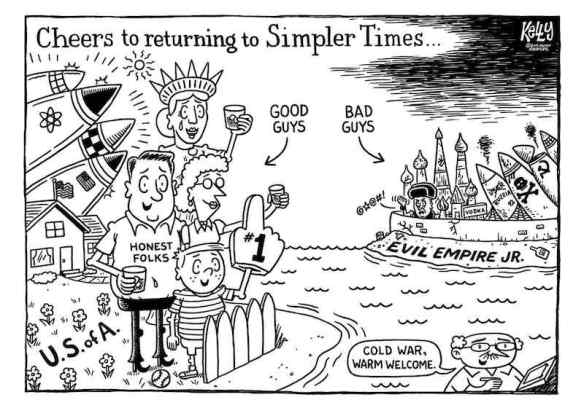
kelly-cold-war

By Philip Giraldi

Source: Unz Review

Liberals are supposed to be antiwar, right? I went to college in the 1960s, when students nationwide were rising up in opposition to the Vietnam War. I was a Young Republican back then and supported the war through sheer ignorance and dislike of the sanctimoniousness of the protesters, some of whom were surely making their way to Canada to live in exile on daddy’s money while I was on a bus going to Fort Leonard Wood for basic combat training. I can’t even claim that I had some grudging respect for the antiwar crowd because I didn’t, but I did believe that at least some of them who were not being motivated by being personally afraid of getting hurt were actually sincere in their opposition to the awful things that were happening in Southeast Asia.

As I look around now, however, I see something quite different. The lefties I knew in college are now part of the Establishment and generally speaking are retired limousine liberals. And they now call themselves progressives, of course, because it sounds more educated and sends a better message, implying as it does that troglodytic conservatives are anti-progress. But they also have done a flip on the issue of war and peace. In its most recent incarnation some of this might be attributed to a desperate desire to relate to the Hillary Clinton campaign with its bellicosity towards Russia, Syria and Iran, but I suspect that the inclination to identify enemies goes much deeper than that, back as far as the Bill Clinton Administration with its sanctions on Iraq and the Balkan adventure, which resulted in hundreds of thousands of deaths and the creation of a terror-narco state in the heart of Europe. And more recently we have seen the Obama meddling in Libya, Yemen and Syria in so called humanitarian interventions which have turned out to be largely fraudulent. Yes, under the Obama Dems it was “responsibility to protect time” (r2p) and all the world trembled as the drones were let loose.

Last Friday I started to read an op-ed in The Washington Post by David Ignatius that blew me away. It began “President Trump confronts complicated problems as the investigation widens into Russia’s attack on our political system.” It then proceeded to lay out the case for an “aggressive Russia” in the terms that have been repeated ad nauseam in the mainstream media. And it was, of course, lacking in any evidence, as if the opinions of coopted journalists and the highly politicized senior officials in the intelligence community should be regarded as sacrosanct. These are, not coincidentally, the same people who have reportedly recently been working together to undercut the White House by leaking and then reporting highly sensitive transcripts of phone calls with Russian officials.

Ignatius is well plugged into the national security community and inclined to be hawkish but he is also a typical Post politically correct progressive on most issues. So here was your typical liberal asserting something in a dangerous fashion that has not been demonstrated and might be completely untrue. Russia is attacking “our political system!” And The Post is not alone in accepting that Russia is trying to subvert and ultimately overthrow our republic. Reporting from The New York Times and on television news makes the same assumption whenever they discuss Russia, leading to what some critics have described as mounting American ‘hysteria’ relating to anything coming out of Moscow.

Rachel Maddow is another favorite of mine when it comes to talking real humanitarian feel good stuff out one side of her mouth while beating the drum for war from the other side. In a bravura performance on January 26th she roundly chastised Russia and its president Vladimir Putin. Rachel, who freaked out completely when Donald Trump was elected, is now keen to demonstrate that Trump has been corrupted by Russia and is now controlled out of the Kremlin. She described Trump’s lord and master Putin as an “intense little man” who murders his opponents before going into the whole “Trump stole the election with the aid of Moscow” saga, supporting sanctions on Russia and multiple investigations to get to the bottom of “Putin’s attacks on our democracy.” Per Maddow, Russia is the heart of darkness and, by way of Trump, has succeeded in exercising control over key elements in the new administration.

Unfortunately, people in the media like Ignatius and Maddow are not alone. Their willingness to sell a specific political line that carries with it a risk of nuclear war as fact, even when they know it is not, has been part of the fear-mongering engaged in by Democratic Party loyalists and many others on the left. Their intention is to “get Trump” whatever it takes, which opens the door to some truly dangerous maneuvering that could have awful consequences if the drumbeat and military buildup against Russia continues, leading Putin to decide that his country is being threatened and backed into a corner. Moscow has indicated that it would not hesitate use nuclear weapons if it is being confronted militarily and facing defeat.

The current wave of Russophobia is much more dangerous than the random depiction of foreigners in negative terms that has long bedeviled a certain type of American know-nothing politics. Apart from the progressive antipathy towards Putin personally, there is a virulent strain of anti-Russian sentiment among some self-styled conservatives in congress, best exemplified by Senators John McCain and Lindsey Graham. Graham has recently said “2017 is going to be a year of kicking Russia in the ass in Congress.”

It is my belief that many in the National Security State have convinced themselves that Russia is indeed a major threat against the United States and not because it is a nuclear armed power that can strike the U.S. That appreciation, should, if anything constitute a good reason to work hard to maintain cordial relations rather than not, but it is seemingly ignored by everyone but Donald Trump.

No, the new brand of Russophobia derives from the belief that Moscow is “interfering” in places like Syria and Ukraine. Plus, it is a friend of Iran. That perception derives from the consensus view among liberals and conservatives alike that the U.S. sphere of influence encompasses the entire globe as well as the particularly progressive conceit that Washington should serve to “protect” anyone threatened at any time by anyone else, which provides a convenient pretext for military interventions that are euphemistically described as “peace missions.”

There might be a certain cynicism in many who hate Russia as having a powerful enemy also keeps the cash flowing from the treasuring into the pockets of the beneficiaries of the military industrial congressional complex, but my real fear is that, having been brainwashed for the past ten years, many government officials are actually sincere in their loathing of Moscow and all its works. Recent opinion polls suggest that that kind of thinking is popular among Americans, but it actually makes no sense. Though involvement by Moscow in the Middle East and Eastern Europe is undeniable, calling it a threat against U.S. vital interests is more than a bit of a stretch as Russia’s actual ability to make trouble is limited. It has exactly one overseas military facility, in Syria, while the U.S. has more than 800, and its economy and military budget are tiny compared to that of the United States. In fact, it is Washington that is most guilty of intervening globally and destabilizing entire regions, not Moscow, and when Donald Trump said in an interview that when it came to killing the U.S. was not so innocent it was a gross understatement.

Ironically, pursuing a reset with Russia is one of the things that Trump actually gets right but the new left won’t give him a break because they reflexively hate him for not embracing the usual progressive bromides that they believe are supposed to go with being antiwar. Other Moscow trashing comes from the John McCain camp which demonizes Russia because warmongers always need an enemy and McCain has never found a war he couldn’t support. It would be a tragedy for the United States if both the left and enough of the right were to join forces to limit Trump’s options on dealing with Moscow, thereby enabling an escalating conflict that could have tragic consequences for all parties.

Nationalist Propaganda has Many Progressives Demonizing ‘The Russians’

79deb5d0f06719de3743bb630d314563

By Robert Barsocchini

Source: Washington’s Blog

Neocon and neoliberal war propaganda, as exhibited in the Washington Post, New York Times, etc., “has turned much of the liberal/progressive community” in the US “into a pro-New Cold War constituency willing to engage in a new breed of McCarthyism”, Robert Parry notes today.  (This author has personally witnessed similar displays.)

Leading Russia expert Stephen Cohen, a professor at Princeton, observes there has been a possibly ‘unprecedented’ ‘propaganda’ ‘tsunami’ occurring in the US targeting Russia and Putin and increasing the already high risk of nuclear war. (The Nation)  This predates the election and the “unproven allegations that Putin had intervened … to put Trump in the White House”, and largely stems from Russia’s intervention at the behest of the Syrian government to prevent the Western-sponsored overthrow of the Syrian state by what US officials privately say is an insurgency dominated by Islamic terrorists being funded by US-backed Saudi dictator Salman bin Abdulaziz’s cadre and similar parties.

Jeff McMahan, a philosopher at Rutgers, notes of the kind of propaganda observed by Cohen that “the powerful sense of collective identity within a nation is often achieved by contrasting an idealized conception of the national character with caricatures of other nations, whose members are regarded as less important or worthy or, in many cases, are dehumanized and despised as inferior or even odious.”  As Parry noted last week, another example of this is the Washington establishment doctrine, partially a holdover from eugenics scholarship and largely a PR tactic serving overtly stated goals of hegemonic expansion, that Russia as a nation is so inferior that any “equivalence” between it and the US is impossible.

However, the world outside the US doctrinal system sees the matter somewhat differently.  In a Western-run global poll taken during the height of the ongoing Ukraine crisis, the international community considered both Russia and the US, along with other countries, for the title of “greatest threat to world peace”.  The US was voted greatest threat by far, receiving twelve times more votes than Russia and three times more votes than the runner-up, Pakistan.

As author David Swanson recently noted in Foreign Policy Journal, in the 95% of the world that is not the US, it is scarcely a secret “that the United States is (as that Putin stooge Martin Luther King Jr. put it) the greatest purveyor of violence on earth. The United States is the top weapons dealer, the top weapons buyer, the biggest military spender, the most widespread imperial presence, the most frequent war maker, the most prolific overthrower of governments, and from 1945 to 2017 the killer of the most people through war.”

McMahan continues: “When nationalist solidarity is maintained” through the type of nationalism described above (which includes keeping much of what Swanson describes secret from or distorting it for the domestic population) “the result is often brutality and atrocity on an enormous scale.”  The Bulletin of Atomic Scientists, which includes respected thinkers and sponsors such as Stephen Hawking, notes the world is at an extremely dangerous moment in terms of the potential for nuclear war, and has set its “doomsday clock” to three minutes to midnight.

Somewhat similar to gang membership, nationalism, McMahan concludes, provides people with “a sense of security and belonging and, by merging their individual identities into the larger national identity, enables them to expand the boundaries of the self, thereby enhancing their self-esteem.

“[W]hile nationalist sentiment may have beneficial effects within the nation, these are greatly outweighed from an impartial point of view by the dreadful effects that it has on relations between nations.”*


Robert J. Barsocchini is an independent researcher and reporter whose interest in propaganda and global force dynamics arose from working as a cross-cultural intermediary for large corporations in the film and Television industry. His work has been cited, published, or followed by numerous professors, economists, lawyers, military and intelligence veterans, and journalists. Updates on Twitter.

*McMahan, Jeff. The Ethics of Killing: Problems at the Margins of Life. 6th ed. New York: Oxford University Press, 2002. Pp 221. Print.

We Have Met the Alien and He Is Us

73e633dab43437b78c926c0403c06bcc

By William Astore

Source: TomDispatch.com

We Are The Empire
Of U.S. Military Interventions, Alien Disaster Movies, and Star Wars
By William J. Astore

Perhaps you’ve heard the expression: “We have met the enemy and he is us.” Cartoonist Walt Kelly’s famed possum, Pogo, first uttered that cry. In light of alien disaster movies like the recent sequel Independence Day: Resurgence and America’s disastrous wars of the twenty-first century, I’d like to suggest a slight change in that classic phrase: we have met the alien and he is us.

Allow me to explain. I grew up reading and watching science fiction with a fascination that bordered on passion. In my youth, I also felt great admiration for the high-tech, futuristic nature of the U.S. military. When it came time for college, I majored in mechanical engineering and joined the U.S. Air Force. On graduating, I would immediately be assigned to one of the more high-tech, sci-fi-like (not to say apocalyptic) military settings possible: Air Force Space Command’s Cheyenne Mountain.

For those of you who don’t remember the looming, end-of-everything atmosphere of the Cold War era, Cheyenne Mountain was a nuclear missile command center tunneled out of solid granite inside an actual mountain in Colorado. In those days, I saw myself as one of the good guys, protecting America from “alien” invasions and the potential nuclear obliteration of the country at the hands of godless communists from the Soviet Union. The year was 1985 and back then my idea of an “alien” invasion movie was Red Dawn, a film in which the Soviets and their Cuban allies invade the U.S., only to be turned back by a group of wolverine-like all-American teen rebels. (Think: the Vietcong, American-style, since the Vietnam War was then just a decade past.)

Strange to say, though, as I progressed through the military, I found myself growing increasingly uneasy about my good-guy stature and about who exactly was doing what to whom. Why, for example, did we invade Iraq in 2003 when that country had nothing to do with the attacks of 9/11? Why were we so focused on dominating the Earth’s resources, especially its oil? Why, after declaring total victory over the “alien” commies in 1991 and putting the Cold War to bed for forever (or so it seemed then), did our military continue to strive for “global reach, global power” and what, with no sense of overreach or irony, it liked to call “full-spectrum dominance”?

Still, whatever was simmering away inside me, only when I retired from the Air Force in 2005 did I fully face what had been staring back at me all those years: I had met the alien, and he was me.

The Alien Nature of U.S. Military Interventions

The latest Independence Day movie, despite earning disastrous reviews, is probably still rumbling its way through a multiplex near you. The basic plot hasn’t changed: ruthless aliens from afar (yet again) invade, seeking to exploit our precious planet while annihilating humanity (something that, to the best of our knowledge, only we are actually capable of). But we humans, in such movies as in reality, are a resilient lot. Enough of the plucky and the lucky emerge from the rubble to organize a counterattack. Despite being outclassed by the aliens’ shockingly superior technology and awe-inspiring arsenal of firepower, humanity finds a way to save the Earth while — you won’t be surprised to know — thoroughly thrashing said aliens.

Remember the original Independence Day from two decades ago? Derivative and predictable it may have been, but it was also a campy spectacle — with Will Smith’s cigar-chomping military pilot, Bill Pullman’s kickass president in a cockpit, and the White House being blown to smithereens by those aliens. That was 1996. The Soviet Union was half-a-decade gone and the U.S. was the planet’s “sole superpower.” Still, who knew that seven years later, on the deck of an aircraft carrier, an all-too-real American president would climb out of a similar cockpit in a flight suit, having essentially just blown part of the Middle East to smithereens, and declare his very own “mission accomplished” moment?

In the aftermath of the invasion of Afghanistan and the “shock and awe” assault on Iraq, the never-ending destructiveness of the wars that followed, coupled with the U.S. government’s deployment of deadly robotic drones and special ops units across the globe, alien invasion movies aren’t — at least for me — the campy fun they once were, and not just because the latest of them is louder, dumber, and more cliché-ridden than ever. I suspect that there’s something else at work as well, something that’s barely risen to consciousness here: in these years, we’ve morphed into the planet’s invading aliens.

Think about it. Over the last half-century, whenever and wherever the U.S. military “deploys,” often to underdeveloped towns and villages in places like Vietnam, Afghanistan, or Iraq, it arrives very much in the spirit of those sci-fi aliens. After all, it brings with it dazzlingly destructive futuristic weaponry and high-tech gadgetry of all sorts (known in the military as “force-multipliers”). It then proceeds to build mothership-style bases that are often like American small towns plopped down in a new environment. Nowadays in such lands, American drones patrol the skies (think: the Terminator films), blast walls accented with razor wire and klieg lights provide “force protection” on the ground, and the usual attack helicopters, combat jets, and gunships hover overhead like so many alien craft. To designate targets to wipe out, U.S. forces even use lasers!

In the field, American military officers emerge from high-tech vehicles to bark out commands in a harsh “alien” tongue. (You know: English.) Even as American leaders offer reassuring words to the natives (and to the public in “the homeland”) about the U.S. military being a force for human liberation, the message couldn’t be more unmistakable if you happen to be living in such countries: the “aliens” are here, and they’re planning to take control, weapons loaded and ready to fire.

Other U.S. military officers have noticed this dynamic. In 2004, near Samarra in Iraq’s Salahuddin province, for instance, then-Major Guy Parmeter recalled asking a farmer if he’d “seen any foreign fighters” about. The farmer’s reply was as simple as it was telling: “Yes, you.” Parmeter noted, “You have a bunch of epiphanies over the course of your experience here [in Iraq], and it made me think: How are we perceived, who are we to them?”

Americans may see themselves as liberators, but to the Iraqis and so many other peoples Washington has targeted with its drones, jets, and high-tech weaponry, we are the invaders.

Do you recall what the aliens were after in the first Independence Day movie? Resources. In that film, they were compared to locusts, traveling from planet to planet, stripping them of their valuables while killing their inhabitants. These days, that narrative should sound a lot less alien to us. After all, would Washington have committed itself quite so fully to the Greater Middle East if it hadn’t possessed all that oil so vital to our consumption-driven way of life? That’s what the Carter Doctrine of 1980 was about: it defined the Persian Gulf as a U.S. “vital interest” precisely because, to quote former Deputy Secretary of Defense Paul Wolfowitz’s apt description of Iraq, it “floats on a sea of oil.”

Of Cold War Memories and Imperial Storm Troopers

Whether anyone notices or not, alien invasion flicks offer a telling analogy when it comes to the destructive reality of Washington’s global ambitions; so, too, do “space operas” like Star Wars. I’m a fan of George Lucas’s original trilogy, which appeared in my formative years. When I saw them in the midst of the Cold War, I never doubted that Darth Vader’s authoritarian Empire in a galaxy far, far away was the Soviet Union. Weren’t the Soviets, whom President Ronald Reagan would dub “the evil empire,” bent on imperial domination? Didn’t they have the equivalent of storm troopers, and wasn’t it our job to “contain” that threat?

Like most young Americans then, I saw myself as a plucky rebel, a mixture of the free-wheeling, wisecracking Han Solo and the fresh-faced, idealistic Luke Skywalker. Of course, George Lucas had a darker, more complex vision in mind, one in which President Richard Nixon, not some sclerotic Soviet premier, provided a model for the power-mad emperor, while the lovable Ewoks in The Return of the Jedi — with their simple if effective weaponry and their anti-imperial insurgent tactics — were clearly meant to evoke Vietnamese resistance forces in an American war that Lucas had loathed. But few enough Americans of the Cold War-era thought in such terms. (I didn’t.) It went without question that we weren’t the heartless evil empire. We were the Jedi! And metaphorically speaking, weren’t we the ones who, in the end, blew up the Soviet Death Star and won the Cold War?

How, then, did an increasingly gargantuan Pentagon become the Death Star of our moment? We even had our own Darth Vader in Dick Cheney, a vice president who actually took pride in the comparison.

Think for a moment, dear reader, about the optics of a typical twenty-first-century U.S. military intervention. As our troops deploy to places that for most Americans might as well be in a galaxy far, far away, with all their depersonalizing body armor and high-tech weaponry, they certainly have the look of imperial storm troopers.

I’m hardly the first person to notice this. As Iraq war veteran Roy Scranton recently wrote in the New York Times, “I was the faceless storm trooper, and the scrappy rebels were the Iraqis.” Ouch.

American troops in that country often moved about in huge MRAPs (mine-resistant, ambush-protected vehicles) described to me by an Army battalion commander as “ungainly” and “un-soldier like.” Along with M1 Abrams tanks and Bradley fighting vehicles, those MRAPs were the American equivalents of the Imperial Walkers in Star Wars. Such vehicles, my battalion commander friend noted drolly, were “not conducive to social engagements with Iraqis.”

It’s not the fault of the individual American soldier that, in these years, he’s been outfitted like a Star Wars storm trooper. His equipment is designed to be rugged and redundant, meaning difficult to break, but it comes at a cost. In Iraq, U.S. troops were often encased in 80 to 100 pounds of equipment, including a rifle, body armor, helmet, ammunition, water, radio, batteries, and night-vision goggles. And, light as they are, let’s not forget the ominous dark sunglasses meant to dim the glare of Iraq’s foreign sun.

Now, think how that soldier appeared to ordinary Iraqis — or Afghans, Yemenis, Libyans, or almost any other non-Western people. Wouldn’t he or she seem both intimidating and foreign, indeed, hostile and “alien,” especially while pointing a rifle at you and jabbering away in a foreign tongue? Of course, in Star Wars terms, it went both ways in Iraq. A colleague told me that during her time there, she heard American troops refer to Iraqis as “sand people,” the vicious desert raiders and scavengers of Star Wars. If “they” seem like vicious aliens to us, should we be surprised that we just might seem that way to them?

Meanwhile, consider the American enemy, whether the Taliban, al-Qaeda, or any of our other opponents of this era. Typically unburdened by heavy armor and loads of equipment, they move around in small bands, improvising as they go. Such “terrorists” — or “freedom fighters,” take your pick — more closely resemble (optically, at least) the plucky human survivors of Independence Day or the ragtag yet determined rebels of Star Wars than heavy patrols of U.S. troops do.

Now, think of the typical U.S. military response to the nimbleness and speed of such “rebels.” It usually involves deploying yet more and bigger technologies. The U.S. has even sent its version of Imperial Star Destroyers (we call them B-52s) to Syria and Iraq to take out “rebels” riding their version of Star Wars “speeders” (i.e. Toyota trucks).

To navigate and negotiate the complex “human terrain” (actual U.S. Army term) of “planets” like Iraq and Afghanistan, U.S. troops call on a range of space-age technologies, including direction-finding equipment, signal intercept, terrain modeling, and satellite navigation using GPS. The enemy, being part of that “human terrain,” has little need for such technology to “master” it. Since understanding alien cultures and their peculiar “human terrains” is not its forte, the U.S. military has been known to hire anthropologists to help it try to grasp the strange behaviors of the peoples of Planet Iraq and Planet Afghanistan.

Yet unlike the evil empire of Star Wars or the ruthless aliens of Independence Day, the U.S. military never claimed to be seeking total control (or destruction) of the lands it invaded, nor did it claim to desire the total annihilation of their populations (unless you count the “carpet bombing” fantasies of wannabe Sith Lord Ted Cruz). Instead, it promised to leave quickly once its liberating mission was accomplished, taking its troops, attack craft, and motherships with it.

After 15 years and counting on Planet Afghanistan and 13 on Planet Iraq, tell me again how those promises have played out.

In a Galaxy Far, Far Away

Consider it an irony of alien disaster movies that they manage to critique U.S. military ambitions vis-à-vis the “primitive” natives of far-off lands (even if none of us and few of the filmmakers know it). Like it or not, as the world’s sole superpower, dependent on advanced technology to implement its global ambitions, the U.S. provides a remarkably good model for the imperial and imperious aliens of our screen life.

We Americans, proud denizens of the land of the gun and of the only superpower left standing, don’t, of course, want to think of ourselves as aliens. Who does? We go to movies like Independence Day or Star Wars to identify with the outgunned rebels. Evidence to the contrary, we still think of ourselves as the underdogs, the rebels, the liberators. And so — I still believe — we once were, a long time ago in a galaxy far, far away.

We need to get back to that time and that galaxy. But we don’t need a high-tech time machine or sci-fi wormhole to do so. Instead, we need to take a long hard look at ourselves. Like Pogo, we need to be willing to see the evidence of our own invasive nature. Only then can we begin to become the kind of land we say we want to be.


A TomDispatch regular, William Astore is a retired lieutenant colonel (USAF) and history professor. He blogs at Bracing Views.