Rule by Criminals: When Dissidents Become Enemies of the State

By John & Nisha Whitehead

Source: The Rutherford Institute

In these days of worldwide confusion, there is a dire need for men and women who will courageously do battle for truth.”— Martin Luther King Jr.

When exposing a crime is treated as committing a crime, you are being ruled by criminals.

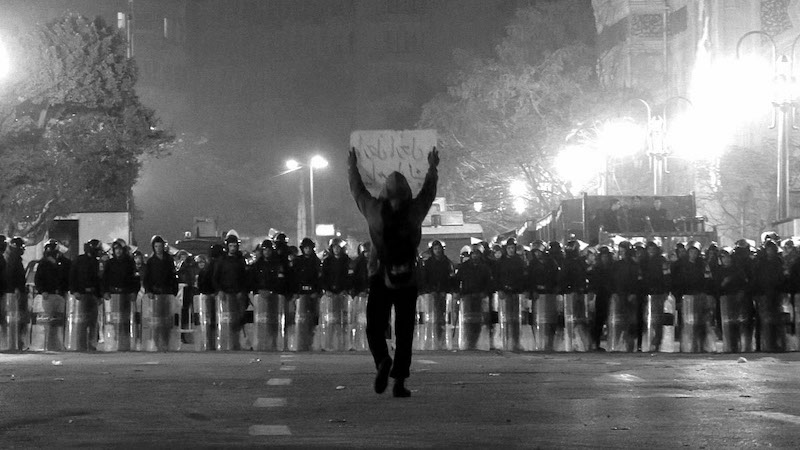
In the current governmental climate, obeying one’s conscience and speaking truth to the power of the police state can easily render you an “enemy of the state.”

The government’s list of so-called “enemies of the state” is growing by the day.

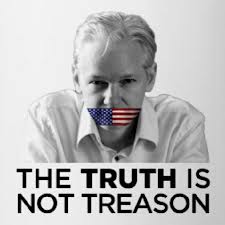
Wikileaks founder Julian Assange is merely one of the most visible victims of the police state’s war on dissidents and whistleblowers.

Five years ago, on April 11, 2019, police arrested Assange for daring to access and disclose military documents that portray the U.S. government and its endless wars abroad as reckless, irresponsible, immoral and responsible for thousands of civilian deaths.

Included among the leaked materials was gunsight video footage from two U.S. AH-64 Apache helicopters engaged in a series of air-to-ground attacks while American air crew laughed at some of the casualties. Among the casualties were two Reuters correspondents who were gunned down after their cameras were mistaken for weapons and a driver who stopped to help one of the journalists. The driver’s two children, who happened to be in the van at the time it was fired upon by U.S. forces, suffered serious injuries.

There is nothing defensible about crimes such as these perpetrated by the government.

When any government becomes almost indistinguishable from the evil it claims to be fighting—whether that evil takes the form of war, terrorism, torture, drug trafficking, sex trafficking, murder, violence, theft, pornography, scientific experimentations or some other diabolical means of inflicting pain, suffering and servitude on humanity—that government has lost its claim to legitimacy.

These are hard words, but hard times require straight-talking.

It is easy to remain silent in the face of evil.

What is harder—what we lack today and so desperately need—are those with moral courage who will risk their freedoms and lives in order to speak out against evil in its many forms.

Throughout history, individuals or groups of individuals have risen up to challenge the injustices of their age. Nazi Germany had its Dietrich Bonhoeffer. The gulags of the Soviet Union were challenged by Aleksandr Solzhenitsyn. America had its color-coded system of racial segregation and warmongering called out for what it was, blatant discrimination and profiteering, by Martin Luther King Jr.

And then there was Jesus Christ, an itinerant preacher and revolutionary activist, who not only died challenging the police state of his day—namely, the Roman Empire—but provided a blueprint for civil disobedience that would be followed by those, religious and otherwise, who came after him.

Indeed, it is fitting that we remember that Jesus Christ—the religious figure worshipped by Christians for his death on the cross and subsequent resurrection—paid the ultimate price for speaking out against the police state of his day.

A radical nonconformist who challenged authority at every turn, Jesus was a far cry from the watered-down, corporatized, simplified, gentrified, sissified vision of a meek creature holding a lamb that most modern churches peddle. In fact, he spent his adult life speaking truth to power, challenging the status quo of his day, and pushing back against the abuses of the Roman Empire.

Much like the American Empire today, the Roman Empire of Jesus’ day had all of the characteristics of a police state: secrecy, surveillance, a widespread police presence, a citizenry treated like suspects with little recourse against the police state, perpetual wars, a military empire, martial law, and political retribution against those who dared to challenge the power of the state.

For all the accolades poured out upon Jesus, little is said about the harsh realities of the police state in which he lived and its similarities to modern-day America, and yet they are striking.

Secrecy, surveillance and rule by the elite. As the chasm between the wealthy and poor grew wider in the Roman Empire, the ruling class and the wealthy class became synonymous, while the lower classes, increasingly deprived of their political freedoms, grew disinterested in the government and easily distracted by “bread and circuses.” Much like America today, with its lack of government transparency, overt domestic surveillance, and rule by the rich, the inner workings of the Roman Empire were shrouded in secrecy, while its leaders were constantly on the watch for any potential threats to its power. The resulting state-wide surveillance was primarily carried out by the military, which acted as investigators, enforcers, torturers, policemen, executioners and jailers. Today that role is fulfilled by the NSA, the FBI, the Department of Homeland Security and the increasingly militarized police forces across the country.

Widespread police presence. The Roman Empire used its military forces to maintain the “peace,” thereby establishing a police state that reached into all aspects of a citizen’s life. In this way, these military officers, used to address a broad range of routine problems and conflicts, enforced the will of the state. Today SWAT teams, comprised of local police and federal agents, are employed to carry out routine search warrants for minor crimes such as marijuana possession and credit card fraud.

Citizenry with little recourse against the police state. As the Roman Empire expanded, personal freedom and independence nearly vanished, as did any real sense of local governance and national consciousness. Similarly, in America today, citizens largely feel powerless, voiceless and unrepresented in the face of a power-hungry federal government. As states and localities are brought under direct control by federal agencies and regulations, a sense of learned helplessness grips the nation.

Perpetual wars and a military empire. Much like America today with its practice of policing the world, war and an over-arching militarist ethos provided the framework for the Roman Empire, which extended from the Italian peninsula to all over Southern, Western, and Eastern Europe, extending into North Africa and Western Asia as well. In addition to significant foreign threats, wars were waged against inchoate, unstructured and socially inferior foes.

Martial law. Eventually, Rome established a permanent military dictatorship that left the citizens at the mercy of an unreachable and oppressive totalitarian regime. In the absence of resources to establish civic police forces, the Romans relied increasingly on the military to intervene in all matters of conflict or upheaval in provinces, from small-scale scuffles to large-scale revolts. Not unlike police forces today, with their martial law training drills on American soil, militarized weapons and “shoot first, ask questions later” mindset, the Roman soldier had “the exercise of lethal force at his fingertips” with the potential of wreaking havoc on normal citizens’ lives.

A nation of suspects. Just as the American Empire looks upon its citizens as suspects to be tracked, surveilled and controlled, the Roman Empire looked upon all potential insubordinates, from the common thief to a full-fledged insurrectionist, as threats to its power. The insurrectionist was seen as directly challenging the Emperor.  A “bandit,” or revolutionist, was seen as capable of overturning the empire, was always considered guilty and deserving of the most savage penalties, including capital punishment. Bandits were usually punished publicly and cruelly as a means of deterring others from challenging the power of the state.  Jesus’ execution was one such public punishment.

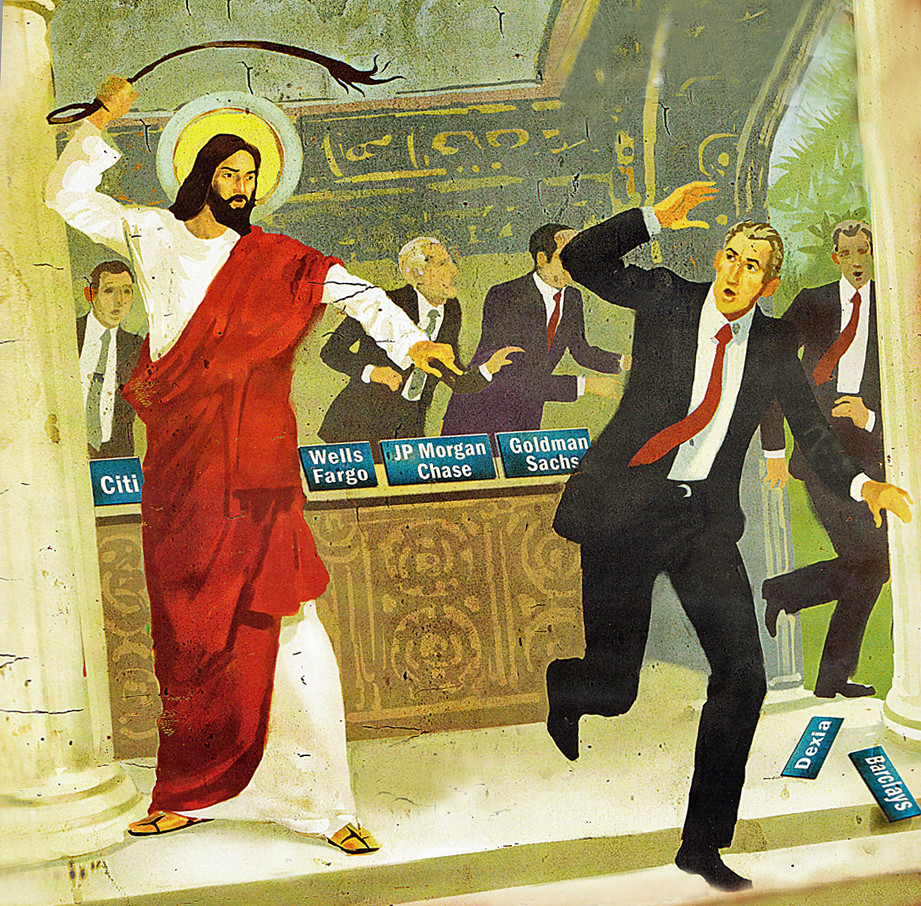
Acts of civil disobedience by insurrectionists. Much like the Roman Empire, the American Empire has exhibited zero tolerance for dissidents such as Julian Assange, Edward Snowden and Chelsea Manning who exposed the police state’s seedy underbelly. Jesus was also branded a political revolutionary starting with his attack on the money chargers and traders at the Jewish temple, an act of civil disobedience at the site of the administrative headquarters of the Sanhedrin, the supreme Jewish council.

Military-style arrests in the dead of night. Jesus’ arrest account testifies to the fact that the Romans perceived Him as a revolutionary. Eerily similar to today’s SWAT team raids, Jesus was arrested in the middle of the night, in secret, by a large, heavily armed fleet of soldiers.  Rather than merely asking for Jesus when they came to arrest him, his pursuers collaborated beforehand with Judas. Acting as a government informant, Judas concocted a kiss as a secret identification marker, hinting that a level of deception and trickery must be used to obtain this seemingly “dangerous revolutionist’s” cooperation. 

Torture and capital punishment. In Jesus’ day, religious preachers, self-proclaimed prophets and nonviolent protesters were not summarily arrested and executed. Indeed, the high priests and Roman governors normally allowed a protest, particularly a small-scale one, to run its course. However, government authorities were quick to dispose of leaders and movements that appeared to threaten the Roman Empire. The charges leveled against Jesus—that he was a threat to the stability of the nation, opposed paying Roman taxes and claimed to be the rightful King—were purely political, not religious. To the Romans, any one of these charges was enough to merit death by crucifixion, which was usually reserved for slaves, non-Romans, radicals, revolutionaries and the worst criminals.

Jesus was presented to Pontius Pilate “as a disturber of the political peace,” a leader of a rebellion, a political threat, and most gravely—a claimant to kingship, a “king of the revolutionary type.” After Jesus is formally condemned by Pilate, he is sentenced to death by crucifixion, “the Roman means of executing criminals convicted of high treason.”  The purpose of crucifixion was not so much to kill the criminal, as it was an immensely public statement intended to visually warn all those who would challenge the power of the Roman Empire. Hence, it was reserved solely for the most extreme political crimes: treason, rebellion, sedition, and banditry. After being ruthlessly whipped and mocked, Jesus was nailed to a cross.

Jesus—the revolutionary, the political dissident, and the nonviolent activist—lived and died in a police state. Any reflection on Jesus’ life and death within a police state must take into account several factors: Jesus spoke out strongly against such things as empires, controlling people, state violence and power politics. Jesus challenged the political and religious belief systems of his day. And worldly powers feared Jesus, not because he challenged them for control of thrones or government but because he undercut their claims of supremacy, and he dared to speak truth to power in a time when doing so could—and often did—cost a person his life.

Unfortunately, the radical Jesus, the political dissident who took aim at injustice and oppression, has been largely forgotten today, replaced by a congenial, smiling Jesus trotted out for religious holidays but otherwise rendered mute when it comes to matters of war, power and politics.

Yet for those who truly study the life and teachings of Jesus, the resounding theme is one of outright resistance to war, materialism and empire.

What a marked contrast to the advice being given to Americans by church leaders to “submit to your leaders and those in authority,” which in the American police state translates to complying, conforming, submitting, obeying orders, deferring to authority and generally doing whatever a government official tells you to do.

Telling Americans to blindly obey the government or put their faith in politics and vote for a political savior flies in the face of everything for which Jesus lived and died.

Will we follow the path of least resistance—turning a blind eye to the evils of our age and marching in lockstep with the police state—or will we be transformed nonconformists “dedicated to justice, peace, and brotherhood”?

As Martin Luther King Jr. reminds us in a powerful sermon delivered 70 years ago, “This command not to conform comes … [from] Jesus Christ, the world’s most dedicated nonconformist, whose ethical nonconformity still challenges the conscience of mankind.”

Ultimately, as I make clear in my book Battlefield America: The War on the American People and in its fictional counterpart The Erik Blair Diaries, this is the contradiction that must be resolved if the radical Jesus—the one who stood up to the Roman Empire and was crucified as a warning to others not to challenge the powers-that-be—is to be an example for our modern age.

Strategic Resistance to the World Economic Forum’s “Great Reset” Gathers Pace

By Robert J. Burrowes and Anita McKone

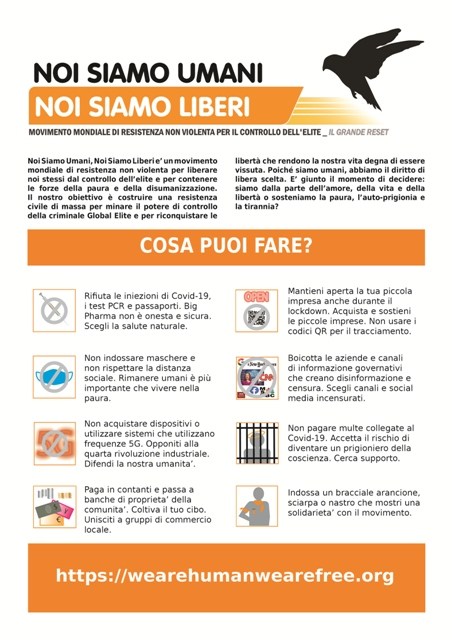
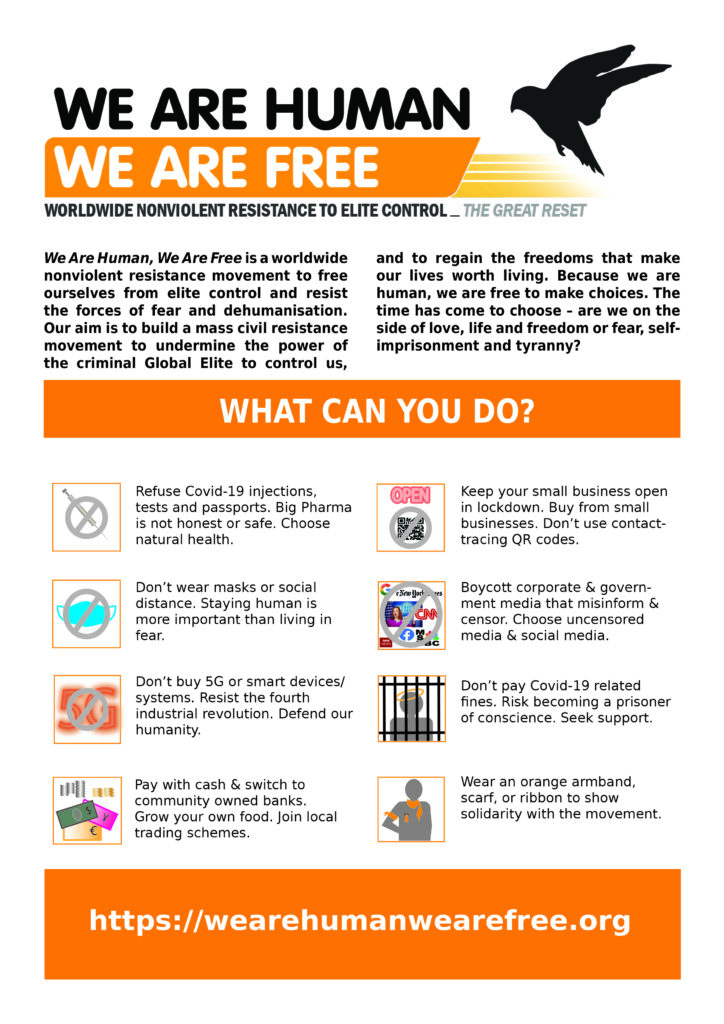
The ‘We Are Human, We Are Free’ campaign was launched earlier this year. It is designed to enable people to participate in a grassroots nonviolent campaign to strategically resist the World Economic Forum’s ‘Great Reset’ and related initiatives of the Global Elite including the transhumanist, eugenics and Cyber Polygon agendas.

Since being launched, people have been joining from all over the world.

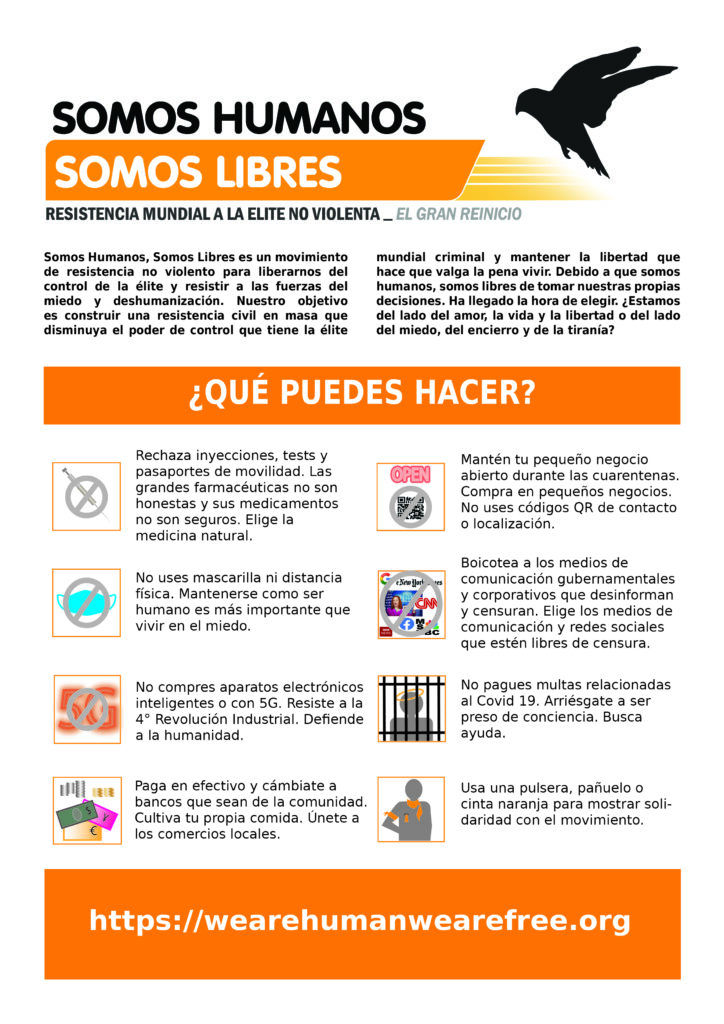
A key initiative of the campaign was to prepare and design a one-page flyer so that people could be given, by various means, a short list of nonviolent actions that offered a series of simple but powerfully effective ways in which anyone could participate in the strategy to defeat the elite agenda.

With the invaluable assistance of members of the campaign from around the world, translations of this one-page flyer are now available in English, Finnish, French, German, Greek, Hungarian, Italian and Spanish with other languages imminent or in the pipeline.

If this campaign interests you, the website is above and our Telegram group is here.

Each of the posters is available on the website or below.

You are welcome to join us!

Biodata:

Robert Burrowes, Ph.D. is a member of the TRANSCEND Network for Peace Development Environment and has a lifetime commitment to understanding and ending human violence. He has done extensive research since 1966 in an effort to understand why human beings are violent and has been a nonviolent activist since 1981. He is the author of Why Violence? Websites: (We Are Human, We Are Free) (Charter)  (Flame Tree Project)  (Songs of Nonviolence) (Nonviolent Campaign Strategy) (Nonviolent Defense/Liberation Strategy(Robert J. Burrowes) (Feelings First) Email: flametree@riseup.net

Anita McKone is a member of the TRANSCEND Network for Peace Development Environment and has been a nonviolent activist since 1993. She has been arrested and imprisoned on a number of occasions for her activism. Anita has written many articles on different aspects of nonviolent activism, psychology and philosophy including Fearless Psychology and Fearful Psychology: Principles and Practice. She has also written and recorded eight ‘Songs of Nonviolence’.

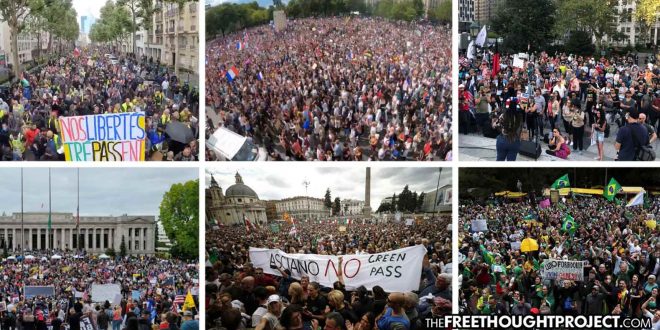
Corporate Media Largely Silent as Millions Protest Vaccine Mandates Worldwide

By Matt Agorist

Source: The Free Thought Project

When protests in the United States happen that help the establishment in some way, whether by stoking divide or pushing an establishment agenda, corporate media is all over them, bombarding us with news of packed streets. However, when massive crowds take to the streets to have their anti-establishment voices heard, it’s crickets on FOXSNBCNN.

Such is the case recently as millions of people across the world have taken to the streets to protest the draconian laws which segregate society and deprive people of their freedoms over their choice in taking a vaccine they may not even need.

Such is the case recently as millions of people across the world have taken to the streets to protest the draconian laws which segregate society and deprive people of their freedoms over their choice in taking a vaccine they may not even need.

One place, in particular, that is currently seeing massive protests is Italy whose government just passed the strictest vaccine mandate in Europe. Starting on October 15, Italy begins enforcing the new workplace green pass requirement. If employees cannot show proof of vaccination, they will not be allowed to go to work nor will they be able to enter any public places like restaurants, theaters, gyms, etc.

If an Italian citizen misses five days of work by failing to comply with the new mandate, the government forces their employer to stop paying them. If employees are caught working without a green pass, the state will extort them to the tune of $2,100 per instance.

Naturally, moves like this have pissed a lot of people off. It is well known now that the antibodies from the covid vaccines fade over time, which is why Israel is now requiring boosters for all of their citizens. It is also well known that immunity from natural infection is far superior to the vaccine.

A person who had the jab back in January and likely has very few antibodies left is considered “green.” However, at the same time, a person who may have caught covid last month and recovered, thereby drastically reducing their ability to catch and spread the disease, is considered a threat and cannot go to work or public places. There is zero logic in these mandates, which prove one thing — they are about control — not your safety.

This is why people are in the streets across the country and all over Europe and Australia. Civil disobedience is their only option left as they are forced out of their jobs, denied entry into public places, and forbidden from travelling.

As the mainstream media refuses to question the idea behind mandating vaccinations, they have made their role clear in this tyranny as enablers. This should come as no surprise either given the money that pours into their coffers from the ones who stand to gain the most from vaccine mandates — big pharma.

As we are currently witnessing with their silence in regard to vaccine mandate protests, it is no secret that the pharmaceutical industry wields immense control over the government, big tech, and the media. It is their control which keeps this and any other negative press about their products from seeing the light of day. However, most people likely do not know the scope of this control.

As Mike Papantonio, attorney and host of the international television show America’s Lawyer, explains, with the exception of CBS, every major media outlet in the United States shares at least one board member with at least one pharmaceutical company. To put that into perspective: These board members wake up, go to a meeting at Merck or Pfizer, then they have their driver take them over to a meeting with NBC to decide what kind of programming that network is going to air.

We have even reported incidents in which reporters have been cut off by the network for mentioning the connection on air. In a clear example of how beholden mainstream media is to the pharmaceutical industries who manufacture and market these drugs, FOX News’ Sean Hannity was recorded in 2018, blatantly cutting off a reporter who dared mention Nikolas Cruz’s reported association with antidepressants.

In the report below, Papantonio explains how the billions of dollars big pharma gives to mainstream media outlets every year is used to keep them subservient and complicit in covering up the slew of deadly side effects from their products.

As we can see with the current censorship and narrative control in regard to those questioning the safety of the COVID-19 vaccines, big pharma wields massive control over the information you are allowed to talk about and consume. Once we zoom out and see the entire situation, it becomes exceedingly evident as to why Facebook, Twitter, YouTube, and the rest of Big Tech, have made it their mission to wipe out any and all content that questions the “official narrative.”

Stand Up to Tyranny: How to Respond to the Evils of Our Age

By John W. Whitehead & Nisha Whitehead

Source: The Rutherford Institute

“The church must be reminded that it is not the master or the servant of the state, but rather the conscience of the state. It must be the guide and the critic of the state, and never its tool. If the church does not recapture its prophetic zeal, it will become an irrelevant social club without moral or spiritual authority.”—Martin Luther King Jr. (A Knock at Midnight, June 11, 1967)

In every age, we find ourselves wrestling with the question of how Jesus Christ—the itinerant preacher and revolutionary activist who died challenging the police state of his time, namely, the Roman Empire—would respond to the moral questions of our day.

For instance, would Jesus advocate, as so many evangelical Christian leaders have done in recent years, for congregants to “submit to your leaders and those in authority,” which in the American police state translates to complying, conforming, submitting, obeying orders, deferring to authority and generally doing whatever a government official tells you to do?

What would Jesus do? 

Study the life and teachings of Jesus, and you may be surprised at how relevant he is to our modern age.

A radical nonconformist who challenged authority at every turn, Jesus spent his adult life speaking truth to power, challenging the status quo of his day, pushing back against the abuses of the Roman Empire, and providing a blueprint for standing up to tyranny that would be followed by those, religious and otherwise, who came after him.

Those living through this present age of government lockdowns, immunity passports, militarized police, SWAT team raids, police shootings of unarmed citizens, roadside strip searches, invasive surveillance and the like might feel as if these events are unprecedented. However, the characteristics of a police state and its reasons for being are no different today than they were in Jesus’ lifetime: control, power and money.

Much like the American Empire today, the Roman Empire of Jesus’ day was characterized by secrecy, surveillance, a widespread police presence, a citizenry treated like suspects with little recourse against the police state, perpetual wars, a military empire, martial law, and political retribution against those who dared to challenge the power of the state.

A police state extends far beyond the actions of law enforcement.  In fact, a police state “is characterized by bureaucracy, secrecy, perpetual wars, a nation of suspects, militarization, surveillance, widespread police presence, and a citizenry with little recourse against police actions.”

Indeed, the police state in which Jesus lived (and died) and its striking similarities to modern-day America are beyond troubling.

Secrecy, surveillance and rule by the elite. As the chasm between the wealthy and poor grew wider in the Roman Empire, the ruling class and the wealthy class became synonymous, while the lower classes, increasingly deprived of their political freedoms, grew disinterested in the government and easily distracted by “bread and circuses.” Much like America today, with its lack of government transparency, overt domestic surveillance, and rule by the rich, the inner workings of the Roman Empire were shrouded in secrecy, while its leaders were constantly on the watch for any potential threats to its power. The resulting state-wide surveillance was primarily carried out by the military, which acted as investigators, enforcers, torturers, policemen, executioners and jailers. Today that role is fulfilled by the NSA, the FBI, the Department of Homeland Security and the increasingly militarized police forces across the country.

Widespread police presence. The Roman Empire used its military forces to maintain the “peace,” thereby establishing a police state that reached into all aspects of a citizen’s life. In this way, these military officers, used to address a broad range of routine problems and conflicts, enforced the will of the state. Today SWAT teams, comprised of local police and federal agents, are employed to carry out routine search warrants for minor crimes such as marijuana possession and credit card fraud.

Citizenry with little recourse against the police state. As the Roman Empire expanded, personal freedom and independence nearly vanished, as did any real sense of local governance and national consciousness. Similarly, in America today, citizens largely feel powerless, voiceless and unrepresented in the face of a power-hungry federal government. As states and localities are brought under direct control by federal agencies and regulations, a sense of learned helplessness grips the nation.

Perpetual wars and a military empire. Much like America today with its practice of policing the world, war and an over-arching militarist ethos provided the framework for the Roman Empire, which extended from the Italian peninsula to all over Southern, Western, and Eastern Europe, extending into North Africa and Western Asia as well. In addition to significant foreign threats, wars were waged against inchoate, unstructured and socially inferior foes.

Martial law. Eventually, Rome established a permanent military dictatorship that left the citizens at the mercy of an unreachable and oppressive totalitarian regime. In the absence of resources to establish civic police forces, the Romans relied increasingly on the military to intervene in all matters of conflict or upheaval in provinces, from small-scale scuffles to large-scale revolts. Not unlike police forces today, with their martial law training drills on American soil, militarized weapons and “shoot first, ask questions later” mindset, the Roman soldier had “the exercise of lethal force at his fingertips” with the potential of wreaking havoc on normal citizens’ lives.

A nation of suspects. Just as the American Empire looks upon its citizens as suspects to be tracked, surveilled and controlled, the Roman Empire looked upon all potential insubordinates, from the common thief to a full-fledged insurrectionist, as threats to its power. The insurrectionist was seen as directly challenging the Emperor.  A “bandit,” or revolutionist, was seen as capable of overturning the empire, was always considered guilty and deserving of the most savage penalties, including capital punishment. Bandits were usually punished publicly and cruelly as a means of deterring others from challenging the power of the state.  Jesus’ execution was one such public punishment.

Acts of civil disobedience by insurrectionists. Starting with his act of civil disobedience at the Jewish temple, the site of the administrative headquarters of the Sanhedrin, the supreme Jewish council, Jesus branded himself a political revolutionary. When Jesus “with the help of his disciples, blocks the entrance to the courtyard” and forbids “anyone carrying goods for sale or trade from entering the Temple,” he committed a blatantly criminal and seditious act, an act “that undoubtedly precipitated his arrest and execution.” Because the commercial events were sponsored by the religious hierarchy, which in turn was operated by consent of the Roman government, Jesus’ attack on the money chargers and traders can be seen as an attack on Rome itself, an unmistakable declaration of political and social independence from the Roman oppression.

Military-style arrests in the dead of night. Jesus’ arrest account testifies to the fact that the Romans perceived Him as a revolutionary. Eerily similar to today’s SWAT team raids, Jesus was arrested in the middle of the night, in secret, by a large, heavily armed fleet of soldiers.  Rather than merely asking for Jesus when they came to arrest him, his pursuers collaborated beforehand with Judas. Acting as a government informant, Judas concocted a kiss as a secret identification marker, hinting that a level of deception and trickery must be used to obtain this seemingly “dangerous revolutionist’s” cooperation. 

Torture and capital punishment. In Jesus’ day, religious preachers, self-proclaimed prophets and nonviolent protesters were not summarily arrested and executed. Indeed, the high priests and Roman governors normally allowed a protest, particularly a small-scale one, to run its course. However, government authorities were quick to dispose of leaders and movements that appeared to threaten the Roman Empire. The charges leveled against Jesus—that he was a threat to the stability of the nation, opposed paying Roman taxes and claimed to be the rightful King—were purely political, not religious. To the Romans, any one of these charges was enough to merit death by crucifixion, which was usually reserved for slaves, non-Romans, radicals, revolutionaries and the worst criminals.

Jesus was presented to Pontius Pilate “as a disturber of the political peace,” a leader of a rebellion, a political threat, and most gravely—a claimant to kingship, a “king of the revolutionary type.” After Jesus is formally condemned by Pilate, he is sentenced to death by crucifixion, “the Roman means of executing criminals convicted of high treason.”  The purpose of crucifixion was not so much to kill the criminal, as it was an immensely public statement intended to visually warn all those who would challenge the power of the Roman Empire. Hence, it was reserved solely for the most extreme political crimes: treason, rebellion, sedition, and banditry. After being ruthlessly whipped and mocked, Jesus was nailed to a cross.

As Professor Mark Lewis Taylor observed:

The cross within Roman politics and culture was a marker of shame, of being a criminal. If you were put to the cross, you were marked as shameful, as criminal, but especially as subversive. And there were thousands of people put to the cross. The cross was actually positioned at many crossroads, and, as New Testament scholar Paula Fredricksen has reminded us, it served as kind of a public service announcement that said, “Act like this person did, and this is how you will end up.”

Jesus—the revolutionary, the political dissident, and the nonviolent activist—lived and died in a police state. Any reflection on Jesus’ life and death within a police state must take into account several factors: Jesus spoke out strongly against such things as empires, controlling people, state violence and power politics. Jesus challenged the political and religious belief systems of his day. And worldly powers feared Jesus, not because he challenged them for control of thrones or government but because he undercut their claims of supremacy, and he dared to speak truth to power in a time when doing so could—and often did—cost a person his life.

Unfortunately, the radical Jesus, the political dissident who took aim at injustice and oppression, has been largely forgotten today, replaced by a congenial, smiling Jesus trotted out for religious holidays but otherwise rendered mute when it comes to matters of war, power and politics.

Yet for those who truly study the life and teachings of Jesus, the resounding theme is one of outright resistance to war, materialism and empire.

Ultimately, as I point out in my book Battlefield America: The War on the American People, this is the contradiction that must be resolved if the radical Jesus—the one who stood up to the Roman Empire and was crucified as a warning to others not to challenge the powers-that-be—is to be an example for our modern age.
After all, there is so much suffering and injustice in the world, and so much good that can be done by those who truly aspire to follow Jesus Christ’s example.

We must decide whether we will follow the path of least resistance—willing to turn a blind eye to what Martin Luther King Jr. referred to as the “evils of segregation and the crippling effects of discrimination, to the moral degeneracy of religious bigotry and the corroding effects of narrow sectarianism, to economic conditions that deprive men of work and food, and to the insanities of militarism and the self-defeating effects of physical violence”—or whether we will be transformed nonconformists “dedicated to justice, peace, and brotherhood.”

As King explained in a powerful sermon delivered in 1954, “This command not to conform comes … [from] Jesus Christ, the world’s most dedicated nonconformist, whose ethical nonconformity still challenges the conscience of mankind.”

Furthermore:

We need to recapture the gospel glow of the early Christians, who were nonconformists in the truest sense of the word and refused to shape their witness according to the mundane patterns of the world.  Willingly they sacrificed fame, fortune, and life itself in behalf of a cause they knew to be right.  Quantitatively small, they were qualitatively giants.  Their powerful gospel put an end to such barbaric evils as infanticide and bloody gladiatorial contests.  Finally, they captured the Roman Empire for Jesus Christ… The hope of a secure and livable world lies with disciplined nonconformists, who are dedicated to justice, peace, and brotherhood.  The trailblazers in human, academic, scientific, and religious freedom have always been nonconformists.  In any cause that concerns the progress of mankind, put your faith in the nonconformist!

…Honesty impels me to admit that transformed nonconformity, which is always costly and never altogether comfortable, may mean walking through the valley of the shadow of suffering, losing a job, or having a six-year-old daughter ask, “Daddy, why do you have to go to jail so much?”  But we are gravely mistaken to think that Christianity protects us from the pain and agony of mortal existence.  Christianity has always insisted that the cross we bear precedes the crown we wear.  To be a Christian, one must take up his cross, with all of its difficulties and agonizing and tragedy-packed content, and carry it until that very cross leaves its marks upon us and redeems us to that more excellent way that comes only through suffering.

In these days of worldwide confusion, there is a dire need for men and women who will courageously do battle for truth.  We must make a choice. Will we continue to march to the drumbeat of conformity and respectability, or will we, listening to the beat of a more distant drum, move to its echoing sounds?  Will we march only to the music of time, or will we, risking criticism and abuse, march to the soul saving music of eternity?

The Government’s War on Free Speech: Protest Laws Undermine the First Amendment

By John W. Whitehead & Nisha Whitehead

Source: The Rutherford Institute

“If freedom of speech is taken away, then dumb and silent we may be led, like sheep to the slaughter.”— George Washington

It’s a given that the government is corrupt, unaccountable, and has exceeded its authority.

So what can we do about it?

The first remedy involves speech (protest, assembly, speech, prayer, and publicity), and lots of it, in order to speak truth to power.

The First Amendment, which is the cornerstone of the Bill of Rights, affirms the right of “we the people” to pray freely about our grievances regarding the government. We can gather together peacefully to protest those grievances. We can publicize those grievances. And we can express our displeasure (peacefully) in word and deed.

Unfortunately, tyrants don’t like people who speak truth to power.

The American Police State has shown itself to be particularly intolerant of free speech activities that challenge its authority, stand up to its power grabs, and force it to operate according to the rules of the Constitution.

Cue the rise of protest laws, the police state’s go-to methods for muzzling discontent.

These protest laws, some of which appear to encourage violence against peaceful protesters by providing immunity to individuals who drive their car into protesters impeding traffic and use preemptive deadly force against protesters who might be involved in a riot, take intolerance for speech with which one might disagree to a whole new level.

Ever since the Capitol protests on Jan. 6, 2021, state legislatures have introduced a broad array of these laws aimed at criminalizing protest activities. Yet while the growing numbers of protest laws cropping up across the country are being marketed as necessary to protect private property, public roads or national security, they are a wolf in sheep’s clothing, a thinly disguised plot to discourage anyone from challenging government authority at the expense of our First Amendment rights.

It doesn’t matter what the source of that discontent might be (police brutality, election outcomes, COVID-19 mandates, the environment, etc.): protest laws, free speech zones, bubble zones, trespass zones, anti-bullying legislation, zero tolerance policies, hate crime laws, etc., aim to muzzle every last one of us.

However, as Human Rights Watch points out, these assaults on free speech are nothing new. “Various states have long-tried to curtail the right to protest. They do so by legislating wide definitions of what constitutes an ‘unlawful assembly’ or a ‘riot’ as well as increasing punishments. They also allow police to use catch-all public offenses, such as trespassing, obstructing traffic, or disrupting the peace, as a pretext for ordering dispersals, using force, and making arrests. Finally, they make it easier for corporations and others to bring lawsuits against protest organizers.

Make no mistake: while many of these laws claim to be in the interest of “public safety and limiting economic damage,” these legislative attempts to redefine and criminalize speech are a backdoor attempt to rewrite the Constitution and render the First Amendment’s robust safeguards null and void.

For instance, there are at least 205 proposed laws being considered in 45 states that would curtail the right to peacefully assemble and protest by expanding the definition of rioting, heightening penalties for existing offenses, or creating new crimes associated with assembly.

No matter how you package these laws, no matter how well-meaning they may sound, no matter how much you may disagree with the protesters or sympathize with the objects of the protest, these proposed laws are aimed at one thing only: discouraging dissent.

In Alabama, lawmakers are pushing to allow individuals to use deadly force near a riot. Kentucky, Missouri and New Hampshire are also considering similar stand your ground laws to justify the use of lethal force in relation to riots.

In Arizona, legislators want to classify protests involving seven or more people as felonies punishable by up to two years in jail. Under such a law, traditional, nonviolent forms of civil disobedience—sit-ins, boycotts and marches—would be illegal.

In Arkansas, peaceful protesters who engage in civil disobedience by occupying any government property after being told to leave could face six months in jail and a $1000 fine.

In Minnesota, where activists continue to protest the death of George Floyd, who was killed after police knelt on his neck for eight minutes, individuals who are found guilty of any kind of offense in connection with a peaceful protest could be denied a range of benefits, including food assistance, education loans and grants, and unemployment assistance.

Oregon lawmakers wanted to “require public community colleges and universities to expel any student convicted of participating in a violent riot.” In Illinois, students who twice infringe the rights of others to engage in expressive activities could be suspended for at least a year.

Proposed laws in at least 25 states, including Oklahoma, Mississippi, and Florida, would give drivers the green light to “accidentally” run over protesters who are preventing them from fleeing a riot. Washington wants to levy steeper penalties against protesters who “swarm” a vehicle, punishing them for a repeat offense with up to 40 years in prison and a $100,000 fine.

Responding to protests over the Keystone Pipeline, South Dakota enabled its governor and sheriffs to prohibit gatherings of 20 or more people on public land if the gathering might damage the land. At least 15 other states have also adopted or are considering legislation that would levy harsher penalties for environmental protests near oil and gas pipelines.

In Iowa, all it takes is for one person in a group of three of more people to use force or cause property damage, and the whole group can be punished with up to 5 years in prison and a $7,500 fine.

Obstruct access to critical infrastructure in Mississippi and you could be facing a $10,000 fine and a seven-year prison sentence.

North Carolina law would have made it a crime to heckle state officials. Under this law, shouting at a former governor would constitute a crime.

In Connecticut, you could be sentenced to five years behind bars and a $5,000 fine for disrupting the state legislature by making noise or using disturbing language.

Indiana lawmakers wanted to authorize police to use “any means necessary” to breakup mass gatherings that block traffic. Lawmakers have since focused their efforts on expanding the definition of a “riot” and punishing anyone who wears a mask to a peaceful protest, even a medical mask, with 2.5 years in prison and a $10,000 fine.

Georgia wants to ban all spontaneous, First Amendment-protected assemblies and deny anyone convicted of violating the ban from receiving state or local employment benefits.

Virginia wants to subject protesters who engage in an “unlawful assembly” after “having been lawfully warned to disperse” with up to a year of jail time and a fine of up to $2,500.

Missouri made it illegal for public employees to take part in strikes and picketing, only to have the law ruled unconstitutional in its entirety.

Oklahoma created a sliding scale for protesters whose actions impact or impede critical infrastructure (including a telephone pole). The penalties range from $1,000 and six months in a county jail to $100,000 and up to 10 years in prison. And if you’re part of an organization, that fine goes as high as $1,000,000.

Talk about intimidation tactics.

Ask yourself: if there are already laws on the books in all of the states that address criminal or illegal behavior such as blocking public roadways, trespassing on private property or vandalizing property—because such laws are already on the books—then why does the government need to pass laws criminalizing activities that are already outlawed?

What’s really going on here?

No matter what the politicians might say, the government doesn’t care about our rights, our welfare or our safety.

Every despotic measure used to control us and make us cower and comply with the government’s dictates has been packaged as being for our benefit, while in truth benefiting only those who stand to profit, financially or otherwise, from the government’s transformation of the citizenry into a criminal class.

In this way, the government conspires to corrode our core freedoms purportedly for our own good but really for its own benefit.

Remember, the USA Patriot Act didn’t make us safer. It simply turned American citizens into suspects and, in the process, gave rise to an entire industry—private and governmental—whose profit depends on its ability to undermine our Fourth Amendment rights.

In much the same way that the Patriot Act was used as a front to advance the surveillance state, allowing the government to establish a far-reaching domestic spying program that turned every American citizen into a criminal suspect, the government’s anti-extremism program criminalizes otherwise lawful, nonviolent activities such as peaceful protesting.

Clearly, freedom no longer means what it once did.

This holds true whether you’re talking about the right to criticize the government in word or deed, the right to be free from government surveillance, the right to not have your person or your property subjected to warrantless searches by government agents, the right to due process, the right to be safe from soldiers invading your home, the right to be innocent until proven guilty and every other right that once reinforced the founders’ belief that this would be “a government of the people, by the people and for the people.”

Not only do we no longer have dominion over our bodies, our families, our property and our lives, but the government continues to chip away at what few rights we still have to speak freely and think for ourselves.

Yet the unspoken freedom enshrined in the First Amendment is the right to think freely and openly debate issues without being muzzled or treated like a criminal.

In other words, if we no longer have the right to voice concerns about COVID-19 mandates, if we no longer have the right to tell a Census Worker to get off our property, if we no longer have the right to tell a police officer to get a search warrant before they dare to walk through our door, if we no longer have the right to stand in front of the Supreme Court wearing a protest sign or approach an elected representative to share our views, if we no longer have the right to protest unjust laws or government policies by voicing our opinions in public or on social media or before a legislative body—no matter how politically incorrect or socially unacceptable those views might be—then we do not have free speech.

What we have instead is regulated, controlled speech, and that’s what those who founded America called tyranny.

On paper, we may be technically free.

In reality, however, we are only as free as a government official may allow.

As the great George Carlin rightly observed: “Rights aren’t rights if someone can take them away. They’re privileges. That’s all we’ve ever had in this country, is a bill of temporary privileges. And if you read the news even badly, you know that every year the list gets shorter and shorter. Sooner or later, the people in this country are gonna realize the government … doesn’t care about you, or your children, or your rights, or your welfare or your safety… It’s interested in its own power. That’s the only thing. Keeping it and expanding it wherever possible.”

In other words, we only think we live in a constitutional republic, governed by just laws created for our benefit.

As I make clear in my book Battlefield America: The War on the American People, we live in a dictatorship disguised as a democracy where all that we own, all that we earn, all that we say and do—our very lives—depends on the benevolence of government agents and corporate shareholders for whom profit and power will always trump principle. And now the government is litigating and legislating its way into a new framework where the dictates of petty bureaucrats carry greater weight than the inalienable rights of the citizenry.

Remember: if the government can control speech, it can control thought and, in turn, it can control the minds of the citizenry.

From Jesus Christ to Julian Assange: When Dissidents Become Enemies of the State

By John W. Whitehead

Source: The Rutherford Institute

“In a time of universal deceit, telling the truth is a revolutionary act.” — George Orwell

When exposing a crime is treated as committing a crime, you are being ruled by criminals.

In the current governmental climate, where laws that run counter to the dictates of the Constitution are made in secret, passed without debate, and upheld by secret courts that operate behind closed doors, obeying one’s conscience and speaking truth to the power of the police state can render you an “enemy of the state.”

That list of so-called “enemies of the state” is growing.

Wikileaks founder Julian Assange is merely the latest victim of the police state’s assault on dissidents and whistleblowers.

On April 11, 2019, police arrested Assange for daring to access and disclose military documents that portray the U.S. government and its endless wars abroad as reckless, irresponsible, immoral and responsible for thousands of civilian deaths.

Included among the leaked materials was gunsight video footage from two U.S. AH-64 Apache helicopters engaged in a series of air-to-ground attacks while American air crew laughed at some of the casualties. Among the casualties were two Reuters correspondents who were gunned down after their cameras were mistaken for weapons and a driver who stopped to help one of the journalists. The driver’s two children, who happened to be in the van at the time it was fired upon by U.S. forces, suffered serious injuries.

There is nothing defensible about crimes such as these perpetrated by the government.

When any government becomes almost indistinguishable from the evil it claims to be fighting—whether that evil takes the form of war, terrorism, torture, drug trafficking, sex trafficking, murder, violence, theft, pornography, scientific experimentations or some other diabolical means of inflicting pain, suffering and servitude on humanity—that government has lost its claim to legitimacy.

These are hard words, but hard times require straight-talking.

It is easy to remain silent in the face of evil.

What is harder—what we lack today and so desperately need—are those with moral courage who will risk their freedoms and lives in order to speak out against evil in its many forms.

Throughout history, individuals or groups of individuals have risen up to challenge the injustices of their age. Nazi Germany had its Dietrich Bonhoeffer. The gulags of the Soviet Union were challenged by Aleksandr Solzhenitsyn. America had its color-coded system of racial segregation and warmongering called out for what it was, blatant discrimination and profiteering, by Martin Luther King Jr.

And then there was Jesus Christ, an itinerant preacher and revolutionary activist, who not only died challenging the police state of his day—namely, the Roman Empire—but provided a blueprint for civil disobedience that would be followed by those, religious and otherwise, who came after him.

Indeed, it is fitting that we remember that Jesus Christ—the religious figure worshipped by Christians for his death on the cross and subsequent resurrection—paid the ultimate price for speaking out against the police state of his day.

A radical nonconformist who challenged authority at every turn, Jesus was a far cry from the watered-down, corporatized, simplified, gentrified, sissified vision of a meek creature holding a lamb that most modern churches peddle. In fact, he spent his adult life speaking truth to power, challenging the status quo of his day, and pushing back against the abuses of the Roman Empire.

Much like the American Empire today, the Roman Empire of Jesus’ day had all of the characteristics of a police state: secrecy, surveillance, a widespread police presence, a citizenry treated like suspects with little recourse against the police state, perpetual wars, a military empire, martial law, and political retribution against those who dared to challenge the power of the state.

For all the accolades poured out upon Jesus, little is said about the harsh realities of the police state in which he lived and its similarities to modern-day America, and yet they are striking.

Secrecy, surveillance and rule by the elite. As the chasm between the wealthy and poor grew wider in the Roman Empire, the ruling class and the wealthy class became synonymous, while the lower classes, increasingly deprived of their political freedoms, grew disinterested in the government and easily distracted by “bread and circuses.” Much like America today, with its lack of government transparency, overt domestic surveillance, and rule by the rich, the inner workings of the Roman Empire were shrouded in secrecy, while its leaders were constantly on the watch for any potential threats to its power. The resulting state-wide surveillance was primarily carried out by the military, which acted as investigators, enforcers, torturers, policemen, executioners and jailers. Today that role is fulfilled by the NSA, the FBI, the Department of Homeland Security and the increasingly militarized police forces across the country.

Widespread police presence. The Roman Empire used its military forces to maintain the “peace,” thereby establishing a police state that reached into all aspects of a citizen’s life. In this way, these military officers, used to address a broad range of routine problems and conflicts, enforced the will of the state. Today SWAT teams, comprised of local police and federal agents, are employed to carry out routine search warrants for minor crimes such as marijuana possession and credit card fraud.

Citizenry with little recourse against the police state. As the Roman Empire expanded, personal freedom and independence nearly vanished, as did any real sense of local governance and national consciousness. Similarly, in America today, citizens largely feel powerless, voiceless and unrepresented in the face of a power-hungry federal government. As states and localities are brought under direct control by federal agencies and regulations, a sense of learned helplessness grips the nation.

Perpetual wars and a military empire. Much like America today with its practice of policing the world, war and an over-arching militarist ethos provided the framework for the Roman Empire, which extended from the Italian peninsula to all over Southern, Western, and Eastern Europe, extending into North Africa and Western Asia as well. In addition to significant foreign threats, wars were waged against inchoate, unstructured and socially inferior foes.

Martial law. Eventually, Rome established a permanent military dictatorship that left the citizens at the mercy of an unreachable and oppressive totalitarian regime. In the absence of resources to establish civic police forces, the Romans relied increasingly on the military to intervene in all matters of conflict or upheaval in provinces, from small-scale scuffles to large-scale revolts. Not unlike police forces today, with their martial law training drills on American soil, militarized weapons and “shoot first, ask questions later” mindset, the Roman soldier had “the exercise of lethal force at his fingertips” with the potential of wreaking havoc on normal citizens’ lives.

A nation of suspects. Just as the American Empire looks upon its citizens as suspects to be tracked, surveilled and controlled, the Roman Empire looked upon all potential insubordinates, from the common thief to a full-fledged insurrectionist, as threats to its power. The insurrectionist was seen as directly challenging the Emperor.  A “bandit,” or revolutionist, was seen as capable of overturning the empire, was always considered guilty and deserving of the most savage penalties, including capital punishment. Bandits were usually punished publicly and cruelly as a means of deterring others from challenging the power of the state.  Jesus’ execution was one such public punishment.

Acts of civil disobedience by insurrectionists. Much like the Roman Empire, the American Empire has exhibited zero tolerance for dissidents such as Julian Assange, Edward Snowden and Chelsea Manning who exposed the police state’s seedy underbelly. Jesus branded himself a political revolutionary starting with his act of civil disobedience at the Jewish temple, the site of the administrative headquarters of the Sanhedrin, the supreme Jewish council. When Jesus “with the help of his disciples, blocks the entrance to the courtyard” and forbids “anyone carrying goods for sale or trade from entering the Temple,” he committed a blatantly criminal and seditious act, an act “that undoubtedly precipitated his arrest and execution.” Because the commercial events were sponsored by the religious hierarchy, which in turn was operated by consent of the Roman government, Jesus’ attack on the money chargers and traders can be seen as an attack on Rome itself, an unmistakable declaration of political and social independence from the Roman oppression.

Military-style arrests in the dead of night. Jesus’ arrest account testifies to the fact that the Romans perceived Him as a revolutionary. Eerily similar to today’s SWAT team raids, Jesus was arrested in the middle of the night, in secret, by a large, heavily armed fleet of soldiers.  Rather than merely asking for Jesus when they came to arrest him, his pursuers collaborated beforehand with Judas. Acting as a government informant, Judas concocted a kiss as a secret identification marker, hinting that a level of deception and trickery must be used to obtain this seemingly “dangerous revolutionist’s” cooperation.

Torture and capital punishment. In Jesus’ day, religious preachers, self-proclaimed prophets and nonviolent protesters were not summarily arrested and executed. Indeed, the high priests and Roman governors normally allowed a protest, particularly a small-scale one, to run its course. However, government authorities were quick to dispose of leaders and movements that appeared to threaten the Roman Empire. The charges leveled against Jesus—that he was a threat to the stability of the nation, opposed paying Roman taxes and claimed to be the rightful King—were purely political, not religious. To the Romans, any one of these charges was enough to merit death by crucifixion, which was usually reserved for slaves, non-Romans, radicals, revolutionaries and the worst criminals.
Jesus was presented to Pontius Pilate “as a disturber of the political peace,” a leader of a rebellion, a political threat, and most gravely—a claimant to kingship, a “king of the revolutionary type.” After Jesus is formally condemned by Pilate, he is sentenced to death by crucifixion, “the Roman means of executing criminals convicted of high treason.”  The purpose of crucifixion was not so much to kill the criminal, as it was an immensely public statement intended to visually warn all those who would challenge the power of the Roman Empire. Hence, it was reserved solely for the most extreme political crimes: treason, rebellion, sedition, and banditry. After being ruthlessly whipped and mocked, Jesus was nailed to a cross.

As Professor Mark Lewis Taylor observed:

The cross within Roman politics and culture was a marker of shame, of being a criminal. If you were put to the cross, you were marked as shameful, as criminal, but especially as subversive. And there were thousands of people put to the cross. The cross was actually positioned at many crossroads, and, as New Testament scholar Paula Fredricksen has reminded us, it served as kind of a public service announcement that said, “Act like this person did, and this is how you will end up.”

Jesus—the revolutionary, the political dissident, and the nonviolent activist—lived and died in a police state. Any reflection on Jesus’ life and death within a police state must take into account several factors: Jesus spoke out strongly against such things as empires, controlling people, state violence and power politics. Jesus challenged the political and religious belief systems of his day. And worldly powers feared Jesus, not because he challenged them for control of thrones or government but because he undercut their claims of supremacy, and he dared to speak truth to power in a time when doing so could—and often did—cost a person his life.

Unfortunately, the radical Jesus, the political dissident who took aim at injustice and oppression, has been largely forgotten today, replaced by a congenial, smiling Jesus trotted out for religious holidays but otherwise rendered mute when it comes to matters of war, power and politics.

Yet for those who truly study the life and teachings of Jesus, the resounding theme is one of outright resistance to war, materialism and empire.

What a marked contrast to the advice being given to Americans by church leaders to “submit to your leaders and those in authority,” which in the American police state translates to complying, conforming, submitting, obeying orders, deferring to authority and generally doing whatever a government official tells you to do.

Telling Americans to march in lockstep and blindly obey the government—or put their faith in politics and vote for a political savior—flies in the face of everything for which Jesus lived and died.

Ultimately, this is the contradiction that must be resolved if the radical Jesus—the one who stood up to the Roman Empire and was crucified as a warning to others not to challenge the powers-that-be—is to be an example for our modern age.

As I make clear in my book Battlefield America: The War on the American People, we must decide whether we will follow the path of least resistance—willing to turn a blind eye to what Martin Luther King Jr. referred to as the “evils of segregation and the crippling effects of discrimination, to the moral degeneracy of religious bigotry and the corroding effects of narrow sectarianism, to economic conditions that deprive men of work and food, and to the insanities of militarism and the self-defeating effects of physical violence”—or whether we will be transformed nonconformists “dedicated to justice, peace, and brotherhood.”

As King explained in a powerful sermon delivered in 1954, “This command not to conform comes … [from] Jesus Christ, the world’s most dedicated nonconformist, whose ethical nonconformity still challenges the conscience of mankind.”

We need to recapture the gospel glow of the early Christians, who were nonconformists in the truest sense of the word and refused to shape their witness according to the mundane patterns of the world.  Willingly they sacrificed fame, fortune, and life itself in behalf of a cause they knew to be right.  Quantitatively small, they were qualitatively giants.  Their powerful gospel put an end to such barbaric evils as infanticide and bloody gladiatorial contests.  Finally, they captured the Roman Empire for Jesus Christ… The hope of a secure and livable world lies with disciplined nonconformists, who are dedicated to justice, peace, and brotherhood.  The trailblazers in human, academic, scientific, and religious freedom have always been nonconformists.  In any cause that concerns the progress of mankind, put your faith in the nonconformist!

…Honesty impels me to admit that transformed nonconformity, which is always costly and never altogether comfortable, may mean walking through the valley of the shadow of suffering, losing a job, or having a six-year-old daughter ask, “Daddy, why do you have to go to jail so much?”  But we are gravely mistaken to think that Christianity protects us from the pain and agony of mortal existence.  Christianity has always insisted that the cross we bear precedes the crown we wear.  To be a Christian, one must take up his cross, with all of its difficulties and agonizing and tragedy-packed content, and carry it until that very cross leaves its marks upon us and redeems us to that more excellent way that comes only through suffering.

In these days of worldwide confusion, there is a dire need for men and women who will courageously do battle for truth.  We must make a choice. Will we continue to march to the drumbeat of conformity and respectability, or will we, listening to the beat of a more distant drum, move to its echoing sounds?  Will we march only to the music of time, or will we, risking criticism and abuse, march to the soul saving music of eternity?

When the state is unjust, citizens may use justifiable violence

By Jason Brennan

Source: aeon

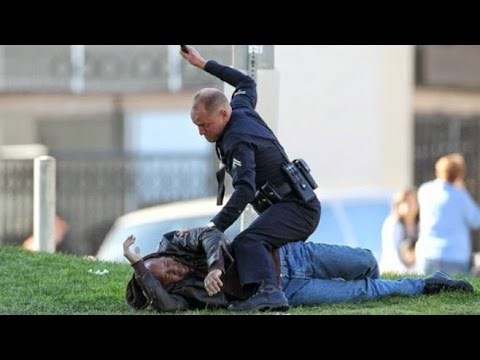
If you see police choking someone to death – such as Eric Garner, the 43-year-old black horticulturalist wrestled down on the streets of New York City in 2014 – you might choose to pepper-spray them and flee. You might even save an innocent life. But what ethical considerations justify such dangerous heroics? (After all, the cops might arrest or kill you.) More important: do we have the right to defend ourselves and others from government injustice when government agents are following an unjust law? I think the answer is yes. But that view needs defending. Under what circumstances might active self-defense, including possible violence, be justified, as opposed to the passive resistance of civil disobedience that Americans generally applaud?

Civil disobedience is a public act that aims to create social or legal change. Think of Henry David Thoreau’s arrest in 1846 for refusing to pay taxes to fund the colonial exploits of the United States, or Martin Luther King Jr courting the ire of the authorities in 1963 to shame white America into respecting black civil rights. In such cases, disobedient citizens visibly break the law and accept punishment, so as to draw attention to a cause. But justifiable resistance need not have a civic character. It need not aim at changing the law, reforming dysfunctional institutions or replacing bad leaders. Sometimes, it is simply about stopping an immediate injustice­. If you stop a mugging, you are trying to stop that mugging in that moment, not trying to end muggings everywhere. Indeed, had you pepper-sprayed the police officer Daniel Pantaleo while he choked Eric Garner, you’d have been trying to save Garner, not reform US policing.

Generally, we agree that it’s wrong to lie, cheat, steal, deceive, manipulate, destroy property or attack people. But few of us think that the prohibitions against such actions are absolute. Commonsense morality holds that such actions are permissible in self-defense or in defense of others (even if the law doesn’t always agree). You may lie to the murderer at the door. You may smash the windows of the would-be kidnapper’s car. You may kill the would-be rapist.

Here’s a philosophical exercise. Imagine a situation in which a civilian commits an injustice, the kind against which you believe it is permissible to use deception, subterfuge or violence to defend yourself or others. For instance, imagine your friend makes an improper stop at a red light, and his dad, in anger, yanks him out of the car, beats the hell out of him, and continues to strike the back of his skull even after your friend lies subdued and prostrate. May you use violence, if it’s necessary to stop the father? Now imagine the same scene, except this time the attacker is a police officer in Ohio, and the victim is Richard Hubbard III, who in 2017 experienced just such an attack as described. Does that change things? Must you let the police officer possibly kill Hubbard rather than intervene?

Most people answer yes, believing that we are forbidden from stopping government agents who violate our rights. I find this puzzling. On this view, my neighbours can eliminate our right of self-defense and our rights to defend others by granting someone an office or passing a bad law. On this view, our rights to life, liberty, due process and security of person can disappear by political fiat – or even when a cop has a bad day. In When All Else Fails: The Ethics of Resistance to State Injustice (2019), I argue instead that we may act defensively against government agents under the same conditions in which we may act defensively against civilians. In my view, civilian and government agents are on a par, and we have identical rights of self-defense (and defense of others) against both. We should presume, by default, that government agents have no special immunity against self-defense, unless we can discover good reason to think otherwise. But it turns out that the leading arguments for special immunity are weak.

Some people say we may not defend ourselves against government injustice because governments and their agents have ‘authority’. (By definition, a government has authority over you if, and only if, it can oblige you to obey by fiat: you have to do what it says because it says so.) But the authority argument doesn’t work. It’s one thing to say that you have a duty to pay your taxes, show up for jury duty, or follow the speed limit. It is quite another to show that you are specifically bound to allow a government and its agents to use excessive violence and ignore your rights to due process. A central idea in liberalism is that whatever authority governments have is limited.

Others say that we should resist government injustice, but only through peaceful methods. Indeed, we should, but that doesn’t differentiate between self-defense against civilians or government. The common-law doctrine of self-defense is always governed by a necessity proviso: you may lie or use violence only if necessary, that is, only if peaceful actions are not as effective. But peaceful methods often fail to stop wrongdoing. Eric Garner peacefully complained: ‘I can’t breathe,’ until he drew his last breath.

Another argument is that we shouldn’t act as vigilantes. But invoking this point here misunderstands the antivigilante principle, which says that when there exists a workable public system of justice, you should defer to public agents trying, in good faith, to administer justice. So if cops attempt to stop a mugging, you shouldn’t insert yourself. But if they ignore or can’t stop a mugging, you may intervene. If the police themselves are the muggers – as in unjust civil forfeiture – the antivigilante principle does not forbid you from defending yourself. It insists you defer to more competent government agents when they administer justice, not that you must let them commit injustice.

Some people find my thesis too dangerous. They claim that it’s hard to know exactly when self-defense is justified; that people make mistakes, resisting when they should not. Perhaps. But that’s true of self-defense against civilians, too. No one says we lack a right of self-defense against each other because applying the principle is hard. Rather, some moral principles are hard to apply.

However, this objection gets the problem exactly backwards. In real life, people are too deferential and conformist in the face of government authority. They are all-too-willing to electrocute experimental subjects, gas Jews or bomb civilians when ordered to, and reluctant to stand up to political injustice. If anything, the dangerous thesis – the thesis that most people will mistakenly misapply – is that we should defer to government agents when they seem to act unjustly. Remember, self-defense against the state is about stopping an immediate injustice, not fixing broken rules.

Of course, strategic nonviolence is usually the most effective way to induce lasting social change. But we should not assume that strategic nonviolence of the sort that King practiced always works alone. Two recent books – Charles Cobb Jr’s This Nonviolent Stuff’ll Get You Killed (2014) and Akinyele Omowale Umoja’s We Will Shoot Back (2013) – show that the later ‘nonviolent’ phase of US civil rights activism succeeded (in so far as it has) only because, in earlier phases, black people armed themselves and shot back in self-defense. Once murderous mobs and white police learned that black people would fight back, they turned to less violent forms of oppression, and black people in turn began using nonviolent tactics. Defensive subterfuge, deceit and violence are rarely first resorts, but that doesn’t mean they are never justified.


Jason Brennan is associate professor of strategy, economics, ethics and public policy at Georgetown University. He is the author, together with Peter Jaworski, of Markets Without Limits (2015), and his latest book is When All Else Fails: The Ethics of Resistance to State Injustice (2019).

Nonviolent Action: Why and How it Works

marcha_sal3

Nonviolent action is extremely powerful.

Unfortunately, however, activists do not always understand why
nonviolence is so powerful and they design ‘direct actions’ that are
virtually powerless.

I would like to start by posing two questions. Why is nonviolent action
so powerful? And why is using it strategically so transformative?

When an activist group is working on an issue – such as a national
liberation struggle, war, the climate catastrophe, violence against
women and/or children, nuclear weapons, drone killings, rainforest
destruction, encroachments on indigenous land – they will often plan an
action that is intended to physically halt an activity, such as the
activities of a military base, the loading of a coal ship, the work of a
bulldozer, the building of an oil pipeline. Their plan might also
include using one or more of a variety of techniques such as locking
themselves to a piece of equipment (‘locking-on’) to prevent it from
being used. Separately or in addition, they might use secrecy both in
their planning and execution so that they are able to carry out the
action before police or military personnel prevent them from doing so.

Unfortunately, the focus on physical outcomes (including actions such as
‘locking-on’ and its many equivalents), and the secrecy necessary to
carry out their plan, all functionally undermine the power of their
action. Why is this? Let me explain how and why nonviolent action works
so that it is clear why any nonviolent activist who understands the
dynamics of nonviolent action is unconcerned about the immediate
physical outcome of their action (and what is necessary to achieve
that).

If you think of your nonviolent action as a physical act, then you will
tend to focus your attention on securing a physical outcome from your
planned action: to prevent the military from occupying a location, to
stop a bulldozer from knocking down trees, to halt the work at an oil
terminal or nuclear power station, to prevent construction equipment
being moved on site. Of course, it is simple enough to plan a nonviolent
action that will do any of these things for a period of time and there
are many possible actions that might achieve it.

But if you pause to consider how your nonviolent action might have
psychological and political impact that leads to lasting or even
permanent change on the issue in question but also society as a whole,
then your conception of what you might do will be both expanded and
deepened. And you will be starting to think strategically about what it
means to mobilise large numbers of people to think and behave
differently.

After all, whatever the immediate focus of your action, it is only ever
one step in the direction of more profound change. And this profound
change must include a lasting change in prevailing ideas and a lasting
change in ‘normal’ behaviour by substantial (and perhaps even vast)
numbers of people. Or you will be back tomorrow, the day after and so on
until you get tired of doing something without result, as routinely
happens in campaigns that ‘go nowhere’ (as so many do).

So why does nonviolent action work?

Fundamentally, nonviolent action works because of its capacity to create
a favourable political atmosphere (because of, for example, the way in
which activist honesty builds trust), its capacity to create a
non-threatening physical environment (because of the nonviolent
discipline of the activists), and its capacity to alter the human
psychological conditions (both innate and learned) that make people
resist new ideas in the first place. This includes its capacity to
reduce or eliminate fear and its capacity to ‘humanise’ activists in the
eyes of more conservative sections of the community. In essence,
nonviolent activists precipitate change because people are inspired by
the honesty, discipline, integrity, courage and determination of the
activists – despite arrests, beatings or imprisonment – and are thus
inclined to identify with them. Moreover, as an extension of this, they
are inclined to change their behaviour to act in solidarity.

It is for this reason too that a nonviolent action should always make
explicit what behavioural change it is asking of people. Whether
communicated in news conferences or via the various media, painted on
banners or in other ways, a nonviolent action group should clearly
communicate powerful actions that individuals can take. For example, a
climate action group should consistently convey the messages to ‘Save
the Climate: Become a Vegan/Vegetarian’, ‘Save the Climate: Boycott
Cars’ and, like a rainforest action group, ‘Don’t Buy Rainforest
Timber’. A peace group should consistently convey such messages as
‘Don’t Pay Taxes for War’ and ‘Divest from the Weapons Industry’ (among
many other possibilities). Groups resisting the nuclear fuel cycle and
fossil fuel industry in their many manifestations should consistently
convey brief messages that encourage reduced consumption and a shift to
more self-reliant renewable energies. See, for example, ‘The Flame Tree
Project to Save Life on Earth’. Groups struggling to defend or reinstate indigenous sovereignty should convey compelling messages that explain what people can do in their particular context.

It is important that these messages require powerful personal action,
not token responses. And it is important that these actions should not
be directed at elites or lobbying elites. Elites will fall into line
when we have mobilized enough people so that they are compelled to do as
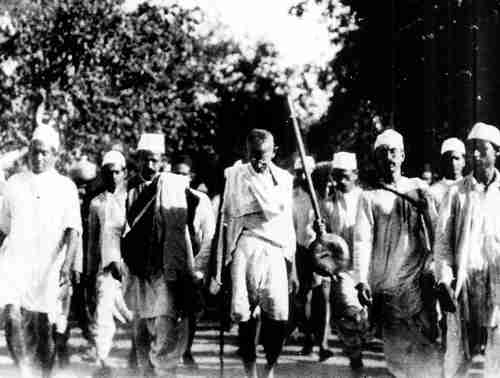
we wish. And not before. At the end of the Salt March in 1930 Gandhi
picked up a handful of salt on the beach at Dandi. This was the signal
for Indians everywhere to start collecting their own salt in violation
of British law. In subsequent campaigns Gandhi called for Indians to
boycott British cloth and make their own khadi (handwoven cloth). These
actions were strategically focused because they undermined the
profitability of British colonialism in India and nurtured Indian
self-reliance.

A key reason why Mohandas K. Gandhi was that rarest of combinations – a
master nonviolent strategist and a master nonviolent tactician – was
because he understood the psychology of nonviolence and how to make it
have political impact. Let me illustrate this point by using the
nonviolent raid on the Dharasana salt works, the nonviolent action he
planned as a sequel to the more famous Salt March in 1930.

On 4 May 1930 Gandhi wrote to Lord Irwin, Viceroy of India, advising his
intention to lead a party of nonviolent activists to raid the Dharasana
Salt Works to collect salt and thus intervene against the law
prohibiting Indians from collecting their own salt. Gandhi was
immediately arrested, as were many other prominent nationalist leaders
such as Jawaharlal Nehru and Vallabhbhai Patel.

Nevertheless, having planned for this contingency, under a succession of
leaders (who were also progressively arrested) the raid went ahead as
planned with hundreds of Indian satyagrahis (nonviolent activists)
attempting to nonviolently invade the salt works. However, despite
repeated attempts by these activists to walk into the salt works during
a three week period, not one activist got a pinch of salt! Moreover,
hundreds of satyagrahis were injured, many receiving fractured skulls or
shoulders, and two were killed.

But an account of the activists’ nonviolent discipline, commitment and
courage – under the steel-tipped lathi (baton) blows of the police – was
reported in 1,350 newspapers around the world. As a result, this
nonviolent action – which ‘failed’ to achieve the stated physical
objective of seizing salt – functionally undermined support for British
imperialism in India. For an account of the salt raids at Dharasana, see
Thomas Weber. ‘”The Marchers Simply Walked Forward Until Struck Down”:
Nonviolent Suffering and Conversion’

If the activists had been preoccupied with the physical seizure of salt
and, perhaps, resorted to the use of secrecy to get it, there would have
been no chance to demonstrate their honesty, integrity, courage and
determination – and to thus inspire empathy for their cause – although
they might have got some salt! (Of course, if salt had been removed
secretly, the British government could, if they had chosen, ignored it:
after all, who would have known or cared? However, they could not afford
to let the satyagrahis take salt openly because salt removal was illegal
and failure to react would have shown the salt law – a law that
represented the antithesis of Indian independence – to be ineffective.)

In summary, nonviolent activists who think strategically understand that
strategic effectiveness is unrelated to whether or not the action is
physically successful (provided it is strategically selected,
well-designed so that it elicits one or other of the intended responses,
and sincerely attempted). Psychological, and hence political, impact is
gained by demonstrating qualities that inspire others and move them to
act personally too. For this reason, among several others, secrecy (and
the fear that drives it) is counterproductive if strategic impact is
your intention.

If you are interested in planning effective nonviolent actions, a
related article also explains the vital distinction between ‘The
Political Objective and Strategic Goal of Nonviolent Actions’.

And if you are concerned about violent military or police responses,
have a look at ‘Nonviolent Action: Minimizing the Risk of Violent
Repression’.

For those of you who are interested in planning and acting strategically
in your nonviolent struggle, whatever its focus, you might be interested
in one or the other of these two websites: Nonviolent Campaign Strategy and Nonviolent Defense/Liberation Strategy.

And if you are interested in being part of the worldwide movement to end
all violence, you are welcome to sign the online pledge of ‘The People’s
Charter to Create a Nonviolent World’.

Struggles for peace, justice, sustainability and liberation often fail.
Almost invariably, this is due to the failure to understand the
psychology, politics and strategy of nonviolence. It is not complicated
but it requires a little time to learn.


Biodata: Robert J. Burrowes has a lifetime commitment to understanding and ending human violence. He has done extensive research since 1966 in an effort to understand why human beings are violent and has been a nonviolent activist since 1981. He is the author of ‘Why Violence?‘ His email address is flametree@riseup.netand his website is at http://robertjburrowes.wordpress.com

Robert J. Burrowes
P.O. Box 68
Daylesford
Victoria 3460
Australia
Email: flametree@riseup.net

Websites:
Nonviolence Charter
Flame Tree Project to Save Life on Earth
‘Why Violence?’
Nonviolent Campaign Strategy
Nonviolent Defense/Liberation Strategy
Anita: Songs of Nonviolence
Robert Burrowes
Global Nonviolence Network