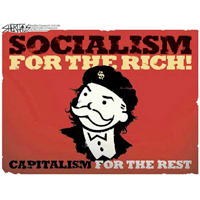
The Entire Status Quo Is a Fraud

corruptPoliticalSystem2

By Charles Hugh Smith

Source: Of Two Minds

Fraud as a way of life caters an extravagant banquet of consequences.

This can’t be said politely: the entire status quo in America is a fraud.

The financial system is a fraud.

The political system is a fraud.

National Defense is a fraud.

The healthcare system is a fraud.

Higher education is a fraud.

The mainstream corporate media is a fraud.

Culture–from high to pop–is a fraud.

Need I go on?

We have come to accept fraud as standard operating practice in America, to the detriment of everything that was once worthy. why is this so?

One reason, which I outline in my book A Radically Beneficial World: Automation, Technology and Creating Jobs for All, is that centralized hierarchies select for fraud and incompetence. Now that virtually every system in America is centralized or regulated by centralized hierarchies, every system in America is fraudulent and incompetent.

Nassim Taleb explains this further in his recent article How To Legally Own Another Person (via Lew G.)

The three ingredients of fraud are abundant: pressure (to get an A, to please your boss, to make your sales numbers, etc.), rationalization (everybody’s doing it) and opportunity.

Taleb explains why failure and fraud become the status quo: admitting error and changing course are risky, and everyone who accepts the servitude of working in a centralized hierarchy–by definition, obedience to authority is the #1 requirement– is averse to risk.

As as I explain in my book, these systems select for risk aversion and the appearance of obedience to rules and authority while maximizing personal gain: in other words, fraud as a daily way of life.

Truth is a dangerous poison in centralized hierarchies: anyone caught telling the truth risks a tenner in bureaucratic Siberia. (In the Soviet Gulag ,a tenner meant a ten-year sentence to a labor camp in Siberia.)

And so the truth is buried, sent to a backwater for further study, obfuscated by jargon, imprisoned by a Top Secret stamp, or simply taken out and executed.Everyone in the system maximizes his/her personal gain by going along with the current trajectory, even if that trajectory is taking the nation off the cliff.

Consider the F-35 Joint Strike Fighter, a $1+ trillion failure. The aircraft is underpowered, under-armed, insanely overpriced, insanely over-budget and still riddled with bugs after seven years of fixes, making it an unaffordable maintenance nightmare that puts our servicepeople and nation at risk.

But no one in a position of power will speak the truth about the F-35, because it is no longer a weapons system–it’s a jobs program. Defense contractors are careful to spread the work of assembling parts of the F-35 to 40+ states, so 80+ senators will support the program, no matter how much a failure it is as a weapons system, or how costly the failure is becoming.

A rational person in charge would immediately cancel it and start from scratch, with a program run outside the Pentagon and outside congressional meddling.But this is impossible in America: instead, we build failed, under-armored, under-powered, under-armed and unreliable ships (LCS) and failed under-powered, under-armed and unreliable fighters as the most expensive make-work programs in history.

As for our failed healthcare system, one anecdote will do. (You undoubtedly have dozens from your own experience.) A friend from Uruguay with a high-tech job in the U.S. recently flew home to Montevideo for a medical exam because 1) the cost of the flight was cheaper than the cost of the care in the U.S. and 2) she was seen the next day in Montevideo while it would have taken two months to get the same care in the U.S.

I’ve listed dozens of examples here over the years: $120,000 for a couple days in a hospital, no procedures performed; $20,000+ for a single emergency room visit, no procedures performed; several thousand dollars charged to Medicare for a few minutes in an “observation room” that was occupied by patients, no staff present–the list is endless.

We’ve habituated to fraud as a way of life because every system is fraudulent.Consider the costly scam known as higher education. The two essentials higher education should teach are: 1) how to learn anything you need to learn or want to learn on your own, and 2) how to think, behave, plan and function entrepreneurially (i.e. as an autonomous problem-solver and lifelong learner who cooperates and collaborates productively with others) as a way of life.

That higher education fails to do so is self-evident. We could create a highly effective system of higher education that costs 10% of the current corrupt system. I’ve described such a system (in essence, a directed apprenticeship as opposed to sitting in a chair for four years) in The Nearly Free University and the Emerging Economy: The Revolution in Higher Education.

As for what passes as culture in the U.S.: the majority of what’s being sold as culture, both high and low, is derivative and forgettable. We suffer the dual frauds of absurd refinement (so only the elites can “appreciate” the art, music, food, wine, etc.) and base coarsening: instead of Tender (romantic love and sex) we have Tinder (flammable trash).

Fraud as a way of life caters an extravagant banquet of consequences. While everyone maximizes their personal gain in whatever system of skim, scam and fraud they inhabit, the nation rots from within. We’ve lost our way, and lost the ability to tell the truth, face problems directly, abandon what has failed and what is unaffordable, and accept personal risk as the essential element of successful adaptation.

Here’s a good place to start: require every politician to wear the logos of their top 10 contributors–just like NASCAR drivers and vehicles display the logos of their sponsors. The California Initiative to make this a reality is seeking signatures of registered California voters. Since politicians are owned, let’s make the ownership transparent.

Liberation Is Unprofitable

c91b81d1dcb043acfb1eed41207da8b5

By Charles Hugh Smith

Source: Of Two Minds

12 examples of how liberation is not profitable and therefore it must be marginalized, outlawed, proscribed or ridiculed.

If we had to summarize the sickness of our economy and society, we could start by noting that liberation is unprofitable, and whatever is not profitable to vested interests is marginalized, outlawed, proscribed or ridiculed. Examples of this abound.

Liberation from digital communication servitude is not profitable. Don’t have a smart phone on 18 hours a day, every day? Loser! Luddite! Liberation from digital communication servitude is not profitable, therefore it is ridiculed.

Liberation from debt is not profitable. Only the wealthy can afford to buy a vehicle without debt, a home without debt or a university education without debt. For everyone else, liberation from debt is not an option, because debt is highly profitable to our financial Overlords and the politicos they buy/own.

This Is How Little It Cost Goldman To Bribe America’s Senators (Zero Hedge)

Liberation from political elites is not profitable. Dependence on the state for monthly payments binds the recipients to the political elites that control the money and payments, and to the financial elites who control the political elites.

Liberation from the staged, soap-opera political drama of elections is not profitable. Election advertising generates staggering profits for media companies, and the ceaseless nurturing of fear, resentment and indignation fuels acceptance of centralized power and control.

Vote all you want. The secret government won’t change.

Liberation from the consumerist mindset is not profitable. Aspirational purchases in the pursuit of appearances are the most profitable of all spending; re-use, repair and informal peer-to-peer sharing are all intrinsically unprofitable.

Narcissistic Consumerism and Self-Destruction (October 20, 2012)

Liberation from the tyranny of central banks is not profitable. Our entire financial system is built on the simple dynamic that everyone is forced to use money issued by the central bank (Federal Reserve) to its member banks and their financier cronies.

Money that is decentralized and not issued by central banks is not profitable.

Common-sense, minimal regulations are not profitable. Regulations feed government fiefdoms and the revolving-door spoils system between the state and private industry, and erect formidable barriers to new competitors. As a result, over-regulation is immensely profitable.

Regulation Run Amok—And How to Fight Back

The ability to think independently is not profitable. The control mechanisms that keep the various classes of serfs in permanent servitude all depend on a dumbed-down populace that has been stripped of the ability to think independently by propaganda, group-think, medications, the education industry and lifelong dependency on the state.

Anti-Intellectualism and the “Dumbing Down” of America

An economy/society without corruption is not profitable. Buying favors, cronyism and cartel control of pricing are the primary sources of corruption. Cartels and the auctioning of favors are highly profitable to politicos and the vested interests who control the tollways of finance, political influence and social mobility.

America’s Main Problem: Corruption

Degrowth is not profitable. Needing fewer, quality things that last for decades is not profitable. Reparing things for nearly-free is not profitable. Giving stuff away to others for free is not profitable. Making do with what you have is not profitable.

Degrowth, Anti-Consumerism and Peak Consumption (May 9, 2013)

A scarcity of stress and anxiety is not profitable. Stress, anxiety and financial insecurity are all highly profitable, as these drive profitably addictive behaviors such as going deep into debt, shopaholic binge buying, multiple anti-anxiety/anti-depression medications, costly therapy and various forms of self-medication.

The Silent Epidemic in a Broken, Deranged System: Stress (April 18, 2013)

Opting out is not profitable. Opting out of debt-serfdom and the burdens of being a tax donkey is not profitable to vested interests or the state. Adopting self-reliance and low-cost/low-impact living and opting out of the status quo culture of consumerism, debt and complicity with a parasitic, exploitive cartel-state Aristocracy/ Plutocracy/ Oligarchy/ Kleptocracy (take your pick–it’s still the same rapacious Elite whatever name you choose)–is not profitable.

Tune In, Turn On, Opt Out (May 17, 2013)


When It Becomes Serious, First They Lie–When That Fails, They Arrest You

ost2

By Charles Hugh Smith

Source: Of Two Minds

When lying is no longer enough to gain compliance, then the organs of security are unleashed on dissent and resistance.

“When it becomes serious, you have to lie.” Jean-Claude Juncker simply gave voice to what the world’s leaders practice on a daily basis, because now it’s always serious.


And why is it now serious? Persuading tax donkeys and debt serfs that everything is going their way is now impossible without lies. Persuading the populace that the leadership is working on their behalf was jettisoned in the wake of the 2008 bailout of bankers and parasites.

Stripped of the artifice that they care about anything other than preserving the wealth of their cronies, global political leaders now rely on propaganda: narratives designed to manage expectations and perceptions, bolstered by carefully tailored official statistics.

Reliance on lies erodes legitimacy. As the rich get richer and the burdens on tax donkeys and debt serfs increase, the gulf between the official happy-story narrative and reality widens to the breaking point, and faith in the narrative and the leadership espousing it declines.

When 20% of the populace no longer believe the lies and begins questioning the state’s enforcement of the status quo, the government devotes its resources to punishing dissenters and resisters. Whistleblowers are charged with trumped-up crimes; those publicly refuting the status quo’s narrative of lies are harassed and discredited, and those who resist state enforcement of parasitic cronyism are set up, beaten, entrapped, investigated, interrogated and arrested once suitably Kafkaesque charges can be conjured up by the apparatchiks of enforcement.

Why 20%? It’s the Pareto Distribution (the 80/20 rule): the 20% of any populace that accepts a new trend, technology or narrative has an outsized influence over the other 80%.

Governments operate on the premise that propaganda and threats will always be enough to cow their populaces into compliance and bribes will induce complicity. When lies, bribes and threats no long work, the state unleashes its full pathological powers on dissent.

The last mass campaign of political suppression in the U.S. occurred in the late 1960s and early 1970s, when resistance to the war of choice in Vietnam reached mainstream proportions.

The U.S. government was accustomed to manipulating and managing the populace with very simple propaganda: Communism is our deadly enemy, we must fight it everywhere on the planet, etc. But when thousands of American service personnel started coming home in body bags from the latest “we must fight Communism everywhere because it’s dangerous to us” war in East Asia, this simplistic justification made no sense: what existential threat to the U.S. did a Communist Vietnam pose?

The U.S. has faced only two existential threats to its sovereignty since 1860: World War II (1941-45) and the potential for a nation-destroying nuclear war with the Soviet Union. The idea that the U.S. was existentially threatened by falling dominoes in East Asia was always ludicrous, and the U.S. status quo (the political leadership, the Deep State, private industry profiting from war, etc.) soon abandoned the absurd justification.

Vietnam was always more of a domestic-politics issue than a geopolitical one: the Democrats feared being perceived as being “weak on Communism” because that impacted the results of elections. Throwing treasure and American lives away in Vietnam was pure domestic politics from 1961-68 (once mired, Democrats feared being tagged as the party that “lost Vietnam”), and thereafter the treasure and lives were sacrificed on the equally contrived Nixon-Kissinger policy of avoiding losing geopolitical face with a withdrawal that amounted to surrender.

Though it is not well known, the Federal Bureau of Investigation (FBI) was ordered to devote essentially all its resources to suppressing dissent in these years. Teams assigned to organized crime were reassigned to track down draft resisters and other political malcontents. COINTELPRO was a vast program devoted to illegally entrapping, beating up and undermining any and all political resistance to the war and the government’s increasingly heavy-handed oppression of dissent.

For more on COINTELPRO, please read War at Home: Covert action against U.S. activists and what we can do about it.

Simply put: when lies no longer work, governments freak out and devote their resources not to eliminating wars of choice, cronyism and corruption but to suppressing dissent and resistance to those policies.

The U.S. government has always been free to pursue wars of choice with its professional military, with little risk of widespread political blowback. A variety of “splendid little wars” have been waged, generally for conquest or enforcement of hemispheric hegemony. The government’s success in rallying the nation during World War II instilled a false confidence that merely raising the flag of existential threat would be enough to eliminate dissent and elicit compliance in the masses.

Vietnam was the first time the American public went through the process of buying the usual “threat” justification for war, questioning the threat and eventually rejecting the state’s narrative. The government responded by lashing out at its own citizenry, engaging in a full spectrum of illegal and blatantly immoral actions designed not to right wrongs or fix broken policies, but to suppress dissent and resistance to destructive policies and broken systems.

The U.S. government is not unique in this; on the contrary, all governments, by their very nature as concentrations of coercive power, will pursue the same path. Rather than confess the government is operated by cronies, for cronies, the machinery of the state will increasingly be turned on its citizenry.

Rendering unto Caesar that which is Caesar’s is no longer enough; abiding by the laws of the land are no longer enough. What the state demands is not just compliance with its countless laws and regulations, but absolute obedience to its narratives and policies.


Anyone who withholds obedience is quickly deemed a traitor–not to the nation or its Constitution, but to the state itself, which is ultimately a collection of cronies and self-serving vested interests protecting their fiefdoms at the expense of the citizenry.

When lying is no longer enough to gain compliance, then the organs of security are unleashed on dissent and resistance. This process is well under way in nation-states around the world.

If I had to pick the two key operative dynamics of the next 20 years, I would choose:

1. The over-expansion and implosion of credit/debt bubbles.

2. The over-reach of the central state as it seeks to win the hearts and minds of its people by ruthlessly suppressing dissent.

The two dynamics are of course causally connected. Central states depend entirely on credit bubbles for their financial survival, and on enforcing increasingly untenable official narratives for their legitimacy.

Both are unraveling, and will continue to unravel, no matter how many state resources are thrown at the symptoms of political illegitimacy, rather than at the root causes of that illegitimacy.


Is the Web Destroying the Cultural Economy?

Internet-devices-globe-world-connected

By Charles Hugh Smith

Source: Of Two Minds

Are we entering a cultural Dark Age, where the talented cannot earn a living creating culture?

Longtime correspondent G.F.B. recently sent me this 13-minute Interview with Andrew Keen. This is my first exposure to Keen, and his view that the democratization of the Web is great for politics but a disaster for what he calls the Cultural Economy— the relatively small but important slice of the economy that pays creators and artists to make culture: music, literature, art and serious journalism.

The title of Keen’s 2007 book encapsulates his dire perspective: The Cult of the Amateur: How blogs, MySpace, YouTube, and the rest of today’s user-generated media are destroying our economy, our culture, and our values.

(His 2012 book had a similar theme: Digital Vertigo: How Today’s Online Social Revolution Is Dividing, Diminishing, and Disorienting Us)

(Author Scott Timberg makes some of the same points in his new book Culture Crash: The Killing of the Creative Class (via Cheryl A.)

Keen touches on a great many ideas and themes in this brief interview, but his core point is this: by enabling everyone to express themselves on an essentially equal footing, the Web has undermined legitimate journalism and buried the talented few in an avalanche of mediocrity–in his words, talent is “lost in a sea of garbage.”

By eliminating the middleman who added value by sorting the wheat from the chaff–the film studio, the music labels, the publishers–the Web has created a cultural landscape where “soft, ordinary” content such as cute cat videos garner the most “likes” and clicks–the digital world’s metric for popularity and thus value in the marketplace.

Keen tossed off one of his most interesting ideas as an aside: that the break-up of community and the resulting loss of identity has generated a universal drive to establish an identity via self-expression: everybody feels they can compose a song, write a novel or make a movie.

Keen is at his most provocative (to the democratized ideal of the amateur making it big) when he declares the vast majority of people are talentless: talent is by definition scarce. We can’t all be equally talented, nor can anyone generate culturally valuable content without mastering their craft over thousands of hours of practice.

Keen unapologetically calls the previous arrangement an “industrial meritocracy.” He feels this hierarchical meritocracy is being destroyed and there is nothing to replace it.  This will result in a cultural Dark Age where the talented cannot earn a living creating culture. The only avenue left for creators of content that can be copied and distributed digitally (music, digital art, writing) is to find wealthy patrons to support their work.

One of G.F.B.’s points in our conversation was the Web’s “level playing field” is an artificial construct, much like the playing field in a stadium. But outside the stadium, the geography is anything but level.  Put other way, global corporations have great advantages in the supposedly “level playing field” of the Web.

Keen mentions that what will remain scarce in this tsunami of digital content is access to the artist, live performances and art that cannot be digitized, such as sculpture and paintings. As I have discussed in previous Musings, musicians who perform constantly can make a living in this environment, because their free music on the web builds an audience for their live performances.  But not every band performs enough to make a go of this model.

In Keen’s  view, it is now essentially impossible for bands, artists and writers to create a “brand” that will generate an income. Only those creators who entered the digital age with an established brand can leverage their recognition into an income.

As a completely marginal creator of content who never rose within the industrial meritocracy lauded by Keen, I  think Keen makes some excellent points but overstates his case for a cultural Dark Age.

As G.F.B. pointed out in our conversation on this topic, a new class of curators is arising within the Web, people who sift through the vast outpouring of content and select the best or most interesting (in their view). Those curators who succeed are adding value just as the industrial middlemen did in the pre-digital model. In some small way, I think Of Two Minds performs a bit of this curation.

It seems to me that the digital age requires every creator of content to not only be perseverant but to focus a great deal of time and energy on marketing their content–precisely what the industrial media and cultural industrial-model companies once did for their talent.

There is no longer enough money in creating content to pay an office full of people to issue press releases and arrange book tours.  In the publishing world, promotion is increasingly up to the authors; as Keen noted, only those authors with brands that were established in the pre-digital age can sell enough content to support industrial-type promotion.

We can bemoan this, or we can grasp the nettle and realize that  it is no longer enough to practice one’s craft for the fabled 10,000 hours–one must also invest another 10,000 hours in promoting and marketing one’s content/cultural creations.  That dual process (creation and marketing) is so arduous, so impoverishing, so demanding, only the driven few can sustain it long enough to claw their way through the mountains of mediocrity.

Making a living at cultural content was always brutally Darwinian; perhaps all that’s changed is the nature of the Darwinian selection process.

Social Schizophrenia, Social Depression: What does TV tell us about America?

wash_dees

By Charles Hugh Smith

Source: Dangerous Minds

The difference between what we experience and what we’re told we experience creates a social schizophrenia that leads to self-destructive attitudes and behaviors.

What can popular television programs tell us about the zeitgeist (spirit of the age) of our culture and economy?

It’s an interesting question, as all mass media both responds to and shapes our interpretations and explanations of changing times. It’s also an important question, as mass media trends crystallize and express new ways of understanding our era.

Those who shape our interpretation of events also shape our responses.  This of course is the goal of propaganda: Shape the interpretation, and the response predictably follows.

As a corporate enterprise, mass media’s goal is to make money—the more the better—and that requires finding entertainment products that attract and engage large audiences.  The products that change popular culture are typically new enough to fulfill our innate attraction to novelty—but this isn’t enough. The product must express an interpretation of our time that was nascent but that had not yet found expression.

We can understand this complex process of crystallizing and giving expression to new contexts as one facet of the politics of experience.

The Politics of Experience

It is not coincidental that the phrase politics of experience was coined by a psychiatrist, R.D. Laing, for the phrase unpacks the way our internalized interpretation of experience can be shaped to create uniform beliefs about our society and economy that then lead to norms of behavior that support the political/economic status quo.

Here’s how Laing described the social ramifications in Chapter Four of his 1967 book, The Politics of Experience:

“All those people who seek to control the behavior of large numbers of other people work on the experiences of those other people. Once people can be induced to experience a situation in a similar way, they can be expected to behave in similar ways. Induce people all to want the same thing, hate the same things, feel the same threat, then their behavior is already captive – you have acquired your consumers or your cannon-fodder.”

For Laing, the politics of experience is not just about influencing social behavior – it has an individual, inner consequence as well:

“Our behavior is a function of our experience. We act according to the way we see things. If our experience is destroyed, our behavior will be destructive. If our experience is destroyed, we have lost our own selves.”

How the media shapes our interpretation affects not just our beliefs and responses, but our perceptions of self and our role in society. If the media’s interpretation no longer aligns with our experience, the conflict can generate self-destructive behaviors.

In other words, mass media interpretations can create a social schizophrenia that can lead to self-destructive attitudes and behaviors.

Social Analysis of TV

By its very nature as a mass shared experience, popular entertainment is fertile ground for social analysis.

Here’s a common example: what does a child learn about conflict resolution if he’s seen a thousand TV programs in which the “hero” is compelled to kill the “bad guy” in a showdown? What does that pattern suggest, not just about the structure of drama, but about the society that creates that drama?

Analyzing entertainment has been popular in America since the 1950s, if not earlier.  The film noir of the 1950s, for example, was widely deemed to express the angst of the Cold War era.  Others held that the rising prosperity of the 1950s enabled the populace to explore its darker demons—something the hardships and anxieties of the Depression did not encourage.

Many believe the Depression gave rise to screwball comedies and light-hearted entertainment featuring the casually wealthy precisely because these were escapist antidotes to the grinding realities of the era.

Even television shows that were denigrated as superficial in their own time (for example, Bewitched in the 1960s) can be seen as politically inert but subconsciously potent expressions of profound social changes: the “witch” in Bewitched is a powerful young female who is constantly implored by her conventional husband to conform to all the bland niceties of a suburban housewife, but she finds ways to rebel against these strictures.

Laing saw the potential conflict between what we experience and how we’re told to interpret that experience not just in social terms but in psychiatric terms: such splits open a gulf that can lead to a form of schizophrenia.

Diagnosing Our Disease with TV

What can we make of the popular TV series of the present era? What do they say, beneath the surface, about American society?

I contend that popular TV expresses three key aspects of U.S. society and economy that are at odds with the core idealized values espoused in civic classes and the media. The three idealized values are:

1.  America is a meritocracy—selections, admissions, etc., are based on the candidates’ merits

2.  Anyone can get ahead if they get an education and work hard

3.  America is the wealthiest nation on earth in terms of opportunity, fairness and capital

TV expresses three aspects that confound these idealized values:

1.  Life is a game in which the winner takes all

2.  The opportunity to “get ahead” via conventional means—getting educated, working hard, etc.—is a joke; only those who skirt conventions and the law get rich

3.  Life is a tortuous endurance course where those in charge demand the cruel and the impossible

Winner-Take-All Talent Shows

Let’s start with the genre that has been a dominant force in American TV since the 2000s: the winner-take-all talent show (reality and game shows).

The long-running Survivor series, for example, was a winner-take-all contest of physical prowess and political guile, while the many programs staging singing/dancing contests (American Idol, etc.) put entertainment skills to the competitive test.  A wide range of other entries stage competitions in cooking, entrepreneurship, losing weight, negotiating obstacle courses, and so on.

What interpretations of our experience do these highly competitive winner-take-all reality shows promote?

We could start with the fact that the stars (other than the hosts/judges) are apparently ordinary “every man/woman” Americans, i.e. people not unlike us.  Watching them, it is not too much of a stretch to imagine ourselves on stage, in the kitchen, etc., trying to impress the judges with our talents. It’s easy to identify with the contestants.

These shows enable us to vicariously experience the fantasy that we, too, could be on national TV and could win the accolades of the judges and fans and be the winner who takes it all.

This natural empathy with the temporarily famous with whom we can vicariously share the thrill of victory and the agony of defeat is clearly tapping a deep cultural desire to taste celebrity and the implied financial rewards of winning in an increasing winner-take-all society/economy.

Could the financial/political marginalization of the average citizen and the widening gulf between the typical household and those at the top of the fame/wealth pyramid have something to do with this fascination for winner-take-all competitions on the public stage?

Since there have been game shows on TV for decades, it could be argued that this proliferation of winner-take-all contests is nothing new. But this fails to account for the difference between a game show in which the correct answer is a fact and the subjective votes of judges, other players and the audience that count in winner-take-all contests.

I would argue that this recent explosion of competitions (“modern gladiator,” anyone?) is an expression of deeply held shared cultural values: we accept that ours is a highly competitive society, and that it is becoming even more so as the top “winners” skim the vast majority of the winnings (media visibility, wealth, adulation, social status. etc.), leaving a few morsels for the top 5% and nothing but crumbs for the bottom 95%.

But these TV programs also project the fantasy that our fight-to-the-figurative-death society is still a meritocracy—the best guy/gal wins, as judged by “experts” (or celebrities claiming expertise; the judges’ expertise is structured to be unassailable, just like all the other “experts” in our society).

But if we can’t win it all on merit, there is an alternative way to win: display superior political guile or greater popularity with the audience. (Interestingly, this echoes the coliseum audiences of the late Roman era, who also had some sway over who lived to fight another day on the choreographed battlefield below.)

Perhaps this helps explain our collective obsession with celebrity and the many measures of popularity available to everyone now—Instagram, Facebook likes, Twitter followers (for sale in lots of 10,000), Klout scores, and so on.

In other words, as success in the real world grows increasingly distant, vicariously competing and “winning it all” becomes very compelling. Rather than deal with the vast injustices of our system, we cling to the idealized norm that meritocracy matters, even as “winning” in real life is increasingly a game of cronyism, guile, gaming the system, misrepresenting the truth, etc.

And so we thrill to these play-acting displays of meritocracy in action, as it confirms our cultural value system that that despite the predations of Wall Street and Washington, merit still counts.

And when all else fails, we have a fallback source of identity and “winning”—our popularity. And if we don’t have enough of our own, then we can share vicariously in the popularity of TV show winners and celebrities who have reached the pinnacle.

This is the core message of an interesting and erudite half-hour talk on celebrity given by Games of Thrones actor Jack Gleeson:

“During a recent visit to the Oxford Union, Gleeson took the opportunity to dismantle the ‘religious hysteria’ of celebrity worship with an appropriately epic rant, breaking down the economic, psychological, and sociological catalysts for public reverence of celebrities and their negative impact on society as a whole.”

Gleeson draws upon a number of intellectual sources (Weber, Baudrillard, et al.) in his discussion of the contemporary culture of celebrity, and concludes that celebrity fills the void left when development of an authentic self is stunted.

The parallel with Laing’s “lost self” is striking.

In effect, when the opportunities for developing an authentic self have been reduced to popularity, public visibility and the status that flows from these forms of recognition, then the worship of celebrity and the aching desire for a moment in the spotlight become rational substitutes for a True Self.

As these wispy contingencies can never form an authentic selfhood, even those who do “win” the competition for celebrity are ultimately dissatisfied and disillusioned.

My conclusion: the popularity of competitive winner-take-all TV programs reflects the paucity of opportunities for selfhood and the substitution of celebrity worship for the difficult task of forging an independent identity in a society that marginalizes all but the top players.

If this isn’t a form of cultural schizophrenia, then what exactly is it? The claim that this is all just good clean fun is absurd, as is the claim that it’s perfectly healthy to sacrifice one’s identity in a competition for recognition that 99.9% of us are sure to lose.

Why Has Classical Capitalism Devolved to Crony-Capitalism?

Crony-Capitalism_200x200

By Charles Hugh Smith

Source: OfTwoMinds.com

Here is the quote that perfectly captures our era: “People of privilege will always risk their complete destruction rather than surrender any material part of their advantage.” (John Kenneth Galbraith) The trick, of course, is to mask the unspoken second half of of that statement: everybody else gets destroyed along with the Elites when the system implodes.

Union pension funds: toast. Government employees’ pension funds: toast. 401Ks: toast. IRAs: toast. The echo-bubble in housing: toast. The Fed’s favorite PR cover to cloak the enrichment of their financier cronies, the wealth effect:toast.

The primary tool the Elites use to mask the risk of complete destruction is magical thinking–specifically, that “given enough time, the system will heal itself.”

That’s rich, considering that the Elites’ primary tool of avoiding destruction is crippling the market’s self-healing immune system: price discovery. Thanks to ceaseless interventions by central banks, the price discovery mechanism has been shattered: want to know the price of risk? It’s near-zero. Yield on sovereign bonds? Near-zero. And so on.

Prices have been so distorted (the ultimate goal of Central Planning everywhere, from China to the EU to Japan to the U.S.) that the illusion of stability is impossible without more intervention.

This leads to two self-liquidating dynamics: diminishing returns (every intervention yields less of the desired result) and the Darwinian selection of only those money managers who believe risk has been vanquished.

Everyone who pursues prudent risk management has either been fired or saw the writing on the wall and exited stage right. So the only people left at the gaming tables of the big institutional players are those individuals who are genetically incapable of responding appropriately to rising risk. Those who did have long been fired for “underperformance.”

So how did classical free-market capitalism become state-cartel crony-capitalism, a Ponzi scheme of epic proportions that is entirely dependent on ceaseless central bank perception management and interventions on a scale never before seen?

We can start with these six factors:

1. Those who control most of the wealth are willing to risk systemic collapse to retain their privileges and wealth. Due to humanity’s virtuosity with rationalization, those at the top always find ways to justify policies that maintain their dominance and downplay the distortions the policies generate. This as true in China as it is in the U.S.

2. Short-term thinking: if we fudge the numbers, lower interest rates, etc. today, we (politicians, policy-makers, money managers, etc.) will avoid being sacked tomorrow. The longer term consequences of these politically expedient policies are ignored.

3. Legitimate capital accumulation has become more difficult and risky than buying political favors. Global competition and the exhaustion of developed-world consumers has made it difficult to reap outsized profits from legitimate enterprise. In terms of return-on-investment (ROI), buying political favors is far lower risk and generates much higher returns than expanding production or risking investment in R&D.

4. The centralization of state/central bank power has increased the leverage of political contributions/lobbying. The greater the concentration of power, the more attractive it is to sociopaths and those seeking to buy state subsidies, sweetheart contracts, protection from competition, etc.

5. Any legitimate reform will require dismantling crony-capitalist/state-cartel arrangements. Since that would hurt those at the top of the wealth/power pyramid, reform is politically impossible.

6. Understood in this light, it’s clear that central bank monetary policy—zero-interest rates, asset purchases, cheap credit to banks and financiers, QE, etc.—is designed to paper over the structural problems that require real reform.

Japan is a case in point: the Powers That Be in Japan have put off real reforms of the Japanese economy and political system for 25 years, and they’ve enabled this avoidance by pursuing extremes of fiscal and monetary policy that have eroded the real economy and created long-term structural imbalances.

In this 24 minute video Gordon T. Long and Charles Hugh Smith discuss through the aid of 17 slides the rapid advancement of Crony Capitalism in America. The facts are undeniable, but why is it becoming so obvious and undeniable? Why is it accelerating without any apparent ‘checks and balances’? Where have the safeguards against this happening gone?

It’s Not Just the Stock Market That’s Rigged: the Entire Status Quo Is Rigged

WallStreetBull

By Charles Hugh-Smith

Source: InvestmentWatch

One has to wonder why we are dodging this truth about what we’ve become: a nation that turns a blind eye to skimmers, scammers and legal looting.

As in the story of the Emperor’s new clothes, the onlooker who declares the obvious– in this case, that the stock market is rigged–shatters the consensus lie. In the current saga, author Michael Lewis plays the role of the truth-telling boy, and everyone who went along with the fiction that the Emperor’s high-frequency trading finery was resplendent is revealed as credulous, complicit or worse.

Lewis’ new book is Flash Boys: A Wall Street Revolt.

The high-frequency trading (HFT) scam is old news, and a number of fine books have addressed the mechanics of the skim, for example Dark Pools: High-Speed Traders, A.I. Bandits, and the Threat to the Global Financial System by Scott Patterson.

Many in the alternative financial media have written about HFT for years. Here are two of my own entries on the topic:

The Stock Market Is an “Attractive Nuisance” and Should Be Closed (August 22, 2012)

We Need a New Stock Market (September 14, 2012)

Interestingly, Mr. Patterson outlined the solution that the heroes of Lewis’ book ended up pursuing. Here is a Q&A I conducted with Patterson in September 2012:

CHS: While there are various regulatory “tweaks” that could be put in place, I wonder if we don’t need a more fundamental “re-set” that asks what role the market should play in finance and the economy inhabited by everyday investors.Scott: I think there are a lot of people in the industry wondering about whether there needs to be a massive overhaul. But it’s probably not a good idea for that to be imposed on the market by the SEC. The uncertainty would be potentially destabilizing. And I just don’t see it happening.

I think the change needs to come from within the market and needs to be imposed by its most important users–I mean, not the high-frequency traders, who are running the show at the exchanges in many ways–but the institutions, the giant mutual fund companies, the pension funds, the long-short hedge funds. They need to exert pressure on the exchanges to stop giving advantages to high-frequency firms.

If we pull back from the media frenzy about HFT, we find the market is rigged in many other ways. The Federal Reserve’s policies, stripped of Orwellian mumbo-jumbo, are all about rigging the market to go in one direction–up.

Consider this chart, courtesy of long-time contributor Harun I., of the Dow Jones Industrial Average: I call it the tale of Two Dows. In the Great Bull Market of 1982 – 2000, a market fueled by an extraordinary economic expansion, the DJIA gained an average of 610 points a year.

In the anemic “recovery” of 2009 – 2013, the DJIA gained an average of 2,500 points per year. While the Fed rigged the 1990s Bull Market with low interest rates and other policies, it pulled out all the stops in the last five years:

The stock market is only the tip of the iceberg of what’s being rigged. For a taste of what’s rigged, ask yourself this question: if Mr. Elite Insider perpetrates a scam, and Mr. John Q. Citizen breaks similar laws, is there any difference between the treatment each receives?

Let’s go even deeper and ask: why is looting legal, even though it is obviously crooked? Why is high-frequency trading legal? Why is it legal for the Fed to offer money at 0% to its buddies but not to Mr. John Q. Citizen?

Why is it legal to issue student loans to future debt-serfs that is unlike all other debt in that it cannot be discharged in bankruptcy?

Since the legal looting continues unabated regardless of what party or toady is in office, then what actual difference is there between the Demopublicans and Republicrats?

It’s not just the stock market that’s rigged–the entire Status Quo is rigged. There are two sets of laws and two sets of opportunities: one for those holding the concentrated wealth and power, and the other for the rest of us debt-serfs.

If the system isn’t rigged, then why are insolvent banks and bankers protected from the creative destruction of capitalism that befalls John Q. Citizen when his risky bets go bad? Why do we as a nation keep insisting the Emperor’s new clothes are splendid when he is in fact parading around buck-naked?

One has to wonder why we are dodging this truth about what we’ve become: a nation that turns a blind eye to skimmers, scammers and legal looting. Perhaps, in Joseph Conrad’s phrase, we hope to escape the grim shadow of self-knowledge. Here is the passage from Chapter 7 of Lord Jim:

I gave no sign of dissent. I had no intention, for the sake of barren truth, to rob him of the smallest particle of any saving grace that would come in his way. I didn’t know how much of it he believed himself. I didn’t know what he was playing up to–if he was playing up to anything at all–and I suspect he did not know either; for it is my belief no man ever understands quite his own artful dodges to escape from the grim shadow of self-knowledge.

What Happened to Flight 370? An Analysis of What Is Known

missing_maylasia_airlines_jet_map

By Charles Hugh Smith

Originally posted at OfTwoMinds.com

If we put these together, we can establish a number of logical parameters around each plausible scenario, where plausible scenario means a situation based on previous losses of commercial aircraft.

Like many other people, I am following the story of what happened to Malaysia Airlines Flight 370 with keen interest. Much of what we’ve been told doesn’t add up, deepening the mystery.

It seems to me that we can already draw a number of conclusions from the known data by pursuing a logic-based analysis of what is possible and what can be excluded as illogical.

Let’s start with what is known:

1. The Malaysian authorities have been evasive to the point of misdirection, in other words, they’ve hidden the facts to serve an undisclosed agenda.

What is the agenda driving their evasion? What is known is that Malaysian security is obviously lax. This fact has caused Malaysian authorities to lose face, i.e. be humiliated on the global stage. Malaysia is an Asian nation, and maintaining face in Asia is of critical importance. We can conclude that one reason the Malaysian authorities are dissembling is to hide their gross incompetence.

It is also suspected that Malaysia is a safe haven for potentially dangerous Islamic groups. (Follow the threads from Pakistan’s secret nuclear proliferation program to Malaysia for documentation of this possibility.) The Malaysian government may have an informal quid pro quo along these lines: you are welcome to set up shop as long as you don’t cause any trouble here or do anything to cause Malaysia to lose face.

This provides another logical source of Malaysian evasion: if there is indeed a terrorist connection to the loss of the aircraft, this would focus the global spotlight on Malaysian tolerance of potentially dangerous groups.

That the Malaysian military was unable to effectively monitor the aircraft or coordinate with civilian air traffic control (ATC) also suggests incompetence at the most sensitive levels. Revealing this would also cause a loss of face.

Summary: Malaysian authorities have not been truthful or timely in their reporting. The logical conclusion is that they’re hiding data to protect national pride and the true state of their abysmal security.

2. Additional information is available but is not being shared with the public. To take one example, the Aircraft Communications Addressing and Reporting System (ACARS) on Flight 370 was functioning and automatically sent data on four critical systems, including the engines. This data has not been released by Malaysian Airlines.

It also appears that the pilot of another 777 airliner heading to Japan contacted the pilot in Flight 370 and reported the transmission was garbled.

Even with the transponder off, the aircraft would appear on primary (military) radar. The Malaysian military tracked Flight 370 but is dissembling. Clearly the authorities are not revealing the full extent of what is known.

3. Satellite imagery did not detect a high-altitude explosion. This excludes all scenarios in which the aircraft crashes into another plane, explodes in mid-air, etc.

4. Flight 370 changed course and altitude, and then maintained the new bearing for hundreds of miles and an additional hour of flight after losing contact with ATC (air traffic control). This limits scenarios in which decompression causes everyone on board to lose consciousness or a catastrophic electrical fire incapacitating the flight deck to an emergency that enabled the pilots to set a new course before losing consciousness or control of the aircraft.

5. The Malaysian military reported Flight 370’s altitude as 29,500 feet. This conflicts with eyewitness accounts from fishermen reporting a large aircraft at a much lower altitude around 1,000 meters (3,000 feet). If the radar altitude is correct, this suggests the aircraft was not experiencing decompression, as the pilots would descend as an emergency response to decompression. If the fishermen’s report is accurate, then decompression would not be an issue.

6. Mobile phone data suggests the passengers’ phones were still functioning after the aircraft lost contact with air traffic control (ATC) and the transponder was turned off/failed.

7. Releasing data from the U.S. intelligence space-based network would reveal U.S. capabilities. The Strait of Malacca is a key shipping lanes chokepoint, and is thus of strategic interest to the U.S. and other nations with space-based assets. U.S. authorities have already revealed that U.S. coverage of the area is “thorough.”

This confirms that U.S. communications monitoring and space-based assets cover the seas around the Strait of Malacca. Given what is known about these monitoring and space-based assets, it is likely that the U.S. intelligence agencies have additional data but are not revealing them, as this would provide direct evidence of U.S. capabilities.

We can surmise that the U.S. maintains thermal imaging capabilities that can detect more than large explosions. We can also surmise that the communications monitoring networks picked up any signals from the aircraft or related to the aircraft.

That the head of the C.I.A. publicly professed ignorance is interesting. What course of action would one pursue if one wanted to keep U.S. capabilities secret? Publicly proclaim ignorance.

This is not to suggest that the U.S. “knows where flight 370 is;” it is simply to note that this is not “open ocean” comparable to the mid-Atlantic where Air France Flight 447 went down five years ago. This is a strategic chokepoint of great interest to the U.S., and therefore it is likely that U.S. networks and space-based assets collected data that would either exclude certain possibilities or make other possibilities more likely.

What can we logically conclude from the most reliable and trustworthy data available?

1. The pilots were conscious when they turned off the transponder (or the transponder failed) around 1:30 a.m. and when they changed course soon after. The aircraft was under the control of the pilots long enough for them to set a new course.

2. The aircraft flew an additional hour or more on the new westward course at cruising altitude.

3. No distress signal was sent during this 1+ hour flight after whatever event caused the the pilots to change course.

If we put these together, we can establish a number of logical parameters around each plausible scenario, where plausible scenario means a situation based on previous losses of commercial aircraft.

1. Pilot suicide. If the pilot had decided to commit suicide by crashing the plane, why not ditch the aircraft in the South China Sea? Why change course and fly for another hour?

Alternatively, the Malaysian military’s reports are completely false and they were tracking an unknown aircraft near Pulau Perak at 2:15 a.m. (previously reported as 2:40 a.m.)

How many unindentified large aircraft are flying around Pulau Perak at 2:15 a.m. on a typical night? The possibility that the radar signal was not Flight 370 seems remote.

2. Mechanical failure that caused decompression or an electrical fire that incapacitated the flight deck. If such an emergency occurred, it enabled the pilots to change course and altitude.

Assuming a decompression event, we could expect the pilots to descend rapidly. If Flight 370 was indeed at 29,500 feet at 2:15 a.m., that suggests the aircraft was still capable of flight at cruising altitude. So either the pilots were still flying the aircraft or the decompression event enabled them to change course and set the autopilot before losing consciousness.

If the aircraft was being flown by autopilot, it could have flown for many more hours, given its fuel load, which raises the question: if the pilots were unconscious at 2:15 a.m., why did the aircraft suddenly crash 10 minutes later?

If an emergency had crippled the aircraft’s electrical system, it’s unlikely the plane could have continued flying at cruising altitude for an additional hour. If a catastrophic electrical fire crippled the flight deck, how could the plane continue flying at cruising altitude for another hour, given that the battery backup would last at best 30 minutes?

In other words, the additional hour of flight time on a new course does not logically align with an emergency decompression or fire that led to the flight deck and pilots being incapacitated. A decompression event would have led to either A. a rapid controlled descent or B. the pilots unconscious/unable to take control and the autopilot flying the aircraft on the new course for many hours.

Alternatively, a catastrophic electrical fire would have either brought the aircraft down within minutes of the event or at best provided 30 minutes on emergency battery power. Neither jives with an additional hour of flight at cruising altitude.

This leads to the conclusion that the aircraft was still being flown by the pilots, i.e. conscious decisions were being made by either the pilots or someone who had seized control of the flight deck.

If a mechanical emergency had crippled the aircraft, it seems unlikely that the pilots could change course and altitude but not be able to send a distress signal. If the pilots had lost consciousness but the rest of the plane’s systems were nominal, the autopilot would have continued flying the aircraft until the fuel ran out, many hours beyond 2:15 a.m.

That suggests there was conscious control of the aircraft and that those in charge made a decision sometime after 2:15 a.m. that led to the loss of the aircraft. This scenario strongly suggests human action or error as the operative emergency rather than mechanical failure.

Either that, or some key data that has been released as fact is actually false.

Late breaking news: if the satellite images released by China (taken one day after Flight 370 went missing) are in fact photos of wreckage, then the Malaysian military was obviously not tracking Flight 370 to the west an hour later.

The blurry photo does not reveal much, but several features are noteworthy:

1. The three pieces are very large, which means they must be intact sections of the wings or fuselage. It is unlikely these would still be floating hours after a crash. We might also wonder, what sort of impact would create three large pieces rather than a debris field?

2. The three pieces are close together. Unless the aircraft landed intact in the water and sank in one piece, there would likely be a field of much smaller floating debris.

3. What else could this be? The large size of the pieces is certainly consistent with the scale of a 777.

4. Why did China withhold the imagery for three days? Did their own search ships reach the coordinates identified by the satellite?

5. The ocean currents and the location of the presumed debris do not compute. Ocean currents in the area are 2 kilometers/hour. Presumed debris is 141 miles from last known position This doesn’t compute: the satellite image was taken 11 am Sunday 33 hours after MH370 presumably crashed; debris would only drift 33 hr X 2 KM=66 KM or about 40 miles from the last known position of HM370. Debris was 140 miles to the east–100 miles beyond what’s possible in terms of debris drifting with currents from the presumed crash site.

In summary, these images open additional questions. There is no substitute for actually finding the aircraft or debris.

MH370: Satellite images show possible crash debris in South China sea

Malaysian military now reveals it tracked MH370 to the Malacca strait

Radar Blips Baffle Officials in Malaysian Jet Inquiry

The Mystery of Malaysia Airlines Flight 370

Malaysian plane sent out engine data before vanishing

Update 3/14: Confirmed automatic maintenance data uploads transferred from the missing plane to a database of engine maker Rolls Royce indicate flight 370 may have continued flying for at least four hours after the tower lost contact with it. This has led some researchers to speculate on possible destinations such as military bases like the ones on Coco Island or Diego Garcia. As for the motive, one possibility was recently posted at 4key.net.

Update 3/17: A plausable scenario posted at Washington’s Blog.

Update 3/19: More info about the Freescale Semiconductor connection: http://www.express.co.uk/news/world/465557/Malaysian-plane-20-on-board-worked-for-ELECTRONIC-WARFARE-and-radar-defence-company

Update 3/22: More clues pointing towards Diego Garcia: http://salonesoterica.wordpress.com/2014/03/22/malaysia-air-flight-370-is-no-doubt-at-diego-garcia-why-would-they-do-this/

Update 3/29: Important questions about MH 370 that need to be answered: http://www.globalresearch.ca/disappearance-of-malaysian-airlines-flight-mh-370-the-trillion-question-to-the-u-s-and-its-intelligence-services/5375780