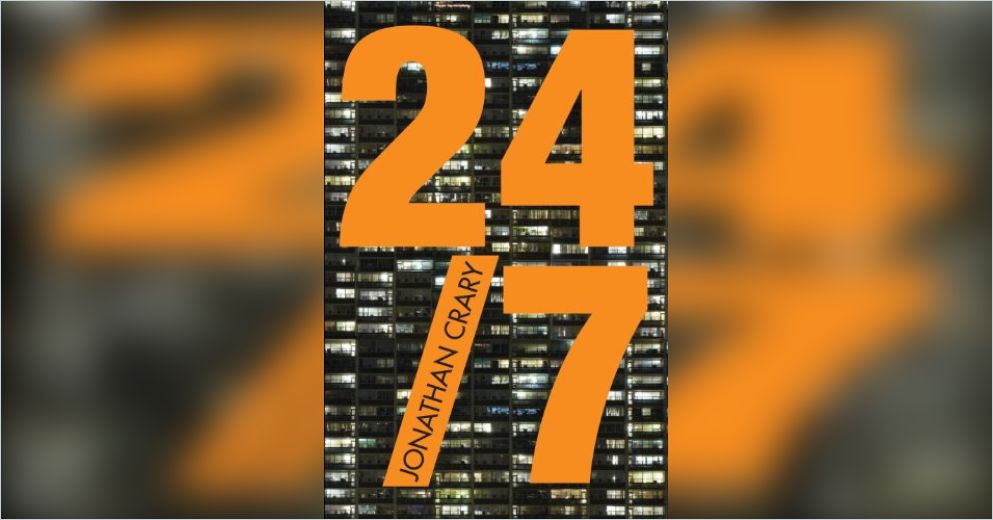
Daydreaming While Reading Jonathan Crary’s 24/7: Late Capitalism and the Ends of Sleep

By Edward Curtin

Source: Behind the Curtain

“Sleep that knits up the raveled sleave of care, The death of each day’s life, sore labor’s bath, Balm of hurt minds, great nature’s second course, Chief nourisher in life’s feast.”   – Shakespeare, Macbeth

People often laugh when I tell them that I go to sleep at 8:15 P.M.  They laugh harder when I say it’s been a lifetime habit, with unavoidable exceptions of course.  And that I wake up long before dawn.  Not because I am a dairy farmer or a baker, but because I love to sleep and all the best things I have written have been written in my dreams and refined during reveries while walking or in the early morning when all is silent still and I am alone with my musings.  I have always felt that sleeping and being awake were a seamless whole, contrary to the go-getters’ attitude that sleep and dreams are a waste of time, and I have been blessed with the ability to fall asleep as soon as I crawl into my crib and usually to remember my dreams in detail when I wake.

Jonathan Crary, the Meyer Schapiro Professor of Modern Art and Theory at Columbia University, agrees that sleep is profoundly important and under assault today.  To enter his book, 24/7, Late Capitalism and the Ends of Sleep, (which was first published in 2014) is for me to discover a kindred spirit, but also to enter a mind so capacious and profound that I wish to share his insights while I dream in words.

If what William Wordsworth (what a name!) wrote in 1802 was true then,

The world is too much with us; late and soon,
Getting and spending, we lay waste our powers;—
Little we see in Nature that is ours;
We have given our hearts away, a sordid boon!

what possibly could one say about today?  That shopping or thinking about shopping – things or propaganda or the latest useless buzz – is all we know?  That we have become completely insane, bamboozled by a capitalist techno-electronic madness that has not only seized our hearts but convinced our minds that it is good to spend our lives – our sleep and dreams and time and praxis – in tending to machines that destroy our souls night and day without interruption.

When fifty plus years ago the monk Thomas Merton wrote that “someday they will sell us the rain,” he could today add that the hard rain that Dylan sung of then has already fallen and they now need not sell us anything because we have eaten the bitter fruit of our own corruption.  People say they want peace while they fill their nights and days with digital dreams, eliminating what Crary calls “fugitive anonymity” for the bait of 24/7 capitalist drug addiction and being “with it.”  All the clichés have it that peace begins with “you,” yet you has become them or it, the tech-life 24/7.  I hear Sinatra singing Cole Porter’s lyrics today as

Night and day, you are the one
Only you ‘neath the moon or under the sun
Whether near to me or far
It’s no matter, cell phone, where you are
I think of you day and night

And such love is reciprocated, of course, as the electronic machines help so many distracted and restless souls make it through the night.  Sort of.  Not the kind of help Kris Kristofferson sang about, but a fleshless flashing gizmo colder than a frozen heart.

It is well known that sleep disorders are widespread today with technologically produced sleep drugs (and now marijuana) used by vast numbers of people. Such drug-induced sleep, the flip side of the frenetic passivity that precedes and follows it, occurs within a larger 24/7 sleepless framework that Crary accurately notes happens “ . . . within the globalist neoliberal paradigm, [for] sleeping is for losers.”   Yet what’s to be won is never enunciated because the winners’ faces are always well-hidden as they execute the prodigious capitalist machine of control that creates docility and separation in people who find the machine life irresistible – even as it drains them of easy-going vitality and the joy of dawdling, even for an idle while.  Doing nothing has become a crime.

Last night I stepped outside an hour after sunset and was startled by a massive full moon eyeing me as it rose over the eastern hills.  Here where I dwell there are no city or factory lights to block the moon and stars as they illuminate our nights.  But most people are not so lucky, for what our ancestors once took for granted – that we are part of nature, part of the Tao – has been lost for so many as artificial lights, urbanization, and a 24/7 linguistic mind-control ideology block the thrill of being transfixed by the moon’s loving gaze, an invitation to taste the sweetness of the north wind’s cookie.  Maybe the sight of her face might rattle the televised images lodged in people’s “memories” of mechanical misbegotten men in ghost suits trampling her peaceful countenance.

The 24/7 digital life, essential to neo-liberal financialized capitalism with its day and night markets and infrastructure that allow for continuous consumption and work – total availability – is the culmination of a long process that began with the invention of artificial lighting that allowed the English cotton mills to run 24/7.  Crary brilliantly illustrates this point through the 1782 painting, Arkwright’s Cotton Mills by Night, by the British artist James Derby.  This painting shows the windows of the massive mills lit like pin-points in the rural night, watched over by a full moon that illuminates the sky.  Incongruous time indeed!  He writes, “The artificial lighting of the factories announces the rationalized deployment of an abstract relation between time and work, severed from the cyclical temporalities of lunar and solar movements.”  This radical break from the traditional relation between time and work and the earth was later noted by Karl Marx as essential to the advance of capitalism since it disconnected the laboring individual from all interdependent connections to family, community, etc. while reorienting people’s feelings for time.  The English art critic John Berger, who knew that time with its corollary to place was a key to understanding so much history, put it this way: “Every ruling minority needs to numb and, if possible, to kill the time-sense of those it exploits.  This is the authoritarian secret of all methods of imprisonment.”

Dreaming of imprisonment, I just remembered that although it seems like a delusion from so far away and long ago, I once worked in a factory by day with its huge blast furnaces, in a NYC Police precinct jail on the 4-12 P.M. shift, and all-night as a nightwatchman.   All good lessons in how American society works, although I hated them all and labored simply for the pay.  But each in its own way taught me about imprisonment, especially the watchman’s job, since it involved a jolting sense of time and staying awake all night and sleeping by day.  I was always exhausted and felt I was violating my deepest nature.

Sleep deprivation is a central component of the torturers’ methods, as so many victims of the U.S. war machine have learned.  And the Pentagon (DARPA) has spent vast sums trying to create a sleepless soldier who can go at least seven days without sleep.  As Crary notes: “ . . . scientists in various labs are conducting experimental trials of sleeplessness techniques, including neurochemicals, gene therapy, and transcranial magnetic stimulation.”   The war against sleep is being waged on many fronts by well-armed maniacs intent on controlling human beings for nefarious ends.  To control sleep is to control time is to confound minds, which is the goal.

Ovid, the most sensual of Roman poets, would be shocked, I imagine, to learn that Morpheus, the god of sleep and dreams from his Metamorphoses, would be attacked so relentlessly by today’s madmen who never heard of his poetry.  My mind drifts to my college days translating Ovid under a weeping willow.  “My cause is better: no-one can claim that I ever took up arms against you,” he wrote and I read.  These words come back to me as I muse on the arms taken today against sleep, but I’m not sure if it’s Ovid or Bob Dylan’s lyrics in his song Workingman’s Blues #2 (from the album Modern Times) that fly to mind, for Dylan also sings “No-one can ever claim/ That I took up arms against you.”

Poor Morpheus, so many people in these modern times yearn for your arms but instead of that balm, they toss and turn in a time out of mind and out of sleep.

Crary tells us that the amount of sleep the average North American adult gets has gone from ten hours in the early twentieth century to eight hours a generation ago to six-and-a-half today.  And although people will always have to sleep, I think we can expect further reductions.  To say it is a form of torture is probably an exaggeration, but not by much.  He writes:

Behind the vacuity of the catchphrase, 24/7 is a static redundancy that disavows its relation to the rhythmic and periodic textures of human life. . . . A 24/7 environment has the semblance of a social world, but it is actually a non-social model of machinic performance and a suspension of living that does not disclose the human cost required to sustain its effectiveness. . . . 24/7 is a time of indifference, against which the fragility of human life is increasingly inadequate and within which sleep has no necessity or inevitability.  In relation to labor, it renders plausible, even normal, the idea of working without pause, without limits.  It is aligned with what is inanimate, inert, or unageing.  As an advertising exhortation it decrees the absoluteness of availability, and hence the ceaselessness of needs and their incitement, but also their perpetual non-fulfillment.

In other words, 24/7 is a form of linguistic mind control tied to cell phones, computers, and the digital life of the Internet whose purpose is to convince people that sleep and the human body is somehow unnatural and the future lies with people accepting their marriage to machines in a disenchanted and transhuman world.  It is a lie, of course, for if that is a future people accept, there will be no future, just a desert.  “Deleuze and Guattari went to the point of comparing the order-word [24/7] to a ‘death sentence,’” writes Crary. Such an order-word or imperative is similar in this respect to the term “9/11” which was coined to send an instant message that emergencies will now be endless so we will have to monitor you forevermore.  Keep your cell phone ready.  Be on your toes, stay alert, the terrorists come at all hours – keep awake!

Crary makes a profoundly important point at a time when there is much justifiable focus on propaganda and the lies of governments and the media.  This is the power of habit involved in the acceptance of the naturalness of various devices – today, electronic screens that are omnipresent – that we semi-automatically accept as normal.  He says, “In this sense, they are part of larger strategies of power in which the aim is not mass-deception, but rather states of neutralization and inactivation, in which one is dispossessed of time.  But even within habitual repetitions there remains a thread of hope – a knowingly false hope – that one more click or touch might open onto something to redeem the overwhelming monotony in which one is immersed.  One of the forms of disempowerment within 24/7 environments is the incapacitation of daydream or any mode of absent-minded introspection that would otherwise occur in intervals of slow or vacant time.”

This is part of a modern process of psychological reductionism and a changed understanding of the nature of wishes that have excluded dreaming and daydreaming from any connection to a traditional magico-theological framework.  Science and especially the neuro-sciences have reduced all life to what is empirically provable, attenuating life and the creation of art in the service of human life.  Crary uses Jean Paul Satre’s inelegant but insightful neologism, “practico-inert,” to explain people’s inability to see the nature of the social worlds they are part of with any clarity.  “The practico-inert was thus Sartre’s way [in Critique of Dialectical Reason] of designating the sedimented, institutional everyday world constituted out of human energy but manifested as the immense accumulation of routine passive activity.”

To repeat, this frenetic passivity serves to obscure the negative historical reality of life in a 24/7 electronic spectacle that is advertised as amazingly empowering but is the reverse.

For direct experience has fallen on hard times as life today has come to be mediated through electronic gadgets.  Surprises must be googled in advance or photographed to prove their reality.  Living is never easy, not in the summertime or any other season. Tension, inattention, exhaustion, and constant busyness are the order of the day.  This should be self-evident but isn’t.  People feel it but can’t see it.

Commenting on the dying art of storytelling, Walter Benjamin, in an essay called “The Storyteller,” said the following about people’s ability to listen and remember stories that they can integrate into their own experience so they can pass them on:

This process of assimilation, which takes place in depth, requires a state of relaxation, which is becoming rarer and rarer [written in 1936].  If sleep is the apogee of physical relaxation, boredom is the apogee of mental relaxation.  Boredom is the dream bird that hatches the egg of experience.  A rustling in the leaves drives him away.  His nesting places – the activities that are intimately associated with boredom – are already extinct in the cities and are declining in the country as well.  With this the gift of listening is lost and the community of listeners disappears.  [my emphasis]

We have gone beyond rustling in the bushes to a cacophonous electronic world that makes one deaf to all else.  That it will come crashing down around our ears is hard to imagine, but it will.  It already has in the damage that it’s done.

Once upon a time . . . well, I will spare you.  It might just seem like the dream of a ridiculous man, or something Dostoevsky would write, not your normal story or even daydream.

So read Jonathan Crary’s brilliant, 24/7: Late Capitalism and the Ends of Sleep and its sequel, Scorched Earth: Beyond the Digital Age to a Post-Capitalist World.  They will get you to think about your sleep habits and whether or not you are ever turned off and tuned out but just sometimes only in “sleep mode.”


If You Ever Start Trusting U.S. Businessmen, Remember Henry Ford

By Mickey Z.

Source: Dissident Voice

Henry Ford, the autocratic magnate who despised unions, tyrannized workers, and fired any employee caught driving a competitor’s model, was also an outspoken anti-Semite.

In 1918, he bought and ran a newspaper, The Dearborn Independent, that became an anti-Jewish forum. The May 22, 1920 headline blared, “The International Jew: The World’s Problem,” and thus began a series of ninety-two articles, including “The Jewish Associates of Benedict Arnold” and “The Gentle Art of Changing Jewish Names.”

By 1923, the Independent’s national circulation reached 500,000. Reprints of the articles were soon published in a four-volume set called The International Jew, which was translated into sixteen different languages.

The New York Times reported in 1922 that there was a widespread rumor circulating in Berlin claiming that Henry Ford was financing Adolf Hitler’s nationalist and anti-Semitic movement in Munich,” write James and Suzanne Pool in their book Who Financed Hitler. They add:

“Novelist Upton Sinclair wrote in The Flivver King, a book about Ford, that the Nazis got forty-thousand dollars from Ford to reprint anti-Jewish pamphlets in German translations, and that an additional $300,000 was later sent to Hitler through an intermediary.”

Ford’s plants in Germany adopted an Aryan-only hiring policy in 1935 before Nazi law required it. A year later, Ford fired Erich Diestel, manager of the automobile company’s German plants, simply because he had a Jewish ancestor.

An appreciative Adolf Hitler kept a large picture of the automobile pioneer beside his desk, explaining, “We look to Heinrich Ford as the leader of the growing Fascist movement in America.”

Hitler hoped to support such a movement by offering to import some shock troops to the U.S. to help Ford run for president.

In 1938, on Henry Ford’s 75th birthday, he was awarded the Grand Cross of the Supreme Order of the German Eagle from the Führer himself.

He was the first American (General Motors’ James Mooney would be second) and only the fourth person in the world to receive the highest decoration that could be given to any non-German citizen. An earlier honoree was none other than a kindred spirit named Benito Mussolini.

When appraising history and today’s Titans of Capitalism™, keep your guard up…

Is the United States a Failed Society?

The facts have become too dire to ignore any longer.

By Chad Mulligan

Source: Hipcrime Vocab

I’d like to pose a question I’ve been dancing around for the last couple of postsIs the United States a failed society?

That may seem overly dramatic, but please hear me out.

Recently, it has once again come to the attention of the news media that Americans are an order of magnitude more likely to die at every age than citizens of other advanced, wealthy, industrialized nations.

This was most recently expounded by a Financial Times correspondent named John Burn-Murdoch. The article itself is paywalled, but this Twitter thread contains all the relevant information:

https://threadreaderapp.com/thread/1641799698058035200.html

It makes for sobering reading. A lot of times the discussion just focuses on total life expectancy, that is, the number on the death certificate. That’s fallen too, but not as dramatically. But life expectancy differs at various ages. Yet, what the numbers invariably show is that, at every single age Americans are more likely to die than their counterparts in other wealthy industrialized nations.

For example, one in 25 five-year-olds in the United States will not live to see their fortieth birthday. That means a lot of parents are going to have to bury their children. But at every age, whether you’re twenty-five or fifty, your chances of dying are much higher in the United States than anywhere else. By age 29, the average American is four times more likely to die than a 29 year-old in another country. I’ve heard plenty of stories from people in their twenties and thirties talking about their high-school years like military veterans recounting their service during wartime (“fifteen in my class didn’t make it out.”). And those are just ordinary citizens!

In other words, growing up in the United States is extraordinarily deadly.

In fact, the social outcomes for the average American are worse than the most socially deprived areas of the United Kingdom like Blackpool—an area synonymous with industrial decline. At every single point along the income distribution, Americans are more likely to be hurt, injured, or killed than their peers in other wealthy, developed nations.

Furthermore, these trends are exclusively confined to the United States. Even Cuba, a relatively poor country under continuous sanctions by the United States since the nineteen-sixties, now has better health outcomes (e.g. life expectancy, infant mortality, chronic diseases). So, too, does China, which has overtaken the U.S. in a number of health metrics despite being the largest country in terms of total population.

The Atlantic’s Derek Thompson has called the United States “The Rich World’s Death Trap.” He interviews John Burn-Murdock here:

The bottom line is this: in many ways, your life chances are much, much lower in the United States than in any other wealthy, industrialized nation in the world. This is simply undeniable.

Which leads me to pose the question I asked above.

Peer Countries

Because this is such a fraught topic, it’s worthwhile to get some things out of the way. Certainly your life chances in the United States are better than many other parts of the world at the moment.

Some places are run by military dictatorships like North Korea or Myanmar. Some places are in outright civil war like Syria, Libya or Sudan. Some areas are in an active shooting war like Ukraine and Russia. Some countries have huge areas of absolute deprivation like sub-Saharan Africa, India, the Philippines or Afghanistan. Some countries have lost control over parts of their territory to drug gangs like Mexico, El Salvador, Peru and Ecuador. You’re certainly better off here than in many of those other countries.

So let’s just acknowledge that right off the bat. Of course, this raises questions about just how supposedly wonderful the current state of our world actually is, but that’s a topic for another time.

But I think it’s absolutely invalid to invoke those countries as a justification for the abysmal statistics listed above. Here’s why: the United States is at the absolute apex of the global economy, and has been since World War Two. We issue the world’s reserve currency. We have more billionaires than anywhere else. We are home to the largest and most powerful corporations in the world. No country in the world is more wealthy or powerful than the United States at the present moment.

This is the concept of peer nations. Those are the ones we should be judging ourselves against. You can use a number of indicators for this. The United States is a member of both the OECD and the G-7. In fact, it is the key member of these organizations. It is at peacetime. It is an electoral democracy. It has the world’s largest GDP. It is surrounded by the world’s two largest oceans and has benign neighbors to the north and the south. It has not had a war on its home soil since the 1860s.

Simply put, the United States has more resources at its disposal and more wherewithal to tackle social problems than anywhere else in the world.

So, unlike many other countries around the world, the United States has no excuse whatsoever for the sorry state of its citizenry, and comparing the United States to non-peer countries is no more than pathetic excuse-making in the face of damning evidence that the U.S. government simply chooses to ignore burgeoning social problems and leaves the majority of its citizens to fend for themselves.

What Else Is New?

Reading these facts, I’m wondering why any of this this is news to people. As far back as 2013 I noted the following:

Americans die younger and experience more injury and illness than people in other rich nations, despite spending almost twice as much per person on health care.

That was the startling conclusion of a major report released earlier this year by the U.S. National Research Council and the Institute of Medicine. It received widespread attention. The New York Times concluded: “It is now shockingly clear that poor health is a much broader and deeper problem than past studies have suggested.”

Why Is the United States So Sick? The director of a massive new study says: “It’s almost everything.” (Slate)

Also from 2013: The Surprising Reason Americans Are Far Less Healthy Than Others in Developed Nations (Alternet)

It received widespread attention all right, and then was promptly forgotten. But even earlier, in 2012, there was this report from The Lancet:

American teenagers have the highest rates of drug and alcohol abuse in the developed world. And they are far more likely to be killed by violence than peers in Europe. This lost generation, whose unemployment rate is 20 percent, leads the modern world in some of the most dangerous and irresponsible behaviors, according to a new study released by the Lancet medical journal.

U.S. teens worst in western world for binge-drinking, drugs and violent deaths (Daily Mail)

In 2019, husband-and-wife economists Angus Deaton and Anne Case coined the term “deaths of despair,” and noted that these were exclusively confined to the United States. In 2020, they published a book chronicling their grim studies with that same title. It, too, received a brief burst of attention in the media and then promptly disappeared down the memory hole just like everything else.

So this is old news. As Burn-Murdock’s article notes, the divergence between the U.S. and its peers has been continuously growing since around 1990, and has been getting even more acute in recent years.

The above podcast touts how “rich” we are compared with other nations using metrics like dollar income. But what does a high salary even mean when you are less likely to survive than other places? What are you supposed to do with that money, anyway—fill your oversized house with crap? As the saying goes, “you can’t take it with you.” This also belies the insanely high cost of everything in America, especially housing, which leads to 70 percent of Americans feeling financially stressed according to CNBC, despite how “rich” we supposedly are. According to Brookings, 44 percent of Americans earn low wages in this allegedly “rich” country.

And, as economist Dean Baker has noted, people in many other countries choose to take their additional “income” as leisure time, which may be another reason why they are so much healthier than we are. Americans work longer hours than anyone else, and at unusual times. The United States has a lousy work culture, with much less vacation or family leave time than other countries. Americans also take less vacation, work longer days, and retire later. Citizens of other countries also don’t have to pay for as many things out of their own pocket—from transportation, to retirement, to health care—due to a misguided fear of “socialism,” making income comparisons misleading. What sense does it make to earn a lot of money if you are lonely and isolated and have no time off to enjoy it? And much of that extra income is dedicated to cushioning ourselves from the fallout of a society decaying around us and positional goods to compete with everyone else.

My question is this: if the United States is not a failed society, then by what criteria should we judge success? Are context-free income statistics, GDP, and the number of billionaires really the appropriate measure for a good society rather than the well-being of the average citizen? People like to tout America’s so-called “innovation,” but one area we don’t seem to be innovating very much in is keeping our citizens healthy and alive.

The symptoms versus the disease

The reasons given for the above statistics are the usual ones: gun violence, drug overdoses, suicides, car crashes, metabolic diseases, and lack of access to basic and preventative health care compared to other nations.

But I want to distinguish the symptoms from the disease.

In medicine, doctors are taught to separate the symptoms from the disease. If a patient is suffering from a fever, jaundice, and swelling, for example; the fever, jaundice, and swelling aren’t what is making them ill. Instead, these are all symptoms caused by the disease which the patient is afflicted with, and it is the doctor’s job to determine what the disease is from the symptoms and try to cure it.

If that is the case, then what is the disease we are suffering from in this instance? In my opinion, it is this: American society is fundamentally rotten to the core.

We have effectively restructured our entire society as a lottery. Under this system, you’re entitled to precisely nothing except what you can claw free from the impersonal market casino rigged in favor the House. American society been transformed into a brutal winner-take-all tournament in the name of “meritocracy,” and most Americans seem to be okay with that.

At every point on their hierarchy, from the highest perch to the lowest, everyone is desperately trying to maintain their current position, hyperattuned to status, fearful of falling into the abyss, clawing each other’s eyes out to hold onto their small piece of the pie in a crabs-in-a-bucket scenario. “There is no such thing as society” has been elevated from a political statement to a a central guiding tenet where it’s every man for himself and the devil take the hindmost.

While other nations at least try to look after the welfare of all of their citizens, in America if you are not rich, successful or an entrepreneur, then your life is worth nothing. If you aren’t good enough, or don’t measure up, then you deserve to suffer. We actively hate the poor and think they should die. We talk about them like animalsAverage is over. The rich get richer. Winners take all.

Cutthroat capitalism is the order of the day. Your only task when you get up every morning is to get as much of the other guy’s money as possible into your own bank account by any means necessary for the next twenty-four hours and do it all over again the next day. There is no higher purpose. “Freedom” is defined as the ability for the rich to do whatever they like to the rest of us without consequence or sanction. It’s a world of predator and prey where you can either be one or the other—there is no other option.

Unlike in other countries, in the United States the government does not exist to help its citizens; rather, its primary role is to funnel money to a series of well-connected insiders feeding at various troughs. The rest of us are on our own. No one is on your side.

In every country, you need to educate your citizenry and keep them safe and healthy. That is the most basic task of any government, anywhere. In the United States, these tasks are delegated to predatory institutions designed to extract as much money as possible so that sticky-fingered middlemen can siphon off as vast amounts to feather their nests. A small sliver of executives in finance, education and health care get obscenely rich while the rest of the population struggles and is mired in debt, assuming they can even access those services at all. As a result, Americans pay wildly inflated prices for just about everything, from health care, to education, to energy, to entertainment and telecommunications. And the system cannot be changed because those insiders and middlemen fund the political campaigns and spend billions on highly effective propaganda. The rich people at the apex cynically strip-mine society for their benefit, while there are fewer paths than ever to a middle class lifestyle for the average person.

“Everything for myself and my immediate offspring; nothing for other people,” is the pervasive ethos: “I dont want pay for someone else’s (health care, education, fill-in-the blank).” But once that attitude becomes endemic, you no longer have anything even resembling a society anymore; you have only collection of individuals fending for themselves. As the title of a post from a few years back put it“I don’t know how to explain to you that you should care about other people.”

It is a nation of sociopaths where fellow citizens are seen as either enemies or competitors. The simple warmth of human kindness has been abolished. Americans walk around in a constant state of fear and high alertness like the prey animals they have become. Or else they have the thousand-yard-stare grazing in the aisles at Walmart. I’ve mentioned before how many Americans seem to be crazed and deranged, or zonked out on drugs, and don’t know how to behave around other people or show basic decency. People seem more and more desperate. I personally have witnessed many more acts of erratic behavior and dangerous driving lately, and have heard similar stories from other people. American society seems to be under more pressure than ever before, and people are cracking up left and right. It feels like a lot of people—even the supposedly “successful” ones—have basically checked out and are simply going through the motions.

The United States is a plantation society to the core. At a basic, fundamental level, American society is not set up not to deliver a good quality of life to it citizens, but rather for a small segment of hard, hard men to get unfathomably rich beyond the dreams of avarice, with the rest of us no more than insects to be stepped on in pursuit of that goal. And if some people happen to enjoy good lives anyway under that system, well, it’s more of an unintentional side-effect than a deliberate outcome. Perhaps you’re one of those hard men (or women), or hope to be. Good for you, I guess.

So I think that’s the fundamental reason for all of the above. That’s the disease, and everything else is merely a symptom—our refusal to properly fund universal health care; our built environment designed exclusively around cars and lack of public transportation; our fat and sugar-laden diets; our overcrowded prisons; our opioid-addicted homeless; our frayed social safety nets; our violent, trigger-happy cops; our extortionate education costs; our predatory financial institutions; our refusal to build affordable housing; and our propensity to shoot one another. American society is rotten to the core.

For example, even though our weekly mass shootings make international headlines, they don’t really have that much of an impact on life expectancy when you compare them against the size of the world’s third most populous nation, despite troubling statistics like these:

Last year (2022), two people died from gun violence in the United States every hour. In 2023, there have been at least 160 mass shootings across the US so far this year. There are 120 guns for every 100 Americans. No other nation has more civilian guns than people. About 44% of US adults live in a household with a gun, and about one-third personally own one.

How US gun culture stacks up with the world (CNN)

How many US mass shootings have there been in 2023? (BBC)

But that’s not the question we should be asking. The question we should be asking is this: what does this level of gun massacres and homicidal mania say about the nature of American society itself?

What does it say about American society that so many people have to turn to alcohol, opioids and other addictive drugs just to cope?

What does it say about America that it produces so many mentally-ill and broken people?

What does it say that Americans are so much fatter and sicker than people in other countries?

What does it say that we lock up more of our citizens than anywhere else in the world?

What does it say that our Surgeon General has described an epidemic of loneliness and isolation?

Americans are prickly and thin-skinned. They can’t bear any criticism of their nation, and will absolutely lose their minds at even the implication that they do not live in the best country on earth, despite mountains of evidence to the contrary (unless you are very wealthy). They will rationalize away all of the statistics listed above. Or else they will resort to immigrants as a way to shore up their fragile egos: “Everyone wants to move here!!!” Interestingly, according to the podcast above (-14:39), U.S. immigrants seem to live about as long as anyone else in the world. Perhaps it’s because immigrant communities tend to look after each other and manage to keep the toxic, every-man-for-himself individualism of mainstream American culture at arm’s length. Too bad for the rest of us, though.

In the end, the facts speak for themselves: By the standards that actually matter for the average individual, compared to peer nations, the United States is an objective failure.

Why is it like this? Some pessimists say that it’s been like this from day one and there’s nothing we can do about it. Perhaps they’re right. But the facts tell a different story. According to the data, it’s really only since 1990 that this yawning chasm in social outcomes has opened up in between the United States and the rest of the world. During the New Deal era, for instance, these gaps didn’t exist or actually favored Americans. The United States was able to accomplish big things like building the Hoover Dam and putting a man on the moon, and people didn’t hate and fear their own government. The U.S. was perceived very differently abroad.

Here’s what I think happened. Starting in the 1970s a small group of sociopathic men at the top of the hierarchy acquired the means and the tools to reshape the United States in their own image. They founded think-tanks. They funded economics departments and political campaigns. They bought up the media. They started television networks to promote their agenda. They packed the courts. They used the latest cutting-edge psychological research and techniques that had been developed in the service of advertising to remold the society like putty in their hands. Throughout the decade of the 1980s under Reagan, their plans ultimately came to fruition, and the transformation was compete by 1990 which is why the changes became apparent after then. Ever since, we’ve been living in the society that they have created. I’m skeptical that Americans were always inherently more sociopathic and antisocial than people everywhere else—I think to a large extent we’ve been made to be this way.

So we’re all living in the end result of that. And now that it has been accomplished, we see the ugly results everywhere around us, including increasing political radicalization and strife as the failure of this vision of society is becoming increasingly apparent but we seem to be incapable of envisioning an alternative or are too fearful of change. Instead, we seem to be doubling down. I fear it’s already too late to turn things around, and this is just the way American society will be forever now and things will just continue to get worse and worse for the vast majority of us. We will remain the (not so) rich world’s death trap, permanently.

I’ll conclude with this passage which I read years ago:

If I could paint the country in one broad stroke, I would say it’s a place where one concept of freedom – used to lobby for private interests and free markets – is at odds with another kind: the ability to lead a life you enjoy. Fewer and fewer seem privileged with this second kind. Not Trayvon Martin, who was a victim of a certain kind of racism which had, as its root, private property anxiety. Not the natural gas employee who has consigned himself to a life of doing something that he feels ought not to be done. Even I – who have managed to escape from time to time – always find, upon return, a cordial invitation to fall in line.

What I learned about freedom from hitchhiking around America (The Guardian)

As the above statistics show, not only are many of us not living lives we enjoy, but increasingly more and more of us aren’t living at all.

Austerity, War & Dictatorship… the Charade of Western Democracy Is Over. Can We Lose Those Chains?

By Finian Cunningham

Source: Strategic Culture Foundation

Western liberal democracy and its ubiquitous “austerity economics” is a euphemism for fascism. And the charade is finally coming to an end.

Western liberal democracy and its ubiquitous “austerity economics” is a euphemism for fascism. And the charade is finally coming to an end.

Austerity is not some recent policy under neoliberal capitalism. It was born out of the historic crisis in the Western system following the First World War and during the 1930s when fascism became a way to curtail any democratic challenge to the prevailing capitalist system.

That political instrument of repression is wielded today across all Western states. Quite amazingly, for a long time, few people recognized their captive, repressive state as fascism. We generally lived under the illusion that we were free citizens in “liberal democracies”.

In this interview, Clara E Mattei explains how the technocratic-sounding “austerity” is used to hide the brutal reality of dictatorship and repression against the vast majority of citizen workers in Western states.

Clara Mattei is an Assistant Professor in the Economics Department of The New School for Social Research, New York. She is the author of The Capital Order: How Economists Invented Austerity and Paved the Way to Fascism.

Her book investigates the origins of austerity as an economic policy after the crisis of World War One. Crucially, she argues that austerity is not merely about governments balancing financial budgets. Professor Mattei contends that austerity policy implemented by all Western governments is a political instrument of mass repression to prevent any challenge to the prevailing capitalist order.

Austerity forces the vast majority to accept unacceptable conditions that are otherwise shockingly anti-democratic. The precariousness and insecurity of employment, the widespread denial of social services, deprivation and poverty, and the relentless abuse of taxes and resources that are fueling insane militarism and war.

If we really did live in free, democratic societies why are such deformities enforced without any alternative? Austerity is used to crush the political imagination for any reasonable, more humane, more peaceful alternative.

However, as Clara Mattei points out in this interview, the extreme anti-democratic conditions in Western societies are inevitably forcing greater numbers of people to question the injustices and hideous anomalies of the prevailing capitalist order.

People are realizing that Western governments are in reality regimes of repression in service for the enrichment of a minority. That fundamental deformity is why Western societies are collapsing and why the United States and its Western lackeys are driven to increasing conflict against Russia and China.

The charade of “Western democracy” is coming to an end. The rulers and their pantomime political parties are losing the moral authority to hold power over the masses.

As people necessarily seek ways to reinvent societies that are fit for meeting their democratic needs, socialist solutions are beckoning. We have to throw off the mental shackles imposed by our dictators, and realize, as Karl Marx once eloquently said, that we have got nothing to lose except our chains.

How Does Degrowth Apply to Our Minds?

By Erin Remblance

Source: resilience

As an Australian, it troubles me that if the whole world lived like us, we would need 4.5 planet Earths. Thanks to over-consuming nations like mine, worldwide we are living as if we have 1.75 planet Earths, a figure that has increased from 1 (that is, living within our means) since 1970. What this boils down to is that those of us in the global north are taking from both countries in the global south and future generations to fuel our lifestyles today. The ‘Earth Overshoot’ research is supported by the work of the late Earth System Scientist, Professor Will Steffen, who brought to our attention The Great Acceleration, whereby “[a]fter 1950 we can see that major Earth System changes became directly linked to changes largely related to the global economic system.” Steffen is referring to our growth-based economies, and while three percent economic growth each year might sound small, it means that within 24 years we will be consuming twice as many resources as today, and within 100 years 19 times as many. As economist Kenneth Boulding said: “[a]nyone who believes that exponential growth can go on forever in a finite world is either a madman or an economist.”

For this reason, I am a big proponent of degrowth in over-consuming nations in order to fit back within planetary boundaries. For anyone not familiar with the term, degrowth is a planned, democratic reduction in material and energy use in high-income nations while improving the well-being of people in those nations. It is more than this though. While very often the focus of degrowth is on how life can be better in a smaller economy, Federico Demaria and Serge Latouche argue that “[t]he point of degrowth is to escape from a society that is absorbed by the fetishism of growth…. It implies decolonization of the imaginary and the implementation of other possible worlds”. In this respect, the former definition of degrowth applies only to over-consuming nations, while the latter definition applies to all nations, and to all people. It is this second definition of degrowth to which this essay relates.

The concept of degrowth is powerful because it is clear that we need systemic change to avoid ecological collapse: business as usual with a “green tinge” isn’t going to be enough. It is also true that individual change drives cultural change which can be the key to unlocking political change leading to fundamental change. On this point, I find it fascinating to consider how “growth has entered our minds and souls”, and how an awareness of these “mental infrastructures of growth” might free us from growthism and help unlock the cultural changes that will bring about the necessary systemic changes.

With this in mind, here are a couple of points to consider in relation to how growth may be enshrined in the psychological structure of our collective minds, largely based on the work of Harald Welzer:

  • Our dreams for the future are centred around it being better than today, in the sense of ‘more’ (e.g., a bigger house, a larger salary, more travel).
  • We see ourselves as something to continually develop and optimise, our lives are seen as a process of creating biographies or filling curriculum vitae.
  • While we used to see paid labour as drudgery and something we did until we had met our needs, now we view it as noble, esteemed even, to be sought out and with no end. Sadly, this cultural 180° turnaround becomes a regret of many as they are dying.
  • Similarly, society views ‘hard-work’ as virtuous and thus ‘hard-work’ entitles those who undertake it to whatever their heart desires without limit or consideration of the harm caused, their purchases being the fruits of their labour.
  • We typically live by the rhythms of the industrial workday via a standardised worldwide time regime, unaware that there is a natural rhythm of time (for example, consider that in 2023 there will be 13 moons but only 12 calendar months or that, on the whole, our pace of work is unchanged by the seasons).
  • It is a collective belief that we should be able to own parcels of land, excluding others from that land. An example of this is that home (and correspondingly land) ownership in Australia is described as the ‘Great Australian Dream’, a term derived from the ‘American Dream’ of the same nature.

In various ways, these – and probably many more aspects of our modern day lives – relate back to the surpluses created by industrialisation (enabling the future to have more than today, a concept that is “historically quite recent”), the enclosure of the commons (the very foundation of growth-dependent capitalism) and the subsequent imperative to work to have our needs met (rather than simply being able to directly meet our needs). Our ability to recognise and unpick these ‘mental infrastructures’ – that is, the worldview that influences all of our actions – will be key to throwing off the shackles of growth and unlocking a culture of sufficiency, whereby we recognise when we have ‘enough’ in a material sense and from then on meet our “nonmaterial needs nonmaterially”, increasing our sense of wellbeing and contentment.

The work of Antonio Gramsci on cultural hegemony is relevant in unlocking a culture of sufficiency. Michael Mezz describes Gramsci’s theory on how the ruling class maintains power via a cultural form of dominance:

“…the ruling class creates an ideology in which its own values become common sense for the rest of society and Gramsci argued that the role of the state is to maintain institutions such as media and the education system that educate the masses on the cultural ideology of the ruling class. The goal of that education being that the working class develop a sense of freedom and a good life that serves the purposes of the people in power. In other words, the working class starts to value things like innovation and productivity and economic growth that doesn’t actually serve them.”

Gramsci tells us that the way to overcome cultural hegemony is by creating a new culture that is not based on the values of the ruling class. A counter-culture, if you like.

So, what are the counter-hegemonic narratives that we can begin to embrace? What would a mind and soul not infiltrated by growth look like? There is much to learn from indigenous cultures on this topic. As Jeff Sparrow highlights in his book, Crimes Against Nature, First Nation Australians found paid labour to be antithetical to their egalitarian lifestyles:

“Today, we take the wages system for granted. It appears normal, almost eternal, since we can barely conceive of an alternative. It did not seem normal to pre-colonial people. In Australia, as elsewhere in the world, they found capitalist practices utterly horrifying…. Indigenous people, accustomed to an egalitarian ethos and to work carried out for the collective good, saw the authority exerted by employers as tyranny. As late as 1888, a churchman complained of the difficulty he had in persuading Indigenous people that one man was innately better than another, that a certain individual, by virtue of his possessions, mandated obedience from his fellows…. Indigenous people did not despise wage labour primarily because of the effort that it entailed. Rather, they thought the work demanded by capitalists stripped life of its humanity.”

Furthermore, First Nations people lived with the rhythms of nature, not the industrial workday, and there was no private land ownership, they had the wisdom to know that “… you are undone if you once forget that the fruits of the earth belong to us all, and the earth itself to nobody” (Jean-Jacques Rousseau).

There are many examples of counter-hegemonic narratives arising more recently too. The following list is skewed more towards examples from the global North because the global North represents the vast majority of the over-consumption and is therefore where cultural change is most needed. Such examples include:

  • Those people, like the Futuresteaders and others who practice voluntary simplicity and frugal abundance, who appreciate the simple things in life, and find happiness in what they have rather than what they want. Seeking only ‘enough’ and not ‘more’ represents an affront to the dominant culture of dreams of the future being materially greater than today. This point is relevant only to those whose needs are already met. Of course, those who are living in conditions of deprivation should have access to ‘more’, until they too have ‘enough’.
  • People who choose to spend their time doing work that is traditionally undervalued and lacking in both career trajectory and pay increases, but is socially valuable, forgoing future surpluses (think of the stay-at-home parents, childcare workers, teachers, nurses, carers, small farmers, those who work part-time voluntarily, and those who volunteer their time to worthy but under-funded causes).
  • The move towards minimalism which seeks to value time and non-material items over ‘the grind’ and the accumulation of things as a reward for hard work. The Tiny House Movement shows us that it is possible to enjoy living with less, including the freedom of a smaller mortgage.
  • The tang ping (lying flat) movement in China and quiet quitting in the U.S.A. are taking back our right to be humans, not simply workers who devote more time than they would like to paid labour.
  • Anyone advocating for job guarantees, enabling anyone who wants to work to do so. Job guarantees seek to remove the artificial scarcity of employment we see today, where the threat of joblessness looms ever large and we constantly need to better ourselves so that we can compete for work. Those who advocate for a Universal Basic Income – an unconditional liveable wage for all – are fighting to remove the need for waged employment at all.
  • People organising for the community rather than the individual are prioritising others over their own interests, giving up the opportunity to build their own CVs in favour of the greater good, and there are some wonderful examples of such union building herehere and here.
  • The move towards a 4-day work week challenges the dominant narrative that more time at work is better.
  • The Nap Ministry and the related manifesto Rest Is Resistance empowers us to value rest over productivity.
  • The many activists calling out the harm caused by the carbon-intensive lifestyles revered by the dominant culture, such as Greta Thunberg (who beautifully articulated in her book, The Climate Book, that “we all have a responsibility to find quick ways of making that [extremely high-emitting] lifestyle socially unacceptable”), activists who block private jets, people promoting going flight free, and those seeking to reduce the dominance of cars on our streets. For these people, simply having the means to live a materially intensive lifestyle – regardless of the hard work involved in acquiring those means – isn’t enough to justify the harm it causes.
  • The locals of the Greek Island Ikaria, who do things in their own time, not that of the industrial workday. This fascinating paper describes “people arriving to appointments in ‘Ikarian time’, that is, a ‘few hours late’ or shopkeepers telling bewildered tourists that ‘the shop will open when it is time to open’”.
  • Co-operative housingcommunity land trusts and Vienna’s enviable form of social housing show us that there are other ways of providing a community’s housing and land needs that don’t rely on private ownership.

There are, of course, many other wonderful counter-culture examples beyond this short list – this is merely scratching the surface – but the point is that we need to advance these, and those of the same theme, until they become the leading narrative.

Unpicking the dominant, growth-based worldview will mean closely analysing the stories we have been told (and who those stories might serve), and bravely and courageously assessing whether all of this growth really does bring us ‘the good life’. We will likely find that we can achieve ‘a good life’ (that is, harmony with ourselves, our community, and the physical world) by living simpler but more meaningful lives. Perhaps we will even come to realise the very wise words of English writer, Alan Watts: “the meaning of life is just to be alive. It is so plain and so obvious and so simple. And yet, everybody rushes around in a great panic as if it were necessary to achieve something beyond themselves”. The way that growth manifests in our minds, our thoughts, our dreams, and our souls is important to consider because if we can create a culture of sufficiency, we will have found the key to systemic change and avoiding ecological catastrophe. I’m sure we can all agree that this is a worthy task indeed.

An Inconvenient Revolution

By Charles Hugh Smith

Source: Of Two Minds

Convenience isn’t just about small appliances. It’s also about ruling nations. Let’s start with the semantics of ruling nations. Some labels might be viewed as somewhat inflammatory (Kleptocracy, anyone?), so let’s stick with the neutral Ruling Order.

Some things have been extraordinarily convenient for the Ruling Order. Take the life and death of one Jeffrey Epstein, an intel “asset” who assembled a veritable goldmine of dirt on an astounding collection of bigwigs, and then became, well, inconvenient.

Very conveniently, the security camera in his cell failed, the guards dozed off and he hung himself in this fortuitous interlude. This was the acme of convenience.

Extending the Surveillance State into Big Tech’s planetary-wide social media networks was also convenient, and a bargain to boot. Instead of all that expensive stuff the Communist State in China had to pay for, America’s Ruling Order just put the squeeze on Big Tech and saved a bundle.

The Surveillance State assumes that any revolt / revolution can either be nipped in the bud by identifying foreign influences / domestic extremists, or crushed by foreknowledge of the storming of the barricades.

In conventional times, these are pretty safe assumptions. But the times are no longer conventional, and so the Ruling Order is in effect investing its treasure and confidence in fighting the last war.

It’s convenient if rebelling citizens organize themselves in visible networks and concentrate into groups that can be crushed by force. It’s inconvenient if the revolution is not neatly organized and crushable but an invisible revolution of not showing up.

In other words, a revolution of getting fed up and opting out, of finding some other way to live rather than spending 10 years paying down the student loans and another 30 years paying down the mortgage and the last few years of one’s life watching the tides of financial excess erode the sand castles of pensions and retirement.

There’s a consequential asymmetry to the inconvenience caused by people getting fed up and opting out. The average worker not showing up is consequential but not catastrophic. But when the managerial class thins out, and those doing the dirty work thin out, there are no replacements, and the system breaks down.

Few are willing to make the beds, empty the bedpans and work in slaughterhouses. When those willing to do the work nobody else wants to do quit, the system collapses. Those with higher expectations will not volunteer to do the dirty work, and many are unable to do the work even if they are willing. It’s too hard and too physically punishing. (Says a guy who’s carried stupid amounts of lumber up hillsides where no forklift could go.)

Despite what many of us may think, the majority of workers lack the experience and tools to manage complex operations. (Those of us who try soon reach our limits.) Many lack a deep enough knowledge to fix major breakdowns. When the critical operational and managerial people retire, quit, or find some other way to live, the system breaks down.

All the surveillance and all the force that the Ruling Order depends on to maintain its dominance is useless when people get fed up and quit supporting the system with their labor and their borrowing / spending. All the surveillance and facial recognition software is worthless, all the monitoring of kitten and puppy photos on social media, all the tracking of foreign influence–none of it matters any more.

It’s inconvenient when those whose sacrifices are essential to the system get fed up and find some other way to live. Yet this is the inevitable consequence of a system hopelessly corrupted by fraud, inequality and unfairness, a system rigged to benefit the few at the expense of the many. People eventually get fed up and opt out.

They don’t throw themselves on the gears of an odious system, they simply stop greasing the gears with their time, effort, experience, debt and money. It doesn’t take many opting out to trigger decay and collapse. The Pareto Distribution applies. The system can adjust to the first 4% opting out, but those consequential few trigger the decay of the commitment of the next 20%, and the system cannot survive when the 20% find some other way to live. The 80% can still be willing to grease the gears but that’s no longer enough to maintain the coherence of the system.

The asymmetry of decay and collapse is inconvenient.

I Know Why Can’t We Fix Homelessness

By Peter Van Buren

Source: We Meant Well

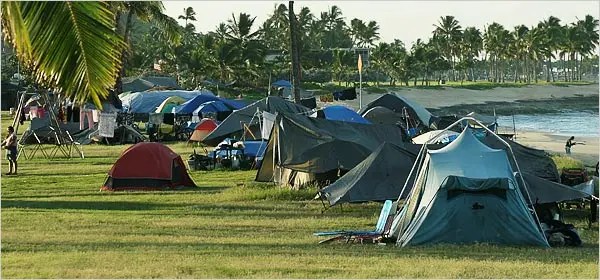
“What stands out for visitors?” I asked our guide during a Honolulu Chinatown tour with my out-of-town guests. “Always the same, the homeless. Even Mainlanders from big cities like San Francisco and New York are surprised how many we have here. I’m waiting to see how the Japanese and Korean guests respond when they start traveling again.”

You can’t miss his point. During our brief walk through Chinatown’s markets we saw a disturbed man dressed only in his underwear touching himself, several seriously street-worn people begging, and watched the fire department respond to a prone homeless man who was dead or simply drugged into paralysis. When someone in our party needed the toilet, the shopkeeper apologized for having to keep it locked to prevent misuse by vagrants. Many places simply had signs saying “no public toilet.” Despite some great tasting food, it was hard to keep up a holiday spirit. Same for when we passed the tent cities and parks overtaken by homeless along a drive on the Windward side.

The numbers only begin to tell the story. Pre-COVID, there were an estimated 6,458 homeless in Hawaii. The Big Island saw the biggest jump in homelessness from 2019-2020, a 16 percent increase. On Oahu the homeless population is up 12 percent. San Francisco before COVID counted over 8,000 homeless persons, and while COVID-era numbers are hard to pin down, one measure is overdose deaths among the homeless, which have tripled. New York has the highest homeless population of any American metropolis, close to 80,000 and growing. The number of homeless there today is 142 percent higher than it was 10 years ago, and currently at the highest level since the Great Depression. Some 3,000 human beings make their full-time home in the subway.

Estimates for the United States as a whole run well over half a million people living homeless. The number shoots up dramatically if one includes people living in their cars, people on their way to exhausting the good will of friends who offered a couch, and those who slide in and out of motels as money ebbs and flows. Some 21 percent of American children live in poverty, homeless or not. In the end nobody actually knows how many people are living without adequate shelter except that it is a large number and it is a growing number and there is nothing in line to lower it, only to find new ways to tolerate it.

We have in many places already surrendered our public parks and libraries. The hostile architecture of protrusions and spikes which make it impossible to sleep on a park bench are pretty much sculpted into the architecture of the city, markers of the struggle for public space. The idea even has its own Instagram account. A security firm offers tips: restrict access to sidewalk overhangs protected from inclement weather, remove handles from water spigots, and keep trash dumpsters locked. If things get too bad, the company, for a price, will deploy “remote cameras with military-grade algorithms capable of detecting people in areas they shouldn’t be in.”

Keep in mind that all of these homeless people coexist in a United States whose wealthiest citizens have their own spaceships. NYC alone is home to 70 billionaires, more than any other American city. New York is also home to nearly one million millionaires, more than any other city in the world. How is it that the nation’s wealthiest city and poorest city are the same place?

All the solutions seem to fail. There are not enough shelters we are told but even when more shelters are built the homeless are too paranoid to move in,or the shelters become too dirty, too dangerous, chaos compacted, so the transition from an encampment to supportive housing isn’t easy. In ravaged San Francisco, one out of 10 of the city’s already existing supportive housing units are empty, with the director of the Department of Homelessness (!) placing the blame on individuals. So the homeless problem becomes a mental health problem which becomes a drug and alcohol problem which becomes a public health problem. Our society will not force people into care, and it will not deport the homeless against their will to desert camps. Instead we simply do nothing absent throwing a few bucks into food programs as an expedient over stepping around too many bodies in the street. Meanwhile nobody asks why nothing seems to work.

When you look at history with enough perspective you see very little happens without cause and effect. Things are connected. Casualty matters more than randomness. Answering the question of what to do about homelessness requires first answering the question of why we have the problem in the first place. Because while homelessness exists elsewhere in the developed world, you simply do not see it at pandemic proportions in equally-developed nations across Europe, and certainly not in the economic superstates like China, Japan, Singapore, et al. Scale and size matter and America wins on both. Why?

Because the American economic system requires homelessness. That’s why we can’t solve homelessness; no matter how much solving you do the system just makes more.

The Democratic arguments over raising the minimum wage are a smokescreen. As long there is a minimum wage and businesses do not have to compete for workers, there have to be homeless people. Think of the homeless as run-off, the unfortunate but necessary waste product of an economic system designed to exploit workers for the benefit of space-traveling overlords. The homeless — no wagers — are the endpoint of an economic spectrum dominated by the minimum wagers, people whose salary and hours, and thus whose chance at lifetime wealth status, are capped by agreement between the government and industry.

Until slavery ended, human beings were considered capital, just like stock today. Now we’re “human resources” so everything’s better. Bringing up race hides the real story of how long this has been going on and how deep a part of our way of life it is. The line between controlling someone with a whip and controlling someone through ever-lower wages gets finer and finer over time.

This is what “systematic” means: a system of public-private sector agreements codified as laws which push workers into a cesspool as grab-and-go disposable labor. Those who sink end up homeless. Those who tread water are guaranteed a life of maybe just enough, their place in society fixed for others’ goals, never their own. It also assures the sales of drugs, alcohol, and lottery tickets as the working poor try to convince themselves all this can’t be true. Can it?

The next step is clear. The working poor are allowed to exist at survival levels only because they are in jobs too expensive or difficult to automate. You think there are a lot of homeless now? Wait until self-driving vehicles click in and another job category simply disappears, leaving drivers and delivery people nowhere to go (there are more than 3.5 million truck drivers in the U.S., making driving one of the most popular occupations.) Same for fast food and other service jobs. Soon enough AI and/or remote online learning will make live teachers an expensive luxury for the children of the wealthy.

If you wanted a clever term about why we have and ignore and can’t address the homeless problem, you could call it systemic inequality in tune with the times’ nomenclature. A system designed to exploit will always exploit too much at its edges. It is supposed to, in order to keep driving the center downward, from 1950s middle class to 2022’s working poor.

But in the near term the issue isn’t confronting the reality of inequality, it is navigating the society it has created, much as my tour guide directed us around the homeless nests in Chinatown so we could sample the dim sum at leisure. “Don’t make eye contact” was some of his best advice.

Related Video:

This Is of Course Insane

By Charles Hugh Smith

Source: Of Two Minds

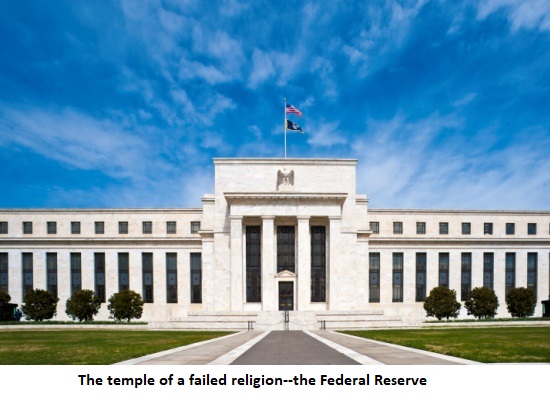
Greed is a powerful motivation to be an ardent believer in the central banking cult.

The ideal cult convinces its followers that it isn’t a cult, it’s simply the natural order of things. In current terms, this normalizes insane behaviors and beliefs. Sacrificing youth to appease the gods isn’t a cult; it’s simply the natural order of things. If we don’t sacrifice youth, bad things will happen, so we have to follow the natural order of things.

Despite the lofty claims made by our rational mind, we want to hear and obey the voices of the gods. This non-rational desire is the root of cults and episodes of mass hysteria, i.e. the madness of crowds.

Humanity is in the grip of the secular cult of central banking. The cult’s seers and prophets periodically emerge with arcane signs and readings, offering divinations to guide the followers.

The motivation to believe the cult is the natural order of things is powerful: greed. Those who heed the oracles of the cult enrich themselves, unbelievers impoverish themselves.

Rationalists outside the cult discern the structure of the cult and its core beliefs. The cult creates credit and “money” out of thin air and distributes it to the few extremely wealthy to further expand their wealth. These few do not improve productivity or the well-being of the many; they use the cult’s gifts to exploit the cult’s rigged casino of speculation to maximize their private gains.

In other words, the cult benefits the few at the expense of the many while proclaiming it benefits everyone. This is of course insane. The cult’s core beliefs are: 1) enriching the already-rich magically trickles down benefits to the masses, and 2) this vast enrichment of the already-wealthy is cost-free. The economy prospers with no downside or consequences other than the glorious expansion of wealth at the top and the trickle-down of sweet goodness to the masses.

This is of course insane. The costs are borne by the masses and by the socio-economic system, which is now in thrall to a cult that has made the economy dependent on an ever-expanding credit bubble which feeds an ever-expanding asset bubble, which then enables a further expansion of credit which then fuels ever-higher assets prices.

And so on, forever, because the cult and its ever-expanding bubble are the natural order of things. If we don’t sacrifice the many to benefit the few, the sun will stop rising and the Earth will be cast into endless shadow.

This is of course insane, but greed is a powerful motivation to be an ardent believer in the central banking cult. Expanding credit based on the expanding collateral of asset bubbles, each feeding the other, is held up not as insane but as a financial perpetual-motion machine, overseen and managed by the seers and prophets of the central bank cult. Followers heeding the cult’s oracles become rich, non-believers and skeptics become impoverished.

Alas, cults and bubbles both come to an inglorious end. What seemed self-evidently true for the ages is revealed as a brief moment of self-serving delusion, supported by the immense powers of greed and the madness of crowds.

Do you hear the voices of the gods? Yes, yes, oh yes.