The Long Cycles Have All Turned: Look Out Below

By Charles Hugh Smith

Source: Of Two Minds

Long cycles operate at such a glacial pace they’re easily dismissed as either figments of fevered imagination or this time it’s different.

But since Nature and human nature remain stubbornly grounded by the same old dynamics, cycles eventually turn and the world changes dramatically. Nobody thinks the cyclical turn is possible until it’s already well underway.

Multiple long cycles are turning in unison:

1. The cycle of interest rates: down for 40+ years (last turn, 1981), now up for an unknown but consequential period of time.

2. The cycle of inflation / deflation: the 40-year period of low real-world inflation and rip-roaring speculative debt-asset inflation has ended and now an era of scarcity, real-world inflation and speculative debt-asset deflation begins.

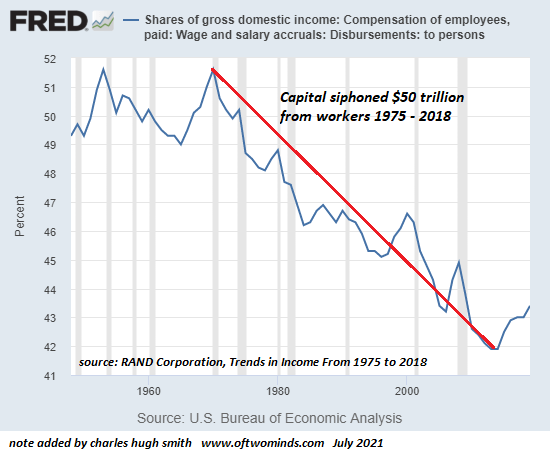
3. The cycle of capital-labor balance: capital has dominated labor for 40+ years, siphoning $50 trillion from labor. This cycle has now turned and the rebalancing is underway: it’s capital’s turn to surrender gains and power.

4. The cycle of social order-disorder: as documented by historian Peter Turchin and others, social order (in Turchin’s phrase, the integrative phase) holds sway for about 50 years and then it gives way to an era of social disorder (the disintegrative phase). This phase doesn’t end with mild reforms nobody even notices, it ends with a rebalancing of social, political and economic power.

5. The cycle of wealth/power inequality: wealth–and the political power it buys–becomes increasingly concentrated in the hands of the few at the expense of the many. This feeds economic and political dysfunction and exploitation that must be remedied by reducing extremes of wealth-power inequality.

6. The cycle of speculative excess: those in power protect their wealth and the wealth of their cronies by instituting moral hazard, the disconnect of risk and consequence: the central state and central bank backstop and bail out the most egregious big speculators, who keep all their gains and transfer their losses to the public.

The public concludes the only way to get ahead in such a rigged financial system is to belly up to the gaming tables and gamble that the next bubble will never pop because those in power won’t ever let it pop.

But alas, humans do not possess god-like powers, they only possess hubris, and so all bubbles pop: the more extreme the bubble, the more devastating the pop. The faint cries that fade to silence are: but this time it’s different! and the Fed will save us! That’s not how cycles work: all the god-like powers are revealed as hubris, which arouses the fatal ire of Nemesis.

Wake From The Nightmare Or Eternal Sleep For Humanity

By Frank Scott

Source: Dissident Voice

The tradition of the dead generations weighs like a nightmare on the minds of the living.

— Karl Marx

Marx offered a thought for all seasons but one that might especially ring true during what is supposed to be a season of peace, joy and humanity. Contradicted by the ever more insanely harsh reality of marketing mass murder under the guise of creating freedom, much of our race, though still too few to radically transform the totality of our reality, has begun to rise in defense of all against a system that profits only a few. France’s recent experience was part of a hopeful trend in that segments of a public which has been bought, sold and rented into near poverty showed they are tired and demanded social justice over becoming what capital sees as a loss of its private profits. Their awakening from humanity’s nightmare, however brief it may seem, is inspiring as well as overdue. The actions of a predominately working class group of citizens demonstrating with enough fervor to force the French government to at least renege on some issues is in stark contrast to Americans trooping off to the polls to “resist” a personality while their system – the same one the French are up in arms about – disintegrates all around them. If we have anything to be happy about during the annual shopping frenzy of an alleged spiritual time for humanity, in a small way it’s a few changes in our congress, but in a greater way it’s the sign of awakening we see in France which will hopefully spread to more places in the New Year.

The social democratic salvation capital arranged after the depression of the twenties and thirties has collapsed and become a renewal of the worst forms of fascist capital that preceded and soon followed that brief cosmetic safety for some made possible only by the reduction to disfigured ugliness of others. The rise in status of a new middle class for millions in the western world was only possible with the misery of greater multitudes in what was called the third, or undeveloped world, but also the poverty class in that same west. There were people sleeping on the streets of America before, during, and after the last breakdown of capital given the brand name “the great depression”. This latest collapse that began in 2008 and is very possibly the last one that will wake up more than the French is only different in that it is worse and the numbers in the street have grown so much only the intellectually and morally blind cannot see them.

The wealth accumulation of the return to market fundamentalist roots was and continues to be shared by a shrinking minority while growing majorities have seen the facade of humanity brought about by social democratic capitalism dissolve in the reality of a take-no-prisoners brand of marketing. This Artificially Intelligent farce not only prides itself on the creation of poverty and warfare but dulls the sense of many of its innocent subjects by filling heads with propaganda that passes for news, entertainment to distract consciousness further, and the combination of the two that marketers call “infotainment”.

Thus we have a perverse form of capital therapy that herds us into near frenzied lynch mobs of genuinely frustrated and set upon souls directing energy at everything but the cause of most if not all the things that plague us. Rich individuals approaching deity status with economic powers beyond those of past royal despots are relatively invisible while some of their employees in government attract enough attention to be replaced by other of their employees who appeal to one or another interest or identity group affording pleasure to some, pain to most and continued ruling power to the incredibly rich minority at the top of the modern pyramid of capital.

Preposterous stories blaming Russia, China, Iran and possibly the Tooth Fairy for every sign of failure in what passes for a language perversion called the “free world” confuse and convince enough among the well fed and supposedly educated classes for the moment. When hardship eventually hits them in a material, rather than mental way, they will hopefully leave their identity groups and join the human race in the work necessary to transform global society.

Until the public good comes before private profit, things will get worse for all of us and any focus that continues separation of humans from potential majorities into smaller identity groups is simply the age old divide and conquer strategies always employed by minority rulers. This helps lead people with individual moral codes that find poverty and injustice intolerable to not only tolerate but to practice the most dreadful social policies imaginable. Privately, we Americans are as good, kind, compassionate, decent, and humane as any people on earth. Socially, however, we spend trillions on war, billions on pets, leave millions to live in poverty and hundreds of thousands to live on the street, and thus collectively become among the most degenerate moral perverts on the planet.

The skin tone, ethnicity, religion, sex or sexual preference of those serving capital while eating meals and flushing toilets at the white house or in slightly lesser roles in congress makes no difference to their victims reduced to cleaning the debris of death and destruction in the places where they oversee the bombing and looting. After their homes and nations are ruined we welcome some of them as migrants offering us cheap labor and a balm for our souls to maintain holiday spirit until the next slaughter we conduct. Food, clothing and shelter are basic human needs, not separate identity practices. They become so under private profit first economics that assure only some of the public will experience good, and that group is shrinking. The only way to assure a better life for all is for the ruling power to come from people who put the public good first, before any private gain is considered. Everyone has to be assured of food, clothing and shelter before anyone can aspire and work for even more by achieving private profit at the market. There is only one way to achieve that change and end society’s nightmare: the democratic forces of humanity must replace the market forces of capital. Happy New Year.

Accelerating Capital: Completed Nihilism and The Indebted Man


By S.C. Hickman

Source: Southern Nights

In his book Data Trash (1993), Arthur Kroker writes that in the field of digital acceleration, more information means less meaning, because meaning slows info circulation. In the sphere of the digital economy, the faster information circulates, the faster value is accumulated. But meaning slows down this process, as meaning needs time to be produced and to be elaborated and understood. So the acceleration of the info-flow implies the elimination of meaning.

—Franco Berardi, And: Phenomenology of the End

The pursuit of profit is the engine of Capital, accumulation is its outcome. Profit is from the Latin profectus, meaning  “advance, increase, success, progress,” out of which the need to benefit or provide income derived. This sense that progress and success drive the need for profit, that the goal of capitalism is this abstract movement toward increasing and advancing one’s success in the world has always been at the heart of the competitive spirit. To compete or strive against others for the foremost place, this sense of the competitive spirit that has been with us at least since the first Greek Olympics. The term itself “compete” is etymologically to enter or be put in rivalry with an other,” from Middle French compéter “be in rivalry with” (14c.), or directly from Late Latin competere “strive in common,” in classical Latin “to come together, agree, to be qualified,” later, “strive together,” from com “with, together” (com-) + petere “to strive, seek, fall upon, rush at, attack”.  A sense of violent taking and war against all comers for the top prize, the best or foremost place in the Sun.

As Berardi reminds us in the old industrial economy described by Marx, the goal of production was already the valorization of capital, through the extraction of surplus- -value from labour. But, in order to produce value, the capitalist was still obliged to exchange useful things, so he was obliged to produce cars and books and bread.

When the referent is cancelled, when profit is made possible by the mere circulation of money, the production of cars, books and bread become superfluous. The accumulation of abstract value is made possible through the subjection of human beings to debt, and through predation on existing resources. The destruction of the real world starts from this emancipation of valorization from the production of useful things, and from the self-replication of value in the financial field. The emancipation of value from the referent leads to the destruction of the existing world. This is exactly what is happening under the cover of the so-called financial crisis, which is not a crisis at all, but the transition to the self-referential financial capitalism. (A: 125-126)

Financial capitalism is no longer the pursuit of profit in the Greek or Latin sense I described. No longer is there a sense of the old value of the pursuit of excellence or an ill-defined sense of virtue. Rather there is no value at all in the outward sense, but rather value has itself lost its luster and only the sheer accumulation of abstract value in the form of debt remains. But what is debt? What exactly is this debt economy of financial capitalism. And, most of all, how does the spirit of capitalism in itself bring about the death of meaning (i.e., nihilism). If as many suspect we are in the moment when Capital is completing this process of nihilism, what does that entail for humanity?

As Berardi said in a recent essay,

The colonization of time has been a fundamental issue in the modern history of capitalist development: the anthropological mutation that capitalism produced in the human mind and in daily life has, above all, transformed the perception of time. But we are now leaping into the unknown—digital technologies have enabled absolute acceleration, and the short-circuiting of attention time. As info-workers are exposed to a growing mass of stimuli that cannot be dealt with according to the intensive modalities of pleasure and knowledge, acceleration leads to an impoverishment of experience. More information, less meaning. More information, less pleasure.

This sense that there is a connection between time, language, and capitalism that is playing out the endgame of nihilism in our generation is foremost in this equation. At the forefront of this is the notion of debt, and that we are entering an era of a new Guilt Culture based on an infinite and unpayable debt. A future imploding into a black hole of guilt and shame that will leave us and our planet bankrupt and without sense or value.

I’ve written of debt in other essays: here and here in which I follow Deleuze and Guattari down the rabbit hole. Alberto Toscano in an excellent essay on Maurizio Lazzarato’s book The Making of the Indebted Man talks of the indebted this way:

Artificially kept alive until they repay outstanding debts, they stalk the landscape of commodity refuse, scavenging, salvaging, recycling to shave off infinitesimal portions of their liabilities, living-dead labour both unproductive and profitable. Telescoping hi-tech financial expropriation and the lo-tech labour in the breakers yards of global capital, the indeadted embody a moment in which subjection to capitalist imperatives subsumes life to the point that it trespasses into death…2

Thanatropic capitalism feeding off the living dead, the zombies of a system that has become total predation on human life and the planet.

In Anti-Oedipus Deleuze and Guattari explain their sense of our current debt regimes:

Society is not exchangist, the socious is inscriptive: not exchanging but marking bodies, which are part of the earth. We have seen that the regime of debt is the unit of alliance, and alliance is representation itself. It is alliance that codes the flows of desire and that, by means of debt, creates for man a memory of words (paroles). It is alliance that represses the great, intense, mute filiative memory, the germinal influx as the representative of the noncoded flows of desire capable of submerging everything. It is debt that articulates the alliances with the filiations that have become extended, in order to form and to forge a system in extension (representation) based on the repression of nocturnal intensities. The alliance-debt answers to what Nietzsche described as humanity’s prehistoric labor: the use of the cruelest mnemotechnics, in naked flesh, to impose a memory of words founded on the ancient biocosmic memory. That is why it is so important to see debt as a direct consequence of the primitive inscription process, instead of making it – and the inscriptions themselves – into an indirect means of universal exchange. (p. 185)

For Deleuze and Guattari it is Nietzsche’s On the Genealogy of Morals that teaches us the truth of debt. In fact it was Nietzsche, and Nietzsche alone who provided the first hint of a theory that the “primitive socious” was inherently a “problem of inscription, of coding, of marking…” (p. 190). As they’ll state it:

Man must constitute himself through repression of the intense germinal influx, the great biocosmic memory that threatens to deluge every attempt at collectivity. But at the same time, how is a new memory to be created for man – a collective memory of the spoken word and of alliances that declines alliances with the extended filiations, that endows him with faculties of resonance and retention, of selection and detachment, and that effects this way of coding the flow of desire as a condition of the socious? The answer is simple – debt – open, mobile, and finite blocks of debt: the extraordinary composite of the spoken voice, the marked body, and the enjoying eye.” (AO: 190)

This sense that in financial capitalism is enforcing a cruel mimetic experiment of instilling and inscribing the Word of Capital upon the body socious; and, that we have reverted to the primitive tattooing systems by inscribing of the social body through the cruelest measures, imposing the harshest words of power over the flesh and blood of millions of indebted humans to suck every last ounce of desire from their zombie lives. This is the outcome of our completed nihilism. Capital as a machine of death and consumption, feeding off the desires of the indebted. If capitalism is defined by social production that passes through axioms of abstract quantities, flows of money and labor that are the real relations of alliance and filiation, rather than codes. Codes have become private matters, searches for meaning. This split between production and reproduction constitutes a very particular affective relation as well, which Deleuze and Guattari summarize as, “the age of cynicism, accompanied by a strange piety. These two affects, cynicism and piety, correspond to the division of social production and reproduction. In the first, in the axioms of capital, we have a social order that reproduces itself without meaning or code. Axioms merely set up a relation between two quantities, a flow of labor and a flow of money. One does believe in, or justify, the rate at which labor is exchanged for money—it simply is. Cynicism is an affect attuned to the indifference of the axioms that produce and reproduce social life, the recognition that the flows of the market mean nothing, have no justification, than their brute effectivity. (AO)

As Nietzsche would say,

All the stupidity and the arbitrariness of the laws, all the pain of initiations, the whole perverse apparatus of repression and education, the red-hot irons, and the atrocious procedures have only this meaning: to breed man, to mark him in his flesh, to render him capable of alliance, to form him within the debtor-credit relation, which both sides turns out to be a matter of memory – a memory straining toward the future. (On the Genealogy of Morals, p. 190)

This sense of debt binding us to a system of mnemonics and cruelty, an organized and ritualistic memory system based on marking and pain – inscription of the collective socious as a system of obligation and guilt, debt and the endless deferral of payment into the future. The ancestors require sacrifice and payment, blood and guts. Alliances against this filiation must be formed, struggles against the dead, defensive gestures: the infinite deferral of debt beyond the vampirism of the dead. This whole triangular process of voice – inscription – eye becomes in our time the “spectacle of punishment”: “as primitive justice, territorial representation has foreseen everything” (p. 191).

Even while we are punished and inscribed, ritually sacrificed to the modern Moloch and his retinue of High Priests and Financiers, the Oligarchs of the World we discover that Capital no longer needs to produce visible commodities, no longer needs to produce useful goods for its wage slaves, it can now bypass us, bypass our needs, our desires, our dreams for its own infinite and digital accelerated world of pure circulation and profit. As Berardi attests,

In the sphere of the financial economy, the acceleration of financial circulation and valorization imply the elimination of the concrete usefulness of products (no matter if material or immaterial, industrial or semiotic). The process of realization of capital, namely the exchange of goods with money, was obviously slowing the pace of monetary accumulation. The virtual technology has created the possibility of skipping this slow passage through concrete meaningful useful goods. (A: 126)

Invisible, immaterial, the new financial economy runs at the speed of light in an absolute timeworld, where profit is based on the virtual circulation of abstract value (not even money, but algorithms, electronic impulses) that has been accelerated and sped up to the point of totally escaping the possibility of human understanding and— obviously—of political control.(A: 126)

Value does not emerge from a physical relationship between work and things, but rather from infinite self-replication of virtual exchanges of nothing with nothing, whose outcome is more money. Digital abstraction leads to the virtualization of the physical act of meeting, and the manipulation of things. These new levels of abstraction do not only concern the labour process, they tend to encompass every space of social life. Therefore, digitalization and financialization are transforming the very fabric of the social body, and inducing mutations in it. (A: 127)

Berardi tells us to look at the reality of debt, look at the awful effects of submission, impoverishment and exploitation that debt is provoking in the body of society. Debt is a weapon against social autonomy, a transformation of money into a blackmail. Young people are obliged to borrow money from the bank in order to pay for their studies, as the public system of education has been destroyed by the Neoliberal fanatics, and private school is costing more and more. As soon as they come out from the university they have to start paying back their debt, and they are obliged to accept any kind of precarious job, and to suffer any kind of blackmail. (A: 128)

For such creatures the future can only be bleak and full of misery and endless years of untold grief as they strive to pay their debt. Many forgo such a Sisyphean project and commit suicide. Others mentally and spiritual die inside and live out the remainder of their lives as zombies under this terrible debt system. In our time whole nations have been blackmailed into this system of debt as we ponder the EU. This same process has already happened to much of the Third World nations for years under a predatory capitalism well documented by Naomi Kline in The Shock Doctrine among other works of like caliber.

Commenting on this dark scenario Berardi says “Money, which was supposed to be the measure of value, has been turned into a tool for psychic and social subjugation. The metaphysical debt is linking money, language and guilt. Debt is guilt, and as guilt it is entering the domain of unconscious, and shapes language according to structures of power and submission.” (A: 128)

The notion that our age old systems of power and coercion have migrated into the digital age and brought about a new guilt culture to subdue and channel the desires of nations into the profit bins of a minority of Oligarchs seems ludicrous at first glance as if this were some nefarious planned and intentional affair. But is it? Is anyone or anything behind such a sinister system of slavery and control? Is this a conspiracy of madness against the human species? Berardi will liken this process not to some power behind the scenes, but rather to the inherent power of language itself and how we for two hundred years have obliterated the hold language had on the referent:

This process of de-referentialization of language—emancipation of the linguistic sign from the referent—which has been the mark of poetic and artistic experimentation with language during the twentieth century, shows an interesting similarity with the transformation in the relation between economy and monetary exchange.

On August 15, 1971, President Nixon announced dramatic changes in economic policy. Particularly he ended the Bretton Woods international monetary system. The Bretton Woods system, created at the end of World War II, involved fixed exchange rates with the US dollar as the key currency—but also a role for gold linked to the dollar at $35/ounce. The system began to falter in the ‘60s because of an excess of dollars flowing out of the US which foreign central banks had to absorb. All of this was ended unilaterally by Nixon’s decision. After a brief attempt to create a modified fixed exchange rate system, the world moved to flexible rates.

Breaking the Bretton Woods’s agreements, the American President declared that the dollar has no referent, and its value is decided by an act of language. This was the starting point of the long lasting process of financialization of the economy, based on the emancipation of the financial dynamic from any conventional standard and from any economic reality. The Neoliberal offensive started in that very moment of arbitrary assertion of the value of the dollar outside the conventional standard. The neoliberal school of the Chicago Boys said “money is creating reality” like the Symbolist poets had said: “words are creating reality”. (A: 128-130)

Words had lost touch with their referent, the natural world and environment within which we all live and have our habitus. The disappearance of the natural and the virtualization of language produced the effects we see in the world today. We are the product of a process that undermined the ancient metaphysical systems of the world that guided primitive, feudal and early modern societies. In our bid to overcome the religious and metaphysical systems that held us in their clutches we also lost the world, our world. We lost the natural in life and ourselves, lost touch with the signs that kept us anchored to the natural environment that our brain had been tied to for sex and survival from the beginnings of the human. We ourselves in our bid to transcend the animal and inhuman in ourselves became non-human. We have brought upon ourselves the semantic apocalypse we see all around us. This is the guilt we bare and the debt we will have to pay, not the tributary debt to those few dark controllers who seek to lord it over us.

It was Jean Baudrillard who wrote in the Symbolic Exchange and Death, where he announces that the economy has abandoned the old law of determination of value, and that the referent for linguistic and economic exchange was dissolved:

“The reality principle coincided with a determinate phase of the law of value. Today the entire system is fluctuating in indeterminacy, all of reality absorbed by the hyperreality of the code and of simulation. It is now a principle of simulation, and not of reality, that regulates social life. The finalities have disappeared; we are now engendered by models… The entire strategy of the system lies in this hyperreality of floating values. It is the same for money and theory as for the unconscious. Value rules according to an ungraspable order: the generation of models, the indefinite chaining of simulation.” (Baudrillard 1976)

We have become mere simulacra of our former selves, simulated creatures in a simulated world. Bound and ensnared in a world of debt, controlled by an algorithmic system of digital hypersystems we live out our lives under the guilt of a system we ourselves helped create. We have no one to blame but ourselves. We know this. We deny this. We seek solace in escape and fantasy worlds of mediatainment that even further suck dry our desires and channel our hopes and dreams into a fantasia of tomorrows that will never come.

For Deleuze & Guattari this primitive system of memory and pain will enter the stage of religion as a debt to be paid ending in the death of Christ as the payer of all debts; and, yet, it will not end there, for debt can never be repaid, so it forms the kernel of the modern State: “the new machine, and the new apparatus of repression” (AO: 192). This system of endless debt: “that finds itself taken into an immense machinery that renders the debt infinite and no longer forms anything but one and the same crushing fate: the aim now is to preclude pessimistically, once and for all, the prospect of discharge; the aim now is to make the glance recoil disconsolately from an iron impossibility. The Earth becomes a madhouse.” (AO: 192)


  1. Berardi, Franco “Bifo”. And: Phenomenology of the End. Semiotext(e) (November 6, 2015) (A) (Page 126).
  2. Toscano, Alberto. Alien Mediations: Critical Remarks on The Making of the Indebted Man. The New Reader #1, 2017

I think therefore I am capital

ea35012b67112d2997cf0b42c21e2b928e14e6e4

By Jamie Goldrick

Source: Adbusters

In the worldview of the Cree, life is lived along a trail of experiences. Sharing experience with others is a result of the crossing of two life trails. Life is experienced as a tangled pattern of all beings. In this way, beings do not occupy one world, as in the Western sense: they inhabit their own relational field.

To the Cree, even the wind is alive. It interacts and has agency, and it has the capacity to come into contact with other beings and be affective. In this respect the wind too has the capacity to be alive as it can give shape to the world. For the Yukaghir in Siberia, Elk have the capacity to enter into personhood depending upon which relational field they enter.

In animist cosmology, objects can be ascribed personhood simply by the fact that they have potential to enter into relations with the environment and other living beings. According to Anthropologist Tim Ingold, “different creatures have different points of view of the world, because of different capabilities and perception they attend to the world in different ways”. Thus to the animist, life is lived through the relational field that objects enter into with each other. Regarding all beings and objects, we exist, therefore we are.

Edward Tylor coined the term animism in 1871. He used it to describe the idea that inanimate beings and objects were attributed with spirits. To Tylor, an evolutionist, this was just an aberration on the part of the animists, a “magical philosophy grounded in error” and nothing more than the simple mistake of a basic society on the path to modernity.

Steeped in the western philosophical tradition, Tylor naturally found focus in rational inquiry and scientific progress. He is a product of the Enlightenment, espousing such values as the natural rights of humans to life, liberty and property. Roy Porter, describing Immanuel Kant, observes:

For Kant enlightenment was man’s final coming of age, the emancipation of human consciousness from an immature state of ignorance and error. He believed that this process of mental liberation was actively at work in his own lifetime. The advancement of knowledge – understanding of nature, but human self-knowledge no less -would propel this giant leap forward.

Yet even to this day Enlightenment values have yet to break free from the shackles of Christianity, perhaps even the Classical Period that came before it as well. There are blind spots and limitations to rational inquiry and scientific progress. Our thinking is infected by it.

One such blind spot presumes a nature-culture divide, the notion that we are different than other sentient beings. In this worldview, animals exist as mere automata. They are machines without consciousness, all body and no mind, or to use Descartes’ famous cogito ergo sum, the definitive difference between us and all other beings on this planet is consciousness: I think, therefore I am.

Thus the environment, the humans who had yet to achieve enlightenment and the animals alike who inhabited it were objects to be manipulated and used by us, the subjects. This is the ontological basis that the West is built upon. It is the foundation that provides the philosophical conditions for capitalism to flourish. The gulf between what is theorized in the minds of men and what is a lived environmental reality was alluded to by one of the foundational thinkers of the Enlightenment, Adam Smith in The Wealth of Nations:

The same division that caused the social organism to grow also causes the individual worker to become impoverished …the man whose life is spent in performing a few simple operations generally becomes as stupid and ignorant as it is possible for a human creature to become.

The Wealth of Nations relied upon the bodily suffering of the disempowered to function at the expense of an abstract social body and to those in possession of the means of production. Written in 1776, things have somewhat changed in the past 240 years.

Briefly, it has been a long, arduous, and somewhat brutal journey for capital to the present day. Capital, in its search for surplus value, has penetrated through domestic markets, foreign markets, future markets, even now to our very sociality via the technological advances that have allowed for online social networking to occur. The collapse of the Bretton Woods agreement, which eliminated the gold standard, allowed the dollar to become symbolic and abstract, facilitating a new definition of economic worth, as evinced by the liberalization of capital markets, the emergence of futures markets, and the notorious derivatives. Economic value has become anthropocentric, a closed human based value system, abstracted from the material environment.

Take for example Google’s $66 billion turnover in 2014, Facebook’s 1.3 billion users, or Twitter’s initial stock market flotation of 23 billion. This value is located in the climate cooled data centers of financial institutions, abstracted from reality. This descent into the digital ether compounds as these abstract value systems begin to play a greater and more influential role in our lives. At a time when our relationship to nature urgently needs to be re-­examined, the gulf between nature and culture grows exponentially. Nature – earth’s ‘free gifts’ – becomes further objectified, commodified and excluded from our sense of being-in-the-world.

Maurizio Lazzarato notes that Neoliberalism relies on the individuality of its users, which has a profound effect upon our understanding of the new digital labor. To Lazzarato, digital labor functions by uniting and bringing together extreme individualization and dividuation (the collection of individuals’ idiosyncrasies into data banks) of individuals. The appendages of digital labor feed off our subjectivity and thus enslave us. As Marx argued, machinery enslaves and is manifested as a form of fixed capital. Today these machinic processes have invaded the daily. Lazzarato observes that we are currently enslaved by the mega-machine. Once our individual identity is stripped, a process called machinic enslavement, the individual is rendered as “a gear, a cog, a component part of business and financial assemblages”.

Today the circulation of capital is now the principal means of generating profit. Capital is reliant on human activity to function and flow. Immaterial capital flows are reliant on dividuals to •connect the circuits• between entities. This modern machinic enslavement does not subscribe to traditional categories of subject/object or human/machine binaries. The dividual does not stand by an external machine, for as Lazzarato notes “together they constitute a human machine apparatus in which humans are but recurrent and interchangeable parts of production and consumption. The individual is part of the machine: part-mineral, part-mind and integral to the functioning of modern day capitalism. By habitually updating a status, Googling a mundane thought, or checking into any given establishment, the bodily language of non-engagement now screams: I think, therefore I am capital.

Technology, paced by notions of progress and modernity, has always had an ambivalent place in Western discourse. The obsession with progress obfuscates the objective effects of technology. Technology once demarcated the distinction between work time and leisure time. According to E.P. Thompson: “Before the industrial revolution, time was task based, with the introduction of the machine to the factory floor, this brought the time-keeper, the informer and the fines.” Capital intensive machines had to be attended to round the clock to function. With the advent of the steam engine, the shift from organic to carbon power, a new proletariat was born. Today technology is once again blurring the boundaries by creating a social factory from out of our leisure and private time. History repeats itself, first as tragedy, second as farce. Innovation within the dominant paradigm of capitalism serves to innovate existing forms of domination. In this case, those who control the visions of the future control the present.

The predominant discourse of think therefore I am, and our obsession with progress blinds us to the realities of the day. We are within its apparatus when we work, or when we play, when reaching out to others, or solitarily in our own homes. What if we could see the true effects of this mega-machine? Strip away Cartesian subjectivity and take on the oft forgotten worldview of the animist. Proclaim “what manner are these things, part mineral, part mind that serve the few and enslave the many, while fouling the land, the water and the air! “We can no longer see objects as they truly exist in the world. To use Descartes’ term, now we are the automata, cogs and gears, the circuitry of the mega­ machine, assembled on the false logic of a nature/culture divide.

Set to the backdrop of species collapse, the disappearance of the rainforests, the acidification of the oceans, the mega-machine operates faster than ever before. The creatures outside look in, from person to machine, and then from human to person, and from person to machine again; but already it is impossible to say which is which….


-Jamie Goldrick is a filmmaker and contributing editor to Rabble magazine in Ireland.

The Acquisitive Self, Minus the Self

article-2386232-1B30C5F9000005DC-668_634x633

By Natasha Vargas-Cooper

Source: The Baffler

Los Angeles isn’t exactly the place that comes to mind when you think of decorous restraint in the display of wealth, even in the dregs of the Great Recession. Here in my hometown, possibly more than in any other outpost of faux-meritocratic privilege in our republic of getting and spending, untrammeled acquisition is understood as an expression of individual will—and more than that, a matter of taste.

Yet for all the studio money sloshing around our bright, stucco world, most of us have never encountered the miniscule stratum of humans that hovers above the rich: the pure, gilt-edged, entrenched, multigenerational wealthy. Movie star money is food stamps compared to oil money, hedge fund money, and even some of that dank old money that still floats around the haciendas of Pasadena. We might have stood kegside next to Kirsten Dunst once, but we don’t know the kinds of rich people that F. Scott Fitzgerald had in mind when he wrote that the rich “are different from you and me”: the Vanderbilts, Rothschilds, and Astors. Hell, our L.A. doesn’t even boast a new-money Midwestern poultry heiress.

We don’t see these types—let alone interact with them—because they’ve largely seceded from public view. This is the guilt-prone social formation that Paul Fussell dubbed the “top out-of-sight class,” because you typically can’t see their houses/compounds unless you have access to a helicopter. Prior to the mid-twentieth century, the top out-of-sight class had been very much in sight; Manhattan’s Fifth Avenue and Philadelphia’s Main Line mansions are still monuments to their Caligulan self-regard. But ever since the Great Depression, and its attendant booms in Social Realist art and Popular Front politics, they staged a quiet but striking mass retreat. So spooked out were the über-rich that they became almost discreet. “The situation now is very different from the one in the 1890s satirized by Thorstein Veblen in The Theory of the Leisure Class,” Fussell wrote in 1983. “In [Veblen’s] day the rich delighted to exhibit themselves conspicuously. . . . Now they hide.”

Thirty years later, this is still mostly true, but thanks to the exhibition-friendly canons of social media, the scions of excess are back and flaunting it, baby—and it’s an entirely underwhelming display. These aren’t the out-of-sight rich but their twentysomething children, flouting their parents’ wealth-whispers code of silence. With acres of unproductive time on their hands, bored rich kids are using their gold-plated iPhones to post images of their baubles of privilege, their chemical stimulants of preference, and their outlandish bar tabs on Instagram, the photo-sharing service of the moment. It’s a bit as though a Bret Easton Ellis novel has come blandly to life, without the benefit of any irony.

Predictably enough, a Tumblr photo-blog has stirred vacantly into being, to compile all these outpourings of opulence in one convenient place. Launched in 2012 by a founder who remains anonymous, Rich Kids of Instagram (RKOI for short) curates and tags photos posted on Instagram by the likes of Barron Hilton, Tiffany Trump, and other “funemployed” trust-funders. The Tumblr, which slaps a whimsical, intricately scrolled frame around each photo but adds little else, doesn’t come with a explanation or an editorial policy, other than that it purports to show you the lifestyles that the unseen rich had previously shared only with their similarly rich friends. “They have more money than you do and this is what they do,” goes the tagline.

Why should we look? The payoffs for the nonrich civilian viewer are oddly perfunctory. After all of the social mythologies we’ve lovingly constructed to envelop the delusions of the 1 percent, this is the lurid end-of-the-rainbow payoff they’ve decided to lord over the rest of us—a fistful of watches, car interiors, and European spa photos? The content of Rich Kids of Instagram is less the aftermath of an imperial Roman bacchanal than the shamefaced hangover of an especially inane and oversexed (though well-appointed!) frat party. Around about the dozenth selfie featuring a buff and/or emaciated scion nestled into a private jet with a bottle of Cristal and a $10,000 clip of cash (“Always make sure to tip your pilot and co-pilot 10k. #rulesofflyingprivate”), you can’t help but wonder, “Is that all there is?”

The Duller Image

Indeed, in strictly visual terms, the site is hard to distinguish from a luxe Sharper Image catalog—merchandised out, to be sure, but disappointingly clichéd. The rich boys of Instagram—the son of fashion mogul Roberto Cavalli, for example, and a weak-chinned fellow with the handle Lord_Steinberg—post pictures of their IWC Grande Complication Perpetual watches, multiple Lamborghinis, and six-figure bar tabs. Here, all the shiny expensive crap seems to cry out, is what I’ve done with my life in lieu of becoming an adult. The young rich ladies, such as Alexa Dell (of, you know, the Dell computers fortune), mainly document how all this pelf looks from the other side of the gender divide: they snap pics of themselves surrounded by tangerine Hermès shopping bags, eating sushi sprinkled with 24K gold flakes, and holding their American Express Centurion card minimum payment notifications (typically $40,000).

There’s not even much in the way of the makings of righteous socialist outrage. (Swazi Leaks this most definitely is not; that project, by contrast, pairs leaked photographs of Swaziland’s high-rolling absolute monarch with pictures of $1-a-day sub-subsistence conditions in the slums.) Yes, the rich kids seem determined to remind us that they have stuff the rest of us will never have. The captions they post with their photos are, at times, slyly aware of their part in inequality (cf. a picture of a private jet and a luxury car with the caption “The struggle is real”). But for all that, the kids don’t seem especially power-hungry so much as aimless and languid. Behind these faux-provocative posts lurks a desperate clamor for attention that almost verges on a cry for help—something that makes you feel a certain involuntary (and certainly undeserved) pity for these manically self-documented upper-crusters.

Nevertheless, the rich kids keep on multiplying their blandified self-inventories, and some among the rest of us, presumably, keep looking. In the beginning, few of the kids knew their Instagram feeds were being monitored by RKOI; the security detail for Alexa Dell, for one, wasn’t prepared to see some of her pictures, with recognizable details that could give away her whereabouts (usually closely guarded by her family), show up on the site. Her social media presence was quickly scrubbed. But now, many of the kids featured know they’re getting Tumblr’d, and some court the attention by submitting photos for consideration, tagged with #rkoi. Rich Kids of Instagram has earned its subjects thousands of followers for their individual feeds, and even momentarily catapulted some of the sort-of rich, perhaps splashing out on a once-a-year chartered yacht to Saint Tropez, into better company than they could ordinarily afford.

American media culture has done its part by spinning off these social-media maunderings into a full complement of incoherent dreck. Last winter, the E! cable network debuted #RichKids of Beverly Hills, a reality TV series loosely organized around the premise (if we can call it that) of the Tumblr account. (The show even features—wink, wink—an “Instagram-obsessed” cast member named Morgan Stewart, who delivers such walk-on anathemas to viewer interest as “I’ve taken so many selfies on my cell phone today it’s, like, embarrassing.” No, son, what’s embarrassing is that you’re saying this shit out loud, in front of a television camera.)

The PG-13 Class War

If an E! show wasn’t enough, this summer saw the release of a book-like object, also called The Rich Kids of Instagram, credited to the site’s anonymous founder together with a ghostwriter/collaborator named Maya Sloan. Like its “inspiration,” the book—billed for some reason as a novel—is unrelentingly dumb, though it does supply an important clue to the weird demographic marketing strategy behind the Rich Kids franchise. It’s clearly written for kids or, um, young adults, suggesting that the notion of “aspirational” reading and viewing—the grand media euphemism for the lifestyle-voyeurism genre—is ripe for retirement. Instead, this plotless, and nearly character-less, flight of fancy is something far more inert, and less interesting: an empty vessel of careless adolescent fantasy.

The book’s careful observance of PG-13 canons of teen rebellion is so pronounced as to be obtrusive. There’s little in the way of appalling or casual sex; the cussing and chronic drug use (nothing too hard, mind you: pills, weed, blow) is there mainly for box-checking shock value. In this, as well, the book is true to the real-life Tumblr; nowhere do you see anything truly threatening or transgressive, like Jordan Belfort snorting coke out of a hooker’s ass in Martin Scorsese’s The Wolf of Wall Street. No, all you encounter, in the book as on the Tumblr feed, is the sort of teen spliff smoking you’d find at an average Dave Matthews show—but in a jet, bro!!

In the same way that such scenes beg to be seen as transgressive, the Rich Kids oeuvre begs to be seen as a populist-baiting vindication of privilege for privilege’s sake: Take that, plebes! But there’s a telling sleight of hand here. The book’s main gimmick is identical to the Tumblr’s MO: the outrage is all imputed to you, the reader, in advance, by its ostensible targets or by the medium itself. This means, in turn, that the proceedings float serenely above any semblance of real-world criticism. So, not surprisingly, the book suffers from the same thing the actual rich kids of Instagram kids do, only at far more tedious length: a depressing lack of imagination. Here, for example, is one of the novel’s rich kids fuming about her maid while also clumsily name-checking her 1,200-thread-count sateen sheet set: “Woven in Italy. For what I paid, I could buy your illegal Guatemalan cousins. That is, if you weren’t from Jersey.”

There’s no pulse-pounding social tension or class resentment on offer here—unless you’re especially aroused by inarticulate dialogue. The novel doesn’t proceed in a mood of detached anthropological inquiry, the way that, say, Louis Auchincloss or John Marquand’s old-money fictions did. There’s no anger, no weight, no insight. All you have in the way of a rich-kid call-to-arms is the empty bravado of the anonymous site creator’s acknowledgements at the front of the book: “To all the RKOI kids, who are unapologetically themselves; in a world where so few people will live out loud, you guys have guts, and for that you deserve admiration.” (And yes, Rich Kid self-awareness once again stops well short of the obvious irony involved in an anonymous social media impresario’s celebration of the overclass’s bold capacity “to live out loud.”)

For “gutsy” exemplars of individual lifestyle, the kids are distressingly uniform in their motivation, behavior, and dramatic purpose. Far from emblazoning their excellent individuality upon our collective prole brainpan, the novel’s cast of characters merges into an interchangeable ensemble of predictable, privileged reflexes and half-copped attitude. Each member of this brat pack is outfitted with a suffocatingly oversignifying name and a ponderous chapter rendered in his or her voice. To save time, here’s a rundown of the main players in the book (think of it as the literary equivalent of a bar-tab selfie):

• Annalise Hoff, a high-strung media heiress who dotes on her Murdoch/Hearst mashup Daddy: “I know: Freud would have a field day with me. I don’t take the short bus, after all. I have a Bentley waiting.”

• Christian Rixen, a Denmark Royal and jewelry designer, who employs an oddly clinical diction suggesting that this is what Southern Californian rich assholes hear when Europeans speak to them: “The countess may have birthed me, but she was far from maternal.”

• Miller Crawford, a Mayflower legacy, rifle heir, and aspiring record producer—and what passes for a self-starting entrepreneur in these circles: “I made a promise long ago: I won’t be that guy. The kind who orders staff to do petty bullshit. Sure, there are emergencies. Scoring coke for an after-hours, buying last-minute condoms. As for the rest? I can get my own double latte, thanks.”

• Todd Evergreen, a Mark Zuckerberg stand-in with a suitably generic name—an upper-middle-class kid who became an overnight billionaire by captaining an overcapitalized software startup. We don’t hear from Evergreen, who is eventually driven into paranoia and Howard Hughes–like seclusion until the novel’s crashingly unpersuasive, life-affirming coda. “I liked their things,” Evergreen says of the rich kids, “don’t get me wrong. Not for the things themselves, but how excited they got about them. How their faces lit up when they talked about them. But I liked the people for other reasons. Better reasons.”

• Desdemona Goldberg, a bipolar singer/actress: “Wow, I think, that coke was awesomeness.

You don’t say. This novelization rounds out the Rich Kids trifecta: Tumblr, TV show, and book. The net effect is, fittingly enough, akin to that of another notorious plutocratic foray into cultural exhibitionism—a Damien Hirst installation. In both, we see our culture lords courting outrage in the most safely inert and vanity-fed forms of display. Both aim to provoke an aesthetic response that is little more than a fleeting revulsion, compounded by the inevitable gawking at the price tag attached to the finished product. And both make a huge deal of curating predators, whether it be champagne-squirting twentysomethings captured in photo-blog form (RKOI) or a really big shark lifelessly preserved in a bath of acid (Hirst).

Binge and Purge

For that matter, the Rich Kids franchise outdoes even Hirst, and achieves a further refinement of this recursive aesthetic of total consumption: it’s a monument to the acquisitive self minus the actual self. Sometimes the kids don’t even bother to take pictures of items they buy. Instead, they share photos of the shopping bags from whatever luxury store they just blew through. Other times, they display pictures of receipts, personal check stubs, or their names embossed on credit cards.

Capital is always on the verge of dematerializing our common world; as Marx and Engels famously warned back in the day, under the height of bourgeois domination, “all that is solid melts into the air.” Here, however, is a gloss on that crippling dynamic that the founders of socialism never could have anticipated: the children of capital are rendering their innermost selves—their critics-be-damned determination to live out loud—as a random agglomeration of nonsignifying digits. The beauty they transmit back, what they see, is nothing more than a place-holding string of credit limits where a human self, or at least a measure of use value, might once have been.

Still, there are evidently some young self-starters who are gleaning a different aspirational message from the whole enterprise. When frequent RKOI contributor Aleem Iqbal, a nineteen-year-old whose dad owns a luxury car leasing service in England, went on a recent binge of selfie-taking, some unintended consequences ensued. The younger Iqbal saturated his Instagram feed with shots of himself driving really expensive cars with the vanity plate “LORD.” On June 6 the teenager leased a $560,000 Lamborghini Aventador Roadster, and a few hours later someone set it on fire. A week after that, three more of his luxury cars, two Audi R8 Spyder supercars and a Bentley Flying Spur, were torched. This was not his understanding of the new social contract at all. Instead of a reality TV or book deal, all his self-infatuated Instagram entries had earned him was the smoldering hulks of four plute-mobiles. On his Facebook page, the aggrieved teen called the campaign of high-end vandalism “a vile act of jealously towards my business.”

Maybe so; it could be like George Orwell said, and there really are only two classes, the rich and the haters. On the other hand, a follower of some RKOI property might have thought it was high time to perform a salutary act of simple math: subtracting some small amount of indecent luxury from the torrent of inert and unproductive excess that we all, inexplicably, must endure. Vileness, after all, is in the eye of the beholder.