Flattening the curve or flattening the global poor? How Covid lockdowns obliterate human rights and crush the most vulnerable

By Stavroula Pabst and Max Blumenthal

Source: The Grayzone

Marketed as life-saving public health measures, lockdowns triggered death and economic devastation on a global scale while doing little to slow the spread of Covid-19. Now, they’re back with a vengeance.

In October 2021, it seemed as though the lockdowns that still paralyzed societies from Australia to New Zealand and Singapore were coming to an end, as these countries threw in the “Zero-COVID” towel following a year and a half of rolling restrictions and closures.

But with COVID-19 cases rising in Europe, several countries are implementing lockdowns all over again, often with clearly punitive motivations. 

This November, Austria’s government announced that police would enforce a lockdown exclusively against unvaccinated citizens. Following days of massive protests, the policy was extended to everyone, with steep fines and even prison sentences to be imposed on those who refuse to comply, and a compulsory vaccination requirement tacked on for good measure.

Next door in Germany, where a new lockdown was announced this December for unvaccinated people, barring them from almost all public places except for pharmacies and supermarkets, Berlin is also weighing a vaccination mandate for all. One German constitutional lawyer has even proposed that refusers of the jab “be brought before the vaccinator by the police.”

Though statewide lockdowns have eased in Australia, the country is constructing internment camps for those who test positive for Covid, along with their Covid-negative “close contacts.” Harley Hodgson, an Australian held for 14 days in one such camp despite repeatedly testing negative for Covid, said of her experience: “You feel like you’re in prison. You feel like you’ve done something wrong. It’s inhumane what they’re doing.”

Initially marketed to the public as a means to “flatten the curve” and “slow the spread,” lockdowns now represent one of the most draconian aspects of the perverse New Normal that has metastasized amid an atmosphere of seemingly endless emergency. 

While much of the public accepted such restrictions during the early days of the pandemic, they are now met with increasing resistance by citizens around the world who have suffered from economic devastation, homelessness, suicidal ideation, social isolation, domestic violence, addiction and the cancellation of routine medical procedures as a result of lockdowns.  

The public health justification for these non-pharmaceutical interventions has not only been discredited in the eyes of millions across the globe, but by an array of scientific studies and data demonstrating that they likely caused more deaths than they prevented.

The lethal impact of lockdowns was particularly pernicious in the Global South, where hundreds of millions of the world’s most vulnerable people were driven into a cascading humanitarian crisis. As the World Food Program warned in 2020, “135 million people on earth are marching towards the brink of starvation” as a result of their economies shutting down to supposedly inhibit the spread of COVID-19.

In his book, The Covid Consensus, professor of African history at King’s College Toby Green chronicled the misery, migration outflow and mass death spawned by lockdowns imposed on populations from Africa to Latin America.

“Lockdowns were not a policy that made any sense in societies where many people live largely outside, and SARS-CoV-2 is a virus that circulates inside,” Green told The Grayzone. “Moreover, they made no sense in regions such as Africa where the population is much younger than in rich countries – they merely saw a massive shift of health burden from the global rich to the global young and poor.”

For most people on the planet, the economic and psychological harm experienced during the past 19 months was not the result of the pandemic per se, but of emergency-order restrictions governments imposed on them and justified as public health measures. In the Global North, such costly efforts did little more than delay the inevitable spread of COVID-19 while transferring wealth into the hands of Big Tech oligarchs who constitute the pandemic’s real “winners.” 

Though public health scholars and some officials warned that lockdowns would do possibly irreparable damage to the global economy while only deepening the public health crisis, the politics of the Trump era enabled supporters of harsh restrictions to caricature critics as dangerous right-wing extremists.

“Discussion of the inevitable harm of lockdowns has been almost totally forbidden by most of the mainstream media and academia, while the left followed the lead of the Democratic Party, doing all it could to marginalize any discussion of the collateral damage of these measures,” Christian Parenti, professor of economics at the City University of New York and author of several books about policing and mass surveillance, commented to The Grayzone. “Any questioning of lockdown measures was cast as right wing, even fascist. But mostly the left just ignored the emerging facts, particularly regarding the carnage caused in the Global South.”

One of the most outspoken among the public health scholars sounding the alarm about the social cost of sweeping restrictions was Dr. Jay Bhattacharya, a professor of medicine at  Stanford University. As a co-author of the Great Barrington Declaration, which advocated a strategy of focused protection instead of hard lockdown, Bhattacharya and his colleagues were subjected to social media censorship and mainstream media attacks.

“Lockdowns provided the illusion of control over a virus that was present in parts of the world and spreading far earlier than most officials believed,” Bhattacharya told The Grayzone. He added, “Much of the evidence that people have developed to argue that lockdowns work come from modelling studies that have proved incredibly inaccurate.” 

Indeed, the initial inspiration for locking down the UK and parts of the US derived from a bunk model of projected fatalities that has since been discredited. 

Lockdowns were inspired by bogus modelling by unqualified academics

On March 16, 2020, as the global consensus formed around implementing restrictions in some form, a professor from London’s Imperial College delivered a presentation to the British government that would prove pivotal. That academic, Neil Ferguson, introduced a model asserting that if the UK did not impose a harsh lockdown, 500,000 citizens would die of Covid-19 that year; and if it took only moderate steps to restrict public life, as Prime Minister Boris Johnson planned, 260,000 would die. 

In either case, Ferguson insisted, the national healthcare system would be overwhelmed and the economy irreparably damaged. Within a week, Johnson’s government accepted Ferguson’s fatalistic model and locked down hard. 

Around the same time, the Trump White House received a paper from Ferguson that envisioned a catastrophic death toll. His model predicted fatalities at a 25% higher rate than the CDC’s already stark projection: 2.2 million dead in the first year unless the US instituted lockdowns. 

“What had the biggest impact in the model is social distancing, small groups, not going in public in large groups,” Dr. Deborah Birx, a leader of Trump’s coronavirus task force, referring to the Imperial College projection. The New York Times reported on March 16, the day the Trump administration received Ferguson’s paper: “White House Takes New Line After Dire Report On Death Toll.”

While Ferguson’s modelling succeeded in inspiring harsh lockdowns, it ultimately brought him public embarrassment. First, the professor was caught breaking the quarantine he personally inspired to enjoy a tryst with his lover – a married woman who complained that the lockdown “strained” her relationship with the professor. Then, as time went on, it became clear that Ferguson’s models had exaggerated the Covid-19 fatality rate by a factor of at least four. 

“Yes, my prediction was off,” he admitted to the Times of London in August 2021. But by then, the damage was done.

This was not the first time Ferguson’s numbers had proven to be wildly off the mark. Back in 2001, Ferguson projected that as many as 50,000 could die from Mad Cow Disease. After a panicked government slaughter of some 6.5 million cattle, the mass death failed to come to fruition. (Only about 2,800 have died from Mad Cow in three decades). 

In 2005, Ferguson was at it again, predicting up to 200 million global deaths from the bird flu. In the end, only a few hundred people died. Then in 2009, Ferguson warned that 65,000 could die from the swine flu in the UK alone. But when the dust cleared, he and his team were off by a factor of over 1000

So why did governments across the Atlantic trust a serial exaggerator who appeared to have no formal training in epidemiology or computer modelling, and whose codes were buggier than a locust infestation

Before briefings from Ferguson, leaders from Whitehall to Washington were already in a panic over the onset of the novel coronavirus. A haze of reporting in early 2020 made the coronavirus appear more deadly than it turned out to be, with some reports suggesting the fatality rate could rise to as high as seven percent

Although it is now known that COVID-19 does not kill the vast majority of people it infects, with Infection Fatality Rates (IFR) of .15 percent overall and .05 percent for persons under 70, the confusion and uncertainty led many public health officials to act quickly. In reality, the coronavirus is a less lethal disease that spreads easily, making it harder to contain with human interventions.

Further, according to Toby Green of King’s College in London, British public health officials were easily seduced by the tech-centric presentation of academics like Ferguson.

“Let’s remember that in the UK, where Ferguson’s model first had its influence, Dominic Cummings, Boris Johnson’s advisor on Covid-19, had already written about the importance of a data-driven approach to policy,” Green explained. “Matt Hancock, the health minister, was also highly integrated into the tech sector through his family, which runs a tech business. So a computer-driven model [like Ferguson’s] was appealing.” 

Somehow, the technocrats placed in charge of Covid-19 policy across the Atlantic demonstrated little concern for how the lockdowns they suddenly imposed would impact the economic and social wellbeing of the citizens they were supposed to protect.

A bonanza for tech oligarchs, “the equivalent of smoking 15 cigarettes a day” for the less fortunate

In the United States, lockdowns and various rolling restrictions triggered an economic catastrophe for working and poor people across the country, pushing those already on the financial precipice over the brink.

In the US in 2020, 40 percent of people making under $40,000 annually lost work, and almost three million women were driven out of the workforce due to an inability to balance work and caregiving and virtual learning obligations for children who could no longer attend in-person school or daycare. Dozens of airlines failed, and at least 200,000 small-businesses were shuttered

Increased unemployment benefits and stimulus checks had a salutary effect on the economic well-being of average Americans, seeing personal savings rise 8 percent between 2019 and summer of 2021. But even if American poverty did not immediately surge, it may yet do so, now that stimulus checks, generous unemployment benefits, and the eviction moratorium have all been terminated by the administration of President Joe Biden. 

As lockdowns drove inequality in the US, millions skipped routine medical care such as childhood vaccinations and cancer screenings, because the Centers for Disease Control (CDC) recommended that hospitals suspend non-essential and elective procedures. In May 2021, almost ten million routine screenings were missed in the United States, while other preventative health visits declined on a mass scale due to elective procedure suspensions, which may also lead to worsening public health problems in the long-term.

Due to the CDC’s recommendations, 1.4 million medical workers lost their jobs in April 2020. One medical record company estimated that screening for breast, colorectal, and cervical cancers dropped by 80% to 90% during March and April of 2020 compared to the same months in 2019. Now, the US is struggling with a surge of cancers and other ailments that went undetected because of overzealous and overly broad lockdowns. 

While average Americans paid a heavy price for the restrictions, Big Tech oligarchs quickly emerged as the pandemic’s winners. In 2020, billionaires increased their wealth by 54 percent. In fact, the top 1% of U.S. households now officially control more money than the entire middle class, or the middle 60 percent of households by income, in the US. 

While the pandemic response has adversely affected working people and small businesses worldwide, lifting restrictions is in fact against major corporate interests: Amazon’s stock even fell seven percent in July as re-openings stalled pandemic-related online buying. 

As lockdowns took their psychological toll on the US population, opioid-related deaths surged to record levels – up 30% from the previous year across the country and up 40% in 10 states. The sharpest rise in deaths occurred in Black Americans, along with those aged 35 to 44. 

Lockdowns and excessive closures have also contributed to an international rise in domestic violence

Despair rose in a significant way with the crisis: according to the CDC, 25.5 percent of survey respondents aged 18-24 reported seriously considering suicide within the previous 30 days by the end of June 2020. The same study indicated adults were more than twice as likely to report considering suicide when compared to those surveyed before the onset of coronavirus.

Professor Stephen Reicher, a behavioral scientist who advised the UK government on Covid policy, commented: “The problem with lockdown is isolation; being cut off from people is bad for you psychologically and physically. It is the equivalent of smoking 15 cigarettes a day.”

The impact of restrictions on young people, adolescents and babies who are at very little risk of illness with serious COVID-19, with a one in 50,000 chance of hospitalization and a two in one million chance of death for children, cannot be overstated. Babies and young infants, after all, require regular socialization and interaction for healthy development. Many of them, however, were only able to visit their closest family members over the past year and a half. Ultimately, extended periods of social isolation or loneliness can negatively impact a young individual’s health even decades later.

The overall outlook for young people, as suggested by the 2020 CDC study referenced above, is and remains grim. In Las Vegas, Nevada, schools opened in December of 2020 after an unprecedented 18 adolescent suicides were recorded in the district since March of the same year. And in the state of Victoria, Australia, about 340 teenagers each week were hospitalized due to mental health emergencies as of August 2021.

For many among the urban laptop class, including a large swath of the hyper-online Western left which still clamors for national school closures and demands lockdowns in the face of a handful of new cases (while crudely painting critics of official Covid policy as Nazis), quarantine orders merely enforced an already sedentary lifestyle that revolves around Zoom meetings, ordered food and Amazon deliveries. The restrictions further eliminated tedious commutes to work while providing those able to work remotely with the satisfying sense that staying home was a bold act of social solidarity.  

Under this spectacular arrangement, which assumed individual behavior could slow down or contribute to the spread of a virus, isolation was framed as a moral choice that led many of those willingly confined to their homes to fear or vilify a working class that frequently provided them with vital services. And while non-pharmaceutical interventions have generally proven futile against COVID-19, the stentorian demands to socially distance and attendant shaming of those who fail to obey has done little more than generate hostility between friends, families, and communities.

“Lockdowns are a luxury of the rich,” Bhattacharya said, “and affect a certain class of people at the expense of others. A lockdown doesn’t mean all of society stops and we all sit in cages alone while we wait for the fires to go away. The poor and working class, many of them vulnerable and older, are asked to risk themselves, while another class of people stays at home protected.”

This was particularly true in the Global South, where class divisions are clearly drawn and most people live dangerously close to the poverty line.

Lockdowns drive debt, dependency and death across the Global South

The legacy of colonialism and imperialism has split the world economy into a “core” of wealthy economies and a periphery of poor economies that are largely dependent on exporting cheap raw materials and low-value added manufactured goods. When the wealthy core economies locked down in 2020, international trade contracted, triggering a violent economic whiplash in developing countries as their earnings from exports and tourism suddenly collapsed. 

As a result, developing country debt has risen from an average of about 40 percent of overall GDP to over 60 percent. Throughout 2020, developing economies were forced to pay out 194 billion to their creditors, even as their economies contracted dramatically. This forced poor countries to cut deeply into social spending to maintain debt servicing from institutions like the International Monetary Fund (IMF). 

Since the COVID-19 pandemic was declared, the IMF has doled out “Covid funds” to 85 countries around the world. An analysis by Oxfam found that 85% of the 107 loans provided to these countries require them to impose austerity until well into the future to pay them back. Now, devastating impacts on future health and social spending in poor countries is practically inevitable.

With surging unemployment, reduced incomes, and fewer social services, the populations of poor countries in the Global South have experienced massive increases in hunger.

As early as July 2020, the Associated Press reported that an additional 10,000 children were dying of hunger every month “due to the virus.” In fact, the deaths were the result of governments’ choice to lock down. Indeed, the coronavirus has had very little effect on the health of children, except indirectly through bad policy. Thus, millions of children across the Global South who were not hungry in 2019 are hungry today because of the lockdowns.

In all, about 2.37 billion people – or about 30 percent of the world population and 320 million more people than in the previous year – did not have access to adequate food at some point during 2020. 

As Nash Landesman reported for The Grayzone, extensive lockdowns with little social support by the US-backed government of Colombia led to mass unemployment, evictions, and widespread hunger throughout 2020, especially in working class neighborhoods of Bogotá, where residents placed red flags outside their homes to signal their sense of despair. 

Mexicans similarly protested lockdown measures, with one vendor affixing a sign to her stall reading: “Mexico is NOT Europe. If you don’t work, you don’t eat.”

And in Honduras, which has been ruled for over a decade by a corrupt US-backed government installed through a military coup, citizens facing food and water shortages due to lockdown took to the streets in protest in March 2020, encountering heavy police repression. The protests continued into September, with drivers blocking roads to demand compensation for wages lost during the forced quarantine. 

In India, meanwhile, where GDP shrank a record 7.3 percent from March 2020 to March 2021, a study of Uttar Pradesh state households found incomes contracting about 75 percent. Anthropologist Dr. Chandana Mathur of Maynooth University reported that the strict, yet poorly planned lockdowns in India kept millions of migrant workers away from income sources, forcing them into homes that were thousands of kilometers away from work or simply non-existent

Just two days before the March 2020 lockdown, many transportation services in India ground to a halt, stranding and starving thousands of people at a time when strict stay-at-home rules were declared. To enforce the orders, police brutally beat those considered insufficiently compliant. One estimate found that about 1,000 people died from March to July 2020 due to the displacement.

In fact, mass suffering was anticipated by some governments and experts when the restrictions began. In March 2020, a cost-benefit analysis by the Dutch government’s Ministry of Economic Affairs and Climate Policy concluded health damage from lockdown would be six times greater than the benefit. Similarly, a 2020 Actuarial Society of South Africa model posited that a lockdown in the country may lead to 29 times more deaths than the restrictions can prevent

And indeed, when lockdowns and other stringent interventions were applied in South Africa, many suffered enormously. Researchers estimate that 47 percent of South Africans ran out of money for food in April 2020. While rates of deprivation have decreased, estimates of hunger in the country remained steady at 17 percent of households throughout April and May 2021. 

South Africans also faced a decrease in overall life expectancy due to other restriction-perpetuated factors, such as an increase in HIV and tuberculosis related health issues thanks to treatment stoppages, outbreaks of other infectious diseases especially associated with malnutrition, poverty and suspension of relevant vaccination programs, and interruptions in maternal and infant care.

Despite such excessive restrictions in the country, which previously included a curfew, a ban on gatherings and even on alcohol sales, some estimates found that 80 percent of South Africans were still infected with COVID-19

A recently published study by researchers at the University of Johannesburg and the University of the Free State, COVID-19 in South Africa, found that “no changes in the shape of the [epidemiological] curve can be attributed to the introduction or easing of any regulation at [the current time].”

Instead of flattening the proverbial curve, restrictions induced economic and social deterioration which killed millions in the name of public health, while depriving an entire generation of the global poor of the right to education.

Lockdowns brutalized the world’s poor while depriving generations of education

For governments across the world, Covid provided an opportunity to pummel their most vulnerable residents, as well as those who dissented from the official order. As Amnesty International’s European bureau stated in a detailed but under-acknowledged June 2020 report, “The police enforcement of lockdowns disproportionately impacted poorer areas, which often have a higher proportion of residents from minority ethnic groups.” 

Among Amnesty’s most disturbing findings was that police searches of Black Britons rose by a full third in the first month of the pandemic; Roma populations across Eastern Europe were placed under militarized quarantines and cut off from food supplies, causing deprivation on a mass scale; homelessness surged across the continent, and refugees and minority residents were subjected to police brutality on a regular basis. 

Throughout 2020 in New York City, Black and Latino residents received a whopping 80% of police summonses for supposedly violating social distancing measures, leading civil rights groups including a local chapter of Black Lives Matter to complain that Covid restrictions were being exploited to bring back dreaded “stop and frisk” policies.

In Greece, such measures have been exploited to target refugees, migrants, and others living on the margins of society. Greek authorities have even fined refugees arriving by boat to Chios island 5000 euros each for not providing proof of negative coronavirus tests in late August 2021.

Many refugees that I, Stavroula, am personally acquainted with in Greece avoided spending time outside during the country’s six month lockdown from November 2020 to May 2021 out of fear of arrest and deportation. The lockdowns, which often confined people to a few miles from their home, and which imposed curfews as early as 6pm, required everyone to possess a government-issued identification and a text message or written note explaining their reason for being in public. 

Penalties for violating the restrictions could mean fines of 300 euros, about half a monthly salary in the country, which could financially ruin many Greeks. For those in the country without papers, not having the required documentation during an encounter with police could even lead to deportation. 

Across the globe, tens of thousands of people, mostly poor and working class, have been arrested for violating quarantine and been locked up in crowded unsanitary jails where Covid infections run rampant. 

In Washington DC’s municipal jail, 1500 inmates were held in de facto solitary confinement for over 400 days without basic services throughout 2020 and early 2021. Though most inmates had already contracted COVID-19, developing durable natural immunity to the virus, the lockdown was justified on the grounds of “slowing the spread.” 

“An overwhelming majority of the jail’s inmates are Black, and many have not yet been found guilty of the crimes for which they were arrested,” the Washington Post noted.

Similarly, St Louis city jail was the site of four prisoner uprisings since December 2020, with inmates forced into de facto solitary confinement for over a year with no trials. “People currently incarcerated…are tired of living in fear of COVID-19 and not being brought to trial,” one prisoner stated.

School-aged children and students around the world also suffered enormously under the weight of closures, particularly those in impoverished communities. In Uganda, citizens have spent large parts of the past two year under various forms of lockdown, with schools and recreation centers closed under orders of the US-backed leader Gen. Yoweri Museveni. 

“An entire generation of our children is being plunged into the bottomless abyss of illiteracy and ignorance. I saw a docile wasted generation of young defenseless victims of Gen. Museveni’s warped COVID-19 directives loitering about and dwindling in hopelessness,” wrote dissident Kakwenza Bashaija after a visit to eastern Uganda.

The New York Times reported this November that Uganda’s ongoing school closures have consigned the county’s youth to possibly lifelong poverty. With educational institutions still off limits, the Times wrote, “young women, abandoning hopes of going to school, are getting married and starting families instead. School buildings are being converted into businesses or health clinics. Teachers are quitting, and disillusioned students are taking menial jobs like selling fruit or mining for gold.”

Poor and working class youth across the United States experienced similar educational setbacks as closures forced them out of the classroom. In the state of Virginia, for example, math achievement scores in 2021 were down by over 40% for eighth graders in comparison to 2018-19. Less than half of Black students from third to sixth grade were able to pass reading tests, while the math scores of disabled youth declined precipitously. 

Glen Youngkin, a Republican who ran for governor in Virginia this year, highlighted these dismaying figures and slammed school closures in his closing campaign message. By capitalizing on the pent-up anger of parents in the state’s swing districts, Youngkin scored a surprise victory against a seasoned and well-funded opponent in a heavily Democratic state. 

Meanwhile, in the Democratic bastion of New Jersey, incumbent Governor Phil Murphy nearly lost to a lesser known Republican challenger who hammered him over his support for some of the most stringent lockdown measures in the country. Murphy was walloped in Atlantic County, home of the Atlantic City resort and casino city where lockdowns pushed one third of small businesses into permanent collapse. 

As the Biden administration considers new restrictions for US travelers, including placing the unvaccinated on a domestic no-fly list, the impact of lockdown policies has helped disrupt the international supply chain, driving inflation and shortages in suppliesgasoline, and even certain food items

With the US government collaborating desperately with major corporations and retailers to repair the existing supply bottlenecks, some in the media class have urged convenience-accustomed Americans to simply lower their expectations.

While these lockdowns were implemented to supposedly blunt the impact of a public health danger, mainstream media have generally avoided a discussion of how well they mitigated the perceived crisis or of the severe social and economic harm they did to working people. 

Despite the mass job loss, economic destruction, and increased hunger that non-pharmaceutical interventions have inflicted on the global population, the effectiveness of efforts such as lockdownscurfewsschool closures, and the constant PCR testing of healthy people are dubious at best.

Unpacking the misconception lockdowns work against COVID-19

Many credited lockdowns in ChinaGreeceVietnam, and Australia with early COVID successes, contributing to a widespread perception that lockdowns are vital to saving lives, and, therefore, a compassionate choice. Such reasoning has led governments internationally to proceed with lengthy closures of daily life.

According to Dr. Bhattacharya, these policies might be appropriate to halt the spread of a given virus depending on its profile and status. “There are diseases that are incredibly deadly, but not particularly infectious, where quarantining and sharp lockdowns locally can be quite effective,” Bhattacharya explained. “For instance, we limited the Ebola [virus] outbreaks in this way.”

Could COVID-19 have been addressed through sharp interventions as Ebola was? The answer depends in part on the properties of the virus, such as how deadly it is and how and how easily it spreads. Oftentimes, more lethal diseases spread less easily than their weaker counterparts, and that’s because the host will either die or know what they have and isolate themselves accordingly, thus halting transmission. Despite significantly higher fatality rates (25-90%, depending on the outbreak) in relation to COVID-19, Ebola is less infectious than other diseases and does not spread through the air: in fact, it typically dies within thirty seconds outside bodily fluids. 

In contrast, COVID-19 is a respiratory virus that likely spreads through aerosol transmission. Echoing the now-discredited modelling from the Imperial College of London, media coverage from early 2020 made the coronavirus appear more deadly than it turned out to be, with some reports suggesting the fatality rate could rise to as high as seven percent. In reality, the coronavirus is a less lethal disease that spreads easily, making it harder to contain with human interventions.

Because COVID-19 is a seasonal virus that tends to flourish in winter, much like the flu, early COVID “victors” like New Zealand and Australia were fortunate to get hit with it during their respective summers. They also are geographically isolated. The rest of the world was not so lucky.  

Drawing on studies of virus prevalence in California urban areas in March 2020, for example, Bhattacharya concluded it was “too late” for the coronavirus measures that state officials issued to help eliminate the virus, with about 3-4% of survey respondents reporting they already had COVID-19 antibodies.

Such numbers suggest that the virus was present much earlier in many parts of the world than originally believed, rendering subsequent preventive pandemic measures futile in eliminating or slowing the virus despite their stringency. In other words, based on the nature of its spread and its widespread establishment in many communities, the virus had already taken root in an irreversible way.

“You don’t get up to 2 to 4 percent disease spread [of COVID-19] unless you’ve had it spreading for a while,” Bhattacharya said in reference to the California seroprevalence study. “That means 96 percent of the population [at the time was] still susceptible to the virus, and far from endemic. But way too far gone to actually have hope that any lockdowns will stop the disease.”

Despite the tendency to resort to them when cases rise, the evidence of lockdowns’ effectiveness in inhibiting the spread of coronavirus is threadbare. 

Peru, which boasts the world’s highest COVID-19 death rate despite imposing hard lockdowns, was a case in point. Meanwhile, Greece locked down in November 2020 at around 2,500-3,000 cases daily, only to open again for tourism six months later with similar case numbers. Then there was Belarus, a country of over 9 million which did not lock down or introduce a mask mandate, and boasted one of Europe’s lowest COVID death rates all the way up to the Delta surge in Eastern Europe. 

The International Monetary Fund, or IMF, reportedly offered Belarusian President Aleksandr Lukashenko $940 million in COVID assistance on the condition that he imposed harsh pandemic restrictions. Lukashenko said he refused, proclaiming, “the IMF continues to demand from us quarantine measures, isolation, and a curfew. This is nonsense. We will not dance to anyone’s tune.”

By June 2021, only a minority of Belarusian citizens told pollsters they favored more COVID-19 restrictions.

Despite their widespread utilization as a non-pharmaceutical intervention against COVID-19, the shaky evidence for lockdowns does not end with anecdotes and country-specific strategies: dozens of academic and scientific studies call into question their efficacy or otherwise argue that the social, economic, and health related harms they pose significantly outweigh the risks. Their conclusions include the following (thread compiled by twitter user @the_brumby):

  • In Did Lockdown Work? An Economist’s Cross-Country Comparison, Aarhus University Economics Professor Christian Bjørnskov writes that after “[u]sing two indices from the Blavatnik Centre’s Covid 19 policy measures and comparing weekly mortality rates from 24 European countries in the first halves of 2017-2020, and addressing policy endogeneity in two different ways, I find no clear association between lockdown policies and mortality development.”
  • Medical researchers and doctors Rabail Chaudhry, MD, Justyna Bartoszko, MD and Sheila Riazi, MD (University of Toronto Department of Anesthesiology and Pain Medicine), George Dranitsaris, MD (University of Ioannina Department of Hematology) and Talha Mubashir, MD (previously University of Toronto Department of Anesthesiology and Pain Medicine, now at the University of Texas McGovern Medical School Department of Anesthesiology) write in A country level analysis measuring the impact of government actions, country preparedness and socioeconomic factors on COVID-19 mortality and related health outcomes that “government actions such as border closures, full lockdowns, and a high rate of COVID-19 testing were not associated with statistically significant reductions in the number of critical cases or overall mortality.”
  • In Stay-at-home policy is a case of exception fallacy: an internet-based ecological study, academics and researchers at Brazil-based institutions, including the Federal University of Rio Grande do Sul, R. F. Savaris, G. Pumi, J. Dalzochio & R. Kunst address early data favoring lockdowns and stay-at-home policies through an analysis of mathematical models and data from 87 regions worldwide. In “yielding 3,741 pairwise comparisons for linear regression analysis[they] were not able to explain if COVID-19 mortality is reduced by staying at home in ~ 98% of the comparisons.”
  • In Covid-19 Mortality: A Matter of Vulnerability Among Nations Facing Limited Margins of Adaptation, French medical researchers Quentin De Larochelambert, Andy Marc, Juliana Antero, Eric Le Bourg and University of Paris Professor of Physiology Jean-François Toussaint write that the “[s]tringency of the measures settled to fight pandemia, including lockdown, did not appear to be linked with death rate.” Instead, they conclude that nations with stagnating life expectancies and high rates of income and non-communicable disease —in other words, existing characteristics of a nation’s demographics— faced higher mortality rates regardless of government interventions.
  • And in Government mandated lockdowns do not reduce Covid-19 deaths: implications for evaluating the stringent New Zealand response, University of Waikato Economics Professor John Gibson concludes that “Lockdowns do not reduce Covid-19 deaths…[t]he apparent ineffectiveness of lockdowns suggests that New Zealand suffered large economic costs for little benefit in terms of lives saved.”

These dozens of studies are consistent with pre-COVID-19 pandemic literature emphasizing the ineffectiveness of non-pharmaceutical interventions like lockdowns. 

“Almost all [pre-pandemic planning guides before the coronavirus] emphasized respect for civil rights, disrupting societies as little as possible, protecting the vulnerable, and not spreading panic,” said Dr. Bhattacharya. “The lockdowns and the media narrative and the public health narrative of March 2020 violated all those principles.”

In a 2006 paper, Disease Mitigation Measures in the Control of Pandemic Influenza, academics at the Center for Biosecurity of the University of Pittsburgh Medical Center (now known as the John Hopkins Center for Health Security) in Baltimore, Maryland, wrote: “Experience has shown that communities faced with epidemics or other adverse events respond best and with the least anxiety when the normal social functioning of the community is least disrupted.”

Documents as recent as the 2019 World Health Organization (WHO) guide, Non-pharmaceutical public health measures for mitigating the risk and impact of epidemic and pandemic influenza, furthermore, state that the “evidence base on the effectiveness of [Non-Pharmaceutical Interventions] in community settings is limited, and the overall quality of evidence was very low for most interventions.”

While already-existing pandemic literature naturally could not make COVID-19 specific recommendations, a well-established understanding of the general ineffectiveness of non-pharmaceutical interventions for respiratory viruses largely went unheeded as media and government-driven fear gripped the population in early 2020. Everyday people paid and continue to pay the price.

“Making poor people a lot poorer” and shortening life spans

While they may not be effective at limiting the spread of coronavirus, lockdowns are effective at destroying the economy, people’s livelihoods, and perhaps the social fabric itself as individuals grow used to remaining distant from friends, coworkers, family and community.

And while income and education losses, extensive isolation, and other COVID-related disruptions are devastating in the short-term, they also can inflict long-term adverse impacts on the length and quality of life, even decades later. 

Childhood years are vital to shaping an adult’s overall well being, and adverse events that elicit extended stress responses throughout one’s youth can have significant impacts on lifespan, and risk of mental health issues and chronic physical health issues in the long term. 

Long-term unemployment, a common phenomenon during COVID-19, can also shorten life expectancy, with Daniel Sullivan and Till von Wachter concluding in 2009 that mortality rates are 50 to 100 percent higher for individuals the year after involuntary income loss, and 10 to 15 percent higher overall for the next 20 years of life. 

Consistent stress itself, certainly exacerbated by ongoing coronavirus restrictions, can also trigger or exacerbate long-term health problems. Highlighting such issues in detail in COVID-19: Rethinking the Lockdown Groupthink, University of Alberta Clinical Professor in the Department of Pediatrics Dr. Ari Joffe concluded that aggressive interventions such as lockdowns will cost society far more WELLBY, or Well-Being-Years, than foregoing them over time.

Generally, extreme restrictions hit marginalized populations and working class people the hardest, especially in places where many were employed informally, and must therefore leave their homes illegally to work during stay-at-home orders. Fines for breaking restrictions and curfews are often prohibitive, moreover, and fail to address that many people are inadequately housed and cannot consistently follow such rules. 

Even the WHO has appealed against lockdowns, acknowledging the strain lockdowns place on the disadvantaged. “We really do appeal to all world leaders, stop using lockdown as your primary method of control,” WHO COVID-19 envoy Dr. David Nabarro told British broadcaster Andrew Neil. “Lockdowns have just one consequence that you must never ever belittle, and that is making poor people an awful lot poorer.”

As the logic behind “stopping the spread” through indefinite lockdowns is questioned even by top public health authorities, the policy has reappeared with a vengeance in Europe, where it has been weaponized against non-compliant populations and to intimidate citizens into line with government policy. A winter of lockdowns, coercion and threats begins

The government of Austria triggered waves of national protest this November when it became the first in the world to announce a lockdown exclusively imposed on unvaccinated people. Just days before resigning, then-Austrian Chancellor Alexander Schallenberg said he aimed to establish a “threatening backdrop” for those who refused to take the jab, promising that “Christmas will be uncomfortable” for them.

Days later, Schallenberg extended the lockdown to all citizens, imposing fines of up to $1660 for anyone who violates the restriction, per violation, and announced a policy of compulsory vaccination for all. For those unable to pay fines for remaining unvaccinated, their refusal “can be converted into a prison sentence,” as The Guardian reported. Those who did not take the jab by December 12 would remain under lockdown, underscoring the punitive agenda behind the policy.

Slovakia followed Austria’s lead, imposing a lockdown on unvaccinated citizens on November 18 before it expanded the policy to the entire population. The next country to impose an unvaccinated-only lockdown is Germany, where public health officials blame a “pandemic of the unvaccinated” for the fourth wave of COVID-19 cases. “Probably by the end of this winter, as is sometimes cynically said, pretty much everyone in Germany will be vaccinated, cured or dead,” remarked German Minister of Health Jens Spahn.

However, in Portugal, which has run out of people to vaccinate due to the country’s near-total uptake, infections are also surging, prompting the government to declare a state of emergency and impose a new bevy of restrictions. And in Gibraltar, officially the most jabbed place on the planet, with a 99% vaccination rate, authorities cancelled official Christmas festivities following a surge of COVID-19 cases. The news confirmed a November 2021 study from the US CDC that found that vaccinated people are “no less infectious” than those who are unvaccinated.

Just as the failure of vaccines to prevent the spread of COVID-19 became apparent, international media began filling up with panicked headlines about a terrifying new variant. Labeled “Omicron” by the World Health Organization on November 26, 2021, the variant reportedly originated in southern Africa. The doctor who discovered the variant has said all cases tend to be mild so far. According to the government of Botswana, it arrived thanks to four fully vaccinated travelers

Among the first prominent public health pundits to hype the supposed danger of Omicron was Tom Peacock, a virologist from the Imperial College of London’s department of infectious diseases – a wing of the same Bill Gates-sponsored institution responsible for the discredited models that influenced the UK and US government’s first lockdowns by grossly overestimating the death toll from COVID-19.

Even before the threat from the so-called Omicron variant is known, the US and EU have enacted new restrictions which are certain to ravage the already weathered economies of southern Africa. On November 26, the Biden administration issued a ban on flights from South Africa, Botswana, Zimbabwe, Namibia, Lesotho, Eswatini, Mozambique, and Malawi. (At the time of publication, several of these countries have yet to register a single Omicron case).

“We are now entering a world where borders close for every variant,” Toby Green, author of The Covid Consensus, commented to The Grayzone. “It’s quite clear that Western governments and media don’t care at all about lives and livelihoods in poor countries. Tour guides, hotel porters, restaurateurs, those who depend on international conferences and study abroad visits – a large proportion of service industries in the Global South – will be devastated. And who benefits? Service industries in rich countries, where the profiteering of the last 20 months will get spent.”

For millions at the mercy of the new wave of restrictions, a dark winter has just begun.
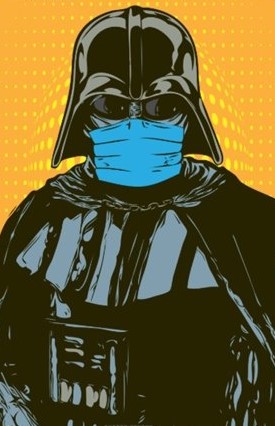
Fauci as Darth Vader of the Covid Wars

By Pepe Escobar

Source: Axis of Logic

Robert F Kennedy Jr’s The Real Anthony Fauci: Bill Gates, Big Pharma and the Global War on Democracy and Public Health should be front-page news in all the news media in the US. Instead, it has been met with the proverbial thundering silence.

Critics seeking to have Kennedy dismissed as a kook trading on a famous name had scored a hit in February, when Instagram permanently deleted his account, allegedly for making false claims about coronavirus and vaccines. Nevertheless, the book, published only a few days ago, is already a certified pop hit on Amazon.

RFK Jr., chairman of the board of and chief legal counsel for Children’s Health Defense, sets out to deconstruct a New Normal, encroaching upon all of us since early 2020. In my early 2021 book Raging Twenties I have termed this force techno-feudalism.

Kennedy describes it as “rising totalitarianism,” complete with “mass propaganda and censorship, the orchestrated promotion of terror, the manipulation of science, the suppression of debate, the vilification of dissent and use of force to prevent protest.”

Focusing on Dr Anthony Fauci as the fulcrum of the biggest story of the 21st century allows RFK Jr to paint a complex canvas of planned militarization and, especially, monetization of medicine, a toxic process managed by Big Pharma, Big Tech and the military/intel complex – and dutifully promoted by mainstream media.

By now everyone knows that the big winners have been Big Finance, Big Pharma, Big Tech and Big Data, with a special niche for Silicon Valley behemoths.

Why Fauci? RFK Jr. argues that for five decades, he has been essentially a Big Pharma agent, nurturing “a complex web of financial entanglements among pharmaceutical companies and the National Institute of Allergy and Infectious Diseases (NIAID) and its employees that has transformed NIAID into a seamless subsidiary of the pharmaceutical industry. Fauci unabashedly promotes his sweetheart relationship with Pharma as a ‘public-private partnership.’”

Arguably the full contours of this very convoluted story have never before been examined along these lines, extensively documented and with a wealth of links. Fauci may not be a household name outside of the US and especially across the Global South. And yet it’s this global audience that should be particularly interested in his story.

RFK Jr accuses Fauci of having pursued nefarious strategies since the onset of Covid-19 – from falsifying science to suppressing and sabotaging competitive products that bring lower profit margins.

Kennedy’s verdict is stark: “Tony Fauci does not do public health; he is a businessman, who has used his office to enrich his pharmaceutical partners and expand the reach of influence that has made him the most powerful – and despotic – doctor in human history.”

This is a very serious accusation. It’s up to readers to examine the facts of the case and decide whether Fauci is some kind of medical Dr Strangelove.

No Vitamin D?


Pride of place goes to the Fauci-privileged modeling that overestimated Covid deaths by 525%, cooked up by fabricator Neil Ferguson of the Imperial College in London, duly funded by the Bill and Melinda Gates Foundation. This is the model, later debunked, that justified lockdown hysteria all across the planet.

Kennedy attributes to Canadian vaccine researcher Dr Jessica Rose the charge that Fauci was at the frontline of erasing the notion of natural immunity even as throughout 2020 the CDC and the World Health Organization (WHO) admitted that people with healthy immune systems bear minimal risk of dying from Covid.

Dr Pierre Kory, president of Front Line Covid-19 Critical Care Alliance, was among those who denounced Fauci’s modus operandi of privileging the development of tech vaccines while allowing no space for repurposed medications effective against Covid: “It is absolutely shocking that he recommended no outpatient care, not even Vitamin D.”

Clinical cardiologist Peter McCullough and his team of frontline doctors tested prophylactic protocols using, for instance, ivermectin – “we had terrific data from medical teams in Bangladesh” – and added other medications such as azithromycin, zinc, Vitamin D and IV Vitamin C. And all this while across Asia there was widespread use of saline nasal lavages.

By July 1, 2020, McCullough and his team submitted their first, ground-breaking protocol to the American Journal of Medicine. It became the most-downloaded paper in the world helping doctors to treat Covid-19.

McCullough complained last year that Fauci has never, to date, published anything on how to treat a Covid patient.” He additionally alleged: “Anyone who tries to publish a new treatment protocol will find themselves airtight blocked by the journals that are all under Fauci’s control.”

It got much worse. McCullough: “The whole medical establishment was trying to shut down early treatment and silence all the doctors who talked about success. A whole generation of doctors just stopped practicing medicine.” (A contrarian view would argue that McCullough got carried away: A million US doctors – the approximate number practicing at any given time – could not all have been in on it.)

The book argues that the reasons there was a lack of original research on how to fight Covid were the dependence of much-vaunted American academics on the billions of dollars granted by the National Institute of Health (NIH) and the fact they were terrified of contradicting Fauci.

Frontline Covid specialists Kory and McCullough are quoted as charging that Fauci’s suppression of early treatment and off-patent medication was responsible for up to 80% of deaths attributed to Covid in the US.

How to kill the competition


The book offers a detailed outline of an alleged offensive by Big Pharma to kill hydroxychloroquine (HCQ) – with research mercenaries funded by the Gates-Fauci axis allegedly misinterpreting and misreporting negative results by employing faulty protocols.

Kennedy says that Bill Gates by 2020 virtually controlled the whole WHO apparatus, as the largest funder after the US government (before Trump pulled the US out of the WHO) and used the agency to fully discredit HCQ.

The book also addresses Lancetgate – when the world’s top two scientific journals, The Lancet and the New England Journal of Medicine published fraudulent studies from a nonexistent database owned by a previously unknown company.

Only a few weeks later both journals – deeply embarrassed and with their hard-earned credibility challenged – withdrew the studies. There was never any explanation as to why they got involved in what could be interpreted as one of the most serious frauds in the history of scientific publishing.

But it all served a purpose. For Big Pharma, says Kennedy, killing HCQ and, later, Ivermectin (IVM) were top priorities. Ivermectin happens to be a low-profit competitor to a Merck product, molnupiravir, which is essentially a copycat but capable of retailing at a profitable $700 per course.

Fauci was quite excited by a promising study of Gilead’s remdesivir – which not only is not effective against Covid but is a de facto deadly poison, at $3,000 for each treatment.

The book suggests that Fauci might have wanted to kill HCQ and IVM because under federal US rules, the FDA’s recognition of both HCQ and IVM would automatically kill remdesivir. The Bill and Melinda Gates Foundation happens to have a large equity stake in Gilead.

A key point for Kennedy is that vaccines were Big Pharma’s Holy Grail.

He details how what could be construed as a Fauci-Gates alliance put “billions of taxpayer and tax-deducted dollars into developing” an mRNA “platform for vaccines that, in theory, would allow them to quickly produce new ‘boosters’ to combat each ‘escape variant.’”

Vaccines, he writes, “are one of the rare commercial products that multiply profits by failing.… The good news for Pharma was that all of humanity would be permanently dependent on biannual or even triannual booster shots.”

Any similarities with our current “booster” reality are not mere coincidence.

The final summary of Pfizer’s clinical trial data will raise countless eyebrows. The whole process lasted a mere six months. This is the document that Pfizer submitted to the FDA to win approval for its vaccine. It beggars belief that Pfizer won the FDA’s emergency approval despite showing that the vaccine might prevent one (italics mine) Covid death in every 22,000 vaccine recipients.

Peter McCullough: “Because the clinical trial showed that vaccines reduce absolute risk less than 1 percent, those vaccines can’t possibly influence epidemic curves. It’s mathematically impossible.”

The Gates matrix


Bill Gates – Teflon-protected by virtually all Western mainstream media – describes the operational philosophy of his foundation as “philantrocapitalism.” It’s more like strategic self-philantropy, as both the foundation’s capital and his net worth have been ballooning in style ($23 billion just during the 2020 lockdowns).

The Bill and Melinda Gates Foundation – “a nonprofit fighting poverty, disease and inequity around the world” – invests in multinational pharma, food, agriculture, energy, telecom and global tech companies. It exercises considerable de facto control over international health and agricultural agencies as well as mainstream media – as the Columbia Journalism Review showed in August 2020.

Gates, without a graduate degree, not to mention medical school degree (like author Kennedy, it must be noted, whose training was as a lawyer), dispenses wisdom around the world as a health expert. The foundation holds corporate stocks and bonds in Pfizer, Merck, GSK, Novartis and Sanofi, among other giants, and substantial positions in Gilead, AstraZeneca and Moderna.

The book delves in minute detail into how Gates controls the WHO (the largest direct donor: $604.2 million in 2018-2019, the latest available numbers). Already in 2011 Gates ordered: “All 183 member states, you must make vaccines a central focus of your health systems.” The next year, the World Health Assembly, which sets the WHO agenda, adopted a Global Vaccine Plan designed by – who else? – the Bill and Melinda Gates Foundation.

The Foundation also controls the Strategic Advisory Group of Experts (SAGE), the top advisory group to the WHO on vaccines, as well as the crucial GAVI Alliance (formerly the Global Alliance for Vaccines and Immunization), which is the second-largest donor to the WHO.

GAVI is a Gates “public-private partnership” that essentially corrals bulk sales of vaccines from Big Pharma to poor nations. British Prime Minister Boris Johnson, only three months ago, proclaimed that “GAVI is the new NATO”. GAVI’s global HQ is in Geneva. Switzerland has given Gates full diplomatic immunity.

Few in East and West know that it was Gates who in 2017 handpicked the WHO’s director general Tedros Adhanom Ghebreyesus – who brought no medical degree and a quite dodgy background.

Dr Vandana Shiva, India’s leading human rights activist (routinely accused of being merely anti-vax), sums up: “Gates has hijacked the WHO and transformed it into an instrument of personal power that he wields for the cynical purpose of increasing pharmaceutical profits. He has single-handedly destroyed the infrastructure of public health globally. He has privatized our health systems and our food systems to serve his own purposes.”

Gaming pandemics


The book’s Chapter 12, Germ Games, may be arguably its most explosive, as it focuses on the US bioweapons and biosecurity apparatus, with a special mention to Robert Kadlec, who might claim leadership of the – contagious – logic according to which infectious disease poses a national security threat to the US, thus requiring a militarized response.

The book argues that Kadlec, closely linked to spy agencies, Big Pharma, the Pentagon and assorted military contractors, is also linked to Fauci investments in “gain of function” experiments capable of engineering pandemic superbugs.

Fauci strongly denies he’s promoted such experiments. Already in 1998 Kadlec had written an internal strategy paper for the Pentagon – though not for Fauci – promoting the role of pandemic pathogens as stealth weapons leaving no fingerprints.

Since 2005 DARPA, which invented the internet by building the ARPANET in 1969, has funded biological weapons research. DARPA – call it the Pentagon’s angel investor – also developed the GPS, stealth bombers, weather satellites, pilotless drones, and that prodigy of combat, the M16 rifle.

It’s important to remember that in 2017 DARPA funneled $6.5 million through Peter Daszak’s EcoHealth Alliance to fund “gain of function” work at the Wuhan lab, on top of gain of function experiments at Fort Detrick. EcoHealth Alliance was the organization through which Kadlec, Fauci and DARPA financed these gain of function experiments.

DARPA also developed the GPS, stealth bombers, weather satellites, pilotless drones, and that prodigy of combat, the M16 rifle. In 2017 DARPA funneled $6.5 million through Peter Daszak’s EcoHealth Alliance to fund “gain of function” work at the Wuhan lab, on top of gain of function experiments at Fort Detrick. EcoHealth Alliance was the organization through which Kadlec, Fauci and DARPA financed these gain of function experiments,

Few people know that DARPA also financed the key tech for the Moderna vaccine, starting way back in 2013.

RFK Jr dutifully connects the Germ Games progress, starting with Dark Winter in 2001, which emphasized the Pentagon’s drive towards bioweapon vaccines (the code name was coined by Kadlec); the anthrax attack three weeks after 9/11; Atlantic Storm in 2003 and 2005, focused on the response to a terrorist attack unleashing smallpox; Global Mercury 2003; and Lockstep in 2010, which developed a scenario funded by the Rockefeller Foundation where we find this pearl:

During the pandemic, national leaders around the world flexed their authority and imposed airtight rules and restrictions, from the mandatory wearing of face masks to body-temperature checks at the entries to communal spaces like train stations and supermarkets. Even after the pandemic faded, this more authoritarian control and oversight of citizens and their activities stuck and even intensified. In order to protect themselves from the spread of increasingly global problems – from pandemics and transnational terrorism to environmental crises and rising poverty – leaders around the world took a firmer grip on power.

RFK Jr paints a picture in which, by mid-2017, the Rockefeller Foundation and US intel agencies had all but crowned Bill Gates as the top financier for the intel/military pandemic simulation business.

Enter the MARS (Mountain Associated Respiratory Virus) simulation during the G20 in Germany in 2017. MARS was about a novel respiratory virus that spread out of busy markets in a mountainous border of an unnamed nation that looked very much like China.

It gets curiouser and curiouser when one learns that MARS’s two moderators were very close to the Bill and Melinda Gates Foundation, and one of them, David Heymann, sat with the Moderna CEO on the Merieux Foundation USA Board. BioMerieux happens to be the French company that built the Wuhan lab.

Big Pharma kisses Western intel


Afterward came SPARS 2017 at the Johns Hopkins Center for Health Security. The Bill and Melinda Gates Foundation happen to be major funders of the Johns Hopkins Bloomberg School of Public Health. SPARS 2017 gamed a coronavirus pandemic running from 2025 to 2028. As RFK Jr. notes, “the exercise turned out to be an eerily precise predictor of the Covid-19 pandemic.”

By 2018 bioweapons expert Peter Daszak was enthroned as the key connector through whom Fauci, Kadlec, DARPA and USAID – which used to be a CIA cover and now reports to the National Security Council – moved grants to fund gain-of-function research, including at the Wuhan Institute of Virology Biosafety Lab.

Crimson Contagion, overseen by Kadlec after eight months of planning, came in August 2019. Fauci was on board the self-described “functional exercise,” representing the NIH, alongside the CDC’s Robert Redfield and several members of the National Security Council. The war game was held in secret, nationwide. The After-Action Crimson Contagion Report only came out via a FOIA request.

The star of the Gates pandemic show was undoubtedly Event 201 in October 2019, held only 3 weeks before US intel may – or may not – have suspected that Covid-19 was circulating in Wuhan. Event 201 was about a global coronavirus pandemic. RFK Jr. persuasively argues that Event 201 was as close as possible to a “real-time” simulation.

The book’s Germ Games chapter leads the reader to acknowledge what mainstream media have simply refused to report: how the pervasive involvement of US (and UK) intel has a secretive – yet dominating – presence in the whole response to Covid-19.

A very good example is the Wellcome Trust – the UK version of the Bill and Melinda Gates Foundation – which is a spin-off of Big Pharma’s GlaxoSmith Kline. This epitomizes the marriage between Big Pharma and Western intel.

The Wellcome Trust chair, from 2015 to 2020, used to be a former director general of MI5, Dame Eliza Manningham-Buller. She was also chair of the Imperial College since 2001. The “English Dr. Fauci,” Neil Ferguson, of the infamous deadly wrong models that led to all lockdowns, was an epidemiologist working for the Wellcome Trust.

These are only a few of the insights and connections woven through RFK Jr’s book. As a matter of public service, the whole lot should be available for popular scrutiny worldwide. These matters concern the whole planet, especially the Global South.

Nobel laureate Luc Montaigner has noted how, “tragically for humanity, there are many, many untruths emanating from Fauci and his minions.” Even more tragic is what emanates from his masters.

Corporate Power: Who Owns the World?

By Dr. Joseph Mercola

Source: The Herland Report

Who Owns the World? A handful of mega corporations — private investment companies — dominate every aspect of our lives; everything we eat, drink, wear or use in one way or another.

These investment firms are so enormous, they control the money flow worldwide.

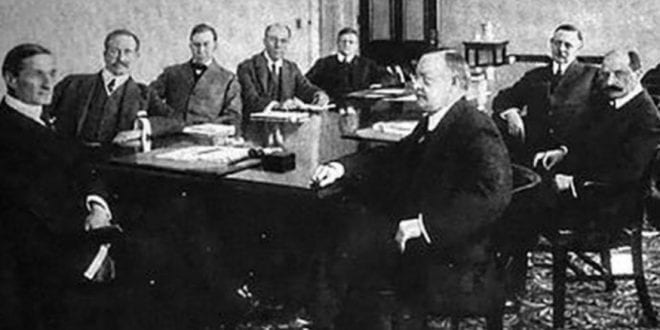
While there appear to be hundreds of competing brands on the market, like Russian nesting dolls, larger parent companies own multiple smaller brands. In reality, all packaged food brands, for example, are owned by a dozen or so larger parent companies. (Feature photo: A rare photo of The Federal Reserve Board of Governors)

These parent companies, in turn, are owned by shareholders, and the largest shareholders are the same in all of them: Vanguard and Blackrock, writes Dr. Joseph Mercola, osteopathic physician, best-selling author and recipient of multiple awards in the field of natural health.

No matter what industry you look at, the top shareholders, and therefore decision makers, are the same: Vanguard, Blackrock, State Street and/or Berkshire Hathaway. In virtually every major company, you find these names among the top 10 institutional investors.

These major investment firms are in turn owned by their own set of shareholders. One of the most amazing things about this scheme is that the institutional investors also own each other.

They’re all shareholders in each other’s companies. At the very top are Vanguard and Blackrock. Blackrock’s largest shareholder is Vanguard, which does not disclose the identity of its shareholders due to its unique structure.

To understand what’s really going on, watch Tim Gielen’s hour-long documentary, “MONOPOLY: Who Owns the World?”

Who Owns the World? Until recently, it appeared economic competition had been driving the rise and fall of small and large companies across the U.S. Supposedly, PepsiCo is Coca Cola’s competitor, Apple and Android vie for your loyalty and drug companies battle for your health care dollars. However, all of that turns out to be an illusion.

Since the mid-1970s, two corporations — Vanguard and Blackrock — have gobbled up most companies in the world, effectively destroying the competitive market on which America’s strength has rested, leaving only false appearances behind.

Indeed, the global economy may be the greatest illusionary trick ever pulled over the eyes of people around the world. To understand what’s really going on, watch Tim Gielen’s hour-long documentary, “MONOPOLY: Who Owns the World?” above.

Corporate Domination

Who Owns the World? As noted by Gielen, who narrates the film, a handful of mega corporations — private investment companies — dominate every aspect of our lives; everything we eat, drink, wear or use in one way or another. These investment firms are so enormous, they control the money flow worldwide. So, how does this scheme work?

While there appear to be hundreds of competing brands on the market, like Russian nesting dolls, larger parent companies own multiple smaller brands. In reality, all packaged food brands, for example, are owned by a dozen or so larger parent companies.

Pepsi Co. owns a long list of food, beverage and snack brands, as does Coca-Cola, Nestle, General Mills, Kellogg’s, Unilever, Mars, Kraft Heinz, Mondelez, Danone and Associated British Foods. Together, these parent companies monopolize the packaged food industry, as virtually every food brand available belongs to one of them.

These companies are publicly traded and are run by boards, where the largest shareholders have power over the decision making. This is where it gets interesting, because when you look up who the largest shareholders are, you find yet another monopoly.

While the topmost shareholders can change from time to time, based on shares bought and sold, two companies are consistently listed among the top institutional holders of these parent companies: The Vanguard Group Inc. and Blackrock Inc.

Pepsi and Coca-Cola — An Example

Who Owns the World? For example, while there are more than 3,000 shareholders in Pepsi Co., Vanguard and Blackrock’s holdings account for nearly one-third of all shares. Of the top 10 shareholders in Pepsi Co., the top three, Vanguard, Blackrock and State Street Corporation, own more shares than the remaining seven.

Now, let’s look at Coca-Cola Co., Pepsi’s top competitor. Who owns Coke? As with Pepsi, the majority of the company shares are held by institutional investors, which number 3,155 (as of the making of the documentary).

As shown in the film, three of the top four institutional shareholders of Coca-Cola are identical with that of Pepsi: Vanguard, Blackrock and State Street Corporation. The No. 1 shareholder of Coca-Cola is Berkshire Hathaway Inc.

These four — Vanguard, Blackrock, State Street and Berkshire Hathaway — are the four largest investment firms on the planet. “So, Pepsi and Coca-Cola are anything but competitors,” Gielen says. And the same goes for the other packaged food companies. All are owned by the same small group of institutional shareholders.

Big Tech Monopoly

Who Owns the World? The monopoly of these investment firms isn’t relegated to the packaged food industry. You find them dominating virtually all other industries as well. Take Big Tech, for example. Among the top 10 largest tech companies we find Apple, Samsung, Alphabet (parent company of Google), Microsoft, Huawei, Dell, IBM and Sony.

Here, we find the same Russian nesting doll setup. For example, Facebook owns Whatsapp and Instagram. Alphabet owns Google and all Google-related businesses, including YouTube and Gmail.

It’s also the biggest developer of Android, the main competitor to Apple. Microsoft owns Windows and Xbox. In all, four parent companies produce the software used by virtually all computers, tablets and smartphones in the world. Who, then, owns them? Here’s a sampling:

  • Facebook — More than 80% of Facebook shares are held by institutional investors, and the top institutional holders are the same as those found in the food industry: Vanguard and Blackrock being the top two, as of the end of March 2021. State Street Corporation is the fifth biggest shareholder
  • Apple — The top four institutional investors are Vanguard, Blackrock, Berkshire Hathaway and State Street Corporation
  • Microsoft — The top three institutional shareholders are Vanguard, Blackrock and State Street Corporation

You can continue going through the list of tech brands — companies that build computers, smart phones, electronics and household appliances — and you’ll repeatedly find Vanguard, Blackrock, Berkshire Hathaway and State Street Corporation among the top shareholders.

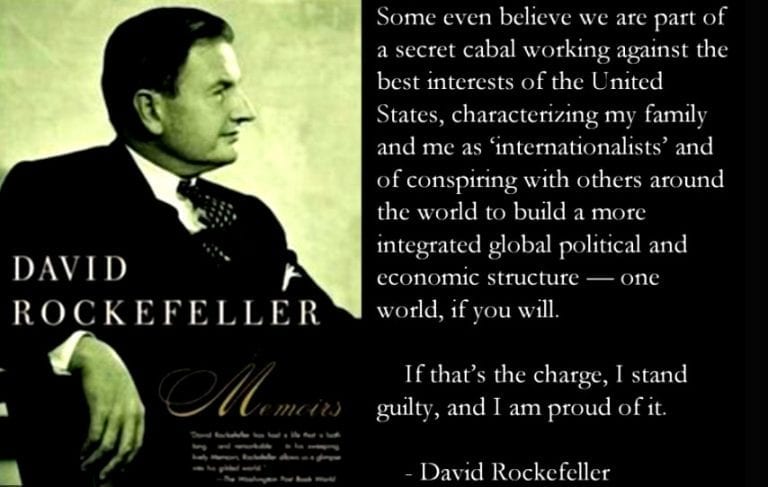
Who Owns the World? A famous David Rockefeller quote, the dream of a global political and economic structure – one world.

Same Small Group Owns Everything Else Too

Who Owns the World? The same ownership trend exists in all other industries. Gielen offers yet another example to prove this statement is not an exaggeration:

“Let’s say we want to plan a vacation. On our computer or smart phone, we look for a cheap flight to the sun through websites like Skyscanner and Expedia, both of which are owned by the same group of institutional investors [Vanguard, Blackrock and State Street Corporation].

We fly with one of the many airlines [American Airlines, Air France, KLM, United Airlines, Delta and Transavia] of which the majority of the shares are often owned by the same investors …

The airline we fly [on] is in most cases a Boeing or an Airbus. Again, we see the same [institutional shareholders]. We look for a hotel or an apartment through Bookings.com or AirBnB.com. Once we arrive at our destination, we go out to dinner and we write a review on Trip Advisor. The same investors are at the basis of every aspect of our journey.

And their power goes even much further, because even the kerosene that fuels the plane comes from one of their many oil companies and refineries. Just like the steel that the plane is made of comes from one of their many mining companies.

This small club of investment companies, banks and mutual funds, are also the largest shareholders in the primary industries, where our raw materials come from.”

The same goes for the agricultural industry that the global food industry depends on, and any other major industry. These institutional investors own Bayer, the world’s largest seed producer; they own the largest textile manufacturers and many of the largest clothing companies.

They own the oil refineries, the largest solar panel producers and the automobile, aircraft and arms industries. They own all the major tobacco companies, and all the major drug companies and scientific institutes too. They also own the big department stores and the online marketplaces like eBay, Amazon and AliExpress.

They even own the payment methods we use, from credit card companies to digital payment platforms, as well as insurance companies, banks, construction companies, telephone companies, restaurant chains, personal care brands and cosmetic brands.

No matter what industry you look at, the top shareholders, and therefore decision makers, are the same: Vanguard, Blackrock, State Street and/or Berkshire Hathaway. In virtually every major company, you find these names among the top 10 institutional investors.

Who Owns the Investment Firms of the World?

Who Owns the World? Diving deeper, we find that these major investment firms are in turn owned by their own set of shareholders. One of the most amazing things about this scheme is that the institutional investors — and there are many more than the primary four we’ve focused on here — also own each other. They’re all shareholders in each other’s companies.At the top of the pyramid — the largest Russian doll of all — we find Vanguard and Blackrock.

“Together, they form an immense network that we can compare to a pyramid,” Gielen says. Smaller institutional investors, such as Citibank, ING and T. Rowe Price, are owned by larger investment firms such as Northern Trust, Capital Group, 3G Capital and KKR.

Those investors in turn are owned by even larger investment firms, like Goldman Sachs and Wellington Market, which are owned by larger firms yet, such as Berkshire Hathaway and State Street. At the top of the pyramid — the largest Russian doll of all — we find Vanguard and Blackrock.

“The power of these two companies is something we can barely imagine,” Gielen says. “Not only are they the largest institutional investors of every major company on earth, they also own the other institutional investors of those companies, giving them a complete monopoly.”

Gielen cites data from Bloomberg, showing that by 2028, Vanguard and BlackRock are expected to collectively manage $20 trillion-worth of investments. In the process, they will own almost everything on planet Earth.

BlackRock — The Fourth Branch of Government

Who Owns the World? Bloomberg has also referred to BlackRock as the “fourth branch of government,” due to its close relationship with the central banks. BlackRock actually lends money to the central bank, the federal reserve, and is their principal adviser.

Dozens of BlackRock employees have held senior positions in the White House under the Bush, Obama and Biden administrations. BlackRock also developed the computer system that the central banks use.

While Larry Fink is the figurehead of BlackRock, being its founder, chairman and chief executive officer, he’s not the sole decision maker, as BlackRock too is owned by shareholders. Here we find yet another curiosity, as the largest shareholder of BlackRock is Vanguard.

Who Owns the World? “This is where it gets dark,” Gielen says. Vanguard has a unique structure that blocks us from seeing who the actual shareholders are. “The elite who own Vanguard don’t want anyone to know they are the owners of the most powerful company on earth.” Still, if you dig deep enough, you can find clues as to who these owners are.

The owners of the wealthiest, most powerful company on Earth can be expected to be among the wealthiest individuals on earth. In 2016, Oxfam reported that the combined wealth of the richest 1% in the world was equal to the wealth of the remaining 99%. In 2018, it was reported that the world’s richest people get 82% of all the money earned around the world in 2017.

In reality, we can assume that the owners of Vanguard are among the 0.001% richest people on the planet. According to Forbes, there were 2,075 billionaires in the world as of March 2020. Gielen cites Oxfam data showing that two-thirds of billionaires obtained their fortunes via inheritance, monopoly and/or cronyism.

“This means that Vanguard is in the hands of the richest families on earth,” Gielen says. Among them we find the Rothschilds, the DuPont family, the Rockefellers, the Bush family and the Morgan family, just to name a few.

Many belong to royal bloodlines and are the founders of our central banking system, the United Nations and just about every industry on the planet.

Gielen goes even further in his documentary, so I highly recommend watching it in its entirety. I’ve only summarized a small piece of the whole film here.

A Financial Coup D’etat

Speaking of the central bankers, I recently interviewed finance guru Catherine Austin Fitts, and she believes it’s the central bankers that are at the heart of the global takeover we’re currently seeing. She also believes they are the ones pressuring private companies to implement the clearly illegal COVID jab mandates. Their control is so great, few companies have the ability to take a stand against them.

“I think [the central bankers] are really depending on the smart grid and creepy technology to help them go to the last steps of financial control, which is what I think they’re pushing for,” she said.

“What we’ve seen is a tremendous effort to bankrupt the population and the governments so that it’s much easier for the central bankers to take control. That’s what I’ve been writing about since 1998, that this is a financial coup d’etat.

Now the financial coup d’etat is being consolidated, where the central bankers just serve jurisdiction over the treasury and the tax money. And if they can get the [vaccine] passports in with the CBDC [central bank digital currency], then it will be able to take taxes out of our accounts and take our assets. So, this is a real coup d’etat.”

When Everything Is Artifice and PR, Collapse Beckons

By Charles Hugh Smith

Source: Of Two Minds

The notion that consequence can be as easily managed as PR is the ultimate artifice and the ultimate delusion.

The consequences of the drip-drip-drip of moral decay is difficult to discern in day-to-day life. It’s easy to dismiss the ubiquity of artifice, PR, spin, corruption, racketeering, fraud, collusion and narrative manipulation (a.k.a. propaganda) as nothing more than human nature, but this dismissal of moral decay is nothing more than rationalizing the rot to protect insiders from the sobering reality that the entire system is unraveling and heading for its final reckoning: collapse.

We’ve become so accustomed to the excesses of marketing that we’ve lost the ability to recognize the difference between “science” that’s been carefully designed to reach a pre-planned conclusion and science that accepts the outcome, even if it harms well-funded interests.

The vast expanses of ignorance greatly aid this artifice. Even though high school physics, chemistry and biology are sufficient to tease apart the vast majority of rigged experiments, trials and studies, few Americans have the interest or fortitude to read Phase III trial results, etc. critically, and so the corporate media can trumpet bogus results without fear of exposure: all the statistical tricks and gimmicks are passed off as “science” to the distracted and gullible.

And if someone dares to examine the results critically, then those benefiting from the ignorance make the results “secret” until the year 2929. And that’s the entire game in a nutshell: maximizing private gain from artifice, PR, spin, corruption, racketeering, fraud, collusion and narrative manipulation, all masked by an putrid spew of virtue-signaling and PR.

Every institution that was once trustworthy has been debauched to maximize private gain: higher education, science, medicine, national defense–the list includes virtually every sector and industry in America. Nothing can be trusted because somebody behind the scenes is spinning the story and data to mask their self-interest, their immense gains and the carefully contrived structure of diverting investigation and eliminating transparency, competition and accountability.

Our technocratic obsession denies the existence of the moral universe, reducing the world to techno-gimmicks (electric air taxis for everyone!), techno-fantasies (fusion reactors on every corner!) and techno-distractions (which billionaire will be the first on Mars?), as if a nation and society hurtling toward moral, social, civic and economic collapse can be saved by some “innovation” that beneath the surface is nothing more than another profiteering monopoly or cartel.

Many people fear collapse, but quality, service and reliability have already collapsed. The washing machine that two generations ago was designed and built to last 25 years now breaks down after a few years–so sorry, the motherboard failed. That will cost you almost as much as new washer, and so the manufacturer, bank and retailer win because the weary, clueless consumer will do the easy thing and buy a new, expensive appliance on credit. The “old” appliance (brand-new by previous standards) is hauled off to the landfill, the ultimate destination of everything in our Landfill Economy of poorly made junk.

Service would be hauled to the landfill as well if it was tangible. Alas, it is simply maddening, as nothing works and Kafkaesque bureaucracies have so much power that they are immune to transparency, competition and accountability. their websites don’t work, they botch the most basic transactions and they perpetuate incorrect information, but too bad–there is no recourse.

Big Tech is equally impervious to transparency, competition and accountability. Your “crime” is never explained, and there is no recourse, for the Machine has no judiciary or human contact: you query the Machine knowing full well that you will never extract anything remotely fair or just from its algorithmic monstrosity.

Technology doesn’t extinguish moral decay or eliminate the stench of self-serving artifice, PR, spin, corruption, racketeering, fraud, collusion and narrative manipulation. Technology only enhances the potential for profiteering under the tissue-thin guise of “innovation,” “technological advance” and the threadbare delusions of a populace that has watched too many contrived narratives in which technology saves the day.

The moral buffers have already thinned; there is nothing left to tap. There is nothing left in what actually matters: social cohesion, moral legitimacy, civic virtue–all stripped, depleted, gone.

Drones and robots won’t save us from collapse. Neither will fusion reactors, electric air taxis, billionaires in space, missions to Mars, algae-based meat or any of the other thousand “innovations” those profiting from moral rot promote in the hopes that the banquet of consequences being served can be swept away by more gimmicks, more artifice, more delusions, more fantasies, more PR, more spin and more narrative control.

Collapse can’t be gimmicked away. The notion that consequence can be as easily managed as PR is the ultimate artifice and the ultimate delusion.

America’s Bottom 50% Have Nowhere To Go But Down

By Charles Hugh Smith

Source: Of Two Minds

One might anticipate that the bottom 50%’s meager share of the nation’s exploding wealth would have increased as smartly as the wealth of the billionaires, but alas, no.

America’s economy has changed in ways few of the winners seem to notice, as they’re too busy cheerleading their own brilliance and success. In the view of the winners, who just so happen to occupy all the seats at the media-punditry-Federal Reserve, etc. table–the rising tide of stock, bond and real estate bubbles are raising all boats. What’s left unsaid is except for the 50% of boats with gaping holes below the waterline, i.e. stagnant wages and a fast-rising cost of living.

The truth the self-satisfied winners don’t include in their self-congratulatory rah-rah is there’s no place for the bottom 50% of American households to go but down. All the winnings flow to those who already owned assets back when they were affordable– the already-wealthy–whose wealth has soared as assets have shot to the moon while the the burdens of inflation and debt service hit the bottom 50% the hardest.

Meanwhile, the Federal Reserve is whining that inflation isn’t high enough yet for their refined tastes. Boo-hoo, how sad for the Fed–inflation isn’t yet high enough. Oh wait–didn’t they each mint millions by front-running their own policies? No wonder they’re not worried about inflation.

The reality few acknowledge is that globalization and financialization have stripped the American economy of low-skilled jobs that don’t demand much of the employee. The reality is that a great many people don’t have what it takes to learn high-level skills and work at a demanding pace under constant pressure–the description of the average job in America.

There were once millions of low-skill, low-pay jobs for people who for whatever mix of reasons were unable to muster the wherewithal to fulfill the fantasy of working extra hard, going to night school, soaking up high-level skills, moving quickly up the ladder to higher pay, buying the starter home and then moving up the food chain to middle class security from there.

The cost of living was low enough that those working these low-skill, low-pay jobs could still have an independent life. There were still low-cost rentals, often derided by the wealthy, in nooks and crannies of even the costliest cities. (I once lived in a room stuffed with old tax records in a poolside shack in an upscale neighborhood. The room had been cleared for a single bed and a path to the decrepit bathroom. Its most important attribute was that I could afford it on my low earnings.)

Affordable housing has vanished, eliminated by the financialization of America’s economy. Once landlords pay double the price for the property, rents have to double to pay their higher expenses. The apartment didn’t double in size or amenities–the rent doubled without any increase in utility to the renter. You get nothing more for double the price–nice.

Yes, people could make better choices, and some do. The point here is the game is rigged against those in the lower tier of the economy who can no longer afford a house or other stake in the only winning game in town–speculative asset bubbles. Go ahead and work a second job and go to night school–you’ll still be left behind the already-rich.

Globalization opened every job in America to global competition via offshoring or the influx of undocumented workers so desperate to support their families back home that no pay was too low and no working condition too wretched to refuse.

Many overindulged pundits who never worked an honest day in their lives sneer about burger flippers without realizing how hard those burger flippers have to work. I doubt the well-dressed pundits, snobbish about their university degrees and general brilliance, could manage to work a single day in a demanding fast-food job.

As the price of housing and other assets have soared, enriching the already rich, they’re out of reach for the bottom 50% who struggle to pay their bills as wages have stagnated and the costs of essentials have skyrocketed.

The rising cost of parking tickets, junk fees, user fees, utilities and food don’t impact the well-paid top 5% technocrat class, whose stake in the Everything Bubble keeps expanding by tens or hundreds of thousands of dollars. But for the bottom 50%, those incremental increases are, when added to higher rents, absolutely crushing.

As for getting high-quality healthcare that includes mental health support–those are reserved for the rich. But no worries, self-medication is always a “choice.”

Getting a boost in pay from $12 an hour to $15 an hour is welcome, but that doesn’t put the worker any closer to affording a house or equivalent stake in the Everything Bubble.

The new feudalism is masked by the glossy SillyCon Valley PR of a gig economy where (per the PR fantasy) bright, shiny and totally independent workers freely choose to serve the winners in the rigged sweepstakes for low pay and zero benefits.

In the SillyCon Valley PR, serfs freely choose to serve their noble masters for nothing but survival because they love the “freedom” and “choice” of kissing the nobility’s plump derrieres. (After all, there were “choices” even back in the good old days of feudalism–one could join the brigands in the forest, or enlist in a poorly paid mercenary army where the odds of dying were high–you know, “choices” of “gigs.”)

One might anticipate that the bottom 50%’s meager share of the nation’s exploding wealth would have increased as smartly as the wealth of the billionaires, but alas, no–the bottom 50%’s share of stocks (equities) actually plummeted in the the glorious decades of Federal Reserve free money for financiers, stock buy-backs and asset bubbles.

All this suits the billionaires and those collecting the crumbs of the Everything Bubble just fine. So what if the bottom 50% have nowhere to go but down? There’s plenty of room in the homeless encampment for another broken down station wagon or an old camper. There’s lots of “choices.”

And no consequences for the winners, of course, because The Fed has our backs.

America Is Now a Kleptocrapocracy

By Charles Hugh Smith

Source: Of Two Minds

I’ve coined a new portmanteau word to describe America’s descent: kleptocrapocracy, a union of kleptocracy (a nation ruled by kleptocrats) and crapocracy, a nation drowning in a moral sewer of rampant self-interest in which the focus is cloaking all the skims, scams, rackets and bezzles in some virtuous-sounding garb, a nation choking on low-quality junk ceaselessly hawked by robocalls, spam, phishing and Big Tech manipulation.

It’s little wonder trust has collapsed in America: the only thing we can trust is whatever’s being pitched is deceptively packaged to mask the self-interest and profiteering of the perps.

The stench from the decomposing carcasses of once-trusted institutions is everywhere. Insiders and the marketers they pay to cloak their grifting are banking bennies at the expense of hapless debt-serfs who fell for the scam. You need these three costly medications, and then when the side-effects kick in, you need six more to counteract the first three, and so on. But trust us; your “health” (heh) is our only concern. Uh, sure.

Why do state universities need to market themselves like a roto-rooter service? Maybe because they’re both working the sewers: state universities are exploiting the student loan sewers, desperate to recruit another batch of debt-serfs who fell for the 3-card monte game in which a lifetime of debt is exchanged for a credential of dubious value.

The competition for the remaining pool of debt-serfs is heating up, so like everything else in America, the game is now all about marketing, virtue-signaling, exploiting Big Tech manipulation, and so on.

Doing something useful is now for chumps. The opportunities in America are all about getting rich by doing, well, nothing: skimming 20% “guaranteed” returns in DeFi, mining cryptos, trading stablecoins, selling volatility, etc.–getting rich and then living large on the sweat of the chumps who are still working (poor deluded fools!).

The obvious goal here is for everyone to get in on trading stablecoins, buying rentals with DeFi, churning meme stocks, etc. Why should anyone lower themselves to doing something useful anymore? Why bother?

Labor has been degraded for decades in speculative-frenzy America. Why work when the Fed has our backs and all those newly issued trillions are up for grabs? Doing something useful is for chumps.

Nobody seems to ask what happens when we’re all minting fortunes off speculative churn and there’s nobody filling potholes, stocking shelves or carrying bags of QuikCrete to customers’ trucks.

And while we’re on the subject of sewage: if America’s security services and Big Tech oligarchies track everything and everyone, why are we drowning in robocalls, spam, SMS-spam (smishing), etc.? Couldn’t the NSA/CIA track the spammers and robo-callers down and rendition them (warrantlessly, of course) to a hellhole camp in an unnamed country?

Of course they could. But the ruination of everyday life is of no concern to the kleptocrats (fly with me to the stars!) or our dysfunctional government, which has become nothing more than an invitation-only auction of favors that elevates the relentless pursuit of self-interest and profiteering to new kleptocratic heights.

Please don’t make the mistake of expecting anything to work properly in America. The components are garbage, the parts are on back-order, the people who knew how to make the kludgy mess function just quit in disgust, and we’ll have to get back to you about your request, as our service staff just left to launch an OnlyFans site.

I don’t want to work, I’m minting money speculating, but gol-darn it, I want everyone else to wait on me and meet my needs for low, low quality goods and services at not-so-low prices, and if I’m not treated well enough by everyone earning chump-change, then I’ll freak out, and if that doesn’t pan out, I’ll blame it all on my meds. Accountability is like work–only for chumps.

Trust me, everything’s going great and we’re all going to get wealthier and wealthier until we won’t be able to take it any more, it will be so great. I hope everyone here is hungry because the banquet of consequences is being served.

Corporate Media Largely Silent as Millions Protest Vaccine Mandates Worldwide

By Matt Agorist

Source: The Free Thought Project

When protests in the United States happen that help the establishment in some way, whether by stoking divide or pushing an establishment agenda, corporate media is all over them, bombarding us with news of packed streets. However, when massive crowds take to the streets to have their anti-establishment voices heard, it’s crickets on FOXSNBCNN.

Such is the case recently as millions of people across the world have taken to the streets to protest the draconian laws which segregate society and deprive people of their freedoms over their choice in taking a vaccine they may not even need.

Such is the case recently as millions of people across the world have taken to the streets to protest the draconian laws which segregate society and deprive people of their freedoms over their choice in taking a vaccine they may not even need.

One place, in particular, that is currently seeing massive protests is Italy whose government just passed the strictest vaccine mandate in Europe. Starting on October 15, Italy begins enforcing the new workplace green pass requirement. If employees cannot show proof of vaccination, they will not be allowed to go to work nor will they be able to enter any public places like restaurants, theaters, gyms, etc.

If an Italian citizen misses five days of work by failing to comply with the new mandate, the government forces their employer to stop paying them. If employees are caught working without a green pass, the state will extort them to the tune of $2,100 per instance.

Naturally, moves like this have pissed a lot of people off. It is well known now that the antibodies from the covid vaccines fade over time, which is why Israel is now requiring boosters for all of their citizens. It is also well known that immunity from natural infection is far superior to the vaccine.

A person who had the jab back in January and likely has very few antibodies left is considered “green.” However, at the same time, a person who may have caught covid last month and recovered, thereby drastically reducing their ability to catch and spread the disease, is considered a threat and cannot go to work or public places. There is zero logic in these mandates, which prove one thing — they are about control — not your safety.

This is why people are in the streets across the country and all over Europe and Australia. Civil disobedience is their only option left as they are forced out of their jobs, denied entry into public places, and forbidden from travelling.

As the mainstream media refuses to question the idea behind mandating vaccinations, they have made their role clear in this tyranny as enablers. This should come as no surprise either given the money that pours into their coffers from the ones who stand to gain the most from vaccine mandates — big pharma.

As we are currently witnessing with their silence in regard to vaccine mandate protests, it is no secret that the pharmaceutical industry wields immense control over the government, big tech, and the media. It is their control which keeps this and any other negative press about their products from seeing the light of day. However, most people likely do not know the scope of this control.

As Mike Papantonio, attorney and host of the international television show America’s Lawyer, explains, with the exception of CBS, every major media outlet in the United States shares at least one board member with at least one pharmaceutical company. To put that into perspective: These board members wake up, go to a meeting at Merck or Pfizer, then they have their driver take them over to a meeting with NBC to decide what kind of programming that network is going to air.

We have even reported incidents in which reporters have been cut off by the network for mentioning the connection on air. In a clear example of how beholden mainstream media is to the pharmaceutical industries who manufacture and market these drugs, FOX News’ Sean Hannity was recorded in 2018, blatantly cutting off a reporter who dared mention Nikolas Cruz’s reported association with antidepressants.

In the report below, Papantonio explains how the billions of dollars big pharma gives to mainstream media outlets every year is used to keep them subservient and complicit in covering up the slew of deadly side effects from their products.

As we can see with the current censorship and narrative control in regard to those questioning the safety of the COVID-19 vaccines, big pharma wields massive control over the information you are allowed to talk about and consume. Once we zoom out and see the entire situation, it becomes exceedingly evident as to why Facebook, Twitter, YouTube, and the rest of Big Tech, have made it their mission to wipe out any and all content that questions the “official narrative.”

Why is there no debate about ‘leaky’ vaccines?

By Jonathan Cook

Source: Jonathan Cook Blog

Do you know what “leaky vaccines” are? There’s a good chance you don’t because discussion about them has been mostly shunted to the fringes of the web, with videos on the subject even excised from Youtube. The subject is treated as though it is something only tinfoil hat-wearing loons would take seriously.

But leaky vaccines have been an established concern in the medical community for years. A paper discussing the potential problems with them was published in a reputable medical journal by experts well before anyone had heard of Covid.

In brief, leaky vaccines don’t offer full protection against the virus they are designed to deal with. Such vaccines don’t stop you from catching the virus. They work in the sense that they are likely to reduce your symptoms and lessen the chance of transmission to others.

That’s a good thing, but researchers have worried that leaky vaccines can have potential drawbacks, possibly very serious ones. If a vaccine erects an imperfect barrier against a virus, one the virus can sometimes breach even if weakly, the virus persists and has every incentive and opportunity to adapt. That is, it is encouraged to grow stronger.

Over time, variants of the virus are likely to find a way past the immune system’s defences mounted by the vaccine. Because the new variant has an evolutionary advantage over the original strain of virus, it comes to dominate – until a new variant supplants it in turn.

Endless arms race

In short, a leaky vaccine is at risk of becoming less effective over time. New vaccines may be needed in an endless arms race against the virus that encourages it to keep adapting and evolving to become ever more potent.

Most of us should be able to understand this problem because we have heard about it in a closely related medical context: so-called “superbugs“.

Antibiotics were invented nearly a century ago to put an end to deadly bacterial infections. They proved highly effective and saved many lives. They were so effective that doctors were encouraged by profit-seeking pharmaceutical companies – as well as the public’s desire for a pain-free life – to prescribe antibiotics for every tickly throat.

Making things worse, farmers looking to maximise profits had every incentive to routinely use antibiotics on livestock – to prevent illness and deaths among animals they packed into warehouses in unnatural and unsanitary conditions.

This abuse of antibiotics led to the current situation where some strains of bacteria have adapted so effectively they can resist every antibiotic on the market. These superbugs put hundreds of thousands of Americans in hospital every year and are reported to kill 35,000 of them annually.

‘Waning immunity’

So what does this have to do with Covid?

As you may have already guessed, the Covid vaccines are all leaky vaccines. In fact, it appears they were known to be leaky before the first person was vaccinated with them. It’s just no one thought to highlight it to us – not our politicians, the vaccine-makers or the corporate media.

We can see quite how leaky they are in the current obsession with “booster” shots to deal with what are being called “breakthrough” cases – only months after most people received what they assumed would be their one and only round of vaccination.

The justification for these boosters is framed as dealing with “waning immunity” and the fact that the delta variant is more “transmissable”. But this medical jargon, though reassuring, may in fact be concealing something significant about the direction the virus is heading in – something that was evident in earlier vaccine research.

‘Nastier’ viral strains

Until Covid, the only way to research how leaky vaccines worked in the midst of a major epidemic was by studying their use in animals. These studies were carried out in part because of concerns about what the effects of leaky vaccines might be if used during a human pandemic.

We now have that pandemic.

In 2015, four years before anyone had ever heard of Covid, the scientific journal PLOS Biology published a paper titled “Imperfect Vaccination Can Enhance the Transmission of Highly Virulent Pathogens”. It examined what happened in the treatment of chickens for a virus called Marek’s disease, caused by a strain of herpes more virulent – if you’re a chicken – than Ebola.

As one of the researchers concluded: “Our research demonstrates that the use of leaky vaccines can promote the evolution of nastier ‘hot’ viral strains that put unvaccinated individuals at greater risk.”

Uncharted territory

In other words, once you start routinely using a leaky vaccine, the very leakiness of the virus in the vaccinated population risks putting the unvaccinated in greater danger by exposing them to turbo-charged variants of the virus their immune systems struggle to overcome.

Because the vaccinated are less aware of being ill – they don’t take to their beds – they can become the equivalent of super-spreaders.

So the solution is simple, no? Just ensure everyone gets vaccinated. (We’ll draw a veil over the issue of what to do with those who can’t get vaccinated for medical reasons.)

But there is a potential problem here too. Because if the leaky vaccines simply allow the virus to adapt and evolve, never putting out the fire, the virus keeps spreading and could get more deadly over time. As with those superbugs, we could reach a point where much nastier strains of the virus become resistant to all the vaccines we have. Delta may be an early indication of how this might happen.

That’s the theory anyway. No one can be sure whether that is what will happen with the Covid pandemic for two reasons.

First, because – from what I can tell – a leaky vaccine has never before been used in the midst of a global pandemic. This is uncharted territory.

And second, because in the case of those chickens, the spread of the disease could be halted, in addition to vaccination, through the culling of infected animals. That – I should hope – is not a solution anyone is contemplating for dealing with Covid.

No debate

Now for the disclaimer. I am not a doctor. I don’t know what the most likely outcome of using leaky vaccines against Covid is, and I don’t claim to. In any case, I doubt most readers care what I think on the subject.

What I am concerned about – and I would hope most other people are too – is that experts in this field be allowed to have a medical debate about these issues in public.

Which is exactly what isn’t happening at the moment. Corporate media companies, from the New York Times and BBC to Facebook and Youtube – many of them invested in pharmaceuticals themselves – are deciding that you shouldn’t even know that the Covid vaccines are leaky, let alone the potential pitfalls.

Maybe that wouldn’t be so serious if we could trust the medical establishment and regulatory authorities to be doing that job for us. But it seems clear we can’t.

The truth is that most doctors, even eminent ones, are little better placed than you or me to judge the dangers of leaky vaccines. This is a very specialist field of research. Those qualified to have an expert opinion on the matter are mostly those doing advanced and very costly research for vaccine companies, especially those working on mRNA technology which has been so central to the Covid vaccination programme.

Difficult to whistleblow

But if there were really a problem with the leaky Covid vaccines, why isn’t this small group of experts not speaking up to warn us? Isn’t their silence proof that this is pure hyperbole?

Here we get to the rub.

Let’s take a comparable case. The first scientists to predict the current trajectory of climate change – to an extremely high degree of accuracy – did so back in the 1970s and 1980s and they worked for the oil companies. They kept their findings secret, as we now know many decades later.

Exxon, BP, Shell and the others invested huge sums in modelling climate change so they would be the first to understand the risks to their industry. They needed to know how long they could get away with destroying the planet before the damage became so apparent they would be required to reinvent themselves as pioneers of green technologies.

The crunch moment those scientists predicted was reached a few years back – about the time the oil companies indeed did start reinventing themselves as pioneers of green technologies.

Similarly, the scientists who best understand the risks of leaky vaccines are those employed by the vaccine companies.

There is no more reason to believe that they will whistleblow on the pharmaceuticals industry than the scientists who worked for the fossil fuel industry, or the tobacco industry, or the car industry.

Any scientist who does have concerns about leaky Covid vaccines knows that by speaking out they will make themselves unemployable, they will be labelled a crazy conspiracy theorist by the media, and in any case they will be unable to reach large audiences because social media companies will censor them either directly or through changes to the search engine algorithms.

Captured by the elite

So what is needed if we are to learn about scientific concerns relating to leaky vaccines in general and leaky Covid vaccines specifically, and not simply the talking points of Big Pharma, is for the odd expert to step forward as an industry whistleblower. Any who do are almost certain to be mavericks – those who have little to lose, those who have retired, those who already hold grievances with the way public health policy is made.

And these are precisely the people who have been raising their voices.

A few disgruntled, former insiders are speaking up – while most of their colleagues keep their heads down. Is that because their colleagues think that they are wrong? Or is it because their colleagues have more to lose – like all those scientists who worked for Exxon and BP and never got round to telling us about the evidence for climate change they had unearthed.

The problem is we just don’t know. And we don’t know because our system of information dissemination is entirely captured by corporate interests. The wealth-elite that profits from rapacious, conscience-less, profit-driven, consumption-led capitalism is also the elite that buys our political class, owns our media, funds our regulatory authorities.

Playing with fire

One expert whistleblower is Dr Robert Malone, who was given a platform this week by Jimmy Dore to express his fears that what happened to the chicken virus may also happen to Covid.

His view is that we are playing with fire by trying to enforce a mass vaccination programme through a mix of mandates, incentives and social pressure . He believes only the most vulnerable to Covid should be vaccinated. Meanwhile, doctors should be working on developing an armoury of repurposed drugs for the small numbers of younger and healthier people who suffer serious ill-effects from Covid.

This, in his view, would have been the wisest and safest strategy.

I don’t know whether he’s right, but I sure would like to hear his and other experts’ concerns being addressed in public – and ideally refuted – instead of what is happening: their concerns are being brushed under the carpet.

I don’t know whether these concerns have been ignored because they are fanciful nonsense, or because the medical establishment has no good arguments to counter them and doesn’t want to frighten us, the children.

Gutter journalism

My worries have only been heightened – and yours should be too – by the fact that no one appears willing to engage in any kind of debate about the potential problems with leaky Covid vaccines.

There should be no doubt that Dr Malone qualifies as an expert. He describes himself as the inventor of the very mRNA technology that is the basis of the Pfizer and Moderna vaccines.

But in practice, that authority to speak on the subject is being used against him. Which should set off alarm bells.

Here is one execrable attempt to discredit Dr Malone rather than address his concerns – this one from the supposedly prestigious Atlantic magazine. The article’s headline, “The Vaccine Scientist Spreading Vaccine Misinformation”, is designed to make us assume – as the author and editors doubtless hope we will assume without reading on – that the piece proves Dr Malone is peddling conspiracy theories.

That headline suggests that the doubts Dr Malone has raised about the safety of leaky Covid vaccines will be discredited in the article with countervailing scientific evidence, presumably from other experts.

The article, however, does nothing of the sort.

It is dedicated instead to painting Dr Malone as an embittered fantasist. It does so not with evidence but by quibbling over whether he can in fact be credited with inventing mRNA technology, as he says, or whether he was simply one of its leading pioneers.

Is Dr Malone the most knowledgeable person on mRNA technology or just one of a handful of them? Unless the first is true, the Atlantic implies, everything he has to say about the potential dangers of leaky Covid vaccines based on mRNA technology is worthless and can be safely discounted.

The Atlantic’s article is what we journalists call a hatchet job. It’s what journalists do when they have no evidence to make a stronger case. You play the man, not the ball. It is the very worst kind of gutter journalism.

Treated like child

I don’t know about you but that simply isn’t good enough for me. I want to hear what Dr Malone is saying and I want to hear experts who are as eminently qualified as him address his concerns. I’m not interested in having corporate journalists and editors no more qualified than me declare me a gullible fool for listening to him or for wanting to hear a scientific rejoinder to his arguments.

I also don’t want politicians and social media corporations deciding whether Dr Malone gets to speak, or the medical establishment pretending that he and the research literature he draws on don’t exist.

And I don’t want Pfizer and Moderna deciding for themselves – and without a proper discussion – whether I and my children should be made to take vaccines for the rest of our lives and whether that is a safe or wise strategy.

I can’t understand why anyone would not feel the same, unless they would prefer to be treated like a child, cocooned from taking any responsibility for their own and their family’s health, safe in the illusion that the establishment has never made a mistake or ever told a self-interested lie.

I want to be treated like a grown-up. I want Dr Malone treated like the expert he undoubtedly is. I want a conversation – before it’s too late to have a conversation.

UPDATE:

The Twitter warriors have been out in force again, insisting to me that there has been no silencing of a debate by experts on the potential dangers of leaky Covid vaccines, while paradoxically also telling me to pipe down as I ask for the chance to be exposed to that debate. Disappointingly, none of these enforcers of discourse conformity seems to be an expert on vaccines.

Strangely, we have gone from being subjected to the Atlantic magazine’s discourse policing on the issue of leaky vaccines to the Twitter mob’s discourse policing. That wasn’t quite the progress I was hoping for.

I wrote this post for two reasons.

First, when concerns about matters relating to Covid start to go viral (sic) – whether prompted by experts, as in this case, or not – it is incumbent upon our political and media class to engage with those concerns, not pretend they don’t exist or imperiously berate those who repeat the concerns.

Rightly, levels of trust in politicians and media have been falling ever lower. Treating sections of the public who entertain doubts as gullible fools who can be safely ignored will prove entirely counter-productive and simply fuel more cynicism towards our already largely unaccountable, corrupt systems of power.

And second, when potentially unjustified certainty on medical matters – especially by non-experts – translates into an attitude of rigid moral rectitude, as we are increasingly witnessing in Covid vaccine debates, we are in very dangerous, divisive territory.

When the majority is focused on finger-pointing, demanding that vaccine mandates and passports be required before fellow citizens are allowed to work or enter the public square, we ought to be pretty damn sure we know that the vaccines are absolutely essential for everyone and that they are the only safe medical option before us.

This is precisely not the time for lazy assumptions, group-think, censorship or standing back as the corporate media decides which experts should be allowed to be part of the public conversation.

One prominent web journalist led the charge against this piece, accusing me of being “disingenuous” in wanting an open debate among experts so we can all be clearer whether there are any potential dangers with leaky Covid vaccines.

But I think there are very good reasons to demand that debate.

If there is, in fact, genuine scientific uncertainty about where the enforcement of mass vaccination at the height of a pandemic might lead, then we ought to be a little more cautious and tolerant before directing our fire at those hesitant to vaccinate themselves or their children.

It might also be wise to demand a little more vociferously that other methods of treating Covid be developed, in addition to vaccines, and that public health care be properly funded rather than put all our eggs in the vaccine basket.

Whereas if there is certainty, then we can all rally enthusiastically behind these vaccines, our doubts assuaged.

My experience is, I suspect, common. I have been exposed on the web for many months to what may indeed be a “conspiracy theory” by dissident experts about leaky vaccines, and yet I haven’t been exposed to the pushback against this theory from similar experts in the “mainstream” corporate media. That shouldn’t be treated as my fault. It is a problem with the current, dominant, corporate media conversation.

If lots of experts know Dr Malone and others are talking nonsense, why did the Atlantic, for example, engage in a hatchet job on Dr Malone rather than quote some of those experts pointing out the glaring fallacies in his thinking?

I am a journalist, and so is my colleague-critic. We know that you play your strongest cards when you write a polemical piece. So why was the only card the Atlantic played the character assassination of Dr Malone? Any journalist happy with that approach is forgetting what journalism is there to do: inform public debate, not fuel hate mobs and prop up group-think.

When asked for links to the vigorous public debate on leaky vaccines that is supposedly taking place, my colleague declined to provide any. Instead he switched tactics and suggested that this be left to peer-reviewed papers in scientific journals.

But the concerns raised by experts that he seems so sure – as a complete non-expert – can be dismissed as quackery are out there on the web right now. They relate to public policy decisions that are being formulated right now. If they are indeed simply conspiracy theories, we don’t need to wait months or years for researchers to share their findings. We need these conspiracy theories engaged with and exposed right now.

You don’t put out a fire by turning your back on it. Those who prefer to silence debate, supposedly in the interests of science, only increase the division, they fuel the blame campaigns, they rationalise the demands for more censorship. And they drive those who refuse to accept the silence deeper into the opposing camp.

Interestingly, in response to my article someone did finally post a piece by an expert relevant to this debate – written, in fact, by one of the researchers behind the chicken study I cited above. It was published in a relatively obscure online publication, fittingly named The Conversation.

I will leave you to assess it as a response to Dr Malone’s concerns. Contrary to the certainty of the Twitter warriors, Prof Andrew Read appears to accept that the virus could adapt under pressure from the leaky Covid vaccines into nastier variants, though he also seems to think that this is not very likely and that there are ways to nullify that threat – mostly by intensifying the use of boosters and further refining the vaccines.

He concludes:

There are probably ways the available COVID-19 vaccines could be improved in the future to better reduce transmission. Booster shots, larger doses or different intervals between doses might help; so too, combinations of existing vaccines. Researchers are working hard on these questions. Next-generation vaccines might be even better at blocking transmission.

The fact that hardly anyone engaged in the social media “row” provoked by my post appeared to know of Prof Read’s rejoinder to the viral videos of Dr Malone underscores exactly the point I was making. It is the responsibility of corporate media like the BBC and New York Times to air these scientific debates through experts, not draw a veil over them.

We need less polarisation and more engagement with prevalent concerns or confusion about Covid and its treatment. And that surely won’t happen as long as the corporate media and Twitter warriors insist on policing the discourse.