“Let us resolve that never again will we send the precious young blood of this country to die trying to prop up a corrupt military dictatorship abroad. This is also the time to turn away from excessive preoccupation overseas to the rebuilding of our own nation. America must be restored to a proper role in the world. But we can do that only through the recovery of confidence in ourselves…. together we will call America home to the ideals that nourished us from the beginning. From secrecy and deception in high places; come home, America. From military spending so wasteful that it weakens our nation; come home, America.”—George S. McGovern, former Senator and presidential candidate
I agree wholeheartedly with George S. McGovern, a former Senator and presidential candidate who opposed the Vietnam War, about one thing: I’m sick of old men dreaming up wars for young men to die in.
It’s time to bring our troops home.
Bring them home from Somalia, Afghanistan, Iraq and Syria. Bring them home from Germany, South Korea and Japan. Bring them home from Saudi Arabia, Jordan and Oman. Bring them home from Niger, Chad and Mali. Bring them home from Turkey, the Philippines, and northern Australia.
Don’t fall for the propaganda, though: America’s military forces aren’t being deployed abroad to protect our freedoms here at home. Rather, they’re being used to guard oil fields, build foreign infrastructure and protect the financial interests of the corporate elite. In fact, the United States military spends about $81 billion a year just to protect oil supplies around the world.
Already, American military servicepeople are being deployed to far-flung places in the Middle East and elsewhere in anticipation of the war drums being sounded over Iran.
Donald Trump, Barack Obama, George W. Bush, Bill Clinton: they all have done their part to ensure that the military industrial complex can continue to get rich at taxpayer expense.
Take President Trump, for instance.
Despite numerous campaign promises to stop America’s “endless wars,” once elected, Trump has done a complete about-face, deploying greater numbers of troops to the Middle East, ramping up the war rhetoric, and padding the pockets of defense contractors. Indeed, Trump is even refusing to withdraw U.S. troops from Iraq in the face of a request from the Iraqi government for us to leave.
Yet while the rationale may keep changing for why American military forces are policing the globe, these wars abroad (in Iraq, Afghanistan, Pakistan, Syria, Yemen and now Iran) aren’t making America—or the rest of the world—any safer, are certainly not making America great again, and are undeniably digging the U.S. deeper into debt.
War spending is bankrupting America.
Although the U.S. constitutes only 5% of the world’s population, America boasts almost 50% of the world’s total military expenditure, spending more on the military than the next 19 biggest spending nations combined.
The American military-industrial complex has erected an empire unsurpassed in history in its breadth and scope, one dedicated to conducting perpetual warfare throughout the earth.
Having been co-opted by greedy defense contractors, corrupt politicians and incompetent government officials, America’s expanding military empire is bleeding the country dry at a rate of more than $32 million per hour.
Talk about fiscally irresponsible: the U.S. government is spending money it doesn’t have on a military empire it can’t afford.
As investigative journalist Uri Friedman puts it, for more than 15 years now, the United States has been fighting terrorism with a credit card, “essentially bankrolling the wars with debt, in the form of purchases of U.S. Treasury bonds by U.S.-based entities like pension funds and state and local governments, and by countries like China and Japan.”
Unfortunately, the outlook isn’t much better for the spending that can be tracked.
A government audit found that defense contractor Boeing has been massively overcharging taxpayers for mundane parts, resulting in tens of millions of dollars in overspending. As the report noted, the American taxpayer paid:
$71 for a metal pin that should cost just 4 cents; $644.75 for a small gear smaller than a dime that sells for $12.51: more than a 5,100 percent increase in price. $1,678.61 for another tiny part, also smaller than a dime, that could have been bought within DoD for $7.71: a 21,000 percent increase. $71.01 for a straight, thin metal pin that DoD had on hand, unused by the tens of thousands, for 4 cents: an increase of over 177,000 percent.
That price gouging has become an accepted form of corruption within the American military empire is a sad statement on how little control “we the people” have over our runaway government.
Mind you, this isn’t just corrupt behavior. It’s deadly, downright immoral behavior.
Americans have thus far allowed themselves to be spoon-fed a steady diet of pro-war propaganda that keeps them content to wave flags with patriotic fervor and less inclined to look too closely at the mounting body counts, the ruined lives, the ravaged countries, the blowback arising from ill-advised targeted-drone killings and bombing campaigns in foreign lands, or the transformation of our own homeland into a warzone.
That needs to change.
The U.S. government is not making the world any safer. It’s making the world more dangerous. It is estimated that the U.S. military drops a bomb somewhere in the world every 12 minutes. Since 9/11, the United States government has directly contributed to the deaths of around 500,000 human beings. Every one of those deaths was paid for with taxpayer funds.
The assassination of Iranian General Qasem Soleimani by a U.S. military drone strike will, I fear, spur yet more blowback against the American people.
The war hawks’ militarization of America—bringing home the spoils of war (the military tanks, grenade launchers, Kevlar helmets, assault rifles, gas masks, ammunition, battering rams, night vision binoculars, etc.) and handing them over to local police, thereby turning America into a battlefield—is also blowback.
James Madison was right: “No nation could preserve its freedom in the midst of continual warfare.” As Madison explained, “Of all the enemies to public liberty war is, perhaps, the most to be dreaded because it comprises and develops the germ of every other. War is the parent of armies; from these proceed debts and taxes… known instruments for bringing the many under the domination of the few.”
We are seeing this play out before our eyes.
The government is destabilizing the economy, destroying the national infrastructure through neglect and a lack of resources, and turning taxpayer dollars into blood money with its endless wars, drone strikes and mounting death tolls.
Clearly, our national priorities are in desperate need of an overhauling.
At the height of its power, even the mighty Roman Empire could not stare down a collapsing economy and a burgeoning military. Prolonged periods of war and false economic prosperity largely led to its demise. As historian Chalmers Johnson predicts:
The fate of previous democratic empires suggests that such a conflict is unsustainable and will be resolved in one of two ways. Rome attempted to keep its empire and lost its democracy. Britain chose to remain democratic and in the process let go its empire. Intentionally or not, the people of the United States already are well embarked upon the course of non-democratic empire.
This is the “unwarranted influence, whether sought or unsought, by the military-industrial complex” that President Dwight Eisenhower warned us more than 50 years ago not to let endanger our liberties or democratic processes.
Eisenhower, who served as Supreme Commander of the Allied forces in Europe during World War II, was alarmed by the rise of the profit-driven war machine that emerged following the war—one that, in order to perpetuate itself, would have to keep waging war.
Washington is playing false flag again, but this time, in the Gulf of Oman as Washington has accused Iran of attacking two commercial tanker ships from Japan and Norway while tensions in the region are at an all-time high. Why would Iran attack commercial tankers in the Gulf of Oman belonging to Norway and the other to Japan in the first place? Keep in mind that just hours before, Prime Minister Shinzo Abe of Japan and the Iranian Supreme Leader Ayatollah Ali Khamenei were going to meet in an attempt to ease the ongoing crisis between Iran and the U.S. The Wall Street Journal reported that “The attacks, including on a Japanese tanker, came just hours before Prime Minister Shinzo Abe of Japan met in Iran with Iranian Supreme Leader Ayatollah Ali Khamenei to try to ease the standoff.” the report also said that “Mr. Abe has attempted to work as a mediator between Washington and Tehran, but Mr. Khamenei dismissed Mr. Abe’s effort, darkening prospects for dialogue. “We don’t believe these words at all because honest negotiations will not come from an individual such as [President] Trump.” An ABC news report stated that Secretary of State Mike Pompeo introduced Washington’s assessment that basically declared Iran is guilty as charged:
“It is the assessment of the United States government that the Islamic Republic of Iran is responsible for the attacks that occurred in the Gulf of Oman today. This assessment is based on intelligence, the weapons used, the level of expertise needed to execute the operation, recent similar Iranian attacks on shipping, and the fact that no proxy group operating in the area has the resources and proficiency to act with such a high-degree of sophistication”
Pompeo also said that the U.S. “will defend its forces, interests and stand with our partners and allies to safeguard global commerce and regional stability.”So what proof does Washington have? The report from ABC news said that “Some of the intelligence that Pompeo referred to includes overhead images taken by a U.S. Navy P-8 surveillance craft that shows Iranians on small boats alongside the Kokuka Courageous attempting to remove an unexploded mine that they had previously attached to the ship, a U.S. official told ABC News. While the images themselves weren’t disclosed, the descriptions suggested that the Iranians were attempting to remove evidence that would link them directly to the tanker attacks.”
Scripted: The Gulf of Tonkin and the Gulf of Oman
It is the same script that was once used on August 2nd, 1964 in what was to become the ‘Gulf of Tonkin Incident’ which based on a false claim of an alleged attack by North Vietnam on a U.S. ship, the USS Maddox. Washington’s official story was that North Vietnamese torpedo boats had launched an “unprovoked attack” against the U.S.S. Maddox that was allegedly on “routine patrol” but the truth was that it was engaged in intelligence-gathering and that it was involved in coordinated attacks on North Vietnam by both the South Vietnamese navy and the Laotian air force. Then two days later, North Vietnamese PT boats allegedly launched a “deliberate attack” on two U.S. destroyers, the USS Maddox and the USS Turner Joy with 22 torpedoes but it was all a lie. There was no evidence to suggest that there was an attack or any damage by North Vietnam. However, US Congress wanted retribution against North Vietnam so they passed The Tonkin Gulf Resolution a couple of days later which gave President, Lyndon B. Johnson authority to enter Vietnam’s civil war and give its full support to South Vietnam. The resolution stated that “Congress approves and supports the determination of the president, as commander in chief, to take all necessary measures to repel any armed attack against the forces of the United States and to prevent further aggression.” The Vietnam War lasted for about 10 years costing the lives of 55,000 US soldiers and roughly 3 million Southeast Asians including men, women and children.
The recent incident in the Gulf of Oman resembles the Gulf of Tonkin Incident. On August 5th, 1964, The New York Times published ‘The President Acts’ and stated the following:
President Johnson went to the American people last night with the somber facts of an enlarging crisis in Vietnam. He announced new steps in reply to “open aggression on the high seas.”. Air action by the United States is being executed against North Vietnam gunboats and supporting installations.
The President will put to the Congress a resolution expressing our united determination in support of the cause of freedom in Southeast Asia: He will put this grave situation before the Security Council of the United Nations. He has sought—and received—from Senator Goldwater, the Republican nominee for President, the assurance of bipartisan support in this critical hour.
The attack on one of our warships that at first seemed, and was hoped to be, an isolated incident is now seen in ominous perspective to have been the beginning of a mad adventure by the North Vietnamese Communists. After offensive action against more vessels of our Navy the President has backed up with retaliatory fire the warnings that North Vietnam chose frequently to ignore
Johnson called on congress to declare that “The United States regards as vital to its national interest and to world peace the maintenance of international peace and security in Southeast Asia” according to a Politico article titled ‘Congress approves Gulf of Tonkin Resolution: Aug. 7, 1964′ stated that “The resolution gave the president the right to “take all necessary measures to repel any armed attack against the forces of the United States and to prevent further aggression.” LBJ gave a speech following the Gulf of Tonkin Incident:
My fellow Americans: – As President and Commander in Chief, it is my duty to the American people to report that renewed hostile actions against United States ships on the high seas in the Gulf of Tonkin have today required me to order the military forces of the United States to take action in reply.
The initial attack on the destroyer Maddox, on August 2, was repeated today by a number of hostile vessels attacking two U.S. destroyers with torpedoes. The destroyers and supporting aircraft acted at once on the orders I gave after the initial act of aggression. We believe at least two of the attacking boats were sunk. There were no U.S. losses.
The performance of commanders and crews in this engagement is in the highest tradition of the United States Navy. But repeated acts of violence against the Armed Forces of the United States must be met not only with alert defense, but with positive reply. That reply is being given as I speak to you tonight. Air action is now in execution against gunboats and certain supporting facilities in North Viet-Nam which have been used in these hostile operations.
In the larger sense this new act of aggression, aimed directly at our own forces, again brings home to all of us in the United States the importance of the struggle for peace and security in southeast Asia. Aggression by terror against the peaceful villagers of South Viet-Nam has now been joined by open aggression on the high seas against the United States of America.
The determination of all Americans to carry out our full commitment to the people and to the government of South Viet-Nam will be redoubled by this outrage. Yet our response, for the present, will be limited and fitting. We Americans know, although others appear to forget, the risks of spreading conflict. We still seek no wider war.
I have instructed the Secretary of State to make this position totally clear to friends and to adversaries and, indeed, to all. I have instructed Ambassador Stevenson to raise this matter immediately and urgently before the Security Council of the United Nations. Finally, I have today met with the leaders of both parties in the Congress of the United States and I have informed them that I shall immediately request the Congress to pass a resolution making it clear that our Government is united in its determination to take all necessary measures in support of freedom and in defense of peace in southeast Asia.
I have been given encouraging assurance by these leaders of both parties that such a resolution will be promptly introduced, freely and expeditiously debated, and passed with overwhelming support. And just a few minutes ago I was able to reach Senator Goldwater and I am glad to say that he has expressed his support of the statement that I am making to you tonight.
It is a solemn responsibility to have to order even limited military action by forces whose overall strength is as vast and as awesome as those of the United States of America, but it is my considered conviction, shared throughout your Government, that firmness in the right is indispensable today for peace; that firmness will always be measured. Its mission is peace
Washington released a video claiming that Iran’s Revolutionary Guard Corps (IRGC) removed an unexploded mine from one of the two tankers. Last Thursday, Navy Captain Bill Urban, a spokesman for the US military’s Central Command, said in a statement “At 4:10pm local time (00:10 GMT) an IRGC Gashti Class patrol boat approached the M/T Kokuka Courageous and was observed and recorded removing the unexploded limpet mine from the M/T Kokuka Courageous.”
The New York Times headlined with ‘Trump Accuses Iran in Explosions That Crippled Oil Tankers’ detailing what Trump had said in relation to the Gulf of Oman incident “Well, Iran did do it,” the president said in a telephone interview on “Fox & Friends” in his first comments since the ships were damaged. “You know they did it because you saw the boat. I guess one of the mines didn’t explode and it’s got essentially Iran written all over it.”The New York Timesweighed in on the accusation by claiming that Iran’s proxy groups have increased attacks in the region, in a way siding with Trump:
In fact, some Iranian proxy groups in the region have stepped up attacks lately. The Houthi faction in Yemen, which has been supported by Iran, has attacked Saudi oil pipelines and other targets. Just this week, a Houthi missile slammed inot the arrival halls of a Saudi airport, injuring 26 people, according to Saudi news. The Houthis reported launching a drone attack on the same airport on Friday but the Saudi military said it intercepted five Houthi drones and the airport was operating normally
According to The New York Times one of the Japanese operators said that the tanker was hit by a flying object not by a limpet mine:
Doubts about the American version of Thursday’s events were raised by the Japanese operator of one of the damaged tankers, which said that it was attacked by air. “Our crew said that the ship was attacked by a flying object,” said Yutaka Katada, the president of the operator, Kokuka Sangyo
Washington’s Hit List: Iran
It’s no secret that Trump is in the pockets of Israel and Saudi Arabia but that’s beside the point, the deep state insiders and the Military-Industrial Complex have been wanting a war with Iran since the Iranian Revolution of 1979 which ousted the U.S. backed dictator, Mohammad Reza Pahlavi also known as the Shah of Iran. But there are a number of reasons why the U.S. wants a war with Iran, one of them being the fact that Iran has dropped its use of the U.S. dollar in trade with several key countries including Russia and China disrupting the petrodollar system. Israel also plays an important part by having the ambitions of becoming the “Greater Israel” in the Middle East, but Iran and its allies including Syria, Hezbollah, Lebanon and the Palestinians are preventing that from happening. If Israel can succeed in pushing the U.S. to attack Iran and destabilize the country as they did with Iraq, then managing the Middle East in its entirely would allow the Zionist state to expand on more Arab territory (Trump recently declared Syria’s Golan Heights as a part of Israel). Then Israel will become a major power in the Middle East armed with nuclear weapons, sort of a mini-empire with teeth.
However, the U.S., Israel and the Gulf States will have their hands tied when it comes to Iran’s military capabilities that includes an estimated 534,000 active personnel and an additional 350,000 reservists in the army, air force, navy and the Islamic Revolutionary Guard Corps (IRGC). It is also worth mentioning that Iran has the manpower which is close to 40 million eligible men and women who would unite no matter what side of the political spectrum they are on. They would rally around the Iranian flag and fight for their homeland. One certainty the U.S. and its allies would face is a nation that has much more people and a land mass that is at least four times larger than Iraq. According to Global Firepower Index, a military website ranked Iran at No. 13 out of 136 countries. Iran has more than 500 aircraft, 1,634 combat tanks, 2,345 armored fighting vehicles and 398 Naval assets including 34 submarines and 88 vessels. Iran recently produced an air defense system called the Khordad 15 that is “capable of tracking and shooting down six targets at the same time. The weapon was rolled out amid growing tensions around the Persian Gulf” according to a report by RT.com. The report said that “Iran unveiled its new domestically-designed air defense missile system Khordad 15 on Sunday. Equipped with long-range Sayyad 3 missiles, it can shoot down enemy jets and combat drones at a range of 120 kilometers, Defense Minister Brigadier General Amir Hatami said.”
The U.S. war machine’s main objective is to destabilize and destroy Iran as a country so that the U.S., the Gulf states and especially Israel can dominate the Middle East and its oil supplies. It will also be a bonus for the Military-Industrial Complex who will profit from what will become a long-term war.
Hugo Chavez and Luiz Inacio Lula da Silva visit a soy farm in El Tigre in Venezuela’s Anzoategui state, Oct. 30, 2009. Ariana Cubillos | AP
With Juan Guaidó’s parallel government attempting to take power with the backing of the U.S., it is telling that the top political donors of those in the U.S. most fervently pushing regime change in Venezuela have close ties to Monsanto and major financial stakes in Bayer.
As the political crisis in Venezuela has unfolded, much has been said about the Trump administration’s clear interest in the privatization and exploitation of Venezuela’s oil reserves, the largest in the world, by American oil giants like Chevron and ExxonMobil.
Yet the influence of another notorious American company, Monsanto — now a subsidiary of Bayer — has gone largely unmentioned.
While numerous other Latin American nations have become a “free for all” for the biotech company and its affiliates, Venezuela has been one of the few countries to fight Monsanto and other international agrochemical giants and win. However, since that victory — which was won under Chavista rule — the U.S.-backed Venezuelan opposition has been working to undo it.
Now, with Juan Guaidó’s parallel government attempting to take power with the backing of the U.S., it is telling that the top political donors of those in the U.S. most fervently pushing regime change in Venezuela have close ties to Monsanto and major financial stakes in Bayer.
In recent months, Monsanto’s most controversial and notorious product — the pesticide glyphosate, branded as Roundup, and linked to cancer in recent U.S. court rulings — has threatened Bayer’s financial future as never before, with a litany of new court cases barking at Bayer’s door. It appears that many of the forces in the U.S. now seeking to overthrow the Venezuelan government are hoping that a new Guaidó-led government will provide Bayer with a fresh, much-needed market for its agrochemicals and transgenic seeds, particularly those products that now face bans in countries all over the world, including once-defoliated and still-poisoned Vietnam.
U.S.-Backed Venezuelan opposition seeks to reverse Chavista seed law and GMO ban
In 2004, then-president of Venezuela, Hugo Chávez, surprised many when he announced the cancellation of Monsanto’s plans to plant 500,000 acres of Venezuelan agricultural land in genetically modified (GM) soybeans. The cancellation of Monsanto’s Venezuela contract led to what became an ad hoc ban on all GM seeds in the entire country, a move that was praised by local farmer groups and environmental activists. In contrast to anti-GM movements that have sprung up in other countries, Venezuela’s resistance to GM crops was based more on concerns about the country’s food sovereignty and protecting the livelihoods of farmers.
Although the ban has failed to keep GM products out of Venezuela — as Venezuela has long imported a majority of its food, much of it originating in countries that are among the world’s largest producers of genetically modified foods — one clear effect has been preventing companies like Monsanto and other major agrochemical and seed companies from gaining any significant foothold in the Venezuelan market.
In 2013, a new seed law was nearly passed that would have allowed GM seeds to be sold in Venezuela through a legal loophole. That law, which was authored by a member of the Chavista United Socialist Party of Venezuela (PSUV), was widely protested by farmers, indigenous activists, environmentalists, and eco-socialist groups, which led to the law’s transformation into what has been nicknamed the “People’s Seed Law.” That law, passed in 2015, went even farther than the original 2004 ban by banning not just GM seeds but several toxic agrochemicals, while also strengthening heirloom seed varieties through the creation of the National Seed Institute.
Soon after the new seed law was passed in 2015, the U.S.-backed Venezuelan opposition led by the Roundtable of Democratic Unity (MUD) — a group comprised of numerous U.S.-funded political parties, including Guaidó’s Popular Will — took control of the country’s National Assembly. Until Venezuela’s Supreme Court dissolved the assembly in 2017, the MUD-legislature attempted to repeal the seed law on several occasions. Those in favor of the repeal called the seed bill “anti-scientific” and damaging to the economy.
Despite the 2017 Supreme Court decision, the National Assembly has continued to meet, but the body holds no real power in the current Venezuelan government. However, if the current government is overthrown and Guaidó — the “interim president” who is also president of the dissolved National Assembly — comes to power, it seems almost certain that the “People’s Seed Law” will be one of the first pieces of legislation on the chopping block.
The AEI axis
Some of the key figures and loudest voices supporting the efforts of the Trump administration to overthrow the Venezuelan government in the United States are well-connected to one particular think-tank, the American Enterprise Institute (AEI). For instance, John Bolton — now Trump’s national security advisor and a major player in the administration’s aggressive Venezuela policy — was a senior fellow at AEI until he became Trump’s top national security official. As national security adviser, Bolton advises the president on foreign policy and issues of national security while also advising both the Secretary of State and the Secretary of Defense. As of late, he has been pushing for military action in Venezuela, according to media reports.
Another key figure in Trump’s Venezuela policy — Elliott Abrams, the State Department’s Special Representative for Venezuela — has been regularly featured at AEI summits and as a guest on its panels and podcasts. According to Secretary of State Mike Pompeo, Abrams’ current role gives him the “responsibility for all things related to our efforts to restore democracy” in Venezuela. Other top figures in the administration, including Vice President Mike Pence and Secretary of State Mike Pompeo, were featured guests at the AEI’s “secretive” gathering in early March. As MintPress and other outlets have reported, Guaidó declared himself “interim president” of Venezuela at Pence’s behest. Pompeo is also intimately involved in directing Trump’s Venezuela policy as the president’s main adviser on foreign affairs.
Other connections to the Trump administration include Secretary of Education Betsy DeVos who was previously on AEI’s board of trustees.
AEI has long been a key part of the “neoconservative” establishment and employs well-known neoconservatives such as Fred Kagan — the architect of the Iraq “troop surge” — and Paul Wolfowitz, the architect of the Iraq War. Its connections to the George W. Bush administration were particularly notable and controversial, as more than 20 AEI employees were given top positions under Bush. Several of them, such as Bolton, have enjoyed new prominence in Trump’s administration.
Other key Bush officials joined the AEI soon after leaving their posts in the administration. One such was Roger Noriega, who was the U.S. representative to the Organization of American States (OAS) during the failed, U.S.-backed 2002 coup and went on to be assistant secretary of state for Western Hemisphere affairs from 2003 to 2005, where he was extremely influential in the administration’s policies towards Venezuela and Cuba.
Since leaving the Bush administration and promptly joining the AEI, Noriega has been instrumental in pushing claims that lack evidence but aim to paint Venezuela’s current President Nicolas Maduro-led government as a national security threat, such as claiming that Venezuela is helping Iran acquire nuclear weapons and hosts soldiers from Lebanon’s Hezbollah. He also lobbied Congress to support Venezuelan opposition leader Leopoldo López, Guaidó’s political mentor and leader of his political party, Popular Will.
Not only that, but Noreiga teamed up with Martin Rodil, a Venezuelan exile formerly employed by the IMF, and José Cardenas, who served in the Bush administration, to found Visión Américas, a private risk-assessment and lobbying firm that was hired to “support the efforts of the Honduran private sector to help consolidate the democratic transition in their country” after the U.S.-backed Honduran coup in 2009. In recent months, Noriega and his associates have been very focused on Venezuela, with Cardenas offering Trump public advice about how “to hasten Maduro’s exit,” while Rodil has publicly offered “to get you a deal” if you have dirt on Venezuela’s government.
While the AEI is best known for its hawkishness, it is also a promoter of big agricultural interests. Since 2000, It has hosted several conferences on the promise of “biotechnology” and genetically modified seeds and has heavily promoted the work of former Monsanto lobbyist Jon Entine, who was an AEI visiting fellow for several years. The AEI also has long-time connections to Dow Chemical.
The most likely reason for the AEI’s interest in promoting biotech, however, can be found in its links to Monsanto. In 2013, The Nation acquired a 2009 AEI document, obtained through a filing error and not intended for public disclosure, that revealed the think tank’s top donors. The form, known as the “schedule of contributors,” revealed that the AEI’s top two donors at the time were the Donors Capital Fund and billionaire Paul Singer.
The Donors Capital Fund, which remains a major contributor to the AEI, is linked to Monsanto interests through the vice chairman of its board, Kimberly O. Dennis, who is also currently a member of the AEI’s National Council. According to AEI, the National Council is composed of “business and community leaders from across the country who are committed to AEI’s success and serve as ambassadors for AEI, providing us with advice, insight, and guidance.”
Dennis is the long-time executive chairwoman of the Searle Freedom Trust, which was founded in 1988 by Daniel Searle after he oversaw the sale of his family pharmaceutical company — G.D. Searle and Company — to Monsanto in 1985 for $2.7 billion. The money Searle had made from that merger was used to fund the trust that now funds the AEI and other right-wing think tanks. Searle was also close to Donald Rumsfeld, who led G.D. Searle and Co. for years and was Secretary of Defense under Gerald Ford and George W. Bush. Searle was also a trustee of the Hudson Institute, which once employed Elliott Abrams.
After the family company — which gained notoriety for faking research about the safety of its sweetener, aspartame or NutraSweet — was sold to Monsanto, G.D. Searle executives close to Daniel Searle rose to prominence within the company. Robert Shapiro, who was G.D. Searle’s long-time attorney and head of its NutraSweet division, would go on to become Monsanto’s vice president, president and later CEO. Notably, Daniel Searle’s grandson, D. Gideon Searle, was an AEI trustee until relatively recently.
Why is a top to Marco Rubio increasing his stake in Bayer while others flee?
Yet, it is AEI’s top individual donor noted in the accidental “schedule of contributors” disclosure who is most telling about the private biotech interests guiding the Trump administration’s Venezuela policy. Paul Singer, the controversial billionaire hedge fund manager, has long been a major donor to neoconservative and Zionist causes — helping fund the Foreign Policy Initiative (FPI), the successor to the Project for a New American Century (PNAC); and the neoconservative and islamophobic Foundation for the Defense of Democracies (FDD), in addition to the AEI.
Singer is notably one of the top political donors to Senator Marco Rubio (R-FL) and has been intimately involved in the recent chaos in Venezuela. He has been called one of the architects of the administration’s current regime-change policy, and was the top donor to Rubio’s presidential campaign, as well as a key figure behind the controversial “dossier” on Donald Trump that was compiled by Fusion GPS. Indeed, Singer had been the first person to hire Fusion GPS to do “opposition research” on Trump. However, Singer has largely since evaded much scrutiny for his role in the dossier’s creation, likely because he became a key donor to Trump following his election win in 2016, giving $1 million to Trump’s inauguration fund.
Singer has a storied history in South America, though he has been relatively quiet about Venezuela. However, a long-time manager of Singer’s hedge fund, Jay Newman, recently told Bloomberg that a Guaidó-led government would recognize that foreign creditors “aren’t the enemy,” and hinted that Newman himself was weighing whether to join a growing “list of bond veterans [that have] already begun staking out positions, anticipating a $60 billion debt restructuring once the U.S.-backed Guaidó manages to oust President Nicolas Maduro and take control.” In addition, the Washington Free Beacon, which is largely funded by Singer, has been a vocal advocate for the Trump administration’s regime-change policy in Venezuela.
Beyond that, Singer’s Elliott Management Corporation gave Roger Noriega, the former assistant secretary of state for Western Hemisphere affairs under Bush, $60,000 in 2007 to lobby on the issue of sovereign debt and for “federal advocacy on behalf of U.S. investors in Latin America.” During the time Noriega was on Singer’s payroll, he wrote articles linking Argentina and Venezuela to Iran’s nonexistent nuclear program. At the time, Singer was aggressively pursuing the government of Argentina in an effort to obtain more money from the country’s prior default on its sovereign debt.
While Singer has been mum himself on Venezuela, he has been making business decisions that have raised eyebrows, such as significantly increasing his stake in Bayer. This move seems at odds with Bayer’s financial troubles, a direct result of the slew of court cases regarding the link between Monsanto’s glyphosate and cancer. The first ruling that signaled trouble for Monsanto and its new parent company Bayer took place last August, but Singer increased his stake in the company starting last December, even though it was already clear by then that Bayer’s financial troubles in relation to the glyphosate court cases were only beginning.
Since the year began, Bayer’s problems with the Monsanto merger have only worsened, with Bayer’s CEO recently stating that the lawsuits had “massively affected” the company’s stock prices and financial performance.
Forcing open a new market for RoundUp
Part of Singer’s interest in Bayer may relate to Venezuela, given that Juan Guaido’s “Plan País” to “rescue” the Venezuelan economy includes a focus on the country’s agricultural sector. Notably, prior to and under Chavismo, agricultural productivity and investment in the agricultural sector took a backseat to oil production, resulting in under 25 percent of Venezuelan land being used for agricultural purposes despite the fact that the nation has a wealth of arable land. The result has been that Venezuela needs to import much of its food from abroad, most of which originate in Colombia or the United States.
Under Chávez and his successor, Maduro, there has been a renewed focus on small-scale farming, food sovereignty and organic agriculture. However, if Maduro is ousted and Guaidó moves to implement his “Plan País,” the opposition’s coziness with foreign corporations, the interests of U.S. coup architects in Bayer/Monsanto, and the opposition’s past efforts to overturn the GM seed ban all suggest that a new market for Bayer/Monsanto products — particularly glyphosate — will open up.
South America has long been a key market for Monsanto and — as the company’s problems began to mount prior to the merger with Bayer — it became a lifeline for the company due to less stringent environmental and consumer regulations that many Western countries. In recent years, when South American governments have opened their countries to more “market-friendly” policies in their agricultural sectors, Monsanto has made millions.
For instance, when Brazil sought to expand biotechnology (i.e. GM seed) investment in 2012, Monsanto saw a 21% increase in its sales of GM corn seed alone, generating an additional $1 billion in profits for the company. A similar comeback scenario is needed more than every by Bayer/Monsanto, as Monsanto’s legal troubles saw the company’s profits plunge late last year.
With countries around the world now weighing glyphosate bans as a result of increased litigation over the chemical’s links to cancer, Bayer needs a new market for the chemical to avoid financial ruin. As Singer now has a significant stake in the company, he — along with the politicians and think tanks he funds — may see promise in the end of the anti-GM seed ban that a Guaidó-led government would bring.
Furthermore, given that Guaidó’s top adviser wants the Trump administration to have a direct role in governing Venezuela if Maduro is ousted, it seems likely that Singer would leverage his connections to keep Bayer/Monsanto afloat amid the growing controversy surrounding glyphosate. Such behavior on the part of Singer would hardly be surprising in light of the fact that international financial media have characterized him as a “ruthless opportunist” and “overly aggressive.”
Such an outcome would be in keeping with the increased profit margins for Monsanto and related companies that have followed its expansion into countries following U.S.-backed coups. For instance, after the U.S.-backed coup in Ukraine in 2014, the loans given to Ukraine by the International Monetary Fund and the World Bank forced the country to open up and expand the use of “biotechnology” and GM crops in its agricultural sector, and Monsanto, in particular, made millions as the prior government’s ban on GM seeds and their associated agrochemicals was reversed. If Maduro is ousted, a similar scenario is likely to play out in Venezuela, given that the Guaidó-led government made known its intention to borrow heavily from these institutions just days after Guaidó declared himself “interim president.”
Whitney Webb is a MintPress News journalist based in Chile. She has contributed to several independent media outlets including Global Research, EcoWatch, the Ron Paul Institute and 21st Century Wire, among others. She has made several radio and television appearances and is the 2019 winner of the Serena Shim Award for Uncompromised Integrity in Journalism.
Kieran Barr contributed to the research used in this report.
Introduction: There is a great deal of controversy about the true shape of the Venezuelan economy and whether Hugo Chavez’ and Nicholas Maduro’s reform and policies were crucial for the people of Venezuela or whether they were completely misguided and precipitated the current crises. Anybody and everybody seems to have very strong held views about this. But I don’t simply because I lack the expertise to have any such opinions. So I decided to ask one of the most respected independent economists out there, Michael Hudson, for whom I have immense respect and whose analyses (including those he co-authored with Paul Craig Roberts) seem to be the most credible and honest ones you can find. In fact, Paul Craig Roberts considers Hudson the “best economist in the world“! I am deeply grateful to Michael for his replies which, I hope, will contribute to a honest and objective understanding of what really is taking place in Venezuela. The Saker
The Saker: Could you summarize the state of Venezuela’s economy when Chavez came to power?
Michael Hudson: Venezuela was an oil monoculture. Its export revenue was spent largely on importing food and other necessities that it could have produced at home. Its trade was largely with the United States. So despite its oil wealth, it ran up foreign debt.
From the outset, U.S. oil companies have feared that Venezuela might someday use its oil revenues to benefit its overall population instead of letting the U.S. oil industry and its local comprador aristocracy siphon off its wealth. So the oil industry – backed by U.S. diplomacy – held Venezuela hostage in two ways.
First of all, oil refineries were not built in Venezuela, but in Trinidad and in the southern U.S. Gulf Coast states. This enabled U.S. oil companies – or the U.S. Government – to leave Venezuela without a means of “going it alone” and pursuing an independent policy with its oil, as it needed to have this oil refined. It doesn’t help to have oil reserves if you are unable to get this oil refined so as to be usable.
Second, Venezuela’s central bankers were persuaded to pledge their oil reserves and all assets of the state oil sector (including Citgo) as collateral for its foreign debt. This meant that if Venezuela defaulted (or was forced into default by U.S. banks refusing to make timely payment on its foreign debt), bondholders and U.S. oil majors would be in a legal position to take possession of Venezuelan oil assets.
These pro-U.S. policies made Venezuela a typically polarized Latin American oligarchy. Despite being nominally rich in oil revenue, its wealth was concentrated in the hands of a pro-U.S. oligarchy that let its domestic development be steered by the World Bank and IMF. The indigenous population, especially its rural racial minority as well as the urban underclass, was excluded from sharing in the country’s oil wealth. The oligarchy’s arrogant refusal to share the wealth, or even to make Venezuela self-sufficient in essentials, made the election of Hugo Chavez a natural outcome.
The Saker: Could you outline the various reforms and changes introduced by Hugo Chavez? What did he do right, and what did he do wrong?
Michael Hudson: Chavez sought to restore a mixed economy to Venezuela, using its government revenue – mainly from oil, of course – to develop infrastructure and domestic spending on health care, education, employment to raise living standards and productivity for his electoral constituency.
What he was unable to do was to clean up the embezzlement and built-in rake-off of income from the oil sector. And he was unable to stem the capital flight of the oligarchy, taking its wealth and moving it abroad – while running away themselves.
This was not “wrong”. It merely takes a long time to change an economy’s disruption – while the U.S. is using sanctions and “dirty tricks” to stop that process.
The Saker: What are, in your opinion, the causes of the current economic crisis in Venezuela – is it primarily due to mistakes by Chavez and Maduro or is the main cause US sabotage, subversion and sanctions?
Michael Hudson: There is no way that’s Chavez and Maduro could have pursued a pro-Venezuelan policy aimed at achieving economic independence without inciting fury, subversion and sanctions from the United States. American foreign policy remains as focused on oil as it was when it invaded Iraq under Dick Cheney’s regime. U.S. policy is to treat Venezuela as an extension of the U.S. economy, running a trade surplus in oil to spend in the United States or transfer its savings to U.S. banks.
By imposing sanctions that prevent Venezuela from gaining access to its U.S. bank deposits and the assets of its state-owned Citco, the United States is making it impossible for Venezuela to pay its foreign debt. This is forcing it into default, which U.S. diplomats hope to use as an excuse to foreclose on Venezuela’s oil resources and seize its foreign assets much as Paul Singer hedge fund sought to do with Argentina’s foreign assets.
Just as U.S. policy under Kissinger was to make Chile’s “economy scream,” so the U.S. is following the same path against Venezuela. It is using that country as a “demonstration effect” to warn other countries not to act in their self-interest in any way that prevents their economic surplus from being siphoned off by U.S. investors.
The Saker: What in your opinion should Maduro do next (assuming he stays in power and the USA does not overthrow him) to rescue the Venezuelan economy?
Michael Hudson: I cannot think of anything that President Maduro can do that he is not doing. At best, he can seek foreign support – and demonstrate to the world the need for an alternative international financial and economic system.
He already has begun to do this by trying to withdraw Venezuela’s gold from the Bank of England and Federal Reserve. This is turning into “asymmetrical warfare,” threatening what to de-sanctify the dollar standard in international finance. The refusal of England and the United States to grant an elected government control of its foreign assets demonstrates to the entire world that U.S. diplomats and courts alone can and will control foreign countries as an extension of U.S. nationalism.
The price of the U.S. economic attack on Venezuela is thus to fracture the global monetary system. Maduro’s defensive move is showing other countries the need to protect themselves from becoming “another Venezuela” by finding a new safe haven and paying agent for their gold, foreign exchange reserves and foreign debt financing, away from the dollar, sterling and euro areas.
The only way that Maduro can fight successfully is on the institutional level, upping the ante to move “outside the box.” His plan – and of course it is a longer-term plan – is to help catalyze a new international economic order independent of the U.S. dollar standard. It will work in the short run only if the United States believes that it can emerge from this fight as an honest financial broker, honest banking system and supporter of democratically elected regimes. The Trump administration is destroying illusion more thoroughly than any anti-imperialist critic or economic rival could do!
Over the longer run, Maduro also must develop Venezuelan agriculture, along much the same lines that the United States protected and developed its agriculture under the New Deal legislation of the 1930s – rural extension services, rural credit, seed advice, state marketing organizations for crop purchase and supply of mechanization, and the same kind of price supports that the United States has long used to subsidize domestic farm investment to increase productivity.
The Saker: What about the plan to introduce a oil-based crypto currency? Will that be an effective alternative to the dying Venezuelan Bolivar?
Michael Hudson: Only a national government can issue a currency. A “crypto” currency tied to the price of oil would become a hedging vehicle, prone to manipulation and price swings by forward sellers and buyers. A national currency must be based on the ability to tax, and Venezuela’s main tax source is oil revenue, which is being blocked from the United States. So Venezuela’s position is like that of the German mark coming out of its hyperinflation of the early 1920s. The only solution involves balance-of-payments support. It looks like the only such support will come from outside the dollar sphere.
The solution to any hyperinflation must be negotiated diplomatically and be supported by other governments. My history of international trade and financial theory, Trade, Development and Foreign Debt, describes the German reparations problem and how its hyperinflation was solved by the Rentenmark.
Venezuela’s economic-rent tax would fall on oil, and luxury real estate sites, as well as monopoly prices, and on high incomes (mainly financial and monopoly income). This requires a logic to frame such tax and monetary policy. I have tried to explain how to achieve monetary and hence political independence for the past half-century. China is applying such policy most effectively. It is able to do so because it is a large and self-sufficient economy in essentials, running a large enough export surplus to pay for its food imports. Venezuela is in no such position. That is why it is looking to China for support at this time.
The Saker: How much assistance do China, Russia and Iran provide and how much can they do to help? Do you think that these three countries together can help counter-act US sabotage, subversion and sanctions?
Michael Hudson: None of these countries have a current capacity to refine Venezuelan oil. This makes it difficult for them to take payment in Venezuelan oil. Only a long-term supply contract (paid for in advance) would be workable. And even in that case, what would China and Russia do if the United States simply grabbed their property in Venezuela, or refused to let Russia’s oil company take possession of Citco? In that case, the only response would be to seize U.S. investments in their own country as compensation.
At least China and Russia can provide an alternative bank clearing mechanism to SWIFT, so that Venezuela can by pass the U.S. financial system and keep its assets from being grabbed at will by U.S. authorities or bondholders. And of course, they can provide safe-keeping for however much of Venezuela’s gold it can get back from New York and London.
Looking ahead, therefore, China, Russia, Iran and other countries need to set up a new international court to adjudicate the coming diplomatic crisis and its financial and military consequences. Such a court – and its associated international bank as an alternative to the U.S.-controlled IMF and World Bank – needs a clear ideology to frame a set of principles of nationhood and international rights with power to implement and enforce its judgments.
This would confront U.S. financial strategists with a choice: if they continue to treat the IMF, World Bank, ITO and NATO as extensions of increasingly aggressive U.S. foreign policy, they will risk isolating the United States. Europe will have to choose whether to remain a U.S. economic and military satellite, or to throw in its lot with Eurasia.
However, Daniel Yergin reports in the Wall Street Journal (Feb. 7) that China is trying to hedge its bets by opening a back-door negotiation with Guaido’s group, apparently to get the same deal that it has negotiated with Maduro’s government. But any such deal seems unlikely to be honored in practice, given U.S. animosity toward China and Guaido’s total reliance on U.S. covert support.
The Saker: Venezuela kept a lot of its gold in the UK and money in the USA. How could Chavez and Maduro trust these countries or did they not have another choice? Are there viable alternatives to New York and London or are they still the “only game in town” for the world’s central banks?
Michael Hudson: There was never real trust in the Bank of England or Federal Reserve, but it seemed unthinkable that they would refuse to permit an official depositor from withdrawing its own gold. The usual motto is “Trust but verify.” But the unwillingness (or inability) of the Bank of England to verify means that the formerly unthinkable has now arrived: Have these central banks sold this gold forward in the post-London Gold Pool and its successor commodity markets in their attempt to keep down the price so as to maintain the appearance of a solvent U.S. dollar standard.
Paul Craig Roberts has described how this system works. There are forward markets for currencies, stocks and bonds. The Federal Reserve can offer to buy a stock in three months at, say, 10% over the current price. Speculators will by the stock, bidding up the price, so as to take advantage of “the market’s” promise to buy the stock. So by the time three months have passed, the price will have risen. That is largely how the U.S. “Plunge Protection Team” has supported the U.S. stock market.
The system works in reverse to hold down gold prices. The central banks holding gold can get together and offer to sell gold at a low price in three months. “The market” will realize that with low-priced gold being sold, there’s no point in buying more gold and bidding its price up. So the forward-settlement market shapes today’s market.
The question is, have gold buyers (such as the Russian and Chinese government) bought so much gold that the U.S. Fed and the Bank of England have actually had to “make good” on their forward sales, and steadily depleted their gold? In this case, they would have been “living for the moment,” keeping down gold prices for as long as they could, knowing that once the world returns to the pre-1971 gold-exchange standard for intergovernmental balance-of-payments deficits, the U.S. will run out of gold and be unable to maintain its overseas military spending (not to mention its trade deficit and foreign disinvestment in the U.S. stock and bond markets). My book on Super-Imperialism explains why running out of gold forced the Vietnam War to an end. The same logic would apply today to America’s vast network of military bases throughout the world.
Refusal of England and the U.S. to pay Venezuela means that other countries means that foreign official gold reserves can be held hostage to U.S. foreign policy, and even to judgments by U.S. courts to award this gold to foreign creditors or to whoever might bring a lawsuit under U.S. law against these countries.
This hostage-taking now makes it urgent for other countries to develop a viable alternative, especially as the world de-dedollarizes and a gold-exchange standard remains the only way of constraining the military-induced balance of payments deficit of the United States or any other country mounting a military attack. A military empire is very expensive – and gold is a “peaceful” constraint on military-induced payments deficits. (I spell out the details in my Super Imperialism: The Economic Strategy of American Empire (1972), updated in German as Finanzimperium(2017).
The U.S. has overplayed its hand in destroying the foundation of the dollar-centered global financial order. That order has enabled the United States to be “the exceptional nation” able to run balance-of-payments deficits and foreign debt that it has no intention (or ability) to pay, claiming that the dollars thrown off by its foreign military spending “supply” other countries with their central bank reserves (held in the form of loans to the U.S. Treasury – Treasury bonds and bills – to finance the U.S. budget deficit and its military spending, as well as the largely military U.S. balance-of-payments deficit.
Given the fact that the EU is acting as a branch of NATO and the U.S. banking system, that alternative would have to be associated with the Shanghai Cooperation Organization, and the gold would have to be kept in Russia and/or China.
The Saker: What can other Latin American countries such as Bolivia, Nicaragua, Cuba and, maybe, Uruguay and Mexico do to help Venezuela?
Michael Hudson: The best thing neighboring Latin American countries can do is to join in creating a vehicle to promote de-dollarization and, with it, an international institution to oversee the writedown of debts that are beyond the ability of countries to pay without imposing austerity and thereby destroying their economies.
An alternative also is needed to the World Bank that would make loans in domestic currency, above all to subsidize investment in domestic food production so as to protect the economy against foreign food-sanctions – the equivalent of a military siege to force surrender by imposing famine conditions. This World Bank for Economic Acceleration would put the development of self-reliance for its members first, instead of promoting export competition while loading borrowers down with foreign debt that would make them prone to the kind of financial blackmail that Venezuela is experiencing.
Being a Roman Catholic country, Venezuela might ask for papal support for a debt write-down and an international institution to oversee the ability to pay by debtor countries without imposing austerity, emigration, depopulation and forced privatization of the public domain.
Two international principles are needed. First, no country should be obliged to pay foreign debt in a currency (such as the dollar or its satellites) whose banking system acts to prevents payment.
Second, no country should be obliged to pay foreign debt at the price of losing its domestic autonomy as a state: the right to determine its own foreign policy, to tax and to create its own money, and to be free of having to privatize its public assets to pay foreign creditors. Any such debt is a “bad loan” reflecting the creditor’s own irresponsibility or, even worse, pernicious asset grab in a foreclosure that was the whole point of the loan.
The Saker: Thank you very much for taking the time to reply to my questions!
Yet again, the United States elite has decided to attempt to impose its will on the people of another nation, in this case, and not for the first time either, your country Venezuela.
Of course, this coup is perfectly consistent with US foreign policy for the past two centuries, the essential focus of which has been to secure control over key geostrategic areas of the world and to steal the resources of foreign nations. For a list of only the ‘most notable U.S. interventions’ in Central/South America over that period, see ‘Before Venezuela: The long history of U.S. intervention in Latin America’. But you can also read a more complete list of US interventions overseas (only since 1945) in William Blum’s ‘Overthrowing other people’s governments: The Master List’.
Unfortunately, international law (like domestic law) is simply used as another means to inflict violence on those outside the elite circle and, as casual observation of the record demonstrates, is routinely ignored by elites in the US and elsewhere when their geopolitical, economic and/or other interests ‘require’ it.
As usual, there is no remotely reasonable pretext for this coup, despite the usual alphabet of sycophantic US allies such as Australia, Britain, Canada, France, Germany, Israel…. – see, for example, ‘Australia recognises Juan Guaidó as Venezuela president’ and ‘Emmanuel Macron, Pedro Sanchez, Angela Merkel and Theresa May Have No Right to Issue an Ultimatum to Venezuela’ – as well as the elite-controlled corporate media, lying that there is such pretext. Mind you, given the flagging domestic support for many of these political leaders in light of their obvious incompetence in dealing with issues of critical import to their own constituencies – is this where we mention words like ‘Brexit’ and ‘Yellow Vests’, for example? – it is little wonder that the distraction offered by events elsewhere is also used to provide some relief from the glare focused on their own ineptitude.
Of course, Luis Almagro, the submissive head of the Organization of American States (OAS), recognized Guaidó in violation of both the OAS Charter and a majority vote of that organization – see ‘Message of the OAS Secretary General on Venezuela’ and ‘Caricom to Almagro: “You Don’t Speak For The Entire OAS”’ – and the cowardly European Union (EU), also kneeling in the face of US pressure to ignore international law, simply add to the picture of a global system devoid of moral compass and the rule of law, let alone courage.
But lest some people think this US coup is only about resources, geopolitical control is also vital. As noted by Garikai Chengu: ‘America seeks control of Venezuela because it sits atop the strategic intersection of the Caribbean, South and Central American worlds. Control of the nation, has always been a remarkably effective way to project power into these three regions and beyond.’ See ‘Sanctions of Mass Destruction: America’s War on Venezuela’.
Of course, even though the outstanding problems in Venezuela have been primarily caused by the ongoing illegal US inteference, the eminently reasonable government of your country remains willing to engage in dialogue to resolve these problems. See, for example, ‘Venezuela leader Nicolas Maduro seeks talks with Obama’ and ‘Maduro Reaffirms Willingness For Dialogue’. However, this willingness for dialogue does not interest the US elite or its sycophantic western and local (both within Central/South America and within Venezuela) allies who, as noted above, are intent on usurping control from the people of Venezuela and stealing your resources.
Fortunately, of course, you have many solidarity allies including countries such as Russia, China, Cuba and Turkey who acknowledge your right to live with the government you elected and do not wish to steal your resources. Moreover, at an ‘emergency’ meeting of the UN Security Council on 26 January 2019, called by the United States to seek authorization for interference in Venezuela, the Council was divided as China, Equatorial Guinea, Russia and South Africa opposed the move, with Côte d’Ivoire and Indonesia abstaining. See ‘UN political chief calls for dialogue to ease tensions in Venezuela; Security Council divided over path to end crisis’.
Anyway, given your existing and ongoing resistance to the coup in defense of your elected government, I would like to offer another avenue of support for you to consider. My support, if you like, to plan and implement a comprehensive nonviolent strategy to defeat the coup.
However, I have also outlined the essential points of this strategy on the website Nonviolent Defense/Liberation Strategy. The pages of this website provide clear guidance on how to easily plan and then implement the twelve components of this strategy.
If you like, you can see a diagrammatic representation of this strategy by looking at the Nonviolent Strategy Wheel.
And on the Strategic Aims page you can see the basic list of 23 strategic goals necessary to defeat a coup of the type you are resisting at the moment. These strategic goals can easily be adopted, modified and/or added to if necessary, in accordance with your precise circumstances as you decide.
If you want to read a straightforward account of how to plan and conduct a nonviolent tactic so that it has strategic impact, you can do so here: ‘Nonviolent Action: Why and How it Works’.
And, to ensure that your courage is most powerfully utilized, you are welcome to consider the 20 points designed to ensure that you are ‘Minimizing the Risk of Violent Repression’ whenever you take nonviolent action where repression is a risk. The information is useful for both neutralizing violent provocateurs but also in the event that sections of the police or army defect to support the US puppet Guaidó in the days or weeks ahead, as often happens in contexts such as these.
In essence, your ongoing resistance to the coup is essential if you are to defeat the coupmakers and defend your elected government. But the chances of success are vastly enhanced if your struggle, and that of your solidarity allies around the world, is focused for maximum strategic impact and designed to spread the cost of doing so.
Remember, it is you who will decide the fate of Venezuela. Not the US elite and not even your President and government.
Of course, whether or not you decide to consider and/or adopt my proposed strategy, you have my solidarity.
Biodata: Robert J. Burrowes has a lifetime commitment to understanding and ending human violence. He has done extensive research since 1966 in an effort to understand why human beings are violent and has been a nonviolent activist since 1981. He is the author of ‘Why Violence?’ His email address is flametree@riseup.net and his website is here.
Robert J. Burrowes
P.O. Box 68
Daylesford, Victoria 3460
Australia
Have you heard the expression ‘climate change’? That lovely expression that suggests a holiday in a place with a more pleasant climate.
Unfortunately, only the rarest individual has the capacity to see through the elite-promulgated delusion that generated this benign expression and its twin notions that 1.5 degrees celsius (above the preindustrial level) is an acceptable upper limit for an increase in global temperature and that the timeframe for extinction-threatening outcomes of this ‘climate change’ is the ‘end of the century’.
If you believe that this 1.5 degree increase is achievable or even viable for sustaining life on Earth and that the ‘end of the century’ is our timeframe then you are the victim of your own fear, which is suppressing your capacity to seek out, analyze and comprehend the evidence that is readily available and to then behave powerfully in response to it. For an explanation, see ‘Why Violence?’ and ‘Fearless Psychology and Fearful Psychology: Principles and Practice’.
Therefore, your fear, rather than the climate catastrophe and other critical assaults on Earth’s biosphere, is the real problem.
The most casual perusal of the evidence in relation to what is happening to Earth’s biosphere – as distinct from the propaganda that is endlessly promulgated in the global elite’s corporate media – clearly indicates that the cataclysmic assault on our biosphere in a wide range of synergistic ways is now driving the sixth mass extinction event in Earth’s history and that, as a direct result of our relentless and rampaging destruction of habitat, it will take down humanity with it. Well within 10 years. See ‘Human Extinction by 2026? A Last Ditch Strategy to Fight for Human Survival’.
Now if your fear hasn’t already been triggered so that you ceased reading this article, let me offer the barest outline of the nature and extent of the assault on Earth’s biosphere and why the climate catastrophe is only one part of it which nonetheless needs to be seriously, rather than tokenistically, addressed, as is usually suggested whether by most climate lobby groups or, of course, elite-controlled governments and the IPCC.
But before ranging beyond the climate to highlight other threats to the biosphere, did you know that governments and corporations around the world are currently planning or have under construction 1,380 new coal plants? That’s right. 1,380 new coal plants. In 59 countries. See ‘NGOs Release List of World’s Top Coal Plant Developers’ and ‘2018 Coal Plant Developers List’.
So if we are deluding ourselves about coal, what about oil? Can we expect a dramatic reduction in oil use to compensate for the substantial increase in coal use? Well, according to the just-released report of the International Energy Agency (IEA), while there is some projected improvement in fuel economy for cars and a projected increase in the number of electric vehicles, cars only account for about one-quarter of the world’s oil consumption and there is no projected reduction in the oil used to fuel freight trucks, ships and airplanes; for heating; and to make plastics and other petrochemicals. ‘As a result, the agency expects global oil demand to keep rising through 2040.’
So, given that we are led to believe that there is supposed to be some sort of international consensus to limit the global temperature increase to 1.5 (which is far too high in any case) above the preindustrial level, why is this happening? Well, in relation to coal: ‘Powerful companies, backed by powerful governments, often in the form of subsidies, are in a rush to grow their markets before it is too late. Banks still profit from it. Big national electricity grids were designed for it.’ See ‘The World Needs to Quit Coal. Why Is It So Hard?’
This report is presented in one of the global elite’s primary propaganda outlets as follows: ‘A major scientific report issued by 13 federal agencies on [23 November 2018] presents the starkest warnings to date of the consequences of climate change for the United States, predicting that if significant steps are not taken to rein in global warming, the damage will knock as much as 10 percent off the size of the American economy by century’s end.’ See ‘U.S. Climate Report Warns of Damaged Environment and Shrinking Economy’.
At this point I must confess that despite my substantial knowledge of human psychology and widespread human insanity (and the fear that drives it), certainly afflicting the global elite, sometimes even I am impressed with the level of delusion that elites can propagate and have so many believe. See ‘The Global Elite is Insane Revisited’.
Still, as Joseph Goebbels, Nazi Minister of Propaganda and Public Enlightenment under Adolf Hitler once noted:
‘If you tell a lie big enough and keep repeating it, people will eventually come to believe it. The lie can be maintained only for such time as the State can shield the people from the political, economic and/or military consequences of the lie. It thus becomes vitally important for the State to use all of its powers to repress dissent, for the truth is the mortal enemy of the lie, and thus by extension, the truth is the greatest enemy of the State.’
What Goebbels didn’t know is that someone must be terrified – as we terrorize our children – so that they can be so victimized by propaganda as adults.
Anyway, apart from our destruction of Earth’s climate by burning coal and oil, not to mention gas, elites use geoengineering to wage war on Earth’s climate, environment and ultimately us. For the latest update on the geoengineering assault on Earth’s biosphere, listen to Dane Wigington’s latest superb ‘Geoengineering Watch Global Alert News, #172’ and read, watch and listen to the vast documentary record available on the Geoengineering Watch website which remind us how climate engineering is annihilating plants, toxifying soils and water, and destroying the ozone layer among many other outcomes. For a video explaining the role of geoengineering in the latest wildfires in California, see ‘Climate Engineering Total Desperation, Engineering Catastrophic Wildfires To Temporarily Cool Earth’.
All of the above is happening despite the existing temperature increase (about one degree) triggering the now-endless succession of deadly wildfires, droughts, cold snaps, floods, heat waves and catastrophic hurricanes (often in parts of the world where the corporate media can ignore them), as well as the out-of-control methane releases into the atmosphere that are occurring. See ‘7,000 underground gas bubbles poised to “explode” in Arctic’ and ‘Release of Arctic Methane “May Be Apocalyptic,” Study Warns’.
So do you think we are even trying? Or are we tinkering around the edges of this accelerating catastrophe and deluding ourselves that we are doing enough?
But this is far from the end of it. There are other critical threats to Earth’s biosphere that horribly complicate the nature and extent of this catastrophe. What are these threats?
Well, to leave aside a series of threats only marginally less drastic, here are some of the key ones, all of which seriously degrade (or destroy outright) vital components of the interrelated ecosystems (‘the web of life’) that make life on Earth possible.
Rainforests
We are currently destroying the world’s rainforests, mainly by logging them for timber and burning them down to make way for cattle ranches or palm oil plantations. In an extensive academic study, more than 150 joint authors of a report advised that ‘most of the world’s >40,000 tropical tree species now qualify as globally threatened’. See ‘Estimating the global conservation status of more than 15,000 Amazonian tree species’.
We are destroying the Earth’s oceans by dumping into them everything ranging from excess carbon dioxide and vast amounts of synthetic poisons to plastic and the radioactive contamination from Fukushima. The oceans absorb carbon dioxide as one manifestation of the climate catastrophe and, among other outcomes, this accelerates ocean acidification, adversely impacting coral reefs and the species that depend on these reefs.
But not all of our destruction is as visible as our vanishing rainforests and contaminated oceans. Have you considered the Earth’s soil recently? Apart from depleting it, for example, by washing it away (sometimes in dramatic mudslides but usually unobtrusively) because we have logged the rainforest that held it in place, we also dump vast quantities of both inorganic and organic pollutants into it as well. Some of the main toxic substances in waste are inorganic constituents such as heavy metals, including cadmium, chromium, lead, mercury, nickel and zinc. Mining and smelting activities and the spreading of metal-laden sewage sludge are the two main culprits responsible for the pollution of soils with heavy metals. See ‘Soil-net’.
Far more common, however, is our destruction of the soil with organic based pollutants associated with industrial chemicals. Thousands of synthetic chemicals reach the soil by direct or indirect means, often in the form of fertilizers, pesticides, herbicides and other poisons that destroy the soil, by reducing the nutrients and killing the microbes, in which we grow our food (which many people actually eat, at great cost to their health). See, for example, ‘Glyphosate effects on soil rhizosphere-associated bacterial communities’.
Using genetically modified organisms, and the chemical poisons on which they rely, exacerbate this problem terribly. But two other outcomes of the use of such poisons are that the depleted soil can no longer sequester carbon and the poisons also kill many of the beneficial insects, such as bees, that play a part in plant pollination and growth.
And, of course, military contamination and destruction of soil is prodigious ranging from the radioactive contamination of vast areas to the extensive and multifaceted chemical contamination that occurs at military bases.
Partly related to military violence but also a product of using nuclear power, humans generate vast amounts of waste from exploitation of the nuclear fuel cycle. This ranges from the pollution generated by mining uranium to the radioactive waste generated by producing nuclear power or firing a nuclear weapon. But it also includes the nuclear waste generated by accidents such as that at Chernobyl and Fukushima.
Like destroying the rainforests and oceans, destroying the soil is an ongoing investment in future extinctions. And so is our overconsumption and contamination of the Earth’s finite fresh water supply.
Fresh Water
Whether wetland, river, creek, lake or acquifer, Earth’s fresh water is under siege. Given corporate negligence, this includes all of the chemical poisons and heavy metals used in corporate farming and mining operations, as well as, in many cases around the world where rubbish removal is poorly organized, the sewage and all other forms of ‘domestic’ waste discharged from households. Contamination of the world’s creeks, rivers, lakes and wetlands is now so advanced that many are no longer able to fully support marine life. For one summary of the problem, see ‘Pollution in Our Waterways is Harming People and Animals – How Can You Stop This!’
Beyond this, however, Earth’s groundwater supplies (located in many underground acquifers such as the Ogallala Aquifer in the United States) are also being progressively contaminated by gasoline, oil and chemicals from leaking storage tanks; bacteria, viruses and household chemicals from faulty septic systems; hazardous wastes from abandoned and uncontrolled hazardous waste sites (of which there are over 20,000 in the USA alone); leaks from landfill items such as car battery acid, paint and household cleaners; and the pesticides, herbicides and other poisons used on farms and home gardens. See ‘Groundwater contamination’.
By the way, if you didn’t know it, our purchase and use of all of those hitech products – cars, computers, mobile phones, televisions… – coupled with our consumption of intensively-farmed animal products, all of which are produced using huge quantities of fresh, clean water, is rapidly depleting and degrading the remaining fresh water on Earth, as well as savagely exploiting the people from whose countries we take the strategic minerals and water necessary for such production. See, for example, ‘500 Years is Long Enough! Human Depravity in the Congo’.
War
In addition to the above (and many other biosphere-destroying activities not mentioned), relying on our ignorance and fearful complicity, elites have a budget of hundreds of billions of dollars annually – see the US budget for war in ‘Costs of Post-9/11 U.S. Wars to 2019: $5.9 Trillion’ – to kill huge numbers of our fellow human beings but also to destroy vast areas of Earth’s biosphere through war and other military violence. See, for example, the Toxic Remnants of War Project and the film ‘Scarred Lands & Wounded Lives’.
Unfortunately, too few activists have the awareness and courage to acknowledge the role that war plays in destroying the climate and environment, and include anti-war efforts in their campaigns. Campaigns that will fail dismally, and spectacularly, if the threatened nuclear war should eventuate. See ‘The War to End War 100 Years On: An Evaluation and Reorientation of our Resistance to War’.
So severe is this assault on the biosphere that recent research warns that the ‘alarming loss of insects will likely take down humanity before global warming hits maximum velocity…. The worldwide loss of insects is simply staggering with some reports of 75% up to 90%, happening much faster than the paleoclimate record rate of the past five major extinction events’. Without insects ‘burrowing, forming new soil, aerating soil, pollinating food crops…’ and providing food for many bird species, the biosphere simply collapses. See ‘Insect Decimation Upstages Global Warming’.
So what can we do?
If you are genuinely powerful, you can stop lobbying governments to tinker with their policies, for example, in the direction of renewable energy (which, alone, cannot solve the multiplicity of ecological crises).
Governments are not the problem. And they simply do as elites direct them in any case. (If you believe that voters decide governments and their policies, and that lobbying them is effective, then your fear is deluding you again.)
The real problem is you and me. We have swallowed one of the ‘big lies’ that Joseph Goebbels talked about: we have believed and acted on the capitalist imperative to endlessly overconsume so that economic growth can rise perpetually in our finite world: a planet that has ecological limits.
But, as I noted above, the big lie only works because our fear makes us believe delusion. Why? Because we were terrorized as a child into accepting material goods as a substitute for our capacity to be our unique and powerful Self. See ‘Love Denied: The Psychology of Materialism, Violence and War’.
The monstrous assault on Earth’s biosphere, that goes far beyond the climate catastrophe, is the outcome of each of us consuming more than we need and then fearfully deluding ourselves that it is necessary (or that the harm it caused was too little to matter or justified by some other consideration). Well, you can delude yourself as much as you like but it is still just that: a fearful delusion.
And the point is simply that you can choose differently and powerfully, if you have the courage. For a start, you can forego all air travel. You can travel without owning your own car. You can eat well without consuming meat or fish (and eating biodynamically/organically grown vegetarian/vegan food instead). In essence: If the demand for planet-destroying products is reduced, corporations will not produce them (and destroy the Earth in doing so). This is how the law of supply and demand works under capitalism.
Beyond these simple but vital measures, you can consider many other powerful options, particularly including (accelerated) participation in the fifteen-year strategy outlined in ‘The Flame Tree Project to Save Life on Earth’ which provides a simple plan for people to systematically reduce their consumption, by at least 80%, involving both energy and resources of every kind – water, household energy, transport fuels, metals, meat, paper and plastic – while dramatically expanding their individual and community self-reliance in 16 areas, so that all environmental concerns are effectively addressed.
The Flame Tree Project was inspired by Mohandas K. Gandhi who identified the environmental crisis decades before it became an issue in the West, and who lived his own life in extraordinary simplicity and self-reliance, symbolized by his daily spinning of khadi. ‘Earth provides enough for every person’s need but not for every person’s greed.’ He also invited us to powerfully follow our conscience, reminding us that ‘Hesitating to act because others do not yet see the way only hinders progress.’
But, critically important though he believed personal action to be, Gandhi was also an extraordinary political strategist and he knew that we needed to do more than transform our own personal lives. We need to provide opportunities that compel others to consider doing the same.
Sound strategy is vital given the insanity driving elite behaviour (such as planning/building 1,380 new coal plants). As mentioned above, see ‘The Global Elite is Insane Revisited’.
If your fear makes it difficult to do things such as those suggested above, consider healing as explained in ‘Putting Feelings First’.
If you want your children to be able to respond powerfully in the face of the biosphere’s progressive collapse, consider making ‘My Promise to Children’.
The bottom line is this. You can systematically and rapidly reduce your personal consumption and, one way or another, mobilize others or nonviolently compel them to do the same. Or you can let your fear delude you that the ongoing destruction of Earth’s biosphere is somehow unrelated to your personal choices about consumption and the choices of those around you.
Extinction beckons. The choice is yours.
Biodata: Robert J. Burrowes has a lifetime commitment to understanding and ending human violence. He has done extensive research since 1966 in an effort to understand why human beings are violent and has been a nonviolent activist since 1981. He is the author of ‘Why Violence?’ http://tinyurl.com/whyviolence His email address is flametree@riseup.net and his website is here. http://robertjburrowes.wordpress.com
Robert J. Burrowes
P.O. Box 68
Daylesford, Victoria 3460
Australia
This story is so complicated and long, I’ve tried to break it into threads of different colors to make it easier to digest. I’ve made separate pages for each thread, in addition to webpages with all the threads together.
Central Asian oil, Enron and the Afghanistan pipelines. For a separate page of these entries only, click here. Information that should have shown what kind of attack al-Qaeda would make. For a separate page of these entries only, click here. US preparing for a war with Afghanistan before 9/11, increasing control of Asia before and since. For a separate page of these entries only, click here. Incompetence, bad luck, and/or obstruction of justice. For a separate page of these entries only, click here. Suggestions of advanced knowledge that an attack would take place on or around 9/11. For a separate page of these entries only, click here. Cover-up, lies, and/or contradictions. For a separate page of these entries only, click here. Israeli “art student” spy ring, Israeli foreknowledge evidence. For a separate page of these entries only, click here. Anthrax attacks and microbiologist deaths. For a separate page of these entries only, click here. Pakistani ISI and/or opium drug connections. For a separate page of these entries only, click here. Bin Laden family, Saudi Arabia corruption and support of terrorists, connections to Bush. For a separate page of these entries only, click here. Erosion of civil liberties and erection of a police state. For a separate page of these entries only, click here.
Names/Abbreviations
For simplicity’s sake I don’t always use the full names and jobs of some of the major people or organizations in this story. For instance, every time I say “bin Laden,” I mean the terrorist Osama bin Laden, not one of his family members. I have standardized the spellings of the Islamic names, even within quotes. Al-Qaeda, for instance, can be spelled many ways, and the person known as Saeed Sheikh has too many name variations and spelling variations to count.
Organizations:
CIA: US Central Intelligence Agency
DEA: US Drug Enforcement Administration
FAA: US Federal Aviation Administration
FDA: US Food and Drug Administration
FBI: US Federal Bureau of Investigations
FEMA: US Federal Emergency Management Agency
ISI: Inter-Services Intelligence, the Pakistani intelligence agency
Mossad: The Israeli intelligence agency
NORAD: US North American Aerospace Defense Command
NSA: US National Security Agency
SEC: US Security and Exchange Commission
Taliban: The rulers of Afghanistan, 1996 – 2001
WTC: World Trade Center
USAMRIID: US Army Medical Research Institute of Infectious Diseases
Important individuals: Ahmad: General Mahmud Ahmad, Director of the ISI, the Pakistani intelligence agency Ashcroft: John Ashcroft, US Attorney General under Bush Jr. Atta: Mohamed Atta, lead 9/11 hijacker bin Laden: Osama bin Laden, leader of al-Qaeda terrorist organization Bush: George Bush Jr., US President since January, 2001 Cheney: Richard “Dick” Cheney, US Vice President under Bush Jr. Clinton: Bill Clinton, US President before Bush Jr. Mueller: Robert Mueller, Director of the FBI since July, 2001 Musharraf: General Pervez Musharraf, President of Pakistan since 1999 Powell: Colin Powell, US Secretary of State under Bush Jr. Rice: Condaleezza Rice, US National Security Advisor under Bush Jr. Rumsfeld: Donald Rumsfeld, US Secretary of Defense Saeed: Ahmad Omar Saeed Sheikh (and many variations thereof), ISI agent, al-Qaeda money man and supposed murderer of reporter Daniel Pearl Tenet: George Tenet, Director of the CIA since 1997 under Clinton and remaining under Bush Jr.
The hijackers: There are many spellings and aliases – the names and spellings below are the versions preferred by the FBI. *= Some evidence suggests the identity of this person may be incorrect (see September 16-23, 2001).
American Airlines Flight 11 Waleed Alshehri, 22, from Saudi Arabia * Wail Alshehri, 28, from Saudi Arabia, brother of Waleed Alshehri, had psychological problems * Abdulaziz Alomari, 22, from Saudi Arabia * Satam Al Suqami, 25, from Saudi Arabia Mohamed Atta, 33, from Egypt (the likely pilot) * United Airlines Flight 93 Saeed Alghamdi, 21, from Saudi Arabia (had flight training) * Ahmed Alhaznawi, 20, from Saudi Arabia * Ahmed Alnami, 23, from Saudi Arabia * Ziad Jarrah, 26, from Lebanon (the likely pilot) * United Airlines Flight 175 Ahmed Alghamdi, 22, from Saudi Arabia Hamza Alghamdi, 20, from Saudi Arabia, brother of Ahmed Alghamdi * Marwan Alshehhi, 23, from United Arab Emirates (the likely pilot) * Mohand Alshehri, 22, from Saudi Arabia, possible cousin of Marwan Alshehhi and/or from the same extended family as Wail and Waleed Alshehri Fayez Ahmed Banihammad (Alshehri), 24, from United Arab Emirates (had flight training) American Airlines Flight 77 Khalid Almihdhar, 26, from Saudi Arabia (originally from Yemen, changed citizenship in 1996) * Nawaf Alhazmi, 25, from Saudi Arabia Salem Alhazmi, 20, from Saudi Arabia, brother of Nawaf Alhazmi * Hani Hanjour, 29, from Saudi Arabia (the likely pilot) Majed Moqed, 24, from Saudi Arabia *
December 26, 1979:Soviet forces invade Afghanistan. They will withdraw in 1989 after a brutal 10-year war. It has been commonly believed that the invasion was unprovoked. But in a 1998 interview, Zbigniew Brzezinski, President Carter’s National Security Adviser, reveals that the CIA began destabilizing the pro-Soviet Afghan government six months earlier, in a deliberate attempt to get the Soviets to invade and have their own Vietnam-type costly war: “What is most important to the history of the world? The Taliban or the collapse of the Soviet empire? Some stirred-up Moslems or the liberation of Central Europe and the end of the cold war?” The US and Saudi Arabia give a huge amount of money (estimates range up to $40 billion total for the war) to support the mujaheddin guerrilla fighters opposing the Russians.
1987-1989: Michael Springman, the head US consular official in Jeddah, Saudi Arabia, later claims that he is “repeatedly told to issue visas to unqualified applicants.” He turns them down, but is repeatedly overruled by superiors. He claims the visas were issued for recruits fighting for bin Laden against Russia in Afghanistan. Springman loudly complains about the practice to numerous government offices but no action is taken. He eventually is fired and the files he has kept on these applicants are destroyed. Springman speculates the issuing of visas to radical Islamic fighters continued until 9/11. 15 of the 19 9/11 hijackers getting their visas through his former Jeddah office. A government report later concludes that all of the known hijacker visa applications should have been rejected, and numerous experts say its improbable that more than a few should have been accepted through luck or incompetence.
1988: Bin Laden forms al-Qaeda this year (some reports claim 1989).
1988: Prior to this year, George Bush Jr. is a failed oil man. Three times friends and investors have bailed him out to keep him from going bankrupt. But in this year, the same year his father becomes President, some Saudis buy a portion of his small company, Harken, which has never worked outside of Texas. Later in the year, Harken wins a contract in the Persian Gulf and starts doing well financially. These transactions seem so suspicious that the Wall Street Journal in 1991 states it “raises the question of … an effort to cozy up to a presidential son.” Two major investors in Bush’s company during this time are Salem bin Laden, Osama bin Laden’s father, and Khaled bin Mahfouz. In 1999 bin Mahfouz will be placed under house arrest in Saudi Arabia for contributions he gave to organizations closely linked to al-Qaeda. His sister is married to Osama bin Laden.
August 12, 1988:The first media report appears about Echelon, a high-tech global electronic surveillance network between the US, Britain, Canada, Australia and New Zealand. Australia and Britain later admit Echelon exists, but the US still denies it. Echelon is capable of “near total interception of international commercial and satellite communications,” including taps into transoceanic cables. The BBC describes Echelon’s power as “astounding,” and elaborates: “Every international telephone call, fax, e-mail, or radio transmission can be listened to by powerful computers capable of voice recognition. They home in on a long list of key words, or patterns of messages. They are looking for evidence of international crime, like terrorism.” With such data collecting ability, and al-Qaeda the biggest threat for years, how could the US miss hearing of the 9/11 plot?
1993:Bin Laden buys a jet from the US military in Arizona (the Pentagon approved the transaction). This aircraft is later used to transport missiles from Pakistan that kill American special forces in Somalia. He also has some of his followers begin training as pilots in US flight schools.
1993: An expert panel commissioned by the Pentagon privately postulates that an airplane could be used as a missile to bomb national landmarks. In 1994 one of the panel’s experts will write in Futurist magazine: “Targets such as the World Trade Center not only provide the requisite casualties but, because of their symbolic nature, provide more bang for the buck. In order to maximize their odds for success, terrorist groups will likely consider mounting multiple, simultaneous operations with the aim of overtaxing a government’s ability to respond, as well as demonstrating their professionalism and reach.”
February 26, 1993: A bombing attempt to knock down the WTC fails. Six people are killed in the misfired blast. The bombing is organized by Ramzi Yousef, who has close ties to bin Laden. The New York Times later reports that an undercover agent testifies that the FBI knew about the attack beforehand and told him they would thwart it by substituting a harmless powder for the explosives. However, this plan was called off by an FBI supervisor, and the bombing was not stopped. Several of the bombers were trained by the CIA to fight in the Afghan war – the CIA later concludes in internal documents that it was “partly culpable” for this bombing attempt. Two years later, a statement from bin Laden is found that says, “on the second attempt they would be successful.” Security at the WTC doesn’t appear to have been noticeably improved after these revelations, or later.
1994: Three separate attacks this year involve hijacking airplanes to crash them into buildings. A disgruntled Federal Express worker tries to crash a DC-10 into a company building in Memphis but is overpowered by the crew. A lone pilot crashes a small plane onto the White House grounds, just missing the President’s bedroom. An Air France flight is hijacked by a terrorist group linked to al-Qaeda, with the aim of crashing it into the Eiffel Tower, but French Special Forces storm the plane before it takes off.
September 1994: Starting as Afghani exiles in Pakistan religious schools, the Taliban begin their conquest of Afghanistan. CNN reports, “The Taliban are widely alleged to be the creation of Pakistan’s military intelligence [the ISI]. Experts say that explains the Taliban’s swift military successes.” The CIA also worked with the ISI to create the Taliban. A regional expert with extensive CIA ties says: “I warned them that we were creating a monster.” After 9/11, the Wall Street Journal states: “Despite their clean chins and pressed uniforms, the ISI men are as deeply fundamentalist as any bearded fanatic; the ISI created the Taliban as their own instrument and still supports it.” 1995-April 1996: In 1995, the government of Sudan offers the US all of its files on bin Laden and al-Qaeda, but the US turns down the offer. Bin Laden had been living in Sudan since 1991. The Sudanese government collected a “vast intelligence database on Osama bin Laden and more than 200 leading members of his al-Qaeda terrorist network… [The US was] offered thick files, with photographs and detailed biographies of many of his principal cadres, and vital information about al-Qaeda’s financial interests in many parts of the globe.” In April 1996, the US again rejects Sudan’s offer of the files. An American involved in the secret negotiations later says that the offer was blocked by another arm of the federal government: “I’ve never seen a brick wall like that before. Somebody let this slip up… We could have dismantled his operations and put a cage on top. It was not a matter of arresting bin Laden but of access to information… and that’s what could have prevented September 11. I knew it would come back to haunt us.” Sudan again offers the US the files in May 2000, and again is turned down. In 1996 Sudan also offers their files to British intelligence, and are also rebuffed. Sudan makes a standing offer to the British to take the information at any time, but the offer is not taken up until after 9/11.
January 6, 1995: While investigating a possible assassination plan against the Pope, Philippine police uncover plans for Operation Bojinka, an al-Qaeda operation led by 1993 WTC bomber Ramzi Yousef and 9/11 mastermind Khalid Shaikh Mohammed. The plan is to explode 12 passenger planes over the Pacific Ocean simultaneously on January 21, 1995. If successful, up to 4,000 people would have been killed. Plans found for a second phase of attacks are also found. Planes would be hijacked and flown into buildings. The WTC, CIA headquarters, Pentagon and the Sears Tower are specifically mentioned as targets. One pilot, who learned to fly in US flight schools, confesses that his role was to crash a plane into CIA headquarters.
November 13, 1995 and June 25, 1996: Two truck bombs kill five Americans and two Indians in a US-operated training center in Riyadh, Saudi Arabia.On June 25, 1996, bombs destroy the Khobar Towers in Dhahran, Saudi Arabia, killing 19 American soldiers and wounding 500. Al-Qaeda is blamed for both of the attacks.
1996: FBI investigators are prevented from carrying out an investigation into Abdullah and Omar bin Laden, two brothers of Osama. The FBI suspected the World Assembly of Muslim Youth (WAMY) was terrorist organization and Abdullah was the US director of WAMY. Apparently the case involved espionage, murder, and national security. Four of the 9/11 hijackerslater lived only three blocks from the WAMY offices near Washington DC, at the same time the two bin Laden brothers were there. WAMY still has not been put on a list of terrorist organizations in the US, but has been banned in Pakistan. A high-placed intelligence official tells the Guardian: “There were always constraints on investigating the Saudis. There were particular investigations that were effectively killed.” An unnamed US source says to the BBC, “There is a hidden agenda at the very highest levels of our government.”
1996: A paid informant, Aukai Collins, later says provided detailed information about hijacker Hani Hanjour to the FBI at this time. Hanjour was living in Phoenix, Arizona and taking flying lessons. Collins says the FBI “knew everything about the guy.” The FBI denies knowing about Hanjour before 9/11, though they acknowledge that they paid Collins for four years to monitor the Islamic and Arab communities in Phoenix.
1996: The Saudi Arabian government starts paying huge amounts of money to al-Qaeda, becoming its largest financial backer. They also give money to other extremist groups throughout Asia. This money vastly increases the capability of al-Qaeda. US officials later privately complain “that the Bush Administration, like the Clinton Administration, is refusing to confront this reality, even in the aftermath of the September 11th terrorist attacks.”
1996:After learning that an al-Qaeda terrorist trained at a US flight school, the FBI visit two flight schools where the terrorist trained. They abandon the investigation when they fail to find any other suspicious students at those schools.
March-May 18, 1996: Pressured by the US to do something about bin Laden, Sudan offers to extradite bin Laden to anywhere he might stand trial. The US decides not to take him because they apparently don’t have enough evidence at the time to charge him with a crime. Saudi Arabia doesn’t want him either. US officials nonetheless insist that Sudan must expel bin Laden. One US intelligence source in the region later states: “We kidnap minor drug czars and bring them back in burlap bags. Somebody didn’t want this to happen.” On May 18, bin Laden and about 150 supporters take a flight to Afghanistan, bringing all of their money, resources and personnel. The US knows in advance that bin Laden is going to Afghanistan, but does nothing to stop him. Sudan’s minister of state for defense later says in an interview: “We warned [the US]. In Sudan, bin Laden and his money were under our control. But we knew that if he went to Afghanistan no one could control him. The US didn’t care; they just didn’t want him in Somalia. It’s crazy.”
June 24, 1996: The Central Asian nation of Uzbekistan signs a deal with Enron “that could lead to joint development of the central Asian nation’s potentially rich natural gas fields.” The $1.3 billion venture teams Enron with the state companies of Russian and Uzbekistan. Two months later, Unocal and Delta Oil of Saudi Arabia come to agreement with state companies in Turkmenistan and Russia to to build a natural gas pipeline from Turkmenistan to Pakistan via Afghanistan. They form the CentGas consortium in October 1997.Halliburton, a company with future Vice President Cheney as CEO, announces an agreement to provide technical services and drilling for Turkmenistan.
July 6-August 11, 1996: US officials identify crop-dusters and suicide flights as potential terrorist weapons that could threaten the Olympic Games in Atlanta, Georgia. Planes are banned from getting too close to Olympic events. During the games, Black Hawk helicopters and US Customs Service jets are deployed to intercept suspicious aircraft over the Olympic venues. Agents monitor crop-duster flights and airports within hundreds of miles of downtown Atlanta.
August 1996: Bin Laden issues a religious decree, authorizing attacks on Western military targets in the Arabian Peninsula. In February 1998, he expands the decree, declaring it the religious duty of all Muslims “to kill the Americans and their allies – civilians and military … in any country in which it is possible.” In May, 1998, bin Laden publicly discusses “bringing the war home to America.”
September 27, 1996: The Taliban conquer Kabul, establishing control over much of Afghanistan. The oil company Unocal is hopeful that the Taliban will stabilize Afghanistan, and allow its pipeline plans to go forward. In fact, “preliminary agreement [on the pipeline] was reached between the [Taliban and Unocal] long before the fall of Kabul.” “Oil industry insiders say the dream of securing a pipeline across Afghanistan is the main reason why Pakistan, a close political ally of America’s, has been so supportive of the Taliban, and why America has quietly acquiesced in its conquest of Afghanistan.”
October 1996: US intelligence learn of an Iranian plot to hijack a Japanese plane over Israel and crash it into Tel Aviv. The plot is never carried out.
1997: Former National Security Advisor Zbigniew Brzezinski publishes a book in which he portrays the Eurasian landmass as the key to world power, and Central Asia with its vast oil reserves as the key to domination of Eurasia. He notes that because of popular resistance to US military expansionism, his ambitious strategy could not be implemented “except in the circumstance of a truly massive and widely perceived direct external threat.”
1997: It is later claimed that the special CIA paramilitary teams start entering Afghanistan in this year. In 1999, they place listening devices within range of al-Qaeda’s tactical radios. CIA Director Tenet states that by 9/11, “a map would show that these collection programs and human networks were in place in such numbers to nearly cover Afghanistan. This array meant that, when the military campaign to topple the Taliban and destroy al-Qaeda began [in October 2001], we were able to support it with an enormous body of information and a large stable of assets.”
December 4, 1997: Representatives of the Taliban are invited guests to the Texas headquarters of Unocal to negotiate their support for the pipeline. Future President Bush Jr. is Governor of Texas at the time. The Taliban appear to agree to a $2 billion pipeline deal, but will do the deal onlyif the US officially recognizes the Taliban regime. The Taliban meet with US officials, and the Telegraph reports that “the US government, which in the past has branded the Taliban’s policies against women and children ‘despicable,’ appears anxious to please the fundamentalists to clinch the lucrative pipeline contract.”
1998: According to later closed session congressional testimony by the heads of the CIA, FBI and NSA, al-Qaeda begins planning the 9/11 attacks in this year. In a June 2002 interview, 9/11 mastermind Khalid Shaikh Mohammed also says the planning for the attacks begin at this time.
February 12, 1998: Unocal Vice President John J. Maresca – later to become a Special Ambassador to Afghanistan – testifies before the House of Representatives that until a single, unified, friendly government is in place in Afghanistan the trans-Afghani pipeline will not be built. He suggests that with a pipeline through Afghanistan, the Caspian basin could produce 20 percent of all the non-OPEC oil in the world by 2010.
May 18, 1998: The FBI office in Oklahoma City sends a memo on this day warning that “large numbers of Middle Eastern males” are getting flight training in Oklahoma and could be planning terrorist attacks. The memo is apparently ignored. In 1999 it is learned that an al-Qaeda agent had studied flight training in Norman, Oklahoma. Hijackers Atta and Marwan Alshehhi consider studying at that school in 2000; Zacarias Moussaoui does study at the school in 2001.
August 1998: A CIA intelligence report asserts that Arab terrorists loosely tied to al-Qaeda are planning to fly a bomb-laden aircraft from a foreign country into the WTC. The FBI and the FAA don’t take the threat seriously because of the state of aviation in that unnamed country.
August 7, 1998: Al-Qaeda terrorists bomb the US embassies in Kenya and Tanzania. The bomb in Nairobi, Kenya kills 213 people, including 12 US nationals, and injures more than 4,500. The bomb in Dar es Salaam kills 11 and injures 85.
August 9, 1998: Northern Alliance capital Mazar-e-Sharif is conquered by the Taliban, giving them control of 90% of Afghanistan, including the entire pipeline route. The CentGas consortium, led by Unocal and the Saudi Arabian Delta Oil, is now “ready to proceed” with the gas pipeline that would run through Afghanistan.
August 20, 1998: The US fires approximately 60 missiles at six training camps in Afghanistan and about 20 missiles at a pharmaceutical factory in Khartoum, Sudan in retaliation for the US embassy bombings. About 30 people are killed in the attacks, but no important al-Qaeda figures. It is later revealed the Sudanese factory had no terrorist connections. Of the six camps targeted in Afghanistan, only four were hit, and of those only one had connections to bin Laden. The missiles were aimed at a “gathering of key terrorist leaders” that actually took place a month earlier, in Pakistan. A US defense analyst later states, “My sense is that because the attack was so limited and incompetent, we turned this guy into a folk hero.”
September 1998: US intelligence finds information that bin Laden’s next operation could possibly involve crashing an aircraft loaded with explosives into a US airport.
October-November 1998: US intelligence learns that al-Qaeda is trying to establish a terrorist cell within the US and are planning to strike a US domestic target.
Autumn 1998: US intelligence hears of a bin Laden plot involving aircraft in the New York and Washington areas. It’s unknown if this is connected to the 9/11 plot or something else.
November 1998: US intelligence learns that a Turkish extremist group loosely connected to al-Qaeda had planned to crash an airplane packed with explosives into a famous tomb during a government ceremony. They were arrested before they could try it.
December 1, 1998: A US intelligence assessment: “[bin Laden] is actively planning against US targets… Multiple reports indicate [he] is keenly interested in striking the US on its own soil… al-Qaeda is recruiting operatives for attacks in the US but has not yet identified potential targets.” Later in the month, a classified document signed by a senior US official states: “The intelligence community has strong indications that bin Laden intends to conduct or sponsor attacks inside the US.”
December 4, 1998:CIA Director Tenet issues a “declaration of war” on al-Qaeda, in a memorandum circulated in the intelligence community. Tenet says, “Each day we all acknowledge that retaliation is inevitable and that its scope may be far larger than we have previously experienced… We are at war… I want no resources or people spared in this effort, either inside CIA or the [larger intelligence] community.” Yet it is later found that few FBI agents had ever heard of the declaration. There is no shift in budget priorities, either. For example, the number of CIA personnel assigned to its Counter-Terrorism Center (CTC) stays roughly constant until 9/11.
December 21, 1998: In a Time magazine cover story entitled “The Hunt for Osama,” it is reported intelligence sources “have evidence that bin Laden may be planning his boldest move yet – a strike on Washington or possibly New York City in an eye-for-an-eye retaliation. ‘We’ve hit his headquarters, now he hits ours,’ says a State Department aide.”
Late 1998: A captured al-Qaeda operative tells the FBI learns of a telephone number in Yemen, in a safe house owned by hijacker Khalid Almihdhar’s father-in-law. US intelligence taps the phone line and learns the house is an al-Qaeda “logistics center” used by agents around the world to communicate with each other and plan attacks. Even bin Laden called the safe house dozens of times. In late 1999 the phone line will lead the CIA to an important al-Qaeda “summit” in Malaysia. It appears al-Qaeda was still using the phone line until a government raid in February 2002. It also appears the US was able to decipher much of al-Qaeda’s code language. For instance, in 1998 they learned “wedding” meant bomb, and the code name for 9/11 was “The Big Wedding.” Why didn’t monitoring of this phone expose the 9/11 attack?
Late 1998: President Clinton signs a directive authorizing the CIA to plan an assassination of bin Laden. The assassination never happens, supposedly because of inadequate intelligence. An officer who helped draw up the plans says, “We were ready to move” but “we were not allowed to do it because of this stubborn policy of risk avoidance… It is a disgrace.”
1999: British intelligence warns US intelligence that al-Qaeda has plans to use “commercial aircraft” in “unconventional ways”, “possibly as flying bombs.”
1999: Mohamed Atta’s telephone is monitored by the Egyptian secret service in this year. They learn that he had visited Afghanistan at least once recently, but it’s not known if the information was shared or when the surveillance stopped.
July 14, 1999: A government informant records a conversation between some illegal arms dealers and Pakistani ISI agents held within view of the WTC. An ISI agent points to the WTC and says, “Those towers are coming down.” He later makes other references to an attack on the WTC. The informant passes these warnings on to Senator Bob Graham and others, but later claims “The complaints were ordered sanitized by the highest levels of government.” Senator Graham admits being “concerned” about this warning before 9/11, but apparently the warning is not passed on. September 1999: A report prepared for US intelligence entitled the “Sociology and Psychology of Terrorism” is completed. It suggests: “Al-Qaeda could detonate a Chechen-type building-buster bomb at a federal building. Suicide bomber(s) belonging to al-Qaeda’s Martyrdom Battalion could crash-land an aircraft packed with high explosives into the Pentagon, the headquarters of the CIA, or the White House.”
December 14, 1999: Al-Qaeda terrorist Ahmed Ressam is arrested trying to enter the US with components of explosive devices. Documents found with Ressam lead to arrests of co-conspirators in New York, Boston and Seattle. These arrests and more in Jordan foil a series of attacks against US targets over the New Year’s weekend. Ressam was to bomb the Los Angeles International Airport. Counterterrorism head Richard Clarke later says, “I think a lot of the FBI leadership for the first time realized that … there probably were al-Qaeda people in the United States.” Yet Clinton’s National Security Adviser Sandy Berger says, “Until the very end of our time in office, the view we received from the [FBI] was that al-Qaeda had limited capacity to operate in the US and any presence here was under surveillance.” No analysis is done before 9/11 to investigate just how big that presence might be.
January 2000:Former PresidentGeorge Bush Sr. meets with the bin Laden family on behalf of the Carlyle Group. He had also met with them in 1998, but it’s not known if he met with them after this.
January-May 2000: The CIA surveils hijacker Mohamed Atta in Germany. He is “reportedly observed buying large quantities of chemicals in Frankfurt, apparently for the production of explosives [and/or] for biological warfare. The US agents reported to have trailed Atta are said to have failed to inform the German authorities about their investigation. The disclosure that Atta was being trailed by police long before 11 September raises the question why the attacks could not have been prevented with the man’s arrest.” The surveillance stopped when he left for the US at the start of June. But “experts believe that the suspect remained under surveillance in the United States.”
January 5-8, 2000: About a dozen of bin Laden’s trusted followers hold a secret, “top-level al-Qaeda summit” in the city of Kuala Lumpur, Malaysia. Plans are made for the 9/11 attacks. The CIA knows it is an al-Qaeda planning meeting and has Malaysia follow, photograph, and even videotape the attendees, but the meeting is not wiretapped. Even before the meeting begins, the CIA learns that hijackers Khalid Almihdhar and Nawaf Alhazmi will be attending, and that Almihdhar has a multiple-entry visa for the US good until April 6, 2000. The two already began living in San Diego in November 1999, and the NSA learned earlier in 1999 that Alhazmi is a terrorist. Yet somehow, the CIA fails to notice under after 9/11 that Khalid Shaikh Mohammed, a top al-Qaeda leader, the mastermind of the 9/11 attacks, and someone the US has been trying to catch since 1995, is at the meeting. Khallad bin Atash, a “trusted member of bin Laden’s inner circle” who was in charge of bin Laden’s bodyguards, also attends, as does top al-Qaeda operative Fahad al-Quso, and a number of terrorists from the Islamic Jihad.Ramzi bin al-Shibh, the would-be 20th hijacker, also attends, but the US says they don’t realize that until after 9/11, despite photographs and video footage of him at the meeting. However, one account says he was recognized at the time of the meeting, which makes it hard to understand why he wasn’t tracked back to Germany and his housemate, hijacker Mohamed Atta. The chances to foil the 9/11 plot based on knowledge of this meeting are many. Had the meeting been wiretapped, presumably the details of the entire 9/11 plot would have been recorded.
January 15, 2000-March 5, 2000: The CIA tracks hijackers Nawaf Alhazmi and Khalid Almihdhar from the al-Qaeda meeting in Malaysia to Thailand, and then tracks Alhazmi as he flies from Bangkok, Thailand, to Los Angeles, California. The US keeps a watch list database known as TIPOFF, with tens of thousands of names of suspected terrorists – even a “reasonable suspicion” that a person is connected with a terrorist group warrants being added to the database. Almihdhar and Alhazmi are important enough to have been mentioned to the CIA Director several times this month, but are not added to the watch list. Furthermore, “astonishingly, the CIA … [didn’t] notify the FBI, which could have covertly tracked them to find out their mission.” In March 2000, another country tells the CIA that Alhazmi flew to Los Angeles and that Almihdhar was on the same flight. Yet again, the CIA fails to put their names on a watch list, and fails to alert the FBI so they can be tracked, and fails to do either until August 23, 2001.
April 2000: A man walks into an FBI office and claims he had trained in Pakistan as part of a plot with 5 or 6 others to hijack a plane in the US, then pilot it to Afghanistan or blow it up. The individual passes a polygraph test, but the FBI is unable to learn more about the plot.
April-May 2000: Hijacker Marwan Alshehhi boasts of planning an attack to a Hamburg librarian. He says, “There will be thousands of dead. You will think of me… In America something is going to happen.” He specifically mentions the WTC. Meanwhile, at the same time in the US, hijacker Mohamed Atta is even more forthcoming when applying for a $650,000 loan at the Department of Agriculture. Atta says he just arrived from Afghanistan, asks about security at the WTC, discusses al-Qaeda and its need for American membership, says bin Laden “would someday be known as the world’s greatest leader,” threatens to cut the throat of the bureaucrat and steal the money from her safe, asks “How would America like it if another country destroyed [Washington] and some of the monuments in it like the cities in [my] country had been destroyed?,” referring to a government building in Washington, asks “How would you like it if somebody flew an airplane into your friends’ building?”, and so on. Incredibly, neither the librarian nor the bureaucrat warn anyone of what they heard. In June 2002, FBI Director Mueller will say of the hijackers, “There were no slip-ups. Discipline never broke down. They gave no hint to those around them what they were about.”
June 29, 2000-September 18, 2000: On the orders of Pakistani ISI Director Lt. Gen. Mahmood Ahmed, Saeed Sheikh wires about $100,000 to hijacker Atta between these dates using the alias Mustafa Ahmed. Saeed Sheikh, later convinced for kidnapping and murdering reporter Daniel Pearl in February 2002.The role of Mahmood Ahmed and the identity of Saeed Sheikh are briefly reported in the US press in early October, 2001, but since then this remarkable story appears to have been forgotten and there have been attempts to connect the Mustafa Ahmed alias with other people. The financial connection between Saeed and the hijackers continues until the day before 9/11, and it’s likely Saeed gave at least half of the $500,000 or so the hijackers spent in the US for the 9/11 plot.
August-September 2000: An unmanned spy plane called the Predator begins flying over Afghanistan, showing incomparably detailed real-time video and photographs of the movements of what appeared to be bin Laden and his aides. Its use is stopped after a few trials when a Predator crashes. It is decided to arm the Predator with a missile, but delays prevent this from happening before 9/11, and no more unarmed flights are conducted.
August 12, 2000-March 2001: Italian intelligence successfully wiretap the al-Qaeda terrorist cell in Milan, Italy from late 1999 until summer 2001. In a wiretapped conversation from this day, terrorist Abdulsalam Ali Abdulrahman tells terrorist Es Sayed about a massive strike against the enemies of Islam involving aircraft and the sky, a blow that “will be written about in all the newspapers of the world. This will be one of those strikes that will never be forgotten… This is a terrifying thing…” In another conversation, Abdulrahman tells Es Sayed: “I’m studying airplanes. I hope, God willing, that I can bring you a window or a piece of an airplane the next time we see each other.” The comment is followed by laughter. In January 2001, a different terrorist asks Es Sayed about some fake documents: “Will these work for the brothers who are going to the United States?” Sayed responds angrily, saying: “Don’t ever say those words again, not even joking! If it’s necessary … whatever place we may be, come up and talk in my ear, because these are very important things. You must know … that this plan is very, very secret, as if you were protecting the security of the state.” Beginning in October 2000, FBI experts begin helping Italian police analyze the intercepts. Neither Italy nor the FBI understands their meaning until after 9/11, but apparently the Italian government understands enough to give the US an official warning based on these intercepts in March 2001.
September-December 2000: Hijackers Nawaf Alhazmi and Khalid Almihdhar live with an FBI informant in San Diego. Supposedly, he never told the FBI the hijackers’ names. Neighbors claim that Mohamed Atta and Hani Hanjour are frequent visitors. Neighbors also witness strange late night visits with Alhazmi and Almihdhar, matching reports of neighbors at other buildings the two lived in. For instance, one neighbor says, “There was always a series of cars driving up to the house late at night. Sometimes they were nice cars. Sometimes they had darkened windows. They’d stay about 10 minutes.”
September 15-October 1, 2000: Olympics officials later reveal that “A fully loaded, fueled airliner crashing into the opening ceremony before a worldwide television audience at the Sydney Olympics was one of the greatest security fears for the Games.” During the Olympics, Australia has six planes in the sky at all times ready to intercept any wayward aircraft. In fact, “IOC officials said the scenario of a plane crash during the opening ceremony was uppermost in their security planning at every Olympics since terrorists struck in Munich in 1972.” Bin Laden was considered the number one threat.
October 12, 2000: The USS Cole is bombed in the Aden, Yemen harbor by al-Qaeda terrorists. 17 US soldiers are killed. The Prime Minister of Yemen at the time later claims that hijacker “Khalid Almihdhar was one of the Cole perpetrators, involved in preparations. He was in Yemen at the time and stayed after the Cole bombing for a while, then he left.” John O’Neill and his team of 200 hundred FBI investigators enter Yemen two days later, but are unable to accomplish much due to restrictions placed on them, and tensions with US Ambassador Barbara Bodine. All but about 50 investigators are forced to leave by the end of October. Even though O’Neill’s boss visits and finds that Bodine is O’Neill’s “only detractor,” O’Neill and much of his team is forced to leave in November, and the investigation stalls without his personal relationships to top Yemeni officials. The Sunday Times later notes, “The failure in Yemen may have blocked off lines of investigation that could have led directly to the terrorists preparing for September 11.”
October 24-26, 2000: Pentagon officials carry out a “detailed” emergency drill based upon the crashing of a hijacked airliner into the Pentagon. The Pentagon is such an obvious target that, “For years, staff at the Pentagon joked that they worked at “Ground Zero”, the spot at which an incoming nuclear missile aimed at America’s defenses would explode. There is even a snack bar of that name in the central courtyard of the five-sided building, America’s most obvious military bullseye.” After 9/11, a Pentagon spokesman will say to the press, “The Pentagon was simply not aware that this aircraft was coming our way, and I doubt prior to Tuesday’s event, anyone would have expected anything like that here.”
December 2000-April 2001: According to later German reports, “a whole horde of Israeli counter-terror investigators, posing as students, [follow] the trails of Arab terrorists and their cells in the United States … In the town of Hollywood, Florida, they [identify] … Atta and Marwan Alshehhi as possible terrorists. Agents [live] in the vicinity of the apartment of the two seemingly normal flight school students, observing them around the clock.” Supposedly, around April, the Israeli agents are discovered and deported, terminating the investigation. This is popularly known as “the art student spy ring” because all of the spies claim to be art students, when in fact all had “recently served in the Israeli military, the majority in intelligence, electronic signal intercept or explosive ordnance units.”Other reports suggest the spy ring began in January 2000. Over 200 “students” are eventually expelled from the US. Supposedly, the Mossad waits until late August 2001 before informing the CIA what it learns, and the CIA doesn’t take the warning seriously. The US government later admits that large numbers of young Israelis were expelled, but denies they were spies.
Early December 2000: Terrorist Fahad al-Quso is arrested by the government of Yemen. In addition to being involved in the USS Cole bombing, al-Quso was at the January 2000 Malaysian meeting with hijackers Nawaf Alhazmi and Khalid Almihdhar. FBI head investigator John O’Neill feels al-Quso is holding back important information and wants him interrogated but the interrogation doesn’t happen because O’Neill had been kicked out of Yemen by his superiors a week or two before. Al-Quso is finally interrogated days after 9/11, and admits to meeting with Alhazmi and Almihdhar in January 2000. One investigator calls the missed opportunity of exposing the 9/11 plot through al-Quso’s connections “mind-boggling.” The CIA has pictures from the Malaysian meeting of al-Quso next to hijacker Khalid Almihdhar, but the CIA doesn’t share the pictures with the FBI, and Alhazmi and Almihdhar remain undetected in the US.
2001: At some point during the year, Julie Sirrs, a Defense Intelligence Agency (DIA) agent, travels twice to Afghanistan. She claims DIA officials knew in advance about both trips. Sirrs sees a terrorist training center, and meets with Northern Alliance leader Ahmad Massoud, who is assassinated by the Taliban two days before 9/11. She returns with what she later claims is a treasure trove of information, including evidence that bin Laden is planning to assassinate Massoud. However, upon returning, a security officer meets her flight and confiscates her material. The DIA and the FBI investigate her. She says no higher-ups want to hear what she had learned in Afghanistan. Ultimately, Sirrs’ security clearance is pulled and she eventually quits the DIA in frustration.
January 4, 2001:The FBI’s investigation into the USS Cole bombing learns that terrorist Khallad bin Atash had been a principal planner of the bombing, and that two other participants in the bombing had delivered money to bin Atash at the time of the January 2000 meeting in Malaysia. The FBI shares this information with the CIA, and when CIA analysts reexamine pictures from the Malaysian meeting to learn more about this, they find a picture of him standing next to hijacker Khalid Almihdhar. The CIA is aware that Almihdhar entered the US a year earlier, yet they don’t attempt to find him or warn the FBI. CNN later notes that, again, the CIA at least “could have put [Nawaf] Alhazmi and Almihdhar and all others who attended the meeting in Malaysia on a watch list to be kept out of this country. It was not done.” More incredibly, even bin Atash is not placed on the watch list at this time, despite being labeled the principal planner of the USS Cole bombing. In July, the CIA rediscovers bin Atash’s role, and a CIA agent warns the CIA’s Counter-Terrorism Center (CTC), that bin Atash “is a major league killer, who orchestrated the Cole attack and possibly the Africa bombings.” Yet bin Atash is still not put on a terrorist watch list, and hijackers Alhazmi and Almihdhar continue to live openly in the US.
January 21, 2001: George Bush Jr. is inaugurated as the 43rd US President, replacing Clinton.
January 30, 2001: Hijacker Ziad Jarrah is questioned for several hours at the Dubai International Airport, United Arab Emirates, at the request of the CIA for “suspected involvement in terrorist activities.” He freely admits that he was in Afghanistan for much of the past two months and that he is headed to Florida. US officials were informed of the results of the interrogation before Jarrah left the airport, but he is allowed to go, and he returns to his flight training in Florida. His questioning “fits a pattern of a CIA operation begun in 1999 to track suspected al-Qaeda operatives who were traveling through the United Arab Emirates.”
January 31, 2001: The final bipartisan report of the US Commission on National Security/21st Century, launched in 1998 by then-President Bill Clinton and then-House Speaker Newt Gingrich, is issued. The report has 50 recommendations on how to combat terrorism in the US, but all of them are ignored by the Bush Administration. Instead, the White House announces in May that it will have Vice President Cheney study the potential problem of domestic terrorism, despite the fact that this commission had just studied the issue for 2 1/2 years. According to Senator Hart, Congress was taking the commission’s suggestions seriously, but then, “Frankly, the White House shut it down…”
Late January 2001: The BBC later reports, “After the elections, [US intelligence] agencies [are] told to ‘back off’ investigatingthe Bin Ladens and Saudi royals,and that anger[s] agents.”
February 9, 2001: US intelligence tells Vice President Cheney that it has been conclusively proven bin Laden was behind the October 2000 attack on the USS Cole. However, fearful of ending secret pipeline negotiations begun just days after Bush took office, the US does not retaliate against known al-Qaeda bases in Afghanistan as Clinton did in 1998. The US also discontinues the covert deployment of cruise missile submarines and gunships on six-hour alert near Afghanistan’s borders that gave President Clinton the option of assassinating bin Laden.
March 2001: A Taliban envoy meets with US officials in Washington and discusses turning bin Laden over. But the US wants to be handed bin Laden directly, and the Taliban want to turn him over for trial in some third country. About 20 more meetings on giving up bin Laden take place up till 9/11, all fruitless.
March 26, 2001: The Washington Post reports on a major improvements of the CIA’s intelligence gathering capability “in recent years.” A new program called Oasis uses “automated speech recognition” technology to turn audio feeds into formatted, searchable text. It can distinguish one voice from another and differentiates “speaker 1” from “speaker 2” in transcripts. Software called Fluent performs “cross lingual” searches, even translating difficult languages like Chinese and Japanese as well as automatically assessing their importance. One week later, the BBC reports that Echelon has become particularly effective against mobile phones, recording millions of calls simultaneously and checking them against a powerful search engine designed to pick out key words that might represent a security threat. Laser microphones can pick up conversations inside buildings from up to a kilometer away by monitoring window vibrations. If a bug is attached to a computer keyboard it is possible to monitor exactly what is being keyed in, because every key on a computer has a unique sound when depressed.However, the government will later report that messages about the 9/11 attacks weren’t translated until after 9/11 because analysts were “too swamped.”
April 8, 2001: Supposedly, Atta flies from the US to Prague, Czech Republic, and meets with an Iraqi spy. But the US and Czech governments later conclude the meeting never happened and Atta never even flew to Europe at the time. But the story is influential – in October 2002, a few days before Congress votes to approve a possible war with Iraq, a poll shows 66% of Americans believe Iraq was involved in the 9/11 attacks.
April 23-June 29, 2001: The 13 hijackers commonly known as the “muscle” – the brute force to protect the hijacker pilots – first arrive in the US.
May 2001: Around this time, intercepts from Afghanistan warn that al-Qaeda could attack an American target in late June or on the July 4 holiday. However, The White House’s Counterterrorism Security Group does not meet to discuss this prospect. This group also fails to meet after intelligence analysts overhear conversations from an al-Qaeda cell in Milan suggesting that bin Laden’s agents might be plotting to kill Bush at the European summit in Genoa, Italy, in late July. In fact, under Bush, the group only meets twice before 9/11 (June 3 and September 4). Under Clinton, the group met two or three times a week between 1998 and 2000. The White House later “aggressively defend[s] the level of attention, given only scattered hints of al-Qaeda activity.”
May 31, 2001: The Wall Street Journal summarizes tens of thousands of pages of evidence disclosed in a recently concluded trial of al-Qaeda terrorists. They are called “a riveting view onto the shadowy world of al-Qaeda.” The documents reveal numerous connections between al-Qaeda and specific front companies and charities. They even detail a “tightly organized system of cells in an array of American cities, including Brooklyn, N.Y.; Orlando, Fla.; Dallas; Santa Clara, Calif.; Columbia, Mo., and Herndon, Va.” Apparently nothing is done. The 9/11 hijackers had ties to many of these same cities and charities.
June 2001: German intelligence warns the CIA, Britain’s MI6, and Israel’s Mossad that Middle Eastern terrorists are planning to hijack commercial aircraft to use as weapons to attack “American and Israeli symbols, which stand out.” German intelligence sources later state the information came from Echelon surveillance.
June 2001: A 60-page internal memo on the Israeli “art student” spy ring is prepared by the DEA’s Office of Security Programs. The memo is a compilation of dozens of field reports, and was meant only for the eyes of senior officials at the Justice Department, but it is leaked to the press around December 2001. The report connects the spies to efforts to foil DEA investigations into Israeli organized crime activity involving the importation of the drug Ecstasy. Salon later suggests this was a cover for the more important goal of spying on Muslim radicals. By the time of the report, the US has “apprehended or expelled close to 120 Israeli nationals.” Twenty more are arrested before 9/11, at least 60 more by the end of 2001, and arrests continue until at least May, 2002.
June 4 , 2001: Three Afghan or Pakistani men living in the Cayman Islands are overheard discussing hijacking attacks in New York City. These men are already being investigated by Cayman and British investigators. On this day, they are taken into custody, questioned and released some time later. This information is forwarded to US intelligence. In late August, an anonymous letter to a Cayman radio station will allege these same men are agents of bin Laden “organizing a major terrorist act against the US via an airline or airlines.” The letter is forwarded to the Cayman government, but it is unknown what they did with it.
June 9, 2001: Robert Wright, an FBI agent who spent ten years investigating terrorist funding, writes a memo that slams the FBI. He states, “There is virtually no effort on the part of the FBI’s International Terrorism Unit to neutralize known and suspected international terrorists living in the United States.” He claims “FBI was merely gathering intelligence so they would know who to arrest when a terrorist attack occurred,” rather than actually trying to stop the attacks. Wright claims the FBI shut down his 1998 criminal probe into alleged terrorist-training camps in Chicago and Kansas City. He says his superiors repeatedly blocked his attempts to shut off money flows to al-Qaeda, Hamas and other terrorist groups. Yet his story is largely ignored by the media because the FBI will not allow Wright to provide details. He is now suing the FBI so he can tell his story.
June 11, 2001: FBI agents from the New York office and Washington headquarters meet with CIA officials to discuss the USS Cole investigation. The FBI agents are shown photographs from the al-Qaeda meeting in Malaysia in January 2000, including pictures of hijackers Khalid Almihdhar and Nawaf Alhazmi, but are not given copies. “The FBI agents recognized the men from the Cole investigation, but when they asked the CIA what they knew about the men, they were told that they didn’t have clearance to share that information. It ended up in a shouting match.” A CIA official later admits that he knew more about Alhazmi and Almihdhar that he was willing to tell the FBI. The two are still not put on a terrorist watch list.
June 23, 2001: Reuters reports that “Followers of exiled Saudi dissident Osama bin Laden are planning a major attack on US and Israeli interests in the next two weeks.” The report is based on the personal impression of a reporter who interviewed bin Ladenand some of his followers two days earlier. This reporter is quoted as saying: “There is a major state of mobilization among the Osama bin Laden forces. It seems that there is a race of who will strike first. Will it be the United States or Osama bin Laden?”
Summer, 2001: Around this time, the NSA intercepts telephone conversations between al-Qaeda leader Khalid Shaikh Mohammed and lead hijacker Mohamed Atta, but does not share the information with any other agencies. Mohammed is on the FBI’s Most Wanted Terrorist List at the time, and is later considered the mastermind of the 9/11 attacks. Supposedly, however, the NSA either fails to translate important messages in a timely fashion, or fails to understand the significance of what was translated. The NSA Director later contradicts other senior US officials and claims no calls involving any of the hijackers have been found.
Summer, 2001: An informant tells an FBI field office agent that he has been invited to a commando training course at a camp operated by al-Qaeda in Afghanistan. The information is passed up to FBI headquarters, which rejects the idea of infiltrating the camp.
July 2, 2001: Indian sources claim that “bin Laden, who suffers from renal deficiency, has been periodically undergoing dialysis in a Peshawar military hospital with the knowledge and approval of the Inter-Services Intelligence (ISI), if not of [Pakistani President] Musharraf himself.” CBS later reports bin Laden had emergency medical care in Pakistan the day before 9/11, again protected by the ISI.
July 4-14, 2001: Bin Laden, the US’s most wanted criminal with a $5 million bounty on his head, supposedly receives lifesaving treatment for renal failure from American surgeon at the American hospital in Dubai, United Arab Emirates. Witnesses claim that on July 12, bin Laden meets with CIA agent Larry Mitchell and possibly another agent. The CIA, the Dubai hospital and even bin Laden deny the story; the doctor named refuses to comment. Le Figaro and Radio France International, who broke the story from French intelligence sources, stand by it.The explosive story is prominently and widely reported in Europe, but barely at all in the US.
July 10, 2001: Phoenix, ArizonaFBI agent Ken Williams sends a memo to FBI headquarters and several other FBI offices, warning about suspicious activities of 10 Middle Eastern men taking flight training lessons in Arizona. The memo specifically suggests that bin Laden’s followers might be trying to infiltrate the civil-aviation system as pilots, security guards or other personnel, and recommends a national program to track suspicious flight-school students. The memo is ignored and no action is taken, not even surveillance of the 10 suspected students. One of the students mentioned periodically roomed and trained with hijacker Hani Hanjour for several years in Arizona. In May 2002, Vice President Cheney states that the memo should never be released to the media or public.
Mid-July 2001: FBI counter-terrorism expertJohn O’Neill privately tell an investigator:”The main obstacles to investigate Islamic terrorism were US oil corporate interests and the role played by Saudi Arabia in it … All the answers, everything needed to dismantle Osama bin Laden’s organization, can be found in Saudi Arabia.” O’Neill also believes the White House is obstructing his investigation of bin Laden because they are still keeping the idea of a pipeline deal with the Taliban open.
July 16, 2001: British spy agencies warn that al-Qaeda is in “the final stages” of preparing a terrorist attack in the West. The report states there is “an acute awareness” that the attack is “a very serious threat.” In early August, the British add that the attack will involve multiple airplane hijackings. This warning is included in Bush’s briefing on August 6.
July 20-22, 2001: The G8 summit is held in Genoa, Italy. Acting on warnings that al-Qaeda would attempt to kill Bush and other leaders with “an airplane stuffed with explosives,” Italy surrounds the summit with antiaircraft guns, keeps fighters in the air, and closes off local airspace to all planes. Bush sleeps in an aircraft carrier off the coast. The attack is called off because of the heavy security.
July 21, 2001: Three former US officials meet with Pakistani and Russian intelligence officers in a Berlin hotel. It is the third of a series of back-channel conferences using ex-officials called “brainstorming on Afghanistan.” Department official Lee Coldren passes on a message from Bush officials. He later says, “I think there was some discussion of the fact that the United States was so disgusted with the Taliban that they might be considering some military action.” One specific threat made at this meeting is that the Taliban can choose between “carpets of bombs” – an invasion – or “carpets of gold” – the oil and gas pipelines.
July 26, 2001: CBS News reports that Attorney General Ashcroft has stopped flying commercial airlines due to a threat assessment, but “neither the FBI nor the Justice Department … would identify [to CBS] what the threat was, when it was detected or who made it.” The San Francisco Chronicle later concludes, “The FBI obviously knew something was in the wind … The FBI did advise Ashcroft to stay off commercial aircraft. The rest of us just had to take our chances.” CBS’s Dan Rather later says of this warning: “Why wasn’t it shared with the public at large?”
Late July 2001: The Taliban Foreign Minister Wakil Ahmed Muttawakillearns that bin Laden is planning a “huge attack” on targets inside America. The attack is imminent, and will kill thousands. He learns this from the leader of the rebel movement in Uzbekistan, which is allied with al-Qaeda. Muttawakil sends an emissary to pass this information on to the US consul general, and another US official, “possibly from the intelligence services,” as well as a United Nations office. The message is not taken very seriously; one source blames this on “warning fatigue” from too many warnings.
Late July 2001: David Schippers, noted conservative Chicago lawyer and the House Judiciary Committee’s chief investigator in the Clinton impeachment trial, later claims that FBI agents in Chicago and Minnesota contact him around this time and tell him that a terrorist attack is going to occur in lower Manhattan. According to Schippers, the agents had been developing extensive information on the planned attack for many months.However, the FBI soon pulls them off the terrorist investigation and threatens them with prosecution under the National Security Act if they go public with the information. As a result, they contact Schippers hoping he can persuade the government to take action. Schippers tries to pass the information on to high government officials but apparently his efforts are ignored. Partly in conjunction with Judicial Watch, the public interest law firm, Schippers is now representing at least ten FBI agents in a suit against the US government in an attempt to have their testimony subpoenaed, which would enable them to legally tell what they know without going to jail.
Late July 2001: CBS reports: “Just days after Atta return[s] to the US from Spain, Egyptian intelligence in Cairo says it received a report from one of its operatives in Afghanistan that 20 al-Qaeda members had slipped into the US and four of them had received flight training on Cessnas. To the Egyptians, pilots of small planes didn’t sound terribly alarming, but they [pass] on the message to the CIA anyway, fully expecting Washington to request information. The request never [comes].”
Late summer 2001: Jordanian intelligence warns the US that a major attack, code named The Big Wedding, is planned inside the US and that aircraft will be used.
Late summer 2001: The Guardian later reports, “Reliable western military sources say a US contingency plan existed on paper by the end of the summer to attack Afghanistan from the north.”
August 2001: A Moroccan informant learns that bin Laden is “very disappointed” that the 1993 bombing had not toppled the WTC, and plans “large scale operations in New York in the summer or fall of 2001.” The International Herald Tribune later calls the story “not proved beyond a doubt” but intriguing.
August 2001: Russian President Putin later states that during this month, “I ordered my intelligence to warn President Bush in the strongest terms that 25 terrorists were getting ready to attack the US, including important government buildings like the Pentagon.” He states that suicide pilots are training for attacks on US targets. The head of Russian intelligence also states, “We had clearly warned them” on several occasions, but they “did not pay the necessary attention.” A Russian newspaper on September 12, 2001 claims that “Russian Intelligence agents know the organizers and executors of these terrorist attacks. More than that, Moscow warned Washington about preparation to these actions a couple of weeks before they happened.”
August 2, 2001: The last secret meeting between US officials and the Taliban is held, apparently in a last ditch attempt to secure a pipeline deal. Talks break off, and the US prepares plans to invade and occupy Afghanistan.
August 6, 2001: President Bush receives classified intelligence briefings at his Crawford, Texas ranch indicating that bin Laden might be planning to hijack commercial airliners. The memo read to him is titled “Bin Laden Determined to Strike in US”, and the entire 11 page memo focuses on the possibility of terrorist attacks inside the US. The contents have never been made public. The existence of this memo is kept secret until May 2002. Vice President Cheney later calls the memo just a “rehash” containing nothing new or interesting. But he says Congress and the public should not see it, “because it contains the most sensitive sources and methods. It’s the family jewels.”
August 6, 2001-September 11, 2001: Inside trading based on advanced knowledge of the 9/11 attacks between August 6, if not earlier, and the day of the attack later lead to investigations around the world. The Securities and Exchange Commission (SEC) later announces that they are investigating the trading of shares of 38 companies in the days just before 9/11. Both the SEC and the Secret Service announce probes into an unusually high volume trade of five-year US Treasury note purchases (considered good investments in a world crisis) around this time. These transactions included a single $5 billion trade.German central bank president Ernst Welteke later says his researchers have found “almost irrefutable proof of insider trading,” not only in shares of heavily affected industries such as airlines and insurance companies, but also in gold and oil. Unusual stock transactions of Munich Re, the world’s largest reinsurer, is also noted by German investigators. US investigators reports that salvaged computers from within the WTC show that over $100 million was rushed through computers even as the disaster unfolded. Investigators say, “There is a suspicion that some people had advance knowledge of the approximate time of the plane crashes… [and] thought that the records of their transactions could not be traced after the main frames were destroyed.” There are ongoing investigations in Belgium, France, Switzerland, Luxembourg, Monte Carlo, Cyprus, Japan, Italy, Britain and other countries. Apparently all of these investigations are still continuing, except one in Britain which found no evidence of inside trading.
August 8-15, 2001: At some point between these dates, Israel warns the US that an al-Qaeda attack is imminent. Two high ranking agents from the Mossad come to Washington and warn the FBI and CIA that from 50 to 200 terrorists have slipped into the US and are planning “a major assault on the United States.” They say indications point to a “large scale target”, and that Americans would be “very vulnerable.” Later in the month, France gives a warning that apparently “echoes” this one.
August 15, 2001: After only a few days training to fly a 747 at a Minnesota flight school, terrorist Zacarias Moussaoui is arrested and detained in Minnesota on the excuse of an immigration violation. The FBI confiscates his possessions, including a computer laptop, but doesn’t have a search warrant to search through them. Moussaoui acted so suspiciously that a flight school staffer warned the FBI about Moussaoui, saying, “A 747 fully loaded with fuel could be used as a weapon!”One local FBI agent speculates that Moussaoui might “fly something into the World Trade Center.” But Minnesota FBI agents quickly become frustrated at the lack of interest in the case from higher ups, who refuse to allow the agents to ask for a search warrant from a secret court that, in over 10,000 cases from the FBI, that had never turned down a warrant request. French intelligence then gives evidence clearly tying Moussaoui to al-Qaeda, including evidence that he had trained in Afghanistan on several occasions. But an official at FBI headquarters edits out all the information tying Moussaoui to terrorism, and another attempt to apply for the warrant is rejected. One Minneapolis agent warns that FBI headquarters is “setting this up for failure,” and another agent later asks: “Why would an FBI agent deliberately sabotage a case?” A few weeks earlier, the headquarters official handling the Moussaoui case was also sent a copy of the Ken Williams memo warning that al-Qaeda terrorists might be training in US flight schools, but he apparently fails to see the connection. The search warrant is not approved until after the 9/11 attacks. Too late, evidence is found suggesting Moussaoui could be involved in a hijacking involving New York City. One newspaper claims that information on his computer “might have been enough to expose the Hamburg cell, which investigators believe was the key planning unit for 11 September.” FBI agent Coleen Rowley later suggests that if they would had received the search warrant sooner, “There is at least some chance that … may have limited the Sept. 11th attacks and resulting loss of life.”
August 21, 2001: Walid Arkeh, a Jordanian serving time in a Florida prison, warns FBI agents of an impending terrorist attack. He had befriended three important al-Qaeda figures in a British jail from September 2000 to July 2001. Bin Laden had telephoned one of them over 200 times prior to 1998. Arkeh tells the FBI that he had learned from these three that “something big was going to happen in New York City,” and they had called the 1993 attack on the WTC “unfinished business.” Tampa FBI agents determine that he had associated with these al-Qaeda agents, but nonetheless don’t believe him then or even after 9/11. One agent responds to his warning by saying: “Is that all you have? That’s old news.” The agents fail to learn more from him, but they do pass his warning to the FBI office in New York that is in charge of investigating al-Qaeda. In May 2002 he tells his story to different FBI agents. They are stunned, and later officially deem his warning valid. One says to him: “Let me tell you something. If you know what happened in New York, we are all in deep shit. We are in deep trouble.”
August 22, 2001: Counter-terrorism expert John O’Neill, the government’s “most committed tracker of Osama bin Laden and his al-Qaeda network of terrorists,” quits the FBI. He says it’s partly because of the recent power play against him apparently led by Tom Pickard, then interim director of the FBI, but also because of repeated obstruction of his investigations into al-Qaeda. He never hears the CIA warning about hijackers Alhazmi and Almihdhar sent out just one day later nor Ken Williams’ flight school memo, nor of Walid Arkeh’s warning, nor about the arrest of Zacarias Moussaoui, nor is he at a June meeting when the CIA revealed some of what it knew about Alhazmi and Almihdhar. The next day he begins a new job as head of security at the WTC. He dies in the 9/11 attack, one day after moving into his office inside the WTC.
August 23, 2001: According to German newspapers, the Mossad gives the CIA a list of 19 terrorists living in the US and say that they appear to be planning to carry out an attack in the near future. It is unknown if these are the 19 9/11 hijackers or if the number is a coincidence. However, four names on the list are known and are names of the 9/11 hijackers: Nawaf Alhazmi, Khalid Almihdhar, Marwan Alshehhi, and Mohamed Atta.The Mossad appears to have learned about this through its “art student” spy ring. Yet apparently this warning and list are not treated as particularly urgent by the CIA and also not passed on to the FBI.
August 23, 2001: The CIA finally notifies the State Department, INS, Customs Service, and FBI that hijackers Nawaf Alhazmi and Khalid Almihdhar be put on the terrorism watch list, which watches for them on any flight to or from the US (but not domestic flights). The CIA also requests that Khallad bin Atash be added to the watch list – eight months after he was known to have been the main planner of the Cole bombing. However, the FBI and other agencies are not told this is an urgent matter, and according to the Wall Street Journal, the search “consisted of little more than entering their names in a nationwide law enforcement database that would have triggered red flags if they were taken into custody for some other reason.” The FBI also fails to check national or state credit card, car registration, driver’s license or bank account databases. All of these would had positive results. Alhazmi’s name was even in the 2000-2001 San Diego phone book, listing the address where he and Almihdhar may have been living off and on until about September 9, 2001. The INS and State Department are not asked to help find the two; both later strongly suggest they could have found them. Although the FBI determines that Almihdhar had previously listed a Los Angeles address, FBI offices in Los Angeles and San Diego are not asked to assist in the search for the two until after 9/11.
August 24, 2001: Frustrated with lack of response from FBI headquarters about Zacarias Moussaoui, the Minnesota FBI asks the CIA for help. The CIA sends messages to stations and bases overseas requesting information about Moussaoui, stating that he might be “involved in a larger plot to target airlines traveling from Europe to the US,” and calls him a “suspect 747 airline attacker” and a “suspect airline suicide hijacker.” In contrast, on September 4, the FBI sends out a message about Moussaoui to the intelligence community and the FAA, but doesn’t suggest he’s a threat or possibly part of a larger plot, and doesn’t ask for any action or help. The FAA decides the warning is not important enough to pass on to the airlines. A terrorist turned informant held by the FBI Seattle knew Moussaoui from an al-Qaeda training camp in Afghanistan, but because of the vague FBI message the Seattle FBI doesn’t know to ask the informant about Moussaoui until after 9/11.
August 24-29, 2001: The 19 hijackers book their flights for 9/11, all use their real names. Most pay using credit cards on the internet. An official later states that had the FAA been properly warned about the watchlist on hijackers Nawaf Alhazmi and Khalid Almihdhar, “they should have been picked up in the reservation process.” Almihdhar in turn was in charge of arrangements for 13 other hijackers, and Alhazmi met regularly with Mohamed Atta.
August 28, 2001: The FBI’s New York office recommends that an investigation be launched “to determine if [Khalid] Almihdhar is still in the United States,” but FBI headquarters immediately turns the idea down on the grounds that there should be a wall between criminal investigations and intelligence work. One FBI agent expresses his frustration in an e-mail the next day, saying, “Whatever has happened to this – someday someone will die – and wall or not – the public will not understand why we were not more effective and throwing every resource we had at certain ‘problems.’ Let’s hope the [FBI’s] National Security Law Unit will stand behind their decisions then, especially since the biggest threat to us now, UBL [Usama bin Laden], is getting the most ‘protection.”‘
August 30-September 4, 2001: According to Egyptian President Mubarak, Egyptian intelligence warns American officials that bin Laden’s network is in the advanced stages of executing a significant operation against an American target, probably within the US. He says he learned this information from an agent working inside al-Qaeda.
Early September 2001: The NSA intercepts “multiple phone calls from Abu Zubaida, bin Laden’s chief of operations, to the United States.” The timing and information contained in these intercepted phone calls has not been disclosed.
Early September 2001: According to British inside sources, “shortly before September 11,” bin Laden contacts an associate thought to be in Pakistan. The conversation refers to an incident that will take place in the US on, or around 9/11, and discusses possible repercussions. In another conversation, bin Laden contacts an associate thought to be in Afghanistan. They discuss the scale and effect of a forthcoming operation; bin Laden praises his colleague for his part in the planning. Neither conversation specifically mentions the WTC or Pentagon, but investigators have no doubt the 9/11 attacks were being discussed.
Early September 2001: Bin Laden moves his training bases in Afghanistan “in the days before the attacks.” Presumably this is noticed by US spy satellites.
Early September 2001: Attendees of a New York mosque are warned to stay out of lower Manhattan on 9/11. The FBI’s Joint Terrorist Task Force interviews dozens of members of the mosque, who confirm the story. An agent in the 9/11 investigation later claims the news “had been out on the street” and the number of leads turning up later is so “overwhelming” that it is difficult to tell who knows about the attacks from secondhand sources and who knows about it from someone who may have been a participant. On September 6, a child in a class of Pakistani immigrants points towards the WTC, and says: “Do you see those two buildings? They won’t be standing there next week.” The FBI later confirms the event. One official at the school says many Arab-American students have come forward with their own stories about having prior knowledge before 9/11: “Kids are telling us that the attacks didn’t surprise them. This was a nicely protected little secret that circulated in the community around here.” Police say that on September 10, a sixth-grade student of Middle Eastern descent in Jersey City, New Jersey, warns his teacher to “to stay away from lower Manhattan because something bad was going to happen.” A few days before 9/11, a Seattle security guard of Middle Eastern descent tells an East Coast friend on the phone that terrorists will soon attack the US; the FBI later verifies the story. Three presumed terrorists talk threateningly in a Florida bar the night before the attacks, one saying: “Wait ’til tomorrow. America is going to see bloodshed.” In June 2002, FBI Director Mueller will claim: “To this day we have found no one in the United States except the actual hijackers who knew of the plot…” In February 2002, CIA Director Tenet claims the 9/11 plot was “in the heads of three or four people” and even most of the hijackers didn’t know the targets or that it would be a suicide attack until just before the attack.
September 3, 2001: Author Salman Rushdie, the target of death threats from radical Muslims for years, is banned by US authorities from taking internal US flights. He says the FAA told his publisher the reason was because it had “intelligence of something about to happen.” One newspaper states, “The FAA confirmed that it stepped up security measures concerning Mr. Rushdie but refused to give a reason.”
September 6-10, 2001: Suspicious trading occurs on American and United, the two airlines used in the 9/11 attacks, but no other airlines. The New York Stock Exchange sees “unusually heavy trading” in the stocks for these two airlines “and related stocks.” The Chicago Board Options Exchange sees a drastic imbalance between purchases of put options (a speculation that the stock will go down) versus call options (a speculation the stock will go up). One analyst says: “I saw put-call numbers higher than I’ve ever seen in 10 years of following the markets…” On September 29, 2001, $2.5 million in put option profits on American Airlines and United Airlines are reported unclaimed, presumably to avoid being caught. “To the embarrassment of investigators, it has also emerged that the firm used to buy many of the ‘put’ options … on United Airlines stock was headed until 1998 by ‘Buzzy’ Krongard, now executive director of the CIA.” Krongard was chairman of Alex Brown Inc., which was bought by Deutsche Bank. Krongard was head of the Bankers Trust, a private client business handling investments of the extremely wealthy. The Chicago Board Options Exchange also sees suspicious trading on Merrill Lynch and Morgan Stanley, two of the largest WTC tenants, with numbers so unusual that one expert states,”This would be one of the most extraordinary coincidences in the history of mankind if it was a coincidence.” On September 10, the trading ratio on United Airlines is 25 times greater than normal at the Pacific Exchange. According to CBS News, by the afternoon of September 10, “alarm bells were sounding over unusual trading in the US stock options market.” It has been documented that the CIA and many other intelligence agencies monitor stock trading in real time using highly advanced programs to look for such warnings. So presumably CIA should have had advance warning something unusual was happening with American and United Airlines.
September 7, 2001: A priest famous for his expertise on the Muslim world is told at a wedding in Todi, Italy of a plot to attack the US and Britain using hijacked airplanes as weapons. He isn’t told time or place specifics. He immediately passes what he knows to a judge and several politicians.
September 8-11, 2001: Saeed Sheikh, associated with both al-Qaeda and the Pakistani ISI, transfers money from the United Arab Emirates to Mohamed Atta in Florida on September 8 and 9. On September 9, three hijackers, Atta, Walid Alshehri and Marwan Alshehhi, transfer about $15,000 back to Saeed’s account. Apparently the hijackers were giving money meant for the 9/11 attacks that they didn’t use. Saeed then flies from the United Arab Emirates to Karachi, Pakistan on 9/11. These last minute transfers are touted as the “smoking gun” proving al-Qaeda involvement in the 9/11 attacks, because of Saeed’s al-Qaeda ties. But shouldn’t it also be a “smoking gun” proving ISI involvement in 9/11?
September 9, 2001: General Ahmed Shah Massoud, the leader of Afghanistan’s Northern Alliance, is assassinated by two men posing as journalists. Massoud was far and away the most popular and powerful figure opposing the Taliban, and would have been the natural choice the lead the country had he lived. His killers are connected to both al-Qaeda and the Pakistani ISI. It is widely believed that the killing was a preemptive strike to prevent a resurgence of the Northern Alliance after the 911 attacks. Congressman Dana Rohrabacher, an expert on Afghanistan, claims he immediately saw Massoud’s assassination as a sign that “something terrible was about to happen” but the 9/11 attacks happen just a few hours before he is to meet to warn top White House officials about this.
September 9, 2001: It is later reported that on this day, bin Laden calls his mother and said, “In two days, you’re going to hear big news and you’re not going to hear from me for a while.” US officials later tell CNN that they had been monitoring calls between bin Laden and his mother for years.
September 9, 2001: A “game plan to remove al-Qaeda from the face of the Earth” is placed on Bush’s desk for his signature. The plan deals with all aspects of a war against al-Qaeda, ranging from diplomatic initiatives to a military invasion in Afghanistan. According to NBC News reporter Jim Miklaszewski, the “directive outlines essentially the same war plan … put into action after the Sept. 11 attacks. The administration most likely was able to respond so quickly to the attacks because it simply had to pull the plans ‘off the shelf.'” Bush was expected to sign it but still hadn’t done so by 9/11. Sandy Berger, Clinton’s National Security Advisor, has stated, “You show me one reporter, one commentator, one member of Congress who thought we should invade Afghanistan before September 11 and I’ll buy you dinner in the best restaurant in New York City.” In July 2002, British Prime Minister Tony Blair will state: “To be truthful about it, there was no way we could have got the public consent to have suddenly launched a campaign on Afghanistan but for what happened on September 11.”
September 9-10, 2001: Donald Rumsfeld threatens to urge a veto if the Senate proceeds with a plan to divert $600 million from missile defense to counter-terrorism. The next day, Attorney General Ashcroft rejects a proposed $58 million increase in financing for the bureau’s counter-terrorism programs. On the same day, he sends a request for budget increases to the White House. It covers 68 programs, but none of them relate to counter-terrorism. He also sends a memorandum to his heads of departments, stating his seven priorities – none of them relating to counter-terrorism. This is more than a little strange, since Ashcroft stopped flying public airplanes in July due to terrorist threats and he told a Senate committee in May that counter-terrorism was his “highest priority.”
September 10, 2001: Amr Elgindy, a notorious inside trader on the financial markets, orders his broker to liquidate his children’s $300,000 trust account fearing a sudden crash in the market the next day. He tells his stock broker that the Dow Jones average, then at 9,600, will fall to below 3,000. Elgindy is later arrested along with two FBI agents. Government prosecutors claim the FBI agents were using their FBI positions to feed him inside information on various corporations. They also claim Elgindy had foreknowledge about the 9/11 attacks.
September 10, 2001: Hijacker Mohamed Atta calls Khalid Shaikh Mohammed, the operational planner of the 9/11 attacks, in Afghanistan. Mohammed gives final approval to launch the attacks. This call is monitored and translated by the US, though it isn’t known how quickly that takes and details of the conversation haven’t been released.
September 10, 2001: At least two messages in Arabic are intercepted by the NSA:”The match begins tomorrow” and “Tomorrow is zero hour.” They were sent between someone in Saudi Arabia and someone in Afghanistan. The NSA claims that they weren’t translated until September 12, and that even if they were translated in time, “they gave no clues that authorities could have acted on.” These are only two of about 30 pre-9/11 communications from suspected al-Qaeda operatives or other militants referring to an imminent event, including “There is a big thing coming,” “They’re going to pay the price” and “We’re ready to go.” The NSA Director later claims the “NSA had no [indications] that al-Qaeda was … planning an attack on US soil.”
September 10, 2001: US officials later admit American agents had infiltrated al-Qaeda cells in the US, though how many and how long they had been in al-Qaeda remains a mystery. On this day, electronic intercepts connected to these undercover agents hear messages such as: “Watch the news” and “Tomorrow will be a great day for us.” At least until February 2002, officials claimed the “CIA failed to penetrate al-Qaeda with a single agent.”
September 10, 2001: Two days after 9/11, Newsweek reports: “The state of alert had been high during the past two weeks, and a particularly urgent warning may have been received the night before the attacks, causing some top Pentagon brass to cancel a trip. Why that same information was not available to the 266 people who died aboard the four hijacked commercial aircraft may become a hot topic on the Hill.” Far from becoming a hot topic, the incident is never mentioned in the media again, except in the next issue of Newsweek.
September 11, 2001: In Israel, two employees of Odigo, Inc., an Israeli paging company, receive warnings of an imminent attack on the WTC around two hours before the first plane hits the WTC. Odigo has its headquarters two blocks from the WTC. Israeli security and the FBI are notified immediately after the 9/11 attacks begin. The two employees claim not to know who sent the warnings. The company suggests the warning may have been sent to a larger audience.
September 11, 2001: The 9/11 attack: four planes are hijacked, two crash into the WTC, one into the Pentagon, and one crashes into the Pennsylvania countryside. More than 2,800 people are killed.
September 11, 2001: A CIA team at the National Reconnaissance Office, an agency that runs many of the nation’s spy satellites, runs “a pre-planned simulation to explore the emergency response issues that would be created if a plane were to strike a building. Little did they know that the scenario would come true in a dramatic way that day.” The simulation was to start at 9:00 A.M., four miles from where one of the real hijacked planes took off. The government calls the simulation a “bizarre coincidence.”
September 11, 2001: At the time of the 9/11 attacks, and at least until the second crash into the WTC, Pakistani ISI Director Lt. Gen. Mahmood Ahmed is meeting in Washington, DC, with the chairmen of the House and Senate Intelligence Committees, Senator Bob Graham and Representative Porter Goss (who is also a former CIA clandestine operations agent). Both later head the joint House-Senate investigation into the 9/11 attacks, and claim there is no 9/11 “smoking gun.” Also present are Senator John Kyl and the Pakistani ambassador to the US, Maleeha Lodhi. All of the people named in this meeting also met in Pakistan a few weeks earlier. As previously mentioned, Lt. Gen. Mahmood Ahmed ordered $100,000 sent to hijacker Mohamed Atta in 2000.The New York Times says the terrorist threat from bin Laden is being discussed in the meeting when the 9/11 attacks begin.
September 11, 2001: A National Public Radio correspondent states: “I spoke with Congressman Ike Skelton – a Democrat from Missouri and a member of the Armed Services Committee – who said that just recently the director of the CIA warned that there could be an attack – an imminent attack – on the United States of this nature. So this is not entirely unexpected.”
September 11, 2001: Hours after the 9/11 attacks, Defense Secretary Rumsfeld is given information that three of the names on the airplane passenger manifests are suspected al-Qaeda operatives. The notes he composes at the time are leaked nearly a year later. Rumsfeld writes he wants the “best info fast. Judge whether good enough hit S.H. [Saddam Hussein] at same time. Not only UBL. [Usama bin Laden] Go massive. Sweep it all up. Things related and not.” It is later revealed that shortly after 9/11, Rumsfeld sets up“a small team of defense officials outside regular intelligence channels to focus on unearthing details about Iraqi ties with al-Qaeda and other terrorist networks.” It has continued to sift “through much of the same databases available to government intelligence analysts but with the aim of spotlighting information the spy agencies have either overlooked or played down.”
September 11, 2001: Hours after the attacks, five Israelis are arrested for “puzzling behavior” related to the WTC attacks.Neighbors alerted the police after seeing them film the burning WTC from the roof of a building, then shouting in what was interpreted as cries of joy and mockery. One man was found with $4,700 in cash hidden in his sock, another had two passports on him, and a box cutter was found in the van they were driving when arrested. Investigators say that “There are maps of the city in the car with certain places highlighted… It looked like they’re hooked in with this. It looked like they knew what was going to happen.” One of these Israelis later says, “Our purpose was to document the event.” ABC News later reports that the FBI determined at least two are Mossad agents, and that all were on a Mossad surveillance mission. The FBI holds them on immigration violations and interrogates them for weeks. They are released on November 20, 2001 as part of a deal with the Israeli government. The owner of the moving van company they all worked for flees to Israel on September 13 and is still wanted by US authorities. The FBI later claims that none of them had any advanced knowledge of the 9/11 attacks.
September 11, 2001: An FAA memo written on the evening of 9/11 suggests a man on Flight 11 was shot and killed with a gun before the plane crashed into the WTC. The memo, based on information from a flight attendant’s phone call, stated “that a passenger located in seat 10B shot and killed a passenger in seat 9B… The passenger killed was Daniel Lewin, shot by passenger Satam Al Suqami.” Lewin is later identified as a former member of the Israel Defense Force Sayeret Matkal, Israel’s most successful special-operations unit, a deep-penetration unit with a record of infiltrating then destroying terrorist plots. Officials later deny the gun story and suggest that Lewin was probably stabbed to death instead.
September 12, 2001: The government’s initial response to the 9/11 attacks is there was no evidence whatsoever that bin Laden planned an attack in the US. “There was a ton of stuff, but it all pointed to an attack abroad,” says one official. Furthermore, in the 24 hours after the attack, investigators have been searching through “mountains of information,” “but the vast electronic ‘take’ on bin Laden, said officials who requested anonymity, contained no hints of a pending terror campaign in the United States itself, no orders to subordinates, no electronic fund transfers, no reports from underlings on their surveillance of the airports in Boston, Newark and Washington.”
September 12, 2001: The passport of hijacker Satam Al Suqami is found a few blocks from the WTC. The Guardian says, “the idea that [this] passport had escaped from that inferno unsinged [tests] the credulity of the staunchest supporter of the FBI’s crackdown on terrorism.” (Note the passport did not belong to Atta, as is sometimes claimed.)
September 13-19, 2001: Members of bin Laden’s family and important Saudis are flown out of the US. The New York Times explains, “The young members of the bin Laden clan were driven or flown under FBI supervision to a secret assembly point in Texas and then to Washington from where they left the country on a private charter plane when airports reopened three days after the attacks.” A Tampa Tribune article describes a flight carrying Saudi royalty from Tampa, Florida to Lexington, Kentucky on September 13, while the ban on all nonmilitary flights in the US is still in effect. Witnesses describe multiple 747’s with Arabic lettering on their sides are already in Lexington, suggesting another secret assembly point. It appears that the FBI were able to only interview the bin Ladens and Saudis only briefly, if at all. The existence of such flights during this ban is now unfortunately often called an urban legend.
September 14, 2001: FBI Director Mueller describes reports that the hijacker pilots had received flight training in the US as “news, quite obviously,” adding: “If we had understood that to be the case, we would have – perhaps one could have averted this.” It is later discovered that contrary to Mueller’s claims, the FBI had interviewed various flight school staffs about Middle Eastern terrorists on numerous occasions, from 1996 until a few weeks before 9/11. Three days later he says, “There were no warning signs that I’m aware of that would indicate this type of operation in the country.”
September 14, 2001: The Director of the Air National Guard claims that in 1997, the number of air forces bases defending the US with fighters on 24-hour alert is reduced from over 100 to only 7. This is done to reduce expenses. On 9/11, supposedly there are only 14 fighters (2 at each base) in the entire US ready to defend against an attack, and, as one newspaper puts it, “they no longer included any bases close to two obvious terrorist targets – Washington, DC, and New York City.” The Director explains this is why jets failed to scramble towards the hijacked aircraft for so many minutes. There is evidence suggesting additional bases on the East Coast had fighters on 24-hour alert on 9/11. But if the story is even remotely accurate, why didn’t Bush increase the number of fighters on alert in response to an increasing number of warnings of hijackings and suicide attacks from the air?
September 15, 2001: CIA Director Tenet briefs Bush with a military plan to conquer Afghanistan that was developed before 9/11 (mostly in May 2001), and is nearly exactly the same as the plan eventually used to conquer Afghanistan. In contrast, the Defense Department is caught relatively unprepared and has to defer to the CIA plans. Tenet then divulges a top secret document called the “Worldwide Attack Matrix,” which describes covert operations against al-Qaeda in 80 countries that are either underway or now recommended. The actions range from routine propaganda to lethal covert action.
September 15-17, 2001:Articles in the New York Times, Washington Post and other newspapers suggest that at least seven of the 9/11 hijackers had training in US military bases. Four were at the Naval Air Station in Pensacola, Florida, and three of those listed that base as their permanent address on their driver’s licenses. The media drops the story after the Air Force makes a not-very-definitive statement, saying that while the names are similar, “we are probably not talking about the same people.” But the military fails to provide any information about the individuals whose names supposedly match those of the alleged hijackers, making it impossible to confirm or refute the story.
September 16-23, 2001: Reports appear in many newspapers suggesting that some of the people the US says were 9/11 hijackers are actually still alive. The London Times reports, “Five of the hijackers were using stolen identities, and investigators are studying the possibility that the entire suicide squad consisted of impostors.”People with the same names and other biographical information of the hijackers speak to the press and governments in the Middle East and claim they were nowhere near the US on 9/11. In some cases, their passports and/or photos appear to have been stolen and used by the hijackers. In a secret report to banks, the US even suggests that one hijacker, Khalid Almidhar, is still alive. However, in November 2001, FBI Director Mueller states, “We at this point definitely know the 19 hijackers who were responsible,” and says that they were sticking with the names and photos released in late September. The Salem Alhazmi still alive in Saudi Arabia says the FBI photo of hijacker Salem Alhazmi is of him, and other details of the hijackers appear to refer to obviously stolen information.
Late September-Early October, 2001: Leaders of Pakistan’s two Islamic parties negotiate bin Laden’s extradition to Pakistan to stand trial for the 9/11 attacks. Bin Laden would be held under house arrest in Peshawar and would face an international tribunal, which would decide whether to try him or hand him over to the US. This plan has both bin Laden’s approval and that of Taliban leader Mullah Omar. However, the plan is vetoed by Pakistan’s president Musharraf who says he “could not guarantee bin Laden’s safety.” But it appears the US did not want the deal: a US official later says that“casting our objectives too narrowly” risked “a premature collapse of the international effort [to overthrow the Taliban] if by some lucky chance Mr. bin Laden was captured.”
October 7, 2001: The US begins bombing Afghanistan. Note that shortly after 9/11 former Pakistani Foreign Secretary Niaz Naik claimed that in July 2001 he was told by senior US officials that a military action to overthrow the Taliban in Afghanistan would “take place before the snows started falling in Afghanistan, by the middle of October at the latest.”
October 7, 2001: Pakistani ISI Director Lt. Gen. Mahmood Ahmed is replaced after the FBI establishes that he had ordered Saeed Sheikh to transfer $100,000 into hijacker Mohamed Atta’s bank account prior in 2000. The story is widely reported by Pakistani newspapers, and even by the Wall Street Journal, which says US government sources helped them to confirm the story. The Times of India says: “A direct link between the ISI and the WTC attack could have enormous repercussions. The US cannot but suspect whether or not there were other senior Pakistani Army commanders who were in the know of things. Evidence of a larger conspiracy could shake US confidence in Pakistan’s ability to participate in the anti-terrorism coalition.” However, the story is quickly forgotten, and has never been mentioned in the US media since.
October 27, 2001:Furious government intelligence officials accuse the NSA of destroying data pertinent to the 9/11 investigation. They claim that possible leads aren’t being followed because of the NSA’s lack of cooperation.
December 12-15, 2001: Fox News broadcasts a remarkable series about the Israeli “art student” spy ring: “There is no indication that the Israelis were involved in the 9/11 attacks, but investigators suspect that the Israelis may have gathered intelligence about the attacks in advance, and not shared it.” “Investigators within the DEA, INS and FBI have all told Fox News that to pursue or even suggest Israeli spying … is considered career suicide.” A highly placed investigator says there are ‘tie-ins’ between the spy ring and 9/11. But when asked for details, he flatly refuses to describe them, saying, ‘evidence linking these Israelis to 9-11 is classified. I cannot tell you about evidence that has been gathered. It’s classified information.'” When a government source is asked if the Israeli spies knew about the 9/11 attacks before they happened, he responds: “The principal question is ‘how could they have not known?'”
January 24, 2002: Democratic Senate Majority Leader Tom Daschle later claims that on this day, Vice President Cheney calls him and urges that no 9/11 inquiry be made. Bush repeats the request on January 28, and Daschle is repeatedly pressured thereafter. Newsweek summarizes one of these conversations: “Bush administration officials might say they’re too busy running the war on terrorism to show up. Press the issue… and you risk being accused of interfering with the mission.”
February 6, 2002: CIA Director Tenet tells a Senate hearing that there was no 9/11 intelligence failure. When asked about the CIA record on 9/11, he says, “We are proud of that record.”
March 2002: Reuters, Le Monde, Salon and others report that many spies in the uncovered Israeli “art student” spy ring seemed to have been trailing some of the 9/11 hijackers. For instance, five Israeli spies are intercepted in the tiny retirement community of Hollywood, Florida, living at the address 4220 Sheridan Street, and four 9/11 hijackers are known to have lived in the same town at 3389 Sheridan Street. Salon claims Israeli spies appear to have been in close proximity to at least 10 of the 19 9/11 hijackers. However, a short Washington Post article completely denies the existence of any Israeli spy ring, and the New York Times has never mentioned the spy ring at all. By mid-March, Jane’s, the respected British intelligence and military analysis service, notes: “It is rather strange that the US media seems to be ignoring what may well be the most explosive story since the 11 September attacks – the alleged breakup of a major Israeli espionage operation in the USA.” Forward, the largest Jewish audience publication in the US, admits that there has been an Israeli spy ring in the US, saying “Israelis in the United States [were] spying on a common enemy, radical Islamic networks suspected of links to Middle East terrorism.”
April 19 , 2002: FBI Director Mueller states: “In our investigation, we have not uncovered a single piece of paper—either here in the United States or in the treasure trove of information that has turned up in Afghanistan and elsewhere—that mentioned any aspect of the September 11 plot.” He also claims that the attackers used “extraordinary secrecy” and “Investigators have found no computers, laptops, hard drives or other storage media that may have been used by the hijackers, who hid their communications by using hundreds of pay phones and cell phones, coupled with hard-to-trace prepaid calling cards.” Yet the Wall Street Journal previously reported, “A senior FBI official says investigators have obtained hundreds of e-mails in English and Arabic, reflecting discussions of the planned Sept. 11 hijackings,” USA Todayreported investigators have recovered a ”substantial” number of e-mails by the hijackers “coordinat[ing] their activities,” a letter by a hijacker discussing the plot has been found, and so on.
May 8, 2002: FBI Director Mueller: “There was nothing the agency could have done to anticipate and prevent the [9/11] attacks.”
May 15 , 2002: CBS reveals that President Bush had been warned about al-Qaeda domestic attacks in August 2001. Bush had repeatedly said that he had “no warning” of any kind. White House Press Secretary Ari Fleischer had stated that while Bush had been warned of possible hijackings, “The president did not – not – receive information about the use of airplanes as missiles by suicide bombers.” The Guardian will state a few days later, “the memo left little doubt that the hijacked airliners were intended for use as missiles and that intended targets were to be inside the US … ‘Conspiracy’ begins to take over from ‘incompetence’ as a likely explanation for the failure to heed – and then inform the public about – warnings that might have averted the worst disaster in the nation’s history.”
May 16 , 2002: Vice President Cheney states: “my Democratic friends in Congress … need to be very cautious not to seek political advantage by making incendiary suggestions, as were made by some today, that the White House had advance information that would have prevented the tragic attacks of 9/11.” He calls such criticism “thoroughly irresponsible … in time of war” and states that any serious probe of 9/11 foreknowledge would be tantamount to giving “aid and comfort” to the enemy.
May 16 , 2002:National Security Advisor Rice states: “I don’t think anybody could have predicted that these people would take an airplane and slam it into the World Trade Center, take another one and slam it into the Pentagon, that they would try to use an airplane as a missile,” adding that “even in retrospect” there was “nothing” to suggest that. In contrast, former CIA Deputy Director John Gannon has stated that scenario has long been taken seriously by US intelligence: “If you ask anybody – could terrorists convert a plane into a missile? – nobody would have ruled that out.” Rice also states, “The overwhelming bulk of the evidence was that this was an attack that was likely to take place overseas.” Rice later concedes that “somebody did imagine it” but says she didn’t know about such intelligence until well after this conference.
May 16 , 2002: The major airlines claim they were never warned of a specific hijacking threat, and were not told to tighten security. For instance, an American Airlines spokesman states the airline ”received no specific information from the US government advising the carrier of a potential terrorist hijacking in the United States in the months prior to Sept. 11, 2001. American receives FAA security information bulletins periodically, but the bulletins were extremely general in nature and did not identify a specific threat or recommend any specific security enhancements.”
May 17 , 2002: CBS anchorman Dan Rather claims that he and other journalists haven’t been properly investigating since 9/11: “There was a time in South Africa that people would put flaming tires around people’s necks if they dissented. And in some ways the fear is that you will be necklaced here, you will have a flaming tire of lack of patriotism put around your neck. Now it is that fear that keeps journalists from asking the toughest of the tough questions.” Three months later, the executive vice-president and general manager of CNN International states: “Anyone who claims the US media didn’t censor itself is kidding you … And this isn’t just a CNN issue – every journalist who was in any way involved in 9/11 is partly responsible.”
May 23, 2002: President Bush says he is opposed to establishing a special, independent commission to probe how the government dealt with terror warnings before 9/11. In September 2002 he changes his stance in the face of overwhelming support for the idea, but in October he sabotages an agreement that Congress had reached to establish the commission. The legislation is then delayed until after the midterm elections in early November. After Republicans win control of the Senate, a much weaker commission is finally approved by Congress in mid-November. In contrast to the previous agreement, Bush now appoints the committee head, and Democrats cannot issue subpoenas without at least one consenting Republican.
May 30, 2002: Afghanistan’s interim leader, Hamid Karzai, Turkmenistan’s President Niyazov, and Pakistani President Musharraf meet in Islamabad and sign a memorandum of understanding on the trans-Afghanistan gas pipeline project. Karzai (who formerly worked for Unocal) calls Unocal the “lead company” in building the pipeline. The Los Angeles Times comments, “To some here, it looked like the fix was in for Unocal when President Bush named a former Unocal consultant, Zalmay Khalilzad, as his special envoy to Afghanistan late last year.” Since then, construction has yet to start, due to continuing violence between warlords along the pipeline route.
June 7, 2002: President Bush states, “Based on everything I’ve seen, I do not believe anyone could have prevented the horror of September the 11th.” Five days earlier, Newsweek reported that FBI agents had prepared a detailed chart showing how they could have uncovered the terrorist plot if the CIA been told them what it knew about the hijackers Almihdhar and Alhazmi sooner. One FBI official says, “There’s no question we could have tied all 19 hijackers together.”
July 23, 2002: The New York City government decides that the audio and written records of the Fire Department’s actions on 9/11 should never be released to the general public. Senior fire officials want to material released and say they were never told that their remarks would be kept confidential.
August 2, 2002: It is revealed that the FBI is questioning and investigating the members of the Senate and House intelligence committees about 9/11-related information leaks. Members of these committees have been investigating the FBI for its 9/11 failures. Congresspeople express “grave concern” for this historically unprecedented and possibly unconstitutional move. A law professor states, “Now the FBI can open dossiers on every member and staffer and develop full information on them. It creates a great chilling effect on those who would be critical of the FBI.” Senator John McCain says, “What you have here is an organization compiling dossiers on people who are investigating the same organization.” The FBI asks senators to take lie detector tests, and turn over phone records, appointment calendars and schedules. One senator says the FBI is “trying to put a damper on our activities and I think they will be successful.”
September 11, 2002: On the first anniversary of the 9/11 attacks, The New York Times writes, “One year later, the public knows less about the circumstances of 2,801 deaths at the foot of Manhattan in broad daylight than people in 1912 knew within weeks about the Titanic, which sank in the middle of an ocean in the dead of night.” A former police commissioner of Philadelphia, says: “You can hardly point to a cataclysmic event in our history, whether it was the sinking of the Titanic, the Pearl Harbor attack, the Kennedy assassination, when a blue-ribbon panel did not set out to establish the facts and, where appropriate, suggest reforms. That has not happened here.”
September 18-October 17, 2002: The Congressional joint committee 9/11 inquiry holds public hearings. The committee was formed in February 2002 but suffered months of delays. The first head of the inquiry was forced to resign after being caught trying to hire a CIA employee who had failed an agency polygraph test as an inquiry staffer. The inquiry is widely seen to be limited by political considerations, but the hearings lead to new interest in an independent commission. The Washington Post reports, “lawmakers from both parties … [protest] the Bush administration’s lack of cooperation in the congressional inquiry into Sept. 11 intelligence failures…” The committee’s director testifies that “the President’s knowledge of intelligence information relevant to this inquiry remains classified even when the substance of that intelligence information has been declassified.” She adds that “the American public has a compelling interest in this information and that public disclosure would not harm national security.”
October 17, 2002: The directors of the US’s three most famous intelligence agencies, the CIA, FBI and NSA, testify before a Congressional inquiry on 9/11. All three say no individual at their agencies has been punished or fired for any of missteps connected to 9/11. Senator Carl Levin says “People have to be held accountable.”
November 11, 2002: It is revealed that while the government didn’t ban box cutters, the airlines’ own rules did. It had been widely reported the hijackers used box cutters because they were legal. It now appears pepper spray was also banned, and like box cutters, should have been confiscated. There is evidence the hijackers used pepper spray as well. It has been reported that nine of the hijackers were given special security screenings on 9/11, and six of those had their bags checked for weapons.
Our society should’ve collapsed by now. You know that, right?
No society should function with this level of inequality (with the possible exception of one of those prison planets in a “Star Wars” movie). Sixty-three percent of Americans can’t afford a $500 emergency. Yet Amazon head Jeff Bezos is now worth a record $141 billion. He could literally end world hunger for multiple years and still have more money left over than he could ever spend on himself.
Worldwide, one in 10 people only make $2 a day. Do you know how long it would take one of those people to make the same amount as Jeff Bezos has? 193 million years. (If they only buy single-ply toilet paper.) Put simply, you cannot comprehend the level of inequality in our current world or even just our nation.
So … shouldn’t there be riots in the streets every day? Shouldn’t it all be collapsing? Look outside. The streets aren’t on fire. No one is running naked and screaming (usually). Does it look like everyone’s going to work at gunpoint? No. We’re all choosing to continue on like this.
Why?
Well, it comes down to the myths we’ve been sold. Myths that are ingrained in our social programming from birth, deeply entrenched, like an impacted wisdom tooth. These myths are accepted and basically never questioned.
I’m going to cover eight of them. There are more than eight. There are probably hundreds. But I’m going to cover eight because (A) no one reads a column titled “Hundreds of Myths of American Society,” (B) these are the most important ones and (C) we all have other shit to do.
Myth No. 8—We have a democracy.
If you think we still have a democracy or a democratic republic, ask yourself this: When was the last time Congress did something that the people of America supported that did not align with corporate interests? … You probably can’t do it. It’s like trying to think of something that rhymes with “orange.” You feel like an answer exists but then slowly realize it doesn’t. Even the Carter Center and former President Jimmy Carter believe that America has been transformed into an oligarchy: A small, corrupt elite control the country with almost no input from the people. The rulers need the myth that we’re a democracy to give us the illusion of control.
Myth No. 7—We have an accountable and legitimate voting system.
Gerrymandering, voter purging, data mining, broken exit polling, push polling, superdelegates, electoral votes, black-box machines, voter ID suppression, provisional ballots, super PACs, dark money, third parties banished from the debates and two corporate parties that stand for the same goddamn pile of fetid crap!
What part of this sounds like a legitimate election system?
No, we have what a large Harvard study called the worst election system in the Western world. Have you ever seen where a parent has a toddler in a car seat, and the toddler has a tiny, brightly colored toy steering wheel so he can feel like he’s driving the car? That’s what our election system is—a toy steering wheel. Not connected to anything. We all sit here like infants, excitedly shouting, “I’m steeeeering!”
And I know it’s counterintuitive, but that’s why you have to vote. We have to vote in such numbers that we beat out what’s stolen through our ridiculous rigged system.
Myth No. 6—We have an independent media that keeps the rulers accountable.
Our media outlets are funded by weapons contractors, big pharma, big banks, big oil and big, fat hard-on pills. (Sorry to go hard on hard-on pills, but we can’t get anything resembling hard news because it’s funded by dicks.) The corporate media’s jobs are to rally for war, cheer for Wall Street and froth at the mouth for consumerism. It’s their mission to actually fortify belief in the myths I’m telling you about right now. Anybody who steps outside that paradigm is treated like they’re standing on a playground wearing nothing but a trench coat.
Myth No. 5—We have an independent judiciary.
The criminal justice system has become a weapon wielded by the corporate state. This is how bankers can foreclose on millions of homes illegally and see no jail time, but activists often serve jail time for nonviolent civil disobedience. Chris Hedges recently noted, “The most basic constitutional rights … have been erased for many. … Our judicial system, as Ralph Nader has pointed out, has legalized secret law, secret courts, secret evidence, secret budgets and secret prisons in the name of national security.”
If you’re not part of the monied class, you’re pressured into releasing what few rights you have left. According to The New York Times, “97 percent of federal cases and 94 percent of state cases end in plea bargains, with defendants pleading guilty in exchange for a lesser sentence.”
That’s the name of the game. Pressure people of color and poor people to just take the plea deal because they don’t have a million dollars to spend on a lawyer. (At least not one who doesn’t advertise on beer coasters.)
Myth No. 4—The police are here to protect you. They’re your friends.
That’s funny. I don’t recall my friend pressuring me into sex to get out of a speeding ticket. (Which is essentially still legal in 32 states.)
The police in our country are primarily designed to do two things: protect the property of the rich and perpetrate the completely immoral war on drugs—which by definition is a war on our own people.
We lock up more people than any other country on earth. Meaning the land of the free is the largest prison state in the world. So all these droopy-faced politicians and rabid-talking heads telling you how awful China is on human rights or Iran or North Korea—none of them match the numbers of people locked up right here under Lady Liberty’s skirt.
Myth No. 3—Buying will make you happy.
This myth is put forward mainly by the floods of advertising we take in but also by our social engineering. Most of us feel a tenacious emptiness, an alienation deep down behind our surface emotions (for a while I thought it was gas). That uneasiness is because most of us are flushing away our lives at jobs we hate before going home to seclusion boxes called houses or apartments. We then flip on the TV to watch reality shows about people who have it worse than we do (which we all find hilarious).
If we’re lucky, we’ll make enough money during the week to afford enough beer on the weekend to help it all make sense. (I find it takes at least four beers for everything to add up.) But that doesn’t truly bring us fulfillment. So what now? Well, the ads say buying will do it. Try to smother the depression and desperation under a blanket of flat-screen TVs, purses and Jet Skis. Nowdoes your life have meaning? No? Well, maybe you have to drive that Jet Ski a little faster! Crank it up until your bathing suit flies off and you’ll feel alive!
The dark truth is that we have to believe the myth that consuming is the answer or else we won’t keep running around the wheel. And if we aren’t running around the wheel, then we start thinking, start asking questions. Those questions are not good for the ruling elite, who enjoy a society based on the daily exploitation of 99 percent of us.
Myth No. 2—If you work hard, things will get better.
According to Deloitte’s Shift Index survey: “80% of people are dissatisfied with their jobs” and “[t]he average person spends 90,000 hours at work over their lifetime.” That’s about one-seventh of your life—and most of it is during your most productive years.
Ask yourself what we’re working for. To make money? For what? Almost none of us are doing jobs for survival anymore. Once upon a time, jobs boiled down to:
I plant the food—>I eat the food—>If I don’t plant food = I die.
But nowadays, if you work at a café—will someone die if they don’t get their super-caf-mocha-frap-almond-piss-latte? I kinda doubt they’ll keel over from a blueberry scone deficiency.
If you work at Macy’s, will customers perish if they don’t get those boxer briefs with the sweat-absorbent-ass fabric? I doubt it. And if they do die from that, then their problems were far greater than you could’ve known. So that means we’re all working to make other people rich because we have a society in which we have to work. Technological advancements can do most everything that truly must get done.
So if we wanted to, we could get rid of most work and have tens of thousands of more hours to enjoy our lives. But we’re not doing that at all. And no one’s allowed to ask these questions—not on your mainstream airwaves at least. Even a half-step like universal basic income is barely discussed because it doesn’t compute with our cultural programming.
Scientists say it’s quite possible artificial intelligence will take away all human jobs in 120 years. I think they know that will happen because bots will take the jobs and then realize that 80 percent of them don’t need to be done! The bots will take over and then say, “Stop it. … Stop spending a seventh of your life folding shirts at Banana Republic.”
One day, we will build monuments to the bot that told us to enjoy our lives and … leave the shirts wrinkly.
And this leads me to the largest myth of our American society.
Myth No. 1—You are free.
And I’m not talking about the millions locked up in our prisons. I’m talking about you and me. If you think you’re free, try running around with your nipples out, ladies. Guys, take a dump on the street and see how free you are.
I understand there are certain restrictions on freedom we actually desire to have in our society—maybe you’re not crazy about everyone leaving a Stanley Steamer in the middle of your walk to work. But a lot of our lack of freedom is not something you would vote for if given the chance.
Try building a fire in a parking lot to keep warm in the winter.
Try sleeping in your car for more than a few hours without being harassed by police.
Try maintaining your privacy for a week without a single email, web search or location data set collected by the NSA and the telecoms.
Try signing up for the military because you need college money and then one day just walking off the base, going, “Yeah, I was bored. Thought I would just not do this anymore.”
Try explaining to Kentucky Fried Chicken that while you don’t have the green pieces of paper they want in exchange for the mashed potatoes, you do have some pictures you’ve drawn on a napkin to give them instead.
Try using the restroom at Starbucks without buying something … while black.
We are less free than a dog on a leash. We live in one of the hardest-working, most unequal societies on the planet with more billionaires than ever.
Meanwhile, Americans supply 94 percent of the paid blood used worldwide. And it’s almost exclusively coming from very poor people. This abusive vampire system is literally sucking the blood from the poor. Does that sound like a free decision they made? Or does that sound like something people do after immense economic force crushes down around them? (One could argue that sperm donation takes a little less convincing.)
Point is, in order to enforce this illogical, immoral system, the corrupt rulers—most of the time—don’t need guns and tear gas to keep the exploitation mechanisms humming along. All they need are some good, solid bullshit myths for us all to buy into, hook, line and sinker. Some fairy tales for adults.
It’s time to wake up.
If you think this column is important, please share it. Also, check out Lee Camp’s weekly TV show “Redacted Tonight” and weekly podcast “Common Censored.”



 First of all, oil refineries were not built in Venezuela, but in Trinidad and in the southern U.S. Gulf Coast states. This enabled U.S. oil companies – or the U.S. Government – to leave Venezuela without a means of “going it alone” and pursuing an independent policy with its oil, as it needed to have this oil refined. It doesn’t help to have oil reserves if you are unable to get this oil refined so as to be usable.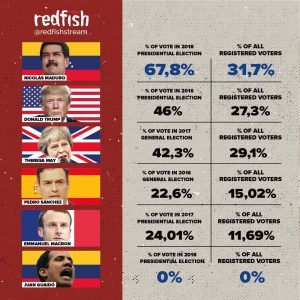


 After the Crash