The Stomach-Churning Violence of the Agrochemical Oligopoly

By Colin Todhunter

Source: OffGuardian

As humans, we have evolved with the natural environment over millennia. We have learned what to eat and what not to eat, what to grow and how to grow it and our diets have developed accordingly. We have hunted, gathered, planted and harvested. Our overall survival as a species has been based on gradual, emerging relationships with the seasons, insects, soil, animals, trees and seeds. And out of these relationships, we have seen the development of communities whose rituals and bonds have a deep connection with food production and the natural environment.

However, over the last couple generations, agriculture and food production has changed more than it had done over previous millennia. These changes have involved massive social upheaval as communities and traditions have been uprooted and have entailed modifying what we eat, how we grow our food and what we apply to it. All of this has been driven by geopolitical concerns and powerful commercial interests with their proprietary chemicals and patented seeds. The process of neoliberal globalisation is accelerating the process as farmers are encouraged to produce for global supply chains dominated by transnational agribusiness.

Certain crops are now genetically engineered, the range of crops we grow has become less diverse, synthetic biocides have been poured on crops and soil and our bodies have been subjected to a chemical bombardment. We have arrived at a point where we have lost touch with our deep-rooted microbiological and social connection with nature and have developed an arrogance that has placed ‘man’ above the environment and all other species. One of the consequences is that we have paid an enormous price in terms of the consequent social, environmental and health-related devastation.

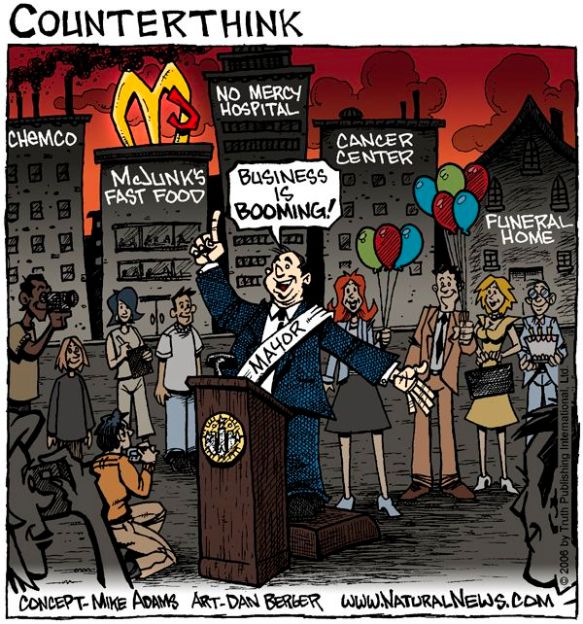
Despite the promise and potential of science, it has too often in modern society become a tool of vested interests, an ideology wrapped in the vestiges of authority and the ‘superstition’ that its corporate-appointed priesthood should not be challenged nor questioned. Instead of liberating humankind, it has now too often become a tool of deception in the hands of agribusiness conglomerates which make up the oligopoly that controls what is an increasingly globalised system of modern food and agriculture.

These corporations have successfully instituted the notion that the mass application of biocides, monocropping and industrial agriculture are necessary and desirable. They are not. However, these companies have used their science and propaganda to project certainty in order to hide the fact that they have no real idea what their products and practices are doing to human health or the environment (and in cases when they do know, they do their best to cover it up or hide behind the notion of ‘commercial confidentiality’).

Based on their limited, tainted studies and co-opted version of science, they say with certainty that, for example, genetically engineered food and glyphosate are ‘safe’. And when inconvenient truths do emerge, they will mobilise their massive lobbying resources to evade regulations, they will seek to hide the dangers of their products or they will set out to destroy scientists whose findings challenge their commercial bottom line.

Soil microbiologists are still trying to fully comprehend soil microbes and how they function as anintegrated network in relation to plants. The agrochemical sector has little idea of how their biocides have affected soils. It merely churns out public relations spin that their inputs are harmless for soil, plants and human health. Such claims are not based on proper, in-depth, long-term studies. They are based on a don’t look, don’t find approach or a manipulation of standards and procedures that ensure their products make it on to the commercial market and stay there.

And what are these biocides doing to us as humans? Numerous studies have linked the increase in pesticide us with spiralling rates of ill health. Kat Carrol of the National Health Federation is concerned about the impacts on human gut bacteria that play a big role in how organs function and our neurological health. The gut microbiome can contain up to six pounds of bacteria and is what Carroll calls ‘human soil’. She says that with their agrochemicals and food additives, powerful companies are attacking this ‘soil’ and with it the sanctity of the human body.

And her concerns seem valid. Many important neurotransmitters are located in the gut. Aside from affecting the functioning of major organs, these transmitters affect our moods and thinking. Feed gut bacteria a cocktail of biocides and is it any surprise that many diseases are increasing?

For instance, findings published in the journal ‘Translational Psychiatry’ provide strong evidence that gut bacteria can have a direct physical impact on the brain. Alterations in the composition of the gut microbiome have been implicated in a wide range of neurological and psychiatric conditions, including autism, chronic pain, depression, and Parkinson’s Disease.

Environmental campaigner Dr Rosemary Mason has written extensively on the impacts of agrochemicals (especially glyphosate) on humans, not least during child and adolescent development. In her numerous documents and papers, she cites a plethora of data and studies that link the use of agrochemicals with various diseases and ailments. She has also noted the impact of these chemicals on the human gut microbiome.

The science writer Mo Costandi discusses the importance of gut bacteria and their balance. In adolescence the brain undergoes a protracted period of heightened neural plasticity, during which large numbers of synapses are eliminated in the prefrontal cortex and a wave of ‘myelination’ sweeps across this part of the brain. These processes refine the circuitry in the prefrontal cortex and increase its connectivity to other brain regions. Myelination is also critical for normal, everyday functioning of the brain. Myelin increases a nerve fibre’s conduction velocity by up to a hundred times, and so when it breaks down, the consequences can be devastating.

Other recent work shows that gut microbes control the maturation and function of microglia, the immune cells that eliminate unwanted synapses in the brain; age-related changes to gut microbe composition might regulate myelination and synaptic pruning in adolescence and could, therefore, contribute to cognitive development. Upset those changes, and, As Mason argues, there are going to be serious implications for children and adolescents. Mason places glyphosate at the core of the ailments and disorders currently affecting young people in Wales and the UK in general.

Yet we are still being subjected to an unregulated cocktail of agrochemicals which end up interacting with each other in the gut. Regulatory agencies and governments appear to work hand in glove with the agrochemical sector.

Carol Van Strum has released documents indicating collusion between the manufacturers of dangerous chemicals and regulatory bodies. Evaggelos Vallianatos has highlighted the massive fraud surrounding the regulation of biocides and the wide scale corruption at laboratories that were supposed to test these chemicals for safety. Many of these substances were not subjected to what was deemed proper testing in the first place yet they remain on the market. The late Shiv Chopra also highlighted how various dangerous products were allowed on the commercial market and into the food chain due to collusion between these companies and public officials.

Powerful transnational corporations are using humanity as their collective guinea pig. But those who question them, or their corporate science, are automatically labelled anti-science and accused of committing crimes against humanity because they are preventing their products from being commercialised ‘to help the poor or hungry’. Such attacks on critics by company mouthpieces who masquerade as public officials, independent scientists or independent journalists are mere spin. They are, moreover, based on the sheer hypocrisy that these companies (owned and controlled by elite interests) have humanity’s and the environment’s best interests at heart.

Many of these companies have historically profited from violence. Unfortunately, that character of persists. They directly profit on the back of militarism, whether as a result of the US-backed ‘regime change’ in Ukraine or the US invasion of Iraq. They also believe they can cajole (poison) nature by means of chemicals and bully governments and attack critics, while rolling out propaganda campaigns for public consumption.

Whether it involves neocolonialism and the destruction of indigenous practices and culturesunder the guise of ‘development’, the impoverishment of farmers in India, the twisting and writing of national and international laws, the destruction of rural communities, the globalisation of bad food and illness, the deleterious impacts on health and soil, the hollowing out of public institutions and the range of human rights abuses we saw documented during The Monsanto Tribunal, what we are witnessing is structural violence in many forms.

Pesticides are in fact “a global human rights concern” and are in no way vital to ensuring food security. Ultimately, what we see is ignorance, arrogance and corruption masquerading as certainty and science.

…when we wound the planet grievously by excavating its treasures – the gold, mineral and oil, destroy its ability to breathe by converting forests into urban wastelands, poison its waters with toxic wastes and exterminate other living organisms – we are in fact doing all this to our own bodies… all other species are to be enslaved or driven to extinction if need be in the interests of human ‘progress’… we are part of the same web of life –where every difference we construct artificially between ‘them’ and ‘us’ adds only one more brick to the tombstone of humankind itself.”
from Micobes of the World Unite! by Satya Sager

Harvest of Greed – the Merger of Bayer and Monsanto

By Dr. Mercola

Source: Waking Times

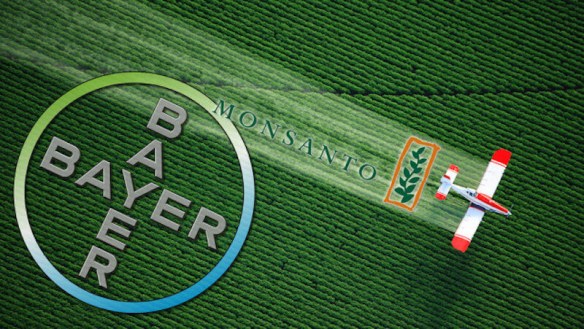
The featured documentary, “Harvest of Greed,” investigates a number of the many issues brought about by the merger of Monsanto and Bayer AG. The merger was initially announced in May 2016, when Monsanto accepted Bayer’s $66 billion takeover offer — the largest all-cash buyout on record.1,2,3

The U.S. Department of Justice (DOJ) approved the merger in April this year,following the European Union’s (EU) approval in March. As a condition of the DOJ’s approval, Bayer will sell some of its assets to BASF — its German competitor — before the finalization of the merger.

This includes its soybean, cottonseed and glufosinate weed killer businesses, which overlap with Monsanto’s and were antitrust sticking points. Combined, Bayer and Monsanto used to control nearly 60 percent of the American cottonseed market. Monsanto also owns the rights to 80 percent of corn and 90 percent of soybeans grown in the U.S.5 The EU also demanded Bayer eliminate about $7.4 billion-worth of its various firms “to ensure fair competition.”6

Mega-Entity Now Controls Large Portion of Global Seed Supply

This new entity is now the largest seed and pesticide company in the world, controlling more than 25 percent of the global seed and pesticide supply. In all, just three companies now dominate the global seed and pesticide market.7 (In addition to the Bayer-Monsanto merger, the DOJ has also given the Dow-DuPont merger the green light, and the Federal Trade Commission recently approved ChemChina’s acquisition of Syngenta.)

The Bayer-Monsanto merger generated deep concerns right from the start, and anti-competition regulators were urged to investigate the takeover. Bernie Sanders went on record saying the takeover poses “a threat to all Americans” and needed to be blocked.8 He also urged the DOJ to “reopen its investigation of Monsanto’s monopoly over the seed and chemical market.” Farmers have also expressed concern over what the merger might do to prices, as less competition inevitably tends to lead to price hikes.

As just one example, the price of a bag of seed corn has risen from $80 to $300 over the past decade alone — a price hike attributed to the consolidation of seed companies and reduced competition. The merger of Bayer and Monsanto is predicted to make matters worse. Farmers also worry that consolidation will result in lower quality products by reducing incentive for innovation. Organic farmers have their concerns as well. As noted by Food and Power:9

“For Kristina Hubbard, director of advocacy and communications for the Organic Seed Alliance, the merger presents a particular threat to organic farmers. She notes that the National Organic Program’s regulations on organic seeds generally dictate that growers must use organic seeds to grow their crops. But there is an exception granted for non-organic seed when ‘an equivalent organically produced variety is not commercially available.’

Acceptable non-organic seeds are generally owned by the giant seed companies. ‘That exemption is important because currently the supply [of organic seeds] isn’t sufficient to meet the diverse and regional needs of all organic farmers,’ she says. With continued consolidation in the seed industry, she says farmers that rely on those non-organic seed options may find themselves faced with even fewer options as the merged companies cut down on research and development.”

Bayer-Monsanto Merger Unlikely to Benefit Anyone but Its Shareholders

Bayer AG’s CEO, Werner Baumann, has stated that “it is not our plan or our ambition or our intent to prevent farmers from having choice.”10 But the history of Monsanto and Bayer both suggest it would be naïve to believe him. As noted by Mark Connelly, an agriculture analyst at the investment group CLSA Americas, “These companies want to make more money, they want to raise prices. No company in this industry needs these deals in order to innovate.”11

Indeed, there can be little doubt that the Bayer-Monsanto merger will give the subsequent entity even more power to bully farmers into paying more and pressuring and manipulating governments into accepting the unacceptable risks posed by genetically engineered (GE) crops and mounting use of ever more toxic pesticides.

One example of Monsanto’s strong-arm tactics included in the film is that of India, where more than 300,000 farmers have committed suicide due to farm-related debt. When the government attempted to regulate the price of seed — the main cause leading to these debts — Monsanto sued the Indian government.

Between 1997 and 2014, Monsanto also sued 147 farmers for “improperly reusing patented seeds.”12 They never lost a single case, even in cases where organic fields were contaminated or cross-pollinated with unwanted GE seeds.

Billions Against Bayer

In response to the announcement of the merger in 2016, the Organic Consumers Association (OCA) launched a boycott against Bayer. The “Billions Against Bayer” campaign is essentially a continuation of the successful “Millions Against Monsanto” campaign. Following the DOJ’s April approval of the merger, OCA renewed its call for consumers around the world to join the boycott. You can follow the campaign and get the latest news updates on Facebook.13 As noted in a September 2016 press release:14

“Two of the world’s most foul corporate criminals will be one. Monsanto will pack up its headquarters and head overseas. The much-maligned Monsanto name will be retired. But a corporate criminal by any other name — or size — is still a corporate criminal.

This merger only heightens the urgency, and strengthens our resolve, to hunt down the corporations that are poisoning everything in sight. We will follow them to the ends of the earth, if need be. We will expose their crimes. We will end the toxic tyranny. We will become the Billions Against Bayer. And we will need your help …

Even many Bayer employees are leery of the merger. While both companies have checkered pasts, Bayer has managed to escape the brunt of the kind of criticism, if not hatred, leveled at Monsanto over the years.

According to the featured documentary, Bayer claims the merger has widespread support among its staff, yet when Bayer employees were approached under the promise of anonymity, the general consensus was one of dismay at inheriting Monsanto’s tarnished reputation. Such fears are likely to come true sooner rather than later. Activists in Argentina, for example, promise Monsanto’s ill reputation cannot be washed clean but will now transfer over to Bayer.

Glyphosate — A Toxic Legacy

Both Bayer and Monsanto insist that glyphosate, the active ingredient in Monsanto’s weed killer Roundup and other herbicide formulations, is “a very safe product when used properly.” In the video, Bayer CEO Werner Baumann stresses that more than 3,000 studies support the chemical’s safety. Yet numerous studies have reached the converse conclusion, showing it poses toxic risks to soil, animals and humans.

“The things you hear in the public debate are ultimately based on misinformation about the risks of this product,” Baumann says. “So, we think glyphosate, even if it does belong to our company, is a good product, and its license should be renewed.”

At the end of 2017, the EU did indeed renew its approval of glyphosate for the next five years,15 but the process was not without its critics, such as Martin Häusling, member of the Green Party and the European Parliament, who noted that many of the studies exonerating glyphosate were funded by Monsanto itself, while independent research keeps finding problems.

Indeed, scientists have discovered it not only may be carcinogenic,16 but may also affect your body’s ability to produce fully functioning proteins, inhibit the shikimate pathway (found in gut bacteria) and interfere with the function of cytochrome P450 enzymes (required for activation of vitamin D and the creation of nitric oxide and cholesterol sulfate).

Glyphosate also chelates important minerals, disrupts sulfate synthesis and transport, interferes with the synthesis of aromatic amino acids and methionine, resulting in folate and neurotransmitter shortages, disrupts your microbiome by acting as an antibiotic, impairs methylation pathways, and inhibits pituitary release of thyroid stimulating hormone, which can lead to hypothyroidism.

Recent Government Tests Show Roundup Is More Toxic Than Glyphosate in Isolation

Most recently, toxicology testing17 by the U.S. National Toxicology Program (NTP) concluded the Roundup formula is actually far more toxic than glyphosate alone.18 The NTP testing was done by request from the U.S. Environmental Protection Agency (EPA) following the International Agency for Research on Cancer (IARC) reclassification of glyphosate as a Class 2A probable carcinogen three years ago.19

At the time, the IARC noted concerns about glyphosate formulations possibly having increased toxicity due to synergistic interactions. As it turns out, that’s exactly what the NTP testing found. According to the NTP’s summary of the results, glyphosate formulations “significantly altered” the viability of human cells by disrupting the functionality of cell membranes.

Mike DeVito, acting chief of the NTP Laboratory commented on the results saying, “We see the formulations are much more toxic. The formulations were killing the cells. The glyphosate really didn’t do it.”

Internal documents from Monsanto, obtained through previous Freedom of Information Act (FOIA) requests, reveal Monsanto’s own employees have not been convinced the product is harmless either. For example, in a 2002 email, Monsanto executive William Heydens said, “Glyphosate is OK but the formulated product … does the damage.”20

Monsanto Charged With Crimes Against Humanity

October 16, 2016 (on World Food Day), Monsanto was put on trial for “crimes against nature and humanity” at a tribunal in The Hague, Netherlands. The steering committee21 included Vandana Shiva, Corinne Lepage (former environment minister of France), Giles-Eric Séralini (toxicologist researching toxicities of GMOs and glyphosate), and Olivier De Schutter (former U.N. Special Rapporteur on the Right to Food), among others. The legal opinion on the evidence presented at the tribunal was delivered April 18, 2017. As reported by Corporate Europe Observatory:22 “The tribunal concluded that:

  • Monsanto has violated human rights to food, health, a healthy environment and the freedom indispensable for independent scientific research
  • ‘Ecocide’ should be recognized as a crime in international law
  • Human rights and environmental laws are undermined by corporate-friendly trade and investment regulation”

When asked if Bayer will continue Monsanto’s underhanded business practices, Baumann said the new entity will be managed “according to our standards,” adding that “Bayer stands for transparency, reliability and a different style of debate.”

Monsanto — A Destroyer of the Natural World

In addition to GE seeds and its flagship product, Roundup, Monsanto has also been a leading producer of Agent Orange, PCBs, DDT, recombinant bovine growth hormone and aspartame — the history of which is summarized in “The Complete History of Monsanto, ‘The World’s Most Evil Corporation,’”23 originally published by Waking Times in 2014.24

Monsanto also made its mark on history by participating in the Manhattan Project to build the first atomic bomb, thereby becoming a “war horse” ally to the United States government — an alliance that still holds today. As noted in “The Complete History,” article:

“To add insult to world injury, Monsanto and their partners in crime Archer Daniels Midland, Sodexo and Tyson Foods write and sponsor The Food Safety Modernization Act of 2009: HR 875.25 This ‘act’ gives the corporate factory farms a virtual monopoly to police and control all foods grown anywhere, including one’s own backyard, and provides harsh penalties and jail sentences for those who do not use chemicals and fertilizers. President Obama … gave his approval.

With this Act, Monsanto claims that only GM [genetically modified] foods are safe and organic or homegrown foods potentially spread disease, therefore must be regulated out of existence for the safety of the world … As further revelations have broken open regarding this evil giant’s true intentions, Monsanto crafted the ridiculous HR 933 Continuing Resolution,26aka Monsanto Protection Act, which Obama robo-signed into law as well.

This law states that no matter how harmful Monsanto’s GMO crops are and no matter how much devastation they wreak upon the country, U.S. federal courts cannot stop them from continuing to plant them anywhere they choose. Yes, Obama signed a provision that makes Monsanto above any laws and makes them more powerful than the government itself.”

Bayer Also Has a Long, Dark, Destructive History of Genocide

Despite having a far “cleaner” public reputation than Monsanto, Bayer is really just more of the same. Founded in Germany in 1863 by Friedrich Bayer and Johann Wescott, it too has a long, sordid history of creating poisons and mass destruction.27 During World War II, Bayer (then I.G. Farben) produced Zyklon B gas, used in the Nazi gas chambers to eradicate 11 million people whose only crime was to be born a Jew.

According to Alliance for Human Research Protection, the company was also “intimately involved with the human experimental atrocities committed by Mengele at Auschwitz.”28 In one case, Bayer purchased 150 healthy female prisoners from the camp commander of Auschwitz for use as test subjects for a new sleep drug. All the test subjects died, and another order for prisoners was placed.

While some of its board members ended up being arrested and tried for their crimes against humanity, others escaped and helped create the Federal Reserve.29 If you think the passing of time might have made this corporate entity kinder, safer and gentler, think again.

In 2003, it was revealed Bayer sold blood-clotting medicine tainted with the HIV virus to Asian, Latin American and Europe in the mid-1980s.30 The drug, Factor VIII concentrate, was worth millions of dollars, and the company continued to sell the tainted drug for a year after the contamination was discovered. In Hong Kong and Taiwan alone, more than 100 hemophiliacs contracted HIV and died after using the medicine.

Bayer’s drug Trasylol — used to control bleeding during surgery — was also eventually found to be responsible for at least 1,000 deaths each month for the 14 years it was on the market.31 In 2006, documents proved Bayer hid evidence showing unfavorable results from the drug in order to continue selling it.  Lawsuits have also been filed against Bayer for the untimely death of 190 young women taking their birth control pill Yaz, which raises your risk of blood clots by 300 percent.

Bayer Unlikely to Shift Public Perception of GMOs and Toxic Agriculture

Between 2006 and 2007, Bayer was also responsible for contaminating U.S. rice imports with three unapproved varieties of GE rice under development by Bayer CropScience. Bayer also makes neonicotinoid pesticides, suspected of being responsible for mass die-offs of bees around the world, thereby threatening the global food supply, and made the plastic chemical bisphenol-A, now known to have a dangerous impact on the human endocrine system.

In short, Bayer’s history is just as dark and unethical as Monsanto’s, if not more, and some have rightfully referred to the merger of these two destructive behemoths as a “marriage made in hell.”32 While change is possible, it seems improbable that this new Bayer-Monsanto mega-entity will radically change, and based on their combined histories, the world better get ready for a monumental fight.

Biotech Companies Are Gaining Power by Taking Over the Government

Monsanto and their industry allies will not willingly surrender their stranglehold on the food supply. They must be resisted and rolled back at every turn. There is no doubt in my mind that GMOs and the chemical-intensive agricultural model of which they are part and parcel, pose a serious threat to the environment and our health. Yet, government agencies not only turn a blind eye to the damage they are inflicting on the planet, but actively work to further the interests of the biotech giants.

This is not surprising. It is well-known that there is a revolving door between regulatory agencies and private corporations. This has allowed companies such as Monsanto to manipulate science, defang regulations and even control the free press, all from their commanding position within the halls of government.

Consider for a moment that on paper, the U.S. may have the strictest safety regulations in the world governing new food additives, but has repeatedly allowed GMOs and their accompanying pesticides such as Roundup to circumvent these laws.

In fact, the only legal basis for allowing GE foods to be marketed in the U.S. is the FDA’s tenuous claim that these foods are inherently safe, a claim which is demonstrably false. Documents released as a result of a lawsuit against the FDA reveal that the agency’s own scientists warned their superiors about the detrimental risks of GE foods. But their warnings fell on deaf ears.

Don’t Be Duped by Industry Shills!

In a further effort to deceive the public, Monsanto and its cohorts spoon-feed scientists, academics and journalists a diet of questionable studies that depict them in a positive light. By hiring “third-party experts,” biotech companies are able to take information of dubious validity, and present it as independent and authoritative.

Industry front groups also abound. The Genetic Literacy Project and the American Council for Science and Health are both Monsanto-funded. Even WebMD, a website that is often presented as a trustworthy source of “independent and objective” health information, is heavily reliant on advertising dollars. It is no coincidence that they promote corporate-backed health strategies and products.

There’s No Better Time to Act Than NOW — Here’s What You Can Do

The biotech giants have deep pocketbooks and political influence, and are fighting to maintain their position of dominance. It is only because of educated consumers and groups like the Organic Consumers Association (OCA) that their failed GMO experiment is on the ropes. We thank all of the donors who helped OCA achieve their fundraising goal. I made a commitment to triple match all donations to OCA during awareness week. It is with great pleasure to present a check to this fantastic organization for $250,000.

At the end of the day, we must shatter Monsanto’s grip on the agricultural sector. There is no way to recall GMOs once they have been released into the environment. The stakes could not be higher. Will you continue supporting the corrupt, toxic and unsustainable food system that Monsanto and its industry allies are working so hard to protect?

For more and more people, the answer is no. Consumers are rejecting genetically engineered and pesticide laden foods. Another positive trend is that there has been strong growth in the global organic and grass fed sectors. This just proves one thing: We can make a difference if we steadily work toward the same goal.

One of the best things you can do is to buy your foods from a local farmer who runs a small business and uses diverse methods that promote regenerative agriculture. You can also join a community-supported agriculture (CSA) program, where you can buy a “share” of the vegetables produced by the farm, so that you get a regular supply of fresh food. I believe that joining a CSA is a powerful investment not only in your own health, but in that of your local community and economy as well.

In addition, you should also adopt preventive strategies that can help reduce the toxic chemical pollution that assaults your body. I recommend visiting these trustworthy sites for non-GMO food resources in your country as well:

Organic Food Directory (Australia) Eat Wild (Canada)
Organic Explorer (New Zealand) Eat Well Guide (United States and Canada)
Farm Match (United States) Local Harvest (United States)
Weston A. Price Foundation (United States) The Cornucopia Institute

Monsanto and its allies want you to think that they control everything, but they are on the wrong side of history. It’s you, the informed and empowered, who hold the future in your hands. Let’s all work together to topple the biotech industry’s house of cards. Remember — it all starts with shopping smart and making the best food purchases for you and your family.

THE MONOPOLIZATION OF AMERICA: The biggest economic problem you’re hearing almost nothing about

By Robert Reich

Source: Nation of Change

Not long ago I visited some farmers in Missouri whose profits are disappearing. Why? Monsanto alone owns the key genetic traits to more than 90 percent of the soybeans planted by farmers in the United States, and 80 percent of the corn. Which means Monsanto can charge farmers much higher prices.

Farmers are getting squeezed from the other side, too, because the food processors they sell their produce to are also consolidating into mega companies that have so much market power they can cut the prices they pay to farmers.

This doesn’t mean lower food prices to you. It means more profits to the monopolists.

Monopolies all around

America used to have antitrust laws that stopped corporations from monopolizing markets, and often broke up the biggest culprits. No longer. It’s a hidden upward redistribution of money and power from the majority of Americans to corporate executives and wealthy shareholders.

You may think you have lots of choices, but take a closer look:

1. The four largest food companies control 82 percent of beef packing, 85 percent of soybean processing, 63 percent of pork packing, and 53 percent of chicken processing.

2. There are many brands of toothpaste, but 70 percent of all of it comes from just two companies.

3. You may think you have your choice of sunglasses, but they’re almost all from one company: Luxottica – which also owns nearly all the eyeglass retail outlets.

4. Practically every plastic hanger in America is now made by one company, Mainetti.

5. What brand of cat food should you buy? Looks like lots of brands but behind them are basically just two companies.

6. What about your pharmaceuticals? Yes, you can get low-cost generic versions. But drug companies are in effect paying the makers of generic drugs to delay cheaper versions. Such “pay for delay” agreements are illegal in other advanced economies, but antitrust enforcement hasn’t laid a finger on them in America. They cost you and me an estimated $3.5 billion a year.

7. You think your health insurance will cover the costs? Health insurers are consolidating, too. Which is one reason your health insurance premiums, copayments, and deductibles are soaring.

8. You think you have a lot of options for booking discount airline tickets and hotels online? Think again. You have only two. Expedia merged with Orbitz, so that’s one company. And then there’s Priceline.

9. How about your cable and Internet service? Basically just four companies (and two of them just announced they’re going to merge).

Why the monopolization of America is a huge problem

The problem with all this consolidation into a handful of giant firms is they don’t have to compete. Which means they can – and do – jack up your prices.

Such consolidation keeps down wages. Workers with less choice of whom to work for have a harder time getting a raise. When local labor markets are dominated by one major big box retailer, or one grocery chain, for example, those firms essentially set wage rates for the area.

These massive corporations also have a lot of political clout. That’s one reason they’re consolidating: Power.

Antitrust laws were supposed to stop what’s been going on. But today, they’re almost a dead letter. This hurts you.

We’ve forgotten history

The first antitrust law came in 1890 when Senator John Sherman responded to public anger about the economic and political power of the huge railroad, steel, telegraph, and oil cartels – then called “trusts” – that were essentially running America.

A handful of corporate chieftains known as “robber barons” presided over all this – collecting great riches at the expense of workers who toiled long hours often in dangerous conditions for little pay. Corporations gouged consumers and corrupted politics.

Then in 1901, progressive reformer Teddy Roosevelt became president. By this time, the American public was demanding action.

In his first message to Congress in December 1901, only two months after assuming the presidency, Roosevelt warned, “There is a widespread conviction in the minds of the American people that the great corporations known as the trusts are in certain of their features and tendencies hurtful to the general welfare.”

Roosevelt used the Sherman Antitrust Act to go after the Northern Securities Company, a giant railroad trust run by J. P. Morgan, the nation’s most powerful businessman. The U.S. Supreme Court backed Roosevelt and ordered the company dismantled.

In 1911, John D. Rockefeller’s Standard Oil Trust was broken up, too. But in its decision, the Supreme Court effectively altered the Sherman Act, saying that monopolistic restraints of trade were objectionable if they were “unreasonable” – and that determination was to be made by the courts. What was an unreasonable restraint of trade?

In the presidential election of 1912, Roosevelt, running again for president but this time as a third party candidate, said he would allow some concentration of industries where there were economic efficiencies due to large scale. He’d then he’d have experts regulate these large corporations for the public benefit.

Woodrow Wilson, who ended up winning the election, and his adviser Louis Brandeis, took a different view. They didn’t think regulation would work, and thought all monopolies should be broken up.

For the next 65 years, both views dominated. We had strong antitrust enforcement along with regulations that held big corporations in check.

Most big mergers were prohibited. Even large size was thought to be a problem. In 1945, in the case of United States v. Alcoa (1945), the Supreme Court ruled that even though Alcoa hadn’t pursued a monopoly, it had become one by becoming so large that it was guilty of violating the Sherman Act.

What happened to antitrust?

All this changed in the 1980s, after Robert Bork – who, incidentally, I studied antitrust law with at Yale Law School, and then worked for when he became Solicitor General under President Ford – wrote an influential book called The Antitrust Paradox, which argued that the sole purpose of the Sherman Act is consumer welfare.

Bork argued that mergers and large size almost always create efficiencies that bring down prices, and therefore should be legal. Bork’s ideas were consistent with the conservative Chicago School of Economics, and found a ready audience in the Reagan White House.

Bork was wrong. But since then, even under Democratic administrations, antitrust has all but disappeared.

The monopolization of high tech

We’re seeing declining competition even in cutting-edge, high-tech industries.

In the new economy, information and ideas are the most valuable forms of property. This is where the money is.

We haven’t seen concentration on this scale ever before.

Google and Facebook are now the first stops for many Americans seeking news. Meanwhile, Amazon is now the first stop for more than a half of American consumers seeking to buy anything. Talk about power.

Contrary to the conventional view of an American economy bubbling with innovative small companies, the reality is quite different. The rate at which new businesses have formed in the United States has slowed markedly since the late 1970s.

Big Tech’s sweeping patents, standard platforms, fleets of lawyers to litigate against potential rivals, and armies of lobbyists have created formidable barriers to new entrants. Google’s search engine is so dominant, “Google” has become a verb.

The European Union filed formal antitrust charges against Google, accusing it of forcing search engine users into its own shopping platforms. And last June, it fined Google a record $2.7 billion.

But not in America.

It’s time to revive antitrust

Economic and political power cannot be separated because dominant corporations gain political influence over how markets are organized, maintained, and enforced – which enlarges their economic power further.

One of the original goals of the antitrust laws was to prevent this.

Big Tech – along with the drug, insurance, agriculture, and financial giants – is coming to dominate both our economy and our politics.

There’s only one answer: It is time to revive antitrust.

Agrochemicals and Institutional Corruption: Pleading with the Slave Master Will Not Set You Free

By Colin Todhunter

Source: CounterPunch

Environmental campaigner Dr Rosemary Mason has just written to President of the European Commission Jean-Claude Juncker, Vice President of the European Commission Frans Timmermans and Health Commissioner Vytenis Andruikaitis. As set out below, she asks these top officials some very pertinent questions about the EU’s collusion with the agrochemical corporations.

1) In authorising glyphosate on behalf of the Glyphosate Task Force led by Monsanto, why did President Juncker fail to state the European Chemicals Agency’ (ECHA) risk assessment in full?

2) Why did the EU collude with corporations that made nerve gases in WW2 for chemical warfare and for use in the Nazi concentration camps? These firms continued to use similar chemicals in agriculture to poison ‘pests’, beneficial insects, birds and people.

3) Could it be that is it is because biocides regulations in the EU are merely designed to make corporations money and are ultimately controlled by the agrochemical industry?

4) Why did Monsanto, the European Food Safety Authority (EFSA), the ECHA and the industry-funded UK Science Media Centre suppress the paper by Gilles-Eric Seralini of the two-year rat feeding study of GM crops and Roundup that produced organ damage and tumours at four months?

5) Do the commissioners know that Cancer Research UK was hijacked by the Agrochemical Industry in 2010 with the full knowledge of the UK government? Michael Pragnell, former Chairman of Cancer Research UK (CRUK), was founder of Syngenta and former chairman of industry lobby group CropLife International. The CRUK website says that there is no convincing evidence that pesticides cause cancer. Instead, CRUK links cancer to life style choices and individual behaviour and blames alcohol use, obesity and smoking.

6) Why did the EU regulators and David Cameron, on behalf of the British government, ignore the Letter from America in 2014 from nearly 60 million citizens, warning you not to authorise GM crops and Roundup because of their toxicity to human health and the environment?

7) Where have all the insects and birds gone as a result of intensive chemical agriculture? The UK, Germany, France, Denmark and Canada are rapidly losing biodiversity. US farmland growing GM Roundup Ready crops has become a biological desert.

8) Did Monsanto and President Juncker conceal the ECHA harmonised classification of glyphosate as “toxic to aquatic life with long-lasting effects” because it would explain the accelerating deterioration of coral in the Great Barrier Reef?

Mason concludes her letter by reiterating the damning advisory opinion of the International Monsanto Tribunal delivered in 2017. She also sent the commissioners a recent letter signed by 23 prominent organisations criticising the EU’s decision to renew the license for glyphosate and outlining Monsanto’s undue influence over decision making.

Along with her letter, Mason sent a 22-page document containing detailed information on:

* The European Commission’s flawed renewal of the license for glyphosate

* The causes of decline in coral cover on the Great Barrier Reef

* European legislation existing for the benefit of the agrochemical industry

* Contamination by glyphosate and neonicotinoid insecticides causing dramatic declines in insects and birds

* Glyphosate being present everywhere

* The International Monsanto Tribunal and various alarming reports on pesticides, their use and impacts

To date, there has been no response from the commissioners to Mason.

In 2003, the World Wide Fund for Nature (UK) concluded that every person it tested across the UK was contaminated by a cocktail of highly toxic chemicals, which were banned from use during the 1970s. Over the years, Mason has cited a range of sources to show the harmful impact of pesticides and that the amount and range of pesticide residues on British food is increasing annually. She also notes a massive rise in the use of glyphosate between 2012 and 2014 alone.

In her many detailed documents and letters (which contains her own views on all the questions she poses above to the commissioners) she has sent to officials over the years, Mason offers sufficient evidence to show that the financial and political clout of a group of powerful agrochemical/agribusiness corporations ensure that its interests are privileged ahead of public health and the environment to the detriment of both. Mason has gone to great lengths to describe the political links between industry and various government departments, regulatory agencies and key committees that have effectively ensured that ‘business as usual’ prevails.

The corporations which promote industrial agriculture and the agrochemicals Mason campaigns against have embedded themselves deeply within the policy-making machinery at both national and international levels. From the flawed narrative that industrial agriculture is necessary to feed the world to providing lavish research grants and the capture of important policy-making institutions, global agribusiness has secured a bogus ‘thick legitimacy’ within policymakers’ mindsets and mainstream discourse.

By referring to the Monsanto Tribunal, Mason implies that governments, individuals and civil groups that collude with corporations to facilitate ecocide and human rights abuses resulting from the actions of global agribusiness corporations should be hauled into court. Perhaps it is only when officials and company executives are given lengthy jail sentences for destroying health and the environment that some change will begin to happen.

From Rachel Carson onward, the attempt to roll back the power of these corporations and their massively funded lobby groups has had limited success. Some 34,000 agrochemicals remain on the market in the US, many of which are there due to weak regulatory standards or outright fraud, and from Argentina to Indonesia, the devastating impact of the industrial chemical-dependent model of food and agriculture on health and the environment has been documented by various reports and writers at length.

What is worrying is that these corporations are being facilitated by the World Bank’s ‘enabling the business of agriculture’, duplicitous trade deals like the US-India Knowledge Initiative on Agriculture, the Gates Foundation’s ‘opening up’ of African agriculture and the bypassing of democratic procedures at sovereign state levels to impose seed monopolies and proprietary inputs on farmers and to incorporate them into a global supply chain dominated by these powerful companies.

For the reasons set out in my previous piece, pleading with public officials to roll back the actions and influence of agrochemical/agribusiness corporations may have no more impact than appealing to a slave master to set you free.

Ultimately, the solution relies on people coming together to challenge a system of neoliberal capitalism that by design facilitates the institutionalised corruption that we see along with the destruction of self-sufficiency and traditional food systems. At the same time, alternatives must be promoted based on localisation, the principles of a politically-oriented model of agroecology (outlined here, here and here) and a food system that serves the public good not private greed.


Colin Todhunter is an extensively published independent writer and former social policy researcher based in the UK and India.

The Global Elite is Insane Revisited

By Robert J. Burrowes

In 2014 I wrote an article titled ‘The Global Elite is Insane’. I want to elaborate what I explained in the earlier article so that people have a clearer sense of what we are up against in our struggle to create a world of peace, justice and ecological sustainability.

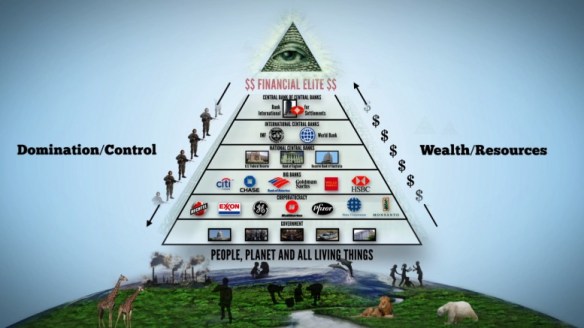
Of course, as I explained previously, it is not just the global elite that is insane. All those individuals – politicians, businesspeople, academics, corporate media editors and journalists, judges and lawyers, bureaucrats…. – who serve the elite, including by not exposing and resisting it, are also insane. And it is important to understand this if we are to develop and implement effective strategies to resist elite violence, exploitation and destruction but also avert the now-imminent human extinction driven by their insane desire for endless personal privilege, corporate profit and political control whatever the cost to Earth’s biosphere and lifeforms (human and non-human alike).

But first, who constitutes the global elite? Essentially, it is those extremely wealthy individuals – notably including the Rothschild family, Jeff Bezos, Bill Gates, Warren Buffett, Amancio Ortega, Mark Zuckerberg, Carlos Slim, the Walton family and the Koch brothers – as well as the world’s other billionaires and millionaires. See ‘Bloomberg Billionaires Index’.

Testament to their secretly and long-accumulated wealth and power, a 2012 investigation concluded that rich individuals and their families have as much as $32 trillion of hidden financial assets – which excludes non-financial assets such as real estate, gold, yachts and racehorses – in offshore tax havens. See the Tax Justice Network.

If this sum was devoted to programs of social uplift then starvation, poverty, homelessness and other privations would vanish immediately and environmental restoration projects as well as research, development and implementation of visionary sustainability initiatives would flourish instantly. The idea of an ‘underdeveloped’ or ‘developing’ national economy would vanish from the literature on Africa, Asia and Central/South America.

In addition to these individuals, however, the global elite includes the major multinational corporations, particularly including the following – although, it should be noted, this list simplifies the picture considerably by ignoring the conglomerate nature of many of these corporations and not including many of the (more difficult to identify) private corporations that should be listed in any comprehensive presentation:

* the major weapons manufacturers (such as Lockheed Martin, Boeing, BAE Systems, Raytheon, Northrop Grumman and General Dynamics)

* the major banks (including Industrial & Commercial Bank of China, China Construction Bank, HSBC Holdings, JPMorgan Chase, Mitsubishi UFJ Financial Group and Bank of America) and their ‘industry groups’ like the International Monetary Conference

* the major investment companies (including BlackRock, Capital Group Companies, FMR, AXA, and JP Morgan Chase)

* the major financial services companies (including Berkshire Hathaway, AXA, Allianz and BNP Paribas)

* the major energy corporations including coal companies (such as Coal India, Adani Enterprises, China Shenhua Energy, China Coal Energy, Mechel, Exxaro Resources, Public Power, Glencore and Peabody Energy) as well as the oil and gas corporations (such as Saudi Aramco, Gazprom, Rosneft, PetroChina, ExxonMobil, Lukoil, BP, Royal Dutch Shell, Petrobras, Chevron, Novatek, Total S.A. and Eni)

* the major media corporations (including Alphabet [Google owner], Comcast, Disney, AT&T, News Corporation, Time Warner, Fox, Facebook, Bertelsmann and Baidu)

* the major marketing and public relations corporations (including Edelman, W2O Group, APCO Worldwide, Deksia, BrandTuitive, Fearless Media, and Citizen Group)

* the major agrochemical (pesticides, seeds, fertilizers) giants (including Bayer, Syngenta, Dow, Monsanto and DuPont)

* the major pharmaceutical corporations (including Johnson & Johnson, Roche, Pfizer, Novartis, Sanofi and GlaxoSmithKline)

* the major biotechnology (genetic mutilation) corporations (again including Johnson & Johnson, Roche, Pfizer and Novartis)

* the major mining corporations (including Glencore Xtrata, BHP Billiton, Rio Tinto, Vale, Anglo American, China Shenhua Energy, Freeport McMoRan Copper & Gold, and Barrick Gold)

* the major nuclear power corporations (including Areva, Rosatom, General Electric/Hitachi, Kepco, Mitsubishi, Babcock & Wilcox, BNFL, Duke Energy, McDermott International, Southern, NextEra Energy, American Electric Power, and Westinghouse)

* the major food multinationals (including Cargill, Archer Daniels Midland Company [ADM], Nestlé, PepsiCo, Coca-Cola, Unilever, Danone, General Mills, Kellogg’s, Mars, Associated British Foods and Mondelez)

* the major water corporations (including Veolia, Suez Environnement, ITT Corporation, United Utilities, Severn Trent, Thames Water, American Water Works).

Of course, the global elite also includes elite fora where various combinations of elite individuals from the corporate, political, media and academic worlds gather to plan their continuing violence against, and exploitation of, the Earth and its inhabitants. This is intended to consolidate and extend t heir control over populations, markets and resources to maximize their privilege, profit and power at the expense of the rest of us and life generally. Among intergovernmental organizations, it includes the United Nations, the World Bank and the International Monetary Fund.

A quick perusal of the agenda of such elite gatherings – including the World Economic Forum, the Bilderberg Group and the Trilateral Commission – reveals a comprehensive lack of interest, despite rhetoric and the occasional token mention, of pressing issues ranging from the threat of nuclear war and the climate catastrophe to the many ongoing wars, deepening exploitation within the global economy, extensive range of environmental threats and the refugee crisis, each of which they generated and now continue to deliberately exacerbate. See, for example, the agenda of the recent WEF meeting in Davos.

Primary servants of the global elite include political leaders in major industrialized countries (who legislate to progressively expand elite power, profit and privilege, such as Donald Trump’s recent tax cuts for the wealthy at the expense of social programs), the judges and lawyers (who defend elite power using the elite-designed and manipulated legal system: ever heard of a wealthy individual convicted in court and given any serious punishment or of any major corporation genuinely held to legal account for its exploitation of indigenous peoples or destruction of the natural environment?), as well as corporate media editors and journalists, entertainment industry personnel, academics, industry organizations (such as the European Round Table of Industrialists) that represent the interests of major corporations, so-called ‘think tanks’ (such as the Council on Foreign Relations and the Brookings Institution) and ‘philanthropic trusts’ (such as the Rockefeller, Carnegie and Ford foundations) all of which justify, ignore or divert attention from elite violence and exploitation.

Importantly too, primary servants of the global elite include those who work within elite-directed agencies, notably including those in the so-called ‘intelligence community’ (such as the US CIA, British MI6, Russian SVR RF, Chinese Ministry for State Security and Israeli Mossad), who perform elite functions in relation to spying, surveillance and secret assassinations (particularly of grassroots activists), ostensibly under the direction of national governments. But it also includes many lower-level servants such as those who work as political lobbyists or in the bureaucracy as well as the education, police and prison systems.

So why do I claim that the elite and those who serve them are insane?

Any dictionary will offer a simple definition of ‘sanity’ along the lines of ‘soundness of judgment or reason’ and ‘the ability to think and speak in a reasonable way and to behave normally’.

But if we use this definition of sanity then, obviously, ‘sanity’ must be interpreted to mean that it is ‘sound judgment, reasonable and normal’ to further perpetrate the violence and exploitation that are overwhelmingly characteristic of our world. After all, most people powerlessly accept this incredibly violent state of affairs and, if they discuss it, do so in terms of its merits, politically, economically, morally or otherwise. Few people argue, simply, that violence is just insane.

So I would like to propose a more rigorous definition of sanity: Sanity is the capacity to consider a set of circumstances, to carefully analyze the evidence pertaining to those circumstances, to identify the cause of any conflict or problem, and to respond appropriately, both emotionally and intellectually, to that conflict or problem with the intention of resolving it, preferably at a higher level of need satisfaction for all parties (including those of the Earth and all of its living creatures).

Clearly, my proposed definition of sanity is designed to imply that any conceptions we have of ‘sound judgment’, ‘reasonable’ and ‘normal’ mean that they are qualities we associate with individuals who possess the desirable capacity to improve the overall state of human affairs, whether an interpersonal relationship or geopolitically. This means, as an absolute minimum, the capacity to reduce violence or exploitation in one context or another.

You might, of course, accuse me of writing a definition of ‘sanity’ that serves my agenda to dramatically improve world order in the direction of peace, justice and sustainability. And you are right! But whose interest does it serve to have sanity defined as behavior that involves ‘sound judgment’ and is considered ‘reasonable and normal’ in the context of perpetuating extraordinary violence?

Alternatively, you might argue that my definition of insanity is too broad. Surely, you might say, we can account for many of the behaviors outlined above in terms of different belief systems, ideologies and religions. Doesn’t a person who believes in killing people to win wars (or for other reasons) just have a worldview different from those who believe that people should resolve conflict nonviolently? Doesn’t a capitalist just have a worldview different from those who believe that people should share resources equally? Doesn’t a person who believes in the unlimited accumulation of wealth just have a worldview different from those who believe in ecological sustainability?

But there is a more fundamental issue here. As I explained in my original article, cited at the beginning of this one: Do you really believe that someone who is capable of perpetrating extraordinary violence, inequity and biosphere-threatening behavior – and thus clearly incapable of experiencing and expressing the love, compassion, empathy and sympathy that would drive a nonviolent approach to the world – is sane? Given that emotional qualities such as love, compassion, empathy and sympathy are an evolutionary gift to those not seriously damaged during childhood, what happened to those individuals who do not possess them? See Why Violence?’ and Fearless Psychology and Fearful Psychology: Principles and Practice.

Or, to explain it based on my longer definition of sanity highlighted above: Casual observation of the state of our world, including the primary threat of near-term human extinction through climate catastrophe or nuclear war – see ‘On Track for Extinction: Can Humanity Survive?’ – clearly reveals that none of the elite is paying considered attention to the perilous state of our world, analyzing the evidence in relation to it, identifying the cause(s) driving it or responding powerfully to end it. Why is this?

In essence, it is because one manifestation of their insanity drives them to deny reality to make huge profits from weapons production used to kill people, the burning of climate-destroying fossil fuels, environmental destruction (through, for example, mining and rainforest logging), commercial farming based on the poisoning and genetic mutilation of foods, the mass production and sale of poisoned, processed and nutritionally-depleted foods, the consumption of health-destroying and dependency-creating drugs, and control over the sale of water, once considered a human right. Moreover, insanity makes the elite do everything in its power to maintain this highly profitable state of affairs. See ‘Profit Maximization is Easy: Invest in Violence’.

Moreover, of course, there is no evidence of committed elite engagement in efforts to end the many local wars (from which they make huge profits), end corporate exploitation of human beings (which kills, through starvation alone, 100,000 people every day but from which they make huge profits) and nonhuman beings (which drives 200 species of life to extinction daily but from which they make huge profits) or end local environmental destruction in a myriad ways (from which they make huge profits).

So, in summary, given our ongoing rush to extinction, it is clear that those who exacerbate this threat through failure to consider and act with awareness (as well as encourage aware action by others) fail to satisfy the definition of sanity that I offered above. In short: Gambling on the future of humanity is not sane.

As an aside, it should be noted: Often enough too, the elite can rely on a largely insane population to mindlessly consume the latest consumer product, no matter how unnecessary, or they can rely on their marketing and advertising agents to persuade those of us who show the slightest reluctance to buy the latest inanity.

So with an insane global elite and its many insane servants as well as a largely insane consumer population, what can those of us who have the sanity to respond powerfully to the many threats to our survival do?

Well, if you want a child who is emotionally and intellectually engaged with the world and therefore capable of responding powerfully to their circumstances (which includes being able to resist the lure of serving the elite and being suckered by its marketing), then terrorizing the child into obedience is not the way to go about it. So, you might like to consider making ‘My Promise to Children’.

If you are sane enough to investigate the evidence and to act intelligently and powerfully in response to it, I encourage you to do so. One option you have if you find the evidence in relation to one or more of the threats mentioned above compelling, is to join those participating in ‘The Flame Tree Project to Save Life on Earth’.

If you are self-aware enough to know that you are inclined to avoid ‘difficult issues’ and to take the action that these require, then perhaps you could tackle this problem at its source by ‘Putting Feelings First’. Unfortunately, as mentioned above, few of us had a childhood that nurtured our sanity.

If you want to mobilize people to campaign effectively on the climate, war, rainforest destruction or any other elite-driven violence that threatens our future, consider developing a comprehensive nonviolent strategy to do so. See Nonviolent Campaign Strategy.

And if you want to participate in the worldwide effort to end the insanity we call violence in all of its manifestations, you are welcome to consider signing the online pledge of The Peoples Charter to Create a Nonviolent World.

Elite insanity, if not stopped, will drive us out of existence. If you believe that the elite and their servants will ‘see the light’ before it is too late, I invite you to seek out the evidence to justify your belief. I have found none.

I also see no evidence that individual members of the elite will do the emotional healing necessary to be able to act sanely in response to the extinction-threatening crisis it has generated.

So it is up to those of us who can think and act sanely to stop the rush to extinction before it is too late.

Are you one of those people?


Biodata: Robert J. Burrowes has a lifetime commitment to understanding and ending human violence. He has done extensive research since 1966 in an effort to understand why human beings are violent and has been a nonviolent activist since 1981. He is the author of Why Violence? His email address is flametree@riseup.net and his website is here.

Robert J. Burrowes
P.O. Box 68
Daylesford, Victoria 3460
Australia

Email: flametree@riseup.net

Websites:
Nonviolence Charter
Flame Tree Project to Save Life on Earth
‘Why Violence?’
Feelings First
Nonviolent Campaign Strategy
Nonviolent Defense/Liberation Strategy
Anita: Songs of Nonviolence
Robert Burrowes
Global Nonviolence Network

The political logic of the junk food revolution

By Jonathan Cook

Source: TruePublica

Here is an article on food whose political implications are really worth considering. We already know that people in western societies, particularly the US and UK, are eating far too much junk food, and that this leads to an epidemic of obesity, heart disease and cancer.

But the latest research not only reveals the extent that “ultra-processed” foods have come to dominate our diets in Europe – now comprising more than half of what Britons eat, for example – but raises the question of what effects the consumption of this much junk food will have on our behaviours.

The nutritionists here are reluctant to offer even well-informed speculation, which always seems to be the case with publicly funded scientists until things have moved beyond a critical point. Think of smoking and climate change: we usually learn much later that the corporations’ own pet-scientists had done the research decades earlier proving or predicting exactly what was coming.

But there are hints from the nutritionists to the Guardian of what might be going on:

“People are missing out not only on vitamins and minerals but also bioactive compounds found in natural foods such as phytoestrogens and fibre.

And then you get salt and starch and sugar and fat and all these additives. We are consuming every day an amount of new substances that are these flavours and colours and emulsifiers and we don’t have any idea as to what will be the problem of these items,” [Professor Carlos Monteiro from the University of Sao Paulo in Brazil, who led the research team] said. …

Other cumulative effects of eating these industrially-made substances are not yet known. “The honest answer is we don’t know what is going on,” said Monteiro.’

Here is an educated guess, based in part on experience and in part on the economic and political logic of our current junk food revolution. (Those of us who eat these industrial substances rarely enough that they do not dominate our diets still have a sense of what happens to us on the occasions we do.)

These lab-created, nutritionally empty substances that our bodies have not evolved to digest not only make us physically sick, but emotionally and mentally sick too: addicted, depressed, lazy, sluggish, docile and anxious.

In fact, a mess of emotions that transforms us into the perfect consumers, buying more of this cheap, harmful “food”. That boosts both the profits of food and other corporations and the electoral fortunes of crowd-pleasing, money-grubbing, vacuous politicians who wish to serve those corporations.

That is how an advanced capitalist system – premised on a psychopathic drive by the strongest to maximise profits by exploiting the weakest – will naturally evolve. It needs to make us as dependent, as passive and docile, as possible.

Sweat Shops, GMOs and Neoliberal Fundamentalism: The Agroecological Alternative to Global Capitalism

By Colin Todhunter

Source: Global Research

Much of the argument in favour of GM agriculture involves little more than misrepresentations and un scrupulous attacks on those who express concerns about the technology and its impacts. These attacks are in part designed to whip up populist sentiment and denigrate critics so that corporate interests can secure further control over agriculture. They also serve to divert attention from the underlying issues pertaining to hunger and poverty and genuine solutions, as well as the self-interest of the pro-GMO lobby itself.

The very foundation of the GMO agritech sector is based on a fraud. The sector and the wider transnational agribusiness cartel to which it belongs have also successfully captured for their own interests many international and national bodies and policies, including the WTO, various trade deals, governments institutions and regulators. From fraud to duplicity, little wonder then the sector is ridden with fear and paranoia.

“They are scared to death,” says Marion Nestle, professor of nutrition, food studies, and public health at New York University and author of several books on food policy. She adds: “They have an industry to defend and are attacking in the hope that they’ll neutralize critics … It’s a paranoid industry and has been from the beginning.”

War against reason

Global corporations like Monsanto are waging an ideological war against not only critics but the public too. For instance, consider that the majority of the British public and the Canadian public have valid concerns about GM food and do not want them. However, the British government was found to have been secretly colluding with the industry and the Canadian government is attempting to soften up the public to try to get people to change their opinions.

Instead of respecting public opinion and serving the public interest by holding powerful corporations to account, officials seem more inclined to serve the interests of the sector, regardless of genuine concerns about GM that, despite what the industry would like to have believe, are grounded in facts and involve rational discourse.

Whether via the roll-out of GMOs or an associated chemical-intensive industrialised monocrop system of agriculture, the agritech/agribusiness sector wants to further expand its influence throughout the globe. Beneath the superficial façade of working in the interest of humanity, however, the sector is driven by a neoliberal fundamentalism which demands the entrenchment of capitalist agriculture via deregulation and the corporate control of seeds, land, fertilisers, water, pesticides and food processing.

If anything matters to the corporate agribusiness/agritech industry, contrary to the public image it tries to convey, it clearly has little to do with ‘choice’, ‘democracy’ or objective science. It has more to do with undermining and debasing these concepts and displacing existing systems of production: economies are “opened up through the concurrent displacement of a pre-existing productive system. Small and medium-sized enterprises are pushed into bankruptcy or obliged to produce for a global distributor, state enterprises are privatised or closed down, independent agricultural producers are impoverished” (Michel Chossudovsky in The Globalization of Poverty, p16).

Critics are highlighting not only how the industry has subverted and debased science and has infiltrated key public institutions and regulatory bodies, but they are also showing how trade and aid is used to subjugate regions and the most productive components of global agriculture – the small/peasant farmer – to the needs of powerful commercial entities.

Critics stab at the heart of neoliberalism

By doing this, critics stab hard at the heart such corporate interests and their neoliberal agenda.

According to Eric Holt-Giménez:

“The World Bank, the World Trade Organization, the World Food Program, the Millennium Challenge, The Alliance for a Green Revolution in Africa, the U.S. Department of Agriculture, and industrial giants like Yara Fertilizer, Cargill, Archer Daniels Midland, Syngenta, DuPont, and Monsanto, carefully avoid addressing the root causes of the food crisis. The ‘solutions’ they prescribe are rooted in the same policies and technologies that created the problem in the first place: increased food aid, de-regulated global trade in agricultural commodities, and more technological and genetic fixes. These measures only strengthen the corporate status quo controlling the world’s food… The future of our food-and fuel-systems are being decided de facto by unregulated global markets, financial speculators, and global monopolies.”

The geopolitics of food and agriculture has played a significant role in creating food-deficit regions. For instance, African agriculture has been reshaped on behalf of the interests described in the above extract. The Gates Foundation is currently spearheading the ambitions of corporate America and the scramble for Africa by global agribusiness. And in India, there has been an ongoing attempt to do the same: a project that is now reaching a critical phase as the motives of the state acting on behalf of private (foreign) capital are laid bare and the devastating effects on health, environment and social conditions are clear for all to see.

Any serious commitment to feeding the world sustainably and equitably must work to challenge a globalised system of capitalism that has produced structural inequality and poverty; a system which fuels the marginalisation of small-scale farms and their vitally important cropping systems and is responsible for the devastating impacts of food commodity speculationland takeoversrigged trade and an industrial system of agriculture.

And embedded within the system is a certain mentality. Whether it is the likes of Monsanto’s High GrantRobb Fraley or Bill Gates, highly paid (multi-millionaire) white men with an ideological commitment to corporate power are trying to force a profitable but bogus model of food production on the world.

They do so while conveniently ignoring the effects of a system of capitalism that they so clearly promote and have financially profited from.

It is a capitalism and a system of agriculture propped up by the blood money of militarism (Ukraine and Iraq), ‘structural adjustment’ and strings-attached loans (Africa) or slanted trade deals (India) whereby transnational agribusiness drives a global agenda to suit its interests and eradicate impediments to profit. And it doesn’t matter how much devastation ensues or how unsustainable their model is, ‘crisis management’ and ‘innovation’ fuel the corporate-controlled treadmill they seek to impose.

Genuine solutions: agroecology, decentralisation and localism

However, what really irks the corporate interests which fuel the current GMO/chemical-intensive industrialised model of agriculture is that critics are offering genuine alternatives and solutions. They advocate a shift towards more organic-based systems of agriculture, which includes providing support to small farms and an agroecology movement that is empowering to people politically, socially and economically.

This represents a challenge to all good neoliberal evangelists (and outright hypocrites) with a stake in corporate agriculture who rely on smears to attack those who advocate for such things.

To understand what agroecology involves, let us turn to Raj Patel:

“To understand what agro-ecology is, it helps first to understand why today’s agriculture is called “industrial.” Modern farming turns fields into factories. Inorganic fertilizer adds nitrogen, potassium, and phosphorous to the soil; pesticides kill anything that crawls; herbicides nuke anything green and unwanted—all to create an assembly line that spits out a single crop… Agro-ecology uses nature’s far more complex systems to do the same thing more efficiently and without the chemistry set. Nitrogen-fixing beans are grown instead of inorganic fertilizer; flowers are used to attract beneficial insects to manage pests; weeds are crowded out with more intensive planting. The result is a sophisticated polyculture—that is, it produces many crops simultaneously, instead of just one.”

And it works. Look no further than what Cuba has achieved and the successes outlined in this article. Indeed, much has been written about agroecology and its potential for radical social change, its successes and the challenges it faces (see thisthis and this). And now there a major new book from Food First and Groundswell International: Fertile Ground: Scaling agroecology from the ground up.

Executive Director of Food First Eric Holtz-Gimenez argues that agroecology offers concrete, practical solutions to many of the world’s problems that move beyond (but which are linked to) agriculture. In doing so, it challenges – and offers alternatives to – the prevailing moribund doctrinaire economics of a neoliberalism that drives a failing system (also see this and this) of GM/chemical-intensive industrial agriculture.

He adds that the scaling up of agroecology can tackle hunger, malnutrition, environmental degradation and climate change. By creating securely paid labour-intensive agricultural work, it can also address the interrelated links between labour offshoring by rich countries and the removal of rural populations elsewhere who end up in sweat shops to carry out the outsourced jobs: the two-pronged process of neoliberal globalisation that has devastated the economies of the US and UK and which is displacing existing indigenous food production systems and undermining the rural infrastructure in places like India to produce a reserve army of cheap labour.

When you fail to understand capitalism and the central importance of agriculture, you fail to grasp many of the issues currently affecting humanity. At the same time, when you are part of the problem and fuel and benefit from it, you will do your best to attack and denigrate anything or anyone that challenges your interests.

Here’s Why Hillary Won’t Allow Her Corporate Speeches to be Published

UTI1781548_r900x493

By Eric Zuesse

Source: RINF

In a previous report, I indicated “Why Hillary Clinton’s Paid Speeches Are Relevant”, but not what they contained. The present report indicates what they contained. 

One speech in particular will be cited and quoted from as an example here, to show the type of thing that all of her corporate speeches contained, which she doesn’t want the general public to know about. 

This is the day’s keynote speech, which she gave on Wednesday, 25 June 2014, to the Biotechnology Industry Organization, a lobbying organization in DC, at their annual convention, which in 2014 was held in San Diego. The announcement for attendees said: “Wednesday’s Keynote session is sponsored by Genentech, and is open to Convention registrants with Convention Access and Convention Access & Partnering badges only. Seating is limited.” Somehow, a reporter from a local newspaper, the Times of San Diego, managed to get in. Also, somehow, an attendee happened to phone-video the 50-minute interview that the BIO’s CEO did of Clinton, which took place during the hour-and-a-half period, 12-1:30, which was allotted to Clinton.

The Times of San Diego headlined that day, “Hillary Clinton Cheers Biotechers, Backing GMOs and Federal Help”, and gave an excellent summary of her statements, including of the interview. Here are highlights:

It was red meat for the biotech base. Hillary Rodham Clinton, in a 65-minute appearance at the BIO International Convention on Wednesday, voiced support for genetically modified organisms and possible federal subsidies. … 

“Maybe there’s a way of getting a representative group of actors at the table” to discuss how the federal government could help biotechs with “insurance against risk,” she said.

Without such subsidies, she said, “this is going to be an increasing challenge.” …

She said the debate about GMOs might be turned toward the biotech side if the benefits were better explained, noting that the “Frankensteinish” depictions could be fought with more positive spin.

“I stand in favor of using seeds and products that have a proven track record,” she said [at 29:00 in the video next posted here], citing drought-resistant seeds she backed as secretary of state. “There’s a big gap between the facts and what the perceptions are.” [that too at 29:00] …

Minutes earlier, Gov. Jerry Brown made a rousing 3-minute pitch for companies to see California as biotech-friendly.

“You’ve come to the right place.” …

Brown had some competition for biotech boosterism in the form of Virginia Gov. Terry McAuliffe, the longtime Clinton ally who pitched his own state as best for biotech. …

[Clinton was] Given a standing ovation at the start and end of her appearance.

In other words: As President, she would aim to sign into law a program to provide subsidies from U.S. taxpayers to Monsanto and other biotech firms, to assist their PR and lobbying organizations to eliminate what she says is “a big gap between the facts and what the perceptions are” concerning genetically modified seeds and other GMOs. In other words: she ignores the evidence that started to be published in scientific journals in 2012 showing that Monsanto and other GMO firms were selectively publishing studies that alleged to show their products to be safe, while selectively blocking publication of studies that — on the basis of better methodology — showed them to be unsafe. She wants U.S. taxpayers to assist GMO firms in their propaganda that’s based on their own flawed published studies, financed by the GMO industry, and that ignores the studies that they refuse to have published. She wants America’s consumers to help to finance their own being poisoning by lying companies, who rake in profits from poisoning them.

Her argument on this, at 27:00 to 30:00 in the video of the 50-minute interview of Clinton, starts by her citing the actual disinformation (that’s propagandized by the fossil-fuels industries, which actually back her Presidential campaign) that causes the American public to reject the view that humans have caused global warming. At 27:38 in the video, she said “98% of scientists in the world agree that man has caused the problem” of global warming, and she alleged that the reason why there is substantial public resistance to GMOs is the same as the reason why there’s substantial public resistance to the reality that global warming exists and must be actively addressed: Americans don’t know the science of the matter. She received several applauses from this pro-GMO audience, for making that false analogy. The reality, that it’s false, is that on 15 May 2013, the definitive meta-study, which examined the 11,944 published studies that had been done relating to the question of global warming and its causes, reported that “97.1% endorsed the consensus position that humans are causing global warming.” The meta-study was titled “Quantifying the consensus on anthropogenic global warming in the scientific literature”. So, Clinton’s statement “98%” was only 0.9% off regarding the size of the scientific consensus. However, her implication that the public’s rejection of that actual 97.1% of experts’ findings on global warming, is at all analogous to the public’s rejection of the actually bogus finding by GMO industry ‘experts’ that GMOs are safe, is pure deception by her. The reality is the exact contrary: The fossil-fuels industries have financed the propaganda ‘discrediting’ the scientists’ consensus about global warming, much like the GMO industries have financed the deception of the public to think that ‘scientists’ ‘find’ that GMOs are safe. In fact, as was reported in Scientific American, on 23 December 2013, “’Dark Money’ Funds Climate Change Denial Effort”, and the study they were summarizing, from the journal Climate Change, was titled “Institutionalizing delay: foundation funding and the creation of U.S. climate change counter-movement organizations”. It found that:

“From 2003 to 2007, the Koch Affiliated Foundations and the ExxonMobil Foundation were heavily involved in funding CCCM [climate change counter-movement] organizations. But since 2008, they are no longer making publicly traceable contributions to CCCM organizations. Instead, funding has shifted to pass through [two] untraceable sources [both of which had been set up by the Kochs: Donors Trust, and Donors Capital Fund].

On 23 April 2016, Politico headlined “Charles Koch: ‘It’s possible’ Clinton is preferable to a Republican for president”, but this isn’t the only indication that Hillary is merely pretending to be their enemy. On 24 February 2016, I headlined “Hillary Clinton’s Global-Burning Record” and summarized and linked to news reports such as the opening there: “On 17 July 2015, Paul Blumenthal and Kate Sheppard at Huffington Post bannered, ‘Hillary Clinton’s Biggest Campaign Bundlers Are Fossil Fuel Lobbyists’ and the sub-head was ‘Clinton’s top campaign financiers are linked to Big Oil, natural gas and the Keystone pipeline.’”

In other words: the same pro-GMO lobbyists who applaud Hillary for verbally endorsing the science that affirms global warming, applaud her for endorsing their own fake ‘science’ which asserts that GMOs have been proven safe. They just love her lie, which analogizes them to the authentic scientists who (97.1%) say that global warming exists and is caused by humans’ emissions of global-warming gases.

Also, she expressed the wish that: “the federal government could help biotechs with ‘insurance against risk,’ she said. Without such subsidies, she said, this is going to be an increasing challenge,” because otherwise, biotech companies might get bankrupted by lawsuits from consumers who might have become poisoned by their products. She wants the consuming public to bear the risk from those products — not the manufacturers of them to bear any of the risks that could result from those manufacturers’ rigged ‘safety’ ‘studies’ (a.k.a.: their propaganda).

In other words: the reason why Hillary Clinton won’t allow her 91 corporate speeches, for which she was paid $21,667,000, to be published, is the lying political cravenness of her pandering to those corporations there. Each group of lobbyists is happy to applaud her lying, regardless of whether her lies include insults against another group of lobbyists, to whom she might be delivering similar lies to butter them up at a different annual convention or etc.

In other words: she’s telling all of them collectively: You’re my type of people, and the public who despise you are merely misguided, but as President I’ll set them straight and they’ll even end up paying part of the bill to be ‘educated’ about these matters, by my Administration, and even part of the bill to pay corporations’ product-liability suits.

The reason why Clinton doesn’t want those speeches to be made public is that she doesn’t want the voters to know that she intends to use their money to propagandize to them for the benefit of those corporations, and also to protect those corporations from liability for harms their products cause the public.

This is called (by the propagandists) ‘capitalism’ and ‘democracy’. Mussolini, with pride, called it sometimes “fascism,” and sometimes “corporationism.” But whatever it’s called, it’s what she supports, and what she represents, to the people who are paying her. And even most of her own voters would find it repulsive, if they knew about it. So: she can’t let them know about it. And she doesn’t.