Beyond Violence and Nonviolence

By Ben Case

Source: ROAR Magazine

The argument over violence and nonviolence — one of the oldest and most divisive on the left — is back. Broken windows, mass arrests and one well-timed punch marked Donald Trump’s inauguration alongside massive nonviolent marches. In the weeks since, demonstrators converged on international airports, adding weight to a heated judicial fight over a sweeping ban on refugees and immigrants from seven countries, and fiery protests outside a famed hate-monger’s talk at Berkeley cancelled the event and forced the speaker to flee under police escort.

Against the backdrop of a renascent fascist menace, the mix of tactical approaches has brought renewed fervor to the violence-vs-nonviolence debate. The dispute has been calcified into fixed positions, where it becomes less about persuading others to a strategic position and more about winning a point for one’s team.

Despite claims to the contrary, the current arguments over violence and nonviolence are based more in personal belief than in strategy. It is perfectly reasonable for an individual to dislike, be frightened of, or not want to participate in violent actions. To others, violent resistance on the part of the oppressed is inherently virtuous — and given social realities, the desire to break and burn things is understandable. But these personal positions should not be confused with strategic logic. In this debate, it does immense harm to the movement to represent personal sentiments as empirical fact.

Lucid strategic thinking is crucial in the present moment, and this type of quarrel is extremely destructive. It is time for movements to update frameworks for understanding disruptive actions, and that means thinking beyond the archaic violence-nonviolence dichotomy.

Nonviolence and Civil Resistance

The violence-nonviolence framework as we know it emerged from a twentieth-century context in which the paradigm for political revolution was armed struggle. Whether drawing inspiration from ideologically Maoist and Guevarist guerrilla strategies or theories of decolonization, revolutionaries took up arms and went to war with the state.

Original adherents to the doctrine of nonviolence, mostly pacifists, objected to acts of violence on a moral and historically religious basis. Gandhi’s philosophy of satyagraha, often translated as “adherence to Truth” or “truth force,” which means social change through and as the practice of nonviolence, was deeply influential for pacifists as an alternative to the dominant model of guerrilla warfare. In this view, nonviolence is valued over political victory, since enacting violence in order to achieve a material goal would not be victory at all.

The field of civil resistance studies changed the approach of “nonviolentism.” Gene Sharp, the founder of the field, separated Gandhi’s theory of nonviolent organizing from his theory of nonviolent spirituality. This new approach of “strategic nonviolence” argues for the use of nonviolent action as a political tool based on its superior strategic efficacy. Strategic nonviolentists distinguish themselves from “moral” or “principled” nonviolentists, who argue for nonviolence based on its inherent virtue. Here the value is placed on political victory, with nonviolent action understood to be the most effective method of achieving it.

Civil resistance studies has identified social and political dynamics that mass movements use to create material leverage in wildly lopsided power struggles with authoritarian regimes. The idea is to locate the “pillars of support” — the systemically loadbearing institutions — for a regime and to strategically dismantle them, focusing on the importance of mass noncooperation, polarizing populations through dramatic actions, and the backfiring effect of police repression.

In a moment when strategic thinking is desperately needed, the civil resistance framework is a powerful one. But the strategic nonviolent approach lags behind contemporary realities. The twentieth-century image of a revolutionary was the guerrilla unit facing off against the army; today it is the crowd facing off against lines of riot police. Of course, leftist armed struggle still exists, but it is increasingly framed as armed self-defense rather than armed conquest of the state, as in the Rojava Revolution and the Zapatista movement.

When guerrilla war was the prevailing method of revolutionary struggle, broadly distinguishing between violent and nonviolent strategy made more sense, because the strategic orientation of street protests was so dissimilar from that of warfare. In the emerging paradigm of revolutionary mass protest movements, whether or not any property is destroyed in a specific action is an entirely different issue, and far less consequential.

By Any Means Necessary

The use of low-level violent actions such as rioting and property destruction is often termed “diversity of tactics.” Like nonviolence, the defense of violent tactics can have both strategic and moral sides to it, and they can be equally difficult to separate.

Despite the objection that nonviolence depends on morality, arguments for the use of diversity of tactics frequently center on moral claims as well. For example, a common refrain is that the violence of breaking windows pales in comparison to the violence perpetrated by the state. While this is manifestly true, it does not constitute a strategic argument. A violent action being morally justifiable as a reaction to or defense from institutional violence does not mean that that type of action most effectively counters the institutional violence.

Malcolm X’s famous statement that “we want freedom by any means necessary” is frequently referenced to defend the use of diversity of tactics, classically juxtaposed to King’s nonviolence. However, the last word in Malcolm X’s sentence receives less attention than it should. The word “necessary” implies a strategic logic — by whichever means are required to achieve a particular goal — but in and of itself this approach does not point to a strategy. (It is worth noting that Malcolm X did not engage in any political violence himself.) Arguments for diversity of tactics might convince an activist that violence can be necessary, but questions of how and when those actions are strategically applied remain.

On the other hand, the study of civil resistance has focused on how and when certain tactics are most effective, but the field’s vestigial attachment to a totalizing concept of nonviolence limits its usefulness. Nonviolence is marketed as not only the most effective but the only viable method of political struggle. This position demands strict adherence to nonviolent discipline, as any act that can be reasonably perceived as violent is understood to help the enemy. Since violent actions nearly always occur at some point in large-scale social movements, a great deal of energy is wasted on hand-wringing over how these actions are hurting nonviolent efforts.

Focusing on What Works

The single most important study in civil resistance is published in Erica Chenoweth and Maria Stephan’s 2011 book Why Civil Resistance Works: The Strategic Logic of Nonviolent Conflict. Their claim is striking: nonviolent movements are almost twice as likely as violent ones to achieve “maximalist” political goals (overthrowing a leader, ousting a foreign occupation or seceding from a territory). This work has become the centerpiece of the assertion that nonviolence is more effective than violence.

Chenoweth and Stephan’s argument is based on a global dataset, Nonviolent and Violent Conflicts and Outcomes (NAVCO), which catalogues and compares uprisings between 1900 and 2006 based on whether or not the primary method was violent or nonviolent. The problem is that this study ignores riots and property destruction.

In fact, Chenoweth and Stephan’s study does not compare violence with nonviolence in the way those terms are used in movements today — it compares warfare to mass protests. According to the authors, NAVCO’s “violent” category comprises civil wars, while the nonviolent category is composed of campaigns that do not harm or threaten to harm opponents. Movements are ultimately categorized based on a campaign’s primary method of struggle, and the data contains no variables for any type of violent action that falls below the threshold for war.

NAVCO does include a variable for the “radical flank effect,” which in this case means an armed struggle being waged in the same country as a civilian protest movement. For example, during the civilian anti-Marcos protests in the Philippines in the 1980s, there was a separate armed insurgency going on at the same time elsewhere in the country — that is a radical flank in NAVCO data. This has nothing to do with the effect of protesters breaking windows or scuffling with police.

Indeed, campaigns in NAVCO’s nonviolent category contain prominent acts of violence. For example, the First Palestinian Intifada, iconically associated with people throwing rocks at soldiers, is listed as nonviolent because the movement was primarily nonviolent. The “Bulldozer Revolution” in Serbia, so named because activists used a bulldozer to break through police barricades at a crucial moment during climactic protests, allowing crowds to storm and burn government buildings, is also classified as nonviolent.

For the most part, activists today do not seriously discuss taking up arms and going to the mountains to wage guerrilla warfare. Instead, contemporary arguments over nonviolent discipline center around activities like smashing windows, throwing projectiles at police and punching neo-Nazis. To date, Chenoweth’s research does not address these actions whatsoever. Unfortunately, it is misrepresented as being directly relevant to the diversity of tactics debate, including by the researchers themselves, and has become the go-to reference for advocates of strict nonviolent discipline.

The gap between Chenoweth and Stephan’s findings and how they are presented is symptomatic of structural problems in the civil resistance field at large. The prevailing trend has been to ignore the types of actions that do not fit the theory. When violent actions occur, they are not investigated with the balanced, systematic analysis given to nonviolent actions, but are brushed off as random or unfortunate breaks from nonviolent discipline.

Between “Strategic” and “Nonviolence”

Though civil resistance studies claims to investigate which strategies are most effective for achieving a movement’s objectives, its conceptual framework ultimately emerged from a Gandhian view of political struggle. Sharp explained Gandhi’s movement in terms of its strategic approach and eventually abandoned the moral pacifism, but the foundational core of the field is still based on a theory of change constructed around the practice of spiritual nonviolence.

The term “strategic nonviolence” contains the contradiction within itself. A strategy that begins by assuming that a certain approach is correct is not actually a strategy but a belief. Civil resistance theorists claim to be motivated purely by the effectiveness of their approach, but if effectiveness is truly the goal, then one must be open to all possibilities that might prove to be effective in a given circumstance. If one rejects a priori all possibilities that are not nonviolence, then what is called strategy is actually selective evidence to support a preexisting conclusion.

While pacifism was never fully purged from strategic nonviolence, the attempt to abandon the moral foundation of nonviolence has had troubling consequences. Without a guiding ideology, that which is deemed to be most strategic can come to stand in for that which is just and correct. In other words, focusing exclusively on how movements win the next battle can obscure the meaning of the war. Ironically, moral nonviolentists like Gandhi and King were far more sympathetic to violent actions that were understood to be on the side of justice than strategic nonviolentists are to a broken bank window.

Rather than taking cues from Gandhi and King, who humanized and allied themselves with all resistance to oppression even when they disagreed with the methods, today’s strategic nonviolentists are quick to deride, abandon and even incriminate activists engaging in property destruction or self-defense. The loss of principle may have allowed strategic nonviolentists to pursue valuable research on effective tactics, but it has also led to a callous attitude towards fellow activists — one that is distinctly un-strategic in its approach to polarizing public opinion around systemic oppression.

Strategic Thinking Beyond Violence and Nonviolence

Like Chenoweth’s research, the field of civil resistance claims to do a lot more than it does — but what it does do is significant. The articulation of simple, user-friendly approaches for dismantling institutional targets using creative nonviolent disruption is important and needed. Research that illuminates how social movements effectively create widespread social and political change is one of the best uses of academic resources.

Unsurprisingly, there is evidence that violent actions generate greater police repression. At least one study suggests that mainstream tolerance for police repression of protests, especially violent ones, is quite high. These are important factors for activists to anticipate and strategize around, but this type of backlash does not necessarily undermine movements. In fact, state repression and polarizing public opinions are part of the cycle of disruption that is required for radical social change.

There are also many reasons to believe that use of limited violence, especially property destruction and community self-defense, might enhance a movement’s power. In addition to sometimes being strategic tools, acts of violence as collective resistance can be important components of consciousness-building and radicalization for many people, an effect that is sometimes overlooked by more clinical studies based on political outcomes. And far from being insulated from one another, there are often fluid interactions between more and less violent elements of movements — and those who participate in them.

Any tactic, whether or not it involves violence, has potential benefits and costs. Just as a riot might damage some people’s perception of a movement, it might galvanize others. A permitted demonstration led by liberal figureheads could play well on TV, but might also suck resources without challenging power. And of course there are differences in tactical impact between shorter term and broader strategic goals. The point is, violence is not necessarily the deciding factor in whether or not an action is strategic.

It is not about which team wins symbolic points in the violence-nonviolence debate; it is about how different groups’ tactical approaches can work in harmony to build power. In the context of today’s movements, the broad argument over violence and nonviolence is at best a distraction. At worst, it promotes a good protester/bad protester narrative that helps the state divide and conquer movements. We need a fresh approach.

Key principles of civil resistance such as noncooperation, mass participation, polarization and the backfiring effect are important and useful. If the blanket exclusion of all violent action is left aside, these principles are theoretically open to a much broader range of strategies and tactics than strict nonviolence currently admits.

Movement strategist Frances Fox Piven sees riots as a form of noncooperation in the routines of civic life. Riots can also dramatize and bring mass attention to serious issues in precisely the way civil resistance advocates. And it might turn out that the backfiring effect has more to do with disproportionate repression than the complete lack of violence on the part of protesters. For example, riots in Ferguson brought police militarization into national focus.

Importantly, these possibilities do not imply an inversion of nonviolent discipline, like some kind of violent discipline. Certainly there are many circumstances in which nonviolent actions are appropriate and effective. Contrary to what some diversity of tactics advocates claim, more violence does not necessarily indicate a more successful movement. But neither necessarily does less violence. We need dynamic strategic models — rooted in principles of solidarity, autonomy and equity — that can accommodate a spectrum of disruptive and prefigurative action.

The rhetoric and meanings of violence can and should be debated, but those meanings are no longer attached to distinct forms of political struggle. It does not make analytical sense to categorize movements or actions into two artificial, opposing categories based on whether or not activists do anything that can be called violence. The civil resistance playbook says that when there is protester violence, nonviolent groups should try to enforce nonviolent discipline or distance themselves. But this response is based less in strategic logic than in a stubborn and unfounded belief that any violence at all is necessarily a movement-stopper.

The moment is urgent. In terms of strategy, the violence-nonviolence dichotomy has outlived its usefulness. Organizers should not evaluate actions based on whether or not there is anything that could be interpreted as violence, but rather based on the potential of those actions to disrupt oppressive systems, build power and win short-term goals that can lead to long-term victory.

America’s Real Red Scare

The Slow-Motion Collapse of the American Empire

By William J. Astore

Source: TomDispatch.com

Jump into your time machine and let me transport you back to another age.

It’s May 2001 and the Atlantic Monthly has just arrived in the mail.  I’m tantalized by the cover article.  “Russia is finished,” the magazine announces.  The subtitle minces no words: “The unstoppable descent into social catastrophe and strategic irrelevance.”  Could it be that the country I had worried most about as a military officer during all those grim years of the Cold War, the famed “Evil Empire” that had threatened us with annihilation, was truly kaput, even in its Russian rather than Soviet guise?

Sixteen years later, the article’s message seems just a tad premature.  Today’s Russia surely has its problems — from poverty to pollution to prostitution to a rickety petro-economy — but on the geopolitical world stage it is “finished” no longer.  Vladimir Putin’s Russia has recently been enjoying heightened influence, largely at the expense of a divided and disputatious superpower that now itself seems to be on an “unstoppable descent.”

Sixteen years after Russia was declared irrelevant, a catastrophe, finito, it is once again a colossus — at least on the American political scene, if nowhere else.  And that should disturb you far less than this: more than a generation after defeating the Soviet Union in the Cold War, the United States of 2017 seems to be doing its level best to emulate some of the worst aspects of its former foe and once rival superpower.

Yes, the U.S. has a Soviet problem, and I’m not referring to the allegations of the moment in Washington: that the Trump campaign and Russian officials colluded, that money may have flowed into that campaign via Russian oligarchs tied to Putin, that the Russians hacked the U.S. election to aid Donald Trump, that those close to the president-elect dreamed of setting up a secret back channel to Moscow and suggested to the Russian ambassador that it be done through the Russian embassy, or even that Putin has a genuine hold of some sort on Donald Trump.  All of this is, of course, generating attention galore, as well as outrage, in the mainstream media and among the chattering classes, leading some to talk of a new “red scare” in America.  All of it is also being investigated, whether by congressional intelligence committees or by former FBI director — now special counsel — Robert Mueller.

When it comes to what I’m talking about, though, you don’t need a committee or a counsel or a back channel or a leaker from some intelligence agency to ferret it out.  Whatever Trump campaign officials, Russian oligarchs, or Vladimir Putin himself did or didn’t do, America’s Soviet problem is all around us: a creeping (and creepy) version of authoritarianism that anyone who lived through the Cold War years should recognize.  It involves an erosion of democratic values; the ever-expanding powers exercised by a national security state operating as a shadow government and defined by militarism, surveillance, secrecy, prisons, and other structures of dominance and control; ever-widening gaps between the richest few and the impoverished many; and, of course, ever more weapons, along with ever more wars.

That’s a real red scare, America, and it’s right here in the homeland.

In February, if you remember — and given the deluge of news, half news, rumor, and innuendo, who can remember anything these days? — Donald Trump memorably compared the U.S. to Russia.  When Bill O’Reilly called Vladimir Putin “a killer” in an interview with the new president, he responded that there was little difference between us and them, for — as he put it — we had our killers, too, and weren’t exactly innocents abroad when it came to world affairs.  (“There are a lot of killers. You think our country’s so innocent?”)  The president has said a lot of outlandish things in his first months in office, but here he was on to something.

My Secret Briefing on the Soviet Union

When I was a young lieutenant in the Air Force, in 1986 if memory serves, I attended a secret briefing on the Soviet Union. Ronald Reagan was president, and we had no clue that we were living through the waning years of the Cold War.  Back then, believing that I should know my enemy, I was reading a lot about the Soviets in “open sources”; you know, books, magazines, and newspapers.  The “secret” briefing I attended revealed little that was new to me. (Classified information is often overhyped.)  I certainly heard no audacious predictions of a Soviet collapse in five years (though the Soviet Union would indeed implode in 1991).  Like nearly everyone at the time, the briefers assumed the USSR would be our archenemy for decades to come and it went without saying that the Berlin Wall was a permanent fixture in a divided Europe, a forever symbol of ruthless Communist oppression.

Little did we know that, three years later, the Soviet military would stand aside as East Germans tore down that wall.  And who then would have believed that a man might be elected president of the United States a generation later on the promise of building a “big, fat, beautiful wall” on our shared border with Mexico?

I wasn’t allowed to take notes during that briefing, but I remember the impression I was left with: that the USSR was deeply authoritarian, a grim surveillance state with an economy dependent on global weapons sales; that it was intent on nuclear domination; that it was imperialist and expansionist; that it persecuted its critics and dissidents; and that it had serious internal problems carefully suppressed in the cause of world mastery, including rampant alcohol and drug abuse, bad health care and declining longevity (notably for men), a poisoned environment, and an extensive prison system featuring gulags.  All of this was exacerbated by festering sores overseas, especially a costly and stalemated war in Afghanistan and client-states that absorbed its resources (think: Cuba) while offering little in return.

This list of Soviet problems, vintage 1986, should have a familiar ring to it, since it sounds uncannily like a description of what’s wrong with the United States today.

In case you think that’s an over-the-top statement, let’s take that list from the briefing — eight points in all — one item at a time.

1. An authoritarian, surveillance state: The last time the U.S. Congress formally declared war was in 1941.  Since then, American presidents have embarked on foreign wars and interventions ever more often with ever less oversight from Congress.  Power continues to grow and coalesce in the executive branch, strengthening an imperial presidency enhanced by staggering technologies of surveillance, greatly expanded in the aftermath of the 9/11 terrorist attacks.  Indeed, America now has 17 intelligence agencies with a combined yearly budget of $80 billion.  Unsurprisingly, Americans are surveilled more than ever, allegedly for our safety even if such a system breeds meekness and stifles dissent.

2. An economy dependent on global weapons sales: The U.S. continues to dominate the global arms trade in a striking fashion.  It was no mistake that a centerpiece of President Trump’s recent trip was a $110 billion arms deal with Saudi Arabia.  On the same trip, he told the Emir of Qatar that he was in the Middle East to facilitate “the purchase of lots of beautiful military equipment.”  Now more than ever, beautiful weaponry made in the U.S.A. is a significant driver of domestic economic growth as well as of the country’s foreign policy.

3. Bent on nuclear domination: Continuing the policies of President Obama, the Trump administration envisions a massive modernization of America’s nuclear arsenal, to the tune of at least a trillion dollars over the next generation.  Much like an old-guard Soviet premier, Trump has boasted that America will always remain at “the top of the pack” when it comes to nuclear weapons.

4. Imperialist and expansionist: Historians speak of America’s “informal” empire, by which they mean the U.S. is less hands-on than past imperial powers like the Romans and the British.  But there’s nothing informal or hands-off about America’s 800 overseas military bases or the fact that its Special Operations forces are being deployed in 130 or more countries yearly.  When the U.S. military speaks of global reach, global power, and full-spectrum dominance, this is traditional imperialism cloaked in banal catchphrases.  Put differently, Soviet imperialism, which American leaders always professed to fear, never had a reach of this sort.

5. Persecutes critics and dissidents: Whether it’s been the use of the Patriot Act under George W. Bush’s presidency, the persecution of whistleblowers using the World War I-era Espionage Act under the Obama administration, or the vilification of the media by the new Trump administration, the U.S. is far less tolerant of dissent today than it was prior to the Soviet collapse.  As Homeland Security Secretary and retired four-star Marine General John Kelly recently put it, speaking of news stories about the Trump administration based on anonymous intelligence sources, such leaks are “darn close to treason.”  Add to such an atmosphere Trump’s attacks on the media as the “enemy” of the people and on critical news stories as “fake” and you have an environment ripe for the future suppression of dissent.

In the Soviet Union, political opponents were often threatened with jail or worse, and those threats were regularly enforced by men wearing military or secret police uniforms.  In that context, let’s not forget the “Lock her up!” chants led by retired Lt. General Michael Flynn at the Republican National Convention and aimed at Donald Trump’s political opponent of that moment, Hillary Clinton.

6. Internal problems like drug abuse, inadequate health care, and a poisoned environment: Alcoholism is still rife in Russia and environmental damage widespread, but consider the U.S. today.  An opioid crisis is killing more than 30,000 people a year.  Lead poisoning in places like Flint, Michigan, and New Orleans is causing irreparable harm to the young.  The disposal of wastewater from fracking operations is generating earthquakes in Ohio and Oklahoma.  Even as environmental hazards proliferate, the Trump administration is gutting the Environmental Protection Agency.  As health crises grow more serious, the Trump administration, abetted by a Republican-led Congress, is attempting to cut health-care coverage and benefits, as well as the funding that might protect Americans from deadly pathogens.  Disturbingly, as with the Soviet Union in the era of its collapse, life expectancy among white men is declining, mainly due to drug abuse, suicide, and other despair-driven problems.

7. Extensive prison systems: As a percentage of its population, no country imprisons more of its own people than the United States.  While more than two million of their fellow citizens languish in prisons, Americans continue to see their nation as a beacon of freedom, ignoring Guantánamo Bay, Cuba.  In addition, the country now has a president who believes in torture, who has called for the murder of terrorists’ families, and who wants to refill Guantánamo with prisoners.  It also has an attorney general who wants to make prison terms for low-level drug offenders ever more draconian.

8. Stalemated wars: You have to hand it to the Soviets.  They did at least exhibit a learning curve in their disastrous war in Afghanistan and so the Red Army finally left that country in 1989 after a decade of high casualties and frustration (even if its troops returned to a land on the verge of implosion).  U.S. forces, on the other hand, have been in Afghanistan for 16 years, with the Taliban growing ever stronger, yet its military’s response has once again been to call for investing more money and sending in more troops to reverse the “stalemate” there.  Meanwhile, after 14 years, Iraq War 3.0 festers, bringing devastation to places like Mosul, even as its destabilizing results continue to manifest themselves in Syria and indeed throughout the greater Middle East.  Despite or rather because of these disastrous results, U.S. leaders continue to over-deploy U.S. Special Operations forces, contributing to exhaustion and higher suicide rates in the ranks.

In light of these eight points, that lighthearted Beatles tune and relic of the Cold War, “Back in the USSR,” takes on a new, and far harsher, meaning.

What Is to Be Done?

Slowly, seemingly inexorably, the U.S. is becoming more like the former Soviet Union.  Just to begin the list of similarities: too many resources are being devoted to the military and the national security state; too many over-decorated generals are being given too much authority in government; bleeding-ulcer wars continue unstanched in Afghanistan, Iraq, and elsewhere; infrastructure (roads, bridges, pipelines, dams, and so on) continues to crumble; restless “republics” grumble about separating from the union (Calexit!); rampant drug abuse and declining life expectancy are now American facts of life. Meanwhile, the latest U.S. president is, in temperament, authoritarian, even as government “services” take on an increasingly nepotistic flavor at the top.

I’m worried, comrade!  Echoing the cry of the great Lenin, what is to be done?  Given the list of symptoms, here’s one obvious 10-step approach to the de-sovietization of America:

1. Decrease “defense” spending by 10% annually for the next five years.  In the Soviet spirit, think of it as a five-year plan to restore our revolution (as in the American Revolution), which was, after all, directed against imperial policies exercised by a “bigly” king.

2. Cut the number of generals and admirals in the military by half, and get rid of all the meaningless ribbons, badges, and medals they wear.  In other words, don’t just cut down on the high command but on their tendency to look (and increasingly to act) like Soviet generals of old.  And don’t allow them to serve in high governmental positions until they’ve been retired for at least 10 years.

3. Get our military out of Afghanistan, Iraq, and other war-torn countries in the Greater Middle East and Africa.  Reduce that imperial footprint overseas by closing costly military bases.

4. Work to eliminate nuclear weapons globally by, as a first step, cutting the vast U.S. arsenal in half and forgetting about that trillion-dollar “modernization” program.  Eliminate land-based ICBMs first; they are no longer needed for any meaningful deterrent purposes.

5. Take the money saved on “modernizing” nukes and invest it in updating America’s infrastructure.

6. Curtail state surveillance.  Freedom needs privacy to flourish.  As a nation, we need to remember that security is not the bedrock of democracy — the U.S. Constitution is.

7. Work to curb drug abuse by cutting back on criminalization.  Leave the war mentality behind, including the “war on drugs,” and focus instead on providing better treatment programs for addicts.  Set a goal of cutting America’s prison population in half over the next decade.

8. Life expectancy will increase with better health care.  Provide health care coverage for all using a single-payer system.  Every American should have the same coverage as a member of Congress.  People shouldn’t be suffering and dying because they can’t afford to see a doctor or pay for their prescriptions.

9. Nothing is more fundamental to “national security” than clean air and water.  It’s folly to risk poisoning the environment in the name of either economic productivity or building up the military.  If you doubt this, ask citizens of Russia and the former Soviet Republics, who still struggle with the fallout from the poisonous environmental policies of Soviet days.

10. Congress needs to assert its constitutional authority over war and the budget, and begin to act like the “check and balance” it’s supposed to be when it comes to executive power.

There you have it.  These 10 steps should go some way toward solving America’s real Russian problem — the Soviet one.  Won’t you join me, comrade?


William J. Astore, a retired lieutenant colonel (USAF) and history professor, is a TomDispatch regular.  His personal blog is Bracing Views.

If a Fool Speaks the Truth, Does it Become Untrue? How to Not Be Divided

By Cassius Methyl

Source: The Mind Unleashed

When a fool speaks the truth, does it become untrue?

Of course not. The truth is the truth regardless of who says it, or how they sound. The truth remains what it is no matter who opposes it, advocates for it, or any other form of influence.

Most people unconsciously believe the opposite. It really boils down to people being unwilling to spend time or effort on forming a detailed opinion on a topic.

They take shortcuts in their reasoning and convince themselves that they can make a vague, brief assessment of the subject at hand, often by observing the behavior of those advocating for or opposing the subject. Based on how a figurehead of an idea or ideology looks or speaks, average people will form opinions and skip reasoning through what the person is saying.

People in power know this, and many suspect that people are placed as figureheads for ideas and movements, paid to look foolish and crazy to give the ideas they represent a bad name. It’s a common sense divide and conquer strategy against activists and thinkers.

Take Alex Jones for example. People seeking a better understanding of the world got into Infowars’ content several years ago, before they took a 180 degree turn toward supporting government. Now, the mainstream media uses Alex Jones as a tool to convince people who don’t care to look into things that deeply, that many true things are crazy nonsense.

One can observe the effectiveness of this strategy and conclude that it will be used as a tool many more times in the future, to make the truth look stupid and the hegemony’s plans look brilliant.

Create a culture that prioritizes appealing to authority over reasoning and critical thought, and create foolish, outlandish figureheads for the ideas that would destroy the system and restore people’s power: that’s how they win.

To not be divided and not develop false opinions, we have to not take shortcuts in our reasoning. We have to not develop any opinions about how the world works too quickly: we have to not just take anyone’s word for anything, but take a hard look at reality and really research before thinking we know something.

How can we actually foster a culture where people do that? That’s an impossible sounding task with the way things look now, but person by person, we can foster that culture for at least a small group of people who think this way. At least the people who care can create their own culture.

It will take a relaxed yet strong and persistent, humble attitude and a sharp sense of discernment to get us through the rest of this decade safely.

If you’d like more perspective on the history of activists being divided, lets take a look at some history with the Black Panthers as targets of the FBI’s COINTELPRO program in the 1960’s. Reading from Assata Shakur.com:

“By July 1969, the Black Panthers had become the primary focus of the program, and was ultimately the target of 233 of the total authorized “Black Nationalist” COINTELPRO actions.

Although the claimed purpose of the Bureau’s COINTELPRO tactics was to prevent violence, some of the FBI’s tactics against the BPP were clearly intended to foster violence, and many others could reasonably have been expected to cause violence. For example, the FBI’s efforts to “intensify the degree of animosity” between the BPP and the Blackstone Rangers, a Chicago street gang, included sending an anonymous letter to the gang’s leader falsely informing him that the the Chicago Panthers had “a hit out” on him.  The stated intent of the letter was to induce the Ranger leader to “take reprisals against” the Panther leadership.

Similarly, in Southern California, the FBI launched a covert effort to “create further dissension in the ranks of the BPP.”  This effort included mailing anonymous letters and caricatures to BPP members ridiculing the local and national BPP leadership for the express purpose of exacerbating an existing “gang war” between the BPP and an organization called the United Slaves (US). This “gang war” resulted in the killing of four BPP members by members of US and in numerous beatings and shootings.””

The Government Is Still the Enemy of Freedom

By John W. Whitehead

Source: The Rutherford Institute

“Rights aren’t rights if someone can take them away. They’re privileges. That’s all we’ve ever had in this country, is a bill of temporary privileges. And if you read the news even badly, you know that every year the list gets shorter and shorter. Sooner or later, the people in this country are gonna realize the government … doesn’t care about you, or your children, or your rights, or your welfare or your safety… It’s interested in its own power. That’s the only thing. Keeping it and expanding it wherever possible.”— George Carlin

My friends, we’re being played for fools.

On paper, we may be technically free.

In reality, however, we are only as free as a government official may allow.

We only think we live in a constitutional republic, governed by just laws created for our benefit.

Truth be told, we live in a dictatorship disguised as a democracy where all that we own, all that we earn, all that we say and do—our very lives—depends on the benevolence of government agents and corporate shareholders for whom profit and power will always trump principle. And now the government is litigating and legislating its way into a new framework where the dictates of petty bureaucrats carry greater weight than the inalienable rights of the citizenry.

We’re in trouble, folks.

Freedom no longer means what it once did.

This holds true whether you’re talking about the right to criticize the government in word or deed, the right to be free from government surveillance, the right to not have your person or your property subjected to warrantless searches by government agents, the right to due process, the right to be safe from soldiers invading your home, the right to be innocent until proven guilty and every other right that once reinforced the founders’ belief that this would be “a government of the people, by the people and for the people.”

Not only do we no longer have dominion over our bodies, our families, our property and our lives, but the government continues to chip away at what few rights we still have to speak freely and think for ourselves.

If the government can control speech, it can control thought and, in turn, it can control the minds of the citizenry.

The unspoken freedom enshrined in the First Amendment is the right to think freely and openly debate issues without being muzzled or treated like a criminal.

In other words, if we no longer have the right to tell a Census Worker to get off our property, if we no longer have the right to tell a police officer to get a search warrant before they dare to walk through our door, if we no longer have the right to stand in front of the Supreme Court wearing a protest sign or approach an elected representative to share our views, if we no longer have the right to protest unjust laws by voicing our opinions in public or on our clothing or before a legislative body—no matter how misogynistic, hateful, prejudiced, intolerant, misguided or politically incorrect they might be—then we do not have free speech.

What we have instead is regulated, controlled speech, and that’s a whole other ballgame.

Protest laws, free speech zones, bubble zones, trespass zones, anti-bullying legislation, zero tolerance policies, hate crime laws and a host of other legalistic maladies dreamed up by politicians and prosecutors are conspiring to corrode our core freedoms purportedly for our own good.

For instance, the protest laws being introduced across the country—in 18 states so far—are supposedly in the name of “public safety and limiting economic damage.”

Don’t fall for it.

No matter how you package these laws, no matter how well-meaning they may sound, no matter how much you may disagree with the protesters or sympathize with the objects of the protest, these proposed laws are aimed at one thing only: discouraging dissent.

In Arizona, police would be permitted to seize the assets of anyone involved in a protest that at some point becomes violent.

In Minnesota, protesters would be forced to pay for the cost of having police on hand to “police” demonstrations.

Oregon lawmakers want to “require public community colleges and universities to expel any student convicted of participating in a violent riot.”

A proposed North Dakota law would give drivers the green light to “accidentally” run over protesters who are blocking a public roadway. Florida and Tennessee are entertaining similar laws.

Pushing back against what it refers to as “economic terrorism,” Washington wants to increase penalties for protesters who block access to highways and railways.

Anticipating protests over the Keystone Pipeline, South Dakota wants to apply the governor’s emergency response authority to potentially destructive protests, create new trespassing penalties and make it a crime to obstruct highways.

In Iowa, protesters who block highways with speeds posted above 55 mph could spend five years in prison, plus a fine of up to $7,500. Obstruct traffic in Mississippi and you could be facing a $10,000 fine and a five-year prison sentence.

A North Carolina law would make it a crime to heckle state officials. Under this law, shouting at a former governor would constitute a crime.

Indiana lawmakers wanted to authorize police to use “any means necessary” to breakup mass gatherings that block traffic. That legislation has since been amended to merely empower police to issue fines for such behavior.

Georgia is proposing harsh penalties and mandatory sentencing laws for those who obstruct public passages or throw bodily fluids on “public safety officers.”

Virginia wants to subject protesters who engage in an “unlawful assembly” after “having been lawfully warned to disperse” with up to a year of jail time and a fine of up to $2,500.

Missouri wants to make it illegal for anyone participating in an “unlawful assembly” to intentionally conceal “his or her identity by the means of a robe, mask, or other disguise.”

Colorado wants to lock up protesters for up to 18 months who obstruct or tamper with oil and gas equipment and charge them with up to $100,000 in fines.

Oklahoma wants to create a sliding scale for protesters whose actions impact or impede critical infrastructure. The penalties would range from $1,000 and six months in a county jail to $100,000 and up to 10 years in prison. And if you’re part of an organization, that fine goes as high as $1,000,000.

Michigan hopes to make it easier for courts to shut down “mass picketing” demonstrations and fine protesters who block entrances to businesses, private residences or roadways up to $1,000 a day. That fine jumps to $10,000 a day for unions or other organizing groups.

Ask yourself: if there are already laws on the books in all of the states that address criminal or illegal behavior such as blocking public roadways or trespassing on private property—because such laws are already on the books—then why does the government need to pass laws criminalizing activities that are already outlawed?

What’s really going on here?

No matter what the politicians might say, the government doesn’t care about our rights, our welfare or our safety.

How many times will we keep falling for the same tricks?

Every despotic measure used to control us and make us cower and fear and comply with the government’s dictates has been packaged as being for our benefit, while in truth benefiting only those who stand to profit, financially or otherwise, from the government’s transformation of the citizenry into a criminal class.

Remember, the Patriot Act didn’t make us safer. It simply turned American citizens into suspects and, in the process, gave rise to an entire industry—private and governmental—whose profit depends on its ability to undermine our Fourth Amendment rights.

Placing TSA agents in our nation’s airports didn’t make us safer. It simply subjected Americans to invasive groping, ogling and bodily searches by government agents. Now the TSA plans to subject travelers to even more “comprehensive” patdowns.

So, too, these protest laws are not about protecting the economy or private property or public roads. Rather, they are intended to muzzle discontent and discourage anyone from challenging government authority.

These laws are the shot across the bow.

They’re intended to send a strong message that in the American police state, you’re either a patriot who marches in lockstep with the government’s dictates or you’re a pariah, a suspect, a criminal, a troublemaker, a terrorist, a radical, a revolutionary.

Yet by muzzling the citizenry, by removing the constitutional steam valves that allow people to speak their minds, air their grievances and contribute to a larger dialogue that hopefully results in a more just world, the government is deliberately stirring the pot, creating a climate in which violence becomes inevitable.

When there is no steam valve—when there is no one to hear what the people have to say, because government representatives have removed themselves so far from their constituents—then frustration builds, anger grows and people become more volatile and desperate to force a conversation.

Then again, perhaps that was the government’s plan all along.

As John F. Kennedy warned in March 1962, “Those who make peaceful revolution impossible will make violent revolution inevitable.”

The government is making violent revolution inevitable.

How do you lock down a nation?

You sow discontent and fear among the populace. You terrorize the people into believing that radicalized foreigners are preparing to invade. You teach them to be non-thinkers who passively accept whatever is told them, whether it’s delivered by way of the corporate media or a government handler. You brainwash them into believing that everything the government does is for their good and anyone who opposes the government is an enemy. You acclimate them to a state of martial law, carried out by soldiers disguised as police officers but bearing the weapons of war. You polarize them so that they can never unite and stand united against the government. You create a climate in which silence is golden and those who speak up are shouted down. You spread propaganda and lies. You package the police state in the rhetoric of politicians.

And then, when and if the people finally wake up to the fact that the government is not and has never been their friend, when it’s too late for peaceful protests and violence is all that remains to them as a recourse against tyranny, you use all of the tools you’ve been so carefully amassing—the criminal databases and surveillance and identification systems and private prisons and protest laws—and you shut them down for good.

As I make clear in my book Battlefield America: The War on the American People, once a government assumes power—unconstitutional or not—it does not relinquish it. The militarized police are not going to stand down. The NSA will continue to collect electronic files on everything we do. More and more Americans are going to face jail time for offenses that prior generations did not concern themselves with.

The government—at all levels—could crack down on virtually anyone at any time.

Martin Luther King saw it coming: both the “spontaneous explosion of anger by various citizen groups” and the ensuing crackdown by the government.

“Police, national guard and other armed bodies are feverously preparing for repression,” King wrote shortly before he was assassinated. “They can be curbed not by unorganized resort to force…but only by a massive wave of militant nonviolence….It also may be the instrument of our national salvation.”

Militant nonviolent resistance.

“A nationwide nonviolent movement is very important,” King wrote. “We know from past experience that Congress and the President won’t do anything until you develop a movement around which people of goodwill can find a way to put pressure on them… This means making the movement powerful enough, dramatic enough, morally appealing enough, so that people of goodwill, the churches, laborers, liberals, intellectuals, students, poor people themselves begin to put pressure on congressmen to the point that they can no longer elude our demands.

“It must be militant, massive nonviolence,” King emphasized.

In other words, besides marches and protests, there would have to be civil disobedience. Civil disobedience forces the government to expend energy in many directions, especially if it is nonviolent, organized and is conducted on a massive scale. This is, as King knew, the only way to move the beast. It is the way to effect change without resorting to violence. And it is exactly what these protest laws are attempting to discourage

We are coming to a crossroads. Either we gather together now and attempt to restore freedom or all will be lost. As King cautioned, “everywhere, ‘time is winding up,’ in the words of one of our spirituals, corruption in the land, people take your stand; time is winding up.”


ABOUT JOHN W. WHITEHEAD

Constitutional attorney and author John W. Whitehead is founder and president of The Rutherford Institute. His new book Battlefield America: The War on the American People (SelectBooks, 2015) is available online at http://www.amazon.com. Whitehead can be contacted at johnw@rutherford.org.


Lessons from George Orwell’s ‘1984’

1984

By Ethan Indigo Smith

Source: Waking Times

“Political language is designed to make lies sound truthful and murder respectable, and to give an appearance of solidity to pure wind.” — George Orwell

Some fictional literature is so profound as to be relevant for decades. George Orwell’s timeless 1984 is one such literary work. One of the most influential books of our time, its message resonates today as much as it did when it was first published over 65 years ago — as shown by its recent surge to the #1 spot on Amazon’s bestseller list.

So what can 1984 teach us about the modern day?

At its core, 1984 is a post-WWII interpretation of the relationship between individuals and institutions. It changed the course of social history by spawning new language relating to the structure and mechanisms of our society, expanding the scope of human language and thought, and therefore, humanity’s understanding of itself. And that legacy seems perfectly fitting, for in the story of 1984, the world is controlled by so many restrictions that even the expressiveness of the official language, “Newspeak”, is deliberately narrowed by the ruling institutions in a way that limits the ability of individuals to express “thoughtcrime” — that which is deemed illegal by the “Inner Party”, the State.

As a work of fiction, 1984 provides a stark view of a burgeoning culture of totalitarianism. As a work of symbolism, however, it stands as a reflection of modern fact in The U.S.A. and the world today. Within its narrative, the five freedoms of the First Amendment of the United States Constitution were infringed and removed; in particular, the freedom of speech was so restricted that there was only one source of news operated by the official governing body and an entire branch of government was dedicated to steadily eliminating language deemed detrimental to the State.

Orwell created new phrases like “Newspeak” (the official, limited language) and its antonym “Oldspeak”, “Goodthink” (thoughts that are approved by the Party) and its antonym “Crimethink”, and “Doublethink” (the normalized act of simultaneously accepting two contradictory beliefs). The new language allowed his narrative to portray and expose age-old structures of thought and language manipulation – structures that have exponentially escalated in the modern day.

In 1984 all opposition is controlled and absorbed into the background. ‘Big Brother’ is the human image that represents The Inner Party (and the Party line) via the Telescreen providing an ‘official’ narrative while appropriating and misrepresenting the notion of brotherhood and unity into a ‘brand name’ — one that actually instills a psychology of collectivism, not brotherhood, just as the controllers in our own world instill nationalism and war-mindedness in the name of “freedom” and “liberty”. Indeed, the Telescreen is the primary means through which norms were forced on the society and false imagery and narratives embedded in its collective consciousness. Totally transfixed on the Party line, as told by the Telescreen, the fictional society of 1984 has lost the ability to think such that it will believe two plus two is five, as the saying goes, as long as it is presented as such on the Telescreen. They have been captive to this set up their entire lives, and, with language and thought restricted and outlawed, they are blind to their own captivity, unable to discern for themselves. Thus, lies are made to be “truths” using logic so distorted that it not only convinces the masses that two plus two equal five, but that war is peace, freedom is slavery, and ignorance is strength.

In reality, individual ignorance is strength to institutions. Such distortions of language and thought (and, incidentally, history) are the perfect means by which to disempower and co-opt an entire society — means that are not limited to the works of fiction. Orwell knew that ideas do not exist separately from language. Language, in both spoken and written forms, is essential to our ability to form and communicate thoughts and ideas. That is why today the United States government, the shadow powerbrokers that control it, and the mainstream media that support it (the entirety of which is owned by only 6 corporations) continue their war on “fake news” — i.e. ideas that are skeptical of government pronouncements, and information that proves them to be false — taking aim not just at independent journalism but independent thought itself. While government surveillance of its own people continues to increase, government secrecy is at an all-time high, the sharing of ideas that challenge the status quo is becoming more heavily censored, releasing information on institutional and State activity is now punishable by law, and whistleblowers from inside the State are systematically destroyed. If that wasn’t Orwellian enough, Donald Trump’s advisors have begun coining phrases like “alternative facts”, and we have even seen the creation of an Orwellian “Ministry of Truth”, an “international fact-checking network” charged with deciding what is “truth” and what is “fake news”.

If the events of 1984 continue to hold true, and the ruling Party of today gets its way, words and ideas will soon become not only censored, but illegal and eliminated altogether, controlled by increasingly totalitarian governments steering our society down a dystopian path of censorship, blind belief, and misinformation — all in the name of the State. However, as our minds are freed, one at a time, we are ultimately finding that our society is heavily embedded with such norms and structures that perpetuate false imagery, preserving the status quo of the State from the ‘threat’ of individual thinking — hence the modern war on “fake news”. We are beginning, as a society, to question such falsehood, and exercise our inherent freedom to expose it.

“Freedom is the freedom to say that two plus two make four. If that is granted, all else follows”. ~ George Orwell

The Last Man in Europe

The original working title to 1984 was ‘The Last Man in Europe.’ This descriptive and evocative title idea provides a clear glimpse into George Orwell’s intent, and encapsulates a main point of 1984, a title perhaps too revealing to be anything but a working title. Certainly, that is the way many of us feel when we first become aware of lies and partial-truths that are presented as reality by those in control of our society today, and accepted in totality by seemingly everyone else – it is as if we are the last lone person. Indeed, the road of the freethinker can be a lonely one, and the story’s protagonist, patriot Winston Smith, is made to believe he is the last person who questions, who looks, listens and speaks.

In a totalitarian society — be it Orwell’s fictional world or the increasingly authoritarian political regimes of today — the official narratives portrayed by the “official” media portray that a society is in consensus with the State, and that those engaged in Thoughtcrime (whether or not it is legally a crime) are isolated social outcasts and lunatics, and demeaned as “rebels” and “conspiracy theorists” (despite the existence of actual conspiracy, against which the truly conscious mind must inevitably rebel.) Yet in reality, Crimethink is what differentiates we freethinkers from those who are lost in the spell of societal illusion and, therefore, pose a threat to the status quo of the State. But this is part of the trap of Goodthink — it creates the illusion of consensus, and therefore, engenders isolation in those who do not concede.

As a master of his craft, nothing Orwell wrote was off the cuff. Now it is not overtly spoken in the book, but there are four types of people in the fictional realm of 1984. There are three described classes and a suggested fourth, only later is it implied that the Brotherhood, anti-establishment rebels — has been eliminated from the narrative jut as those in power sought to eliminate them from the society.

The Secret to 1984 is ‘4’

1984 is in part an expose on the four basic types of people in a society, the four types of institutions and the four types of institutional lies that enable them.

Characterized by how they respond to information, modern societies are made up of four archetypes of people — idiots, zealots, elitists and patriots. Idiots refuse information, zealots blindly refute information, elitists misuse information, and patriots seek and distribute information. Despite dramatic alterations in the world’s geopolitical landscape, and some fluctuation of individuals from one group/role to another over time, the dynamic between these groups has historically remained the same, and are inevitably intertwined: Idiots avoid all new pertinent information in order to maintain their perspective, never questioning the status quo. Zealots ask certain questions of certain information, ignoring unaligned information in order to maintain their perspective, supporting the status quo at all costs. Elitists question information in order to manipulate and reap gains off those who don’t know, benefiting from the status quo. Patriots question information to educate themselves and share it with others, in order that we might enhance our lives and progress beyond the status quo.

It is no wonder, then, that the patriot has been all but deleted from today’s socio-political landscape, with those acting as true patriots being demonized by the State, and the meaning of the word “patriot” distorted and confused (by the likes of George W. Bush Jr.) to mean an unquestioning, flag-waving, with-us-or-against-us brand of nationalistic idiocy. (Check out my article, The First Amendment – The REAL Patriot Act for a deeper discussion of this.) Using a practice so well-defined by Orwell that it is known today as Orwellian speak, institutions transfer and confuse words and ideas by mixing up themselves, their policies and their products with patriotic ideas and words. They take the meaning of words and archetypes, and flip them on their heads: War is peace, freedom is slavery, ignorance is strength, and true patriotism (such as that shown by government whistleblowers) is traitorous.

In reality, the true patriots, the rebels who see through the lies of institutions and act accordingly, are removed from public consciousness in exactly the same way. In “Orwellian” fashion, the fourth deleted class of people in 1984, the Brotherhood, who are working to bring down the fascist Inner Party, are deleted through the admission of language. The other three types, which are specifically mentioned in the-book-within-the-book, the fictional The Theory and Practice of Oligarchical Collectivism, are the High, the Middle and the Low castes. Similarly, the other three types of people depicted in the society of Oceania are the Inner Party, the Outer Party and the Proles. The social classes interact very little.

The Inner Party and Outer Party make up 2% of the population, and are the institutionalized controllers of Oceania. They are akin to modern politicians and the financial elite, working with and against one another, and clamoring to gain and maintain power. They have privileges the other castes do not, including being able to (temporarily) turn off the propaganda-spewing Telescreens.

However, there is a pecking order within the Party. The Outer Party are given state administrative jobs and are composed of the more educated members of society. They are responsible for the direct implementation of the Party’s policies but have no say in decision making. They are the “artificial middle class” and as such, have strict rules applied to them. They are allowed “no vices other than cigarettes and Victory Gin”, are spied on via their Telescreens, and are encouraged to spy on each other, and to report suspicious activities to Big Brother.

The lower class of workers that perform the majority of menial tasks and labors are known as the Proles. They live in the poorest of conditions, are not educated, and instead are kept entertained with alcohol, gambling, sports, fiction and pornography (called “prolefeed”) — the 1984 equivalent of “bread and circus”.

According to the Inner Party and the Telescreen it controls, those who might challenge the system – the important fourth type of person – simply do not exist. The Brotherhood, the organization of patriots, are portrayed by the controlling ‘Inner Party’ as only a rumor, and the notion of their existence is belittled by the Inner Party, via the Telescreen. In Oceania, if the Telescreen is t be believed, there are no patriots, nor is such action allowed — and any who think that way are isolated by the divide-and-conquer tactic used by empires past and present. Thus, like so many in our failing society, Smith believes himself to be ‘The Last Man in Europe’…

“During times of universal deceit, telling the truth becomes a revolutionary act.” – George Orwell

And yet, as the character of Winston Smith accurately observes in his diary, “If there is any hope, it lies with the Proles” — just as our hope for today lies with the so-called “99%”. The “proles” in our society must begin to look beyond the bread and circus, beyond the prolefeed, and become a true brotherhood, and sisterhood, by questioning information, educating themselves, and sharing what they learn with others in order that we might overcome institutional oppression and finally create the ‘golden age’ that is our combined potential.

God and Gold is Within

“We shall meet in the place where there is no darkness.” — George Orwell, 1984

Nothing Orwell wrote was by accident. The name of the character who leads the Brotherhood rebellion is named Emmanuel Goldstein, a name that translates roughly to mean God (Emmanuel) and gold are within (Goldstein). The use of this character name by Orwell asserts a developed, even transmuted human being, who has transcended the imposed limitations of the system he is opposed to, and grown from dull to refined, disempowered to empowered. It also reveals Orwell’s knowledge of how such patriotism and rebellion can become revolution.

The word “prole” is short for prolétariat, a French word derived from the Latin proletarius, meaning “a man whose only wealth is his offspring, or whose sole service to the state is as father”. A word evoking pure institutionalized collectivism, it suggests that the individual has no value other than the labor and progeny he provides to the State. (If you’re only value to the state is as a breeder and consumer, well what kind of world does, sorry, would that result in??) Now compare that definition to the name Emmanuel Goldstein, Golden Godliness is Within. In complete contrast, it is a statement of inner development, of individual enlightenment and empowerment — which, as Orwell knew, are the only forces that can successfully lead a rebellion against the institutional oppression of both fiction and reality.

So, you see, the secret to 1984 is ‘4’. Its most powerful message is in its omissions: in the omission of information, which is the only way the Party/State can maintain authoritarian control, and in the deliberately-omitted fourth human archetype, the righteous rebel, the marginalized voice of descent who is led to believe he is the “last man in Europe”. But in fact, the last man in Europe is you and I. We are everywhere. And, as we open our minds and our mouths, and embrace the gold within, we re-tell the lost narrative of the Brotherhood, and turn our Proles into our Brothers.

The Deep State’s Dominant Narratives and Authority Are Crumbling

By Charles Hugh Smith

Source: Of Two Minds

This is why the Deep State is fracturing: its narratives no longer align with the evidence.

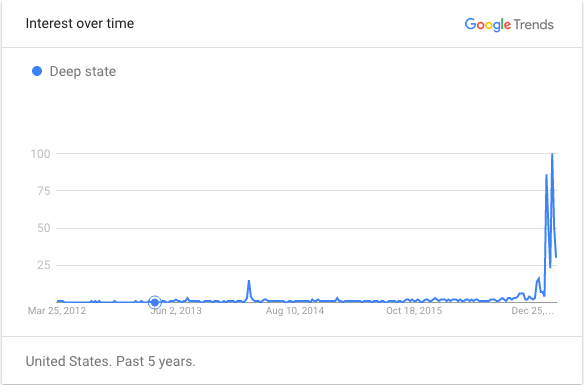
As this chart from Google Trends illustrates, interest in the Deep State has increased dramatically in 2017. The term/topic has clearly moved from the specialist realm to the mainstream. I’ve been writing about the Deep State, and specifically, the fractures in the Deep State, for years.

Amusingly, now that “Progressives” have prostituted themselves to the Security Agencies and the Neocons/Neoliberals, they are busy denying the Deep State exists. For example, There is No Deep State (The New Yorker).

In this risible view, there is no Deep State “conspiracy” (the media’s favorite term of dismissal/ridicule), just a bunch of “good German” bureaucrats industriously doing the Empire’s essential work of undermining democracies that happen not to prostrate themselves at the feet of the Empire, murdering various civilians via drone strikes, surveilling the U.S. populace, planting bugs in new iPhones, issuing fake news while denouncing anything that questions the dominant narratives as “fake news,” arranging sweetheart deals with dictators and corporations, and so on.

The New Yorker is right about one thing–the Deep State is not a “conspiracy:” it is a vast machine of control that is largely impervious to the views or demands of elected representatives or the American people. The key to understanding this social-political-economic control is to grasp that control of the narratives, expertise and authority is control of everything. Allow me to illustrate how this works.

The typical politician has a busy daily schedule of speaking at the National Motherhood and Apple Pie Day celebration, listening to the “concerns” of important corporate constituents, attending a lunch campaign fundraiser, meeting with lobbyists and party committees, being briefed by senior staff, and so on.

Senior administrators share similarly crowded schedules, minus the fundraising but adding budget meetings, reviewing employee complaints and multiple meetings with senior managers and working groups.

Both senior elected officials and senior state administrators must rely on narratives, expertise and authority because they have insufficient time and experience to do original research and assessment.

Narratives create an instant context that “makes sense” of various data points and events. Narratives distill causal factors into an explanatory story with an implicit teleology–because of this and that, the future will be thus and so.

For example: because Iraq has weapons of mass destruction (WMD), the future promises the terrible likelihood (more than a possibility, given Iraqi deployment of poison gas in the Iraq-Iran War) that America or its allies will be devastated by Iraqi weapons of mass destruction. This teleology leads to the inescapable need to eliminate Iraq’s weapons of mass destruction by any means necessary, and remove the political will to use them by removing Iraq’s leader from power.

Politicos and senior administrators rely on expertise and authority as the basis of deciding whether something is accurate and actionable. Professional specialists are assumed to have the highest available levels of expertise, and their position in institutions that embody the highest authority give their conclusions the additional weight of being authoritative. The experts’ conclusion doesn’t just carry the weight of expertise, it has been reviewed by senior officials of the institution, and so it also carries the weight of institutional authority.

So when the C.I.A. briefing by its experts claims Iraq has WMD, and the briefing includes various threads of evidence that the institution declares definitive, who is a non-expert to challenge this conclusion and teleology? On what technical basis does the skeptic reject the expertise and authority of the institution?

We can now define the Deep State with some precision. The Deep State is fundamentally the public-private centralized nodes that collect, archive and curate dominant narratives and their supporting evidence, and disseminate these narratives (and their implicit teleologies) to the public via the media and to the state agencies via formal and informal inter-departmental communication channels.

By gaining control of the narratives, evidence, curation and teleology, each node concentrates power. the power to edit out whatever bits contradict the dominant narrative is the source of power, for once the contradictory evidence is buried or expunged, it ceases to exist.

For example, the contradictory evidence in the Pentagon Papers was buried by being declared Top Secret. The bureaucratic means to bury skeptical (i.e. heretical) views or evidence are many. Sending the authors to figurative Siberia is remarkably effective, as is burying the heretical claims in a veritable mountain of data that few if any will ever survey.

Curation is a critical factor in maintaining control of the narrative and thus of control; the evidence is constantly curated to best support the chosen narrative which in turn supports the desired teleology, which then sets the agenda and the end-game.

The senior apparatchiks of the old Soviet Union were masters of curation; when a Soviet leader fell from favor, he was literally excised from the picture–his image was erased from photos.

This is how narratives are adjusted to better fit the evidence. Thus the accusation that “the Russians hacked our election” has been tabled because it simply doesn’t align with any plausible evidence. That narrative has been replaced with variants, such as “the Russians hacked the Democratic National Committee.” Now that this claim has also been shown to be false, new variants are popping up weekly, with equally poor alignment with evidence.

The primary claim of each Deep State node is that its expertise and authority cannot be questioned. In other words, while the dominant narrative can be questioned (but only cursorily, of course), the expertise and authority of the institutional node cannot be questioned.

This is why the Deep State is fracturing: the expertise and authority of its nodes are delaminating because its narratives no longer align with the evidence. If various Security Agencies sign off on the narrative that “Russia hacked our election” (a nonsense claim from the start, given the absurd imprecision of the “hacking”–hacking into what? Voting machines? Electoral tallies?), and that narrative is evidence-free and fact-free, i.e. false, then the expertise and authority of those agencies comes into legitimate question.

Once the legitimacy of the expertise and authority is questioned, control of the narrative is imperiled. The control of the narrative is control of the teleology, the agenda and the end-game–in other words, everything. If the institution loses control of the dominant narrative, it loses its hold on power.

This is why the Deep State is in turmoil–its narratives no longer make sense, or are in direct conflict with other nodes’ narratives or have been delegitimized by widening gaps between “definitive” claims and actual evidence.

There is indeed a Deep State, but its control of dominant narratives, and thus its source of control and power, is crumbling. The gap between the narratives and the evidence that supports them has widened to the point of collapse.


Why Today’s Neoliberal Global Order Is Incompatible With Democracy

global_capitalism01_small_092915-326x493

A new book by Jerry Harris explores the transformation of global capitalism and its implications.

By Bill Fletcher Jr.

Source: In These Times

In the years since the Cold War and the collapse of the USSR, the U.S. Left has sensed that something was morphing within global capitalism. This “something” was described more by its symptoms than by its essence, e.g., deindustrialization. In much of the rest of the world there was a growing awareness, however, that a particular form of capitalism was becoming dominant on a world scale, a form that came to be known as neoliberal capitalism or neoliberal globalization.

Jerry Harris offers his book, Global Capitalism and the Crisis of Democracy, as an instrument to better understand this transformation of global capitalism and its implications. Most of the book is devoted to helping the reader better grasp what Harris argues is the historical transition—underway—from capitalism centered around the nation-state to global capitalism. This work is successful, enlightening and engrossing. In the final two chapters, however, Harris shifts gears, laying the basis for a problem that I’ll discuss below.

The thrust of Harris’s argument is that since World War II, but especially since the late 1960s/1970s, capitalism, which as a system is always in need of expansion, has been evolving in such a manner that it transcends national borders. Contrary to theorists, such as the late Ellen Meiksins Wood, this is not a return to the era of high-level trade that marked the pre-1914 capitalist world (what some theorists have described as an earlier globalization). Rather, it is the emergence of an unprecedented interpenetration of capital on a global stage.

And with this interpenetration we start to see, over the last several decades, the rise of what has come to be termed as a “transnational capitalist class.” This class, as the name implies, is not rooted in one country but has assumed an identity that goes beyond specific nation-states. As Harris make clear, this does not mean that the nation-state no longer holds any importance—which is the thrust of the argument offered by Michael Hardt and Antonio Negri in their famous work, Empire—but that the role has shifted significantly, to a great extent servicing and serving the needs of the transnational capitalist class.

This analysis clashes with more traditional arguments on the Left but it speaks to matters that the traditional analyses have been unable to explain fully. A case in point was the U.S.-led invasion of Iraq. At the time of the 2003 invasion, much of the Left and the progressive anti-war movement argued that this was an effort, in effect, to recolonize Iraq under U.S. domination and seize its oil. In the aftermath of the invasion, however, something odd happened. Occupation forces opened Iraq up for business to global capitalism rather than reserve it for the United States alone.

The transnational capitalist class thesis has been caricaturized by some critics as suggesting that contradictions between nation-states have disappeared into a global class-against-class scenario. Harris takes on this idea directly and with a level of detail that, on those grounds alone, makes his work a must-read book.

Harris lays out his case in describing the development of global capitalism and the transnational capitalist class in the first three chapters. In chapters 4 and 5, he offers a marvelous examination of two concrete situations: Ukraine and China. With regard to Ukraine, Harris digs behind the headlines and looks at the class forces on both sides, the relationship that they have with capitalist class forces in other parts of the world, historic nation-state tensions and the wild card of right-wing populism and neo-fascism that is infecting both Russia and Ukraine. He examines the interrelationship of these forces in a situation—and world—that is undergoing a transition. And therein lies the key to understanding the transnational capitalist class thesis: It speaks to a phenomenon that is emerging and transitioning, rather than a phenomenon that is fully and totally developed.

Harris’ examination of contemporary China is just as illuminating and satisfying. Again, he examines the connections that the Chinese capitalists have developed with others in the transnational capitalist class, including the role of the Chinese State—ironically led by a party that calls itself “Communist”—in the integration of the Chinese economy into the larger global capitalist economy. Harris, along with other theoreticians of this school, argues that many—though not all—of the contradictions we are witnessing between China and the United States are a reflection of the efforts by Chinese capitalists, and their allies, to alter the terms under which global capitalism operates. In other words, the conflict is not a competition between traditional empires but, analogically, disputes within a gang.

Harris offers his book as both an analysis of the growth of neoliberal globalization and a cautionary note on the dangerous road that it has placed before humanity. Perhaps it is for that reason that his final two chapters examine alternatives to neoliberal globalization, including both failed alternatives as well as sources of hope. The problem is that this comes across as two different books. While it was clear that Harris was trying to get the readers to consider how to struggle against global capitalism and its tendency towards authoritarianism and barbarism, there was a missing transition.

Harris might also have been more successful had he integrated into his discussion a deeper analysis of the rise of right-wing populism (including but not limited to neo-fascism) in the context of neoliberal globalization. After all, right-wing populism posits itself as THE alternative strategy of neoliberal globalization. While Harris acknowledges right-wing populism at various points in the book, he tends to merge it a bit too quickly with other segments of the Right, including into what the theoretician Nicos Poulantzas referenced as “authoritarian statism” and what I have described as “neoliberal authoritarianism.” Drawing from Poulantzas, I would distinguish the movement towards authoritarianism by the so-called democratic capitalist state as not identical with the rise of right-wing populism, though the two tendencies can and do overlap.

Despite the abrupt transition, Harris’s discussion of alternatives is useful, though a bit of a distraction. In fact, I would argue that he should further develop his thinking on alternatives in a separate volume. And I would further argue that a deeper examination of right-wing populism in the context of neoliberal globalization deserves to be addressed by adherents to the so-called global capitalism school in order to flesh out their analysis.

Global Capitalism and the Crisis of Democracy is an exceptionally thorough and thought-provoking work. Very rarely, these days, do I use a highlighter when reading a book in order to remind myself of facts, points of interest or points of difference. In this case, the highlighter was with me till the end, with my knowing that I will return to this book as a resource for better understanding, as well as explaining, the development of global capitalism and its implications for the billions of people on this planet ravaged by it.


Bill Fletcher, Jr. is the author of “They’re Bankrupting Us!”: And 20 Other Myths about Unions and co-author of Solidarity Divided: The Crisis in Organized Labor and a New Path toward Social Justice. He is a talk show host, writer and activist. Follow him on Twitter, Facebook and at http://www.billfletcherjr.com.

Freedom Begins Within: From the Authoritarian Self to the Liberated Self

8244838bdbdc236e5a0deac3cf5e1307-958x716x1-300x224

By Gary ‘Z’ McGee

Source: Waking Times

“If people base their identity on identifying with authority, freedom causes anxiety. They must then conceal the victim in themselves by resorting to violence against others.” ~Arno Gruen

Freedom is both the easiest thing to gain and the hardest thing to hold onto. We can courageously declare ourselves free in one breath, while in the next breath meekly kowtow to authority. It’s like an Orwellian doublespeak somersaulting through our heads: freedom is debt-slavery, freedom is obeying orders, freedom is paying taxes against our will, freedom is keeping our mouth shut when a cop speaks, freedom is forcing our will onto others, freedom is codependence on an unhealthy authoritarian state. Really?!

Cognitive dissonance is our ego’s saving grace. We convince ourselves we are free, even when we’re not, so that our pride isn’t harmed. We convince ourselves we are free so as to maintain our comfort zones. We convince ourselves we are free because if we’re not free then our existence is null. In the end, freedom becomes a cliché concept we toss around inside of the very box we’re trying so desperately to think outside of.

When it comes down to it, liberty begins within. It begins by first admitting that we must free ourselves from our inner tyrant before we can give birth to our inner liberator. It begins by digging deep and ousting the king trying to rule, decommissioning the commissioner trying to micromanage, and banishing the warden trying to keep order. It begins by not talking like rigid authoritarians to ourselves.

Let’s break it down…

Authoritarian Self-Speak

“None are more hopelessly enslaved than those who falsely believe they are free.” ~Johann Wolfgang von Goethe

We live in an age of hyper-conformity. It goes widely unrecognized because it has become the rigid “reality” that modern culture indoctrinates into its members. It’s even considered admirable somehow to be “well-adjusted to a sick society.” Of course, our cognitive dissonance usually prevents us from admitting that such is the case. This is because we are primarily psychosocial animals who create a pleasing-to-others false self in order to alleviate the deep-seeded fear of being hurt or abandoned by others. Which is fine if one lives in a healthy culture. Not so fine if one lives in a profoundly unhealthy, unsustainable, authoritarian culture such as the cultures dominating the world today.

So what does a psychosocial animal that’s raised in an authoritarian culture do? Well, they speak to themselves in an authoritarian voice for one. Their inner tyrant is constantly pushing its authoritarian agenda, keeping the rebellious liberator at bay, lest he rise up and ruin the comfort zone or cultural malaise that has kept the inner tyrant safe and secure within the social milieu for so long.

So even if self-liberation is the goal, the inner tyrant rises up and barks in its best drill sergeant voice, “Stop dreaming, there’s no such thing as freedom,” or “Shut up and obey like everybody else,” or “You’re not worthy of freedom, what makes you so special?” or “This is just the way things are, deal with it,” or “Don’t rock the boat, it’s easier that way.”

The problem with this is that the majority of us cannot distinguish the indoctrinated authoritarian voice from the voice of our own free will, and we then confuse it for our own free will. Out of confusion and fear, we give into the inculcation. We remain authoritarian unto ourselves. We go with the flow, even though the flow is clearly poisonous.

Ironically, the cure for authoritarianism is self-authority, or free will. The key to the cultural prison is realizing that we’re all at once our own prisoner as well as our own warden. Our inner conflict between indoctrinated authoritarian and rebellious liberator is precisely what keeps us unfree. But there is no conflict, really. We imprison ourselves with our own commanding words. We’re always free. Our free will has only to take authority back from our inner authoritarian, by using words infused with free choice, in order to turn the tables on the psychosocial dynamic.

Instead of listening to the commands and authoritarian orders dictated by our inner warden or king, we speak to ourselves in a way that the freedom of choice is clearly paramount. And suddenly we’re able to ask ourselves, as Rumi did, “Why do you stay in prison when the door is wide open?”

Liberated Self-Overcoming

“The revolution begins at home. If you overthrow yourself again and again, you might earn the right to overthrow the rest of us.” ~Rob Brezsny

So what happens when we begin to base our identity on self-authority rather than on identifying with an outside authority? What happens when freedom of choice becomes paramount, despite our inner authoritarian? Freedom no longer causes anxiety, in this case, because we have liberated ourselves into further freedom. Indeed, we have become Liberty itself. By simply changing our self-speak from a commanding (certain) voice to a voluntary (questioning) voice, we change the paradigm. We become less rigid and more flexible. We become less invulnerable and more vulnerable. We become less fearful and more courageous. We gain authority over authoritarianism, including our own. In short: we take back our own power.

Instead of commands, we issue options: “I can do whatever I want, like break the law or not break the law,” or “I don’t have to pay my taxes if I don’t think it’s necessary,” or “I can live whatever life I feel like living, as a statist or as an anarchist, but I choose to live like an anarchist,” or “I am free to do what I want, and I am choosing dangerous freedom over comfortable safety.” As Robert A. Heinlein said, “I am free, no matter what rules surround me. If I find them tolerable, I tolerate them; if I find them too obnoxious, I break them. I am free because I know that I alone am morally responsible for everything I do.”

Also, instead of getting all wrapped up in answers, we are more capable of surrendering to ruthless questioning: “Why do I think the state is immoral, or not?,” or “Would I really rather be slapped with the truth than kissed with a lie?,” or “How might I be suffering from cognitive dissonance or any number of cognitive biases and fallacies?,” or “How has my cultural conditioning affected the way I relate to the world?,” or “Do I have the courage to choose truth and speak out against deception?,” or “How can I take personal responsibility for becoming more ethical than the society I grew up in?,” The answers to these questions have the potential to launch our fledging liberation into further, more robust, liberation.

When we free ourselves into further freedom, we allow ourselves to grow. We allow our comfort zones to stretch. We become psychosocially, politically, and spiritually more flexible. We give ourselves permission to authentically live. In short: We blossom into a state of self-overcoming.

Self-overcoming is a Nietzschean concept of transcending ones given standards and values and creating something new out of the ashes of the old. It’s the constant adaptation and improvisation of the self in regards to the world. When we are self-overcoming, we’re too busy flourishing to be bothered with attaching ourselves to a particular state of being. We are shedding, and thus individuating, our “pleasing-to-others” skin. We’re surrendering to growth, to flexibility, to adaptability, and to moral plasticity. The result is a psychosocial animal becoming a freedom unto itself.

A liberated self-overcomer is truly a force to be reckoned with. No authority can command it, not even self-authority, because the liberated self-overcomer is constantly changing. It’s already adapting to, and overcoming, the slings and arrows of vicissitude, whether from the state, from others, or from the self. Indeed, a liberated self-overcomer is Transformation incarnate.

In the end, authoritarianism dissolves into futility under the crushing wave of the liberated self-overcomer. All authoritarian self-speak gets muted under the blaring harmony of self-overcoming. Commands melt into cartoons. Rigid certitude softens into flexible sincerity. Inner freedom becomes outer freedom. The inner voice of the liberated self-overcomer is both self-interrogating and voluntary, thus liberating the overcomer into further liberation, which ultimately leads to the liberation of others. For the liberated self-overcomer, the authoritarian culture has lost its stranglehold. Authentic reconditioning of the cultural conditioning is at hand. For, as Carl Jung declared, “I am not what happened to me, I am what I choose to become.”