Globalisation: Hyperstition, Surveillance, and the Empire of Reason

By S.C. Hickman

Source: Techno Occulture

Edmund Berger in his essay Underground Streams speaking of various tactics used by the Situationists, Autonomia, and the Carnivalesque:

“Like the Situationists the Autonomia would engage with the tradition of the Carnivalesque alongside a Marxist political analysis. Bakhtin had described the carnival as “political drama without footlights,” where the dividing line between “symbol and reality” was extremely vague, and the Autonomia had embodied this approach through their media-oriented tactics of detournement. But under a regime of emergency laws a great portion of the Autonomia was sent to prison or into exile, leaving its legacy through an extensive network of radical punk and anarchist squats and social centers.”

One of the things we notice is that the Autonomia movement actually struck a nerve at the heart of Power and forced their hand, which obligingly reacted and used their power over and dominion of the Security System to screen out, lock up, and exclude this threat. That’s the actual problem that will have to be faced by any emancipatory movement in the present and future: How to create a movement that can be subversive of the system, and yet chameleon like not rouse the reactionary forces to the point of invoking annihilation or exclusionary measures?

A movement toward bottom-up world building, hyperstition, and exit from this Statist system will have to do it on the sly utilizing a mirror world strategy that can counter the State and Public Security and Surveillance strategies.  Such Counter-Worlds of Exit and Hyperstitional instigation will need to work the shadow climes of the energetic unconscious, triggering a global movement from the shadows rather than in direct opposition.

In many ways as I think we need a politics of distortion, allure, and sincerity, one that invents a hyperstitional hyperobject among the various multidimensional levels of our socio-cultural systems, calling forth the energetic forces at the heart of human desire and intellect, bypassing the State and Corporate filters and Security Systems of power and control. Such a path will entail knowing more about the deep State’s secret Security apparatus and Surveillance methodologies, technologies, and tactics than most thinkers are willing to acknowledge or even apprehend. Like the Hacker movements of the 90’s up to Anonymous one will need to build shadow worlds that mimic the stealth weapons of the State and Corporate Global apparatus and assemblages; but with one caveat – these weapons are non-violent “weapons of the mind”, and go unseen and unrecognized by the State Security Systems at Local and Global levels.

A global system of mass, warrantless, government surveillance now imperils privacy and other civil liberties essential to sustaining the free world. This project to unilaterally, totally control information flow is a product of complex, ongoing interplay between technological, political, legal, corporate, economic, and social factors, including research and development of advanced, digital technologies; an unremitting “war on terror”; relaxed surveillance laws; government alliances with information technology companies; mass media manipulation; and corporate globalism. One might say it as the Googling of the World.

The United Stats internally hosts 17 intelligence agencies under the umbrella known as the Security Industrial Complex. They are also known for redundancy, complexities, mismanagement and waste. This “secret state” occupies 10,000 facilities across the U.S. Over the past five years the total funding budget exceeded half a trillion dollars. The notion of globalization which has its roots in the so called universalist discourses of the Enlightenment had as its goal one thing: to impose a transparent and manageable design over unruly and uncontrollable chaos: to bring the world of humans, hitherto vexingly opaque, bafflingly unpredictable and infuriatingly disobedient and oblivious to human wishes and objectives, into order: a complete, incontestable and unchallenged order. Order under the indomitable rule of Reason.1

This Empire of Reason spreads its tentacles across the known world through networks and statecraft, markets and tradecraft, war and secrecy, drugs and pharmakon.  The rise of the shadow state during Truman’s era began a process that had already been a part of the Corporate worldview for decades. The monopoly and regulation of a mass consumption society was and always will be the goal of capitalist market economies. In our time the slow and methodical spread of the American surveillance state and apparatus has shaped the globalist agenda. Because of it the reactionary forces of other state based control systems such as Russia and China are exerting their own power and surveillance systems as counters to Euro-American hegemony.

Surveillance is a growing feature of daily news, reflecting its rapid rise to prominence in many life spheres. But in fact surveillance has been expanding quietly for many decades and is a basic feature of the modern world. As that world has transformed itself through successive generations, so surveillance takes on an ever changing character. Today, modern societies seem so fluid that it makes sense to think of them being in what Bauman terms a ‘liquid’ phase. Always on the move, but often lacking certainty and lasting bonds, today’s citizens, workers, consumers and travelers also find that their movements are monitored, tracked and traced. Surveillance slips into a liquid state.

As Bauman relates it liquid surveillance helps us grasp what is happening in the world of monitoring, tracking, tracing, sorting, checking and systematic watching that we call surveillance. Such a state of affairs engages with both historical debates over the panopticon design for surveillance as well as contemporary developments in a globalized gaze that seems to leave nowhere to hide, and simultaneously is welcomed as such. But it also stretches outwards to touch large questions sometimes unreached by debates over surveillance. It is a conversation in which each participant contributes more or less equally to the whole. (Bauman)

Our network society has installed its own “superpanopticon” (Mark Poster). Such a system is ubiquitous and invisible to the mass of users. As Poster states it “The unwanted surveillance of one’s personal choice becomes a discursive reality through the willing participation of the surveilled individual. In this instance the play of power and discourse is uniquely configured. The one being surveilled provides the information necessary.” For Poster, this supply of self-surveillance is provided through consumer transactions stored and immediately retrievable via databases in their constitution of the subject as a “sum of the information in the fields of the record that applies to that name.” The database compiles the subject as a composite of his or her online choices and activities as tracked by IFS. This compilation is fixed on media objects (images, text, MP3s, Web pages, IPs, URLs) across the deluge of code that can be intercepted through keyword pattern recognition and private lists of “threatening” URLs.2

Our so called neoliberal society has erased the Public Sphere for the atomized world of total competition in a self-regulated market economy devoid of politics except as stage-craft. As authors in the Italian autonomist movements have argued for the past fifty and more years, this “total subsumption” of capital upon the life-sphere has been accomplished through “material” and “immaterial” means.  According to these authors, capital in late capitalism and neoliberalism has attempted to progressively colonize the entire life-sphere. Resistance, they argue, comes through the “reserves” to capital that remain as the social and intellectual foundation from which capital draws, including through “immaterial labor” using digital means. Gradually during modernity, such theorists have argued, life itself has been taken as a target for capitalist subsumption, through the cooptation of communication, sexual and familial relationships (Fortunati 1995), education, and every other sphere of human activity, with economic exchange and survival as the ultimate justification for all relationships.3

Capital’s “apparatus of capture” has become increasingly efficient and broad in its appropriation of selves as subjects of its political economy through the combination of appropriating governmental functions such as: buying off political actors and agencies, cutting public funding to modernist institutions and infrastructures, redefining the agenda of education and other cultural institutions toward capitalist values, owning and narrowing the focus of the media, forcing family structures and individuals to adapt to scarcity economies, and using government police and surveillance forces and economic pressures to crush resistance. In short, it is said that neoliberalism has advanced by the totalitarian institutionalization of national and international capitalism, one nation after another, using domestic means to force compliance in domestic markets and using international pressures (economic, military, cultural) to do the same to other countries, cultures, and peoples. (Day, pp. 126-127)

The increased accuracy (or believed accuracy) of increased surveillance and feedback targeting through the collection of social big data and its analyses and social and political uses (ranging from drone predators to state surveillance in both democratic and communist/ authoritarian governments to consumer targeting— for example, the targeting done by Target Corporation, as described in a 2012 New York Times article [Duhigg 2012])— belong to a conjoined mechanism of cybernetic and neoliberal governmentality, which crosses governmental and corporate databases and organizations. Social big data seeks to demarcate trends, which then directly or indirectly act as norms, which further consolidate individual and group action within market-determined norms (Rouvroy 2013). People are forced into competition, into a “freedom” that is monitored and checked within systems of feedback control. As Norbert Weiner suggested in the Cold War period (Wiener 1954, 1961), communicative control can be used toward a discourse of “rationality”; a rationality that is seen as proper to a given political economy. The documentary indexing of the subject provides the codes for the subject’s social positioning and expressions by others and by itself. Thanks to networked, mobile devices, the subject can attempt to continuously propose him- or herself to the world as the subject of documentary representation. (Day, pp. 132-133)

Those of us in the West who use mobile devices are becoming hooked into an elaborate datasociety in which every aspect of our lives is conditioned to enforce a self-regulatory system of choices and taboos. The surveillance is done at the level of individuals, who are monitored and whose actions are predicted throughout key moments of their consumption or production, marking changes in trends and phase states, and recalculating the trajectory of entities according to these new parameters and relationships. Our algorithmic society is splicing us all into a grid of total control systems from which it will become increasingly difficult to extricate ourselves.

As Douglas Rushkoff said recently digital technology is programmed. This makes it biased toward those with the capacity to write the code. In a digital age, we must learn how to make the software, or risk becoming the software. It is not too difficult or too late to learn the code behind the things we use—or at least to understand that there is code behind their interfaces. Otherwise, we are at the mercy of those who do the programming, the people paying them, or even the technology itself.4 More and more our mass society is being programmed through an immaterial grid of datafied compliance and surveillance that captures our desires and regulates our choices. In some ways we’ve become the mindless generation, unable to stand back from the immersive worlds of our technosphere in which we live and breath. We’ve become enamored with our Mediatainment Industrial Complex that encompasses us to the point that those being born now will not know there ever was a word without gadgets. In fact we’ve all become gadgets in a market world of science fiction, our desires captured by the very gadgets we once thought would free us from the drudgery of time. Instead we’ve been locked within a world without time, a timeless realm in which the very truth of history has been sucked out of it and instead we live in a mythic time of no time, prisoners of a cartoon world of endless entertainment and false desires. In such a world the virtual has become actual, we wander through life caught in the mesh of a fake world of commodity cartoons, citizens of a dreamland turned nightmare. Shall we ever wake up?

Modern radical thought has always seen subjectivation as an energetic process: mobilization, social desire and political activism, expression, participation have been the modes of conscious collective subjectivation in the age of the revolutions. But in our age, energy is running out and desire, which has given modern social dynamics their soul, is absorbed in the black hole of virtualization and financial games, as Jean Baudrillard argues in his 1976 book, Symbolic Exchange and Death. In this book, Baudrillard analyzes the hyperrealistic stage of capitalism, and the instauration of the logic of simulation.

The end of the spectacle brings with it the collapse of reality into hyperrealism, the meticulous reduplication of the real, preferably through another reproductive medium such as advertising or photography. Through reproduction from one medium into another the real becomes volatile, it becomes the allegory of death, but it also draws strength from its own destruction, becoming the real for its own sake, a fetishism of the lost object which is no longer the object of representation, but the ecstasy of denegation and its own ritual extermination: the hyperreal. […]

The reality principle corresponds to a certain stage of the law of value. Today the whole system is swamped by indeterminacy, and every reality is absorbed by the hyperreality of the code and simulation. The principle of simulation governs us now, rather that the outdated reality principle. We feed on those forms whose finalities have disappeared. No more ideology, only simulacra. We must therefore reconstruct the entire genealogy of the law of value and its simulacra in order to grasp the hegemony and the enchantment of the current system. A structural revolution of value. This genealogy must cover political economy, where it will appear as a second-order simulacrum, just like all those that stake everything on the real: the real of production, the real of signification, whether conscious or unconscious.

Capital no longer belongs to the order of political economy: it operates with political economy as its simulated model. The entire apparatus of the commodity law of value is absorbed and recycled in the larger apparatus of the structural law of value, this becoming part of the third order of simulacra. Political economy is thus assured a second life, an eternity, within the confines of an apparatus in which it has lost all its strict determinacy, but maintains an effective presence as a system of reference for simulation. (Baudrillard 1993a: 71-72, 2).5

We’ve all become simulations now. It’s not our bodies that matter in this digital universe of data, but rather the dividual traces we leave across the virtualized world that can be manipulated to produce profit. In the sphere of semiocapitalism, financial signs are not only signifiers pointing to particular referents. The distinction between sign and referent is over. The sign is the thing, the product, the process. The “real” economy and financial expectations are no longer distinct spheres. In the past, when riches were created in the sphere of industrial production, when finance was only a tool for the mobilization of capital investment in the field of material production, recovery could not be limited to the financial sphere. It also took employment and demand. Industrial capitalism could not grow if society did not grow. Nowadays, we must accept the idea that financial capitalism can recover and thrive without social recovery. Social life has become residual, redundant, irrelevant. (Bifo)

Those of us of an older generation still remember what existed the other side of the virtual screen, but the mass of young being born now will not have that luxury and their minds will be completely immersed in this new virtual actuality with no sense of the Outside.

While those on the Left still ponder outmoded political worlds the world of capital has abandoned both the political and the social. It’s time to wake up … I wanted to say, “before it’s too late”. My problem, my despair is that it is already too late. And, yet, I continue throwing out my little posts in hopes that someone is listening, that someone will awaken from their dogmatic slumber and act… is that you?


  1. Bauman, Zygmunt; Lyon, David. Liquid Surveillance: A Conversation (PCVS-Polity Conversations Series) (pp. 79-80). Wiley. Kindle Edition.
  2. Raiford Guins. Edited Clean Version: Technology and the Culture of Control (Kindle Locations 1304-1308). Kindle Edition.
  3. Day, Ronald E.. Indexing It All: The Subject in the Age of Documentation, Information, and Data (History and Foundations of Information Science) (p. 126). The MIT Press. Kindle Edition.
  4. Douglas Rushkoff. Program or Be Programmed (Kindle Locations 1363-1367). Kindle Edition.
  5. Berardi, Franco Bifo. After the Future (Kindle Locations 2276-2294). AK Press. Kindle Edition.

Clinton Does Best Where Voting Machines Flunk Hacking Tests: Hillary Clinton vs. Bernie Sanders Election Fraud Allegations

1015636467

By Doug Johnson Hatlem

Source: CounterPunch

At the end of the climactic scene (8 minutes) in HBO’s Emmy nominated Hacking Democracy (2006), a Leon County, Florida Election official breaks down in tears. “There are people out there who are giving their lives just to try to make our elections secure,” she says. “And these vendors are lying and saying everything is alright.” Hundreds of jurisdictions throughout the United States are using voting machines or vote tabulators that have flunked security tests. Those jurisdictions by and large are where former Secretary of State Hillary Clinton is substantially outperforming the first full wave of exit polling in her contest against Senator Bernie Sanders.

CounterPunch has interviewed hackers, academics, exit pollsters, and elections officials and workers in multiple states for this series taking election fraud allegations seriously. The tearful breakdown in Hacking Democracy is not surprising. There is a well-beyond remarkable gap between what security experts and academics say about the vulnerability of voting machines and the confidence elections experts and academics, media outlets, and elections officials place in those same machines.

In Leon County, Bev Harris’ Black Box Voting team had just demonstrated a simple hack of an AccuVote tabulator for bubble-marked paper ballots. Ion Sancho, Leon County’s Supervisor of Elections, also fights back tears in the Hacking Democracy clip: “I would have certified this election as a true and accurate result of a vote.” Sancho adds, “The vendors are driving the process of voting technology in the United States.”

In 2010, and this reminder will pain those of you who can remember when Nate Silver’s outfit did real data journalism rather than primarily yay-Clinton boo-Trump punditry, a FiveThirtyEight column argued that hacking was one of two possibilities for statistical anomalies in a Democratic Senate primary in South Carolina: “B. Somebody with access to software and machines engineered a very devious manipulation of the vote returns.”

Joshua Holland’s column in The Nation “debunking” claims of election fraud benefiting Clinton rests its case on a simple proposition: why would Clinton need to cheat when she was winning anyway? Apparently, Mr. Holland has never heard of an obscure American politician named Richard Nixon.

More importantly, entering the South Carolina primary, the pledged delegate count was 52-51. CNN’s poll two weeks out projected an 18 point Clinton win. Ann Selzer, the best pollster in the United States, projected a 22 point Clinton win. RealClearPolitics’ polling average projected a 27.5% win. FiveThirtyEight was much bolder in projecting a 38.3% Clinton win. The early full exit poll said Clinton had won by 36%, pretty close to FiveThirtyEight’s call. Tellingly, white people in that exit poll went for Sanders 58-42. But the final results said Clinton won by 47.5%, an 11.5% exit polling miss. And the exit polls had to adjust their initial figures to a 53-47 Clinton win with white Democrats in South Carolina.

Three days after South Carolina’s primary, Clinton seriously outperformed her exit polling projections again in a bunch of states on Super Tuesday, including Massachusetts where she went from a projected 6.6% loss to a 1.4% win. Super Tuesday set the narrative that Sanders had no chance of beating Clinton in pledged delegates.

Correlating Exit Polling Misses and Bad Machines

Let’s be clear: yes, correlation does not equal causality. What strong correlation does do, however, is set the agenda for reasonable investigation. Mocking fraud claims where there is a strong correlative case and actual evidence of potential vote tampering in places like Arizona, New York, and Chicago is precisely the kind of thing that has seen confidence in media outlets plummet to an all-time low. Just 6% of people in the U.S., about the same number as for Congress, have high confidence that media are unbiased and accurate.

Meanwhile, according to a September 2015 study (.pdf) by the Brennan Center for Justice at New York University’s School of Law, South Carolina uses all machines more than ten years old. In fact, drawing on the source of the Brennan Center report over at Verified Voting, South Carolina uses provably hackable voting machines without a verified paper trail. Virtually all counties in South Carolina use two machines in particular – Electronic Systems and Software’s (ES&S) iVotronic, a touch screen voting machine without a paper trail, and ES&S’s Model 100, used to tabulate absentee and provisional ballots.

Kim Zetter, the best reporter on hacking and computer security at Wired Magazine, delved into the Brennan Center report with an article entitled “The Dismal State of America’s Decade-Old Voting Machines.” Zetter noted that in 2002, after the Bush v. Gore disaster, Congress passed the Help America Vote Act (HAVA) with billions of dollars available for counties throughout the U.S. to upgrade to new voting machines. Zetter then hits the critical point for discussion of election fraud allegations in the Democratic presidential primary:

But many of the machines installed then, which are still in use today, were never properly vetted—the initial voting standards and testing processes turned out to be highly flawed—and ultimately introduced new problems in the form of insecure software code and design.

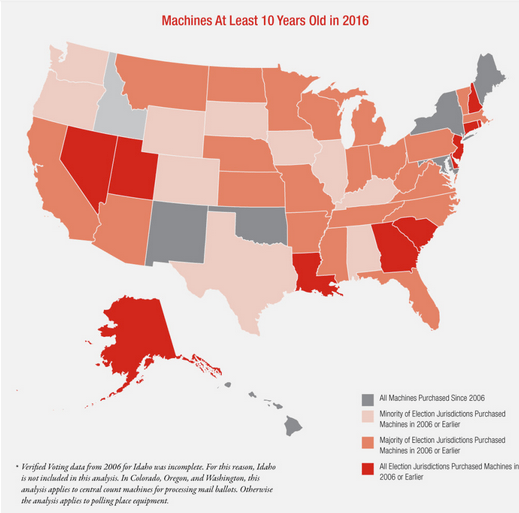
Things are dismal, yes, but they are not evenly so. As this map from the Brennan Center report shows, there are just a few states that are as bad off as South Carolina (all machines ten years old or greater). But there are also just as few states that are relatively well off with all machines newer than ten years old.

state-by-state-10-year-old-voting-machines

Of the nine places where the exit polling has missed by more than 7% (South Carolina, Alabama, Georgia, Massachusetts, Tennessee, Texas, Mississippi, Ohio, New York), two-thirds are states where all or the majority of election jurisdictions are using machines ten years old or greater. For these six states the average initial exit polling miss is a whopping 9.98%. From my column on exit polling misses last week, the average exit polling miss in Clinton’s favor is 5.1%. For the three states (Oklahoma, New York, Maryland) for which there is polling and for which all election jurisdictions use machines less than ten years old (gray in the map), the average is just a 1.67% miss in Clinton’s favor. Now take note, this 1.67% average includes New York with its huge miss in Clinton’s favor. Alabama is also worth looking at, with a minority of jurisdictions having machines more than ten years old, because I have been using an “Alabama Test” to see whether theories for the exit polling misses make sense.

I put figures like this to exit pollster and Executive Vice President of Edison Research Joe Lenski for question 10, which I’d previously left out of the published version of the interview I completed with him. I wanted to know whether the gap in exit polling misses raised any red flags. Here was Lenski’s reply:

The reliability of vote equipment is a true concern but I don’t see any evidence how the concentration of older voting machines in certain states would have affected either candidate more than the other.  There are many examples of vote count errors.  Here is a link reporting a recent vote count error in the Michigan primary that inflated Ted Cruz’s vote by 3000 votes  http://uselectionatlas.org/WEBLOGS/dave/ .  These types of errors are discovered all the time but there is no evidence that these are anything more than mistakes by local election officials – not a systematic attempt to affect a single candidate’s vote totals.  This reminds me of theories after the 2008 New Hampshire Democratic Primary based upon the fact that Hillary Clinton did better in towns with voting machines while Barack Obama did better in towns that voted on paper.  That was simply an artifact of the demographics in New Hampshire of the towns that had voting machines versus those that voted on paper.  Again the states with older voting machines in 2016 may just be the same states with demographics that favored Hillary Clinton over Bernie Sanders.

But again, as I argued last Wednesday, the demographics by state and other proposed reasons for exit polling misses do not actually add up. Big misses have happened in the South, in Massachusetts, and also in Ohio where Sanders otherwise did quite well in the Midwest. Nor do age or early voting patterns predict exit polling misses. Still, what is most remarkable about Lenski’s statement is that he is one of the few non-tech experts we spoke with who recognized that the “reliability of voting equipment is a true concern.”

None of the three elections academics I spoke with for last Wednesday’s piece appeared to be familiar with the Brennan Center report on aging and vulnerable machines, and Antonio Gonzalez, an exit polling expert and Latino voter registration guru who called for parties not to seat Arizona’s delegations in last Thursday’s piece, seemed a bit floored when I presented him with question ten from my interview with Lenski. “Oh,” he said, “I thought Congress was supposed to have taken care of that with HAVA.” HAVA, as noted earlier, offered money from 2002 to 2006 for states to upgrade to the then latest and greatest voting technology.

At this point we should take a look at the proven flaws in four very old and hackable machines in particular. These machines or similar elderly and vulnerable machines are in use in almost all places where Clinton outperforms exit polling most substantially. Because I am taking evidence and counter-evidence seriously, we will also look at the machines used in New York City, which are not quite so old (about six or seven years). While those machines, ES&S’s DS200, have had several problems over the years of the type suggested by Lenski, they also have not verifiably flunked independent security tests, so far as I know.

AccuVote (TS, OS, TSX models)

AccuVote technology is among the worst of the worst. This is the Diebold technology hacked in the Hacking Democracy clip. It is more than ten years old, can be hacked in such a way that even those models (OS, TSX) with a paper trail can be tricked, and it is in use throughout Georgia (12.2% miss) and in more than 300 counties or other election jurisdictions in more than 20 states.

AVC Edge and Edge II  (from my column on Chicago Friday)

The AVC Edge and Edge II (with paper trail) were provably hacked by a “Red Team” from UC Santa Barbara hired by the State of California in 2008. Jim Allen, spokesman for the Chicago Board of Elections, called and emailed to complain after my article last Friday. He dismissed the suggestion that Edge II could be hacked because of the paper trail. Not only is this laughable since his team engaged in a wildly inaccurate audit of the paper trail from the Chicago Democratic primary, but Allen apparently failed to click on the linkregarding the UCSB Red Team test that I included in the article. The first paragraph of that article notes that Edge machines, “even those with a so-called Voter Verified Paper Trail” can be successfully hacked by a single person. AVC Edge machines are in use without a paper trail throughout Louisiana (where there were no exit polls but where Clinton seriously outperformed her pre-election day polling average) and in more than 130 counties in various other states.

Model 100 (from ES&S)

Model 100 also badly flunked (.pdf) the California “Red Team” test in 2008. Like the other machines in this list, it is hackable in a way that spreads virally to other machines in the same network. Hundreds of jurisdictions still use Model 100 to tabulate votes, including especially Wayne County (Detroit), 27 counties in Ohio, 9 counties in Tennessee, 78 counties in Texas, and many more that match very well with where Clinton has outperformed exit polls.

iVotronic (ES&S)

iVotronic machines are touchscreen voting machines, many without a paper trail. iVotronic machines flunked a University of Pennsylvania test in 2007 and are the precise machines in question in the previous suspicious Democratic primary results in South Carolina in 2010. They continue to be used throughout South Carolina (no paper trail) and in hundreds of counties in states where Clinton has suspiciously overperformed exit polling.

DS200

DS200 machines have had a wide variety of malfunctioning problems, particularly in New York City, but those problems can and mostly have been addressed in places like New York City by retraining poll workers to check immediately whether each voters’ vote was counted and then offering a new chance to vote if necessary. As stated, the DS200 has not been provably hacked so far as I know. Newer machines of this sort were put into use just this year in Maryland where the overall exit polling missed in Sanders favor, for once, but by just 0.6 points. Still, the votes in Baltimore County have now been decertifiedbecause, among other things, there were more votes than voters who checked in at the polls. In Maryland, the DS200 machines are all networked to a statewide system for tabulating votes quickly. Networking, however, is not required, and my best information suggests that networking is not how the DS200 is used in New York City. Instead, precinct workers pull the results off the machine at the end of the voting day and relay them to county headquarters, according to my discussions with a poll worker from Brooklyn.

What About the Exceptions to This Correlation?

But we also would have to deal with where there are exceptions to this strong correlation between hackable machines and Clinton beating the exit polling badly. Here’s where my conversation with a particular veteran hacker comes into play. I chatted securely with a long-time member of Anonymous whom I’ll call the King of SciAm (not the handle they use publicly or privately). The King of SciAm has long worked with the Telecommix branch of Anonymous. Telecommix rose to fame when Hosni Mubarak cut off internet access in Egypt during the Arab Spring uprising. Telecommix found work-arounds via dial-up internet to keep information from activists on the ground flowing out of Egypt. As a general rule, Telecommix does not take part in Anonymous leaks or website shutdowns and defacements, but they made an exception to that rule early in this campaign cycle. Telecommix members defaced Donald Trump’s website with a tribute to Jon Stewart upon his retirement. The New Yorker’s Alex Koppleman called it the “classiest website hack ever,” a compliment the King of SciAm relishes.

The King of SciAm emphasized to me that, if hired to hack an election (which they would never do), the first thing they would do would be to figure out the best way to leave no trace: “we’d target the network packets or their headwater.” The key idea being for “a hack to survive the security audit trail after the vote is certified.” Furthermore, “we would likely try to target the thing most likely to get it’s logs wiped first – so – whatever it plugs into to move the data. Are the voting machines in use network connected?”

The King of SciAm told me that targeting old, provably hackable machines is “not an unfair theory,” but “you asked how (if we did these sort of things) we would do them.” The problem, they noted, “is that any change to the voting machine operating system or driver stack will likely be found in the security auditor’s rotation pretty quickly. This is because once the machines are down (end of election day) – they are no longer accessible to revert any source code changes or wipe any logs that said you were there, unless you’ve written STUXnet – in which case you wouldn’t be targeting the booth machines either.”

The King of SciAm was not at all surprised that sloppy hackers may be targeting older machines in places like South Carolina and Chicago, nor that elections officials were cluelessly trusting those machines and not even properly following procedures that could catch a less sophisticated hack.

So if, instead of targeting the DS200 in New York, hackers had targeted further upstream in the voting ecosystem, how would you catch it? The King of SciAm noted that you would have to use some procedure to “match 100% of the data, not 5%,” as in Chicago.

To do this, you would need to use a methodology much more like that used in the FiveThirtyEight article on irregularities in the South Carolina 2010 primary election. There, FiveThirtyEight referred to a Benford’s law test on precinct level results. That test showed an “unusual, non-random pattern in the precinct-level results suggest[ing] tampering, or at least machine malfunction, perhaps at the highest level.”

Intriguingly, after I began this series on election fraud allegations, a reader who would like to remain anonymous, emailed to point out similar irregularities in New York’s Democratic primary this year:

Results for Kings County and Bronx county [show] deviation from perfect 60-40 and 70-30 results was the same 0.035% The increase in votes in Kings (Brooklyn) from 2008 is incredible, almost a perfect 10%. Not only that but that’s where over a 100,000 voters lost their right to vote. Another 20,000 votes in Kings would mean almost a 20% increase which would be amazing compared to other counties that experienced decreases or mild increases. 

Furthermore, the overall results in New York, as announced on election night, deviated from a perfect 58-42 split “by 0.005345%. That’s 97 votes out of over 1.8 million.” Will FiveThirtyEight apply a Benford’s law test to 2016 primary results? Not a chance. They have boosted Clinton throughout and are already quite embarrassed by how badly they missed on the GOP side with Donald Trump.

But what about our test? The “Alabama Test.” What’s good for the goose is good for the gander. Alabama only has a minority of jurisdictions using old, provably hackable machines. Is that a weak correlation for the theory that in most places sloppy hackers targeted old, provably vulnerable machines while apparently more sophisticated hackers would have had to have been involved with targeting New York’s results as well as registration switching operations in a wide variety of states?

Taking a look at Alabama on a county level gives us a fairly strong answer. Most of Alabama’s counties also use hand cast ballots tabulated by the DS200, but a minority use Model 100, one of our flunked election machines. Three of the flunked Model 100 counties, however, are three of the four biggest counties in Alabama (Jefferson, Mobile, and Montgomery) and accounted for around 40% of the vote for Democrats in Alabama. Clinton won by a 64.2% spread in Jefferson, by 66.5% in Mobile, and by a stunning 73.4% in Montgomery. What happened in Madison, the one county of the top four by population that votes using the DS200 model? Clinton won by just a 38.5% spread! In fact, Clinton did not make it to 80% of the vote in any of the top twelve counties by population except for those three counties using Model 100 to tabulate votes.

And controlling for factors like African American voters or wealth does not account for this phenomenon. Take for instance Mobile where the population is 35.3% black versus a 24.6% black population in Madison County. A 10% difference in black population does not account for a 28% difference in the Clinton-Sanders spread. What’s more, if you compare Mobile to a very similar county in North Carolina (where the exit polls did not really miss), you see something similarly telling.

Cumberland County, NC is very comparative to Mobile, Alabama. They have similar populations, similar numbers of black residents (with Cumberland slightly higher at 37.6% African American), very similar per capita income figures, and both counties had about 35,000 Democratic voters. Clinton won Cumberland by 32.8%, very close to the Madison County (DS200 model) results and about half the percentage spread Clinton saw in Mobile (Model 100).

Of the theories we have so far for why exit polling missed in Alabama by a huge 14%, the only theory that provides a reasonable explanation is vote tabulating machine tampering. Now, perhaps someone else will come up with a non-fraudulent exit polling miss theory that passes the Alabama Test and explains other states as well. Such a theory cannot be about early voting (Alabama had none) and over-projecting young voters (there were very few according to exit polls of Alabama).

Until someone comes up with such a workable theory, election fraud benefiting Hillary Clinton to the tune of a 120 to 150 pledged delegate difference, is the best explanation we have. People wanting to prove this theory should be suing for a technologically sophisticated and independent review of results and the voting results’ entire computer ecosystems in places like Ohio, South Carolina, Alabama, Boston, Chicago, New York, and many others.

Part 1: Taking Election Fraud Allegations Seriously
Part 2: Debunking Some Election Fraud Allegations
Part 3: In-depth Report on Exit Polling and Election Fraud Allegations
An Interview With Lead Edison Exit Pollster Joe Lenski
Part 4: Purged, Hacked, Switched
Part 5: Chicago Election Official Admits “Numbers Didn’t Match”

Doug Johnson Hatlem is best known for his work as a street pastor and advocate with Toronto’s homeless population from 2005-2013. He is now a film producer and free-lance writer based in Chicago.

Cult Movie Inspires Global Protest Against Internet Censorship

anonymous_telecomix_2012_5_31

Anonymous to Commemorate Guy Fawkes Day with Hundreds of Events

By Klaus Marre

Source: WhoWhatWhy.org

Here’s something sure to raise “hackles” in corporate boardrooms everywhere: The hacker collective Anonymous is marching in cities around the world today in the name of a free Internet.

The more than 600 events scheduled coincide with Guy Fawkes Day, an English holiday that animates the plot of the popular anti-tyranny movie V for Vendetta. Guy Fawkes was a notorious rebel who tried to blow up the English Parliament in 1605.

The Free Flow of Information: Unstoppable

“This year you are invited to stand against censorship and tyranny, corruption, war, poverty,” Anonymous said in a video on the Million Mask March website. “Millions will unite around the globe on the 5th of November to make their voices heard and let the various governments of the world know that they’ll never stop the free flow of information.”

Most of the events will be held in the US and Europe. In London protesters will gather outside the Ecuadorian embassy, where Wikileaks founder Julian Assange has found temporary refuge from prosecution. Hacktivists see his prosecution as payback for his making public vast numbers of top-secret files. Another major demonstration is planned for Washington, DC.

Others actions are scheduled for remote areas like Greenland and even, purportedly, scientific stations in Antarctica.

Only a handful of events are planned in countries like Russia and China, which have a history of dealing harshly with protesters.

The Million Mask March website warns marchers to be prepared for government counter-measures.

“Don’t risk your safety. Depending upon your country, if you believe you must go with superhero costumes, flowers, peace signs and pink sunglasses, do it,” the site states. “Go with a buddy. Keep your cameras on, and never surrender your camera.”

“Governments Don’t Work for the Interest of the People”

While advising caution, Anonymous frames the rationale for the Million Mask March in the starkest terms.

“It must be clear by now that governments don’t work for the interest of the people, but for big banks and corporations,” the hacker collective says in the video. “Do you or your children really want to live in a world where the government spies on its own citizens and sees you as a potential terrorist or criminal?”

Anonymous also announced that it would release today the names of KKK members that it gathered from hacked websites and databases. This would be the group’s latest high-profile action.

Anonymous is credited with dozens of “hacktivist” activities — against a wide range of government and private entities that rouse its ire. Previous targets have included the governments of the US and Israel, the Church of Scientology, child pornography sites, major corporations and the rabidly anti-gay Westboro Baptist Church.

The hacker collective sees the Internet as “one of the last truly free vessels that we the citizens have access to” and it has come out against what they view as harmful to that freedom. This includes government initiatives such as the Stop Online Privacy Act, the Cyber Intelligence Sharing and Protection Act, and the Trans-Pacific Partnership.

25 Signs That The Global Elite’s Ship Is About To Sink

225473091_Rats_300x231_xlarge

By Lance Schuttler

Source: The Mind Unleashed

Make no mistake about it. The tide has turned on the global elite and there will be no going back. A new day is rising for humanity as those who have planned for complete control are now being exposed, cornered and investigated from many different angles. There is no need to buy into the fear-based propaganda the major media and even several alternative media outlets dispense. Very good things are happening and even better things are coming. Let’s take a look at some of the major stories that have occurred in the last 8 weeks alone. Piecing the puzzle together, we see that the jig is up and the events surrounding it are growing in size and speed.

1. 57 Nations approved as founding members of the China-led Asian Infrastructure Investment Bank. Notable countries who signed on June 29th, 2015 include Russia, India, Iran, Switzerland, Germany, France, Saudi Arabia, Australia, Indonesia, the UK, Italy and Austria. Notables who did not join are the U.S. and Japan.

2. May 12th, 2015: Russia asks Greece to join the BRICS Alliance. Notice the BRICS trend in the stories to follow.

3. May 24th, 2015: The Pentagon released documents to Judicial Watch, a government watchdog law firm,
proving that the US Government played a central role in creating ISIL. Interestingly, the mainstream media failed to cover this story. A few weeks later, ex US Intelligence officials confirm the report.

4. May 31st, 2015: Greece’s Prime Minister Alexis Tsipras writes an open letter, warns European leaders they are “making a grave mistake,” and suggests they re-read Hemingways’s “For Whom The Bell Tolls.”

5. June 2nd, 2015: The U.S. Federal Government was hacked as the personal data of 4 million current, former and prospective employees believed to have been breached. 3 weeks later FBI Director James Comey told US Senators the actual number could be 18 million. Some believe the hack was coordinated to gather further evidence
of crimes by certain government officials. More on that further down.

6. June 2nd, 2015: Kentucky Senator Rand Paul calls for the U.S. Government to declassify 28 pages in the 9/11 attack report that the Bush Administration blacked out.

7. June 3rd, 2015: Famous musician Akon announces his Solar Academy will bring solar power to over 600 million people in Africa. A major victory for clean energy and humanity.

8. June 4th, 2015: Whistle-blower Edward Snowden says a “profound difference” had occurred since releasing the NSA documents and that the balance of power has shifted in our world.  Is he referring to the BRICS Alliance?

9. June 5th, 2015: “There Will Be A Reset of The Financial Industry.” The International Monetary Fund says the Chinese yuan is no longer undervalued. This sets the stage for the yuan to be recognized as a global reserve currency, something the U.S. Dollar (which is backed by war and oil) does not like.

10. June 7, 2015: Deutsche Bank, one of the world’s largest banks, co-CEO’s Jain and Fitschen resign. Two days later, German prosecutors raided the Bank’s headquarters in a criminal tax-fraud probe.

11. June 15, 2015: China says the G-7 Summit in Germany was a “gathering of debtors.” They mean this literally as the Bretton Woods western financial system is based on debt. And in fact, the entire western financial system has been running illegally and is technically bankrupt. For more on the real history of Bretton Woods and its connection to JFK, The Global Collateral Accounts and the gold standard, read here.

12. June 17th, 2015 is quite the day with the next four stories all being reported at that time. First, JP Morgan’s number 2, the Vice Chairman Jimmy Lee, suddenly and unexpectedly passes over. Since late 2013, the list of high-level banking officials to have passed over has grown to 70. Clearly, something is happening.

13. June 17, 2015: Russia and China announced that all natural gas and crude oil sales between
the two countries will now be done in Chinese yuan( formerly the U.S. Dollar) and will be convertible into Russian Rubles. The U.S. Dollar hegemony is waning.

14. June 17, 2015: The State of Texas has signed a bill that calls for the repatriation of their gold from the Federal Government. When asked what would happen if the government tried to steal back the gold, State Representative Giovanni Capriglione said this: There is a motto in the office of almost every state legislator in Texas, and it’s a flag that we have [from the Texas Revolution], it’s below a cannon and what the motto says is, “Come and Take it.”

15. June 17, 2015: Greece’s Hellenic Parliament’s Debt Truth Committee released a report stating that the debt Greece “owes” is illegal, illegitimate and odious, according to international law. Further, they stated the IMF and ECB ( European Central Bank) having illegally and knowingly imposed these illegitimate debts upon Greece and other nations. A direct call out to the global banking cartel.

16. June 18th, 2015: Baron David de Rothschild has been indicted by a French court over financial fraud. French police have been ordered by the court to track down Baron. The Rothschild family has long been viewed as the family sitting atop the global financial ponzi scheme. Lawyer Antonio Flores told reporters, ” it’s a real breakthrough moment for everyone involved.”

17. June 18, 2015: In a 2-1 ruling, the 2nd Circuit U.S. Court of Appeals says Bush era officials can be held liable for detaining innocent people after the 9/11 attack. Will this lead to some major arrests?

18. June 19, 2015: While European leaders try to save face on the debt crisis, Greek PM Alexis Tsipras was in Russia and gave a speech at the St. Petersburg Economic Forum, stating that “the economic center of the planet has already shifted” and that new powers are playing an “important role on an economic and geopolitical level.” * Reread story header number 8…BRICS, anyone? Oh, and Greece and Russia signed a €2 billion gas pipeline deal that day too…a strategic economic and geopolitical game-changer.

19. July 5th, 2015: Greece votes “NO” to the creditors’ bailout offer. This is a massive stance for humanity that Greece just took against the banking elite. As of this writing, a “deal” has been reached but is expected to fall apart in the coming days. Kicking the can down the road does not solve the issue, but rather speeds up the revolution mindset of many frustrated Greek citizens. September/October is when many financial experts are saying that some fireworks are to be expected. 

20. July 7th, 2015: The BRICS Bank officially opens for business.

21. July 8th, 2015: On this day, several strange events occurred. The NYSE was taken down for multiple hours, the Wall Street Journal was taken offline just after the stock exchange went down, United Airlines was forced to ground all of its flights nationwide due to computer “issues,” and 2,500 people losing power in Washington D.C. This whistle-blower journalist just wrote that his Pentagon sources said the Pentagon/BRICS Alliance took it down as a “dry run.”

22. July 7th, 2015: Backing up one day we see that the hacking group Anonymous tweeted this on the evening prior to the stock exchange hack: Wonder if tomorrow is going to be bad for Wall Street….we can only hope. 
David Wilcock has previously written a detailed document stating that Anonymous is working with certain patriotic US Military forces to legally take down the banking elite.. This aligns nicely with what the whistle-blower journalist, Benjamin Fulford, just wrote this week about the Pentagon and BRICS Alliance in the previous story.

23. July 14th, 2015: Iran, China, Russia, France, Germany, the U.K. and the U.S. reach a historic deal on Iran’s nuclear program. Entire books could be written on the geopolitical, financial and technological implications of this move. There are also reports that the reality of this situation is that Iran has free energy technology and will be using this to help bring down the banking/political/oil industry elite. This would make sense as the strongest opponents to this deal have been Israel and its Prime Minister and several American politicians like the Bushes, Marco Rubio and Ted Cruz. 

24. July 15th, 2015: Santa Cruz County votes to stop doing business with 5 major banks, including JP Morgan Chase, Barclays, Citigroup, Royal Bank of Scotland and UBS. Watch this set off a chain reaction in those who will follow suit.

25. Now: You are here on the planet at this time to make a wonderful contribution. Please continue playing your role for the benefit of us all.

It is clear that something big is happening. Use this information to move forward with optimism and hope. Share with your friends. Discuss with your friends. Continue to search and dig for the truth. Two people I strongly suggest the reader looking into are Benjamin Fulford, the whistleblower who was the Asia Pacific Bureau Chief for Forbes Magazine and is listed in stories number 21 and 22, and Neil Keenan, who is working with many well connected sources to open up the global collateral accounts. These accounts are what President Kennedy was assassinated over and are what the banking elite does not want the public to know exists. This revolution WILL NOT be televised.

Open Letter to BoA from Anonymous Olympia

258844_104131489680984_104118713015595_32268_721285_o__1_

In the wake of recent revelations of documents confirming Bank of America’s use of social media trolling teams to spy on activist groups, Anonymous Olympia has released an open letter (reposted below) stating that they will hold them accountable. Whether or not they follow through on their promise, they make good arguments for why we should not be giving our money to such banks. There’s plenty of alternatives more deserving of our trust and which make better investments, such as public banks, community banks, credit unions, community currencies, digital currencies (do careful research first) and safe deposit boxes for physical precious metals. Currently, only North Dakota has a state-owned bank, but it’s been such a success, at least 20 other states are considering proposals to create their own.

—————————————————————————-

Dear Bank of America,

Thank you for your interest in Anonymous Olympia. After careful review

of your actions, we have prepared the following open letter:

Your institution is like a large, festering carcass that smothers all

of the life beneath it as it wallows, decaying in its own gluttonous

vastness. Nobody pretends that you’re a decent banking institution

these days except you, and we all know you’re not. You’re swollen,

sallow with your own misdeeds.

It blows our minds how anyone could still bank with you, or why they

would want to. Your commercials smile and lie, but everyone can smell

the bullshit wafting from behind those carefully constructed scenes of

gentle middle-class life that you promote on television and in the

lobbies of your bank branches.

The way you nickel and dime your customers to financial death is

disgusting, and you should be ashamed. A fee to close an account, a

monthly fee to have an account, a thirty five dollar over-draft fee

for as little as a $0.01 over-draft, a fee for bill-pay, the five

dollar debit-usage fee.

You’re a vampire, Bank of America. You’re a parasite, bloated with the

blood that you suck from the financial life of your customers.

Shall we mention your colluding with Visa and MasterCard to keep ATM

fees outrageously high? Or all the times that you illegally and

wrongfully foreclosed on the homes of families that banked with you,

leaving those families homeless, their lives ruined? Or the miniscule

amount of taxes that you’re supposed to pay, but don’t?

What about the six former Bank of America employees who came forward

and revealed your despicable practices, including rewarding employees

who managed to place ten or more mortgage accounts into foreclosure in

one month with a $500.00 bonus?

We suppose a financial institution with your track record of being

evil could justify spying on a group of average citizens who were

attempting to exercise their right to air grievances through public

assembly, but that doesn’t make it right, and it doesn’t make what we

do any of your business, either.

In fact, your actions directly violate our constitutional right to

privacy. The fact that you worked with Washington State Patrol to

share information represents a terrifying fusion of financial and

state interest, one that I hope keeps your employees up at night.

Fascism is defined as a merging of state and corporate interest, so

make of that what you will, Bank of America.

We know that you were asked to comment on your spying, but declined to

do so- this leaves us with little hope that you will hold yourself

accountable for this and other actions, so we’re going to start

holding you accountable, instead, and we’re going to ask all of our

brothers and sisters to join us.

You may have been watching us, Bank of America, but we’ve been

watching you, too, and our memories are long.

We do not forgive, we do not forget.

Regards,
Anonymous Olympia

Anonymous Calls for Worldwide Wave of Action #www

Via: Anonymous

s_500_evolvesociety_org_0_v-for-vendetta-effetto-domino-940x321

The modern paradigm may still seem insurmountable “because it possesses an outward front, the work of a long past, but is in reality an edifice crumbling to ruin and destined to fall in at the first storm.”
— Gustave Le Bon, The Crowd: A Study of the Popular Mind

The decentralized movement toward freedom is raging across the world. It cannot be stopped. The tipping point is near. Despite the lack of coverage in the mainstream media, actions are springing up on an increasing basis. A wave of transformation is rising. The zeitgeist is shifting in our direction.

At this point, given all the nonviolent direct actions that are currently being planned, it makes strategic sense for us to organize them, in a decentralized way, in a way that the mainstream media cannot ignore. A slightly more coordinated approach is all it will take.

The Awakening Wave

The last time we all rallied together in a loosely knit collective fashion, the Occupy movement was born and the 99% meme brought the corruption of our political and economic system, along with the grotesque inequality of wealth, into mass consciousness in a profound and lasting way. It was the opening act, the awakening wave.

Since the Occupy camps were crushed by brutal police state force, the movement has splintered in many different directions. This is now proving to have been a blessing in disguise. It gave us time to learn from our mistakes, figure out what worked best and forced us back into the autonomous actions that built the movement in the first place. We have now experimented with different tactics and thought through longer-term strategies.

Meanwhile, the repressive conditions that inspired Occupy in the first place have become even more oppressive. Now more than ever, governments no longer have the consent of the governed. A critical mass has lost faith and trust in our existing institutions. The present paradigm has outlived its usefulness. It has been overrun with corruption and rendered obsolete. Our political, economic and legal systems are doing much more to limit our potential than enhance it.

It’s Time For A Worldwide Wave of Transformation

Let’s pick a three-month span, perhaps throughout this coming spring, and unite our collective actions into an unprecedented Worldwide Wave that cannot be ignored by anyone.

Let’s crowdsource a relentless global wave of action that protests the corrupt, while also rallying around and celebrating effective alternatives and solutions to the vast problems we are confronted by. Imagine thousands of nonviolent guerrilla armies swarming corrupt targets and rallying for viable solutions for a sustained three-month cycle. If we begin preparing now, a massive spring offensive can lead to a summer of transformation.

Staying true to the vital nature of the movement, you lead, in your own way. Pick whatever issues concern you most and run with them, knowing that likeminded people throughout the world will also be fighting in solidarity, in whatever way they can, at the same time you are.

Not Focused Enough?

In an attempt to dismiss and undermine us, status quo propagandists will once again criticize us by saying that our message of systemic change is not focused enough or lacks coherent goals. This feeble attempt to keep people from joining in with us will be overcome by our widespread and consistent actions, which will lead by example and inspire the cultural shift in mass consciousness that we urgently need. Our diverse crowdsourced actions will boldly demonstrate our will to expose, fight and overcome tyrannical systems. By rallying around viable solutions and protesting what we are against, the goals and freedoms that we aspire to will organically become self-evident to all.

Throughout history, when people have fought against tyranny and oppression, they didn’t have one perfect utopian model outcome agreed upon beforehand. They just knew that the invading and old systems were detrimental to their wellbeing and had to go. We are now in that position.

Don’t let the propagandists fool you. We do not need corrupt corporations or aristocratic government rulers anymore. They are obsolete. People throughout this interconnected technological world have already come up with much more effective systems to replace the tyrannical one that is currently dominating our lives. There are already many effective solutions to our problems, solutions that are held back by the entrenched forces of shortsighted greed. Once a small percentage of us withdraw our participation from corrupt entities and opt out of tyranny, the old and obsolete systems of rule will quickly fall away.

Extensive empirical evidence demonstrates that nonviolent movements toward freedom result in positive outcomes. Research has proven that it only takes approximately 3% of the population engaging in various forms of nonviolent action to create significant meaningful change, for the betterment of society. We now have the necessary critical mass of aware people who are ready, willing and capable.

Guerrilla Tactics

This time the police state will not be able to crush us. We will not have stationary targets. We will be everywhere, fluid and evasive. The movement will be an unstoppable crowdsourced, decentralized and autonomous revolutionary force.

We will engage in a diversity of nonviolent tactics, from large-scale mobilizations to small daily acts. Most of you already know the actions and tactics that are needed. Without revealing too much strategic information, here are a few basic actions to get a fire going in your mind:

-Mass gatherings, demonstrations;
-Marches, parades;
-Flash mobs, swarms;
-Shutdown harmful corporate and governmental operations;
-Worker Strikes;
-Hunger strikes;
-Sit-ins;
-Strategic defaults, debt strikes;
-Foreclosure prevention;
-Boycotting corrupt corporations;
-Monkeywrench corrupt corporations;
-Move your money out of the big banks and the stock market;
-Use alternative currencies and economic systems;
-Cancel your cable television and support independent media;
-Use independent online tools that don’t sell your info and protect your privacy;
-Online civil disobedience, Anonymous operations;
-Leak information on corruption;
-Use alternative energy;
-Build your own urban and hydroponic farms, or get your food from them;
-Support local businesses;
-Join local community organizations;
-Take part in food banks and help develop community support systems;
-Start or join intentional and autonomous communities;
-Experiment with new governing systems, Liquid Democracy;
-Create Temporary Autonomous Zones
-Host teach-ins;
-Organize socially conscious events;
-Make conscious media;
-Guerrilla theater;
-Guerrilla gardening;
-Guerrilla postering, messages on money;
-Help inspiring groups and organizations spread their message;
-Random acts of kindness and compassion;
-Mass meditations, prayer sessions and spiritual actions.

The list goes on and on. You know what you can do to play a part. Do whatever you feel inspired to do. Amplify what you are already doing. Think about what you are willing to do to be the change that we urgently need to see in the world, and then do it.

Don’t get bogged down in infighting and caught up in negativity. Ignore the saboteurs. Collaborate with people who inspire you. Keep moving forward with an indomitable will, a compassionate spirit and radiate a positive attitude. Moods are contagious. Be passionate and have fun!

Our ability to take part in civil disobedience is multiplied by our ability to easily record the actions on video and spread them throughout the Internet. By flooding social media with these inspiring videos, we will create a positive feedback loop that translates into more action on the ground.

Radical change is urgently needed, so let’s make transforming the world the cool thing to do. Let’s create a culture of transformation. Let’s blaze a contagious nonviolent wave of action through mass consciousness, signaling the end of the old world, ushering in a new paradigm.

Now is the time.

~~*~~

Ride the Worldwide Wave of Transformation
001101000010111000110100001011100011000100110100
#www

Tweak this meme! This is a draft call to action, a work in progress. Feel free to make changes to it and spread it around however you see fit.

Source link

Jeremy Hammond Speaks Out on FBI Entrapment

Jeremy Hammond Photo: Jim Newberry, FreeHammond.com

Jeremy Hammond Photo: Jim Newberry, FreeHammond.com

By Sparrow Media and Jeremy Hammond

[NEW YORK, NY] Jeremy Hammond, a 28-year-old political activist, was sentenced today to 10 years in prison after pleading guilty to participating in the Anonymous hack into the computers of the private intelligence firm Strategic Forecasting (Stratfor). The Ceremonial Courtroom at the Federal Court for the Southern District of New York was filled today with an outpouring of support by journalists, activists and other whistleblowers who see Jeremy Hammond’s actions as a form of civil disobedience, motivated by a desire to protest and expose the secret activities of private intelligence corporations.

The hearing opened with arguments as to what sections of the court record will remain redacted after sentencing. While Jeremy’s attorneys initially erred on the side of caution in previous memorandums and kept large pieces of the record redacted, both the defense and prosecution agreed this morning that many of the sections should now be made available for public view. The prosecution, however took stiff exception to portions of the court record being made public that indicate victims, specifically foreign governments, that Jeremy allegedly hacked under the direction of Hector “Sabu” Monsegur, the FBI informant at the helm of Jeremy’s alleged actions. Judge Preska ordered that the names of these foreign governments remain sealed.

Jeremy’s counsel, Sarah Kunstler, who is 9 months pregnant and due to give birth today, delivered a passionate testimonial as to the person that Jeremy is, and the need for people like Jeremy during this era of exponential changes in our socio-political landscape. (Read Sarah Kunstler’s complete argument HERE) She was followed by co-counsel, Susan Kellman, who wept as she recalled her own experiences reading the hundreds of letters from supporters to the court detailing Jeremy Hammond’s unbridled selflessness and enthusiastic volunteerism. She pointed out that it was this same selflessness that motivated Jeremy’s actions in this case. She closed her testimony by underscoring that, “The centerpiece of our argument is a young man with high hopes and unbelievably laudable expectations in this world.”

Susan was followed by Jeremy Hammond himself, who gave a detailed, touching and consequential allocution to the court. The following is Jeremy’s statement to the court. We have redacted a portion [marked in red] upon the orders of Judge Preska. While we believe the public has a right to know the redacted information therein, we refuse to publish information that could adversely effect Jeremy or his counsel.

JEREMY HAMMOND’S SENTENCING STATEMENT | 11/15/2013

Good morning. Thank you for this opportunity. My name is Jeremy Hammond and I’m here to be sentenced for hacking activities carried out during my involvement with Anonymous. I have been locked up at MCC for the past 20 months and have had a lot of time to think about how I would explain my actions.

Before I begin, I want to take a moment to recognize the work of the people who have supported me. I want to thank all the lawyers and others who worked on my case: Elizabeth Fink, Susan Kellman, Sarah Kunstler, Emily Kunstler, Margaret Kunstler, and Grainne O’Neill. I also want to thank the National Lawyers Guild, the Jeremy Hammond Defense Committee and Support Network, Free Anons, the Anonymous Solidarity Network, Anarchist Black Cross, and all others who have helped me by writing a letter of support, sending me letters, attending my court dates, and spreading the word about my case. I also want to shout out my brothers and sisters behind bars and those who are still out there fighting the power.

The acts of civil disobedience and direct action that I am being sentenced for today are in line with the principles of community and equality that have guided my life. I hacked into dozens of high profile corporations and government institutions, understanding very clearly that what I was doing was against the law, and that my actions could land me back in federal prison. But I felt that I had an obligation to use my skills to expose and confront injustice—and to bring the truth to light.

Could I have achieved the same goals through legal means? I have tried everything from voting petitions to peaceful protest and have found that those in power do not want the truth to be exposed. When we speak truth to power we are ignored at best and brutally suppressed at worst. We are confronting a power structure that does not respect its own system of checks and balances, never mind the rights of it’s own citizens or the international community.

My introduction to politics was when George W. Bush stole the Presidential election in 2000, then took advantage of the waves of racism and patriotism after 9/11 to launch unprovoked imperialist wars against Iraq and Afghanistan. I took to the streets in protest naively believing our voices would be heard in Washington and we could stop the war. Instead, we were labeled as traitors, beaten, and arrested.

I have been arrested for numerous acts of civil disobedience on the streets of Chicago, but it wasn’t until 2005 that I used my computer skills to break the law in political protest. I was arrested by the FBI for hacking into the computer systems of a right-wing, pro-war group called Protest Warrior, an organization that sold racist t-shirts on their website and harassed anti-war groups. I was charged under the Computer Fraud and Abuse Act, and the “intended loss” in my case was arbitrarily calculated by multiplying the 5000 credit cards in Protest Warrior’s database by $500, resulting in a total of $2.5 million.My sentencing guidelines were calculated on the basis of this “loss,” even though not a single credit card was used or distributed – by me or anyone else. I was sentenced to two years in prison.

While in prison I have seen for myself the ugly reality of how the criminal justice system destroys the lives of the millions of people held captive behind bars. The experience solidified my opposition to repressive forms of power and the importance of standing up for what you believe.

When I was released, I was eager to continue my involvement in struggles for social change. I didn’t want to go back to prison, so I focused on above-ground community organizing. But over time, I became frustrated with the limitations, of peaceful protest, seeing it as reformist and ineffective. The Obama administration continued the wars in Iraq and Afghanistan, escalated the use of drones, and failed to close Guantanamo Bay.

Around this time, I was following the work of groups like Wikileaks and Anonymous. It was very inspiring to see the ideas of hactivism coming to fruition. I was particularly moved by the heroic actions of Chelsea Manning, who had exposed the atrocities committed by U.S. forces in Iraq and Afghanistan. She took an enormous personal risk to leak this information – believing that the public had a right to know and hoping that her disclosures would be a positive step to end these abuses. It is heart-wrenching to hear about her cruel treatment in military lockup.

I thought long and hard about choosing this path again. I had to ask myself, if Chelsea Manning fell into the abysmal nightmare of prison fighting for the truth, could I in good conscience do any less, if I was able? I thought the best way to demonstrate solidarity was to continue the work of exposing and confronting corruption.

I was drawn to Anonymous because I believe in autonomous, decentralized direct action. At the time Anonymous was involved in operations in support of the Arab Spring uprisings, against censorship, and in defense of Wikileaks. I had a lot to contribute, including technical skills, and how to better articulate ideas and goals. It was an exciting time – the birth of a digital dissent movement, where the definitions and capabilities of hacktivism were being shaped.

I was especially interested in the work of the hackers of LulzSec who were breaking into some significant targets and becoming increasingly political. Around this time, I first started talking to Sabu, who was very open about the hacks he supposedly committed, and was encouraging hackers to unite and attack major government and corporate systems under the banner of Anti Security. But very early in my involvement, the other Lulzsec hackers were arrested, leaving me to break into systems and write press releases. Later, I would learn that Sabu had been the first one arrested, and that the entire time I was talking to him he was an FBI informant.

Anonymous was also involved in the early stages of Occupy Wall Street. I was regularly participating on the streets as part of Occupy Chicago and was very excited to see a worldwide mass movement against the injustices of capitalism and racism. In several short months, the “Occupations” came to an end, closed by police crackdowns and mass arrests of protestors who were kicked out of their own public parks. The repression of Anonymous and the Occupy Movement set the tone for Antisec in the following months – the majority of our hacks against police targets were in retaliation for the arrests of our comrades.

I targeted law enforcement systems because of the racism and inequality with which the criminal law is enforced. I targeted the manufacturers and distributors of military and police equipment who profit from weaponry used to advance U.S. political and economic interests abroad and to repress people at home. I targeted information security firms because they work in secret to protect government and corporate interests at the expense of individual rights, undermining and discrediting activists, journalists and other truth seekers, and spreading disinformation.

I had never even heard of Stratfor until Sabu brought it to my attention. Sabu was encouraging people to invade systems, and helping to strategize and facilitate attacks. He even provided me with vulnerabilities of targets passed on by other hackers, so it came as a great surprise when I learned that Sabu had been working with the FBI the entire time.

On December 4, 2011, Sabu was approached by another hacker who had already broken into Stratfor’s credit card database. Sabu, under the watchful eye of his government handlers, then brought the hack to Antisec by inviting this hacker to our private chatroom, where he supplied download links to the full credit card database as well as the initial vulnerability access point to Stratfor’s systems.

I spent some time researching Stratfor and reviewing the information we were given, and decided that their activities and client base made them a deserving target. I did find it ironic that Stratfor’s wealthy and powerful customer base had their credit cards used to donate to humanitarian organizations, but my main role in the attack was to retrieve Stratfor’s private email spools which is where all the dirty secrets are typically found.

It took me more than a week to gain further access into Stratfor’s internal systems, but I eventually broke into their mail server. There was so much information, we needed several servers of our own in order to transfer the emails. Sabu, who was involved with the operation at every step, offered a server, which was provided and monitored by the FBI. Over the next weeks, the emails were transferred, the credit cards were used for donations, and Stratfor’s systems were defaced and destroyed. Why the FBI would introduce us to the hacker who found the initial vulnerability and allow this hack to continue remains a mystery.

As a result of the Stratfor hack, some of the dangers of the unregulated private intelligence industry are now known. It has been revealed through Wikileaks and other journalists around the world that Stratfor maintained a worldwide network of informants that they used to engage in intrusive and possibly illegal surveillance activities on behalf of large multinational corporations.

After Stratfor, I continued to break into other targets, using a powerful “zero day exploit” allowing me administrator access to systems running the popular Plesk webhosting platform. Sabu asked me many times for access to this exploit, which I refused to give him. Without his own independent access, Sabu continued to supply me with lists of vulnerable targets. I broke into numerous websites he supplied, uploaded the stolen email accounts and databases onto Sabu’s FBI server, and handed over passwords and backdoors that enabled Sabu (and, by extension, his FBI handlers) to control these targets.

These intrusions, all of which were suggested by Sabu while cooperating with the FBI, affected thousands of domain names and consisted largely of foreign government websites, including those of XXXXXXX, XXXXXXXX, XXXX, XXXXXX, XXXXX, XXXXXXXX, XXXXXXX and the XXXXXX XXXXXXX. In one instance, Sabu and I provided access information to hackers who went on to deface and destroy many government websites in XXXXXX. I don’t know how other information I provided to him may have been used, but I think the government’s collection and use of this data needs to be investigated.

The government celebrates my conviction and imprisonment, hoping that it will close the door on the full story. I took responsibility for my actions, by pleading guilty, but when will the government be made to answer for its crimes?

The U.S. hypes the threat of hackers in order to justify the multi billion dollar cyber security industrial complex, but it is also responsible for the same conduct it aggressively prosecutes and claims to work to prevent. The hypocrisy of “law and order” and the injustices caused by capitalism cannot be cured by institutional reform but through civil disobedience and direct action. Yes I broke the law, but I believe that sometimes laws must be broken in order to make room for change.

In the immortal word of Frederick Douglas, “Power concedes nothing without a demand. It never did and it never will. Find out just what any people will quietly submit to and you have found out the exact measure of injustice and wrong which will be imposed upon them, and these will continue till they are resisted with either words or blows, or both. The limits of tyrants are prescribed by the endurance of those whom they oppress.”

This is not to say that I do not have any regrets. I realize that I released the personal information of innocent people who had nothing to do with the operations of the institutions I targeted. I apologize for the release of data that was harmful to individuals and irrelevant to my goals. I believe in the individual right to privacy – from government surveillance, and from actors like myself, and I appreciate the irony of my own involvement in the trampling of these rights. I am committed to working to make this world a better place for all of us. I still believe in the importance of hactivism as a form of civil disobedience, but it is time for me to move on to other ways of seeking change. My time in prison has taken a toll on my family, friends, and community. I know I am needed at home. I recognize that 7 years ago I stood before a different federal judge, facing similar charges, but this does not lessen the sincerity of what I say to you today.

It has taken a lot for me to write this, to explain my actions, knowing that doing so — honestly — could cost me more years of my life in prison. I am aware that I could get as many as 10 years, but I hope that I do not, as I believe there is so much work to be done.

STAY STRONG AND KEEP STRUGGLING!

To schedule interviews with Jeremy Hammond’s attorneys and supporters following today’s sentencing please contact Andy Stepanian, 631.291.3010, andy@sparrowmedia.net.

The Jeremy Hammond Defense Committee is a coalition of family members, activists, lawyers, and other supporters who are working together to protect free speech and to support Jeremy Hammond. The committee’s goal is to provide information to the public and the press, to organize events related to Jeremy’s case, and to support Jeremy while he is in jail. For more information, please visit http://freejeremy.net.

sparrow donate