Reality Tunnels: How to Control & Re-Program Your Mind

By Jack Fox-Williams

Source: Waking Times

When I was in secondary school, a teacher showed me an animated optical illusion in which a dancer appears to be spinning in one direction. I was adamant that the dancer was spinning clockwise, while my teacher insisted it was spinning counterclockwise. She then told me that you could change the direction of the dancer by focusing on the feet. I gazed with meditative fixation, and suddenly, to my amazement, the dancer started spinning counterclockwise! My teacher explained that since there are no visual cues for three-dimensional depth, your mind can determine what direction the dancer spins.

At that moment, I realised that reality is a construct of the mind, and we all potentially see the same world differently. I may have put it in less eloquent terms than that (considering I was only a teenager), but there was a fundamental shift in my understanding. The illusion made me realise that the notion of ‘objective truth’ was essentially arbitrary since our subjective beliefs mediate sensory experience.

My teacher and I could have argued for hours, days or weeks as to which direction the dancer was spinning; science couldn’t have proven either of us correct since it was a matter of perception rather than ‘truth’. In ‘reality’, the dancer was spinning in both directions, but since the brain has a natural tendency to classify, categorise and catalogue information in binary terms (up/down, left/right, black/white, clockwise/counterclockwise), the animated optical illusion appears monodirectional.

There are numerous examples of this in our day-to-day lives, like when we fail to appreciate other people’s viewpoints because we perceive the world differently. We believe we are right despite the multiple (if not infinite) interpretations about the nature of reality.

What are Reality Tunnels?

The countercultural guru Timothy Leary coined the term ‘reality-tunnel’ to describe our filtered perceptions of the world. Robert Anton Wilson later developed the concept to describe “pre-composed patterns of thinking which limit and distort the perception of reality by reducing complexity and options.”1 According to Wilson, reality-tunnels shape our phenomenological sense of self, editing out experiences that do not support our beliefs while focusing on those which do.2

An advocate for capitalism, for example, will gather facts to support the view that capitalism is the most effective socioeconomic model, discarding any information that runs contrary to this viewpoint. Similarly, a Marxist will construct arguments based on select information to support the view that communism is the best system, often neglecting evidence that contradicts their position.

As the psychedelic scholar Ido Hartogsohn states, “all of us harbour established ideas about minorities, religions, nationalities, the sexes, the right ways to think, act, feel govern, eat, drink, and what not. Reality tunnels act to help us fortify these ideas against challenging information.”3 In this sense, there is a crossover between the concept of reality-tunnels and confirmation bias, the latter described as the “human tendency to notice and assign significance to observations that confirm existing beliefs while filtering out or rationalising away observations that do not fit with prior beliefs and expectations.”4 The phenomenon of confirmation bias helps explain why people who ascribe to a reality-tunnel are oblivious. Most people believe their worldview corresponds to the “one true objective reality,” however, Wilson emphasises that many reality tunnels are artistic creations, a culmination of biological, cultural and environmental inputs.5

The notion that reality is shaped by the conditions of the human mind is not new. The 18th-century German philosopher Immanuel Kant proposed in his Critique of Pure Reason that experience is based “on the perception of external objects and a priori knowledge.”6 We receive information about the external world through our five senses, which is then processed by the brain, allowing us to conceptualise its contents. When I look at an object, such as a chair or a table, I have no understanding of its external nature. The qualities that enable me to denote the meaning of the object, such as shape, colour, size etc., have no objective existence; they are merely by-products of the brain.

The French psychoanalyst and psychiatrist Jacques Lacan proposed his theory distinguishing between ‘The Real’ and the ‘Symbolic’. Lacan argued that ‘The Real’ is the “imminent unified reality which is mediated through symbols that allow it to be parsed into intelligible and differentiated segments.”7 However, the ‘Symbolic’, which is primarily subconscious, is “further abstracted into the imaginary (our actual beliefs and understandings of reality). These two orders ultimately shape how we come to understand reality.”8

The Harvard sociologist, Talcott Parsons, uses the word gloss to describe how our minds come to perceive reality. According to Parsons, we are taught how to “put the world” together by others who subscribe to a consensus reality based on shared beliefs, norms and associations.9 A gloss constitutes a total system of language and/or perception. For example, the word ‘house’ is a gloss since we lump together a series of isolated phenomena – floor, ceiling, window, lights, rugs, etc. – and turn it into a totality of meaning.

The author and anthropologist Carlos Castaneda commented on this notion, stating, “we have to be taught to put the world together in this way. A child reconnoitres the world with few preconceptions until he is taught to see things in a way that corresponds to the descriptions everybody agrees on. The world is an agreement. The system of glossing seems to be somewhat like walking… we learn we are subject to the syntax of language and the mode of perception it contains.”10

The French philosopher Jacques Derrida stated that our understanding of objects (and the words which denote them) are only understood in relation to how they are contextually related to other objects (and denotive words).11

We can break free from prescribed reality-tunnels by using objects and language in unusual or disjointed ways, thereby creating new discursive meanings, associations and connotations. This was the aim and outcome of certain art movements such as Dadaism and Surrealism, as well as Brion Gysin and William Burroughs’ cut-up method.12

The famous ethnobotanist and psychonaut, Terence McKenna, argued that ideology and culture are tools “which give other people control over one’s experience and identity since they lead individuals to shape their identity according to pre-conceived forms. If a person identifies with commercial brands or with popular ideas of what is beautiful, true or important, they give away their power to other people.”13 McKenna once said that you should not see “culture and ideology as your friends,” implying that you should understand reality on your own terms rather than buying into “pre-packaged ideological and cultural ideals” such as communism, capitalism, democracy or some form of totalitarianism.14 Belief in itself, argued McKenna, was “limiting to the individual, because every time you believe in something you are automatically precluded from believing its opposite. By believing something, you are virtually shutting yourself from all contradictory information, thus once again performing the sin of imposing a rigid simplified structure upon an infinitely complex reality.”15

Much like McKenna, Wilson recommends that a “fully functioning human ought to be aware of their reality tunnel and be able to keep it flexible enough to accommodate and, to some degree, empathise with different ‘game rules’, different cultures.”16 According to Wilson, constructivist thinking, which considers how social and cultural processes determine our perception of the world, constitutes an exercise in metacognition, enabling us to become aware of how reality tunnels are never truly objective, thereby decreasing the “chance that we will confuse our map of the world with the actual world.”17

How Your Reality Tunnel Is Formed

The constraints of human biology partially limit our models of reality. As Wilson states, our DNA “evolved from standard primate DNA and still has a 98% similarity to chimpanzee (and 85% similarity to the DNA of the South American Spider Monkey). We have the same gross anatomy as other primates, the same nervous system and the same sense organs. While our highly developed pre-frontal cortex enables us to perform ‘higher’, more complex mental tasks than other primates, our perceptions remain largely within the primate norm.”18

The neural apparatus produced by our genetic coding helps create what ethologists call the umwelt, or “world-field.” Birds, reptiles and insects occupy a separate umwelt or reality-tunnel to primates (ourselves, included). For example, bees are able to perceive floral patterns in ultraviolet light, which we cannot (unless certain technologies are utilised). Canine, feline and primate reality-tunnels remain similar enough that friendship and communication can occur between these different species, however, a snake (for example) occupies such a different reality tunnel that their behaviour appears entirely alien.

As Wilson argues, the belief that human umwelt reveals “reality” or “deep-reality” is as “naïve as the notion that a yardstick shows more reality than a voltmeter or that ‘my religion is better than your religion’. Neurogenetic chauvinism has no more scientific justification than national or sexual chauvinisms.”19 He goes so far as to suggest that “no animal, including the domesticated primate, can smugly assume the world created by its senses and brain equal in all respects the ‘real world’ or the ‘only real world’.”20

Reality-tunnels are also influenced by “imprint vulnerability,” periods in our lives when early childhood/adolescent experiences “bond neurons into reflex networks which remain for life.”21 The psychological researchers, Lorenz and Tinbergen, won a Nobel Prize in 1973 for their research into imprinting, which demonstrated that “the statistically normal snow-goose imprints its mother, as distinct from any other goose, shortly after birth. This imprint creates a ‘bond’ and the gosling attaches itself to the mother in every possible way.”22 These imprints can be imposed onto literally anything. Lorenz observed a case in which a gosling, in the absence of its mother, imprinted a ping-pong ball. It followed the ping-pong ball around and, on reaching adulthood, “attempted to mount the ball sexually.”23

Wilson estimates that the age at which we are imprinted with language determines lifelong programs of “cleverness” (verbal intelligence) and “dumbness” (verbal unintelligence), since linguistic models enable us to articulate mental processing, evaluate complex ideas and communicate with those around us.24 Furthermore, how and when our first sexual experiences are imprinted can “determine lifelong programs of heterosexuality, brash promiscuity or monogamy etc.”25 In more obscure imprints, such as celibacy, foot-fetishism and sadomasochism, the “bounded brain circuitry seems quite as mechanical as the imprint which bounded the gosling to the ping-pong ball.”26

These examples suggest that experiences during childhood, when the brain exhibits optimal ‘neuroplasticity’ (a term used to refer to malleability of neural networks in the brain), can shape our reality tunnels far into adulthood. As Sigmund Freud proposed, many “rational” thoughts and behaviours are typically the result of “repressed” memories, impulses and desires, which dwell in the murky depths of the unconscious mind.27

Furthermore, reality-tunnels are shaped by social conditioning, the “sociological process of training in a society to respond in a manner generally approved by the society in general and peer groups within society.”28 Manifestations of social conditioning are multifarious but include nationalism, education, employment, entertainment, popular culture, spirituality and family life. Unlike imprinting, which usually requires only one powerful experience to set permanently into the neural networks of the brain, conditioning requires “many repetitions of the same experience and does not set permanently.”29

The processes of social conditioning vary greatly, depending on the cultural environment to which one is exposed. For example, an individual born in a Muslim country (such as Saudi Arabia) will likely believe in the teachings of the Quran and adhere to certain religious norms, customs and traditions. However, individuals born in a Western capitalist/consumerist country, or an Eastern country with Hindu or Buddhist traditions, will adhere to different cultural and behavioural codes.

Reality-tunnels are also formed through the process of learning. Much like conditioning, learning requires repetition, but it also requires motivation. Therefore, it plays “less of a role in human perception and belief than genetics and imprinting and even less than conditioning does.”30 Learning marks a major difference between how mammals, reptiles, insects and birds perceive the world. For example, snakes share the same reality tunnel since they merely act on biologically determined reflexes, with only minor imprinted differences. Mammals show “more conditioned and learned differences in their reality tunnels.”31

Humans demonstrate a higher aptitude for learning due to our highly developed cortex and frontal lobes as well as our prolonged infancy. This variability functions as “the greatest evolutionary strength of the human race” since it enables us to pass down knowledge from one generation to the next. But it also means that we can become brainwashed and label other people who do not share our beliefs as “mad,” “anti-social,” or “blasphemous.” In fact, it could be said that the majority of all wars are the result of two (or more) opposing reality tunnels fighting for supremacy. This is particularly evident in the case of religious conflict, where people kill each other in the name of “God.”

Tunnel Vision: The Politicisation of Reality

The rise of “identity politics” in the 21st century perfectly demonstrates how reality-tunnels prevent us from considering alternative perspectives and viewpoints. During the last decade, the political domain has become increasingly polarised as the left and right engage in a battle for cultural supremacy. Such polarisation was apparent in the Brexit referendum of 2016, in which 51.9% of the British public voted to leave the European Union while 48.1% voted to remain.32 The marginal success of the ‘leave’ campaign highlighted the strong division between both sides of the political spectrum. The former stressed the importance of the Union in promoting social and economic stability, while the latter emphasised the importance of national identity, sovereignty and independence.

The rhetoric employed by both the ‘leave’ and ‘remain’ campaign was so binary in its articulation that neither side engaged in meaningful dialogue; instead, the referendum became a series of baseless slogans, mottos and catchphrases – an advertising campaign designed to appeal to target demographics. The referendum was more about two separate reality-tunnels competing for ideological supremacy than a balanced analysis of benefits and risks.

The US presidential election of 2016 was a similar drama of competing reality-tunnels, shaped by masterful spin doctors and hidden persuaders who exploited modern advertising techniques to capture specific demographics based on class, age, sex, religion, geographical location and other criteria.

Donald Trump was well-known for his campaign slogan ‘Make America Great Again’ and other catchphrases that employed a lexicon of patriotism, populism and protectionism to appeal to those on the right. On the other hand, Hillary Clinton used the slogan ‘Stronger Together’ to evoke feelings of unity, compassion, and solidarity. The election became a battle between two contrasting reality-tunnels, grounded in meaningless rhetoric and hyperbole.

Another example of politicisation is the Covid-19 crisis, with the public divided into two camps – those who supported measures such as lockdowns versus the other side that rejected many of these same measures. Political polarisation demolished a sane balanced approach to the crisis, exacerbated and intensified by the ongoing political divide across the media landscape.

‘Echo Chambers’ & Identity Politics

Social media has fuelled identity politics by enabling groups and movements to generate an online presence and have real-world impacts. According to independent scholar and author Ilaria Bifarini, this results in the emergence of ‘echo chambers’ in which internet users “find information that validates their pre-existing opinions and activates confirmation bias.”33 This mechanism, says Bifarini, “strengthens one’s beliefs and radicalises them, without adding anything to information and knowledge. The result is the ideological extremism that we are observing today and in which we are taking part, where political debates have been replaced by supporters and verbal violence.”34

Another way this happens, for example, is how Google’s online video sharing and social media platform YouTube utilises algorithmic data to show users similar content to their prior engagements – content they are likely to engage with in the future, thus creating a feedback loop in which they are exposed to media reinforcing their political preferences.35 As media scholars Brooke E. Auxier and Jessica Vitak state, “many social media platforms structure their content-feeds based on what an algorithm determines to be the ‘top’ or most ‘relevant’ stories. While these tools may help users control their information and news environments – making consumption more manageable and mitigating information overload – it is possible that these tailoring tools will expose users to redundant information and singular viewpoints.”36

Both sides of the political spectrum fail to engage in meaningful discussion when they are entrapped in a single reality-tunnel, the stability of which is threatened by competing narratives. Instead, political dialogue becomes characterised by inflammatory insults, name-calling and defamation.

Loaded language – such as ‘virtue signallers’, ‘snowflakes’, ‘racist’, ‘transphobic’, ‘Islamophobic’, ‘hetero-normative’, ‘privileged’ – enables identity groups to protect the integrity of their reality-tunnel by excluding those who hold a different opinion. In the same way that religious cult leaders isolate their members from the outside world, so too do identity groups orientate themselves around a closed belief system, which is immune to criticism, contention or challenge.

In order to facilitate a more meaningful discussion, it is important that both sides learn to break free from the constraints of their reality-tunnel.

Rising Above the Fray

In his book Prometheus Rising, Robert Anton Wilson provides various techniques for challenging dominant reality tunnels. Writing in the early 1980s, Wilson suggested that “if you are a liberal, subscribe to the [conservative magazine] National Review… Each month try to enter their reality-tunnel for a few hours while reading their articles. If you are a conservative, subscribe to New York Review of Books for a year and try to get into their headspace for a few hours a month. If you are a rationalist, subscribe to Fate Magazine for a year. If you are an occultist, join the Committee for the Scientific Investigation of Claims of the Paranormal and read their journal, The Sceptical Inquirer, for a year.”37

To put a modern ‘spin’ on this exercise, if you follow conservative thinkers online such as Jordan Peterson or Ben Shapiro, expose yourself to leftist thinkers such as Slavoj Zizek or Noam Chomsky, and do the opposite if you are on the left. Subscribe to internet channels that do not align with your reality-tunnel. By performing this exercise, you will find that you can think about political issues in a more balanced, neutral and multidimensional way, free from the constraints of ideological dogma.

You can use the same technique with religion. In one exercise, Wilson says, “become a pious Roman Catholic. Explain in three pages why the Church is still infallible and holy despite Popes like Alexander VI (the Borgia Pope), Pious XII (ally of Hitler), etc.”38 Then explain why the Church is an immoral and outdated institution; also write three pages detailing why you believe this to be the case. If you have the time, you can perform the same exercise with other religions such as Hinduism, Buddhism, and even Satanism. Explain why these religions hold the key to the ‘true’ nature of ‘reality’ and then refute yourself by providing a counterargument.

You can use the same technique to become more conspiratorial in your thinking. In one exercise, Wilson says, “start collecting evidence that your phone is bugged. Everyone gets a letter occasionally that is slightly damaged. Assume that somebody is opening your mail and clumsily revealing it. Look around for evidence that your co-workers or neighbours think you’re a bit queer and are planning to have you committed to a mental hospital.”39 Observe how these assumptions influence your perception of other people and their behaviour – it won’t be long before you find evidence to support your paranoid thinking!

Once you have sufficiently experimented with this reality-tunnel, “try living a whole week with the program, ‘Everybody likes me and tries to help me achieve all of my goals’.”40 Then try living a whole month with the program, “I have chosen to be aware of this particular reality.”41 Then try living a day with the program, “I am God playing at being a human being. I created every reality I notice.”42 Then try living forever with the metaprogram, “Everything works out more perfectly than I plan it.”43 By adopting these different reality-tunnels, you will notice how malleable your perceptual faculties really are – the world can become a place of conspiracy and collusion or a place of benevolence and positivity, depending on how you view it.

Wilson provides another interesting exercise to expand the boundaries of consciousness, in which you “list at least 15 similarities between New York (or any large city) and an insect colony, such as a bee-hive or termite hill. Contemplate the information in the DNA loop, which created both of these enclaves of high coherence and organisation, in primate and insect societies.”44 Then, “Read the Upanishads and every time you see the word ‘Atman’ or ‘World Soul’, translate it as DNA blueprint. See if it makes sense to you that way.”45 According to Wilson, “Contemplating these issues usually triggers Jungian synchronicities. See how long after reading this chapter you encounter an amazing coincidence – e.g., seeing DNA on a license plate, having a copy of the Upanishads given to you unexpectedly…”46

Experimenting with different reality tunnels is a necessary practice if one wishes to challenge dominant narratives, perspectives and viewpoints and expand the boundaries of human consciousness. As we find ourselves in a post-modern ‘information age’, where an increasing number of political factions compete for informational authority, we are exposed to the hidden forces of propaganda more than ever before.

Every time we log into Facebook, Twitter, Instagram and YouTube, we allow ourselves to be manipulated by a complex system of algorithms that generates content based on our likes, dislikes, and even our differences. In order to escape the trappings of ideological dogma, we must become conscious of our biological, social and environmental conditioning and adopt a more multidimensional way of thinking.

Understanding about ‘reality-tunnels’ becomes instrumental in achieving true inner liberation since it enables us to think about the mind as a form of technological software that can be continually updated and reorganised. We achieve a state of metacognition, an awareness of one’s thought processes and an understanding of the patterns behind them. It is what the pioneering mind explorer John Lilly called our capacity for “metaprogramming,” the creation, revision, and reorganisation of mental programs.47

Although we are constrained by the limitations of biological programming (to a certain extent), the creativity of human consciousness is infinite, a maze of endless possibilities and potentialities waiting to be explored. As the Buddha said, “All that we are is the result of all that we have thought. It is founded on thought. It is based on thought.”48

Footnotes

1. Hartogsohn, I. (2015). The Psychedelic Society Revisited: On Reducing Valves, Reality Tunnels and the Question of Psychedelic Culture, Psychedelic Press, 3
2. ultrafeel.tv/reality-tunnel-how-beliefs-and-expectations-create-what-you-experience-in-life
3. Op cit., Hartogsohn, I. (2015), 4
4. en.wikipedia.org/wiki/Confirmation_bias 
5. Anton Wilson, R. (1983). Prometheus Rising, Tempe, Arizona: New Falcon
6. en.wikipedia.org/wiki/Immanuel_Kant
7. en.wikipedia.org/wiki/Reality_tunnel
8. Ibid
9. Parsons, T. (1951). The Social System, Glencoe, Illinois: The Free Press, 1951
10. Sam Keen, Castaneda interview, Psychology Today, December 1972
11. Derrida, J. (1978). ‘Genesis’ and ‘Structure’ and Phenomenology, in Writing and Difference, Routledge.
12. en.wikipedia.org/wiki/Dada
13. Op cit., Hartogsohn, I. (2015), 1
14. Ibid, 2
15. Anton Wilson, R. (1990). Quantum Psychology: How Brain Software Programs You & Your World, New Falcon Publications
16. en.wikipedia.org/wiki/Reality_tunnel 
17. Quantum Psychology, 74
18. Ibid, 74
19. Ibid, 75
20-24. Ibid, 76
25-26. Ibid, 76-77
27. Wollheim, R. (1971). Freud, Fontana Press
28. en.wikipedia.org/wiki/Social_conditioning 
29. Quantum Psychology, 77
30. Ibid
32. Ibid
33. Bifarini, I. Cognitive bias and echo chambers: The social media trap, www.academia.edu/40650380/Cognitive_bias_and_echo_chambers_The_social_media_trap
34. Ibid
35. Nguyen, C. Echo Chamber and Epistemic Bubbles, www.academia.edu/36634677/Echo_Chambers_and_Epistemic_Bubbles 
36. Auxier, B. and Vitak (2019). Factors Motivating Customization and Echo Chamber Creation Within Digital News Environments. Social Media and Society, April-June 2019
37. Prometheus Rising, 83
38. Ibid, 159
39. Ibid, 241
40-43. Ibid, 242
44-46. Ibid, 190
47. Lilly, John C. Programming & Metaprogramming in the Human Biocomputer, New York: The Julian Press, Inc., 1967
48. The Dhammapada

Saturday Matinee: Mother Night

Helps us see that there is no escaping the burdens of living in a political world.

Film Review by Frederic and Mary Ann Brussat

Source: Spirituality and Practice

There is no escaping the burdens of living in a political world nor is it possible to duck our obligation to take responsibility for what we do. These two moral points are at the hub of Keith Gordon’s riveting screen adaptation of Kurt Vonnegut’s 1961 novel Mother Night.

In 1961, Howard Campbell (Nick Nolte), an American, finds himself in an Israeli prison where he is ordered to write his memoirs before standing trial as a war criminal.

He recalls his life in Germany and his success as a playwright. During the rise of Hitler, Campbell and his wife try to ignore what is happening and live in their own “nation of two.”

Then Col. Frank Wirtanen (John Goodman) plays upon Campbell’s ego and convinces him to become a secret agent while posing as a Nazi sympathizer. Campbell’s virulent radio broadcasts against the Jews and the Allies win him fame in Germany and hatred abroad.

After the war is over, he moves to Greenwich Village alone; his wife has died during the war. Campbell doesn’t know whether to view himself as a hero or a villain. Meanwhile, he is pursued by two Russian spies (Alan Arkin and Sheryl Lee) and some neo-Nazis.

The screenplay by Robert B. Weide draws out the moral conundrums in Vonnegut’s thought-provoking novel about good and evil, role-playing, and conscience.

____________________

Watch Mother Night on Hoopla here: https://www.hoopladigital.com/title/11749338

Bull or Bear? The Ultimate Source of Market Instability

By Charles Hugh Smith

Source: Of Two Minds

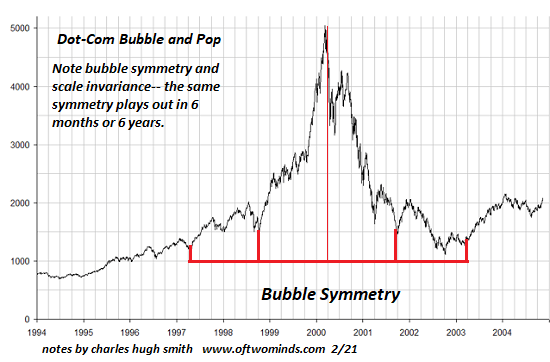
Market commentators tend to focus on Bulls and Bears and Federal Reserve policies as drivers of stock market gyrations, but there’s a far more profound dynamic working beneath these veneers: the forces of adaptation and evolution transforming the economy and society as conditions change.

While the general expectation is that the post-Covid economy “should” revert to the stability of 2019, this ignores what was already unraveling in 2019. The global economy experienced fundamental shifts in technology, production, energy, capital flows, labor, currencies and geopolitics in the past 25 years, and all these forces are not just in motion but accelerating in ways that are destabilizing the status quo.

The necessity of adaptation and evolution can be summed up very simply: adapt or die. This is the natural state not just of Nature and species but of systems such as societies and economies. Those which cling on to failing models stagnate and decay, while those which embrace dissent, transparency and a constant churn of experimentation and trial-and-error will adapt and evolve and emerge stronger and more adaptable.

The US economy went through a comparable period of instability and forced adaptation in the 1970s, a dynamic I explored in The Forgotten History of the 1970s (January 13, 2023). Everyone benefiting from the status quo arrangements fought the much-needed changes tooth and nail, and so progress was uneven. Transitioning to a more efficient and responsive industrial base required tremendous capital investments and scaling up new technologies.

The transition is more costly and takes more time than we would like; the 1970s transition took about a decade. We can anticipate a similar scale of capital investment and time will be needed for this structural adaptation.

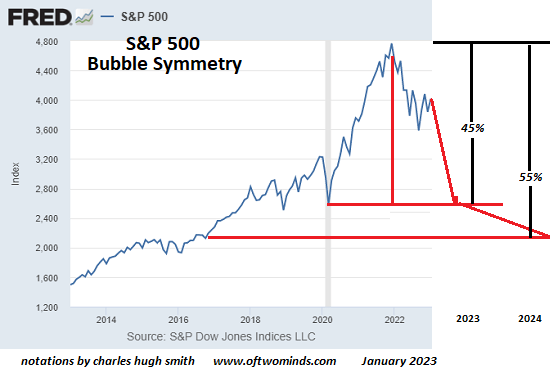
As the chart below illustrates, the 1970s was characterized by high inflation and big swings up and down in the stock market. Successful adaptations generated hope for quick recovery, while lagging adaptations tempered the hope with painful realities.

Again, it is likely that the decade ahead will track this same general dynamic of big swings generated by hope that the worst is over and the realities that progress is only partial and instability still reigns.

Everyone wants a trend they can trade for effortless gains. That may no longer be realistic.

The GATHERING Storm in Ukraine Spells Doom for the West

Photo by by Adam Brummett

By Col. Douglas MacGregor

Source: Information Clearing House

The crisis of American national power has begun. America’s economy is tipping over, and Western financial markets are quietly panicking. Imperiled by rising interest rates, mortgage-backed securities and U.S. Treasuries are losing their value. The market’s proverbial “vibes”—feelings, emotions, beliefs, and psychological penchants—suggest a dark turn is underway inside the American economy.

American national power is measured as much by American military capability as by economic potential and performance. The growing realization that American and European military-industrial capacity cannot keep up with Ukrainian demands for ammunition and equipment is an ominous signal to send during a proxy war that Washington insists its Ukrainian surrogate is winning.

Russian economy-of-force operations in southern Ukraine appear to have successfully ground down attacking Ukrainian forces with the minimal expenditure of Russian lives and resources. While Russia’s implementation of attrition warfare worked brilliantly, Russia mobilized its reserves of men and equipment to field a force that is several magnitudes larger and significantly more lethal than it was a year ago.

Russia’s massive arsenal of artillery systems including rockets, missiles, and drones linked to overhead surveillance platforms converted Ukrainian soldiers fighting to retain the northern edge of the Donbas into pop-up targets. How many Ukrainian soldiers have died is unknown, but one recent estimate wagers between 150,000-200,000 Ukrainians have been killed in action since the war began, while another estimates about 250,000.

Given the glaring weakness of NATO members’ ground, air, and air defense forces, an unwanted war with Russia could easily bring hundreds of thousands of Russian Troops to the Polish border, NATO’s Eastern Frontier. This is not an outcome Washington promised its European allies, but it’s now a real possibility.

In contrast to the Soviet Union’s hamfisted and ideologically driven foreign policymaking and execution, contemporary Russia has skillfully cultivated support for its cause in Latin America, Africa, the Middle East, and South Asia. The fact that the West’s economic sanctions damaged the U.S. and European economies while turning the Russian ruble into one of the international system’s strongest currencies has hardly enhanced Washington’s global standing.

Biden’s policy of forcibly pushing NATO to Russia’s borders forged a strong commonality of security and trade interests between Moscow and Beijing that is attracting strategic partners in South Asia like India, and partners like Brazil in Latin America. The global economic implications for the emerging Russo-Chinese axis and their planned industrial revolution for some 3.9 billion people in the Shanghai Cooperation Organization (SCO) are profound.

In sum, Washington’s military strategy to weaken, isolate, or even destroy Russia is a colossal failure and the failure puts Washington’s proxy war with Russia on a truly dangerous path. To press on, undeterred in the face of Ukraine’s descent into oblivion, ignores three metastasizing threats: 1. Persistently high inflation and rising interest rates that signal economic weakness. (The first American bank failure since 2020 is a reminder of U.S. financial fragility.) 2. The threat to stability and prosperity inside European societies already reeling from several waves of unwanted refugees/migrants. 3. The threat of a wider European war.

Inside presidential administrations, there are always competing factions urging the president to adopt a particular course of action. Observers on the outside seldom know with certainty which faction exerts the most influence, but there are figures in the Biden administration seeking an off-ramp from involvement in Ukraine. Even Secretary of State Antony Blinken, a rabid supporter of the proxy war with Moscow, recognizes that Ukrainian President Volodymyr Zelensky’s demand that the West help him recapture Crimea is a red line for Putin that might lead to a dramatic escalation from Moscow.

Backing down from the Biden administration’s malignant and asinine demands for a humiliating Russian withdrawal from eastern Ukraine before peace talks can convene is a step Washington refuses to take. Yet it must be taken. The higher interest rates rise, and the more Washington spends at home and abroad to prosecute the war in Ukraine, the closer American society moves toward internal political and social turmoil. These are dangerous conditions for any republic.

From all the wreckage and confusion of the last two years, there emerges one undeniable truth. Most Americans are right to be distrustful of and dissatisfied with their government. President Biden comes across as a cardboard cut-out, a stand-in for ideological fanatics in his administration, people that see executive power as the means to silence political opposition and retain permanent control of the federal government.

Americans are not fools. They know that members of Congress flagrantly trade stocks based on inside information, creating conflicts of interest that would land most citizens in jail. They also know that since 1965 Washington led them into a series of failed military interventions that severely weakened American political, economic, and military power.

Far too many Americans believe they have had no real national leadership since January 21, 2021. It is high time the Biden administration found an off-ramp designed to extricate Washington, D.C., from its proxy Ukrainian war against Russia. It will not be easy. Liberal internationalism or, in its modern guise, “moralizing globalism,” makes prudent diplomacy arduous, but now is the time. In Eastern Europe, the spring rains present both Russian and Ukrainian ground forces with a sea of mud that severely impedes movement. But the Russian High Command is preparing to ensure that when the ground dries and Russian ground forces attack, the operations will achieve an unambiguous decision, making it clear that Washington and its supporters have no chance to rescue the dying regime in Kiev. From then on, negotiations will be extremely difficult, if not impossible.

Related Video:

Don’t Believe Anything – But Recognize the Verge of a New Dark Age

By Phil Butler

Source: New Eastern Outlook

A decade ago, discovering every significant media outlet in the western world as tabloid news would have been inconceivable. Well, the unbelievable is all around us pounding pure lies into our brains on behalf of people eviler than Emperor Caligula. Just Google Putin, Russia, or even China, and with some effort, you’ll see what I mean.

In the mainstream, your average American gets, President Joe Biden is some kind of Dwight Eisenhower or Harry Truman figure. A man who cannot find his way off a stage or navigate the White House lawn is somehow a fit chess competitor for Vladimir Putin. The latest snafu is about his visit with Ukraine’s Zelensky a day before Putin spoke about a new phase of Russian policy. The CNN headline read “Biden’s Ukraine visit upstages Putin and leaves Moscow’s military pundits raging.” As an American who served his country in the military and other capacities, it’s sickening. Get this.

These media outlets and the Neocons have Americans believing a Chinese weather balloon that blew off course was gathering vital US nuclear missile silo intel. And Joe Biden waited until it flew all the way across the country before launching a multi-million-dollar F-22 strike to kill the spy machine. Days later, US fighter pilots shot down UFOs over Alaska. The only positive note after that was the Internet memes poking fun at the senile President and our goofball policies. Oh, but there’s more, oh so much more.

The New York Times and the rest are providing pushback on the Biden-authorized Nord Stream sabotage reported by one of the world’s most respected investigative journalists, Seymour Hersh. The guy who uncovered the My Lai massacre and its cover-up during the Vietnam War, key facts on Watergate, CIA domestic spy, and a lot more busted the Biden administration for using Navy Seals to detonate undersea charges dooming a Russia to Germany gas pipeline. The Pulitzer Prize-winning journalist’s revelations should have caused a media frenzy, a UN summit, and a NATO emergency meeting. But the people in charge can’t have that. The story of the decade so far is being slid under the rug. The reason why is explained in something Russian Foreign Minister Sergey Lavrov said recently:

“In many cases, ruling elites in unfriendly countries do not act of their free will, but only because they must show solidarity within their block. NATO and the EU enforce heavy-handed discipline on their members at the initiative of an aggressive minority.”

“How America Took Out The Nord Stream Pipeline” should be a reason for Biden’s impeachment hearings to be planned. The Germans should be banning US military personnel from their borders. And the Russians should probably go ahead and declare war when it all pans out true. We have this from Hersh’s sources and research:

“Last June, the Navy divers, operating under cover of the highly publicized NATO exercise known as BALTOPS 22, planted the remotely triggered explosives that, three months later, destroyed three of the four Nord Stream pipelines, according to a source with knowledge of the operational planning.”

The pipelines, which supplied Germany and much of Europe with cheap gas to run industry and fueled the lives of millions, were sabotaged without so much as a mention of the plan to America’s lawmakers. Hersh went on to describe how Biden, Jake Sullivan, Victoria Nuland, and Anthony Blinken were key conspirators in the illegal plan to undermine a NATO ally just to get to Putin and Russia. Biden had announced months before, after a meeting with Germany’s Scholz, that if Russia invaded Ukraine, “there would be no pipeline.”

Of course, Biden and his scandalous minions knew Russia had to act to prevent further NATO shenanigans in Ukraine, as we learned from the revelations of former German Chancellor Angela Merkel about the Minsk accords being a ruse. Talk about world-class liars and thugs. America’s leadership makes the worst Israeli mafioso seem harmless as Mickey Mouse. These people will get our world blown up.

Now Biden, Zelensky, all the EU criminals, and even exiled Putin enemy and Russian mafioso Mikhail Borisovich Khodorkovsky have been seen at the Munich Security Council predicting Putin’s demise—some more. Once we’d have thought US presidents, New York Times publishers, and killer thugs kicked from Russia like bullying kids from the schoolyard would be strange bedfellows. But this Biden administration has to be the most corrupt bunch since the days of Al Capone and Lucky Luciano.

Get this, one of the men involved in the Hunter Biden laptop affair, Prof. Gal Luft, is now in leg irons in a Cyprus jail awaiting extradition to the US for, you won’t believe it, being an arms dealer. Luft had helped the FBI and other agencies with highly incriminating facts about Hunter Biden, and now he’s on a path like Jeffrey Epstein or Julian Assange. Hanged by the neck, or something like that. Oh, and congressional investigators are asking who paid millions of dollars for Hunter Biden’s art? The lunacy goes on, and on, and on.

I’ll leave off with the European Parliament bosses blocking public scrutiny of Ursula von der Leyen over a Pfizer contract she clearly benefitted from. And Pfizer gate is not the EU President’s only worry. She’s now pledged another €1 billion for Ukraine’s fast recovery. That is, if there is a Ukraine to rebuild once western weapons and mercenaries force the Russians to obliterate the country just to keep NATO and bio-weapons labs out. For me, it now seems obvious why the liberal world order has gone all in with this proxy war against Russia. If the citizens of our countries ever find out what their leaders have really done, there will be public hangings Mussolini style across the NATO cabal.

So, forget the tabloids except to use reverse psychology for understanding the news. If the White House says we did not blow up Nord Stream, you can bet your last dollar we did. Think about our track record, America’s I mean. Our leaders operate like very drunken Roman senators, and our military operates as if Hannibal were commanding the armed forces of every third-world country. We even have officials swearing that Putin does not have any nuclear weapons. No really. This is where we are with detente in the 21st century, on the verge of a new Dark Ages.

How Mainstream Media Becomes Controlled

Most people think of money and agenda, and that’s part of the picture, but there’s one incredibly common factor most don’t consider: access. Let’s explore Kim Iverson’s Dershowitz interview.

By Joe Martino

Source: The Pulse

In personal development, one can’t change something about themselves until they are first made aware of the pattern or problem they are experiencing. Once they know, steps can be taken to adjust, better themselves, or grow beyond the problem.

The same can be said for how our society functions. After all, we as individuals are a microcosm of our collective story.

In that sense, I am a strong believer that if we don’t have an understanding of how our world works, then we don’t stand a chance in making it a better place as we don’t know what problem we are solving.

The first step towards uncovering truth is being able to re-examine our positions and embrace uncertainty.

Propaganda Produces Narrative

In my previous piece on propaganda I talked about how governments distribute a “story” or “narrative” about current events to rally the public behind an idea. It’s through this propaganda that people believe something about how the world works, even if it’s not at all true.

Mainstream media is the mouthpiece that connects government to the people. It has incredible power in shaping public opinion, and governments and powerful people know this.

The is how the masses come to believe they live in a democracy, that government is doing their best to fight enemies. Or that government is keeping people safe through their authoritarian actions, and attempting to create wellness in society. Don’t question government or else you’re a conspiracy theorist.

This narrative is all told through mainstream media. Control mainstream media and you control the masses’ perception.

Controlling Mainstream Media

There are many ways in which mainstream media can be controlled. A common belief is that newsroom directors are constantly getting phone calls from government people telling them not to run certain stories.

This may be true for a small portion of MAJOR stories as we saw with the government program Project Mockingbird.

A 1991 a declassified document from the CIA archives shows the Central Intelligence Agency had a close relationship with mainstream media and academia.

The document states that the CIA task force “now has relationships with reporters from every major wire service, newspaper, news weekly, and television network in the nation,” and that “this has helped us turn some ‘intelligence failure’ stories into ‘intelligence success” stories,’ and has contributed to the accuracy of countless others.”

It admits the agency had “persuaded reporters to postpone, change, hold, or even scrap stories that could have adversely affected national security interests or jeopardized sources and methods.”

We learned through COVID that this sort of thing does still happen, especially with major stories. But for the most part this isn’t how media is controlled in my opinion.

One other common idea is that “all of the journalists at The New York Times or CBC know they are lying.” I don’t think this is true.

Most of these people fully believe in what they publish, and are more so regulated by a news culture and environment that is built around avoiding certain conclusions. They also tend to perform unbalanced investigation into certain subjects.

Part of how news culture is built, and what stops journalists from following their gut, is the fear of the loss of access.

What is Access?

Access is simple: a news outlet can gain access to certain individuals like politicians, powerful business people, or celebrities based on their reputation and knowledge that they won’t “cross the line” or surprise guests.

In this case “the line” is asking tough questions or holding people accountable. Cross the line, and word gets out that powerful people shouldn’t associate with those brands as readily.

Imagine during the Freedom Convoy if the CBC decided they were going to ask Justin Trudeau very tough questions about his abuse of power, lies, and hatred he was disseminating towards unvaccinated people.

You can bet that the CBC would be fearful Trudeau’s admin would give them less access to early stories, updates, interviews and so on if they don’t “play ball” with Trudeau.

If the CBC doesn’t play ball, they will be late on stories, their competition will get things first and the CBC would be playing catch up all the time. This is bad for business.

Access is directly tied to the profitability of many news organizations. Thus, it becomes a race to the bottom dynamic of kissing the ass of those in power and not upsetting them so you can compete amongst other news organizations to get access to stories and interviews first – or even at all.

A Prime Example

This concept is well demonstrated in a recent interview Kim Iverson conducted with Alan Dershowitz on her show. To note, Iverson’s program is independent, and not considered mainstream media.

Iverson interviewed Dershowitz about Trump’s looming arrest. During the interview, she also asked him about his ties to Epstein and whether or not Epstein had ties to Mossad.

Dershowitz went on to provide short, weak answers to the questions, but eventually became annoyed with Iverson questioning him about Epstein.

Dershowitz said:

“Are you used to having people come on your show to talk about one subject, and then sandbagging them on another subject without any warning? It’s nice to know you do that. I have nothing to hide, and I’m happy to talk about any of this, but I’m used to more ethical journalism.”

Iverson goes on to state that her team notified the people who booked Dershowitz onto the show that she would ask about Epstein.

Dershowitz said they never told him, and ended the interview by saying,

“[…] it’s the last time you’ll have me on your show, so take advantage of it.”

Iverson went on to provide proof that Dershowitz’s team was notified about upcoming Epstein questions.

Iverson asked Dershowitz tough questions that were significantly less “soft ball” than what he would get from mainstream media. He was also less prepared to tailor his answers perfectly because of an internal team mistake.

As a result, he won’t go on her show again. She lost access to him, and this message could spread throughout, causing her to lose access to others as well.

Simply put, the game is rigged. Play ball in the way powerful people want you to or you don’t get to play.

Put another way, ask tough questions that are “out of bounds” in authoritarian culture and you’ll stop getting interviews. Why then would someone ask tough questions?

But this instance also reveals something important: powerful people know the questions first before they appear on news shows. Does this make sense? Does this create the opportunity for true and honest answers?

Is real journalism even being done by mainstream outlets?

The Purpose of Media is Largely Lost, But Slowly Repairing

All of us who wonder why certain questions aren’t asked by mainstream journalists even when they are strikingly obvious, should consider the concept of access.

Every person listed on Epstein’s flight log could have been asked to explain themselves by The New York Times or Washington Post, but they weren’t. Because that’s not allowed.

However those organizations can forgo good journalistic practices to push COVID fear and propaganda all day long, because that will only gain them more access in the end.

Thus, mainstream media is controlled by the threat of losing access.

Does it make sense that a person should know all of the questions they are going to be asked before coming on a show? Does it make sense that they should be allowed to fully prepare those answers? Doesn’t that give a deep opportunity to deceive?

Why is this accepted as “ethical journalism” when in reality it can protect powerful people?

A Way Forward

This is why I believe we must point out the ways in which mainstream media has no incentive to tell the truth, and point out the ways in which mainstream journalism works.

We must also illustrate the ways in which the mainstream media is obviously wrong or misleading on certain subjects.

It is often too difficult to prove EXACTLY what is true, because that can be incredibly hard to know, but to critique the MSM in ways that reveal their deception can help people begin granting less legitimacy to MSM, and start embracing more uncertainty.

I do believe more and more people are seeing how corrupt mainstream media is, and perhaps we are getting closer to a tipping point. As a result, even The New York Times is trying to convince their audience they are ‘independent journalism.’

Journalistic Malpractice on Trial: What the Dominion Voting System Tells Us About How the Media Sacrificed their Credibility to Partisan Falsehoods

By Nolan Higdon

Source: Project Censored

“This is direct evidence of knowing falsity” exclaimed RonNell Anderson Jones, Professor of Law at the University of Utah, in a February 2023 interview with Jon Stewart. Jones noted that in most defamation cases “the likelihood that you will find evidence of them [news outlets] saying, ‘We know this is a lie and we would like to move forward with it anyway is deeply unlikely.’” However, in the case of Dominion Voting Systems v. Fox News, “the filing contains just this trove of evidence of emails and text messages and internal memos that are ‘rare’ both in terms of the ‘volume of the evidence and as to the directness of the evidence.’” This sentiment was echoed by Harvard law professor Laurence Tribe who noted, “I have never seen a defamation case with such overwhelming proof that the defendant admitted in writing that it was making up fake information in order to increase its viewership and its revenues.”

In the $1.6 billion defamation lawsuit, Dominion Voting Systems accuses Fox News Channel of falsely reporting that Dominion’s voting machines fraudulently delivered victory to Joe Biden in the 2020 U.S. Presidential Election. Court documents attained by other media outlets reveal that hosts and other high-ranking Fox News Channel officials – including the Chairman and CEO of Fox’s parent company News Corporation, Rupert Murdoch – knew these reports were false, but aired them because they were more concerned with confirming their audience’s belief that Donald Trump won the election.

The evidence presented in the court documents speaks to the journalistic malpractice that plagues the cable news industry. Journalistic malpractice refers to professional journalists who privilege ideological bias and profits over truth in their reporting. Fox News Channel is patient zero for the plague of journalistic malpractice. It was created in 1996 by Rupert Murdoch and the late Roger Ailes, a media consultant for several Republican presidents, as a political project to sell conservative culture and policy to the American public with pro-conservative propaganda disguised as journalism. For example, Fox News Channel has

  • falsely claimed that other media outlets did not cover the conservative Tea Party rallies;
  • utilized videos out of context to inflate the perceived size of conservative protests;
  • labeled former President Barack Obama a racist;
  • declared Osama bin Laden as a John Kerry supporter;
  • perpetuated discredited reports on the existence of Weapons of Mass Destruction in Iraq;
  • introduced digitally altered photos to fabricate Black Lives Matter violence and make New York Timesreporters appear to be revolting.   

Liberals were right to assert that such chicanery was propaganda, not journalism. But before liberal readers scold Fox News viewers, they should remind themselves that the plague of journalistic malpractice has also infected the liberal leaning cable networks such as CNN and MSNBC. Researchers and scholars have noted that the advent of cable and then the internet saw news media outlets shift from attaining the largest audience possible to focusing on a more specific or narrow demographic of the audience. While Fox News Channel sought to cater to Republican Party voting viewers, CNN and MSNBC did the same for Democratic Party voters. This gave the Democratic Party influence over programming that was tantamount to what the Republican Party long enjoyed at Fox.

When Senator U.S. Bernie Sanders’ 2016 Presidential bid posed a threat to their desired candidate Hillary Clinton in 2016, leaders from the Democratic Party admitted they worked to undermine his campaign. Pro-Democratic party outlets like MSNBC and CNN aided in this effort by

  • creating an unfavorable debate schedule;
  • giving Clinton twice as much and more favorable coverage;
  • publishing 16 negative articles about Sanders in Washington Post (owned by major Democratic Party funder Jeff Bezos) in 16 hours;
  • ghost editing previous news articles to diminish Sanders’ quarter century of accomplishments;
  • inviting his opponent’s surrogates to attack his character under the auspices of being objective journalists.

Their smear of Sanders continued in 2020 when

  • the Democratic Party-leaning news outlets misled the public about Sanders’ polling numbers;
  • CNN’s Abby Phillips drew gasps for ignoring Sanders’ claim that he never said a “woman could not be president;”
  • James Carville on MSNBC made the baseless claim that Russia was supporting Sanders;
  • MSNBC’s Chris Matthews compared Sander’s primary victories to the Nazi’s defeat of the French, an unfortunate comparison as Sanders’ family was murdered in the holocaust.

Journalistic malpractice also plagued Covid-19 coverage. Starting in 2020, CNN’s Chris Cuomo utilized his platform – with the approval of CNN leadership – to host his brother, then New York Governor Andrew Cuomo. The jovial segments seemed like campaign advertisements as Chris treated Andrew as the anti-thesis to then President Trump: a competent executive who took decisive action to address the Covid-19 pandemic. Although, the Democratic versus Republican framing attracted partisan audiences, in reality, Andrew Cuomo and Trump were all too similar: both concealed the actual number of Covid-19 deaths in their jurisdiction, both put patients at risk with kickbacks to industry partners, and both utilized media contacts to stifle press reports about their alleged sexual crimes.

The partisan falsehoods in cable news includes the production of powerful, long- running false stories designed to convince their audiences that the other party is wrong and crazy. For years now, conservatives and Fox News Channel perpetuated the baseless Qanon conspiracy, which alleges that a cabal of Satan-worshiping pedophiles – mainly in the Democratic Party – runs global affairs but Trump will break up the conspiracy. The absurdity of this conspiracy is tantamount to liberal leaning news media’s reporting on Russiagate, which sought to discredit Republicans. Since 2016, Russiagate – the story that Russia meddled in and influenced the outcome of the U.S. election in 2016, had direct connections to Donald Trump and his associates, and worked to help defeat Hillary Clinton for the presidency – was perpetuated by a series of false stories from Democratic Party-friendly media including

  • Russia hacking a Vermont power plant;
  • putting a bounty on U.S. soldiers in Afghanistan;
  • shifting election outcomes around the world;
  • turning Trump into an asset since 1987;
  • labeling the Hunter Biden laptop story as fake news.

Conservatives rightly see this reporting and believe liberals are insane.

Both factions need to look in a mirror. While audiences can clearly see the insanity in other networks’ viewers, they rarely seem to see it in themselves. Indeed, in the same week that CNN and others were having a schadenfreude moment over the Dominion v. Fox case, they hosted a commentator on the train derailment in East Palestine, Ohio without disclosing that he had lobbied for the train company Norfolk Southern. This example of hypocrisy and journalistic malpractice is not only costly to CNN’s credibility, but our democracy as well.   

Without a robust media system that privileges truth over preaching to the choir, the public will have endless debates devoid of facts on key issues such as critical race theory, vaccine efficacy, the origins of the COVID-19 virus, climate change, transgender issues, Ukraine, mysterious balloons, and more. Democratic discourse will be reduced to seeing Republicans as MAGA-hat wearing, blue lives matter-flag waving, gun nuts, and Democrats as medical mask wearing, “this house cares about everything” front-lawn sign adorning, professional victims and virtue signalers. These caricatures have never really been accurate, but as long as the nation is infected with the plague of journalist malpractice they will surely be perpetuated.

While the courts are unlikely to deliver solace from political party propaganda disguised as journalism, they have provided some wisdom. Both Rachel Maddow and Tucker Carlson of MSNBC and Fox News Channel respectively, have been brought to court for spreading false information and were exonerated because the judges concluded that no reasonable person would believe either of them were telling the truth. That is good advice, and viewers would be wise to remember it every time they consider watching cable news.