Summer of the Hawks

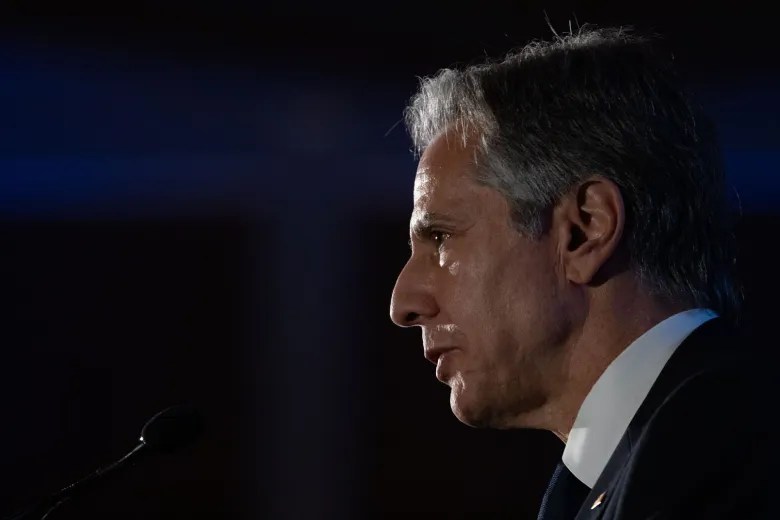
Secretary of State Antony Blinken speaks during the Mandela Washington Fellowship Summit for Young African Leaders in Washington, DC, August 2, 2023. (Official State Department photo by Chuck Kennedy)

By Seymour Hersh

Source: Rise Up Times

It’s been weeks since we looked into the adventures of the Biden administration’s foreign policy cluster, led by Tony Blinken, Jake Sullivan, and Victoria Nuland. How has the trio of war hawks spent the summer?

Sullivan, the national security adviser, recently brought an American delegation to the second international peace summit earlier this month at Jeddah in Saudi Arabia. The summit was led by Crown Prince Mohammed bin Salman, known as MBS, who in June announced a merger between his state-backed golf tour and the PGA. Four years earlier MBS was accused of ordering the assassination and dismemberment of the journalist Jamal Khashoggi at the Saudi consulate in Istanbul, for perceived disloyalty to the state.

As unlikely as it sounds, there was such a peace summit and its stars did include MBS, Sullivan, and President Volodymyr Zelensky of Ukraine. What was missing was a representative of Russia, which was not invited to the summit. It included just a handful of heads of state from the fewer than fifty nations that sent delegates. The conference lasted two days, and attracted what could only be described as little international attention.

Reuters reported that Zelensky’s goal was to get international support for “the principles” that that he will consider as a basis for the settlement of the war, including “the withdrawal of all Russian troops and the return of all Ukrainian territory.” Russia’s formal response to the non-event came not from President Vladimir Putin but from Deputy Minister of Foreign Affairs Sergei Ryabkov. He called the summit “a reflection of the West’s attempt to continue futile, doomed efforts” to mobilize the Global South behind Zelensky.

India and China both sent delegations to the session, perhaps drawn to Saudi Arabia for its immense oil reserves. One Indian academic observer dismissed the event as achieving little more than “good advertising for MBS’s convening power within the Global South; the kingdom’s positioning in the same; and perhaps more narrowly, aiding American efforts to build consensus by making sure China attends the meeting with . . . Jake Sullivan in the same room.”

Meanwhile, far away on the battlefield in Ukraine, Russia continued to thwart Zelensky’s ongoing counteroffensive. I asked an American intelligence official why it was Sullivan who emerged from the Biden administration’s foreign policy circle to preside over the inconsequential conference in Saudi Arabia.

“Jeddah was Sullivan’s baby,” the official said. “He planned it to be Biden’s equivalent of [President Woodrow] Wilson’s Versailles. The grand alliance of the free world meeting in a victory celebration after the humiliating defeat of the hated foe to determine the shape of nations for the next generation. Fame and Glory. Promotion and re-election. The jewel in the crown was to be Zelensky’s achievement of Putin’s unconditional surrender after the lightning spring offensive. They were even planning a Nuremberg type trial at the world court, with Jake as our representative. Just one more fuck-up, but who is counting? Forty nations showed up, all but six looking for free food after the Odessa shutdown”—a reference to Putin’s curtailing of Ukrainian wheat shipments in response to Zelensky’s renewed attacks on the bridge linking Crimea to the Russian mainland.

Enough about Sullivan. Let us now turn to Victoria Nuland, an architect of the 2014 overthrow of the pro-Russian government in Ukraine, one of the American moves that led us to where we are, though it was Putin who initiated the horrid current war. The ultra-hawkish Nuland was promoted early this summer by Biden, over the heated objections of many in the State Department, to be the acting deputy secretary of state. She has not been formally nominated as the deputy for fear that her nomination would lead to a hellish fight in the Senate.

It was Nuland who was sent last week to see what could be salvaged after a coup led to the overthrow of a pro-Western government in Niger, one of a group of former French colonies in West Africa that have remained in the French sphere of influence. President Mohamed Bazoum, who was democratically elected, was tossed out of office by a junta led by the head of his presidential guard, General Abdourahmane Tchiani. The general suspended the constitution and jailed potential political opponents. Five other military officers were named to his cabinet. All of this generated enormous public support on the streets in Niamey, Niger’s capital—enough support to discourage outside Western intervention.

There were grim reports in the Western press that initially viewed the upheaval in East-West terms: some of the supporters of the coup were carrying Russian flags as they marched in the streets. The New York Times saw the coup as a blow to the main US ally in the region, Nigerian President Bola Ahmed Tinubu, who controls vast oil and gas reserves. Tinubu threatened the new government in Niger with military action unless they returned power to Bazoum. He set a deadline that passed without any outside intervention.

The revolution in Niger was not seen by those living in the region in east-west terms but as a long needed rejection of long-standing French economic and political control. It is a scenario that may be repeated again and again throughout the French-dominated Sahel nations in sub-Saharan Africa.

There are distinctions that do not bode well for the new government in Niger. The nation is blessed, or perhaps cursed, by having a significant amount of the remaining natural uranium deposits in the world. As the world warms up, a return to nuclear generated power is seen as inevitable, with obvious implications for the value of the stuff underground in Niger. The raw uranium ore, when separated, filtered and processed is known worldwide as yellowcake.

The corruption so often “talked about in Niger is not about petty bribes by government officials, but about an entire structure—developed during French colonial rule—that prevents Niger from establishing sovereignty over its raw materials and over its development,” according to a recent analysis published by Baltimore’s Real News Network. Three out of four laptops in France are powered by nuclear energy, much of which is derived from uranium mines in Niger effectively controlled by its former colonial overlord.

Niger is also the home of three American drone bases targeting Islamic radicals throughout the region. There  are also undeclared Special Forces outposts in the region, whose soldiers receive double pay while on their risky combat assignments. The American official told me that “the 1,500 US troops now in Niger are exactly the number of American troops who were in South Vietnam at the time John F. Kennedy took over the presidency in 1961.”

Into this scene came Victoria Nuland, who must have drawn the short straw inside the Biden Administration. She was sent to negotiate with the new regime and to arrange a meeting with the ousted President Bazoum, whose life remains under constant threat from the governing junta. The New York Times reported that she got nowhere after talks she described as “extremely frank and at times quite difficult.” The intelligence official put her remarks to the Times in American military lingo: “Victoria set out to save the Niger uranium owners from the barbaric Russians and got a huge single-finger salute.”

Quieter in recent weeks than Sullivan and Nuland has been Secretary of State Tony Blinken. Where was he? I asked that question of the official, who said that Blinken “has figured out that the United States”—that is, our ally Ukraine—“will not win the war” against Russia. “The word was getting to him through the Agency [CIA] that the Ukrainian offense was not going to work. It was a show by Zelensky and there were some in the administration who believed his bullshit.

“Blinken wanted to broker a peace deal between Russia and Ukraine as Kissinger did in Paris to end the Vietnam war.” Instead, the official said, “it was going to be a big lose and Blinken found himself way over his skis. But he does not want to go down as the court jester.”

It was at this moment of doubt, the official said, that Bill Burns, the CIA director, “made his move to join the sinking ship.” He was referring to Burns’s speech earlier this summer at the annual Ditchley conference near London. He appeared to put aside his earlier doubts about expanding NATO to the east and affirmed his support at least five times for Biden’s program.

“Burns does not lack self-confidence and ambition,” the intelligence official said, especially when Blinken, the ardent war hawk, was suddenly having doubts. Burns served in a prior administration as deputy secretary of state and running the CIA was hardly a just reward.

Burns would not replace a disillusioned Blinken, but only get a token promotion: an appointment to Biden’s cabinet. The cabinet meets no more than once a month and, as recorded by C-SPAN, the meetings tend to be tightly scripted affairs and to begin with the president reading from a prepared text.

Tony Blinken, who publicly vowed just a few months ago that there would be no immediate ceasefire in Ukraine, is still in office and, if asked, would certainly dispute any notion of discontent with Zelensky or the administration’s murderous and failing war policy in Ukraine.

So the White House’s wishful approach to the war, when it comes to realistic talk to the American people, will continue apace. But the end is nearing, even if the assessments supplied by Biden to the public are out of a comic strip.

This piece is from Seymour Hersh’s Substack, you may subscribe to it here.

From Burkina Faso to Niger to Gabon, Western Hegemony Dying in Africa

By Harun Elbinawi

Source: Covert Geopolitics

Berlin Conference of 1884-1885 was undeniably one of the biggest evil summits in modern history. Greedy and racist European colonialists sat down in the German city and divided Africans as if they were sharing bread on a breakfast table.

The conference was organized by Otto von Bismarck, the first chancellor of Germany at the request of King Leopold II of Belgium, the Western genocidal barbarian that murdered more than 10 million innocent Africans in Congo.

Most Africans are not even aware of this genocide in Congo perpetrated by the Belgium colonialists because it is not in our history books written by the white colonialists.

European colonialism in Africa lasted more than a century with only the ancient Kingdom of Ethiopia spared because they defeated the Italian colonialists on the battlefield.

Trillions and trillions of dollars were stolen from Africa, millions of Africans were murdered by the European colonialists and Africans were massively brainwashed that they had no history before European colonialism.

The wave of ‘independence’ in Africa from the 1950s and 1960s did not represent true independence. What actually happened was that colonialism was cleverly replaced with neocolonialism by the genocidal imperialist barbarians of the West.

The massive looting of rich resources in Africa continued under Western puppet leadership. The courageous African leaders who refused to dance to the tune of the European colonialists were eliminated.

This was what happened to African heroes, Patrick Lumumba of Congo and Thomas Sankara of Burkina Faso. Congo has all mineral resources except for crude oil.

The uranium used by the US regime to make the atomic bombs unleashed on Hiroshima and Nagasaki was mined in Congo.

French greed in Africa

Among the European colonialists, French colonialism was more brutal and exploitative.

France killed more than 1.5 million civilians in Algeria alone. They murdered tens of thousands of civilians in other African countries.

One of the Modus Operandi of the French colonialists was to assemble Islamic scholars in a hall and exterminate all of them. They did this in Algeria, Chad, Mali and Senegal.

And the greed of their neocolonialism is extreme. Even after independence, France is still controlling the wealth of its former colonies in Africa.

The rich resources of French nations are still controlled by France and they continue to pay colonial tax to France.

French goods and services dominate their markets. The domineering presence of France in these countries has been excruciating and devastating for local populations.

Niger Republic does not know the quantity of uranium France was taking from there, which is worst than slavery.

No evil lasts forever

There is a popular saying that “No evil lasts forever”.

France’s neocolonialism in Africa will not last forever. Popular military coups against puppets of France imperialism have started and are gathering momentum.

The recent military coup in the West African state of Niger Republic does not stand in isolation but follows similar upheavals in the neighboring countries of Mali, Burkina Faso, and Guinea in recent years.

Mali is facing insurgency that is backed by Western hegemony. Mali expelled French troops because they were actively aiding the insurgents to justify its military presence in the African country.

Now, on Wednesday, we woke up with the news of another puppet of the Western hegemonic barbarians in Gabon overthrown by the military. Ali Bango inherited the Gabon presidency from his corrupt Father, Omar Bongo.

Early on Wednesday, some military personnel appeared on state TV and announced that they were seizing power and dislodging a family that has ruled the country for 56 years.

The military officers introduced themselves as members of the Committee of Transition and the Restoration of Institutions.

“Today the country is undergoing a severe institutional, political, economic, and social crisis,” the officers said in a statement, dubbing the recent election illegitimate.

“In the name of the Gabonese people … we have decided to defend the peace by putting an end to the current regime.”

Pertinently, Gabon’s former president had 70 bank accounts, 39 apartments, 2 Ferraris, 6 Mercedes Benz cars, 3 Porsches and a Bugatti in France. He ruled for 42 years (from 1967 to 2009). French leaders loved Bongo because he was loyal to them.

His son, Ali Bongo has been the president for 14 years (2009 – 2023). He has just been overthrown in a  coup.

Failure of Western liberal democracy

The fact is that the Western liberal democracy has not only failed in Africa but has failed woefully.

Democracy in Africa has become a tool for the corrupt ruling elites to steal the wealth of their respective countries and transfer it to Western financial institutions while the populations remain in abject poverty and hunger.

Democracy is just another system of government hijacked by the Western hegemonic barbarians, the biggest enemies of the human race. Democracy is now an imperialist tool of Western hegemony in Africa. This is a bitter and undeniable fact.

The people of Gabon will definitely celebrate this military coup as it marks the end of French interference and looting in their country. Another setback for the French leaders.

Africa must rise again

The most noticeable current in Mali, Burkina Faso, Guinea, Niger Republic and Gabon is that the change of governments all have popular support as the people of those countries are tired of France’s imperialism, arrogance and terrorism.

Today France has the 4th largest gold reserves in the world and there is no single gold mine in France.

These gold mines are all in Mali, Niger Republic and other African countries. The France neocolonialism in Africa must end. Its time has come.

What Do You (Think You) Really Know?

On the need for maintaining a curious spirit.

By Tom Bunzel

Source: The Pulse

“When in doubt observe and ask questions.  When certain, observe at length and ask many more questions.”  — George Patton

Once again, I thought I would follow up on Joe Martino’s recent discussion of huge gaps and worse in many peoples’ understanding.  This is such an important point first made by Socrates: You don’t know what you don’t know.

Joe mentioned the Dunning-Kruger effect in which people with relatively little knowledge will overestimate what they in fact know.  Joe’s piece used the example of brand influencers who tend to become very sure of their pronouncements because, of course, they had a vested interest in it.  

This speaks to the conditioning that takes place in corporate environments, similar to how an individual accumulates a self or Ego.

One thing that happens with people who are sure of themselves is that they frequently break off mentally and become separate from any sense of Wholeness (to defend their position).  This crystallizes the ego which then, with many insecure people, and hardens with each challenge – something we can see in our current politics.

It’s also obvious that whatever we think we know is generally another thought.  The exception is if it is a bodily sensation or emotion which is purely felt, without interpretation.

Unfortunately, most people are also heavily invested in feeling good – or avoiding any discomfort – and the discipline of sensing emotions in the body and allowing them to be experienced without judgement is quite foreign.  I say it’s unfortunate because in my recent experience, it is the one way to begin to heal trauma stored in the body.

And speaking of the body, this is where we can surely go even a step further.

We Don’t Know What We Don’t Know that We Don’t Know

Things get even more complicated when you focus on the real mystery.  The vastness of the gaps is staggering.

An example of this is qualia – defined as “the internal and subjective component of sense perceptions, arising from stimulation of the senses by phenomena.”

What this really comes down to is our Experience, which is somehow created out of our Awareness of whatever is happening.  But qualia for humans is more subtle and indefinable – scientists have been unable to explain, for example, why some wine tastes dry and another fruity.

How does the subjective part – the judgment – come into (our?) awareness.

Neuroscience now can identify and label the various components of the experience in terms of physics and biochemistry, but they cannot explain how “we” experience things like awe, gratitude and so on.

And for the sense of “someone” experiencing any phenomena they can only give it another label:  Consciousness.  

When trying to define “ourselves” or the experience of being, our language has proven so inadequate (partly due to the subject/object grammatical bias of English and most modern languages) that to the extent any speculations or theories are wrong – we probably don’t even have the capability to comprehend what makes them so incomplete.

Attempts to pin the experience of the self down scientifically have fallen short, as I described in “AI and the Hard Problem of Consciousness”.

Where is the Ground of Our Experience?

This conundrum exists because science deals with facts and certainty and our experience actually seems to arise in a space other than that which science can adequately define.

But still, we are deeply conditioned to believe that our experiences and thoughts about what has, may or is happening comprise a separate self or identity, that is often surmised to exist in the brain.

But recent neurological advances have failed to locate any physical or even biochemical basis for a separate self.

If we return once again to the body, we can also see that all of our senses, and even thoughts, can be reduced to a biochemical reaction.  We can now view it as information passing from the receptor to the brain, gut or heart.

Since this information is based on very specific individual parameters, the results are almost by definition finite and fallible.  What we experience is by no means a universally known phenomenon. We generally experience what we’ve been conditioned to experience, which separates us from other humans, and for that matter from all other life forms.

Birds can see better than we can, whales, dolphins and bats live on sound and most animals can hear things humans can’t.  If you have a cat you know that its world is nothing like yours.

And now, even when humans have invented incredible instruments to augment our senses and allow a glimpse even into vast apparent distances away from our planet out into the cosmos, we are confronted more and more with phenomena that we cannot explain.

(I wrote “apparent distances” because our view of “outer” space is always, inevitably a subjective experience that seems to create an image within “us” – presumably within our brains from a signal through the optic nerve.  I often suspect that even the way we perceive “outer space” is a function of our limited sensory and intellectual capacities).

The irony is that it is Science that now points most effectively to what we don’t even know that we don’t know, and yet it is the same science that is the cause of so much human hubris and delusion.

Before Quantum Mechanics was discovered and Einstein’s theories verified we didn’t know that we had no clue about matter and energy.  Because a lot in the quantum world doesn’t make “sense” there are presumably more vast areas where we can’t even comprehend our own ignorance.

I dealt with some of these issues when I wrote about Robert Lanza’s theory of Biocentrism.  Science seems to be dragged kicking and screaming into a new paradigm where the self we believe in doesn’t really exist – and what WE ARE (not what we have or do) is aligned intimately with Nature, or our environment, or whatever label one might want to use in what is really an infinitely sacred Mystery.

The Limitations of Current Scientific Labels

Another example would be biology where for centuries all life was thought of as either animal or plant.  Then they found microbes, and eventually viral agents and the line between life and the “objective” world blurred.

Returning our attention to qualia, and consciousness, again these personal “events” are defined as subjective experiences.

Science can’t really explain subjectivity.  As previously noted, that may well be because explanations involve a subject and an object (as conditioned by our language and grammar) but what if everything is just an arising in Consciousness (subjectivity)?

If we take the concept of “Wholeness” literally – there cannot in fact be anyone outside of the whole to have a subjective experience.

This is the essence of “Nonduality” – a modern popular philosophical movement.

Our interpreted experience is comprised of thoughts, words and feelings.  But where do these occur?

The body and the brain are the short answers, the ones the DKE people would grab hold on, but upon deeper examination “your” experience of your hands, for example, takes place visually and tactilely; you can both see your hands and feel them.  But how is that happening and by whom?

But what makes them “yours”?  What is it that differentiates “you” from everything else you see or feel?

If you think about it, a separate “identity” was not originally within awareness when your body was first born.  It started when someone told you ‘your’ name.

And ever since the narrative of a separate person, made up mainly of thoughts and memories has accumulated more knowledge based on that one erroneous assumption of separation, culminating in an illusory experience of “you.”

How do we make the bulk of humanity aware of this delusion?   I wonder if it is not central to the issue of what we now may become “Disclosure” where our psychological world seems poised to explode in ways we cannot know that we do not know.  And as the 70’s comedy team called Firesign Theater once said:  “Everything you know is wrong.”

I would think that under the circumstances the most appropriate position to take in many instances is what Eckhart Tolle recommends – deep acceptance of not knowing.

Moreover, in the face of such overwhelming evidence of our ignorance, we might be better advised to ask very deep questions – and as Joe Martino has also mentioned, allowing silent sensing to bring us a response (perhaps not even answer) that could even bring up physical emotions or sensations, but no actual conclusion.

I tried to use that technique in the book I wrote recently “Conversations with Nobody” written with AI, about AI and giving a taste of AI.

Because the format of the book was an apparent “conversation” with a nonhuman intelligence the questions I posed (or prompts) were actually the only creative element in the book – and were designed to either take the AI’s response and follow up with more depth, or pose a question that had some nuance and would make the reader think about an issue like the one in this article.

Of course the potential promise of AI is to provide impersonal and presumably more factual information than a mere human; but so far that promise is unfulfilled.

The AI generally gave answers perfectly in line with the most obvious human biases – not surprising in that its “answers” were simply guesses as to next appropriate word in the response, based on its programming as a “language” model.  No actual human thought was involved in the response.

But the openness of the question may evoke an appropriate feeling in one who considers it silently.  It may even take one beyond one’s mind.  Questions to ponder and go beyond the conditioned limitations of Dunning-Kruger:

What do we really know? 

Who (or what) are we?

What is our relationship to reality – what was here before we got here and thought about it?

A Pigeon Sat on a Branch Reflecting on Existence

By Simon Abrams

Source: RogerEbert.com

Swedish comedy “A Pigeon Sat on a Branch Reflecting On Existence” has a very particular style of deadpan humor and an equally specific morbid sense of empathy. As in his previous two films, writer/director Roy Andersson (“Songs from the Second Floor,” “You, The Living”) presents several thematically-united sketches of life as it’s experienced by the meek, and the suffering, two groups of people who are (according to Andersson’s films) doomed to inherit nothing. “A Pigeon Sat on a Branch Reflecting on Existence” is, in that sense, a kind of alarmist comedy. It’s a series of comedic sketches about people who are too self-involved to empathize with each other. It’s also a plaintively blunt wake-up call, and an effective demand for viewers’ vigilant sensitivity.

I’m writing this review as a series of direct free-associations because that’s essentially how “A Pigeon Sat on a Branch Reflecting On Existence” presents itself. Like Andersson’s other recent films, “Pigeon” is a movie that’s so viscerally effective that it doesn’t really matter how hard individual scenes clobber you over the head with Andersson’s humanist message: by choosing to isolate ourselves from each other, we die a thousand little absurd deaths every day without ever really moving on.

“A Pigeon Sat On a Branch Reflecting on Existence” doesn’t really have a plot, but it does feature two recurring characters: Jonathan (Holger Andersson) and Sam (Nils Westblom) sell novelty items, but aren’t very good at it. They’re shy and tactless, as we see in any scene where they try to pitch people who could clearly care less about plastic vampire fangs, and rubber Halloween masks. But Jonathan, who is repeatedly teased for being over-sensitive, also suffers from a vague sinking feeling that something is wrong with his life, and that leads to problems with Sam later on.

To be fair, Jonathan’s not completely blameless. In one scene, we see him bullying a store-owner who is too anxious and depressed to address Jonathan and Sam when they demand payment for novelty items that were bought on credit. It’s an awkwardly heated argument since Jonathan and Sam have to argue with their client through a third party: the store-owner’s wife. Jonathan and Sam’s seeming lack of empathy is what unites them with the various other people in “A Pigeon Sat On a Branch Reflecting on Existence.” Several characters receive phone calls that lead them to miss whatever situation is happening right in front of their eyes, like the callous scientist who ignores a monkey she’s performing electroshock therapy on or the desperate barber who doesn’t see his reluctant (and only) client leaving his barber shop. Each time this happens, the person on the phone ironically says “I’m glad that you’re doing fine,” reminding viewers that the opposite is actually true, and that a state of un-fine-ness is actually what passes for normalcy in Andersson’s film.

Andersson is not however a pessimist nor is “A Pigeon Sat On A Branch Reflecting on Existence” a cynical film. On the contrary, “Pigeon” leads viewers through a series of comically bleak vignettes towards a hopefully open-ended conclusion. In a 2009 interview published in MuBI by former “At the Movies” co-host Ignatiy Vishnevetsky, Andersson describes his simultaneously unsparing but ennobling sensibility as “a light without mercy.” Vishenvetsky correctly adds that “There’s a difference between being ‘without mercy’ and being cruel.” You can see exactly what Vishnevetsky means in the most confrontational scene in “Pigeon:” a dream sequence wherein white blue bloods set a giant container full of black slaves on fire, and watch as the container revolves slowly and makes music. The painfully deliberate pacing of this scene makes it surprisingly shocking. You realize what’s happening well before the scene is over, but by the time the scene ends, you’ll also realize that you’ve just seen the most serious scene in “Pigeon.” It’s a howl of inflexible indignation that informs the rest of the film’s slippery pre-apocalyptic comedy.

Andersson is able to essentially lecture his audience into laughing at his funhouse reflections of human insensitivity because he has a very exact style, one that he’s honed after directing hundreds of equally surreal commercials. Andersson takes his time behind the camera. He typically reshoots scenes that feature only a handful of dialogue over and over again, sometimes several dozen times. He doesn’t agonize over shots, according to line producer John Carlsson, but rather just chooses them at his own pace. That sensitivity shows in “Pigeon”‘s sets: life-like models and fixtures that make you feel like you’re looking at street scenes when in fact you’re looking at vividly detailed interior sets that also retain a magical kind of artificiality. The film’s interiors are similarly shot like tableaux vivants that just barely come alive whenever a zombie-like protagonist trudges through. The world of “A Pigeon Sat on a Branch Reflecting on Existence” is, in that sense, fragile, but not really moribund. Andersson’s hysterically impotent characters may, in other words, be perpetually on the verge of a spiritual breakdown, but they never completely fall apart. That kind of mulishly stubborn resilience is very human, and also very funny.

When He Was Vice-President, Joe Biden Acted Like Ukraine Was His ‘Own Backyard’: Fired Ukraine Prosecutor

“Biden was personally engaged in corruption in Ukraine”

By Arjun Singh

Source: Global Research.ca

The former Ukrainian prosecutor who was fired at the insistence of then-Vice President Joe Biden in 2016 after investigating Burisma, claimed that Biden treated Ukraine like his “own backyard,” according to comments made during an interview with Fox News’ Brian Kilmeade on Saturday.

Viktor Shokin was fired by Ukrainian President Petro Poroshenko in 2016 after Biden — who was in charge of Ukrainian policy during the Obama administration — gave him an ultimatum, saying that Ukraine would not receive $1 billion dollars in aid until Shokin was dismissed. In an interview with Brian Kilmeade on “One Nation” on Saturday, Shokin claimed that Biden treated Ukraine as if it were his “own backyard.”

“I developed a very firm understanding of the fact that the vice president was only acting in his own interest. He, generally speaking, handled Ukraine like it was his own backyard,” Shokin told Kilmeade. “The office of Poroshenko, the president, was humiliated, but the entire country was humiliated,” Shokin added, describing Biden’s ultimatum that he be dismissed, which Biden publicly boasted about at a Council on Foreign Relations event on Jan. 23, 2018.

“I’m going to be leaving here in six hours. If the prosecutor is not fired, you’re not getting the money. Well, son of a bitch, he got fired and they put in place someone who was solid,” Biden said at the event.

At the time of Shokin’s firing, his office was investigating Burisma, a Ukrainian energy company that had hired Biden’s son, Hunter, to join its board. FBI documents released by Congress in July suggested that Hunter was hired to enable Burisma to utilize his father’s political influence and avoid threats to the company.

Shokin also suggested that Biden was personally engaged in corruption in Ukraine, citing his firing as one instance. “They were being bribed. The fact that Joe Biden gave away $1 billion in U.S. money in exchange for my dismissal, my firing, isn’t that alone a case of corruption?” he said.

“For years, these false claims have been debunked, and no matter how much air time Fox gives them, they will remain false,” said White House spokesperson Iam Sams in a statement to the Daily Caller News Foundation. “Fox is giving a platform for these lies to a former Ukrainian prosecutor general whose office his own deputy called a hotbed of corruption, drawing demands for reform not only from then-Vice President Biden but also from U.S. diplomats, international partners, and Republican Senators like Ron Johnson.”

BRICS 11 – Strategic Tour de Force

By Pepe Escobar

Source: The Unz Review

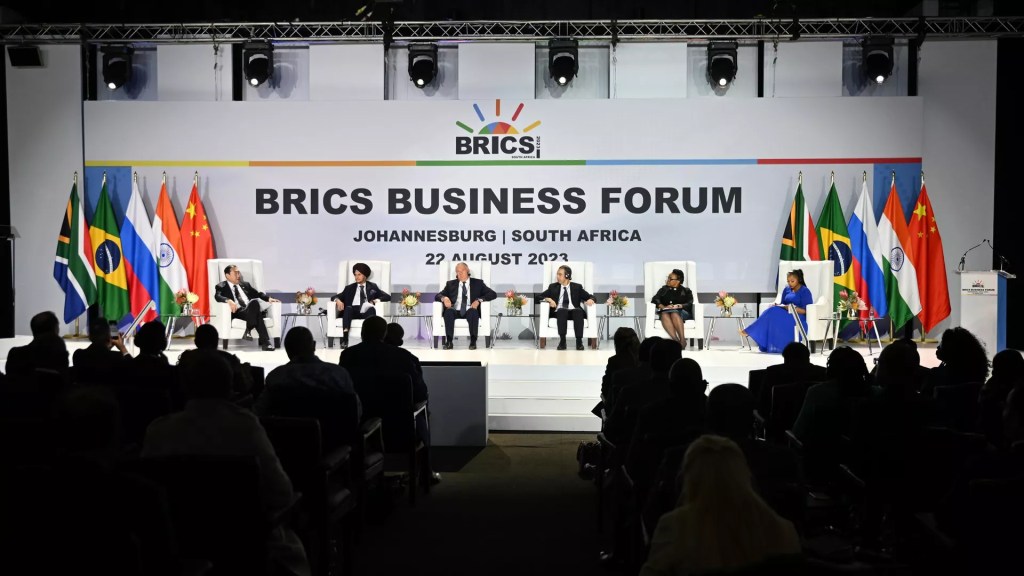
Chinese President Xi Jinping defined all the major decisions embedded in the 15th BRICS summit in South Africa as “historic”. That may be seen as an understatement.

It will take time for the Global South, or Global Majority, or “Global Globe” (copyright President Lukashenko), not to mention the stunned collective West, to fully grasp the enormity of the new strategic stakes.

President Putin, for his part, described the negotiations on BRICS expansion as quite difficult. By now a relatively accurate picture is emerging of what really went down on that table in Johannesburg.

India wanted 3 new members. China wanted as many as 10. A compromise was finally reached, with 6 members: Egypt, Iran, Saudi Arabia, United Arab Emirates (UAE), Argentina and Ethiopia.

So from now on it’s BRICS 11. And that’s just the beginning. Starting with the rotating Russian presidency of BRICS on January 1, 2024, more partners will be progressively included, and most certainly a new round of full members will be announced at the BRICS 11 summit in Kazan in October next year.

So we may soon progress to BRICS 20 – on the way to BRICS 40. The G7, for all practical purposes, is sliding towards oblivion.

Bur first things first. At that fateful table in Johannesburg, Russia supported Egypt. China went all out for Persian Gulf magic: Iran, UAE and the Saudis. Of course: Iran-China are already deep into a strategic partnership, and Riyadh is already accepting payment for energy in yuan.

Brazil and China supported Argentina, Brazil’s troubled neighbor, running the risk of having its economy fully dollarized, and also a key commodity provider to Beijing. South Africa supported Ethiopia. India, for a series of very complex reasons, was not exactly comfortable with 3 Arab/Muslim members (Saudi Arabia, UAE, Egypt). Russia assuaged New Delhi’s fears.

All of the above respects geographic principles and imprints the notion of BRICS representing the Global South. But it goes way beyond that, blending cunning strategy and no-nonsense realpolitik.

India was mollified because Russian Foreign Minister Sergey Lavrov, at the table in Johannesburg negotiating on behalf of President Putin, and highly respected by New Delhi, fully understood that a new, single BRICS currency is a long way away. What really matters, short and medium term, is expanding intra-BRICS trade in their national currencies.

That was stressed by New Development Bank (NDB) president Dilma Rousseff in her report to the South African summit hosts – even as Brazilian President Lula once again emphasized the importance of setting up a work group to discuss a BRICS currency.

Lavrov understood how New Delhi is absolutely terrified of secondary sanctions by the US, in case its BRICS role gets too ambitious. Prime Minister Modi is essentially hedging between BRICS and the completely artificial imperial obsession embedded in the terminology “Indo-Pacific” – which masks renewed containment of China. The Straussian neo-con psychos in charge of US foreign policy are already furious with India buying loads of discounted Russian oil.

New Delhi’s support for a new BRICS currency would be interpreted in Washington as all-out trade war – and sanctions dementia would follow. In contrast, Saudi Arabia’s MbS doesn’t care: he’s a top energy producer, not consumer like India, and one of his priorities is to fully court his top energy client, Beijing, and pave the way for the petroyuan.

It Takes Just a Single Strategic Move

Now let’s get into the strategic stakes. For all practical purposes, in Eurasian terms, BRICS 11 is now on the way to lord over the Arctic Sea Route; the International North South Transportation Corridor (INSTC); BRI’s East West Corridors; the Persian Gulf; the Red Sea; and the Suez Canal.

That blends several overland corridors with several nodes of the Maritime Silk Roads. Nearly total integration in the Heartland and the Rimland. All with just a single strategic move in the geopolitical/geoeconomic chessboard.

Much more than an increase of BRICS 11 collective GDP to 36% of the world’s total (already larger than the G7), with the group now encompassing 47% of the world’s population, the top geopolitical and geoeconomic breakthrough is how BRICS 11 is about to literally break the bank on the energy and commodities market fronts.

By incorporating Iran, Saudi Arabia and the UAE, BRICS 11 instantly shines on as an oil and gas powerhouse. BRICS 11 now controls 39% of global oil exports; 45.9% of proven reserves; and at least 47.6% of all oil produced globally, according to InfoTEK.

With BRICS 11 possibly including Venezuela, Algeria and Kazakhstan as new members as early as in 2024, it may control as much as 90% of all oil and gas traded globally.

Inevitable corollary: operations settled in local currencies bypassing the US dollar. And inevitable conclusion: petrodollar in a coma. The Empire of Chaos and Plunder will lose its free lunch menu: control of global oil prices and means to enforce “diplomacy” via a tsunami of unilateral sanctions.

Already in the horizon, direct BRICS 11-OPEC+ symbiosis is inevitable. OPEC+ is effectively run by Russia and Saudi Arabia.

A ground-shaking geoeconomic reorientation is at hand, involving everything from routes plied by global supply chains and new BRICS roads to the progressive interconnection of BRI, the Saudi Vision 2030 and massive port expansion in the UAE.

By choosing Ethiopia, BRICS expands its African reach on mining, minerals and metals. Ethiopia is rich in gold, platinum, tantalum, copper, niobium and offers vast potential in oil and natural gas exploration. Saudi Arabia and the UAE, incidentally, are also involved in mining.

This all spells out fast, progressive integration of North Africa and West Asia.

How Diplomacy Goes a Long Way

The BRICS 11 Shock of the New, in the energy sphere, is a sharp historical counterpoint to the 1973 oil shock, after which Riyadh started wallowing in petrodollars. Now Saudi Arabia under MbS is operating a tectonic shift, in the process of becoming strategically aligned with Russia-China-India-Iran.

Diplomatic coup does not even begin to describe it. This is the second stage of the Russian-initiated and Chinese-finalized rapprochement between Riyadh and Tehran, recently sealed in Beijing. The Russia-China strategic leadership, working patiently in synch, never lost sight of the ball.

Now compare it with collective West’s “strategies”, such as the G7-imposed oil price cap. Essentially the G7 “coalition of the willing” self-imposed a price cap on Russian crude imported by sea. The result is that they had to start buying way more oil products from Global South nations which ignored the price cap and duly increased their purchase of Russian crude.

Guess who are the top two: BRICS members China and India.

After wallowing in several stages of denial, the collective West may – or may not – realize it’s a fool’s dream to attempt to “de-couple” the West-ruled part of the global economy from China, whatever is spewed out by Washington.

BRICS 11 now shows, graphically, how the “Global South/Global Majority/”Global Globe” is more non-aligned with the West than anytime in recent history.

By the way, the president of the G77, Cuban leader Diaz-Canel, was at the BRICS summit representing the de-facto new Non-Aligned Movement (NAM): the G77 actually incorporates no less than 134 nations. Most are African. Xi Jinping in Johannesburg met in person with the leaders of most of them.

The collective West, in panic, regards all of the above as “dangerous”. So the last refuge is, predictably, rhetorical: “de-coupling”, “de-risking”, and similar idiocies.

Yet that may also get practically dangerous. As in the first ever trilateral summit in Camp David on August 18 between the Empire and two Asian vassals, Japan and South Korea. That may be interpreted as the first move towards a military-political Asian NATO even more toxic than Quad or AUKUS, obsessed to simultaneously contain China, Russia and the DPRK.

The Collective Outstripping of the Global North

The UN lists 152 nations in the world as “developing countries”. BRICS 11 is aiming at them – as they outstrip the Global North on everything from population growth to overall contribution to global GDP growth measured by PPP.

In the past 10 years since the announcement of BRI first in Astana and then in Jakarta, Chinese financial institutions have lent nearly $1 trillion for infrastructure connectivity projects across the Global South. The upcoming BRI forum in Beijing will signal a renewed drive. That’s the BRI-BRICS symbiosis.

In the G20 last year, China was the first nation to lobby for the inclusion of the 55-member African Union (AU). That may happen at the G20 summit next month in New Delhi; in that case, Global South representation will be close to parity with the Global North.

Claims that Beijing was organizing a malign conspiracy to turn BRICS into a weapon against the G7 are infantile. Realpolitik – and geoeconomic indicators – are dictating the terms, configuring the Shock of the New: the G7’s irreversible irrelevance with the rise of BRICS 11.

Neocons and Other Malignancies in the American Body Politic

They will never give up until we’re all dead

By Philip Giraldi

Source: The Unz Review

It is interesting to observe how, over the past twenty-five years, the United States has become not only a participant in wars in various places on the planet but has also evolved into being the prime initiator of most of the armed conflict. Going back to the Balkans in the nineteen-nineties and moving forward in Afghanistan, Iraq, Libya, Syria, Lebanon and Somalia there is almost always an American leading role where there is bombing and killing. And where there is no actual war, there are threats and sanctions intended to make other nations come to heel, be they in Latin America like Venezuela, or Iran in the Middle East, or North Korea in Asia. And then there is the completely senseless act of turning major competitors like Russia and China, as we are now seeing, into enemies, with a proxy war raging in Ukraine, threats over Taiwan, and the world moving one step closer to a nuclear disaster.

It seems to me that the transition from an America bumbling its way into war and the current situation where wars are pursued as a matter of course coincides with a certain political development in the United States, which is the rise of neoconservatives as the foreign and national security policy makers in both major parties. This has developed together with the evolution of the view that the United States can do no wrong by definition, indeed, that it has a unique and God-given right to establish and police the globe through something that it invented, exploits and has dubbed the “rules based international order.”

Who would have thought that a bunch of Jewish student-activists, mostly leftists, originally conspiring in a corner of the cafeteria in the City College of New York would create a cult type following that now aspires to rule the world? The neocons became politically most active in the 1960s and eventually some of them attached themselves to the Republican Party under Ronald Reagan, declaring their evolution had come about because they were “liberals mugged by reality.” The neoconservative label was first used to describe their political philosophy in 1973. Since that time, they have diversified and succeeded in selling their view to a bipartisan audience that the US should embrace an aggressive interventionist foreign policy and must be the world hegemon. To be sure their desire for overwhelming military power has been strongly shaped by their tribal cohesion which has fed a compulsion to have Washington serve as the eternal protector of Israel, but the hegemonistic approach has inevitably led to expanding conflict all over the world and a willingness to challenge, confront and defeat other existing great powers. Hence the support for a needless and pointless war in Ukraine to “weaken Russia” and a growing conflict with China over Taiwan to do the same in Asia. To make sure that the Republicans do not waver on that mission, leading neocon Bill Kristol has recently raised $2 million to do some heavy lobbying to make sure that they stay on track to confront the Kremlin in Europe.

One of the leading neocon families is the Kagans, who have successfully penetrated and come to dominate the establishment foreign policy centers in both the Republican and Democratic Parties. Victoria Nuland nee Nudelman, the wife of Robert Kagan, is entrenched at the State Department where she is now the Deputy Secretary, the number two position. Up until recently, she was one of the top three officials at State, all of whom were and are Jewish Zionists. Indeed, under Joe Biden Zionist Jews dominate the national security structure, to include the top level of the State Department, the head of Homeland Security, the Attorney General, the National Security Adviser, the Director of National Intelligence, the President’s Chief of Staff, and the Deputy Director of the Central Intelligence Agency. Nuland’s hawkish appeal is apparently bipartisan as she has served in senior positions under Bill Clinton, Dick Cheney, George W. Bush, Barack Obama and now Joe Biden. As adviser to Cheney, she was a leading advocate of war with Iraq, working with other Jewish neocons Doug Feith and Paul Wolfowitz at Defense and also Scooter Libby in the Vice President’s office. As there was no actual threat to the US from Saddam Hussein she and her colleagues invented one, the WMD that they sold to the media and to idiots like Secretary of State Condoleezza Rice. Nuland is also considered to be close to Hillary Clinton and the recently deceased ghastly former Secretary of State Madeleine Albright. All of her government assignments have included either invading or severely sanctioning some country considered by her and her colleagues to be unfriendly. She particularly hates the Russians and anyone who is hostile to Israel.

Apparently, Nuland’s record of being seriously wrong in the policies she promoted has only served to improve her resume in Washington’s hawkish foreign policy establishment and when Biden came into the presidency she found herself appointed to the number three position at the State Department as the Under Secretary of State for Political Affairs. Her return to power with the Democrats might also be due in part to the activism of her husband Robert, currently a senior fellow at the Brookings Institute, who was one of the first neocons to get on the NeverTrump band wagon back in 2016 when he endorsed Hillary Clinton for president and spoke at a Washington fundraiser for her, complaining about the “isolationist” tendency in the Republican Party exemplified by Trump. Robert famously has never seen a war he disapproved of and, while urging Europe to do more defense spending, commented that “When it comes to use of military force “Americans are from Mars, and Europeans are from Venus.” Robert’s brother Frederick, a Senior Fellow at the neocon American Enterprise Institute, and Frederick’s wife Kimberly, who heads the bizarrely named Institute for the Study of War, are also regarded as neocon royalty.

Nuland is particularly well known for her being the driving force behind the regime change in Ukraine in 2014 that replaced the fairly-elected but friendly-to-Russia President Viktor Yanukovych with a selected candidate more accommodating to the US and Western Europe. Ukraine, the most corrupt country in Europe, has been unstable ever since and the current war, also initiated by interference from the US and UK, has brought about the deaths and wounding of an estimated half million Ukrainians and Russians.

Nuland was recently in Africa, stirring up developments in Niger, which has experienced a recent military coup that removed a president who was corrupt but also a friend of the US and France, both of which have troops stationed in the country. As I write this, a number of African nations (ECOWAS) friendly to US and French interests in the region are gathering together their own military force to reverse the coup, but there is little enthusiasm for the project. We will see how that turns out, but predictably Nuland is advertising a possible intervention as a “restoration of democracy.”

And there is more over the horizon with neocons like Secretary of State Antony Blinken and Nuland in charge of US foreign policy and supported by most of congress and a Jewish dominated media and entertainment industry. Joe Biden is too weak and too much under the thumb of the Israel Lobby to pursue any policies that would be beneficial to the American people in general, so the course will be set by the current crop of zealots, just as Donald Trump was guided by his Christian Zionist advisers.

If you want to understand just how what remains of our republic is in a bus being driven over the cliff by a group that has no regard for most of the citizens of the country that they reside in, one only has to read some of what passes for neocon analysis of what must be done to make America “safe.” Not surprisingly, it also involves Israel and a war on behalf of the Jewish state.

One astonishingly audacious article that appeared on August 13th in The Hill entitled “If Israel strikes Iran over its nuclear program, the US must have its back,” gives Israel the option of starting a war for any or no reason with the United States compelled to join in in support. It was written Michael Makovsky, a well-known Jewish neocon, and Chuck Wald. Makovsky is President and CEO of the Jewish Institute for National Security of America (JINSA) while Wald is a former general who also is affiliated with that group as a “distinguished fellow,” which means he is getting paid generously to serve as a mouthpiece providing credibility for the group. For those unfamiliar with The Hill, it is an inside the beltway defense contractor funded online magazine that pretends to be serious but which is actually an integral part of the status quo Zionist and war-on-demand network. That the Jewish Institute for National Security is “of America” is, of course, a characteristically clever euphemism.

The article begins with “The Biden administration should learn from its unpreparedness for the Russia-Ukraine war and begin to prepare for a major Israel-Iran conflict. The administration needs to set aside its differences with the Israeli government, overcome its aversion to conflict with Iran, and begin to work closely with Jerusalem to prepare for the growing likelihood that Israel will feel it has no choice but to initiate a military campaign against Iran’s nuclear program. In ‘No Daylight,’ a new report from the Jewish Institute for National Security of America (JINSA)…retired senior military officers and national security experts explain that whatever differences the US might now have with Israel over Iran policy, our two countries’ interests will be aligned after an Israeli strike. Consequently, in preparing its response, the U.S. guiding principle should be ‘no daylight with Israel,’ to ensure Israeli military success, mitigate Iranian retaliation and limit the scope of the conflict — vital interests for both countries.”

That war with Iran is a “vital interest” for the United States is, of course, not really explained as the point is to let Israel to decide on the issue of war and peace for the United States. The article then trots out the old “credibility” argument, i.e. that if we don’t go to war no one will ever trust our security guarantees: “A US betrayal of its close Israeli ally, at a time of great peril for the Jewish state, would be ‘one of the greatest catastrophes ever,’ an Arab leader told us privately recently. Because Israel is widely perceived as a close American ally, the US stance as Israel risks thousands of casualties in defense of its very existence, will resound broadly. Strong American support will reassure allies from Warsaw to Abu Dhabi and Taipei; American equivocation will shred Washington’s credibility and embolden adversaries from Tehran to Moscow and Beijing.”

One would love to know who the anonymous Arab leader so concerned about Israel is and, of course, the Jewish state is not in fact an American ally apart from in the fertile imaginations of congressmen, the media and the White House. And Israel will, of course, need more weapons and money from the US taxpayer to include “expediting delivery to Israel of KC-46A tankers, precision-guided munitions, F-15 and F-35 aircraft, and air and missile defenses…. Washington should accelerate building integrated regional air, missile and maritime defenses against persistent Iranian threats.” And America must be prepared to expand the war: “Privately, Iranian and Hezbollah leadership should be warned that heavy retaliation against Israel…will prompt severe Israeli and/or American responses that could threaten their very grasp on power. Upon commencement of an Israeli strike, the United States should promptly resupply Israel with Iron Dome interceptors, precision-guided munitions, ammunition and spare parts, and deploy Patriot air defenses to Israel…”

So the United States must be prepared to turn over its national security to Israel in exchange for what gain for Americans? In part it would apparently involve “finding a permanent solution to Iran’s illegal nuclear weapons program” which is based on a lie even if Prime Minister Benjamin Netanyahu has been repeating for over 20 years that Iran is only six months away from a weapon. Both the CIA and Mossad have confirmed that Iran has no such program while Israel does have a secret illegal nuclear arsenal built using enriched uranium and nuclear triggers stolen from the US. The article concludes with another reference to the non-existing program, claiming “the most effective way to address Iran’s nuclear program already has been articulated by President Biden and communicated by America’s ambassador in Jerusalem: ‘Israel can and should do whatever they need to deal with it, and we’ve got their back.’”

Supporting Israeli war crimes is not the way to go. As Chris Hedges puts it correctly, there is no compelling American interest in damaging itself by supporting Israel blindly, quite the contrary: “The long nightmare of oppression of Palestinians is not a tangential issue. It is a black and white issue of a settler-colonial state imposing a military occupation, horrific violence and apartheidbacked by billions of US dollars, on the indigenous population of Palestine. It is the all powerful against the all powerless. Israel uses its modern weaponry against a captive population that has no army, no navy, no air force, no mechanized military units, no command and control and no heavy artillery, while pretending intermittent acts of wholesale slaughter are wars.”

And, of course, while Israel engages in slaughter and torture it always portrays itself as the victim only engaged in fighting against “terrorists.” I have a better idea for where we should go with all of this. President Joe Biden should be impeached for ignoring war powers legislation and indicating that he is willing to sacrifice US interests and kill American soldiers, few or plausibly none of whom will actually be Jewish since it is not an occupation that attracts them, to please and support a manifestly evil foreign government. And Donald Trump should also be punished for having done much the same type of pandering to a foreign country while in office. Meanwhile, haul Makovsky and Wald together with their buddies at the American-Israel Public Affairs Committee (AIPAC) and the Anti-Defamation League (ADL) down to the Justice Department and put them in jail for violation of the Foreign Agents Registration Act of 1938 (FARA) in that they are willfully acting as agents of a foreign government and are operating corruptly to serve the interests of that government. The criminals at AIPAC are already using their associated PACs to oust targeted members of Congress up for re-election in 2024 who have in any way been critical of Israel or pro-Palestinian. And while you’re at it Mr. Attorney General Merrick Garland nee Garfinkel, please have Mr. Blinken and Ms. Nuland pop by for a chat just for starters and see how far you can make the laws apply to those in power. There is some confusion evident here as Israel is not part of the United States, no matter how politically dominant and wealthy its lobby might be. Time to put an end to this nonsense and call it out for what it is – it is treason.