Hillary’s email revelation: France and US killed Qaddafi for his gold and oil

hilary_clinton_laughs_gaddafi_

By Bob Fitrakis

Source: FreePress.org

With the recent release of Hillary Clinton’s emails by Wikileaks, the public now knows exactly how the North Atlantic Treaty Organization (NATO) went from a collective defense organization to the new Barbary Coast Pirates of imperialism.

During the 2011 Libyan uprising, the United Nations Security Council passed Resolution 1973 which called for a ceasefire and authorized military action to protect civilian lives. A coalition formed, centered around NATO with the March 17, 2011 passing of the Resolution. Its purpose — a so-called “no-fly zone” over Libya.

The irony that the U.S.-dominated NATO military organization would be concerned with “protecting” Arab civilians is all too obvious since the United States is the nation most responsible for killing Arab civilians.

The real reasons for the attack have been dealt with most directly by America’s famous reformed “economic hitman,” John Perkins.

Perkins points out that the attack on Libya, like the attack on Iraq, has to do with power and control of resources, not only oil, but gold. Libya has the highest standard of living in Africa. “According to the IMF, Libya’s Central Bank is 100% state owned. The IMF estimates that the bank has nearly 144 tons of gold in its vaults,” Perkins wrote.

NATO went there like modern Barbary Coast Pirates — to loot Libya’s gold. The Russian media, in addition to Perkins, reported that the Pan-Africanist Qaddafi, the former President of the African Union, had been advocating that Africa use the gold so plentiful in Libya and South Africa to create an African currency based on a gold dinar.

“It is significant that in the months running up to the UN resolution that allowed the U.S. and its allies to send troops into Libya, Muammar al-Qaddafi was openly advocating the creation of a new currency that would rival the dollar and the euro. In fact, he called upon African and Muslim nations to join an alliance that would make this new currency, the gold dinar, their primary form of money and foreign exchange. They would sell oil and other resources to the US and the rest of the world only for gold dinars,” Perkins explained.

Revelation in Email to Hillary Clinton

Wikileaks released an unclassified U.S. Department of State document emailed to Hillary dated April 2, 2011, key Clinton aide Sidney Blumenthal confirmed that the Perkins was right and the attack on Libya had nothing to do with Qaddafi being a threat to the United States and NATO and everything to do with looting his gold.

“Qaddafi’s government holds 143 tons of gold, and a similar amount in silver. During late March, 2011, these stocks were moved to Sabha (south west in the direction of the Libyan border with Niger and Chad); taken from the vaults of the Libyan Central Bank in Tripoli,” Blumenthal reported to Clinton.

Blumenthal pointed out the purpose of Qaddafi’s precious metal: “This gold was accumulated prior to the current rebellion and was intended to be used to establish a pan-African currency based on the Libyan golden Dinar. This plan was designed to provide the Francophone African Countries with an alternative to the French franc (CFA).”

Blumenthal spells out the reason for NATO’s attack and France’s imperial plunder, “French intelligence officers discovered this plan shortly after the current rebellion began, and this was one of the factors that influenced President Nicholas Sarkozy’s decision to commit France to the attack on Libya.”

There were five reasons for France’s illegal war with NATO against Libya. Sarkozy sought, according to Blumenthal, “a. A desire to gain a greater share of Libyan oil production, b. Increase French influence in North Africa, c. Improve his internal situation in France, d. Provide the French military with an opportunity to assert its position in the world, e. Address the concern of his advisors over Qaddafi’s long term plans to supplant France as the dominant power in Francophone Africa.”

Under the neo-colonialism favored after World War II during the period of the Cold War, we preferred to bribe various African leaders to help us loot their nation’s resources. The U.S., of course, killed any Pan-African aspirations as well as potential leaders like Patrice Lumumba.

This highjacking of Arab and African resources and slaughtering of Arab civilians is a long-standing plan put forth by neo-conservatives in the United States. The Project for a New American Century (PNAC) has had a “hit list” of Arab nations and little regard for Arab casualties.

General Wesley Clark wrote in “Winning Modern Wars” that “As I went back through the Pentagon in November 2001, one of the senior military staff officers had time for a chat. Yes, we are still on track for going against Iraq, he said. But there was more. This was being discussed as part of a five-year campaign plan, he said, and there was a total of seven countries beginning with Iraq, then Syria, Lebanon, Libya, Iran, Somalia, and Sudan.

What we witnessed in Libya was old-fashioned 19th century imperialism — the deliberate plundering of a sovereign nation-state’s resources by more powerful Western conquistadors.

Link to Wikileaks article

Sports Bar Politics and Corporate Duopolies

GLEN_JackAssaPhant

You don’t have to feel “The Bern” to root for Sanders in the primaries, nor must you be a white supremacist to hope that Trump wins the GOP contest. Both campaigns have the potential to fracture the duopoly electoral system that “ensnares the whole U.S. electoral apparatus and ensures that one of the rich men’s parties will triumph at the end of each electoral cycle.” So, cheers for whatever brings chaos and fracture to the duopoly.

By Glen Ford

Source: Black Agenda Report

“Those who seek fundamental change in U.S. political alignments and structures should root for whatever primary election results that contribute to the dissolution of the Democratic-Republican duopoly system.”

From the perspective of a sports bar, Bernie Sanders’ 57% – 43% victory over Hillary Clinton’s Corporate Demo Crusaders, in Wisconsin, keeps his Leftish Upstarts in the playoffs, although their chances of grabbing the brass ring in Philadelphia this summer are slim to none. Donald Trump’s White Knights stumbled, but may still rally to shut out the Corporate GOP Avengers, in Cleveland, in July.

The problem with sports bar elections is that the Black and progressive teams aren’t playing, and may not even exist. As in professional sports, the “home team” isn’t really from your city: it is comprised of high-paid mercenary athletes beholden to multi-millionaire owners who are bound together in a cabal that manipulates the whole spectacle for their own mega-profits.

The corporate duopoly electoral system is the equivalent of the sports league cabal: whatever the score, the owners win. The best possible outcome of their quadrennial games would be a breakup of the duopoly, through a split in one or both of the corporate parties. For the first time in at least a century, such an earth-shaking fracture is possible, and even likely. Therefore, those who seek fundamental change in U.S. political alignments and structures should root for whatever primary election results that contribute to the dissolution of the Democratic-Republican duopoly system.

“Trump reckoned that the Republican masses wanted a real White Man’s Party – so he’s trying to give them one.”

Donald Trump has done a great service by pushing the Republican Party to the brink of disintegration. For 40 years the GOP has provided its section of the tiny capitalist class with a popular base by acting as the White Man’s Party within the duopoly structure. (Throughout U.S. history, one of the two parties has always been the White Man’s Party, whose organizing principle is white supremacy. This position is permanent, although it may be occupied by different parties at different times.) Until now, racial dog whistles sufficed to inform the white supremacist masses where to caste their ballots. Donald Trump has pumped up the volume to a (Queens-accented) rebel yell, stripping away the GOP “establishment’s” pretenses to civilized bigotry. Trump reckoned that the Republican masses wanted a real White Man’s Party – so he’s trying to give them one.

Such overt misbehavior threatens the post-civil rights ruling class consensus on race and the maintenance of political hegemony in the United States. Far worse, however, are Trump’s heresies regarding U.S. Empire. The billionaire believes he can wheel-and-deal America to continued supremacy in the world, while discarding much of global U.S. military infrastructure, halting wars of “humanitarian” intervention, and confronting China and Russia economically, rather than at the point of a missile. As we wrote in these pages, last week, “If the Trump candidacy can continue to thrive while rejecting the holiest shibboleths of the bipartisan War Party, then we must conclude that the whole U.S. foreign policy debate is a construct of the corporate media and the corporate-bought duopoly political establishments.”

“Two Republican Parties, splitting roughly the same voting constituency, are weaker than one.”

The GOP “establishment” – meaning, the Republican wing of the corporate/financial ruling class – has loudly signaled that it will abandon the Republican emblem if it cannot be retrieved from Trump’s overtly racist and “isolationist” clutches. Trump, for his part, says his followers might “riot” if he is unfairly denied the nomination – and most observers seem to believe them.

Two Republican Parties, splitting roughly the same voting constituency, are weaker than one. Therefore, anti-duopoly “fans” at the political sports bar ought to be cheering for whatever primary election outcomes bring the GOP closer to the breaking point – especially if one of the fractured parts is militarily less bellicose than the current party, while indistinguishable from it on actual racial policy. That’s not cheering for Trump; it’s rooting for a fracturing of the duopoly that ensnares the whole U.S. electoral apparatus and ensures that one of the rich men’s parties will triumph at the end of each electoral cycle.

A similar logic applies to the Democrats that bookend the Republicans. Bernie Sanders eagerly agreed to be a “sheep dog” for Hillary Clinton if she won the nomination. However, polls show that many of his supporters do not feel bound by Sanders’ promise. (And, who knows, at the end of the process, he might not feel honor-bound either, especially if Clinton keeps questioning whether he is a “real” Democrat). By far the greatest contribution the Sanders campaign could make to history would be if it resulted in a genuine and lasting split in the Democratic Party, which is the duopoly holding pen for all but the most radical elements of the U.S. polity. The Democratic Party cannot be transformed from below – and the question will be rendered moot by Clinton’s victory, which is mathematically all but certain. However, with every primary victory won by the Sandernistas, their righteous anger at the corporate stranglehold on the party and their estrangement from its structures, will increase. If Hillary loses discipline and insults them once too often, a real break from the party by a critical mass of Sanders’ left-most followers is possible – whether he swears fealty to Clinton or not.

“By far the greatest contribution the Sanders campaign could make to history would be if it resulted in a genuine and lasting split in the Democratic Party.”

There is no hope that the electoral system can play any positive role as long as the Democrats monopolize all the political terrain to the left of the White Man’s Party(s). The fracturing of the Republican Party – which seems inevitable – is a good thing under any circumstances. However, Hillary will use the crisis in the GOP to create a “big tent” Democratic campaign to absorb millions of disaffected Republicans. No matter what the Democratic Party platform says, Clinton will wage a ferociously “centrist” campaign designed to accommodate refugees from Republican chaos, and she will govern from even further to the right. The Sandernistas historical duty – if they are to have any lasting relevance at all – is to refocus their energies outside the Democratic Party. This is more likely to occur if they do as well as possible in the remaining primary contests, and emerge from the experience with an intense sense of anti-corporate mission – one that is incompatible with the Clinton agenda.

The seats on the left side of the political sports bar should, therefore, be cheering for Bernie in the primaries – and hoping that Hillary behaves like the cackling witch she is, and totally alienates them before, and at, the Philadelphia convention.


BAR executive editor Glen Ford can be contacted at Glen.Ford@BlackAgendaReport.com.

The 1 Percent’s Houses Are Getting Bigger and Swankier While Average Americans Struggle To Make Rent

0aar7AZ9VX8C5_3820homeless-read-tweets

For a view of the inefficiencies of the free market, there’s no clearer view than the U.S. housing market, where there are as many as 29 empty homes for every homeless person.

By Bob Larson

Source: In These Times

Today’s gigantic class cleavages bring to mind Matthew 8:20, where Jesus describes his persecution: “The foxes have holes, and the birds of the air have nests, but the Son of man hath not where to lay his head.” This description could increasingly also apply to the wrong end of our lopsided capitalist society, which shows itself nowhere more clearly than in housing.

The Wall Street Journal has characteristically thorough reporting on the current housing market, in which it observes “a severe shortage of midtier apartments,” meaning those “aimed at the working class.” This “dearth of lower-priced apartments” has driven up rents for lower- and middle-income-earners, with a market segment average of $845 a month—a daunting figure for many of today’s part-timers and even full-timers.

The reason for this “severe shortage” is pure market economics: “Construction costs are generally too high to justify building new complexes for low- and middle-income tenants. …The difference in costs between installing granite countertops and stainless-steel appliances is so slight compared to buying land and installing elevators that economists say developing a luxury apartment and a midtier one comes out roughly the same.” This has meant that “the supply of less expensive apartments…had decreased 1.6% since 2002. Over that time, high-end apartment inventory has increased 31%.” Not surprising, since rents for the higher-income occupants average $1,702. This isn’t exactly a glowing review of capitalism’s alleged ability to meet consumer demand, regardless of income level.

These market dynamics are especially important for today’s generation of young “millennials,” as the business press observes they tend to rent more, “younger Americans either can’t afford to buy a house or don’t want to.” They’re willing to accept small apartment sizes also, and for reasons that reflect the economic realities of the new generation: “They have diminished expectations, less access to financing and a strong desire to stay in cities.” The tendency for normal working families to be squeezed by high rents out of safe neighborhoods, or into tinier spaces, is another example of the invisible hand giving the finger.

Condo or castle?

On the other hand, a convenient place to observe how the other side of the market works is “Mansion,” a weekly section of the elite-oriented Wall Street Journal, which profiles various different playground properties of elite management and the 1%. Like a lot of print and online media that cover housing, it’s part journalism of lifestyle trends and part naked sales pitch. But the window it provides on the day-to-day life of the ruling class is fascinating.

A conspicuous Mansion headline, “Masters of the Universe,” refers to the infamous phrase used to describe Wall Street power-brokers. But this reference is to the incredible scale of high-end master suites, “With square footage that rivals the average American home.”

The features are gobsmacking: “Amenities have included everything from small kitchens to beauty salons and pedicure stations. Some clients have requested private pools just off the master, separate from the home’s main pool.” At another development, private suites have separate “laundry rooms, small gyms or Pilates areas and ‘super closets’ within the master.” These super closets are their own embarrassment of riches: “closets have evolved from utilitarian storage spaces to showpieces modeled after designer stores, with fireplaces, seating areas and separate dressing rooms.” Illustrated with enormous color photos (often software-generated in the small print), you can easily see that several of these condo and mansion designs have bedroom suites that alone exceed the median modern US house size of 2300 square feet.

Elsewhere, the Mansion section observes that in New York City’s always record-setting property market, “At least two new developments in Manhattan are asking $1 million for a single parking spot,” not failing to notice that this is “about four times the cost of an average single-family home in the U.S.” Spaces can be had for less, but these particular concrete patches are associated with units sporting super-high price tags themselves.

A more old-world example comes from the Financial Times, where a recent edition of its high-living Town & Country section profiles a Scottish Duke with a fair-sized castle in the Argyles. The Times is eager to show a self-effacing, status-disregarding picture of the Duke, encouraging us to see the particularly ludicrous institution of Anglo-Scottish aristocracy with Downton Abbey post-status charm. But the local history is more realist: “To the distress of some Inveraray residents, the whole town was moved in the 1770s to give the castle a more secluded setting.”

Today His Grace is most concerned with fending off the increasingly left-leaning Scottish National Party’s proposals to increase the tax on landed estates like his, and split up the great family fortunes—although estates managed through corporations are exempt. But while he hopes to avoid any splitting of his assets, the Duke also confesses he seldom uses his castle’s two-story library: “I’m just not a book person.”

For the urbane London CEO needing a break from city noise, the WSJ Magazine recommends the “Soho Farmhouse,” actually a fantastically expensive members-only rural retreat with a country club, ice rink, horse stable, football field, event barn, boathouse and tennis courts. To ease rich members into their relaxation time, “a hidden camera scans license plates as guests enter the property,” and “guests are handed cocktails as their vehicles are whisked away…guests can specify their height and foot measurements when checking in online to ensure that they are given properly sized bicycles and Wellington boots for their stay.”

Knowing its audience, the magazine mentions an “Added bonus: If guests don’t want to make their own cocktails, they can summon one of two 24-hour roving milk trucks that have been converted into portable bars with bartenders on hand.” Look, no one appreciates the appeal of a roving bar more than me. But 160,000 kids will die from cheaply-treatable diarrhea-related diseases this month, and these fun cash-burning novelties are pretty obscene to African mothers watching their kids die from conditions that could be cured for far less than an executive’s artisan cocktail.

No vacancies, more vagrancies

But the gaping chasm in housing classes is most dramatically seen by comparing the often-mentioned number of empty houses and apartments, relative to the number of homeless citizens living on the streets or shelters around the United States. Real numbers can be looked up—the Census Bureau’s homeownership survey found that in the first quarter of 2015, 17.3 million housing units were vacant, excluding properties only vacant for part of the year. (Notably, the Mansion survey of gigantic master suites notes that these condos and mansions will often “most likely be a second residence for the potential buyer.”)

The number of homeless Americans is of course somewhat harder to pin down, with the Department of Housing and Urban Development in its Annual Homeless Assessment Report for 2014 (the most recent available) finding 578,424 people homeless on a given night. However this HUD number is considered to be at best incomplete, as its “point-in-time” data reporting tends to underestimate the issue. Nonprofits and advocacy groups like the Urban League approach the number in a longer time frame, trying to estimate how many people experience homelessness over the course of a year. The numbers found through this approach are startlingly different, with older research suggesting numbers around 2.3 million, reflecting high turnover among the homeless population.

The most gross calculation from this data would suggest a ratio of 17.3 million year-round vacant units to 2.3 million homeless, or about 7.5 units per homeless individual. Using the HUD’s more conservative “Homelessness measured on a single night” data would give us an even more insane 29 homes or apartments for each homeless person!

Obviously, numbers anything like these point to a hugely irrational economic system, where people, including families with kids, are spending the nights in dangerous shelters or on the streets while millions of empty apartments and houses sit silently still.

This staggering inefficiency of housing markets throws the irrationality of capitalism into stark relief. Much like crumbling bridges and the unemployed construction workforce, the market economy’s failure to bring these economic factors together is pretty damning. Were Christ to return in our capitalist epoch, He’d need to ante up a lot more than the Word to find a place to lay His head—unless He, like other young Americans, had “diminished expectations” for housing.

About the Author

Rob Larson is Professor of Economics at Tacoma Community College in Washington State, and author of Bleakonomics: A Heartwarming Introduction to Financial Catastrophe, the Jobs Crisis and Environmental Destruction. Follow him on Twitter: @ironicprofessor.

Fascism, American style

fascism1

By John W. Whitehead

Source: Intrepid Report

“If we define an American fascist as one who in case of conflict puts money and power ahead of human beings, then there are undoubtedly several million fascists in the United States.”―Henry A. Wallace, 33rd Vice President of the United States

This is an indictment of every politician who has ever sold us out for the sake of money and power, it is a condemnation of every politician who has ever lied to us in order to advance their careers, and it is a denunciation of every political shill who has sacrificed our freedoms on the altar of Corporate America.

They’re all fascists.

If Donald Trump is a fascist—as nearly half of Americans surveyed believe—then so is every other politician in office or running for office in America who has ever prioritized money and power over human beings.

Truly, apart from Trump’s virulently bombastic comments and his metaphorical willingness to spit in the wind in order to garner media coverage and notoriety, how is he any more of a fascist than Hillary Clinton and the millions she has amassed from the financial sector?

How is Trump any more of a fascist than Barack Obama, whose willingness to march in lockstep with the military industrial complex has resulted in endless wars, covert drone strikes that have killed hundreds of civilians abroad, and militarized police who have killed thousands of American citizens here at home?

How is Trump any more of a fascist than Congress, the majority of whom are millionaires and who are more inclined to do the bidding of their corporate sponsors and benefactors, all the while remaining deaf to their less affluent constituents?

For that matter, how is Trump any more of a fascist than the Supreme Court whose decisions in recent years have been characterized most often by an abject deference to government authority, military and corporate interests?

Writing for the New York Times in 1944, Vice President Henry A. Wallace noted that “American fascists are most easily recognized by their deliberate perversion of truth and fact. Their newspapers and propaganda carefully cultivate every fissure of disunity, every crack in the common front against fascism. They use every opportunity to impugn democracy. They use isolationism as a slogan to conceal their own selfish imperialism. They cultivate hate and distrust . . .”

As Wallace concluded, American fascists are not pro-Constitution:

They are patriotic in time of war because it is to their interest to be so, but in time of peace they follow power and the dollar wherever they may lead . . . They claim to be super-patriots, but they would destroy every liberty guaranteed by the Constitution. They demand free enterprise, but are the spokesmen for monopoly and vested interest. Their final objective toward which all their deceit is directed is to capture political power so that, using the power of the state and the power of the market simultaneously, they may keep the common man in eternal subjection.

We are being played for fools. Again.

The United States of America, that dream of what a democratic republic ought to be, has become the Fascist States of America. We have moved beyond the era of representative government and entered a new age. You can call it the age of authoritarianism. Or fascism. Or oligarchy. Or the American police state.

Whatever label you want to put on it, the end result is the same.

Driven by our fears, we have entered into a corporate-controlled, militaristic state where all citizens are suspects, security trumps freedom, and the U.S. government does not represent the majority of American citizens but instead is ruled by the rich and powerful.

Any semblance of constitutional government that we might still enjoy today is a mere shadow, a mockery of what the founders envisioned. Constitutional government today—much like the farcical circus that purports to be the presidential election—is a sham, a hoax, an elaborate ruse maintained by the powers-that-be to mollify us into believing that we still have a say in the workings of our government. We do not.

Shortly after World War II, historian William L. Shirer predicted that America may be the first country in which fascism comes to power through democratic elections.

Former presidential advisor Bertram Gross also warned that we would not recognize fascism when it took over:

Anyone looking for black shirts, mass parties, or men on horseback will miss the telltale clues of creeping fascism . . . In America, it would be supermodern and multi-ethnic—as American as Madison Avenue, executive luncheons, credit cards, and apple pie. It would be fascism with a smile. As a warning against its cosmetic facade, subtle manipulation, and velvet gloves, I call it friendly fascism. What scares me most is its subtle appeal.

They were both right.

However, what we failed to realize is that the fascist coup took place long ago. It was that subtle and that incremental.

We are now ruled by the velvet-gloved, technologically savvy, militarized iron fist of what Gross termed “friendly fascism” or fascism with a smile. Having studied Shirer and Gross, tracked the rise of fascism in past regimes, and assimilated the necessary ingredients for a fascist state, I can attest to the fact—as I document in my book Battlefield America: The War on the American People—that the parallels to modern America are impossible to ignore.

Under fascism, the government:

  • is managed by a powerful leader (even if he or she assumes office by way of the electoral process)
  • assumes it is not restrained in its power (this is authoritarianism, which eventually evolves into totalitarianism)
  • ostensibly operates under a capitalist system while being undergirded by an immense bureaucracy
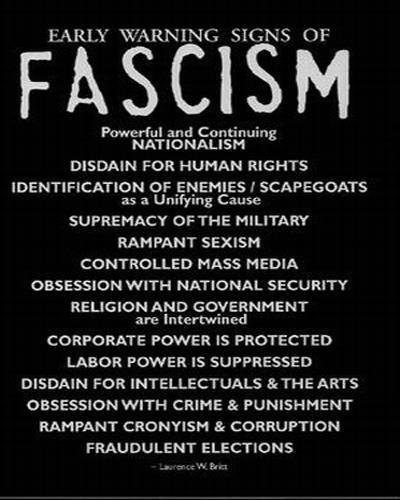
  • emits powerful and continuing expressions of nationalism through its politicians
  • has an obsession with national security while constantly invoking terrifying internal and external enemies
  • establishes a domestic and invasive surveillance system and develops a paramilitary force that is not answerable to the citizenry
  • and its various agencies (federal, state, and local) develop an obsession with crime and punishment (this is overcriminalization)
  • becomes increasingly centralized while aligning closely with corporate powers to control all aspects of the country’s social, economic, military, and governmental structures
  • uses militarism as a center point of its economic and taxing structure
  • and is increasingly imperialistic in order to maintain the military-industrial corporate forces.

Compare that to America today where, as economist Jeffrey Tucker rightly observes, “every industry is regulated. Every profession is classified and organized. Every good or service is taxed. Endless debt accumulation is preserved. Immense doesn’t begin to describe the bureaucracy. Military preparedness never stops, and war with some evil foreign foe, remains a daily prospect.”

Fascism thrives by hiding behind the entertainment spectacle that is partisan politics. As Tucker points out, “It’s incorrect to call fascism either right wing or left wing. It is both and neither . . . fascism does not seek to overthrow institutions like commercial establishments, family, religious centers, and civic traditions. It seeks to control them . . . it preserves most of what people hold dear but promises to improve economic, social, and cultural life through unifying their operations under government control.”

In this way, American-style fascism is deceptively appealing.

It appears friendly.

The news media covers the entertainment and political trivia. The basic forms of government remain intact. The legislators remain in session. There are elections.

Consent of the governed, however, no longer applies. Actual control has finally passed to the oligarchic elite controlling the government behind the scenes.

Yet the most crucial ingredient for fascism to succeed in America is that the majority of the people would have to agree that it’s not only expedient but necessary for the government to assume greater powers in order to keep them safe and secure, whether it’s by militarizing the police, stripping them of basic constitutional rights, criminalizing virtually every form of behavior, or spying on their communications, movements and transactions.

Sound familiar?

When you really drill down to what the various presidential candidates believe about the issues that will impact the future of our freedoms long-term—war, surveillance, civil liberties—you’ll find that most of them support the government’s position, which, conveniently enough, profits the corporate sector.

This is not freedom.

It is despotism, which Gross refers to as “faceless oligarchs [who] sit at command posts of a corporate-government complex that has been slowly evolving over many decades.” Gross explains:

In efforts to enlarge their own powers and privileges, they are willing to have others suffer the intended or unintended consequences of their institutional or personal greed. For Americans, these consequences include chronic inflation, recurring recession, open and hidden unemployment, the poisoning of air, water, soil and bodies, and, more important, the subversion of our constitution. More broadly, consequences include widespread intervention in international politics through economic manipulation, covert action, or military invasion . . .

It is, in Gross’ words, “pretended patriots who desecrate the American flag by waving it while waiving the law”:

I see at present members of the Establishment or people on its fringes who, in the name of Americanism, betray the interests of most Americans by fomenting militarism, applauding rat-race individualism, protecting undeserved privilege, or stirring up nationalistic and ethnic hatreds.

It is, concludes Gross, Big Business and Big Government in bed together:

In this present, many highly intelligent people look with but one eye and see only one part of the emerging Leviathan. From the right, we are warned against the danger of state capitalism or state socialism, in which Big Business is dominated by Big Government. From the left, we hear that the future danger (or present reality) is monopoly capitalism, with finance capitalists dominating the state. I am prepared to offer a cheer and a half for each view; together, they make enough sense for a full three cheers.Big Business and Big Government have been learning how to live in bed together and despite arguments between them, enjoy the cohabitation. Who may be on top at any particular moment is a minor matter—and in any case can be determined only by those with privileged access to a well-positioned keyhole.

When the votes have all been counted, “we the people” will be the losers.

The joke will be on us. Whether we ever realize it not, the enemy is not across party lines, as they would have us believe. It has us surrounded on all sides.

Even so, we’re not yet defeated.

We could still overcome our oppressors if we cared enough to join forces and launch a militant nonviolent revolution—a people’s revolution that starts locally and trickles upwards—but that will take some doing.

It will mean turning our backs on the political jousting contests taking place on the national stage and rejecting their appointed jesters as false prophets. It will mean not allowing ourselves to be corralled like cattle and branded with political labels that have no meaning anymore. It will mean recognizing that all the evils that surround us today—endless wars, drone strikes, invasive surveillance, militarized police, poverty, asset forfeiture schemes, overcriminalization, etc.—were not of our making but came about as a way to control and profit from us.

It will mean “voting with our feet” through sustained, mass civil disobedience. As journalist Chris Hedges points out, “There were once radicals in America, people who held fast to moral imperatives. They fought for the oppressed because it was right, not because it was easy or practical. They were willing to accept the state persecution that comes with open defiance. They had the courage of their convictions. They were not afraid.”

Ultimately, it will mean refusing to be divided, one against each other, as Democrats versus Republicans, and instead uniting behind the only distinction that has ever mattered: “we the people” against tyranny.


Constitutional attorney and author John W. Whitehead is founder and president of The Rutherford Institute. His new book “The Freedom Wars” (TRI Press) is available online at www.amazon.com. Whitehead can be contacted at johnw@rutherford.org. Information about The Rutherford Institute is available at www.rutherford.org.

 

3 Ways to Overcome the System and Start Your Own Revolution

F9uXOjIj4WQq6disjprvezl72eJkfbmt4t8yenImKBVvK0kTmF0xjctABnaLJIm9

By Gary ‘Z’ McGee

Source: ZenGardner.com

“How does it become a man to behave toward the American government today? I answer, that he cannot without disgrace be associated with it. I cannot for an instant recognize that political organization as my government which is the slave’s government also.” ~Henry David Thoreau

Here’s the thing: starting a revolution is a daunting task. Being a revolution, really living it, is still challenging, but it’s considerably less daunting. Raging against the machine has its place, and it can be fun as hell pissing in the Cocoa Puffs of the powers-that-be, but when it comes down to it, rebellious antics against the murderous man-machine are a flash in the pan compared to living the revolution day-in and day-out.

Don’t get me wrong, defending ourselves against machine-men with machine-hearts is a vital aspect of living the revolution, but it isn’t primary. What is primary is being the change we seek, and not allowing ourselves the easy path toward becoming machines ourselves. Whether it’s downsizing our carbon footprint or rebuilding our community blueprint, living the revolution is less about directly fighting the system and more about building a healthier one. Like Buckminster Fuller advised, “You never change things by fighting the existing reality. To change something, build a new model that makes the existing model obsolete.”

Which I only half agree with. Truly living the revolution is doing both: fighting the existing system while also building a new one. With this in mind, the following three tactics are primary actions we all must take in order to overcome the unhealthy, unsustainable, and violent man-machine of the all-too-cliché Matrix.

1. Overcome the Appropriation of Your Freedom

“To put it still more plainly: the desire for security and the feeling of insecurity are the same thing. To hold your breath is to lose your breath. A society based on the quest for security is nothing but a breath-retention contest in which everyone is as taut as a drum and as purple as a beet.” ~Alan Watts

Don’t give into the hype of state-driven human governance. The hype is diabolically hyperreal, an abstraction of an abstraction, and it’s preventing you from being authentically free. Stop drinking the Kool-Aid the system has been trying to pour down your throat your entire life. Flip over the punchbowl instead. It’s distracting you from the following three truths: everything is connected; you are the world and the world is you; and you are independent because you are interdependent upon a healthy environment. Otherwise your independence is nothing more than a tool of your ego and your ego is nothing more than a pawn for the unhealthy system.

Overcoming the appropriation of your freedom is first realizing that everything is connected. The system doesn’t want you to understand this, because then the jig is up. The system wants you to believe that you need it in order to survive. But all you actually need is food, water, shelter, and healthy human companionship in a clean environment. As it stands, the system locks up your food, it unsustainably bottles your water, it brainwashes you into believing that’s all okay, while devastating entire ecosystems behind the scenes and calling it “progress.” Exactly the opposite of what we need as a healthy species.

If, as Albert Camus said, “In order to understand the world, one has to turn away from it on occasion,” then it behooves us to turn away from the Matrix and face the Desert of the Real so that we can get the horse of progressive, sustainable evolution back in front of the cart of outdated, unsustainable “progress.” In order to understand the world as it really is, we must be able to turn away from anyone or any system that undermines the health of the world as an interconnected organism. It begins by looking into the mirror and changing your worldview from “you versus the world” to “you are the world.”

2. Overcome the Hijacking of Your Imagination

“The best use of imagination is creativity. The worst use of imagination is anxiety.” ~Deepak Chopra

Choose acceptance over anxiety. Use your imagination to flip the script. There’s more ways to be in this world than the way you’ve been spoon-fed into believing. Understand that the system is designed to keep you indebted to it, then turn the tables by realizing that debt is ultimately an illusion, a cartoon in your head, a hyperreal abstraction that has your brain tied up in knots. Accept that you’ve been swallowing the blue pill of deceit your entire life, and then have the courage to swallow the red pill of truth instead.

As Chuck Palanuik warns, “Big Brother is making sure your imagination withers. Until it’s as useful as your appendix. He’s making sure your attention is always filled. With the system always filling you, no one has to worry about what’s in your mind. With everyone’s imagination atrophied, no one will ever be a threat to the system.”

As it stands, inside the system, you’ve been tranquilized by the trivial. Your creativity has been syphoned into mindless jobs and fed back to you as colorful placation. Devoid of imagination, you live in a sea of hyper-realities that have dulled your senses to what it truly means to be free. Break the cycle. Don’t allow the conquer-control-consume-destroy-repeat, knee-jerk reaction of culture to destroy your imagination. Don’t allow your life to be turned into a commodity. Be creative despite the crippling status anxiety of the system.

Take back the airplane of your imagination. You are the pilot, not them. So the system hijacked your imagination? Hijack it right back. The only “war” you need to worry about is going on in your head. As Diane Di Prima said, “The only war that matters is the war against imagination. All other wars are subsumed by it.” Indeed, seek that sacred space where imagination reimagines itself.

3. Overcome the Suppressing of Your Spirituality

“Which is more likely — that the whole natural order is to be suspended, or that a Jewish minx should tell a lie?” ~David Hume

You have to choke on the finite God that’s been shoved down your throat before you can digest the infinite God that wakes you up. The finite God is religion. The infinite God is spirituality. The suppression of our spirituality by both the church and the state is a tough one to overcome. After all, it is human nature to cling to beliefs, no matter how absurd. But overcome it we must if we are to evolve as a healthy species, let alone to thrive despite the unhealthy system surrounding us.
Religion is rigid, dogmatic, and divisive, and when taken too seriously, it’s violent. Spirituality is flexible, open-minded, harmonious, holistic, and antithetical to violence. Religion is based upon politics and belief. Spirituality is based upon mystery and awe. Spirituality is everything religion claims to be, but isn’t. Religion assumes. Spirituality subsumes. The system (church and state) wants you to assume that it has your best interest at heart, when really it relies upon you being ignorant and apathetic. Spirituality is antithetical to the system precisely because it encourages awareness and empathy. Spirituality attempts to rejuvenate sacred and moral traditions that have disintegrated because of the divisiveness of the church and state; a divisiveness that has caused worldwide disorientation and dissociation.

At the end of the day, being the revolution isn’t a fad, it’s a lifestyle. This isn’t a diet that you go on for a week and then go back to your old, rigid, destructive, consumerist ways devoid of any deep, spiritual meaning. No. This is a life-link. This is interdependent freedom. This is reimagining imagination. This is reconnecting the spiritual disconnect between nature and the human soul. It will be the brave and audacious minority –who dare to live the revolution despite the cow-eyed majority that are codependent on an unhealthy system –who will change the world.

As Henri Bergson profoundly articulated:

“Fortunately, some are born with spiritual immune systems that sooner or later give rejection to the illusory worldview grafted upon them from birth through social conditioning. They begin sensing that something is amiss, and start looking for answers. Inner knowledge and anomalous outer experiences show them a side of reality others are oblivious to, and so begins their journey of awakening. Each step of the journey is made by following the heart instead of following the crowd and by choosing knowledge over the veils of ignorance.”


About the Author

Gary ‘Z’ McGee, a former Navy Intelligence Specialist turned philosopher, is the author of Birthday Suit of God and The Looking Glass Man. His works are inspired by the great philosophers of the ages and his wide awake view of the modern world.

This article (3 Ways to Overcome the System and Start Your Own Revolution) was originally created and published by Waking Times and is printed here under a Creative Commons license with attribution to Gary ‘Z’ McGee and WakingTimes.com. It may be re-posted freely with proper attribution, author bio, and this statement of copyright.

Saturday Matinee: Crash! (1971)

Crash_Spain_525

From Open Culture:

The Very First Film of J.G. Ballard’s Crash, Starring Ballard Himself (1971)

The Collins English Dictionary defines “Ballardian” as “resembling or suggestive of the conditions described in J. G. Ballard’s novels and stories, especially dystopian modernity, bleak man-made landscapes and the psychological effects of technological, social or environmental developments.” You’ll find no more distilled dose of the Ballardian than in Ballard’s book The Atrocity Exhibition, a 1969 experimental novel, or collection of fragments, or what’s been called a collection of “condensed novels.” Subject to an obscenity trial in the United States and the subsequent pulping of nearly a whole print run, the book has earned a permanent place in the canon of controversial literature. Its twelfth chapter, “Crash!”, even provided the seed for a Ballard novel to come: 1973’s Crash, a story of symphorophilia which David Cronenberg adapted into a film 23 years later. The movie, in its turn, stoked a furor in the United Kingdom, culminating in a Daily Mail campaign to ban it. But as far as filming material born of Ballard’s fascination with the intersection of auto wrecks and sexuality, Cronenberg didn’t get there first.

Susan Emerling and Zoe Beloff drew from Crash the novel to make the still-unreleased Nightmare Angel in 1986, but fifteen years before that, Harley Cokeliss turned “Crash!” the chapter into Crash! the short film (also known as The Atrocity Exhibition). Casting Ballard himself in the starring role and Gabrielle Drake (sister of singer-songwriter Nick Drake) opposite, Cokeliss crafts a vision almost oppressively of the seventies: the protagonist’s wide, striped shirt collar dominates his even wider jacket collar below the grim visage he wears while ensconsed in the suit of armor that is his hulking American vehicle. “I think the key image of the twentieth century is the man in the motor car,” Ballard says in voiceover. “Have we reached a point now in the seventies where we only make sense in terms of these huge technological systems? I think so myself, and that it is the vital job of the writer to try to analyze and understand the huge significance of this metallized dream.” If this Ballardian vision resonates with you, see also Simon Sellars’ thorough essay on the film at fan site Ballardian.

The Media and the Corporate State

THINK_for_yourself_Question_Everything_Anonymous_raising_awareness__113654

By Kevin Carson

Source: Center for a Stateless Society

In an interview with Cenk Uygur March 23, Bernie Sanders noted, “The media is an arm of the ruling class of this country,” going on to point out its concentrated corporate ownership (for example, Disney’s ownership of ABC, Comcast’s of NBC, etc). This corporate media has a vested interest in not covering real news in a way that examines the root causes of problems. Such coverage might lead to radical threats to the power structure. Of course he’s quite right. And it’s not a situation that came about by accident; the state played a central role in bringing it about.

The mainstream media — network news shows, cable news networks, major newspapers and wire services — is part of an interlocking set of governing institutions that also includes government agencies, large corporations, and universities, think tanks and charitable foundations. These institutions share a common organizational style — top-down hierarchies and enormous managerial bureaucracies, Weberian rules, million-dollar executives — and tend to shuffle their personnel back and forth from one such institution to the other.

This whole interlocking complex of institutions goes back to the rise of such institutions in the late 19th century as the dominant organizational form — a top-down transformation of the American economy and society that the state and the plutocratic interests controlling it imposed on the country.

From the beginning of radio, the state’s regulatory approach fostered a cartelized system of nationwide media networks. The FCC licensing system permitted a limited number of radio stations compared to what the spectrum permitted. Had the full spectrum been opened up on a first-come first-served basis, with something like the common law of riparian rights preventing new stations from broadcasting on frequencies that might disrupt broadcasts of existing stations, there would have been many more stations. And had the spectrum been open to all homesteaders, there would have been a variety of participants including amateurs and hobbyists, and community and labor groups. For that matter the FCC itself might have awarded its licenses to such a variety of groups; but instead it awarded them almost entirely to commercial interests. And given a limited number of salable licenses, they inevitably appreciated in value just like taxicab medallions, so that only plutocratic interests could afford them.

But before the mass broadcast media ever came into existence, there was already a nationwide advertising market in place fostered by the corporate centralization of the economy, and a complex of corporate and government institutions to influence the content of media.

The existence of a nationwide advertising market, coupled with “intellectual property” in content and rebroadcast rights, further reinforced the concentration of broadcast media into nationwide networks.

And the pre-existence of an interlocking system of corporate, state and civil society institutions into which the media could be assimilated, created the systemic pressures and filters behind what Noam Chomsky and Edward Herman called the media’s “Propaganda Model.” This doesn’t just mean the cruder forms of influence like direct advertiser vetoes of stories, or even editorial fear of offending advertisers — although that obviously plays a real part in filtering content. More important is the common class background and affinity, and common social ties of those in charge of the media and governing institutions, and the symbiotic organizational structures of the institutions themselves.

Network executives, talk show hosts, and newspaper publishers and editors travel in the same social circle as the powerful state and corporate figures whom they’re theoretically supposed to serve as watchdogs over. So you have “responsible” and “patriotic” news organizations refusing to report on government war crimes, and people like publisher Katherine Graham of the Washington Post telling an appreciative audience of CIA spooks that “there are some things the public doesn’t need to know.”

You have a “professional” journalistic culture, since Walter Lippmann’s time, dominated by the same managerial ethos as other governing institutions, seeing their job as simply reporting “objectively” what “both sides” say without regard to facts. And given the limited (and dwindling) resources for actual reporting, you have the majority of TV news anchor scripts and newspaper column inches taken up either by quotes from public figures or the output of public spokespersons and corporate and state PR departments. You have wire service correspondents in countries where the U.S. is backing local death squads or military coups, sitting in hotel rooms writing their copy directly from U.S. embassy handouts.

The cumulative effect of all these filters, without much central direction, is a sort of “invisible hand” mechanism with exactly the result Chomsky and Herman described:  a corporate media that reports news from the perspective of the state and the corporations in control of it almost the same as if they were officially censoring it.

So Sanders is right: the media is an arm of the ruling class — and the state is at the heart of it.