

FILE – In this Monday, Aug. 15, 2011 file photo, children from southern Somalia hold their pots as they line up to receive cooked food in Mogadishu, Somalia. A report by two U.S. government-funded famine and food agencies gives the highest death toll yet, estimating that 260,000 people died – more than double previous estimates. (AP Photo/Farah Abdi Warsameh, File)
By
Source: Business Connect
From the beginning of time, their have been food crises in one form or another. Ancient books such as the Bible have records of various famines devastating portions of the world.
And while it’s easy to attribute these crises to a single cause, such as war or drought, the causes are usually much deeper and much more complex.
Nelson Mandela said, “Overcoming poverty is not an act of charity, it is an act of justice.”
In order for us to achieve the kind of justice envisioned by Mandela, it’s essential that we first understand the underlying causes of food crises. Only after we have understood can we then begin creating meaningful solutions.
With that in mind, here are 8 primary factors behind almost every global food crisis. While not all 8 of these will be present at a time, you will almost always find several of these at work.
One of the greatest factors in every food crisis is stark and abject poverty. This isn’t surprising. With enough money, anyone can ensure they have enough food. But with many developing nations sitting well below the poverty line, the population simply can’t afford the food they so desperately need.
Additionally, poverty has a distinct effect on food output. In Africa, for example, many farmers can’t afford proper irrigation and fertilizer. This, in turn, leads to lower yields, which then reduces the overall amount of food available to the population.
The population of the Sub-Saharan region of Africa is expected to grow at an astronomical rate, topping out at 2.4 billion by 2050. This will continue to exacerbate the poverty issue, which will then continue to drive the lack of sufficient food in the area.
Widespread droughts, leading to the desertification of particular locations also causes huge disruptions to food production. For example, leading up to and during the global food crisis of 2008, 110 countries experienced significant droughts. This caused even the most well-irrigated, fertile areas to become arid deserts, making it impossible to grow crops.
Australia is normally the second largest exporter of grain, after the U.S. The continent, though, is experiencing an ongoing drought that has been described as the worst in a century. Grain yields have shrunk and many silos remain empty. Australia’s drought is a major factor in global wheat stocks being at their lowest since 1979. In fact, many wheat and rice farmers are switching to crops that demand less water, such as wine grapes.
Additionally, farmers often let animals over-graze on their land, reducing the amount of vegetation and increasing desertification. If the soil becomes dry enough, it is ruined and unable to support any crops at all.
Finally, as populations grow, deforestation occurs at an increased rate, which then leads to less vegetation and more desertification.
In the past, the International Monetary Fund has pressured small farmers, particularly in impoverished African countries, to abandon agricultural farming in favor of industrial work. The money generated from this practice would be used to pay off debt and import food.
While it may sound like a working strategy, it has created catastrophic results.
The urban population increased seven-fold, swelling from 18% to 33% of the population. Millions of poor and unemployed workers have swelled the cities—with two-thirds of them living in slums. The manufacturing and industrial sector did not “take off” in African countries; the percent of the GDP coming from industry was 30% in 1961 and 32% in 2000. In the countryside, as plantations for agro-exports expanded, food production plummeted and poverty grew. Though the rural population, density increased by 180% as more farmers were crowded onto smaller plots.
Many countries have begun adopting a more Western diet, which includes eating significantly more meat and dairy. To make this happen, farmers have been forced to raise more cattle, and more cattle means more grain being consumed.
The problem, however, is that this causes a significant deficiency in terms of calories consumed versus calories available. A cow consumes approximately 700 calories worth of grain to produce a piece of meat containing only 100 calories. When this happens on a massive scale, an enormous shortage of food is the end result. The longer this deficit continues, the greater the imbalance will become.
When the price of oil goes up, the energy cost for planting and transporting foods goes through the roof. When food costs more to grow, it then costs more to sell. These rising costs then make it more difficult for the local population to purchase crops as well as for farmers to export their crops to industrialized nations.
Additionally, increased oil costs has led many countries to invest heavily in the development of agro-fuels. More agro-fuels always means less food available.
As Esther Vivas helpfully puts it:
The increase in the price of oil, which doubled in 2007 and 2008 and caused a big rise in the price of fertilizers and transport related to the food system, has resulted in increasing investment in the production of alternative fuels such as those of plant origin. Governments in the United States, the European Union, Brazil and others have subsidized production of agro-fuels in response to the scarcity of oil and global warming. But this green fuel production comes into direct competition with the production of food. To give just one example, in 2007 in the United States 20% of the total cereal harvest was used to produce ethanol and it is calculated in the next decade that this figure will reach 33%. We can imagine the situation in the countries of the South.
At the peak of the 2007-2008 food crisis, food aid was at it’s lowest point since 1961. This is one of the oddities about the national food market. When cereal prices are low, countries look to sell their food through international aid. However, when food prices are high, they prefer to sell them on the open market for increased profits.
In other words, during food crises, when food is scarcest and at it’s highest prices, it isn’t available for international aid. When the bottom falls out of world aid, food crises grow in magnitude.
International conflicts are a particularly visible factor behind many food crises. During conflicts, it’s common for one country to restrict exports to another country, which then reduces the amount of food available to the general population.
Or, even worse, dictators will intentionally isolate their countries, refusing foreign aid that is desperately needed. Aid workers may be blocked from entering the country, making it difficult for the citizens to receive needed help. If foreign aid does come, they seize it for themselves, depriving the population of desperately needed sustenance.
If a country experiences a particularly violent outbreak of a disease, it can completely disrupt the overall food supply. For example, the HIV/AIDS crisis in Africa has killed farmers, which in turn pushes families deep into poverty.
When a population is undernourished, drugs become less effective and can at times create intense hunger pains. These two factors combined create a vicious cycle of death, poverty, and hunger.
Additionally, certain highly contagious diseases can restrict the amount of aid available to a country. For example, during the 2014 Ebola epidemic in West Africa, aid workers were restricted from traveling to the region due to fear of spreading the disease.
Most food crises aren’t the result of a single factor. Rather, they are caused by a perfect storm of events that coalesce into a deadly storm.
For example, in 2011, Somalia was devastated by a drought that caused widespread crop failure. The food crisis was made even worse by a non-functioning government as well as a national conflict. All these forces combined to make it difficult for aid workers to reach those who so desperately needed help.
The result was that approximately 260,000 people died.
Because the problems are almost always complex and multi-layered, the solutions must be equally multi-faceted. Simple solutions typically exacerbate the problem at the expense of the local population.
The best solutions are those that involve numerous parties working together to create a tangible, workable solution.
There will always be food crises to one degree or another. But as we grow in our understanding of what causes them, we can also grow in our ability to bring them to an end.

By Andrew Korybko
Source: Sputnik International
Morgan Freeman’s latest publicly stunt permanently stained his legacy after the famous actor decided to join the fake news industry by passing off a blockbuster script as a true story.
Morgan Freeman declared in his latest two-minute video that “We have been attacked. We are at war”, but he’s wrong in saying that Americans have been victimized by Russia, but should have rather told the truth that they’re under attack by their own government. To channel Freeman, “Imagine this movie script”, albeit modified to reflect real-life events instead of conspiratorial ones:
A globalist power cabal made up of the permanent military, intelligence, and diplomatic bureaucracies (the “deep state”), in conjunction with the Democratic Party, “Cultural Marxist” professors, the Mainstream Media, and Hollywood have attacked American democracy using non-stop infowar operations against their own fellow citizens to spread propaganda and false information aimed at convincing people that the Republican candidate and future President of the United States is really a Russian puppet.
A few years ago this might have sounded just as ridiculous as the narrative that Freeman read off in front of the cameras, but the difference is that this actually happened whereas his story still remains the realm of fiction. The conspiracy theory that Russia somehow swayed the 2016 election has no basis in reality, and it’s very condescending to the millions of average Americans in the Midwest who swayed the election for Trump to even infer that these patriotic citizens were under the influence of a foreign intelligence operation at the time.
Midwesterners didn’t tip the election for Trump because President Putin, the FSB, RT, or Sputnik told them to — which they didn’t — but because they had enough of the old order of business in the US and were desperately craving a change, any change, to improve the all-around deteriorating conditions that have come to define their lives. Trump promised law and order, jobs and strong borders, and a no-nonsense approach to American domestic politics, the complete opposite of Hillary’s platform and exactly what Midwesterners wanted to hear.
Even without the DNC leaks, many of those folks would never have countenanced voting for Hillary due to her husband’s toxic legacy and that of his party. Moreover, these voters didn’t need proof of Hillary and the Democrats’ corruption because they had suspected it all along, though the amplification of their crimes by the global media vindicated them for what The Establishment had falsely claimed for years was just another tinfoil hat “conspiracy theory”.
Now about actual conspiracy facts, many people could never have thought that their own government would turn against them and attack America’s sacred political system, its electoral democracy, through the incessant demonization of Donald Trump and the plethora of fake news that they disseminated about him. When Trump claimed that his campaign was under surveillance by the Obama Administration, he was dismissed as a crackpot, but it’s since emerged just the other day that former National Security Advisor Susan Rice did in fact authorize the spying of Trump’s former campaign manager Paul Manafort.
On top of that, the never-ending assertions that Trump is in cahoots with the Russian government or somehow under the nefarious influence of shadowy Kremlin agents are regularly debunked by listening to the President and his Administration constantly talk about “Russian aggression” and watching them use this pretext to make hostile moves against Moscow. These actions strongly refute the claims of a secret Trump-Russian connection and most Americans understand that, but the “deep state” and their cohorts in the “Cultural Marxist” corners of academia, the Mainstream Media, Hollywood, and the masked mob of “Antifa” rioters believe that the population is just too stupid to see this and could therefore be easily misled into believing their fake news narrative that Putin’s proxy is in control of the White House.
The whole point behind this massive infowar operation against the minds of the American public is to delegitimize Trump’s election in a last-ditch bid to give the Democrats a chance to win back Congress during next year’s midterm elections. It’s also designed to influence the President’s domestic and foreign policy decision making, and it actually has succeeded to a degree in that respect if one holds the view that Trump truly believed what he said on the campaign trail but was later pressured by the “deep state” to take a decidedly neo-conservative stance towards International Affairs after he entered into office. Regardless, what’s important to focus on in this context are the American people themselves, who largely dismiss the conspiratorial, never-proven, and constantly debunked accusations that Morgan Freeman shamelessly told the American public with a straight face.
There’s a popular saying that one shouldn’t “shoot the messenger”, but that doesn’t mean that the said messenger is above criticism. Morgan Freeman is a beloved household name who’s universally praised for his excellent acting skills and the unforgettable memories that he’s imbued his audiences with, but politics isn’t his element, and no matter how much the “Committee to Investigate Russia’ pleads that it’s “non-partisan”, former National Intelligence Director James Clapper’s open involvement in the project proves that it’s linked to the same anti-Trump “deep state” that’s been undermining American democracy for over the past two years. Morgan Freeman should have known better than to lend his acting talent to pretending that a movie script is a real-life story, and that’s why so many people are disappointed in him on a deep, personal level.
The irony of it all is that Morgan Freeman could have actually done a lot of good if he had the courage to say the truth. Instead of imploring Trump to sit down in front of the American people, elaborate on Hillary’s “Russia Did It!” conspiracy theory, and then “legitimize” it through a full-blown nationwide anti-Russian witch hunt stretching from the Office of the Presidency all the way down to the paupers in the inner city, he himself could have sat down in front of the American people just as he did in his two-minute psy-op video and calmly explain the actual real-life “deep state” conspiracy against Trump and the American people. He didn’t do that, so there’s no use in speculating about “coulda, shoulda, woulda”, but for the sake of cracking a smile and thinking about what might have been, it sure would have been powerful if he channeled his blockbuster script but adapted it to actual events by saying:
“My fellow Americans, during this past election, we came under attack by our own government. I’ve called on the patriotic members of Congress and our intelligence community to use every resource available to conduct a thorough investigation to determine exactly how this happened. Our citizens are demanding accountability. For 241 years our democracy has been imperfect but nevertheless something to aspire to, and we owe it to the brave people who have fought and died to protect this great nation and save democracy. And we owe it to our future generations to continue the fight.”
But then again, Hollywood by its very nature is fake and deceptive, so it might be too much to ever hope for an American movie icon to stand up and say those brave words that were imagined above, though that doesn’t mean that they wouldn’t have resonated with tens of millions of dyed-in-the-wool patriotic Americans who are sick and tired of the “deep state’s” manipulative mind games.

By Brandon Smith
Source: Alt-Market
Is it true that freedom is an overly idealized concept? Perhaps, but it is one of the few concepts worthy of idealization. It is so worthy, that it is worth dying for.
Since the dawn of recorded history human beings have fought and sacrificed to attain freedom. It is an inherent psychological construct. It is a principle that is rooted not only in the mind of man, but his spirit or soul. Scientists in the realm of the mind have struggled for generations to understand where it comes from — others have sought to dismiss it as a fanciful notion or societal construct. Nihilists claim it doesn’t really exist, while other people center their entire lives on the proliferation of it. The concept of freedom, love it or hate it, is central to all cultures and all civilizations. The most common dismissal of the idea of freedom that I have seen is the argument that none of us is really free because “tyranny exists”. Tyranny is a constant, therefore, in the view of the nihilists, freedom cannot exist. I believe this dim way of thinking stems from a misconception of what freedom is and where it comes from.
Freedom, first and foremost, begins in the mind, or the heart; whatever you are inclined to put more stock in. To think critically or to imagine wildly is indeed to be free. Tyranny, by extension, rises from the mire and muck in the physical world around us and ends in the mind and the heart. If one is free of mind, then one is never truly enslaved.
I have heard so many times the ignorant accusation that freedom requires action before consequence. That is to say, if you have suffered the consequences of a tyrannical system, then you have already failed to prevent your own enslavement. This is not how freedom functions. It has never worked this way.
There is no such thing as a world without the consequences of tyranny. Tyrants are everywhere, always. There are little tyrants in our everyday lives, and big tyrants that pull strings from behind the curtains and from the darker places. There are people reading this article right now that think they are liberty-minded, but act like tyrants towards those around them. There are people who think they are slaves when one simple choice or action could easily make them free. There are people who see private property as tyranny and seek to supplant it….with an even greater tyranny of entitlement and socialism. And, there are people who think freedom means freedom for them, but not for others. Each tyrant takes time to understand and remove from our lives. Some we simply need to walk away from; others need to be destroyed.
The point is, we are forever dealing with tyranny, and many of us are forever working to topple it. As long as we are able to pursue that goal, we are still free. The true slaves are those that have given up completely out of laziness or fear. Tyranny is always present, after all; why take a bath today when you are just going to end up soiled again tomorrow?
The idea that one can do nothing in the face of the machine is an old idea proven wrong time and time again, yet, it is also a very easy and comfortable lie to live in. Struggle is difficult. Sacrifice is foreboding and ugly. There are a million-and-one excuses and rationalizations as to why it is better to “accept fate” or circumstances. There is always another excuse that can be used to paper over cowardice.
Tyrants can, in fact, win and keep winning for the length of an epoch, exactly because of the logical fallacy that they cannot be resisted or be beaten. It is the self-fulfilling prophecy of nihilism that makes tyranny possible. Without it, tyrants inevitably fail and fall.
The great monster of our time that must be slayed is the monster of organized conspiracy. Past generations have confronted and defeated appendages of this monster, but they never beheaded it, and this is why our particular brand of tyranny persists. It is not enough for us to fight the tentacles of the beast anymore — it is the job of the freedom fighters of our era to stab at the brains of the wretched thing.
I am of course speaking of the banking cabal, the cult of financiers and elites that make up the globalist hierarchy. They pervade the halls of numerous institutions and think tanks, from the Federal Reserve and the Council on Foreign Relations to the International Monetary Fund and the Bank for International Settlements. They sit in positions of great political influence and hold council (and some would say considerable sway) over world leaders. They write “theoretical” policies which are quickly adopted by governments and made into law. They are primary stockholders and owners of our mainstream media. Their slithering fingers are wrapped around academia and many scientific communities. They insinuate themselves into every foundation of thought, because thought is what they most wish to control.
They prefer to divide and conquer, to pit one group against another, or to give their ideological enemies enough rope to hang themselves with. If they can’t rule the psyche of a society or succeed in 4th generation warfare, they will fall back to the old standard of brute force. In fact, they might just do that anyway, because what tyrant doesn’t love instilling abject terror every once in a while?
And yet, these “elites” stand on a razor’s edge. Despite all their supposed power, despite all their wealth, despite the vast spiderwebs they weave, all of it can be turned to ash in an instant and they know it. Empires like this rely on anonymity, and they are anonymous no longer. The cabal is out in the open; they have to be.
To shift the world into true globalism and true centralization requires actions which can be masked from some people but not all people. They believe the intricate digital networks they have funded will buy them total information awareness, but these same networks also provide us with the tools to understand who they are and what they want. This double-edged sword of full spectrum data creates a Catch-22 timeline. The longer the globalists wait to implement the one world system they desire, the more time we have to educate millions of people. The faster they implement their one-world system, the more likely they are to make a mistake.
Time is running out. Time is working against them. Time is the master here, and the globalists are nothing but paper boats on a tidal wave.
This organized conspiracy increases its odds of success through psychological manipulation. There will come a time, perhaps sooner rather than later, when banking elites and their political allies can no longer stand outside the game unscathed. Risk is coming. So, they must encourage as much self-defeat in the minds of freedom champions as possible.
They will conjure crisis and catastrophe, they will conjure puppet enemy after puppet enemy, they will exploit useful idiots with collectivist views as cannon fodder, they will engineer conflicts between East and West. They will try to grind us down and break the legs of our resolve.
However, as long as there are people who know who the globalists are that are willing to hunt them down, the globalists cannot win. For what they desperately want is to stand out in the sun with criminal impunity, and without fear. They want to be untouchable. They want to be gods.
Real gods do not suffer consequences, and these people will suffer consequences.
The nihilists will cry, “When?! How?! Never!” But this is the nature of freedom. Freedom is in the fighting; winning is transitory. Tyranny can be subtle and it can be blunt, freedom is the same way. If you think because there is no shooting going on yet that a war is not happening, then you do not understand the nature of warfare.
Yes, it is possible that the fall of one globalist cabal might give rise to another, and another. But we are free to be there and to fight again. As long as we fight, we prevail. When we abandon the fight completely, that is when true slavery begins. Today, we fight using information versus propaganda, and we must be adept at this. We also must be adept at other forms of combat as the conflict escalates.
There will never be total absence of tyranny. The naysayers against the principle of freedom are delusional, or maybe they know such a standard is unattainable and this will make them forever “right.” When will the fight begin? It already has. It has been going on since time immemorial and we are merely here to continue it. This might seem like a task for Sisyphus – an endless circular nightmare. I look at it another way: We are a changing of the guard. We have inherited a responsibility beyond all responsibilities. In this age, we are the freedom fighters, and if we fail now then we pass an even more difficult horror on to some other generation down the line.
In my view this is unacceptable. The opportunity to end one longstanding tyranny is now. We must counter using information as long as is needed, and we must wake up as many people as possible, so when the time comes to storm the castle, the shared sacrifice is that much easier to bear. If you have taken up this fight in one form or another never let anyone tell you you are not free. Your ability to think and to act is concrete proof otherwise.

Source: Open Culture
On May 27, 1956, millions of Americans tuned in to The Ed Sullivan Show, expecting the usual variety of comedians, talents and musical guests. What they weren’t prepared for was a short animated film that Sullivan introduced thusly:
Just last week you read about the H-bomb being dropped. Now two great English writers, two very imaginative writers — I’m gonna tell you if you have youngsters in the living room tell them not to be alarmed at this ‘cause it’s a fantasy, the whole thing is animated — but two English writers, Joan and Peter Foldes, wrote a thing which they called “A Short Vision” in which they wondered what might happen to the animal population of the world if an H-bomb were dropped. It’s produced by George K. Arthur and I’d like you to see it. It is grim, but I think we can all stand it to realize that in war there is no winner.
And with that, he screened the horrific bit of animation you can watch above. At the height of the atomic age, this film was a short sharp shock. Its vision of a nuclear holocaust is told in the style of a fable or storybook, with both animals and humans witnessing their last moments on earth, and ending with the extinguishing of a tiny flame. The mostly static art work is all the more effective when faces melt into skulls.
Many children didn’t leave the room of course, and the website Conelrad has a wonderful in-depth history of that night and collected memories from people who were traumatized by the short as a child. One child’s hair–or rather a small section of his hair–turned white from fright.
It was as formative a moment as The Day After would be to children of the ‘80s. The papers the next day reported on the short in salacious detail (“Shock Wave From A-Bomb Film Rocks Nation’s TV Audience”) and Sullivan not only defended his decision, but showed the film again on June 10.
The film was created by married couple Peter and Joan Foldes, and shot for little money in their kitchen on a makeshift animation table. Peter was a Hungarian immigrant who had studied at the Slade School of Art and the Courtlaud Institute and apprenticed with John Halas where he learned animation.
(Halas is best known for the animated feature version of Orwell’s Animal Farm.)
A Short Vision would go on in September of that year to win best experimental film at the 17th Venice Film Festival. (Peter Foldes would later make another disturbing and award-winning short called Hunger.)
Once so shocking, A Short Vision fell out of circulation. But a generation grew up remembering that they had seen something horrific on television that night (in black and white, not the color version above.) For a time, it was hard to find a mention of the film on IMDB and a damaged educational print was one of the few copies circulating around. Fortunately the British Film Institute has made a pristine copy available of this important Cold War document.

By William Astore and TomDispatch
Source: TomDispatch.com
After 19 al-Qaeda militants armed only with box-cutters and knives hijacked four American commercial airliners, the U.S. military moved with remarkable efficiency to rectify the problem. In the years since, in its global war on terror, the Pentagon has ensured that America’s enemies in Afghanistan, Iraq, Syria, and elsewhere have regularly been able to arm themselves with… well, not to beat around the bush, a remarkable range of U.S. weaponry. The latest such story: a report that in recent fighting around the city of Tal Afar, the Iraqi military recovered a U.S.-produced FGM-148 Javelin anti-tank missile and launcher from an Islamic State weapons cache. That’s a weapon capable of taking out an M1 Abrams tank. And this is hardly the first time U.S. anti-tank missiles meant either for the Iraqi military or Syrian rebels backed by the CIA have turned up in the hands of ISIS militants. In 2015, that group released photos of its fighters using U.S.-made BGM-71 TOW anti-tank missiles.
Of course, when the American-trained, funded, and armed Iraqi army collapsed in the summer of 2014 in the face of relatively small numbers of ISIS fighters, that group took vast stores of U.S. weaponry and vehicles that they’ve used ever since. But that was hardly the end of it. The U.S. soon began retraining and rearming its Iraqi allies to the tune of $1.6 billion for “tens of thousands of assault rifles, hundreds of armored vehicles, hundreds of mortar rounds, nearly 200 sniper rifles, and other gear,” much of which, a government audit found, the Pentagon simply lost track of. The weaponry, you might say, went missing in action. No one knew whose hands much of it ended up in and this wasn’t a new story, either. For example, in 2007 the Government Accountability Office found that “the United States could not account for nearly 30% of the weapons it had distributed in Iraq since 2004 — about 200,000 guns.”
Similar stories could be told about Afghanistan, another country where U.S. weaponry has disappeared in remarkable quantities. (The Taliban, for instance, recently released a video of their fighters sporting weaponry normally used only by U.S. Special Operations personnel.) In short, the Pentagon has been arming itself, its allies, and its enemies in a profligate fashion for years now in its never-ending conflicts across the Greater Middle East and Africa. As TomDispatch regular and retired Air Force Lieutenant Colonel William Astore suggests today, since 9/11 the U.S. military has in some sense been fighting itself — and losing. Someday, when historians look back on this bizarre tale, they will have to explain one thing above all: Why, year after year, in the face of obvious and repetitive failure in such conflicts, was no one in Washington capable of imagining another course of action? Tom
Out Everywhere and Winning Nowhere
By William Astore
When it comes to the “world’s greatest military,” the news has been shocking. Two fast U.S. Navy ships colliding with slow-moving commercial vessels with tragic loss of life. An Air Force that has been in the air continuously for years and yet doesn’t have enough pilots to fly its combat jets. Ground troops who find themselves fighting “rebels” in Syria previously armed and trained by the CIA. Already overstretched Special Operations forces facing growing demands as their rates of mental distress and suicide rise. Proxy armies in Iraq and Afghanistan that are unreliable, often delivering American-provided weaponry to black markets and into the hands of various enemies. All of this and more coming at a time when defense spending is once again soaring and the national security state is awash in funds to the tune of nearly a trillion dollars a year.
What gives? Why are highly maneuverable and sophisticated naval ships colliding with lumbering cargo vessels? Why is an Air Force that exists to fly and fight short 1,200 pilots? Why are U.S. Special Operations forces deployed everywhere and winning nowhere? Why, in short, is the U.S. military fighting itself — and losing?
It’s the Ops Tempo, Stupid
After 16 years of a never-ending, ever-spreading global war on terror, alarms are going off in Asia from the Koreas and Afghanistan to the Philippines, while across the Greater Middle East and Africa the globe’s “last superpower” is in a never-ending set of conflicts with a range of minor enemies few can even keep straight. As a result, America’s can-do military, committed piecemeal to a bewildering array of missions, has increasingly become a can’t-do one.
Too few ships are being deployed for too long. Too few pilots are being worn out by incessant patrols and mushrooming drone and bombing missions. Special Operations forces (the “commandos of everywhere,” as Nick Turse calls them) are being deployed to far too many countries — more than two-thirds of the nations on the planet already this year — and are involved in conflicts that hold little promise of ending on terms favorable to Washington. Meanwhile, insiders like retired General David Petraeus speak calmly about “generational struggles” that will essentially never end. To paraphrase an old slogan from ABC’s “Wide World of Sports,” as the U.S. military spans the globe, it’s regularly experiencing the agony of defeat rather than the thrill of victory.
To President Donald Trump (and so many other politicians in Washington), this unsavory reality suggests an obvious solution: boost military funding; build more navy ships; train more pilots and give them more incentive pay to stay in the military; rely more on drones and other technological “force multipliers” to compensate for tired troops; cajole allies like the Germans and Japanese to spend more on their militaries; and pressure proxy armies like the Iraqi and Afghan security forces to cut corruption and improve combat performance.
One option — the most logical — is never seriously considered in Washington: to make deep cuts in the military’s operational tempo by decreasing defense spending and downsizing the global mission, by bringing troops home and keeping them there. This is not an isolationist plea. The United States certainly faces challenges, notably from Russia (still a major nuclear power) and China (a global economic power bolstering its regional militarily strength). North Korea is, as ever, posturing with missile and nuclear tests in provocative ways. Terrorist organizations strive to destabilize American allies and cause trouble even in “the homeland.”
Such challenges require vigilance. What they don’t require is more ships in the sea-lanes, pilots in the air, and boots on the ground. Indeed, 16 years after the 9/11 attacks it should be obvious that more of the same is likely to produce yet more of what we’ve grown all too accustomed to: increasing instability across significant swaths of the planet, as well as the rise of new terror groups or new iterations of older ones, which means yet more opportunities for failed U.S. military interventions.
Once upon a time, when there were still two superpowers on Planet Earth, Washington’s worldwide military posture had a clear rationale: the containment of communism. Soon after the Soviet Union imploded in 1991 to much triumphalist self-congratulation in Washington, the scholar and former CIA consultant Chalmers Johnson had an epiphany. What he would come to call “the American Raj,” a global imperial structure ostensibly built to corral the menace of communism, wasn’t going away just because that menace had evaporated, leaving not a superpower nor even a major power as an opponent anywhere on the horizon. Quite the opposite, Washington — and its globe-spanning “empire” of military bases — was only digging in deeper and for the long haul. At that moment, with a certain shock, Johnson realized that the U.S. was itself an empire and, with its mirror-image-enemy gone, risked turning on itself and becoming its own nemesis.
The U.S., it turned out, hadn’t just contained the Soviets; they had contained us, too. Once their empire collapsed, our leaders imbibed the old dream of Woodrow Wilson, even if in a newly militarized fashion: to remake the world in one’s own image (if need be at the point of a sword).
Since the early 1990s, largely unconstrained by peer rivals, America’s leaders have acted as if there were nothing to stop them from doing as they pleased on the planet, which, as it turned out, meant there was nothing to stop them from their own folly. We witness the results today. Prolonged and disastrous wars in Iraq and Afghanistan. Interventions throughout the Greater Middle East (Libya, Syria, Yemen, and beyond) that spread chaos and destruction. Attacks against terrorism that have given new impetus to jihadists everywhere. And recently calls to arm Ukraine against Russia. All of this is consistent with a hubristic strategic vision that, in these years, has spoken in an all-encompassing fashion and without irony of global reach, global power, and full-spectrum dominance.
In this context, it’s worth reminding ourselves of the full scope of America’s military power. All the world is a stage — or a staging area — for U.S. troops. There are still approximately 800 U.S. military bases in foreign lands. America’s commandos deploy to more than 130 countries yearly. And even the world is not enough for the Pentagon as it seeks to dominate not just land, sea, and air but outer space, cyberspace, and even inner space, if you count efforts to achieve “total information awareness” through 17 intelligence agencies dedicated — at a cost of $80 billion a year — to sweeping up all data on Planet Earth.
In short, America’s troops are out everywhere and winning nowhere, a problem America’s “winningest” president, Donald Trump, is only exacerbating. Surrounded by “his” generals, Trump has — against his own instincts, he claimed recently — recommitted American troops and prestige to the Afghan War. He’s also significantly expanded U.S. drone strikes and bombing throughout the Greater Middle East, and threatened to bring fire and fury to North Korea, while pushing a program to boost military spending.
At a Pentagon awash in money, with promises of more to come, missions are rarely downsized. Meanwhile, what passes for original thinking in the Trump White House is the suggestion of Erik Prince, the founder of Blackwater, to privatize America’s war in Afghanistan (and possibly elsewhere). Mercenaries are the answer to Washington’s military problems, suggests Prince. And mercs, of course, have the added benefit of not being constrained by the rules of engagement that apply to America’s uniformed service members.
Indeed, Prince’s idea, though opposed by Trump’s generals, is compelling in one sense: If you accept the notion that America’s wars in these years have been fought largely for the corporate agendas of the military-industrial complex, why not turn warfighting itself over to the warrior corporations that now regularly accompany the military into battle, cutting out the middleman, that very military?
Hammering a Cloud of Gnats
Erik Prince’s mercenaries will, however, have to bide their time as the military high command continues to launch kinetic strikes against elusive foes around the globe. By its own admission, the force recent U.S. presidents have touted as the “finest” in history faces remarkably “asymmetrical” and protean enemies, including the roughly 20 terrorist organizations in the Afghanistan-Pakistan theater of operations. In striking at such relatively puny foes, the U.S. reminds me of the mighty Thor of superhero fame swinging his hammer violently against a cloud of gnats. In the process, some of those gnats will naturally die, but the result will still be an exhausted superhero and ever more gnats attracted by the heat and commotion of battle.
I first came across the phrase “using a sledgehammer to kill gnats” while looking at the history of U.S. airpower during the Vietnam War. B-52 “Arc Light” raids dropped record tons of bombs on parts of South Vietnam and Laos in largely failed efforts to kill dispersed guerrillas and interdict supply routes from North Vietnam. Half a century later, with its laser- and GPS-guided bombs, the Air Force regularly touts the far greater precision of American airpower. Yet in one country after another, using just that weaponry, the U.S. has engaged in serial acts of overkill. In Afghanistan, it was the recent use of MOAB, the “mother of all bombs,” the largest non-nuclear weapon the U.S. has ever used in combat, against a small concentration of ISIS fighters. In similar fashion, the U.S. air war in Syria has outpaced the Russians and even the Assad regime in its murderous effects on civilians, especially around Raqqa, the “capital” of the Islamic State. Such overkill is evident on the ground as well where special ops raids have, this year, left civilians dead from Yemen to Somalia. In other words, across the Greater Middle East, Washington’s profligate killing machine is also creating a desire for vengeance among civilian populations, staggering numbers of whom, when not killed, have been displaced or sent fleeing across borders as refugees in these wars. It has played a significant role in unsettling whole regions, creating failed states, and providing yet more recruits for terror groups.
Leaving aside technological advances, little has changed since Vietnam. The U.S. military is still relying on enormous firepower to kill elusive enemies as a way of limiting (American) casualties. As an instrument of victory, it didn’t work in Vietnam, nor has it worked in Iraq or Afghanistan.
But never mind the history lessons. President Trump asserts that his “new” Afghan strategy — the details of which, according to a military spokesman, are “not there yet” — will lead to more terrorists (that is, gnats) being killed.
Since 9/11, America’s leaders, Trump included, have rarely sought ways to avoid those gnats, while efforts to “drain the swamp” in which the gnats thrive have served mainly to enlarge their breeding grounds. At the same time, efforts to enlist indigenous “gnats” — local proxy armies — to take over the fight have gone poorly indeed. As in Vietnam, the main U.S. focus has invariably been on developing better, more technologically advanced (which means more expensive) sledgehammers, while continuing to whale away at that cloud of gnats — a process as hopeless as it is counterproductive.
The Greatest Self-Defeating Force in History?
Incessant warfare represents the end of democracy. I didn’t say that, James Madison did.
I firmly believe, though, in words borrowed from President Dwight D. Eisenhower, that “only Americans can hurt America.” So how can we lessen the hurt? By beginning to rein in the military. A standing military exists — or rather should exist — to support and defend the Constitution and our country against immediate threats to our survival. Endless attacks against inchoate foes in the backlands of the planet hardly promote that mission. Indeed, the more such attacks wear on the military, the more they imperil national security.
A friend of mine, a captain in the Air Force, once quipped to me: you study long, you study wrong. It’s a sentiment that’s especially cutting when applied to war: you wage war long, you wage it wrong. Yet as debilitating as they may be to militaries, long wars are even more devastating to democracies. The longer our military wages war, the more our country is militarized, shedding its democratic values and ideals.
Back in the Cold War era, the regions in which the U.S. military is now slogging it out were once largely considered “the shadows” where John le Carré-style secret agents from the two superpowers matched wits in a set of shadowy conflicts. Post-9/11, “taking the gloves off” and seeking knockout blows, the U.S. military entered those same shadows in a big way and there, not surprisingly, it often couldn’t sort friend from foe.
A new strategy for America should involve getting out of those shadowy regions of no-win war. Instead, an expanding U.S. military establishment continues to compound the strategic mistakes of the last 16 years. Seeking to dominate everywhere but winning decisively nowhere, it may yet go down as the greatest self-defeating force in history.

By Danielle Ryan
Source: Covert Geopolitics
Iran, China, and Russia are challenging the US in the seas and skies. It’s a symptom of America’s declining global influence.
In his new book about the decline of US global power, historian Alfred McCoy writes, that faced with a fading superpower, incapable of paying its bills, other powers will begin to “provocatively challenge US dominion” in the seas and skies.
This is happening already with what appears to be increasing regularity, although perhaps “provocative” is not the right adjective to describe it.
The American military has been the chief provocateur in the seas and skies for decades, entering foreign airspace and territorial waters with impunity, expecting no retaliation. Now, powers like China, Iran and Russia are more actively challenging the US’s unchecked behavior.
In January, Iran detained ten American sailors overnight after two US Navy boats entered Iranian territorial waters. American exceptionalists were dismayed at Iran’s apparent show of disregard for US power, many blaming the incident on Obama’s “weakness.”
In May, US officials accused Beijing of an “unsafe intercept” when Chinese planes buzzed an American spy plane flying off the coast of China. Later that month, two US nuke ‘sniffer’ aircraft were intercepted by Chinese planes in the East China Sea. In July, Chinese jets again drove off an American spy plane flying over the Yellow Sea. Just last week, a US ship fired warning shots at an Iranian boat in the Persian Gulf after the craft approached within 150 yards and ignored American warnings to stay away.
Those are just a few examples from a spate of recent incidents that have seen US boats and planes intercepted or harassed. Not to mention, Russian and American jets are always buzzing and chasing each other off over the Baltic and the Black Sea.
This willingness to confront the US military may be indicative of the wider, aforementioned problem for Washington: Its global influence is waning, the country and its military are enjoying less respect and clout internationally, and rising powers are beginning to assert their own national interests more forcefully.
The assumption of US dominance in regions like the Western Pacific and South China Sea has ended. In Europe, Russia has not been shy about challenging the seemingly endless eastward expansion of NATO. In the Middle East, too, Russia has come to be seen as an equal to the US in terms of clout, influence and the ability to arbitrate in regional conflicts. Despite its archipelago of more than 800 bases across the world, the US can no longer dictate to the world in the way it once could.
All these powers, that the US has worked so hard to keep in check, are continuously being pushed toward each other by a common goal: to end US domination and build a more multipolar world.
Most often, these developments are portrayed as “muscle flexing” and “aggressive” by Western media, while American efforts to maintain global hegemony are seen almost exclusively as benign and crucially important for democracy and world peace.
Among American politicians and pundits, there’s a temptation to pick someone to blame for this diminishing power. Republicans often want to blame “weak” Obama, while Democrats prefer to blame George W. Bush. In future years, the focus of their blame will undoubtedly shift to Donald Trump for compounding the image of the once-superpower now in the midst of a flailing and embarrassing decline from within.
If we had to pinpoint the most significant turning point or catalyst, it would probably be the invasion of Iraq under Bush. But it’s not about one president or policy. What sets an empire on a path toward decline is rot from within the system. That system does not change with elections, no matter how radical the candidates.
It is the system Dwight D. Eisenhower warned about in a 1953 speech, two months into his presidency. Despite his military background, the former Supreme Commander of Allied Expeditionary Force in Europe warned against “a burden of arms draining the wealth and the labor of all peoples; a wasting of strength that defies the American system or the Soviet system or any system to achieve true abundance and happiness for the peoples of this earth.”
“Every gun that is made, every warship launched, every rocket fired signifies, in the final sense, a theft from those who hunger and are not fed, those who are cold and are not clothed,” he said.
In his farewell address eight years later, Eisenhower warned again: “We must guard against the acquisition of unwarranted influence, whether sought or unsought, by the military-industrial complex.”
But it’s not just the overuse of the military causing the problem. There are other trends which will eventually affect America’s global decline.
US infrastructure is crumbling. About 56,000 bridges across the country are marked as “structurally deficient.” The country cannot boast a single airport which ranks among the top 20 in the world. More than two-thirds of American roads are “in dire need of repair or upgrades” — and the American Society of Civil Engineers has given the overall condition of the country’s infrastructure a “D+” grade.
Recent OECD literacy, science and math tests have seen students from Singapore, Hong Kong and Japan come out on top, while the US trails 20 or 30 places behind. Over the long run, trends like this may contribute to the US losing its reputation for cutting edge technology and innovation. All of these factors contribute to imperial decline.
Like any declining empire in denial, the top priority becomes to preserve its status at any cost. A desperate attempt to preserve that dominance can be seen in Washington’s haphazard, erratic and nonsensical foreign policies. This is not at all president-specific. Each of the last four presidents has been foreign policy failures.
When speaking of the decline of American empire, people often assume it will happen in one big bang. We wake up one day, and the empire has suddenly fallen. Empires don’t rise or fall in a day. In reality, it can be so slow you barely notice it until it’s no longer possible to correct the course.
The US has, in the past 17 years, invaded Afghanistan, invaded Iraq, launched a “humanitarian” intervention in Libya which destroyed the country, fueled a proxy war in Syria and aided Saudi Arabia’s slaughter of Yemen. Now, the Trump administration appears to be angling for a war with Iran.
Contrary to the official narrative, none of this has been to do with democracy or fighting for human rights. It has been a scramble to maintain America’s status as the world’s top-decider and go-between.
China, which is forecast to have a bigger economy than the US by 2030, has managed to quietly expand its influence and strengthen its military without deploying it abroad or starting pointless wars. Meanwhile, the US has overextended itself around the globe to little avail. It has alienated powers like Russia and Iran by constantly saber rattling in their directions, slapping sanctions on any nation which fails to do its bidding — ultimately encouraging its so-called enemies to unite against it.
The growing willingness of other countries to outwardly challenge US power on the seas and in the skies may just be a visible example of the results.
“Since 1991, we have lost our global preeminence, quadrupled our national debt, and gotten ourselves mired in five Mideast wars, with the neocons clamoring for a sixth, with Iran,” wrote Pat Buchanan in a recent piece for The American Conservative.
Americans concerned at the direction their country is taking should ask themselves whether continuing on the current course will be worth it.
History would argue it is not.
There are some sectors in the alternative media who are laughing at the efforts of the Eastern Alliance towards a multipolar world. Yet, they could not present a more viable alternative. They can describe the problem so eloquently, yet they seem to dwell more on the “hopelessness of the situation.”
We consider them part of the problem, and you are the solution.
By
The use of information to enhance martial power goes back to the beginning of human civilization itself, where propaganda and psychological warfare went hand-in-hand with slings, arrows, swords and shields.
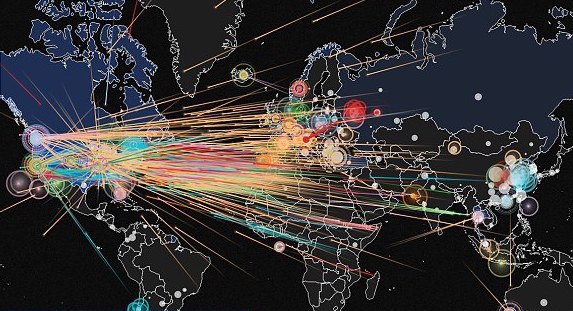
The most recent iteration of this takes the form of social media and cyberwarfare where tools are being developed and deployed to influence populations at home and abroad, to manipulate political processes of foreign states and even tap into and exploit global economic forces.
In the beginning of the 21st century, the United States held an uncontested monopoly over the tools of cyberwarfare. Today, this is changing quickly, presenting an increasingly balanced cyberscape where nations are able to defend themselves on near parity with America’s ability to attack them.
To reassert America’s control over information and the technology used to broker it, Jared Cohen, current Google employee and former US State Department staff, has proposed a US-created and dominated “international” framework regarding cyberconflict.
His op-ed in the New York Times titled, “How to Prevent a Cyberwar,” begins by admitting the very pretext the US is using to expand its control over cyberwarfare is baseless, noting that “specifics of Russia’s interference in the 2016 America election remain unclear.”
Regardless, Cohen continues by laying out a plan for reasserting American control over cyberwarfare anyway, by claiming:
Cyberweapons won’t go away and their spread can’t be controlled. Instead, as we’ve done for other destructive technologies, the world needs to establish a set of principles to determine the proper conduct of governments regarding cyberconflict. They would dictate how to properly attribute cyberattacks, so that we know with confidence who is responsible, and they would guide how countries should respond.
Cohen, unsurprisingly, nominates the US to lead and direct these efforts:
The United States is uniquely positioned to lead this effort and point the world toward a goal of an enforceable cyberwarfare treaty. Many of the institutions that would be instrumental in informing these principles are based in the United States, including research universities and the technology industry. Part of this effort would involve leading by example, and the United States can and should establish itself as a defender of a free and open internet everywhere.
Cohen never explains how this US-dominated framework will differ from existing “international” frameworks regarding conventional warfare the US regularly abuses to justify a growing collection of devastating conflicts it is waging worldwide.
And as has been repeatedly documented, the United States’ definition of a “free and open internet everywhere” is an Internet dominated by US tech companies seeking to enhance and expand US interests globally.
Cohen ironically notes that:
Cyberweapons have already been used by governments to interfere with elections, steal billions of dollars, harm critical infrastructure, censor the press, manipulate public conversations about crucial issues and harass dissidents and journalists. The intensity of cyberconflict around the world is increasing, and the tools are becoming cheaper and more readily available.
Indeed, cyberweapons have already been used, primarily by the United States.
Jared Cohen himself was directly involved in joint operations between Google, Facebook, the US State Department and a number of other US tech and media enterprises which before and during 2011 set the stage for the so-called “Arab Spring.”
It included the training, funding and equipping of activists years ahead of the the uprisings as well as active participation in the uprisings themselves, including providing assistance to both protesters and militants everywhere from Libya to Syria in overthrowing governments targeted by Washington for regime change.
One such tool used in these efforts was described in a UK Independent article titled, “Google planned to help Syrian rebels bring down Assad regime, leaked Hillary Clinton emails claim,” which would report that:
An interactive tool created by Google was designed to encourage Syrian rebels and help bring down the Assad regime, Hillary Clinton’s leaked emails have reportedly revealed.
By tracking and mapping defections within the Syrian leadership, it was reportedly designed to encourage more people to defect and ‘give confidence’ to the rebel opposition.
The article would continue, mentioning Jared Cohen by name:
The email detailing Google’s defection tracker purportedly came from Jared Cohen, a Clinton advisor until 2010 and now-President of Jigsaw, formerly known as Google Ideas, the company’s New York-based policy think tank.
In a July 2012 email to members of Clinton’s team, which the WikiLeaks release alleges was later forwarded to the Secretary of State herself, Cohen reportedly said: “My team is planning to launch a tool on Sunday that will publicly track and map the defections in Syria and which parts of the government they are coming from.”
Would Cohen’s more recently proposed “framework” have prevented the United States’ use of these cyberweapons against sovereign states to undermine sociopolitical stability, overturn entire governments and plunge them into enduring chaos many still remain in 6 years later? Most likely not.
What Cohen and the interests he represents are truly concerned with is that nations are now not only able to recognize, prepare for and defend against US cyberwarfare, they may be capable of retaliating against the US.
Cohen’s proposal for an international framework to govern cyberwarfare simply seeks to define it in terms that leaves the US with both an uncontested monopoly over cyberwarfare as well as the means to wield it globally with absolute impunity.
It would be not unlike current “international” frameworks used to govern conflicts between nations which the US has used to justify an expansive, global campaign of extraterritorial war stretching from North Africa to Central Asia and beyond.
Such frameworks have become enablers of injustice, not a deterrence to it.
As nations from Iran to North Korea are discovering, the only true means of defending oneself from foreign military aggression is creating a plausible deterrence to dissuade foreign nations from attacking. This is done by creating a price for attacking and invading that is higher than the perceived benefits of doing so.
Nations like Russia and China have already achieved this balance with the United States in terms of conventional and nuclear warfare, and have now nearly established a similar deterrence in terms of cyber and information warfare. For the rest of the world, developing cyberdefense is not as costly as conventional military or nuclear arsenals, making cyberwarfare a corner of the battlefield unlikely to be monopolized by the US as it had done at the turn of the century.
Ensuring that no single nation ever has the opportunity to abuse such a monopoly again means exposing and confronting efforts by those like Google’s Jared Cohen and his proposal for an “international framework” for cyberwarfare that resembles the same sort of enabling the United Nations provides the US in terms of proliferating conventional conflicts across the globe.
INDIAN COUNTRY NEWS
"It is the duty of every man, as far as his ability extends, to detect and expose delusion and error"..Thomas Paine
Human in Algorithms
100% Accurate Google Sheets + KDP Book Formatting | 24hr Delivery
From the Roof Top
I See This
blog of the post capitalist transition.. Read or download the novel here + latest relevant posts
अध्ययन-अनुसन्धानको सार

