Two for Tuesday
Reply


By Eric Zuesse
Source: The Duran
The agreement, which has been arranged through National Security Advisor Jake Sullivan in the White House and Israel’s President Benjamin Netanyahu, is that poor countries with corrupt leaders will be bribed to accept forced immigrants from Gaza so as to cleanse it in order to carry out settlement of Jews into that area, after Gaza’s post-war reconstruction, which will be done by the Governments of Israel and U.S., by paying contractors from both countries to ‘make the desert bloom’ there for the incoming Jews.
On January 3rd, the Times of Israel — which was founded by the late gambling casino mega-billionaire Sheldon Adelson, who had been the chief donor to the political careers of both Netanyahu and Trump, and so the newspaper that he created has well-connected sources inside Israel’s Government — headlined “Israeli officials said in talks with Congo, others on taking in Gaza emigrants”, and reported:
The Times of Israel’s Hebrew sister-site Zman Yisrael reports that Israeli officials have held clandestine talks with the African nation of Congo and several others for the potential acceptance of Gaza emigrants.
“Congo will be willing to take in migrants, and we’re in talks with others,” a senior source in the security cabinet tells Shalom Yerushalmi.
Yerushalmi quotes Intelligence Minister Gila Gamliel saying at the Knesset yesterday: “At the end of the war Hamas rule will collapse, there are no municipal authorities, the civilian population will be entirely dependent on humanitarian aid. There will be no work, and 60% of Gaza’s agricultural land will become security buffer zones.”
Saying education to hatred will continue in Gaza and further attacks on Israel are only a matter of time, she added: “The Gaza problem is not just our problem. The world should support humanitarian emigration, because that’s the only solution I know.”
Yesterday Washington panned far-right ministers Bezalel Smotrich and Itamar Ben Gvir for advocating the resettlement of Palestinians outside of Gaza.
“This rhetoric is inflammatory and irresponsible,” State Department spokesman Matthew Miller said.
This is consistent with the news earlier regarding both Biden and Netanyahu, that Netanyahu will be ethnically cleansing Gaza while Biden will give lip-service to criticizing it but will continue to set no conditions upon the U.S. Government’s supplying of weapons and of military intelligence to Israel’s forces to carry out the ethnic cleansing there. Both Netanyahu and Biden, meanwhile, will be arm-twisting at the U.N. General Assembly to gain approval for the forced-resettled-in-Africa Gazans to receive aid from U.N. agencies, in order to keep down the refugees’ maintenance-costs in those countries, sufficiently so as to avoid rebellions by those receiving countries’ publics that might result from tax-increases for those receiving Governments to pay for those immigrants who will have become relocated there.
As I reported earlier, the previous plan by both Netanyahu and Biden was to expel the 2.3 million Gazans to either Egypt or Jordan, but on October 16th and 17th both of those Governments refused to participate. This is what has now led to the negotiations with the Governments of “the African nation of Congo and several others for the potential acceptance of Gaza emigrants.” If the Biden and Netanyahu team cannot find lands to cooperate, then whatever Gazans survive the bombardments and siege might be simply starved to death, in which case the end-result will be a genocide against the Gazans, instead of merely an ethnic cleansing of them. So: the current plan might not be the final plan, the final solution to the Gazan problem.
By Brian Berletic
Source: New Eastern Outlook
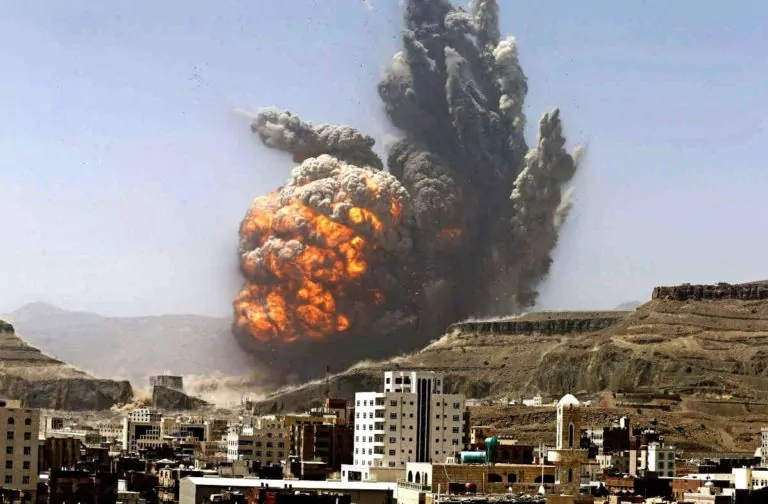
In the opening weeks of 2024, the US and British unilaterally launched several large-scale missile and air strikes on targets in territory held by Ansar Allah (referred to as the “Houthis” across the Western media) in Yemen.
The strikes follow a campaign of missile strikes and boardings conducted by Ansar Allah against commercial shipping destined to and from Israel in response to Israel’s ongoing punitive operations in Gaza.
While the stated purpose of the US-British strikes are to protect commercial shipping, hostility of any kind in the Red Sea is likely to prompt international shipping companies to continue seeking out and using alternative routes until fighting of any kind subsides.
Indeed, according to Euronews Business, despite the US-British strikes on Ansar Allah, the CEO of Maersk, responsible for one-fifth of global maritime shipping, believes safely transiting the Red Sea is still months away.
Despite the political posturing that accompanied these attacks, strategically, they will do little to impact Ansar Allah’s fighting capacity. The political movement possesses a formidable military organization that has weathered years of full-scale war waged against it by a Saudi-led Arab coalition, backed by both the US and UK.
Not only did the US and UK encourage Saudi Arabia to sustain an air and ground war against Yemen, both Western nations contributed directly to Saudi Arabia’s war efforts.
The New York Times in a 2018 article titled, “Army Special Forces Secretly Help Saudis Combat Threat From Yemen Rebels” admitted that US special forces were operating, at a minimum, along the Saudi-Yemeni border, assisting Saudi Arabia’s armed forces in choosing targets.
The same article admits that the US was also lending assistance related to “aircraft refueling, logistics and general intelligence sharing.”
The Guardian in a 2019 article titled, “‘The Saudis couldn’t do it without us’: the UK’s true role in Yemen’s deadly war,” admitted to the scope of support provided by the UK to Saudi Arabia in its war on Yemen. It included supplying weapons and munitions, thousands of maintenance contractors, pilot training, and even sending British troops to fight alongside Saudi soldiers in Yemen itself.
The scale of both Saudi Arabia’s own war on Yemen and the scale of US and British assistance to Saudi Arabia, including through the use of thousands of contractors and hundreds of soldiers on the ground, dwarfs the current missile and air strikes conducted by the US and British from the Red Sea. Even if the US and British significantly expanded their current missile and air strike campaign, it would still pale in comparison to the war that has been waged against Yemen in recent years.
Clearly then, the current US-British strikes on Yemen hold little prospect of deterring Ansar Allah, so why is the US and British carrying out these strikes anyway?
Washington’s True Motives for Striking Yemen
CNN in an article titled, “US and UK carry out strikes against Iran-backed Houthis in Yemen,” would claim:
For weeks, the US had sought to avoid direct strikes on Yemen because of the risk of escalation in a region already simmering with tension as the Israel-Hamas war continues, but the ongoing Houthi attacks on international shipping compelled the coalition to act.
Yet, because the strikes only ensure shipping in the Red Sea remains obstructed and because the strikes themselves have little hope of impacting Ansar Allah strategically, the only other explanation as to why the US launched them was to specifically raise “the risk of escalation in the region.”
Ansar Allah’s ally, Iran, has been the target of US-sponsored regime change operations for decades. Entire policy papers have been written by US government and corporate-funded think tanks, including the Brookings Institution and its 2009 paper, “Which Path to Persia?,” detailing options to achieve regime change including through deliberate attempts to draw Iran into a war by both covert action within Iran, and through attacks on Iran’s network of regional allies.
The Brookings paper admits:
“…it would be far more preferable if the United States could cite an Iranian provocation as justification for the airstrikes before launching them. Clearly, the more outrageous, the more deadly, and the more unprovoked the Iranian action, the better off the United States would be. Of course, it would be very difficult for the United States to goad Iran into such a provocation without the rest of the world recognizing this game, which would then undermine it. (One method that would have some possibility of success would be to ratchet up covert regime change efforts in the hope that Tehran would retaliate overtly, or even semi-overtly, which could then be portrayed as an unprovoked act of Iranian aggression.)”
Preceding the US-British missile and air strikes on Yemen, the US has carried out strikes on Iranian allies across the region, including in Syria and Iraq. Israel, with US-backing, has also carried out attacks across the region on Iranian allies, specifically on Hezbollah in southern Lebanon.
There was also recently a terrorist bombing inside of Iran, likely carried out by one of several terrorist organizations sponsored by the US to carry out just such attacks, as per the Brookings paper’s own suggestion regarding “ratcheting up cover regime change efforts inside Iran.” It should be noted that elsewhere in the Brookings paper the option of using known terrorist groups to carry out US-backed “insurgency” is afforded an entire chapter (Chapter 7, Inspiring an Insurgency – Supporting Iranian Minority and Opposition Groups).
Together, this constitutes a strategy of attempting to degrade Iranian allies in the region ahead of a wider conflict, and as a means of provoking and thus drawing Iran itself into that wider conflict.
So far, Iran has exhibited tremendous patience. Iran, as both Russia and China who face similar US policies of encirclement and containment, knows time works in its favor. Iranian patience has already served Tehran well. It has afforded it the ability to diplomatically resolve tensions between itself and Saudi Arabia through Chinese mediation. It has also allowed Iran to continue building up not only its own military capabilities, but those across its network of allies in the region, leading to a gradual shift in the balance of power in Tehran’s favor.
Washington realizes this. This time next year, if events continue to unfold as they have in recent years, Iran will only be stronger and the US more isolated in the region. The US faced a similar problem of waning primacy in Europe, using its proxy war in Ukraine against Russia as a means of reasserting itself over Europe. Washington likely imagines it can use a similar strategy to reassert itself over the Middle East while using a regional conflict to collectively weaken and thus subordinate the nations therein.
Only time will tell if the US is as “successful” in the Middle East as it was in Europe. Already many factors are working against the US, but from Washington’s perspective, it isn’t paying the price for any of these conflicts – the regions these conflicts are fought in are paying that price. As long as Washington is absolved from any direct cost in such a foreign policy, it will continue pursuing it until it is finally and fully denied the means to continue doing so.

By Gary ‘Z’ McGee
Source: Waking Times
“Doubt is the origin of wisdom.” ~Rene Descartes
“Doubt is essential. It is the vehicle that transports us from one certainty to another.” ~Eric Weiner
The right question is always more important than the right answer. Why? Because there is a higher probability of getting lost in answers. Also, there is a higher probability of discovering something beyond the “answers” by questioning them.
Answers are more likely to become golden idols. Questions are more likely to melt those golden idols into something more malleable, more open, and more adaptable to change.
As Ken Kesey said, “The need for mystery is greater than the need for an answer.”
Accepting answers without questioning them is a problem of certainty. You might think that you want to be certain, but certainty is almost always a hangup. The cure for certainty is curiosity. Don’t believe what you think; be curious about why you think it instead.
“Only once he has endured the necessary doubt and despair within himself can the individual play an exemplary role in standing firm amidst the world’s pandemonium.” ~Stefan Zweig
Doubt makes you vulnerable, open, and honest with being a fallible creature. It forces you to confront the raw reality that we’re all just imperfect mammals vainly attempting to pigeonhole godhood into wormwood.
As Ernest Becker said, “The essence of normality is the refusal of reality.”
This is the comfortable burden forced upon you by Mother Culture. But you cannot afford to refuse reality. You must embrace it. Refuse the cultural illusion instead. Doubt the comfort zone.
Employ your mind as a mirror. Reflect the illusion. Receive but do not keep. Absorb but do not cling. Learn but do not dwell. Question but remember to never settle on an answer. Settling for an answer is giving up on your goal of knowing something that has never been known before. Never settle. Even if the answer seems convincing. Question it. Always question it. Especially if it is presented by culture as something you must believe in.
Asking difficult questions and challenging culture will always be more important than receiving simple answers and accepting culture.
“Trust those who seek the truth. Doubt those who find it.” ~Andre Gide
Doubt teaches you how to, as Aristotle advised, “entertain a thought without accepting it.”
Blind belief is the epitome of accepting a thought without entertaining it. Whether due to cultural conditioning, religious indoctrination, or political programming, blind belief leads to willful ignorance. And the only remedy for willful ignorance is doubt.
The willful ignorance inherent in blind belief is the bane of any Truth Quest. Doubt reprograms the Truth Quest. And once the Truth Quest is reprogrammed, you are liberated. You are free to always question, to always be open, to always be flexible, and to never again fall into the trap of blind belief.
As the Buddha said, “Doubt everything. Find your own light.”
Doubt keeps all things in perspective. And especially this: The Truth Quest must go on for the sake of Truth itself. Indeed. It is the hallmark of doubt to always keep the Truth Quest ahead of the “truth.”
“If you would be a real seeker of truth, it is necessary that at least once in your life you doubt, as far as possible, all things.” ~Descartes
Doubt teaches clarity through iteration. The self is an endless ocean. The more you know yourself, the more you realize how much you don’t know. But a clarity comes from this. The waters are still endlessly deep, but you gain better visibility.
You realize that self-knowledge has no end. You realize that it’s not about coming to an identity, or ending up with a personality, or forming an opinion, or coming to a conclusion, or ending up with a belief. Not at all.
It’s about swimming into deeper clarity. You swim through identity, through personality, through opinion, through belief. You do so because the alternative is becoming stuck. The alternative is becoming fixed and conditioned, placated and trapped, bamboozled and brainwashed.
Doubt teaches you how to iterate through the self like a snake sheds its skin. Always moving forward. Always adapting. Always overcoming.
Growth, expansion, and greater clarity are always in the depths of a greater ocean. Swim!
“To be aware of limitations is already to be beyond them.” ~Georg Wilhelm Friedrich Hegel
Doubt teaches uncertainty and uncertainty teaches aplomb.
Aplomb drops a bomb in the bomb shelter of your certainty. It sees the way out of the trap of certainty from the inside out. It’s embracing the fact that doubt is a crashing wave, but rather than fight against it, you act with aplomb and surf it out.
Acting with aplomb is being proactive despite self-doubt. It’s honoring doubt, detaching from it, and then focusing on what makes you curious and inspired instead. Acting with aplomb takes nerve, nonchalance, and self-confidence. It’s realizing that the ends don’t have to justify the means.
So, the universe is fundamentally uncertain? So be it. Might as well join forces with it. Might as well take that uncertainty and transform it into astonishment and awe. Might as well stay ahead of the curve by not clinging to any aspect of the curve. Let the chips fall where they may.
Stepping into the unknown can be harrowing. Self-doubt is a given. Acting with aplomb is simply accepting it as a gift that keeps on giving you the power to consistently flatten the box, turn the tables, flip the script, and push the envelope of certainty that threatens to envelope you in one-dimensional thinking.
“Humor is not a mood but a way of looking at the world.” ~Ludwig Wittgenstein
There is nothing more powerful than a good sense of humor, not even power. In the throes of good humor, the entire universe is inside you, vibrating through you, howling at all moons, singing a language older than words, and most importantly reminding you that although you are but a speck in the cosmos you are also the entire cosmos within a speck.
When you’re in the throes of good humor, you are in tune with higher frequencies. You’re a fountainhead tapped into the higher order of disordered order. You’re a beacon of hope in a field of despair. You’re a beacon of darkness in the blinding light of cultural conditioning. You’re a devil-may-care cosmonaut in the whirlwind slipping all knots.
Cultivated humor is an inverted mirror that flips the universe. It puts seriousness and pettiness into perspective. It keeps humor ahead of hubris, laughter ahead of longing, Amor Fati ahead of Fate. It puts the ego on a leash.
As Camus said, “The greatness of man lies in his decision to be stronger than his condition.”
In order to build new knowledge, you must first be able to destroy untruth and stop taking yourself too seriously. Take a leap of courage out of belief and into faith. Be curious, not certain. Be creative, not convinced. Be eccentric, not conformist. Be humorous, not full of hubris.
Doubt! Free yourself to unlearn what you have been deceived into learning.
“The middle path does not go from here to there. It goes from there to here.” ~Jack Kornfield
Doubt keeps you in alignment with the Great Mystery; what some call God. The more aligned you are with this Mystery, the more disciplined your imagination will be. The more likely you will act with awe and transcendence rather than belief and closemindedness.
You can’t know the future. You can’t control how things will turn out. You can only control how you react to how things turn out. Even then, it’s not about control. It’s about being adaptable. It’s about being flexible and resilient. It’s about being prepared for the worst, even as you hope for the best. It’s about pulling your fragile past toward your antifragile future.
In that speck of hope is all the courage you’ll ever need. A dash of courage trumps an ocean of doubt. Use that courage like a sword. Or, even better, a scythe. Cut through the storm of the unknown. Shred the shroud of not knowing. Slice and dice the thickness of uncertainty. Not for the goal of invulnerability but for the transcendence of absolute vulnerability.
The Middle Way is where absolute vulnerability comes to fruition. The Middle Way is the sword of truth splitting all “truths”. The Middle Way is the scythe of justice breaking all “crowns”.
Cut with your soul. Meet the danger on the road to adventure. Greet Glory in the field. Confront the albatross on the path. Encounter the Minotaur in the labyrinth. Cut! Cut the obstacle until it becomes the path.
And if “God Himself” should stand in your way, cut that bastard down and become one with all things.

“Everything Everywhere All at Once” Review — Don’t Forget To Breathe
By Sergiu Inizian
Source: Medium
In 2016, Daniel Scheinert and Daniel Kwan (known collectively as Daniels) premiered their feature debut at the Sundance Film Festival. Swiss Army Man stunned audiences with a bizarre premise and is still one of the oddest films to come out of the prestigious festival.
It is a movie in which the emotional weight gets swallowed by a nevertheless entertaining childish cinematic approach. But it’s also a test run for Everything Everywhere All at Once, a whirlwind of a movie that brings so much more to the screen than downright weirdness.
The Daniels tell the story of Evelyn (Michelle Yeoh), a Chinese-American woman who runs a laundromat with her easy-going husband, Waymond (Ke Huy Quan). She is discouraged by life, has marital problems, and is unable to communicate with her daughter, Joy (Stephanie Hsu). On top of it all, she is at a loss when trying to challenge her father (James Hong) about past trauma or present issues.
Yeoh infuses so much dignity into Evelyn, a struggling mother who quietly looks for answers to her personal problems while trying to put the family business in order. Her two priorities are organizing a Chinese New Year party and successfully dealing with an IRS audit.
But, in the IRS building, a wholly changed Waymond introduces her to the Multiverse, a collection of realities that hosts endless versions of Evelyn. This is revealed to her because she is the one powerful enough to combat an entity that desires to destroy the fabric of reality.
What ensues next is a kaleidoscopic montage of possibility that showcases the protagonist’s alternate lives with gripping vigor. This interdimensional music video entertains through dynamic genre mashups, marvelous colors, and an eclectic Son Lux soundtrack. The directors decorate their psychedelic narrative with an abundance of references that range from arthouse drama to “Avengers-style” heroics and to completely silly antics.
At the center of the polychromatic experience, Evelyn is tasked to make sense of it all. Michelle Yeoh is fearless in her multifaceted role, bringing nuance and honesty to a captivating madhouse of a film. Within the Multiverse, Yeoh’s wide-open eyes pierce through all the outlandish embroidery and stand as the film’s brightest marvels.
Underneath the sci-fi-infused cinematic experience, the Daniels reveal an attentive treatment of sorrow, generational conflict, and reconciliation. The portrayal of familial disconnect especially absorbed me: Evelyn is both a mother and daughter and yet she finds herself in the middle of a discord that spans three generations. In Everything Everywhere All at Once, the fractures of reality pale in comparison to the emotional ruptures that define Evelyn’s family.
While the visual experience of the massive Multiverse can be overwhelming at times, the directors know when to hit the pause button and insert quiet moments, allowing the characters to shine. Ke Huy Quan steals the show in these scenes, especially in the universe in which Evelyn is a famous actress. He brings so much authenticity to the kind, hopeful Waymond and his presence is a fitting companion to Yeoh’s mesmerizing performance.
In Everything Everywhere All at Once, the Daniels create so many layers for the seemingly mundane story of Evelyn. It’s a breathtaking journey that deals with life’s “what-ifs” and entertains through sheer ambition. It also embraces a charming message which showcases the wonder of cinema and the craft of the quirky directorial pair: regardless of how seemingly ordinary a destiny is, it always involves plenty of fantasy, mystery, and hope.
____________________
Watch Everything Everywhere All at Once on Hoopla here: https://www.hoopladigital.com/movie/everything-everywhere-all-at-once-michelle-yeoh/16497128
We are ruled by murderous tyrants. By nuclear-armed thugs who would rather starve civilians to protect the continuation of an active genocide than allow peace to get a word in edgewise.
By Caitlin Johnstone
Source: CaitlinJohnstone.com.au
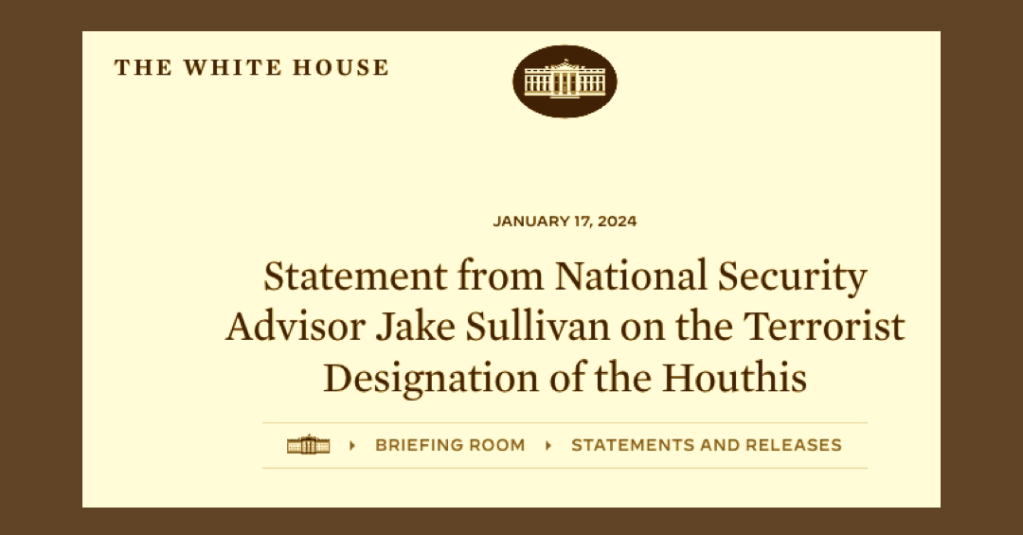
The Biden administration has officially re-designated Ansarallah — the dominant force in Yemen also known as the Houthis — as a Specially Designated Global Terrorist entity.
The White House claims the designation is an appropriate response to the group’s attacks on US military vessels and commercial ships in the Red Sea and the Gulf of Aden, saying those attacks “fit the textbook definition of terrorism.” Ansarallah claims its actions “adhere to the provisions of Article 1 of the Convention on the Prevention and Punishment of the Crime of Genocide,” since it is only enforcing a blockade geared toward ceasing the ongoing Israeli destruction of Gaza.
One of the most heinous acts committed by the Trump administration was its designation of Ansarallah as a Foreign Terrorist Organization (FTO) and as Specially Designated Global Terrorists (SDGT), both of which imposed sanctions that critics warned would plunge Yemen’s aid-dependent population into even greater levels of starvation than they were already experiencing by restricting the aid that would be allowed in. One of the Biden administration’s only decent foreign policy decisions has been the reversal of that sadistic move, and now that reversal is being partially rolled back, though thankfully only with the SDGT listing and not the more deadly and consequential FTO designation.
In a new article for Antiwar about this latest development, Dave Decamp explains that as much as the Biden White House goes to great lengths insisting that it’s going to issue exemptions to ensure that its sanctions don’t harm the already struggling Yemeni people, “history has shown that sanctions scare away international companies and banks from doing business with the targeted nations or entities and cause shortages of medicine, food, and other basic goods.” DeCamp also notes that US and British airstrikes on Yemen have already forced some aid groups to suspend services to the country.
So the US empire is going to be imposing sanctions on a nation that’s still trying to recover from the devastation caused by the US-backed Saudi blockade that contributed to hundreds of thousands of deaths between 2015 and 2022. All in response to the de facto government of that very same country imposing its own blockade with the goal of preventing a genocide.
That’s right kids: when Yemen sets up a blockade to try and stop an active genocide, that’s terrorism, but when the US empire imposes a blockade to secure its geostrategic interests in the middle east, why that’s just the rules-based international order in action.
It just says so much about how the US empire sees itself that it can impose blockades and starvation sanctions at will upon nations like Yemen, Venezuela, Cuba, Iran, Syria and North Korea for refusing to bow to its dictates, but when Yemen imposes a blockade for infinitely more worthy and noble reasons it gets branded an act of terrorism. The managers of the globe-spanning empire loosely centralized around Washington literally believe the world is theirs to rule as they will, and that anyone who opposes its rulings is an outlaw.
What this shows us is that the “rules-based international order” the US and its allies claim to uphold is not based on rules at all; it’s based on power, which is the ability to control and impose your will on other people. The “rules” apply only to the enemies of the empire because they are not rules at all: they are narratives used to justify efforts to bend the global population to its will.
We are ruled by murderous tyrants. By nuclear-armed thugs who would rather starve civilians to protect the continuation of an active genocide than allow peace to get a word in edgewise. Our world can never know health as long as these monsters remain in charge.
Many institutions have no convincing justification for their own existence.

By Robert Gore
Source: Straight Line Logic
Western civilization is characterized by its institutions. Its foundations have been government, organized religion, the military, science, technology, business, academia, media, art, and entertainment. Institutions have been bulwarks of order and have enabled Western civilization to reach unprecedented plateaus of achievement and prosperity. Now, they’re under assault and crumbling, which has been often noted and decried but usually not analyzed or understood as the outcome of an epochal transition.
Institutions have been the victim of their own success. The Industrial and Information Revolutions have put goods, services, wealth, data, and choices in billions of hands in what amounts to an historical blink of an eye, less than two centuries. The average American lives better and longer than royalty did back in monarchy’s heyday and has more personal power. Kings and emperors of yore could order people around and toss them in dungeons, but they couldn’t hop on the Internet and communicate with someone on the other side of the planet or hop on a freeway and journey five hundred miles in a day.
Institutions’ loss has been individuals’ gain, and many of the latter are questioning the necessity of the former. Institutions are staring into an abyss. Many, including governments, do not have convincing justifications for their own existence. They offer little to average people and in many cases they’re a net negative, imposing nothing but burdens. Their leaders are solely devoted to furthering their own prerogatives and power. Now, institutions are fighting a rearguard action to halt or slow a transition that at best will dramatically reduce their power and could mean their extinction.
COVID, climate change, foreign wars, censorship, woke, open borders, surveillance, and digital passports and currencies are Last Gasp efforts to preserve institutional status, wealth, and power. The institutions have responded to their own drum roll with what vigor they can muster, but those causes inspire vapid virtue signaling, not authentic passion. Their only wellspring of true passion is hatred for anyone who believes differently, who challenges their science, propaganda, and mendacity, and, more broadly, their right to dictate and coerce, and to cancel, punish or execute anyone not toeing their line.
Their objective failures—many of which count in their corrupt reckonings as successes—are manifest. The COVID response, particularly vaccines’ deaths and adverse events, completely discredited governments, public health, institutional medicine, the pharmaceutical companies, and social and mainstream media, while inflicting severe collateral damage on official “science,” big business, and central banks. The institutions are regrouping under the banner of climate change, but it’s clear from the pushback they’re already receiving that their agenda can only be implemented through violence and high-tech totalitarianism.
Repeated failures and ever-mounting resistance would seem to be enough to doom their totalitarian designs. Unfortunately, in their desperation and hatred, the willingness of the elite to wage actual, kinetic war on the rest of us shouldn’t be underestimated. While the COVID vaccine death toll numbers in the millions, war still has no rival for murderous effectiveness. However, offensive violence is no solution.
Nuclear weapons changed warfare in a way that’s not generally recognized. The threat that a global nuclear conflagration could eliminate humanity rendered their use a high-risk proposition. The Hiroshima and Nagasaki bombings in 1945 remain the only wartime use of nuclear weapons. Under the umbrella created by nuclear weapons’ unemployability, technological advances have fueled the development of a staggering array of armaments that has decisively shifted the military balance from offensive to defensive warfare.
World War II was the last major war in which an offensive, or, more correctly, a counter-offensive, won. The allied powers repelled the axis powers, but at huge cost. Industrial-scale, mechanized warfare’s awesome destructive power left all the major participants except the U.S. in ruins, their populations decimated.
Offensive military power has become enormously expensive relative to the defensive technologies and strategies that can be employed against it. Since World War II, there have been few successful invasions. Both sides were stymied in the Korean War. U.S. invasions have been a string of disasters since Vietnam. Afghan goat herders defeated both the Soviets and the U.S.
On the cusp of victory in Ukraine, the Russian Special Military Operation would seem to belie the trend of offensive failures. However, the Russians have actually won by playing defense. They moved through their major objective, the Donbass region of Eastern Ukraine, where the majority of the population speak Russian. Many of them want to be part of Russia and hate the Ukrainian government, which has waged war on them since the 2014 coup. Consequently, the Russians were supported by the local population.
This past year featured a Ukrainian counteroffensive that was supposed to drive the Russians back from Donbass and retake the Crimean peninsula. NATO and Ukrainian strategists refused to recognize that their offensive was akin to sending cavalry units against machine-gun and artillery emplacements. They were up against an opponent well-armed with land mines, state-of-the-art field artillery and long-range missiles, air cover, and surveillance and attack drones. The Russian military, which has a long tradition of waging defensive warfare, employed a complex three-layer defense. The Ukrainians rarely progressed through even the first layer, impaling themselves on the tip of the Russian spear and taking massive losses.
The successful Russian strategies and tactics will be, or should be, studied by military analysts in the U.S. However, what’s most important is that those tactics implicitly acknowledge a truism central to the transition in progress. High-cost offensive warfare can be stymied and often defeated with relatively low-cost defensive weaponry and asymmetric warfare.
It can be argued that an offensive against the world’s most powerful military was obviously doomed, although nobody in the Western brain trust made that argument before the Ukrainians attacked. What truly signals the dawning of a new age have been the repeated successes since World War II of guerrilla or insurgent warfare against ostensibly much more powerful forces.
The Russians learned their lesson from the Soviet failure in Afghanistan. The U.S. government hasn’t learned anything from its string of failures. In Washington, nothing succeeds like failure. Its unconditional backing of Israel’s attempted elimination of Palestinians in Gaza finds it doubling down on what hasn’t worked.
The Israelis recognize a grim reality of fighting an insurgency on insurgent territory: To win, it’s not enough to kill the guerrillas; the guerrilla-friendly local population must be eliminated as well. The Israelis’ campaign has been merciless: destroying structures, killing Palestinian civilians, and making life intolerable for the survivors. The Israeli aim is to drive the Palestinians from Gaza and Israel for good. This meets international-law definitions of genocide and has been rightly decried around the world.
What will it mean if Israel fails? The Israelis may well reduce Gaza to rubble, but that would not be mission accomplished. Rubble provides excellent cover for guerrilla strikes. Hamas’ extensive tunnels indicate that it has prepared for this war for years. In all probability, it launched the October 7 attack to get things going. Israel’s negligence detecting and responding to that attack may have been intentional, indicating that it, too, wanted the war it now has.
Hamas has a network of allies across the Middle East. Israeli and U.S. forces and maritime commerce are under attack in Iraq, Syria, Lebanon, Yemen, the Red Sea, the Indian Ocean, and the Mediterranean. Yemen’s Houthis have already bottled up the Red Sea. It would be an easy matter for Iran to do the same in the Persian Gulf. Control of maritime commerce at important choke points calls into question a plank as central to the American Empire as it was to the British Empire before it: control of the world’s seas and oceans.
What happens if an American-led flotilla tasked with keeping the Red Sea or the Persian Gulf open comes under a swarming missile and drone attack, plus electronic warfare that disrupts its command and control capabilities, and destroyers or aircraft carriers are sunk? Missiles, drones, and cyber disruption cost a pittance compared to battleships, and it would then be apparent that they make conventional surface naval power a paper shark. The vessels in their watery grave would send the same message as the tanks smoldering on Ukraine’s battlefields.
The power of governments rests on their ability to use violence to control populations. Yawning cost disparities, decentralized technologies, and asymmetric warfare have rendered much of conventional offensive power vulnerable or obsolete, marking an historic, tectonic transition in the relationships between governments and governed. This is no secret, particularly in the non-Western world.
Across the globe, insurgents are taking the measure of governments and finding them wanting. Governments that are not feared cannot govern. As they confront their limitations, they will, being governments, make their situations worse.
The American government has a problem not shared by many others. Its potential insurgents—urban, suburban, and rural—are armed to the teeth. They already control many of the cities (see “Ants at the Picnic, Part Two”). Heavily indebted Washington cannot command the resources necessary to subjugate the population. It gets stretched thinner with each new dollar of debt, each new tax, each new institutionalized corruption, each new illegal migrant, each new substitution of gobbledygook ideology for rationality, and each new foreign intervention. Recognition of Washington’s weakness is behind the talk of secession and some states’ defiance of its dictates.
Washington’s weakness is shared by many Western governments, although most of them don’t have to contend with armed opposition. They do have to contend with increasingly restive populations, which by sheer force of numbers can upend existing political arrangements. It is delusional to think that these beleaguered national governments can be replaced by a confederated or unitary global government that could then exercise effective control.
The imposition of global government would entail an invasion by an outside force of millions of globally dispersed localities. The global force would encounter the same problem Israel faces in Gaza. Overt and covert opposition could number in the billions.
The globalists would have to contend with organized insurrection, guerrilla warfare, sabotage, and terrorism, as well as random riots, criminality, and widespread disorder. They would have to resort to the Israeli “solution” in Gaza—mass extermination. While they are relying on propaganda, subversion, electronic control, and biological warfare, perhaps only nuclear weapons could achieve genocide at the necessary scale. Don’t put it past them. Don’t put it past the insurgents to acquire their own nukes.
Short of nuclear conflagration, the world will continue to devolve towards institutional failure, popular disillusionment, mounting rage, and chaotic fragmentation and balkanization. Today’s dinosaur governments are unable to exercise control, and many of them are slated for extinction. They will not be replaced by an even larger and more unwieldy dinosaur—global government—which is only the last, desperate hope of the fading regime. Instead, the vacuum created by failed governments will be filled by those proficient in decentralized violence. Those who have relied on centralized authority for their livelihoods, power, and status will find their worlds turned upside down. Many will not survive the transition.
Assume crash positions.
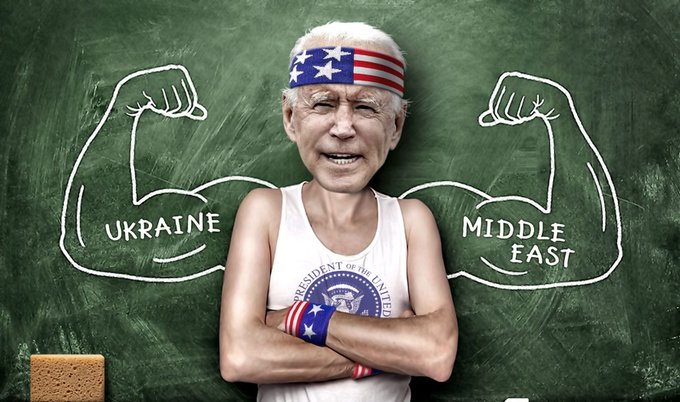
The outcome of US-led conflicts in Ukraine and West Asia will have a profound impact on the developing world order. Washington has already lost the former, and its major adversaries are vested in making sure it loses the latter too.
By MK Bhadrakumar
Source: The Cradle
Geopolitical analysts broadly agree that the war in Ukraine and the West Asian crisis will dictate the trajectory of world politics in 2024. But a reductionist thesis appears alongside that views the Israel-Palestine conflict narrowly in terms of what it entails for the resilience of the US proxy war in Ukraine – the assumption being that the locus of world politics lies in Eurasia.
The reality is more complex. Each of these two conflicts has a raison d’être and dynamics of its own, while at the same time also being intertwined.
Washington’s neck-deep involvement in the current phase of the West Asian crisis can turn into a quagmire, since it is also tangled up with domestic politics in a way that the Ukraine war never has been. But then, the outcome of the Ukraine war is already a foregone conclusion, and the US and its allies have realized that Russia cannot be defeated militarily; the endgame narrows down to an agreement to end the conflict on Russia’s terms.
To be sure, the outcome of the Ukraine war and the denouement of the Israel-Palestine conflict, which is at the root of the West Asian crisis, will have a profound impact on the new world order, and the two processes reinforce each other.
Russia realizes this fully. President Vladimir Putin’s stunning ‘year-enders’ in the run-up to the New Year speak for themselves: daylong visits to Abu Dhabi and Riyadh (watched by a shell-shocked US President Joe Biden), followed by talks with Iran’s president and rounded off with a telephone conversation with the Egyptian president.
In the space of 48 hours or so, Putin touched base with his Emirati, Saudi, Iranian, and Egyptian colleagues who officially entered the portals of the BRICS on 1 January.
The evolving US intervention in the West Asian crisis can be understood from a geopolitical perspective only by factoring in Biden’s visceral hostility toward Russia. BRICS is in Washington’s crosshairs. The US understands perfectly well that the extra large presence of West Asian and Arab nations in BRICS — four out of ten member states — is central to Putin’s grand project to re-structure the world order and bury US exceptionalism and hegemony.
Saudi Arabia, the UAE, and Iran are major oil producing countries. Russia has been rather explicit that during its 2024 chairmanship of BRICS, it will push for the creation of a currency to challenge the petrodollar. Without doubt, the BRICS currency will be at the center stage of the grouping’s summit due to be hosted by Putin in Kazan, Russia in October.
In a special address on 1 January, marking the start of Russia’s BRICS Chairmanship, Putin stated his commitment to “enhancing the role of BRICS in the international monetary system, expanding both interbank cooperation and the use of national currencies in mutual trade.”
If a BRICS currency is used instead of the dollar, there could be significant impact on several financial sectors of the US economy, such as energy and commodity markets, international trade and investment, capital markets, technology and fintech, consumer goods and retail, travel and tourism, and so on.
The banking sector could take the first hit that might eventually spill over to the markets. And if Washington fails to fund its mammoth deficit, prices of all commodities could skyrocket or even reach hyperinflation triggering a crash of the US economy.
Meanwhile, the eruption of the Israel-Palestine conflict has given the US an alibi — ‘Israel’s self-defense’ — to claw its way back on the greasy pole of West Asian politics. Washington has multiple concerns, but at its core are the twin objectives of resuscitating the Abraham Accords (anchored on Saudi-Israeli proximity) and the concurrent sabotage of the Beijing-mediated Saudi-Iranian rapprochement.
The Biden administration was counting on the fact that an Israeli-Saudi deal would provide legitimacy to Tel Aviv and proclaim to the Islamic world that there was no religious justification for hostility towards Israel. But Washington senses that post-7 October it would not be able to secure a Saudi-Israel deal during this Biden term, and all that could be coaxed out of Riyadh is a door left ajar for future discussion on the topic. No doubt, it is a major blow to the US strategy to liquidate the Palestinian question.
In a medium term perspective, if the Russian-Saudi mechanism known as OPEC+ liberates the world oil market from US control, BRICS drives a dagger into the heart of US hegemony which is anchored on the dollar being the ‘world currency.’
Saudi Arabia recently signed a currency swap deal worth $7 billion with China in an attempt to shift more of their trade away from the dollar. The People’s Bank of China said in a statement that the swap arrangement will “help strengthen financial cooperation” and “facilitate more convenient trade and investment” between the countries.
Going forward, sensitive Saudi-Chinese transactions in strategic areas such as defense, nuclear technology, among others, will henceforth take place below the US radar. From a Chinese perspective, if its strategic trade is sufficiently insulated from any US-led program of anti-China sanctions, Beijing can position itself confidently to confront US power in the Indo-Pacific. This is a telling example of how the US strategy for the Indo-Pacific will lose traction as a result of its waning influence in West Asia.
The conventional wisdom is that preoccupation in volatile West Asia distracts Washington from paying attention to the Indo-Pacific and China. In reality, though, the waning influence in West Asia is complicating the capacity of the US to counter China both in the region as well as in the Indo-Pacific. The developments are moving in a direction where the credentials of the US as a great power are at an inflection point in West Asia – and that realization has leaked into other geographic regions around the world.
Way back in 2007, the distinguished political scientists John Mearsheimer of the University of Chicago and Stephen Walt of the John F. Kennedy School of Government at Harvard, wrote with great prescience in their famous 34,000-word essay entitled The Israel Lobby and US Foreign Policy that Israel has become a ‘strategic liability’ for the United States, but retains its strong support because of a wealthy, well-organized, and bewitching lobby that has a ‘stranglehold’ on Congress and US elites.
The authors warned that Israel and its lobby bear outsized their responsibility for persuading the Bush Administration to invade Iraq and, perhaps one day soon, to attack the nuclear facilities of Iran.
Interestingly, on New Year’s Eve, in a special report based on extensive briefing by top US officials, the New York Times highlighted that “No other episode [as the war in Gaza] in the past half-century has tested the ties between the United States and Israel in such an intense and consequential way.”
Clearly, even as Israel’s barbaric actions in Gaza and its colonial project in the occupied West Bank are exposed and laid bare, and the Israeli state’s campaign to force Palestinian population migration are in full view, two of the US strategic objectives in the region are unravelling: first, the restoration of Israel’s military superiority in the balance of forces regionally and vis-a-vis the Axis of Resistance, in particular; and second, the resuscitation of the Abraham Accords where the crown jewels would have been a Saudi-Israeli treaty.
Viewed from another angle, the directions in which West Asia’s crisis unfolds are being keenly watched by the world community, especially those in the Asia-Pacific region. Most notable here is that Russia and China have given the US a free hand to navigate its military moves – unchallenged, so far, in the Red Sea. This means that any conflagration in the region will be synonymous with a catastrophic breakdown of US strategy.
Soon after the US defeat in Afghanistan in Central Asia, and coinciding with an ignominious ending of the US-led proxy war by NATO against Russia in Eurasia, a violent, grotesque setback in West Asia will send a resounding message across all of Asia that the US-led bandwagon has run out of steam. Among the end users of this startling message, the countries of ASEAN stand at the forefront. The bottom line is that the overlapping tumultuous events in Eurasia and West Asia are poised to coalesce into a climactic moment for world politics.
INDIAN COUNTRY NEWS
"It is the duty of every man, as far as his ability extends, to detect and expose delusion and error"..Thomas Paine
Human in Algorithms
From the Roof Top
I See This
blog of the post capitalist transition.. Read or download the novel here + latest relevant posts
अध्ययन-अनुसन्धानको सार
 After the Crash