Two for Tuesday
Reply

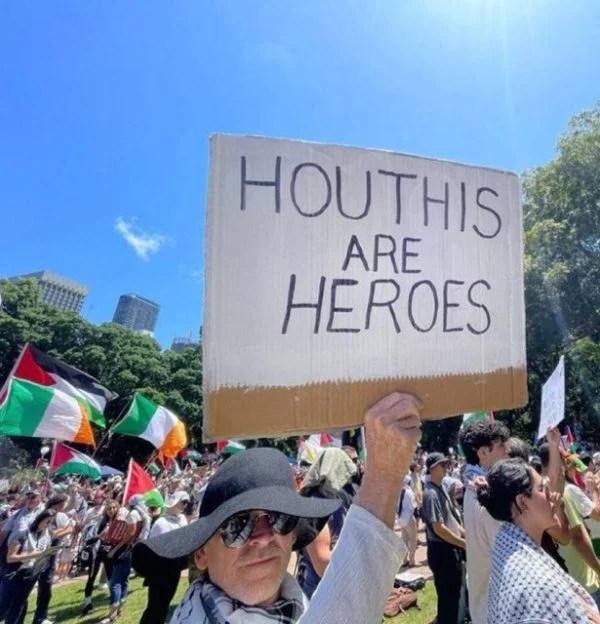
By Mike Whitney
Source: The Unz Review
“Whoever does not try to stop a genocide, has lost his humanity.” Mohammed Al-Bukhaiti, Houthi spokesman
Events in the Middle East are spinning out of control. In the last week, the United States has attacked Houthi positions on the Yemeni mainland 7 times while the Houthis have launched 5 attacks on commercial vessels and US warships in the Red Sea. At the same time, Iran has launched multiple attacks on sites in Syria, Iraq and Pakistan, while Israel has hit targets in both Lebanon and Damascus. Adding more fuel to the fire, the IDF has continued its relentless assault on Palestinians living in Gaza resulting in scores of new deaths and injuries. In short, there’s been a sharp uptick in military activity across the Middle East that is steadily increasing. This suggests that the low-intensity conflict we have seen for the last few weeks is about to explode into something much more violent, far-reaching and unpredictable. Many analysts believe we are on the brink of full-blown regional war which—in view of recent developments—may be unavoidable. This is from an article at the Washington Post:
The Biden administration is crafting plans for a sustained military campaign targeting the Houthis in Yemen after 10 days of strikes failed to halt the group’s attacks on maritime commerce…
Officials say they don’t expect that the operation will stretch on for years like previous U.S. wars in Iraq, Afghanistan or Syria. At the same time they acknowledge they can identify no end date or provide an estimate for when the Yemenis’ military capability will be adequately diminished…..
While the attacks have so far taken a greater toll on Europe than the United States…the Houthi campaign is already beginning to reshape the global shipping map. Some firms have chosen to reroute ships around the Cape of Good Hope off southern Africa, while major oil companies including BP and Shell suspended shipments through the area…
“It’s impossible to forecast exactly what’s going to happen, and certainly not [to predict] future operations,” the first U.S. official said. “But the principle that it simply can’t be tolerated for a terrorist organization … with these advanced capabilities to essentially shut down or control shipping through a key international choke point is one that we feel very strongly about.”…
U.S. officials also are concerned that attacking the Houthis has thrust the United States into a conflict with little exit strategy and limited support from key allies. Notably, America’s most powerful Gulf partners have withheld their backing for the American operation. The prime minister of Qatar, a key U.S. ally in the Gulf, has warned that Western strikes would not halt the violence and could fuel regional instability. As Houthis vow to fight on, U.S. prepares for sustained campaign, Washington Post
While the Washington Post article provides little new information, it does help to clarify a few important points:
There’s also no guarantee that the plan will work at all. In fact, there is every reason to believe it will backfire spectacularly creating an even bigger crisis. Check out this clip from an article at Responsible Statecraft:
It would seem that the real threat here is the escalation from continued U.S. airstrikes, which are killing people. As RS has reported on these pages time and again, the Houthis are battle hardened and even emboldened by the reaction of the West to their provocations. … a number of realist voices are decrying the folly of once again falling into a spiral of retaliatory violence that will likely lead to a real military crisis, even the death of U.S. service members, before it is done.
“They (strikes) won’t work. They won’t sufficiently degrade Houthi capability or will stop their attacks on shipping,” says Ben Friedman, senior fellow of Defense Priorities. “Why do something that is so evidently reckless? Restraint reminds us that no such law says we must conduct airstrikes that won’t work. We always have the option not to employ pointless violence.” US strikes Yemen again, but Houthi attacks keep coming, Responsible Statecraft
The fact that 8 years of relentless airstrikes by the Saudis only served to strengthen the Houthis, has not dampened the administration’s enthusiasm for more of the same. Biden is convinced that the identical policy will produce a different result. But isn’t that the definition of “insanity”? And where do we see evidence that the prescribed method actually works: Afghanistan? Iraq? Syria? Libya? Ukraine? Are these the shining examples of ‘military triumph’ that have convinced Biden that he’s on the right track?
But even if the Biden team had a coherent military strategy, there would still be a fundamental problem with the current approach, mainly because it’s morally wrong. The United States should work alongside those who are trying to enforce the Genocide Convention, not treat them as enemies. The Houthis have taken a constructive and (so far) non-lethal approach to Israel’s depredations in Gaza, an approach that is consistent with Article 1 of the Convention on the Prevention and Punishment of the Crime of Genocide which clearly states:
The Contracting Parties confirm that genocide, whether committed in time of peace or in time of war, is a crime under international law which they undertake to prevent and to punish.
The Houthis blockade of Israel-linked commercial ships passing through the Red Sea also hews to the tenets of The Responsibility to Protect – known as R2P which “was unanimously adopted in 2005 at the UN World Summit, the largest gathering of Heads of State and Government in history”, a document which—by the way—was signed by representatives of the United States. Here’s a short excerpt from the text:
Each individual State has the responsibility to protect its populations from genocide, war crimes, ethnic cleansing and crimes against humanity…. The international community, through the United Nations, also has the responsibility to use appropriate diplomatic, humanitarian and other peaceful means, in accordance with Chapters VI and VIII of the Charter, to help to protect populations from genocide, war crimes, ethnic cleansing and crimes against humanity….
Pillar 1
Every state has the Responsibility to Protect its populations from four mass atrocity crimes: genocide, war crimes, crimes against humanity and ethnic cleansing.
Pillar 2
The wider international community has the responsibility to encourage and assist individual states in meeting that responsibility.
Pillar 3
If a state is manifestly failing to protect its populations, the international community must be prepared to take appropriate collective action, in a timely and decisive manner and in accordance with the UN Charter. WhatIsR2P? , Global Center for the Responsibility to Protect
While it’s true that the Houthis have not garnered UNSC approval for their unilateral blockade of Israeli-bound ships, that is because the US blocks all such measures just as it blocked the previous Ceasefire resolutions. But the fact that the international community is unable to enforce basic humanitarian precepts—due to the obstructionism of the US— does not absolve people or states from doing their duty. It would be vastly preferable to have the UN’s authorization, but it is not absolutely necessary. The higher priority is saving the lives of innocent people. Here’s how Houthi spokesman, Mohammed Al-Bukhaiti summed it up in a recent statement on Twitter:
Taking action to support the oppressed… is a true test of morality… and whoever does not take action to stop the crime of genocide… has lost his humanity.
Moral… values.. do not change with the race and religion of the person… If another group of humans were subjected to the injustice that the Palestinians are subjected to, we would take action to support them, regardless of their religion and race.
… the Yemeni people (are committed) … to achieve a just peace that guarantees the dignity, safety and security of all countries and peoples Mohammed Al-Bukhaiti @M_N_Albukhaiti
Is it naive of us to think that the Houthis are acting in accordance with universally-accepted principles of justice and humanity? Are we wrong in assuming that the Houthis sound like men who can be reasoned with and with who one could negotiate an agreement that would end the blockade and the onslaught in Gaza at the same time? If that is so, then they why doesn’t Biden engage the group diplomatically instead of bombarding their ports and cities?
And, just for the record: The administration and their allies in the media continue to imply that the traffic in the Red Sea is at historic lows due to the “indiscriminate” attacks on commercial ships by the Houthis. But that is not the case. On Monday, Iranian Foreign Minister Hossein Amir-Abdollahian (in a visit to the United Nations) produced documentary evidence that traffic in the Red Sea remains relatively normal excluding the fact that Israel-linked ships are prevented from sailing the waterway. In other words, the western media is deliberately misleading the American people to accelerate the rush to war. Here’s the story from Press TV (Iranian state media):
The Iranian foreign minister noted that satellite images show that approximately 230 merchant vessels and oil tankers were cruising in the Red Sea at the time that the US and UK carried out their strikes against Yemen.
“This means that they (Americans and Britons) have well understood Yemenis’ point that only ships heading towards ports operated by the occupying Israeli regime will be blocked,” Amir-Abdollahian said. Iran has sternly warned Washington against attacks on Yemen, says Iranian foreign minister, Press TV
The Iranian FM’s remarks are underscored by an official Houthi statement that was published on X and which says the following:
The Yemeni Navy is steadfast to its commitment to ongoing operations in the Red Sea until the cessation of the blockade and the aggression against Gaza. Consequently, maritime activities and navigation in the Red Sea are securely facilitated for all vessels excluding those affiliated with Israel or bound for Israeli ports. For ships unaffiliated with Israel, it is crucial to maintain uninterrupted communication with Yemeni authorities throughout their entire journey through the following channels (radio and email) The Yemeni Armed Forces reiterates its dedication to conducting operations in strict adherence to international legal principles aimed at preventing genocide and punishing those responsible for it. Additionally, it underscores its commitment to facilitating unimpeded traffic flow and upholding maritime security in the Red Sea and the broader region. Yemeni Navy: “Here’s exactly what you have to do to identify your vessels so they’re not targeted” Houthi Spokesman
The idea that the Houthis are attacking commercial vessels willy-nilly just doesn’t pass the ‘smell test’. What’s more likely is that the narrative has been tweaked in order to demonize a rival of Israel.
Finally, I have taken the liberty of transcribing a short video by Tim Anderson who argues that the Houthis have not only seized the moral high-ground, but that the United States and Israel are acting in a way that is reckless, hypocritical and damaging to their own best interests. I think you’ll find it’s worth your time:
The United States has designated the Houthis as a foreign terrorist organization for what amounts to trying to stop Israel’s genocide…. Now the stated purpose of Ansar Allah’s (AKA—The Houthis) blockade, is to uphold Article 1 of the UN Genocide Convention. And given that Yemen is a member to the UN Genocide Convention, the Houthis say they have an obligation to stop the shipment of weapons and other supplies to Israel while it commits a genocide. …The US is saying that the “terrorists” aren’t the ones perpetrating a genocide, …but the ones who are trying to stop a genocide. …
Designating Ansar Allah as terrorists is also deeply ironic because the US is currently enforcing two unilateral economic blockades of Cuba and Venezuela. …and, unlike Ansar Allah’s blockade of Israel, which has yet to kill anyone, US blockades have killed thousands of people….Ansar Allah is using their blockade to stop a genocide whereas the US blockades are intended to starve and collectively punish the countries they target and can be considered a form of genocide. …
Ansar Allah is not being punished because of terrorism. They are being punished because their blockade is working. Israel imports 99% of its goods by sea. …The Israeli port of Eilat has been blocked by the Houthis and seen an 85% decrease in activity…. The shipping companies are going to pass the costs onto consumers which is going to cause prices to rise and imported goods to become scarcer. …The war resembles an economic recession for Israel. A survey taken in November found that one in three businesses in Israel is operating at 20% capacity or less, and more than half of Israeli businesses lost 50% of their revenue. According to the labor ministry, 18% of the Israeli workforce have been called up to fight the war which has left a huge hole in the Israeli workforce…. Over a million Israelis have left the country, tourism has collapsed, business investment has collapsed, and all in all the Israeli Treasury predicts that Israels GDP will have fallen 15% in the forth quarter, and that the war will cost Israel a total of $58 billion. …
State Department records show that for decades US elites were concerned they would lose control of the Red Sea. And, in 2015, the US would go on to arm, fund and support a genocidal war waged by Saudi Arabia against Ansar Allah. The war pushed two-thirds of the population to the brink of starvation and caused the worst cholera outbreak in human history. But it still failed to defeat Ansar Allah. And, now the same Yemeni people who faced a US-backed genocide only a few years ago, are now mounting the most disruptive actions against the US-backed genocide in Gaza. This is, of course, is humiliating to the United States.
It wasn’t so long ago, the US considered Nelson Mandela and his supporters “terrorists”. Then they defeated South African apartheid. In that sense, this latest terrorist designation of the Houthi movement, is just a continuation of this very long trend. Terrorism is a highly politicized term. Of course, apartheid states and their supporters are going to consider attempts to end their apartheid states as terrorism. But in Palestine and the Middle East, the real terrorists are the ones that are carpet-bombing hospitals, schools and entire neighborhoods; Israel and the United States.
Joe Biden relies on advisors who view the world through the prism of the West’s civilizing mission to the “lesser breeds” of the earth to formulate his policies towards Israel and the Middle East.

By Chris Hedges
Source: ScheerPost
Joe Biden’s inner circle of strategists for the Middle East — Antony Blinken, Jake Sullivan and Brett McGurk — have little understanding of the Muslim world and a deep animus towards Islamic resistance movements. They see Europe, the United States and Israel as involved in a clash of civilizations between the enlightened West and a barbaric Middle East. They believe that violence can bend Palestinians and other Arabs to their will. They champion the overwhelming firepower of the U.S. and Israeli military as the key to regional stability — an illusion that fuels the flames of regional war and perpetuates the genocide in Gaza.
In short, these four men are grossly incompetent. They join the club of other clueless leaders, such as those who waltzed into the suicidal slaughter of World War One, waded into the quagmire of Vietnam or who orchestrated the series of recent military debacles in Iraq, Libya, Syria and Ukraine. They are endowed with the presumptive power vested in the Executive Branch to bypass Congress, to provide weapons to Israel and carry out military strikes in Yemen and Iraq. This inner circle of true believers dismiss the more nuanced and informed counsels in the State Department and the intelligence communities, who view the refusal of the Biden administration to pressure Israel to halt the ongoing genocide as ill-advised and dangerous.
Biden has always been an ardent militarist — he was calling for war with Iraq five years before the U.S. invaded. He built his political career by catering to the distaste of the white middle class for the popular movements, including the anti-war and civil rights movements, that convulsed the country in the 1960s and 1970s. He is a Republican masquerading as a Democrat. He joined Southern segregationists to oppose bringing Black students into Whites-only schools. He opposed federal funding for abortions and supported a constitutional amendment allowing states to restrict abortions. He attacked President George H. W. Bush in 1989 for being too soft in the “war on drugs.” He was one of the architects of the 1994 crime bill and a raft of other draconian laws that more than doubled the U.S. prison population, militarized the police and pushed through drug laws that saw people incarcerated for life without parole. He supported the North American Free Trade Agreement, the greatest betrayal of the working class since the 1947 Taft-Hartley Act. He has always been a strident defender of Israel, bragging that he did more fundraisers for the American Israel Public Affairs Committee (AIPAC) than any other Senator.
“As many of you heard me say before, were there no Israel, America would have to invent one. We’d have to invent one because… you protect our interests like we protect yours,” Biden said in 2015, to an audience that included the Israeli ambassador, at the 67th Annual Israeli Independence Day Celebration in Washington D.C. During the same speech he said, “The truth of the matter is we need you. The world needs you. Imagine what it would say about humanity and the future of the 21st century if Israel were not sustained, vibrant and free.”
The year before Biden gave a gushing eulogy for Ariel Sharon, the former Israeli prime minister and general who was implicated in massacres of Palestinians, Lebanese and others in Palestine, Jordan and Lebanon — as well as Egyptian prisoners of war — going back to the 1950s. He described Sharon as “part of one of the most remarkable founding generations in the history not of this nation, but of any nation.”
While repudiating Donald Trump and his administration, Biden has not reversed Trump’s abrogation of the Iran nuclear deal negotiated by Barack Obama, or Trump’s sanctions against Iran. He has embraced Trump’s close ties with Saudi Arabia, including the rehabilitation of Crown Prince and Prime Minister Mohammed bin Salman, following the assassination of the Saudi journalist Jamal Khashoggi in 2017 in the consulate of Saudi Arabia in Istanbul. He has not intervened to curb Israeli attacks on Palestinians and settlement expansion in the West Bank. He did not reverse Trump’s moving of the U.S. Embassy to Jerusalem, although the embassy includes land Israel illegally colonized after invading the West Bank and Gaza in 1967.
As a seven-term senator of Delaware, Biden received more financial support from pro-Israel donors than any other senator, since 1990. Biden retains this record despite the fact that his senatorial career ended in 2009, when he became Obama’s vice president. Biden explains his commitment to Israel as “personal” and “political.”
He has parroted back Israeli propaganda — including fabrications about beheaded babies and widespread rape of Israeli women by Hamas fighters — and asked Congress to provide $14 billion in additional aid to Israel since the Oct. 7 attack. He has twice bypassed Congress to supply Israel with thousands of bombs and munitions, including at least 100 2,000-pound bombs, used in the scorched earth campaign in Gaza.
Israel has killed or seriously wounded close to 90,000 Palestinians in Gaza, almost one in every 20 inhabitants. It has destroyed or damaged over 60 percent of the housing. The “safe areas,” to which some 2 million Gazans were instructed to flee in southern Gaza, have been bombed, with thousands of casualties. Palestinians in Gaza now make up 80 percent of all the people facing famine or catastrophic hunger worldwide, according to the U.N. Every person in Gaza is hungry. A quarter of the population are starving and struggling to find food and drinkable water. Famine is imminent. The 335,000 children under the age of five are at high risk of malnutrition. Some 50,000 pregnant women lack healthcare and adequate nutrition.
And it could all end if the U.S. chose to intervene.
“All of our missiles, the ammunition, the precision-guided bombs, all the airplanes and bombs, it’s all from the U.S.,” retired Israeli Major General Yitzhak Brick told the Jewish News Syndicate. “The minute they turn off the tap, you can’t keep fighting. You have no capability… Everyone understands that we can’t fight this war without the United States. Period.”
Blinken was Biden’s principal foreign policy adviser when Biden was the ranking Democrat on the Foreign Relations Committee. He, along with Biden, lobbied for the invasion of Iraq. When he was Obama’s deputy national security advisor, he advocated the 2011 overthrow of Muammar Gaddafi in Libya. He opposed withdrawing U.S. forces from Syria. He worked on the disastrous Biden Plan to partition Iraq along ethnic lines.
“Within the Obama White House, Blinken played an influential role in the imposition of sanctions against Russia over the 2014 invasion of Crimea and eastern Ukraine, and subsequently led ultimately unsuccessful calls for the U.S. to arm Ukraine,” according to the Atlantic Council, NATO’s unofficial think tank.
When Blinken landed in Israel following the attacks by Hamas and other resistance groups on Oct. 7, he announced at a press conference with Prime Minister Benjamin Netanyahu: “I come before you not only as the United States Secretary of State, but also as a Jew.”
He attempted, on Israel’s behalf, to lobby Arab leaders to accept the 2.3 million Palestinian refugees Israel intends to ethnically cleanse from Gaza, a request that evoked outrage among Arab leaders.
Sullivan, Biden’s national security advisor, and McGurk, are consummate opportunists, Machiavellian bureaucrats who cater to the reigning centers of power, including the Israel lobby.
Sullivan was the chief architect of Hillary Clinton’s Asia pivot. He backed the corporate and investor rights Trans-Pacific Partnership Agreement, which was sold as helping the U.S. contain China. Trump ultimately killed the trade agreement in the face of mass opposition from the U.S. public. His focus is thwarting a rising China, including through the expansion of the U.S. military.
While not focused on the Middle East, Sullivan is a foreign policy hawk who has a knee jerk embrace of force to shape the world to U.S. demands. He embraces military Keynesianism, arguing that massive government spending on the weapons industry benefits the domestic economy.
In a 7,000-word essay for Foreign Affairs magazine published five days before the Oct. 7 attacks, which left some 1,200 Israelis dead, Sullivan exposed his lack of understanding of the dynamics of the Middle East.
“Although the Middle East remains beset with perennial challenges,” he writes in the original version of the essay, “the region is quieter than it has been for decades,” adding that in the face of “serious” frictions, “we have de-escalated crises in Gaza.”
Sullivan ignores Palestinian aspirations and Washington’s rhetorical backing for a two-state solution in the article, hastily rewritten in the online version after the Oct. 7 attacks. He writes in his original piece:
At a meeting in Jeddah, Saudi Arabia, last year, the president set forth his policy for the Middle East in an address to the leaders of members of the Gulf Cooperation Council, Egypt, Iraq, and Jordan. His approach returns discipline to US policy. It emphasizes deterring aggression, de-escalating conflicts, and integrating the region through joint infrastructure projects and new partnerships, including between Israel and its Arab neighbors.
McGurk, the deputy assistant to President Biden and the coordinator for the Middle East and North Africa at the White House National Security Council, was a chief architect of Bush’s “surge” in Iraq, which accelerated the bloodletting. He worked as a legal advisor to the Coalition Provisional Authority and the U.S. ambassador in Baghdad. He then became Trump’s anti-ISIS czar.
He does not speak Arabic — none of the four men does — and came to Iraq with no knowledge of its history, peoples or culture. Nevertheless, he helped draft Iraq’s interim constitution and oversaw the legal transition from the Coalition Provisional Authority to an Interim Iraqi Government led by Prime Minister Ayad Allawi. McGurk was an early backer of Nouri al-Maliki, who was Iraq’s prime minister between 2006 and 2014. Al-Maliki built a Shi’ite-controlled sectarian state that deeply alienated Sunni Arabs and Kurds. In 2005, McGurk transferred to the National Security Council (NSC), where he served as director for Iraq, and later as special assistant to the president and senior director for Iraq and Afghanistan. He served on the NSC staff from 2005 to 2009. In 2015, he was appointed as Obama’s Special Presidential Envoy for the Global Coalition to Counter ISIL. He was retained by Trump until his resignation in Dec. 2018.
An article in April 2021 titled “Brett McGurk: A Hero of Our Times,” in New Lines Magazine by former BBC foreign correspondent Paul Wood, paints a scathing portrait of McGurk. Wood writes:
A senior Western diplomat who served in Baghdad told me that McGurk had been an absolute disaster for Iraq. “He is a consummate operator in Washington, but I saw no sign that he was interested in Iraqis or Iraq as a place full of real people. It was simply a bureaucratic and political challenge for him.” One critic who was in Baghdad with McGurk called him Machiavelli reincarnated. “It’s intellect plus ambition plus the utter ruthlessness to rise no matter the cost.”
[….]
A U.S. diplomat who was in the embassy when McGurk arrived found his steady advance astonishing. “Brett only meets people who speak English. … There are like four people in the government who speak English. And somehow he’s now the person who should decide the fate of Iraq? How did this happen?”
Even those who didn’t like McGurk had to admit that he had a formidable intellect — and was a hard worker. He was also a gifted writer, no surprise as he had clerked for Supreme Court Chief Justice William Rehnquist. His rise mirrored that of an Iraqi politician named Nouri al-Maliki, one careerist helping the other. That is McGurk’s tragedy — and Iraq’s.
[….]
McGurk’s critics say his lack of Arabic meant he missed the vicious, sectarian undertones of what al-Maliki was saying in meetings right from the start. Translators censored or failed to keep up. Like many Americans in Iraq, McGurk was deaf to what was happening around him.
Al-Maliki was the consequence of two mistakes by the U.S. How much McGurk had to do with them remains in dispute. The first mistake was the “80 Percent Solution” for ruling Iraq. The Sunni Arabs were mounting a bloody insurgency, but they were just 20% of the population. The theory was that you could run Iraq with the Kurds and the Shiites. The second error was to identify the Shiites with hardline, religious parties backed by Iran. Al-Maliki, a member of the religious Da’wa Party, was the beneficiary of this.
In a piece in HuffPost in May 2022 by Akbar Shahid Ahmed, titled “Biden’s Top Middle East Advisor ‘Torched the House and Showed Up With a Firehose,’” McGurk is described by a colleague, who asked not to be named, as “the most talented bureaucrat they’ve ever seen, with the worst foreign policy judgment they’ve ever seen.”
McGurk, like others in the Biden administration, is bizarrely focused on what comes after Israel’s genocidal campaign, rather than trying to halt it. McGurk proposed denying humanitarian aid and refusing to implement a pause in the fighting in Gaza until all the Israeli hostages were freed. Biden and his three closest policy advisors have called for the Palestinian Authority — an Israeli puppet regime that is reviled by most Palestinians — to take control of Gaza once Israel finishes leveling it. They have called on Israel — since Oct. 7 — to take steps towards a two-state solution, a plan rejected in an humiliating public rebuke to the the Biden White House by Netanyahu.
The Biden White House spends more time talking to the Israelis and Saudis, who are being lobbied to normalize relations with Israel and help rebuild Gaza, than the Palestinians, who are at best, an afterthought. It believes the key to ending Palestinian resistance is found in Riyadh, summed up in a top-secret document peddled by McGurk called the “Jerusalem-Jeddah Pact,” the HuffPost reported. It is unable or unwilling to curb Israel’s bloodlust, which included missile strikes in a residential neighborhood in Damascus, Syria, on Saturday that killed five military advisors from Iran’s Islamic Revolutionary Guard Corps, and a drone attack in South Lebanon on Sunday, which killed two senior members of Hezbollah. These Israeli provocations will not go unanswered, evidenced by the ballistic missiles and rockets launched on Sunday by militants in western Iraq that targeted U.S. personnel stationed at the al-Assad Airbase.
The Alice-in-Wonderland idea that once the slaughter in Gaza ends a diplomatic pact between Israel and Saudi Arabia will be the key to regional stability is stupefying. Israel’s genocide, and Washington’s complicity, is shredding U.S. credibility and influence, especially in the Global South and the Muslim world. It ensures another generation of enraged Palestinians — whose families have been obliterated and whose homes have been destroyed — seeking vengeance.
The policies embraced by the Biden administration not only blithely ignore the realities in the Arab world, but the realities of an extremist Israeli state that, with Congress bought and paid for by the Israel lobby, couldn’t care less what the Biden White House dreams up. Israel has no intention of creating a viable Palestinian state. Its goal is the ethnic cleansing of the 2.3 million Palestinians from Gaza and the annexation of Gaza by Israel. And when Israel is done with Gaza, it will turn on the West Bank, where Israeli raids now occur on an almost nightly basis and where thousands have been arrested and detained without charge since Oct. 7.
Those running the show in the Biden White House are chasing after rainbows. The march of folly led by these four blind mice perpetuates the cataclysmic suffering of the Palestinians, stokes a regional war and presages another tragic and self-defeating chapter in the two decades of U.S. military fiascos in the Middle East.
There are always, ALWAYS lies, obfuscations and manipulations involved in marketing a new war to the public, or in hiding its involvement in foreign wars from public attention.

By Caitlin Johnstone
Source: CaitlinJohnstone.com.au
If you’re among those who have only just begun paying attention to US foreign policy and western media bias in light of Israel’s destruction of Gaza and Biden’s act of war against Yemen, it’s important to understand that none of the depravity you’re seeing is new. The lies. The insane double standards. The murderousness. The western political/media class always does this.
Every war the US involves itself in is always facilitated by lies promulgated in one voice by the official government in Washington and by the “independent” “free” press (actually propaganda services) of the western world. They deceived the world about Ukraine. They deceived the world about Yemen. They deceived the world about Syria, Libya and Iraq. There are always, always lies, obfuscations and manipulations involved in marketing a new war to the public, or in hiding its involvement in foreign wars from public attention.
All of this manipulation and deceit is necessary to hide the fact that the US-centralized empire is the most tyrannical power structure on this planet. And make no mistake, it is an empire. Washington serves as the hub of an undeclared empire comprised of alliances, partnerships, assets, public deals and secret agreements which knit a large number of nations together into what functions as a single power structure with regard to international affairs.
Most of the beneficiaries of this power structure reside in the west, or global north, while the most exploited and abused victims of this power structure tend to reside in the east, or global south. There are all sorts of rules and regulations and narratives and justifications for why this all happens the way it happens, but if you mentally “mute” the soundtrack on the verbal overlay and just look at what’s actually happening, what you will see is the lion’s share of the world’s wealth and resources moving northward and westward from populations of a darker average skin tone toward populations of a paler average skin tone. Wherever that movement is hindered, diverted, threatened or inconvenienced, you will see western war machinery moving southward and eastward to get it back on the desired track.
Most major international conflicts can be understood as either direct or indirect efforts by the US empire to shore up planetary domination, which are often met with resistance by populations who wish to retain their sovereignty. Much of this conflict happens in the middle east because that’s where the world gets a lot of its oil from, with US-aligned nations like Israel and Saudi Arabia frequently serving as the frontline for hostilities with non-US-aligned nations like Iran and Syria as well as non-US-aligned forces like Hezbollah, Ansarallah and Hamas.
This struggle for US planetary hegemony is disguised by the western political/media class as something other than what it is, because you can’t allow the public in a democratic nation to understand clearly that their government is on the side of evil. They’ll frame it as a US-led international coalition to liberate a nation from a tyrannical dictator. As a humanitarian intervention to protect human rights. As support for Israel’s right to defend itself. As protection of freedom of navigation in the Red Sea. But what’s actually happening is the world’s most powerful and murderous power structure killing human beings in western Asia in order to secure control over a crucial resource.
You see this all over the world against nations which refuse to allow themselves to be absorbed into the US-centralized power structure like North Korea, Venezuela and Cuba, with China being by far the strongest of these and Russia a distant second. And you will notice that you have heard every nation I just mentioned cast in a very negative light by the western press over the years. This is not a coincidence.
You don’t need to believe anything I’m saying on faith. If you just keep in mind what I said and start watching the patterns for yourself while seeking out the truth day by day, you will see it for yourself. You will see the same patterns emerging over and over again, year after year. Over and over again you will see the US and the states that are aligned with it acting with extreme aggression toward non-US-aligned powers in ways that benefit the US-centralized power structure, and you will see the western press deceiving the world about what’s happening. The next Official Bad Guy you see dominating western press coverage on international affairs will be a non-US-aligned power, and if you apply diligent research and critical thinking you will find that they are not presenting an accurate picture of what’s happening.
Just keep learning and studying the patterns with open curiosity and self-honesty, and the picture will inevitably become clear to you. And then you will clearly see who’s really driving the bulk of the violence and disorder in our world.

A LIFE ON THE FARM Review: Making Movies
By Ernesto Zelaya Miñano
Source: Screen Anarchy
“Charles Carson. Coombe End Farm.”
This story begins with a videotape. Director Oscar Harding finds an old tape he never got to watch in its entirety as a kid. Said video was titled “Life On The Farm”, a feature-length home movie made by Charles Carson, an elderly neighbor of his grandparents’. When looking into how this salt-of-the-earth, unassuming farmer managed to make a movie, Harding uncovers a great story. A Life On The Farm is the result.
At first, the contents of said tape – a grainy home movie with bad tracking and all those other bugs that make one nostalgic for the VHS era – prove disturbing. Clad in a plaid red shirt and cowboy hat, Charles Carson takes Harding and his viewers on a tour of his laidback country life in Somerset, England, spending days looking after his animals, tending to the land, showing cows giving birth in graphic detail, talking incessantly to his dead cat and ultimately, taking the corpse of his deceased mother around the farm and posing her for pictures with the animals. It’s no wonder that one talking head compares him to Ed Gein, and you’ll probably be thinking of Norman Bates and his unhealthy attachment to Norma more than once.
But just as you expect Harding’s prized discovery to escalate into a full-blown snuff film or something similar, the director does a total bait-and-switch while digging into Charles Carson’s background, and discovers a simple, well-meaning guy who turned to filmmaking due to loneliness; meanwhile, all his interviewees go from laughing and pointing to sincerely admiring the man.
Carson’s story was pretty tragic; having lived nearly all his life on a remote farm, he lost both his parents, a brother, and his wife, who also did not live with him and only visited occasionally. Left alone in the company of cows, cats and other assorted animals, Carson turned to an old video camera and a photography hobby to have a link to the outside world, and one assumes to keep himself sane.
While he first regaled his neighbors with pictures of himself on his land along with funny captions, they soon started receiving what would be his legacy, “Life On The Farm”. Sadly, Carson passed away in the mid 00’s, alone and mostly forgotten. That is, until Harding and an entire community of found footage and vintage VHS enthusiasts got a hold of his film.
Harding’s doc goes from a budding backwoods horror picture to an uplifting story of an unlikely DIY guerrilla filmmaker whose unconventional work is being rediscovered. Carson’s VHS tape also highlights the love many film fans have for physical media, which is largely disappearing in this new era of streaming platforms; bizarre little gems like Carson’s magnum opus can disappear into the ether (though this one is uploaded to YouTube, so at least it’s safe for the time being), and this film is a rallying cry for their continued survival.
Even though it starts to lay the schmaltz on a bit thick, A Life On The Farm ends up as a portrait of a one-of-a-kind artist who’s finally getting his due, whose work for many will be nothing more than a passing curiosity, but who managed to make his mark. Movies are that one special thing that can bring people together, and for Carson, they’re what brought him to the rest of the world.
____________________
Watch A Life On The Farm on Kanopy here: https://www.kanopy.com/en/product/14052224
The ruling by the International Court of Justice was a legal victory for South Africa and the Palestinians, but it will not halt the slaughter.
By Chris Hedges
Source: Scheer Post
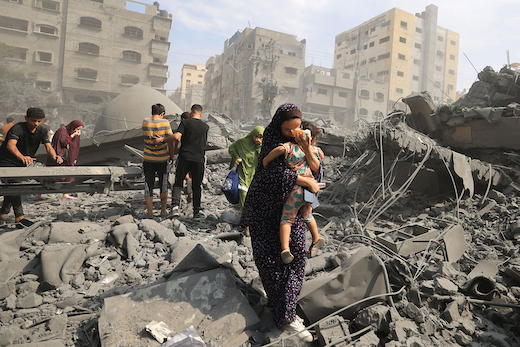
The International Court of Justice (ICJ) refused to implement the most crucial demand made by South African jurists: “the State of Israel shall immediately suspend its military operations in and against Gaza.” But at the same time, it delivered a devastating blow to the foundational myth of Israel. Israel, which paints itself as eternally persecuted, has been credibly accused of committing genocide against Palestinians in Gaza. Palestinians are the victims, not the perpetrators, of the “crime of crimes.” A people, once in need of protection from genocide, are now potentially committing it. The court’s ruling questions the very raison d’être of the “Jewish State” and challenges the impunity Israel has enjoyed since its founding 75 years ago.
The ICJ ordered Israel to take six provisional measures to prevent acts of genocide, measures that will be very difficult if not impossible to fulfill if Israel continues its saturation bombing of Gaza and wholesale targeting of vital infrastructure.
The court called on Israel “to prevent and punish the direct and public incitement to commit genocide.” It demanded Israel “take immediate and effective measures to enable the provision of urgently needed basic services and humanitarian assistance.” It ordered Israel to protect Palestinian civilians. It called on Israel to protect the some 50,000 women giving birth in Gaza. It ordered Israel to take “effective measures to prevent the destruction and ensure the preservation of evidence related to allegations of acts within the scope of Article II and Article III of the Convention on the Prevention and Punishment of the Crime of Genocide against members of the Palestinian group in the Gaza Strip.”
The court ordered Israel to “take all measures within its power” to prevent the crimes which amount to genocide such as “killing, causing serious bodily and mental harm, inflicting on the group conditions of life calculated to bring about its physical destruction in whole or in part, and imposing measures intended to prevent births within the group.”
Israel was ordered to report back in one month to explain what it had done to implement the provisional measures.
Gaza was pounded with bombs, missiles and artillery shells as the ruling was read in The Hague — at least 183 Palestinians have been killed in the last 24 hours. Since Oct. 7, more than 26,000 Palestinians have been killed. Almost 65,000 have been wounded, according to the Palestinian Ministry of Health. Thousands more are missing. The carnage continues. This is the cold reality.
Translated into the vernacular, the court is saying Israel must feed and provide medical care for the victims, cease public statements advocating genocide, preserve evidence of genocide and stop killing Palestinian civilians. Come back and report in a month.
It is hard to see how these provisional measures can be achieved if the carnage in Gaza continues.
“Without a ceasefire, the order doesn’t actually work,” Naledi Pandor, South Africa’s minister of international relations, stated bluntly after the ruling.
Time is not on the side of the Palestinians. Thousands of Palestinians will die within a month. Palestinians in Gaza make up 80 percent of all the people facing famine or catastrophic hunger worldwide, according to the United Nations. The entire population of Gaza by early February is projected to lack sufficient food, with half a million people suffering from starvation, according to the Integrated Food Security Phase Classification, drawing on data from U.N. agencies and NGOs. The famine is engineered by Israel.
At best, the court — while it will not rule for a few years on whether Israel is committing genocide — has given legal license to use the word “genocide” to describe what Israel is doing in Gaza. This is very significant, but it is not enough, given the humanitarian catastrophe in Gaza.
Israel has dropped almost 30,000 bombs and shells on Gaza — eight times more bombs than the U.S. dropped on Iraq during six years of war. It has used hundreds of 2,000-pound bombs to obliterate densely populated areas, including refugee camps. These “bunker buster” bombs have a kill radius of a thousand feet. The Israeli aerial assault is unlike anything seen since Vietnam. Gaza, only 20 miles long and five miles wide, is rapidly becoming, by design, uninhabitable.
Israel will no doubt continue its assault arguing that it is not in violation of the court’s directives. In addition, the Biden administration will undoubtedly veto the resolution at the Security Council demanding Israel implement the provisional measures. The General Assembly, if the Security Council does not endorse the measures, can vote again calling for a ceasefire, but has no power to enforce it.
Defense for Children International – Palestine v. Biden was filed in November by the Center for Constitutional Rights against President Joe Biden, Secretary of State Antony Blinken and Secretary of Defense Lloyd Austin. The case challenges the U.S. government’s failure to prevent complicity in Israel’s unfolding genocide of the Palestinian people. It asks the court to order the Biden administration to cease diplomatic and military support and comply with its legal obligations under international and federal law.
The only active resistance to halt the Gaza genocide is provided by Yemen’s Red Sea blockade. Yemen, which was under siege for eight years by Saudi Arabia, the United Arab Emirates, France, Britain and the U.S., experienced over 400,000 deaths from starvation, lack of health care, infectious diseases and the deliberate bombing of schools, hospitals, infrastructure, residential areas, markets, funerals and weddings. Yemenis know too well — since at least 2017 multiple U.N. agencies have described Yemen as experiencing “the largest humanitarian crisis in the world” — what the Palestinians are enduring.
Yemen’s resistance — when the history of this genocide is written — will set it apart from nearly every other nation. The rest of the world, including the Arab world, retreats into toothless rhetorical condemnations or actively supports Israel’s obliteration of Gaza and its 2.3 million inhabitants.
The Israeli newspaper Yedioth Ahronoth reported that the U.S. has sent 230 cargo planes and 20 ships filled with artillery shells, armored vehicles and combat equipment to Israel since the attacks of Oct. 7, in which some 1,200 Israelis were killed. U.S. weapons and military equipment are being shipped to Israel — which is running out of munitions — from the British base RAF Akrotiri in Cyprus, according to the U.K. investigative website Declassified UK. The Israeli newspaper Haaretz reported that more than 40 U.S. and 20 British transport aircraft, along with seven heavy-lift helicopters, have flown into RAF Akrotiri, a 40-minute flight from Tel Aviv. Germany reportedly plans to provide 10,000 rounds of 120mm precision ammunition to Israel. If the court rules against Israel, these countries will be recognized by the world’s most important international court as accomplices to genocide.
The ruling was dismissed by Israeli leaders.
Prime Minister Benjamin Netanyahu, seeking to paint the decision not to demand a ceasefire as a victory for Israel, said “Like every country, Israel has an inherent right to defend itself. The vile attempt to deny Israel this fundamental right is blatant discrimination against the Jewish state, and it was justly rejected. The charge of genocide leveled against Israel is not only false, it’s outrageous, and decent people everywhere should reject it.”
“The decision of the antisemitic court in The Hague proves what was already known: This court does not seek justice, but rather the persecution of Jewish people,” National Security Minister Itamar Ben-Gvir said. “They were silent during the Holocaust and today they continue the hypocrisy and take it another step further.”
The ICJ was founded in 1945 following the Nazi Holocaust. The first case it heard was submitted to the court in 1947.
“Decisions that endanger the continued existence of the State of Israel must not be listened to,” Ben-Gvir added. “We must continue defeating the enemy until complete victory.”
The court, which rejected Israel’s arguments to dismiss the case, acknowledged “that the military operation being conducted by Israel following the attack of 7 October 2023 has resulted, inter alia, in tens of thousands of deaths and injuries and the destruction of homes, schools, medical facilities and other vital infrastructure, as well as displacement on a massive scale.”
The ruling included a statement made by the U.N. Under-Secretary-General for Humanitarian Affairs and Emergency Relief Coordinator, Martin Griffiths, who on Jan. 5, called Gaza “a place of death and despair.” The court document went on:
. . . Families are sleeping in the open as temperatures plummet. Areas where civilians were told to relocate for their safety have come under bombardment. Medical facilities are under relentless attack. The few hospitals that are partially functional are overwhelmed with trauma cases, critically short of all supplies, and inundated by desperate people seeking safety.
A public health disaster is unfolding. Infectious diseases are spreading in overcrowded shelters as sewers spill over. Some 180 Palestinian women are giving birth daily amidst this chaos. People are facing the highest levels of food insecurity ever recorded. Famine is around the corner.
For children in particular, the past 12 weeks have been traumatic: No food. No water. No school. Nothing but the terrifying sounds of war, day in and day out.
Gaza has simply become uninhabitable. Its people are witnessing daily threats to their very existence — while the world watches on.
The court acknowledged that “an unprecedented 93% of the population in Gaza is facing crisis levels of hunger, with insufficient food and high levels of malnutrition. At least 1 in 4 households are facing ‘catastrophic conditions’: experiencing an extreme lack of food and starvation and having resorted to selling off their possessions and other extreme measures to afford a simple meal. Starvation, destitution and death are evident.”
The ruling, quoting Philippe Lazzarini, the Commissioner-General of the United Nations Relief and Works Agency for Palestine Refugees in the Near East (UNRWA), continued:
Overcrowded and unsanitary UNRWA shelters have now become ‘home’ to more than 1.4 million people,” the ruling read. “They lack everything, from food to hygiene to privacy. People live in inhumane conditions, where diseases are spreading, including among children. They live through the unlivable, with the clock ticking fast towards famine.
The plight of children in Gaza is especially heartbreaking. An entire generation of children is traumatized and will take years to heal. Thousands have been killed, maimed, and orphaned. Hundreds of thousands are deprived of education. Their future is in jeopardy, with far-reaching and long-lasting consequences.
The court also referred pointedly to comments made by multiple senior Israeli government officials advocating genocide, including the president and minister of defense. Statements made by government and other officials form a crucial element of the “intent” component when seeking to establish the crime of genocide.
It quoted Israeli Defense Minister Yoav Gallant who declared — two days after the Hamas-led attack of Oct. 7 — that he ordered a “complete siege” of Gaza City with “no electricity, no food, no fuel” being permitted.
“I have released all restraints . . . You saw what we are fighting against. We are fighting human animals. This is the ISIS of Gaza,” Gallant told Israeli troops massing around Gaza the following day. “This is what we are fighting against…Gaza won’t return to what it was before. There will be no Hamas. We will eliminate everything. If it doesn’t take one day, it will take a week, it will take weeks or even months, we will reach all places.”
The ICJ quoted Israel’s President Isaac Herzog as saying, “It is not true this rhetoric about civilians not aware, not involved. It is absolutely not true. They could have risen up. They could have fought against that evil regime which took over Gaza in a coup d’état. But we are at war. We are at war. We are defending our homes.” Herzog continued “We are protecting our homes. That’s the truth. And when a nation protects its home, it fights. And we will fight until we’ll break their backbone.”
Today’s decision was read out by the ICJ’s current president, Judge Joan Donoghue, an American lawyer who used to work at the U.S. State Department and the Department of the Treasury before she joined the World Court in 2010.
“In the Court’s view, the facts and circumstances mentioned above are sufficient to conclude that at least some of the rights claimed by South Africa and for which it is seeking protection are plausible,” it read. “This is the case with respect to the right of the Palestinians in Gaza to be protected from acts of genocide and related prohibited acts identified in Article III, and the right of South Africa to seek Israel’s compliance with the latter’s obligations under the Convention.”
It is clear from the ruling that the court is fully aware of the magnitude of Israel’s crimes. This makes the decision not to call for the immediate suspension of Israeli military activity in and against Gaza all the more distressing.
But the court did deliver a devastating blow to the mystique Israel has used since its founding to carry out its settler colonial project against the indigenous inhabitants of historic Palestine. It made the word genocide, when applied to Israel, credible.
By Alan MacLeod
Source: Mint Press News
Most of the world has watched the Israeli assault on Gaza in horror. As tens of thousands have been killed and millions displaced, tens of millions of people around the world have poured onto the streets to demand an end to the violence. But a few select others have taken to the pages of our most influential media to demand an escalation of the violence and that the United States help Israel strike not just Palestine, Syria, and Lebanon but Iran as well.
“I might have once favored a cease-fire with Hamas, but not now,” wrote Bush-era diplomat Dennis Ross in The New York Times, explaining that “if Hamas is perceived as winning, it will validate the group’s ideology of rejection, give leverage and momentum to Iran and its collaborators and put [our] own governments on the defensive.”
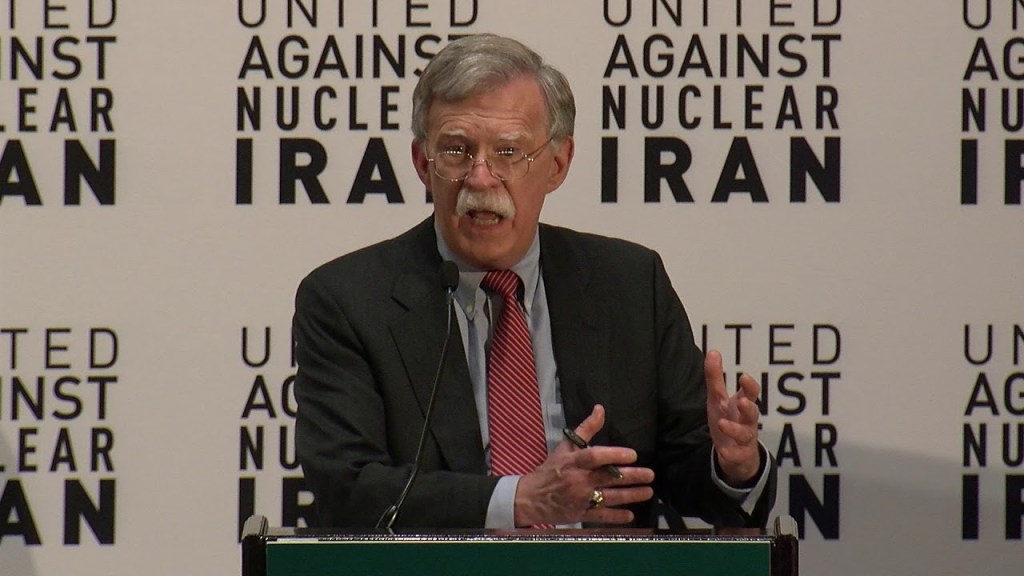
In the wake of Hamas’ October 7 assault, arch-neoconservative official John Bolton was invited on CNN, where he claimed that what we witnessed was really an “Iranian attack on Israel using Hamas as a surrogate” and that the U.S. must immediately respond. When asked whether he had any evidence, given the implications of what he was saying, he shrugged and replied, “This is not a court of law.”
On December 28, Bolton doubled down on his hawkish stance, writing in the pages of Britain’s Daily Telegraph that “The West may now have no option but to attack Iran” – a position he has held for at least a decade.
Meanwhile, in an interview with Saudi state-funded broadcaster Iran International, senior Bush official Mark Wallace bellowed that, “This is Iran’s work. Iran will suffer at the hands of retribution and will suffer the consequences of supporting this terror group and its horrific attack on Israel.” Wallace continued:
No civilized country wants further conflict. But the Iranians are forcing the civilized world’s hand. And you will see a dramatic response soon as the United States, Israel, and our allies begin to position assets around the world in preparation.”
If there was any doubt as to what sort of “dramatic response” Wallace wanted to see, he added a message to Iran’s Islamic Revolutionary Guard Corps: “I look forward to seeing you hanged from the end of one of your own ropes.”
Iran was recently the victim of a deadly terrorist attack. As mourners commemorated the U.S. assassination of Qassem Soleimani, two bombs exploded, killing 91 and injuring hundreds more. In this context, it was understandable why Iranian officials pointed the finger at the U.S. and Israel.
What these individuals all have in common is that they are board members of United Against Nuclear Iran (UANI), a shadowy but influential organization dedicated to pushing the West toward a military confrontation with the Islamic Republic.
Founded in 2008, the group is led by neoconservative hawks and has close ties to both U.S. and Israeli intelligence. It does not divulge where it receives its copious funding. However, it is known that right-wing Israeli-American billionaire Sheldon Adelson was a source. There is strong circumstantial evidence that Gulf dictatorships may also be bankrolling the group, although UANI has strongly denied this. In 2019, Iran designated UANI as a terrorist organization.
When asked by MintPress what he made of UANI’s recent statements, Eli Clifton, one of the few investigative journalists to have covered the group, said, “It’s very consistent with the positions and advocacy that the organization has taken since its inception.” Adding,
United Against Nuclear Iran does not miss an opportunity to try to bring the United States closer to a military conflict with Iran. And on the other side of the equation, they also have worked very hard to oppose efforts to de-escalate the U.S.-Iran relationship.”
UANI’s board is a who’s who of high state, military and intelligence officials from around the Western world. Among its more notable members include:
In addition, notable former board members include ex-CIA Director R. James Woolsey; head of Mossad between 2002 and 2011, Meir Dagan; and one-time chief of British spy agency MI6, Sir Richard Dearlove.
For 15 years, UANI has organized conferences, published reports, and lobbied politicians and governments, all with one goal: pushing a neoconservative line on Iran. “UANI are a force multiplier. They provide at least the veneer of an intellectual infrastructure for the Iran hawk movement. They did not invent being hawkish on Iran, but they sure made it a heck of a lot easier,” Ben Freeman, Director of the Democratizing Foreign Policy Program at the Quincy Institute, told MintPress.
For such a large, well-financed, and influential organization filled with senior officials, United Against Nuclear Iran keeps its funding sources very quiet. However, in 2015, Clifton was able to obtain a UANI donor list for the 2013 financial year. By far and away, the largest funders were billionaire New York-based investor Thomas Kaplan and multibillionaire Israeli-American casino mogul Sheldon Adelson.
Kaplan, whose $843,000 donation supplied around half the group’s 2013 funding, is a venture capitalist investor concentrating on metals, particularly gold. He is the chairman of Tigris Financial and the Electrum Group LLC. Both of Kaplan’s firms employ UANI CEO Mark Wallace as CEO and COO, respectively.
A 2010 Wall Street Journal article titled “Tigris Financial Goes All-in on Gold” noted that the company had bet billions of dollars on the price of gold rising, more than the reserves of the Brazilian central bank. As Clifton has noted, both Kaplan and Wallace have marketed gold to clients as the perfect commodity to hold if there is increased instability in the Middle East. Therefore, both Kaplan and Wallace stand to make massive sums if the U.S. or Israel were to attack Iran, making their UANI warmongering a gigantic and potentially profitable conflict of interest.
Adelson provided the majority of the rest of UANI’s funding. The world’s 18th-richest individual at the time of his 2021 death, the tycoon turned his economic empire into a political one, supporting ultraconservative causes in both the United States and Israel. Between 2010 and 2020, he and his wife donated more than $500 million to the Republican Party, becoming GOP kingmakers in the process. He would often vet Republican presidential candidates at his casino in Las Vegas, and it was often said that this “Adelson Primary” was almost as important as the public one.
An ardent Zionist, Adelson bankrolled numerous pro-Israel lobby projects, such as AIPAC, One Jerusalem and Taglit Birthright. He also owned Israel Hayom, the country’s most-read newspaper, with 31% of the national share. Relentlessly pro-Netanyahu, it was said that the Israeli prime minister asked his friend Adelson to set up a newspaper to help his political career.
Adelson and his influence have been one of the driving forces of American hostility towards Iran. In 2013, during a conversation with Rabbi Shmuley Boteach, he called for the United States to stop negotiating and drop a nuclear bomb on Iran to show that “we mean business.”
A potential third, even more controversial, source of funding is the Gulf monarchies of Saudi Arabia and the UAE. Leaked emails show UANI officials soliciting support from the Emirati royal family. Both Mark Wallace and Frances Townsend, for example, emailed the Emirati Ambassador to the U.S. detailing cost estimates for upcoming events and inquiring about support from the UAE.
Thomas Kaplan himself is extraordinarily close to the nation. “The country and the leadership of the UAE, I would say, are my closest partners in more facets of my life than anyone else other than my wife,” he told the Emirati outlet, The National News, which also detailed his friendship with Crown Prince of Abu Dhabi, Sheikh Mohamed bin Zayed.
One of United Against Nuclear Iran’s primary activities, Iranian political commenter Ali Alizadeh told MintPress, is to create a worldwide “culture of fear and anxiety for investing in Iran.” The group attempts to persuade businesses to divest from the Islamic Republic and sign their certification pledge, which reads as follows:
The undersigned [Name], the [Title] of [Company] (the “Company”), does hereby certify on behalf of the Company that until the Iranian regime verifiably abandons its drive for nuclear weapons, support for terrorism, routine human rights violations, hostage-taking, and rampant anti-Americanism as state policy, that neither the Company nor any subsidiary or affiliate of the Company, directly or through an agent, representative or intermediary.”
One corporation that UANI targeted was the industrial machinery firm Caterpillar. UANI hectored the firm, even erecting a roadside billboard outside its headquarters in Peoria, IL, insinuating that they were aiding Iran in constructing a nuclear weapon. Caterpillar quickly ordered its Iran projects terminated. Wallace took heart from his group’s victory and warned that other businesses would be targeted.
These have included French companies such as Airbus and Peugeot-Citroen, who were threatened with legal action. In 2019, UANI earned an official rebuke from the Russian Foreign Ministry for attempting to intimidate Russian corporations trading with Tehran. “We think such actions are unacceptable and deeply concerning,” said Foreign Ministry spokesperson Maria Zakharova. “Attempts to pressure and threaten Russian business … are a follow-up on the dishonorable anti-Iranian cause by the U.S. administration,” she added, hinting at collusion between the government and the supposedly non-governmental organization.
Some of UANI’s campaigns have been markedly petty, including pressuring New York City hotels to cancel bookings with Iranian officials (including then-President Mahmoud Ahmadinejad) visiting the city on United Nations business. Others, however, have been devastating to the Iranian economy, such as the SWIFT international money transfer terminating its relationship with Tehran, cutting the country off from the global banking system.
On UANI’s actions against businesses, Freeman said: “It’s effective, and (in some cases, at least) it’s to the detriment of the people of Iran; it’s to the detriment of these companies; and it’s to the detriment of peace in the region.”
While the group presents itself as against a nuclear Iran, UANI was strangely opposed to the Joint Comprehensive Plan of Action (JCPOA) – the deal between Iran and the West that limited the former’s nuclear technology research in exchange for sanctions relief from the latter. As MintPress reported at the time, UANI spent millions on T.V. advertisements trashing the agreement. As Wallace noted, “We have a multi-million-dollar budget, and we are in it for the long haul. Money continues to pour in.”
After the JCPOA was signed, UANI hosted a summit attended by senior Israeli, Emirati, and Bahraini officials, touting its failures. Once UANI’s John Bolton was named Donald Trump’s National Security Advisor, he persuaded the president to withdraw entirely from the deal. Bolton has deep connections to the Mojahedin-e-Khalq (MEK), an exiled Iranian political group widely identified as a terrorist organization. He has, for some time, considered them a government in waiting after the U.S. overthrows the current administration. “Before 2019, we will celebrate in Tehran,” he told the group in 2018, predicting that, with him at the helm, the Trump administration would soon cause the downfall of the Iranian government.
Bolton has long been a hardliner on regime change. “To stop Iran’s bomb, bomb Iran,” read the title of his 2015 New York Times op-ed. Yet this appears to be the dominant position at UANI. In March, Ross published an article in The Atlantic headlined “Iran needs to believe America’s threat,” which demanded that the U.S. “take forceful action to check Tehran’s progress toward a nuclear bomb.” Failure to do so, Ross claimed, would provoke Israel to do so itself – a “much more dangerous scenario,” according to him. Yet only two years previously, Ross called on the U.S. to “give Israel a big bomb” to “deter Iran,” noting that the “best way” to stop the Iranian nuclear program was to supply Israel with its own nukes, thereby taken as a given that Iran was indeed pursuing nuclear weapons itself (a highly questionable claim at the time) and ignoring Israel’s already existing 200+ stockpile of nuclear missiles.
“It doesn’t seem like UANI ever really took seriously the possibility of a diplomatic means to constrain Iran from continuing to increase its enrichment levels and moving towards a nuclear weapon,” Clifton told MintPress. “As a matter of fact, they generally fought tooth and nail against the JCPOA. They are eager to push the United States toward confrontation with Iran using the possibility of Iranian nuclear weapons as a reason,” he added.
That UANI is headed by so many state, military and intelligence leaders begs the question: to what extent is this really a non-governmental organization? “That is one of the dirty secrets of think tanks: they are very often holding tanks for government officials,” Freeman said, adding:
The Trump folks all had to leave office when Biden won, so a lot of them ended up in think tanks for a while, four years, let’s say. And if Trump wins again, they will bounce back into government. And the same is true of Democratic administrations, too.”
The U.S. government also clearly has a longstanding policy of outsourcing much of its work to “private” groups in order to avoid further scrutiny. Many of the CIA’s most controversial activities, for example, have been farmed out to the National Endowment for Democracy (NED), a technically non-governmental organization funded entirely by Washington and staffed with ex-state officials. In recent years, the NED has funneled millions of dollars to protest leaders in Hong Kong, organized an attempted color revolution in Cuba, organized anti-government rock concerts in Venezuela, and propped up dozens of media organizations in Ukraine.
These sorts of institutions blur the line between public and private sectors. But a 2014 legal case raises even more questions about UANI’s connections to the U.S. government. After UANI accused Greek shipping magnate Victor Restis of working with the Iranian government, he sued them for libel. In an unprecedented move for what was a private, commercial lawsuit, Attorney General Eric Holder intervened in the lawsuit, ordering the judge to shut the case down on the grounds that, if it continued, it would expose key U.S. national security secrets. The case was immediately dropped without explanation.
In the past, when the Justice Department has invoked state secrets, a high-ranking state official has offered a public statement as to why. Yet, this time, nothing was offered. Reporters at the time speculated that much of the material Restis wanted to make public was possibly given to UANI by either the CIA or Mossad, which would have revealed a network of collusion between state intelligence agencies and a supposedly independent, private non-profit. Given the glut of ex-Mossad and CIA chiefs at UANI, this speculation is perhaps not as wild as it might seem.
UANI’s funders certainly also have extensive connections to Israel. Kaplan is the son-in-law of Israeli billionaire Leon Recanati and is said to be close with Prime Ministers Naftali Bennet and Yair Lapid. He has also employed a number of Israeli officials at his businesses. An example of this is Olivia Blechner, who, in 2007, left her role as the Director of Academic Affairs at the Israeli Consulate General in New York to become Executive Vice-President of Investor Relations and Research at Kaplan’s Electrum Group – a rather perplexing career move.
Adelson, meanwhile, was given what amounted to an official state funeral in Israel, one that even Prime Minister Netanyahu attended. He was buried on the Mount of Olives in Jerusalem – one of the holiest sites in Judaism and an honor that very few figures receive.
While United Against Nuclear Iran is already a notable enough organization, it is actually merely part of a large group of shadowy non-governmental groups working to cause unrest and, ultimately, regime change in Iran. These groups all share overlapping goals, funders and key individuals.
One example of this is the Counter Extremism Project (CEP), a non-profit that purports to exist to “combat the growing threat posed by extremist ideologies.” Yet the group focuses largely on Islamist extremism – and only those groups that are enemies of the U.S., Israel and the Gulf Monarchies (about whose extremism and violence the CEP has nothing to say). Ten members of the CEP’s leadership council are also on UANI’s board, including Wallace, who is CEO of both organizations.
Another group headed by Wallace is the Jewish Committee to Support Women Life Freedom in Iran. This organization claims to be focused on improving women’s rights in Iran. It very quickly, however, divulges that this is a vehicle for regime change. On its homepage, for example, it writes:
These freedom fighters continue with no sign of relenting on their calls for regime change. Calls for “Woman Life Freedom” and the removal of Supreme Leader Ayatollah Ali Khamenei echo from rooftops, down street corridors, across campus hallways, and on government billboards. These brave Iranians have expressed their hatred for the ruling clerics not only in their words, but in their actions.”
Seven members of the Jewish Committee to Support Women Life Freedom in Iran’s steering group – including Wallace and Kaplan – also lead UANI.
Mike Wallace, second from right, poses with prominent anti-Iran figures at a lobbying event in Italy, February 2023. Photo | Twitter
Kaplan is well-known as a conservationist. However, his group, Panthera, which works to preserve the world’s 40 known species of big cats, has also been accused of being a secret regime change operation. Panthera has a number of UANI officials on its board or conservation council, including Wallace and Lamb (the ex-director of U.K. Special Forces and Commander of the British Army). Also on the council are Itzhak Dar, former Director of the Israeli Secret Service, Shin Bet, and General David Petraeus, former CIA Director and Commander of the U.S. invasion of Afghanistan.
In 2018, Iranian authorities arrested eight individuals working with Panthera inside the country. All eight were convicted of spying on behalf of the U.S. and Israel. While many in the West decried the trials as politically motivated, any organization led by these figures is bound to cause suspicions.
This is especially the case as Wallace is also a founder of PaykanArtCar, an organization that attempts to use art to, in its words, “advocate for the restoration of human rights and dignity for all in Iran.” All three team members of PaykanArtCar also work at UANI.
The final group in this Iran regime change network is the International Convention for the Future of Iran. Set up by Wallace himself, the organization’s website explains that it exists to “end the repression of the regime and bring true change to Iran.” Further purposes are to “connect the Iranian opposition in exile [i.e., the MEK] with policymakers in the United States and internationally” and to “offer program grants and technical support” to groups working to overthrow the government. However, judging by the lack of updates and the group’s Twitter profile having only 31 followers, it appears that it has not had much success achieving its goals.
In short, then, there exists a network of American NGOs with the mission statements of helping Iran, opposing Iran, preserving Iran, and bombing Iran, all staffed by largely the same ex-U.S. government officials.
Iran, however, is not the only target in Wallace’s sights. It appears that he is also trying to give Turkey similar treatment. Wallace is the CEO of the Turkish Democracy Project, a non-profit established to oppose the rule of President Recep Tayyip Erdoğan, who, it says, has “dramatically altered Turkey’s position in the international community and its status as a free and liberal democracy.” The Turkish Democracy Project denounces what it calls Erdoğan’s “destabilizing actions in and beyond the region, his systemic corruption, support for extremism, and disregard for democracy and human rights.” There are no Turkish people among the Turkish Democracy Project’s leadership. But there are seven UANI board members at the top, calling the shots.
The history of Iran has been intimately intertwined with the United States since at least 1953 when Washington orchestrated a successful coup against Prime Minister Mohammad Mosaddegh. Mosaddegh had refused U.S. demands to stamp out Communist influences in his country and had nationalized the nation’s oil. The U.S. installed Shah Mohammad Reza Pahlavi as a puppet ruler. An unpopular and authoritarian ruler, the Shah was overthrown in the Revolution of 1979. Since then, it has become a target for regime change, and its nuclear program is something of an obsession in the West.
Often orchestrated by UANI officials while they were in government, the U.S. has carried out a sustained economic war against Tehran, attempting to collapse its economy. American sanctions have severely hurt Iran’s ability to both buy and sell goods on the open market and have harmed the value of the Iranian rial. As prices and inflation rose rapidly, ordinary people lost their savings.
During the COVID-19 pandemic, the U.S. turned the screw once again, intimidating both businesses and nations into refusing to sell Tehran vital medical supplies. Eventually, the World Health Organization stepped in and directly supplied it with provisions – a factor in the Trump administration’s decision to pull out of the agency.
While U.S. actions have severely harmed the Iranian economy, a future bright spot may come in the form of BRICS, the economic bloc that Iran – along with Egypt, Ethiopia, Saudi Arabia, and the UAE – joined on January 1. American economic power on the global stage appears to be waning. However, This new reality might spur Washington policymakers to reconsider a military option, as UANI desperately wants them to.
It is perfectly reasonable to be worried about Iran – or any country, for that matter – developing atomic bombs. Nuclear weapons pose an existential threat to human civilization, and more actors with access to them increase the likelihood of a devastating confrontation. Already in the region, India, Pakistan, Israel and Russia possess them. But it is only the United States that has ever used them in anger, dropping two on Japan and coming close to doing so in China, Korea and Vietnam. And given the U.S.’ recent track record of attacking countries that do not possess weapons of mass destruction (e.g., Iraq, Libya, Afghanistan) and not touching those who do (such as North Korea), it is entirely understandable why Iran might want one. As Freeman said:
I certainly do not want Iran to get a nuclear weapon. But at the same time, you can also believe that it would be catastrophic if the U.S. were to engage in a war with Iran…And the concern with groups like UANI is that they are taking that [the worry of Iran getting a nuclear weapon] and pushing that argument to a point where it might lead to an active conflict.”
The slaughter in Gaza has been horrifying enough. More than 22,000 people have been killed in the Israeli invasion, and a further 1.9 million displaced. Israel is also simultaneously bombing the West Bank, Syria and Lebanon. The U.S. is facilitating this, sending billions of dollars in weaponry, pledging iron-clad political support to Israel, silencing critics of its actions, and vetoing United Nations resolutions.
But United Against Nuclear Iran is eager to escalate the situation to a vastly greater level, urging Washington to attack a well-armed country of nearly 90 million people, erroneously claiming that Iran is behind every Hamas or Hezbollah action. “This is not a nuclear non-proliferation organization” Clifton said, noting that there are plenty of genuine already existing peace and environmental groups worried about nuclear weapons that either supported the JCPOA or said it did not go far enough. “Their focus is more on working towards regime change in Iran rather than actually supporting efforts that might prevent Iranian nuclear weapons,” he added.
IF UANI gets its way, a conflict with Iran might spark a Third World War. And yet they are receiving virtually no pushback to their ultra-hawkish pronouncements, largely because they operate in the shadows and receive virtually no public scrutiny. It is, therefore, imperative for all those who value peace to quickly change that and expose the organization for what it is.
While the White House claims to be “frustrated” with Israel’s conduct in Gaza, US support for the carnage continues.
By Aaron Maté
Source: Aaron Maté Substack
On October 15th, President Biden took umbrage at a suggestion that his administration could not back both the Ukraine proxy war and Israel’s assault on Gaza at the same time.
“We’re the United States of America for God’s sake, the most powerful nation… in the history of the world,” Biden told CBS News. “We can take care of both of these and still maintain our overall international defense.”
Three months and well over 20,000 defenseless Palestinians slain later, the self-declared leader of the most powerful nation in the history of world now claims to be a helpless bystander.
According to four US officials, Biden is “increasingly frustrated” and “losing his patience” with Israeli Prime Minister Benjamin Netanyahu, who has rejected “most of the administration’s recent requests related to the war in Gaza,” Axios reports. “The situation sucks and we are stuck,” one official complained. “The president’s patience is running out.” Another official fumes that “there is immense frustration” in the Oval Office. According to Democratic Senator Chris Van Hollen: “At every juncture, Netanyahu has given Biden the finger. They are pleading with the Netanyahu coalition, but getting slapped in the face over and over again.”
Van Hollen is correct that the administration is getting slapped in the face by Israel. But he omits that Biden is a willing scene partner in a barely disguised performance: pretending to be up in arms about Israel’s genocidal conduct while doing everything he can to support it.
As Likud parliamentarian Danny Danon explained last month, any US demand of Israel’s military is perfunctory. “They didn’t agree to a ground invasion — we invaded,” Danon said. “They didn’t agree to [attacking] Al-Shifa hospital — we ignored their request. They wanted a pause without hostages — we didn’t accept that. We have no American ultimatum. There is no deadline from the US.”
The US not only imposes no conditions on its support for Israel’s mass murder campaign in Gaza, but has twice bypassed Congress to expedite weapons for it. After all, this administration professes to have “no red lines” when it comes to Israeli aggression, and is fronted by a president who has declared that there is “no possibility” of a ceasefire.
While Biden and his aides now pretend to have their hands tied, their instrumental role is undeniable. “Biden is president of the United States, still the most powerful country in the world by almost every measure and a country without whose support Israel has no future,” former US diplomat Patrick Theros writes. “A firm public demand to cease and desist immediately would have enormous domestic political repercussions in Israel — far less in the United States. Biden would not have to publicly threaten to cut off weapons deliveries; a few words delivered in private to Netanyahu and a few members of his war cabinet would probably suffice.”
“If you want to use your leverage, use your leverage,” former Israeli negotiator Daniel Levy says of Biden’s stance. “You’ve chosen to give Israel a blank check.”
That choice continues. In meetings with Israeli officials on Nov. 30th, Secretary of State Antony Blinken informed his counterparts that they had “weeks, not months” to “wrap up combat operations at the current level of intensity,” US officials later told the New York Times. Upon a return visit to Israel this week, Blinken again touted his push for what he called “the phased transition of Israel’s military campaign in Gaza.” That “transition” to a “lower-intensity phase,” White House spokesperson John Kirby said on Sunday, “is coming here very, very soon.”
But away from the news cameras, the posture changes. A senior US official now explains to the Washington Post that it’s in fact “pointless to urge them [the Israelis] to change.” Accordingly, “Washington’s priority has now shifted to tolerating Israel’s high-intensity operation throughout January, while insisting instead that it downgrade the tempo in February.”
In other words, the US has decided to tolerate Israel’s genocidal tempo in Gaza as normal. From Washington’s point of view, saving thousands of Palestinian lives from murder at the hands of US-supplied weaponry would be pointless.
Biden is so committed to continuing the Gaza slaughter that he has even expanded the war zone to Yemen. In a statement announcing his authorization of US strikes last week, Biden declared that he was acting to protect “freedom of navigation” and the “free flow of international commerce.” Since mid-November, the group that controls most of Yemen, Ansar Allah (misleadingly known in the US as the Houthis), has been targeting commercial ships – primarily those with Israeli links – passing through the Red Sea in a bid to compel the Israeli government to halt its assault on Gaza. By contrast with Israel’s operations, which has an official death toll of 23,000 and counting, Ansar Allah has not killed anyone. It even lost at least ten fighters in a US counterattack on December 31st. As Biden noted, Ansar Allah’s main impact has been to threaten “weeks of delays in product shipping times.” (Others estimate that the delay time can in fact be counted in days).
As in Gaza, the ultimate targets of US aggression in Yemen are civilians. While the Pentagon claims to be targeting Ansar Allah’s military capabilities, the “greater risk from the air attacks is likely borne by ordinary Yemenis,” the New York Times notes. This risk to ordinary Yemenis is consistent with longstanding US policy, specifically the current Biden team’s 2015 decision under President Obama to green-light the Saudi-led war on Yemen that has caused the ensuing humanitarian crisis. Around 21 million Yemenis – two-thirds of the country – rely on aid for survival, while more than four million are internally displaced.
In facing “one of the world’s worst humanitarian calamities,” the Times adds, Yemen faces “a dubious distinction now shared by Gaza.” Given its critical support for Israel’s assault, the US therefore has the dubious distinction of fueling two of the world’s worst humanitarian calamities.
Because of Israel’s blockade and military assault, the risk of famine in Gaza is “growing by the day,” Martin Griffiths, the United Nations’ top humanitarian official now warns. “As ground operations move southwards, aerial bombardments have intensified in areas where civilians were told to relocate for their safety.” For Gaza’s civilians – more than 90% of them displaced — “dignified human life is a near impossibility.”
According to one anonymous official with Israel’s occupation authority for Gaza (COGAT), the lack of dignity for Palestinians in Gaza is a genetic trait. “There is no hunger in Gaza,” the official told Haaretz. “…There were stockpiles of food in Gaza. Don’t forget that this is an Arab, Gazan population whose DNA is to hoard, certainly when it comes to food.”
It is apparently in the White House DNA to share its Israeli client’s avowed bigotry. In a statement Sunday night, President Biden marked “100 days of captivity” for the Israeli hostages in Gaza. Biden’s emotional message failed to even mention the hundreds of thousands of Palestinians killed, wounded, and displaced under US-backed Israeli assault over that same period.
“No one should have to endure even one day of what they have gone through, much less 100,” Biden said of the hostages. By refusing to acknowledge them, Biden is affirming via omission that he believes the exact opposite — and in fact infinitely worse — for Gaza’s two million Palestinian hostages. After 100 days of genocide, the people of Gaza are fated to endure continued atrocities as a direct result of US policy, no matter the Biden team’s ongoing effort to pretend otherwise.
INDIAN COUNTRY NEWS
"It is the duty of every man, as far as his ability extends, to detect and expose delusion and error"..Thomas Paine
Human in Algorithms
From the Roof Top
I See This
blog of the post capitalist transition.. Read or download the novel here + latest relevant posts
अध्ययन-अनुसन्धानको सार
 After the Crash