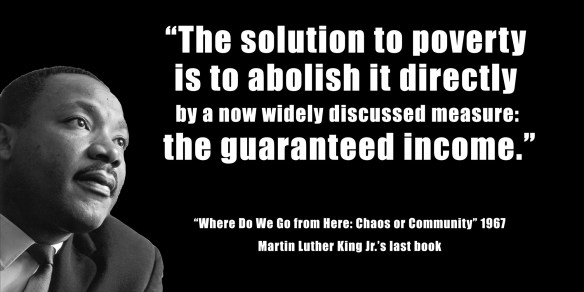
A 2% Financial Wealth Tax Would Provide A $12,000 Annual Stipend To Every American Household

Careful analysis reveals a number of excellent arguments for the implementation of a Universal Basic Income.

By Paul Buchheit

Source: Nation of Change

It’s not hard to envision the benefits in work opportunities, stress reduction, child care, entrepreneurial activity, and artistic pursuits for American households with an extra $1,000 per month. It’s also very easy to justify a financial wealth tax, given that the dramatic stock market surge in recent years is largely due to an unprecedented degree of technological and financial productivity that derives from the work efforts and taxes of ALL Americans. A 2% annual tax on financial wealth is a small price to pay for the great fortunes bestowed on the most fortunate Americans.

The REASONS? Careful analysis reveals a number of excellent arguments for the implementation of a Universal Basic Income (UBI).

(1) Our Jobs are Disappearing

A 2013 Oxford study determined that nearly HALF of American jobs are at risk of being replaced by computers, AI, and robots. Society simply can’t keep up with technology. As for the skeptics who cite the Industrial Revolution and its job-enhancing aftermath (which actually took 60 years to develop), the McKinsey Global Institute says that society is being transformed at a pace “ten times faster and at 300 times the scale” of the radical changes of two hundred years ago.

(2) Half of America is Stressed Out or Sick

Half of Americans are in or near poverty, unable to meet emergency expenses, living from paycheck to paycheck, and getting physically and emotionally ill because of it. Numerous UBI experiments have led to increased well-being for their participants. A guaranteed income reduces the debilitating effects of inequality. As one recipient put it, “It takes me out of depression…I feel more sociable.”

(3) Children Need Our Help

This could be the best reason for monthly household stipends. Parents, especially mothers, are unable to work outside the home because of the all-important need to care for their children. Because we currently lack a UBI, more and more children are facing hunger and health problems and educational disadvantages.

(4) We Need More Entrepreneurs

A sudden influx of $12,000 per year for 126 million households will greatly stimulate the economy, potentially allowing millions of Americans to TAKE RISKS that could lead to new forms of innovation and productivity.

Perhaps most significantly, a guaranteed income could relieve some of the pressure on our newest generation of young adults, who are deep in debt, underemployed, increasingly unable to live on their own, and ill-positioned to take the entrepreneurial chances that are needed to spur innovative business growth. No other group of Americans could make more productive use of an immediate boost in income.

(5) We Need the Arts & Sciences

A recent Gallup poll found that nearly 70% of workers don’t feel ‘engaged’ (enthusiastic and committed) in their jobs. The work chosen by UBI recipients could unleash artistic talents and creative impulses that have been suppressed by personal financial concerns, leading, very possibly, to a repeat of the 1930s, when the Works Progress Administration hired thousands of artists and actors and musicians to help sustain the cultural needs of the nation.

Arguments against

The usual uninformed and condescending opposing argument is that UBI recipients will waste the money, spending it on alcohol and drugs and other ‘temptation’ goods. Not true. Studies from the World Bank and the Brooks World Poverty Institute found that money going to poor families is used primarily for essential needs, and that the recipients experience greater physical and mental well-being as a result of their increased incomes. Other arguments against the workability of the UBI are countered by the many successful experiments conducted in the present and recent past: FinlandCanada, Netherlands, Kenya, IndiaGreat Britain, Uganda, Namibia, and in the U.S. in Alaska and California.

How to pay for it

Largely because of the stock market, U.S. financial wealth has surged to $77 trillion, with the richest 10% owning over three-quarters of it. Just a 2 percent tax on total financial wealth would generate enough revenue to provide a $12,000 annual stipend to every American household (including those of the richest families).

It’s easy to justify a wealth tax. Over half of all basic research is paid for by our tax dollars. All the technology in our phones and computers started with government research and funding. Pharmaceutical companies wouldn’t exist without decades of support from the National Institutes of Health. Yet the tech and pharmaceutical companies claim patents on the products paid for and developed by the American people.

The collection of a wealth tax would not be simple, since only about half of U.S. financial wealth is held directly in equities and liquid assets (Table 5-2). But it’s doable. As Thomas Piketty notes, “A progressive tax on net wealth is better than a progressive tax on consumption because first, net wealth is better defined for very wealthy individuals..”

And certainly a financial industry that knows how to package worthless loans into A-rated mortgage-backed securities should be able to figure out how to tax the investment companies that manage the rest of our ever-increasing national wealth.


US Technological Transformations and the Narcotic-Fueled Genocide of American Workers

By James Petras

Source: The Unz Review

Introduction

During his recent visit to New Hampshire on 3/20/18, President Trump declared once again that the US is facing a ‘drug epidemic’. This time he advocated the death penalty for criminal drug dealers as the solution to a national crisis that has killed over 1 million Americans since the 1990’s (when the blockbuster prescription opiate Oxycontin was first released on the market). Trump promised that the Justice Department would develop the most severe penalties for criminal drug traffickers, by which he meant foreigners. He argued that his proposed “Wall” (between the Mexican- US border) would cut the flow of drugs responsible for the ongoing addiction of millions of US citizens – as though the prescription opiate addiction epidemic resulted from a foreign invasion, and not corporate decisions from Big Pharma.

President Trump’s claim that 116 ‘drug deaths’ occur every day (42,000 a year) is a major underestimate. In 2017, alone over 64,000 drug overdose deaths were reported in official statistics (with many unreported cases signed off as natural or undetermined, especially in counties too poor to afford autopsies and expensive forensic toxicology). Another 4 million Americans, at least, are currently addicted to opioids and at risk for overdose.

In comparative terms, more American workers have been killed or devastated by narcotics (mostly via prescription) in 2017 alone, than in the entire decade of the Vietnam War with its 58,000 dead and 500,000 wounded. In 2017, 40,000 Americans died in motor vehicle accidents and another 39,000 by gun violence – and these statistics are not broken down to include vehicular accidents due to drug intoxication or gun violence over drugs. Prescription or illegal opiates, alone or mixed with other sedative drugs, like Valium, or alcohol, are the most prominent and preventable cause of premature death in the United States today.

This pattern is unique to the United States, where the irresponsible medical prescription of highly addicting narcotics has been the primary portal of entry into the degrading life of addiction for millions. Despite President Trump’s claims, the addiction crisis is not a product of urban Afro-American street dealers or Mexican narco-traffickers: This uniquely American crisis has been created and fueled by billionaire-owned US pharmaceutical corporations, which produced, distributed and wildly profited from legal narcotics. They were aided by the irresponsible prescription practice of tens of thousands of doctors and other ‘providers’ who introduced millions of vulnerable patients to the world of narcotic dependency – including youngsters with sports injuries and workers with job-related pain. These are physicians and medical providers who rarely stopped to examine their own responsibility, even when their otherwise healthy patients overdosed or were destroyed by addiction. It is especially outrageous that doctors and ‘Big Pharma’ worked hand in hand for over 20 years to create this epidemic, enjoying wild profits and almost total legal immunity. Few have dared to openly question their irresponsibility and greed. In the poorest and most vulnerable areas of this country, the most irresponsible and unaccountable incompetence has replaced real medical care and created a health care apartheid.

The Federal Drug Enforcement Agency (FDA) and the Drug Enforcement Agency (DEA) have protected the corporate drug traffickers and ensured the manicured and cultured narco-bosses the highest rates of return on their products. These polished pushers have their names engraved on the walls of museums and opera houses around the country.

The majority of Presidential, Federal, State and municipal candidates from both major parties have received millions of dollars in electoral campaign funds from these huge legal narcotic manufacturers and distributors, as well as from physicians and other representative of the ‘pain-treatment industry’. Over the past decades, politicians have openly or secretly opposed or weakened legislation designed to address this crisis.

Why not just ask President Trump to direct his Justice Department to impose the death penalty on the board of directors of the big corporate narcotic manufacturers or distributors or on the CEOs of major ‘pain clinics’ or on the owners of local rural ‘health centers’ that drove the villagers of West Virginia into their life-destroying downward spirals?

When will the DEA finally storm the medical centers to arrest the over-prescribing ‘providers’ of narcotics and benzodiazepine tranquilizers (a very common deadly combination)?

When will the SWAT teams seize the vacation homes of the CEOs of major US hospitals where the convenient and fake ideology of promising a ‘pain-free’ experience (‘make it Zero on the Pain Scale’) led to the generalized promotion of highly addicting narcotics for minor injuries, arthritic pain, or chronic back discomfort due to work or obesity? Responsible alternatives existed and were used in the rest of the world – largely untouched by this prescription-fueled crisis.

No doubt what President Trump has in mind is something else: the expulsion of Latin American workers under the pretext of going after the drug dealers and the even more massive incarceration of petty street dealers in the African American community.

Trump will then turn to further monitoring and arresting small-scale American marijuana farmers, who earn a basic income from growing a product that many believe is safe, non-addicting, and significantly reduces demand for dangerous narcotics.

As ugly as this all seems, the complicity of the political, economic and the medical elite in exponentially spreading deadly narcotics among the poor, working class and downwardly mobile middle class, points to a deeper and more sinister policy goal: the systematic elimination of millions of American workers made redundant in the new economy. This is a ‘gentler genocide’, where millions of workers die prematurely seeking an escape from pain as they have been replaced by a new technology and a new ideology: Robots, artificial intelligence and digitalization have rendered them disposable, while the out-sourcing of work to low paid overseas laborers and immigrants have guaranteed unimaginable profits for the elite decision makers.

This highly profitable process, benefiting the political, pharmaceutical, financial, police and judicial elites, conveniently blames the victims, a significant proportion of whom come from the poor and working class in this country, including white rural and small town addicts, especially youth, stuck at minimum wage jobs with no prospects of a decent future – injured construction workers, 15% of whom abuse prescription narcotics for work-related injuries, as well as the marginalized petty drug dealers from the urban slums and desperate Latino immigrants forced to accommodate the cartels. These people have little rights and are easily monitored, incarcerated, expelled and just written-off in one-line obituaries.

The narcotic-fueled genocide had grown out of a calculated corporate strategy meant to cull and subdue a huge population of potentially restive marginalized workers and their families, blaming the overdosing victims for their own ‘irresponsible’ choices, their reliance on prescription opiates, their lack of access to competent medical care, and their untimely deaths as though this were all a collective suicide as the great nation marches forward.

The higher the death toll among marginalized Americans, the greater the reliance on political distractions and racist deceptions. President Trump loudly blames street-level retail distributors, while ignoring the links between tax-exempt mega-billionaires who have profited from the shortened life-expectancies of addicted workers (scores of billions of dollars already saved in future pension and health care expenses) and the millions fired for addiction and denied jobless benefits and treatment. Trump has yet to even mention the actions of the legal pharma-medical industry that set this in motion.

Meanwhile, the Democratic Party leaders denounce the worker-victims of addiction and their communities as ‘irresponsible and racist’, for having believed the populist rhetoric of candidate Trump. Trump’s most intense rural areas of support coincided with areas of the worst opioid addiction and suicide rates. Trump’s rival, Hillary Clinton wrote off scores of millions of vulnerable Americans as ‘deplorables’ and never once addressed the addiction crisis that grew exponentially during her husband’s administration.

Since the implementation of NAFTA during the 1990’s, scores of millions of American workers have been relegated to unstable, low paid jobs, deprived of health benefits and subject to grueling work, prone to physical and mental injuries. Workplace injuries set the stage for the prescription narcotic crisis. Even worse, today workers are constantly distracted by electronic gadgets at the workplace, with their orders from above arriving digitally. These highly profitable gadgets have created enormous distractions and contributed to workplace death and injuries. The plaything of choice for the masses, the I-phone, has added to the addiction crisis, by increasing the rate of injury. This mind-numbing distraction, produced abroad at incredible profit, has played an unexplored role in the increase in premature death in the US.

The corporate narcotic elites, like the ultra-cultured Sackler clan owners of Perdue Pharmaceuticals, and their allies in the finance sector, support the diverse ideological distractions fashioned by their politician pawns: Eager to please her donor-owners, Hillary Clinton and the Democrats blame the working class for their backwardness and genetic propensity to addiction and degradation. Meanwhile, President Trump and the Republicans blame ‘outside’ suppliers and distributors including Mexican narco-cartels, illegal immigrant traffickers, black urban street dealers and now point to overseas Chinese fentanyl labs – as though the entire crisis came from the outside. Trump’s approach flies in the face of the unquestionable source of most narcotic addiction in the US: Irresponsible prescribing of highly addicting legal narcotics.

No other industrialized country is experiencing this scale of addiction and pre-mature death. No other industrialized country relies on a private, for-profit, unregulated system of delivering medical care to its citizens. Only the US.

Both elite political parties avoid the basic issue of the long-term, large-scale structural imperatives underlying the transformation of the US work places. They refuse to address the marginalization of tens of millions of American workers and their families, made disposable by corporate economic and political decisions.

The US corporate elite are completely incapable of developing, let alone favoring, any policy that addresses the needs of millions of surplus office and factory workers and their family members replaced by new technology and ‘global’ economic policies. The American financial and political elite is not about to support an economic, political and cultural ‘GI’ bill to save the scores of millions shoved to the wayside in their rush to obscene wealth and power.

The unstated, but clearly implemented, ‘final solution’ is a Social Darwinian policy of active and passive neglect, the unleashing of profitable prescription narcotics into the population of vulnerable disposable workers, offering them a convenient, painless way out – the opioid solution to the over-population problem of redundant rural and small town ‘Helots’. The political elite’s willing complicity with Big Pharma, the medical profession, the financial oligarchs and the prison-industrial complex has transformed the country in many ways. Shortened lives and depopulation of rural and small town communities translates into lower demand for public services, such as schools, health care, pensions and housing. This is guaranteeing a greater concentration of national wealth in the hands of a tiny elite. The financial press has openly celebrated the projected decrease in pension liabilities as a result of the drop in worker life expectancy.

The ongoing mass genocide by opioids may have started to arouse popular discontent among working people who do not want to continue dying young and miserable! Social services and child protective services for the millions of orphaned or abandoned children of this crisis have been demanding real policies. Unfortunately, the usual platitudes and failed policies prevail. Drug education and ‘opioid addiction treatment’ programs (currently among the largest expense in some union health plans) are pointless Band-Aids when confronted by the larger policy decisions fuelling this crisis. Nevertheless, thousands of health care professionals are beginning to resist corporate pressure to prescribe cheap opioids – and fight for more expensive, but less dangerous, alternative for addressing their patients’ pain. Even if all medical providers stopped over-prescribing narcotics today, there are still millions of addicts already created by past practice, who seek the most deadly street drugs, like fentanyl, to feed their addiction.

Politicians now publicly denounce ‘Big Pharma’, while privately winking at the lobbyists and accepting millions from their ‘donor-owners’.

Public critics in the corporate media are quick to condemn the workers’ susceptibility to narcotic addiction but not the underlying causative imperatives of global capitalism.

Mainstream academics celebrate corporate technological advances with occasional neo-Malthusian warnings about the dangers of millions of redundant workers, while ignoring the profit-driven role of narcotics in reducing the social threat of excess workers!

Finally the role of an elite and respected profession must be re-evaluated in a historic context: In the 1930’s German doctors helped develop an ideology of ‘racial hygiene’ and a technology to demonize and eliminate millions of human beings deemed redundant and inferior, through overwork in slave camps, starvation and active genocide – serving the ambitions of Nazi expansionism and deriving significant profit for select individuals and corporations. US physicians and the broader medical community have less consciously assisted in the ongoing ‘culling of the herd’ of American laborers and rural residents rendered superfluous and undesirable by the decisions of a global oligarchy increasingly unwilling to share public wealth with its masses. There are similarities.

Once prosperous, industrial cities and towns, as well as rural villages, in the US have seen marked declines in populations and a premature death crisis among those who remain.

This must be reversed.

 

The Singular Pursuit of Comrade Bezos

By Malcolm Harris

Source: Medium

It was explicitly and deliberately a ratchet, designed to effect a one-way passage from scarcity to plenty by way of stepping up output each year, every year, year after year. Nothing else mattered: not profit, not the rate of industrial accidents, not the effect of the factories on the land or the air. The planned economy measured its success in terms of the amount of physical things it produced.

— Francis Spufford, Red Plenty

But isn’t a business’s goal to turn a profit? Not at Amazon, at least in the traditional sense. Jeff Bezos knows that operating cash flow gives the company the money it needs to invest in all the things that keep it ahead of its competitors, and recover from flops like the Fire Phone. Up and to the right.

— Recode, “Amazon’s Epic 20-Year Run as a Public Company, Explained in Five Charts


From a financial point of view, Amazon doesn’t behave much like a successful 21st-century company. Amazon has not bought back its own stock since 2012. Amazon has never offered its shareholders a dividend. Unlike its peers Google, Apple, and Facebook, Amazon does not hoard cash. It has only recently started to record small, predictable profits. Instead, whenever it has resources, Amazon invests in capacity, which results in growth at a ridiculous clip. When the company found itself with $13.8 billion lying around, it bought a grocery chain for $13.7 billion. As the Recode story referenced above summarizes in one of the graphs: “It took Amazon 18 years as a public company to catch Walmart in market cap, but only two more years to double it.” More than a profit-seeking corporation, Amazon is behaving like a planned economy.

If there is one story on Americans who grew up after the fall of the Berlin Wall know about planned economies, I’d wager it’s the one about Boris Yeltsin in a Texas supermarket.

In 1989, recently elected to the Supreme Soviet, Yeltsin came to America, in part to see Johnson Space Center in Houston. On an unscheduled jaunt, the Soviet delegation visited a local supermarket. Photos from the Houston Chronicle capture the day: Yeltsin, overcome by a display of Jell-O Pudding Pops; Yeltsin inspecting the onions; Yeltsin staring down a full display of shiny produce like a line of enemy soldiers. Planning could never master the countless variables that capitalism calculated using the tireless machine of self-interest. According to the story, the overflowing shelves filled Yeltsin with despair for the Soviet system, turned him into an economic reformer, and spelled the end for state socialism as a global force. We’re taught this lesson in public schools, along with Animal Farm: Planned economies do not work.

It’s almost 30 years later, but if Comrade Yeltsin had visited today’s most-advanced American grocery stores, he might not have felt so bad. Journalist Hayley Peterson summarized her findings in the title of her investigative piece, “‘Seeing Someone Cry at Work Is Becoming Normal’: Employees Say Whole Foods Is Using ‘Scorecards’ to Punish Them.” The scorecard in question measures compliance with the (Amazon subsidiary) Whole Foods OTS, or “on-the-shelf” inventory management. OTS is exhaustive, replacing a previously decentralized system with inch-by-inch centralized standards. Those standards include delivering food from trucks straight to the shelves, skipping the expense of stockrooms. This has resulted in produce displays that couldn’t bring down North Korea. Has Bezos stumbled into the problems with planning?

Although OTS was in play before Amazon purchased Whole Foods last August, stories about enforcement to tears fit with the Bezos ethos and reputation. Amazon is famous for pursuing growth and large-scale efficiencies, even when workers find the experiments torturous and when they don’t make a lot of sense to customers, either. If you receive a tiny item in a giant Amazon box, don’t worry. Your order is just one small piece in an efficiency jigsaw that’s too big and fast for any individual human to comprehend. If we view Amazon as a planned economy rather than just another market player, it all starts to make more sense: We’ll thank Jeff later, when the plan works. And indeed, with our dollars, we have.

In fact, to think of Amazon as a “market player” is a mischaracterization. The world’s biggest store doesn’t use suggested retail pricing; it sets its own. Book authors (to use a personal example) receive a distinctly lower royalty for Amazon sales because the site has the power to demand lower prices from publishers, who in turn pass on the tighter margins to writers. But for consumers, it works! Not only are books significantly cheaper on Amazon, the site also features a giant stock that can be shipped to you within two days, for free with Amazon Prime citizensh…er, membership. All 10 or so bookstores I frequented as a high school and college student have closed, yet our access to books has improved — at least as far as we seem to be able to measure. It’s hard to expect consumers to feel bad enough about that to change our behavior.


Although they attempt to grow in a single direction, planned economies always destroy as well as build. In the 1930s, the Soviet Union compelled the collectivization of kulaks, or prosperous peasants. Small farms were incorporated into a larger collective agricultural system. Depending on who you ask, dekulakization was literal genocide, comparable to the Holocaust, and/or it catapulted what had been a continent-sized expanse of peasants into a modern superpower. Amazon’s decimation of small businesses (bookstores in particular) is a similar sort of collectivization, purging small proprietors or driving them onto Amazon platforms. The process is decentralized and executed by the market rather than the state, but don’t get confused: Whether or not Bezos is banging on his desk, demanding the extermination of independent booksellers — though he probably is — these are top-down decisions to eliminate particular ways of life.

Now, with the purchase of Whole Foods, Bezos and Co. seem likely to apply the same pattern to food. Responding to reports that Amazon will begin offering free two-hour Whole Foods delivery for Prime customers, BuzzFeed’s Tom Gara tweeted, “Stuff like this suggests Amazon is going to remove every cent of profit from the grocery industry.” Free two-hour grocery delivery is ludicrously convenient, perhaps the most convenient thing Amazon has come up with yet. And why should we consumers pay for huge dividends to Kroger shareholders? Fuck ’em; if Bezos has the discipline to stick to the growth plan instead of stuffing shareholder pockets every quarter, then let him eat their lunch. Despite a business model based on eliminating competition, Amazon has avoided attention from antitrust authorities because prices are down. If consumers are better off, who cares if it’s a monopoly? American antitrust law doesn’t exist to protect kulaks, whether they’re selling books or groceries.

Amazon has succeeded in large part because of the company’s uncommon drive to invest in growth. And today, not only are other companies slow to spend, so are governments. Austerity politics and decades of privatization put Amazon in a place to take over state functions. If localities can’t or won’t invest in jobs, then Bezos can get them to forgo tax dollars (and dignity) to host HQ2. There’s no reason governments couldn’t offer on-demand cloud computing services as a public utility, but instead the feds pay Amazon Web Services to host their sites. And if the government outsources health care for its population to insurers who insist on making profits, well, stay tuned. There’s no near-term natural end to Amazon’s growth, and by next year the company’s annual revenue should surpass the GDP of Vietnam. I don’t see any reason why Amazon won’t start building its own cities in the near future.

America never had to find out whether capitalism could compete with the Soviets plus 21st-century technology. Regardless, the idea that market competition can better set prices than algorithms and planning is now passé. Our economists used to scoff at the Soviets’ market-distorting subsidies; now Uber subsidizes every ride. Compared to the capitalists who are making their money by stripping the copper wiring from the American economy, the Bezos plan is efficient. So, with the exception of small business owners and managers, why wouldn’t we want to turn an increasing amount of our life-world over to Amazon? I have little doubt the company could, from a consumer perspective, improve upon the current public-private mess that is Obamacare, for example. Between the patchwork quilt of public- and private-sector scammers that run America today and “up and to the right,” life in the Amazon with Lex Luthor doesn’t look so bad. At least he has a plan, unlike some people.

From the perspective of the average consumer, it’s hard to beat Amazon. The single-minded focus on efficiency and growth has worked, and delivery convenience is perhaps the one area of American life that has kept up with our past expectations for the future. However, we do not make the passage from cradle to grave as mere average consumers. Take a look at package delivery, for example: Amazon’s latest disruptive announcement is “Shipping with Amazon,” a challenge to the USPS, from which Amazon has been conniving preferential rates. As a government agency bound to serve everyone, the Postal Service has had to accept all sorts of inefficiencies, like free delivery for rural customers or subsidized media distribution to realize freedom of the press. Amazon, on the other hand, is a private company that doesn’t really have to do anything it doesn’t want to do. In aggregate, as average consumers, we should be cheering. Maybe we are. But as members of a national community, I hope we stop to ask if efficiency is all we want from our delivery infrastructure. Lowering costs as far as possible sounds good until you remember that one of those costs is labor. One of those costs is us.

Earlier this month, Amazon was awarded two patents for a wristband system that would track the movement of warehouse employees’ hands in real time. It’s easy to see how this is a gain in efficiency: If the company can optimize employee movements, everything can be done faster and cheaper. It’s also easy to see how, for those workers, this is a significant step down the path into a dystopian hellworld. Amazon is a notoriously brutal, draining place to work, even at the executive levels. The fear used to be that if Amazon could elbow out all its competitors with low prices, it would then jack them up, Martin Shkreli style. That’s not what happened. Instead, Amazon and other monopsonists have used their power to drive wages and the labor share of production down. If you follow the Bezos strategy all the way, it doesn’t end in fully automated luxury communism or even Wall-E. It ends in The Matrix, with workers swaddled in a pod of perfect convenience and perfect exploitation. Central planning in its capitalist form turns people into another cost to be reduced as low as possible.

Just because a plan is efficient doesn’t mean it’s good. Postal Service employees are unionized; they have higher wages, paths for advancement, job stability, negotiated grievance procedures, health benefits, vacation time, etc. Amazon delivery drivers are not and do not. That difference counts as efficiency when we measure by price, and that is, to my mind, a very good argument for not handing the world over to the king of efficiency. The question that remains is whether we have already been too far reduced, whether after being treated as consumers and costs, we might still have it in us to be more, because that’s what it will take to wrench society away from Bezos and from the people who have made him look like a reasonable alternative.

Zucktown, USA

Facebook, Amazon, and Google are reviving the ill-fated “company towns” of the Gilded Age

By Julianne Tveten

Source: The Baffler

EARLIER THIS YEAR IN SILICON VALLEY, a phalanx of six-figure-earning Facebook engineers confronted Mark Zuckerberg about subsidizing their extortionate rents. Meanwhile, the contract laborers who serve them bacon kimchi dogs and duck confit found themselves cordoned off from the affordable housing market—where salaries approaching $74,000 qualify—and began converting their garages into homes. Still, if these events point to a dire situation, they’re but the latest stirrings of the hulking leviathan that is the region’s housing crisis—an issue that has peppered the headlines of news outlets great and small for nearly a decade.

Thanks in part to this accretion of bad press, Zuckerberg and his fellow cyborgian billionaires have sprung into action as property developers. In July, Facebook announced plans to create “Willow Campus,” an aggressively rectilinear, Rem Koolhaas-designed rebrand of a Menlo Park office complex it purchased in 2015. The expansion of its headquarters will boast fifteen hundred units of housing, 15 percent of which it claims will be “offered at below-market rates.” If that isn’t sufficiently microcosmic, the company promises to dedicate 125,000 square feet to commercial space, promising a grocery store, pharmacy, and the cryptically worded “additional community-facing retail.”

Equally if not more responsible for crafting California’s bloodsucking geometric crapscape is Google, whose newfangled parent company Alphabet has vowed to provide temporary housing, in the form of modular dwellings, for three hundred of its employees in its home city of Mountain View. For years, Google has been seeking to wrest control of the city from its government; last year, it gained over 370,000 square feet of office space along with the right to develop 1.4 million square feet in the North Bayshore neighborhood after vying with LinkedIn to furnish the territory with a new police station, road improvements, and college scholarships. (The modular homes will be constructed on a former NASA air base, which the company signed an agreement to lease for sixty years.)


We’re witnessing, in these schemes, a revival of the company town. An oft-recurring feature of the Western capitalist imaginary, the company town’s American variety dates back to the nineteenth century; railroad industrialist George Pullman’s eponymous city in Illinois provides one of the more illustrative examples. Pullman characterized his town, completed in 1884, as a lucrative, pro-business utopia filled with satisfied participants, employee and investor alike. Its veneer was indeed shiny: the amenities it promised—yards, indoor plumbing, gas, trash removal—were rare for industrial workers of the time, and its ultra-formal gardens and shopping center, which equipped them with a barbershop, dentist’s offices, a bank, and a slew of overpriced retail, offered a vanguard capitalist’s dabbling in luxury.

There was a catch: paternalistic and omnipresent capitalism. Immaculately manicured trees were merely curtains obscuring a panopticon, one that kept workers behaviorally economized. (White workers, that is—the town expressly excluded black people.) “[Pullman] wanted to create a company town where everybody would be . . . content with their place in the capitalist system,” Jane Eva Baxter explained to Paleofuture. Workers were forced to rent—with no option to buy—the uniform row houses that corralled them, and from which they worried over persistent inspection and imminent eviction. Their employers likewise controlled which books filled their libraries and which performances took place in their theaters, and a ban precluded them from congregating at saloons or holding town meetings unless sanctioned by the Pullman Company, lest they entertain the notion of unionizing.

The forced exchange not just of labor, but of personal autonomy, for the tenuous ability to buy bread or light one’s stove is, in a word, inhumane, and in three, cause for revolt. Pullman workers had organized several strikes throughout the 1880s, but none were so monumental as the one in 1894. In response to the prior year’s economic depression, Pullman opted to slash workers’ wages; rents, however, remained steadfastly fixed, enriching the company’s reported worth of $62 million while leaving workers with as little as two cents (after paying for housing costs). In partnership with the American Railway Union, four thousand Pullman workers, galvanized and desperate, withheld their labor, and legions of workers throughout the nation would soon join them. Yet the strike collapsed when the Cleveland administration, in a violent display of authoritarianism, deployed federal troops and imprisoned labor leaders. Not long after, by Illinois Supreme Court order, the town was forced to sell everything not used expressly for “industry.”

Still, Pullman’s fiasco didn’t discourage other magnates. In 1900, chocolatier Milton Hershey began construction on a factory complex near a collection of dairy farms in rural Pennsylvania, where he declared there’d be “no poverty, no nuisances, no evil”—a Delphic precursor to Google’s now infamous and defunct slogan, “Don’t be evil.” To attract workers, Hershey reclaimed many of Pullman’s gilded comforts: indoor plumbing, pristine lawns, central heating, garbage pickup, and eventually, the theaters and sports venues any company town worth its salt would host.

What was designed as a wholesome advertisement for the company quickly morphed into a miserly surveillance state. Hershey, who served as the town’s mayor, constable, and fire chief, patrolled neighborhoods to survey the maintenance of houses and hired private detectives to monitor employees’ after-hours alcohol consumption. While the town managed to stage a sort of idyllic capitalist performance for onlookers, by the 1930s its employees resented their binding environs and the Depression-era layoffs they endured from a company earning ten times its annual payroll in after-tax profits. A crippled attempt to unionize with the Congress of Industrial Organizations (CIO) bred a 1937 sit-down strike; days later, farmers and company cheerleaders armed with rocks and pitchforks bloodied and ejected the dissidents, destabilizing for good another corporate-civic lark. Hershey’s vast estate, however, remains unscathed to this day.


If Facebook and Google have begun to revive the company town, Amazon has already given it a futuristic luster. California’s inchoate company towns pale in comparison to their northern counterpart, which occupies 19 percent of Seattle’s office space and a farcical 8.1 million square feet. (Its CEO and founder, Jeff Bezos, has vowed to acquire four million more over the next five years, a muscular move meant to complement his midlife-crisis physique.) Touting its sponsorship of local engineering and sustainability programs, Amazon crows about such “investments” as its dog park, playing fields, art installations, and Buckyball-reminiscent domical gardens. Of course, with Bezos’s colonizing aspirations comes yet another bellicose rental market—the very conditions Facebook and Google claim to be combatting. When considered alongside its recent purchase of Whole Foods, Amazon’s dream of tethering its employees to their jobs—by way of homogenized cubes for rent and lightly discounted quinoa chips—is fast becoming a reality.

Like George Pullman and Milton Hershey, the tech industry’s elites take all prisoners in their respective campaigns to expand, absorb, and dominate. The tech company town, that most contemporary of neofeudalist wangles, is the next step in West Coast corporate behemoths’ quest to lure employees into a twenty-four-hour working existence—the totalizing successor to bottomless Indian food spreads, on-site bike-repair shops, and Frank Gehrized habitats. Its premise deviates not at all from that of its antecedents: a genial, painstakingly aestheticized service to workers, where beneficent corporate hands take the reins of the public good  for the well-being of the community. This time around, though, that community will be bridled with unionbusting and data-harvesting apparatuses sure to make even the most paranoid techno-tyrant salivate.

Certainly, the megalomaniacs who aim to populate municipal fixtures with registered-trademark logos will expect cities to genuflect at every turn. Bezos has exemplified this in Seattle, whose recent measure to “tax the rich” drove him to seek another location in which to build Amazon’s second headquarters. While residents of its hometown grapple with a commandeering leech that “suck[s] up our resources and refus[es] to participate in daily upkeep,” Amazon will soon attempt to prime another city to be sapped. Meanwhile, the smooth-faced metallic vampires of California have just begun to cosplay as frontiersmen, raring to follow Bezos’s lead. Drunk on glib TED Talk propagandizing, and accustomed to dismissing the civic inconveniences of corporate regulations and poor neighborhoods, our technosettlers feel little need to heed the lessons of the past when their chief interest is to monopolize the future. Taxing the techie billionaires is a start, but only when cities refuse to be their hosts will they cease to be their parasites.


Julianne Tveten writes about the technology industry’s relationship with socioeconomics and culture. Her work has appeared in Current Affairs, Hazlitt, In These Times, The Outline, and elsewhere.

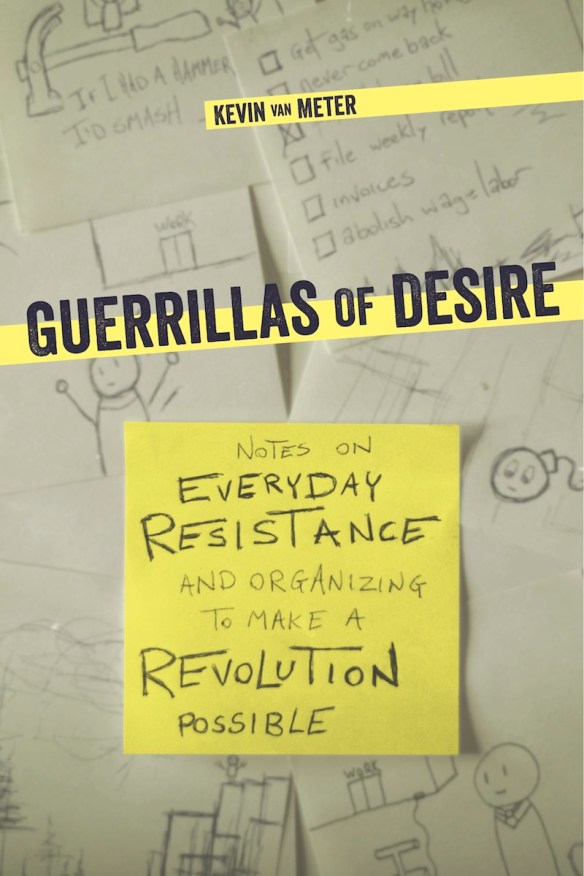
The Seeds of Anti-Capitalist Revolt Found in Everyday Resistance: A Review of Guerrillas of Desire – Notes on Everyday Resistance and Organizing to Make a Revolution Possible by Kevin Van Meter (AK Press, 2017)

By Scott Campbell

Source: Institute for Anarchist Studies

Back when I first began selling my labor for a wage in the wasteland of suburbia’s strip malls, I can recall the tedium of stocking shelves, summoning up insincere courtesy in the face of entitled customers and obnoxious bosses, comparing the stacks of money counted at the end of the day with the totals on our paychecks, and feigning adherence to whatever motivational façade management cooked up to mask the reality of our exploitation.

Yet I also remember, much more vividly and fondly, the latent and occasionally eruptive defiance among my co-workers. This included the constant collective complaining about the job, taking more and longer-than-approved breaks, working as little as possible, fudging time sheets, stealing, and the intermittent screaming matches with the boss in the middle of the store. Underpinning all these actions was an unspoken but broadly understood code of silence when it came to such transgressions and, when appropriate, expressions of support for them.

At the time, I didn’t think much about this, it was just how things happened and I’ve encountered similar experiences to varying degrees in every workplace since. Our actions weren’t guided by a political framework nor was there any attempt to organize them in a directed manner. It was more a spontaneous, innate reaction to experiencing the coercion of capitalism. I had cause to reflect upon this anew while reading Kevin Van Meter’s new book, Guerrillas of Desire: Notes on Everyday Resistance and Organizing to Make a Revolution Possible, published by AK Press and the Institute for Anarchist Studies.

In the preface, Van Meter observes that the question motivating him is not “What is to be done?” but “How do people become what they are?” Throughout the course of the book he seeks to provide an answer by locating power in the resistance of workers, apart from any political ideology or organization. Whether and how that inherently anti-capitalist refusal of work develops into revolt or rebellion are the questions he compellingly urges us to reflect and act upon.

To reach that point, Guerrillas of Desire ambitiously takes on multiple tasks that feed into and build on one another. Van Meter initiates a dialogue between anarchism and Autonomist Marxism that leads to a reconceptualization of the working class, bolstered in part by a historical accounting of workplace actions such as the ones I recounted. He labels these “everyday resistance,” committed by “guerrillas of desire,” and proposes a focus on those deeds as the entry point for organizing revolutionary resistance to capitalism. The impetus for this initiative, concisely carried out in under 160 pages, is his proposal that the current approach to organizing is conceptually flawed and therefore destined to fail. “Guerrillas of Desire offers a contentious hypothesis: the fundamental assumption underlying Left and radical organizing, including many strains of anarchism, is wrong. I do not mean organizationally dishonest, ideologically inappropriate, or immoral. I mean empirically incorrect” (13). The incorrect basis for current organizing is the assumption that the poor and working classes are unorganized and passive and that it therefore rests upon activists and organizations to educate and mobilize them for their own sakes. Van Meter instead proposes that there is in fact informal organization and resistance occurring, it is just of a sort that does not fit within the Left’s organizing vision and therefore goes unseen, unrecognized, and unincorporated into political theories, analysis, and action.

To provide a political frame for understanding the “everyday resistance” of the working class, Van Meter draws upon anarchism’s mutual aid – the material and emotional cooperation and reciprocal support that exists in societies – with Autonomist Marxism’s self-valorization – autonomous working class action that counters the state and capitalism, primarily the refusal of work in its myriad forms. Combined together and reinforcing one another, mutual aid and the refusal of work comprise the “everyday resistance” of the working class.

These phenomena also give definition to what is meant by “working class,” which Van Meter defines as “autonomous from both capitalism and the official organization of the Left, broadly including all those who work under capitalism, based in relationships between workers rather than as a structural component of the economy or sociological category” (32). Rather than being premised on income, occupation, or union membership, the working class under Van Meter’s formulation is made up of all those who must perform work under capitalism – be it waged or unwaged, in the factory, home, office, bedroom, affective, or social spheres. However, when they are not taking action in response to their subjugation under capitalism, these people are just workers. They become a class through the process of struggling against the conditions imposed upon them by capitalism. This struggle initially takes the form of everyday resistance based on mutual aid and the refusal of work. It is everyday resistance that unites individual workers as a class because such resistance, even when performed by one person, requires at a bare minimum the tacit complicity of co-workers and preferably their active collaboration.These acts and the social relationships they create and depend on lay the groundwork for the broader and overt organizing against capitalism more commonly interpreted as working class struggle. Using this framework as offered by Van Meter, we can understand the working class as composed of the relationships forged among workers actively in resistance against capitalism.Without anti-capitalist struggle, the working class does not exist.

After laying this theoretical groundwork, the bulk of the book traces the various forms of resistance by slaves, peasants, and workers in the industrial and social factories (the expansion of capitalist logic from the factory into society at large, in particular in service, immaterial, and reproductive work), creating a lineage and legacy of working class resistance against the various formations of capitalism that spans centuries. “Viewing the working class broadly to include slaves and peasants as well as students, homemakers, immigrants, and factory and office workers reveals the breadth of struggle and generalized revolt against work that continues to be imposed” (128). In doing so, Van Meter further builds the framework of the working class as being formed through its self-activity against the demands and deprivations of capitalism.

The historical survey brings the discussion into the present, where Van Meter offers a proposal to address his initial hypothesis that the Left is carrying out its organizing work in an incorrect way. His suggestion is for the organizers of today and in the future to begin their work by “reading the struggles” already underway in the form of everyday resistance. Through investigation and documentation by organizers, new relationships may be fostered with guerillas of desire that allow everyday resistance to expand into larger and more overt forms of autonomous anti-capitalist struggle. He proposes that the seeds of the new, liberatory worlds sought by anarchism and Autonomist Marxism are to be found in the everyday resistances that are already occurring rather than in the latest organizing manual or official Left strategy document..

While impressed after reading through this formulation, I was left with lingering questions. It remained unclear how, for instance, everyday resistance morphed into more overt, organized resistance and the part organizers positioning themselves as readers of struggle played in such a development. The personal anecdotes he provided on stepping back from ideological assumptions and reorienting towards the collective experiences of communities during his work in Long Island were helpful. It brought to mind the story of Marxist-Leninist intellectuals heading off to the Chiapan jungle with grand plans of starting a peasant guerrilla force. Only when they arrived, they found the population had no time or interest in their grandiose ideology. It was only when they dropped their assumptions and worked within the community to understand its needs, concerns and own history of resistance that the Zapatistas emerged. That, however, is a rather specific and exceptional example. I feel Van Meter’s proposal to begin organizing from within everyday resistance based on the notion that it will lead to more overt resistance could benefit from further articulation and direction.

Similarly, the focus on work as existing solely within the capitalist sphere left me curious as to his vision of the place of non-leisure activity under capitalism or even after capitalism. The refusal of the work that maintains capitalism is indispensable. Yet I would not advocate the refusal of work that maintains communal and personal well-being or builds autonomous organization, or writes books reviews in spare time, for example. Certainly, Van Meter would not advocate that either, but it remains a matter necessitating clarification and one that I believe extends beyond an issue of semantics.

Despite those questions, Guerrillas of Desire is aspirational in its scope and contains ideas and proposals worthy of consideration by radicals reflecting on how to engage in the current moment. In a time when mobilizing and organizing around class has fallen off the radar of many, it is a welcome reminder of the importance of paying attention to the working class and the integral role working class struggle plays in resistance to capitalism, alongside the currently more prevalent resistances to capitalist white supremacy, heteropatriarchy, colonization, environmental destruction and more.

Van Meter assists in this advocacy by accessibly presenting an updated Autonomist Marxist perspective of the working class, expanding it, breathing life into, and imbuing it with its own power, separate from both capitalism and the official Left. As such, he allows readers who may toil in a variety of ways under capitalism to see themselves within the working class, conceptualize their activities as part of a broader resistance with a rich history, and inspire them to build on that legacy.


Scott Campbell is a radical writer and translator based in California. He is part of the collectives that publish the websites El Enemigo Común and It’s Going Down. His personal site is fallingintoincandescence.com

Guerrillas of Desire is available here!


Why We’re Doomed: Our Economy’s Toxic Inequality

By Charles Hugh Smith

Source: Of Two Minds

Anyone who thinks our toxic financial system is stable is delusional.

Why are we doomed? Those consuming over-amped “news” feeds may be tempted to answer the culture wars, nuclear war with North Korea or the Trump Presidency.

The one guaranteed source of doom is our broken financial system, which is visible in this chart of income inequality from the New York Times: Our Broken Economy, in One Simple Chart.

While the essay’s title is our broken economy, the source of this toxic concentration of income, wealth and power in the top 1/10th of 1% is more specifically our broken financial system.

What few observers understand is rapidly accelerating inequality is the only possible output of a fully financialized economy. Various do-gooders on the left and right propose schemes to cap this extraordinary rise in the concentration of income, wealth and power, for example, increasing taxes on the super-rich and lowering taxes on the working poor and middle class, but these are band-aids applied to a metastasizing tumor: financialization, which commoditizes labor, goods, services and financial instruments and funnels the income and wealth to the very apex of the wealth-power pyramid.

Take a moment to ponder what this chart is telling us about our financial system and economy. 35+ years ago, lower income households enjoyed the highest rates of income growth; the higher the income, the lower the rate of income growth.

This trend hasn’t just reversed; virtually all the income gains are now concentrated in the top 1/100th of 1%, which has pulled away from the top 1%, the top 5% and the top 10%, as well as from the bottom 90%.

The fundamental driver of this profoundly destabilizing dynamic is the disconnect of finance from the real-world economy.

The roots of this disconnect are debt: when we borrow from future earnings and energy production to fund consumption today, we are using finance to ramp up our consumption of real-world goods and services.

In small doses, this use of finance to increase consumption of real-world goods and services is beneficial: economies with access to credit can rapidly boost expansion in ways that economies with little credit cannot.

But the process of financialization is not benign. Financialization turns everything into a commodity that can be traded and leveraged as a financial entity that is no longer firmly connected to the real world.

The process of financialization requires expertise in the financial game, and it places a premium on immense flows of capital and opaque processes: for example, the bundling of debt such as mortgages or student loans into instruments that can be sold and traded.

These instruments can then become the foundation of an entirely new layer of instruments that can be sold and traded. This pyramiding of debt-based “assets” spreads risk throughout the economy while aggregating the gains into the hands of the very few with access to the capital and expertise needed to pass the risk and assets off onto others while keeping the gains.

Profit flows to what’s scarce, and in a financialized economy, goods and services have become commodities, i.e. they are rarely scarce, because somewhere in the global economy new supplies can be brought online.

What’s scarce in a financialized economy is specialized knowledge of financial games such as tax avoidance, arbitrage, packaging collateralized debt obligations and so on.

Though the billionaires who have actually launched real-world businesses get the media attention–Bill Gates, Jeff Bezos, Steve Jobs, et al.–relatively few of the top 1/10th of 1% actually created a real-world business; most are owners of capital with annual incomes of $10 million to $100 million that are finance-generated.

This is only possible in a financialized economy in which finance has become increasingly detached from the real-world economy.

Those with the capital and skills to reap billions in profits from servicing and packaging student loan debt have no interest in whether the education being purchased with the loans has any utility to the indebted students, as their profits flow not from the real world but from the debt itself.

This is how we’ve ended up with an economy characterized by profound dysfunction in the real world of higher education, healthcare, etc., and immense fortunes being earned by a few at the top of the pyramid from the financialized games that have little to no connection to the real-world economy.

Anyone who thinks our toxic financial system is stable is delusional. If history is any guide (and recall that Human Nature hasn’t changed in the 5,000 uears of recorded history), this sort of accelerating income/wealth/ power inequality is profoundly destabilizing–economically, politically and socially.

All the domestic headline crises–culture wars, opioid epidemic, etc.–are not causes of discord: they are symptoms of the inevitable consequences of a toxic financial system that has broken our economy, our system of governance and our society.

Media’s Grim Addiction to Perseverance Porn

By Adam Johnson

Source: FAIR

You’ve seen or heard or read the personal interest story a thousand times: An enterprising seven-year-old collects cans to save for college (ABC72/8/17), a man with unmatched moxie walks 15 miles to his job (Today2/20/17), a low-wage worker buys shoes for a kid whose mother can’t afford them (Fox512/14/16), an “inspiring teen” goes right back to work after being injured in a car accident (CBS News12/16/16). All heartwarming tales of perseverance in the face of impossible odds—and all ideological agitprop meant to obscure and decontextualize the harsh reality of dog-eat-dog capitalism.

Man walks eight miles in the snow to get to work every day (ABC 273/14/17). Or was it a teen walking 10 miles in freezing weather to a job interview (New York Daily News2/26/13)? Or was it 10 miles to work every day (Times Herald Record3/17/17)? Or was it 12 (ABC News2/22/17) or 15 (Today2/20/17) or 18 (Evening Standard, 2/9/09) or 21 (Detroit Free Press1/20/15)? Who cares—their humanity is irrelevant. They’re clickbait, stand-in bootstrap archetypes meant to validate the bourgeois morality of click-happy media consumers.

These stories are typically shared for the purposes of poor-shaming, typically under the guise of inspirational life advice. “This man is proof we all just need to keep walking, no matter what life throws at us,” insisted Denver ABC7 anchor Anne Trujillo, after sharing one of those stories of a poor person forced to walk thousands of miles a year to survive.

A healthy press would take these anecdotes of “can do” spirit and ask bigger questions, like why are these people forced into such absurd hardship? Who benefits from skyrocketing college costs? Why does the public transit in this person’s city not have subsidies for the poor? Why aren’t employers forced to offer time off for catastrophic accidents? But time and again, the media mindlessly tells the bootstrap human interest story, never questioning the underlying system at work.

One particularly vulgar example was CBS News(12/16/16) referring to an “inspiring” African-American kid who had to work at his fast food job with an arm sling and a neck brace after a car accident. To compound the perseverance porn, he was, at least in part, doing so to help donate to a local homeless charity. Here we have a story highlighting how society has colossally failed its most vulnerable populations—the poor, ethnic minorities, children and the homeless—and the take-home point is, “Ah gee, look at that scrappy kid.”

Journalism is as much—if not more—about what isn’t reported as what is. Here a local reporter is faced with a cruel example of people falling through the cracks of the richest country on Earth, and their only contribution is to cherry-pick one guy who managed—just barely—to cling on to the edge.

Perseverance porn goes hand in hand with the rise of a GoFundMe economy that relies on personal narrative over collective policy, emotional appeals over baseline human rights. $930 million out of the $2 billion raised on GoFundMe since its inception in 2010 was for healthcare expenses, while an estimated 45,000 people a year die a year due to a lack of medical treatment. Meanwhile, anchors across cable news insist that single-payer healthcare is “unaffordable,” browbeating guests who support it, while populating their broadcasts with these one-off tales of people heroically scraping by.

It’s part of a broader media culture of anecdotes in lieu of the macro, moralizing “success” rather than questioning systemic problems. Perseverance porn may seem harmless, but in highlighting handpicked cases of people overcoming hardship without showing the thousands that didn’t—much less asking broader questions as to what created these conditions—the media traffics in decidedly right-wing tropes. After all, if they can do it, so can you—right?

Just Wait a Little While

By James Howard Kunstler

Source: Kunstler.com

The trouble, of course, is that even after the Deep State (a.k.a. “The Swamp”) succeeds in quicksanding President Trump, America will be left with itself — adrift among the cypress stumps, drained of purpose, spirit, hope, credibility, and, worst of all, a collective grasp on reality, lost in the fog of collapse.

Here’s what you need to know about what’s going on and where we’re headed.

The United States is comprehensively bankrupt. The government is broke and the citizenry is trapped under inescapable debt burdens. We are never again going to generate the kinds and volumes of “growth” associated with techno-industrial expansion. That growth came out of energy flows, mainly fossil fuels, that paid for themselves and furnished a surplus for doing other useful things. It’s over. Shale oil, for instance, doesn’t pay for itself and the companies engaged in it will eventually run out of accounting hocus-pocus for pretending that it does, and they will go out of business.

The self-evident absence of growth means the end of borrowing money at all levels. When you can’t pay back old loans, it’s unlikely that you will be able to arrange new loans. The nation could pretend to be able to borrow more, since it can supposedly “create” money (loan it into existence, print it, add keystrokes to computer records), but eventually those tricks fail, too. Either the “non-performing” loans (loans not being paid off) cause money to disappear, or the authorities “create” so much new money from thin air (money not associated with real things of value like land, food, manufactured goods) that the “money” loses its mojo as a medium of exchange (for real things), as a store of value (over time), and as a reliable index of pricing — which is to say all the functions of money.

In other words, there are two ways of going broke in this situation: money can become scarce as it disappears so that few people have any; or everybody can have plenty of money that has no value and no credibility. I mention these monetary matters because the system of finance is the unifying link between all the systems we depend on for modern life, and none of them can run without it. So that’s where the real trouble is apt to start. That’s why I write about markets and banks on this blog.

The authorities in this nation, including government, business, and academia, routinely lie about our national financial operations for a couple of reasons. One is that they know the situation is hopeless but the consequences are so awful to contemplate that resorting to accounting fraud and pretense is preferable to facing reality. Secondarily, they do it to protect their jobs and reputations — which they will lose anyway as collapse proceeds and their record of feckless dishonesty reveals itself naturally.

The underlying issue is the scale of human activity in our time. It has exceeded its limits and we have to tune back a lot of what we do. Anything organized at the giant scale is headed for failure, so it comes down to a choice between outright collapse or severe re-scaling, which you might think of as managed contraction. That goes for government programs, military adventures, corporate enterprise, education, transportation, health care, agriculture, urban design, basically everything. There is an unfortunate human inclination to not reform, revise, or re-scale familiar activities. We’ll use every kind of duct tape and baling wire we can find to keep the current systems operating, and we have, but we’re close to the point where that sort of cob-job maintenance won’t work anymore, especially where money is concerned.

Why this is so has been attributed to intrinsic human brain programming that supposedly evolved optimally for short-term planning. But obviously many people and institutions dedicate themselves to long-term thinking. So there must be a big emotional over-ride represented by the fear of letting go of what used to work that tends to disable long-term thinking. It’s hard to accept that our set-up is about to stop working — especially something as marvelous as techno-industrial society.

But that’s exactly what’s happening. If you want a chance at keeping on keeping on, you’ll have to get with reality’s program. Start by choosing a place to live that has some prospect of remaining civilized. This probably doesn’t include our big cities. But there are plenty of small cities and small towns out in America that are scaled for the resource realities of the future, waiting to be reinhabited and reactivated. A lot of these lie along the country’s inland waterways — the Ohio, Mississippi, Missouri river system, the Great Lakes, the Hudson and St. Lawrence corridors — and they also exist in regions of the country were food can be grown.

You’ll have to shift your energies into a trade or vocation that makes you useful to other people. This probably precludes jobs like developing phone apps, day-trading, and teaching gender studies. Think: carpentry, blacksmithing, basic medicine, mule-breeding, simplified small retail, and especially farming, along with the value-added activities entailed in farm production. The entire digital economy is going to fade away like a drug-induced hallucination, so beware the current narcissistic blandishments of computer technology. Keep in mind that being in this world actually entitles you to nothing. One way or another, you’ll have to earn everything worth having, including self-respect and your next meal.

Now, just wait a little while.