Hastening the Downfall of the Neocons

By L’Ordre

Source: Dissident Voice

Neocons, whose name fits almost every mainstream politician and commentator, say America is destined to rule the world through violence, intimidation and the belief in its own moral superiority. Unfortunately, despite losing wars, their variant of fascism evades condemnation and trial thus far.

It is saddening to see politicians responsible for maintaining our catastrophic, failed foreign policies in the United States and the United Kingdom continue to evade justice since their illegal invasion of Iraq in 2003. Such neocons, including Tony Blair in Britain, have even been taken back from the sewer and polished by the press for us, almost as if they had not committed war crimes and bathed in the blood of innocent people.

For the press to present Tony Blair’s face to us, let alone allow him to assert his judgments and advise us, after he lied to us all and bloodied his hands with the children of Iraq, is an assault on human intelligence and dignity. For any journalist to present George W. Bush in a fond way because he isn’t Donald Trump is a disgusting attack on the memory of the women he massacred and the welfare of the children he orphaned.

A madness driven by the bizarre US Presidential Election of 2016 has overtaken much of the political left, who are realigning themselves to be primarily anti-Donald Trump and generally favorable towards anyone else. This has driven them into openly siding with Hillary Clinton and even George Soros, proclaiming that the CIA, the billionaire world elite and the reactionary warmongers of 2003 are now heroes of progressivism because of their opposition to Donald Trump.

What the strange theater of the Election has succeeded in doing was to twist minds and fragment the political left, not only in the United States but across the West. Many on the so-called center left are convinced the only thing to do with left wing activism over the next decade is to oppose Donald Trump, and that means they want to even support nationalist, neoliberal and neoconservative authority figures and even deep state thugs who might want to assassinate and overthrow the foolish President.

In truth, what Donald Trump represents is the same for the world as Hillary Clinton, Tony Blair and George W. Bush. Anyone freshly aligned against Donald Trump and the “alt right”, who now looks back in adoration at the murderers Barack Obama and George W. Bush, has been deceived and led on like a donkey. These war criminals are all identical, as far as world human welfare is concerned. They have no goal other than to position the United States as the moral chieftain over humanity, held up by the chauvinists on one side and the cowards terrified of America’s military strength on the other. According to one approach, people in either category must be named and shamed endlessly until their evil views are exposed and met with as much revulsion as Nazism.

The troubling reality, something few American readers are likely to accept here, is that the United States cannot be fixed. The same can be declared about the Western political system in its entirety, meaning all the other supposedly “exceptional” countries bragging at the top of all the lists of free and democratic states.

When modern democratic republics were new, their purity was thwarted by acts of betrayal. We were told the values of the French Revolution, the American Revolution and the transition away from absolute monarchy in Britain had prevailed. In fact, such attempts to form true republics were all corrupted, sabotaged and kept from completion by reactionaries within years of taking place, and only the ideals remained alive in desperate hearts. What was intended in the French Revolution, in taking the ax to the root of power, was kept from completion by the Thermidorian Reaction. In the centuries following such betrayals, we inherited this parody we see, a hollow shape of splendor cut from the vilest corruption, lies and moral sewage. This shape is what people are today mistaking for “democracy”, while it is used as an excuse to wage crusades and massacre other nations when we are told they are inferior.

One might strike back against the arguments made here by accusing me of being too forceful in deciding what is best for Americans without being one of them, but not one shred of any argument here is concerned with the future of the American people. The American people have shown too little regard for anyone else in their short but violent history to be the concern of the rest of the world. The only thing that should matter to us is neutering this destructive regime and ending the unprecedented evil it now embodies. As the only country to have used nuclear weapons, no crime is too great for Americans to commit. No injury to America’s interests could mean anything other than saving civilians from the regime’s endless war of terror.

What happens in the United States is not the concern of Americans foremost, but the concern of others. The US has committed global crimes and invaded the lives of everybody in the world, leaving the entire world with a supreme responsibility to stop the destructive aggressor. The fate of the United States must be decided by non-Americans first and by Americans second, because it has imposed itself so egregiously on the rest of the world. If the rest of humanity were to choose that this destructive regime should be destroyed, no attempt by Americans to appeal against justice can be allowed.

Mass murder will be the hobby of every Western government until there is a punishment for the neocon mentality. Since the neocons are invaders, they should be punished according to whatever laws exist in the land they helped invade. Neocons should be subjected to native justice, because to use our Western laws in punishing those of us who invaded oppressed nations would only be another arrogant policy against the oppressed.

The future contains great peril for the neocons. America’s behavior has proven it will never voluntarily give up its criminal designs, and will have to be physically defeated or rendered much weaker before it can be brought to justice. Until that day arrives, everything that immobilizes the American political system, confounds their deranged politics further, or leaves America vulnerable to foreign threats will be part of the regime’s collapse. For those who doubt this collapse, see the history of prior empires, and be aware that surviving longer only increases the horror and violence to descend on them in the end. It means less suffering to collapse now than later

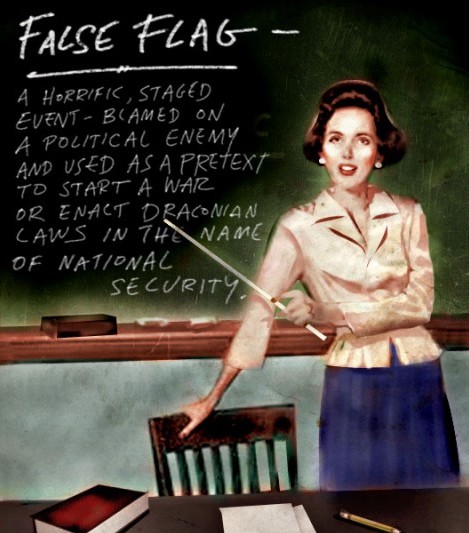
‘False flag,’ another weapon in the US arsenal

By Dave Alpert

Source: Intrepid Report

Now hear this . . . Noam Chomsky, respected intellect and political guru of the “left,” a man that ridiculed and denounced the efforts of the 9/11 Truth Movement, has joined the ranks of the conspiracy theorists.

On Monday, March 27, Noam, in an interview, as reported by AlterNet, stated that Donald Trump could stage a “false flag” terror attack in order to consolidate his power.

Trump’s administration is currently on thin ice. Not only does he not have the support of Democrats, but members of his own party have been distancing themselves from him. It also should be noted that Trump’s standing amongst the voters, according to poll numbers, is at an historic low.

George W. Bush’s Secretary of the Treasury, from January 2001 to December 2002, Paul O’Neill, revealed in his book, “The Price of Loyalty,” published in 2004, that the war in Iraq was planned from the first National Security Council meeting, soon after the administration took office. At the first cabinet meeting of the new Bush administration, O’Neill observed that the debate was not “should we attack Iraq?” but rather “how do we go about attacking Iraq?”

It was and is clear that the Bush administration needed to gather popular support for an invasion of Iraq through an event that would guarantee such support. Fortunately, along came 9/11, a perfect example of how a “false flag” event is organized and implemented.

Predictably, the people rallied behind the Bush administration’s stated desire to hold the guilty parties accountable and pursue retribution. Bush was given carte blanche powers to fulfill his promise to find and destroy those responsible for the savage attack on US soil.

Trump knows that people are losing faith in his presidency and, according to Chomsky, will look to scapegoat someone or some group in order to draw our attention away from his failings and, as the G.W. Bush administration did, mobilize support. Trump has already identified those he is likely to scapegoat, the vulnerable, the immigrants, the Muslims, the terrorists, etc.

Chomsky states, “I think that we shouldn’t put aside the possibility that there would be some kind of staged or alleged terrorist act, which can change the country instantly.” WOW, he really said that?

The first and crucial step in a planned false flag event is for the government initiating the action to prime the public by demonizing the target, the country or group that will be scapegoated and assume the blame for the event, and creating fear and anger among the populace. For that, Trump has a fairly large group of possible scapegoats if, in fact, Chomsky’s projections get played out. As mentioned above, there are, of course, Muslims as well as extremists from any of the immigrant groups coming from countries that the US has decimated or from our Mexican neighbors to the South, as well as any group that can conveniently be labeled “terrorists.”

Immediately after the event, there is a comprehensive narrative and a convenient, ready-made culprit is identified by officials. With the help of law enforcement and the media, the narrative is repeated often enough to convince the public of its accuracy. Not only is the official explanation not questioned by the media, their responsibility is to ensure that no alternative views of the event in question are heard. In fact, the media often actively denounce and mobilize against alternative theories regarding the events in question. Most often they marginalize the people who raise questions about the official version, labeling them as “conspiracy nuts.”

Coincidently, it should be noted, if you believe in coincidences, a large percentage of major domestic or international terror attacks have involved simultaneous “training drills.” This list includes, but is not limited to, the infamous NORAD drills of 9/11, the 7/7 London Bombings, the 2011 Norway shooting, the Aurora shooting, and the Boston Marathon.

These training drills serve to confuse respondents to the “terror” attack. During the 9/11 attack, a military officer could be heard, when he was informed, asking “Is this real time?” At the time of the attacks, several military exercises were in progress and were a factor in immobilizing and confusing respondents. Is this another coincidence?

So, the question still hangs out there, unanswered, “Why now, Mr. Chomsky?” Why project the possible false flag operation orchestrated by the Trump people, while ignoring the overwhelming real evidence demonstrating that 9/11 was a false flag event?

The answer to that question may be in Chomsky’s personal feelings about Trump, the man. Chomsky has called Trump a “con man” who will drag civilization “down to the utter depths of barbarism.”

Yet, Mr. Chomsky, despite the events of the past century, when various US presidents have played the role of “con men” and have dragged civilization down to a deadly and destructive level of barbarism, has decided to vent his anger and frustration at Trump, who I’m certain will also continue his assignment to drag the world into a state of savagery. After all, world domination and making America great again is not for sissies.

Yet, he and many other so-called leftists abandoned the 9/11 Truth Movement, made up of people who did not accept the government’s mythological version of that day and were seeking truth.

During the past 16 years, millions of people were either killed, mutilated, or displaced from their homes as a result of 9/11. Where have these “progressive” voices been during this time? Now he’s going to speak out . . . screw him!!!

A valiant verbal warrior demythologizes the CIA

valentinecover-400x600

By Edward Curtin

Source: Intrepid Report

“Once there is a suspicion that a religion is a myth, its power has gone.”—Alan Watts, The Wisdom of Insecurity

Like Odysseus, Douglas Valentine is a wily warrior who managed to enter the enemy’s stronghold disguised as a gift. Not Troy, and not within a wooden horse, but in the guise of a nice young “Nobody,” he was able, thirty or so years ago, to breach the walls of the CIA through William Colby, a former director of the Central Intelligence Agency. The guileful thing he brought was his proposal to demystify the Phoenix program, “the controversial CIA assassination program that resulted in the deaths of thousands of civilians during the Vietnam War,” with which Colby was notably associated.

Colby naively assumed “demystify” meant justify, so he welcomed Valentine into his inner sanctum. As in days of yore, Colby, and the CIA officers he referred Valentine to, were so disarmed by the bright young trickster that they divulged their secrets without being asked, defeating themselves in the boastful ways of men drunk on their own youthful exploits. Wanting to be heroes in their own myths, they became unwitting accomplices in their own besmirchment. So much for intelligence.

When the Trojan Horse that became Valentine’s 1990 book, The Phoenix Program: America’s Use of Terror in Vietnam, was opened, and many truths rushed out to slay them, they reacted with shocked outrage that they had been double-crossed by an amateur counterspy.

Legends fall, of course, battles are lost, but when the self-anointed heroic warriors of the CIA fell, they summoned their acolytes and media scribes to silence the counterspy who did not love them. It was not the Valentine that these spurned lovers were expecting.

In this case, their defender was the media celebrity reporter, Morley Safer, who had reported from Vietnam and was friendly with William Colby. Safer owed Colby a favor. When he was in Vietnam, Safer had accepted Colby’s Mephistophelian offer to take a tour of the infamous Phoenix program’s interrogation centers and meet the counterterrorism teams, but with one stipulation. In Safer’s words, delivered to a conference in 2010: “I showed up and [Colby] said, ‘Okay, here are the rules. . . . You can’t take notes and you can’t report anything you hear. . . . to this day, I still feel constrained in terms of talking about’” (what he saw and heard).

Valentine: “And like Don Corleone dispensing favors in The Godfather, Colby knew that one day Safer would be obligated to return it. That is how the CIA, as the organized crime branch of the US government, functions like the Mafia through its old boy network of complicit media hacks.”

So The New York Times, which Valentine had criticized in his book for not reporting the truth about the CIA’s Phoenix program, had Safer write a book review of The Phoenix Program: America’s Use of Terror in Vietnam. He wrote a scathing review in which he said the book was “as turgid and dense and often incomprehensible book as I have ever had the misfortune to open.” Thus Valentine’s work was disappeared like the Vietnamese victims of the Phoenix program. (Safer’s “misfortune,” however, became our fortune when in 2014 Open Roads publishers announced a “Forbidden Bookshelves” series and resurrected Valentine’s exposé in a new edition.)

In his latest book, The CIA as Organized Crime: How Illegal Operations Corrupt America And The World, Valentine explains it thus: “But the left’s leadership is part of the CIA’s old boy network and like all American intellectuals, they look to the Times for direction and validation. So the word went out to ignore the book, not just because it revealed CIA secrets, but because it identified the media, and the Times in particular, as the reason why the public can’t see the CIA clearly for what it is: a criminal conspiracy on behalf of wealthy capitalists.”

But Valentine had been “neutralized,” and over the next quarter century the CIA, through its placement of its people throughout the media, including Hollywood and television, resurrected its mythic image—phoenix-like—from the fleeting and rarely examined ashes Valentine had reduced it to. Using what the CIA officer Frank Wisner called the agency’s “Mighty Wurlitzer”—its deep penetration of the news and cultural apparatus—it played the American people to a tune of CIA heroes defending the “homeland” from mad Muslim terrorists and evil drug dealers besieging the U.S. citadel through deception and direct attack. Movies, television shows, cognitive infiltration of the mainstream media across platforms repeated the message over and over again: We are the good guys in this mythic battle of good against evil. We are defenders of the “Homeland.”

But over these years Valentine had not disappeared, despite the CIA’s wish that he had. It took him fifteen years to recover from his “neutralization,” and then he wrote two books—The Strength of the Wolf and The Strength of the Pack—that examine the nexus between the CIA, the Federal Bureau of Narcotics, and the Drug Enforcement Administration in which he explains in documented detail how the CIA hijacked drug enforcement as it became a prime player in international drug trafficking. Joining hands with organized crime and corrupting law enforcement, the drug running and murder that was crucial to the CIA’s Phoenix program went international.

Most importantly, the Phoenix program’s organizational structure became the template for these world-wide bloody operations: among them, the Salvadoran Option, undertakings throughout South and Central America, the Middle-East, and later the war on terror, “the greatest covert op ever.” And the Phoenix became the conceptual model for The Department of Homeland Security, as “both are based on the principle that governments can manage societies through implicit and explicit terror.”

Valentine shows how the federal drug agencies protect the CIA’s drug running assets and operations, and spread addiction throughout the “homeland.” This is accomplished by CIA agents posing as federal narcotics agents. “The DEA has a public affairs branch staffed by creative writers who filter out anything bad and tell you only what the bosses want you to know. The media echoes what the DEA and the CIA PR people say. But it’s a big lie and it’s pervasive.”

But those important books had little effect on a drug addled population. They appeared in the midst of the dramatic rise in the use of “legal” pharmaceutical drugs (see Deadly Medicines and Organized Crime: How Big Pharma Has Corrupted Healthcare by Dr. Peter C. Gotzsche) and the epidemic of heroin (Greek, heros, hero + German chemical suffix, ine, coined in 1898 by the Bayer Company as a morphine substitute) that has reduced so many people to walking zombies, while minorities have long had their neighborhoods devastated by CIA facilitated crack cocaine. The zombie myth itself has become a staple of American culture—pure entertainment for a brain devouring and brain dead population—entertainment for dummies. It is no wonder. Because from 1990 when Valentine’s The Phoenix Program was trashed by the Times until today, the U.S. government and the scientific/media establishment have worked to convince Americans that all our lives revolve around our brains and that the answers to our problems lie with more brain research, drugs, genetic testing, etc. It’s been a quarter century deluge of propaganda of scientific materialism and biological determinism that we are not free but victims of our genes, neurotransmitters, brains/computers, and chemicals. Having lost our minds and fixated on our brains as instructed, we have chosen to be determined to be determined, not free. It is not coincidental that the U.S. government, beginning with ex-CIA Director and then President George H.W. Bush, declared the 1990s the decade of brain research, followed up with 2000–2010 as the decade of the behavior project, and our present decade being devoted to mapping the brain and artificial intelligence, organized by the Office of Science and Technology Project and the Defense Advanced Research Projects Agency. Brains and drugs, Big Pharma and the CIA, drug running and drug dealing, deaths at home and deaths abroad—a neat circle that has corrupted the country at the deepest levels.

This corruption is dependent on the creation of fictions that penetrate public consciousness to the level of myth. “The government,” Valentine writes, “is creating conditions across the board that are conducive to taking drugs. The pharmaceutical industry is part of the problem, along with its co-conspirators in the advertising industry; every time you turn on the TV there’s a commercial telling you to take a pill. The next commercial says don’t take that pill, take this pill. This is the free market at work, sucking the life out of people.”

But myths rise and fall, and recently the CIA’s invincibility has come under increased scrutiny. As the Greeks warned us long ago, hubris leads to humiliation. Today, more and more Americans are learning, through independent Internet sources and a growing list of books, how to deconstruct the ways the CIA “uses language and mythology to control political and social movements.” The fight is on.

Valentine, a warrior of astute knowledge from his wanderings in the CIA’s labyrinth, has reemerged with his new guidebook to the Minotaur’s deadly ways. The CIA As Organized Crime is a tour de force, a counterpuncher’s no-holds-barred passionate battle to reverse “the terrible truth . . . that a Cult of Death rules America and is hell-bent on world domination.” Unlike many writers, he holds back nothing. He names names. He is adamantine in his accusations against those he considers accomplices—in particular, “the compatible left”—“liberals and pseudo-intellectual status seekers who are easily influenced”—in the CIA/media/elite’s efforts at domination and mind-control. He claims that media celebrities of the left serve the function of pacifying the liberal bourgeoisie in these enterprises.

But knowing how leads on to way and one can easily get lost in a labyrinth, let me not tell the story of the man, Valentine, skilled in all ways of contending with such a formidable foe as the CIA. Better to give you a sampling of his words that explain what he has learned in his long wanderings in these strange and sick worlds.

“I have a very broad approach. . . . psychological, political, anthropological, sociological, historical, philosophical. When I look at a subject I look at it comprehensively from all those different points of view. Literary criticism teaches the power of symbolic transformation, or processing experience into ideas, into meaning. . . . one must, above all, understand the archetypal power of the myth of the hero. That way you can transform, through words, Joe the Plumber or even a mass murderer, into a national hero. When I decided to research and write about the CIA’s Phoenix program, that was how I went at it.”

“They [CIA] create the myths we believe. If we were allowed to understand the CIA, we’d realize it’s a criminal organization that is corrupting governments and societies around the world. It’s murdering civilians who haven’t done anything wrong.”

“Nowadays, the only way you can discern what’s going on is by studying and understanding the historical arc of these bureaucracies. Where did the CIA come from? Where is it going? If you look at it historically, you can see beyond the spin and it becomes demystified. And that is not a happy story. As power gets more concentrated in the security services, the media is no longer simply compliant, it’s functioning as their public relations arm. It simply ignores anything that contradicts the official line.”

“The most important fiction of all is the need for secrecy to preserve our national security.”

“If you want to understand the CIA, you have to understand how it’s organized. . . . The media organizes itself the way the CIA does.”

“Journalism in the US is a traditional cover for CIA officers. And when the owners of the media aren’t covering for the CIA, they’re selling commercial time slots to the multi-national corporations that in turn are selling you commodities made in sweatshops in foreign nations that have been subverted by the CIA. You could almost say there is no such thing as factual reporting. . . . The CIA and the media are part of the same criminal conspiracy. You’re never going to learn anything substantive by reading what mainstream reporters dish out about the CIA. You can’t take a journalism course in CIA Criminal Conspiracies 101.”

“I’m sure the anthrax scare after 9/11 was a CIA provocation designed to justify a mail intercept program codenamed HTLINGUAL.”

“The CIA and the military hire the smartest anthropologists, sociologists, and psychologists to figure out how to do this stuff [social engineering]. . . . That’s why you need a broad historical view. If you focus on just what’s happening now, you’re shocked every day by what you see.”

“When the United States took over drug law enforcement in Afghanistan, opium production increased dramatically. All of a sudden Afghan heroin is flooding the US and Europe. It still is. You can say it’s a coincidence, except all the opium warlords are on the CIA payroll. The DEA sends six hundred agents to Afghanistan to make sure nobody knows about it.”

“Phoenix is the conceptual model for the DHS [Department of Homeland Security]. Both are based on the principle that governments can manage societies through implicit and explicit terror. The strategic goal is to widen the gap between the elites and the mass of the citizenry, while expunging anyone who cannot be ideologically assimilated.”

“Through their control of the media, political and bureaucratic systems, America’s secret rulers engage in terrorism abroad and at home for economic purposes. . . . The objective is to maximize profits and concentrate wealth and political power in fewer and fewer hands. The global War on Terror and its domestic homeland security counterpart are flip sides of the same coin. They are the capitalist ideology applied to foreign and domestic security policy. And like the capitalist system it serves, an unstated national security policy is consolidated in fewer and fewer ideologically correct hands as the empire expands and its contradictions become more apparent.”

This sampling of Valentine’s insights should be enough to show the depth and breadth of his demythologization of this “religious” cult of death that is the CIA. Yet myths die hard. And even when they do, they often rise again, especially when one controls the levers of a society’s storytelling powers, as does the CIA to a great extent through its incestuous coupling with the mainstream corporate media. That is why it is so important for people to take the time to read Valentine’s work.

While The CIA As Organized Crime is filled with detailed information labyrinthine in its complexity, his primary goal is to help us grasp the big picture, to see how the myth and the mythmaking work and how we might break through these fictions. He repeatedly reminds us that we are truly caught in the belly of the whale, in the underworld that will overwhelm us if we do not make the sustained effort to get beyond the blur of daily events and understand how the illusionists who are deluding us create and structure their evil propaganda.

Perhaps the only way to heaven is through hell, as Dante told us. Virgil was his guide. The valiant Valentine can be ours, if we are willing to accompany him on the journey.

The U.S. Deep State Rules – On Behalf of the Ruling Class

By Glen Ford

Source: Black Agenda Report

“The U.S. Deep State is unlike any other, in that there is no other global superpower bent on world domination.”

The Deep State is busy denying that it exists, even as it savages a sitting president and brutally bitch-slaps its host society, demanding the nation embrace its role as global psycho thug and kick some Russian ass. The New York Times, always available to divert attention from the essential facts of who rules America, points to Egypt, Turkey and Pakistan as the natural habitats of Deep States. Apparently, Deep State-infected countries tend to be nations with majority Muslim populations, whose military-intelligence apparatus hovers over society and periodically seizes control of the civil government.

The Times quoted high-ranking operatives of the Deep State to prove that such structures are alien to the U.S. Michael V. Hayden, who ran the CIA under Democratic President Obama and Republican George Bush, recoiled at the term. He “would never use” the words Deep State in connection with his own country. “That’s a phrase we’ve used for Turkey and other countries like that, but not the American republic.”

Loren DeJonge Schulman, a former Obama National Security Council official, claimed to be repelled by the very idea of an American Deep State. “A deep state, when you’re talking about Turkey or Egypt or other countries, that’s part of government or people outside of government that are literally controlling the direction of the country no matter who’s actually in charge, and probably engaging in murder and other corrupt practices,” she said.

Apparently, Ms. Schulman did not consider it murder when Obama and his top national security advisors met every Tuesday at the White House to decide who would be assassinated by drone or other means. But she is “shocked” to hear “that kind of [Deep State-phobic] thinking from” President Trump “or the people closest to him.”

Once the Times had located the nexus of Deep Statism in the Muslim world, the lesser lights at The New Yorker endorsed the corporate media consensus that the U.S. is Deep State-free. Staff writer David Remnick admits that U.S. presidents “have felt resistance, or worse, from elements in the federal bureaucracies,” citing Eisenhower’s warnings against the military-industrial complex, Lyndon Johnson’s “pressure from the Pentagon,” and the “rebuke” of Obama’s Syria policy through the State Department’s “dissent channel.” However, he denies that any “subterranean web of common and nefarious purpose” threatens the orderly and transparent processes of the U.S. political system.

In reality, the U.S. Deep State is by far the world’s biggest and most dangerous version of the phenomenon; a monstrous and not-so subterranean “web of common and nefarious purpose” that is, by definition, truly global, since its goal is to rule the planet. Indeed, the Deep States of Turkey, Egypt and Pakistan — all nominal U.S. allies – are midgets in comparison and must operate in a global environment dominated by Washington’s Deep State apparatus. So vast is the imperial Deep State, that its counterparts in other nations exist largely to collaborate with, resist, or keep tabs on the U.S. behemoth, the predator that seeks to devour all the rest.

What is a Deep State? The U.S. Deep State is unlike any other, in that there is no other global superpower bent on world domination. (Washington’s political posture is also unique; no other nation claims to be “exceptional” and “indispensable” and thus not subject to the constraints of international law and custom.) Indeed, the U.S. is so proudly and publicly imperialist that much of what should be secret information about U.S. military and other capabilities is routinely fed to the world press, such as the 2011 announcement that the U.S. now has a missile that can hit any target on the planet in 30 minutes, part of the Army’s “Prompt Global Strike” program. Frightening the rest of the world into submission — a form of global terrorism — is U.S. public policy.

However, arming and training Islamic jihadist terrorists to subvert internationally recognized governments targeted by the U.S. for regime change is more than your usual variety of covert warfare: It is a policy that must forever be kept secret, because U.S. society would suffer a political breakdown if the facts of U.S. and Saudi nurturing of the international jihadist network were ever fully exposed. This is Deep State stuff of the highest order. The true nature of U.S. foreign policy in the 21st century, and the real character of the current wars in Syria and Iraq, must be hidden from the U.S. public at all cost. An alternative reality must be presented, through daily collaboration between corporate media, corporate universities, and the public and covert organs of the U.S. State.

What part of the New York Times coverage of the war against Syria is a lie? Damn near all of it. What role does the Deep State play in crafting the lies dutifully promulgated by the corporate media? That’s impossible to answer, because the Deep State is a network of relationships, not a clearly delineated zone or space or set of organizations. The best way to describe the imperial Deep State is: those individuals and institutions that are tasked with establishing the global supremacy of the corporate ruling class. Such activities must be masked, since they clash with the ideological position of the ruling class, which is that the bourgeois electoral system of the United States is the world’s freest and fairest. The official line is that the U.S. State is a work of near-perfection, with checks and balances that prevent any class, group or section from domination over the other. The truth is that an oligarchy rules, and makes war on whomever it chooses — internationally and domestically — for the benefit of corporate capital.

The Deep State and its corporate imperatives manifestly exists when corporate lobbyists and lawyers are allowed to draw up the Trans Pacific Partnership global “trade” agreement, but the contents are kept secret from the Congresspersons whose duty is to vote on the measure. The Deep State is where corporate power achieves its class aims outside the public processes of government. It’s where the most vicious class warfare takes place, whether on a foreign killing field, or in the corporate newsroom that erases or misrepresents what happened on that battlefield.

At this stage of capitalism, the U.S. ruling class has less and less use for the conventional operations of the bourgeois state. It cannot govern in the old way. More and more, it seeks to shape events through the levers of the collaborating networks of the Deep State. It’s number one global priority is to continue the military offensive begun in 2011, and to break Russia’s resolve to resist that offensive. The ruling class and its War Party, now consolidated within the Democratic Party and regrouping among Republicans, have effectively neutralized a sitting president whose party controls both Houses of Congress, less than two months into his term.

Only a Deep State could pull that off.


BAR executive editor Glen Ford can be contacted at Glen.Ford@BlackAgendaReport.com.

Glen Ford’s blog

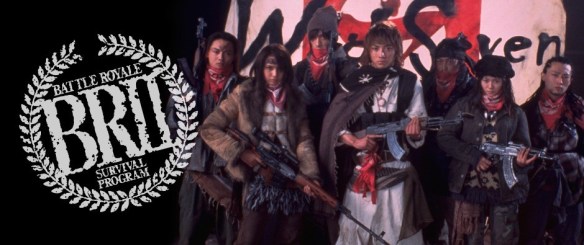
Saturday Matinee: Battle Royale 2

“Battle Royale 2: Requiem” (2003) is an under-appreciated yet boldly provocative sequel taking place three years after the events of the first Battle Royale. The protagonists of the previous film have joined other survivors of past Battle Royales to form a terror cell known as Wild 7. After a major bomb attack, a new class of high-schoolers kidnapped by the government are forced to raid Wild 7’s island hideout and assassinate the group within 72 hours. Battle Royale 2 was director Kinji Fukasaku’s final project, who died of cancer shortly after filming began. The majority of the the film was directed by his son Kenta Fukasaku who wrote the screenplays for both films.

Watch the film with English subtitles here.

Trump proposes huge hike in military and police spending

discretionary_spending_pie_2015_enacted

By Patrick Martin

Source: WSWS.org

The Trump administration sent instructions to federal agencies Monday proposing a $54 billion increase in spending for the Pentagon, the intelligence agencies and the Department of Homeland Security, to be offset by $54 billion in cuts for other agencies, mainly those involved in domestic social services and regulation of business.

Trump’s budget outline sets the stage for his first address to Congress on Tuesday. It provides further evidence that the Trump administration will be dedicated to radically rolling back social spending to finance a dramatic escalation of military operations, both in the neo-colonial wars in the Middle East and against the United States’ ‘great power’ rivals: China and Russia.

Federal departments are being told to file budget requests for the fiscal year that begins October 1, 2017 based on the numbers they were given by the Office of Management and Budget. Each agency will be responsible for working out the cuts required to meet proposed reductions, while the Pentagon, CIA and DHS will propose expanded operations with the additional funds they are to be awarded.

There were no details made public about the exact budget ceilings given to each federal department, but White House officials made it clear that foreign aid programs in the State Department and anti-pollution regulation through the Environmental Protection Agency (EPA) would suffer some of the largest cuts.

The total budget of the EPA is only $9 billion, so many other domestic programs are certain to be hard-hit, involving such departments as Education, Labor, Transportation, Agriculture (which includes food stamps), Housing and Urban Development and Health and Human Services.

The biggest federal social programs, Social Security, Medicare and Medicaid, are not affected by the budget order, which involves only funding for so-called discretionary programs, those financed through annual congressional appropriations. Entitlement programs, where benefits are paid out automatically to those who establish their eligibility, are covered by a separate budget process.

OMB Director Mick Mulvaney appeared at the White House press briefing Monday afternoon to explain the action taken by the Trump administration. He emphasized that setting what he called the “top-line budget number” for each department was only the start of a protracted process.

The OMB will use the figures from each department and agency to prepare a budget outline to be submitted to Congress on March 16. A full budget will not be ready until sometime in May, Mulvaney said. He also indicated that while spending on Social Security, Medicare and Medicaid were not addressed in the action taken Monday, “entitlement reform”—i.e., cuts in these critical programs—would be a subject of discussion with congressional leaders later in the budget process.

Press reports identified the three White House officials who have played the main roles in the initial budgeting: Mulvaney, who was confirmed on February 16 as budget director; National Economic Council Director Gary Cohn, the former president of Goldman Sachs, the huge investment bank; and Stephen K. Bannon, Trump’s chief strategist, the former chief executive of the fascistic Breitbart News site, who exercises increasingly broad sway over all White House policy decisions.

While no details have yet been released of what the $54 billion increase in military-police spending will pay for, the scale of the increase, in and of itself, shows the real character of the Trump administration. This is to be a government of war abroad and mass repression at home.

Trump himself touched on this theme in typically rambling and unfocused remarks to a meeting of the National Governors Association Monday. “We never win a war,” he said. “We never win. And we don’t fight to win. We don’t fight to win. So we either got to win, or don’t fight at all.”

He continued, telling the governors, “My first budget will be submitted to the Congress next month. This budget will be a public safety and national security budget, very much based on those two with plenty of other things, but very strong. And it will include a historic increase in defense spending to rebuild the depleted military of the United States of America at a time we most need it.”

Additional money for the Pentagon is likely to go to a dramatically increased tempo of operations in Iraq and Syria. Defense Secretary James Mattis delivered proposals to the White House Monday for an offensive against Islamic State in Iraq and Syria (ISIS), as required by an executive order issued by Trump last month. No details are available yet, but any acceleration of the bombing campaign, let alone the deployment of significant numbers of the US ground troops, would increase the cost of that war by many billions.

The $54 billion increase would also presumably include funds for the construction of Trump’s planned wall on the US-Mexico border, as well as a massive increase in spending on detention facilities for the hundreds of thousands of immigrants to be rounded up under the executive orders already issued by the White House.

The federal budget is operating under the constraints imposed by the 2011 Budget Control Act, the bipartisan legislation negotiated by the Obama White House, the Republican-controlled House of Representatives, and a Democratic-controlled Senate. This set up the so-called sequester process, under which all discretionary spending is subject to a budget freeze, for both domestic and military programs.

Each year, increased spending for programs under the sequester has been worked out on the basis of roughly equal increases for domestic and military programs. Last year, for fiscal year 2016, Congress approved $543 billion for domestic discretionary programs and $607 billion for the military. The Trump White House plan would thus represent a cut of about 10 percent for domestic programs, and an increase of nearly that amount for the military.

Any significant change in the sequester process would require support from congressional Democrats, particularly in the Senate, where the Republican party holds only a narrow 52-48 edge, and any major legislation would require a 60-vote majority to pass.

Several congressional Republican leaders criticized the White House plan as insufficiently skewed to the military. House Armed Services Committee Chairman Mac Thornberry of Texas issued a statement criticizing the “low budget number” and adding, “The administration will have to make clear which problems facing our military they are choosing not to fix.”

Senator John McCain of Arizona, chairman of the Senate Armed Services Committee, declared that the Trump plan is “a mere 3 percent above President Obama’s defense budget, which has left our military underfunded, undersized and unready.”

For all the statements by Trump and the Republicans bemoaning the supposedly “depleted” state of the US military, the United States spends more on its armed forces than the next 15 countries in the world combined. The military budget is only inadequate if the mission of the US military is assumed to be the conquest of the entire planet and the subduing of all armed resistance from any quarter—which is actually the perspective of the American ruling elite.

The Duran’s Alex Christoforou: Treating Russia As The ‘Bogeyman’ Has Failed

russia_wants_war_look_how_closely_they_put_country_to_our_military_bases

By

Source: MintPress News

ATHENS — So-called “fake news” has been in the news in recent months, and this debate over what is and what isn’t legitimate news reflects the political divisiveness that is increasingly prevalent in the United States and in Europe.

Like MintPress News, another website which was accused of purveying “fake news” is The Duran, a recently-launched website which offers perspectives and analysis on geopolitical issues which are frequently not found in mainstream U.S. and European media.

As the news cycle moved at lightning speed in recent months, MintPress had the opportunity to conduct a series of interviews with Alex Christoforou, one of the co-founders and writers for The Duran. In this wide-ranging interview, Christoforou discusses Trump’s election, foreign policy rhetoric and maneuvers thus far, the Russian reaction to the NATO buildup along its border, the anti-Russian sentiment in the U.S. political arena and mass media, developments in Syria and the Ukraine, the recent Cyprus reunification talks which were held in Geneva, the role of Turkey in the region and Turkish relations with the U.S. and Russia, the Trump administration’s support for “Brexit” and the possibility of a “Grexit,” the accusations of “fake news,” and more. These interviews first aired on Dialogos Radio in January and February.

MintPress News (MPN): President Trump has spoken out in favor of improved U.S. relations with Russia and with Vladimir Putin. Do you believe that Trump will make good on this pledge, in light of the challenges he is facing?

Alex Christoforou (AC): That’s an interesting question, and I think that’s something that everyone’s debating right now, how sincere he is in creating an atmosphere of detente between the U.S. and Russia. The first thing is that Obama was absolutely terrible for U.S.-Russia relations. He pretty much threw the whole relationship back into the Cold War era. Trump has got a lot of ground to cover, and there’s a lot of forces at work right now which are adamant about not having Trump create an atmosphere of detente with Russia. So Trump is really in a tough position here, especially given the initiatives that the Obama administration took up, which was really an effort by the outgoing administration to box Trump in.

They’ve created a hysteria of Russian hacking which has no evidence whatsoever, no evidence has been presented to the public at all. You have various media outlets really publishing a lot of fake news about Trump’s relationship with Putin and Russia. The fact is that Trump has never even met Vladimir Putin. So you have this interesting dynamic; if Trump does approach Russia with a much friendlier foreign policy and a much more workable foreign policy, right away Trump is going to be labeled by the mainstream media, the establishment media as a Putin stooge, as a Kremlin stooge, as a Russian “useful idiot,” and they’re going to point fingers and say, “Look, we told you so, Trump is the Manchurian candidate of the Kremlin.” It’s all absolutely ridiculous, to be honest.

My opinion is, sure the Kremlin was relieved to have Trump win the presidency, but not for the reasons that people think. Putin has made no secret of the fact that he wants a good partner in the United States and that the last eight years, especially the second term of Obama, have been very tense between Russia and the U.S. So Putin is probably looking forward to having a world leader that he can speak with on equal terms. Obama definitely was not that world leader. Without a doubt, Obama and Putin did not get along.

I think from that standpoint, Russia understands that in Trump they may have a leader that they can speak with. On the other hand, there’s this misconception that Russia was happy to see Hillary Clinton lose. This is false. Yes, Hillary Clinton was a dangerous prospect for a U.S. president. She was very bullish, very much a war hawk on Russia, especially with regard to Syria and the Ukraine, which are two geopolitical regions that are extremely important to Russia. But saying that, Putin definitely got the best of Obama on just about every single foreign policy initiative that the two countries faced in the last eight years. So the Kremlin pretty much knew that it if was going to be four years of Hillary Clinton, it would be a very easy go as to dealing with the U.S. on various challenges that the two countries faced.

On the one hand, I think they’re looking forward to Trump, and speaking with a world leader that they could work with. On the other hand, I think there’s a big part of Russia and a big part of the Kremlin that says, “We really ran over Obama pretty easily,” as far as geopolitics is concerned, and Hillary Clinton likely would have been a lot easier of an opponent to deal with. Will Trump stand by his word? I think he will. He’s a negotiator and I think he’s going to want to do deals.


MPN: The Trump administration’s foreign policy could be characterized as contradictory thus far, with this opening toward warmer relations with Russia on the one hand and an increased rhetoric against Iran on the other hand. Where do you believe these foreign policy contradictions can lead?

AC: I don’t think anybody knows yet where it could lead. Certainly we are seeing a change. On the one hand, we see that Trump would like better relations with Russia, which is what he was saying during his campaign as well. However, the mass media and most politicians from both sides of the aisle are quite hostile toward Russia. Trump has continued to maintain, however, that he desires good relations with Putin’s government. On the other hand, we see that Iran has taken over the “bogeyman” role which Russia held during the Obama administration, and it is evident that the Trump administration wants to do something about Iran. What this something will be, we don’t know just yet. The Trump administration is acting in a hostile manner toward Iran, including President Trump himself and [Secretary of Defense James] Mattis. Until now, we haven’t seen any concrete actions, other than a reinstatement of certain sanctions. But I do fear what action the Trump administration might decide to take against Iran. We will just have to see.

I do think that Trump, so far, is testing the waters, and it is clear that he does want better relations with Russia, while with Iran he is not following the same path as Obama. What these changes will be though and what policies will be adopted is not yet certain. It is still early, though, and much can change.

I think you definitely have a Cabinet that’s got mixed feelings about Russia, a Cabinet that’s very deep in its military experience. That could be seen as a good thing or a bad thing. One thing that military people seem to understand is the price of war and the risks of war, and that’s a good thing. They’re just not flippant about going into war because they understand what’s at stake and the human tragedy of war. On the other hand, military Cabinet picks tend to be a lot more hawkish and a lot more eager to project America’s military superiority.

I don’t agree with all of Trump’s Cabinet selections, but I think the most significant selection of all is that of Secretary of State Rex Tillerson. The Obama administration and Hillary Clinton and John Kerry left behind so much chaos, so many problems that Tillerson really has his work cut out for him. It’s not just Russia, but Syria, the Ukraine, Libya, ISIS, China, and Iran. For the first time, though, a successful businessperson will be in charge of the State Department, and it will be interesting to see which policies he will enforce.

I think at the end of the day, Trump will await people’s opinions, but I think the buck will stop with him. At least that’s the impression that I get as to what type of leader he will be. I think all the decisions will begin and end with his final word. It’s going to be a wait-and-see, but all signs show that he’s going to take a very CEO type of approach to running the country.


MPN: Do you believe that the fierce backlash that the Trump administration has faced is precisely a result of this desire for developing better relations with Russia?

AC: Yes, of course. That’s part of it. This panic over Russia began with Obama, continued with Hillary Clinton, and it seems that all of Washington, all of the advisers and certainly all of the media, are trying to undermine any efforts toward achieving detente between the two countries. My opinion is that this is an effort to smear Trump and to claim that he is unfit for the presidency.

For the time being, I don’t think we will see a significant shift in U.S.-Russia relations. I think we’ll be in a better position to judge things after six months or a year of the new administration. For now, the Russia hysteria has been thrust to the forefront to cast a negative cloud over Trump. However, the average American does not care about what’s happening with Russia. They are concerned with jobs, jobs, jobs. That is how they will evaluate the Trump administration and the new president. I think that this tactic of blaming Russia for everything and casting Putin as the bogeyman has failed, as proven by the election result itself, and I think it will continue to fail. The American people don’t care about what’s happening with Russia. They care about what’s happening at home.


MPN: Where do you believe all of the anti-Russian fearmongering can ultimately lead?

AC: It can lead to a hot war. It definitely has led to a cold war. The last thing we want is a hot war. You have two nuclear powers who are inching closer to each other in conflict, and I think that needs to be scaled back, and scaled back right away. I think we’ve already seen various proxy wars between the U.S. and Russia take place. We saw it in the Ukraine, we saw it in Syria. We already see the two sides engaging with each other, though they’re not engaging directly with each other. NATO troops moving up to Russia’s border is very provocative. We should never forget that the last time forces amassed on Russia’s border was during World War II, and during that war we cannot forget that Russia lost 28 million people. They paid a very, very heavy price for defeating Nazi Germany on the Eastern Front. So if there’s one thing that there’s any red lines that Russia is very firm about, it’s about having troops amassed on their border, and the other red line was about having any countries that are bordering them, for example the Ukraine, be integrated into NATO. These are red lines that Russia has been very firm in saying may not be crossed.

Saying that, Trump has really got to scale back the aggressive posturing of Obama. The media has helped to portray Russia as the aggressor, but when you take a step back and see who has provoked all the conflict in the various hot spots of the world, Russia has been very reactionary. The Ukraine was a coup d’etat. The U.S. and the European Union overthrew a democratically-elected government. That’s a fact. It’s indisputable, and that coup d’etat was initiated by [Assistant Secretary of State] Victoria Nuland and Ambassador [Geoffrey] Pyatt in Athens. This coup d’etat was instigated by a neoconservative faction in Washington. They put in place a far-right government, and some factions of that far-right party are openly fascist and neo-Nazi, and Russia reacted. Syria is the same thing. In Syria, you see a situation where the United States, with the help of Turkey, Saudi Arabia, and Qatar, went to overthrow a secular sovereign leader, once again, internationally recognized by the United Nations. They went to overthrow that leader, and they created chaos. Russia, once again, reacted to that, to the facts on the ground, and you have what’s been a complete disaster in Syria.

You have a very deep state and neocon faction in the U.S. that’s combined forces with this Hillary Clinton-neoliberal faction to create a lot of tension between U.S.-Russia relations. You have the mainstream media, which was in the tank with the neoliberal Hillary cabal from the get-go, fueling the fires of Russian hysteria, but the situation is anything but Russia being the aggressor. Russia has actually reacted to the facts being created by these neoconservatives and neoliberals that have really just run roughshod over the world disastrously, in Syria, in Libya, in Somalia, in Iraq, in Afghanistan, in the Ukraine. It’s been one disaster after another, and Putin has been very correct in really castigating the United States and saying, during his U.N. speech, “Do you realize what you’ve done?” That’s a profound statement, in telling the world this cannot continue, this regime change policy, this constant war-like attitude toward the Middle East has to stop, otherwise we’re going to turn a cold war and various proxy wars into hot war. The mainstream media is not helping, that’s for sure.


MPN: Recently, NATO forces have been mobilized in Germany and in Eastern Europe, the Russian ambassador to Turkey was murdered and the Russian ambassador to Greece lost his life under unclear circumstances. We had the Russian diplomats that were expelled from Washington in the final days of the Obama administration, and of course the accusations of Russian hacking and meddling in the U.S. elections. How has Vladimir Putin responded to all of this, in your view?

AC: Brilliantly, I think. Vladimir Putin’s response to all of this has really been wait-and-see. He was well within his diplomatic range and his diplomatic standing to retaliate against Obama’s kicking out of the 35 diplomats and the closing down of the two Russian locations in the U.S., but he didn’t. He took a very smart attitude of “Obama is gone in two or three weeks, let’s wait and see what Trump says and what Trump does when he comes into office.”

It was, in my opinion, such childish behavior from Obama toward Trump and toward the transition. Obama should not have been doing these things. It was very childish of him, and I think he lost a lot of respect from a lot of people on the world stage, as just being a very spiteful and childish world leader. He should not have taken these actions against Russia with only two, three weeks left in office. He should not have tried to sabotage Trump’s transition, and he should have really worked with the Trump administration to create a smooth transition.

The diplomat that died in Greece was actually a very underreported news story. Very, very few mainstream media outlets even picked up on that story, and it was, from what I’m seeing in the Greek media that’s reporting on it, under very unclear, very suspicious circumstances. No one really knows much about it. So that was an interesting story that was not picked up.


MPN: On the part of Russia, we have not seen much of a response to new Ukrainian attacks against the Donbass. What is the Ukraine trying to achieve, and why has Russia seemingly not responded?

AC: It’s very simple. The Ukraine is one of the problems that was created by Obama, Hillary Clinton, John Kerry, Victoria Nuland, and the EU. Let’s not forget that they overthrew the Ukrainian government. This was an illegal and provocative action, and in any event, the Ukraine was scheduled to hold elections the following year. There was no need for the U.S. and the EU to undertake this action against the Ukraine, the Ukrainian people, and against Russia, but they did so.

Now, I believe that the Ukraine is trying to start a new conflict and to once again draw attention to itself, because Kiev fears that Trump does not care much about the Ukrainian issue. I think Trump has shown this thus far. Trump recently spoke with Ukrainian President [Petro] Poroshenko, and it was the first time that the U.S. president did not use the phrase “Russian aggression toward the Ukraine,” which Obama would repeatedly state. Trump said that a solution has to be found for the Ukraine, that the two sides need to sit at the same table. This rhetoric was much different from that which was employed by Obama all these years, and I think the Ukrainian authorities are in shock. I detect some panic on their part, but instead of trying to find a solution to this problem, they are going in the opposite direction and trying to provoke a new conflict, hoping that the U.S. will intervene and side with them and that this will undermine the positive relations that Trump is seeking to develop with Putin. This is an incorrect strategy and it will not succeed. Europe cannot handle a war in the Ukraine. I think German Chancellor Angela Merkel understands this and Putin clearly stated this to her, that the Ukrainian government must halt these actions and sit at the negotiating table again and enforce the Minsk Protocol.

For the time being, I think Russia is holding steady with regard to the Ukraine and won’t make a move, because Russia knows, as does the EU, Merkel, and Trump, that the Ukraine is in a difficult situation. It’s a failed state. The efforts of the Obama administration and the EU in the Ukraine have failed, the Ukraine can’t handle any more. It is a corrupt state, its people are suffering, their current government is facing tremendous difficulties, and I think it’s a matter of time before we see major changes in the Ukraine.


MPN: What is the situation on the ground in Syria presently, how is Russia currently involved, and what might we expect to see from the Trump administration with regard to its policy toward Syria?

AC: In Syria you had a situation where Russia came in and they pounded the hell out of ISIS and al-Qaida. Al-Qaida, a.k.a. al-Nusra [Jabhat al-Nusra, the former name of the group now known as Jabhat Fateh al-Sham], a.k.a. the “moderate rebels” that the mainstream media seems to love, were lumped in along with ISIS as terrorist groups, which they are. Russia did not separate the two, and they took over military operations within that country along with Iran and the Syrian army. They defeated these terrorist organizations in Aleppo, and they liberated and gained control of the city. The people in Aleppo were extremely happy, they were celebrating. These are things that were not reported in the establishment media. All the reports were saying that [Syrian President Bashar] Assad was going to Aleppo and burning people. These reports have been proven to be 100 percent false. Aleppo is now under the sovereign, internationally-recognized control of the Syrian government, and now that they have control of the major cities in Syria, you’re going to see a campaign to push ISIS, al-Qaida, and al-Nusra out of the country.

Russia has now worked with Turkey to hammer out a ceasefire plan and a plan toward peace. Interestingly enough, the United States was left out of this deal. This was a huge blotch on Obama’s foreign policy record. Here, you have for the first time other powers in the region — Russia, Turkey, Iran — actually hammering out a peace deal without the United States. For Obama and John Kerry, this was probably the lowest point in their foreign policy record over the past eight years. Not only did they destroy a secular, internationally-recognized country, a secular nation that gave women rights, that gave freedom of religion to the all the people, that had health care, that had university education for all, they destroyed that country by trying to move it into the hands of al-Qaida/al-Nusra. But they also were pushed out of the peace plan for that country.

After Aleppo was liberated, I don’t see many people talking about Syria any longer. This was followed by Russia, Iran, and Syria working together to draft a new constitution, without American input, and to try to achieve a solution for Syria, again without U.S. involvement. This is significant. Now, with Trump, we just have to wait and see what his stance toward Syria will be. One thing is certain, though: Trump does not view Assad as the problem. He views ISIS as the problem, and I believe he will be able to collaborate with Russia to fight ISIS wherever it exists. For the time being, I wouldn’t say that the situation in Syria has calmed, it is still an ugly situation there, but there are efforts being made to find a solution. I think this solution will come from the defeat of ISIS and from Assad staying in power. This is clear. Assad is going nowhere.

I just want to make one more note, as far as the way that the press and the media has been covering this war. It was not a civil war. What happened in Syria was an invasion. It was an invasion of foreign jihadist, Wahhabi, ISIS, al-Qaida, al-Nusra forces, and they destabilized the nation and destroyed what was one of the few secular, stable nations in the region. This is a huge point. It’s very, very good that Syria did not go the way of Libya. Hopefully, the Syrian people can get rid of ISIS, can get rid of al-Qaida’s foreign invaders, and can get back to being the secular and peaceful nation that they were. It’s been a disastrous six years for the Syrian people.


MPN: In the closing days of the Obama administration, outgoing Assistant Secretary of State Victoria Nuland was dispatched to broker a solution regarding the divided island of Cyprus. Who is Victoria Nuland and what was her role in the Ukraine?

AC: She overthrew the government, plain and simple. I mean, we have it on tape. Do we not have her calling the ambassador to the Ukraine at that time, Geoffrey Pyatt, pretty much telling him who’s going to be in government? They were going over all the government appointees, they said the famous words about the EU, and the people that they talked about being placed into government were the people, in fact, that were placed into government. Victoria Nuland overthrew a democratically-elected government.

The previous government, as corrupt as it may have been or as unpopular as it may have been by 50 percent of the population that saw it in unfavorable terms, was still a democratically-elected government. Ukraine was going to have elections in a years’ time anyway, so what happened in the Ukraine was extremely regretful. It was the most blatant and obvious coup d’etat that has happened in probably the last 100 years.

[Author’s Note: The husband of Victoria Nuland, Robert Kagan, is a senior fellow with the Project on International Order and Strategy in the Foreign Policy program at the Brookings Institution, and the self-described “liberal interventionist” is widely regarded as a leading neoconservative.]


MPN: Victoria Nuland was one of the major players in these talks, which were held in Geneva in January, regarding the potential reunification in Cyprus. What was the outcome of these talks?

AC: If there’s one person that has taken the Cyprus reunification talks very seriously from the U.S. side, it has been Joe Biden. He’s shown a very big interest in solving the Cyprus problem. Joe Biden, as a politician, has always historically been very warm with the Greek-American population, and he seems to take Greek foreign policy issues very much to heart. Victoria Nuland has shown an interest in solving the Cyprus problem, though I would caution that Victoria Nuland does not seek a solution because she wants to create peace within the island of Cyprus. She sees things more from a geopolitical standpoint, of making sure that Cyprus is aligned with Western Europe, with NATO, and used as very much a geopolitical tool against Russian influence within the region.

The players involved in solving the Cyprus issue are, of course, the Greek Cypriots and the Turkish Cypriots, and along with them are the three guarantor states, which are the United Kingdom, Greece, and Turkey. For this solution to crystallize, it’s my belief that the framework of having a “guarantor nation,” in other words, to guarantee the peace on the island between the two communities, those guarantor nations have to be removed. That means that the 40,000 Turkish soldiers stationed on the island obviously have to leave, the Greek soldiers that are stationed on the island have to leave, and Cyprus has to find its path toward being a unified nation.

The negotiations right now are taking place between the two communities, the U.N. is very actively involved, and we’re very close to hammering out a deal between the two communities. The guarantor nations — Turkey, Greece, and the United Kingdom — will most likely be called in to oversee and to weigh in on whatever deal is finalized between the two sides. I believe that the concept of having “guarantor states” of a sovereign nation is going to be a thing of the past, and I think Cyprus will be a sovereign nation, not a divided island anymore. Victoria Nuland is out, so whatever influence she had in the negotiation process is all but over. Rex Tillerson, as the new Secretary of State, will take over from here on out, and we’ll see how engaged [the U.S. is] or how disengaged it is. We’re very close, and we’ll see how things play out. There’s a few issues at hand that they have to hammer out, very sticky issues, very tough issues, but we’re very, very close to seeing a unified Cyprus.

Saying that, what you’re looking at is a bi-zonal, bi-communal federal state, so you’ll have one country, but you’ll have a two-state solution. Each state will have its laws and certain powers to govern their side of the island, but you will also have one executive branch, which will also govern the island as a whole; a whole member of the international community, of the EU, of the U.N. You’re really looking at a “United States of Cyprus,” and that’s the solution that will most likely be brought to the table.

Regarding the talks, I think that Turkey got what it was looking for — namely, for nothing significant to happen with the Cyprus issue until the Turkish constitutional reforms have been passed. Until then, I believe talks will proceed slowly, step by step, but we won’t see any significant developments until Turkey is ready. Until then, we will only see minor developments. I foresee we will see more developments toward the summer, beginning in May and June and thereafter. Everything, however, will depend on Turkey, and I think that Turkey is not yet ready to express a clear position on the Cyprus issue.


MPN: Where do things stand at the present time with regard to Russian-Turkish relations? Is Turkish president Recep Tayyip Erdogan once again turning away from the U.S./NATO/EU sphere and moving toward Russia?

AC: That’s a good question. Erdogan, he’s something else. I think Erdogan is a survivor, he’s extremely controversial, he’s a very tough person to deal with both for the Russians and for the Americans. There’s no doubt that Erdogan has been hot and cold with Russia. They’ve had huge moments of disparity and very tense moments in recent months, but they’ve also found ways to bridge those gaps and to move past those tense moments. The same holds true with the United States. Erdogan has been playing the U.S. hot and cold as well for the past six months to a year.

I would say, two or three years ago, Erdogan had a vision of a “grand Ottoman resurgence,” a grand Ottoman empire in which Turkey would have influence over Syria, over Iraq, etc. I think now Erdogan has been forced to scale that vision down, and I would say that now Erdogan’s number one concern is the Kurds in the north of Syria. His number one foreign policy initiative is that he cannot allow a Kurdish state to form in the north of Syria and the north of Iraq. That would be disastrous for Turkey and would probably lead to the breakup of Turkey, given that Turkey has, I believe, an estimated 15 million Kurds who reside in the borders of the Turkish state. Having any type of autonomous Kurdish region in the north of Syria and the north of Iraq would be a red line that Erdogan would caution both the United States and Russia cannot be crossed.

Erdogan has scaled back his grand Ottoman vision and is now looking more to consolidating his power in Turkey and making sure that the Turkish state remains intact, without any Kurdish interference. Russia, with regard to Turkey, it’s been hot and cold in recent months, but they keep the channels of communication open. The relations are not the same as they were five to ten years ago, but they are steady, and Russia and Turkey are collaborating on Syria and have found some common ground on this issue. The same holds true for the United States. Erdogan is not an easy world leader to deal with. That’s just a fact.

I believe that Turkey is waiting for the constitutional reforms to pass, so that Erdogan attains absolute power. Until then I don’t believe we’ll see significant developments coming out of Turkey, and I think everyone is waiting to see what policy Trump and Rex Tillerson will adopt toward Turkey. I think we’ll see Turkey take an active role again in about six months. It will not make any moves until Erdogan attains absolute power. We will likely see some adverse developments, perhaps even some positive ones, but we will just have to wait and see.


MPN: Recently, we have seen an increase in Turkish belligerence toward Greece. Do you believe that Erdogan is angling toward fueling a conflict with Greece?

AC: No. There is no chance of such a development. I don’t believe we’ll see anything happen with Turkey. Erdogan, of course, will remain Erdogan. He’ll do what he does, he’ll be provocative toward Greece, Syria, NATO, and Cyprus. But I do not think we’ll see anything major happen until Erdogan attains full control. Turkey is slated to hold a referendum on constitutional reform in April, and in the new system the president will hold absolute power. In other words, we’ll be talking about “Sultan Erdogan” in a couple months’ time. Until this happens, nothing of significance will come out of Turkey. Erdogan will continue to be provocative, that’s his style, but we won’t see anything more until the constitution is changed and power is concentrated in his hands.


MPN: The Trump administration seems to have adopted a positive stance toward Brexit, while Trump’s nominee for the U.S. ambassadorship to the EU, Ted Malloch, has made a series of interesting statements recently, stating that the eurozone is headed toward collapse and predicting that Greece will unilaterally depart from the eurozone. What position do you believe we will see from the Trump administration going forward with regard to the EU, the euro, and issues like Brexit and Grexit?

AC: I think that Malloch and the Trump administration view Brexit positively. I believe that following Brexit, Trump will draw Britain closer to the U.S. sphere and put them against EU interests. Let’s not forget that Trump is a businessman and he is looking for certain things from Europe and from NATO members. He’s been clear about this, and I think he will use the United Kingdom, post-Brexit, to get what he wants from Europe, and in a manner which favors the interests of the United States. That’s how Trump operates; he’s a businessman above all.

Regarding Europe, the EU is doing a fine job destroying itself without the assistance of the United States, Trump, or Brexit. The EU, on its own, has managed to be a dysfunctional institution and European officials are performing a “miracle” in managing to destroy the EU from within. It’s nonsense for Brussels to blame Trump and Brexit for the EU’s problems, when Brussels is managing quite nicely on its own to destroy the EU. The EU has no one to blame but itself.


MPN: It’s been two years since the Syriza government took over power in Greece. How do you evaluate the current situation in the country and the first two years of Syriza’s reign in office?

AC: I think that it’s been terrible. Greece has been in an eight or nine year period of slow suffering. We’ve seen the country hollowed out economically and socially. It’s been just an economic crisis that seems to be never-ending, and you see it on the ground when you’re in Athens. The shops are closing, the people really have very, very few options as far as employment and earning an income. The Syriza government, in my opinion, has done everything in its power to make sure that the public sector is okay but the private sector is just marginalized and, I would say, almost demolished. The taxes have just become so sky high that it’s just destroyed any form of entrepreneurship, any form of desire within the people to start businesses, to run a business, because you just can’t pay the high taxes to keep that business open.

It’s not looking good for Greece, and they definitely need to figure out a way to either remove themselves from the euro and find a way to get back to some sort of economic sustainability, or they need to find a way to get that €350 billion debt wiped off the books, and that’s not going to happen. Germany has been very firm on their stance over the debt. But as long as that debt is hanging over the Greeks’ heads, that situation will never improve. It just cannot, it’s fiscally impossible.


MPN: Let’s talk about the site you write for, The Duran. This is a new online news initiative and you are one of its co-founders. Share with us a few words about it.

AC: The Duran is a publication that we started about eight or nine months ago. Myself, Peter Lavelle, Alexander Mercouris and Vladimir Rodzianko are the co-founders of The Duran, and we take an approach to geopolitics and news from a realpolitik standpoint. In other words, we try to see things from a very logical standpoint. The site is not about feel-good values and what should be right and what should be wrong. It takes a look at news from a perspective of how the world is and from the perspective that nation-states have interests, nation-states approach each other with those interests in mind, some states are big and powerful, some states are not big and powerful. The way the world works is not so much through what I would say has been, the last eight years, a value-based kind of outlook, that our values are morally superior to your values. We take an approach that each nation-state has certain interests and they’re going to deal with each other with those interests in mind and create a realpolitik type of an approach to world order.

The Duran is definitely not looking at things from the left, but we’re also not looking at things from the right. We try to take a much more balanced approach and just look at things from a very logical standpoint in terms of how we cover the news. We’re 100 percent independent. We’ve been accused of being Kremlin or Russia stooges. That’s not the case. We’re very transparent and open with our readers, we have live events with our readers where they can ask us questions via Facebook Live. We don’t try to hide our positions as to how we see geopolitics and the news that’s coming out of the U.S., Europe, etc., and we challenge people and leaders to give us their leaders and to engage in debate. That’s the only way we’re going to understand what has become a very complicated world, and it’s not going to get easier. There’s a lot of moving parts, and we’re moving away from U.S. hegemony to a more multipolar type of world order, where China has become a world power, where Russia has become a world power, where the EU is in a bit of disarray, where the United States with Trump and the election [are going through] a very divisive period, so it’s a very challenging time to cover news, but it’s also a very interesting time to cover news.

Resisting Donald Trump’s Violence Strategically

american-empire

(Editor’s note: we realize the issues addressed by the article are hardly unique to Trump and his administration but as they are the puppets currently in power, their actions and those of their controllers should be of primary concern.)

By Robert J. Burrowes

It is already clearly apparent, as many predicted, that Donald Trump’s
election as president of the United States would signal the start of
what might be the final monumental assault on much of what is good in
our world. Whatever our collective gains to date to create a world in
which peace, social justice and environmental sustainability ultimately
prevail for all of Earth’s inhabitants, we stand to lose it all in the
catastrophic sequence of events that Trump is now initiating with those
who share his delusional worldview.

Starting with the appointment to his administration of individuals, such
as Steve Bannon, Rex Tillerson and Scott Pruitt, who share his warped
view of the world, and continuing with the policy decisions he is now
implementing via executive orders, Trump threatens our biosphere with
ecological catastrophe (through climate/environment-destroying decisions
and perhaps through nuclear war) – see ‘US election: Climate scientists
react to Donald Trump’s victory’ and ‘It is two and a half minutes to midnight: 2017 Doomsday Clock Statement‘ as well as ‘Trump pledges “greatest military build-up in American history“‘ – exacerbates military violence in existing war zones – see ‘Obama
Killed a 16-Year-Old American in Yemen. Trump Just Killed His 8-Year-Old
Sister’ – increases regional geopolitical tensions in ways that inflame the
possibility of political unrest and military violence in new theatres –
see ‘Worried Over Trump, China Tries to Catch up With U.S. Navy‘ – supports violent and repressive regimes against those who struggle for liberation – see ‘The Middle East “peace process” was a myth. Donald Trump ended it‘ – and is generally implementing decisions that reverse progressive outcomes from years of peace, social justice and environmental
struggles. See, for example, ‘Trump’s Immigration Crackdown Is Likely to
Bring a Flood of Lawsuits‘ and ‘One of Donald Trump’s first moves in the White House strips women of abortion rights‘ as well as ‘President Trump Breaks a Promise on Transgender Rights‘.

Moreover, Trump, and those like him, further criminalize our right to
dissent. See ‘North Dakota Senate passes bills criminalizing Dakota
Access Pipeline protests‘.

Why does Trump ignore overwhelming scientific evidence (for example, in
relation to the climate) and want to ‘lock out’ people who are desperate
to improve their lives? Why does he want to prepare for and threaten
more war and even nuclear war?

Is Donald Trump sane?

According to Dr John D. Gartner, a practising psychotherapist who taught
psychiatric residents at Johns Hopkins University Medical School,
‘Donald Trump is dangerously mentally ill and temperamentally incapable
of being president’. See ‘Temperament Tantrum: Some say President Donald
Trump’s personality isn’t just flawed, it’s dangerous‘.

Moreover, Chris Hedges argues, Trump is dangerously violent. See ‘Trump
Will Crush Dissent With Even Greater Violence and Savagery‘.

But why is Trump ‘dangerously mentally ill’ and violent?

For the same reason that any person, whether in the Trump administration
or not, ends up in this state: it is an outcome of the ‘visible’,
‘invisible’ and ‘utterly invisible’ violence that they suffered during
childhood and which unconsciously determines virtually everything they
now do. In brief, Trump is utterly terrified and full of self-hatred but
projects this as terror and hatred of women, migrants, Muslims… and this
makes him behave insanely. For a brief explanation, see ‘The Global
Elite is Insane‘. For a more comprehensive explanation of why many human beings are violent, see ‘Why Violence?‘ and ‘Fearless Psychology and Fearful Psychology: Principles and Practice‘.

So what are we to do? Well, if you are inclined to resist the diabolical
actions of Donald Trump (and his insane and violent equivalents in the
United States and other countries around the world), I invite you to
respond powerfully. This includes maintaining a large measure of empathy
for the emotionally damaged individual who is now president of the US
(and his many equivalents). It also includes recognizing that this
individual and his equivalents are the current ‘face’ of a global system
of violence and exploitation built on many long-standing structures that
we must systematically dismantle.

Here are some options for resisting and rebuilding, depending on your
circumstances.

If you wish to strike at the core of human violence, consider modifying
your treatment of children in accordance with the suggestions in the
article ‘My Promise to Children‘.

If you wish to simultaneously tackle all military, climate and
environmental threats to human existence while rebuilding human
societies in ways that enhance individual empowerment and community
self-reliance, consider joining those participating in ‘The Flame Tree
Project to Save Life on Earth‘.

If you wish to resist particular elite initiatives that threaten peace,
justice and environmental sustainability, consider planning, organizing
and implementing nonviolent strategies to do so. But I wish to emphasize
the word ‘strategies’. There is no point taking piecemeal measures or
organizing one-off events, no matter how big, to express your concern.
If you don’t plan, organize and act strategically, you will have wasted
your time and effort on something that has no impact. Remember 15
February 2003? Up to thirty million people in over 600 cities around the
world participated in rallies against the war on Iraq in what some
labeled ‘the largest protest event in human history’. Did it stop the
war?

So if you are inclined to respond powerfully by planning a nonviolent
strategy for your campaign, you might be interested in the Nonviolent
Strategy Wheel and other strategic thinking on this website – Nonviolent
Campaign Strategy – or the parallel one: Nonviolent Defense/Liberation Strategy.

And if you wish to join the worldwide movement to end violence in all of
its forms, you might also be interested in signing the online pledge of
The People’s Charter to Create a Nonviolent World‘.

Donald Trump has formidable institutional power at his disposal and he
and his officials will use it to inflict enormous damage on us and our
world in the months ahead.

What most people do not realize is that we have vastly greater power at
our disposal to stop him and the elite and their institutions he
represents. But we need to deploy our power strategically if we are to
put this world on a renewed trajectory to peace, justice and
sustainability.


Biodata: Robert J. Burrowes has a lifetime commitment to understanding and ending human violence. He has done extensive research since 1966 in an effort to understand why human beings are violent and has been a nonviolent activist since 1981. He is the author of ‘Why Violence?‘ His email address is flametree@riseup.netand his website is at http://robertjburrowes.wordpress.com

Robert J. Burrowes
P.O. Box 68
Daylesford
Victoria 3460
Australia
Email: flametree@riseup.net

Websites:
Nonviolence Charter
Flame Tree Project to Save Life on Earth
‘Why Violence?’
Nonviolent Campaign Strategy
Nonviolent Defense/Liberation Strategy
Anita: Songs of Nonviolence
Robert Burrowes
Global Nonviolence Network