Censorship in the Digital Age

By Jason Hirthler

Source: CounterPunch

The grand experiment with western democracy, badly listing thanks to broadsides from profiteering oligarchs, may finally run ashore on the rocks of thought crime. In the uneven Steven Spielberg project Minority Report, starring excitable scientologist Tom Cruise, Cruise plays a futuristic policeman who investigates pre-crimes and stops them before they happen. The police owe their ability to see the criminal plots developing to characters called pre-cognitives, or pre-cogs, kind of autistic prophets who see the future and lie sleeping in sterile pools of water inside the police department. Of course, it turns out that precogs can pre-visualize different futures, a hastily hidden flaw that threatens to jeopardize the profits of the pre-crime project. Here is the crux of the story: thought control is driven by a profit motive at bottom. As it turns out, just like real life.

Now, the British government has decided to prosecute pre-crime but has done away with the clunky plot device of the pre-cogs, opting rather to rely on a hazy sense of higher probability to justify surveilling, nabbing, convicting, and imprisoning British citizens. The crime? Looking at radical content on the Internet. What is considered radical will naturally be defined by the state police who will doubtless be personally incentivized by pre-crime quotas, and institutionally shaped to criminalize trains of thought that threaten to destabilize a criminal status quo. You know, the unregulated monopoly capitalist regime that cuts wages, costs, and all other forms of overhead with psychopathic glee. Even a Grenfell Towers disaster is regarded more as a question of how to remove the story from public consciousness than rectify its wrongs.

The Triple Evils

Martin Luther King, Jr. famously, or infamously, depending on whether you are a penthouse mandarin or garden-variety prole, linked the triple evils of poverty, racism, and militarism. These evils are as yet unaddressed in our society, as we are daily shown on the media mouthpieces of imperial capitalism. Wars must be waged. Victims of social injustice must be incarcerated. Society itself must be made poor to ensure higher profits.

Yet there is another set of evils that are primarily used to mask the original trifecta outlined by King. In fact, the connection between propaganda, surveillance, and censorship is clear and inseparable. Take as your initial premise that imperial capitalists want to control the world. Not an unjustified claim. As an imperial capitalist, you are part of a privileged minority whose objective is to further exploit the disenfranchised whose only recourse is the resources you are pillaging. War, be it with bombs or sanctions or special forces or proxies, is immensely profitable to the capitalists. Arms makers make money. Chemical companies make money. Energy companies make money. Media companies make money. Presidents not only make money, they also make history. But the workers, the poor, and the downtrodden pay the price. That’s why they won’t be happy to hear of your plans. Therefore, they must be lied to, lied to so convincingly and comprehensively that they accept, without a second thought, the plans you have laid out before them.

This convincing requires three decisive actions: propaganda, surveillance, and censorship. The first is the official lie you craft to convince them to believe you. The second is the dragnet of digital observation by which you assess whether or not they do believe you. The third is the coercive methods by which you punish those that don’t believe you (justified by the imperial tale you first wove).

The official interpretation of reality is already in place: western civilization is beset on all sides by maniacs that want to take away our freedoms. The surveillance is already in place through programs like the Five Eyes alliance and ECHELON, PRISM, Boundless Informant, FISA, Stellar Wind, and many others. What remains is to tighten the noose of censorship around the neck of our open western societies.

Idiots Abroad

To that end, British Home Secretary Amber Rudd recently announced that citizens that view too much extremist material online could face up to 15 years in jail. Rudd related,

“I want to make sure those who view despicable terrorist content online, including jihadi websites, far-right propaganda and bomb-making instructions, face the full force of the law.”

This flaxen cipher of totalitarian control opened by tabulating some 67,000 tweets by ISIS, along with 44,000 links to ISIS propaganda, had been generated in the last year. Already, Section 58 of the Terrorist Act 2000 criminalized the possession of information that might be useful to a terrorist. But this is not enough for 10 Downing Street. Rudd is taking that law of possession and expanding it into a law of perception. It is now enough to simply watch extremist content. You needn’t download it, distribute it, or otherwise act on it. You need only see it more than once. At that point, by Rudd’s surely flawlessly calculated probabilities, you have become an existential threat to the state, or rather, to national security. You are more likely to commit acts of terror than those who have not seen the extremist content. Pre-crime without the pre-cogs.

But Rudd’s was another step in a long line of encroachments peddled by fascist-minded western governments. Theresa May, the reviled Thatcherite epigone, wants to play a paternal role in preventing citizens from even having the chance to view extremist content. The Tory manifesto tells us, “Some people say that it is not for government to regulate when it comes to technology and the internet. We disagree.” Britain plans, quite proudly it seems, to become the “global leader” in the regulation of the Internet. Just before these announcements were made, Britain had passed the Investigatory Powers Act, which lets the government sweep up user browsing histories. So the surveillance data authorities would use to implement Rudd’s plan is already there. Want to read that eloquent jeremiad against the Tories? Sorry, that was just labeled hate speech. Want to visit your favorite leftist forum? Apologies, mate, but that was deemed a “safe space” for extremist speech and shut down. Want to watch some attractive young people copulate? No problem. Just submit a request to your local minister outlining your precise reasons for wanting access to such nominally proscribed content. Otherwise, forget it.

The Germans aren’t far behind. The so-called Network Enforcement Act is said to create a framework for managing Internet activity, particularly in social media. The act is part of the country’s fake fight against fake news and hate speech, or rather its quite real fight against progressive, leftist, or communist thought and expression. This law demands, on pain of a fifty million euro penalty, that companies with two million or more web visitors must, on receipt of complaint, remove “unlawful content” from their sites. Facebook has opened a new data center in Germany to deal with removal requests, sure to be flooding in from the Bundestag. As the World Socialist Web Sitemakes clear, if your fake news promotes war (Iraq 2003), mischaracterizes coup d’états (Ukraine 2014), or spreads anti-immigrant hysteria (Cologne 2015), then you’ve got nothing to fear. Of course, it falls to the government itself to decide what is and what isn’t extremist content, no doubt a comforting thought for myriad Der Spiegel loyalists. And, of course, the erstwhile European Commission, destroyer of Greece and perpetrator of other ills, has published guidelines to help member states remove “illegal” content. Even the Russians have joined in, promoting legislation designed to curtail digital freedoms.

Stateside Schlemiels

None of this would be news to Barack Obama, whose own legacy of crumpled writs of habeas corpus, worthless privacy platitudes, and high-altitude wetwork, sits like a canker on the body politic. On his way out the door, through the turnstile of public weal into private gain, he provided the deep state with millions of dollars when he added the Countering Disinformation and Propaganda Act to the annual National Defense Authorization Act (NDAA), which consecrates black budgets, cost overruns, price gouging, and all other manner of insecurity practiced by the Pentagon and its parasitic defense contractor community. The CDPA, if that’s how it will eventually be known, will effectively pay people to generate officially sanctioned narratives. The U.S. government is fighting fact by calling it propaganda and then producing its own propaganda and calling it fact.

Thanks in part to pressure from Congressional Senate Intelligence Committee that, and the indefatigable efforts of Democrats Adam Schiff and Mark Warner, major brands have been hopping on the clanging tumbrel of Russiagate, as it wheels unsteadily through the digital space, collecting the corpses of freethinkers. Facebook is now blocking “fake news” from its ads. YouTube has begun to fetter content producers with a more restrictive ad network and murky review policies. Google has tweaked its algorithm to keep “fake news” from surfacing high in Search Engine Results Pages, or SERPS. What precisely constitutes fake news is evidently up to the Zuckerbergs and Schmidts of the world. For Google, it has decidedly meant suppressing progressive and left-wing content, as plummeting traffic numbers have indicated. Of course, it won’t mean suppressing the fake news produced by the CIA or Mi5 or the standard state-fluffing smorgasbord of lies, deceits and hit jobs offered up by the so-called mainstream media.

The always sharp Glen Ford at Black Agenda Report writes that the FBI has created a fresh construct to deal with African-American unrest, called, “Black Identity Extremism,” already truncated into another mind-murdering acronym, BIE. (As though an acronym adds just the note of tenability required to pass off a fatuity on a mal-educated populace.) Foreign Policy, in an otherwise surprisingly liberal-minded story, suggests the construct risks reviving the racism the agency has worked so hard to overcome. Ford drily notes the overlooked matter of J. Edgar Hoover targeting blacks since the 1920s, not to mention COINTELPRO and attacks on the Black Panthers. Regardless, in the eyes of the FBI, blacks angry about police abuses, persistent economic inequalities, and the New Jim Crow, are little more than “identity extremists,” a danger to national security, notably the security of the white plutocracy which it serves.

(Fore) Closing Thoughts

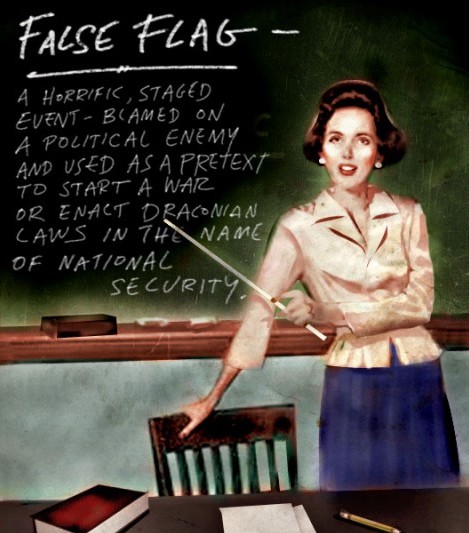
Remember that much of this apparatus of thought control has been applied beneath the banner of the fake Russia hacking story. That story, created by the Clinton camp to distract from the DNC email revelations provided by WikiLeaks, at first blamed Russia for hacking into “our democracy”, then suggested Donald Trump had colluded with Russia to swing the election, and then emphasized that Russia had launched an “influence campaign” designed to swing the election, with the focus subtly shifting from hacking to collusion to influence. At each turn, the evidence proves paltry, the claims absurd, and the virtue signaling nauseating. The bar is being progressively lowered until it meets a threshold of credibility by which the Senate Intel Committee can prosecute Donald Trump or justify some sort of punitive measures against Russia.

The story is so transparently false, from the technical detail to the geopolitical motive, that it is only sustained by the permanent—or deep state—elements of the foreign policy community that need a means by which to control and direct the Trump administration. Russia collusion served as an ideal pretext to force Trump away from campaign-trail odes to conciliation and toward a continuation of the hostile foreign policies glibly enabled and advanced by Barack Obama. The comedy of it all is that Facebook found ‘incriminating’ ads that amounted to less than one percent of the Facebook total ad buys. Congress would like to ban RT, which has ratings that are 0.3 percent of Judge Judy’s. And the infamous hack has been shown to be a leak. What are we left with? A grandiose deceit based on a need to sustain a brutal ideology of oppression, austerity, and war.

But this is how the imperialists do it. They organize globally to oppress locally. That’s why they’ve been rightly rebranded as ‘the globalists’. The workers always trail behind, left to cope with recently discovered alliances of institutional powers collaborating to fence in the prospects for economic equality, social justice, and the fair distribution of a nation’s wealth. We find ourselves beneath the a pregnant cloud of metastasizing repression, conceived and constructed beneath our own gaze. In his recent novel Purity, one of author Jonathan Franzen’s characters, a famous East German exile and whistleblower extraordinaire (a more charismatic Assange), finds himself a global celebrity, the subject of countless interviews wherein,

“…he’d taken to dropping the word totalitarian. Younger interviewers, to whom the word meant total surveillance, total mind control, gray armies in parade with medium-range missiles, had understood him to be saying something unfair about the Internet. In fact, he simply meant a system that was impossible to opt out of.”

Whether it is too late for a world of working class people and the ubiquitous poor to opt out of the globalized imperium dreamed up by our post-war planners, is hard to say. But if you think there’s still time, be extremely careful, since the pre-crime police are nearly omnipresent, and they might overhear you quoting Marx or see you scrawling ideas about redistribution on the walls of some abandoned underpass. Just imagine some future advertisement for the pre-crime program, a glistening LCD ad floating between skyscrapers, a smiling family at play, a nation secure, and an omniscient narrator softly reminding you, “Don’t forget—it’s the thought that counts.”

Revolutionary Terror: Mark Steven’s ‘Splatter Capital’

By Michael Grasso

Source: We Are the Mutants

Splatter Capital: The Political Economy of Gore Films
By Mark Steven
Repeater Books, 2017

“Splatter confirms and redoubles our very worst fears. It reminds us of what capital is doing to all of us, all of the time—of how predators are consuming our life-substances; of how we are gravely vulnerable against the machinery of production and the matrices of exchange; and of how, as participants of an internecine conflict, our lives are always already precarious.”

—from the Introduction to Splatter Capital

Political readings or interpretations of horror films are nothing new. But in Mark Steven’s 2017 study, Splatter Capital, an explicit connection is made between the bloody gore of what Steven terms “splatter” horror films and the dehumanizing, mutilative forces of global capitalism. Moreover, Steven posits the artistic motivation behind splatter horror as an explicit repudiation of this system: “It is politically committed and its commitment tends toward the anti-capitalist left.” In splatter films, Steven tells us, the images of gory dismemberment do double duty. They both offer a clear metaphor for capitalism’s cruelty, and act as a cathartic revenge in which the bloody legacy of capitalist exploitation is often visited upon its perpetrators and profiteers among the bourgeoisie.

Some definitions are in order here, given that Steven’s schema of genres—“splatter,” “slasher,” “extreme horror”—draws distinctions that might not be apparent even to horror fans. Splatter horror, according to Steven, is all about the violence that can be visited upon the human body and all the abjection that follows. It is machinery tearing apart flesh, blood, and guts: the moment a human body becomes meat. It differs from the personalized and often sexualized “hunt” of the slasher flick. The protagonist in a slasher movie is an individual (often female) resisting violent death at the hands of another individual (often male). In victory against Jason, Freddy, or Michael Myers, this protagonist, in Steven’s words, “restores a social order, which is all too regularly white, middle-class, and suburban.” Splatter horror not only expands the horizons of mutilation and violence allowable in a horror film but systematizes it. The splatter enemy is an implacable, impersonal force, full of shock and awe; its grudge is not personal, but instead overwhelming, inescapable, and, most importantly, class-based.

The language of violence and horror has been with Marxist thought from the beginning. Steven gives us a good précis of Marx’s use of explicitly Gothic (along with bloody and cannibalistic) imagery throughout his works, as well as a splatter-tastic explanation of the exploitation behind surplus value, using an imaginary case study in the manufacturing of chainsaws and knives. The October Revolution in Russia is viewed as a reaction to the inhuman mechanized slaughter of the first World War; Eisenstein’s early filmic paeans to the necessity of revolution such as Strike (1925) demonstrate, thanks to Eisenstein’s pioneering use of montage, capitalism’s role as butcher. Steven also discusses avowed leftist filmmakers from outside the Soviet Union such as Godard, Makavejev, and Pasolini—specifically their use of gore to embody the cruelty of the ruling classes.

As we enter the world of Hollywood film in Chapter Three, Steven examines splatter film as a specifically American reaction to the constant churning crisis of capitalism. Specifically, Steven looks at the two peaks of gore-flecked horror—the mid ’60s through the early ’80s, and the post-Cold War “torture porn” trend of the early ’00s—as expressions of two very important economic and political shifts. The first splatter peak in the ’70s is seen as a clear reaction to the slow, inexorable widening of neoliberal and globalist postindustrial economics and its impact on the American industrial worker. (The aftermath of this trend continues into the 1980s with the evaporation of industry and the establishment of a new information-and-finance-based economy.) The splatter/torture porn trend of the ’00s and beyond is a reaction to the crises of capitalism under a new world order of neocolonialist conflict: the War on Terror, the final disestablishment of the Western industrial base in favor of cheap labor in the developing world, and the new interconnected, networked world’s rulership by speculative capital in the form of the finance sector.

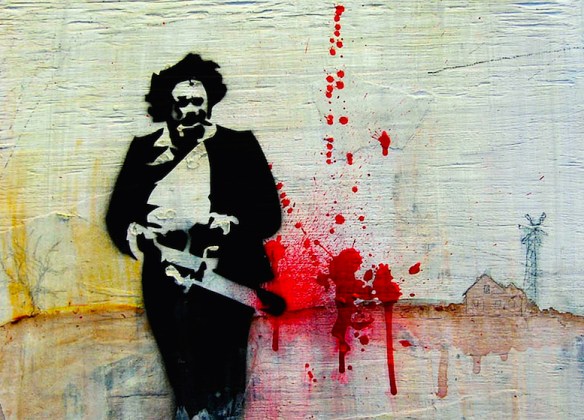
Steven cites too many splatter movies to cover in this review, but central to his thesis is the seminal 1974 Tobe Hooper film, The Texas Chain Saw Massacre. The death of local industry leads Leatherface and family to keep their slaughterhouse traditions alive by carving up and eating young people. These young people, Steven is quick to point out, are only here at all because they were unable to get gas for their car (thanks to the first of two 1970s oil crises). American decline is everywhere; betrayal by global economic forces are central to the trap that’s being laid by the cannibals. (Of course, the carnage of the Vietnam War can’t be overlooked here either, given the visual language of ambush, capture, and torture; Hooper himself has cited this in subsequent interviews.) Steven notes that the victims in The Texas Chain Saw Massacre are representative of a bourgeoisie who don’t know how the sausage is made. It’s important and vital, Steven says, that the cannibalistic side of splatter involves the bourgeoisie being forced to eat members of their own class. It’s Burroughs’s famous “naked lunch“: “the frozen moment when everyone sees what is at the end of every fork.”

As the neoliberal takeover of the world economy begins in earnest in the 1980s, as complex and largely ephemeral systems of mass media and finance take the place of the visceral, grinding monomania of industrial capitalism, splatter horror follows suit. Steven’s analysis of David Cronenberg’s Videodrome (1983) is especially sharp, examining the links between the body horror of the film and the Deleuzian body without organs. Max Renn’s body becomes an endlessly modular media node, able to accommodate video cassettes, to generate and fuse with phallic weapons (used to assassinate and destroy the media forces who’ve made him this way), to mesh and mold and mix with the hard plastic edges of media technology. By the end of the film, Renn is a weapon reprogrammed and re-trained on the very media-industrial complex that made him. More body horror: the cult classic Society (1989) and its shocking conclusion posits the ruling class as a cancerous monster, an amorphous leviathan straight out of a Gilded Age political cartoon, eating and fucking and vomiting, red in tooth and claw and pseudopod. Barriers between bodies break down; the system begins swallowing up all alternate possibilities.

By the time the Cold War is finished, the era of post-9/11 eternal war, of Abu Ghraib and Guantanamo, led to the popular new splatter sub-genre of “torture porn.” Steven identifies the genre’s distinguishing aesthetic feature: the indisputable, systematic, and worldwide victory of capitalism and the hypnotic Spectacle that accompanies it. In this era, there are no longer any alternatives. Everyone, rich and poor, is trapped in the system, and the system reintegrates torture into a worldwide video spectacle. This is embodied in both the global conspiracies of the wealthy in Roth’s Hostel series and in the Jigsaw Killer’s industrially-themed Rube Goldberg devices in the Saw franchise—devices of dismemberment explicitly linked to moral quandaries reminiscent of capitalism’s impossible everyday Hobson’s choices for the working class. The system will go on consuming you, whether you’re unlucky enough to be a splatter film’s victim, or “lucky” enough to wield the power to splatter (for example, Hostel: Part II‘s reversal of fate on the ultra-wealthy hunters, or the Jigsaw Killer’s death from cancer in Saw III—ultimately due to… a lack of health insurance).

Possibly the most intriguing aspect of this already very good book is Steven’s interspersing of personal anecdotes on when and where he discovered some of his favorite horror and genre films. By placing his personal and psychological experience of splatter films front and center, and linking it to his personal growth and increasing political maturity, he demonstrates the personal impact of the political, and the necessity of personal epiphany, mediated by culture, to achieve political awareness. Splatter Capital ultimately is not a book for the already-convinced and committed leftist, the Marxian thinker already well-versed in theory. (Another of Splatter Capital‘s very strong points is how Steven largely eschews jargon and obscurantism for an approachable tone and topic that laypeople can dive into easily.) It is for the fans of these films who’ve always wondered about the ineluctable appeal of visceral, shocking violence on screen, and perhaps why it all feels so strangely familiar.

U.S. WARS AND HOSTILE ACTIONS: A LIST

By David Swanson

Source: Let’s Try Democracy

There is a reason that most countries polled in December 2013 by Gallup called the United States the greatest threat to peace in the world, and why Pew found that viewpoint increased in 2017.

But it is a reason that eludes that strain of U.S. academia that first defines war as something that nations and groups other than the United States do, and then concludes that war has nearly vanished from the earth.

Since World War II, during a supposed golden age of peace, the United States military has killed some 20 million people, overthrown at least 36 governments, interfered in at least 82 foreign elections, attempted to assassinate over 50 foreign leaders, and dropped bombs on people in over 30 countries. The United States is responsible for the deaths of 5 million people in Vietnam, Laos, and Cambodia, and over 1 million just since 2003 in Iraq.

For the past almost 16 years, the United States has been systematically destroying a region of the globe, bombing Afghanistan, Iraq, Pakistan, Libya, Somalia, Yemen, and Syria, not to mention the Philippines. The United States has “special forces” operating in two-thirds of the world’s countries and non-special forces in three-quarters of them.

In an attempt to quantify U.S. warmaking, I’ve copied below lists from these sources:

>> William Blum: America’s Deadliest Export: Democracy
>> Dr. Zoltan Grossman: A Century of U.S. Military Interventions
>> 
James Lucas: U.S. Has Killed More Than 20 Million People

The supreme international crime according to 2017 U.S. media reporting is interferring nonviolently in a democratic election — at least if Russia does it. William Blum, in his book Rogue State, lists over 30 times that the United States has done that. Another study, however, says 81 elections in 47 countries. France 2017 makes that total at least 82.

In a reality-based assessment of U.S. crimes, the serious offenses begin beyond that threshold. Here’s Blum’s list of over 50 foreign leaders whom the United States has attempted to assassinate:

  • 1949 – Kim Koo, Korean opposition leader
  • 1950s – CIA/Neo-Nazi hit list of more than 200 political figures in West Germany to be “put out of the way” in the event of a Soviet invasion
  • 1950s – Chou En-lai, Prime minister of China, several attempts on his life
  • 1950s, 1962 – Sukarno, President of Indonesia
  • 1951 – Kim Il Sung, Premier of North Korea
  • 1953 – Mohammed Mossadegh, Prime Minister of Iran
  • 1950s (mid) – Claro M. Recto, Philippines opposition leader
  • 1955 – Jawaharlal Nehru, Prime Minister of India
  • 1957 – Gamal Abdul Nasser, President of Egypt
  • 1959, 1963, 1969 – Norodom Sihanouk, leader of Cambodia
  • 1960 – Brig. Gen. Abdul Karim Kassem, leader of Iraq
  • 1950s-70s – José Figueres, President of Costa Rica, two attempts on his life
  • 1961 – Francois “Papa Doc” Duvalier, leader of Haiti
  • 1961 – Patrice Lumumba, Prime Minister of the Congo (Zaire)
  • 1961 – Gen. Rafael Trujillo, leader of Dominican Republic
  • 1963 – Ngo Dinh Diem, President of South Vietnam
  • 1960s-70s – Fidel Castro, President of Cuba, many attempts on his life
  • 1960s – Raúl Castro, high official in government of Cuba
  • 1965 – Francisco Caamaño, Dominican Republic opposition leader
  • 1965-6 – Charles de Gaulle, President of France
  • 1967 – Che Guevara, Cuban leader
  • 1970 – Salvador Allende, President of Chile
  • 1970 – Gen. Rene Schneider, Commander-in-Chief of Army, Chile
  • 1970s, 1981 – General Omar Torrijos, leader of Panama
  • 1972 – General Manuel Noriega, Chief of Panama Intelligence
  • 1975 – Mobutu Sese Seko, President of Zaire
  • 1976 – Michael Manley, Prime Minister of Jamaica
  • 1980-1986 – Muammar Qaddafi, leader of Libya, several plots and attempts upon his life
  • 1982 – Ayatollah Khomeini, leader of Iran
  • 1983 – Gen. Ahmed Dlimi, Moroccan Army commander
  • 1983 – Miguel d’Escoto, Foreign Minister of Nicaragua
  • 1984 – The nine comandantes of the Sandinista National Directorate
  • 1985 – Sheikh Mohammed Hussein Fadlallah, Lebanese Shiite leader (80 people killed in the attempt)
  • 1991 – Saddam Hussein, leader of Iraq
  • 1993 – Mohamed Farah Aideed, prominent clan leader of Somalia
  • 1998, 2001-2 – Osama bin Laden, leading Islamic militant
  • 1999 – Slobodan Milosevic, President of Yugoslavia
  • 2002 – Gulbuddin Hekmatyar, Afghan Islamic leader and warlord
  • 2003 – Saddam Hussein and his two sons
  • 2011 – Muammar Qaddafi, leader of Libya

Let me know of any updates or corrections, and I’ll add them.
Thanks to Said Zulficar for pointing out the need to add Jaime Roldos, President of Ecuador, assassinated May 1981.

Here is Blum’s list of U.S. attempts to overthrow governments (* indicates success):

  • China 1949 to early 1960s
  • Albania 1949-53
  • East Germany 1950s
  • Iran 1953 *
  • Guatemala 1954 *
  • Costa Rica mid-1950s
  • Syria 1956-7
  • Egypt 1957
  • Indonesia 1957-8
  • British Guiana 1953-64 *
  • Iraq 1963 *
  • North Vietnam 1945-73
  • Cambodia 1955-70 *
  • Laos 1958 *, 1959 *, 1960 *
  • Ecuador 1960-63 *
  • Congo 1960 *
  • France 1965
  • Brazil 1962-64 *
  • Dominican Republic 1963 *
  • Cuba 1959 to present
  • Bolivia 1964 *
  • Indonesia 1965 *
  • Ghana 1966 *
  • Chile 1964-73 *
  • Greece 1967 *
  • Costa Rica 1970-71
  • Bolivia 1971 *
  • Australia 1973-75 *
  • Angola 1975, 1980s
  • Zaire 1975
  • Portugal 1974-76 *
  • Jamaica 1976-80 *
  • Seychelles 1979-81
  • Chad 1981-82 *
  • Grenada 1983 *
  • South Yemen 1982-84
  • Suriname 1982-84
  • Fiji 1987 *
  • Libya 1980s
  • Nicaragua 1981-90 *
  • Panama 1989 *
  • Bulgaria 1990 *
  • Albania 1991 *
  • Iraq 1991
  • Afghanistan 1980s *
  • Somalia 1993
  • Yugoslavia 1999-2000 *
  • Ecuador 2000 *
  • Afghanistan 2001 *
  • Venezuela 2002 *
  • Iraq 2003 *
  • Haiti 2004 *
  • Somalia 2007 to present
  • Honduras 2009
  • Libya 2011 *
  • Syria 2012
  • Ukraine 2014 *
    [arguably, Syria 1949 needs to be added to this list. –DS]

The above list does not include numerous coups by U.S.-trained fighters, such as (other than Honduras) those discussed here: “from Isaac Zida of Burkina Faso, Haiti’s Philippe Biamby, and Yahya Jammeh of The Gambia to Egypt’s Abdel-Fattah el-Sisi, Mohammad Zia-ul-Haq of Pakistan, and the IMET-educated leaders of the 2009 coup in Honduras, not to mention Mali’s Amadou Sanogo.” These are just in very recent years, by no means a complete list, though the Haiti coup referenced here was earlier than the one included in the list above.

Here is Blum’s list of nations bombed by the United States:

  • Korea and China 1950-53 (Korean War)
  • Guatemala 1954
  • Indonesia 1958
  • Cuba 1959-1961
  • Guatemala 1960
  • Congo 1964
  • Laos 1964-73
  • Vietnam 1961-73
  • Cambodia 1969-70
  • Guatemala 1967-69
  • Grenada 1983
  • Lebanon 1983, 1984 (both Lebanese and Syrian targets)
  • Libya 1986
  • El Salvador 1980s
  • Nicaragua 1980s
  • Iran 1987
  • Panama 1989
  • Iraq 1991 (Persian Gulf War)
  • Kuwait 1991
  • Somalia 1993
  • Bosnia 1994, 1995
  • Sudan 1998
  • Afghanistan 1998
  • Yugoslavia 1999
  • Yemen 2002
  • Iraq 1991-2003 (US/UK on regular basis)
  • Iraq 2003-2015
  • Afghanistan 2001-2015
  • Pakistan 2007-2015
  • Somalia 2007-8, 2011
  • Yemen 2009, 2011
  • Libya 2011, 2015
  • Syria 2014-2016

[Drone strikes in the Philippines should be added to this list. As perhaps should be all the islands and territories destroyed by test bombings. –DS]

Blum adds these further bombings:

Iran, April 2003 – hit by US missiles during bombing of Iraq, killing at least one person

Pakistan, 2002-03 – bombed by US planes several times as part of combat against the Taliban and other opponents of the US occupation of Afghanistan

China, 1999 – its heavily bombed embassy in Belgrade is legally Chinese territory, and it appears rather certain that the bombing was no accident (see chapter 25 of Rogue State)

France, 1986 – After the French government refused the use of its air space to US warplanes headed for a bombing raid on Libya, the planes were forced to take another, longer route; when they reached Libya they bombed so close to the French embassy that the building was damaged and all communication links knocked out.

Philadelphia, Pennsylvania, May 13, 1985 – A bomb dropped by a police helicopter burned down an entire block, some 60 homes destroyed, 11 dead, including several small children. The police, the mayor’s office, and the FBI were all involved in this effort to evict a black organization called MOVE from the house they lived in.

If we add in other missing instances and go back to and prior to WWII the list starts to look like this:

Dominican Republic 1915 – 1935
Haiti 1915 – 1934
Logan County, West Virginia 1921
Tulsa, Oklahoma 1921
Honduras 1924, 1925
Nicaragua 1927 – 1933
Algeria, Austria, Belgium, Bulgaria, China, Crete, Czechoslovakia, France, Germany, Greece, Guam, Hungary, Indonesia, Italy, Japan, Libya, Luxembourg, Morocco, Myanmar (Burma), Netherlands, New Guinea and the Solomon Islands, Okinawa, Philippines, Poland, Romania, Saipan, Taiwan (Formosa), Thailand, Tinian, Tunisia, Vietnam (French Indochina), Yugoslavia 1941 – 1945
Marshall Islands, Republic of Kiribati, Alaska, Nevada, Colorado, Mississippi, New Mexico nuclear testing 1945 – 1962
Korea and China 1950 – 1953
Guatemala 1954
Indonesia 1958
Cuba 1959 – 1961
Guatemala 1960
Congo 1964
Laos 1964 – 1973
Vietnam 1961 – 1973
Cambodia 1969 – 1970
Guatemala 1967 – 1969
El Salvador 1980s
Nicaragua 1980s
Grenada 1983
Lebanon 1983, 1984
Libya 1986
Philadelphia, Pennsylvania 1985
Iran 1987
Panama 1989
Kuwait 1991
Iraq 1991 – 2017
Somalia 1993
Bosnia 1994, 1995
Sudan 1998
Afghanistan 1998
Yugoslavia 1999
Afghanistan 2001 – 2017
Yemen 2002
Pakistan 2002 – 2003
Iran 2003
Pakistan 2007 – 2017
Somalia 2007 – 2008, 2011
Yemen 2009, 2011, 2016-2017
Libya 2011, 2015 – 2017
Philippines 2012
Syria 2014 – 2017

Then there’s Blum’s list of instances of the United States attempting to suppress a populist or nationalist movement (* indicates success):

  • China – 1945-49
  • France – 1947 *
  • Italy – 1947-1970s *
  • Greece – 1947-49 *
  • Philippines – 1945-53 *
  • Korea – 1945-53 *
  • Haiti – 1959 *
  • Laos – 1957-73
  • Vietnam – 1961-73
  • Thailand – 1965-73 *
  • Peru – 1965 *
  • Dominican Republic – 1965 *
  • Uruguay – 1969-72 *
  • South Africa – 1960s-1980s
  • East Timor – 1975-1999 *
  • Philippines – 1970s-1990s *
  • El Salvador – 1980-92 *
  • Colombia – 1990s to early 2000s *
  • Peru – 1997 *
  • Iraq – 2003 to present *

Zoltan Grossman provides the following list of all variety of hostile actions:

IRAN 1946, Nuclear threat, Soviet troops told to leave north.
YUGOSLAVIA 1946, Nuclear threat, naval Response to shoot-down of U.S. plane.
URUGUAY 1947, Nuclear threat, Bombers deployed as show of strength.
GREECE 1947-49, Command operation, U.S. directs extreme-right in civil war.
GERMANY 1948, Nuclear Threat, Atomic-capable bombers guard Berlin Airlift.
CHINA 1948-49, Troops/Marines evacuate Americans before Communist victory.
PHILIPPINES 1948-54, Command operation, CIA directs war against Huk Rebellion.
PUERTO RICO 1950, Command operation, Independence rebellion crushed in Ponce.
KOREA 1951-53 (-?), Troops, naval, bombing , nuclear threats, U.S./So. Korea fights China/No. Korea to stalemate; A-bomb threat in 1950, and against China in 1953. Still have bases.
IRAN 1953, Command Operation, CIA overthrows democracy, installs Shah.
VIETNAM 1954, Nuclear threat, French offered bombs to use against seige.
GUATEMALA 1954, Command operation, bombing, nuclear threat CIA directs exile invasion after new gov’t nationalized U.S. company lands; bombers based in Nicaragua.
EGYPT 1956, Nuclear threat, troops Soviets told to keep out of Suez crisis; Marines evacuate foreigners.
LEBANON l958, Troops, naval Army & Marine occupation against rebels.
IRAQ 1958, Nuclear threat, Iraq warned against invading Kuwait.
CHINA l958 Nuclear threat, China told not to move on Taiwan isles.
PANAMA 1958 Troops, Flag protests erupt into confrontation.
VIETNAM l960-75 Troops, naval, bombing, nuclear threats Fought South Vietnam revolt & North Vietnam, one million killed in longest U.S. war; atomic bomb threats in l968 and l969.
CUBA l961 Command operation, CIA-directed exile invasion fails.
GERMANY l961 Nuclear threat, Alert during Berlin Wall crisis.
LAOS 1962 Command operation, Military buildup during guerrilla war.
CUBA l962 Nuclear threat, naval Blockade during missile crisis; near-war with Soviet Union.
IRAQ 1963 Command operation, CIA organizes coup that killed president, brings Ba’ath Party to power, and Saddam Hussein back from exile to be head of the secret service.
PANAMA l964, Troops Panamanians shot for urging canal’s return.
INDONESIA l965, Command operation, Million killed in CIA-assisted army coup.
DOMINICAN REPUBLIC 1965-66, Troops, bombing Army & Marines land during election campaign.
GUATEMALA l966-67, Command operation, Green Berets intervene against rebels.
DETROIT l967, Troops, Army battles African Americans, 43 killed.
UNITED STATES l968 Troops After King is shot; over 21,000 soldiers in cities.
CAMBODIA l969-75, Bombing, troops, naval Up to 2 million killed in decade of bombing, starvation, and political chaos.
OMAN l970, Command operation, U.S. directs Iranian marine invasion.
LAOS l971-73, Command operation, bombing U.S. directs South Vietnamese invasion; “carpet-bombs” countryside.
SOUTH DAKOTA,  l973 Command operation, Army directs Wounded Knee siege of Lakotas.
MIDEAST 1973, Nuclear threat, World-wide alert during Mideast War.
CHILE 1973, Command operation, CIA-backed coup ousts elected marxist president.
CAMBODIA l975, Troops, bombing Gassing of captured ship Mayagüez, 28 troops die when copter shot down.
ANGOLA l976-9,2 Command operation, CIA assists South African-backed rebels.
IRAN l980 Troops, nuclear threat, aborted bombing Raid to rescue Embassy hostages; 8 troops die in copter-plane crash. Soviets warned not to get involved in revolution.
LIBYA l981, Naval jets Two Libyan jets shot down in maneuvers.
EL SALVADOR l981-92 , Command operation, troops Advisors, overflights aid anti-rebel war, soldiers briefly involved in hostage clash.
NICARAGUA l981-90, Command operation, naval CIA directs exile (Contra) invasions, plants harbor mines against revolution.
LEBANON l982-84, Naval, bombing, troops Marines expel PLO and back Phalangists, Navy bombs and shells Muslim positions. 241 Marines killed when Shi’a rebel bombs barracks.
GRENADA l983-84, Troops, bombing Invasion four years after revolution.
HONDURAS, l983-89, Troops, Maneuvers help build bases near borders.
IRAN, l984 Jets, Two Iranian jets shot down over Persian Gulf.
LIBYA l986 Bombing, naval Air strikes to topple Qaddafi gov’t.
BOLIVIA 1986 Troops, Army assists raids on cocaine region.
IRAN l987-88 Naval bombing, US intervenes on side of Iraq in war, defending reflagged tankers and shooting down civilian jet.
LIBYA 1989, Naval jets, Two Libyan jets shot down.
VIRGIN ISLANDS 1989, Troops, St. Croix Black unrest after storm.
PHILIPPINES 1989, Jets Air, cover provided for government against coup.
PANAMA 1989, Troops, bombing,  Nationalist government ousted by 27,000 soldiers, leaders arrested, 2000+ killed.
LIBERIA 1990, Troops, Foreigners evacuated during civil war.
SAUDI ARABIA, 1990-91, Troops, jets Iraq countered after invading Kuwait. 540,000 troops also stationed in Oman, Qatar, Bahrain, UAE, Israel.
IRAQ 1990-91 Bombing, troops, naval Blockade of Iraqi and Jordanian ports, air strikes; 200,000+ killed in invasion of Iraq and Kuwait; large-scale destruction of Iraqi military.
KUWAIT 1991 Naval, bombing, troops Kuwait royal family returned to throne.
IRAQ 1991-2003 Bombing, naval No-fly zone over Kurdish north, Shiite south; constant air strikes and naval-enforced economic sanctions
LOS ANGELES 1992 Troops Army, Marines deployed against anti-police uprising.
SOMALIA 1992-94 Troops, naval, bombing U.S.-led United Nations occupation during civil war; raids against one Mogadishu faction.
YUGOSLAVIA 1992-94 Naval NATO blockade of Serbia and Montenegro.
BOSNIA 1993-? Jets, bombing No-fly zone patrolled in civil war; downed jets, bombed Serbs.
HAITI 1994 Troops, naval Blockade against military government; troops restore President Aristide to office three years after coup.
ZAIRE (CONGO) 1996-97 Troops Troops at Rwandan Hutu refugee camps, in area where Congo revolution begins.
LIBERIA 1997 Troops Soldiers under fire during evacuation of foreigners.
ALBANIA 1997 Troops Soldiers under fire during evacuation of foreigners.
SUDAN 1998 Missiles Attack on pharmaceutical plant alleged to be “terrorist” nerve gas plant.
AFGHANISTAN 1998 Missiles Attack on former CIA training camps used by Islamic fundamentalist groups alleged to have attacked embassies.
IRAQ 1998 Bombing, Missiles Four days of intensive air strikes after weapons inspectors allege Iraqi obstructions.
YUGOSLAVIA 1999 Bombing, Missiles Heavy NATO air strikes after Serbia declines to withdraw from Kosovo. NATO occupation of Kosovo.
YEMEN 2000 Naval USS Cole, docked in Aden, bombed.
MACEDONIA 2001 Troops NATO forces deployed to move and disarm Albanian rebels.
UNITED STATES 2001 Jets, naval Reaction to hijacker attacks on New York, DC
AFGHANISTAN 2001-? Troops, bombing, missiles Massive U.S. mobilization to overthrow Taliban, hunt Al Qaeda fighters, install Karzai regime, and battle Taliban insurgency. More than 30,000 U.S. troops and numerous private security contractors carry our occupation.
YEMEN 2002 Missiles Predator drone missile attack on Al Qaeda, including a US citizen.
PHILIPPINES 2002-? Troops, naval Training mission for Philippine military fighting Abu Sayyaf rebels evolves into combat missions in Sulu Archipelago, west of Mindanao.
COLOMBIA 2003-? Troops US special forces sent to rebel zone to back up Colombian military protecting oil pipeline.
IRAQ 2003-11 Troops, naval, bombing, missiles Saddam regime toppled in Baghdad. More than 250,000 U.S. personnel participate in invasion. US and UK forces occupy country and battle Sunni and Shi’ite insurgencies. More than 160,000 troops and numerous private contractors carry out occupation and build large permanent bases.
LIBERIA 2003 Troops Brief involvement in peacekeeping force as rebels drove out leader.
HAITI 2004-05 Troops, naval Marines & Army land after right-wing rebels oust elected President Aristide, who was advised to leave by Washington.
PAKISTAN 2005-? Missiles, bombing, covert operation CIA missile and air strikes and Special Forces raids on alleged Al Qaeda and Taliban refuge villages kill multiple civilians. Drone attacks also on Pakistani Mehsud network.
SOMALIA 2006-? Missiles, naval, troops, command operation Special Forces advise Ethiopian invasion that topples Islamist government; AC-130 strikes, Cruise missile attacks and helicopter raids against Islamist rebels; naval blockade against “pirates” and insurgents.
SYRIA 2008 Troops Special Forces in helicopter raid 5 miles from Iraq kill 8 Syrian civilians
YEMEN 2009-? Missiles, command operation Cruise missile attack on Al Qaeda kills 49 civilians; Yemeni military assaults on rebels
LIBYA 2011-? Bombing, missiles, troops, command operation NATO coordinates air strikes and missile attacks against Qaddafi government during uprising by rebel army. Periodic Special Forces raids against Islamist insurgents.
IRAQ 2014-? Bombing, missiles, troops, command operation

Air strikes and Special Forces intervene against Islamic State insurgents; training Iraqi and Kurdish troops.
SYRIA 2014-? Bombing, missiles, troops, command operation

Air strikes and Special Forces intervene against Islamic State insurgents; training other Syrian insurgents. Missile strikes against Syrian military begin April 2017.


Now, here’s James Lucas’ list of victims of U.S. wars
(His footnotes are here.)

37 VICTIM NATIONS

Afghanistan

The U.S. is responsible for between 1 and 1.8 million deaths during the war between the Soviet Union and Afghanistan, by luring the Soviet Union into invading that nation. (1,2,3,4)

The Soviet Union had friendly relations its neighbor, Afghanistan, which had a secular government. The Soviets feared that if that government became fundamentalist this change could spill over into the Soviet Union.

In 1998, in an interview with the Parisian publication Le Novel Observateur, Zbigniew Brzezinski, adviser to President Carter, admitted that he had been responsible for instigating aid to the Mujahadeen in Afghanistan which caused the Soviets to invade. In his own words:

According to the official version of history, CIA aid to the Mujahadeen began during 1980, that is to say, after the Soviet army invaded Afghanistan on 24 December 1979. But the reality, secretly guarded until now, is completely otherwise. Indeed, it was July 3, 1979 that President Carter signed the first directive for secret aid to the opponents of the pro-Soviet regime in Kabul. And that very day, I wrote a note to the President in which I explained to him that in my opinion this aid was going to induce a Soviet military intervention. (5,1,6)

Brzezinski justified laying this trap, since he said it gave the Soviet Union its Vietnam and caused the breakup of the Soviet Union. “Regret what?” he said. “That secret operation was an excellent idea. It had the effect of drawing the Russians into the Afghan trap and you want me to regret it?” (7)

The CIA spent 5 to 6 billion dollars on its operation in Afghanistan in order to bleed the Soviet Union. (1,2,3) When that 10-year war ended over a million people were dead and Afghan heroin had captured 60% of the U.S. market. (4)

The U.S. has been responsible directly for about 12,000 deaths in Afghanistan many of which resulted from bombing in retaliation for the attacks on U.S. property on September 11, 2001. Subsequently U.S. troops invaded that country. (4)

Angola

An indigenous armed struggle against Portuguese rule in Angola began in 1961. In 1977 an Angolan government was recognized by the U.N., although the U.S. was one of the few nations that opposed this action. In 1986 Uncle Sam approved material assistance to UNITA, a group that was trying to overthrow the government. Even today this struggle, which has involved many nations at times, continues.

U.S. intervention was justified to the U.S. public as a reaction to the intervention of 50,000 Cuban troops in Angola. However, according to Piero Gleijeses, a history professor at Johns Hopkins University the reverse was true. The Cuban intervention came as a result of a CIA – financed covert invasion via neighboring Zaire and a drive on the Angolan capital by the U.S. ally, South Africa1,2,3). (Three estimates of deaths range from 300,000 to 750,000 (4,5,6)

Argentina: See South America: Operation Condor

Bangladesh: See Pakistan

Bolivia

Hugo Banzer was the leader of a repressive regime in Bolivia in the 1970s. The U.S. had been disturbed when a previous leader nationalized the tin mines and distributed land to Indian peasants. Later that action to benefit the poor was reversed.

Banzer, who was trained at the U.S.-operated School of the Americas in Panama and later at Fort Hood, Texas, came back from exile frequently to confer with U.S. Air Force Major Robert Lundin. In 1971 he staged a successful coup with the help of the U.S. Air Force radio system. In the first years of his dictatorship he received twice as military assistance from the U.S. as in the previous dozen years together.

A few years later the Catholic Church denounced an army massacre of striking tin workers in 1975, Banzer, assisted by information provided by the CIA, was able to target and locate leftist priests and nuns. His anti-clergy strategy, known as the Banzer Plan, was adopted by nine other Latin American dictatorships in 1977. (2) He has been accused of being responsible for 400 deaths during his tenure. (1)

Also see: See South America: Operation Condor

Brazil: See South America: Operation Condor

Cambodia

U.S. bombing of Cambodia had already been underway for several years in secret under the Johnson and Nixon administrations, but when President Nixon openly began bombing in preparation for a land assault on Cambodia it caused major protests in the U.S. against the Vietnam War.

There is little awareness today of the scope of these bombings and the human suffering involved.

Immense damage was done to the villages and cities of Cambodia, causing refugees and internal displacement of the population. This unstable situation enabled the Khmer Rouge, a small political party led by Pol Pot, to assume power. Over the years we have repeatedly heard about the Khmer Rouge’s role in the deaths of millions in Cambodia without any acknowledgement being made this mass killing was made possible by the the U.S. bombing of that nation which destabilized it by death , injuries, hunger and dislocation of its people.

So the U.S. bears responsibility not only for the deaths from the bombings but also for those resulting from the activities of the Khmer Rouge – a total of about 2.5 million people. Even when Vietnam latrer invaded Cambodia in 1979 the CIA was still supporting the Khmer Rouge. (1,2,3)

Also see Vietnam

Chad

An estimated 40,000 people in Chad were killed and as many as 200,000 tortured by a government, headed by Hissen Habre who was brought to power in June, 1982 with the help of CIA money and arms. He remained in power for eight years. (1,2)

Human Rights Watch claimed that Habre was responsible for thousands of killings. In 2001, while living in Senegal, he was almost tried for crimes committed by him in Chad. However, a court there blocked these proceedings. Then human rights people decided to pursue the case in Belgium, because some of Habre’s torture victims lived there. The U.S., in June 2003, told Belgium that it risked losing its status as host to NATO’s headquarters if it allowed such a legal proceeding to happen. So the result was that the law that allowed victims to file complaints in Belgium for atrocities committed abroad was repealed. However, two months later a new law was passed which made special provision for the continuation of the case against Habre.

Chile

The CIA intervened in Chile’s 1958 and 1964 elections. In 1970 a socialist candidate, Salvador Allende, was elected president. The CIA wanted to incite a military coup to prevent his inauguration, but the Chilean army’s chief of staff, General Rene Schneider, opposed this action. The CIA then planned, along with some people in the Chilean military, to assassinate Schneider. This plot failed and Allende took office. President Nixon was not to be dissuaded and he ordered the CIA to create a coup climate: “Make the economy scream,” he said.

What followed were guerilla warfare, arson, bombing, sabotage and terror. ITT and other U.S. corporations with Chilean holdings sponsored demonstrations and strikes. Finally, on September 11, 1973 Allende died either by suicide or by assassination. At that time Henry Kissinger, U.S. Secretary of State, said the following regarding Chile: “I don’t see why we need to stand by and watch a country go communist because of the irresponsibility of its own people.” (1)

During 17 years of terror under Allende’s successor, General Augusto Pinochet, an estimated 3,000 Chileans were killed and many others were tortured or “disappeared.” (2,3,4,5)

Also see South America: Operation Condor

China An estimated 900,000 Chinese died during the Korean War.

For more information, See: Korea.

Colombia

One estimate is that 67,000 deaths have occurred from the 1960s to recent years due to support by the U.S. of Colombian state terrorism. (1)

According to a 1994 Amnesty International report, more than 20,000 people were killed for political reasons in Colombia since 1986, mainly by the military and its paramilitary allies. Amnesty alleged that “U.S.- supplied military equipment, ostensibly delivered for use against narcotics traffickers, was being used by the Colombian military to commit abuses in the name of “counter-insurgency.” (2) In 2002 another estimate was made that 3,500 people die each year in a U.S. funded civilian war in Colombia. (3)

In 1996 Human Rights Watch issued a report “Assassination Squads in Colombia” which revealed that CIA agents went to Colombia in 1991 to help the military to train undercover agents in anti-subversive activity. (4,5)

In recent years the U.S. government has provided assistance under Plan Colombia. The Colombian government has been charged with using most of the funds for destruction of crops and support of the paramilitary group.

Cuba

In the Bay of Pigs invasion of Cuba on April 18, 1961 which ended after 3 days, 114 of the invading force were killed, 1,189 were taken prisoners and a few escaped to waiting U.S. ships. (1) The captured exiles were quickly tried, a few executed and the rest sentenced to thirty years in prison for treason. These exiles were released after 20 months in exchange for $53 million in food and medicine.

Some people estimate that the number of Cuban forces killed range from 2,000, to 4,000. Another estimate is that 1,800 Cuban forces were killed on an open highway by napalm. This appears to have been a precursor of the Highway of Death in Iraq in 1991 when U.S. forces mercilessly annihilated large numbers of Iraqis on a highway. (2)

Democratic Republic of Congo (formerly Zaire)

The beginning of massive violence was instigated in this country in 1879 by its colonizer King Leopold of Belgium. The Congo’s population was reduced by 10 million people over a period of 20 years which some have referred to as “Leopold’s Genocide.” (1) The U.S. has been responsible for about a third of that many deaths in that nation in the more recent past. (2)

In 1960 the Congo became an independent state with Patrice Lumumba being its first prime minister. He was assassinated with the CIA being implicated, although some say that his murder was actually the responsibility of Belgium. (3) But nevertheless, the CIA was planning to kill him. (4) Before his assassination the CIA sent one of its scientists, Dr. Sidney Gottlieb, to the Congo carrying “lethal biological material” intended for use in Lumumba’s assassination. This virus would have been able to produce a fatal disease indigenous to the Congo area of Africa and was transported in a diplomatic pouch.

Much of the time in recent years there has been a civil war within the Democratic Republic of Congo, fomented often by the U.S. and other nations, including neighboring nations. (5)

In April 1977, Newsday reported that the CIA was secretly supporting efforts to recruit several hundred mercenaries in the U.S. and Great Britain to serve alongside Zaire’s army. In that same year the U.S. provided $15 million of military supplies to the Zairian President Mobutu to fend off an invasion by a rival group operating in Angola. (6)

In May 1979, the U.S. sent several million dollars of aid to Mobutu who had been condemned 3 months earlier by the U.S. State Department for human rights violations. (7) During the Cold War the U.S. funneled over 300 million dollars in weapons into Zaire (8,9) $100 million in military training was provided to him. (2) In 2001 it was reported to a U.S. congressional committee that American companies, including one linked to former President George Bush Sr., were stoking the Congo for monetary gains. There is an international battle over resources in that country with over 125 companies and individuals being implicated. One of these substances is coltan, which is used in the manufacture of cell phones. (2)

Dominican Republic

In 1962, Juan Bosch became president of the Dominican Republic. He advocated such programs as land reform and public works programs. This did not bode well for his future relationship with the U.S., and after only 7 months in office, he was deposed by a CIA coup. In 1965 when a group was trying to reinstall him to his office President Johnson said, “This Bosch is no good.” Assistant Secretary of State Thomas Mann replied “He’s no good at all. If we don’t get a decent government in there, Mr. President, we get another Bosch. It’s just going to be another sinkhole.” Two days later a U.S. invasion started and 22,000 soldiers and marines entered the Dominican Republic and about 3,000 Dominicans died during the fighting. The cover excuse for doing this was that this was done to protect foreigners there. (1,2,3,4)

East Timor

In December 1975, Indonesia invaded East Timor. This incursion was launched the day after U.S. President Gerald Ford and Secretary of State Henry Kissinger had left Indonesia where they had given President Suharto permission to use American arms, which under U.S. law, could not be used for aggression. Daniel Moynihan, U.S. ambassador to the UN. said that the U.S. wanted “things to turn out as they did.” (1,2) The result was an estimated 200,000 dead out of a population of 700,000. (1,2)

Sixteen years later, on November 12, 1991, two hundred and seventeen East Timorese protesters in Dili, many of them children, marching from a memorial service, were gunned down by Indonesian Kopassus shock troops who were headed by U.S.- trained commanders Prabowo Subianto (son in law of General Suharto) and Kiki Syahnakri. Trucks were seen dumping bodies into the sea. (5)

El Salvador

The civil war from 1981 to1992 in El Salvador was financed by $6 billion in U.S. aid given to support the government in its efforts to crush a movement to bring social justice to the people in that nation of about 8 million people. (1)
During that time U.S. military advisers demonstrated methods of torture on teenage prisoners, according to an interview with a deserter from the Salvadoran army published in the New York Times. This former member of the Salvadoran National Guard testified that he was a member of a squad of twelve who found people who they were told were guerillas and tortured them. Part of the training he received was in torture at a U.S. location somewhere in Panama. (2)

About 900 villagers were massacred in the village of El Mozote in 1981. Ten of the twelve El Salvadoran government soldiers cited as participating in this act were graduates of the School of the Americas operated by the U.S. (2) They were only a small part of about 75,000 people killed during that civil war. (1)

According to a 1993 United Nations’ Truth Commission report, over 96 % of the human rights violations carried out during the war were committed by the Salvadoran army or the paramilitary deaths squads associated with the Salvadoran army. (3)

That commission linked graduates of the School of the Americas to many notorious killings. The New York Times and the Washington Post followed with scathing articles. In 1996, the White House Oversight Board issued a report that supported many of the charges against that school made by Rev. Roy Bourgeois, head of the School of the Americas Watch. That same year the Pentagon released formerly classified reports indicating that graduates were trained in killing, extortion, and physical abuse for interrogations, false imprisonment and other methods of control. (4)

Grenada

The CIA began to destabilize Grenada in 1979 after Maurice Bishop became president, partially because he refused to join the quarantine of Cuba. The campaign against him resulted in his overthrow and the invasion by the U.S. of Grenada on October 25, 1983, with about 277 people dying. (1,2) It was fallaciously charged that an airport was being built in Grenada that could be used to attack the U.S. and it was also erroneously claimed that the lives of American medical students on that island were in danger.

Guatemala

In 1951 Jacobo Arbenz was elected president of Guatemala. He appropriated some unused land operated by the United Fruit Company and compensated the company. (1,2) That company then started a campaign to paint Arbenz as a tool of an international conspiracy and hired about 300 mercenaries who sabotaged oil supplies and trains. (3) In 1954 a CIA-orchestrated coup put him out of office and he left the country. During the next 40 years various regimes killed thousands of people.

In 1999 the Washington Post reported that an Historical Clarification Commission concluded that over 200,000 people had been killed during the civil war and that there had been 42,000 individual human rights violations, 29,000 of them fatal, 92% of which were committed by the army. The commission further reported that the U.S. government and the CIA had pressured the Guatemalan government into suppressing the guerilla movement by ruthless means. (4,5)

According to the Commission between 1981 and 1983 the military government of Guatemala – financed and supported by the U.S. government – destroyed some four hundred Mayan villages in a campaign of genocide. (4)
One of the documents made available to the commission was a 1966 memo from a U.S. State Department official, which described how a “safe house” was set up in the palace for use by Guatemalan security agents and their U.S. contacts. This was the headquarters for the Guatemalan “dirty war” against leftist insurgents and suspected allies. (2)

Haiti

From 1957 to 1986 Haiti was ruled by Papa Doc Duvalier and later by his son. During that time their private terrorist force killed between 30,000 and 100,000 people. (1) Millions of dollars in CIA subsidies flowed into Haiti during that time, mainly to suppress popular movements, (2) although most American military aid to the country, according to William Blum, was covertly channeled through Israel.

Reportedly, governments after the second Duvalier reign were responsible for an even larger number of fatalities, and the influence on Haiti by the U.S., particularly through the CIA, has continued. The U.S. later forced out of the presidential office a black Catholic priest, Jean Bertrand Aristide, even though he was elected with 67% of the vote in the early 1990s. The wealthy white class in Haiti opposed him in this predominantly black nation, because of his social programs designed to help the poor and end corruption. (3) Later he returned to office, but that did not last long. He was forced by the U.S. to leave office and now lives in South Africa.

Honduras

In the 1980s the CIA supported Battalion 316 in Honduras, which kidnapped, tortured and killed hundreds of its citizens. Torture equipment and manuals were provided by CIA Argentinean personnel who worked with U.S. agents in the training of the Hondurans. Approximately 400 people lost their lives. (1,2) This is another instance of torture in the world sponsored by the U.S. (3)

Battalion 316 used shock and suffocation devices in interrogations in the 1980s. Prisoners often were kept naked and, when no longer useful, killed and buried in unmarked graves. Declassified documents and other sources show that the CIA and the U.S. Embassy knew of numerous crimes, including murder and torture, yet continued to support Battalion 316 and collaborate with its leaders.” (4)

Honduras was a staging ground in the early 1980s for the Contras who were trying to overthrow the socialist Sandinista government in Nicaragua. John D. Negroponte, currently Deputy Secretary of State, was our embassador when our military aid to Honduras rose from $4 million to $77.4 million per year. Negroponte denies having had any knowledge of these atrocities during his tenure. However, his predecessor in that position, Jack R. Binns, had reported in 1981 that he was deeply concerned at increasing evidence of officially sponsored/sanctioned assassinations. (5)

Hungary

In 1956 Hungary, a Soviet satellite nation, revolted against the Soviet Union. During the uprising broadcasts by the U.S. Radio Free Europe into Hungary sometimes took on an aggressive tone, encouraging the rebels to believe that Western support was imminent, and even giving tactical advice on how to fight the Soviets. Their hopes were raised then dashed by these broadcasts which cast an even darker shadow over the Hungarian tragedy.“ (1) The Hungarian and Soviet death toll was about 3,000 and the revolution was crushed. (2)

Indonesia

In 1965, in Indonesia, a coup replaced General Sukarno with General Suharto as leader. The U.S. played a role in that change of government. Robert Martens,a former officer in the U.S. embassy in Indonesia, described how U.S. diplomats and CIA officers provided up to 5,000 names to Indonesian Army death squads in 1965 and checked them off as they were killed or captured. Martens admitted that “I probably have a lot of blood on my hands, but that’s not all bad. There’s a time when you have to strike hard at a decisive moment.” (1,2,3) Estimates of the number of deaths range from 500,000 to 3 million. (4,5,6)
From 1993 to 1997 the U.S. provided Jakarta with almost $400 million in economic aid and sold tens of million of dollars of weaponry to that nation. U.S. Green Berets provided training for the Indonesia’s elite force which was responsible for many of atrocities in East Timor. (3)

Iran

Iran lost about 262,000 people in the war against Iraq from 1980 to 1988. (1) See Iraq for more information about that war.

On July 3, 1988 the U.S. Navy ship, the Vincennes, was operating withing Iranian waters providing military support for Iraq during the Iran-Iraq war. During a battle against Iranian gunboats it fired two missiles at an Iranian Airbus, which was on a routine civilian flight. All 290 civilian on board were killed. (2,3)

Iraq

A. The Iraq-Iran War lasted from 1980 to 1988 and during that time there were about 105,000 Iraqi deaths according to the Washington Post. (1,2)

According to Howard Teicher, a former National Security Council official, the U.S. provided the Iraqis with billions of dollars in credits and helped Iraq in other ways such as making sure that Iraq had military equipment including biological agents This surge of help for Iraq came as Iran seemed to be winning the war and was close to Basra. (1) The U.S. was not adverse to both countries weakening themselves as a result of the war, but it did not appear to want either side to win.

B: The U.S.-Iraq War and the Sanctions Against Iraq extended from 1990 to 2003.

Iraq invaded Kuwait on August 2, 1990 and the U.S. responded by demanding that Iraq withdraw, and four days later the U.N. levied international sanctions.

Iraq had reason to believe that the U.S. would not object to its invasion of Kuwait, since U.S. Ambassador to Iraq, April Glaspie, had told Saddam Hussein that the U.S. had no position on the dispute that his country had with Kuwait. So the green light was given, but it seemed to be more of a trap.

As a part of the public relations strategy to energize the American public into supporting an attack against Iraq the daughter of the Kuwaiti ambassador to the U.S. falsely testified before Congress that Iraqi troops were pulling the plugs on incubators in Iraqi hospitals. (1) This contributed to a war frenzy in the U.S.

The U.S. air assault started on January 17, 1991 and it lasted for 42 days. On February 23 President H.W. Bush ordered the U.S. ground assault to begin. The invasion took place with much needless killing of Iraqi military personnel. Only about 150 American military personnel died compared to about 200,000 Iraqis. Some of the Iraqis were mercilessly killed on the Highway of Death and about 400 tons of depleted uranium were left in that nation by the U.S. (2,3)

Other deaths later were from delayed deaths due to wounds, civilians killed, those killed by effects of damage of the Iraqi water treatment facilities and other aspects of its damaged infrastructure and by the sanctions.

In 1995 the Food and Agriculture Organization of the U.N. reported that U.N sanctions against on Iraq had been responsible for the deaths of more than 560,000 children since 1990. (5)

Leslie Stahl on the TV Program 60 Minutes in 1996 mentioned to Madeleine Albright, U.S. Ambassador to the U.N. “We have heard that a half million children have died. I mean, that’s more children than died in Hiroshima. And – and you know, is the price worth it?” Albright replied “I think this is a very hard choice, but the price – we think is worth it.” (4)

In 1999 UNICEF reported that 5,000 children died each month as a result of the sanction and the War with the U.S. (6)

Richard Garfield later estimated that the more likely number of excess deaths among children under five years of age from 1990 through March 1998 to be 227,000 – double those of the previous decade. Garfield estimated that the numbers to be 350,000 through 2000 (based in part on result of another study). (7)

However, there are limitations to his study. His figures were not updated for the remaining three years of the sanctions. Also, two other somewhat vulnerable age groups were not studied: young children above the age of five and the elderly.

All of these reports were considerable indicators of massive numbers of deaths which the U.S. was aware of and which was a part of its strategy to cause enough pain and terror among Iraqis to cause them to revolt against their government.

C: Iraq-U.S. War started in 2003 and has not been concluded

Just as the end of the Cold War emboldened the U.S. to attack Iraq in 1991 so the attacks of September 11, 2001 laid the groundwork for the U.S. to launch the current war against Iraq. While in some other wars we learned much later about the lies that were used to deceive us, some of the deceptions that were used to get us into this war became known almost as soon as they were uttered. There were no weapons of mass destruction, we were not trying to promote democracy, we were not trying to save the Iraqi people from a dictator.

The total number of Iraqi deaths that are a result of our current Iraq against Iraq War is 654,000, of which 600,000 are attributed to acts of violence, according to Johns Hopkins researchers. (1,2)

Since these deaths are a result of the U.S. invasion, our leaders must accept responsibility for them.

[For a more up-to-date look at studies of deaths in Iraq, see http://davidswanson.org/iraq      –DS]

Israeli-Palestinian War

About 100,000 to 200,000 Israelis and Palestinians, but mostly the latter, have been killed in the struggle between those two groups. The U.S. has been a strong supporter of Israel, providing billions of dollars in aid and supporting its possession of nuclear weapons. (1,2)

Korea, North and South

The Korean War started in 1950 when, according to the Truman administration, North Korea invaded South Korea on June 25th. However, since then another explanation has emerged which maintains that the attack by North Korea came during a time of many border incursions by both sides. South Korea initiated most of the border clashes with North Korea beginning in 1948. The North Korea government claimed that by 1949 the South Korean army committed 2,617 armed incursions. It was a myth that the Soviet Union ordered North Korea to attack South Korea. (1,2)

The U.S. started its attack before a U.N. resolution was passed supporting our nation’s intervention, and our military forces added to the mayhem in the war by introducing the use of napalm. (1)

During the war the bulk of the deaths were South Koreans, North Koreans and Chinese. Four sources give deaths counts ranging from 1.8 to 4.5 million. (3,4,5,6) Another source gives a total of 4 million but does not identify to which nation they belonged. (7)

John H. Kim, a U.S. Army veteran and the Chair of the Korea Committee of Veterans for Peace, stated in an article that during the Korean War “the U.S. Army, Air Force and Navy were directly involved in the killing of about three million civilians – both South and North Koreans – at many locations throughout Korea…It is reported that the U.S. dropped some 650,000 tons of bombs, including 43,000 tons of napalm bombs, during the Korean War.” It is presumed that this total does not include Chinese casualties.

Another source states a total of about 500,000 who were Koreans and presumably only military. (8,9)

Laos

From 1965 to 1973 during the Vietnam War the U.S. dropped over two million tons of bombs on Laos – more than was dropped in WWII by both sides. Over a quarter of the population became refugees. This was later called a “secret war,” since it occurred at the same time as the Vietnam War, but got little press. Hundreds of thousands were killed. Branfman make the only estimate that I am aware of , stating that hundreds of thousands died. This can be interpeted to mean that at least 200,000 died. (1,2,3)

U.S. military intervention in Laos actually began much earlier. A civil war started in the 1950s when the U.S. recruited a force of 40,000 Laotians to oppose the Pathet Lao, a leftist political party that ultimately took power in 1975.

Also See Vietnam

Nepal

Between 8,000 and 12,000 Nepalese have died since a civil war broke out in 1996. The death rate, according to Foreign Policy in Focus, sharply increased with the arrival of almost 8,400 American M-16 submachine guns (950 rpm) and U.S. advisers. Nepal is 85 percent rural and badly in need of land reform. Not surprisingly 42 % of its people live below the poverty level. (1,2)

In 2002, after another civil war erupted, President George W. Bush pushed a bill through Congress authorizing $20 million in military aid to the Nepalese government. (3)

Nicaragua

In 1981 the Sandinistas overthrew the Somoza government in Nicaragua, (1) and until 1990 about 25,000 Nicaraguans were killed in an armed struggle between the Sandinista government and Contra rebels who were formed from the remnants of Somoza’s national government. The use of assassination manuals by the Contras surfaced in 1984. (2,3)

The U.S. supported the victorious government regime by providing covert military aid to the Contras (anti-communist guerillas) starting in November, 1981. But when Congress discovered that the CIA had supervised acts of sabotage in Nicaragua without notifying Congress, it passed the Boland Amendment in 1983 which prohibited the CIA, Defense Department and any other government agency from providing any further covert military assistance. (4)

But ways were found to get around this prohibition. The National Security Council, which was not explicitly covered by the law, raised private and foreign funds for the Contras. In addition, arms were sold to Iran and the proceeds were diverted from those sales to the Contras engaged in the insurgency against the Sandinista government. (5) Finally, the Sandinistas were voted out of office in 1990 by voters who thought that a change in leadership would placate the U.S., which was causing misery to Nicaragua’s citizenry by it support of the Contras.

Pakistan

In 1971 West Pakistan, an authoritarian state supported by the U.S., brutally invaded East Pakistan. The war ended after India, whose economy was staggering after admitting about 10 million refugees, invaded East Pakistan (now Bangladesh) and defeated the West Pakistani forces. (1)

Millions of people died during that brutal struggle, referred to by some as genocide committed by West Pakistan. That country had long been an ally of the U.S., starting with $411 million provided to establish its armed forces which spent 80% of its budget on its military. $15 million in arms flowed into W. Pakistan during the war. (2,3,4)

Three sources estimate that 3 million people died and (5,2,6) one source estimates 1.5 million. (3)

Panama

In December, 1989 U.S. troops invaded Panama, ostensibly to arrest Manuel Noriega, that nation’s president. This was an example of the U.S. view that it is the master of the world and can arrest anyone it wants to. For a number of years before that he had worked for the CIA, but fell out of favor partially because he was not an opponent of the Sandinistas in Nicaragua. (1) It has been estimated that between 500 and 4,000 people died. (2,3,4)

Paraguay: See South America: Operation Condor

Philippines

The Philippines were under the control of the U.S. for over a hundred years. In about the last 50 to 60 years the U.S. has funded and otherwise helped various Philippine governments which sought to suppress the activities of groups working for the welfare of its people. In 1969 the Symington Committee in the U.S. Congress revealed how war material was sent there for a counter-insurgency campaign. U.S. Special Forces and Marines were active in some combat operations. The estimated number of persons that were executed and disappeared under President Fernando Marcos was over 100,000. (1,2)

South America: Operation Condor

This was a joint operation of 6 despotic South American governments (Argentina, Bolivia, Brazil, Chile, Paraguay and Uruguay) to share information about their political opponents. An estimated 13,000 people were killed under this plan. (1)

It was established on November 25, 1975 in Chile by an act of the Interamerican Reunion on Military Intelligence. According to U.S. embassy political officer, John Tipton, the CIA and the Chilean Secret Police were working together, although the CIA did not set up the operation to make this collaboration work. Reportedly, it ended in 1983. (2)

On March 6, 2001 the New York Times reported the existence of a recently declassified State Department document revealing that the United States facilitated communications for Operation Condor. (3)

Sudan

Since 1955, when it gained its independence, Sudan has been involved most of the time in a civil war. Until about 2003 approximately 2 million people had been killed. It not known if the death toll in Darfur is part of that total.

Human rights groups have complained that U.S. policies have helped to prolong the Sudanese civil war by supporting efforts to overthrow the central government in Khartoum. In 1999 U.S. Secretary of State Madeleine Albright met with the leader of the Sudan People’s Liberation Army (SPLA) who said that she offered him food supplies if he would reject a peace plan sponsored by Egypt and Libya.

In 1978 the vastness of Sudan’s oil reservers was discovered and within two years it became the sixth largest recipient of U.S, military aid. It’s reasonable to assume that if the U.S. aid a government to come to power it will feel obligated to give the U.S. part of the oil pie.

A British group, Christian Aid, has accused foreign oil companies of complicity in the depopulation of villages. These companies – not American – receive government protection and in turn allow the government use of its airstrips and roads.

In August 1998 the U.S. bombed Khartoum, Sudan with 75 cruise míssiles. Our government said that the target was a chemical weapons factory owned by Osama bin Laden. Actually, bin Laden was no longer the owner, and the plant had been the sole supplier of pharmaceutical supplies for that poor nation. As a result of the bombing tens of thousands may have died because of the lack of medicines to treat malaria, tuberculosis and other diseases. The U.S. settled a lawsuit filed by the factory’s owner. (1,2)

Uruguay: See South America: Operation Condor

Vietnam

In Vietnam, under an agreement several decades ago, there was supposed to be an election for a unified North and South Vietnam. The U.S. opposed this and supported the Diem government in South Vietnam. In August, 1964 the CIA and others helped fabricate a phony Vietnamese attack on a U.S. ship in the Gulf of Tonkin and this was used as a pretext for greater U.S. involvement in Vietnam. (1)

During that war an American assassination operation,called Operation Phoenix, terrorized the South Vietnamese people, and during the war American troops were responsible in 1968 for the mass slaughter of the people in the village of My Lai.

According to a Vietnamese government statement in 1995 the number of deaths of civilians and military personnel during the Vietnam War was 5.1 million. (2)

Since deaths in Cambodia and Laos were about 2.7 million (See Cambodia and Laos) the estimated total for the Vietnam War is 7.8 million.

The Virtual Truth Commission provides a total for the war of 5 million, (3) and Robert McNamara, former Secretary Defense, according to the New York Times Magazine says that the number of Vietnamese dead is 3.4 million. (4,5)

[I would add that the latest study from Harvard puts deaths in Vietnam at 3.8 million, which Nick Turse argues in Kill Anything That Movesis a significant understatement. –DS]

Yugoslavia

Yugoslavia was a socialist federation of several republics. Since it refused to be closely tied to the Soviet Union during the Cold War, it gained some suport from the U.S. But when the Soviet Union dissolved, Yugoslavia’s usefulness to the U.S. ended, and the U.S and Germany worked to convert its socialist economy to a capitalist one by a process primarily of dividing and conquering. There were ethnic and religious differences between various parts of Yugoslavia which were manipulated by the U.S. to cause several wars which resulted in the dissolution of that country.

From the early 1990s until now Yugoslavia split into several independent nations whose lowered income, along with CIA connivance, has made it a pawn in the hands of capitalist countries. (1) The dissolution of Yugoslavia was caused primarily by the U.S. (2)

Here are estimates of some, if not all, of the internal wars in Yugoslavia. All wars: 107,000; (3,4)

Bosnia and Krajina: 250,000; (5) Bosnia: 20,000 to 30,000; (5) Croatia: 15,000; (6) and

Kosovo: 500 to 5,000. (7)

##

Thanks to David Vine’s book and other sources, I’ve started making a list of instances of the United States conquering territory:

During World War II the U.S. Navy seized the small Hawaiian island of Koho’alawe for a weapons testing range and ordered its inhabitants to leave. The island has been devastated. In 1942, the U.S. Navy displaced Aleutian Islanders. Those practices did not end in 1928 or in 1945. President Harry Truman made up his mind that the 170 native inhabitants of Bikini Atoll had no right to their island in 1946. He had them evicted in February and March of 1946, and dumped as refugees on other islands without means of support or a social structure in place. In the coming years, the United States would remove 147 people from Enewetak Atoll and all the people on Lib Island. U.S. atomic and hydrogen bomb testing rendered various depopulated and still-populated islands uninhabitable, leading to further displacements. Up through the 1960s, the U.S. military displaced hundreds of people from Kwajalein Atoll. A super-densely populated ghetto was created on Ebeye.

On Vieques, off Puerto Rico, the U.S. Navy displaced thousands of inhabitants between 1941 and 1947, announced plans to evict the remaining 8,000 in 1961, but was forced to back off and — in 2003 — to stop bombing the island. On nearby Culebra, the Navy displaced thousands between 1948 and 1950 and attempted to remove those remaining up through the 1970s. The Navy is right now looking at the island of Pagan as a possible replacement for Vieques, the population already having been removed by a volcanic eruption. Of course, any possibility of return would be greatly diminished.

Beginning during World War II but continuing right through the 1950s, the U.S. military displaced a quarter million Okinawans, or half the population, from their land, forcing people into refugee camps and shipping thousands of them off to Bolivia — where land and money were promised but not delivered.

In 1953, the United States made a deal with Denmark to remove 150 Inughuit people from Thule, Greenland, giving them four days to get out or face bulldozers. They are being denied the right to return.

Between 1968 and 1973, the United States and Great Britain exiled all 1,500 to 2,000 inhabitants of Diego Garcia, rounding people up and forcing them onto boats while killing their dogs in a gas chamber and seizing possession of their entire homeland for the use of the U.S. military.

The South Korean government, which evicted people for U.S. base expansion on the mainland in 2006, has, at the behest of the U.S. Navy, in recent years been devastating a village, its coast, and 130 acres of farmland on Jeju Island in order to provide the United States with another massive military base.


Use of U.S. Military Within U.S.

See “Internal Military Intervention in the United States,” by David Adams in Journal of Peace Research, Vol. 32, No. 2 (May, 1995), pp. 197-211, Published by: Sage Publications, Ltd.


One final list.

Here is a complete list of those actions compiled from all the lists above that have been successful and made the world a better place:


##

The social pathology of the Las Vegas Massacre

By Patrick Martin

Source: WSWS.org

In yet another eruption of savage impersonal violence, at least 59 people were killed and 527 people wounded as an outdoor music festival on the Las Vegas Strip, attended by more than 20,000, was suddenly converted into a war zone.

The alleged gunman, Stephen Paddock, used multiple semi-automatic weapons that had been converted to fully automatic use, through an attachment known as a bump-stock device—available for a mere $40 per weapon—as he opened fire on the helpless crowd from his vantage point on the 32nd floor of the Mandalay Bay hotel and casino. He took his own life after the rampage.

Paddock could lay down a field of fire on a military scale, nearly 100 rounds per minute. He was found in possession of about 20 weapons, many of them high-powered semi-automatics, along with additional ammunition. The first minutes of gunfire triggered a smoke alarm that allowed police to locate Paddock far more quickly than through a search of the huge 3,300-room hotel, a fact that suggests that the toll of death and injury could have been much higher.

The gunman’s motives are unknown, and his identity sheds little light on what drove him on this murderous course. Paddock was 64 years old, shared a comfortable home with his female companion, and was, according to some reports, financially well-off. One of his brothers described Paddock as a real estate multi-millionaire. He had a pilot’s license and owned two small planes. He had no known associations with any political or religious group.

There is a family history of mental illness—Paddock’s father, Richard Hoskins Paddock, was a bank robber and diagnosed as a psychopath. He was on the FBI’s 10 Most Wanted List for nearly a decade. But Stephen Paddock had no contact with his father after he was seven years old, and there are no reports that he exhibited mental illness or received any treatment for it.

As in virtually all such shootings, the gunman knew none of the wounded and killed. They did not exist for him as individuals. Paddock saw the concert-goers packed below him in a parking lot not as fellow human beings, but as objects to be destroyed. The victims were the random targets of the uncontrolled and impersonal hatred of a gunman indifferent to their fate and the lifelong suffering that awaits their surviving family and friends.

Clearly, this was not the act of a normal person. Some form of mental illness, even if not previously diagnosed, must be involved in Paddock’s crime. But there is certainly a socially induced element in this terrible event. The frequency of these occurrences cannot be explained in purely individual and personal terms. The Las Vegas massacre is a peculiarly American crime, arising out of the social pathology of a deeply troubled society.

What is the social context of this latest episode of domestic mass killing? The United States has been at war more or less continuously for the past 27 years. The US government has treated tens of millions of people in the Middle East, Afghanistan, and Africa as targets for extermination through bombs, bullets, and drone-fired missiles. These wars have penetrated deeply into American culture, celebrated endlessly in film, television, music and even sport.

Social relations within the United States, characterized by the growth of economic inequality on a scale that exceeds any previous era in American history, fuel a culture of indifference, and even outright contempt for human life.

One telling detail: on the day that the media was filled with reports about the worst mass shooting in American history, the stock market continued its relentless march upwards, with new records for the Dow-Jones Industrial Average and other indexes. Wall Street is celebrating in anticipation of the Trump administration pushing through the biggest tax cut for corporate America and the super-rich in history.

The damage inflicted on American society by constant war and deepening social inequality has found expression in an endless series of events like the mass shooting in Las Vegas. With only 5 percent of the world’s population, the US accounts for 30 percent of the mass shootings. And the scale of such horrors is increasing: the four worst mass shootings, in terms of casualty toll, and six of the seven worst, have taken place since 2007.

Corporate media pundits and government officials are incapable of more than perfunctory expressions of shock and dismay over such atrocities, which recur with appalling frequency in the United States. Even uttering such rote statements seems to be too much to ask of President Trump, whose remarks Monday morning were both banal and palpably insincere. How can anyone take seriously a foul-mouthed misogynist and pathological liar as he begins a sentence with the words, “Scripture teaches us”?

As for his moronic statement that the killings in Las Vegas were “pure evil,” such a characterization explains nothing. It doesn’t even explain Trump himself, who gave a speech two weeks ago at the United Nations where he threatened to use nuclear weapons to incinerate the 27 million inhabitants of North Korea. Yet CNN, ever the sycophant, described his televised remarks on Las Vegas as “pitch perfect.”

Trump is to visit Las Vegas Wednesday, one day after an equally stage-managed and bogus display of compassion set for Puerto Rico. There he will view the devastation inflicted by Hurricane Maria, while pursuing his Twitter feud with local government officials who have dared to criticize the poorly executed federal response to the catastrophe.

During the 16 years since the 9/11 attacks, during which the US government has been supposedly engaged in a “war on terror,” an average of one American per year has been killed by a foreign terrorist. During the same period, at least 10,000 Americans have been killed every year by other Americans. Mass shootings like Virginia Tech, Newtown, Orlando and now Las Vegas have killed six times as many Americans as all the terrorist attacks in that period.

Further investigation into the circumstances of the Las Vegas tragedy is vital. But one conclusion can surely be drawn: what happened late Sunday night outside the Mandalay Bay hotel was a manifestation of a deep sickness in American society.

The Superpower That Fought Itself — And Lost

By William Astore and TomDispatch

Source: TomDispatch.com

After 19 al-Qaeda militants armed only with box-cutters and knives hijacked four American commercial airliners, the U.S. military moved with remarkable efficiency to rectify the problem. In the years since, in its global war on terror, the Pentagon has ensured that America’s enemies in Afghanistan, Iraq, Syria, and elsewhere have regularly been able to arm themselves with… well, not to beat around the bush, a remarkable range of U.S. weaponry.  The latest such story: a report that in recent fighting around the city of Tal Afar, the Iraqi military recovered a U.S.-produced FGM-148 Javelin anti-tank missile and launcher from an Islamic State weapons cache. That’s a weapon capable of taking out an M1 Abrams tank. And this is hardly the first time U.S. anti-tank missiles meant either for the Iraqi military or Syrian rebels backed by the CIA have turned up in the hands of ISIS militants. In 2015, that group released photos of its fighters using U.S.-made BGM-71 TOW anti-tank missiles.

Of course, when the American-trained, funded, and armed Iraqi army collapsed in the summer of 2014 in the face of relatively small numbers of ISIS fighters, that group took vast stores of U.S. weaponry and vehicles that they’ve used ever since. But that was hardly the end of it.  The U.S. soon began retraining and rearming its Iraqi allies to the tune of $1.6 billion for “tens of thousands of assault rifles, hundreds of armored vehicles, hundreds of mortar rounds, nearly 200 sniper rifles, and other gear,” much of which, a government audit found, the Pentagon simply lost track of. The weaponry, you might say, went missing in action. No one knew whose hands much of it ended up in and this wasn’t a new story, either.  For example, in 2007 the Government Accountability Office found that “the United States could not account for nearly 30% of the weapons it had distributed in Iraq since 2004 — about 200,000 guns.”

Similar stories could be told about Afghanistan, another country where U.S. weaponry has disappeared in remarkable quantities. (The Taliban, for instance, recently released a video of their fighters sporting weaponry normally used only by U.S. Special Operations personnel.) In short, the Pentagon has been arming itself, its allies, and its enemies in a profligate fashion for years now in its never-ending conflicts across the Greater Middle East and Africa. As TomDispatch regular and retired Air Force Lieutenant Colonel William Astore suggests today, since 9/11 the U.S. military has in some sense been fighting itself — and losing. Someday, when historians look back on this bizarre tale, they will have to explain one thing above all: Why, year after year, in the face of obvious and repetitive failure in such conflicts, was no one in Washington capable of imagining another course of action? Tom

The American Military Uncontained

Out Everywhere and Winning Nowhere

By William Astore

When it comes to the “world’s greatest military,” the news has been shocking. Two fast U.S. Navy ships colliding with slow-moving commercial vessels with tragic loss of life.  An Air Force that has been in the air continuously for years and yet doesn’t have enough pilots to fly its combat jets.  Ground troops who find themselves fighting “rebels” in Syria previously armed and trained by the CIA.  Already overstretched Special Operations forces facing growing demands as their rates of mental distress and suicide rise.  Proxy armies in Iraq and Afghanistan that are unreliable, often delivering American-provided weaponry to black markets and into the hands of various enemies.  All of this and more coming at a time when defense spending is once again soaring and the national security state is awash in funds to the tune of nearly a trillion dollars a year.

What gives?  Why are highly maneuverable and sophisticated naval ships colliding with lumbering cargo vessels?  Why is an Air Force that exists to fly and fight short 1,200 pilots?  Why are U.S. Special Operations forces deployed everywhere and winning nowhere?  Why, in short, is the U.S. military fighting itself — and losing?

It’s the Ops Tempo, Stupid

After 16 years of a never-ending, ever-spreading global war on terror, alarms are going off in Asia from the Koreas and Afghanistan to the Philippines, while across the Greater Middle East and Africa the globe’s “last superpower” is in a never-ending set of conflicts with a range of minor enemies few can even keep straight.  As a result, America’s can-do military, committed piecemeal to a bewildering array of missions, has increasingly become a can’t-do one.

Too few ships are being deployed for too long.  Too few pilots are being worn out by incessant patrols and mushrooming drone and bombing missions.  Special Operations forces (the “commandos of everywhere,” as Nick Turse calls them) are being deployed to far too many countries — more than two-thirds of the nations on the planet already this year — and are involved in conflicts that hold little promise of ending on terms favorable to Washington.  Meanwhile, insiders like retired General David Petraeus speak calmly about “generational struggles” that will essentially never end.  To paraphrase an old slogan from ABC’s “Wide World of Sports,” as the U.S. military spans the globe, it’s regularly experiencing the agony of defeat rather than the thrill of victory.

To President Donald Trump (and so many other politicians in Washington), this unsavory reality suggests an obvious solution: boost military funding; build more navy ships; train more pilots and give them more incentive pay to stay in the military; rely more on drones and other technological “force multipliers” to compensate for tired troops; cajole allies like the Germans and Japanese to spend more on their militaries; and pressure proxy armies like the Iraqi and Afghan security forces to cut corruption and improve combat performance.

One option — the most logical — is never seriously considered in Washington: to make deep cuts in the military’s operational tempo by decreasing defense spending and downsizing the global mission, by bringing troops home and keeping them there.  This is not an isolationist plea.  The United States certainly faces challenges, notably from Russia (still a major nuclear power) and China (a global economic power bolstering its regional militarily strength).  North Korea is, as ever, posturing with missile and nuclear tests in provocative ways.  Terrorist organizations strive to destabilize American allies and cause trouble even in “the homeland.”

Such challenges require vigilance.  What they don’t require is more ships in the sea-lanes, pilots in the air, and boots on the ground.  Indeed, 16 years after the 9/11 attacks it should be obvious that more of the same is likely to produce yet more of what we’ve grown all too accustomed to: increasing instability across significant swaths of the planet, as well as the rise of new terror groups or new iterations of older ones, which means yet more opportunities for failed U.S. military interventions.

Once upon a time, when there were still two superpowers on Planet Earth, Washington’s worldwide military posture had a clear rationale: the containment of communism.  Soon after the Soviet Union imploded in 1991 to much triumphalist self-congratulation in Washington, the scholar and former CIA consultant Chalmers Johnson had an epiphany.  What he would come to call “the American Raj,” a global imperial structure ostensibly built to corral the menace of communism, wasn’t going away just because that menace had evaporated, leaving not a superpower nor even a major power as an opponent anywhere on the horizon.  Quite the opposite, Washington — and its globe-spanning “empire” of military bases — was only digging in deeper and for the long haul.  At that moment, with a certain shock, Johnson realized that the U.S. was itself an empire and, with its mirror-image-enemy gone, risked turning on itself and becoming its own nemesis.

The U.S., it turned out, hadn’t just contained the Soviets; they had contained us, too.  Once their empire collapsed, our leaders imbibed the old dream of Woodrow Wilson, even if in a newly militarized fashion: to remake the world in one’s own image (if need be at the point of a sword).

Since the early 1990s, largely unconstrained by peer rivals, America’s leaders have acted as if there were nothing to stop them from doing as they pleased on the planet, which, as it turned out, meant there was nothing to stop them from their own folly.  We witness the results today.  Prolonged and disastrous wars in Iraq and Afghanistan.  Interventions throughout the Greater Middle East (Libya, Syria, Yemen, and beyond) that spread chaos and destruction.  Attacks against terrorism that have given new impetus to jihadists everywhere.  And recently calls to arm Ukraine against Russia.  All of this is consistent with a hubristic strategic vision that, in these years, has spoken in an all-encompassing fashion and without irony of global reach, global power, and full-spectrum dominance.

In this context, it’s worth reminding ourselves of the full scope of America’s military power.  All the world is a stage — or a staging area — for U.S. troops.  There are still approximately 800 U.S. military bases in foreign lands.  America’s commandos deploy to more than 130 countries yearly.  And even the world is not enough for the Pentagon as it seeks to dominate not just land, sea, and air but outer space, cyberspace, and even inner space, if you count efforts to achieve “total information awareness” through 17 intelligence agencies dedicated — at a cost of $80 billion a year — to sweeping up all data on Planet Earth.

In short, America’s troops are out everywhere and winning nowhere, a problem America’s “winningest” president, Donald Trump, is only exacerbating.  Surrounded by “his” generals, Trump has — against his own instincts, he claimed recently — recommitted American troops and prestige to the Afghan War.  He’s also significantly expanded U.S. drone strikes and bombing throughout the Greater Middle East, and threatened to bring fire and fury to North Korea, while pushing a program to boost military spending.

At a Pentagon awash in money, with promises of more to come, missions are rarely downsized.  Meanwhile, what passes for original thinking in the Trump White House is the suggestion of Erik Prince, the founder of Blackwater, to privatize America’s war in Afghanistan (and possibly elsewhere).  Mercenaries are the answer to Washington’s military problems, suggests Prince.  And mercs, of course, have the added benefit of not being constrained by the rules of engagement that apply to America’s uniformed service members.

Indeed, Prince’s idea, though opposed by Trump’s generals, is compelling in one sense: If you accept the notion that America’s wars in these years have been fought largely for the corporate agendas of the military-industrial complex, why not turn warfighting itself over to the warrior corporations that now regularly accompany the military into battle, cutting out the middleman, that very military?

Hammering a Cloud of Gnats

Erik Prince’s mercenaries will, however, have to bide their time as the military high command continues to launch kinetic strikes against elusive foes around the globe.  By its own admission, the force recent U.S. presidents have touted as the “finest” in history faces remarkably “asymmetrical” and protean enemies, including the roughly 20 terrorist organizations in the Afghanistan-Pakistan theater of operations.  In striking at such relatively puny foes, the U.S. reminds me of the mighty Thor of superhero fame swinging his hammer violently against a cloud of gnats. In the process, some of those gnats will naturally die, but the result will still be an exhausted superhero and ever more gnats attracted by the heat and commotion of battle.

I first came across the phrase “using a sledgehammer to kill gnats” while looking at the history of U.S. airpower during the Vietnam War.  B-52 “Arc Light” raids dropped record tons of bombs on parts of South Vietnam and Laos in largely failed efforts to kill dispersed guerrillas and interdict supply routes from North Vietnam.  Half a century later, with its laser- and GPS-guided bombs, the Air Force regularly touts the far greater precision of American airpower.  Yet in one country after another, using just that weaponry, the U.S. has engaged in serial acts of overkill.  In Afghanistan, it was the recent use of MOAB, the “mother of all bombs,” the largest non-nuclear weapon the U.S. has ever used in combat, against a small concentration of ISIS fighters.  In similar fashion, the U.S. air war in Syria has outpaced the Russians and even the Assad regime in its murderous effects on civilians, especially around Raqqa, the “capital” of the Islamic State.  Such overkill is evident on the ground as well where special ops raids have, this year, left civilians dead from Yemen to Somalia.  In other words, across the Greater Middle East, Washington’s profligate killing machine is also creating a desire for vengeance among civilian populations, staggering numbers of whom, when not killed, have been displaced or sent fleeing across borders as refugees in these wars. It has played a significant role in unsettling whole regions, creating failed states, and providing yet more recruits for terror groups.

Leaving aside technological advances, little has changed since Vietnam. The U.S. military is still relying on enormous firepower to kill elusive enemies as a way of limiting (American) casualties.  As an instrument of victory, it didn’t work in Vietnam, nor has it worked in Iraq or Afghanistan.

But never mind the history lessons.  President Trump asserts that his “new” Afghan strategy — the details of which, according to a military spokesman, are “not there yet” — will lead to more terrorists (that is, gnats) being killed.

Since 9/11, America’s leaders, Trump included, have rarely sought ways to avoid those gnats, while efforts to “drain the swamp” in which the gnats thrive have served mainly to enlarge their breeding grounds.  At the same time, efforts to enlist indigenous “gnats” — local proxy armies — to take over the fight have gone poorly indeed.  As in Vietnam, the main U.S. focus has invariably been on developing better, more technologically advanced (which means more expensive) sledgehammers, while continuing to whale away at that cloud of gnats — a process as hopeless as it is counterproductive.

The Greatest Self-Defeating Force in History?

Incessant warfare represents the end of democracy.  I didn’t say that, James Madison did.

I firmly believe, though, in words borrowed from President Dwight D. Eisenhower, that “only Americans can hurt America.”  So how can we lessen the hurt?  By beginning to rein in the military.  A standing military exists — or rather should exist — to support and defend the Constitution and our country against immediate threats to our survival.  Endless attacks against inchoate foes in the backlands of the planet hardly promote that mission.  Indeed, the more such attacks wear on the military, the more they imperil national security.

A friend of mine, a captain in the Air Force, once quipped to me: you study long, you study wrong.  It’s a sentiment that’s especially cutting when applied to war: you wage war long, you wage it wrong.  Yet as debilitating as they may be to militaries, long wars are even more devastating to democracies.  The longer our military wages war, the more our country is militarized, shedding its democratic values and ideals.

Back in the Cold War era, the regions in which the U.S. military is now slogging it out were once largely considered “the shadows” where John le Carré-style secret agents from the two superpowers matched wits in a set of shadowy conflicts.  Post-9/11, “taking the gloves off” and seeking knockout blows, the U.S. military entered those same shadows in a big way and there, not surprisingly, it often couldn’t sort friend from foe.

A new strategy for America should involve getting out of those shadowy regions of no-win war.  Instead, an expanding U.S. military establishment continues to compound the strategic mistakes of the last 16 years.  Seeking to dominate everywhere but winning decisively nowhere, it may yet go down as the greatest self-defeating force in history.

Assumption of US Dominance Has ended; Imperial Decline is Looming

By Danielle Ryan

Source: Covert Geopolitics

Iran, China, and Russia are challenging the US in the seas and skies. It’s a symptom of America’s declining global influence.

In his new book about the decline of US global power, historian Alfred McCoy writes, that faced with a fading superpower, incapable of paying its bills, other powers will begin to “provocatively challenge US dominion” in the seas and skies.

This is happening already with what appears to be increasing regularity, although perhaps “provocative” is not the right adjective to describe it.

The American military has been the chief provocateur in the seas and skies for decades, entering foreign airspace and territorial waters with impunity, expecting no retaliation. Now, powers like China, Iran and Russia are more actively challenging the US’s unchecked behavior.

In January, Iran detained ten American sailors overnight after two US Navy boats entered Iranian territorial waters. American exceptionalists were dismayed at Iran’s apparent show of disregard for US power, many blaming the incident on Obama’s “weakness.”

In May, US officials accused Beijing of an “unsafe intercept” when Chinese planes buzzed an American spy plane flying off the coast of China. Later that month, two US nuke ‘sniffer’ aircraft were intercepted by Chinese planes in the East China Sea. In July, Chinese jets again drove off an American spy plane flying over the Yellow Sea. Just last week, a US ship fired warning shots at an Iranian boat in the Persian Gulf after the craft approached within 150 yards and ignored American warnings to stay away.

Those are just a few examples from a spate of recent incidents that have seen US boats and planes intercepted or harassed. Not to mention, Russian and American jets are always buzzing and chasing each other off over the Baltic and the Black Sea.

This willingness to confront the US military may be indicative of the wider, aforementioned problem for Washington: Its global influence is waning, the country and its military are enjoying less respect and clout internationally, and rising powers are beginning to assert their own national interests more forcefully.

The assumption of US dominance in regions like the Western Pacific and South China Sea has ended. In Europe, Russia has not been shy about challenging the seemingly endless eastward expansion of NATO. In the Middle East, too, Russia has come to be seen as an equal to the US in terms of clout, influence and the ability to arbitrate in regional conflicts. Despite its archipelago of more than 800 bases across the world, the US can no longer dictate to the world in the way it once could.

All these powers, that the US has worked so hard to keep in check, are continuously being pushed toward each other by a common goal: to end US domination and build a more multipolar world.

Most often, these developments are portrayed as “muscle flexing” and “aggressive” by Western media, while American efforts to maintain global hegemony are seen almost exclusively as benign and crucially important for democracy and world peace.

Among American politicians and pundits, there’s a temptation to pick someone to blame for this diminishing power. Republicans often want to blame “weak” Obama, while Democrats prefer to blame George W. Bush. In future years, the focus of their blame will undoubtedly shift to Donald Trump for compounding the image of the once-superpower now in the midst of a flailing and embarrassing decline from within.

If we had to pinpoint the most significant turning point or catalyst, it would probably be the invasion of Iraq under Bush. But it’s not about one president or policy. What sets an empire on a path toward decline is rot from within the system. That system does not change with elections, no matter how radical the candidates.

It is the system Dwight D. Eisenhower warned about in a 1953 speech, two months into his presidency. Despite his military background, the former Supreme Commander of Allied Expeditionary Force in Europe warned against “a burden of arms draining the wealth and the labor of all peoples; a wasting of strength that defies the American system or the Soviet system or any system to achieve true abundance and happiness for the peoples of this earth.

Every gun that is made, every warship launched, every rocket fired signifies, in the final sense, a theft from those who hunger and are not fed, those who are cold and are not clothed,” he said.

In his farewell address eight years later, Eisenhower warned again: “We must guard against the acquisition of unwarranted influence, whether sought or unsought, by the military-industrial complex.”

But it’s not just the overuse of the military causing the problem. There are other trends which will eventually affect America’s global decline.

US infrastructure is crumbling. About 56,000 bridges across the country are marked as “structurally deficient.” The country cannot boast a single airport which ranks among the top 20 in the world. More than two-thirds of American roads are “in dire need of repair or upgrades” — and the American Society of Civil Engineers has given the overall condition of the country’s infrastructure a “D+” grade.

Recent OECD literacy, science and math tests have seen students from Singapore, Hong Kong and Japan come out on top, while the US trails 20 or 30 places behind. Over the long run, trends like this may contribute to the US losing its reputation for cutting edge technology and innovation. All of these factors contribute to imperial decline.

Like any declining empire in denial, the top priority becomes to preserve its status at any cost. A desperate attempt to preserve that dominance can be seen in Washington’s haphazard, erratic and nonsensical foreign policies. This is not at all president-specific. Each of the last four presidents has been foreign policy failures.

When speaking of the decline of American empire, people often assume it will happen in one big bang. We wake up one day, and the empire has suddenly fallen. Empires don’t rise or fall in a day. In reality, it can be so slow you barely notice it until it’s no longer possible to correct the course.

The US has, in the past 17 years, invaded Afghanistan, invaded Iraq, launched a “humanitarian” intervention in Libya which destroyed the country, fueled a proxy war in Syria and aided Saudi Arabia’s slaughter of Yemen. Now, the Trump administration appears to be angling for a war with Iran.

Contrary to the official narrative, none of this has been to do with democracy or fighting for human rights. It has been a scramble to maintain America’s status as the world’s top-decider and go-between.

China, which is forecast to have a bigger economy than the US by 2030, has managed to quietly expand its influence and strengthen its military without deploying it abroad or starting pointless wars. Meanwhile, the US has overextended itself around the globe to little avail. It has alienated powers like Russia and Iran by constantly saber rattling in their directions, slapping sanctions on any nation which fails to do its bidding — ultimately encouraging its so-called enemies to unite against it.

The growing willingness of other countries to outwardly challenge US power on the seas and in the skies may just be a visible example of the results.

Since 1991, we have lost our global preeminence, quadrupled our national debt, and gotten ourselves mired in five Mideast wars, with the neocons clamoring for a sixth, with Iran,” wrote Pat Buchanan in a recent piece for The American Conservative.

Americans concerned at the direction their country is taking should ask themselves whether continuing on the current course will be worth it.

History would argue it is not.

There are some sectors in the alternative media who are laughing at the efforts of the Eastern Alliance towards a multipolar world. Yet, they could not present a more viable alternative. They can describe the problem so eloquently, yet they seem to dwell more on the “hopelessness of the situation.”

We consider them part of the problem, and you are the solution.

False Flag Terrorism Isn’t a “Theory” … It’s ADMITTED and Widespread

Source: Washington’s Blog

Presidents, Prime Ministers, Congressmen, Generals, Spooks, Soldiers and Police ADMIT to False Flag Terror

In the following instances, officials in the government which carried out the attack (or seriously proposed an attack) admit to it, either orally, in writing, or through photographs or videos:

(1) Japanese troops set off a small explosion on a train track in 1931, and falsely blamed it on China in order to justify an invasion of Manchuria. This is known as the “Mukden Incident” or the “Manchurian Incident”. The Tokyo International Military Tribunal found: “Several of the participators in the plan, including Hashimoto [a high-ranking Japanese army officer], have on various occasions admitted their part in the plot and have stated that the object of the ‘Incident’ was to afford an excuse for the occupation of Manchuria by the Kwantung Army ….” And see this, this and this.

(2) A major with the Nazi SS admitted at the Nuremberg trials that – under orders from the chief of the Gestapo – he and some other Nazi operatives faked several attacks on their own people and resources which they blamed on the Poles, to justify the invasion of Poland.    The staged attacks included:

  • The German radio station Sender Gleiwitz [details below]
  • The strategic railway at POSunka Pass (Jabłonków Incident), located on the border between Poland and Czechoslovakia
  • The German customs station at Hochlinden (today part of Rybnik-Stodoły)
  • The forest service station in Pitschen (Byczyna)
  • The communications station at Neubersteich (“Nieborowitzer Hammer” before 12 February 1936, now Kuznia Nieborowska)
  • The railroad station in Alt-Eiche (Smolniki), Rosenberg in Westpreußen district
  • A woman and her companion in Katowice

The details of the Gleiwitz radio station incident include:

On the night of 31 August 1939, a small group of German operatives dressed in Polish uniforms and led by Naujocks seized the Gleiwitz station and broadcast a short anti-German message in Polish (sources vary on the content of the message). The Germans’ goal was to make the attack and the broadcast look like the work of anti-German Polish saboteurs.

To make the attack seem more convincing, the Germans used human corpses to pass them off as Polish attackers. They murdered Franciszek Honiok, a 43-year-old unmarried German Silesian Catholic farmer known for sympathizing with the Poles. He had been arrested the previous day by the Gestapo. He was dressed to look like a saboteur, then killed by lethal injection, given gunshot wounds, and left dead at the scene so that he appeared to have been killed while attacking the station. His corpse was subsequently presented to the police and press as proof of the attack.

(3) The minutes of the high command of the Italian government – subsequently approved by Mussolini himself – admitted that violence on the Greek-Albanian border was carried out by Italians and falsely blamed on the Greeks, as an excuse for Italy’s 1940 invasion of Greece.

(4) Nazi general Franz Halder also testified at the Nuremberg trials that Nazi leader Hermann Goering admitted to setting fire to the German parliament building in 1933, and then falsely blaming the communists for the arson.

(5) Soviet leader Nikita Khrushchev admitted in writing that the Soviet Union’s Red Army shelled the Russian village of Mainila in 1939 – while blaming the attack on Finland – as a basis for launching the “Winter War” against Finland. Russian president Boris Yeltsin agreed that Russia had been the aggressor in the Winter War.

(6) The Russian Parliament, current Russian president Putin and former Soviet leader Gorbachev all admit that Soviet leader Joseph Stalin ordered his secret police to execute 22,000 Polish army officers and civilians in 1940, and then falsely blamed it on the Nazis.

(7) The British government admits that – between 1946 and 1948 – it bombed 5 ships carrying Jews who were Holocaust survivors attempting to flee to safety in Palestine right after World War II, set up a fake group called “Defenders of Arab Palestine”, and then had the psuedo-group falsely claim responsibility for the bombings (and see thisthis and this).

(8) Israel admits that in 1954, an Israeli terrorist cell operating in Egypt planted bombs in several buildings, including U.S. diplomatic facilities, then left behind “evidence” implicating the Arabs as the culprits (one of the bombs detonated prematurely, allowing the Egyptians to identify the bombers, and several of the Israelis later confessed) (and see this and this).

The U.S. Army does not believe this is an isolated incident. For example, the U.S. Army’s School of Advanced Military Studies said of Mossad (Israel’s intelligence service):

“Ruthless and cunning. Has capability to target U.S. forces and make it look like a Palestinian/Arab act.”

(9) The CIA admits that it hired Iranians in the 1950′s to pose as Communists and stage bombings in Iran in order to turn the country against its democratically-elected prime minister.

(10) The Turkish Prime Minister admitted that the Turkish government carried out the 1955 bombing on a Turkish consulate in Greece – also damaging the nearby birthplace of the founder of modern Turkey – and blamed it on Greece, for the purpose of inciting and justifying anti-Greek violence.

(11) The British Prime Minister admitted to his defense secretary that he and American president Dwight Eisenhower approved a plan in 1957 to carry out attacks in Syria and blame it on the Syrian government as a way to effect regime change.

(12) The former Italian Prime Minister, an Italian judge, and the former head of Italian counterintelligence admit that NATO, with the help of the Pentagon and CIA, carried out terror bombings in Italy and other European countries in the 1950s through the 1980s and blamed the communists, in order to rally people’s support for their governments in Europe in their fight against communism.

As one participant in this formerly-secret program stated: “You had to attack civilians, people, women, children, innocent people, unknown people far removed from any political game. The reason was quite simple. They were supposed to force these people, the Italian public, to turn to the state to ask for greater security” … so that “a state of emergency could be declared, so people would willingly trade part of their freedom for the security” (and see this) (Italy and other European countries subject to the terror campaign had joined NATO before the bombings occurred). And watch this BBC special. They also allegedly carried out terror attacks in France, Belgium, Denmark, Germany, Greece, the Netherlands, Norway, Portugal, the UK, and other countries.

The CIA also stressed to the head of the Italian program that Italy needed to use the program to control internal uprisings.

False flag attacks carried out pursuant to this program include – by way of example only:

(13) In 1960, American Senator George Smathers suggested that the U.S. launch “a false attack made on Guantanamo Bay which would give us the excuse of actually fomenting a fight which would then give us the excuse to go in and [overthrow Castro]”.

(14) Official State Department documents show that, in 1961, the head of the Joint Chiefs and other high-level officials discussed blowing up a consulate in the Dominican Republic in order to justify an invasion of that country. The plans were not carried out, but they were all discussed as serious proposals.

(15) As admitted by the U.S. government, recently declassified documents show that in 1962, the American Joint Chiefs of Staff signed off on a plan to blow up AMERICAN airplanes (using an elaborate plan involving the switching of airplanes), and also to commit terrorist acts on American soil, and then to blame it on the Cubans in order to justify an invasion of Cuba. See the following ABC news reportthe official documents; and watch this interview with the former Washington Investigative Producer for ABC’s World News Tonight with Peter Jennings.

(16) In 1963, the U.S. Department of Defense wrote a paper promoting attacks on nations within the Organization of American States – such as Trinidad-Tobago or Jamaica – and then falsely blaming them on Cuba.

(17) The U.S. Department of Defense also suggested covertly paying a person in the Castro government to attack the United States: “The only area remaining for consideration then would be to bribe one of Castro’s subordinate commanders to initiate an attack on Guantanamo.”

(18) A U.S. Congressional committee admitted that – as part of its “Cointelpro” campaign – the FBI had used many provocateurs in the 1950s through 1970s to carry out violent acts and falsely blame them on political activists.

(19) A top Turkish general admitted that Turkish forces burned down a mosque on Cyprus in the 1970s and blamed it on their enemy. He explained: “In Special War, certain acts of sabotage are staged and blamed on the enemy to increase public resistance. We did this on Cyprus; we even burnt down a mosque.” In response to the surprised correspondent’s incredulous look the general said, “I am giving an example”.

(20) A declassified 1973 CIA document reveals a program to train foreign police and troops on how to make booby traps, pretending that they were training them on how to investigate terrorist acts:

The Agency maintains liaison in varying degrees with foreign police/security organizations through its field stations ….

[CIA provides training sessions as follows:]

a. Providing trainees with basic knowledge in the uses of commercial and military demolitions and incendiaries as they may be applied in terrorism and industrial sabotage operations.

b. Introducing the trainees to commercially available materials and home laboratory techniques, likely to he used in the manufacture of explosives and incendiaries by terrorists or saboteurs.

c. Familiarizing the trainees with the concept of target analysis and operational planning that a saboteur or terrorist must employ.

d. Introducing the trainees to booby trapping devices and techniques giving practical experience with both manufactured and improvised devices through actual fabrication.

***

The program provides the trainees with ample opportunity to develop basic familiarity and use proficiently through handling, preparing and applying the various explosive charges, incendiary agents, terrorist devices and sabotage techniques.

(21) The German government admitted (and see this) that, in 1978, the German secret service detonated a bomb in the outer wall of a prison and planted “escape tools” on a prisoner – a member of the Red Army Faction – which the secret service wished to frame the bombing on.

(22) A Mossad agent admits that, in 1984, Mossad planted a radio transmitter in Gaddaffi’s compound in Tripoli, Libya which broadcast fake terrorist transmissions recorded by Mossad, in order to frame Gaddaffi as a terrorist supporter. Ronald Reagan bombed Libya immediately thereafter.

(23) The South African Truth and Reconciliation Council found that, in 1989, the Civil Cooperation Bureau (a covert branch of the South African Defense Force) approached an explosives expert and asked him “to participate in an operation aimed at discrediting the ANC [the African National Congress] by bombing the police vehicle of the investigating officer into the murder incident”, thus framing the ANC for the bombing.

(24) An Algerian diplomat and several officers in the Algerian army admit that, in the 1990s, the Algerian army frequently massacred Algerian civilians and then blamed Islamic militants for the killings (and see this video; and Agence France-Presse, 9/27/2002, French Court Dismisses Algerian Defamation Suit Against Author).

(25) In 1993, a bomb in Northern Ireland killed 9 civilians. Official documents from the Royal Ulster Constabulary (i.e. the British government) show that the mastermind of the bombing was a British agent, and that the bombing was designed to inflame sectarian tensions. And see this and this.

(26) The United States Army’s 1994 publication Special Forces Foreign Internal Defense Tactics Techniques and Procedures for Special Forces – updated in 2004 – recommends employing terrorists and using false flag operations to destabilize leftist regimes in Latin America. False flag terrorist attacks were carried out in Latin America and other regions as part of the CIA’s “Dirty Wars“. And see this.

(27) Similarly, a CIA “psychological operations” manual prepared by a CIA contractor for the Nicaraguan Contra rebels noted the value of assassinating someone on your own side to create a “martyr” for the cause. The manual was authenticated by the U.S. government. The manual received so much publicity from Associated Press, Washington Post and other news coverage that – during the 1984 presidential debate – President Reagan was confronted with the following question on national television:

At this moment, we are confronted with the extraordinary story of a CIA guerrilla manual for the anti-Sandinista contras whom we are backing, which advocates not only assassinations of Sandinistas but the hiring of criminals to assassinate the guerrillas we are supporting in order to create martyrs.

(28) A Rwandan government inquiry admitted that the 1994 shootdown and murder of the Rwandan president, who was from the Hutu tribe – a murder blamed by the Hutus on the rival Tutsi tribe, and which led to the massacre of more than 800,000 Tutsis by Hutus – was committed by Hutu soldiers and falsely blamed on the Tutis.

(29) An Indonesian government fact-finding team investigated violent riots which occurred in 1998, and determined that “elements of the military had been involved in the riots, some of which were deliberately provoked”.

(30) Senior Russian Senior military and intelligence officers admit that the KGB blew up Russian apartment buildings in 1999 and falsely blamed it on Chechens, in order to justify an invasion of Chechnya (and see this report and this discussion).

(31) As reported by the New York TimesBBC and Associated Press, Macedonian officials admit that in 2001, the government murdered 7 innocent immigrants in cold blood and pretended that they were Al Qaeda soldiers attempting to assassinate Macedonian police, in order to join the “war on terror”. They lured foreign migrants into the country, executed them in a staged gun battle, and then claimed they were a unit backed by Al Qaeda intent on attacking Western embassies”. Specifically, Macedonian authorities had lured the immigrants into the country, and then – after killing them – posed the victims with planted evidence – “bags of uniforms and semiautomatic weapons at their side” – to show Western diplomats.

(32) At the July 2001 G8 Summit in Genoa, Italy, black-clad thugs were videotaped getting out of police cars, and were seen by an Italian MP carrying “iron bars inside the police station”. Subsequently, senior police officials in Genoa subsequently admitted that police planted two Molotov cocktails and faked the stabbing of a police officer at the G8 Summit, in order to justify a violent crackdown against protesters.

(33) The U.S. falsely blamed Iraq for playing a role in the 9/11 attacks – as shown by a memo from the defense secretary – as one of the main justifications for launching the Iraq war.

Even after the 9/11 Commission admitted that there was no connection, Dick Cheney said that the evidence is “overwhelming” that al Qaeda had a relationship with Saddam Hussein’s regime, that Cheney “probably” had information unavailable to the Commission, and that the media was not ‘doing their homework’ in reporting such ties. Top U.S. government officials now admit that the Iraq war was really launched for oil … not 9/11 or weapons of mass destruction.

Despite previous “lone wolf” claims, many U.S. government officials now say that 9/11 was state-sponsored terror; but Iraq was not the state which backed the hijackers. (Many U.S. officials have allegedthat 9/11 was a false flag operation by rogue elements of the U.S. government; but such a claim is beyond the scope of this discussion. The key point is that the U.S. falsely blamed it on Iraq, when it knew Iraq had nothing to do with it.). 

(Additionally, the same judge who has shielded the Saudis for any liability for funding 9/11 has awarded a default judgment against Iran for $10.5 billion for carrying out 9/11 … even though no one seriously believes that Iran had any part in 9/11.)

(34) Although the FBI now admits that the 2001 anthrax attacks were carried out by one or more U.S. government scientists, a senior FBI official says that the FBI was actually told to blame the Anthrax attacks on Al Qaeda by White House officials (remember what the anthrax letters looked like). Government officials also confirm that the white House tried to link the anthrax to Iraq as a justification for regime change in that country. And see this.

(35) According to the Washington Post, Indonesian police admit that the Indonesian military killed American teachers in Papua in 2002 and blamed the murders on a Papuan separatist group in order to get that group listed as a terrorist organization.

(36) The well-respected former Indonesian president also admits that the government probably had a role in the Bali bombings.

(37) Police outside of a 2003 European Union summit in Greece were filmed planting Molotov cocktails on a peaceful protester.

(38) In 2003, the U.S. Secretary of Defense admitted that interrogators were authorized to use the following method: “False Flag: Convincing the detainee that individuals from a country other than the United States are interrogating him.” While not a traditional false flag attack, this deception could lead to former detainees – many of whom were tortured – attacking the country falsely blamed for the interrogation and torture.

(39) Former Department of Justice lawyer John Yoo suggested in 2005 that the US should go on the offensive against al-Qaeda, having “our intelligence agencies create a false terrorist organization. It could have its own websites, recruitment centers, training camps, and fundraising operations. It could launch fake terrorist operations and claim credit for real terrorist strikes, helping to sow confusion within al-Qaeda’s ranks, causing operatives to doubt others’ identities and to question the validity of communications.”

(40) Similarly, in 2005, Professor John Arquilla of the Naval Postgraduate School – a renowned US defense analyst credited with developing the concept of ‘netwar’ – called for western intelligence services to create new “pseudo gang” terrorist groups, as a way of undermining “real” terror networks. According to Pulitzer-Prize winning journalist Seymour Hersh, Arquilla’s ‘pseudo-gang’ strategy was, Hersh reported, already being implemented by the Pentagon:

“Under Rumsfeld’s new approach, I was told, US military operatives would be permitted to pose abroad as corrupt foreign businessmen seeking to buy contraband items that could be used in nuclear-weapons systems. In some cases, according to the Pentagon advisers, local citizens could be recruited and asked to join up with guerrillas or terrorists

The new rules will enable the Special Forces community to set up what it calls ‘action teams’ in the target countries overseas which can be used to find and eliminate terrorist organizations. ‘Do you remember the right-wing execution squads in El Salvador?’ the former high-level intelligence official asked me, referring to the military-led gangs that committed atrocities in the early nineteen-eighties. ‘We founded them and we financed them,’ he said. ‘The objective now is to recruit locals in any area we want. And we aren’t going to tell Congress about it.’ A former military officer, who has knowledge of the Pentagon’s commando capabilities, said, ‘We’re going to be riding with the bad boys.’”

(41) United Press International reported in June 2005:

U.S. intelligence officers are reporting that some of the insurgents in Iraq are using recent-model Beretta 92 pistols, but the pistols seem to have had their serial numbers erased. The numbers do not appear to have been physically removed; the pistols seem to have come off a production line without any serial numbers. Analysts suggest the lack of serial numbers indicates that the weapons were intended for intelligence operations or terrorist cells with substantial government backing. Analysts speculate that these guns are probably from either Mossad or the CIA. Analysts speculate that agent provocateurs may be using the untraceable weapons even as U.S. authorities use insurgent attacks against civilians as evidence of the illegitimacy of the resistance.

(42) In 2005, British soldiers dressed as Arabs were caught by Iraqi police after a shootout against the police. The soldiers apparently possessed explosives, and were accused of attempting to set off bombs. While none of the soldiers admitted that they were carrying out attacks, British soldiers and a column of British tanks stormed the jail they were held in, broke down a wall of the jail, and busted them out. The extreme measures used to free the soldiers – rather than have them face questions and potentially stand trial – could be considered an admission.

(43) Undercover Israeli soldiers admitted in 2005 to throwing stones at other Israeli soldiers so they could blame it on Palestinians, as an excuse to crack down on peaceful protests by the Palestinians.

(44) Quebec police admitted that, in 2007, thugs carrying rocks to a peaceful protest were actually undercover Quebec police officers (and see this).

(45) A 2008 US Army special operations field manual recommends that the U.S. military use surrogate non-state groups such as “paramilitary forces, individuals, businesses, foreign political organizations, resistant or insurgent organizations, expatriates, transnational terrorism adversaries, disillusioned transnational terrorism members, black marketers, and other social or political ‘undesirables.’” The manual specifically acknowledged that U.S. special operations can involve both counterterrorism and “Terrorism” (as well as “transnational criminal activities, including narco-trafficking, illicit arms-dealing, and illegal financial transactions.”)

(46) The former Italian Prime Minister, President, and head of Secret Services (Francesco Cossiga) advised the 2008 minister in charge of the police, on how to deal with protests from teachers and students:

He should do what I did when I was Minister of the Interior … infiltrate the movement with agents provocateurs inclined to do anything …. And after that, with the strength of the gained population consent, … beat them for blood and beat for blood also those teachers that incite them. Especially the teachers. Not the elderly, of course, but the girl teachers yes.

(47) An undercover officer admitted that he infiltrated environmental, leftwing and anti-fascist groups in 22 countries. Germany’s federal police chief admitted that – while the undercover officer worked for the German police – he acted illegally during a G8 protest in Germany in 2007 and committed arson by setting fire during a subsequent demonstration in Berlin. The undercover officer spent many years living with violent “Black Bloc” anarchists.

(48) Denver police admitted that uniformed officers deployed in 2008 to an area where alleged “anarchists” had planned to wreak havoc outside the Democratic National Convention ended up getting into a melee with two undercover policemen. The uniformed officers didn’t know the undercover officers were cops.

(49) At the G20 protests in London in 2009, a British member of parliament saw plain clothes police officers attempting to incite the crowd to violence.

(50) The oversight agency for the Royal Canadian Mounted Police admitted that – at the G20 protests in Toronto in 2010 – undercover police officers were arrested with a group of protesters. Videos and photos (see this and this, for example) show that violent protesters wore very similar boots and other gear as the police, and carried police batons. The Globe and Mail reports that the undercover officers planned the targets for violent attack, and the police failed to stop the attacks.

(51) Egyptian politicians admitted (and see this) that government employees looted priceless museum artifacts 2011 to try to discredit the protesters.

(52) Austin police admit that 3 officers infiltrated the Occupy protests in that city. Prosecutors admit that one of the undercover officers purchased and constructed illegal “lock boxes” which ended up getting many protesters arrested.

(53) In 2011, a Colombian colonel admitted that he and his soldiers had lured 57 innocent civilians and killed them – after dressing many of them in uniforms – as part of a scheme to claim that Columbia was eradicating left-wing terrorists. And see this.

(54) Rioters who discredited the peaceful protests against the swearing in of the Mexican president in 2012 admitted that they were paid 300 pesos each to destroy everything in their path. According to Wikipedia, photos also show the vandals waiting in groups behind police lines prior to the violence.

(55) On November 20, 2014, Mexican agent provocateurs were transported by army vehicles to participate in the 2014 Iguala mass kidnapping protests, as was shown by videos and pictures distributed via social networks.

(56) The highly-respected writer for the Telegraph Ambrose Evans-Pritchard says that the head of Saudi intelligence – Prince Bandar – recently admitted that the Saudi government controls “Chechen” terrorists.

(57) Two members of the Turkish parliamenthigh-level American sources and others admitted that the Turkish government – a NATO country – carried out the chemical weapons attacks in Syria and falsely blamed them on the Syrian government; and high-ranking Turkish government admitted on tape plans to carry out attacks and blame it on the Syrian government.

(58) The former Director of the NSA and other American government officials admit said that the U.S. is a huge supporter of terrorism. Jimmy Carter’s National Security Adviser Zbigniew Brzezinski admitted on CNN that the U.S. organized and supported Bin Laden and the other originators of “Al Qaeda” in the 1970s to fight the Soviets. The U.S. and its allies have been supporting Al Qaeda and other Islamic terrorist groups for many decades, and providing them arms, money and logistical support in LibyaSyriaMaliBosniaChechnyaIran, and many other countries. U.S. allies are also directly responsible for creating and supplying ISIS.

It’s gotten so ridiculous that a U.S. Senator has introduced a “Stop Arming Terrorists Act”, and U.S. Congresswoman – who introduced a similar bill in the House – says: “For years, the U.S. government has been supporting armed militant groups working directly with and often under the command of terrorist groups like ISIS and al-Qaeda in their fight to overthrow the Syrian government.”

(59) The Ukrainian security chief admits that the sniper attacks which started the Ukrainian coup were carried out in order to frame others. Ukrainian officials admit that the Ukrainian snipers fired on both sides, to create maximum chaos.

(60) Speaking of snipers, in a secret recording, Venezuelan generals admit that they will deploy snipers to shoot protesters, but keep the marksmen well-hidden from demonstrator and the reporters covering the events so others would be blamed for the deaths.

(61) Burmese government officials admitted that Burma (renamed Myanmar) used false flag attacks against Muslim and Buddhist groups within the country to stir up hatred between the two groups, to prevent democracy from spreading.

(62) Israeli police were again filmed in 2015 dressing up as Arabs and throwing stones, then turning over Palestinian protesters to Israeli soldiers.

(63) Britain’s spy agency has admitted (and see this) that it carries out “digital false flag” attacks on targets, framing people by writing offensive or unlawful material … and blaming it on the target.

(64) The CIA has admitted that it uses viruses and malware from Russia and other countries to carry out cyberattacks and blame other countries.

(65) U.S. soldiers have admitted that if they kill innocent Iraqis and Afghanis, they then “drop” automatic weapons near their body so they can pretend they were militants.

(66) Similarly, police frame innocent people for crimes they didn’t commit. The practice is so well-known that the New York Times noted in 1981:

In police jargon, a throwdown is a weapon planted on a victim.

Newsweek reported in 1999:

Perez, himself a former [Los Angeles Police Department] cop, was caught stealing eight pounds of cocaine from police evidence lockers. After pleading guilty in September, he bargained for a lighter sentence by telling an appalling story of attempted murder and a “throwdown”–police slang for a weapon planted by cops to make a shooting legally justifiable. Perez said he and his partner, Officer Nino Durden, shot an unarmed 18th Street Gang member named Javier Ovando, then planted a semiautomatic rifle on the unconscious suspect and claimed that Ovando had tried to shoot themduring a stakeout.

Wikipedia notes:

As part of his plea bargain, Pérez implicated scores of officers from the Rampart Division’s anti-gang unit, describing routinely beating gang members, planting evidence on suspects, falsifying reports and covering up unprovoked shootings.

(As a side note – and while not technically false flag attacks – police have been busted framing innocent people in many other ways, as well.)

(67) A former U.S. intelligence officer recently alleged:

Most terrorists are false flag terrorists or are created by our own security services.

(68) The head and special agent in charge of the FBI’s Los Angeles office said that most terror attacks are committed by the CIA and FBI as false flags.

(69) The Director of Analytics at the interagency Global Engagement Center housed at the U.S. Department of State, also an adjunct professor at George Mason University, where he teaches the graduate course National Security Challenges in the Department of Information Sciences and Technology, a former branch chief in the CIA’s Counterterrorism Center, and an intelligence advisor to the Secretary of Homeland Security (J.D. Maddox) notes:

Provocation is one of the most basic, but confounding, aspects of warfare. Despite its sometimes obvious use, it has succeeded consistently against audiences around the world, for millennia, to compel war. A well-constructed provocation narrative mutes even the most vocal opposition.

***

The culmination of a strategic provocation operation invariably reflects a narrative of victimhood: we are the 
victims of the enemy’s unforgivable atrocities.

***

In the case of strategic provocation the deaths of an aggressor’s own personnel are a core tactic of the provocation.

***

The persistent use of strategic provocation over centuries – and its apparent importance to war planners – begs the question of its likely use by the US and other states in the near term.

(70) Leaders throughout history have acknowledged the “benefits” of of false flags to justify their political agenda:

Terrorism is the best political weapon for nothing drives people harder than a fear of sudden death”.
– Adolph Hitler

“Why of course the people don’t want war … But after all it is the leaders of the country who determine the policy, and it is always a simple matter to drag the people along, whether it is a democracy, or a fascist dictatorship, or a parliament, or a communist dictatorship … Voice or no voice, the people can always be brought to the bidding of the leaders. That is easy. All you have to do is to tell them they are being attacked, and denounce the pacifists for lack of patriotism and exposing the country to danger. It works the same in any country.”
– Hermann Goering, Nazi leader.

“The easiest way to gain control of a population is to carry out acts of terror. [The public] will clamor for such laws if their personal security is threatened”.
– Josef Stalin

Postscript 1:  It is not just “modern” nations which have launched false flag attacks. For example, a Native American from one tribe (Pomunkey) murdered a white Englishwoman living in Virginia in 1697 and then falsely blamed it on second tribe (Piscataway). But he later admitted in court that he was not really Piscataway, and that he had been paid by a provocateur from a third tribe (Iroquois) to kill the woman as a way to start a war between the English and the Piscataway, thus protecting the profitable Iroquois monopoly in trade with the English.

Postscript 2:  On multiple occasions, atrocities or warmongering are falsely blamed on the enemy as a justification for war … when no such event ever occurred. This is more like a “fake flag” than a “false flag”, as no actual terrorism occurred.

For example:

  • The NSA admits that it lied about what really happened in the Gulf of Tonkin incident in 1964 … manipulating data to make it look like North Vietnamese boats fired on a U.S. ship so as to create a false justification for the Vietnam war
  • One of the central lies used to justify the 1991 Gulf War against Iraq after Iraq invaded Kuwait was the false statement by a young Kuwaiti girl that Iraqis murdered Kuwaiti babies in hospitals. Her statement was arranged by a Congressman who knew that she was actually the daughter of the Kuwaiti Ambassador to the U.S. – who was desperately trying to lobby the U.S. to enter the war – but the Congressman hid that fact from the public and from Congress
  • Pulitzer prize-winning journalist Ron Suskind reported that the White House ordered the CIA to forge and backdate a document falsely linking Iraq with Muslim terrorists and 9/11 … and that the CIA complied with those instructions and in fact created the forgery, which was then used to justify war against Iraq. And see this and this
  • Time magazine points out that the claim by President Bush that Iraq was attempting to buy “yellow cake” Uranium from Niger:

had been checked out — and debunked — by U.S. intelligence a year before the President repeated it.

  • The “humanitarian” wars in Syria, Libya and Yugoslavia were all justified by highly exaggerated reports that the leaders of those countries were committing atrocities against their people. And see this

Afterword: The corporate media will likely never report on false flags … as it is ALWAYS pro-war.

Conspiracy Theory

By Paul Craig Roberte

Source: PaulCraigRoberts.org

In the United States “conspiracy theory” is the name given to explanations that differ from those that serve the ruling oligarchy, the establishment or whatever we want to call those who set and control the agendas and the explanations that support the agendas.

The explanations imposed on us by the ruling class are themselves conspiracy theories. Moreover, they are conspiracy theories designed to hide the real conspiracy that our rulers are operating.

For example, the official explanation of 9/11 is a conspiracy theory. Some Muslims, mainly Saudi Arabians, delivered the greatest humiliation to a superpower since David slew Goliath. They outsmarted all 17 US intelligence agencies and those of NATO and Israel, the National Security Council, the Transportation Safety Administration, Air Traffic Control, and Dick Cheney, hijacked four US airliners on one morning, brought down three World Trade Center skyscrapers, destroyed that part of the Pentagon where research was underway into the missing $2.3 trillion, and caused the morons in Washington to blame Afghanistan instead of Saudi Arabia.

Clearly, the Saudia Arabians who humiliated Ameria were involved in a conspiracy to do so.

Is it a believable conspiracy?

The ability of a few young Muslim men to pull off such a feat is unbelievable. Such total failure of the US National Security State means that America was blindly vulnerable throughout the decades of Cold War with the Soviet Union. If such total failure of the National Security State had really occurred, the White House and Congress would have been screaming for an investigation. People would have been held accountable for the long chain of security failures that allowed the plot to succeed. Instead, no one was even reprimanded, and the White House resisted all efforts for an investigation for a year. Finally, to shut up the 9/11 families, a 9/11 Commission was convened. The commission duly wrote down the government’s story and that was the “investigation.”

Moreover, there is no evidence to support the official conspiracy theory of 9/11. Indeed, all known evidence contradicts the official conspiracy theory.

For example, it is a proven fact that Building 7 came down at freefall acceleration, which means it was wired for demolition. Why was it wired for demolition? There is no official answer to this question.

It is the known evidence provided by scientists, architects, engineers, pilots, and the first responders who were in the twin towers and personally experienced the numerous explosions that brought down the towers that is described as a conspiracy theory.

The CIA introduced the term “conspiracy theory” into public discourse as part of its action plan to discredit skeptics of the Warren Commission report on the assassination of President John F. Kennedy. Any explanation other than the one handed down, which is contradicted by all known evidence, was debunked as a conspiracy theory.

Conspiracy theories are the backbone of US foreign policy. For example, the George W. Bush regime was active in a conspiracy against Iraq and Saddam Hussein. The Bush regime created fake evidence of Iraqi “weapons of mass destruction,” sold the false story to a gullible world and used it to destroy Iraq and murder its leader. Similarly, Gaddafi was a victim of an Obama/Hillary conspiracy to destroy Libya and murder Gaddafi. Assad of Syria and Iran were slated for the same treatment until the Russians intervened.

Currently, Washington is engaged in conspiracies against Russia, China, and Venezuela. Proclaiming a non-existent “Iranian threat,” Washington put US missiles on Russia’s border and used the “North Korean threat” to put missiles on China’s border. The democratically elected leader of Venezuela is said by Washington to be a dictator, and sanctions have been put on Venezuela to help the small Spanish elite through whom Washington has traditionally ruled South American countries pull off a coup and reestablish US control over Venezuela.

Everyone is a threat: Venezuela, Yemen, Syria, Iran, Iraq, Afghanistan, tribes in Pakistan, Libya, Russia, China, North Korea, but never Washington. The greatest conspiracy theory of our time is that Americans are surrounded by foreign threats. We are not even safe from Venezuela.

The New York Times, the Washington Post, CNN, NPR, and the rest of the presstitutes are quick to debunk as conspiracy theories all explanations that differ from the explanations of the ruling interests that the presstitutes serve.

Yet, as I write and for some nine months to date, the presstitute media has itself been promoting the conspiracy theory that Donald Trump was involved in a conspiracy with the president of Russia and Russian intelligence services to hack the US presidential election and place Trump, a Russian agent, in the White House.

This conspiracy theory has no evidence whatsoever. It doesn’t need evidence, because it serves the interests of the military/security complex, the Democratic Party, the neoconservatives, and permits the presstitutes to show lavish devotion to their masters. By endless repetition a lie becomes truth.

There is a conspiracy, and it is against the American people. Their jobs have been offshored in order to enrich the already rich. They have been forced into debt in a futile effort to maintain their living standards. Their effort to stem their decline by electing a president who spoke for them is being subverted before their eyes by an utterly corrupt media and ruling class.

Sooner or later it will dawn on them that there is nothing they can do but violently revolt. Most likely, by the time they reach this conclusion it will be too late. Americans are very slow to escape from the false reality in which they live. Americans are a thoroughly brainwashed people who hold tightly to their false life within The Matrix.

For the gullible and naive who have been brainwashed into believing that any explanation that differs from the officially-blessed one is a conspiracy theory, there are available online long lists of government conspiracies that succeeded in deceiving the people in order that the governments could achieve agendas that the people would have rejected.

If liberty continues to exist on earth, it will not be in the Western world. It will be in Russia and China, countries that emerged out of the opposite and know the value of liberty, and it will be in those South American countries, such as Venezuela, Ecuador, and Bolivia that fight for their sovereignty against American oppression.

Indeed, as historians unconcerned with their careers are beginning to write, the primary lesson in history is that governments deceive their peoples.

Everywhere in the Western world, government is a conspiracy against the people.