Martial Law By Other Means: Corporate Strangulation of Dissent

By Glen Ford

Source: Black Agenda Report

The ‘hate speech’ trick, in practice, rewards Black people’s occupiers and abusers (the police) and renders voices of protest illegitimate and mute.”

The people that rule the United States are in the third year of a frenzy to blame Russia and its “trolls,” “dupes,” and witting or unwitting “colluders” – including a sitting president – for racial conflicts, eroding respect for public institutions and a general social breakdown in the nation. “We are at war!” they scream, incessantly, in a thousand well-placed voices. The relentless barrage of war-talk crowds out all other subjects in the corporate media — the Omnipresent Voice of Oligarchy — including the actual wars waged all across the globe by the U.S. and its shrinking gaggle of allies.

By now, 65 percent of Americans — if asked — tell pollsters they think Russia “interfered” in the 2016 elections. According to an NBC/Wall Street Journal poll  released late last month, 41 percent believe that whatever the Russians did had some effect on the election, and 30 percent think Hillary Clinton would be president if the Russians had not interfered.

“The relentless barrage of war-talk crowds out all other subjects in the corporate media — including the actual wars.”

People don’t volunteer these opinions; the question is presented by the pollsters and respondents select an answer among the multiple choices offered. However, a Gallup poll , taken during the same period, that allowed respondents to offer their own list of problems besetting the nation showed that less than one percent thought “the ongoing situation with Russia was the top issue.” Immigration was the top problem on people’s minds (22 percent), followed by dissatisfaction with the U.S. government (19 percent), and racism (7 percent). Concerns over “unifying the country,” “lack of respect for each other,” “the economy in general,” “health care,” and the catch-all, “ethics/morality/religious/family decline” rank in the even lower single digits – but almost nobody considers Russia to be a top problem.

Apparently, Americans don’t yet believe that anything like a “Pearl Harbor” has occurred, despite the Herculean efforts of the corporate media, the Democratic Party, old school Republicans, and the National Security State (Spookland). Undeterred, these fevered fomenters of hysteria insist that Russia’s “war” against the United States — aided by a “fifth column” composed of left-wing and right-wing web sites — must be answered by putting the nation on martial footing, through further curbs on freedom of speech and association at home, and relentless pursuit of full spectrum military dominance over all potential adversaries and competitors abroad.

Less than one percent thought ‘the ongoing situation with Russia was the top issue.’”

The oligarch-declared state of war requires that there be one set of “truths” and a common worldview to unite the nation at this time of peril — whether the people perceive such a peril, or not. If there is insufficient public resolve to respond to the “threat” from Moscow and their partners in Beijing, then that is blamed on Kremlin-disseminated disinformation designed to confuse Americans or cause them to lose faith in U.S. institutions, and to fight among themselves – to “hate” each other — thus requiring more censorship.

It is the ruling class that is in panic, and using Russia as an all-purpose foil. The U.S. is in terminal decline, and has already been economically surpassed by China, based on “purchasing power parity,” the standard of measurement preferred even by the U.S dominated International Monetary Fund. According to an analysis by business columnist Noah Smith in Bloomberg , “not only is China already the world’s largest economy, the gap between it and the U.S. can be expected to grow even wider.” Dean Baker , co-director of the Center for Economic and Policy Studies, says “China’s economy is already 25 percent larger than the U.S. economy and is on a path to be almost twice as large in a decade.”

The era of U.S. economic dominance has already ended, and the Potemkin façade of American economic supremacy is only maintained by the U.S. dollar’s artificial status as the main international reserve currency – from which pedestal it will ultimately be toppled, and the imperial era will be over. But this is an historical verdict that the U.S. rulers cannot accept. Having lost the economic capacity to lord over the planet, they must now rely on their military — a terror machine more expensive than most of the rest of the world’s militaries, combined — in a “generational,” twilight battle to preserve the empire. The Lords of Capital cannot imagine a world in which they are not on top. They have chosen permanent, “infinite” war.

Not only is China already the world’s largest economy, the gap between it and the U.S. can be expected to grow even wider.”

On the home front, the ruling class policy is eternal austerity, dictated by the requirements of capitalism at this stage in its decline. It is a horrifically destructive process of corporate consolidation (the big get bigger, devouring each other and everyone else) and the shrinking of the public sphere, through public sector starvation and privation. The job market is restructured, with more and more workers becoming “casual” or “contracted” — the “gig” economy — and millions of others (especially Blacks) made permanently redundant and disposable.

A regime of permanent war and austerity — the fate that both corporate parties plan for us — requires the manufacture and perpetual maintenance of war hysteria, and the methodical suppression of popular demands for economic rescue of the affected classes. It demands Russiagate and the snuffing out of radical dissent. This is not about Hillary Clinton, although she was the presidential choice of the great bulk of the ruling class because she could be trusted to pursue permanent war and austerity. It’s about preserving and serving the oligarchy under capitalism in terminal decline.

“A regime of permanent war and austerity requires the manufacture and perpetual maintenance of war hysteria, and the methodical suppression of popular demands for economic rescue of the affected classes.”

A similar process is underway in Europe, where the welfare state is besieged by the ruling bankers and corporate chiefs. Some leftish pundits describe the corporate parties’ lashing out at “the left and the right” as an offensive of “the center” — but that’s nonsense. In both the U.S. and Europe, the corporate governments are to the right of the public; they don’t represent some political “center” — they represent only their corporate selves. The corporate leaders of the Democratic Party are positioned way to the right of Democratic voters, and also rightward of the general American pubic on most key economic issues. They are carrying out their corporate duties to preserve and maintain austerity and war.

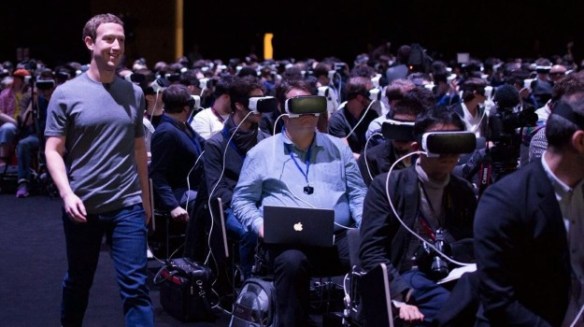
This compels them to make a spectacle of Russiagate, and to ensure that the show never ends, but takes on new forms of hysteria. And it requires that internet-based dissent be brought to heal, as Hillary would say — even at the cost of billions to one of the top oligarchs, Facebook’s Mark Zuckerberg, who has been mercilessly bludgeoned by his fellow corporatists. Facebook’s political tampering with its algorithms to marginalize left-wing sites like BAR cannot help but suggest that the company also puts its fingers on the scales of the algorithms whose results Facebook sells to advertisers. But Zuckerberg no doubt understands that the purge of “left and right” sites is in the best interest of his class, and has accepted to forgo some profits.

“The corporate leaders of the Democratic Party are positioned way to the right of Democratic voters, and also rightward of the general American pubic on most key economic issues.”

Facebook, Apple, Google, YouTube and Spotify all came down  on right-winger Alex Jones and his Infowars, this week, in what appeared to be a coordinated purge. Although the corporate media have long accused Jones of spreading “disinformation,” he was not purged for telling non-truths. Apple announced that “it does not tolerate hate speech.” Facebook said “false news” was not the issue, but that Jones had violated its policies by “glorifying violence” and “using dehumanizing language to describe people who are transgender, Muslims and immigrants.”

When it comes to “hate,” the high tech oligarchs rely heavily on the Southern Poverty Law Center (SPLC), the Morris Dees – Richard Cohen  legal outfit in Montgomery, Alabama. The Center has a special animus towards Black nationalists, to whom it dedicates a whole page  on its web site. “Most forms of black nationalism are strongly anti-white and anti-Semitic,” the SPLC declares, as if its white, Jewish leadership are expert in the Black American polity. In addition to naming Min. Louis Farrakhan and every Nation of Islam mosque, the site lists a slew of “Black Nationalist Hate Groups,” including book stores, the Black Riders Liberation Party and all its affiliates, various Black Israelites, both halves of the split New Black Panther Party, and the Revolutionary Black Panther Party, as well as the Nuwaubian Nation of Moors. We can assume that these groups’ internet sites and Facebook presence are marked for special attention and future purging.

The Southern Poverty Law Center has a special animus towards Black nationalists.”

But, many more Blacks will be caught up in the “hate speech” net that the high tech monopolists have deployed. Anyone that has gone to protests against killer cops has shouted words that could be deemed hate speech — because we do hate killer cops, and we do hate their armed occupation of our communities, and we have every right to say so among ourselves or to shout it to the world. Black people — and especially Black activists — must be most zealous in defense of free speech, knowing that our speech will be the first to be curtailed and outlawed.

We can expect no defense of Black speech rights from the Black misleadership class, which has always opted to cut off Black lips in order to silence a few white racists’ mouths. In the early Seventies, the Congressional Black Caucus and the Atlanta NAACP tried to get the Federal Communications Commission to ban campaign ads by J.B. Stoner, the arch-racist candidate for one of Georgia’s seats in the U.S. Senate. I argued loudly against attempting to create a “hate speech” standard for the public airwaves, warning that among the first victims of such a standard would be Min. Farrakhan, whose weekly radio program was aired on over 100 Black-oriented radio programs.

“Black people — and especially Black activists — must be most zealous in defense of free speech, knowing that our speech will be the first to be curtailed and outlawed.”

The FCC ruled in J.B. Stoner’s favor in 1972, but it was a good day for Black political speech, too. In the same way, the high tech monopolists’ assault on right-winger Alex Jones under a “hate speech” standard is bad news for Black political speech, and for radical speech. “Hate speech” is a trap. A few months ago, all but eleven members of the Congressional Black Caucus voted to make any assault on police a “hate crime,” thereby giving police the status of a protected class. The “hate speech” trick, in practice, rewards Black people’s occupiers and abusers (the police) and renders voices of protest illegitimate and mute.

We will need every energizing expletive in our vocabularies to mobilize our folks against the racist repression that must accompany the rulers’ plans for permanent austerity and war. We need to hate them very deeply for what they are trying to do to humanity, and to express that hatred at the top of our lungs and in every forum possible.


BAR executive editor Glen Ford can be contacted at Glen.Ford@BlackAgendaReport.com.

Alex Jones and the Rise of Corporate Censorship

By Brendan O’Neill

Source: Strategic Culture Foundation

So we’re now trusting the capitalist class, massive, unaccountable corporations, to decide on our behalf what we may listen to and talk about? This is the take-home message, the terrible take-home message, of the expulsion of Alex Jones’ Infowars network from Apple, Facebook and Spotify and of the wild whoops of delight that this summary banning generated among so-called liberals: that people are now okay with allowing global capitalism to govern the public sphere and to decree what is sayable and what is unsayable. Corporate censorship, liberals’ new favourite thing – how bizarre.

We live in strange times. On one hand it is fashionable to hate capitalism these days. No middle-class home is complete without a Naomi Klein tome; making memes of Marx is every twentysomething Corbynistas’ favourite pastime. But on the other hand we seem content to trust Silicon Valley, the new frontier in corporate power, to make moral judgements about what kind of content people should be able to see online. Radicals and liberals declared themselves ‘very glad’ that these business elites enforced censorship against Jones and Infowars. We should be ‘celebrating the move’, said Vox, because ‘it represents a crucial step forward in the fight against fake news’. Liberals for capitalist censorship! The world just got that bit odder, and less free.

Over the past 24 hours, Jones and much of his Infowars channel has been ‘summarily banned’ – in the excitable words of Vox – from Apple, Facebook, Spotify and YouTube. Initially, Facebook and YouTube had taken only selective measures against Jones. In response to a Twitterstorm about his presence on these platforms, they took down some of his videos. But then Apple decided to ban Jones entirely – removing all episodes of his podcast from its platform – and the other online giants followed suit. Or as the thrilled liberal commentary put it: ‘The dominoes started to fall.’ Despite having millions of subscribers, despite there being a public interest in what he has to say, Jones has been cast out of the world of social media, which is essentially the public square of the 21st century, on the basis that what he says is wicked.

This is censorship. There will of course be apologists for the corporate control of speech, on both the left and right, who will say, ‘It’s only censorship when the government does it!’. They are so wrong. When enormous companies that have arguably become the facilitators of public debate expel someone and his ideas because they find them morally repugnant, that is censorship. Powerful people have deprived an individual and his network of a key space in which they might propagate their beliefs. Aka censorship.

It doesn’t matter what you think of Jones. It doesn’t matter if you think he is mad, eccentric, and given to embracing crackpot theories about school shootings being faked. You should still be worried about what has happened to him because it confirms we have moved into a new era of outsourced censorship. It shows that what was once done by the state is now done by corporations. The illiberal, intolerant cleansing from public life of ideas judged to be offensive or dangerous has shifted from being the state’s thing to being the business elite’s thing. Witness how many campaigners for censorship now seek to marshal capitalist power to the end of erasing voices they don’t like – from the Dump Farage campaign that wants corporations to withdraw their advertising from LBC until it dumps Nigel Farage as a presenter to the calling on Silicon Valley to deprive the oxygen of publicity to offensive broadcasters.

In essence, so-called liberals and sections of the political class now want corporations to do their dirty work for them. They want the capitalist elites to do what it has become somewhat unfashionable for the state to do: ban controversial political speech. What an extraordinary folly this is. To empower global capitalism to act as judge, jury and executioner on what may be said on social-media platforms, in the new public square, is to sign the death warrant of freedom of speech. What if these bosses decide next that Marxist speech is unacceptable? Or that Zionist speech is dangerous? In green-lighting the censorship of Jones, we grant corporate suits the moral authority to censor pretty much anything else, too.

People on both the liberal left and the libertarian right argue that what has been done to Jones is acceptable because this is simply a case of businesses deciding freely who they should associate with or provide platforms to. This is disingenuous. This was not a clean, independent business decision – it was a rash act of silencing carried out under pressure from a moralised mob that insisted Jones’ words are too wicked for public life. This isn’t the free market in action – it’s the bending of capitalist power to the end of enforcing moral controls on speech. There is one very interesting thing that will spring from this incident: we will witness the severe limitations of right-wing libertarianism. Libertarians’ obsession with the state, their belief that things are only bad if the state does them, means they are incapable of arguing against capitalist authoritarianism, and in fact even support it on the basis that this is the free market being the free market (even though it isn’t). Libertarianism is devastatingly ill-prepared for the new authoritarianism, for tackling the rise of outsourced censorship and informal intolerance.

For good or ill, the social-media sphere is the new public sphere. The expulsion of people from these platforms is to 2018 what a state ban on the publication or sale of certain books was to 1618. How can we convince the owners of social media to permit the freest speech possible and to trust their users to negotiate the world of ideas for themselves? This is the question we should be asking ourselves, rather than concocting more ways to encourage these corporate overlords to censor and blacklist.

In A Corporatist System Of Government, Corporate Censorship Is State Censorship

By Caitlin Johnstone

Source: CaitlinJohnstone.com

Last year, representatives of Facebook, Twitter, and Google were instructed on the US Senate floor that it is their responsibility to “quell information rebellions” and adopt a “mission statement” expressing their commitment to “prevent the fomenting of discord.”

“Civil wars don’t start with gunshots, they start with words,” the representatives were told. “America’s war with itself has already begun. We all must act now on the social media battlefield to quell information rebellions that can quickly lead to violent confrontations and easily transform us into the Divided States of America.”

Yes, this really happened.

Today [8/7] Twitter has silenced three important anti-war voices on its platform: it has suspended Daniel McAdams, the executive director of the Ron Paul Institute, suspended Scott Horton of the Scott Horton Show, and completely removed the account of prominent Antiwar.com writer Peter Van Buren.

I’m about to talk about the censorship of Alex Jones and Infowars now, so let me get the “blah blah I don’t like Alex Jones” thing out of the way so that my social media notifications aren’t inundated with people saying “Caitlin didn’t say the ‘blah blah I don’t like Alex Jones’ thing!” I shouldn’t have to, because this isn’t actually about Alex Jones, but here it is:

I don’t like Alex Jones. He’s made millions saying the things disgruntled right-wingers want to hear instead of telling the truth; he throws in disinfo with his info, which is the same as lying all the time. He’s made countless false predictions and his sudden sycophantic support for a US president has helped lull the populist right into complacency when they should be holding Trump to his non-interventionist campaign pledges, making him even more worthless than he was prior to 2016.

But this isn’t about defending Alex Jones. He just happens to be the thinnest edge of the wedge.

As of this writing, Infowars has been censored from Facebook, Youtube (which is part of Google), Apple, Spotify, and now even Pinterest, all within hours of each other. This happens to have occurred at the same time Infowars was circulating a petition with tens of thousands of signatures calling on President Trump to pardon WikiLeaks editor-in-chief Julian Assange, who poses a much greater threat to establishment narratives than Alex Jones ever has. Assange’s mother also reports that this mass removal of Infowars’ audience occurred less than 48 hours after she was approached to do an interview by an Infowars producer.

In a corporatist system of government, wherein there is no meaningful separation between corporate power and state power, corporate censorship is state censorship. Because legalized bribery in the form of corporate lobbying and campaign donations has given wealthy Americans the ability to control the US government’s policy and behavior while ordinary Americans have no effective influence whatsoever, the US unquestionably has a corporatist system of government. Large, influential corporations are inseparable from the state, so their use of censorship is inseparable from state censorship.

This is especially true of the vast megacorporations of Silicon Valley, whose extensive ties to US intelligence agencies are well-documented. Once you’re assisting with the construction of the US military’s drone program, receiving grants from the CIA and NSA for mass surveillance, or having your site’s content regulated by NATO’s propaganda arm, you don’t get to pretend you’re a private, independent corporation that is separate from government power. It is possible in the current system to have a normal business worth a few million dollars, but if you want to get to billions of dollars in wealth control in a system where money translates directly to political power, you need to work with existing power structures like the CIA and the Pentagon, or else they’ll work with your competitors instead of you.

And yet every time I point to the dangers of a few Silicon Valley plutocrats controlling all new media political discourse with an iron fist, Democratic Party loyalists all turn into a bunch of hardline free market Ayn Rands. “It’s not censorship!” they exclaim. “It’s a private company and can do whatever it wants with its property!”

They do this because they know their mainstream, plutocrat-friendly “centrist” views will never be censored. Everyone else is on the chopping block, however. Leftist sites have already had their views slashed by a manipulation of Google’s algorithms, and it won’t be long before movements like BDS and Antifa and skeptics of the establishment Syria and Russia narratives can be made to face mass de-platforming on the same exact pretext as Infowars.

This is a setup. Hit the soft target so your oligarch-friendly censorship doesn’t look like what it is, then once you’ve manufactured consent, go on to shut down the rest of dissenting media bit by bit.

Don’t believe that’s the plan? Let’s ask sitting US Senator Chris Murphy:

“Infowars is the tip of a giant iceberg of hate and lies that uses sites like Facebook and YouTube to tear our nation apart,” Murphy tweeted in response to the news. “These companies must do more than take down one website. The survival of our democracy depends on it.”

That sure sounds an awful lot like the warnings issued to the Silicon Valley representatives on the Senate floor at the beginning of this article, no? This is headed somewhere dark.

We’re going to have to find a way to keep the oligarchs from having their cake and eating it too. Either (A) corporations are indeed private organizations separate from the government, in which case the people need to get money out of politics and government agencies out of Silicon Valley so they can start acting like it, and insist that their owners can’t be dragged out on to the Senate floor and instructed on what they can and can’t do with their business, or (B) these new media platforms get treated like the government agencies they function as, and the people get all the First Amendment protection that comes with it. Right now the social engineers are double-dipping in a way that will eventually give the alliance of corporate plutocrats and secretive government agencies the ability to fully control the public’s access to ideas and information.

If they accomplish that, it’s game over for humanity. Any hope of the public empowering itself over the will of a few sociopathic, ecocidal, omnicidal oligarchs will have been successfully quashed. We are playing for all the chips right now. We have to fight this. We have no choice.

Building a Cooperative Economy

By Oliver Sylvester-Bradley

Source: Resilience

In permaculture terms the economy sometimes feels like a segregated monoculture planted with terminator seeds, sprayed with patented pesticides on venture capital backed farms designed to maximise profits in an unsustainable market place full of thieves and cheats. No wonder people prefer to potter in their gardens and allotments – and try to forget the craziness of corporate capitalism!

But no matter how much we try to ignore the corporate machine it ploughs on regardless and at various points in all of our lives we are forced to interact with the unsustainable, greed-based economy whether we like it or not. We all need to travel, buy energy, we like presents and holidays and now we are buying more and more of these goods and services online, from people we do not know.

As local banks close in favour of apps, local taxis are driven out by Uber and the likes of Airbnb and other holiday and comparison websites offer us ‘guaranteed savings’ – the brave new world of digital platforms is being thrust upon us, whether we like it or not.

The dominant form of business in our economy has not changed, but the method of delivery has. Platform businesses which reach further and wider than conventional ‘bricks and mortar’ businesses, that are able to ‘scale up’ and attract customers in their millions are forcing out the smaller players, just like supermarkets killed the traditional garden market. Except these “platform monopolies” are taking things to a new level – often unbeknown to us they’re gathering our data and using sophisticated algorithms to work out how to sell us more things, that quite often we don’t need or want. They’re aggregating data and dissintermediating in ways that we never knew were possible. Uber is valued at over 60 billion dollars but does not own a single taxi…

From monoculture to platform co-ops

To someone practicing permaculture, there is something almost offensive about vast fields where businesses cultivate the same single crop and, in a similar way, the exponents of ‘peer to peer’ and ‘open source’ technologies get equally offended by monolithic platforms that dominate the digital landscape.

Peer to peer, (where individuals share content with other people, rather than relying on centralised servers) and open source software (which is free to use and adapt, without requiring a licence fee) are like the digital community’s own versions of permaculture. They provide a pathway to greater independence, autonomy, diversity and resilience than is offered by the dominant system.

David Holmgreen’s ideas about creating small scale, copyable, adaptable solutions which have the power to change the world by creating decentralised, diverse, and more resilient systems have huge parallels with open source, collaborative software projects, which are developing as a response to the monolithic, proprietary and profit driven enclosures that dominate today’s Internet.

The end goal of this work is to create ‘platform cooperatives’, as alternatives to the venture capital backed platforms. Platform cooperatives that are member owned and democratically controlled – allowing everyone that is affected by the business, be they customers, suppliers, workers or investors, a say in how the business is run and managed. Co-ops are an inherently different form of organisation than Limited or Public companies, which place community before profit, hence have entirely different principles than their corporate rivals. For this reason they are more resilient in downturns, more responsible to their communities and environments and more effective at delivering real (not just financial) value to everyone they interact with.

Platform co-ops provide a template for a new kind of economy built on trust, mutual aid and respect for nature and community. By placing ownership firmly in the hands of the people and applying democratic forms of governance they offer a legitimate alternative to the defacto form of business. There are several platform co-ops that already provide comparable, and often better services than their corporate rivals and with more support others will continue to develop.

On 26 and 27 July the OPEN 2018 conference at Conway Hall in London will showcase platform co-ops such as The Open Food Network – which is linking up local food producers and consumers through Europe, Resonate – the music streaming co-op, and SMart from Belgium which provides support for a network of thousands of freelancers throughout Europe. The beginnings of a viable, self-supporting and sustainable economy are stating to emerge and OPEN 2018, along with similar events in the US and across Europe, is bringing together the people with the ideas, the tech developers and the legal experts to help catalyse the transition.

Shared values and the network effect

There are so many similarities between permaculture’s philosophy and principles and the works of other progressive groups that hope to encourage a more sustainable, more resilient and equitable future. From Occupy to Open sourcePermaculture to Peer to Peer and Collaborative Technology to the Commons Transition groups there are clearly overlapping values.

David Bollier, writing on the Peer to Peer Foundation blog has suggested that “…permaculturists and commoners need to connect more and learn from each other…” and the idea that these communities are ultimately working towards the same objective seems especially important to recognise if we are to accelerate the development of a more sustainable world.

There is already an evolving “shared narrative” between these various, disparate initiatives, but it is often sidelined by our self-selecting filters which lead us back into the communities we know and trust. Collaboration and cooperation can be hard work and as groups get bigger they can become harder still but that’s no reason not to try. The fact that Wikipedia provides a better encyclopaedia for free in more languages than Britannica ever managed proves that online, open source collaboration can deliver greater value than proprietary, closed source systems.

The true value of a collaborative, open networks only really manifests when its members communicate, and work together, through connected systems. Sharing ideas, discussing problems and addressing challenges in larger networks creates positive feedback loops via the network effect – a term which describes how the value of something increases in proportion to the number of people using it (like a phone, or social media network) – something all the various ethical and progressive networks could benefit from enormously.

Parallels between collaborative, open source software development and permaculture principles:

1. Observe and interact

Progressive software projects often utilise ‘user focused’ design strategies to ensure they meet people’s needs. Taking time to understand how users interact with software systems via user experience testing groups and an ongoing, iterative design processes are recognised to deliver higher quality solutions which suit specific user needs.

2. Catch and store energy

Peer to peer networks don’t rely on centralised servers but instead make use of the latent capacity of other user’s machines. Imagine how much more efficient it would be than deploying huge server farms if our computers were not shut off at night, or left idle, when they could be providing valuable processing power for others. The Holochain project aims to make it simple and secure for anyone to join a truly peer to peer network and to share files and processing power in this way – and to even earn credits for hosting other people’s files and applications.

3. Obtain a yield

The Peer Production License provides a means by which open source developers can make the code they develop available for free and still benefit from it’s use. Sites like the Internet of Ownership, which contains a directory of cooperative platforms use the PPL to “permit reuse exclusively for non-commercial and worker-owned enterprises” thereby helping to grow the commons. The ultimate goal of the PPL is to enable mechanisms so commoners can support themselves and ensure their own social reproduction without resorting to capitalism.

4. Apply self-regulation and accept feedback

This principle is particularly integral to open source development since the concepts of ‘user focussed’ and ‘agile development’, ‘branching’ and ‘forking’ are all designed to ensure that software projects are self-regulating by listening to the users needs, driven by user feedback and that they are able to be adapted to changing needs.

5. Use and value renewable resources and services

Open source technology is inherently more renewable in the way it enables the reuse and repackaging of code for new purposes. Ethically minded hosts and developers such as Green Net power their servers with renewable energy.

6. Produce no waste

As above, open source code is often re-used and repurposed but progressive developers still have a lot to gain from better collaboration. There are often multiple teams working on identical problems and ideas and whilst this has benefits in terms of developing strength and resilience through diversity it also leads to waste, mainly in terms of time. At least the waste ‘product’ of web development is only digital and so old technology and code doesn’t littler the streets or pollute the environment as much as physical products can, especially if archives are stored on renewably powered servers.

7. Design from patterns to details

Genuine online collaboration has been slow to evolve, with the best examples being Linux (the open source operating system), Firefox, the open source web browser and Wikipedia, the open source encyclopaedia. It is only recently, with the rise of monolithic capitalist gardens such as Google and Facebook and Amazon that the hive mind of the internet is recognising the need to step back and redesign its systems according to new patterns. The push for “Net neutrality” and Tim Berners-Lee’s Solid project are examples of this in action as is the Holo project, a very exciting and truly peer to peer “community of passionate humans building a distributed cloud, owned and run by users like you and me.”

8. Integrate rather than segregate

The move from centralised to decentralised, to distributed and federated technology is a a key element of open source and collaborative technology design. The entire Peer to Peer philosophy is based on the recognition that the connections and relationships between nodes (people or computers) in a network is what gives it strength and value. Collaborative technologists still have a lot to gain from developing deeper and wider integrations, like we see in nature, and which permaculturists know so well.

9. Use small and slow solutions

Designing a computer system to be slow is not something you will normally (ever?) hear a programmer talk about but they often talk about small, in many guises. Small packages (of code), small apps, “minified” (meaning compressed) code and even small computers, like the Raspberry Pi are key features of collaborative technology which all aim for increased efficiency.

10. Use and value diversity

Diversity is intrinsic to open source and collaborative technology. The plurality and adaptability of open source solutions ensures a highly diverse ecosystem. Users are free to adapt open source code to their needs and the open nature of most open source projects values contributions from anyone, irrespective of race, gender, age or any other factor. It is true that the majority of contributors to open source projects are normally young, white and male but the reasons for that seem more to do with societal inequalities and stereotypes rather than any specific prejudices or practices.

11. Use edges and value the marginal

The explanation of this principle places most value on “the interface between things…” and this is a central component of web design. Web services have now realised the necessity of providing intuitive user interfaces, to allow users to navigate complex data and to investigate deeper informational relationships but, more interestingly the latest developments in linked open data enable users to interface with more specific, more granular and more timely data to provide increase value. The Internet Of Things will facilitate a massive increase in the number and type of products which can interact over the internet. Whilst it is not the norm, drawing diverse information from the edges and valuing the marginal is something the open internet can really facilitate.

12. Creatively use and response to change

Most open source, collaborative projects use some kind of agile development, which advocates adaptive planning, evolutionary development, early delivery, and continuous improvement, and encourages rapid and flexible response to change. Permaculture and open source see eye to eye on this principle which bodes very well for a growing, symbiotic relationship in our rapidly evolving world.

The Bizarre Facebook Path to Corporate Fascism

By Glen Ford

Source: Black Agenda Report

“The Facebook intervention is a qualitative escalation of the McCarthyite offensive.”

Facebook has assumed additional political police powers, disrupting a planned counter-demonstration against white supremacists, set for August 12th in Washington, on the grounds that it was initiated and inspired by “Russians” as part of a Kremlin campaign to “sow dissention” in the U.S. The Facebook intervention is a qualitative escalation of the McCarthyite offensive launched by the Democrat Party and elements of the national security state, and backed by most of the corporate media, initially to blame Hillary Clinton’s 2016 defeat on “collusion” between Wikileaks, “the Russians” and the Trump campaign to steal and publicize embarrassing Clinton campaign emails.

After failing to produce one shred of hard evidence to support their conspiracy theory, the anti-Russia hysteria mongers switched gears, focusing on the alleged purchase of about $100,000 in Facebook ads by the Internet Research Agency (IRA), a St. Petersburg-based Russian company, over a multi-year period. The problem was, most of the ads had no direct connection to the presidential contest, or were posted after the election was over, and many had no political content, at all. The messages were all over the place, politically, with the alleged Russian operatives posing as Christian activists, pro- and anti-immigration activists, and supporters of the Black Lives Matter Movement. Special prosecutor Robert Mueller was forced to flip the scriptindicting 13 Russians for promoting general “discord” and undermining “public confidence in democracy” in the United States – thus creating a political crime that has not previously been codified in the United States.

In doubling down on an unraveling conspiracy tale, the Mueller probe empowered itself to tar and feather all controversial speech that can be associated with utterances by “Russians,” even if the alleged “Russians” are, in fact, mimicking the normal speech of left- or right-wing Americans — a descent, not into Orwell’s world, but that of Kafka (Beyond the Law) and Heller (Catch-22).

Facebook this week announced that it had taken down 32 pages and accounts that had engaged in “coordinated and inauthentic behavior” in promoting the August 12 counter-demonstration against the same white supremacists that staged the fatal “Unite the Right” demonstrations in Charlottesville, Virginia, a year ago. Hundreds of anti-racists had indicated their intention to rally against “Unite the Right 2.0” under the banner of Shut It Down DC, which includes D.C. Antifascist Collective, Black Lives Matter D.C., Hoods4Justice, Resist This, and other local groups.

Facebook did not contend that these anti-racists’ behavior was “inauthentic,” but that the first ad for the event was purchased by a group calling itself “Resisters” that Facebook believes were behaving much like the Internet Research Agency. “At this point in our investigation, we do not have enough technical evidence to state definitively who is behind it,” said Nathaniel Gleicher, Facebook’s head of cybersecurity policy . “But we can say that these accounts engaged in some similar activity and have connected with known I.R.A accounts.”

Chelsea Manning, whose prison sentence for sending secret documents to Wikileaks was commuted by President Obama, said the counter-protest was “organic and authentic”and that activists had begun organizing several months ago. “Folks from D.C. and Charlottesville have been talking about this since at least February,” Manning told The New York Times.

“This was a legitimate Facebook event that was being organized by Washington, D.C. locals,” says Dylan Petrohilos, of Resist This. Petrohilos was one of the defendants in the Trump inauguration “riot” prosecutions. He protested Facebook’s disruption of legitimate free speech and assembly. “DC organizers had controlled the messaging on the no UTR fb page and now FB made it harder for grassroots people to organize,” he tweeted. The organizers insist the August 12 counter-demonstration — “No Unite the Right 2 – DC” — is still a go, as is the white supremacist rally.

Whoever was first to buy a Facebook ad — the suspected Russian “Resisters,” or Workers Against Racism, who told the Daily Beast they decided to host their own anti-“Unite the Right 2.0” event because they thought “Resisters” was an “inexperienced liberal organizer” – there was no doubt whatsoever that the white supremacists would be confronted by much larger numbers of counter-demonstrators, in Washington. Nobody in Russia needed to tell U.S. anti-racists to shut the white supremacists down, or vice versa. The Russians didn’t invent American white supremacy, or the native opposition to it. Even if Mueller, Facebook, the Democratic Party and the howling corporate media mob are to be believed, the “Russians” are simply mimicking U.S. political rhetoric and sloganeeriing – and weakly, at that. The Workers Against Racism thought the “Resisters” weren’t worth partnering with, but that the racist rally must be countered. The Shut It Down DC coalition didn’t need the “Resisters” to crystallize their thinking on white supremacism.

The Democratic Party and corporate media, speaking for most of the U.S. ruling class — and actually bullying one of its top oligarchs, Mark Zuckerberg — is on its own bizarre and twisted road to fascism. (Donald Trump’s proto-fascism is the old fashioned, all-American type that the white supremacists want to celebrate on August 12.) With former FBI Director Robert Mueller at the head of the pack, they have created a pseudo legal doctrine whereby “Russians” (or U.S. spooks pretending to be Russians) can be indicted for launching a #MeToo campaign of mimicry, echoing the rhetoric and memes indigenous to U.S. political struggles, while the genuine, “authentic” American political voices — the people who are being mimicked — are labeled co-conspirators in a foreign-based “plot,” and their rights to speech and assembly are trashed.

That’s truly crazy, but devilishly clever, too. If “Russian” mimics (or cloaked spooks) can reproduce the vocabulary and political program of U.S. dissent, then all of us actual U.S. lefties can be dismissed as “dupes of the Russians” or “co-conspirators” in the speech crimes of our mimics — for sounding like ourselves.


BAR executive editor Glen Ford can be contacted at Glen.Ford@BlackAgendaReport.com.

OUR NEW, HAPPY LIFE? THE IDEOLOGY OF DEVELOPMENT

By Charles Eisenstein

Source: Waking Times

In George Orwell’s 1984, there is a moment when the Party announces an “increase” in the chocolate ration – from thirty grams to twenty. No one except for the protagonist, Winston, seems to notice that the ration has gone down not up.

‘Comrades!’ cried an eager youthful voice. ‘Attention, comrades! We have glorious news for you. We have won the battle for production! Returns now completed of the output of all classes of consumption goods show that the standard of living has risen by no less than 20 percent over the past year. All over Oceania this morning there were irrepressible spontaneous demonstrations when workers marched out of factories and offices and paraded through the streets with banners voicing their gratitude to Big Brother for the new, happy life which his wise leadership has bestowed upon us.

The newscaster goes on to announce one statistic after another proving that everything is getting better. The phrase in vogue is “our new, happy life.” Of course, as with the chocolate ration, it is obvious that the statistics are phony.

Those words, “our new, happy life,” came to me as I read two recent articles, one by Nicholas Kristof in the New York Times and the other by Stephen Pinker in the Wall Street Journal, both of which asserted, with ample statistics, that the overall state of humanity is better now than at any time in history. Fewer people die in wars, car crashes, airplane crashes, even from gun violence. Poverty rates are lower than ever recorded, life expectancy is higher, and more people than ever are literate, have access to electricity and running water, and live in democracies.

Like in 1984, these articles affirm and celebrate the basic direction of society. We are headed in the right direction. With smug assurance, they tell us that thanks to reason, science, and enlightened Western political thinking, we are making strides toward a better world.

Like in 1984, there is something deceptive in these arguments that so baldly serve the established order.

Unlike in 1984, the deception is not a product of phony statistics.

Before I describe the deception and what lies on the other side of it, I want to assure the reader that this essay will not try to prove that things are getting worse and worse. In fact, I share the fundamental optimism of Kristof and Pinker that humanity is walking a positive evolutionary path. For this evolution to proceed, however, it is necessary that we acknowledge and integrate the horror, the suffering, and the loss that the triumphalist narrative of civilizational progress skips over.

What hides behind the numbers

In other words, we need to come to grips with precisely the things that Stephen Pinker’s statistics leave out. Generally speaking, metrics-based evaluations, while seemingly objective, bear the covert biases of those who decide what to measure, how to measure it, and what not to measure. They also devalue those things which we cannot measure or that are intrinsically unmeasurable. Let me offer a few examples.

Nicholas Kristof celebrates a decline in the number of people living on less than two dollars a day. What might that statistic hide? Well, every time an indigenous hunter-gatherer or traditional villager is forced off the land and goes to work on a plantation or sweatshop, his or her cash income increases from zero to several dollars a day. The numbers look good. GDP goes up. And the accompanying degradation is invisible.

For the last several decades, multitudes have fled the countryside for burgeoning cities in the global South. Most had lived largely outside the money economy. In a small village in India or Africa, most people procured food, built dwellings, made clothes, and created entertainment in a subsistence or gift economy, without much need for money. When development policies and the global economy push entire nations to generate foreign exchange to meet debt obligations, urbanization invariably results. In a slum in Lagos or Kolkata, two dollars a day is misery, where in the traditional village it might be affluence. Taking for granted the trend of development and urbanization, yes, it is a good thing when those slum dwellers rise from two dollars a day to, say, five. But the focus on that metric obscures deeper processes.

Kristof asserts that 2017 was the best year ever for human health. If we measure the prevalence of infectious diseases, he is certainly right. Life expectancy also continues to rise globally (though it is leveling off and in some countries, such as the United States, beginning to fall). Again though, these metrics obscure disturbing trends. A host of new diseases such as autoimmunity, allergies, Lyme, and autism, compounded with unprecedented levels of addiction, depression, and obesity, contribute to declining physical vitality throughout the developed world, and increasingly in developing countries too. Vast social resources – one-fifth of GDP in the US – go toward sick care; society as a whole is unwell.

Both authors also mention literacy. What might the statistics hide here? For one, the transition into literacy has meant, in many places, the destruction of oral traditions and even the extinction of entire non-written languages. Literacy is part of a broader social repatterning, a transition into modernity, that accompanies cultural and linguistic homogenization. Tens of millions of children go to school to learn reading, writing, and arithmetic; history, science, and Shakespeare, in places where, a generation before, they would have learned how to herd goats, grow barley, make bricks, weave cloth, conduct ceremonies, or bake bread. They would have learned the uses of a thousand plants and the songs of a hundred birds, the words of a thousand stories and the steps to a hundred dances. Acculturation to literate society is part of a much larger change. Reasonable people may differ on whether this change is good or bad, on whether we are better off relying on digital social networks than on place-based communities, better off recognizing more corporate logos than local plants and animals, better off manipulating symbols rather than handling soil. Only from a prejudiced mindset could we say, though, that this shift represents unequivocal progress.

My intention here is not to use written words to decry literacy, deliciously ironic though that would be. I am merely observing that our metrics for progress encode hidden biases and neglect what won’t fit comfortably into the worldview of those who devise them. Certainly, in a society that is already modernized, illiteracy is a terrible disadvantage, but outside that context, it is not clear that a literate society – or its extension, a digitized society – is a happy society.

The immeasurability of happiness

Biases or no, surely you can’t argue with the happiness metrics that are the lynchpin of Pinker’s argument that science, reason, and Western political ideals are working to create a better world. The more advanced the country, he says, the happier people are. Therefore the more the rest of the world develops along the path we blazed, the happier the world will be.

Unfortunately, happiness statistics encode as assumptions the very conclusions the developmentalist argument tries to prove. Generally speaking, happiness metrics comprise two approaches: objective measures of well-being, and subjective reports of happiness. Well-being metrics include such things as per-capita income, life expectancy, leisure time, educational level, access to health care, and many of the other accouterments of development.  In many cultures, for example, “leisure” was not a concept; leisure in contradistinction to work assumes that work itself is as it became in the Industrial Revolution: tedious, degrading, burdensome. A culture where work is not clearly separable from life is misjudged by this happiness metric; see Helena Norberg-Hodge’s marvelous film Ancient Futures for a depiction of such a culture, in which, as the film says, “work and leisure are one.”

Encoded in objective well-being metrics is a certain vision of development; specifically, the mode of development that dominates today. To say that developed countries are therefore happier is circular logic.

As for subjective reports of individual happiness, individual self-reporting necessarily references the surrounding culture. I rate my happiness in comparison to the normative level of happiness around me. A society of rampant anxiety and depression draws a very low baseline. A woman told me once, “I used to consider myself to be a reasonably happy person until I visited a village in Afghanistan near where I’d been deployed in the military. I wanted to see what it was like from a different perspective. This is a desperately poor village,” she said. “The huts didn’t even have floors, just dirt which frequently turned to mud. They barely even had enough food. But I have never seen happier people. They were so full of joy and generosity. These people, who had nothing, were happier than almost anyone I know.”

Whatever those Afghan villagers had to make them happy, I don’t think shows up in Stephen Pinker’s statistics purporting to prove that they should follow our path. The reader may have had similar experiences visiting Mexico, Brazil, Africa, or India, in whose backwaters one finds a level of joy rare amidst the suburban boxes of my country. This, despite centuries of imperialism, war, and colonialism. Imagine the happiness that would be possible in a just and peaceful world.

I’m sure my point here will be unpersuasive to anyone who has not had such an experience first-hand. You will think, perhaps, that maybe the locals were just putting on their best face for the visitor. Or maybe that I am seeing them through romanticizing “happy-natives” lenses. But I am not speaking here of superficial good cheer or the phony smile of a man making the best of things. People in older cultures, connected to community and place, held close in a lineage of ancestors, woven into a web of personal and cultural stories, radiate a kind of solidity and presence that I rarely find in any modern person. When I interact with one of them, I know that whatever the measurable gains of the Ascent of Humanity, we have lost something immeasurably precious. And I know that until we recognize it and turn toward its recovery, that no further progress in lifespan or GDP or educational attainment will bring us closer to any place worth going.

What other elements of deep well-being elude our measurements? Authenticity of communication? The intimacy and vitality of our relationships? Familiarity with local plants and animals? Aesthetic nourishment from the built environment? Participation in meaningful collective endeavors? Sense of community and social solidarity? What we have lost is hard to measure, even if we were to try. For the quantitative mind, the mind of money and data, it hardly exists. Yet the loss casts a shadow on the heart, a dim longing that no assurance of new, happy life can assuage.

While the fullness of this loss – and, by implication, the potential in its recovery – is beyond measure, there are nonetheless statistics, left out of Pinker’s analysis, that point to it. I am referring to the high levels of suicide, opioid addiction, meth addiction, pornography, gambling, anxiety, and depression that plague modern society and every modernizing society. These are not just random flies that have landed in the ointment of progress; they are symptoms of a profound crisis. When community disintegrates, when ties to nature and place are severed, when structures of meaning collapse, when the connections that make us whole wither, we grow hungry for addictive substitutes to numb the longing and fill the void.

The loss I speak of is inseparable from the very institutions – science, technology, industry, capitalism, and the political ideal of the rational individual – that Stephen Pinker says have delivered humanity from misery. We might be cautious, then, about attributing to these institutions certain incontestable improvements over Medieval times or the early Industrial Revolution. Could there be another explanation? Might they have come despite science, capitalism, rational individualism, etc., and not because of them?

The empathy hypothesis

One of the improvements Stephen Pinker emphasizes is a decline in violence. War casualties, homicide, and violent crime, in general, have fallen to a fraction of their levels a generation or two ago. The decline in violence is real, but should we attribute it, as Pinker does, to democracy, reason, rule of law, data-driven policing, and so forth? I don’t think so. Democracy is no insurance against war – in fact, the United States has perpetrated far more military actions than any other nation in the last half-century. And is the decline in violent crime simply because we are better able to punish and protect ourselves from each other, clamping down on our savage impulses with the technologies of deterrence?

I have another hypothesis. The decline in violence is not the result of perfecting the world of the separate, self-interested rational subject. To the contrary: it is the result of the breakdown of that story, and the rise of empathy in its stead.

In the mythology of the separate individual, the purpose of the state was to ensure a balance between individual freedom and the common good by putting limits on the pursuit of self-interest. In the emerging mythology of interconnection, ecology, and interbeing, we awaken to the understanding that the good of others, human and otherwise, is inseparable from our own well-being.

The defining question of empathy is, What is it like to be you? In contrast, the mindset of war is the othering, the dehumanization and demonization of people who become the enemy. That becomes more difficult the more accustomed we are to considering the experience of another human being. That is why war, torture, capital punishment, and violence have become less acceptable. It is not that they are “irrational.” To the contrary: establishment think tanks are quite adept at inventing highly rational justifications for all of these.

In a worldview in which competing self-interested actors is axiomatic, what is “rational” is to outcompete them, dominate them, and exploit them by any means necessary? It was not advances in science or reason that abolished the 14-hour workday, chattel slavery, or debtors’ prisons.

The worldview of ecology, interdependence, and interbeing offers different axioms on which to exercise our reason. Understanding that another person has an experience of being, and is subject to circumstances that condition their behavior, makes us less able to dehumanize them as a first step in harming them. Understanding that what happens to the world in some way happens to ourselves, reason no longer promotes war. Understanding that the health of soil, water, and ecosystems is inseparable from our own health, reason no longer urges their pillage.

In a perverse way, science & technology cheerleaders like Stephen Pinker are right: science has indeed ended the age of war. Not because we have grown so smart and so advanced over primitive impulses that we have transcended it. No, it is because science has brought us to such extremes of savagery that it has become impossible to maintain the myth of separation. The technological improvements in our capacity to murder and ruin make it increasingly clear that we cannot insulate ourselves from the harm we do to the other.

It was not primitive superstition that gave us the machine gun and the atomic bomb. Industry was not an evolutionary step beyond savagery; it applied savagery at an industrial scale. Rational administration of organizations did not elevate us beyond genocide; it enabled it to happen on an unprecedented scale and with unprecedented efficiency in the Holocaust. Science did not show us the irrationality of war; it brought us to the very extreme of irrationality, the Mutually Assured Destruction of the Cold War. In that insanity was the seed of a truly evolutive understanding – that what we do to the other, happens to ourselves as well. That is why, aside from a retrograde cadre of American politicians, no one seriously considers using nuclear weapons today.

The horror we feel at the prospect of, say, nuking Pyongyang or Tehran is not the dread of radioactive blowback or retributive terror. It arises, I claim, from our empathic identification with the victims. As the consciousness of interbeing grows, we can no longer easily wave off their suffering as the just deserts of their wickedness or the regrettable but necessary price of freedom. It as if, on some level, it would be happening to ourselves.

To be sure, there is no shortage of human rights abuses, death squads, torture, domestic violence, military violence, and violent crime still in the world today. To observe, in the midst of it, a rising tide of compassion is not a whitewash of the ugliness, but a call for fuller participation in a movement. On the personal level, it is a movement of kindness, compassion, empathy, taking ownership of one’s judgments and projections, and – not contradictorily – of bravely speaking uncomfortable truths, exposing what was hidden, bringing violence and injustice to light, telling the stories that need to be heard. Together, these two threads of compassion and truth might weave a politics in which we call out the iniquity without judging the perpetrator, but instead seek to understand and change the circumstances of the perpetration.

From empathy, we seek not to punish criminals but to understand the circumstances that breed crime. We seek not to fight terrorism but to understand and change the conditions that generate it. We seek not to wall out immigrants, but to understand why people are so desperate in the first place to leave their homes and lands, and how we might be contributing to their desperation.

Empathy suggests the opposite of the conclusion offered by Stephen Pinker. It says, rather than more efficient legal penalties and “data-driven policing,” we might study the approach of new Philadelphia District Attorney Larry Krasner, who has directed prosecutors to stop seeking maximum sentences, stop prosecuting cannabis possession, steer offenders toward diversionary programs rather than penal programs, cutting inordinately long probation periods, and other reforms. Undergirding these measures is compassion: What is it like to be a criminal? An addict? A prostitute? Maybe we still want to stop you from continuing to do that, but we no longer desire to punish you. We want to offer you a realistic opportunity to live another way.

Similarly, the future of agriculture is not in more aggressive breeding, more powerful pesticides, or the further conversion of living soil into an industrial input. It is in knowing soil as a being and serving its living integrity, knowing that its health is inseparable from our own. In this way, the principle of empathy (What is it like to be you?) extends beyond criminal justice, foreign policy, and personal relationships. Agriculture, medicine, education, technology – no field is outside its bounds. Translating that principle into civilization’s institutions (rather than extending the reach of reason, control, and domination) is what will bring real progress to humanity.

This vision of progress is not contrary to technological development; neither will science, reason, or technology automatically bring it about. All human capacities can be put into service to a future embodying the understanding that the world’s wellbeing, human and otherwise, feeds our own.

Invisible Architecture III: The Psychogeography of Hyperspace

By Rococo Modem Basilisk

Source: Modern Mythology

Ordinarily, when we discuss psychogeography, we operate at the scale of a city: we discuss how people are drawn through a walkable space, at a speed in which they can be affected by each piece of passing scenery and make a detour to examine it. But, at the same time the Lettrists were wandering Paris and laying the groundwork for Disneyland in the micro-scale, at the macro-scale holes were being punched through the fabric of the United States in the form of highways.

Habitual migration patterns break the close association between culture and geography. There’s a psychogeographic wormhole between Fairfield County, CT and south Florida, and used to be one between there and upstate NY. If you live in Fairfield County (or certain parts of NYC) you’re liable to be culturally closer to some parts of south Florida than to many points in-between, not because of natural rock formations or bodies of water, but because highways have made it possible to pass through the middle without interacting with it.

Areas of transience — the hyperspace of psychogeography — are not ‘non-places’ with ‘non-culture’. They have a uniquely warped kind of culture, in the same way tourist-dependent places do. Some people spend large amounts of their lives there: long-haul truckers, jet-setting businessmen, touring bands or comedians or authors. The attempt at producing a consistent experience across geography produces an experience that can only exist in hyperspace.

Our own psychogeographic hyperspace is not as psychedelic as the one in Cordwainer Smith’s A Game of Rat and Dragon, but it is stranger, in a Ligottian way.

Why do they have ice machines? Why do they have pools? Why are airplanes and airports trapped in a perpetual 1963 idea of what luxury looks like? Path dependence has made the culture of our hyperspace deeply strange: there are low upper limits on quality of manufacture and high lower limits on quality of service, and the assumed transitory state of most inhabitants means bonds cannot be formed.

When new ideas are integrated here at all, they slot into existing structures — structures that don’t exist outside, in the world that is normal for most of us. Wifi passwords come with the keycard; a robot kiosk in front of the check-in desk prints tickets, as the clerk who formerly printed tickets watches.

These liminal spaces are only forgettable for people who have destinations. They’re also populated by residents, or commuters from geographically — nearby places, who fill the service jobs. What’s it like to have a diner with no regulars? This situation is capitalism-optimized. If you are a resident of psychogeographic hyperspace — nomadic or not — you are dog-fooding the experience that Rand thought was natural to man: separation of orbits, mediated by impersonal monetary transactions. It looks like endless beige hotels with broken ice machines.

What are the attributes of this Randian New Man who lives as hyperspace nomad? Sleep deprivation, boredom, and a dependence on stimulants. Gas stations in hyperspace cater to truckers, abnormally large DVD and pornography selections and every variety of pick-me-up not yet banned. Airports, whose nomads are of a higher caste and have less private space or scheduling freedom, focus more on overpriced convenience food, mediocre reading material, and headphones, and pillows. A Cinnabon could not survive outside of hyperspace, even if it grew up in the shallows of the shopping mall, but in this ecosystem, sheltered from competitors and provided with a steady stream of easy prey, it thrives.

The culture of hyperspace is not a psychogeography, except in a fairly minor sense: everywhere is the same, or tries to be. The few deviations, like Denver International Airport, are notable because deviation is so rare. There is an international internet radio station specifically for airports, and I have heard it play the same playlist in three states. (It never played Brian Eno.) However, like the hyperspace of fiction, it is a strange world that fills the gaps as we jump from one point to another without travelling in-between.

Transit systems are not the only holes in psychogeography. Communications systems also create them. Just as the prevalence of snowbirds and Adirondack cottages make it possible for small segments of northern New York and southern Florida to influence Manhattan finance and vice versa, arbitrary decisions or early-mover advantages gave Los Angeles cultural power over film, Cleveland cultural power over radio, and Atlanta cultural power over podcasting.

Communications technologies have their own hyperspace-cultures, although the geographic centralization of the big players has a larger impact on how they manifest than in the case of hotels. Twitter is the internet equivalent of a trucker-optimized gas station, and caters to journalists — the long-haul truckers of the information landscape. Facebook is the internet equivalent of a Holiday Inn: a premium-mediocre imitation of homeyness that is endearing in its complete failure to be convincing but ultimately irritating if you try to stay too long. (Facebook’s ice machine is always broken, and always loud.) The film industry is a bit like any airport: perpetually stuck in a cheap imitation of an imagined luxurious past, adapting poorly to the cosmopolitanism produced by globalization while profiting through its monopoly on the means of that globalization.

The culture of any hyperspace, because the means of association are limited to the Randian, will be corporate in its manifestation: customer service, marketing, selection, returns, free coupons as a means of apology. It differs from non-hyperspace because these are the only forms of communication truly available. This diner has no regulars with whom the waitress can be frank, only strangers perpetually passing through. It can get away with being shallow and having nothing under its surface, because only very rarely will someone stay long enough to peel it back.

Monuments to the Ego

By

Source: CounterPunch

Some rich bourgeoisie newcomers have perpetrated yet the latest in a series of atrocities upon the small valley where we live, entailing an assault on the sensibilities of virtually everyone and everything living there. Adding insult to injury, this has all been done with apparent utter disregard for us, our neighbors, our dirt road, the wildlife, the native vegetation, and everything sacred and beautiful.

The newcomers scalped the hillside they’ve occupied, smoothed out the offending topographic wrinkles, tore up all the untidy native shrubs, hacked a bench in the slope, erected a large garish pole barn, chiseled out an impractically steep access road, covered every flat or otherwise traversed surface with thick coats of coarse and fine gravel, revegetated the raw soil with non-native plants, propagated massive amounts of weeds, and displaced the deer and elk…meanwhile afflicting all of the neighbors below their lofty perch with the endless noise of heavy equipment suited for construction of interstate highways and a ceaseless caravan of over-sized dump trucks kicking up billowing clouds of dust while assaulting us with their jake brakes. And, no doubt, these naïve newcomers will panic when they realize that mountain lions and bears prowl the ridge where they live, with resulting fatal consequences for any large carnivore ranging nearby.

Perhaps not surprisingly, one of the favorite pastimes among us and other long-term residents is grousing about the rich newcomers, especially the ugly monstrosities they’ve built in highly-visible places. Our nearest neighbor, a salt-of-the earth kind of guy, has a talent for naming the $1 million-plus edifices, including The Ugly House, The Chicken Coop, The Atrocity, and, most recently, The Abortion Clinic.  But the most compelling comment was delivered by yet another long-time neighbor, who billed all of these overbuilt ugly piles with-a-view as simply “monuments to the ego.”

Ego and Egotism…

Ego is an interesting concept upon which to hang the rapine pillaging in our little valley…as well as throughout the human-occupied world. Freud and Buddha would have us believe that all humans have an ‘ego’ (Anatta to the Buddhists), whether as a literal reality or simply as a useful partitioning of the psyche. By these conceptions, ego entails a way of orienting to the world that engenders survival and practical action by the ‘self’.

But, importantly, Freud allows for a curbing effect of the super-ego that embodies ethical concerns and cultural constraints, usually in service of some greater collective good. Likewise, Buddhists distinguish between the Small Self, entailing ego-based motivations, and the Greater Self that, like the super-ego, embodies evolution towards a maturity manifesting compassion and cognizance of connection with other beings. In both instances, ego unchecked by the super-ego or by evolution towards a Greater Self manifests as greed, selfishness, arrogance, fear, and hedonism, with resulting indifference, dishonesty, ruthlessness, and even cruelty exhibited towards others—especially others who are alien or otherwise different.

And Our Moral Universe

Another way of framing all of this is through the lens of moral universes. A person driven wholly by crass motivations originating in the brainstem and ego has a moral universe collapsed into the cesspit of Small Self. This is to say, essentially no moral universe. Expanding outward from this problematic condition are those who deploy notions of fairness, obligation, concern, and benevolence only to family members—as in the Mafia. Next beyond are those with a moral orientation that additionally encompasses those who are of identical or similar identity—national, tribal, ethnic, racial, gender, or the like. And, at the doorstep of enlightenment and transcendence, are those who extend moral concerns and deportment towards all humans—even towards non-human sentient beings.

Scholars such as Peter Singer and Shalom Schwartz have expounded on the importance of an every-expanding moral universe to the welfare and dignity of all humans, even of non-humans with varying degrees of manifest sentience. A world comprised solely of ego-driven humans operating with little restraint or related regard for the effects of their actions on others would be a truly horrific, eventually uninhabitable, place. As Steven Pinker has argued, our small Earth has become a more hospitable and charitable place largely because ever more people are regarding ever more beings of ever greater difference with ever more benevolence, despite what one might think reading vitriolic trash published in outlets such as Breitbart.

The Larger Psycho-Sociological Context

In the end, though, unchecked egotism and all the ills that flow from it flourishes only to the extent that such a condition is sanctioned, even encouraged, by culture, society, and institutions. People obviously shape all of these derivations of basic human behaviors, but human behaviors are in turn powerfully shaped by the higher-order social-psychological phenomena within which they are embedded, creating the potential for powerfully wicked—or powerfully benevolent—synergies.

Of relevance here, culture, society, and institutions ineluctably invoke the nature of our somewhat benighted nation and the more overtly benighted nature of the individualistic capitalist enterprise we have so enthusiastically embraced and codified.

Contradictions of Capitalism

Neoconservatives and their lapdog economists would have us believe that unchecked unfettered capitalism under-girds the best of all possible worlds. Moreover, freely but selectively quoting the likes of John Locke and Adam Smith, they would further have us believe that unbridled greed and unqualified self-interest, channeled by the invisible hand of free markets, is the surest means of furthering the well-being of all humans. Indeed, the Princes of Capitalism who run amuck on Wall Street proudly and unabashedly profess their greed and fundamental disregard for others, assuming that we who hear such professions somehow know it ends well for the rest of us due to the transformative magic of markets.

Never mind peoples’ unequal access to markets. Never mind inequalities in power and privilege. Never mind unequal access to information. Never mind the fundamentally irrational behavior of humans. Never mind the distorting effects of artificial demand created by manipulative advertising. Never mind the chronic gross distortion of markets by hidden (or not so hidden) subsidies created by power elites beholden to wealth elites. Never mind…ad nauseam. We have no free markets.

Despotism…

In the end, people who are wealthy or powerful become ever more wealthy and powerful at the expense of everyone else. Despotism reigns in the sense that an ever smaller minority of people amass an ever greater portion of values, while everyone else becomes comparatively more impoverished. It is no coincidence that we have seen a trend, not only in the United States, but in most developed or developing countries, towards the amassing of more and more wealth in the hands of a mere 1%—even 0.1%—of the populace.

As the radical thinker and economist Charles Eisenstein pithily observed, the modern business enterprise operates on the basis of shifting costs onto others as a normal part of making profits; in other words, by privatizing profits while socializing costs. Put another way, profits—the fundamental underpinning of the capitalist enterprise—are axiomatically created by passing as many costs as possible onto the affected human community, the natural environment, and future generations, often in ways that are fundamentally destructive. The French economist Thomas Piketty offered a complementary argument in his book Capital in the Twenty-First Century, holding that ‘trickle down’ from wealth elites to the comparatively impoverished masses is, in reality, inconsequential and little more than cover for this despotic capitalist enterprise.

And the Problem of Externalities

But concern about the imperfections and problematics of capitalism are not limited to radical or revisionary economists. Indeed, the likes of John Locke and Adam Smith were acutely aware that, despite the hidden hand of markets, the monetary capitalist systems they championed would generate social costs and income inequalities that required rectification by governments.

Some of these social costs have been termed ‘externalities’ by succeeding generations of economists—an externality being a cost or benefit generated by a private economic transaction or activity, but incurred by those who did not chose to partake of the outcome. Classic examples of such externalities include air and water pollution, spillover effects of development on surrounding property values, and the loss of finite biota caused by profit-making enterprises.

Our society has, reasonably enough, responded to these sorts of externalities with laws that zone development, control pollution, and protect endangered species. Whether overtly or tacitly, most people realize that we do, in fact, live in community where considerations of the commonwealth occasionally weigh heavily in the scale of considerations. Indeed, every credible economic or political philosopher or theorist since Locke and Smith and afterwards, Marx, has viewed capitalism and property, not as ends in themselves, but rather as candidate means (dubious means, in the case of Marx) of uplifting humanity and enhancing the well-being and dignity of all—of promoting a flourishing commonwealth; something that many contemporary politicians, economists, and bourgeois capitalists seem to miss.

As it is, the pervasive systemic problem of privatized profits and socialized costs remains, especially in a society such as ours that is wedded to the justifying myth of capitalism and, in the minds of some, the virtues of unchecked greed and individualism—and where those who profit so much from displacing the costs of their activities onto society hold such sway over politicians. This insidious system continues to spawn the sorts of people who show up in our little valley with ill-gotten (by definition) wealth to manifest their ego in various physical obscenities.

Property…

The notion of ‘property’ is yet another pillar of Smith’s capitalism that factors into on-going devastation of the natural world by societies that have succumbed to the capitalist premise. More to the point, private property rights plays a central role in not only the unfolding ecological holocaust, but also in simultaneously catalyzing and justifying damage to human communities.

On the face of it, ‘property’ seems a benign or even beneficial concept. The term is generally understood in reference to anything owned or possessed by someone. Adam Smith even advanced the notion that one’s own labor and physical body are property held, by right of ‘natural law’, exclusively by the salient embodied person. Yet the notion of property has, in fact, been extended to possession of one human by another, most egregiously in the form of overt slavery, but historically (and, in places, still) even in application to dependent children and adult women.

And Its Problems

These latter extensions to other humans highlight an intrinsic, even potentially fatal, problem with the notion of ‘property’. Relegation of anything to the category of property constitutes the ultimate instrumentalization and related erasure of intrinsic worth. Through this, property has no rights, no prerogatives, and no claim to considerations of well-being and health.

Relegation of inanimate physical objects to the category of property is perhaps not problematic, but any application to another life form, especially one with plausible sentience immediately raises moral questions. Does a dog deserve consideration of its health and well-being, despite being property? Some people would say ‘no’, but our society has answered a resounding ‘yes’ through the passage, for example, of animal welfare laws and even serious consideration of whether chimpanzees deserve rights. But, then, do elk and bears and lions deserve consideration of their welfare? Do ecosystems have ‘health’ and, if so, do even these abstract entities warrant moral concern, especially when it comes to fostering and preserving ‘health’?

I hold that the manner in which a person orients to such issues offers a profound commentary on their ego maturity and moral universe—Small versus Greater. And, in fact, orientations towards living property end up being entangled with precepts of capitalism and consideration of ‘the other’ in choices people make regarding their use of property, specifically whether they care at all about the negative impacts their choices may have on others, whether human, animal, vegetal, or even spiritual. People with small souls and a small moral universe will probably not give a damn, and even actively resist any societal requirements that they be held accountable for the harm they cause, often by deploying the justifying rhetoric of libertarianism and the primacy of individual freedom.

Inanities of Property Rights

All of this comes to a head in considerations of private property rights, although it is worth first noting that property can be held privately, publicly, or communally, and also simply by societal consent without rising to the level of a ‘right’. But there are some ideologues and yahoos (not mutually exclusive) who hold that the only credible sort of property is private, and that all private property is axiomatically held by the owner as a ‘right’.

Such simple-minded constructions hardly pass the laugh test. On the face of it, public property has more intrinsic merit than private property simply because it is held in trust to explicitly serve the greater good of society. The same could be said for communal property, but with ‘the greater good’ reckoned at the scale of a given community.

Insofar as being a ‘right’ is concerned, Debbie Becher cogently observed in a 2015 article that “…social theorists have long understood that property is not the ownership of a thing or a set of individual rights, but a set of social agreements about what ownership entails…Property rules involve government intimately not only in creating value but also in determining who deserves which valuable resources.”

Notice ‘social agreements’, the role of ‘government’, and the invocation of ‘deserve’. None of this bespeaks a ‘right’ in the conventional sense that we think of such things, especially in application to human health and happiness (see my article on Human Dignity and Micheline Ishay’s book The History of Human Rights), although our society paradoxically—even perversely—holds that rights attach to our property but not to our health. In fact, property is held solely by the consent of society and ultimately (whether acknowledged or not) in service of promoting the commonwealth of human well-being and dignity.

Rich and Not-So-Rich Yahoos

Yet our country is filled with people who think that they not only have an absolute right to their property, but that this supposed ‘right’ gives them the prerogative to mete out use, abuse, destruction, and harm without restraint or consideration of impacts on other humans—much less impacts on other sentient beings, and certainly not impacts on the health and wholeness of the ecosystems they exploit.

Such seems to be the case with our new neighbors wreaking havoc upstream in yet the latest exhibition of stunted moral development by newly-arrived rich folk. Although these people are by no means the only ones.

Metamorphosis?

We all suffer sooner or later living in a world of unchecked greed, selfishness, and self-centeredness—understood by some to be the equivalent of ‘individualism’. This is especially true in a country such as ours where simple-minded conceptions of capitalism and private property encourage, if not sanctify, abusive relations with the land, other people, and other life forms. Under such auspices, people are prone to the fallacy of conflating ‘freedom’ with possession, which can never lead to contentment.

No doubt, most of us want the greatest scope of free choice possible, as well as assurance that the physical goods we depend upon and hold dear will be secure from depredation. Yet, more assuredly, I would hold that most of us—albeit inchoately—want to be part of a commonwealth of human dignity. Inescapably, such a commonwealth requires that we curb our actions out of respect for others and with due consideration of harm we may cause. Sadly, our society seems to be exhibiting less rather than more of such dignified self-restraint.

There are perhaps only a few ways that the current death spiral of our living Earth can be checked. The spiritually dead look to technological fixes. A highly virulent and contagious disease specific to humans might save the rest of life on this planet, but only through erasure of our species. More hopefully, we humans might evolve towards greater benevolence, generosity, and concern, not only for other humans, but for all of life.

But such evolution depends on the rapid expansion of our collective moral universe beyond the frontiers of humankind. To do so, though, requires that we transcend our delusional fixation with patently destructive ideologies, of which capitalism and private property rights are currently one of the most potent. Closer to home for me, I hope to live long enough to see the end of people scraping, gouging, chiseling, hacking, tearing, and uprooting the naked living Earth simply to build yet another monument to their ego.