Surveillance Capitalism

By John Bucher

Source: Adbusters

The alarm beside your bed rings, triggered by an event in your calendar. The smart thermostat in your bedroom senses your motion and turns on the hot water, reporting your movements to a central database at the same time.

News and social updates ping your phone, with your decision whether to click them carefully monitored (and parameters adjusted accordingly). How far and where your morning run takes you, the conditions of your commute, the contents of your text messages, the words your smart speaker overhears, the actions you make under all-seeing cameras, your impulse purchases, your online searches (and selections) of dates and mates – all recorded, rendered as data, uploaded to the cloud, processed, and analyzed. This happens so often and so extensively that we become numb, forgetting that this is not some dystopian imagining of the future. It’s the present.

Welcome to surveillance capitalism.

Google and Facebook might not call to mind the belching smoke stacks and child labourers of the Industrial Revolution, but their leaders have revealed themselves to be as ruthless and profit-seeking as any Gilded Age tycoon. Instead of mining the natural landscape, however, surveillance capitalists extract their raw material from human experience.

“Google is a shape-shifter, but each shape manifests the same aim: to hunt and capture raw material.

Baby, wonʼt you ride my car? Talk to my phone? Wear my shirt? Use my app?”

Fortunately for them, the surveillance matrix of present-day capitalism provides plenty of inputs to work with. It should; they built it. We are the source of what technologists call “data exhaust” — the informational by-products of our every connected movement and decision. As it happens, very little of the data is interesting or important on its own. So why are surveillance capitalists vacuuming it up from every corner of our lives? Because at scale, it furnishes a startlingly accurate picture of human behaviour. Behaviour modification is a numbers game, and the prediction algorithms are hungry for ever more of your data.

You know the old saw that if the service is free, the product is you? Turns out it isn’t true.

To the Googles and Facebooks of the world, people are neither customer nor product. We are more like the elephant, that most majestic mammal—or, at least, part of one. What surveillance capitalists are really interested in is our behaviour, our preferences—our ivory. And when, like poachers, they get it, are they inclined to worry about what happens to the rest of the elephant?

No, to the Googles and Facebooks of the world, we aren’t even the product. We are the abandoned carcass.

Social Media and the Society of the Spectacle

By Kenn Orphan

Source: CounterPunch

“The reigning economic system is a vicious circle of isolation. Its technologies are based on isolation, and they contribute to that same isolation. From automobiles to television, the goods that the spectacular system chooses to produce also serve it as weapons for constantly reinforcing the conditions that engender “lonely crowds.”

― Guy Debord, The Society of the Spectacle

“The conscious and intelligent manipulation of the organized habits and opinions of the masses is an important element in democratic society. Those who manipulate this unseen mechanism of society constitute an invisible government which is the true ruling power of our country. We are governed, our minds are molded, our tastes formed, our ideas suggested, largely by men we have never heard of. This is a logical result of the way in which our democratic society is organized. Vast numbers of human beings must cooperate in this manner if they are to live together as a smoothly functioning society.”

― Edward Bernays, Propaganda

“We think we’re searching Google; Google is actually searching us. We think that these companies have privacy policies; those policies are actually surveillance policies. We’re told that if we have nothing to hide, then we have nothing to fear. The fact is, what they don’t tell us and what we are forgetting, that if you have nothing to hide, then you are nothing, because everything about us that makes us our unique identities, that gives us our individual spirit, our personality, our sense of freedom of will, freedom of action, our sense of our right to our own futures, that’s what comes from within. Those are our inner resources. That’s our private realm. And it’s intended to be private for a reason, because that is how it grows and flourishes and turns us into people who assert moral autonomy—an essential element of a flourishing, democratic society.”

― Shoshana Zuboff, author of Master or Slave: The Fight for the Soul of Our Information Civilization 

“Under observation, we act less free, which means we effectively are less free.”

― Edward Snowden

Recently I was rereading some of Guy Debord’s The Society of the Spectacle. I was reminded of how essential this work by the late French Marxist philosopher is to today’s age of social media. Debord’s understanding of how the forces of capital shape our collective experiences and thoughts speaks to our time where algorithms dominate the trajectory of the psyche against a craven backdrop of what political philosopher Sheldon Wolin has described as “inverted totalitarianism.”

Every day we are bombarded with the imagery of empire and capital. It is relentless. Our minds have become both a marketplace and a commodity to be traded. And it is a lucrative industry with Facebook and Google as prime examples. Their data collection and surveillance typify a conjoining of the state and capitalist economy; and they have carved out insidious new spaces in the human brain to coerce self-imposed censorship and conformity to the prevailing consumerist global order.

This social conditioning is a process which requires mass compliance. The infamous propagandist for industry and vaunted “father of public relations” Edward Bernays understood that. It takes time to manipulate the multilayered strata of the human psyche, especially in regard to large populations of people. But history is replete with tragic examples of its successful implementation by powerful interests. Today those interests lie squarely with capital and empire; but the effects are the same, distraction, censorship, alienation, coerced, compliance with the norms of the status quo and the numbing of the critical mind.

Debord said, “Such a perfect democracy constructs its own inconceivable foe, terrorism. Its wish is to be judged by its enemies rather than by its results. The story of terrorism is written by the state and it is therefore highly instructive. The spectating populations must certainly never know everything about terrorism, but they must always know enough to convince them that, compared with terrorism, everything else seems rather acceptable, or in any case more rational and democratic.” This profound observation is even more important today. The state, via mass media, informs us of the villains and phantoms they believe we should fear. Other, far more destructive, deadly and oppressive threats such as the continued proliferation of nuclear arms, catastrophic climate change, collapse of ecosystems, dangers to public health from industrial pollutants, vastly unequal, racist and brutal economic and legal systems, militarism or plutocratic tyranny can then be relegated as non-issues, or at least lesser ones.

Most people on the planet will not suffer or die from a terrorist attack, but they are very likely to be severely affected by the other issues mentioned above. Imagery on portable screens that virtually everyone in the West and around the world has access to communicates messages that may speak to some of these dire or existential problems, but they do so in an abstract manner that divorces the observer from the subject.

As Debord observed, this kind of culture of spectacle informs our personal relationships as well. Whether one is “present” on social media or not has become a sort of litmus test of ones presence in life itself. “Likes” or emojis have replaced and truncated language to such an extent that now older forms of communication are often looked at with novelty, suspicion, or even disgust. What’s more is that emojis in social media, particularly Facebook, have been employed all too often as tools of ridicule or even harassment of weak or vulnerable people. But what is perhaps the most striking about the current social media age is its repetitive narrative of self-aggrandizement. One so repetitive and hypnotic that it almost appears invisible. The “selfie” and “status update” are examples of the unending drive of social media to create a false sense of self to present to the world. Of course this self must conform and be well adjusted to consumerist society in one form or another lest it be tagged for “mental health issues,” subversive thought or behavior, or simply be rendered unnoticed or unimportant by society in general.

Indeed, I am certain Debord would be horrified at the age of social media. At no other time in human history has there been a greater confluence of authoritarian dominance or social control implemented in such an intimate and ubiquitous manner. Unlike Debord’s time, social media provides a new medium to not only socially condition the masses but for the corporate state to gather what was once private information about those masses via their personally owned devices and apps.

That it masquerades as a form of democracy is equally disturbing, especially since at its core it represents the policing of thought and dampening of dissent. He wrote as if penning a prophecy: “The spectator’s consciousness, imprisoned in a flattened universe, bound by the screen of the spectacle behind which his life has been deported, knows only the fictional speakers who unilaterally surround him with their commodities and the politics of their commodities. The spectacle, in its entirety, is his “mirror image.””

This spectacle reigns supreme in today’s social media culture. It is essential to its formulation and operating guidelines. Under such a paradigm history must be sterilized of analysis and ultimately atomized into unrelated instances to make an eternal present, divorced from any transformative potential. Therefore corporations and industries which have long records of polluting the environment or lying to the public about the safety of their products can continue to expand and even be celebrated by the corporate owned media. Religious institutions with long histories of abuse, patriarchy and repression can maintain their status as trusted institutions. The military can repeat the lie over and over that it is noble despite a history drenched in the blood of well documented atrocities and ongoing crimes. The United States and many other nations can keep calling themselves democracies despite quite obvious facts that strongly refute that designation. The mere notion of revolution then is made to be farcical or even dangerous. After all, how could revolution ever be seen as necessary within a democracy?

Social media does not necessarily signal the death of democratic freedom, but in its current form and under the aegis of capital it is certainly a nail in its coffin. This is because under such circumstances it is incapable of being anything other than a means for capital accumulation for the corporate state and a platform for its narrative, and it will do this through ever more invasive, censorial and repressive means. As Edward Snowden pointed out, people are less free when they feel that they are being observed. This is especially so when the observer is the state. Several studies have indicated that there is a sharp decline in certain online searches among the general public following any indication that government agencies are logging those searches, even if those citizens have not committed any crime. And the chilling effect is not unfounded. One incident involved an innocent couple who were visited by counter-terrorism police after searching Google for pressure cookers and backpacks. Since the internet has become the world’s public library, the implications for democracy are as dire as they are clear.

Unplugging from any of this isn’t easy, nor is it necessarily virtuous, but there are ways to divest from its social control personally and collectively. There are also ways to use it which defy its dominant algorithms. Détournement, which merely means rerouting or hijacking in French, is one of those ways. This involves inverting the imagery or messages of capital and empire to illustrate and even amplify their mendacity. It has a long history of effective use in bending the dominant narrative to one which reflects reality.

All of this is not to say that technology or social media are inherently bad, but to recognize that much of it has become a vehicle for a rather pernicious authoritarianism. And its danger lies in the fallacy of its benign appearance. Whether it be Google maps or one of countless other “helpful” apps one uses on a daily basis, surveillance capital becomes a means of controlling behavior, transactions, choices, as well as determining which members of society present a threat to the order. In other words, conformity is strongly reinforced while any form of dissent is rendered dangerously subversive. But although the algorithmic maps to our collective psyche are being endlessly drawn by programmers and their corporate and state masters, we still have the agency to navigate these landscapes with our eyes open. And indeed, the best tool we possess will always be that critically informed dissent the powerful so fear the most.

Stick to the Plan

Illustration by Mike Faille

Reclaiming central planning from the clutches of corporations

By Brendan James

Source: The Baffler

What do you think the Russians talk about in their councils of state—Karl Marx? They get out their linear programming charts, statistical decision theories, minimax solutions, and compute the price-cost probabilities of their transactions and investments, just like we do.

–CCA Chairman Arthur Jensen, Network

WHAT DO JEFF BEZOS AND JOSEPH STALIN have in common? A certain supervillain chic. Cold-blooded austerity. Iron discipline. A penchant for back-breaking output targets. A healthy appetite for terror.

Yet perhaps their most surprising overlap is that the General Secretary and the chairman of Amazon, Inc. built two of history’s largest centrally planned economies. Then again, maybe it’s not so surprising: What embodies the trademark Bezos-ethos of “Get Big Fast” better than the Five-Year Plan? Thanks to its cutting-edge logistics and coordinated supply chains, Amazon last year clocked a GDP of $230 billion[*]. To Jared Kushner’s recent demand that “the government should be run like a great American company,” let all communists raise a fist of solidarity!

In fact, write Leigh Phillips and Michal Rozworski in The People’s Republic of Walmart, Amazon is just one of thousands of firms, big and small, that centrally plan their inputs and outputs. Of the top hundred global economies, around sixty-nine of them are businesses, not countries; most, if not all, are internally planned. (Sears, which over the last decade broke its firm into an “internal market” of competing units thanks to CEO and Ayn Rand-devotee Eddie Lampert, is conspicuously absent from this list.) Despite the collapse of the USSR and the global gospel of markets that spread in its wake, it seems planning is still working all around us.

The problem is that planning is not working for most of us. Yes, automation and “Big Data” have conjured cheaper goods for consumers—unfortunately, most consumers are also laborers who remain ruthlessly exploited. As the promise of new technology expands each day, workers sleep while standing or collapse from heat exhaustion. Planning, once a revolutionary tool meant to reduce labor time and eliminate exploitation, has become just another vulgar mechanism for maximizing the profits of unelected, authoritarian, union-busting, planet-cooking, superrich vampires. The People’s Republic of Walmart makes the case that the left should reclaim the radical demand for a democratically planned economy and repurpose this corporate apparatus for the flourishing of all. Far from a dry pamphlet on logistics theory, the book raises crucial questions about justice, technology, and our capacity to build a new world in the face of economic and climate catastrophe.

The planned economy was supposed to have gone extinct three decades ago. The Soviet Union gasped its last breath, American capitalism sprayed a bottle of Cristal, European social democracy ordered another latte, and China pressed a big button labeled “Market Socialism.” But if you really put the time in, you could probably get a wonk from the Hoover Institution to grudgingly accept that government planning still beats the market in the realm of certain public services, such as health care or fire departments. The knives come out, though, when this approach is proposed for things like housing, pharmaceuticals, energy, or, heaven forbid, consumer goods in general.

What may surprise newcomers, however, is that many self-described Marxists are wary of planning, too. Despite being thanked in Phillips and Rozworski’s acknowledgements, Bhaskar Sunkara, editor of the left-wing magazine Jacobinidentifies as a market socialist. In a 2013 essay sketching an agenda for the left, Jacobin’s executive editor Seth Ackerman conceded that markets are necessary, so perhaps we’d best just find a way to socialize them. Vivek Chibber, professor of sociology and, along with Sunkara, one of several co-authors of The ABCs of Socialismdismisses planning as a dead-end: “We can want planning to work, but we have no evidence that it can.” One of the left’s “worst legacies” has been to “identify socialism with central planning.” Market socialism, we’re told, is communism for grown-ups.

Everyone from the market socialist to the Austrian economist has taken one side of an incredibly sexy academic exchange known as the “socialist calculation debate.” The argument should be familiar: market transactions provide producers with essential information about what consumers and other producers need, and therefore how much to make. To try and calculate (that is, plan) this galaxy of interdependent inputs and outputs is impossible in a fluid economy. It’s a matter of information, you fool. And like it or not, market prices are the best way to collect the information we need to map out supply and demand.

A rich tradition of heterodox economics, mathematics, and computer science has materialized to answer this problem of calculation. But it is modern processing power, dwarfing the bandwidth available in the twentieth century, that truly rebukes the argument above. Consider computer scientist and economist Paul Cockshott who, in about two minutes, using only university equipment, claims to have run models that were able to optimize an economy “roughly the size of Sweden.” You get the feeling that the mammoth data centers at Amazon, Ford, or Foxconn might be capable of even more impressive calculations. And besides, to insist communist theory prove some perfect equation is either disingenuous or missing the point. The question is not whether planning is mathematically pristine, but whether it can allocate better than the market.

The answer, to return to the material world, is yes it can. It’s true that under capitalism firms plan internally but compete with each other, a dance that keeps companies innovating new ways to capture surplus and, sometimes, inadvertently benefit regular people. This dynamic would not occur naturally in a planned economy; one cannot just seize Amazon or Walmart, socialize it, and call it a day. Phillips and Rozworski apparently recognize this (there is an entire chapter in The People’s Republic of Walmart titled “Nationalization Is Not Enough”) and point to an interesting line of thought from economist J. W. Mason: Banks tend to operate as a privatized Gosplan, where the slush fund of finance capital flows to whichever firm a group of Brooks Brothers-clad planners decide deserves investment, regardless of profitability. Market competition, in other words, is hardly the divine engine of innovation if so many firms are, as Mason writes, “born new each day by the grace of those financing it.”

Even so, could planning replicate the market’s capacity to innovate? Ford’s former CEO Mark Fields certainly seemed to think so, declaring in 2016 that his company would soon “be able to use analytics to anticipate people’s needs, as opposed to people trying to tell us what they want.” And to the perennial taunt of the lizard-brained conservative—“I love seeing idiot millennials protest capitalism on their Apple-made IPHONES”—one may point out it was largely the market-immune Pentagon and Department of Energy, not Apple, that developed the batteries, algorithms, touch screens, and microprocessors our right-wing friend uses to tweet about the Muslim Caravan. Once again, none of this is to celebrate the actual decisions or practitioners of planning as it exists under capitalism, but to recognize its power and how else it might be put to use.

So much for feasibility. Still, the left has good reason to harbor deeper techno-skepticism. When most of us hear the phrase “data collection,” we think not so much of social justice but of Facebook selling our personal information, NSA surveillance, and racist models of “predictive” policing. In Automating Inequality, Virginia Eubanks catalogs state policies that placed welfare applications, housing allocation, and child welfare investigations under algorithmic control. The results have been catastrophic for the poor and working class, of every race and gender. Algorithms, after all, are written by humans, and prejudices operate just as easily in digital form as they do in twentieth century analog—perhaps even more so. Phillips and Rozworski acknowledge this reality and rightfully urge vigilance. If planning is to make use of such technology, we must make sure not to bake this poison into the cake.

But hope lies in the very recognition that technology is a political construct, rather than some transcendental, neutral force. If we can program the reinforcement of hierarchies, we can certainly work to program their destruction. (There’s already encouraging research as to how to account for problems such as “disparate impact.”) As Eubanks writes, “if there is to be an alternative, we must build it on purpose, brick by brick and byte by byte.”

Beyond algorithmic justice, the real specter haunting socialism is, naturally, the Union of Soviet Socialist Republics, whose record in planning was less than exemplary. While capital-C Communism brought about modern industry, literacy, and social security, Phillips and Rozworski don’t deny the ultimate failure of the Soviet experiment. The October Revolution was contorted and compromised by a world war, a civil war, imperialist invasion, economic backwardness, another world war, and a half-century of military competition with the United States. For the sake of the revolution, democracy was indefinitely postponed. Even if Soviet and East German firms were just as or more efficient than their Western counterparts, this arrangement still resulted in workers resisting work and managers lying about output, i.e., bad information. (In a particularly cruel irony, Gosplan bureaucrats even took to sabotaging new computerized approaches to planning, lest they personally lose their political clout. Their unlikely co-conspirators were “reform” minded crypto-capitalists who worried the algorithms would actually succeed, leaving planning in place forever!)

For Phillips and Rozworski, it wasn’t communist planning that led to authoritarianism and disaster, but authoritarianism and disaster that led to bad planning. “Democracy,” they write, “is not some abstract ideal tacked on to all this, but essential to the process.”

A few years ago. Francis Spufford’s novel Red Plenty cast the very idea of Soviet planning as its hero, wherein it falls from grace, as all tragic heroes do. There’s no need to understate that tragedy, but it ispossible to overstate it. Let’s not forget what happened after the victorious arrival of the market in the former USSR: production of consumer goods, industrial output, and human life expectancy all cratered. A new class of homeless citizens emerged, frozen to death in streets, alleyways, and parks. We often discuss the millions of deaths in the Stalinist 1930s. We don’t discuss the millions of deaths in the post-Communist 1990s. Unsurprisingly, recent polling revealed that a majority of those surveyed in Russia still regret the collapse of the USSR and its planned economy. (In 1996 they nearly voted in Communist presidential candidate Gennady Zyuganov until—get this—right-wing hucksters colluded with a hostile foreign government to help install a widely unpopular and corrupt buffoon through a media campaign that peddled rank propaganda.) The Soviet experience was a lesson, all right, but not quite the one many smug market fetishists would have us believe.

And if all that can happen to a superpower, imagine what faced Chile, the would-be socialist alternative to Soviet technocracy: in 1970, buoyed by the support of the working class, Marxist president Salvador Allende was elected and set about building a nation-wide, participatory planning network. This novel approach was predictably stymied by a U.S. economic blockade and finally snuffed out by a CIA-backed military coup in 1973. Still, the pioneering spirit of this moment was poignantly captured by Eden Medina in her wonderful study Cybernetic Revolutionaries. What happened next is a depressing cliché: Chileans were placed under the rule of a distinctly not-left-wing dictatorship and enrolled as fresh test subjects in the mad laboratory of the market.

How will that same market treat the workers of tomorrow who fall victim to imminent waves of automation? Is the market really compatible long-term with progressive policy goals like universal basic income, or full employment? Will the market really permit the end of mass incarceration? Then there’s the C-word: last month we learned that potentially catastrophic climate change is now beyond prevention, and that even if we swore off carbon tomorrow, by 2099 the Arctic will still be 5°C hotter. The expression “glacial pace” doesn’t quite mean what it used to. In light of this, The Atlantic, official mouthpiece for the death god Nyarlathotep, predictably suggests that “any realistic plan to decarbonize the U.S. economy will almost surely require the sort of commercial technological breakthroughs that tend to come from private entrepreneurs.” Not to be outdone, the New York Times last month published an op-ed titled—no shit—“Can Exxon Mobil Protect Mozambique From Climate Change?

It doesn’t have to be this way. Converting industries to renewable energy, Phillips and Rozworski argue, is wholly within the power of America, India, and China. But, wouldn’t you know it, the principles of commerce just aren’t incentivizing them fast enough! Carbon-free agriculture is a trickier feat, but certainly less tricky as a state-sponsored venture freed from market meddling, à la Sputnik or the Manhattan Project. Climate reporter Kate Aronoff suggests: “If you create a successful drive to nationalize [the fossil fuel industry] or rapidly scale back their power that will create a real precedent for other industries . . . then you can nationalize Monsanto. Have that be the crux of a populist demand of a climate movement.” There are different schools on the left when it comes to ecology (Phillips, science writer by day, has been criticized for consumerist, growth-happy “ecomodernism”), but one hopes we can all agree that smashing the existing energy market is a necessary step.

More than any other crisis of capitalism, ecological calamity is the most self-evident reason to abandon the dumb, short-sighted, animal logic of the market for a rational and humane plan. It has been, to quote the superior critique of capital, Gremlins 2, “a complete failure of management.” And if the history of capitalist crises is any guide, the odds are that climate change will produce a bigger, bulkier, more controlling state no matter what. Before things really start to crack up, we may want to pick whether that state runs on egalitarian principles or the fascist death drive. Does anyone who doesn’t own a yacht called Fountainhead truly want to cede that decision to the invisible hand of the market?

To their credit, Phillips and Rozworksi return throughout the book to the necessity of mass mobilization. Planning is not One Weird Trick to Achieve Socialism. Unless we simply want state-capitalist profit optimization, the real thing will require continuous and brutal class struggle. It will require experimentation, failure and, as Marv Alpert once said, tenacious defense. Any hope of success lies in a rejuvenated, robust and, yes, global people’s movement to shatter the political, legal and physical barricades put up by governments and capital. But planning must be part of the agenda.

Here the cybernetic concept of feedback is useful: the very idea of a plan, of giving everyone control of their own lives, is just the kind of revolutionary notion that can energize, inspire, and keep such a movement alive. The final line of Spufford’s Red Plenty need not be read as the end of a dream, but the real beginning of history: “Can it be, can it be, can it ever be otherwise?”

Hope for the best, of course. And plan for the worst.

Assange and the Unforgivable Sin of Disemboweling Official Narratives

By Charles Hugh Smith

Source: Of Two Minds

The entire global status quo is on the cusp of the S-Curve decline phase.

There is really only one unforgivable sin in the political realm, and that’s destroying the official narrative by revealing the facts of the matter. This is why whistleblowers who make public the secret machinery of the elaborately artful lies underpinning all official narratives are hounded to the ends of the Earth.

Employees of state entities such as Ellsberg, Manning and Snowden are bound by vows of secrecy and threatened by the promise of severe punishment. Outsiders such as Assange are even further beyond the pale because they can’t be accused of being traitors, as they never took the vows of secrecy required by the Deep State.

The single most damaging revelation to all the elaborate lies that make up official narratives is the truth revealed in official emails, documents and conversations. This is why virtually every document and correspondence is now “classified,” so anyone releasing even a mundane scrap can be sentenced to rot in federal prison.

In a recent C-SPAN interview, author Nomi Prins explained the incredible difficulty of accessing papers in presidential libraries now due to virtually everything being classified. Freedom of Information Act (FOIA) applications must be filed, and researchers must wait years to gain access to routine correspondence that was freely available to all a decade or so ago.

Official paranoia has a 100% correlation with the amount of damage done to official narratives by any leaks of the facts of the matter. What are they so afraid of? Here’s the dynamic in play: the more fragile the narrative, the greater the dependence on half-truths and lies, the greater the official urgency to crush all whistleblowers and maintain a Stasi-like vigilance against any murmurs of dissent or doubt.

If the entire contraption wasn’t so vulnerable to exposure and so dependent on lies, why the infinite paranoia? This paranoia extends past the present system of lies into the past, as exposing the lies in decades past calls into question the official narratives of today.

Any doubt is extremely dangerous, as if even a single thread is pulled loose, the entire fabric of ginned-up statistics, false assurances, half-truths and outright lies unravels. Once the Pentagon Papers revealed the facts of the war in Vietnam, support for the official narrative collapsed essentially overnight.

In the immortal words of Jean-Claude Juncker, when it becomes serious you have to lie, and it’s now serious all the time.

The entire global status quo is on the cusp of the S-Curve decline phase. Hence the vulnerability to disruption of its official narratives and the panicky paranoia of its handlers.


A Land Uncharted: the Persecution of Julian Assange

Drawing by Nathaniel St. Clair

By Kenn Orphan

Source: CounterPunch

“The freedom of the press is not safe. It’s over. And I think our republic is in its last days, because unauthorized disclosures of this kind are the lifeblood of a republic.”

– Daniel Ellsberg

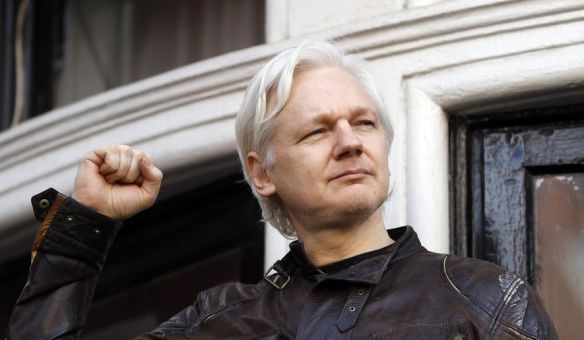
The persecution and arrest of Julian Assange is the first and most definitive step toward full blown global fascism. The symbolism of a gravely ill journalist being manhandled by uniformed henchmen is the exact imagery it needed to send a chilling message to whistleblowers and the press. The assault and eventual dismantling of what remains of a free press has always been that first step, and it is what lies on the horizon barring mass dissent. For decades the mainstream media has acquiesced to the demands of the corporate world of high finance that now owns them outright and the military and surveillance state that informs their narrative. To be sure, many of them must be trembling at the events that unfolded in London.

That so many prominent American liberals are cheering this on is hardly surprising. History is replete with examples of how the privileged bourgeoisie are the first to capitulate to fascism. It happened in the 1930’s in Germany, Spain and Italy. It happened in the 1970’s in Argentina and Chile. It is happening now across the supposedly “democratic” western world. The animus they possess for Assange is not over his personal ethics, politics or affiliations, which are indeed open for criticism and debate. Like any human being, he is flawed. It is rooted in sore feelings over Wikileaks exposure of the machinations of the corrupt Democratic Party and their Wall Street favoured war hawk, Hillary Clinton. None of what Wikileaks revealed was untrue, but they blame the failure of their deeply flawed candidate on it nonetheless. They care little about the war crimes the platform helped expose through the courage of Chelsea Manning or the threat his persecution represents to press freedom itself.

That the fascist despot Trump has disavowed Wikileaks is hardly surprising either. After all, he may have used the leaks to his benefit, but the man who has relentlessly demonized the press will undoubtedly use this moment to his benefit again. Wikileaks as an organization isn’t perfect and, like any other media outlet, it is not beyond criticism. But nearly every major news outlet has used and published its material, without appreciation or gratitude, because it provided an unprecedented glimpse into the nefarious activities and guiding principles of the ruling elite. The veil had been finally lifted. But with the arrest of Julian Assange this makes all of those news outlets vulnerable to state or corporate repression and censure.

With the Trump administration chomping at the bit to launch a war against Iran and Venezuela, this must come as welcome news to them. After all, it was Wikileaks that exposed the war crimes of the Bush administration in Iraq, not the corporate media. So they can be assured little reporting, aside from a few courageous citizen journalists or those embedded with the troops who parrot Pentagon talking points, will be done to expose the Empire’s war crimes now.

Indeed, Trump has been given a green light with this one event to continue and expand the American Empire, moribund as it is, without reproach. And like a bloated corpse, it will undoubtedly infect and defile everything it touches. More brutal violations of the global south, more coups against democratically elected governments, and bolder acts of authoritarian cruelty at home. He has made no pretense of this. His minions, Pompeo and Bolton, are working tirelessly constructing the next war. And in the past several weeks he has purged his administration of monsters he deemed “too weak” when it comes to crackdowns against immigrants and asylum seekers. A classic tactic of all tyrants. He has anointed the rabid white supremacist, Stephen Miller, in this 21st century pogrom and has also toyed with the idea of making the military in charge of internment camps for migrants. Only a fool would not find such a thing chilling to the bone.

Indeed fascist leaders around the world, along with the military/surveillance establishment and their neoliberal enablers, are celebrating the silencing of Assange. After all, Wikileaks has represented a major thorn in their sides for a decade. From Netanyahu to Duterte to Bolsonaro to Modi and even Putin, all will be emboldened to expand their own attacks on press freedom. All of them will feel empowered to be even more unrestrained in their brutality.

We are on the eve of a sweeping, global, fascist tyranny. Thanks to the continued proliferation of nuclear arms, endless corporate and military assaults on the life sustaining biosphere, catastrophic climate change and the systematic dismantling of democracy, it is a land uncharted. Journalists, especially those who are independent of the corporate stranglehold, are being routinely and relentlessly persecuted and even murdered around the world. They are a bulwark against fascism we dare not lose. But the arrest of Assange is representative of a free press now under constant threat of annihilation. And it will without a doubt grow even more difficult for them to navigate through the mendacity of a ruthless ruling order that has become utterly unrestrained.

Kenn Orphan is an artist, sociologist, radical nature lover and weary, but committed activist. He can be reached at kennorphan.com.

Free Julian Assange and All Political Prisoners

By Rob Urie

Source: Counterpunch

The American war against Iraq was among the more idiotic and gratuitous slaughters in human history. It was premised on lies, prosecuted by criminals and fools, outsourced to professional murderers and it isn’t over. In addition to those murdered directly and indirectly in the war, several million refugees were scattered across the Middle East, including over a million into Syria. ISIS grew from the ranks of the disbanded Iraqi army. This fiasco appeared as it was to all the world, the gasp of a dying empire sunk under the weight of its ignorance and arrogance.

Late in the war Julian Assange and his colleagues at Wikileaks published documents and videos allegedly leaked by Chelsea Manning that brought the gratuitous nature of American violence home for all to see. The most damning was this video that shows American soldiers carefully and methodically slaughtering civilians, including Reuters staffers, outside of any determinable theater of war. The label ‘collateral murders’ was attached to the video, but those murdered were targeted— they weren’t ancillary to otherwise justifiable murders.

Julian Assange has reportedly been charged by an American Grand Jury for his role in publishing this leaked video, among others. He will apparently be extradited to the U.S. where he is expected to stand trial for doing what reporters do— publishing true information in the public interest. The New York Times and other newspapers also published the leaked documents, but have as yet not been charged. This legal maneuvering appears to be a politically motivated vendetta against Julian Assange for embarrassing the War Criminals behind the Iraq war.

National Democrats and the liberal press have spent the last 2.5 years demonizing Mr. Assange for his role in publishing leaked DNC emails in the run up to the 2016 Presidential race. As with the government’s case against him, the content of the leaked videos and documents is not in dispute. They are what they are purported to be. American soldiers did murder civilians and Reuters staffers who posed no immediate threat to them. Hillary Clinton’s campaign staff did screw Bernie Sanders out of the Democratic nomination and she did give contradictory information about her political positions depending on what she thought her audience wanted to hear.

Mr. Assange’s accusers are largely those responsible for the imperial decline that his reporting has illuminated. The leading Republicans and Democrats behind the Iraq war should have been charged with War Crimes. There is no statute of limitations on War Crimes. The national security officials among Mr. Assange’s accusers illegally spied on Americans and lied about doing so under oath to congress. The CIA illegally spied on the congressional committee charged with investigating illegal torture in the Iraq War after illegally destroying videotape evidence of its crimes. What is Julian Assange being charged with again?

What Mr. Assange did is expose the crimes of the rich and powerful. Arguments over his methods conflate process errors with the gratuitous murder of civilians. If these murdered civilians had been well-to-do white Americans and staffers at the New York Times, where might ‘process’ fit into the utterly predictable (and justifiable) calls to give those charged fair trials and prison sentences if convicted. Through what lens are the crimes exposed by Mr. Assange and Wikileaks not crimes? As with everything about a gratuitous war in which a million or more civilians are killed, why aren’t its architects and chief instigators in the dock at The Hague pleading for their lives?

While the political pump has been primed in the U.S. by war-state Democrats and war-state liberals to go after Julian Assange without legal restraint, he is lauded by much of the world for bringing the crimes of the American elite into public view. What will be illuminated by prosecuting Mr. Assange is the crimes of the elite and their use of power and office to cover up their crimes. While most Americans haven’t seen the video (link above) of American soldiers murdering civilians and press staffers, the publicity of a trial will certainly stir public interest.

Much as the Iraq War was a late gasp of an empire in decline, the prosecution of Julian Assange is the desperate act of a political establishment that is losing its grip on power. Mr. Assange is but a messenger. This establishment is the agent of its own demise. And it couldn’t happen to a more deserving group of people. Free Julian Assange and All Political Prisoners. All Power to the People!

The Seven Years of Lies About Assange won’t Stop Now

By Jonathan Cook

Source: Dissident Voice

For seven years, from the moment Julian Assange first sought refuge in the Ecuadorean embassy in London, they have been telling us we were wrong, that we were paranoid conspiracy theorists. We were told there was no real threat of Assange’s extradition to the United States, that it was all in our fevered imaginations.

For seven years, we have had to listen to a chorus of journalists, politicians and “experts” telling us that Assange was nothing more than a fugitive from justice, and that the British and Swedish legal systems could be relied to handle his case in full accordance with the law. Barely a “mainstream” voice was raised in his defence in all that time.

From the moment he sought asylum, Assange was cast as an outlaw. His work as the founder of Wikileaks – the digital platform that for the first time in history gave ordinary people a glimpse into the darkest recesses of the most secure vaults in the Deepest of Deep States – was erased from the record.

Assange was reduced from one of the few towering figures of our time – a man who will have a central place in history books, if we as a species live long enough to write those books – to nothing more than a sex pest, and a scruffy bail-skipper.

The political and media class crafted a narrative of half-truths about the sex charges Assange was under investigation for in Sweden. They overlooked the fact that Assange had been allowed to leave Sweden by the original investigator, who dropped the charges, only for them to be revived by another investigator with a well-documented political agenda.

They failed to mention that Assange was always willing to be questioned by Swedish prosecutors in London, as had occurred in dozens of other cases involving extradition proceedings to Sweden. It was almost as if Swedish officials did not want to test the evidence they claimed to have in their possession.

The media and political courtiers endlessly emphasised Assange’s bail violation in the UK, ignoring the fact that asylum seekers fleeing legal persecution don’t usually honour bail conditions. That, after all, is why they are seeking asylum.

The political and media establishment ignored the mounting evidence of a secret grand jury in Virginia formulating charges against Assange, and ridiculed Wikileaks’ concerns that the Swedish case might be cover for a more sinister attempt by the US to extradite Assange and lock him away in a high-security prison, as had happened to whistleblower Chelsea Manning.

They belittled the 2016 verdict of a panel of United Nations legal scholars that the UK was “arbitrarily detaining” Assange. The media were more interested in the welfare of his cat.

They ignored the fact that after Ecuador changed presidents – with the new one keen to win favour with Washington – Assange was placed under more and more severe forms of solitary confinement. He was denied access to visitors and basic means of communications, violating both his asylum status and his human rights, and threatening his mental and physical well being.

Equally, they ignored the fact that Assange had been given diplomatic status by Ecuador, as well as Ecuadorean citizenship. Britain was obligated to allow him to leave the embassy, using his diplomatic immunity, to travel unhindered to Ecuador. No “mainstream” journalist or politician thought this significant either.

They turned a blind eye to the news that, after refusing to question Assange in the UK, Swedish prosecutors had decided to quietly drop the case against him in 2015. Sweden had kept the decision under wraps for more than two years.

It was a freedom of information request by an ally of Assange, not a media outlet, that unearthed documents showing that Swedish investigators had, in fact, wanted to drop the case against Assange back in 2013. The UK, however, insisted that they carry on with the charade so that Assange could remain locked up. A British official emailed the Swedes: “Don’t you dare get cold feet!!!”

Most of the other documents relating to these conversations were unavailable. They had been destroyed by the UK’s Crown Prosecution Service in violation of protocol. But no one in the political and media establishment cared, of course.

Similarly, they ignored the fact that Assange was forced to hole up for years in the embassy, under the most intense form of house arrest, even though he no longer had a case to answer in Sweden. They told us – apparently in all seriousness – that he had to be arrested for his bail infraction, something that would normally be dealt with by a fine.

And possibly most egregiously of all, most of the media refused to acknowledge that Assange was a journalist and publisher, even though by failing to do so they have exposed themselves in the future to the use of the same draconian sanctions should they or their publications ever need to be silenced.

This was never about Sweden or bail violations, as anyone who was paying the vaguest attention should have worked out. It was about the US Deep State doing everything in its power to crush Wikileaks and make an example of its founder.

It was about making sure there would never again be a leak like that of Collateral Murder, the military video released by Wikileaks in 2007 that showed US soldiers celebrating as they murdered Iraqi civilians. It was about making sure there would never again be a dump of US diplomatic cables, like those released in 2010 that revealed the secret machinations of the US empire to dominate the planet whatever the cost in human rights violations.

Now the pretense is over. The British police invaded the diplomatic territory of Ecuador – invited in by Ecuador after it had revoked Assange’s diplomatic status – to smuggle him off to jail. Two vassal states cooperating to do the bidding of the US empire. The arrest was not to help two women in Sweden or to enforce a minor bail infraction. The British authorities were acting on an extradition warrant from the US.

Still the media and political class is turning a blind eye. Where is the outrage at the lies we have been served up for these past seven years? Where is the contrition at having been gulled for so long? Where is the fury at the most basic press freedom – the right to publish – being sacrificed to silence Assange? Where is the willingness finally to speak up in Assange’s defence?

It’s not there. There will be no indignation at the BBC, or the Guardian, or CNN. Just curious, impassive reporting of Assange’s fate.

And that is because these journalists, politicians and experts never really believed anything they said. They knew all along that the US wanted to silence Assange and to crush Wikileaks. They knew that all along and they didn’t care. In fact, they happily conspired in paving the way for today’s kidnapping of Assange.

They did so because they are not there to represent the truth, or to stand up for ordinary people, or to protect a free press, or even to enforce the rule of law. They don’t care about any of that. They are there to protect their careers, and the system that rewards them with money and influence. They don’t want an upstart like Assange kicking over their apple cart.

Now they will spin us a whole new set of deceptions and distractions about Assange to keep us anaesthetised, to keep us from being incensed as our rights are whittled away, and to prevent us from realising that Assange’s rights and our own are indivisible. We stand or fall together.

What the arrest of Assange means for human rights of all


By Prof Marcello Ferrada de Noli, chairman of Swedish Doctors for Human Rights, SWEDHR

Source: The Indicter

We have repeatedly expounded the issue of right to existence as the primary of all human rights, and of human rights for all. War and its willfully killing is thus N° 1 enemy of such humanity’s essential right.

Hence, we have warmly supported the denounce of preparations, propaganda and perpetration of occupation-wars, illegal wars, war-abuses, crimes perpetrated under the name of one power’s ‘national security’ against the international security of many nations, the widespread killing of civilians, the using of prohibited chemical weapons, etc. All that denouncing has been a leit motif in the endeavors of WikiLeaks. Julian Assange, the founder of that organization, has established an example of civil courage, a behaviour  which has been followed by important other exposures at different latitudes.

This movement, which also perfectioned the mechanisms of modern alternative media to counter arrest the disinformation routine that has characterized MSM,  have provided free information, and thus education, as to how deal with the alienation pursued by the messages of those in power that are transmitted by the media at their service.

The arresting of the WikiLeaks publisher Mr Julian Assange signifies not only a hard blow for Western democratic principles referred to freedom of speech and freedom of the press. It also entails a further threat to all honest journalists, public and private officials which have undertaken the honourable mission of  denouncing war crimes allegedly perpetrated by NATO and its aligned forces in various scenarios of illegal wars.

On the other hand, amidst the dramatic circumstances in the now unpredictable fate of Mr Julian Assange, emerges another truth. This is, the Western media  in consensus, invariably dismissed the risk of extradition of Assange as the invention of “conspiracy theorists” –referring to the NGOs that defended Assange’s human rights. Instead, the first news arising after the arrest of Assange was known, is the public acknowledgement of an extradition request from the part of the US government. Hence, it was not “Assange’s paranoia”. And our analyses were accurate.

Let’s began by clarifying that Julian Assange has never been charged with any crime, neither in Sweden nor elsewhere. Instead, he has been made responsible for the legendary exposures in “Collateral Murder”, the documentary which denounced atrocities in the Iraq war, including the killing of civilian journalists ­–and already viewed by over 16 million people.

Due to WikiLeaks exposures on alleged US war crimes in the Iraq and Afghanistan wars,  the US has been after the extradition of Assange since 2010. After the publication of WikiLeaks of over 70,000 classified documents covering the war in Afghanistan, the US urged nations participating in the US-led coalition in Afghanistan to initiate prosecution against Julian Assange. This is documented in the ‘Snowden papers”, which text relevant to this issue  was republished in The Indicter Magazine in 2016. Of the countries then consulted, only Sweden complied with the US request and subsequently they opened an investigation against Assange on alleged sexual offences to permit a warrant for his arrest. Those accusations probed to be unsustainable, and the case had to be dropped afters years of Assange being held under the Swedish arrest warrant.

The real reason for the arrest was, according to open investigations SWEDHR has access to and which we earliest denounced, the extradition of Assange to the US.  A sealed process against Assange had been opened in Virginia –also negated by the authorities at that time– and which only recently has been confirmed by the U.S. Department of Justice.

While in house arrest, and in order to avoid the impending rendition to Sweden from the part of the London authorities, Julian Assange sought asylum at the Embassy of Ecuador in London.  The government of Ecuador under the presidency of Rafael Correa granted political asylum to him due to the risk of his extradition to the US from Sweden.

The UK then instructed Sweden to protract the ‘investigation’ on Assange, to which the Swedish authorities docilely complied. Meanwhile the process against Chelsea Manning continued.

But after Sweden dropped the investigations on Assange, The UK has said that it will arrest Assange anyway in case he leaves the embassy’s premises. This on the argument that Assange would have violated the conditions of his house arrest by seeking instead asylum at the Ecuador embassy.

In the meantime the United Nations Working Group on Arbitrary Detention (UNWGAD), had requested the immediate freedom of Mr Assange.

When I met Julian Assange at the embassy in London in August 2017, his situation had been substantially changed. Although efforts deployed by the outgoing ambassador, Assange’s health was deteriorating after years of isolation, sun deprivation, etc. He also told me about the unjustified accusations of involvement with Russian interests around the US presidential election narrative, which he categorically denied.  But the change of government in Ecuador had started to show consequences for his juridical, and physical safety at the Embassy.

President Moreno had another stance on issues of Ecuador’s national sovereignty – read, relationships with the US government. which openly consider South America as “our backyard”–  and in pursuing better terms for financial deals for his country with the US, president Moreno was said to include the fate if Assange in those negotiations. At east, according to WikiLeaks reports.

One first complaint against Assange was his use of Internet connections, provided to him at the Embassy, to embarrass “friendly governments”, such the US. But the real reason turn out being another “embarrassing”. Which was President Moreno’s own.

And so we arrive to the “INAPapers” affair, which was appartently used by Moreno as a pretext to justify his decision of rendering Julian Assange to the UK authorities (and subsequently to the US). Here is the “INAPapers affair in summary:

According to reports published in Ecuador local media, Ina Investment Corporation is an offshore company related to Xavier Macías Carmigniani, his wife María Auxiliadora Patiño Herdoiza, and the Ecuador president Lenin Moreno’s family.

Between 2012-2016 the company had a bank account in the  Balboa Bank de Panamá. WikiLeaks mentioned in a tweet some of the information that has been already published in Ecuador. Also an investigation in Ecuador’s National Assembly was opened. One issue that I could read is that that several furniture items were acquired and stored at Lenin Moreno’s apartment in Geneva, Switzerland, in 2015. The published source that I am using here (Periodismo de Investigación),  also reported that from such account departed transfers to purchase  an apartment in the Mediterranean coast, in 2016.

The transfer pertaining the furniture deal, is alleged to consist in $19 342, and the recipient firm was described as  “Moinat S.A. Atiquities” en Suiza. And regarding the apartment of Moreno in Switzerland, this would have correspond to the residence he has at the time he served as UN Special Envoy on Disability and Accessibility –an appointment he received from Secretary-General Ban Ki-moon. All according to what has been described by  Periodismo de Investigación.

Already on April 4, WikiLeaks tweeted that “A high level source within the Ecuadorian state has told WikiLeaks that Julian Assange will be expelled within “hours to days” using the INAPapers offshore scandal as a pretext–and that it already has an agreement with the UK for his arrest.”

This was immediately denied by Ecuador’s Foreign minister José Valencia:

In the morning of April 5, 2019,  Ecuador Foreign Minister José Valencia tweeted (he later did withdraw it) in response to the above mentioned post by WikiLeaks:

“Diplomatic asylum is a sovereign privilege of a state, which has the right to grant it or withdraw it unilaterally when deemed necessary”

Ensuing, SWEDHR produced the following statement: