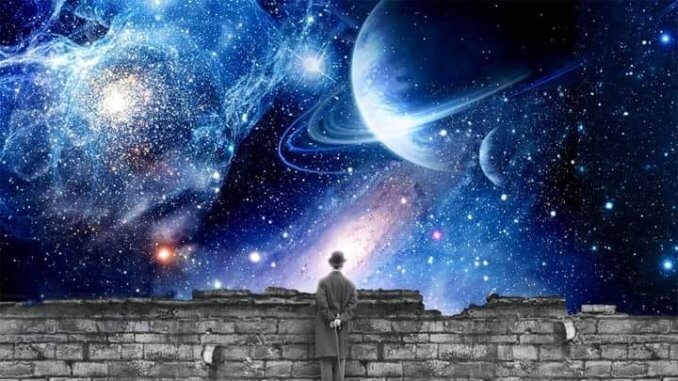
Sea Monsters Threaten the World With Their Tridents

By Edward Curtin

Source: Behind the Curtain

Sometimes you wake up from a dream to realize it is telling you to pay close attention to the depth of its message, especially when it is linked to what you have been thinking about for days.  I have just come up from a dream in which I went down to the cellar of the house I grew up in because the basement light was on and the back cellar door had been opened by a mysterious man who stood outside.

I will spare you additional details or an interpretation, except to say that my daytime thoughts concerned the media spectacle surrounding the Titan submersible that imploded two miles down in the ocean’s cellar while trying to give its passengers a view of the wreck of the Titanic, the “unsinkable” ship nicknamed “the Millionaire’s Special.”  The ship that no one could sink except an ice cube in the drink that swallowed it.

Cellar dreams are well-known as the place where we as individuals and societies can face the flickering shadows that we refuse to face in conscious life.  Carl Jung called it “the shadow.”  Such shadows, when unacknowledged and repressed, have a tendency to autonomously surface and erupt, not only leading to personal self-destruction but that of whole societies.  History is replete with examples.  My dream’s mysterious stranger had lit my way through some dark thoughts and opened the door to a possible escape.  He got me thinking about what all of us tend to want to deny or avoid because its implications are so monstrous.

The obsession with the alleged marvels of technology together with naming them after ancient Greek and Roman gods are fixations of elite technologues who have lost what Spengler called “living inner religiousness” but wish to show they know the classical names even though they miss the meaning of these myths.  Such myths tell the stories of things that never happened but always are.  Appropriating the ancient names without irony – such as naming a boat Titanic or a submersible Titan – unveils the hubristic ignorance of people who have never descended to the underworld to learn its lessons.  Relinquishing  their sense of god-like power doesn’t occur to them, nor does the shadow side of their Faustian dreams.

They will never name some machine Nemesis, for that would expose the fact that they have exceeded the eternal limits with their maniacal technological extremism, and, to paraphrase Camus, dark Furies will swoop down to destroy them.

Nietzsche termed the result nihilism.  Once people have killed God, machines are a handy replacement in societies that worship the illusion of technique and are scared to death of death and the machines that they invented to administer it.

The latter is not a matter fit to print since it must remain in the dark basement of the public’s consciousness.  If it were publicized, the game of nihilistic death-dealing would be exposed.  Because power, money, and technology are the ruling deities today, the mass media revolve around publicizing their marvels in spectacular fashion, and when “accidents” occur, they never point out the myth of the machines, or what Lewis Mumford called “The Pentagon of Power.”  Tragedies occur, they tell us, but they are minor by-products of the marvels of technology.

But if these media would take us down to see the truth beneath the oceans’ surfaces, we would see not false monsters such as the Titanic or Moby Dick or cartoon fictions such as Disney’s Monstro the whale, but the handiwork of thousands of mad Captain Ahabs who have attached the technologues “greatest” invention – nuclear weapons – to nuclear-powered ballistic submarines.

Trident submarines. First strike submarines, such as the USS Ohio.

These Trident subs live and breathe in the cellars of our minds where few dare descend.  They are controlled by jackals in Washington and the Pentagon with polished faces in well-appointed offices with coffee machines and tasty snacks.  Madmen.  They hum through the deep waters ready to strike and destroy the world.  Few hear them, almost none see them, most prefer not to know of them.

But wait, what’s the buzz, tell me what’s happening: the Titan and the Titanic, wealthy voyeurs intent on getting a glance into the sepulchre of those long dead, while six hundred or so desperate migrants drown in the Mediterranean sea from which the ancient gods were born.  These are the priorities of a society that worships the wealthy; a society of the spectacle that entertains and distracts while the end of the world cruises below consciousness.

The United States alone has fourteen such submarines armed with Trident missiles constantly prowling the ocean depths, while the British have four.  Named for the three-pronged weapon of the Greek and Roman sea gods, Poseidon and Neptune respectively, these submarine-launched ballistic missiles, manufactured by Lockheed Martin (“We deliver innovative solutions to the world’s toughest challenges”), can destroy the world in a flash. Destroy it many times over. A final solution.

While the United States has abrogated all treaties that offered some protection from their use and has declared their right of first use, it has consistently pushed toward a nuclear confrontation with Russia and China.  Today – 2023 June – we stand on the precipice of nuclear annihilation as never before.

A single Trident submarine has 20 Trident missiles, each carrying 12 independently targeted warheads for a total of 240 warheads, with each warhead approximately 40 times more destructive than the Hiroshima bomb.  Fourteen submarines times 240 equals 3,360 nuclear warheads times 40 equals 134,400 Hiroshimas.  Such are the lessons of mathematics in absurd times.

James W. Douglass, the author of the renown JFK and the Unspeakable and a longtime activist against the Tridents at Ground Zero Center for Non-Violent Action outside the Bangor Submarine Base in Washington state, put it this way in 2015 when asked about Robert Aldridge, the heroic Lockheed Trident missile designer who resigned his position in an act of conscience and became an inspirational force for the campaign against the Tridents and nuclear weapons:

Question: “What did the Nuremberg attorneys say about war crimes that had such a deep impact on Robert Aldridge?”

Douglass: “They said that first-strike weapons and weapons that directly target a civilian population were war crimes in violation of the Nuremberg principles. Those Nuremberg principles, which are the foundations of international law, are violated by both by electronic warfare – which is why we poured blood on the files for electronic warfare [at the base] – and also by the Trident missile system, which is what Robert Aldridge was building.”

Robert Aldridge saw his shadow side.  He went to the cellar of his darkest dreams. He refused to turn away.  He became an inspiration for James and Shelley Douglass and so many others.  He was a man in and of the system, who saw the truth of his complicity in radical evil and underwent a metanoia.  It is possible.

If those missiles are ever launched from the monsters that carry them through the hidden recesses of the world’s oceans, there will never be another Nuremberg Trial to judge the guilty, for the innocent and the guilty will all be dead.

We will have failed to shed light on our darkest shadows.

Writing in another context that pertains to today’s high-flying nuclear madmen whose mythic Greek forbear Icarus would not listen, the poet W. H. Auden put it this way in “Musée des Beaux Arts”:

About suffering they were never wrong,
The Old Masters: how well they understood
Its human position; how it takes place
While someone else is eating or opening a window or just walking dully along

How, when the aged are reverently, passionately waiting
For the miraculous birth, there always must be
Children who did not specially want it to happen, skating
On a pond at the edge of the wood:
They never forgot
That even the dreadful martyrdom must run its course
Anyhow in a corner, some untidy spot
Where the dogs go on with their doggy life and the torturer’s horse
Scratches its innocent behind on a tree.

In Brueghel’s Icarus, for instance: how everything turns away
Quite leisurely from the disaster; the ploughman may
Have heard the splash, the forsaken cry,
But for him it was not an important failure; the sun shone
As it had to on the white legs disappearing into the green
Water; and the expensive delicate ship that must have seen
Something amazing, a boy falling out of the sky
Had somewhere to get to and sailed calmly on.

We turn away at our peril.

Your Efforts Make A Difference, And We Can Win This Thing

By Caitlin Johnstone

Source: CaitlinJohnstone.com

We can win this thing and create a healthy, harmonious world, and the work each of us does to help bring this about makes a real difference. The more I observe and learn about human behavior, the more convinced of this I become.

Let me explain.

Every positive change in human behavior is always preceded by an expansion of consciousness. This is true whether you’re talking about positive behavioral changes in an individual or in a collective.

By “expansion of consciousness” I mean an increase in awareness — someone or a group of someones becoming more aware of something than they previously were:

  • Someone gaining a new perspective on the forces within themselves which drive them to seek out dysfunctional relationships.
  • An addict becoming more conscious of the inner dynamics that compel them to use.
  • A victim of abuse realizing that abuse is happening, and that a better life is possible, and that they deserve it.
  • A community becoming aware that their clergy have been sexually abusing children.
  • The US civil rights movement making Americans more aware of the injustice and destructiveness of racism.
  • Increased literacy and a greater ability to distribute the written word giving society a greater hunger for freedom and democracy and less tolerance for overt tyranny.
  • Etc.

Conditions don’t get better until the forces which give rise to them are clearly seen and understood. This movement from the darkness of unconsciousness into the light of awareness can create the illusion that things are getting worse, because they turn up so much ugliness.

After the 1955 lynching of Emmett Till, his mother made the decision to hold an open-casket funeral to expose the world to the cruelty that black Americans were being subjected to by showing his mutilated body to the public. In that moment it looked like the world was being made more ugly, because an ugliness that had previously gone unseen by many people was being published in papers across the country. But it was later said that “The open-coffin funeral held by Mamie Till Bradley exposed the world to more than her son Emmett Till’s bloated, mutilated body. Her decision focused attention on not only American racism and the barbarism of lynching but also the limitations and vulnerabilities of American democracy.”

Similarly, the dawn of the internet has turned up a tremendous amount of ugliness and cruelty that had previously gone unseen and unknown to most people. This can lead to the mistaken impression that the internet itself is making people more cruel and ugly than they previously were, but it isn’t. It’s just turning up humanity’s longstanding inner demons that had previously functioned solely in the dark.

It looks ugly, it moves in a sloppy, clumsy, two-steps-forward-one-step-back shamble, but human consciousness is undeniably expanding. We’re getting so much better at sharing ideas and information with each other that we’ve arguably changed more as a species in the last thirty years than we did in the previous thirty centuries. We might outwardly look similar to the way we looked in our grandparents’ time, but billions of human brains connected to each other through the internet is something that is wildly unprecedented in the entire history of our species. Nothing like this has ever happened before.

So humanity is indisputably becoming more conscious, as awkward and sloppy as our situation looks right now. We’re becoming more and more aware of the problems our species faces, and our rulers are having to do more and more work to pull the wool over our eyes and keep us marching in a way that is convenient to them.

Police brutality. The abuses of Israeli apartheid. The agony of poverty. The ravages of ecocide. The ways we’ve been deceived and manipulated by the mass media. People are becoming more and more aware of these things than they used to be, because the truth about them is suddenly vastly more visible now than it previously was.

And what’s exciting is that we all have the ability to participate in, and facilitate, this expansion of consciousness. We each have the ability to help humanity become more conscious in our own small way, thereby bringing us that much closer to a positive shift in our collective behavior.

Anything you can do to help make humanity a little more aware of the abusive nature of the systems which drive the problems we now face makes a difference, even if it’s a difference as small as making one single person a little bit more aware of one specific aspect of the tyranny we’re being subjected to. It doesn’t make a huge difference, but it does make a difference. And as long as it makes the slightest bit of difference, it is worth doing, because a lot of slight differences adds up to a massive difference. And there are a whole lot of people who have the ability to do this.

What this means is that we each have the ability to directly and meaningfully participate in the creation of a healthy world, because we are each able to directly and meaningfully advance the only factor that ever leads to positive changes in human behavior. We can do this through the new technologies which have expanded humanity’s ability to share ideas and information like videos, blogs, podcasts, tweets and memes, and we can do this through older means like holding demonstrations, creating art, distributing literature, writing messages on walls, and just having conversations.

Anything you can do to help people become more aware of injustice, abuses, propaganda and tyranny, whether in your own community or in the world, makes a difference. Does this mean you will single-handedly save the day like the protagonist in a Hollywood movie? No. That’s not how real change happens, and it never has been. Real change is the result of sustained efforts of many, many people whose individual actions could never achieve much on their own.

I think the protagonist-driven storytelling models humanity uses in its legends, folk tales, novels and films often plays an unwholesome role in distorting people’s expectations about the efficaciousness of their own individual actions. Those storytelling models are designed to appeal to the human ego, which gets a tremendous amount of energy and attention in this particular slice of spacetime, but they are not accurate representations of the way real change actually happens in real life. In real life, change happens because a great many people put their shoulders up against the change that was needed and shoved in the required direction.

So that’s what we can all do: we can all lean our shoulders into the expansion of human consciousness and shove. Spread awareness of what’s going on in the world, make people more aware that we’re all being deceived and manipulated at mass scale, and help people to see that a better world is possible. The more people open their eyes to what’s happening, the more shoulders there are to help join in our collective shove toward consciousness.

Ultimately what we’re looking at is humanity’s journey toward becoming a conscious species. One that’s no longer driven by unconscious animal impulses and the flailings of illusory egoic constructs in our psyches, and is instead driven by a lucid perception of reality and a desire for the greater good of all beings.

We can all play a role in this achievement, both by expanding our own consciousness as far as it can go by bringing clarity to our own minds, our own worldviews and our own inner processes, and by helping others to become more aware of the world around them. It won’t often unfold in a way that is elegant and linear and egoically pleasing, but it will unfold. And if it unfolds enough, positive change becomes inevitable.

TEMPLATE FOR A TRANSFORMATION OF HUMAN SOCIETY

By Julian Rose

Source: Waking Times

There are many thousands of groups that have formed themselves around the need to stand against the globalist attack on life on earth. There are thousands more presenting alternative vision/suggestions for a better future. And there are a small number who are doing both; declaring that one must commit to stopping the worst while simultaneously nurturing into life a new template for human and ecological emancipation.

It is the latter action which I subscribe to, because it strikes me that we have no choice other than to fight-off the most immediate threats to our fundamental life values; yet equally have no choice other than to recognise the obvious shortcomings of the day to day way of life that constitutes the accepted norm of most post industrial societies today.

Given this state of affairs, one finds oneself committed to taking a deeper look into both the causal factors behind the degradation of human values and what will form the key ingredients of a new society. That which emerges out of the darkness and leads the way beyond repetitions of the divisive trends destroying humanity’s integrity.

Quite recently I came across the term ‘Truth Movement’ and discovered that it stands for a broadly connected body of individuals all having a similar goal: the defeat of the globalists. This seemed to hark back to the term ‘truthers’ as applied to those ready to expose the 9/11 fraud.

What, I asked myself, would this ‘Truth Movement’ do if it were to actually succeed in fulfilling its ambition?

What would ensure that such a movement did not implode once faced by the responsibility for building a future purged of the ‘rotten apple’ factors that so often bring-down otherwise promising movements and visions?

By ‘rotten apple’ factor, I mean the tendency for jealousy, excessive ego, lack of importance given to trust, power complexes, political ambition and – I would add – the group psychology of demanding ‘consensus’ in decision making, thereby pulling down individual aspirations and ending-up with abdication to the lowest common denominator as the only way ‘to keep the peace’.

Within socio-economic structures which largely reject the notion of ‘leadership by the wise’, a palpable void opens-up when important/controversial decisions have to be taken which require more than a superficial five sense appraisal of the way forward.

When our Truth Movement is confronted by the need to decide the composition of ‘the new template for the new society’ it is to usher into reality, many different convictions are likely to be put forward.

For example: an end to racial discrimination; the common ownership of land; the dissolution of the banking industry and widespread redistribution of wealth; no more ‘government’; the rise of ‘rule by the people’; free green energy for all; organic food and farming being adopted as the prime means of food production.

So as to bring the dilemma presented by this situation to life in a ‘real time’ way, I’m going to paint my envisioned picture of how events might unfold.

As ideas pour in, a committee is established to find a pragmatic way to turn these ideals into political reality. A reality which reflects the broad banner heading ‘Truth Movement’, whose idealistic rhetoric has finally garnered enough support to overcome the long dominant globalist control system.

On this committee are the leading proponents of the various ideals deemed most essential for laying the foundation of the promised New Society.

However, the daunting task of turning this pool of individual potential into a unified body of pragmatic ground-breakers,  leads to the realisation that some critically important ingredients have been neglected. Internal frictions start to come to the surface causing fractures in the once seeming unity.

Disagreements eventually come to a head and in a highly revealing and heated exchange, it emerges that the deeper significance of the word ‘truth’ has never been explored or even debated. Never understood as primarily a spiritual value, an inner commitment to the evolution of higher values, not just to outer changes in the functioning of society.

In an attempt to prevent the situation deteriorating into chaos, a respected analyst is brought to the table to put a few fundamental questions to the committee leaders:

How aligned are you in your personal lives with what you call upon others to do in order to solve the crisis in values you see around you?

How truthful are you to yourselves and to others, if you don’t consider it important to lead by example – but nevertheless expect others to live the changes you claim must be brought-about?

How committed are you to raising your own levels of consciousness? To gaining a higher level of awareness concerning your own ambitions and shortcomings?

Are you actually committed to ‘a path of truth’ in your own lives? To following disciplines that quieten the ego and develop your relationship with the deeper spiritual values that are, in practice, the only real expression of truth?

How determined are you not to be a hypocrite? To avoid turning-out like the very politicians you so readily condemn?

As leaders of ‘the truth movement’ can you honestly say that you are committed to uphold the highest standards of responsibility, integrity and trust in your dealings with others?

What specific qualities are necessary in order to lead your supporters wisely, honestly and effectively?

Faced by this penetrating examination, the room became strangely quiet.

Being asked to address an inner commitment to truth, as opposed to its relatively surface oriented outer manifestation, has led to the need for a traumatic reappraisal of ‘the order of values’. And has called for a new level of consciousness to be put at the very top of the agenda of what is most essential for the building of the new society.

I tell this tale so as to highlight the task which stands in front of all of us, as ‘activists’ and campaigners for a better world. For should the neo-liberal control system collapse or even be finally defeated, we will find ourselves at the forefront of a global situation in which the great majority are subjected to an uncharted sense of insecurity and loss of direction.

A life of slavery to task masters carries with it a kind of insurance policy of not having to deal with – or be responsible to – the wider world or one’s own inner quest for liberation.

Suddenly, or relatively suddenly, being placed in a position where the expectation of the majority is for those most vocal in exposing the wrong – to now step forward and establish ‘the right’- presents a formidable challenge.

At the centre of this challenge is a burning question which we should all be addressing now rather than waiting until the hour of need is thrust upon us.

The question centres around a very fundamental precept: is the decision making process – essential to establishing the new desired template – to be based on ‘leadership by the wise’ or by ‘group consensus’?

By a ‘committee of the wise and the good’ or by a continuation of ‘democratic representative governance’ and quasi-consensus decision making?

To put it a little more bluntly: a benign, wise dictatorship or an elected common denominator form of governance which has no base in wisdom or vision and which is very easily exploited by the power hungry?

Within the constitution of the British Isles and many other countries, there exists something called Natural Law/Common Law, which goes back a long way.

It states that there is only one indomitable law and that is the law of God. God’s law. A form of decree based upon universal truth and justice, founded upon the supreme wisdom of our Creator.

In a world overcome by rank injustice, the complete absence of truth, and no sign of wisdom, Common/Natural Law shines out as the light at the end of a very dark tunnel.

The emergence of an earthly law that reflects universal law can only be brought forward by a committee of the wise and true. Indeed, God’s laws can be described as emanating from ‘the Supreme Benign Dictator.’

At the most basic level, they are reflected in the laws of nature and the predilection for an ever expanding biodiversity of plant, animal and insect life.

At the human level, they represent the (age old) quest for truth, love and full emancipation of the soul of man. Even when individuals do not consciously know it,  this is what all are longing for – and now is the time to go public about it.

We have passed the point of no return for ‘democracy’ or anything resembling it, so we may choose to call what will really open our minds and hearts: a ‘Veritocracy’.

Veritocracy from ‘veritas’ the Latin for truth. ‘Way of Truth’.

Going face to face with a cult regime based on darkness and division, demands a steadfast commitment to the opposite. Truth, as the unrestrained manifestation of the call of our souls.

This is the one force that will disintegrate the forces of darkness and disempower the globalist control system, once and for all.

It is the one force that can unite all of humanity and provide the dynamic foundation for true leadership and true trusteeship of the planet.

Let us commit now. Let us be properly prepared to lead the world beyond ruination and into rebirth.

THE BATTLE AGAINST BEWITCHMENT: UPSETTING SETTLED MINDS

By Gary Z McGee

Source: Waking Times

“Philosophical thinking that doesn’t do violence to one’s settled mind is no philosophical thinking at all.” ~Rebecca Goldstein

Comfort zones are a curious thing. So warm and secure. So safe and reassuring. So satisfying and certain. Beliefs have a similar effect on us. Especially the core beliefs that we take for granted. But beliefs are comfort zones with reinforced invulnerability; or, at least, the illusion of it.

Such reinforcements are like prison bars that most of us are not even aware of. We’re so completely indoctrinated, so utterly pre-programmed, that we don’t even know that we don’t know that we’ve been conditioned to blindly believe in something simply because enough people convinced us it was true.

The problem with reinforced comfort zones is that there is no growth. A regular comfort zone, you can stretch. A reinforced comfort zone, you’re usually not even aware it needs to be stretched. A regular comfort zone allows for trial and error, it allows for questioning, and so there is at least potential for self-improvement and self-overcoming. But a reinforced comfort zone does not allow for trial and error. It doesn’t allow for “blasphemous” questioning, because it is taken for granted as already perfect or “simply the way it is.”

Regular comfort zones can be healthy, giving us a safe haven, a place where we can heal and lick our wounds. But reinforced comfort zones are unnecessary safety nets based upon fear (of God, the Unknown, Death) placation, and self-pity. It’s a place where cognitive dissonance rules and any notion of attempting to think outside the box is met with: You simply need to have faith in the “box”.

The Battle Against Bewitchment:

Philosophy is a battle against the bewitchment of our intelligence by means of language.” ~Ludwig Wittgenstein

Self-Inflicted Philosophy is at the forefront of the battle against bewitchment. Self-inflicted philosophy is about upsetting settled minds. It’s about toppling the reinforced comfort zones of blind belief. It’s about flattening the “box” that everyone talks a big game about thinking outside of but when it really comes down to it, they cling to the “box” out of fear of the unknown or out of faith in what they believe they know.

Foremost, self-inflicted philosophy is about questioning the self to the nth degree through self-interrogation. But you can only get so far in such questioning before you are met with the reinforced comfort zone of a blind belief. So, self-inflicted philosophy is also about questioning the layer-upon-layer of cultural, political, and religious indoctrination that led to that reinforced comfort zone to begin with.

When you don the cloak of a self-inflicted philosopher, no belief, no matter how true it may seem, is off the hook for being questioned with ruthless skepticism and unwavering circumspection. In the battle against bewitchment, the destruction of a belief, no matter how powerful, is mere collateral damage to the Occam’s razor of universal truth. Hell, even “universal truth” is not beyond questioning.

When you don the cloak of a self-inflicted philosopher, the concept of belief is nixed from your interpretation of the universe. There is no place for belief here, only thought, only deep inquiry, only imaginative curiosity. You replace all usage of “belief” or “believe” with “thought” or “think”. You don’t believe that you certainly exist, you “think” that you “probably” exist. But you could be wrong. So you remain circumspect, for even your interpretation of your own existence could be an illusion, no matter how “true” it may feel.

There will be those who will say, “You are merely believing that you don’t believe.” But that is patently false, because you are not “believing” in non-belief, you are “thinking/inquiring/imagining” through non-belief, with the understanding, the flexibility that your thinking “could” be wrong. And that’s the rub: it is much easier to alter a thought than a belief. It is almost impossible to alter a belief. You are more likely to question a thought than you are a belief. And so, rather than get trapped in a reinforced comfort zone, you stay ahead of the curve by thinking rather than believing, and then by questioning what you think so that you don’t accidentally begin to believe it.

In the spirit of upsetting settled minds, you don’t believe in having an unsettled mind, you think that having an unsettled mind is more productive, more progressive, and more open-minded than having a settled mind (an unquestioning belief). You realize that belief in general is counterproductive, because you understand that the human mind is a delusion-generator rather than a truth-generator. It pumps out delusions like a spider pumps out webs. But, unlike the spider, it tends to get caught in them. Thereby, you understand that the only window to truth is through a questioning, circumspect, and a skeptical mindset, rather than through an unquestioning, dogmatic, and certain mindset.

The only solution to a delusion-generator is a question-generator. Luckily, the human brain is both. As a self-inflicted philosopher, you don’t believe that this is certainly true; rather, you think that this is probably true. And you’re willing to question everything to “prove” it. Indeed, you’ve transformed Descartes’ “I think therefore I am” into I think, therefore I question.

Tapping into the question-generator:

“It is far better to grasp the universe as it really is than to persist in delusion, however satisfying and reassuring.” ~Carl Sagan

The problem with the human brain is that is never knows when it has been duped by a delusion, so it is almost always better to not believe anything just in case it’s a delusion. A kind of reverse Pascal’s Wager. It’s almost always better to, as Aristotle suggested, “entertain a thought without accepting it.” Just take it all into consideration and let it pass through the sieve of probability. Then, whatever doesn’t insult your soul, think about it, dissect it, inquire about it. Be curious about it. Just don’t make the mistake of believing it.

You are more likely to grasp the universe “as it really is” by questioning it than by believing it. You don’t believe the universe is certainly a certain way; rather, you think the universe may be a certain way, but you’re willing to question further so as to get you closer to the way the universe “really is”. If you cling to a particular belief of how the universe is, then you block yourself from ever getting closer to the universe “as it really is.” Better to simply not have a belief in the first place. Better to simply think and keep the motor running on the question-generator so as to keep the delusion-generator in check.

The opposite of belief is neither disbelief nor doubt, but clarity of a thought. Without beliefs reinforcing the comfort zone, you are liberated to stretch it. You are clear enough to think outside it, you are courageous enough to question it. When the reinforcements fall away, the comfort zone becomes a sacred rather than stagnant place. It is free to grow through self-improvement rather than remain stuck in self-reassurance. Indeed, without beliefs cluttering the mindset, you’re finally able to drop the “set” and move into “mind.”

Free of the “mindset” of a settled mind, you move into the mindfulness of a questioning mind. You become a walking, talking, question-generator, able to consistently counter-balance the delusion-generator of the human condition. You’re ahead of the curve, surfing Aslam’s Infinite Circle on the surfboard of Occam’s razor. In absolute awe over the beautiful unfolding of an ultimately unknowable universe. On the edge of your own curiosity, questioning all “answers” countering all beliefs, elusive of all delusions. You’re a self-inflicted philosopher, and not even God is safe from your ruthless inquiry.

Steiner and the Blood Demons

Blood Demons original title artwork by Michael Cox – see his art on Instagram here

By Jason Happenstall

Source: Beyond the Wasteland

Is the human race under spiritual attack? And did the esoteric philosopher and clairvoyant Rudolf Steiner warn about it over a century ago when he said a ‘vaccine’ would be the delivery system for the defeat of humanity?

For many, the overly-authoritarian response by governments worldwide to Covid-19 pointed to some deeper, more sinister, driving force. But it hasn’t just been the governments that seemed to be acting strange. Over the last two years we’ve witnessed people across a broad spectrum of society meekly submit to draconian attacks on their freedoms, many even fiercely defending the assault. In the same way, we’ve seen politicians and parties who once ran on platforms of personal freedom and economic autonomy almost overnight turn into overbearing control freaks, intent on micromanaging every aspect of our lives. How has this happened?

Recently, the term ‘mass formation psychosis’ has been on everybody’s lips. It’s defined as a psychological phenomenon whereby a mass of people voluntarily go through a process of deindividuation and a herd mentality forms. Due to their contagious nature, the thoughtforms affecting these deindividuated people, catalysed by the positive feedback loops of news programmes, social media and peer interaction, spread like wildfire throughout the population. In the past, this used to be called mob psychology, or more plainly, the madness of crowds.

Psychology: from Science to the Occult

Someone for whom the events of the past couple of years would not have been so surprising was the Austrian esoteric philosopher and mystic Rudolf Steiner, who died almost a century ago. Throughout the course of his life Steiner wrote numerous books and delivered thousands of lectures on his theories, contributing greatly to diverse spheres from architecture to education, and agriculture to beekeeping. His highly unique – and sometimes controversial – insights and methods led to the founding of the spiritual movement known as Anthroposophy, which emphasises the existence of a boundless potential for human beings.

Unlike some esoteric thinkers, Steiner saw the great importance of materialistic science, but argued that it was vital to see it as only a single aspect of reality which should ideally be combined with what he called ‘spiritual science’ – gained by mystical experience – in order to present the full picture. After all, breakthroughs often occur when scientists receive insights from beyond the material realm, as in the famous case of James Watson, credited with the discovery of the double helix shape of DNA which came to him in a dream featuring two intertwined serpents. Similarly, Dmitri Mendeleev, created the period table after a dream of “… a table where all the elements fell into place as required.” These cases go to show that not all scientific discoveries are the result of logical deduction and experimentation.

In fact, Steiner, who had been on the receiving end of mystical insights since childhood, honed his clairvoyant skills to such an extent that the information he received from non-conventional sources became more than the occasional flash of insight, His quest became the establishment of methods for obtaining objective extrasensory perception – a task he considered of paramount importance for he believed an epic battle was being fought in the spiritual realm that would have disastrous consequences for humankind unless it was addressed head-on.

Spirits of Darkness

His clearest warnings about the future fate of humanity came in a series of lectures delivered towards the end of his life in Dornach, Switzerland; these lectures are reproduced in the book The Fall of the Spirits of Darkness. Although Steiner’s detractors say his prose can be leaden, his lectures meandering, and his concepts difficult to grasp, he is remarkably clear and straightforward when it comes to the fate that awaits humanity if our obsession with scientific materialism is allowed to reign free without being pulled back into balance by the counterbalancing forces of spirituality.

This is most clearly illustrated in the final two lectures in the series – 13 and 14 – which are respectively titled The Fallen Spirits’ Influence in the World and Into the Future. Steiner posits that an unseen battle took place in the early 19th century which certain ‘spirits of darkness’ lost. These spirits were duly ejected from their heavenly realms and cast down into a more material plane of existence i.e. here. He is remarkably precise about when this occurred: autumn 1879.

These newly arrived spirits joined those who were already here – the ones that have been existing alongside and influencing humanity since the mythological times associated with the Fall. Given that it takes time for these malign spirits to work their way through human societies, it wasn’t until 1914 when their malign influence manifested in human society in the form of the First World War – a disastrous event the cause of which still puzzles secular historians.

Lucifer and Ahriman – the Leaders of the Pack

The spirits Ahriman and Lucifer have been hacking humanity for thousands of years, says Steiner, with Lucifer being the ‘light bringer’ intent on making us more spiritual and granting us more free will, and Ahriman doing the opposite and making us more materialistic and easier to control. In simplistic terms, Lucifer is an ascending influence, which Ahriman is a descending one.

Why should they want to do this? Well, we just don’t know – it’s difficult for our human minds to figure out what makes angels and demons tick. But whenever there’s one of those periodic battles in the spirit world, Steiner said, it tends to result in a new batch of reinforcements being thrown down into the material realm to join forces with those already here.

Steiner told us that Ahriman – a demon first identified by the Zoroastrians in ancient Persia – has the upper hand right now. He had a personal beef with Ahriman and had seen his face in vision – in fact he was still carving a likeness of it out of wood at the time of his death. Ahriman’s main aim seems to be to drag humankind into a purely materialistic state devoid of any form of spirituality, removing even the impulse to connect with our souls. The method of attack would be through science and technology, and by taking possession of the minds of powerful and influential people in order to push through this agenda. These controlled people could be scientists, politicians, religious leaders, or anyone with any influence. Thus, demonic forces would work through these people, and the people themselves, blinded by all-too-human failings such as greed or a lust for power, would lack the basic awareness to recognise what was occurring.

A New Religion for a New Age

The background to this power grab was the rise of atheism and the worship of science and progress. Now, we have a situation in which a purely materialist perspective is presented as the only explanation for all creation. Atheism has, for some, become a de facto religion, while the rich traditions of native spirituality have been side-lined and crushed under its heel. People, animals and in fact all life is regarded in the same cold manner; merely receptacles of proteins and genetic code that can be exploited. The endgame of this play is presented as a bleak, monochrome world expunged of spirit and light, where humans – their minds and spirits broken – are herded together and monitored like lab animals.

We can see how this scenario is being expedited. The CEOs of tech corporations are viewed almost as saints or Bodhisattvas, dangling the carrot of eternal life in the form of uploading the ‘data’ contained within our brains onto microchips. At the same time, politicians, corporate scientists, civil servants and economists are regarded as technocratic engineers tasked with ensuring the smooth functioning of the juggernaut of the material economy. Free will? The implicit assumption is that this will be unnecessary once the AI powered algorithms – which know us better than we do – reach escape velocity. At this stage, human life would have no intrinsic value, and the shells of our former selves would be occupied by the demonic army that Steiner warned us was waiting for its moment.

In the Blood

Some people say that Rudolf Steiner predicted a vaccine would appear which would be the delivery system for the final defeat of humankind. In light of the clandestine efforts made over the last two years to inject almost everybody on the planet with a gene editing treatment, his prescience seems remarkable – but how true is it? Amazingly, Steiner was remarkably clear (by his own standards) about the physical process by which this takeover would occur. He states in his final lecture in The Fall of the Spirits of Darkness that the spiritual world where entities such as angels, demons and archangels dwell is within the human blood. He meant this quite literally, saying:

“Both the Archangels and the Angels had their dwelling place in the blood, as it were. Truly, the blood is not something merely for chemists to analyse; it is also the dwelling place of entities from higher worlds.”

To that end, he speculated that the delivery mechanism will be in the form of a vaccine, injected directly into our bodies.

“Today [in 1917] bodies are vaccinated against one thing and another; in future, children will be vaccinated with a substance which it will certainly be possible to produce, and this will make them immune so that they do not develop foolish inclinations connected with spiritual life – ‘foolish’ here, of course, in the eyes of the materialists.”

This ‘vaccine’, he goes on to say, would block off any communication from the spirit world, meaning no messages or impulses would be able to get through from the ‘spirits of light’ whose aim is always to help humanity progress and fulfil our destiny. Positive impulses which were once transmitted to us would be permanently locked out by the vaccine, and instead the hapless victims would only be able to receive the impulses coming to them from disruptive sources, which we can imagine today might include the media, the education system and even established religion. There would be great confusion, he says, and Ahrimanic forces will turn people’s thoughts upside down and inside out. Everything that once was good and sensible will appear evil and crazy, while everything that was once considered insane and evil will be presented as sensible and good.

Squid Games: From Wetiko to The Matrix

Does this all sound implausible, the ramblings of a long-dead mystic? Many will no doubt say that it does, and that there are more earthly and plausible explanations for the psychic epidemic which has gripped the world. Perhaps Steiner was speaking metaphorically after all, some may reason. Nevertheless, the phenomenon to which Steiner alluded bears striking similarities to the Native American concept of the demonic force they call wetiko. The author Paul Levy has written extensively about this, defining it as “a contagious psychospiritual disease of the soul, a parasite of the mind that is currently being acted out en masse on the world stage via a collective psychosis of titanic proportions.”

Listening to a recent Legalise Freedom podcast entitled Covid-19: War on Humanity, Emma Farrell, a plant healer who uses shamanic techniques to access inner realms, made the observation that she and others in the same field had seen a veritable horde of spiritual parasitic entities attached to people over the last two years – as if a floodgate had been opened and they had poured through it. These entities, she says, come in all shapes and sizes but there are two very common and recognisable ones, one of which is squid-like. These squid-like beings, she says, attach themselves to unprotected people and harvest their spiritual energy by causing division and discord among us.

This struck me as interesting as we’ve seen this squid archetype move into human consciousness over the past few years, not least becoming apparent through popular culture. Many people have reported having dreams of octopus or squid-like creatures, and artists such as Peter Yankowski have painted pictures of these visions. Indeed, the villainous machines that control humans and harvest their energies in the Matrix movies look like robotic squids, while one of the top Netflix series of 2021 was Squid Game, a grim and violent survival thriller that posits human nature as intrinsically barbaric. What’s more, the resurgence in popularity of H.P. Lovecraft’s supernatural tales of horrors from the deep adds another tentacled layer to this rugose cake.

And let’s not forget when Goldman Sachs, one of the world’s largest investment banks, was memorable described by Rolling Stone journalist Matta Taibbi as a “great vampire squid wrapped around the face of humanity, relentlessly jamming its blood funnel into anything that smells like money.” The description is apt, after all, what is the purpose of an investment bank other than to turn every aspect of the sacred world into a monetised asset that can be traded, exploited and leveraged?

The Path Back to Sanity

Could this manifestation of a squid/octopus archetype into human consciousness be what Steiner was warning us about? Are there really spiritual entities within our blood that could account for billionaire technocrats’ obsession with injecting substances into us that are said to contain nanoparticles we know very little about? And how does this sit with the psychospiritual disease of wetiko outlined by Paul Levy, and the concept of ‘mass formation psychosis’ being talked about in the alternative media?

Perhaps the truth lies somewhere in the nexus of these concepts, with the implicit suggestion that we should not rest in our deep enquiry into the manner of the affliction that is currently so prevalent across the world. Only by doing so can we hope to find the necessary tools and weapons to fight back against it.

Or maybe the Ahrimanic demons that Steiner warned us about, the wetiko mind parasites Paul Levy writes of, and the tentacled entities that have squirmed into our collective consciousness via popular culture are all playing on the same team. If so, what does our team look like? And how do we win this game? Perhaps the fight is a necessary one at this juncture in human development, and that by defeating these ‘spirits of darkness’ we can progress to a higher level.

Whatever the case, referring back to the old adage alluded to earlier, people it’s said, might go mad in crowds, but the path back to sanity happens one person at a time.

Saturday Matinee: Enter the Void

Enter the Void and the Inhuman Condition

By Matt Cipolla

Source: RogerEbert.com

“I know it is coming, and I do not fear it, because I believe there is nothing on the other side of death to fear … I was perfectly content before I was born, and I think of death as the same state.” — Roger Ebert

Inaccessible as mortality itself and as jolting as a bullet to the back, Gaspar Noé’s “Enter the Void,” which made its Cannes debut ten years ago this month, is a science fiction movie, but it isn’t worried about what exists outside our world. It isn’t concerned with aliens or spaceships. It’s about what we’re all obsessed with—pretending to live, refusing to die, and latching onto any ersatz empathy just for the sake of hope. It isn’t an optimistic film in its depiction of the afterlife, but that’s entirely the point—and that’s what makes it sort of beautiful.

Writer/director Gaspar Noé has been a staple of the New French Extremity movement since the turn of the millennium. His debut feature, “I Stand Alone” (1998), was a cauldron of rage centered on a man so seething the audience had to strain to see his humanity. “Irreversible” (2002) existed in the same narrative universe but was thematically adjacent more than anything else. They were neck-deep in social nihilism, drowning in the worst of human nature. But while they were each an hour-and-a-half of vitriol, “Enter the Void” acts as the answer to that: a nearly three-hour dissociation of living, dying, and repeating, all from an atheistic view.

Noé has regularly disagreed with the concept of a higher power and life after death. This isn’t too surprising given how antitheist his films are, and while “Enter the Void” is much more spiritual than his other films, it’s also much more accepting of death. That may sound depressing in theory, but Noé is so comfortable in his beliefs that there’s little room for depression. Here, death is not sad. It’s nothing to fear, or hate, or cry about. It simply is.

“Death is an extraordinary experience,” Noé told the Irish Times. “I believe that. No one can really tell you what it is like because once you’ve experienced death, you are done. But it only happens just once in your life. By its nature it is extraordinary. If you are suffering or in pain, death is the best thing that can happen. I’m annoyed by a culture in which death is always considered something bad.”

“Enter the Void” revels in death right away by treating it like a breath of fresh air in a world hogtied by plastic. First, the film dives into its opening credits, an assault of flashing words and staccato techno music. It’s hypnotic, sure, but it also feels like a game of chicken between the viewer and a case of epilepsy. Just as we adjust to the anarchy, it dies. Cut to black.

Now we’re in a first-person point of view. We are Oscar (Nathaniel Brown), an American drug dealer and addict living in Tokyo. We talk with our sister Linda (Paz de la Huerta) on a balcony overlooking a world of neon and, after she leaves, smoke some DMT. Then a phone call interrupts the trip: it’s Victor (Olly Alexander), an acquaintance asking for some more drugs. But he can’t pick them up, so we need to bring them to him.

We oblige just as there’s a knock on the door—is it the police? No, it’s just Alex (Cyril Roy), a friend who’s lent us his copy of The Tibetan Book of the Dead. We head over to Victor and discuss the afterlife and reincarnation, and despite being in one of the most populous cities in the world, it never feels like we’re in more than a bubble. We’re itching to pop out of it.

We part ways with Alex and eventually find Victor in a bar. He’s crying. “I’m so sorry,” he says—and then the police swarm in. We run into the bathroom, try to flush the drugs, and pop!—the police shoot us through the door. We keel over. We die. Slowly, oh so slowly. And as we finally leave our body, we take the perspective of our spirit as it floats around the city, reliving our past memories and seeing our death’s aftermath. The first-person perspective becomes third person when replaying memories, and an over-the-shoulder framing motif carries an uncanny degree of separation from our own body. It’s a piggyback ride with our eyes on our back, right by the angel wings that never come to be.

Over the course of the journey, we remember that Linda’s and our parents died in a car crash while we were small kids. Foster care put her in a different home and, in accordance with a childhood pact we made to never leave each other, we started selling drugs to help Linda to move to Tokyo. But we got more and more into drugs. We needed more and more until more was never enough. Just maybe if we can find a second life, we can get just that: more.

Noé may find death to be happy if anything, but that’s something Oscar can’t bring himself to believe. His fatal flaw is what keeps him from passing on.

Truthfully, “Enter the Void”’s climax is Oscar’s death, only 25 minutes into the 161-minute film. It would be the inciting incident in most films, but here it caps off the part that’s grounded to reality. The film then dives into science fiction and becomes unstuck in time for its remaining 136 minutes, and as our protagonist searches for reincarnation, Noé approaches his arc with the detachment often seen in the sci-fi work of Tarkovsky and Kubrick. The idea of living, dying, and repeating until breaking the cycle is fundamentally spiritual (and specifically Buddhist), but it’s also a genre staple. From “2001: A Space Odyssey” to “Solaris” to “Under the Skin,” the concept is divorced from theism. It’s a form of atheistic spiritualism that Noé treats as sci-fi, like a drug-fueled melodrama as told by “2001”’s star child. 

In a September 2010 interview with Den of Geek, Noé said that he partly based the film’s premise on a theory that our brains contain limited amounts of DMT, which are unleashed during death. This was later echoed in a September 2018 article from the BBC that documented the reported similarities between DMT trips and near-death experiences. Combined with the languid pacing and psychedelic aesthetics, “Enter the Void”’s internalized sense of humanity feels just as elusive as the unknown encounters of “2001” or the personified dreams of “Solaris.”

As we do stumble out of the film, it ends with a rebirth. Could it be Oscar’s eventual reincarnation or could it just be a stoner’s dream that he had while dying? Was he trying to assign some sort of meaning to his life or was it actually there? If there was no latent purpose, is it better or worse for his life to reset? What if there is a latent purpose? Would the real damnation be an end to all emotions and the end of all life?

Whether Oscar’s life had meaning doesn’t matter because he couldn’t give himself to the possibility of it not. In the world of “Enter the Void,” it’s as good to cease to exist than it is to live and suffer.

____________________

Watch Enter the Void on tubi here: https://tubitv.com/movies/100000089/enter-the-void?start=true&tracking=google-feed&utm_source=google-feed

Reality Tunnels: How to Control & Re-Program Your Mind

By Jack Fox-Williams

Source: Waking Times

When I was in secondary school, a teacher showed me an animated optical illusion in which a dancer appears to be spinning in one direction. I was adamant that the dancer was spinning clockwise, while my teacher insisted it was spinning counterclockwise. She then told me that you could change the direction of the dancer by focusing on the feet. I gazed with meditative fixation, and suddenly, to my amazement, the dancer started spinning counterclockwise! My teacher explained that since there are no visual cues for three-dimensional depth, your mind can determine what direction the dancer spins.

At that moment, I realised that reality is a construct of the mind, and we all potentially see the same world differently. I may have put it in less eloquent terms than that (considering I was only a teenager), but there was a fundamental shift in my understanding. The illusion made me realise that the notion of ‘objective truth’ was essentially arbitrary since our subjective beliefs mediate sensory experience.

My teacher and I could have argued for hours, days or weeks as to which direction the dancer was spinning; science couldn’t have proven either of us correct since it was a matter of perception rather than ‘truth’. In ‘reality’, the dancer was spinning in both directions, but since the brain has a natural tendency to classify, categorise and catalogue information in binary terms (up/down, left/right, black/white, clockwise/counterclockwise), the animated optical illusion appears monodirectional.

There are numerous examples of this in our day-to-day lives, like when we fail to appreciate other people’s viewpoints because we perceive the world differently. We believe we are right despite the multiple (if not infinite) interpretations about the nature of reality.

What are Reality Tunnels?

The countercultural guru Timothy Leary coined the term ‘reality-tunnel’ to describe our filtered perceptions of the world. Robert Anton Wilson later developed the concept to describe “pre-composed patterns of thinking which limit and distort the perception of reality by reducing complexity and options.”1 According to Wilson, reality-tunnels shape our phenomenological sense of self, editing out experiences that do not support our beliefs while focusing on those which do.2

An advocate for capitalism, for example, will gather facts to support the view that capitalism is the most effective socioeconomic model, discarding any information that runs contrary to this viewpoint. Similarly, a Marxist will construct arguments based on select information to support the view that communism is the best system, often neglecting evidence that contradicts their position.

As the psychedelic scholar Ido Hartogsohn states, “all of us harbour established ideas about minorities, religions, nationalities, the sexes, the right ways to think, act, feel govern, eat, drink, and what not. Reality tunnels act to help us fortify these ideas against challenging information.”3 In this sense, there is a crossover between the concept of reality-tunnels and confirmation bias, the latter described as the “human tendency to notice and assign significance to observations that confirm existing beliefs while filtering out or rationalising away observations that do not fit with prior beliefs and expectations.”4 The phenomenon of confirmation bias helps explain why people who ascribe to a reality-tunnel are oblivious. Most people believe their worldview corresponds to the “one true objective reality,” however, Wilson emphasises that many reality tunnels are artistic creations, a culmination of biological, cultural and environmental inputs.5

The notion that reality is shaped by the conditions of the human mind is not new. The 18th-century German philosopher Immanuel Kant proposed in his Critique of Pure Reason that experience is based “on the perception of external objects and a priori knowledge.”6 We receive information about the external world through our five senses, which is then processed by the brain, allowing us to conceptualise its contents. When I look at an object, such as a chair or a table, I have no understanding of its external nature. The qualities that enable me to denote the meaning of the object, such as shape, colour, size etc., have no objective existence; they are merely by-products of the brain.

The French psychoanalyst and psychiatrist Jacques Lacan proposed his theory distinguishing between ‘The Real’ and the ‘Symbolic’. Lacan argued that ‘The Real’ is the “imminent unified reality which is mediated through symbols that allow it to be parsed into intelligible and differentiated segments.”7 However, the ‘Symbolic’, which is primarily subconscious, is “further abstracted into the imaginary (our actual beliefs and understandings of reality). These two orders ultimately shape how we come to understand reality.”8

The Harvard sociologist, Talcott Parsons, uses the word gloss to describe how our minds come to perceive reality. According to Parsons, we are taught how to “put the world” together by others who subscribe to a consensus reality based on shared beliefs, norms and associations.9 A gloss constitutes a total system of language and/or perception. For example, the word ‘house’ is a gloss since we lump together a series of isolated phenomena – floor, ceiling, window, lights, rugs, etc. – and turn it into a totality of meaning.

The author and anthropologist Carlos Castaneda commented on this notion, stating, “we have to be taught to put the world together in this way. A child reconnoitres the world with few preconceptions until he is taught to see things in a way that corresponds to the descriptions everybody agrees on. The world is an agreement. The system of glossing seems to be somewhat like walking… we learn we are subject to the syntax of language and the mode of perception it contains.”10

The French philosopher Jacques Derrida stated that our understanding of objects (and the words which denote them) are only understood in relation to how they are contextually related to other objects (and denotive words).11

We can break free from prescribed reality-tunnels by using objects and language in unusual or disjointed ways, thereby creating new discursive meanings, associations and connotations. This was the aim and outcome of certain art movements such as Dadaism and Surrealism, as well as Brion Gysin and William Burroughs’ cut-up method.12

The famous ethnobotanist and psychonaut, Terence McKenna, argued that ideology and culture are tools “which give other people control over one’s experience and identity since they lead individuals to shape their identity according to pre-conceived forms. If a person identifies with commercial brands or with popular ideas of what is beautiful, true or important, they give away their power to other people.”13 McKenna once said that you should not see “culture and ideology as your friends,” implying that you should understand reality on your own terms rather than buying into “pre-packaged ideological and cultural ideals” such as communism, capitalism, democracy or some form of totalitarianism.14 Belief in itself, argued McKenna, was “limiting to the individual, because every time you believe in something you are automatically precluded from believing its opposite. By believing something, you are virtually shutting yourself from all contradictory information, thus once again performing the sin of imposing a rigid simplified structure upon an infinitely complex reality.”15

Much like McKenna, Wilson recommends that a “fully functioning human ought to be aware of their reality tunnel and be able to keep it flexible enough to accommodate and, to some degree, empathise with different ‘game rules’, different cultures.”16 According to Wilson, constructivist thinking, which considers how social and cultural processes determine our perception of the world, constitutes an exercise in metacognition, enabling us to become aware of how reality tunnels are never truly objective, thereby decreasing the “chance that we will confuse our map of the world with the actual world.”17

How Your Reality Tunnel Is Formed

The constraints of human biology partially limit our models of reality. As Wilson states, our DNA “evolved from standard primate DNA and still has a 98% similarity to chimpanzee (and 85% similarity to the DNA of the South American Spider Monkey). We have the same gross anatomy as other primates, the same nervous system and the same sense organs. While our highly developed pre-frontal cortex enables us to perform ‘higher’, more complex mental tasks than other primates, our perceptions remain largely within the primate norm.”18

The neural apparatus produced by our genetic coding helps create what ethologists call the umwelt, or “world-field.” Birds, reptiles and insects occupy a separate umwelt or reality-tunnel to primates (ourselves, included). For example, bees are able to perceive floral patterns in ultraviolet light, which we cannot (unless certain technologies are utilised). Canine, feline and primate reality-tunnels remain similar enough that friendship and communication can occur between these different species, however, a snake (for example) occupies such a different reality tunnel that their behaviour appears entirely alien.

As Wilson argues, the belief that human umwelt reveals “reality” or “deep-reality” is as “naïve as the notion that a yardstick shows more reality than a voltmeter or that ‘my religion is better than your religion’. Neurogenetic chauvinism has no more scientific justification than national or sexual chauvinisms.”19 He goes so far as to suggest that “no animal, including the domesticated primate, can smugly assume the world created by its senses and brain equal in all respects the ‘real world’ or the ‘only real world’.”20

Reality-tunnels are also influenced by “imprint vulnerability,” periods in our lives when early childhood/adolescent experiences “bond neurons into reflex networks which remain for life.”21 The psychological researchers, Lorenz and Tinbergen, won a Nobel Prize in 1973 for their research into imprinting, which demonstrated that “the statistically normal snow-goose imprints its mother, as distinct from any other goose, shortly after birth. This imprint creates a ‘bond’ and the gosling attaches itself to the mother in every possible way.”22 These imprints can be imposed onto literally anything. Lorenz observed a case in which a gosling, in the absence of its mother, imprinted a ping-pong ball. It followed the ping-pong ball around and, on reaching adulthood, “attempted to mount the ball sexually.”23

Wilson estimates that the age at which we are imprinted with language determines lifelong programs of “cleverness” (verbal intelligence) and “dumbness” (verbal unintelligence), since linguistic models enable us to articulate mental processing, evaluate complex ideas and communicate with those around us.24 Furthermore, how and when our first sexual experiences are imprinted can “determine lifelong programs of heterosexuality, brash promiscuity or monogamy etc.”25 In more obscure imprints, such as celibacy, foot-fetishism and sadomasochism, the “bounded brain circuitry seems quite as mechanical as the imprint which bounded the gosling to the ping-pong ball.”26

These examples suggest that experiences during childhood, when the brain exhibits optimal ‘neuroplasticity’ (a term used to refer to malleability of neural networks in the brain), can shape our reality tunnels far into adulthood. As Sigmund Freud proposed, many “rational” thoughts and behaviours are typically the result of “repressed” memories, impulses and desires, which dwell in the murky depths of the unconscious mind.27

Furthermore, reality-tunnels are shaped by social conditioning, the “sociological process of training in a society to respond in a manner generally approved by the society in general and peer groups within society.”28 Manifestations of social conditioning are multifarious but include nationalism, education, employment, entertainment, popular culture, spirituality and family life. Unlike imprinting, which usually requires only one powerful experience to set permanently into the neural networks of the brain, conditioning requires “many repetitions of the same experience and does not set permanently.”29

The processes of social conditioning vary greatly, depending on the cultural environment to which one is exposed. For example, an individual born in a Muslim country (such as Saudi Arabia) will likely believe in the teachings of the Quran and adhere to certain religious norms, customs and traditions. However, individuals born in a Western capitalist/consumerist country, or an Eastern country with Hindu or Buddhist traditions, will adhere to different cultural and behavioural codes.

Reality-tunnels are also formed through the process of learning. Much like conditioning, learning requires repetition, but it also requires motivation. Therefore, it plays “less of a role in human perception and belief than genetics and imprinting and even less than conditioning does.”30 Learning marks a major difference between how mammals, reptiles, insects and birds perceive the world. For example, snakes share the same reality tunnel since they merely act on biologically determined reflexes, with only minor imprinted differences. Mammals show “more conditioned and learned differences in their reality tunnels.”31

Humans demonstrate a higher aptitude for learning due to our highly developed cortex and frontal lobes as well as our prolonged infancy. This variability functions as “the greatest evolutionary strength of the human race” since it enables us to pass down knowledge from one generation to the next. But it also means that we can become brainwashed and label other people who do not share our beliefs as “mad,” “anti-social,” or “blasphemous.” In fact, it could be said that the majority of all wars are the result of two (or more) opposing reality tunnels fighting for supremacy. This is particularly evident in the case of religious conflict, where people kill each other in the name of “God.”

Tunnel Vision: The Politicisation of Reality

The rise of “identity politics” in the 21st century perfectly demonstrates how reality-tunnels prevent us from considering alternative perspectives and viewpoints. During the last decade, the political domain has become increasingly polarised as the left and right engage in a battle for cultural supremacy. Such polarisation was apparent in the Brexit referendum of 2016, in which 51.9% of the British public voted to leave the European Union while 48.1% voted to remain.32 The marginal success of the ‘leave’ campaign highlighted the strong division between both sides of the political spectrum. The former stressed the importance of the Union in promoting social and economic stability, while the latter emphasised the importance of national identity, sovereignty and independence.

The rhetoric employed by both the ‘leave’ and ‘remain’ campaign was so binary in its articulation that neither side engaged in meaningful dialogue; instead, the referendum became a series of baseless slogans, mottos and catchphrases – an advertising campaign designed to appeal to target demographics. The referendum was more about two separate reality-tunnels competing for ideological supremacy than a balanced analysis of benefits and risks.

The US presidential election of 2016 was a similar drama of competing reality-tunnels, shaped by masterful spin doctors and hidden persuaders who exploited modern advertising techniques to capture specific demographics based on class, age, sex, religion, geographical location and other criteria.

Donald Trump was well-known for his campaign slogan ‘Make America Great Again’ and other catchphrases that employed a lexicon of patriotism, populism and protectionism to appeal to those on the right. On the other hand, Hillary Clinton used the slogan ‘Stronger Together’ to evoke feelings of unity, compassion, and solidarity. The election became a battle between two contrasting reality-tunnels, grounded in meaningless rhetoric and hyperbole.

Another example of politicisation is the Covid-19 crisis, with the public divided into two camps – those who supported measures such as lockdowns versus the other side that rejected many of these same measures. Political polarisation demolished a sane balanced approach to the crisis, exacerbated and intensified by the ongoing political divide across the media landscape.

‘Echo Chambers’ & Identity Politics

Social media has fuelled identity politics by enabling groups and movements to generate an online presence and have real-world impacts. According to independent scholar and author Ilaria Bifarini, this results in the emergence of ‘echo chambers’ in which internet users “find information that validates their pre-existing opinions and activates confirmation bias.”33 This mechanism, says Bifarini, “strengthens one’s beliefs and radicalises them, without adding anything to information and knowledge. The result is the ideological extremism that we are observing today and in which we are taking part, where political debates have been replaced by supporters and verbal violence.”34

Another way this happens, for example, is how Google’s online video sharing and social media platform YouTube utilises algorithmic data to show users similar content to their prior engagements – content they are likely to engage with in the future, thus creating a feedback loop in which they are exposed to media reinforcing their political preferences.35 As media scholars Brooke E. Auxier and Jessica Vitak state, “many social media platforms structure their content-feeds based on what an algorithm determines to be the ‘top’ or most ‘relevant’ stories. While these tools may help users control their information and news environments – making consumption more manageable and mitigating information overload – it is possible that these tailoring tools will expose users to redundant information and singular viewpoints.”36

Both sides of the political spectrum fail to engage in meaningful discussion when they are entrapped in a single reality-tunnel, the stability of which is threatened by competing narratives. Instead, political dialogue becomes characterised by inflammatory insults, name-calling and defamation.

Loaded language – such as ‘virtue signallers’, ‘snowflakes’, ‘racist’, ‘transphobic’, ‘Islamophobic’, ‘hetero-normative’, ‘privileged’ – enables identity groups to protect the integrity of their reality-tunnel by excluding those who hold a different opinion. In the same way that religious cult leaders isolate their members from the outside world, so too do identity groups orientate themselves around a closed belief system, which is immune to criticism, contention or challenge.

In order to facilitate a more meaningful discussion, it is important that both sides learn to break free from the constraints of their reality-tunnel.

Rising Above the Fray

In his book Prometheus Rising, Robert Anton Wilson provides various techniques for challenging dominant reality tunnels. Writing in the early 1980s, Wilson suggested that “if you are a liberal, subscribe to the [conservative magazine] National Review… Each month try to enter their reality-tunnel for a few hours while reading their articles. If you are a conservative, subscribe to New York Review of Books for a year and try to get into their headspace for a few hours a month. If you are a rationalist, subscribe to Fate Magazine for a year. If you are an occultist, join the Committee for the Scientific Investigation of Claims of the Paranormal and read their journal, The Sceptical Inquirer, for a year.”37

To put a modern ‘spin’ on this exercise, if you follow conservative thinkers online such as Jordan Peterson or Ben Shapiro, expose yourself to leftist thinkers such as Slavoj Zizek or Noam Chomsky, and do the opposite if you are on the left. Subscribe to internet channels that do not align with your reality-tunnel. By performing this exercise, you will find that you can think about political issues in a more balanced, neutral and multidimensional way, free from the constraints of ideological dogma.

You can use the same technique with religion. In one exercise, Wilson says, “become a pious Roman Catholic. Explain in three pages why the Church is still infallible and holy despite Popes like Alexander VI (the Borgia Pope), Pious XII (ally of Hitler), etc.”38 Then explain why the Church is an immoral and outdated institution; also write three pages detailing why you believe this to be the case. If you have the time, you can perform the same exercise with other religions such as Hinduism, Buddhism, and even Satanism. Explain why these religions hold the key to the ‘true’ nature of ‘reality’ and then refute yourself by providing a counterargument.

You can use the same technique to become more conspiratorial in your thinking. In one exercise, Wilson says, “start collecting evidence that your phone is bugged. Everyone gets a letter occasionally that is slightly damaged. Assume that somebody is opening your mail and clumsily revealing it. Look around for evidence that your co-workers or neighbours think you’re a bit queer and are planning to have you committed to a mental hospital.”39 Observe how these assumptions influence your perception of other people and their behaviour – it won’t be long before you find evidence to support your paranoid thinking!

Once you have sufficiently experimented with this reality-tunnel, “try living a whole week with the program, ‘Everybody likes me and tries to help me achieve all of my goals’.”40 Then try living a whole month with the program, “I have chosen to be aware of this particular reality.”41 Then try living a day with the program, “I am God playing at being a human being. I created every reality I notice.”42 Then try living forever with the metaprogram, “Everything works out more perfectly than I plan it.”43 By adopting these different reality-tunnels, you will notice how malleable your perceptual faculties really are – the world can become a place of conspiracy and collusion or a place of benevolence and positivity, depending on how you view it.

Wilson provides another interesting exercise to expand the boundaries of consciousness, in which you “list at least 15 similarities between New York (or any large city) and an insect colony, such as a bee-hive or termite hill. Contemplate the information in the DNA loop, which created both of these enclaves of high coherence and organisation, in primate and insect societies.”44 Then, “Read the Upanishads and every time you see the word ‘Atman’ or ‘World Soul’, translate it as DNA blueprint. See if it makes sense to you that way.”45 According to Wilson, “Contemplating these issues usually triggers Jungian synchronicities. See how long after reading this chapter you encounter an amazing coincidence – e.g., seeing DNA on a license plate, having a copy of the Upanishads given to you unexpectedly…”46

Experimenting with different reality tunnels is a necessary practice if one wishes to challenge dominant narratives, perspectives and viewpoints and expand the boundaries of human consciousness. As we find ourselves in a post-modern ‘information age’, where an increasing number of political factions compete for informational authority, we are exposed to the hidden forces of propaganda more than ever before.

Every time we log into Facebook, Twitter, Instagram and YouTube, we allow ourselves to be manipulated by a complex system of algorithms that generates content based on our likes, dislikes, and even our differences. In order to escape the trappings of ideological dogma, we must become conscious of our biological, social and environmental conditioning and adopt a more multidimensional way of thinking.

Understanding about ‘reality-tunnels’ becomes instrumental in achieving true inner liberation since it enables us to think about the mind as a form of technological software that can be continually updated and reorganised. We achieve a state of metacognition, an awareness of one’s thought processes and an understanding of the patterns behind them. It is what the pioneering mind explorer John Lilly called our capacity for “metaprogramming,” the creation, revision, and reorganisation of mental programs.47

Although we are constrained by the limitations of biological programming (to a certain extent), the creativity of human consciousness is infinite, a maze of endless possibilities and potentialities waiting to be explored. As the Buddha said, “All that we are is the result of all that we have thought. It is founded on thought. It is based on thought.”48

Footnotes

1. Hartogsohn, I. (2015). The Psychedelic Society Revisited: On Reducing Valves, Reality Tunnels and the Question of Psychedelic Culture, Psychedelic Press, 3
2. ultrafeel.tv/reality-tunnel-how-beliefs-and-expectations-create-what-you-experience-in-life
3. Op cit., Hartogsohn, I. (2015), 4
4. en.wikipedia.org/wiki/Confirmation_bias 
5. Anton Wilson, R. (1983). Prometheus Rising, Tempe, Arizona: New Falcon
6. en.wikipedia.org/wiki/Immanuel_Kant
7. en.wikipedia.org/wiki/Reality_tunnel
8. Ibid
9. Parsons, T. (1951). The Social System, Glencoe, Illinois: The Free Press, 1951
10. Sam Keen, Castaneda interview, Psychology Today, December 1972
11. Derrida, J. (1978). ‘Genesis’ and ‘Structure’ and Phenomenology, in Writing and Difference, Routledge.
12. en.wikipedia.org/wiki/Dada
13. Op cit., Hartogsohn, I. (2015), 1
14. Ibid, 2
15. Anton Wilson, R. (1990). Quantum Psychology: How Brain Software Programs You & Your World, New Falcon Publications
16. en.wikipedia.org/wiki/Reality_tunnel 
17. Quantum Psychology, 74
18. Ibid, 74
19. Ibid, 75
20-24. Ibid, 76
25-26. Ibid, 76-77
27. Wollheim, R. (1971). Freud, Fontana Press
28. en.wikipedia.org/wiki/Social_conditioning 
29. Quantum Psychology, 77
30. Ibid
32. Ibid
33. Bifarini, I. Cognitive bias and echo chambers: The social media trap, www.academia.edu/40650380/Cognitive_bias_and_echo_chambers_The_social_media_trap
34. Ibid
35. Nguyen, C. Echo Chamber and Epistemic Bubbles, www.academia.edu/36634677/Echo_Chambers_and_Epistemic_Bubbles 
36. Auxier, B. and Vitak (2019). Factors Motivating Customization and Echo Chamber Creation Within Digital News Environments. Social Media and Society, April-June 2019
37. Prometheus Rising, 83
38. Ibid, 159
39. Ibid, 241
40-43. Ibid, 242
44-46. Ibid, 190
47. Lilly, John C. Programming & Metaprogramming in the Human Biocomputer, New York: The Julian Press, Inc., 1967
48. The Dhammapada

Arguments Against Despair

By David Edwards

Source: Media Lens

Eliot Jacobson is a retired professor of mathematics and computer science who regularly appears on our Twitter feed discussing the climate crisis. He sends tweets under the grim title, ‘Your “moment of doom” for the day’. These channel the latest news on rapidly rising carbon emissions and temperatures, catastrophic examples of extreme weather, and so on. It’s depressing fare, and Jacobson is candid about the level of anguish he feels:

‘I woke up feeling angry at about 2:30 AM this morning.

‘It’s easy to find something wrong with just about anything I look at. It’s all projection. I’ve been writing and deleting Tweets, but I still feel angry.

‘I’m angry that there’s very little I can do and there’s no way out.’

In a blog post, he wrote:

‘This sadness is so overwhelming, so all-consuming, that it takes my breath away. The things I do to cope with the weight of it all are mere distractions from this sadness. Volunteer for a few hours, then sadness. Go for a walk, then sadness. Listen to music, read, visit websites, then sadness. Visit with friends or family, then sadness. Sadness returns every time I have a moment to reflect on the predicament of the present moment.’

I’m no stranger to this emotional roller-coaster. 1988 was the big year for me, when NASA scientist James Hansen told the world we were heading for disaster. I had no difficulty believing him.

It seemed inconceivable to me that the profit motive driving global industry could be restrained, let alone reversed, in time. I was then working as a marketing manager for British Telecom in the West End of London where I set up a Green Initiatives Group. Small changes were made, but they were just window dressing – deeper changes impacting profit were completely unthinkable. It seemed obvious to me that this fundamentalist corporate resistance must, sooner or later, lead to disaster.

I first protested for action on climate change with Friends of the Earth on the streets of central London in October 1989. I was 27 when I started campaigning; I’m now 61. I’ve thought a lot, worried a lot, talked a lot, read a lot, and written a lot about these issues for three and a half decades, more than half my life.

It seems absolutely incredible to me – by which I mean it seems something that I honestly would not have believed was possible – that what seemed like an urgent crisis to me in the late 1980s can still seem like ‘hype’, a ‘liberal tax scam’, an ‘oligarch plot’ and ‘bourgeois hysteria’ to large numbers of people in 2023. In the 1980s, we said things would change when there were ‘bodies in the streets’ – but the bodies are all around us now, and there is still no sign of meaningful change.

I say all this to make clear that I am in no way complacent about, or indifferent to, the looming climate catastrophe (it seems absurd to even describe it as ‘looming’). My comments below are not intended to detract from the vital need to take immediate action; they are addressed to the despair that I know many people, like Jacobson, are feeling.

You, Me And The Mysterium Tremendum

After everything I have myself suffered, it seems to me that we have two main tasks at the present time: first, to do everything in our power to avert the terrifying crisis threatening us with extinction. Second, to do everything we can to transform the fear and suffering of our predicament into love and bliss.

The first of these is new. The second may sound preposterous, even annoying, but it has actually always been the great human task.

Many activists devoted to action, to change, despise the very idea that our own happiness should be any kind of concern. The suggestion is dismissed as self-indulgent ‘navel gazing’. We have to dispense with all such ‘sentimentality’ and focus on ‘hard politics’. We have to plunge into the darkness of realpolitik and fight for our lives. It’s going to be bruising, to hurt – forget all kitten-cuddling ideas about ‘love’ and feeling good. And how on earth can you feel ‘bliss’ when the world is falling apart? Such nonsense!

As so often, the anger is rooted in fear – the fear that such concerns will divert energy and attention away from what really matters. The counter-argument is that not giving a damn about personal feelings, about our needs as human beings in this short life, is actually one of the key factors that got us into this fine mess in the first place. (See my Cogitation: ‘Our Indifference To Ourselves’ – Beyond The ‘Virtue’ Of Self-Sacrifice – Parts 1 and 2)

Just as I can’t understand how so many people can fail to see the truth of the existential crisis we’re facing, I can’t understand how people can feel so absolutely certain about the significance, the meaning, of this crisis that they fall into absolute despair.

First of all, we need to remember that despair is a function of mind; it is not something mandated by Existence. As Thoreau noted, we have a choice:

‘However mean your life is, meet it and live it; do not shun it and call it hard names.’ (Thoreau, ‘Walden’, Oxford University Press, 1997, p.292)

This has been as true for everyone in human history facing death from illness, starvation, genocide, as it is for all of us now, facing extinction.

I find the universe so mysterious, so fundamentally Unknown, and even Unknowable, that I cannot establish a solid base of existential certainty that allows me to be confidently desperate about even this situation.

Of course, climate collapse is terrible for us – I don’t want to die, you don’t want to die; we don’t want so-called human ‘civilisation’ to disappear. But we all do have to die and the deeper significance of even a disaster on this scale is fundamentally unknown.

We are a miniscule part of billions of years of existence involving 200 billion galaxies each containing 200 billion stars, and who knows how many planets, swirling over distances that completely defy imagination – all of it emerging out of the mysterium tremendum, the how and why of Existence (we can’t say Creation; we don’t even know if it has a beginning or an end).

This immensity of space and time has led to this moment that stands before us. Here we are! Everything in this cosmos has led us here. We can’t just blame politicians, corporate executives and their journalistic enablers – the universe made them as they are and this is what the universe has given us to deal with.

Who are we to break down in despair as if we were certain about the final meaning of what is happening? What do we really know about anything? Do we really know enough to find a solid position from which we can cast judgement even on the extinction of human life, or even of all life, on this planet? 

In November, spiritual writer Steve Taylor posted a poem, ‘Being Watched by The Moon’, on Facebook. Taylor wrote of our cosmic near neighbour:

‘Then I noticed a look of concern on her face.

There was a glint of disapproval, a hint of dismay

in her gaze, as it followed me home

as if she was witnessing an accident, or a crime.

Had I done something wrong? I wondered.

Had I injured or offended someone?

Had I gone astray, and lost the meaning of my life?

But then I looked closer, and realised:

she wasn’t just watching me.

She was watching the whole world.’

A glint of ‘concern’, ‘disapproval’ and ‘dismay’, as if ‘witnessing an accident, or a crime’? Is this really the most likely reaction of the Moon? After all, she has seen a lot – she’s around 4.5 billion years old, about the same age as the Earth. Human beings have been around for just 2.8 million years, and in our problematic modern form for just 200,000 years. The Sun formed about 4.6 billion years ago from an enormous molecular cloud that gave birth to numerous other stars. Our star has about 5 billion years of life left; she’s in her prime. The universe itself is about 13.8 billion years old – at least in this cycle, if it is a cycle. We don’t know where all this comes from, what it means, what lies at the base of it all. 

Worst case scenarios suggest that human-induced climate change might devastate most animal and plant species to such an extent that it could take five million years for life to recover. But 5 million years is a blink of the cosmic eye to old-timers like the Moon, Earth and Sun whose memories stretch back, not millions, but billions of years. And if things don’t work out here post-climate collapse, maybe they’ll go better among the billions and billions of stars out there – that’s a lot of stars, a lot of possibility. From this perspective, one might surmise that human despair at the prospect of human extinction is one more manifestation of an egotism that causes us to vastly overestimate our own importance.

Might it alter our despairing perspective to consider that the enlightened mystics might be right in declaring that, not just plants and animals, but the entire universe is alive? We think life arises miraculously, ‘accidentally’ (what on earth does that mean?), Lazarus-like, from dead matter. But atoms are pretty lively phenomena; they are whizzing flea circuses of jumping sub-atomic particles, quantum waves and other forms of energy. Might we one day conclude that what we call life arises from these subtler forms of life? Is energy in some sense life?

And might our despair be leavened by the possibility, as mystics also insist, that, not just human beings, but the entire cosmos is conscious? What would it mean, if it turns out that even rocks are consciousness in a kind of coma; that evolution is ultimately a process of consciousness awakening from the slumber (not the death) of matter?

If everything is alive and everything is conscious, then even human beings are unable to inflict any real damage – a manifestation of eternal life rises and falls, comes and goes, but the ocean of living consciousness continues completely unharmed.

The universe seems to consist of objects, of material ‘things’. But that is not all: these rocks, animals, planets and stars appear in the something that is no-thing that we call space. Likewise, our awareness also provides an internal space in which sense perceptions, thoughts and emotions can appear and be known. We assume the universe is material and yet awareness seems non-material, seems entirely other than that which is material. Is it possible that external space and the internal space of awareness are related? Could they actually be the same phenomenon? We tend to see our internal space as an epiphenomenon of the brain, but is external space an epiphenomenon of matter?

Could the mystics even be right when they insist that awareness evolves in the universe by moving from ageing bodies to new ones? Westerners find this a childishly obvious example of wishful thinking. But does that make it untrue? Do we imagine that Buddha, Bodhidharma, Nagarjuna, Lao tse and all other enlightened humans were inventing when they made this claim over and over again? Could they even be right in arguing that consciousness moves from old, exhausted planets to fresh, new planets better suited to the continued evolution of consciousness?

If that sounds ludicrous, is it any crazier than the idea that the universe suddenly emerged from nothingness – nothing, nothing, nothing, then, Bang! – or that it has somehow always existed? These appear to be the only two possibilities, and yet both seem totally nonsensical to us. If the only logical possibilities seem impossible, how can we so confidently root our despair in our clearly inadequate human capacity for logic?

Satchitananda

I controversially suggested our task was to find bliss in the face of looming extinction. Is that possible? Is it moral even to try in the face of so much suffering?

Seasoned meditators tell us that the mysterious awareness perceiving these words is inherently blissful. Not just pleasurable, mind you – ecstatic. We are told the bliss is already there, is always there; that it is the very nature of awareness. The idea is captured in the Sanskrit epithet ‘satchitananda’, or ‘reality, consciousness, bliss’ – existence is aware and awareness is blissful.

This sounds counter-intuitive standing at a bus stop on a rainy Monday morning commute to work. We are here, we are aware, thank you very much, and we are emphatically not beaming with delight.

There are two possible explanations for this contradiction: either all the enlightened mystics were talking nonsense, or we are not in fact here, not in fact aware, and are therefore not able to experience the bliss that is here.

But if we’re not here, where on earth are we?

We are physically here, of course, but our minds are not in the present; they are in the past and in the future. Because the past and future do not exist, because they are mere ideas in the mind, when we are thinking we are absent; we are not truly here.

There are times when I sit in meditation for an hour when thoughts finally drop away; thoughts by which I am otherwise unceasingly plagued by day and night (dreams are thinking in pictures). When thoughts drop away, even for a moment, something very subtle, but very powerful slips through. In my experience, it emerges like a wispy strand of pink candy floss spinning out from some completely unknown depth and melting into my heart (my ‘dantian’ and ‘lower dantian’, in the terminology of Qigong). The melting is experienced as a sweetness, a delight, that glows with unconditional love for everyone and everything.

It is clear, sitting alone in a room, that this loving bliss is uncaused. I may have been as miserable as sin about the state of the world before slumping down to watch my thoughts and feelings – nothing in my world has objectively changed in that hour. In fact, as all the mystics insist, this loving delight has not been caused; it has simply been unveiled, revealed.

Thought is the veil. This is why we can’t feel the bliss of existence: it is hidden from us by layer upon layer of thought, rather like the multiple layers of cloud that typically greet solemn holidaymakers returning to Britain.

Human beings are the only animal that can become lost in the unreal world of mentation. All the virtuous, politically correct and well-intentioned thought by which we have always hoped to make the world a better place – the whole, misguided 17th and 18th century dream of the European ‘Enlightenment’ – has combined with all other thoughts to form an almost impenetrable barrier between us and the real source of civilisation, of personal and global salvation, within us.

The truth is that we have destroyed our planet and become almost completely estranged from the inherent bliss of being because we have sought civilisation and happiness in our heads. In reality, true civilisation – not the ability to build machines to pyrrhically ‘conquer’ nature, other animals and humans – is found when we transcend thought and connect deeply and often with our hearts.

‘The Best People In The World’ – Actual Human Civilisation

The very idea of technological ‘progress’ implies some kind of ‘Manifest Destiny’. It is our ‘destiny’ – the natural path of any ‘advanced’ civilisation on any planet – to develop ever more powerful technology, that we might one day voyage across the cosmic ocean just as we once voyaged across the water and air of our home planet.

But this may be wrong. It may be that the right option is to journey inwards in an exploration of being, of consciousness, to an unimagined brave new world of love and bliss.

Perhaps we don’t hear anything from highly technological ‘civilisations’ out there in the cosmos because the whole effort is a suicidal wrong turn that leads to near-instant decline and extinction. The cosmos may nevertheless be teeming with genuinely civilised beings who have gone in a very different direction.

After all, even on our planet, there have been examples of authentically civilised humans – people who live in their hearts rather than in their heads, who are free of our obsessive thinking. They appear to have rooted their daily lives in the kind of love and bliss that we in the West can only find in meditation.

In his book, ‘The Conquest of Paradise’, writer and ecologist Kirkpatrick Sale described the low-tech, Taino society encountered by the Spanish conquistadors in 1492:

‘So little a part did violence play in their system that they seem, remarkably, to have been a society without war (at least we know of no war music or signals or artifacts, and no evidence of intertribal combats) and even without overt conflict (Las Casas reports that no Spaniard ever saw two Tainos fighting).’ (Kirkpatrick Sale, ‘The Conquest of Paradise’, Papermac, 1992, p.99)

But the lack of violence was only one aspect of the Tainos’ towering civilisation:

‘And here we come to what was obviously the Tainos’ outstanding cultural achievement, a proficiency in the social arts that led those who first met them to comment unfailingly on their friendliness, their warmth, their openness, and above all – so striking to those of an acquisitive culture – their generosity.’ (p.99)

Even Admiral Cristobal Colon (‘Christopher Columbus’ in old money), the man who brought death and disaster to the lives of the Taino, recorded in his journal:

‘They are the best people in the world and above all the gentlest. They became so much our friends that it was a marvel… They traded and gave everything they had, with good will.’ (pp.99-100)

He continued:

‘I sent the ship’s boat ashore for water, and they very willingly showed my people where the water was, and they themselves carried the full barrels to the boat, and took great delight in pleasing us. They are very gentle and without knowledge of what is evil; nor do they murder or steal.’

Colon added:

‘They love their neighbours as themselves, and they have the sweetest talk in the world, and are gentle and always laughing.’ (p.100)

Sale wrote poignantly:

‘It is to be regretted that the Admiral, unable to see past their nakedness, as it were, knew not the real virtues of the people he confronted. For the Tainos’ lives were in many ways as idyllic as their surroundings, into which they fit with such skill and comfort. They were well fed and well housed, without poverty or serious disease. They enjoyed considerable leisure, given over to dancing, singing, ballgames, and sex, and expressed themselves artistically in basketry, woodworking, pottery, and jewellery. They lived in general harmony and peace, without greed or covetousness or theft.’ (pp.100-101)

American geographical scholar Carl Sauer concluded:

‘…the tropical idyll of the accounts of Columbus… was largely true’. (p.101)

The Tainos were human beings who lived in their hearts, not in their heads. They had no august universities packed with thinkers, philosophers and other half-crazed intellectuals; no 24/7 outpourings of media pollution – they lived in the bliss of awareness unclouded by obsessive thought.

As for us! By painful contrast, in his book, ‘Impact of Western Man’, historian William Woodruff commented on the society from which Colon had sailed:

‘No civilization prior to the European had occasion to believe in the systematic material progress of the whole human race; no civilization placed such stress upon the quantity rather than the quality of life; no civilization drove itself so relentlessly to an ever-receding goal; no civilization was so passion-charged to replace what is with what could be; no civilization had striven as the West has done to direct the world according to its will; no civilization has known so few moments of peace and tranquillity.’ (Sale, ibid, p.91, my emphasis)

To live in the head, to sacrifice the moment for the future, to prioritise the ‘serious’, ‘important’ work of the greedy, plotting mind over the bliss of the heart is to build a self-destructive, doomed version of fake ‘civilisation’.

Or consider the experience of the Mexican anthropologist Miguel Covarrubias on visiting the island of Bali in 1938. Covarrubias wrote:

‘No other race gives the impression of living in such close touch with nature, creates such a complete feeling of harmony between the people and the surroundings… The Balinese belong in their environment in the same way that a humming-bird or an orchid belongs in a Central American jungle.’ (Miguel Covarrubias, ‘Island of Bali’, KPI, 1986, p.11)

Covarrubias added:

‘A man is assisted by his neighbours in every task he cannot perform alone; they help him willingly and as a matter of duty, not expecting any reward other than the knowledge that, were they in his case, he would help in the same manner’. (p.14)

The result, Covarrubias wrote, was a village system which operated as ‘a closely unified organism in which the communal policy is harmony and cooperation – a system that works to everybody’s advantage’. (p.15)

In the late 1990s, I worked with the Swedish ecologist and activist Helena Norberg-Hodge who lived for many years among the people of Ladakh on the Tibetan plateau of Northern India. In her book ‘Ancient Futures’, Norberg-Hodge wrote of how she was bewildered by the strange fact that the Ladakhis were always smiling:

‘At first I couldn’t believe that the Ladakhis could be as happy as they appeared. It took me a long time to accept that the smiles I saw were real. Then, in my second year there, while at a wedding, I sat back and observed the guests enjoying themselves. Suddenly I heard myself saying, “Aha, they really are that happy”. Only then did I recognize that I had been walking around with cultural blinders on, convinced that the Ladakhis could not be as happy as they seemed. Hidden behind the jokes and laughter had to be the same frustration, jealousy, and inadequacy as in my own society. In fact, without knowing it, I had been assuming that there were no significant cultural differences in the human potential for happiness. It was a surprise for me to realize that I had been making such unconscious assumptions, and as a result I think I became more open to experiencing what was really there.’ (Helena Norberg-Hodge, ‘Ancient Futures – Learning From Ladakh,’ Sierra, 1992, p.84)

As amongst the Tainos, fighting in traditional Ladakhi society was unknown, disputes were settled quickly and peaceably, and when one person had a problem the entire community did its best to help:

‘In traditional Ladakh, aggression of any sort is exceptionally rare: rare enough to say that it is virtually non-existent… Even arguments are rare. I have hardly ever seen anything more than mild disagreement in the traditional villages—certainly nothing compared with what you find in the West.’ (p.46)

Norberg-Hodge concluded:

‘I have never met people who seem so healthy emotionally, so secure, as the Ladakhis.’ (p.85)

These societies that seem so ‘primitive’ and ‘uncivilised’ to goal-oriented, power-obsessed, head-trapped Europeans, were actually exemplars of authentic human civilisation.

I am not suggesting that we can become like the Tainos, Balinese and Ladakhis. If we are too high-tech primitive to save ourselves from climate disaster, we can obviously not hope to create that kind of paradise on earth.

What I am suggesting, though, is that the existence of these societies powerfully supports the contention of the mystics: that awareness unclouded by obsessive thinking is indeed in the nature of bliss and love. I am suggesting that such low-tech civilisations may exist in abundance, undetected, on other planets that will of course continue to thrive no matter what happens on our planet. I am also suggesting that you and I can create a little patch of this paradise in our own hearts.

Perhaps in our world as it is, genuinely civilised, loving societies are doomed to be destroyed by brutal, head-trapped, Western-style societies. But you and I still have the freedom, even in the face of this wider brutality, even in the face of environmental catastrophe, to live a life overflowing with love and bliss. Maybe that is all that is possible for us, and maybe that is enough.