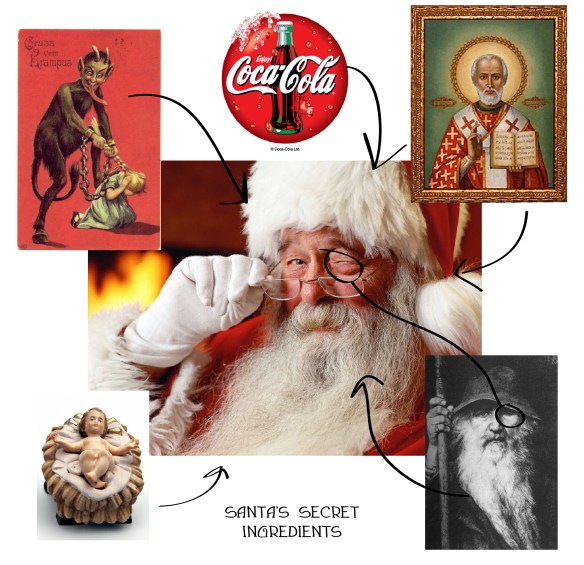
Santa, the Reindeer Shaman

origins-of-santa-claus-01

By Jerry B. Brown Ph.D. and Julie M. Brown M.A.

Source: Reality Sandwich

The following is excerpted from The Psychedelic Gospels by Jerry B. Brown, Ph.D. and Julie M. Brown, M.A., published by Inner Traditions. 

On Christmas Eve, when the streets are all covered with snow and a hush falls over the land, parents recite the story of Santa Claus to wide-eyed children. They discreetly wink as they tell the timeworn tale of a jolly old elf who is dressed all in red and white from his head to his toes. Miraculously, Santa travels around the world in one night, in a sleigh pulled by flying reindeer, stopping at each home to place gifts under the Christmas tree festively decorated in tinsel and colorful ornaments with a star on top.

How improbable! How curious! But what if this snow-white lie, which we dutifully recount each year, was grounded in an ancient reality whose roots reach back thousands of years to the vast forests of Siberia? What if the real story of Santa was even stranger than that of the commercial myth of Saint Nick, the little sleigh driver “so lively and quick”? What if it was stranger than most of us could ever imagine?

It was high in the Cairngorms in the heart of the Scottish Highlands that Julie first heard the true story of Santa Claus and his flying ­reindeer. Driving east from the Isle of Skye, where we spent our twenty-fifth anniversary, Julie and I stopped in Inverness, located at the north end of Loch Ness. From there, we followed route A9 as it twisted and turned up into Cairngorms National Park. After lunch in the alpine resort town of Aviemore, Julie made a few phone calls and found lodging at the Braeriach Guest House. Sitting on the banks of the River Spey in the quaint village of Kingcraig, this two-story stone-walled Victorian inn has five guest rooms, all furnished with wooden sleigh beds. The view from our bedroom window looked out past a flower garden to the fast-moving river, on to a wide pastoral valley dotted with black-and-white cows, and up to the peaks of the snow-capped mountains. Over tea that afternoon, we asked our innkeeper Fiona, a refugee from the hubbub of London, what we should see during our stay.

“Oh, my favorite place would be to visit the wild reindeer. When you return, you can have dinner at the Boathouse Restaurant, only a twenty-minute walk from here through the forest.”

The following morning we drove to the long wooden cabin that housed the Cairngorm Reindeer Center. There we met three other couples and our guides, Beth and William, who would lead us up into the mountains. Beth explained that the “reindeer were reintroduced into Scotland in 1952 by a Swedish reindeer herder, Mikel Utsi. Starting from a few reindeer, the herd has grown in numbers over the years and is currently held at between a hundred and thirty and a hundred and fifty by controlling breeding.”1 About fifty of these reindeer live in a natural environment in the forests and highland plateaus nearby. The region is rich with lichen, the chief food of reindeer.

After the orientation we drove in a car caravan up a steep, curvy road. After parking in a small clearing, everyone donned knee-high Wellington boots. It was a cold day, and the trail was wet and muddy from a drizzling rain. We were excited and a bit apprehensive at the thought of encountering creatures in the wild. As the trail opened onto a large pasture, bordered by a dense dark-green forest, the sun broke through the clouds and the rain lifted. As we shed our rain gear, Will put down the sack of food he had carried on his shoulder and instructed us how to behave around the reindeer—who were still nowhere to be seen. “You can pet them, even touch their noses, but not their antlers. They grow very fast, a couple of inches a week, and are very sensitive.”

Just then, Beth began bellowing loudly. It felt eerie to be huddled together on a chilly hilltop while our guide howled into the wilderness. It took a minute before we realized that she was rounding up reindeer. Suddenly, we saw a huge light-brown stag emerge from the woods. He strode majestically toward us, his giant antlers swaying to and fro. Another reindeer followed and then another, slowly walking toward us, a plodding procession of caribou.

As the males, females, and calves drew closer Beth began calling them by name: Sting, Marley, Cranna, Oryx, Gandhi, Magnus . . . Elvis. As the herd approached, Will opened the sack and scooped pellets of food into our hands, telling us to pick a reindeer and go up to him slowly with outstretched arms. I walked up to a large bull. He nuzzled his warm, silky nose into my palms, gently licking them clean. Julie stood back and observed. Soon, everyone was talking, smiling, and even giggling at the sheer delight of being in the presence of these gentle caribou.

Julie noticed an albino reindeer standing off to the side, away from the herd. She asked Beth why he did not join the group.

“Oh, him. Sircus is his name,” Beth replied. “He only takes food from me or Will. He’s a real loner.”

“Really? Do you know why?” Julie inquired.

“I think it’s because he loves mushrooms so much,” Beth said.

At the mention of mushrooms, Julie’s ears perked up. She glanced over at me with a knowing look. Aha, she thought.

“Now, don’t get me wrong,” Beth continued. “All reindeer love fly agaric, but for Sircus they are his favorite food, even more than lichen. Sometimes, during the summer mushroom season, he eats so many that he just stands there mesmerized, staring into the sun, swaying back and forth. That’s why his face is so blotched and pink. It’s sunburned.”

As Beth finished speaking, Sircus turned toward Julie and without hesitation walked up to her. He placed his soft muzzle into her palms and ate slowly, all the while looking into her eyes. Julie glanced toward me, her face beaming. She stood still for a long while, gently petting Sircus. Then, just as quickly as they had appeared, the reindeer turned and ambled back toward the forest. Sircus followed. Everyone was silent on the downhill walk back to the cars.

“Jer,” Julie said softly to me, taking my hand along the trail, “I swear I had a real connection with Sircus, as if we knew each other. Don’t you think it strange that I could have such a spiritual encounter with a reindeer?”

“Yes, you must be Saint Francis of the animals,” I said.

Julie laughed and nodded her head in affirmation.

Rudolph, the Red-Nosed Reindeer

Once back at the inn, I was tired from our excursion and lay down to take a nap. But when I happened to glance over at the bookshelf next to the bed, I noticed the Field Guide to Mushrooms of Great Britain. Soon, I was turning its richly illustrated pages. After finding Sircus’s favorite, the red-and-white Amanita muscaria, I eventually fell into a deep and restful sleep.

When I awoke, I carried the field guide downstairs, planning to show it to Julie. I found her sitting near a roaring fireplace. She was engaged in animated conversation about our reindeer adventure with the other houseguests: Anne and John, a well-groomed, middle-aged couple from Devon, whose English accent I could understand if I listened carefully, and Bonny and Sid, young punk bikers from Liverpool whom I could barely understand at all. No wonder George Bernard Shaw observed, “England and America are two countries separated by a common language.”

After Julie mentioned that the Reindeer Center rented the caribou out during the Yuletide season to pull sleighs bearing gifts for children across Great Britain, the conversation turned to Christmas and Santa Claus.

“Does anyone know what Santa has to do with Christmas, the birth of Jesus, and this?” I asked, opening the mushroom field guide and showing everyone the photo of the bright red Amanita mushroom covered with snowy white dots.

Before I could finish the sentence, I felt Julie’s two hands firmly tugging on my arm, as she said in her calming therapist’s voice, “Sorry to interrupt, honey, but if we don’t leave now, we won’t be able to walk to dinner and back before dark.”

We strolled under tall trees whose leaves sparkled in the late afternoon sunlight. The air carried a sweet scent of wildflowers. Soon we came to the rustic restaurant on the banks of an alpine lake. After finishing the delectable grilled trout fresh from the lake, Julie asked pointedly, “What were you thinking back there?”

“I was just trying to explain my theory of Santa Claus,” I said defensively.

“I . . .” “Come on. You know what I’m talking about,” Julie objected. “What about our vow of secrecy, the one we made to each other at the beginning of this trip? Right before I escorted you out the door, you were about to blurt out that we were searching for the psychedelic roots of Christianity. I need to know that you won’t go around talking to people about our work while we are on this research trip.”

“Okay, I promise,” I replied.

“Now, tell me,” Julie said with a sigh of relief, “what were you trying to say about Santa back there at the inn?”

“While most people think of Christmas in terms of the quintessential Christian celebration,” I began, “the truth is that nearly all of the symbols associated with Santa Claus are based on the shamanic traditions of pre-Christian Europe.”

“I always thought of shamanism as a tribal religion,” Julie said. “I certainly never thought of Santa as a shaman! What do you mean?”

Archaic Techniques of Ecstasy

The classic anthropological definition of shamanism comes from ­Mircea Eliade (1907–1986), who described it as “archaic techniques of ecstasy.” By “ecstasy” he was invoking the Greek term ekstasis, which literally means “to be outside oneself” and in this context figuratively means “flight of the soul.” In essence, shamanism refers to ancient methods for inducing the flight of the soul, for both the living and the recently deceased. One of the most concise descriptions of the ­universal ­foundations of shamanism is found in Peter Furst’s Hallucinogens and Culture. These foundations include “the skeletal soul of man and animal and the restitution of life from the bones; all phenomena in the environment as animate; [and] separability of the soul from the body during life.”

At the very center of these belief systems stands the persona of the shaman and his or her unique ecstatic experience. With the aid of spirit helpers he can travel to and intercede with the supernatural forces of the Upperworld and Underworld whose mystical geography he has traversed through training and trance. Frequently, although not always, his mastery comes from the use of sacred psychoactive plants, which serve both as a portal to other realms and as a source of transforming power or “soul stuff.” With the concept of “transformation” so fundamental to this worldview, it is easy to see why sacred plants with the power to radically alter consciousness and provide direct access to these supernatural realms would be universally revered in ancient religions. Throughout prehistory the religions of our ancestors were shamanistic.

“But how does shamanism work?” Julie asked.

Seeing a puzzled look on Julie’s face, I searched for an analogy.

“Imagine yourself,” I replied, “as a Koryak reindeer herder living a nomadic existence in the endless boreal forest belt of Siberia. You live in a world without maps, compasses, or clocks and certainly without GPS. Season upon season you travel with your clan and reindeer herd through a seamless landscape of green and brown forests sometimes interrupted by the blues and grays of lakes and rivers. Then one day you watch your favorite reindeer nibble on a bright red-and-white mushroom that popped up out of the moist ground overnight. Suddenly, the reindeer begins to cavort about in a very un-reindeer-like fashion. You try the mushroom and soon find yourself transported through magical landscapes filled with talking spirits who instruct you how to live well and prosper.”

Julie was listening intently as I asked her, “So what would you think about this world?”

“That it was showing me a spirit world that could help me thrive in the natural world,” Julie replied.

“Precisely,” I agreed, “and that’s the point. For tribal peoples, these supernatural realms were accessed through the shamanic flight of the soul. It’s only within the context of shamanism that we can understand the true origins of Santa Claus.”

Mushroom Rock Art of the Chukchi

Often overlooked and certainly overshadowed by Wasson’s cracking of the Soma code in the Rigveda is his equally surprising discovery of an ancient “Siberian fly-agaric complex” among the ancient indigenous peoples of the Arctic Circle. Peering deep into the wellsprings of time long before the Aryan invasion on the Indus Valley,* Wasson traced the roots of Aryan worship of the Soma mushroom back some six thousand years to the semi-nomadic reindeer herders of Eurasia known to anthropologists as the fathers of shamanism. Today there remain some three hundred thousand reindeer herders divided into thirty ethnolinguistic groups.

*According to the widely accepted Aryan invasion theory, between the fourth and second centuries BCE, several migrations occurred involving different Proto-Indo-Aryan groups from the steppes of central Asia toward the alluvial plains and valleys of northwest India. However, academics continue to debate whether the Indo-Aryans invaded and assimilated the less sophisticated Indus Valley cultures, or whether the Indo-Aryans moved in as the superior Indus Valley civilization was in a state of decline, adopting their mythologies and technologies. They inhabit three far-flung, forest-belt regions of Russia and Scandinavia. Among them are the Lapps and Nenets in the Far West; the Ostyak, Samoyed, and Vogul of the central tundra and taiga zones; and the Chukchi, Koryak, and Kamchadal who live in the extreme Far East of Russia.

When Wasson published Soma in 1968, he had to rely on secondhand data derived from folk tales and linguistic analysis and on the firsthand accounts of “explorers, travelers, and anthropologists” who visited these remote regions as far back as the late eighteenth century.4 At that time he was unaware of recent Russian archaeological expeditions that had found iconic evidence—dramatic images etched in stone—of the use of psychoactive mushrooms among the ancient Chukchi.

During field expeditions in 1967 and 1968, Russian archaeologist N. N. Dikov discovered numerous mushroom and reindeer petroglyphs (rock carvings dating from 1000 BCE) on the banks of the Pegtymel River in the Far Eastern Chukotka region, located across the Bering Sea from Alaska. These rock drawings graphically reflect the worldview of nomadic herders and their traditional shamanic practice of ingesting Amanita muscaria. Since that initial discovery, Russian researchers have identified more than two hundred similar compositions at rock art centers in northern Russian, mainly in areas inhabited by reindeer herders.

The central images of these carvings are reindeer and an increasing number of “incomparable” anthropomorphic images of people, mainly women, wearing huge mushroom-shaped hats or, in another interpretation, dancing women with mushrooms hovering over or emanating from the crowns of their heads.

The northern region where these figures are found is one where fly agaric thrive. In a later work, observing that these “doubtless” Amanita muscaria “mushrooms were much larger in scale than normal,” certainly when compared to the humanlike figures, Wasson concurs that this suggests “mushroom possession.” A common theme in these visions is the personification of the spirit (wapaq) of the mushroom as “little men or women.” The Koryak believe that the spirits residing in the fly agaric appear in the form of tiny mushroom folk who give instructions to the be-mushroomed person. One observer reports that among the Ob-Ungrians, “the mushroom eater enters the realm of the little people, talks with them, learns from them what he wishes to know—the future, the outlook for a sick person, etc.”

Santa, the Reindeer Shaman

“So are you saying that the story of Santa Claus originated with the reindeer herders?” Julie asked.

“Not at all,” I replied, “simply this: while most people think of Christmas in terms of the classic Christian holiday, the truth is that most of the symbols associated with Santa Claus are based on the religious traditions of pre-Christian Europe. In fact, every major meme of our modern myth of Santa Claus can be found in Wasson’s pioneering description of a Siberian fly agaric–reindeer culture.

“Convince me,” Julie insisted.

“Okay, I will,” I replied.

Flying Reindeer

In Soma, Wasson notes that “reindeer have a passion for mushrooms and especially for the fly-agaric, on which they inebriate themselves. Reindeer have a passion for urine and especially human urine. (When the human urine is impregnated with fly-agaric, what regal cate is there, to be served to a favored reindeer!)”9 In fact, some herders carry sealskins filled with their own urine to lure stray reindeer back to the herd.

Reindeer have a seminal place in the lives of these semi-nomadic herders as the primary source of useful everyday articles and of spiritual significance. Practically, the reindeer provide transporation by sleigh, food and milk, clothing, shelter in the form of skins for yurts, tools, and many other necessities. Spiritually, flying reindeer serve as guides for shamans, transporting them through the spirit world. The hundreds of flying reindeer megaliths found in Siberia and Mongolia offer graphic representations of myths and legends about winged reindeer who transport their ecstatic riders up into the highest branches of the Cosmic Tree, universally revered by ancient peoples as the Tree of Life.

Christmas Tree as Cosmic Tree

In addition to the nearly universal flood myth similar to the story of Noah in the Bible, many tribal cultures have a deep belief in a sacred Cosmic Tree. In the context of shamanism, this tree provides a cosmic axis around which the three planes of the universe revolve. Its roots run deep into the Underworld, its trunk holds Middle Earth, and its branches reach skyward into the Upperworld.

The birch, pine, cedar, and fir trees play a conspicuous role among Siberian cultures and serve as the nodal points for shamanism. But it was Wasson who first pointed out that birches and evergreens play an essential role in the life cycle of the fly agaric. This is because fly agaric has a symbiotic relationship with these trees in that its invisible spores colonize the host trees’ roots prior to the mushroom bursting into view aboveground as an early stage Amanita muscaria, wrapped in a pure white veil. As a result, tribespeople were amazed to witness how these mushrooms apparently sprang from the earth without any visible seeds in what appears to be a virgin birth.

Like the Cosmic Tree, the center point between heaven and earth, the North Star is also considered sacred. Among reindeer herders, it is also known as the “Immobile Star” or the “Pole Star,” because all the stars in the heavens revolve around it. Thus today we symbolically place a star at the tippy-top of the Christmas tree, and for this reason Santa makes his home in the North Pole.

Santa, the Archetypal Shaman

Our contemporary image of Santa Claus as a rotund, jolly, white-bearded fellow in a red suit (or robe) with white fir trim is a modern version of the archetypal Siberian mushroom shaman. In fact, even today some Siberian male shamans and female mushroom gatherers still dress in ceremonial red-and-white trimmed jackets when they go to gather the sacred mushrooms. The biochemical effects of Soma are most pleasant and transformative when the mushrooms are dried before consumption. For this reason, the shaman initially hangs the fresh fungi to dry in the branches of pine trees (like the colorful ornaments that decorate the Christmas tree).

After the mushroom harvest is complete, the shaman collects his gifts in a sack and places them on his sleigh, which a team of reindeer pulls back to his yurt (Santa’s sleigh full of toys, pulled by flying reindeer). A yurt is the nomad’s teepee-like dwelling typically made out of birch branches and reindeer hides. In winter, snow drifts can cover the yurt’s main entrance, so the shaman enters through the smoke hole at the top (Santa coming down the chimney) to deliver his gifts to appreciative clan members. To further dry the mushrooms, they string them up around the fireplace, and in the morning they awaken to a ritual feast of dried magic mushrooms (Christmas gifts placed in stockings over the fireplace). Once they ingest the mushrooms, the celebrants leave the physical plane and are transported to the mystical realms of the Cosmic Tree, guided by spirits that live within the mushrooms (Santa’s helpers, elves that live in the North Pole).

All of these Christmas themes include the image of Santa Claus: the Christmas tree, the flying reindeer pulling Santa’s sleigh, Santa coming down the chimney, the exchange of gifts—even the elves who live in Santa’s workshop at the North Pole.

Dusk was falling as we started to walk back around the lake toward the inn. The Santa Claus conversation had sparked Julie’s inquisitiveness. “What about the Christian Saint Nicholas?”

“To be sure, religious historians argue that many saints were simply Christian versions of earlier pagan gods, adapted by the church to encourage heathens to accept the new religion of Rome. It is said that Saint Nicholas’s legends were created mainly out of folk tales about the Teutonic god Hold Nickar, a malevolent water spirit who tips over boats and torments sailors, or even about Alte Hoerner, which stands for ‘Old Horney.’

Julie smiled at the sexual reference to Santa Claus.

“No, no, it’s not what you’re thinking. In old German, Alte Hoerner literally means ‘old horned one’ and in this case the ‘ancient horned god,’ referring to the headdress of reindeer antlers worn by Eurasian shamans. Later on, when pagan deities were demonized by the medieval church under Pope Gregory, the horned god of shamanism became the devil of Christianity. And ‘Santa’ became ‘Satan.’”

“Rings of Smoke through the Trees”

“Look, look around us!” whispered Julie. A low-hanging cloud was slowly creeping through the woods, completely encircling us in a ring of ghostly white gossamer. The mist moved silent as cat paws, covering the ground and the trunks of the trees in a blanket of clouds. The tops of trees stood bare, silhouetted against the gun-metal sky and the fading sun, silent sentinels of the forest.

“Jer,” Julie spoke, in hushed tones, “this is unearthly. All evening, we’ve been talking about the way of the shaman, portals between the worlds, about how all things are alive with spirit.”

“Look,” I said, patiently, “just because this rare cloud rolls in just as we were discussing shamanism doesn’t mean there’s a connection. You can’t prove that; no one can.”

“No, I can’t prove it,” Julie spoke quietly, “but think about what’s happened today! We came to the mountains for vacation, and I met Sircus, an albino, Amanita-loving reindeer, who walks up to me and peers into my soul. We spend the evening talking about mystical realms. And now all around us the forest is alive, as if the living spirit of nature was welcoming us to the world of the shaman . . . affirming our decision to retrace Wasson’s steps.”

I was about to object, but just then these lines from Led Zeppelin’s “Stairway to Heaven” ran through my head: “There’s a feeling I get when I look to the west/ And my spirit is crying for leaving. In my thoughts I have seen rings of smoke through the trees/ And the voices of those who stand looking. Ooh, it makes me wonder/ Ooh, it really makes me wonder.”

We stood silently in the middle of the mist-filled forest, wondering what the future would bring. At our next stop in Greece, the cradle of Western civilization, we walked among the monumental ruins of Eleusis, where rituals involving entheogens had been practiced for two thousand years.

Escapism as Spiritual Journey

mobile-marketing-coming-to-virtual-reality

By rahkyt

Source: Sacred Space in Time

People are racing to leave this world.

Seriously.

There are virtual reality worlds you can immerse yourself in, there are fantasy role-playing worlds too. One, you can put on a headset or stare at a screen to enjoy and the other you play on boards with pieces with your friends. Both, you can lose yourself in for hours out of the day.
Or, you can go the spiritual route.

Become a New Ager, a Wiccan, a Pagan or Luciferian and learn how to astral travel or experience OOBEs. You can visit the Fae or the Reptilian and Mantis peoples; you can communicate with Galactic Councils, you may even be a member of one! You can experience your past lives and leave this one behind, living in the energy streams and the cocoon of coalescing consciousness they call the Alternative Community.

Some People are doing what they can to leave this world behind. Or should I say, some aspects of it. To voluntarily give up your grounding in Gaia is a serious thing.

People say they’re alien, ain’t from here, feel alienated from other types of humans, feel closer to machines and dream of transhumanistic transformations to our world, where the virtual will become the real world and biomechanical implants are the norm rather than the exception.

All I’m saying, is be careful what you wish for. For real.

Allow your imagination to soar free for a while and envision the consequences of your leaving this world, and the people that you don’t like, behind. What checking out of the necessity of saving the world in favor of dreaming fantasies about a future world will mean.

The manifestation of whatever the active (yin) and passive (yang) states co-create will reflect these simultaneous forms of grounding and soaring, vibratory rates of simpatico energetically supporting and releasing souls into their destinies sans plan. Or, seemingly so, at least.

It all looks crazy from this vantage point. If you gotta go join your star family, peace and well being to you. Best of luck. But if you feel your destiny is here on earth, with us mere earthlings of all persuasions and potentialities, we welcome you to join the fight. The Light against the Dark. My name is Mark. Welcome.

Ah…if only it were so simple. But shades of grey reign, as the world seems to be headed down the track in the face of an oncoming freight train, carrying Nazis and Fascists, Epidemics and comet strikes, nuclear waste and dead ocean life.

Maybe the escapists have it right.

Well, whatever the case may be, the world is splitting in twain. Two groups, one seeking the spiritual flow, the other immersed in the world we know.

Which side do you come down on? Dreaming of bringing heaven to earth and making man into gods or getting ready for the Ascension and the New Rebirth? Is Jesus coming to get you? The Maitreya singing siren songs? Or does Deus ex Machina call, luring you down into computerized depths, never to return to the meat haven of Gaia’s bowels?

Whatever folks choose, is what they will experience. Guarantee it. So better choose right. Might not have another chance, past tonight.

6 The Enlightened Madness of Philip K. Dick: The Black Iron Prison and Wetiko

images

(Editor’s note: Today happens to mark the anniversary of the birth of Philip K. Dick on December 16, 1928.)

By Paul Levy

There is something terribly wrong in our world. The Native American people have a term—wetiko—that can really help us to contextualize and get more of a handle on the ever-unfolding catastrophe playing out all over our planet. As my research deepens, I am continually amazed that so many different spiritual wisdom traditions, as well as creative artists, are each in their own unique ways, pointing out wetiko. Wetiko—which can be likened to a virus of the mind—works through our unconscious blind spots, which is to say that it depends upon our unawareness of its covert operations within our own minds to keep itself in business. There is no one definitive model that fully delineates the elusive workings of wetiko disease, but when all of these unique articulations are seen together, a deeper picture begins to get in focus that can help us to see it. Seeing how wetiko works—both out in the world and within our own minds—is its worst nightmare, for once we see how it is playing us, its gig is up.

Recently, I have been delighted to learn that the science fiction author Philip K. Dick (henceforth PKD) was, in his own completely unique and “Philip K. Dickian” way describing wetiko—the psycho-spiritual disease that afflicts our species—to a T. Considered to be one of the pre-eminent sci-fi writers of his—or any—time, PKD had one of the most unique, creative, unusual and original minds I have ever come across. Way ahead of his time, he was a true visionary and seer, possibly even a prophet. To say that PKD had an unfettered imagination is an understatement of epic proportions—it is hard to imagine an imagination more unrestrained. Continually questioning everything, he was actually a very subtle thinker whose prime concern was the question “What is reality?”

Though mainly a writer of fiction, PKD didn’t consider himself a novelist, but rather, a “fictionalizing philosopher,” by which he meant that his stories—what have been called “his wacky cauldron of science fiction and metaphysics”[1]—were employed as the medium for him to formulate his perceptions. In other words, his fiction was the way he was trying to figure out what was going on in this crazy world of ours, as well as within his own mind. As the boundary dissolved between what was real and what wasn’t, he even wondered whether he had become a character in one of his own novels (in his own words, “I’m a protagonist from one of PKD’s books”). Through his writing, PKD tapped into the shamanic powers of language to shape, bend and alter consciousness, thereby changing our view and experience of reality itself.

From all accounts, it is clear that PKD’s life involved deep suffering; his process included bungled suicide attempts, self-described psychotic episodes, psychiatric hospitalizations and abuse of drugs (he was a “speed writer,” in that most of his writing was fueled by speed—amphetamines). We shouldn’t throw the baby out with the bathwater, however, and use these facts to invalidate his insights or dismiss the profundity of his work. Though much of what he wrote came out of whatever extreme state he was in at the moment, he was definitely (in my opinion) plugged into something profound. PKD was a true creative artist who, in wrestling with his demons, left us a testament that can help us illumine our own struggles.

In 1974 Dick had—at least from his point of view—an overwhelming mystical experience, which he spent the rest of his life trying to understand and integrate. He was thrown into a “crisis of revelation,” feeling an inner demand to understand what had been revealed to him. I love that he didn’t have a fixed point of view in his inquiry, but, depending on the day, wondered whether he had become, in his words, a saint or schizophrenic. He continually came up with new theories and viewpoints, depending upon who knows what. There is no psychiatric category yet devised that could do justice to the combination of genius and high weirdness that characterized PKD’s process. It is clear from his philosophical writings, letters and personal journal (his “Exegesis”) that whatever it was he experienced in 1974 radically changed his whole perception of the universe and his—and our—place in it.

PKD confesses in his letters that the world has always seemed “dreamlike” to him. To quote PKD, “The universe could turn into a dream because in point of fact our universe is a dream.”[2] We are asleep—in a dream state—and mistakenly think we are awake. PKD writes in his journal, “We are forgetful cosmocrators [i.e., rulers], trapped in a universe of our own making without our knowing it.”[3] It is as if we are living inside of a dreamlike universe, but in our state of amnesia we have forgotten that we are the dream’s creators—the dreamers of the dream—and hence, have become trapped inside of a world that is our own creation. As PKD points out, “one of the fundamental aspects of the ontological category of ignorance is ignorance of this very ignorance; he not only does not know, he does not know that he does not know.”[4] We ignore—and remain ignorant of—what PKD is pointing at to our own peril.

I imagine that if PKD were here today he would be most pleased to learn that his mind-blowing revelations were helping us to wrap our minds around the over-the-top craziness that is getting acted out in every corner of our world. Not only precisely mapping the covert operations of the destructive aspects of wetiko, PKD offers psycho-activating insights into how to deal with its insidious workings that are novel beyond belief, insights that can therefore add to the ever-growing corpus of studies on wetiko. Like a modern-day shaman, PKD descended into the darkness of the underworld of the unconscious and took on—and into himself—the existential madness that afflicts humanity, and in his creative articulations of his experience, is offering gifts for all the rest of us. For this we should be most grateful.

The Black Iron Prison

We are trapped in a dream of our own making. PKD writes, “We are in a kind of prison but do not know it.”[5] Becoming aware of our imprisonment, however, is the first, crucial step in becoming free of it. One of the main terms PKD coined to describe wetiko is the “Black Iron Prison” [henceforth BIP]. PKD writes, “The BIP is a vast complex life form (organism) which protects itself by inducing a negative hallucination of it.”[6] By negative hallucination, PKD means that instead of seeing what is not there, we cannot see whatis there. In PKD’s words, “The criminal virus controls by occluding (putting us in a sort of half sleep)…. The occlusion is self-perpetuating; it makes us unaware of it.”[7] Being self-perpetuating, this occlusion in our consciousness will not go away of its own accord; it acts as a feedback loop (in PKD’s words, “a positive feedback on itself”) that perpetually self-generates until we manage to break its spell. PKD writes, “the very occlusion itself prevents us from assessing, overcoming or ever being aware of the occlusion.”[8]

An intrinsic challenge to our investigation of wetiko/BIP is that it is incarnating in and through the very psyche which itself is the means of our inquiry. Speaking about the difficulty of seeing wetiko/BIP, PKD writes, “we alter it by perceiving it, since we are not outside it. As our views shift, it shifts. In a sense it is not there at all.”[9] Similar to how an image in a dream doesn’t exist separate from the mind of the dreamer, wetiko/BIP does not objectively exist, independent from the mind that is perceiving it. In our encounter with wetiko, we find ourselves in a situation where we are confronted—practically face-to-face—with the unconscious, both its light and darker halves.

There is another problem with seeing wetiko/BIP. Because it is invisible to most people, seeing it can be an isolating experience. When we see wetiko/BIP, we are, in PKD’s words, “seeing what is there—but no one else does, hence no semantic sign exists to depict the entity and therefore the organism cannot continue an empathic relationship with the members of his society. And this breakdown of empathy is double; they can’t empathize his ‘world,’ and he can’t theirs.”[10] This points to the important role language plays in human life—it is the cardinal instrument through which individual worldviews are linked so that a shared, agreed-upon, and for all intents and purposes common reality is constructed. Hence, creating language and finding the name—be it wetiko, the Black Iron Prison or whatever we call it—is crucial for getting a handle on this elusive mind-virus.

It is as if our species is suffering from a thought-disorder. PKD writes, “There is some kind of ubiquitous thinking dysfunction which goes unnoticed especially by the persons themselves, and this is the horrifying part of it: somehow the self-monitoring circuit in the person is fooled by the very dysfunction it is supposed to monitor.”[11] When we have fallen under the spell of the wetiko virus, we aren’t aware of our affliction; from our point of view we are normal, oftentimes never feeling more ourselves (while the exact opposite is actually true; i.e., we have been taken over by something alien to ourselves). Working through the projective tendencies of the mind, wetiko distracts us by exploiting our unconscious habitual tendency to see the source of our problems outside of ourselves.

Speaking of the BIP, PKD writes, “We are supposed to combat it phagocyte-wise, but the very valence of the (BIP) stasis warps us into micro-extensions of itself; this is precisely why it is so dangerous. This is the dread thing it does: extending its android thinking (uniformity) more and more extensively. It exerts a dreadful and subtle power, and more and more people fall into its field (power), by means of which it grows.”[12] “Android thinking,” i.e., robotic, machine-like group-thinking (with no creativity programmed in), is one of the qualities of a mind taken over by wetiko/BIP. Just as someone bit by a vampire becomes a vampire themselves, if we don’t see how wetiko/BIP works through our unconscious blind spots, it “warps us into micro-extensions of itself” such that we unwittingly become its purveyors, which is how it propagates itself in the field.

Masses are breeding grounds for this nefarious mind virus to flourish. Wetiko/BIP is not just something that afflicts individuals—it is a collective psychosis that can only work the full power of its black magic through groups of people. In his bookThe Divine Invasion, PKD has one of his characters say, “Sometimes I think this planet is under a spell…. We are asleep or in a trance.” Along similar lines, in hisExegesis, PKD writes, “We got entangled in enchantment, a gingerbread cottage that beguiled us into enslavement and ruin…we are not merely enslaved, we are trapped.”[13] As if living within a mythic or fairy tale-like reality, our species is under a bewitchment—a seeming curse—of massive proportions. Contemplating “the basic condition of life,” PKD writes that each one of us will “be required to violate your own identity…this is the curse at work, the curse that feeds on all life.”[14] This curse that feeds on life is another name for wetiko/BIP. Thankfully, in his writings PKD gives us clues regarding how to break out of this curse.

We can’t break out of the curse, however, without first shedding light on the nature of the darkness we have fallen into that is informing the curse. Giving a precise description of how wetiko/BIP works, PKD writes, “This is a sinister life form indeed. First it takes power over us, reducing us to slaves, and then it causes us to forget our former state, and be unable to see or to think straight, and not to know we can’t see or think straight, and finally it becomes invisible to us by reason of what it has done to us. We cannot even monitor our own deformity, our own impairment.”[15] A complex and seemingly malevolent life form, wetiko/BIP works through the cover of the unconscious, rendering itself invisible to our conscious awareness. It feeds off of and into our unawareness of it.

Further elaborating the BIP, PKD writes, “It can not only affect our percept systems directly but can alter our memories.”[16] We become convinced that our—i.e., “its”—memories are objectively real, therefore feeding into the self-limiting and self-defeating narrative the virus wants us to believe about ourselves. We then tell stories—both to others as well as ourselves—about who we are and what happened to us in the past to make us this way in a manner that reifies us into a solidified identity. In The Divine Invasion, PKD has a character say, “something causes us to see what it wants us to see and remember and think what it wants us to remember and think.” Are these the ravings of a paranoid madman, or insights of someone who is seeing through the illusion, snapping out of the spell and waking up?

PKD writes, “It is as if the immune system has failed to detect an invader, a pathogen (shades of William Burroughs: a criminal virus!). Yes, the human brain has been invaded, and once invaded, is occluded to the invasion and the damage resulting from the invasion; it has now become an instrument for the pathogen: it winds up serving as its slave, and thus the ‘heavy metal speck’ [i.e., the BIP] is replicated (spread through linear and lateral time, and through space).”[17] The mind invaded becomes an unwitting channel for the pathogen to further propagate and spread itself in and through the field.

To quote PKD, “We may not be what we seem even to ourselves.”[18] Wetiko/BIP is a shape-shifting bug; it cloaks itself in and assumes our form, impersonating us such that we then identify with its limited and impoverished version of who we are while we simultaneously dissociate from—and forget—who we actually are. Wetiko/BIP is in competition with us for a share of our own mind; it literally does everything it can to think in our place, sit in our seat and occupy—and possess—our very selves. Speaking of this very situation, PKD writes, “A usurper is on the throne.”[19]

Having no creativity on its own, once wetiko “puts us on,” i.e., fools us into buying into its version of who we are, it can then piggyback onto and plug into our intrinsic creativity, co-opting our creative imagination to serve its malevolent agenda. PKD writes, “Being without psyche of its own it slays the authentic psyches of those creatures locked into it, and replaces them with a spurious microform of its own dead psyche.”[20] Sometimes using the phrase the “Black Iron Prison Police State” (which is mirrored externally in the ever-increasing “police state” of the world), PKD also describes this state as one where the person so afflicted becomes “frozen” (as in trauma), in a “corpse-state” (i.e., spiritually dead).

Wetiko/BIP can be conceived of as a cancer of the psyche that slowly metastasizes, gradually subsuming all of the healthy parts of the psyche into itself to serve its sinister agenda. Speaking of the part of the psyche that has been captured by the BIP, PKD comments, “This section died. It became fossilized, and merely repeats itself. This is scary; it is like mental illness: ‘one day nothing new ever entered his mind—and the last thought just recirculated endlessly.’ Thus death rules here…The BIP is the form of this death, its embodiment—of what is wrong, here.”[21] Like a vampire, wetiko/BIP is—and turns us into—one of the undead; it is death taking on living human form so as to take life. Wetiko/BIP, like a virus, is “dead” matter, it is only in a living creature that viruses acquire a “quasi-life.” When we fall under wetiko’s spell, our life-force and God-given creativity become vampirically drained, as we are bled dry of what really counts.

Commenting on the BIP, PKD continues, “To see it is to see the ailment, the complex which warps all other thoughts to it.”[22] To see the BIP is to begin to heal it; there is no healing it without first seeing it. Once wetiko/BIP entrenches itself within a psyche, however, the personality then becomes one-sided, self-organizing an outer display of coherence around this pathogenic core, which masks the inner dysfunction, making it hard to recognize. In a psychic coup d’état, the wetiko bug can usurp and displace a person—or a group of people—who become its puppet and marionette. To quote PKD, “We’re a fucking goddam “Biosphere” ruled by an entity who—like a hypnotist—can make us not only quack like a duck on cue, but imagine, to boot, that we wanted (decided) to quack.”[23]

PKD comments that when “we begin to see what formerly was concealed to us, or from us, and the shock is great, since we have, all our lives, been trading (doing business) with evil.”[24] This is one of the reasons it is so hard to see wetiko/BIP—there is a counterincentive built into seeing it, as we have to be strong enough to bear the trauma of seeing our own collusion with darkness. If we choose to look away from how the BIP occludes us and become resistant to bringing awareness to the nature of our situation, we are then being unconsciously complicit in our own imprisonment. To quote PKD, “So there was a base collusion between us andthe BIP: it was a kind of pact!”[25] He conjectures, “we’re sources of psychic/psychological energy to it: we help power it.”[26]

As if we are in a double-bind with no exit, PKD points out that “the enslaved people cannot be rescued by departing the Empire [the BIP] because the Empire is worldwide.”[27] Existing within the collective unconscious itself, wetiko/BIP/Empire is ubiquitous; being nonlocal it can’t be located within the third-dimensional space-time matrix, and yet, there is no place where it is not. Its very root—as well as the medium through which it operates—is the psyche, which is somehow able to inform, extend itself and give shape to events in our world. To think that the ultimate source of the horrors that are playing out in our world is to be found somewhere other than within the human psyche is to be truly dis-oriented, i.e., looking in the wrong direction.

PKD writes, “The very doctrine of combating the ‘hostile world and its power’ has to a large extent been ossified by and put at the service of the Empire.”[28] In fighting the seeming demonic power of wetiko/BIP/Empire, we are playing its game and have already lost, as it feeds off of polarization. PKD warns that “the BIP warps every new effort at freedom into the mold of further tyranny.”[29] Even our thoughts regarding how to solve the BIP only “fuel” the seeming reality of the BIP. The Empire/BIP/wetiko will subvert every attempt at shedding light on its darkness in such a way as to feed the very darkness we are trying to illumine. And yet, if we don’t fight it, then we have no chance. What are we to do?

PKD opines, “The idea is to break the BIP’s power by revealing more and more about it.”[30] Just as a vampire loses its power in the light of day, wetiko/BIP has no power in the light of conscious awareness. To quote PKD, “The Empire is only a phantasm, lingering because we have gone to sleep.”[31] It is as if the Empire/BIP/wetiko is an after-image that we have mistaken for being real; PKD refers to it as a “deceitful corpse” that apes life. The idea is to shed light on darkness—what good is seeing the light if our vision doesn’t illumine the darkness? The Gnostic text The Gospel of Philip says, “So long as the root of wickedness is hidden, it is strong. But when it is recognized, it is dissolved. When it is revealed, it perishes…. It is powerful because we have not recognized it.” (II, 3, 83.5-30.)

Fake Fakes

Wetiko/BIP can be likened to an “anti-information” virus—not only does it block the reception of information, but it substitutes false information for the real thing. PKD writes, “the bombardment of pseudorealities begins to produce inauthentic humans very quickly [in his words ‘spurious humans’].”[32] PKD writes of the BIP, “it has grown vine-like into our information media; it is an information life form.”[33] It is an info life form (composed of and creating living dis-information) that lies to us—PKD compares this to the figure of Satan, who is “the liar.” Wetiko/BIP has co-opted the mainstream, corporatized media to be its propaganda organ, which becomes its instrument for creating—and delivering into our minds—fictitious realities. These institutions have, to quote PKD “an astonishing power: that of creating whole universes, universes of the mind. I ought to know. I do the same thing. It is my job to create universes.”[34]

PKD was intensely interested in what makes an authentic human being. He continues, “Fake realities will produce fake humans. Or, fake humans will produce fake realities and then sell them to other humans, turning them, eventually, into forgeries of themselves.”[35] An authentic human being, on the other hand, to quote PKD, “cannot be compelled to be what they are not.”[36] He elaborates, “The power of spurious realities battering at us today—these deliberately manufactured fakes never penetrate to the heart of true human beings.”[37]

Wetiko/BIP has no creativity on its own, but is a master of imitation—it apes, mimes and impersonates both our world and ourselves, such that, if we identify with its version of the way things are, we have then given ourselves away. Succinctly stating the problem, PKD writes, “The problem is that a mock creation has filtered in, which must be transubstantiated into the real.”[38] Our universe is a collectively shared dream or hallucination that appears real; in PKD’s words, “our reality is a cunning counterfeit, mutually shared.”[39] To imbue our world with an intrinsic, objective reality that exists separate from the mind that is observing it would be, in PKD’s words, “a dreadful intellectual error.”

Pointing directly at wetiko/BIP, PKD writes that “there is a vast life form here, that has invaded this world and is camouflaged.”[40] He marvels at how it camouflages itself; in PKD’s words, it “simulated normal objects and their processes so as to copy them and in such an artful way as to make himself [the BIP] invisible within them.”[41] Through its mimicry of real phenomenal objects, the BIP, in PKD’s words, “steadily, stealthily replaces them and mimics—assumes their form.”[42] Though PKD’s writings appear “out there,” and can easily sound crazy, paranoid and conspiratorial, it should be pointed out that what he is pointing at is exactly what an apocryphal text of the Bible is referring to when it speaks of a “counterfeiting spirit.”[43]

PKD has articulated wetiko’s/BIP’s counterfeiting ability—and how the universe responds—in a way that only he can. He has realized that the very ground of being itself—PKD refers to it by various names—Christ, God, the Savior, the Urgrund (a German term used by both Meister Eckhart and Jacob Boehme to describe ultimate reality)—is responding to wetiko/BIP in a very unique and revelatory way. As the BIP mimes reality so as to create a counterfeit of the real thing, the ground of reality, in PKD’s words, “counterfeits the counterfeit.” In PKD’s words, “So originally the bogus info mimicked the actual successfully enough to fool us, and now we have a situation in which the actual has returned in a form mimicking the bogus.”[44]

Wetiko/BIP has created an illusory, fake world, and the ground of being itself, in a radically new ontological category that PKD calls a “fake fake,” has imitated the imitation. Delighted by this new idea, PKD asks the question, “Is a fake fake more fake than just a fake, or null-fake?”[45] In other words, if a fake fake is not more fake than a fake, is it the real thing? PDK’s idea of a fake fake is cognate to the indeterminacy between originals and simulacra that is the hallmark of the world of virtual reality. To quote PKD, “A fake fake = something real. The demiurge [the false God in Gnosticism] unsuccessfully counterfeited the pleroma, and now God/the Savior is mimicking this counterfeit cosmos with a stealthily growingrealone.”[46] In other words, God/the ground of being is assimilating our seemingly counterfeit universe into and as itself.

Writing about the Savior, PKD writes that “it doesn’t want its adversary to know it’s here, so it must disguise (randomize) its presence, including by giving out self discrediting information; as if mimicking a hoax.”[47] Just like the BIP tricks us into identifying with its world, the true ground of being tricks the BIP by surreptitiously imitating and becoming it; i.e., taking it on (and into itself). It doesn’t want to let the BIP know it is doing this, which would defeat the purpose of its counter-ploy; the Savior does its mimicry on the sly. PKD comments, “The Urgrund does not advertise to the artifact [i.e., wetiko/BIP] that it is here.”[48] Just as the BIP works through our blind spots, the ground of being works through the BIP’s blind spots. PKD comments, “the artifact is as occluded as to the nature and existence of the Urgrund as we are to the artifact.”[49] Like an underground resistance movement, the Urgrund’s activities, in PKD’s words, “resemble the covert advance of a secret, determined revolution against a powerful tyranny.”[50]

Speaking of Christ as another reference for the ground of being, Dick writes, “Through him the properly functioning (living and growing) total brain replicated itself here in microform (seed-like) thereafter branching out farther and farther like a vine, a viable life form taking up residence within a dead, deranged and rigid one [BIP]. It is the nature of the rigid region to seek to detect and ensnare him, but his discorporate plasmatic nature ensures his escape from the intended imprisonment.”[51] In other words, the spirit can’t be pinned down; in PKD’s words, “He is everywhere and nowhere.”[52]

Describing this deeper process of how the ground of being potentially saves us—and itself—from wetiko/BIP, PKD comments, “a criminal entity [BIP] has been invaded by life giving cells [Christ, God, the Urgrund] which it can’t detect, and so it accepts them into itself, replacing the ‘iron’ ones.”[53] PKD is describing transubstantiation in the flesh. Speaking of the savior, PKD writes, “like a gas (plasma) he begins invisibly to expand and fill up the whole of BIP.”[54]

What I so appreciate about PKD’s vision is that he’s not just describing the life-destroying workings of wetiko/BIP, but he’s also articulating the other half of this process, which is the response from the living intelligence of the universe as a whole. To quote PKD, “The key to everything lies in understanding this mimicking living stuff.”[55] PKD equates this “form-mimicker” with the Deus Absconditus, the dark and hidden God. The idea is that God reveals Itself through its darker half.

This makes me think how the unconscious responds to a one-sided situation in our psychic lives by sending compensatory forms—like symbols in a dream—so as to bring us back into balance. To quote PKD, “If the universe is a brain the BIP is a rigid ossified complex, and Zebra [another of PKD’s names for the savior] is metabolic toxin (living info) designed to melt it out of existence by restoring elasticity to it, which means to cause it to cease recirculating the same thought over and over again.”[56]Seen psychologically, the BIP is a rigidified complex which has developed an autonomy and has gone rogue, seemingly having an independent life and a will of its own that is antithetical to and at odds with our own. In psychological-speak, until this “autonomous complex” (what indigenous people refer to as a “demon”) is dissolved and rejoins the wholeness of the psyche, “the organism,” to quote PKD, “is stuck in its cycle, in cybernetic terms; it won’t kick over—which fits with my idea that we are memory coils which won’t kick over and discharge their contents.”[57] We are like malfunctioning memory coils in a quasi-dream state; in PKD’s words, “we are an impaired section of the megamind.”[58]

These contemplations helped PKD to contextualize, and hopefully integrate his overwhelming spiritual experience of 1974. He writes that his experience is “an achievement by the Urgrund in reaching its objective of reflecting itself back to itself, using me as a point of reflection.”[59] In other words, PKD realized that we are all potentially reflecting mirrors for the divine ground of being to wake up to itself. This is to say that we play a crucial role in the deeper archetypal process of the Incarnation of the deity. PKD writes in his journal, “Perhaps the transformation of and in me in 3-74 [i.e., March, 1974] was when this mimicking ‘plasma’ reached me and replaced me—although I appeared outwardly the same (i.e., my essence changed—a new self replaced the old)…my ‘me’ was covertly replaced by a greater other ‘me’ I’d never seen or known before.”[60] This greater self that replaced PKD’s ego goes by many names: the greater personality, the Self, our true nature, Buddha nature and Christ, to name but a few.

PKD writes, “A human can evolve into Christ if Christ ignites his own self in the human and takes the human over[61]…it is at the moment of when the ultimate blow (of pain, murderous injury, humiliation and death) is struck, it is Christ who is there, replacing the victim and taking the blow himself. This is what happened to me in 3-74.”[62] He continues, “So flight from suffering inexorably involves a flight from life (reality)…. But the secret, mysterious opposite from this is a full facing of suffering—a non-flinching—that can lead to a magic alchemy: suddenly it is you/suddenly it is Christ/so you must equal (be) Christ.”[63] In psychological speak, the “genuine suffering” (to use Jung’s words) that PKD went through enabled him to withdraw his unconscious projections from an outward historical or metaphysical figure and wake up the Christ within himself. In other words, he was able to introject this sacred figure, i.e., realize that Christ (i.e., the Self) lived in him and was not an external figure separate and different from himself.[64]

Dreamlike Cosmology

According to PKD’s cosmology, it is as if God the creator has allowed himself to become captured, enslaved by and hostage to his own creation. PKD writes, “He, the living, is at the mercy of the mechanical. The servant has become the master, and the master the servant.”[65] PKD’s words have a particular ring of truth in this technological age of ours, where many people think that one of the greatest dangers that faces humanity is that AI (artificial intelligence) can potentially enslave its human creators. PKD continues, “But the artifact is teaching him, painfully, by degrees, over thousands of years, to remember—who he is and what he is. The servant-become-master is attempting to restore the master’s lost memories and hence his true identity.”[66]

PKD’s contemplations shed light on what might be the hidden purpose of the emergence of wetiko/BIP in our world. PKD comments, “The artifact enslaves us, but on the other hand it is attempting to teach us to throw off its enslavement.”[67] Wetiko/BIP tests us so as to make sure that we will make optimal use of our divine endowment. As PKD points out, the fundamental dialectic at work is liberation vs. enslavement. Here’s what I wrote in Dispelling Wetiko, “Wetiko literally demands that we step into our power and become resistant to its oppression such that we discover how to step out of bondage and become free, or else!”[68] In a sense wetiko/BIP is the guardian of the threshold of our evolution.

PKD has created a parable in which a fallen and amnesiac God has fallen prey to Its own creation and is in need of redemption. Lest we think that PKD’s cosmological imaginings are the ravings of a madman, it should be pointed out that his theories are fully resonant with those found in the profound wisdom traditions of alchemy, Gnosticism, Kabbalah and Christianity. Evoking “Christ as the salvator salvandus,” PKD writes of “the savior who must be saved and who is in a certain real sense identical with those he saves.”[69]

In PKD’s words, “The creator can afford to descend into his own creation. He can afford to shed his memories (of his identity) and his supernatural powers…. The creator deliberately plants clues in his irreal creation—clues which he cunningly knows in time (eventually) will restore his memory (anamnesis) of who he is…. So he has a fail-safe system built in. No chance he won’t eventually remember. Makes himself subject to spurious space, time and world (and death, pain, loss, decay, etc.), but has these disinhibiting clues or stimuli distributed deliberately strategically in time and space. So it is he himself who sends himself the letter which restores his memory (Legend of the Pearl). No fool he!”[70]

It is as if we, or more accurately, our true identity as the Self (which is whole and connected with the whole) plants alarm clocks in the waking dream—what PKD calls “a perturbation in the reality field”—that are set to go off at just the right time, acting as a catalyst to wake us up. In PKD’s words, “The megamind is attempting to stimulate us back to being in touch with itself.”[71] Once these clues—which can be conceived of as a higher dimension of our being signaling to us—are deciphered, we can discover, as PKD suggests, that we’ve composed them ourselves. What PKD calls “disinhibiting clues” (what he also calls “Logos triggering agents,” and what I call “lucidity stimulators”) are like keys that open up the lock encasing our minds so that we can remember who we are and our life’s mission, i.e., what we are here to do. PKD writes, “Zebra is trying to find—reach—us and make us aware of it—more primarily, it seeks to free us from the BIP, to break the BIP’s power over us.”[72]

Our classical, materialist mechanistic worldview is, as PKD rightfully points out, “shabby and cracking apart and fading away.”[73] PKD writes that there is a “universe lying behind ours, concealed within—yes, actually concealed within ours!”[74] The universe we see simultaneously conceals and reveals the universe lying behind ours. It is PKD’s opinion that in order to construct a new worldview to replace the one that is cracking apart, we need to see—to re-cognize—the universe concealed within ours. “The world is not merely counterfeit,” PKD writes, “there is more: it is counterfeit, but under it lies another world, and it is this other world, this Logos world, which filters or breaks through.”[75] He continues, “But in truth, in very truth, this is a shadow universe we see, a reflection in the mirror of another universe behind it, and that other universe can be reached by an individual directly, without the help of any priest.”[76] This other universe—a universe that we are not separate from and is not separate from our consciousness—doesn’t need an external mediator to be accessed, but can be reached through direct experience.

I call this other, higher-dimensional world that underlies and is concealed within ours (borrowing a term from physics) the “nonlocal field,” which is a field that contains, pervades and expresses itself through our third-dimensional world (while at the same time not being constrained by the third-dimensional laws of space and time). The nonlocal field connects us with everything. When the nonlocal field, or in PKD’s words, the “Logos world” breaks through consensus reality and reveals itself are when we experience synchronicities—what physicist F. David Peat calls “‘flaws’ in the fabric of reality.” Synchronistic phenomena are, in Peat’s words “momentary fissures that allow us a brief glimpse of the immense and unitary order underlying all of nature.”

Just like the BIP/artifact/Empire/wetiko will co-opt and subvert any of our attempts at illumining it to feed into and serve its nefarious agenda, God/Christ/Zebra/Urgrund/Savior will use the BIP/artifact/Empire/wetiko’s attempts at imprisonment to ultimately serve our freedom. Speaking of the artifact’s agenda of “enslavement, deception and spiritual death” PKD writes, “even this is utilized by the Urgrund, which utilizes everything, [this] is a sacred secret.”[77] PKD points out that one way of expressing the fundamental dialectic is information vs. anti-information (remember: wetiko is an anti-information virus). To quote PKD, “The Empire, which by suppressing information is therefore in a sense the anti-Christ, is put to work as half of the dialectic; Christ uses everything (as was revealed to me): in its very act of suppressing information, the Empire aids in the building of the soma of the Cosmic Christ (which the Empire does not realize).”[78] This is to say that the Cosmic Christ is, in essence, generated by its antithesis (the anti-Christ).

This brings to mind Goethe’s masterpiece Faust, in which Faust asks Mephistopheles (who represents the devil) who he is, and Mephistopheles replies that he is the “part of that force which would do evil, yet forever works the good.” It is a Kabbalistic idea that, though at cross purposes to the good at its core, evil is the very condition and foundation of the highest good’s very realization.

Bodhisattvic Madness

A collective psychosis, wetiko is a psycho-spiritual disease of the soul that pervades the collective unconscious of humanity. To quote PKD, “The only question is, which kind of madness will we choose?…. We are, then, all mad, but I, uniquely, choose to go mad while facing pain, not mad while denying pain.”[79]PKD is delineating two different ways of facing the pain of reality; in his writings he makes it clear that his (“non-flinching”) way of facing pain isn’t necessarily better, it just “hurts more.” PKD writes, “In a very real sense the pain we feel as living creatures is the pain of waking up…the pressure of this pain motivates us to seek an answer; which is to say, motivates us toward greater and greater consciousness.”[80] PKD is professing a point of view that can help us to recontextualize what seems to be meaningless suffering; one of the things that’s hardest for human beings to bear are experiences bereft of meaning. “The artifact,” PKD explains, speaking of and from his own experience, “by inflicting too much pain on me it had, in a certain real sense, awakened me.”[81]

In his novel Valis, PKD writes, “It is sometimes an appropriate response to reality to go insane.” PKD writes, “My insanity, facing an insane world, is, paradoxically, a facing of reality, and this is sane; I refuse to close my eyes and ears.”[82]Paradoxically, PKD’s form of insanity is the most sane response of all. PKD wonders, “Perhaps if you know you are insane you are not insane.”[83] He elaborates, “The distinction between sanity and insanity is narrower than a razor’s edge, sharper than a hound’s tooth, more agile than a mule deer. It is more elusive than the merest phantom. Perhaps it does not even exist; perhaps it is a phantom.”[84]

Never one to shy away from the tough questions, PKD asks, “So, then, in what sense am I insane? I am insane in that I continue to face the truth without the ability to come up with a workable answer…. I really do not know anything in terms of the solution; I can only state the problem. No other thinker has ever stated a problem and so miserably failed to solve it in human histories; human thought is, basically, problem-solving, not problem stating.”[85]

I personally don’t think PKD is giving himself enough credit. For in fact, it is clear in his writings that he did come up with a “workable answer,” one that is universal and is common to all wisdom traditions. PKD likened our existential situation to being in a maze, what he refers to as “one colossal and absolute Chinese finger trap.” The harder we try to get out, the more trapped we become; this is to say that we are not able to find our way out through ordinary means. Seemingly alive and sentient, the maze has a peculiar nature of shifting as we become aware of it. It isas if it is aware of—and responds to—our awareness of it.

One only escapes from the maze, to quote PKD, “when he decides voluntarily to return (to resubject himself to the power of the maze) for the sake of these others, still in it. That is, you can never leave alone, to leave you must elect to take the others out…the ultimate paradox of the maze, its quintessential ingenuity of construction, is that the only real way out is a voluntary way back in (into it and its power), which is the path of the bodhisattva.”[86] We would only voluntarily return to help others if we recognized that they are not separate from ourselves, which is to realize that we are all interdependent and interconnected—which is the very realization that simultaneously enlivens compassion and dissolves wetiko.

PKD writes, “when you think you are out of the maze—i.e., saved—you are in fact still in it.”[87] This brings to mind the insight that if we think we are free of wetiko and it is only “others” that are afflicted with it, this very perspective is, paradoxically, a symptom of having fallen under the spell of wetiko. To quote PKD, “If there is to be happiness it must come in a voluntary relinquishing of self in exchange for aware participation in the destiny of the total one.”[88]

In a very real sense, PKD did find the solution to humanity’s existential dilemma. He writes, “compassion’s highest power is the only power capable of solving the maze.”[89] As PKD points out, “The true measure of a man is not his intelligence or how high he rises in this freak establishment. No, the true measure of a man is this: how quickly can he respond to the needs of others and how much of himself he can give.”[90] In other words, the true measure of who we are is how much we are able to love.

PKD concludes, “If the final paradox of the maze is that the only way you can escape it is voluntarily to go back in (into it), then maybe we are here voluntarily; we came back in.”[91] In other words, perhaps we have chosen to incarnate at this very moment in time, i.e., our voluntary return to the maze has already happened (evidenced by the simple fact of our incarnation), which is to say that we have already solved the maze and simply have to recognize this fact. This is true anamnesis—a loss of forgetfulness—which is a remembering, a recollection of our dissociated members, as we re-member our rightful place as part of a greater whole, connected with all that is. “Anamnesis,” to quote PKD from a 1976 interview, “was the loss of amnesia. You remembered your origins, and they were from beyond the stars.”[92]

~

A pioneer in the field of spiritual emergence, Paul Levy is a wounded healer in private practice, assisting others who are also awakening to the dreamlike nature of reality. He is the author ofAwakened by Darkness: When Evil Becomes Your Father(Awaken in the Dream Publishing, 2015), Dispelling Wetiko: Breaking the Curse of Evil(North Atlantic Books, 2013) and The Madness of George W. Bush: A Reflection of Our Collective Psychosis (Authorhouse, 2006). He is the founder of the “Awakening in the Dream Community” in Portland, Oregon. An artist, he is deeply steeped in the work of C. G. Jung, and has been a Tibetan Buddhist practitioner for over thirty years. He is the coordinator for the Portland PadmaSambhava Buddhist Center. Please visit Paul’s websitewww.awakeninthedream.com. You can contact Paul at paul@awakeninthedream.com; he looks forward to your reflections.

[1] A phrase used by Richard Doyle to describe PKD’s writings, from the Afterword to PKD’s Exegesis, p. 899.

[2] Jackson, Pamela and Lethem, Jonathan, eds., The Exegesis of Philip K. Dick(New York: Houghton Mifflin Harcourt, 2011), p. 553.

[3] Ibid., 778.

[4] Herron, Don, The Selected Letters of Philip K. Dick: 1980-1982(Nevada City, California: Underwood Books, 2009), p. 267.

[5] Ibid., 96.

[6] Jackson, Pamela and Lethem, Jonathan, eds., The Exegesis of Philip K. Dick(New York: Houghton Mifflin Harcourt, 2011), p. 404.

[7] Ibid., 294.

[8] Ibid., 403.

[9] Ibid., 517.

[10] Sutin, Lawrence, ed., The Shifting Realities of Philip K. Dick: Selected Literary and Philosophical Writings (New York: Pantheon Books, 1995), p. 173.

[11] Herron, Don, The Selected Letters of Philip K. Dick: 1980-1982(Nevada City, California: Underwood Books, 2009), p. 146.

[12] Jackson, Pamela and Lethem, Jonathan, eds., The Exegesis of Philip K. Dick(New York: Houghton Mifflin Harcourt, 2011), p. 473.

[13] Sutin, Lawrence, ed., The Shifting Realities of Philip K. Dick: Selected Literary and Philosophical Writings (New York: Pantheon Books, 1995), p. 310.

[14] From Do Androids Dream of Electric Sheep?

[15] Jackson, Pamela and Lethem, Jonathan, eds., The Exegesis of Philip K. Dick(New York: Houghton Mifflin Harcourt, 2011), p. 405.

[16] Ibid., 357.

[17] Ibid., 405.

[18] Sutin, Lawrence, ed., The Shifting Realities of Philip K. Dick: Selected Literary and Philosophical Writings (New York: Pantheon Books, 1995), p. 310.

[19] Jackson, Pamela and Lethem, Jonathan, eds., The Exegesis of Philip K. Dick(New York: Houghton Mifflin Harcourt, 2011), p. 828.

[20] Ibid., 319.

[21] Ibid., 391.

[22] Ibid.

[23] Ibid., 291.

[24] Ibid., 178.

[25] Ibid., 402.

[26] Ibid., 328.

[27] Ibid., 608.

[28] Ibid., 473.

[29] Ibid., 346.

[30] Ibid., 323.

[31] Ibid., 414.

[32] Ibid., 263.

[33] Ibid., 596.

[34] Sutin, Lawrence, ed., The Shifting Realities of Philip K. Dick: Selected Literary and Philosophical Writings (New York: Pantheon Books, 1995), p. 262.

[35] Ibid., 263-4.

[36] Ibid., 279.

[37] Ibid.

[38] Jackson, Pamela and Lethem, Jonathan, eds., The Exegesis of Philip K. Dick(New York: Houghton Mifflin Harcourt, 2011), p. 554.

[39] Ibid., 289.

[40] Ibid., 596.

[41] Sutin, Lawrence, ed., The Shifting Realities of Philip K. Dick: Selected Literary and Philosophical Writings (New York: Pantheon Books, 1995), p. 251.

[42] Jackson, Pamela and Lethem, Jonathan, eds., The Exegesis of Philip K. Dick(New York: Houghton Mifflin Harcourt, 2011), p. 222.

[43] Referred to as the antimimon pneuma in the Apocryphon of John (Apoc. John III, 36:17),

[44] Jackson, Pamela and Lethem, Jonathan, eds., The Exegesis of Philip K. Dick(New York: Houghton Mifflin Harcourt, 2011), p. 327.

[45] Ibid., 419.

[46] Ibid., 277.

[47] Ibid., 316.

[48] Sutin, Lawrence, ed., The Shifting Realities of Philip K. Dick: Selected Literary and Philosophical Writings (New York: Pantheon Books, 1995), p. 308.

[49] Ibid., 285.

[50] Ibid., 309.

[51] Jackson, Pamela and Lethem, Jonathan, eds., The Exegesis of Philip K. Dick(New York: Houghton Mifflin Harcourt, 2011), p. 391.

[52] Sutin, Lawrence, ed., The Shifting Realities of Philip K. Dick: Selected Literary and Philosophical Writings (New York: Pantheon Books, 1995), p. 295.

[53] Jackson, Pamela and Lethem, Jonathan, eds., The Exegesis of Philip K. Dick(New York: Houghton Mifflin Harcourt, 2011), p. 332.

[54] Ibid., 315.

[55] Ibid., 222.

[56] Ibid., 332.

[57] Ibid., 414.

[58] Ibid., 278.

[59] Sutin, Lawrence, ed., The Shifting Realities of Philip K. Dick: Selected Literary and Philosophical Writings (New York: Pantheon Books, 1995), p. 296.

[60] Jackson, Pamela and Lethem, Jonathan, eds., The Exegesis of Philip K. Dick(New York: Houghton Mifflin Harcourt, 2011), p. 222.

[61] Ibid., 290.

[62] Ibid., 294.

[63] Ibid., 317.

[64] This brings to mind the quote from the Bible, “It is no longer I who live, but Christ who lives in me.” (Galatians: 2:20).

[65] Sutin, Lawrence, ed., The Shifting Realities of Philip K. Dick: Selected Literary and Philosophical Writings (New York: Pantheon Books, 1995), p. xxiii.

[66] Ibid., 294.

[67] Ibid., 291.

[68] Levy, Paul, Dispelling Wetiko: Breaking the Curse of Evil (Berkeley: North Atlantic Books, 2013), pp. 261-2.

[69] Herron, Don, The Selected Letters of Philip K. Dick: 1980-1982(Nevada City, California: Underwood Books, 2009), p. 79.

[70] Jackson, Pamela and Lethem, Jonathan, eds., The Exegesis of Philip K. Dick(New York: Houghton Mifflin Harcourt, 2011), p. 413.

[71] Ibid., 278.

[72] Ibid., 404.

[73] Ibid., 75.

[74] Ibid.

[75] Ibid., 272.

[76] Ibid., 76.

[77] Sutin, Lawrence, ed., The Shifting Realities of Philip K. Dick: Selected Literary and Philosophical Writings (New York: Pantheon Books, 1995), p. 289.

[78] Jackson, Pamela and Lethem, Jonathan, eds., The Exegesis of Philip K. Dick(New York: Houghton Mifflin Harcourt, 2011), p. 612.

[79] Ibid., 692.

[80] Sutin, Lawrence, ed., The Shifting Realities of Philip K. Dick: Selected Literary and Philosophical Writings (New York: Pantheon Books, 1995), pp. 309-310.

[81] Ibid., 296.

[82] Jackson, Pamela and Lethem, Jonathan, eds., The Exegesis of Philip K. Dick(New York: Houghton Mifflin Harcourt, 2011), p. 692.

[83] From The Man in the High Castle, https://www.goodreads.com/author/quotes/4764.Philip_K_Dick?page=4

[84] From Valis, https://www.goodreads.com/author/quotes/4764.Philip_K_Dick?page=2

[85] Jackson, Pamela and Lethem, Jonathan, eds., The Exegesis of Philip K. Dick(New York: Houghton Mifflin Harcourt, 2011), pp. 692-3.

[86] Ibid., 877-878.

[87] Ibid., 878.

[88] Ibid., 296.

[89] Ibid., 877.

[90] https://www.goodreads.com/author/quotes/4764.Philip_K_Dick?page=1

[91] Jackson, Pamela and Lethem, Jonathan, eds., The Exegesis of Philip K. Dick(New York: Houghton Mifflin Harcourt, 2011), pp. 878.

[92] DePrez, Daniel, An Interview with Philip K. Dick, Science Fiction Review, No. 19, Vol. 5, no. 3, August (1976).

This article was originally published on Paul’s website, Awaken in the Dream

Understanding Evil: From Globalism To Pizzagate

2350633195_d69a16ab76

By Brandon Smith

Source: Alt-Market.com

I have spent the better part of the last 10 years working diligently to investigate and relate information on economics and geopolitical discourse for the liberty movement. However, long before I delved into these subjects my primary interests of study were the human mind and the human “soul” (yes, I’m using a spiritual term).

My fascination with economics and sociopolitical events has always been rooted in the human element. That is to say, while economics is often treated as a mathematical and statistical field, it is also driven by psychology. To know the behavior of man is to know the future of all his endeavors, good or evil.

Evil is what we are specifically here to discuss. I have touched on the issue in various articles in the past including Are Globalists Evil Or Just Misunderstood, but with extreme tensions taking shape this year in light of the U.S. election as well as the exploding online community investigation of “Pizzagate,” I am compelled to examine it once again.

I will not be grappling with this issue from a particularly religious perspective. Evil applies to everyone regardless of their belief system, or even their lack of belief. Evil is secular in its influence.

The first and most important thing to understand is this — evil is NOT simply a social or religious construct, it is an inherent element of the human psyche. Carl Gustav Jung was one of the few psychologists in history to dare write extensively on the issue of evil from a scientific perspective as well as a metaphysical perspective.  I highly recommend a book of his collected works on this subject titled ‘Jung On Evil’, edited by Murray Stein, for those who are interested in a deeper view.

To summarize, Jung found that much of the foundations of human behavior are rooted in inborn psychological contents or “archetypes.”  Contrary to the position of Sigmund Freud, Jung argued that while our environment may affect our behavior to a certain extent, it does not make us who we are. Rather, we are born with our own individual personality and grow into our inherent characteristics over time. Jung also found that there are universally present elements of human psychology. That is to say, almost every human being on the planet shares certain truths and certain natural predilections.

The concepts of good and evil, moral and immoral, are present in us from birth and are mostly the same regardless of where we are born, what time in history we are born and to what culture we are born. Good and evil are shared subjective experiences.  It is this observable psychological fact (among others) that leads me to believe in the idea of a creative design — a god.  Again, though, elaborating on god is beyond the scope of this article.

To me, this should be rather comforting to people, even atheists.  For if there is observable evidence of creative design, then it would follow that there may very well be a reason for all the trials and horrors that we experience as a species.  Our lives, our failures and our accomplishments are not random and meaningless.  We are striving toward something, whether we recognize it or not.  It may be beyond our comprehension at this time, but it is there.

Evil does not exist in a vacuum; with evil there is always good, if one looks for it in the right places.

Most people are readily equipped to recognize evil when they see it directly.  What they are not equipped for and must learn from environment is how to recognize evil disguised as righteousness.  The most heinous acts in history are almost always presented as a moral obligation — a path towards some “greater good.”  Inherent conscience, though, IS the greater good, and any ideology that steps away from the boundaries of conscience will inevitably lead to disaster.

The concept of globalism is one of these ideologies that crosses the line of conscience and pontificates to us about a “superior method” of living.  It relies on taboo, rather than moral compass, and there is a big difference between the two.

When we pursue a “greater good” as individuals or as a society, the means are just as vital as the ends.  The ends NEVER justify the means.  Never.  For if we abandon our core principles and commit atrocities in the name of “peace,” safety or survival, then we have forsaken the very things which make us worthy of peace and safety and survival.  A monster that devours in the name of peace is still a monster.

Globalism tells us that the collective is more important than the individual, that the individual owes society a debt and that fealty to society in every respect is the payment for that debt.  But inherent archetypes and conscience tell us differently.  They tell us that society is only ever as healthy as the individuals within it, that society is only as free and vibrant as the participants.  As the individual is demeaned and enslaved, the collective crumbles into mediocrity.

Globalism also tells us that humanity’s greatest potential cannot be reached without collectivism and centralization.  The assertion is that the more single-minded a society is in its pursuits the more likely it is to effectively achieve its goals.  To this end, globalism seeks to erase all sovereignty. For now its proponents claim they only wish to remove nations and borders from the social equation, but such collectivism never stops there.  Eventually, they will tell us that individualism represents another nefarious “border” that prevents the group from becoming fully realized.

At the heart of collectivism is the idea that human beings are “blank slates;” that we are born empty and are completely dependent on our environment in order to learn what is right and wrong and how to be good people or good citizens.  The environment becomes the arbiter of decency, rather than conscience, and whoever controls the environment, by extension, becomes god.

If the masses are convinced of this narrative then moral relativity is only a short step away. It is the abandonment of inborn conscience that ultimately results in evil. In my view, this is exactly why the so called “elites” are pressing for globalism in the first place. Their end game is not just centralization of all power into a one world edifice, but the suppression and eradication of conscience, and thus, all that is good.

To see where this leads we must look at the behaviors of the elites themselves, which brings us to “Pizzagate.”

The exposure by Wikileaks during the election cycle of what appear to be coded emails sent between John Podesta and friends has created a burning undercurrent in the alternative media. The emails consistently use odd and out of context “pizza” references, and independent investigations have discovered a wide array connections between political elites like Hillary Clinton and John Podesta to James Alefantis, the owner of a pizza parlor in Washington D.C. called Comet Ping Pong. Alefantis, for reasons that make little sense to me, is listed as number 49 on GQ’s Most Powerful People In Washington list.

The assertion according to circumstantial evidence including the disturbing child and cannibalism artwork collections of the Podestas has been that Comet Ping Pong is somehow at the center of a child pedophilia network serving the politically connected. Both Comet Ping Pong and a pizza establishment two doors down called Besta Pizza use symbols in their logos and menus that are listed on the FBI’s unclassified documentation on pedophilia symbolism, which does not help matters.

Some of the best documentation of the Pizzagate scandal that I have seen so far has been done by David Seaman, a former mainstream journalist gone rogue. Here is his YouTube page.

I do recommend everyone at least look at the evidence he and others present. I went into the issue rather skeptical, but was surprised by the sheer amount of weirdness and evidence regarding Comet Pizza.  There is a problem with Pizzagate that is difficult to overcome, however; namely the fact that to my knowledge no victims have come forward.  This is not to say there has been no crime, but anyone hoping to convince the general public of wrong-doing in this kind of scenario is going to have a very hard time without a victim to reference.

The problem is doubly difficult now that an armed man was arrested on the premises of Comet Ping Pong while “researching” the claims of child trafficking.  Undoubtedly, the mainstream media will declare the very investigation “dangerous conspiracy theory.”  Whether this will persuade the public to ignore it, or compel them to look into it, remains to be seen.

I fully realize the amount of confusion surrounding Pizzagate and the assertions by some that it is a “pysop” designed to undermine the alternative media.  This is a foolish notion, in my view.  The mainstream media is dying, this is unavoidable.  The alternative media is a network of sources based on the power of choice and cemented in the concept of investigative research.  The reader participates in the alternative media by learning all available information and positions and deciding for himself what is the most valid conclusion, if there is any conclusion to be had.  The mainstream media simply tells its readers what to think and feel based on cherry picked data.

The elites will never be able to deconstruct that kind of movement with something like a faked “pizzagate”; rather, they would be more inclined to try to co-opt and direct the alternative media as they do most institutions.  And, if elitists are using Pizzagate as fodder to trick the alternative media into looking ridiculous, then why allow elitist run social media outlets like Facebook and Reddit to shut down discussion on the issue?

The reason I am more convinced than skeptical at this stage is because this has happened before; and in past scandals of pedophilia in Washington and other political hotbeds, some victims DID come forward.

I would first reference the events of the Franklin Scandal between 1988 and 1991. The Discovery Channel even produced a documentary on it complete with interviews of alleged child victims peddled to Washington elites for the purpose of favors and blackmail.  Meant to air in 1994, the documentary was quashed before it was ever shown to the public. The only reason it can now be found is because an original copy was released without permission by parties unknown.

I would also reference the highly evidenced Westminster Pedophile Ring in the U.K., in which the U.K. government lost or destroyed at least 114 files related to the investigation.

Finally, it is disconcerting to me that the criminal enterprises of former Bear Sterns financier and convicted pedophile Jeffrey Epstein and his “Lolita Express” are mainstream knowledge, yet the public remains largely oblivious.  Bill Clinton is shown on flight logs to have flown on Epstein’s private jet at least a 26 times; the same jet that he used to procure child victims as young as 12 to entertain celebrities and billionaires on his 72 acre island called “Little Saint James”.  The fact that Donald Trump was also close friends with Epstein should raise some eyebrows – funny how the mainstream media attacked Trump on every cosmetic issue under the sun but for some reason backed away from pursuing the Epstein angle.

Where is the vast federal investigation into the people who frequented Epstein’s wretched parties?  There is none, and Epstein, though convicted of molesting a 14 year old girl and selling her into prostitution, was only slapped on the wrist with a 13 month sentence.

Accusations of pedophilia seem to follow the globalists and elitist politicians wherever they go. This does not surprise me. They often exhibit characteristics of narcissism and psychopathy, but their ideology of moral relativity is what would lead to such horrible crimes.

Evil often stems from people who are empty. When one abandons conscience, one also in many respects abandons empathy and love.  Without these elements of our psyche there is no happiness. Without them, there is nothing left but desire and gluttony.

Narcissists in particular are prone to use other people as forms of entertainment and fulfillment without concern for their humanity.  They can be vicious in nature, and when taken to the level of psychopathy, they are prone to target and abuse the most helpless of victims in order to generate a feeling of personal power.

Add in sexual addiction and aggression and narcissists become predatory in the extreme. Nothing ever truly satisfies them. When they grow tired of the normal, they quickly turn to the abnormal and eventually the criminal.  I would say that pedophilia is a natural progression of the elitist mindset; for children are the easiest and most innocent victim source, not to mention the most aberrant and forbidden, and thus the most desirable for a psychopathic deviant embracing evil impulses.

Beyond this is the even more disturbing prospect of cultism. It is not that the globalists are simply evil as individuals; if that were the case then they would present far less of a threat. The greater terror is that they are also organized. When one confronts the problem of evil head on, one quickly realizes that evil is within us all. There will always be an internal battle in every individual. Organized evil, though, is in fact the ultimate danger, and it is organized evil that must be eradicated.

For organized evil to be defeated, there must be organized good. I believe the liberty movement in particular is that good; existing in early stages, not yet complete, but good none the less.  Our championing of the non-aggression principle and individual liberty is conducive to respect for privacy, property and life.  Conscience is a core tenet of the liberty ideal, and the exact counter to organized elitism based on moral relativity.

Recognize and take solace that though we live in dark times, and evil men roam free, we are also here. We are the proper response to evil, and we have been placed here at this time for a reason. Call it fate, call it destiny, call it coincidence, call it god, call it whatever you want, but the answer to evil is us.

Being Our Experience

Seer

By Iam Saums with contributions from Zen Gardner

Source: ZenGardner.com

“Until we choose our own experience of life, we will never truly live.”

Common Thread:

There are over six billion unique interpretations of life in the three-dimensional construct we experience as reality.  Although human beings have the popular inclination to gravitate toward a common one to which we are bound, our true vision and nature is remarkably multiplicit.  We inevitably subject ourselves to inner and peripheral conditioning to toe the line of reality.  We become social echoes for an engineered existence that is distorted, elusive, obscure and unconscious.  Our desire for social amusement, comfort, identity, purpose and security significantly outweighs our quest to fulfill our being, creativity, destiny, love and truth.

Foundation of Illusion:

We are programmed to believe that our intelligence is the sole benefactor of our survival.  Our insatiable fascination with ourselves and our place in the world distracts us from all that is sacred.  Eventually, we exchange our passion to live with an addiction to buy.  Our genuine experiences that empower and enrich us are superseded by virtual events recorded on a sales receipt.  The measure of our fulfillment is in the quantity of our entertainment instead of the quality of our experience.  Society turns on a worthless dime, promising a wealth of abundance, happiness and meaning, though rarely ever delivers.

Wired for Reason:

We are multi-dimensional beings with eternal possibilities and infinite potential.  Our indoctrination into the complex principles and structures of the standard reality conditions, hypnotizes and manipulates us into the human imprisonment of instinct, reaction and survival.  We are akin to a clipper ship with unfastened sails, bouncing upon the social seas of happenstance.  Our body and brain is our hardware and our software is a two-dimensional program of instinct and intellect.  We are dependent upon and obliviously tethered to knowledge and logic, conditioned to be simulations in a paradigm of thought, threat and fear.

Playing the Angles:

All of us are brainwashed and spellbound by the multi-faceted filters of our own perceptions.  We are frequently presented with opportunities to choose how we behold our experience of life.  Most of us view the world through an elaborate tapestry of our analysis, fears, judgements, and wants.  Rarely do we observe the world as it truly is.  We see it the way we would like it to be.  We live from these personal fantasies and push the agendas of our positions in the pursuit of making the common reality ever more comfortable, compliant or convenient to our own desires.  We engage with an illusion of what is instead of its authenticity.

The World We Enable:

Our personal power is in our creativity, compassion, consciousness, love and transformation.  Yet, we express it most often with our drama, judgement, opinion and outrage.  It isn’t that we are purely oblivious to our truth and purpose.  We are products of the societal ethics to which we eagerly acquiesce.  It seems easier to abandon our own unique experience, existence and perception as an inauthentic and noble sacrifice instead of claiming and living the life only we were meant.  We are so powerful as human beings.  Yet, we commit to killing our lives everyday with our denial, disinterest, doubt and obedience to the enslavement of reality.

“Lay down your right.  Lay down your wrong.  Lay down the lie.  To which you belong.”

The Human God:

The human invention of God we accept and are expected to believe is primarily one of judgement, vengeance and wrath.  It is the fear beyond the myth that captivates our allegiance.  The intoxication of this false power seduces us into emulation and imitation.  Though we often fail to see the most glaring truth of this “divine” influence.  The raw power of our unattended ego imposes an experience and perception of cynicism, resignation and ridicule for anything that is not of our own clever design.  We adopt a defense of disapproval, drama, opinion and rumor rather than be present to the possibilities of acceptance, compassion and understanding.

Vital Signs:

The medical field identifies the vitality of our existence by taking our pulse, analyzing our response to stimuli, observing our breath in different areas of our body and listening to our heart.  When we meet these basic criteria, we are given a label of health and an acknowledgment of life.  Yet, the true measurement of living is found in our potential, expression and willingness to make a difference.  The true meaning of life is to serve others as much or more than ourselves for the sake of service.  When we choose to exercise this opportunity, we instantly transform our experience into one of community, purpose and possibility.

In Purpose:

Most of us live our lives in the absence of purpose.  We have a tendency to throw havoc to the wind and see what returns to us.  More often than not very little does, at least to our desire.  Unfortunately, purpose isn’t primarily exercised let alone existent in our society.  The very nature of reality does not support or sustain the extraordinary.  Our personal focus depends solely upon the what, how and why of our experience.  These are the crucial elements of our potential to empower our lives.  When we bring purpose to every facet of our experience, we express creativity, consciousness, enlightenment and transformation.

The Truth of False Power:

Each one of us has our own unique experience of life defined by our choices, the focus of our energy, the perception(s) we embrace and the destiny we fulfill.  There is no one else in this world that could or should degrade, discredit, judge or question the authenticity, intent, meaning, and worth of our experiences.  All who do simply endeavor to conceal or protect their own fears, inadequacies, insecurities and weaknesses.  We have been raised in a social environment of defense that is of great peril to the coincidental targets of our expression.  The force of the false power we project upon others ultimately diminishes the truth of our own.

Being Our Experience:

There is nothing more significant in our life than who we are being.  In a reality where being-ness has been swept under the proverbial rug of contemporary society, it is truly the only saving grace for the present and future of all.  Who we are being creates, expresses and sustains the quality of our commitment.  Our vision, empowerment, purpose and stand inspires how we truly live our lives.  Of us it requires our creativity, confidence, courage and trust to manifest our greatest experience.  Only through us will the power of our experience transcend the boundaries of reality and society and transform the world.

“The greatest experiences we will ever have are the ones we choose to create.”

Colin Wilson’s “The Outsider”

51el43rwbvl-_sy344_bo1204203200_

(Editor’s note: We’re sharing this article today to commemorate the third anniversary of Colin Wilson’s passing.)

By Gary Lachman

Source: Reality Sandwich

This is an excerpt from my new book, Beyond the Robot: The Life and Work of Colin Wilson. Wilson rose to global fame sixty years ago, when his first book, The Outsider, became a bestseller overnight and sparked the nascent counter culture into a sudden blaze. It thrust the twenty-four year old Wilson into celebrity, and inaugurated the brief craze for the Angry Young Men, a kind of British buttoned-down version of the Beat Generation. Wilson had little in common with his other Angries, who were focused mainly on social issues. Wilson’s concern was the lack of spiritual tension in the modern world, and he quickly became known as Britain’s “homegrown existentialist,” rivaling Sartre, Camus and others on the existential scene with his analysis of the modern predicament. Wilson’s path to success was bumpy. In the years before The Outsider he had worked at dozens of menial jobs, always moving on when he got bored. He survived a suicide attempt, hitchhiked across England and France, hob nobbed with bohemians in London and Paris, and slept rough on Hampstead Heath while writing by day in the British Museum. He died in 2013 at the age of 82.

Wilson’s success was short-lived, and soon after celebrating him the press and the critics, ever fickle, brought him down, the boy genius now persona non grata. Wilson went on to write an enormous number of books, over a remarkable range of subjects, from criminality and sex to the paranormal and mystical experience, as well as many novels, such as Ritual in the Dark, about a modern-day Jack the Ripper, and The Mind Parasites, a phenomenological science fiction thriller about alien psychic vampires in the mind…

This section introduces Wilson’s character of the Outsider, a person who has a hunger for meaning and purpose that the modern world cannot provide, and who must discover the “secret life” within him or face death, madness, or quiet despair.

In The Outsider Wilson made his first attempt at analysing a character he felt was peculiar to our age, a person with a pressing hunger for meaning and spiritual purpose in a world seemingly bent on denying him these. In the past, during the Middle Ages, such an individual could have found a home in the church, which was then the heart of life, and which provided a place, monasteries, where he could work toward his salvation – work, that is, to awaken the spiritual life within him, to grasping his purpose with an unwavering seriousness. That purpose was to become something greater than himself, to work against the laziness and complacency that keeps him second-rate and allows him to be satisfied with being “only human.”

But today, in our modern society, geared toward comfort and security and motivated by purely material aims, there is no place for such a person, and his spiritual seriousness is a liability. His or her desire to be something more than a happy, well-fed animal, puts him at odds with the world around him. This type is driven by needs that the people he knows do not understand. For him the world that they complacently accept is false. He sees “too deep and too much” and his awareness of the illusions that satisfy others brings him to despair. He is not at home in the world, his permanent sense of self-dissatisfaction does not allow him to be. This dissatisfaction cannot be met by any changes to the social or economic system, as Marxists like the theatre critic Kenneth Tynan, one of the Angry Young men, believed. “The question of freedom,” Wilson writes, “is not a social problem.” Only by the long, difficult, personal struggle to self-realization can the Outsider realize his goal. That realization, or actualization, as the psychologist Abraham Maslow, one of Wilson’s earliest readers, called it, requires an “intensity of will” and is fostered by anything that arouses one’s “will to more life.”

This path is difficult. The Outsider at first feels himself a kind of misfit, a “lone nutter,” and his dissonance from the Insiders, those content with the world of the second-rate, leads to neurosis. There must be something wrong with him, he believes, and he may try to “fit in.” Usually he fails, and winds up occupying an uncomfortable middle realm. He cannot accept the world and its triviality, but he is not strong enough to escape from it completely or to impose his own seriousness upon it. This may lead to nothing more than a life of quiet desperation, or the Outsider may smoulder with resentment at the insects around him, and lash out indiscriminately – as Wilson’s explorations of the “criminal” Outsider will show, this can have deadly results. But if he is lucky, there are moments of vision, when a sense of power and meaning comes to him and he sees that he is not a misfit, and that the hunger and dissatisfaction that drives him, and which drove the mystics and saints of the past, are more real than the newspapers, television, and mediocrity he abhors.

It is a vision of “a higher form of reality than he has so far known,” a glimpse of what Wilson calls “the secret life,” that sense of total affirmation that he had experienced more than once by now. But then the vision fades. The Outsider is back on earth and is left wondering what the vision was about and why he must return to the dreary treadmill. The Outsider examines the possibility of restoring the vision, of so strengthening one’s grasp on one’s sense of purpose that it is not weakened or confused by the banality of “life.”

Wilson’s notebooks were full of observations of such figures, of Outsiders who were not able to survive their clashes with the world and who succumbed to illness, suicide or madness, who were not quite strong enough to impose their vision on their contemporaries. What went wrong? Why did giants like Nietzsche, Nijinsky, Van Gogh, T. E. Lawrence, and others fail? To say they failed is not, of course, to diminish their greatness. But Nietzsche and Nijinsky went insane, Van Gogh shot himself, and Lawrence went into a kind of spiritual suicide, burying himself as a private in the RAF at the height of his fame. Why did so many poets and writers of the nineteenth century end in a kind of self-destruction? Shelley, Keats, Poe, Hölderlin, Schubert, Hoffman, Schiller, Kleist, Rimbaud, Verlaine, Lautreamont – this list of nineteenth century geniuses who either died young, went mad, killed themselves or succumbed to alcohol or drug addiction could go on.

Why did it happen? Could it have been prevented? All were infused with the Romantic vision that burst upon western consciousness in the late eighteenth century, the insight that informed the music of Beethoven and the poetry of Blake. This was the sense, lost in the modern age, that human beings are really gods, or at least are meant to be, if only they could overcome their laziness and timidity. The Outsider is an exploration of the psychological and spiritual stresses that these and other men of genius faced in the search for their true selves. “The Outsider,” Wilson tells us, “ is not sure who he is. He has found an ‘I’, but it is not his true ‘I’. His main business is to find his way back to himself.”


The Journey of a Psychedelic Marine

high-res-psymar-683x1024

The following is excerpted from Psychedelic Marine: A Transformational Journey from Afghanistan to the Amazon by Alex Seymour, published by Inner Traditions. This book follows Royal Marine Commando Alex Seymour as he copes with the extremes he’s experienced in the war through ayahuasca ceremonies in the Amazon.

By Alex Seymour

Source: Reality Sandwich


Force is temporary, consumes energy, moves from one location to another. Power is self-sustaining, permanent, stationery and invincible.
David R. Hawkins

We boarded the large motorized canoe that would take us all to where the riverbank met the jungle. The moon shone overhead, the water reflecting its brilliance like a mirror. The air temperature was a comfortable 75˚F. Ten minutes later the boatman killed the motor, and the canoe began to drift toward the riverbank. Waiting on shore to greet us was Alfredo, who prepared the ayahuasca, and his crew of four men, who had already cleared a space in the jungle for the ceremony and would act as a safety team.

We stepped ashore. Torches flicked on, and everyone trod off in single file into the jungle, each person walking quickly and staying close to the person in front. No one wanted to get left behind or stray off the freshly beaten path. We came to the clearing. A quick flick of the torch revealed it to be about twenty meters wide. Standing in the middle were eight tiny Shipibo women. None of these medicine or holy women was taller than five feet and most appeared to be quite old. None flinched as our torchlights passed over their faces, their eyes shining brightly in the swathes of light.

Torchlight was the only light. Insects buzzing, and occasional whispers from group members were the only sounds apart from the gentle footfall of people as they moved around, choosing a place to sit. Twenty thin mattresses had been laid out around the edge of the clearing. The Shipibo shamanas—all trained ayahuasqueros—sat in a row in the middle. César, an elderly man with a wide, beatific smile—the Shipibo master ayahuasquero—was seated on the ground at one end of the line of women. He nodded a welcome to each of us as we settled in.

The mood was somber. We all attended to our own needs, making ourselves comfortable as best we could, aware of the implications of where we were and what we were about to do. Most checked to ensure their torch, water, and other comfort items were close to hand.

Andreas called us all to rise from our mattresses and move toward the middle of the clearing and form a circle. He said “Argonauts . . . happiness is a choice! And know this: it’s also a skill, and with intention you can commit to making that choice and learning that skill.”

He instructed us to face north and hold our arms up toward the sky with hands outstretched. He began an incantation, his voice booming into the darkness: “To the eagle of the north, soar above us. Look out for us and guide us as we journey inside.”

He shuffled his bulk a quarter to the left, and we followed suit. “To the hummingbirds in the west, fly near and protect us, let your wings beat softly over us as we make this journey inside to peace.”

We turned south. “To the spirit of the Anaconda, encircle us with your protective strength as we seek love from the Divine Mother of the forest.”

Facing east. “To the spirit of the jaguar, give us your courage, your agility as we seek a connection to you and the spirit of the forest and of the Earth and the mighty river.”

Turning for the last time back to the center of the clearing, we lowered our arms, completing the calling in of the directions with a loud ho. This ritual would start the ceremony each night.

César began to sing very softly. Andreas called out names in groups of four, and we crept forward to receive a cup from one of the female ayahuasqueros. Each person stoically drank the foul-tasting brew, a few shuddered in disgust as the thick brown gloop made its way from mouth to throat to stomach. We crept back to our mattresses and prepared to journey. Andreas admonished us to remain sitting upright for the next twenty minutes to ensure the ayahuasca sank deep into our stomachs. César stopped singing, and we sat in silence, waiting for the brew to take effect.

Out of nowhere a long swathe of light snaked into my peripheral vision. OK, here we go . . . Within minutes phantasmagorical visions erupted volcanically in cataclysmic sensory overload. I watched multicolored geometrical shapes morph into organic sentient forms. As the visions came on in full force, I steadied myself. You’re grounded, you are sane.Despite the attempt to self-soothe, the sensations escalated to the completely otherworldly.

The eight tiny Shipibo women singing icaros were unbelievable! Their voices harmonized beautifully in layer upon layer of exquisite choral vibration. Each of them was singing an entirely different song, but it was woven into an aural tapestry, a giant sound-shawl gently laid over us. Alien, yet soothing. Pure South American genius.

The singing was the cue for us to lie down flat on our mats. A few people had already started purging into their buckets. I glanced up at the sky and the jungle canopy above. Wow! I could only see a chunk of sky filling one-third of my visual field. The rest was a mass of dark foliage. The jungle was dancing! This was my first session outdoors, and everywhere the branches, shrubs, and vines were bathed in neon light and were in motion in a primordial dance. Through the dancing canopy, stars were shining like I’d never seen light shine before. Luminescence from a thousand fireflies flickered on and off. Seeing them burst here and there, flashing one second, dark the next, it seemed Peter Pan’s Tinkerbell and her friends had come to visit. I extended my arms trying to grab them, like a child reaching for bubbles. Then I lay still, and they landed on my outstretched forearms, lights flickering on and off in concert. This couldn’t be happening! It was too magical!

The visual fireworks began to settle down, and I focused on my intention: show me how to trust. Overwhelmingly the thoughts were of my friend JJ. Over the next hour there wasn’t a minute that went by when I didn’t think of him. Here was that sense of the divine once again. I was feeling interconnected to everything, sensing how life on Earth was about us, the collective, not the individual. It’s our separation that’s causing our dis-ease and war. We are connected! My sense of ego diminished to something infinitesimally insignificant—to practically nothing—and it felt so good. For the first time in my life, I actually felt sensations emanating from my heart—emotions literally becoming heartfelt. Much of this energy was directed toward JJ. I sensed the pain from the catastrophe he had suffered in a way that was far more than empathy. JJ, I feel you—all the way from the Amazon. My God, our God, dear God, I feel you in my soul, brother. I felt comparable to a disciple and sensed that JJ was a true holy man. These were the extraordinarily peculiar thoughts that looped over and over for an hour. I got a sense that JJ had been born before and had been revered. It sounds insane, of course, but if you met him, you would know this was not an entirely insane thought.

My hands moved involuntarily, forming into a prayer position. An energy was controlling the actual physical position of my hands, so much so that when my hands moved away from one another, within a minute they mysteriously drew back together again in the prayer position, fingertips extended, touching lightly. Why did this always happen? I’m not religious but had an overwhelming sense that ayahuasca was teaching me something. JJ is a schoolteacher. I thought that he should come to the Amazon and drink. It was such a natural fit: the plant teacher and the schoolteacher. Together a formidable force for good. JJ come to the Amazon and drink ayahuasca. I recommend it 100 percent. I recommend it 1,000 percent. How ridiculous does that sound? But the same thought spilled over and over and over. I recommend it 1,000 percent. The words refused to go away.

The reverie was disturbed by queer noises coming from the people lying nearby. Until now everyone had remained disciplined and quiet. Occasionally, someone called out for Andreas, and he strode into the middle of the circle, his huge bulk silhouetted against ambient light from the moon and asked, “Who called me?”

When the person identified him- or herself, he went over and solved the problem. During the briefing on the ship, Andreas had told us that if someone appeared to be troubled or in need of assistance, we were to ignore them. He and his team would be on hand immediately to lend any assistance. He asked us to be selfish, to focus only on ourselves, to pay attention only to our intention. Hard as it might be, if someone needed assistance, we should not concern ourselves or take action—no matter how anguished the person seemed to be. “Do not help anyone!” he had explicitly commanded. Taking that instruction to heart had amplified the anticipation of what was to come.

But now exceptionally unusual noises were coming from a woman lying a few mattresses away. She was making a weirdahhh sound, more than a sigh, lasting as it did for five to ten seconds at a time. It started at a low pitch and rose higher and higher, or sometimes the reverse. Initially, rather than a woman in ecstasy, it sounded eerie. But it developed into much more than that—as if she were encountering an entity that possessed majesty so astounding that she was awed to a state where mere words were useless to express its magnificence. It was unnerving, the feeling you’d get from a wolf howling in the wild. She uttered occasional gasps of wonder, although she sounded simultaneously fearful and humbled in her rapture. At times it seemed as if she were on the cusp of either a scream or an uncontrollable laugh. I’d never heard anything like it. The noise must have been involuntary, because Andreas had instructed us to remain silent throughout the ceremony unless we needed his assistance. But as the ceremonies unfolded over the coming nights, this woman continued to make the same sounds.

In between my own intermittent gasps of wonder, introspection reigned. Understanding the significance of being able to detach my self from the ego was as insightful as learning the magnitude of the golden rule as a child. If only I could have parked my ego before now. It was infuriating that the solution to much of life’s angst had always been hidden in plain sight if only the veil could have been lifted. The fights I could have sidestepped, the conflicts and squabbles, the overwhelming enormity of self-inflicted suffering that could have been avoided didn’t bear thinking about. And with new comprehension I realized that it is entirely possible to cruise through life, from birth to death, and never even get out of the third gear of consciousness: asleep, awake, occasionally drunk. Repeat for eighty years. Die. There are men I know who will do this, of that there is no doubt. The unholy triumvirate of laws, beliefs, and culture will tragically exclude them from the psychedelic experience. A psychedelic encounter for many men would be like food to an anorexic—what could nourish them is denied, and denied by their own volition.

When the ceremony ended I lay there for a couple of minutes and watched the scene unfold as people rose up, shook themselves out of their introspection, and began talking. Robert, the heart surgeon, was near the foot of my mattress with Andreas, and I watched them embrace, two giants hugging. They held each other for a long while, an intimate moment. Andreas whispered in Robert’s ear. He listened intently for what seemed like an eternity, then slowly nodded and embraced Andreas again, only this time they placed their hands on each other’s upper arms and stared at each other in deep affection. Then they parted. I smiled, noticing a queue had formed behind Robert of other people who also wanted to thank Andreas. He asked us to thank César and the shamanas. We all clapped appreciatively, and they smiled rather shyly and nodded their heads in acknowledgment.

Back on board the ship, there was a celebratory atmosphere. Everyone seemed relieved that they’d gotten through the ceremony and were safe, sanity intact. Everyone I talked to was still very much feeling the aftereffects of the brew. People laughed, hugged, and kissed, inquiring, “So, how was it for you?”

I sat up on the top deck and shared a cigarette with Josh and Julian, the two young Americans. We were still feeling spaced out and woozy. I was thirsty and went to the dining room to grab a fruit juice. Glancing through the dining-room window, I saw Andreas sitting at the head of the long dining table on a high-backed chair reminiscent of a throne. He held a huge staff in his hand—a silent monarch. Two Australians—Phil and Trey—flanked him, sitting on each side, eyes closed, perhaps meditating. It was comically theatrical. I crashed into the room, breaking their trance. Andreas looked over, unfazed.

“Alex, how are you?” he asked, smiling warmly.

“Feeling supergood!” I gushed.

I got the juice, we said good night, and I trotted off to my cabin. Panos was still not back, and so I went over to the full-length mirror and stared at my reflection. My pupils were dilated. The beard—my first—longer than ever. Stripped to the waist, I could see ribs poking through. A pendulous crystal wrapped in a cross-section of ayahuasca vine hung on a leather cord around my neck. A castaway stared back at me—a grown-up Lord of the Flies survivor.

Panos returned, and we greeted each other like old friends. He looked deeply vulnerable as he described how he had developed what he referred to as a dark energy, a shadow, in his stomach area. He even had a specific name for this darkness—an Erebus, a kind of entity living in him. One of the reasons he had come on this trip was to try to manage his relationship with this Erebus. I surmised that Erebus were common to his part of Europe, a kind of ghoul that took up residence in certain unlucky people. He asked earnestly, “Do you have the same kind of thing where you come from?”

“I really don’t think so.”

Every night when he went to bed, he would liberally sprinkle Agua de Florida around him and tap his stomach with an eagle feather. While waiting to join the group back in Iquitos, he’d purchased the enormous feather, which was two feet long and six inches at its widest. He loved it, so much so that, before going to sleep each night, he gently waved it up and down, tapping the tip of the feather on his midriff, where the Erebus resided, furnishing himself the comfort he needed. The Agua de Florida is a sweet perfume often used by shamans and ayahuasqueros in ceremony to cleanse a person or environment of dark energy. It made our room stink.

Now, with this story of the Erebus, I understood that ritual—and that Panos was very superstitious. Sweet and gentle but plagued with doubts and conflicts exacerbated not only by his inability to see without glasses—to see things as they really are—but also by archaic beliefs about energies that could only be managed with rituals and potions. Then again, the shamans believed in and did the same thing. At the quantum level who really knows exactly what is happening?

In all the time we shared a room, Panos never once inquired about my life outside the Mythic Voyage: where I came from, who I was, if I had a family. I think he just enjoyed using his imagination.

I lay down and began to think about the war and the unorthodox possibility of how ayahuasca could help military men prepare for war and heal from war. If we could give modern combatants a sense of the possibility of an afterlife, as I had had with my very first experience with DMT, based on their own direct mystical experience and not something that was merely taught or dependent on faith, then this had to be worth exploring and a potential source of comfort. I lay there thinking that so much pain is endured by emotionally wounded troops. On returning to the US, more troops were committing suicide each year than were actually killed in Afghanistan. There are many men I know who have returned from serving in Iraq and Afghanistan who have suffered greatly, who are, at the very least, disillusioned. A friend of mine has serious post-traumatic stress disorder, is addicted to nicotine, and has been prescribed strong antidepressant medication for the last three years. Veterans like these are denied legal access to natural substances that can induce mystical states. Many feel misunderstood. Some go rogue and postal. Suicides are rife. Everyone loses. Surely, if a natural psychedelic could inspire me with such renewed optimism and faith in the value of life, then it could conceivably be of benefit to other veterans, too.

A totally unexpected gateway had opened in me to compassion, empathy, and a sense of everlasting life after death. The time for being culturally nudged into the seemingly blunt binary choice of being a religious believer or an atheist was over. This was a new alternative: spiritual. A new third way.

I drifted off to sleep feeling a genuine sense of forgiveness for my father and stepfathers. Once and for all, I had to just let that shit go.

Seeking the True Path

thelesseroftwoevils_e2e98a_4912688

Cartoon by Loren Fishman. See more of his work at https://humoresquecartoons.com

Robert J. Burrowes

One of the more subtle manifestations of the intimate link between
(unconscious) human emotions and behaviour is illustrated by the simple
concept of choice and how this is so often reduced to a dichotomy
between two bad options. In such circumstances, most people choose
whatever they consider to be ‘the lesser evil’.

But how often are there only two options, even if they appear ‘good’ and
‘bad’? Frankly, I cannot think of one circumstance in which my choices
are limited to two, however good or bad they appear to be.

Why does this belief in just two options arise?

When we are born, our evolutionary inheritance includes a phenomenally
powerful capacity to feel a complex range of emotions. However, because
what sociologists refer to as ‘socialization’ (a process by which babies
and children are supposedly taught the ways of their society) is
actually a process of terrorizing babies and children into suppressing
their awareness of these emotions so that they can be forced to conform
to societal ‘norms’ (no matter how dysfunctional), the disastrous
outcomes of ‘socialization’ are obscured. If you wish to read more about
the terrorization of children, you can do so in ‘Why Violence?‘ and
Fearless Psychology and Fearful Psychology: Principles and Practice‘.

This terrorizing of babies and children takes many forms but one of the
most common ways it occurs is through simply telling a child what they
must do under threat of punishment for non-compliance which all parents,
teachers, religious figures and other adults do routinely. This
imperative to obey will always run counter to the child’s own Self-will.
Why is this? Because every single human baby is genetically programmed
to follow their own Self-will, not to obey the will of another.

This individual Self-will is generated by the integrated sense of how to
behave in response to the mental and physical feedback – including
feelings, thoughts, memory, conscience, sensory perception (sight,
smell, sound, touch, taste), truth register, intuition… – which each
person receives and which their mind processes and integrates to
crystallise the precisely appropriate behaviour in any given
circumstance.

But once a child is routinely terrorized into submitting to the will of
another – no matter how benign either the person giving the instruction
or the instruction itself – they lose trust and faith in their own
capacity to decide on a course of action and undertake it powerfully.
They are now adrift without clear internal guidance and, as they grow
up, they are now readily vulnerable to the ‘persuasion’ of others
whether it be the opinion of someone else, the advice of an ‘expert’ or
the inanity of an advertisement for a commercial product.

Adrift from their own unique and powerful internal mental processor –
with its emotional, intellectual, sensory, intuitive, memory, conscience
and other components – they are the victim of their own fear of being
disobedient, wrong, in the minority, isolated … if they follow their own
Self-will.

Unconsciously, the child feels trapped. They are terrified to do what
they want without permission (which is routinely denied) but
unconsciously angry about this (because they have been scared out of
being openly angry at their parents and teachers) which usually
manifests as something powerless such as resentment.

What does the child do in this circumstance? Obey the parent/teacher or
attempt to follow their own Self-will and risk (and probably receive)
punishment for doing so? What is the ‘good’ option here? Or is the child
faced with a choice between two evils and must try to choose the
‘lesser’ one? In the words of Anita McKone: ‘It feels like you must
either put up with abuse or die.’

Routine abuse of the child in this manner by their parents, teachers and
other adults throughout their early life leaves virtually all adults
with an unconscious belief that life is a series of choices between
‘lesser evils’ with an occasional ‘good’ choice allowed in limited
circumstances. We might choose our meal, the color and style of our
clothing, what film to watch and other such trivia. But what of anything
important? No way!

Most people end up believing that there are only ever two choices on
anything that matters and neither is particularly desirable.
Unconsciously, they feel trapped and it makes no sense when they are
told that they have many options from which to choose. This is not their
experience and it just feels untrue. They will endlessly choose the
lesser evil of two bad options on virtually everything that matters in
their life and accept the trinket ‘goods’ they are allowed to choose,
such as the nature of their hairstyle.

Long before adulthood, the child accepts a lifepath of conformity to the
most mundane human existence imaginable: school, work, the occasional
holiday, illness and death. A life never lived.

In essence, the terrorized child, now an adult, never looks beyond the
choices given, even when both are ‘bad’ or one is trivially ‘good’.

Most people have no sense of their own Self-will in the profound sense,
no faith in where this Self-will might take them if followed and, if
they could/can feel it, no courage to do what their Self-will tells
them.

The tragedy of virtually every human life is that they never seek out
what was taken from them as a child: the Self-will that would guide them
unerringly to seek out and become everything they were born to be. They
are so full of fear, self-hatred and powerlessness as a result of the
violence they suffered as a child, that they endlessly settle for ‘the
lesser evil’ on anything important and settle for trinkets in the form
of ‘good’: the choice of ice-cream flavour, the color of their socks,
the novel to read, the holiday destination.

Is there a way out? Yes, but it requires you to feel your fear, anger,
sadness and other feelings at what has happened to you until you are
powerful enough to reject both/all ‘bad’ options and to refuse the
trinkets that parody ‘good’. And to ask ‘What do I want?’ It is only by
consciously and deliberately rejecting all ‘lesser evil’ options that
the magnificent array of incredible opportunities which you have never
contemplated/discovered will open before you to choose as you wish.

And that is why it is so difficult. You must have the courage to cut
off, without the option of turning back, all options that do not give
you what you need. This is because what matters is not whether you get
what you need in the short term, but whether you live your truth, no
matter how difficult this might be in the immediate sense.

It is the fear of burning all bridges that holds us back because, as a
child, we were too scared to walk out on those who told us, one way or
another, that we had no choice but to suffer their abuse or die.

But the more bridges you burn, the more magnificent will be the vista of
undreamt opportunities that will open before you. And you will wonder
why you never considered/saw them before. Imagine if everyone had the
courage to burn the bridges of fear and to set out on their own unique
path.

And to experience the sheer joy of living powerfully in every moment of
their life.

But our own personal effort does not need to exclude the possibility of
making it easier for others in future too. So if you would like to
participate in the ongoing effort to create a world in which living
powerfully is more possible for each of us, you are welcome to consider
signing the online pledge of ‘The People’s Charter to Create a Nonviolent World‘.

If people are not afraid of violence, they are genuinely free to seek
their true path.


Biodata: Robert J. Burrowes has a lifetime commitment to understanding and ending human violence. He has done extensive research since 1966 in an effort to understand why human beings are violent and has been a nonviolent activist since 1981. He is the author of ‘Why Violence?‘ His email address is flametree@riseup.netand his website is at http://robertjburrowes.wordpress.com

Robert J. Burrowes
P.O. Box 68
Daylesford
Victoria 3460
Australia
Email: flametree@riseup.net

Websites:
Nonviolence Charter
Flame Tree Project to Save Life on Earth
‘Why Violence?’
Nonviolent Campaign Strategy
Nonviolent Defense/Liberation Strategy
Anita: Songs of Nonviolence
Robert Burrowes
Global Nonviolence Network