Lucid Living

By Caitlin Johnstone

Source: CaitlinJohnstone.com

Beneath all our evolutionary conditioning, beneath all our cultural mind viruses and power-serving, power-promulgated belief systems, beneath the chaos and confusion of life in an insane society, there is a deep stillness.

We all know deep down in our guts that that stillness is there, and that it is our natural condition. That’s why we all spend our lives trying out different strategies for coming to inner tranquility. Most of those strategies are unhealthy and doomed to fail, but that inner stillness at the root of our being is what we’re always reaching to experience.

Beneath all the warmongering, conflict and violence in our species, there is a bottomless foundation of pure peace. We all know deep in our guts that it’s there; that’s why we all secretly long for peace, even if most of us are confused about how to get there.

Beneath all the division, drama and us-versus-them othering, there is an underlying perception in each of us which sees only oneness. We all know deep in our guts that this perception is there, which is why, even though we get mixed up about how best to achieve it, we’re always reaching in some way toward unity.

Beneath all human hate, rejection, bigotry and prejudice, there is a profound love for all that arises. We all intuitively sense this love below our own surface-level awareness, which is why we all, in our own clumsy ways, seek love.

We all know this, on some level. We all know that everything we really want is already our own true nature. That’s why all of us, in our own convoluted, delusional, map-upside-down-and-compass-near-a-magnet ways, seek truth.

That’s all we’re ever really dealing with here, those of us who value peace, truth and justice. All we’re ever really dealing with (in ourselves and in others) is humankind’s built-in impulse to come home, and its flailing, awkward attempts to manifest that impulse.

Peace is your true nature. Oneness is your true nature. Love is your true nature.

I am not here saying that there is some aspect of you that is these things, some small part of you which you can find by rummaging around in your mind and possibly locating underneath your id to the east of your latent oedipal complex or whatever. I’m saying that is you. It’s what you really are, beneath everyone’s mental stories about what you really are.

Day after day from the moment this planet births our body, we experience a field of consciousness containing sensory input, thoughts and feelings. That field of consciousness is all any of us ever experience from cradle to grave, yet it almost never occurs to anyone to pop the hood and directly investigate what makes it tick.

What intense investigation will show you is that all any of us are actually experiencing in any waking moment is this singular, unified field of consciousness being perceived by something that is utterly free from it, in the same way lucid investigation into a dream will reveal a singular, unified dream being perceived by a dreamer who has no stake in what happens to any of the dream characters.

And, just as in the experience of lucid dreaming, when the dreamer realizes the truth of what’s really happening, the experience suddenly becomes a lot more fun. You realize that you, the dreamer are not actually being chased by pirates or whatever, and that you’re actually free from the drama and entanglements in the dream which until that moment seemed perilously threatening. From that free perspective, the dream is delightful. The dream is beloved.

An ineffable something is perceiving the mysterious field of consciousness which has been arising every day since your physical form first showed up here. That ineffable something is your true nature. And it is everything you’ve ever sought in this strange dream world. The only thing keeping your from recognizing this has been your fixation on the drama of the dream.

Lucid living means the dreamer of this waking life, the witness of this beautiful, dancing, ever-changing field of consciousness, is seen clearly to be what you really are.

And the good news is that you are already what it is you’ve been seeking. You just have to perceive this with lucidity. Your innate love of truth is already calling you home. Just follow it.

Epistemological divide: How we live in two different worlds of understanding

By Kurt Cobb

Source: Resilience

Epistemology is the study of how we know things. All of us cycle between two main ways of knowing in our modern culture: 1) the rational, reductionist way and 2) the holistic, relational, intuitive way. By far the most dominant way is the rational, reductionist way and our institutions, scientific, economic, financial and organizational are governed by this way of thinking.

For the reductionist thinker, everything in the universe is made up of parts. If we can understand the parts, we can understand the whole. Depending on the field, the physical world is nothing but atoms and molecules and the social world is nothing but self-maximizing, rational actors. The reductionist view is very powerful and filled with “nothing but” statements. It never occurs to the thoroughgoing reductionist that the idea of “parts” is merely a mental construct.

In our everyday relationships with friends and family, in our nonrational pursuits in music and the arts, in our religious lives, we tend toward the second way of thinking, holistic, relational and intuitive.

We cycle back and forth between these ways of knowing almost effortlessly and for the most part unconsciously. That seems to work well for us as individuals—except when we miscalculate or misperceive a situation and bad consequences follow. Mostly, we regroup and recover and go on, adjusting for what we have learned.

Can the same be said of society as a whole? Yes and no. Global human society can be likened to a superorganism that has its own logic and modes of action. Each of us is strongly influenced by its trajectory and constrained in our actions. We may wish fervently to address income inequality or hunger or climate change. But the complex interactions and power arrangements in our global society make it difficult to do anything but make a small dent. Even our personal destinies seem to be caught up in a flow of events which we cannot control, but rather must react to.

The reductionist way suggests mastery through manipulation of carefully measured forces: mass, temperature, vectors of force, energy gradients (both physical and chemical). We build machines that use energy to build yet more machines. We erect great public works, dams, bridges and roads that create the arteries through which commerce and people flow. We douse the land with chemical fertilizers boosting farm yields to feed hungry billions.

The holistic way suggests mastery through alignment with natural and social forces. We say that it is best to “go with the flow” in both the physical and social dimensions of our lives. Such words imply an intuitive apprehension of an entire pattern. Recognition of patterns becomes the master key to understand the world. But what is a pattern? It is certainly something that repeats, but not always exactly.

Mark Twain is often quoted as saying,”History never repeats itself but it does rhyme.” The mystery of comparison is the engine of perception, cognition and our resulting cultural outputs of literature, art and music.

The holistic way tries to see the entire picture including all the messy consequences. Knowing that those consequences ramify infinitely, it can only intuit the extent and significance of any pattern. The holistic way knows ahead of time that it will never see the whole, only “feel” its meaning.

Both ways are general approaches to modeling the world we see. We create mental models of how the world works and fits together. When we mistake those models for “the truth,” we can get stuck, failing to adjust to new information and experience. We begin to dismiss information contrary to our model rather than embracing such information as a new insight for our process of adjustment. You can hear the dismissal happening when people say, “That can’t be” or “Everybody knows that…”

Heraclitus says, “Nothing endures but change.” The global superorganism—described by Nate Hagens in the piece cited above entitled, “Economics for the future – Beyond the superorganism”—keeps changing but in a direction that constantly undermines the survivability of humankind (and many other organisms and animals). That organism perceives the world as parts to be controlled and exploited, not just partially and temporarily, but completely and permanently. The perception that the universe is a seamless whole where a victory of mastery in one place means a perilous defeat in another, never occurs to this superorganism.

As Hagens describes it, the global human superorganism does not understand that there is a future in which the consequences of its actions will be manifested in a colossal systemic collapse. There is only the hungry maw of now, of immediate control and mastery, of immediate gratification, of immediate power.

The point is not to banish the reductionist way of thinking. Rather, it is to recognize it for what it is, but one model of perception that has its limitations and will never embrace the entire universe—a model that is as prone to error as any other model and one that will never get close to “the truth” because as Heraclitus tells us, “the truth” of the universe is always changing.

“The Cost Of Sanity, In This Society, Is A Certain Level Of Alienation”

By Caitlin Johnstone

Source: CaitlinJohnstone.com

The late psychonaut/philosopher Terence McKenna once said “The cost of sanity, in this society, is a certain level of alienation,” and I think my regular readers will immediately and experientially understand exactly what he was talking about.

It’s not always easy to be on the outside of consensus reality. Our entire society, after all, has been built upon consensus–upon a shared agreement about what specific mouth sounds mean, on what money is and how it works, on how we should all behave toward each other in public spaces, and on what normal human behavior in general looks like.

We all share a learned agreement that we picked up from our culture in early childhood that it’s normal and acceptable to stand around with your hands in your pockets and babble about the weather to anyone who gets too close to you, for example, whereas it would be considered weird and disruptive to stand around slathered in Cheese Whiz shrieking the word “Poop!” But we could just as easily reverse that consensus on behavioral norms tomorrow, and as long as we all agreed to it we could do it without missing a beat.

In exactly the same way, there exists a general consensus about what’s going on in our world at the moment. There’s a general consensus that we live in the kind of society we were taught about in school: a free and democratic nation which maybe did some not so great things in the past, but is now a supremely virtuous beacon of light on this earth that kicked Hitler’s ass and then surfed into the present day on a wave of truth and sensible fiscal policy. There’s a general consensus that the news reporters on our screens paint us a more or less accurate picture of world affairs, that there are a lot of Bad Guys in our world with whom the Good Guys in our government are fighting, and that most of our nation’s problems are caused by the people in the other political party.

This consensus is grounded in delusion. It is insanity.

In reality, of course, we live in a world where our understanding of the world is constantly being deceitfully manipulated by oligarchic media propaganda and the utterances of oligarch-owned politicians. Where elections are mostly just a live action role-playing game which allows the rabble to pretend that they have some degree of influence over the things that their government does. Where our government routinely forms alliances with the worst Bad Guys on the planet while manufacturing consent to topple governments whose downfall would be utterly disastrous. Where our nation’s problems have almost nothing to do with half its population disagreeing with our personal ideology, and practically everything to do with the loose international alliance of plutocrats and government agencies who actually run things behind the facade of the comings and goings of official elected governments.

Sanity means seeing this as it is, rather than subscribing to the mass delusion of the consensus worldview. Which, as you probably already know, can make it difficult to relate to others in some ways. Conversations about politics often either get heated very rapidly when you challenge a tightly-held orthodoxy or dead-end in awkwardness. Friendships can end. Family relationships can be ruined. Collective narratives about you can be woven and circulated within your social circle which have nothing to do with how you actually see things.

And that’s just if you talk about your worldview. If you keep your views to yourself, as many do, that’s just another kind of alienation. It’s to stand outside of public political discourse completely, unable to participate out of fear of the backlash you’d receive from your friends, loved ones and acquaintances if you started talking about Trump as a symptom rather than the disease, or said that Corbyn is being targeted by a transparently bogus smear campaign, or said that Russia’s interventions in world affairs are clearly dwarfed by America’s by orders of magnitude. The specific heresies will vary depending upon the social circle, but the inability to voice them necessarily comes with the same sense of alienation.

But the alternative to that sense of alienation is to live a lie. It’s to climb back inside the distorted funhouse-mirror reality tunnel of the establishment narrative control matrix and plug yourself back into the same delusions that everyone else is living. Most of us couldn’t even do that if we wanted to. Even if we could the intense mental gymnastics we’d have to perform just to avoid the discomfort of cognitive dissonance would make it not worth the effort.

We close ourselves off from a full sense of participation in our society when we depart from the consensus worldview, but in closing that door we open so many more. Because, as it turns out, all that effort that people pour into staying on the same wavelength as everyone else closes them off to a vast spectrum of potential human experience. The allure of the mass delusion is that you need to devote yourself to being plugged into it in order to achieve what the mass delusion defines as “success”, but in so doing you lose the ability to leap down psychological and experiential rabbit holes of consciousness that those still jacked into the matrix can’t even imagine. And in so doing you open up the possibility for an immensely more fulfilling and enjoyable life that has really deeply explored the more intimate questions about what it means to be a human being on this planet.

Jiddu Krishnamurti once said, “It is no measure of health to be well-adjusted to a profoundly sick society.” And a profoundly sick society is indeed what we have here. The alienation which we experience is an alienation from something that isn’t worth belonging to anyway.

I began this essay with a quote from one of the celebrated thought leaders of the psychedelic movement, and I think the question of what we can do to cope with the alienation McKenna spoke of is best answered by ending with a quote from another such leader, Timothy Leary:

“Admit it. You aren’t like them. You’re not even close. You may occasionally dress yourself up as one of them, watch the same mindless television shows as they do, maybe even eat the same fast food sometimes. But it seems that the more you try to fit in, the more you feel like an outsider, watching the ‘normal people’ as they go about their automatic existences. For every time you say club passwords like ‘Have a nice day’ and ‘Weather’s awful today, eh?’, you yearn inside to say forbidden things like ‘Tell me something that makes you cry’ or ‘What do you think deja vu is for?’. Face it, you even want to talk to that girl in the elevator. But what if that girl in the elevator (and the balding man who walks past your cubicle at work) are thinking the same thing? Who knows what you might learn from taking a chance on conversation with a stranger? Everyone carries a piece of the puzzle. Nobody comes into your life by mere coincidence. Trust your instincts. Do the unexpected. Find the others.”

The Need for a Greater Vision: Recognizing Reality

By Jennifer Ladd

Source: Resilience

Question Beliefs

We live in a culture that is embedded in unquestioned beliefs passing as truth. These beliefs are the source of our current crisis. We attempt to solve the problems of degradation of our environment and climate disruption, but we do not look at these core beliefs. We hold on to the idea that capitalism is the only right way to organize an economy, that democracy is essential to our freedom, that freedom itself is a core ingredient to our happiness. We believe corporate slogans such as “Progress is our most important product” (General Electric), and subscribe to the belief that technology will solve whatever problems we have, even the ones caused by technology.

Grasp the Scope of the Crisis

Most of us are unable to back away far enough to grasp the whole picture. We are like a tourist with a flashlight trying to get a view of a huge mural that covers a block-long wall. The news media can only focus our attention on a tiny fraction of the image at any one time. We read daily reports of record temperatures in the arctic, of ice sheets melting in the Antarctic, of floods, forest fires all over the world, political gridlock, and recession fears. We are deluged with information. Most of us have been touched directly by at least one aspect of the crisis. Today I am breathing the smoke of fires in British Columbia and Alaska hundreds of miles away. These are direct experiences, yet there are still those who deny that climate change is real or that it is a problem. And worse yet we do not have the political will or mechanism to respond. Many scientists clam we are beyond the tipping point. They say the damage done to the ecosystem is so great that further decline is assured, even if we drastically reduce our impact in the next 5 years.

We are confronting a confluence of issues – environmental degradation, climate disruption, political tension and economic instability – that create an unprecedented risk to future generations. Climate disruption is getting all the headlines, but talk to a fisherman anywhere on the coast and he will point to depleted fish stocks making it impossible to earn a living fishing. Some of that is due to climate, but over-fishing, water pollution and destruction of spawning grounds also play major roles. Agricultural runoff is creating large dead zones at the mouths of rivers, areas that used to be some of the most productive.

Insect populations are plummeting with some reports of 75% loss in the last 50 years1.Insects are the base of the food chain for many creatures. If they die off then we will all go. The cause is not simple but insecticides on farm land and habitat destruction are major factors.

Fresh water is another resource in critical decline. We have been pumping water from aquifers at rates that far exceed the rate of recharge. Worldwide, 40% of our food grown on irrigated land.2 Without irrigation we will face severe food shortages. In addition, much of the remaining irrigated land is dependent on snowpack that feeds reservoirs in the mountains. As the climate warms there is less snow and it melts sooner, reducing the amount of stored water available.

If we listen to the economic news we cannot help but be aware of the rapid increase in the US national debt. Politicians seem incapable of holding the debt in check, especially the Trump administration that established policies and tax cuts that have dramatically increased the debt at a time when the economy is doing relatively well and we should be reducing the debt. Despite the ignorance of some lawmakers, debt cannot continue to rise indefinitely. Many countries have tried that. In the end it leads to hyper inflation, and in extreme cases, a collapse of the government.

A more subtle and less talked about issue is that of resource depletion. True, Malthus warned the world of this 200 years ago during a time when energy resources in the form of wood were being depleted.Then we discovered coal, then oil, and the industrial revolution sparked a new level of development and environmental destruction on a level Malthus could never have foreseen. The issue is that while technology has kept the price of raw materials from increasing dramatically, metals like copper, and energy sources like oil and gas are finite. The deeper we have to mine or drill and the more complex the extraction process, the smaller the final product derived from the energy expended to get the material. When oil was first discovered it took roughly one barrel of oil’s worth of energy to extract 100 barrels. Now that one barrel might get us 10 barrels. The costs are multiplied throughout the system. In other words if it now takes 3 times as much energy to mine a ton of copper as it did 50 years ago, because the high quality and easily extracted ore are gone, and that energy is derived from oil which itself requires 10 times more energy to extract, then the two factors multiply the real cost of the copper. In our example it now “costs” the equivalent of 30 times more oil to produce a ton of copper. Again, we run into limits.

I am proposing that the solution is a radical redesign of our civilization based on a more sustainable model. To do that we need to examine the core beliefs of our society to see which ones are compatible with a new vision and which ones need to be abandoned. This requires that we face our fear of change, grieve for the losses, clear our nervous systems of intergenerational trauma that blinds us to seeing the reality of our time and open our hearts to living in connection. This cannot come about by any rational decision by a governing body. Those in power have a vested interest in keeping the current system alive as long as possible. Call it a form of corruption, but it is also simply a matter of self preservation. We can, however, make changes on a personal and local level. We can have working models established on a small scale that can replace systems on a national level as they fail. We either cling to the existing paradigm as it implodes, or we can place our attention and focus our energy on creating new systems that support life in harmony on the planet.

Look Below the Symptoms

A partial list of these beliefs was mentioned already – that our prosperity depends on capitalism, democracy, and progress through technology. Let’s go deeper to see how these structures of society evolved, and how they affect us today. The core belief that underlies our current civilization is the idea that we are separate from nature and superior to other creatures and even other races of human beings. It leads to a distrust of nature which shows up even in the fables we tell our children, which are filled with images of the dark and dangerous forest and the merciless ocean depths.

Another belief is that security consists of having enough food or money stored away to last through hard times. In itself the belief is true, but it becomes dysfunctional in a world of finite resources when each person is focused on maximizing their own resources without consideration for the whole. To justify our actions we convince ourselves that there are no limits, we can have it all and, through technology, everyone can be raised up to the lifestyle we enjoy in the USA.

We are embedded in the psychology of capitalism, and we live in a world shrouded in fear. The combination is lethal. Fear leads to contraction and thinking only of one’s own survival. Capitalism promotes the value of gathering resources for our own use and enjoyment. When capitalism is combined with the Puritan work ethic, it allows us to justify income inequality because of the unspoken belief that if we have more than our neighbor it is because we worked harder or smarter and therefore deserve the rewards. We may feel no obligation to share our good fortune because those who are less well off obviously did not work hard enough. The result is a society that is fundamentally adversarial, pitting the wealthy against the poor, those in power against those who would like to be in control.

That leads to us versus them thinking that pervades our culture and shows up on all levels, particularly in public arenas like politics. The two party system has devolved into two conflicting ideologies that feel irreconcilable. Each party has become more isolated and rigid in their doctrine to the point that many people only listen to information that supports their point of view or their party’s view. Where is the middle ground that allows for a cooperative solution? Problems that require dramatic solutions like climate disruption cannot be effectively addressed.

Capitalism has been the driving force behind the industrial age. It has brought us technology that was unimaginable 200 years ago.  The problem is that it is fundamentally incompatible with a sustainable world. The core precepts – private ownership of goods and land, a competitive market for labor and materials, emphasis on capital accumulation – lead to a society that is made up of a few wealthy “owners” and a large number of “workers”. The system is dependent on keeping the wages paid to labor low enough that the owners can produce products that are competitive in the market place. When labor unions were strong there was a balance of power, but the advent of free trade and multinational corporations has robbed labor unions of their bargaining power because of the availability of cheap labor in the developing world. The result is an ever increasing disparity of wealth between the owners and the workers, and an ever increasing number of workers at the lowest level of the economy. Until the last 10 years, this has been partly disguised by an overall improvement in living standards through technology, but when one compares the hours worked in 1950 to support a family, when one person’s income was adequate, compared to the present when both adults of the family have to work, it’s clear that the average working family has to work harder simply to pay for the necessities of life. Free time to enjoy life has evaporated. We do not account for that in the statistics of progress like GDP.

To facilitate the transactions of a capitalistic economy we invented money and a banking system to manage the creation of money. In our system, money is created by the banks in an equal amount to the loans they make. In other words the creation of money is dependent on the creation of debt. Debt, however, once created, tends to grow faster than the money supply because of the effect of compounding interest. Debt will tend to accumulate with those members of society that are unable to pay it off, and capital will accumulate to those who have wealth already and are free from debt. At first it works well, but as debt accumulates to the workers, they have less money to buy the goods produced by the owners and the economy goes into recession. Debt is reduced through bankruptcies and foreclosures. Capital is reduced by the downsizing and failure of businesses. Eventually a new cycle begins. Historically, the cycle often becomes extreme and outcome is revolution as the tension between the wealthy and the poor becomes intolerable.

Capitalism is a natural outgrowth of our survival instinct in disconnected world. If we do not feel supported by our fellow humans, by the natural world, and by a greater presence, then there is a level of insecurity that we continually try to appease by building protective shells around us. In modern times this translates into ownership of land, house, and enough money and other resources to allow us to feel secure. Unfortunately in the rush to acquire these items we have sold our soul to the banks which in effect own our homes and often our cars. We end up feeling even less secure because we now have even more to lose if the economy turns down and we lose our job. We crave a sense of control over our lives, but we can no longer hunt for our food or harvest it directly from the earth so even to eat we are dependent on a complex web of corporate-run systems of transportation and production that we do not control or even understand.

Healing the Wound Of Separation

In order to live in harmony with each other and with the earth we need to heal the core wound of separation from a close community, separation from the earth and the natural world, and separation from the spiritual ground from which all of this manifested world arises. Without resolving all three levels of separation we will continue to live in fear and grief, maybe depression. It is that core sense of not enough that drives the Euro-American addiction to doing, to trying to get somewhere or get something that we think will cure that sense of not enough. We invent better technology, more powerful machines to get us there faster, but the result is that we find out ever sooner that the goal we had set is not going to satisfy the sense of lack. We may accumulate more wealth at the expense of the community around us and defend that wealth with all our strength, but it does not bring us the security we seek.

In order to heal, let us acknowledge the true state of our own life and of the world. Let us fully feel the grief of the separation and fully feel the rage that lies hidden. We may have a sense of being betrayed by the society that we were taught to trust as a child. We accepted the promise of perpetual progress and came to expect that we should have a better life than our parents.

On a global level, can we feel the pain and destruction this has caused to the earth? Can we acknowledge and feel the horrors of genocide against the native population of this country and other colonized places in the world? Can we feel the full impact of enslaving millions of African natives to work our fields? The grief is immense. We have kept it suppressed for centuries, but it must be felt. Let us clear the intergenerational trauma so we can come into our hearts and truly feel the connection with the earth and with each other.

Only then, free from clinging to a failing system, in the hope of preserving the status quo, can we reconnect with source and make the leap to a new way of living. We do not have to invent better ways of living on this planet. There are models of aboriginal societies that have lived here for more than 10,000 years without destroying their environment or collapsing from internal dysfunction. They have evolved sophisticated systems of government and economic systems that allowed the wealth that was accumulated to be redistributed to those in need. They held their land in common for the benefit of the whole tribe. We have much to learn from their societies.

1. In 2017, scientists reported a decline of more than 75 percent in insect biomass across 63 nature areas in Germany between 1989 and 2016. https://www.scientificamerican.com/article/as-insect-populations-decline-scientists-are-trying-to-understand-why/

2 .http://www.fao.org/nr/water/aquastat/infographics/Irrigated_eng.pdf

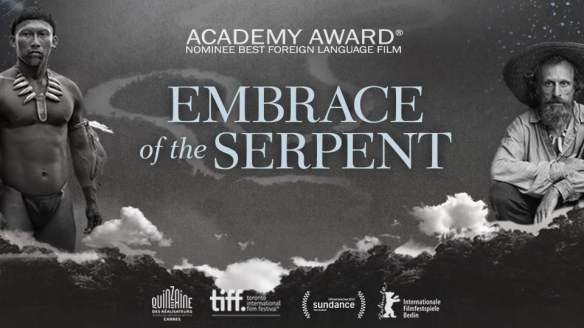
Saturday Matinee: Embrace of the Serpent

From Wikipedia:

Embrace of the Serpent (Spanish: El abrazo de la serpiente) is a 2015 internationally co-produced adventure drama film directed by Ciro Guerra, and written by Guerra and Jacques Toulemonde Vidal. Shot almost entirely in black and white, the film follows two journeys made thirty years apart by the indigenous shaman Karamakate in the Colombian Amazonian jungle, one with Theo, a German ethnographer, and the other with Evan, an American botanist, both of whom are searching for the rare plant yakruna. It was inspired by the travel diaries of Theodor Koch-Grunberg and Richard Evans Schultes, and dedicated to lost Amazonian cultures.

Embrace of the Serpent was premiered on 15 May 2015 during the Directors’ Fortnight section at the 2015 Cannes Film Festival, where it won the Art Cinema Award. The film was released in Colombia on 21 May 2015, and worldwide over the course of the following twelve months. It has received universal acclaim from critics, who praised the cinematography and the story’s impact of the destruction of the Amazon rainforest and way of life by white colonialism. It has won numerous awards, including the Alfred P. Sloan Prize at the 2016 Sundance Film Festival, the Grand Jury Prize for Best Picture at the 2017 Riviera International Film Festival, and seven awards at the 3rd Platino Awards to recognise the best Ibero-American films of 2015, including the Platino Award for Best Ibero-American Film. In 2016 the film was submitted as Colombia’s entry for the category of Best Foreign Language Film at the 88th Academy Awards and was included among the final five nominees, becoming the first Colombian film ever to receive a nomination for an Academy Award.

The film tells two stories thirty years apart, both featuring Karamakate, an Amazonian shaman and last survivor of his tribe. He travels with two scientists, firstly with the German Theo von Martius in 1909 and then with an American named Evan in 1940, to look for the rare yakruna, a sacred plant.[4]

Theo, an ethnographer from Tübingen who has already been residing in the Amazon for several years, is very sick and is travelling by canoe with his field notes and a westernised local named Manduca who he saved from enslavement on a rubber plantation. Karamakate prolongs his life, blasting white powder called “the sun’s semen” (possibly a hallucinogenic made from virola[5]) up his nose, but is reluctant to become involved with a westerner and refuses his money. Theo is searching for yakruna as the only cure for his disease and the three set off in the canoe to search for it.

Many years later an American botanist, Evan (Brionne Davis), paddles up to a much older Karamakate (Antonio Bolívar) who has apparently forgotten the customs of his own people. Evan says he is hoping to complete Theo’s quest and Karamakate does assist, again reluctantly, saying his knowledge is spent. Evan has a book of Theo’s final trek, which his aide had sent back to Europe, as he did not survive the jungle. The book includes an image of Karamakate, which he refers to as his chullachaqui, a native term for hollow spirit. Karamakate agrees to help him only when Evan describes himself as someone who has devoted himself to plants, although Evan’s real purpose is actually to secure disease-free rubber trees, since the United States’s supplies of rubber from South East Asia had dwindled due to the Japanese wartime advance.

Both expeditions feature a Spanish Catholic Mission by the side of an Amazon tributary, run in 1909 by a sadistic, lone Spanish priest who beats orphan boys for any “pagan” behaviour, and in 1940 by a delusional Brazilian figure who believes he is the Messiah. He only trusts the visitors when he believes they are the Biblical Magi, but Karamakate wins his respect when he heals his wife. By now the children of 1909 have grown into disturbed and violent acolytes.

In 1909, we are left with Theo, sick and having fled the Mission, arriving at a frontier post just about to be invaded by Colombian soldiers during the Amazon rubber boom, where the sacred yakruna is being abused by drunken men, and cultivated, against local traditions. Karamakate is furious and destroys it. In 1940, Karamakate does show Evan the origin of the plant in striking denuded dome-shaped mountains (Cerros de Mavecure), allegedly the home of yakruna. He reveals one yakruna flower that is on the last plant – he has destroyed all the others – and prepares it for Evan. The preparation being hallucinogenic, aids Evan in undergoing a superconscious experience. While most of the film is in black-and-white, a part of this experience is shown in colour to signify its intensity. The film ends with a transformed Evan remaining enamoured by a group of butterflies.

Watch the full film on Kanopy.

So, About That Moment Of Clarity You Experienced That One Time…

By Caitlin Johnstone

Source: CaitlinJohnstone.com

At some point in your life you’ve experienced at least one moment of clarity. Maybe it was just a little bit of clarity, maybe you got reamed up the third eye by The Whole Enchilada, but to a greater or lesser extent you caught a glimpse beyond the veil of mental bullshit that most of us tend to experience in our day to day living.

This is just a reminder of that moment of clarity, and an assurance that it’s just as real and true now as it was back then.

Maybe it happened when you were a child, before the grownups had fully managed to teach you how to be crazy like them. Maybe it happened while you were under the influence of psychedelics. Maybe it happened while you were seated in meditation. Maybe it happened after everything in your life went to hell all at once and it felt as though God Himself was taking time out of His busy schedule to urinate on you personally. Whatever the antecedent, and for whatever reason, the usual mechanisms of stress and confusion and mental perseveration just sort of fell asleep at the wheel one day, and you experienced a moment of clarity.

And then what happened? If you’re like most of us, it vanished from sight as “real life” came crashing back in.

How weird is that? You experience reality and truth to a greater extent than ever before, and you realize “Oh, this is what’s real actually, all that stuff I thought was so important a moment ago really doesn’t matter at all,” and then you have to set all that reality aside because “reality” comes knocking. Bills to pay, kids to feed, people with the wrong political beliefs to yell at on the internet. It all goes out the window, and in exchange for all that truth and reality you just traded in, you get a bucket of bullshit. It’s weird.

And then you just kind of set that moment of clarity on a shelf somewhere in the background of your daily mental clutter. Maybe you told yourself it was just youthful immaturity. Maybe you told yourself it was just the drugs. Maybe you almost managed to forget all about it but you never really could–not completely. Maybe you hadn’t thought about it directly in years until I brought it up just now. Maybe you’re still trying to convince yourself that it didn’t happen or it wasn’t real.

But it did happen. And it was real. It was the most real moment of your entire life.

All the stuff that fell away is what’s not real. All the mental chatter, all the sticky fixations on people and opinions and gossip and guilt and shame and insecurity and inadequacy and obligation and dread, that’s what’s imaginary. What’s real is what remains when all that stuff fades into the background. What’s real is the presence you experienced in your moment of clarity.

This isn’t an admonishment to try and get back there. You can never “get back there”, because presence doesn’t live “back there”; it lives here and now. You can also never hope to attain it in the future, for the exact same reason. If you reach into the past or the future for another moment of presence, you’re guaranteed to miss it.

Presence is closer even than the concepts of “here” and “now” can point you to. Presence, fundamentally, is you. Your moment of clarity came when you experienced yourself without the usual illusions about being something other than what you are added on top of that. You experienced yourself without all the extra imaginary stuff. Living free from extra imaginary stuff is a skill that you can learn if you want to.

Really, all it takes is wanting it. Set the intention to live in truth. Say to yourself right now, “I want to let all the bullshit fall away and only live with what’s real, even if what’s real hurts my feelings or dissolves my beliefs.” All you have to do is set that intention and then let it go. It’s a kind of set-and-forget thing. Let life deal with the path and the details.

If you try and “do” it yourself, you’ll fuck it up. It’s not a “doing” thing, because then your thinker-brain takes the wheel, and your thinker-brain has no idea about these things. As soon as you do that, you are attempting to use the same tool that is created by (and invested in) this bullshit to clear away the bullshit. It’s kind of like trying to use water to get dry, or asking your cult leader how to get out of his cult. You have to decide that this is what you want more than anything else, and also decide that you don’t care how or when it happens. It’s a tricky two-step. Trust yourself to let your greater consciousness take care of it. Let life take you by the hand and make it happen for you.

Or not. If you don’t want it you don’t want it. Not right now anyway. But maybe someday you’ll remember that moment of clarity you experienced that one time, and you’ll start getting curious about it.

The Wounded Mind

By Kingsley L. Dennis

Source: Waking Times

There’s something fundamentally wrong with how the world is right now. Don’t you see it – feel it? We are a species with noble character, with a great spirit, and with a sacred soul. In our hearts we wish only for the betterment of all people; for love and justice and communion. And yet what we see going on in the world is nothing less than complete madness. We have to say it exactly as it is – there is a sickness going on and this pathogen is being perpetrated on a vast scale.

I propose the possibility for the existence of some kind of infection/invasion/contagion that produces a form of mental ‘madness’ that is so normalized within us that we hardly recognize its presence. That is, this ‘presence’ has embedded itself into our various forms of social conditioning (or perhaps even produces this conditioning) in order to veil its existence. This normalized madness then usurps genuine thinking patterns, with the result that when everyone shares the collective psychosis then the madness of the world appears to be a ‘normal feature’ of human civilization. And those people who are ‘awake’ to the genuine human spirit and mind are considered the crazies – the anomalies – as the following tale shows:

There was once a wise and powerful king who ruled in a remote city of a far kingdom. And the king was feared for both his might and his love of wisdom. At the heart of the city was a well whose water was cool and crystalline, and all the inhabitants drank from this well, even the king and his courtiers, because there was no other well in the city. One night, while everyone was asleep, a witch entered the city and poured seven drops of a strange liquid into the well, and said:

‘From now on, anyone who drinks this water will go crazy.’

The next morning all the inhabitants drank the water from the well, except the king and his lord chamberlain, and very soon everyone went mad, as the witch had foretold. During that day, all people went through the narrow streets and public places whispering to each other:
‘The king is mad. Our king and his lord chamberlain have lost their reason. Naturally, we cannot be ruled by a mad king. We must dethrone him!’

That night, the king ordered a golden cup of water from the well to be brought to him. And when they brought the cup the king and his lord chamberlain drank heavily from it. Soon after that there was great rejoicing in that distant city of a far kingdom because the king and his lord chamberlain had regained their reason.

The King and his love of wisdom (Genuine Mind) was corrupted by the poisonous drops of the witch’s liquid (virus/pathogen) that resulted in the mass epidemic of craziness (psychosis/Wounded Mind). This corrupted mind then became the dominant narrative that influenced social behavior. This Wounded Mind is like a contagion that infects.

Our collective ‘cultural mind’ is continually being shaped by dominant social-cultural narratives that normalize our mental and emotional behavioral patterns. These norms are then transferred into cultural myths that serve to transmit and reinforce these mass-minded belief systems. We end up validating our own corrupted thinking through unconscious affirmations. Once this seed of psychosis is planted then it aims to propagate and strengthen through diversions and manifestations that legitimate its own ‘logical’ existence. Like a mental cancer it ingratiates itself into our own neural pathways as an insider rather than an outsider so that we fail to notice its toxic presence. Yet there remains a niggling sense of something being ‘not-quite-right’ deep within any sensible/sensitive person.

This strange reality of ours becomes internalized so that we adapt to a form of ‘normality’ and anyone who speaks up or questions this ‘paradigm of normality’ is considered either odd, eccentric or, at worst, crazy. A more recent category for such people is now to be designated as a ‘conspiracy theorist’ which is a quick brush to dismiss people with ideas or thinking contrary to this ‘norm.’ And those people who appear to accept and encourage such norms are quickly brought ‘into the fold’ and supported in their career paths. The majority of those manifesting the Wounded Mind are not in psychiatric care but running most of our social, political, and financial institutions. Positions of great power necessitate their own specific mindset, one that is generally provided by the corrupted mind.

A Disturbance of Mind

The presence of the Wounded Mind is like a sickness of the soul, and it manifests as a disturbance in the collective unconscious. Just like any other virus or pathogen, it seeks to spread itself by infecting as many carriers as possible. Those people who carry the Wounded Mind (whether knowingly or not) act as transmitters and amplifiers for it, strengthening its frequency within the collective nonlocal field of consciousness. A collective possession is what we refer to as a psychic epidemic, or a disturbance in the field. Such disturbances can have varying affects upon people’s mental health and well-being.

People who suffer from a Wounded Mind may carry it as an ‘undefinable’ trauma within them, and it is common to turn to alcoholism or drug dependencies as a way of coping (or of escape). When a person feels stressed or traumatized they are like an open wound for further mental invasion. And it can be quite subtle at first as our modern societies have devised endless ways for our interference. We are distracted to look away from our own minds and thus miss the psycho-pathogen in action. As a person further integrates the Wounded Mind they may find themselves vulnerable to victimization; such as through social harassment and bullying (especially online nowadays), or as addicted-consumers of sexual deviancy, pornography, and socially-sanctioned extreme experiences. The monk Thomas Merton said that our modern societies suffer from a crisis of sanity:

‘The problems of the nations are the problems of mentally deranged people, but magnified a thousand times because they have the full-straight-faced approbation of a schizoid society, schizoid national structures, schizoid military and business complexes.’1

If all modern institutions are infected by a corrupted system of mental thinking patterns then, as Merton suggests, this instability will be amplified and made worse. Individual neuroses are given institutional sanction and support within a culture that has based its social norms upon such irrationalities. The irrational has broken through and implanted itself as the rational standard rule. It is perhaps little wonder that people can be so susceptible to this mental pathogen when it comes to us dressed up in sheep’s clothing. As is always the case, those people most vulnerable are usually those who are conditioned to authority and/or passivity. This trait, unfortunately, is one that is first implanted through compulsory schooling.

Likewise, people who are easily influenced by external opinions, and whom are prone to group-thinking, are amongst the first to give away their mental independence to external sources. The virus of the Wounded Mind preys upon such ‘group-think’ individuals as they are the mass open playing fields for psychic epidemics. The ‘mass mind’ of humanity helps in the transmission and proliferation of the psychic pathogen – the wounded mind. As the famous psychiatrist R.D. Laing once said – ‘The condition of alienation, of being asleep, of being unconscious, of being out of one’s mind, is the condition of the normal man…normal men have killed perhaps 100,000,000 of their fellow normal men in the last fifty years.’2 Conscious awareness is perhaps our greatest antidote.

If we are to see human history from a wider perspective then it is important we view major events, human actions, propaganda, social disturbances, power struggles, and the rest, from this standpoint of the wounded mind. The modern human mind has been formed from many traits that include greed, lust, ambition, materialism, insincerity, and a ‘split’ personality. In all, these are traits that mark a lack of authenticity. The Wounded Mind seeks to develop greater degrees of inauthenticity and lack of empathy within the individual. We can see such personalities walking across the world stage.

The peril of the Wounded Mind is that resistance may also help to spread it. That is, people who often start out resisting and fighting against this corrupted mindset often find themselves adopting it’s values in order to survive. It’s the ‘if you can’t beat them, join them’ type of thinking. And this cliché too is very likely to have been a product of the Wounded Mind intending to verify itself. It may seem that we are struggling to awaken against our very own spell of sleep.

Under the Pathogen Spell

It has often been said – by mystics, sages, and wisdom traditions – that humanity is collectively asleep. Our ignorance over our condition, and the absence of real knowledge, indicates we are asleep.  Similarly, the Gnostics viewed humanity as being ‘asleep’ under a trance – a form of material spell – that has severed us from contact with a genuine divine source. Instead, we are ruled by a false or ‘flawed god,’ a demiurge, that has malevolent intentions to keep us trapped within the material realms.

The more we breed this Wounded Mind within our societies and cultures the more people will behave and live like automatons. We will live within a tighter range of conditioned stimuli that programs specific opinions and thinking patterns that validate the pathogen. A person who is more conditioned to obedience is more susceptible to receive the mental virus. Perhaps this is why our modern societies are establishing rigid orders of control and obedience, such as when we travel, pass through airports, etc. It can be likened to a preparation for automated behavior as a requisite for an automated mind. The mystic George Gurdjieff wrote:

‘Contemporary culture requires automatons. And people are undoubtedly losing their acquired habits of independence and turning into automatons, into parts of machines…. Man is becoming a willing slave. He no longer needs chains. He begins to grow fond of his slavery, to be proud of it. And this is the most terrible thing that can happen to a man.’3

By adopting the mentality of the Wounded Mind, we participate in our own suppression and further the behavior of an automaton. We need to recognize that many of our incumbent social systems are set-up to corroborate and reinforce the consensus mind-set. Any genuine resistance cannot come from any ‘mass movement’ but only from those persons who can think and act independently.

It is important to recognize that the Wounded Mind is a field phenomenon, and that our own mind and thoughts do not exist securely guarded within our heads. Since we are all interconnected within the non-local field, we are all susceptible to the infection of this predatory virus. The first step we can take is to accept the possibility that the pathogen virus exists. The Gnostic text The Gospel of Philip says: ‘So long as the root of wickedness is hidden, it is strong. But when it is recognized, it is dissolved. When it is revealed, it perishes…’ The danger lies in our distraction.

We must guard against being diverted away from our authenticity and lured into the modern distractions of hedonistic pleasure-seeking, greed and materialism, and the running after shallow satisfactions. After all, this illusive psychosis offers false promises. Our modern cultures appear to want to prevent the majority of people from pursuing their own genuine developmental paths. This is no doubt because our capitalist-consumer based societies require a regular mass of workers and consumers whom live a regulated, predictable, and conformist life.

Yet it is now necessary to see the Wounded Mind for what it is – recognition and acknowledgement is key. If we cannot bring harmony and good sense to the world around us, then we should at least bring it upon ourselves. We are the wounded ones who can become our own wounded healers.

Phantom Performances – The Rise of the Spectacle

By Kingsley L. Dennis

Source: Waking Times

ˈspɛktək(ə)l/

noun

a visually striking performance or display

an event or scene regarded in terms of its visual impact

“Now the death of God combined with the perfection of the image has brought us to a whole new state of expectation. We are the image.” ~John Ralston Saul, Voltaire’s Bastards

“Magical thinking is the currency not only of celebrity culture, but also of totalitarian culture.” ~Chris Hedges, Empire of Illusion

Welcome to the spectacle. Or perhaps I should say the kind of spectacle that has become the face of entertainment that pervades our westernized cultures. The way that the spectacle succeeds is that it isn’t so much about fooling us into believing its lies as real, but rather that it is we who ask to be fooled. We seek to suspend our sense of reality, to pursue a space of escape. The spectacle pulls us in because we lend our willingness to its agenda. If we are honest, in this post-truth age, we will admit to living in an age of spectacle. And it is from this that many of us receive our interpretation of reality. Since the middle of the 20th century onwards the ‘western spectacle’ has been in the form of media advertisement and propaganda. We may think that we’ve only recently arrived at the age of the spectacle, where Disneylandification is becoming the norm, and Super Bowls are interspersed with scantily-clad singers, and TV programs appear in the slots between advertisers. Yet the whole spectacle show has been a form of function creep ever since telecommunications first emerged as a social phenomenon. The image has been with humanity since the first dawn of our arising; from cave paintings to hieroglyphics to cuneiform clay tablets. The major difference is that today the spectacle of the image has not only gone global, but it has also gotten inside of our heads.

Western cultures especially (and the US specifically) have now made the image, the spectacle, and hence the illusion so grand, so vivid, and so persuasively realistic that they are becoming our basis of reality. We swing from one illusion to the alternative, which is still yet another grand spectacle; just as we swing from the political left to the right, believing each side is distinctly different. Yet each is a part of the same bubble that customizes our lives – they form a part of our news, our heroes, our tragedies, and our dreams. We now serve a mosaic of ideals carefully crafted as a patchwork of phantom performances. Nothing is ever real anymore except the painful extremes that pervade our daily existence: the violence, the suffering, the deprivation, the inequality, the disease. Only these fragments that create great pain become the real, and from these many of us seek refuge in a plenitude of diversions, distractions, and triviality.

Western civilization has chosen to be played out upon a grand stage where the performance – of invented storylines and scripts – runs the show. We move through social realities that are an entanglement of signs, virtual connections, and social media status. It’s all about who is going to be the next ‘influencer’? We are encouraged to project back into the world our entertainment-mediatized fantasies. People begin to act out their imaginary landscapes, often in violent and distorted ways, as young students massacre their classmates before going to eat at McDonalds. This is the hyperreal that distorts a stable reality, making it harder to gain a grounded perspective on things. People are increasingly being guided by the false totems of media-militarized-entertainment.

The media spectacle gives us our modern guiding images. This is similar to how in the Middle Ages images depicted in stained glass windows and paintings of religious torment or salvation acted to control and influence the social behavior of our ancestors. For many of us the white-bearded god above is dead, so we have media depictions of heroes, adventurers, McGyvers, celebrity-cosmetic makeovers, beauty pageants, talk shows and reality television to be our social guides. An illusory sensate reality has been erected that runs on pseudo-lives and phantom performances. Such phantom performances mask our personal failures and conveniently hide them behind a curtain of the unreal. People prefer to watch the rich and famous on television rather than face the domestic unhappiness of their own lives. Why have ice when you can have bubblegum-flavored ice-cream?

Luckily for those of us who live in the west we inhabit a world of easy-correction where we can make ourselves better if we buy certain products, ingest certain foods, and hang-out in the right yoga gyms. For every situation there is seemingly a commercial solution. We have not been abandoned, after all. In the realm of hyperreality, our fantasies are no longer an impediment to success. On the contrary, our fantasies are the portals through which we enter. All we need is for the world of the media to give us our dream. Everybody has talent, as the reality shows tell us – ‘Britain’s Got Talent,’ ‘America’s Got Talent:’ in fact, we’ve all got talent! We are all of us hidden unique performers, and the world ‘out there’ is begging for our arrival. This is not to be confused with the manipulation by greedy commercial enterprises that are ready to discard you as soon as your ‘talent’ no longer sells.

Yet the truth of the matter is that the spectacle of celebrity culture seeks commodities, not real individuals or souls. It doesn’t want that we seek for any form of transcendence, illumination, or real growth. It is a world that seeks only those that feed the phantom and encourage others to do the same. It is the ‘real’ that gets pushed into a black hole – to become a figment of the imagination, whilst imaginary dreams take its place. Celebrity culture thrives from the very lack of inner reflection. There is no ‘going within’ unless it is a form of medication going down our throats. If we are brutally honest, the celebrity spectacle is an ugly specter that can be as cruel as it is superficial.

The Spectacle of Celebrity Culture

No one achieves celebrity status on their own. It is a stage performance that requires a hoard of cultural enablers; from media, marketers, promoters, agents, handlers, and a host of hungry and gullible people. It is a veritable stage of actors, with each person in it to gain something for themselves. They either seek attention, satisfaction, fame, wealth, or a combination of these. Celebrity culture has come to dominate how many of us define our sense of belonging. It has come to define how we relate to the world around us, and in this respect has disfigured our notions of social belonging and community. Celebrity culture funds and feeds our own movies inside our heads as we invent our roles and behavior. It is a culture in which very few participants are even real for a day.

We idolize celebrities and often project them as idealized forms of ourselves. And yet through this substitution we move further away from any real self-actualization. The transcendent – the Real – does not do substitutes. By throwing our fantasies onto others we are diminishing our own power. In the words of one serious journalist,

We are chained to the flickering shadows of celebrity culture, the spectacle of the arena and the airwaves, the lies of advertising, the endless personal dramas, many of them completely fictional, that have become the staple of news, celebrity gossip, New Age mysticism, and pop psychology …in contemporary culture the fabricated, the inauthentic, and the theatrical have displaced the natural, the genuine, and the spontaneous, until reality itself has been converted into stagecraft. 1

We are subtly pushed through the well-structured stagecraft whilst all the time thinking that it is real. Our contemporary ‘death of the gods’ has been replaced by a divine adoration of celebrities and celebrity culture. Celebrity items, like holy relics, are paraded, idolized, and sold for vast sums. People rush for autographs, only to sell them later on eBay to make an unhealthy profit. Celebrity personal possessions are sold off at prestigious auction houses for astronomical prices, so aging people can wear the clothes of their idols. The glitzy suit that Elvis wore before dying in a Las Vegas toilet; or the dress that Marilyn Monroe wore to show her knickers to the world above a subway vent. Everything is up for grabs – the profane is made sacred, and then sacrificed as celebrity talismans. It all engenders a performance of hysteria, leading sometimes to stalking, or what is nowadays referred to as ‘trolling,’ as celebrity private photos are hacked and shared online. It’s happened to Emma Watson, Jennifer Lawrence, Kate Upton, Jessica Alba, Kate Hudson, Scarlett Johansson…and the list goes on, and on, and on.

The world of celebrity culture thrusts us into a moral void. People are valued by their appearance and their skin-deep beauty rather than their humanity. Such a culture focuses upon onanistic desires and ways for self-gratification. The cult of self ‘has within it the classic traits of psychopaths: superficial charm, grandiosity, and self-importance; a need for constant stimulation, a penchant for lying, deception, and manipulation, and the inability to feel remorse or guilt.’2 The cult of self also promotes the right to get whatever we wish, and celebrity media plays into this, often at the cost of the celebrity who suffers from social media harassment and online trolling. Celebrity public life is not a sacred space; instead, it has become a theatre of performance that is open for all spectators. And those spectators who surround themselves with celebrity culture tend to live in the present, fed by an endless stream of packaged information. They live by credit promises, ignorant to the future prospect of unmanageable debt. They are hostage to a culture that keeps them enthralled, like a television commercial replete with pleasing jingles. They navigate their purchases through well-known brands, eyeing the famous logos as guides. It is an image-saturated reality, bright and tantalizing, offering comfort and satisfaction upon all levels – until the credit runs out. Then the person becomes an outlaw to the very system that fattened them up like foie gras ducks.

These are the trivial diversions that for many are necessary, and which exist in cultures that prize shallow entertainment above substance. We may wonder whether the consumerist celebrity culture is a compensation for the loss of our true freedom regarding the human spirit and our well-being. And celebrities too are often trapped within their own fairy-tale prisons. They are skillfully controlled by their handlers and pushed in front of the media – all this to compensate for the insatiable appetites of those thirsty spectators that swarm upon celebrity culture. We are tantalizingly shown that even us, the humble spectators, can triumph in fame through the lens of reality television. The celebrity machinery oils itself on the media-creation of third and fourth-rate celebrities that have their fifteen minutes of fame – crammed together on desert islands, stuffing insects into their mouths as they bad-mouth their once beloved ‘best-friend’ and vote them off the show. Reality survival, it seems, comes at a cost. And then when they finally emerge into the ‘real world’ of the hyperreal they throng and mingle with other reality-stars under the glare of media spotlight in the vain hope that together they can populate an illusory world of the celebrity.

The world of reality television is another limb on the body of phantom performance. In the last decade a multitude of reality shows have cropped up on our television screens; and they all have one thing in common – they involve being constantly watched. Popular shows such as Big Brother put strangers to live together with round-the-clock constant surveillance. These strangers are even videoed in their beds as they sleep or fondle and kiss with other contestants. Sex lives are ogled over alongside the tears and on-screen breakdowns. Then the television psychologists are wheeled out to offer ‘expert commentary’ on the contestant’s state for mass consumption. Yet underneath all this glamour and glitz is the subtle message that intrusive surveillance is a normal feature of contemporary societies. In fact, it even masquerades as something cool that can be shared online, and which can make us famous. However, the brute reality is that such reality shows normalize what would otherwise be blatant non-constitutional intervention. And yet such shows make surveillance not only routine but a potentially enjoyable part of our modern lives. We are being conditioned into monitoring and sharing our own lives for others to see. Our phantom performances can make any one of us into an enviable star.

Social media is now rife with home-grown videos where everyone from toddler to teenager to retiree is making their performances visible to the image-hungry collective. Selfies too are the new fashionable rage as we perform in front of ourselves. This trend has become so pervasive that each year the number of selfie-related deaths has been increasing. In 2015 more people died from taking selfies than from shark attacks.[i] A dedicated online Wikipedia page has been established to record some of the ongoing ‘selfie-deaths.’ Here are a few examples:

Two young men died in the Ural Mountains after they pulled the pin from a live hand grenade to take a selfie. The phone with the picture remained as evidence of the circumstance of their deaths. (Russia, January 2015)

An 18-year-old died when she attempted to take the “ultimate selfie”, posing with a friend on top of a train in the north-eastern Romanian city of Iași when her leg touched a live wire above which electrocuted her with 27,000 volts. (Romania, May 2015)

A 19-year-old from Houston died after trying to take an Instagram selfie while holding a loaded gun to his head. He accidentally fired the gun and shot himself in the throat. (USA, September 2015)

A 17-year-old student, Andrey Retrovsky from Vologda, Russia, fell to his death attempting to take a selfie while hanging from a rope from a nine-story building. The rope snapped. Retrovsky was known for taking ‘extreme’ selfies and posting them to his Instagram account. (Russia, September 2015)

Selfie deaths, it seems, are global – and not a rare occurrence. Our phantom performances come at a cost. In a world where the image is iconic, more and more people are losing themselves in a reality where a sense of achievement comes from catching the ‘ultimate selfie.’

The drive for inner fulfilment, transcendence, and growth has been wavered aside in favor of the pixilated image. We fear not being seen. We dread being anonymous. Even being a spectral ghost is preferable to being dead.

We Are the Image

The new perspective on the world is pixilated. We are awash with images without substance and which are routinely fetishized as iconic. Signs are lacking immanence; they are fleeting and transient like never before. That is why corporations spend millions trying to find an image logo that will stick around long enough to be implanted into our minds. Images are becoming signs to the disappearance of the real. Images are the new believable reality; now no one cares that the original behind the image has quietly slipped away. The world exists as if in a play of phantom appearances. The image has taken centerstage within the space of the new real. We are now the image.

Yet the danger here is that in being given the image with its glamour and glitz we are in return giving up our critical and intellectual tools that help us cope with a complex world. Where once we had the faculty of separating illusion from reality we now have a simplified hyperreal world where everything can be explained away by a platitude of post-truth phrases. Does it even matter anymore that Las Vegas with its illusion of France with the mock Eiffel Tower, or its pseudo-canals of Venice, are far from the reality of France or Venice? How many people care? Or that the fantasy worlds within the various Disney theme parks are merging with the entertainment-saturated lives outside? Would it truly matter if we were all living within a controlled environment as depicted within the film The Truman Show? Or maybe, just maybe, such films are actually trying to tell us something – to wake us up?

The danger now is that our cultural spectacles – our celebrity culture and spectral images – are making any other alternative seem dull to us. It may be that in an age of simplified gratification any complex reality is boring. What the ‘real’ presents us with may no longer be enough. In its place we are perhaps seeking a false magic.

We have lost touch with that essential something that can work like magic in our lives. As one thinker recently stated:

We live in changing times whereby humanity is undergoing a transformation…We need to understand phenomena at deeper levels, and not just accept what we are told, or what is fed to us through well-structured social institutions and channels. We must learn to accept that our thinking is a great tangible spiritual force for change. 2

The notion that our ideas, our vision, our projections onto the world can be a ‘great tangible spiritual force for change’ is eluding us. Never before has it been so important to trust in the power of the human spirit, and to put forth, with honesty and integrity, the innate human power. The alternative is that we slide into the slipstream of our own phantom performances – we become the image.


Extract from the book Bardo Times: hyperreality, high-velocity, simulation, automation, mutation – a hoax?

Endnotes 

Hedges, Chris. 2010. Empire of Illusion: The End of Literacy and the Triumph of Spectacle. New York: Nation Books, p15

 Gulbekian, S.E. 2004. In the Belly of the Beast: Holding Your Own in Mass Culture. Charlottesville, VA: Hampton Roads, p251

[i] See http://www.telegraph.co.uk/technology/11881900/More-people-have-died-by-taking-selfies-this-year-than-by-shark-attacks.html