“We abuse the land because we see it as a commodity belonging to is. When we see the land as a community to which we belong, we may begin to use it with love and respect.” ~Aldo Leopold
If, as Krishnamurti said, “It’s no measure of health to be well adjusted to a profoundly sick society,” then it stands to reason that remaining “well adjusted” has kept us in a perpetual state of ecocide.
Our society poisons the air it breathes, the water it drinks, and the food it eats. And then it has the audacity to poison the minds of its citizens by convincing them that this is somehow “progress”.
The problem is that we don’t have a healthy sense of community. What little sense of community we do have is wrapped up in the unhealthy society that we were born into. It’s caught up in the nine-to-five daily grind and the rat-in-a-cage drudgery of a fear-based lifestyle that’s codependent upon a corrupt state. And this is happening on a global scale. You would be hard-pressed to find a healthy society: that is, a society that does not poison its air, water, food, and minds.
It all comes down to perspective—or the lack thereof. We have been conditioned by a sick society to perceive the world as a commodity that belongs to us. In order to cure ourselves, in order to no longer be sick, we must find a way to flip our perspective into perceiving the world as a community to which we belong.
It will require unlearning what we have learned from the profoundly sick society. It will require unwashing the brainwash and reconditioning the cultural conditioning. It will require living a courage-based lifestyle despite the fear-based lifestyle that surrounds us. It will require becoming interdependent from, rather than codependent on, the profoundly sick society. It will require obtaining an eco-centric perspective while rejecting the egocentric perspective that got us into this mess.
This will be an arduously Herculean task. But no battle is more important for the continued survival of our species.
World as Commodity:
“Do not become one of those who only has the courage of other people’s convictions.” ~A. Bartlett Giamatti
What makes it so difficult to flip our perspective? It’s the fact that the sick society keeps us comfortable, safe, and secure while at the same time that it keeps us unhealthy and codependent. The other reason is that it is so much easier to use the world as a commodity.
And that’s the rub. Nobody wants to take responsibility. Nobody wants to be uncomfortable, unsafe, or insecure. Everybody wants to take the easy road. And so the profoundly sick society just keeps on getting sicker.
It’s all too easy to simply rely upon unsustainable corporations that pollute the air and poison the water. In order to keep up with the rat race and keep food on the table, we are forced to rely on corrupt corporations and bureaucratic governments that are dead set on using the world as a commodity while calling it progress. After all, even unhealthy food is better than no food at all. Right?
And even when we do try to become independent and grow our own food or catch our own rainwater, we have overreaching governments with the monopoly on violence coming down on us and slapping us with fines or threatening us with jail time.
The ‘world as commodity’ is an unhealthy snake eating its own tail. Even worse, it gives birth to citizens that are codependent sheep grazing on the unhealthy snake shit and somehow managing to convince themselves it’s food. “Hell! If it’s cheap and easy and keeps me comfortable and safe from government oppression, I might as well eat it. Ignorance is bliss, right?” Right.
And that’s the real kicker. Any awareness of living in a sick society is easily pushed to the side and repressed through the psychosocial convenience of cognitive dissonance. Which usually sounds a little something like this: “It’s uncomfortable for me to believe that I live in a profoundly sick society, even though the evidence is overwhelming. So, rather than think about it, I’ll simply ignore it. After all, there are bills to pay. My kids need to eat (probably McDonald’s or Roundup-laced vegetables). Who do you think I am? Captain Fantastic?”
Satire aside, comfort and convenience are the front lines in the battle against the world as a commodity. If we have any chance of winning this battle, every single one of us will have to win that war at the front line. Which will mean a lot of discomfort and inconvenience.
World as Community:
“We are what we repeatedly do. Excellence, then, is not an act, but a habit.” ~Aristotle
The solution to winning the war against perceiving the world as a commodity is flipping our perspective and perceiving it as a community. Unfortunately, this will require discomfort and inconvenience.
This will require peeling away layer upon layer of cultural conditioning. The first layer is fear of the unknown. It’s the fear of trying something new, of making a healthy lifestyle change. It’s the fear of being ostracized or left out. It’s the fear of some arbitrary authority coming in with some arbitrary power and fining us with some arbitrary law.
So, the first thing we’ll need is courage. But not just any kind of courage. We’ll need a particular flavor of courage that is willing to be “the bad guy,” the maverick, the martyr. It will require the kind of courage that can stand up to codependent peer pressure and take independent leaps of courage, despite goodie-two-shoe conformists and weak-kneed milquetoasts.
The kind of courage that will make the sick society hate you for being healthy; when, really, it just hates itself for remaining sick. It’s the kind of courage that eco-centrically crushes out into healthy interdependence with cosmos, despite the sick society that egocentrically flushes everything away in codependent excess and greed.
The second thing we’ll need is the ability to question the sick society to the nth degree. But not just any kind of questioning. No. We need a particular flavor of questioning that is ruthless, penetrating, interrogating—no-holds-barred.
The kind of questioning that puts unsustainable corporations on blast. The kind of questioning that’s civilly disobedient. The kind of questioning that tears apart the outdated, xenophobic reasoning of the sick society; that reveals the chain-of-command as nothing more than an up-jumped human centipede, blind and poisonous to reason. Indeed. The kind of questioning that has shock value; that won’t allow the sick society to fall back into pretending it’s asleep.
Most of all, it will require us all to practice self-interrogation, self-improvement, and self-overcoming—all of which are exceedingly uncomfortable and inconvenient. Oh well.
When it comes down to it, things will probably get worse before they get better. Transitioning from a sick society that treats the world as a commodity to a healthy society that treats the world as a community will not be an easy task. Things may even slip into anarchy (no masters, no rulers). But even uncomfortable anarchy is healthier than comfortable tyranny, or convenient sickness. Especially when the tyranny and the sickness are ecocidal. Without a healthy planet there can be no healthy people. It really is that critical. Indeed. We may need to sow a little strategic disorder to reap a higher order.
The world can be a community to which we belong, full of compassion, respect, love, and tolerance. But only if we let it. And not if we continue to treat the world like a commodity that belongs to us.
Our tolerance of a ‘profoundly sick society’ can only go so far. Lest we inadvertently end up on the side of the executioners, we must draw the line somewhere. It must be drawn at sickness, at excess, at violence, at greed, and at ecocide. And only free, healthy, courageous individuals will have the wherewithal to draw it.
“Look at every path closely and deliberately, then ask yourself this crucial question, does this path have heart? If it does, then the path is good. If it doesn’t, then it is of no use.” ~Carlos Castaneda
The art of shadowing yourself is a ruthless form of self-overcoming made popular by the writings of Carlos Castaneda (he called it stalking the self), who was inspired by the Yacqui Shaman Don Juan.
The shadower needs four essential qualities: ruthlessness, cunning, patience, and humor. The fundamentals of the art of shadowing yourself are three-fold: shadowing the self, shadowing the world, and shadowing the unknown. Let’s break it down…
Shadowing the Self:
“Be melting snow. Wash yourself of yourself.” –Rumi
Shadowers are seekers. They are ruthless explorers. When shadowers shadow themselves, they are shadowing inner knowledge, sacred wisdom, and hidden information. They are in search of the golden shadow, where latent creativity is hidden beneath layer upon layer of cultural conditioning, religious indoctrination, and political brainwashing.
When a shadower shadows him/herself, he is a hunter mercilessly routing out codependence, weakness, and cowardice. He uses self-interrogation like Occam’s Razor, shaving away the superfluous, cutting away years and years of false knowledge, unlearning what was learned, un-washing the brainwash, and reconditioning the conditioning that came before.
A shadower audaciously digs a hole right into the center of his own comfort zone. He digs deep. He keeps digging, hungry for something more, for something he knows not what. He digs until there is nothing more than a snarling abyss, a soul-shattering existential darkness that presses in on him, that smashes his fragile ego into a million little pieces.
It is at the bottom of the abyss, deep in the throes of a Dark night of the soul, with his shattered ego reassembled into an individuated tool for further exploration, that the shadower discovers the diamond hidden in the rough of his soul: shadow’s gold.
Shadow’s gold is our sacred wound glowing like nothing else can glow. It is the accumulation of all the repressed pain, failure, setbacks, and loss experienced in a lifetime pressurized into a powerful force of darkness made conscious. It is our repressed shadow married with our inner light.
Having discovered the inner darkness of his soul’s abyss, the shadower takes his shadow’s gold and uses it to climb out of fearful codependence and into courageous independence. Now it’s time to use this newfound independence—this unity of abyss and summit, of shadow and light—to stretch his tiny comfort zone into the world.
Shadowing the World:
“The shamans say that being a medicine man begins by falling into the power of the demons. The one who pulls out of the dark place becomes the medicine man, and the one who stays in it is the sick person. You can take every psychological illness as an initiation. Even the worst things you fall into are an effort of initiation, for you are in something that belongs to you.” ~Marie-Louise von Franz
Now that the self has been thoroughly interrogated, shadow’s gold discovered, abyss and summit united, it’s time for the shadower to shadow the world. It’s time for the shadower to rise up out of the ashes of his codependence and break down the walls of his tiny comfort zone. It’s time to piece back together his shattered ego into an individuated ego. The shadower uses the knowledge of his individuation to take a leap of courage out of his comfort zone. He finally has the ears to hear the call to adventure. He is ready to take the next step into his hero’s journey.
But the world is dangerous. Living a life well-lived is full of risks. Adventure is at hand, yet when a shadower stretches his comfort zone, he understands that he is stretching into risky adventure. Hence the need for courage.
Shadowing the world is not for the faint of heart. It requires questioning all institutions to the Nth degree. It requires getting in the face of all so-called authorities. It requires ruthless civil disobedience that puts the powers that be in check. It requires David-like courage challenging any and all Goliath-like power structures. Sometimes, it even requires amoral agency to balance out the extremes of the overly moral goodie-two-shoes and immoral psychopaths of the world.
A shadower shadows the world with the same ruthlessness in which he shadowed himself, mercilessly interrogating everything the culture has taken for granted. He holds outdated world views against the hot iron of universal law and tosses out what cannot withstand the heat. He counts coup on power. He deflates egos and animates souls. He cuts the strings that once bound him to a profoundly sick society like a mere puppet and turns those strings into a lasso with which he lassos truth.
The shadower acts as a mirror to the world, revealing the shadows of others. People fear their own shadows and so they tend to fear the ruthless honesty of the shadower. They cringe. They balk. They reel inside the slow simmer of their own cognitive dissonance. Nevertheless, the shadower relentlessly injects wakefulness into an otherwise somnambulant world.
When a shadower shadows the world, he becomes the world. He stretches his tiny comfort zone into a mighty horizon, subsuming the world. And the shadow of the world is a mighty thing indeed. He is now ready for the difficult task of shadowing the unknown.
Shadowing the Unknown:
“The need for mystery is greater than the need for an answer.” ~Ken Kesey
When a shadower shadows the unknown, he goes Meta. He shadows the infinite. He shadows God. He cunningly interrogates mental paradigms. He lives between worlds, bridging gaps. To a shadower, the unknown is merely procrastinating knowledge just waiting to be known.
If, as Einstein said, “Imagination is more powerful than knowledge,” then the shadower turns the power of his imagination on the universe itself, flexing on Infinity, despite his own finitude.
It is in this sense that a shadower becomes a cosmic hero. Having risen up out of his codependent comfort zone, having leveraged a life well lived through shadow’s gold, having embraced the interconnectedness of all things through the union of summit and abyss, the shadower becomes an interdependent self-actualizer projecting the prism of his shadow’s glow into the Great Mystery. He has left behind the fear-based lifestyle and embraced a courage-based lifestyle that manifests the provident-based lifestyle of cosmic heroism.
Shadowing the unknown almost always leads to high art. Cathartic art. The kind of art that changes the world, full of myth and metaphor and existential leitmotifs. The kind of art that becomes the magic elixir that wakes up entire “tribes,” that animates an otherwise inanimate world. A shadower shadows the unknown in order to give birth to the sacred known.
Shadowing the unknown is the art of living life to the Nth degree. It’s inflicting oneself with a life well-lived through a courage of the most high, with a humor of the most high, with honor of the most high. It’s grabbing God by the throat and forcing him to cough up all his secrets, blasphemy be damned. It’s being ruthlessly determined to live life well, as a shining example to those living life ill.
Ultimately, shadowing the unknown is shadowing death. It’s being on the hunt for a good death that balances out a good life. As Castaneda said, “Death is the only wise advisor we have. Whenever you feel like everything is going wrong and you’re about to be annihilated, turn to your death and ask if that is so. Your death will tell you that you are wrong; that nothing matters outside its touch. Your death will tell you, “I haven’t touched you yet.”
“If the injustice is part of the necessary friction of the machine of government, let it go, let it go: perchance it will wear smooth–certainly the machine will wear out… but if it is of such a nature that it requires you to be the agent of injustice to another, then I say, break the law. Let your life be a counter-friction to stop the machine. What I have to do is to see, at any rate, that I do not lend myself to the wrong which I condemn.” ~Henry David Thoreau
Obedience is the connective tissue of oppression.
In other words, any form of control on a collective level can only be carried out through obedience. A dictator can’t arrest or kill an entire population himself; he needs mindless minions to do the dirty work. This principle applies across all forms and degrees of systematic control, even the most subtle.
The desires of any wannabe controller can only come to fruition through the compliance of others. And that’s been the case throughout recorded history (his-story). The desire for control becomes a virus, driven by fear and infecting more and more people, until there are enough drones to oppress an entire population.
This phenomenon isn’t just the case with large-scale atrocities; it applies to anything which is an impediment to freedom or love; be it a person, group, system or idea.
Everything is held up by belief. Laws are merely words written on paper, only legitimized by collective acquiescence. Laws need people to enforce them. And if laws are unjust (as most are), those who carry them out must unquestioningly submit to authority and go against their own inner knowing.
The only way control or oppression works on any scale is through compliance. Too many people do the work of ‘the man’ for ‘the man.’ That’s the problem. The solution lies in civil disobedience.
Freedom Cannot Be Granted
“Freedom cannot be granted. It must be taken.” ~Max Stirner
Asking for freedom is oxy-moronic. If you have to ask for freedom, you’re already a slave.
How is freedom taken? The simple decision to be the master of your own body and mind.
It really is as simple as that, though difficult to apply. It’s easy to blame problems on others, it’s easy to neglect our health and think “the doctor can fix me.” We’ve been conditioned to externalize our power since childhood. We’ve been taught to not trust ourselves. We’ve been taught to submit to authority without question.
This is a recipe for a control system to stealthily and slowly permeate society (the totalitarian tiptoe).
When you attain a degree of self-mastery, you do not acquiesce to the will of destructive people or disharmonious institutions. Which leads to the next point…
Fear-Based Programming
“The pioneers of a warless world are the youth who refuse military service.” ~Albert Einstein
The covert means by which oppression takes over is through fear-based programming.
If you have people in fear, you can easily control them. Fear activates the part of the brain known as the amygdala (the center for emotional behavior/motivation) and inhibits neocortex function (our “thinking brain”). This means that rationality and intellect are thrown out the window, the perfect storm for brainwashing. There’s even a term for this fear response; amygdala hijack.
The media is one big amygdala hijack, perpetually programming the population with which boogeyman to fear next. This is a massive ritual of fear-based programming that insidiously shifts entire populations into thinking and acting irrationally out of fear. Television is called programming for a reason.
Remember the whole weapons of mass destruction fiasco with Iraq in 2003? US military action in Iraq and massive destabilization of the middle east (which continues to this day) was predicated on that lie. There were no weapons of mass destruction. But lingering fear from 9/11 resulted in a string of irrational behavior and many people blindly believing the hype.
The holocaust took place because German soldiers were thoroughly conditioned to carry out orders. They didn’t carry out orders because they liked doing it, but because they feared the wrath of their higher ranking officers, or even because they were conditioned to fear jewish people. These abominations only occur when fear is the driving force.
Fear is hard to pin down. It’s slippery, and ultimately illusory (False Evidence Appearing Real). Yet it’s the undercurrent of all “negative” emotions. Fear is what stops us from saying no to evil. Fear might actually distort our perceptions to support evil. That’s why it’s so dangerous.
When you cultivate self-mastery, you’re able to break the cycle. The spread of fear stops before you and is transmuted by the omnipotent force of unyielding love.
Love Over Fear
“There are two basic motivating forces: fear and love. When we are afraid, we pull back from life. When we are in love, we open to all that life has to offer with passion, excitement, and acceptance. We need to learn to love ourselves first, in all our glory and our imperfections. If we cannot love ourselves, we cannot fully open to our ability to love others or our potential to create. Evolution and all hopes for a better world rest in the fearlessness and open-hearted vision of people who embrace life.” ~John Lennon
Strive to choose love over fear in every situation. You can never go wrong if you act from a place of compassion. This is the fulcrum of change, and it starts within you.
The change we all yearn to see in the world will only happen in the wake of a fundamental change in consciousness. Everything we see in this world starts in the realms of imagination before coming into manifestation.
The change begins within and ripples outward. Embodying the change is the first step, the prerequisite. Without inner transformation, humanity will be stuck on the same merry-go-round of madness.
When a critical mass of people create positive inner changes, it will open up doors we never could’ve imagined before and will provide possibilities far beyond our current limited perspective. Solutions will spontaneously emerge.
Go within and stop the momentum of fear. Learn to listen to and trust your intuition. Have the courage to follow your heart instead of cowardly bowing to fear.
“Courage is a heart word. The root of the word courage is cor – the Latin word for heart. In one of its earliest forms, the word courage meant ‘To speak one’s mind by telling all one’s heart.’” ~Brene Brown
Compliance with destruction, hatred, oppression, violence and fear is cowardice, while noncompliance is courageous. In the depths of your being, in your heart of hearts, you know what is right.
Choose love over fear.
Have the courage of heart and freedom of mind to disobey oppressive forces.
“You ask, ‘what is Zen?’ I answer, ‘Zen is that which makes you ask the question.’ Because the answer is where the question arises. The answer is the questioner himself.” ~Daisetz Suzuki
Zen is ultimately undefinable. It’s paradoxical. It’s a feeling; a meditation on opposites and interconnectedness intermittently. It’s a bridge between the unanswerable question and the unknowable answer. Even more cryptic: it’s No-mind meditating the mind into mindfulness.
No matter what Zen really is, the meditator attempting Zen is Zen. Or perhaps they are Zenning and Zen is actually a verb disguised as a noun—like God.
Either way, Zen practice is never more important than when we are in the trenches, down and out, at the bottom of the rollercoaster ride, experiencing a Dark Night of the Soul. In such a state, Zen is the great equalizer, an individuating leveling mechanism. An excuse to climb out of Hell and into Heaven. Or at least back to level ground.
Transforming shadows into sharpness:
“By accepting the inevitability of our shadow, we recognize that we are also what we are not. This humbling recognition restrains us from the madness of trying to eliminate those we hate or fear in the world. Self-mastery, maturity, and wisdom, are defined by our ability to hold the tension between opposites.” ~Louis G. Herman
Zen is the essence of holding the tension between opposites. It’s a proactive meditation on the paradoxical state of the human condition. It acts like a bridge between the unconscious shadow and the darkness made conscious. When our shadow is hidden from us or repressed—either subconsciously or through willful ignorance—we feel dull, insecure, fragmented, confused, unaware, and less than whole. But when our darkness is made conscious, we fell whole, aware, open, and sharper in mind, body, and soul.
Zen teaches us how to reconcile our dark side. Deep in the trenches of our shadow, Zen plants a question mark seed made of light. Through daily cultivation and practice (attention, awareness, focus), the light brightens the darkness, and the shadow becomes a vital self-aware aspect of the overall condition. Light magnifies shadow out of repression and into self-actualization.
Transforming certainty into curiosity:
“I ask you: what are you? You don’t know; there is only ‘I don’t know.’ Always keep this don’t-know mind. When this don’t-know mind becomes clear, then you will understand. Keep don’t-know mind always and everywhere. This is the true practice of Zen.” ~Seung Sahn Sunim
The most deceptive of all “trenches” is being stuck in the box of certainty. Believing that one certainly knows is the ultimate delusion. Whereas thinking that one possibly knows, but probably doesn’t, is the ultimate escape from delusion. Flexibility and open-mindedness are key. Zen can help us with both.
Zen helps us get in touch with the primordial coordinates of the interconnected cosmos. It helps us recognize the probability spectrum. When Socrates said, “The only thing I know is that I know nothing,” he was speaking in probabilities. He recognized that his was a single perception dwarfed by an unfathomably large universe. He realized that what he thought he knew was incomparably less to what he didn’t know and wisely swallowed his pride.
Better to use Zen to keep us in flow. When we are fluid and dynamic in our thinking, we are less likely to be seduced by dogmatic belief. Zen keeps us questioning to the nth degree. It keeps is open to the vital transformations the universe goes through. Zen is the art of adapting to the ebbs and flows of constant change. Being aware of this deep flow is being curious. Curiosity is the wave of change crashing over the fragile structure of our certainty. We would be wise to ride that wave straight over and learn from the destruction. The debris of which holds gold tantamount to transformative ambrosia.
Transforming anxiety into artistry:
“Who among you can at the same time laugh and be exalted? He who climbs upon the highest mountains laughs at all the tragedies, real or imagined.” ~Nietzsche
Anxiety is like an open wound of the psyche. And when you are down in the tranches, it can be a crippling experience. When we transform anxiety into art, we are using the stress as fuel for the fire of our imagination. The anxiety becomes a kind of eu-stress, which can be quite cathartic. Tension becomes a bridge between ‘stress’ and ‘creative outlet,’ where anxious state meets flow state.
Whether it’s transforming wounds into wisdom, demons into diamonds, or setbacks into steppingstones, the cathartic release of worry and pain can become the active components of a beautiful work of art. Pain is transformed into paint, misery into music, psychosis into poetry. And with enough practice, a kind of existential masochism can arise from the spiritual and psychological plasticity—robustness becomes antifragility.
Insofar as this existential masochism can be applied to a life well-lived, a Zen-full humor arises where all tragedies are laughable aspects of the overall cosmic joke. Life itself becomes a work of art.
Transforming hypocrisy into humor:
“No one ever grows up. They may look grown up, but it’s a disguise. It’s just the clay of time. Men and women are still children deep in their hearts. They still would like to jump and play, but that heavy clay won’t let them.” ~Robert McCammon
Governing the precept that life is a cosmic joke, it stands to reason that we get better at laughing at the joke rather than crying over the spilled milk of being the butt-end of it. The humbling effect of Beginner’s Mind can help with this. It reminds us that we are all merely fallible creatures at the mercy of the cosmic joke. Anything else is mere hypocrisy. Especially the title of “grown up.”
The Zen of Beginner’s Mind is the art of tapping into that playful innocence which refuses to be serious but is always sincere. It counters the hypocrisy of the human condition with a sense of playfulness. From which a creative adaptation and improvisation arises. We are fallible creatures? So be it. We are hypocritical naked apes? Might as well have a sense of humor about it. It’s all laughable in the grand scheme of things? We might as well have a laugh.
Adopting a good sense of humor is the best tool we can utilize while in the tranches. It can get us through just about anything. And even if it doesn’t, at least we’re laughing. Our inner child teaches us how to laugh and play through the misery, rather than just be miserable.
Transforming Hell into Heaven:
“Morality doesn’t mean ‘follow divine commandments.’ It means ‘reduce suffering.’” ~Yuval Noah Harari
Even in the trenches, we have a choice to be healthy or not. Even in the gutter, we can either drown in our own tears or flip over, take a deep breath, and regard the stars their aesthetic splendor. Yes. Even beauty itself can be healing. And beauty combined with a good sense of humor can be transcendent… Skipping through Hell with bells on. Laughing into the abyss. Mocking all devils, demons, angels, and gods. Using it all as a sharpening stone.
That’s Zen in the trenches.
We either play the victim and wallow in self-pity, or we rise up with a ‘humor of the most high’ and dare to become healthier. In the alchemical transformation of the human condition, Hell is the forge folding the blade of the soul into a sharper instrument.
Our comfort zone just isn’t hot enough. Heaven is too soft. Purgatory is too comfortable. Hell is just right, as long as we don’t make the mistake of losing ourselves there and burning ourselves out. We must remember to kill the devil first, and then make our way back to the “tribe” to inform them that there’s nothing to be afraid of anymore.
Zen in the trenches is no walk in the park. It takes daring and flexibility. It takes moxie and mettle. It takes a good sense of humor despite a meaningless universe. It takes emotional alchemy and existential masochism to deal with the pain and suffering.
Practicing Zen in the trenches is whistling, “Always look on the bright side of life” while nailed to a cross (The Life of Brian). It’s creating meaning out of nothingness, building bridges out of bandages, birthing a Phoenix out of ashes. It’s laughing and playing and dancing despite the slings and arrows and in spite of the ever-tightening mortal coil. Indeed.
As Rabelais said, “For all your ills, I give you laughter.”
In a linear world, the external order dictates an artificial way of life to the individual, creating a conformist society and forcing us to relinquish our power to a machine that is unnatural and devoid of life. This passive conformity can be traced back to the origins of the Vedic Hindu caste system and the feudal system under medieval Western Christianity. When a settled agrarian culture such as these is born, it tends to build towns, not only to protect people from outside influences but also to develop a mental framework based on rules and regulations.
The complexity of agrarian culture leads to a division of labour and a division of function. From this division, the ancient Hindus (the Vedic civilisation of Dravidians and Aryans) developed a caste system. The Hindu caste system is made up of the Brahmins (priesthood), Kshatriyas (nobility), Vaishyas (merchants and farmers), and the Shudras (labourers). A direct parallel to the Hindu caste system can be found in medieval Christian society, where we see the priesthood and the church, feudal lords and nobility, farmers and merchants of the commons, and the serfs.
Although we no longer have a caste system, this underlying pattern is still with us today. When we are born into this world, we come out of our mother’s womb (nature) and are taught to submit to the rules of society and culture according to our socioeconomic status. This is the crucifixion of the individual; it is the sacrifice we all make. According to the tyranny of the machine, this crucifixion is for the “common good” or “greater good.” But there is a stark difference between the Hindu and Christian societies of ancient times.
First of all, the function of the Vedic caste system was an act of surrender to Brahman (ultimate reality/godhead). Individuals would crucify their egos and their desires in favour of the lives they had been given by nature. This means they would not seek another path or to try and control their lives according to their interests. Instead, they would abide by the order of society, which helped them diminish their egos so that they could feel the presence of Brahman within themselves. This is dharma as social duty.
The second difference is that, once Hindus have fulfilled their social duties in this life, they are allowed to break away from caste and become renunciate sages in the forest, a practice and title known as vanaprastha in Sanskrit. (This possibility is loathed by Christian society because one is thought of as useless if one does not contribute to the social order.) This breakaway from caste is viewed as a return back to nature and could be thought of as a resurrection. A sage is not part of society and does not conform to its rules. Jesus was a sage in this mould. This is why he was not thought of as a particularly good member of society, and he was actually put to death (if we take the story of Jesus to be real).
Those who submit invariably lose their natural innocence. Conformity is the result of force. When individuals are forced by society and culture into life situations that are against their will, they give away their natural sovereignty in exchange for comfort and servitude and are psychologically reduced to sheep. We developed this sheeplike behaviour as a result of the belief that the morals and ethics forced upon us by society are avenues to success and freedom. This notion is absurd inasmuch as the success and freedom of our world are unnatural. These goals are gauged only by finances. But obviously this is not true success or freedom, as money is empty and void of meaning, and it provides no happiness other than that of acquisition. Happiness cannot be contained in anything that we need to force to happen.
As human life is forced into a sheeplike way of being, happiness is reduced to momentary stimulants of excitement. In such a life we can never express our natural divinity, li, because we are following the model of someone else’s idea of life. Yet conforming to anything other than one’s own innate world destroys us physically, mentally, and spiritually, as te, the virtue of Tao, cannot come through the organic pattern of the individual, li. Anxiety, depression and stress are so prevalent in this day and age partly because we are forced to live such lives. Wars and social unrest then reflect the individual’s anxiety.
Liberated individuals are in alignment with their own nature and with the Tao. They do not benefit the accepted social order and are regarded as useless in the eyes of institutional and organisational power. [Taoist sages] Lao-tzu and Chuang-tzu were treated this way because they could see the unnaturalness of an artificial society. The Buddha and Jesus of Nazareth were two other such sages who could see through the hypnotic veil. A liberated sage understands that anyone who continues to act out the unnatural patterns of conditioning is contributing to chaos and destruction, either consciously or unconsciously. One who is liberated, on the other hand, begins the yoking process until a crystal-clear perception of the Tao in reality can be experienced. In Richard Wilhelm’s translation of the I Ching, he states:
Not every man has an obligation to mingle in the affairs of the world. There are some who are developed to such a degree that they are justified in letting the world go its own way and in refusing to enter public life with a view of reforming it. But this does not imply a right to remain idle or to sit back and merely criticise. Such withdrawal is justified only when we strive to realise in ourselves the higher aims of mankind. For although the sage remains distant from the turmoil of daily life, he creates incomparable human values for the future. (The I Ching or Book of Changes)
Evidence for these “incomparable human values” can be found in the legacy that a sage leaves behind. Lao-tzu is a good example. It has been over 2,500 years since he lived, and yet his wisdom still reverberates within our consciousness today. This is the power of te.
The virtue of te is only available to those who do not seek power, control, or force. Governments, politics, banking, religions, and commerce, on the other hand, are constantly striving for control by forcing the population to their will. This poses a significant hurdle for humanity to overcome. What would it take to bring the individual and the collective back into harmony with the Tao?
The above is an exclusive extract from Jason Gregory’s book Effortless Living: Wu-Wei and the Spontaneous State of Natural Harmony. Gregory outlines the Taoist practice of wu-wei, revealing that when we release our ego and allow life to unfold as it will, we align ourselves more closely with our goals and cultivate skill and mastery along the way. The book is available from all good bookstores.
Back in the 1880s, the mathematician and theologian Edwin Abbott tried to help us better understand our world by describing a very different one he called Flatland.
Imagine a world that is not a sphere moving through space like our own planet, but more like a vast sheet of paper inhabited by conscious, flat geometric shapes. These shape-people can move forwards and backwards, and they can turn left and right. But they have no sense of up or down. The very idea of a tree, or a well, or a mountain makes no sense to them because they lack the concepts and experiences of height and depth. They cannot imagine, let alone describe, objects familiar to us.
In this two-dimensional world, the closest scientists can come to comprehending a third dimension are the baffling gaps in measurements that register on their most sophisticated equipment. They sense the shadows cast by a larger universe outside Flatland. The best brains infer that there must be more to the universe than can be observed but they have no way of knowing what it is they don’t know.
This sense of the the unknowable, the ineffable has been with humans since our earliest ancestors became self-conscious. They inhabited a world of immediate, cataclysmic events – storms, droughts, volcanoes and earthquakes – caused by forces they could not explain. But they also lived with a larger, permanent wonder at the mysteries of nature itself: the change from day to night, and the cycle of the seasons; the pin-pricks of light in the night sky, and their continual movement; the rising and falling of the seas; and the inevitability of life and death.
Perhaps not surprisingly, our ancestors tended to attribute common cause to these mysterious events, whether of the catastrophic or the cyclical variety, whether of chaos or order. They ascribed them to another world or dimension – to the spiritual realm, to the divine.
Paradox and mystery
Science has sought to shrink the realm of the inexplicable. We now understand – at least approximately – the laws of nature that govern the weather and catastrophic events like an earthquake. Telescopes and rocket-ships have also allowed us to probe deeper into the heavens to make a little more sense of the universe outside our tiny corner of it.
But the more we investigate the universe the more rigid appear the limits to our knowledge. Like the shape-people of Flatland, our ability to understand is constrained by the dimensions we can observe and experience: in our case, the three dimensions of space and the additional one of time. Influential “string theory” posits another six dimensions, though we would be unlikely to ever sense them in any more detail than the shadows almost-detected by the scientists of Flatland.
The deeper we peer into the big universe of the night sky and our cosmic past, and the deeper we peer into the small universe inside the atom and our personal past, the greater the sense of mystery and wonder.
At the sub-atomic level, the normal laws of physics break down. Quantum mechanics is a best-guess attempt to explain the mysteries of movement of the tiniest particles we can observe, which appear to be operating, at least in part, in a dimension we cannot observe directly.
And most cosmologists, looking outwards rather inwards, have long known that there are questions we are unlikely ever to answer: not least what exists outside our universe – or expressed another way, what existed before the Big Bang. For some time, dark matter and black holes have baffled the best minds. This month scientists conceded to the New York Times that there are forms of matter and energy unknown to science but which can be inferred because they disrupt the known laws of physics.
Inside and outside the atom, our world is full of paradox and mystery.
Breaking News: Evidence is mounting that a tiny subatomic particle is being influenced by forms of matter and energy that are not yet known to science but which may nevertheless affect the nature and evolution of the universe. https://t.co/8cwwhlPCOe
Despite our science-venerating culture, we have arrived at a similar moment to our forebears, who gazed at the night sky in awe. We have been forced to acknowledge the boundaries of knowledge.
There is a difference, however. Our ancestors feared the unknowable, and therefore preferred to show caution and humility in the face of what could not be understood. They treated the ineffable with respect and reverence. Our culture encourages precisely the opposite approach. We show only conceit and arrogance. We seek to defeat, ignore or trivialise that which we cannot explain or understand.
The greatest scientists do not make this mistake. As an avid viewer of science programmes like the BBC’s Horizon, I am always struck by the number of cosmologists who openly speak of their religious belief. Carl Sagan, the most famous cosmologist, never lost his sense of awestruck wonder as he examined the universe. Outside the lab, his was not the language of hard, cold, calculating science. He described the universe in the language of poetry. He understood the necessary limits of science. Rather than being threatened by the universe’s mysteries and paradoxes, he celebrated them.
When in 1990, for example, space probe Voyager 1 showed us for the first time our planet from 6 billion km away, Sagan did not mistake himself or his fellow NASA scientists for gods. He saw “a pale blue dot” and marvelled at a planet reduced to a “mote of dust suspended in a sunbeam”. Humility was his response to the vast scale of the universe, our fleeting place within it, and our struggle to grapple with “the great enveloping cosmic dark”.
Mind and matter
Sadly, Sagan’s approach is not the one that dominates the western tradition. All too often, we behave as if we are gods. Foolishly, we have made a religion of science. We have forgotten that in a world of unknowables, the application of science is necessarily tentative and ideological. It is a tool, one of many that we can use to understand our place in the universe, and one that is easily appropriated by the corrupt, by the vain, by those who seek power over others, by those who worship money.
Until relatively recently, science, philosophy and theology sought to investigate the same mysteries and answer the same existential questions. Through much of history, they were seen as complementary, not in competition. Abbott, remember, was a mathematician and theologian, and Flatland was his attempt to explain the nature of faith. Similarly, the man who has perhaps most shaped the paradigm within which much western science still operates was a French philosopher using the scientific methods of the time to prove the existence of God.
Today, Rene Descartes is best remembered for his famous – if rarely understood – dictum: “I think, therefore I am.” Four hundred years ago, he believed he could prove God’s existence through his argument that mind and matter are separate. Just as human bodies were distinct from souls, so God was separate and distinct from humans. Descartes believed knowledge was innate, and therefore our idea of a perfect being, of God, could only derive from something that was perfect and objectively real outside us.
Weak and self-serving as many of his arguments sound today, Descartes’ lasting ideological influence on western science was profound. Not least so-called Cartesian dualism – the treatment of mind and matter as separate realms – has encouraged and perpetuated a mechanistic view of the world around us.
We can briefly grasp how strong the continuing grip of his thinking is on us when we are confronted with more ancient cultures that have resisted the west’s extreme rationalist discourse – in part, we should note, because they were exposed to it in hostile, oppressive ways that served only to alienate them from the western canon.
Hearing a Native American or an Australian Aboriginal speak of the sacred significance of a river or a rock – or about their ancestors – is to become suddenly aware of how alien their thinking sounds to our “modern” ears. It is the moment when we are likely to respond in one of two ways: either to smirk internally at their childish ignorance, or to gulp at a wisdom that seems to fill a yawning emptiness in our own lives.
Science and power
Descartes’ legacy – a dualism that assumes separation between soul and body, mind and matter – has in many ways proved a poisonous one for western societies. An impoverished, mechanistic worldview treats both the planet and our bodies primarily as material objects: one a plaything for our greed, the other a canvas for our insecurities.
The British scientist James Lovelock who helped model conditions on Mars for NASA so it would have a better idea how to build the first probes to land there, is still ridiculed for the Gaia hypothesis he developed in the 1970s. He understood that our planet was best not viewed as a very large lump of rock with life-forms living on it, though distinct from it. Rather Earth was as a complete, endlessly complex, delicately balanced living entity. Over billions of years, life had grown more sophisticated, but each species, from the most primitive to the most advanced, was vital to the whole, maintaining a harmony that sustained the diversity.
Few listened to Lovelock. Our god-complex got the better of us. And now, as the bees and other insects disappear, everything he warned of decades ago seems far more urgent. Through our arrogance, we are destroying the conditions for advanced life. If we don’t stop soon, the planet will dispose of us and return to an earlier stage of its evolution. It will begin again, without us, as simple flora and microbes once again begin recreating gradually – measured in aeons – the conditions favourable to higher life forms.
But the abusive, mechanistic relationship we have with our planet is mirrored by the one we have with our bodies and our health. Dualism has encouraged us to think of our bodies as fleshy vehicles, which like the metal ones need regular outside intervention, from a service to a respray or an upgrade. The pandemic has only served to underscore these unwholesome tendencies.
In part, the medical establishment, like all establishments, has been corrupted by the desire for power and enrichment. Science is not some pristine discipline, free from real-world pressures. Scientists need funding for research, they have mortgages to pay, and they crave status and career advancement like everyone else.
Kamran Abbasi, executive editor of the British Medical Journal, wrote an editorial last November warning of British state corruption that had been unleashed on a grand scale by covid-19. But it was not just politicians responsible. Scientists and health experts had been implicated too: “The pandemic has revealed how the medical-political complex can be manipulated in an emergency.”
He added: “The UK’s pandemic response relies too heavily on scientists and other government appointees with worrying competing interests, including shareholdings in companies that manufacture covid-19 diagnostic tests, treatments, and vaccines.”
So many conflicts of interest in the decisions that shape our understanding of the world. Here's just one more tiny, unremarkable nugget told in passing:
'Google’s parent company, Alphabet, owns 12% of Vaccitech', the biotech firm behind AstraZeneca's jab https://t.co/XSslDkpDd4
But in some ways Abbasi is too generous. Scientists haven’t only corrupted science by prioritising their personal, political and commercial interests. Science itself is shaped and swayed by the ideological assumptions of scientists and the wider societies to which they belong. For centuries, Descartes’ dualism has provided the lens through which scientists have often developed and justified medical treatments and procedures. Medicine has its fashions too, even if they tend to be longer-lived – and more dangerous – than the ones of the clothing industry.
In fact, there were self-interested reasons why Descartes’s dualism was so appealing to the scientific and medical community four centuries ago. His mind-matter division carved out a space for science free from clerical interference. Doctors could now claim an authority over our bodies separate from that claimed by the Church over our souls.
But the mechanistic view of health has been hard to shake off, even as scientific understanding – and exposure to non-western medical traditions – should have made it seem ever less credible. Cartesian dualism reigns to this day, seen in the supposedly strict separation of physical and mental health. To treat the mind and body as indivisible, as two sides of the same coin, is to risk being accused of quackery. “Holistic” medicine still struggles to be taken seriously.
Faced with a fear-inducing pandemic, the medical establishment has inevitably reverted even more strongly to type. The virus has been viewed through a single lens: as an invader seeking to overwhelm our defences, while we are seen as vulnerable patients in desperate need of an extra battalion of soldiers who can help us to fight it off. With this as the dominant framework, it has fallen to Big Pharma – the medical corporations with the greatest firepower – to ride to our rescue.
Vaccines are part of an emergency solution, of course. They will help save lives among the most vulnerable. But the reliance on vaccines, to the exclusion of everything else, is a sign that once again we are being lured back to viewing our bodies as machines. We are being told by the medical establishment we can ride out this war with some armour-plating from Pfizer, Moderna and AstraZeneca. We can all be Robocop in the battle against Covid-19.
Pfizer claims people will likely need a third dose of its Covid-19 vaccine within six to 12 months of receiving the first two doses.
CEO Albert Bourla says, from then on, it is also possible that people may require annual booster shots. pic.twitter.com/Ki9nVLVg7v
But there are others ways to view health than as an expensive, resource-depleting technological battle against virus-warriors. Where is the focus on improving the ever-more nutrient-deficient, processed, pesticide-laden, and sugar and chemical-rich diets most of us consume? How do we address the plague of stress and anxiety we all endure in a competitive, digitally connected, no-rest world stripped of all spiritual meaning? What do we do about the cosseted lifestyles we prefer, where exertion is a lifestyle choice renamed as exercise rather than integral to our working day, and where regular exposure to sunshine, outside of a beach vacation, is all but impossible in our office-bound schedules?
Fear and quick-fixes
For much of human history, our chief concern was the fight for survival – against animals and other humans, against the elements, against natural disasters. Technological developments proved invaluable in making our lives safer and easier, whether it was flint axes and domesticated animals, wheels and combustion engines, medicines and mass communications. Our brains now seem hardwired to look to technological innovation to address even the smallest inconvenience, to allay even our wildest fears.
So, of course, we have invested our hopes, and sacrificed our economies, in finding a technological fix to the pandemic. But does this exclusive fixation on technology to solve the current health crisis not have a parallel with the similar, quick-fix technological remedies we keep seeking for the many ecological crises we have created?
Global warming? We can create an even whiter paint to reflect back the sun’s heat. Plastics in every corner of our oceans? We can build giant vacuum-cleaners that will suck it all out. Vanishing bee populations? We can invent pollinator drones to take their place. A dying planet? Jeff Bezos and Elon Musk will fly millions of us to space colonies.
Were we not so technology obsessed, were we not so greedy, were we not so terrified of insecurity and death, if we did not see our bodies and minds as separate, and humans as separate from everything else, we might pause to ponder whether our approach is not a little misguided.
Science and technology can be wonderful things. They can advance our knowledge of ourselves and the world we inhabit. But they need to be conducted with a sense of humility we increasingly seem incapable of. We are not conquerors of our bodies, or the planet, or the universe – and if we imagine we are, we will soon find out that the battle we are waging is one we can never hope to win.
“Leveraging Mindful Practices To Maximize Productivity”, reads a Forbes headline from last week.
“Using mindfulness to overcome financial stress”, reads another headline published a few days ago by Financy.
“The impact of mindfulness on businesses in the work from home era”, reads another by Business Review from last week.
Over the last few years we’ve seen a surge in the forceful mainstreaming of so-called mindfulness practices, a westernized iteration of various eastern meditative traditions emphasizing non-judgemental present-moment awareness which can, as a side effect, reduce stress levels. If you look at the headlines above, it’s not hard to see toward what end these practices are being promoted.
The way mindfulness is being so aggressively prescribed as a means to relieve the soul-crushing stress of meaningless labor under a meaningless system has been discussed at length in Ronald Purser’s 2019 book “McMindfulness“, which critiques the way “mindfulness has become a banal form of capitalist spirituality that mindlessly avoids social and political transformation, reinforcing the neoliberal status quo.” Are you experiencing financial stress from being ruthlessly exploited by your unfathomably wealthy employer? Mindfulness it away! Are you having trouble coping with the demands of empty gear-turning in an amoral corporate machine which benefits humanity in no discernible way? McMindfulness, baby!
The sticking point here is that mindfulness, like literally every other spiritual practice that has ever existed, can be used to psychologically compartmentalize away from certain aspects of reality. Bringing awareness to the present moment can indeed take mental energy away from stress-inducing impotent thought patterns, but it can also take attention away from real problems which should in fact be dealt with at some point: the fact that you are in an abusive marriage. The fact that you are in an abusive workplace. The fact that the working class is in an abusive relationship with the ruling class.
Hang out in spiritual circles long enough and you’ll realize that most of the people who frequent them are using spirituality to run away from themselves. Using spirituality as stress management instead of addressing the inherently stressful living situation they’ve found themselves in. Using spirituality to give themselves a few nice feelings here and there to escape from the unpleasant reality that all their close interpersonal relationships since birth have been with malignant narcissists. Using spirituality to give themselves a nice story about going to Heaven when they die to comfort themselves through the suffering caused by early childhood trauma.
This is false spirituality, and it comprises the overwhelming majority of what’s out there, whether you’re talking about personal spirituality, New Age/spiritual-but-not-religious spirituality, or organized religion. Probably ninety-nine percent of spirituality as it actually exists in our world is just glorified escapism. Nice stories, feel-good conceptual re-frames, practices to help you bliss out on the surface instead of addressing the deep sources of profound suffering underneath. Devices for reality avoidance, no different from drugs, overeating, compulsive sexual behavior, video games or Netflix binging.
False spirituality serves corrupt power. It always has: from the minute the local strongman discovered he can manipulate his subjects with fairy tales about invisible deities who only speak to him, to the Roman empire promoting a religion which promotes meekness, poverty, obedience and “render unto Caesar what is Caesar’s”, all the way to mindfulness practices being promoted at the World Economic Forum in Davos.
False spirituality serves corrupt power because it draws awareness away from a clear perception of reality, and therefore away from a clear perception of corrupt power. True spirituality does the exact opposite.
True spirituality means expanding consciousness of what’s true and real, both within and without. It means bringing consciousness to the subconscious dynamics within us which generate our suffering, rather than using feel-good spiritual practices or religious narratives to sedate ourselves through that suffering. It means becoming conscious of our true nature, of the way self, experience and perception are really happening as opposed to how the mind tells us they are happening. It means bringing consciousness to the unconscious aspects of our lives, our community, our society, and our species. It means shining the light of truth on all the injustice and depravity the powerful work so hard to keep anyone from looking at.
True spirituality isn’t pretty. It isn’t cutesy. It isn’t comfortable for the ego. It means getting absolutely, uncompromisingly real with yourself and calling the truth out into the light, regardless of how ugly or embarrassing it might be to realize. It means getting absolutely, uncompromisingly real about the contradictions and sources of dissonance in your personal life, no matter how inconvenient or downright terrifying it can be when you have to eliminate them. It means getting absolutely, uncompromisingly real about what’s going on in the world, even if it means flushing your old worldview and the psychological comfort it gave you right down the toilet.
Corrupt power relies on keeping things hidden and endarkened. That’s why government secrecy is a thing. That’s why mass media propaganda is a thing. That’s why the persecution of Julian Assange is a thing. That’s why internet censorship is a thing. Corrupt power structures cannot thrive in the light, because if people could see clearly how badly they’re being robbed and exploited and by whom they would immediately use the their vast numbers to overhaul that system. Corrupt power and false spirituality have therefore always had a symbiotic relationship, while corrupt power and true spirituality have always been natural enemies.
For this reason, it’s unsurprising that so much of what passes for spirituality in our world today is false. No matter what the age and no matter where the location, those with the ability to dominate culture the most successfully have been those with the most power. Healthy impulses to shed the light of truth in all directions would at best receive no platform and at worst get people burned at the stake, while unhealthy power-serving belief systems would be widely promoted by the powerful.
This remains as true as ever today. Colonialism, capitalism, consumerism and imperialism have left us so disconnected from ourselves, from our roots, from the land we live on and from any sense of depth that the majority of us end up turning in desperation to power-serving belief systems, not realizing what they are. We let old power-serving religions give us our spirituality. We let the news man tell us what’s good and what’s true. We let Hollywood tell us what’s meaningful, what’s worth living for, what’s worth dying for.
And it never satisfies. It never can. Trying to fill that hole we’re trying to fill with what mainstream culture offers us is like trying to quench your thirst with seawater.
Only truth can satiate us. Only by shining the light of truth inwardly and bringing our endarkened aspects into consciousness can we extend our roots downward in the way our spirit craves. Only by shining the light of truth outward to the reality of our current circumstances in this world can our branches extend upward and let our spirit soar.
The one advantage true spirituality has going for it that it didn’t have in ages past, if you can call it an advantage, is the fact that we as a species appear to have trolled ourselves into an evolve-or-die predicament, leaving ourselves in check on the chessboard where the only way to escape the checkmate of extinction via climate collapse or nuclear war is to collectively awaken to reality.
Humanity will not survive if we don’t all start getting very, very real with ourselves very, very soon, both inwardly and outwardly. We survive by purging ourselves of inner falseness and outer falseness, thereby reaching the level of maturity needed to shift to a collaboration-based planetary civilization where we work in harmony with each other and with our ecosystem for the common good.
We will either make the jump or we will not. Whether we do or don’t will have a lot to do with how courageous we are; whether we are brave enough to desire the truth come what may, or whether we succumb to the inertia of fear and fail.
The good news is we can all help building momentum for that jump right now, by doing everything we can to expand human consciousness both inwardly within ourselves and outwardly in the world. Sing the truth loudly, wake up as many people as you can to as much truth as you can, and wake yourself up to as much truth as possible by bringing consciousness to your inner dynamics.
Shine bright, and shine in all directions, and we just might win this thing.
“The church must be reminded that it is not the master or the servant of the state, but rather the conscience of the state. It must be the guide and the critic of the state, and never its tool. If the church does not recapture its prophetic zeal, it will become an irrelevant social club without moral or spiritual authority.”—Martin Luther King Jr. (A Knock at Midnight, June 11, 1967)
In every age, we find ourselves wrestling with the question of how Jesus Christ—the itinerant preacher and revolutionary activist who died challenging the police state of his time, namely, the Roman Empire—would respond to the moral questions of our day.
For instance, would Jesus advocate, as so many evangelical Christian leaders have done in recent years, for congregants to “submit to your leaders and those in authority,” which in the American police state translates to complying, conforming, submitting, obeying orders, deferring to authority and generally doing whatever a government official tells you to do?
What would Jesus do?
Study the life and teachings of Jesus, and you may be surprised at how relevant he is to our modern age.
A radical nonconformist who challenged authority at every turn, Jesus spent his adult life speaking truth to power, challenging the status quo of his day, pushing back against the abuses of the Roman Empire, and providing a blueprint for standing up to tyranny that would be followed by those, religious and otherwise, who came after him.
Those living through this present age of government lockdowns, immunity passports, militarized police, SWAT team raids, police shootings of unarmed citizens, roadside strip searches, invasive surveillance and the like might feel as if these events are unprecedented. However, the characteristics of a police state and its reasons for being are no different today than they were in Jesus’ lifetime: control, power and money.
Much like the American Empire today, the Roman Empire of Jesus’ day was characterized by secrecy, surveillance, a widespread police presence, a citizenry treated like suspects with little recourse against the police state, perpetual wars, a military empire, martial law, and political retribution against those who dared to challenge the power of the state.
Indeed, the police state in which Jesus lived (and died) and its striking similarities to modern-day America are beyond troubling.
Secrecy, surveillance and rule by the elite. As the chasm between the wealthy and poor grew wider in the Roman Empire, the ruling class and the wealthy class became synonymous, while the lower classes, increasingly deprived of their political freedoms, grew disinterested in the government and easily distracted by “bread and circuses.” Much like America today, with its lack of government transparency, overt domestic surveillance, and rule by the rich, the inner workings of the Roman Empire were shrouded in secrecy, while its leaders were constantly on the watch for any potential threats to its power. The resulting state-wide surveillance was primarily carried out by the military, which acted as investigators, enforcers, torturers, policemen, executioners and jailers. Today that role is fulfilled by the NSA, the FBI, the Department of Homeland Security and the increasingly militarized police forces across the country.
Widespread police presence. The Roman Empire used its military forces to maintain the “peace,” thereby establishing a police state that reached into all aspects of a citizen’s life. In this way, these military officers, used to address a broad range of routine problems and conflicts, enforced the will of the state. Today SWAT teams, comprised of local police and federal agents, are employed to carry out routine search warrants for minor crimes such as marijuana possession and credit card fraud.
Citizenry with little recourse against the police state. As the Roman Empire expanded, personal freedom and independence nearly vanished, as did any real sense of local governance and national consciousness. Similarly, in America today, citizens largely feel powerless, voiceless and unrepresented in the face of a power-hungry federal government. As states and localities are brought under direct control by federal agencies and regulations, a sense of learned helplessness grips the nation.
Martial law. Eventually, Rome established a permanent military dictatorship that left the citizens at the mercy of an unreachable and oppressive totalitarian regime. In the absence of resources to establish civic police forces, the Romans relied increasingly on the military to intervene in all matters of conflict or upheaval in provinces, from small-scale scuffles to large-scale revolts. Not unlike police forces today, with their martial law training drills on American soil, militarized weapons and “shoot first, ask questions later” mindset, the Roman soldier had “the exercise of lethal force at his fingertips” with the potential of wreaking havoc on normal citizens’ lives.
A nation of suspects. Just as the American Empire looks upon its citizens as suspects to be tracked, surveilled and controlled, the Roman Empire looked upon all potential insubordinates, from the common thief to a full-fledged insurrectionist, as threats to its power. The insurrectionist was seen as directly challenging the Emperor. A “bandit,” or revolutionist, was seen as capable of overturning the empire, was always considered guilty and deserving of the most savage penalties, including capital punishment. Bandits were usually punished publicly and cruelly as a means of deterring others from challenging the power of the state. Jesus’ execution was one such public punishment.
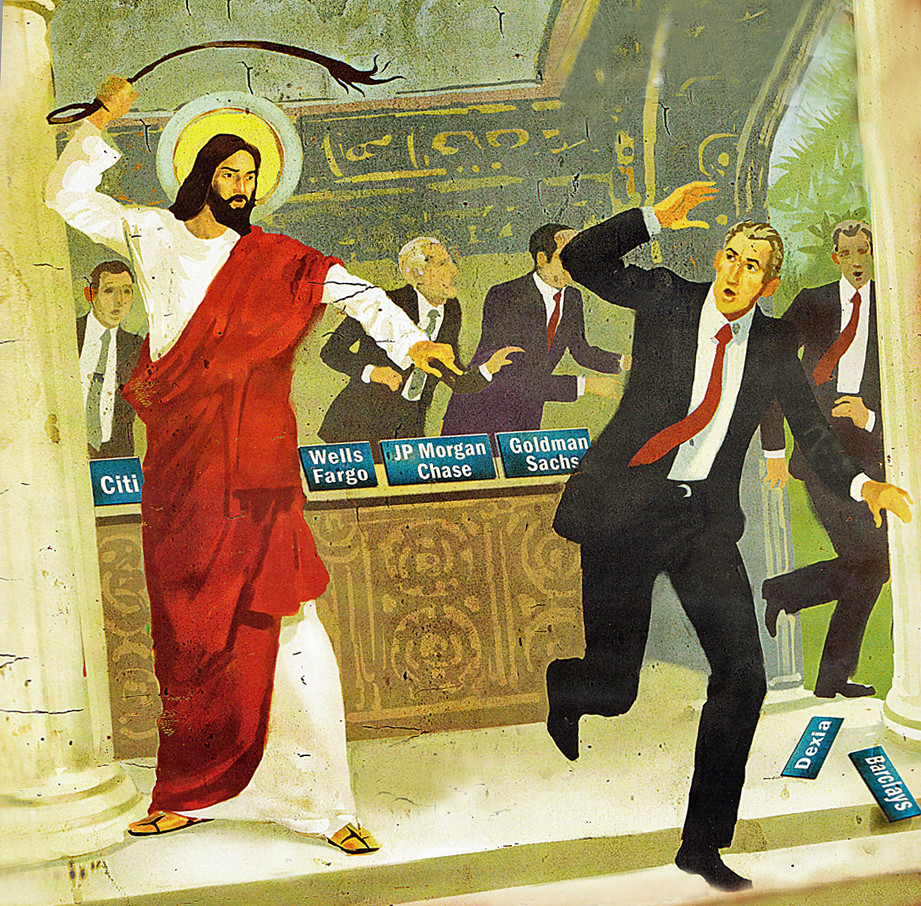
Acts of civil disobedience by insurrectionists. Starting with his act of civil disobedience at the Jewish temple, the site of the administrative headquarters of the Sanhedrin, the supreme Jewish council, Jesus branded himself a political revolutionary. When Jesus “with the help of his disciples, blocks the entrance to the courtyard” and forbids “anyone carrying goods for sale or trade from entering the Temple,” he committed a blatantly criminal and seditious act, an act “that undoubtedly precipitated his arrest and execution.” Because the commercial events were sponsored by the religious hierarchy, which in turn was operated by consent of the Roman government, Jesus’ attack on the money chargers and traders can be seen as an attack on Rome itself, an unmistakable declaration of political and social independence from the Roman oppression.
Military-style arrests in the dead of night. Jesus’ arrest account testifies to the fact that the Romans perceived Him as a revolutionary. Eerily similar to today’s SWAT team raids, Jesus was arrested in the middle of the night, in secret, by a large, heavily armed fleet of soldiers. Rather than merely asking for Jesus when they came to arrest him, his pursuers collaborated beforehand with Judas. Acting as a government informant, Judas concocted a kiss as a secret identification marker, hinting that a level of deception and trickery must be used to obtain this seemingly “dangerous revolutionist’s” cooperation.
Torture and capital punishment. In Jesus’ day, religious preachers, self-proclaimed prophets and nonviolent protesters were not summarily arrested and executed. Indeed, the high priests and Roman governors normally allowed a protest, particularly a small-scale one, to run its course. However, government authorities were quick to dispose of leaders and movements that appeared to threaten the Roman Empire. The charges leveled against Jesus—that he was a threat to the stability of the nation, opposed paying Roman taxes and claimed to be the rightful King—were purely political, not religious. To the Romans, any one of these charges was enough to merit death by crucifixion, which was usually reserved for slaves, non-Romans, radicals, revolutionaries and the worst criminals.
Jesus was presented to Pontius Pilate “as a disturber of the political peace,” a leader of a rebellion, a political threat, and most gravely—a claimant to kingship, a “king of the revolutionary type.” After Jesus is formally condemned by Pilate, he is sentenced to death by crucifixion, “the Roman means of executing criminals convicted of high treason.” The purpose of crucifixion was not so much to kill the criminal, as it was an immensely public statement intended to visually warn all those who would challenge the power of the Roman Empire. Hence, it was reserved solely for the most extreme political crimes: treason, rebellion, sedition, and banditry. After being ruthlessly whipped and mocked, Jesus was nailed to a cross.
As Professor Mark Lewis Taylor observed:
The cross within Roman politics and culture was a marker of shame, of being a criminal. If you were put to the cross, you were marked as shameful, as criminal, but especially as subversive. And there were thousands of people put to the cross. The cross was actually positioned at many crossroads, and, as New Testament scholar Paula Fredricksen has reminded us, it served as kind of a public service announcement that said, “Act like this person did, and this is how you will end up.”
Jesus—the revolutionary, the political dissident, and the nonviolent activist—lived and died in a police state. Any reflection on Jesus’ life and death within a police state must take into account several factors: Jesus spoke out strongly against such things as empires, controlling people, state violence and power politics. Jesus challenged the political and religious belief systems of his day. And worldly powers feared Jesus, not because he challenged them for control of thrones or government but because he undercut their claims of supremacy, and he dared to speak truth to power in a time when doing so could—and often did—cost a person his life.
Unfortunately, the radical Jesus, the political dissident who took aim at injustice and oppression, has been largely forgotten today, replaced by a congenial, smiling Jesus trotted out for religious holidays but otherwise rendered mute when it comes to matters of war, power and politics.
Yet for those who truly study the life and teachings of Jesus, the resounding theme is one of outright resistance to war, materialism and empire.
Ultimately, as I point out in my book Battlefield America: The War on the American People, this is the contradiction that must be resolved if the radical Jesus—the one who stood up to the Roman Empire and was crucified as a warning to others not to challenge the powers-that-be—is to be an example for our modern age.
After all, there is so much suffering and injustice in the world, and so much good that can be done by those who truly aspire to follow Jesus Christ’s example.
We must decide whether we will follow the path of least resistance—willing to turn a blind eye to what Martin Luther King Jr. referred to as the “evils of segregation and the crippling effects of discrimination, to the moral degeneracy of religious bigotry and the corroding effects of narrow sectarianism, to economic conditions that deprive men of work and food, and to the insanities of militarism and the self-defeating effects of physical violence”—or whether we will be transformed nonconformists “dedicated to justice, peace, and brotherhood.”
As King explained in a powerful sermon delivered in 1954, “This command not to conform comes … [from] Jesus Christ, the world’s most dedicated nonconformist, whose ethical nonconformity still challenges the conscience of mankind.”
Furthermore:
We need to recapture the gospel glow of the early Christians, who were nonconformists in the truest sense of the word and refused to shape their witness according to the mundane patterns of the world. Willingly they sacrificed fame, fortune, and life itself in behalf of a cause they knew to be right. Quantitatively small, they were qualitatively giants. Their powerful gospel put an end to such barbaric evils as infanticide and bloody gladiatorial contests. Finally, they captured the Roman Empire for Jesus Christ… The hope of a secure and livable world lies with disciplined nonconformists, who are dedicated to justice, peace, and brotherhood. The trailblazers in human, academic, scientific, and religious freedom have always been nonconformists. In any cause that concerns the progress of mankind, put your faith in the nonconformist!
…Honesty impels me to admit that transformed nonconformity, which is always costly and never altogether comfortable, may mean walking through the valley of the shadow of suffering, losing a job, or having a six-year-old daughter ask, “Daddy, why do you have to go to jail so much?” But we are gravely mistaken to think that Christianity protects us from the pain and agony of mortal existence. Christianity has always insisted that the cross we bear precedes the crown we wear. To be a Christian, one must take up his cross, with all of its difficulties and agonizing and tragedy-packed content, and carry it until that very cross leaves its marks upon us and redeems us to that more excellent way that comes only through suffering.
In these days of worldwide confusion, there is a dire need for men and women who will courageously do battle for truth. We must make a choice. Will we continue to march to the drumbeat of conformity and respectability, or will we, listening to the beat of a more distant drum, move to its echoing sounds? Will we march only to the music of time, or will we, risking criticism and abuse, march to the soul saving music of eternity?






 After the Crash