THE ESTABLISHMENT OF MASS PSYCHOLOGY & FALSE SOLIDARITY

View of crowd covering ears

By Kingsley L. Dennis

Source: Waking Times

It is always necessary to critically question our assumptions and the information that informs our social behaviour. In this light, I intend to cast a glance over current social manifestations regarding how the pandemic has been redefining our social patterns and relations. I will also be examining these patterns from the perspectives of mass psychology, mental intoxication, and a reprogrammed solidarity. According to Prof. Mattias Desmet,[i] the four conditions that allow mass formation – popularly referred to as crowd psychology – to emerge are: a lack of social bonds; people experiencing life as meaningless or senseless; free-floating anxiety; and free-floating frustration and aggression. In recent years, going back decades, these conditions have been building up within our modern societies. As I mentioned in a previous essay,[ii] social anxiety and psychological suffering were already growing exponentially even before the pandemic outbreak of 2020. The foundations for establishing a mass psychology were existent in many, if not most, of our industrialized societies and cultures before the traumatic experience of the current pandemic. At such junctures of psychological vulnerability, a shift of attachment – that is, a transference of identification – can be achieved rapidly. What has likely occurred within the past 18 months has been a widescale process of reprogrammed solidarity.

Prof. Mattias Desmet believes the world has experienced a huge, global ritual that has established a new form (a recalibrated form) of social bonding. Desmet also states that this newly arrived mass psychology is a manner of compensation for many years of extreme individualism where people felt they needed to seek out new and different collective bonds of solidarity. This new solidarity frees people from their prior isolationism and atomization. It is a socially programmed and managed method of social re-gathering. And it is being accomplished on a worldwide scale. Also, it is being brought into being through a form of ritual. Rituals are not only for religious or sacred circumstances. By definition, a ritual is ‘a sequence of activities involving gestures, words, actions, or objects, performed according to a set sequence.’[iii] That is, they are a range of actions performed according to a prescribed order. And that ‘prescribed order’ can come through agreement or imposition – or a mixture of both. Participation in rituals also develop a degree of loyalty to the group/grouping through adherence to and the performing of acts that support the main narratives. These acts of obedience (behaviour sets) can be regarded as rituals, similar to how more familiar religious rituals are performed to denote loyalty to a specific religious faith. When social acts are performed through an emotional attachment of ritual, a form of ‘hypnotic allegiance’ is established that is then extremely hard to break away from. This can then lead to a form of misplaced ethics that can cause people to engage in acts of self-sacrifice in order to uphold what they have been led to believe is their ethical position. People caught up within the mass hypnosis are made to sincerely believe that the mainstream narratives are correct and that they are right to be following and supporting them – even when the evidence points to the contrary. In other words, such people strongly believe in the moral rightness of their position, and this gives them a more powerful sense of solidarity and justification. Similarly, during the Crusades each side felt they were doing ‘God’s work’ by engaging in mass slaughter. What we see here is a condition of misplaced ethics.

People swept up within a mass or crowd psychology tend to protect and maintain it whether consciously or unconsciously. This is why they are most likely to reject any contrary information when it is presented to them; or will reject even the chance for such information to be presented. This amounts to a state of mild induced hypnosis which has shifted from an external identification to a self-maintained state. That is, people engage in the process of their own induced hypnosis. This may sound implausible to some people, yet we need to observe the conditions that were present to allow such states of hypnosis. Part reason for this is that many of the people who accepted the slippage into the formation of a mass psychology were already experiencing psychological discontent. This could come from perceiving a lack of life purpose and meaning; a dislike of their jobs; general restlessness and anxiety; and similar issues related with their previous life status. In such cases, the way to break the hypnosis is not by trying to persuade such people to return to their ‘old normal’ ways, which they were not happy with previously, but by searching out ways to alleviate the source of their psychological discontent. And this suggests a radical transformation in our social and cultural systems and ways of living. Furthermore, it points to a shift away from increasing materialism, automation, and technological dependency into a path that celebrates more the beauty and meaning in being human.

Mass Hypnosis of Solidarity

Persons susceptible to mass psychology are less likely to be responsive or sensitive to rational argument and debate. It is because they did not fall into line with the main narrative through reasoning but rather through a form of ‘mental intoxication’ that triggered a transference of social bonding to the newly established mass solidarity. Such triggers are generally most effective when they are presented through emotional states – these are often based upon fear; (in)securities; and mortality. When such fear-related triggers are heightened and expanded through widescale media coverage, then most, if not all, alternative narratives are discredited, discarded, and ignored. When within such heightened emotional states, cognitive decisions become overruled by inter-personal circumstances. Importantly, the state-supported narrative (the new consensus) gives people an object to connect their anxiety with. They have a mental representation of what is the cause of their anxiety. Their previous condition of free-floating anxiety has now become anchored, and people feel they are then better able to control their frustrations. To take away their belief in the dominantly imposed narrative would confront the person with their initial unease and psychological discontent. For this reason, it is difficult to break or stop such collective psychological formations once they have been established. Once the psychological patterning and emotional identification has been constructed it is then difficult to deconstruct – a significant collective solidarity has been established that imprints the mass mind.

Another factor that strengthens the mass psychology is that the imposed mainstream narratives appear to speak in one collective voice. They are clearer in what they represent and appear to come from a place of unified agreement (i.e., all state actors and state-affiliated actors are showing public agreement). It is important that there is no public disagreement on the narratives. This sense of external clarity further strengthens the issue as a ritualistic act – a hypnotic formation. The other voices that speak out against the dominant imposed narratives are not regarded or seen as coherent because they speak in many, varied voices. This is usually because they come from many and varied sources that have liberty to say things in different ways. Yet this seeming lack of narrative coherency is weaker at confronting or opposing the hypnotic collective. Those people who remain uncertain and not yet fully decided are then more liable to choose the ‘crowd narrative’ because the mass storyline falsely appears as more solid. Those people caught within the mass programming believe themselves to be expressing their own opinions when in fact there has been a clever sleight-of-hand in that they have been provided with a set of pre-formed ‘opinion bundles’ that they can then put forward as their own. Such people are therefore not expressing personal opinions arrived at through individual critical questioning but rather conditioned ‘thought bundles’ provided through the programming techniques built into the establishment of the psychological collective mass. The mass hypnosis of solidarity comes with a pre-prepared collection of opinion sets for bulk dispersal. However entrenched this situation appears, there is always the possibility for counteracting the collective hypnosis.

Regathering our Unity

It is important that those people who see, perceive, and understand the contradictions and falsity in the mass narratives continue to speak out. Hypnosis can be lessened or weakened through continual exposure to rational information, even when that information opposes the narratives of the mass psychology.

The first step in countering the mass psychosis is to disconnect people’s anxiety from the ‘object’ that people were persuaded to transfer their identification to. This can be understandably difficult when the mainstream media is not at your availability but is working to maintain the hypnotic imprinting of the mass narratives. One way, however, that works to make this disconnect is by presenting a scenario – an ‘object threat’ – that may be greater than the one used in the original collective imprinting. For example, if people realized that the current ‘health crisis’ could lead to a condition of totalitarianism, then this realization could be sufficient to awaken people from their hypnosis as they still have the cognitive capacity to grasp that the social condition of totalitarianism is a graver threat than a biological agent with low mortality rate.

The real issues, and the one that creates a fertile ground for inducing a mass psychology in the first place, is the lack of social bonding in our societies and a perceived lack of meaning. This perceived lack of meaning and purpose in everyday life is what produces the feeling of ‘free-floating’ anxiety. The danger here is that a populace under the sway of mass psychology – mass induced hypnosis – is more likely to support or go along with a totalitarian regime that maintains this mass hypnosis. This was one of the reasons why Germany’s National Socialism (the Nazi regime) was so successful in its aims.

The people who were less susceptible to hypnosis of mass psychology tended to be those who disagreed with the ideology behind it or had more experience in using critical analysis of social phenomena, and/or were more aware of the processes of social conditioning and the uses of mainstream propaganda. They were much more capable of spotting from the onset how the narratives of the mass psychology were treating people as mere biological units to be moved around the board. The question that now needs to be asked is: how can those people who stand apart from the mass hypnosis be able to unify? Those who can speak out against the mass hypnosis need to connect together. And their advantage is that they are unified through an understanding whilst remaining diverse in their backgrounds, belief structures, identities, etc. Such people can find cohesion in perspectives whilst remaining as diverse and independent individuals. This diversity and individual independence bring greater strength than a collective mass that has been unified through the programming of a false solidarity.

It is important that those people with perceptive cognition recognize that a global ritual has been set into motion that has as its goal the ‘retraining’ of the populace into welcoming upon them a new civilizational model. The willing compliance to adopt this new model of order, at the local, regional, national and global level, will sever humanity from its own biological and constitutional roots. In order to move forward as human beings, we will likely need to reject certain materialistic futures offered to us. These offers will come with promises of comfort and convenience; yet they will hide an underbelly of human disconnect and the loss of the human spirit. If a deal is made with the devil, then we can be sure that our souls will be collected without delay. And the great truth that gives humanity its strength is that the human soul and spirit can never be taken without our willing compliance. In that, by denying them our willing compliance we strengthen our unity by default. The unity established through conscious awareness is always greater energetically than the perceived unity through unconscious programming. If the fewer are aware, and conscious of what is being attempted by the mass hypnosis, then this shall energetically give us a stronger unity. And the way to break the mass hypnosis is by aligning with a greater truth that shall gradually resynch and recalibrate the energetic vibration of the collective.

THE WAY OF THE MASTER: LIFE AS APPRENTICESHIP

By Gary Z McGee

Source: Waking Times

“It is the height of selfishness to merely consume what others create and to retreat into a shell of limited goals and immediate pleasures. Alienating yourself from your inclinations can only lead to pain and disappointment in the long run, and a sense that you have wasted something unique.” ~Robert Greene

How do you become a prime mover? How do you become more self-determined, more self-aware, more responsible for your lot in life? How do you become your own boss, fully volitional, fully responsible, fully engaged, with more creativity, more adaptability, and more courage? How do you become a master?

It begins with self-apprenticeship. You must create your own momentum. Don’t be afraid of becoming an autodidact. Read a lot. Connect the dots. Seek out the shoulders of giants, not just to learn, but to see further than they did. Seek help, expertise, guidance, and wisdom from others, but then you must take responsibility for your own improvement. Take a leap of courage out of faith. Create a scaffold of knowledge. Its foundation is curiosity. Stay curious. Be Curiosity. As Joseph Campbell said, “follow your bliss.”

Mobilize your mind:

“Those who cannot change their minds cannot change anything.” ~George Bernard Shaw

The immobilized mindset is a handicap. Living a full life requires movement. What does not move is dead. Let the mind move, let the mind flow, let the mind grow.

Don’t let your mind settle. A settled mind is a closed mind. A settled mind tricks you into believing that you have figured things out. It inadvertently sacrifices reason for anti-reason. It uses anti-reason to buttress itself against new knowledge.

Remember: knowledge is always your master. Don’t let your ego fool you. One does not master knowledge; one only learns it. The mind is simply too fallible, too inflexible, too imperfect to become a master of knowledge. True self-mastery is understanding that knowledge will always be your master.

Which is all the more reason to keep your mind active, fluid, flexible, and mobile. Don’t get comfortable. Take risks. Embrace change. It’s when you fight against change, when you deny it, repress it, ignore it, or rage against it that you suffer unnecessarily. When you embrace change, however, you’re in flow with it, dancing, flexible, and empowered, even when it hurts. Especially when it hurts. Because you know, pain is information. Pain is a teacher. Pain is a guide. Pain is merely procrastinating power. In the long run it will make you stronger.

The ability to loosen your mind, to alter your perspective, to reimagine imagination is one of the most amazing powers you have as a human being. Cultivate it through mindfulness. Activate it through No-mind. Avoid fixation. Avoid attachment. Avoid belief. Ponder what is absent to create a flexible open-mindedness that can persistently overcome itself.

As Jeremy Hammond said, “Your mind is programmable—and if you’re not programming it then someone else will program it for you.”

Embrace the almighty metaphor:

“As our eyes grow accustomed to sight, they armor themselves against wonder.” ~Leonard Cohen

Reality is a great mystery. Honor it. Let it continually fill you with awe. Don’t seek certainty. Just seek. Be with the curiosity. Be hunger. Be love. Be on the edge of your seat, flabbergasted and entranced, astounded and gobsmacked, dumbfounded and engaged, detached and aloof with the interconnectedness of all things.

Certainty is the creativity killer. Certainty murders mystery. Certainty cripples mastery. Avoid it at all costs. Being certain gets you nowhere but stuck in a box, closed off in a mental paradigm, stifled by a tiny comfort zone, or blocked by an inflexible boundary. It puts eye guards on when peripheral vision is needed.

Employ strategies of awe. Plant a maze in your mind and watch it grow into a labyrinth. Explore it. Transform your eyes into Over Eyes, your mind into No-mind, your soul into Soul Craft. Transform your life into a Hero’s Journey. Confront threshold guardians. And when your mind becomes fixed and settled, strategically plant a minefield in the mind field. Then sit back and enjoy the explosion, as your mind is blown into new ways of seeing the world.

Everything in life is Metaphor. From shapeshifting comes worldmaking. Life becomes art, and art becomes life. Forget genes. Forget memes. Carry mythemes and astonish the world.

Embolden what makes you unique:

“I would rather be a man of paradoxes than a man of prejudices.” ~Rousseau

Carl Jung stressed that an individual’s proper goal is wholeness, not perfection. You will never be perfect, but you will always be unique. Let notions of perfection roll off you like water off a duck’s back. Then double down on your uniqueness.

Real power is emboldened uniqueness. Uniqueness is true power. Everything else is moonshine. Everything else is smoke and mirrors. Focus on what makes you unique, what makes you come alive. Split the smoke. Shatter the mirrors. Let your authenticity boldly blast through it all.

You are a slice of Fate. You might be made up of the same ingredients as other slices of Fate, but your slice is arranged in a way that has never occurred before nor will it ever be repeated. You are a one-time phenomenon. You are beyond a force of Nature. You are a force of Fate. Use it. Fuel yourself with it. Be the tip of the spear and pierce through your life with purpose and meaning.

Becoming who you really are is shedding the skin of who you were conditioned to be by culture and then embracing the new skin of your reconditioning. It’s shaving away the superfluous and embracing the numinous.

When you are able to do this, you unleash your calling, your inner voice, your primal howl. This voice is intuitive, inquisitive, and hungry to be heard. If you listen intently, you will feel your own potential and your deepest longing to create and express your own uniqueness. This uniqueness is your life’s purpose. But it isn’t there for a reason. You must give it a reason to empower you.

Use probability to stay ahead of the curve:

“Consider nothing impossible, then treat possibilities as probabilities.” ~Charles Dickens

Truth or delusion is both a tripwire and a balancing wire. Either way you go, it is precarious. One man’s truth is another man’s delusion. Fortunately, there is validity and probability that you can use as a benchmark, as a way to measure what is more likely to be true.

A good rule of thumb, when faced with potential invalidity, is to ask: “Sure, it’s possible, but is it probable?” True mastery comes more from embracing and being fascinated by mystery and less from intellectualizing and labeling it. It’s more of a detached obliteration of “baskets” than a codependent clinging to them.

The key is to keep your eggs free of all baskets. Don’t settle on any single bedrock of thought. As Aristotle said, “It is the mark of an educated mind to be able to entertain a thought without accepting it.” Just flow through it all. Keep questioning. Keep swimming. Keep searching. Use probability as your Occam’s Razor.

Because nobody is off the hook for being wrong. The best we can do is get better at recognizing the hook for what it is so that we are less likely to get dragged away by it. By developing and practicing disciplined strategies for cutting the line and negotiating the hook before the Fisherman of Closemindedness can reel us into his Boat of Dogmatism.

Real mastery sharpens itself against probability. Keep using the sound tools of logic, reasoning, and probability. Keep deflating self-important seriousness into authentic sincerity. Have fun with it. Laugh at it. Play with it. Tease it. Dance with it. Reimagine it in ways that shock your soul into heightened awareness. Shoot yourself in the foot before someone else does, or before the passage of time deems your work outdated or uncouth.

Ever tried. Ever wrong. No matter. Try again. Be wrong again. Be wrong better. This will keep you ahead of the curve. It will keep you sharp against entropy. As it turns out, you are more likely to be right by admitting that you are more likely wrong than by declaring that you are absolutely right.

Allow healthy skepticism and an intimacy with probability to become your shifting bedrock, your foundational quicksand, your liberated measuring tool. This is the apprenticeship. When you are free to swim in the waters of uncertainty rather than remain chained to the pillars of certitude, you are more likely to achieve mastery.

REVISIONING JUNG’S IDEA OF SYNCHRONICITY

By Paul Levy

Source: Waking Times

Synchronicity is considered to be one of the most important ideas emerging out of the twentieth century. Jung coined the term synchronicity to describe a category of experience that defied and had an altogether different logic than the widely accepted and virtually unquestioned logic of linear sequential causality (in which a cause precedes an effect in linear time), which was generally thought to be the only kind of causality operating in the universe at the time. Bringing forth the notion of synchronicity was a bold and heretical act by Jung that was a radical departure from and challenged one of the most inviolable, sacrosanct, and seemingly unassailable foundations of the modern scientific materialistic worldview. In his idea of synchronicity Jung was proposing a completely different kind of organizing principle at play in the universe that was quite alien to the widely accepted western worldview of how the universe worked.

In order to break free from and distinguish synchronicity from the limiting logic of linear causality, Jung chose the word “acausal” (calling synchronicities an “acausal connecting principle”) in order to characterize how synchronicities didn’t have to do with causality as it had been generally understood. There was an unforeseen problem, however, that had to do with Jung’s choice of the word “acausal”—and what he meant by this—that has caused a rift and created conflict among a number of theorists, researchers, scientists and psychologists in their accepting Jung’s idea of synchronicity. Some people have even dismissed Jung’s work on synchronicity, thinking his conception of synchronicity is incoherent or flawed.

To cite one example, J. B. Rhine, who is widely considered to be the father of parapsychology, and was one of Jung’s inspirations for his work on synchronicity, couldn’t accept Jung’s idea of synchronicity being “acausal,” and thereby rejected Jung’s understanding of synchronicity. Jung thereby lost an important potential ally in helping him bring forth his concept of synchronicity to the world.

The dictionary definition of the word acausal is “not involving causation or arising from a cause; not causal. Synonym: noncausal.” For example, in describing synchronicities, Jung writes that they are “a modality without a cause, an ‘acausal orderedness.’” Being called an acausal connecting principle therefore implies that there is no causality operating in a synchronicity. Jung was of the opinion that it is our strongly “ingrained belief in the sovereign power of causality” that makes it seem unthinkable that “causeless events” could ever happen. But if events without a cause actually do exist, Jung regarded them as “creative acts” that are “not derivable from any known antecedents.” The type of causation we are dealing with in synchronicities were totally unfamiliar and unknown to the prevailing western scientific mindset of his day. In his theory of synchronicity, Jung was trying to articulate a radically new vision of reality—a new worldview—that was completely out of the box and off the radar of the existing scientific materialistic paradigm.

In his conception of synchronicities as being acausal, it is entirely conceivable that Jung was way ahead of his time and was tapping into, perceiving and pointing at the underlying unified quantum field which is openly hidden (from our spatio-temporally conditioned, dualistic human perception) within the very midst of our physical world. In this unified nonlocal field there is no separation whatsoever, as there are no independent “things” that interact with and hence, have causal effects upon each other. These separate parts are merely mental constructs, just ideas in our mind, human overlays or projections of our own inner state of fragmentation onto an ultimately indivisible field of reality that we then mistakenly take to be made up of separate things. In an undivided realm such as this—that is simultaneously immanent and transcendent—there can be no causality because causality implies separate entities that influence and have effects upon each other.

To illustrate this same point, quantum theorist David Bohm uses the following example: Imagine a fish swimming in a fish tank, with two video cameras at right angles to each other filming the fish’s movements, which are then transmitted to and shown on two different monitors in another room in a way that makes us think we are looking at two different fish. The fish’s movements on these two screens clearly seem related to each other, but we can’t say that the fish’s movement on one of the screens “caused” or influenced in any way the corresponding movement on the other screen. This is because the different images on the two screens are not pictures of independently existing entities that are interacting, but are in reality two images (from different perspectives) of one and the same entity. It would be an error to try to establish a causal relationship between these two images, as the notion of causality simply does not apply in this circumstance. It would therefore make sense to say that the “connecting principle” between the two different images of this single fish (representing the deeper indivisible nature of reality) is acausal. Thus, in describing the nature of a quantum universe such as ours, Bohm characterizes it as having a “non-causal” connection between its elements.

Jung’s usage of the word acausality may therefore have been intentionally referring to this intrinsically unified field which admits no separation. In any case, his choice of the word acausal has nevertheless created a lot of misunderstanding that continues to persist up through our present day that needs to be remedied.

Do synchronicities arise, as Jung seems to suggest, without a cause? Or, is there in synchronistic experiences an unfamiliar kind of causality that is operating in the world in which cause and effect are not taking place over linear sequential time, maybe not even taking place within time itself? If it does exist, how is this unknown type of causality a “connecting principle” between the inner and outer dimensions of our experience?

To address this problem, I thus propose coining and bringing forth the word “simulcausality” as an alternative term to more accurately describe the kind of atemporal causality that might be happening in synchronicities. The notion of ‘simulcausality’ remedies the confusion around the word ‘acausal’ by acknowledging, rather than a linear-sequential or temporal form of causality—or no causality at all—that a new and different kind of simultaneous causality which acts as a ‘connecting principle’ is taking place in synchronicities.

This unfamiliar kind of causality that mysteriously links the inner and outer contents of our experience together is brought into focus through the notion of simulcausality. In synchronicities, these two realms—the inner (subjective) and the outer (objective)—are connected in a way that is not sequentially causal but simulcausal. These two realms—the internal and the external—are what synchronicities act as a connecting principle between. Simulcausality implies that there is a different kind of causality operating than we are accustomed to, but this other kind of causality occurs between the two seemingly distinct realms of mind and matter while taking place outside of time, in no time—i.e., simultaneously!

Introducing the word simulcausal involves, of course, more than the mere changing of a word. Replacing the word acausal with simulcausal is symbolic of shifting into a new, more expansive mode of seeing that previously was unavailable to us because of our unconscious conditioning. With this new kind of vision comes a new way of understanding ourselves and the world that helps us to see how our self-reflecting and potentially self-reflective universe actually operates, rather than how we had been hallucinating that it operates while being conditioned and blinded by the spell of linear time and its natural correlate, linear causality.

We can now redefine synchronicity as “a simulcausal connecting principle” in which causality happens vertically (simultaneously) rather than horizontally (over linear time). Vertical causality refers to a kind of causality that occurs between different dimensions or domains of our experience that are inseparably embedded and inter-nested within each other in the same moment. This perfectly describes the interdimensional relationship between the inner subjective world within us, which takes place in a higher dimension (‘in’ is ‘up’ dimensionally), compared to the lowerdimensions of the seemingly outer 3D world of matter, time and our physical sense perceptions (commonly known as the spacetime continuum).

The higher dimension and the lower dimensions of our experience interpenetrate each other so fully such that there’s an intrinsic connectivity between them—through the simulcausal connecting principle—that allows these two realms to instantaneously influence each other interdimensionally in no time at all. Because this is an interdimensional connection, this process happens simultaneously—in the present now moment—without time being involved whatsoever. Mind and matter are thus connected through a simulcausal interdimensional communication link which takes place outside of and independent from linear time.

These different dimensions (of mind and matter) that are conceived of as influencing each other interdimensionally are, ultimately speaking, not two separate dimensions that are interacting with each other, but rather, a multidimensional continuum that is inseparably one. To recognize this is to begin to see the dreamlike nature of our universe where, just like our dreams at night, the physical world we are experiencing is not separate nor separable from our consciousness.

Synchronicities thus operate through an instantaneous simulcausal resonance or interdimensional coordination between the contents of our inner (higher dimensional) life—our minds—and the outer events taking place in the (lower dimensional) 3D physical universe. These two domains—our inner “subjective” and outer “objective” life—are conventionally thought to be distinct and non-interacting but are in fact inseparably interconnected parts of a unified multidimensional whole system. These two domains—mind and matter—which since Descartes have been traditionally understood in the West to be operating independently and separately from each other are, in synchronicities, revealed to have a mysterious correlation that clearly defies the strict Cartesian dualism that requires mind and matter, the subjective and objective realms, to remain separate and non-interacting.

The coordination between these realms takes place instantaneously in the implicit interdimensional simulcausal dynamics constituting each and every moment of our experience. This accounts for the uncanny correspondences between the inner and the outer worlds that are the central and most notable feature of synchronistic phenomena. Because simulcausality operates instantly, outside of time—in the realm of “no time”—its very existence is easy to miss, which is why it has been left out of the western scientific materialistic worldview, which is more outwardly focused and not as introspective as the eastern worldview.

From the materialistic point of view, synchronicities are inexplicable not only because their cause is unknown, but because, presupposing third-dimensional space and time as being objectively real, their cause, to use Jung’s word, is “unthinkable.” This is to say that we can’t comprehend the unfamiliar type of causality involved in synchronicities if we are stuck in our thinking mind. In other words, synchronicities force us out of our (cognitive, conceptualizing) minds.

Our experience of the world—composed of a combination of both linear causality and simulcausality—can be represented by a symmetric cross that can be called “The Cross of Linear and Simultaneous Causality.” In this image, the horizontal axis of the cross represents the realm of linear time and linear sequential causality in which cause precedes effect, which then becomes the cause of a subsequent effect and so on and so forth. This is the common and conventionally understood “timeline” in which the flow of sequential time moves from left to right with the “past” or earlier events being to the left, the present moment of a linear “now” is a single point in the center and then the “future” lies to the right or ahead of the single point representing the now or present moment. This represents the process of horizontal (linear) causality.

The vertical axis represents the timeless now moment in which there is no linear sequential (horizontal) time occurring, but rather, is the domain in which a timelessly operating simulcausality is at work in a way that connects the inner (higher) and outer (lower) dimensions through a kind of instantaneous interdimensional resonance. Each point on the horizontal timeline has a vertical line (representing the interdimensional axis) that can be drawn perpendicular to it. Each and every point of intersection between the two axes represents a specific moment in linear time that is being influenced by—and is an expression of—the connection between the higher and lower dimensions of our experience (via the simulcausal connecting principle that is operating outside of time through each and every moment).

These two modes of causality—the linear causal and simulcausal—co-exist and interpenetrate in an elegantly integrated harmony that is an expression of the wholeness of our universe (as well as reflecting our own intrinsic wholeness as multidimensional beings).

In suggesting the notion of simulcausality I am merely offering a new possible way of contemplating the nature of synchronistic phenomena that has some novel features and some significant conceptual advantages that bypass the set of problems that Jung’s notion of acausality and “acausal orderedness” brought with them. The notion of simulcausality enables us to describe the way that synchronicities operate in a new way that opens up fresh possibilities for us to envision the nature of our universe (as well as our own nature).

One of the key aspects of this revisioning of our scientific conception of reality is the recognition that reality as a whole is a profoundly nonlinear affair with linear dynamics only comprising a small subset of the total dynamics that make up the cosmos. Since the time that Jung introduced the concept of synchronicity there has been an explosion of new scientific theories and creative maps and models of reality that push our understanding far beyond the logic of linear causality. These new insights have moved the scientific imagination of the world into vast new realms of nonlinearity that are now recognized to be fundamental and essential features of the nature of nature, of the universe and of reality itself. For example, nonlinear whole systems sciences like Chaos Theory—more accurately described as the science of nonlinear order—and Complexity Theory have made many groundbreaking inroads into the nonlinear frontier that have changed our scientific picture of our world and of our understanding of reality in extremely profound and fundamental ways.

Simulcausality is, however, not really anything new at all. It is referred to in multiple esoteric, wisdom traditions across the world throughout recorded history. For example, simulcausality is equivalent to what in Buddhism is called “the simultaneity of cause and effect.” At the very heart of the Buddha’s teachings, the simultaneity of cause and effect points to the dynamic in which we are creating our experience of the seemingly outer world (which is not separate from ourselves), while—at the same time—being influenced by our creation in a reciprocally co-creative feedback loop. Contrary to linear cybernetics, in which feedback loops take place through space and over time, simulcausality is characterized by a process of synchronistic cybernetics in which the feedback loops are beginningless, circular, instantaneous, and timeless.

The principle of simulcausality does not negate the possibility of linear causality, nor does linear causality disallow simulcausality. These two fundamentally different types of causality naturally co-exist with each other. This is reflected in the Buddhist understanding of how the simultaneity of cause and effect (instant karma) does not negate but harmoniously co-exists with linear cause and effect (karma that unfolds over time). Their co-existence produces a much more complete view of reality that recognizes and embraces both types of causality.

The Buddhist teaching of “As Viewed, So Appears” is another example of simulcausality. As Viewed, So Appears can be thought of as the mystic law or a mystic equation describing how we formulate and cocreate reality instantaneously within—and with—our dreamlike universe. Think about the nature of a night dream: it is a reflection—a projection—of the mind that is observing it. In a dream, the very moment we connect the dots on the inkblot of the dream (interpreting and placing meaning on it), the dream has no choice—instantaneously, in no time whatsoever—but to reflect back to us our perception/interpretation (for a dream is nothing other than a reflection of the mind that is dreaming), which then confirms to us the “objective” truth of whatever we happen to be seeing (as we now have all the evidence we need to “prove” that what we are seeing is “true”).

This becomes a self-confirming and (potentially) never-ending instantaneous feedback loop that is self-referential and self-generated by our own mind that (since it is happening in no time and unfolding over time at the same time) continually feeds back into itself until it is seen through. Not seeing how simulcausality operates in our moment to moment lives is one of the main reasons why we are prone to get stuck in insidiously self-reinforcing feedback loops that seemingly trap us in all sorts of self-limiting double binds, self-bewitching spells, infinite regressions and dead ends within our own minds. Becoming conscious of the simulcausality principle that is continually at work crafting our experience (of both ourselves and the world) can prevent us from falling under these maddening self-created spells while, at the same time, immediately puts immeasurable, otherwise unavailable creativity at our disposal.

In essence, we have entranced/hypnotized ourselves—putting ourselves under a spell—through our own creative genius of how we are participating in creating our dream (sleeping or waking). This dynamic—which can be clearly seen in our night dreams—is reflecting and teaching us something about how simulcausality acts as a connecting principle between the inner and outer dimensions of our experience that is intrinsic to how we dream up (and create) not only our sleeping dreams, but our waking life as well.

In our universe everything is simultaneously intercausing (causing and being caused by) everything else in a cybernetic chain that recursively loops back on itself in no time. Everything that manifests is reciprocally co-arising with everything else in a nonlinear and nonlocally coordinated way in the one singular and eternal “now” moment. In Buddhism this process of intercausality (a third type of causality) is called “dependent co-arising” (also known as “interdependent co-origination”), which is considered to be the fundamental dynamic by which empirical reality is continually reconstituted in each and every moment.

At the heart of the Buddha’s realization, the notion of dependent co-arising helps us to awaken from the spell of linear causality and enables us to see how our experience of the world—and ourselves—actually arises (via the process of intercausality) in the present now moment while (at the same time) giving the very convincing appearance that it is unfolding in a linear sequential way. Each new configuration of the outer universe as well as of our inner subjective life in each moment (which is always happening in the same eternal now moment) is thought to be—and subjectively experienced as—another (separate) moment, which gives birth to the idea of a linear sequence of distinct moments that arise one after the other (like a conveyor belt). Emerging out of this way of looking at things is our (illusory) conception of linear sequential time, which as physics has pointed out, is in essence nothing other than a construct(ion)—a creation—of our minds. Jung suggests that what happens successively in and over linear time could be conceived of as occurring simultaneously—all at once—in the mind of God. In fact, based on our experience, we always find ourselves in the one and the same singular unchanging now moment, which is a realization that can’t help but to transform the very consciousness that has realized this.

An expression of the interconnectedness, interdependence and undivided wholeness of the universe (where not only there is no separate self to be found, but no separate things of any sort as well), dependent co-arising is operative all throughout space at any given moment in time as well as in each moment. Simulcausality, on the other hand, operates in a realm outside of time, in that it connects the different dimensions of our experience, such as inner (mind) and outer (matter) in a way that does not take place over time. Transcending linear causality, both intercausality (happening throughout space in any and every moment in time), and simulcausality (happening outside of time altogether) mysteriously come together in a timeless embrace, as they reveal themselves in a singular synchronistic moment in time.

There are a number of phenomena that seem to defy our ordinary sense of spacetime based logic—such as, for example, nonlocality (quantum entanglement), dependent co-arising (intercausality), simulcausality, synchronistic phenomena, and psi phenomena. Because they all appear to violate the third-dimensional laws of space and time, these phenomena tend to mistakenly be conflated as being equivalent, which results in confusion and misunderstanding. They are all somehow related, as they are interconnected aspects of the sentient dreamlike universe that we inhabit, but exactly how they are related has yet to be fully established.

Bringing more and more consciousness to the experience of simulcausality enables us to deepen our understanding of how we are playing a key role in creating ourselves and our experience of the universe in each and every (now) moment. This process is similar to how a dream (in which the seemingly inner and outer realities are unified) is constructed. Dreams are literally revealing to us that the primary dynamic of how we co-create the reality we experience is simulcausal in nature. Sequential (linear) causation can be recognized to be a secondary dynamic that builds upon, extends and transforms through and over time that which has already—and always is—being instantaneously simulcausally created.

The tragic and unnecessary self-confinement of our minds to a linear-sequential logic can be seen as a parallel or symbolic reflection of what has happened to much of humanity as a whole with its fall into an overly rationalistic materialist paradigm. Although granting humanity immense power over the physical universe, our entrainment into the scientific materialistic point of view has sadly also brought about an atrophy of the immensely powerful inner psychic/spiritual faculties of humanity, making many of us into misshapen, one-sided and imbalanced creatures.

Similar to how the unconscious compensates a one-sidedness in us by sending us dreams, Jung considered synchronicity to be an indispensable counterpart to linear causality that is compensatory in nature. As a connecting principle, synchronicity can thus help us to connect back with ourselves and our own creative power. The compensation for the one-sidedness of humanity as a whole must come through the reawakening of these atrophied and dormant inner faculties of our minds.

RESISTING TYRANNY DEPENDS ON THE COURAGE TO NOT CONFORM

By Barry Brownstein

Source: Waking Times

Social psychologist Roy Baumeister begins his book Evil: Inside Human Violence and Cruelty, with a proposition that will be counterintuitive to many: “Evil usually enters the world unrecognized by the people who open the door and let it in. Most people who perpetrate evil do not see what they are doing as evil.”

Dismissing evildoers as “insane” is an attempt to absolve both them and you of responsibility. Baumeister observes, “People do become extremely upset and abandon self-control, with violent results, but this is not insanity.” If only “insane” people commit “evil” acts, you might reason there is no need to strengthen spiritual and moral muscles. You might skip the reflection, study, and practice that builds spiritual and moral strength.

Would you, Baumeister asks, “obey orders to kill innocent civilians? Would you help torture someone? Would you stand by passively while the secret police hauled your neighbors off to concentration camps?” Baumeister writes, “Most people say no. But when such events actually happen, the reality is quite different.” Today, to the point, will you obey orders to fire upon people who refuse to comply with mandates?

In one of the most instructive books about Nazi Germany, Ordinary Men: Reserve Police Battalion 101 and the Final Solution in Poland, historian Christopher Browning explores why most people say yes and commit heinous acts even when given latitude to say no.

The men of Police Battalion 101 were not specially selected psychopathic killers. Initially, the Battalion was set up to enforce Nazi rule in occupied Poland. Eventually, their mission changed, bringing them to be the genocidal murderers of Jews they were charged with rounding up. Browning explains, “The bulk of the killers were not specially selected but drawn at random from a cross-section of German society, and they did not kill because they were coerced by the threat of dire punishment for refusing.” Mostly they were “middle-aged reserve policemen.” Battle had not driven these men to depravity, “they had not been fired on nor had they lost comrades.”

Browning explores one of their initial murderous actions, “shooting some 1,500 Jews in the Polish village of Józefów in the summer of 1942.” Major Wilhelm Trapp addressed his men before the shooting began: “Pale and nervous, with choking voice and tears in his eyes, Trapp visibly fought to control himself as he spoke. The Battalion, he said plaintively, had to perform a frightfully unpleasant task. This assignment was not to his liking; indeed, it was highly regrettable, but the orders came from the highest authorities.”

Trapp provided a “justification” for the coming slaughter—Jews were damaging Germany and threatening German troops—but then Trapp “made an extraordinary offer: if any of the older men among them did not feel up to the task that lay before him, he could step out.” The task, Trapp outlined, was the immediate killing of all women, children, and the elderly.

Only twelve of the approximately 500 in the Battalion initially took Trapp’s offer to “step out.” Browning estimated “10 to 20 percent of those actually assigned to the firing squads” extricated themselves “by less conspicuous methods or asked to be released from the firing squads once the shooting had begun.” Yet for most of the police, killing became second nature: “Many reserve policemen who were horrified in the woods outside Józefów… subsequently became casual volunteers for numerous firing squads and ‘Jew hunts.’”

Browning’s research provides insights into the mindsets that fueled obedience: “Who would have ‘dared,’ one policeman declared emphatically, to ‘lose face’ before the assembled troops.” Another said, “No one wants to be thought a coward.”

Not all who followed orders lacked moral consciousness: “Another policeman—more aware of what truly required courage—said quite simply, ‘I was cowardly.’”

Some rationalized their atrocities: “It was possible for me to shoot only children. My neighbor then shot the mother and I shot the child that belonged to her, because I reasoned with myself that after all without its mother the child could not live any longer.”

To escape moral culpability, others offered the excuse of what difference could they make: “Without me [shooting] the Jews were not going to escape their fate anyway.” How many managers are saying today, what difference can I make? If I don’t fire the unvaccinated, someone else will.

Browning explains, “The men’s concern for their standing in the eyes of their comrades was not matched by any sense of human ties with their victims. The Jews stood outside their circle of human obligation and responsibility.” Today, hospital administrators are firing workers with robust natural immunity who faithfully served during the pandemic and refuse the vaccine. Like the men in the Battalion, these administrators are just following orders.

What would have happened that terrible day in 1942 if more policemen recognized the humanity of the “other” and had the courage to not conform? Today, what would happen if more businesses, like In-N-Out Burger, refuse to obey government edicts? In October, Stephen Davis, a Florida fire battalion chief, “was fired for refusing to discipline department employees listed as unvaccinated.” What would happen if more managers had the courage of Chief Davis? Without obedience, tyranny fails.

During this time of Covid, we can learn lessons from Browning’s book about how we treat people who make choices different from our own. We can notice when we fail to see the humanity in others. We can become aware when we justify an us vs. them mindset. We can question our perceptions. To wait for Biden or Fauci to change first is to ignore our power of choice.

Lessons Learned

Browning reflects on the actions of the Battalion and asks, “If obedience to orders out of fear of dire punishment is not a valid explanation, what about ‘obedience to authority’ in the more general sense used by Stanley Milgram?”

Browning wonders if there is “a ’deeply ingrained behavior tendency’ to comply with the directives of those positioned hierarchically above, even to the point of performing repugnant actions in violation of ‘universally accepted’ moral norms.” Browning explains,

The notions of ‘loyalty, duty, discipline,’ requiring competent performance in the eyes of authority, become moral imperatives overriding any identification with the victim. Normal individuals enter an ‘agentic state’ in which they are the instrument of another’s will. In such a state, they no longer feel personally responsible for the content of their actions but only for how well they perform.

Browning recounts, “Milgram made direct reference to the similarities between human behavior in his experiments and under the Nazi regime. He concluded, ‘Men are led to kill with little difficulty.’”

Importantly, “Milgram himself notes that people far more frequently invoke authority than conformity to explain their behavior, for only the former seems to absolve them of personal responsibility.” Yet, in the Battalion case, “Many policemen admitted responding to the pressures of conformity—how would they be seen in the eyes of their comrades?—not authority.” Based on his research, Browning concludes, “Conformity assumes a more central role than authority at Józefów.”

The Covidocracy demands we all conform and shames those who make different choices. Browning explains the dangers of a culture of shame: “The shame culture, making conformity a prime virtue, impelled ordinary Germans in uniform to commit terrible crimes rather than suffer the stigma of cowardice and weakness and the ‘social death’ of isolation and alienation vis-à-vis their comrades.”

The segregation of Jews was an enabler of evil actions. Browning points to pervasive banishment of Jews from German society “and the resulting exclusion of the Jewish victims from any common ground with the perpetrators made it all the easier for the majority of the policemen to conform to the norms of their immediate community (the battalion) and their society at large (Nazi Germany).”

For some policemen who did not shoot, their commercial ties shaped their view of human beings. One said, “Through my business experience, especially because it extended abroad, I had gained a better overview of things. Moreover, through my earlier business activities I already knew many Jews.”

Harvard social psychologist Gordon Allport developed his famed contact hypothesis in the 1940s: “Increasing exposure to out-group members will improve attitudes toward that group and decrease prejudice and stereotyping.” Commercial ties bring people together.

Today, politicians work overtime demonizing, mocking, and punishing “out-group members” who won’t obey their dictates.

A Story of Nonconformity

Recently Tim, a reader and business owner from New Zealand, sent me his powerful testimony in an email:

Fifty odd years ago, as a young child I went to Ranui Primary School in suburban Auckland. There were two Māori boys in my class of 9-year-olds. Sometimes through the day they would make short comments to each other in Māori.

If the teacher heard them do it, he would keep our entire class in detention after school for 15 to 30 minutes. I always hated it because one of the boys was my friend, and a regular playmate of mine after school. The other one, used to walk home from school with me too, they were my friends.

But most of the class blamed these two Māori boys for us all being locked in after school. The majority of the kids disliked and bullied them in my class.

I couldn’t do it; I couldn’t dislike them because they were my friends. Perhaps even then as a boy I could see what our teacher was doing.

Our teacher was using the rest of the class as a weapon against those two young boys by encouraging the spiteful and discriminating attitudes towards them.

Tim’s choice to not conform to social pressure made all the difference to his Māori friends. Did Tim’s ability to see the humanity in others help him become a successful entrepreneur? After all, entrepreneurs succeed when they help serve the needs of others.

Tim continued his testimony:

Today, 50 years later, I am again feeling the same way as I did back in my Ranui Primary School class. The teacher is telling us all that we will continue to be locked in until 90% (or whatever) of the country is vaccinated. And further, we are told that it is the fault of the 20% (or so) that have so far chosen not to accept the two shots in the arm.

As a country, we are all encouraged to heap blame and hate towards anyone who has decided to not vaccinate.

Regardless of my own vaccination status, I have friends and family who I refuse to hate or blame.

I lay the blame exactly where it belongs. At the feet of my Primary School teacher for our detentions, not my two boyhood friends.

And at the feet of our Prime Minister for her lockdown rules, not my friends and family who have chosen to decline an injection that they don’t trust, rightly or wrongly.

Be like Tim. Be like the 10-20% of Battalion 101 who didn’t conform. Our scorn should be towards those who demand our obedience and split America into an in-group and an out-group. Become more aware when you allow your thinking to be hijacked by propaganda.

Many in the Battalion didn’t understand their crimes until decades after the war ended. Don’t wait to reflect until a future historian writes a book about how you supported tyranny by placing conformity above human rights.

Today Charles Eisenstein points out, “Many people trust the authorities and willingly comply with their rules. They face no dilemma, no initiatory moment, no self-defining world-creating choice point, not yet.”

Conforming, lacking courage, will not spare you from choices that life will demand of you. Eisenstein challenges us: “As the authorities’ narratives devolve into absurdity and their rules devolve into oppression, more and more of us face this choice: … To do what you know is right, or to cave in to the pressure, consoling yourself with words you don’t believe. ‘I had no choice.’”

We all have a personal responsibility for preserving freedom. The price of abdicating our responsibility is high. As Browning puts it, Germans paid a high price for “placing uncritical trust in the ‘firm leadership’ of seemingly well-intentioned political authority between 1933 and 1945.”

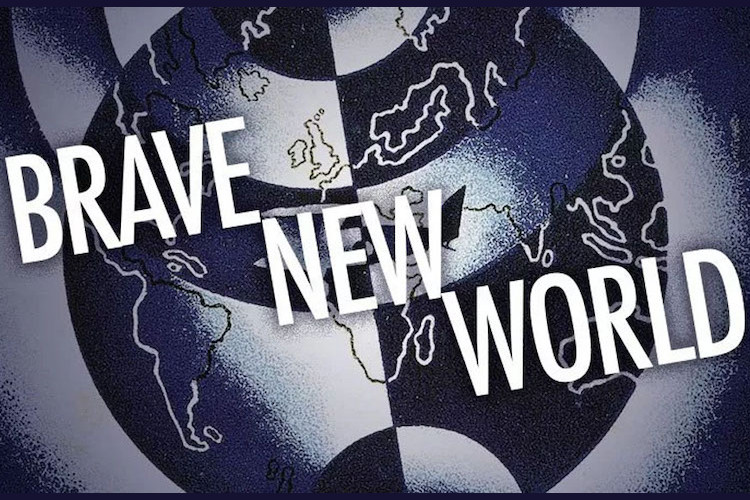
WHO WILL BE ‘BRAVE’ IN HUXLEY’S NEW WORLD?

By John W. Whitehead & Nisha Whitehead

Source: Waking Times

“ ‘Science?’….’Yes,’ Mustapha Mond was saying, ‘that’s another item in the cost of stability. It isn’t only art that’s incompatible with happiness; it’s also science. Science is dangerous; we have to keep it most carefully chained and muzzled…I’m interested in truth, I like science. But truth’s a menace, science is a public danger. As dangerous as it’s been beneficent. It has given us the stablest equilibrium in history…But we can’t allow science to undo its own good work. That’s why we so carefully limit the scope of its researchers…We don’t allow it to deal with any but the most immediate problems of the moment. All other enquiries are most sedulously discouraged…Our Ford himself did a great deal to shift the emphasis from truth and beauty to comfort and happiness…[but] People still went on talking about truth and beauty as though they were the sovereign goods. Right up to the time of the Nine Years’ War. That made them change their tune all right. What’s the point of truth or beauty or knowledge when the anthrax bombs are popping all around you? That was when science first began to be controlled – after the Nine Years’ War. People were ready to have even their appetites controlled then. Anything for a quiet life. We’ve gone on controlling ever since. It hasn’t been very good for truth, of course. But it’s been very good for happiness. One can’t have something for nothing. Happiness has got to be paid for. You’re paying for it, Mr. Watson – paying because you happen to be too much interested in beauty. I was too much interested in truth; I paid too.’ “ ~Aldous Huxley’s Brave New World

Where does one start in discussing the famed fiction novel of Huxley? Although most agree that there is a definite brilliance to the piece, most are also confused as to what was Huxley’s intention in writing the extremely influential dystopic vision. Was it meant to be taken as an exhortation? An inevitable prophecy? Or rather…was it meant as an Open Conspiracy?

What do I mean by an Open Conspiracy?

If we are going to talk about such things our story starts with H.G. Wells, whom Aldous acknowledged he was most certainly influenced by, particularly by Wells’ novels “A Modern Utopia,” “The Sleeper Awakes,” and “Men Like Gods,” when writing his “Brave New World.”

Although Aldous is quoted as referring to Wells as a “horrid, vulgar little man,” (Wells was indeed not a very likeable individual) it was not for reasons one might first assume. Aldous did share a Wellsian perspective in that society should be organised based on a caste system. Perhaps this was one of the reasons Aldous was so fascinated with learning about India’s Hindu religious beliefs and practices, which had coexisted for centuries with a deeply ingrained caste system to which India is still struggling to remove itself from to this day. This is not to say that one caused the other, or that Hinduism has not offered a plethora of great works and insights, but that it had become corrupted and thoroughly intertwined with upholding India’s caste system at some point one cannot deny; that it was used to justify a system of hierarchy from slave to the god-like state of a Brahmin and that British imperialists had always been greatly fascinated by this form of social organization one cannot deny.

Aldous was always interested in the subject of religion, but more so for its uses in behaviourism and mental conditioning achieved through such techniques as entering states of trance where an individual’s suggestibility could be manipulated. Hypnopædia was not just some quirky sci-fi concoction. It is also why Aldous was so interested in the work of Dr. William Sargant, whom Aldous repeatedly refers to in his writings and lectures and who was involved with the Tavistock Institute and MKUltra. More on this in Part two.

These spiritual/religious studies are what shaped the core thesis of Aldous’ book “Doors of Perception” which is considered the instruction manual for what started the counterculture movement. The title is influenced by the poet William Blake who wrote in 1790 in his book “The Marriage of Heaven and Hell,”:

if the doors of perception were cleansed then everything would appear to man as it is, Infinite. For man has closed himself up, till he sees all things through narrow chinks of his cavern

Another major influence for “Doors of Perception” was again H.G. Wells, from his book “The Door in the Wall,” which examines the contrast between aesthetics and science and the difficulty in choosing between them. The protagonist Lionel Wallace is unable to bridge the gap between his imagination and his rational, scientific side which leads to his death.

Aldous writes in his “Doors of Perception,”:

That humanity at large will ever be able to dispense with Artificial Paradises seems very unlikely…Art and religion, carnivals and saturnalia [ancient Roman pagan festival], dancing and listening to oratory – all these have served, in H.G. Wells’s phrase, as Doors in the Wall…Under a more realistic, a less exclusively verbal system of education than ours, every Angel (in Blake’s sense of that word) would be permitted as a sabbatical treat, would be urged and even, if necessary, compelled to take an occasional trip through some chemical Door in the Wall into the world of transcendental experience. If it terrified him, it would be unfortunate but probably salutary. If it brought him a brief but timeless illumination, so much the better. In either case the Angel might lose a little of the confident insolence sprouting from systematic reasoning and the consciousness of having read all the books…But the man who comes back through the Door in the Wall will never be quite the same as the man who went out…

Aldous was always chasing the perfect drug that would be minimal in its physically destructive effects but would allow an individual to tap into an almost consumer state of a religious/spiritual out-of-body experience, a transcendence that promised a connection with the Infinite, inner peace and enlightenment.

Enlightenment and inner peace in a pill, ready for whenever one needed a short holiday from the “illusion” of reality.

The name Soma, which Aldous used to name his fantasy ideal drug in “Brave New World,” was based off a plant whose juices were used to create the spiritual drink which was described in both the ancient religious practices of the Vedic tradition and Zoroastrianism, which called the plant and spiritual drink by the same name, Soma. Today, it is a mystery as to what plant they were referring to in these texts. Huxley no doubt chased after this dragon the entire latter half of his life, and indeed, psilocybin mushrooms are theorised as one of the potential candidates for what could have been named Soma centuries ago.

It is perhaps here that people are the most confused about the character of Huxley. After all, he was obviously walking the walk so to speak, thus didn’t he truly believe that psychedelics were the path to freedom through enlightenment?

Well, the argument has been made that Huxley’s approach to LSD [and other psychedelics] was essentially oligarchic, that it was to be regarded as a dangerous substance to be sampled only by such fine and visionary minds as his own. That is, those who had the mental strength, the mental stamina to reach enlightenment; those who were too weak to sustain such mental rigours would become the very opposite, and risked falling into the dark pit of complete madness, although this in of itself was perceived by many to be a form of clairvoyance. After all, what is it to be mad in a world that is sickeningly and inhumanely “normal”? This is most certainly how Ken Kesey thought when writing his “One Flew Over the Cuckoo’s Nest,” that madness itself was a form of liberation from the shackles of capitalist societal constraints.

Perhaps madness was the goal, it was after all, much more attainable that the promised enlightenment…

As William Sargant noted in his book “Battle for the Mind: A Physiology of Conversion and Brain-Washing” J.F.C. Hecker was studying the dancing mania phenomenon that occurred during the Black Death, which was a social phenomenon that arose in Europe between the 14th and 17th centuries. It involved groups of people who would begin to dance erratically during the Plague, sometimes thousands at a time until they would fall from exhaustion or from injuries. It was thought to have arisen in Aachen, Germany in 1374 and quickly spread throughout Europe with one of the last observations of it occurring in 1518 in Alsace, France.

Hecker observed in his research on the dancing mania that heightened suggestibility had the capability to cause a person to “embrace with equal force, reason and folly, good and evil, diminish the praise of virtue as well as the criminality of vice.

Such a state of mind was likened to the first efforts of the infant mind, Sargant writes “this instinct of imitation when it exists in its highest degree, is also united a loss of all power over the will, which occurs as soon as the impression on the senses has become firmly established, producing a condition like that of small animals when they are fascinated by the look of a serpent.

I wonder if Sargant imagined himself the serpent…

It is no wonder that the Tavistock Institute and the CIA became involved in looking at the effects of LSD and how to influence and control the mind. And perhaps it is no coincidence that Aldous Huxley was in close correspondence with William Sargant to which Sargant even refers to Aldous’ “insights” multiple times in his book “Battle for the Mind.”

Aldous is also quoted in a lecture he delivered to the Tavistock Group, California Medical School in 1961:

There will be, in the next generation or so, a pharmacological method of making people love their servitude, and producing dictatorship without tears, so to speak, producing a kind of painless concentration camp for entire societies, so that people will in fact have their liberties taken away from them, but will rather enjoy it, because they will be distracted from any desire to rebel by propaganda or brainwashing, or brainwashing enhanced by pharmacological methods. And this seems to be the final revolution.

Aldous goes on to state a year later in a lecture titled “The Ultimate Revolution” at UC Berkeley Language Center 1962:

Today we are faced, I think, with the approach of what may be called the ultimate revolution, the final revolution, where man can act directly on the mind-body of his fellows…we are in process of developing a whole series of techniques which will enable the controlling oligarchy who have always existed and presumably will always exist to get people to love their servitude. This is the, it seems to me, the ultimate in malevolent revolutions shall we say, and this is a problem which has interested me many years and about which I wrote thirty years ago, a fable, Brave New World, which is an account of society making use of all the devices available and some of the devices which I imagined to be possible making use of them in order to, first of all, to standardize the population, to iron out inconvenient human differences, to create, to say, mass produced models of human beings arranged in some sort of scientific caste system.

Yes, yes we get it. This is all to be taken as “warnings” to the public, a terrible necessity that will come about if over-population is not addressed (as he makes clear in his Brave New World Revisited). With over-population comes over-organization which in turn leads to the scientific advances in technology which we are told by Aldous can only lead to totalitarianism. Thus, population growth and advances in the sciences are the greatest threat to humankind. Wait, that sounds oddly very much like the reasonings of Mustapha Mond, have we come around full circle, what exactly does Aldous agree and disagree with here? Are we to have a scientific dictatorship in order to avoid a totalitarian system in the form of a scientific dictatorship?

In H.G. Wells’ “Open Conspiracy: Blueprints for a World Revolution,” he describes his vision for a Modern Religion:

‘…if religion is to develop unifying and directive power in the present confusion of human affairs it must adapt itself to this forward-looking, individuality-analyzing turn of mind; it must divest itself of its sacred histories…The desire for service, for subordination, for permanent effect, for an escape from the distressful pettiness and mortality of the individual life, is the undying element in every religious system.

The time has come to strip religion right down to that [service and subordination is all Wells wants to keep of the old relic of religion]The explanation of why things are is an unnecessary effortThe essential fact…is the desire for religion and not how it came about…The first sentence in the modern creed must be, not “I believe,” but “I give myself.” ‘

Hmm, is this the same Revolution as Aldous is speaking about? After all, there is a lot of similarity between H.G. Wells’ description of his “Modern Religion” and what Aldous is preaching in his “Doors of Perception,” to which Wells is undoubtedly a large influence. The desire to escape from the distressful pettiness and mortality of the individual life, that the explanation for why one does something is not important, only to be motivated by the desire for release, for a complete catharsis that only the fervour of a “religious,” a “spiritual” experience can bring about.

It is the desire for, not the care for why. To believe is not even acceptable, because to believe pertains to thought, it is merely a matter of surrender, that you give yourself. It is not to act with reason but to be possessed by its very opposite; to be in a state of existence where there are no words, and thus there are no thoughts, just direct sensory feeling.

The ultimate achievement is to completely surrender oneself to the external world, perhaps to a dictatorship without tears…

The reader should be aware that Wells wrote a book titled “The New World Order” in 1940, and is the first that I am aware of to pioneer this now-infamous term. The reader should also be aware that Julian Huxley (Aldous Huxley’s brother) was a co-author of “The Science of Life,” a part of Wells’ trilogy “The Outline of History” (1919), “The Science of Life” (1929), and “The Work, Wealth, and Happiness of Mankind” (1932) to which Wells made no qualms should be regarded as the new Bible. Julian was also a prominent member of the British Eugenics Society, serving as its Vice-President from 1937-1944 and its President from 1959-1962. Interesting life choices from the authors of the “new Bible.”

In addition, Aldous’ grandfather Thomas Huxley (“Charles Darwin’s bulldog”) was the biology teacher of H.G. Wells and was one of the largest influences in Wells’ life, promoting the works of Charles Darwin and Thomas Malthus, for more on this refer to my paper. Although Thomas Huxley lived before the time of the “science” of Eugenics, he was a stout Malthusian and thus one can rather safely say would have been a eugenicist if offered the chance.

Thus, we should regard Aldous’ mention of the stylish ‘Malthusian belt’ in his “Brave New World,” under a more somber light perhaps…

And now we are ready to walk through the doors of perception on Aldous himself, the true Huxley behind the projected illusion. We may not find Infinity at the end of this excursion, but we will most certainly be better equipped to tell the difference between Huxley’s self and non-self, between what is real and what is false.

ALL OUT WAR ON THE LIFE FORCE

By Julian Rose

Source: Waking Times

‘Guile’ and ‘cunning’ are two words that seldom feature in the modern vernacular, yet we need them now – because our species is under an unprecedented level of sustained attack – and it is guile and cunning that is being used to disguise this attack as some form of benevolent protection. The hypnotic effect this deception is having on mankind threatens to render our species extinct.

Who would guess? After all, those who believe what they read in the press and see on TV are sure they are being ‘saved’ not sacrificed.

Saved from Covid, global warming, the Russians and of course ‘terrorists’. While individuals in possession of a reasonable degree of awareness recognise that those calling the shots are trying to pull-off some grand plan which will leave them in charge of all the material avenues of daily life. What Klaus Schwab, director of the World Economic Forum likes to refer to as “you’ll own nothing and you’ll be happy.”

Which properly translates as “We’ll own everything and you’ll be fortunate if your still alive”.

Yet this is actually just one level of a multi pronged attack being prepared against humanity. It goes a lot deeper.

At the deeper level we are brought up against a struggle with our own minds to grasp the magnitude of the dark agenda proposed for life on earth. Many amongst us cannot even begin to fathom the fact that this is not just a new attempt to introduce a totalitarian dictatorship, but is in fact all out war on the life force itself. An attempt to render our very DNA for ever changed – engineered – into something wholly alien to that which drives the evolutionary dynamic of life on earth.

The origins of this anti-life persuasion stretch back a long way. They start with a refusal to recognise the essential spiritual composition of all matter. That at its essence, life – in all its animate and inanimate forms – is a manifestation of that which was brought to birth by a cosmic entity of pure spirit – over a great span of time – during which it evolved itself into what we call ‘matter’.

Matter is pure spirit congealed into material substance. That is why Jesus is cited as saying “Split wood, and I am there.” Our ancient rocks, soils, ferns, protozoa, aerobic microorganisms, insects, reptiles – and eventually man – form a grand diversity and continuum of expressions of one omnipotent cosmic source point we call God.

Initially, the life expression here on earth was of a very simple nature and lacked any form of self awareness. Yet all seemingly inanimate matter contains the seed of animation. It is, after all ‘all energy’ – but the fact that we cannot see the whirling atoms that form the composition of a rock does not mean they are not actual. That it is not alive.

The creative source point of all life is present even in the most ancient mountains and minerals of our planet.

All these are aspiring to become more than they are. They all have the capacity for constant movement towards a higher expression of themselves. Thus they ‘transform’ and move on, as it were, into subtler forms of expression of their original form. This is the true meaning of the word ‘evolution’.

We – mankind – are at the upper edge of this process of evolution, but we are still informed by all stages that got us here. We recognise them as being gradually evolving expressions within the development of our unique psycho-spiritual and physical propensities.

Thus we can today, if we so wish, feel ‘at one’ with the natural environment around us, simply because we are it – and it is us. There has never been a separation point, just a continuum of evolving expression of the pure source point from whence ‘life’ was birthed.

However, somewhere along the line, at a well developed stage of the continuum – with the human brain already active, a deviation of the natural evolutionary movement became manifest.

We will not speculate on what exactly that was, but will acknowledge its existence. This deviation could happen due to the ‘free will’ originally accorded to independent ‘thinking’ man.

Free will is the condition we call ‘freedom’ today; however, only when its intention is the continuing manifestation of the great diversity of the species and a further manifestation of its divine origins. A state I call ‘the responsibility of freedom’.

This ‘true freedom’ is precisely what came under attack many millennia ago. The motivation for the attack was based upon the desire that the riches the material world brings to birth should be seen and worshipped solely as inert matter, completely devoid of spirit. In other words, a denial of the existence of a (cosmic) creator which is reflected in all life forms – and a taking ownership of the material world (matter) as a ‘possession’ whose primary objective is personal enrichment.

Thus the divine source was stripped clean from the manifestation of its own creation.

From here, gorged on the wealth of three dimensional power, the false aspirants went on – driven by an insatiable infatuation with possession, to try to capture not just the material – but the innate spiritual expression of human and planetary evolution as well.

They saw that in spite of their taking a controlling influence over mankind, the life force remained irrepressible. This aroused a deep jealously in ‘the one who would be god-king’; and the only way of satiating this jealousy was to reek vengeance on this freedom loving life force. A force that would not allow itself to come under the control of a godless authority.

Great wars were set in motion by the jealous ones. The core of each was ‘divide man against himself’. Let him destroy himself.

But even the carnage reeked by this evil ploy did not completely vanquish the true human, driven as he/she is by the upwardly rising spirit of aspiration, resonant echo of the One Pure Spirit. That great mystery which stimulates the desire to consciously realise one’s oneness with Source.

So we arrive at today.

Today the jealous ones, bruised, but more vindictive than ever – thanks to their past failures – aim to attack and distort the very DNA of life itself. In order to splice into it the codes of their spirit-less digital mechanistic void, so as to create the ‘ex-human’ robotic designer-slave – that which has all its faculties genetically engineered, to the synthetic point of no return. No return to nature. No way home.

Thus the murderers seek to enthrone themselves as god-kings of their satanic empire.

Now they have declared open war on Earth as well as humanity – and are going for the jugular.

While this very small and very sick cabal leads the way, their army of foot soldiers trudge along behind, gazing into their mobile phones and wide screen TV’s, awaiting the next instructions. Their designer-slave minds already given over to the slow march into spiritual oblivion. Their bodies bent with denial. Their souls’ vital transmissions suffocated under a heavy blanket of uncontrolled and poisoned thinking, whose chief ingredient is – fear.

We know the plan – and we know of human-kind’s retrograde passivity which has been responsible for allowing this plan to get as far as it has.

We have learned that the Covid jab, chemtrails-aluminium, WiFi and fluoride combine to calcify the pineal gland and block its function as chief receptor of the higher vibrational cosmic energies.

We have learned that GMO and pesticides do a very similar thing to the plant kingdom which is here to nourish us. And we know that a great part of the food chain carries the burden of this toxicity.

We know that all such brutal attacks on this living planet and its occupants stem from a grossly distorted perception of what Life is all about. A reversal, in fact.

But we also know one more thing. That a rising tide of awakening humanity has recognised the deception and is now establishing a formidable resistance. And in doing so has discovered its inner powers and found the will to directly challenge the architects of destruction.

We start to understand how times of profound darkness can be precursors of times of searing illumination. How a great metamorphosis of life on earth is in the air.

A manifestation that will bring with it that which we nurture in our hearts and envision in our minds. We, guardians of the flag of truth and vanguard of a new society built on honour, wisdom, justice and truth.

It’s a battle royal, make no mistake. The road to peace is not secured via passivity and wishful thinking. Not at all. Not even prayer.

The great Indian Sadhu, Prabat Rajan Sarkar stated it this way “There is no other way of establishing peace than by fighting against the reasons that disturb the peace.”

So fight we will, until we win.

About the Author

Julian Rose is an early pioneer and practitioner of UK organic farming; an entrepreneur and leader of projects to create self sufficient communities based on local supply and demand; a teacher of holistic life approaches and the author of four books – one of which ‘Creative Solutions to a World in Crisis’ lays-out detailed guide-lines for the transformation of society into caring communities built upon ecological and spiritual awareness, justice and cooperation. See Julian’s website for more information www.julianrose.info

WE ARE ALL BEING COOKED IN THE SOUP TOGETHER

By Paul Levy

Source: Waking Times

One of the recurring thought-forms that I hear repeated everywhere during these apocalyptic times is, “We are all in this together.” It is ironic that “we are all in this together,” and yet, our world feels anything but together, as it is in an incredibly polarized and dissociated state. Our species is suffering from what Jung calls a “sickness of dissociation,” which is a state of fragmentation deep within the unconscious itself that has seemingly spilled outside of our skulls and, through psychic forces beyond our conscious awareness, has taken the form of polarizing collective events playing themselves out en masse on the world stage. Our dissociation is not solely pathological, however, but is an expression of a deeper holistic process that is in the act of revealing itself. To quote Jung, “the sickness of dissociation in our world is at the same time a process of recovery, or rather, the climax of a period of pregnancy which heralds the throes of birth. A time of dissociation … is simultaneously an age of rebirth.”[1]

Whenever I hear “We are all in this together,” it reminds me of an amazing paragraph that Jung wrote in the late 1950’s that is as relevant today as it was then. Here is an excerpt: “We are in the soup that is going to be cooked for us, whether we claim to have invented it or not…. We are threatened with universal genocide if we cannot work out the way of salvation by a symbolic death.”[2] In other words, we are fated to suffer an unconscious “literal” death if we don’t consciously go through a “symbolic” death. What does Jung mean by this?

We are all in the soup together, yet we are suffering from a sickness of dissociation, and we are needing to go through a symbolic death experience, while another part of us is being reborn! What is going on here? Is what’s happening in our world meaningless chaos, or is there “something deeper” going on? The short answer: Our species has gotten drafted into an archetypal death/rebirth experience – in symbolically dying to a part of ourselves that is no longer serving us, another part of us is being reborn. As Jung points out, “there are times [and ours seems to be one of them] when the spirit is completely darkened because it needs to be reborn.”[3]

We can deepen our understanding of the archetypal process of death and rebirth that we are living out by shedding light on a prototypical example of death and rebirth – i.e., The Incarnation. Contemplating the West’s prevailing myth of the birth of God as a human being—the Christ event—psychologically, which is to say symbolically (i.e., as if it is a dream of our species) can help us gain some crucial insights into the deeper archetypal process that we are collectively enacting unconsciously on the world stage during these truly apocalyptic times.

The word “apocalypse,” etymologically speaking, refers to something previously hidden being unveiled and brought to light – in other words, something is being revealed to us during these apocalyptic times. Whereas in religious language, the apocalypse has to do with the Incarnation of God and the coming of the Messiah, psychologically speaking, the “apocalypse” means the momentous, world-shattering event of the coming of what Jung calls “the Self” (the wholeness of our personality, i.e., the God within) into conscious realization. Instead of incarnating through one man, however, like God did over two thousand years ago through the individual person of Jesus, the divine is now incarnating through the unconscious psyche of all of humanity. “God,” Jung writes, “wants to become man,” and instead of choosing a pure, guiltless vessel, God has chosen, in Jung’s words, “the creaturely man filled with darkness—the natural man who is tainted with original sin.”[4]

In that same amazing paragraph Jung writes, “Through his further incarnation God becomes a fearful task for man, who must now find ways and means to unite the divine opposites in himself. He is summoned…. Christ has shown how everybody will be crucified upon his destiny, i.e., upon his self, as he was. He did not carry his cross and suffer crucifixion so that we could escape.”[5] In other words, regardless of our outer religious orientation, everyone of us is fated (whether we like it or not) to carry our cross—to consciously bear our shadow and suffer the tension of the opposites within us—just as Christ did. And yet, something that we could not have created via the efforts of our own ego can potentially emerge as a result of consciously bearing this creative tension.

In being “summoned,” like a healer, shaman or artist who is being called by their inner voice and sacred vocation, we are being subpoenaed by a higher power. Whenever the archetype of the Self is constellated, due to the opposites intrinsic to the nature of this experience, we invariably feel a state of extreme conflict within us that is epitomized by the Christian symbol of the cross. Viewed symbolically, Christ on the cross reveals to us that the development and differentiation of consciousness leads to an ever-increasing awareness of a primordial conflict within our soul which necessarily involves a crucifixion of the ego. To understand this conflict psychologically, we could say that the unconscious longs to reach the light of consciousness, while at the same time continually recoils against it, because it would rather remain unconscious. In theological terms, to quote Jung, “God wants to become man, but not quite.”[6]

The Self is made manifest—i.e., real in space and time—through consciously suffering the conflict between the opposites to the point where we begin to experience their synthesis and complementarity. Jung comments, “This condition of the crucifixion, then, is a symbolic expression for the state of extreme conflict, where one simply has to give up, where one no longer knows, where one almost loses one’s mind. Out of that condition grows the thing which is really fought for … the birth of the self.”[7] It is by going through an internal experience of what the historical crucifixion symbolizes that the divine holy and whole-making spirit gets born through us.

Jung comments, “One shouldn’t evade this conflict by escaping into a premature and anticipated state of redemption, otherwise one provokes it in the outside world. And that is of the devil.”[8] If we don’t deal with the source of the divine conflict within us, it will get projected outside of ourselves and dreamed up in the external world. In other words, in our avoidance of dealing with the conflict within us, we are unwittingly colluding with the darker forces of death and destruction that are playing out in the outer world.

Nature herself does not come to a permanent standstill when confronted with opposites – rather, she uses them to create, out of their very opposition, a synthesis, a new birth. When Christ is nailed to the cross during the crucifixion, it symbolically represents that it is through the experience of being bound and severely limited in the space/time continuum that itself becomes the doorway through which we become introduced to the transcendent part of us that is beyond the physical, i.e., our spiritual nature. In other words, it is in experiencing our finite limitations to the max that becomes a doorway to the infinite part of ourselves.

Nothing so promotes the growth of consciousness as confronting the opposites within ourselves. Holding the tension of the opposites that is inherent in the crucifixion experience invariably liberates us from holding and identifying with our fixed and cherished perspectives. Helping us transcend the notion of a privileged and correct point of view, we become aperspectival in our viewpoint, as we see the relativity of all viewpoints – a way of seeing which coincides with the meta-perspective of the Self.

The essence of the Christian gnosis—the Incarnation of God through humanity—can be best understood as humanity’s creative confrontation with the opposites and their synthesis in the Self. The Self—which Jung equates with Christ—is present in everyone, but typically in an unconscious and unrealized condition. Once we withdraw our projections and fixations upon an external historical or metaphysical figure, however, we can realize that the Self/Christ (or whatever name we call it) lives within us – in Jung’s words, we then “wake up the Christ within.”[9]

Nature herself does not come to a permanent standstill when confronted with opposites – rather, she uses them to create, out of their very opposition, a synthesis, a new birth. When Christ is nailed to the cross during the crucifixion, it symbolically represents that it is through the experience of being bound and severely limited in the space/time continuum that itself becomes the doorway through which we become introduced to the transcendent part of us that is beyond the physical, i.e., our spiritual nature. In other words, it is in experiencing our finite limitations to the max that becomes a doorway to the infinite part of ourselves.

Nothing so promotes the growth of consciousness as confronting the opposites within ourselves. Holding the tension of the opposites that is inherent in the crucifixion experience invariably liberates us from holding and identifying with our fixed and cherished perspectives. Helping us transcend the notion of a privileged and correct point of view, we become aperspectival in our viewpoint, as we see the relativity of all viewpoints – a way of seeing which coincides with the meta-perspective of the Self.

The essence of the Christian gnosis—the Incarnation of God through humanity—can be best understood as humanity’s creative confrontation with the opposites and their synthesis in the Self. The Self—which Jung equates with Christ—is present in everyone, but typically in an unconscious and unrealized condition. Once we withdraw our projections and fixations upon an external historical or metaphysical figure, however, we can realize that the Self/Christ (or whatever name we call it) lives within us – in Jung’s words, we then “wake up the Christ within.”[9]

The cross is the symbol of the suffering Godhead that redeems humanity. This suffering would not have occurred without darker forces seemingly opposed to God. This is to say that the powers of evil play a crucial, mysterious and essential role in the redemption of humanity. Jung continues, “Christ is the model for the human answers and his symbol is the cross, the union of the opposites. This will be the fate of man, and this he must understand if he is to survive at all.”[11]

To quote Trappist monk and author Thomas Merton, “every man is Christ on the Cross, whether he realizes it or not. But we, if we are Christians [and in the deeper symbolic sense we are all “Christians”], must learn to realize it.”[12] Realizing we are Christ on the Cross re-contextualizes our suffering, transforming it from a deeply problematic personal situation to a more universal process in which we have all gotten enlisted. It is important to distinguish our neurotic suffering—which is a result of our unconscious clinging and is totally unproductive—from the suffering which is “sent by God” (as Christian mystics would say) in order to purify us of our obscurations. Our neurotic suffering blocks us from experiencing the divine, while the suffering that is a result of our participation in the archetypal process of crucifixion, through connecting us to the deeper passion that Christ went through, is the doorway introducing us to something beyond ourselves.

Russian philosopher Nicolas Berdyaev writes, “But there was a tendency to forget that the cross had a universal significance and application. The Crucifixion awaits not only the individual man but also society as a whole, a State or a civilization.”[13] In other words, it is not just individuals who are symbolically going through a crucifixion experience, but our global civilization as a whole. The microcosm (the individual) and the macrocosm (the collective), like iterations of the same fractal, are mirrored reflections of each other. The Self (or whatever name we call it) is incarnating through us—both individually and as a species—and it makes all the difference in the world whether we consciously realize this or not.[14]

If we remain unconscious when a living archetypal process is activated within us, this inner process will physically manifest itself externally in the outside world, where, as if by fate, it will get unconsciously dreamed up and acted out in a “literal,” concrete and oftentimes destructive way. Instead of going through an inner symbolic death, for example, we then literally kill each other, as well as, ultimately, ourselves. If we recognize, however, that we are being cast to play a role in a deeper cosmic process, instead of being destined to enact it unconsciously, and hence, destructively, we are able to consciously and creatively “incarnate” this archetypal process as individuation.

We, as a species, to quote Jung, have been “drawn into the cycle of the death and rebirth of the gods.”[15] In other words, having become part of a deeper mythic, archetypal and alchemical process of transformation, we are going through a cosmic death-rebirth experience of a higher order. Jung describes “how the divine process of change manifests itself to our human understanding and how man experiences it – as punishment, torment, death, and transfiguration.”[16] This divinely-sponsored process is subjectively experienced by the human ego as torture.[17] However, if we don’t personalize the experience, identify with it or get stuck in its nightmarish aspect—a great danger—but allow this deeper process to refine us as it needs to, it can lead to a transfiguration of our very being.

Whether consciously or not, we are all in a state of grieving – the world we have known is dying. In addition, our sense of who we think we are—imagining we exist as a separate self, alien to and apart from other separate selves as well as the rest of the universe—is an illusion whose expiration date has now been reached. This illusion is like a non-existent mirage that, if not recognized as illusory, can become reified and thereby become a lethal mirage. Either our illusion expires, or we do. As the poet Rumi would say, we need to “die before we die.”

To step out of the illusion of thinking we exist as a separate self is to recognize—and be born into—our greater identity (whether we call it the Self, Christ, Buddha, etc.), that includes and embraces everything under the sun. The Self—who we actually are—is simultaneously the source and fruit of life itself, enhancing life beyond measure. Connecting with the Self is not only our only hope in these dark times, it’s what everything that is happening in our world is potentially helping us to realize. And yet, the way to ascend to the light of the Higher Self (in Christian terminology, to attain The Resurrected Body)—as Christ himself indicates via his descent to the underworld after his death on the cross—is by journeying through the darkness.

To quote Jung, “God really wants to become man, even if he rends him asunder[18] … because he wants to become man, the uniting of his antinomy must take place in man.”[19] Where else, after all, could the opposites intrinsic to God’s nature (e.g., light and dark, good and evil) attain unity except in the very vessel—humanity—that God has prepared just for this very purpose? Being cooked in the soup together, we are being immersed and baptized into a deeper cosmic process. We are playing a crucial role in the divine drama of incarnation, an insight that renders meaning to our suffering and assists us in discovering our place in the world as well as helping us to find our very selves.

THE ART OF THE UNDECEIVED

Strong confident woman.

By Gary Z McGee

Source: Waking Times

“Here the ways of men divide. If you wish to strive for peace of soul and happiness, then believe; if you wish to be a disciple of truth, then search.” ~Nietzsche

What does it mean to be undeceived?

To a certain extent, we are always deceived. For we are only human, all too human. But to the extent that we can become aware of deception—both self-deception and the deception of others—being undeceived means being ahead of the curve of the human condition.

First, it means embracing deception as an integral part of life. Then it means being strategically circumspect while creating your own meaning. It means taking everything that you’ve learned into consideration with humility and a good sense of humor. It means becoming so healthy that your very existence is a catalyst for healthy change. It means connecting courage to curiosity. It means taking a leap of courage. It means putting things into proper perspective by using health as a benchmark.

It is, paraphrasing Bruce Lee, “absorbing what is useful, discarding what is not, and adding what is uniquely your own.” Let’s break it down…

Absorb what is useful:

“If everyone is thinking alike, then no one is thinking.” ~Benjamin Franklin

What is useful? Well, if your goal is not only basic survival but also progressive evolution, then what is useful is what is healthy. Contrastingly, what is not useful is what is unhealthy.

So, how do you figure out what is healthy or not? Through logic, reason, and critical thinking. You cannot wish something into being healthy. You cannot simply believe something is healthy and, by your strong faith alone, expect it to be valid. You can only reason through if something is healthy or not. Once you have reasoned a thing to be healthy, you free yourself to absorb what is useful.

Absorbing what is useful is absorbing what is healthy. The path is then clear to question with a good conscience. You become undeceived. In a state of undeception, you are free to wield the question mark sword, the Sword of Truth, and to use it in a way that distinguishes what’s healthy from what’s not.

What is healthy is absorbed as something useful for progressive evolution. What is unhealthy can then be discarded as something useless, so as to avoid an unhealthy society.

Discard what is not useful:

“A fool thinks himself wise, a wise man knows himself to be a fool.” ~William Shakespeare

Discarding what is not useful (what is unhealthy) requires self-discipline. It requires vigilance. Most people don’t even know that they don’t know the difference between healthy and unhealthy. Especially people who have grown up, culturally conditioned and indoctrinated, in a profoundly sick society.

How do you know if you were born into a profoundly sick society?

1.) Any society that pollutes the air it needs to breathe is a profoundly sick society.

2.) Any society that pollutes the water it needs to drink is a profoundly sick society.

3.) Any society that pollutes the food it needs to eat is a profoundly sick society.

4.) Any society that pollutes the minds it needs to evolve with is a profoundly sick society.

You must have the self-discipline to daily question what is healthy and what is not. For health is not a matter of opinion. Health is a benchmark. Without this benchmark, you cannot discern what is useful from what is not useful.

As such, belief and certainty are the greatest obstacles blocking us from being able to discard what is not useful. This is especially dangerous when those beliefs and certainties are derived from the cultural conditioning of a profoundly sick society. Hence the importance of vigilance and strategic prudence.

In order to remain undeceived, we must remain circumspect. The Sword of Truth must be unleashed daily so that it may cut through the red tape of wishful thinking, irrational beliefs, and whimsical certitude.

It is only when our naïve beliefs have been shattered upon the hard concrete of reality that we are free to distinguish between what is healthy and what is not. As we begin to piece things together, we become undeceived. We are liberated to absorb what is useful and discard what is not.

Add what is uniquely your own:

“Small minds discuss people. Average minds discuss events. Great minds discuss ideas.” ~Henry Thomas Buckle

Once you have successfully threshed the chaff (unhealthy/useless) from the grain (healthy/useful), you are free to unleash your creativity. From swords to plowshares, your Sword of Truth becomes a Pen of Truth. With it, you are free to create high art; art that shatters molds, stretches comfort zones, and initiates wake up calls. You become free to prove why the pen will always be mightier than the sword.

Here, still, we must remain vigilant. For even art can become dogmatic. In order not to be deceived, we must always be in a state of questioning what we think we know and weighing it against the nonnegotiable scales of healthy/unhealthy. Should our art become dogmatic, we would be wise to absorb what is useful from it and discard what is not. This way we will always be openminded and openhearted enough to add what is uniquely our own.

Outdated truth must die so that it doesn’t taint the updated truth of the times. God must die so that God can be reborn. Creativity thrives off the ashes of old art. Evolution progresses or stagnates in proportion to how creative we can be after having absorbed what is useful (healthy) and discarding what is not (unhealthy).

The art of being undeceived is more like the juggler’s art than the interrogator’s. It should be flexible and adaptable to meet results which are sudden and unexpected. The undeceived understand that the self is masks all the way down perceiving delusions all the way up, and they have the acumen and the wherewithal to juggle both masks and delusions into a state of high humor and even higher art.