
Nostalgic for the Future

By Edward Curtin

Source: Behind the Curtain

Despite its pedigree as a fundamental element in civilization’s greatest stories, nostalgia has come to be associated with treacly sentimentality, defeatism, and spurious spiritual inclinations.  Homer, Vergil, Dante, the Biblical writers, and their ilk would demur, of course, but they have been dead for a few years, so progress’s mantra urges us to get on with it.  This is now.

But now is always, and like its twin – exile – nostalgia is perpetual.  The aching for “home” – from Greek algos, pain + nostos, homecoming – is not simply a desire for the past, whether in reality or imagination, time or place, but a passionate yearning for the best from the past to be brought into the future.

Nostalgia may be more a long ache of old people, but it is also a feeling that follows everyone along life’s way.  Its presence may be shorter in youth, and it may be brief, intermittent, and unrecognized, but it is there.  Surely it grows with experience.  As everyone knows, a taste, a smell, a sight, a sound, a song – can conjure up a moment’s happiness, a reverie of possibility.  Paradise regained, but differently.  A yearning recognized, as with seeing for the first time how Van Gogh’s blue paint opens a door to ecstasy or a line of poetry cracks open a space in one’s heart for prospective love.  Hope reborn as an  aperture to the beyond reimagined and made possible.

There is no need to ever leave where we are to find that we are already no longer there, for living is a perpetual leaving-taking, and the ache of loss is its price.

But like all pains, it is one we wish to relieve in the future; and in order to make a future, we must be able to imagine or remember it first.  We are all exiled in our own ways. Home was yesterday, and our lost homes lie in our futures, if we hold to the dream of homecoming, whatever that may mean to each person.  But it also has a universal meaning, since we dwell on this earth together, our one home for our entire human family.

You may think I am engaging in fluff and puff and flimsy imaginings.  But no.

All across the world there are hundreds of millions of exiles, forced by wars, power politics, poverty, starvation, destructive capitalism, and modernization’s calamitous consequences to leave their homes and suffer the disorientation of wandering.  Emigration, immigration, salvaging bits of the old in the new strange lands – thus is their plight.  So much lost and small hopes found in nostalgic remembering. Piecing together the fragments.

But in a far less physical sense, the homeless mind is the rule today.  There are very few people these days who don’t wish to somehow return to a time when the madness that engulfs us didn’t exist; to escape the whirligig of fragmented consciousness in which the world appears – i.e. is presented by the media – as a pointillistic painting whose dots move so rapidly that a coherent picture is near impossible.  This feeling is widespread.  It is not a question of politics.  It crisscrosses the world following the hyper-real unreality of the technologies that join us in a state of transcendental homelessness and anxiety.  All the propaganda about a “new normal” and a digital disembodied future ring hollow. The Great Reset is the Great Nightmare.  Nothing seems normal anymore and the future seems even less so.

The world has become Weirdsville. This is something that most people – young and old – feel, even if they can’t articulate it.  The feeling that all the news is false and that some massive con game is underway is pandemic.

Here is an insignificant bit of nostalgia.  I mention it because it points beyond itself, then and now.  It has always been nostalgia for the future.  I think it is a commonplace experience.

When I was in high school, there was a tiny cheese shop on Lexington Avenue and 85th St. in New York City near the subway that I took to and home from school.  It was the size of a walk-in closet.  Thousands of cheeses surrounded you when you entered. The smells were overwhelming.  I would often stop in there with empty pockets on my way home from school.  The proprietor, knowing I was in awe of the thousands of cheeses, would often give me little samples with pieces of crusty French bread.  He would regale me with tales of Paris and the histories of the various European cheeses. He would emphasize their livingness, how they breathed.  By the door was a large basket filled with long loaves of fragrant French bread flown in every morning from Paris by Air France.  These were the days before every supermarket sold knockoff versions of the genuine thing.  Each long loaf was in a colorful French tricolored paper bag.

Those loaves of bread in the French colors always transported me to Paris, a place I had never been, but whose language I was studying.  Then, and for years afterwards, I was nostalgic for a Paris that was not yet part of my physical experience.  How could this be? I asked myself.  One day I realized that I was not nostalgic for Paris or the cheese shop, nor for the cheese or the bread, which I had tasted many times, but for the paper bags the bread came in.  Why?

This question perplexed me until I realized my notion of nostalgia was wrong.  For those bags had always represented the future for me, the birds of flight a sign of freedom beckoning as my youthful world expanded.  My nostalgia for the Air France bags was a way to go back to go forward, not to wallow in sentimentality and the “good old days,” but to read the entrails for their prophetic message: the small-life world is limiting – expand your horizons.

It was not a question of jumping on a plane and going somewhere different, although that in time would also be good.  It was not an invitation to revisit that cheese shop, as if that were possible, for the store was long gone and in any case it would not mean the same thing.  It was not a desire to become a teenager again. You cannot repeat an experience, despite F. Scott Fitzgerald writing:  “You can’t repeat the past?…Why of course you can.”

The past in that sense is quicksand, a death wish.  For many people (and this is the prevalent understanding of nostalgia as an exclusively negative way of thinking), embittered nostalgia is their way of denying the present and the future, often by the fictitious creation of “the good old days” when everything was supposedly so much better.

But nostalgia can also be an impetus to create a better future, a reminder that good aspects of what has been lost need to be regained to change the course of the present’s future trajectory.

Today most people are bamboozled by world events, as an idiot wind blows through the putrescent words of the media sycophants who churn out their endlessly deceptive and confusing propaganda on behalf of their elite masters.  Given a few minutes peace of mind to analyze this drivel – a tranquility destroyed by the electronic frenzy – it becomes apparent that their fear, anxiety, and contradictory reports are intentional, part of a strategy to pound down the public into drooling, quaking morons.

But many people in their better moments do recall times when they experienced glimpses of a better life, transitory as those experiences might have been.  Moments when they felt more at home in their skin in a world where they belonged and they could make better sense of the news they received.  Not lost and wandering and constantly fearfully agitated by a future seemingly chaotic, leading to dusty death in a story told by an idiot full of sound and fury signifying nothing.

I suggest that those nostalgic moments revolve around the changing nature of our experience of space and time.  There was a time when time was time and space and speed had some human meaning, for people lived within the limits of the natural world of which they were a part.  As I wrote once before:

In former days you could cross over to other people’s lives and come back with a different perspective, knowing what was obvious was true and that to exist meant to be composed of flesh and blood like all the others in different places and to be bound by the natural cycles of life and death, spring and fall, summer and winter. There were limits then, on the land, water, and even in the sky, where space too had dimensions and the stars and planets weren’t imaginary landing strips for mad scientists and their partners in celluloid fantasies.

In that rapidly disappearing world where people felt situated in space and time, life was not yet a holographic spectacle of repetitive images and words, a pseudo-world of shadowy figures engaging in pseudo-debates on electronic screens with people traveling from one place to another only to find that they never left home. When the mind is homeless and the grey magic of digital propaganda is its element, life becomes a vast circinate wandering to nowhere. The experience of traveling thousands of miles only to see the same chain of stores lining the same roads in the same towns across a country where the same people live with their same machines and same thoughts in their same lives in their same clothes. A mass society of mass minds in the hive created by cell phones and measured in nanoseconds where the choices are the freedom to choose what is always the same within a cage of categories meant to render all reality a ‘mediated reality.’

Nostalgia is always about time and space. In that sense, it is equivalent to all human experience that also takes place within these dimensions.  And when technology has radically disrupted our human sense of limits in their regard, it becomes harder and harder to feel at home, to dwell enough to grasp what is happening in the world.

I believe that many people feel nostalgic for slower and more silent days when they could hear themselves think a bit.  When the sense of always being on the go and lacking time predominates as it does today, thinking becomes very difficult.  To think, one must dethrone King Rush and silence Queen Noise, the two conditions that the speed and noise of digital technology render impossible.  Tranquilized by the beeping trivia pouring out of the omnipresent electronic gadgets, the very devices being used by the elites to control the masses, a profound grasp of the source of one’s disquietude is impossible. The world becomes impossible to read. The sense of always being away, ungrounded, and mentally homeless in a cacophonous madhouse becomes the norm.  One feels sick in heart and mind.

Most people sense this, and whether they think of it as nostalgia or not, I believe they feel that something important is missing and that they are wandering like rolling stones, as Dylan voiced it so poetically, with no direction home.

How does it feel?  It feels lousy.

So it’s not a question of returning to “the good old days.”  The future beckons.  But if we don’t find a way to rediscover those essential human needs of slowness and silence, to name but two, I am afraid we will find ourselves speeding along into an inferno of our own making, where it’s noisy as hell and not fit for human habitation.
Saturday Matinee: Din of Celestial Birds

By Jason Hoffman

Source: The Third Eye

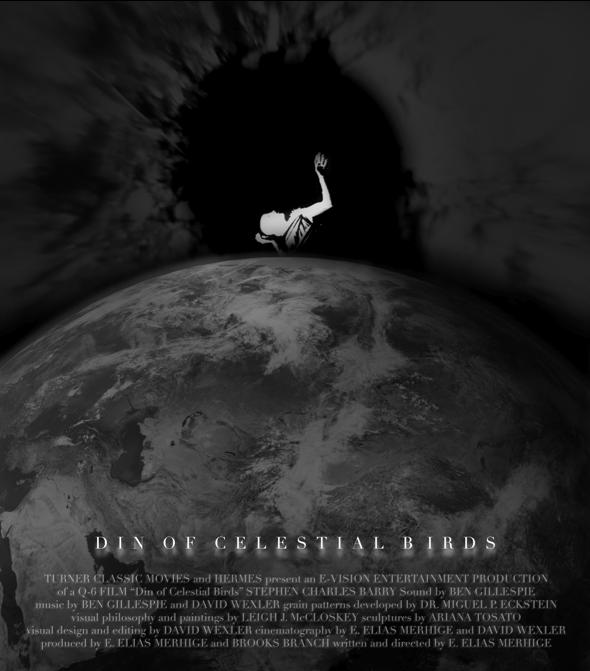
Din of Celestial Birds (2006) A film by E. Elias Merhige. Black and white, sound, 16mm, 14 mins.

American filmmaker E. Elias Merhige’s experimental film Din of Celestial Birds (2006) is the second part of an as yet unfinished trilogy of films, the first part being his bold and visionary debut feature Begotten. Most people coming to Din of Celestial Birds will have watched Begotten and are presumably expecting more of the gruesome and haunting imagery that distinguished the style of that feature, however as the movie begins, we are reassured to “Not be afraid … Be comforted … Remember … Our origin…”.

“A transcendental meditation on creation and consciousness”

I came away from the film thinking of it as Begotten enacted on a microscopic scale: a depiction of the divine mystery of creation through an exploration of processes prior to it, but where Begotten did so as a metaphorical psychodrama, Din of Celestial Birds does this as if a nature documentary of life, in a style reminiscent of Man Ray and other Surrealists.

The opening credits actually attribute the film to Q6, a collective consisting of a visual philosopher (whatever that is), a computational visual neuroscientist, a multi-media performance artist, a composer, and a sculptor; all of whom Merhige collected around him to produce the movie in a hands-on fashion employing techniques used by the work of cinema pioneers like the Lumiere brothersFritz Lang, and Jean Cocteau, in addition to software and technology created specifically for the film.

Though Din of Celestial Birds arguably ploughs the same furrow as its conceptual predecessor, the film is nevertheless testament to a unique artistic vision, exploring representations of the fringes of consciousness by challenging the limits of cinema.

To experience Zen-like awakening, try going the headless way

By Brentyn J. Ramm

Source: Psyche

A prominent theme in Asian religious traditions such as the Advaita Vedanta and Zen Buddhism is that our everyday human experience is like a dream. The dream is that you are merely a person – a thing in the world bounded by your skin, a self that is separate from things and other people. But you are not separate from things and other people. And when you see through the illusion of separation, you become ‘awakened’.

In Chinese Zen Buddhism (Ch’an), a significant form of awakening experience is known as ‘Kensho’. This literally translates as ‘seeing one’s true nature’. In Zen, one’s true nature is often described as ‘empty’ – and at the same time identical with the given world. Kensho isn’t the end point of practice. It isn’t some supreme final state such as ‘enlightenment’ or ‘nirvana’ (if these states are even possible). Rather, it is the beginning, for awakening is in fact a life-long practice, never truly completed. This is the type of awakening experience that I am interested in here.

Hui Hai, an 8th-century Zen Master renowned for establishing a monastery and insisting on the importance of manual work, said that your true nature should not be sought externally. He described your true nature as follows:

Mind has no colour, such as green or yellow, red or white; it is not long or short; it does not vanish or appear; it is free from purity and impurity alike; and its duration is eternal. It is utter stillness. Such then is the form and shape of our original mind, which is also our original body.

Our true nature, then, is like a void. It lacks all objective qualities. It is shapeless, colourless, limitless, motionless. So how exactly does one see one’s own true nature, if it is so shorn of discernible features? The traditional method is to sit for many years in an intense meditation practice under the guidance of an experienced teacher. Unfortunately, most practitioners never experience ‘the void’. There is however a tradition in Zen of spontaneous awakening even in the absence of any meditation practice. This suggests that there is a far quicker and more direct means of awakening.

Early Chinese Zen masters referred to the need to ‘chop off one’s head’

Let’s look at a method of self-enquiry called ‘the headless way’, which provides a modern method of approaching awakening. These first-person experiments were developed by the English philosopher and mystic Douglas Harding in his influential book On Having No Head: Zen and the Rediscovery of the Obvious (1961). Harding grew up in a fundamentalist Christian sect in which he wasn’t allowed to go to the cinema and the only book he was permitted to read was the Bible. When he left the sect at 21, he was determined to seek the truth for himself and to be his own authority. The approach he developed was unconventional and can be considered a form of radical empiricism.

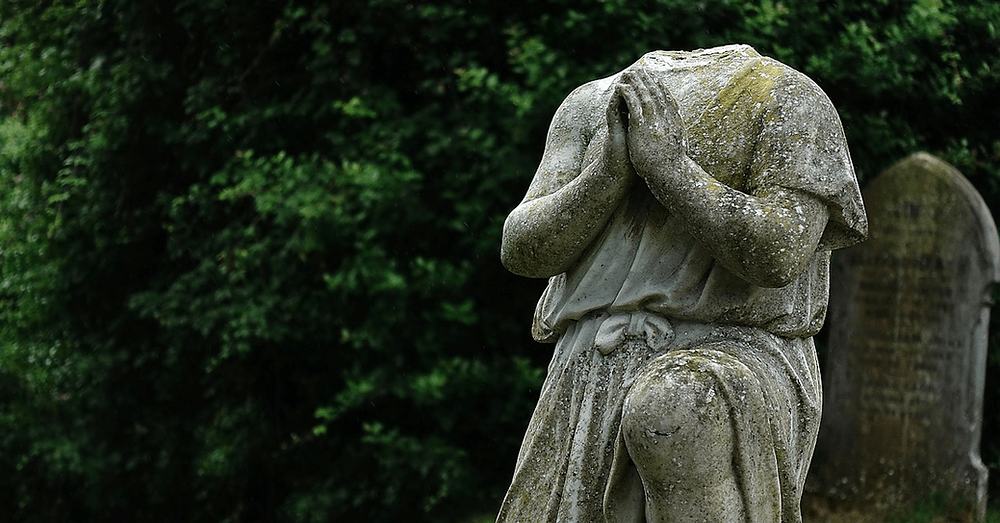
The key to his method is noticing that you cannot see your own head. Rather than looking out of a head, visually speaking, there is just a gap here. Indeed, early Chinese Zen masters referred to the need to ‘chop off one’s head’. Hui Hai claimed that he could teach nothing as he had no tongue to teach with. The heart sutra, which distils the essence of Zen teaching, states that ‘in emptiness there is no form, no eye, no ear, no nose, no tongue, no body, no mind.’ Zen masters also urge practitioners to recognise their ‘original face’ – another name for one’s true nature.

How does one see their true nature according to Zen? One of the best places to start is with the mysterious figure Bodhidharma, the First Patriarch of Zen, who reputedly brought Buddhism to China from India around the 5th century. A legend about him tells us that he attained enlightenment after sitting for nine years facing a cave wall, and also that he cut off his own eyelids to stop himself from falling asleep. Bodhidharma is attributed with the following verse, which is often thought to express the core of Zen teaching:

A special transmission outside the scriptures,
Not founded upon words and letters;
By pointing directly to one’s mind
It lets one see into one’s own true nature and thus attain Buddhahood.

How exactly does one directly point to one’s mind or true nature? Harding’s ‘pointing experiment’ assists in turning one’s attention within, starting with the exercise of pointing a finger literally to the spot from which you are looking. Note that if these exercises are not carried out, or if they are merely thought about, this article will make no sense. So please do the following:

Point at a distant thing, such as a wall. Notice its shape and colour. It is a thing that is extended in space. It is also opaque. You cannot see through it. Point to the floor. Again, notice the coloured expanse and its textures. Point to your foot. Again, it is a shaped and coloured thing. Point to your chest and notice its colours and shape and the movement from your breathing. Now point to where you are looking from. In your present experience, is there any colour here? Any shape? Any texture? Any movement? Are there any eyes, mouth or cheeks here? Are there any features of a person? Notice that this spot is totally lacking in any personally identifying characteristics. Is there anything at all here? Or is it just a transparent opening?

When I look within, when I turn my attention 180 degrees from objects over there to where I am, I find that I am not a coloured, limited thing in the world, but rather a colourless, unchanging capacity for the world, exactly as described by Zen. Is this the much sought-after ‘void’ that is referred to by contemplative traditions across times and cultures?

When you were an infant, you did not recognise that face in the mirror as your own. It was just a baby behind some glass

A well-known story in Zen is of Tung-Shan’s awakening, in the 9th century, which also shows intriguing parallels with Harding’s observations. Once, as a child, Tung-Shan was reading the heart sutra with his tutor when he came upon the passage ‘no eye, no ear, no nose, no tongue, no body, no mind’. He was confused. He used his hands to feel his face and then asked his tutor why the sutra said they didn’t exist. His tutor told Tung-Shan that he could not help him, so Tung-Shan spent many years searching for a worthy master to explain this and other mysteries of the Dharma to him. One day he was crossing a river and saw his face reflected in the water. He saw where his face was in his lived experience, and he instantly had a great awakening.

Zen goes beyond words and letters, so merely thinking about this story would be against the spirit of Zen. To test this out directly in your own experience, please carry out the ‘mirror experiment’:

Look into a mirror. You can now see your human face. Notice where it is. In my experience, it is over there, a couple of feet away, not on my shoulders. Is this true for you? It is also facing the wrong way. It is looking in, rather than outwards. How many faces do you see? Two, or just one? Notice the shapes, textures and colours of that little face trapped behind the glass. By contrast, notice the lack of shapes, textures, colours and indeed boundaries to the spot you are looking from.

That face over there is your acquired face. When you were an infant, you did not recognise it as your own. It was just a baby behind some glass. It took many months to learn to identify with that face. You learnt to marry that visual thing over there with the ‘facial’ sensations you feel here, and hence you became boxed in (at least apparently so). Isn’t how you are for yourself – that is, your ‘original face’ – in total contrast to that little face in the mirror? In fact, as lacking any characteristics of its own, isn’t this ‘gap’ seamlessly united with the world? Couldn’t you equally say that your ‘original face’ is the given world itself?

All this might sound a little esoteric, so let’s look at one potential practical benefit of the ‘headless’ practice in the case of personal relationships. We think that we meet each other face-to-face, thing-to-thing. Of course, this is how it looks to others from the outside. But you relate to others from your first-person perspective, not from over there. The lived experience of being with others isn’t in fact of being face-to-face, but rather face-to-no-face. My face never gets in the way of the faces of others – including those you dislike. The ‘space’ you are looking out of has no preferences. It takes on everyone completely, no matter who they are, without judgement. Noticing this is a rather simple and concrete way to see that you are not, in fact, separate from others. In theory, this could provide a basis for true compassion towards others.

One can meditate for many years without seeing their own true nature. Most never do. The precision and apparent reliability of these experiments open up a form of Zen-like awakening to empirical investigation. Yet these techniques have so far received little attention from philosophers and scientists. (I describe these experiments and discuss their relation to Zen more fully in my recent article ‘The Technology of Awakening’.) The results of the experiments suggest that it doesn’t require a lifetime or many lifetimes to see your true nature. You can do so right now. It is simply to see who or what you are at this very moment – that which is seeing these very words.

Saturday Matinee: Perverse Preachers, Fascist Fundamentalists and Kristian Kiddie Kooks

‘Perverse Preachers, Fascist Fundamentalists and Kristian Kiddie Kooks’: Insane Christian cult video

By Richard Metzger

Source: Dangerous Minds

“He’s a rewarder of those who seek him. Some say God is a punisher, but do you know what we do with child abusers today? We put child abusers in prison if we find out about ‘em. God is not a child abuser! God is a good god. Why don’t you just say that out loud with me right no? God is a good god, you always remember that! God is not gonna do you harm… (pause) There is a judgement coming someday…”

—“Mrs. Hook” from The Christian Pirates cable access show.

History will note that for a short period at the end of the 20th century, there was this “format” called “VHS” (“Video Home System” is what it stood for) that allowed people to do something called “videotaping” “off” their television sets (it didn’t work exactly like that, but it’s, you know, close enough). But what history might neglect to record is that certain things got passed around from hand to hand on this format samizdat style in what was then called the “VHS tape trading underground.” During the mid-1980s to the late 90s, traders and flea market dealers were making pirated copies of things like the banned Rolling Stones movie Cocksucker Blues, Heavy Metal Parking Lot, “Screaming Boy” (lunatic Dallas public access preacher Jonathan Bell, later made famous by The Daily Show), a tape of a groupie blowing out a candle with her pussy for guitarist Steve Vai and “The Great Satan At Large,” a satanic talk show, among hundreds of other things.

One of the most heavily circulated items during the “VHS tape trading underground” days was a synapse-frying excursion straight into the dark heart of the most deeply disturbed, bat-shit crazy 80s TV evangelism titled “Perverse Preachers, Fascist Fundamentalists and Kristian Kiddie Kooks.”  When the tape began making the rounds in the early 90s, the jaw-dropping selection of low IQ buffoonery, superstitious insanity and wildly inappropriate kiddie shows made by people who should NEVER BE LEFT ALONE UNSUPERVISED WITH YOUNG CHILDREN was the centerpiece of many a weed and alcohol-fuelled viewing fest.

An unnamed Internet reviewer said this of “Perverse Preachers, Fascist Fundamentalists and Kristian Kiddie Kooks”:

Americans: See why the rest of the world thinks we’re a bunch of blithering idiots!

Rest of the world: See why Americans are a bunch of blithering idiots!

That pretty much sums it up in a nutshell.

One of the more perplexing things on exhibit in “Perverse Preachers, Fascist Fundamentalists and Kristian Kiddie Kooks” is the clips from the no budget “Christian Pirates” cable access show where godless children are forced to “walk the plank” by one-legged Captain Hook and they sing songs about hoping that Satan gets paralyzed and has to use a wheelchair. There’s Jimmy Swaggart’s tearful confession of whore mongering (a masterclass in fleecing the faithful with the “I have sinned” ploy). A Jim and Tammy Faye Bakker press conference. There’s a lot of asking for money, natch, some racist Bible prophecy, preaching against something one of them calls “Marxism” and a “joyous” man with hands growing from his shoulders who, er, counts his blessings. It’s not just Christianity that takes a beating here. New Age beliefs are lampooned and there’s even an appearance by Queen Uriel from the nutty Unarius Academy of Science.

“Perverse Preachers, Fascist Fundamentalists and Kristian Kiddie Kooks” was produced by a Boston-based zine called Zontar. It came with an attached pamphlet that you can see reproduced here. Aside from being a masterpiece of video folk art (YES, this should preserved and elevated to museum status) it’s one of the single best things ever to get stoned and watch. I guarantee you’ll be blown away by “Perverse Preachers, Fascist Fundamentalists and Kristian Kiddie Kooks” (and if you’re not, you’ll be issued a full refund…)

BONUS VIDEO: Disgraced—but still currently raking it in like a gangsta on BET—TV evangelist Robert Tilton in the infamous “Pastor Gas” video that has made the rounds on the Internet since the first days of MySpace. My VHS copy of “Perverse Preachers, Fascist Fundamentalists and Kristian Kiddie Kooks” included this:

THE POWER OF MAGIC ELIXIR

By Gary Z McGee

Source: Waking Times

“Solitude is fine, but you need someone to tell that solitude is fine.” ~Honoré de Balzac

Solitude and meditation are a combination of the most powerful tools known to mankind, provided one can eventually swap them out for the equally powerful tool of magic elixir.

But let’s not get ahead of ourselves. Let’s not make the mistake of putting the cart in front of the horse. In order to discover magic elixir, one must first dare solitude and meditation. This requires a Hero’s Journey of sorts: a separation phase, an initiation phase, and a return phase. Let’s break it down.

Into the Wild (Separation Phase):

“It is what one takes into solitude that grows there, the beast within included.” ~Nietzsche

Sometimes the only way to realize that life is beautiful is to look at it in a beautiful way.

This is not a plea for donning rose-colored glasses. Not at all. It is an appeal to leave the all-too-familiar rust, dust, dullness, naivete, softness, and fragility of the comfort zone. It’s a call to beauty, the beauty of adventure. The beauty of living between worlds and gaining the wherewithal to migrate back and forth.

Solitude is powerful because it separates us from the rat race and reveals interconnected beauty. We go from being a rat in a cage to a creature enthralled by its connection with Nature as a whole. We go from being a millstone in a daily grind to being a whetstone that we can sharpen ourselves against. We go from being a cog in the clockwork to an alarm clock that awakens us to higher awareness. In solitude, we can no longer pretend that we are asleep.

Most members of the herd never taste solitude. They get caught up in the rat race, trapped in their cultural conditioning, stuck in religious indoctrination, or imprisoned in political brainwashing. They lose sight of the underlying essence. They sacrifice their wildness for mildness. And when it comes that their life requires a little bite, they discover that they have no teeth.

Solitude rewilds the domesticated animal and teaches it how to regrow its teeth. In conservation biology the term “rewilding” is the rehabilitation process of captive animals. In the case of rewilding the world, or The Great Rewilding, the captive animal just happens to be human.

Understand: rewilding does not mean regressing. It’s not a call back into the cave. Not at all. It’s exactly the opposite. It’s the call of the wild which helps us realize that civilization has become the modern-day Plato’s Cave. The call of the wild is the heart’s longing for itself to become open-hearted once again. Rewilding is simply a healthy means toward achieving that end.

Rewilding begins within. If you rewild yourself again and again, you might earn the right to rewild the world.

Learn to be nourished by solitude rather than defeated by it. Solitude will break you. That’s fine. Let it. You have to feel your brokenness. You have to fall in love with it. Otherwise, you will only ever be a fool of your hope and never authentically hopeful.

The Hope-fool, Hopeless, Hopeful Dynamic (Initiation Phase):

“Life has no meaning. Each of us has meaning and we bring it to life. It is a waste to be asking the question when you are the answer.” ~Joseph Campbell

Confucius described the “fasting of the heart” as a form of meditation which leads to letting our preconceptions go and making room to receive.

The Hope-fool enters their solitude filled with preconceptions and expectations. Their cup is overflowing with delusions of grandeur and pigeonholed meaning. They have yet to bring their own meaning to life because they are drowning in the delusion that existence is meaningful.

In order to bring one’s own meaning to life, the individual must die to their preconceived notion that life is meaningful. That is to say, the individual must become hopeless.

Losing all hope is the beginning of meaningful hope. It’s the crossing of the first threshold. It’s surrendering to the fall into the rabbit hole. It’s taking the red pill after forsaking the blue. It’s embracing the Desert of the Real upon exiting Plato’s Cave. It’s “making room to receive.” What does one receive? Truth. Hard truth. The harsh truth that reality is fundamentally meaningless.

This harsh truth is a dark gift. It’s the psychological death of the old self and the birth of a new more capable self. It’s a painful rebirth. It’s tempest-testing, honor-honing, humor-sharpening. The reward is deep insight.

This deep insight forms a mirror inside us which reflects the world as it is rather than how we were conditioned, indoctrinated, or brainwashed into seeing it. From this deep reflection we become a drop on Indra’s Web, reflecting the whole. We fractal out. We fractal in. We interconnect. The hope-fool collapses into hopelessness only to be resurrected into Hope, into providence. The uninitiated (Hope-fool) becomes the initiated (hopeless) becomes individuated (Hopeful).

Hopelessness is the crucible in which the elixir is cooked. Hope is the integration, containment, and encapsulation of the elixir that makes it magical.

Provident Reciprocity (The Return Phase):

“Everything that is formulated becomes more tolerable.” ~Emil Cioran

Having gleaned otherworldly secrets (deep wisdom, hopeless love, the experience of survival), it’s now time to transform it all into art.

Pain is the magic ingredient within art that makes it meaningful, valuable, and worthwhile. Art without pain is mere makeup. Art infused with pain is transcendent, otherworldly, transformative and transportive. The pain strikes at the heart of the human condition and drags us into heightened levels of experience.

This reveals a profound revelation: the heart of hope is hopelessness. It’s yin-yang perfect. It’s existentially masochistic. These are the profound ingredients of the storytelling medicine of magic elixir.

It’s painful to put yourself out there. It’s painful to be vulnerable, but those people who do that are the dreamers, the innovators, and the creators of magic elixir. They bring hard-earned secrets back to the tribe as a gift of tough love. They choose to become medicine, which could only be discovered while in the deep throes of allowing the journey to be the thing (hopelessness). Then they bring that powerful medicine back to the tribe in the form of hope.

Magic elixir is a squaring of the circle. It’s a hacking of the mind of God. Where the circle is the infinite interconnectedness between all things (God) and the square is the magic elixir (the meaning which contains it) that we bring back to the world.

Those carrying magic elixir have access to the crossroads between Nature and the human soul. They can bridge the gap between the sacred and the banal. It’s on the bridge back to the tribe where they repackage and recode their wisdom. They take what they learned in the wild and develop new forms of courage and endurance which they inject into their elixir.

They have learned how to compress Infinity into bounded form. They fit it into a frame, a book, a painting, a potion, or even a red pill. They bring it back to the tribe, or they leave it on the trail for others to discover. It becomes legendary, mythological, something that ordinary people can get drunk on and gain access to extraordinary experience.

Cultural transformation is the raison d’être of magic elixir. It keeps culture progressively evolving in a healthy way so that it doesn’t become stagnant, congealed, or stuck in dead patterns.

This provident reciprocity does not end. No. Process over outcome. Journey over destination. Those who once dared solitude must dare again. They are too busy connecting the finite with the infinite, dancing between worlds, and bridging gaps with mystic recalibrations and relearned myth to be overwhelmed by the tribe. They must flip scripts. They must turn tables. They must keep rediscovering solitude and returning with updated magic elixir that will continue to overwhelm the tribe.

Revolution, Awakening, And Leaving Abusive Relationships All Happen In Unexpected Ways

By Caitlin Johnstone

Source: CaitlinJohnstone.com

People don’t generally leave abusive relationships in egoically satisfying, Hollywood-friendly ways.

I point this out because those of us who are watching the people’s abusive relationship with predatory power structures and hoping for revolutionary change often tend to envision the status quo ending in an epic way that will make for a good story and let us feel good about ourselves and how right we were. And that just isn’t how these things tend to go.

One of the most shameful things about being in an abusive relationship is how much longer you’ll let it go on for than an outside observer would expect. How much brutality you’ll put up with and the ways you’ll justify it to yourself.

The shame of this can be soul-crushing. A friend once said, “The worst part wasn’t when he raped me, it was having to make him breakfast afterward.” The shamefulness of the abuse and degradation you’ll put up with because of where you’re at in your mind is why people don’t discuss this aspect more, which is why the loved ones of people in those relationships often have such a hard time understanding it. People don’t talk about it, so many don’t understand how common it is.

Generally when someone leaves an abusive relationship it’s not really because they were hit one too many times. It’s not because it got worse than it used to be. Sometimes it will be because the abuser started to assault the victim’s child, but even that will often happen in ways that are a lot more complicated and shameful than the victim acknowledges when telling the story later on.

Generally when someone leaves an abusive relationship it happens for the same reason flowers bloom: because it was time. Something just shifts, and suddenly you’re seeing things you weren’t seeing before. You start noticing patterns, noticing manipulations, noticing the malice in the abuser’s face that you’d previously compartmentalized away from seeing.

And then when you leave the reality of it doesn’t often make for a great Hollywood movie or Hallmark TV special. It doesn’t fit well into egoically gratifying stories. A process just kind of plays itself out, some things happen in ways you probably didn’t anticipate, and then one day you’re not waking up next to the same person anymore. You might try to tell heroic stories about it, or others might do that on your behalf, but really it just kind of happened when the happening was ripe.

Spiritual enlightenment often happens in the same way. Zen Buddhism is full of stories of sudden awakenings where a monk meditates for thirty years while remaining locked in delusion and then suddenly experiences satori after slipping and falling or hearing a teacher say something unexpected or whatever.

It happens when it’s time. A good teacher might offer some spiritual practices to help “lay the groundwork” for awakening, but one person can take those practices and never awaken while another can awaken very quickly. It’s not like building a house or learning a new language where you set to work and do certain things in a certain way and then eventually you have what you set out to obtain. Awakening doesn’t work that way. It’s not the product of personal will. It happens when it happens.

A pot of water can sit there on the stove for minutes without looking like much is happening. When people look at our current environment of murderous exploitative status quo systems and deeply propagandized populations they’ll often despair because it’s very much the same: it doesn’t look like much is happening.

But then the water begins to boil. But then the battered wife escapes to safety. But then the spiritual aspirant sees beyond the veil of illusion. But then the people rise up.

Humans are storytelling creatures; that’s why it’s possible to gain such a tremendous amount of power over us by controlling our stories. We are storytelling creatures whose primate brains weren’t evolved for the purpose of giving us any absolute understanding of ultimate reality, whose senses only take in a tiny fraction of our surroundings, whose minds don’t process what’s happening in the ways science tells us things are actually happening.

What do you get when you have a storytelling animal with a very limited capacity to perceive life as it really is? You get a lot of things happening in ways that the creature did not expect, because none of their mental stories told them to anticipate it happening in that way. And then probably telling a bunch of stories about what happened which don’t truly reflect reality.

If and when humanity does wake up from its propaganda-induced coma and push for the changes needed for us to evade extinction and create a healthy world together, it will happen in ways we’re not expecting. It will happen in ways that aren’t pleasing to the ego. It will happen in ways that don’t allow us to stand up and say “Aha! You see? I was right all along!” It will happen in ways that don’t form a compelling narrative.

And how could it? If humanity is to survive into the distant future we’re going to have to transcend the egoic mental habits which led us into this mess. We’re going to have to transcend our unhealthy relationship with mental narrative which made us so easy to manipulate and propagandize. We’re going to have to transcend our self-destructive patterning, which will necessarily have to come from an unpatterned, and therefore unexpected direction.

It will happen when it happens, in a way we couldn’t possibly have predicted it would happen.

So don’t despair if it looks like things aren’t headed toward change. The boiling water, the escaped abuse victim, and the deeply enlightened mind all looked the same at one point.

Don’t despair, and don’t fear the unknown. The unknown is the only direction humanity’s salvation can possibly come from.

THE POWER OF DISCERNMENT

By Kingsley L. Dennis

Source: Waking Times

At our general level of awareness there is often no perceptible or discernible pattern to the flow of events. Partly this stems from having been conditioned into perceiving a particular dominant reality program. We do not have access to objective reality, although there can be moments and instances when glimpses occur. The phenomenon of miracles is an example of this, when the laws of a reality outside of our own intervene/operate within our subjective reality. Likewise, many ancient tales, fables, allegories, etc, are representations of what we refer to as a ‘higher dimension’ operating within our own. Such impulses help us, whether we are conscious of it or not, to re-orientate our perception against the indoctrinated programming. What we often take to be reality is in fact only a very thin slice of a much ‘bigger picture.’

The act of discernment is an inward one; as such, it requires a disciplined focus. Yet as we have seen, modern societies not only do they not cater to such practices, but they also actively dissuade us from approaching them. The result of this is that people in general do not see – or feel – a need for such a discernment. Modern life keeps us occupied and diverted by other pursuits. Unfortunately, it is often the case that ‘shock impacts’ are required in order for us to shift our attention away from the ‘straight path’ of normalized living. And we’ve been living with such a ‘shock event’ for almost two years now since the outbreak of the pandemic. We could see our current predicament from this perspective: that modern life was in need of a ‘crisis point’ within its old patterns for there to arise within people the need for something else. It is in such moments of deep reflection that an inner realization may occur: the recognition that common (i.e., consensus) culture does not provide sufficient meaning for our lives. That is, there is the lack of any transcendental, metaphysical impulse. An awareness of such lack often occurs in times when there is a noticeable deterioration in social and cultural systems. Such recognition – or re-cognition – is not yet dominant among the majority of our modern so-called ‘civilized’ nations. Yet we are soon reaching that tipping point.

For too long we have been absent from the vale of ‘soul-making,’ to quote the poet John Keats. And yet the signs have always been there to guide the way. When our early cave-dwelling ancestors first made their handprints upon the walls of their caves they were signalling to the external world: ‘I am here – I exist.’ The inner spark of the human being was attempting to be heard – to be imprinted onto the outer life. It was an early stage in the expression of an interiorized human consciousness. In each epoch our consciousness perceives and interprets reality in a particular way. How we experience the reality around us influences our perception of it, and vice-versa. This is why our perceptions have always been a target for direct manipulation – it is our reality-sensing software.

As part of our steps toward discernment we can begin by a recognition of the following factors: i) acknowledgement of one’s situation and the need for self-development and/or life adjustment; and ii) the need for partial detachment from one’s social and cultural conditioning and external influences. By recognizing these two factors a person can make the first step to self-aware discernment. A gradual de-conditioning of the social personality (the persona) helps to develop a detached perspective and to see external impacts for what they are. In order to see and think clearly, we need to methodically de-clutter our social personality. Then, and only then, can a conscious step be taken toward inner freedom and genuine liberty. That is, the old patterns must become less determined, dogmatic, and fixed. Then through this space, where old belief patterns have left their moorings, can new perceptions emerge. As this process gradually unfolds it is important that each person stays grounded in the world – in their everyday lives – and not to entertain themselves with amusing fantasies or unwarranted intoxications. Furthermore, it is important to remember that in all we do we should be in harmony and balance, and not in conflict with our everyday life. Our dignity and decency is not in what it has achieved, nor what it is, but in what it can become. And this is a choice each person can make.

Our Choice

As in everything in our lives, we make a choice. When it comes down to basics – which it inevitably must do – then we find that we have a fundamental choice between living a life in Love or in Fear. In other words, if we choose Love then we side with compassion, empathy, creativity, connection, support, sharing, and resilience. And if we choose to align with the Fear then we give ourselves over to control, manipulation, anxiety, and vulnerability – all the expressions of a culture of oppression.

If we ascribe to a life lived as islands of separation, then inevitably we learn (or are conditioned) to place our trust externally upon a range of institutions; these may range from religious, work/career, social, educational, political, etc. And if these institutions fail us then we naturally feel vulnerability, or even betrayed. And yet the truth of the matter is that we betrayed ourselves in the first place by outsourcing our trust. If we live a life relying upon external systems, then we must be prepared to feel distraught should those external systems break-down. In such times of great transition, such as now, these social institutions are themselves very fragile. Further, many of these systems are now revealing themselves to be corrupt – or being utilized by corrupt human agents. Right now, I would say that we are witnessing the ‘great unravelling’ of many of our once trusted systems. We are seeing head-on the undoing of many dishonest, unethical, and toxic structures that inevitably can no longer serve our interests. This unravelling is revealing that our sense of vulnerability is partly the dismantling of our false assumptions. And further, that our sense of vulnerability is the fear of letting go. It is important to be open to receiving information, even if it is of the disagreeable kind. Yet in being open to such information does not mean we should adopt a position of fear. We have to make a choice of not accepting, or adopting, these external aspects of fear and toxicity. They do not ‘belong’ to us.

In knowing this, we are compelled to seek out those experiences that feel real to us, and which can assist us in developing as human beings. If there is a ‘truth’ to be discerned, then it must surely come not through artificial constructs but through our everyday personal experiences. To understand that which we call the ‘self’ is only a construct until we can experience it through the revelation brought about by others. Alone, we are unable to ‘see’ the self – no more than we can see our own faces. And just as we need a mirror in order to view our face, so too do we need other people and experiences in life to be as mirrors to reveal the workings of the inner Self. In the end, it is our participation in life that shall teach us the discernment we need to tell truth from falsehood. No online course or TV program can teach us this. Let us not back away from ourselves – let us invite us closer in.

THE THRESHOLD OF EXHAUSTION: OUR TIME FOR REGATHERING & RECALIBRATION

By Kingsley L. Dennis

Source: Waking Times

Decades of expansionist practices and beliefs have brought us to a new threshold. It is not yet the threshold between human and spirit, as some would have preferred, but a threshold of exhaustion.

The modern age of post-industrialization has been feeding an acceleration cycle that is built upon continual expansion and consumption. These expansionist policies are mostly a result of the neo-capitalist thirst for ever increasing profits. And these ever-increasing returns have been predicated upon continuous wars, expanded trading (e.g. globalization), and the ongoing patterns of consumption. Modern world expansion has plundered and exhausted the world’s physical resources and has exploited the nervous system of humanity, bringing it to a psycho-fragility and biological burnout. The global brain is entering a state of dementia at the same time it is encountering competition from the automated global brain. This current human, and yet inhumane, thrust have brought the present generations to a threshold of exhaustion. We have saturated our limits of attention and are becoming quickly overwhelmed by the smallest of impacts. The human psyche is becoming over-sensitive to environmental stimuli that is now bombarding us from every media channel we can cram onto our devices. Humanity has forged a new environment for itself within the last century – and especially in the last decades – that pushes us further away from a natural context and towards an artificial, unnatural construct. Many people, or at least those within industrialized cultures, are now perceiving reality from within a bubble of stimulation. An overload of images, sounds, pixels, digitization, and the real-time ‘always on’ lifestyles that now wrap around us have created an unprecedented level of electromagnetic smog. We have slipped into an electronic ecosystem without being consciously aware of what was happening until we were already embedded deeply within it. This new electrocuted environment shifts humans from a state of self-perception into a mode of info-stimulation. Our minds and bodies are being re-tuned and recalibrated to exist within a state of permanent excitement.

Human life is now for many people an experience of hyper-expression. The human inner life is being pulled out of us and sprawled upon the external chaotic mediascape. No wonder we are witnessing so many cases of nervous system exhaustion. Our nervous systems are being exploited until the point of near explosion. The sad part here is that a medical industry has been established to cater to this by profit-centred chemicalization of our bodies and minds. It is no longer the jagged pill we should be cautious of but the plethora of smooth pills we are constantly offered that many people are only too willing to pop. The human nervous system (the body-mind) has reached a point of saturation: too much noise, too many nervous stimulations, too much vibrational dissonance: people are quite literally cracking up. There is a subtle state of traumatization that has entered as a low-level hum within our global vibration. Many people have become entrained into this hum. It is creating an underlying sense of anxiety, unease, uncertainty, and restless nervousness. Something is afoot. Many of us feel this, and yet cannot quite place it. There is a presence in the room – yet it is out of visible sight. A moment of regathering is now required.

A moment of regathering is necessary as individually and collectively we are becoming out-of-synch with our vibrational alignment. Technology has created some of this dissonance, although not all. Over the years, humanity has been given nudges to assist its re-alignment. But now, something stronger is required: ‘you have not been inclined to feel that nudge. Now, it has to be more so of a blow rather than a nudge.’[i] As a species we are not yet sufficiently unified, or connected, to be making the best use from technology. We can see this clearly from the behaviour we witness online and in social media. We are still too splintered for our technologies to be of most use to us. If we are not aligned, then there is the danger that any technologies we develop will create further dissonance and dysfunction. Humanity needs to respond to this situation, but by awareness and vibrational re-alignment, and not by taking itself further away from life: ‘it is never about ridding life of yourselves: sitting upon a hilltop void of self, void of world, no.’[ii] What we need is to strip it all away – to strip back our socially constructed lives into a way of living that is closer to the essential. We need to allow the expansive vibrational essence to flow through us: ‘allow this vibrational essence to flow through your being, birthing a new vibrational signature – a non-splintered one, a unified one.’[iii] Humanity needs to take off its bandages and to allow its wounds to heal. It is time to shift into a more harmonized species vibration; this is crucial now. A more aligned and vibrationally resonant humanity can emerge from this – ‘one consciousness at a time, one vibrational alignment at a time.’ And this is where human beings can be of purpose, both physically in their everyday lives and in alignment with the resonance of pure consciousness.

Human life is also about the expanding of our field of consciousness; to allow pure consciousness to manifest through the physical human being. The physical being is biologically encased, yet this does not mean that we should be encased in our limitations of consciousness. Humanity has already explored far and wide. We have gone deep into the oceans, far across the Earth, and high up into the atmosphere and into orbit. Yet if we don’t explore and reach ourselves first, then we shall have found nothing: ‘You can only ever but find yourselves. But if so coming from a splintered mind, you are finding everything else but yourselves.’[iv] It is time to unclose the closed; to reveal the unrevealed. How can we be going towards the “post-human” if we have not yet arrived at the fully human? By coming back to our essential selves, new pathways shall open up for us – a new resonance shall be gained. A new sight shall be revealed: ‘they will be new to the eyes that have not yet been open but old news to those that have been awake.’[v] The human is both within being and becoming – between stillness and movement. This is the flow of evolution and has always been so. Consciousness has always been in flow through humanity, yet it manifests in relation to the pathways that have been created. It is now time for new pathways to be established, so that pure consciousness can flow more abundantly. It is time now for a genuine human recalibration into a consciousness vibration – not into an artificial electro-smog vibration.

By recalibrating and re-wiring, then we are also dropping old patterns (patterning) and habits. As connections and patterns are internally shifted, so too will this affect our outer lives. To shift the outer, we must first shift the inner: ‘opening up for new pathways to be formed which are more of resonation to your being and to that of which is trying to manifest in form.’[vi] This is our moment for regathering and recalibration. It is the time for a readjustment and return to humanity’s home resonance. It is time for all of us to find The Way Back Home. We have been taught to be in a constant struggle of extremes; to be thrust between spurts of action and sudden, constant rest. In this way, we are actually flat-lining life: ‘You are straightening it out, and also it goes for the other end of constant rest. It has to be of resonance – of movement, of rest, of breath.’[vii] The energy is always there, available for us, only that it needs to be in resonance to the ‘mechanism or organism that is receiving such vibrations.’ And right now, the human organism requires some recalibration so that more expanded energy, consciousness, and awareness, can come forth through us. If a person is in dissonance, out of balance with themselves, rather than align with the energies of expanded consciousness they will more likely be sucked into the ecosystem of electro-energies. These energies are sub-nature. They are part of living existence, yet they are a lower form of life vibration. Electricity, said Rudolf Steiner, is light in a sub-material state. That is, it is a form of light that has fallen below the level of nature and has become what he termed ‘sub-nature.’ It is because of this that Steiner warned humankind to be cautious not to build cultures dependent or based on electricity. An electro-ecosystem will only serve to draw us away from our natural eco-system and into a lower vibrational state of sub-nature.

Modern living, as we can bear witness to, has de-sensitized many of us to natural energies of Nature. And the shift into increased digitization has only emphasized this. To attune ourselves to natural, vital life-forces we need to become closer to our natural environments. We need to spend more time outside, being in touch with the soil – to let our hands and feet be grounded by earthly energies. We shouldn’t be afraid of earthly dirt or the bacteria in the soil; not to be squeamish at the stains of bugs. What we need is an openness to a state of receptivity and rebalance. We have to make time for allowance – to allow ourselves to Be, to be present, and to be receptive to life’s vital forces. In this way, we can begin to overcome our collective de-sensitization and to allow the finer vibrational energies of the vital life-forces to flow through us into this beautiful world we have the privilege of experiencing.

By reaching the threshold of exhaustion, we can now take this opportunity to cross over into a different threshold – a threshold into a new phase where the human being merges with the vital life-forces of pure consciousness. A new phase is incoming. We only have to be balanced, stable, and in-synch for this new allowance.

Endnotes

All citations (listed below) were taken from the ABE communications as published in my previous book UNIFIED: Cosmos, Life, Purpose – Communicating with the Unified Source Field & How This Can Guide Our Lives and The Way Back Home: The ABE Conversations (Vol.1). The reference notes refer to Section 5 and the Question number.

[i] (S.5.Q11)

[ii] (S.5.Q11)

[iii] (S.5.Q11)

[iv] (S.5.Q14)

[v] (S.5.Q15)

[vi]  (S.5.Q19)

[vii] (S.5.Q23)

Opening image: Pedro Duran – http://piedrasenequilibrio.com/