Inside the Iron Cage

By Edward Curtin

Source: Behind the Curtain

“No one knows who will live in this [iron] cage in the future….”
– Max Weber, The Protestant Ethic and the Spirit of Capitalism

I would prefer not to relay the following very strange story given to me by a fellow sociologist, but he had done me a number of favors, and since he asked me to do him a favor in return, I feel obligated.  I don’t know what to make of the whole thing.  Following this brief introduction, you will find the manuscript he handed me. I realize you are getting this third hand, but there’s nothing I can do about that.  I don’t know his friend.  When he asked me to print it for him, I told him I would prefer not to, but then guilt got the best of me, so here it is.

This is one of those stories hard to believe.  When I first heard it, I thought it was a joke, some sort of parable, and my friend who was telling it to me had had too much to drink or was just pulling my leg.  I’m not sure.  Like so much in today’s world, the difference between fiction and fact has become very blurry.

Let me call him Sean, since these days holding a strong dissenting opinion can cost you your job.  He is a professor who, like the character David in John Fowles’ story, “The Ebony Tower,” teaches art history.  And like Fowles’ character he is a very frustrated academic.  In Sean’s case, he has had to contend with the transformation of his college from a place of learning to a place where “Woke” ideology stifles dissent.  Perhaps more importantly, he has suffered from extreme writer’s block.  He had just been telling me how, after years of writing copiously in his private journals, he had grown nauseated by it because it seemed so self-involved, concerning self and family stuff he was sick of.  He wanted to write articles and books, yet when he tried, he couldn’t.  All his energy had been going into his futile daily journals, where he felt trapped by family matters.  Until one recent day at the bar where we regularly meet, he heard this strange story.  It jolted him.

Here is what he told me over beer at the tavern.  I am paraphrasing, but because his tale was so startling, I know I have the essentials right.  He said:

“It was late in the afternoon last Wednesday when I came in here for a beer.  I was feeling very tired that day, though depressed would be more accurate.  The teaching routine seemed absurd to me.  I wasn’t writing.  I felt at a dead end.  I guess I was.  Anyway, you know that guy Tom whom we’ve talked to here before?  Well, he was here and we got talking.  The place was empty.  It turns out his last name is Finn – Tom Finn.  His father was Russell Finn, the famous painter, you know, the one the mainstream media gush over.  A realistic sentimentalist is the way I’ve heard him described, although I would say he was a sick fabulist trying to repaint history for Hallmark Cards.  Anyway, so this Tom Finn had had a few beers, and as he got talking, the both of us had a few more.  It became obvious that he was obsessed with his father.  He didn’t say that exactly, but I could guess it from the snide remarks about him he’d laugh out of the side of his mouth.  I asked him about a big traveling exhibit of his father’s paintings which I had recently read about in the newspapers; had he seen it?  ‘No,’ he said, ‘I don’t go to that kind of crap.  That’s his bag of marbles.’  Things like that.

“It turns out the son is also a painter, but he said nothing about his own work, just that he painted.  He talked all about his father’s work, how his father stole ideas, wasn’t very good, etc.  I told him I agreed that his father’s work was overhyped and mediocre, but that my experience studying art taught me that was true for every era.  I was trying to be nice, something I tend to overdo.  I got the impression he turned to painting by default, it being some kind of knee-jerk reaction to his father, some kind of Oedipal contest.

“It turns out his real obsession is toys, no shit, and he got very animated as he talked about them.  He wanted me to come over to his house to see his vast toy collection.  The invitation was so weird, and with the beer’s effects, I couldn’t refuse.  It was nearly dinner time, so I called Sara and told her I’d be late.  I was actually interested in what made him tick.  I mean, why would a grown man – I’d say he is in his mid-forties – collect fucking toys?  And weirder still, he said his specialty was tiny plastic figures of all sorts.  Of these he had more than 25,000 – for some reason he emphasized that number – that he’d periodically put on display at local libraries.

“So I followed him over to his house which is on that street adjoining the university where a number of art history professors live.  Oak Terrace, I think it is.  I couldn’t help laughing when I saw all those abstract sculptures decorating their lawns.  It was getting dark and they were spotlighted.  What a juxtaposition – so perfect – so-called realism and cerebral abstraction side-by-side.  And both utter bullshit.  I was reminded of a description of Russell Finn’s paintings that I once read: Cute wallpaper for readers of Reader’s Digest.

“Actually, Finn’s house is quite cute itself.  When we were going in, I had to restrain myself from saying to him, ‘Life’s cute, isn’t it?’  I don’t think he would have appreciated that, although it’s very possible that he wouldn’t have known what the hell I was getting at.  He’s a toy collector after all and what’s cuter than that.

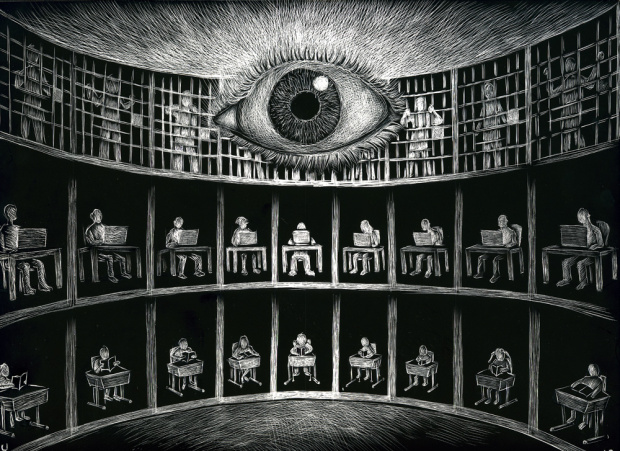
“I’ll tell you this.  I wasn’t prepared for what he showed me.  He took me down to his finished basement, which he called ‘the laboratory.’  When he switched on the lights the room was empty except for the walls.  They were covered with shelves about six inches apart that ran from wall to wall and ceiling to floor.  It gave the large room this incredibly bizarre look as though it were a prison cell.  There were even spotlights that illuminated the shelves, upon which, right along the outer edges looking out, he had lined up his collection of little figures.  As we stood in the middle of the room, it was as though thousands of little people were staring at us, the giants. I felt as though I was hallucinating. Finn just chuckled when I said, ‘Pretty fucking amazing!”  Then he said, ‘I like the perspective, don’t you?’   I knew he didn’t expect an answer and I could only chuckle in response, even as I felt a chill on the back of my neck.  It was so eerie that I had to contain a shudder.  For a brief moment I had the feeling that the door we had entered was going to shut and be bolted and that something terrifying was about to unfold.

“But at that moment he gestured to me to follow him to another door, over which a sign read, ‘The Family Fun Room.’  ‘This is my favorite,’ he said with a smile.

“In the middle of this pink painted room there was a cage that extended from floor to ceiling, and in the cage, sitting on stools, were two life-sized and very realistic figures of a man and a woman.  They were both dressed in those black and white stripped prison uniforms you’ve seen in old movies.  The woman was facing away from the man.  I couldn’t tell who the woman was, but I immediately recognized the man.  It was Finn’s father, down to the most realistic detail.  He was holding a small toy figurine and was looking into its face.  The door to the cell was padlocked shut.  ‘That’s to make sure they can’t escape,’ Finn said with a straight face.  ‘Now that I got them where I want them, I can’t take any chances.  They’re dangerous and can cause me a lot of grief.’

“He then closed the door and we went upstairs.  Neither of us said a word.  He offered me a beer, but I declined.  I felt spooked, some dreadful feeling in my gut.  I told him I had to be leaving, which I did.  On the way out I noticed a framed photograph in the foyer.  It was a picture of Finn at about the age of nine or ten with his parents and sister.  They are sitting together on a couch, the two kids caught between the parents.  No one is smiling.  Behind them on the wall is the father’s famous painting of a family of four sitting on a couch.  In that one, everyone is smiling and the father in the painting is Finn’s father.  As you probably know, that was one of his father’s favorite techniques – to put himself in his paintings.  Such a cute double-message: I did it, of course, but how could I have done it when I’m in it.  You’re left wondering: who really did it?  Who executed the painting of these happy people. But since it’s all supposed to be so amusing, you’re left to chuckle, to think, how cute, how tricky.  You’re supposed to smile.  But no one was smiling in the picture on the wall.  It seemed like a house of smoke and mirrors and I was damn glad to leave.

“As I drove home, I sure as hell wasn’t smiling.  There was something terribly disturbing about it all.  I felt nauseated, disgusted, really disturbed.  Maybe it seems obvious, but I felt there was a connection between this weird experience and myself.  A double connection, actually.  I won’t go into all the details now, and you know about my writer’s block, but this bizarre experience has left me with a new sense of freedom, some kind of opening to a new way to write that at the time I couldn’t put my finger on.  I’ve come to think of it as writing beyond a cage of categories.

“I thought about all the stuff we talk about, the political propaganda about everything, the loss of a sense of reality, the illusions and delusions with the digital technology, the warmongering by the U.S against Russian, the covid bullshit, all of it, all the stuff we share over beers.  Especially the disconnect between the private and the public and the two-faced nature of a way of living that is so fucking phony.  I realized why I had been hiding in my notebooks, how they had become my cage.

“To top it all off, when I got home and told Sara about my experiences with Tom Finn, the cage and all, she didn’t believe me.  She accused me of having drunk too much, which I had to admit I did.  She said I was scaring her with such a ridiculous tale and that I was sounding like a deluded conspiracy nut.

“Anyway, I’ve told no one else about Finn.  I’m afraid they wouldn’t believe me either.   You’re a sociologist and know all about Max Weber’s prediction of a coming disenchanted world with its iron cage.  Shit, I feel like I had a small glimpse of it.  Do you think anyone would believe me if I told this story?

“Do you?”
New Cold War Propaganda: About China’s Spy Balloon and the US Spy Planes that have Violated the Airspace of Sovereign Nations

By Timothy Alexander Guzman

Source: Silent Crow News

Washington’s political establishment says China was spying on US sovereign territory with what China has called their ‘weather balloon.  China’s Foreign Affairs Ministry Spokesperson issued a statement:

The airship is from China. It is a civilian airship used for research, mainly meteorological, purposes. Affected by the Westerlies and with limited self-steering capability, the airship deviated far from its planned course. The Chinese side regrets the unintended entry of the airship into US airspace due to force majeure. The Chinese side will continue communicating with the US side and properly handle this unexpected situation caused by force majeure

However, the Western mainstream-media has been non-stop with the hysteria on China’s “spy balloon” invading US sovereign territory, but when it comes to the US government and its Military-Industrial Complex (MIC) who has consistently invaded the airspace of many sovereign countries, it is barely mentioned and forgotten.  The bottom line is that the China balloon story is all about war propaganda.  The US and its allies are setting the stage for another war, this time against China. 

The Associated Press (AP) China balloon: Many questions about suspected spy in the sky reported on what the Pentagon has claimed regarding China’s spy balloon, “The Pentagon says the balloon, which is carrying sensors and surveillance equipment, is maneuverable and has shown it can change course. It has loitered over sensitive areas of Montana where nuclear warheads are siloed, leading the military to take actions to prevent it from collecting intelligence.”  Brigadier General Pat Ryder, the Pentagon’s press secretary said, “the balloon was not a military or physical threat” and that “once the balloon was detected, the U.S. government acted immediately to protect against the collection of sensitive information.”  

CNN also jumped in on the propaganda bandwagon and published What is a suspected Chinese spy balloon doing above the US?’, and surprisingly asked a legit question, “Don’t spies use satellites now?”  But CNN switched back to  its propaganda mode when they reported on what Peter Layton, a fellow at the Griffith Asia Institute in Australia and former Royal Australian Air Force officer had said, “Using balloons as spy platforms goes back to the early days of the Cold War. Since then, the US has used hundreds of them to monitor its adversaries.”  So, the US has used these types of balloons in the past, “But with the advent of modern satellite technology enabling the gathering of overflight intelligence data from space, the use of surveillance balloons had been going out of fashion.  Or at least until now.”  They mention the advancement of “miniaturization of electronics” which complements the idea of “floating intelligence platforms.”  Layton said that “Balloon payloads can now weigh less and so the balloons can be smaller, cheaper and easier to launch.”  An article published by The Washington Post ‘How do stratospheric Balloons Work? Here’s a Visual Guidesaid that “Experts in national security and aerospace said the craft appears to share characteristics with high-altitudes balloons used by developed countries around the world for weather forecasting, telecommunications and scientific research.”   

The Democrats and Republicans are united against a common adversary and that is China.  They say how dare the Chinese Communist Party release a surveillance balloon on our sovereign territory and defy international law.  Well, it is true that a foreign object that invades a sovereign country’s airspace  does violate international law, but for decades, the US has invaded the sovereign airspace of many countries around the world including Nicaragua, Venezuela, Iran, and others. 

So let’s go back to November 11th, 1984, the United Press International (UPI) headlined with Nicaragua said U.S. spy planes Sunday broke the sound… reported that “Nicaragua said U.S. spy planes Sunday broke the sound barrier twice over the country, causing minor damages and fueling the leftist Sandinista government’s fears of an American invasion.”  The SR-71 or its more accurate name, “The SR-71 “Blackbird” is used for “strategic reconnaissance” or in other words, to spy on its adversaries.  The SR-71 Blackbird is manufactured by Lockheed Martin, a heavyweight in the MIC was identified by the Sandinistas during the time of the Iran-Contra affair “Within two hours of each other, what the Nicaraguans identified as a U.S. SR-71 ‘Blackbird’ jets flew over Managua and other cities, breaking the sound barrier with a loud boom.”                  

Another incident happened on December 5th, 2011, this time in Iran. Lockheed Martin’s RQ-170 Sentinel unmanned aerial vehicle (UAV) was noticed in the city of Kashmar, located in northeastern Iran and was seized by a cyberwarfare unit from Iranian forces.  The Cyberwarfare unit gained control of the UAV spy drone and landed the plane although the western media reported that the spy plane was shot down.  The Obama regime initially denied Iran’s claims but later admitted that the aircraft that was supposedly shot down, was a US drone.  Iran did file a complaint to the United Nations over the US violating its airspace shortly after.  The RQ-170 Sentinel Unmanned Aerial Vehicle is described in Airforce-technology.com as “a high altitude and long-endurance unmanned aerial vehicle (UAV) designed and manufactured by Skunk Works, a division of Lockheed Martin Corporation, for the United States Air Force (USAF)” and that “The UAV can capture real-time imagery of the battlefield and transfer the data to the ground control station (GCS) through a line of sight (LOS) communication data link.”  It was also used against various countries, “The low-observable design enables the aircraft to fly on the borders of Iran, China, India and Pakistan for capturing real-time information regarding missile tests, telemetry and multispectral intelligence.”

On July 21st, 2019, Venezuela’s airspace was also violated by the US military as Reuter’s headlined with U.S. says Venezuelan plane aggressively shadowed a U.S. military aircraftnot mentioning that it was a spy plane, “The U.S. military on Sunday accused a Venezuelan fighter aircraft of “aggressively” shadowing a U.S. Navy EP-3 Aries II plane over international airspace, in yet another sign of the increasing hostility between the two nations.”  Keep in mind that that Obama had imposed sanctions against Venezuela, “The encounter between the U.S. and Venezuelan planes occurred on Friday, the same day that the Trump administration announced it was sanctioning four top officials in Venezuela’s military counterintelligence agency.”  The US military had issued a statement about the incident and said that “it had determined the “Russian-made fighter aggressively shadowed the EP-3 at an unsafe distance in international airspace for a prolonged period of time, endangering the safety of the crew and jeopardizing the EP-3 mission.”  So, what was that mission?  To spy on Venezuela’s oil fields?  This was during the time when the Trump regime’s hostilities towards the Maduro government was at an all-time high,  “U.S. President Donald Trump’s administration has repeatedly used sanctions in an effort to oust Venezuelan President Nicolas Maduro, whose 2018 re-election has been deemed illegitimate by the United States and most Western nations.”  The EP-3 stems from the P-3 Orion.  The P-3 Orion is an anti-submarine and surveillance aircraft also developed by Lockheed Martin in the 1960’s for the US Navy.  The EP-3 known as ARIES (Airborne Reconnaissance Integrated Electronic System) has specific capabilities that can intercept various signals.  It is an aircraft that is operated by naval personnel with specific skills that includes cryptographers, technicians and even linguists to translate intercepted messages in foreign languages. 

Online news website ‘The Drive’ is one of the internet’s main sources for news, features and guides about modern automotive culture and other technologies has a section called ‘The War Zone’ published an article titled The U.S. Army’s Newest Spy Plane in Action in Africa and Latin America admits that “After almost getting canned in 2012, the enhanced Medium Altitude Reconnaissance and Surveillance System is now snooping abroad.”  “Rules for thee, and not for me” is the US model, so “snooping abroad” is I guess justified.  According to The Drive:

The first version of the U.S. Army’s newest spy plane is in action in Africa and Latin America. At the same time, the service is finishing tests of three additional sub-variants in Arizona.  On March 12, 2017, Scout Warrior first reported these overseas deployments. The War Zone subsequently learned only some of the four signals intelligence-focused versions of the Enhanced Medium Altitude Reconnaissance and Surveillance System (EMARSS-S) were snooping abroad.

In an Email, U.S. Army Lt. Col. Sean Smith confirmed this particular model was supporting U.S. Africa Command (AFRICOM) and U.S. Southern Command (SOUTHCOM) operations. “There are no other EMARSS variants fielded or deployed at this time,” he added.  Despite its name, the EMARSS-S has a suite of signal-snooping gear to track and listen in on enemy communications, as well as the ability to record full-motion video during the day or at night. Each aircraft also has work stations connected to the controversial Distributed Common Ground System – Army (DCGS-A) intelligence data network, which is supposed to help collect, compile, and distribute information rapidly across units

Not only do they openly admit that the US has spy planes in Africa and Latin America, to them it makes perfect sense! 

Sending the aircraft to work with AFRICOM and SOUTHCOM makes perfect sense for early deployments. The regions these commands work are relatively low threat environments for American aircraft, but offer no shortage of work tracking drug smugglers, terrorists, and insurgents in remote areas

Let me get this straight, they are using spy planes “to track drug smugglers, terrorists, and insurgents”?  Call me cynical but “tracking drug smugglers, terrorists and insurgents” is only a half-truth.  Maybe in a small number of cases they have tracked real drug smugglers and others, but the US government has been involved in drug smuggling operations in the past, just ask the CIA.  As for tracking terrorists, the US government and the intelligence community has supported terrorists in the Middle East and Latin America for decades and as for tracking insurgencies of let’s say, in Iraq, it is usually against US and NATO occupiers, so who are they fooling? 

In Central and South America and Africa, Army spy planes such as the RC-12X Guardrail Common Sensor (GRCS) and EO-5C Airborne Reconnaissance Low – Multisensor (ARL-M) already fly routine missions, in cooperation with other aircraft and personnel from the U.S. Air Force, American law enforcement agencies, local security forces, and private contractors. After 9/11, the Pentagon found renewed interest in monitoring terrorist groups and potential hotspots in Africa with a similar mix of assets

To the US establishment, any form of spying on its territory is considered a declaration of war, but any violation of airspace of their perceived enemies anywhere in the Global South is justified because the US government can do whatever they want and bypass international law.  The Chinese spy balloon story is to create fear that an enemy is collecting data on its nuclear missile sites and on the American people.  Now they are accusing China of spying on Latin America with another balloon which asks the obvious question, why?  China has a good relationship with most of Latin America.  The US establishment, the MIC and the mainstream media are all pushing for a new war with a nuclear power that has a formidable military that would fight any foreign invasion on its territory.  China is not interested in becoming a global empire, it is the US who wants to remain a global empire.  It’s all war propaganda, nothing more, and nothing less.             

The Big Stiff: Russia-Iran dump the dollar and bust US sanctions

News of Russian banks connecting to Iran’s financial messaging system strengthens the resistance against US-imposed sanctions on both countries and accelerates global de-dollarization.  

By Pepe Escobar

Source: The Cradle

The agreement between the Central Banks of Russia and Iran formally signed on 29 January connecting their interbank transfer systems is a game-changer in more ways than one.

Technically, from now on 52 Iranian banks already using SEPAM, Iran’s interbank telecom system, are connecting with 106 banks using SPFS, Russia’s equivalent to the western banking messaging system SWIFT.

Less than a week before the deal, State Duma Chairman Vyachslav Volodin was in Tehran overseeing the last-minute details, part of a meeting of the Russia-Iran Inter-Parliamentary Commission on Cooperation: he was adamant both nations should quickly increase trade in their own currencies.

Ruble-rial trade

Confirming that the share of ruble and rial in mutual settlements already exceeds 60 percent, Volodin ratified the success of “joint use of the Mir and Shetab national payment systems.” Not only does this bypass western sanctions, but it is able to “solve issues related to mutually beneficial cooperation, and increasing trade.”

It is quite possible that the ruble will eventually become the main currency in bilateral trade, according to Iran’s ambassador in Moscow, Kazem Jalali: “Now more than 40 percent of trade between our countries is in rubles.”

Jalali also confirmed, crucially, that Tehran is in favor of the ruble as the main currency in all regional integration mechanisms. He was referring particularly to the Russian-led Eurasian Economic Union (EAEU), with which Iran is clinching a free trade deal.

The SEPAM-SPFS agreement starts with a pilot program supervised by Iran’s Shahr Bank and Russia’s VTB Bank. Other lenders will step in once the pilot program gets rid of any possible bugs.

The key advantage is that SEPAM and SPFS are immune to the US and western sanctions ruthlessly imposed on Tehran and Moscow. Once the full deal is up and running, all Iranian and Russian banks can be interconnected.

It is no wonder the Global South is paying very close attention. This is likely to become a landmark case in bypassing Belgium-based SWIFT – which is essentially controlled by Washington, and on a minor scale, the EU. The success of SEPAM-SPFS will certainly encourage other bilateral or even multilateral deals between states.

It’s all about the INSTC

The Central Banks of Iran and Russia are also working to establish a stable coin for foreign trade, replacing the US dollar, the ruble, and the rial. This would be a digital currency backed by gold, to be used mostly in the Special Economic Zone (SEZ) of Astrakhan, in the Caspian Sea, already very busy moving plenty of Iranian cargo.

Astrakhan happens to be the key Russian hub of the International North-South Transportation Corridor (INSTC), a vast network of ship, rail, and road routes which will drastically increase trade from Russia – but also parts of Europe – across Iran to West Asia and South Asia, and vice-versa.

And that reflects the full geoconomic dimension of the SEPAM-SPFS deal. The Russian Central Bank moved early to set up SPFS in 2014, when Washington began threatening Moscow with expulsion from SWIFT. Merging it with the Iranian SEPAM opens up a whole new horizon, especially given Iran’s ratification as a full member of the Shanghai Cooperation Organization (SCO), and now a leading candidate to join the extended BRICS+ club.

Already three months before the SEPAM-SPFS agreement, the Russian Trade Representative in Iran, Rustam Zhiganshin, was hinting that the decision “to create an analog of the SWIFT system” was a done deal.

Tehran had been preparing the infrastructure to join Russia’s Mir payment system since last summer. But after Moscow was hit with extremely harsh western sanctions and Russian banks were cut off from SWIFT, Tehran and Moscow decided, strategically, to focus on creating their own non-SWIFT for cross-border payments.

All that relates to the immensely strategic geoeconomic role of the INSTC, which is a much cheaper and faster trade corridor than the old Suez Canal route.

Russia is Iran’s largest foreign investor

Moreover, Russia has become Iran’s largest foreign investor, according to Iranian Deputy Finance Minister Ali Fekri: this includes “$2.7 billion worth of investment to two petroleum projects in Iran’s western province of Ilam in the past 15 months.” That’s about 45 percent of the total foreign investment in Iran over the October 2021 – January 2023 period.

Of course the whole process is in its initial stages – as Russia-Iran bilateral trade amounts to only US$3 billion annually. But a boom is inevitable, due to the accumulated effect of SEPAM-SPFS, INSTC, and EAEU interactions, and especially further moves to develop Iran’s energy capacity, logistics, and transport networks, via the INSTC.

Russian projects in Iran are multi-faceted: energy, railways, auto manufacturing, and agriculture. In parallel, Iran supplies Russia with food and automotive products.

Ali Shamkhani, the secretary of Iran’s Supreme National Security Council, is fond of reminding anyone that Russia and Iran “play complementary roles in global energy and cargo transit.” The Iran-EAEU free agreement (FTA) is nearly finalized – including zero tariffs for over 7,500 commodities.

In 2022, the EAEU traded more than $800 billion worth of goods. Iran’s full access to the EAEU will be inestimable in terms of providing a market gateway to large swathes of Eurasia – and bypassing US sanctions as a sweet perk. A realistic projection is that Tehran can expect $15 billion annual trade with the five members of the EAEU in five years, as soon as Iran becomes the sixth member.

The legacy of Samarkand

Everything we are tracking now is in many ways a direct consequence of the SCO summit in Samarkand last September, when Russian President Vladimir Putin and his Chinese counterpart Xi Jinping, in person, placed their bet on strengthening the multipolar world as Iran signed a memorandum to join the SCO.

Putin’s private talks with Iranian President Ebrahim Raisi in Samarkand were all about deep strategy.

The INSTC is absolutely crucial in this overall equation. Both Russia and Iran are investing at least $25 billion to boost its capabilities.

Ships sailing the Don and Volga Rivers have always traded energy and agricultural commodities. Now Iran’s Maritime News Agency has confirmed that Russia will grant their ships the right of passage along the inland waterways on the Don and Volga.

Meanwhile, Iran is already established as the third largest importer of Russian grain. From now on, trade on turbines, polymers, medical supplies, and automotive parts will be on a roll.

Tehran and Moscow have signed a contract to build a large cargo vessel for Iran to be used at the Caspian port of Solyanka. And RZD logistics, a subsidiary of Russian railway RZD, operates container cargo trains regularly from Moscow to Iran. The Russian Journal for Economics predicts that just the freight traffic on INTSC could reach 25 million tons by 2030 – no less than a 20-fold increase compared to 2022.

Inside Iran, new terminals are nearly ready for cargo to be rolled off ships to railroads crisscrossing the country from the Caspian to the Persian Gulf. Sergey Katrin, head of Russia’s Chamber of Commerce and Industry, is confident that once the FTA with the EAEU is on, bilateral trade can soon reach $40 billion a year.

Tehran’s plans are extremely ambitious, inserted in an “Eastern Axis” framework that privileges regional states Russia, China, India, and Central Asia.

Geostrategically and geoeconomically, that implies a seamless interconnection of INSTC, EAEU, SCO, and BRICS+. And all of this is coordinated by the one Quad that really matters: Russia, China, India, and Iran.

Of course there will be problems. The intractable Armenia-Azerbaijan conflict might be able to derail the INSTC: but note that Russia-Iran connections via the Caspian can easily bypass Baku if the need arises.

BRICS+ will cement the dollar’s descent

Apart from Russia and Iran, Russia and China have also been trying to interface their banking messaging systems for years now. The Chinese CBIBPS (Cross-Border Inter-Bank Payments System) is considered top class. The problem is that Washington has directly threatened to expel Chinese banks from SWIFT if they interconnect with Russian banks.

The success of SEPAM-SPFS may allow Beijing to go for broke – especially now, after the extremely harsh semiconductor war and the appalling balloon farce. In terms of sovereignty, it is clear that China will not accept US restrictions on how to move its own funds.

In parallel, the BRICS in 2023 will delve deeper into developing their mutual financial payments system and their own reserve currency. There are no less than 13 confirmed candidates eager to join BRICS+ – including Asian middle powers like Iran, Saudi Arabia, and Indonesia.

All eyes will be on whether – and how – the $30 trillion-plus indebted US will threaten to expel BRICS+ from SWIFT.

It’s enlightening to remember that Russia’s debt to GDP ratio stands at only 17 percent. China’s is 77 percent. The current BRICS without Russia are at 78 percent. BRICS+ including Russia may average only 55 percent. Strong productivity ahead will come from a BRICS+ supported by a gold and/or commodities-backed currency and a different payment system that bypasses the US dollar. Strong productivity definitely will not come from the collective west whose economies are entering recessionary times.

Amid so many intertwined developments, and so many challenges, one thing is certain. The SEPAM-SPFS deal between Russia and Iran may be just the first sign of the tectonic plates movement in global banking and payment systems.

Welcome to one, two, one thousand payment messaging systems. And welcome to their unification in a global network. Of course that will take time. But this high-speed financial train has already left the station.

A Star is Born!

By James Howard Kunstler

Source: Kunstler.com


“Everything that can be engineered is being engineered dishonestly.” —Truman Verdun

If you think the reasons behind the First World War were incomprehensible, imagine what historians of the future — pan-fraying peccary loins over their camp fires — will think about World War Three. Some people started something in Ukraine… and then the USA blew up the main energy supply line of its NATO ally, Germany… say, what…?!?

    Weird, a little bit.  A sane person in a sane world would call sabotaging the Nord Stream pipelines an act-of-war against a friendly nation, since the result was to virtually destroy the basis of Germany’s industry, not to mention the domestic comfort of German citizens. Now, thanks to 85-year-old Seymour Hersh, the independent investigator who uncovered the My Lai Massacre in 1969 and reported on the depraved antics of American jailers at the Abu Ghraib prison in Iraq in 2004, we have a pretty good idea how the Nord Stream caper went down.

     For a year before the op, “Joe Biden” and Undersecretary of State Victoria Nuland — architect of the 2014 Maidan Coup in Ukraine, which kicked-off the present fiasco there — blabbed about “ending” the Nord Streams. Curiously, the Germans said nothing. Meanwhile, the US made a deal to beef up military bases in Norway, an original NATO signatory (1949), for staging the Nord Stream sabotage op. Of course, Norway, being Western Europe’s remaining sole oil-and-gas exporter, had an interest in eliminating its competition.

    In June of 2022, under cover of an annual NATO naval exercise in the Baltic Sea, US Navy divers attached mines to the Nord Stream pipelines. The mines had triggers that could be activated remotely at any time of choosing, and that moment came on September 26… kaboom. Ms. Nuland and Secretary of State Antony Blinken gloated publicly. Naturally, the US blamed Russia. America’s news media — catamite of the Intel Community — amplified the charge, despite the absurdity of Russia blowing up its most lucrative source of export revenue. The New York Times has so far made no mention of Mr. Hersh’s recent update of the Nord Stream sabotage.

     Germany, too, hardly made a peep, nor did the rest of Western Europe, which now faces a future that looks, energy-wise, like a return to the Fourteenth Century. Maybe they’re all jaded with modern life, all that tiresome bathing and malingering in the brightly-lit cafes. Under the sagacious guidance of the WEF they were all going “green,” anyway — but was that green like the heart-shaped leaves of the linden tree or green like the moldy veins in Roquefort cheese? I guess they’ll find out.

     Luckily, America had the Chinese balloon to distract them, and then “Joe B’s” State-of-the-Union extravaganza where the nation learned that we are living in the most extraordinary economic boom since the days of Babe Ruth and Charlie Chaplin. The perpetually-vacationing Leader of the Free World has apparently made America great again, despite the dastardly plots and ongoing insurrections of his far-right, white supremacist adversaries. Did the annual SOTU smell a little bit like a reelection pitch, though? I hope so.

     Speaking of insurrection, the House commenced hearings this past week, debuting with the Oversight Committee’s witness panel of Twitter execs who carried out a years-long censorship campaign against the First Amendment in cahoots with the FBI, CIA, DOD, DOJ, DOS, DHS… well you get the picture. A more arrogant crew of dedicated fascists would be hard to find in any other corner of the world today, except perhaps Canada, than the likes of Vijaya Gadde, Yoel Roth, Anika Collier Navaroli, and James Baker, former chief counsel of the FBI. They “moderated” speech on the chat app for the good of the American people, you understand, lest the public succumb to “misinformation” — otherwise known as reality.

     One reality being that the sedulously-repressed news of Hunter Biden’s crime-stuffed laptop represented interference in the 2020 election. James Baker told the committee he could not recall at the time (October 2020) whether he spoke to anyone back in his old haunts at the FBI about the matter — though there is no question that, as chief counsel, he knew the agency had possession of the laptop since 2019, and what was in it. Rep. Clay Higgins (R-La.) warned the four former Twitter employees that “this is the investigation part, later comes the arrest part.” Let’s hope so on that one, too.

     Meanwhile, the House Special Subcommittee on the Weaponization of the Federal Government held a lively colloquy with four “experts” including former FBI agents Nicole Parker and Thomas Baker, GWU Law Professor Jonathan Turley, and one Elliot Williams, former DOJ Assistant AG and currently shill for DC Lawfare tank the Raban Group. The theme, generally, was the change-in-mission in the FBI-DOJ nexus from law enforcement to harassment of US citizens who oppose Democratic Party policy.

     Most instructive in Thursday’s session, though, was the political debut of Rep. Danial Sachs Goldman (real name), newly elected member for New York’s Tenth District (which encompasses Wall Street). Among other distinctions, Mr. Goldman is an heir to the Levi-Strauss blue jeans fortune, and was lead counsel during the 2019 impeachment hearings against Donald Trump in the House Intelligence Committee. This vicious prick, an apt replacement for the inveterate liar and seditionist, Rep. Adam Schiff (CA), put on a florid demonstration of hectoring witnesses, cutting them off, and re-directing the committee’s attention at every opportunity to the so-called “insurrection” at the Capitol of 1/6/20.

      Mr. Goldman is a man to watch, especially as the House actually does give its complete attention later this year to the 1/6/20 matter and the true facts behind the FBI’s engineering of the event, including the nefarious actions of former Speaker Nancy Pelosi and her Capitol Police. When it comes, I can’t wait to watch Mr. Goldman unwind like one of those cheap counterfeit Rolex watchers that peddlers hawk on Wall Street’s sidewalk.

CIA Agent Cloaks Lockdown Propaganda in Concern for China

By Debbie Lerman

Source: Brownstone Institute

On January 24, 2023, Dr. Michael V. Callahan published an opinion piece in The New York Times entitled “The Indirect Ways the U.S. Can Help China Avoid Covid Catastrophe.”

If we assume this was written by a prominent doctor at a Harvard-affiliated hospital – an academic professional who bases his opinions on sound medical principles and scientific knowledge – it makes no sense at all. In fact, it is an embarrassment to the writer and the institution he represents.

If, however, we realize that this is just the latest in the quarantine-until-vaccine propaganda campaign of a CIA agent and top biosecurity cabal member, everything suddenly makes perfect sense. In fact, many of the points in the article map beautifully onto Robert Blumen’s helpful Covid propaganda grid.

The following are the medical and scientific fictions (or, if you prefer, lies) supposedly advocated by infectious-disease-physician Callahan, followed by an explanation of why CIA-agent/biosecurity-propagandist Callahan would want to promulgate them:

Fiction #1: Zero Covid works

Callahan opens his article with a bold statement: “China rolled back its longstanding pandemic strategy ‘zero Covid,’ which had protected the country for nearly three years.” As many, including myselfhave noted, there is no evidence – except the repeated statements of people like Callahan and the lockdown-narrative-promoting mainstream press – for the fact that the “zero Covid” strategy protected anyone from anything

Callahan, who has worked for the intelligence community in Asia, knows (as we all should) that information from the Chinese Communist Party (CCP) is not reliable, to say the least. Therefore, there is no reason to think he believes the CCP’s absurd claims that there were no Covid deaths in China for three years thanks to lockdowns.

So why is this his lede? Because the biosecurity propaganda machine has to maintain the illusion that lockdowns, at least to some degree, are effective, and that ending them is somehow undesirable.

Fiction #2: China’s Lunar New Year is a very scary time

Callahan returns to a favorite trope of the quarantine-until-vaccine cabal from exactly three years ago: the Lunar New Year in China. Due to “enormous” travel, “densely packed transit systems, winter conditions and multigenerational gatherings,” Callahan tells us “the Lunar New Year is a common tabletop simulation for training public health officials.” What about the real world? Do we have any proof that it was disastrous in 2020, as mainstream media warned, or will be disastrous in 2023? 

Furthermore, if Lunar New Year travel in 2020 already exported Covid far and wide (we know that by the time lockdowns were initiated in China on January 23, 2020, the virus had already spread to nearly every Chinese province, and many other countries) – what use were lockdowns in one or two specific areas for containing its worldwide spread? And if it spread everywhere, including in China, despite lockdowns, how can we believe the zero deaths for three years narrative?

Fiction #3: the most dangerous subvariant

Ever since Delta, variants and subvariants have provided a never-ending source of fear mongering for the quarantine-until-vaccine junta. In his op-ed, Callahan makes an unsubstantiated claim that the “subvariant XBB1.5” is “the most infectious to date.” There is no reference, so I’m not sure where the information is from. I found one doctor in North Carolina saying it “seems to be the most infectious” with no meaningful data to support the claim. A WHO official says it’s the “most transmissible” (again, no numbers or data) but adds “there’s no indication it makes people more sick than previous subvariants.” 

As has been true for SARS-CoV-2 and every one of its mutations, and as is true for every infectious disease humanity has ever encountered: If it’s not very lethal to most people, it can infect the entire world’s population while causing very little serious disease or death. 

Dr. Callahan knows this. Propagandist Callahan is using the tried and true biodefense network’s tactic of constantly citing high case numbers (regardless of illness or death) to send the media and public into paroxysms of panic.

Fiction #4: vaccines work

Next, Callahan says the United States has a high vaccination rate using “highly protective vaccines.” If he means against the original SARS-CoV-2 virus, Callahan might be able to dig up some evidence (though it is highly contestable). But if he means against this subvariant, he has zero evidence, and he knows it.

Fiction #5: some vaccines (ours) are better than others (theirs)

“Domestically made Chinese vaccines,” according to Callahan, “may provide less lasting protection against the virus and its variants.” 

Since he says “may,” this is clearly just a hypothesis. Since we know our vaccines provide at most a few months of protection from the original strain (again, a contestable statement) and none from any variant or subvariant thereafter, the meaning of “less lasting protection” basically is “less than zero,” which again makes no sense.

However, as a member of the quarantine-until-vaccine biosecurity network, Callahan is using this piece of propaganda to bolster the case that lockdowns and vaccines work.

How anyone can believe such preposterous fiction is a mystery.

Postscript: a very scary non-fiction

The vast expansion of surveillance in general, and biosurveillance in particular, is one of the biosecurity community’s biggest achievements during Covid, and Callahan manages to include a plug for more:

In December, at least one online pharmacy in China began selling the Covid drug Paxlovid, made by the American pharmaceutical company Pfizer, directly to patients. The pharmacy shipped Paxlovid to any Chinese person with a positive coronavirus test. If the Beijing government were to tie the government’s home test result reporting system to the commercial Paxlovid home delivery providers, many lives could be saved.

If anyone is wondering why it’s important to debunk and expose all of the fictions and propaganda of the Covid biosecurity agenda, this tiny window into the terrifying vision they have for our future is the answer.

The New York Times is Orwell’s Ministry of Truth

By Edward Curtin

Source: Behind the Curtain

“Ingsoc. The sacred principles of ingsoc. Newspeak, double-speak, the mutability of the past.” – George Orwell, 1984

As today dawned, I was looking out the window into the cold grayness with small patches of snow littering the frozen ground.  As light snow began to fall, I felt a deep mourning in my soul as a memory came to me of another snowy day in 1972 when I awoke to news of Richard Nixon’s savage Christmas bombing of North Vietnam with more than a hundred B-52 bombers, in wave after wave, dropping death and destruction on Hanoi and other parts of North Vietnam.  I thought of the war the United States is now waging against Russia via Ukraine and how, as during the U.S. war against Vietnam, few Americans seem to care until it becomes too late.  It depressed me.

Soon after I was greeted by an editorial from The New York Times’ Editorial Board, “A Brutal New Phase of the War in Ukraine.”  It is a piece of propaganda so obvious that only those desperate to believe blatant lies would not fall down laughing.  Yet it is no laughing matter, for The N.Y. Times is advocating for a wider war, more lethal weapons for Ukraine, and escalation of the fighting that risks nuclear war.  So their title is apt because they are promoting the brutality.  This angered me.

The Times’ Editorial Board tells us that President Putin, like Hitler, is mad.  “Like the last European war, this one is mostly one man’s madness.”  Russia and Putin are “cruel”; are conducting a “regular horror” with missile strikes against civilian targets; are “desperate”; are pursuing Putin’s “delusions”; are waging a “terrible and useless war”; are “committing atrocities”; are responsible for “murder, rape and pillaging,” etc.

On the other hand, “a heroic Ukraine” “has won repeated and decisive victories against Russian forces” who have lost “well over 100,000 Russian soldiers killed and wounded,” according to the “reliable” source, chairman of the U.S. Joint Chief of Staff, Gen. Mark A. Milley.  To add to this rosy report, the Ukrainians seem to have suffered no causalities since none are mentioned by the cozy Times’ Editorial Board members from their keyboards on Eighth Avenue.  When you support a U.S. war, as has always been The Times’ modus operandi as a stenographer for the government, mentioning the dead pawns used to accomplish the imperialists’ dreams is bad manners.  So are the atrocities committed by those forces, so they too have been omitted.  Neo-Nazis, the Azov Battalion?  They too must never have  existed since they are not mentioned.

But then, according to the esteemed editorial writers, this is not a U.S. proxy war waged via Ukraine by U.S./NATO “to strip Russia of its destiny and greatness.”  No, it is simply Russian aggression, supported by “the Kremlin’s propaganda machinery” that has churned “out false narratives about a heroic Russian struggle against forces of fascism and debauchery.”  U.S./NATO were “horrified by the crude violation of the postwar order,” so we are laughingly told, and so came to Ukraine’s defense as “Mr. Putin’s response has been to throw ever more lives, resources and cruelty at Ukraine.”

Nowhere in this diatribe by the Times’ Board of propagandists – and here the whole game is given away for anyone with a bit of an historical sense – is there any mention of the U.S. engineered coup d’état in Ukraine in 2014.  It just didn’t happen.  Never happened.  Magic by omission.  The U.S., together with the Ukrainian government “led” by the puppet-actor “President Volodymyr Zelensky,” are completely innocence parties, according to the Times.  (Note also, that nowhere in this four page diatribe is President Putin addressed by his title, as if to say that “Mr. Putin” is illegitimate and Zelensky is the real thing.)

All the problems stem from when “Mr. Putin seized Crimea and stirred up a secessionist conflict in eastern Ukraine n 2014.”

Nowhere is it mentioned that for years on end U.S./NATO has been moving troops and weapons right up to Russia’s borders, that George W. Bush pulled the U.S. out of the Anti-Ballistic Missile Treaty and that Trump did the same with the Intermediate-Range Nuclear Forces Treaty, that the U.S. has set up so-called anti-ballistic missile sites in Poland and Rumania and asserted its right to a nuclear first-strike, that more and more countries have been added to NATO’s eastern expansion despite promises to Russia to the contrary, that 15,000 plus mostly Russian-speaking people in eastern Ukraine have been killed by Ukrainian forces for years before February 2022, that the Minsk agreements were part of a scheme to give time for the arming of Ukraine, that the U.S. has rejected all calls from Russia to respect its borders and its integrity, that the U.S./NATO has surrounded Russia with military bases, that there was a vote in Crimea after the coup, that the U.S. has been for years waging economic war on Russia via sanctions, etc.  In short, all of the reasons that Russia felt that it was under attack for decades and that the U.S. was stone deaf to its appeals to negotiate these threats to its existence.  It doesn’t take a genius to realize that if all were reversed and Russia had put troops and weapons in Mexico and Canada that the United States would respond forcefully.

This editorial is propaganda by omission and strident stupidity by commission.

The editorial has all its facts “wrong,” and not by accident.  The paper may say that its opinion journalists’ claims are separate from those of its newsroom, yet their claims echo the daily barrage of falsehoods from its front pages, such as:

  • Ukraine is winning on the battlefield.
  • “Russia faces decades of economic stagnation and regression even if the war ends soon.”
  • That on Jan.14, as part of its cruel attacks on civilian targets, a Russian missile struck an apartment building in Dnipro, killing many.
  • Only one man can stop this war – Vladimir Putin – because he started it.
  • Until now, the U.S. and its allies were reluctant to deploy heavy weapons to Ukraine “for fear of escalating this conflict into an all-in East-West war.”
  • Russia is desperate as Putin pursues “his delusions.”
  • Putin is “isolated from anyone who would dare to speak truth to his power.”
  • Putin began trying to change Ukraine’s borders by force in 2014.
  • During the last 11 months Ukraine has won repeated and decisive victories against Russian forces …. The war is at a stalemate.”
  • The Russian people are being subjected to the Kremlin’s propaganda machinery “churning out false narratives.”

This is expert opinion for dummies.  A vast tapestry of lies, as Harold Pinter said in his Nobel Prize address.  The war escalation the editorial writers are promoting is in their words, “this time pitting Western arms against a desperate Russia,” as if the U.S./NATO does not have CIA and special forces in Ukraine, just weapons, and as if “this time” means it wasn’t so for the past nine years at least as the U.S. was building Ukraine’s military and arms for this very fight.

It is a fight they will lose in the days to come.  Russia was, is, and will triumph.

Everything in the editorial is disingenuous.  Simple propaganda: the good guys against the bad guys.  Putin another Hitler.  The good guys are winning, just as they did in Vietnam, until reality dawned and it had to be admitted they weren’t (and didn’t).  History is repeating itself.

Little has changed and so my morning sense of mourning when I remembered Nixon and Kissinger’s savagery at Christmas 1972 was appropriate.  As then, so today, we are being subjected to a vast tapestry of lies told by the corporate media for their bosses, as the U.S. continues its doomed efforts to control the world.  It is not Russia that is desperate now, but propagandists such as the writers of this strident and stupid editorial.  It is not the Russian people who need to wake up, as they claim, but the American people and those who still cling to the myth that The New York Times Corporation is an organ of truth.  It is the Ministry of Truth with its newspeak, double-speak, and its efforts to change the past.

Let Harold Pinter have the last words:

The crimes of the United States have been systematic, constant, vicious, remorseless, but very few people have actually talked about them. You have to hand it to America. It has exercised a quite clinical manipulation of power worldwide while masquerading as a force for universal good. It’s a brilliant, even witty, highly successful act of hypnosis.

The Cost Of Living Has Become Extremely Oppressive And 57 Percent Of Americans Cannot Afford A $1,000 Emergency Expense

By Michael Snyder

Source: Activist Post

I don’t have to tell you that your money doesn’t go as far as it once did.  You see it every time that you go shopping.  Our leaders flooded the system with money and pursued highly inflationary policies for years, and now we are all paying the price.  The cost of living has been rising much faster than our incomes have, and this is systematically destroying the middle class.  Survey after survey has shown that a solid majority of the population is living paycheck to paycheck, and at this point most U.S. consumers are tapped out.  In fact, one brand new survey just discovered that 57 percent of Americans cannot even afford to pay a $1,000 emergency expense

According to Bankrate’s Annual Emergency Fund Report, 68% of people are worried they wouldn’t be able to cover their living expenses for just one month if they lost their primary source of income. And when push comes to shove, the majority (57%) of U.S. adults are currently unable to afford a $1,000 emergency expense.

When broken down by generation, Gen Zers (85%) and Millennials (79%) are more likely to be worried about covering an emergency expense.

These numbers are quite ominous, because they clearly demonstrate that we are completely and utterly unprepared for any sort of a major economic downturn.

And thanks to the rapidly rising cost of living, we are losing even more ground with each passing month.

Another survey that was recently released found that “earnings are falling behind the cost of living” for 72 percent of middle income families…

Nearly three-quarters, or 72%, of middle-income families say their earnings are falling behind the cost of living, up from 68% a year ago, according to a separate report by Primerica based on a survey of households with incomes between $30,000 and $100,000. A similar share, 74%, said they are unable to save for their future, up from 66% a year ago.

We haven’t experienced anything like this in the United States in decades.

When I walked into a Walmart store the other day, I was shocked by how high the prices are now.

Isn’t Walmart supposed to be the place with “low prices every day”?

Well, the prices were certainly not “low” when I walked through the store.

And I was stunned to learn that McDonald’s is now selling one hash brown for three dollars.

Are you kidding me?

I am sure that many of you can remember a time when they were 50 cents.

Sadly, those days are not coming back.

Food prices are going to continue to go up, and the CEO of Unilever recently admitted that his company has actually “been accelerating the rate of price increases that we’ve had to put into the market”…

“For the last 18 months we’ve seen extraordinary input cost pressure … it runs across petrochemical derived products, agricultural derived products, energy, transport, logistics,” he said.

“It’s been feeding through for quite some time now and we’ve been accelerating the rate of price increases that we’ve had to put into the market,” he added.

That doesn’t sound good at all.

And he also ominously warned that “there’s more inflationary pressure coming”

Unilever’s view, he said, was that “we know for sure there’s more inflationary pressure coming through in our input costs.”

As food prices continue to rise, these big companies are going to look for ways to reduce input costs.

One way that they are going to do that is by starting to put crushed bugs in our food.

I know that this may sound really bizarre to you, but this is already happening in Europe

As of yesterday, a food additive made out of powdered crickets began appearing in foods from pizza, to pasta to cereals across the European Union.

Yes, really.

Defatted house crickets are on the menu for Europeans across the continent, without the vast majority of them knowing it is now in their food.

So you might want to start reading labels a lot more carefully from now on.

Of course it isn’t just the cost of food that has become extremely oppressive.

Just about everything has gotten more expensive, and this has broken the remaining strength of the U.S. consumer.

If you doubt this, just consider some of the latest economic numbers that we have seen.

-U.S. retail sales fell once again last month…

US retail sales continued their fall in December, dropping by 1.1% as inflation remained high, the Commerce Department reported Wednesday.

That’s the largest monthly decline since December 2021, and practically every category (except for building materials, groceries and sporting goods) saw sales drop from the prior month.

-Sales of existing homes have now fallen for 11 months in a row

U.S. existing home sales slowed for the 11th consecutive month in December as higher mortgage rates, surging inflation and steep home prices sapped consumer demand from the housing market.

-More Americans than ever before are being forced to pay at least 30 percent of their incomes on rent

The average US household is now considered ‘rent-burdened’ as a record-high number of people are spending more than 30 percent of their income on rent.

According to Moody’s Analytics’ latest affordability report, the national average rent-to-income (RTI) ratio reached 30 percent for the first time since the company began tracking the data more than 20 years ago.

U.S. consumers are being stretched financially like never before, and many are turning to debt to help them maintain their current lifestyles.

As a result, the savings rate has plunged to a historic low, credit card debt has surged to a record high, and the average rate of interest on credit card balances has also risen to a record high.  As Zero Hedge has aptly noted, this is “nothing short of catastrophic”…

The combination of record high credit card debt and record high credit card interest is nothing short of catastrophic for both the US economy, and the strapped consumer who has no choice but to keep buying on credit while hoping next month’s bill will somehow not come. Unfortunately, it will and at some point in the very near future, this will also translate into massive loan losses for US consumer banks; that’s when Powell will finally panic.

For a long time, we have been warned that the very foolish economic policies that our leaders were implementing would have deeply tragic consequences.

And now it is starting to happen right in front of our eyes.

Sadly, the truth is that this is just the beginning.

The entire system is cracking and crumbling all around us, and there is much more pain ahead.

360 Degree Surveillance: How Police Use Public-Private Partnerships to Spy on Americans

By John & Nisha Whitehead

Source: The Rutherford Institute

We live in a surveillance state founded on a partnership between government and the technology industry.”— Law Professor Avidan Y. Cover

In this age of ubiquitous surveillance, there are no private lives: everything is public.

Surveillance cameras mounted on utility poles, traffic lights, businesses, and homes. License plate readers. Ring doorbells. GPS devices. Dash cameras. Drones. Store security cameras. Geofencing and geotracking. FitBits. Alexa. Internet-connected devices.  

There are roughly one billion surveillance cameras worldwide and that number continues to grow, thanks to their wholehearted adoption by governments (especially law enforcement and military agencies), businesses, and individual consumers.

With every new surveillance device we welcome into our lives, the government gains yet another toehold into our private worlds.

Indeed, empowered by advances in surveillance technology and emboldened by rapidly expanding public-private partnerships between law enforcement, the Intelligence Community, and the private sector, police have become particularly adept at sidestepping the Fourth Amendment.

As law professor Avidan Y. Cover explains:

A key feature of the surveillance state is the cooperative relationship between the private sector and the government. The private sector’s role is vital to the surveillance both practically and legally. The private sector, of course, provides the infrastructure and tools for the surveillance… The private sector is also critical to the surveillance state’s legality. Under the third-party doctrine, the Fourth Amendment is not implicated when the government acquires information that people provide to corporations, because they voluntarily provide their information to another entity and assume the risk that the entity will disclose the information to the government. Therefore, people do not have a reasonable expectation of privacy in their calling data, or potentially even their emails. As a result, the government does not normally need a warrant to obtain information transmitted electronically. But the Fourth Amendment is not only a source of protection for individual privacy; it also limits government excess and abuse through challenges by the people. The third-party doctrine removes this vital and populist check on government overreach.

Critical to this end run around the Fourth Amendment’s prohibitions against unreasonable searches and seizures by government agents is a pass play that allows police to avoid public transparency requirements (open bids, public meetings, installation protocols) by having private companies and individuals do the upfront heavy lifting, leaving police to harvest the intel on the back end.

Stingray devices, facial recognition technology, body cameras, automated license plate readers, gunshot detection, predictive policing software, AI-enhanced video analytics, real-time crime centers, fusion centers: all of these technologies and surveillance programs rely on public-private partnerships that together create a sticky spiderweb from which there is no escape.

As the cost of these technologies becomes more affordable for the average consumer, an effort underwritten by the tech industry and encouraged by law enforcement agencies and local governing boards, which in turn benefit from access to surveillance they don’t need to include in their budgets, big cities, small towns, urban, suburban and rural communities alike are adding themselves to the surveillance state’s interconnected grid.

What this adds up to for government agencies (that is, FBI, NSA, DHS agents, etc., as well as local police) is a surveillance map that allows them to track someone’s movements over time and space, hopscotching from doorbell camera feeds and business security cameras to public cameras on utility poles, license plate readers, traffic cameras, drones, etc.

It has all but eliminated the notion of privacy and radically re-drawn the line of demarcation between our public and private selves.

Over the past 50 years, surveillance has brought about a series of revolutions in how governments govern and populations are policed to the detriment of us all. Cybersecurity expert Adam Scott Wandt has identified three such revolutions.

The first surveillance revolution came about as a result of government video cameras being installed in public areas. There were a reported 51 million surveillance cameras blanketing the United States in 2022. It’s estimated that Americans are caught on camera an average of 238 times every week (160 times per week while driving; 40 times per week at work; 24 times per week while out running errands and shopping; and 14 times per week through various other channels and activities). That doesn’t even touch on the coverage by surveillance drones, which remain a relatively covert part of police spying operations.

The second revolution occurred when law enforcement agencies started forging public-private partnerships with commercial establishments like banks and drug stores and parking lots in order to gain access to their live surveillance feeds. The use of automatic license plate readers (manufactured and distributed by the likes of Flock Safety), once deployed exclusively by police and now spreading to home owners associations and gated communities, extends the reach of the surveillance state that much further afield. It’s a win-win for police budgets and local legislatures when they can persuade businesses and residential communities to shoulder the costs of the equipment and share the footage, and they can conscript the citizenry to spy on each other through crowdsourced surveillance.

The third revolution was ushered in with the growing popularity of doorbell cameras such as Ring, Amazon’s video surveillance doorbell, and Google’s Nest Cam.

Amazon has been particularly aggressive in its pursuit of a relationship with police, enlisting them in its marketing efforts, and going so far as to hosting parties for police, providing free Ring doorbells and deep discounts, sharing “active camera” maps of Ring owners, allowing access to the Law Enforcement Neighborhood Portal, which enables police to directly contact owners for access to their footage, and coaching police on how to obtain footage without a warrant.

Ring currently partners with upwards of 2,161 law enforcement agencies and 455 fire departments, and that number grows exponentially every year. As Vice reports, “Ring has also heavily pursued city discount programs and private alliances with neighborhood watch groups. When cities provide free or discounted Ring cameras, they sometimes create camera registries, and police sometimes order people to aim Ring cameras at their neighbors, or only give cameras to people surveilled by neighborhood watches.”

In November 2022, San Francisco police gained access to the live footage of privately owned internet cameras as opposed to merely being able to access recorded footage. No longer do police even have to request permission of homeowners for such access: increasingly, corporations have given police access to footage as part of their so-called criminal investigations with or without court orders.

We would suggest a fourth revolutionary shift to be the use of facial recognition software and artificial intelligence-powered programs that can track people by their biometrics, clothing, behavior and car, thereby synthesizing the many strands of surveillance video footage into one cohesive narrative, which privacy advocates refer to as 360 degree surveillance.

Finally, Wandt sees autonomous cars equipped with cameras that record everything around them as yet another revolutionary expansion of surveillance to be tapped by police.

Yet in the present moment, it’s those public-private partnerships that signify a watershed moment in the transition from a police state to a surveillance state and sound a death knoll for our privacy rights. This fusion of government power and private power is also at the heart of the surveillance state’s growing stranglehold on the populace.

As always, these intrusions into our personal lives are justified in the name of national security and fighting crime. Yet while the price to be paid for having the government’s so-called protection is nothing less than our right to privacy, the guarantee of safety remains dubious, at best.

As a study on camera surveillance by researchers at City University of New York concluded, the presence of cameras were somewhat effective as a deterrent for crimes such as car burglaries and property theft, but they had no significant effect on violent crimes.

On the other hand, when you combine overcriminalization with wall-to-wall surveillance monitored by police in pursuit of crimes, the resulting suspect society inevitably gives way to a nation of criminals. In such a society, we are all guilty of some crime or other.

The predatory effect of these surveillance cameras has also yet to be fully addressed, but they are vulnerable to being hacked by third parties and abused by corporate and government employees.

After all, power corrupts. We’ve seen this abuse of power recur time and time again throughout history. For instance, as an in-depth investigative report by the Associated Press concludes, the very same mass surveillance technologies that were supposedly so necessary to fight the spread of COVID-19 are now being used to stifle dissent, persecute activists, harass marginalized communities, and link people’s health information to other surveillance and law enforcement tools. As the AP reports, federal officials have also been looking into how to add “‘identifiable patient data,’ such as mental health, substance use and behavioral health information from group homes, shelters, jails, detox facilities and schools,” to its surveillance toolkit.

These cameras—and the public-private eyes peering at us through them—are re-engineering a society structured around the aesthetic of fear and, in the process, empowering “people to not just watch their neighborhood, but to organize as watchers,” creating not just digital neighborhood watches but digital gated communities.

Finally, there is a repressive, suppressive effect to surveillance that not only acts as a potentially small deterrent on crime but serves to monitor and chill lawful First Amendment activity. As Matthew Feeney warns in the New York Times, “In the past, Communists, civil rights leaders, feminists, Quakers, folk singers, war protesters and others have been on the receiving end of law enforcement surveillance. No one knows who the next target will be.

No one knows, but it’s a pretty good bet that the surveillance state will be keeping a close watch on anyone seen as a threat to the government’s chokehold on power.

It’s George Orwell’s 1984 on a global scale.

As I make clear in my book Battlefield America: The War on the American People and in its fictional counterpart The Erik Blair Diaries, Orwell’s dystopian nightmare has become our looming reality.