Is the Web Destroying the Cultural Economy?

Internet-devices-globe-world-connected

By Charles Hugh Smith

Source: Of Two Minds

Are we entering a cultural Dark Age, where the talented cannot earn a living creating culture?

Longtime correspondent G.F.B. recently sent me this 13-minute Interview with Andrew Keen. This is my first exposure to Keen, and his view that the democratization of the Web is great for politics but a disaster for what he calls the Cultural Economy— the relatively small but important slice of the economy that pays creators and artists to make culture: music, literature, art and serious journalism.

The title of Keen’s 2007 book encapsulates his dire perspective: The Cult of the Amateur: How blogs, MySpace, YouTube, and the rest of today’s user-generated media are destroying our economy, our culture, and our values.

(His 2012 book had a similar theme: Digital Vertigo: How Today’s Online Social Revolution Is Dividing, Diminishing, and Disorienting Us)

(Author Scott Timberg makes some of the same points in his new book Culture Crash: The Killing of the Creative Class (via Cheryl A.)

Keen touches on a great many ideas and themes in this brief interview, but his core point is this: by enabling everyone to express themselves on an essentially equal footing, the Web has undermined legitimate journalism and buried the talented few in an avalanche of mediocrity–in his words, talent is “lost in a sea of garbage.”

By eliminating the middleman who added value by sorting the wheat from the chaff–the film studio, the music labels, the publishers–the Web has created a cultural landscape where “soft, ordinary” content such as cute cat videos garner the most “likes” and clicks–the digital world’s metric for popularity and thus value in the marketplace.

Keen tossed off one of his most interesting ideas as an aside: that the break-up of community and the resulting loss of identity has generated a universal drive to establish an identity via self-expression: everybody feels they can compose a song, write a novel or make a movie.

Keen is at his most provocative (to the democratized ideal of the amateur making it big) when he declares the vast majority of people are talentless: talent is by definition scarce. We can’t all be equally talented, nor can anyone generate culturally valuable content without mastering their craft over thousands of hours of practice.

Keen unapologetically calls the previous arrangement an “industrial meritocracy.” He feels this hierarchical meritocracy is being destroyed and there is nothing to replace it.  This will result in a cultural Dark Age where the talented cannot earn a living creating culture. The only avenue left for creators of content that can be copied and distributed digitally (music, digital art, writing) is to find wealthy patrons to support their work.

One of G.F.B.’s points in our conversation was the Web’s “level playing field” is an artificial construct, much like the playing field in a stadium. But outside the stadium, the geography is anything but level.  Put other way, global corporations have great advantages in the supposedly “level playing field” of the Web.

Keen mentions that what will remain scarce in this tsunami of digital content is access to the artist, live performances and art that cannot be digitized, such as sculpture and paintings. As I have discussed in previous Musings, musicians who perform constantly can make a living in this environment, because their free music on the web builds an audience for their live performances.  But not every band performs enough to make a go of this model.

In Keen’s  view, it is now essentially impossible for bands, artists and writers to create a “brand” that will generate an income. Only those creators who entered the digital age with an established brand can leverage their recognition into an income.

As a completely marginal creator of content who never rose within the industrial meritocracy lauded by Keen, I  think Keen makes some excellent points but overstates his case for a cultural Dark Age.

As G.F.B. pointed out in our conversation on this topic, a new class of curators is arising within the Web, people who sift through the vast outpouring of content and select the best or most interesting (in their view). Those curators who succeed are adding value just as the industrial middlemen did in the pre-digital model. In some small way, I think Of Two Minds performs a bit of this curation.

It seems to me that the digital age requires every creator of content to not only be perseverant but to focus a great deal of time and energy on marketing their content–precisely what the industrial media and cultural industrial-model companies once did for their talent.

There is no longer enough money in creating content to pay an office full of people to issue press releases and arrange book tours.  In the publishing world, promotion is increasingly up to the authors; as Keen noted, only those authors with brands that were established in the pre-digital age can sell enough content to support industrial-type promotion.

We can bemoan this, or we can grasp the nettle and realize that  it is no longer enough to practice one’s craft for the fabled 10,000 hours–one must also invest another 10,000 hours in promoting and marketing one’s content/cultural creations.  That dual process (creation and marketing) is so arduous, so impoverishing, so demanding, only the driven few can sustain it long enough to claw their way through the mountains of mediocrity.

Making a living at cultural content was always brutally Darwinian; perhaps all that’s changed is the nature of the Darwinian selection process.

ISIS 101: What’s really terrifying about this threat

ISIS-and-the-false-flag-frame-up

By John Chuckman

Source: RINF

ISIS certainly is not what a great many people think that it is, if you judge what they think by what our corporate press proclaims incessantly.

Judging by what ISIS actually does and whom its acts benefit, its clandestine associates, and the testimony of some witnesses, ISIS is a complex intelligence operation. Its complexity reflects at least in part the fact that it serves the interests of several countries and that it has more than one objective. Its complexity reflects also the large effort to reinforce a false image with disinformation and staged events such as a video of a beheading which could not have been a beheading unless they’ve discovered a bloodless method until now unknown to science.

The subject of ISIS is not without brief glimmers of humor. The image of bands of men, swathed in Arabic robes and bumping their way around the desert in Japanese pick-up trucks with Kalashnikovs raised in the air for every picture has elements of Monty Python. The idea of modern, trained and well-armed military units turning and running from them resembles a war scene in a Laurel and Hardy comedy such as the one with Hardy stuck upside down in a WWI tank turret kicking his legs the whole time Laurel drives towards the German positions managing accidentally to round-up a whole trench-full of prisoners with some wire fencing that becomes snagged on the tank.

Despite the tiresome stupidities we see and hear about it, ISIS unquestionably does kill people and destroy things, that being its purpose, and there is no humor in that.

ISIS appears to have served several tasks so far. First, it frightened Iraq’s Prime Minister, Nouri al-Maliki, out of office in Iraq, a man America and Israel grew very much to dislike owing simply to his good relations with Iran, one of the unintended consequences of America’s invasion of Iraq being expanded Iranian influence in the region. No doubt al-Maliki was terrified not so much by ISIS approaching in their pick-up trucks as he was by his own military’s tendency, as if on cue, to turn and run from ISIS, often leaving weapons behind. The message was clear: you won’t be protected.

Second, America’s highly selective “air war” against ISIS somehow manages to attack infrastructure targets inside Syria with the feeble excuse that they are facilities helping ISIS. We’ve seen what American bombing can do when it’s undertaken seriously, and somehow I have a hard time imaging the men in Japanese pick-ups lasting long when faced with what hit the Taleban in Afghanistan or Gadhafi’s forces in Libya. The air strikes are partly a show for the world – after all, how can America be seen not to be fighting such extremely well-advertised, super-violent terrorists, guys putting out videos regularly from a studio trailer they must haul around with one of their pick-up trucks?  The air strikes’ main purpose appears to be a way of hurting Assad and assisting those fighting Syria’s army without coming into conflict with Russia, as they would with a large, direct campaign. They likely also punish elements of ISIS which have exceeded their brief and serve as a reminder to the rest of what could happen to them if they stray too far from their subsidized purpose once the war comes to an end.

Three, in some of the ground fighting in Iraq where we’ve read of Iraqi units fighting ISIS, the units are often Kurdish, and sometimes the press uses expressions like “Iraqi and Kurdish troops.” But the Kurdish region is still part of Iraq legally, although it has been given a good deal of autonomy by the central government. The Kurdish region of Iraq is the country’s prime oil-producing area, and in the estimation of many observers, an area both the United States and Israel would very much like to see severed from Iraq in the way Kosovo was severed from Serbia after America’s devastating air war there. This would not only permanently assure Iraq’s weakness, it would create a rather grateful and more willing oil supplier.

Where does ISIS get its technical equipment and the know-how to produce videos and run Internet sites? These are not qualities commonly found among fanatical fundamentalists anywhere; indeed most true radical fundamentalists tend to eschew technology. A supply of advice, technical assistance, and equipment comes from somewhere. Where does ISIS get the money for food, gasoline, clothes, ammunition, and Japanese pick-up trucks? And I wonder, did one of those wild-looking jihadi types just show up one day at an Iraqi car dealership and order a fleet of Japanese pick-ups? Were they delivered out on the desert or did a gang of jihadists march in, waving their Kalashnikovs, to drive them away?

The effort to destroy the Syrian government, whether by means of ISIS or anyone else, is warmly and generously supported by Saudi Arabia and its buddy Qatar – another oil-rich, absolute monarchy where political parties are banned – both these counties’ primary interest being the defence of their immensely privileged situations against creeping threats of all progressive developments such as equal human rights or democracy or indeed against revolt led by external forces. The payments we now know the Saudi royal family long made to Osama bin Laden before 9/11 were simply bribes to keep him and his anti-establishment work out of the country. They really didn’t care a lot about what the money bought elsewhere, but since 9/11 and its many Saudi connections – 15 of the perpetrators plus the past financing plus the many members of the royal family and bin Laden family secretly flown out by American officials at the time – the Saudi authorities were genuinely fearful of how America might respond and have become far more responsive to what America wants in the Middle East and now apply their money to such projects. What America wants in the Middle East is, invariably, what Israel wants, so there is now extensive, secret cooperation where once there was complete official hostility.

We have reports from plane-spotters in the region of daily flights of mysterious planes from Israel to Qatar. We have several eye-witness reports and photographs of supply bundles dropped from unknown planes into ISIS territory. Maybe ISIS has its own air force now? We know Turkey has served both as an entry point for countless terrorists into Syria and as a place of retreat and refuge when fighting with the Syrian army becomes too hot for them, the volumes of such activity having been too great to keep secret. We have reports of Turkish supply flights. A Jordanian official recently told a reporter that ISIS members were trained in 2012 by American instructors working at a secret base in Jordan.

If ISIS is what our corporate news pretends that it is – a fanatical Muslim extremist group that sprang suddenly from the desert sands much like Jack’s bean stalk – one blindingly obvious question is, why does it not attack Israel or Israeli interest? Isn’t that what one would expect from such a cast of characters? But it has not done so, undoubtedly because Israel is an important covert benefactor and supplier.

We might equally ask why ISIS has not attacked Saudi Arabia or its interests, for although the Saudi royal family officially professes a strict and conservative form of Islam, Wahhabism, in fact many of them are very worldly people who spend a good deal of time and money at the world’s great pleasure palaces. Perhaps even more damning for a genuine fanatical fundamentalist, the Saudis now often secretly cooperate and make plans with Israel where mutual interests exist.

No, there is something highly suspicious about Islamic fundamentalist terrorists who avoid such interests while managing to brutally kill poor Syrian soldiers just doing their jobs along with the odd foreign journalist or aid worker who may just have seen something they shouldn’t have seen. Of course, we have Edward Snowden himself having described ISIS as an operation intended to protect Israel. Despite the fact that some news sources have said the interview in which this was revealed never took place, my instincts tell me it likely did. Snowden has never refuted it, and the news sources saying it did not are highly suspect on such a subject.

The way ISIS serves Israeli and American interests is by providing a focus point for extremists, attracting them from various parts of the world so that they can be recorded and kept track of. Also the tracks back to the various countries from which they come provide security services with leads to places where there might be some festering problems. In the meantime, ISIS serves the interest of helping to bring down President Assad, a goal dear to the hearts of Israelis. Please remember that black operations, even the ones about which we know, show little consideration for lives or property. Just think of Israel’s attack on an American spy ship in the Mediterranean during the Six Day War, its pilots knowingly shooting up and bombing for two hours the well-marked ship of its ally and benefactor, no explanation worth hearing ever having been offered.

Just read conservative mainline sources (pretty much a redundant pair of adjectives) about the harm Snowden has done: claims of everything from his revelations about American intelligence having served to help ISIS avoid detection (!) to his revelations having set up the United States for another 9/11! You might think intelligent people would be ashamed of making such asinine public statements, but, no, there are almost no limits to trying to discredit those revealing murderous, dark operations.

We’ve had many reports of officials in various countries, including Canada as I write, concerned about the odd individual or small group running off to join ISIS. Now why should that be a concern? A few flaky people going abroad just removes them from your country, something I should have thought was a complete gain from a security point of view. Even if they were ever to return in future, you would know exactly who they are. Where is the basis for serious concern? But the psychological advantages of noise and hype to scare people about obscure dangers and “lone wolves” and “home-grown terrorists” outweigh completely good sense and intelligence.

Finally, there are numerous reports that Abu Bakr al-Baghdadi (a nom de guerre, not his real name), the leader of ISIS, is a Western intelligence asset. What little we can learn about him makes that entirely plausible. The Supreme Leader of Iran, Ali Khamenei, has said that the man is a Mossad agent, a claim supported supposedly by documents revealed by Edward Snowden. Abu Bakr al-Baghdadi is by all accounts a secretive man who speaks directly with few people, and even his birth place, given as Samarra, Iraq, is not sure. Records of his past, as those from his period of American captivity (always a great opportunity to “turn” someone to serving two interests), are not available. He was once reported killed but is still alive. He is said to have received intensive training from Mossad and the CIA, and some sources give his real name as Simon Elliot (or, Elliot Shimon), but few details can ever be certain in such dark operations.

The truly terrifying aspect of ISIS and other forces fighting with it in Syria is that the United States and Israel have approved and supported such wanton destruction in so beautiful and formerly-peaceful a place as Syria. Millions of lives destroyed and countless historic places damaged as though they were all nothing more than a few pieces moved on a geopolitical chessboard. I think it fair to describe that as the work of psychopaths.

People as Livestock: The Cult of Fundamentalist Materialism and the Cheapening Life

Farm to Fork

I first encountered the term “Fundamentalist-Materialism” in the work of Robert Anton Wilson; it appears in several of his non-fiction works, including “The Cosmic Triggger” series. As far as I know R.A.W. was the originator of this philosophical designation.”

Is there any inherent value to an individual human life? 

By Dan Mage

Source: OpEdNews.com

Authoritarians of the left, libertarians of the right, objectivists, conservatives and even liberals and progressives fixated on “jobs” and “rehabilitation” of the socioeconomically dysfunctional give the answer “no; ” sometimes directly (as in the case of the Stalinist and the American conservative) and other times through actions, policies, and preferences (as in the case of elements of the “occupation” movement distancing themselves from “homeless bums,” “drug users,” and “ex-cons”).

Most of all, those with the power to set wages, prices, working conditions and societal expectation for those who have nothing left but their time and “docile bodies”*(Foucault) to sell, control and trade in human lives as commodities. While most of the supposedly civilized world frowns on chattel slavery (although a good bit of it goes on, especially in the sex trade, where prosecution of traffickers is the exception rather than the rule), the legal technicality of ownership is superfluous to the trade in human lives, time, labor, and in Reichian terms orgones.

What do Stalinism, objectivism, authoritarian capitalism, and global corporatism all have in common ? They are in my opinion fundamentalist-materialist cults that value the inanimate over the living, the concrete over the abstract and have effectively reduced the vast majority of the human race to livestock, or wild beasts to be hunted down, captured, contained, broken, or in the alternative, simply slaughtered and destroyed.

I have been told that it has always been thus, and perhaps in terms of humanity’s historical failings this is true. There is however no historical precedent for the establishment of a global value system through electronic multi-sensory media. Even the best efforts of the Catholic Church, Protestant missionaries and Islamic holy-warriors do not equal the technology and level of sophistication in the application of “industrial psychology.”

The message remains the same though, as it has been throughout history: “Obey or suffer.” Individual disobedience or even mere failure to “produce” in spite of the individual’s best efforts will result in stigmatization, marginalization, a degrading dependency on the state and, as state support for the economically disengaged is cut back and removed, starvation, homelessness and imprisonment; even the fact of homelessness is defined as a criminal offense by more local jurisdictions with each passing year.

The fact is that life is cheap; the idealistic visions of humanitarians are swept aside by those advocates of “austerity” and “tough choices,” whose calculations in service of usury on a global scale will determine the level of human suffering in each nation up to and including death by starvation, disease, and the inevitable outcome of manufactured scarcity, war.

The blurry and dim imagery of the concretes of suffering fades from vision in the glare of the deadly abstractions; political ideologies, religions, money that does not exist anywhere other than in the record keeping of the money lenders remains in clear focus. The conclusion returns stark, glaring and obvious: human life is a commodity, the value of which is consistently decreasing. The devaluation of an individual human life to a unit of production and consumption, which therefore can be discarded if determined to have no economic value, is all that is required for the machinery of mass exterminations and genocide to be set in motion.

Arguing about wages, prices, social systems and ways of arranging economies, even in cases where “progress” is made, will be useless. The dominance of the fundamentalist-materialist cults, as well as the authoritarian religions that create legitimacy for them in the eyes of the masses (and even Stalin, the ultimate fundamentalist-materialist, allowed for the return of religion as an adjunct of the state when he realized its value) will continue to crush and compress human life, until the perverted and inverted values themselves are overthrown, shattered, burned and buried.

When will the biocentric (life centered) ethos replace the thanatocentric (death centered) ethos as the dominant culture’s value system? I cannot answer even the “if” of this question, let alone the question itself. The fact that the power to collect interest on nonexistent money and the lifestyles that such usury on a global scale supports is presented, and apparently accepted, as an immutable law of nature rather than as an imposition of culture’s order on the true nature of humanity seems by way of this very acceptance to be a “natural law.” Images of vultures waiting for starving children to crawl to their deaths and mothers weeping over infants at the bottoms of pits do not move the master manipulators of numbers. If anything, only the fact that the die-offs are not more extensive is cause for lamentation.

Do we care anymore? I’m not speaking of our little “jobs” and “futures,” and relative degree of comfort/discomfort in oppression that seems to be everyone’s primary concern. I’m demanding of myself, of you and above all of those who have declared themselves to be “leaders;” what is it that matters to you? Do you feel anything at all? Can we set aside all calculations save for those needed to ease human suffering? The primary demand of all protests, occupations, strikes, boycotts and further actions of increasing effect and extremity will be “Life First!”

The life of one human being hanging on the edge of death, in suffering, is too high a price to pay, for all the glorious achievements of the fundamentalist-materialist cults, their leaders and their adherents. The cult of power, authority, war, and property as a weapon of coercion has, for all its trillions of dollars and stockpiled weapons of mass destruction, a single and fatal vulnerability; to function it depends on obedience. For obedience to be guaranteed, the “obey or suffer” directive must be enforceable. This directive is only enforceable if the doctrine of fundamentalist-materialism enjoys continued acceptance as a “fact of life,” rather than the monstrous fraud that it is.

*The term “docile bodies” is a chapter title in Michel Foucault’s “Discipline and Punish: The Birth of the Prison” 1977, Random House, NY, NY.


Saturday Matinee: Little Murders

little-murders-poster

“Little Murders” (1971) is a dark comedy based on a play written by Jules Feiffer and was the first feature film directed by Alan Arkin. The plot centers on vivacious interior designer Patsy who falls in love with photographer Alfred after saving him from a beating, despite (or because of) his physical and emotional passivity. The film’s comedic elements stem from Patty’s attempts to break Alfred out of his shell and their opposite approaches in dealing with the insanity of the world around them. Little Murders is memorable for its over-the-top nihilistic conclusion and great performances by Elliot Gould, Marcia Rodd, Alan Arkin and Donald Sutherland (as a hippy priest officiating one of cinema’s funniest wedding scenes).

Utopia: The Final Frontier

Spock_vulcan-salute

By Sadie Doyle

Source: The Baffler

Leonard Nimoy, who passed away this past Friday, was less an actor than an icon, an ever-present figure and a seemingly universal pop-culture touchstone. What struck me, upon hearing the news of his death, was that I’d somehow assumed he couldn’t die. It seemed as if Leonard Nimoy had always been there, in one form or another—as Spock, as himself on the best episodes of The Simpsons, as the man singing that ridiculously earworm-y theme song to the animated Hobbit movie—and I’d believed he always would be.

Not bad, for a guy whose biggest claim to fame was a TV show that was cancelled after three seasons. Despite his understandable discomfort with being identified solely with Star Trek (his first memoir was entitled I Am Not Spock, after all), it’s Spock, and Star Trek, that will be Leonard Nimoy’s most lasting legacy.

The role also explains much of the emotional hold he had on fans: he was the purest and clearest symbol of Star Trek’s utopian vision. Spock was an icon of perfectible human nature existing in a perfected world.

The Star Trek universe’s political vision is fun in part because it’s so massively impractical. The reasons I adored it as a child are the same reasons I find it so charming today. To start with, Star Trek is explicitly post-capitalist. No one worries about money; the characters seem to show up to work simply because they like being there. And the one alien species that does operate on a capitalist structure, the Ferengi, are villains. Yet the Federation is entirely devoid of the problems anti-capitalists face now: no one gets stuck with a crap job on the spaceship, because all of the “bad” jobs (factory labor, secretarial work, cleaning the Holodeck) are automated. No one has to worry that sharing resources will deprive them of things they want; in the Federation, everyone is comfortably middle-class, if not rich.

Needless to say, this is impossible. As ecofeminists like Vandana Shiva and Maria Mies have repeatedly affirmed, affluent, technologically enabled Western lifestyles simply can’t be universalized. (See, for instance, this excerpt from their book Ecofeminism (PDF). In the real world, at least, the Earth is a closed system. There’s only so much stuff we can use. Western ideas of “comfort” or affluence depend on Westerners using up vastly disproportionate amounts of that stuff, which depends on global capitalism, which depends on strategically impoverishing other countries and using them as a source of exploited labor. We can create a world where no one is poor, but never a world where everyone is rich; the Earth simply can’t produce enough to support that level of consumption.

But you know what solves the problem of the Earth as closed system? Spaceships, that’s what. In Star Trek, there is infinite Stuff, and whatever you don’t have, you just find on a new planet, or get from the replicator. Poverty and exploitation are things of the past, because their fundamental cause—competition for limited resources—simply doesn’t exist.

Star Trek’s perfect social reality is nothing next to its vision of perfect people. It’s not so much that Star Trek is dorky—although every character on those shows is deeply dorky—as that it lacks the necessary conditions for coolness to arise. There’s no counterculture; the culture is already perfect, so who’d want to counter it? There’s no youthful rebellion—even Wesley Crusher, the much-abhorred teenage pipsqueak of Star Trek: The Next Generation, hangs out mostly with his mom—because there’s nothing to rebel against.

If the Federation can seem humorless, it’s only because the keenest humor, as Freud reminds us, arises from hostility; in Star Trek, interpersonal hostility has been replaced with an all-encompassing sweetness, a sense that, although the characters on the Enterprise may chafe each other occasionally, they’re ultimately friends, making common cause in the best of all possible worlds.

Which brings us to Spock, and to Nimoy. Though Spock is half Vulcan—and, as such, treated to some of the show’s few explicit acknowledgements that racism might not just disappear, via McCoy’s frequent references to him as a “green-blooded goblin”—he was also Star Trek’s clearest statement of what a perfected human might be. His character is cleansed of hatred, fear, greed, and self-destructive impulses, just as the show’s universe is cleansed of oppression. He is a strict rationalist; the show, likewise, puts its faith in science to resolve all practical and emotional problems. If someone is getting on Spock’s nerves, he merely remarks that their actions are “highly illogical.” If something threatens his life, he’s more likely to call it “fascinating” than panic or run away.

Try to visualize Spock yelling at someone in rush-hour traffic. Visualize Spock in the midst of an acrimonious divorce, or picking a pointless fight with a friend after a rough day at work. You can’t. Those are the parts of human nature that are ugly and hard to manage, the parts that we don’t like, and that others don’t like about us. Spock has none of them.

Ridding ourselves of hostility and irrationality is just as impossible as everything else in Star Trek. Nimoy’s great gift as an actor was to make it seem plausible: With his seriousness, with his stillness, with the reserves of humor we could always sense glinting just under the surface (that eyebrow!), he made Spock a real person, and so gave our ideal selves form. That gift made him the most beloved character in one of our most beloved stories. And Star Trek granted him his own measure of immortality. Leonard Nimoy couldn’t stay with us forever. But Spock can.

Screen Shot 2015-02-28 at 7.51.46 PM

New Analysis Shatters Narrative of Charter School Success

Common_Core_585x585

In Minnesota, ‘new information is fueling critics who say the charter school experiment has failed to deliver.’

By Deirdre Fulton

Source: CommonDreams.org

Public schools are outperforming charter schools in Minnesota, in some cases “dramatically,” according to a new analysis by the state’s Star-Tribune newspaper.

In addition, many charter schools fail to adequately support minority students, close examination of the data revealed.

Journalist Charlene Briner, the Minnesota Department of Education looked at 128 of the state’s 157 charter schools and found “that the gulf between the academic success of its white and minority students widened at nearly two-thirds of those schools last year. Slightly more than half of charter schools students were proficient in reading, dramatically worse than traditional public schools, where 72 percent were proficient.”

Between 2011 and 2014, McGuire reported, 20 charter schools failed to meet the state’s expectations for academic growth each year, “signaling that some of Minnesota’s most vulnerable students had stagnated academically.”

Charlene Briner, the Minnesota Department of Education’s chief of staff, told the newspaper that she was troubled by the information, “which runs counter to ‘the public narrative’ that charter schools are generally superior to public schools.”

“Minnesota is the birthplace of the charter school movement and a handful of schools have received national acclaim for their accomplishments, particularly when it comes to making strong academic gains with low-income students of color,” the Star-Tribune claims. “But the new information is fueling critics who say the charter school experiment has failed to deliver on teaching innovation.”

Education analyst Diane Ravitch notes: “Minnesota was the home of the charter movement, which began with high expectations as a progressive experiment but has turned into a favorite mechanism in many states to promote privatization of public education and to generate profits for charter corporations like Imagine, Charter Schools USA, and K12. Today, charter advocates claim that their privately managed charters will ‘save low-income students from failing public schools,’ but the Minnesota experience suggests that charters face the same challenges as public schools, which is magnified by high teacher turnover in charter schools.”

The findings back up a report (pdf) put out last fall by the Institute on Metropolitan Opportunity at the University of Minnesota Law School, which examined the success and failures of the charter school system in Chicago, Illinois.

That study concluded:

Sadly the charters schools, which on average score lower that the Chicago public schools, have not improved the Chicago school system, but perhaps made it even weaker. Further charters, which are even more likely to be single race schools than the already hyper segregated Chicago school system, have not increased interracial contact, an often-stated goal of charter systems. Finally, the fact that Chicago charters use expulsion far more often that public schools deserves further study. In the end it is unlikely that the Chicago charter school experience provides a model for improving urban education in other big city school districts.

Meanwhile, in Philadelphia, the School Reform Commission plans to vote on no fewer than 39 charter school applications at a special meeting starting Wednesday afternoon. There will be opportunity for final statement by applicants and public commenting by just 39 speakers who registered in advance.

Earlier this month, a pro-charter, non-profit organization offered the cash-strapped city school district up to $35 million to help defray the costs of enrolling an additional 15,000 students in new charter schools.

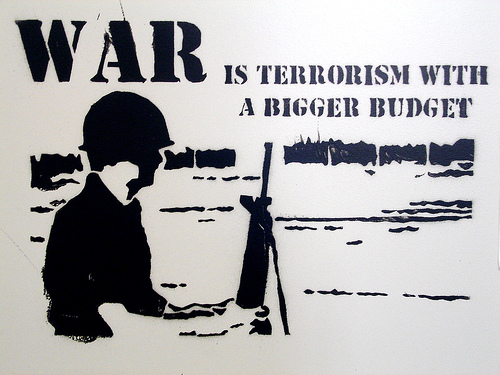
Domestic Fear Is the Price of Empire

waristerrorism

By Sheldon Richmond

Source: The Future of Freedom Foundation

If you find no other argument against American intervention abroad persuasive, how about this one? When the U.S. government invades and occupies other countries, or when it underwrites other governments’ invasions or oppression, the people in the victimized societies become angry enough to want and even to exact revenge — against Americans.

Is the American empire worth that price?

We should ask ourselves this question in the wake of the weekend news that al-Shabaab, the militant Islamist organization that rules parts of Somalia ISIS-style, appeared to encourage attacks at American (and Canadian) shopping malls.

Maybe the Shabaab video was just a prank to scare us. Maybe it was an attempt to plant violent thoughts in the minds of Somalis living in the United States. No one believes that the organization itself is capable of attacking Americans where they live, but that doesn’t mean Shabaab-inspired violence is impossible.

At any rate, it’s unsettling to be advised to watch out for terrorism when we shop at the mall.

Here’s the thing: We don’t have to live this way. The empire is just not worth it. We must understand that people in the Middle East, Africa, and Central Asia who subscribe to fringe militant interpretations of Islam would not be wishing us harm except for the violence the U.S. government has inflicted or helped to inflict on Muslim societies for many decades. In fact, those militant interpretations wouldn’t be nearly so attractive without the American empire and its ally Israel.

Why won’t the media describe this context? It’s because their job, despite what they say, is to be the government’s megaphone, not its adversary.

Let’s look at Somalia, where the latest threat originated.

U.S. intervention goes back to 1992, when President George H.W. Bush sent the military into a civil war there. Among the military’s activities was the suppression of the Somalis’ use of the intoxicant khat, which has been part of their culture for millennia.

That’s right. The U.S. government imposed a war on the Somali drug of choice.

President Bill Clinton withdrew the forces after two Blackhawk helicopters were shot down, but that was not the end of U.S. intervention. After the September 11 attacks, Somali warlords seeking American largess played on the George W. Bush administration’s concerns about al-Qaeda. The CIA obliged the warlords with suitcases of cash. As a result, everyday life became intolerably violent. So when the Islamic Courts Union (ICU) — a relatively moderate coalition of Sharia courts in the capital, Mogadishu —drove out the warlords and produced a measure of peace and stability, the Somali people were relieved.

That should have been deemed satisfactory, except that the warlords and their American backers were unhappy with the new situation, as Jeremy Scahill reported in 2011. “Most of the entities that made up the Islamic Courts Union did not have anything resembling a global jihadist agenda,” Scahill wrote. “Nor did they take their orders from Al Qaeda.”

Nevertheless, the U.S. government was determined to oust the ICU. To achieve that goal the Bush administration in 2006 backed a military invasion by Ethiopia, Somalia’s long-time Christian adversary, which overthrew the ICU.

“The Ethiopian invasion was marked by indiscriminate brutality against Somali civilians,” Scahill wrote.

Ethiopian and Somali government soldiers secured Mogadishu’s neighborhoods by force, raiding houses in search of ICU combatants, looting civilian property and beating or shooting anyone suspected of collaboration with antigovernment forces.… If Somalia was already a playground for Islamic militants, the Ethiopian invasion blew open the gates of Mogadishu for Al Qaeda. Within some US counterterrorism circles, the rise of the Shabab in Somalia was predictable and preventable.

To make things worse, the U.S. government has waged a drone war, with civilian casualties, and special operations against the Somalis. According to Scahill, the CIA also operates a secret prison and other facilities there.

So the U.S.-sponsored intervention sowed the ground for the most militant group in Somalia, al-Shabaab. Had the ICU been left to govern, we might never have heard of these young Islamists, whom the Obama administration now uses to scare American shoppers.

We can live without the fear of terrorism — but only if the U.S. government stops antagonizing foreign populations that have never threatened us.

Sheldon Richman is vice president of The Future of Freedom Foundation and editor of FFF’s monthly journal, Future of Freedom. For 15 years he was editor of The Freeman, published by the Foundation for Economic Education in Irvington, New York. He is the author of FFF’s award-winning book Separating School & State: How to Liberate America’s Families; Your Money or Your Life: Why We Must Abolish the Income Tax; and Tethered Citizens: Time to Repeal the Welfare State. Calling for the abolition, not the reform, of public schooling. Separating School & State has become a landmark book in both libertarian and educational circles. In his column in the Financial Times, Michael Prowse wrote: “I recommend a subversive tract, Separating School & State by Sheldon Richman of the Cato Institute, a Washington think tank… . I also think that Mr. Richman is right to fear that state education undermines personal responsibility…” Sheldon’s articles on economic policy, education, civil liberties, American history, foreign policy, and the Middle East have appeared in the Washington Post, Wall Street Journal, American Scholar, Chicago Tribune, USA Today, Washington Times, The American Conservative, Insight, Cato Policy Report, Journal of Economic Development, The Freeman, The World & I, Reason, Washington Report on Middle East Affairs, Middle East Policy, Liberty magazine, and other publications. He is a contributor to the The Concise Encyclopedia of Economics. A former newspaper reporter and senior editor at the Cato Institute and the Institute for Humane Studies, Sheldon is a graduate of Temple University in Philadelphia. He blogs at Free Association. Send him e-mail.

Chicago’s Abu Ghraib

Chicago-Homan-Square-police-torture-2

By Andre Damon

Source: WSWS.org

In April 2004, the world was shocked and horrified by the release of photographs of sadistic torture carried out by US military personnel at the Abu Ghraib prison in Iraq. Detainees at the prison, most of them locked up for opposing the US military occupation, were beaten, tortured, sexually assaulted and killed.

At the time, the World Socialist Web Site explained that the crimes revealed in the photos and the psychology underlying them could be understood only in relation to the brutality of social relations in the United States, together with the dirty colonial aims of the war itself.

The WSWS further warned that “such a military, accompanied by a growing army of professional ‘civilian’ mercenaries, represents a danger not only to oppressed peoples in the Middle East, Central Asia and elsewhere, but to the democratic rights of the population in the US.”

A decade later, this assessment has been fully borne out. On Tuesday, the Guardian newspaper revealed the existence of what it describes as a “black site” on the West Side of Chicago, where police detain, beat and torture prisoners, while keeping their whereabouts secret from their families and attorneys.

The newspaper writes: “The Chicago police department operates an off-the-books interrogation compound, rendering Americans unable to be found by family or attorneys while locked inside what lawyers say is the domestic equivalent of a CIA black site.”

Among those detained at the facility was Brian Jacob Church, one of the “NATO 3” who were entrapped by Chicago police in 2012 in connection with protests against the US-led military alliance, which was meeting in Chicago.

Church was taken to the secret facility and handcuffed to a bench for 17 hours. Along with two other protestors, he was set up by police on terrorism charges and subsequently sentenced to five years in prison.

Vic Suter, another participant in the protests, said that she was taken to the facility and interrogated while shackled to a bench for eighteen hours before she was allowed to see a lawyer.

The Guardian writes that detainees taken to the facility report having been beaten and otherwise tortured by police. In 2013, one detainee was found unconscious in an interview room at the facility. He later died.

On Thursday, the Intercept corroborated the Guardian’s account, interviewing another torture victim at the facility who was handcuffed across a bench and hit in the face and groin until he agreed to provide false testimony to police.

The revelations follow the report last week by the Guardian that Richard Zuley, one of the lead torturers at the Guantanamo detention center, used similar techniques to secure false confessions from murder suspects when he was a detective with the Chicago Police Department.

Chicago has a long history of police violence. It is also the political home of Barack Obama and has been run since 2011 by Rahm Emanuel, Obama’s former White House chief of staff.

The Obama administration, far from repudiating the horrific and criminal actions of its predecessor, has deployed the apparatus of police violence ever more directly against the American people. A series of events has marked the increasingly open application within the borders of the United States of the murderous methods of the “war on terror” tested out and perfected in Afghanistan, Pakistan, Iraq, Libya, Syria, Somalia and Yemen.

· In September 2010, the Obama administration ordered raids on the homes of leaders of the Anti-War Committee and the Freedom Road Socialist Organization in Minneapolis and Chicago on charges of “providing material support to terrorism.”

· In May 2012, Chicago police arrested the “NATO 3,” charging them with conspiracy to commit terrorism.

· In March 2013, US Attorney General Eric Holder declared that the president had the right to kill American citizens without a trial or any legal due process, including within the borders of the United States.

· Just one month later, in April 2013, the city of Boston was placed under de facto martial law following the Boston Marathon bombings, with residents told to “shelter in place” while armored vehicles and helicopters patrolled the streets and police carried out warrantless house-to-house searches.

· In June 2014, the American Civil Liberties Union released a report entitled “War Comes Home: The Excessive Militarization of American Policing.” The ACLU reported that the Defense Department had transferred $4.3 billion in military hardware, including armored vehicles, helicopters, and belt-fed machine guns, to local police departments.

· In August 2014, the authorities responded to protests against the police murder of unarmed teenager Michael Brown with a military/police crackdown. Hundreds of peaceful protesters were arrested, shot with rubber bullets or exposed to tear gas, and over a dozen members of the press were detained.

The Obama administration is presently seeking a new Authorization for Use of Military Force, nominally to fight the Islamic State of Iraq and Syria (ISIS), but with no geographical boundaries defined. On Wednesday, three Brooklyn residents were arrested in connection with this new war on ISIS, clearly raising the potential for this second “war on terror” to become an occasion for police-military operations within the US “homeland.”

These developments express the growing convergence of militarism abroad with the attack on democratic rights within the US. What ties these two processes together are the class interests of the financial aristocracy and the criminal methods it employs in the defense of its wealth and power.

In pursuit of these aims, the ruling class seeks to mobilize the most backward and reactionary sections of the population, including sadistic prison guards and fascist-minded police detectives. But the ultimate responsibility for these crimes rests with forces at the highest levels of the state.

It is worth recalling that late last year the Senate released a report implicating the Bush administration in a brutal torture regime carried out at Guantanamo and CIA “black site” torture centers throughout the world. Far from anyone being held accountable for these crimes, those who ordered and carried them out have defended their actions, while the Obama administration has sought to block any prosecution of those responsible.

The actions of the ruling class express the character of American capitalism, which is based on parasitism, fraud, criminality and an economic order in deep decline. The American ruling class has no response to the crisis of its system and the inevitable growth of social opposition other than violence and repression.

Related Article:

Total Mainstream Media Blackout of Chicago Secret ‘Black Site’ at Homan Square (By Nick Bernabe, Antimedia.org)