The Mechanics Of A Free Society

anarchism_defined_by_ztk2006-d3j3ga4

By Colin Turner

Source: Freeworlder

Most people who have given any consideration to a moneyless, ‘free world’ society are already aware that we have the technology today to create a world of abundance without the constraints and inequality of the traditional market system, owing to how much human labour can now be efficiently automated.

Without scarcity, and a massive reduction in the need for labour, money effectively becomes obsolete. That’s the theory. But it’s not the full story, nor does it convince everybody who comes into contact with the theory. In fact, it convinces surprisingly few indeed.

In my opinion, this kind of super-advanced “Star Trek” moneyless society is still quite a distance away – not because we lack the technology – but because we humans lack the openness and understanding required to make it work.

A truly free society should be just that – unlimited, self-determining and self-organising for the optimum benefit of all. Today it appears that, left to our own devices, humanity just can’t wait to blow itself to pieces. How can you de-regulate society and hope to achieve equilibrium against that backdrop?

Let us remind ourselves that today we share our world with people separated by walls to stop them killing each other, giant corporate agencies detached from the social and ecological effects of their business, people who kill animals for pleasure, and, worst of all, a population that has somehow programmed itself to consume recklessly to compensate for its own imagined insecurity.

To my mind, celebrity/brand worship, religious fervour, and xenophobic flag-waving are all here to remind us that – irrespective of our technological advances – we still have a long way to go before humanity can unite in the common purpose of sharing our world and its bounty equitably and sustainably for all.

As someone who has considered these ideas perhaps more than most, I have had plenty of time to critique and refine my own philosophy along the way. As a result of these self-inquiries, I have come up with a number of ideas that I believe can help us paint a fuller picture of what to expect in a free society, and some ways that we can enact it today.

Social Gravity

This is the glue that keeps society together. We are a social species. By and large, we prefer to do things together. We naturally gravitate into groups, teams, villages and cities.

This all stems from one basic human need –  the urge of individuals to belong to something greater. Everything from our cities, our cultures, our religions, even our great unwritten social contract of be-good-to-others – stems from this need.

Social Gravity is the force that naturally binds us – even keeping our unfair, outdated system together, with all its flaws. This is because most people prefer to accept the broader consensus rather than apply radical new thinking. The fact that it keeps our system together, in plain view of its injustices and suffering, tells you just how powerful a force Social Gravity is.

Now imagine how much more powerful this force could be in a society that positively promotes life, health, diversity and happiness for all. Social Gravity is the primary force that will bond a free society and make it work.

Currently, most free world advocates are fighting against Social Gravity as they meet peoples’ resistance to radically new ideas and change. But we know this is changing ever more by the day as these people are beginning to question the logic and injustice of the prevailing system themselves.

As more change their viewpoint, the more they ‘normalise’ the environment for others to do so too. This is why it’s important to let people know how you are thinking. Even if they disagree now, you will probably become a point of reference for them later as they too begin to change.

This natural social pressure is what will maintain order, balance and efficiency in a free society. The more people benefit from it, the stronger that force becomes.

Self-Determination

Most people do not understand the true meaning of anarchy – to the point that I’ve almost given up using the term. Over the years, the media and prevailing thought have suffused its meaning with disorder, chaos and violence. But this is not anarchy – this is usually just the collapse of oppression.

Our screens are often filled with views of young people rioting, throwing missiles or looting shops, with the strong suggestion that they have become ‘lawless’, or that ‘law and order’ need to be restored – but this is a deep and dangerous misunderstanding.

Scenes like this are, in fact, the backlash of oppression. Whatever happened before is what creates those scenes. This is anger, not anarchy.

The best way to describe anarchy is to look to the animal kingdom. By and large, animals are peaceful creatures and will happily co-exist with each other in a steady-state* environment. The only time an animal is ever violent is when it must kill to eat, or when threatened, and – crucially – no animal ever kills more than it needs.

This is self-determination – the default behaviour of all beings. When survival is not threatened, peaceful coexistence is the default state of all animals, including humans. It’s simply easier than violence.

History books and media are full of references to aggressive culture, heinous acts of violence and torture – man pitted against fellow man. This gives an abiding impression of a bloodthirsty homo sapiens, indiscriminately bludgeoning all in his path to get what he wants. But this is a false impression, and yet another dangerous misunderstanding of the world and of ourselves.

The reason for this is simple. Wars, conflict and aggression make for more interesting stories so are always reported on and read about in our history books and media. Whereas, peace and non-conflict is essentially boring and does not get written about – yet it probably accounts for 99.999% of all human behaviour.

For every lunatic who takes up a gun and starts killing people, there are millions and millions of other people who don’t, but we never hear about them. The reality is, our human experience, from a statistical point of view, is almost entirely peaceful.

A self-determining society doesn’t use or require laws. Laws were invented primarily to protect private interests and enforce the payment of taxes. In a world of abundance, open access and greater understanding of ourselves, these laws would become redundant.

Nor do we need laws to protect ourselves from each other, as that basic morality is already hard-wired into us. We are a social species. We want to get along. We all experience this spirit of humanity every day in the help we get from our work or student colleagues, our friends and families, and from strangers – even in times of crisis. When financial stress is gone, people are good to each other.

The ideological boundaries between us – culture, religion, nationality, etc – are purely superficial, and friction between differing views – much of which is inequality-based – can only diminish as the common ideals and benefits of a free society become apparent.

As long as we each have our survival needs met by society, there is nothing to compete for – at least nothing that is worth killing or dying for.

Of course, we cannot expect self-determination to automatically rule out all acts of senseless violence or anti-social behaviour, but once scarcity is not an object to peoples’ existence, we can certainly expect to reduce such incidences to a minimum.† (See Anti-Aggression Strategies)

* A steady state environment is an environment where scarcity and territories are not an issue. Technically, we humans have long since solved the problem of scarcity through the application of technology. We just have to work on our own ‘software’ to create a fair distribution system for it. Also, by doing so, we will regain sufficient trust between each other to render our territorial and cultural boundaries as meaningless as county lines.

† It’s worth pointing out that senseless violence and anti-social behaviour are already common daily occurences under our current law system – most of which can be related directly to scarcity and inequality. It seems wholly unreasonable to assume such behaviour would increase in a self-determining, abundant society.

Life Education Program

To give a free society any chance of succeeding or surviving, a radical overhaul of our current education system is essential. By and large, our current system prioritises reading, writing and arithmetic as core learning, but, in my opinion, these are far from the most important skills we need to acquire.

Children from the earliest age (even from 0) must have access to the most important information that can help them live a rich and fulfilling life, with all the skills for building great self, inter-personal and community relationships. This information can easily be compiled for children of all levels of cognisance.

Here are some examples of topic headings (though I’m sure many more could be extrapolated here):

  • Nature
    Introduction to our planet, our ecosystem, death and the cycle of life, appreciation of all life.
  • Environment
    Ecology, the food chain, water, weather, city and bio-systems, energy, sustainability, regeneration.
  • Community
    The mechanics of community, the purpose and benefits of sharing, respect, trust, empathy, being responsible, leadership, team-work, resolving disputes,  appreciating unfamiliar races and cultures.
  • Self
    Anatomy of self, basic hygiene, health, nutrition, hydration, oxygenation, meditation, massage, self-awareness, self-acceptance, self-respect.
  • Life Skills
    Interpersonal relationships, effective communication, empathy, understanding and coping with negative emotions, problem solving, critical thinking, creative expression, food growing and preparation, sex, parenting and family.

Of course, traditional learning still has enormous value and will continue to be taught in a free society, but relevant and practical lessons on life and life skills must have precedence in order to create better, happier communities.

By building Life Education as a modular program, we could even start introducing this vital new education in stages today.

Community Service

While many necessary jobs in the community will naturally be filled by those passionate and motivated enough to devote their time unconditionally to it, there will invariably be a shortfall in volunteers to participate in some of the less glamorous functions of modern society – like sweeping the roads, etc.

Community service is a concept that most of us are already familiar with – though we usually associate it with punishment for petty criminals. But the fact is, organised community service is undoubtedly the most efficient way to deliver essential services equitably within a large population.

In the enactment of a free society, every member of the community should be encouraged to contribute a reasonable minimum number of hours community service a month. Remember, for a society without conventional employment, this would be a trivial commitment for most people.

A monthly schedule of required services and tasks in the community could be published, where members would opt to participate in whichever tasks best suited their skills and availability at the time.

The number of recommended hours per month would obviously depend on local factors, ie. what needed to be done, population number, availability of skills, complexity of tasks, etc, but the idea is to keep peoples’ commitment to a minimum by spreading the community workload as widely as possible.

Children should also be actively encouraged to engage in their community’s projects from as young as possible – and in as many diverse tasks as possible. This would help them discover their own aptitude, engage with the community, and gain valuable life experience in the process.

Each service task would have a strong social aspect, where people are encouraged to work in teams, during the same hours, and towards common goals. There’s no reason why community work in a free world should ever be onerous, or could not even be carried out in entertaining ways.

For example, with a little imagination, some tasks could even be turned into sports events where teams compete to fulfil tasks, or see who can come up with the most innovative solutions. The overriding goal is that community service, while providing essential services, would be entirely opt-in, and a fulfilling and engaging experience that people would enjoy.

The Project Pledge Scheme

In any community, large projects always need to be undertaken – like building a new bridge, road, school or hospital. The current market system works quite well in this regard, as it monetarily ‘locks in’ the required personnel to complete large scale tasks uninterrupted for many months or years at a time.

In a moneyless world, rotating volunteer personnel from within local communities to help with long, complex projects may prove inefficient, or, in some cases unworkable.

A solution might be to create a Project Pledge scheme, where willing workers publicly pledge to see the project through until completion. It’s reasonable to assume that any large scale community project would find it easy to enlist local volunteers who would benefit directly from the project.

A project launch ceremony could be held where they each undertake their pledges. What’s important is that the project managers would seek the full commitment and pledge from participants at the outset, while the volunteers themselves become personally invested in the project’s success too.

As with all community service, large projects would also have a strong emphasis on creating an enjoyable social experience for the participants.

As technology gets better and more widely available, large intensive projects would obviously require fewer and fewer personnel, but a Project Pledge Scheme could be a viable interim solution.

Central Resources & Skills Database

A free society needs an effective information network to maintain its efficiency.  We can have a central information database relating to resource location and inventory, and a comprehensive directory of people and skills. Such a database would be maintained and moderated by users.

The resources section would be a map-based inventory and requisition facility for users to list, find and request the resources they require. By resources, I mean anything from raw iron ore to a wooden dining table. Whatever physical resources people have available for sharing, they can list it on the database.

Anyone looking for those resources would simply run a search on the database, find the nearest match, and place a requisition order. If necessary, resource requisitions could be weighted according to urgency and depth of benefit to the community. For example, a community urgently requiring concrete for re-construction of a well would have greater priority than an individual requiring concrete to build a garage.

Like the inventory, the requisition system would be entirely transparent, and a user making the request would be able to see where his request was positioned in the queue and read the other requests. A fully transparent system is the only way to avoid needless misunderstandings and conflicts.

Items that need to be delivered from one area to another could then come under the Community Service system in the despatching area to source a driver and truck to carry the requested goods – if possible on an already existing despatch route.

The skills section would be a map-based directory of people who wish to offer their labour or specialist skills to others. Users looking for those skills would be able to make contact with them directly.

It would seem logical for a company like Google who already have the established infrastructure and reputation to incorporate such a facility into their current portfolio, but of course, it could be any provider.

The HonorPay System

Obviously the notion of giving for reward is firmly embedded in our culture. It’s not entirely clear to me if we can ever fully transcend this essentially ego-based reward paradigm – or even if transcending this would be a good idea.

Many supporters of a free society believe we can surpass ego. I’m not so sure, since at its most base level, ego is part of our survival mechanism, and, in its highest form, embodies our individuality. Certainly in the interim period, moving from a market-based system to a free society, I believe it will be useful to maintain a symbolic reward or Honor system.

The HonorPay system, or something like it, may offer just such a symbolic payment system. It’s a free web utility that provides a means to award limited ‘Honors’ to any person you wish, aggregating their public reputation score.

The Honor awards have no useable value, and are simply tokens of appreciation. In a world powered purely by volunteerism, appreciation will be a valuable incentive.

The HonorPay system is already live (honorpay.org), and something that can be used today, providing people with a means of incentive and reward beyond physical or monetary tokens.

Open Proposals Platform

In matters relating to large numbers of people, it would make sense to have a an open platform where each person can vote on decisions that affect everybody, voice their own opinions, and propose motions of their own.

Relatively simple to implement, such a platform would seem to be a basic requisite for an open society. Though surprisingly, it may end up seeing little use, since a more conscious, abundant and creative society will likely have moved beyond reducing everything to binary choices and leaving an endless trail of disgruntled minorities! However, while still useful, there may be a far more interesting and potentially beneficial purpose for building such a system.

Today, even in supposedly democratic countries, most important decisions relating to things like budgets, laws, jobs or foreign conflict are never put to a public referendum. Most referenda are nothing more than democratic window-dressing that only address political ‘hot potatoes’ or moral hazards that politicians would rather avoid, and which usually have almost no relevance to how the country is actually run.

Implementing a public polling platform today would give people the opportunity to ‘vote’ on every issue that affects their lives. Even though their vote would not officially count, it would still give them a means for their collective voice to be heard. For example, it would be much more difficult for a country’s government to follow through on its own internal policy when the open polling platform is clearly showing a large majority of the population that don’t agree with it.

Such a platform could play a very important role in bringing about change, while also bringing the required technology for post-change society.

Organic Leadership

Just because a self-determining society doesn’t use governance doesn’t mean that we don’t need leaders and role models. Leaders are people who see further, who can envision greater possibilities, who can solve problems, or who have the courage and enthusiasm to inspire people during uncertain times.

In a free society, people will still seek leaders to inspire and help them. However this does not mean that we need rulers. Rulers do not necessarily help, they merely rule – and usually only when there is something to protect.

A truly free society does not require protection, as it is based on the understanding of nature and community first, not on private property. However, some kind of leadership structure is undoubtedly an efficient way of accomplishing complex tasks. (Think film director, for instance)

In Organic Leadership, leaders are nominated for specific tasks based on their ability through the common wishes of the group. Selection can happen in any way, but should be an organic process where the natural choice of the group is obvious.

A leader’s true role is merely to administrate the desires of others, or to adjudicate on which suggested course of action is the best one. Leadership in this form will only exist as and for when it is necessary, and based on the common understanding that, once chosen, the leader has final say on matters for which they are appointed.

Creative Arbitration

No matter how well we design and create the kind of world we want to see, there will always be disputes among people, whether over relationships, personal beliefs, or claims on land or property. That is just part of the deal with being human. We aren’t perfect – so it’s best to begin by accepting that fact!

By far the most crucial instrument in resolving disputes is speed. Unresolved problems create stress, animosity and compound fear. These are the explosive ingredients of aggression and war, so the sooner a solution is found, the better.

Where people are unable to find solutions themselves, it would seem reasonable for both parties to nominate an independent arbitrator whom they both trust to help them reach a solution. (The arbitrator can be anyone from the community who is willing to help)

But let’s define what we mean by ‘solution’. In today’s world, resolutions are usually reached using the law or courts to decide. It almost always come down to a binary choice where one side wins and the other loses. There’s nothing wrong with this in theory, but to create a lasting, stable society, no-one should ever need to be the loser.

For example, if two parties A and B are arguing over property rights, and an arbitrator – acting in the interest of the community – decides that A is the more deserving claimant, it may please A and the community, but still leaves B the loser. Even though B may accept that resolution, they are left with a sense of personal injustice and/or embarrassment that can ferment into one of the previously mentioned ingredients of aggression. This is unnecessary.

In a free society, we should never settle for a resolution that leaves even one person marginalised. This is a limited view. There is always a creative solution that brings an optimal – and preferably superior – outcome for everyone, and nothing should be considered solved until such a solution is found.

Once the limits of traditional society are lifted, much more solutions become available. For example, why would someone want to claim your house if they could readily organise an even better one for themselves elsewhere?

Creative Arbitration is about finding an amazing solution that makes all parties happier than before. We shouldn’t settle for less. The best persons to be elected to assist in dispute resolution ought not necessarily to be those most wise, but those most flexible and creative in problem-solving.

Anti-Aggression Strategies

Implementing a free and abundant society is undoubtedly the best way to reduce incidences and reasons-to-exist of socially aberrant behaviour, but, of course, we are not perfect and some incidences of violence and anti-social behaiour will still arise – albeit many times less than before.

Having a system of prescribed laws and measures to tackle ‘crime’ will not be possible nor desirable in a self-determining society, so what is the solution? How do we stop people perpetrating violence on others? How do we stop people who take unfair advantage? How do we punish people? Should we punish people at all?

The answer is simple: common sense.

Every situation is unique and should be handled using local information, with respect to the people involved, and the application of common sense. Creative Arbitration can be applied to resolve disputes and find an optimal outcome, but if it’s not possible and someone is continually making life miserable for others or being violent, then they need to be restrained. It’s that simple.

Common sense dictates that you don’t allow a gunman to continue his killing spree uninterrupted. He will obviously be restrained. How and in what measure would be determined by the situation. Drastic force may be required.

In the event that anyone does need to be restrained to prevent harming others, then every effort should be made to rehabilitate that person during that time, and to integrate them back to the community as early as possible.

In today’s world, a prison is merely a place to lock people up out of harm’s way, but it should be viewed more as a ‘timeout’ opportunity for someone with social or emotional problems to get the intensive help they need.

There are plenty of effective rehabilitation strategies and techniques available today that can be employed, but which are usually too expensive and labour intensive to be successfully implemented. A free society would have no such restrictions, and plenty of good councillers passionate enough about their work to put in the time.

Community Lighthouse

In order to prevent social decay, or regression back to our former imperial ways, a free society requires an early warning protection system. This could perhaps be incorporated into the Open Proposals platform and act like an immune system for the community at large.

If there are problems in some areas with resources or people where quality of life is becoming less than optimal, then members of that community should be able to raise alerts – anonymously if desired – to warn the greater community of the problem.

As previously stated, speed is the key to finding effective solutions, and applying a creative problem-solving approach. For example, say a remote village is being denied some vital resource due to the actions of a local farmer. A problem like this, if ignored, could end in some violent confrontation, which in turn could lead to repercussions, which in turn could become a larger tribal or familial conflict, etc.

A Community Lighthouse system could alert a neighbouring community who may be able to intervene quickly, impartially, and creatively arbitrate a solution, or, failing that, find an alternative means of providing that resource to the community.  It may even just suffice for the farmer himself to be alerted to how unpopular he is becoming.

All major problems spring from unresolved small problems. By resolving small problems early, we can avoid the larger ones. A Community Lighthouse system would be crucial to the ongoing stability and security of a free society.


Does “Creative Destruction” Include the State?


uncle-sam-gun-head

By Charles Hugh Smith

Source: Of Two Minds

When do we get to exercise democracy and fire every factotum, apparatchik, toady and lackey in the state who has abused his/her authority?

Everyone lauds “creative destruction” when it shreds monopolies and disrupts private enterprise “business as usual.” If thousands lose their middle-class livelihoods– hey, that’s the price of progress.

Improvements in productivity and efficiency can’t be stopped, and those employed making buggy whips and collecting horse manure from fetid streets will have to move on to other employment.

This raises an obvious question few dare ask: does this inevitable process of creative destruction include the state? If not, why not? Aren’t the state and the central bank the ultimate monopolies begging to be disrupted for the benefit of all? If government is inefficient and unproductive, shouldn’t it be “creatively destroyed” in the same fashion as private enterprise?

The obvious answer is yes. Why should a monopoly (government) remain untouched by new knowledge and competition as it skims the cream from society to fund its own monopolies and grants one monopoly/cartel privilege after another to its private-sector cronies?

Under the tender care of the state, we now have uncompetitive, inefficient parastic cartels dominating higher education, national defense, healthcare insurance, pharmaceuticals and hospitals– to name but a few of the major industries that are now state-enforced cartels thanks to the heavy hand of the state (i.e. regulatory capture).

Under the tender mercies of the state, prosecutors have a 90% conviction rate thanks to rigged forensic evidence, threats of life imprisonment (better to plea-bargain than risk years in America’s gulag) and other strong-arm tactics that presume guilt, not innocence. We have the best judicial system that money can buy, meaning you’re jail-bait if you can’t put your hands on a couple hundred thousand for legal defense and the all-important media campaign.

No wonder “we’re number one” in false convictions, innocent people rotting away in the drug gulag and overcrowded prisons. The citizenry are fish in a barrel for overzealous prosecutors and “get tough on drugs” politicos.

And for goodness sake, don’t get caught with cash–you must be a drug lord! Only drug lords have more than $200 cash on them at any one time. Once again, the state monopoly on force reckons you’re guilty until proven innocent–and in cases where your cash and car were “legally stolen” (a.k.a. civil forfeiture) by the state, that will cost you months or years and tens of thousands in legal fees to get your property back–unless you’re targeted for further investigation.

As I have described here in detail, the state can empty your bank account on the barest suspicion that you might owe more taxes than you paid. Due process and rule of law have been replaced with legalized looting and harassment by government in America.

Orwell and Kafka Do America: How the Government Steals Your Money–“Legally,” Of Course (March 24, 2015)

Welcome to the Predatory State of California–Even If You Don’t Live There (March 20, 2012)

The Predatory State of California, Part 2 (March 21, 2012)

Criminalizing Poverty For Profit: Local Government’s New Debtors Prisons

Pimping the Empire, Conservative-Style

Pimping the Empire, Progressive-Style

When the Savior State Becomes the Enemy of the People (October 30, 2009)

As for using your rights to uncover whatever illegal spying and dirty tricks the state imposed on you in years past–good luck getting a Freedom of Information claim processed. The state’s organs of security are busy targeting suspected terrorists with drone strikes, and your trivial concerns about constitutional rights don’t count.

In fact, why exactly are you asking? Your inquiry is highly suspicious.

If there is a difference between the U.S. national security state and the Stasi, it is merely technological. We don’t have to depend on snitches; we got high-tech tools, pilgrim.

There are two systems under our state: one for insiders and one for the rest of us. Insiders get a free pass, everyone else gets the state’s boot on their neck. If you’re Hillary Clinton, rules are for the little people who haven’t managed to skim tens of millions in bribes ( a.k.a. speaking fees and campaign contributions). There is no financial crime that can’t be turned into a heroic expression of America’s greatness–if you can afford the bribes.

Here’s how bad it is: let’s say you’re a senior U.S. senator whose husband is the penultimate crony insider worth hundreds of millions of dollars. This is a power couple to be reckoned with, wielding state and private-wealth power.

So what did the national security state say when the senator asked for minimal factual reports on agency activities? Blow chow, honey.

The lady in question is senior U.S. senator Dianne Feinstein, who is married to investment banker/financier Richard Blum. Interestingly, Feinstein had carried the national security state’s water for years in the senate, defending our Stasi/KGB from inquiry or even the dimmest light of media exposure.

Hey, America’s Stasi: you guys really know how to reward your water carriers.

The full story can be found in the new book Lords of Secrecy: The National Security Elite and America’s Stealth Warfare.

Here’s my question: when do we get to exercise democracy and fire every factotum, apparatchik, toady and lackey in the state who has abused his/her authority, trampled on our constitutional rights, participated in civil forfeiture, threatened innocent citizens, looted the system for personal gain and committed malfeasance? It’s called accountability and rule of law, people.

If you can’t fire your Stasi, KGB, corrupt prosecutors, greedy cops and parasitic politicos, then you don’t have a real democracy, you just have a phony facsimile of democracy, an empty shell that’s up held up as propaganda to a skeptical world.

A Unified Theory of Corruption – The Deep State

the-powers-that-be-deep-state

LongTime Capitol Hill Insider Exposes the Kind of Government We Really Have

By Jeff Schechtman

Source: WhoWhatWhy.org

The Holy Grail of physics has always been to find what Einstein called a Unified Field Theory, or, as we’ve come to know it today, a theory of everything. One idea, one set of equations that could explain the physical universe.

Imagine if such a thing existed in government and politics. If we could look at the last 40 years of upheaval, change, and political dislocation, and find the one thread that explains it all.

The term “The Deep State” originated in the Ottoman Empire — where the Turks recognized that their leaders owed allegiance to elites, and placed the opportunities and prerogatives of nationalism, corporatism, and elites over the interest of its citizens.

Today, the term is just as apt. Those same allegiances on the part of today’s leaders may just be responsible for income inequality, perpetual war, the dominance of Wall Street, and a Military/Homeland Security Complex far greater, deeper and stronger than anything that President Dwight Eisenhower could ever have imagined. Many thinkers have looked at this, including people like Peter Dale Scott, who has written much about it here on the pages of WhoWhatWhy.org.

Now, Mike Lofgren — a long time Capitol Hill insider, Senate and House Budget Committee staffer — shares 28 years of up close and personal insight which has led him to similar conclusions.

Lofgren thinks he has found the unifying theory. From his Washington perch,he has observed deep and intricate connections between Wall Street, the military, defense contractors, political operatives, the treasury, elected leaders, and unnamed others. And he has perceived the presence of a shadow government.

This complex web was made even stronger by 9/11 and the 2008 financial meltdown. And it leaves out ordinary citizens — the patsies — as more and more money is sucked out of the system and denied to those looking for even the most basic government infrastructure and services.

Lofgren is out with a new book and, in this week’s podcast, he’s interviewed by WhoWhatWhy’s Jeff Schechtman.  He talks the nitty gritty of the Deep State, showing once again that WhoWhatWhy is your Deep State Headquarters.

The book is called The Deep State: The Fall of the Constitution and the Rise of a Shadow Government, and it is published by Viking.

WhoWhatWhy Radio podcast mp3


War, Repression and International Gangsterism: U.S. State Policy From Benghazi to Baltimore

Baltimore-Riots.jpg_23790e32da49a4d09d45db82b7634b69

By Ajamu Baraka

Source: CounterPunch.org

A mere two months after clashes between black youth and police in Baltimore following the murder of Freddie Gray while in police custody, President Obama’s Department of Justice (DOJ) announced the indictment of twenty-four year old Raymon Carter for his alleged involvement in the torching of a CVS pharmacy. The national government’s intervention into the case had an unmistakable message – if you engage in “unauthorized” forms of resistance – in this case, crimes against property – expect to confront the full power of the national government.

U.S. Attorney Rod J. Rosenstein made it even clearer: “Anyone in the future who participates in a ‘riot’ should know that police, prosecutors and citizens will track them down and send them to prison.”

This aggressive and speedy move on the part of the DOJ to criminalize poor, black kids in Baltimore differed sharply from the DOJ approach to high government officials, armed servants of the state at the local level and the big banks and investment firms. For the officials involved in torture under the Bush Administration, the financial gangsters who engineered the 2008 economic crisis, and the killer cops across the country who have yet to experience one indictment from Obama’s DOJ after months of “investigations,” DOJ-granted impunity has been the operative principle in practice.

But Obama’s DOJ has not been the only state institution involved in providing cover and impunity for repression and criminality in the service of the capitalist oligarchy.

Impunity for State Terrorism: the Real Story of Benghazi

What might seem oppositional and important in the game of U.S. politics is usually insignificant and diversionary. Hillary Clinton’s appearance before the House Select Committee, ostensibly established to conduct a bi-partisan investigation into the events that led to the death of Christopher Stevens and three other U.S. citizens on September 11, 2012, was a case in point.

Despite the supposed acrimony between the two ruling class parties in Congress, an ideological consensus exists around the overall strategic commitment to maintain U.S. global dominance. On that ultimate objective both corporate parties share an interest in shifting public attention away from state policies and actions that demonstrate the state’s absolute commitment to the principle of “by any means necessary” for maintaining and advancing the interests of the White supremacist, patriarchal, colonial/capitalist order.

For example, initially the Republican majority’s decision to launch another investigation into the events of 2012 was met with a considerable amount of consternation on the part of some democrats who saw the investigation as just another effort to sabotage Clinton’s run for the Presidency. However, when the republicans settled on the issue of Clinton’s emails the democrats were concerned that Clinton’s use of a private server might cause some embarrassment for her candidacy, but it was also clear that the hearings were going to be rigged and the real questions related to Benghazi would never be raised.

If the House Committee had really been committed to public accountability and surfacing the truth, there were a number of questions that could have been raised such as: 1) what was the role of the facility that was attacked? Was it a U.S. Consulate, a CIA facility or some other entity? 2) Why were those facilities set up so quickly even before a stable government was established in the aftermath of the destruction of the Libyan state? 3 ) Why were there estimated to be more than twenty CIA personnel on the ground in Benghazi just miles from the facility on the night of the attack and what was the mission of those CIA personnel? And 4) Why did the U.S. government contract with an organization to provide security for the facility that had clear ties to Jihadist groups that the U.S. considered as part of the international terrorist networks?

These kinds of questions that would have delved into U.S. involvement in Libya were not raised for two reasons: 1) The Syrian issue – Congress didn’t want the public to focus too much attention on the question of the timeline of U.S. involvement. Although many right-wing republicans were upset that the Obama administration was not more aggressive with more open and direct support for its regime change strategy, everyone in Congress knows that the narrative of reluctant and recent involvement on the part of the Obama administration in the events in Syria is pure fiction. And 2) elements in congress and the Obama administration, with the full collaboration of the corporate press, have suppressed the facts around the mission of the CIA and the role of the State Department in Libya during the period leading to the attack on the two compounds because those activities contravened both U.S. and international law.

Investigative journalist Seymore Hersh revealed that a classified annex to a report prepared by the Senate Intelligence Committee on Benghazi that was not made public, discussed a secret agreement made in early 2012 between the Obama and Erdogan administration in Turkey to run an arms supply line from Libya using arms secured with the overthrow of the Libya state to the so-called rebel forces in Syria. The operation was run by CIA director David Petraeus, and the elements that received support included jihadist groups, including the Al Nusrah Front, al-Qaeda’s official Syrian affiliate.

So even though information on the real role of the U.S. in the war in Syria is getting more coverage, the elites in Congress and the Administration were still not interested in calling too much attention to the fact that the U.S. provided material support to groups that it defined as terrorists which technically under U.S. law should have made that assistance prosecutable.

Vice President Joe Biden even stated publically that governments allied with the U.S. and their nationals were supplying arms to elements that they knew were terrorists and U.S. officials knew it:

“They poured hundreds of millions of dollars and thousands of tons of weapons into anyone who would fight against Assad. Except that the people who were being supplied were al-Nusra and al-Qaeda and the extremist elements of jihadist coming from other parts of the world. “

Yet not one of these individuals or government officials, many who travel on a regular basis to the U.S. and other Western nations have been charged or had sanctions applied to them. In fact, in a pathetic and disingenuous comment, Biden claims that even though it was pointed out to those states by U.S. officials that their support was going to extremist jihadists forces – “We could not convince our colleagues to stop supplying them.”

Obviously for the Obama Administration charging them, freezing their bank accounts, slapping sanctions on the government as was done with the governments and individuals in Iran and Russia was out of the question.

This is why for anyone whose vision is not distorted by the myopia of white supremacist, capitalist ideology, the crude class politics of the DOJ’s decision to prosecute the young resisters in Baltimore is so outrageous.

Benghazi is only a symptom of a pattern of criminal activity on the part of U.S. officials from both parties. From the illegal attacks on Iraq and Libya, subversion in Syria and Venezuela, surveillance, police state repression and mass incarceration domestically, coups in Honduras and Haiti, support for genocide in Yemen, and the continued occupation of Palestine, it is clear that what unites the elites of both parties is their unshakable commitment to maintaining the power of the U.S./EU/NATO axis of domination as the institutional expressions of concentrated white power for as long as possible.

In the meantime, Raymon Carter is facing years in prison because the state claims it has a right to hunt down and prosecute who it defines as criminals.

But the social world is not static and the balance of forces is shifting. One day using that same logic but informed by an alternative ethical framework that centers real justice, the people will be in a position to hunt down and bring to justice the international colonial gangsters who destroy our earth, torture, exploit and bring death to countless millions.

Ajamu Baraka is a human rights activist, organizer and geo-political analyst. Baraka is an Associate Fellow at the Institute for Policy Studies (IPS) in Washington, D.C. and editor and contributing columnist for the Black Agenda Report. He is a contributor to “Killing Trayvons: An Anthology of American Violence” (CounterPunch Books, 2014). He can be reached atwww.AjamuBaraka.com

The lottery and social despair in America

1fab0b8ba5546a67810419e62958f0cc

By Andre Damon

Source: WSWS.org

This mania, so generally condemned, has never been properly studied. No one has realized that it is the opium of the poor. Did not the lottery, the mightiest fairy in the world, work up magical hopes? The roll of the roulette wheel that made the gamblers glimpse masses of gold and delights did not last longer than a lightning flash; whereas the lottery spread the magnificent blaze of lightning over five whole days. Where is the social force today that, for forty sous, can make you happy for five days and bestow on you—at least in fancy—all the delights that civilization holds?

Balzac, La Rabouilleuse, 1842

The jackpot in the US Powerball lottery has hit $800 million, since there were no winners in Wednesday’s drawing. In the current round, which began on December 2, over 431 million tickets have been sold, a figure substantially larger than America’s population.

Go into any corner store in America and you will see workers of every age and race waiting in line to buy lottery tickets. With the current round, the lines are longer than ever. Americans spend over $70 billion on lottery tickets each year. In West Virginia, America’s second-poorest state, the average person spent $658.46 on lottery tickets last year.

Powerball players pick six random numbers when they purchase their tickets, with a certain percentage of sales going to the jackpot. If no winning ticket is sold, the jackpot rolls over to the next round.

The totals for the Mega Millions and Powerball national lotteries have been growing every year. This year’s jackpot has eclipsed 2012’s record of $656.5 million, the $390 million payout in 2007 and the $363 million prize in 2000. The jackpots have grown in direct proportion to ticket sales.

State-run gambling programs such as Powerball have been promoted by Democrats and Republicans alike as a solution to state budget shortfalls, even as the politicians slash taxes on corporations and wealthy individuals and gut social programs. From the standpoint of government revenue, lotteries and casinos are nothing more than a back-door regressive tax, soaking up money from the poor in proportion to the growth of social misery.

The boom in lotteries is global. Lottery sales grew 9.9 percent worldwide in 2014, after growing 4.9 percent in 2013.

Psychology Professor Kate Sweeny has noted that lottery sales grow when people feel a lack of control over their lives, particularly over their economic condition. “That feeling of self-control is very important to psychological well-being,” Sweeny says.

There is ample reason for American workers to feel they have no control over their lives. According a recent survey by Bankrate.com, more than half of Americans do not have enough cash to cover an unexpected expense of $500 or more—roughly the price of four name-brand tires.

Some 62 percent of Americans have savings of less than $1,000, and 21 percent do not have any savings at all. Most Americans are one medical emergency or one spell of unemployment from financial ruin.

For all the talk about “economic recovery” by the White House, the real financial state of most American households is far worse than before the 2008 financial crisis and recession. As of 2013, Americans were almost 40 percent poorer than they were in 2007, according to a recent survey by the Pew Research Center. While a large portion of the decline in household wealth is attributable to the collapse of the housing bubble, falling wages and chronic mass unemployment have played major roles.

The yearly income of a typical US household dropped by a massive 12 percent, or $6,400, in the six years between 2007 and 2013, according to the Federal Reserve’s latest survey of consumer finances. A large share of this decline has taken place during the so-called recovery presided over by the Obama administration.

In addition to becoming poorer, America has become much more economically polarized. According to a separate Pew survey, for the first time in more than four decades “middle-income households” no longer constitute the majority of American society. Instead, the majority of households are either low- or high-income. Pew called its findings “a demographic shift that could signal a tipping point” in American society.

“Is the lottery the new American dream?” asked USA Today, commenting on this month’s Powerball jackpot. The observation is truer than the authors intended. For American workers, achieving the “American Dream” of a stable job and one’s own home is becoming increasingly unrealizable.

Following more than 10 million foreclosures during the financial crisis, America’s home ownership rate has hit the lowest level in two decades, and for young households, the rate of home ownership is the lowest it has been since the 1960s.

For the tens of millions of America’s poor, and the more than 100 million on the threshold of poverty, the dream of winning the lottery has replaced the “American Dream” of living a decent life. A lottery ticket is a chance to escape to a fantasy world where money is not a constant, nagging worry, where one is not insulted and bullied at a low-wage job by bosses whose pay is matched only by their incompetence. The lottery is, as Balzac aptly described it, the “opium of the poor.”

Using the same phrase to describe religion, Marx noted that the “illusory happiness of the people” provided by the solace of religion is, in fact, a silent protest and distorted “demand for their real happiness.” It is the intolerable social conditions that compel masses of people to seek consolation in a lottery ticket that will propel them into revolutionary struggles.

Rest in Peace, David Bowie

DavidBowie-portrait-770x470

Today like many others, I was saddened to hear the news that David Bowie passed away yesterday from liver cancer. He was not only an innovative and influential rock star but a hero to generations of alienated youth. Bowie’s otherworldly presence elevated films he starred in such as The Man Who Fell to Earth, The Hunger, Labyrinth, Twin Peaks: Fire Walk With Me, and The Prestige while his music was the soundtrack to iconic scenes in films as diverse as Cat People, Christiane F., The Falcon and the Snowman, When the Wind Blows, The Night is Young (aka Bad Blood, Mauvais Sang), The Lost Highway, The Martian, and countless others. David Bowie was a one-of-a-kind artist and will truly be missed.


The video for the title track of Blackstar, his final album which was released on Bowie’s 69th birthday three days ago.

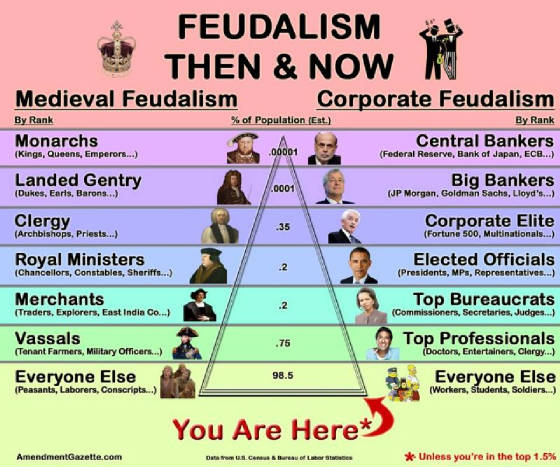
An Introduction to Technofeudalism Ascending

feudalism-then-and-now-hierarchy.jpg.w560h467

By SARTRE

Source: BATR.org

The future of the planetary Reign of Terror has never been clearer. The pattern for global governance has been set into motion and operates under a model that has been used throughout much of history. The modern day version of command and control can be effectively described as Technofeudalism. The purpose of this introduction is to provide an outline of the arguments used by Steven Yates, Ph.D. The link to this significant treatise is provided below. In addition News With Views maintains an extensive archives of Dr. Yates’ work. Invest the time to read the entire essay for a full understanding of the linkage behind Technofeudalis and the course for top down dominance.

Technofeudalism Ascending comprises nine sections. Dr. Yates provides the following preface.

My book Four Cardinal Errors (2011) introduced the idea of technofeudalism. Though a bit of a mouthful, this is the best term for the political economy towards which an intergenerational superelite has been directing as much of the world as possible for at least a century. This existence of this group, I argue, is the foremost political-economic reality of our times.

Their goal, I argued in Four Cardinal Errors, is to institute corporate controlled global governance: de facto world government, managed for private profit and for control over national governments and populations. Technofeudalism is the resulting political economy. While preserving some of the vocabulary and outward features of market capitalism, technofeudalism has almost nothing to do with free markets, or free enterprise, as generally understood. It is about instituting whatever policies, instigating whatever wars, bringing about whatever revolutions, and causing whatever levels of misery are deemed necessary for enforced mass compliance. Its tools include both neoliberal and neoconservative ideology, artificial scarcity, education reduced to job training, and fear induction through constant pontificating about “terrorism” amidst random and often-depraved acts of violence, reducing as many as possible to a status of permanently cash-strapped, mentally paralyzed subjects — living amidst the most advanced technology in human history, but equivalent to serfs (“owned” as de facto property by “their” governments, employers, etc., as in medieval feudal systems of old). Hence, the term technofeudalism.

Introduction:  Why Technofeudalism? (Technofeudalism is the best term for a kind of political economy that has been coming together very gradually for much of the past century, but accelerating in recent decades: it is technologically advanced but populations are controlled by various means and, in effect, made into serfs who are tied to whatever work they can find and to government programs. Technofeudalism is driven by those I call the superelite—a group of globalist-minded extended families whose primary motivation is wealth and power. It illustrates the primary problem of practical political philosophy and strategy: how to contain that minority in our midst that is drawn to power.)

  1. The End of History? (The collapse of the Soviet Union seemed to leave the world at a major turning point; Communism was dead, the combination of market capitalism and liberal democracy seemed to be catching on everywhere, and the U.S. was the sole superpower. It seemed conceivable that it really was, as Francis Fukuyama described, the end of history.)
  1. The Neoliberal Illusion.  (Things began to unravel almost at once, as trade deals such as NAFTA began to put an end to the largest financially independent middle class in history. Neoliberal ideology proved to have a dark side, as wealth began to be redistributed upward and millions of people ended up out of work.)
  1. Precariatization and the Destruction of the American Mind.  (Higher education faced multiple crises: rising radical left “scholarship” in the humanities, a rising corporate or business mindset in expanding administrations, the collapse of the academic job market creating conditions where control was possible, and the impoverishing of faculty via adjunctification, one species of the creation of a precariat — workers in an environment of part-time, temporary, and short term work. Liberal arts learning itself came under assault, as the thinking skills it provides threaten a political economy of power, domination, precarity, and corruption.)
  1. The Empire of Corruption.  (Ensuing decades have seen rising corruption and financial manipulation which eventually caused the 2008 meltdown and have brought about a steadily lowering of the standard of living in the U.S. Supreme Court decisions such as Citizens United ensure a bought-and-paid-for political class, and articles now appear in refereed journals indicating that the U.S. is now a plutocratic oligarchy.)
  1. The Global Corporatist Leviathan.  (If the present political system is plutocratic oligarchy, the correct term for the present economy is corporatism, with technofeudalism its broader political-economic-technocratic instrument. Poor education ensures a systematic confusion between capitalism and corporatism. Under corporatism, corporations are in the driver’s seat behind governments, as we can see from their latest effort to dominate a section of the world’s economy: the Trans-Pacific Partnership.)
  1. The New Serfdom.  (You are living in a feudal system when there is one set of rules for those with power and another set of rules for those without power, with only token representation. Technofeudalism emerges in that its subjects are technologically advanced serfs — surrounded by technology but tied to low-wage work or to a government-based support system.)
  1. “What Can We Do?”  (You can educate yourself on issues ranging from the possibilities of expatriation to that of peoples separating politically from empires, which may become possible as a very severe downturn, worse than the Great Recession — a Greater Depression — is almost certainly inevitable.)
  1. Preparing for the Greater Depression.  (The world is on the verge of having to face the realities of financialization that will bring on the Greater Depression. You can prepare by building proper skills now. It is conceivable that the global superelite is planning on a Greater Depression. You should prepare anyway.)
  1. Grounds for Hope: Real Sustainability and the Cycles of History.  (Technofeudalism will prove unsustainable. It may be put in place, but its structure and the mindset that gave rise to it will cause it to decay and eventually disintegrate. We have come this way before, as empires have risen and fallen before. This provides hope, in that with the collapse of the technofeudalist state, separation and the building of a world of small states will become possible — again if we begin to prepare now.)

This summary outline attempts to persuade the compelling case to review the entire critique. Filling in the connections and relationships to achieve the eternal objective of worldwide ascendancy in an age of technological supremacy, means that the return to a feudal society becomes the undeniable 21th century danger.

Technofeudalism is based upon herding marginal and unneeded humans into ghettos of subsistent serfdom existence. The technocrats who administer the process of dehumanization become the executioners of civilization. Utopia for the select, built on the misery of the masses is a future not worth living. This fact is exactly the objective of the globalist. Destroying resistance through marginalizing survival rules a feudal society. However, building the achievement of a renaissance culture is based upon the liberation of the human spirit and decentralization of authority.

The global elites depend on acquiesce of the masses to accept and adopt the tyrannical systems and indoctrination methods propagated by the technocratic matrix. Liberty is despised by authoritarians. Technofeudalism is the enemy of all human beings. Once armed with the knowledge of this threat, what will be the response of the populace targeted for slavery or extinction?


Life’s Most Important Dramas Are Being Disrupted

index

By Charles Hugh Smith

Source: Washington’s Blog

The idea that human life subdivides rather naturally into stages is based on our natural progression from childhood into adulthood and eventual (if we’re lucky) old age.

Confucian thought views life as a developmental process with seven stages, each roughly corresponding to a decade: childhood, young adulthood (16-30), age of independence (30-39), age of mental independence (40-49), age of spiritual maturity (50-59), age of acceptance (60-69), and age of unification (70 – end of life).

Each stage has various tasks, goals and duties, which establish the foundation for the next stage.

Each stage is centered on a core human drama: for the teenager, establishing an identity and life that is independent of parents; for the young adult, finding a mate and establishing a career; for the middle-aged, navigating the challenges of raising children and establishing some measure of financial security; for those in late middle-age, helping offspring reach independent adulthood and caring for aging parents; early old age, seeking fulfillment now that life’s primary duties have been accomplished and managing one’s health; and old age, the passage of accepting mortality and the loss of vitality.

The End of Secure Work and the diminishing returns of financialization are disrupting these core human dramas and frustrating those who are unable to proceed to the next stage of life:

1. Teenagers are being pressured to focus their lives on achieving a conventional financial success that is becoming harder to achieve.

2. Young adults without secure full-time careers cannot afford marriage or children, so they extend the self-absorption of late adolescence into middle age.

3. The middle-aged are finding financial security elusive or out of reach as they struggle to fund their young adult children, aging parents and their own retirement.

4. Increasing longevity is pressuring the late-middle-aged’s stage of fulfillment, as elderly parents may require care even as their children reach their own retirement (65-70).

The financial pressures generated by the demise of financialization and the End of Secure Work are not just disrupting each stage; they are upending essential financial balances between the young, the middle-aged and the old.

The elderly, protected by generous social welfare benefits paid by current taxpayers, also benefit from the soaring value of assets such as real estate and stocks. Meanwhile, financialization’s asset bubbles have pushed housing beyond the reach of most young people.

Downsizing, lay-offs, low-paying replacement work and poor decisions to buy houses near the peak of the prior bubble have left many of the middle-aged with high fixed costs and a stagnant or increasingly insecure income.

The stresses of trying to make enough money to afford what was once assumed to be a birthright–a “middle class” lifestyle–is taking a heavy toll on the mental and physical health of the middle-aged, leaving many of them too tired for any fulfilling activities and easy prey for destructive self-medication.

This erosion of opportunities to complete life’s stages and core dramas is gradual, and rarely recognized, much less addressed. We are constantly bombarded with messages to innovate, keep up, be fulfilled, etc.–essentially impossible demands for those with multiple generational and/or business duties.

The most productive response to these financial disruptions is to focus not on what’s scarce and fraught with intense competition (the top 5% slots of conventional financial security) but on what’s still abundant, which is opportunities outside conventional hierarchies, ways of reducing fixed costs and life-skills that are entrepreneurial, adaptive and fulfilling.

When I talk about the Mobile Creative class, I’m not talking about a finance-centric definition of success or a path to join the top 5% in Corporate America and the government. The herd is chasing those dwindling slots, too, guaranteeing frustration and failure for the 95% who won’t secure one of those slots.

What we’re really discussing is a way of living that places a premium on independent thinking, maintaining very low fixed costs, establishing a healthy honesty with oneself and one’s associates and customers, the ability to make realistic assessments of oneself, one’s successes, failures and errors, and a focus on challenges, opportunities, risks, adaptability, flexibility and experimentation, all with a goal of building one’s own human, social and physical capital–the foundations not just of well-being but of any meaningful measure of independent, real wealth.