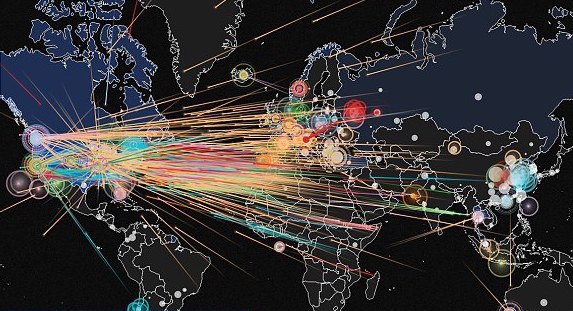
Are Facebook and Google the New Colonial Powers?

By Charles Hugh Smith

Source: Of Two Minds

To qualify as colonial powers, Facebook and Google must effectively limit the choices and power of users, and punish or coerce those who question or resist their power.

I was struck by a phrase from a recent essay on advertising and social media, You Are the Product: As Taplin points out, that remark ‘unwittingly revealed a previously unspoken truth: Facebook and Google are the new colonial powers.’

As you’ve no doubt noticed, the dominance of Facebook and Google in online advertising is now “in the news” for a variety of reasons: the possibility that agents of other governments influenced U.S. elections with media buys on Facebook; anti-trust concerns; the potential for these advert-tech giants to effectively silence legitimate online voices under the guise of limiting “fake news”, and of course, the ongoing issues of click fraud and the underperformance of digital ads.

The phrase that captures this broad narrative is: When an online service is free, you’re not the customer. You’re the product.

In other words, if you’re not paying for the service or content, then your information (harvested by Google, Facebook, et al.), your time online (i.e. your attention, a.k.a. eyeballs) and the content you create and post for free (videos of your cute cat, etc.) are the products being sold to advertisers at a premium.

The characterization of the two dominant digital-advert giants as new colonial powers is interesting on a number of fronts. To get a handle on a few of the issues, I recommend reading these two essays:

A Serf on Google’s Farm

Lost Context: How Did We End Up Here?

And watching this video on the archiving of digital information on individuals–including meta-data, that is, data about your behaviors, transactions, posts, etc. that have been scrubbed of your identity markers (name, account numbers, etc.)

Haunted by Data – Maciej Ceglowski (via GFB)

The key dynamics of colonialism for the residents are 1) a lack of choice and 2) a lack of power: the colonial power imposes a regime, either formally or informally, that limits the choices enjoyed by residents and limits their power to bypass or replace the colonial regime.

In the classic Plantation Economy of overt colonialism–a topic I’ve discussed numerous times here–residents are stripped of any options other than working on the plantation and buying their goods at the plantation store. This coercion need not be direct; the colonial regime can strip residents of choice and power by making it impossible to live without cash, for example, and then providing one source of paid work: the plantation.

Once cash is necessary to live, then credit is introduced–but only if you buy at the company store.

I’ve also written extensively about the Neo-Colonial Model in which corporations and banks bring the colonial model of exploitation to the home country, stripmining the domestic populace via dependence on credit.

Welcome to Neocolonialism, Exploited Peasants! (October 21, 2016)

Greece and the Endgame of the Neocolonial Model of Exploitation (February 19, 2015)

The E.U., Neofeudalism and the Neocolonial-Financialization Model (May 24, 2012)

This model is also used in the developing world, where it has replaced the old overt form of Colonialism with the new and improved credit-based version.

To qualify as colonial powers, Facebook and Google must effectively limit the choices and power of users, and punish or coerce those who question or resist their power. As the dominant corporations in search, social media and digital advertising, Facebook and Google limit the options of users simply by being essential due to their dominance.

As for punishing users–the potential to do so is what’s worrying observers. The cover for silencing or banning critics is opaque: non-compliance with guidelines. So who’s to say that users who criticized or questioned the policies of Facebook and Google aren’t silenced along with click-fraudsters, “fake news” purveyors, etc.? Who gets silenced is completely up to the companies, and there is no recourse to the corporation’s opaque judgment.

The Orwellian possibilities are real enough.

Here’s a look at the digital advert market:

And the dominance of Google/Facebook:

The Morgan Freeman Psy-Op Proves How Desperate The ‘Deep State’ Has Become

By Andrew Korybko

Source: Sputnik International

Morgan Freeman’s latest publicly stunt permanently stained his legacy after the famous actor decided to join the fake news industry by passing off a blockbuster script as a true story.

Morgan Freeman declared in his latest two-minute video that “We have been attacked. We are at war”, but he’s wrong in saying that Americans have been victimized by Russia, but should have rather told the truth that they’re under attack by their own government. To channel Freeman, “Imagine this movie script”, albeit modified to reflect real-life events instead of conspiratorial ones:

A globalist power cabal made up of the permanent military, intelligence, and diplomatic bureaucracies (the “deep state”), in conjunction with the Democratic Party, “Cultural Marxist” professors, the Mainstream Media, and Hollywood have attacked American democracy using non-stop infowar operations against their own fellow citizens to spread propaganda and false information aimed at convincing people that the Republican candidate and future President of the United States is really a Russian puppet.

A few years ago this might have sounded just as ridiculous as the narrative that Freeman read off in front of the cameras, but the difference is that this actually happened whereas his story still remains the realm of fiction. The conspiracy theory that Russia somehow swayed the 2016 election has no basis in reality, and it’s very condescending to the millions of average Americans in the Midwest who swayed the election for Trump to even infer that these patriotic citizens were under the influence of a foreign intelligence operation at the time.

Midwesterners didn’t tip the election for Trump because President Putin, the FSB, RT, or Sputnik told them to — which they didn’t — but because they had enough of the old order of business in the US and were desperately craving a change, any change, to improve the all-around deteriorating conditions that have come to define their lives. Trump promised law and order, jobs and strong borders, and a no-nonsense approach to American domestic politics, the complete opposite of Hillary’s platform and exactly what Midwesterners wanted to hear.

Even without the DNC leaks, many of those folks would never have countenanced voting for Hillary due to her husband’s toxic legacy and that of his party. Moreover, these voters didn’t need proof of Hillary and the Democrats’ corruption because they had suspected it all along, though the amplification of their crimes by the global media vindicated them for what The Establishment had falsely claimed for years was just another tinfoil hat “conspiracy theory”.

Now about actual conspiracy facts, many people could never have thought that their own government would turn against them and attack America’s sacred political system, its electoral democracy, through the incessant demonization of Donald Trump and the plethora of fake news that they disseminated about him. When Trump claimed that his campaign was under surveillance by the Obama Administration, he was dismissed as a crackpot, but it’s since emerged just the other day that former National Security Advisor Susan Rice did in fact authorize the spying of Trump’s former campaign manager Paul Manafort.

On top of that, the never-ending assertions that Trump is in cahoots with the Russian government or somehow under the nefarious influence of shadowy Kremlin agents are regularly debunked by listening to the President and his Administration constantly talk about “Russian aggression” and watching them use this pretext to make hostile moves against Moscow. These actions strongly refute the claims of a secret Trump-Russian connection and most Americans understand that, but the “deep state” and their cohorts in the “Cultural Marxist” corners of academia, the Mainstream Media, Hollywood, and the masked mob of “Antifa” rioters believe that the population is just too stupid to see this and could therefore be easily misled into believing their fake news narrative that Putin’s proxy is in control of the White House.

The whole point behind this massive infowar operation against the minds of the American public is to delegitimize Trump’s election in a last-ditch bid to give the Democrats a chance to win back Congress during next year’s midterm elections. It’s also designed to influence the President’s domestic and foreign policy decision making, and it actually has succeeded to a degree in that respect if one holds the view that Trump truly believed what he said on the campaign trail but was later pressured by the “deep state” to take a decidedly neo-conservative stance towards International Affairs after he entered into office. Regardless, what’s important to focus on in this context are the American people themselves, who largely dismiss the conspiratorial, never-proven, and constantly debunked accusations that Morgan Freeman shamelessly told the American public with a straight face.

There’s a popular saying that one shouldn’t “shoot the messenger”, but that doesn’t mean that the said messenger is above criticism. Morgan Freeman is a beloved household name who’s universally praised for his excellent acting skills and the unforgettable memories that he’s imbued his audiences with, but politics isn’t his element, and no matter how much the “Committee to Investigate Russia’ pleads that it’s “non-partisan”, former National Intelligence Director James Clapper’s open involvement in the project proves that it’s linked to the same anti-Trump “deep state” that’s been undermining American democracy for over the past two years. Morgan Freeman should have known better than to lend his acting talent to pretending that a movie script is a real-life story, and that’s why so many people are disappointed in him on a deep, personal level.

The irony of it all is that Morgan Freeman could have actually done a lot of good if he had the courage to say the truth. Instead of imploring Trump to sit down in front of the American people, elaborate on Hillary’s “Russia Did It!” conspiracy theory, and then “legitimize” it through a full-blown nationwide anti-Russian witch hunt stretching from the Office of the Presidency all the way down to the paupers in the inner city, he himself could have sat down in front of the American people just as he did in his two-minute psy-op video and calmly explain the actual real-life “deep state” conspiracy against Trump and the American people. He didn’t do that, so there’s no use in speculating about “coulda, shoulda, woulda”, but for the sake of cracking a smile and thinking about what might have been, it sure would have been powerful if he channeled his blockbuster script but adapted it to actual events by saying:

“My fellow Americans, during this past election, we came under attack by our own government. I’ve called on the patriotic members of Congress and our intelligence community to use every resource available to conduct a thorough investigation to determine exactly how this happened. Our citizens are demanding accountability. For 241 years our democracy has been imperfect but nevertheless something to aspire to, and we owe it to the brave people who have fought and died to protect this great nation and save democracy. And we owe it to our future generations to continue the fight.”

But then again, Hollywood by its very nature is fake and deceptive, so it might be too much to ever hope for an American movie icon to stand up and say those brave words that were imagined above, though that doesn’t mean that they wouldn’t have resonated with tens of millions of dyed-in-the-wool patriotic Americans who are sick and tired of the “deep state’s” manipulative mind games.

Related Article:

Morgan Freeman, David Frum, and the no-good non-profit (The Baffler)

Freedom Is Not Necessarily The Absence Of Tyranny

By Brandon Smith

Source: Alt-Market

Is it true that freedom is an overly idealized concept? Perhaps, but it is one of the few concepts worthy of idealization. It is so worthy, that it is worth dying for.

Since the dawn of recorded history human beings have fought and sacrificed to attain freedom. It is an inherent psychological construct. It is a principle that is rooted not only in the mind of man, but his spirit or soul. Scientists in the realm of the mind have struggled for generations to understand where it comes from — others have sought to dismiss it as a fanciful notion or societal construct. Nihilists claim it doesn’t really exist, while other people center their entire lives on the proliferation of it. The concept of freedom, love it or hate it, is central to all cultures and all civilizations. The most common dismissal of the idea of freedom that I have seen is the argument that none of us is really free because “tyranny exists”. Tyranny is a constant, therefore, in the view of the nihilists, freedom cannot exist. I believe this dim way of thinking stems from a misconception of what freedom is and where it comes from.

Freedom, first and foremost, begins in the mind, or the heart; whatever you are inclined to put more stock in. To think critically or to imagine wildly is indeed to be free. Tyranny, by extension, rises from the mire and muck in the physical world around us and ends in the mind and the heart. If one is free of mind, then one is never truly enslaved.

I have heard so many times the ignorant accusation that freedom requires action before consequence. That is to say, if you have suffered the consequences of a tyrannical system, then you have already failed to prevent your own enslavement. This is not how freedom functions. It has never worked this way.

There is no such thing as a world without the consequences of tyranny. Tyrants are everywhere, always. There are little tyrants in our everyday lives, and big tyrants that pull strings from behind the curtains and from the darker places. There are people reading this article right now that think they are liberty-minded, but act like tyrants towards those around them. There are people who think they are slaves when one simple choice or action could easily make them free. There are people who see private property as tyranny and seek to supplant it….with an even greater tyranny of entitlement and socialism. And, there are people who think freedom means freedom for them, but not for others. Each tyrant takes time to understand and remove from our lives. Some we simply need to walk away from; others need to be destroyed.

The point is, we are forever dealing with tyranny, and many of us are forever working to topple it. As long as we are able to pursue that goal, we are still free. The true slaves are those that have given up completely out of laziness or fear. Tyranny is always present, after all; why take a bath today when you are just going to end up soiled again tomorrow?

The idea that one can do nothing in the face of the machine is an old idea proven wrong time and time again, yet, it is also a very easy and comfortable lie to live in. Struggle is difficult. Sacrifice is foreboding and ugly. There are a million-and-one excuses and rationalizations as to why it is better to “accept fate” or circumstances. There is always another excuse that can be used to paper over cowardice.

Tyrants can, in fact, win and keep winning for the length of an epoch, exactly because of the logical fallacy that they cannot be resisted or be beaten. It is the self-fulfilling prophecy of nihilism that makes tyranny possible. Without it, tyrants inevitably fail and fall.

The great monster of our time that must be slayed is the monster of organized conspiracy. Past generations have confronted and defeated appendages of this monster, but they never beheaded it, and this is why our particular brand of tyranny persists. It is not enough for us to fight the tentacles of the beast anymore — it is the job of the freedom fighters of our era to stab at the brains of the wretched thing.

I am of course speaking of the banking cabal, the cult of financiers and elites that make up the globalist hierarchy. They pervade the halls of numerous institutions and think tanks, from the Federal Reserve and the Council on Foreign Relations to the International Monetary Fund and the Bank for International Settlements. They sit in positions of great political influence and hold council (and some would say considerable sway) over world leaders. They write “theoretical” policies which are quickly adopted by governments and made into law. They are primary stockholders and owners of our mainstream media. Their slithering fingers are wrapped around academia and many scientific communities. They insinuate themselves into every foundation of thought, because thought is what they most wish to control.

They prefer to divide and conquer, to pit one group against another, or to give their ideological enemies enough rope to hang themselves with. If they can’t rule the psyche of a society or succeed in 4th generation warfare, they will fall back to the old standard of brute force. In fact, they might just do that anyway, because what tyrant doesn’t love instilling abject terror every once in a while?

And yet, these “elites” stand on a razor’s edge. Despite all their supposed power, despite all their wealth, despite the vast spiderwebs they weave, all of it can be turned to ash in an instant and they know it. Empires like this rely on anonymity, and they are anonymous no longer. The cabal is out in the open; they have to be.

To shift the world into true globalism and true centralization requires actions which can be masked from some people but not all people. They believe the intricate digital networks they have funded will buy them total information awareness, but these same networks also provide us with the tools to understand who they are and what they want. This double-edged sword of full spectrum data creates a Catch-22 timeline. The longer the globalists wait to implement the one world system they desire, the more time we have to educate millions of people. The faster they implement their one-world system, the more likely they are to make a mistake.

Time is running out. Time is working against them. Time is the master here, and the globalists are nothing but paper boats on a tidal wave.

This organized conspiracy increases its odds of success through psychological manipulation. There will come a time, perhaps sooner rather than later, when banking elites and their political allies can no longer stand outside the game unscathed. Risk is coming. So, they must encourage as much self-defeat in the minds of freedom champions as possible.

They will conjure crisis and catastrophe, they will conjure puppet enemy after puppet enemy, they will exploit useful idiots with collectivist views as cannon fodder, they will engineer conflicts between East and West. They will try to grind us down and break the legs of our resolve.

However, as long as there are people who know who the globalists are that are willing to hunt them down, the globalists cannot win. For what they desperately want is to stand out in the sun with criminal impunity, and without fear. They want to be untouchable. They want to be gods.

Real gods do not suffer consequences, and these people will suffer consequences.

The nihilists will cry, “When?! How?! Never!” But this is the nature of freedom. Freedom is in the fighting; winning is transitory. Tyranny can be subtle and it can be blunt, freedom is the same way. If you think because there is no shooting going on yet that a war is not happening, then you do not understand the nature of warfare.

Yes, it is possible that the fall of one globalist cabal might give rise to another, and another. But we are free to be there and to fight again. As long as we fight, we prevail. When we abandon the fight completely, that is when true slavery begins. Today, we fight using information versus propaganda, and we must be adept at this. We also must be adept at other forms of combat as the conflict escalates.

There will never be total absence of tyranny. The naysayers against the principle of freedom are delusional, or maybe they know such a standard is unattainable and this will make them forever “right.” When will the fight begin? It already has. It has been going on since time immemorial and we are merely here to continue it. This might seem like a task for Sisyphus – an endless circular nightmare. I look at it another way: We are a changing of the guard. We have inherited a responsibility beyond all responsibilities. In this age, we are the freedom fighters, and if we fail now then we pass an even more difficult horror on to some other generation down the line.

In my view this is unacceptable. The opportunity to end one longstanding tyranny is now. We must counter using information as long as is needed, and we must wake up as many people as possible, so when the time comes to storm the castle, the shared sacrifice is that much easier to bear. If you have taken up this fight in one form or another never let anyone tell you you are not free. Your ability to think and to act is concrete proof otherwise.

The Superpower That Fought Itself — And Lost

By William Astore and TomDispatch

Source: TomDispatch.com

After 19 al-Qaeda militants armed only with box-cutters and knives hijacked four American commercial airliners, the U.S. military moved with remarkable efficiency to rectify the problem. In the years since, in its global war on terror, the Pentagon has ensured that America’s enemies in Afghanistan, Iraq, Syria, and elsewhere have regularly been able to arm themselves with… well, not to beat around the bush, a remarkable range of U.S. weaponry.  The latest such story: a report that in recent fighting around the city of Tal Afar, the Iraqi military recovered a U.S.-produced FGM-148 Javelin anti-tank missile and launcher from an Islamic State weapons cache. That’s a weapon capable of taking out an M1 Abrams tank. And this is hardly the first time U.S. anti-tank missiles meant either for the Iraqi military or Syrian rebels backed by the CIA have turned up in the hands of ISIS militants. In 2015, that group released photos of its fighters using U.S.-made BGM-71 TOW anti-tank missiles.

Of course, when the American-trained, funded, and armed Iraqi army collapsed in the summer of 2014 in the face of relatively small numbers of ISIS fighters, that group took vast stores of U.S. weaponry and vehicles that they’ve used ever since. But that was hardly the end of it.  The U.S. soon began retraining and rearming its Iraqi allies to the tune of $1.6 billion for “tens of thousands of assault rifles, hundreds of armored vehicles, hundreds of mortar rounds, nearly 200 sniper rifles, and other gear,” much of which, a government audit found, the Pentagon simply lost track of. The weaponry, you might say, went missing in action. No one knew whose hands much of it ended up in and this wasn’t a new story, either.  For example, in 2007 the Government Accountability Office found that “the United States could not account for nearly 30% of the weapons it had distributed in Iraq since 2004 — about 200,000 guns.”

Similar stories could be told about Afghanistan, another country where U.S. weaponry has disappeared in remarkable quantities. (The Taliban, for instance, recently released a video of their fighters sporting weaponry normally used only by U.S. Special Operations personnel.) In short, the Pentagon has been arming itself, its allies, and its enemies in a profligate fashion for years now in its never-ending conflicts across the Greater Middle East and Africa. As TomDispatch regular and retired Air Force Lieutenant Colonel William Astore suggests today, since 9/11 the U.S. military has in some sense been fighting itself — and losing. Someday, when historians look back on this bizarre tale, they will have to explain one thing above all: Why, year after year, in the face of obvious and repetitive failure in such conflicts, was no one in Washington capable of imagining another course of action? Tom

The American Military Uncontained

Out Everywhere and Winning Nowhere

By William Astore

When it comes to the “world’s greatest military,” the news has been shocking. Two fast U.S. Navy ships colliding with slow-moving commercial vessels with tragic loss of life.  An Air Force that has been in the air continuously for years and yet doesn’t have enough pilots to fly its combat jets.  Ground troops who find themselves fighting “rebels” in Syria previously armed and trained by the CIA.  Already overstretched Special Operations forces facing growing demands as their rates of mental distress and suicide rise.  Proxy armies in Iraq and Afghanistan that are unreliable, often delivering American-provided weaponry to black markets and into the hands of various enemies.  All of this and more coming at a time when defense spending is once again soaring and the national security state is awash in funds to the tune of nearly a trillion dollars a year.

What gives?  Why are highly maneuverable and sophisticated naval ships colliding with lumbering cargo vessels?  Why is an Air Force that exists to fly and fight short 1,200 pilots?  Why are U.S. Special Operations forces deployed everywhere and winning nowhere?  Why, in short, is the U.S. military fighting itself — and losing?

It’s the Ops Tempo, Stupid

After 16 years of a never-ending, ever-spreading global war on terror, alarms are going off in Asia from the Koreas and Afghanistan to the Philippines, while across the Greater Middle East and Africa the globe’s “last superpower” is in a never-ending set of conflicts with a range of minor enemies few can even keep straight.  As a result, America’s can-do military, committed piecemeal to a bewildering array of missions, has increasingly become a can’t-do one.

Too few ships are being deployed for too long.  Too few pilots are being worn out by incessant patrols and mushrooming drone and bombing missions.  Special Operations forces (the “commandos of everywhere,” as Nick Turse calls them) are being deployed to far too many countries — more than two-thirds of the nations on the planet already this year — and are involved in conflicts that hold little promise of ending on terms favorable to Washington.  Meanwhile, insiders like retired General David Petraeus speak calmly about “generational struggles” that will essentially never end.  To paraphrase an old slogan from ABC’s “Wide World of Sports,” as the U.S. military spans the globe, it’s regularly experiencing the agony of defeat rather than the thrill of victory.

To President Donald Trump (and so many other politicians in Washington), this unsavory reality suggests an obvious solution: boost military funding; build more navy ships; train more pilots and give them more incentive pay to stay in the military; rely more on drones and other technological “force multipliers” to compensate for tired troops; cajole allies like the Germans and Japanese to spend more on their militaries; and pressure proxy armies like the Iraqi and Afghan security forces to cut corruption and improve combat performance.

One option — the most logical — is never seriously considered in Washington: to make deep cuts in the military’s operational tempo by decreasing defense spending and downsizing the global mission, by bringing troops home and keeping them there.  This is not an isolationist plea.  The United States certainly faces challenges, notably from Russia (still a major nuclear power) and China (a global economic power bolstering its regional militarily strength).  North Korea is, as ever, posturing with missile and nuclear tests in provocative ways.  Terrorist organizations strive to destabilize American allies and cause trouble even in “the homeland.”

Such challenges require vigilance.  What they don’t require is more ships in the sea-lanes, pilots in the air, and boots on the ground.  Indeed, 16 years after the 9/11 attacks it should be obvious that more of the same is likely to produce yet more of what we’ve grown all too accustomed to: increasing instability across significant swaths of the planet, as well as the rise of new terror groups or new iterations of older ones, which means yet more opportunities for failed U.S. military interventions.

Once upon a time, when there were still two superpowers on Planet Earth, Washington’s worldwide military posture had a clear rationale: the containment of communism.  Soon after the Soviet Union imploded in 1991 to much triumphalist self-congratulation in Washington, the scholar and former CIA consultant Chalmers Johnson had an epiphany.  What he would come to call “the American Raj,” a global imperial structure ostensibly built to corral the menace of communism, wasn’t going away just because that menace had evaporated, leaving not a superpower nor even a major power as an opponent anywhere on the horizon.  Quite the opposite, Washington — and its globe-spanning “empire” of military bases — was only digging in deeper and for the long haul.  At that moment, with a certain shock, Johnson realized that the U.S. was itself an empire and, with its mirror-image-enemy gone, risked turning on itself and becoming its own nemesis.

The U.S., it turned out, hadn’t just contained the Soviets; they had contained us, too.  Once their empire collapsed, our leaders imbibed the old dream of Woodrow Wilson, even if in a newly militarized fashion: to remake the world in one’s own image (if need be at the point of a sword).

Since the early 1990s, largely unconstrained by peer rivals, America’s leaders have acted as if there were nothing to stop them from doing as they pleased on the planet, which, as it turned out, meant there was nothing to stop them from their own folly.  We witness the results today.  Prolonged and disastrous wars in Iraq and Afghanistan.  Interventions throughout the Greater Middle East (Libya, Syria, Yemen, and beyond) that spread chaos and destruction.  Attacks against terrorism that have given new impetus to jihadists everywhere.  And recently calls to arm Ukraine against Russia.  All of this is consistent with a hubristic strategic vision that, in these years, has spoken in an all-encompassing fashion and without irony of global reach, global power, and full-spectrum dominance.

In this context, it’s worth reminding ourselves of the full scope of America’s military power.  All the world is a stage — or a staging area — for U.S. troops.  There are still approximately 800 U.S. military bases in foreign lands.  America’s commandos deploy to more than 130 countries yearly.  And even the world is not enough for the Pentagon as it seeks to dominate not just land, sea, and air but outer space, cyberspace, and even inner space, if you count efforts to achieve “total information awareness” through 17 intelligence agencies dedicated — at a cost of $80 billion a year — to sweeping up all data on Planet Earth.

In short, America’s troops are out everywhere and winning nowhere, a problem America’s “winningest” president, Donald Trump, is only exacerbating.  Surrounded by “his” generals, Trump has — against his own instincts, he claimed recently — recommitted American troops and prestige to the Afghan War.  He’s also significantly expanded U.S. drone strikes and bombing throughout the Greater Middle East, and threatened to bring fire and fury to North Korea, while pushing a program to boost military spending.

At a Pentagon awash in money, with promises of more to come, missions are rarely downsized.  Meanwhile, what passes for original thinking in the Trump White House is the suggestion of Erik Prince, the founder of Blackwater, to privatize America’s war in Afghanistan (and possibly elsewhere).  Mercenaries are the answer to Washington’s military problems, suggests Prince.  And mercs, of course, have the added benefit of not being constrained by the rules of engagement that apply to America’s uniformed service members.

Indeed, Prince’s idea, though opposed by Trump’s generals, is compelling in one sense: If you accept the notion that America’s wars in these years have been fought largely for the corporate agendas of the military-industrial complex, why not turn warfighting itself over to the warrior corporations that now regularly accompany the military into battle, cutting out the middleman, that very military?

Hammering a Cloud of Gnats

Erik Prince’s mercenaries will, however, have to bide their time as the military high command continues to launch kinetic strikes against elusive foes around the globe.  By its own admission, the force recent U.S. presidents have touted as the “finest” in history faces remarkably “asymmetrical” and protean enemies, including the roughly 20 terrorist organizations in the Afghanistan-Pakistan theater of operations.  In striking at such relatively puny foes, the U.S. reminds me of the mighty Thor of superhero fame swinging his hammer violently against a cloud of gnats. In the process, some of those gnats will naturally die, but the result will still be an exhausted superhero and ever more gnats attracted by the heat and commotion of battle.

I first came across the phrase “using a sledgehammer to kill gnats” while looking at the history of U.S. airpower during the Vietnam War.  B-52 “Arc Light” raids dropped record tons of bombs on parts of South Vietnam and Laos in largely failed efforts to kill dispersed guerrillas and interdict supply routes from North Vietnam.  Half a century later, with its laser- and GPS-guided bombs, the Air Force regularly touts the far greater precision of American airpower.  Yet in one country after another, using just that weaponry, the U.S. has engaged in serial acts of overkill.  In Afghanistan, it was the recent use of MOAB, the “mother of all bombs,” the largest non-nuclear weapon the U.S. has ever used in combat, against a small concentration of ISIS fighters.  In similar fashion, the U.S. air war in Syria has outpaced the Russians and even the Assad regime in its murderous effects on civilians, especially around Raqqa, the “capital” of the Islamic State.  Such overkill is evident on the ground as well where special ops raids have, this year, left civilians dead from Yemen to Somalia.  In other words, across the Greater Middle East, Washington’s profligate killing machine is also creating a desire for vengeance among civilian populations, staggering numbers of whom, when not killed, have been displaced or sent fleeing across borders as refugees in these wars. It has played a significant role in unsettling whole regions, creating failed states, and providing yet more recruits for terror groups.

Leaving aside technological advances, little has changed since Vietnam. The U.S. military is still relying on enormous firepower to kill elusive enemies as a way of limiting (American) casualties.  As an instrument of victory, it didn’t work in Vietnam, nor has it worked in Iraq or Afghanistan.

But never mind the history lessons.  President Trump asserts that his “new” Afghan strategy — the details of which, according to a military spokesman, are “not there yet” — will lead to more terrorists (that is, gnats) being killed.

Since 9/11, America’s leaders, Trump included, have rarely sought ways to avoid those gnats, while efforts to “drain the swamp” in which the gnats thrive have served mainly to enlarge their breeding grounds.  At the same time, efforts to enlist indigenous “gnats” — local proxy armies — to take over the fight have gone poorly indeed.  As in Vietnam, the main U.S. focus has invariably been on developing better, more technologically advanced (which means more expensive) sledgehammers, while continuing to whale away at that cloud of gnats — a process as hopeless as it is counterproductive.

The Greatest Self-Defeating Force in History?

Incessant warfare represents the end of democracy.  I didn’t say that, James Madison did.

I firmly believe, though, in words borrowed from President Dwight D. Eisenhower, that “only Americans can hurt America.”  So how can we lessen the hurt?  By beginning to rein in the military.  A standing military exists — or rather should exist — to support and defend the Constitution and our country against immediate threats to our survival.  Endless attacks against inchoate foes in the backlands of the planet hardly promote that mission.  Indeed, the more such attacks wear on the military, the more they imperil national security.

A friend of mine, a captain in the Air Force, once quipped to me: you study long, you study wrong.  It’s a sentiment that’s especially cutting when applied to war: you wage war long, you wage it wrong.  Yet as debilitating as they may be to militaries, long wars are even more devastating to democracies.  The longer our military wages war, the more our country is militarized, shedding its democratic values and ideals.

Back in the Cold War era, the regions in which the U.S. military is now slogging it out were once largely considered “the shadows” where John le Carré-style secret agents from the two superpowers matched wits in a set of shadowy conflicts.  Post-9/11, “taking the gloves off” and seeking knockout blows, the U.S. military entered those same shadows in a big way and there, not surprisingly, it often couldn’t sort friend from foe.

A new strategy for America should involve getting out of those shadowy regions of no-win war.  Instead, an expanding U.S. military establishment continues to compound the strategic mistakes of the last 16 years.  Seeking to dominate everywhere but winning decisively nowhere, it may yet go down as the greatest self-defeating force in history.

US Seeks to Monopolize Cyberwarfare

By Ulson Gunnar

Source: New Eastern Outlook

The use of information to enhance martial power goes back to the beginning of human civilization itself, where propaganda and psychological warfare went hand-in-hand with slings, arrows, swords and shields.

The most recent iteration of this takes the form of social media and cyberwarfare where tools are being developed and deployed to influence populations at home and abroad, to manipulate political processes of foreign states and even tap into and exploit global economic forces.

In the beginning of the 21st century, the United States held an uncontested monopoly over the tools of cyberwarfare. Today, this is changing quickly, presenting an increasingly balanced cyberscape where nations are able to defend themselves on near parity with America’s ability to attack them.

To reassert America’s control over information and the technology used to broker it, Jared Cohen, current Google employee and former US State Department staff, has proposed a US-created and dominated “international” framework regarding cyberconflict.

His op-ed in the New York Times titled, “How to Prevent a Cyberwar,” begins by admitting the very pretext the US is using to expand its control over cyberwarfare is baseless, noting that “specifics of Russia’s interference in the 2016 America election remain unclear.”

Regardless, Cohen continues by laying out a plan for reasserting American control over cyberwarfare anyway, by claiming:

Cyberweapons won’t go away and their spread can’t be controlled. Instead, as we’ve done for other destructive technologies, the world needs to establish a set of principles to determine the proper conduct of governments regarding cyberconflict. They would dictate how to properly attribute cyberattacks, so that we know with confidence who is responsible, and they would guide how countries should respond.

Cohen, unsurprisingly, nominates the US to lead and direct these efforts:

The United States is uniquely positioned to lead this effort and point the world toward a goal of an enforceable cyberwarfare treaty. Many of the institutions that would be instrumental in informing these principles are based in the United States, including research universities and the technology industry. Part of this effort would involve leading by example, and the United States can and should establish itself as a defender of a free and open internet everywhere.

Cohen never explains how this US-dominated framework will differ from existing “international” frameworks regarding conventional warfare the US regularly abuses to justify a growing collection of devastating conflicts it is waging worldwide.

And as has been repeatedly documented, the United States’ definition of a “free and open internet everywhere” is an Internet dominated by US tech companies seeking to enhance and expand US interests globally.

Cohen ironically notes that:

Cyberweapons have already been used by governments to interfere with elections, steal billions of dollars, harm critical infrastructure, censor the press, manipulate public conversations about crucial issues and harass dissidents and journalists. The intensity of cyberconflict around the world is increasing, and the tools are becoming cheaper and more readily available.

Indeed, cyberweapons have already been used, primarily by the United States.

Jared Cohen himself was directly involved in joint operations between Google, Facebook, the US State Department and a number of other US tech and media enterprises which before and during 2011 set the stage for the so-called “Arab Spring.”

It included the training, funding and equipping of activists years ahead of the the uprisings as well as active participation in the uprisings themselves, including providing assistance to both protesters and militants everywhere from Libya to Syria in overthrowing governments targeted by Washington for regime change.

One such tool used in these efforts was described in a UK Independent article titled, “Google planned to help Syrian rebels bring down Assad regime, leaked Hillary Clinton emails claim,” which would report that:

An interactive tool created by Google was designed to encourage Syrian rebels and help bring down the Assad regime, Hillary Clinton’s leaked emails have reportedly revealed.

By tracking and mapping defections within the Syrian leadership, it was reportedly designed to encourage more people to defect and ‘give confidence’ to the rebel opposition.

The article would continue, mentioning Jared Cohen by name:

The email detailing Google’s defection tracker purportedly came from Jared Cohen, a Clinton advisor until 2010 and now-President of Jigsaw, formerly known as Google Ideas, the company’s New York-based policy think tank.

In a July 2012 email to members of Clinton’s team, which the WikiLeaks release alleges was later forwarded to the Secretary of State herself, Cohen reportedly said: “My team is planning to launch a tool on Sunday that will publicly track and map the defections in Syria and which parts of the government they are coming from.”

Would Cohen’s more recently proposed “framework” have prevented the United States’ use of these cyberweapons against sovereign states to undermine sociopolitical stability, overturn entire governments and plunge them into enduring chaos many still remain in 6 years later? Most likely not.

What Cohen and the interests he represents are truly concerned with is that nations are now not only able to recognize, prepare for and defend against US cyberwarfare, they may be capable of retaliating against the US.

Cohen’s proposal for an international framework to govern cyberwarfare simply seeks to define it in terms that leaves the US with both an uncontested monopoly over cyberwarfare as well as the means to wield it globally with absolute impunity.

It would be not unlike current “international” frameworks used to govern conflicts between nations which the US has used to justify an expansive, global campaign of extraterritorial war stretching from North Africa to Central Asia and beyond.

Such frameworks have become enablers of injustice, not a deterrence to it.

As nations from Iran to North Korea are discovering, the only true means of defending oneself from foreign military aggression is creating a plausible deterrence to dissuade foreign nations from attacking. This is done by creating a price for attacking and invading that is higher than the perceived benefits of doing so.

Nations like Russia and China have already achieved this balance with the United States in terms of conventional and nuclear warfare, and have now nearly established a similar deterrence in terms of cyber and information warfare. For the rest of the world, developing cyberdefense is not as costly as conventional military or nuclear arsenals, making cyberwarfare a corner of the battlefield unlikely to be monopolized by the US as it had done at the turn of the century.

Ensuring that no single nation ever has the opportunity to abuse such a monopoly again means exposing and confronting efforts by those like Google’s Jared Cohen and his proposal for an “international framework” for cyberwarfare that resembles the same sort of enabling the United Nations provides the US in terms of proliferating conventional conflicts across the globe.

New York Times stokes anti-Russia campaign to promote Facebook, Twitter censorship

By Bill Van Auken

Source: WSWS.org

The New York Times has mounted a concerted campaign promoting a crackdown on political expression on social media on the basis of unsubstantiated allegations of Russian government interference in the 2016 US presidential election.

In conjunction with a public statement by Facebook last Wednesday on political advertising allegedly originating in Russia, the Times published a sensationalist “investigative” report titled “The Fake Americans Russia Created to Influence the Election,” an op-ed piece indicting Facebook for failing to exercise greater censorship of political content and an editorial Saturday touching on the same themes.

Facebook briefed members of both the Senate and House intelligence committees on its findings on September 6. It said it found $50,000 in spending on 2,200 “potentially politically related” ads “that might have originated in Russia” over a two-year period beginning in June 2015. It added that this included Facebook accounts and pages “with very weak signals of a connection and not associated with any known organized effort,” including “accounts with US IP addresses but with the language set to Russian.”

The vast majority of the ads, Facebook’s chief security officer Alex Stamos added, “didn’t specifically reference the US presidential election, voting or a particular candidate,” but rather appeared to focus on amplifying “divisive social and political messages.”

The testimony was seized upon by Democratic politicians attempting to promote the theme of Russia meddling in the US elections in support of Trump. Representative Adam Schiff, the senior Democrat on the House Intelligence Committee, called the highly ambiguous Facebook findings “deeply disturbing and yet fully consistent with the unclassified assessment of the intelligence committee.”

The Times “investigation” was as weak in its substantiation of a Russian government operation to influence the 2016 presidential election as the Facebook report, but far more inflammatory.

It described an “unprecedented foreign intervention in American democracy” and a “cyberarmy of counterfeit Facebook and Twitter accounts, a legion of Russian-controlled impostors whose operations are still being unraveled.”

It repeated the unproven allegations that Russia was responsible for the hacking and leaking of Democratic emails exposing the party leadership’s attempts to sabotage the presidential campaign of self-described “socialist” Senator Bernie Sanders, while accusing Russian media outlets like RT and Sputnik of having “battered” Hillary Clinton with a “fire hose of stories, true, false and in between.”

The story focuses, however, on the alleged Russian use of Facebook and Twitter, darkly accusing the two companies of failing to prevent themselves from “being turned into engines of deception and propaganda.”

The “evidence” uncovered by the Times consisted of linking “suspect” Facebook accounts, since taken down by the company, that posted material linking to a website, DCLeaks.com, that published hacked emails from billionaire financier and Democratic Party donor George Soros, a former NATO commander, and Democratic as well as Republican functionaries. With no substantiation, the newspaper claims that “United States intelligence concluded” that the site was a creation of the Russian military intelligence agency GRU.

The article also accuses Russia of exploiting Twitter, using “hundreds of accounts” for “posting anti-Clinton messages and promoting leaked material.”

It further charges that the alleged Russian campaign employed “automated Twitter bots, which send out tweets according to built-in instruction.”

According to Twitter’s own estimate, there are some 48 million such bots on Twitter, and they accounted for fully 19 percent of all election-related tweets during the 2016 presidential campaign.

The Times report acknowledges that it investigated Twitter accounts identified as “Kremlin trolls” to discover that there were real people behind them with no ties to the Russian government. It quoted one of them, Marilyn Justice, 66, from Nova Scotia, who told the newspaper she believed that “Hillary’s a warmonger” and that she was hostile to the anti-Russian bias in the Western media. Another so-called “troll” turned out to be a web producer in Zurich, who expressed sharp disagreement with Western narratives on the Ukraine and Syria.

The existence of such views, the Times concluded was “a victory for Russia’s information war—that admirers of the Kremlin spread what American officials consider to be Russian disinformation on election hacking, Syria, Ukraine and more.”

The Times followed up its “investigation” with an op-ed piece accusing Facebook of having “contributed to, and profited from, the erosion of democratic norms in the United States” by having allowed the posting of “anti-Hillary ads precisely aimed at Facebook users whose demographic profiles implied a vulnerability to political propaganda.”

It went on to comment: “Unfortunately, the range of potential responses to this problem is limited. The First Amendment grants broad protections to publishers like Facebook.”

The Times editorial published Saturday questions whether “any federal agency is focused on” the alleged “problems” uncovered in the newspaper’s report: “foreign intervention through social media to feed partisan anger and suspicion in a polarized nation.”

There is a farcical element to the Times exposé. The idea that the spending of $50,000, vaguely linked to Russia, on Facebook ads over a two-year period undermined US elections in which total spending is estimated at roughly $7 billion is ludicrous.

Whatever actions may have been taken by the government of Vladimir Putin to promote the international interests of Russia’s ruling oligarchy, Moscow’s alleged Internet activities pale in comparison to the unrelenting campaigns mounted by US government agencies, from the CIA to the Pentagon and the National Endowment for Democracy, to rig foreign elections, engineer regime change operations and militarily destroy entire countries. As the former US assistant secretary of state Victoria Nuland proudly acknowledged, Washington sunk some $5 billion into promoting pro-Western regime change in Ukraine.

Even more preposterous is the attempt to attribute the sharp social tensions and intense political antagonisms that are ripping apart the seams of American society to Russian propaganda. Both are the product of the crisis of American capitalism, characterized above all by the uninterrupted growth of social inequality.

There is, however, a sinister and deadly serious content to the campaign by the Times editorial board, which functions as a reliable conduit for CIA propaganda. It has joined its long-running campaign around allegations of Russian interference in the US election with the demand for a crackdown on political expression on social media.

The two are inextricably linked. Underlying the Times campaign around Moscow’s supposed assault on the “integrity of American democracy” lies the political agenda of powerful factions within the US ruling establishment, which are demanding the continuation and intensification of the drive toward regime change in, and military confrontation with, Russia.

The preparations for war abroad are inevitably accompanied by the growth of censorship and political repression at home. The Times ’ criticisms of Facebook and Twitter notwithstanding, these corporations, along with Google, are collaborating closely with the US government and its intelligence agencies in the attempt to suppress freedom of speech and thought and censor anti-capitalist and anti-war reporting and opinion.

Under the phony banner of combating “fake news,” Google announced a change in its search algorithms last April that was clearly directed at slashing the readership of anti-war and left-wing websites, with the World Socialist Web Site being hit the hardest, losing more than two-thirds of its traffic from Google search results.

Facebook has followed suit, rolling out a similar announcement in June that it was updating its own News Feed algorithm aimed at “deprioritizing” posts viewed as “problematic” promoting “low quality content” “sensationalism” and “misinformation.”

The attempts by these multi-billion-dollar corporations to arrogate to the themselves the power of gatekeepers of the Internet, censoring content that conflicts with the interests of the American ruling oligarchy and its military-intelligence apparatus has aroused broad popular hostility. The WSWS has spearheaded the opposition to these attacks, with 3,500 people from more than 80 different countries signing it petition demanding that Google cease its censorship of the Internet.

What Country Is This? Forced Blood Draws, Cavity Searches and Colonoscopies

By John W. Whitehead

Source: The Rutherford Institute

“The Fourth Amendment was designed to stand between us and arbitrary governmental authority. For all practical purposes, that shield has been shattered, leaving our liberty and personal integrity subject to the whim of every cop on the beat, trooper on the highway and jail official.”—Herman Schwartz, The Nation

Our freedoms—especially the Fourth Amendment—are being choked out by a prevailing view among government bureaucrats that they have the right to search, seize, strip, scan, shoot, spy on, probe, pat down, taser, and arrest any individual at any time and for the slightest provocation.

Forced cavity searches, forced colonoscopies, forced blood draws, forced breath-alcohol tests, forced DNA extractions, forced eye scans, forced inclusion in biometric databases: these are just a few ways in which Americans are being forced to accept that we have no control over our bodies, our lives and our property, especially when it comes to interactions with the government.

Worse, on a daily basis, Americans are being made to relinquish the most intimate details of who we are—our biological makeup, our genetic blueprints, and our biometrics (facial characteristics and structure, fingerprints, iris scans, etc.)—in order to clear the nearly insurmountable hurdle that increasingly defines life in the United States: we are now guilty until proven innocent.

Such is life in America today that individuals are being threatened with arrest and carted off to jail for the least hint of noncompliance, homes are being raided by police under the slightest pretext, property is being seized on the slightest hint of suspicious activity, and roadside police stops have devolved into government-sanctioned exercises in humiliation and degradation with a complete disregard for privacy and human dignity.

Consider, for example, what happened to Utah nurse Alex Wubbels after a police detective demanded to take blood from a badly injured, unconscious patient without a warrant.

Wubbels refused, citing hospital policy that requires police to either have a warrant or permission from the patient in order to draw blood. The detective had neither. Irate, the detective threatened to have Wubbels arrested if she didn’t comply. Backed up by her supervisors, Wubbels respectfully stood her ground only to be roughly grabbed, shoved out of the hospital, handcuffed and forced into an unmarked car while hospital police looked on and failed to intervene (take a look at the police body camera footage, which has gone viral, and see for yourself).

Michael Chorosky didn’t have an advocate like Wubbels to stand guard over his Fourth Amendment rights. Chorosky was surrounded by police, strapped to a gurney and then had his blood forcibly drawn after refusing to submit to a breathalyzer test. “What country is this? What country is this?” cried Chorosky during the forced blood draw.

What country is this indeed?

Unfortunately, forced blood draws are just the tip of the iceberg when it comes to the indignities and abuses being heaped on Americans in the so-called name of “national security.”

Forced cavity searches, forced colonoscopies and forced roadside strip searches are also becoming par for the course in an age in which police are taught to have no respect for the citizenry’s bodily integrity whether or not a person has done anything wrong.

For example, 21-year-old Charnesia Corley was allegedly being pulled over by Texas police in 2015 for “rolling” through a stop sign. Claiming they smelled marijuana, police handcuffed Corley, placed her in the back of the police cruiser, and then searched her car for almost an hour. No drugs were found in the car.

As the Houston Chronicle reported:

Returning to his car where Corley was held, the deputy again said he smelled marijuana and called in a female deputy to conduct a cavity search. When the female deputy arrived, she told Corley to pull her pants down, but Corley protested because she was cuffed and had no underwear on. The deputy ordered Corley to bend over, pulled down her pants and began to search her. Then…Corley stood up and protested, so the deputy threw her to the ground and restrained her while another female was called in to assist. When backup arrived, each deputy held one of Corley’s legs apart to conduct the probe.

The cavity search lasted 11 minutes. This practice is referred to as “rape by cop.”

Although Corley was charged with resisting arrest and with possession of 0.2 grams of marijuana, those charges were subsequently dropped.

David Eckert was forced to undergo an anal cavity search, three enemas, and a colonoscopy after allegedly failing to yield to a stop sign at a Wal-Mart parking lot. Cops justified the searches on the grounds that they suspected Eckert was carrying drugs because his “posture [was] erect” and “he kept his legs together.” No drugs were found.

During a routine traffic stop, Leila Tarantino was subjected to two roadside strip searches in plain view of passing traffic, while her two children—ages 1 and 4—waited inside her car. During the second strip search, presumably in an effort to ferret out drugs, a female officer “forcibly removed” a tampon from Tarantino. No contraband or anything illegal was found.

Thirty-eight-year-old Angel Dobbs and her 24-year-old niece, Ashley, were pulled over by a Texas state trooper on July 13, 2012, allegedly for flicking cigarette butts out of the car window. Insisting that he smelled marijuana, the trooper proceeded to interrogate them and search the car. Despite the fact that both women denied smoking or possessing any marijuana, the police officer then called in a female trooper, who carried out a roadside cavity search, sticking her fingers into the older woman’s anus and vagina, then performing the same procedure on the younger woman, wearing the same pair of gloves. No marijuana was found.

Sixty-nine-year-old Gerald Dickson was handcuffed and taken into custody (although not arrested or charged with any crime) after giving a ride to a neighbor’s son, whom police suspected of being a drug dealer. Despite Dickson’s insistence that the bulge under his shirt was the result of a botched hernia surgery, police ordered Dickson to “strip off his clothes, bend over and expose all of his private parts. No drugs or contraband were found.”

Meanwhile, four Milwaukee police officers were charged with carrying out rectal searches of suspects on the street and in police district stations over the course of several years. One of the officers was accused of conducting searches of men’s anal and scrotal areas, often inserting his fingers into their rectums and leaving some of his victims with bleeding rectums.

It’s gotten so bad that you don’t even have to be suspected of possessing drugs to be subjected to a strip search.

A North Carolina public school allegedly strip-searched a 10-year-old boy in search of a $20 bill lost by another student, despite the fact that the boy, J.C., twice told school officials he did not have the missing money. The assistant principal reportedly ordered the fifth grader to disrobe down to his underwear and subjected him to an aggressive strip-search that included rimming the edge of his underwear. The missing money was later found in the school cafeteria.

Suspecting that Georgia Tech alum Mary Clayton might have been attempting to smuggle a Chick-Fil-A sandwich into the football stadium, a Georgia Tech police officer allegedly subjected the season ticket-holder to a strip search that included a close examination of her underwear and bra. No contraband chicken was found.

What these incidents show is that while forced searches may span a broad spectrum of methods and scenarios, the common denominator remains the same: a complete disregard for the rights of the citizenry.

In fact, in the wake of the U.S. Supreme Court’s ruling in Florence v. Burlison, any person who is arrested and processed at a jail house, regardless of the severity of his or her offense (i.e., they can be guilty of nothing more than a minor traffic offense), can be subjected to a strip search by police or jail officials without reasonable suspicion that the arrestee is carrying a weapon or contraband.

Examples of minor infractions which have resulted in strip searches include: individuals arrested for driving with a noisy muffler, driving with an inoperable headlight, failing to use a turn signal, riding a bicycle without an audible bell, making an improper left turn, and engaging in an antiwar demonstration (the individual searched was a nun, a Sister of Divine Providence for 50 years).

Police have also carried out strip searches for passing a bad check, dog leash violations, filing a false police report, failing to produce a driver’s license after making an illegal left turn, having outstanding parking tickets, and public intoxication. A failure to pay child support can also result in a strip search.

As technology advances, these searches are becoming more invasive on a cellular level, as well.

For instance, close to 600 motorists leaving Penn State University one Friday night were stopped by police and, without their knowledge or consent, subjected to a breathalyzer test using flashlights that can detect the presence of alcohol on a person’s breath. These passive alcohol sensors are being hailed as a new weapon in the fight against DUIs. (Those who refuse to knowingly submit to a breathalyzer test are being subjected to forced blood draws. Thirty states presently allow police to do forced blood draws on drivers as part of a nationwide “No Refusal” initiative funded by the federal government. Not even court rulings declaring such practices to be unconstitutional in the absence of a warrant have slowed down the process. Now police simply keep a magistrate on call to rubber stamp the procedure over the phone.)

The National Highway Safety Administration, the same government agency that funds the “No Refusal” DUI checkpoints and forcible blood draws, is also funding nationwide roadblocks aimed at getting drivers to “voluntarily” provide police with DNA derived from saliva and blood samples, reportedly to study inebriation patterns. In at least 28 states, there’s nothing voluntary about having one’s DNA collected by police in instances where you’ve been arrested, whether or not you’re actually convicted of a crime. All of this DNA data is being fed to the federal government.

Airline passengers, already subjected to virtual strip searches, are now being scrutinized even more closely, with the Customs and Border Protection agency tasking airport officials with monitoring the bowel movements of passengers suspected of ingesting drugs. They even have a special hi-tech toilet designed to filter through a person’s fecal waste.

Iris scans, an essential part of the U.S. military’s boots-on-the-ground approach to keeping track of civilians in Iraq and Afghanistan, are becoming a de facto method of building the government’s already mammoth biometrics database. Funded by the Dept. of Justice, along with other federal agencies, the iris scan technology is being incorporated into police precincts, jails, immigration checkpoints, airports and even schools. School officials—from elementary to college—have begun using iris scans in place of traditional ID cards. In some parts of the country, parents wanting to pick their kids up from school have to first submit to an iris scan.

As for those endless pictures everyone so cheerfully uploads to Facebook (which has the largest facial recognition database in the world) or anywhere else on the internet, they’re all being accessed by the police, filtered with facial recognition software, uploaded into the government’s mammoth biometrics database and cross-checked against its criminal files. With good reason, civil libertarians fear these databases could “someday be used for monitoring political rallies, sporting events or even busy downtown areas.”

While the Fourth Amendment was created to prevent government officials from searching an individual’s person or property without a warrant and probable cause—evidence that some kind of criminal activity was afoot—the founders could scarcely have imagined a world in which we needed protection against widespread government breaches of our privacy, including on a cellular level.

Yet that’s exactly what we are lacking and what we so desperately need.

Unfortunately, the indignities being heaped upon us by the architects and agents of the American police state—whether or not we’ve done anything wrong—are just a foretaste of what is to come.

As I make clear in my book Battlefield America: The War on the American People, the government doesn’t need to tie you to a gurney and forcibly take your blood or strip you naked by the side of the road in order to render you helpless. It has other methods—less subtle perhaps but equally humiliating, devastating and mind-altering—of stripping you of your independence, robbing you of your dignity, and undermining your rights.

With every court ruling that allows the government to operate above the rule of law, every piece of legislation that limits our freedoms, and every act of government wrongdoing that goes unpunished, we’re slowly being conditioned to a society in which we have little real control over our bodies or our lives.

New York Times Propagates Russia Hacking Conspiracy Theory

The New York Times reports as fact that Russia hacked the 2016 US presidential election despite failing to present any evidence to support this claim.

By Jeremy R. Hammond

Source: Foreign Policy Journal

In late 2002 and early 2003, those of us who were warning that the US government was lying, that there was no evidence that Iraq still possessed stockpiles of weapons of mass destruction (WMD), much less active WMD manufacturing programs, were frequently dismissed as “conspiracy theorists”.

Of course, in reality, it was the US mainstream media that was propagating the government’s unfounded conspiracy theory that Saddam Hussein had such weapons and, further, had a cooperative relationship with Al-Qaeda, the terrorist organization held responsible for the attacks of September 11, 2001.

The New York Times served the government in its campaign of deception by spearheading the media’s dissemination of the lies out to the public, thus manufacturing Americans’ consent for this illegal war of aggression.

Spreading government propaganda is a function the Times never ceases to serve well — the lesson from its own reporting during the run-up to the Iraq war, and from the mainstream media’s reporting in general, having been dutifully disregarded.

One of the latest government conspiracy theories the Times is helping to propagate, by serving effectively as the political establishment’s very own public relations firm, is the claim that the government of Russia was responsible for hacking into computers of the Democratic National Committee (DNC) and email accounts of John Podesta, who was then chairman of Hillary Clinton’s presidential campaign.

In a report published September 1, 2017, the Times elaborated on this conspiracy theory under the headline “Russian Election Hacking Efforts, Wider Than Previously Known, Draw Little Scrutiny”.

In it, the Times reports as fact that Russia was responsible not only for hacking the DNC and Podesta’s email account, but also for hacking directly into the US election system itself. All that’s old news, however, so the Times‘ new spin is that Russia’s efforts to hack state electoral systems were much more extensive than previously thought.

However, the Times presents not one shred of evidence to support the underlying claim that Russia hacked these systems, much less that this alleged hacking was much more widespread than previously reported.

To the scrutinous reader who is familiar with the propaganda techniques mainstream media use in order to manufacture consent for various government policies, the total lack of evidence is apparent. In fact, the Times actually acknowledges that there is no evidence to support the claim it is making in the headline. Yet, through obfuscation, use of deceptive language, and various other techniques, the Times leads the general reader to believe that its headline is true.

An examination of the article is useful to see just how the Times manages to lead readers to the conclusion the Russia hacking is a demonstrated fact when, in reality, it remains just another conspiracy theory originating from the government that the Times is all too happy to help propagate.

The Alleged Russian Hacking of US Electoral Systems

The first thing to note about this New York Times piece is its title. The headline makes two claims: 1) it’s a fact that Russia tried to hack the US election, and this fact has been known publicly for some time; and 2) the Times has new information showing not only that US election systems were hacked and that Russia was responsible, but also that Russia’s hacking efforts even more widespread than previously known.

The story begins with the case of Durham county, North Carolina, where, we learn, various irregularities occurred at polling stations on election day last November (bold emphasis added throughout):

Dozens were told they were ineligible to vote and were turned away at the polls, even when they displayed current registration cards. Others were sent from one polling place to another, only to be rejected. Scores of voters were incorrectly told they had cast ballots days earlier. In one precinct, voting halted for two hours.

Susan Greenhalgh, a troubleshooter at a nonpartisan election monitoring group, was alarmed. Most of the complaints came from Durham, a blue-leaning county in a swing state [North Carolina]. The problems involved electronic poll books — tablets and laptops, loaded with check-in software, that have increasingly replaced the thick binders of paper used to verify voters’ identities and registration status. She knew that the company that provided Durham’s software, VR Systems, had been penetrated by Russian hackers months before.

“It felt like tampering, or some kind of cyberattack,” Ms. Greenhalgh said about the voting troubles in Durham.

Note that the Times does not say that Ms. Greenhalgh “believed” or “had heard” that Russian hackers were responsible for earlier hacking VR Systems, but that she “knew” this was so. With this verb choice, the Times is asserting that this claim is a proven fact.

The purpose of this assertion is to establish credibility in the mind of the reader that its headline is true, that the evidence shows that Russian hacking efforts were more widespread than previously known. If it is a fact that Russia hacked US election systems, then it is not hard to believe that its hacking was more extensive than previously thought.

But what evidence does the Times present to support its assertion that this earlier Russian hacking of VR Systems occurred?

Well, to answer that question, let’s first look at how Ms. Greenhalgh “knew” that Russians had hacked VR Systems. Much further into the article, more than halfway through, the Times tells us:

As the problems mounted, The Charlotte Observer reported that Durham’s e-poll book vendor was Florida-based VR Systems, which Ms. Greenhalgh knew from a CNN report had been hacked earlier by Russians. “Chills went through my spine,” she recalled.

So there were irregularities at the Durham county polling stations, and Durham county used VR Systems for its polling system, which Ms. Greenhalgh “knew” Russians had hacked because she’d heard it on CNN.

Mid-article, however, the Times also quotes Ms. Greenhalgh acknowledging, with respect to the specific case of Durham county, “We still don’t know if Russian hackers did this.”

If we don’t know whether Russian hacking was responsible for the supposed irregularities in Durham county’s polling station, why is the Times using it as an example to support the claim made in its headline that this hacking was more extensive than previously thought? If there are cases where there is evidence, why not feature one of those, instead?

The answer is that no such evidence exists; the Times has no evidence to support that claim in its headline. In fact, it acknowledges this in several other places in the article. What the Times is trying to do is to build the case that we can safely assume that what happened in Durham county was a consequence of Russian hacking. After all, if Russia hacked VR Systems, that certainly could explain those election-day irregularities, right?

But how solid is the Times‘ premise that Russia hacked VR Systems in the first place?

The Times doesn’t attempt to support this premise solely with hearsay about something CNN reported. It exerts slightly greater effort to convince the reader. Nine paragraphs into the article, we read:

Beyond VR Systems, hackers breached at least two other providers of critical election services well ahead of the 2016 voting, said current and former intelligence officials, speaking on condition of anonymity because the information is classified. The officials would not disclose the names of the companies.

Note here that the Times is once again acknowledging that it doesn’t actually have any evidence to support the claim that Russia hacked other companies in addition to VR Systems, which it is using to support the claim made in its headline that the Russian hacking was more widespread than previously thought. The Times is simply parroting government officials who’ve made this claim.

The Times‘ case crumbles even further the deeper one reads into the article. With respect to the Durham county irregularities, the Times next notes:

There are plenty of other reasons for such breakdowns — local officials blamed human error and software malfunctions — and no clear-cut evidence of digital sabotage has emerged, much less a Russian role in it. Despite the disruptions, a record number of votes were cast in Durham, following a pattern there of overwhelming support for Democratic presidential candidates, this time Hillary Clinton.

But months later, for Ms. Greenhalgh, other election security experts and some state officials, questions still linger about what happened that day in Durham as well as other counties in North Carolina, Virginia, Georgia and Arizona.

So keep in mind as we proceed that the Times is here once again acknowledging that no evidence exists to support the suspicion that the Durham county irregularities were due to Russian hacking. Yet it attempts to lead readers to that conclusion by suggesting that Russians did hack states’ electoral systems:

After a presidential campaign scarred by Russian meddling, local, state and federal agencies have conducted little of the type of digital forensic investigation required to assess the impact, if any, on voting in at least 21 states whose election systems were targeted by Russian hackers, according to interviews with nearly two dozen national security and state officials and election technology specialists.

Note that here the Times is attributing the claim that Russia hacked into states’ electoral systems to various sources. In its next paragraph, however, the Times does away with attribution and transforms this claiminto an ostensibly verified fact:

The assaults on the vast back-end election apparatus — voter-registration operations, state and local election databases, e-poll books and other equipment — have received far less attention than other aspects of the Russian interference, such as the hacking of Democratic emails and spreading of false or damaging information about Mrs. Clinton. Yet the hacking of electoral systems was more extensive than previously disclosed, The New York Times found.

Here we see that the Times is back to asserting as fact that the Russian hacking was more extensive than previously reported, even though it has admittedly not yet provided even a single piece of supporting evidence! How can it do that? Well, transparently, what is important to the Times is that its readers believe that its headline is true, not to actually demonstrate it. Whether it is actually true does not matter; it is just the belief that the Times is aiming to instill.

This is the nature of propaganda.

Turning to the premise, note that the Times is here claiming as fact that, one, US electoral systems were extensively hacked, and, two, Russia was responsible.

It continues:

Intelligence officials in January reassured Americans that there was no indication that Russian hackers had altered the vote count on Election Day, the bottom-line outcome. But the assurances stopped there.

Government officials said that they intentionally did not address the security of the back-end election systems, whose disruption could prevent voters from even casting ballots.

That’s partly because states control elections; they have fewer resources than the federal government but have long been loath to allow even cursory federal intrusions into the voting process.

That, along with legal constraints on intelligence agencies’ involvement in domestic issues, has hobbled any broad examination of Russian efforts to compromise American election systems. Those attempts include combing through voter databases, scanning for vulnerabilities or seeking to alter data, which have been identified in multiple states. Current congressional inquiries and the special counsel’s Russia investigation have not focused on the matter.

Note here how the Times is explaining that the federal government has not really focused much on investigating US election systems irregularities even while continuing to assert as fact that there were Russian efforts to compromise those systems! Further:

“We don’t know if any of the problems were an accident, or the random problems you get with computer systems, or whether it was a local hacker, or actual malfeasance by a sovereign nation-state,” said Michael Daniel, who served as the cybersecurity coordinator in the Obama White House. “If you really want to know what happened, you’d have to do a lot of forensics, a lot of research and investigation, and you may not find out even then.”

In interviews, academic and private election security experts acknowledged the challenges of such diagnostics but argued that the effort is necessary. They warned about what could come, perhaps as soon as next year’s midterm elections, if the existing mix of outdated voting equipment, haphazard election-verification procedures and array of outside vendors is not improved to build an effective defense against Russian or other hackers.

So, again, the Times is acknowledging that the kind of forensic investigation that would be required to determine whether US election systems were hacked have not actually been conducted. How, therefore, can the Times report as fact not only that such hacking occurred, but that Russia was responsible?

It gets worse. The Times at this point in the article has already acknowledged that there could be perfectly benign explanations for what happened in Durham county. As we continue reading, we learn that the those supposedly alarming irregularities the Times opened the article with were not actually all that irregular (and hence not all that alarming). To the contrary:

Still, some of the incidents reported in North Carolina occur in every election, said Charles Stewart III, a political scientist at the Massachusetts Institute of Technology and an expert on election administration.

“Election officials and advocates and reporters who were watching most closely came away saying this was an amazingly quiet election,” he said, playing down the notion of tampering.

The Times next quotes Ms. Greenhalgh’s admission that there’s no evidence hackers got into Durham county’s system (much less that Russia was responsible).

Keep in mind that the claim the government and media have been making is that Russia interfered in the US election to throw the vote to Donald Trump. Yet, in the case of Durham county, the result was that, as the Times informs, “Hillary Clinton won 78 percent of the 156,000 votes”. This is a strange outcome if we are to assume that Russia hacked the system to tamper with the election!

But the Times is not unskilled in the art of propaganda, so it has an explanation ready for us: Russia tried to hack the system there, but was just unsuccessful! It continues:

Details of the breach did not emerge until June, in a classified National Security Agency [NSA] report leaked to The Intercept, a national security news site. That report found that hackers from Russia’s military intelligence agency, the G.R.U., had penetrated the company’s computer systems as early as August 2016, then sent “spear-phishing” emails from a fake VR Systems account to 122 state and local election jurisdictions. The emails sought to trick election officials into downloading malicious software to take over their computers.

The N.S.A. analysis did not say whether the hackers had sabotaged voter data. “It is unknown,” the agency concluded, whether Russian phishing “successfully compromised the intended victims, and what potential data could have been accessed.”

VR Systems’ chief operating officer, Ben Martin, said he did not believe Russian hackers were successful. He acknowledged that the vendor was a “juicy target,” given that its systems are used in battleground states including North Carolina, Florida and Virginia. But he said that the company blocked access from its systems to local databases, and employs security protocols to bar intruders and digital triggers that sound alerts if its software is manipulated.

Take note again of the Times choice of verb: the NSA report “found” that hackers working for Russian intelligence had penetrated VR Systems’ computer systems. Through this choice of verb, the Times is communicating that it is a verified fact that Russia hacked VR Systems. But is it? To answer that, let’s turn to the Times‘ source.

The Intercept reported on this alleged hack much earlier, on June 5, 2017. Unlike the Times, however, The Intercept provided the following important caveat:

While the document provides a rare window into the NSA’s understanding of the mechanics of Russian hacking, it does not show the underlying “raw” intelligence on which the analysis is based. A U.S. intelligence officer who declined to be identified cautioned against drawing too big a conclusion from the document because a single analysis is not necessarily definitive.

To reiterate, the supposed evidence that exists proving that Russia hacked VR Systems is classified and still unknown to either the public or the media, including The Intercept and New York Times.

As The Intercept notes, the NSA report “states unequivocally in its summary statement that it was Russian military intelligence, specifically the Russian General Staff Main Intelligence Directorate, or GRU, that conducted the cyber attacks described in the document.”

But upon what actual evidence is that unequivocal statement based?

The Intercept, like the Times, proceeds to accept this unequivocal summary statement as fact despite its acknowledged lack of access to the evidence supposedly supporting this claim:

The NSA has now learned, however, that Russian government hackers, part of a team with a “cyber espionage mandate specifically directed at U.S. and foreign elections,” focused on parts of the system directly connected to the voter registration process, including a private sector manufacturer of devices that maintain and verify the voter rolls.

Here The Intercept is being as disingenuous with its readers as the Times. Note again the deceptive verb choice. The NSA had not actually “learned” that Russia tried to hack US electoral systems; it had rather assessed that this was so. As the manufactured “intelligence” about Iraq’s WMDs should have taught us, those are far from the same thing.

Conveniently, The Intercept provides a graphic image from the NSA report illustrating the point:

The key element of this chart to note is in the left column, where it identifies the “Operators” responsible sending Phishing emails — emails designed to trick the recipient into giving away login credentials for whatever system the hackers were trying to get into. Note that, according to the NSA, these “Operators” were “Probably within” the GRU.

“Probably”.

So, does the NSA know that the Russian government was responsible for these Phishing emails?

No.

The NSA is claiming this is so. But the supposed evidence it is basing this claim upon has not been shown to even exist.

Now, perhaps the NSA has solid reasoning to arrive at this conclusion. Perhaps it has solid, though not definitive, evidence to back this up.

But the New York Times ought to be properly informing its readers that the Russian hacking of VR Systems is an allegation. It ought to be including the caveat with this information that this is according to the government, but that it has not yet been proven. Moreover, the Times ought to be informing its readers that the evidence supposedly supporting this conclusion has not been made public, and, further, that nobody at the Times has been able to verify it even exists.

But continuing in its propaganda effort, the Times reminds us that, “In an assessment of Russian cyberattacks released in January, intelligence agencies said Kremlin spy services had been collecting information on election processes, technology and equipment in the United States since early 2014.”

But that was just another example of the government making a claim for which no evidence has actually been provided. Each of these claims simply builds upon those that preceded it. In the next manifestation, the New York Times claim that Russia’s supposed hacking was even more extensive than previously known will likewise be presented as fact, and the acknowledgments about the lack of supporting evidence will be omitted, just as the Times omitted that important caveat from The Intercept.

Of course, to write and publish this kind of story requires extreme cognitive dissonance on the part of journalists and editors at the Times. This psychological phenomenon of holding two fundamentally contradictory beliefs at the same time is palpable throughout the piece. Once more, even while reporting its headlined claim as fact, the Times acknowledges that it has no evidence to support it:

Beginning in 2015, the American officials said, Russian hackers focused instead on other internet-accessible targets: computers at the Democratic National Committee, state and local voter databases, election websites, e-poll book vendors and other back-end election services.

Apart from the Russian influence campaign intended to undermine Mrs. Clinton and other Democratic officials, the impact of the quieter Russian hacking efforts at the state and county level has not been widely studied. Federal officials have been so tight-lipped that not even many election officials in the 21 states the hackers assaulted know whether their systems were compromised, in part because they have not been granted security clearances to examine the classified evidence.

Of course, nobody at the New York Times has seen that evidence, either, to be able to verify that it even exists.

The Times closes by noting that, unlike Ms. Greenhalgh, Durham county officials “have rejected any notion that an intruder sought to alter the election outcome.” Nevertheless, the county has turned over computers to the North Carolina State Board of Elections and Ethics Enforcement in order for the matter to be investigated.

Of course, the Times‘ purpose with this piece, rather than being to properly inform the public, is to lead readers into the belief that, regardless of whether it happened in Durham county, there were extensive efforts by the government of Russia to hack into state electoral systems.

Never mind that the Times presents not one shred of actual evidence to support either of the two claims it makes in its headline.

Conclusion

We can again recall how the media, including the New York Times, piled lie upon lie in order to manufacture consent for the US’s war of aggression against Iraq.

Here, again, the political establishment has an agenda. Donald Trump campaigned on a platform of seeking improved relations with Russia, a deescalation of tensions, and greater cooperation with Moscow. The so-called “Deep State” was upset by Hillary Clinton’s loss. In order for the national security state to retain the authoritarian powers it has assumed supposedly in order to keep Americans safe, it needs to convince Americans that they need protecting. Russia has been selected to serve as a useful “enemy” to that end.

Framing Russia as an enemy of the United States also serves the interests of the military/security complex and the goal of maintaining and expanding US hegemony across the globe. This narrative has been used, for example, to prevent Trump from deescalating in Syria and increasing cooperation with Russia there. Trump had indicated that he would shift US policy away from the Obama administration’s goal of seeking regime change in Syria and only focus on combating the so-called “Islamic State” (a.k.a., ISIS, ISIL, or Daesh). The national security state has maneuvered rather to ensure that relations between the US and Russia remain tense and that US policy remains effectively to prolong the violence.

Whatever the motives for the propaganda campaign, we can observe that this propaganda campaign is occurring. Members of the establishment media have not only failed to learn the relevant lesson from their reporting about Iraqi WMD, but refusing to do so almost seems a job prerequisite.

News consumers should not make the same mistake.

Scrutinize. Question. Think.

If we want the mainstream media to change its behavior and actually do its job of properly informing the public, then news consumers need to change their behavior. Ever news consumers knows the old adage that you can’t believe everything you read in the newspaper. Nevertheless, all too habitually, that is precisely what they do — just as the journalists and editors they are relying on for information all too habitually accept claims from government officials as fact.

It is supposed to be the job of news media to analyze information, assess the veracity of sources, question government claims, and reveal the truth. Yet the establishment media not only fail to do so, but actively serve to propagate conspiracy theories originating from the government, and thus to manufacture consent for various government policies and the private agendas of the politically and financially powerful.

In light of how the mainstream media serve this function, it is critical for the consumers to develop the analytic skills necessary to determine the truth for themselves and be able to identify state propaganda when they see it.

Hopefully, this exercise has provided some useful insights into how to do just that.