Looking back to what I wrote in 2012, in the midst of the so-called Arab Spring and its aftermath, it is striking just how much the Region has shifted. It is now almost 180° re-orientated. Then, I argued,
“That the Arab Spring “Awakening” is taking a turn, very different to the excitement and promise with which it was hailed at the outset. Sired from an initial, broad popular impulse, it is becoming increasingly understood, and feared, as a nascent counter-revolutionary “cultural revolution” – a re-culturation of the region in the direction of a prescriptive canon that is emptying out those early high expectations …
“That popular impulse associated with the ‘awakening’ has now been subsumed and absorbed into three major political projects associated with this push to reassert [Sunni primacy]: a Muslim Brotherhood project, a Saudi-Qatari-Salafist project, and a [radical jihadi] project.
“No one really knows the nature of the [first project] the Brotherhood project – whether it is that of a sect; or if it is truly mainstream … What is clear, however, is that the Brotherhood tone everywhere is increasingly one of militant sectarian grievance. The joint Saudi-Salafist project was conceived as a direct counter to the Brotherhood project – and [the third] was the uncompromising Sunni radicalism [Wahhabism], funded and armed by Saudi Arabia and Qatar, that aims, not to contain, but rather, to displace traditional Sunnism with the culture of Salafism. i.e. It sought the ‘Salifisation’ of traditional Sunni Islam.
“All these projects, whilst they may overlap in some parts, are in a fundamental way competitors with each other. And [were] being fired-up in Yemen, Iraq, Syria, Lebanon, Egypt, north Africa, the Sahel, Nigeria, and the horn of Africa.
[Not surprisingly] …“Iranians increasingly interpret Saudi Arabia’s mood as a hungering for war, and Gulf statements do often have that edge of hysteria and aggression: a recent editorial in the Saudi-owned al-Hayat stated: “The climate in the GCC [Gulf Cooperation Council] indicates that matters are heading towards a GCC-Iranian-Russian confrontation on Syrian soil, similar to what took place in Afghanistan during the Cold War. To be sure, the decision has been taken to overthrow the Syrian regime, seeing as it is vital to the regional influence and hegemony of the Islamic Republic of Iran”.
Well, that was then. How different the landscape is today: The Muslim Brotherhood largely is a ‘broken reed’, compared to what it was; Saudi Arabia has effectively ‘switched off the lights’ on Salafist jihadism, and is focussed more on courting tourism, and the Kingdom now has a peace accord with Iran (brokered by China).
“The cultural shift toward re-imagining a wider Sunni Muslim polity”, as I wrote in 2012, always was an American dream, dating back to Richard Perle’s ‘Clean Break’ Policy Paper of 1996 (a report that had been commissioned by Israel’s then-PM, Netanyahu). Its roots lay with the British post-war II policy of transplanting the stalwart family notables of the Ottoman era into the Gulf as an Anglophile ruling strata catering to western oil interests.
But look what has happened —
A mini revolution: Iran has, in the interim, ‘come in from the cold’ and is firmly anchored as ‘a regional power’. It is now the strategic partner to Russia and China. And Gulf States today are more preoccupied with ‘business’ and Tech than Islamic jurisprudence. Syria, targeted by the West, and an outcast in the region, has been welcomed back into the Arab League’s Arab sphere with high ceremony, and Syria is on its way to assuming again its former standing within the Middle East.
What is interesting is that even then, hints of the coming conflict between Israel and the Palestinians were apparent; as I wrote in 2012:
“Over recent years we have heard the Israelis emphasise their demand for recognition of a specifically Jewish nation-state, rather than for an Israeli State, per se. A Jewish state that in principle, would remain open to any Jew seeking to return: the creation of a ‘Jewish umma’, as it were.
“Now, it seems we have, in the western half of the Middle East, at least, a mirror trend, asking for the reinstatement of a wider Sunni nation – representing the ‘undoing’ of the last remnants of the colonial era. Will we see the struggle increasing epitomised as a primordial struggle between Jewish and Islamic religious symbols – between al-Aqsa and the Temple Mount?
“It seems that both Israel and its surrounding terrain are marching in step toward language which takes them far away from the underlying, largely secular concepts by which this conflict traditionally has been conceptualised. What will be the consequence as the conflict, by its own logic, becomes a clash of religious poles?”
What has driven this 180° turn? One factor, assuredly, was Russia’s limited intervention into Syria to prevent a jihadi sweep. The second has been China’s appearance on the scene as a truly gargantuan business partner – and putative mediator too – precisely at a time when the U.S. had begun its withdrawal from the region (at least in terms of the attention it pays to it, if not (yet) reflected in any substantive physical departure).
The latter – U.S. military withdrawal (Iraq and Syria) – however, seems more a question of ‘when’, rather than if. All expect it.
Put plainly, we have experienced a Mackinder-style ‘pivot of history’: Russia and China – and Iran – are slowly taking control of the Asian heartland (both institutionally and economically), as the pendulum of the West swings away.
The Sunni world – ineluctably and warily – marches towards the BRICS. Effectively, the Gulf finds itself badly wrong-footed by the so-called ‘Abraham Accords’ that tied them to Israeli Tech (which, in turn, was channelling considerable Wall Street venture ‘free money’ their way). Israel’s ‘suspect genocide’ (ICJ language) in Gaza is slowly driving a stake into the heart of the Gulf ‘business model’.
But another key factor has been the smart diplomacy pursued by Iran. It is easy for western Iran-hawks to decry Iran’s politicking and influencing across the region – the Islamic Republic is after all, unrepentantly ‘non-compliant’ with the U.S. aims and pro-Israeli ambitions in the Region. What else, other than pushback, might you expect when all the encircling western ‘fire’ was so concentrated on the Islamic Republic?
Yet, Iran has pursued an astute path. It has NOT gone to war against Sunni Arab states in Syria, as was mooted in 2012. Rather, it quietly has pursued a strategy of diplomacy and joint Gulf security and trade with Gulf States. Iran too, has partly succeeded in shaking itself free from much of the effects of western sanctions. It has joined both BRICS and the SCO and has acquired a new economic and political ‘spatial depth’.
Whether the U.S. and Europe likes it or not, Iran is a major regional political player, and it sits atop, with others, the coalition of Resistance Movements and Fronts that have been woven together through shrewd diplomacy to work in close conjunction with each other.
This development has become a key strategic ‘project’: Sunni (Hamas) and Shi’i (Hizbullah) are joined with other ‘fronts’ in an anti-colonial struggle for liberation under the non-sectarian symbol of Al-Aqsa (which is neither Sunni, nor Shi’a, nor Muslim Brotherhood, nor Salafist or Wahhabi). It represents, rather, the storied tale of Islamic civilisation. Yes, it is, in its way, eschatological too.
This latter achievement has done much to limit the threat of all-out war from engulfing the region (fingers-crossed though …). The Iranian and Resistance Axis’ interest is twofold: First, to retain power to carefully calibrate the intensity of conflict – upping and lowering as appropriate; and secondly, to keep escalatory dominance as much as possible in their hands.
The second aspect encompasses strategic patience. The Resistance Movements well understand the Israeli psyche – therefore, NO Pavlovian reflexes to Israeli provocations are accepted. But rather, to wait and rely on Israel to provide the pretext to any further step up the escalatory ladder. Israel must be seen to be the instigator for escalation – and the resistance merely the responder. The ‘eye’ must be on the Washington political psyche.
Thirdly, Iran draws confidence to pursue its ‘forwardness’ by having innovated a tectonic shift in asymmetric warfare, and in deterrence against Israel and the West. The U.S. might huff and puff, but Iran felt assured throughout this period that the U.S. well knows the risks associated with trying ‘blow the house down’.
Realists in the West tend to believe that ‘power’ is a simple function of national population size and GDP. So that, given the disparity in air and firepower, no way, as an example, can Hizbullah expect to ‘come out quits’ against Israel – a much richer and more populated entity.
This blindspot is the Resistance’s silent ‘ally’. It prevents the West (mostly) from understanding this pivot in military thinking.
Iran and its allies take a different view: They regard a state’s power to rest on intangibles, rather than literal tangibles: strategic patience; ideology; discipline; innovation and the concept of military leadership defined as the ability to cast a ‘magic’ spell over men so that they would follow their commander, even unto death.
The West has (or had) airpower and unchallenged air superiority, but the Resistance Fronts have their two-stage solution. They manufacture their own AI-assisted swarm drones and smart earth-hugging missiles. This is their Air Force.
The second stage naturally would be to evolve a layered air defence system (Russian-style). Does the Resistance possess such? Like Brer Rabbit, they stay mum.
The Resistance’s underlying strategy is clear: the West is over-invested in its air dominance and in its overwhelming fire-power. It prioritises quick shock and awe thrusts, but usually quickly exhausts itself early in the encounter. They rarely can sustain such high-intensity assault for long.
In Lebanon in 2006, Hizbullah remained deep underground whilst the Israeli air assault swept overhead. The physical surface damage was huge, yet their forces were unaffected and emerged only afterwards. Then came the 33 days of Hizbullah’s missile barrage – until Israel called it quits. This patience represents the first pillar of strategy.
The second therefore, is that whereas the West has short endurance, the opposition is trained and prepared for long attritional conflict – missile and rocket barrage to the point that civil society can sustain the impact no longer. War’s aim not necessarily has killing the enemy soldiers as a prime objective; rather it is exhaustion and inculcating a sense of defeat.
And what of the opposing project?
In 2012, I wrote:
“It seems that both Israel and [the Islamic world] are marching in step toward [eschatological narratives] which is taking them far away from the underlying, largely secular concepts by which this conflict traditionally has been conceptualised. What will be the consequence as the conflict, by its own logic, becomes a clash of religious poles? ” [– Al-Aqsa versus the Temple Mount].
Well, the West remains stuck with trying to manage and contain the conflict, using precisely those ‘largely secular concepts’ by which this conflict has been conceptualised and managed (or non-managed, I would say). In so doing, and through the West’s (secular) support for one particular eschatological vision (which happens to overlap with its own) over another, it inadvertently fuels the conflict.
Too late to return to secular modes of management; the genie is out.
Anyone acting in good faith understands that murdering 30,000 innocent people has nothing to do with eliminating Hamas. Operation Iron Glaive appears for what it is: a cover to realize the old dream pursued by Jewish fascists from Jabotinsky to Netanyahu: to expel the Arab population from Palestine. From then on, this mass crime, committed for the first time live on television, turned the world’s political chessboard upside down. Feeling threatened, the Jewish supremacists themselves threatened the United States. Anxious to remain masters of the “free world”, the United States is preparing to topple the Jewish supremacists.
The Biden administration watched with bated breath as Israel reacted to the attack by the Palestinian Resistance, including Hamas, known as the “Flood of Al-Aqsa” (October 7). Operation Iron Glaive began with a massive pounding of Gaza City on a scale unprecedented anywhere in the world, including the World Wars. From October 27 onwards, this was followed by ground intervention, looting and the torture of thousands of Gazan civilians. In five months, 37,534 civilians were killed or disappeared, including 13,430 children and 8,900 women, 364 medical personnel and 132 journalists. [1].
At first, Washington reacted by unwaveringly supporting “Israel’s right to defend itself”, threatening to veto any ceasefire request and supplying as many bombs as necessary for the widespread destruction of the Palestinian enclave. It was unthinkable, in its eyes, to suffer yet another defeat, after those in Syria and Ukraine. However, Americans were watching the horrors live on their cell phones. Many high-ranking State Department officials wrote and spoke of their shame at supporting this butchery. Petitions were circulated. Prominent figures, both Jewish and Muslim, resigned.
In the midst of a presidential election campaign, Joe Biden’s team could no longer stain its hands with blood. It therefore began to put pressure on the Israeli war cabinet to negotiate the release of the hostages and conclude a ceasefire. However, Benjamin Netanyahu’s coalition refused, playing on the trauma of its citizens to ensure that peace would only return once Hamas had been eradicated. Washington eventually realized that the events of October 7 were merely a pretext for Jabotinsky’s followers to do what they had always wanted to do: expel the Arabs from Palestine. He became more insistent, stressing that the Palestinians had a right to live, that the colonization of their land was illegal under international law, and that the Israeli-Palestinian question would be resolved by a “two-state solution” (and not by the binational state envisaged by Resolution 181 of 1947).
Revisionist Zionists” (i.e., followers of Jabotinsky [2]) responded by organizing the “Conference for the Victory of Israel” [3] on January 28, 2024. Headlining the event was Rabbi Uzi Sharbaf, sentenced in Israel to life imprisonment for his racist crimes against Arabs, but pardoned by his friends. Sharbaf did not hesitate to proclaim himself heir to the Lehi and Stern groups who fought against the Allies alongside duce Benito Mussolini.
The message was perfectly received in Washington and London: this tiny group intended to impose its will on the Anglo-Saxons and would not hesitate to attack them if they tried to prevent ethnic cleansing.
The White House immediately issued a ban on fundraising and transfers to them [4]. This ban was extended to all Western banks under the Foreign Account Tax Compliance Act (FATCA).
In addition, on February 8, President Joe Biden signed a Memorandum on the conditions of US arms transfers [5]. Israel has until March 25 to guarantee in writing that it will not violate either International Humanitarian Law (but not International Law itself) or Human Rights (in the sense of the US Constitution).
For their part, the parliaments of the Netherlands and the United Kingdom have begun debating the possibility of ceasing arms trading with Israel.
In Israel, the Jewish democratic opposition organized anti-Zionist demonstrations, which were not very well attended. Speakers emphasized the betrayal of the Prime Minister, who used the shock of October 7 not to save the hostages, but to realize his colonial dream.
The “revisionist Zionists” then launched a media offensive against the United Nations Relief and Works Agency for Palestine Refugees in the Near East (UNRWA). Since 1949, this UN agency has been providing education, food, healthcare and social services to 5.8 million stateless Palestinians in Palestine itself, as well as in Jordan, Lebanon and Syria. It has an annual budget of over $1 billion and employs over 30,000 people. Already in 2018, President Donald Trump had questioned the agency’s assistance to Palestinians and suspended US funding for it. His intention was to force the Palestinian factions back to the negotiating table. Five years on, the aim of the “revisionist Zionists” is very different. By attacking UNRWA, they intend to force Jordan, Lebanon and Syria to expel Palestinian refugees too. To this end, they accused 0.04% of its staff of having taken part in Operation Flood of Al-Aqsa, and blocked their bank accounts in Israel. UNRWA Director Philippe Lazzarini of Switzerland immediately suspended the 12 accused employees and ordered an internal investigation.
Of course, he never received the proof the Israelis claimed to have, but one donor after another, led by the United States and the European Union, suspended funding. Within days in Gaza, and weeks in Jordan, Lebanon and Syria, the United Nations aid system collapsed.
As David Cameron, former British Prime Minister and current Foreign Secretary, visited Israel to discuss how to salvage what was left for the Palestinians, Amichai Chikli, Minister of the Diaspora, compared him to Neville Chamberlain signing the Munich Agreement with Adolf Hitler. “Hello to David Cameron, who wants to bring ’Peace to Our Time’ and give the Nazis, who committed the atrocities of October 7, a prize in the form of a Palestinian state as a sign of gratitude for the murder of babies in their cradles, the mass rapes and the abduction of mothers with their children,” he declared. As at the “Israel Victory Conference”, the “revisionist Zionists” threatened the Anglo-Saxons.
Benjamin Netanyahu’s Jewish supremacist coalition began to talk of a new phase of “Swords of Iron”, this time against Rafah. Civilians, who had already fled Gaza, would have to flee again. However, since Tshal had built a road cutting the Gaza Strip in two, they would not be able to return to where they had come from. Preparing for the worst, Egypt set up a vast area of Sinai to temporarily house Gazans whose expulsion seemed inevitable [6].
Aware that they could only hold on to power in Tel Aviv thanks to the shock of October 7, the “revisionist Zionists” passed a law equating any reflection on the “Flood of Al-Aqsa” operation with a challenge to the Nazi Final Solution. It forbade any investigation into these events, on pain of 5 years’ imprisonment. Revisionists could therefore continue to attribute the attack solely to Hamas, even though Islamic Jihad and the PFLP had taken part. They could interpret it as an anti-Semitic demonstration, equating it with a gigantic pogrom and thus denying its objective of national liberation.
Knowing that many states were questioning their withdrawal from UNRWA funding, the revisionist Zionists continued their attacks on the agency. They claimed that Hamas headquarters was located in a tunnel beneath the agency’s headquarters. Philippe Lazzarini expressed his perplexity and recalled that Israel regularly came to search the agency’s facilities. But Gilad Erdan, Israel’s Permanent Representative to the United Nations, tweeted: “It’s not that you don’t know, it’s that you don’t want to know. We have shown the terrorists tunnels under UNRWA schools and provided evidence that Hamas is exploiting UNRWA. We implored you to carry out a comprehensive search of all UNRWA facilities in Gaza. But not only did you refuse, you chose to bury your head in the sand. Assume your responsibilities and resign today. Every day, we find more proof that in Gaza, Hamas=the UN and vice-versa. You can’t trust everything the UN says, or everything they say about Gaza.
The Jewish supremacists formed an organization, Tzav 9 (by analogy with the general mobilization order “Tsav 8”) to prevent UNRWA from continuing its aid to the Gazans. They stationed activists at the two entry points to the Gaza Strip to obstruct the passage of trucks. At the same time, an UNRWA truck driver was murdered in Gaza, forcing the agency to suspend its convoys. The convoys were eventually resumed, but only under Israeli military escort. It was at this point that the first attacks by starving crowds took place. USAID Director Samantha Power announced that she would be visiting the area to verify what was happening. Washington assumed that the attacks were not spontaneous, but encouraged by “revisionist Zionists”. Only then did the massacre take place at the Naboulsi traffic circle (south of Gaza City): according to the IDF, 112 people were trampled to death during a food aid distribution. The Israeli soldiers only managed to extricate themselves by using their weapons. In reality, according to the medical staff and the United Church of Christ, 95% of the victims were killed by bullets. Washington issued a statement supporting Tel Aviv’s position, but according to Haaretz: “It is doubtful that the international community will buy these explanations” [7].
Washington responded by authorizing Jordan and France to drop food rations on Gaza’s beaches, and then by joining in these air operations. In addition, they began deploying their logistics to create a floating island that could serve as a landing stage for international humanitarian aid to Gaza (the Gazan coast is too shallow to accommodate large ships). In doing so, the Pentagon is taking up an idea put forward in 2017 by Israel Katz, current Minister of Foreign Affairs. The principle of a humanitarian naval corridor from Cyprus has already been agreed. It will be used by the United Arab Emirates and the European Union
While Israel accused, still without proof, now 450 UNRWA employees of being members of Hamas, UNRWA met and listened to a hundred Gazan civilians who had been taken prisoner by the IDF “for interrogation”. It is preparing a report on the systematic torture they underwent. The whole world has seen the images of these men forced by Israeli soldiers to strip naked for interrogation. Scorning the Anglo-Saxons, the “revisionist Zionists” resumed their colonization project. They entered the Gaza Strip, through the Eretz/Beit Hanoune crossing, to construct the first buildings of a new settlement, New Nisanit. They were able to erect two wooden buildings before being turned back by the IDF.
36 editors from leading Anglo-Saxon media signed a letter from the Committee to Protect Journalists denouncing the deaths of their employees in Gaza and reminding the Israeli government of its responsibility to ensure their safety [8].
However, while the Israeli government pretended to be surprised by these deaths, most of the Department of Information officers tendered their resignations en bloc. Minister Galit Distel-Etebaryan had already resigned on October 12 to protest against military censorship. Now the crisis was much more serious: those responsible for disinformation refused to continue lying, as the gap between their narrative and the truth continued to widen.
Benjamin Netanyahu’s only concession was to lift the ban on Ramadan celebrations at the Al-Aqsa mosque. After Arab deputies in the Knesset intervened with King Abdullah II of Jordan, who was solely responsible for the security of Jerusalem’s Muslim holy site, he finally authorized these gatherings for the first week, renewable every seven days.
Washington then decided to radically change its policy. Until then, it had considered that it could not afford to let Israel lose. It had therefore supported its crime. Now, it could no longer afford to let the Jewish fascists win. It’s important to understand that Washington didn’t change its mind when it saw the suffering of the Gazans, nor because of a sudden outburst of anti-fascism, but because of the threats of the “revisionist Zionists”. Its positions are dictated exclusively by its desire to maintain its domination of the world. It could not contemplate another defeat for its Israeli allies, this time after those in Syria and Ukraine. But it could even less envisage losing to the “revisionist Zionists”.
The Biden Administration has therefore invited General Benny Gantz, the former alternative Prime Minister and since October 12 Minister without Portfolio, to consult in the United States, despite the opposition of Prime Minister Benjamin Netanyahu. It’s a kind of backlash to the way the latter was invited to deliver a speech before Congress against the advice of President Barack Obama, in 2015. The United States is keen to show that it is in charge and no one else.
The United States feels compelled to act. Russia has invited sixty Palestinian political organizations to Moscow. It urged them to unite and convinced Hamas to accept the PLO charter, i.e. to recognize the State of Israel.
General Benny Gantz did not accept this invitation to seek outside help and overthrow the Prime Minister. He went to Washington to make sure that he could still save Israel and that his allies would not let him down. To their great surprise, he did not appear to them as a strategic alternative to Benjamin Netanyahu, but just as a general concerned not to massacre innocent people en masse.
On March 5, Benny Gantz was received by Vice President Kamala Harris, who delivered an uncompromising denunciation of the massacre perpetrated by Benjamin Netanyahu’s coalition. The US press pointed out that her initial speech had been written in even harsher terms. The important thing is that she played the role of “bad cop”, while the State Department and Pentagon played the more understanding “good cop”. He also met the Secretary of State, Antony Blinken, who thus anointed him in the name of “America” as Israel’s future Prime Minister. While there, he learned of the immediate retirement of Under-Secretary Victoria Nuland.
She is known in Europe for having overseen the overthrow of Ukraine’s elected president, Viktor Yanukovych, in 2014. She was also responsible for convincing German Chancellor Angela Merkel and French President François Hollande to sign the Minsk agreements in order to secure Russia’s withdrawal. We now know that the West had no intention of stopping the massacre of the Donbass inhabitants, but only of buying time to arm Ukraine.
However, Victoria Nuland is first and foremost the wife of historian Robert Kagan, who presided over the Project for a New American Century. It was in this capacity that they announced the September 11th attacks, the “New Pearl Harbor” that would reawaken the “American Empire” [9]. Both are disciples of the philosopher Leo Strauss, himself a disciple of Vladimir Jabotinsky and a leading figure in the neoconservative movement [10]. The number 2 at the Project for a New American Century was Elliott Abrams, the man who last year financed Benjamin Netanyahu’s election campaign and coup d’état [11].
In 2006, Victoria Nuland, then US ambassador to NATO, stopped the Israeli-Lebanese war, saving Israel from defeat at the hands of Hezbollah. She therefore knows Benjamin Netanyahu very well. Her dismissal demonstrates the Biden Administration’s desire to clean up its own house, while doing the same for Israel.
On March 6, Benny Gantz stopped off in London on his way home. He was received by Security Adviser Tim Barrow, Prime Minister Rishi Suna and Foreign Secretary David Cameron. He stressed that Israel had the right to defend itself, but only in accordance with international law. For him, this was an obligatory stop, since Hamas is the Palestinian branch of the Muslim Brotherhood, a political secret society run by the British MI6 and followed for decades by King Charles III (then Prince of Wales).
During his State of the Union address on March 7, President Joe Biden said, “To Israel’s leaders, I say this: Humanitarian aid cannot be a secondary consideration or a bargaining chip. Protecting and saving innocent lives must be a priority. As for the future, the only real solution to the situation is a two-state solution. I say this as a long-time ally of Israel, and as the only American president to have visited Israel in wartime. But there is no other way to guarantee Israel’s security and democracy. There is no other way to guarantee the Palestinians a life of peace and dignity. And there is no other way that guarantees peace between Israel and all its Arab neighbours, including Saudi Arabia” [12].
During the Gazan massacre, many leaders in the wider Middle East who were sympathetic to the Muslim Brotherhood began to question Hamas. If it was understandable that, supposedly in the name of Islam, the Brotherhood had fought the Soviets, then the secularists Muamar Gaddafi and Bashar al-Assad, how could it be explained that they had carried out an operation for which only a Muslim people would pay the price? First to react, Turkish President Recep Tayyip Erdoğan revoked the Turkish citizenship of the Brotherhood’s Supreme Guide, the Egyptian Mahmud Huseyin, which he had granted him two years earlier.
This does not, of course, mean that Recep Tayyip Erdoğan is abandoning the ideology of political Islam, but that he is attempting to dissociate it from Anglo-Saxon colonialism, as proposed by Brother Mahmoud Fathi.
For 75 years, the West has imposed its will on its former colonies in the “wider Middle East”, either through jihadists or directly through its armies. By supporting for four months the massacres perpetrated by the Jewish fascists of the Jabotinsky-Netanyahu group, the West has lost its prestige. Whatever Israel does next, with Benny Gantz and Yair Lapid rather than Benjamin Netanyahu and Itamar Ben-Gvir, Israel’s power, based on the myth that Jews are incompatible with fascism, has collapsed. From now on, it will be possible to exhume all the crimes committed by this tiny group, on behalf of the CIA, during the Cold War, in the Middle East, Africa and Latin America.
“The two irreducible enemies: democrat Benny Gantz and fascist Benjamin Netanyahu”
The Biden administration watched with bated breath as Israel reacted to the attack by the Palestinian Resistance, including Hamas, known as the “Flood of Al-Aqsa” (October 7). Operation Iron Glaive began with a massive pounding of Gaza City on a scale unprecedented anywhere in the world, including the World Wars. From October 27 onwards, this was followed by ground intervention, looting and the torture of thousands of Gazan civilians. In five months, 37,534 civilians were killed or disappeared, including 13,430 children and 8,900 women, 364 medical personnel and 132 journalists. [1].
At first, Washington reacted by unwaveringly supporting “Israel’s right to defend itself”, threatening to veto any ceasefire request and supplying as many bombs as necessary for the widespread destruction of the Palestinian enclave. It was unthinkable, in its eyes, to suffer yet another defeat, after those in Syria and Ukraine. However, Americans were watching the horrors live on their cell phones. Many high-ranking State Department officials wrote and spoke of their shame at supporting this butchery. Petitions were circulated. Prominent figures, both Jewish and Muslim, resigned.
In the midst of a presidential election campaign, Joe Biden’s team could no longer stain its hands with blood. It therefore began to put pressure on the Israeli war cabinet to negotiate the release of the hostages and conclude a ceasefire. However, Benjamin Netanyahu’s coalition refused, playing on the trauma of its citizens to ensure that peace would only return once Hamas had been eradicated. Washington eventually realized that the events of October 7 were merely a pretext for Jabotinsky’s followers to do what they had always wanted to do: expel the Arabs from Palestine. He became more insistent, stressing that the Palestinians had a right to live, that the colonization of their land was illegal under international law, and that the Israeli-Palestinian question would be resolved by a “two-state solution” (and not by the binational state envisaged by Resolution 181 of 1947).
Revisionist Zionists” (i.e., followers of Jabotinsky [2]) responded by organizing the “Conference for the Victory of Israel” [3] on January 28, 2024. Headlining the event was Rabbi Uzi Sharbaf, sentenced in Israel to life imprisonment for his racist crimes against Arabs, but pardoned by his friends. Sharbaf did not hesitate to proclaim himself heir to the Lehi and Stern groups who fought against the Allies alongside duce Benito Mussolini.
The message was perfectly received in Washington and London: this tiny group intended to impose its will on the Anglo-Saxons and would not hesitate to attack them if they tried to prevent ethnic cleansing.
The White House immediately issued a ban on fundraising and transfers to them [4]. This ban was extended to all Western banks under the Foreign Account Tax Compliance Act (FATCA).
In addition, on February 8, President Joe Biden signed a Memorandum on the conditions of US arms transfers [5]. Israel has until March 25 to guarantee in writing that it will not violate either International Humanitarian Law (but not International Law itself) or Human Rights (in the sense of the US Constitution).
For their part, the parliaments of the Netherlands and the United Kingdom have begun debating the possibility of ceasing arms trading with Israel.
In Israel, the Jewish democratic opposition organized anti-Zionist demonstrations, which were not very well attended. Speakers emphasized the betrayal of the Prime Minister, who used the shock of October 7 not to save the hostages, but to realize his colonial dream.
The “revisionist Zionists” then launched a media offensive against the United Nations Relief and Works Agency for Palestine Refugees in the Near East (UNRWA). Since 1949, this UN agency has been providing education, food, healthcare and social services to 5.8 million stateless Palestinians in Palestine itself, as well as in Jordan, Lebanon and Syria. It has an annual budget of over $1 billion and employs over 30,000 people. Already in 2018, President Donald Trump had questioned the agency’s assistance to Palestinians and suspended US funding for it. His intention was to force the Palestinian factions back to the negotiating table. Five years on, the aim of the “revisionist Zionists” is very different. By attacking UNRWA, they intend to force Jordan, Lebanon and Syria to expel Palestinian refugees too. To this end, they accused 0.04% of its staff of having taken part in Operation Flood of Al-Aqsa, and blocked their bank accounts in Israel. UNRWA Director Philippe Lazzarini of Switzerland immediately suspended the 12 accused employees and ordered an internal investigation.
Of course, he never received the proof the Israelis claimed to have, but one donor after another, led by the United States and the European Union, suspended funding. Within days in Gaza, and weeks in Jordan, Lebanon and Syria, the United Nations aid system collapsed.
As David Cameron, former British Prime Minister and current Foreign Secretary, visited Israel to discuss how to salvage what was left for the Palestinians, Amichai Chikli, Minister of the Diaspora, compared him to Neville Chamberlain signing the Munich Agreement with Adolf Hitler. “Hello to David Cameron, who wants to bring ’Peace to Our Time’ and give the Nazis, who committed the atrocities of October 7, a prize in the form of a Palestinian state as a sign of gratitude for the murder of babies in their cradles, the mass rapes and the abduction of mothers with their children,” he declared. As at the “Israel Victory Conference”, the “revisionist Zionists” threatened the Anglo-Saxons.
Benjamin Netanyahu’s Jewish supremacist coalition began to talk of a new phase of “Swords of Iron”, this time against Rafah. Civilians, who had already fled Gaza, would have to flee again. However, since Tshal had built a road cutting the Gaza Strip in two, they would not be able to return to where they had come from. Preparing for the worst, Egypt set up a vast area of Sinai to temporarily house Gazans whose expulsion seemed inevitable [6].
Aware that they could only hold on to power in Tel Aviv thanks to the shock of October 7, the “revisionist Zionists” passed a law equating any reflection on the “Flood of Al-Aqsa” operation with a challenge to the Nazi Final Solution. It forbade any investigation into these events, on pain of 5 years’ imprisonment. Revisionists could therefore continue to attribute the attack solely to Hamas, even though Islamic Jihad and the PFLP had taken part. They could interpret it as an anti-Semitic demonstration, equating it with a gigantic pogrom and thus denying its objective of national liberation.
Knowing that many states were questioning their withdrawal from UNRWA funding, the revisionist Zionists continued their attacks on the agency. They claimed that Hamas headquarters was located in a tunnel beneath the agency’s headquarters. Philippe Lazzarini expressed his perplexity and recalled that Israel regularly came to search the agency’s facilities. But Gilad Erdan, Israel’s Permanent Representative to the United Nations, tweeted: “It’s not that you don’t know, it’s that you don’t want to know. We have shown the terrorists tunnels under UNRWA schools and provided evidence that Hamas is exploiting UNRWA. We implored you to carry out a comprehensive search of all UNRWA facilities in Gaza. But not only did you refuse, you chose to bury your head in the sand. Assume your responsibilities and resign today. Every day, we find more proof that in Gaza, Hamas=the UN and vice-versa. You can’t trust everything the UN says, or everything they say about Gaza.
The Jewish supremacists formed an organization, Tzav 9 (by analogy with the general mobilization order “Tsav 8”) to prevent UNRWA from continuing its aid to the Gazans. They stationed activists at the two entry points to the Gaza Strip to obstruct the passage of trucks. At the same time, an UNRWA truck driver was murdered in Gaza, forcing the agency to suspend its convoys. The convoys were eventually resumed, but only under Israeli military escort. It was at this point that the first attacks by starving crowds took place. USAID Director Samantha Power announced that she would be visiting the area to verify what was happening. Washington assumed that the attacks were not spontaneous, but encouraged by “revisionist Zionists”. Only then did the massacre take place at the Naboulsi traffic circle (south of Gaza City): according to the IDF, 112 people were trampled to death during a food aid distribution. The Israeli soldiers only managed to extricate themselves by using their weapons. In reality, according to the medical staff and the United Church of Christ, 95% of the victims were killed by bullets. Washington issued a statement supporting Tel Aviv’s position, but according to Haaretz: “It is doubtful that the international community will buy these explanations” [7]
.
Washington responded by authorizing Jordan and France to drop food rations on Gaza’s beaches, and then by joining in these air operations. In addition, they began deploying their logistics to create a floating island that could serve as a landing stage for international humanitarian aid to Gaza (the Gazan coast is too shallow to accommodate large ships). In doing so, the Pentagon is taking up an idea put forward in 2017 by Israel Katz, current Minister of Foreign Affairs. The principle of a humanitarian naval corridor from Cyprus has already been agreed. It will be used by the United Arab Emirates and the European Union
While Israel accused, still without proof, now 450 UNRWA employees of being members of Hamas, UNRWA met and listened to a hundred Gazan civilians who had been taken prisoner by the IDF “for interrogation”. It is preparing a report on the systematic torture they underwent. The whole world has seen the images of these men forced by Israeli soldiers to strip naked for interrogation. Scorning the Anglo-Saxons, the “revisionist Zionists” resumed their colonization project. They entered the Gaza Strip, through the Eretz/Beit Hanoune crossing, to construct the first buildings of a new settlement, New Nisanit. They were able to erect two wooden buildings before being turned back by the IDF.
36 editors from leading Anglo-Saxon media signed a letter from the Committee to Protect Journalists denouncing the deaths of their employees in Gaza and reminding the Israeli government of its responsibility to ensure their safety [8].
However, while the Israeli government pretended to be surprised by these deaths, most of the Department of Information officers tendered their resignations en bloc. Minister Galit Distel-Etebaryan had already resigned on October 12 to protest against military censorship. Now the crisis was much more serious: those responsible for disinformation refused to continue lying, as the gap between their narrative and the truth continued to widen.
Benjamin Netanyahu’s only concession was to lift the ban on Ramadan celebrations at the Al-Aqsa mosque. After Arab deputies in the Knesset intervened with King Abdullah II of Jordan, who was solely responsible for the security of Jerusalem’s Muslim holy site, he finally authorized these gatherings for the first week, renewable every seven days.
Washington then decided to radically change its policy. Until then, it had considered that it could not afford to let Israel lose. It had therefore supported its crime. Now, it could no longer afford to let the Jewish fascists win. It’s important to understand that Washington didn’t change its mind when it saw the suffering of the Gazans, nor because of a sudden outburst of anti-fascism, but because of the threats of the “revisionist Zionists”. Its positions are dictated exclusively by its desire to maintain its domination of the world. It could not contemplate another defeat for its Israeli allies, this time after those in Syria and Ukraine. But it could even less envisage losing to the “revisionist Zionists”.
The Biden Administration has therefore invited General Benny Gantz, the former alternative Prime Minister and since October 12 Minister without Portfolio, to consult in the United States, despite the opposition of Prime Minister Benjamin Netanyahu. It’s a kind of backlash to the way the latter was invited to deliver a speech before Congress against the advice of President Barack Obama, in 2015. The United States is keen to show that it is in charge and no one else.
The United States feels compelled to act. Russia has invited sixty Palestinian political organizations to Moscow. It urged them to unite and convinced Hamas to accept the PLO charter, i.e. to recognize the State of Israel.
General Benny Gantz did not accept this invitation to seek outside help and overthrow the Prime Minister. He went to Washington to make sure that he could still save Israel and that his allies would not let him down. To their great surprise, he did not appear to them as a strategic alternative to Benjamin Netanyahu, but just as a general concerned not to massacre innocent people en masse.
On March 5, Benny Gantz was received by Vice President Kamala Harris, who delivered an uncompromising denunciation of the massacre perpetrated by Benjamin Netanyahu’s coalition. The US press pointed out that her initial speech had been written in even harsher terms. The important thing is that she played the role of “bad cop”, while the State Department and Pentagon played the more understanding “good cop”. He also met the Secretary of State, Antony Blinken, who thus anointed him in the name of “America” as Israel’s future Prime Minister. While there, he learned of the immediate retirement of Under-Secretary Victoria Nuland.
She is known in Europe for having overseen the overthrow of Ukraine’s elected president, Viktor Yanukovych, in 2014. She was also responsible for convincing German Chancellor Angela Merkel and French President François Hollande to sign the Minsk agreements in order to secure Russia’s withdrawal. We now know that the West had no intention of stopping the massacre of the Donbass inhabitants, but only of buying time to arm Ukraine.
However, Victoria Nuland is first and foremost the wife of historian Robert Kagan, who presided over the Project for a New American Century. It was in this capacity that they announced the September 11th attacks, the “New Pearl Harbor” that would reawaken the “American Empire” [9]. Both are disciples of the philosopher Leo Strauss, himself a disciple of Vladimir Jabotinsky and a leading figure in the neoconservative movement [10]. The number 2 at the Project for a New American Century was Elliott Abrams, the man who last year financed Benjamin Netanyahu’s election campaign and coup d’état [11].
In 2006, Victoria Nuland, then US ambassador to NATO, stopped the Israeli-Lebanese war, saving Israel from defeat at the hands of Hezbollah. She therefore knows Benjamin Netanyahu very well. Her dismissal demonstrates the Biden Administration’s desire to clean up its own house, while doing the same for Israel.
On March 6, Benny Gantz stopped off in London on his way home. He was received by Security Adviser Tim Barrow, Prime Minister Rishi Suna and Foreign Secretary David Cameron. He stressed that Israel had the right to defend itself, but only in accordance with international law. For him, this was an obligatory stop, since Hamas is the Palestinian branch of the Muslim Brotherhood, a political secret society run by the British MI6 and followed for decades by King Charles III (then Prince of Wales).
During his State of the Union address on March 7, President Joe Biden said, “To Israel’s leaders, I say this: Humanitarian aid cannot be a secondary consideration or a bargaining chip. Protecting and saving innocent lives must be a priority. As for the future, the only real solution to the situation is a two-state solution. I say this as a long-time ally of Israel, and as the only American president to have visited Israel in wartime. But there is no other way to guarantee Israel’s security and democracy. There is no other way to guarantee the Palestinians a life of peace and dignity. And there is no other way that guarantees peace between Israel and all its Arab neighbours, including Saudi Arabia” [12].
During the Gazan massacre, many leaders in the wider Middle East who were sympathetic to the Muslim Brotherhood began to question Hamas. If it was understandable that, supposedly in the name of Islam, the Brotherhood had fought the Soviets, then the secularists Muamar Gaddafi and Bashar al-Assad, how could it be explained that they had carried out an operation for which only a Muslim people would pay the price? First to react, Turkish President Recep Tayyip Erdoğan revoked the Turkish citizenship of the Brotherhood’s Supreme Guide, the Egyptian Mahmud Huseyin, which he had granted him two years earlier.
This does not, of course, mean that Recep Tayyip Erdoğan is abandoning the ideology of political Islam, but that he is attempting to dissociate it from Anglo-Saxon colonialism, as proposed by Brother Mahmoud Fathi.
For 75 years, the West has imposed its will on its former colonies in the “wider Middle East”, either through jihadists or directly through its armies. By supporting for four months the massacres perpetrated by the Jewish fascists of the Jabotinsky-Netanyahu group, the West has lost its prestige. Whatever Israel does next, with Benny Gantz and Yair Lapid rather than Benjamin Netanyahu and Itamar Ben-Gvir, Israel’s power, based on the myth that Jews are incompatible with fascism, has collapsed. From now on, it will be possible to exhume all the crimes committed by this tiny group, on behalf of the CIA, during the Cold War, in the Middle East, Africa and Latin America.
The sole remaining reservoirs of trust in American life are personal networks, local enterprises and local institutions.
It’s not exactly news that social trust has declined significantly in the United States. Surveys find that public trust in institutions and the professional classes that dominate those institutions has cratered. (see chart below) Social trust–our confidence that other people are trustworthy–has also fallen to multi-decade lows.
This was not the case in decades past. Americans maintained high levels of trust in their institutions, government and fellow citizens. The decline in social trust is across the entire spectrum: our trust in institutions, professional elites and our fellow Americans has declined precipitously.
The causes of this decay of social trust can be debated endlessly, but several factors are obvious:
1. Institutions forfeited the trust of the citizenry by withholding / editing realities to serve the interests of hidden agendas and insiders’ careers. The Vietnam War was pursued on fabrications, as was the second Gulf War to topple Saddam. Watergate eroded trust on multiple levels, as did the Church Committee’s investigation of America’s security agencies’ domestic spying / over-reach.
2. The managerial / professional elites at the top of the nation’s institutions no longer put the citizenry’s interests above their own. The public’s trust has eroded as institutions are primarily viewed as vehicles for self-enrichment and career advancement: healthcare CEOs pay themselves millions, higher education is bloated with layers of non-teaching administration, defense contractors and the Pentagon have greased the revolving door to the benefit of incumbents and insiders, and so on, in an endless parade of self-serving cloaked with smirking PR claims of “serving the public.”
The shift from a high-trust society to a low-trust society is consequential economically, politically and socially. Low-trust societies have stagnant economies, as nobody trusts anyone they don’t know personally or through personally trusted networks, and nobody trust institutions to function effectively or fulfill their stated mission to serve the public good.
Faced with incompetent, unaccountable, corrupt bureaucracies and a culture overflowing with scams, frauds, imposters and get-rich-quick schemes, people give up and drop out. Rather than start a business and accept all the risks just to get dumped on or ripped off, they don’t even try to start a business. Given the financial insecurity that is now the norm, they decide not to get married or have children.
The vast trading networks of the Roman Empire were based on personal trusted networks and trust in Rome’s functionaries / institutions. The owners of trading ships dealt with trusted captains and merchants, who then paid duties to Roman functionaries in Alexandria and other major trading ports.
In other words, tightly bound personal trusted networks work well as long as the state institutions that bind the entire economy are trusted as fair and reliable–not perfect, of course, but efficient and “good enough.”
But when public institutions are viewed as unfair, unreliable, corrupt or incompetent, the entire economy decays. Even personal trusted networks cannot survive in an economy of unfair, unreliable, corrupt or incompetent state bureaucracies and private institutions.
The American economy is now dominated by enormous privately owned and managed monopolies and cartels that are the private-sector equivalent of self-serving state bureaucracies. Big Tech, Big Pharma, Big Healthcare, Big Ag, Big Finance, etc., are even worse than state bureaucracies because there are no legal requirements for transparency or recourse. Try getting a response from a Big Tech corporation when you’ve been shadow-banned or sent to Digital Siberia.
The sole remaining reservoirs of trust in American life are personal networks, local enterprises and local institutions. These are not guaranteed, of course; in many locales, even these reservoirs have been drained. But in other locales, enterprises and institutions such as the county water utility, the local newspaper, the local community college, etc. continue to earn the trust of the public by performing the services they exist to provide effectively and at a reasonable cost.
The larger the institution and the greater its wealth and power, the lower the social trust–for good reasons. The greater the influence of the managerial elites, the greater the disconnect from the everyday experiences of the citizenry and customers, and the more extreme the self-serving PR.
Sure, I trust Big Tech, Big Pharma, Big Healthcare, Big Finance–to rip me off, profiteer, send me obfuscating bills, jack up junk fees, make it impossible to contact them, and send me to Digital Siberia if I complain.
The divide between the elites and the commoners should prompt us to examine the low-trust path we’re sliding down:
In a society in which everything is phony, low quality or fraudulent, you’re taking a chance trusting anyone you don’t know personally–and even that can be risky now that self-aggrandizing flim-flam is the last remaining path to financial security for non-elites.
A low-trust society is an impoverished society, economically stagnant and socially threadbare. That’s where we are now, and the more fragmented, greedy, self-serving, desperate and deranged we become, the lower the odds that we’ll find the means to rebuild trust.
Sadly, we already know that anyone claiming to “rebuild trust” is spouting PR designed to mask self-enrichment. We also know that the vast army of well-paid flacks, factotums, enforcers, happy-story apologists, lackeys, toadies and sell-out minions are declaring “everything’s great!”
Just mumble, “Uh, sure” and continue to Tune in (to degrowth), drop out (of hyper-consumerism and debt-serfdom) and turn on (to self-reliance and relocalizing capital and agency).
When exposing a crime is treated as committing a crime, you are being ruled by criminals.
In the current governmental climate, obeying one’s conscience and speaking truth to the power of the police state can easily render you an “enemy of the state.”
The government’s list of so-called “enemies of the state” is growing by the day.
Wikileaks founder Julian Assange is merely one of the most visible victims of the police state’s war on dissidents and whistleblowers.
Five years ago, on April 11, 2019, police arrested Assange for daring to access and disclose military documents that portray the U.S. government and its endless wars abroad as reckless, irresponsible, immoral and responsible for thousands of civilian deaths.
Included among the leaked materials was gunsight video footage from two U.S. AH-64 Apache helicopters engaged in a series of air-to-ground attacks while American air crew laughed at some of the casualties. Among the casualties were two Reuters correspondents who were gunned down after their cameras were mistaken for weapons and a driver who stopped to help one of the journalists. The driver’s two children, who happened to be in the van at the time it was fired upon by U.S. forces, suffered serious injuries.
There is nothing defensible about crimes such as these perpetrated by the government.
When any government becomes almost indistinguishable from the evil it claims to be fighting—whether that evil takes the form of war, terrorism, torture, drug trafficking, sex trafficking, murder, violence, theft, pornography, scientific experimentations or some other diabolical means of inflicting pain, suffering and servitude on humanity—that government has lost its claim to legitimacy.
These are hard words, but hard times require straight-talking.
It is easy to remain silent in the face of evil.
What is harder—what we lack today and so desperately need—are those with moral courage who will risk their freedoms and lives in order to speak out against evil in its many forms.
Throughout history, individuals or groups of individuals have risen up to challenge the injustices of their age. Nazi Germany had its Dietrich Bonhoeffer. The gulags of the Soviet Union were challenged by Aleksandr Solzhenitsyn. America had its color-coded system of racial segregation and warmongering called out for what it was, blatant discrimination and profiteering, by Martin Luther King Jr.
And then there was Jesus Christ, an itinerant preacher and revolutionary activist, who not only died challenging the police state of his day—namely, the Roman Empire—but provided a blueprint for civil disobedience that would be followed by those, religious and otherwise, who came after him.
Indeed, it is fitting that we remember that Jesus Christ—the religious figure worshipped by Christians for his death on the cross and subsequent resurrection—paid the ultimate price for speaking out against the police state of his day.
A radical nonconformist who challenged authority at every turn, Jesus was a far cry from the watered-down, corporatized, simplified, gentrified, sissified vision of a meek creature holding a lamb that most modern churches peddle. In fact, he spent his adult life speaking truth to power, challenging the status quo of his day, and pushing back against the abuses of the Roman Empire.
Much like the American Empire today, the Roman Empire of Jesus’ day had all of the characteristics of a police state: secrecy, surveillance, a widespread police presence, a citizenry treated like suspects with little recourse against the police state, perpetual wars, a military empire, martial law, and political retribution against those who dared to challenge the power of the state.
For all the accolades poured out upon Jesus, little is said about the harsh realities of the police state in which he lived and its similarities to modern-day America, and yet they are striking.
Secrecy, surveillance and rule by the elite. As the chasm between the wealthy and poor grew wider in the Roman Empire, the ruling class and the wealthy class became synonymous, while the lower classes, increasingly deprived of their political freedoms, grew disinterested in the government and easily distracted by “bread and circuses.” Much like America today, with its lack of government transparency, overt domestic surveillance, and rule by the rich, the inner workings of the Roman Empire were shrouded in secrecy, while its leaders were constantly on the watch for any potential threats to its power. The resulting state-wide surveillance was primarily carried out by the military, which acted as investigators, enforcers, torturers, policemen, executioners and jailers. Today that role is fulfilled by the NSA, the FBI, the Department of Homeland Security and the increasingly militarized police forces across the country.
Widespread police presence. The Roman Empire used its military forces to maintain the “peace,” thereby establishing a police state that reached into all aspects of a citizen’s life. In this way, these military officers, used to address a broad range of routine problems and conflicts, enforced the will of the state. Today SWAT teams, comprised of local police and federal agents, are employed to carry out routine search warrants for minor crimes such as marijuana possession and credit card fraud.
Citizenry with little recourse against the police state. As the Roman Empire expanded, personal freedom and independence nearly vanished, as did any real sense of local governance and national consciousness. Similarly, in America today, citizens largely feel powerless, voiceless and unrepresented in the face of a power-hungry federal government. As states and localities are brought under direct control by federal agencies and regulations, a sense of learned helplessness grips the nation.
Martial law. Eventually, Rome established a permanent military dictatorship that left the citizens at the mercy of an unreachable and oppressive totalitarian regime. In the absence of resources to establish civic police forces, the Romans relied increasingly on the military to intervene in all matters of conflict or upheaval in provinces, from small-scale scuffles to large-scale revolts. Not unlike police forces today, with their martial law training drills on American soil, militarized weapons and “shoot first, ask questions later” mindset, the Roman soldier had “the exercise of lethal force at his fingertips” with the potential of wreaking havoc on normal citizens’ lives.
Acts of civil disobedience by insurrectionists. Much like the Roman Empire, the American Empire has exhibited zero tolerance for dissidents such as Julian Assange, Edward Snowden and Chelsea Manning who exposed the police state’s seedy underbelly. Jesus was also branded a political revolutionary starting with his attack on the money chargers and traders at the Jewish temple, an act of civil disobedience at the site of the administrative headquarters of the Sanhedrin, the supreme Jewish council.
Military-style arrests in the dead of night. Jesus’ arrest account testifies to the fact that the Romans perceived Him as a revolutionary. Eerily similar to today’s SWAT team raids, Jesus was arrested in the middle of the night, in secret, by a large, heavily armed fleet of soldiers. Rather than merely asking for Jesus when they came to arrest him, his pursuers collaborated beforehand with Judas. Acting as a government informant, Judas concocted a kiss as a secret identification marker, hinting that a level of deception and trickery must be used to obtain this seemingly “dangerous revolutionist’s” cooperation.
Torture and capital punishment. In Jesus’ day, religious preachers, self-proclaimed prophets and nonviolent protesters were not summarily arrested and executed. Indeed, the high priests and Roman governors normally allowed a protest, particularly a small-scale one, to run its course. However, government authorities were quick to dispose of leaders and movements that appeared to threaten the Roman Empire. The charges leveled against Jesus—that he was a threat to the stability of the nation, opposed paying Roman taxes and claimed to be the rightful King—were purely political, not religious. To the Romans, any one of these charges was enough to merit death by crucifixion, which was usually reserved for slaves, non-Romans, radicals, revolutionaries and the worst criminals.
Jesus was presented to Pontius Pilate “as a disturber of the political peace,” a leader of a rebellion, a political threat, and most gravely—a claimant to kingship, a “king of the revolutionary type.” After Jesus is formally condemned by Pilate, he is sentenced to death by crucifixion, “the Roman means of executing criminals convicted of high treason.” The purpose of crucifixion was not so much to kill the criminal, as it was an immensely public statement intended to visually warn all those who would challenge the power of the Roman Empire. Hence, it was reserved solely for the most extreme political crimes: treason, rebellion, sedition, and banditry. After being ruthlessly whipped and mocked, Jesus was nailed to a cross.
Jesus—the revolutionary, the political dissident, and the nonviolent activist—lived and died in a police state. Any reflection on Jesus’ life and death within a police state must take into account several factors: Jesus spoke out strongly against such things as empires, controlling people, state violence and power politics. Jesus challenged the political and religious belief systems of his day. And worldly powers feared Jesus, not because he challenged them for control of thrones or government but because he undercut their claims of supremacy, and he dared to speak truth to power in a time when doing so could—and often did—cost a person his life.
Unfortunately, the radical Jesus, the political dissident who took aim at injustice and oppression, has been largely forgotten today, replaced by a congenial, smiling Jesus trotted out for religious holidays but otherwise rendered mute when it comes to matters of war, power and politics.
Yet for those who truly study the life and teachings of Jesus, the resounding theme is one of outright resistance to war, materialism and empire.
What a marked contrast to the advice being given to Americans by church leaders to “submit to your leaders and those in authority,” which in the American police state translates to complying, conforming, submitting, obeying orders, deferring to authority and generally doing whatever a government official tells you to do.
Will we follow the path of least resistance—turning a blind eye to the evils of our age and marching in lockstep with the police state—or will we be transformed nonconformists “dedicated to justice, peace, and brotherhood”?
As Martin Luther King Jr. reminds us in a powerful sermon delivered 70 years ago, “This command not to conform comes … [from] Jesus Christ, the world’s most dedicated nonconformist, whose ethical nonconformity still challenges the conscience of mankind.”
Ultimately, as I make clear in my book Battlefield America: The War on the American People and in its fictional counterpart The Erik Blair Diaries, this is the contradiction that must be resolved if the radical Jesus—the one who stood up to the Roman Empire and was crucified as a warning to others not to challenge the powers-that-be—is to be an example for our modern age.
The US government claims that TikTok is a national security threat because China can collect data on its users for “intelligence gathering.” Give me a break! The House of Representatives passed a bill to ban TikTok unless Byte Dance, the Chinese parent company “divests” from the app within six months or so, in other words, they are forcing Byte Dance to sell TikTok within a certain time period in order for it to operate in the US. Former Treasury Secretary, Steven Mnuchin said on CNBC’s “Squawk Box” that he is putting together an investor group to supposedly buy TikTok.
The reality is that they are not going after TikTok because of China’s “intelligence gathering” on US citizens, it is because Western governments, Israel and their mainstream media networks are being exposed for their lies and propaganda more than ever before by various alternative media websites, blogs, social media, and video-sharing platforms such as TikTok.
China’s “Intelligence Gathering” vs. Israel’s War Crimes
It is most likely that the US congress is scapegoating China mainly to protect Israel’s reputation in the last bastion of its supporters in the United States were there are more than 170 million TikTok users. In one way or another Israel’s war crimes in Gaza and beyond has been exposed on TikTok and it does not look good for the self-described “Jewish State.”
Last January, the US-based TIME magazine reported on the reality of how the world views Israel and its actions in the Middle East, “New data shared with TIME magazine business intelligence company Morning Consult shows that support for Israel around the world has dropped significantly since the war in Gaza began.” Morning Consult found that Israel’s standing in world opinion has dropped dramatically, “Net favorability—the percentage of people viewing Israel positively after subtracting the percentage viewing it negatively—dropped globally by an average of 18.5 percentage points between September and December, decreasing in 42 out of the 43 countries polled.”
From China to South Korea, even in the UK and several countries in Latin America all had a somewhat positive view of Israel, but when the war on Gaza began, opinion polls on Israel’s favorability status collapsed:
China, South Africa, Brazil, and several other countries in Latin America all went from viewing Israel positively to negatively. And many rich countries that already had net negative views of Israel—including Japan, South Korea, and the U.K.—saw steep declines. Net favorability in Japan went from -39.9 to -62.0; in South Korea from-5.5 to -47.8; and in the U.K. from -17.1 to -29.8
Sonnet Frisbie, the deputy head of political intelligence at Morning Consult said that “the data shows just how tough of a road Israel has right now in the international community.” Of course, the US population still holds a favorable opinion of Israel, “The U.S. remains the only rich country that still had net positive views of Israel. Net favorability dropped just 2.2 percentage points, from a net favorability of 18.2 to a net favorability of 16 from September to December” the report said.
Al Jazeera, ‘Israel has lost the war of public opinion,’ by Imam Omar Suleiman published last year said that “In a new media landscape dominated not by Western media giants but by Instagram reels, TikTok videos and YouTube shorts, Israel’s ongoing war on the besieged Gaza Strip is more than televised.”
Israel’s crimes have been exposed due to the internet including alternative media networks and various social media platforms since the Zionist controlled mainstream media failed to do its job which should not be a surprise to anyone.
Platforms such as TikTok has more than 170 million users in the US which is a concern for both the US and Israeli governments who propagandize the US population on a daily basis on the situation of Palestine through their control of the mainstream media and Hollywood:
Audiences across the world, and especially young people, have been watching the devastation caused by Israel’s indiscriminate bombardment of the Palestinian enclave on their preferred social media platforms, in real-time, for over a month. Anyone with internet access has seen countless videos of babies torn apart by bombs, women crushed under tonnes of concrete and mothers cradling the dead bodies of their children
Suleiman said that “Israel, of course, still continues with its usual efforts – and more – to control the narrative about its bloody wars and decades-old occupation.” He pinpoints how Israel is losing the information war:
Yet, despite all these efforts, thanks largely to social media, Israel is no longer able to conceal the truth about its conduct in Palestine. It can no longer control the narratives and the public opinion on Palestine. As mainstream media loses its ability to single-handedly decide what Western and, to a certain extent, global audiences get to witness about the situation in Palestine, the brutality of Israel’s occupation has been laid out in the open for everyone to see
The Times of Israel published an article based on Israel’s obvious concerns regarding TikTok, ‘Major US Jewish group backs bipartisan bill that could see TikTok banned’ said that “One of the most prominent Jewish groups in the country has thrown its support behind a fast-advancing bill that could lead to the massively popular video app TikTok being banned in the United States.”
The world knows that both Democrats and Republicans in the US Capital are in the pockets of Jewish lobbying groups are moving forward in efforts to ban TikTok because its a “Chinese owned app” and it is collecting data on American citizens.
In my opinion, why would China spy on US citizens since most people in the US are in debt or are too busy watching reality TV, celebrity news or sports, in fact, many could not even find China or any other Asian country on a map. It’s a harsh statement, but it’s a fact. Besides there are companies(some are based in the US including Amazon) who have been selling your data for some time now. It’s no secret.
The article states that “Politicians backing the bill, who include leaders from both parties, have centered their criticism of TikTok on national security concerns related to the app’s Chinese ownership and data collection practices.” Representative Cathy McMorris Rodgers, a Republican from Washington said that “It is very important that it is targeted and specific to the national security threat” and that “This is not related to content. This is about the threat because of the data that has been collected.” So, the ban on TikTok is not related to the content? That’s pure nonsense. The Times of Israel at least stated the facts on why the US and Israel is really interested in banning the platform:
Jewish Federations of North America, representing hundreds of organized Jewish communities, said its support for the bill is rooted in concerns about antisemitism on the platform. The Jewish Federations and the Anti-Defamation League have accused TikTok of allowing antisemitism and anti-Israel sentiment to run rampant
The Jewish Federations of North America (JFNA) wrote a letter to the US Congress claiming that “The single most important issue to our Jewish communities today is the dramatic rise in antisemitism” and that “Our community understands that social media is a major driver of the drive-in antisemitism and that TikTok is the worst offender by far.”
Banning TikTok is about censorship. It is a fact that Israel’s war crimes and the destructive nature of the US war machine is getting exposed more than ever before. US lawmakers are giving Byte Dance which is managed by Shou Zi Chew, a Singaporean citizen, about six months to divest US assets from the app, or they will face a ban. If the ban of TikTok moves forward, then free speech in the US is completely dead. But that does not mean all social media platforms or even websites will be in danger for the foreseeable future because there will be other apps and platforms that the US, EU, and Israeli political establishment won’t be able to control.
Banning TikTok will Only Motivate Us to Create Other Platforms
Social Media platforms such as YouTube, Facebook, and Twitter (although owned by Elon Musk) have been completely hijacked by the government censorship regime. The Western political establishment, Globalist bankers, Zionists, Multi-national corporations such as Big Oil and Big Pharma and others around the world are facing an information war that they are clearly losing.
The internet has given us the tools to fight the mainstream media and their lies. Several social media platforms have grown to be a vital tool to challenge government and corporate propaganda such as TikTok, but there are also other various types of online-video platforms such as Rumble, Bit Chute, Odysee(part of LBRY, a blockchain based file-sharing and payment network) and we must include instant messaging services such as Telegram and VKwhere you can post articles and videos as well.
The point here is that regardless of how certain governments such as the US and the European Union who have banned foreign media companies such as Russia’s RT News and Iran’s Press TV, they also have plans to ban social media platforms, but it won’t work.
They believe that banning TikTok will prevent people from getting the truth especially to what is happening in Palestine, but they are wrong, it will only help motivate people to create new platforms and other ideas, they will create new channels of information that would get out to the public. Whether they ban TikTok or not, the genie is out of the bottle, the truth can never be suppressed.
Russian foreign policy could change significantly, depending on the results of the investigation into the atrocity.
The heinous act of terrorism at the Crocus City Hall concert venue just outside Moscow on Friday night – which is confirmed to have killed more than 130 people at the time of writing – has perhaps shaken Russia more than anything since a similar attack on a theater in the capital in 2002.
This latest atrocity will certainly have a major impact on the Russian people’s consciousness and the nation’s public security. It could also lead to serious changes in Moscow’s foreign policy, depending on the results of the investigation into the source of the attack and its masterminds. Considering the enormously high stakes involved in its findings and conclusions, there is no doubt that the investigation will have to be incredibly thorough.
The US government’s version of an Islamic State connection to the attack has been met with skepticism by Russian officials and commentators. Firstly, they were surprised by how quickly – virtually within minutes – Washington pointed the finger at the group. What also drew the attention of Russian observers was the US reference to an IS-linked news site which had claimed responsibility for the crime.
Normally, all such sources are subjected to thorough checks. But not this time. Figures in Russia have also noted that American spokesmen immediately, and without prompting, declared that Ukraine was in no way linked to the act of terror.
Other criticisms of the American version include the style of the attack (no political statements or demands were made); the admission by one of the captured attackers that he had shot innocent people for money; and the fact that this was not planned as a suicide operation. Many experts have pointed out that IS is far from its prime, and that Russian forces defeated its core elements in Syria years ago. This has allowed speculation to grow about a false flag attack.
Ukraine, true to form, and alone among the nations of the world, has suggested that the Crocus City atrocity was an operation carried out by Russia’s own secret services, launched to facilitate a further tightening of the political regime and a new wave of mobilization. Clearly nonsensical, this interpretation invoked in many Russian minds the old proverb, “liar, liar, pants on fire.”
Russian President Vladimir Putin, in his five-minute address to the nation on Saturday, refrained from rolling out the Kremlin’s own version. His words and his demeanor were calm, but the style of his remarks was stern. Those behind the attack “will be punished whoever they are and wherever they may be,” the president declared.
The direction of Putin’s thinking was revealed by the two facts – not conjectures – he raised: that the terrorists, having fled the scene of the assault, had been apprehended not far (100km or so) from the Ukrainian border, and that “information” had been obtained that they intended to cross the border into Ukraine, where “they had contacts.”
At this point, nothing is firmly established. The results of the Russian investigation will be enormously important. If Moscow concludes that the attack was conceived, planned, and organized by the Ukrainians – say, the military intelligence agency GUR – Putin’s public warning would logically mean that the agency’s leaders will not just be “legitimate” targets, but priority ones for Russia.
Since an attack of such gravity would almost certainly have required the approval of Ukrainian President Vladimir Zelensky, the “guarantee” that Putin informally gave to foreign leaders (including Israel’s then-Prime Minister Naftali Bennett) that Russia would not target Zelensky personally, would presumably be lifted. If so, Moscow would be removing one of its most important self-imposed constraints – not to touch Kiev’s senior leadership.
The Crocus City terrorist attack seemingly fits into a pattern. It has come against the background of Ukraine’s intensification of artillery and drone strikes against the civilian population in Russian regions on the shared border, as well as attempts (all thwarted, thus far) to raid Russian villages.
As a result, scores of Russian civilians have been killed or wounded, and thousands of children evacuated to safety. The conclusion reached by many analysts is that Ukraine, by focusing on “soft” civilian targets, had been seeking to undermine the Russian population’s morale in the run-up to the presidential elections in mid-March, and to strain the country’s internal stability after them.
Regarding the concert hall massacre, there is another aspect at play: the US version of IS complicity and the use of Tajik citizens to carry out the attack may be intended to stoke inter-ethnic tensions within Russia between the Slavic majority and the Muslim minority population, both local and immigrant.
Taken together, all of this strengthens the argument of those inside Russia who have long insisted that Ukraine – under its present ultranationalist leadership – is a terrorist state, and that Russia simply cannot tolerate such a regime on its borders. They believe that any talk of a ceasefire or negotiations should stop.
Russia must achieve a complete victory – otherwise it will constantly bleed at the hands of the terrorists in power next door, supported and protected by the country’s adversaries in the West. If the results of the investigation confirm that Ukraine was behind the Crocus City massacre, Russia’s war aims will need to be greatly expanded, and the conflict will significantly grow in intensity.
One thing that’s important to note” The war in Ukraine is not considered by Russians to be a war againstUkraine.
Rather, it is seen as a fight against the US-led West, which is using Ukraine as a battering ram to inflict a “strategic defeat” on Russia. It is interesting that Kremlin spokesman Dmitry Peskov just last week publicly admitted for the first time that the “special military operation” was in fact now a war. It became so, he said, as a result of the West’s involvement in the conflict.
Thus, if Ukraine’s complicity in Friday’s terrorist attack is indeed established, it would also suggest, at a minimum, US knowledge and de facto approval of it. In this respect, various people have already highlighted the recent warnings by the GUR chief, Kirill Budanov, and outgoing US Undersecretary of State Victoria Nuland about “unpleasant surprises” awaiting Russia in the near future.
Thus, Russia’s own warnings about striking airfields in NATO countries if they are used by the Ukrainian Air Force, and about wiping out French (or any other NATO) troop contingents if they are sent into Ukraine, are acquiring more credibility. Escalation of the conflict, which heretofore has mostly been driven by Western actions, each time raising the stakes a notch, and Russia (in)famously “exercising restraint,” will potentially lead to a head-on collision.
Unless, of course, Washington decides at some point that enough is enough, that what’s happening is too dangerous, and that, unlike for Russia, the battle in Ukraine is not existential for the US itself – or even for its dominant position in Europe.
The food transition, the energy transition, net-zero ideology, programmable central bank digital currencies, the censorship of free speech and clampdowns on protest. What’s it all about? To understand these processes, we need to first locate what is essentially a social and economic reset within the context of a collapsing financial system.
Writer Ted Reece notes that the general rate of profit has trended downwards from an estimated 43% in the 1870s to 17% in the 2000s. By late 2019, many companies could not generate enough profit. Falling turnover, squeezed margins, limited cashflows and highly leveraged balance sheets were prevalent.
Professor Fabio Vighi of Cardiff University has described how closing down the global economy in early 2020 under the guise of fighting a supposedly new and novel pathogen allowed the US Federal Reserve to flood collapsing financial markets (COVID relief) with freshly printed money without causing hyperinflation. Lockdowns curtailed economic activity, thereby removing demand for the newly printed money (credit) in the physical economy and preventing ‘contagion’.
According to investigative journalist Michael Byrant, €1.5 trillion was needed to deal with the crisis in Europe alone. The financial collapse staring European central bankers in the face came to a head in 2019. The appearance of a ‘novel virus’ provided a convenient cover story.
The European Central Bank agreed to a €1.31 trillion bailout of banks followed by the EU agreeing to a €750 billion recovery fund for European states and corporations. This package of long-term, ultra-cheap credit to hundreds of banks was sold to the public as a necessary programme to cushion the impact of the pandemic on businesses and workers.
In response to a collapsing neoliberalism, we are now seeing the rollout of an authoritarian great reset — an agenda that intends to reshape the economy and change how we live.
SHIFT TO AUTHORITARIANISM
The new economy is to be dominated by a handful of tech giants, global conglomerates and e-commerce platforms, and new markets will also be created through the financialisation of nature, which is to be colonised, commodified and traded under the notion of protecting the environment.
In recent years, we have witnessed an overaccumulation of capital, and the creation of such markets will provide fresh investment opportunities (including dodgy carbon offsetting Ponzi schemes) for the super-rich to park their wealth and prosper.
This great reset envisages a transformation of Western societies, resulting in permanent restrictions on fundamental liberties and mass surveillance. Being rolled out under the benign term of a ‘Fourth Industrial Revolution’, the World Economic Forum (WEF) says the public will eventually ‘rent’ everything they require (remember the WEF video ‘you will own nothing and be happy’?): stripping the right of ownership under the guise of a ‘green economy’ and underpinned by the rhetoric of ‘sustainable consumption’ and ‘climate emergency’.
Climate alarmism and the mantra of sustainability are about promoting money-making schemes. But they also serve another purpose: social control.
Neoliberalism has run its course, resulting in the impoverishment of large sections of the population. But to dampen dissent and lower expectations, the levels of personal freedom we have been used to will not be tolerated. This means that the wider population will be subjected to the discipline of an emerging surveillance state.
To push back against any dissent, ordinary people are being told that they must sacrifice personal liberty in order to protect public health, societal security (those terrible Russians, Islamic extremists or that Sunak-designated bogeyman George Galloway) or the climate. Unlike in the old normal of neoliberalism, an ideological shift is occurring whereby personal freedoms are increasingly depicted as being dangerous because they run counter to the collective good.
The real reason for this ideological shift is to ensure that the masses get used to lower living standards and accept them. Consider, for instance, the Bank of England’s chief economist Huw Pill saying that people should ‘accept’ being poorer. And then there is Rob Kapito of the world’s biggest asset management firm BlackRock, who says that a “very entitled” generation must deal with scarcity for the first time in their lives.
At the same time, to muddy the waters, the message is that lower living standards are the result of the conflict in Ukraine and supply shocks that both the war and ‘the virus’ have caused.
The net-zero carbon emissions agenda will help legitimise lower living standards (reducing your carbon footprint) while reinforcing the notion that our rights must be sacrificed for the greater good. You will own nothing, not because the rich and their neoliberal agenda made you poor but because you will be instructed to stop being irresponsible and must act to protect the planet.
NET-ZERO AGENDA
But what of this shift towards net-zero greenhouse gas emissions and the plan to slash our carbon footprints? Is it even feasible or necessary?
Gordon Hughes, a former World Bank economist and current professor of economics at the University of Edinburgh, says in a new report that current UK and European net-zero policies will likely lead to further economic ruin.
Apparently, the only viable way to raise the cash for sufficient new capital expenditure (on wind and solar infrastructure) would be a two decades-long reduction in private consumption of up to 10 per cent. Such a shock has never occurred in the last century outside war; even then, never for more than a decade.
But this agenda will also cause serious environmental degradation. So says Andrew Nikiforuk in the article The Rising Chorus of Renewable Energy Skeptics, which outlines how the green techno-dream is vastly destructive.
He lists the devastating environmental impacts of an even more mineral-intensive system based on renewables and warns:
“The whole process of replacing a declining system with a more complex mining-based enterprise is now supposed to take place with a fragile banking system, dysfunctional democracies, broken supply chains, critical mineral shortages and hostile geopolitics.”
All of this assumes that global warming is real and anthropogenic. Not everyone agrees. In the article Global warming and the confrontation between the West and the rest of the world, journalist Thierry Meyssan argues that net zero is based on political ideology rather than science. But to state such things has become heresy in the Western countries and shouted down with accusations of ‘climate science denial’.
Regardless of such concerns, the march towards net zero continues, and key to this is the United Nations Agenda 2030 for Sustainable Development Goals.
Today, almost every business or corporate report, website or brochure includes a multitude of references to ‘carbon footprints’, ‘sustainability’, ‘net zero’ or ‘climate neutrality’ and how a company or organisation intends to achieve its sustainability targets. Green profiling, green bonds and green investments go hand in hand with displaying ‘green’ credentials and ambitions wherever and whenever possible.
It seems anyone and everyone in business is planting their corporate flag on the summit of sustainability. Take Sainsbury’s, for instance. It is one of the ‘big six’ food retail supermarkets in the UK and has a vision for the future of food that it published in 2019.
Here’s a quote from it:
“Personalised Optimisation is a trend that could see people chipped and connected like never before. A significant step on from wearable tech used today, the advent of personal microchips and neural laces has the potential to see all of our genetic, health and situational data recorded, stored and analysed by algorithms which could work out exactly what we need to support us at a particular time in our life. Retailers, such as Sainsbury’s could play a critical role to support this, arranging delivery of the needed food within thirty minutes — perhaps by drone.”
Tracked, traced and chipped — for your own benefit. Corporations accessing all of our personal data, right down to our DNA. The report is littered with references to sustainability and the climate or environment, and it is difficult not to get the impression that it is written so as to leave the reader awestruck by the technological possibilities.
However, the promotion of a brave new world of technological innovation that has nothing to say about power — who determines policies that have led to massive inequalities, poverty, malnutrition, food insecurity and hunger and who is responsible for the degradation of the environment in the first place — is nothing new.
The essence of power is conveniently glossed over, not least because those behind the prevailing food regime are also shaping the techno-utopian fairytale where everyone lives happily ever after eating bugs and synthetic food while living in a digital panopticon.
FAKE GREEN
The type of ‘green’ agenda being pushed is a multi-trillion market opportunity for lining the pockets of rich investors and subsidy-sucking green infrastructure firms and also part of a strategy required to secure compliance required for the ‘new normal’.
It is, furthermore, a type of green that plans to cover much of the countryside with wind farms and solar panels with most farmers no longer farming. A recipe for food insecurity.
Those investing in the ‘green’ agenda care first and foremost about profit. The supremely influential BlackRock invests in the current food system that is responsible for polluted waterways, degraded soils, the displacement of smallholder farmers, a spiralling public health crisis, malnutrition and much more.
It also invests in healthcare — an industry that thrives on the illnesses and conditions created by eating the substandard food that the current system produces. Did Larry Fink, the top man at BlackRock, suddenly develop a conscience and become an environmentalist who cares about the planet and ordinary people? Of course not.
Any serious deliberations on the future of food would surely consider issues like food sovereignty, the role of agroecology and the strengthening of family farms — the backbone of current global food production.
The aforementioned article by Andrew Nikiforuk concludes that, if we are really serious about our impacts on the environment, we must scale back our needs and simplify society.
In terms of food, the solution rests on a low-input approach that strengthens rural communities and local markets and prioritises smallholder farms and small independent enterprises and retailers, localised democratic food systems and a concept of food sovereignty based on self-sufficiency, agroecological principles and regenerative agriculture.
It would involve facilitating the right to culturally appropriate food that is nutritionally dense due to diverse cropping patterns and free from toxic chemicals while ensuring local ownership and stewardship of common resources like land, water, soil and seeds.
That’s where genuine environmentalism and the future of food begins.
One of my favorite false narratives floating around corporate media platforms has been the argument that the American people “just don’t seem to understand how good the economy really is right now.” If only they would look at the stats, they would realize that we are in the middle of a financial renaissance, right? It must be that people have been brainwashed by negative press from conservative sources…
I have to laugh at this claim because it’s a very common one throughout history – It’s an assertion made by almost every single political regime right before a major collapse. These people always say the same things, and when you study economics as long as I have you can’t help but throw up your hands and marvel at their dedication to the propaganda.
One example that comes to mind immediately is the delusional optimism of the “roaring” 1920s and the lead up to the Great Depression. At the time around 60% of the US population was living in poverty conditions (according to the metrics of the decade) earning less than $2000 a year. However, in the years after WWI ravaged Europe, America’s economic power was considered unrivaled.
The 1920s was an era of mass production and rampant consumerism but it was all fueled by easy access to debt, a condition which had not really existed before in America. It was this illusion of prosperity created by the unchecked application of credit that eventually led to the massive stock market bubble and the crash of 1929. This implosion, along with the Federal Reserve’s policy of raising interest rates into economic weakness, created a black hole in the US financial system for over a decade.
There are two primary tools that various failing regimes will always use to distort the true conditions of the economy: Debt and inflation. In the case of America today, we are experiencing BOTH problems simultaneously and this has made certain economic indicators appear healthy when they are, in fact, highly unstable. The average American knows this is the case because they see the effects daily. They see the damage to their wallets, to their buying power, in the jobs market and in their quality of life. This is why public faith in the economy has been stuck in the dregs since 2021.
The establishment can shove out-of-context stats in people’s faces, but they can’t force the populace to see a recovery that simply does not exist. Let’s go through a short list of the most faulty indicators and the real reasons why the fiscal picture is not as rosy as the media would like us to believe…
The “Miracle” Labor Market Recovery
In the case of the US labor market, we have a clear example of distortion through inflation. The $8 trillion+ dropped on the economy in the first 18 months of the pandemic response sent the system over the edge into stagflation land. Helicopter money has a habit of doing two things very well: Blowing up a bubble in stock markets and blowing up a bubble in retail. Hence, the massive rush by Americans to go out and buy, followed by the sudden labor shortage and the race to hire (mostly for low wage part-time jobs).
The problem with this “miracle” is that inflation leads to price explosions, which we have already experienced. The average American is spending around 30% more for goods, services and housing compared to what they were spending in 2020. This is what happens when you have too much fiat money chasing too few goods and limited production.
The jobs market looks great on paper, but the majority of jobs generated in the past few years are jobs that returned after the covid lockdowns ended (the same lockdowns Democrats tried to keep in place perpetually). The rest are jobs created through monetary stimulus, and then there is the issue of “immigrant jobs” and data that is revised to the negative months later. I suspect we won’t ever hear the real stats unless Trump enters office in 2025. Then the media discussion will focus intently on how terrible the labor market really is.
Part time low wage service sector jobs are not going to keep the country rolling for very long in a stagflation environment. The question is, what happens now that the stimulus punch bowl has been removed?
Just as we witnessed in the 1920s, Americans have turned to debt to make up for higher prices and stagnant wages by maxing out their credit cards to historic levels. With the central bank keeping interest rates high, the credit safety net will soon falter. This condition also goes for businesses; businesses that will soon jump headlong into mass layoffs when they realize the party is over. It happened during the Great Depression and it will happen again today.
Stock Market Bonanza
We saw cracks in in the armor of the financial structure in 2023 with the spring banking crisis, and without the abrupt Federal Reserve backstop many more small and medium banks would have dropped dead. The weakness of US banks is offset by the relative strength of the US dollar, which lures in foreign investors hoping to protect their wealth using dollar denominated assets.
But something is amiss. Gold and Bitcoin have rocketed higher along with stocks and the dollar. This is the opposite of what’s supposed to happen. Gold and BC are supposed to be hedges against a weak dollar and weak equities, right? If global faith in the dollar and in stocks is so high, why are investors diving into protective assets like gold?
Again, as noted above, inflation distorts everything. Tens of trillions of extra dollars printed by the Fed are floating around and it’s no surprise that much of that cash is flooding into the stock market which simply pushes higher right along with prices on the shelf. But, gold and BC are telling us a more nuanced story about what’s really happening.
Right now, the US government is adding around $1 Trillion every 100 days to the national debt as the Fed holds rates higher to fight inflation. Higher interest means exponential debt conditions, and this debt is going to crush America’s financial standing for global investors who will eventually ask HOW the US is going to handle that growing millstone? As I predicted years ago, the Fed has created a perfect Catch-22 scenario in which the US must either return to rampant inflation, or, face a debt breakdown. In either case, US dollar denominated assets will lose their appeal and stock markets will ultimately plummet.
Beyond this reality, stocks are not a leading indicator of anything, let alone the stability of the financial system. Stocks are a trailing indicator; they crash well after all the other warning signals have made it obvious that something is wrong. Average Americans, for good reason, do not care what stock markets have to say.
Healthy GDP Is A Complete Farce
Beyond the stock market, GDP is the most common out-of-context stat used by governments to convince the citizenry that all is well. It is yet another stat that is entirely manipulated by inflation. It is also manipulated by the way in which modern governments define “production and market value.”
GDP is primarily driven by spending. Meaning, the higher inflation goes, the higher prices go, and the higher GDP climbs (to a point). Eventually prices go too high, credit cards tap out and spending ceases. But, for a short time inflation makes GDP (as well as retail) look good.
Another factor that creates a bubble is the reality that government spending is actually included in the calculation of GDP. That’s right, every dollar of your tax money that the government wastes helps the establishment by propping up GDP numbers. This is why government spending increases will never stop – It’s too valuable for them to spend as a way to make the economy appear healthier than it is.
The Real Economy Is Eclipsing The Fake Economy
The bottom line is that Americans used to be able to ignore the warning signs because their bank accounts were not being directly affected. This is over. Now, every person in the country is dealing with a massive decline in buying power and higher prices across the board in all assets. Even the wealthy are seeing a compression to their profits and many are struggling to keep their businesses in the black.
The unfortunate truth is that the elections of 2024 will probably be the turning point at which the whole edifice comes tumbling down. Even if the public votes for change, the system is already broken and cannot be repaired without a complete overhaul. We have consistently avoided taking our medicine and our weaknesses have only accumulated.
People have lost faith in the economy because they have not faced this kind of uncertainty since the 1930s. Even the stagflation crisis of the 1970s will likely pale in comparison to what is about to happen. On the bright side, at least a large number of Americans are aware of the threat, as opposed to the 1920s when the vast majority of people were utterly conned by the government, the banks and the media into thinking all was well. Knowing is the first step to preparing.

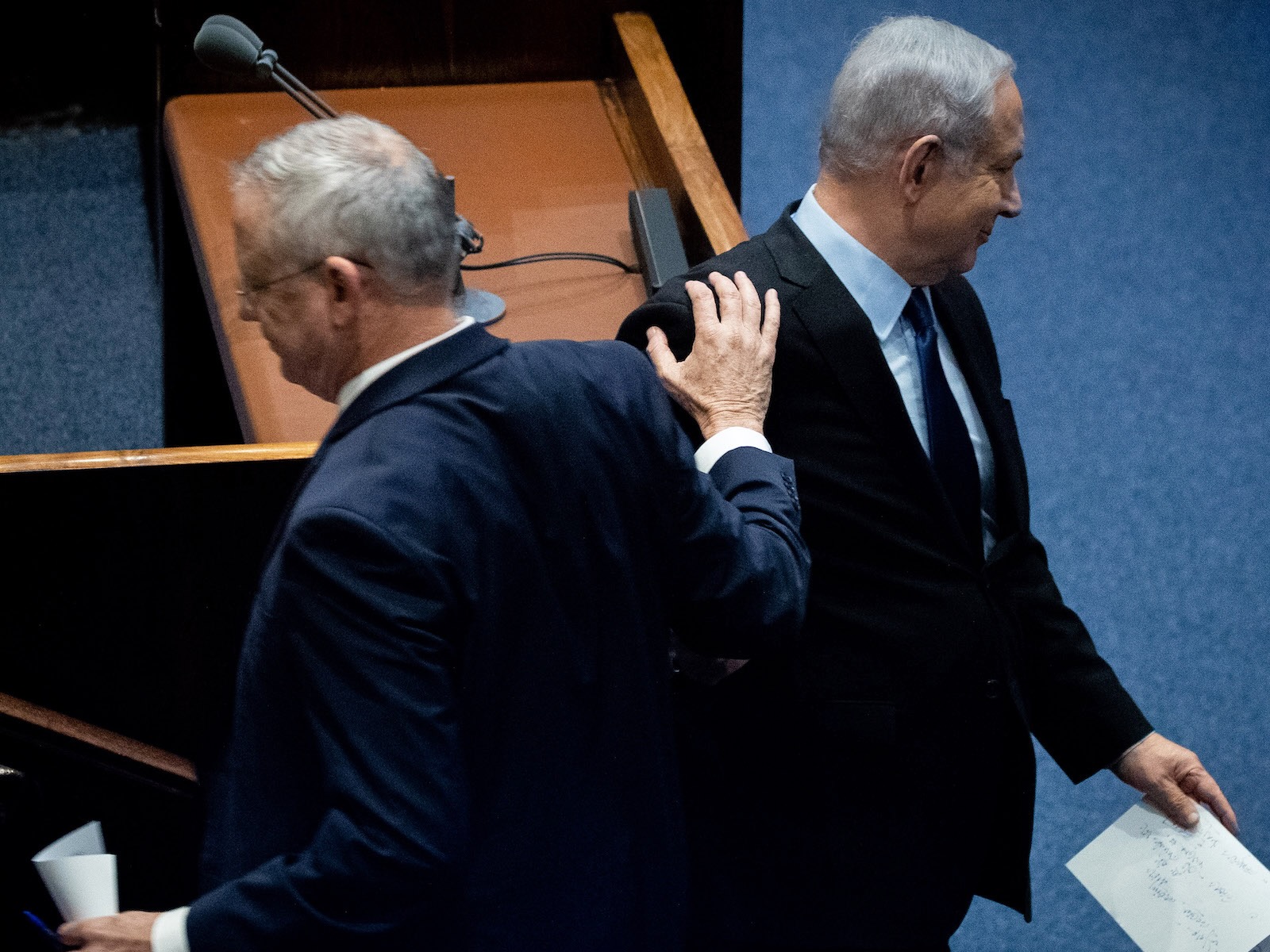
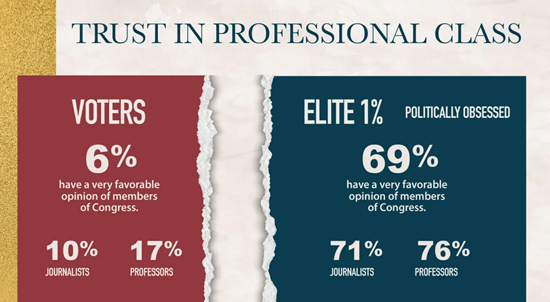
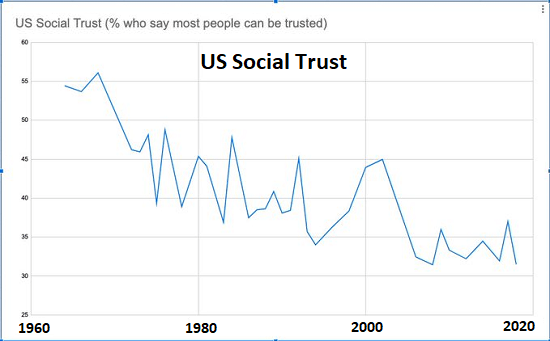


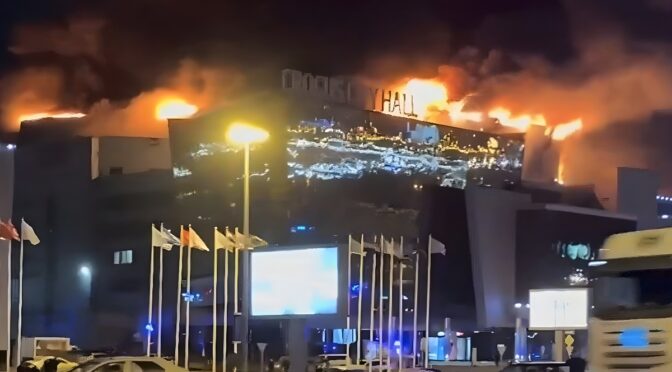

 After the Crash