Helio is a short, visceral film centered on a post apocalyptic underground society where miners work for light to survive. But when a dying rebel thrusts the unexpected onto an unassuming worker’s lap, all hell breaks loose. What begins as one man’s race to escape the hostile government quickly escalates into a city-wide uprising of the people.
“Election” (1999) is a sharp political satire in a high school setting directed by Alexander Paine and based on a novel by Tom Perrotta. Matthew Broderick stars as Mr. McAllister, a popular high school teacher who holds a personal grudge against insufferable over-achieving student Tracy Flick (Reese Witherspooon). When Tracy runs for student council president initially unopposed, McAllister attempts to derail her political future by encouraging Paul Metzler, an injured football jock, to run against her. Meanwhile, Paul’s younger adopted sister Tammy (Jessica Campbell) is dumped by her girlfriend who immediately starts dating Paul. Tammy retaliates by joining the race for school president on an anarchist platform so successful it threatens the best-laid plans of Tracy Flick, Mr. McCallister and the high school administration.
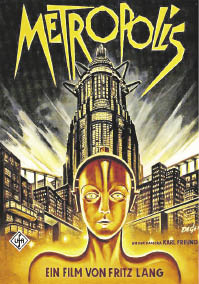
Today we bring you one of the most influential films of all time: Fritz Lang’s 1927 fable of good and evil fighting it out in a futuristic urban dystopia, Metropolis.
The melodrama is set in the year 2026. Metropolis is a beautiful high-tech city, but beneath the dazzling surface toil masses of enslaved workers. To keep the machinery running efficiently, the workers have been forced to become virtual machines themselves. The city is ruled by a heartless mastermind named Johann Fredersen, whose idealistic son, Freder, discovers the cruel conditions imposed on the workers and rebels against his father.
Freder falls in love with Maria, a messianic figure preaching love and reconciliation, but his father hatches an evil plot to turn the workers against Maria. He hires the mad scientist Rotwang to make a robotic counterfeit of Maria to wreak havoc among the workers, discrediting her and discouraging rebellion. An epic struggle ensues.
Lang actually detested the story, which was written mostly by his wife Thea Von Harbou. He told Peter Bogdanovich that Metropolis was “silly and stupid.” But from a visual standpoint the film is one of the great works of 20th century art. Lang said he got the idea of making a movie about a futuristic city while visiting New York in 1924. Standing at night on the deck of his ship in New York Harbor, the filmmaker looked up and was amazed:
I saw a street lit as if in full daylight by neon lights and, topping them, oversized luminous advertisements moving, turning, flashing on and off, spiraling…something that was completely new and nearly fairy tale-like for a European in those days….The buildings seemed to be a vertical veil, shimmering, almost weightless, a luxurious cloth hung from the sky to dazzle, distract, and hypnotize. At night the city did not give the impression of being alive; it lived as illusions lived. I knew then that I had to make a film about all of these sensations.
The iconic poster image above is reproduced from an extremely rare program printed for the March 21, 1927 London premiere of Metropolis. You can look through the entire 32-page program at the Web site of bookseller Peter Harrington. The page will open in a new window, so you can look at the program and stay here and watch the film.
There’s also a 2010 restoration of the film, supervised by the F.W. Murnau Foundation, which incorporates footage from an early print discovered in Buenos Aires, bringing the film closer to Lang’s original vision.
Dust is set in a dystopian world where most of humanity lives in walled cities to protect themselves from a chaotic environment where evolution occurs at breakneck speed, creating organisms which can be a deadly plague or miraculous medicine. It’s the job of a tracker to document the changes and, with the help of a black-market merchant, find a cure to save the society which he rejected.
“Zoom” (2015) is a hybrid film on many levels. It’s a Brazilian/Canadian comedy/drama mixing live action and animation directed by Pedro Morelli. The plot is split between three narratives involving comic book artist Emma Boyles (Alison Pill), novelist Michelle (Mariana Ximenes), and film director Edward Deacon (Gael Garcia Bernal). Each exists in parallel realities which become increasingly intertwined as they come together in a metafictional conclusion.
We live in a time of great uncertainty and confusion. Events keep happening that seem inexplicable and out of control. Donald Trump, Brexit, the War in Syria, the endless migrant crisis, random bomb attacks. And those who are supposed to be in power are paralysed – they have no idea what to do.
This film is the epic story of how we got to this strange place. It explains not only why these chaotic events are happening – but also why we, and our politicians, cannot understand them.
It shows that what has happened is that all of us in the West – not just the politicians and the journalists and the experts, but we ourselves – have retreated into a simplified, and often completely fake version of the world. But because it is all around us we accept it as normal.
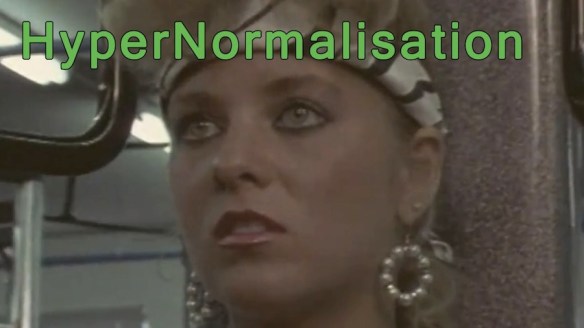
HyperNormalisation
The film has been made specially for iplayer – and is a giant narrative spanning forty years, with an extraordinary cast of characters. They include the Assad dynasty, Donald Trump, Henry Kissinger, Patti Smith, the early performance artists in New York, President Putin, intelligent machines, Japanese gangsters, suicide bombers – and the extraordinary untold story of the rise, fall, rise again, and finally the assassination of Colonel Gaddafi.
All these stories are woven together to show how today’s fake and hollow world was created. Part of it was done by those in power – politicians, financiers and technological utopians. Rather than face up to the real complexities of the world, they retreated. And instead constructed a simpler version of the world in order to hang onto power
But it wasn’t just those in power. This strange world was built by all of us. We all went along with it because the simplicity was reassuring. And that included the left and the radicals who thought they were attacking the system. The film shows how they too retreated into this make-believe world – which is why their opposition today has no effect, and nothing ever changes.
But there is another world outside. And the film shows dramatically how it is beginning to pierce through into our simplified bubble. Forces that politicians tried to forget and bury forty years ago – that were then left to fester and mutate – but which are now turning on us with a vengeful fury.
“Wing Chun” (1994) is a martial arts comedy directed by Yuen Woo-Ping (True Legend, Iron Monkey) starring Michelle Yeoh and Donnie Yen. Loosely based on a true story, the film tells the story of Wing Chun (Yeoh), a talented kung fu master who lives in a mountain village with her father, sister and aunt. After rescuing a widow from bandits, she must defend herself and her village while dealing with drama related to a childhood friend Leung (Yen), who returns after many years of studying kung fu.
“Technocalyps” (2006) is a documentary by Frank Theys examining the transhumanist movement and development of the sciences of interest to them including genetics, robotics, nanotechnology, and artificial intelligence. Features interviews with philosophers, writers and researchers including Raymond Kurzweil, Kirkpatrick Sale, Natasha Vita More, Robert Anton Wilson and Terence McKenna among others.







 After the Crash