“Breaking the Fear Factor”: Opposing War, Financial Fraud and State Terrorism, Dismantling Propaganda

4501e162f2a86d1f455bb5d8a1814139

By Peter Koenig

Source: Global Research

We are living in a (western) world dominated by neoliberal dictators, criminals and crooks. And many of us, impregnated with the human idiocy, as so well described by  Andre Vltcheck (The West Spreads Intellectual Idiocy) are every day deeper and deeper immersed into fear – fear of action, fear of what’s next – fear of losing our comfort zone. The western propaganda machine paid for by the corporate and financial oligarchy through the presstitute media is constantly indoctrinating the little we have left of our free-thinking brains.

Fear is everywhere. People who are afraid can easily be manipulated. People who are afraid obey. The system needs people who don’t resist. Renegades are potential drone targets. The Big Constant that pervades our western world with ambitions to also infiltrate Asia – is terrorism. Man-made terrorism – or better – elite-made terrorism; George Orwell would have called it Big Brother-made terrorism; terrorism with a particular purpose: spreading fear and submission.

On Friday, 21 August 2015, on a train from Amsterdam to Paris, according to the New York Times, “a heavily armed gunman opened fire aboard a packed high-speed train, traveling from Amsterdam to Paris [….] wounding several passengers before he was tackled and subdued” by two American military servicemen (on leave), who were helped by a third American. According to French officials, they “averted a mass killing.”- The gunman was armed with an automatic pistol, an AK47 and a knife (NYT annotation: AK47 is Al Qaeda’s preferred weapon). The Americans were coincidentally and suitably near to subdue the shooting 26 year-old Moroccan, a convenient Arab, who was taken into custody when the train stopped in Arras, France, just beyond the French-Belgian border. No doubt, he will be squeezed for confession. He may try to escape – and then may be shot death. Amen.

The French anti-terrorist unit took immediately charge of the investigation. The unit is known to work in utmost secrecy. Whatever news comes out of it is most likely ‘cooked’ to suit the system.

The NYT proclaims that the three Americans saved the train from a massacre. Nobody was killed. Just one of the American heroes was injured. Hollande thanked Obama for the brave Americans’ exemplary behavior and for preventing a train carnage. Propaganda all over. In America we trust – is dogma number one; dogma number two is – there is no save place on earth.

Fear everywhere, but America is there to help. Danger lingers at every corner. A terrorist may be just next door. Just give yourself up to Big Brother and he won’t let you down.

The first step towards sub-doing fear is asking yourself: Who invented and fabricated terrorism in the first place? In countries and entire regions ravaged by Washington incited wars and conflicts, terrorism is the expression of hopelessness, of wrath – of fighting back, when there is nothing left to lose. Look at the Middle East. A battlefield of nations destroyed by years of war – people living in ruins, in miserable squalor; some escape – and become the endless and EU loathed stream of refugees. According to the UN High Commissioner, there are more than 50 million refugees worldwide.

People take-up arms in self-defense. The west calls them terrorists. A term popularized by the media. A term that instills fear. – Imagine a world where the Judeo-Christian aggressors would suddenly see the light and stop spreading wars and conflicts and subjugating the world – peace would break out and settle in – terrorism, one of the key reasons for fear, would have no purpose to persist – fear would die, trust and solidarity would grow. The empires worst enemy: solidarity, friendship, and trust among people.

All wars and conflicts are multi-purpose. They boost the elite-dominated war industry; in the US more than 50% of GDP; they help dominate and subjugate people, exploit their resources, and are trailblazing a path towards Full Spectrum Dominance – world hegemony. They also help one of the ‘elite’s’ key objective – depopulating the world, so the elite may live longer with the ever scarcer resources of our gradually depleted planet. Reducing world population is a key objective of the Bilderberg Society – voiced by Henry Kissinger already in the 1960s. Recently I overheard one buddy telling another: I hate wars; but the only good thing about wars is – they reduce world population.

That is the horrendous level of immorality and greed to which humanity has sunk. – We the over-fed west may not get enough in an ‘overpopulated world’ (sic), therefore let’s reduce the human stock by killing off the under-people.

According to FAO – the UN Food and Agriculture Organization – with the current available agricultural technology Mother Earth could aliment at least 12 billion people, almost double of today’s world population. Fear and greed decimate our rational thinking. The me-me-me of abject western consumerism – and the fear of losing it – overwhelms our innate sense of human solidarity.

Remember the infamous Christmas Day 2009 ‘underwear bomber’ on a Northwest Airliner approaching Detroit wanting to detonate a plastic bomb sewed into his undies? He was suitably identified as a Nigerian Al Qaeda fighter and also conveniently and par hazard filmed by a passenger in the back row — This was such an amateurish attempt to spread fear, that after a short while even the media didn’t want to lose their ‘credibility’ (sic) and shut up.

Is there ever a thought among the fearful that such terrorists might be ‘planted’ by those who are served by the fear they cause?

A former CIA official recently admitted that virtually all so-called terror acts in the US and most of those in other parts of the world since (and including – added by me) 9/11 are false flags. With every false flag, the system can tighten its grip on the population under the pretext of ‘protection and security’. The populace literally asks for it – please protect us, please come to our houses, put them upside down and see whether there are terrorists hiding in our closets… that’s how the Boston people reacted after the April 2013 false-flag Marathon bombing.

Since 9/11 US citizens have lost more than 90% of their civil rights; first through the Patriot Act, then by subsequent extensions of police ‘protective measures’. Most US citizens are not even aware of the power they gave up to the police which has now the authority to invade people’s homes at will, without search warrant or explanation and then find anything justifying the arrest and indefinite confinement without trial of an inconvenient person. The ‘suspects’ are mostly Muslims. These days it’s easy selling to the brainwashed western world a Muslim as a criminal or terrorist.

Yet, the Boston Marathon false flag was of such low grade that anybody with a little bit of reason left, could recognize that the bombs were detonated by special forces with the mere purpose of implanting the notion that even a relatively progressive thinking university town like Boston is in danger of terrorism. Therefore let’s control the people, let’s not this ‘intellectual Boston crowd’ choose its own ways, abandoning the sinking ship. All sheep must be kept together in false solidarity, of course.

The two Chechnyan brothers were pre-identified, they had no clue what may eventually happen to them. They conveniently had a police record, maybe fabricated, to also hurt Russia, hitting two flies with the same stone. The Chechnyan ‘malfeasance’ could easily be sold to the public. One of the two alleged suspects was killed – and silenced – in an artificially created ‘shootout’. The other one is in solidarity confinement and is not allowed to talk, not even in court – condemned to die – soon to be silenced too.

Public events henceforth project fear. – People, please stand up against police and state-sponsored violence and terrorism! – Analyze for yourselves! Don’t believe the lies spread by the mainstream media. Yes, it takes a little effort, seeking out the truth and reading the news on internet – Global Research, Information Clearing House, Sputnik News, VNN, RT, TeleSUR, PressTV, CounterPunch, New Easter Outlook, The Saker – and many more – but it is one of the few chances you have to see the light and stand up for your rights – and get rid of fear.

The Boston false flag bombing, was followed by a similar horror event in Paris, in January this year. The Hebdo Charlie and related supermarket assault killed 17 people. It was opportunely planned at a notoriously anti-Muslim cartoon magazine, executed by CIA-Mossad forces in full connivance with the French secret service

(see http://www.globalresearch.ca/paris-charlie-the-shock-doctrine-par-excellence/5424960).

Two plus one ‘suspects’ with previous police records, were pre-identified. One of them ‘forgets or loses’ casually his ID in the get-away car – the only link the police has to the ‘terrorists’ – they find two, kill them at sight – so they won’t talk anymore. – The third related alleged assassin of a Jewish supermarket at the outskirts of Paris awaited the same fate: death by a police barrage of bullets. A blurred amateur video (maybe by now taken off internet) shows how a hand-cuffed individual is thrown before the wolves outside of the supermarket, to be riddled mercilessly with bullets. Nobody to talk. The truth remains ugly propaganda – propaganda for the system – a system that prevails over and feeds on terrorism. Millions of people, dulled by the event, walked the streets of European cities, solemnly parading placards lettered with “I am Charlie” — millions of people submitted – and still do – to a miserable lie – spreading and perpetuating fear.

Hollande had a justification to tighten the grip around France and within Paris – police everywhere, reducing civil liberties just a tad more – orders from the Washington masters. Being a nominal ‘socialist’ (sic), the emperor doesn’t quite trust him – as he may resent having been forced by the White House to abrogate his country’s lucrative sale of two Mistral type amphibious assault ships to Russia. To dampen any lingering sympathy for Russian President Putin, Hollande had to be reined in; and the spineless French leader (sic) did indeed cave in.

Fear is everywhere. European politicians are all afraid they may be in the crosshairs of the CIA or Pentagon or other US mercenary hit men if they don’t behave. A couple of days ago it was reported that Hollande is now also planning preventive drone assassinations, mimicking his brother-in-crime, Peace Nobel Laureate, Barack Obama. Imagine! – How far can you sink to lick – ehhh – the naked toes of the naked emperor. How far has our western civilization sunk in only the last 30 years – the onset of neoliberalism!

Fear commands everyone – almost. Fear is the public enemy number One – but it can be overcome – with courage, an open mind and foremost an awakened consciousness.

People feel reasonably happy. They feel protected. They gladly trade their civil rights for police and military protection. Terrorism is horrible and it is so unpredictable. It lurks everywhere. And nobody dares to question these bloody fabricated horror events. Nobody dares ask: what motivates the terrorists? How come their number has increased exponentially in the last 15 years? Terror sows more terror. Fear disseminates more fear. More fear facilitates more oppression and manipulation of people – and eventually more terrorism.

Take the massive flood of refugees engulfing Europe. The EU laments the ‘refugee crisis; seemingly not realizing that they helped making it. The Eurocrats cannot deal with the overwhelming influx of refugees. They use the bought media to make people afraid of them. The refugees come from these Arab countries the west is fighting for ‘freedom and democracy’. They are dark-skinned, poor and no-good. They steal our jobs, food and women. The human touch and solidarity of westerners has been annihilated long ago – by the neoliberal doctrine – that knows no mercy, only profit and power. Western powers don’t want these poor homeless beggars within their frontiers. What to do with them? They are a costly nuisance. Most of them are Muslims anyway. There is no space for them.

Would it ever occur to one of those high-flying, arrogant never elected Maastricht politicians to ask ‘why is this onslaught of refugees increasing by the day?’ – They may find the answer in front of their nose, in case they still have some left-over ticking brains. We, Europeans, in full complicity with war-mongering hegemonic Washington have helped destroy their countries, their economies, their jobs, torn apart their families, killed their children, have bombed their very homes to ashes – now they come to seek help from us. These poor people have no choice but asking their hangmen for a bit of mercy, for some crumbs of bread, for some rudimentary shelter. The raped seeks alms from the rapist. It’s the Stockholm syndrome. – Its fear from dying. Maybe the criminals who almost killed them have some humanity left, a bit of mercy – please.

What makes them tick – these criminal hegemonic politicians? Why are they so inhumanly selfish, greedy and violent? The public at large is afraid to even ask. Asking could produce answers that may derange one’s comfort zone. Better don’t ask and follow the rules. Let fear continue to rule.

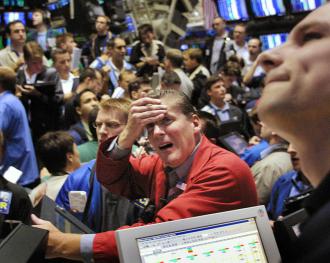
The NYT also reports, “Stock prices around the world continued to plunge on Friday, threatening to end one of the longest bull runs in the history of the United States stock market.” Fear of losing money is spread. Such ‘market’ fluctuations, as most of us know, have little to do with ‘markets’, be it share or money markets. Money is fabricated by a mouse-click of a bank dishing out debt. Markets are manipulated by banks and political powers for monetary profit and political gains – and to sow fear – fear that something horrendously drastic may happen, may affect our fragile economy – and may foremost affect our stolen well-being. Yes, stolen. Our western riches have been stolen during hundreds of years of abject, murderous colonization of the southern hemisphere. And we continue colonizing them with our modern weapon – MONEY. When banks spread fear, it is to steal the money, pension funds, social systems from us, their faithful clients. Stealing from abroad is not enough.

Rather than fearfully shutting up – wake up! Dare stand up fellow citizen – against the white collar onslaught of fraud and exploitation, against corruption of our elitist neoliberal system! Get rid of those deceiving politicians – the scum of greed and power. Expose them. Neutralize them.

The US as well as the European Commission just enacted laws, allowing banks, effective immediately – to ‘rescue’ themselves by so-called ‘bail-ins’ – meaning, a bank that has overstretched and over-speculated itself into bankruptcy may literally save itself by stealing the money from its depositors and shareholders. – Why does such an edict – not really a law because those who designed the rule are unelected Eurocrats – not prompt an immediate run on the banks? – Why does nobody even protest? – Because people don’t know? Maybe. But Fear – sheer fear from being punished for ‘disobedience’ – is a better explanation.

Instead, our fear makes us trust that such ‘bail-ins’ will always happen to others. We so easily forget what happened only two years ago, in March 2013 to the people of Cyprus, when their deposits were decimated by the infamous ‘haircut’, administered by the highly indebted Cypriot banks, by order of the BCE, with full complicity of the Cypriot elites, who first transferred their fortunes abroad. It was like a trial run. How much would the populace swallow without (too much) protesting? – It worked. The rule is now institutionalized – and nobody says beep. – For fear that worse may follow? – Or for sheer comfort of not moving our butts.

The famous late Howard Zinn said civil disobedience is our – as in ‘we the people’ – strongest weapon against corporate and state injustice and abuse. Today’s version of this wisdom might be for the 99.99% of us, the people, to organize and infiltrate the reigning criminal system and breaking it down from within. Much like did and do the State Department funded Washington-based thinktanks (sic) – initiating the deadly and destructive ‘Arab Spring’, intruding and subverting the European Parliament with bought proxies and fake NGOs – and what they attempt to do in Russia and China, albeit unsuccessfully.

Back to the NYT article on the plunge of the US stock exchange. Finger-pointing of the guilty is of the order. The fear factor has to be substantiated and enhanced by fault of an ‘outsider’ – in this case China – which according to the NYT has ‘unexpectedly’ devalued its currency, a sign of a troubled economy and a bleak outlook for the economy of other large ‘developing countries’.

Let’s fear the Evil East. – No good may come from the east. The NYT has of course no explanation of truth. Namely that the Chinese Yuan had been artificially over-valued under pressure of the US, and kept within a 2% band of fluctuation by the Chinese authorities. This was also in line with China’s huge dollar reserves, some 1.6 trillion dollars. Relaxation of the fluctuation – letting the rate slide naturally to an expected 3% margin, would not only make China more competitive, but might enhance the currency’s international standing to eventually becoming a new currency in the IMF’s basket constituting the SDRs, or Special Drawing Rights. The SDR is an international virtual money that may be lent to countries which so desire, hence, better balancing the currency exchange risk of the loan. The current SDR basket is composed of only four ‘world’ currencies; the US dollar, the British Pound, the Euro and the Japanese Yen.

If the Yuan can keep its own by floating against other major currencies, chances are it may be admitted by the west-dominated IMF as the fifth currency to the SDR basket, thereby opening the door for the Chinese Yuan to become a major official world reserve currency. Washington may not like it, but may have little choice preventing the currency of the world’s strongest economy to become an officially admitted reserve currency.

Fear may also be the main reason for the Greek Tsipras Government 180 degree U-turn after the 62% NO vote on July 5 – No to austerity, No to more strangulation by the infamous troika – European Central Bank (ECB), European Commission (EC) and the International Monetary Fund (IMF). Not Germany, not the troika, are Greece’s strongest enemies; fear is. The Syriza government was pressured, blackmailed, coerced – and possibly even corrupted – into accepting an even more nefarious austerity package than the one against which Greeks voted with an overwhelming NO. If indeed enacted, the new debt commitment of € 86 billion will drive Greece’s debt to GDP ratio way above 200 % – and not one euro will flow into Greece’s economy, her social system, fighting unemployment, bringing back public hospitals, schools, water and electricity.

The Syriza Tsipras Government has committed an illegal act against Greece’s own Constitution which puts the people above parliament and above the executive – as a true democracy should. Tsipras’ anti-democratic act could be undone any time by a simple decision of the Supreme Court. According to international standards, Greece’s accumulated debt is fully illegal and could be erased by a mouse click, the same way it was created. Any contract – in this case debt – concluded under duress, coercion, corruption and / or blackmail does not stand up before an international court of law. This must have been known to the Tsipras government. Yet, Tsipras and his inner circle went to Brussels to ‘negotiate’ ignoring this chance. Instead they sold out their country to the banksters, let themselves be humiliated, ridiculed in the face of their own people, let alone the rest of the world.

Fear was most likely the engine for Tsipras’ behavior. Many of his Syriza colleagues left the government coalition. Ministers who didn’t agree with his politics were fired. He preferred succumbing to fear – fear of the potential wrath that might emanate from the corrupt and criminal EU; from greedy Germany whose neoliberalism is rapidly taking on the colors of Nazism. – German supremacy over Europe – again? – Maybe there were death-threats involved, who knows. It is common practice when power and resources are at stake.

However, a true leader has no fear. He or she stands tall with the moral and ethical obligation to defend the interests of the people who elected him or her. As did Hugo Chavez, Fidel Castro, Rafael Correa, Evo Morales, Cristina Kirchner, Lula, Dilma Rousseff and many more.

Traveling recently all over Greece fear was visible everywhere. When asked, why their inaction in the face of this shameful treason of their PM – no protests, the streets remained calm – the answer was almost uniformly – we are afraid. Afraid of what? Of the police; they shoot at us with rubber bullets, with water cannons – and we don’t know when the military will intervene.

In Delphi, the very town where democracy was born some 2,500 years ago, a shop owner confessed, democracy is dead, not only in Greece – but in Europe, in the world. With this backdrop, a new military takeover was according to him not far-fetched. The Tsipras betrayal was a boon for the rightwing, the Nazi-like ‘Golden Dawn’ – a perfect backing for a new military regime.

After the 1967 US-supported so-called Coup of the Colonels, Greece suffered seven years of a most repressive right wing military dictatorship, where full obedience was of the order, where people disappeared, where the communist party was forbidden and communists were prosecuted and killed, where anything resembling left-wing literature was censured, during which miniskirts, pop-music, long hair, the peace sign and the like were prohibited. This repressive regime has deeply marked the Greek population. They are afraid it may return. They are aware of their country’s vulnerability due to its importance for Washington, hosting the southern-most strategic NATO base. Any deviation of the Washington made and EC imposed rule may bring back the military horror – reminiscent of Costa Cavras’ 1969 extraordinary docudrama “Z”.

Now, the Tsipras Government has resigned – for fear of the domestic consequences of its actions? – A new interim government is to be prepared before the announced 20 September election. Will the radical break-away Syriza faction, the new Unity Party, be able to form a viable coalition and gather the necessary trust to win the coming September elections?

Will Greece after all be able to break the paralyzing streak of fear?

Will Greece set the new standard of fearlessness for the rest of Europe to follow? – Will Greece dare to go the only practical way – exit the unviable euro – go back to her drachma and revamp their economy with public banking for the benefit of the Greek people? – I trust Greece will dare take back her sovereignty, breaking the all-permeating Fear Factor and become a flagship of courage for Europe and for the world.

Peter Koenig is an economist and geopolitical analyst. He is also a former World Bank staff and worked extensively around the world in the fields of environment and water resources. He writes regularly for Global Research, ICH, RT, Sputnik News, TeleSur, The Vineyard of The Saker Blog, and other internet sites. He is the author of Implosion – An Economic Thriller about War, Environmental Destruction and Corporate Greed – fiction based on facts and on 30 years of World Bank experience around the globe. He is also a co-author of The World Order and Revolution! – Essays from the Resistance . 

Dollar As World’s Reserve Currency Threatened

dollar_2977362b

By Stephen Lendman

Source: Stephen Lendman Blog

US dollar dominance finances Washington’s reckless spending, global militarism, its empire of bases, endless wars, corporate takeovers, as well as speculative excess creating bubbles and economic crises – at the expense of democratic freedoms and beneficial social change.

China, Russia and other nations increasingly trading in their own currencies pose a significant threat to dollar dominance. Mahdi Darius Nazemroaya explained Washington’s currency war on China, saying:

“The Chinese are in the process of displacing the monopoly of the US dollar. They are dropping their US Treasury bonds, stockpiling gold reserves, and opening regional distribution banks for their own national currency.”

“This will give them easier access to capital markets and insulate them from financial manipulation by Washington and Wall Street.”

China bashing by public and private US officials is part of a campaign to denigrate its government – making inflammatory accusations without proof about hacking, defying its legitimate right to do what it wishes in its own waters, and threatening sanctions – legal only by Security Council members, never by individual countries against others, Washington’s longstanding weapon against independent governments.

“As the financial architecture of the world is being altered by China and Russia, the US dollar is gradually being neutralized as one of Washington’s weapon of choice,” Nazemroaya explained.

The post-WW II US-dominated international monetary system is threatened with unraveling. Washington is fighting back with propaganda, energy, financial, economic and currency wars against China and Russia, said Nazemroaya.

Russia sold a fifth of its $125 billion in US Treasuries holdings last March. China’s US Treasuries holdings exceed $1 trillion dollars. It’s been aggressively dumping them.

It’s gone from the world’s largest buyer to its biggest seller. Will other countries follow suit? Nations are increasingly trading in their own currencies. Weakening America’s financial strength is the best way curb its imperial ambitions.

Russia drafted legislation aimed at eliminating dollars and euros in trade between Commonwealth of Independent States (CIS) countries: Armenia, Belarus, Kazakhstan, Kyrgyzstan, Tajikistan, Russia, and other former Soviet republics.

A Kremlin statement said “(t)his would help expand the use of national currencies in foreign trade payments and financial services and thus create preconditions for greater liquidity of domestic currency markets.”

It would facilitate regional trade and help achieve economic stability. It would reduce dependency on the world’s two dominant currencies.

China’s central bank launched a Heilongjiang Province yuan/ruble program – Russia’s currency replacing the dollar.

Both countries are increasingly trading in their own currencies – bypassing dollar transactions. If enough other countries follow suit, dollar strength will weaken. Its hegemonic ambitions will be curbed – how much, how soon remains to be seen.


Stephen Lendman lives in Chicago. He can be reached at lendmanstephen@sbcglobal.net.

His new book as editor and contributor is titled “Flashpoint in Ukraine: US Drive for Hegemony Risks WW III.”

http://www.claritypress.com/LendmanIII.html

Visit his blog site at sjlendman.blogspot.com.

Where is Neo When We Need Him — Paul Craig Roberts

images

By Paul Craig Roberts

Source: PaulCraigRoberts.org

In The Matrix in which Americans live, nothing is ever their fault. For example, the current decline in the US stock market is not because years of excessive liquidity supplied by the Federal Reserve have created a bubble so overblown that a mere six stocks, some of which have no earnings commiserate with their price, accounted for more than all of the gain in market capitalization in the S&P 500 prior to the current disruption.

In our Matrix existence, the stock market decline is not due to corporations using their profits, and even taking out loans, to repurchase their shares, thus creating an artificial demand for their equity shares.

The decline is not due to the latest monthly reporting of durable goods orders falling on a year-to-year basis for the sixth consecutive month.

The stock market decline is not due to a week economy in which after a decade of alleged economy recovery, new and existing home sales are still down by 63% and 23% from the peak in July 2005.

The stock market decline is not due to the collapse in real median family income and, thereby, consumer demand, resulting from two decades of offshoring middle class jobs and partially replacing them with minimum wage part-time Walmart jobs without benefits that do not provide sufficient income to form a household.

No, none of these facts can be blamed. The decline in the US stock market is the fault of China.

What did China do? China is accused of devaluing by a small amount its currency.

Why would a slight adjustment in the yuan’s exchange value to the dollar cause the US and European stock markets to decline?

It wouldn’t. But facts don’t matter to the presstitute media. They lie for a living.

Moreover, it was not a devaluation.

When China began the transition from communism to capitalism, China pegged its currency to the US dollar in order to demonstrate that its currency was as good as the world’s reserve currency. Over time China has allowed its currency to appreciate relative to the dollar. For example, in 2006 one US dollar was worth 8.1 Chinese yuan. Recently, prior to the alleged “devaluation” one US dollar was worth 6.1 or 6.2 yuan. After China’s adjustment to its floating peg, one US dollar is worth 6.4 yuan. Clearly, a change in the value of the yuan from 6.1 or 6.2 to the dollar to 6.4 to the dollar did not collapse the US and European stock markets.

Furthermore, the change in the range of the floating peg to the US dollar did not devalue China’s currency with regard to its non-US trading partners. What had happened, and what China corrected, is that as a result of the QE money printing policies currently underway by the Japanese and European central banks, the dollar appreciated against other currencies. As China’s yuan is pegged to the dollar, China’s currency appreciated with regard to its Asian and European trading partners. The appreciation of China’s currency (due to its peg to the US dollar) is not a good thing for Chinese exports during a time of struggling economies. China merely altered its peg to the dollar in order to eliminate the appreciation of its currency against its other trading partners.

Why did not the financial press tell us this? Is the Western financial press so incompetent that they do not know this? Yes.

Or is it simply that America itself cannot possibly be responsible for anything that goes wrong. That’s it. Who, us?! We are innocent! It was those damn Chinese!

Look, for example, at the hordes of refugees from America’s invasions and bombings of seven countries who are currently overrunning Europe. The huge inflows of peoples from America’s massive slaughter of populations in seven countries, enabled by the Europeans themselves, is causing political consternation in Europe and the revival of far-right political parties. Today, for example, neo-nazis shouted down German Chancellor Merkel, who tried to make a speech asking for compassion for refugees.

But, of course, Merkel herself is responsible for the refugee problem that is destabilizing Europe. Without Germany as Washington’s two-bit punk puppet state, a non-entity devoid of sovereignty, a non-country, a mere vassal, an outpost of the Empire, ruled from Washington, America could not be conducting the illegal wars that are producing the hordes of refugees that are over-taxing Europe’s ability to accept refugees and encouraging neo-nazi parties.

The corrupt European and American press present the refugee problem as if it has nothing whatsoever to do with America’s war crimes against seven countries. I mean, really, why should peoples flee countries when America is bringing them “freedom and democracy?”

Nowhere in the Western media other than a few alternative media websites is there an ounce of integrity. The Western media is a Ministry of Truth that operates full-time in support of the artificial existence that Westerners live inside The Matrix where Westerners exist without thought. Considering their inaptitude and inaction, Western peoples might as well not exist.

More is going to collapse on the brainwashed Western fools than mere stock values.

Wall Street Panic

panicked trader

By Mike Whitney

Source: Counterpunch

“Not only is the equity market at the second most overvalued point in U.S. history, it is also more leveraged against probable long-term corporate cash flows than at any previous point in history.”

— John P. Hussman, Ph.D. “Debt-Financed Buybacks Have Quietly Placed Investors On Margin“, Hussman Funds

“This year feels like the last days of Pompeii: everyone is wondering when the volcano will erupt.”

— Senior banker commenting to the Financial Times

Last Friday’s stock market bloodbath was the worst one-day crash since 2008. The Dow Jones dropped 531 points, while the S&P 500 fell 64, and the tech-heavy Nasdaq slid 171. The Dow lost more than 1,000 points on the week dipping back into the red for the year. At the same time, commodities continued to get hammered with oil prices briefly dropping below the critical $40 per barrel mark. More tellingly, the market’s so called “fear gauge” (VIX) skyrocketed to a 2015 high indicating more volatility to come.  The VIX has remained at unusually low levels for a number of years as investors have grown more complacent figuring the Fed will intervene whenever stocks fall too far. But last week’s massacre cast doubts on  the Central Bank’s intentions. Will the Fed ride to the rescue again or not? To the vast majority of institutional investors, who now base their buying decisions on Fed policy rather than market fundamentals, that is the crucial question.

Ostensibly, last week’s selloff  was triggered by China’s unexpected decision to devalue its currency, the juan.   The announcement confirmed that the world’s second biggest economy is rapidly cooling off increasing the likelihood of a global slowdown. Over the last decade, China has accounted  “for a third of the expansion in the global economy,… almost double the contribution of the US and more than triple the impacts of Europe and Japan.” Fears of a slowdown were greatly intensified on Friday when a survey showed that manufacturing in China shrank at the fastest pace since the recession in 2009. That’s all it took to put the global markets into a nosedive. According to the World Socialist Web Site:

“The deceleration of growth in China, reflected in figures on production, exports and imports, business investment and producer prices, is fueling a near-collapse in so-called “emerging market” economies that depend on the Chinese market for exports of raw materials. The past week saw a further plunge in stock prices and currency rates in Russia, Turkey, Brazil, South Africa and other countries. These economies are being hit by a massive outflow of capital, placing in doubt their ability to meet debt obligations.”

(“Panic sell-off on world financial markets”, World Socialist Web Site)

While a correction was not entirely unexpected following a 6-year long bull market, the sudden drop in equities does have analysts rethinking the effectiveness of the Fed’s monetary policies which have had little impact on personal consumption, retail spending, wages, productivity, household income, or economic growth all of which remain weaker than they have been following any recession in the post war era.  For all intents and purposes, the plan to inflate asset prices by dropping rates to zero and injecting trillions in liquidity into the financial system has been an abject failure.   GDP continues to hover at an abysmal 1.5% while  signs of a strong, self sustaining recovery are nowhere to be seen. At the same time, government and corporate debt continue to balloon at a near-record pace draining capital  away from productive investments that could lay the groundwork for higher employment and stronger growth.

What’s so odd about last week’s market action is that the bad news on China put shares into a tailspin instead of sending them into the stratosphere which has been the pattern for the last four years. In fact, the reason volatility has stayed so low and investors have grown so complacent is because every announcement of bad economic data has been followed by cheery promises from the Fed to keep the easy-money sluicegates open until the storm passes.  That hasn’t been the case this time, in fact, Fed chair Janet Yellen hasn’t even scrapped the idea of jacking up rates some time in September which is almost unthinkable given last week’s market ructions.

Why? What’s changed?   Surely, Yellen isn’t going to sit back and let six years of stock market gains be wiped out in a few sessions, is she?  Or is there something we’re missing here that is beyond the Fed’s powers to change? Is that it?

My own feeling is that China is not the real issue. Yes, it is the catalyst for the selloff, but the real problem is in the credit markets where the spreads on high yield bonds continue to widen relative to US Treasuries.

What does that mean?

It means the price of capital is going up, and when the price of capital goes up, it costs more for businesses to borrow. And when it costs more for businesses to borrow, they reduce their borrowing, which decreases the demand for credit. And when the demand for credit decreases in a credit-based system, then there’s a corresponding slowdown in business investment which impacts stock prices and growth. And that is particularly significant now, since the bulk of corporate investment is being diverted into stock buybacks. Check out this excerpt from a post at Wall Street on Parade:

“According to data from Bloomberg, corporations have issued a stunning $9.3 trillion in bonds since the beginning of 2009. The major beneficiary of this debt binge has been the stock market rather than investment in modernizing the plant, equipment or new hires to make the company more competitive for the future. Bond proceeds frequently ended up buying back shares or boosting dividends, thus elevating the stock market on the back of heavier debt levels on corporate balance sheets.

Now, with commodity prices resuming their plunge and currency wars spreading, concerns of financial contagion are back in the markets and spreads on corporate bonds versus safer, more liquid instruments like U.S. Treasury notes, are widening in a fashion similar to the warning signs heading into the 2008 crash. The $2.2 trillion junk bond market (high-yield) as well as the investment grade market have seen spreads widen as outflows from Exchange Traded Funds (ETFs) and bond funds pick up steam.” (“Keep Your Eye on Junk Bonds: They’re Starting to Behave Like ‘08 “, Wall Street on Parade)

As you can see, the nation’s corporations don’t borrow at zero rates from the Fed. They borrow at market rates in the bond market, and those rates are gradually inching up. And while that hasn’t slowed the stock buyback craze so far,  the clock is quickly running out. We are fast approaching the point where debt servicing, shrinking revenues, too much leverage, and higher rates will no longer make stock repurchases a sensible option, at which point stocks are going to fall off a cliff. Here’s more from Andrew Ross Sorkin at the New York Times:

“Since 2004, companies have spent nearly $7 trillion purchasing their own stock — often at inflated prices, according to data from Mustafa Erdem Sakinc of the Academic-Industry Research Network. That amounts to about 54 percent of all profits from Standard & Poor’s 500-stock index companies between 2003 and 2012, according to William Lazonick, a professor of economics at the University of Massachusetts Lowell.”

You can see the game that’s being played here. Mom and Pop investors are getting fleeced again. They’ve been lending trillions of dollars to corporate CEOs (via bond purchases) who’ve taken the money, split it up among themselves and their wealthy shareholder buddies, (through buybacks and dividends neither of which add a thing to a company’s productive capacity) and made out like bandits.  This, in essence, is how stock buybacks work. Ordinary working people stick their life savings into bonds (because they were told “Stocks are risky, but bonds are safe”.) that offer a slightly better return than ultra-safe, low-yield government debt (US Treasuries) and, in doing so, provide lavish rewards for scheming executives who use it to shower themselves and their cutthroat shareholders with windfall profits that will never be repaid. When analysts talk about “liquidity issues” in the bond market, what they really mean is that they’ve already divvied up the money between themselves and you’ll be lucky if you ever see a dime of it back. Sound familiar?

Of course, it does. The same thing happened before the Crash of ’08. Now we are reaching the end of the credit cycle which could produce the same result. According to one analyst:

“There’s been worrying deterioration in the overall global demand picture with the continuation of EM (Emerging Markets) FX (Currency Markets) onslaught, deterioration in credit metrics with rising leverage in the US as well as outflows in credit funds in conjunction with significant widening in credit spreads…..The goldilocks period of “low rates volatility-stable carry trade environment of the last couple of years is likely coming to an end.”

(“Credit: Magical Thinking“, Macronomics)

In other words, the good times are behind us while hard times are just ahead. And while the end of the credit cycle doesn’t always signal a stock market crash, the massive buildup of leverage in unproductive financial assets like buybacks suggest that equities are in line for a serious whooping. Here’s more from Bloomberg:

“Credit traders have an uncanny knack for sounding alarm bells well before stocks realize there’s a problem. This time may be no different. Investors yanked $1.1 billion from U.S. investment-grade bond funds last week, the biggest withdrawal since 2013, according to data compiled by Wells Fargo & Co…..

“Credit is the warning signal that everyone’s been looking for,” said Jim Bianco, founder of Bianco Research LLC in Chicago. “That is something that’s been a very good leading indicator for the past 15 years.”

Bond buyers are less interested in piling into notes that yield a historically low 3.4 percent at a time when companies are increasingly using the proceeds for acquisitions, share buybacks and dividend payments. Also, the Federal Reserve is moving to raise interest rates for the first time since 2006, possibly as soon as next month, ending an era of unprecedented easy-money policies that have suppressed borrowing costs….

“Unlike the credit market, the equity market well into 2008 was very complacent about the subprime crisis that led to a full blown financial crisis,” the analysts wrote…..

So if you’re very excited about buying stocks right now, just beware of the credit traders out there who are sending some pretty big warning signs.”  (“U.S. Credit Traders Send Warning Signal to Rest of World Markets”, Bloomberg)

It’s worth noting that the above article was written on August 14, a week before the stock market blew up. But credit was “flashing red” long before stock traders ever took notice.

But that’s beside the point. Whether the troubles started with China or the credit markets, probably doesn’t matter. What matters is that the system about to be put-to-the-test once again because the appropriate safeguards haven’t been put in place, because bubbles are unwinding, and because the policymakers who were supposed to monitor and regulate the system decided that they were more interested in shifting  wealth to their voracious colleagues on Wall Street than building a strong foundation for a healthy economy. That’s why a simple correction could turn into something much worse.

NOTE: As of posting time, Sunday night, the Nikkei Index is down 710, Shanghai down 296, HSI down 1,031. US equity futures are all deep in the red

MIKE WHITNEY lives in Washington state. He is a contributor to Hopeless: Barack Obama and the Politics of Illusion (AK Press). Hopeless is also available in a Kindle edition. He can be reached at fergiewhitney@msn.com.

On the Meaning of “Middle Class” and the State of the Middle Class

and_wearing_shoes_middle_class_k_750725

By Dr. Nicholas Partyka

Source: The Hampton Institute

When politicians talk, one of the recurring themes about which they spew platitudes is the economy. It would be the subject of another essay to unpack what is meant by “the economy” when politicians and other capitalist elements use that term. This aside, in discussing the economy there is a phrase that politicians use with such alacrity that it has become trite. This phrase is, “middle class”. Politicians, pundits, and social commentators deploy this term in many contexts, but almost always appealing to its ubiquity of membership, critical role in democracy, and moral virtue in their speeches. These constant references to the middle class in the popular political discourse have rendered this term impenetrably vague. If we listen to politicians then one would be led to believe that most Americans are members of this middle class, whose health and prosperity the politicians never tire of proclaiming as their highest priority. Speeches are one thing, reality another. Let us interrogate this concept of the “middle class”, and see what to make of this notion that plays such a prominent role in American political discourse on the economy.

With an election year looming, and a Presidential election at that, with their seemingly always lengthening election cycle, the phrase “middle class” will only be heard more and more frequently from now until after November 2016. The President’s recent invocation of the phrase “middle class economics” is only the latest salvo between the two dominant capitalist political parties, as they try to position themselves in the public’s mind as the true defender of – the almost apotheosized- middle class. Candidates and their supporters will be arguing more and more vigorously about which party, or which policies, will do more to help this middle class. About the only thing that candidates from both parties will agree on is that the middle class is in trouble, and that economic policies should be designed which maximally promote the welfare of this class. The two major political parties in this country have divergent views about what kinds of policies best aid this alleged middle class. However, both parties are attempting to win votes by claiming to be champions of the middle class, a class with which a great many Americans still continue to identify themselves.

We’re going to explore two distinct, but interrelated questions in what follows. First, we’ll want to know, Who and how many, people are middle class? Second, we’ll want to ask, What does it mean to be middle class? The answers to these questions will likely have to be made relative to particular societies at particular times; though some generalization is possible. To begin we’ll look at what it has meant historically to be middle class. Then we’ll look more in depth into the meaning of being middle class in the contemporary American context. What we will find is a great deal more confusion and ambiguity about this notion of a “middle class”. So much so that we should start to wonder if this notion retains any usefulness.
The Middle Classes, Historically

For most of history being middle class simply meant occupying, however tenuously, a social status that was between that of a slave and that of a noble. Basically, the middle class was composed of everyone who was not technically a chattel slave, and lacking the noble pedigree of a true aristocrat. In most societies of the ancient world this simple definition would indeed make most people middle class. However, this understanding glosses over the highly variegated nature of socio-economic positions possible between technical chattel slavery and blue-blooded nobility. For instance, debt bondage and serfdom, both forms of un-free labour, would not cause one to be dropped from the middle class on this accounting. For example, in the ancient world slaves were often employed as overseers, that is in a management capacity. It would not have been uncommon for slave overseers to sometimes direct the labour of technically free men.

We can see in certain socio-political cleavages that splits have occurred in many contexts between the lower ranks of these middle classes and the higher elements of this class. Middle classes have struggled against entrenched aristocracy and nobility at many points in history for social advancement and political inclusion. However, almost always, in the critical moment, the higher elements of these middle classes would betray the interests of the lower elements, whose bodies, blood and ballots had been used to gain them inclusion. Marx would come to call these “higher elements” of the middle classes petit-bourgeoisie, signifying the much greater material, and indeed much more importantly, aspirational affinity with the bourgeoisie than the proletariat.

Two examples will suffice here. In ancient Greece we see the demos, or “the people” engaging in political struggle for inclusion in the political life of the polis. But who is this demos? First, Greeks used the word demos in two distinct ways. In one sense, we might call the wide sense, it meant the whole citizen body of city-state in general. In the narrow sense, on the other hand, the demos meant the ‘common people’, the ‘lower classes’, the aporoi, the propertyless. This group included a very wide range of socio-economic and political situations, and certainly contained an upper and lower group. The main cleavage within the ranks of the demos is between the better off elements and those struggling to get by. It goes without saying that slaves would not be counted among the demos. Those who are struggling are more, or in worst case entirely, dependent on others for their livelihood. The Greeks called Thetes and Banausoi. The former we might call day-labourers or wage earners, the latter we could translate loosely as artisans. These were the lowest two of Solon’s five social classes, and while not slaves, were subject to various kinds of forced labour. Though some artisans and merchants could be quite wealthy, most were not. Most merchants, as opposed to retailers, though were likely to be foreigners, and thus not eligible for citizenship.

When we focus on the internal political conflicts of the Greek polis of the Classical period (roughly the 5th and 4th centuries BC), what we see is a struggle over citizenship, that is over access to political participation in government. While the socio-economic and political realities of the ancient world are complex, in the main the conflicts were between an urban middle class of mainly artisans and middling farmers on the one hand, and the traditional land-owning oligarchy which monopolized political power on the other.[1] The political struggles over demokratia in this period revolved mainly around whether or not the banausoi and thetes should be given citizenship rights. Chiefly important among the rights of citizens were the right to vote in the Assembly, to hold public office, the serve as a juror in the dikasteria, to bring matters before the courts; at Athens in particular, citizens would be entitled to receive a share in any disbursement of the polis‘s dividends from the proceeds of the Laurium silver mines.

The demos was the main agent of social change in the ancient Greek polis, the traditional aristocracy certainly saw it this way. They saw “middle class” elements as being too politically ambitious, which is in part why they deploy the term pejoratively. By “middle class elements” the traditional aristocracy would have lumped together both very wealthy artisans, and much more humble enterprises, all of whom were united in not being aristocrats by blood lineage. Wealthy merchants and artisans might themselves employ slaves both for carrying out production, as well as the overseeing of this work, but they lacked the “best” kind of background. This made them unsuitable for political participation in the eyes of established elites. Smaller artisans and merchants, who didn’t have exorbitant wealth to recommend them, would have been thought only the more unsuited to political life.

All of the main institutions of Classical Greek demokratia were devices designed to help poor and working-class free men defend themselves from the depredations of their richer counterparts. Rule by majority vote in an Assembly, ekklesia, open to all citizens; freedom of speech, parrhesia, in the assembly; large popular courts of law, dikasteria, composed of fellow citizens; rule of law, isonomia, as passed by the Assembly and administered in the courts; the belief that political power should be scrutinized, subject to euthyna, are all practices that helped the aporoi defend their highly precarious social position from the predatory behavior of wealthy citizens. As one eminent scholar describes, “Since the majority of citizens everywhere owned little or no property, the propertied class complained that demokratia was the rule of demos in the narrower sense and in effect the domination of the poor over the rich.”[2]

In the ancient Greek polis political participation was usually restricted to those native adult men who could meet a certain property qualification. In the main, in order to be a citizen one had to possess enough wealth to afford to outfit themselves with the hoplite panopoly. This was the complete set of armaments associated with the heavy armed infantry. If one could afford to buy one’s own armor, and afford the leisure time to learn to fight as part of a phalanx formation, then one was considered worthy to participate in the political life of the polis. The idea being that if one was wealthy enough to afford the hoplite panopoly then one had enough of a stake in the success and survival of the polis to be entitled to a role in the government of the city-state. Those “old money” and nouveau riche aristocrats who were wealthy enough could afford to outfit themselves with horses as well as more ornate armor and weapons, and thus the traditional prestige associated with the cavalry. The question of democracy in the ancient Greek world, was thus a struggle over the inclusion of those who could not afford the traditional citizenship qualification based on the connection of wealth and military service, and who because they were not slaves could make legitimate claims to be entitled to such inclusion.

Renaissance Italy serves as another great example. In the rise of the classic northern Italian city-state podestaral form of communal government there was employed in the popular political discourse a term, the popolo. Loosely translated, it means the people. However, once again we’ll see that this notion of the people actually covers over a major divergence within between well-off members and working-class members. As one scholar claims, “When, therefore, the long and venomous struggle broke out between the popolo (the “people”) and the nobility, the popular movement drew its force and numbers from the middle classes, not from the poor, the day labourers, or the unskilled”.[3]

The political conflict in 13th century northern Italian city-states was, much like in the ancient Greek world, fundamentally about participation. Beginning in the 12th century, a political conflict between church and secular authorities saw the rise of communal governments in all the major Renaissance city-states in northern Italy. At the time, this form of government was identified with the self-government of local magnates and aristocrats instead of more alien authorities imposed by church leaders in Rome. In this early phase of commune government, “The nobility dominated the consulate, manipulated the general assembly, and ruled the city, except where the emperor successfully intervened, as at Vicenza, Siena, and Volterra, or where the political power of the Bishop persisted.”[4]

It was against this restricted form of government that the political forces of the popolo were arrayed in the 13th century. By organizing for combat against the military forces of the nobility, the popolo was able to seize power in the commune and change the structure of commune government, in that it was able to secure more participation for those in its ranks; or more correctly, some of those in its ranks. The popolo, much like the demos, was a class composed of better off artisans, tradesman, merchants, et cetera. It was a class of persons who had to work for a living, that is they had to do physical labour themselves to achieve their subsistence. These people were free, in that they were not slaves or serfs, but were not aristocrats, they did not possess the right kind of lineage. Political participation was at this time still restricted to those who did have the proper kind of aristocratic genealogy.

Much as in the case of the ancient Greek world, the main political cleavage in the Renaissance northern Italian city-state between the popolo and nobilitas largely concerned the way individuals made a living. Nobles owned large landed estates, and derived their wealth and status from being able to control the labour of others, i.e. vassals and serfs. Those who were not aristocrats could be wealthy, could own land, but typically had to work themselves. That is, the typical member of the popolo could not control the labour of others to the same extent that a noble could. The political conflicts of the 13th century were not simplistic conflicts between land owners and merchants, the reality was much more complicated than that.

Both popolo and nobilitas would be distinguished from a day-labourer in that they would be considered independent in the right sort of way, they would be considered the people who had real freedom. What distinguishes the position of the poorest classes is that they are dependent on others for their livelihood. Thus, for example, the serf is dependent on the lord, the tenant farmer on the land-owner, and the day-labourer on the employer who pays him. These kinds of people would have been considered not really free in the right way, especially politically. Though all God’s children would have been understood to be free, some were not considered free enough to be worthy of inclusion in government.

In what would become an unfortunate recurring tendency, once the leading – i.e. the wealthiest- elements in the “middle class”, the popolo, achieved inclusion in communal government, they allied with the old aristocracy and turned against the lower, more ‘middling’ elements in the popolo to suppress their continued agitations for further liberalization of political participation. Thus, as one scholar puts it,

“Up to about the middle of the thirteenth century, it was in the interest of bankers and -long-distance traders to batter the entrenched communal oligarchy with an eye to loosening the political monopoly of the old consular families, mostly of noble lineage… But after about 1250 or 1260, having fully achieved their aims and in fact now menaced by the political ambitions of the middle classes, they broke with the popolo, thereby dividing and undermining the popular movement”.[5]

With the erosion of nobility and its traditional privileges across Europe and North America from the 17th century onward, as well as the formal abolition of chattel slavery in these societies, this traditional understanding of middle classes is not sufficient for the world we inhabit. Being neither a slave nor a noble will not help many locate their social position in contemporary societies, when these societies do not formally legally recognize slavery or nobility. As capitalism remade societies across western Europe and North America in this same period, it reshaped the nature of the classes that composed those societies. Thus, a new way to understand what the middle-class is will be needed.
The Idea of the Middle Class in Post-WWII America

There are some who are reluctant to define the middle class using income measurements. The alternative proposed by many of these critics is a more aspirational definition based on consumption. This definition is based on both the level and the kind of consumption desired by individuals who aspire to be middle-class, ie. who desire to live what is deemed a middle-class lifestyle. Most of the essential features of this conception of the middle class are derived from the experience of Americans post WWII. The vast pool of purchasing power accumulated by US citizens during the war led in the post-war period to rising standards of living for a wide swath of the population. The patterns of consumption, the norms and values, of what we today consider definitional of the middle class in America were originated to a large extent in this period.

It was in this period that the idea of the “American Dream”, as it is currently understood, originates. This post-war vision of increasingly wealthy Americans achieving higher material standards of living is the well-spring of many of the elements of middle-class-ness that we take for granted. The conception of middle-class-ness as consisting of things like widespread home ownership, ownership of a motor vehicle or vehicles, stable long-term employment, ability to send children to college, take a family vacation, et cetera, was born during this era.

If we try to understand the middle class this way, we should investigate what the patterns of consumption for a middle-class individual, or family, today requires in terms of income, and how many Americans actually possess the financial means to afford this lifestyle. According to one recent report, it was estimated that a middle-class “American dream” lifestyle would cost $130,000 a year for a family of four.[6] The median income for individual income-earners in the US in 2013 was around $52,000, not even half of that estimated cost. According to a 2010 study by the Commerce Department only a family with two income-earners in the 75th percentile or above could afford the middle-class lifestyle described in the previous report. [7] According to data from a 2014 report by the Congressional Research Service only around 20% of American household could afford this price tag of a “middle-class” lifestyle.

If one takes only the items listed as “essential” in the report cited in the previous paragraph the total cost of a middle-class lifestyle, which is still above the current median income. This accounting clearly leaves out other important expenses, like taxes, that one will incur, as well as makes impossible any expenditure on important items like savings, and recreation. Now, of course food prices change, and fuel prices change, and these effect how wealthy consumers feel, as decreases in food and fuel costs can be transferred to increase consumption of “extras” like college savings for children, or family vacations. One should also note that this report categorized cell phone and internet expenditure as an “extra”. In today’s world these things are properly considered more akin to utilities, they are essentials for living.

Clearly, the level of income needed for achievement of a characteristically middle-class, or “American dream”, lifestyle is out of reach for a great many individuals and families. This is likely part of why the percentage of those identifying themselves as lower-class, or lower-middle class in recent surveys has increased.[8] Indeed, even a family with two income-earners, in the 25th percentile only has an income about equivalent to the median. Meanwhile, as of 2010, an individual income-earner in the 50th percentile only made around $25,000. The rising costs of college, the continued stagnation of wages – especially at the lowest ends of the labour market – as well as the reductions in employer-based pension and benefit programs for most workers have a contributed to making the mid-twentieth century American vision of middle-class existence more and more out of reach for large swaths of Americans.

The post-war American experience, if put in proper context, is the product of a historically unprecedented epoch. According to the research presented by Thomas Piketty in his book Capital in the Twenty-First Century, the middle part of the twentieth century was the only time in the last 300 years that his law of capital (r>g) was reversed.[9] This was a special period in which the growth rate exceeded the return to capital, and thus workers received increasing wages, and increasing purchasing power. It was in this historically unique period that the main expectations, norms, values, and status symbols of modern American “middle-class” lifestyle were born.

If we look the heyday of the American middle class in the 1950s and 1960s what we see is a transformation of American society born of a historical accident. Piketty’s research demonstrates that income inequality in the US basically plateaued over these decades, after decreasing sharply during the period from 1913-1945, that is the period of the World Wars and the Great Depression. What the French call “les trente glorieuses”, and others have called a pax Americana, was the direct result of the tumult of the wars and economic crises of the first half of the twentieth century. Workers in the western world generally experienced a boom, in that they experienced rising living standards, wages, and benefits. In Europe these benefits often took the form of national programs, while in America they were largely employer-based; healthcare and retirement are good examples. It was in this environment of rising levels of access to material consumption that the dominant aspects of the outlook of the middle class in America took shape.

Without the devastating effects of two world wars and an economic depression of immense scale, governments, especially in the US, would not have made the concessions that they did to workers, to organized labour in particular. The need to secure consistent, reliable production of vital war supplies, which might be disrupted by labour agitation, inclined the US government to enter the fray of industrial warfare on the side of workers during the First World War; at least to the extent required to ensure production for war. The Great Depression was an important cause of the establishment of the main pillars of the American welfare system in the 1930s. Labour unions achieved even greater privileges during the Second World War, as the leadership of organized labour organizations were increasingly co-opted by the corporate interests they were supposed to oppose. As a result of the need to take sometimes drastic measures to fight two wars and a titanic economic depression the US government enacted policies which resulted in a reduction in income inequality. This reduction in inequality combined with rising levels of material consumption, due to workers increased ability to bargain collectively with the support of the legal apparatus of the state, define this unprecedented period in economic history.
Middle Class Confusion

Clarification about the meaning of “middle class” is especially important because Americans seem to be confused about this notion of “middle class”, about who is in it, and what it means to be in it. It is a well-know and, much commented on, phenomenon in American political culture that almost everyone tends to perceive themselves as “middle-class”. What makes this fact interesting, and thus worthy of the decades of commentary and analysis it has received, is the startling economic inequality that coexists with this perception.

Though the rates of self-identification with being middle-class have varied over time, a healthy portion of Americans still identify as being middle class. Even now, after decades of erosion in the position of workers due to stagnating wages, reductions in benefits, cuts to social programs and education, increasing international competition, and the shifting of various kinds of work to the global south and other peripheral economies, as well as more recently the effects of the 2008 financial crisis, 44% of people surveyed in one recent survey self-identified as being middle-class. [10] Indeed this figure has fallen over the years of the Great Recession, self-identification as middle-class fell from 53% in 2008, to 49% in 2012, and then to 44% in 2014. Thus, even in bad times, as a great many people are still struggling, a great many people continue to perceive themselves as middle-class.

There is no one universally accepted way to define the middle-class. Perhaps this is part of the reason why politicians are able to make so much political hay with it. This is also part of how it is possible for a great many rather wealthy see themselves as middle-class at the same time as many of the working poor. It is also part of how many super-wealthy individuals come to perceive others less wealthy than themselves, though still obscenely wealthy, as ‘merely’ middle-class.[11] This lack of a consensus about a definition is certainly one of the reasons there is so much confusion about the middle-class, and who belongs to it, and how one belongs to it.

Conventionally, the middle is understood as everyone in the second, third, and fourth income quintiles. Basically, everyone who is not in the top-fifth or the bottom-fifth of income earners is defined as middle-class. In America today this definition of middle-class is roughly equivalent to those earning between $30,000 and $80,000 a year.[12] This is quite a large middle-class. One might think that it is rather too large. Indeed, how can one assimilate the experiences of an individual, or even more a family, living on $30,000 to one making $80,000? One could, I think quite properly, say that these two sets of experiences are so incommensurable materially as to make them awkward members of a common middle-class. Let us note in this connection that the federal government defines the poverty threshold for a family of four as a bit less than $24,000 a year. So, it would seem hard to think the experiences of family living on about 25% more than the poverty level would be anything like those of a family making more than two and a half times that amount.

That this conception is too wide to be very useful, and for the reasons I alluded to, is admitted by the fact that, at least colloquially, we have adopted the distinctions between ‘upper’ and ‘lower’ middle class. This distinction testifies to the difference in material position of individuals, or families, in the upper and lower ends of the middle. The lifestyle, the patterns of consumption, level of access to opportunity, and much else, varies so much between these groups that the distinction suggests itself, and is so patently apparent that no one questions its propriety.

Perhaps then we should narrow our definition of middle-class to only the third income quintile. This understanding of middle-class would include those making roughly $40,000 to $65,000. Even the top end of this range would still be half of what one estimate suggests a middle-class lifestyle would cost. Moreover, only about 15% of income earners would count as middle-class on this way of understanding the middle class. [13] This fact would certainly seem inconsistent with the widespread perception that the middle-class is the numerically largest class. Even if we expand back to our original range of $30-80,000, only about 40% of income earners would be middle-class. While this figure has the virtue of appearing to match up quite closely with the level of self-reported identification as being middle-class, it suffers from the vagueness we noted above. The upper limit of the 4th income quintile is north of $100,000. I do not think it is a stretch to say the material circumstances of a “middle-class” family making anywhere from the median to the upper limit has much in common with those families earning closer to the lower threshold of “middle class”.

By several ways of trying to understand the middle class we come up with results that fall short of matching our expectations and common perceptions. We seem to end up with either an unhelpfully expansive notion of the middle-class that encompasses individuals and families with greatly divergent material circumstances. Or, one ends up with a more precise statistical conception of the middle class, but wherein fewer persons are understood to be middle-class than commonly report being so in surveys. Part of explaining this confusion about the middle-class is the fact that Americans are either unaware or deeply confused about the nature of the distribution of wealth in this country. Many people report feeling like they are middle-class, but only as a result of ignorance or confusion about the nature of wealth inequality in America. Indeed, it would be crazy to deny that part of one’s perception of class position is the relative position of others. Were more Americans aware of the real nature of the distribution of wealth they would likely feel less middle-class, and more lower-class. According to the results of one recent research study, a representative sample of Americans reported thinking that the share of total income possessed by the middle class in America, i.e. the second through fourth income quintiles, was just north of 40%. Respondents also reported thinking the third income quintile alone possesses over 10% of total national wealth. In fact, the real share possessed by the first through fourth income quintiles combined is less than 20%, and the third quintile alone possesses closer to 5% than greater than the 10% that was reported.[14]

Another important aspect of the explanation for why there is so much confusion about the middle class is the confusion individuals face given their precarious position in the socio-economic hierarchy. Given how much inequality has risen over the last few decades there has been an increase in the perception that the post-war American middle-class lifestyle is out of reach for a great many hard-working people. Rising inequality combined with the effects of a calamitous financial crises, followed by years of recession, caused many to report falling in social class. The youngest cohort especially was hard hit, with now 49% reporting being in the lower or lower-middle class. It also caused many who identify as middle-class to feel this status increasingly precarious. Indeed, according to a Pew Research study from 2014 almost as many Americans reported being lower-class as middle-class, and the spread between the two was a mere 4%.[15]
The Working Class

We have seen now that this notion of the “middle class” is highly problematic. When we attempt a rational accounting of it, what we find is that our social reality confounds many of the expectations that most Americans have when they talk about the middle class. We find that though many Americans report in surveys that they are middle-class, the middle class is small, and shrinking. Once we distinguish upper from lower in the middle class, the true middle is really a small part of the income spectrum. One cannot get too far below the median income for one to be more lower class than middle class, nor can one get too far above without becoming upper-middle, or even elite. For instance, $100,000 in income would put one at the upper limit of the fourth income quintile, while an income at or above $150,000 would place one among the top 10% of income-earners. One cannot thus get too far beyond the $80,000 average income of the fourth income quintile without ending up less middle class than upper class.

If we judge belonging to the middle class as a function of ability to consume, then again we find that the traditional middle-class lifestyle ideal is increasingly out of reach for large swaths of the American population. What we see now is that we need a new way to think about class, about the socio-economic positions that people occupy and how these are best described. Getting a handle on what class one belongs to is important, especially in these election cycles, as appeals for votes are made to members of the various social classes that compose the electorate. How is one to know which kind of candidate or policy to vote for if one does not know what candidates or policies will advance their interests? And how is one to know what will advance one’s interests if one does know have an accurate understanding of their own socio-economic reality?

Rather than muddle on with this vague notion of a middle class, we should substitute a new understanding of class and class relations. This understanding of class should emphasize the role that working conditions play in determining socio-economic position, or class. This understanding will of course have much overlap with the dominant income-based understanding. For indeed, working conditions and wage rates are often highly correlated in market economies, that is, typically the lower the pay the worse the working conditions (in one form or another) and vice versa. When we take the kinds of jobs people work into account, the picture that emerges is one which demonstrates the importance of thinking in terms of a working class rather than a middle class. When we start putting working conditions in the forefront of our conception of social class we gain a much accurate, and explanatory conception of class.

One example that helps demonstrate this need for an understanding of class based on working conditions is the practice of “flex-time”. In the upper end of the labour market this concept is instantiated by programs that allow workers to do their work on their own schedule, freeing workers of the need to always be in the office during the traditional working day. This allows workers to achieve a better work-life balance, by having more flexibility with the time they need to devote to work. On the lower end of the labour market flex-time typically takes the form of on-call forms of scheduling. This is an extension of the logic of the “just-in-time” inventory management systems that have come to dominate manufacturing industries, and applied to the labour force of a variety of businesses, but especially retail firms. The idea, in both cases, is to only have as much as it needed of both on hand at any one time, so as to free up capital from unnecessary investment in extra stock or extra labour.
Conclusion

Have middle classes existed in history, yes. Did a middle class exist in the US during the middle part of the twentieth century, yes. However, in both cases these answers must be qualified, if the nuance of reality is not to be lost. Yet, in appending these qualifications we change the nature of the answers, and thus must come to see the original answer as importantly flawed. In both cases we find the reality of the middle class(es) does not match up with our modern expectations and perceptions about the middle class. In the first case, one might be subject to various forms of un-free labour despite still being technically not a slave, and thus free but by no means rich, or even independent. In the latter case, we find that this ideal of the middle class was quite restricted, and the alleged golden age of its reign was certainly not seen as such by the many marginalized groups of that era. We also see that its very existence occurs because of the confluence of historical circumstances that would be near impossible to re-create.

The idea of being “middle class” is also a source of confusion when compared to modern thinking about the middle class, and its role in society. Indeed, much of the meaning of being “middle class” has always involved poor people, those who work for wages for a living, aping the consumption trends of their ‘social betters’. Thus, even while during the classic 19th century hay-day of industrialization the middle class, ie. the petit bourgeoisie, was fairly small it nonetheless transmitted its social norms, consumption patterns, taste in art and décor, to those below them on the social ladder. It was not this middling class, but rather the working class, the proletariat, whose consumption, aping the middle class above them, drove the rise of a “middle class society”. This process of transmittal of social norms, values, and patterns of consumption is eloquently detailed by Thorsten Veblen in his Theory of the Leisure Class.

Today, this notion of the middle class, a remnant of the mid-century post-war Pax Americana, stands in the way of proper thinking about the role of class in society and the role of class in individuals’ lives. We need to be free of this notion if we’re going to able to correctly perceive how class works, and how it has changed. Remember that this notion of the middle class in post-war America was built on stable, long-term employment, with benefits, and pension plans, that paid enough to own a home, buy a car, household appliances, vacations, college educations, and more. In today’s economy these kinds of employment features of increasingly harder to come by for increasingly large segments of the labour market.

What one finds is that as automation increases, and as services increasingly dominate over production, more and more workers are forced into ever more precarious forms of employment. These tenuous relationships serve employers desire for flexibility, ie. ability to (re)move capital quickly, but increase burdens on working class people; especially on their time. Instead of thinking of themselves as “middle class”, these workers should more correctly perceive themselves to be part of what Guy Standing calls the Precariat[16]. The Precariat is already a class in-itself, but the ideology of the middle class in the US prevents it to a great extent from developing into a class for-itself. Opposed to this class is what Standing calls the Salariat, that is, the minority of a firms’ workers who are central to operations. These are core workers who typically earn a salary, have benefits, sick time, vacation days, and many of the other trappings of the fabled American middle class lifestyle.

Politicians will continue to talk in speeches, interviews, and the like about a middle class that supposedly exists in America, and how they will do the most to help it, typically by enacting the policies that will allow it to flourish. From what we have seen here working class people should no longer be duped into thinking that those politicians are addressing them. The rhetoric that dominates our politics simply does not match the reality of the contemporary economy, in particular the labour market. When we adopt a more appropriate view of class we see an economy characterized not by a broad-based and prosperous middle class, but rather by increasing inequality. We see a labour market where trends in job conditions and benefits very much resemble those in real wages. When we adopt a different view of class we see a very different answer to the question, Is there a middle class in America? No, not in a way that matches the mid-century American ideal.

Notes

[1] For a thorough analysis of the political and social conflict in the ancient Greek world see, G.E.M. de Ste. Croix’s The Class Struggle in the Ancient Greek World. 1981. Cornell University Press, 1998.

[2] De Ste. Croix 1998, 284

[3] Martines, Lauro. Power and Imagination; City-States in Renaissance Italy. 1979. Vintage Books, 1980; 40.

[4] Martines 1980, 29.

[5] Martines 1980, 61

[9] In Piketty’s equation (r) = after tax rate of return to capital, and (g) = the rate of growth of per capita income, a proxy for economic growth. For further information about Piketty’s research see my review of his book for The Hampton Institute.

[16] See his book, The Precariat: The New Dangerous Class. Bloomsbury Academic; 2011.

Our Spoiled-Brat Economy

f418a7472f5783aa8fcf04d0d72e443140b9e2325a6cf04371d142e41c4827e0

By Charles Hugh Smith

Source: Of Two Minds

By insuring spoiled brats/vested interests never face the consequences of their actions and choices, we guarantee failure of the entire system.

Spoiled brats do not take kindly to being called out as spoiled brats. Since economies are aggregates of individuals, we can anticipate howls of outraged denial at our economy being identified as spoiled rotten.


The two essential characteristics of spoiled brats are 1) a complete disregard for the burdens of those paying the bills and 2) a childishly self-absorbed sense of overweening entitlement. Spoiled brats have no sense of fiscal discipline. Indeed, it is their defining characteristic. They want what they want, and they want it now, regardless of the cost to others or the system as a whole.

In America’s Spoiled Brat Economy, no vested interest is ever allowed to fail. Lost billions gambling with borrowed money? Just throw a K Street temper tantrum and threaten to close all the ATMs when you go broke, and voila, Mommy and Daddy (the federal government and Federal Reserve) come rushing with trillions of dollars to make all the bad things like well-deserved bankruptcy go away.

That tens of millions of savers must be robbed of hundreds of billions of dollars in lost interest to rebuild your banks’ profits and balance sheets–the sacrifices of others are of no concern to spoiled brats.

What does not allowed to fail bring to mind? How about coddled children who are crippled by helicopter parents who do their homework for them and schools that give everybody passing grades and gold stars?

A system that doesn’t allow individuals and enterprises to fail is a system that is simply taking another path to failure. Students who are given gold stars and 9th place ribbons (Meet the Fockers) cannot possibly establish a real sense of accomplishment or learn how to make a realistic assessment of their deficiencies or strengths. They are crippled by all the “help” enablers press on them.

The same is true of spoiled-brat economies. Enterprises that are never allowed to fail (for example, too big to fail banks, bankrupt cities, counties and states, defense contractors who produce failed weapons systems, healthcare organizations that cheat the government and patients, etc. etc. etc.) become deadwood that saps the vitality of the economy, dragging down the few productive sectors.

The “help” lavished on vested interests include sweetheart contracts, direct subsidies, tax credits, lines of credit, zero interest rates and a vast range of other subsidies. The entire point of the vast lobbying machine that funnels federal and Federal Reserve largesse to vested interests is about staving off the very failure that keeps economies from imploding (creative destruction).

The Yellowstone Analogy and The Crisis of Neoliberal Capitalism (May 18, 2009)

Innovation, Risk and the Forest Fire Analogy (July 2, 2010)

By insuring spoiled brats/vested interests never face the consequences of their actions, choices and self-absorbed greed, we guarantee failure of the entire system. So by all means, keep passing out subsidies to too big to fail banks and 9th-place ribbons, and give the brats whatever they want as soon as they start wailing, regardless of the cost to the system itself.


Another World is Possible

original

From the Spanish Civil War to the fall of the Berlin Wall, anarchism pushes for a new social order

By Tommaso Segantini

Source: Adbusters

The Spanish Civil War that occurred between 1936-1939 is always remembered as the fight between the Republicans and Franco’s nationalist semi-fascist forces. However, the war was marked by another, extraordinary event; in 1936, the year of the outbreak of the civil war, the world witnessed the first glimpses of an anarchist revolution. Sam Dolgoff, an American anarcho-syndicalist, stated that the Spanish Revolution “came closer to realizing the ideal of the free stateless society on a vast scale than any other revolution in history.”

The revolution was led by the CNT (Confederación Nacional del Trabajo), a confederation of anarchist and anarcho-syndicalist trade unions. A significant part of Spain’s economy was collectivized and put under direct worker’s control. In Catalonia, workers controlled more than 75% of the economy. We should not imagine Soviet-style forced collectivization, but, as Sam Dogloff said, “a genuine grass roots functional libertarian democracy, where each individual participated directly in the revolutionary reorganization of social life”. George Orwell, who has served as a combatant for the CNT, was able to document the revolution as a first-hand observer. Two short passages from his Homage to Catalonia, published in 1938, illustrate superbly the spirit of the revolution: “[T]here was a belief in the revolution and the future, a feeling of having suddenly emerged into an era of equality and freedom. Human beings were trying to behave as human beings and not as cogs in the capitalist machine,” and “many of the normal motives of civilized life—snobbishness, money-grubbing, fear of the boss, etc.—had simply ceased to exist. The ordinary class-division of society had disappeared to an extent that is almost unthinkable in the money-tainted air of England; there was no one there except the peasants and ourselves and no one owned anyone else as his master.”

Unfortunately, the Spanish anarchist utopia did not last long. The anarchists were crushed by a temporary alliance between all other political parties (including the Communists and the Socialists) and the brief—but real—experience of an anarchist society faded away.

However, an important lesson can be drawn from the anarchist utopia of 1936: another world is possible (which is also the slogan of the World Social Forum). Before discussing anarchism’s possible role in the resistance to the capitalist world order, let’s shortly retrace last century’s main stages of the capitalist system’s consolidation: elites have won the long-lasting struggle against the working class; this was achieved firstly by granting workers some benefits after World War II, notably through the implementation of welfare systems in the West, then by fragmenting them with the increase in specialization of labor and the growth of the service industry during the post-Fordist period and finally by assessing the knockout blow through neoliberal policies, which erased hard-fought social and economic rights, diminished trade unions’ bargaining power and weakened their influence.

The libertarian revolutions of 1968 have also ended up in disappointment. Hopes brought by the “New Left” political movement that emerged from the demands of students, activists and workers, came to a close when economic powers and politics colluded in the 80s, removing the last glimmers of hope that change could happen from within the current political system. The 1980s also marked the beginning of the neoliberal era (deregulation of the financial system, erosion of welfare states, privatization programs, financial crises, cuts to public spending).

Finally, the fall of the Berlin Wall represented the end of the last bastion of ideological resistance against capitalism: communism. Fukuyama’s The End of History and the Last Man main thesis was emblematic in the representation of the world we faced and still face today: the triumph of liberal democracy and capitalism marked the end point of mankind’s ideological and political evolution.

We live in a historically specific cultural paradigm, shaped during the course of the last century through mass media, popular culture and advertising, which converged together and formed our consumer culture and in an economic and political system structured to serve the interests of a small elite. In this scenario, anarchist thought has a dual function of resistance: as a challenge to the neoliberal ideology, and as a possible concrete utopia that can guide us in the construction of a valid alternative social order.

The most accessible ground for us, “the 99%,” through which a radical change can be achieved, is that of ideas. No economic or political revolution can bring genuine change without, stated Serge Latouche, an advocator of the degrowth movement, “the decolonization of our minds” from the ideological framework we find ourselves in. Anarchism challenges the ideas, the dehistoricized and naturalized assumptions, and the taken-for-granted norms of today’s society. In an anarchist society, solidarity would replace individualism; mutual aid would prevail on competition; altruism on egoism; spirituality on materialism; the local on the global. Changing the current global framework of rules first necessitates an individual ideological liberation that can only come through self-awareness. To free our body we must first free our mind.


The Poverty Machine: Student Debt, Class Society, and Securing Bonded Labor

StudentLoanDebt070313_0

By Jeremy Brunger

Source: The Hampton Institute

At the dawn of the 20th century, very few American students attended high school, as the demands of the heavy-industrial and the agricultural economies of that period were ill-suited to an extended education beyond the family sphere. In the middle of the 20th century, most Americans who either aspired to or had to work entered the full-time workforce immediately after high school, for such a postwar economy featured plenty of growth and comparably fair wage-compensation for the average worker. As the economy became more complex in its labor needs, its extending length of education complemented these requirements. The transformation of the agricultural economy into the technological economy after World War II, in turn, transformed the university, once the commune of the well-to-do, into a center for job training, an adjunct to industry, and one which continued to increase in enrollment as the technological necessities of an increasingly complex economy required further education. What was once the realm of the study of Christian religion, the Rennaissance humanists, and the Aufklärung became, for most students, the study of the technical labor necessary to produce and reproduce the new forms of capitalism and scientific production coming into existence. The growth of the American middle class became co-incident with the growth of the education industries which had hardly existed a century previous, when the middle class itself had hardly existed in any recognizable form. Where there was study, there was hope for economic success-the maxim “if a man falls in a field he is redeemed in a library” comes to mind-and the institution of the university became as integral to living well in the United States as the ownership of property and the propagation of the nuclear family.

However, in the 21st century, although attendance of university courses is at an all-time high as the millennial generation achieves the highest historical rate on record of college attendance, that same generation is forecast to experience a decline in standards of living comparative to their forebears. Not only this qualitative fact, but also the quantitative method of that attendance is worthy of critical analysis-for the funding of undergraduate and graduate educations comes largely from the borrowing of money from lenders with the Federal government playing its role as intermediary. As the declining middle class cannot pay for its children’s higher educations, it looks to the loan system to cover the ever-increasing costs of reproducing its standards of living over time. But such loans cannot be discharged in bankruptcy, and with the already saturated labor markets of the majority of the professions that could hope to pay off those loans, the economic situation comes to look much different: rather than the state intent on spreading enlightenment to the masses, the state appears to be securitizing a labor force that will simply have to perform whatever jobs are available, perhaps for decades on end, in order to pay off those loans.

That is, the students will have to do so if they want to qualify for home mortgages and otherwise live free from debt, which historically has always loomed over the subaltern and the serf alike. The parallels between the indebted student and the historical bond-laborer are strong enough to warrant comparison. One trend that especially deserves critical analysis is the outreach of the market to cover students from low-income backgrounds and whether or not such outreach is democratic-a Rawlsian lifting of the boats-or if it is merely predatory in nature and outcome. For, if the state and its lenders are merely financing higher education in order to secure a labor force that will not practice in the professions for which it trained but rather any job available by fiat of the debt-load, then a new reckoning is due of the state of affairs between the working-class young and their educations, the relationship between the state and the private sector, and the ongoing presence of class determinism in the free world.
Debt Corvee

According to The Institute for College Access and Success, statistics for the average student debt load from 2014 suggest that 71% of all students graduating from four-year colleges had student loan debt and the average level of this debt for public colleges was about $25,550, about $5000 higher than 2008. At the for-profit colleges the level was even higher, with students graduating with about $40,000 in debt. Most of this debt is mediated by government loan programs-about 80%-with the rest being covered by private lenders without mediation. The average student debt has increased, since 1993, about three-fold; given the rising cost of living and institutional funding in general, an increase in cost is not particularly surprising. What is surprising is how steep that increase in cost is. The cost of the aspirant apparatus of education increases beyond the market value of the professions on offer when viewed sociologically-the combination of public funding and private ambition allows tuition rates to soar even as student returns on investment plummet.

It appears the days when middle-class parents, a status declining in real terms since the 1970’s, directly financed their children’s college educations are largely over. While this may appear to be beneficial to the working class, in that the gatekeeping apparatus for entry into the professions-the colleges and universities-are more easily accessible than ever before, the debt that falls on the students is that much more of a burden. Students “who received Pell Grants, most of whom had family incomes under $40,000, were much more likely to borrow and to borrow more” than their more middle class peers, according to the Institute for College Access and Success. The debt load is thus geared to the children of the working class and the working poor who, no doubt seeking a better future for themselves, expend large sums of money-often more than a year’s wages, and sometimes two years’ worth-in accessing the portals of higher education. Given that student loans mediated by the government cannot be discharged in bankruptcy, students often have no choice but to live with that debt load for years and years if not forever: they have an education which cannot be repossessed, but they are also forced to work in professions for which they did not train in order to pay off that initial investment. This situation comes to resemble the historical institution of corvee labor, or other forms of debt-labor, in that the young, in being promised a better future, must nevertheless work for others as bonded servants in order to pay off their contracts. This is especially true for graduates in the non-scientific disciplines, as a Bachelor’s degree in a field other than business or the sciences becomes a mere shibboleth for entry into work that is not at the very bottom of the labor market, and even those “safe degrees” harbor little real safety for the student at the whim of capital. Having a Master’s degree in economics, the social science that ended The Great Depression, is yet no guarantee against waiting tables for tips for an indefinite period. The same can be said of the other disciplines.

The historical practice of corvee labor has much in common with the emergence of the indebted student. Corvee was a form of near-slavery, often linked to the military, that indentured laborers to a contract with an owner; nominally, the contract was entered into freely by the laborer, was guaranteed by the state, and was therefore not legally slavery, but due to the conditions of existence the laborer otherwise faced, the contract’s foundations were more reminiscent of the Hobbesian outlook than the Lockean. It was often the only viable option available for the children of the poor, and so, faced with hunger or hard labor, they chose labor on contract with the state. The structural difference between this practice and the practice of loaning to students are small, in that the state was involved in corvee as much as it is involved in student lending-for the student who may seek jobs after graduation is still in the economic red even as the student receives compensation for work. Corvee’s goals were to fill up a floating labor pool; the side effect, whether designed or accidental, of student lending winds up much the same. A student who accrued $30,000 in debt studying philosophy is likely to wind up working in the lower sectors of the labor market, unless they go back to school for a different or a higher degree-and so, in terms of base economics, their impersonal labor has been securitized by the public sector in favor of the private sector. Unless, that is, that student winds up working for the state in some other capacity than what they expected when they entered into their field of study, in which case the state has merely financed its own labor pool: and plenty of state jobs, like those in the sector of public secondary education, offer debt-manumission in reward for practicing in those fields for a period of several years. As such, the claim that only for-profit colleges are to blame for high student debt is false, for public universities contribute massively to rates of student debt and possess internal incentives for producing indebted students who might seek to dissolve their debt through public service.

The same may be said to apply to a pre-medical student who decides it is not prudent to enter into the “megaloans” required for medical school-at which point that student is already indebted for the undergraduate education and so, like the student of philosophy, winds up working for any institution that is hiring. This aleatory materialism may not have been intended by the state-the rhetoric behind opening access to higher education to as many people as possible was couched in democracy and enlightenment, to which every “Dream Big” sign on college campuses will attest-but its practical effects come to much the same result as corvee labor. The ideological state apparatus metamophoses into the financial state apparatus, yet focuses on the same people-the students, who, now indebted, represent a securitized labor force for private and public sectors alike. Most internships available to the graduate are unpaid internships-a relatively new development since the 1990s-thus leaving workng-class graduates desperate for income only non-professional career avenues. As the only broad field of economic growth under the last two presidential terms has occured in the service sector, educated working-class students can expect to enter the same service sectors in which their parents worked. Most interestingly, the etymological root of the word “service” stems from the word “serf.”
The Graeberian Insight

According to Dr. David Graeber’s 2011 book Debt: The First 5000 Years, the centralizing state has employed debt as its apparatus of growth for centuries. Debt, for Graeber, informs the very epistemology of Western people-we think in terms of credit and debit, of libertas and indebtedness, of squaring up our moral accounts. Debt is thus an all-pervasive category in how the Western world works, whether in the ancient world or in the contemporary 21st century. Graeber’s insight is useful beyond his idealist prescriptions for “everyday communism” and his moral philosophy, for the latent commodification of the ideals of democracy-education among them-is still a very real phenomenon. Education may have its necessary infrastructural costs, but it need not be a commodity traded between lenders, or traded between speculators, with unwitting students-especially students from non-professional backgrounds-used as its financial pawns. Given that the actually-existing professions cannot absorb these students, and that the state serves as mediator between lenders financing their educations, the surplus labor which the students provide can only be absorbed by sectors they did not intend on entering: the various service sectors, the only growing sectors in the economy, the only employers broadly willing to accept non-professionals.

Graeber writes that “presented with the prospect of its own eternity, capitalism-or anyway, financial capitalism-simply explodes. Because if there’s no end to it, there’s absolutely no reason not to generate credit-that is, future money-infinitely. Recent events would certainly seem to confirm this. The period leading up to [the financial crisis of] 2008 was one in which many began to believe that capitalism really was going to be around forever; at the very least, no one seemed any longer to be able to imagine an alternative. The immediate effect was a series of increasingly reckless bubbles that brought the whole apparatus crashing down” (360). Given that higher education has become an industry like any other, subject to the same laws of capital and labor, it also suffers the same proneness to instability endemic to any other capitalist endeavor. Consider the recent closure of Sweet Briar College, the glut of PhDs, or the models of infinite growth to which larger universities seem to adhere. The universities are awash in internal commentary that they are swiftly becoming corporatized, going from the internally-administed grove of academe to an organ of capital’s interest-just look at any critical article on The Chronicle of Higher Education, especially those written by educators and researchers already secure in their tenure, such as Terry Eagleton’s 2015 article “The Slow Death of the University.” With such extension of the sphere of capital and its models of development into academia, academia comes to suffer the same risks as capital, along with its students-or, according to the corporatized university, its customers.

The social form of capitalism, in synthesizing Louis Althusser’s social theory of economic reproduction and Graeber’s theory of debt, thus reproduces itself not only through relations of the commodity-form but also through relations of debt (Althusser 47). Capital has a tendency to perform its name-to capitalize, to penetrate into vulnerable markets-and what market is more vulnerable than youth? From ancient Greece to Africa it was not uncustomary for families to lend their children to the market in the form of pawnship or peonage, or in the early modern Western world with indentured servitude, according to the Historical Dictionary of Slavery and Abolition; and with corvee, the state guaranteed the trade-and within the structures of contemporary student lending these kinds of practices appear to have survived into the 21st century even in the liberal West (174, 229-30). The millennial cohort, massive as it is and funded into debt by the state, represents not a boon for the professions but a huge and exploitable labor pool for the industries.
The Re-proletarianization of Youth

In world-systems theory, as understood by the scholar Immanuel Wallerstein in his book Historical Capitalism, the spread of capitalist social relations produces two key processional phenomena: embourgeoisement and proletarianization. These historical processes act in tandem, as some become bourgeois through the labor of those who become proletarianized, and others, more unfortunate, reverse that process. Such a process, now that the university systems have co-opted the capitalist mode of financing, has been enacted in large swathes of the student population. In seeking embourgeoisement and standards of living that have been viable for only a very few for decades, many students actually become proletarianized-and perhaps moreso than had they not attended higher education with the help of the lending system in the first place. Now that higher education is a thoroughly penetrated market for historical capitalism, many of its students become proletarians as surely as if they had went to work in the nearest factory-only it is not the lonely capitalist who profits but rather the university institutions and the state. The funding models of higher education depend on a floating student body, just how labor-intensive industry depends on a floating labor pool; both groups of people come to resemble each other more and more in terms of base material economy in relation to overall American wealth.

The trappings of economic success-a diploma, the social capital of calling oneself educated-only signify the sort of well-being to which people aspire. Those trappings do not guarantee it. Indeed, even many of the teaching scholars who profess at America’s universities still have debt from their undergraduate years well into their careers that prevent them from attaining the truly middle class lifestyles their students expect to earn. The academic phenomenology of the indebted teacher becomes the capitalist yoke of the indebted student who, upon graduation, in all likelihood does not even know the definition of “liberal capitalism.” It is odd, given America’s general strain of individualism, that it has become a normative part of life to amass such large amounts of debt-that the insistence on neoliberal economics binds the citizenry that much more powerfully by debt-relations than by individualism. Such a process is bound to produce discontent not in isolated outliers but in a whole cohort of the population.

The cornerstone of proletarianization is that one expects, in resignation, to work for low wages in industry-any industry, at that. The structural similarity between the historical proletariat and the new student proletariat is profound enough to warrant its assertion; even if standards of living have increased for the working class since Karl Marx’s 19th century by vast leaps and bounds, the group of people graduating from universities with mortgage-sized loans fit into the same category of social utility as that historical proletariat. An indebted youth cohort is very good for capitalist endeavor-businesses, having already offloaded job-training responsibilities to the colleges, can expect an incoming workforce that is more desperate for employment because of the debt-burden-and it is very good for the state, since so many students attend public universities. Given that universities, once homesick spaces of learning and temporary poverty, have become profiteering enterprises of not only education but also entertainment akin to theme parks, they produce permanent poverty under the current administrative model of offering high loans to undergraduates.

Consider the critical theorist Theodor Adorno’s observations, in “The Culture Industry” section of Dialectic of Enlightenment, on “the original affinity between business and entertainment” which “reveals itself in the meaning of entertainment itself: as society’s apologia” (115). Even the studious and earnest student plays today and pays tomorrow in the contemporary university-the hardships of education are passed onto not the undergraduate of today but the graduate of tomorrow. The right to proletarian entertainment is not the “jazz-machines” of Adorno’s era, but the sites of higher education which only since the 1980s welcomes proletarians on their credit. Through a Kantian education that is supposed to free them from external determination, the young have become mere objects of financial speculation, as well as objects of exploitable and undifferentiated labor. The parallels in labor, in relation to the social totality, suggests that the average student body upon graduation becomes the reproduced proletarian body due to debt peonage, which has always been the chief exploitable force and method in industrial society.

In contrast, the medieval institution of journeymanship, by which a student learns gradually more and more from a teacher-worker, was not a relationship of bondage so much as a relationship of tutorship, but despite the modern university’s medieval roots in these practices, the emergence of student debt of such magnitude renders null those benign roots. The indebted student is, as a rule of thumb with its exceptions, rendered by the system of higher education the indebted servant to capital. Working-class 18 year olds ought not be the victims of financial speculation instruments wielded from above, nor should the narrative of enlightenment reproduce inequal relations of capitalism on their shoulders. Beyond this, it is perhaps symptomatic of general living conditions that so many working-class students are attending higher education in the first place-that being poor in a world-historically dynamic economy is that much more intolerable than in the past.

The most worrying facet of this indebting process is the public insistence that students from low-income families attend university on credit. Born into poverty, they can expect to continue enduring it even upon graduation, even if they amass the scholarships and grants that are geared to supporting them. Given the statistics on debt provided by The Institute for College Access and Success, this low-income cohort is the most vulnerable to predatory lending, and so becomes the most indebted relative to their wealthier peers. The class determinism inherent to this shifting of capital from private business to the educational sector all too often makes poor teenagers into poor students into poor working adults. The kinds of jobs these students were taught never to do, by their parents who worked those very jobs in order to keep food on the table, are the only kinds of jobs available to the majority of indebted students upon graduation. While standing debts that pose no possibility of discharge in bankrupty might be good for the speculators of the macro-economy, it represents a monumental burden for individuals and especially those individuals who compose the working class. The pedagogical theorist Henry Giroux suggests in his 2014 book Neoliberalism’s War on Higher Education that the funding mechanisms for American universities are abrasively neoliberal, in that they are extended to students only in the interest of maximum returns on investment-and not only does the funding mechanism support inequality, but also the class interests vested in university research that favors the wealthy over the interests of the poor: the aspirant young become as grist for the capitalist mill by the very institutions they were taught to trust since birth.

The sociology of student debt suggests that indebted working-class students will live in, in relation to society at large, the same socioeconomic position as their parents despite their higher educational attainments. According to findings in the economist Dr. Thomas Piketty’s Capital in the Twenty-First Century, “even with the considerable increase in the average level of education over the course of the twentieth century, earned income inequality did not increase,” and neither did “the intergenerational correlation of education and earned incomes, which measures the reproduction of the skill hierarchy over time” that “shows no trend toward greater [social] mobility over the long run” (484). The cycle of sociological immiseration thus continues unabated, no matter how loud the college yells of freedom and democracy resound, for someone-most likely not the student-profits off the exploited student body. The social utility of higher education transforms, under capitalism, into the private utility of the capitalist; the social affectation of education-as-commodity transforms into the relations between master and bondsman in the new feudalism. Cultures are changed not by the beliefs of the old but by the beliefs of the young. Where the forces of conservatism-not necessarily undesirable in themselves provided they are matched with creativity-over-reach their purview is in the debt-relations extended to the young, who alone amongst the age groups offer history an American future.

Youth is a time for creative experiment and creative destruction, for healthy questioning of the decadent status quo, for sane inquiry into our insane history; it is not a time to be enslaved to financial circumstance, the time clock, or the manager with delusions of grandeur. Such inexuscable waste now doubtless bears future repercussions. Education has always had its costs, and any prosperous society has paid them-but to what result? Creating a vast age group that, in coming to political and economic consciousness, despises the institutions that led it into servitude is not only damaging to the quality of life the students themselves experience. It is also damaging to the self-serving patriotism that conservative forces depend on, for student debt loads only foster distrust of hallowed institutions. “Mistreat the young,” the old adage goes, “and doom the old.” Not only this, but it is also destructive to middle-class capitalism itself, for a generation that pays student debt is a generation that does not buy homes-a high mark of complaint given that so many American cities are falling into infrastructural decay and personal poverty. The populist imperative to preserve a future worth living in need not clash with the profit motive, provided speculators find means other than the young to achieve their profits. The theory of higher education-its opening of access to a more democratic cross-cut of the classes-ought to inform its more predatory practices which, under the debt-relation, only reproduces poverty.

A Victorian patriarch despite himself, Marx despised the immiseration of proletarians most of all because their subordinate positions rendered them incapable of independence, as though by virtue of their servitude they became adult children permanently. Similar in his criticism was that the chief goal of the working class is self-abolition, that is, the working class’s aspiration is to no longer be working class. In seeking to escape the mire of poverty amidst splendor-for America remains the wealthiest country on the planet-working-class students all too often dig themselves deeper into the poverty trap, however adorned with diplomas its ever-heightening walls become. The only way out of the poverty trap for most of them is to become the very thing they were taught not to become by their parents and their professors: bonded servants, or, as the economist Frederic Lordon calls them,willing slaves of capital,” in his book of the same name.

It is not that state involvement in higher education is destructive to the common weal. Far from it-higher education is definitely an institution best left to public administration, for it is a valuable aspect of the commons and its democratic purview. The attendance of higher education may represent one area where the erosion of the commons, at first appearance, has not progressed. But the erosion of the commons occurs where capital privatizes public utility, whether or not it happens in land-grant universities or in private colleges. Where the danger lies is in the inter-relationships between the state and funding models that target the poor for the benefit of the wealthy, thereby fostering uneven development and the reproduction of the conditions of poverty for the working class. Were the attendance of university by the poor and the children of the poor not incumbent upon credit, and therefore upon their probable future immiseration, higher education in America would actually function in harmonious accordance with its original raison d’etre: the humane enlightenment of society no matter the class situations its members may have happened to inherit in the lottery of birth.

Works Cited

Adorno, Theodor & Horkheimer. “The Culture Industry.” Dialectic of Enlightenment. Stanford UP, 2002.

Althusser, Louis. “The Reproduction of the Conditions of Production.” On the Reproduction of Capitalism. Verso, 2014.

Eagleton, Terry. “The Slow Death of the University.The Chronicle of Higher Education. 2015.

Giroux, Henry. Neoliberalism’s War on Higher Education. Harmarket, 2014.

Graeber, David. Debt: The First 5000 Years. Melville House, 2012.

Klein, Martin. “Pawnship.” Historical Dictionary of Slavery and Abolition. Scarecrow Press, 2002.

Lordon, Frederic. Willing Slaves of Capital: Spinoza and Marx on Desire. Verso, 2014.

Piketty, Thomas. “Regulating Capital in the Twenty-First Century: Do Educational Institutions Foster Social Mobility?” Capital in the Twenty-First Century. Harvard UP, 2014.

TICAS.Quick Facts About Student Debt, March 2014. The Institute for College Access and Success. 2014.

Wallerstein, Immanuel. Historical Capitalism. Verso, 2011.