The Economic Cataclysm Ahead

By Charles Hugh Smith

Source: Of Two Minds

The economic storm hasn’t passed; the false calm is only the eye of the financial hurricane.

To understand the economic cataclysm ahead, do the math. Those expecting the Covid-19 pandemic to leave the U.S. economy untouched are implicitly making these preposterously unlikely claims:

1. China will resume full pre-pandemic production and shipping within the next two weeks.

2. Chinese consumers will resume borrowing and spending at pre-pandemic rates in a few weeks.

3. Every factory and every worker in China will resume full pre-pandemic production without any permanent closures or disruptions.

4. Corporate America’s just-in-time inventories will magically expand to cover weeks or months of supply chain disruption.

5. Not a single one of the thousands of people who flew direct from Wuhan to the U.S. in January is an asymptomatic carrier of the coronavirus who escaped detection at the airport.

6. Not a single one of the thousands of people who flew from China to the U.S. in February is an asymptomatic carrier of the coronavirus.

7. Not a single one of the thousands of people who are in self-quarantine broke the quarantine to go to Safeway for milk and eggs.

8. Not a single person who came down with Covid-19 after arriving in the U.S. feared being deported so they did not go to a hospital and are therefore unknown to authorities.

9. Even though U.S. officials have only tested a relative handful of the thousands of people who came from Covid-19 hotspots in China, they caught every single asymptomatic carrier.

10. Not a single asymptomatic carrier caught a flight from China to Southeast Asia and then promptly boarded a flight for the U.S.

I could go on but you get the picture: an extremely contagious pathogen that is spread by carriers who don’t know they have the virus to people who then infect others in a rapidly expanding circle has been completely controlled by U.S. authorities who haven’t tested or even tracked tens of thousands of potential carriers in the U.S.

These same authorities are quick to claim the risk of Covid-19 spreading in the U.S. is low even as the 14 infected people they put on a plane ended up infecting 25 passengers on the flight. These same authorities tried to transfer quarantined people to a rundown facility in Costa Mesa CA that was not suitable for quarantine, forcing the city to file a lawsuit to stop the transfer.

Do these actions instill unwavering confidence in the official U.S. response? You must be joking.

Do the math, people. The coronavirus is already in the U.S. but authorities have no way to track it due to its spread by asymptomatic carriers. People who don’t even know they have the virus are flying to intermediate airports outside China and then catching flights to the U.S.

None of the known characteristics of the virus support the confidence being projected by authorities. The tests are not reliable, few are being tested, carriers can’t be detected because they don’t have any symptoms, the virus is highly contagious, thousands of potential carriers continue to arrive in the U.S., etc. etc. etc.

The network of global travel remains intact. Removing a few nodes (Wuhan, etc.) does not reduce the entire network’s connectedness that enables the rapid and invisible spread of the virus.

Second, what authorities call over-reaction is simply prudent risk management. As I noted yesterday in How Many Cases of Covid-19 Will It Take For You to Decide Not to Frequent Public Places?, when an abstract pandemic becomes real, shelves are emptied and streets are deserted.

It doesn’t take thousands of cases to trigger a dramatic reduction in the willingness to mix with crowds of strangers. A relative handful of cases is enough to be consequential.

Many of the new jobs created in the U.S. economy over the past decade are in the food and beverage services sector, the sector that is immediately impacted when people decide to lower their risk by staying home rather than going out to crowded restaurants, theaters, bars, etc.

Many of these establishments are hanging on by a thread due to soaring rents, taxes, fees, healthcare and wages. Many of the employees are also hanging on by a thread, only making rent if they collect big tips.

Central banks can borrow money into existence but they can’t replace lost income. A significant percentage of America’s food and beverage establishments are financially precarious, and their exhausted owners are burned out by the stresses of keeping their business afloat as costs continue rising. The initial financial hit as people reduce their public exposure will be more than enough to cause many to close their doors forever.

As small businesses fold, local tax revenues crater, triggering fiscal crises in local government budgets dependent on ever-higher tax and fee revenues.

A significant percentage of America’s borrowers are financially precarious, one paycheck or unexpected expense away from defaulting on student loans, subprime auto loans, credit card payments, etc.

A significant percentage of America’s corporations are financially precarious, dependent on expanding debt and rising cash flow to service their expanding debt load. Any hit to their revenues will trigger defaults that will then unleash second-order effects in the global financial system.

The global economy is so dependent on speculative euphoria, leverage and debt that any external shock will tip it over the cliff. The U.S. economy is far more precarious than advertised as well.

The economic storm hasn’t passed; the false calm is only the eye of the financial hurricane.

The Corporate Debt Bubble Is A Train Wreck In Slow Motion

By Brandon Smith

Source: Alt-Market.com

There are two subjects that the mainstream media seems specifically determined to avoid discussing these days when it comes to the economy – the first is the problem of falling global demand for goods and services; they absolutely refuse to acknowledge the fact that demand is going stagnant and will conjure all kinds of rationalizations to distract from the issue. The other subject is the debt bubble, the corporate debt bubble in particular.

These two factors alone guarantee a massive shock to the global economy and the US economy are built into the system, but I believe corporate debt is the key pillar of the false economy.  It has been utilized time and time again to keep the Everything Bubble from completely deflating, however, the fundamentals are starting to catch up to the fantasy.

For example, in terms of stock markets, which are now meaningless as an indicator of the health of the real economy, corporate stock buybacks have been the single most vital mechanism for inflation. Corporations buy their own stocks, often using cash borrowed from each other and from the Federal Reserve, in order to reduce the number of shares on the market and artificially boost the value of the remaining shares. This process is essentially legal manipulation of equities, and to be sure, it has been effective so far at keeping markets elevated.

The problem is that these same corporations are taking on more and more debt through interest payments in order to maintain the facade. Over the period of a decade, corporate debt has skyrocketed back to levels not seen since 2007, just before the credit crisis. The official corporate debt load now stands at over $10 trillion, and that’s not even counting derivatives exposure.  According to the Bank for International Settlements, the amount of derivatives still held by corporations stands at around $544 trillion in notional value (theoretical value), while the current market value is only around $10 trillion.  This is a massive discrepancy that can only lead to disaster.

In terms of debt-to-GDP, the credit cycle peak has spiked beyond any other peak in the past 40 years. This amount of borrowing always has consequences. Even if central banks were to intervene on a level similar to TARP, which saturated markets with $16 trillion in liquidity, the amount of cash needed is so immense and the economic returns so muted that such measures are ultimately a waste of time. The Federal Reserve fueled this bubble, and now there is no stopping it’s demise. Though, they’re behavior and minimal response to the problem suggests that they have no intention of stopping it anyway.

Currently, stock buybacks are set to decline this year, and I don’t think this is because corporations have decided they want to quit the tactic. They have to quit, because the amount of debt they are accumulating is is now outpacing their falling profits. Corporate profits peaked in the 3rd Quarter of 2018 and have been in decline ever since.  The Price-to-Earnings ratio as well as the Price-to-Sales ratio are now well above their historic peak during the dot-com bubble, meaning, stocks have never been more overvalued compared to the profits that corporations are actually bringing in.

As I warned back in 2018, Trump’s tax cuts were a gift to corporations, not average people, and that gift was designed to be squandered as there was no doubt that companies would pour all extra cash into stock buybacks instead of innovation and new jobs. This is exactly what happened.

While corporations, the Fed and Trump have been putting some effort into keeping stock markets from imploding, the real economy has been evaporating. Global import/exports are crashing, US manufacturing is in recession territory, US GDP is in decline (even according to rigged official numbers), US retail outlets are closing by the thousands, the poverty rate jumped in 30% of US counties in the past year, and high paying jobs are disappearing and being replaced with minimum wage service sector jobs.

To be sure, this process did not start under Trump, it’s been a slow motion train wreck for over a decade. But, it’s important to point out that Trump has done nothing to mitigate the crash and his obsession with the fraudulent stock market shows that he has no plans to try. The amount of time the tax cuts and debt increase bought was a couple of years. That’s it. With buybacks in decline, the question is what will keep the bubble afloat now? The Fed? That’s doubtful…

Global corporations with the most VISIBLE debt include:

AT&T with $180 billion

SoftBank with $154 billion

Apple with $136 billion

Verizon with $114 billion

Comcast with $112 billion

AbInbev with $110 billion

General Electric with $115 billion

Shell with $77 billion

Microsoft with $67 billion

Some companies, like Apple and Warren Buffet’s Berkshire Hathaway are holding extensive cash reserves, but most do not. Also, the level of cash reserves held by certain top corporations suggests they know something is on the horizon. Why hold piles of cash when the stock market is a “sure thing”? Unless, the debt bubble is about to collapse and cash will be needed to absorb the damage?

Stock buybacks, I believe, are the litmus test for how long the corporate world can hold out against the weight of the debt bubble. 2020 appears to be the year in which buybacks are set to crumble. Corporate profits degraded over 2019 and the slide is set to continue this year. This means profits are not going to come to the rescue and stave off the explosion of the debt structure (once again, the problems of demand and debt intertwine). All that is left is the Fed, as the “buyer of last resort” becomes the buyer of only import.

The list above, of course, does not include financial companies like JP Morgan and other banks that are suspected of harboring an extensive debt load and borrowing cash frantically through the Fed’s overnight repo markets.

These loans are now coming due, and the Fed has indicated it plans to tighten liquidity once again next month while returning to balance sheet cuts. Interest rates remain well above zero, which means the more companies borrow through repo markets, the more interest they will accrue. The Fed will have to institute a full QE program on the level of the TARP bailouts and cut interest rates to zero in order to end the constant repo liquidity threat and kick the can for a couple more years, and they’ve given no indication that they plan to do this in time to stop the current crash.

For now, Fed repo intervention has achieved little except keeping stocks at all-time highs. The rest of the economy is in disarray.

The real economy will start to drag down the establishment’s favorite distraction – The Dow, as this process continues. The big question is always one of timing. How long can the delusional euphoria keep the system levitated?

The situation is one of complacency and condition. If people are suddenly confronted with an enormous forest fire surrounding their city, they will ask “What can we do to save ourselves?” But what if people are surrounded by a forest fire for ten years and it hasn’t quite reached them yet? You warn them that the winds have finally changed and it is about to expand and take their homes and they will say “What forest fire?”

It’s hard to imagine a scenario in which there are no major shocks to the financial structure for the rest of the year. With the corporate system tapped out and no longer able to act as a support for the bubble, the fundamentals will start to take over again. Geopolitical events will also have a more visible effect. A whole year without escalation with Iran?  Without escalation with North Korea? Without a pandemic threat like the coronavirus going global? Without threats of a liquidity crisis as banks starve for more and more repo loans? I think not…

It’s important not to let complacency interfere with vigilance.  A slow motion train wreck is still ultimately a train wreck.  The damage can only be mitigated by removing one’s self from the train, and preparing for the fallout.  Do not think that simply because the system has been able to drag its nearly lifeless body along for ten years that this means all is well.  All bubbles collapse, and corporate debt has already sealed the fate of the Everything Bubble.

The Final Act

By Dmitry Orlov

Source: Club Orlov

In processing the flow of information about the goings on in the US, it is impossible to get rid of a most unsettling sense of unreality—of a population trapped in a dark cave filled with little glowing screens, all displaying different images yet all broadcasting essentially the same message. That message is that everything is fine, same as ever, and can go on and on. But whatever it is that’s going on can’t go on forever, and therefore it won’t. More specifically, a certain coal mine canary has recently died, and I want to tell you about it.

It’s easy to see why that particular message is stuck on replay even as the situation changes irrevocably. As of 2019, 90% of the media in the United States is controlled by four media conglomerates: Comcast (via NBCUniversal), Disney, ViacomCBS (controlled by National Amusements), and AT&T (via WarnerMedia). Together they have formed a corporate media monoculture designed to most effectively maximize shareholder value.

As I wrote in Reinventing Collapse in 2008, “…In a consumer society, anything that puts people off their shopping is dangerously disruptive, and all consumers sense this. Any expression of the truth about our lack of prospects for continued existence as a highly developed, prosperous industrial society is disruptive to the consumerist collective unconscious. There is a herd instinct to reject it, and therefore it fails, not through any overt action, but by failing to turn a profit because it is unpopular.”

Two years earlier, in a slideshow optimistically titled “Closing the Collapse Gap” (between the USSR and the USA), I wrote: “…It seems that there is a fair chance that the US economy will collapse sometime within the foreseeable future. It also would seem that we won’t be particularly well-prepared for it. As things stand, the US economy is poised to perform something like a disappearing act.” And now, 12 years later, I believe I am finally watching what amounts to preparations for that act’s final rehearsal; the ballet troupe is doing stretching exercises and the fat lady is singing arpeggios to warm up…

Clearly, this final act is yet to be performed. The media replay loop continues to play, keeping the populace convinced that the future will resemble the past (except, perhaps, it will have more wind generators, solar panels and electric cars). The populace continues to be persuaded to go out and shop for (or, more frequently now, order online) things it doesn’t need, to be paid for by money it doesn’t have.

Of course, there have been changes. The populace in the US has been doing progressively worse. Drug addiction and suicide rates have skyrocketed while rates of childbirth have plummeted. The purchase of a home is now out of reach for the vast majority of young couples. Artificially rosy unemployment statistics hide the 100 million or so people who are considered “not in labor force” (because they lost their jobs some time ago and haven’t been able to find another one). Uniquely among developed nations, life expectancy among white males—historically the most economically active and prosperous part of the population—has been dropping. These are all negatives, but neither any one of them nor any combination of them adds up to anything that could cause the US economy to undergo a spontaneous existence failure.

Nevertheless, it is possible to build a convincing case that Rome is, to put it figuratively, burning. To continue with the metaphor, evidence that there is some fiddling going on is particularly compelling. Overall, there is a steady backing away from addressing the substance of any problem and a concerted effort to maintain appearances at all cost.

Take the trade war with China, which has been going on since early 2018. Trump has recently declared a major victory in it, but upon examination signs of victory are impossible to discern. In 2017 the US ran a $750 billion trade deficit with China on $3.3 trillion of trade (22.7%). In 2018 it has jumped to $930 billion on $3.8 trillion of trade (24.4%). China has found ways to parry each of Trump’s thrusts by imposing countertariffs. After two years of this sort of World War I-style trench warfare, in which the US has been slowly losing ground, it became clear that the US doesn’t have any means to put pressure on China.

And so Trump suddenly declares victory; not a full victory (that will have to wait until after Trump is reelected for his second term) but a victory nonetheless, because the Chinese have supposedly agreed to buy an extra $200 billion worth of US exports, $50 billion of them of agricultural exports from states that voted for Trump in 2016. But Trump is lying to his supporters. Over the past two years the Chinese have imported roughly $24 billion of agricultural commodities from the US, and sources close to the trade talks have said that the Chinese have agreed to increase these imports by just $16 billion, putting the total $10 billion short of the $50 billion mark. Even then, the US agricultural sector would have to rapidly scale up production by a factor of 1.6—and this is not at all likely.

The farmers will discover this only after they vote to reelect Trump, but that’s not Trump’s problem. Nor was it Trump’s problem when in 2017 the Chinese promised to buy $120 billion of US liquefied natural gas exports and then the US wasn’t able to provide anywhere near that volume. And now that Russia’s Power of Siberia pipeline is operational and ramping up volumes, while US fracking companies are going bankrupt left and right, the question has become largely moot. The AG promise is just a replay of the LNG promise at a smaller scale. Appearances are all that matter, and appearances are what Trump delivers every time. And if his voters want to believe—who’s to stop them? Even though it is clearly heading toward a defeat for the US as a whole, the trade war with China is definitely a huge positive for Trump: all he has to do to win personally is periodically deliver promises that others won’t keep—but that’s not his problem.

Another net benefit for Trump is the never-ending impeachment saga. It has kept him in the media limelight and has allowed him to pretend that he is prevailing heroically against great odds while making his opposition look ridiculous in the eyes of his supporters. After the “Russian meddling” fable unraveled, an even more preposterous rationale for impeachment has taken its place. An attempt to impeach Trump for refusing to cooperate with a congressional investigation is in the process of failing, since anyone with more intelligence than a bucket of California penis fish should know that it is up to the courts, not up to the legislature, to resolve disputes between the legislature and the executive. All that remains now is an alleged abuse of power by Trump. Apparently, it is a no-no for a US president to ask a foreign leader to investigate a US presidential candidate for a variety of crimes such as corruption, bribery and money-laundering. This may all seem quite ridiculous, but it serves a purpose: it allows Trump to clean up on free publicity and to continue fiddling (tweeting, in his case) as Rome burns.

But what has set fire under Rome is not the decrepitating state of US society, or the permanent and permanently worsening trade imbalance with China, or the never-ending impeachment farce. It is the incipient failure of the US dollar. For those who have been paying careful attention, the surreal nature of the proceedings, and the fact that results no longer matter—only appearances do—have become perfectly obvious, but they are a tiny minority. What has allowed the politicians and the media to exploit the general public’s innate normalcy bias and to keep the media replay loop going without too many people catching on to what’s really happening was (note the past tense!) the ability of the US government (with the assistance of the Federal Reserve, which is a government-linked but essentially private entity) to paper over the gaping chasm in the nation’s finances by issuing debt, in the form of US Treasury paper.

The US Treasury has been able to exploit its “exorbitant privilege” to issue internationally recognized and traded debt instruments denominated in its own currency—the US dollar—which has been the world’s main reserve currency for many decades. The reserve currency status has conveyed a certain aura of security and reliability (paper money is, after all, pretty much just a confidence game) and has supported the world’s largest and most liquid financial market. Anybody anywhere could put up US Treasury paper as collateral for a loan and get a low interest rate because that paper was considered as good as “real money” (whatever that means). And then that scheme suddenly broke.

It is difficult to say what caused the confidence game to fail. It could be just the inexorable and ever-accelerating increase in US government debt. It could be the blatant decoupling between the growth rate of the US economy and the rate of increase of its indebtedness. It could also be the fact that much of the world is making a concerted effort to walk away from the US dollar as a reserve currency and as a means of exchange in international trade (Russia has sold off almost all of its US debt; China’s hoard is much larger but it is also gradually selling it off). It is unclear what was the ultimate cause, but what is clear is that in August of 2019 something finally snapped, and USTs went from “good as real money” to “stuff nobody wants to hold.”

I first wrote about this in September when it became clear that real trouble was brewing in the market for US debt. Now, three months later, the situation has gone from bad to worse, and it would appear that the market for USTs definitively broke. I will try to sketch out what that means for the US economy and society later on (spoiler alert: nothing good) but for now I just want to lay out some of what has happened. In the meantime please take your normalcy bias and put it some place safe (in case you need it later, although I have no idea what for).

Previously, when it was clear that an overburden of bad debt could trigger financial collapse at any moment, the Federal Reserve (which is in charge of printing money) engaged in something it euphemistically called “quantitative easing” (“QE”). It printed lots of US dollars in exchange for various bits of USTs, along with other financial garbage, with the goal of later selling the USTs while hiding the garbage, thereby preserving the appearance that USTs are sovereign debt supported by the full faith and credit of the US government rather than just some waste paper clogging up its vaults. But when it declared “quantitative easing” to be over and tried selling the USTs, all hell immediately broke loose and it was forced to go right back to buying them up, in a scheme that has been sarcastically referred to as “not QE.” Euphemisms aside, what is happening is properly called “debt monetization”: it’s when a government “borrows” money not by selling its debt in exchange for money that already exists but simply printing the money using paper and ink, or magic digits inside a very secure computer.

Let’s go over some of the relevant details. “Not QE” actually started well before it was announced and proceeded in stealth mode. Over six weeks starting in September 2019, the Fed monetized an average of $20.5 billion per week. This rate is compatible with the extent of its previous efforts at “quantitative easing” at their height. It was forced to do so because the REPO rate on USTs spiked to 10 times the rate set by the Fed. (REPO stands for “repurchase agreement”; it is where one party borrows short-term from another party, using USTs (and other supposedly very safe debt instruments) as collateral, much as a pawn shop will give you money for a watch and then allow you to buy it back.) The huge spike in interest rates signaled that USTs were no longer seen as particularly safe collateral and the Fed had to step in and start throwing freshly minted dollars at the problem. And it never stopped. In fact, the problem grew larger; so large, that now, at the year’s end, the Fed has committed $500 billion of printing press output to making sure that nobody runs out of cash.

It is commonly thought that the Fed’s action has to do with short-term debt, and is therefore a short-term problem, but that’s simply not the case. Since early August (the start of stealth-mode “not QE”) the Fed has vacuumed up $179 billion with of USTs, of which USTs with terms longer than a year made up $108 billion, or 60%. Compare these numbers to the total borrowing by the US government over the same period, which amounted to $659 billion, of which $368 billion was short-term debt and $291 billion long-term. Thus, over this period the Fed has monetized 29.4% of new long-term debt and 24.4% of short-term debt. This should help put your mind at ease if you suspected that this isn’t a short-term problem but weren’t sure. It’s a long-term, structural problem.

Next, let’s consider whether the problem is being solved or is getting worse. Rest assured, it is getting worse. Looking at the numbers for October and November, the Fed monetized over half (50.7%) of new US government debt. A straight-line projection is that if it took the Fed to go from 0% to 50% in four months, then it will go from 50% to 100% in another four—by April Fool’s 2020. But who’s to say that the increase will be linear rather than exponential? Whichever it is, the trend is unmistakable: the market in US government debt—once the deepest and most liquid market in the world—is dead. The only thing propping up the value of USTs is the Fed’s printing press. And the only thing propping up the value of the output of the Fed’s printing press is… what is it, exactly? Exactly!

Let’s add one more salient detail. Over the course of 2020, $4.665 trillion of USTs will mature and will need to be rolled over into new USTs. This is an all-time record, and this is on top of new debt that will have to be issued in order for the US government to be able to stay open. Over the past year the US budget deficit has amounted to $1.022 trillion, which is a 15.8% increase over the previous year. If this trend continues, the new deficit will be around $1.183 trillion. In order to keep the wheels of finance from grinding to a halt, over 2020 the Fed will have to monetize, or print, close to $6 trillion.

It appears likely that at some point over the coming months Fed chairman Jerome Powell will have to announce “not not QE,” and then “not not not QE,” and then “Milk-milk-lemonade, ’round the corner fudge is made!” and run for the unigender restroom sobbing inconsolably. And then Donald Trump will be forced to channel Boris Yeltsin, who, on August 14, 1998, summoned all the presidential gravitas he could muster and spoke the following sage words:

«Девальвации рубля не будет. Это твердо и четко. Мое утверждение — не просто моя фантазия, и не потому, что я не хотел бы девальвации. Мое утверждение базируется на том, что все просчитано. Работа по отслеживанию положения проводится каждые сутки. Положение полностью контролируется».

“There will be no ruble devaluation. This is my firm and clear position. My assertion is not just a product of my fantasy, and not because I don’t want devaluation to happen. My assertion is based on the fact that everything is taken into account. The work on reassessing the situation is being conducted daily. The situation is entirely under control.” (My translation.)

And then three days later the Russian government declared sovereign default. The ruble dropped by 2/3 against the US dollar and the Russian economy, which was at that time extremely import-dependent, crashed hard. In a similar scenario, the US economy will crash much harder. Like Russia in 1998, the US is extremely import-dependent. But here the US government is not the only large borrower: most of US corporations are zombified corpses bloated with debt. For many years they have been borrowing at artificially low interest rates in order to buy up their own shares and prop up their value in a ridiculous effort to maximize shareholder value in the face of stalling economic growth. If they become unable to roll over their debt at artificially low interest rates (which will go away once the Fed definitively loses control of the situation) then they will automatically be forced to declare bankruptcy and liquidate.

If you want to maintain an optimistic outlook in spite of all of this, here is a book you might want to read.

Neoliberal Economics Destroyed the Economy and the Middle Class

By Paul Craig Roberts

Source: PaulCraigRoberts.com

According to official US government economic data, the US economy has been growing for 10.5 years since June of 2009. The reason that the US government can produce this false conclusion is that costs that are subtrahends from GDP are not included in the measure. Instead, many costs are counted not as subtractions from growth but as additions to growth. For example, the penalty interest on a person’s credit card balance that results when a person falls behind his payments is counted as an increase in “financial services” and as an increase in Gross Domestic Product. The economic world is stood on its head.

It is aggregate demand that drives the economy. Payments made on a rise in interest rates on credit card balances from 19% to a 29% penalty rate reduce consumers’ ability to contribute to aggregate demand by purchasing goods and the services of doctors, lawyers, plumbers, electricians, and carpenters. Contrary to logic, the fee is magically counted in the “financial services” category as a contributor to GDP growth. The extortion of a fee that reduces aggregate demand lowers GDP, but builds paper wealth in the financial services sector.

GDP growth is also artificially inflated by counting as GDP abstract concepts that do not produce income streams. For example, for homeowners the US Department of Commerce estimates the rental values of owner-occupied housing, that is, the amount owners would be paying if they rented instead of owned their homes, and counts this imputed rent as GDP.

These and other absurdities have caused economist Michael Hudson to conclude correctly that the “financial reality of how the U.S. economy works is no longer captured in GDP statistics.”
https://michael-hudson.com/2019/10/asset-price-inflation-and-rent-seeking/

Today we have two economies. One is the real economy of production and consumption. The other is the financialized economy of paper wealth. The former is doing poorly, and the latter is doing well. The financialized economy is growing much faster than the real economy. Indeed, the real economy might not be growing at all.

Michael Hudson describes the difference. The stock market is at all time highs that have created massive wealth in financial assets for stock and bond owners. In the real economy the situation is totally different: “The Federal Reserve’s Report on the Economic Well-Being of U.S. Households in 2018 reports that 39% of Americans do not have $400 cash available for a medical or other emergency, and that a quarter of adults skipped medical care in 2018 because they could not afford it ( https://www.federalreserve.gov/publications/files/2018-report-economic-well-being-us-households-201905.pdf ). The latest estimates by the U.S. Government Accountability Office (GAO) report that nearly half (48 percent) of households headed by someone 55 and older lack any retirement savings or pension benefits ( https://www.aarp.org/retirement/retirement-savings/info-2019/no-retirement-money-saved.html ). Even in what the press calls an economic boom, most Americans feel stressed and many are chronically angry and worried. According to a 2015 survey by the American Psychological Association, financial worry is the “number one cause of stress in America today” ( https://www.apa.org/news/press/releases/2015/02/money-stress ).

The data is completely clear. The rich are becoming much richer, and the rest are becoming poorer. Michael Hudson explains:

“The creation and trading of property and financial assets at rising prices has been fueled by rising debt levels owed to the financial sector. This sector’s returns therefore are best seen not as real wealth on the asset side of the balance sheet, but as overhead on the liabilities side. And the process is multi-layered: income accruing to the financial wealth owned by the top 10 Percent is paid mainly by the bottom 90 percent in the form of rising debt service and other returns to financial and other property.

“In the textbook models of industrial capitalism’s mass production and consumption, an asset’s price is determined by its cost of production. If the price rises above this level, competitors will offer it cheaper. But in the financialized economy an asset’s price is determined by how much credit buyers can borrow to buy it, not by its cost of production. A home is worth as much as a bank will lend to a bidder.

“The engine of industrial capitalism and its consumer society is a positive feedback loop in which widely shared income growth, expanding consumption and markets generated yet more investment and growth. By contrast, the feedback loop of financial capitalism is an exponential growth of credit-driven debt, driving up asset prices and hence requiring yet more borrowing to buy homes, retirement income and other assets. Corporate management and investment today is mainly about obtaining capital gains for real estate, stocks and bonds than about earning income.

“We illustrate this by charting the flow of income and capital gains in the real estate sector to show the dominance of asset-price gains over net rental income – and how rental income is used up paying interest in our financialized economy. Likewise, corporate income is spent (and new debt taken on) largely for stock buybacks to raise share prices. The resulting dynamic is exponential and destabilizing.”

This dynamic is destabilizing, because as more of consumers’ discretionary income is drawn off to service mortgage, credit card, automobile and student debt and for compulsory health insurance, less is left to purchase the goods and services in the real economy. Consequently, credit-driven debt grows faster than the income that services it, and this impoverishes the 90%. However, for the 10%, money creation by the Federal Reserve in order to protect the balance sheets of the “banks too big to fail or jail” drives up the values of financial assets. As a result the distribution of income and wealth becomes hightly polarized.

Think about the many Americans who meet their living expenses by making only the minimum payment on their credit card balance. At 19% interest their debt grows monthly. Eventually they hit a credit card debt cap and can no longer use the card to cover their living expenses. But they have the burden of a large debt balance to service without an income stream capable of servicing it.

Think about the corporation that decapitalizes itself in order to produce short to intermediate term capital gains for shareholders and executives by indebting the firm in order to buy back the firm’s shares. The end result is that all income goes for debt service.

In a financialized economy, the only possible outcomes are debt forgiveness or collapse.

As Michael Hudson makes clear, the combination of nonsensical categories in the National Income and Product Accounts and a financialized economy means we have no accurate picture of the economy’s condition. Michael Hudson has a proposal for correcting these problems and making GDP accounting more accurate, but as ecological economists such as Herman Daly have made clear, GDP measurement also omits the external costs of production. This means that we do not know whether GDP is growing or declining. It is entirely possible that the ecological and social costs of an increase in GDP (as currently measured) are greater than the value of the increased output. (See Paul Craig Roberts, The Failure of Laissez-Faire Capitalism, https://www.amazon.com/Failure-Laissez-Faire-Capitalism/dp/0986036250/ref=sr_1_2?crid=16NHZEQ9G3JRW&keywords=paul+craig+roberts+books&qid=1576440032&s=books&sprefix=Paul+Craig%2Caps%2C173&sr=1-2 )

Perhaps the major way in which GDP is overstated is the exclusion of external or social costs. External or social costs are costs of producing a product that the producer does not incur but imposes on third parties or on the environment. For example, untreated sewage dumped into a stream imposes costs on people downstream. Runoff of chemical fertilizers from commercial farming produces dead zones in the Gulf of Mexico and toxic algal blooms such as Red Tide that result in massive fish kills, make seafood unsafe, cause human ailments and adversely impact the tourist trade of beach areas. The result is lost incomes, ruined vacations, health expenses, and none of these costs are born by the commercial farmers.

Real estate development produces massive external costs. Scenic views from existing properties are blocked, thus reducing their values. Construction noise and congestion impose costs on existing residents and reduces the quality of their lives. Water runoff problems are often created. Infrastructure has to be provided, such as larger highways to provide evacuation from hurricane-impacted areas, usually financed by taxpayers. If the global warming case is correct, the external cost of human economic activity can be the life of the planet.

Lakshmi Sarah in the May/June, 2019, issue of the Sierra Club magazine provides an excellent detailed account of the external costs of coal-fired power plants being built in India by the Indian conglomerate Tata with a loan from the International Finance Corporation, a branch of the World Bank. The ground water in the area has been ruined and is no longer drinkable. Farmers are no longer able to grow crops on half of the area farmland. Heated wastewater that is dumped into the Gulf of Kutch is destroying fishing. The ecology and the livelihoods of the population are essentially destroyed. None of these costs are born by the private power companies.

Tired of being doormats for capitalists and the World Bank, the residents of the affected provinces rebelled. They have succeeded in getting their case before the US Supreme Court. It seems that the International Finance Corporation is so accustomed to financing projects that produce large external costs that it overlooked its obligation to examine the environmental impact of the projects it finances. This oversight resulted in Indian farmers and fishermen getting their case before the US Supreme Court. The International Finance Corporation’s lawyers argued that the World Bank lending agency had “absolute immunity.” The Supreme Court said no and remanded the case to the circuit court to rule on the damages.

Perhaps the most surprising thing about this apparent victory for ordinary faraway little people in an American court against the World Bank, a principle instrument of American imperialism, is that the Trump administration appeared in court as a friend of the Indian farmers and fishermen. The US Solicitor General, represented by Jonathan Ellis, rejected the notion that international orgnizations have absolute immunity. The Establishment exists on its immunity. Here we see the ultimate reason that the ruling Establishment wants rid of Trump.

Already the senior staff of the International Finance Corporation have come to the realization that they have other responsibilities than just to shuffle money out the lending shute. If the Indian farmers and fishermen succeed in protecting themselves from ruination by external costs, perhaps Americans who suffer external costs will follow their lead.

Perhaps economists will also come to the realization that they owe us accurate GDP accounting and not fanciful accounts that serve elite wealth in the financialized economy.

This holiday season, American workers have little to celebrate

By Danny Haiphong

Source: Intrepid Report

Every year, much of the U.S. population celebrates Thanksgiving and Christmas to show appreciation for their families and friends. Thanksgiving normalizes the colonial origins of the United States and erases the brutality of the English settlers who massacred indigenous people to prepare the land for capitalist accumulation. Christmas is the annual holiday of big business. On no other day are workers more encouraged to spend their wages on the latest consumer product to gift to their loved ones. The holidays bring with them a deep pressure to be merry. Yet on this holiday season, workers have little to celebrate.

A new study by Brookings Institution provides a snapshot into the devastation wrought on the working class by American capitalism. Forty-four percent of all workers between the ages of 18-64 are employed in low-wage sectors and earn an average of $16 or less per hour. The study excluded workers who logged over 98 hours per week over the last year as well as certain sections of the college-educated population such as those living in dormitories and attending graduate school. Had these groups of workers been counted, the percentage of low-wage workers out of the total population would likely be even higher. This verifies prior datasets which proved that around half of the U.S. population makes less $30,000 per year.

The growing poverty of the American worker is a major contributor to the growth of toxic stress and mental illness. Half of all U.S. adults will develop a mental illness over the course of their life. Serious mental health conditions afflict nearly ten million people in the United States and over a quarter of these individuals live below the official poverty line. Suicide rates are at a thirty-year high. An obvious connection exists between rising poverty and the worsening mental health of the American worker.

Workers in the United States see no future under the current stage of capitalism. They struggle to afford rent in a nation where the federal minimum wage cannot pay for a two-bedroom apartment anywhere in the country. They indebt themselves in the trillions to attend college and obtain healthcare. They work in redundant, service sector jobs where hours are long and mistreatment, abuse, and injury are all too common. The American worker is increasingly alienated from themselves and each other. Union density rates in the U.S. have fallen to just ten percent of all workers since World War II.

The shrinking labor movement has followed a larger trend in U.S. society. Privatization has decimated the public sector. Workers have few places to socially convene independent of the machinations of consumer capitalism. Workers are competing for fewer jobs, most of which are not worth competing for at all. Homelessness, mass incarceration, and endless war remind workers that they can easily be turned into cannon fodder if they step out of line. In such an environment, addiction and self-destruction is encouraged while organizing for justice is discouraged.

Economic insecurity and alienation place more pressure on families to make up for stagnant wages and exorbitant amounts of debt. More young workers are living with their parents than at any other time in the last one hundred years. Older workers are not only forestalling retirement but also finding themselves without family or community support as siblings and adult children chase the highest paying jobs and the lowest rents and property values. Couples feel compelled to remain in toxic relationships for economic reasons. A strong link exists between domestic violence and poverty.

Contrary to the messages in Hallmark cards or the corporate media, the holidays are far from a time of celebration. Many workers view the holiday season as a harsh reminder of the loss, alienation, and despair that they’ve experienced over the course of their lives. Holidays place added pressure on workers to dismiss the ills of capitalism and the personal stressors associated with them. It should come as no surprise that most workers already struggling with mental health conditions report that the holidays only worsen their symptoms. Instead of embracing humanity, the holidays encourage workers to embrace rampant commercialism and the nuclear family.

To break from a culture steeped in the profit motive, workers will need to create their own traditions based upon solidarity and social transformation. Not everything about the holidays needs to be thrown out in the process. Spending time with family and friends during a day off from work can and should be rewarding to the psyche and to society. The conditions of capitalism prevent the holidays from serving a social purpose. Holidays under capitalism breed despair but brand themselves as moments of pure joy.

While workers may have little to celebrate this holiday season, there are reasons for the working class to be optimistic in the years to come. Teachers in cities such as Chicago and Los Angeles have won key gains in 2019 by using the most powerful weapon at the disposal of organized labor: the strike. At the beginning of the year, the Los Angeles Teachers won smaller class sizes and more support staff. The Chicago Teachers Union massively increased the number of nurses in the school district by forcing the city to hire nurses rather than continue the inefficient and harmful practice of hiring private contractors. The UAW’s strike of General Motors (GM) earlier this Fall made global headlines even if it was unable to win every demand that the workers put forth. These strikes reflect a growth of class consciousness in the United States. The continued growth of class consciousness will be critical toward building the kind of struggle capable of bringing about massive political and economic change for the working class.

Furthermore, workers around the world are leading the way in the struggle against class inequality and foreign-sponsored wars. Massive protests in Haiti, Chile, Honduras, and Algeria are just a few of many occurring around the globe. The protests have mainly targeted repressive U.S.-backed governments and their neoliberal economic agenda. China is leading the world in poverty reduction. Cuba is the most sustainably developed nation in the world. A vast majority of workers around the world want to see an end of the miseries imposed by global capital and are actively fighting to make their demands a reality.

The question is whether workers in the United States can decisively break from the despair, the racism, and the extreme alienation shaping their current condition. Being determines consciousness. At this moment, the neoliberal race to the bottom has rendered most workers too fearful, disorganized, and full of self-blame to fight back. However, millions of workers have rallied behind the political campaign of Bernie Sanders. Labor unrest is likely to continue as neither political party appears interested in implementing Bernie Sanders’ social democratic agenda. Workers in the United States are in desperate need of a revived labor movement to quench their thirst for a better life. Putting our energies into building this movement will go a long way toward shaking the Holiday Blues and giving workers something to really celebrate: a society run by workers, in the interests of workers.

The Economic Crash So Far: A Look At The Real Numbers

By Brandon Smith

Source: Alt-Market.com

There are many problems when attempting to track a faltering economy. For one, the people in government generally do not want the public to know when the system is in decline because this looks bad for them. They prefer to rig statistical indicators as much as possible and hope that no one notices. When the crash occurs, they then claim that “no one saw it coming” and the disaster “came out of nowhere”, so how could they be to blame?

I have even heard it argued that political leaders, including the president, have a “duty” to lie about the state of the economy because once they admit to the decline they will cause a panic and perpetuate the crisis. This is stupidity. If an economic system is in disrepair and is built on a faulty foundation, then the problems should be identified and fixed immediately. The weak businesses should be culled, not bailed out. The wasteful government spending should be cut, not increased. The downturn should not be hidden and prolonged for years or decades. In most cases, this only makes the inevitable crash far worse and more damaging.

Another factor, which some people might call “conspiracy theory” – but it has been proven time and time again in history – is that the money elites have a tendency to engineer economic disasters while deliberately hiding the real statistics from the public. Why? Well, if the real data was widely disseminated, then a crash would not be much of a surprise and the populace could be prepared for it. I suspect the elites hide the data because they WANT the crash to be a surprise. The bigger the shock, the bigger the psychological effect on the masses. This fear and confusion allows them to make changes in the power structure of a nation or of the entire world that they would not be able to accomplish otherwise.

The most rigged statistics tend to be the least important overall in analysis, but this does not stop the mainstream media and investors from hyper focusing on them. How many times have you told friends and family about the collapse in manufacturing or the explosion in consumer and corporate debt, only to hear them say, “But the stock market is at all-time highs!” Yes, even though stock markets are a meaningless trailing indicator, even though GDP stats are a complete fallacy, and even though jobless numbers do not include tens of millions of people out of work, these are the stats that the average person takes mental note of when consuming their standard 15 minutes of news per day.

While the issue of rigged statistics makes analysis of a crash difficult, a willfully ignorant citizenry makes reporting on the real data almost impossible. It’s sad to say, but a large number of people do not want to hear about negative information. They want to believe that all is well, and will delude themselves with fantasies of blind optimism and endless summers. Like the tale of “The Ant And The Grasshopper”, they are grasshoppers and they see anyone who focuses on the negative as “chicken littles” and “doom mongers”. In their minds they have all the time in the world, until they freeze and starve when winter comes.

When I encounter people who actually believe the manipulated numbers or buy into the stock market farce or simply don’t want to accept that a crash could happen in their lifetime, I always ask them to consider these questions: If the global economy is not on the verge of collapse, then why did central banks keep propping it up for the past ten years? And if central banks have been propping up the system, how much longer do you think they can do this? How much longer do you think they want to do it? What if one day they decide to let the entire house of cards tumble? What if such an event actually benefits them?

We’ve seen that a broken economy can be technically held together for a decade, but under the surface, the structure continues to rot. The bottom line is that even if the elites wanted to keep the system going for another ten years, and even if politicians continued to help them by pumping out false statistics, there is no way to hide the effects of crumbling fundamentals. We saw this during the crash of 2008, and now we’re seeing it again.

After nearly ten years of stimulus inflated the largest financial bubble in history (the Everything Bubble), the Federal Reserve and other central banks halted stimulus measures and tightened global liquidity. By the end of 2018, a new crash began, the implosion of the Everything Bubble had been triggered. All of this is still just an extension of the crash of 2008, which never really subsided; it was only slowed down through tens of trillions of dollars in central bank intervention. Now, the central banks have started an avalanche that cannot be stopped. But the fact of the matter is, they don’t really want to stop it.

Here are the indicators so far that prove a crash is happening in the U.S. while a majority of the public is oblivious:

GDP numbers are completely manipulated. Government spending of taxpayer dollars on a number of inflated programs, including continued spending on Obamacare, is added to GDP calculations. Without this fancy accounting, U.S. GDP growth would actually be negative, according to ShadowStats. But even with the juiced data, official GDP growth is still in decline, falling to 1.9% and well below the 3% growth we were supposed to see this year.

Official unemployment stats remain at all-time lows, which is commonly cited by the mainstream media, Donald Trump (he used to argue the opposite three years ago), and even the Federal Reserve in reference to the health and stability of the economy. What they do not mention much is the 95 million people not in the labor force and not counted because they have been unemployed for so long. When the media does mention this fact, they claim the number is “misleading”, that most of these people are students or retired, that the retirement age is decreasing and Baby Boomers are leaving the workforce sooner, and that the people who don’t have jobs are simply “not interested” in working. None of this is true.

The retirement age is increasing in the U.S., not decreasing, according the SS Administration. Current average retirement age is now 67, up from 65, almost the same as it was during the Great Depression.

Baby Boomers are not retiring at rates similar to ten years ago, and are in fact attempting to stay in the workforce due to the poor economy. Many of them are trying to come OUT of retirement just to make ends meet.

The labor participation rate remains near record lows.

Interestingly, the Bureau of Labor Statistics (BLS) house survey that is used to determine if people “want a job” assumes that if you are near retirement age and do not have a job, you are simply not interested in a job, and they count you as “non-participating”. However, if you DO have a job and you are near retirement age, they count you as participating. It’s a rather convenient assumption on the government’s part to claim that just because an unemployed person is near retirement age, that means they “don’t want a job”.

While there is surely a small percentage of the 95 million people not counted in the labor force that do not want a job, if unemployment stats counted U-6 measurements as they used to, the unemployment rate would be closer to 20%.

Another problem is the quality of jobs being created. U.S. manufacturing jobs, as well as higher wage jobs, are in steep decline. They have been replaced with low paying jobs in the service sector.

Real wages in the U.S. have not kept up with inflation. The average worker is now losing money overall as prices rise beyond the pace of their incomes.

As more and more Millennials say they cannot afford to buy a home, rental prices have skyrocketed in the past several years. The home ownership rate plunged starting in 2006 and has not recovered since.

U.S. manufacturing has fallen to levels not seen since the crash of 2008. U.S. factory orders have slumped in 2019.

U.S. Services PMI continues to falter since spring of this year. Job growth is now slowing and over 8,500 retail stores have been closed down already in 2019. Web-based retail is not picking up the slack, as online sellers like Amazon are suffering from falling profits.

Corporate profits overall have tumbled this year and projected future profits have been drastically adjusted to the downside.

Corporate debt, consumer debt and national debt are all at historic highs. Corporate cash flow is so tight that Federal Reserve repo purchases continue to run into high demand. This debt signal is one we saw in 2007, just before the credit crisis.

U.S. trucking and railroad freight continue to log steep declines in traffic and goods. This tells us what we already know: Even though consumer spending has increased recently, this does not mean people are buying more stuff or have more disposable income. What is really happening is inflation, or stagflation. Cost of living is going up. Debt payments are going up. Consumers are spending more on the same amount of stuff, or less stuff, and have less expendable income. U.S. consumers are being bled dry.

All of these factors and more show an economy in recession or depression (depending on what historic standards you use). In the darker corners of the investment world, the great hope is that the central banks will return to pumping trillions into the banking sector ($16 trillion during the TARP bailout dwarfs the $250 billion the Fed has recently pumped out in their repo markets). They hope that this will free up even more credit. Meaning, they believe only more debt will save the system from suffering.

I say, time is up on the debt party. More stimulus will not stall the crash that is already happening, and the Fed does not appear poised to print anywhere near what it did during the credit crisis, at least not in time to change the trend. The can has been kicked for the last time. The grasshopper mentality will not save people from the clear reality. Only preparation and planning will.

Establishment media’s mass deception

By Stephen Lendman

Source: Intrepid Report

On major geopolitical and other issues, mass deception overrides truth and full disclosure in establishment media print editions and daily broadcasts—wealth, power and privileged interests served over peace, equity and justice.

The NYT is Exhibit A. Its Friday edition featured Iran-bashing disinformation, saying the following: “Iran has used the continuing chaos in Iraq to build up a hidden arsenal of short-range ballistic missiles in Iraq [sic], part of a widening effort to try to intimidate the Middle East and assert its power [sic]”—citing unnamed US intelligence and Pentagon officials,” adding that the US built up “its military presence in the Middle East to counter emerging threats to American interests [sic], including attacks on oil tankers and facilities that intelligence officials have blamed on Iran [sic].”

Iranian missiles “pose a threat to American allies and partners in the region, including Israel and Saudi Arabia, and could endanger American troops…”

Fact: Iranian Foreign Ministry Spokesman Bahram Qassemi debunk phony claims about IRGC missiles in Iraq, saying that the accusations are “false, meaningless and ludicrous. What has been raised and published by some infamous cells and certain media about the transfer of Iranian missiles to Iraq is a nonsensical statement and sheer lie.”

They’re all about maliciously vilifying Iran to create a nonexistent threat, wanting its Iranian relations with neighboring countries undermined.

Iranian military advisors are in Iraq and Syria at the behest of their governments, Tehran’s Supreme National Security Council Secretary Ali Shamkhani earlier explained—adding that they’re there to help combat US-supported terrorism.

The US and its key allies are “the main creators and sponsors of takfiri terrorists,” he earlier stressed.

Fact: Iran was falsely blamed earlier for attacks on regional oil tankers and facilities it had nothing to do with—no evidence suggesting otherwise. The incidents were false flags staged to wrongfully blame Iran for what happened.

Fact: Iran threatens no other countries. Claims otherwise are bald-faced Big Lies, part of establishment media supported US propaganda.

Fact: The US and its imperial allies threaten humanity. Needing enemies to unjustifiably justify its imperial agenda, they’re invented because no real ones exist—none since WW II ended.

Fact: Iran’s nuclear program has no military component, never did in a nation abhorring these weapons, wanting them eliminated everywhere.

Fact: Iranian defense spending is solely for self-defense, its legal right under international law. It’s ruling authorities haven’t attacked another nation in centuries—what US-dominated NATO and Israel do repeatedly, their hostile actions supported by the Times and other establishment media.

Instead of reporting “all the news that’s fit to print,” Times’ editions feature managed news misinformation and disinformation.

Times and other establishment media columnists are what famed journalist George Seldes (1890 – 1995) called “prostitutes of the press.”

They’re propagandists, scam artists and charlatans—paid to lie, distort, misinform, and blame victims for US high crimes committed against them, while supporting monied interests over popular ones.

In his latest disinformation piece, Times columnist David Brooks “cheer[ed] (predatory) capitalism, now and forever,” adding, “I came to realize that capitalism is really good at doing the one thing socialism is really bad at: creating a learning process to help people figure stuff out… It has a competitive profit-driven process to motivate you to learn and innovate, every single day.”

Fact: Diogenes called education “the foundation of every state.” Horace Mann said: “The common [public] school (socialized education) is the greatest discovery ever made by man”—calling it the “great equalizer” that was “common” to all.

In 1862, the Morrill Act established land-grant public colleges and universities on a tuition-free basis.

For the next century, many US state and other public colleges and universities charged no or nominal tuition and other fees to attend—socialized higher education, affordable to millions that worked as intended.

Attending today entraps millions of students into debt bondage because of exorbitantly higher education costs—at a time when career opportunities are a shadow of what they were post-WW II

Fact: New Deal, Fair Deal, and Great Society program helped millions of Americans avoid poverty—social programs that worked, eroding and disappearing today.

FDR’s Great Depression social programs built or renovated 700,000 miles of roads, 7,800 bridges, 45,000 schools, 2,500 hospitals, 13,000 parks and playgrounds, 1,000 airfields, and other infrastructure projects—including much of Chicago’s lakefront.

Fact: The post-WW II (GI Bill) Servicemen’s Readjustment Act provided college or vocational education for 7.8 million returning vets.

Fact: Another 2.4 million got VA-backed low-interest, no down payment home loans at a time when their average cost was under $5,000—letting millions of families afford them.

Studies later showed the GI Bill was one of America’s soundest investments. It paid for itself seven times over. It also helped millions readjust successfully to civilian life.

The State University of New York (SUNY) system, the nation’s largest, was tuition-free until 1963. The University of California system had free tuition until the 1980s.

Today, SUNY tuition, room, board and fees are around $14,000 annually. At UCLA, it’s around $34,000 annually for state residents, at UC Berkeley over $36,000, for non-state residents about $63,000 annually.

Facilitating free or low-cost higher education and home ownership in the US post-WW II with VA-backed low-interest loans helped created post-war prosperity.

In the 1940s and 50s, strong unions and well-paid factory jobs elevated millions of Americans to middle-class status, what’s fast eroding today.

The economy then grew annually at around 3.5%. By 1960, blue-collar workers were the biggest buyers of many luxury goods and services, including homes and autos.

Socialism works as intended when unobstructed by foreign interference. Under Hugo Chavez, Venezuela was Latin America’s fastest growing economy.

The country prospered until devastated by US economic terrorism, harming the nation and its people.

According to the Times’ resident neocon Bret Stephens, “NATO is full of freeloaders [sic],” falsely adding the alliance is “how we defend the free world. Europe without American protection is a continental disaster waiting to happen.”

Fact: US-dominated NATO threatens world peace and humanity’s survival. After Soviet Russia dissolved in December 1991, NATO became an alliance for aggression, not deterrence, its current US-controlled mission.

As long as NATO exists, endless US-led wars will continue, world peace and stability remaining unattainable—the ominous threat of nuclear war by accident or design possible.

The Unraveling Quickens

By Charles Hugh Smith

Source: Of Two Minds

Even if we don’t measure the erosion of intangible capital, the social and political consequences of this impoverishment are manifesting in all sorts of ways.

The central thesis of my new book Will You Be Richer or Poorer? is the financial “wealth” we’ve supposedly gained (or at least a few of us have gained) in the past 20 years has masked the unraveling of our intangible capital: the resilience of our economy, our social capital, i.e. our ability to find common ground and solve real-world problems, our sense that the playing field, while not entirely level, is not two-tiered, and our sense of economic security–have all been shredded.

The unraveling of everything that actually matters is quickening. While every “news” outlet cheerleads the stock market (“The Dow soared today as investor optimism rose… blah blah blah”), our “leadership” and our media don’t even attempt to measure what’s unraveling, much less address the underlying causes.

The hope is that if we ignore what’s unraveling, it will magically go away. But that’s not how reality works.

The unraveling is gathering momentum because prices have been pushing higher while wages lag, feeding the rising precariousness and inequality of our economy. The connection between people losing ground and social disorder/disunity has been well established by historians such as Peter Turchin Ages of Discord and David Hackett Fischer The Great Wave: Price Revolutions and the Rhythm of History.

In our era, trust in the legitimacy of our institutions is unraveling because the statistics presented as “facts” are so clearly designed to support the status quo narrative that everything’s getting better every day in every way rather than the politically unwelcome reality that the bottom 95% are losing ground and whatever they do earn and own is increasingly at risk from forces outside their control.

Economic decay leads to social and political disorder / disunity. The sudden rise of vast homeless encampments is one manifestation of the social fabric unraveling. In the political realm, the insanity of accusing Democratic candidates of being “Russian agents” matches the hysterical destructiveness of the McCarthy era in the 1950s.

It all starts with economic decay, so let’s look at some charts. Here’s a chart of income inequality which helps drive wealth inequality.

Note that the only group that benefited from the past 20 years of speculative bubbles is the top 1%. The whole idea that inflating bubbles creates a “wealth effect” that “trickles down” is preposterous, as evidenced by the decline of the middle 60% of households while the speculators and owners of bubble-assets skimmed the vast majority of income gains.

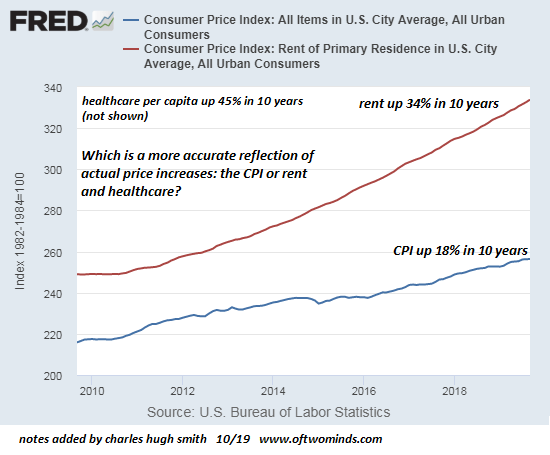
Meanwhile, we’re told inflation is less than 2% annually while rising costs have outpaced meager wage increases. What’s a more realistic measure of real-world inflation–the official Consumer Price Index (CPI) at 18% over ten years or rent and healthcare at 34% and 45%?

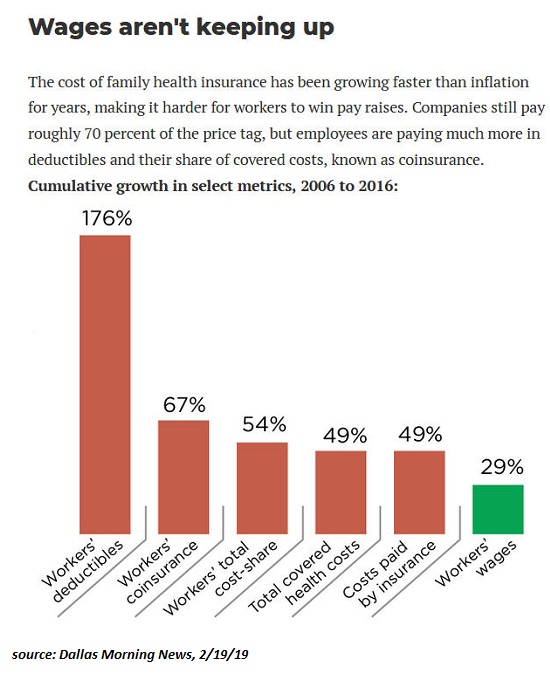
According to the Chapwood Index, real-world inflation in urban America is running 9% to 13% annually. This is more in line with reality than the bogus CPI, as evidenced by this chart of wages and healthcare costs:

Even if we don’t measure the erosion of intangible capital, the social and political consequences of this impoverishment are manifesting in all sorts of ways: large-scale social disorder is breaking out around the globe, and the political middle ground has completely vanished: no matter which way an issue is decided, one camp will refuse to accept the outcome.

The only way forward with any chance of success is to start by acknowledging the decay of our economy due to rampant financialization, legalized looting, the pathologies of “winner take most” speculation and the realities of a two-tiered system in which entrenched elites are “more equal” than the rest of us, economically, socially and politically. We have to accept the limits of technology to reverse the unraveling and assess the damage that’s already been done to our shared capital.

Acting as if the system is working just fine and the problem is perception/optics is accelerating the unraveling.