Dear America: If You Want to Stop Racism, Tear Down the Drug War—Not Statues

We cannot change the future by trying to erase the past. Tearing down a statue is not a solution to racism — ending the drug war is.

By Matt Agorist

Source: The Free Thought Project

On Monday, protesters — reacting to the violence in Charlottesville over the weekend — brought a ladder and some rope to North Carolina and tore down a near century old statue of a Confederate soldier. Unsurprisingly, nothing changed. However, the Durham Police Department and the Durham County Sheriff’s Office announced that they will be seeking criminal charges for those involved in the destruction of the statue.

Watching people wage violence against their fellow human in the name of protecting or tearing down some arbitrary government artifact is as disheartening as it is frustrating. The future cannot be changed by attempting to erase the past.

A statue holds no magical power to make people racists. If anything, the monuments to former racists serve as reminders that the state can and always will be open to the influence of bigotry — and only the state has the power to enforce racism.

An ignorant racist is exactly that — however, if society grants that ignorant racist a political position or a badge and a gun, this ignorant racist now has power over you. Removing or keeping a piece of concrete will never change this.

Jim Crow laws weren’t overturned because people went around town tearing down statues.

Racist government laws were brought to an end because people refused to obey them. Had Rosa Parks used her time and energy lobbying to take down a statue instead of disobeying a racist law, rest assured Browder v. Gayle, which ruled that segregated buses were unconstitutional, would’ve never happened.

Had the Civil Rights Movement in the 1950s not organized the Montgomery Bus Boycott, rest assured, desegregation would’ve taken much longer.

Society has the amazing ability to force positive change through nonviolent and nondestructive means. However, all too often, we let emotions rule our thoughts and take to yelling and fighting in the streets and destroying property. This only serves to create more divide and empower the ranks of the racists.

If we really want to put the brakes on a racist system, fighting with other citizens (even if they are devout racists) will never work.

Boycotts, refusal of service, shaming, exposing — these are the tools we as citizens have against other citizens who are spreading hate and racism.

One amazing private solution to racism actually just happened on Tuesday in Washington. Richard Spencer, the ostensible leader of the white supremacists, was forced to hold his press conference in his own house because businesses refused to allow him to rent their hotels. This campaign of public shaming and refusal of service is far more effective than tearing down a statue or attempting to use the government to ban hate speech.

But what do we do when the state is perpetuating a racist system and prolonging the suffering of minorities? Again, the answer to that question is not to tear down a statue, but to realize where the power of this racism rests.

In America, the area of government that is most responsible for maintaining a racist system, allowing racist actors to oppress their targets with impunity, and perpetuating the suffering and plight of millions through the persecution of morally innocent individuals — is the war on drugs.

Without a doubt, the war on drugs fuels the racist system by targeting minorities and the poor. It serves to increase interactions between police—who are often caught joining the force to act out their racist desires—and the citizens.

The drug war, from the police departments to the court systems, unequivocally targets and punishes minorities harder for the same victimless crimes for which their white counterparts receive slaps on the wrist.

As TFTP reported last year, a scathing report in Harper’s Magazine, written by Dan Baum set the record straight and relieved all doubt over the intentions of the drug war. John Daniel Ehrlichman, counsel and domestic policy chief to President Richard Nixon, came clean on the real reason behind the war on drugs — to criminalize blacks and hippies.

According to Baum, he tracked down Ehrlichman in 1994 at his engineering firm in Atlanta, Georgia.

“You want to know what this was really all about?” Ehrlichman bluntly asked Baum of the war on drugs. “The Nixon campaign in 1968, and the Nixon White House after that, had two enemies: the antiwar left and black people. You understand what I’m saying? We knew we couldn’t make it illegal to be either against the war or black, but by getting the public to associate the hippies with marijuana and blacks with heroin, and then criminalizing both heavily, we could disrupt those communities. We could arrest their leaders, raid their homes, break up their meetings, and vilify them night after night on the evening news. Did we know we were lying about the drugs? Of course we did.”

To this day, the racist intentions behind the war on drugs serve to further oppress black communities. The war on drugs is still creating criminals out of otherwise innocent individuals who’re caught in possession of arbitrary substances, removing their opportunity for employment by giving them criminal records, and guaranteeing a difficult future within the working class.

It is no coincidence that the ACLU refers to the drug war as the new Jim Crow.

As Graham Boyd wrote in 2001, in a report in NACLA:

The war on drugs subjects the United States to much of the same harm, with much of the same economic and ideological underpinnings, as slavery itself. Just as Jim Crow responded to emancipation by rolling back many of the newly gained rights of African-Americans, the drug war is again replicating the institutions and repressions of the plantation. And like slavery and Jim Crow, the drug war garners appalling levels of support. Each has its own rhetoric, each its own claims to unassailable legitimacy. The brutality of slavery was justified on economic and paternalistic grounds. Jim Crow pretended that separate but equal treatment sufficed, even as blacks faced daily lynchings and every form of overt discrimination. The drug war claims morality and protection of children as its goals, while turning a blind eye to the racial injustice it promotes. And with all three systems of oppression, much of society sits idly by, accepting the rhetoric that later will seem so unbelievably corrupt. We will one day understand that the war on drugs was a war on people and communities.

If we really want to deal a blow to this racist system we must strike the root. The drug war is one such root. Until we eliminate the cause of this strife, tearing down all the statues in the world will do nothing. Until we realize that we are financing our own oppression and refuse to support the government programs that keep us in the days of Jim Crow, the tyranny will remain.

It is high time we realize this real solution to this real problem before the entire country is so divided that we enter a new American civil war.

Rest in Peace and Rise in Power Dick Gregory

As many of you may have heard over the weekend, pioneering comedian and activist Dick Gregory died of heart failure on August 19th at age 84. For those not familiar to him, it’s difficult to encapsulate the scope of his work, but the following excellent synopsis is provided from his own website, Global Watch:

Gregory, Richard Claxton “Dick” (Born, October 12, 1932, St. Louis, Mo.), African American comedian and civil rights activist whose social satire changed the way white Americans perceived African American comedians since he first performed in public.

Dick Gregory entered the national comedy scene in 1961 when Chicago’s Playboy Club (as a direct request from publisher Hugh Hefner) booked him as a replacement for white comedian, “Professor” Irwin Corey. Until then Gregory had worked mostly at small clubs with predominantly black audiences (he met his wife, Lillian Smith, at one such club). Such clubs paid comedians an average of five dollars per night; thus Gregory also held a day job as a postal employee. His tenure as a replacement for Corey was so successful — at one performance he won over an audience that included southern white convention goers — that the Playboy Club offered him a contract extension from several weeks to three years. By 1962 Gregory had become a nationally known headline performer, selling out nightclubs, making numerous national television appearances, and recording popular comedy albums.

It’s important to note that no biography of Gregory would be complete without mentioning that he and his beloved wife, Lil, had ten kids who have become highly respected members of the national community in a variety of fields. They are: Michele, Lynne, Pamela, Paula, Stephanie (aka Xenobia), Gregory, Christian, Miss, Ayanna and Yohance. The Gregory’s had one child who died at birth but they have shared 49 years of historic moments, selfless dedication and tremendous personal love.

Gregory began performing comedy in the mid-1950s while serving in the army.
(See Black sin the Military). Drafted in 1954 while attending Southern Illinois University at Carbondale on a track scholarship, Gregory briefly returned to the university after his discharge in 1956, but left without a degree because he felt that the university “didn’t want me to study, they wanted me to run.” In the hopes of performing comedy professionally, he moved to Chicago, where he became part of a new generation of black comedians that included Nipsey Russell, Bill Cosby, and Godfrey Cambridge. These comedians broke with the minstrel tradition, which presented stereotypical black characters. Gregory, whose style was detached, ironic, and satirical, came to be called the “Black Mort Sahl” after the popular white social satirist. Friends of Gregory have always referred to Mort Sahl as the “White Dick Gregory.” Gregory drew on current events, especially the racial issues, for much of his material: “Segregation is not all bad. Have you ever heard of a collision where the people in the back of the bus got hurt?”

From an early age, Gregory demonstrated a strong sense of social justice. While a student at Sumner High School in St. Louis he led a March protesting Segregated schools. Later, inspired by the work of leaders such as Dr. Martin Luther King Jr., and organizations such as the Student Nonviolent Coordinating Committee (SNCC), Gregory took part in the Civil Rights Movement and used his celebrity status to draw attention to such issues as segregation and disfranchisement. When local Mississippi governments stopped distributing Federal food surpluses to poor blacks in areas where SNCC was encouraging voter registration, Gregory chartered a plane to bring in several tons of food. He participated in SNCC’s voter registration drives and in sit-ins to protest segregation, most notably at a restaurant franchise in downtown Atlanta, Georgia. Only later did Gregory disclose that he held stock in the chain.

Gregory’s autobiography, Nigger, was published in 1963 prior to The assassination of President Kennedy, and became the number one best-selling book in America. Over the decades it has sold in excess of seven million copies. His choice for the title was explained in the forward, where Dick Gregory wrote a note to his mother. “Whenever you hear the word ‘Nigger’,” he said, “you’ll know their advertising my book.”

Through the 1960s, Gregory spent more time on social issues and less time on performing. He participated in marches and parades to support a range of causes, including opposition to the Vietnam War, world hunger, and drug abuse. In addition, Gregory fasted in protest more than 60 times, once in Iran, where he fasted and prayed in an effort to urge the Ayatollah Khomeini to release American embassy staff who had been taken hostage. The Iranian refusal to release the hostages did not decrease the depth of Gregory’s commitment; he weighed only 97 lbs when he left Iran.

Gregory demonstrated his commitment to confronting the entrenched political powers by opposing Richard J. Daley in Chicago’s 1966 mayoral election. He ran for president in 1968 as a write-in candidate for the Freedom and Peace Party, a splinter group of the Peace and Freedom Party and received 1.5 million votes. Democratic candidate Hubert Humphrey lost the election to Republican Richard Nixon by 510,000 votes, and many believe Humphrey would have won had Gregory not run. After the assassinations of King, President John F. Kennedy, and Robert Kennedy, Gregory became increasingly convinced of the existence of political conspiracies. Gregory wrote books such as Code Name Zorro: The Murder of Martin Luther King Jr. (1971) with Mark Lane, world famous author, attorney and documentary filmmaker, whose findings published in the best-selling 1966 book Rush To Judgment Gregory credited with reversing the nation’s opinion on who assassinated the president and the facts which contradicted the official government version contained in the Warren Report. Lane’s book contained answers and facts, which Gregory has espoused in Numerous lectures from then until now. Lane and Gregory have been best friends, co-authors and have lectured together for over 40 years and both livein Washington D.C. Gregory and Lane’s book on the assassination of Dr. King was recently released under another title, Murder In Memphis, as a trade paperback.

Gregory’s activism continued into the 1990s. In response to published allegations that the Central Intelligence Agency (CIA) had supplied cocaine to predominantly African American areas in Los Angeles, thus spurring the crack epidemic, Gregory protested at CIA headquarters and was arrested. In 1992 he began a program called Campaign for Human Dignity to fight crime in St. Louis neighborhoods.

In 1973, the year he released his comedy album Caught in the Act, Gregory moved with his family to Plymouth, Massachusetts, where he developed an interest in vegetarianism and became a nutritional consultant. In 1984 he founded Health Enterprises, Inc., a company that distributed weight loss products. In 1987 Gregory introduced the Slim-Safe Bahamian Diet, a powdered diet mix, which was immensely profitable. Economic losses caused in part by conflicts with his business partners led to his eviction from his home in 1992. Gregory remained active, however, and in 1996 returned to the stage in his critically acclaimed one-man show, Dick Gregory Live! The reviews of Gregory’s show compared him to the greatest stand-ups in the history of Broadway.

In 1998 Gregory spoke at the celebration of the birthday of Dr. Martin Luther King, Jr. and President Clinton were in attendance. Not long after that, the President told Gregory’s long-time friend and PR. Consultant, Steve Jaffe, “I love Dick Gregory, he is one of the funniest people on the planet.” They spoke of how Gregory had made a comment on Dr. King’s birthday that broke everyone into laughter, when he noted that the President made Speaker Newt Gingrich ride “in the back of the plane,” on an Air Force One trip overseas. In 2001, Gregory announced to the world that he had been diagnosed with a rare form of Cancer. He refused traditional medical treatment – chemotherapy –and with the assistance of some of the finest minds in alternative medicine, put together a regimen of a variety of diet, vitamins, exercise, and modern devices not even known to the public, which ultimately resulted in his reversing the trend of the Cancer to the point where today he is 100% Cancer free.

Gregory’s going public with his diagnosis has helped millions of his fans around the world to understand what Cancer specialists have been trying to explain for decades, which is that “Cancer is curable.” Gregory was honored recently at the Kennedy Center in Washington D.C., by a sold out house and a tribute hosted by Bill Cosby, with special tributes by Mrs. Martin Luther King Jr., Stevie Wonder, Isaac Hayes, Cicely Tyson, Mark Lane, Marion Barry and many more.

His most recent book, Callus On My Soul, (Longstreet Press, Atlanta, Ga.) which became a best-seller within weeks of publication, is an autobiography that updates his earlier autobiography (Nigger), because as Dick says, “I’ve lived long enough to need two autobiographies which is fine with me. I’m looking forward to writing the third and fourth volumes as well.”

In 2001, Gregory escaped death once again when a massive tree fell on his car in a storm in Washington D.C. crushing it completely, causing him to have to be extricated from the car by emergency crews. One witness said, “I knew the driver and his passengers had died when I saw the tree fall.” Gregory said, “I knew that God had more work for me to do when I saw the tree falling. ” He saved his own life by driving into the oncoming lanes of traffic. The word of the accident circulated the globe immediately in the media, underscoring the power, influence, and support that Gregory has earned from people of all nations.

Doctor’s at George Washington Hospital refused to release Gregory for a few days causing his first-ever “State of the Union Address” to African Americans to be delayed by a month. Gregory gave the first “State of The Union” address live on the Internet from Los Angeles on April 21st.


The Unifying Force of War Abolition

By David Swanson

Source: Let’s Try Democracy

Remarks at United National Antiwar Coalition in Richmond, Virginia, on June 18, 2017.

It’s not unusual for an activist, focused on one of the millions of worthy causes out there, to try to recruit other activists to that particular cause. That’s not exactly what I want to do. For one thing, if we are going to succeed we are going to have to recruit millions of new people into activism who are not now active at all.

Of course I do favor types of activism that eliminate the need for more activism, such as campaigns to make voter registration automatic or to index the minimum wage to the cost of living. But for the most part I want everyone to keep doing what inspires them. Only, I think I know a way to shift our emphases and unite out movements, a way that doesn’t usually occur to us.

It’s not unusual for an activist to think that their particular field is the unifying top priority.

For example:

If we don’t get the money out of politics how can we enact or enforce any laws not favored by money? We’ve legalized bribery for godsake! What else matters until we fix that?

Or:

If we don’t create credible democratic independent media, we can’t communicate. Door knocking can’t defeat television. We only know that Cindy Sheehan went to Crawford or Occupyers went to Wall Street because corporate television chose to tell us. Why have elections if we can’t tell the truth about the candidates?

Or:

Excuse me, the earth is cooking. Our species and many others are losing their habitats. If it’s not already too late, now is the time to decide whether we will have great grandchildren at all. If we don’t have any, what will it matter what kind of elections or television networks they have?

One can go on and on in this vein, as well as in claiming that one societal evil precedes and causes another. Racism or militarism or extreme materialism is the disease and the others are the symptoms.

All of this is also not exactly what I want to do. I want us to work on everything and use every means of unifying. I want us to recognize how each problem contributes to others and vice versa. Hungry scared people can’t end climate change. A culture that puts a trillion dollars a year into mass-killing of distant dark-skinned people can’t build schools or end racism. Unless we redistribute wealth, we cannot redistribute power. We can’t create media unless we have something important to say. We can’t protect the earth’s climate while steadfastly ignoring the top consumer of petroleum on earth because criticizing the military would be inappropriate. But we will go on ignoring it if we don’t create good media. We have to do it all, and there are various ways in which we can become more united, more strategic, and potentially more effective.

The way that I think we don’t pay enough attention to lies in developing a focus on complete and total war abolition, elimination of all weapons and militaries, all bases, all aircraft carriers, missiles, armed drones, generals, colonels, and if necessary all senators from Arizona.

Why war abolition? I’ll give you 10 reasons.

  1. It actually makes sense. The reasonable position of opposing some wars and cheering for others, but cheering for the troops even in the bad wars doesn’t attract a lot of energy because it doesn’t make any sense. Jeremy Corbyn just won votes by pointing out that wars generate terrorism, they are counter-productive on their own terms, endangering us rather than protecting us. They need to be replaced with diplomacy, aid, cooperation, the rule of law, the tools of nonviolence, the skills of de-escalation of conflict. Claiming that wars are sort of good but shouldn’t be overdone makes no sense at all — what is the point of them if not to win them? And if wars make murder OK, why is torture so unacceptable? And if bombs dropped by piloted planes are OK, what’s wrong with drones? And if Anthrax is barbaric, why are White Phosphrous and Napalm civilized? None of it makes any sense, which is one reason the top killer of U.S. troops is suicide. You know how to properly love the troops, end all war and give them life options that don’t make them want to kill themselves.
  2. Nuclear apocalypse is a growing danger on a par with climate chaos and will continue to grow unless war abolition succeeds.
  3. The biggest destroyer of water, air, land, and atmosphere that we have is militarism. It’s war or planet. Time to choose.
  4. War kills first and foremost by removing resources from where they are needed, including from famines and disease epidemics created by war. Any activism that seeks funding for any human or environmental needs has to look to ending war. It is where all the money is, more money every single year than could be taken once and only once from the billionaires.
  5. War creates secrecy, surveillance, classification of public business, warrantless spying on activists, patriotic lying, and illegal actions by secret agencies.
  6. War militarizes local police, making the public into an enemy.
  7. War fuels, just as it is fueled by, racism, sexism, bigotry, hatred, and domestic violence. It teaches people to solve problems by shooting guns.
  8. War divides humanity at a time when we must unite on major projects if we are to survive or prosper.
  9. A movement to abolish all war, all weapons, and all atrocities that flow out of war can unite opponents of the crimes of one government or group with the opponents of the crimes of another. Without equating all crimes with each other, we can unite as opponents of war rather than of each other.
  10. War is the primary thing our society does, it sucks down the majority of federal discretionary spending, its promotion permeates our culture. It is the very foundation of the belief that ends can justify evil means. Taking on the myths that sell us war as necessary or inevitable or glorious is an ideal way of opening our minds to rethinking what we’re doing on this little planet.

So let’s not work for an environmentally sensitive military into which women have the equal right to be drafted against their will. Let’s not oppose the weapons that are wasteful or don’t kill well enough. Let’s build a broad multi-issue movement in which one of the unifying factors is the cause of eliminating in its entirety the institution of organized mass murder.

The Price of Resistance

Statues at the Museum of Myths and Traditions. (León)

By Chris Hedges

Source: OpEdNews.com

In the conflicts I covered as a reporter in Latin America, Africa, the Middle East and the Balkans, I encountered singular individuals of varying creeds, religions, races and nationalities who majestically rose up to defy the oppressor on behalf of the oppressed. Some of them are dead. Some of them are forgotten. Most of them are unknown.

These individuals, despite their vast cultural differences, had common traits–a profound commitment to the truth, incorruptibility, courage, a distrust of power, a hatred of violence and a deep empathy that was extended to people who were different from them, even to people defined by the dominant culture as the enemy. They are the most remarkable men and women I met in my 20 years as a foreign correspondent. And to this day I set my life by the standards they set.

You have heard of some, such as Vaclav Havel, whom I and other foreign reporters met most evenings, during the 1989 Velvet Revolution in Czechoslovakia, in the Magic Lantern Theatre in Prague. Others, no less great, you probably do not know, such as the Jesuit priest Ignacio Ellacuria, who was assassinated in El Salvador in 1989. And then there are those “ordinary” people, although, as the writer V.S. Pritchett said, no people are ordinary, who risked their lives in wartime to shelter and protect those of an opposing religion or ethnicity being persecuted and hunted. And to some of these “ordinary” people I owe my own life.

To resist radical evil is to endure a life that by the standards of the wider society is a failure. It is to defy injustice at the cost of your career, your reputation, your financial solvency and at times your life. It is to be a lifelong heretic. And, perhaps this is the most important point, it is to accept that the dominant culture, even the liberal elites, will push you to the margins and attempt to discredit not only what you do, but your character. When I returned to the newsroom at The New York Times after being booed off a commencement stage in 2003 for denouncing the invasion of Iraq and being publicly reprimanded by the paper for my stance against the war, reporters and editors I had known and worked with for 15 years lowered their heads or turned away when I was nearby. They did not want to be contaminated by the same career-killing contagion.

Ruling institutions–the state, the press, the church, the courts, academia–mouth the language of morality, but they serve the structures of power, no matter how venal, which provide them with money, status and authority. In times of national distress–one has only to look at Nazi Germany–all of these institutions, including the academy, are complicit through their silence or their active collaboration with radical evil. And our own institutions, which have surrendered to corporate power and the utopian ideology of neoliberalism, are no different. The lonely individuals who defy tyrannical power within these institutions, as we saw with the thousands of academics who were fired from their jobs and blacklisted during the McCarthy era, are purged and turned into pariahs.

All institutions, including the church, Paul Tillich once wrote, are inherently demonic. And a life dedicated to resistance has to accept that a relationship with any institution is often temporary, because sooner or later that institution is going to demand acts of silence or obedience your conscience will not allow you to make. To be a rebel is to reject what it means to succeed in a capitalist, consumer culture, especially the idea that we should always come first.

The theologian James H. Cone in his book “The Cross and the Lynching Tree” writes that for oppressed blacks the cross was a “paradoxical religious symbol because it inverts the world’s value system with the news that hope comes by way of defeat, that suffering and death do not have the last word, that the last shall be first and the first last.”

Cone continues: “That God could ‘make a way out of no way’ in Jesus’ cross was truly absurd to the intellect, yet profoundly real in the souls of black folk. Enslaved blacks who first heard the gospel message seized on the power of the cross. Christ crucified manifested God’s loving and liberating presence in the contradictions of black life–that transcendent presence in the lives of black Christians that empowered them to believe that ultimately, in God’s eschatological future, they would not be defeated by the ‘troubles of this world,’ no matter how great and painful their suffering. Believing this paradox, this absurd claim of faith, was only possible in humility and repentance. There was no place for the proud and the mighty, for people who think that God called them to rule over others. The cross was God’s critique of power–white power–with powerless love, snatching victory out of defeat.”

Reinhold Niebuhr labeled this capacity to defy the forces of repression “a sublime madness in the soul.” Niebuhr wrote that “nothing but madness will do battle with malignant power and ‘spiritual wickedness in high places.’ ” This sublime madness, as Niebuhr understood, is dangerous, but it is vital. Without it, “truth is obscured.” And Niebuhr also knew that traditional liberalism was a useless force in moments of extremity. Liberalism, Niebuhr said, “lacks the spirit of enthusiasm, not to say fanaticism, which is so necessary to move the world out of its beaten tracks. It is too intellectual and too little emotional to be an efficient force in history.”

The prophets in the Hebrew Bible had this sublime madness. The words of the Hebrew prophets, as Abraham Heschel wrote, were “a scream in the night. While the world is at ease and asleep, the prophet feels the blast from heaven.” The prophet, because he saw and faced an unpleasant reality, was, as Heschel wrote, “compelled to proclaim the very opposite of what his heart expected.”

This sublime madness is the essential quality for a life of resistance. It is the acceptance that when you stand with the oppressed you get treated like the oppressed. It is the acceptance that, although empirically all that we struggled to achieve during our lifetime may be worse, our struggle validates itself.

Daniel Berrigan told me that faith is the belief that the good draws to it the good. The Buddhists call this karma. But he said for us as Christians we did not know where it went. We trusted that it went somewhere. But we did not know where. We are called to do the good, or at least the good so far as we can determinate it, and then let it go.

As Hannah Arendt wrote in “The Origins of Totalitarianism,” the only morally reliable people are not those who say “this is wrong” or “this should not be done,” but those who say “I can’t.” They know that as Immanuel Kant wrote: “If justice perishes, human life on earth has lost its meaning.” And this means that, like Socrates, we must come to a place where it is better to suffer wrong than to do wrong. We must at once see and act, and given what it means to see, this will require the surmounting of despair, not by reason, but by faith.

I saw in the conflicts I covered the power of this faith, which lies outside any religious or philosophical creed. This faith is what Havel called in his great essay “The Power of the Powerless” living in truth. Living in truth exposes the corruption, lies and deceit of the state. It is a refusal to be a part of the charade.

“You do not become a ‘dissident’ just because you decide one day to take up this most unusual career,” Havel wrote. “You are thrown into it by your personal sense of responsibility, combined with a complex set of external circumstances. You are cast out of the existing structures and placed in a position of conflict with them. It begins as an attempt to do your work well, and ends with being branded an enemy of society. … The dissident does not operate in the realm of genuine power at all. He is not seeking power. He has no desire for office and does not gather votes. He does not attempt to charm the public. He offers nothing and promises nothing. He can offer, if anything, only his own skin–and he offers it solely because he has no other way of affirming the truth he stands for. His actions simply articulate his dignity as a citizen, regardless of the cost.”

The long, long road of sacrifice and suffering that led to the collapse of the communist regimes stretched back decades. Those who made change possible were those who had discarded all notions of the practical. They did not try to reform the Communist Party. They did not attempt to work within the system. They did not even know what, if anything, their tiny protests, ignored by the state-controlled media, would accomplish. But through it all they held fast to moral imperatives. They did so because these values were right and just. They expected no reward for their virtue; indeed they got none. They were marginalized and persecuted. And yet these poets, playwrights, actors, singers and writers finally triumphed over state and military power. They drew the good to the good. They triumphed because, however cowed and broken the masses around them appeared, their message of defiance did not go unheard. It did not go unseen. The steady drumbeat of rebellion constantly exposed the dead hand of authority and the rot of the state.

I stood with hundreds of thousands of rebellious Czechoslovakians in 1989 on a cold winter night in Prague’s Wenceslas Square as the singer Marta Kubisova approached the balcony of the Melantrich building. Kubisova had been banished from the airwaves in 1968 after the Soviet invasion for her anthem of defiance “Prayer for Marta.” Her entire catalog, including more than 200 singles, had been confiscated and destroyed by the state. She had disappeared from public view. Her voice that night suddenly flooded the square. Pressing around me were throngs of students, most of whom had not been born when she vanished. They began to sing the words of the anthem. There were tears running down their faces. It was then that I understood the power of rebellion. It was then that I knew that no act of rebellion, however futile it appears in the moment, is wasted. It was then that I knew that the communist regime was finished.

“The people will once again decide their own fate,” the crowd sang in unison with Kubisova. [Editor’s note: To see YouTube photographs of the 1989 revolution and hear Kubisova sing the song in a studio recording, click here.]

The walls of Prague were covered that chilly winter with posters depicting Jan Palach. Palach, a university student, set himself on fire in Wenceslas Square on Jan. 16, 1969, in the middle of the day to protest the crushing of the country’s democracy movement. He died of his burns three days later. The state swiftly attempted to erase his act from national memory. There was no mention of it on state media. A funeral march by university students was broken up by police. Palach’s gravesite, which became a shrine, saw the communist authorities exhume his body, cremate his remains and ship them to his mother with the provision that his ashes could not be placed in a cemetery. But it did not work. His defiance remained a rallying cry. His sacrifice spurred the students in the winter of 1989 to act. Prague’s Red Army Square, shortly after I left for Bucharest to cover the uprising in Romania, was renamed Palach Square. Ten thousand people went to the dedication.

We, like those who opposed the long night of communism, no longer have any mechanisms within the formal structures of power that will protect or advance our rights. We too have undergone a coup d’e’tat carried out not by the stone-faced leaders of a monolithic Communist Party but by the corporate state.

We may feel, in the face of the ruthless corporate destruction of our nation, our culture and our ecosystem, powerless and weak. But we are not. We have a power that terrifies the corporate state. Any act of rebellion, no matter how few people show up or how heavily it is censored, chips away at corporate power. Any act of rebellion keeps alive the embers for larger movements that follow us. It passes on another narrative. It will, as the state consumes itself, attract wider and wider numbers. Perhaps this will not happen in our lifetimes. But if we persist, we will keep this possibility alive. If we do not, it will die.

Dr. Rieux in Albert Camus’ novel “The Plague” is not driven by ideology. He is driven by empathy, the duty to minister to suffering, no matter the cost. Empathy, or what the Russian novelist Vasily Grossman called “simple human kindness,” becomes in all despotisms a subversive act. To act on this empathy–the empathy for human beings locked in cages less than an hour from us [here in Princeton], the empathy for undocumented mothers and fathers being torn from their children on the streets of our cities, the empathy for Muslims who are demonized and banned from our shores, fleeing the wars we created, the empathy for poor people of color gunned down by police in our streets, the empathy for girls and women trafficked into prostitution, the empathy for all those who suffer at the hands of a state intent on militarization and imposing a harsh cruelty on the vulnerable, the empathy for the earth that gives us life and that is being contaminated and pillaged for profit–becomes political and even dangerous.

Evil is real. But so is love. And in war–especially when the heavy shells landed on crowds in Sarajevo, sights so gruesome that to this day I cannot eat a piece of meat–you could feel, as frantic family members desperately sought out loved ones among the wounded and dead, the concentric circles of death and love, death and love, like rings from the blast of a cosmic furnace.

Flannery O’Connor recognized that a life of faith is a life of confrontation: “St. Cyril of Jerusalem, in instructing catechumens, wrote: ‘The dragon sits by the side of the road, watching those who pass. Beware lest he devour you. We go to the Father of Souls, but it is necessary to pass by the dragon.’ No matter what form the dragon may take, it is of this mysterious passage past him, or into his jaws, that stories of any depth will always be concerned to tell, and this being the case, it requires considerable courage at any time, in any country, not to turn away from the storyteller.”

Accept sorrow–for who cannot be profoundly sorrowful at the state of our nation, the world and our ecosystem–but know that in resistance there is a balm that leads to wisdom and, if not joy, a strange, transcendent happiness. Know that if we resist we keep hope alive.

“My faith has been tempered in Hell,” wrote Vasily Grossman in his masterpiece “Life and Fate.” “My faith has emerged from the flames of the crematoria, from the concrete of the gas chamber. I have seen that it is not man who is impotent in the struggle against evil, but the power of evil that is impotent in the struggle against man. The powerlessness of kindness, of senseless kindness, is the secret of its immortality. It can never be conquered. The more stupid, the more senseless, the more helpless it may seem, the vaster it is. Evil is impotent before it. The prophets, religious leaders, reformers, social and political leaders are impotent before it. This dumb, blind love is man’s meaning. Human history is not the battle of good struggling to overcome evil. It is a battle fought by a great evil struggling to crush a small kernel of human kindness. But if what is human in human beings has not been destroyed even now, then evil will never conquer.”

Isms, Schisms and Post-Political Correctness

img_2330

By rahkyt

Source: MAR

I grew up in the 70s and came of age in the 80s. Pre-political correctness. Which means I’ve never been interested in glossing over what people really think with some false veneer of civility that obscures more than it reveals.

In my experience, that is dangerous.

I’ve experienced extreme forms of racism in my life. Have been called nigger countless times. Have been in physical fights in neighborhoods and on playgrounds. Heckled racially by entire classrooms in Oklahoma and Illinois in the 70s. Was on a diverse basketball team coming from a diverse, military school district and among the first live black people entire towns had ever seen in Washington State in HS. In the 80s.

I’ve been the first black American in university departments of Geography; subjected to drive-by racism, debates and arguments in the 90s during the fabled Flame Wars.  As a result of these experiences,  I’ve had to fight ignorance on the streets, in the classroom, boardroom and the academy, and I ain’t trying to pretend this world ain’t what it is in no way, shape or form.

I’d much rather someone hate to my face. Honestly.
Glaring at me through machines while working at an automobile factory, shooting at me with their index finger while racing me on a highway through Houston, giving me and my sometimes white girlfriends the evil eye in different cities and states in this beautiful, dangerous country of ours.

Don’t get me wrong.

All these folks were and are not just conservatives. There are liberal racists too, who prefer the “color-blindness” of white privilege and who couch their distaste in socioeconomic and cultural terms. Who hate rap and certain kinds of dances and call them degradations of culture and music, who hold stereotypes about and bemoan the situation of the inner-cities while proselytizing the prison-industrial complex and the welfare-state because “blacks and browns and reds can’t take care of themselves” and need a paternal, Eurocentric social system to take care of them.

There are many other examples of how ideological liberalism and conservatism are two sides of the same supremacy coin. The difference between them is in the intention. The intention to exclude or include.

Political correctness as an exercise in potentiality was high-minded in intention, low-brow in execution, demanding compliance and cooptation of individual experience and knowledge. While it’s aspirations toward a higher and more inclusive society during the era of the culture wars were laudable, the resentment and ignorance its cultural deployment bred are well in evidence now. It further exacerbated the divide between moderate whites, which has affected blacks and browns and reds in predictable ways.

Big “T” Truth always trumps little “t” truth.

Societal truths are subordinate to universal Truths. One such relevant comparison is the reality of the human race versus the perception of multiple races. Words are power. Rhetoric has created the reality we live in right now, where people believe in a black race, a white race, a yellow race. Where people generalize and stigmatize groups in order to maintain their political and economic supremacy.

This is a human problem, one of segregation rather than holism. A problem that cannot be “fixed” at the level of rhetoric. A problem that can be alleviated only through experiential learning. When dealing with the subconscious structures of societal and cultural indoctrination, surface attempts at changing the way that people act, talk and think can only be successful if people are open to learning in the first place. Religious and social stigmas based upon the inherent polarity of black versus white, good versus evil, affect too many at a level they are not aware of, which bounds thought, words and actions, constricting potentiality only to the limited known universe of responses.

So political correctness as a “soft” public policy was doomed from the start. Because people keep it real even when they don’t. Tone and silence speak as loudly as words. Body language, expressions and eyes reveal deeper communications.

We should rejoice in this new, collective choice to say what we mean and mean what we say. It makes things clearer and simpler. People no longer have to attempt to decode key words and dog whistle phrases. And ignorance can be confronted directly at its illogical roots.

Cognitive dissonance is an effective force for change and seeding the consciousness fields of our virtual and immediate physical environments should be the goal of our communication strategies. Telling and showing the truth, sharing it wIth those on the cusp of knowing, who will share it with their networks, remains a valid modality for effective engagement.

The Truth holds power.

It overcomes lies by virtual of its resonant and cohesive essence and compliance with logic and nature law. Resting in the Truth makes political correctness unnecessary. We should not bemoan the end of a false narrative that hid more than it revealed.

Claiming Truth is claiming the power of your convictions and this power is what Is rising now within multitudes intent upon continuing this Great Experiment and perfecting this union no matter what it takes.

Each word you write, each article and video you share is another volley in service of a diverse and inclusive America and world. Don’t back down, don’t give up and continue to shift hearts and minds. Every, single soul counts. Your loved ones, your family and friends are your responsibility.

We are indeed our sisters’ and brothers’ keepers. Because, in the end, we are all One. And what we think, say and do affects others far beyond our most fantastic speculations.

Disposable Americans: The Numbers are Growing

middle-class

By Paul Buchheit

Source: Information Clearing House

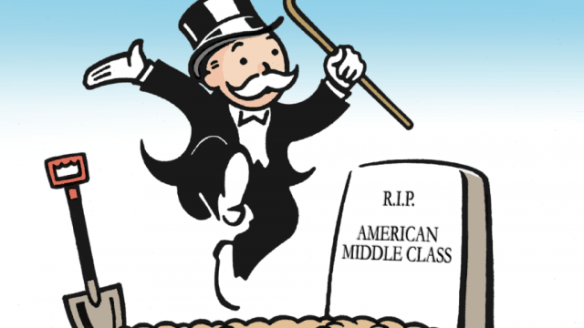
As often noted in the passionate writings of Henry Giroux, poor Americans are becoming increasingly ‘disposable’ in our winner-take-all society. After 35 years of wealth distribution to the super-rich, inequality has forced much of the middle class towards the bottom, to near-poverty levels, and to a state of helplessness in which they find themselves being blamed for their own misfortunes.

The evidence keeps accumulating: income and wealth — and health — are declining for middle-class America. As wealth at the top grows, the super-rich feel they have little need for the rest of society.

Income Plummets for the Middle Class

According to Pew Research, in 1970 three of every ten income dollars went to upper-income households. Now five of every ten dollars goes to them.

The Social Security Administration reports that over half of Americans make less than $30,000 per year. That’s less than an appropriate average living wage of $16.87 per hour, as calculated by Alliance for a Just Society.

Wealth Collapses for Half of Us

Numerous sources report that half or more of American families have virtually no savings, and would have to borrow money or sell possessions to cover an emergency expense. Between half and two-thirds of Americans have less than $1,000.

For every $100 owned by a middle-class household in 2001, that household now has just $72.

Not surprisingly, race plays a role in the diminishing of middle America. According to Pew Research, the typical black family has only enough liquid savings to last five days, compared to 12 days for the typical Hispanic household, and 30 days for a white household.

Our Deteriorating Health

In a disgraceful display of high-level disregard for vital health issues, House Republicans are attempting to cut back on lunches for over 3 million kids.

The evidence for the health-related disposability of poor Americans comes from a new study that finds nearly a 15 year difference in life expectancy for 40-year-olds among the richest 1% and poorest 1% (10 years for women). Much of the disparity has arisen in just the past 15 years.

It’s not hard to understand the dramatic decline in life expectancy, as numerous studies have documented the health problems resulting from the inequality-driven levels of stress and worry and anger that make Americans much less optimistic about the future. The growing disparities mean that our children will likely see less opportunities for their own futures.

It May Be Getting Worse

The sense derived from all this is that half of America is severely financially burdened, at risk of falling deeper into debt.

It may be more than half. The Wall Street Journal recently reported on a JP Morgan study’s conclusion that “the bottom 80% of households by income lack sufficient savings to cover the type of volatility observed in income and spending.” Fewer than one in three 25- to 34-year-olds live in their own homes, a 20 percent drop in just the past 15 years.

It may be even worse for renters. The number of families spending more than half their incomes on rent — the ‘severely’ cost-burdened renters — has increased by a stunning 50 percent in just ten years. Billionaire Steve Schwarzman, whose company Blackstone has been buying up tens of thousands of homes at rock-bottom prices and then renting them back while waiting out the housing market, finds the growing anger among voters “astonishing.”

What’s astonishing is the disregard that many of the super-rich have for struggling Americans.


Paul Buchheit is a college teacher, an active member of US Uncut Chicago, founder and developer of social justice and educational websites (UsAgainstGreed.org, PayUpNow.org, RappingHistory.org), and the editor and main author of “American Wars: Illusions and Realities” (Clarity Press). He can be reached at paul@UsAgainstGreed.org.

Neoliberalism: Serving the Interests of the International Business Elitists

41rnwuTZinL._SX332_BO1204203200_-201x300

By Edward S. Herman

Source: Dissident Voice

Mark Weisbrot, a co-director with Dean Baker of the Center for Economic and Policy Research (CEPR), has written an enlightening book that pulls together many of the analyses that CEPR has been producing over the past several decades. The book, Failed: What the “Experts” Got Wrong about the Global Economy, is important and useful because it provides an alternative framework of analysis to the one used by establishment experts, media and policy-makers. What is more, this alternative framework and description of reality is well supported by empirical evidence and is convincing. It is marginalized in the mainstream because it runs counter to the interests of the powerful, who over the past three decades, have successfully pushed for a neoliberal world order that scales back the earlier welfare state advances and pursues trickle-down economics and the well-being of the affluent.

In fact, an important feature of Weisbrot’s analysis is his recognition of the extent to which policy failures have flowed from biased analyses that serve a small elite and punish the majority, and that policy successes have often followed the loss of power by those serving elite interests. His first chapter is entitled “Troubles in Euroland: When the Cures Worsen the Disease,” whose central theme is that the long crisis and malperformance of Europe’s economies, and especially the weaker ones of Greece, Portugal, Spain and to a lesser extent, Italy, were in large measure the result of poor policy choices. The crisis, which dates back to 2008, was not due to high sovereign debt, which was only threateningly high in Greece, but rather the refusal of the policy-making “troika,” the European Central Bank (ECB), European Community and IMF, to carry out expansionary policies that would allow the poor countries to grow out of their deficit position.

The Fed met the U.S. crisis with an easy money program which, when combined with modest fiscal expansion efforts, quickly mitigated this crisis (although the fiscal actions fell short of what was needed for a full recovery). But the ECB refused to carry out a comparable expansion policy, and there was no Europe-wide fiscal program in the EU system. So the poor countries were forced to depend for recovery on an “internal devaluation” of cutbacks in mainly social budgets, given that external devaluations for individual countries were ruled out by the use of a common currency, the euro. This didn’t do the job, so the eurozone remained in a depressed state, even up to the present.

Weisbrot shows that this policy failure was deliberate, with the troika leaders–mainly the ECB–taking advantage of the weaker countries’ vulnerability to force on them structural and policy changes that served the interests of the international business elite. These changes, including cutbacks on public outlays for education, health care, social security, and poverty alleviation, mainly harmed ordinary citizens. So did the enforced pro-cyclical monetary and fiscal policies themselves, which produced a eurozone crisis of unemployment and foregone output that extended for six years and is still ongoing. Weisbrot points out that this policy and process was a notable application of Naomi Klein’s “shock doctrine,” according to which elites take advantage of painful developments (here macro-distress) to force policy changes that could not be obtained through a democratic process like a national political vote of approval. Weisbrot shows that the troika leaders were quite conscious of the fact that they were pursuing “reforms” that the public wouldn’t support outside of shock conditions.

This process rested on the undemocratic structure of macro-policy-making in the European community. One of neoliberalism’s instruments is an “independent” central bank, where independent means not subject to democratic control. The ECB meets that standard well, more so than the Fed; and in its statute the ECB is only required to meet a price stability objective, so it is free to ignore unemployment and even deliberately increase it. Neoliberal practice is also encouraged by the 1992 Maastricht Treaty, which placed ceilings on the size of budget deficits and total public debt (3 and 60 percent respectively). These unnecessary ceilings are often breached, but provide levers to put pressure on weaker countries.

The countries victimized by the ECB’s pressure for painful internal devaluation could in theory exit from the euro and rely on expansion via currency devaluation and newly feasible monetary and fiscal expansion. But the risks in the cutoff of aid and money market access and the turmoil in any transition are severe, and although Syriza was voted into power in Greece on an anti-austerity program and pledge, it did not see fit to exit. In this connection Weisbrot discusses the case of Argentina, which, in the midst of a calamitous recession in 2001-2002 did default on its large external debt, ended its peg of the peso to the dollar, froze bank deposit accounts, and installed controls over capital movements. This caused immediate chaos and a worsened crisis, but as Weisbrot stresses, after only a single quarter of further GDP decline (5 percent), freed of its externally imposed constraints, Argentina began its recovery, taking three and a half years to regain its pre-recession level of output, but with real growth of some 100 percent over the next 11 years. Greece, which had a peak GDP loss of 25 percent, and which is still mired in a badly depressed economy, could hardly have fared worse than Argentina if it had exited years ago. Whether that option should still be taken is debatable, and Weisbrot discusses the pros and cons without coming to a definite conclusion, but that an exit might well have a positive result is suggested by the Argentinian experience.

A major theme of Failed is the negative impact of neoliberalism on the growth of low and middle-income countries and the welfare of their people. A major chapter on “The Latin American Spring” features evidence that the triumph of neoliberalism in the years from 1980 to the end of the 1990s was a dismal economic and welfare failure, Per capita GDP growth fell from 3.3. percent per year, 1960-1980 to 0.4 percent 1980-2000, rising again to 1.8 percent in the years 2000-2014. The earlier period (1960-1980) was one of widespread government intervention in the interest of rapid economic development; the middle years were dominated by the triumph of neoliberalism, with widespread imposition of structural adjustment programs under IMF and World Bank auspices, lowering trade and investment barriers, and ruthlessly cutting back development and welfare state programs. The years 2000-2014 saw a resurgence of economic growth, but not up to the pre-Reagan years.

Weisbrot shows that the new spurt in economic growth was closely associated with the victory of leftist governments in quite a few Latin American states, starting in 1998, He also presents a great deal of evidence showing that the growth spurt resulted in major improvements in a range of human welfare indicators, like reduced infant mortality, poverty reduction, more widepread schooling, enlarged pensions, and greater income equality. Thus, for example, the Brazilian poverty rate, which had remained virtually unchanged in the eight neoliberal years before the victory of the Workers Party, saw a 55 percent drop in that rate during the years 2002-2013. Similar changes in this and other welfare measures took place in Ecuador, Bolivia and other Latin states that escaped the neoliberal trap. Although these changes brought improved lives and prospects to millions, Weisbrot points out that the U.S. mainstream has played dumb, refusing to feature and reflect on the significance of this widespread improvement in human welfare and its strange efflorescence associated with the decline in U.S. and IMF-World Bank influence in Latin America.

Weisbrot stresses the importance of democratization and policy space in these growth and welfare improvements. The ECB narrowed that policy space in the eurozone, making it difficult for national leaders to expand or otherwise help improve social conditions. This reflected the weakening of democracy in the eurozone, with the ECB, EC and IMF able to make decisions that local democratic governments would not be able to make. Similarly, the loss of power over Latin governments by the U.S. and IMF following the left political triumphs from 1998, and their record of anti-people actions and other policy failures, made for policy space. So also did the rise of China as an economic power, providing a market for Latin products and loans without political conditions. Weisbrot notes that the common orthodox position that the democratic West would be more likely to help poorer countries develop democracies as compared with what authoritarian China would likely do is fallacious. China lends widely without intervening politically. The United States has a long record of support of undemocratic regimes that will serve as its political instruments and/or provide a “favorable climate of investment.” (This writer’s The Real Terror Network was a dossier of U.S. support of National Security States in Latin America and of its active involvement in many counter-revolutionary “regime changes.”)

It is arguable that an unrecognized benefit of the Iraq and Afghanistan wars was their distracting U.S. officials from major efforts to halt the trend toward democratic government in Latin America, although their participation in the attempts at regime change in Venezuela and their successful support of an undemocratic coup in Honduras in 2009 shows that the longstanding anti-democratic policy thrust of the U.S. leadership is not dead. (Mrs. Clinton, of course, fully supported the Honduras coup. So we may see a more energetic pursuit of the traditional U.S. policy of hostility to democracy in Latin America with her election.)

Weisbrot stresses throughout the importance of per capita growth for improving the human condition. A problem with this premise is that the human race may be growing too fast for ecological survival. Weisbrot confronts this issue, arguing that while population growth is a definite negative productivity growth may on balance be a means of coping by increasing food output and lowering the cost of wind turbines, solar panels and other improvements. However, increases in incomes tend to increase the preference for meat, larger houses, and other resource depleters, so that productivity improvements may, on balance, place even more pressure on the environment.

Weisbrot is possibly over-optimistic on this front. But his book is rich in compelling analyses and data that show how the mainstream live in an Alice-In-Wonderland economic world and the important things we may do to escape that Wonderland.


Edward S. Herman is an economist and media analyst with a specialty in corporate and regulatory issues as well as political economy and the media. Read other articles by Edward.

The real Hunger Games: the Capitalist recipe to maximise profits while ‘having fun’

peacekeeper

By Sky Wanderer

Source: Investment Watch

Introduce a political economy upon the arbitrary axiom that Capitalism is the one and only economic system for mankind, and introduce a narcissistic moral philosophy that you as a Capitalist represent unsurpassable objective moral virtues.

You as a Capitalist hire politicians to implement policy as per your moral and economic philosophy and redefine ‘democracy’ as the political system to sustain Capitalism. Then from such position of self-established authority, abolish unions and all labour-representation, thus force your employees into a race-to-the-bottom contest to compete for jobs by accepting lower and lower wages.

Give decent jobs and benefits to only those who belong to your noble circles. For everyone else reintroduce slavery in the form of “workfare”. The goal is that you pay the lowest wages for jobs done by the fittest slaves, who will survive the contest. If you wish, you can call the contest “real Hunger Games”.

To speed up the process, extend the race-to-the-bottom into global scope so that you will have access to the cheapest and fittest labour everywhere on the planet. Never mind that your slaves will have to live out of a suitcase and every time when you lay them off and labour demand calls them elsewhere, they will have to relocate to yet another continent.

To further accelerate the process, make good use of your 3rd-world colonies, your Mideast colonising wars and your secretly sponsored mercenaries (ISIS). Via your “leftist” assistants, organise a massive refugee crisis to import the cheapest possible workforce via your war-refugees and economic migrants. These migrants are the fittest contestants who – glad just to escape your bombs – will worship you as their saviours and will work for you for literally zero payment. The migrants will not only boost your profits to sky-high levels but will rapidly pull down the overall wages of your domestic employees.

Meanwhile keep increasing the prices so your slaves can’t pay for food, energy, heat and shelter from their next-to-zero incomes. If some of them attempt to survive by taking bank-loans to acquire shelter, education and meet other basic needs, but they can’t repay the loans from their low incomes, you can just evict them from their homes via your banks.

When you made them homeless this way, make sure their ugly presence won’t spoil the beauty of your city. Install pretty anti-homeless spikes, so when they crush onto the pavement they will die, and you can just collect their bodies. To project your capitalist moral virtues into eternity, incorporate the beauty of your anti-homeless spikes into the modern concept of art and beauty.

Introduce private banking to enable yourself to creating new money when you wish. This way you can easily indebt the entire society, soon you can even purchase the whole planet.

Meanwhile dismantle public healthcare, so those of your slaves who are still alive but get sick, will die without treatment. Eliminate (privatise) all affordable public services, destroy the public sphere, abolish all public spaces and welfare benefits. To have a dandy excuse for such policy, make sure to keep the country in ever increasing debt by taking countless £ billions of government loans, and transfer the responsibility of these odious debts onto your slaves. Refer to these debts as the reason for the crisis, then refer to the crisis as the reason for these debts, then refer to the debts and the crisis as the reason for austerity and spending cuts. Then you can increase the public debt again and continue the same loop ad infinitum.

Make sure your very own mainstream media and academia would never reveal the truth that the never-ending crisis and mass-unemployment are due to your private banking and debt- and profit-mongering dysfunctional capitalist system, and keep the real disastrous indicators of the state of economy in secret.

Instead of admitting the truth, use the divide et impera strategy to make your victims blame themselves and one another. To increase the fun, produce reality shows where the still active part of your slaves will blame the disabled and the unemployed, meanwhile make the local poor blame the immigrant poor for the overall misery that you inflicted. Then establish offices where the local poor dressed as fancy clerks will evict the immigrant poor, meanwhile watch how all of them are begging for their lives until they give up and commit suicide.

Enjoy!