THE WILL TO PURPOSE – ACTIVATING OUR INNER DRIVE & INTENTIONALITY

By Kingsley L. Dennis

Source: Waking Times

‘A sincere reflection on human behavior is enough to convince us that the power of choice plays much less part in the life of man than we think.’ ~J.G. Bennett

We are familiar with the concept that a person has no real choice, and we generally regard this in relation to our commercial choices. That is, what we choose to buy is generally a decision based on a selection of limited choice. This has also been referred to as ‘curated needs.’ What we think or believe we want, or need, is conditioned into us – or ‘curated’ – so that we are merely responding to managed external stimuli to acquire certain goods. Whilst this is valid, and is indeed an operative modality, it remains within the material realm. In the opening citation, the thinker and author J.G. Bennett was referring to a form of choice beyond that of a material one. He was relating to the lack of choice within the inner world of the human being – that is, the presence of human will. Bennett was speaking and writing from the 1940s to the 1970s, yet what he said then is as relevant for today as he was not speaking about things that are relative to historical time or place but to an almost timeless situation – the human condition. The lack of genuine inner will of the human being has been made starker in modern times due to the lens of psychology and similar sciences.

Professor Mattias Desmet has recently popularised the concept of mass formation and false solidarity, which refer to how crowd psychology is established and sustained.[i] In his recent book (The Psychology of Totalitarianism), Desmet points out that what we call totalitarianism has only been with us for the past 120 years, since the beginning of the twentieth century. Two previous examples that he gives are the Stalinist regime that came to power on the back of the Russian Revolution, and the National Socialist (Nazi) regime in Germany. Most recently, he says, the world is experiencing the rise of a global form of totalitarianism under the guise, or ideology, of technocracy. The one thing that totalitarianism has in common is that it is based on ideology rather than brute power. Further, that the populace is persuaded (or programmed) into obeyance through propaganda and social-cultural conditioning, rather than forced through fear (as is the case with dictatorships). The mass formation of willing obedience is a symbol for our times. With the availability of global communications, a largely digitally ‘plugged-in’ world population, the widespread influence of controlled media, and the pervasive presence of mind-influencing technologies, the human species has never been in a more pressing moment in its collective history.

Modern day humanity may not only be suffering from a lack of genuine choice; more importantly, it may be experiencing the dilemma of a lack of connection with internal will power. It is this dominant state of the human psyche – we may even go so far as to call it a widespread psychosis – that lies at the root of much of our present ills with its sense of apathy and pessimism. Some readers will be familiar with German philosopher Friedrich Nietzsche’s concept of the will to power; lesser known is the English philosopher Colin Wilson and his notion of the will to perceive. For Wilson, the question of freedom and choice is not a social problem – it is an internal one for it requires an ‘intensity of will.’[ii] In other words, it is a personal struggle to achieve a form of self-awakening, or triggering, to arouse oneself from the torpidity and apathy of life. The issue is that for most people they don’t consider the fragility of life’s situation. The general masses, at least in the western world, consider themselves to be already free. They exist within the belief structure that they are protected and looked after by their governments and social institutions and that, give or take a few things, they have most essential needs provided for. Such people, I would posit, live on the outside of themselves – they are skin-dwellers. They live through their personalities and are most likely to adhere to mass consensus narratives. They are to be swayed by the rollercoaster ride of external events and react as anticipated by the governing elites who manipulate finances, food supply, energy supply, and more. This mass of people will only recognize the loss of freedom when it is threatened in relation to external events. It is a manufactured sense of freedom for once the threat has vanished – or seemingly made to vanish – then the meaning of freedom dissipates for the danger is no longer perceived. That is, it is an exterior crisis or danger that triggers people into action and as the perceived threat fades, they slip back once again into apathy and mass obedience. There is a lack of internal stimulation.

The stimulation of the human will requires that a person has the will to acquire insight. This they must choose for themselves, for no other agency shall give it to them. On the contrary, many social systems are designed to deteriorate a person’s will by compelling them to give away their dependency and authority onto external systems. Consistency, commitment, and the intention to will, are human aspects severely undermined by the deliberate constraint of material structures and social systems. Such critical observations and the power of intention are also being increasingly undermined by the rise of what I would call ‘lazy spirituality.’ This is the type of Instagram positive thinking or commercial well-beingness that online ‘spiritual celebrities’ are all too eager to promote (and sell). Behind such on-demand spiritual well-being-positive-thinking packages is a passivity or laziness to critically engage in inner work and to gain perceptive cognition to recognize the fallacy inherent within the material domain.

It is one thing to be positively-orientated and having ‘oneness’ for all creation; it is another matter to have the perceptive capacity to recognize that there are forces in play in the world that are active in nullifying metaphysical values and realities in order to replace them with an ever-deepening materialism. It would seem that there is an increasing form of cultural laziness and indecision, especially in this current time when people chiefly wish for things to be made easy for them. Instead of a person having faith and hope that they can change by making real effort, they are usually entertained with illusions that then take away from them the impulse to make any real change within themselves. In today’s world, a person who seeks to develop inner awareness and to raise their perceptive capacity often find themselves at odds with their cultural milieu. Those with ‘spiritual seriousness,’ so to say, are what Colin Wilson referred to as the Outsider.[iii] Such individuals have an intangible need to be more than just a ‘happy, well-fed animal.’ Again, Wilson referred to this state as being that of the robot; he said that we all have a robot within us that is eager to come out and take over all our daily duties for us. The Greek-Armenian mystic G.I. Gurdjieff called this the state of the ‘man machine.’ I have referred to this as the robosapien.[iv]

Within such automated states the individual experiences the world through a narrowed lens of awareness. Wilson, for example, recognized that such limited awareness almost lulled a person into a ‘state of permanent drowsiness, like being half-anesthetized’ so that a broader vision of life is restricted. And this is how what we call ordinary, everyday life affects us. Whether it be through external impacts, stimulants, distractions, information, technological entanglement, energetic haze, and more, the environment of everyday life pacifies us by closing down our perceptual horizons. In response to this, Colin Wilson noted that ‘it is as impossible to exercise freedom in an unreal world as it is to jump while you are falling.’[v] Freedom is not only related to physical mobility and access to human rights; it is also a question of an inner ‘intensity of mind’ that can pull a person out of the collective of mass formation (as Desmet would call it). The modern life can be regarded as a cause of spiritual decay because it seeks to demolish any recognition of a metaphysical reality. And through this, many people are unknowingly suffering a form of ‘reality deficiency.’ There have been people who, over the years, have strived to point this out to us, from wisdom teachers, mystics, and philosophers (like Colin Wilson). This deficiency prevents people from receiving inner nourishment; over time, this acts to deprive human cognition by literally starving it of nutrients (perception). We are in a time right now of great ‘reality deficiency’ as the dominant consensus narratives peddle their lies, manipulations, and programming.

Each age has its own form of reality and/or metaphysical suppression, from the physically overt (Spanish Inquisition) to the covert (technocracy). Within each specific era, there are calculated forces that act to impinge upon the individuals’ own evolutionary drive toward not only self-attainment but, more importantly, a connection with a transcendental impulse (what some may call as Source). The historian Arnold Toynbee believed that civilizations (and its individuals) progress by overcoming struggles; by moving through ‘challenge points,’ so to speak. If the crisis is too great, the civilization succumbs and collapses. If the challenge is not great enough, the civilization overcomes and becomes complacent, slides into greater decadence and eventually collapses. The challenge must be just right – the ‘Goldilocks’ zone, as Gary Lachman calls it. Challenges bring out the best in individuals too, yet they must be able to grow and develop through the crisis – and this is often down to an inner will or drive.  Toynbee believed that a civilization needs to produce a ‘creative minority’ to meet such a challenge of its time. It would seem that we are amidst such a ‘challenge point’ right now; and it is not only a physical crisis but also an existential one. I would go further and suggest that human civilization cannot survive indefinitely without some inborn sense of a transcendental purpose – otherwise it is like a hollow shell that becomes increasingly brittle over time. British philosopher and historian Nicholas Hagger, whose monumental work The Fire and the Stones examines the sacred impulse (the ‘Fire/Light’) within twenty-five civilizations, likewise has shown how civilizations are inspired by the transcendental impulse and decay when such an impulse is forgotten or dismissed.[vi]

What is required is for us, our communities and cultures, to become more conscious of our participation in reality. Further, that what we take to be reality is a merger between the physical and the metaphysical. As such, humanity is a being ‘of spirit’ that is manifesting through the intermediary of a physical body. To take this even further, we need to come to recognize that all existence is consciousness primarily, and that physical phenomena is an energetic state that manifests from a source of consciousness. What is required of humanity to survive beyond this existential crisis and challenge point is to become more conscious. Is this possible? Colin Wilson was not so sure. Wilson believed, and stated as such, that the majority of people cannot accept the burden of becoming more conscious. He felt that the ‘masses’ were both consciously and subconsciously choosing the more comfortable ‘mediocracy of life.’ I would even question what this term means any more – what is the ‘mediocracy of life’ when we can no longer be sure what reality is? Abstractions have now replaced realities to create an enveloping world of pseudo-reality and a ‘theatre of the absurd.’ As I talked about in my book Bardo Times,[vii] life has become a simulation – a simulacra as the French theorist Jean Baudrillard would say – and the notion of what is ‘real’ appears to have dissolved into what is the latest consensus narrative. What is important to acknowledge in these challenging times is that as the chaos whirls around us, humanity stands on the threshold of a higher form of life.

This is the other point that perceptive individuals have been attempting to point out to us (not least of them has been the Indian sage Sri Aurobindo). And this threshold becomes more apparent and urgent whenever a civilization begins either its decline or its necessary transition to a different epoch and modality. This is the challenge that civilization must face – either to raise/adjust its level of consciousness and perceptive capacity or stagnate and then collapse. Human civilization necessarily reflects the state of perception of its inhabitants. As that indwelling perception expands, so too does the physical environment develop in alignment. If perceptive capacity is restricted or even being deliberately reduced, as is the case right now, then entropic or atrophying forces begin to dominate. This is why we must resist, at great effort, to submit to a programming of conformity and perceptive limitation that is likely to come about through increased technocratic forms of social management and control. This is where Colin Wilson’s notion of the will to perceive comes in. Due to the external environment, human consciousness is generally conditioned into a dulled state so that higher insights or perceptions are not ‘allowed’ to get through. We need to seek to ‘widen’ (expand) our consciousness beyond such limiting influences so that greater perceptive insights can be achieved. Most people, however, are reflections of their surroundings and, as such, require external inputs to motivate or trigger them into action. Chaos and crises can function as such triggering impacts. The ‘will to perceive’ also activates a will to purpose. Behind the human developmental impulse there is a push, I would say, to increase our intentionality. Without the ‘will to purpose’ there is a lack of conscious participation. It is the will to purpose that distinguishes the human being from the machine – the ‘robosapien.’ Modern life, with its technocratic pull, is encouraging people not to think but to allow automation to take over duties and responsibilities. On the contrary, we need to be ‘pulling ourselves up by the bootstraps’ and intentionally driving ourselves across the threshold. What could this threshold be?

Humanity is moving towards a stage in its evolutionary path whereby it becomes cognizant of its role as a fusion (a bridge or merger) between spirit/consciousness and physicality/matter. We are, in these times, the forward ground crew sent ahead to prepare the groundwork. Sometime in the future – it could be ten, twenty, thirty years or more – human understanding and the sciences will come to recognize the primary role of consciousness behind all existence. And when this occurs, human life will alter drastically. We shall understand that human existence is a merging of non-physical intelligence with physical forces. The very notion of life and reality will be greatly expanded beyond current conceptions. We shall be propelled beyond the confines of the physical robot – the robosapien – and shall utilize presently unknown organs of perception. But we are not at that threshold yet. And this is partly why we are seeing a contestation of forces in play. There are forces that do not wish for humanity to reach, and pass, this threshold for we shall then no longer be their passive robots to manage and control. The present control hierarchies will be demolished. And there is a small contingency that wish to cut humanity off from this transcendental impulse, to isolate us from receiving such developmental forces, and to push us back into our perceptual prisons of the ‘everyday mundane.’ Such forces aim to increase the programming and technologies of cognitive influence to hypnotize the mass of humanity into accepting an ‘upside-down’ reality that the robosapien seems the most suited to. Our will to purpose now is about having the inner drive and intentionality to move us beyond this current predicament and modern state of alienation, and forward into a state of heightened cognition and expanded perceptual awareness.

It is my view that the ‘teething pains’ that we are presently experiencing represent the birthing, or arrival, of a new form of consciousness coming to manifestation through the human species. That is, a mergence with an expanded field of consciousness. And for this to emerge, the individual is called upon to ‘meet it’ halfway, so to speak. Social forces will attempt to continue to hold back the individual by mental, emotional, and physical/biological interventions. And yet, against these artificial constrictions, I am confident that if enough of us (we don’t need to be a majority) can strive for cognitive freedom, perceptive clarity, and inner awareness, we can become the early wave – the evolutionary outsider – to make the initial steps across the threshold. Just enough of us need to act as the ‘antennae of the race’[viii] to pass the baton onto our descendants. And that, I would say, gives us enough reason to activate our will to purpose.

About the Author

Kingsley L. Dennis is the author of The Phoenix Generation: A New Era of Connection, Compassion, and Consciousnessand The Sacred Revival: Magic, Mind & Meaning in a Technological Age, available at Amazon. Visit him on the web at http://www.kingsleydennis.com/.

[i] See my previous essay: ‘The Establishment of Mass Psychology & False Solidarity’ – https://kingsleydennis.com/the-establishment-of-mass-psychology-false-solidarity/

[ii] For an in-depth study of Wilson’s life and thought, I would recommend the excellent biography by Gary Lachman – Beyond the Robot: The Life and Work of Colin Wilson (2016)

[iii] See Colin Wilson’s book The Outsider (originally published in 1956)

[iv] See my book Hijacking Reality: The Reprogramming and Reorganization of Human Life (2021)

[v] Wilson, Colin (1982) The Outsider. Los Angeles: Jeremy P. Tarcher, p39

[vi] Hagger, Nicholas (1991) The Fire and the Stones. Dorset: Element Books.

[vii] Bardo Times: hyperreality, high-velocity, simulation, automation, mutation – a hoax? (2018)

[viii] A phrase coined by the poet Ezra Pound.

LA VOLUNTAD DE PROPÓSITO: Cruzar el umbral venidero de la humanidad
IN THE CULTURE OF HUNGRY GHOSTS

By Dylan Charles

Source: Waking Times

“No society can understand itself without looking at its shadow side.” ― Gabor Maté, In the Realm of Hungry Ghosts: Close Encounters with Addiction

Something wicked bubbles just beneath the surface of the collective conscience. Our society is rife with corruption, predation, perversion, over-consumption, violence, addiction and so much more. Somehow enough is never enough, as if the driving force behind human existence is pure want.

This is not true, though, for we know that spiritually well beings are content beings, looking no further than the present moment’s blessings for satisfaction. We don’t have an inherent need for want. Want is a symptom, not the condition. It’s something that enters when the spirit is untended to.

It must then be a spiritual illness which plagues society. Something secretly driving so many of us mad with insatiable desire for sensation and objects. Unforgiving cravings that manifest in any way imaginable, from sex, to money, to food, to power and even in the need to be perfect. It’s a war against the self, waged unconsciously by the self. A below subconscious campaign of self-annihilation.

There are no contemporary metaphors to understand this kind of emptiness. The void just is. And since the void is so rarely acknowledged and so rarely looked at deeply, it sits in the shadows driving us mad, steering with impulse.

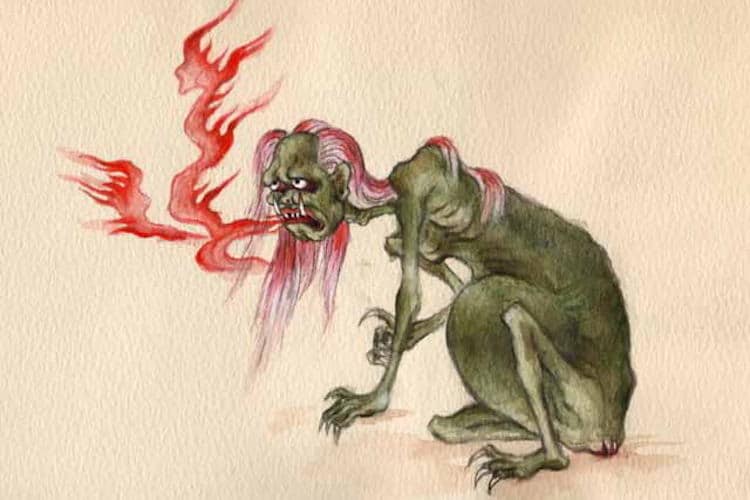
In Chinese Buddhist philosophy, though, there is a story that fits. The hungry ghost.

“In Chinese Buddhist teachings, “hungry ghosts are unable to take in or assimilate what they desperately need. The problem lies in their constricted throats — which cannot open for nourishment. They wander aimlessly in search of relief that is not forthcoming.”” [Source]

Interestingly, according to some of its origin myths, the hungry ghost was born out an act of cruelty. In many of the stories, it is a wealthy man’s wife who did some terrible thing to a monk, and when she eventually dies her spirit takes the form of the hungry ghost, forever lurking in purgatory, unable to ever fill its distorted belly and therefore always needing and wanting more.

The hungry ghost, then, is an expression of karma.

Hungry ghosts are the demon-like creatures described in Buddhist, Taoist, Hindu, Sikh, and Jain texts as the remnants of the dead who are afflicted with insatiable desire, hunger or thirst as a result of bad deeds or evil intent carried out in their life times. [Source]

In the realm of hungry ghosts, a deep drama between the ego and the ghost plays out ad infinitum. It’s an interplay that feeds the ego just enough for it to survive, so that in turn the ego can feed the hungry ghost. A dead-end cul-de-sac of sorts. A looping projection of one of our worst human vulnerabilities.

“The work of the ghost does not want to completely destroy its prey. Having fed off the other through dissociative trajectories of turbulence, the ego again becomes more robust. The hungry ghost now has, as companion and source of nurture, a replenished ego on which internal feeding may resume inside the space of erasure until the plenitude of the ghost-within again permeates the intersubjective.” ~  Nick Totton, Psychoanalysis and the Paranormal: Lands of Darkness

Spiritually healthy people understand their cravings for what they, expressions of innumerable forms of pain. Manifestations of the suffering caused by disconnection from the self, and from nature. And the self is nature. There really is no distinction between the two. The illusion is of separateness.

The ghosts are there to remind us that our real work is transmuting our suffering and cruelty into resilience and compassion. It’s not enough to numb the pain, it must be used to our advantage, for our growth, to serve as a catalyst for transformation, and to provide a chrysalis in which the transformation can take place.

“We are social beings. When we feel disconnected or alienated, we experience pain. Addiction, depression, anger, and violence are different ways we react to pain. To heal our society we must heal the emotional wounds.” ~Chris Agnos

Few understand this more clearly than Dr. Gabor Maté, whose work with drug addicts has transformed our understanding of what it means to be stuck in the realm of hungry ghosts.

BE YOUR OWN SAVIOR WHILE YOU STILL CAN

By Gary Z McGee

Source: Waking Times

“Stop drifting—sprint to the finish. Write off your hopes, and if your well-being matters to you, be your own savior while you can.” ~Marcus Aurelius

In a world on fire, it’s on you to be water. It’s on you to put out the flames. It’s on you to become the savior you’ve been waiting for. Idleness makes you mere kindling; boldness makes you a force of nature to contend with.

If, as Steve Jobs advised, “remembering that you are going to die is the best way I know to avoid the trap of thinking you have something to lose,” then it stands to reason that you use death as a guide for redeeming your life.

Because you are going to die. Maybe not today. Maybe not tomorrow. But someday you will be pushing up daisies along with every other human being who has ever existed.

The question is: will it be death by boredom and banality pining for a savior, or death by passion and curiosity becoming your own savior?

You have from this day until the day you die to live the life you want to live. You might as well make it a healthy life. You might as well make it a heroic life.

You had an eternity before you existed to do nothing. You’ll have an eternity after you exist to do nothing. Now is your time to actually do something, to find something you love to do and then use it to save your life.

Place the oxygen mask on yourself before assisting others:

“Once you fall in love with yourself, their game is over.” ~Alamir Guard

Focus on you until the focus is on you, then focus on the world.

The best way to do this is to imagine your life as a crashing plane. In the crashing plane that is your life, you must be capable of putting the oxygen mask (health) on yourself before assisting others. Once you have your mask set right, you can begin attempting to set the world right.

If you attempt to set the world right without your oxygen mask on, you risk not being able to help because you can’t function. You risk ill-health and incompetence. You risk death before your time.

With your oxygen mask secure, however, you will have the health and confidence needed to engage the world with strength and vitality. You will be a force to be reckoned with. Such a force can bring balance to an otherwise imbalanced world. Such a force can even prevent the plane from crashing before its time.

Seen in this light, you can see how there is a virtue in selfishness. For it is selfishness with good intent. The selfishness of putting the oxygen mask on yourself leads to the selflessness of helping others do the same.

Pride up; ego down. Confidence up; conceit down. Chin up; foot down. Self-esteem leads to prestige when you use it toward the wellbeing of others and to ground the world in health.

Be counteractive with answers and proactive with questions:

“Be a free thinker and don’t accept everything you hear as truth. Be critical and evaluate what you believe in.” ~Aristotle

Sometimes saving yourself means freeing yourself from what has been preventing you from flourishing. Often what prevents you from flourishing is not so obvious. It can be as simple as an outdated law or as complex as a limited worldview. Paradoxically, the only way to know for sure of what’s preventing you from flourishing is to not be sure.

Ironically, when you’re not sure of anything, you free yourself to be sure of what’s possible and what’s not. This is because when you sacrifice certainty, you resurrect curiosity. You get out in front of what you think you know so that what you don’t know can at least potentially become knowable.

This requires a questioning disposition. It requires the ability to face an “answer” with credulity and circumspection; to, as Aristotle suggested, “entertain a thought without accepting it.” It requires the fortitude to cut through orthodoxy with an unorthodox sword.

In the spirit of becoming your own savior, there is perhaps nothing more powerful than questioning the answers that came before you. Nothing is more powerful than an unorthodox question mark planted over an orthodox period.

The questioner is the redeemer. For what must be redeemed is the Truth Quest itself, and it is redeemed from the trap of the so-called “truth.”

In a world full of toxic positivity be authentic chaos:

“In each one of you there is a call, a will, an impulse of nature, an impulse toward the future, the new, the higher. Let it mature, let it resound, nurture it! Your future, your hard dangerous path is this: to mature and to find God in yourselves.” ~Hermann Hesse

What does it mean to be authentic chaos in a world full of toxic positivity? It means recognizing when comfort has become a prison and acting in such a way that you break free and stretch your comfort zone. It means recognizing when a lifejacket has become a limitation to swimming. It means casting security aside so that courage can be self-actualized. It means realizing that there’s more happiness in a spoonful of hard-earned self-improvement than in an ocean-full of easy self-affirmation.

Authentic chaos is introducing a little strategic disorder into the current order to alchemize a higher order. It’s controlled anarchy like the native American concept of counting coup. It’s the personification of a social leveling mechanism that levels the playing field of all finite games while introducing the higher perspective of the Infinite Game of life.

More importantly, authentic chaos is a deep reconnecting to our primal nature. It’s a vital hard reset into sacred alignment. It’s becoming a force of nature first and a person second. Written laws shrivel into nothingness beneath the primacy of the unwritten law of the interconnected cosmos. Self-as-world and world-as-self becomes the supreme perspective. Egocentrism is trumped by eco-centrism. One-dimensional independence is subsumed by multidimensional interdependence.

The world opens, the fountainhead overflows, the Philosopher’s Stone reveals itself, as the authentic chaos of the individuated cuts through toxic positivity like a hot blade through cold butter.

Practice Fait Sur Mesure:

“The spiritual journey is individual, highly personal. It can’t be organized or regulated. It isn’t true that everyone should follow one path. Listen to your own truth.” ~Ram Dass

One powerful way to listen to your own truth is to practice fait sur mesure. Which is French for ‘made to your measure.’ A huge part of becoming your own savior is realizing when what your culture has given you is not to your measure and then having the courage to create a way of living that is to your measure.

This means accepting that you are the only benchmark for your life. You are the measure. Nobody else can determine what is or is not to your measure. Only you have the power to either remain a culturally conditioned cog or to become a courageously reconditioned catalyst.

Don’t fall into the trap of following someone else’s plan. Deconstruct, analyze, and scrutinize their plan, then improvise it. Stand on the shoulders of giants. Customize your life to your own fitting. Take this piece from this ideology and that piece from that ideology, but then connect it all to your own unique imagination. Be creative. Think outside the box. Push your culturally-prescribed comfort zone as far as it will go. It’s all yours for the making.

Understand: In the Matrix of the world, you are “the one.” Just don’t get a big head about it. Because everyone is “the one.” It’s just that not everyone has the capacity to act on it. It is your responsibility alone to gain the capacity to act on it. It is your responsibility alone to create your own destiny.

So, existentially crush out. No holds barred. Go full frontal boss mode on living life to the fullest. Dive into the cosmic ocean with Death for a lifejacket. Become your own savior before it’s too late.

Pandemic? Great Reset? How about… a beginner’s mind?

By Mickey Z.

Source: Dissident Voice

“In the beginner’s mind there are many possibilities. In the expert’s, there are few.” 1

Has there ever been a more urgent time to embrace many possibilities? This age of pervasive uncertainty and division may well be very fertile ground for questioning our assumptions and interrogating our beliefs. In fact, we just might be living in the ideal time to accept that there are limitless ways to perceive even the most contentious issues.

Expert vs. Beginner

The expert’s mind is over-secure in its prowess. Such a mentality may promote shortsighted habits like confirmation bias. Many “authorities” will only seek out (read: cherry-pick) information that validates and justifies their behavior because expertise — real or imagined — causes us to grow less curious.

If we already feel well-versed in a topic, we tend to pay less attention to it. We ask fewer questions. This is a stifling choice even if we know 95 percent of what there is to know about a particular subject. Ideally, this is when we should be paying more attention to it in order to discern the nuances that remain to be learned.

Conversely, the beginner’s mind is ever-hungry for input — regardless of its source or its tendency to reinforce existing beliefs. In the beginner’s mind, there are fewer limits and fewer expectations. There is much more room for revelation and awe. Nothing is taken for granted and even the tiniest detail has the potential to inspire reverence.

The beginner’s mind is basically the polar opposite of today’s social media algorithms, mainstream news headlines, and popular political discourse.

3 (of the many) Benefits of a Beginner’s Mind

Creativity

Habits and structure can be incredibly useful. They can also become an obstacle to innovation. A beginner’s mind encourages us to approach familiar problems with a fresh perspective. This mindset often results in the exploration of avenues that an expert would casually dismiss as “been there, done that.”

Gratitude

A beginner’s mind awakens each morning, ready to wipe the slate clean and start anew. From this fresh perspective, it feels more natural to identify and appreciate your blessings.

Mindfulness

Seeing the world like a beginner prevents you from “going through the motions.” There is a clearer understanding that the present is all you have. The past is where guilt and regret dwell. In the future may lie apprehension and anxiety. Right here, right now, the moment is enough.

How to Rediscover a Beginner’s Mind

By its very definition, there are an infinite number of ways to occupy a beginner’s mind. To follow are some basic guidelines but think of them like Bruce Lee’s finger pointing a way to the moon. As Lee urged, “Don’t concentrate on the finger or you’ll miss all that heavenly glory.”2

1. Reject your ego’s need to be an expert

Eavesdrop on a conversation at the local supermarket. Even better, scroll (without reacting) through most threads on social media. You’ll see and hear so many people pretending they know“what’s really happening” and “what’s gonna happen.” Your ego craves the status of being right. The beginner in you would rather open-mindedly look for reality than be deemed an expert at anything.

2. Slow down

As touched on above, we must avoid going through the motions. Whenever possible, slow down to question and explore. Take your time to learn — even from the most unlikely of sources.

3. Channel your inner child

Re-introduce yourself to some of your closest childhood friends: wonder, mischief, and playfulness. Reject the cynical adult premise of “same shit, different day.”

4. See with new eyes

In the words of Marcel Proust: “The real voyage of discovery consists not in seeking new landscapes, but in having new eyes.”3 Practically speaking, your quest for new eyes can begin with simple exercises like treating your hometown as if you were a tourist and seeing what you can discover.

5. Embrace nonsense 

As Gary Zukav, author of Dancing Wu Li Masters: An Overview of the New Physics, (1979)posits: “Nonsense is nonsense only when we have not yet found that point of view from which it makes sense.”

6. Meditation

Perhaps the most time-worn path to a beginner’s mind is the practice of mindful meditation. Whether you choose a spiritual or secular approach, even ten minutes a day of meditation will expand your consciousness.

The child is in me still and sometimes not so still.4

There is no one right way to inhabit a beginner’s mind. After all, it is not a destination. It’s all about the process, the learning, and those moments of epiphany made possible by not closing off your options… so re-activate your inner child.

Keep re-evaluating what you believe before your perceptions can grow ossified. Don’t limit your explorations by choosing in advance what it is you wish to find. Turn your truth over and over, again and again. Avoid accumulating old answers. Instead, dedicate far more of your time to conjuring up new questions. Through it all, let compassion serve as your compass.

The experts [sic] have gotten us into this mess.

It’s time to give beginners their opportunity to shine.

  1. Shunryu Suzuki, Prologue Zen Mind, Beginner’s Mind, (1973). []
  2. Bruce Lee, Enter the Dragon, 1973. []
  3. The Captive. (La Prisonnière, the fifth volume of Remembrance of Things Past), 1923. []
  4. Fred Rogers, (2003). The World According to Mister Rogers: Important Things to Remember, p. 45, Hachette UK. []

‘Us vs. Them’ Thinking Is Hardwired—But Consciousness Can Overpower It

By Joe Martino

Source: The Pulse

Are we hardwired to categorize each other into ‘Us vs Them?’ Simply put, yes. But this hardwiring is remarkably easy to break. It’s time we equip ourselves with the knowledge and tools to do so.

Why? Well, anything from powerful governments to mainstream and alternative media is consistently trying to divide us by focusing aggressively on our differences. When we know how these mechanisms work and focus our consciousness in an effective way, these attempts to divide fail.

First a quick story.

When we first launched our membership I hired marketing teams to help. They would always tell me “in the sales messaging we need to create an ‘Us vs Them dynamic’ in order to get people to buy.” I resisted.

I felt like that wasn’t necessary and also contrary to our mission of unifying people to create a better world. But, the marketers were right. When we would A/B test sales messaging without ‘Us vs Them’ compared to sales messaging with it, the ‘Us vs Them’ messaging always won.

I have to admit this made me a bit sad. Was I thinking too idealistically about human beings? Maybe. But I always asked ‘Why doesn’t Us vs Them messaging work on me?” Before you suggest I’m naive and think “of course the messaging works on you,” read to the end of this piece. You’ll see how simply it is for this messaging not to work on anyone should they choose.

Neuroscience suggests that this Us vs Them biological trait developed thousands of years ago. As you might imagine, it had much to do with survival in much different times than we live in today.

It essentially states that human beings are primed to make very basic and categorical Us vs Them judgments. In fact, your brain is processing these Us vs Them differences in a twentieth of a second. These noticed differences are your classically promoted artificial constructs of: ethnicity, gender, skin color, age, socioeconomic class, and even something like sports team preference.

(I say artificial because social constructs tell us we should focus on these as differences. We don’t actually have to see them as differences as we are ALL one species. Other animals do not engage their Us vs Them biology within their species – only we do – and it’s a taught behaviour.)

All of this is enhanced by a multi-purposed hormone in our brain called Oxytocin.

Oxytocin has been shown to be a wonderful hormone for connecting and bonding with others that we know in our communities, ‘Us’. It’s often referred to as the love hormone or connection hormone. It essentially heightens meaningful connections with our in-group.

But on the flip side, studies have shown that when it comes to people who we see as strangers (Them), oxytocin creates a decrease in cooperation and increases envy when people are struggling. Further, it pushes one to gloat when they are ‘winning.’ In fact, there are many ways in which oxytocin is linked to dividing ourselves from ‘Them’ and keeping it that way.

In short, oxytocin enhances this Us vs Them divide. But, while this sounds like we may be doomed for division and judgment of others forever, what has also been shown is that these almost instantaneous judgements we make can be manipulated incredibly easily. And that’s without bringing in a little bit of conscious awareness and presence.

Studies have shown that when you expose people to others who look different from them, the ‘Us’ wiring often turns on when people look similar, and the ‘Them’ wiring turns on when people look different. This showed an implicit judgment based on ethnicity.

Yet when those same people were exposed to people who looked the same and different from them but were now wearing baseball hats with team logos, things changed. Suddenly the participants brains indicated that Us and Them had nothing to do with ethnicity anymore, it was about which team they supported.

A tiny change created an instantaneous manipulation of who is Us vs Them. I wrote about a similar phenomenon in a recent piece called Racism Plummeted When People Were Told Aliens Exist. This showed that when humans were told aliens existed, the Us became humans, and the Them became aliens. Suddenly people were nicer to each other and more accepting of differences.

The point? It doesn’t take much to for us to see each other as one, we just have to focus our consciousness a bit.

Consciousness Is Everything

There is much gained in our well being and in society when we become more self-aware, reflective and present. It moves unconscious and often automatic behaviour into a lens where we can ask: why do we do this?

Further, an increase in the above mentioned traits can lead to something as simple as stopping ourselves before we do something destructive out of anger. We can then pause for a short period, reflect, and respond.

The more we move from automatic, unconscious and reactive ways of living to present, reflective and conscious ways of living, the more harmony surrounds our lives.

What I’m saying can bring up similarities to new-agey, online influencer judgments that the ‘conscious’ are more than the ‘unconscious,’ this is not at all what I’m saying here. And I will expand in a moment.

First, I trust it’s clear that we can be manipulated into different Us vs Them dichotomies very easily. Studies exploring implicit bias also show that when we are exposed to different people regularly, we become less judgemental towards their differences.

Even still, we can build self awareness around how WE play into these divides in order to diffuse them.

For example, during COVID government leaders like Justin Trudeau sowed division in Canada by making unvaccinated Canadians less than. He did this by calling them names and characterizing them in ways that would cause the general population to dislike them.

“They [the unvaccinated] don’t believe in science/progress and are very often misogynistic and racist. It’s a very small group of people, but that doesn’t shy away from the fact that they take up some space.”Justin Trudeau

He combined this rhetoric with un-contextualized and false data around vaccination status in Canada to strengthen his propaganda.

Note, I’m not focusing on Trudeau here because I’m “a Poilievre fan” or anything. In fact, I don’t feel our current structure of politics is healthy nor serving us as people. I’m simply illustrating the ways in which our society has become ‘lost’ in division. Getting out of it requires us to take a close examination of what is happening so we can choose a different path.

In contrast, some unvaccinated people around the world began to refer to themselves as ‘pure bloods’ because they were not vaccinated. This led to memes, hateful rhetoric, and actions like avoiding and separating themselves from their vaccinated friends and families. Instead of attempting to understand why some became vaccinated, it was often simply seen as ‘the vaccinated are sheep.’

Once again we see division, in/out groups, and greater than/less than beliefs.

In both cases we are seeing the destruction and damage that can occur when we allow our flimsy biological traits around Us vs Them to be fed and upheld by faulty information and propaganda.

What is also important to note is that our ‘authoritative’ institutions of government and mainstream media will often be guilty of this destructive behaviour which deeply normalizes it amongst the masses.

That said, we are not doomed. Consciousness is everything. By that I mean, the quality of our consciousness. The ways in which we slow down, reflect, and become more present in everyday life becomes an antidote to propaganda feeding Us vs Them.

This is why we have the section at the top of our articles to “Pause and set your pulse.” To cultivate more presence and self awareness, check out a couple of the pieces of content I list at the bottom of this piece.

Let’s go deeper. Perhaps why I have felt Us vs Them messaging does not work on me stems from: what happens when we have experiences that lead us to feel we are all one and interconnected with everything? I have had these experiences many times in my life. I experienced them through meditation, breath work, and even randomly.

Thrust into what can be best described as ‘sensing the nature of our reality,’ when you have these transcendental experiences you do not see yourself as all that separate from everything else. Sure, you are YOU, and you know you are an individual, but you also have a knowing of the connection and sameness you share with everything.

What happens if we nurture and hold that knowing in our consciousness and allow it to form our worldview? Does our sense of Us vs Them get triggered as easily? I don’t think so. But that’s my experience.

This direct experience has led me to believe that a shift in our consciousness can be one of the most powerful tools in changing the way we see each other and ultimately re-design our society – because it has to happen.

Albert Einstein had some thoughts on this as well:

“A human being is part of a whole, called by us the ‘Universe’ —a part limited in time and space. He experiences himself, his thoughts, and feelings, as something separated from the rest—a kind of optical delusion of his consciousness. This delusion is a kind of prison for us, restricting us to our personal desires and to affection for a few persons nearest us. Our task must be to free ourselves from this prison by widening our circles of compassion to embrace all living creatures and the whole of nature in its beauty.”Albert Einstein

A task indeed, but one that is very possible with the right practice and focus.

Education Is Key Too

Why are things the way they are? We have to explore content that seeks to answer these questions. Instead of using social media for fast memes, 15 second videos, and short out of context video clips, deepen your knowledge. Consume less, but spend MORE time on each thing you consume.

Buying into this fast and distracting culture of information consumption is only furthering the problems we have. Social media algorithms are rigged to build an echo chamber around you and to give you ‘truth’ that confirms your existing bias’. This is not real education.

As for the biological trait itself, why can’t we focus our attention on our human similarities instead of our differences? We can. But culturally we have learned not to because somewhere along the lines it’s what we chose to obsess over.

Perhaps because powerful people glean more power by dividing masses. Perhaps because our current economic systems thrive off division, competition, and having various classes. Either way, we’re making this all up as we go. It doesn’t have to be like this.

For those who might think “this is our biology. We will always do best in small groups of the same type of people,” this doesn’t appear to be true. Studies have shown that diversity trumps ability. Diversity significantly enhances the level of innovation in organizations around the world.

Groups of only ‘like-minds’ become echo chambers and our efficiency and innovation suffers. Yet another reason we must learn to love, respect and communicate with one another.

(Note: here I’m pointing to the uncovering our potential as humans and having that be our driver. Not productivity and innovation tied to making more money and having a ‘bullish market economy’)

The Takeaway

The key is that consciousness can overcome a flimsy biological trait that produces Us vs Them thinking within us. We can engage experience and education that connects us to our similarities, adopts a consciousness of interconnection and a shared stewardship of our planet and people.

Everything from ‘woke ideology’ constantly obsessing over our differences, to political news commentary always inviting people to ‘dislike the other side’ is contributing to a worse direction for humanity. Don’t just sit there and blame it though, simply choose to engage differently. Improve how you use social media. Consume less content but go deeper.

Consciousness is the power here. Why can’t we extend our worldview of who we are into oneness and a deeper connectedness? Why must we fight to shut off our wonder and hold to petty differences?

FILMMAKER REVEALS THE TRUTH ABOUT SUBLIMINAL MESSAGES

By Dylan Charles

Source: Waking Times

We’re all being conditioned to think and believe certain things without any rational explanation through subliminal messaging in advertising, music, film, television, political propaganda, and military psychological operations.

Considering the definition of the word subliminal – ‘existing or functioning below the threshold of consciousness’ – it is easy to downplay the power of this brainwashing technique because most people are not consciously aware that it is happening, yet, it is affecting their lives. Once you realize that subliminal messaging is real and start to pay attention, it becomes much easier to recognize the we are, indeed, all being conditioned to behave a certain way, to want certain things, and to believe in ideas, without being able to rationally explain why.

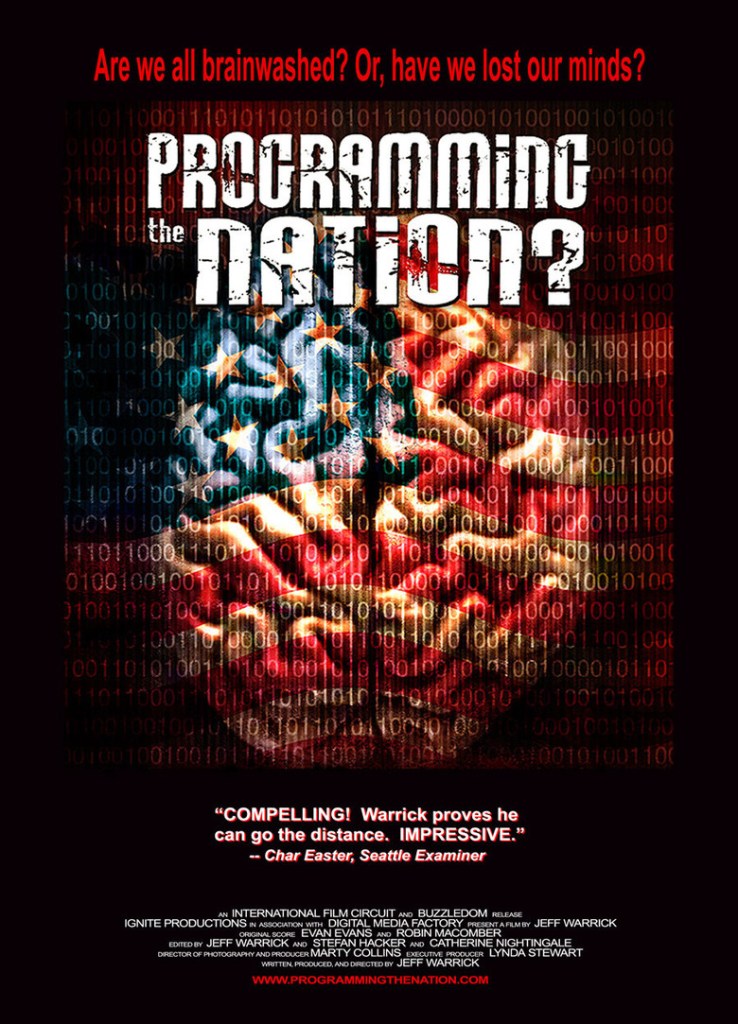
Below is a short video in which Jeff Warrick, the director of Programming the Nation (2011), offers his take on the truth about subliminal messaging. Warrick shares a few examples of messages embedded within ads, which are not likely to be seen consciously, but are admitted into the subconscious mind.

A common response to this type of revealing information is skepticism and disbelief that sexual innuendos or random words embedded in pictures or film will not impact a person’s willingness to buy a product.

Although it is a common assumption that sex sells because for most people it is associated with feelings of pleasure, excitement, enjoyment or even love, subliminal messaging is about much more than helping advertisers sell more product. These messages are designed to have an impact on general consumer behavior and affect people’s life patterns, thus molding society as a whole, creating and captivating more and more receptive consumers.

When bombarded with subliminal messaging, the mind is likely to trigger emotions, memories or feelings, without a person’s conscious recognition of why they feel a certain way. A person may not consciously realize why they start to become more attracted to certain behaviors, lifestyles or products, but they are more likely to succumb to the attraction.

“..subliminal ads are used as a technique not only to increase sales but is also used to divert youth and involve them in such type of behaviour which is only hazardous to the consumer.” ~ (Impact of Subliminal Messaging in TV Advertisements on Consumer Behaviour – A Case Study of Youth in Kashmir Province of J&K, Blue Ocean Research Journalssource)

Are subliminal messages contributing to a variety of economic, social, and political problems currently present in our culture, such as over-competitiveness, low self-esteem, obesity, over-consumption and debt? There are many examples that support this idea and demonstrate that subliminal messaging, over time, can have a powerful impact.

Take, for instance, advertising to women. If you look at any variety of ads that are targeted at women ages 18-35, an overwhelming majority will personify that women and girls should be thin, wear lots of makeup, style their hair in certain ways, and, of course, look very sexy. It almost appears as though it is the advertisers’ job to make young women feel bad about themselves.

See the following example of women in advertising in the video below:

Other examples are films such as the Rambo series of the 1980’s and the more resent American Sniper, which glorify mindless military self-sacrifice, torture and violence. They romanticize obedience to authority and unquestioning loyalty to a war-mongering government.

“‘American Sniper’ lionizes the most despicable aspects of U.S. society—the gun culture, the blind adoration of the military, the belief that we have an innate right as a “Christian” nation to exterminate the “lesser breeds” of the earth, a grotesque hypermasculinity that banishes compassion and pity, a denial of inconvenient facts and historical truth, and a belittling of critical thinking and artistic expression.” – Chris Hedges

Below is the complete documentary by Jeff Warrick, Programming the Nation, that offers a full history behind subliminal message. In the film, Warrick examines if subliminal messaging and other subconscious techniques have conditioned the United States public to become one of the highest consuming nations in the world, accounting for about 25 percent use of the worlds natural resources even though its populace makes up less than 5 percent of the global population.

Consider the Chickens

Intelligence, ethics, and the inner lives of animals

By Rafia Zakaria

Source: The Baffler

I OWE CHICKENS AN APOLOGY. Not only have I been eating them until very recently, but I have refused to even consider the possibility of a chicken having any kind of inner life. This estimation was not made from a lack of interaction. As children, my twin brother and I purchased baby chicks from a street vendor. We did this unfazed by the fact that quite often, the chickens would die. Once, when we were nine, we had two that lived, a hen and a rooster. No one told us that we should probably get more hens. Not having any other female companions, the rooster exerted his attentions on the one chicken. She would lay an egg or two every day, much to our delight, but soon sickened and died. Then there was only an incel rooster who roamed our compound and terrorized the women. After a few ugly incidents, he was “given away” to one of the women who worked at our house. We were never told what happened to him, and I didn’t care. There is nothing worse than an incel rooster patrolling your house all day long.

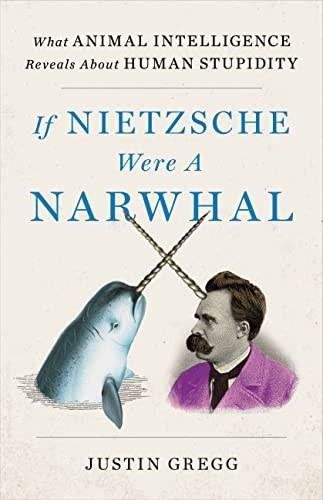
Now, so many years later, I’ve found my way to animal behaviorist Justin Gregg’s brilliant new book If Nietzsche Were a Narwhal: What Animal Intelligence Reveals About Human Stupidity. Gregg’s chicken coop is “a huge enclosed area” with high rafters, because as an animal scientist, he knows them to be jungle birds who need perches on which to sleep at night. But it is not only the magisterial heights of Gregg’s discussion of chickens that stayed with me. I was struck also by Gregg’s description of his chickens’ varied personalities, one anxious, another friendly, and so on; he tells us that these chickens do have inner lives and thus a consciousness of themselves as distinct from others. Instead of the feckless creatures I (and most people) assume them to be, chickens have just the sort of intelligence that is necessary for their own survival. They don’t think like humans, Gregg tells us, because they do not need to.

Intelligence, in Gregg’s explanation, does not exist in the way SATs or other IQ tests would have you believe. Those tests quantify a certain kind of ability to process information. People who do not do well on such tests may have other kinds of abilities that simply are not being measured. Intelligence is not one easily definable thing; engineers working on artificial intelligence cannot agree on a definition of it. But what humans have is a tendency to ask why things operate in a certain way. In Gregg’s terminology, humans are “why specialists,” a proclivity that in natural selection terms is no advantage and perhaps even a liability. A narwhal swimming around in the sea, for instance, would never have the kind of mental breakdown that the German philosopher pondering nihilism suffered toward the end of his life. Animal intelligence is practical and does not get caught up in abstract thought. By and large, animals make calculations based on what they can observe; ideas such as “causality,” which lie at the crux of human intelligence, are outside their capacity for thought.

Humans evolved to become why specialists. As Gregg tells it, 200,000 years ago, humans were hanging out with chimpanzees and exhibited no interest in the whys. They could make rudimentary tools and had some kind of assemblage of grunts that allowed for basic communication. He notes that roughly 40,000 years ago, cave paintings were created. Here were humans asking the whys; symbolic representation is an exclusively human thing.

Inability to be why specialists does not mean that animals are not capable of “metacognition,” the ability to be conscious of their own thinking or cognition. One of the most stunning examples in this book full of stunning examples is that of Natua, a dolphin at the Dolphin Research Center in Florida. An experiment was set up where Natua was exposed to two kinds of sounds, one a very high tone and one a very low tone. After hearing the sound, Natua had to choose between two paddles, one for the high and another for the low. If he chose correctly, he was given a fish for a reward. If he did not, he was sent for a long time-out, in that the experiment stopped. As the experiment progressed, the high tone sound came very close to the low sound such that they were nearly indistinguishable. At this point, Natua was unable to tell the difference; “he just started randomly pressing paddles,” Gregg writes. His behavior proved that some animals are capable of metacognition, the awareness that they do not know, or that their thinking about something is wrong.

It is no surprise that Gregg is pessimistic about how humans have used their abilities as why specialists, and he thinks that there is a chance that humans might not even survive over another century. The prospect of nuclear war and the climate crisis suggest, in Gregg’s view, that the end is possible. In the meantime, developing a consciousness of animals as beings who are capable of metacognition, of having individual personalities and so on, points to the need for a new ethics. This new set of basic premises would abandon the centering principle that the animal-human relationship must always be of one having dominion over the other.

But if you consider the continued resistance to the idea of animal rights, it is hard to be optimistic about the emergence of a new ethics of mutuality that eschews the dominion portion. Too many human rationalizations, attached to what we eat, what we wear, how we live, are predicated on the belief that we are the only feeling beings and that our actions upon animals are independent of consequences. If you know the fear of a chicken or a cow or a pig about to be slaughtered, you may look at your food in a different way. You might eschew fried chicken or beef or pork completely. If you understand that a horse being whipped is suffering terribly, is extremely scared and dissolute, you can also understand that there is a need for a radical expansion of mindfulness and a concomitant shrinking of power.

In the moral universe informed by Gregg’s argument, the survival of the human race is not an imperative for the planet because humans as a species have been far more disastrous for the world than others. “Prognostic myopia” keeps us horribly and condemnably in the moment, burning fossil fuels and trashing the oceans even though we know that it is terrible for the environment. This is a unique position among philosophers, a lot of whom have lately concerned themselves with questions of ethics and planetary survival. 

As a contrast to Gregg, the Oxford Associate Professor in Philosophy William MacAskill, in his What We Owe the Future, proposes “effective altruism” as a way to live ethically in times of climate crisis. If Gregg argues against human exceptionalism, MacAskill reduces humans to data points, where the survival of the most, and the most benefit to the planet, are guideposts to a present and future ethics. Using Gregg’s arguments, however, effective altruism is rendered meaningless. Even those who live sparingly on twenty-six thousand pounds a year, like MacAskill, are still a burdensome threat, unless we define their worth according to tiresome illusions of human exceptionalism.

If Nietzsche Were A Narwhal is the sort of critical look at human dominion that our world needs. A few years ago, Brown University environmental historian Bathsheba R. Demuth wrote Floating Coast: An Environmental History of the Bering Strait, a similarly groundbreaking look at the consequences of the extractive relationship humans have had with the environment. Just as Gregg reveals the risks of humans imagining their power over animals as shorn of consequences, Demuth reveals the consequences of human dominion over nature.

Thinkers and scientists like Gregg and Demuth are presenting readers with the urgent and pressing necessity for a new ethics. The unthinking, extractive, and dominant human treats animals as a lower form of existence, rather than a different form; we assess the environment based on what can be extracted from it. Like our means of communication, our means of travel, of treating disease, and so much else, our ethics need an urgent and pressing update that takes into consideration the understanding of animals. Factory farms, the constant consumption of animal products, and the greedy use of fossil fuels are the seeds of destruction.

I am not sure I could have offered the chicken and rooster of my childhood a deluxe chicken coop with high rafters, but an argument for better living conditions and the introduction of new companions for the rooster would have been easier if we had understood the first thing about the animals around us. I do not need to underscore the rapid pace at which our world is changing. If Nietzsche Were A Narwhal is a must-read because it explains how we can save the world only if we exist in symbiosis with the thinking, feeling creatures that have had the misfortune of sharing the planet with humans, who turn out not to be as intelligent as they believe themselves to be.

Masters of Deceit: The Government’s Propaganda of Fear, Mind Control & Brain Warfare

By John & Nisha Whitehead

Source: The Rutherford Institute

“It is the function of mass agitation to exploit all the grievances, hopes, aspirations, prejudices, fears, and ideals of all the special groups that make up our society, social, religious, economic, racial, political. Stir them up. Set one against the other. Divide and conquer. That’s the way to soften up a democracy.”― J. Edgar Hoover, Masters of Deceit

The U.S. government has become a master of deceit.

It’s all documented, too.

This is a government that lies, cheats, steals, spies, kills, maims, enslaves, breaks the laws, overreaches its authority, and abuses its power at almost every turn; treats its citizens like faceless statistics and economic units to be bought, sold, bartered, traded, and tracked; and wages wars for profit, jails its own people for profit, and has no qualms about spreading its reign of terror abroad.

Worse, this is a government that has become almost indistinguishable from the evil it claims to be fighting, whether that evil takes the form of terrorism, torture, drug traffickingsex trafficking, murder, violence, theft, pornography, scientific experimentations or some other diabolical means of inflicting pain, suffering and servitude on humanity.

With every passing day, it becomes painfully clear that this is not a government that can be trusted with your life, your loved ones, your livelihood or your freedoms.

Just recently, for example, the Pentagon was compelled to order a sweeping review of clandestine U.S. psychological warfare operations (psy ops) conducted through social media platforms. The investigation comes in response to reports suggesting that the U.S. military has been creating bogus personas with AI-generated profile pictures and fictitious media sites on Facebook, Twitter and Instagram in order to manipulate social media users.

Psychological warfare, as the U.S. Army’s 4th Psychological Operations Group explained in a recruiting video released earlier this year, enables the government to pull the strings, turn everything they touch into a weapon, be everywhere, deceive, persuade, change, influence, and inspire.

Of the many weapons in the government’s vast arsenal, psychological warfare (or psy ops) can take many forms: mind control experiments, behavioral nudging, propaganda.

In the 1950s, MK-ULTRA, the mind control program developed under CIA director Allen Dulles as part of his brain warfare Cold War campaigns, subjected hundreds of unsuspecting American civilians and military personnel to doses of LSD, some having the hallucinogenic drug slipped into their drinks at the beach, in city bars, at restaurants. For Operation Midnight Climax, the CIA hired prostitutes to lure men into a bugged room, where they would be dosed with LSD and observed having sex

As Brianna Nofil explains, “MK-Ultra’s ‘mind control’ experiments generally centered around behavior modification via electro-shock therapy, hypnosis, polygraphs, radiation, and a variety of drugs, toxins, and chemicals.”

The CIA spent nearly $20 million on its MKULTRA program, reportedly as a means of programming people to carry out assassinations and, to a lesser degree, inducing anxieties and erasing memories, before it was supposedly shut down.

As one study reported, detainees held in CIA safe-houses abroad “were literally interrogated to death in experimental methods combining drugs, hypnosis and torture, to attempt to master brainwashing techniques and memory erasing.”

Similarly, the top-secret Montauk Project, the inspiration for the hit Netflix series Stranger Things, allegedly was working to develop mind-control techniques that would then be tested out on locals in a nearby village, triggering crime waves or causing teenagers to congregate.

As journalist Lorraine Boissoneault concludes, “Despite MK-ULTRA violating ethical norms for human experiments, the legacy of brainwashing experiments continued to live on in U.S. policy. The same methods that had once been used to train American soldiers ended up being used to extract information from terrorists in Abu Ghraib, Iraq and Guantanamo Bay.”

Fast forward to the present day, and it’s clear that the government—aided and abetted by technological advances and scientific experimentation—has updated its psy ops warfare for a new era. For instance, the government has been empowered to use its ever-expanding arsenal of weapons and technologies to influence behaviors en masse and control the populace.

It’s a short hop, skip and a jump from a behavioral program that tries to influence how people respond to paperwork to a government program that tries to shape the public’s views about other, more consequential matters. Thus, increasingly, governments around the world—including in the United States—are relying on “nudge units” to steer citizens in the direction the powers-that-be want them to go, while preserving the appearance of free will.

Back in 2014, for example, a Fusion Center in Washington State (a Dept. of Homeland Security-linked data collection clearinghouse that shares information between state, local and federal agencies) inadvertently released records on remote mind control tactics (the use of “psycho-electronic” weapons to control people from a distance or subject them to varying degrees of pain).

Indeed, the COVID-19 pandemic could easily be considered psychological warfare disguised as a pandemic threat. As science writer David Robson explains: “Fears of contagion lead us to become more conformist and tribalistic… Daily reminders of disease may even sway our political affiliations… Various experiments have shown that we become more conformist and respectful of convention when we feel the threat of a disease… the evocative images of a pandemic led [participants in an experiment] to value conformity and obedience over eccentricity or rebellion.”

This is how you persuade a populace to voluntarily march in lockstep with a police state and police themselves (and each other): by ratcheting up the fear-factor, meted out one carefully calibrated crisis at a time, and teaching them to distrust any who diverge from the norm.

This is not a new experiment in mind control.

Add the government’s inclination to monitor online activity and police so-called “disinformation,” and you have the makings of a restructuring of reality straight out of Orwell’s 1984, where the Ministry of Truth polices speech and ensures that facts conform to whatever version of reality the government propagandists embrace.

This “policing of the mind” is exactly the danger author Jim Keith warned about when he predicted that “information and communication sources are gradually being linked together into a single computerized network, providing an opportunity for unheralded control of what will be broadcast, what will be said, and ultimately what will be thought.”

We’ve already seen this play out on the state and federal level with hate crime legislation that cracks down on so-called “hateful” thoughts and expression, encourages self-censoring and reduces free debate on various subject matter. 

The end goal of these mind-control campaigns—packaged in the guise of the greater good—is to see how far the American people will allow the government to go in re-shaping the country in the image of a totalitarian police state.

The government’s fear-mongering is yet another key element in its mind-control programming.

It’s a simple enough formula. National crises, global pandemics, reported terrorist attacks, and sporadic shootings leave us in a constant state of fear. The emotional panic that accompanies fear actually shuts down the prefrontal cortex or the rational thinking part of our brains. In other words, when we are consumed by fear, we stop thinking.

A populace that stops thinking for themselves is a populace that is easily led, easily manipulated and easily controlled whether through propaganda, brainwashing, mind control, or just plain fear-mongering.

Fear not only increases the power of government, but it also divides the people into factions, persuades them to see each other as the enemy and keeps them screaming at each other so that they drown out all other sounds. In this way, they will never reach consensus about anything and will be too distracted to notice the police state closing in on them until the final crushing curtain falls.

This Machiavellian scheme has so ensnared the nation that few Americans even realize they are being brainwashed—manipulated—into adopting an “us” against “them” mindset. All the while, those in power—bought and paid for by lobbyists and corporations—move their costly agendas forward.

This unseen mechanism of society that manipulates us through fear into compliance is what American theorist Edward L. Bernays referred to as “an invisible government which is the true ruling power of our country.”

It was almost 100 years ago when Bernays wrote his seminal work Propaganda:

“We are governed, our minds are molded, our tastes formed, our ideas suggested, largely by men we have never heard of… In almost every act of our daily lives, whether in the sphere of politics or business, in our social conduct or our ethical thinking, we are dominated by the relatively small number of persons…who understand the mental processes and social patterns of the masses. It is they who pull the wires which control the public mind.”

As I point out in my book Battlefield America: The War on the American People and in its fictional counterpart The Erik Blair Diaries, to this invisible government of rulers who operate behind the scenes—the architects of the Deep State—we are mere puppets on a string, to be brainwashed, manipulated and controlled.

For years now, the powers-that-be—those politicians and bureaucrats who think like tyrants and act like petty dictators regardless of what party they belong to—have attempted to brainwash us into believing that we have no rights: to think for ourselves, make decisions about our health, protect our homes and families and businesses, act in our best interests, demand accountability and transparency from government, or generally operate as if we are in control of our own lives.

Well, the government is wrong.

We have every right, and you know why? Because, as the Declaration of Independence states, we are endowed by our Creator with certain inalienable rights—to life, liberty, property and the pursuit of happiness—that no government can take away from us.

It’s time we started reminding the government that “we the people” are the ones in charge.