Arguments Against Despair

By David Edwards

Source: Media Lens

Eliot Jacobson is a retired professor of mathematics and computer science who regularly appears on our Twitter feed discussing the climate crisis. He sends tweets under the grim title, ‘Your “moment of doom” for the day’. These channel the latest news on rapidly rising carbon emissions and temperatures, catastrophic examples of extreme weather, and so on. It’s depressing fare, and Jacobson is candid about the level of anguish he feels:

‘I woke up feeling angry at about 2:30 AM this morning.

‘It’s easy to find something wrong with just about anything I look at. It’s all projection. I’ve been writing and deleting Tweets, but I still feel angry.

‘I’m angry that there’s very little I can do and there’s no way out.’

In a blog post, he wrote:

‘This sadness is so overwhelming, so all-consuming, that it takes my breath away. The things I do to cope with the weight of it all are mere distractions from this sadness. Volunteer for a few hours, then sadness. Go for a walk, then sadness. Listen to music, read, visit websites, then sadness. Visit with friends or family, then sadness. Sadness returns every time I have a moment to reflect on the predicament of the present moment.’

I’m no stranger to this emotional roller-coaster. 1988 was the big year for me, when NASA scientist James Hansen told the world we were heading for disaster. I had no difficulty believing him.

It seemed inconceivable to me that the profit motive driving global industry could be restrained, let alone reversed, in time. I was then working as a marketing manager for British Telecom in the West End of London where I set up a Green Initiatives Group. Small changes were made, but they were just window dressing – deeper changes impacting profit were completely unthinkable. It seemed obvious to me that this fundamentalist corporate resistance must, sooner or later, lead to disaster.

I first protested for action on climate change with Friends of the Earth on the streets of central London in October 1989. I was 27 when I started campaigning; I’m now 61. I’ve thought a lot, worried a lot, talked a lot, read a lot, and written a lot about these issues for three and a half decades, more than half my life.

It seems absolutely incredible to me – by which I mean it seems something that I honestly would not have believed was possible – that what seemed like an urgent crisis to me in the late 1980s can still seem like ‘hype’, a ‘liberal tax scam’, an ‘oligarch plot’ and ‘bourgeois hysteria’ to large numbers of people in 2023. In the 1980s, we said things would change when there were ‘bodies in the streets’ – but the bodies are all around us now, and there is still no sign of meaningful change.

I say all this to make clear that I am in no way complacent about, or indifferent to, the looming climate catastrophe (it seems absurd to even describe it as ‘looming’). My comments below are not intended to detract from the vital need to take immediate action; they are addressed to the despair that I know many people, like Jacobson, are feeling.

You, Me And The Mysterium Tremendum

After everything I have myself suffered, it seems to me that we have two main tasks at the present time: first, to do everything in our power to avert the terrifying crisis threatening us with extinction. Second, to do everything we can to transform the fear and suffering of our predicament into love and bliss.

The first of these is new. The second may sound preposterous, even annoying, but it has actually always been the great human task.

Many activists devoted to action, to change, despise the very idea that our own happiness should be any kind of concern. The suggestion is dismissed as self-indulgent ‘navel gazing’. We have to dispense with all such ‘sentimentality’ and focus on ‘hard politics’. We have to plunge into the darkness of realpolitik and fight for our lives. It’s going to be bruising, to hurt – forget all kitten-cuddling ideas about ‘love’ and feeling good. And how on earth can you feel ‘bliss’ when the world is falling apart? Such nonsense!

As so often, the anger is rooted in fear – the fear that such concerns will divert energy and attention away from what really matters. The counter-argument is that not giving a damn about personal feelings, about our needs as human beings in this short life, is actually one of the key factors that got us into this fine mess in the first place. (See my Cogitation: ‘Our Indifference To Ourselves’ – Beyond The ‘Virtue’ Of Self-Sacrifice – Parts 1 and 2)

Just as I can’t understand how so many people can fail to see the truth of the existential crisis we’re facing, I can’t understand how people can feel so absolutely certain about the significance, the meaning, of this crisis that they fall into absolute despair.

First of all, we need to remember that despair is a function of mind; it is not something mandated by Existence. As Thoreau noted, we have a choice:

‘However mean your life is, meet it and live it; do not shun it and call it hard names.’ (Thoreau, ‘Walden’, Oxford University Press, 1997, p.292)

This has been as true for everyone in human history facing death from illness, starvation, genocide, as it is for all of us now, facing extinction.

I find the universe so mysterious, so fundamentally Unknown, and even Unknowable, that I cannot establish a solid base of existential certainty that allows me to be confidently desperate about even this situation.

Of course, climate collapse is terrible for us – I don’t want to die, you don’t want to die; we don’t want so-called human ‘civilisation’ to disappear. But we all do have to die and the deeper significance of even a disaster on this scale is fundamentally unknown.

We are a miniscule part of billions of years of existence involving 200 billion galaxies each containing 200 billion stars, and who knows how many planets, swirling over distances that completely defy imagination – all of it emerging out of the mysterium tremendum, the how and why of Existence (we can’t say Creation; we don’t even know if it has a beginning or an end).

This immensity of space and time has led to this moment that stands before us. Here we are! Everything in this cosmos has led us here. We can’t just blame politicians, corporate executives and their journalistic enablers – the universe made them as they are and this is what the universe has given us to deal with.

Who are we to break down in despair as if we were certain about the final meaning of what is happening? What do we really know about anything? Do we really know enough to find a solid position from which we can cast judgement even on the extinction of human life, or even of all life, on this planet? 

In November, spiritual writer Steve Taylor posted a poem, ‘Being Watched by The Moon’, on Facebook. Taylor wrote of our cosmic near neighbour:

‘Then I noticed a look of concern on her face.

There was a glint of disapproval, a hint of dismay

in her gaze, as it followed me home

as if she was witnessing an accident, or a crime.

Had I done something wrong? I wondered.

Had I injured or offended someone?

Had I gone astray, and lost the meaning of my life?

But then I looked closer, and realised:

she wasn’t just watching me.

She was watching the whole world.’

A glint of ‘concern’, ‘disapproval’ and ‘dismay’, as if ‘witnessing an accident, or a crime’? Is this really the most likely reaction of the Moon? After all, she has seen a lot – she’s around 4.5 billion years old, about the same age as the Earth. Human beings have been around for just 2.8 million years, and in our problematic modern form for just 200,000 years. The Sun formed about 4.6 billion years ago from an enormous molecular cloud that gave birth to numerous other stars. Our star has about 5 billion years of life left; she’s in her prime. The universe itself is about 13.8 billion years old – at least in this cycle, if it is a cycle. We don’t know where all this comes from, what it means, what lies at the base of it all. 

Worst case scenarios suggest that human-induced climate change might devastate most animal and plant species to such an extent that it could take five million years for life to recover. But 5 million years is a blink of the cosmic eye to old-timers like the Moon, Earth and Sun whose memories stretch back, not millions, but billions of years. And if things don’t work out here post-climate collapse, maybe they’ll go better among the billions and billions of stars out there – that’s a lot of stars, a lot of possibility. From this perspective, one might surmise that human despair at the prospect of human extinction is one more manifestation of an egotism that causes us to vastly overestimate our own importance.

Might it alter our despairing perspective to consider that the enlightened mystics might be right in declaring that, not just plants and animals, but the entire universe is alive? We think life arises miraculously, ‘accidentally’ (what on earth does that mean?), Lazarus-like, from dead matter. But atoms are pretty lively phenomena; they are whizzing flea circuses of jumping sub-atomic particles, quantum waves and other forms of energy. Might we one day conclude that what we call life arises from these subtler forms of life? Is energy in some sense life?

And might our despair be leavened by the possibility, as mystics also insist, that, not just human beings, but the entire cosmos is conscious? What would it mean, if it turns out that even rocks are consciousness in a kind of coma; that evolution is ultimately a process of consciousness awakening from the slumber (not the death) of matter?

If everything is alive and everything is conscious, then even human beings are unable to inflict any real damage – a manifestation of eternal life rises and falls, comes and goes, but the ocean of living consciousness continues completely unharmed.

The universe seems to consist of objects, of material ‘things’. But that is not all: these rocks, animals, planets and stars appear in the something that is no-thing that we call space. Likewise, our awareness also provides an internal space in which sense perceptions, thoughts and emotions can appear and be known. We assume the universe is material and yet awareness seems non-material, seems entirely other than that which is material. Is it possible that external space and the internal space of awareness are related? Could they actually be the same phenomenon? We tend to see our internal space as an epiphenomenon of the brain, but is external space an epiphenomenon of matter?

Could the mystics even be right when they insist that awareness evolves in the universe by moving from ageing bodies to new ones? Westerners find this a childishly obvious example of wishful thinking. But does that make it untrue? Do we imagine that Buddha, Bodhidharma, Nagarjuna, Lao tse and all other enlightened humans were inventing when they made this claim over and over again? Could they even be right in arguing that consciousness moves from old, exhausted planets to fresh, new planets better suited to the continued evolution of consciousness?

If that sounds ludicrous, is it any crazier than the idea that the universe suddenly emerged from nothingness – nothing, nothing, nothing, then, Bang! – or that it has somehow always existed? These appear to be the only two possibilities, and yet both seem totally nonsensical to us. If the only logical possibilities seem impossible, how can we so confidently root our despair in our clearly inadequate human capacity for logic?

Satchitananda

I controversially suggested our task was to find bliss in the face of looming extinction. Is that possible? Is it moral even to try in the face of so much suffering?

Seasoned meditators tell us that the mysterious awareness perceiving these words is inherently blissful. Not just pleasurable, mind you – ecstatic. We are told the bliss is already there, is always there; that it is the very nature of awareness. The idea is captured in the Sanskrit epithet ‘satchitananda’, or ‘reality, consciousness, bliss’ – existence is aware and awareness is blissful.

This sounds counter-intuitive standing at a bus stop on a rainy Monday morning commute to work. We are here, we are aware, thank you very much, and we are emphatically not beaming with delight.

There are two possible explanations for this contradiction: either all the enlightened mystics were talking nonsense, or we are not in fact here, not in fact aware, and are therefore not able to experience the bliss that is here.

But if we’re not here, where on earth are we?

We are physically here, of course, but our minds are not in the present; they are in the past and in the future. Because the past and future do not exist, because they are mere ideas in the mind, when we are thinking we are absent; we are not truly here.

There are times when I sit in meditation for an hour when thoughts finally drop away; thoughts by which I am otherwise unceasingly plagued by day and night (dreams are thinking in pictures). When thoughts drop away, even for a moment, something very subtle, but very powerful slips through. In my experience, it emerges like a wispy strand of pink candy floss spinning out from some completely unknown depth and melting into my heart (my ‘dantian’ and ‘lower dantian’, in the terminology of Qigong). The melting is experienced as a sweetness, a delight, that glows with unconditional love for everyone and everything.

It is clear, sitting alone in a room, that this loving bliss is uncaused. I may have been as miserable as sin about the state of the world before slumping down to watch my thoughts and feelings – nothing in my world has objectively changed in that hour. In fact, as all the mystics insist, this loving delight has not been caused; it has simply been unveiled, revealed.

Thought is the veil. This is why we can’t feel the bliss of existence: it is hidden from us by layer upon layer of thought, rather like the multiple layers of cloud that typically greet solemn holidaymakers returning to Britain.

Human beings are the only animal that can become lost in the unreal world of mentation. All the virtuous, politically correct and well-intentioned thought by which we have always hoped to make the world a better place – the whole, misguided 17th and 18th century dream of the European ‘Enlightenment’ – has combined with all other thoughts to form an almost impenetrable barrier between us and the real source of civilisation, of personal and global salvation, within us.

The truth is that we have destroyed our planet and become almost completely estranged from the inherent bliss of being because we have sought civilisation and happiness in our heads. In reality, true civilisation – not the ability to build machines to pyrrhically ‘conquer’ nature, other animals and humans – is found when we transcend thought and connect deeply and often with our hearts.

‘The Best People In The World’ – Actual Human Civilisation

The very idea of technological ‘progress’ implies some kind of ‘Manifest Destiny’. It is our ‘destiny’ – the natural path of any ‘advanced’ civilisation on any planet – to develop ever more powerful technology, that we might one day voyage across the cosmic ocean just as we once voyaged across the water and air of our home planet.

But this may be wrong. It may be that the right option is to journey inwards in an exploration of being, of consciousness, to an unimagined brave new world of love and bliss.

Perhaps we don’t hear anything from highly technological ‘civilisations’ out there in the cosmos because the whole effort is a suicidal wrong turn that leads to near-instant decline and extinction. The cosmos may nevertheless be teeming with genuinely civilised beings who have gone in a very different direction.

After all, even on our planet, there have been examples of authentically civilised humans – people who live in their hearts rather than in their heads, who are free of our obsessive thinking. They appear to have rooted their daily lives in the kind of love and bliss that we in the West can only find in meditation.

In his book, ‘The Conquest of Paradise’, writer and ecologist Kirkpatrick Sale described the low-tech, Taino society encountered by the Spanish conquistadors in 1492:

‘So little a part did violence play in their system that they seem, remarkably, to have been a society without war (at least we know of no war music or signals or artifacts, and no evidence of intertribal combats) and even without overt conflict (Las Casas reports that no Spaniard ever saw two Tainos fighting).’ (Kirkpatrick Sale, ‘The Conquest of Paradise’, Papermac, 1992, p.99)

But the lack of violence was only one aspect of the Tainos’ towering civilisation:

‘And here we come to what was obviously the Tainos’ outstanding cultural achievement, a proficiency in the social arts that led those who first met them to comment unfailingly on their friendliness, their warmth, their openness, and above all – so striking to those of an acquisitive culture – their generosity.’ (p.99)

Even Admiral Cristobal Colon (‘Christopher Columbus’ in old money), the man who brought death and disaster to the lives of the Taino, recorded in his journal:

‘They are the best people in the world and above all the gentlest. They became so much our friends that it was a marvel… They traded and gave everything they had, with good will.’ (pp.99-100)

He continued:

‘I sent the ship’s boat ashore for water, and they very willingly showed my people where the water was, and they themselves carried the full barrels to the boat, and took great delight in pleasing us. They are very gentle and without knowledge of what is evil; nor do they murder or steal.’

Colon added:

‘They love their neighbours as themselves, and they have the sweetest talk in the world, and are gentle and always laughing.’ (p.100)

Sale wrote poignantly:

‘It is to be regretted that the Admiral, unable to see past their nakedness, as it were, knew not the real virtues of the people he confronted. For the Tainos’ lives were in many ways as idyllic as their surroundings, into which they fit with such skill and comfort. They were well fed and well housed, without poverty or serious disease. They enjoyed considerable leisure, given over to dancing, singing, ballgames, and sex, and expressed themselves artistically in basketry, woodworking, pottery, and jewellery. They lived in general harmony and peace, without greed or covetousness or theft.’ (pp.100-101)

American geographical scholar Carl Sauer concluded:

‘…the tropical idyll of the accounts of Columbus… was largely true’. (p.101)

The Tainos were human beings who lived in their hearts, not in their heads. They had no august universities packed with thinkers, philosophers and other half-crazed intellectuals; no 24/7 outpourings of media pollution – they lived in the bliss of awareness unclouded by obsessive thought.

As for us! By painful contrast, in his book, ‘Impact of Western Man’, historian William Woodruff commented on the society from which Colon had sailed:

‘No civilization prior to the European had occasion to believe in the systematic material progress of the whole human race; no civilization placed such stress upon the quantity rather than the quality of life; no civilization drove itself so relentlessly to an ever-receding goal; no civilization was so passion-charged to replace what is with what could be; no civilization had striven as the West has done to direct the world according to its will; no civilization has known so few moments of peace and tranquillity.’ (Sale, ibid, p.91, my emphasis)

To live in the head, to sacrifice the moment for the future, to prioritise the ‘serious’, ‘important’ work of the greedy, plotting mind over the bliss of the heart is to build a self-destructive, doomed version of fake ‘civilisation’.

Or consider the experience of the Mexican anthropologist Miguel Covarrubias on visiting the island of Bali in 1938. Covarrubias wrote:

‘No other race gives the impression of living in such close touch with nature, creates such a complete feeling of harmony between the people and the surroundings… The Balinese belong in their environment in the same way that a humming-bird or an orchid belongs in a Central American jungle.’ (Miguel Covarrubias, ‘Island of Bali’, KPI, 1986, p.11)

Covarrubias added:

‘A man is assisted by his neighbours in every task he cannot perform alone; they help him willingly and as a matter of duty, not expecting any reward other than the knowledge that, were they in his case, he would help in the same manner’. (p.14)

The result, Covarrubias wrote, was a village system which operated as ‘a closely unified organism in which the communal policy is harmony and cooperation – a system that works to everybody’s advantage’. (p.15)

In the late 1990s, I worked with the Swedish ecologist and activist Helena Norberg-Hodge who lived for many years among the people of Ladakh on the Tibetan plateau of Northern India. In her book ‘Ancient Futures’, Norberg-Hodge wrote of how she was bewildered by the strange fact that the Ladakhis were always smiling:

‘At first I couldn’t believe that the Ladakhis could be as happy as they appeared. It took me a long time to accept that the smiles I saw were real. Then, in my second year there, while at a wedding, I sat back and observed the guests enjoying themselves. Suddenly I heard myself saying, “Aha, they really are that happy”. Only then did I recognize that I had been walking around with cultural blinders on, convinced that the Ladakhis could not be as happy as they seemed. Hidden behind the jokes and laughter had to be the same frustration, jealousy, and inadequacy as in my own society. In fact, without knowing it, I had been assuming that there were no significant cultural differences in the human potential for happiness. It was a surprise for me to realize that I had been making such unconscious assumptions, and as a result I think I became more open to experiencing what was really there.’ (Helena Norberg-Hodge, ‘Ancient Futures – Learning From Ladakh,’ Sierra, 1992, p.84)

As amongst the Tainos, fighting in traditional Ladakhi society was unknown, disputes were settled quickly and peaceably, and when one person had a problem the entire community did its best to help:

‘In traditional Ladakh, aggression of any sort is exceptionally rare: rare enough to say that it is virtually non-existent… Even arguments are rare. I have hardly ever seen anything more than mild disagreement in the traditional villages—certainly nothing compared with what you find in the West.’ (p.46)

Norberg-Hodge concluded:

‘I have never met people who seem so healthy emotionally, so secure, as the Ladakhis.’ (p.85)

These societies that seem so ‘primitive’ and ‘uncivilised’ to goal-oriented, power-obsessed, head-trapped Europeans, were actually exemplars of authentic human civilisation.

I am not suggesting that we can become like the Tainos, Balinese and Ladakhis. If we are too high-tech primitive to save ourselves from climate disaster, we can obviously not hope to create that kind of paradise on earth.

What I am suggesting, though, is that the existence of these societies powerfully supports the contention of the mystics: that awareness unclouded by obsessive thinking is indeed in the nature of bliss and love. I am suggesting that such low-tech civilisations may exist in abundance, undetected, on other planets that will of course continue to thrive no matter what happens on our planet. I am also suggesting that you and I can create a little patch of this paradise in our own hearts.

Perhaps in our world as it is, genuinely civilised, loving societies are doomed to be destroyed by brutal, head-trapped, Western-style societies. But you and I still have the freedom, even in the face of this wider brutality, even in the face of environmental catastrophe, to live a life overflowing with love and bliss. Maybe that is all that is possible for us, and maybe that is enough. 

The World Wants to Be Deceived

By Edward Curtin

Source: Behind the Curtain

My title comes from a 19th century author whose name does not matter nor would it mean much if I mentioned him.  It’s an old truth that has not changed a bit over the centuries.  I think, however, it would be more linguistically accurate to say that most people want to be deceived, for the world, the earth doesn’t give a damn, as the French poet Jacques Prévert reminds us in “Song in the Blood”:

There are great puddles of blood on the world
where’s it all going all this spilled blood
is it the earth that drinks it and gets drunk
funny kind of drunkography then
so wise . . . so monotonous . . .
No the earth doesn’t get drunk
the earth doesn’t turn askew
it pushes its little car regularly its four seasons
rain . . . snow
hail . . . fair weather
never is it drunk
. . . . . . . . . . . . . . . .
It doesn’t give a damn
The earth

But people, the thinking reeds as Pascal called us, we, who through the support of wars and violence of all sorts, care just enough to want to be deceived as to what we are doing by making so much blood that is inside people get to the outside for the earth to drink.

I could, of course, quote liberally from truth tellers down through history who have said the same thing about self-deception with all its shades and nuances. Those quotations are endless.  Why bother?  At some very deep level in the recesses of their hearts, people know it’s true.  I could make a pretty essay here, be erudite and eloquent, and weave a web of wisdom from all those the world says were the great thinkers because they are now dead and can no longer detect hypocrisy.

For the desire to be deceived and hypocrisy (Greek hypokrites, stage actor, a pretender) are kissing cousins.  I write this to try to say something of value about the mass idiocy of the media’s daily barrage of lies and stupidities that pass for news on the front pages and newscasts of the corporate media.  And the people who believe them.

It is not easy.  No matter how obviously absurd the claims about Chinese “spy” balloons, the shooting down of unidentified flying objects, reports of how Russia is losing the war in Ukraine, all the support for presidents and prime ministers who shill for the war industries, etc. – a list that could be extended indefinitely on a daily basis – these media are relentless in presenting government propaganda juxtaposed with trivia.

When you think they must realize they have gone too far since even a moron could see through their fabrications, they double down.  And I am referring only to what they do report, not what they omit – e.g. how the U.S. has restricted aid to the earthquake victims in Syria or Seymour Hersh’s report on the U.S. blowing up the Nord Stream pipelines, two examples of terror by a terrorist state that must be protected at all costs.  This is the protection racket by omission and commission.

Maybe an anecdote would help. A week ago, I ran into an old friend at a coffee shop.  Hersh’s article, aspects of which I question, had just come out and I asked him if he had seen it.  He said he hadn’t but didn’t know anything about such pipelines being blown up.  I was stunned.  A devout consumer of mainstream media, yet he somehow missed this major September 2022 event in the U.S. war against Russia that was reported widely by the media he relies upon.  Those media went on to suggest that Russia blew up its own pipelines, a claim beyond ridicule but one that was part of its war propaganda narrative.  My friend is a guy who has strong opinions about everything and finds NPR, The Guardian, The New York Times, CNN, etc. to be credible news sources.  How could he have missed one of the major stories of 2022, one that The New York Times, etcwas reporting on into December, still suggesting that Russia did the deed?  How could he have missed the pipeline story whose reverberations spread through all aspects of the U.S. war against Russia via Ukraine when it was referenced in so many reports of gas and oil prices, a cold winter for Europe, and so many other issues?  Its ramifications are manifold and have been reported as such, but he had never heard of it.  I was stunned.

I wanted to quote him Dylan’s facetious words from “The Ballad of the Thin Man”: “’Cause something is happening/And you don’t know what it is/Do you, Mister Jones?”  But I did not.

I have spent a week wondering how it is possible that he didn’t know anything about the pipeline explosions.  I am sure he wasn’t lying to me.  So how explain it?

In the interim, as I have been trying to comprehend these matters, the Super Bowl with its mesmeric half-time spectacle replete with crotch grabbing has come and gone, and I have read an interesting article by Ethan Strauss, a sports journalist, “Why America Needs Football. Even its Brutality” that raises important questions.

Much has been written about football’s violence and the injuries it causes, the most recent example being the near fatal injury to Damar Hamlin of the NFL’s Buffalo Bills that garnered headlines for weeks (even though why he suffered cardiac arrest has been left unanswered since that would raise the COVID vaccine problem, which is also taboo).  Strauss notes the many arguments calling for the banning of football – the war game – because of its violence.  He notes that it is very true that football is very violent but that this is part of its great appeal.  He writes:

And the NFL gives Americans that war, as spectacle, week after week.

Today, at 6:30 p.m., eastern time, begins the biggest spectacle of them all: the Super Bowl, where we channel those ancient animal spirits into a highly commercialized event that ends with fireworks and a shiny trophy.

We should celebrate that.

He doesn’t argue for the celebration of war, which he opposes, but for the war-like game of football.  To Malcolm Gladwell’s statement in support of the banning of football as “a moral abomination” – “This is a sport that is living in the past that has no connection to the realities to the game right now and no connection to American society.” – he responds quite rightly that Gladwell is wrong:

In 2022, 82 of the top 100 TV shows in America were NFL games, and the top 50 most viewed sporting events were football games or events that immediately followed football games. By contrast, in 2016, only 33 of the top 50 were football-related. The country has lost interest in so much else, but football remains a huge draw and, in fact, is gaining relative market share.

Americans love violence, not just the military propaganda that precedes the Super Bowl game, but the smashing hits that players make and take in the games.  It is hard to deny.  Strauss goes on to show how over ninety percent of former NFL players who suffer from daily lifelong pain say they would do it again.  The violence is intoxicating and Americans get drunk on it.  It is the American Way.

I don’t agree with all of Strauss’s points or assumptions, especially his imperative that “we have war within us, whether or not there’s one to wage,” but he clearly is right that despite all the rhetoric about how terrible violence is, there is something about it that Americans love.  D. H. Lawrence’s point a century ago still applies: “The essential America soul is hard, isolate, stoic, and a killer.  It has never yet melted.”

But this killer soul must be hidden behind a wall of deceptions as the U.S. warfare state ceaselessly wages wars all around the world.  It must be hidden behind feel good news stories about how Americans really care about others, but only others that they are officially allowed to care about.  Not Syrians, Yemenis, Russian speakers of the Donbass, Palestinians, et al.  The terrorist nature of decades upon decades of U.S. savagery and the indifference of so many Americans go hand-in-hand but escape notice in the corporate media.  The major theme of these media is that the United States government is the great defender of freedom, peace, and democracy.  Every once in a while, a scapegoat, one rotten apple in the barrel, is offered up to show that all is not perfect in paradise.  But essentially it is one massive deception.

There’s a make-believe quality to this vast spectacle of violent power and false innocence that baffles the mind.  To see and hear the corporate masked media magicians’ daily reports is to enter a world of pure illusion that deserves only sardonic laughter but sadly captivates so many adult children desperate to believe.  This is so even as the propagandists’ trial balloons are popped in the society of the comedic spectacle.

But back to my friend I mentioned earlier. He hates violence in all its forms, is strongly opposed to war, and has a most compassionate heart, yet he remains devoted to the media that have lied us – and continue to do so – into war after war, a media that clearly fronts for the warfare state.  I still can’t explain how he knew nothing about the pipeline explosions.  Nor can I explain his allegiance to the media that lie to him daily.

Even as his government, led by that very media, leads the world toward nuclear annihilation, he remains true to his media informants.

I am stunned.

In the Blood

Born in a normal time,
The periodic slaughter of millions
By the civilized nations of the earth
I grew to adulthood half-crazed
With fear and numbed wonder.

I always wished to believe otherwise,
That people were good at heart,
Wanted to live in mutual peace
And tend the green earth as if
It were a garden
As if pity vivified all living things.

Somehow the blood that was in me
Said otherwise,
Spoke truth to the power
Of my wish,
While everywhere around me lay the lie.

But my blood, this blood that became me
While millions were being butchered
And Bing Crosby crooned I’m dreaming
Of a white Christmas,
This red blood said otherwise.

Do not accept the way they say
“Good Morning”
And the way they nod as they pass,
As though they didn’t want to kill
Each other.

Do not believe their eyes
And the way they pray to the skies
To save them.
Do not believe their beliefs,
All lies woven to deceive.
For at heart they truly hate
The green earth.

Do not believe the way they say
“Good Evening”
For they wish the darkest night
To descend upon us,
The nothingness of their knowledge
To swallow all.

That is what will release them,
That is all.

Thus my blood spoke to me,
A child of a sanguine century,
Born in a normal time,
The periodic slaughter of millions
By the civilized nations of the earth.

And despite all appearances,
I have never believed them.
Never.  Not at all.

HOW TO DISCOVER YOURSELF THROUGH YOUR OWN PHILOSOPHY

By Mickey Z.

Source: Waking Times

“Be yourself; everyone else is already taken.” ~Oscar Wilde

There are now over eight billion people on the planet. We each have a different psychophysiological reaction to any given stimuli, no matter how minute the difference. From forks to forklifts, spoons to spoonerisms, folklore to philosophy. Every single one of us perceives everything differently.

The way I perceive the concept of something as simple as a tree is fundamentally different than the way every single other person perceives the “same” concept. This is due to our historically unique experiences with “trees.”

The memories we form influence our experience of perceiving trees. I may have fallen out of a tree and broken my arm. You may be blind and can only touch or smell a tree. I may have chopped down twenty trees to build a house. You may have crashed into a tree and totaled your car. The point is, every single historical interaction with a tree has formed a unique interpretation of “tree” in our psychophysiology.

The same thing applies to abstract concepts such as love, God, and philosophy. We each have historically unique experiences regarding these abstract concepts as well.

Which brings me to the point of this article: we should own up to the fact that we each have a devastatingly unique perception of all things, including philosophy. And rather than merely piggyback, kowtow, or place all our eggs into a single historical philosophy forsaking our individuality, we should make our individuality foremost and create our own philosophy out of the mulch, fodder, and compost of past philosophies.

We should double down on our uniqueness and fatten our individuality on the food of philosophies past.

Most people settle upon one established philosophy (religion, ideology, worldview), unaware that they have a unique perception of what that philosophy is. It is already the case that we perceive the concept of philosophy in a fundamentally different way than others do even within the same philosophy. Developing our own unique philosophy is simply becoming aware and honoring our unique perception.

It’s a matter of awareness and honor. Becoming aware of our unique perception of all things puts us into an existential pickle: We either admit it and honor it, or we deny it and dishonor it. If you choose the former, read on. If you choose the latter, not even the one-dimensional philosophy you lean on like a cripple can save you from yourself.

Here are five ways to discover yourself through your own philosophy…

1.) Practice self-inflicted philosophy:

“To go wrong in one’s own way is better than to go right in someone else’s.” ~Dostoevsky

What does it mean to inflict yourself with philosophy? It means being ruthless with your perception of reality. No excuses. No mercy. No self-pity. It means forcing your head over the edge of the abyss. No rose-colored glasses. No pie-in-the-sky delusions. No safety nets. Just you and the eternal darkness. Just you and the rawness of nihilism. Just you and the existential angst.

You’re faced with the bleeding-meat realness of reality, a snarling darkness puking up all things. It forces you into a vital confrontation, demanding you think rather than believe. Full-frontal, no punches pulled, it grabs you by the throat and asks you, point blank, “Are you ready to accept that everything you believed was a lie?”

Self-inflicted philosophy forces you to perceive reality with a clean slate. It gets down to brass tacks. It’s philosophy in action. It digs down to the roots of the human condition. It cuts deep into the pulsing blister of the mortal wound. It reveals the lodestone. It’s your ticket to staying ahead of the curve because it exposes how everything is on the curve. No exceptions.

As Marcus Aurelius said, “All that exists is the seed of what will emerge from it. You think the only seeds are the ones that make plants or children? Go deeper.”

2.) See the world from the shoulders of multiple giants:

“If I have seen further, it is by standing on the shoulders of giants.” ~Isaac Newton

Don’t be afraid of becoming an autodidact. Read a lot. Connect the dots. Stay curious. Seek the shoulders of giants. Seek help, expertise, guidance, and wisdom from others. Become a sponge for higher knowledge. Soak it up. Ring it out. Repeat. Learn; unlearn; relearn.

Don’t cling. Never settle. Putting down roots on a giant’s shoulder is a death knell for your uniqueness. Jump! Take a leap of courage out of faith. Stay loose. Stay flexible. Create a scaffolding between giants. Keep your curiosity ahead of your certainty.

Don’t get caught up in the hype. Don’t allow their destiny to prevent your own. Rather, use their destiny to invigorate your own hero’s journey.

What does this mean? It means staying out of your own way. It means allowing for guideposts, other points of view, and a healthy sense of detachment. It means sojourning, not standing, on the shoulders of multiple giants to see further than they did. It means employing self-interrogation strategies as pivot points in order to better navigate the labyrinth of life.

When you sojourn on the shoulders of giants, you are effectively building a bridge to the Overman. You rise above the outdated past to embrace the updated future.

3.) Interrogate the knowledge:

“As anywhere else in the world, the unwritten law defeated the written one.” ~Herman Hesse

The flipside of sojourning on the shoulders of giants is the ability to be circumspect with the knowledge gained. To truly be original one must be able to “entertain a thought without accepting it (Plato).” This means you must take the knowledge gained and interrogate your perception of it lest you become stuck in a belief.

Human ingenuity, like human evolution, is a flowing process of change and mutation. The key to maintaining the process is to allow reimagination despite past imaginings.

The stale and outdated past must give way to a fresh and updated future. Otherwise, there is only stagnation, devaluation, and de-evolution. Therefore, you must have the wherewithal to question everything you’ve learned to the nth degree.

The best way to do this is to honor what validates Universal Law and discard what doesn’t. A deep enough interrogation of the knowledge you gained from sojourning on the shoulders of giants should reveal its validity in relation to the benchmark of health.

When you use health as a benchmark, you realize that health is not a matter of opinion. Rather, it is dictated by an indifferent universe with universal laws that apply to everyone, despite our interests, biases, opinions, or beliefs. And this applies to everyone not only physically, but mentally and spiritually as well.

But health will only get you so far. It can teach you moderation and temperance. But it won’t get you outside the box, the comfort zone, the domesticated bliss, the indoctrination, the cultural conditioning, or the dogmatic mental paradigm. Only audacity and courage can do that.

It doesn’t take courage to blindly follow the dictates of the giants who came before you (manmade laws), but it does take courage to question them (using universal laws). Be audacious. Be courageous. Interrogate your knowledge.

4.) Blend it all together with your unique soul-signature imagination:

“Your time is limited, don’t waste it living someone else’s life.” ~Steve Jobs

If given a choice between the path most travelled and the path least travelled, choose neither. Choose your own path instead.

Don’t fall into the trap of following someone else’s plan. Deconstruct, analyze, and scrutinize their plan, then improvise it. Infuse it with your own essence. Take the knowledge gained from standing on the shoulders of giants and run it through the sieve of your imagination. Customize your life to your own fitting.

Take this piece from this ideology and that piece from that ideology, but then connect it all to your own unique perspective. Be creative. Think outside the box. Push your culturally prescribed comfort zone as far as it will go. It’s all yours for the making.

You are a pivot with a point of view. You are a wave crashing onto the shores of eternity. You are a unique emergence from the universal interdependent spirit molecule. You are the cosmos becoming aware of itself. And you are vital for the progressive evolution of the interconnectedness of all things, whether you realize it or not.

Don’t let anything else lay your uniqueness low, whether spiritually or psychologically. This is your life. This is your story to tell. As Nietzsche said, “The individual has always had to struggle to keep from being overwhelmed by the tribe. If you try it, you will be lonely often, and sometimes frightened. But no price is too high to pay for the privilege of owning yourself.”

Indeed. No price is too high to pay for the privilege of discovering yourself through your own philosophy. No price is too high to pay for the privilege of self-mastery.

5.) Recycle the mastery:

“To attain knowledge, add things every day. To attain wisdom, remove things every day.” ~Lao Tzu

When it’s all said and done, mastery is just as illusory is it is useful. Don’t allow it to kill your quest for truth. Let the life-death-rebirth process come alive inside you. Resurrect Beginner’s Mind. Keep the flow state flowing. Keep the fountainhead resonating. Keep the Truth Quest always ahead of the “truth.”

As Scott Adams said, “Awareness is about unlearning. It is the recognition that you don’t know as much as you thought you knew.”

For a true seeker there is no settled state, there is no final stage. There is always something more to learn. There is always an answer to question. Mastery is always recyclable. The journey is always the thing, or it is nothing. The sword is always sharpened dullness. The diamond is always pressurized coal. As James Hillman said, “the pearl is also always grit, an irritation as well as a luster.”

Mastery must be discarded on the funeral pyre of muscle memory lest it become the dogma that kills your journey. Feel the mastery, love it, relish being in awe and overwhelmed with gratitude for it. Then let it go. Surrender “mastery” to Cosmos. Practice detachment. When you’re attached to nothing, you’re connected to everything.

Inside the Iron Cage

By Edward Curtin

Source: Behind the Curtain

“No one knows who will live in this [iron] cage in the future….”
– Max Weber, The Protestant Ethic and the Spirit of Capitalism

I would prefer not to relay the following very strange story given to me by a fellow sociologist, but he had done me a number of favors, and since he asked me to do him a favor in return, I feel obligated.  I don’t know what to make of the whole thing.  Following this brief introduction, you will find the manuscript he handed me. I realize you are getting this third hand, but there’s nothing I can do about that.  I don’t know his friend.  When he asked me to print it for him, I told him I would prefer not to, but then guilt got the best of me, so here it is.

This is one of those stories hard to believe.  When I first heard it, I thought it was a joke, some sort of parable, and my friend who was telling it to me had had too much to drink or was just pulling my leg.  I’m not sure.  Like so much in today’s world, the difference between fiction and fact has become very blurry.

Let me call him Sean, since these days holding a strong dissenting opinion can cost you your job.  He is a professor who, like the character David in John Fowles’ story, “The Ebony Tower,” teaches art history.  And like Fowles’ character he is a very frustrated academic.  In Sean’s case, he has had to contend with the transformation of his college from a place of learning to a place where “Woke” ideology stifles dissent.  Perhaps more importantly, he has suffered from extreme writer’s block.  He had just been telling me how, after years of writing copiously in his private journals, he had grown nauseated by it because it seemed so self-involved, concerning self and family stuff he was sick of.  He wanted to write articles and books, yet when he tried, he couldn’t.  All his energy had been going into his futile daily journals, where he felt trapped by family matters.  Until one recent day at the bar where we regularly meet, he heard this strange story.  It jolted him.

Here is what he told me over beer at the tavern.  I am paraphrasing, but because his tale was so startling, I know I have the essentials right.  He said:

“It was late in the afternoon last Wednesday when I came in here for a beer.  I was feeling very tired that day, though depressed would be more accurate.  The teaching routine seemed absurd to me.  I wasn’t writing.  I felt at a dead end.  I guess I was.  Anyway, you know that guy Tom whom we’ve talked to here before?  Well, he was here and we got talking.  The place was empty.  It turns out his last name is Finn – Tom Finn.  His father was Russell Finn, the famous painter, you know, the one the mainstream media gush over.  A realistic sentimentalist is the way I’ve heard him described, although I would say he was a sick fabulist trying to repaint history for Hallmark Cards.  Anyway, so this Tom Finn had had a few beers, and as he got talking, the both of us had a few more.  It became obvious that he was obsessed with his father.  He didn’t say that exactly, but I could guess it from the snide remarks about him he’d laugh out of the side of his mouth.  I asked him about a big traveling exhibit of his father’s paintings which I had recently read about in the newspapers; had he seen it?  ‘No,’ he said, ‘I don’t go to that kind of crap.  That’s his bag of marbles.’  Things like that.

“It turns out the son is also a painter, but he said nothing about his own work, just that he painted.  He talked all about his father’s work, how his father stole ideas, wasn’t very good, etc.  I told him I agreed that his father’s work was overhyped and mediocre, but that my experience studying art taught me that was true for every era.  I was trying to be nice, something I tend to overdo.  I got the impression he turned to painting by default, it being some kind of knee-jerk reaction to his father, some kind of Oedipal contest.

“It turns out his real obsession is toys, no shit, and he got very animated as he talked about them.  He wanted me to come over to his house to see his vast toy collection.  The invitation was so weird, and with the beer’s effects, I couldn’t refuse.  It was nearly dinner time, so I called Sara and told her I’d be late.  I was actually interested in what made him tick.  I mean, why would a grown man – I’d say he is in his mid-forties – collect fucking toys?  And weirder still, he said his specialty was tiny plastic figures of all sorts.  Of these he had more than 25,000 – for some reason he emphasized that number – that he’d periodically put on display at local libraries.

“So I followed him over to his house which is on that street adjoining the university where a number of art history professors live.  Oak Terrace, I think it is.  I couldn’t help laughing when I saw all those abstract sculptures decorating their lawns.  It was getting dark and they were spotlighted.  What a juxtaposition – so perfect – so-called realism and cerebral abstraction side-by-side.  And both utter bullshit.  I was reminded of a description of Russell Finn’s paintings that I once read: Cute wallpaper for readers of Reader’s Digest.

“Actually, Finn’s house is quite cute itself.  When we were going in, I had to restrain myself from saying to him, ‘Life’s cute, isn’t it?’  I don’t think he would have appreciated that, although it’s very possible that he wouldn’t have known what the hell I was getting at.  He’s a toy collector after all and what’s cuter than that.

“I’ll tell you this.  I wasn’t prepared for what he showed me.  He took me down to his finished basement, which he called ‘the laboratory.’  When he switched on the lights the room was empty except for the walls.  They were covered with shelves about six inches apart that ran from wall to wall and ceiling to floor.  It gave the large room this incredibly bizarre look as though it were a prison cell.  There were even spotlights that illuminated the shelves, upon which, right along the outer edges looking out, he had lined up his collection of little figures.  As we stood in the middle of the room, it was as though thousands of little people were staring at us, the giants. I felt as though I was hallucinating. Finn just chuckled when I said, ‘Pretty fucking amazing!”  Then he said, ‘I like the perspective, don’t you?’   I knew he didn’t expect an answer and I could only chuckle in response, even as I felt a chill on the back of my neck.  It was so eerie that I had to contain a shudder.  For a brief moment I had the feeling that the door we had entered was going to shut and be bolted and that something terrifying was about to unfold.

“But at that moment he gestured to me to follow him to another door, over which a sign read, ‘The Family Fun Room.’  ‘This is my favorite,’ he said with a smile.

“In the middle of this pink painted room there was a cage that extended from floor to ceiling, and in the cage, sitting on stools, were two life-sized and very realistic figures of a man and a woman.  They were both dressed in those black and white stripped prison uniforms you’ve seen in old movies.  The woman was facing away from the man.  I couldn’t tell who the woman was, but I immediately recognized the man.  It was Finn’s father, down to the most realistic detail.  He was holding a small toy figurine and was looking into its face.  The door to the cell was padlocked shut.  ‘That’s to make sure they can’t escape,’ Finn said with a straight face.  ‘Now that I got them where I want them, I can’t take any chances.  They’re dangerous and can cause me a lot of grief.’

“He then closed the door and we went upstairs.  Neither of us said a word.  He offered me a beer, but I declined.  I felt spooked, some dreadful feeling in my gut.  I told him I had to be leaving, which I did.  On the way out I noticed a framed photograph in the foyer.  It was a picture of Finn at about the age of nine or ten with his parents and sister.  They are sitting together on a couch, the two kids caught between the parents.  No one is smiling.  Behind them on the wall is the father’s famous painting of a family of four sitting on a couch.  In that one, everyone is smiling and the father in the painting is Finn’s father.  As you probably know, that was one of his father’s favorite techniques – to put himself in his paintings.  Such a cute double-message: I did it, of course, but how could I have done it when I’m in it.  You’re left wondering: who really did it?  Who executed the painting of these happy people. But since it’s all supposed to be so amusing, you’re left to chuckle, to think, how cute, how tricky.  You’re supposed to smile.  But no one was smiling in the picture on the wall.  It seemed like a house of smoke and mirrors and I was damn glad to leave.

“As I drove home, I sure as hell wasn’t smiling.  There was something terribly disturbing about it all.  I felt nauseated, disgusted, really disturbed.  Maybe it seems obvious, but I felt there was a connection between this weird experience and myself.  A double connection, actually.  I won’t go into all the details now, and you know about my writer’s block, but this bizarre experience has left me with a new sense of freedom, some kind of opening to a new way to write that at the time I couldn’t put my finger on.  I’ve come to think of it as writing beyond a cage of categories.

“I thought about all the stuff we talk about, the political propaganda about everything, the loss of a sense of reality, the illusions and delusions with the digital technology, the warmongering by the U.S against Russian, the covid bullshit, all of it, all the stuff we share over beers.  Especially the disconnect between the private and the public and the two-faced nature of a way of living that is so fucking phony.  I realized why I had been hiding in my notebooks, how they had become my cage.

“To top it all off, when I got home and told Sara about my experiences with Tom Finn, the cage and all, she didn’t believe me.  She accused me of having drunk too much, which I had to admit I did.  She said I was scaring her with such a ridiculous tale and that I was sounding like a deluded conspiracy nut.

“Anyway, I’ve told no one else about Finn.  I’m afraid they wouldn’t believe me either.   You’re a sociologist and know all about Max Weber’s prediction of a coming disenchanted world with its iron cage.  Shit, I feel like I had a small glimpse of it.  Do you think anyone would believe me if I told this story?

“Do you?”

YOUR BODY IS A PROJECTION OF CONSCIOUSNESS AND THOUGHT

By Dylan Charles

Source: Waking Times

At the cutting edge of science and technology today is artificial intelligence and robotics, which are being driven by ever-increasing computational speeds made possible by quantum computing. When the capacity of technological computation rivals the speed of our capacity to think and process information as humans, then we will reach the singularity and a superintelligence will emerge in our society, triggering runaway technological growth.

While this is coming in the very near future, we are also now learning how this very type of quantum creative power is already at play in our world via the interplay of human consciousness and the material world. In the early 1900’s, the famous double-slit experiment demonstrated that material objects can actually change their composition based on what is being held in consciousness when said objects are observed.

In other words, the world around us is being created moment by moment, and our expectations of what the world should be is what gives it form. In order to alter its form or to change course, we can use the directed focus of the mind to envision and feel something different for ourselves, and in time and through repetition, this reality will eventually take form. The feeling is the key.

This is something we do all the time. The best example of this, perhaps, is the human body, which can by some measures be considered a projection of human consciousness. We see this everywhere. For example, just look at people’s bodies and consider their health, and you’ll be able to get a fair idea of what type of thought patterns and belief systems are at work in the everyday silence of their own minds.

The best example is someone with radiant health, high energy and intense vitality. This person didn’t get to be this way by happenstance. The patterns of thought in their mind support their belief that their body can be a radiant storehouse of health. This, in turn, supports the development of habits which create such well-being. This type of person engages in clean, clear thinking about their health and body, and the result is this very type of body. They intentionally feel how they want to feel.

On the other hand, a person with an out of shape, obese, or disease-ridden body undoubtedly engages in thought patterns and beliefs about health which support such poor health. They never believe that they can be disease free or of ideal weight, and so their thoughts reinforce habits which deteriorate their health. Inside this person’s mind is chaos, confusion, fear, self-loathing and other patterns which create dis-ease.

There is more to this, though, if we consider the possibilities unfolding in the realms of quantum physics and superintelligent technology. We are beginning to get a clear idea of what the quantum field actually is and what it can do. It appears to be waiting for us to purposefully interact with it.

The quantum world is waiting for us to make a decision so that it knows how to behave. That is why quantum physicists have such difficulties in dealing with, explaining, and defining the quantum world. We are truly, in every sense of the word, masters of creation because we decide what manifests out of the field of all-possibility and into form.

The thing is, the quantum level of reality isn’t a local and insignificant aspect of creation. It is all around us, and it is the most fundamental level of creation aside from the unified field itself. The human energy field is interacting and influencing the quantum field all around us at all times and the energy of our beliefs and intentions are infused into our energy field because they are defined by the energy of our thoughts and emotions. ~Brandon West

Final Thoughts

This may sound to some like a woo woo way of looking at the world, but there is immense practicality in this world view for improving your life, your health, your relationships, and your overall happiness. The takeaway here is that you must take control over your own mind, and plant thoughts that support the projection of a healthy body and life. As Dr. Joe Dispenza notes, you’ll need to decide what you want, then put your attention on creating that reality.

“Whatever it is that is your vision, you’re just going to have to be passionate enough to invest your attention and your energy into that future over and over again, till all of a sudden you start seeing feedback in your life.” ~Dr. Joe Dispenza

3 QUESTIONS YOU’RE NOT SUPPOSED TO ASK ABOUT LIFE IN A SICK SOCIETY

By Dylan Charles

Source: Waking Times

In a society this controlling, it’s no wonder so many people can’t let go of their grip on false realities, and pressure others to conform to their point of view. In my work as a self-mastery coach I help people see what false realities they’ve made for themselves, and help them let go of their grip on useless beliefs.  ~Dylan Charles

“It is no measure of health to be well adjusted to a profoundly sick society.” ~J. Krishnamurti

Society is directed by a never-ending mainstream narrative which is always evolving, and always reaching new dramatic peaks in sensationalism and hype. They fill your mind with topics they select, they keep your attention on these topics, and they invite and encourage you to argue amongst each other about these topics. In this way our collective attention is permanently commandeered, preventing us from diving too deeply into matters which have more than a superficial impact on day-today life.

Free-thinking is the ability and willingness to explore of ideas and areas of the mind which are yet undiscovered or are off-limits. It is a vanishing art that is deliberately being stamped out by a control system which demands conformity, acquiescence and obedience of body, mind, and spirit.

For your consideration, here are three questions you’re not supposed to ask about life in our profoundly sick society.

1. Who owns the money supply, and the world’s debt?

Pretty much the entire world is in financial debt, an insidious form of slavery which enables the exploitation of human beings and of all things in nature. It’s maddening when you think about it. The United States alone supposedly owes some $20 trillion, while the world at large owes a shocking $215 trillion?

But to whom, precisely?

Money is just a medium of exchange which facilitates transactions between people. In and of itself it has no intrinsic value as we could just as easily use sea shells instead of dollar bills and still be able to get things done. But today’s money is the property of private third-parties who rent it out to national governments, who then use the labor of their citizens as collateral against these loans. This is a highly refined form of slavery, which has already put future unborn generations of human beings in debt.

But who, exactly does the human race owe? Who are our debt-slave masters?

2. Who owns your body?

Ownership means having the explicit right to use, control and dispose of something in the manner of your choosing. The one thing you are born with that you take with you to your death is your own body, but do you own it? If not you, then who does own your body?

If this question were already settled in our society then there wouldn’t be ever-increasing pressure on those who choose to refuse vaccines. Children battling cancer and other serious illnesses wouldn’t be forced to take chemo and radiation under penalty of law and under threat of being taken from their parents. Water wouldn’t be fluoridated without our consent. Natural medicines wouldn’t be outlawed under threat of fines and prison time.

We are rapidly approaching a time when people will be required by law to take psychotropic medications as citizens were in Aldous Huxley’s dystopian classic, Brave New World.

Do you own your body, or does it belong to the state?

3.  Why is the exploration of consciousness restricted and illegal?

The most effective prisons are not material, but are constructed inside the mind. Perception, opinion and understanding are all dynamic concepts, not at all static. These can all change in the blink of an eye just because a new idea or experience resonates with you in a special way. Our evolution depends on our ability to expand the frontiers of what’s possible, and when the mind is held in confinement by an entrenched system and powerful cultural paradigm, progress, even happiness, is stunted.

In this societal trap you are given free rein to debase your consciousness and your spirit with alcohol, dangerous drugs, pharmaceuticals, television, pornography, theatrical violence, and then some, yet many natural medicines which elevate consciousness and provide a window into the soul are illegal.

“This is the way freedom is hijacked—not all at once, out in the open, but stealthily, little by little, behind closed doors, and with our own agreement. How will we be able to resist when so many of us have already willingly handed over the keys to our own consciousness to the state and accepted without protest that it is OK to be told what we may and may not do, what we may and may not explore, even what we may and may not experience, with this most precious, sapient, unique, and individual part of ourselves?

If we are willing to accept that then we can be persuaded to accept anything.” ~Graham Hancock

ILLUSION & TRUTH: THE DISINTEGRATION OF METAPHYSICAL VALUES

Little rabbit in a magician hat.

By Kingsley L. Dennis

Source: Waking Times

“Yes, the world is an illusion. But Truth is always being shown there.” ~Idries Shah, The Dermis Probe.

It seems that we can talk about consciousness and consciousness studies so long as it remains within the ‘reality remit’ and does not push against the ‘barriers of perception.’ This is why so much of our modern societies and the media marketplace are filled with pop-spirituality as they function as cultural remedies rather than revolutions. That is, they provide a band aid plaster rather than seeking to find a permanent cure. Many easy ‘self-help’ practices offer a ‘false exit’ revolving door so that people are given the sensation of finding a way out of the ‘system’ only to be brought back into it again. Such teachings or offerings act as auto-tranquilizers – they act as auto-tranquilizing mechanisms to provide an alternative treatment, or pleasing sensation, that appears as fringe or ‘outside’ the system but is not. Rather, it is another sub-set within the overall program; but a subset that does not constitute a threat or provide a means to perceive through the programmed reality set. In other words, it is an allowed anomaly.

The ‘allowed anomalies’ are examples of mechanisms of mental anesthesia that soften or even dispel the original urge to seek for answers. They also serve as a quick satiation (fast food) to bring temporary satisfaction. Temporary satiation, or satisfaction, dulls down the real hunger so that afterwards the developmental urge remains in the ‘goldilocks zone’ of not too hungry or too full – just full enough to want to keep on with the spiritual pursuit yet not too hungry that they wish to seek beyond what is openly offered or available in the marketplace. The forces currently acting upon humanity are those that shall compel us to die away or die to become. The opportunity now available compels us to become something qualitatively new. This is now the perfect time for personal advancement and for the expansion of perception and awareness. It is no longer necessary to be clever – it is essential to be wise.

There has been a noticeable decline in what, in simple terms, may be called the ‘metaphysical quest’ (what has also been known as the ‘spiritual quest’). The inner impulse to seek beyond material-physical appearances has almost vanished from contemporary life. It was long ago co-opted into religious pursuits and fashioned into ritualistic ceremonies and dogma. And more recently, it has been ushered into what I have previously called ‘Ashram Avenues’ and ‘Guru Boulevards’ by people enticed with exotic interests. The glamour of ‘self-development’ has found a wanting marketplace within the glare of social media. The depth of inner longing is scratched at the surface and satisfied by sipping at the singing bowls of inner harmony and world peace.

It is all too easy to become stereotypes of ourselves, driven by platitudes of false mysticism and superficial attainment. There is so much within contemporary life that bears down upon us to make us forget ourselves that just the act of self-remembering becomes a force of rebellion and treason against the material world. We are led to forget those capacities that we bring with us from the metaphysical realm. We are here in this world as both guests and custodians; we inhabit our bodies during the life experience in the hope of making the most of those gifted lives. And yet, we rarely come to realize the truth of who we really are. We become entranced by the material realm and its systemic diversions. Our independent liberty and free will is dismantled by succumbing to set patterns, habits, and programmed behaviours. Generally, in our societies an individual is ‘permitted’ to access a form of ‘spirituality’ just enough to provide them with a taster smell of satisfaction. This is then carried around throughout life as a constant marker of ‘satisfied attainment’ – an outer recognized badge of honour. The individual then stops doing the Work – the critical seeking – and falls into line within the Game. The perennial memory starts to fade again. Yet … have we ever done enough?

Human civilization is infected with deviant distractions distributed through social, cultural, and also spiritual mischief. So much false gold within circulation creates a parallel economy. On the other side, however, true gold increases its value. The disintegration of metaphysical values, and the moral decay that accompanies this, are part of a deliberate projection into hyper-materialism. We have yet to fully realize that the fastest way to awaken is to become the cause of someone else’s awakening. By assisting and serving our fellow human beings we are simultaneously helping ourselves. Many people are already awake – they just don’t know it yet. Sounds contradictory? How many times have we known that something is the right thing to do and yet we fail to do it? Similarly, so many people instinctively feel the inner urge, and sense the inversion of the world, and yet choose not to act upon this. In the words of the sage and philosopher Sri Aurobindo:

At first the inner consciousness seems to be the dream and the outer the waking reality. Afterwards the inner consciousness becomes the reality and the outer is felt by many as a dream or delusion, or else as something superficial and external.[i]

Our current consensus reality is not an accurate portrayal of the life experience, and it is no longer where we need to be. We need to turn things around so that the outer world is recognized to be the dream state, or the lower perceptive level of reality. It is time to choose a different timeline – if that makes any sense?

If people continue to be fed by the dross of the external world – its media circus, entertainment absurdities, and directed propaganda – then the consensus reality gets continually imprinted (validated) by these inputs that people feed back into the system. A new template or consciousness field struggles to come into existence. The mass perceptive state remains low – very low. And as a collective species, humanity can no longer remain at this low level of perceptive awareness (ignorance) at a time when an advancement in awareness is vital. It is simply not sustainable in the long term. If this polarized state continues, then there is likely to be a splintering in humanity’s future, and not everyone will walk the same path going forward. What we choose today will become the reality we shall experience later. Now is the time for advancement in terms of perceptive awareness: it is time to EXPAND. It is time to grow out of the lens of infantile perception. It is time to walk each step with awareness, with conscious knowing, instead of stumbling through on autopilot.

Let us ponder on our predicament by concluding with the following tale:

The Fruit of the Tree

An ancient tale tells how a wise man once related a story about a remarkable tree which was to be found in India. People who ate of the fruit of this tree, as he told it, would neither grow old nor die. This legend was repeated, by a reliable person, to one of the Central Asian kings of long ago, and this monarch at once conceived a passionate desire for the fruit – the source of the Elixir of Life.

So the King sent a suitably resourceful representative to find and to bring back the fruit of that tree. For many years the emissary visited one city after another, travelled all over India, town and country, and diligently asked about the object of his search from anyone who might know about its nature and where it was to be found.

As you can imagine, some people told this man that such a search must obviously only be a madman’s quest; others questioned him closely to find out how a person of such evident intelligence could actually be involved in such an absurd adventure; their kindness in this respect, showing their consideration for him as a deluded dupe, hurt him even more than the physical blows which the ignorant had also rained upon him.

Many people, of course, told him false tales, sending him from one destination to another, claiming that they, too, had heard of the miraculous Tree. Years passed in this way, until the King’s representative lost all his hope of success, and made the decision to return to the royal court and confess his dismal failure. Now, there was also, luckily, a certain man of real wisdom in India – they do occasionally exist there – and the King’s man, having heard of him late in his search, thought; ‘I will at least go to him, desperate as I am, to seek his blessing on my journey homeward.’

He went to the wise man, and asked him for a blessing, and he explained how it was that he had got into such a distressed condition, a failure without hope. The sage laughed and explained:

‘You simpleton; you don’t need a blessing half as much as you need orientation. Wisdom is the fruit of the Tree of Knowledge. Because you have taken images and form, secondary names for things, as your aim, you have not been able to find what lies beyond. It has thousands of names: it may be called the Water of Life, the Sun, an Ocean and even a Cloud … But the emblem is not the thing itself.’

Whoever, this Teacher continued, attaches himself to names and clings to concepts without being able to see that these derivative things are only stages, sometimes barriers, to understanding, will stay at the stage of secondary things. They create, and remain in a sub-culture of emotional stimulus, fantasy and quasi-religion.[ii]

References:

[i] Sri Aurobindo, Integral Yoga. Lotus Press (1993), p49

[ii] Idries Shah, (1978) A Perfumed Scorpion. London: Octagon Press, p137-8

Welcome to Philip K. Dick’s dystopia

Nothing is private and no one is free

 (Credit: Alamy)

By David Samuels

Source: UnHerd

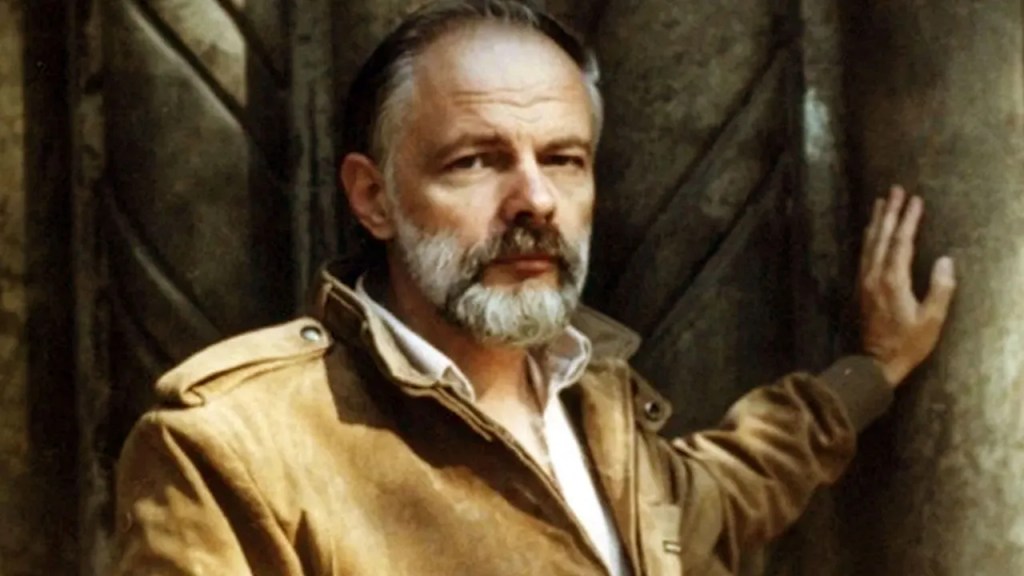
Philip K. Dick, whose novel Do Androids Dream of Electric Sheep? inspired the film Blade Runner, did not live to enjoy his Hollywood success. He died on March 2, 1982, three months before the film was released.

In the years since, the novelist once dismissed as a gutter pulp sci-fi weirdo has steadily climbed the ladder of posthumous literary reputation. The case for Dick’s genius has never rested on his dystopian vision of technology, which he shared in common with masters like HG Wells and Stanislaw Lem, and with hundreds of sci-fi writers since. Good science fiction — as opposed to fantasy novels set on other planets — is defined by a quasi-philosophical examination of interactions between men and machines and other products of modern science. It is part novel and part thought-experiment, centered on our idea of the human.

What made Dick a literary genius, then, was not any special talent for predicting hand-held personal devices or atom bombs the size of a shoe which might have led him to a job in Apple’s marketing department. His gift was for what might be called predictive psychology — how the altered worlds he imagined, whether futuristic or merely divergent from existing historical continuums, would feel to the people who inhabited them. Dick’s answer was, very often: “Not good.”

Dick’s dystopian-psychological approach marks him less as a conventional science fiction writer than as a member of the California anti-utopian school of the Sixties, whose best-known members include Robert Stone, Thomas Pynchon, Ken Kesey, Joan Didion and Hunter Thompson. Seen from this angle, Dick was perhaps the most powerfully and sweepingly paranoid of a group of writers whose stock-in-trade was conspiracy and paranoia, the hallmarks of a society marked — at that moment, and this one — by violent street crime, drug-induced psychosis, and visionary promises gone terribly wrong. Of his anti-utopian peers, Dick’s sci-fi genre background made him the only one who had any particular feel for the proposition that technology was inseparable from, and would therefore inevitably alter, our idea of the human.

Technology was and is perhaps the most Californian aspect of the American mythos. The idea that the universal constants of human nature were at war with the mutilating demands of technology-driven systems was a very Sixties Californian conceit, to which Dick’s fellow anti-utopians each adhered in their own way: In Kesey’s showdown between man and the castrating nanny-state; in Didion’s emphasis on the vanishing virtue of self-reliance; in Pynchon’s degenerate Ivy League Puritanism; in Thompson’s drug-addled primitivism; and in Stone’s Catholic idea of devotion to a God that might somehow salve the wounds of the survivors once the great American adventure goes bust.

What Dick saw, and what his fellow anti-utopians did not, was that human psychology and technology are not separate actors, and that whatever emerged from the other side of the future would be different to the human thing that entered it.

* * *

Seeing and describing how large numbers of people will perceive reality before anyone else does requires imagining states of consciousness that, in the moment, seem deeply strange. It is no accident that the greatest of works of speculative psychology were written by revolutionaries whose outlook was often bleak to the point of despair. The negative tone of these works often led future generations to describe their authors as conservatives, though artistically and psychologically speaking, they are radicals. Or rather, in their rejection of the dominant order, they are radicals and reactionaries at the same time.

The anti-utopian tradition emerged in earnest in 19th-century Russia. The Russian pioneers of the genre were superior to their rivals in England and elsewhere because the latter’s visions were constrained by attachments to a settled society, which one can argue never really existed in Russia — and because the ideas of revolution and violent reaction have always been so closely allied in the Russian psyche. Fyodor’s Dostoyevsky’s Notes From Underground struck many of its initial readers as a kind of artless mental vomit, before revealing itself as a Rosetta Stone for the century of Adolf Hitler and Lee Harvey Oswald. Yevgeny Zamyatin’s We is probably the greatest of at least a dozen weirdly prophetic novels written in the years immediately after the Bolshevik Revolution. In We, Zamyatin predicted what a surveillance society run by engineers would feel like to its inhabitants with a nauseating accuracy that did not become fully apparent until the rise of the modern tech surveillance complex.

The Dick novel that directly predicted our information-addicted, socially-networked 21st-century society, A Scanner Darkly, was both a prophecy of future psychological states and a half-veiled memoir of Dick’s own experiences in the California drug culture. Published in 1977, the book was a detective noir set in a druggy future in which large portions of the population appear to spend their lives scheming and snitching on each other to feed their addictions to a drug called Substance D — the “D” standing for Death, of course.

A Scanner Darkly, a reference to the line in Corinthians in which men at first see God “as in a glass, darkly”, is Dick’s rawest book and the one that reads least like science fiction. The book’s protagonist is simultaneously a narcotics agent known to his peers as Fred and a Substance D addict named Bob Arctor. Fred/Arctor lives in a house — his former marital abode — with two fellow addicts, and is in love with another addict named Donna, who comes to visit him there. Donna helps Arctor obtain Substance D, which he consumes, while Fred uses Donna to attempt to climb higher on the drug distribution ladder. At the end of the novel, Donna turns out to be a drug agent, who is spying on Bob Arctor.

What’s so striking about the book is not Dick’s heartfelt, if futuristically bent, portrayal of the evils of Sixties drug culture. For that, read Stone, who was a master of connecting the physical, mental and moral corruption of drug dealing and dependency, and the fantasies those pursuits inevitably engender to the deeper corruption of man’s nature.

What Dick uniquely captured was something else: The degenerative effects of the split-screen existence of a human brain ceaselessly spying on and doubting and implicating itself while at the same time being spied on by others, all of whom are embedded within machine systems that record everything for reasons that humans cannot understand. Over the course of this machine-and-chemical fed process of human self-contradiction and self-destruction, of which Fred/Arctor is only intermittently aware, we see his thoughts and perceptions being short-circuited and reduced to gibberish.

Drug-induced paranoia aside, the psychology of Dick’s addicts and narcs is as good a description as exists of the spreading incoherence of today’s information ecosystem, which none of us are able to fully see or understand. As a thought experiment, it doesn’t matter that Dick chose a drug rather than the stories we tell about ourselves and our world. It’s not the technology; it’s the psychology. What Dick saw was that the process of splitting ourselves in two — into subject and narc — was a brutal assault on the idea of being human and would make thoughts and communication impossible.

“What does a scanner see?” Arctor wonders, after examining the surveillance apparatus that has been planted, with his knowledge, in his own home. “I mean, really see? Into the head? Down into the heart? Does a passive infra-red holographic scanner like they used to use, or a cube-type holo-scanner like they use these days, the latest thing, see into me – into us – clearly or darkly? I hope it does, see clearly,” Arctor continues, “because I can’t any longer these days see into myself. I see only murk. Murk outside; murk inside. I hope, for everyone’s sake, the scanners do better.” They don’t.

* * *

Jeremy Bentham’s panopticon, which the English philosopher sketched out in a series of letters between 1786 and 1788 while visiting  the Mogilev district of the Russian Empire, was an architectural system of control in which all inmates of an institution could be made visible to a single guard. Bentham’s utopian-utilitarian idea was widely applied in Victorian England to a range of public and private spaces including prisons, asylums, hospitals, factories and even schools. The unique horror of the Benthamite set-up was not the power imbalance inherent in places like prisons and factories, whose existence is obvious to guards and prisoners alike. It was the attempt to eliminate privacy, which is a necessary precondition for being human.

Over the last decade, Bentham’s architecture of unfreedom has been replaced by the architecture of machines. This has created a new social reality where everyone is at once inmate and guard; a panopticon where nothing is private and no one is free. The invisible operations of the machines and programmes we use every day to buy books or food or communicate, which are linked to each other and to the surveillance operations of large government agencies in a single net, induces in most sentient beings a kind of free-floating paranoia of the type that destroys the inhabitants of A Scanner Darkly. On the one hand, everyone knows that everyone is being watched. On the other, it is necessary to deny that knowledge in order to appear to be functioning normally.

One of the most unpleasant characteristics of the weird split-screen mentality of our times is how people must routinely speak against themselves — deny what they see, hear, feel and believe  — in order to maintain the appearance of sanity. It is now routine, for example, to hear Americans on the Left and the Right deride their political opponents for believing in far-reaching conspiracy theories — while in the next breath revealing their own.

No doubt both sides are at least half right. During lockdowns, it became normal for public officials in Western countries to issue draconian edicts in the name of “science” for the supposed good of large numbers of people, only to violate those edicts themselves. The meaning of “science”, it turned out, had nothing to do with the “common good”, or with demonstrating a theory through evidence; it was “one rule for me and another for thee”.

The flagrant doublespeak that is nurtured in the surveillance societies of the West, which have sprung up around us unnoticed, is characteristic of totalitarian societies and mental asylums. The difference is that both totalitarian societies and asylums allow for nonthreatening zones of privacy in order to make life easier for the guards. What we live in today is something else, a set of mirrors into which we are encouraged to look so that our reflections can be distorted and then returned to us. As Bob Arctor puts it, reflecting on the words of Corinthians: “it is not through glass but reflected back by a glass. And that reflection that returns to you: it is you, it is your face, but it isn’t.”

Powerful people in Western societies have lately become convinced of their ability to accomplish great feats of moral and social engineering by controlling these mirrors, altering our reflections and selling them back to us, while undermining our ability to think coherently. The mirrors are not meant to help anyone think; they are systems of control. They are mechanisms of profit, which foster dependence. They are used to mete out punishment, and spy on us.

What’s alarming is that the people who delight in their mastery of these devices seem not to have thought very hard about the damage they are doing to the people who shoot up, a category that includes those who shoot up schools and malls. None of them seem to calculate what creating a miasma of nonsensical conspiracy theories will do to the psyches of their own children, who will inherit “the murk”. They appear to believe that people with minds that have been permanently broken by their gibberish machines will make the perfect workers on their farm. Let’s see how that turns out for them.