
Cyberwar: #RussiaGate Is US

By Rob Williams

Source: Project Censored

The following is a critical book review of Kathleen Hall Jamieson’s Cyberwar: How Russian Hackers and Trolls Helped Elect A President – What We Don’t, Can’t, And Do Know (Oxford: Oxford University Press, 2018).

“Russia hacked the 2016 US election!”

Since November 2016, the US “news” chatterati – pundits and poets, priests, prognosticators and politicians – have repeated this statement ad nauseum. The #RussiaGate story has become a commonly-accepted article of faith amongst the US neoliberal faithful – disgruntled Clintonistas, bereaved “Bernie Bros,” US news flaks, and anyone else who dislikes the current occupant of the White House. If the “Russia hacked the 2016 US election” meme warriors had a high-viz US standard bearer, it would probably be popular MSNBC performance artist Rachel “All Russia, All The Time” Maddow, who serves up the #RussiaGate sauce with reckless abandon to high TeeVee viewer ratings, earning somewhere between $30 and $40 K daily in salary. (LINK to RM mashup here).

And now, we have a scholarly book published by Oxford University Press with an epic title – Cyberwar: How Russian Hackers and Trolls Helped Elect A President – What We Don’t, Can’t, And Do Know – that purports to prove that Russia’s cyber-meddling helped sabotage the HRC campaign, swinging the 2016 US presidential election in favor of DJT.

To approach Cyberwar, first consider everything on the table re: the 2016 US presidential election.

Here‘s just a short list.

Witness the two most unpopular presidential candidates in US political history (one of whom confidently encouraged the other to run, convinced she could beat him); massive and well-documented bipartisan digital vote count manipulation (“electile dysfunction”) courtesy the 2002 “Help America Vote Act” (Orwell would be impressed); the grotesque (human) nature of Donald J Trump and Republicans’ comical attempts to first displace and then eventually come to terms with his 2016 candidacy; the complete corruption of the national Democratic Party leadership, which did everything it could to crown HRC the Dem standard bearer, from systematically undermining insurgent Vermont “progressive” Bernie Sanders’ presidential bid (read the 110 page report “Democracy Lost” for detailed descriptions of how the DNC manipulated 2016 Democratic primary outcomes in 11 swing states) to diverting DNC fundraising – millions of dollars collected from the pockets of ordinary Americans – away from so-called “down ballot” local office races and into HRC presidential campaign coffers during the heated months of 2016.

There’s so much more, but I’ll simply stop there.

Rather than looking in the 2016 mirror, however, US blames…Russians?

To be clear, I approached Cyberwar with an open mind. I am a big fan of the book’s author, distinguished US media scholar Kathleen Hall Jamieson (KHJ), longtime badass in the world of political communications scholarship, and current Elizabeth Ware Packard Professor at the Annenberg School for Communication at the University of Pennsylvania and the Director of the Annenberg Public Policy Center. Jamieson’s got street cred. However, after a close read and re-read of KHJ’s new book, including all the footnotes, Cyberwar left me unconvinced by its “more or less” central conclusion – “Russia trolled and hacked the 2016 US election, sorta!” In fact, I’d suggest that Cyberwar is a deeply problematic book, a fascinating scholarly study in “manufacturing consent” – the term Edward Herman and Noam Chomsky borrowed from Walter Lippman to title their 1988 book of the same name – describing how US elites “massage” US news channels like the New York Times, “filtering” into public view the “news” stories most beneficial to their strategic goals, while downplaying or censoring other worthy “news” stories of significance.

To fully understand my critique of Cyberwar, start with Jamieson’s credulous acceptance of “facts” provided by the US “intelligence community” (my new favorite Orwellian trope) re: the Russian government’s “interference” to advance her Cyberwar case. More on that in a moment. In the meantime, here is KHJ’s central Cyberwar claim, summarized in a single long sentence, slightly paraphrased for brevity, from her book’s conclusion: “In the run up to the 2016 US presidential election, Russian trolls and hackers carried out a strategically systematic and ultimately successful communications campaign to discredit Democratic presidential candidate Hillary Rodham Clinton and support Republican presidential candidate Donald J. Trump through sufficiently widespread messaging that focused on issues compatible with Trump’s strategic needs, addressing constituencies he had to mobilize and demobilize, by employing persuasive, visually evocative and well-targeted content that was amplified in swing states through sharing, liking, and commenting.” (p. 203).

It’s a mouthful, I know, and when you read it over a few times, removing both Clinton and Trump’s names, you quickly realize that this is what ANY strategic political campaign using digital tools –Cyberspace’s unique power and reach – would set out to do to try and win any election, anywhere. Russian president Vladimir Putin himself concedes that Russia wages “campaigns of political influence” wherever and whenever they can, just as the US and other powerful countries do and have done for decades, using as many communications tools as they can leverage.

So – how does Jamieson set out to prove Russian Cyberwar? She divides her book into four parts.

Part One of Jamieson’s book explores “who did it, why, and what research says about it might matter.” Here, KHJ flags the Internet Research Agency (IRA), a Russian troll farm, and introduces the reader to her previous ground-breaking work on communications effects research – how techniques like agenda-setting, framing, priming and “contagion creation” have worked over time to influence US voter decisions, and thus, perhaps, election outcomes. Big caveat here, that KHJ leaves unacknowledged. To wit – presumably, Russian “trolls” share the same primary goal as ALL trolls on the Internet, namely, maximizing audience engagement (and thus profit) through the creation and deployment of relevant content, with their chief “currency” being click-throughs, likes, shares, retweets, etc.

In Part Two of Cyberwar, Jamieson looks at what she calls “the prerequisites of [Russian] troll influence.” “Were the extent and virality of Russian social media content and the nature, coverage, and exposure of Russian-hacked Democratic materials,” she asks, “sufficient and sufficiently persuasive to plausibly affect the outcome of an election decided in three states by about 78,000 votes?” (p. 65). Hint – her final answer is a circumspectly strong “maybe.”

Part Three of Cyberwar finds KHJ considering “how the Russians affected the news and debate agendas in the last month of the presidential campaign.” Here, Jamieson looks at how “Russian hacked content” (her words) transformed the nature of US news coverage surrounding HRC in the month before the 2016 election, with a particular focus on the “drip drip drip” impact of “WikiLeak’d” emails illegally obtained from Democratic National Committee (DNC) servers, as well as FBI director James Comey’s role, during October 2016, in reopening the investigation into “newly-found” HRC emails, which KHJ argues helped shape public impressions around HRC for undecided US voters in the days just before the election.

Jamieson uses Cyberwar Part Four to provide a brief summary of “what we don’t, can’t, and do know about how Russian hackers and trolls helped elect Donald Trump.” “My case that the uses of Russian-hacked (emphasis added) Democratic materials influenced voters is built on scholars’ understandings of the effects of linguistic priming, media agenda setting, and framing the susceptibilities of late deciders, the dispositions of those who view both candidates unfavorably, the effects of imbalances in the amount of negative information available about alternative candidates, and scholarship on how debates affect voter attitudes,” Jamieson concludes. “It is scaffolded on evidence that the hacked content not only altered the media and debate agendas but also increased the negative press about Clinton. And it is bolstered by the possibility that Russian access and anticipated use of illegally gotten or fabricated Democratic content shaped a key decision by FBI director Comey.” (210)

To be fair, Cyberwar is an engaging read. Jamieson is a fine scholarly writer, and she has a field day digging into the aesthetics of individual Russian troll farm memes – complete with pictures. (The “Army Of Jesus” Facebook page, purportedly created by Russian trolls, features a boxing glove clad HRC sporting devil horns engaged in a fierce arm-wrestling match with Aryan Jesus himself. Hilarious.) KHJ also does a credible job tracing the evolution of the US news narrative around HRC in the weeks leading up to the 2016 election, showing how pivotal moments may have influenced voter perceptions about both HRC and DJT.

However! Individual Russian troll farm memes and evolving US “news” media coverage negatively impacting HRC do NOT a strategic Kremlin-led messaging campaign make.

Cyberwar continually flirts with a central question (which has become a story routinely told by US “news” media outlets)  – “Was Russian troll farming some sort of Kremlin-staged strategic cyber-op?” – without ever really answering it. The result is a book-length begging of this very important question, and here we come to the primary problem with Cyberwar– and it’s a whopper. Jamieson build her case for the Russian “tanking” of HRC’s candidacy on two central assumptions, both unproven.

Assumption #1: Jamieson implicitly asserts in Cyberwar that the Russians “hacked” into the Democratic National Committee (DNC) computer servers (as well as other hacks) and obtained digital copies of thousands of what became publicly damning emails from members of the DNC leadership team – Clinton campaign advisor John Podesta, HRC herself, and others – and then (by extension) tried to leverage the contents of these stolen documents for months in US social media spaces (and, by extension, influenced the shaping of US news narratives about HRC.) Interestingly, KHJ sneaks in “Russia hacked” and “Russian-stolen Democratic content” language into the last third of her book, without directly addressing this BIG rhetorical move or providing any proof that the Russians did so. Instead, she appears to implicitly draw on “evidence” for Russian hacking provided by the US “intelligence community” – former FBI director turned Trump special prosecutor Bob Mueller, former director of national intelligence James Clapper, and former National Security Agency director Michael Hayden chief among them. (Mueller, Clapper, Hayden – three US government officials who have all been less than honest with the American people, and I’m being generous.)

The counternarrative to the “Russia hacked into the DNC computers” story? Information was “leaked” from inside the DNC, not hacked from the outside. How might we know? Former NSA cryptographer Bill Binney, former CIA official Ray McGovern, and many other members of the 2003-founded Veteran Intelligence Professionals for Sanity (VIPS) argue that, based on their review of computer bit rate information, the stolen DNC content traveled at bandwidth rates too high to have been an external “hack,” but rather an internal “leak.” The reality? We’ll never know for sure, because the DNC refused to hand over their compromised computer servers to the FBI, instead contracting with Crowd Strike, a private US cybersecurity firm, to ascertain affirmative Russian hacking involvement (#Surprise!). For interested readers, NSA whistleblower Bill Binney discusses his “leak versus hack” conclusions on this recent episode of Brass Check TV between 1:27 – 1:37 here.

Assumption #2: In Cyberwar, Jamieson implies that WikiLeaks closely collaborated with the Russian government, or at the very least (it’s a bit hard to tell from her lack of analysis here), Putin used WikiLeaks as its public relations machine to destroy HRC’s reputation and elevate DJT as a presidential candidate. In other words, from his Ecuadorian embassy prison, Assange was in close cahoots with Putin, Cyberwar implies, or at the very least, Assange served as a “useful idiot” for the Kremlin. Here again, KHJ offers no proof, other than continually flagging the usual suspects, Russian troll farmers and hackers, as well as other sources such as the popular RT (formerly Russia Today) news channel for alleged disinformation shenanigans, such as broadcasting an exclusive in-depth interview between independent British journalist John Pilger and WikiLeaks’ co-founder Julian Assange on November 6, 2016, two days before the election.

Side note – this interview, entitled “Secret World of US Election,” is fascinating (see here).

RT/Russia Today now carries a variety of US news shows  hosted by US news journalists now unable to find access to the US airwaves, individuals like former MSNBC journalist Ed Schultz (now deceased), former US talk show host Larry King, and Pulitzer Prize winning former New York Times foreign correspondent Chris Hedges. Ironically, RT’s news content is often much more in-depth than any stories provided by the US corporate commercial TeeVee channels – watch any episode of Chris Hedges’ “On Contact,” for example, to hear perspectives on US politics you’ll rarely find on any other US news channel. On December 31, 2018, RT aired an episode of Larry King’s program talking with longtime Russia expert and War With Russia? author Stephen Cohen, and the show begins with King parroting the “Russia interfered in the US election” meme, a claim Cohen respectfully disputes before launching into a cogent and thoughtful analysis of the importance of a 21st century US-Russia “partnership” (not “friendship”) instead of more US/NATO aggression on Russia’s borders,  and how DJT’s overtures to Russia have been continually hamstrung by US political and media elites. Here’s a link for further listening. It bears repeating, and King and Cohen discuss this at some length, that Cohen’s point of view re: Russia is now considered “radical” in US policy-making circles, despite the Cold War between the US and Russia having been officially over for thirty years.

Back to WikiLeaks and the organization’s alleged conspiring with the Kremlin. Suffice to say, as the world’s first truly “stateless” news organization, WikiLeaks’ role as a powerful platform for publishing information provided by corporate and state insiders-turned-whistleblowers has been consistently credible and accurate, as well as proving a colossal PITA for US political and economic elites on all sides of the aisle. And yes, Assange and WikiLeaks have reserved special ire for the Clintons, and indeed, Assange admitted to actively working with the DJT campaign in the months leading up to the 2016 US presidential election. To implicitly blame the Russians for WikiLeaks’ behavior, however, as KHJ does in Cyberwar, is disingenuous at best.

Here’s a single example of this troublesome conflation based on faulty assumptions from page 149 pf KHJ’s Cyberwaranalysis: In early October 2016, Jamieson asserts, “a DHS-ODNI intelligence report confirmed that the Russians were behind the hacking of the DNC…and a first tranche of Russian-hacked Podesta emails was WikiLeak’d.” She then goes on to detail (rightly in my estimation) the damning impact of these documents on US news coverage of HRC’s campaign. But read her sentence above again to understand the broad leaps she is making, which go well beyond Russian troll farmers.

And here is the rub. At day’s end, Jamieson’s case for Russian Cyberwar squarely rests on these two assumptions, both unproven. The result? KHJ makes mountains out of molehills – amateurish Russian troll farming on Facebook and Twitter, and (maybe?) a “campaign of influence targeting HRC” is transmogrified, in her implicit final analysis AND by uncritical coverage of her Cyberwar book in the popular US news media, into Putin’s Russian government strategically penetrating to the very heart of the US electoral process, “gaming” the outcome against HRC and in favor of DJT. In this tense geopolitical moment, when corporate for-profit and “deep state” US “news” media mouthpieces supporting the Empire’s “full-spectrum dominance” of planet Earth on the Pentagon’s behalf are blindly thrashing about looking for someone (or some country) to blame, Cyberwar only adds fuel to the fires of the #RussiaGate hysteria.

Bigger picture? Even more troublesome for any American who still believes in the transformative power of free, open, and democratic discourse are the ways in which the two-year-old #RussiaGate tale is now being leveraged by US elites here in the “Homeland.” “Behavioral microtargeting,” a digital communications strategy pioneered in 2016 by UK-based Cambridge Analytica CEO Alexander Nix, Trump chief strategist Steve Bannon, and Facebook (unwittingly?) through “data breaches” of 50 million (with an M) Facebook user accounts, is now being used in state and local political races around the US as a viable political strategy. Social media censorship, meanwhile, is emerging as a strategic US synergistic state/corporate response to so-called “fake news” – witness neoliberal think tank Atlantic Council’s recent collaboration with Facebook to “purge” more than 800 “suspect” Facebook accounts, or Google’s “algorithmic censorship,” gaming its algorithm to marginalize US news outlets – TruthDig, Alternet, TruthOut, WWSA – critical of the US imperial status quo, or the complete purging of controversial independent analyst and so-called “conspiracy theorist” Alex Jones from pretty much ALL mainstream (read corporate) US digital platforms – all happened within the past year. And, as US comedienne Michelle Wolf pointed out at the annual Washington Press Club banquet last spring, MOUNDS of money are being made by US neoliberal “news” outlets – clicks, ratings, book sales – through this sort of Trump-bashing and fear-mongering, while pressing issues impacting the lives of ordinary Americans – “still no clean water in Flint, Michigan!” – are completely ignored. #RussiaGate, in sum, is now a rationale for demonizing, marginalizing, and censoring any US individual or organization that does not tow the #RussiaGate party line.

Despite the US news-induced hysteria surrounding the #RussiaGate tale, voices of reason persist. Most prominent include Rolling Stone investigative journalist Matt Taibbi, LA-based nightclub comedian Jimmy Dore (who regularly covers the excesses of the #RussiaGate story with his comedic colleagues on is popular YouTube channel “The Jimmy Dore Show”), and Nation reporter Aaron Maté, whose December 28, 2018 article calls BS on the #Russiagate nonsense. The complete title of Maté’s article? “New Studies Show Pundits Are Wrong About Russian Social-Media Involvement in US Politics – Far from being a sophisticated propaganda campaign, it was small, amateurish, and mostly unrelated to the 2016 election.” (read Maté’s piece here). Maté, who has covered the #RussiaGate story extensively since 2016, provides in-depth analysis of two new reports alleging Russian cyber meddling – one produced by the University of Oxford’s Computational Propaganda Research Project and the other by the US consulting corporation with deep ties to the national security state, New Knowledge. I encourage interested readers to take the time to read his story.

Maté’s conclusion, meanwhile, is worth quoting here at length:

Based on all of this data, we can draw this picture of Russian social-media activity: It was mostly unrelated to the 2016 election; microscopic in reach, engagement, and spending; and juvenile or absurd in its content. This leads to the inescapable conclusion, as the New Knowledge study acknowledges, that “the operation’s focus on elections was merely a small subset” of its activity. They qualify that “accurate” narrative by saying it “misses nuance and deserves more contextualization.” Alternatively, perhaps it deserves some minimal reflection that a juvenile social-media operation with such a small focus on elections is being widely portrayed as a seismic threat that may well have decided the 2016 contest.

Indeed.

Would that Kathleen Hall Jamieson was not a bit more “nuanced” in “contextualizing” her Cyberwar analysis.

What to do? The best answer is critical media literacy education – moving beyond partisan politics and moral panics to more thoughtfully engage these important political questions in open dialogue and debate.

Until we do so, we will continue to be enthralled by the #RussiaGate tale, with potentially deleterious geopolitical consequences. (Again, Cohen’s interview with Larry King is a good starting place).

To wit, in Pogo’s famous phrase – “we have met the enemy and he is US.”

A N.Y. Times Story Just Accidentally Shredded the Russiagate Hysteria

By Lee Camp

Source: TruthDig

Every once in a while, one of those stories comes along that makes the mainstream corporate media look like a bunch of middle-school kids filming their “news show” on an iPhone with their neck ties crooked. Recently, one of those stories splashed down into the middle of our cultural zeitgeist like a small meteor landing in the middle of an elite dinner party.

It made our mass media pundits look like hardened fools. But they have kept spouting their nonsense anyway, hoping no one notices the soup dripping down their faces.

But to talk about that, I have to talk about this: Last month we finally got to see the Senate report spelling out the Russian meddling in our last election. And it was a bombshell. It rocked the heart of our country. It shredded the inflamed mucousy core of our palpitating democracy.

As Dan Cohen reported for the Grayzone Project, the report said that “…everything from the Green Party’s Jill Stein to Instagram to Pokemon Go to the African American population had been used and confused by the deceptive Facebook pages of a private Russian troll farm called the Internet Research Agency.”

That’s right. Russia even used Pokémon Go to pulverize the previously pristine 2016 election. That’s ever so frightening, since Pokémon Go is CIA-backed. (I guess it’s high time we just accept that the CIA has been taken over by those ruthless vodka drinkers.)

Back to the point—we learned from the report last month that the Russian Internet Research Agency manipulated every one of us with Facebook ads. If you don’t mind though, the Senate and the corporate media (and anybody else who knows the secret oligarchy handshake) would really prefer you just ignore the fact that Facebook clearly stated: “…56% [of the Russian ads] were after the election” and “…roughly 25% of the ads were never shown to anyone.”

But like an overweight man dressed like Wolverine at a Comic-Con, our brave congressmen and -women are not about to be dissuaded by reality. After the reports came out, Sen. Mark Warner tweeted, “Incredible. These bombshell reports demonstrate just how far Russia went to exploit the fault lines of our society and divide Americans, in an attempt to undermine and manipulate our democracy.”

Just after posting that, Warner patriotically pissed his red, white and blue Underoos.

So who are these amazing nonpartisan unbiased sleuths who put together this legitimate and nonpartisan unbiased Senate report? The New York Times found out they are a group called New Knowledge (which sounds like a terrible boy band). New Knowledge was founded by two veterans of the Obama administration, Jonathon Morgan and Ryan Fox. …So, I guess we’re, um, doing away with the “nonpartisan unbiased” thing.

Well, in that case—I say go hard or go home. I want MORE bias!

The Grayzone Project pointed out that besides working for Obama and the State Department, “… Morgan also developed technology for the Defense Advanced Research Projects Agency (DARPA), the arm of the Department of Defense created for basic, applied technological research, and futuristic war toys.”

All right, all right, not bad. But I know what you’re thinking. “Lee, that might be a great bias appetizer, but we want the full bias entree!”

OK, how about this?

Ryan Fox is a 15-year veteran of the NSA and was a computer analyst for the Joint Special Operations Command (JSOC) military unit. JSOC is notorious for its spree of atrocities across the Middle East. …

Hell yeah! You can feel that bias in my toes, can’t ya? But, the truth is, we’re still only at a 45 percent bias rating. I say we get it up to at least 65 percent. Back to Dan Cohen:

The report … was overseen by Renee DiResta, a former Wall Street trader and tech specialist who was recruited by Obama’s State Department to devise strategies for combating online ISIS propaganda.

So now we’ve got former Wall Street, former State Department, former Obama White House, former NSA, former DARPA, and former JSOC writing this completely legitimate completely factual report for the Senate about the powerful Russian impact of Facebook ads that no one ever saw.

I love it. This is like a report written by a hungry virus telling you not to wash your hands.

But hold on, it’s not only this Senate report that showed nefarious Russian meddling. It’s also all of those evil Russian bots. How do we know there are evil Russian bots? Well, most outlets quote Hamilton 68, which tracked Russian influence operations on Twitter.

Outlets like MSNBC, The Washington Post, The New York Times, Mother Jones and Tiger Beat. They’re all quoting Hamilton 68 or people who are referencing work done by Hamilton 68. Well, who the hell made Hamilton 68, and why does it sound like a ’90s alt-rock band that opened for Blink 182?

Oh, what do you know! Our old friend “[Jonathon] Morgan is also one the developers of Hamilton 68. … Funded by the German Marshall Fund’s Alliance for Securing Democracy—which is itself backed by NATO and USAID.”

Well OK, that sounds pretty serious. Clearly these people have found a special device that locates Russian bots on the interwebs, and it most likely resembles the thing Egon used in the “Ghostbusters” movies. So, shouldn’t we just congratulate Morgan on helping to develop the holy grail for spotting Russian bots and then call it a day? Well, there’s one itsy bitsy problem:

 … one of Hamilton 68’s founders, Clint Watts, admitted that the Twitter accounts it follows may actually be real people who are not Russian at all.

Real people? Who aren’t Russian? Call me crazy, but what I personally look for in a Russian bot is something that is at least Russian. And if not that, then a bot. And if neither, then you don’t have much of a goddamn Russian bot, do ya? Claiming these are Russian bots is like saying, “I just met the Queen of England, except she may have been a small Icelandic goat.”

Then, a few weeks ago The New York Times revealed that New Knowledge carried out an elaborate false flag operation to hurt the election chances of Judge Roy Moore in Alabama. You might recall that Roy Moore is an accused pedophile and a proven dipshit. And I don’t believe he should be elected to pick the bedbugs out of Rush Limbaugh’s armpits. But that doesn’t mean I think these New Knowledge charlatans shouldn’t be revealed for what they are.

So here’s how New Knowledge’s game worked, according to the Times. New Knowledge created a fake Facebook page in order to get conservatives in Alabama to support patio supply salesman Mac Watson instead of Roy Moore.

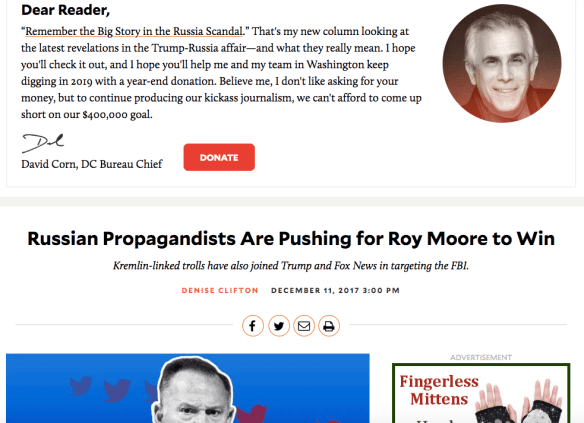
New Knowledge then tried to make everyone think that Moore’s campaign was working with the Kremlin by showing that he had thousands of Russian bots following his Twitter account. Many in the mainstream media ran with this outlandish idea. Mother Jones’s well-researched (sarcasm) article on the topic was titled “Russian Propagandists Are Pushing for Roy Moore to Win!” In the article they sourced (Can you guess?) Hamilton 68.

So to rehash: Hamilton 68, using their “Ghostbusters” device (patent pending), found that Russian bots (which may not be Russian and may not be bots and may not be Russian bots) were simply in love with alleged pedophiliac Alabama judges. So much so, that a majority of their tweets (meaning at least 51 percent) were in support of Roy Moore.

But as The New York Times has revealed, New Knowledge’s own internal report said, “We orchestrated an elaborate ‘false flag’ operation that planted the idea that the Moore campaign was amplified on social media by a Russian botnet.”

After these revelations came out a few weeks ago, Facebook suspended some of the accounts. So now The New York Times found itself in a quandary. They must have been thinking, “We need to report on this huge development in which the core authors of the Senate report on Russian meddling and the co-founder of Hamilton 68 were involved in lying, bullshitting, and false-flagging in order to help the Democratic party. But that completely undermines the Russiagate hysteria we have anchored our ship to. What do we do?”

Well, kids, take notes. This is how you do it. This is how you have your yellowcake uranium story and eat it too.

The New York Times headline was “Facebook Closes 5 Accounts Tied to Russia-Like Tactics in Alabama Senate Race”

Russia-like tactics?! This is literally an article about how Russia was NOT involved in the Alabama senate race false flag. In fact, it’s an article on how the guy who helped write the Senate report on the so-called Russian tactics is also one of the top people at New Knowledge, which either created or pushed pretend Russian bots to support Roy Moore so that they could leak to the press, “Russian bots are supporting Roy Moore!”

Sometimes the ability of the legacy media to believe (or at least regurgitate) their own bullshit is truly breathtaking.

To sum up this fuck de cluster:

1) The Senate report is laughable.

2) Any journalist who quotes Hamilton 68 should have their face sewn to the carpet.

3) If you want ridiculous pathetic reporting on nonsense that seduces us all to the edge of nuclear annihilation, turn to your mainstream corporate media.

4) If you want someone to actually put together the truth about these issues, you’ll have to turn to alternative outlets like Truthdig or the Grayzone Project.

5) Bill Murray and the Ghostbusters were ahead of their time.

If you think this column is important, please share it. To find out about all of Lee Camp’s columns, subscribe to his free newsletter here

 This column is based on a monologue Lee Camp wrote and performed on his TV show “Redacted Tonight.”


US Backs Coup in Oil-Rich Venezuela, Right-Wing Opposition Plans Mass Privatization and Hyper-Capitalism

The US has effectively declared a coup in Venezuela. Trump recognized unelected right-wing opposition leader Juan Guaidó as new “president,” who plans mass privatization and neoliberal capitalist policies.

By Ben Norton

Source: GrayZone

The United States has effectively declared a political coup d’état in Venezuela, from abroad. Trump announced on January 23 that the US recognizes the unelected, illegitimate right-wing opposition leader Juan Guaidó as the supposed new “interim president” of Venezuela’s supposed new “government.”

Venezuela’s US-backed opposition has pledged to carry out a mass privatization of state assets and to implement harsh neoliberal capitalist policies. The opposition-controlled legislatures declared in its “transition” plans that the “centralized model of controls of the economy will be replaced by a model of freedom and market based on the right of each Venezuelan to work under the guarantees of property rights and freedom of enterprise.”

The US has also hinted at violence in Venezuela. During a background briefing after Trump’s declaration, journalist Dan Cohen heard a US official declare that if the government of actual President Nicolás Maduro responds with any violence, “They have no immediate future, they have no immediate livelihood. One way or another they have their days counted.”

Trump administration officials added, “When we say all options are on the table, all options are on the table… Let’s hope Maduro and his cronies see the magnitude of the message.”

Region’s Right-Wing Countries Join US in Recognizing Coup

Canada’s Liberal government, led by Prime Minister Justin Trudeau; Brazil’s new far-right leader Jair Bolsonaro; and the overtly pro-US Organization of American States (OAS) and its Secretary General Luis Almagro have joined Trump in endorsing this diplomatic coup in Venezuela.

Likewise, the right-wing, US-allied countries in Latin America, including Argentina, Chile, Colombia, Costa Rica, and Ecuador have joined Trump in anointing Guaidó as leader.

The region’s few remaining leftist governments, Bolivia, Cuba, and Nicaragua, have continued recognizing Venezuela’s legitimate government, as has Mexico’s newly elected left-wing President Andrés Manuel López Obrador.

Bolivian President Evo Morales warned that “the claws of imperialism again seek to fatally wound the democracy and self-determination of the peoples of South America,” adding, “No longer will we be the backyard of the US.”

The US government, its right-wing allies, and an obeisant corporate media have repeatedly referred to Venezuela’s actual president, Nicolás Maduro, as an “authoritarian dictator.” What they have failed to mention is that Venezuela still has regular elections, but the US-backed right-wing opposition, which is notoriously disunited and incompetent, has chosen to boycott these elections, preferring to call for foreign-backed military coups instead.

One of the only elected officials in the US who has spoken out against the coup is left-wing California Congressman Ro Khanna. Other progressive and anti-Trump US politicians, including self-declared “democratic socialists,” have remained silent on Trump’s effective declaration of a coup in Latin America.

Opposition Plans for Privatized ‘Free Market’ Economy

While supporters of regime change in Venezuela insist this blatantly undemocratic move is necessary to “defend democracy,” make no mistake, the upheaval is clearly not motivated by resistance to authoritarianism.

Venezuela, which has the world’s largest oil reserves and has challenged the hegemony of the US dollar, has long been a target of US aggression. In 2002, the United States supported a military coup that briefly ousted democratically elected President Hugo Chávez and replaced him with the right-wing oligarch Pedro Carmona. US intervention, including crippling economic sanctions, has only continued since then.

Elements of Venezeula’s opposition have portrayed themselves to credulous foreign observers as “social democratic,” but their real intentions are very clear: The opposition-controlled legislature has demanded mass privatization of state assets and a return to a capitalist oligarch-controlled economic system built on “property rights and freedom of enterprise.”

In 2017, the Venezuelan government declared the creation of the Constituent Assembly, to rewrite the constitution. Venezuela’s opposition refused to recognize this body and boycotted the elections. The opposition instead remained in control of the National Assembly and decided to run it as a separate parallel legislature.

The opposition-controlled National Assembly drafted a “transition” law that openly outlines what policies the opposition, led by Juan Guaidó, would pursue in its illegitimate, US-recognized “government” in Venezuela. Analyst Jorge Martín, explained what this means in an article published by VenezuelaAnalysis:

The “transition law” drafted by the Assembly National (in contempt) is explicit about the central objectives of the coup in the political and economic field:

“[C]entralized controls, arbitrary measures of expropriation and other similar measures will be abolished… For these purposes, the centralized model of controls of the economy will be replaced by a model of freedom and market based on the right of each Venezuelan to work under the guarantees of property rights and freedom of enterprise.”

In other words, the nationalised companies will be returned to their former private owners (including telecommunications, electrical, SIDOR, cement, etc), as will expropriated landed estates. It is noteworthy that there is a lot of talk of property and business rights, but no mention is made of workers’ rights, which would certainly be abolished. It continues:

“Public companies will be subject to a restructuring process that ensures their efficient and transparent management, including through public-private agreements.”

What this means, in plain language, is massive dismissal of workers from state companies and the entry of private capital into them: a policy of looting which has already proved to be a disaster in all countries where it has been applied.

The model of the opposition’s new coup regime in Venezuela — backed by the US, Canada, and Brazil — is the reimposition of neoliberal capitalism and the recolonization of Latin America. Any bluster about restoring democracy is a mere pretense at this point.

A New Narrative Control Firm Works To Destroy Alternative Media

By Caitlin Johnstone

Source: CaitlinJohnstone.com

The frenzied, hysterical Russia narrative being promoted day in and day out by western mass media has had two of its major stories ripped to shreds in the last three days.

A report seeded throughout the mainstream media by anonymous intelligence officials back in September claimed that US government workers in Cuba had suffered concussion-like brain damage after hearing strange noises in homes and hotels with the most likely culprit being “sophisticated microwaves or another type of electromagnetic weapon” from Russia. A recording of one such highly sophisticated attack was analyzed by scientists and turned out to be the mating call of the male indies short-tailed cricket. Neurologists and other brain specialists have challenged the claim that any US government workers suffered any neurological damage of any kind, saying test results on the alleged victims were misinterpreted. The actual story, when stripped of hyperventilating Russia panic, is that some government workers heard some crickets in Cuba.

Another report which dominated news headlines all of yesterday claimed that former Trump campaign manager Paul Manafort (the same Paul Manafort who the Guardian falsely claimed met with Julian Assange in the Ecuadorian embassy) had shared polling data with a Russian associate and asked him to pass it along to Oleg Deripaska, who is often labeled a “Russian oligarch” by western media. The polling data was mostly public already, and the rest was just more polling information shared in the spring of 2016, but Deripaska’s involvement had Russiagaters burning the midnight oil with breathless excitement. Talking Points Memo‘s Josh Marshall went so far as to publish an article titled “The ‘Collusion’ Debate Ended Last Night”, substantiating his click-generating headline with the claim that “What’s crystal clear is that the transfer to Kilimnik came with explicit instructions to give the information to Deripaska. And that’s enough.”

Except Manafort didn’t give any explicit instructions to share the polling data with Deripaska, but with two Ukrainian oligarchs (who are denying it). The New York Times was forced to print this embarrassing correction to the story it broke, adding in the process that Manafort’s motivation was likely not collusion, but money.

These are just the latest in a long, ongoing pattern of terrible mass media debacles as reporters eager to demonstrate their unquestioning fealty to the US-centralized empire fall all over themselves to report any story that makes Russia look bad without practicing due diligence. The only voices who have been questioning the establishment Russia narrative that is being fed to mass media outlets by secretive government agencies have been those which the mass media refuses to platform. Alternative media outlets are the only major platforms for dissent from the authorized narratives of the plutocrat-owned political/media class.

Imagine, then, how disastrous it would be if these last strongholds of skepticism and holding power to account were removed from the media landscape. Well, that’s exactly what a shady organization called NewsGuard is trying to do, with some success already.

A new report by journalist Whitney Webb for MintPress News details how NewsGuard is working to hide and demonetize alternative media outlets like MintPress, marketing itself directly to tech companies, social media platforms, libraries and schools. NewsGuard is led by some of the most virulently pro-imperialist individuals in America, and its agenda to shore up narrative control for the ruling power establishment is clear.

The product which NewsGuard markets to the general public is a browser plugin which advises online media consumers whether a news media outlet is trustworthy or untrustworthy based on a formula with a very pro-establishment bias which sees outlets like Fox News and the US propaganda outlet Voice of America getting trustworthy ratings while outlets like RT get very low ratings for trustworthiness. This plugin dominates the bulk of what comes up when you start researching NewsGuard, but circulating a plugin which individual internet users can voluntarily download to help their rulers control their minds is not one of the more nefarious agendas being pursued by this company. The full MintPress article gives a thorough breakdown of the yucky things NewsGuard has its fingers in, but here’s a summary of five of its more disturbing revelations:

1. The company has created a service called BrandGuard, billed as a “brand safety tool aimed at helping advertisers keep their brands off of unreliable news and information sites while giving them the assurance they need to support thousands of Green-rated [i.e., Newsguard-approved] news and information sites, big and small.” Popularizing the use of this service will attack the advertising revenue of unapproved alternative media outlets which run ads. NewsGuard is aggressively marketing this service to “ad tech firms, leading agencies, and major advertisers”.

2. NewsGuard’s advisory board reads like the fellowships list of a neocon think tank, and indeed one of its CEOs, Louis Gordon Crovitz, is a Council on Foreign Relations member who has worked with the American Enterprise Institute and Heritage Foundation. Members of the advisory board include George W Bush’s Secretary of Homeland Security Tom Ridge, deep intelligence community insider Michael Hayden, and the Obama administration’s Richard Stengel, who once publicly supported the need for domestic propaganda in the US. All of these men have appeared in influential think tanks geared toward putting a public smiley face on sociopathic warmongering agendas.

3. Despite one of its criteria for trustworthy sources being whether or not they are transparent about their funding, the specifics of NewsGuard’s financing is kept secret.

4. NewsGuard is also planning to get its news-ranking system integrated into social media outlets like Facebook and Twitter, pursuing a partnership which will make pro-establishment media consumption a part of your experience at those sites regardless of whether or not you download a NewsGuard app or plugin.

5. NewsGuard markets itself to state governments in order to get its plugin installed in all of that state’s public schools and libraries to keep internet users from consuming unauthorized narratives. It has already succeeded in accomplishing this in the state of Hawaii, with all of its library branches now running the NewsGuard plugin.

https://twitter.com/Daniel_Rubino/status/1081271640925921280

We may be absolutely certain that NewsGuard will continue giving a positive, trustworthy ranking to the New York Times no matter how many spectacular flubs it makes in its coverage of the establishment Russia narrative, because the agenda to popularize anti-Russia narratives lines up perfectly with the neoconservative, government agency-serving agendas of the powers behind NewsGuard. Any attempt to advance the hegemony of the US-centralized power establishment will be rewarded by its lackeys, and any skepticism of it will be punished.

Whoever controls the narrative controls the world. Ruling power’s desire to regulate people’s access to information is so desperate that it has become as clumsy and ham-fisted as a teenager pawing at his date in the back seat of a car, and it feels about as enjoyable. They’re barely even concealing their desire to control our minds anymore, so it shouldn’t be too difficult to wake everyone up to their manipulations. We need to use every inch of our ability to communicate with each other before it gets shut down for good.

Lobotomized: Secrecy and the “Dis-enlightenment”

By Gordon Duff

Source: New Eastern Outlook

As we enter 2019, one thing above all others is clear, the mechanisms of human engagement, education, media and information, even what passes for human contact through social media and email, is all subjected to “algorithms,” whatever those are.

It was Snowden that brought it to our attention, from the Guardian back in 2014:

“Increasingly, we are watched not by people but by algorithms. Amazon and Netflix track the books we buy and the movies we stream, and suggest other books and movies based on our habits. Google and Facebook watch what we do and what we say, and show us advertisements based on our behavior. Google even modifies our web search results based on our previous behavior. Smartphone navigation apps watch us as we drive, and update suggested route information based on traffic congestion. And the National Security Agency, of course, monitors our phone calls, emails and locations, then uses that information to try to identify terrorists.”

Documents provided by Edward Snowden and revealed by the Guardian today show that the UK spy agency GHCQ, with help from the NSA, has been collecting millions of webcam images from innocent Yahoo users. And that speaks to a key distinction in the age of algorithmic surveillance: is it really okay for a computer to monitor you online, and for that data collection and analysis only to count as a potential privacy invasion when a person sees it? I say it’s not, and the latest Snowden leaks only make more clear how important this distinction is.”

When we look back on 2014 from where we are today, Edward Snowden’s warnings of an Orwellian nightmare seem innocent. Maybe it was Donald Trump that opened our eyes, if so, whatever contribution history attributes to him, he might well want to hang his hat on this one.

The fake science of intruding into lives in order to recognize and control “influencers” began in the private sector and was “tuned up” for political races, crime and terrorism prevention and more.

By “more,” we mean “dumbing down” the “masses,” as they are called, presenting reality as a consumer product, custom engineered to be believable, to create drama or fear, to raise concerns of imaginary threats, to distract, and, above all, to control.

Social scientists have postulated that humans can actually be programmed to respond to the most basic stimuli, touch, hearing, taste, based on “fake” information, that the human mind can be fooled into filtering out such basic sensory responses as smell.

The basic synaptic connections that tie sensory input to ideas or concepts, let’s look at one glaring example. Try to say the word “Palestinian” without following it with “terrorist.”

Then again, let’s go back one more step and define the difference between an “armed militant” and a “freedom fighter.” Nothing here is new, the rules were laid out a century ago.

Einstein predicted this in his “Autobiographical notes” on epistemology. It was some 50 years ago when Dr. John Ward of Michigan State University pounded this into my head in his Philosophy of Science lectures. “The relationship between sense experiences and concepts is entirely intuitive as are the relationships between all concepts. You see what you see, not because of what you see but because of what you think.”

It was quite one thing when such pursuits were endeavors of science and philosophy at our great universities, but it became something quite different when Wilson Bryan Key, back in 1973, wrote the seminal work, Subliminal Seduction, demonstrating how altered images could reach into the most basic primitive drives, the “reptile brain,” as it were, driving an unknowing viewer to alter both perceptions and reasoning, even toward lowering human survivability.

Key’s imagery, taken from popular magazines, strange figures of death’s heads or nude women, airbrushed into ice cubes, were an opening salvo. If thanatotic drive could sell liquor or cigarettes, how easy might it be to sell a war?

No more films like Sergeant York or Red Dawn needed, or perhaps only as a “supporting actor,” pounding the nail in just a bit more.

Twenty years prior to the publication of Key’s work, the US government began a project known as MK Ultra. Though it officially ended in 1973 after 20 years of poorly documented “research” into every form of psychological manipulation, in truth, MK Ultra and other programs as well, simply “went dark.”

The reason, of course, we are traveling his historical path today is that those programs, after not 50 but 65 years of still classified efforts, after billions of dollars in black funding, programs with no oversite, programs carried out on unsuspecting citizens, sometimes entire cities, sometimes on unwilling victims in “black sites,” are the precursors to the world of Google and Facebook today.

Looking at 2018, there were some obvious “projects,” the White Helmet staged fake gas attacks for sure. This involved Facebook posts, fake videos, but the key is that they were channeled directly to the President of the United States who had been programmed to ignore credible intelligence sources. Thus, Trump ordered an attack on Syria entirely based on a Facebook post.

But there are millions of Facebook posts every day. Why did he get this one? Who put it in front of him? Is Trump surrounded by handlers, traitors?

You see, it is one thing when something is put on the internet, the equivalent of leaving a post-it note in a public restroom on the “wrong side of town.” It is quite something else when the message, a parentless bastard of disinformation, is given to a man who has, according to sources within the White House, openly advocated use of tactical nuclear weapons against Syrian people in retribution for wildly fabricated accusations.

Consider the implications, even if someone, perhaps General Mattis, had taken the nuclear option off the table. Simply put, it lowers the standards of the United States exercising war powers in attacking a sovereign nation to an anonymous social media post.

Again, we ask, it is one thing posting something malicious and dangerous and quite something else when a national leader with access to nuclear weapons is programmed to seek out and act upon same.

Then again, were any other president to order a missile strike based on, well, based on nothing whatsoever, not even a decent lie, one might expect negative repercussions.

Let’s take a second to juxtapose. If a fake public narrative exists, and it is reasonable to postulate that “the public,” such as it is, is more than aware that a “real world” exists in which what is generally known and accepted as true is, in fact, utterly false.

In fact, some of the most popular television series of the past decades have exposed the flummery of generally accepted history. Shows like The Secret History of World War II and many if not endless others, feed a hungry public a continual diet of debunked reality.

What we are left with is this, an ongoing process, a spiral as it were, around and down, around and down, ever faster, ever more hopeless, intrusion into lives, into thoughts, planted feelings, manipulated responses, altered perceptions, until nothing can be trusted, especially not ourselves.


Gordon Duff is a Marine combat veteran of the Vietnam War that has worked on veterans and POW issues for decades and consulted with governments challenged by security issues. He’s a senior editor and chairman of the board of  Veterans Today, especially for the online magazine “New Eastern Outlook.”
https://journal-neo.org/2019/01/09/lobotomized-secrecy-and-the-dis-enlightenment/


Retconning History

By CH

Source: The Hipcrime Vocab

“He who controls the past, controls the future; and he who controls the present, controls the past.”–George Orwell

“The mistake of judging the men of other periods by the morality of our own day has its parallel in the mistake of supposing that every wheel and bolt in the modern social machine had its counterpart in more rudimentary societies…”–H.S. Maine

“The past is a foreign country; they do things differently there.” –L.P. Hartley

I’ve often referred to the “Flintstonization of history”—a concept I borrowed from the book Sex at Dawn. It’s the tendency to project our present-day circumstances onto the past, assuming that people basically thought and acted much as we do. But when we do that, we bring our “modern” sensibilities and worldview along with us. And those have been decisively shaped by the time and culture in which we live.

Today I’d like to introduce a related concept–the retconning of history.

Looking back, that’s been the theme of a lot of my writing over the past year. I’ve looked at a lot of history which challenges and overturns the conventional narrative that our present-day circumstances and social organization are basically the same as past societies, except with better technology and a few more creature comforts (i.e. the past, but with cell phones). Or that they are the way things have always been, and that there are no alternatives.

Now, most of you probably know what retconning is. It is short for the phrase “retroactive continuity”. In order to make a narrative coherent, the authors “rewrite” (or simply ignore) what has occurred in previous episodes or iterations of a long-running franchise in order to maintain continuity with the ongoing “new” narrative arc and characters. The phrase originated with comic books, and is typically used in reference to films, television shows, books, video games, etc.

From there, the word has passed into common parlance. Normally, retcon is still used in the context of a work of fiction. However, I’ve seen the word spread beyond just talking about movies and TV shows to the world in general. When people say retcon now, they are usually referring to an attempt to “rewrite” past events by deliberately distorting them or altering the record after the fact. That is, “[people] tell themselves a different story about what happened in prior events in order to maintain consistency with their current circumstances.” That story may include a blatant distortion of facts and a general disregard for reality. Much of this is derived from our current political situation. A politician may suddenly reverse their position, and then declare that what came before didn’t happen (“fake news”), or simply ignore it altogether if it doesn’t fit with the narrative “spin” of the political parties.

At it’s heart, it is an attempt to “erase” or “rewrite” the past for the sake of present circumstances. As one of it’s earliest descriptions had it“retroactive continuity ultimately means that history flows fundamentally from the future into the past.”

What’s any of this got to do with history? It strikes me that much of what we learn about history are attempts to “retcon” the past.

What do I mean by this? It seems that history often adopts a “modern” point of view to explain past events. In this narrative, we were always heading to exactly where we are: globalized free-market corporate monopoly capitalism.This is done to depict our present circumstances not as deliberately engineered, or contingent on any historical circumstances, or political choices, but rather as something “natural” and just an expression of unchanging human nature. With this retconning, we are unable to think of different ways of organizing things, because those ways—even in the very recent past—have been retconned out of history. Even things in recent living memory—such as not going into debt for an education, or being able to afford a single family house on 25 percent of your income—are retconned to make it so that they never happened.

Here are just a few of the major retcons I have discovered over the past year or so:

1. Economists tend to depict all of human history as heading towards “free and open” markets, if only government would only just “get out of the way” and drop all restrictions and regulations on merchant princes and wealthy oligarchs. That is, globalized corporate free trade is “natural” (as is currency), and collective governance is “artificial” and unnecessary. Our “natural instinct” is to “truck, barter and exchange” declared Adam Smith. John Locke argued that the reason governments came to exist was to protect and secure private property, and that they should do little else besides this.

Of course, all of this is false. For example, an attempt at retconning history was engaged in by economists Santhi Hejeebu and Deirdre McCloskey (of ‘bourgois virtues’fame) attempting to refute some of Karl Polanyi’s book The Great Transformation. As political economist Mark Blyth countered, citing the works of Polanyi and Albert Hirschmann:

“While gain-seeking has indeed existed throughout history…the historical oddity was that gain-seeking became equated with market transactions only relatively recently. This was a qualitative and not a quantitative change; otherwise Incas, Mayans, Romans, and contemporary Britons were/are all living in societies that were more or less similar in their economic structure, despite the differences in, for example, the presence of slaves.”

“Painting the history of all hitherto existing societies as the history of capitalism in vitro probably obscures more economic history than it illuminates…capitalism did not simply evolve, it was argued for. It was propagandized by Scottish enlightenment intellectuals, English liberals, and French physiocrats long “before its triumph”. And it was as much a project of governance; limiting the state; constructing the commodified individual; building a singular notion of economically based self-interest, as much as it was one of creating wealth…”
“Capitalism was created, it did not just ‘happen’, and labeling all hitherto existing societies as ‘almost capitalism’ hardly erases the distinctions between historical periods and economic systems. The fact the ‘we’ today accept Smith far more readily than ‘we’ accept Polanyi speaks directly to the power of ideas rather than the discovery of facts…”

The great transformation in understanding Polanyi: Reply to Hejeebu and Mccloskey(Critical Review)

As Polanyi himself summed it up: “Laissez-faire was planned, planning was not”. From The Great Transformation:

Indeed, on the evidence available it would be rash to assert that local markets ever developed from individual acts of barter.

Obscure as the beginnings of local markets are, this much can be asserted: that from the start this institution was surrounded by a number of safeguards designed to protect the prevailing economic organization of society from interference on the part of market practices. The peace of the market was secured at the price of rituals and ceremonies which restricted its scope while ensuring its ability to function within the given narrow limits. The most significant result of markets—the birth of towns and urban civilization—was, in effect, the outcome of a paradoxical development. Towns, insofar as they sprang from markets, were not only the protectors of those markets, but also the means of preventing them from expanding into the countryside and thus encroaching on the prevailing economic organization of society…
Such a permanent severance of local trade and long-distance trade within the organization of the town must come as another shock to the evolutionist, with whom things always seem so easily to grow into one another. And yet this peculiar fact forms the key to the social history of urban life in Western Europe…Internal trade in Western Europe was actually created by the intervention of the state.

Right up to the time of the Commercial Revolution what may appear to us as national trade was not national, but municipal…The trade map of Europe in this period should rightly show only towns, and leave blank the countryside—it might as well have not existed as far as organized trade was concerned. So-called nations were merely political units, and very loose ones at that, consisting economically of innumerable smaller and bigger self sufficing households and insignificant local markets in the villages. Trade was limited to organized townships which carried it on either locally, as neighborhood trade, or as long-distance trade—the two were strictly separated, and neither was allowed to infiltrate into the countryside indiscriminately…neither long-distance trade nor local trade was the parent of the internal trade of modern times—thus apparently leaving no alternative but to turn for an explanation to the deus ex machina of state intervention…

This retconning has been particularly egregious by the debunked “Austrian economic school” which was expressly created to overturn history and rewrite it for the benefit of capitalists and the wealthy. Michael Hudson, an economist who probably knows more about ancient economic organization than anyone since Polanyi, writes:

…Karl Polanyi[‘s] doctrine was designed to rescue economics from [the Austrian] school, which makes up a fake history of how economics and civilization originated.

One of the first Austrian’s [sic] was Carl Menger in the 1870s. His “individualistic” theory about the origins of money – without any role played by temples, palaces or other public institutions – still governs Austrian economics. Just as Margaret Thatcher said, “There’s no such thing as society,” the Austrians developed a picture of the economy without any positive role for government. It was as if money were created by producers and merchants bartering their output. This is a travesty of history.

All ancient money was issued by temples or public mints so as to guarantee standards of purity and weight. You can read Biblical and Babylonian denunciation of merchants using false weights and measures so see why money had to be public. The major trading areas were agora spaces in front of temples, which kept the official weights and measures. And much exchange was between the community’s families and the public institutions.

Most important, money was brought into being not for trade (which was conducted mainly on credit), but for paying debts. And most debts were owed to the temples and palaces for pubic services or tribute. But to the Austrians, the idea was that anything the government does to protect labor, consumers and society from rentiers and grabbers is deadweight overhead.

Above all, they opposed governments creating their own money, e.g. as the United States did with its greenbacks in the Civil War. They wanted to privatize money creation in the hands of commercial banks, so that they could receive interest on their privilege of credit creation and also to determine the allocation of resources.

Rewriting Economic Thought (Michael Hudson)

So we see that in this case that there is a very specific political agenda behind the retconning of history. It’s pressed in economic textbooks and expressly designed to promote a libertarian point of view. Much of retconning history does serve a political agenda that benefits a select group of people.

Trying to analyze all premodern economies as though they were just proto-capitalists lead to all sorts of errors, as Branko Milanovich points out in a recent post:

“The equilibrium (normal) price in a feudal economy, or in a guild system where capital is not allowed to move between the branches will be different from equilibrium prices in a capitalist economy with the free movement of capital. To many economists this is still not obvious. They use today’s capitalist categories for the Roman Empire where wage labor was (to quote Moses Finley) ‘spasmodic, casual and marginal’.”

Marx for me (and hopefully for others too) (globalinequality)

2. The individual has always been the basic unit of social organization. People have always thought of themselves primarily as citizens of territorial nation-states (British, German, French, Canadian, etc.) with well-defined borders. The neolocal monogamous nuclear family is the only natural and logical form of human social organization.

None of these statements are true, of course. Such arrangements are very contingent upon time and place and culture, and often very recent. For most of human history, the nation-state did not exist. There is nothing “natural” about it–it was created from above by oligarchic elites, just like the One Big Market. They are artificial creations.

And while families are, indeed, “natural,” the form they take varies widely. Most families were extended, and consisted of many generations living either on the same land or under the same roof, together with agnatic relations. Who was or was not considered a part of the family had to do with kinship structures, typically encoded into the language and culture.

Extended kinship networks were the primordial form of human social organization (as Lewis Henry Moran discovered). Religion, too, played a significant role, especially ancestor worship, collective rituals, and food-sharing meals and feasts (even bonobos do it).

This was the conclusion made by Henry Sumner Maine by studying ancient legal structures and comparing to them to surviving village communities in India, Java, North America, and elsewhere. He writes, “We have the strongest reason for thinking that property once belonged not to individuals nor even to isolated families, but to larger societies composed on the patriarchal model.” Concerning private property, he concludes,

“…[P]rivate property, in the shape in which we know it, was chiefly formed by the gradual disentanglement of the separate rights of individuals from the blended rights of a community. Our studies…seemed to show us the Family expanding into the Agnatic group of kinsmen, then the Agnatic group dissolving into separate households; lastly the household supplanted by the individual; and it is now suggested that each step in the change corresponds to an analogous alteration in the nature of Ownership.”

“…if it be true that far the most important passage in the history of Private Property is its gradual elimination from the co-ownership of kinsmen, then the great point of inquiry…what were the motives which originally prompted men to hold together in the family union? To such a question, Jurisprudence, unassisted by other sciences, is not competent to give a reply. The fact can only be noted.” (p. 159)

This is why Marxists argued that “primitive communism” was the original form of property ownership, i.e. socialism. Historically, this is correct. The problem was that this was predicated upon extended kinship networks and not large, industrial, nation states, composed of strangers. That is, primitive communism does not scale, which is why market economies came to supplant them over time.

Regarding the “lone individual” posited by Classical Liberals as the primordial atomic unit of society, this, too, is ahistorical. Like the primitive barter economy, anthropology has failed to turn it up anywhere it has looked for it:

It is here that archaic law renders us one of the greatest of its services, and fills up a gap which otherwise could have only been bridged by conjecture. It is full, in all its provinces, of the clearest indications that society in primitive times was not what it is assumed to be at present, a collection of *individuals*. In fact, and in the view of the men who composed it, it was an *aggregation of families*. The contrast may be most forcibly expressed by saying that the *unit* of an ancient society was the Family, or a modern society the individual. We must be prepared to find in ancient law all the consequences of this difference.

[Archaic Law] is so framed as to be adjusted to a system of small independent corporations. It is therefore scanty, because it is supplemented by the despotic commands of the heads of households. It is ceremonious, because the transactions to which it pays regard resemble international concerns much more than the quick play of intercourse between individuals.

Above all…it takes a view of *life* wholly unlike any which appears in developed jurisprudence. Corporations never die, and accordingly primitive law considers the entities with which it deals, i.e. the patriarchal or family groups, as perpetual and inditinguishable…
Ancient Law pp. 134-135

Surveying continental Europe and much of the colonial world, French scholar Emile de Lavaleye came to the same conclusion:

Originally the clan, or village, is the collective body owning the soil ; later on, it is the family, which has all the characteristics of a perpetual corporation. The father of the family is merely the administrator of the patrimony: when he dies, he is replaced by another administrator. There is no place for the testament, nor even for individual succession…Such was also the law everywhere where these communities have existed; and, probably, every nation has passed through the system.

The point of all this, of course, is not to advocate a rewind to the past. Rather, it is to show us that social forms change over time; and what may adaptive in one context (say, Fordism), will not work in another (say, an information economy). Lavaleye points this out himself:

“…the object of this book is not to advocate a return to the primitive agrarian community; but to establish historically the natural right of property as proclaimed by philosophers, as well as to show that ownership has assumed very various forms, and is consequently susceptible of progressive reform.”

3. Everyone before the Industrial Revolution was miserable, sick, and hungry all the time, irrespective of time and place. Life was, as Hobbes argued, “nasty, brutish and short” throughout prehistory before the last hundred years or so. We’ve doubled the human lifespan—a thirty year-old man was considered “old” just a few generations ago.

I’ve written so much disproving this idea that it’s not worth reiterating here. But here is yet another item that shows us that life in the past was not as horrible as it is commonly depicted by the evangelists of the Progress Gospel:

Medieval peasant food was frigging delicious (BoingBoing)

This Reddit Ask Historians question: Was there ever a civilization that had proper nutrition prior to modern society? begs the question. Its very formulation assumes that everyone was malnourished—a product of such retconning. Here are some good answers:

According to my history professor at Dalhousie University, Cynthia Neville (one of the top scholars in early medieval Scottish history), the Scots in medieval times had an incredibly healthy diet compared to many other parts of Europe at the time.

Wheat doesn’t grow well so far north, but hardier grains like oats and barley do quite well, and provide much better staple foodstock, along with many native vegetable varieties. Also, because cows weren’t as viable (except for the wealthiest lowland nobles), they lived on sheep’s milk and goat milk, which are much easier on the human digestive system. Much of their proteins came from seafood, which, as we know today, are loaded with omega fatty acids and essential vitamins.

There was a bit more to it, but that’s about all I can recall off the top of my head from her classes. This is one of the reasons why the Scots had a reputation for being taller and stronger, because their diets and hardy lifestyles kept them fit and healthy.

And:

When the Romans invaded Gaul, they noticed the Gauls were more than a foot taller, on average, than the Romans. This was due to better nutrition. Many prehistoric people’s had great nutrition. They were defeated by “civilized” people’s who had the advantages of greater numbers and organization. The same was true of the Indians of Massachusetts, when the Pilgrims arrived.

Not all prehistoric people had good nutrition, and not so people’s proliferate societies had bad nutrition. The Norse (Vikings) were dairy farmers and fishermen, and had excellent nutrition, like the Scotch, in medieval times.

4. People need “jobs” in order to feel valuable, or else they will go crazy. That is, we need to find a willing buyer for our labor, or we will feel like a useless burden on society. Furthermore, working forty hours a week is something we’ve just always done since forever. We would all be bored otherwise.

Of course, “jobs” are very recent invention. Most people in the past did not have formalized “jobs”—wage-labor was actually seen as a kind of slavery for much of ancient history. Yet today we’re told that jobs are an absolute necessity to feel “meaningful” and to have any kind of social outlet in today’s society.

Moreover, even when wages were paid, it was for a specific task and a specific duration (say, bringing in the harvest), not selling precisely 40 hours a week of your time to the highest bidder. Modern jobs are more of a babysitting operation than anything else. Of course people in earlier times had occupations and professions—farmers, craftsmen, warriors, artisans, clerks, priests, and so on. One of the biggest challenges capitalism faced was overcoming the previous work/leisure patterns and “disciplining” workers. Ryan Cooper sums up the very novelty of these ‘eternal’ notions:

The idea that work is a bedrock of society, that absolutely everyone who is not too old, too young, or disabled must have a job, was not handed down on tablets from Mount Sinai. It is the result of a historical development, one which may not continue forever. On the contrary, based on current trends, it is already breaking down.

The history of nearly universal labor participation is only about a century and a half old. Back in the early days of capitalism, demand for labor was so strong that all the ancient arrangements of society and family were shredded to accommodate it. Marx’s Capital famously described how women and very young children were press-ganged into the textile mills and coal mines, how the nighttime was colonized for additional shifts, and how capitalists fought to extend the working day to the very limits of human endurance (and often beyond).

The resulting misery, abuse, and wretchedness were so staggering, and the resulting class conflicts so intense, that various hard-won reforms were instituted: the eight-hour day, the weekend, the abolition of child labor, and so forth.

But this process of drawing more people into the labor force peaked in the late 1990s, when women finally finished joining the labor force (after having been forced out to make room for returning veterans after World War II). The valorization of work as the source of all that is good in life is to a great degree the result of the need to legitimate capital’s voracious demand for labor.

America is running out of jobs. It’s time for a universal basic income (The Week)

And here’s investigative journalist Yasha Levine recounting part of capitalism that have been retconned out of existence, citing the underappreciated work of economist Michael Perelman:

One thing that the historical record makes obviously clear is that Adam Smith and his laissez-faire buddies were a bunch of closet-case statists, who needed brutal government policies to whip the English peasantry into a good capitalistic workforce willing to accept wage slavery.

Francis Hutcheson, from whom Adam Smith learned all about the virtue of natural liberty, wrote: ”it is the one great design of civil laws to strengthen by political sanctions the several laws of nature. … The populace needs to be taught, and engaged by laws, into the best methods of managing their own affairs and exercising mechanic art.”

Yep, despite what you might have learned, the transition to a capitalistic society did not happen naturally or smoothly. See, English peasants didn’t want to give up their rural communal lifestyle, leave their land and go work for below-subsistence wages in shitty, dangerous factories being set up by a new, rich class of landowning capitalists. And for good reason, too. Using Adam Smith’s own estimates of factory wages being paid at the time in Scotland, a factory-peasant would have to toil for more than three days to buy a pair of commercially produced shoes. Or they could make their own traditional brogues using their own leather in a matter of hours, and spend the rest of the time getting wasted on ale. It’s really not much of a choice, is it?

But in order for capitalism to work, capitalists needed a pool of cheap, surplus labor. So what to do? Call in the National Guard!

Faced with a peasantry that didn’t feel like playing the role of slave, philosophers, economists, politicians, moralists and leading business figures began advocating for government action. Over time, they enacted a series of laws and measures designed to push peasants out of the old and into the new by destroying their traditional means of self-support.

“The brutal acts associated with the process of stripping the majority of the people of the means of producing for themselves might seem far removed from the laissez-faire reputation of classical political economy,” writes Perelman. “In reality, the dispossession of the majority of small-scale producers and the construction of laissez-faire are closely connected, so much so that Marx, or at least his translators, labeled this expropriation of the masses as “primitive accumulation.”

Yasha Levine: Recovered Economic History – “Everyone But an Idiot Knows That The Lower Classes Must Be Kept Poor, or They Will Never Be Industrious” (Naked Capitalism)

Indeed, average non-agricultural workers had much more autonomy and leisure time in the past, according to Perelman:

A medieval peasant had plenty of things to worry about, but the year-round control of daily life was not one of them. Perelman points out that in pre-capitalist societies, people toiled relatively few hours over the course of a year compared to what Americans work now. They labored like dogs during the harvest, but there was ample free time during the off-seasons. Holidays were abundant – as many as 200 per year. It was Karl Marx, in his Theory of Alienation, who saw that modern industrial production under capitalist conditions would rob workers of control of their lives as they lost control of their work. Unlike the blacksmith or the shoemaker who owned his shop, decided on his own working conditions, shaped his product, and had a say in how his goods were bartered or sold, the modern worker would have little autonomy. His relationships with the people at work would become impersonal and hollow.

Clearly, the technological wonders of our capitalist system have not released human beings from the burden of work. They have brought us more work. They have not brought most of us more freedom, but less.

Fifty Shades of Capitalism: Pain and Bondage in the American Workplace (Naked Capitalism)

Yet now we’re told that we need “jobs” to have any sort of meaning? Really?? WTF??? The vast majority of human existence has occurred outside of formalized wage work, as anthropologist James Suzman points out. Yet society will fall apart if we don’t submit ourselves to worker ‘discipline’ and scientific management? I don’t buy it. Whom does this narrative benefit, anyway?

See also this post from Reddit: What did an average day look like in medieval Europe?And this: Myths about the Medieval Times? Lots of good debunking in that last one.

In addition, laborers who recalled the previous autonomous lifeways–as late as the eighteenth century–were much more resistant to the constraints and insults of corporate capitalism. Now that the past has been retconned, we no longer even remember those past ways of being. Why is there no longer any resistance to the crushing or workers? Why do we not resist, even celebrate, the fortunes of today’s robber barons, unlike our forefathers? American resistance to our ruling elites has vanished. A lot of it has to do with the retconning of history, as this review of the Steve Fraser’s excellent book The Age of Acquiescence makes clear:

The fight against slavery had loosened the tongues of capitalism’s critics, forging a radical critique of the market’s capacity for barbarism. With bonded labor now illegal, the target pivoted to factory “wage slavery.” This comparison sounds strange to contemporary ears, but as Fraser reminds us, for European peasants and artisans, as well as American homesteaders, the idea of selling one’s labor for money was profoundly alien.

This is key to Fraser’s thesis. What ­fueled the resistance to the first Gilded Age, he argues, was the fact that many Americans had a recent memory of a different kind of economic system, whether in America or back in Europe. Many at the forefront of the resistance were actively fighting to protect a way of life, whether it was the family farm that was being lost to predatory creditors or small-scale artisanal businesses being wiped out by industrial capitalism. Having known something different from their grim present, they were capable of imagining — and fighting for — a radically better future.

It is this imaginative capacity that is missing from our second Gilded Age, a theme to which Fraser returns again and again in the latter half of the book. The latest inequality chasm has opened up at a time when there is no popular memory — in the United States, at least — of another kind of economic system. Whereas the activists and agitators of the first Gilded Age straddled two worlds, we find ourselves fully within capitalism’s matrix. So while we can demand slight improvements to our current conditions, we have a great deal of trouble believing in something else entirely.

A similar point is made in this review of the book in the London Review of Books:

Resistance to capitalism, it appeared, could look back as well as forwards; it was rooted not only in utopian visions of the future but also in concrete experience of the present and past, in older ways of being in the world, depending on family, craft, community, faith – all of which were threatened with dissolution (as Marx and Engels said) in ‘the icy waters of egotistical calculation’. Radical critiques of capitalism might well arise from conservative commitment to pre-capitalist ways of life, or memories of that life.

This wasn’t only an American pattern. E.P. Thompson, in The Making of the English Working Class (1963), rescued the Luddites and other artisans from ‘the enormous condescension of posterity’ by showing that their apparently reactionary attachments to custom and tradition created the leading edge of working-class consciousness. Soon American historians were making similar discoveries.
The Thompsonian history of the working class revealed a common pattern on both sides of the Atlantic: as workers became less grounded in traditional ways, their critique of capitalism tended to soften.

The Long Con (The London Review of Books)

5. New technology and innovation increases leisure time.The Industrial Revolution was accomplished purely by technological advances with no dislocation or bloodshed, and it made everyone better off with no government intervention whatsoever.

If there’s one consistent trend in technology, it’s this – new technology increases the amount of work! Greater leisure has only and ever been delivered due to worker insurrection and deliberate organization, and not by the “invisible hand” of the Market. Furthermore, entire generations were sacrificed and written out of the historical narrative to make the Industrial Revolution seem like a harmless win-win. As this commenter to Slashdot writes:

“Luddites weren’t just angry conservatives (literal, not political) trying to maintain some mythical “way of life”, it was a movement stated due to massive unemployment brought on by innovation in the textile industry. It became a generic insult because we’re so far removed from their (very real) suffering.”

There was [sic] close to 80 years of unemployment following the industrial revolution that is seldom talked about (if you took history in high school or college you got maybe a paragraph at best). This is because text book historians like to keep an upbeat tone and because school boards are often staffed by economically conservative (political now) who don’t want anyone speaking ill of capitalism. Go find a book called “A People’s History of the United States” if you want a sense for how screwed up American history actually is.”

https://hardware.slashdot.org/story/19/01/04/180226/robots-are-taking-some-jobs-but-not-all-world-bank

Or, just read this post: The US Government Has Always Been a Tool of Greedy Corporations (Vice)

5. Ancient people were uniformly ruled over by evil despots (i.e. ‘Oriental Despotism’). The “West” was all about freedom, justice, and democracy compared to the yoke of despotism the rest of the world lived under in primitive places such as Asia, Africa and the Americas.

As we’ve seen, Classical civilization–from the ancient Greeks to the Romans–was the most slave-driven economy in history to that point (only to be surpassed in the ‘Western’ colonial Americas). While that slavery decayed due to the dissolution of the Roman Empire, subsequent serfdom could hardly be considered freedom. By contrast, not all “primitive” societies were anywhere near as despotic as Western Europe and Imperial China were. That was a retconning of history to depict Western European civilization as “enlightened” in opposition to the ignorant “heathens.” For example, here is an excerpt from the book The Story of Manual Labor:

At no time in the history of ancient Mexico do we find that heartless oppression of the poor by the rich, that lack of humanity toward the wage-worker, that blackens the annals of so many European peoples. Luxury existed in the court of the Montezumas, it is true, but to support that luxury the poorer classes were not plunged into poverty and degradation. They were a simple people, and their needs were small and easily satisfied. Living in a tropical climate, upon a soil that repaid a thousandfold the slightest effort of the farmer; surrounded by forests full of game and rivers teeming with edible fish, the Mexican lived a life of comfort that to the Saxon churl or French bourgeoise of the same day would have seemed idyllic.

The Story of Manual Labor (Archive.org)

There are countless other examples, from long car commutes, to 20+ years of formalized schooling and expensive post-graduate degrees required for a job (or any formalized education at all), but I think you get the point.

As Chris Hedges poignantly writes in his latest book, America: the Farewell Tour:

If we do not know our history and our culture, if we accept the history and culture manufactured for us by the elites, we will never free ourselves from the forces of oppression. The recovery of memory and culture in the 1960s by radical movements terrified the elites. It gave people an understanding of their own power and agency. It articulated and celebrated the struggles of working men and women and the oppressed rather than the mythical beneficence of the powerful. It exposed the exploitation and mendacity of the ruling class. And that is why corporatists spent billions to crush and marginalize these movements and their histories in schools, culture, the press, and in our systems of entertainment.

Not only does the people have no precise consciousness of its own historical identity,” Gramsci lamented under fascism, “it is not even conscious of the historical identity or the exact limits of its adversary.

If we do not know our history we have no point of comparison. We cannot name the forces that control us or see the long continuity of capitalist oppression and resistance… p. 17

Anyway, here’s to a happy (or at least, tolerable) 2019, and I hope you all stick around and continue reading and commenting. Thanks!

“The War on Terrorism” is “Fake”: On the Need for Mass Social Mobilizations and Transformative Changes

By Mark Taliano

Source: GlobalResearch.ca

Myriad agencies, funded by Western governments, foundations, and NATO, continue to erect o barriers to freedoms of thought and expression in the West’s post-democratic, New Fascist, societies.

The totalitarianism implicit in these restrictions means that colonial media is monochromatic, tightly framed, and ubiquitous. There is no “free exchange” of ideas, a necessary foundation of democratic societies. Hence, messaging that promotes wars of aggression, and dysfunctional economic ideologies remains ascendant in the public sphere.

The public is led to believe that never-ending criminal wars and vast outflows of public monies to the military industrial complex are normal and necessary. Similarly, publicly bailed-out, predatory, diseconomies are presented as the only viable economic models.  Socially-oriented, (democratic) political economies, we are told, “do not work”.  The public remains unaware that Empire wages criminal economic and “kinetic”, terrorist-supporting warfare, against societies that seek to determine their own political economies.  Socially-oriented political-economies in countries such as Libya, Iraq, Syria, Nicaragua, Venezuela and on and on, are constantly under attack, and not allowed to thrive. Empire targets these countries criminally, aggressively, and perpetually.

The covert barriers which create bounded, framed restrictions on freedoms of expression create a “chilling effect” that promotes self-censorship, and disappears evidence-based truths which would otherwise counter-balance narratives from media conglomerates, all of which are unduly impacted, and subservient to “establishment” pressures from Big Oil, Banking, Military Industrial Complex, Big Pharmaceutical, and other monopolies.

Thought leaders who step outside of the confines of Establishment narratives are targeted. The University of Sydney’s warrantless suspension of best-selling author and Senior lecturer, Prof. Tim Anderson[1], from his teaching duties, is a case in point. Not only does his suspension create a “chilling effect”, and a culture of academic self-censorship, but it also restricts the amount of evidence-based research that reaches the public arena.

Military/Intelligence fronts, such as the Integrity Initiative[2]– well-funded by state agencies and even NATO[3]– add to the oppression, not only by targeting individuals for smear campaigns, but also by guaranteeing a non-stop flow of war propaganda.

Time and again, policymakers use Private Intelligence Contractors (PICS) as sources of fake intelligence that they wrap around previously planned policies, to give an air of credibility to war propaganda. Have we forgotten already the lies used to justify the West’s supremely criminal destruction of Iraq? All of the post-9/11 wars (and beyond) were sold to gullible domestic populations by means of well-planned strategies of deception.

It is an unequal battle, but the broad-based public must first free itself from foundational war lies if we are to make transformative changes. Foremost amongst these lies is “The War On Terrorism”. The public needs to understand that this War on Terror myth is cover for criminal wars of conquest. Our governments and their agencies support the terrorists. Pretending that the West is fighting ISIS and other terrorists (i.e al Qaeda) prolongs the suffering of its victims, past, present, and future. It is not a war against ISIS. It never was. The West and its allies support all of the terrorists in Syria, (and beyond), including ISIS.

If the public can be disabused of the “War on Terrorism” myth, then it will be ready for mass social unrest and mobilizations for fundamental reforms.  Incremental reforms only bolster Establishment positions by providing illusions of democratic policymaking.

For starters, Canada needs to leave NATO, cut its military budget, end its “neoliberal” diseconomy, instate a socially-oriented economy, and regain its sovereignty and democracy.

Given all of the structural barriers that we face, these goals may never be achieved, but we still “win” when we at least struggle for justice.


Note to readers: please click the share buttons. Forward this article to your email lists. Crosspost on your blog site, internet forums. etc.

Mark Taliano is a Research Associate of the Centre for Research on Globalization (CRG) and the author of Voices from Syria, Global Research Publishers, 2017.

Notes

[1] Prof. Tim Anderson, “STEPHEN GARTON’S OVERREACH: INTELLECTUAL FREEDOM AT THE UNIVERSITY OF SYDNEY.” Avant Garde, 12 December, 2018.( https://avantgarde2009.wordpress.com/2018/12/12/stephen-gartons-overreach-intellectual-freedom-at-the-university-of-sydney/?fbclid=IwAR1MpVAZX-F7LcuwbZvSzHAio1mN-L2BemweI7IVMuBrEGrjRjT-sRSRLpc) Accessed 19 December, 2018.

[2] Mohamed Elmaazi and Max Blumenthal, “Inside The Temple Of Covert Propaganda: The Integrity Initiative And The U.K’s Scandalous Information War.” Gray Zone,17 November, 2018. (https://grayzoneproject.com/2018/12/17/inside-the-temple-of-covert-propaganda-the-integrity-initiative-and-the-uks-scandalous-information-war/) Accessed 19 December, 2018.

[3] George Eliason, “A Crisis in Intelligence: Unthinkable Consequences of Outsourcing U.S. Intel. (Part 3)” Consortium News, 18 February, 2018.( https://consortiumnews.com/2018/02/18/a-crisis-in-intelligence-unthinkable-consequences-of-outsourcing-u-s-intel-part-3/?fbclid=IwAR2DKmAtaSMattb28apQZ-gCJ61stFYP3jem97t93PLm-bSpQLGp-0Z_4No) Accessed 18 February, 2018.

Senate Report on Russian Interference Was Written By Disinformation Warriors Behind Alabama ‘False Flag Operation’

Hailed by Congress and the media as defenders of democracy, high-tech Russiagate hustlers Jonathon Morgan and Ryan Fox have been exposed for waging “an elaborate ‘false flag’ operation” to swing the 2017 Alabama senate race.

By Dan Cohen

Source: Gray Zone

On December 17, two reports detailing ongoing Russian interference operations commissioned by the Senate Intelligence Committee were made public. They generated a week’s worth of headlines and sent members of Congress and cable news pundits into a Cold War frenzy. According to the report, everything from the Green Party’s Jill Stein to Instagram to Pokemon Go to the African American population had been used and confused by the deceptive Facebook pages of a private Russian troll farm called the Internet Research Agency.

Nevermind that 56% of the troll farm’s pages appeared after the election, that 25% of them were seen by no one, or that their miniscule online presence paled in comparison to the millions of dollars spent on social media by the two major presidential campaigns and their supporters to sway voters. This was an act of war that demanded immediate government action.

According to Sen. Mark Warner, the Democratic chair of the Senate Intelligence Committee, the reports were “a wake up call” and a “bombshell” that was certain to bring “long-overdue guardrails when it comes to social media”. His Republican counterpart on the committee, North Carolina Senator Richard Burr, hailed the research papers as “proof positive that one of the most important things we can do is increase information sharing between the social media companies who can identify disinformation campaigns and the third-party experts who can analyze them.”

But the authors of one of the reports soon suffered a major blow to their credibility when it was revealed that they had engaged in what they called a “Russian style” online disinformation operation aimed to swing a hotly contested special senate election. The embarrassing revelation has already resulted in one of the authors having his Facebook page suspended.

The well-funded deception was carried out by New Knowledge, a private cyber intelligence firm founded by two self-styled disinformation experts who are veterans of the Obama administration: Jonathon Morgan and Ryan Fox.

‘It may be designed to manipulate you’

Morgan began his career as a product manager at AOL before founding a series of start ups, some with funding from the United States Agency for International Development and Silicon Valley billionaire Pierre Omidyar’s Omidyar Network. Once a Brookings Institution researcher and special advisor to the Obama White House and State Department, Morgan founded Data for Democracy, a volunteer organization said to use “public data to monitor the election system for signs of fraud.” Morgan also developed technology for the Defense Advanced Research Projects Agency (DARPA), the arm of the Department of Defense created for basic, applied technological research, and futuristic war toys.

Rising through the ranks of the national security apparatus, Morgan ultimately emerged as a go-to source for credulous reporters seeking to blame Hillary Clinton’s loss to Donald Trump on Russian disinformation.

In an interview with the local CBS affiliate in Austin, Texas, Morgan told viewers that feelings of discontent were telltale signs that they had been duped by Russian disinformation. “If it makes you feel too angry or really provokes that type of almost tribal response, then it may be designed to manipulate you… People should be concerned about things that encourage them to change their behavior,” he warned.

Fox, for his part, is a 15-year veteran of the National Security Agency and was a computer analyst for the Joint Special Operations Command (JSOC) military unit. JSOC is notorious for its spree of atrocities across the Middle East including digging their bullets out of dead pregnant women’s bodies in Afghanistan. Comparatively little information is available about Fox’s background.

Since receiving an $11 million investment from venture capital firm, GGV Capital, in August 2017, New Knowledge has positioned itself as one of the leading private intelligence firms taking on the scourge of Russian disinformation. The outfit made its biggest splash on December 17th when it published one of the two Senate Intelligence Committee-commissioned reports.

The report, titled “The Tactics and Tropes of the Internet Research Agency,” was oversseen by Renee DiResta, a former Wall Street trader and tech specialist who was recruited by Obama’s State Department to devise strategies for combating online ISIS propaganda. The New York Times described DiResta as one among a small group of “hobbyists” who “meticulously logged data and published reports on how easy it was to manipulate social media platforms.”

The hobby lobby of online obsessives converged at New Knowledge this year to sound the alarm on supposed Russian disinformation. In a New York Times op-ed published as Americans went to cast their votes in the midterm elections, Morgan and Fox alleged that the Kremlin was secretly running hundreds of propaganda websites in an effort to swing the outcomes. That assertion ran counter to the narrative the two operatives had been spinning out just months before.

In an interview earlier in the year, Ryan Fox suggested that despite the Trump administration’s multiple rounds of sanctions against Russia, Vladimir Putin was so satisfied with the state of U.S. affairs that the Kremlin had actually cut back on its supposed interference. “Strategically, are they content with the way things are? Does it play in their favor to do anything right now? That’s a valid question,” Fox said. “Keep up the momentum, keep poking away. But do they have to implement drastic measures like hacking the DNC and exposing thousands of emails? Probably not.”

More recently, Fox claimed to have identified hundreds of Russian-controlled Facebook and Twitter accounts active in France’s Yellow Vest movement, which has raged against the country’s neoliberal leadership and sparked anxiety among centrist elites across the Atlantic.

However, Fox produced no evidence to support his incendiary accusation, prompting reporters to qualify his assertions as “very likely” and write that he merely “believes” Russian interference took place.

Drafting the dubious bot dashboard

Morgan is also one the developers of the Hamilton 68 dashboard, an online project dedicated to inflaming public outrage over online Russian bots. Funded by the German Marshall Fund’s Alliance for Securing Democracy – which is itself backed by NATO and USAID – Hamilton 68 claims to track hundreds of accounts supposedly linked to Russian influence operations. The effort has largely succeeded in drawing positive media attention despite one of its founders, Clint Watts, admitting that the Twitter accounts it follows may actually be real people who are not Russian at all.

When Morgan was asked what techniques Hamilton 68 uses to identify Russian influence operations, he offered a confident-sounding but ultimately empty answer: “We developed some techniques for determining who matters in a conversation… Using some of those techniques, we’ve identified a subset of accounts that we’re very confident are core to furthering the Russian narrative in response to mainstream events.”

Because Morgan and his colleagues have explicitly refused to name the accounts monitored by Hamilton 68, his claims can never be proven.

In a lengthy profile of the musicologist-turned-New Knowledge “online detective” Kris Shaffer, Foreign Policy described the supposed methodology he employed to identify Russian disinfo operations: “By working with massive datasets of tweets, Facebook posts, and online articles, he is able to map links between accounts, similarities in the messages they post, and shared computer infrastructure.”

The article added an extraordinarily revealing disclaimer: “This method of analysis is in its infancy, remains a fairly blunt instrument, and still requires human intervention. It sometimes mistakes real people who post anti-imperialist arguments about U.S. foreign policy for Kremlin trolls, for example.”

It may have been that New Knowledge had no knowledge at all of Kremlin botnets, but their reports were nonetheless treated as gospel by droves of credulous reporters eager to make their name in the frenzied atmosphere of Russiagate.

“We orchestrated an elaborate ‘false flag’ operation”

According to an internal New Knowledge report first seen by the New York Times, the firm carried out a multi-faceted influence operation designed to undermine a 2017 bid by right-wing Republican former state supreme court judge Roy Moore for an open Alabama senate seat. By its own admission, New Knowledge’s campaign capitalized on the the sexual assault allegations against Moore to “enrage and energize Democrats” and “depress turnout” among Republicans.

To accomplish this, the New Knowledge team created a Facebook page aimed at appealing to conservative Alabamians by encouraging them to endorse an obscure patio supply salesman-turned-write-in candidate named Mac Watson. They hoped the subterfuge would peel votes away from Moore. It was precisely the kind of tactic that New Knowledge claims Russian troll farms carry out to sow divisions among the American electorate.

Morgan told the New York Times the effort stopped there. But the New Knowledge report says the Facebook page “boosted” Watson’s campaign and even arranged interviews for him with The Montgomery Advertiser and the Washington Post. At the same time, Watson’s Twitter following mysteriously jumped from 100 to about 10,000.

Of the dozens of conservative Alabamian Facebook pages the Watson campaign messaged, the New Knowledge-run page was the only one that responded to it. “You are in a particularly interesting position and from what we have read of your politics, we would be inclined to endorse you”, they wrote. New Knowledge then “asked Mr. Watson whether he trusted anyone to set up a super PAC that could receive funding and offered advice on how to sharpen his appeal to disenchanted Republican voters.”

While Watson communicated with the deceptive Facebook page, the New Knowledge operators never revealed their identity, and the page disappeared the day after the vote. “It was weird,” Watson commented to the New York Times. “The whole thing was weird.”

New Knowledge then sought to manufacture a link between Roy Moore’s campaign and the Kremlin by claiming thousands of his Twitter followers were Russian bots. Mainstream media outlets credulously ran with the narrative, insinuating that the Christian theocrat Moore was secretly backed by Russia.

The Montgomery Observer first reported the alleged link: Russian invasion? Roy Moore sees spike in Twitter followers from land of Putin. From there, it was picked up by Mother Jones, whose headline read: Russian Propagandists Are Pushing for Roy Moore to Win. But there was no proof of any Russian connection to the accounts. To bolster its evidence-free claim, Mother Jones simply turned to Hamilton 68, the highly suspect Russian influence monitoring system that Morgan helped design.

Today, as can be seen below, Mother Jones is using a bogus story generated by a disinformation campaign to raise funds for more Russiagate coverage.

As the Russian bot narrative peaked, Moore blamed the Jones campaign for manufacturing the scare. “It’s not surprising that they’d choose the favorite topic of MSNBC and the Fake News outlets — the Russia conspiracy. Democrats can’t win this election on the issues and their desperation is on full display.”

Moore’s opponent, Jones, said he had no knowledge of the operation.

Moore was roundly mocked in liberal circles as a conspiratorial crank, but New Knowledge’s internal report contained a stunning admission: “We orchestrated an elaborate ‘false flag’ operation that planted the idea that the Moore campaign was amplified on social media by a Russian botnet,” its authors revealed.

While the New York Times says the internal report does not confirm that New Knowledge purchased the bot account themselves, the accounts’ flagrant use of Cyrillic language and profile pictures of famous singers including Britney Spears, Christina Aguilera and Avril Lavigne strongly suggest that whoever bought them went to extreme lengths to leave the appearance of a Russian hand.

Disinfo ops to “strengthen American democracy”

The Alabama disinformation campaign was carried out through a network of Silicon Valley tech entrepreneurs and former Obama administration officials who have joined the private sector to leverage liberal anti-Trump outrage into profits.

Billionaire Reid Hoffman, who co-founded the employment networking site LinkedIn, provided $100,000 for the black ops campaign. The money was then pipelined through American Engagement Technologies, which is headed by Mikey Dickerson, a former Google engineer who founded the United State Digital Service. Dickerson is also Executive Director of the New Data Project, an organization dedicated to “testing new approaches” and “serving as an advanced technology research lab for progressives.”

A colleague of Hoffman’s claimed the purpose of his investments was to “strengthen American democracy.”

Since the New York Times’ exposé, Facebook released a statement announcing its suspension of “five accounts run by a multiple individuals for engaging in coordinated inauthentic behavior,” including Morgan’s account. The social media platform has opened an investigation, though it has not revealed what the other pages are or who operated them.

The headline of the New York Times story about the Facebook suspensions appeared to have been crafted to keep the focus on Russia while deflecting scrutiny from the group of Democratic Party-linked hustlers that orchestrated the disinformation operation. It read: “Facebook Closes 5 Accounts Tied to Russia-Like Tactics in Alabama Senate Race.”

For his part, Sen. Jones has demanded an investigation. “I think we’ve all focused too much on just the Russians and not picked up on the fact that some nefarious groups, whether they’re right or left, could take those same playbooks and start interfering with the elections for their own benefit,” he said. “I’d like to see the Federal Election Commission and the Justice Department look at this to see if there were any laws being violated and, if there were, prosecute those responsible.”

Facing an inquiry for possible violations of election laws, Morgan issued a mealy-mouthed statement claiming he “did not participate in any campaign to influence the public and any characterization to the contrary misrepresents the research goals, methods and outcome of the project.”

https://twitter.com/jonathonmorgan/status/1075575821362958337

While the impact of the disinformation campaign on the Alabama senate race may never be quantified, the cynicism behind it is hard to understate. A group of Democratic Party operatives with close ties to the national security state waged a cynical campaign of online deception against the American public, while marketing themselves as the guardians against from foreign interference. Few, if any, Russian hackers could have done as much damage to the already worn fabric of American democracy as they have.