
Follow the trail of facts, hints, and allegations—connect the dots

images

By Edward Curtin

Source: Intrepid Report

“There were incidents and accidents/there were hints and allegations.—Paul Simon

Children love to trace, to connect the dots, to make connections, but often the connections they make frighten adults who try to ignore their points or offer some ridiculous circumlocutions. Maybe we adults are much like children in our desires to make connections, but the thought of it frightens us.

Suppose we could for a while calm those fears and concentrate long enough to trace through the dim glimmerings of a faded pattern a clarifying story that would jolt us into an awareness that could change our lives and society. I offer here an arc of history that you may consider tedious. Try patience. I could yell, I could scream, I could try all the classical argumentation and logic that comes “naturally” to me. I could be a wise guy, amuse you, try to provoke you, curse, sing a song, stomp my feet—even write post-modern gibberish. As Andre Vltchek says, it’s hard—I’m putting it nicely—to get through, to have an impact that counts. We desperately want to believe in a world where we really are children and BIG Daddy (apologies to Burl Ives) has told the truth. Obviously I have reached some stern conclusions, but I think the conclusions follow from the facts. See what you think.

  • 1957, Massachusetts Senator John Kennedy delivers a Senate speech in support of the Algerian liberation movement, in support of African liberation generally, and against colonial imperialism. The speech causes an international uproar, and Kennedy is harshly attacked by Eisenhower, Nixon, John Foster Dulles, and even liberals such as Adlai Stevenson. He is praised in the third world.
  • 1959, George H. W. Bush moves his oil company—Zapata Offshore—to Houston, Texas. One of Zapata’s drilling rigs, Scorpion, having been moved from the Gulf of Mexico the previous year, is now operating 54 miles north of Cuba
  • 1960. On March 17, President Eisenhower approves the Bay of Pigs project.
  • 1961. On January 17, in anticipation of Kennedy’s inauguration in three days, the Belgian government in complicity with the CIA assassinates Congolese nationalist leader Patrice Lumumba. On February 13, a devastated Kennedy receives a belated phone call informing him of Lumumba’s murder.
  • 1961, April. More than a week before the CIA led Bay of Pigs invasion of Cuba—code-named the Zapata Operation—the CIA discovers that the Soviets have learned the date of the invasion and informed Castro. Knowing the invasion is doomed in advance, the CIA Director Allen Dulles doesn’t tell Kennedy. When the invasion fails, the CIA blames JFK who angrily says he wants “to splinter the CIA into a thousand pieces and scatter it to the winds.” Kennedy fires Dulles.
  • 1962. On June 13, Lee Harvey Oswald, ex-Marine and alleged traitor, returns from the Soviet Union with a loan from the State Department that also arranges for him, together with his Russian wife, to be met at the dock in Hoboken, New Jersey by Spas T. Raikin, an official of an anti-communist organization with extensive intelligence connections. Oswald soon moves to Dallas, Texas where, at the behest of the CIA, he is chaperoned around by CIA asset and George H. W. Bush’s old friend, George de Mohrenschildt.
  • 1963, June 10. JFK delivers his famous American University address calling for an end to “a Pax Americana enforced on the world by American weapons of war.”
  • 1963. On October 11, Kennedy issues National Security Action Memorandum 263 calling for the withdrawal of 1,000 American troops from Vietnam by the end of 1963 and all of them by the end of 1965.
  • 1963, November 2. At the last minute JFK cancels his trip to Chicago to attend the Army-Air Force football game when it is learned that a four-man rifle team has plotted to assassinate him. The four are never charged or named, but an alienated ex-Marine scapegoat with CIA connections, Thomas Arthur Vallee, is arrested on a pretext. Vallee works in a building overlooking a dog-leg turn where JFK’s car was to pass.
  • 1963, November 22. JFK is shot in Dallas on a dog-leg turn at 12:30 P.M. and dies at 1 P.M. At 1:38 P.M. Walter Cronkite makes the first public announcement of the president’s death. At 1:45 P.M. George H. W. Bush, who is in Tyler, Texas an hour and a half southeast of Dallas, telephones Houston FBI agent Graham W. Kitchel to inform him that he’s heard gossip that a Houston man, James Parrot, has been talking about killing Kennedy when he comes to Houston (JFK had been in Houston the day before). Parrot is questioned and deemed harmless. Bush tells the FBI agent that he’ll be going to Dallas in the evening, though he fails to mention that he was there the night before. At 1:50 PM the Dallas police arrest Lee Harvey Oswald in the Texas theatre and charge him with the murder of Dallas police Officer J.D. Tippett. A few minutes after Oswald’s arrest and his exit out the front door to waiting police cars, a second Oswald is arrested in the theatre and surreptitiously taken out the back door. Later in the day Oswald is charged with also killing President Kennedy from behind from the 6th floor of the Texas School Book Depository. But the fatal shot to Kennedy’s head comes from the left front.
  • 1963. Two days later, Ruby kills Oswald, who claimed he was a patsy, in the Dallas police building. That same afternoon LBJ tells Henry Cabot Lodge that “I am not going to lose Vietnam.”
  • 1963, November 29. LBJ announces the formation of the Warren Commission whose key member is Allen Dulles, the former CIA Director fired by Kennedy.
  • 1963. On December 24, Johnson tells the Joint Chiefs of Staff: “Just get me elected, and then you can have your war.”
  • 1964, August. The fraudulent Tonkin Gulf Incidents and Tonkin Gulf Resolution. Johnson orders the bombing of North Vietnam. The Vietnam War starts in earnest.
  • 1964 ,September. The Warren Commission findings are made public. Oswald is declared the lone assassin with the magic bullet explanation being the key.
  • 1967. Martin Luther King delivers his Riverside Church speech—“A Time to Break Silence”—denouncing the Vietnam War and calling for opposition to it, while linking it to social and economic oppression at home.
  • 1968, April 4. Martin Luther King is assassinated in Memphis. The authorities blame it on James Earl Ray, a petty criminal loner.
  • 1968. On June 6 in Los Angeles, Senator Robert Kennedy. On the cusp of becoming the Democratic nominee for president, is assassinated. The accused lone assassin, Sirhan Sirhan, was standing in front and to the left of RFK. The autopsy shows Kennedy was killed by a bullet from behind and below that entered his head behind his right ear. Sirhan is subsequently convicted as the lone crazed gunman, despite many witnesses seeing a girl, in a polka dot dress, with a male companion, running down the back stairs of the hotel, shouting. “We shot him! We shot him! We shot Senator Kennedy.”
  • 1972, June 17. Five CIA employees and veterans of the Bay of Pigs operation are arrested inside the Watergate offices of the Democratic National Committee. Together with H. Howard Hunt (CIA) and G. Gordon Liddy, they are later indicted. The burglars are caught by a security guard who notices that these skilled undercover operatives have taped locks open from the outside so that the tape is showing.
  • The Watergate story is primarily reported by reporters Bob Woodward and Carl Bernstein who work at the Washington Post under Editor Ben Bradlee. Woodward had earlier served in Naval Intelligence, as had Bradlee, while Bradlee and the Washington Post have deep ties to the CIA and intelligence communities.
  • 1974, August 9. Nixon is forced to resign. He is the second president in eleven years to be removed from office. Gerald Ford, a former member of the Warren Commission assumes the presidency. Dick Cheney is named White House Chief of staff and Donald Rumsfeld, Secretary of Defense.
  • 1976, January 30. Having been nominated by Ford, George H. W. Bush assumes the directorship of the CIA, despite critics arguing that he has no intelligence experience. He serves in that capacity for 365 days.
  • 1976. George de Mohrenschildt, Oswald’s CIA chaperone and George H. W. Bush’s old friend, writes a letter to CIA Director Bush begging for help “we are being followed everywhere. . . .”
  • 1977, March 27. George de Mohrenschildt, about to be questioned by the House Select Committee on Assassinations, allegedly commits suicide in Florida.
  • 1979, November 4. Fifty-two Americans are taken hostage in the U.S. Embassy in Tehran.
  • 1980. Ronald Reagan is elected president and George H. W. Bush, vice-president. It is later alleged that Bush, CIA officer Robert Gates, and CIA Director William Casey met secretly with Iranian officials in Paris before the election and made a secret deal to insure Reagan/Bush an election victory by not releasing the hostages before the vote. The hostages were subsequently released a few minutes after Reagan and Bush were sworn in on January 20, 1981.
  • 1985-88. The Iran-Contra scandal plays out as it is discovered that the Reagan administration was secretly selling arms to Iran in exchange for hostages and using the proceeds to illegally arm the anti-Sandinista rebels in Nicaragua in violation of the Boland amendment. Oliver North becomes the public face of the secret machinations while Reagan and Bush plead ignorance. Many are indicted, while Bush, when running for president in 1988, claims he was “out of the loop.”
  • 1988, July 16. In the midst of the presidential campaign pitting Bush against Dukakis, the Nation magazine publishes an article by Joseph McBride, “The Man Who Wasn’t There, ‘George Bush,’ CIA Operative.” The article centers around a newly discovered memo from FBI Director J. Edgar Hoover, dated November 29, 1963, concerning the JFK assassination and an oral briefing the bureau had given on November 23 regarding the assassination to “Mr. George Bush of the Central Intelligence Agency.” A Bush spokesman denies it was candidate Bush.
  • 1988, July 3. The USS Vincennes shoots down in Iranian airspace civilian Iran Flight 655 killing 299, including 66 children. Vice President Bush says, “ I will never apologize for the U.S. I don’t care what the facts are . . . I’m not an apologize-for-America kind of guy.”
  • 1988. George H. W. Bush is elected president.
  • 1990-91. President Bush attacks Iraq, called the Gulf War, public and congressional support for which is given a huge boost on the testimony of a nurse who claims she witnessed Iraqi soldiers in Kuwait City hospital grabbing babies out of incubators and throwing them on the floor to die. It is later discovered that the “nurse” in question was the daughter of the Kuwaiti ambassador to the United States and that she hadn’t lived in Kuwait at the time. Her story had been hatched by the Hill and Knowlton public relations firm and was a lie—a successful lie.
  • 1991, May 19. A few weeks after filming had begun on Oliver Stone’s movie, JFK, the Washington Post’s national security reporter George Lardner, Jr., writes a scathing review of the film based on a stolen copy of the first draft of the screenplay.
  • 1991, December 20. Stone’s film, JFK, is released.
  • 1991,0n December 24, President Bush grants pardons to six former members of the Reagan/Bush administration facing prosecution in the Iran-Contra scandal.
  • 1993-2000. President Bill Clinton bombs Iraq, Yugoslavia, Afghanistan, Sudan . . . killing untold numbers of people, while maintaining economic sanctions on Iraq.
  • 1996, May 12. On CBS’s Sixty Minutes, Clinton’s Secretary of State Madeleine Albrecht says that the deaths of over 500,000 Iraqi children as a result of the sanctions are worth it.
  • 1997. The Project for the New American Century, a neoconservative enterprise, three of whose signatories are Dick Cheney, Donald Rumsfeld, and Jeb Bush, is launched. Among other things, they call for the overthrow of Saddam Hussein in Iraq. Ten signees of the statement of principles go on to serve in the George W. Bush administration.
  • 1999. On April 26, CIA headquarters was named the George Bush Center for Intelligence in honor of former president George H.W. Bush who served as CIA Director for 357 days.
  • 1999. A jury in Memphis, Tennessee returns a verdict in a civil trial brought by Martin Luther King’s family concluding that King was killed, not by James Earl Ray, but by a conspiracy involving agencies of the U. S. government and the Memphis police.
  • 2000, September. The Project for the New American Century releases a position paper, “Rebuilding America’s Defenses,” stating that the United States will not be able to enforce its will on Iraq, Iran, Syria, and Afghanistan and maintain a Pax Americana “absent some catastrophic and catalyzing event—like a new Pearl Harbor.” The paper introduces a new word to refer to the United States of America—“the homeland.”
  • 2000, November. George W. Bush is elected president after a disputed ballot count and the intervention of the Supreme Court. Dick Cheney becomes vice-president and Donald Rumsfeld is named secretary of defense.
  • 2001, May 1. George W. Bush gives a major foreign policy speech at the National Defense University and says that the U.S.A. must be willing to “rethink the unthinkable,” giving public notice that the U. S. planned to withdraw from the ABM treaty. He warns against “weapons of mass destruction” and “weapons of terror” in the hands of rogue actors. The speech closely follows the reasoning of the PNAC paper of the previous year in urging an aggressive foreign policy. Cheney and Rumsfeld are in the audience.
  • 2001, June 22-23. Exercise Dark Winter takes place at Andrews Air Force base. The scenario involves anonymous threatening letters sent to mainstream media. The letters threaten more letters to come with anthrax. Judith Miller, author of Germs, and a notoriously deceptive Iraq war hawk for The New York Times, participates, playing Judith Miller of the New York Times.
  • 2001, September 11. The terrorist attacks in NYC and Washington, D.C. occur. The media immediately starts referring to them as another Pearl Harbor, a new Pearl Harbor. CBS News reports that before going to bed at night George W. Bush wrote in his diary, “The Pearl Harbor of the 21st century took place today.” The site of the Twin Towers is first referred to as “ground zero,” a nuclear war term, by Mark Walsh, identified as a freelancer for Fox News by the Fox News interviewer on the street of lower Manhattan. Presciently anticipating the official explanation for the buildings collapse, Walsh adds that the towers obviously collapsed “mostly due to structural failure since the fires were too intense.”
  • 2001, September 12. The New York Times headlines a story: “Personal Accounts of a Morning Rush that Became the Unthinkable.” Another headline under the byline of future editor Bill Keller, Iraq war hawk, reads, “America’s Emergency Line: 9/11.” The endless emergency and war on terror begin. Henceforth, for the first time in American history, a very important day is referred to by numbers, not by name—an emergency phone number.
  • 2001, September 22. Tom Ridge is named director of the newly created Homeland Security and becomes in charge of politically motivated terror alerts.
  • 2001 September-October. Real and fake anthrax attacks occur. A sham investigation follows with the FBI eventually accusing government scientist Bruce Ivins on little to no evidence, resulting in Ivins alleged suicide.
  • 2001. Throughout the first three weeks of October the major media use the word “unthinkable” repetitively, echoing its association with nuclear war, just as the World Trade Center site is similarly referred to as “ground zero,” another nuclear term. A phony “anthrax” letter containing a harmless white powder, postmarked in St. Petersburg, Florida. On September 20, is sent to Tom Brokaw of NBC. The letter, not made public until October 22, after the media’s repeated use of the word “unthinkable,” begins: “The Unthinkabel” Sample Of How It Will Look. Judith Miller of the New York Times receives an anthrax threat letter also sent from St. Petersburg.
  • 2001, October 7. The U.S.A attacks Afghanistan.
  • 2001 October 27. The Patriot Act is passed.
  • 2001, December 4. George W. Bush says when he was outside the classroom in Florida on September 11, he “had seen this plane fly into the first building. There was a TV set on. . . .” Problem: No one saw the first plane hit the North Tower since it wasn’t televised live. Much later a tape someone had made was shown on television.
  • 2002, October 2. At the Cincinnati Museum Center President Bush gives a speech linking Saddam Hussein to the September 11 attacks and says that “we cannot wait for the final proof—the smoking gun—that that could come in the form of a mushroom cloud.” He urges the disarming of Iraq.
  • 2002-10. Regular color-coded terrorist alerts.
  • 2003, February. Secretary of State Colin Powell gives false testimony at the U.N., asserting that Iraq possesses chemical and biological weapons of mass destruction and must be confronted.
  • 2003, March. The U. S. attacks Iraq based on lies.
  • 2003-8. Bush wages war on Iraq, Afghanistan, etc. Homeland “security” leads to indefinite detention, black sites, torture, spying on Americans, the loss of constitutional rights, etc.
  • 2007, February 10. Barack Obama, having been a U.S. Senator for 2 years, 1 month, announces he is running for president.
  • 2008, September. An international financial meltdown occurs. The government claims it was unforeseen. The Bush administration bails out the big banks and financial institutions.
  • 2008, November. A seriously inexperienced Senator from Illinois, Barack Obama, comes out of nowhere to be elected president on a populist platform of “hope” and “change.” He receives more backing from Wall Street than his Republican rival. Liberals and progressives go wild for joy. Hope and change is proclaimed.
  • 2009. Lawrence Summers, former CEO of Goldman Sachs, takes up his position as head of Obama’s economic team. Timothy Geithner, former head of the New York Federal Reserve, whose father, Peter Geithner, oversaw the Ford Foundation’s programs in Indonesia developed by Obama’s mother, becomes secretary of the Treasury. And Robert Gates, former CIA Director and George W. Bush’s Secretary of Defense continues in that position for Obama.
  • 2009, March. Obama meets with the CEOs of fifteen big banks and tells them that “my administration is the only thing between you and the pitchforks. . . . I’m not out there to go after you. I’m protecting you.”
  • 2009. Obama intensifies the war on Afghanistan.
  • 2009, October 9. Obama is given the Nobel Peace Prize.
  • 2009, December. Obama sends 30,000 more American troops to Afghanistan, saying this “will bring this war to a successful conclusion.”
  • 2010. Obama vows to carry forward the Bush tax cuts for the richest Americans.
  • 2010 and ongoing. Obama chooses his drone war kill list every Tuesday; says the killing of American citizen Anwar al-Awlaki “is an easy one.”
  • 2011. Obama and partners attack Libya and brutally kill Muammar Gaddafi. Libya descends into chaos.
  • 2009 and ongoing. Obama attacks Afghanistan, Iraq, Syria, Yemen, Libya, Sudan, Somalia, etc. Does nothing to stop the Israeli slaughter of Palestinians. Supports and arms terrorists in Syria and other countries. Engineers a coup d’etat in Ukraine and supports neo-Nazi forces attacking eastern Ukraine. Encircles Russia with NATO troops and military exercises. Starts a new Cold War. Maintains military commissions and indefinite detention. Prosecutes more whistleblowers than all previous American presidents combined, but does not prosecute any banksters or torturers. Charges Edward Snowden, Thomas Drake, Jeffrey Sterling, Chelsea Manning, John Kiriakou, et al of violating the 1917 Espionage Act. Acquiesces in the military coup against the democratically elected leader of Egypt, Mohamed Morsi and his subsequent imprisonment. Spies on Americans and other countries. Maintains a national state of emergency and the Patriot Act with minor adjustments. Prosecutes “the war on terror” initiated by George W. Bush. Rules over a technological, computerized war of killing all over the globe and a technological, computerized spying apparatus here at home. And does all this and more with a smile.

It should be clear from this small portion of events over the years that there is a connecting link, that there is a bloody thread running through them connecting key players and the obvious ongoing presence of a secret structure that recruits its team to maintain this oppressive system. To see it should be gutsy child’s play. It is not an issue of either/or; we can’t explain how we have come to this terrifying situation of rule by a murderous, militarized national security apparatus serving the wealthy elites by concentrating on either individuals or structures. People such as Barack Obama, the Bushes, et al don’t emerge from thin air (though in Obama’s case it seems that way, and some have speculated on his CIA links). These people grow out of a system that has cultivated and nurtured them. They become spokesmen for the secretive and powerful monied forces some call the Deep State. (The scholar Peter Dale Scott sees a hidden link between the JFK assassination, Watergate, Iran-Contra, and 9/11.) Spokesmen, yes, but executive spokesmen; they are not innocent victims; they are free executioners. People and ongoing structures are intertwined. Individuals count, but so do structures. We are now living within a structure of non-stop and almost total propaganda that individuals, with the help of alternative structures of communication such as alternative media, can penetrate and understand, but only if they are willing to trudge through history that will allow for context and the connecting of dots. In the end, it takes desire and work. Many individuals concluding alike can lead to change. Connect and be outraged.

The psychiatrist Allen Wheelis once wrote a brilliant little book, called How People Change. His “childish” conclusion was that they change because they want to. Simple but true.

Edward Curtin is a sociologist and writer who teaches at Massachusetts College of Liberal Arts and has published widely.
Are Neocons an Existential Threat?

1-kagan-NEOCON

By Robert Parry

Source: Consortium News

The neoconservatives arguably have damaged American national interests more than any group in modern history. They have done more harm than the marginal Communists pursued by Sen. Joe McCarthy in the 1950s, more than the Yippies of the 1960s, more than Richard Nixon’s Watergate burglars in the 1970s or the Iran-Contra conspirators in the 1980s.

The neocons have plunged the U.S. government into extraordinarily ill-considered wars wasting trillions of dollars, killing hundreds of thousands if not millions of people, anddestabilizing large swaths of the planet including the Middle East, much of Africa and now Europe. Those costs include a swelling hatred against America and a deformed U.S. foreign policy elite that is no longer capable of formulating coherent strategies.

Yet, the neocons have remained immune from the consequences of their catastrophes. They still dominate Washington’s major think tanks as well as the op-ed pages of virtually all the leading newspapers, including The Washington Post, Wall Street Journal and New York Times. They hold down key positions in the State Department, and their “liberal interventionist” pals have the ear of President Barack Obama.

Clearly, the neocons are skilled operatives, knowing how to arrange a steady stream of funding for themselves, from military contractors donating to think tanks, from U.S. taxpayers footing the bill for organizations like the National Endowment for Democracy, and from ideological billionaires set on aligning U.S. foreign policy with hard-line Israeli desires.

The neocons are adept at writing op-ed articles that twist any set of facts into support for their ideological cause; they supply just the right quote that fits into the news cycle’s latest narrative; and they host policy conferences that attract powerful politicians and fawning media coverage.

But are the neocons a force that can coexist with the American Republic? Have they become an existential threat not only to the constitutional structure crafted in 1787 but to continued life on the planet? Are they locked on a course of action that could lead to a nuclear holocaust?

Clearly, the neocons’ commitment to Israeli interests violates a key principle established by the nation’s early presidents who all warned against “foreign entangling alliances” as a fundamental threat to a citizens’ republic that would transform America into a warrior state that would inevitably sap the nation’s liberties.

That loss of liberty has surely happened. Not only is there now bipartisan support for a surveillance state that can spy on the personal lives of American citizens, but the U.S. government has wedded itself to the concept of “strategic communications,” a catch-phrase that merges psychological operations, propaganda and P.R. into a seamless approach toward managing public perceptions at home and abroad.

When information is systematically pushed through a filter designed to ensure consent, the core democratic concept of an informed electorate has been turned on its head: The people no longer oversee the government; the government manipulates the people.

Neocon Tactics

All this has been part of the neocon approach dating back to the 1980s when key operatives, such as Robert Kagan and Elliott Abrams, were part of inter-agency task forces designed to whip the American people into line behind the government’s aggressive war policies. Guided by seasoned CIA propagandists, such as Walter Raymond Jr., the neocons learned their lessons well.

But the neocons are no longer just threatening the existence of the Republic; they are now endangering the continuation of life itself. They have decided to launch a new Cold War against Russia that will push the world toward the brink of thermo-nuclear war.

Of course, the neocons will frame their doomsday strategy as all Vladimir Putin’s fault. They will insist that they are just standing up to “Russian aggression” and that anyone who doesn’t join them is a “stooge of Moscow” or “weak.” They will dictate the shape of the debate just as they have in countless other situations, such as guiding Americans to war in Iraq over non-existent WMD stockpiles.

The neocon pundits will write seemingly authoritative op-eds about devious Kremlin strategies which will glue black hats on the Russians and white hats on whomever is on the other side, whether the neo-Nazis in Ukraine or the Islamic State/Al Qaeda terrorists in Syria. Americans will be whipped up into a frenzy that will demand a direct clash with the “Russ-kies” or “regime change” in Moscow.

There will be little or no concern about the risks. With the neocons, there never is. The assumption is that if “Amur-ika” is tough, the other side will back down. Then, with U.S.-led economic sanctions from the outside and U.S.-funded NGOs stirring up trouble from the inside, “regime change” becomes the cure-all.

Everyone who’s important in Official Washington – everyone on the talk shows and op-ed pages – knows that these disruptive situations always play out just the way they’re diagramed inside the top think tanks. A hand-picked “democratic reformer” who’s traveled the think-tank circuit and gotten the seal of approval – the likes of Iraq’s Ahmed Chalabi – will easily be installed and then the target country will do whatever the neocons dictate. After all, that approach worked so well in Iraq. The neocons always know best.

Raising the Stakes

Yet, with Russia, the stakes are even higher than with Iraq. Yes, it’s easy to find fault with Vladimir Putin. I myself have a personal rule that men over 40 should keep their shirts on when out in public (unless maybe they’re actors in a Bond film or going for a swim at the beach).

But Putin at least is a rational player in global affairs. Indeed, he has tried to cooperate with President Obama on a variety of key issues, including convincing Syria to surrender its chemical weapons and getting Iran to make concessions in the nuclear deal – two contributions to world peace that infuriated the neocons who favored bomb-bomb-bombing both Syria and Iran.

At a dinner party in Europe this summer, I was asked by a well-informed British woman what should be done with Putin. My answer was that Putin doesn’t frighten me; it’s the guy who comes after Putin who frightens me – because despite the neocons’ confidence that their “regime change” plans for Moscow will install a malleable moderate, the more likely result would be a much harder-line Russian nationalist than Putin.

The idea of the nuclear codes being handed to someone determined to defend the honor of Mother Russia is what scares me. Then, the clumsily aggressive neocons in Washington would have their reckless counterpart in Moscow, with neither side having the wisdom of a John F. Kennedy or a Nikita Khrushchev as displayed during the Cuban Missile Crisis in 1962.

Would American neocons or a Russian super-nationalist have the wisdom and courage to back down, to compromise, to make the concessions necessary to avoid plunging over the edge? Or would they assume that the other guy would blink first and that they would “win” the showdown?

I recall what William R. Polk, one of Kennedy’s mid-level aides during the Cuban Missile Crisis,wrote recently about what happens to the human mind under such stress.

“Since human beings make the decisions, we must be aware of decision makers’ vulnerabilities,” Polk wrote. “During the Cuban Missile Crisis, I was one of about 25 civilians fully engaged in the events. I was not at the center but in the second or third ‘echelon.’ So I did not feel the full strain, but by the Thursday of the Crisis, I was thoroughly exhausted. My judgment must have been impaired even though I was not aware of it.

“I do remember, however, a terrible episode – fortunately lasting only a few minutes – at which I thought to myself, ‘let’s just get it over with.’ When later I met with my Soviet counterparts, I got the impression, although they denied it, that my feelings were not unique. How the strain impacted on the inner group I can only guess.”

If someone as stable and serious as Bill Polk had such thoughts – “let’s just get it over with” – what might happen when American neocons or hyped-up Russian nationalists are inserted into the decision process? That is an existential question that I don’t want to even contemplate.

Endless Putin-Bashing

And, if you doubt that the neocons will engage in over-the-top Cold War-style Putin bashing, you should read the op-ed by The Washington Post’s neocon deputy editorial page editor Jackson Diehl on Monday, entitled “Putin shifts fronts: With a move into Syria, he continues his in-your-face maneuvers.”

Diehl delves into Putin’s psyche – a process that is so much easier than doing real reporting – and concludes that Putin’s decision to join the fight in Syria against the Islamic State and Al Qaeda is just another attempt to stick his finger in the eye of the righteous but clueless United States.

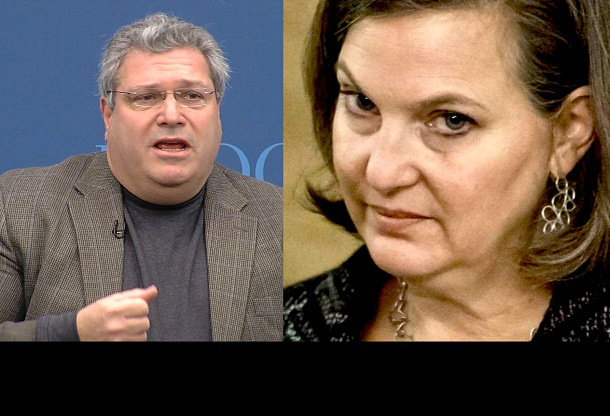
Diehl, of course, starts off with the neocon-approved narrative of the Ukraine crisis, ignoring the key role of neocon Assistant Secretary of State Victoria Nuland (Robert Kagan’s wife) in midwifing the Feb. 22, 2014 coup that overthrew democratically elected President Viktor Yanukovych and installed an intensely anti-Russian regime on Russia’s border. Nuland even handpicked the new Prime Minister Arseniy Yatsenyuk, telling U.S. Ambassador Geoffrey Pyatt in a phone call several weeks before the coup that “Yats is the guy.”

The coup-makers then dispatched neo-Nazi militias (and Islamist militants) to wage a bloody “anti-terrorism operation” against ethnic Russian Ukrainians who resisted the “regime change.” [See Consortiumnews.com’s “Ukraine Merges Nazis and Islamists.”]

But all that complexity is neatly boiled down by American neocons and the mainstream U.S. media as “Russian aggression.” Regarding the Syrian civil war, some neocons have even joined with senior Israeli officials in claiming that a victory by Al Qaeda is preferable to the continuation of Assad’s secular regime. [See Consortiumnews.com’s “Syria’s Nightmarish Narrative.”]

Yet, however the story goes, the biggest bad guy is Putin, always with sinister motives and evil intent. So, in explaining the situation in Ukraine and Syria, Diehl writes:

“Throughout the summer, Russia’s forces in eastern Ukraine kept up a daily drumbeat of attacks on the Ukrainian army, inflicting significant casualties while avoiding a response by Western governments. On Sept. 1, following a new cease-fire, the guns suddenly fell silent. Optimists speculated that Vladi­mir Putin was backing down.

“Then came the reports from Syria: Russian warplanes were overflying the rebel-held province of Idlib. Barracks were under construction at a new base. Ships were unloading new armored vehicles. Putin, it turns out, wasn’t retreating, but shifting fronts — and executing another of the in-your-face maneuvers that have repeatedly caught the Obama administration flat-footed.”

The rest of the op-ed is similarly didactic and one-sided: Putin is the villain and Obama is the rube. In Diehl’s world, only he and other neocons have what it takes to take on Putin and put Russia down.

Any alternative explanation for Russia’s action in Syria is brushed aside, such as Putin deciding that a victory by either Al Qaeda’s Nusra Front – as favored by Israel – or the even more bloodthirsty Islamic State is unacceptable and thus Assad’s regime must be stabilized to avert a major geopolitical catastrophe.

Typically, the neocons breeze past the frightening logic of what the collapse of Assad’s military would mean for the Middle East, Europe and the world. After all, once Israeli leaders decided to throw in their lot with Al Qaeda in Syria, the die was cast as far as the neocons were concerned.

But the notion that the neocons can micromanage the outcome in Syria, with “moderate” Al Qaeda taking Damascus rather than the more “radical” Islamic State, reflects the arrogant know-nothing-ism of these U.S. opinion leaders. More likely, Al Qaeda’s Nusra Front would coordinate with their former allies in the Islamic State and share in the Sunni revenge against Syria’s Christian, Alawite, Shiite and other minorities.

So, while the Islamic State would busy itself chopping off heads of “heretics,” Al Qaeda could use its new headquarters in Damascus to plot the next round of terror attacks against the West. And, as destabilizing as the current refugee flow into Europe has been, it would multiply astronomically as the survivors of the Islamic State/Al Qaeda bloodletting flee Syria.

With Europe in chaos and the neocons still insisting that the real enemy is Russia, the possible consequences would be frightening to contemplate. Yet, this is the course that the neocons have set for the world – and nearly all the Republican candidates for president have signed on for the journey along with Democratic frontrunner Hillary Clinton.

In 2014, arch-neocon Robert Kagan, whom Secretary of State Clinton selected as one of her advisers while also promoting his wife, Victoria Nuland, told The New York Times that he could embrace a Clinton presidency: “If she pursues a policy which we think she will pursue … it’s something that might have been called neocon, but clearly her supporters are not going to call it that; they are going to call it something else.” [For more, see Consortiumnews.com’s “Is Hillary Clinton a Neocon-Lite?” and “Obama’s True Foreign Policy ‘Weakness.’“]

So far, virtually no one in the 2016 presidential race or in the mainstream U.S. news media is seriously addressing the reality of the neocons’ “regime change” chaos spreading across the Middle East and the prospect of a destabilized Europe. What limited discussion there is on the campaign trail mostly echoes Jackson Diehl’s Putin-bashing.

No one dares confront the existential question of whether the United States and the world can continue to tolerate and accommodate the neoconservatives.

Investigative reporter Robert Parry broke many of the Iran-Contra stories for The Associated Press and Newsweek in the 1980s. You can buy his latest book, America’s Stolen Narrative, either in print here or as an e-book (from Amazon andbarnesandnoble.com). You also can order Robert Parry’s trilogy on the Bush Family and its connections to various right-wing operatives for only $34. The trilogy includesAmerica’s Stolen Narrative. For details on this offer, click here.

Was Afghanistan’s Invasion Also Based on Lies?

binladen01_04

It’s Time for a Real Investigation

By Jack Balkwill

Source: Dissident Voice

There appears to be a bigger lie than “weapons of mass destruction.”  It’s not simply that the illegal invasion of Iraq was based on lies, but that the entire “war on terrorism” is likely based on lies.

We were told by our government that Afghanistan was invaded for giving shelter to Osama bin Laden, who was responsible for the 9/11 attacks.  Mainstream press have pushed this so repeatedly that “9/11″ and “Osama bin Laden” have become interchangeable.

While working on this piece I asked the first three people I ran into at my local grocery store “Who was responsible for the 9/11 attacks?,”  three times getting “Osama bin Laden” for replies.  This is not scientific, yet it makes one wonder how this would work out in national polling.

But what if bin Laden was not responsible for the 9/11 attacks despite the drumbeat of government officials and the corporate press?  What if there has been a rush to judgment to make it appear the Bush regime was taking definitive action?

The invasion of Afghanistan certainly wasn’t about the Taliban – the Bush regime gave the Taliban $43 million in “aid” only four months before the 9/11 attacks, so were on friendly terms.

Following are three reasons to question official sources on their casus belli for invading Afghanistan.

Attempts to Peacefully Resolve the Issue

First, before the invasion of Afghanistan, the Taliban offered to try bin Laden in exchange for evidence that he was responsible for the 9/11 attacks.

President Bush provided no evidence, and invaded Afghanistan instead.

After the start of the U.S. air campaign, the Taliban offered to send bin Laden to a third country for trial if evidence could be provided that he had been involved in the 9/11 attacks – a proposal the United States also promptly rejected.

Why not provide evidence, if it were available, to prevent a war?  It was obvious that the people of Afghanistan would defend their country from a foreign invasion, as they had since Alexander the Great invaded, and there would be a great loss of life (see Roman Empire, British Empire, USSR, etc.).

There can only be two answers– that there was no evidence supporting the cause for invasion, or that former President Bush is a psychopath who doesn’t care about human life, so contemptuously ignored the request for evidence.

Bin Laden’s Denials

Second, bin Laden denied, more than once, in the months following 9/11, that he was involved in the dirty deed.  Less than a week after the 9/11 attacks, al Jazeera quoted bin Laden:  “The U.S. government has consistently blamed me for being behind every occasion its enemies attack it.  I would like to assure the world that I did not plan the recent attacks, which seem to have been planned by people for personal reasons.”

In an interview with Pakistan’s Karachi Ummat on 28 September 2001, bin Laden was quoted,

Neither I had any knowledge of these attacks nor I consider the killing of innocent women, children, and other humans as an appreciable act. Islam strictly forbids causing harm to innocent women, children, and other people. Such a practice is forbidden ever in the course of a battle. … I have already said that we are against the American system, not against its people, whereas in these attacks, the common American people have been killed.

This is a translation from Arabic to Urdu to English, and may not be entirely clear.  But for those who believe bin Laden was lying, I would suggest they come up with a motive for such a lie.  The USA had offered a $25 million reward for information leading to his capture, and President Bush had threatened “I want justice, and there’s an old poster out West that says, ‘Wanted Dead or Alive,’” so bin Laden had nothing to gain from such a lie – he was condemned either way.  Bin Laden’s followers would have admired him as a great hero for having taken on the USA, so he had much to gain by accepting responsibility for the 9/11 attacks, were it a fact.

Demonization

Third, there was an extensive effort to demonize bin Laden, at times with apparently false charges.  Why would this be necessary for one who was guilty?

Our government and corporate media, as one on National Security State issues, made him out to be abominable, and without providing evidence, unceasingly assumed his guilt.  Recordings were blasted and headlined in Western corporate print and electronic media of bin Laden accepting responsibility for 9/11.  The public were not given the same eyeball-grabbing headlines when the recordings were proven to be likely bogus.

Here is a Guardian report showing that Swiss Scientists suggested that an audio tape of bin Laden taking responsibility was likely faked, although widely broadcast in the corporate press as evidence of his involvement in 9/11 attacks.

Here’s a BBC report showing how the “smoking gun” video may have been faked, again, after the corporate press hyped the video as incontrovertible evidence.

Conclusion

The official version, that 19 Arab hijackers were responsible, has flaws.  One flaw was that many of the alleged hijackers have been found alive and well since 9/11.  Of course, it may be that the hijackers used pseudonyms to conceal their identities.

But getting beyond these 19 Arabs is difficult because they are all dead and cannot be interviewed.  Official government investigations into 9/11, much of which are classified, look like reflexive actions to neatly tie up loose ends rather than serious inquiries.

Certainly, as Ward Churchill pointed out (and lost his job for raising the issue), Arabs had a clear motive for the 9/11 attacks, with the UN revealing, only two years earlier, that the sanctions pushed mainly by the USA on the people of Iraq resulted in over 500,000 deaths of children under age five, mostly Arab, and most Arabs were aware of this and seething with anger.

To jump to the conclusion that bin Laden was behind the 9/11 attacks causes one to wonder, “Why then did the FBI never bring charges against bin Laden for the hijackings and murders?  Why did the wanted posters (up to his death he was on the FBI ten most wanted list) not mention the biggest crime, though they mentioned smaller terrorist incidents as reasons for his being on the list?

We may never know if bin Laden was responsible for 9/11, but his involvement was used as the excuse for invading Afghanistan and slaughtering a massive number of people, based on the assumption that they gave bin Laden refuge.

Just as nobody has been charged with a crime for the illegal invasion of Iraq based on lies, it would appear that an investigation is in order involving the justification behind invading Afghanistan, starting with the matter of proof that bin Laden was directly involved.  The American people and the people of Afghanistan have every right to be presented with the evidence.

Jack Balkwill is an activist in Virginia. He can be reached at libertyuv@hotmail.com Read other articles by Jack.

Related article: Who Was Really Behind the 9/11 Attacks?

“Breaking the Fear Factor”: Opposing War, Financial Fraud and State Terrorism, Dismantling Propaganda

4501e162f2a86d1f455bb5d8a1814139

By Peter Koenig

Source: Global Research

We are living in a (western) world dominated by neoliberal dictators, criminals and crooks. And many of us, impregnated with the human idiocy, as so well described by  Andre Vltcheck (The West Spreads Intellectual Idiocy) are every day deeper and deeper immersed into fear – fear of action, fear of what’s next – fear of losing our comfort zone. The western propaganda machine paid for by the corporate and financial oligarchy through the presstitute media is constantly indoctrinating the little we have left of our free-thinking brains.

Fear is everywhere. People who are afraid can easily be manipulated. People who are afraid obey. The system needs people who don’t resist. Renegades are potential drone targets. The Big Constant that pervades our western world with ambitions to also infiltrate Asia – is terrorism. Man-made terrorism – or better – elite-made terrorism; George Orwell would have called it Big Brother-made terrorism; terrorism with a particular purpose: spreading fear and submission.

On Friday, 21 August 2015, on a train from Amsterdam to Paris, according to the New York Times, “a heavily armed gunman opened fire aboard a packed high-speed train, traveling from Amsterdam to Paris [….] wounding several passengers before he was tackled and subdued” by two American military servicemen (on leave), who were helped by a third American. According to French officials, they “averted a mass killing.”- The gunman was armed with an automatic pistol, an AK47 and a knife (NYT annotation: AK47 is Al Qaeda’s preferred weapon). The Americans were coincidentally and suitably near to subdue the shooting 26 year-old Moroccan, a convenient Arab, who was taken into custody when the train stopped in Arras, France, just beyond the French-Belgian border. No doubt, he will be squeezed for confession. He may try to escape – and then may be shot death. Amen.

The French anti-terrorist unit took immediately charge of the investigation. The unit is known to work in utmost secrecy. Whatever news comes out of it is most likely ‘cooked’ to suit the system.

The NYT proclaims that the three Americans saved the train from a massacre. Nobody was killed. Just one of the American heroes was injured. Hollande thanked Obama for the brave Americans’ exemplary behavior and for preventing a train carnage. Propaganda all over. In America we trust – is dogma number one; dogma number two is – there is no save place on earth.

Fear everywhere, but America is there to help. Danger lingers at every corner. A terrorist may be just next door. Just give yourself up to Big Brother and he won’t let you down.

The first step towards sub-doing fear is asking yourself: Who invented and fabricated terrorism in the first place? In countries and entire regions ravaged by Washington incited wars and conflicts, terrorism is the expression of hopelessness, of wrath – of fighting back, when there is nothing left to lose. Look at the Middle East. A battlefield of nations destroyed by years of war – people living in ruins, in miserable squalor; some escape – and become the endless and EU loathed stream of refugees. According to the UN High Commissioner, there are more than 50 million refugees worldwide.

People take-up arms in self-defense. The west calls them terrorists. A term popularized by the media. A term that instills fear. – Imagine a world where the Judeo-Christian aggressors would suddenly see the light and stop spreading wars and conflicts and subjugating the world – peace would break out and settle in – terrorism, one of the key reasons for fear, would have no purpose to persist – fear would die, trust and solidarity would grow. The empires worst enemy: solidarity, friendship, and trust among people.

All wars and conflicts are multi-purpose. They boost the elite-dominated war industry; in the US more than 50% of GDP; they help dominate and subjugate people, exploit their resources, and are trailblazing a path towards Full Spectrum Dominance – world hegemony. They also help one of the ‘elite’s’ key objective – depopulating the world, so the elite may live longer with the ever scarcer resources of our gradually depleted planet. Reducing world population is a key objective of the Bilderberg Society – voiced by Henry Kissinger already in the 1960s. Recently I overheard one buddy telling another: I hate wars; but the only good thing about wars is – they reduce world population.

That is the horrendous level of immorality and greed to which humanity has sunk. – We the over-fed west may not get enough in an ‘overpopulated world’ (sic), therefore let’s reduce the human stock by killing off the under-people.

According to FAO – the UN Food and Agriculture Organization – with the current available agricultural technology Mother Earth could aliment at least 12 billion people, almost double of today’s world population. Fear and greed decimate our rational thinking. The me-me-me of abject western consumerism – and the fear of losing it – overwhelms our innate sense of human solidarity.

Remember the infamous Christmas Day 2009 ‘underwear bomber’ on a Northwest Airliner approaching Detroit wanting to detonate a plastic bomb sewed into his undies? He was suitably identified as a Nigerian Al Qaeda fighter and also conveniently and par hazard filmed by a passenger in the back row — This was such an amateurish attempt to spread fear, that after a short while even the media didn’t want to lose their ‘credibility’ (sic) and shut up.

Is there ever a thought among the fearful that such terrorists might be ‘planted’ by those who are served by the fear they cause?

A former CIA official recently admitted that virtually all so-called terror acts in the US and most of those in other parts of the world since (and including – added by me) 9/11 are false flags. With every false flag, the system can tighten its grip on the population under the pretext of ‘protection and security’. The populace literally asks for it – please protect us, please come to our houses, put them upside down and see whether there are terrorists hiding in our closets… that’s how the Boston people reacted after the April 2013 false-flag Marathon bombing.

Since 9/11 US citizens have lost more than 90% of their civil rights; first through the Patriot Act, then by subsequent extensions of police ‘protective measures’. Most US citizens are not even aware of the power they gave up to the police which has now the authority to invade people’s homes at will, without search warrant or explanation and then find anything justifying the arrest and indefinite confinement without trial of an inconvenient person. The ‘suspects’ are mostly Muslims. These days it’s easy selling to the brainwashed western world a Muslim as a criminal or terrorist.

Yet, the Boston Marathon false flag was of such low grade that anybody with a little bit of reason left, could recognize that the bombs were detonated by special forces with the mere purpose of implanting the notion that even a relatively progressive thinking university town like Boston is in danger of terrorism. Therefore let’s control the people, let’s not this ‘intellectual Boston crowd’ choose its own ways, abandoning the sinking ship. All sheep must be kept together in false solidarity, of course.

The two Chechnyan brothers were pre-identified, they had no clue what may eventually happen to them. They conveniently had a police record, maybe fabricated, to also hurt Russia, hitting two flies with the same stone. The Chechnyan ‘malfeasance’ could easily be sold to the public. One of the two alleged suspects was killed – and silenced – in an artificially created ‘shootout’. The other one is in solidarity confinement and is not allowed to talk, not even in court – condemned to die – soon to be silenced too.

Public events henceforth project fear. – People, please stand up against police and state-sponsored violence and terrorism! – Analyze for yourselves! Don’t believe the lies spread by the mainstream media. Yes, it takes a little effort, seeking out the truth and reading the news on internet – Global Research, Information Clearing House, Sputnik News, VNN, RT, TeleSUR, PressTV, CounterPunch, New Easter Outlook, The Saker – and many more – but it is one of the few chances you have to see the light and stand up for your rights – and get rid of fear.

The Boston false flag bombing, was followed by a similar horror event in Paris, in January this year. The Hebdo Charlie and related supermarket assault killed 17 people. It was opportunely planned at a notoriously anti-Muslim cartoon magazine, executed by CIA-Mossad forces in full connivance with the French secret service

(see http://www.globalresearch.ca/paris-charlie-the-shock-doctrine-par-excellence/5424960).

Two plus one ‘suspects’ with previous police records, were pre-identified. One of them ‘forgets or loses’ casually his ID in the get-away car – the only link the police has to the ‘terrorists’ – they find two, kill them at sight – so they won’t talk anymore. – The third related alleged assassin of a Jewish supermarket at the outskirts of Paris awaited the same fate: death by a police barrage of bullets. A blurred amateur video (maybe by now taken off internet) shows how a hand-cuffed individual is thrown before the wolves outside of the supermarket, to be riddled mercilessly with bullets. Nobody to talk. The truth remains ugly propaganda – propaganda for the system – a system that prevails over and feeds on terrorism. Millions of people, dulled by the event, walked the streets of European cities, solemnly parading placards lettered with “I am Charlie” — millions of people submitted – and still do – to a miserable lie – spreading and perpetuating fear.

Hollande had a justification to tighten the grip around France and within Paris – police everywhere, reducing civil liberties just a tad more – orders from the Washington masters. Being a nominal ‘socialist’ (sic), the emperor doesn’t quite trust him – as he may resent having been forced by the White House to abrogate his country’s lucrative sale of two Mistral type amphibious assault ships to Russia. To dampen any lingering sympathy for Russian President Putin, Hollande had to be reined in; and the spineless French leader (sic) did indeed cave in.

Fear is everywhere. European politicians are all afraid they may be in the crosshairs of the CIA or Pentagon or other US mercenary hit men if they don’t behave. A couple of days ago it was reported that Hollande is now also planning preventive drone assassinations, mimicking his brother-in-crime, Peace Nobel Laureate, Barack Obama. Imagine! – How far can you sink to lick – ehhh – the naked toes of the naked emperor. How far has our western civilization sunk in only the last 30 years – the onset of neoliberalism!

Fear commands everyone – almost. Fear is the public enemy number One – but it can be overcome – with courage, an open mind and foremost an awakened consciousness.

People feel reasonably happy. They feel protected. They gladly trade their civil rights for police and military protection. Terrorism is horrible and it is so unpredictable. It lurks everywhere. And nobody dares to question these bloody fabricated horror events. Nobody dares ask: what motivates the terrorists? How come their number has increased exponentially in the last 15 years? Terror sows more terror. Fear disseminates more fear. More fear facilitates more oppression and manipulation of people – and eventually more terrorism.

Take the massive flood of refugees engulfing Europe. The EU laments the ‘refugee crisis; seemingly not realizing that they helped making it. The Eurocrats cannot deal with the overwhelming influx of refugees. They use the bought media to make people afraid of them. The refugees come from these Arab countries the west is fighting for ‘freedom and democracy’. They are dark-skinned, poor and no-good. They steal our jobs, food and women. The human touch and solidarity of westerners has been annihilated long ago – by the neoliberal doctrine – that knows no mercy, only profit and power. Western powers don’t want these poor homeless beggars within their frontiers. What to do with them? They are a costly nuisance. Most of them are Muslims anyway. There is no space for them.

Would it ever occur to one of those high-flying, arrogant never elected Maastricht politicians to ask ‘why is this onslaught of refugees increasing by the day?’ – They may find the answer in front of their nose, in case they still have some left-over ticking brains. We, Europeans, in full complicity with war-mongering hegemonic Washington have helped destroy their countries, their economies, their jobs, torn apart their families, killed their children, have bombed their very homes to ashes – now they come to seek help from us. These poor people have no choice but asking their hangmen for a bit of mercy, for some crumbs of bread, for some rudimentary shelter. The raped seeks alms from the rapist. It’s the Stockholm syndrome. – Its fear from dying. Maybe the criminals who almost killed them have some humanity left, a bit of mercy – please.

What makes them tick – these criminal hegemonic politicians? Why are they so inhumanly selfish, greedy and violent? The public at large is afraid to even ask. Asking could produce answers that may derange one’s comfort zone. Better don’t ask and follow the rules. Let fear continue to rule.

The NYT also reports, “Stock prices around the world continued to plunge on Friday, threatening to end one of the longest bull runs in the history of the United States stock market.” Fear of losing money is spread. Such ‘market’ fluctuations, as most of us know, have little to do with ‘markets’, be it share or money markets. Money is fabricated by a mouse-click of a bank dishing out debt. Markets are manipulated by banks and political powers for monetary profit and political gains – and to sow fear – fear that something horrendously drastic may happen, may affect our fragile economy – and may foremost affect our stolen well-being. Yes, stolen. Our western riches have been stolen during hundreds of years of abject, murderous colonization of the southern hemisphere. And we continue colonizing them with our modern weapon – MONEY. When banks spread fear, it is to steal the money, pension funds, social systems from us, their faithful clients. Stealing from abroad is not enough.

Rather than fearfully shutting up – wake up! Dare stand up fellow citizen – against the white collar onslaught of fraud and exploitation, against corruption of our elitist neoliberal system! Get rid of those deceiving politicians – the scum of greed and power. Expose them. Neutralize them.

The US as well as the European Commission just enacted laws, allowing banks, effective immediately – to ‘rescue’ themselves by so-called ‘bail-ins’ – meaning, a bank that has overstretched and over-speculated itself into bankruptcy may literally save itself by stealing the money from its depositors and shareholders. – Why does such an edict – not really a law because those who designed the rule are unelected Eurocrats – not prompt an immediate run on the banks? – Why does nobody even protest? – Because people don’t know? Maybe. But Fear – sheer fear from being punished for ‘disobedience’ – is a better explanation.

Instead, our fear makes us trust that such ‘bail-ins’ will always happen to others. We so easily forget what happened only two years ago, in March 2013 to the people of Cyprus, when their deposits were decimated by the infamous ‘haircut’, administered by the highly indebted Cypriot banks, by order of the BCE, with full complicity of the Cypriot elites, who first transferred their fortunes abroad. It was like a trial run. How much would the populace swallow without (too much) protesting? – It worked. The rule is now institutionalized – and nobody says beep. – For fear that worse may follow? – Or for sheer comfort of not moving our butts.

The famous late Howard Zinn said civil disobedience is our – as in ‘we the people’ – strongest weapon against corporate and state injustice and abuse. Today’s version of this wisdom might be for the 99.99% of us, the people, to organize and infiltrate the reigning criminal system and breaking it down from within. Much like did and do the State Department funded Washington-based thinktanks (sic) – initiating the deadly and destructive ‘Arab Spring’, intruding and subverting the European Parliament with bought proxies and fake NGOs – and what they attempt to do in Russia and China, albeit unsuccessfully.

Back to the NYT article on the plunge of the US stock exchange. Finger-pointing of the guilty is of the order. The fear factor has to be substantiated and enhanced by fault of an ‘outsider’ – in this case China – which according to the NYT has ‘unexpectedly’ devalued its currency, a sign of a troubled economy and a bleak outlook for the economy of other large ‘developing countries’.

Let’s fear the Evil East. – No good may come from the east. The NYT has of course no explanation of truth. Namely that the Chinese Yuan had been artificially over-valued under pressure of the US, and kept within a 2% band of fluctuation by the Chinese authorities. This was also in line with China’s huge dollar reserves, some 1.6 trillion dollars. Relaxation of the fluctuation – letting the rate slide naturally to an expected 3% margin, would not only make China more competitive, but might enhance the currency’s international standing to eventually becoming a new currency in the IMF’s basket constituting the SDRs, or Special Drawing Rights. The SDR is an international virtual money that may be lent to countries which so desire, hence, better balancing the currency exchange risk of the loan. The current SDR basket is composed of only four ‘world’ currencies; the US dollar, the British Pound, the Euro and the Japanese Yen.

If the Yuan can keep its own by floating against other major currencies, chances are it may be admitted by the west-dominated IMF as the fifth currency to the SDR basket, thereby opening the door for the Chinese Yuan to become a major official world reserve currency. Washington may not like it, but may have little choice preventing the currency of the world’s strongest economy to become an officially admitted reserve currency.

Fear may also be the main reason for the Greek Tsipras Government 180 degree U-turn after the 62% NO vote on July 5 – No to austerity, No to more strangulation by the infamous troika – European Central Bank (ECB), European Commission (EC) and the International Monetary Fund (IMF). Not Germany, not the troika, are Greece’s strongest enemies; fear is. The Syriza government was pressured, blackmailed, coerced – and possibly even corrupted – into accepting an even more nefarious austerity package than the one against which Greeks voted with an overwhelming NO. If indeed enacted, the new debt commitment of € 86 billion will drive Greece’s debt to GDP ratio way above 200 % – and not one euro will flow into Greece’s economy, her social system, fighting unemployment, bringing back public hospitals, schools, water and electricity.

The Syriza Tsipras Government has committed an illegal act against Greece’s own Constitution which puts the people above parliament and above the executive – as a true democracy should. Tsipras’ anti-democratic act could be undone any time by a simple decision of the Supreme Court. According to international standards, Greece’s accumulated debt is fully illegal and could be erased by a mouse click, the same way it was created. Any contract – in this case debt – concluded under duress, coercion, corruption and / or blackmail does not stand up before an international court of law. This must have been known to the Tsipras government. Yet, Tsipras and his inner circle went to Brussels to ‘negotiate’ ignoring this chance. Instead they sold out their country to the banksters, let themselves be humiliated, ridiculed in the face of their own people, let alone the rest of the world.

Fear was most likely the engine for Tsipras’ behavior. Many of his Syriza colleagues left the government coalition. Ministers who didn’t agree with his politics were fired. He preferred succumbing to fear – fear of the potential wrath that might emanate from the corrupt and criminal EU; from greedy Germany whose neoliberalism is rapidly taking on the colors of Nazism. – German supremacy over Europe – again? – Maybe there were death-threats involved, who knows. It is common practice when power and resources are at stake.

However, a true leader has no fear. He or she stands tall with the moral and ethical obligation to defend the interests of the people who elected him or her. As did Hugo Chavez, Fidel Castro, Rafael Correa, Evo Morales, Cristina Kirchner, Lula, Dilma Rousseff and many more.

Traveling recently all over Greece fear was visible everywhere. When asked, why their inaction in the face of this shameful treason of their PM – no protests, the streets remained calm – the answer was almost uniformly – we are afraid. Afraid of what? Of the police; they shoot at us with rubber bullets, with water cannons – and we don’t know when the military will intervene.

In Delphi, the very town where democracy was born some 2,500 years ago, a shop owner confessed, democracy is dead, not only in Greece – but in Europe, in the world. With this backdrop, a new military takeover was according to him not far-fetched. The Tsipras betrayal was a boon for the rightwing, the Nazi-like ‘Golden Dawn’ – a perfect backing for a new military regime.

After the 1967 US-supported so-called Coup of the Colonels, Greece suffered seven years of a most repressive right wing military dictatorship, where full obedience was of the order, where people disappeared, where the communist party was forbidden and communists were prosecuted and killed, where anything resembling left-wing literature was censured, during which miniskirts, pop-music, long hair, the peace sign and the like were prohibited. This repressive regime has deeply marked the Greek population. They are afraid it may return. They are aware of their country’s vulnerability due to its importance for Washington, hosting the southern-most strategic NATO base. Any deviation of the Washington made and EC imposed rule may bring back the military horror – reminiscent of Costa Cavras’ 1969 extraordinary docudrama “Z”.

Now, the Tsipras Government has resigned – for fear of the domestic consequences of its actions? – A new interim government is to be prepared before the announced 20 September election. Will the radical break-away Syriza faction, the new Unity Party, be able to form a viable coalition and gather the necessary trust to win the coming September elections?

Will Greece after all be able to break the paralyzing streak of fear?

Will Greece set the new standard of fearlessness for the rest of Europe to follow? – Will Greece dare to go the only practical way – exit the unviable euro – go back to her drachma and revamp their economy with public banking for the benefit of the Greek people? – I trust Greece will dare take back her sovereignty, breaking the all-permeating Fear Factor and become a flagship of courage for Europe and for the world.

Peter Koenig is an economist and geopolitical analyst. He is also a former World Bank staff and worked extensively around the world in the fields of environment and water resources. He writes regularly for Global Research, ICH, RT, Sputnik News, TeleSur, The Vineyard of The Saker Blog, and other internet sites. He is the author of Implosion – An Economic Thriller about War, Environmental Destruction and Corporate Greed – fiction based on facts and on 30 years of World Bank experience around the globe. He is also a co-author of The World Order and Revolution! – Essays from the Resistance . 

Where is Neo When We Need Him — Paul Craig Roberts

images

By Paul Craig Roberts

Source: PaulCraigRoberts.org

In The Matrix in which Americans live, nothing is ever their fault. For example, the current decline in the US stock market is not because years of excessive liquidity supplied by the Federal Reserve have created a bubble so overblown that a mere six stocks, some of which have no earnings commiserate with their price, accounted for more than all of the gain in market capitalization in the S&P 500 prior to the current disruption.

In our Matrix existence, the stock market decline is not due to corporations using their profits, and even taking out loans, to repurchase their shares, thus creating an artificial demand for their equity shares.

The decline is not due to the latest monthly reporting of durable goods orders falling on a year-to-year basis for the sixth consecutive month.

The stock market decline is not due to a week economy in which after a decade of alleged economy recovery, new and existing home sales are still down by 63% and 23% from the peak in July 2005.

The stock market decline is not due to the collapse in real median family income and, thereby, consumer demand, resulting from two decades of offshoring middle class jobs and partially replacing them with minimum wage part-time Walmart jobs without benefits that do not provide sufficient income to form a household.

No, none of these facts can be blamed. The decline in the US stock market is the fault of China.

What did China do? China is accused of devaluing by a small amount its currency.

Why would a slight adjustment in the yuan’s exchange value to the dollar cause the US and European stock markets to decline?

It wouldn’t. But facts don’t matter to the presstitute media. They lie for a living.

Moreover, it was not a devaluation.

When China began the transition from communism to capitalism, China pegged its currency to the US dollar in order to demonstrate that its currency was as good as the world’s reserve currency. Over time China has allowed its currency to appreciate relative to the dollar. For example, in 2006 one US dollar was worth 8.1 Chinese yuan. Recently, prior to the alleged “devaluation” one US dollar was worth 6.1 or 6.2 yuan. After China’s adjustment to its floating peg, one US dollar is worth 6.4 yuan. Clearly, a change in the value of the yuan from 6.1 or 6.2 to the dollar to 6.4 to the dollar did not collapse the US and European stock markets.

Furthermore, the change in the range of the floating peg to the US dollar did not devalue China’s currency with regard to its non-US trading partners. What had happened, and what China corrected, is that as a result of the QE money printing policies currently underway by the Japanese and European central banks, the dollar appreciated against other currencies. As China’s yuan is pegged to the dollar, China’s currency appreciated with regard to its Asian and European trading partners. The appreciation of China’s currency (due to its peg to the US dollar) is not a good thing for Chinese exports during a time of struggling economies. China merely altered its peg to the dollar in order to eliminate the appreciation of its currency against its other trading partners.

Why did not the financial press tell us this? Is the Western financial press so incompetent that they do not know this? Yes.

Or is it simply that America itself cannot possibly be responsible for anything that goes wrong. That’s it. Who, us?! We are innocent! It was those damn Chinese!

Look, for example, at the hordes of refugees from America’s invasions and bombings of seven countries who are currently overrunning Europe. The huge inflows of peoples from America’s massive slaughter of populations in seven countries, enabled by the Europeans themselves, is causing political consternation in Europe and the revival of far-right political parties. Today, for example, neo-nazis shouted down German Chancellor Merkel, who tried to make a speech asking for compassion for refugees.

But, of course, Merkel herself is responsible for the refugee problem that is destabilizing Europe. Without Germany as Washington’s two-bit punk puppet state, a non-entity devoid of sovereignty, a non-country, a mere vassal, an outpost of the Empire, ruled from Washington, America could not be conducting the illegal wars that are producing the hordes of refugees that are over-taxing Europe’s ability to accept refugees and encouraging neo-nazi parties.

The corrupt European and American press present the refugee problem as if it has nothing whatsoever to do with America’s war crimes against seven countries. I mean, really, why should peoples flee countries when America is bringing them “freedom and democracy?”

Nowhere in the Western media other than a few alternative media websites is there an ounce of integrity. The Western media is a Ministry of Truth that operates full-time in support of the artificial existence that Westerners live inside The Matrix where Westerners exist without thought. Considering their inaptitude and inaction, Western peoples might as well not exist.

More is going to collapse on the brainwashed Western fools than mere stock values.

Don’t Worry – Everything is Not Under Control

dailyroutine

By Zen Gardner

Source: ZenGardner.com

What a farce. Telling everyone “everything is under control” is perhaps the most dulling and disempowering phrase ever uttered.

My fascination with language just keeps expanding. I love looking at expressions, words, colloquialisms, so-called “sayings” and the like with fresh awakened eyes. I can’t help it. The supposed, accepted and unconscious meanings of these imposed “expressions” are what direct our minds and turn our attention.

So much of what we’ve been handed down is contorted, manipulated and eventually nestled in the collective mindset to twist our hearts away from simple truth.

How many times has this expression been used to bring seeming comfort to someone; “Don’t worry, everything’s under control.” Really? What control? Who’s controlling what? And why?

So often this is used to imply some powerful force is behind everything directing what’s going on. Remind you of anything? Yes – religion, hierarchy, and social, political and economic so-called “controllers”. How debilitating can you get when it comes right down to it, playing on people’s insecurity and lack of conscious awareness?

“It’s under control” is comforting to people? It’s the picture of personal disempowerment!

External Control? Or Creative Freedom!

Sure, there is a wonderful creative Source we are all intrinsically part of, but it’s not “controlling” anything in a living, expanding Universe with beings of all sorts with free will and self determination in an alive multidimensional environment. If anything, this Creative impetus is tearing down control systems that attempt to foist themselves on its process, put there either by conscious intent or the manifestation of hardening mindsets in the social fabric.

Earth processes attest to this, as well as our spectacular expanding and ever changing Universe. Nature itself is alive with new sprouts of life in the animal, plant and mineral worlds, never mind other realms of existence.

Look at earthquakes and volcanoes, or the sun and astral influences. As much as some try to analyze or predict major events that affect earth that still brings no control, only a measure of preparedness on rare occasion. And that type of insecurity is good for us. It’s humbling and keeps us in check.

This process is what the awakening is all about!

While some earth changes may be exacerbated by human activity, the big stuff is way out of our control. Thankfully. That’s what makes life life, and also why the insane would-be captivators of humanity and its planet work so feverishly in their mad pursuits to try to control natural processes. Control is their yardstick and without it they have no temporal security or power, which to them equates some weird form of normalcy or equilibrium.

How upside down can you get.

Be it geoengineering our climate, genetically modifying the natural progression of life forms, or attempting to install artificial intelligence to run their soulless programs, these maniacs are desperate for control in every shape and form. Why? They cannot meld or harmonize with what’s natural since their psychopathic, demonic intentions have nothing to gain, all while the rest of us thrive on being part of the fantastic empowering natural processes of Creation Itself.

Therein lies the rub. Quite apparently we’re in a world of conflicts of interest. That’s our current playing field, if you will. Or won’t. It’s just the way it is.

Let Go Into Conscious Anarchy

I like the anarchy approach. Anarchy is an example of another twisted word. It’s doesn’t mean putting a society into deliberate chaotic destruction, it means living without hierarchical control mechanisms. Something most groomed humans are scared spitless of thanks to generations of social programming.

You mean to tell me if we didn’t have so-called “government” that everything would fall apart? Baloney. People are resourceful and essentially responsible, at least their inner nature is, that hasn’t been perverted by all of this programming to the contrary. That very dependence on external control systems is what the hierarchy is literally banking on which is why the repeated memes of fear of scarcity or personal security.

There’s plenty for everybody. All we need to do is work together locally and share with other communities in a range of sizes and distances. Real commerce in loving cooperation, not the regulated systems that have been foisted upon us. We’ve been weaned from personal responsibility into a system of statist dependence, like someone who’s stopped using their muscles and is dependent on some mass produced contraption for their mobility when there’s nothing wrong with them at all.

They just need to exercise their innate capabilities.

Just because people have become spiritually atrophied in large numbers doesn’t mean that’s the way it’s supposed to be. Exactly like waking up, it’s time to arise and use the magnificent body of capabilities we’ve all been given, and let go of these false crutches and systems of hierarchy and walk into life and live!

Epilogue

That false assurance that everything’s under control by external forces as if we individually have virtually none has got to go. Being comforting in times of stress and turmoil is one thing, but propping people up with some external dependence reinforcement is fundamentally wrong.

It’s time to be conscious – in our words, our thoughts and our actions.

It’s really not that difficult. The main thing you’ll confront is ignorant, unenlightened opposition from those who’ve grown deeply accustomed to this dependency programming, as if it’s some form of respect for the “great ones” who rule them.

It’s very deep and will take time to overcome for most. But remaining in that conscious space, no matter what ridicule or obstacles assail you, is the very solution we each are longing for.

It begins with each of us. Standing our ground and then moving forward in conscious, loving action.

Do it. Bravely. The time for humanity to arise is now.

Much love, be well, and fully empowered,

Zen

ZenGardner.com

The Nature of American Denial

409004_2544867183443_1306665339_32089606_585965628_n

By SARTRE

Source: Waking Times

At the core of self delusion is the inability and/or the unwillingness of facing reality. While psychological disorders can often explain abnormal behavior in individuals, the exegesis for deviant social attitudes and accompanying conduct is reserved for society. Or so we are told! But does this make sense to you? As long as you accept that reality does exist and that it can be understood, it follows that we have the right, the ability and the obligation to comprehend it and adjust our actions accordingly.

Most Americans view, of their own personal identity, is inculcated by the political culture. Delmar England, in his provocative work – Mind and Matters, The World in a Mirror – offers this valuable insights into our mutual and shared condition: “In human affairs, as surely as effect is preceded by action, action is preceded by belief, and belief is preceded by thought and conclusions.”

Applying this standard to politics Mr England depicts government is this fashion:

“For all the sidestepping, dance arounds, word games, and confused rhetoric, the term government is easily defined; not by subjective agreement, but by reference to objective reality and the actual entities involved. First, we know that there is no such thing as an infinite entity and that the term, government, necessarily denotes a relationship. The actual entities involved are human individuals. The base options of relationships between individuals are non-initiation of force and non-coercion, or initiation of force and coercion. It makes no difference how many different subjective labels are put upon the situation, the objective fact remains that at the root of it all, these are the only two options. The former is in recognition of the individual as a self-owned entity. The latter is based on the idea of an individual being the property of an “infinite entity”; which is the “justification” for rule by the individuals who hide behind the abstracts and exercise their will to dominate and control all others.”

“The subjective and arbitrary labels arbitrarily associated with government such as democracy, socialism, communism, etc. are purely for the purpose of self-delusion. Although form of implementation may vary and some versions start closer to ultimate self-destruction than other versions, the common and identifying objective content of each and every one is initiation of force and coercion. Millions may volunteer for such an anti-social system and play self-deluding word games for the sake of preferred self-image, but all the pretense in the world and “definitions by agreement” will not erase the truth about government, nor prevent the certain violent consequences of initiation of force and coercion.”

No doubt, this is a correct assessment. Virtually every society and country operates with the implied and universal acceptance that government is natural and ordained. The individual accepts force and coercion as a substitute for avoiding the risk and responsibility of personal Freedom. MindMatters concludes with this point:

“Rather than freedom being the highest value sought by most, it is their deepest and most abiding fear. So much so that they can’t even envision it.”

American denial has caused an epidemic dysfunctional confusion. The delusion that our own self identify is equivalent with the “collective will” of society; which, in turn is synonymous with the government and its policies, is a sociopathic sickness. The antisocial behavior of the STATE demonstrates all the characteristics of a profile of a sociopath. Apply the top five to the demeanor of government: Glibness/Superficial Charm – Manipulative and Conning – Grandiose Sense of SelfPathological Lying – Lack of Remorse, Shame or Guilt. We are all taught what we should believe about government; but only the fool, the liar or the delusional accepts that our – self-owned entity – benefits from the force and coercion that the State demands upon us.

Robert L. Kocher has compiled a body of works far too numerous, on this topic to cite sufficiently. We urge you to review and absorb the wisdom in his insights. Most of the lessons detail the last administration, but are completely relevant to the current regime. One essay, especially compliments the Delmar England conclusion. Mr Kocher writes in American Mental Health and Politics:

“If some of us are appalled, frightened, and even driven half crazy by the maddeningly and complacently silly or psychotic levels of denial, by the superficiality, by the abysmal immaturity, by the primitive level of personality structure, by the too-easily employed distorted rationalizations, by the lack of contact with basic reality that we deal with in our daily lives, hear in our college faculties, and see on TV and in high political office, we can nevertheless know that the reality of our perceptions is validated by mental health figures as well as those patients being seen in therapist’s offices.”

Currently, the national mood is absorbed in the illusion that Americans are at risk and that they are in danger from terrorists abroad. While reality demonstrates that enemies of America are plentiful, the disconnect that their veridical hatred is focused upon the U.S. Government and its policies, is concealed. Vast numbers of Americans feed their denial that they are the target of madmen; while they seek comfort in the fallacy that support for the WAR Party will make them safe. The force and coercion that the government imposes upon you, under the pretext that it is necessary and protective, diminishes your safety as it destroys your Liberty. The utter fraud of national security policy, seeks only to preserve the government, no matter how much harm it inflicts upon citizens.

So why do so many misguided flag-waving zealots rally to a jingoistic cause? Kocher provides the answer: “We now live in a society where many people no longer want or value freedom. Personal freedom and the responsibility that goes with it are abrasive intrusions or demands upon a crippled self-absorbed internal state.”

“American Denial” prevents the admission that U.S. policies only benefit the government. Their own personal delusional perceptions are interchangeable with a phony litmus test, judged by their support for State illusions. The thought of exercising the Freedom to think, criticize, condemn and resist is far too disconcerting to the sheeple. They view their own self worth as an adjunct of an abstract deception; while, the true motives of the government are to control society and all individuals, using force and coercion. Both England and Kocher have it right. The association between an individual and an infinite entity denotes a relationship; and the reluctance or unwillingness to exercise freedom and responsibility, allows the government to implement force and coercion.

“Eternal Vigilance” is no longer enough to preserve Liberty. Sound mental health, appreciation for your own self worth, trust in the integrity of reality and the courage to do battle with the forces that seek to delude your own dignity are all necessary to win this struggle. America is NOT the Government. When policies are dishonest they must be opposed. When officials are depraved they need to be removed. And when your neighbor demands your allegiance to a corrupt government, it is your duty to confront his delusion.

We can no longer afford to be silent in the face of “American Denial”.


About the Author

SARTRE is the mind behind BATR. org (Breaking All The Rules), which documents the steady decline of American exceptionalism.

On the Meaning of “Middle Class” and the State of the Middle Class

and_wearing_shoes_middle_class_k_750725

By Dr. Nicholas Partyka

Source: The Hampton Institute

When politicians talk, one of the recurring themes about which they spew platitudes is the economy. It would be the subject of another essay to unpack what is meant by “the economy” when politicians and other capitalist elements use that term. This aside, in discussing the economy there is a phrase that politicians use with such alacrity that it has become trite. This phrase is, “middle class”. Politicians, pundits, and social commentators deploy this term in many contexts, but almost always appealing to its ubiquity of membership, critical role in democracy, and moral virtue in their speeches. These constant references to the middle class in the popular political discourse have rendered this term impenetrably vague. If we listen to politicians then one would be led to believe that most Americans are members of this middle class, whose health and prosperity the politicians never tire of proclaiming as their highest priority. Speeches are one thing, reality another. Let us interrogate this concept of the “middle class”, and see what to make of this notion that plays such a prominent role in American political discourse on the economy.

With an election year looming, and a Presidential election at that, with their seemingly always lengthening election cycle, the phrase “middle class” will only be heard more and more frequently from now until after November 2016. The President’s recent invocation of the phrase “middle class economics” is only the latest salvo between the two dominant capitalist political parties, as they try to position themselves in the public’s mind as the true defender of – the almost apotheosized- middle class. Candidates and their supporters will be arguing more and more vigorously about which party, or which policies, will do more to help this middle class. About the only thing that candidates from both parties will agree on is that the middle class is in trouble, and that economic policies should be designed which maximally promote the welfare of this class. The two major political parties in this country have divergent views about what kinds of policies best aid this alleged middle class. However, both parties are attempting to win votes by claiming to be champions of the middle class, a class with which a great many Americans still continue to identify themselves.

We’re going to explore two distinct, but interrelated questions in what follows. First, we’ll want to know, Who and how many, people are middle class? Second, we’ll want to ask, What does it mean to be middle class? The answers to these questions will likely have to be made relative to particular societies at particular times; though some generalization is possible. To begin we’ll look at what it has meant historically to be middle class. Then we’ll look more in depth into the meaning of being middle class in the contemporary American context. What we will find is a great deal more confusion and ambiguity about this notion of a “middle class”. So much so that we should start to wonder if this notion retains any usefulness.
The Middle Classes, Historically

For most of history being middle class simply meant occupying, however tenuously, a social status that was between that of a slave and that of a noble. Basically, the middle class was composed of everyone who was not technically a chattel slave, and lacking the noble pedigree of a true aristocrat. In most societies of the ancient world this simple definition would indeed make most people middle class. However, this understanding glosses over the highly variegated nature of socio-economic positions possible between technical chattel slavery and blue-blooded nobility. For instance, debt bondage and serfdom, both forms of un-free labour, would not cause one to be dropped from the middle class on this accounting. For example, in the ancient world slaves were often employed as overseers, that is in a management capacity. It would not have been uncommon for slave overseers to sometimes direct the labour of technically free men.

We can see in certain socio-political cleavages that splits have occurred in many contexts between the lower ranks of these middle classes and the higher elements of this class. Middle classes have struggled against entrenched aristocracy and nobility at many points in history for social advancement and political inclusion. However, almost always, in the critical moment, the higher elements of these middle classes would betray the interests of the lower elements, whose bodies, blood and ballots had been used to gain them inclusion. Marx would come to call these “higher elements” of the middle classes petit-bourgeoisie, signifying the much greater material, and indeed much more importantly, aspirational affinity with the bourgeoisie than the proletariat.

Two examples will suffice here. In ancient Greece we see the demos, or “the people” engaging in political struggle for inclusion in the political life of the polis. But who is this demos? First, Greeks used the word demos in two distinct ways. In one sense, we might call the wide sense, it meant the whole citizen body of city-state in general. In the narrow sense, on the other hand, the demos meant the ‘common people’, the ‘lower classes’, the aporoi, the propertyless. This group included a very wide range of socio-economic and political situations, and certainly contained an upper and lower group. The main cleavage within the ranks of the demos is between the better off elements and those struggling to get by. It goes without saying that slaves would not be counted among the demos. Those who are struggling are more, or in worst case entirely, dependent on others for their livelihood. The Greeks called Thetes and Banausoi. The former we might call day-labourers or wage earners, the latter we could translate loosely as artisans. These were the lowest two of Solon’s five social classes, and while not slaves, were subject to various kinds of forced labour. Though some artisans and merchants could be quite wealthy, most were not. Most merchants, as opposed to retailers, though were likely to be foreigners, and thus not eligible for citizenship.

When we focus on the internal political conflicts of the Greek polis of the Classical period (roughly the 5th and 4th centuries BC), what we see is a struggle over citizenship, that is over access to political participation in government. While the socio-economic and political realities of the ancient world are complex, in the main the conflicts were between an urban middle class of mainly artisans and middling farmers on the one hand, and the traditional land-owning oligarchy which monopolized political power on the other.[1] The political struggles over demokratia in this period revolved mainly around whether or not the banausoi and thetes should be given citizenship rights. Chiefly important among the rights of citizens were the right to vote in the Assembly, to hold public office, the serve as a juror in the dikasteria, to bring matters before the courts; at Athens in particular, citizens would be entitled to receive a share in any disbursement of the polis‘s dividends from the proceeds of the Laurium silver mines.

The demos was the main agent of social change in the ancient Greek polis, the traditional aristocracy certainly saw it this way. They saw “middle class” elements as being too politically ambitious, which is in part why they deploy the term pejoratively. By “middle class elements” the traditional aristocracy would have lumped together both very wealthy artisans, and much more humble enterprises, all of whom were united in not being aristocrats by blood lineage. Wealthy merchants and artisans might themselves employ slaves both for carrying out production, as well as the overseeing of this work, but they lacked the “best” kind of background. This made them unsuitable for political participation in the eyes of established elites. Smaller artisans and merchants, who didn’t have exorbitant wealth to recommend them, would have been thought only the more unsuited to political life.

All of the main institutions of Classical Greek demokratia were devices designed to help poor and working-class free men defend themselves from the depredations of their richer counterparts. Rule by majority vote in an Assembly, ekklesia, open to all citizens; freedom of speech, parrhesia, in the assembly; large popular courts of law, dikasteria, composed of fellow citizens; rule of law, isonomia, as passed by the Assembly and administered in the courts; the belief that political power should be scrutinized, subject to euthyna, are all practices that helped the aporoi defend their highly precarious social position from the predatory behavior of wealthy citizens. As one eminent scholar describes, “Since the majority of citizens everywhere owned little or no property, the propertied class complained that demokratia was the rule of demos in the narrower sense and in effect the domination of the poor over the rich.”[2]

In the ancient Greek polis political participation was usually restricted to those native adult men who could meet a certain property qualification. In the main, in order to be a citizen one had to possess enough wealth to afford to outfit themselves with the hoplite panopoly. This was the complete set of armaments associated with the heavy armed infantry. If one could afford to buy one’s own armor, and afford the leisure time to learn to fight as part of a phalanx formation, then one was considered worthy to participate in the political life of the polis. The idea being that if one was wealthy enough to afford the hoplite panopoly then one had enough of a stake in the success and survival of the polis to be entitled to a role in the government of the city-state. Those “old money” and nouveau riche aristocrats who were wealthy enough could afford to outfit themselves with horses as well as more ornate armor and weapons, and thus the traditional prestige associated with the cavalry. The question of democracy in the ancient Greek world, was thus a struggle over the inclusion of those who could not afford the traditional citizenship qualification based on the connection of wealth and military service, and who because they were not slaves could make legitimate claims to be entitled to such inclusion.

Renaissance Italy serves as another great example. In the rise of the classic northern Italian city-state podestaral form of communal government there was employed in the popular political discourse a term, the popolo. Loosely translated, it means the people. However, once again we’ll see that this notion of the people actually covers over a major divergence within between well-off members and working-class members. As one scholar claims, “When, therefore, the long and venomous struggle broke out between the popolo (the “people”) and the nobility, the popular movement drew its force and numbers from the middle classes, not from the poor, the day labourers, or the unskilled”.[3]

The political conflict in 13th century northern Italian city-states was, much like in the ancient Greek world, fundamentally about participation. Beginning in the 12th century, a political conflict between church and secular authorities saw the rise of communal governments in all the major Renaissance city-states in northern Italy. At the time, this form of government was identified with the self-government of local magnates and aristocrats instead of more alien authorities imposed by church leaders in Rome. In this early phase of commune government, “The nobility dominated the consulate, manipulated the general assembly, and ruled the city, except where the emperor successfully intervened, as at Vicenza, Siena, and Volterra, or where the political power of the Bishop persisted.”[4]

It was against this restricted form of government that the political forces of the popolo were arrayed in the 13th century. By organizing for combat against the military forces of the nobility, the popolo was able to seize power in the commune and change the structure of commune government, in that it was able to secure more participation for those in its ranks; or more correctly, some of those in its ranks. The popolo, much like the demos, was a class composed of better off artisans, tradesman, merchants, et cetera. It was a class of persons who had to work for a living, that is they had to do physical labour themselves to achieve their subsistence. These people were free, in that they were not slaves or serfs, but were not aristocrats, they did not possess the right kind of lineage. Political participation was at this time still restricted to those who did have the proper kind of aristocratic genealogy.

Much as in the case of the ancient Greek world, the main political cleavage in the Renaissance northern Italian city-state between the popolo and nobilitas largely concerned the way individuals made a living. Nobles owned large landed estates, and derived their wealth and status from being able to control the labour of others, i.e. vassals and serfs. Those who were not aristocrats could be wealthy, could own land, but typically had to work themselves. That is, the typical member of the popolo could not control the labour of others to the same extent that a noble could. The political conflicts of the 13th century were not simplistic conflicts between land owners and merchants, the reality was much more complicated than that.

Both popolo and nobilitas would be distinguished from a day-labourer in that they would be considered independent in the right sort of way, they would be considered the people who had real freedom. What distinguishes the position of the poorest classes is that they are dependent on others for their livelihood. Thus, for example, the serf is dependent on the lord, the tenant farmer on the land-owner, and the day-labourer on the employer who pays him. These kinds of people would have been considered not really free in the right way, especially politically. Though all God’s children would have been understood to be free, some were not considered free enough to be worthy of inclusion in government.

In what would become an unfortunate recurring tendency, once the leading – i.e. the wealthiest- elements in the “middle class”, the popolo, achieved inclusion in communal government, they allied with the old aristocracy and turned against the lower, more ‘middling’ elements in the popolo to suppress their continued agitations for further liberalization of political participation. Thus, as one scholar puts it,

“Up to about the middle of the thirteenth century, it was in the interest of bankers and -long-distance traders to batter the entrenched communal oligarchy with an eye to loosening the political monopoly of the old consular families, mostly of noble lineage… But after about 1250 or 1260, having fully achieved their aims and in fact now menaced by the political ambitions of the middle classes, they broke with the popolo, thereby dividing and undermining the popular movement”.[5]

With the erosion of nobility and its traditional privileges across Europe and North America from the 17th century onward, as well as the formal abolition of chattel slavery in these societies, this traditional understanding of middle classes is not sufficient for the world we inhabit. Being neither a slave nor a noble will not help many locate their social position in contemporary societies, when these societies do not formally legally recognize slavery or nobility. As capitalism remade societies across western Europe and North America in this same period, it reshaped the nature of the classes that composed those societies. Thus, a new way to understand what the middle-class is will be needed.
The Idea of the Middle Class in Post-WWII America

There are some who are reluctant to define the middle class using income measurements. The alternative proposed by many of these critics is a more aspirational definition based on consumption. This definition is based on both the level and the kind of consumption desired by individuals who aspire to be middle-class, ie. who desire to live what is deemed a middle-class lifestyle. Most of the essential features of this conception of the middle class are derived from the experience of Americans post WWII. The vast pool of purchasing power accumulated by US citizens during the war led in the post-war period to rising standards of living for a wide swath of the population. The patterns of consumption, the norms and values, of what we today consider definitional of the middle class in America were originated to a large extent in this period.

It was in this period that the idea of the “American Dream”, as it is currently understood, originates. This post-war vision of increasingly wealthy Americans achieving higher material standards of living is the well-spring of many of the elements of middle-class-ness that we take for granted. The conception of middle-class-ness as consisting of things like widespread home ownership, ownership of a motor vehicle or vehicles, stable long-term employment, ability to send children to college, take a family vacation, et cetera, was born during this era.

If we try to understand the middle class this way, we should investigate what the patterns of consumption for a middle-class individual, or family, today requires in terms of income, and how many Americans actually possess the financial means to afford this lifestyle. According to one recent report, it was estimated that a middle-class “American dream” lifestyle would cost $130,000 a year for a family of four.[6] The median income for individual income-earners in the US in 2013 was around $52,000, not even half of that estimated cost. According to a 2010 study by the Commerce Department only a family with two income-earners in the 75th percentile or above could afford the middle-class lifestyle described in the previous report. [7] According to data from a 2014 report by the Congressional Research Service only around 20% of American household could afford this price tag of a “middle-class” lifestyle.

If one takes only the items listed as “essential” in the report cited in the previous paragraph the total cost of a middle-class lifestyle, which is still above the current median income. This accounting clearly leaves out other important expenses, like taxes, that one will incur, as well as makes impossible any expenditure on important items like savings, and recreation. Now, of course food prices change, and fuel prices change, and these effect how wealthy consumers feel, as decreases in food and fuel costs can be transferred to increase consumption of “extras” like college savings for children, or family vacations. One should also note that this report categorized cell phone and internet expenditure as an “extra”. In today’s world these things are properly considered more akin to utilities, they are essentials for living.

Clearly, the level of income needed for achievement of a characteristically middle-class, or “American dream”, lifestyle is out of reach for a great many individuals and families. This is likely part of why the percentage of those identifying themselves as lower-class, or lower-middle class in recent surveys has increased.[8] Indeed, even a family with two income-earners, in the 25th percentile only has an income about equivalent to the median. Meanwhile, as of 2010, an individual income-earner in the 50th percentile only made around $25,000. The rising costs of college, the continued stagnation of wages – especially at the lowest ends of the labour market – as well as the reductions in employer-based pension and benefit programs for most workers have a contributed to making the mid-twentieth century American vision of middle-class existence more and more out of reach for large swaths of Americans.

The post-war American experience, if put in proper context, is the product of a historically unprecedented epoch. According to the research presented by Thomas Piketty in his book Capital in the Twenty-First Century, the middle part of the twentieth century was the only time in the last 300 years that his law of capital (r>g) was reversed.[9] This was a special period in which the growth rate exceeded the return to capital, and thus workers received increasing wages, and increasing purchasing power. It was in this historically unique period that the main expectations, norms, values, and status symbols of modern American “middle-class” lifestyle were born.

If we look the heyday of the American middle class in the 1950s and 1960s what we see is a transformation of American society born of a historical accident. Piketty’s research demonstrates that income inequality in the US basically plateaued over these decades, after decreasing sharply during the period from 1913-1945, that is the period of the World Wars and the Great Depression. What the French call “les trente glorieuses”, and others have called a pax Americana, was the direct result of the tumult of the wars and economic crises of the first half of the twentieth century. Workers in the western world generally experienced a boom, in that they experienced rising living standards, wages, and benefits. In Europe these benefits often took the form of national programs, while in America they were largely employer-based; healthcare and retirement are good examples. It was in this environment of rising levels of access to material consumption that the dominant aspects of the outlook of the middle class in America took shape.

Without the devastating effects of two world wars and an economic depression of immense scale, governments, especially in the US, would not have made the concessions that they did to workers, to organized labour in particular. The need to secure consistent, reliable production of vital war supplies, which might be disrupted by labour agitation, inclined the US government to enter the fray of industrial warfare on the side of workers during the First World War; at least to the extent required to ensure production for war. The Great Depression was an important cause of the establishment of the main pillars of the American welfare system in the 1930s. Labour unions achieved even greater privileges during the Second World War, as the leadership of organized labour organizations were increasingly co-opted by the corporate interests they were supposed to oppose. As a result of the need to take sometimes drastic measures to fight two wars and a titanic economic depression the US government enacted policies which resulted in a reduction in income inequality. This reduction in inequality combined with rising levels of material consumption, due to workers increased ability to bargain collectively with the support of the legal apparatus of the state, define this unprecedented period in economic history.
Middle Class Confusion

Clarification about the meaning of “middle class” is especially important because Americans seem to be confused about this notion of “middle class”, about who is in it, and what it means to be in it. It is a well-know and, much commented on, phenomenon in American political culture that almost everyone tends to perceive themselves as “middle-class”. What makes this fact interesting, and thus worthy of the decades of commentary and analysis it has received, is the startling economic inequality that coexists with this perception.

Though the rates of self-identification with being middle-class have varied over time, a healthy portion of Americans still identify as being middle class. Even now, after decades of erosion in the position of workers due to stagnating wages, reductions in benefits, cuts to social programs and education, increasing international competition, and the shifting of various kinds of work to the global south and other peripheral economies, as well as more recently the effects of the 2008 financial crisis, 44% of people surveyed in one recent survey self-identified as being middle-class. [10] Indeed this figure has fallen over the years of the Great Recession, self-identification as middle-class fell from 53% in 2008, to 49% in 2012, and then to 44% in 2014. Thus, even in bad times, as a great many people are still struggling, a great many people continue to perceive themselves as middle-class.

There is no one universally accepted way to define the middle-class. Perhaps this is part of the reason why politicians are able to make so much political hay with it. This is also part of how it is possible for a great many rather wealthy see themselves as middle-class at the same time as many of the working poor. It is also part of how many super-wealthy individuals come to perceive others less wealthy than themselves, though still obscenely wealthy, as ‘merely’ middle-class.[11] This lack of a consensus about a definition is certainly one of the reasons there is so much confusion about the middle-class, and who belongs to it, and how one belongs to it.

Conventionally, the middle is understood as everyone in the second, third, and fourth income quintiles. Basically, everyone who is not in the top-fifth or the bottom-fifth of income earners is defined as middle-class. In America today this definition of middle-class is roughly equivalent to those earning between $30,000 and $80,000 a year.[12] This is quite a large middle-class. One might think that it is rather too large. Indeed, how can one assimilate the experiences of an individual, or even more a family, living on $30,000 to one making $80,000? One could, I think quite properly, say that these two sets of experiences are so incommensurable materially as to make them awkward members of a common middle-class. Let us note in this connection that the federal government defines the poverty threshold for a family of four as a bit less than $24,000 a year. So, it would seem hard to think the experiences of family living on about 25% more than the poverty level would be anything like those of a family making more than two and a half times that amount.

That this conception is too wide to be very useful, and for the reasons I alluded to, is admitted by the fact that, at least colloquially, we have adopted the distinctions between ‘upper’ and ‘lower’ middle class. This distinction testifies to the difference in material position of individuals, or families, in the upper and lower ends of the middle. The lifestyle, the patterns of consumption, level of access to opportunity, and much else, varies so much between these groups that the distinction suggests itself, and is so patently apparent that no one questions its propriety.

Perhaps then we should narrow our definition of middle-class to only the third income quintile. This understanding of middle-class would include those making roughly $40,000 to $65,000. Even the top end of this range would still be half of what one estimate suggests a middle-class lifestyle would cost. Moreover, only about 15% of income earners would count as middle-class on this way of understanding the middle class. [13] This fact would certainly seem inconsistent with the widespread perception that the middle-class is the numerically largest class. Even if we expand back to our original range of $30-80,000, only about 40% of income earners would be middle-class. While this figure has the virtue of appearing to match up quite closely with the level of self-reported identification as being middle-class, it suffers from the vagueness we noted above. The upper limit of the 4th income quintile is north of $100,000. I do not think it is a stretch to say the material circumstances of a “middle-class” family making anywhere from the median to the upper limit has much in common with those families earning closer to the lower threshold of “middle class”.

By several ways of trying to understand the middle class we come up with results that fall short of matching our expectations and common perceptions. We seem to end up with either an unhelpfully expansive notion of the middle-class that encompasses individuals and families with greatly divergent material circumstances. Or, one ends up with a more precise statistical conception of the middle class, but wherein fewer persons are understood to be middle-class than commonly report being so in surveys. Part of explaining this confusion about the middle-class is the fact that Americans are either unaware or deeply confused about the nature of the distribution of wealth in this country. Many people report feeling like they are middle-class, but only as a result of ignorance or confusion about the nature of wealth inequality in America. Indeed, it would be crazy to deny that part of one’s perception of class position is the relative position of others. Were more Americans aware of the real nature of the distribution of wealth they would likely feel less middle-class, and more lower-class. According to the results of one recent research study, a representative sample of Americans reported thinking that the share of total income possessed by the middle class in America, i.e. the second through fourth income quintiles, was just north of 40%. Respondents also reported thinking the third income quintile alone possesses over 10% of total national wealth. In fact, the real share possessed by the first through fourth income quintiles combined is less than 20%, and the third quintile alone possesses closer to 5% than greater than the 10% that was reported.[14]

Another important aspect of the explanation for why there is so much confusion about the middle class is the confusion individuals face given their precarious position in the socio-economic hierarchy. Given how much inequality has risen over the last few decades there has been an increase in the perception that the post-war American middle-class lifestyle is out of reach for a great many hard-working people. Rising inequality combined with the effects of a calamitous financial crises, followed by years of recession, caused many to report falling in social class. The youngest cohort especially was hard hit, with now 49% reporting being in the lower or lower-middle class. It also caused many who identify as middle-class to feel this status increasingly precarious. Indeed, according to a Pew Research study from 2014 almost as many Americans reported being lower-class as middle-class, and the spread between the two was a mere 4%.[15]
The Working Class

We have seen now that this notion of the “middle class” is highly problematic. When we attempt a rational accounting of it, what we find is that our social reality confounds many of the expectations that most Americans have when they talk about the middle class. We find that though many Americans report in surveys that they are middle-class, the middle class is small, and shrinking. Once we distinguish upper from lower in the middle class, the true middle is really a small part of the income spectrum. One cannot get too far below the median income for one to be more lower class than middle class, nor can one get too far above without becoming upper-middle, or even elite. For instance, $100,000 in income would put one at the upper limit of the fourth income quintile, while an income at or above $150,000 would place one among the top 10% of income-earners. One cannot thus get too far beyond the $80,000 average income of the fourth income quintile without ending up less middle class than upper class.

If we judge belonging to the middle class as a function of ability to consume, then again we find that the traditional middle-class lifestyle ideal is increasingly out of reach for large swaths of the American population. What we see now is that we need a new way to think about class, about the socio-economic positions that people occupy and how these are best described. Getting a handle on what class one belongs to is important, especially in these election cycles, as appeals for votes are made to members of the various social classes that compose the electorate. How is one to know which kind of candidate or policy to vote for if one does not know what candidates or policies will advance their interests? And how is one to know what will advance one’s interests if one does know have an accurate understanding of their own socio-economic reality?

Rather than muddle on with this vague notion of a middle class, we should substitute a new understanding of class and class relations. This understanding of class should emphasize the role that working conditions play in determining socio-economic position, or class. This understanding will of course have much overlap with the dominant income-based understanding. For indeed, working conditions and wage rates are often highly correlated in market economies, that is, typically the lower the pay the worse the working conditions (in one form or another) and vice versa. When we take the kinds of jobs people work into account, the picture that emerges is one which demonstrates the importance of thinking in terms of a working class rather than a middle class. When we start putting working conditions in the forefront of our conception of social class we gain a much accurate, and explanatory conception of class.

One example that helps demonstrate this need for an understanding of class based on working conditions is the practice of “flex-time”. In the upper end of the labour market this concept is instantiated by programs that allow workers to do their work on their own schedule, freeing workers of the need to always be in the office during the traditional working day. This allows workers to achieve a better work-life balance, by having more flexibility with the time they need to devote to work. On the lower end of the labour market flex-time typically takes the form of on-call forms of scheduling. This is an extension of the logic of the “just-in-time” inventory management systems that have come to dominate manufacturing industries, and applied to the labour force of a variety of businesses, but especially retail firms. The idea, in both cases, is to only have as much as it needed of both on hand at any one time, so as to free up capital from unnecessary investment in extra stock or extra labour.
Conclusion

Have middle classes existed in history, yes. Did a middle class exist in the US during the middle part of the twentieth century, yes. However, in both cases these answers must be qualified, if the nuance of reality is not to be lost. Yet, in appending these qualifications we change the nature of the answers, and thus must come to see the original answer as importantly flawed. In both cases we find the reality of the middle class(es) does not match up with our modern expectations and perceptions about the middle class. In the first case, one might be subject to various forms of un-free labour despite still being technically not a slave, and thus free but by no means rich, or even independent. In the latter case, we find that this ideal of the middle class was quite restricted, and the alleged golden age of its reign was certainly not seen as such by the many marginalized groups of that era. We also see that its very existence occurs because of the confluence of historical circumstances that would be near impossible to re-create.

The idea of being “middle class” is also a source of confusion when compared to modern thinking about the middle class, and its role in society. Indeed, much of the meaning of being “middle class” has always involved poor people, those who work for wages for a living, aping the consumption trends of their ‘social betters’. Thus, even while during the classic 19th century hay-day of industrialization the middle class, ie. the petit bourgeoisie, was fairly small it nonetheless transmitted its social norms, consumption patterns, taste in art and décor, to those below them on the social ladder. It was not this middling class, but rather the working class, the proletariat, whose consumption, aping the middle class above them, drove the rise of a “middle class society”. This process of transmittal of social norms, values, and patterns of consumption is eloquently detailed by Thorsten Veblen in his Theory of the Leisure Class.

Today, this notion of the middle class, a remnant of the mid-century post-war Pax Americana, stands in the way of proper thinking about the role of class in society and the role of class in individuals’ lives. We need to be free of this notion if we’re going to able to correctly perceive how class works, and how it has changed. Remember that this notion of the middle class in post-war America was built on stable, long-term employment, with benefits, and pension plans, that paid enough to own a home, buy a car, household appliances, vacations, college educations, and more. In today’s economy these kinds of employment features of increasingly harder to come by for increasingly large segments of the labour market.

What one finds is that as automation increases, and as services increasingly dominate over production, more and more workers are forced into ever more precarious forms of employment. These tenuous relationships serve employers desire for flexibility, ie. ability to (re)move capital quickly, but increase burdens on working class people; especially on their time. Instead of thinking of themselves as “middle class”, these workers should more correctly perceive themselves to be part of what Guy Standing calls the Precariat[16]. The Precariat is already a class in-itself, but the ideology of the middle class in the US prevents it to a great extent from developing into a class for-itself. Opposed to this class is what Standing calls the Salariat, that is, the minority of a firms’ workers who are central to operations. These are core workers who typically earn a salary, have benefits, sick time, vacation days, and many of the other trappings of the fabled American middle class lifestyle.

Politicians will continue to talk in speeches, interviews, and the like about a middle class that supposedly exists in America, and how they will do the most to help it, typically by enacting the policies that will allow it to flourish. From what we have seen here working class people should no longer be duped into thinking that those politicians are addressing them. The rhetoric that dominates our politics simply does not match the reality of the contemporary economy, in particular the labour market. When we adopt a more appropriate view of class we see an economy characterized not by a broad-based and prosperous middle class, but rather by increasing inequality. We see a labour market where trends in job conditions and benefits very much resemble those in real wages. When we adopt a different view of class we see a very different answer to the question, Is there a middle class in America? No, not in a way that matches the mid-century American ideal.

Notes

[1] For a thorough analysis of the political and social conflict in the ancient Greek world see, G.E.M. de Ste. Croix’s The Class Struggle in the Ancient Greek World. 1981. Cornell University Press, 1998.

[2] De Ste. Croix 1998, 284

[3] Martines, Lauro. Power and Imagination; City-States in Renaissance Italy. 1979. Vintage Books, 1980; 40.

[4] Martines 1980, 29.

[5] Martines 1980, 61

[9] In Piketty’s equation (r) = after tax rate of return to capital, and (g) = the rate of growth of per capita income, a proxy for economic growth. For further information about Piketty’s research see my review of his book for The Hampton Institute.

[16] See his book, The Precariat: The New Dangerous Class. Bloomsbury Academic; 2011.