Slaves and Bulldozers, Plutocrats and Widgets

By Kristine Mattis

Source: CounterPunch

There is not an industrial company on earth, not an institution of any kind – not mine, not yours, not anyone’s – that is sustainable. I stand convicted by me, myself alone, not by anyone else, as a plunderer of the earth. But not by our civilization’s definition. By our civilization’s definition, I’m a captain of industry and in the eyes of many, a kind of modern-day hero.

— Ray Anderson, (1934-2011) CEO of Interface, Inc.

We are living a collective illusion known as the civilized world. We feign concern for our horrendous conditions of poverty, socioeconomic inequality, deteriorating public health, and severe environmental degradation (to which climate change is merely one factor), but everything we do belies that distress. These issues comprise the largest risks to the survival of the human species, as well as the most significant amoral atrocities on the planet. Both individually and as a species, our health, safety, and ability the live a decent, dignified life have always been imperiled by these predicaments. Yet, we continue along with complete cognitive dissonance in that the crux of our lives – our jobs, our consumer culture – all contribute to, perpetuate, and exacerbate the unsustainable and morally reprehensible conditions of our existence. But while we are all marginally responsible for the multitude of calamities befalling us, the one group who bears the brunt of the blame for our social and ecological decay is the wealthy.

Have you looked around and seen just what humanity has done to our stunning Earth? We’ve bulldozed the beauty for bucks. Far too much of what was once a glorious paradise is now a complete disaster of unfathomable proportions. A disaster wholly of our own making. In America, and in most places around the world, from the moment we are born we are preparing for a future career, and  more specifically, for the lifelong goal of making money. But on the whole, most of the jobs we do end up being more detrimental than beneficial to society and the environment. We characterize work through measures of productivity, but producing more and more unnecessary, meaningless, and often useless products compromises our physical environment, which in turn, compromises the health of humans, other beings, and our entire planetary ecosystem.

So many of the things that form the basis of our civilization should not, and perhaps cannot, exist in a just and sustainable world. Items like arms and artillery, synthetic chemicalsconcentrated animal feeding operationsplasticsmartphones and other electronic gadgetrydo not feed a sustainable and equitable world but create more needless havoc. The irony, though, is that the very people who run the systems that incessantly construct and promulgate these harmful, redundant, or unnecessary products are the richest and most successful people on earth.

We define success in our society almost exclusively in terms of wealth, with its attendant power and sometimes, fame. Rich people are the recipients of adulation and reverence for nothing more than their accumulation of wealth and material products. We like to think that riches come by way of great intellect, talent, skill, and a strong work ethic, but in reality, monetary success is more a matter of inherited socioeconomic status, ambition, and determination, rather than ability and aptitude. Most of all, to achieve wealth means to have a myopic resolve, not only to look away from how the sausage is made, but to not care how the sausage is made.

The wealthy in our society then become the people with the most power and influence. While ironically, they are the people least deserving of our respect. They are the exact people whom we should look upon with the utmost skepticism and even disdain. They should not be in the position to make decisions about our collective lives and the workings of our society, because their financial success is completely antithetical to societal justice and sustainability.

It doesn’t take great acumen or diligence to make a lot of money; it takes a narrow-minded, insular, immoral, sometimes psychopathic view of life, in which personal pleasure and profit are the primary variables. It’s quite easy to do well financially and find personal satisfaction if the exploitation of humans, other animals, and the entire biosphere is left outside of the realm of your career consciousness. As Ray Anderson, CEO of Interface Carpet admitted,“For 21 yearsI never gave a thought to what we were taking from the earth or doing to the earth in the making of our products.” He built his fortune without consideration to the effects of his enterprise until someone brought the deleterious consequences to his attention.

We like to believe the cream rises to the top, but the truth is that the top is actually full of scum. We have seen in recent weeks, if we did not know already, that entertainment, politics, and indeed, all of the wealthiest industries are cesspools of moral depravity, especially at the apex.

There may be some exceptions, but scum is the rule. Some might call these people ambitious, some might call them razor-focused, others would call them sociopathic. It takes a careful regimen of willful  ignorance and/or denial to not consider all the harms that directly and indirectly result from avenues toward career achievements in the process of our normal lives – harms such as exploitation of labor, torture of animals, and toxic contamination and of food, water, and natural resources.

Material success requires rape and pillage, figuratively and literally. Donald Trump bragged that when you have the kind of wealth he has, you can treat women as objects and just “grab ’em by the pussy.” You can also exploit resources, exploit labor, befoul the environment, and endanger public health with few or no consequences. On a purely moral basis, only scum could have the hubris to consider others as mere playthings for their own enjoyment, to feel superior enough to warrant their extreme wealth which they did not earn but stole from the commons, and to believe that they deserve obscene riches when the majority of others do not even have basic life necessities.

How often have you heard the phrases “not that there is anything wrong with being rich,” or “I don’t begrudge him his wealth”? Wealth should be considered reprehensible. Wealth has always been in the hands of the few to the detriment of the many, and one’s access to it has always been almost wholly correlated with one’s socioeconomic status at birth. Yet we rationalize this immoral situation and pretend that the proverbial “pie,” of which we all need a slice, is infinite in size and that wealth is accessible to anyone. We assume that being rich is not only acceptable but aspirational. It is neither in a just and sustainable world.

On a finite planet every excess dollar, every excess material good, every extra home, car, garment, trinket, piece of food, or beverage that one person possesses essentially correlates to an item that another person does not have. When we normalize one person having more than he/she needs in a world where billions have far less than the bare minimum required to meet their basic needs, then we are obliged to rethink our morality. When a simple handbag can cost between $12K and $300K and we as a society see nothing wrong with that kind of excess in the face of poverty, hunger, homelessness, and disease, we are not only completely socially corrupt, we are spelling our own doom. Poverty only exists because excessive wealth exists and neither is compatible with a sustainable and humane civilization.

To achieve a sustainable world, we must relinquish our use of non-renewable resources, we must utilize renewable resources at a level in which they have the time and ability to replenish, and we must leave no waste that is not regenerative. To achieve an equitable world, we must relinquish our greed and desire for opulence, excess, and disproportionate influence. In fact, sustainability is also a function of equity. However, our current society is predicated on the antithesis of all such requirements.

Wealthy people gain their successes because they have tunnel vision. They are singularly focused on themselves, their careers, and/or on money. They do not take into consideration the externalities involved in their actions. They pay little mind to the exploitation involved in their pursuits. Ethics never supersedes ambition. Therefore, these are the exact people who should not be in charge of making policies for the benefit of society and should not be in charge of civic ventures. To be able to be so wealthy without shame, guilt, or acknowledgement that your own wealth impedes the lives of others is to be either ignorant or indifferent. We are facing global ecological and economic collapse. Who made this happen? The wealthiest people of the world. If you are rich you do not have the solution. You are the problem.

The world is run on slave labor, indentured servitude, animal and natural resource exploitation, and endless generation of waste and contamination. Material success comes with adopting a shortsighted view of the world – closing yourself off to your own connection to global anthropogenic climate change, toxification, and inequality.

So many of the wealthy who consider themselves socially and environmentally aware perceive no connection between their own wealth accumulation and the causes they claim to champion. Instead of curtailing their materialism, they rationalize it. Instead of acknowledging that their consumerism intensifies global resource extraction, they produce more products (often erroneously labeled “green”) to sustain their riches. When the wealthy are not hawking products for their for-profit activities, they have the audacity to solicit for charitable organizations that are only necessitated by the economic system that produces poverty and environmental devastation in the wake of their extravagant wealth. They ask donations from the majority of citizens who are barely making ends meet, when they themselves could surrender probably 90% of their accumulated wealth and not notice a marked change in their material status whatsoever. The elites who are not in denial about the problems we face want scientific and technological solutions – solutions that they can throw their money at and have others solve so they do not have to think about their own contribution to the problems.

But there are no silver bullets to end inequality and environmental destruction, while continuing with business as usual in civilized society. Science cannot save us. Scientific research itself relies on the same unsustainable production, consumption, use of resources, and waste as every other industry.

Technology mavens always tout the great social or biological service that their new technology will provide. Their innovations comes under the guise of helping the world, but the majority of the time, their creations are frivolous and do not do much more than use natural resources, create waste, and earn them exorbitant profit. At the university where I earned my doctoral degree there is a masters program in biotechnology and there’s a reason why their curriculum extends beyond just science, containing at least two required business courses. Of course, business is fundamental to their instruction because the principle purpose of our education, of our careers, is profit.

All of the harmful products and practices in our civilization – military arms, sweatshops, low wages, pesticides, plastics, throw-away items, excess of products, animal cruelty, overuse of medicine and surgery – only exist to increase revenue for the rich. None are fair or just or equitable or sustainable. Our societal justification of the above items just marks our collective delusion. These products and practices persist in the name of profit, and we rationalize their continuation just as we rationalize extravagant wealth.

When Senator Bernie Sanders was on TV decrying President Barack Obama’s half-million dollar speaking engagements on Wall Street, the anchors of the program said to him, “Wouldn’t you do it if you could?” Bernie replied, “I wouldn’t be asked.” Rather, he should have explained that anyone with integrity would not accept money they do not need for some sort of quid pro quo from a destructive and corrupt institution. The hosts of the show surmised that everyone would jump at the opportunity to earn money if they had the chance. It is precisely that sort of mindset that enables these broadcasters to inhabit their influential positions on a national television program and to earn millions of dollars. They demonstrate what unethical opportunists they, and most of the rich, actually are. Their lack of ethics is internalized and taken for granted by not only them, but most of the rest of our society. They are more than willing to be bought at whatever price for whatever service. “Just doing my job” does not serve as an excuse for immorality.

Nevertheless, there are people who have chosen lives based on conviction rather than money. Former Uruguayan President Jose Mujica and Seattle City Council member Kashama Sawant chose to earn the local average income for their official positions and donate the remainder of their salaries toward social justice work. Biologist and writer Sandra Steingraber donated a portion of her $100K Heinz Award prize toward the fight against hydraulic fracturing (fracking) rather than spend it on personal treats. Likewise, teacher Jesse Hagopian donated his $100K settlement for being unjustly attacked with pepper-spray by Seattle police toward social justice action. Not everyone is looking to cash in, and not everyone is seeking the next, biggest profit-making endeavor.

Living with integrity and simplicity is difficult. People do not choose to live this way because their personal sacrifice will change the world. They do so because it is the right thing to do. They do so because having too much means others don’t have enough. They do so because living by example allows others who care to see that a life of wealth and consumerism augments inequality and unsustainability; it is not the only way to live and need not be. They live this way because only by walking the walk rather than talking the talk will we ever start to achieve justice and sustainability to help preserve the future of our species.

In recent years there have been waves and wave of protests throughout the country and the world in response to myriad societal maladies. The best protest we can do in America now is to reject the bourgeois life – reject excessive wealth and the material components that come with it, reject profligate consumption, reject consumerism, reject wasteful holidays, reject wasteful trinkets,  reject all that is incompatible with what we purport to champion. For example, retired talk-show host David Letterman appears sincere in his dedication toward helping combat climate change, while at the same time, he remains co-owner of an auto racing team. In the world in which we currently live, auto racing is completely incongruent with climate change mitigation. We can’t pretend to value matters like justice and sustainability unless the way we live upholds those values. We can’t decouple our livelihoods from our lives.

The rich tend to ensconce themselves in their well-manicured communities, shop with abandon, and disregard the abject poverty, environmental degradation, and injustices all around them. They are in the process of spending small portions of their vast fortunes building survival bunkers to withstand either the revolutionary upheaval that may soon come as a result of immeasurable socioeconomic inequality, or the catastrophic ecological collapse that may result from reckless resource extraction and expenditure. How misguided or cynical are they to not realize that by renouncing their extreme wealth, they would need no such provisions and could play a large part in salvaging our civilization?

Need I even explain how the current tax scam pending on Capitol Hill will serve to enhance all of the socioeconomic, environmental, and public health calamities that are arising ever more rapidly and in quick succession? Need I elaborate on how our escalating climate-related weather catastrophes only reach the cataclysmic proportions they do because of the wealth disparities involved and because of the high-risk industrial components therein, that exist mainly to enrich the elite? Would these natural disasters be so disastrous if more people had the economic resilience that they deserve and if society took more precaution against the hazards of multibillion-dollar industries that manufacture products of questionable value while generating tremendous wealth to a select few?

We live n a time of unprecedented social disarray, ecological disrepair, public health decay, and moral depravity. Nearly every aspect of the way we live in modern industrial societies is completely unsustainable. Even if we were to transition to 100% solar energy tomorrow throughout the planet, the worst effects of climate change might be averted, but the plastic pollution that permeates the most far-reaching depths of the oceans would still remain, the persistent organic pollutants (POPs) and endocrine disrupting compounds (EDCs) that harm our own health and the health of the entire global ecosystem remain. Not only do they remain, but they continue to be produced, not out of necessity, but for the financial profit of the privileged few. The production of, consumption of, and waste stream from our global industrial society continues unabated. This is the system that forms the foundation of all of our lives in the civilized world, and this is the system that bestows excessive wealth to some while leaving others fighting for survival.

While it is indeed the system of capitalism that generates and sustains our societal injustice and ecological degradation, the system is comprised of people – people who could abdicate their fictional obligation to happiness via indefinitely-increasing earnings, people who can choose better, Without a preponderance of such people, no countervailing just and sustainable system can ever compete.

In 1964, Uruguayan journalist Eduardo Galeano interviewed the famous Argentinean hero of the Cuban revolution Ernesto “Che” Guevara. In the midst of a comprehensive conversation, Che stated to Galeano, ” I don’t want every Cuban to wish he were a Rockefeller.” To be sure, if we are remotely interested in a sustainable and equitable world, the attainment of wealth must be transformed from admirable to contemptible. With regard to the multitude of obstacles we face, Ralph Nader once wrote “only the super-rich can save us.” He’s right. They can save us by not existing.

Human Anxiety in Late-Stage Capitalism


By Phil Rockstroh

Source: Consortium News

A number of recent press articles, including an over 8,000-word feature piece in The New York Times have asked, to quote the Times’ headline, “Why Are More American Teenagers Than Ever Suffering From Severe Anxiety?”

Although the question was proffered, the reporters and editors responsible for the articles remain resolutely obtuse to the obvious: The bughouse crazy environment of late-stage capitalist culture evokes classic fight-or-flight responses attendant to episodes of severe anxiety and panic attacks.

The word panic has its derivation in reference to Pan, the Greek god of wilderness and wildness, of the animal body encoded within human beings and its attendant animalistic imperatives. To wit, deracinate an animal from its natural habitat and it will evince, on an instinctual basis, a fight-or-flight response.

If caged, the unfortunate creature will pace the confines of its imprisonment, chew and tear at its fur and flesh, become irritable, enervated, languish and even die from the deprivation of the environment it was born to inhabit. A caged animal, even if the unfortunate creature endures captivity, is not the entity nature conceived; the living being has been reduced to A Thing That Waits For Lunch.

Human beings, animals that we are, respond in a similar fashion. Experiencing anxiety is among the ways our innate animal spirits react to the capitalist cage. Inundate a teenager with the soul-defying criteria of the corporate/consumer state, with its overbearing, pre-careerist pressures, its paucity of communal eros, its demands, overt and implicit, to conform to a shallow, manic, nebulously defined yet oppressive societal order, and insist that those who cannot adapt, much less excel, are “losers” who are fated to become “basement dwellers” in their parents’ homes or, for those who lack the privilege, be cast into homelessness, then the minds of the young or old alike are apt to be inundated with feelings of angst and dread.

Worse, if teenagers are culturally conditioned to believe said feelings and responses are exclusively experienced by weaklings, parasites, and losers then their suffering might fester to the point of emotional paralysis and suicidal inclinations.

No Real Remedies

What does the capitalist state offer as remedy? Obscenely profitable, corporately manufactured and widely prescribed psychoactive medications. Treatment, which, at best, merely masks symptoms and bestows the illusion of recovery.

As R. D. Laing observed: “What we call ‘normal’ is a product of repression, denial, splitting, projection, introjection and other forms of destructive action on experience. It is radically estranged from the structure of being.”

In short, it is insanity to be expected to adapt to socially acceptable insanity. Yet we are pressured to adapt to, thus internalize odious, groupthink concepts and tenets. To cite one such groupthink example: homelessness is natural to the human condition and is a communally acceptable situation.

Closer to fact: The problem of homelessness is the result of a societal-wide perception problem — the phenomenon is the very emblem of the scrambling, twisting, dissociating, and displacing of perception that capitalist propagandists specialize in. Homelessness would be considered a relic of a barbaric past if this very simple principle was applied: Having access to permanent shelter is a human right and not a privilege.

What kind of a vile, vicious people would deny that simple proposition? Those conditioned by a lingering Puritan/Calvinist mindset to believe: Punishment for resisting the usurpation of the fleeting hours of one’s finite life must be severe. If the over-class can no longer get away with, as was once common practice in the Puritan/Calvinist tradition, public floggings to whip the labor force into line, then those who will not or cannot comply will be cast onto the cold, unforgiving concrete of a soulless cityscape.

It comes down to this, societies that are ridden with vast wealth inequity, due to the machinations of a rapacious over-class, create the obscenity known as homelessness. Moreover, the situation is only one of the numerous obscenities inherent to state capitalism. Obscenities that include, events that are dominating the present news cycle, e.g., the predations of a lecherous movie mogul, to the sub-cretinous doings and pronouncements of a Chief of State who is a bloated, bloviating, two-legged toxic waste dump.

Trump, No Aberration 

How is it then, liberals fail to grasp the fact that the Trump presidency is not an aberration; rather, his ascension to power should be regarded as being among the high probability variables of late-stage capitalism and empire building? The psychopathic, tangerine-tinged clown Trump is the embodiment of the Second Law of Thermodynamics, a development that is concomitant to over-expanded empires. Thus he will continue to flounce deeper into the quagmire of crash-engendering, economic legerdemain and perpetual war.

Empires are death cults, and death cults, on a subliminal basis, long for their own demise. Paradoxically, the collective mindset of imperium, even as it thrusts across the expanse of the world, renders itself insular, cut off from culturally enhancing novelty, as all the while, the homeland descends into a psychical swamp of churning madness.

A draining of the swamp of the collective mind cannot come to pass, for the swamp and citizenry are one. Withal, the likes of leaders such as Trump rise from and are made manifest by the morass of the culture itself. In a swamp, the gospel of rebirth and redemption is heard in the song of humus. New life rises from its compost.

In the presence of Trump’s debased mind and tombified carcass, one is privy to arias of rot. While Hillary Clinton’s monotonous tempo was the dirge of a taxidermist — cold, desiccated of heart, and devoid of life’s numinous spark — Trump’s voice carries the depraved cacophony of a Célinean fool’s parade … its trajectory trudging towards the end of empire.

As liberals new BFFL (Best Friend for Life) George W. Bush might ask, “Is our liberals learning.”

In a word, no. For example, the collective psyche of U.S. culture as been enflamed by the revelations that actresses were coerced into sexual encounters with a movie mogul whose power in the industry was only matched, even enhanced, by his sadistic nature. The staff of his company assisted, was complicit in, or remained silent about his lechery, as did the whole of the movie industry and the entertainment press. All as NFL athletes are being threatened with expulsion from the League if they kneel during the national anthem.

The Great Unspoken 

Yet the great unspoken remains: The enabling of and submission to the degradation, exploitation and tyranny, and the lack of resistance thereof share a common and singular factor: The careerism of all concerned. The cultural milieu concomitant to capitalism is at the rotten root and noxious blossoming of the situation.

Jean-Luc Godard’s 1967 cinematic barnburner “Two or Three Things I Know About Her” should be required viewing for those unaware or in denial of the acuity of the film’s theme i.e., becoming enmeshed within the psychical landscape of dominance, degradation, and submission inherent to and inseparable from capitalist/consumer culture will cause one to become party to societal sanctioned prostitution. When life is negotiated within a collective value system that devalues and deadens the individual’s inner life thus warps every human transaction, anomie descends, the worst among a people ascend to positions of power.

“Panic is the sudden realization that everything around you is alive.” — William S. Burroughs, from Ghost of Chance

When friends visited me in New York, where I lived for decades, I would take them on walking tours through the city. We would cross the Westside Highway and stroll the pedestrian walk along the Hudson River, or cross the East River by walking across the Brooklyn Bridge.

The effect of these excursions on people was often profound … the combined elements of the elemental beauty of the rivers and vastness of the city’s architecture and scope, clamor, and the dense interweaving of traditional ethnic customs and ad hoc social codes of New Yorkers often would heighten the visitors’ senses and open them to larger, more intricate awareness of themselves and extant reality … the freeways of the contemporary mind (conditioned to be constantly engaged in manic motion, with one’s mind either frenzied by an obsession with performing (ultimately futile) maneuvers directed to saving time — or stalled at a frustration inducing standstill) were replaced by the exigencies of life at street level, i.e., novel situations that had to be apprehended and negotiated.

The possibilities of life seemed greater. The crimped eros of insular suburban thought became loosened before the city’s intricacies and expansiveness. Although: Not all, or even a scant few, New Yorkers can maintain the state of being. Few of us can live by Rilke’s resolve to “make every moment holy.” Life, in the city, becomes grotesquely distorted … High rents, inflicted by hyper-gentrification, in combination with the deification of success and its cult of careerism overwhelm one’s psyche … There is so far to fall.

Angst (the word originally can be traced to the ancient Greek deity Ananke, the immovable by prayer and offering bitch Goddess of Necessity and the root word of anxiety) clamps down one’s sense of awareness. Ananke dominates the lives of the non-privileged citizenry while Narcissus, Trump’s, the Clintons’, et.al. and their financial and cultural elitists’ patron God rules the day. The pantheon of possibility has been decimated, a cultural cleansing has been perpetrated, by the egoist caprice of the beneficiaries of the late capitalist dictatorship of money.

Hence, we arrive at the primal wisdom tacitly conveyed by anxiety-borne states of fight or flight. Due to the reality that capitalism, on both an individual and collective basis, drives individuals into madness, all as the system destroys forest and field, ocean and sea and the soul-scape of all who live under its rapacious dominion, our plight comes down to this: We either struggle and strive, by and any and all means, to end the system — or it will end us.

Tomorrow Belongs to the Corporatocracy

By C.J. Hopkins

Source: The Unz Review

Back in October of 2016, I wrote a somewhat divisive essay in which I suggested that political dissent is being systematically pathologized. In fact, this process has been ongoing for decades, but it has been significantly accelerated since the Brexit referendum and the Rise of Trump (or, rather, the Fall of Hillary Clinton, as it was Americans’ lack of enthusiasm for eight more years of corporatocracy with a sugar coating of identity politics, and not their enthusiasm for Trump, that mostly put the clown in office.)

In the twelve months since I wrote that piece, we have been subjected to a concerted campaign of corporate media propaganda for which there is no historical precedent. Virtually every major organ of the Western media apparatus (the most powerful propaganda machine in the annals of powerful propaganda machines) has been relentlessly churning out variations on a new official ideological narrative designed to generate and enforce conformity. The gist of this propaganda campaign is that “Western democracy” is under attack by a confederacy of Russians and white supremacists, as well as “the terrorists” and other “extremists” it’s been under attack by for the last sixteen years.

I’ve been writing about this campaign for a year now, so I’m not going to rehash all the details. Suffice to say we’ve gone from Russian operatives hacking the American elections to “Russia-linked” persons “apparently” setting up “illegitimate” Facebook accounts, “likely operated out of Russia,” and publishing ads that are “indistinguishable from legitimate political speech” on the Internet. This is what the corporate media is presenting as evidence of “an unprecedented foreign invasion of American democracy,” a handful of political ads on Facebook. In addition to the Russian hacker propaganda, since August, we have also been treated to relentless white supremacist hysteria and daily reminders from the corporate media that “white nationalism is destroying the West.” The negligible American neo-Nazi subculture has been blown up into a biblical Behemoth inexorably slouching its way towards the White House to officially launch the Trumpian Reich.

At the same time, government and corporate entities have been aggressively restricting (and in many cases eliminating) fundamental civil liberties such as freedom of expression, freedom of the press, the right of assembly, the right to privacy, and the right to due process under the law. The justification for this curtailment of rights (which started in earnest in 2001, following the September 11 attacks) is protecting the public from the threat of “terrorism,” which apparently shows no signs of abating. As of now, the United States has been in a State of Emergency for over sixteen years. The UK is in a virtual State of Emergency. France is now in the process of enshrining its permanent State of Emergency into law. Draconian counter-terrorism measures have been implemented throughout the EU. Not just the notorious American police but police throughout the West have been militarized. Every other day we learn of some new emergency security measuredesigned to keep us safe from “the terrorists,” the “lone wolf shooters,” and other “extremists.”

Conveniently, since the Brexit referendum and unexpected election of Trump (which is when the capitalist ruling classes first recognized that they had a widespread nationalist backlash on their hands), the definition of “terrorism” (or, more broadly, “extremism”) has been expanded to include not just Al Qaeda, or ISIS, or whoever we’re calling “the terrorists” these days, but anyone else the ruling classes decide they need to label “extremists.” The FBI has designated Black Lives Matter “Black Identity Extremists.” The FBI and the DHS have designated Antifa “domestic terrorists.” Hosting corporations have shut down several white supremacist and neo-Nazi websites, along with their access to online fundraising. Google is algorithmically burying leftist news and opinion sources such as Alternet, Counterpunch, Global Research, Consortium News, and Truthout, among others. Twitter, Facebook, and Google have teamed up to cleanse the Internet of “extremist content,” “hate speech,” and whatever else they arbitrarily decide is inappropriate. YouTube, with assistance from the ADL (which deems pro-Palestinian activists and other critics of Israel “extremists”) is censoring “extremist” and “controversial” videos, in an effort to “fight terrorist content online.” Facebook is also collaborating with Israel to thwart “extremism,” “incitement of violence,” and whatever else Israel decides is “inflammatory.” In the UK, simply reading “terrorist content” is punishable by fifteen years in prison. Over three thousand people were arrested last year for publishing “offensive” and “menacing” material.

Whatever your opinion of these organizations and “extremist” persons is beside the point. I’m not a big fan of neo-Nazis, personally, but neither am I a fan of Antifa. I don’t have much use for conspiracy theories, or a lot of the nonsense one finds on the Internet, but I consume a fair amount of alternative media, and I publish in CounterPunch, The Unz Review, ColdType, and other non-corporate journals. I consider myself a leftist, basically, but my political essays are often reposted by right-wing and, yes, even pro-Russia blogs. I get mail from former Sanders supporters, Trump supporters, anarchists, socialists, former 1960s radicals, anti-Semites, and other human beings, some of whom I passionately agree with, others of whom I passionately disagree with. As far as I can tell from the emails, none of these readers voted for Clinton, or Macron, or supported the TPP, or the debt-enslavement and looting of Greece, or the ongoing restructuring of the Greater Middle East (and all the lovely knock-on effects that has brought us), or believe that Trump is a Russian operative, or that Obama is Martin Luther Jesus-on-a-stick. What they share, despite their opposing views, is a general awareness that the locus of power in our post-Cold War age is primarily corporate, or global capitalist, and neoliberal in nature. They also recognize that they are being subjected to a massive propaganda campaign designed to lump them all together (again, despite their opposing views) into an intentionally vague and undefinable category comprising anyone and everyone, everywhere, opposing the hegemony of global capitalism, and its non-ideological ideology (the nature of which I’ll get into in a moment).

As I wrote in that essay a year ago, “a line is being drawn in the ideological sand.” This line cuts across both Left and Right, dividing what the capitalist ruling classes designate “normal” from what they label “extremist.” The traditional ideologicalparadigm, Left versus Right, is disappearing (except as a kind of minstrel show), and is being replaced, or overwritten, by a pathological paradigm based upon the concept of “extremism.”

* * *

Although the term has been around since the Fifth Century BC, the concept of “extremism” as we know it today developed in the late Twentieth Century and has come into vogue in the last three decades. During the Cold War, the preferred exonymics were “subversive,” “radical,” or just plain old “communist,” all of which terms referred to an actual ideological adversary. In the early 1990s, as the U.S.S.R. disintegrated, and globalized Western capitalism became the unrivaled global-hegemonic ideological system that it is today, a new concept was needed to represent the official enemy and its ideology. The concept of “extremism” does that perfectly, as it connotes, not an external enemy with a definable ideological goal, but rather, a deviation from the norm. The nature of the deviation (e.g., right-wing, left-wing, faith-based, and so on) is secondary, almost incidental. The deviation itself is the point. The “terrorist,” the “extremist,” the “white supremacist,” the “religious fanatic,” the “violent anarchist” … these figures are not rational actors whose ideas we need to intellectually engage with in order to debate or debunk. They are pathological deviations, mutant cells within the body of “normality,” which we need to identify and eliminate, not for ideological reasons, but purely in order to maintain “security.”

A truly global-hegemonic system like contemporary global capitalism (the first of this kind in human history), technically, has no ideology. “Normality” is its ideology … an ideology which erases itself and substitutes the concept of what’s “normal,” or, in other words, “just the way it is.” The specific characteristics of “normality,” although not quite arbitrary, are ever-changing. In the West, for example, thirty years ago, smoking was normal. Now, it’s abnormal. Being gay was abnormal. Now, it’s normal. Being transgender is becoming normal, although we’re still in the early stages of the process. Racism has become abnormal. Body hair is currently abnormal. Walking down the street in a semi-fugue state robotically thumbing the screen of a smartphone that you just finished thumbing a minute ago is “normal.” Capitalism has no qualms with these constant revisions to what is considered normal, because none of them are threats to capitalism. On the contrary, as far as values are concerned, the more flexible and commodifiable the better.

See, despite what intersectionalists will tell you, capitalism has no interest in racism, misogyny, homophobia, xenophobia, or any other despotic values (though it has no problem working with these values when they serve its broader strategic purposes). Capitalism is an economic system, which we have elevated to a social system. It only has one fundamental value, exchange value, which isn’t much of a value, at least not in terms of organizing society or maintaining any sort of human culture or reverence for the natural world it exists in. In capitalist society, everything, everyone, every object and sentient being, every concept and human emotion, is worth exactly what the market will bear … no more, no less, than its market price. There is no other measure of value.

Yes, we all want there to be other values, and we pretend there are, but there aren’t, not really. Although we’re free to enjoy parochial subcultures based on alternative values (i.e., religious bodies, the arts, and so on), these subcultures operate within capitalist society, and ultimately conform to its rules. In the arts, for example, works are either commercial products, like any other commodity, or they are subsidized by what could be called “the simulated aristocracy,” the ivy league-educated leisure classes (and lower class artists aspiring thereto) who need to pretend that they still have “culture” in order to feel superior to the masses. In the latter case, this feeling of superiority is the upscale product being sold. In the former, it is entertainment, distraction from the depressing realities of living, not in a society at all, but in a marketplace with no real human values. (In the absence of any real cultural values, there is no qualitative difference between Gerhard Richter and Adam Sandler, for example. They’re both successful capitalist artists. They’re just selling their products in different markets.)

The fact that it has no human values is the evil genius of global capitalist society. Unlike the despotic societies it replaced, it has no allegiance to any cultural identities, or traditions, or anything other than money. It can accommodate any form of government, as long as it plays ball with global capitalism. Thus, the window dressing of “normality” is markedly different from country to country, but the essence of “normality” remains the same. Even in countries with state religions (like Iran) or state ideologies (like China), the governments play by the rules of global capitalism like everyone else. If they don’t, they can expect to receive a visit from global capitalism’s Regime Change Department (i.e., the US military and its assorted partners).

Which is why, despite the “Russiagate” hysteria the media have been barraging us with, the West is not going to war with Russia. Nor are we going to war with China. Russia and China are developed countries, whose economies are entirely dependent on global capitalism, as are Western economies. The economies of every developed nation on the planet are inextricably linked. This is the nature of the global hegemony I’ve been referring to throughout this essay. Not American hegemony, but global capitalist hegemony. Systemic, supranational hegemony (which I like to prefer “the Corporatocracy,” as it sounds more poetic and less post-structural).

We haven’t really got our minds around it yet, because we’re still in the early stages of it, but we have entered an epoch in which historical events are primarily being driven, and societies reshaped, not by sovereign nation states acting in their national interests but by supranational corporations acting in their corporate interests. Paramount among these corporate interests is the maintenance and expansion of global capitalism, and the elimination of any impediments thereto. Forget about the United States (i.e., the actual nation state) for a moment, and look at what’s been happening since the early 1990s. The US military’s “disastrous misadventures” in Iraq, Libya, Afghanistan, Syria, and the former Yugoslavia, among other exotic places (which have obviously had nothing to do with the welfare or security of any actual Americans), begin to make a lot more sense. Global capitalism, since the end of the Cold War (i.e, immediately after the end of the Cold War), has been conducting a global clean-up operation, eliminating actual and potential insurgencies, mostly in the Middle East, but also in its Western markets. Having won the last ideological war, like any other victorious force, it has been “clear-and-holding” the conquered territory, which in this case happens to be the whole planet. Just for fun, get out a map, and look at the history of invasions, bombings, and other “interventions” conducted by the West and its assorted client states since 1990. Also, once you’re done with that, consider how, over the last fifteen years, most Western societies have been militarized, their citizens placed under constant surveillance, and an overall atmosphere of “emergency” fostered, and paranoia about “the threat of extremism” propagated by the corporate media.

I’m not suggesting there’s a bunch of capitalists sitting around in a room somewhere in their shiny black top hats planning all of this. I’m talking about systemic development, which is a little more complex than that, and much more difficult to intelligently discuss because we’re used to perceiving historico-political events in the context of competing nation states, rather than competing ideological systems … or non-competing ideological systems, for capitalism has no competition. What it has, instead, is a variety of insurgencies, the faith-based Islamic fundamentalist insurgency and the neo-nationalist insurgency chief among them. There will certainly be others throughout the near future as global capitalism consolidates control and restructures societies according to its values. None of these insurgencies will be successful.

Short some sort of cataclysm, like an asteroid strike or the zombie apocalypse, or, you know, violent revolution, global capitalism will continue to restructure the planet to conform to its ruthless interests. The world will become increasingly “normal.” The scourge of “extremism” and “terrorism” will persist, as will the general atmosphere of “emergency.” There will be no more Trumps, Brexit referendums, revolts against the banks, and so on. Identity politics will continue to flourish, providing a forum for leftist activist types (and others with an unhealthy interest in politics), who otherwise might become a nuisance, but any and all forms of actual dissent from global capitalist ideology will be systematically marginalized and pathologized.

This won’t happen right away, of course. Things are liable to get ugly first (as if they weren’t ugly enough already), but probably not in the way we’re expecting, or being trained to expect by the corporate media. Look, I’ll give you a dollar if it turns out I’m wrong, and the Russians, terrorists, white supremacists, and other “extremists” do bring down “democracy” and launch their Islamic, white supremacist, Russo-Nazi Reich, or whatever, but from where I sit it looks pretty clear … tomorrow belongs to the Corporatocracy.

‘Violence Against Women: Why the UN Secretary-General Got it Wrong’

By Robert J. Burrowes

In his remarks on the recent International Day for the Elimination of Violence Against Women – see ‘Violence Against Women is Fundamentally About Power’ – United Nations Secretary-General António Guterres inadvertantly demonstrated why well-meaning efforts being undertaken globally to reduce violence against women fail to make any progress in addressing this pervasive crisis.

Hence, while the UN might be ‘committed to addressing violence against women in all its forms’ as he claimed, and the UN might have launched a range of initiatives over the past twenty years, including awarding $129 million to 463 civil society initiatives in 139 countries and territories through the UN Trust Fund to End Violence against women, his own article acknowledges that ‘Attacks on women are common to developed and developing countries. Despite attempts to cover them up, they are a daily reality for many women and girls around the world.’

And, without realizing it, the Secretary-General effectively nominated (by omission) why so little progress has been made on this vital issue: ‘As Prime Minister of Portugal, one of my most difficult battles was to win recognition that family violence and especially against women was a serious issue’. The omission here is appalling and yet few reading the line will be able to identify it.

While I want to acknowledge the commitment of those within and outside the UN who work on this critical issue, it is simply the case that if we do not understand the cause of violence against women then any ‘strategy’ to address the problem must fail, as the record in recent decades (since the issue gained a significant profile in response to feminist agitation) demonstrates.

In fact, of course, if we do not understand the fundamental cause of violence, then attempts to address it in any context must either fail outright or meet with only limited success.

So what is the cause of violence, including violence against women?

Perpetrators of violence learn their craft in childhood. If you inflict violence on a child, they learn to inflict violence on others. The terrorist suffered violence as a child. The political leader who wages war suffered violence as a child. The man who inflicts violence on women suffered violence as a child. The corporate executive who exploits working class people and/or those who live in Africa, Asia or Central/South America suffered violence as a child. The racist or religious bigot suffered violence as a child. The individual who perpetrates violence in the home, in the schoolyard or on the street suffered violence as a child.

If we want to end violence against women then we must finally end our longest and greatest war: the adult war on children. And here is an additional incentive: if we do not tackle the fundamental cause of violence, then our combined and unrelenting efforts to tackle all of its other symptoms must ultimately fail. And extinction at our own hand is inevitable.

How can I claim that violence against children is the fundamental cause of all other violence? Consider this. There is universal acceptance that behaviour is shaped by childhood experience. If it was not, we would not put such effort into education and other efforts to socialize children to fit into society. And this is why many psychologists have argued that exposure to war toys and violent video games shapes attitudes and behaviours in relation to violence.

But it is far more complex than this and, strange though it may seem, it is not just the ‘visible’ violence (such as hitting, screaming at and sexually abusing) that we normally label ‘violence’ that causes the main damage, although this is extremely damaging. The largest component of damage arises from the ‘invisible’ and ‘utterly invisible’ violence that we adults unconsciously inflict on children during the ordinary course of the day. Tragically, the bulk of this violence occurs in the family home and at school. See ‘Why Violence?’ and Fearless Psychology and Fearful Psychology: Principles and Practice.

So what is ‘invisible’ violence? It is the ‘little things’ we do every day, partly because we are just ‘too busy’. For example, when we do not allow time to listen to, and value, a child’s thoughts and feelings, the child learns to not listen to themSelf thus destroying their internal communication system. When we do not let a child say what they want (or ignore them when they do), the child develops communication and behavioral dysfunctionalities as they keep trying to meet their own needs (which, as a basic survival strategy, they are genetically programmed to do).

When we blame, condemn, insult, mock, embarrass, shame, humiliate, taunt, goad, guilt-trip, deceive, lie to, bribe, blackmail, moralize with and/or judge a child, we both undermine their sense of Self-worth and teach them to blame, condemn, insult, mock, embarrass, shame, humiliate, taunt, goad, guilt-trip, deceive, lie, bribe, blackmail, moralize and/or judge.

The fundamental outcome of being bombarded throughout their childhood by this ‘invisible’ violence is that the child is utterly overwhelmed by feelings of fear, pain, anger and sadness (among many others). However, mothers, fathers, teachers and other adults also actively interfere with the expression of these feelings and the behavioral responses that are naturally generated by them and it is this ‘utterly invisible’ violence that explains why the dysfunctional behavioral outcomes actually occur.

For example, by ignoring a child when they express their feelings, by comforting, reassuring or distracting a child when they express their feelings, by laughing at or ridiculing their feelings, by terrorizing a child into not expressing their feelings (e.g. by screaming at them when they cry or get angry), and/or by violently controlling a behavior that is generated by their feelings (e.g. by hitting them, restraining them or locking them into a room), the child has no choice but to unconsciously suppress their awareness of these feelings.

However, once a child has been terrorized into suppressing their awareness of their feelings (rather than being allowed to have their feelings and to act on them) the child has also unconsciously suppressed their awareness of the reality that caused these feelings. This has many outcomes that are disastrous for the individual, for society and for nature because the individual will now easily suppress their awareness of the feelings that would tell them how to act most functionally in any given circumstance and they will progressively acquire a phenomenal variety of dysfunctional behaviors, including some that are violent towards themself, others and/or the Earth.

From the above, it should also now be apparent that punishment should never be used. ‘Punishment’, of course, is one of the words we use to obscure our awareness of the fact that we are using violence. Violence, even when we label it ‘punishment’, scares children and adults alike and cannot elicit a functional behavioural response. See ‘Punishment is Violent and Counterproductive’.

If someone behaves dysfunctionally, they need to be listened to, deeply, so that they can start to become consciously aware of the feelings (which will always include fear and, often, terror) that drove the dysfunctional behaviour in the first place. They then need to feel and express these feelings (including any anger) in a safe way. Only then will behavioural change in the direction of functionality be possible. See ‘Nisteling: The Art of Deep Listening’.

‘But these adult behaviors you have described don’t seem that bad. Can the outcome be as disastrous as you claim?’ you might ask. The problem is that there are hundreds of these ‘ordinary’, everyday behaviors that destroy the Selfhood of the child. It is ‘death by a thousand cuts’ and most children simply do not survive as Self-aware individuals. And why do we do this? We do it so that each child will fit into our model of ‘the perfect citizen’: that is, obedient and hardworking student, reliable and pliant employee/soldier, and submissive law-abiding citizen.

Moreover, once we destroy the Selfhood of a child, it has many flow-on effects. For example, once you terrorise a child into accepting certain information about themself, other people or the state of the world, the child becomes unconsciously fearful of dealing with new information, especially if this information is contradictory to what they have been terrorized into believing. As a result, the child will unconsciously dismiss new information out of hand.

In short, the child has been terrorized in such a way that they are no longer capable of learning (or their learning capacity is seriously diminished by excluding any information that is not a simple extension of what they already ‘know’). If you imagine any of the bigots you know, you are imagining someone who is utterly terrified. But it’s not just the bigots; virtually all people are affected in this manner making them incapable of responding adequately to new (or even important) information. This is one explanation why some people are ‘climate deniers’ and most others do nothing in response to the climate catastrophe.

Of course, each person’s experience of violence during childhood is unique and this is why each perpetrator becomes violent in their own particular combination of ways. This explains, for example, why the violence of some men against women manifests as sexual violence, including rape.

So what is happening psychologically for the rapist when they commit the act of rape? In essence, they are projecting the (unconsciously suppressed) feelings of their own victimhood onto their rape victim. That is, their fear, self-hatred and powerlessness, for example, are projected onto the victim so that they can gain temporary relief from these feelings. Their fear, temporarily, is more deeply suppressed. Their self-hatred is projected as hatred of their victim. Their powerlessness is temporarily relieved by a sense of being in control, which they were never allowed to be, and feel, as a child. And similarly with their other suppressed feelings. For example, a rapist might blame their victim for their dress: a sure sign that the rapist was endlessly, and unjustly, blamed as a child and is (unconsciously) angry about that.

The central point in understanding violence is that it is psychological in origin and hence any effective response must enable both the perpetrator’s and the victim’s suppressed feelings (which will include enormous fear about, and rage at, the violence they have suffered) to be safely expressed. For an explanation of what is required, see ‘Nisteling: The Art of Deep Listening’.

Unfortunately, this nisteling cannot be provided by a psychiatrist or psychologist whose training is based on a delusionary understanding of how the human mind functions. See ‘Defeating the Violence of Psychiatry’. Nisteling will enable those who have suffered from trauma to heal fully and completely, but it will take time.

So if we want to end violence against women, we must tackle the fundamental cause. Primarily, this means giving everyone, child and adult alike, all of the space they need to feel, deeply, what they want to do, and to then let them do it (or to have the feelings they naturally have if they are prevented from doing so). See ‘Putting Feelings First’. In the short term, this will have some dysfunctional outcomes. But it will lead to an infinitely better overall outcome than the system of emotional suppression, control and punishment which has generated the incredibly violent world in which we now find ourselves.

This all sounds pretty unpalatable doesn’t it? So each of us has a choice. We can suppress our awareness of what is unpalatable, as we have been terrorized into doing as a child, or we can feel the various feelings that we have in response to this information and then ponder ways forward.

If feelings are felt and expressed then our responses can be shaped by the conscious and integrated functioning of thoughts and feelings, as evolution intended, and we can plan intelligently. The alternative is to have our unconscious fear controlling our thinking and deluding us that we are acting rationally.

It is time to end the adult war on children so that all of the other violence that emerges from this cause can end too.

So what do we do?

Well, if you are willing, you can make the commitment outlined in ‘My Promise to Children’. If you need to do some healing of your own to be able to nurture children in this way, then consider the information provided in the article ‘Putting Feelings First’.

You might also deeply consider, and act in response to, the extraordinary damage inflicted on children by sending them to school. See ‘Do We Want School or Education?’

Why are these so important? Because if you want a boy (or girl) who is nonviolent, truthful, compassionate, considerate, patient, thoughtful, respectful, generous, loving of themself and others, trustworthy, honest, dignified, determined, courageous and powerful, then the boy (or girl) must be treated with – and experience – nonviolence, truth, compassion, consideration, patience, thoughtfulness, respect, generosity, love, trust, honesty, dignity, determination, courage and power.

So each one of us has an important choice. We can acknowledge the painful truth that we inflict enormous violence on our children (which then manifests in all directions) and respond powerfully to that truth. Or we can keep deluding ourselves and continue to observe, powerlessly, as the violence in our world proliferates until human beings are extinct.

In addition to addressing this violence, you are also welcome to consider participating in ‘The Flame Tree Project to Save Life on Earth’ which maps out a fifteen-year strategy for creating a peaceful, just and sustainable world community so that everyone has an ecologically viable planet on which to live. And, if you like, you can join the worldwide movement to end all violence by signing online ‘The People’s Charter to Create a Nonviolent World’.

In essence, if you want a man who doesn’t inflict violence on women, then his mother and father should not inflict (visible, invisible and utterly invisible) violence on him as a boy.


Biodata: Robert J. Burrowes has a lifetime commitment to understanding and ending human violence. He has done extensive research since 1966 in an effort to understand why human beings are violent and has been a nonviolent activist since 1981. He is the author of ‘Why Violence?’ His email address is flametree@riseup.net and his website is here.


Robert J. Burrowes
P.O. Box 68
Daylesford
Victoria 3460
Australia

Email: flametree@riseup.net

Websites:

https://thepeoplesnonviolencecharter.wordpress.com/ (Nonviolence Charter) https://tinyurl.com/flametree (Flame Tree Project to Save Life on Earth) https://tinyurl.com/whyviolence (‘Why Violence?’) https://feelingsfirstblog.wordpress.com/ (Feelings First) https://nonviolentstrategy.wordpress.com/ (Nonviolent Campaign Strategy) https://nonviolentliberationstrategy.wordpress.com/ (Nonviolent Defense/Liberation Strategy) https://anitamckone.wordpress.com (Anita: Songs of Nonviolence) https://robertjburrowes.wordpress.com/ (Robert) https://globalnonviolencenetwork.wordpress.com/ (Global Nonviolence Network)

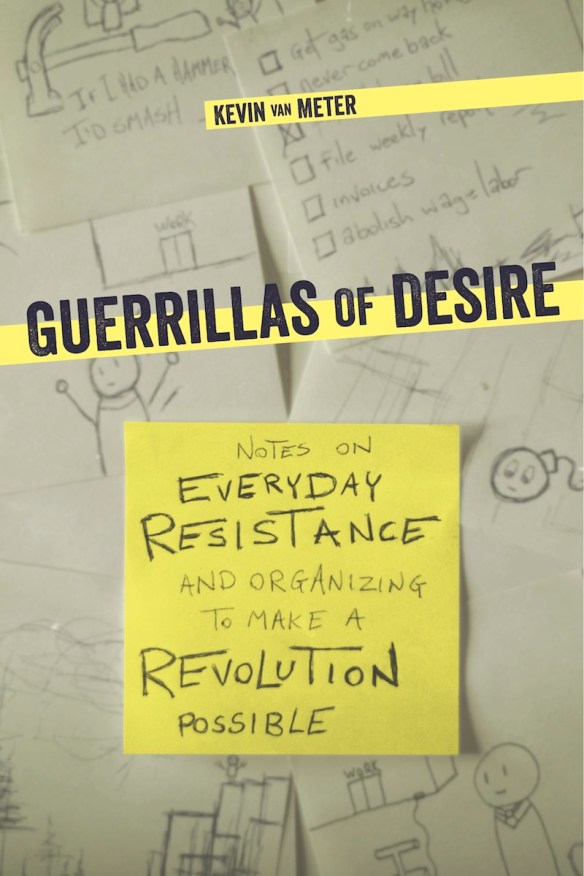
The Seeds of Anti-Capitalist Revolt Found in Everyday Resistance: A Review of Guerrillas of Desire – Notes on Everyday Resistance and Organizing to Make a Revolution Possible by Kevin Van Meter (AK Press, 2017)

By Scott Campbell

Source: Institute for Anarchist Studies

Back when I first began selling my labor for a wage in the wasteland of suburbia’s strip malls, I can recall the tedium of stocking shelves, summoning up insincere courtesy in the face of entitled customers and obnoxious bosses, comparing the stacks of money counted at the end of the day with the totals on our paychecks, and feigning adherence to whatever motivational façade management cooked up to mask the reality of our exploitation.

Yet I also remember, much more vividly and fondly, the latent and occasionally eruptive defiance among my co-workers. This included the constant collective complaining about the job, taking more and longer-than-approved breaks, working as little as possible, fudging time sheets, stealing, and the intermittent screaming matches with the boss in the middle of the store. Underpinning all these actions was an unspoken but broadly understood code of silence when it came to such transgressions and, when appropriate, expressions of support for them.

At the time, I didn’t think much about this, it was just how things happened and I’ve encountered similar experiences to varying degrees in every workplace since. Our actions weren’t guided by a political framework nor was there any attempt to organize them in a directed manner. It was more a spontaneous, innate reaction to experiencing the coercion of capitalism. I had cause to reflect upon this anew while reading Kevin Van Meter’s new book, Guerrillas of Desire: Notes on Everyday Resistance and Organizing to Make a Revolution Possible, published by AK Press and the Institute for Anarchist Studies.

In the preface, Van Meter observes that the question motivating him is not “What is to be done?” but “How do people become what they are?” Throughout the course of the book he seeks to provide an answer by locating power in the resistance of workers, apart from any political ideology or organization. Whether and how that inherently anti-capitalist refusal of work develops into revolt or rebellion are the questions he compellingly urges us to reflect and act upon.

To reach that point, Guerrillas of Desire ambitiously takes on multiple tasks that feed into and build on one another. Van Meter initiates a dialogue between anarchism and Autonomist Marxism that leads to a reconceptualization of the working class, bolstered in part by a historical accounting of workplace actions such as the ones I recounted. He labels these “everyday resistance,” committed by “guerrillas of desire,” and proposes a focus on those deeds as the entry point for organizing revolutionary resistance to capitalism. The impetus for this initiative, concisely carried out in under 160 pages, is his proposal that the current approach to organizing is conceptually flawed and therefore destined to fail. “Guerrillas of Desire offers a contentious hypothesis: the fundamental assumption underlying Left and radical organizing, including many strains of anarchism, is wrong. I do not mean organizationally dishonest, ideologically inappropriate, or immoral. I mean empirically incorrect” (13). The incorrect basis for current organizing is the assumption that the poor and working classes are unorganized and passive and that it therefore rests upon activists and organizations to educate and mobilize them for their own sakes. Van Meter instead proposes that there is in fact informal organization and resistance occurring, it is just of a sort that does not fit within the Left’s organizing vision and therefore goes unseen, unrecognized, and unincorporated into political theories, analysis, and action.

To provide a political frame for understanding the “everyday resistance” of the working class, Van Meter draws upon anarchism’s mutual aid – the material and emotional cooperation and reciprocal support that exists in societies – with Autonomist Marxism’s self-valorization – autonomous working class action that counters the state and capitalism, primarily the refusal of work in its myriad forms. Combined together and reinforcing one another, mutual aid and the refusal of work comprise the “everyday resistance” of the working class.

These phenomena also give definition to what is meant by “working class,” which Van Meter defines as “autonomous from both capitalism and the official organization of the Left, broadly including all those who work under capitalism, based in relationships between workers rather than as a structural component of the economy or sociological category” (32). Rather than being premised on income, occupation, or union membership, the working class under Van Meter’s formulation is made up of all those who must perform work under capitalism – be it waged or unwaged, in the factory, home, office, bedroom, affective, or social spheres. However, when they are not taking action in response to their subjugation under capitalism, these people are just workers. They become a class through the process of struggling against the conditions imposed upon them by capitalism. This struggle initially takes the form of everyday resistance based on mutual aid and the refusal of work. It is everyday resistance that unites individual workers as a class because such resistance, even when performed by one person, requires at a bare minimum the tacit complicity of co-workers and preferably their active collaboration.These acts and the social relationships they create and depend on lay the groundwork for the broader and overt organizing against capitalism more commonly interpreted as working class struggle. Using this framework as offered by Van Meter, we can understand the working class as composed of the relationships forged among workers actively in resistance against capitalism.Without anti-capitalist struggle, the working class does not exist.

After laying this theoretical groundwork, the bulk of the book traces the various forms of resistance by slaves, peasants, and workers in the industrial and social factories (the expansion of capitalist logic from the factory into society at large, in particular in service, immaterial, and reproductive work), creating a lineage and legacy of working class resistance against the various formations of capitalism that spans centuries. “Viewing the working class broadly to include slaves and peasants as well as students, homemakers, immigrants, and factory and office workers reveals the breadth of struggle and generalized revolt against work that continues to be imposed” (128). In doing so, Van Meter further builds the framework of the working class as being formed through its self-activity against the demands and deprivations of capitalism.

The historical survey brings the discussion into the present, where Van Meter offers a proposal to address his initial hypothesis that the Left is carrying out its organizing work in an incorrect way. His suggestion is for the organizers of today and in the future to begin their work by “reading the struggles” already underway in the form of everyday resistance. Through investigation and documentation by organizers, new relationships may be fostered with guerillas of desire that allow everyday resistance to expand into larger and more overt forms of autonomous anti-capitalist struggle. He proposes that the seeds of the new, liberatory worlds sought by anarchism and Autonomist Marxism are to be found in the everyday resistances that are already occurring rather than in the latest organizing manual or official Left strategy document..

While impressed after reading through this formulation, I was left with lingering questions. It remained unclear how, for instance, everyday resistance morphed into more overt, organized resistance and the part organizers positioning themselves as readers of struggle played in such a development. The personal anecdotes he provided on stepping back from ideological assumptions and reorienting towards the collective experiences of communities during his work in Long Island were helpful. It brought to mind the story of Marxist-Leninist intellectuals heading off to the Chiapan jungle with grand plans of starting a peasant guerrilla force. Only when they arrived, they found the population had no time or interest in their grandiose ideology. It was only when they dropped their assumptions and worked within the community to understand its needs, concerns and own history of resistance that the Zapatistas emerged. That, however, is a rather specific and exceptional example. I feel Van Meter’s proposal to begin organizing from within everyday resistance based on the notion that it will lead to more overt resistance could benefit from further articulation and direction.

Similarly, the focus on work as existing solely within the capitalist sphere left me curious as to his vision of the place of non-leisure activity under capitalism or even after capitalism. The refusal of the work that maintains capitalism is indispensable. Yet I would not advocate the refusal of work that maintains communal and personal well-being or builds autonomous organization, or writes books reviews in spare time, for example. Certainly, Van Meter would not advocate that either, but it remains a matter necessitating clarification and one that I believe extends beyond an issue of semantics.

Despite those questions, Guerrillas of Desire is aspirational in its scope and contains ideas and proposals worthy of consideration by radicals reflecting on how to engage in the current moment. In a time when mobilizing and organizing around class has fallen off the radar of many, it is a welcome reminder of the importance of paying attention to the working class and the integral role working class struggle plays in resistance to capitalism, alongside the currently more prevalent resistances to capitalist white supremacy, heteropatriarchy, colonization, environmental destruction and more.

Van Meter assists in this advocacy by accessibly presenting an updated Autonomist Marxist perspective of the working class, expanding it, breathing life into, and imbuing it with its own power, separate from both capitalism and the official Left. As such, he allows readers who may toil in a variety of ways under capitalism to see themselves within the working class, conceptualize their activities as part of a broader resistance with a rich history, and inspire them to build on that legacy.


Scott Campbell is a radical writer and translator based in California. He is part of the collectives that publish the websites El Enemigo Común and It’s Going Down. His personal site is fallingintoincandescence.com

Guerrillas of Desire is available here!


A New Concept of Consciousness

By Ervin Laszlo

Source: Reality Sandwich

The following is excerpted from The Intelligence of the Cosmos by Ervin Laszlo, published by Inner Traditions.

What about mind? If the world is vibration, is also mind and consciousness a form of vibration? Or on the contrary, are all vibrations, the observed world, a manifestation of mind?

Although it is true that when all is said and done all we know is our consciousness, it is also true that we do not know our own consciousness, not to mention the consciousness of anyone else. We do not know what consciousness really is or how it is related to the brain. Since our consciousness is the basis of our identity, we do not know who we really are. Are we a body that generates the stream of sensations we call consciousness, or are we a consciousness associated with a body that displays it? Do we have consciousness, or are we consciousness? Consciousness could be a kind of illusion, a set of sensations produced by the workings of our brain. But it could also be that our body is a vehicle, a transmitter of a consciousness that is the basic reality of the world. The world could be material, and mind could be an illusion. Or the world could be consciousness, and the materiality of the world could be the illusion.

Both of these possibilities have been explored in the history of philosophy, and today we are a step closer than before to understanding which of them is true. There are important insights emerging at the expanding frontiers where physical science joins consciousness research.

On the basis of a growing series of observations and experiments, a new consensus is emerging. It is that “my” consciousness is not just my consciousness, meaning the consciousness produced by my brain, any more than a program transmitted over the air would be a program produced by my TV set. Just like a program broadcast over the air continues to exist when my TV set is turned off, my consciousness continues to exist when my brain is turned off.

Consciousness is a real element in the real world. The brain and body do not produce it; they display it. And it does not cease when life in the body does. Consciousness is a reflection, a projection, a manifestation of the intelligence that “in-forms” the world.

Mystics and shamans have known that this is true for millennia, and artists and spiritual people know it to this day. Its rediscovery at the leading edge of science augurs a profound shift in our view of the world. It overcomes the answer the now outdated materialist science gives to the question regarding the nature of mind: the answer according to which consciousness is an epiphenomenon, a product or by-product of the workings of the brain. In that case, the brain would be like an electricity-generating turbine. The turbine is material, while the current it generates is not (or not strictly) material. In the same way, the brain could be material, even if the consciousness it generates proves to be something that is not quite material.

On first sight, this makes good sense. On a second look, however, the materialist concept encounters major problems. First, a conceptual problem. How could a material brain give rise to a truly immaterial stream of sensations? How could anything that is material produce anything immaterial? In modern consciousness research this is known as the “hard problem.” It has no reasonable answer. As researchers point out, we do not have the slightest idea how “matter” could produce “mind.” One is a measurable entity with properties such as hardness, extension, force, and the like, and the other is an ineffable series of sensations with no definite location in space and an ephemeral presence in time.

Fortunately, the hard problem does not need to be solved: it is not a real problem. There is another possibility: mind is a real element in the real world and is not produced by the brain; it is manifested and displayed by the brain.


Mind beyond Brain: Evidence for a New Concept of Consciousness

If mind is a real element in the real world only manifested rather than produced by the brain, it can also exist without the brain. There is evidence that mind does exist on occasion beyond the brain: surprisingly, conscious experience seems possible in the absence of a functioning brain. There are cases—the near-death experience (NDE) is the paradigm case—where consciousness persists when brain function is impaired, or even halted.

Thousands of observations and experiments show that people whose brain stopped working but then regained normal functioning can experience consciousness during the time they are without a functioning brain. This cannot be accounted for on the premises of the production theory: if there is no working brain, there cannot be consciousness. Yet there are cases of consciousness appearing beyond the living and working brain, and some of these cases are not easy to dismiss as mere imagination.

A striking NDE was recounted by a young woman named Pamela. Hers has been just one among scores of NDEs;* it is cited here to illustrate that such experiences exist, and can be documented.

*For a more extensive sampling see Ervin Laszlo with Anthony Peake from The ­Immortal Mind (Rochester, Vt.: Inner Traditions, 2014).

Pamela died on May 29, 2010, at the age of fifty-three. But for hours she was effectively dead on the operating table nineteen years earlier. Her near-demise was induced by a surgical team attempting to remove an aneurism in her brain stem.

After the operation, when her brain and body returned to normal functioning, Pamela described in detail what had taken place in the operating theater. She recalled among other things the music that was playing (“Hotel California” by the Eagles). She described a whole series of conversations among the medical team. She reported having watched the opening of her skull by the surgeon from a position above him and described in detail the “Midas Rex” ­bone-cutting device and the distinct sound it made.

About ninety minutes into the operation, she saw her body from the outside and felt herself being pulled out of it and into a tunnel of light. And she heard the bone saw activate, even though there were specially designed speakers in each of her ears that shut out all external sounds. The speakers themselves were broadcasting audible clicks in order to confirm that there was no activity in her brain stem. Moreover, she had been given a general anesthetic that should have assured that she was fully unconscious. Pamela should not have been able either to see or to hear anything.

It appears that consciousness is not, or not entirely, tied to the living brain. In addition to NDEs, there are cases in which consciousness is detached from the brain in regard to its location. In these cases consciousness originates above the eyes and the head, or near the ceiling, or above the roof. These are the out-of-body experiences: OBEs.

There are OBEs where congenitally blind people have visual awareness. They describe their surroundings in considerable detail and with remarkable accuracy. What the blind experience is not restored eyesight, because they are aware of things that are shielded from their eyes or are beyond the range of normal eyesight. Consciousness researcher Kenneth Ring called these experiences “transcendental awareness.”

Visual awareness in the blind joins a growing repertory of experiences collected and researched by Stanislav Grof: “transcendental ­experiences.” As Grof found, these beyond-the-brain and ­beyond-here-and-now experiences are widespread—more widespread than anyone would have suspected even a few years ago.

There are also reports of ADEs, after-death experiences. Thousands of psychic mediums claim to have channeled the conscious experience of deceased people, and some of these reports are not easy to dismiss as mere imagination. One of the most robust of these reports has come from Bertrand Russell, the renowned English philosopher. Lord Russell was a skeptic, an outspoken debunker of esoteric phenomena, including the survival of the mind or soul beyond the body. He once wrote, “I believe that when I die I shall rot, and nothing of my ego will survive.” Yet after he died he conveyed the following message to the medium Rosemary Brown.

You may not believe that it is I, Bertrand Arthur William Russell, who am saying these things, and perhaps there is no conclusive proof that I can offer through this somewhat restrictive medium. Those with an ear to hear may catch the echo of my voice in my phrases, the tenor of my tongue in my tautology; those who do not wish to hear will no doubt conjure up a whole table of tricks to disprove my retrospective rhetoric.

. . . After breathing my last breath in my mortal body, I found myself in some sort of extension of existence that held no parallel as far as I could estimate, in the material dimension I had recently experienced. I observed that I was occupying a body predominantly bearing similarities to the physical one I had vacated forever; but this new body in which I now resided seemed virtually weightless and very volatile, and able to move in any direction with the minimum of effort. I began to think I was dreaming and would awaken all too soon in that old world, of which I had become somewhat weary to find myself imprisoned once more in that ageing form which encased a brain that had waxed weary also and did not always want to think when I wanted to think. . . .

Several times in my life [Lord Russell continued] I had thought I was about to die; several times I had resigned myself with the best will that I could muster to ceasing to be. The idea of B.R. no longer inhabiting the world did not trouble me unduly. Befitting, I thought, to give the chap (myself) a decent burial and let him be. Now here I was, still the same I, with the capacities to think and observe sharpened to an incredible degree. I felt earth-life suddenly seemed very unreal almost as it had never happened. It took me quite a long while to understand that feeling until I realized at last that matter is certainly illusory although it does exist in actuality; the material world seemed now nothing more than a seething, changing, restless sea of indeterminable density and volume.

This report “from beyond” appears hardly credible, were it not that it is supported by other ADEs. One of the most striking and difficult to dismiss of these ADEs is the case of a deceased chess grand master who played a game with a living grand master.*

*For details see Laszlo with Peake, The Immortal Mind.

Wolfgang Eisenbeiss, an amateur chess player, engaged the medium Robert Rollans to transmit the moves of a game to be played with Viktor Korchnoi, the world’s third-ranking grand master. His ­opponent was to be a player whom Rollans was to find in his trance state. Eisenbeiss gave Rollans a list of deceased grand masters and asked him to contact them and ask who would be willing to play. Rollans entered his state of trance and did so. On June 15, 1985, the former grand master Geza Maroczy responded and said that he was available. Maroczy was the third-ranking grand master in the year 1900. He was born in 1870 and died in 1951 at the age of eighty-one. Rollans reported that Maroczy responded to his invitation as follows.

I will be at your disposal in this peculiar game of chess for two reasons. First, because I also want to do something to aid mankind ­living on Earth to become convinced that death does not end everything, but instead the mind is separated from the physical body and comes up to us in a new world, where individual life continues to manifest itself in a new unknown dimension. Second, being a Hungarian patriot, I want to guide the eyes of the world into the direction of my beloved Hungary.

Korchnoi and Maroczy began a game that was frequently interrupted due to Korchnoi’s poor health and numerous travels. It lasted seven years and eight months. Speaking through Robert Rollans, Maroczy gave his moves in the standard form: for example, “5. A3 – Bxc3+”; Korchnoi gave his own moves to Rollans in the same form, but by ordinary communication. Every move was analyzed and recorded. It turned out that the game was played at the grand-master level and that it exhibited the style for which Maroczy was famous. It ended on February 11, 1993, when at move forty-eight Maroczy resigned. Subsequent analysis showed that it was a wise decision: five moves later Korchnoi would have achieved checkmate.

In this case the medium Rollans channeled information he did not possess in his ordinary state of consciousness. And this information was so expert and precise that it is extremely unlikely that any person Rollans could have contacted would have possessed it.

There are also firsthand testimonies of consciousness without a functioning brain. The well-known Harvard neurosurgeon Eben Alexander, who was just as insistently skeptical about consciousness beyond the brain as Lord Russell had been, gave a detailed account of his conscious experience during the seven days he spent in deep coma. In the condition in which he found himself, conscious experience, he previously said, is completely excluded. Yet his experience—which he described in detail in several articles and three bestselling books—was so clear and convincing that it has changed his mind. Consciousness, he is now claiming, can exist beyond the brain.

The above-cited cases illustrate that there is remarkable, and on occasion remarkably robust, evidence that consciousness is not confined to the living brain. Although this evidence is widespread, it is not widely known. There are still people, including scientists, who refuse to take cognizance of it. This is not surprising, given that the evidence is anomalous for the dominant world concept. Those who strongly disbelieve that such phenomena exist, not only refuse to consider evidence to the contrary, they often fail to perceive evidence to the contrary.

Nonetheless, the view that consciousness is a fundamental element in the world is gaining recognition. The Manifesto of the Summit on Post-Materialist Science, Spirituality and Society (Tucson, Arizona, 2015) declared: “Mind represents an aspect of reality as primordial as the physical world. Mind is fundamental in the universe, i.e., it cannot be derived from matter and reduced to anything more
basic.”

Newsletter: From Neoliberal Injustice To Economic Democracy

By Kevin Zeese and Margaret Flowers

Source: Dissident Voice

The work to transform society involves two parallel paths: resisting harmful systems and institutions and creating new systems and institutions to replace them. Our focus in this article is on positive work that people are doing to change current systems in ways that reduce the wealth divide, meet basic needs, ensure sustainability, create economic and racial justice and provide people with greater control over their lives.

When we and others organized the Occupation of Washington, DC in 2011, we subtitled the encampment ‘Stop the Machine, Create a New World’, to highlight both aspects of movement tasks — resistance and creation. One Popular Resistance project, It’s Our Economy, reports on economic democracy and new forms of ownership and economic development.

Throughout US history, resistance movements have coincided with the growth of economic democracy alternatives such as worker cooperatives, mutual aid and credit unions. John Curl writes about this parallel path in “For All the People,” which we summarized in “Cooperatives and Community Work are Part of American DNA.”

Mahatma Gandhi’s program of nonviolent resistance, satyagraha, had two components: obstructive resistance and constructive programs. Gandhi promoted Swaraj, a form of “self-rule” that would bring independence not just from the British Empire but also from the state through building community-based systems of self-sufficiency. He envisioned economic democracy at the village level. With his approach, economics is tied to ethics and justice — an economy that hurts the moral well-being of an individual or nation is immoral and business and industry should be measured not by shareholder profit but by their impact on people and community.

Today, we suffer from an Empire Economy. We can use Swaraj to break free from it. Many people are working to build a new economy and many cities are putting in place examples of economic democracy. One city attempting an overall transformation is Cooperation Jackson in Jackson, Mississippi.

Economic Democracy in response to neoliberalism

In his new book, Out of the Wreckage: A New Politics for an Age of Crisis, George Monbiot argues that a toxic ideology of greed and self–interest resulting in extreme competition and individualism rules the current economic and political culture. It is built on a misrepresentation of human nature. Evolutionary biology and psychology show that humans are actually supreme altruists and cooperators.  Monbiot argues that the economy and government can be radically reorganized from the bottom up, enabling people to take back control and overthrow the forces that have thwarted human ambitions for a more just and equal society.

In an interview with Mark Karlin, Monbiot describes how neolibealism arose over decades, beginning in the 1930s and 40s with John Maynard Keynes, Friedrich Hayek and others, and is now losing steam, as ideologies do. Monbiot says we need a new “Restoration Story.”

We are in the midst of writing that new story as people experience the injustice of the current system with economic and racial inequality, destruction of the environment and never ending wars. Indeed, we are further ahead in creating the new Restoration Story than we realize.

Cooperatives

New research from the University of Wisconsin–Madison’s Center for Cooperatives (UWCC) has found there are 39,594 cooperatives in the United States, excluding the housing sector, and there are 7 million employer businesses that remain “potential co-op candidates.” These cooperatives account for more than $3 trillion in assets, more than $500 billion in annual revenue and sustain nearly two million jobs. This May, the Office of Management and Budget approved including coop questions in the Economic Census so that next year the US should have more accurate figures. The massive growth of cooperatives impacts many segments of the economy including banking, food, energy, transit and housing among others.

In cooperatives, workers or consumers decide directly how their business operate and work together to achieve their goals; it is a culture change from the competitive extreme capitalist view dominated by self-interest.

In Energy Democracy: Advancing Equity in Clean Energy Solutions, editors Denise Fairchild and Al Weinrub describe energy cooperatives that are creating a new model for how we organize the production and distribution of energy, which is decentralized, multi-racial and multi-class.

Lyn Benander of Co-op Power, a network of many cooperatives in New England and New York, writes that they transform not just energy but also their communities:

First, people come together across class and race to make change in their community by using their power as investors, workers, consumers, and citizens ready to take action together. Then, they work together to build community-owned enterprises with local capital and local jobs to serve local energy needs. It’s a proven strategy for making a real difference.

In Lancaster, CA, the mayor has turned the town into a solar energy capital where they produce power not just for themselves, but also to sell to other cities. They are also moving to create manufacturing jobs in electric buses, which more cities are buying, and energy storage. Research finds that rooftop solar and net-metering programs reduce electricity prices for all utility customers, not just those with solar panels. The rapid growth of rooftop solar is creating well-paying jobs at a rate that’s 17 times faster than the total U.S. economy. Rooftop solar, built on existing structures, such as homes and schools, puts energy choices in the hands of customers rather than centralized monopolies, thereby democratizing energy.

Including housing cooperatives would greatly increase the number of cooperatives. According to the National Association of Housing Cooperatives, “Housing cooperatives offer the more than one million families who live in them several benefits such as: a collective and democratic ownership structure, limited liability, lower costs and non-profit status.”  Residents of a mobile home park in Massachusetts decided to create a housing cooperative to put the residents in charge of the community when the owner planned to sell it.

Related to this are community land trusts. A section of land is owned in a trust run as a non-profit that represents the interests of local residents and businesses. Although the land is owned by the trust, buildings can be bought and sold. The trust lowers prices and can prevent gentrification.

Universal Basic Income

Another tool gaining greater traction is a universal basic income.  James King writes in People’s Policy Project that “. . . a universal basic income (UBI) – a cash payment made to every person in the country with no strings attached – is becoming increasingly popular in experimental policy circles. . . payments  [would be] large enough to guarantee a minimum standard of living to every person independent of work. In the US, that would be roughly $12,000 per person based on the poverty line.”

The wealth divide has become so extreme in the United States that nearly half of all people are living in poverty. A small UBI would provide peace of mind, financial security and the possibility of saving money and building some wealth. A report by the Roosevelt Institute, this week, found that a conservative analysis of the impact of a UBI of $1,000 per month would grow the economy by 12.56 percent after an eight-year implementation, this translates to a total growth of $2.48 trillion.

Public Finance

Another major area of economic democracy is the finance sector. At the end of 2016 there were 2,479 credit unions with assets under 20 million dollars in the United States. Members who bank in credit unions are part of a cooperative bank where the members vote for the board and participate in other decisions.

Another economic democracy approach is a public bank where a city, state or even the national government creates a bank using public dollars such as taxes and fee revenues. Public banks save millions of dollars that are usually paid in fees to Wall Street banks, and the savings can be used to fund projects such as infrastructure, transit, housing, healthcare and education, among other social needs. Public banks can also partner with community banks or credit unions to fund local projects. This could help to offset one of the negative impacts of Dodd-Frank, which has been a reduction in community banks. In testimony, the Secretary of Treasury, Stephen Munchin, said we could “end up in a world where we have four big banks in this country.”

North Dakota is the only state with a public bank, and it has the most diverse, locally-owned banking system in the country. Stacey Mitchell writes that “North Dakota has six times as many locally owned financial institutions per person as the rest of the nation. And these local banks and credit unions control a resounding 83 percent of deposits in the state, more than twice the 30 percent market share such banks have nationally.” Public banking campaigns are making progress in many parts of the country, among them are Oakland, Los Angeles, Philadelphia, Santa Fe, and other areas.

Mutual Aid

When crises occur, no matter what their cause, people can work together cooperatively and outside of slow and unresponsive state systems to meet their needs. This is happening in Athens, Greece, which has been wracked by financial crisis and austerity for years. People have formed “networks of resistance” that meet in community assemblies organized around needs of the community, such as health care and food. They started with time banks as a base for a new non-consumer society.

Similar efforts are underway in Puerto Rico following the devastation of Hurricane Maria. A group called El Llamado is coordinating more than 20 mutual aid efforts, and providing political education and support for self-organizing at the same time.

As George Monbiot describes it, this is consistent with the truth about what human beings are:

We survived despite being weaker and slower than both our potential predators and most of our prey. We did so through developing, to an extraordinary degree, a capacity for mutual aid. As it was essential to our survival, this urge to cooperate was hard-wired into our brains through natural selection.

As we face more crises, whether in lack of access to health care, education, housing, food or economic and climate disasters, let’s remember that we have the capacity to meet our needs collectively.  In fact, every day, people are putting in place a new economic democracy that allows people to participate based on economic and racial justice as well as real democracy. As these alternatives are put in place, they may become dominant in our economy, communities and politics and bring real democracy and security to our lives.


Kevin Zeese and Margaret Flowers are co-directors of Popular Resistance. Read other articles by Kevin Zeese and Margaret Flowers.

Live Free or Die: The Psychology of Rebellion & Dissent

By Gary ‘Z’ McGee

Source: Waking Times

“I rebel—therefore we exist.” ~Albert Camus, The Rebel

Dissent is a tricky subject. The need to rebel against atrocity is deeply ingrained in the human condition. Even if most of us don’t act on it, the impulse is still there, churning our guts with disgust, getting our hearts pumping, moving us to spit curse words in lathered fury and shout in angry defiance. The problem is that most of us don’t know what to do with this powerful and sometimes overwhelming energy.

Most of us were raised in violent societies that use violence to keep the culture churning in a diabolical conquer-control-consume-repeat cycle. So, most of us tend to use violence to channel our deep and powerful need for dissent, thus perpetuating more violence. When the culture is jamming violence down our throat as a solution to its problems, are we really that surprised when our acts of rebellion turn out to be violent? Something’s got to give if we want to break this cycle of violence deeply imbedded in our culture.

In his book, The Rebel: An Essay on Man in Revolt, Albert Camus wrote about the “true rebel.”The true rebel is in revolt against oppression, violence, slavery and tyranny for the sake of others through constructive and life-affirming action. The true rebel protests out of love, so that others may be free. Intent is everything. True rebellion, Camus argues, is an act motivated but concerned with the common good rather than by self-interest. The rebel in revolt out of selfishness, greed, or need for power, eventually becomes a tyrant. The rebel in revolt for the sake of others, becomes a hero.

Whether you are alt-right or alt-left, republican’t or democan’t, voluntarist or anarchist, if you are seeking power over others for your own selfish and greedy ends, your revolution means fuck-all. You’re just another would-be-tyrant getting churned out of the meat-mill of violence begetting violence. It doesn’t matter how noble or important you think your cause is; if you need to use violence to persuade others to follow it, your cause is fundamentally flawed and immoral. Acting violently in a violent culture only perpetuates violence. Similarly, acting immorally in an immoral society just perpetuates immorality. Unhealthy acts beget unhealthy acts. Like Gandhi said, “An eye for an eye makes the whole world blind.”

Lest we all go blind, we must rebel so that others may freely exist. This requires our dissent to be based in freedom for everyone, even those we don’t agree with. A kind of metamorality arises from this kind of thinking, like Joshua Greene writes about in his book, Moral Tribes. But, and here’s the rub, any freedom which seeks to violate the nonaggression principle must not be tolerated. Violence is where the line must be drawn. As someone once said, “Your freedom to swing your fist ends an inch from my nose” (unknown). In such cases, self-defense is paramount. As Gandhi also advised, “When there is only a choice between cowardice and violence, I would advise violence.”

A true rebel doesn’t seek out rebellion for the sake of rebellion, or just as an excuse to act out violently. No. A true rebel passionately seeks a healthy environment (physically, culturally, and psychologically) and they rebel against anything that stands in the way of that healthy environment. As Camus said, “Rebellion, though apparently negative, since it creates nothing, is profoundly positive in that it reveals the part of man which must always be defended.” And that’s what it comes down to: self-defense, self-preservation, and survival. Not just personal survival, but the survival of the species.

That’s where life-affirming action comes in. When our rebellion is life-affirming, freedom-affirming, and based on nonviolence, it is healthy (heroic). When our rebellion is life-denying, freedom-denying, and based on violence, it is unhealthy (tyrannical). The hero is free, and uses that freedom with the soul intent to free others. The tyrant (or would be tyrant) is also free, but uses that freedom with the soul intent to rule others. We escape tyranny when we seek to free others through our own freedom. Liberty coincides with heroism when we’re able to go from asking, ‘free from what?’ to asking, ‘free for what?’

At the end of the day, the history of our culture of violence is only fruitful through a vigilant rebellion against it. This means a vigilant rebellion against oppression, hate, violence, and slavery of all kinds. Those who dedicate themselves to this culture of violence dedicate themselves to nothing and, in turn, are nothing. But those who dedicate themselves to life, freedom, and health, despite the culture of violence, dedicate themselves to survival and reap from it the harvest that sows its seed in the progressive evolution of our species.

A species hellbent on violence against itself is unhealthy and eventually destroys itself. A species determined to be healthy only ever uses violence as a last resort in self-defense and for the preservation of the species itself. From the former, the defiant tyrant juts his ugly head, declaring himself free at the expense of the freedom of others. From the latter, the defiant hero rises up, denying the tyrant’s violent oppression, and affirming freedom through the freedom of us all. That’s what Camus meant when he wrote: “I rebel –therefore we exist.”