‘Us vs. Them’ Thinking Is Hardwired—But Consciousness Can Overpower It

By Joe Martino

Source: The Pulse

Are we hardwired to categorize each other into ‘Us vs Them?’ Simply put, yes. But this hardwiring is remarkably easy to break. It’s time we equip ourselves with the knowledge and tools to do so.

Why? Well, anything from powerful governments to mainstream and alternative media is consistently trying to divide us by focusing aggressively on our differences. When we know how these mechanisms work and focus our consciousness in an effective way, these attempts to divide fail.

First a quick story.

When we first launched our membership I hired marketing teams to help. They would always tell me “in the sales messaging we need to create an ‘Us vs Them dynamic’ in order to get people to buy.” I resisted.

I felt like that wasn’t necessary and also contrary to our mission of unifying people to create a better world. But, the marketers were right. When we would A/B test sales messaging without ‘Us vs Them’ compared to sales messaging with it, the ‘Us vs Them’ messaging always won.

I have to admit this made me a bit sad. Was I thinking too idealistically about human beings? Maybe. But I always asked ‘Why doesn’t Us vs Them messaging work on me?” Before you suggest I’m naive and think “of course the messaging works on you,” read to the end of this piece. You’ll see how simply it is for this messaging not to work on anyone should they choose.

Neuroscience suggests that this Us vs Them biological trait developed thousands of years ago. As you might imagine, it had much to do with survival in much different times than we live in today.

It essentially states that human beings are primed to make very basic and categorical Us vs Them judgments. In fact, your brain is processing these Us vs Them differences in a twentieth of a second. These noticed differences are your classically promoted artificial constructs of: ethnicity, gender, skin color, age, socioeconomic class, and even something like sports team preference.

(I say artificial because social constructs tell us we should focus on these as differences. We don’t actually have to see them as differences as we are ALL one species. Other animals do not engage their Us vs Them biology within their species – only we do – and it’s a taught behaviour.)

All of this is enhanced by a multi-purposed hormone in our brain called Oxytocin.

Oxytocin has been shown to be a wonderful hormone for connecting and bonding with others that we know in our communities, ‘Us’. It’s often referred to as the love hormone or connection hormone. It essentially heightens meaningful connections with our in-group.

But on the flip side, studies have shown that when it comes to people who we see as strangers (Them), oxytocin creates a decrease in cooperation and increases envy when people are struggling. Further, it pushes one to gloat when they are ‘winning.’ In fact, there are many ways in which oxytocin is linked to dividing ourselves from ‘Them’ and keeping it that way.

In short, oxytocin enhances this Us vs Them divide. But, while this sounds like we may be doomed for division and judgment of others forever, what has also been shown is that these almost instantaneous judgements we make can be manipulated incredibly easily. And that’s without bringing in a little bit of conscious awareness and presence.

Studies have shown that when you expose people to others who look different from them, the ‘Us’ wiring often turns on when people look similar, and the ‘Them’ wiring turns on when people look different. This showed an implicit judgment based on ethnicity.

Yet when those same people were exposed to people who looked the same and different from them but were now wearing baseball hats with team logos, things changed. Suddenly the participants brains indicated that Us and Them had nothing to do with ethnicity anymore, it was about which team they supported.

A tiny change created an instantaneous manipulation of who is Us vs Them. I wrote about a similar phenomenon in a recent piece called Racism Plummeted When People Were Told Aliens Exist. This showed that when humans were told aliens existed, the Us became humans, and the Them became aliens. Suddenly people were nicer to each other and more accepting of differences.

The point? It doesn’t take much to for us to see each other as one, we just have to focus our consciousness a bit.

Consciousness Is Everything

There is much gained in our well being and in society when we become more self-aware, reflective and present. It moves unconscious and often automatic behaviour into a lens where we can ask: why do we do this?

Further, an increase in the above mentioned traits can lead to something as simple as stopping ourselves before we do something destructive out of anger. We can then pause for a short period, reflect, and respond.

The more we move from automatic, unconscious and reactive ways of living to present, reflective and conscious ways of living, the more harmony surrounds our lives.

What I’m saying can bring up similarities to new-agey, online influencer judgments that the ‘conscious’ are more than the ‘unconscious,’ this is not at all what I’m saying here. And I will expand in a moment.

First, I trust it’s clear that we can be manipulated into different Us vs Them dichotomies very easily. Studies exploring implicit bias also show that when we are exposed to different people regularly, we become less judgemental towards their differences.

Even still, we can build self awareness around how WE play into these divides in order to diffuse them.

For example, during COVID government leaders like Justin Trudeau sowed division in Canada by making unvaccinated Canadians less than. He did this by calling them names and characterizing them in ways that would cause the general population to dislike them.

“They [the unvaccinated] don’t believe in science/progress and are very often misogynistic and racist. It’s a very small group of people, but that doesn’t shy away from the fact that they take up some space.”Justin Trudeau

He combined this rhetoric with un-contextualized and false data around vaccination status in Canada to strengthen his propaganda.

Note, I’m not focusing on Trudeau here because I’m “a Poilievre fan” or anything. In fact, I don’t feel our current structure of politics is healthy nor serving us as people. I’m simply illustrating the ways in which our society has become ‘lost’ in division. Getting out of it requires us to take a close examination of what is happening so we can choose a different path.

In contrast, some unvaccinated people around the world began to refer to themselves as ‘pure bloods’ because they were not vaccinated. This led to memes, hateful rhetoric, and actions like avoiding and separating themselves from their vaccinated friends and families. Instead of attempting to understand why some became vaccinated, it was often simply seen as ‘the vaccinated are sheep.’

Once again we see division, in/out groups, and greater than/less than beliefs.

In both cases we are seeing the destruction and damage that can occur when we allow our flimsy biological traits around Us vs Them to be fed and upheld by faulty information and propaganda.

What is also important to note is that our ‘authoritative’ institutions of government and mainstream media will often be guilty of this destructive behaviour which deeply normalizes it amongst the masses.

That said, we are not doomed. Consciousness is everything. By that I mean, the quality of our consciousness. The ways in which we slow down, reflect, and become more present in everyday life becomes an antidote to propaganda feeding Us vs Them.

This is why we have the section at the top of our articles to “Pause and set your pulse.” To cultivate more presence and self awareness, check out a couple of the pieces of content I list at the bottom of this piece.

Let’s go deeper. Perhaps why I have felt Us vs Them messaging does not work on me stems from: what happens when we have experiences that lead us to feel we are all one and interconnected with everything? I have had these experiences many times in my life. I experienced them through meditation, breath work, and even randomly.

Thrust into what can be best described as ‘sensing the nature of our reality,’ when you have these transcendental experiences you do not see yourself as all that separate from everything else. Sure, you are YOU, and you know you are an individual, but you also have a knowing of the connection and sameness you share with everything.

What happens if we nurture and hold that knowing in our consciousness and allow it to form our worldview? Does our sense of Us vs Them get triggered as easily? I don’t think so. But that’s my experience.

This direct experience has led me to believe that a shift in our consciousness can be one of the most powerful tools in changing the way we see each other and ultimately re-design our society – because it has to happen.

Albert Einstein had some thoughts on this as well:

“A human being is part of a whole, called by us the ‘Universe’ —a part limited in time and space. He experiences himself, his thoughts, and feelings, as something separated from the rest—a kind of optical delusion of his consciousness. This delusion is a kind of prison for us, restricting us to our personal desires and to affection for a few persons nearest us. Our task must be to free ourselves from this prison by widening our circles of compassion to embrace all living creatures and the whole of nature in its beauty.”Albert Einstein

A task indeed, but one that is very possible with the right practice and focus.

Education Is Key Too

Why are things the way they are? We have to explore content that seeks to answer these questions. Instead of using social media for fast memes, 15 second videos, and short out of context video clips, deepen your knowledge. Consume less, but spend MORE time on each thing you consume.

Buying into this fast and distracting culture of information consumption is only furthering the problems we have. Social media algorithms are rigged to build an echo chamber around you and to give you ‘truth’ that confirms your existing bias’. This is not real education.

As for the biological trait itself, why can’t we focus our attention on our human similarities instead of our differences? We can. But culturally we have learned not to because somewhere along the lines it’s what we chose to obsess over.

Perhaps because powerful people glean more power by dividing masses. Perhaps because our current economic systems thrive off division, competition, and having various classes. Either way, we’re making this all up as we go. It doesn’t have to be like this.

For those who might think “this is our biology. We will always do best in small groups of the same type of people,” this doesn’t appear to be true. Studies have shown that diversity trumps ability. Diversity significantly enhances the level of innovation in organizations around the world.

Groups of only ‘like-minds’ become echo chambers and our efficiency and innovation suffers. Yet another reason we must learn to love, respect and communicate with one another.

(Note: here I’m pointing to the uncovering our potential as humans and having that be our driver. Not productivity and innovation tied to making more money and having a ‘bullish market economy’)

The Takeaway

The key is that consciousness can overcome a flimsy biological trait that produces Us vs Them thinking within us. We can engage experience and education that connects us to our similarities, adopts a consciousness of interconnection and a shared stewardship of our planet and people.

Everything from ‘woke ideology’ constantly obsessing over our differences, to political news commentary always inviting people to ‘dislike the other side’ is contributing to a worse direction for humanity. Don’t just sit there and blame it though, simply choose to engage differently. Improve how you use social media. Consume less content but go deeper.

Consciousness is the power here. Why can’t we extend our worldview of who we are into oneness and a deeper connectedness? Why must we fight to shut off our wonder and hold to petty differences?

Billionaires, Bunkers and Brain Damage

“The rich are not like us”

By Mickey Z.

Source: Dissident Voice

Douglas Rushkoff has an article (based on his latest book) called “The super-rich ‘preppers’ planning to save themselves from the apocalypse,” in The Observer.

This excerpt gives you an idea of how the barbaric brain of a billionaire operates:

Finally, the CEO of a brokerage house explained that he had nearly completed building his own underground bunker system, and asked: “How do I maintain authority over my security force after the event?” The event. That was their euphemism for the environmental collapse, social unrest, nuclear explosion, solar storm, unstoppable virus, or malicious computer hack that takes everything down.

This single question occupied us for the rest of the hour. They knew armed guards would be required to protect their compounds from raiders as well as angry mobs. One had already secured a dozen Navy Seals to make their way to his compound if he gave them the right cue. But how would he pay the guards once even his crypto was worthless? What would stop the guards from eventually choosing their own leader?

The billionaires considered using special combination locks on the food supply that only they knew. Or making guards wear disciplinary collars of some kind in return for their survival. Or maybe building robots to serve as guards and workers – if that technology could be developed “in time.” It’s as if they want to build a car that goes fast enough to escape from its own exhaust

I tried to reason with them. I made pro-social arguments for partnership and solidarity as the best approaches to our collective, long-term challenges. The way to get your guards to exhibit loyalty in the future was to treat them like friends right now, I explained. Don’t just invest in ammo and electric fences, invest in people and relationships. They rolled their eyes at what must have sounded to them like hippy philosophy.

After reading that, you may be wondering if the rich are brain-damaged. To which I reply: Why weren’t you thinking that all along and yes, they are brain-damaged. Some studies to consider:

There’s plenty more where that came from but, of course, all such “research” must be viewed with healthy skepticism. Personally, since I’m justifiably wary of “studies,” I’ll just look around to see — with my own three eyes — how the wealthiest humans on the planet have behaved since, well… forever.

Or consider the words of the immortal Dorothy Parker: “If you want to know what God thinks of money, just look at the people he gave it to.”

Translation: The billionaires are not going to save you — or ever help you. They’re running scared to get their brain-damaged butts into bunkers.

So, connect with your peers. Connect across “party” lines and ideological hive minds. Toss away your purity litmus tests and find common ground.

What will save us is what always saves us: community, resilience, compassion, open-mindedness, innovation, and imagination.

Consider the Chickens

Intelligence, ethics, and the inner lives of animals

By Rafia Zakaria

Source: The Baffler

I OWE CHICKENS AN APOLOGY. Not only have I been eating them until very recently, but I have refused to even consider the possibility of a chicken having any kind of inner life. This estimation was not made from a lack of interaction. As children, my twin brother and I purchased baby chicks from a street vendor. We did this unfazed by the fact that quite often, the chickens would die. Once, when we were nine, we had two that lived, a hen and a rooster. No one told us that we should probably get more hens. Not having any other female companions, the rooster exerted his attentions on the one chicken. She would lay an egg or two every day, much to our delight, but soon sickened and died. Then there was only an incel rooster who roamed our compound and terrorized the women. After a few ugly incidents, he was “given away” to one of the women who worked at our house. We were never told what happened to him, and I didn’t care. There is nothing worse than an incel rooster patrolling your house all day long.

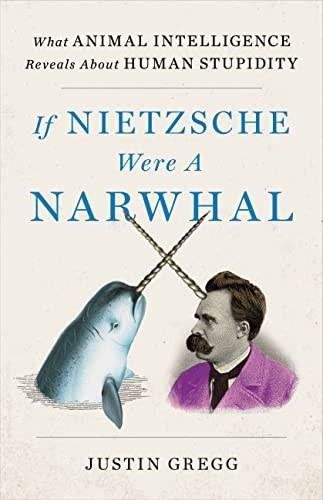
Now, so many years later, I’ve found my way to animal behaviorist Justin Gregg’s brilliant new book If Nietzsche Were a Narwhal: What Animal Intelligence Reveals About Human Stupidity. Gregg’s chicken coop is “a huge enclosed area” with high rafters, because as an animal scientist, he knows them to be jungle birds who need perches on which to sleep at night. But it is not only the magisterial heights of Gregg’s discussion of chickens that stayed with me. I was struck also by Gregg’s description of his chickens’ varied personalities, one anxious, another friendly, and so on; he tells us that these chickens do have inner lives and thus a consciousness of themselves as distinct from others. Instead of the feckless creatures I (and most people) assume them to be, chickens have just the sort of intelligence that is necessary for their own survival. They don’t think like humans, Gregg tells us, because they do not need to.

Intelligence, in Gregg’s explanation, does not exist in the way SATs or other IQ tests would have you believe. Those tests quantify a certain kind of ability to process information. People who do not do well on such tests may have other kinds of abilities that simply are not being measured. Intelligence is not one easily definable thing; engineers working on artificial intelligence cannot agree on a definition of it. But what humans have is a tendency to ask why things operate in a certain way. In Gregg’s terminology, humans are “why specialists,” a proclivity that in natural selection terms is no advantage and perhaps even a liability. A narwhal swimming around in the sea, for instance, would never have the kind of mental breakdown that the German philosopher pondering nihilism suffered toward the end of his life. Animal intelligence is practical and does not get caught up in abstract thought. By and large, animals make calculations based on what they can observe; ideas such as “causality,” which lie at the crux of human intelligence, are outside their capacity for thought.

Humans evolved to become why specialists. As Gregg tells it, 200,000 years ago, humans were hanging out with chimpanzees and exhibited no interest in the whys. They could make rudimentary tools and had some kind of assemblage of grunts that allowed for basic communication. He notes that roughly 40,000 years ago, cave paintings were created. Here were humans asking the whys; symbolic representation is an exclusively human thing.

Inability to be why specialists does not mean that animals are not capable of “metacognition,” the ability to be conscious of their own thinking or cognition. One of the most stunning examples in this book full of stunning examples is that of Natua, a dolphin at the Dolphin Research Center in Florida. An experiment was set up where Natua was exposed to two kinds of sounds, one a very high tone and one a very low tone. After hearing the sound, Natua had to choose between two paddles, one for the high and another for the low. If he chose correctly, he was given a fish for a reward. If he did not, he was sent for a long time-out, in that the experiment stopped. As the experiment progressed, the high tone sound came very close to the low sound such that they were nearly indistinguishable. At this point, Natua was unable to tell the difference; “he just started randomly pressing paddles,” Gregg writes. His behavior proved that some animals are capable of metacognition, the awareness that they do not know, or that their thinking about something is wrong.

It is no surprise that Gregg is pessimistic about how humans have used their abilities as why specialists, and he thinks that there is a chance that humans might not even survive over another century. The prospect of nuclear war and the climate crisis suggest, in Gregg’s view, that the end is possible. In the meantime, developing a consciousness of animals as beings who are capable of metacognition, of having individual personalities and so on, points to the need for a new ethics. This new set of basic premises would abandon the centering principle that the animal-human relationship must always be of one having dominion over the other.

But if you consider the continued resistance to the idea of animal rights, it is hard to be optimistic about the emergence of a new ethics of mutuality that eschews the dominion portion. Too many human rationalizations, attached to what we eat, what we wear, how we live, are predicated on the belief that we are the only feeling beings and that our actions upon animals are independent of consequences. If you know the fear of a chicken or a cow or a pig about to be slaughtered, you may look at your food in a different way. You might eschew fried chicken or beef or pork completely. If you understand that a horse being whipped is suffering terribly, is extremely scared and dissolute, you can also understand that there is a need for a radical expansion of mindfulness and a concomitant shrinking of power.

In the moral universe informed by Gregg’s argument, the survival of the human race is not an imperative for the planet because humans as a species have been far more disastrous for the world than others. “Prognostic myopia” keeps us horribly and condemnably in the moment, burning fossil fuels and trashing the oceans even though we know that it is terrible for the environment. This is a unique position among philosophers, a lot of whom have lately concerned themselves with questions of ethics and planetary survival. 

As a contrast to Gregg, the Oxford Associate Professor in Philosophy William MacAskill, in his What We Owe the Future, proposes “effective altruism” as a way to live ethically in times of climate crisis. If Gregg argues against human exceptionalism, MacAskill reduces humans to data points, where the survival of the most, and the most benefit to the planet, are guideposts to a present and future ethics. Using Gregg’s arguments, however, effective altruism is rendered meaningless. Even those who live sparingly on twenty-six thousand pounds a year, like MacAskill, are still a burdensome threat, unless we define their worth according to tiresome illusions of human exceptionalism.

If Nietzsche Were A Narwhal is the sort of critical look at human dominion that our world needs. A few years ago, Brown University environmental historian Bathsheba R. Demuth wrote Floating Coast: An Environmental History of the Bering Strait, a similarly groundbreaking look at the consequences of the extractive relationship humans have had with the environment. Just as Gregg reveals the risks of humans imagining their power over animals as shorn of consequences, Demuth reveals the consequences of human dominion over nature.

Thinkers and scientists like Gregg and Demuth are presenting readers with the urgent and pressing necessity for a new ethics. The unthinking, extractive, and dominant human treats animals as a lower form of existence, rather than a different form; we assess the environment based on what can be extracted from it. Like our means of communication, our means of travel, of treating disease, and so much else, our ethics need an urgent and pressing update that takes into consideration the understanding of animals. Factory farms, the constant consumption of animal products, and the greedy use of fossil fuels are the seeds of destruction.

I am not sure I could have offered the chicken and rooster of my childhood a deluxe chicken coop with high rafters, but an argument for better living conditions and the introduction of new companions for the rooster would have been easier if we had understood the first thing about the animals around us. I do not need to underscore the rapid pace at which our world is changing. If Nietzsche Were A Narwhal is a must-read because it explains how we can save the world only if we exist in symbiosis with the thinking, feeling creatures that have had the misfortune of sharing the planet with humans, who turn out not to be as intelligent as they believe themselves to be.

LIFE… IN REVERSAL

By Kingsley L. Dennis

Source: Waking Times

‘We must distinguish between real change and fictitious change. The change that comes from without, from externally imposed training and discipline, is fictitious…Real change comes from within, by conscious work intentionally performed by the being himself.’ ~J.G. Bennett 

It is increasingly difficult in these times to speak of ‘non-verifiable’ or unprovable matters, especially concerns of the spirit-consciousness, for too many people are inculcated with fixed beliefs and thinking patterns. This is itself a sign of social conditioning and of a certain ‘management of mind.’ We should not be surprised that this situation is rife throughout our societies and cultures and is becoming increasingly predominant. Social norms are persuading many people to prefer safety and security rather than the potential discomfort that comes from gaining new realizations and understanding.

An ex-officer of the Soviet secret police who defected to the West (Gregory Klimov), revealed that in the fields of Soviet psychological warfare (and social psychology) they utilized the principles of psychoanalysis. In this, they saw the phenomena of evil as a ‘complicated, complex social illness.’ The psychoanalysts within the KGB equated evil with illness, especially an illness of the human psyche. This perspective places demonic actors and events as ‘objective realities;’ i.e., as various forms of illness of ‘psyche and soul.’ As the Russian anthroposophist G.A. Bondarev writes: ‘The devils represents an involved and complex process of degeneracy or retrogression that in the main consists of three parts: sexual deviation, psychic illnesses and some physical deformities of the organism.

The number of humans already afflicted with this degeneration is legion.’1 Bondarev goes on to say that, based on certain social-psychological testing, the greatest degeneracy exists within the so-called elite of the world (as much as 75%). What this points to, concludes Bondarev, is a drastic decline of the human spirit. What it also tells us is that the phenomenon of ‘evil’ does not necessarily need to be personified or projected into certain personages as it represents an illness of the human psyche. We can recognize its presence operating within psychic imbalance and internal disconnect and detachment. And I would concur with Bondarev’s conclusion in that such psychic dis-ease represents an inner disconnect with the transcendental impulse. This disconnect, or splintering, from a sacred source has now come to signify the nature of the reversal that epitomizes much of contemporary life.

It is within this reversal that we see much of the negating, or counter-evolutionary, forces within humanity. And these forces have been dominating much of our everyday lives and continue to do so. I would suggest that it is our individual responsibility to recognize these forces, attempt to comprehend them, and to transform them into impulses that can work for humankind’s evolvement. In this, we need to come to grips with the presence and activity of those aspects that signify a psychic illness, or dis-ease, within life. Such aspects are a feature of existence as much as positive, developmental forces. They all act within the playground of attraction, repulsion, and the expression of energy. The Rosicrucians recognized these forces when they referred to the Deus Inversus – or the ‘Reversed God.’ This nature of reversal works on humanity through the spheres of imbalance and disharmony to counteract civilizational development. The Austrian mystic Rudolf Steiner was aware of the future impact of such forces when he stated that: ‘It is essential that the forces which manifest as evil if they appear at the wrong place must be taken in hand…in such a way that humanity can achieve something with these forces of evil that will be beneficial for the future of the whole of world evolution.’2 In this regard, it is important that the individual becomes aware of the metaphysical realm that lies beyond the threshold of normal, or every day, consciousness.

If we remain unawares to our own forces of spirit-consciousness, then we are more susceptible to the manipulations of such counter-developmental forces. Those readers familiar with my writings will know that I have attempted to draw attention to certain aspects of our consensus reality in order to gain greater clarity about how we may respond to the situation in a constructive way. I stand by what was written in the Gnostic Gospel of Philip: ‘For so long as the root of wickedness is hidden, it is strong. But when it is recognized, it is dissolved. When it is revealed, it perishes.’ Recognition, through heightened awareness and perception, brings more choice into play. The individual needs to be conscious of certain facts before they can manifest the correct intention and focus of will. What is needed is a culture of revelation – of ‘uncovering’ – rather than of cover up. It is through revelation that insight into the metaphysical foundation of life can be sustained within our increasingly materialistic societies. This access to metaphysical realities can never be wholly eradicated. Yet just a cursory glance at modern life indicates that there are attempts to deepen peoples’ immersion into deteriorating forms of dissonance and distraction. This can be seen as a form of reality deceit.

Reality Deceit

The great deceit that is coming upon us is the unveiling of a so-called ‘utopia’ based on the isolation of the human spirit-consciousness. This fake promise is wrapped up in tech-salvationist terms, heralding a false ideal future. The real dis-ease of the human condition is to be in a state of estrangement. That is, estranged and alienated from any metaphysical influence or nourishment. It is not that the metaphysical background to life must necessarily be obvious to us, or tangible in our daily lives – only that we are cognizant of its existence and continual influence. Yet once this sense of recognition (the act of aware cognition) is dissolved, a barren soulless life is the result. And yet, in most circumstances, people will not be cognizant of this loss – this lack of the transcendental impulse in their lives – for they will be entrained into a reality consisting of a physical-digital mesh that keeps them attached to their lower nature and desires. This deceit consists of a most heinous form of enslavement, for it shall both be a willing one as well as an ignorant one. The splintering of the human being from its metaphysical connection shall go almost unnoticed, and the transfer into a reality of limited consciousness will have been enacted quite skillfully. This sly route to a human condition of alienation, procured through the guise of technological advancement and progress, will be a coup against the creative spirit. And this shall be the reversal of the human reality – the reality deceit.

The almost imperceptible dangers are that we have been slipping into a reversed reality, constructed through a realm of fantasy and make-believe, which now fuels the crass and superficial culture industries that dominate modern life. Any notion of Higher Reality has been twisted into an artificial lesser reality that attempts to hinder, as far as is possible, the developmental impulse from penetrating. This arrangement has culminated in dissociating humankind not only from its natural, organic, carbon-based environment, but also from an inherent contact with its origin – Source consciousness. This increasing disembodiment is reflected in such forms as the techno-digital ecosystem, extended reality (the Metaverse), computerization (including algorithms), and artificial intelligence. For many people today, their digital devices have become their instruments of salvation. But this salvation, this divine deliverance, belongs to the Deus Inversus – and we should choose our gods carefully. We should be careful too, not to be pulled into the encroaching banalization of life. And we should be on the look-out for signs and signals.

If anyone wishes to see how ‘signals’ can operate within the reality deceit, then watch all the episodes in the recent Westworld TV series (2016-2022). In Season Four, the machinic android ‘hosts’ have taken control of the world using a bioengineered virus that infects humans over the course of a generation, turning them docile and susceptible to AI and ‘host’ control. Storylines and narratives are created in order to give people their roles and characters in life, which they passively follow believing them to be their own life stories. Humankind is managed through these manufactured ‘storylines’ (a.k.a. socio-cultural narratives) that are transmitted directly to the minds and lives of humans through a series of radio-sonic transmission signals via the global technological infrastructure…But then again, this is just a fantasy story after all.

The course of external events that inform our political, economic, and cultural systems are not arbitrary, coincidental or natural. The modern human has been subtly manipulated into disconnecting from, and even shunning, the guidance of higher impulses. We are being told that the human being alone is the sole and dominant driving force for the future. And by this, we are propelled ever further into the personality construct with the human ego at the wheel. We are standing at the threshold of adopting a glorified materialistic view of life and the world. The spell of this disease is working to over-materialize materialism in a very deliberate and nefarious way. There may be some discomfort in the unfoldment of awareness, yet this is part of the transmutation of the dis-ease.

Life ‘in reversal’ is working hard and fast on this intensifying of materialism. This deepening materialism not only denies the expansion of consciousness but is actively working to stagnate it. At the same time, we are moving through an impulse of increasing individual awareness against the backdrop of this over-materialization. Yet it is an awareness through the few, and not the many (yet). By recognizing that certain forces within the world are using processes of mass suggestion to introduce a simplification – or ‘dumbing down’ – of human consciousness, we can gain greater awareness over our condition and predicament. And in this awareness, we can gain a natural resistance and protection, as recognition allows a discernment to be made. It is this discernment to step away from the negating energies and frequencies of toxicity that can help a person to attune to a resonance of perceptive consciousness. By choosing where we place ourselves – our focus and attention – we can either take a step forward or stay where we are and stagnate. As always, the choice remains with us.

THE ELITES WHO ARE JUST SO OVER HUMANITY

The depth of anti-humanist sentiment related by Douglas Rushkoff in his latest book, Survival of the Richest, is harrowing and illuminating.

By Chris Barsanti

Source: PopMatters

Some things can be horrifying even if unsurprising. One such moment is the opening anecdote in Douglas Rushkoff’s Survival of the Richest: Escape Fantasies of the Tech Billionaires. In 2017, Rushkoff was paid an exorbitant fee to travel to a remote high-end resort where (he thought) he would do his usual thing: Talk about the future to investment bankers looking for a way to game the next trend.

What happened was far stranger. Rather than give a speech, Rushkoff sat at a conference room table with five fantastically rich guys from “the upper echelon of the tech investing and hedge fund world” and tried to answer their questions about how they could survive the impending apocalypse.

The scene is comical, in a Dr. Strangelove way. Assuming the world is racing toward an inevitable societal collapse they called “the Event”, the men thought it best to talk survival tactics with a self-described “Marxist media theorist” and professor at Queens/CUNY. Rather than acting like masters of the universe, they were nervous about being caught out when the Event came. They worried whether New Zealand or Alaska was the right location for their doomsday bunker; could their security guards keep the hungry mobs at bay; if an all-robot staff could be better. Rushkoff explains what seemed to lie behind these unnamed One Percenter preppers’ anxieties:

Taking their cue from Tesla founder Elon Musk colonizing Mars, Palantir’s Peter Thiel reversing the aging process, or artificial intelligence developers Sam Altman and Ray Kurzweil uploading their minds into supercomputers, they were preparing for a digital future that had less to do with making the world a better place than it did with transcending the human condition altogether. Their extreme wealth and privilege served only to make them obsessed with insulating themselves from the very real and present danger of climate change, rising sea levels, mass migrations, global pandemics, nativist panic, and resource depletion. For them, the future of technology is about only one thing: escape from the rest of us.– Douglass Rushkoff

Rushkoff calls this thinking “the Mindset”. He defines it as an “atheistic and materialistic scientism” that launders a desire for control and conquest through quasi-religious adherence to digital code and the power of the market. Expanding on his original article from 2018 (Medium)—which ironically led to his being swamped by requests from disaster-related industries to get in touch with the anonymous five they thought needed their services—Rushkoff spends the rest of Survival of the Richest explaining where the Mindset came from, how dangerous it is, and what he thinks should replace it.

Nothing that Rushkoff writes in this clipped, angry book should surprise most readers. Nobody who has spent any time tracking the pronouncements and feuds of the more futurist-minded tech elites would think many had a high opinion of or interest in improving the daily lot of carbon-based life forms. Though predictable and at times a bit too broadly defined, the depth of anti-humanist sentiment related by Rushkoff is still harrowing and illuminating.

The phenomenon of powerful men thinking themselves separate from the great unwashed and unbound by common morality is as old as human history. Although this of-the-moment book contains little context dating back more than three decades, Rushkoff does not try to claim everything about the Mindset is new. He points instead to how illogical power fantasies have merged with an Ayn Randian cult of the solitary hero and been nurtured by the Web’s seductive capacity for self-aggrandizing mythmaking. Given how much he may have contributed to those seductions, he is the right messenger.

Among the first public intellectuals to grapple seriously with the digital revolution as it washed over society in the 1990s, Rushkoff remains a go-to expert for Internet prognostication. Unlike many tech evangelizers, though, he later had second thoughts. Some of the more revealing sections in Survival of the Richest come from when the author turns his focus on himself.

Readers of a mindset will likely feel a certain wistfulness as Rushkoff writes about the early punk years of cyberspace. Just as underground music was bursting into the mainstream and indie bands were making real money, outlaw hackers were suddenly at the forefront of a technological revolution. In 1994, Rushkoff published two books: The GenX Reader, a heady anthology of alt-cultural tropes (part of the Slacker screenplay, Dan Clowes and Peter Bagge comics) that could already see the commodification of generational rebellion to come; and Cyberia, a quasi-utopian paean about the psychedelia-inspired confluence of programmers, Deadheads, libertarians, Wiccans, and ravers who seemed to be leading the nascent Web towards a consciousness- and freedom-expanding future. The 1996 “Declaration of Independence of Cyberspace,” announced ironically enough at the first ever World Economic Forum in Davos, proclaimed a borderless world where governments had no sovereignty.

Rushkoff looks back now with clearer eyes:

Deregulation sounded good at the time. We were just ravers and cyberpunks, paranoid about the government arresting us for drugs … We didn’t realize that banishing the government from the internet would create a free zone for corporate colonization. We hadn’t yet discovered that government and business balance each other out—a bit like fungus and bacteria. Get rid of one, and the other runs rampant.

In Rushkoff’s cultural history, the experimental tribal ethos of the Web’s heady early days was co-opted by business interests who saw a new frontier to monetize; less Mondo 2000, more AOL CD-ROMs. Online libertarianism seemed to evolve from a confederacy of rule-breaking rebels and pioneers to anger-prone grumps so dissatisfied with their fellow man that they started planning unintentionally funny “seasteading” ocean communities, taking their toys and leaving. Wealthy futurists imagine uploading themselves onto a cloud server, revealing a depressingly simplistic view of human consciousness and a grand view of themselves as transcendent immortals. As technology and behavioral science became more finely tooled at predicting consumer behavior, it also exacerbates hate and loneliness, assisting the all-too-easy COVID-19 pandemic pivot to increasingly tech-mediated relationships.

For the Mindset’s “tech titans and billionaire inventors”, per Rushkoff, there is no problem that technology cannot solve. And the problems are often human in form. Suppose that were true, and the world was spiraling towards a collapse (which the online tools superpowered by elites could be accelerating). In that case, the believers might wonder, why not use technology to scarper off to their Bond villain bunkers?

Rushkoff’s critique expands from what he calls this amoral “sociopathic” attitude toward the state of capitalism. Combining the digital-communitarian ethos of Cory Doctorow with the acerbic skepticism of Naomi Klein, Rushkoff does not trust that a more enlightened kind of capitalism can save the world. His argument against eternal economic growth has merit. But Rushkoff is on firmer ground when defining technological-sociological phenomena like the Mindset. That is not to say there is no case for a more sustainable economy, but Rushkoff breezes too quickly past the challenges resulting from that massive transition. Being necessary does not make a thing easy.

As with many jeremiads of this kind, Survival of the Richest loses some of its impact when delivering suggestions for how to push back (don’t give in to the inevitability of doom, buy local, fight for anti-monopoly laws). That is partly because it is difficult for them to seem equal to the magnitude of the problem. But for Rushkoff, the smallness of the solutions is part of the point: “We can still be individuals; we just need to define our sense of self a bit differently than the algorithms do.”

Cultivate a habit of small acts of sedition

By Caitlin Johnstone

Source: Intrepid Report

It is not easy being someone who cares about the world and opposes the status quo. It’s a series of disheartening failures and crushing disappointments amid an endless deluge of information saying that everything is getting worse and worse.

The environment keeps degrading. Ruling power structures keep getting more and more controlling. Capitalism gets more and more imbalanced and exploitative. World powers get closer and closer to a mass military confrontation of unspeakable horror.

And what do we get when we try to oppose these things? Letdown after letdown. Politicians we support lose their elections, often after brazen interference from the very power structures we’d hoped they’d oppose. Political organizing breaks down in sectarian infighting. Activist leaders get caught up in sex scandals. Agendas we helped push for fizzle into impotence. Power wins time after time.

What passes for “the left” in the English-speaking world is basically either controlled opposition or a glorified online hobby group. Or both. The real left has been so successfully subverted by power that the mainstream public doesn’t even know what it is anymore; most think the left is either a mainstream political party that’s wholly owned and operated by the empire or a loose bunch of vaguely related ideas like having pink hair or saying your pronouns. The left really has been so successfully dismantled that it has almost been purged from memory.

Every time, at every turn, power wins and the people lose. After a while it starts to feel like you’re bashing your head against an immovable object. Some people fall down after a few hard bashes. Some don’t get back up again. Others keep bashing away, becoming harder and harder and more and more miserable and neurotic the longer they go at it.

And most people don’t even know any of this is happening, that’s what can really make it hard. You talk to your loved ones about what you’re seeing and they just get uncomfortable or look at you like you’re crazy. They don’t see the problems you’re pointing to because none of the places they’re getting their information from tell them it’s happening, because the powerful control those information sources.

As Terence McKenna put it, “The cost of sanity in this society is a certain level of alienation.” And as Marshall McLuhan put it, “In the land of the blind, the one-eyed man is a hallucinating idiot.”

And it sucks. No matter how you slice it, it sucks. It sucks watching this massive juggernaut slowly devour your world and see everyone’s attempts to stop it fail, and to have most people in your life not understand it or even see what it is you’re pointing to.

So what can you do? Is there a way to beat the bastards? Is there a way to stop the machine in its tracks and turn this thing around?

Well, no. Not right this moment anyway, and not by yourself. The machine’s far too big, far too entrenched, and its control over information systems means you’re not going to get help from other people in the numbers that you will need them. It’s just you and a few others against an entire globe-spanning power structure.

But that doesn’t mean you are powerless, and it doesn’t mean there’s nothing you can do. It just means you’re not going to be single-handedly knocking out the bad guy and saving the world in some grand, ego-pleasing way like an action hero in some stupid Hollywood movie.

What you can do as an individual is cultivate a habit of committing small acts of sedition. Making little paper cuts in the flesh of the beast which add up over time. You can’t stop the machine by yourself, but you can sure as hell throw sand in its gears.

Giving a receptive listener some information about what’s going on in the world. Creating dissident media online. Graffiti with a powerful message. Amplifying an inconvenient voice. Sharing a disruptive idea. Supporting an unauthorized cause. Organizing toward forbidden ends. Distributing literature. Creating literature. Having authentic conversations about real things with anyone who can hear you.

Every day there’s something you can do. After you start pointing your creativity at cultivating this habit, you’ll surprise yourself with the innovative ideas you come up with. Even a well-placed meme or tweet can open a bunch of eyes to a reality they’d previously been closed to. Remember, they wouldn’t be working so frantically to restrict online speech if it didn’t pose a genuine threat to the empire.

People tend to overestimate how much they can accomplish in a day, but sorely underestimate how much they can accomplish over a span of several years. Finding little ways to undermine the oppression machine every day gradually adds up to hundreds of acts of defiance in a year, which after a few years becomes thousands.

Do this, and then relax. Don’t expect yourself to save the world on your own. You’re only human, and there’s only one of you. You can only do what you can do, and humanity will either make the leap into health or it won’t. Just exert influence over the things you can exert influence over, and outside that little sphere of influence you’ve got to let go and let be. Don’t put any unfair or unreasonable pressures on yourself.

Perpetrate regular small acts of sedition, and then surrender to whatever life brings. I personally see many reasons to hold out hope that we can bring that machine crashing down together one day.

RE-WIRING FOR THE FOUNDATIONS OF A NEW WORLD

By Kingsley L. Dennis

Source: Waking Times

‘You are the foundation in which a new world needs to be built upon – each and every one of you are a part of this foundation.’ – Abe

There have always been individuals among the population that exhibit a higher resonance, and this enables them, whether they are conscious of it or not, to act as ‘alarm clocks’ for others. What may be the real issue here is not so much the chaos unfolding in the physical world but rather that not enough people are enabling an appropriate resonance to take root and to become established within humanity. The real ‘apocalyptic’ scenario is the breaking down of old ways and the bringing in of new resonant alignments. It is difficult for humans to accept that great change and shifts come about through breakdown, and what appears as destruction. That is, beginnings need a new space from which to emerge, both physically and energetically.

The current reality of the modern world has much within it to overload the human senses. There are many factors that contribute to vibrational dissonance, and this seems to be increasing, not lessening. Part of this is related to our advancing technologies, especially our digital devices and communications infrastructure. Other aspects are related to the human psyche, and its individual and collective state of psychological (dis)equilibrium. Both elements – the technological and the psychological – are interrelated and affect one another. Moreover, there are also deliberate human strategies to maintain this dissonance and state of fragmentation as a means to manipulate, control, divide, and box up each individual inside their own conscious experience. If placed into specific labelled boxes, then human thinking patterns and fields of consciousness will become artificially restricted. Unfortunately, many people have become so used to experiencing consciousness within limited parameters. These are our restrictive thinking patterns, that then go on to form belief systems, intellectual structures, and programmed perspectives. We are literally living out of boxes – psychologically homeless – with our genuine freedoms curtailed. We are so used to projecting our psychological attachments upon so many unnecessary things, which we then get entangled with.

It is understandable that there is a confusion around the concept of resonance. There is a popular notion that resonance is something to be ‘raised’ through certain actions such as positive thinking. Yet ultimately, this may be little more than sugar-coating – a ‘band-aid treatment’ as it is called.[1] That is, people end up masking the issue without actually getting to the root of it. And this appears to be fast becoming a default setting in modern life. By seeking out positive thinking ‘feel good’ type of practices, this is like using medication to mask the pain without finding out the root cause. And in the end, it may serve as a distraction rather than a benefit for there is still an attachment to the old patterns and feel-good factors may function more as a delay rather than as a remedy. Positive thought is not a bad thing, but it should not detract from the understanding that a person is, relatively speaking, already imbued with their own potentials. The misunderstanding here is that people are pushing to ‘raise something.’ But in this, people often remain clinging to all the old baggage of seeking salvation away from the circumstances of everyday life. And this can make it harder still for people to let go, to disconnect, from their unhealthy entanglements. Natural resonance is more a question of being receptive rather than pushing to ‘raise’ something. That is, we are being reminded to refine what we already are – there is no need to feel compelled to go anywhere ‘higher.’

A person’s energetic state and resonance is relational to how they feel within. As such, it is strongly connected to our mental and emotional states. As it is now broadly recognized, the human being is highly socially conditioned. We are easily influenced and manipulated to give away our inner authority onto external structures and supports. The more things that we link our energy up to, the more we can be influenced. In this, we can be giving our energies away without a reciprocal exchange. This can be through linking up to other people, as well as with possessions, ideas, desires, etc.

The more we send out our vibrational tentacles, the more we are liable, often unknowingly, to give a little away of ourselves each time. We easily forget to ‘draw back the links,’ and to reevaluate our psychological, emotional, and physical attachments. It is often through our own unawareness that we block or distort our natural resonance – our flow. Just as we arrange our house to the way we like it, to give us the energetic feel that makes it right for us, so too should we arrange our life, our connections and relations, in a way that harmonizes with us. Humans have the advantage over other animals that we have a high degree of self-awareness. Yet because of this, we often over-complicate matters; whereby animals, on the other hand, are much more instinctive and responsive to fields of energy. It may be good to remind ourselves that we each have the capacity to literally re-wire our internal connections that then will manifest in our external relations. In the end, human survival is dependent upon the connections we make to the world around us. We cannot evolve as a species cut off from its environment, energetically isolated.

It seems that humanity is being nudged down its rabbit hole, but all alone. We have lost part of our essential connection in how we resonate to the planet, the animal kingdom, with the ecosystem, and within the larger cosmos. We are severing our resonance with the very environment that sustains and nourishes us – it is like we are peeing in our own bathwater. In the end, any imbalance will cause our species the greatest upset. The planet, and its environment, can always find rebalance, for this is their natural resonance. On the other hand, humanity has placed this disequilibrium and off-kilter resonance upon themselves – or else allowed others to place it. Yet now is the moment to step away from these pathways of dissonance and disequilibrium and to allow for the establishment of a new foundation.

Beginnings need a new space from which to emerge, both physically and energetically.

The path of self-development – ‘a process of human becoming’ – is something that generally goes against all that we have been taught. Or rather, against all the social programming and conditioning that we were brought up within. We may even be asking ourselves: ‘why be the foundation in which a new world needs to be built upon when I have a hard enough time dealing with my regular everyday life?’ It may also sound like pseudo-science when it is said that the creation of new neural pathways in the human brain can allow for a new resonance pattern. Yet this is how new thinking operates – it starts to establish new patterns of neuronal connection. And this is where the initial re-wiring should occur – in our own internal workings, not out there in the physical world. Besides, what happens within will also be reflected without: this is also part of the relational aspect of energy. It is about reprogramming ourselves first, before we rush off trying to reorder and reorganize the world around us. We need to take time to reassess and to question ourselves and the world we perceive. It is time for us to take a good, deep look at our own human programming.

Humanity (broadly speaking) has seemingly got itself embedded into a ‘vicious cycle,’ or loop pattern. Our socializing processes literally hypnotize us, and we create a myriad of manifestos and ideologies to keep us entertained (or transfixed). We easily become trapped within our own rankings and system of hierarchies, and little realize how much we smother ourselves.  After putting on so many outer layers (like overcoats) – socially, psychologically, emotionally, etc. – it is now time to start stripping them back. We often refer to the life experience as the ‘game of life,’ yet we often miss the point in that games are meant to be played – and we need to learn how to play our ‘selves.’ In playing our Self, we also should be playing our own truths. Yet most of the time we end up playing someone else’s truths. We need to ground ourselves first. Otherwise, we are liable to be swung around by the events, influences, and manipulations of life.

We are not here to pre-define to ourselves where we may find our truths or not, for then we are already creating limitations and confinements. The barriers, blockages, and illusions that we may have built up around us need now to be dropped. After all, life often has a way of circumnavigating our expectations and presenting us with incredible, spontaneous opportunities. Let us just say that it is timely to be now taking time out to re-align with our ‘home resonance’ and to root this. It is important that we each find the space to refocus, to readjust, and realign. To find our balance – our resonance/equilibrium – is not rocket-science, as they say.

If a person wishes to use certain practices/tools to re-sync back up, then this is fine – so long as they realize that these are tools and not the thing itself. Of course, it can be said that humans have always used tools throughout their history; tools have helped us navigate through the material world and to mediate our experiences. The danger here, though, is when we start to over-identify with them; when we say, ‘my practice or meditation is more spiritual, more aligned than yours,’ then such an attitude as this helps no one. Readjustment is not a forced process; it is a natural re-alignment and, as such, should be as normal as possible and not strained. Our tools and practices should not end up getting in the way by becoming our crutches. Once the ‘work is done,’ so to speak, we can put them down again and stop carrying them with us. After all, we wouldn’t continue to use a hammer if it is not needed, for it would only damage the wood.

Ultimately, those structures and groupings that favour separation, division, and control will fall for they are not sustainable or relatable to natural law. If the energy upon this planet increasingly shifts to one of unity and togetherness, then this will attract others into this alignment. People, structures, and groupings that have previously favoured separation and discord may then be compelled to realign if the prominent energies upon the planet shift. Not only is this scenario possible, it may even be likely, due to cosmic factors which then influence planetary ones. This realignment upon the planet may be chaotic initially, yet such chaos generally has a function. And let us also be honest: this re-wiring for the foundations of a new world will not attract everyone. Not everyone is ready for it yet. There are a great many people not yet actively seeking this type of information or understanding. And that is fine. Nothing can be forced – that is the nature of natural resonance. Yet if enough people start to manifest a new harmonic resonance, the collective instrument that is humanity can be re-tuned. After all, it only takes a few musicians to hear the new pitch in order to guide the orchestra.

At the Lost and Found

By Edward Curtin

Source: Behind the Curtain

“Nothing is more real than nothing.”
Samuel Beckett, Malone Dies

Those who are never lost are forever lost.  Only those who know they are lost and that life is a shipwreck have a chance to find their way to shore.

The world’s great religions, including Taoism and Existential philosophy, understand that at the heart of human existence is the presence of the not (death, emptiness, void), but this negative reality, this “nothingness” interpenetrates with the positive of being alive so that our knowledge coincides with our ignorance, our lives with our death, and our truth with untruth.  This is also common sense.

Everyone is a pilgrim on the way, and because there are no maps, we all get lost.  And it is only by getting lost in a deep sense that we can find ourselves and discover the truth about the world.

It is well known that Ernest Hemingway made famous the phrase “the lost generation” when he opened his novel The Sun Also Rises with the epigram “You are all a lost generation,” attributed to Gertrude Stein, who said she heard it from a garage owner who said it about a young auto mechanic in his employ.

It is less well known that Hemingway later wrote “that all generations were lost by something and always had been and always would be …But to hell with her lost-generation talk and all the dirty easy labels.”

He was thinking of how the madness of war with the calls to patriotism and God and country and the never-ending official lies about everything maimed people at very deep levels.  His words in A Farewell to Arms have lasted because they are so true in their dismissal of abstract obscenities and their embrace of the concrete:

I was always embarrassed by the words sacred, glorious, and sacrifice and the expression in vain …. And I had seen nothing sacred, and the things that were glorious had no glory and the sacrifices were like the stockyards of Chicago if nothing were done with the meat except to bury it …. Abstract words such as glory, honor, courage, or hallow were obscene beside the concrete names of villages, the numbers of roads, the names of rivers, the numbers of regiments and the dates.

No doubt he was also thinking of the existential anxiety of being alive and the fear of death and nothingness that is conveyed in his powerful short story, “A Clean Well-Lighted Place” that appeared in the 1930 volume Winner Take Nothing.  He was well acquainted with nothing (the not, nada) and knew that social circumstances only add to it, particularly wars and the nihilistic death wishes of lying political leaders.

Some say nothing has changed for millennia and that every age is similar and people are the same, always complaining about the present and recalling the good old days.  There is some truth in this, but the issue of assessing today in all its uniqueness remains paramount.  For every age and every generation is different; therein lies its potential and dangers.  Each can only be understood within its place and time.  We live in the era of high technology that has never before existed.  It is unique.  And it is uniquely dangerous.

Today is a time of unprecedented official lies about everything, endless wars hot and cold, class wars of the rich against the poor, medical wars of international elites against everyone, etc. –  it is a daily electronic digital  barrage meant to pound people into the deepest despair.  Call it “The Lost World of the Information Superhighway.”  These lies have sown a vast sense of bewilderment, as intended.  Lostness for so many, including those who don’t know it and take those lies for truth. People who don’t know that there are still places, although they are shrinking, where truth can be found.  The problem is, of course, that even when they are told about media sites and writers that operate honestly and outside the propaganda mill, they usually refuse to go there.  They prefer to live inside what Jim Garrison, the former New Orleans District Attorney who brought the only trial in the assassination of President Kennedy, correctly termed “the Doll’s House.”

Picking through the bins at the lost and found on the Internet, which is dominated by intelligence services and their Silicon Valley big tech partners, many who feel lost find “things” they think they have lost but which are counterfeit.  They cling to them as to false gods, not realizing that they have been placed there by the elite mountebanks and their accomplices, a process similar to a document dump that contains fabricated records.  It is an old trick.  Often what is really lost is the sense that life makes sense and is meaningful, but this awareness is often replaced with shards of false reassurance meant to distract and far too much information for anyone to comprehend.

What’s up?  Check your cell phone and head down the primrose path to unreality.

Just as there are two senses to being lost, one based on the awareness that if we refuse to grasp at straws and proceed through life by faith, the unknown road will bear us up (Thoreau said, “How vigilant we are! determined not to live by faith if we can avoid it…”), and the other being the more socially induced one of incessant propaganda, so too there are two ways of thinking about nothing.  The existential sense as described by Hemingway in his famous story mentioned above, and the sense of trivia or superficial preoccupations that distract.  C.S. Lewis described the latter sense very well:

The Christians describe the enemy as one ‘without whom Nothing is strong’. And Nothing is very strong: strong enough to steal away a man’s best years not in sweet sins but in a dreary flickering of the mind over it knows not what and knows not why, in the gratification of curiosities so feeble that the man is only half aware of them, in drumming of fingers and kicking of heels, in whistling tunes that he does not like, or in the long dim labyrinth of reveries that have not even lust or ambition to give them relish, but which, once chance association has started them, the creature is too weak and fuddled to shake off.

This is a perfect description of the passivity of scrolling the internet or social media.  Much ado about absolutely nothing but distractions.  Tranquilized by trivia.

Our current situation has been long in coming.  Back in the early 1960s, there was a  highly touted intellectual named Marshall McLuhan whose 1964 book, Understanding Media: The Extensions of Man, was gobbled up by the baby boomers raised on television, whose rebellious members protested the inhumanity of IBM computer technology of that time.  Ironically, it was members of this generation who later created the computer revolution and have promoted the digital revolution.  They carry cell phones as sidearms to defend themselves from reality.

Newsweek called McLuhan “the oracle of the New Communications.”  He was an obscurantic celebrator of the electronic media and retribalized man long before the Internet, cell phones, personal computers, and digital mania.  McLuhan’s paeans to technology sounded very profound and liberating  with their vaguely Gnostic and Jungian rhetoric, which also fit with the 1960s “vibes.”  He called the electronic media our gods whom we must serve, for they in turn would liberate us.  He gave life to things while taking it from persons.  He wrote:

Electromagnetic technology requires utter human docility and quiescence of meditation such as befits an organism that now wears its brain outside its skull and its nerves outside its hide. Man must serve his electronic technology with the same servo-mechanistic fidelity with which he served his coracle, his canoe, his typography, and all other extensions of his physical organs. But there is this difference, that previous technologies were partial and fragmentary, and the electric is total and inclusive. An external consensus or conscience is now as necessary as private consciousness. [my emphases]

Clearly this was a message of a prescient religious crank: mystical, mythological, technological nonsense perfectly in tune with the dawning new age. Not any coming of the Age of Aquarius, however, but that of the Age of Digital Control and endless wars.

By turning the person inside out and giving life to things, McLuhan was certainly anticipating and promoting the developments of the past forty years.  His ideas gave legitimacy to the passivity of the person in the face of the burgeoning mass media consumer culture.  They supported the growing commodification of all aspects of life, especially people.  By externalizing the person, McLuhan was eliminating the idea of the autonomous self and opening the way for today’s era of consumers, blank screens for the reception of advertising, public relations, and propaganda on a vast scale.  In fact, what he wrote of television runs deeper for cell phones and computer screens.  “ … with TV,” he wrote, “the viewer is the screen.  He is bombarded with light impulses that James Joyce called the ‘Charge of the Light Brigade’ that imbues his ‘soulskin with subconscious inklings.’ “

Inklings of abstract obscenities at war with the lost world of reality.

While many people sense this, they still embrace their killers, feeling that they would be lost without them. They have become appendages of their electronic appendages.  The current push to transform all person-to-person life into a digital one run by Artificial Intelligence (AI) technologies with its mass surveillance powers is recognized by many but dismissed as a weird conspiracy.  This is so far from the truth.  A good indicator of this nonchalant attitude toward such developing trends is the vastly increased popularity of on-line shopping.  Its innocence conceals the future that is coming.

I recently won a very high-tech looking electric toothbrush at the dentist.  When I opened it, I discovered it contained a gadget with a suction cup that could hold a “smart phone” that you could attach to the mirror.  The phone could electronically be linked to the toothbrush and it would monitor your brushing as you watched yourself brush.  Poor me, I felt so stupid: a man without a smart phone!

While everybody knows that the boat is leaking and the captain lied, to paraphrase Leonard Cohen, such knowledge is abstract.  It is a sort-of knowledge, sensed but also denied.  Real but unreal.  Known but unknown.  And that’s how it goes.  It is very difficult for many conventional people to admit that the life they have known is disappearing while they dawdle in fantasy land, believing the propaganda of their rulers.  To live in the U.S.A. is to live in Neverland where no one ever has to be alone, never grow up, and always be “in touch” through the ether.  It is a country of lost children.

You can choose any issue of importance and its official explanation is certain to be untrue, obvious or subtle propaganda.  The lies about Ukraine and Russia; Covid-19, lockdowns, and vaccines; China and Taiwan; U.S. forces in Syria and U.S. support for Israeli aggression against Syria and the Palestinians; its support for Saudi Arabia’s ruthless policies and war against Yemen; the economy, central banking, and inflation; the increasing censorship of dissident voices; digital IDs, digital programmable currencies, and social credit systems; the persecution of Julian Assange; the Great Reset; a series of binaries meant to suggest false alternatives, etc.  The list is endless.  All official lies to support a sinking ship captained by psychopathic liars seemingly intent on a world war that will destroy the world.  Melville’s Captain Ahab writ large. Like those traveling on the Titanic, today’s passengers on the flailing American empire’s Good Ship Lollipop are in for a surprise, and it won’t be a sweet trip to a candy shop.

Hemingway was surely right that “Winner Take Nothing.”  Yet losers also exit empty-handed.  Everybody knows this but goes on surrounding themselves with stuff, lots of things.  Hoarders are a popular TV subject because they represent the extreme form of this madcap method of trying to secure oneself from loss.  It is a form of mental and spiritual despair that could only exist in advanced capitalist consumer society.  Too many possessions and too much information.  Cluttered minds, cluttered abodes.  There is a reason why the world’s poor are called the dispossessed.  One could say hoarders are the possessed, and it is a form of demonic possession.

Recently I was called upon to help a hospitalized elderly relative by checking on her house.  The house is filled from attic to basement, in every nook and cranny, with collected things that serve no life purpose but were kept to provide a security blanket that was really a strangulation cord.  I will spare you the details, except to say that this relative is an intelligent woman, as was her deceased husband, and yet they surrounded themselves with so much “stuff,” never threw things out, kept papers from 70 years ago, old keys and coins, empty jewelry boxes by the score, etc.  An overwhelming scene to behold.  And why did they do this?  Because they thought they were protecting themselves against loss, against nothing, nada.

As T. S. Eliot wrote in The Wasteland: “These fragments I have shored against my ruins.”  But there is nothing that will protect against the loss Eliot was referring to – the social, psychological, and spiritual fragmentation of Europe as a result of World War I.  A wasteland created by politicians. Like today.

We too are now living in a wasteland, and the only way to find our way forward is to acknowledge that we are lost and to jettison the false security of believing the vast tapestry of lies promulgated by the captains of the American-led Titanic.

I often think of the words of the poet Rilke as good advice, a step in the right direction where there is a lost and found worth visiting and insights await us. While primarily writing about the artist who time and again is that someone who emerges from the crowd and whose “winged heart everywhere beats against the walls of their time,” I think his words apply to every person, including journalists.  To plumb the depths of our sordid current world demands aesthetic, political, and spiritual resistance rooted in the open sociological imagination, a willingness to go wherever the facts and intuition leads us.  Rilke said:

Not any self-control or self-limitation for the sake of specific ends, but rather a carefree letting go of oneself; not caution, but rather a wise blindness; not working to acquire silent, slowly increasing possessions, but rather a continuous squandering of all perishable values. This way of being has something naïve and instinctive about it, and resembles that period of the unconscious best characterized by a joyous confidence, namely the period of childhood …. [the child] has no anxiety about losing things …. And whatever he has once been lit up in love remains as an image, never more to be lost, and the image is possession; that is why children are so rich.

For a country of lost children, this is a good place to start.