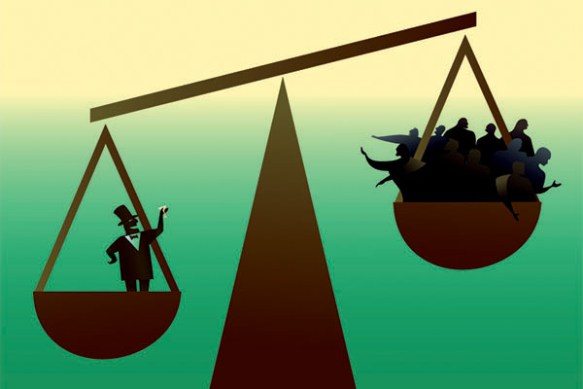
Julian Assange’s life is in danger

By Eric London

Source: WSWS.org

Following Thursday’s arrest of WikiLeaks founder Julian Assange in London, the governments of the US, Britain and Ecuador are engaged in a conspiracy to facilitate the whistleblower’s extraordinary rendition to the US. Julian Assange’s life and liberty is in imminent danger. It is necessary to mobilize all supporters of free speech to prevent him from falling into the hands of the American government.

Over 40 years ago, a Rand Corporation analyst Daniel Ellsberg provided the Washington Post with evidence regarding the US government’s illegal activity in the Vietnam War. Yesterday, Ellsberg issued the following statement:

It’s a very serious assault on the First Amendment. A clear attempt to rescind the freedom of the press…This is the first indictment of a journalist and editor or publisher, Julian Assange. And if it’s successful it will not be the last. This is clearly is a part of President Trump’s war on the press, what he calls the enemy of the state. And if he succeeds in putting Julian Assange in prison, where I think he’ll be for life, if he goes there at all, probably the first charge against him is only a few years. But that’s probably just the first of many.

The official pretext being used to extradite Assange is a transparent lie. In a previously-sealed indictment made public Thursday, the US Department of Justice charged Assange only with violating a federal law against conspiring to break passwords to government computers.

The fact that the crime carries only a 5-year sentence and does not fall under the Espionage Act provides all involved parties with a cover for handing Assange over to the Americans. In particular, the US-UK extradition treaty excludes transfer for “political offenses,” including espionage. Citing the Justice Department document, the British government will claim in courts that Assange’s extradition will not be prevented by this exclusion.

The Ecuadoran government, moreover, claims it could revoke Assange’s asylum because the indictment shows he will not face the threat of the death penalty.

In fact, once Assange is in the hands of the United States, he will quickly confront a series of additional charges, including espionage. The efforts to downplay the threat to the freedom of the press and understate the charge against Assange are aimed at sowing complacency in the population and distracting from the core free speech issues at stake.

The language of the indictment itself makes clear the government is targeting Assange for political reasons, despite the official charge at its conclusion. It asserts: “The primary purpose of the conspiracy was to facilitate [Chelsea] Manning’s acquisition and transmission of classified information related to the national defense of the United States so that WikiLeaks could publicly disseminate the information on its website.”

The indictment notes that the information WikiLeaks released to the public included “approximately 90,000 Afghanistan war-related significant activity reports, 400,000 Iraq war-related significant activities reports, 800 Guantanamo Bay detainee assessment briefs, and 250,000 U.S. Department of State cables. Many of these records were classified pursuant to Executive Order No. 13526,” signed by Barack Obama in 2009. The indictment claims these releases “reasonably could be expected to cause serious damage to the national security.”

This language mirrors the text of the Espionage Act, which bars releasing information “relating to the national defense.” The Espionage Act criminalizes anyone who “communicates, delivers, transmits or causes to be communicated, delivered or transmitted” such information.

Based on the language of the indictment, both Assange and Manning could face criminal persecution under this law. By announcing that Assange is being prosecuted based explicitly on Manning’s activity, the government is demonstrating her future is at risk as well. In fact, the first two words of the indictment are “Chelsea Manning.”

This language also confirms last year’s “inadvertent” release by prosecutors of documents arguing Assange should be extradited because there are “charges”—plural—against him. Prosecutors convened a secret grand jury to investigate Assange at least as far back as 2011, and the US government sought warrants to spy on WikiLeaks employees based on allegations of “espionage” in 2012.

Only the complicit or the naïve could accept that a secret grand jury spent over eight years to charge Assange with just one count of password manipulation.

The response of leading political figures in the US, as well as previous statements, makes clear that the ruling elite is eager to seize Assange and lock him up for life—if not impose worse punishments.

Democratic Senate Minority Leader Charles Schumer tweeted, “I hope he will soon be held to account for his meddling in our elections on behalf of Putin and the Russian government.” Democratic Senator Mark Warner called Assange “a direct participant in Russian efforts to weaken the West and undermine American security. I hope British courts will quickly transfer him to U.S. custody so he can finally get the justice he deserves.”

Prosecuting Assange on the basis of the unfounded allegations of “meddling” would be charges of espionage.

Like a dungeonmaster who has been handed his latest victim, Democratic Senator Joe Manchin declared: “He is our property and we can get the facts and the truth from him.” On the basis of this statement, Assange is being transferred to the US for the purpose of interrogation—which would fall under the category of extraordinary rendition, not extradition.

Assange has also faced open death threats in the press and from the government over the past several years. Rightwing radio personality Rush Limbaugh called for Assange to receive “a bullet to the brain.” Former Fox News host Bill O’Reilly told Assange: “We’re going to hang you.” Former Republican Speaker of the House Newt Gingrich said, “Julian Assange is engaged in terrorism and should be treated as an enemy combatant.” Democratic Vice President Joe Biden called Assange a “high-tech terrorist.” Democratic operative Bob Beckel said, “this guy’s a traitor” and the US should “illegally shoot the son of a b***h.”

Another function of the indictment is to provide the corrupt and lying media with a cover for applauding Assange’s arrest. The New York Times and Washington Post have played a particularly criminal role in downplaying the indictment by claiming the use of a lesser charge means prosecuting Assange poses no threat to free speech.

In an editorial board statement yesterday, the New York Times wrote: “The government charged Julian Assange, founder of WikiLeaks, not with publishing classified government information, but with stealing it, skirting—for now—critical First Amendment questions.”

The single count against Assange, the Times wrote, means the arrest does not pose “a direct challenge to the distinction between a journalist exposing abuse of power through leaked materials—something traditional newspapers like the Times do all the time—and a foreign agent seeking to undermine the security of the United States through theft or subterfuge… The administration has begun well by charging Mr. Assange with an indisputable crime.”

The Washington Post’s editorial is titled, “Julian Assange is not a free-press hero. And he is long overdue for personal accountability.”

The Post wrote, “Mr. Assange’s case could conclude as a victory for the rule of law, not the defeat for civil liberties of which his defenders mistakenly warn.” The Post labeled concerns over Assange’s safety as “pro-WikiLeaks propaganda.” The fact that the indictment does not charge Assange with violating the Espionage Act proves he “had no legitimate fears for his life, either at the hands of CIA assassins or, via extradition, the US death penalty.”

The Post explained that “Britain should not fear that sending him for trial on that hacking count would endanger freedom of the press” because Assange is “unethical” and not a “real journalist” because he “dumped material into the public domain without any effort independently to verify its factuality or give named individuals an opportunity to comment.”

Who are the New York Times and the Washington Post to lecture about “real journalism”? These statements expose the Times and the Post as nothing but government propaganda organs.

The Times is synonymous with peddling the Bush administration’s false claim of “weapons of mass destruction” in Iraq, and the Post is owned by Jeff Bezos, the billionaire CEO of Amazon, which recently reached a $600 million service contract with the Pentagon.

The conspiracy against Assange underscores the collapse of any constituency in the political establishment and corporate media for the defense of democratic rights. If Ellsberg approached the Post today with photocopies of Pentagon-commissioned Rand reports on the war, the Post would call the FBI and have him arrested for threatening “national security.”

The Times and the Post may convince their affluent readers that Assange aided Russia by publishing evidence showing Hillary Clinton received hundreds of thousands of dollars secretly telling audiences of bankers and CEOs she would represent their interests if elected president. Meanwhile, the Democrats have made common cause with the leaders of the military and intelligence agencies responsible for the crimes Assange has revealed. The rightwing character of the Democrats’ opposition to Trump is exposed by the fact that they support his administration’s attacks on Assange.

The defense of Julian Assange, along with Chelsea Manning and Edward Snowden, is now a central political question that confronts the working class. Attitudes toward these whistleblowers break down largely upon class lines. As the ruling class cracks down on free speech and freedom of the press, class conflict is intensifying across the world.

The Socialist Equality Party and the World Socialist Web Site make the broadest appeal to all those who are serious about defending democratic rights to join the fight to defend Assange, Manning and Snowden. Workers and youth internationally must mobilize immediately to defend these class war prisoners. Their lives depend on it.

The fight for Assange’s freedom is the spearhead of the political struggle in defense of democratic rights, against imperialist militarism and capitalism. Only to the extent that the power of the working class can be harnessed can a defense of these whistleblowers be mounted.

As Socialist Equality Party (Australia) National Committee member Nick Beams said at Friday’s emergency rally in Sydney, “the attack on democracy is a symptom of a profound disease. There is no defense of democracy without tackling the problem at its source, that is, the profit system of global capitalism, a system in crisis that has played out its historic role and now has to tear up, trample, defile even the democratic rights that it once stood for. We have to begin as part of this struggle the part for a socialist perspective. Only then can the world be cleansed of all the horrors that it is conjuring up.”

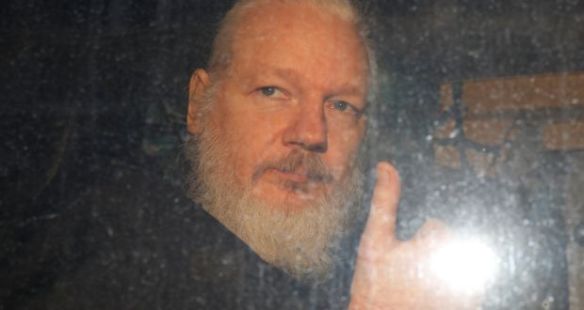
The Martyrdom of Julian Assange

By Chris Hedges

Source: Truthdig

The arrest Thursday of Julian Assange eviscerates all pretense of the rule of law and the rights of a free press. The illegalities, embraced by the Ecuadorian, British and U.S. governments, in the seizure of Assange are ominous. They presage a world where the internal workings, abuses, corruption, lies and crimes, especially war crimes, carried out by corporate states and the global ruling elite will be masked from the public. They presage a world where those with the courage and integrity to expose the misuse of power will be hunted down, tortured, subjected to sham trials and given lifetime prison terms in solitary confinement. They presage an Orwellian dystopia where news is replaced with propaganda, trivia and entertainment. The arrest of Assange, I fear, marks the official beginning of the corporate totalitarianism that will define our lives.

Under what law did Ecuadorian President Lenin Moreno capriciously terminate Julian Assange’s rights of asylum as a political refugee? Under what law did Moreno authorize British police to enter the Ecuadorian Embassy—diplomatically sanctioned sovereign territory—to arrest a naturalized citizen of Ecuador? Under what law did Prime Minister Theresa May order the British police to grab Assange, who has never committed a crime? Under what law did President Donald Trump demand the extradition of Assange, who is not a U.S. citizen and whose news organization is not based in the United States?

I am sure government attorneys are skillfully doing what has become de rigueur for the corporate state, using specious legal arguments to eviscerate enshrined rights by judicial fiat. This is how we have the right to privacy with no privacy. This is how we have “free” elections funded by corporate money, covered by a compliant corporate media and under iron corporate control. This is how we have a legislative process in which corporate lobbyists write the legislation and corporate-indentured politicians vote it into law. This is how we have the right to due process with no due process. This is how we have a government—whose fundamental responsibility is to protect citizens—that orders and carries out the assassination of its own citizens such as the radical cleric Anwar al-Awlaki and his 16-year-old son. This is how we have a press legally permitted to publish classified information and a publisher sitting in jail in Britain awaiting extradition to the United States and a whistleblower, Chelsea Manning, in a jail cell in the United States.

Britain will use as its legal cover for the arrest the extradition request from Washington based on conspiracy charges. This legal argument, in a functioning judiciary, would be thrown out of court. Unfortunately, we no longer have a functioning judiciary. We will soon know if Britain as well lacks one.

Assange was granted asylum in the embassy in 2012 to avoid extradition to Sweden to answer questions about sexual offense allegations that were eventually dropped. Assange and his lawyers always argued that if he was put in Swedish custody he would be extradited to the United States. Once he was granted asylum and Ecuadorian citizenship the British government refused to grant Assange safe passage to the London airport, trapping him in the embassy for seven years as his health steadily deteriorated.

The Trump administration will seek to try Assange on charges that he conspired with Manning in 2010 to steal the Iraq and Afghanistan war logs obtained by WikiLeaks. The half a million internal documents leaked by Manning from the Pentagon and the State Department, along with the 2007 video of U.S. helicopter pilots nonchalantly gunning down Iraqi civilians, including children, and two Reuters journalists, provided copious evidence of the hypocrisy, indiscriminate violence, and routine use of torture, lies, bribery and crude tactics of intimidation by the U.S. government in its foreign relations and wars in the Middle East. Assange and WikiLeaks allowed us to see the inner workings of empire—the most important role of a press—and for this they became empire’s prey.

U.S. government lawyers will attempt to separate WikiLeaks and Assange from The New York Times and the British newspaper The Guardian, both of which also published the leaked material from Manning, by implicating Assange in the theft of the documents. Manning was repeatedly and often brutally pressured during her detention and trial to implicate Assange in the seizure of the material, something she steadfastly refused to do. She is currently in jail because of her refusal to testify, without her lawyer, in front of the grand jury assembled for the Assange case. President Barack Obama granted Manning, who was given a 35-year sentence, clemency after she served seven years in a military prison.

Once the documents and videos provided by Manning to Assange and WikiLeaks were published and disseminated by news organizations such as The New York Times and The Guardian, the press callously, and foolishly, turned on Assange. News organizations that had run WikiLeaks material over several days soon served as conduits in a black propaganda campaign to discredit Assange and WikiLeaks. This coordinated smear campaign was detailed in a leaked Pentagon document prepared by the Cyber Counterintelligence Assessments Branch and dated March 8, 2008. The document called on the U.S. to eradicate the “feeling of trust” that is WikiLeaks’ “center of gravity” and destroy Assange’s reputation.

Assange, who with the Manning leaks had exposed the war crimes, lies and criminal manipulations of the George W. Bush administration, soon earned the ire of the Democratic Party establishment by publishing 70,000 hacked emails belonging to the Democratic National Committee (DNC) and senior Democratic officials. The emails were copied from the accounts of John Podesta, Hillary Clinton’s campaign chairman. The Podesta emails exposed the donation of millions of dollars from Saudi Arabia and Qatar, two of the major funders of Islamic State, to the Clinton Foundation. It exposed the $657,000 that Goldman Sachs paid to Hillary Clinton to give talks, a sum so large it can only be considered a bribe. It exposed Clinton’s repeated mendacity. She was caught in the emails, for example, telling the financial elites that she wanted “open trade and open borders” and believed Wall Street executives were best positioned to manage the economy, a statement that contradicted her campaign statements. It exposed the Clinton campaign’s efforts to influence the Republican primaries to ensure that Trump was the Republican nominee. It exposed Clinton’s advance knowledge of questions in a primary debate. It exposed Clinton as the primary architect of the war in Libya, a war she believed would burnish her credentials as a presidential candidate. Journalists can argue that this information, like the war logs, should have remained hidden, but they can’t then call themselves journalists.

The Democratic leadership, intent on blaming Russia for its election loss, charges that the Podesta emails were obtained by Russian government hackers, although James Comey, the former FBI director, has conceded that the emails were probably delivered to WikiLeaks by an intermediary. Assange has said the emails were not provided by “state actors.”

WikiLeaks has done more to expose the abuses of power and crimes of the American Empire than any other news organization. In addition to the war logs and the Podesta emails, it made public the hacking tools used by the CIA and the National Security Agency and their interference in foreign elections, including in the French elections. It disclosed the internal conspiracy against British Labour Party leader Jeremy Corbyn by Labour members of Parliament. It intervened to save Edward Snowden, who made public the wholesale surveillance of the American public by our intelligence agencies, from extradition to the United States by helping him flee from Hong Kong to Moscow. The Snowden leaks also revealed that Assange was on a U.S. “manhunt target list.”

A haggard-looking Assange, as he was dragged out of the embassy by British police, shook his finger and shouted: “The U.K. must resist this attempt by the Trump administration. … The U.K. must resist!”

We all must resist. We must, in every way possible, put pressure on the British government to halt the judicial lynching of Assange. If Assange is extradited and tried, it will create a legal precedent that will terminate the ability of the press, which Trump repeatedly has called “the enemy of the people,” to hold power accountable. The crimes of war and finance, the persecution of dissidents, minorities and immigrants, the pillaging by corporations of the nation and the ecosystem and the ruthless impoverishment of working men and women to swell the bank accounts of the rich and consolidate the global oligarchs’ total grip on power will not only expand, but will no longer be part of public debate. First Assange. Then us.


Assange arrest: The turning point is here—don’t let them win

Will we wait until they come for us because our homes are built atop resources they wish to plunder, because we shared information online they found objectionable, because we dared to question why madmen are in control of our country and much of the world?

By Whitney Webb

Source: Intrepid Report

LONDON—Yesterday morning, the London-based branch of Empire made good on its threat and boldly moved to begin dismantling the vestiges of democracy and press freedom that still remain, vestiges that have allowed people throughout the Western world to pretend that their government and politicians still respect their rights and the rule of law.

Julian Assange, the man who has helped expose a litany of crimes and the in-your-face corruption of the world’s most powerful people and governments, was pulled from the embassy of the country where he not only holds citizenship but had been granted asylum. The dangerous precedents Assange’s arrest has set—not just for journalism, but also for national sovereignty and international law—are staggering.

With Assange now in U.K. custody, his fate will mirror our own, as Assange’s fate and that of journalists around the world, as well as the public itself, are increasingly intertwined. After all, those who are after Assange and seek to rob him of his freedom—the U.S. Empire, the “deep state,” the shadow government, the global elite, etc.—are after our freedom as well.

If we remain silent as they jail, extradite, torture or even kill this man, we may expect a similar fate for ourselves. It will not come tomorrow. It will not come next week. It could be years away. But make no mistake, the global empire, whose core is the U.S. government, will now be empowered to charge and imprison anyone it deems a threat to its operations.

Those operations, including those that Assange helped to expose, often involve the mass murder of innocent civilians—untold numbers of children among them—in order to loot the resources of other sovereign nations. They also often involve the installation of puppet governments by either covert (e.g., election “meddling”) or overt (e.g., regime-change wars) means.

Those responsible for the most egregious violations of international law, for war crimes, for the slaughter of innocent life, are not imprisoned, degraded or tortured—they are rewarded and promoted. As we have seen today—and in recent weeks, particularly following Chelsea Manning’s imprisonment—those who seek to expose these crimes are the ones who are threatened, tortured and punished.

Like it or not, we are all already a part of this war

The world has known for years that Assange would meet this fate. Little was done. Now, the turning point is here. Will we continue to escape into the false realities of television, cinema, video games, and whatever we use to distract us and numb our pain while the actual world in which we live devolves into a technocratic, imperial dictatorship? Will we continue to ignore the obvious threats to our lives and our children’s lives because confronting these threats is uncomfortable and often difficult?

Will we wait until they come for us because our homes are built atop resources they wish to plunder, because we shared information online they found objectionable, because we dared to question why madmen are in control of our country and much of the world?

Such an eventuality may seem laughable to some, but those days are not far away and are already here for many people around the world, even in the West. Assange’s arrest is the first shot of a war to which all of us, like it or not, have already been drafted because it is a war for the very world in which we live—a war for our society, our planet, our livelihood, our right to self-determination. You can try to escape to the ends of the Earth, thousands of miles away from “the West” (as I myself did), only to find that there is no country anywhere in the world that is not currently under siege.

Never before in history has the global oligarchy been more powerful. The concentration of power and wealth in the hands of the few is unprecedented, worse even than in the Gilded Age or the final days of the Roman Empire. These people do not plan to cede any of this power to you. They do not want you to have control over your own lives. To them, we are already slaves. And those who are silent, especially now, are sending a signal to the elites that they embrace that servitude.

The revolution will not be televised and the war will not be won on social media

For too long, actions in defense of Assange, and more broadly in protest of Empire, have been focused in the virtual realm—that is, on the Internet and social media. While the Internet and social media are important tools for sharing information, their use for that end is being suppressed like never before and it will not be long before social media is entirely censored and devoid of dissent. If we wait until that day comes, and put all our eggs in the social media basket, we will have shot ourselves in the foot and it could well be a fatal blow.

We can no longer run from the world, escape into our remaining comforts—particularly those online—while the world burns. Assange may be the first journalist to be arrested and extradited under these circumstances, but he will not be the last. What we do now will determine how far they go.

The U.S. and its allies are prepping for several wars, many of them against countries much larger than Iraq, and such wars could make Iraq and Afghanistan look like skirmishes by comparison. The people behind Assange’s arrest and perpetual imperial wars do not care about your tweets or Facebook posts. They want your focus to remain on the virtual world and away from the real one over which they are consolidating their control.

Now is the time to resist. Now is the time to insist. Now is the time to take to the streets, to talk to your neighbors, family and co-workers of the dangers facing us all. Your voice and your actions matter. The longer we wait, the worse things will become. The turning point is here. Don’t let them win.


Whitney Webb is a MintPress News journalist based in Chile. She has contributed to several independent media outlets including Global Research, EcoWatch, the Ron Paul Institute and 21st Century Wire, among others. She has made several radio and television appearances and is the 2019 winner of the Serena Shim Award for Uncompromised Integrity in Journalism.

Big Government and Big Tech versus the Internet and everyone

By Thomas L. Knapp

Source: Intrepid Report

Governments around the world began trying to bring the Internet under control as soon as they realized the danger to their power represented by unfettered public access to, and exchange of, information. From attempts to suppress strong encryption technology to the Communications Decency Act in the US and China’s “Great Firewall,” such efforts have generally proven ineffectual. But things are changing, and not for the better.

The European Parliament recently passed a “Copyright Directive” which, if implemented, will force Internet platforms to actively monitor user content instead of putting the burden of proving copyright infringement on those claiming such infringement. The directive also includes a “link tax” under which publishers will charge aggregation platforms for traditionally “fair use” excerpts.

The US government’s Committee on Foreign Investment is attempting to force the sale of Grindr, a gay dating app, over “national security” concerns. Grindr is owned by a Chinese company, Beijing Kunlun. CFIUS’s supposed fear is that the Chinese government will use information the app gathers to surveil or even blackmail users in sensitive political and military jobs.

Those are just two current examples of many.

Big Governments and Big Tech are engaged in a long-term mating dance.

Big Governments want to regulate Big Tech because that’s what governments do, and because, as with Willie Sutton and banks, Big Tech is where the Big Tax Money is.

Big Tech wants to be regulated by Big Governments because regulation makes it more difficult and expensive for new competitors to enter the market. Facebook doesn’t want someone else to make it the next MySpace. Google doesn’t want a fresh new face to send it the way of Yahoo.

It’s a mating dance with multiple suitors on all sides.

The US doesn’t like Grindr or Huawei, because FREEDUMB.

The Chinese don’t want uncensored Google or Twitter, because ORDER.

The EU is at least honest about being sexually indiscriminate: It freely admits that it just wants to rigorously screw everyone, everything, everywhere.

Big Tech wants to operate in all of these markets and it’s willing to buy every potential Big Government as many drinks as it takes to get them all into the sack.

Everybody wins, I guess. Except the public.

Governments and would-be monopolists are fragmenting what once advertised itself as a Global Information Superhighway into hundreds of gated streets.

Those streets are lined by neatly manicured lawns per the homeowners’ association’s rigorously enforced rules, and herbicide is sprayed on those lawns to kill off the values that made the Internet the social successor to the printing press and the economic successor to the Industrial Revolution.

As Stewart Brand wrote, “Information Wants To Be Free. Information also wants to be expensive. … That tension will not go away.”

Big Tech and Big Government are both coming down, increasingly effectively, on the side of “expensive” and on the side of Ford’s Model T philosophy (“you can have any color you want as long as it’s black”).

They’re killing the Internet. They’re killing the future. They’re killing us.


Thomas L. Knapp (Twitter: @thomaslknapp) is director and senior news analyst at the William Lloyd Garrison Center for Libertarian Advocacy Journalism. He lives and works in north central Florida.

The Making of a Monster: We’re All Lab Rats in the Government’s Secret Experiments

By John W. Whitehead

Source: The Rutherford Institute

“But these weren’t the kind of monsters that had tentacles and rotting skin, the kind a seven-year-old might be able to wrap his mind around—they were monsters with human faces, in crisp uniforms, marching in lockstep, so banal you don’t recognize them for what they are until it’s too late.” — Ransom Riggs, Miss Peregrine’s Home for Peculiar Children

The U.S. government, in its pursuit of so-called monsters, has itself become a monster.

This is not a new development, nor is it a revelation.

This is a government that has in recent decades unleashed untold horrors upon the world—including its own citizenry—in the name of global conquest, the acquisition of greater wealth, scientific experimentation, and technological advances, all packaged in the guise of the greater good.

Mind you, there is no greater good when the government is involved. There is only greater greed for money and power.

Unfortunately, the public has become so easily distracted by the political spectacle coming out of Washington, DC, that they are altogether oblivious to the grisly experiments, barbaric behavior and inhumane conditions that have become synonymous with the U.S. government.

These horrors are being meted out against humans and animals alike.

It’s heartbreaking enough when you hear about police shooting family dogs that pose no threat—beloved pets that are “guilty” of little more than barking, or wagging a tag, or racing towards them in greeting—at an alarming rate somewhere in the vicinity of 500 dogs a day.

What I’m about to share goes beyond heartbreaking to horrifying.

For instance, did you know that the U.S. government has been buying hundreds of dogs and cats from “Asian meat markets” as part of a gruesome experiment into food-borne illnesses? The cannibalistic experiments involve killing cats and dogs purchased from Colombia, Brazil, Vietnam, China and Ethiopia, and then feeding the dead remains to laboratory kittens, bred in government laboratories for the express purpose of being infected with a disease and then killed.

It gets more gruesome.

The Department of Veterans Affairs has been removing parts of dogs’ brains to see how it affects their breathing; applying electrodes to dogs’ spinal cords (before and after severing them) to see how it impacts their cough reflexes; and implanting pacemakers in dogs’ hearts and then inducing them to have heart attacks (before draining their blood). All of the laboratory dogs are killed during the course of these experiments.

It’s not just animals that are being treated like lab rats by government agencies.

“We the people” have also become the police state’s guinea pigs: to be caged, branded, experimented upon without our knowledge or consent, and then conveniently discarded and left to suffer from the after-effects.

Back in 2017, FEMA “inadvertently” exposed nearly 10,000 firefighters, paramedics and other responders to a deadly form of ricin during simulated bioterrorism response sessions. In 2015, it was discovered that an Army lab had been “mistakenly” shipping deadly anthrax to labs and defense contractors for a decade.

While these particular incidents have been dismissed as “accidents,” you don’t have to dig very deep or go very back in the nation’s history to uncover numerous cases in which the government deliberately conducted secret experiments on an unsuspecting populace—citizens and noncitizens alike—making healthy people sick by spraying them with chemicals, injecting them with infectious diseases and exposing them to airborne toxins.

At the time, the government reasoned that it was legitimate to experiment on people who did not have full rights in society such as prisoners, mental patients, and poor blacks.

In Alabama, for example, 600 black men with syphilis were allowed to suffer without proper medical treatment in order to study the natural progression of untreated syphilis. In California, older prisoners had testicles from livestock and from recently executed convicts implanted in them to test their virility. In Connecticut, mental patients were injected with hepatitis.

In Maryland, sleeping prisoners had a pandemic flu virus sprayed up their noses. In Georgia, two dozen “volunteering” prison inmates had gonorrhea bacteria pumped directly into their urinary tracts through the penis. In Michigan, male patients at an insane asylum were exposed to the flu after first being injected with an experimental flu vaccine. In Minnesota, 11 public service employee “volunteers” were injected with malaria, then starved for five days.

In New York, dying patients had cancer cells introduced into their systems. In Ohio, over 100 inmates were injected with live cancer cells. Also in New York, prisoners at a reformatory prison were also split into two groups to determine how a deadly stomach virus was spread: the first group was made to swallow an unfiltered stool suspension, while the second group merely breathed in germs sprayed into the air. And in Staten Island, children with mental retardation were given hepatitis orally and by injection to see if they could then be cured.

As the Associated Press reports, “The late 1940s and 1950s saw huge growth in the U.S. pharmaceutical and health care industries, accompanied by a boom in prisoner experiments funded by both the government and corporations. By the 1960s, at least half the states allowed prisoners to be used as medical guinea pigs … because they were cheaper than chimpanzees.”

Moreover, “Some of these studies, mostly from the 1940s to the ’60s, apparently were never covered by news media. Others were reported at the time, but the focus was on the promise of enduring new cures, while glossing over how test subjects were treated.”

Media blackouts, propaganda, spin. Sound familiar?

How many government incursions into our freedoms have been blacked out, buried under “entertainment” news headlines, or spun in such a way as to suggest that anyone voicing a word of caution is paranoid or conspiratorial?

Unfortunately, these incidents are just the tip of the iceberg when it comes to the atrocities the government has inflicted on an unsuspecting populace in the name of secret experimentation.

For instance, there was the U.S. military’s secret race-based testing of mustard gas on more than 60,000 enlisted men. As NPR reports, “All of the World War II experiments with mustard gas were done in secret and weren’t recorded on the subjects’ official military records. Most do not have proof of what they went through. They received no follow-up health care or monitoring of any kind. And they were sworn to secrecy about the tests under threat of dishonorable discharge and military prison time, leaving some unable to receive adequate medical treatment for their injuries, because they couldn’t tell doctors what happened to them.”

And then there was the CIA’s MKULTRA program in which hundreds of unsuspecting American civilians and military personnel were dosed with LSD, some having the hallucinogenic drug slipped into their drinks at the beach, in city bars, at restaurants. As Time reports, “before the documentation and other facts of the program were made public, those who talked of it were frequently dismissed as being psychotic.”

Now one might argue that this is all ancient history and that the government today is different from the government of yesteryear, but has the U.S. government really changed?

Has the government become any more humane, any more respectful of the rights of the citizenry?

Has it become any more transparent or willing to abide by the rule of law? Has it become any more truthful about its activities? Has it become any more cognizant of its appointed role as a guardian of our rights?

Or has the government simply hunkered down and hidden its nefarious acts and dastardly experiments under layers of secrecy, legalism and obfuscations? Has it not become wilier, more slippery, more difficult to pin down?

Having mastered the Orwellian art of Doublespeak and followed the Huxleyan blueprint for distraction and diversion, are we not dealing with a government that is simply craftier and more conniving that it used to be?

Consider this: after revelations about the government’s experiments spanning the 20th century spawned outrage, the government began looking for human guinea pigs in other countries, where “clinical trials could be done more cheaply and with fewer rules.”

In Guatemala, prisoners and patients at a mental hospital were infected with syphilis, “apparently to test whether penicillin could prevent some sexually transmitted disease.” In Uganda, U.S.-funded doctors “failed to give the AIDS drug AZT to all the HIV-infected pregnant women in a study… even though it would have protected their newborns.” Meanwhile, in Nigeria, children with meningitis were used to test an antibiotic named Trovan. Eleven children died and many others were left disabled.

The more things change, the more they stay the same.

Case in point: back in 2016, it was announced that scientists working for the Department of Homeland Security would begin releasing various gasses and particles on crowded subway platforms as part of an experiment aimed at testing bioterror airflow in New York subways.

The government insisted that the gases released into the subways by the DHS were nontoxic and did not pose a health risk. It’s in our best interests, they said, to understand how quickly a chemical or biological terrorist attack might spread. And look how cool the technology is—said the government cheerleaders—that scientists can use something called DNATrax to track the movement of microscopic substances in air and food. (Imagine the kinds of surveillance that could be carried out by the government using trackable airborne microscopic substances you breathe in or ingest.)

Mind you, this is the same government that in 1949 sprayed bacteria into the Pentagon’s air handling system, then the world’s largest office building. In 1950, special ops forces sprayed bacteria from Navy ships off the coast of Norfolk and San Francisco, in the latter case exposing all of the city’s 800,000 residents.

In 1953, government operatives staged “mock” anthrax attacks on St. Louis, Minneapolis, and Winnipeg using generators placed on top of cars. Local governments were reportedly told that “‘invisible smokescreen[s]’ were being deployed to mask the city on enemy radar.” Later experiments covered territory as wide-ranging as Ohio to Texas and Michigan to Kansas.

In 1965, the government’s experiments in bioterror took aim at Washington’s National Airport, followed by a 1966 experiment in which army scientists exposed a million subway NYC passengers to airborne bacteria that causes food poisoning.

And this is the same government that has taken every bit of technology sold to us as being in our best interests—GPS devices, surveillance, nonlethal weapons, etc.—and used it against us, to track, control and trap us.

So, no, I don’t think the government’s ethics have changed much over the years. It’s just taken its nefarious programs undercover.

The question remains: why is the government doing this? The answer is always the same: money, power and total domination.

It’s the same answer no matter which totalitarian regime is in power.

The mindset driving these programs has, appropriately, been likened to that of Nazi doctors experimenting on Jews. As the Holocaust Museum recounts, Nazi physicians “conducted painful and often deadly experiments on thousands of concentration camp prisoners without their consent.”

The Nazi’s unethical experiments ran the gamut from freezing experiments using prisoners to find an effective treatment for hypothermia, tests to determine the maximum altitude for parachuting out of a plane, injecting prisoners with malaria, typhus, tuberculosis, typhoid fever, yellow fever, and infectious hepatitis, exposing prisoners to phosgene and mustard gas, and mass sterilization experiments.

The horrors being meted out against the American people can be traced back, in a direct line, to the horrors meted out in Nazi laboratories. In fact, following the second World War, the U.S. government recruited many of Hitler’s employees, adopted his protocols, embraced his mindset about law and order and experimentation, and implemented his tactics in incremental steps.

Sounds far-fetched, you say? Read on. It’s all documented.

As historian Robert Gellately recounts, the Nazi police state was initially so admired for its efficiency and order by the world powers of the day that Herbert Hoover, then-head of the FBI, actually sent one of his right-hand men, Edmund Patrick Coffey, to Berlin in January 1938 at the invitation of Germany’s secret police, the Gestapo.

The FBI was so impressed with the Nazi regime that, according to the New York Times, in the decades after World War II, the FBI, along with other government agencies, aggressively recruited at least a thousand Nazis, including some of Hitler’s highest henchmen.

All told, thousands of Nazi collaborators—including the head of a Nazi concentration camp, among others—were given secret visas and brought to America by way of Project Paperclip. Subsequently, they were hired on as spies, informants and scientific advisers, and then camouflaged to ensure that their true identities and ties to Hitler’s holocaust machine would remain unknown. All the while, thousands of Jewish refugees were refused entry visas to the U.S. on the grounds that it could threaten national security.

Adding further insult to injury, American taxpayers have been paying to keep these ex-Nazis on the U.S. government’s payroll ever since. And in true Gestapo fashion, anyone who has dared to blow the whistle on the FBI’s illicit Nazi ties has found himself spied upon, intimidated, harassed and labeled a threat to national security.

As if the government’s covert, taxpayer-funded employment of Nazis after World War II wasn’t bad enough, U.S. government agencies—the FBI, CIA and the military—have since fully embraced many of the Nazi’s well-honed policing tactics, and have used them repeatedly against American citizens.

It’s certainly easy to denounce the full-frontal horrors carried out by the scientific and medical community within a despotic regime such as Nazi Germany, but what do you do when it’s your own government that claims to be a champion of human rights all the while allowing its agents to engage in the foulest, bases and most despicable acts of torture, abuse and experimentation?

When all is said and done, this is not a government that has our best interests at heart.

This is not a government that values us.

Perhaps the answer lies in The Third Man, Carol Reed’s influential 1949 film starring Joseph Cotten and Orson Welles. In the film, set in a post-WW II Vienna, rogue war profiteer Harry Lime has come to view human carnage with a callous indifference, unconcerned that the diluted penicillin he’s been trafficking underground has resulted in the tortured deaths of young children.

Challenged by his old friend Holly Martins to consider the consequences of his actions, Lime responds, “In these days, old man, nobody thinks in terms of human beings. Governments don’t, so why should we?

“Have you ever seen any of your victims?” asks Martins.

“Victims?” responds Limes, as he looks down from the top of a Ferris wheel onto a populace reduced to mere dots on the ground. “Look down there. Tell me. Would you really feel any pity if one of those dots stopped moving forever? If I offered you twenty thousand pounds for every dot that stopped, would you really, old man, tell me to keep my money, or would you calculate how many dots you could afford to spare? Free of income tax, old man. Free of income tax — the only way you can save money nowadays.”

As I make clear in my book Battlefield America: The War on the American People, this is how the U.S. government sees us, too, when it looks down upon us from its lofty perch.

To the powers-that-be, the rest of us are insignificant specks, faceless dots on the ground.

To the architects of the American police state, we are not worthy or vested with inherent rights. This is how the government can justify treating us like economic units to be bought and sold and traded, or caged rats to be experimented upon and discarded when we’ve outgrown our usefulness.

To those who call the shots in the halls of government, “we the people” are merely the means to an end.

“We the people”—who think, who reason, who take a stand, who resist, who demand to be treated with dignity and care, who believe in freedom and justice for all—have become obsolete, undervalued citizens of a totalitarian state that, in the words of Rod Serling, “has patterned itself after every dictator who has ever planted the ripping imprint of a boot on the pages of history since the beginning of time. It has refinements, technological advances, and a more sophisticated approach to the destruction of human freedom.”

In this sense, we are all Romney Wordsworth, the condemned man in Serling’s Twilight Zone episode “The Obsolete Man.”

The Obsolete Man” speaks to the dangers of a government that views people as expendable once they have outgrown their usefulness to the State. Yet—and here’s the kicker—this is where the government through its monstrous inhumanity also becomes obsolete. As Serling noted in his original script for “The Obsolete Man,” “Any state, any entity, any ideology which fails to recognize the worth, the dignity, the rights of Man…that state is obsolete.

How do you defeat a monster? You start by recognizing the monster for what it is.

It’s really very simple

By Dmitry Orlov

Source: Club Orlov

There are times when a loud cry of “The emperor has no clothes!” can be most copacetic. And so, let me point out something quite simple, yet very important.

The old world order, to which we became accustomed over the course of the 1990s and the 2000s, its crises and its problems detailed in numerous authoritative publications on both sides of the Atlantic—it is no more. It is not out sick and it is not on vacation. It is deceased. It has passed on, gone to meet its maker, bought the farm, kicked the bucket and joined the choir invisible. It is an ex-world order.

If we rewind back to the early 1980s, we can easily remember how the USSR was still running half of Europe and exerting major influence on a sizable chunk of the world. World socialist revolution was still sputtering along, with pro-Soviet regimes coming in to power here and there in different parts of the globe, the chorus of their leaders’ official pronouncements sounding more or less in unison. The leaders made their pilgrimages to Moscow as if it were Mecca, and they sent their promising young people there to learn how to do things the Soviet way. Soviet technology continued to make impressive advances: in the mid-1980s the Soviets launched into orbit a miracle of technology—the space station Mir, while Vega space probes were being dispatched to study Venus.

But alongside all of this business-as-usual the rules and principles according which the “red” half of the globe operated were already in an advanced state of decay, and a completely different system was starting to emerge both at the center and along the periphery. Seven years later the USSR collapsed and the world order was transformed, but many people simply couldn’t believe in the reality of this change. In the early 1990s many political scientists were self-assuredly claiming that what is happening is the realization of a clever Kremlin plan to modernize the Soviet system and that, after a quick rebranding, it will again start taking over the world. People like to talk about what they think they can understand, never mind whether it still exists.

And what do we see today? The realm that self-identifies itself as “The West” is still claiming to be leading economically, technologically, and to be dominant militarily, but it has suffered a moral defeat, and, strictly as a consequence of this moral defeat, a profound ideological defeat as well.

It’s simple.

1. How can they talk of the inviolability of private property while confiscating the savings of depositors in Cypriot banks?

2. How can they talk of safeguarding the territorial integrity of countries while destroying, in turn, Yugoslavia, Iraq, Libya, Syria and Ukraine?

3. How can they talk of free enterprise and then sign contracts to build ships but refuse to deliver them because of pressure from Washington, as happened with Mistral ships which Russia ordered from France?

4. How can they talk of democracy and then use naked threats against the premier of Greece—the birthplace of European democracy—forcing him to ignore the unprofitable results of the Greek national referendum?

5. How can they talk about fighting racism while in the US they are constantly shooting mass quantities of unarmed Negros, all the while forbidding people to call them Negros.

6. How can they accuse the Serbs of genocide while refusing to acknowledge what they did to supposedly “independent” Kosovo, which has been turned into a European criminal enclave specializing in the production and distribution of narcotics?

7. How can they claim to oppose extremism and terrorism while training, arming and financing ISIS and the Ukrainian Neo-nazis?

8. How can they talk about justice while the US maintains the largest prison population in the history of the world and has executed many people subsequently discovered to have been innocent?

9. How can they talk about freedom of religion after the US federal government exterminated the Branch Davidians in Waco, Texas, and then imprisoned the survivors, even though the government’s allegations against the sect have subsequently been proven to be false?

10. How can they accuse others of corruption after the colossal financial embarrassment of 2008, in the run-up to which obvious financial bubbles that were ready to bust were assigned the highest ratings?

What has happened is the worst thing that could have possibly happened: in full view of the entire world, “Western values” have been demonstrated to be null and void.

If you think that these are just some specific examples of difficulties or mistakes that could potentially be overcome in some dim and foggy future, then you are wrong: this is all of the “Western values” worth mentioning, and they have all been invalidated by observation. Note the past tense: they already have been invalidated. Are there any “Western values” left intact? Oh yes, just one: the rights of sexual minorities. But it is not possible to maintain Western civilization on the strength of gay marriage alone.

Is it any wonder then that the rest of the world is trying to put as much distance between itself and the morally bankrupt “West” as it possibly can, as quickly as it can? China is working on developing its own model, Russia is striving for self-sufficiency and independence from Western imports and finance, and even Latin America, once considered the backyard of the US, is increasingly going its own separate way.

The ranks of the fools who are still buying the West’s story are shrinking, while the ranks of the rebels are growing. There is the truth-teller Edward Snowden, who was forced to flee to Moscow to avoid persecution back home. There are European parliamentarians who recently broke ranks and visited Crimea. There are French and German military men who are volunteering to defend Eastern Ukraine against Western attack. There are the many European businessmen who came to the Economics Forum in St. Petersburg to sign trade deals with Russia, never mind what their politicians think of that.

On the other side, the rapidly emerging new world order was recently on display in Ufa, capital of the majority-Moslem Republic of Bashkortostan in Southern Urals, Russian Federation. Leaders of more than half the world’s population came there to sign deals, integrate their economies, and coordinate security arrangements. India and Pakistan set their differences aside and walked in through the door at the same time; Iran is next. “The West” was not represented there.

Now that all Western values (other than the rights of sexual minorities) have been shown to be cynical exercises in hypocrisy, there is no path back. You see, it is a matter of reputation, and a reputation is something that one can lose exactly once. There is a path forward, but it is very frightening. There is the loss of control: Western institutions can no longer control the situation throughout much of the world, including, in due course, on their own territory. There is the abandonment of the Western narrative: Western pontificators, pundits and “thought leaders” will find that their talking points have been snatched away and will be reduced to either babbling apologetically or lapsing into embarrassed silence. Finally, there is the loss of identity: it is not possible, for the non-delusional, to identify with something (“The West”) that no longer exists.

But the most frightening thing of all is this: behind a morally bankrupt civilization there are morally bankrupt people—lots and lots of them. Their own children, who will be forced to make their way in the world—however it turns out to be—will be as disrespectful of them as they were of their own vaunted civilizational values.

A belief in meritocracy is not only false: it’s bad for you

By Clifton Mark

Source: Aeon

‘We are true to our creed when a little girl born into the bleakest poverty knows that she has the same chance to succeed as anybody else …’ Barack Obama, inaugural address, 2013

‘We must create a level playing field for American companies and workers.’ Donald Trump, inaugural address, 2017

Meritocracy has become a leading social ideal. Politicians across the ideological spectrum continually return to the theme that the rewards of life – money, power, jobs, university admission – should be distributed according to skill and effort. The most common metaphor is the ‘even playing field’ upon which players can rise to the position that fits their merit. Conceptually and morally, meritocracy is presented as the opposite of systems such as hereditary aristocracy, in which one’s social position is determined by the lottery of birth. Under meritocracy, wealth and advantage are merit’s rightful compensation, not the fortuitous windfall of external events.

Most people don’t just think the world should be run meritocratically, they think it is meritocratic. In the UK, 84 per cent of respondents to the 2009 British Social Attitudes survey stated that hard work is either ‘essential’ or ‘very important’ when it comes to getting ahead, and in 2016 the Brookings Institute found that 69 per cent of Americans believe that people are rewarded for intelligence and skill. Respondents in both countries believe that external factors, such as luck and coming from a wealthy family, are much less important. While these ideas are most pronounced in these two countries, they are popular across the globe.

Although widely held, the belief that merit rather than luck determines success or failure in the world is demonstrably false. This is not least because merit itself is, in large part, the result of luck. Talent and the capacity for determined effort, sometimes called ‘grit’, depend a great deal on one’s genetic endowments and upbringing.

This is to say nothing of the fortuitous circumstances that figure into every success story. In his book Success and Luck (2016), the US economist Robert Frank recounts the long-shots and coincidences that led to Bill Gates’s stellar rise as Microsoft’s founder, as well as to Frank’s own success as an academic. Luck intervenes by granting people merit, and again by furnishing circumstances in which merit can translate into success. This is not to deny the industry and talent of successful people. However, it does demonstrate that the link between merit and outcome is tenuous and indirect at best.

According to Frank, this is especially true where the success in question is great, and where the context in which it is achieved is competitive. There are certainly programmers nearly as skilful as Gates who nonetheless failed to become the richest person on Earth. In competitive contexts, many have merit, but few succeed. What separates the two is luck.

In addition to being false, a growing body of research in psychology and neuroscience suggests that believing in meritocracy makes people more selfish, less self-critical and even more prone to acting in discriminatory ways. Meritocracy is not only wrong; it’s bad.

The ‘ultimatum game’ is an experiment, common in psychological labs, in which one player (the proposer) is given a sum of money and told to propose a division between him and another player (the responder), who may accept the offer or reject it. If the responder rejects the offer, neither player gets anything. The experiment has been replicated thousands of times, and usually the proposer offers a relatively even split. If the amount to be shared is $100, most offers fall between $40-$50.

One variation on this game shows that believing one is more skilled leads to more selfish behaviour. In research at Beijing Normal University, participants played a fake game of skill before making offers in the ultimatum game. Players who were (falsely) led to believe they had ‘won’ claimed more for themselves than those who did not play the skill game. Other studies confirm this finding. The economists Aldo Rustichini at the University of Minnesota and Alexander Vostroknutov at Maastricht University in the Netherlands found that subjects who first engaged in a game of skill were much less likely to support the redistribution of prizes than those who engaged in games of chance. Just having the idea of skill in mind makes people more tolerant of unequal outcomes. While this was found to be true of all participants, the effect was much more pronounced among the ‘winners’.

By contrast, research on gratitude indicates that remembering the role of luck increases generosity. Frank cites a study in which simply asking subjects to recall the external factors (luck, help from others) that had contributed to their successes in life made them much more likely to give to charity than those who were asked to remember the internal factors (effort, skill).

Perhaps more disturbing, simply holding meritocracy as a value seems to promote discriminatory behaviour. The management scholar Emilio Castilla at the Massachusetts Institute of Technology and the sociologist Stephen Benard at Indiana University studied attempts to implement meritocratic practices, such as performance-based compensation in private companies. They found that, in companies that explicitly held meritocracy as a core value, managers assigned greater rewards to male employees over female employees with identical performance evaluations. This preference disappeared where meritocracy was not explicitly adopted as a value.

This is surprising because impartiality is the core of meritocracy’s moral appeal. The ‘even playing field’ is intended to avoid unfair inequalities based on gender, race and the like. Yet Castilla and Benard found that, ironically, attempts to implement meritocracy leads to just the kinds of inequalities that it aims to eliminate. They suggest that this ‘paradox of meritocracy’ occurs because explicitly adopting meritocracy as a value convinces subjects of their own moral bona fides. Satisfied that they are just, they become less inclined to examine their own behaviour for signs of prejudice.

Meritocracy is a false and not very salutary belief. As with any ideology, part of its draw is that it justifies the status quo, explaining why people belong where they happen to be in the social order. It is a well-established psychological principle that people prefer to believe that the world is just.

However, in addition to legitimation, meritocracy also offers flattery. Where success is determined by merit, each win can be viewed as a reflection of one’s own virtue and worth. Meritocracy is the most self-congratulatory of distribution principles. Its ideological alchemy transmutes property into praise, material inequality into personal superiority. It licenses the rich and powerful to view themselves as productive geniuses. While this effect is most spectacular among the elite, nearly any accomplishment can be viewed through meritocratic eyes. Graduating from high school, artistic success or simply having money can all be seen as evidence of talent and effort. By the same token, worldly failures becomes signs of personal defects, providing a reason why those at the bottom of the social hierarchy deserve to remain there.

This is why debates over the extent to which particular individuals are ‘self-made’ and over the effects of various forms of ‘privilege’ can get so hot-tempered. These arguments are not just about who gets to have what; it’s about how much ‘credit’ people can take for what they have, about what their successes allow them to believe about their inner qualities. That is why, under the assumption of meritocracy, the very notion that personal success is the result of ‘luck’ can be insulting. To acknowledge the influence of external factors seems to downplay or deny the existence of individual merit.

Despite the moral assurance and personal flattery that meritocracy offers to the successful, it ought to be abandoned both as a belief about how the world works and as a general social ideal. It’s false, and believing in it encourages selfishness, discrimination and indifference to the plight of the unfortunate.

Survival of the Richest

All Are Equal, Except Those Who Aren’t

By Nomi Prins

Source: TomDispatch.com

Like a gilded coating that makes the dullest things glitter, today’s thin veneer of political populism covers a grotesque underbelly of growing inequality that’s hiding in plain sight. And this phenomenon of ever more concentrated wealth and power has both Newtonian and Darwinian components to it.

In terms of Newton’s first law of motion: those in power will remain in power unless acted upon by an external force. Those who are wealthy will only gain in wealth as long as nothing deflects them from their present course. As for Darwin, in the world of financial evolution, those with wealth or power will do what’s in their best interest to protect that wealth, even if it’s in no one else’s interest at all.

In George Orwell’s iconic 1945 novel, Animal Farm, the pigs who gain control in a rebellion against a human farmer eventually impose a dictatorship on the other animals on the basis of a single commandment: “All animals are equal, but some animals are more equal than others.” In terms of the American republic, the modern equivalent would be: “All citizens are equal, but the wealthy are so much more equal than anyone else (and plan to remain that way).”

Certainly, inequality is the economic great wall between those with power and those without it.

As the animals of Orwell’s farm grew ever less equal, so in the present moment in a country that still claims equal opportunity for its citizens, one in which three Americans now have as much wealth as the bottom half of society (160 million people), you could certainly say that we live in an increasingly Orwellian society. Or perhaps an increasingly Twainian one.

After all, Mark Twain and Charles Dudley Warner wrote a classic 1873 novel that put an unforgettable label on their moment and could do the same for ours. The Gilded Age: A Tale of Today depicted the greed and political corruption of post-Civil War America. Its title caught the spirit of what proved to be a long moment when the uber-rich came to dominate Washington and the rest of America. It was a period saturated with robber barons, professional grifters, and incomprehensibly wealthy banking magnates. (Anything sound familiar?) The main difference between that last century’s gilded moment and this one was that those robber barons built tangible things like railroads. Today’s equivalent crew of the mega-wealthy build remarkably intangible things like tech and electronic platforms, while a grifter of a president opts for the only new infrastructure in sight, a great wall to nowhere.

In Twain’s epoch, the U.S. was emerging from the Civil War. Opportunists were rising from the ashes of the nation’s battered soul. Land speculation, government lobbying, and shady deals soon converged to create an unequal society of the first order (at least until now). Soon after their novel came out, a series of recessions ravaged the country, followed by a 1907 financial panic in New York City caused by a speculator-led copper-market scam.

From the late 1890s on, the most powerful banker on the planet, J.P. Morgan, was called upon multiple times to bail out a country on the economic edge. In 1907, Treasury Secretary George Cortelyou provided him with $25 million in bailout money at the request of President Theodore Roosevelt to stabilize Wall Street and calm frantic citizens trying to withdraw their deposits from banks around the country. And this Morgan did — by helping his friends and their companies, while skimming money off the top himself. As for the most troubled banks holding the savings of ordinary people? Well, they folded. (Shades of the 2007-2008 meltdown and bailout anyone?)

The leading bankers who had received that bounty from the government went on to cause the Crash of 1929. Not surprisingly, much speculation and fraud preceded it. In those years, the novelist F. Scott Fitzgerald caught the era’s spirit of grotesque inequality in The Great Gatsby when one of his characters comments: “Let me tell you about the very rich. They are different from you and me.” The same could certainly be said of today when it comes to the gaping maw between the have-nots and have-a-lots.

Income vs. Wealth

To fully grasp the nature of inequality in our twenty-first-century gilded age, it’s important to understand the difference between wealth and income and what kinds of inequality stem from each. Simply put, income is how much money you make in terms of paid work or any return on investments or assets (or other things you own that have the potential to change in value). Wealth is simply the gross accumulation of those very assets and any return or appreciation on them. The more wealth you have, the easier it is to have a higher annual income.

Let’s break that down. If you earn $31,000 a year, the median salary for an individual in the United States today, your income would be that amount minus associated taxes (including federal, state, social security, and Medicare ones). On average, that means you would be left with about $26,000 before other expenses kicked in.

If your wealth is $1,000,000, however, and you put that into a savings account paying 2.25% interest, you could receive about $22,500 and, after taxes, be left with about $19,000, for doing nothing whatsoever.

To put all this in perspective, the top 1% of Americans now take home, on average, more than 40 times the incomes of the bottom 90%. And if you head for the top 0.1%, those figures only radically worsen. That tiny crew takes home more than 198 times the income of the bottom 90% percent. They also possess as much wealth as the nation’s bottom 90%. “Wealth,” as Adam Smith so classically noted almost two-and-a-half-centuries ago in The Wealth of Nations, “is power,” an adage that seldom, sadly, seems outdated.

A Case Study: Wealth, Inequality, and the Federal Reserve

Obviously, if you inherit wealth in this country, you’re instantly ahead of the game. In America, a third to nearly a half of all wealth is inherited rather than self-made. According to a New York Times investigation, for instance, President Donald Trump, from birth, received an estimated $413 million (in today’s dollars, that is) from his dear old dad and another $140 million (in today’s dollars) in loans. Not a bad way for a “businessman” to begin building the empire (of bankruptcies) that became the platform for a presidential campaign that oozed into actually running the country. Trump did it, in other words, the old-fashioned way — through inheritance.

In his megalomaniacal zeal to declare a national emergency at the southern border, that gilded millionaire-turned-billionaire-turned-president provides but one of many examples of a long record of abusing power. Unfortunately, in this country, few people consider record inequality (which is still growing) as another kind of abuse of power, another kind of great wall, in this case keeping not Central Americans but most U.S. citizens out.

The Federal Reserve, the country’s central bank that dictates the cost of money and that sustained Wall Street in the wake of the financial crisis of 2007-2008 (and since), has finally pointed out that such extreme levels of inequality are bad news for the rest of the country. As Fed Chairman Jerome Powell said at a town hall in Washington in early February, “We want prosperity to be widely shared. We need policies to make that happen.” Sadly, the Fed has largely contributed to increasing the systemic inequality now engrained in the financial and, by extension, political system. In a recent research paper, the Fed did, at least, underscore the consequences of inequality to the economy, showing that “income inequality can generate low aggregate demand, deflation pressure, excessive credit growth, and financial instability.”

In the wake of the global economic meltdown, however, the Fed took it upon itself to reduce the cost of money for big banks by chopping interest rates to zero (before eventually raising them to 2.5%) and buying $4.5 trillion in Treasury and mortgage bonds to lower it further. All this so that banks could ostensibly lend money more easily to Main Street and stimulate the economy. As Senator Bernie Sanders noted though, “The Federal Reserve provided more than $16 trillion in total financial assistance to some of the largest financial institutions and corporations in the United States and throughout the world… a clear case of socialism for the rich and rugged, you’re-on-your-own individualism for everyone else.”

The economy has been treading water ever since (especially compared to the stock market). Annual gross domestic product growth has not surpassed 3%in any year since the financial crisis, even as the level of the stock market tripled, grotesquely increasing the country’s inequality gap. None of this should have been surprising, since much of the excess money went straight to big banks, rich investors, and speculators.  They then used it to invest in the stock and bond markets, but not in things that would matter to all the Americans outside that great wall of wealth.

The question is: Why are inequality and a flawed economic system mutually reinforcing? As a starting point, those able to invest in a stock market buoyed by the Fed’s policies only increased their wealth exponentially. In contrast, those relying on the economy to sustain them via wages and other income got shafted. Most people aren’t, of course, invested in the stock market, or really in anything. They can’t afford to be. It’s important to remember that nearly 80% of the population lives paycheck to paycheck.

The net result: an acute post-financial-crisis increase in wealth inequality — on top of the income inequality that was global but especially true in the United States. The crew in the top 1% that doesn’t rely on salaries to increase their wealth prospered fabulously. They, after all, now own more than half of all national wealth invested in stocks and mutual funds, so a soaring stock market disproportionately helps them. It’s also why the Federal Reserve subsidy policies to Wall Street banks have only added to the extreme wealth of those extreme few.

The Ramifications of Inequality

The list of negatives resulting from such inequality is long indeed. As a start, the only thing the majority of Americans possess a greater proportion of than that top 1% is a mountain of debt.

The bottom 90% are the lucky owners of about three-quarters of the country’s household debt. Mortgages, auto loans, student loans, and credit-card debt are cumulatively at a record-high $13.5 trillion.

And that’s just to start down a slippery slope. As Inequality.org reports, wealth and income inequality impact “everything from life expectancy to infant mortality and obesity.” High economic inequality and poor health, for instance, go hand and hand, or put another way, inequality compromises the overall health of the country. According to academic findings, income inequality is, in the most literal sense, making Americans sick. As one study put it, “Diseased and impoverished economic infrastructures [help] lead to diseased or impoverished or unbalanced bodies or minds.”

Then there’s Social Security, established in 1935 as a federal supplement for those in need who have also paid into the system through a tax on their wages. Today, all workers contribute 6.2% of their annual earnings and employers pay the other 6.2% (up to a cap of $132,900) into the Social Security system. Those making far more than that, specifically millionaires and billionaires, don’t have to pay a dime more on a proportional basis. In practice, that means about 94% of American workers and their employers paid the full 12.4% of their annual earnings toward Social Security, while the other 6% paid an often significantly smaller fraction of their earnings.

According to his own claims about his 2016 income, for instance, President Trump “contributed a mere 0.002 percent of his income to Social Security in 2016.” That means it would take nearly 22,000 additional workers earning the median U.S. salary to make up for what he doesn’t have to pay. And the greater the income inequality in this country, the more money those who make less have to put into the Social Security system on a proportional basis. In recent years, a staggering $1.4 trillion could have gone into that system, if there were no arbitrary payroll cap favoring the wealthy.

Inequality: A Dilemma With Global Implications

America is great at minting millionaires. It has the highest concentration of them, globally speaking, at 41%. (Another 24% of that millionaires’ club can be found in Europe.) And the top 1% of U.S. citizens earn 40 times the national average and own about 38.6% of the country’s total wealth. The highest figure in any other developed country is “only” 28%.

However, while the U.S. boasts of epic levels of inequality, it’s also a global trend. Consider this: the world’s richest 1% own 45% of total wealth on this planet. In contrast, 64% of the population (with an average of $10,000 in wealth to their name) holds less than 2%. And to widen the inequality picture a bit more, the world’s richest 10%, those having at least $100,000 in assets, own 84% of total global wealth.

The billionaires’ club is where it’s really at, though. According to Oxfam, the richest 42 billionaires have a combined wealth equal to that of the poorest 50% of humanity. Rest assured, however, that in this gilded century there’s inequality even among billionaires. After all, the 10 richest among them possess $745 billion in total global wealth. The next 10 down the list possess a mere $451.5 billion, and why even bother tallying the next 10 when you get the picture?

Oxfam also recently reported that “the number of billionaires has almost doubled, with a new billionaire created every two days between 2017 and 2018. They have now more wealth than ever before while almost half of humanity have barely escaped extreme poverty, living on less than $5.50 a day.”

How Does It End?

In sum, the rich are only getting richer and it’s happening at a historic rate. Worse yet, over the past decade, there was an extra perk for the truly wealthy. They could bulk up on assets that had been devalued due to the financial crisis, while so many of their peers on the other side of that great wall of wealth were economically decimated by the 2007-2008 meltdown and have yet to fully recover.

What we’ve seen ever since is how money just keeps flowing upward through banks and massive speculation, while the economic lives of those not at the top of the financial food chain have largely remained stagnant or worse. The result is, of course, sweeping inequality of a kind that, in much of the last century, might have seemed inconceivable.

Eventually, we will all have to face the black cloud this throws over the entire economy. Real people in the real world, those not at the top, have experienced a decade of ever greater instability, while the inequality gap of this beyond-gilded age is sure to shape a truly messy world ahead. In other words, this can’t end well.


Nomi Prins, a former Wall Street executive, is a TomDispatch regular. Her latest book is Collusion: How Central Bankers Rigged the World (Nation Books). She is also the author of All the Presidents’ Bankers: The Hidden Alliances That Drive American Power and five other books. Special thanks go to researcher Craig Wilson for his superb work on this piece.