The Corporate Debt Bubble Is A Train Wreck In Slow Motion

By Brandon Smith

Source: Alt-Market.com

There are two subjects that the mainstream media seems specifically determined to avoid discussing these days when it comes to the economy – the first is the problem of falling global demand for goods and services; they absolutely refuse to acknowledge the fact that demand is going stagnant and will conjure all kinds of rationalizations to distract from the issue. The other subject is the debt bubble, the corporate debt bubble in particular.

These two factors alone guarantee a massive shock to the global economy and the US economy are built into the system, but I believe corporate debt is the key pillar of the false economy.  It has been utilized time and time again to keep the Everything Bubble from completely deflating, however, the fundamentals are starting to catch up to the fantasy.

For example, in terms of stock markets, which are now meaningless as an indicator of the health of the real economy, corporate stock buybacks have been the single most vital mechanism for inflation. Corporations buy their own stocks, often using cash borrowed from each other and from the Federal Reserve, in order to reduce the number of shares on the market and artificially boost the value of the remaining shares. This process is essentially legal manipulation of equities, and to be sure, it has been effective so far at keeping markets elevated.

The problem is that these same corporations are taking on more and more debt through interest payments in order to maintain the facade. Over the period of a decade, corporate debt has skyrocketed back to levels not seen since 2007, just before the credit crisis. The official corporate debt load now stands at over $10 trillion, and that’s not even counting derivatives exposure.  According to the Bank for International Settlements, the amount of derivatives still held by corporations stands at around $544 trillion in notional value (theoretical value), while the current market value is only around $10 trillion.  This is a massive discrepancy that can only lead to disaster.

In terms of debt-to-GDP, the credit cycle peak has spiked beyond any other peak in the past 40 years. This amount of borrowing always has consequences. Even if central banks were to intervene on a level similar to TARP, which saturated markets with $16 trillion in liquidity, the amount of cash needed is so immense and the economic returns so muted that such measures are ultimately a waste of time. The Federal Reserve fueled this bubble, and now there is no stopping it’s demise. Though, they’re behavior and minimal response to the problem suggests that they have no intention of stopping it anyway.

Currently, stock buybacks are set to decline this year, and I don’t think this is because corporations have decided they want to quit the tactic. They have to quit, because the amount of debt they are accumulating is is now outpacing their falling profits. Corporate profits peaked in the 3rd Quarter of 2018 and have been in decline ever since.  The Price-to-Earnings ratio as well as the Price-to-Sales ratio are now well above their historic peak during the dot-com bubble, meaning, stocks have never been more overvalued compared to the profits that corporations are actually bringing in.

As I warned back in 2018, Trump’s tax cuts were a gift to corporations, not average people, and that gift was designed to be squandered as there was no doubt that companies would pour all extra cash into stock buybacks instead of innovation and new jobs. This is exactly what happened.

While corporations, the Fed and Trump have been putting some effort into keeping stock markets from imploding, the real economy has been evaporating. Global import/exports are crashing, US manufacturing is in recession territory, US GDP is in decline (even according to rigged official numbers), US retail outlets are closing by the thousands, the poverty rate jumped in 30% of US counties in the past year, and high paying jobs are disappearing and being replaced with minimum wage service sector jobs.

To be sure, this process did not start under Trump, it’s been a slow motion train wreck for over a decade. But, it’s important to point out that Trump has done nothing to mitigate the crash and his obsession with the fraudulent stock market shows that he has no plans to try. The amount of time the tax cuts and debt increase bought was a couple of years. That’s it. With buybacks in decline, the question is what will keep the bubble afloat now? The Fed? That’s doubtful…

Global corporations with the most VISIBLE debt include:

AT&T with $180 billion

SoftBank with $154 billion

Apple with $136 billion

Verizon with $114 billion

Comcast with $112 billion

AbInbev with $110 billion

General Electric with $115 billion

Shell with $77 billion

Microsoft with $67 billion

Some companies, like Apple and Warren Buffet’s Berkshire Hathaway are holding extensive cash reserves, but most do not. Also, the level of cash reserves held by certain top corporations suggests they know something is on the horizon. Why hold piles of cash when the stock market is a “sure thing”? Unless, the debt bubble is about to collapse and cash will be needed to absorb the damage?

Stock buybacks, I believe, are the litmus test for how long the corporate world can hold out against the weight of the debt bubble. 2020 appears to be the year in which buybacks are set to crumble. Corporate profits degraded over 2019 and the slide is set to continue this year. This means profits are not going to come to the rescue and stave off the explosion of the debt structure (once again, the problems of demand and debt intertwine). All that is left is the Fed, as the “buyer of last resort” becomes the buyer of only import.

The list above, of course, does not include financial companies like JP Morgan and other banks that are suspected of harboring an extensive debt load and borrowing cash frantically through the Fed’s overnight repo markets.

These loans are now coming due, and the Fed has indicated it plans to tighten liquidity once again next month while returning to balance sheet cuts. Interest rates remain well above zero, which means the more companies borrow through repo markets, the more interest they will accrue. The Fed will have to institute a full QE program on the level of the TARP bailouts and cut interest rates to zero in order to end the constant repo liquidity threat and kick the can for a couple more years, and they’ve given no indication that they plan to do this in time to stop the current crash.

For now, Fed repo intervention has achieved little except keeping stocks at all-time highs. The rest of the economy is in disarray.

The real economy will start to drag down the establishment’s favorite distraction – The Dow, as this process continues. The big question is always one of timing. How long can the delusional euphoria keep the system levitated?

The situation is one of complacency and condition. If people are suddenly confronted with an enormous forest fire surrounding their city, they will ask “What can we do to save ourselves?” But what if people are surrounded by a forest fire for ten years and it hasn’t quite reached them yet? You warn them that the winds have finally changed and it is about to expand and take their homes and they will say “What forest fire?”

It’s hard to imagine a scenario in which there are no major shocks to the financial structure for the rest of the year. With the corporate system tapped out and no longer able to act as a support for the bubble, the fundamentals will start to take over again. Geopolitical events will also have a more visible effect. A whole year without escalation with Iran?  Without escalation with North Korea? Without a pandemic threat like the coronavirus going global? Without threats of a liquidity crisis as banks starve for more and more repo loans? I think not…

It’s important not to let complacency interfere with vigilance.  A slow motion train wreck is still ultimately a train wreck.  The damage can only be mitigated by removing one’s self from the train, and preparing for the fallout.  Do not think that simply because the system has been able to drag its nearly lifeless body along for ten years that this means all is well.  All bubbles collapse, and corporate debt has already sealed the fate of the Everything Bubble.

Passing the Point of No Return, A World War is Upon Us

By Timothy Alexander Guzman

Source: Silent Crow News

War is inevitable. More innocent people will be murdered, maimed, raped or sold into slavery. War is indescribable, a nightmare, yet those who are currently in power, the establishment or what some like to call “the elite” are on Trump’s team leading the world into another war In the Middle East that can go nuclear. Trump has not drained the swamp, in fact he has filled his administration with war hawks, bankers, Zionists and the Neoconservatives (Neocons) who are all inter-connected to various corporations and special interests. It was reported by NBC news that Trump had actually approved the assassination of Iranian General Qassem Soleimani several months ago “President Donald Trump authorized the killing of Iranian Gen. Qassem Soleimani seven months ago if Iran’s increased aggression resulted in the death of an American, according to five current and former senior administration officials. The presidential directive in June came with the condition that Trump would have final signoff on any specific operation to kill Soleimani, officials said.” Trump’s decision to assassinate Iranian General Qasem Soleimani, a popular figure among Muslims and Christians who fought against ISIS, Al-Nusra and other terrorist organizations in Syria and Iraq was the powder keg that has exploded in the Middle East and now there is no turning back. Real terrorists were actually celebrating the death of Soleimani. RT news reported that “the weekly Islamic State (IS, formerly ISIS/ISIL) newspaper Al-Naba portrayed Soleimani’s death as an act of god in support of its cause, and Muslims in general, according to BBC Monitoring.” What was interesting was that “an editorial in the jihadi paper was careful not to credit the US or even mention Soleimani by name.” My guess is that terrorists know the rules, never rat on your friends! However, it’s also noteworthy to consider that the strike could lead ISIS and the other terrorist organizations to regroup as “the paper also reported on the US and its allies suspending operations against IS as an opportunity for the group’s resurgence, according to BBC journalist Mina Al-Lami.” The world will once again see a new push into Syria by ISIS and other terrorist groups with US and Israeli support in an effort to remove Syrian President, Bashar Al-Assad. That is why Russian President Vladimir Putin went to Syria for talks with President Assad as reported by RT news:

The two leaders were briefed on the military situation in Syria, including the northwestern province of Idlib, occupied by militants linked to Al-Qaeda. Assad thanked Putin and Russia for their support in restoring peace in Syria. Russian troops have been assisting the Syrian army since September 2015 in battling various terrorist groups, including Islamic State (IS, formerly ISIS)

All anti-US and anti-Israel movements from Lebanon to Iran and all the way to central Asia with Afghanistan and Pakistan are now united for one cause, and that is to end US presence in the Middle East by targeting all US bases, embassies and other installations.

I could just imagine what world leaders are thinking at this point, especially those who are in some form of conflict with Washington including Russia, China, Syria, Lebanon, Venezuela, Cuba, Nicaragua, Argentina, the Palestinians, Pakistan, past and re-emerging former Latin American presidents Lula de Silva of Brazil and Evo Morales of Bolivia, leaders from political, social and Indigenous movements including those within the US and occupied territories must be saying to themselves: What will America do to us? Would they drone strike me if I don’t obey them? The Trump regime has stepped-up its economic wars with sanctions that has caused mass suffering among populations in the Middle East with Iran and Syria as their targets and in Latin America with Venezuela and don’t forget that 59 year embargo on Cuba that Trump has kept going, so Trump is already a war president. Trump is a typical example of what you would call a “Chicken hawk” a term particularly used in the US which is defined by Wikipedia as “a person who strongly supports war or other military action yet who actively avoids or avoided military service when of age.” Newsweek magazine reported that “In all, Trump secured five deferments from the Vietnam War draft, four of which were because he was still studying at college. The fifth and final deferment was granted on medical grounds after a doctor signed Trump off as having bone spurs in his heels.” The article also claimed the following:

The daughters of the late podiatrist in question, Dr. Larry Braunstein, told The New York Times that their father did it as a favor to Fred Trump, the president’s father, who owned the building in which the doctor had an office. They said the suggestion from their father in his oft-told story was that Trump did not have a foot problem that should have disqualified him from the Vietnam troop drafts, and it was not clear if the podiatrist had ever examined him

I do not know if the claims made by Newsweek or The New York Times who have credibility issues are true or not, but if Dr. Larry Braunstein did do Trump’s father a favor, then it should be of no surprise because many wealthy people especially those in the East Coast of the United States did have the right connections to pull the strings to prevent their children from getting drafted into the Vietnam war. However, Trump has committed young men and women who mostly come from poor families to the coming war effort against Iran. Not only will US forces be fighting another war for oil and other natural resources, they will be fighting for Israel. Trump decisions concerning Israel has made his close friend and ally, Prime Minister Benjamin Netanyahu very happy because Israel needs Iran and Syria to become another Iraq. US troops will be used for the protection and expansion of Israel who will become a powerful player in the Middle East with nuclear weapons. One thing is certain, the Muslim world is not going to except that under any circumstances.

Prepare Now, The War Has Begun

A report by the Financial Times on December 27th, 2019 ‘Russia, China and Iran Launch Gulf of Oman War Games’:

Russia, China and Iran launched their first joint naval exercises in the Gulf of Oman on Friday in a direct challenge to US influence in the Middle East. The move reflects growing co-operation between the US’s two main rivals and the Islamic republic, which is under sanctions imposed by Washington. 

“The most important achievement of these drills . . . is this message that the Islamic republic of Iran cannot be isolated,” vice-admiral Gholamreza Tahani, a deputy naval commander, said. “These exercises show that relations between Iran, Russia and China have reached a new high level while this trend will continue in the coming years” 

After Trump’s reckless strike against Soleimani, Russia and China quickly condemned the actions. It was reported by RT news that “Moscow considers the operation “an adventurous move that will lead to an escalation of tension throughout the region.” China’s response was similar. CNBC reported that Chinese Foreign Minister Wang Yi had said that “China opposes the use of force in international relations” and that “Military means will lead nowhere. Maximum pressure won’t work either. China urges the U.S. to seek resolutions through dialogue instead of abusing force.” China will be monitoring the crisis very closely “China will continue to uphold an objective and just position and play a constructive role in safeguarding peace and security in the Gulf region of the Middle East.“ Trump and the neoconservatives have now escalated tensions in the Middle East and in almost every region in the world with economic sanctions, failed coup attempts on Venezuela’s President Nicolas Maduro and the other coup that succeeded in Bolivia. The Trump regime also managed to instigate a trade war with China while funding protests in Hong Kong to create instability in Asia and the list goes on.

A new resistance has become a reality in the Middle East that will eventually force US troops out of the region. Expect more anti-war protests to grow substantially across the world as the US and its allies become more aggressive. The US economy is also collapsing, putting its own national security at risk with a $22 trillion in debt because let’s face it, when the US economy collapses, all of the debt bubbles will pop and all hell will break out across the US. However, Trump proudly tweeted that “The United States just spent Two Trillion Dollars on Military Equipment. We are the biggest and by far the BEST in the World! If Iran attacks an American Base, or any American, we will be sending some of that brand new beautiful equipment their way…and without hesitation!” There is a new neoconservative movement within the Trump White House driving foreign policy in the Middle East with Secretary of State Mike Pompeo and Vice-President Mike Pence leading the charge thus bringing back the memories of the Bush Neocons.  Let’s go back to an interesting Christian Science Monitor article from 2003 which can also be found on Global Research that describes what the Neocons believe in. The article ‘Neocon 101: What do Neoconservatives Believe?’ said the following:

What does a neoconservative dream world look like? Neocons envision a world in which the United States is the unchallenged superpower, immune to threats. They believe that the US has a responsibility to act as a “benevolent global hegemon.” In this capacity, the US would maintain an empire of sorts by helping to create democratic, economically liberal governments in place of “failed states” or oppressive regimes they deem threatening to the US or its interests. In the neocon dream world the entire Middle East would be democratized in the belief that this would eliminate a prime breeding ground for terrorists. This approach, they claim, is not only best for the US; it is best for the world. In their view, the world can only achieve peace through strong US leadership backed with credible force, not weak treaties to be disrespected by tyrants.  

Any regime that is outwardly hostile to the US and could pose a threat would be confronted aggressively, not “appeased” or merely contained. The US military would be reconfigured around the world to allow for greater flexibility and quicker deployment to hot spots in the Middle East, as well as Central and Southeast Asia. The US would spend more on defense, particularly for high-tech, precision weaponry that could be used in preemptive strikes. It would work through multilateral institutions such as the United Nations when possible, but must never be constrained from acting in its best interests whenever necessary

In an important note, neoconservative ideology is not limited to the Republicans. Glenn Greenwald of The Intercept published a report in 2017 titled ‘With New D.C. Policy Group, Dems Continue to Rehabilitate and Unify With Bush-Era Neocons’ pointed out that “one of the most under-discussed yet consequential changes in the American political landscape is the reunion between the Democratic Party and the country’s most extreme and discredited neocons.” The report continued:

A newly formed and, by all appearances, well-funded national security advocacy group, devoted to more hawkish U.S. policies toward Russia and other adversaries, provides the most vivid evidence yet of this alliance. Calling itself the Alliance for Securing Democracy, the group describes itself as “a bipartisan, transatlantic initiative” that “will develop comprehensive strategies to defend against, deter, and raise the costs on Russian and other state actors’ efforts to undermine democracy and democratic institutions,” and also “will work to publicly document and expose Vladimir Putin’s ongoing efforts to subvert democracy in the United States and Europe.” 

It is, in fact, the ultimate union of mainstream Democratic foreign policy officials and the world’s most militant, and militaristic, neocons. The group is led by two longtime Washington foreign policy hands, one from the establishment Democratic wing and the other a key figure among leading GOP neocons. 

The Democrat, Laura Rosenberger, served as a foreign policy adviser for Hillary Clinton’s 2016 presidential campaign and chief of staff to two Obama national security officials. The Republican is Jamie Fly, who spent the last four years as counselor for foreign and national security affairs to one of the Senate’s most hawkish members, Marco Rubio; prior to that, he served in various capacities in the Bush Pentagon and National Security Council 

The neocons are back in the White House, reminiscent of the Bush regime, so another war is on the table. Be prepared, for the worst is yet to come.


Come Home, America: Stop Policing the Globe and Put an End to Wars-Without-End

By Jon W. Whitehead

Source: The Rutherford Institute

“Let us resolve that never again will we send the precious young blood of this country to die trying to prop up a corrupt military dictatorship abroad. This is also the time to turn away from excessive preoccupation overseas to the rebuilding of our own nation. America must be restored to a proper role in the world. But we can do that only through the recovery of confidence in ourselves…. together we will call America home to the ideals that nourished us from the beginning. From secrecy and deception in high places; come home, America. From military spending so wasteful that it weakens our nation; come home, America.”—George S. McGovern, former Senator and presidential candidate

I agree wholeheartedly with George S. McGovern, a former Senator and presidential candidate who opposed the Vietnam War, about one thing: I’m sick of old men dreaming up wars for young men to die in.

It’s time to bring our troops home.

Bring them home from Somalia, Afghanistan, Iraq and Syria. Bring them home from Germany, South Korea and Japan. Bring them home from Saudi Arabia, Jordan and Oman. Bring them home from Niger, Chad and Mali. Bring them home from Turkey, the Philippines, and northern Australia.

That’s not what’s going to happen, of course.

The U.S. military reportedly has more than 1.3 million men and women on active duty, with more than 200,000 of them stationed overseas in nearly every country in the world. Those numbers are likely significantly higher in keeping with the Pentagon’s policy of not fully disclosing where and how many troops are deployed for the sake of “operational security and denying the enemy any advantage.” As investigative journalist David Vine explains, “Although few Americans realize it, the United States likely has more bases in foreign lands than any other people, nation, or empire in history.”

Don’t fall for the propaganda, though: America’s military forces aren’t being deployed abroad to protect our freedoms here at home. Rather, they’re being used to guard oil fields, build foreign infrastructure and protect the financial interests of the corporate elite. In fact, the United States military spends about $81 billion a year just to protect oil supplies around the world.

The reach of America’s military empire includes close to 800 bases in as many as 160 countries, operated at a cost of more than $156 billion annually. As Vine reports, “Even US military resorts and recreation areas in places like the Bavarian Alps and Seoul, South Korea, are bases of a kind. Worldwide, the military runs more than 170 golf courses.”

This is how a military empire occupies the globe.

Already, American military servicepeople are being deployed to far-flung places in the Middle East and elsewhere in anticipation of the war drums being sounded over Iran.

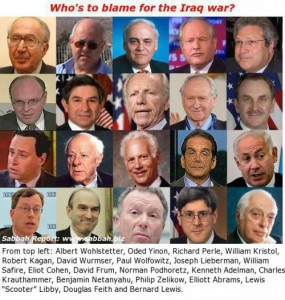
This Iran crisis, salivated over by the neocons since prior to the Iraq War and manufactured by war hawks who want to jumpstart the next world war, has been a long time coming.

Donald Trump, Barack Obama, George W. Bush, Bill Clinton: they all have done their part to ensure that the military industrial complex can continue to get rich at taxpayer expense.

Take President Trump, for instance.

Despite numerous campaign promises to stop America’s “endless wars,” once elected, Trump has done a complete about-face, deploying greater numbers of troops to the Middle East, ramping up the war rhetoric, and padding the pockets of defense contractors. Indeed, Trump is even refusing to withdraw U.S. troops from Iraq in the face of a request from the Iraqi government for us to leave.

Obama was no different: he also pledged—if elected—to bring the troops home from Iraq and Afghanistan and reduce America’s oversized, and overly costly, military footprint in the world. Of course, that didn’t happen.

Yet while the rationale may keep changing for why American military forces are policing the globe, these wars abroad (in Iraq, Afghanistan, Pakistan, Syria, Yemen and now Iran) aren’t making America—or the rest of the world—any safer, are certainly not making America great again, and are undeniably digging the U.S. deeper into debt.

War spending is bankrupting America.

Although the U.S. constitutes only 5% of the world’s population, America boasts almost 50% of the world’s total military expenditure, spending more on the military than the next 19 biggest spending nations combined.

In fact, the Pentagon spends more on war than all 50 states combined spend on health, education, welfare, and safety.

The American military-industrial complex has erected an empire unsurpassed in history in its breadth and scope, one dedicated to conducting perpetual warfare throughout the earth.

Since 2001, the U.S. government has spent more than $4.7 trillion waging its endless wars.

Having been co-opted by greedy defense contractors, corrupt politicians and incompetent government officials, America’s expanding military empire is bleeding the country dry at a rate of more than $32 million per hour.

In fact, the U.S. government has spent more money every five seconds in Iraq than the average American earns in a year.

Future wars and military exercises waged around the globe are expected to push the total bill upwards of $12 trillion by 2053.

Talk about fiscally irresponsible: the U.S. government is spending money it doesn’t have on a military empire it can’t afford.

As investigative journalist Uri Friedman puts it, for more than 15 years now, the United States has been fighting terrorism with a credit card, “essentially bankrolling the wars with debt, in the form of purchases of U.S. Treasury bonds by U.S.-based entities like pension funds and state and local governments, and by countries like China and Japan.”

War is not cheap, but it becomes outrageously costly when you factor in government incompetence, fraud, and greedy contractors. Indeed, a leading accounting firm concluded that one of the Pentagon’s largest agencies “can’t account for hundreds of millions of dollars’ worth of spending.”

Unfortunately, the outlook isn’t much better for the spending that can be tracked.

A government audit found that defense contractor Boeing has been massively overcharging taxpayers for mundane parts, resulting in tens of millions of dollars in overspending. As the report noted, the American taxpayer paid:

$71 for a metal pin that should cost just 4 cents; $644.75 for a small gear smaller than a dime that sells for $12.51: more than a 5,100 percent increase in price. $1,678.61 for another tiny part, also smaller than a dime, that could have been bought within DoD for $7.71: a 21,000 percent increase. $71.01 for a straight, thin metal pin that DoD had on hand, unused by the tens of thousands, for 4 cents: an increase of over 177,000 percent.

That price gouging has become an accepted form of corruption within the American military empire is a sad statement on how little control “we the people” have over our runaway government.

Mind you, this isn’t just corrupt behavior. It’s deadly, downright immoral behavior.

Americans have thus far allowed themselves to be spoon-fed a steady diet of pro-war propaganda that keeps them content to wave flags with patriotic fervor and less inclined to look too closely at the mounting body counts, the ruined lives, the ravaged countries, the blowback arising from ill-advised targeted-drone killings and bombing campaigns in foreign lands, or the transformation of our own homeland into a warzone.

That needs to change.

The U.S. government is not making the world any safer. It’s making the world more dangerous. It is estimated that the U.S. military drops a bomb somewhere in the world every 12 minutes. Since 9/11, the United States government has directly contributed to the deaths of around 500,000 human beings. Every one of those deaths was paid for with taxpayer funds.

The U.S. government is not making America any safer. It’s exposing American citizens to alarming levels of blowback, a CIA term referring to the unintended consequences of the U.S. government’s international activities. Chalmers Johnson, a former CIA consultant, repeatedly warned that America’s use of its military to gain power over the global economy would result in devastating blowback.

The 9/11 attacks were blowback. The Boston Marathon Bombing was blowback. The attempted Times Square bomber was blowback. The Fort Hood shooter, a major in the U.S. Army, was blowback.

The assassination of Iranian General Qasem Soleimani by a U.S. military drone strike will, I fear, spur yet more blowback against the American people.

The war hawks’ militarization of America—bringing home the spoils of war (the military tanks, grenade launchers, Kevlar helmets, assault rifles, gas masks, ammunition, battering rams, night vision binoculars, etc.) and handing them over to local police, thereby turning America into a battlefield—is also blowback.

James Madison was right: “No nation could preserve its freedom in the midst of continual warfare.” As Madison explained, “Of all the enemies to public liberty war is, perhaps, the most to be dreaded because it comprises and develops the germ of every other. War is the parent of armies; from these proceed debts and taxes… known instruments for bringing the many under the domination of the few.”

We are seeing this play out before our eyes.

The government is destabilizing the economy, destroying the national infrastructure through neglect and a lack of resources, and turning taxpayer dollars into blood money with its endless wars, drone strikes and mounting death tolls.

Clearly, our national priorities are in desperate need of an overhauling.

At the height of its power, even the mighty Roman Empire could not stare down a collapsing economy and a burgeoning military. Prolonged periods of war and false economic prosperity largely led to its demise. As historian Chalmers Johnson predicts:

The fate of previous democratic empires suggests that such a conflict is unsustainable and will be resolved in one of two ways. Rome attempted to keep its empire and lost its democracy. Britain chose to remain democratic and in the process let go its empire. Intentionally or not, the people of the United States already are well embarked upon the course of non-democratic empire.

This is the “unwarranted influence, whether sought or unsought, by the military-industrial complex” that President Dwight Eisenhower warned us more than 50 years ago not to let endanger our liberties or democratic processes.

Eisenhower, who served as Supreme Commander of the Allied forces in Europe during World War II, was alarmed by the rise of the profit-driven war machine that emerged following the war—one that, in order to perpetuate itself, would have to keep waging war.

We failed to heed his warning.

As I make clear in my book Battlefield America: The War on the American People, there’s not much time left before we reach the zero hour.

It’s time to stop policing the globe, end these wars-without-end, and bring the troops home before it’s too late.

Butcher of the Worst Kind: The Deeper Story Behind Trump’s Assassination of Soleimani

BAGHDAD, IRAQ – JANUARY 05: Iraqi Prime Minister Adel Abdul-Mahdi (L) attends an Iraqi parliament session in Baghdad, Iraq, 05 January 2020. Iraqi parliamentarians attended a session to discuss the presence of US forces in the country after Qasem Soleimani, the head of Iran’s Revolutionary Guards’ elite Quds force, was killed in a U.S. drone airstrike in Iraq. (Photo by Iraqi prime minister office /Handout/Anadolu Agency via Getty Images)

By Federico Pieraccini

Source: Covert Geopolitics

Mainstream media pundits are now talking about “de-escalation” between Iran and the US, after “both sides have fooled everyone that they have achieved victory.” Is that how cheap the life of a man who dedicated his better days fighting against the Deep State controlled ISIS and Al Qaeda terror groups?

Most people in the West believed as Trump, the Democrats, and the CIA mainstream media, were saying that Soleimani was a terrorist, who orchestrated the killing of hundreds of US troops and civilians throughout the Middle East. Yet, it was the US Air Force planes which were airdropping military supplies to terrorist positions in Syria.

It was Gen. Soleimani who directed and coordinated the movements of different forces which successfully averted the fall of Syria and Iraq during the onslaught of ISIS terror in 2011 and onwards. All sides of the conflict have acknowledged the key role played by Soleimani in counter-terrorism.

What has transpired immediately prior to the assassination of Gen. Soleimani should give the Americans an overview of the true nature of the Trump presidency, amidst their high expectations of a meaningful change away from their endless wars abroad.

The Deeper Story Behind the Assassination of Soleimani

Days after the assassination of General Qasem Soleimani, new and important information is coming to light from a speech given by the Iraqi prime minister. The story behind Soleimani’s assassination seems to go much deeper than what has thus far been reported, involving Saudi Arabia and China as well the U.S. dollar’s role as the global reserve currency.

The Iraqi prime minister, Adil Abdul-Mahdi, has revealed details of his interactions with Trump in the weeks leading up to Soleimani’s assassination in a speech to the Iraqi parliament. He tried to explain several times on live television how Washington had been browbeating him and other Iraqi members of parliament to toe the American line, even threatening to engage in false-flag sniper shootings of both protesters and security personnel in order to inflame the situation, recalling similar modi operandi seen in Cairo in 2009, Libya in 2011, and Maidan in 2014. The purpose of such cynicism was to throw Iraq into chaos.

Here is the reconstruction of the story:

[Speaker of the Council of Representatives of Iraq] Halbousi attended the parliamentary session while almost none of the Sunni members did. This was because the Americans had learned that Abdul-Mehdi was planning to reveal sensitive secrets in the session and sent Halbousi to prevent this. Halbousi cut Abdul-Mehdi off at the commencement of his speech and then asked for the live airing of the session to be stopped. After this, Halbousi together with other members, sat next to Abdul-Mehdi, speaking openly with him but without it being recorded. This is what was discussed in that session that was not broadcast: 

Abdul-Mehdi spoke angrily about how the Americans had ruined the country and now refused to complete infrastructure and electricity grid projects unless they were promised 50% of oil revenues, which Abdul-Mehdi refused.

The complete (translated) words of Abdul-Mahdi’s speech to parliament:

This is why I visited China and signed an important agreement with them to undertake the construction instead. Upon my return, Trump called me to ask me to reject this agreement. When I refused, he threatened to unleash huge demonstrations against me that would end my premiership.

Huge demonstrations against me duly materialized and Trump called again to threaten that if I did not comply with his demands, then he would have Marine snipers on tall buildings target protesters and security personnel alike in order to pressure me.

I refused again and handed in my resignation. To this day the Americans insist on us rescinding our deal with the Chinese.

After this, when our Minister of Defense publicly stated that a third party was targeting both protestors and security personnel alike (just as Trump had threatened he would do), I received a new call from Trump threatening to kill both me and the Minister of Defense if we kept on talking about this “third party”.

Nobody imagined that the threat was to be applied to General Soleimani, but it was difficult for Prime Minister Adil Abdul-Mahdi to reveal the weekslong backstory behind the terrorist attack.

I was supposed to meet him [Soleimani] later in the morning when he was killed. He came to deliver a message from Iran in response to the message we had delivered to the Iranians from the Saudis.

We can surmise, judging by Saudi Arabia’s reaction, that some kind of negotiation was going on between Tehran and Riyadh:

The Kingdom’s statement regarding the events in Iraq stresses the Kingdom’s view of the importance of de-escalation to save the countries of the region and their people from the risks of any escalation.

Above all, the Saudi Royal family wanted to let people know immediately that they had not been informed of the U.S. operation:

The kingdom of Saudi Arabia was not consulted regarding the U.S. strike. In light of the rapid developments, the Kingdom stresses the importance of exercising restraint to guard against all acts that may lead to escalation, with severe consequences.

And to emphasize his reluctance for war, Mohammad bin Salman sent a delegation to the United States. Liz Sly, the Washington Post Beirut bureau chief, tweeted:

Saudi Arabia is sending a delegation to Washington to urge restraint with Iran on behalf of [Persian] Gulf states. The message will be: ‘Please spare us the pain of going through another war’.

What clearly emerges is that the success of the operation against Soleimani had nothing to do with the intelligence gathering of the U.S. or Israel. It was known to all and sundry that Soleimani was heading to Baghdad in a diplomatic capacity that acknowledged Iraq’s efforts to mediate a solution to the regional crisis with Saudi Arabia.

It would seem that the Saudis, Iranians and Iraqis were well on the way towards averting a regional conflict involving Syria, Iraq and Yemen. Riyadh’s reaction to the American strike evinced no public joy or celebration. Qatar, while not seeing eye to eye with Riyadh on many issues, also immediately expressed solidarity with Tehran, hosting a meeting at a senior government level with Mohammad Zarif Jarif, the Iranian foreign minister. Even Turkey and Egypt, when commenting on the asassination, employed moderating language.

This could reflect a fear of being on the receiving end of Iran’s retaliation. Qatar, the country from which the drone that killed Soleimani took off, is only a stone’s throw away from Iran, situated on the other side of the Strait of Hormuz. Riyadh and Tel Aviv, Tehran’s regional enemies, both know that a military conflict with Iran would mean the end of the Saudi royal family.

When the words of the Iraqi prime minister are linked back to the geopolitical and energy agreements in the region, then the worrying picture starts to emerge of a desperate U.S. lashing out at a world turning its back on a unipolar world order in favor of the emerging multipolar about which I have long written.

The US, now considering itself a net energy exporter as a result of the shale-oil revolution (on which the jury is still out), no longer needs to import oil from the Middle East. However, this does not mean that oil can now be traded in any other currency other than the U.S. dollar.

The petrodollar is what ensures that the U.S. dollar retains its status as the global reserve currency, granting the U.S. a monopolistic position from which it derives enormous benefits from playing the role of regional hegemon.

This privileged position of holding the global reserve currency also ensures that the U.S. can easily fund its war machine by virtue of the fact that much of the world is obliged to buy its treasury bonds that it is simply able to conjure out of thin air. To threaten this comfortable arrangement is to threaten Washington’s global power.

Even so, the geopolitical and economic trend is inexorably towards a multipolar world order, with China increasingly playing a leading role, especially in the Middle East and South America.

Venezuela, Russia, Iran, Iraq, Qatar and Saudi Arabia together make up the overwhelming majority of oil and gas reserves in the world. The first three have an elevated relationship with Beijing and are very much in the multipolar camp, something that China and Russia are keen to further consolidate in order to ensure the future growth for the Eurasian supercontinent without war and conflict.

Saudi Arabia, on the other hand, is pro-US but could gravitate towards the Sino-Russian camp both militarily and in terms of energy. The same process is going on with Iraq and Qatar thanks to Washington’s numerous strategic errors in the region starting from Iraq in 2003, Libya in 2011 and Syria and Yemen in recent years.

The agreement between Iraq and China is a prime example of how Beijing intends to use the Iraq-Iran-Syria troika to revive the Middle East and and link it to the Chinese Belt and Road Initiative.

While Doha and Riyadh would be the first to suffer economically from such an agreement, Beijing’s economic power is such that, with its win-win approach, there is room for everyone.

Saudi Arabia provides China with most of its oil and Qatar, together with the Russian Federation, supply China with most of its LNG needs, which lines up with Xi Jinping’s 2030 vision that aims to greatly reduce polluting emissions.

The U.S. is absent in this picture, with little ability to influence events or offer any appealing economic alternatives.

Washington would like to prevent any Eurasian integration by unleashing chaos and destruction in the region, and killing Soleimani served this purpose.  The U.S. cannot contemplate the idea of the dollar losing its status as the global reserve currency. Trump is engaging in a desperate gamble that could have disastrous consequences.

The region, in a worst-case scenario, could be engulfed in a devastating war involving multiple countries. Oil refineries could be destroyed all across the region, a quarter of the world’s oil transit could be blocked, oil prices would skyrocket ($200-$300 a barrel) and dozens of countries would be plunged into a global financial crisis. The blame would be laid squarely at Trump’s feet, ending his chances for re-election.

To try and keep everyone in line, Washington is left to resort to terrorism, lies and unspecified threats of visiting destruction on friends and enemies alike.

Trump has evidently been convinced by someone that the U.S. can do without the Middle East, that it can do without allies in the region, and that nobody would ever dare to sell oil in any other currency than the U.S. dollar.

Soleimani’s death is the result of a convergence of U.S. and Israeli interests. With no other way of halting Eurasian integration, Washington can only throw the region into chaos by targeting countries like Iran, Iraq and Syria that are central to the Eurasian project. While Israel has never had the ability or audacity to carry out such an assassination itself, the importance of the Israel Lobby to Trump’s electoral success would have influenced his decision, all the more so in an election year.

Trump believed his drone attack could solve all his problems by frightening his opponents, winning the support of his voters (by equating Soleimani’s assassination to Osama bin Laden’s), and sending a warning to Arab countries of the dangers of deepening their ties with China.

The assassination of Soleimani is the U.S. lashing out at its steady loss of influence in the region. The Iraqi attempt to mediate a lasting peace between Iran and Saudi Arabia has been scuppered by the U.S. and Israel’s determination to prevent peace in the region and instead increase chaos and instability.

Washington has not achieved its hegemonic status through a preference for diplomacy and calm dialogue, and Trump has no intention of departing from this approach.

Washington’s friends and enemies alike must acknowledge this reality and implement the countermeasures necessary to contain the madness.


Federico Pieraccini is an independent freelance writer specialized in international affairs, conflicts, politics and strategies.


The War Pigs Are Finally Revealing Themselves – And This Is Just The Beginning…

By Brandon Smith

Source: Alt-Market

In 2016 during the election campaign of Donald Trump one of the primary factors of his popularity among conservatives was that he was one of the first candidates since Ron Paul to argue for bringing US troops home and ending American involvement in the various elitist fabricated wars in the Middle East. From Iraq, to Afghanistan, to Syria and Yemen and beyond, the Neo-Cons and Neo-Libs at the behest of their globalist masters had been waging war oversees unabated for over 15 years. The time was ripe for a change and people felt certain that if Hillary Clinton entered the White House, another 4-8 years of war were guaranteed.

There was nothing to be gained from these wars. They were only dragging the US down socially and economically, and even the idea of “getting the oil” had turned into a farce as the majority of Iraqi oil has been going to China, not the US. General estimates on the costs of the wars stand at $5 trillion US tax dollars and over 4500 American dead along with around 40,000 wounded. The only people that were benefiting from the situation were globalists and banking elites, who had been clamoring to destabilize the Middle East since the day they launched their “Project For A New American Century” (PNAC). Truly, all wars are banker wars.

The Obama Administration’s attempts to lure Americans into supporting open war with the Assad regime in Syria had failed. Consistent attempts by George W. Bush and Obama to increase tensions with Iran had fizzled. Americans were showing signs of fatigue, FINALLY fed up with the lies being constructed to trick them into being complicit in the banker wars. Trump was a breath of fresh air…but of course, like all other puppets of the globalists, his promises were empty.

In my article ‘Clinton vs. Trump And The Co-Option Of The Liberty Movement’, published before the 2016 election, I warned that Trump’s rhetoric might be a grand show, and that it could be scripted by the establishment to bring conservatives back into the Republican/Neo-Con fold. At the time, leftist media outlet Bloomberg openly reveled in the idea that Trump might absorb and destroy the “Tea Party” and liberty movement and turn them into something far more manageable. The question was whether or not the liberty movement would buy into Trump completely, or remain skeptical.

Initially, I do not think the movement held onto its objectivity at all. Far too many people bought into Trump blindly and immediately based on misguided hopes and a desire to “win” against the leftists. The insane cultism of the political left didn’t help matters much, either.

When Trump started saturating his cabinet with banking elites and globalists from the CFR the moment he entered office, I knew without any doubt that he was a fraud. Close associations with establishment swamp creatures was something he had consistently criticized Clinton and other politicians for during the campaign, but Trump was no better or different than Clinton; he was just an errand boy for the elites. The singular difference was that his rhetoric was designed to appeal directly to liberty minded conservatives.

This meant that it was only a matter of time before Trump broke most of his campaign promises, including his assertions that he would bring US troops home. Eventually, the mask had to come off if Trump was going to continue carrying out the agenda of his masters.

Today, the mask has indeed come off. For the past three years Trump has made announcements of an imminent pull back of troops in the Middle East, including the recent claim that troops would be leaving Syria. All of the announcements were followed by an INCREASE in US troop presence in the region. Consistent attempts have been made to foment renewed strife with Iran. The build-up to war has been obvious, but some people on the Trump train still didn’t get it.

The most common argument I heard when pointing out all the inconsistencies in Trump’s claims as well as his direct links to globalists was that “He hadn’t started any wars, so how could he be a globalist puppet…?” My response has always been “Give it a little time, and he will.”

One of my readers noted recently that “Trump Derangement Syndrome” (TDS) actually goes both ways. Leftists double down on their hatred of Trump at every opportunity, but Trump cultists double down on their support for Trump regardless of how many promises he breaks. This has always been my biggest concern – That conservatives in the liberty movement would ultimately abandon their principles of limited government, the end to banking elites in the White House and ending illegal wars because they had invested themselves so completely in the Trump farce that they would be too embarrassed to admit they had been conned.

Another concern is that the liberty movement would be infected by an influx of people who are neo-conservative statists at their core. These people pretend to be liberty minded conservatives, but when the veil is lifted they show their true colors as the War Pigs they really are. A distinction has to be made between Bush era Neo-Con control freaks and constitutional conservatives; there are few if any similarities between the two groups, but the establishment hopes that the former will devour the latter.

I’ve noticed that the War Pigs are out in force this past week, beating their chests and calling for more blood. The US government has assassinated Iranian military commander Qasem Soleimani, retaliations against US targets have begun, and now the Iraqi government has demanded that US troops be removed from the region, to which Trump has said “no” and demanded payment instead. A new troop surge has been initiated and this WILL end in all out war. The tit-for-tat has just begun.

How do Trump cultists respond? “Kill those terrorists!”

Yes, many of the same people that applauded Trump’s supposed opposition to the wars three years ago are now fanatically cheering for the beginning of perhaps the most destructive war of all. The rationalizations for this abound. Soleimani was planning attacks on US targets in Iraq, they say. And, this might be true, though no hard proof has yet been presented.

I’m reminded of the Bush era claims of Iraqi “Weapons of Mass Destruction”, the weapons that were never found and no proof was found that they ever existed. The only weapons Iraq had were the weapons the US sold to them decades ago. Any government can fabricate an excuse for assassination or war for public consumption; the Trump Administration is no different.

That said, I think the most important factor in this debate has fallen by the wayside. The bottom line is, US troops and US bases should NOT be in Iraq in the first place. Trump himself stated this time and time again. Even if Soleimani was behind the attacks and riots in Iraq, US assets cannot be attacked in the region if they are REMOVED from the region as Trump said he would do.

There is only one reason to keep US assets in Iraq, Afghanistan or Syria at this time, and that is to create ongoing tensions in the area which can be used by the establishment to trigger a new war, specifically with Iran.

The War Pigs always have reasons and rationales, though. They say the Muslim world is a threat to our way of life, and I agree that their ideology is completely incompatible with Western values. That said, the solution is not sending young Americans to die overseas in wars based on lies. Again, these wars only benefit the bankers and globalists; they do not make us safer as a people. The only moral solution is to make sure the fascist elements of Muslim extremism are not imported to our shores.

The War Pigs say that we deserve payment for our “services rendered” in the region before we leave, echoing the sentiments of Donald Trump. I ask, what services? Payment for what? The invasion the Iraqi’s didn’t want, based on fallacies that have been publicly exposed? The US bases that should not be there in the first place? The hundreds of thousands dead from a war that had no purpose except to deliberately destabilize the region?

We will never get “payment” from the Iraqis as compensation for these mad endeavors, and the War Pigs know this. They want war. They want it to go on forever. They want to attach their egos to the event. They want to claim glory for themselves vicariously when we win, and they want to claim victimhood for themselves vicariously when our soldiers or citizens get killed. They are losers that can only be winners through the sacrifices of others.

The War Pigs defend the notion that the president should be allowed to make war unilaterally without support from congress. They say that this type of action is legal, and technically they are right. It is “legal” because the checks and balances of war were removed under the Bush and Obama Administrations. The passage of the AUMF (Authorization For Use Of Military Force) in 2001 gave the Executive Branch dictatorial powers to initiate war on a whim without oversight. Just because it is “legal” does not mean it is constitutional, or right.

In the end, the Trump bandwagon is meant to accomplish many things for the globalists; the main goal though is that it is designed to change liberty conservatives into rabid statists. It is designed to make anti-war pro-constitution activists into war mongers and supporters of big government, as long as it is big government under “our control”. But it’s not under our control. Trump is NOT our guy. He is an agent of the establishment and always has been.

For now, the saber rattling is aggressive but the actions have been limited. This will not be the case for long.  Some may ask why the establishment has not simply launched all out war now?  Why start out small?  Firstly, they need conservatives psychologically invested in the idea.  This may require a false flag event or attack on American civilians.  Secondly, they need to execute an extensive troop build-up, which could take a few months.  Declarations of a “need for peace” are always used to stall for time while the elites position for war.

War with Iran is pointless, and frankly, unwinnable, and the elites know this. It’s not just a war with Iran, it is a war with Iran, their allies, and every other nation that reacts negatively to our actions.  And, these nations do not have to react militarily, they can react economically by dumping US treasuries and the dollar as world reserve.

The establishment wants the US embroiled in Afghanistan, Iraq, Iran, etc. until we are so hollowed out from conflict that we collapse.

They also need a considerable distraction to hide their responsibility for the implosion of the Everything Bubble and the economic pain that will come with it. The end game for the establishment is for America to self destruct, so that it can be rebuilt into something unrecognizable and eternally monstrous. They want every vestige of our original principles to be erased, and to do that, they need us to be complicit in our own destruction. They need us to participate. Don’t participate, and refuse to support new banker wars. Don’t be a War Pig.

Iran’s Hero has Fallen, and Now the World is an Even More Dangerous Place

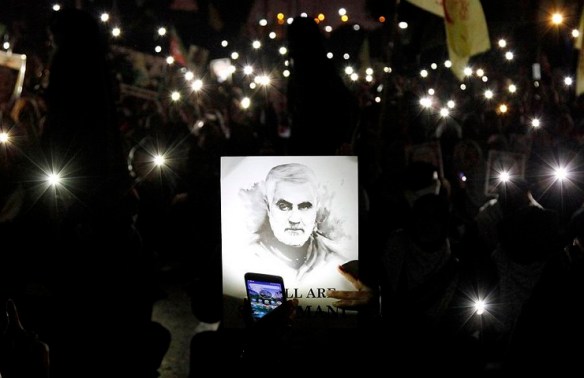
A Shiite Muslim illuminates a portrait of Iranian Revolutionary Guard Gen. Qassem Soleimani, with light from a mobile phone, during a rally to condemn his killing in Iraq by a U.S. airstrike, in Karachi, Pakistan, Sunday, Jan. 5, 2020. Iran has vowed “harsh retaliation” for the U.S. airstrike near Baghdad’s airport that killed Tehran’s top general and the architect of its interventions across the Middle East, as tensions soared in the wake of the targeted killing. (AP Photo/Ikram Suri)

By Andre Vitchek

Source: New Eastern Outlook

They say he came from a humble background, and worked himself up the ranks, becoming, as many believe, the second most powerful man in Iran. They say he had the chance to become the next Supreme Leader of the country.

Whenever I visit Iran, I am told how much he is loved by his people. He became the symbol of resistance against the West; the symbol of the strength and dignity of the nation which was attacked, colonized and starved by several Western capitals.

And now, Iran’s Quds Force commander Qassem Soleimani is no more. And the US Commander-in-Chief, Donald Trump, is proudly claiming responsibility for his demise.

The statement from the Pentagon came promptly, and it was clear:

“At the direction of the president, the US military has taken decisive defensive action to protect US personnel abroad by killing Qasem Soleimani… This strike was aimed at deterring future Iranian attack plans. The United States will continue to take all necessary action to protect our people and interests wherever they are around the world.”

Defensive action…

Almost immediately, RT and others asked me to analyze.

I could not help but to define what was done at the airport outside Baghdad, Iraq, as a vulgar and brutal extra-judicial killing.

***

For the last two months, I have been flying all over the world, writing about (and filming) all those horrors that the Empire unleashed against the people with different cultures, living in various parts of the world.

The Middle East, China, Latin America.

It appears that all boundaries have been crossed. Washington and its NATO allies have lost all restraint, shame and decency. They actually never had much of those, but now they have almost none.

Everything appears to be primitive, as in a badly directed mafia film. If the rulers of the West do not like some country? In that case they simply attack it, starve and destroy it. As brutal as that. No UN Security Council mediations, no arguments, and no pretending that there should be some legal process.

It has been happening to Hong Kong, To Bolivia, Venezuela and West Papua. It has also been happening to Iran, as well as China and Russia, although those countries have proven to be much tougher to eliminate, than Washington’s planners originally thought.

The same applies to individuals: people get murdered without second thought, some quickly, some very slowly and painfully. Julian Assange is one of them, being slowly tortured to death, in front of the entire world, despite legal and medical experts protesting and demanding his release.

The killing of Quassem Suleimani and others in Baghdad, was quick and totally unexpected.

The facial expressions of US officials were absolutely shocking: as if mafia bosses were caught in a corner of some filthy den by a bunch of amateur journalists. Unapologetically, they grinned at the lenses, suggesting: “So what? What are you going to do now? Challenge us? Us? We’ll break your legs, or something…”

And nobody, absolutely nobody really dares to challenge them! Not yet. Not at this moment.

It is one tested, bulletproof game. You destroy an entire country, or you kill a person, and then you show your piece; your well-maintained revolver, or two. You expose your guns and ugly row of teeth. You say, or you suggest without pronouncing it: “You have a wife, and two daughters back home, don’t you? You don’t want anything to happen to them, right?”

It is on that level, now. It is not any better than that, don’t you see?

If you defend yourself – you die; your family dies. Or your family members get violated. Or both.

You like it? You don’t like it? You absolutely detested it? Who cares! The Empire has guns. It is all it has. The ability to kill and to rape. It has become dumb, degenerate. It produces hardly anything of value. But it has millions of weapons, as well as a monstrous propaganda machine.

***

Now, seriously: what can Iran do? What can a nation with thousands of years of culture do?

Can it defend itself? Honestly, if you think it can, then say it: how?

If it retaliates, it could be erased from the face of the earth. If it doesn’t do anything, it will lose face, self-respect, as well as the purpose to continue with its struggle for true independence and its unique form of socialism.

For years and decades, Iran has been a thorn in the eye of the West. Its allies have fought against Western-injected terrorism in Iraq, Syria and Lebanon. Iranian ally in Lebanon, Hezbollah, has been defending the country against Israeli invasions, while providing social support to poor and needy citizens. Iran has been giving jobs and temporary shelter to many Afghan citizens, particularly those from Herat, people who have absolutely nothing left after the horrendous US/NATO occupation of the country. I worked in Afghanistan, and I saw tremendous lines in front of the Iranian consulate in Herat. Iran has even been deeply involved in Latin America, helping, building social housing in Venezuela, Evo’s Bolivia, and elsewhere.

And now, recently, it began moving closer and closer to two of Washington’s arch enemies: China and Russia.

Therefore, it has been decided in the annals of Washington and the Pentagon: Iran has to be stopped; destroyed. At any price. Meaning, any price which would have to be paid by the Iranian citizens.

***

I am convinced that this madness has to be stopped.

For Iran’s sake.

But also, because, if Iran is ruined, destroyed like Iraq, Libya or Afghanistan, someone will be next. First, most likely, Venezuela, and then Cuba. But then, perhaps, most likely, Russia or China, or both.

The Empire will not stop by itself.

If not opposed, it will get more and more emboldened.

It is a tremendous mistake to let it literally ‘get away with a murder’.

Today, a brave Iranian General has been murdered. Washington is smiling provocatively, cynically.

It is sending vibes to all corners of the world: “Stay on your couches in front of television sets. Be petrified. Do nothing. Or else!”

Yes, the world is scared. There are reasons to be scared. But the world simply has to act. These brutal, cowardly acts of degeneracy and fundamentalism/fanaticism committed by the Empire have to be stopped, sooner or later, in the name of our human race. Otherwise, soon, there will be no humanity left!

America Escalates its “Democratic” Oil War in the Near East

By Michael Hudson

Source: CounterPunch

The mainstream media are carefully sidestepping the method behind America’s seeming madness in assassinating Islamic Revolutionary Guard general Qassim Suleimani to start the New Year. The logic behind the assassination was a long-standing application of U.S. global policy, not just a personality quirk of Donald Trump’s impulsive action. His assassination of Iranian military leader Suleimani was indeed a unilateral act of war in violation of international law, but it was a logical step in a long-standing U.S. strategy. It was explicitly authorized by the Senate in the funding bill for the Pentagon that it passed last year.

The assassination was intended to escalate America’s presence in Iraq to keep control of the region’s oil reserves, and to back Saudi Arabia’s Wahabi troops (Isis, Al Quaeda in Iraq, Al Nusra and other divisions of what are actually America’s foreign legion), to support U.S. control of Near Eastern oil as a buttress of the U.S. dollar. That remains the key to understanding this policy, and why it is in the process of escalating, not dying down.

I sat in on discussions of this policy as it was formulated nearly fifty years ago when I worked at the Hudson Institute and attended meetings at the White House, met with generals at various armed forces think tanks and with diplomats at the United Nations. My role was as a balance-of-payments economist, having specialized for a decade at Chase Manhattan, Arthur Andersen and oil companies in the oil industry and military spending. These were two of the three main dynamics of American foreign policy and diplomacy. (The third concern was how to wage war in a democracy where voters rejected the draft in the wake of the Vietnam War.)

The media and public discussion have diverted attention from this strategy by floundering speculation that President Trump did it, except to counter the (non-)threat of impeachment with a wag-the-dog attack, or to back Israeli lebensraum drives, or simply to surrender the White House to the neocon hate-Iran syndrome. The actual context for the neocon’s action was the balance of payments, and the role of oil and energy as a long-term lever of American diplomacy.

The balance of payments dimension

The major deficit in the U.S. balance of payments has long been military spending abroad. The entire payments deficit, beginning with the Korean War in 1950-51 and extending through the Vietnam War of the 1960s, was responsible for forcing the dollar off gold in 1971. The problem facing America’s military strategists was how to continue supporting the 800 U.S. military bases around the world and allied troop support without losing America’s financial leverage.

The solution turned out to be to replace gold with U.S. Treasury securities (IOUs) as the basis of foreign central bank reserves. After 1971, foreign central banks had little option for what to do with their continuing dollar inflows except to recycle them to the U.S. economy by buying U.S. Treasury securities. The effect of U.S. foreign military spending thus did not undercut the dollar’s exchange rate, and did not even force the Treasury and Federal Reserve to raise interest rates to attract foreign exchange to offset the dollar outflows on military accounts. In fact, U.S. foreign military spending helped finance the domestic U.S. federal budget deficit.

Saudi Arabia and other Near Eastern OPEC countries quickly became a buttress of the dollar. After these countries quadrupled the price of oil (in retaliation for the United States quadrupling the price of its grain exports, a mainstay of the U.S. trade balance), U.S. banks were swamped with an inflow of  foreign deposits – which were lent out to Third World countries in an explosion of bad loans that blew up in 1972 with Mexico’s insolvency. This destroyed Third World government credit for a decade, forcing it into dependence on the United States via the IMF and World Bank.

To top matters, of course, what Saudi Arabia does not save in dollarized assets with its oil-export earnings is spent on buying hundreds of billion of dollars of U.S. arms exports. This locks them into dependence on U.S. supply of replacement parts and repairs, and enables the United States to turn off Saudi military hardware at any point of time, in the event that the Saudis may try to act independently of U.S. foreign policy.

So maintaining the dollar as the world’s reserve currency became a mainstay of U.S. military spending. Foreign countries would not have to pay the Pentagon directly for this spending. They simply finance the U.S. Treasury and U.S. banking system.

Fear of this development was a major reason why the United States moved against Libya, whose foreign reserves were held in gold, not dollars, and which was urging other African countries to follow suit in order to free themselves from “Dollar Diplomacy.” Hillary and Obama invaded, grabbed their gold supplies (we still have no idea who ended up with these billions of dollars worth of gold) and destroyed Libya’s government, its public education system, its public infrastructure and other non-neoliberal policies.

The great threat to this is dedollarization as China, Russia and other countries seek to avoid recycling dollars. Without the dollar’s function as the vehicle for world saving – in effect, without the Pentagon’s role in creating the Treasury debt that is the vehicle for world central bank reserves – the U.S. would find itself constrained militarily and hence diplomatically constrained, as it was under the gold exchange standard.

That is the same strategy that the U.S. has followed in Syria and Iraq. Iran was threatening this dollarization strategy and its buttress in U.S. oil diplomacy.

The oil industry as buttress of the U.S. balance of payments and foreign diplomacy

The trade balance is buttressed by oil and farm surpluses. Oil is the key, because it is imported by U.S. companies at almost no balance-of-payments cost (the payments end up in the oil industry’s head offices here as profits and payments to management), while profits on U.S. oil company sales to other countries are remitted to the United States (via offshore tax-avoidance centers, mainly Liberia and Panama for many years). And as noted above, OPEC countries have been told to keep their official reserves in the form of U.S. securities (stocks and bonds as well as Treasury IOUs, but not direct purchase of U.S. companies being deemed economically important). Financially, OPEC countries are client slates of the Dollar Area.

America’s attempt to maintain this buttress explains U.S. opposition to any foreign government steps to reverse global warming and the extreme weather caused by the world’s U.S.-sponsored dependence on oil. Any such moves by Europe and other countries would reduce dependence on U.S. oil sales, and hence on the U.S’s ability to control the global oil spigot as a means of control and coercion. These are viewed as hostile acts.

Oil also explains U.S. opposition to Russian oil exports via Nordstream. U.S. strategists want to treat energy as a U.S. national monopoly. Other countries can benefit in the way that Saudi Arabia has done – by sending their surpluses to the U.S. economy – but not to support their own economic growth and diplomacy. Control of oil thus implies support for continued global warming as an inherent part of U.S. strategy.

How a “democratic” nation can wage international war and terrorism

The Vietnam War showed that modern democracies cannot field armies for any major military conflict, because this would require a draft of its citizens. That would lead any government attempting such a draft to be voted out of power. And without troops, it is not possible to invade a country to take it over.

The corollary of this perception is that democracies have only two choices when it comes to military strategy: They can only wage airpower, bombing opponents; or they can create a foreign legion, that is, hire mercenaries or back foreign governments that provide this military service.

Here once again Saudi Arabia plays a critical role, through its control of Wahabi Sunnis which motivates terrorist jihadis willing to sabotage, bomb, assassinate, blow up and otherwise fight any target designated as an enemy of “Islam,” the euphemism for Saudi Arabia acting as a U.S. client state. (Religion really is not the key; I know of no ISIS or similar Wahabi attack on Israeli targets.) The United States needs the Saudis to supply or finance Wahabi crazies. So in addition to playing a key role in the U.S. balance of payments by recycling its oil-export earnings into U.S. stocks, bonds and other investments, Saudi Arabia provides manpower by supporting the Wahabi members of America’s foreign legion, ISIS and Al-Nusra/Al-Qaeda. Terrorism has become the “democratic” mode of today U.S. military policy.

What makes America’s oil war in the Near East “democratic” is that this is the only kind of war a democracy can fight – an air war, followed by a vicious terrorist army that makes up for the fact that no democracy can field its own army in today’s world. The corollary is that, terrorism has become the “democratic” mode of warfare.

From the U.S. vantage point, what is a “democracy”? In today’s Orwellian vocabulary, it means any country supporting U.S. foreign policy. Bolivia and Honduras have become “democracies” since their coups, along with Brazil. Chile under Pinochet was a Chicago-style free market democracy. So was Iran under the Shah, and Russia under Yeltsin – but not since it elected Vladimir Putin president, any more than is China under President Xi.

The antonym to “democracy” is “terrorist.” That simply means a nation willing to fight to become independent from U.S. neoliberal democracy. It does not include America’s proxy armies.

Iran’s role as U.S. nemesis

What stands in the way of U.S. dollarization, oil and military strategy? Obviously, Russia and China have been targeted as long-term strategic enemies for seeking their own independent economic policies and diplomacy. But next to them, Iran has been in America’s gun sights for nearly seventy years.

America’s hatred of Iran is starts with its attempt to control its own oil production, exports and earnings. It goes back to 1953, when Mossadegh was overthrown because he wanted domestic sovereignty over Anglo-Persian oil. The CIA-MI6 coup replaced him with the pliant Shah, who imposed a police state to prevent Iranian independence from U.S. policy. The only physical places free from the police were the mosques. That made the Islamic Republic the path of least resistance to overthrowing the Shah and re-asserting Iranian sovereignty.

The United States came to terms with OPEC oil independence by 1974, but the antagonism toward Iran extends to demographic and religious considerations. Iranian support of its Shi’ite population and those of Iraq and other countries – emphasizing support for the poor and for quasi-socialist policies instead of neoliberalism – has made it the main religious rival to Saudi Arabia’s Sunni sectarianism and its role as America’s Wahabi foreign legion.

America opposed General Suleimani above all because he was fighting against ISIS and other U.S.-backed terrorists in their attempt to break up Syria and replace Assad’s regime with a set of U.S.-compliant local leaders – the old British “divide and conquer” ploy. On occasion, Suleimani had cooperated with U.S. troops in fighting ISIS groups that got “out of line” – meaning the U.S. party line. But every indication is that he was in Iraq to work with that government seeking to regain control of the oil fields that President Trump has bragged so loudly about grabbing.

Already in early 2018, President Trump asked Iraq to reimburse America for the cost of “saving its democracy” by bombing the remainder of Saddam’s economy. The reimbursement was to take the form of Iraqi Oil. More recently, in 2019, President Trump asked, why not simply grab Iraqi oil. The giant oil field has become the prize of the Bush-Cheney post 9-11 Oil War. “‘It was a very run-of-the-mill, low-key, meeting in general,” a source who was in the room told Axios.’ And then right at the end, Trump says something to the effect of, he gets a little smirk on his face and he says, ‘So what are we going to do about the oil?’”

Trump’s idea that America should “get something” out of its military expenditure in destroying the Iraqi and Syrian economies simply reflects U.S. policy.

In late October, 2019, The New York Times reported that: “In recent days, Mr. Trump has settled on Syria’s oil reserves as a new rationale for appearing to reverse course and deploy hundreds of additional troops to the war-ravaged country. He has declared that the United States has “secured” oil fields in the country’s chaotic northeast and suggested that the seizure of the country’s main natural resource justifies America further extending its military presence there. ‘We have taken it and secured it,’ Mr. Trump said of Syria’s oil during remarks at the White House on Sunday, after announcing the killing of the Islamic State leader, Abu Bakr al-Baghdadi.” A CIA official reminded the journalist that taking Iraq’s oil was a Trump campaign pledge.

That explains the invasion of Iraq for oil in 2003, and again this year, as President Trump has said: “Why don’t we simply take their oil?” It also explains the Obama-Hillary attack on Libya – not only for its oil, but for investing its foreign reserves in gold instead of recycling its oil surplus revenue to the U.S. Treasury – and of course, for promoting a secular socialist state.

It explains why U.S. neocons feared Suleimani’s plan to help Iraq assert control of its oil and withstand the terrorist attacks supported by U.S. and Saudi Arabia. That is what made his assassination an immediate drive.

American politicians have discredited themselves by starting off their condemnation of Trump by saying, as Elizabeth Warren did, how “bad” a person Suleimani was, how he had killed U.S. troops by masterminding the Iraqi defense of roadside bombing and other policies trying to repel the U.S. invasion to grab its oil. She was simply parroting the U.S. media’s depiction of Suleimani as a monster, diverting attention from the policy issue that explains why he was assassinated now.

The counter-strategy to U.S. oil, dollar and global-warming diplomacy

This strategy will continue, until foreign countries reject it. If Europe and other regions fail to do so, they will suffer the consequences of this U.S. strategy in the form of a rising U.S.-sponsored war via terrorism, the flow of refugees, and accelerated global warming (and extreme weather).

Russia, China and its allies already have been leading the way to dedollarization as a means to contain the balance-of-payments buttress of U.S. global military policy. But everyone now is speculating over what Iran’s response should be.

The pretense – or more accurately, the diversion – by the U.S. news media over the weekend has been to depict the United States as being under imminent attack. Mayor de Blasio has positioned policemen at conspicuous key intersections to let us know how imminent Iranian terrorism is – as if it were Iran, not Saudi Arabia that mounted 9/11, and as if Iran in fact has taken any forceful action against the United States. The media and talking heads on television have saturated the air waves with warnings of Islamic terrorism. Television anchors are suggesting just where the attacks are most likely to occur.

The message is that the assassination of General Soleimani was to protect us. As Donald Trump and various military spokesmen have said, he had killed Americans – and now they must be planning an enormous attack that will injure and kill many more innocent Americans. That stance has become America’s posture in the world: weak and threatened, requiring a strong defense – in the form of a strong offense.

But what is Iran’s actual interest? If it is indeed to undercut U.S. dollar and oil strategy, the first policy must be to get U.S. military forces out of the Near East, including U.S. occupation of its oil fields. It turns out that President Trump’s rash act has acted as a catalyst, bringing about just the opposite of what he wanted. On January 5 the Iraqi parliament met to insist that the United States leave. General Suleimani was an invited guest, not an Iranian invader. It is U.S. troops that are in Iraq in violation of international law. If they leave, Trump and the neocons lose control of oil – and also of their ability to interfere with Iranian-Iraqi-Syrian-Lebanese mutual defense.

Beyond Iraq looms Saudi Arabia. It has become the Great Satan, the supporter of Wahabi extremism, the terrorist legion of U.S. mercenary armies fighting to maintain control of Near Eastern oil and foreign exchange reserves, the cause of the great exodus of refugees to Turkey, Europe and wherever else it can flee from the arms and money provided by the U.S. backers of Isis, Al Qaeda in Iraq and their allied Saudi Wahabi legions.

The logical ideal, in principle, would be to destroy Saudi power. That power lies in its oil fields. They already have fallen under attack by modest Yemeni bombs. If U.S. neocons seriously threaten Iran, its response would be the wholesale bombing and destruction of Saudi oil fields, along with those of Kuwait and allied Near Eastern oil sheikhdoms. It would end the Saudi support for Wahabi terrorists, as well as for the U.S. dollar.

Such an act no doubt would be coordinated with a call for the Palestinian and other foreign workers in Saudi Arabia to rise up and drive out the monarchy and its thousands of family retainers.

Beyond Saudi Arabia, Iran and other advocates of a multilateral diplomatic break with U.S. neoliberal and neocon unilateralism should bring pressure on Europe to withdraw from NATO, inasmuch as that organization functions mainly as a U.S.-centric military tool of American dollar and oil diplomacy and hence opposing the climate change and military confrontation policies that threaten to make Europe part of the U.S. maelstrom.

Finally, what can U.S. anti-war opponents do to resist the neocon attempt to destroy any part of the world that resists U.S. neoliberal autocracy? This has been the most disappointing response over the weekend. They are flailing. It has not been helpful for Warren, Buttigieg and others to accuse Trump of acting rashly without thinking through the consequences of his actions. That approach shies away from recognizing that his action did indeed have a rationale—to draw a line in the sand, to say that yes, America WILL go to war, will fight Iran, will do anything at all to defend its control of Near Eastern oil and to dictate OPEC central bank policy, to defend its ISIS legions as if any opposition to this policy is an attack on the United States itself.

I can understand the emotional response of yet new calls for impeachment of Donald Trump. But that is an obvious non-starter, partly because it has been so obviously a partisan move by the Democratic Party. More important is the false and self-serving accusation that President Trump has overstepped his constitutional limit by committing an act of war against Iran by assassinating Soleimani.

Congress endorsed the assassination of Soleimani as ordered by Trump (and his neocon advisor, Secretary of State Pompeo) and is fully as guilty as he is for having approved the Pentagon’s budget. This is due to the Senate’s removal of the amendment to the 2019 National Defense Authorization Act where Bernie Sanders, Tom Udall and Ro Khanna inserted an amendment in the House of Representatives version, explicitly not authorizing the Pentagon to wage war against Iran or assassinate its officials. When this budget was sent to the Senate, the White House and Pentagon (a.k.a. the military-industrial complex and neoconservatives) removed that constraint. That was a red flag announcing that the Pentagon and White House did indeed intend to wage war against Iran and/or assassinate its officials. Congress lacked the courage to argue this point at the forefront of public discussion.

Conclusion

First came the 9/11 attack (Sept 2001).

In the wake of this, Congress passed the 2002 Authorization Act. This authorized the President to move against Al Qaeda.

Fast forward to today: Suleimani and Iran were fighting AGANST Al Qaeda and its offshoot, ISIS/Daesh. Saudi Arabia had asked Suleimani (with U.S. approval) to help negotiate a peace, whereby the Saudi’s would stop backing ISIS. It was an official mission invited by Iraq to negotiate peace between Saudi Arabia, Iran and Iraq.

This infuriated the United States, which wanted a permanent warfare there as an excuse to occupy Iraq and prevent a Shi’ite Crescent linking Iran, Iraq, Syria and Lebanon, which incidentally would serve as part of China’s Belt and Road initiative. So it killed Suleimani to prevent the peace negotiation.

The implication is that the US wants a PERMANENT occupation of Iraq, which is needed to secure the US grab of Iraq’s oil and Syria’s oil, as well as to prevent any non-U.S. oil transit.

The question is, how to get the world’s politicians – U.S., European and Asians – to see how America’s all-or-nothing policy is threatening new waves of war, refugees, extreme weather and the disruption of the oil trade in the Strait of Hormuz. Ultimately, the aim is to ensure neoliberal dollarization is imposed on all countries to subsidize US imperial hegemony.

It is a sign of how little power exists in the United Nations that no countries are calling for a new Nurenberg-style war crimes trial following the assassination, no threat to withdraw from NATO or even to avoid holding reserves in the form of money lent to the U.S. Treasury to fund America’s military budget.


Notes.

[1] https://www.axios.com/trump-to-iraqi-pm-how-about-that-oil-1a31cbfa-f20c-4767-8d18-d518ed9a6543.html. The article adds: “In the March meeting, the Iraqi prime minister replied, ‘What do you mean?’ according to the source in the room. And Trump’s like, ‘Well, we did a lot, we did a lot over there, we spent trillions over there, and a lot of people have been talking about the oil.’”

[2] Michael Crowly, “‘Keep the Oil’: Trump Revives Charged Slogan for new Syria Troop Mission,” The New York Times, October 26, 2019. . The article adds: “‘I said keep the oil,’ Mr. Trump recounted. ‘If they are going into Iraq, keep the oil. They never did. They never did.’”

On The Idiotic Partisan Debate Over Regime Change In Iran Or Syria

By Caitlin Johnstone

Source: CaitlinJohnstone.com

I love my job. Really, I do. But writing about US military agendas for a living often brings one into contact with such staggering stupidity that all you can do is pause and wonder how our species survived past the invention of the pointy stick.

By far the dumbest thing in all of US politics is the fact that Democrats tend to support regime change in Syria, while Republicans tend to support it more in Iran. I am not talking about the elected officials in those parties; I’m talking about the ordinary rank-and-file Joes and Janets who stand absolutely nothing to gain from toppling either Damascus or Tehran, but who have been brainwashed by lifelong media consumption into supporting one or the other anyway.

Whenever I write against the US government’s longstanding agenda to replace the leadership of Tehran with a compliant puppet regime, I know with absolute certainty that I’m going to spend the rest of my time online arguing with Trump supporters and lifelong Republicans. Whenever I write against the US government’s longstanding agenda to do the same in Syria, I know with absolute certainty that I’m going to be arguing predominantly with so-called centrist liberals.

At no time has this ever failed to occur.

I’ve spent the last few days arguing with Trump supporters who are telling me I’m crazy for not celebrating the death of an Iranian general they had no idea existed one week ago, and many of these pro bono State Department propagandists began following my work because they liked what I’ve been saying about Syria.

Conversely, all the fauxgressives and liberal interventionists who spent all last month telling me I’m a monster for writing about leaked OPCW documents showing we were lied to about an alleged 2018 chemical weapons incident have been staying out of my social media notifications completely these past four days.

It is truly bizarre. And it is truly, deeply, profoundly stupid.

It is truly, deeply and profoundly stupid because the agenda to topple Iran’s government and the agenda to topple Syria’s government are not two separate agendas. They are the same. Supporting one while opposing the other is like wanting to shoot someone in the head but being morally opposed to shooting them in the heart.

Syria and Iran are allies. Eliminating one government necessarily hurts the other. Iran has been helping Syria to win the war against foreign-backed extremist proxy fighters who nearly succeeded in toppling Damascus before its allies stepped in, and should Syria succeed in rebuilding itself (something the Trump administration is actively preventing it from doing) we can be sure it would return the favor when called upon.

The US government’s agenda to “take out” all noncompliant governments in the Middle East is completely removed from any consideration for American party politics. It’s one unified agenda, and the more the imperial blob succeeds in weakening any of the remaining unabsorbed nations, the easier it gets to absorb the others.

Supporting regime change in Iran but not Syria, or vice-versa, is for this reason an inherently absurd position to take. If you opposed Obama’s attempt to topple Damascus via Timber Sycamore-armed proxies, it’s absurd for you to support any maneuvers which could lead to the elimination of Syria’s key ally in that fight. If you oppose Trump’s current warmongering toward Iran, it’s absurd for you to support the elimination of one of Iran’s remaining friends in the region.

If Iran falls you may be sure that Syria will fall next, and vice versa. It’s the same box being ticked; you’re just arguing over whether it should be a left-handed or right-handed check mark.

But such is the strength of propaganda. The perception managers of the US war machine have successfully manipulated the voting public into a debate not about whether regime change interventionism should happen, but which regime change intervention should happen first.

In a sense it’s quite brilliant; we may be quite sure that government agency departments responsible for domestic perception management on US foreign policy have discussed this precise dynamic at length. But in another sense it’s quite mundane: the recent Republican presidents have pursued regime change in Iran, while Obama pursued it in Syria, so Republicans support Republican interventions while Democrats support Democratic ones.

This has nothing to do with any substantial difference in these agendas (again, it’s actually one agenda) and everything to do with what each faction can be more easily propagandized toward. Liberal hearts are easier to grab with horror stories about a monster who gasses babies for no reason and less concerned about refugee crises and the persecution of Syrian Christians, while Republicans are much easier to manipulate into despising a theocracy run by Muslims.

And of course there’s overlap; people who prioritize mass murder above all else like John Bolton and Lindsey Graham will cheer enthusiastically for as much military interventionism as they can get in either country (or any country, really). But by and large, especially among the rank-and-file, people tend to support the interventions their respective presidents propagandized them into supporting. Propaganda is pretty much the only thing the presidential “bully pulpit” is used for.

Because Iraq has poisoned the idea, each mainstream faction may deny actually wanting the US to oust the government of Iran or Syria. Trump supporters who still stand by the anti-interventionist platform he falsely campaigned on may say “I don’t want war with Iran, I just want Iranians to get their freedom and I think it’s awesome they killed Solamumi or however you spell it.” Liberals might say “I don’t want interventionism! I just support the Freedom Fighters™️ in Idlib and want Assad to stop murdering civilians for fun and sexual gratification.” But circulating propaganda narratives about governments targeted for regime change is supporting regime change. You’re participating in it as surely as if you’d deployed the Tomahawk missiles yourself.

Yesterday someone told me that everyone at Qassem Soleimani’s incredibly massive funeral procession was attending because they were forced to. When I asked him if he was claiming that every single one of those millions of people were publicly mourning because they’d been literally forced at gunpoint, he told me no: many were forced in the sense that state propaganda was all they’d ever known, so they were psychologically coerced into grieving Soleimani.

“I don’t accept that your ‘state propaganda their whole lives’ model is any more coercive or fascistic than the kind that causes Americans to turn up to pro- and anti-Trump rallies,” I said. “Americans are no less propagandized than Iranians. If anything it’s worse, since Americans don’t know they’re being propagandized.”

“You’ve got it backwards,” he said. “Iranians don’t know they’re being propagandized because they only have one source of information. The U.S. knows it because we have sides screaming it to other sides all the time and the freedom of information and thought to come to our own conclusions.”

“Nonsense,” I replied. “Nearly all Americans are propagandized to the gills. They’re probably the most aggressively propagandized population on earth, just because so much depends on their swallowing propaganda. It’s just a more scientific sort.”

“And yet here we are, talking about it freely without worrying about swallowing a bullet,” he said.

“Here I am arguing with a man who just so happens to be striving very, very hard to convince me to swallow the exact same narrative that Mike Pompeo is trying to convince me to swallow,” I replied.

The greatest asset of the propagandists is the belief that we haven’t been propagandized.