The Engineered Stagflationary Collapse Has Arrived – Here’s What Happens Next

By Brandon Smith

Source: Alt-Market.us

In my 16 years as an alternative economist and political writer I have spent around half that time warning that the ultimate outcome of the Federal Reserve’s stimulus model would be a stagflationary collapse. Not a deflationary collapse, or an inflationary collapse, but a stagflationary collapse. The reasons for this were very specific – Mass debt creation was being countered with MORE debt creation while many central banks have been simultaneously devaluing their currencies through QE measures. On top of that, the US is in the unique position of relying on the world reserve status of the dollar and that status is diminishing.

It was only a matter of time before the to forces of deflation and inflation met in the middle to create stagflation. In my article ‘Infrastructure Bills Do Not Lead To Recovery, Only Increased Federal Control’, published in April of 2021, I stated that:

Production of fiat money is not the same as real production within the economy… Trillions of dollars in public works programs might create more jobs, but it will also inflate prices as the dollar goes into decline. So, unless wages are adjusted constantly according to price increases, people will have jobs, but still won’t be able to afford a comfortable standard of living. This leads to stagflation, in which prices continue to rise while wages and consumption stagnate.

Another Catch-22 to consider is that if inflation becomes rampant, the Federal Reserve may be compelled (or claim they are compelled) to raise interest rates significantly in a short span of time. This means an immediate slowdown in the flow of overnight loans to major banks, an immediate slowdown in loans to large and small businesses, an immediate crash in credit options for consumers, and an overall crash in consumer spending. You might recognize this as the recipe that created the 1981-1982 recession, the third-worst in the 20th century.

In other words, the choice is stagflation, or deflationary depression.”

It’s clear today what the Fed has chosen. It’s important to remember that throughout 2020 and 2021 the mainstream media, the central bank and most government officials were telling the public that inflation was “transitory.” Suddenly in the past few months this has changed and now even Janet Yellen has admitted that she was “wrong” on inflation. This is a misdirection, however, because the Fed knows exactly what it is doing and always has. Yellen denied reality, but she knew she was denying reality. In other words, she was not mistaken about the economic crisis, she lied about it.

As I outlined last December in my article ‘The Fed’s Catch-22 Taper Is A Weapon, Not A Policy Error’:

‘First and foremost, no, the Fed is not motivated by profits, at least not primarily. The Fed is able to print wealth at will, they don’t care about profits – They care about power and centralization. Would they sacrifice “the golden goose” of US markets in order to gain more power and full bore globalism? Absolutely. Would central bankers sacrifice the dollar and blow up the Fed as an institution in order to force a global currency system on the masses? There is no doubt; they’ve put the US economy at risk in the past in order to get more centralization.’

The Fed has known for years that the current path would lead to inflation and then market destruction, and here’s the proof – Fed Chairman Jerome Powell actually warned about this exact outcome in October of 2012:

“I have concerns about more purchases. As others have pointed out, the dealer community is now assuming close to a $4 trillion balance sheet and purchases through the first quarter of 2014. I admit that is a much stronger reaction than I anticipated, and I am uncomfortable with it for a couple of reasons.First, the question, why stop at $4 trillion? The market in most cases will cheer us for doing more. It will never be enough for the market. Our models will always tell us that we are helping the economy, and I will probably always feel that those benefits are overestimated. And we will be able to tell ourselves that market function is not impaired and that inflation expectations are under control. What is to stop us, other than much faster economic growth, which it is probably not in our power to produce?

When it is time for us to sell, or even to stop buying, the response could be quite strong; there is every reason to expect a strong response. So there are a couple of ways to look at it. It is about $1.2 trillion in sales; you take 60 months, you get about $20 billion a month. That is a very doable thing, it sounds like, in a market where the norm by the middle of next year is $80 billion a month. Another way to look at it, though, is that it’s not so much the sale, the duration; it’s also unloading our short volatility position.”

As we all now know, the Fed waited until their balance sheet was far larger and until the economy was MUCH weaker than it was in 2012 to unleash tightening measures. They KNEW the whole time exactly what was going to happen.

It is no coincidence that the culmination of the Fed’s stimulus bonanza has arrived right after the incredible damage done to the economy and the global supply chain by the covid lockdowns. It is no coincidence that these two events work together to create the perfect stagflationary scenario. And, it’s no coincidence that the only people who benefit from these conditions are proponents of the “Great Reset” ideology at the World Economic Forum and other globalist institutions. This is an engineered collapse that has been in the works for many years.

The goal is to “reset” the world, to erase what’s left of free market systems, and to establish what they call the “Shared Economy” system. This system is one in which the people who survive the crash will be made utterly dependent on government through Universal Basic Income and one that will restrict all resource usage in the name of “carbon reduction.” According to the WEF, you will own nothing and you will like it.

The collapse is engineered to create crisis conditions so frightening that they expect the majority of the public to submit to a collectivist hive mind lifestyle with greatly reduced standards. This would be accomplished through UBI, digital currency models, carbon taxation, population reduction, rationing of all commodities and a social credit system. The goal, in other words, is complete control through technocratic authoritarianism.

All of this is dependent on the exploitation of crisis events to create fear in the population. Now that economic destabilization has arrived, what happens next? Here are my predictions…

The Fed Will Hike Interest Rates More Than Expected, But Not Enough To Stop Inflation

Today, we are witnessing the poisonous fruits of a decade-plus of massive fiat money creation and we are now at the stage where the Fed will reveal its true plan. Hiking interest rates fast, or hiking them slow. Fast hikes will mean an almost immediate crash in markets (beyond what we have already seen), slow hikes will mean a drawn out process of price inflation and general uncertainty.

I believe the Fed will hike more than expected, but not enough to actually slow inflation in necessities. There will be an overall decline in luxury items, recreation commerce and non-essentials, but most other goods will continue to climb in cost. It is to the advantage of globalists to keep the inflation train running for another year or longer.

In the end, though, the central bank WILL declare that the pace of interest rates is not enough to stop inflation and they will revert to a Volcker-like strategy, pushing rates up so high that the economy simply stops functioning altogether.

Markets Will Crash And Unemployment Will Abruptly Spike

Stock markets are utterly dependent on Fed stimulus and easy money through low interest rate loans – This is a fact. Without low rates and QE, corporations cannot engage in stock buybacks. Meaning, the tools for artificially inflating equities are disappearing. We are already seeing the effects of this now with markets dropping 20% or more.

The Fed will not capitulate. They will continue to hike regardless of the market reaction.

As far as jobs are concerned, Biden and many mainstream economists constantly applaud the low unemployment rate as proof that the American economy is “strong,” but this is an illusion. Covid stimulus measures temporarily created a dynamic in which businesses needed increased staff to deal with excess retail spending. Now, the covid checks have stopped and Americans have maxed out their credit cards. There is nothing left to keep the system afloat.

Businesses will start making large job cuts throughout the last half of 2022.

Price Controls

I have no doubt that Joe Biden and Democrats will seek to enforce price controls on many goods as inflation continues, and there will be a handful of Republicans that will support the tactic. Price controls actually lead to a reduction in supply because they remove all profits and thus all incentive for manufacturers to keep producing goods. What usually happens at that point is government steps in to nationalize manufacturing, but this will be substandard production and at a much lower yield.

In the end, supplies are reduced even further and prices go even higher on the black market because no one can get their hands on most goods anyway.

Rationing

Yes, rationing at the manufacturing and distribution level is going to happen, so be sure to buy what you need now before it does. Rationing occurs in the wake of price controls or supply chain disruptions, and usually this coincides with a government propaganda campaign against “hoarders.”

They will hold up a few exaggerated examples of people who buy truckloads of merchandise to scalp prices on the black market. Then, not long after, they will accuse preppers and anyone who bought goods BEFORE the crisis of “hoarding” simply because they planned ahead.

Rationing is not only about controlling the supply of necessities and thus controlling the population by proxy; it is also about creating an atmosphere of blame and suspicion within the public and getting them to snitch on or attack anyone that is prepared. Prepared people represent a threat to the establishment, so expect to be demonized in the media and organize with other prepared people to protect yourself.

Be Ready, It Only Gets Worse From Here On

It might sound like I am predicting success of the Great Reset program, but I actually believe the globalists will fail in the end. That’s not going to stop them from making the attempt. Also, the above scenarios are only predictions for the near term (within the next couple of years). There will be many other problems that stem from these situations.

Naturally, food riots and other mob actions will become more commonplace, perhaps not this year, but by the end of 2023 they will definitely be a problem. This will coincide with the return of political unrest in the US as leftist factions, encouraged by globalist foundations, demand more government intervention in poverty. At the same time, conservatives will demand less government interference and less tyranny.

At bottom, the people who are prepared might be called a lot of mean names, but as long as we organize and work together, we will survive. Many unprepared people will NOT survive. Understand that the economic conditions ahead of us are historically destructive; there is no way that serious consequences can be avoided for a large part of the population, if only because they refuse to listen and to take proper steps to protect themselves.

The denial is over. The crash is here. Time to take action if you have not done so already.
Wokeness is a Product of Neoliberalism

Why don’t more people make this connection?

By Chad C. Mulligan

Source: The Hipcrime Vocab Substack

One thing I haven’t seen people point out anywhere else is how much the current atmosphere of “wokeness” is an outcome of neoliberalism.

Let me explain.

There was a lot of analysis written about neoliberalism back in the 1990s when it was still a relatively new phenomenon, having only been enshrined as the dominant economic paradigm in the 1980s. Now that neoliberalism has become simply the water in which we swim and the horizon upon which we gaze, we don’t even notice it anymore. The idea that there could be other ways to organize the economy and society has completely vanished from the discourse even on the nominal “Left”—so utterly complete has been its intellectual victory.

I can’t recall all the books and articles I read during that time, but a couple of standouts were One Market Under God by Thomas Frank and No Logo by Naomi Klein. Frank’s The Baffler magazine published a lot of good articles about neoliberalism back in those days, and Klein’s subsequent The Shock Doctrine is indispensable for understanding how neoliberalism took over the world.

One of the things that those analyses pointed out was the fact that neoliberalism derided governments as universally incompetent and inefficient and argued that only market competition could distribute goods and services effectively.

Furthermore, those markets had to be global in scope and free from “interference,” which was broadly defined as anything that hindered profit maximization including worker and environmental protections. This, in theory, would lead to ideal outcomes—or at least as close to ideal as they could be in a world of inherent scarcity.

As a corollary of this, neoliberals argued that democratic politics—the idea that citizens could express their wishes and desires via their elected representatives—was a hopelessly naive and outdated notion in the age of globalism. Rather, they argued that people’s preferences and desires would be more accurately reflected by how people spent their money in “free and open” markets. People’s spending patterns—aggregated and allocated by markets—would therefore be a better agent of social change than ineffective political action according to neoliberal theory1.

The One Big Market under neoliberalism, therefore, was seen not just a method for coordinating economic activities and allocating goods and services, but as the highest expression of people’s fundamental valuesWe were now expected to change the world thru shopping. As a result of this, you were expected to be an “ethical consumer.” You were exhorted to “spend your values.” Markets, neoliberals argued—and not popularly elected governments—were the true expression of the democratic will. As our choices at the voting booth began to narrow and seem more and more alike, we were told to vote with your dollar!

Here’s a concrete, real-world example. If you were concerned about dolphins being ensnared and killed in fishing nets used to dredge the ocean for tuna, the solution was not to ban the practice. No, the solution was to spend ethically on products labeled “dolphin safe.” Since consumers would express their preferences via buying dolphin safe tuna instead of the ones not so labeled, eventually the Invisible Hand of the Market would cause this practice to die out without a single government regulation. Similarly, if you wanted to support sustainable farming practices, you would spend preferentially on products labeled “organic” rather than the alternatives.

So in the neoliberal world view, the best way to bring about positive social change was by individuals spending their money in markets. That’s why in a modern shopping center you see all kinds of labels festooned on every conceivable product proclaiming how it is “responsibly sourced,” or how environmentally-friendly it is, or how the package is biodegradable, or how the farmers were fairly compensated, or whatever. You never saw that in the 1960s or 1970s—this change was ushered in by neoliberalism.

Now when you went to the grocery store it was no longer just to buy groceries—you had the obligation to save the world! (As if your life wasn’t stressful enough with the ever-longer working hours that were also the result of neoliberalism). A recurring theme of those analyses I read back in the day was the replacement of citizens with consumers.

(Of course, what’s to stop corporations from slapping any old claim onto their products? How can shoppers evaluate these claims? How can they possibly know what’s accurate and what’s not? Into this void stepped literally hundreds of different (private) certification agencies to try and make sure that these labels accurately reflected what they claimed. Thus, in the effort to avoid regulating markets, neoliberalism actually caused a proliferation of far more regulations and regulatory agencies than ever before. And often these privatized agencies have nonexistent oversight, poor standards and lax enforcement).

Another fundamental aspect of neoliberalism was the notion that competition would bring about ideal social outcomes. Therefore competition, neoliberals argued, had to be introduced into absolutely every aspect of human affairs. In this regard, neoliberalism a was really not just about economics, but was rather a radical totalitarian vision for remaking human society.

This extended even to social issues. For example, the philosophy behind “school choice” came from the notion that the problem with public schools was the lack of free market competition because schools were a state-owned monopoly. State-owned monopolies are the greatest possible evil under neoliberalism because they are not subject to market competition. By unleashing “choice,” schools would be forced to compete for students just like businesses compete for customers. This would make public education better, the thinking went, by eliminating bad schools and teachers and creating “lean and mean” educational institutions.

Even environmentalism has been colonized by neoliberalism. Instead of limiting the emission of fossil fuels, for example, new and exotic markets would be established so that polluters could trade opaque “carbon credits” in order to theoretically allocate pollution the same way we allocate any other resource under neoliberalism. This also demonstrates how neoliberalism is not anti-regulation or “small government” as is often portrayed, since creating these kinds of artificial markets takes massive amounts of government regulation and bureaucracy.

As this all-encompassing philosophy gradually took over the world, social protections were dismantled, regulations were abolished, and untrammeled, cutthroat competition was unleashed in every arena of life.

But it was Karl Polanyi who pointed out that such a vision of turning over society to anarchic markets with no protections and no refuge from its capricious dictates would lead to the “demolition of society.” No one could long withstand the never-ending whipsaws and bullwhips of “pure”relentless market competition—not consumers, not workers, and not even the businesses themselves! That’s why its has never existed, he said, and cannot exist.

So what actually happened in the real world due to unleashing this radical philosophy was an unprecedented wave of mergers, acquisitions, and consolidations in every sector of the economy, enabled by high finance (which was also “unleashed” thanks to neoliberalism).

You see, competition is expensive. It is also highly inefficientIt’s much more effective for parties to cooperate than to compete. That’s just game theory 101. It’s true of human affairs just as it is in nature. That’s why you see cooperation everywhere throughout the animal kingdom as Peter Kropotkin pointed out long ago. Any species where every single member was perennially locked in existential competition with every other member of the species would quickly die out, he said. Even where competition does exist in nature, it is in very limited in scope and in circumscribed contexts like mate choice.

Competition is also inherently unstable. You can’t just have an endless tournament going on forever and ever as free market theory depicts. Eventually there has to be a winner. Again, this is simply game theory 101. You can observe this everywhere you look.

So the current wave of consolidations and mergers in every sector of the economy can be seen as the logical outcome of neoliberal philosophy when applied to the real world as opposed to the world depicted in economic textbooks and think-tank policy papers. Want to know why the entire economy is dominated by a handful of mega-monopolies these days? That’s the reason why.

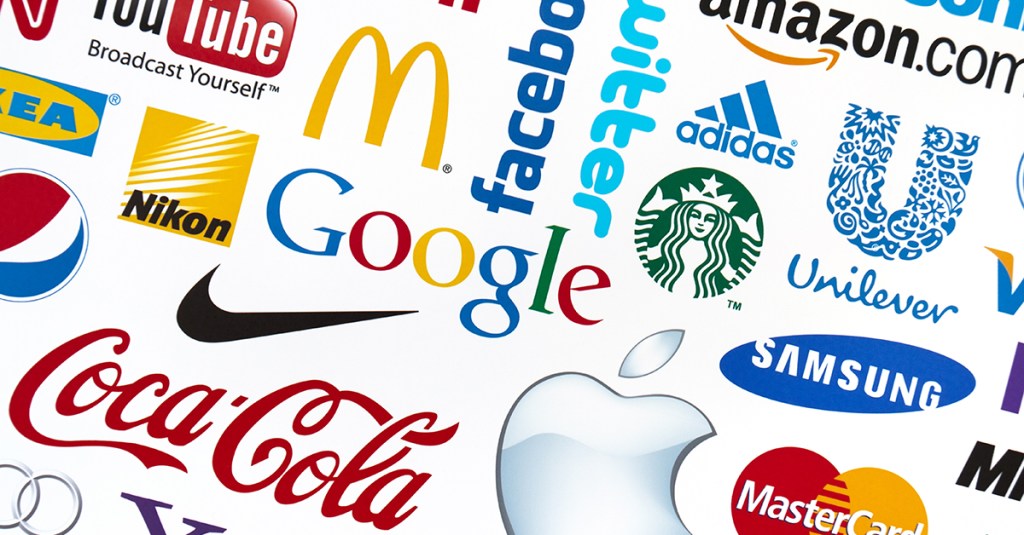
But getting back to our initial topic, here’s the point that’s absolutely critical: as a result of this neoliberal transformation, corporations had to portray themselves as agents of positive social change.

Read that again. And again and again and again until it sinks in.

This is what has lead to the rise of the modern “socially conscious” corporation and to so-called “woke capitalism.”

Think about it. Back in the pre-neoliberal 1960s, did any company bend over backwards to convey what it believed about absolutely anything? About any social issue whatsoever? No, because corporations weren’t expected to do that. Corporations were widely seen as anonymous entities devoid of values designed to make money by producing the goods and services consumers wanted. Back in the 1960’s—an era of rapid social change—no one cared about what IBM, Boeing, McDonalds, DuPont, General Electric, Coca Cola, General Motors, Prudential, Chevron, or any other big corporation thought about anything, much less the prevailing social issues of the day. That’s what politics was for! Businesses were expected to make money, full stop. Besides, how could a corporation really “think” anything? A corporation is a faceless bureaucratic enterprise composed of hundreds, or even thousands of individuals, each with their own personal set of values and beliefs. The very idea that a corporation could “believe” anything would have been seen as preposterous and absurd back then.

Spending money in “free” markets has subsequently become the only acceptable form of social protest or fomenting change under globalized neoliberalism—and not, for example, people banding together in popular movements to advocate for a better world. Government and politics have become passé and irrelevant—or so we’re told by those in charge. The sole option you have as a lone individual in the face of this relentless onslaught is to become an ethical consumer—in other words, to “spend your values.” Therefore, in order to meet this solemn obligation, you have to be sure that when you hand your money over to a corporation, that corporation reflects your values! That is a fundamental tenet of neoliberalism and its emphasis on markets—and not governments—as the highest arbiter of social values and preferences.

Yet very few commentators on the (fake) Left and the (pseudo) populist Right seem to grasp this. Instead they just shake their fists and rage.

So in order to get their hands on those precious “ethical” dollars, faceless bureaucratic corporations have to fashion themselves as “socially responsible.” As “ethical.” As being “positive change agents.” To that end they have launched wave after wave of PR campaigns designed to proclaim just how ethical and virtuous they are, from Amazon to Dove to Gillette, and every other big business has to follow suit.

Consider, for instance, those Dove advertisements that promised to let plus-size women believe they were beautiful—and publicly paraded them in their bras and panties in a commercial for cellulite-reducing cream. Or the Heineken “Worlds Apart” ad that showed people of disparate backgrounds and races coming together (eventually) over the beer. Or—to bring things back to the strategic positioning of carbonated sugar water as a proto-revolutionary product—the (thankfully short-lived) Kendall Jenner Pepsi spot that portrayed the soda as the means to bring Occupy-style protesters back into a grateful posture of consumer-abundance connoisseurship…

Believe in Something (The Baffler)

This also ties in with the “doing well by doing good” ethos of philanthropic capitalism as described by Anand Giridharadas in his book, Winners Take All. Once again, elected governments and politicians are portrayed as hopelessly inept and incompetent (sense a pattern?). In place of governments installed by the will of the people, therefore, “social entrepreneurs” will step into the void and solve the most pressing social problems of the day—and make a killing $$$ by doing so. This is portrayed as a “win-win” scenario in the media, which is owned and controlled by those same rich people (the fact that every single social problem seems to be getting exponentially worse has not deterred this policy approach in the slightest).

So if you wonder where all that cloying, patronizing Silicon Valley bullshit about “changing the world” and “making the world a better place” comes from—that’s where it comes from. It’s basically a form of neofeudalism in practice.

So the end result of all this is that under neoliberalism corporations are now obligated to portray themselves as ethical and moral in order to attract precious consumer dollars. Hence the rise of the modern “woke” corporation expressing it’s opinion on absolutely every hot-button issue of the day—from Black Lives Matter, to gay marriage, to the abortion debate, to transgender rights, to sexual harassment, to gun control, to multiculturalism, to whatever contentious wedge issue the political Right will dream up next.

And whether you like it or not, the people who tend to earn the most under globalized, technocratic monopoly capitalism really do strongly support cosmopolitan values like diversity, tolerance and inclusiveness. And since we are obligated to “spend our values” under neoliberalism, corporations have to cater to them—and to make sure that everyone knows about it. Thus they have to “officially” support things like Black Lives Matter. They have to speak out against discrimination against gay and transgender people. They have to be “antiracist.” They have to extol “empowering women and girls.” All because they need to attract the kinds of people who “spend their values,” and those values are more likely to be socially liberal for the kinds of people that corporations want to attract both as employees and consumers. That’s just the reality, and it’s not likely to change anytime soon.

And even though conservatives may not like it, socially regressive people and reactionaries tend to be poorer and less educated overall—and hence are less desirable as workers and consumers. That’s also just how it is. Therefore, corporations are “woke” based on a cynical, self-interested calculation of what will net them the most consumer dollars under neoliberal capitalism, and no amount of conservative grousing is going to change that. As a result, reactionaries and authoritarians are increasingly turning to politics to force their values upon people which they can’t enforce via the kinds of free market choices that they believe should dictate every other aspect of life.

When it became clear that the NFL supporters—largely white, male, and older—were outnumbered by the corporation’s brand loyalists—more diverse and younger—Nike went ahead and now even claims that it inaugurated the campaign because it believes that Kaepernick “is one of the most inspirational athletes of his generation.”

Believe in Something (The Baffler)

Of course, if we had a healthy and functioning political system none of this would be necessary. And it follows that if neoliberalism had not become the dominant social and economic paradigm of the twenty-first century there would be no such thing as “woke” capitalism in the first place.

So it’s truly amusing to watch the political Right rage to the heavens at the result of their own economic philosophy being applied in practice.

It’s also funny that, to my knowledge, no one appears to have made this connection. After all, why did corporations only relatively recently (i.e. after the 1990s) begin virtue signalling at every opportunity? It’s not just because everyone suddenly became “based” at approximately the same time. It’s the economic system, stupid!

Of course, it’s a win-win situation for political conservatives since they now have something to permanently complain about to rally people to their side, even though they are still just as pro-wealth and anti-worker as ever, and even though they still fervently believe in the most toxic tenets of neoliberalism (such as its contempt for democratically elected governments and its antipathy toward regulations and constraining the rich in any way). That’s the natural result of gutting civil society in favor of apotheosizing an all-powerful Market.

Of course, the bad news is that the end result of neoliberalism will probably be the rise of a twenty-first century form of fascist authoritarianism based on what I’m seeing in the media and across the political spectrum these days.

In conclusion, I find all of these “culture war” topics utterly inane and ridiculous (despite all the money you can make by endlessly bellyaching about them on Sub$tack). In a country where many citizens can’t even access basic health care, homelessness is endemic and rising, higher education is unaffordable, crime and suicide are rampant, people are mired in debt, wages have stagnated and mass shootings occur on a weekly basis2, I find it hard to get worked up over “wokeness” and “cancel culture.” And, as many besides me have pointed out, the idea that this cynical virtue signalling by mega-corporations means that they are in any way “left-of-center” by any reasonable definition of that term is absurd. After all, we’re talking about some of the most vile, sociopathic billionaires since the Gilded Age and some of the most brutal working conditions since the era of George Pullman. And the saddest thing is, we’ll never be able to unite to stop them since—thanks to neoliberalism—we will be kept perennially at each other’s throats while they continue to Tweet from their luxury yachts, penthouses, villas, and private jets about diversity and inclusiveness for ever and ever.

1 A good book about this is Undoing the Demos: Neoliberalism’s Stealth Revolution by Wendy Brown. Here’s an interview with the author.

2 It’s worth noting that I wrote this post before the latest massacre in Texas.

Terrified of Freedom: Why Most Human Beings are Embracing the Global Elite’s Technotyranny

By Robert J. Burrowes

In early 2020, the Global Elite launched its long-planned coup to capture control of the human population by killing off a substantial proportion and technologically imprisoning those left alive as transhuman slaves. A primary intended outcome of this agenda is to enable the Elite to own and completely control use of the Earth’s remaining resources.

Using the World Economic Forum (WEF) as its primary agent, and with the complicity of key international organizations and all national governments (after some hiccoughs requiring the assassination of five national presidents), the Global Elite has gone about progressively implementing the many components of its plan for a full takeover of Planet Earth. See ‘The Final Battle for Humanity: It is “Now or Never” in the Long War Against Homo Sapiens’.

Despite the facts that the horrendous details of the World Economic Forum’s ‘Great Reset’ – which, without consulting any of us, identifies changes to some 200 areas of human life – can be read by anyone on the WEF website and many spokespeople, including the delusional chairperson Klaus Schwab – The fourth industrial revolution ‘is characterized by a range of new technologies that are fusing the physical, digital and biological worlds… and even challenging ideas about what it means to be human.’ – and his equally delusional adviser Yuval Noah Harari – ‘History began when humans invented gods, and will end when humans become gods.’ – have outlined some key details of what they are doing to us, the bulk of the human population has submissively accepted their fate by burying their heads deeply into the sand and, gullibly believing the Elite’s ‘virus-threat’ narrative, meekly tolerated a long series of encroachments on their rights and freedom, including mask-wearing, social distancing, lockdowns, QR codes, multiple gene-altering (and, in many cases, injury or death-inflicting) injections, as well as the political, economic and social costs of these elite measures. See ‘Great Reset’‘The Fourth Industrial Revolution, by Klaus Schwab’ and Yuval Noah Harari.

And these encroachments and costs are just the beginning of their very detailed agenda!

Shortly after the Global Elite launched its coup, I wrote an article explaining the psychology of the three primary parties to this conflict: the Elite, their victims and those who resisted. See ‘The Psychology of the COVID-19 Coup: The Elite, their Victims and those who Resist’.

Since that time, some scholars, notably including Professor Mattias Desmet, have offered commentaries on elements of the same subject, particularly in relation to the mass compliance. See, for example, ‘Mass Formation and Totalitarian Thinking in This Time of Global Crisis’ and ‘The Covid-19 Crisis. A Campaign Against Critical Thinking. “Mass Formation Psychosis”’. And you can access a series of commentaries by Dr. Rudolf Hänsel from ‘An Upbringing According to Strict Religious and Military Principles – And the Reflex of Absolute Spiritual Obedience: The Example of Auschwitz Commander Rudolf Höß’.

Other authors, writing in support of the Elite-driven narrative, portray those who resist the dominant narrative as psychologically dysfunctional, in one way or another. See, for example, Adaptive and Dark Personality in the COVID-19 Pandemic: Predicting Health-Behavior Endorsement and the Appeal of Public-Health Messages‘Adaptive and maladaptive behavior during the COVID-19 pandemic: The roles of Dark Triad traits, collective narcissism, and health beliefs’‘Compliance with containment measures to the COVID-19 pandemic over time: Do antisocial traits matter?’ and Sociopathic traits linked to non-compliance with mask guidelines and other COVID-19 containment measures.

Given the value of understanding the psychology underpinning the main categories of actors in this conflict if we are to fully comprehend what has taken place and why, as well as the psychological qualities necessary to resist the Elite agenda effectively, I want to revisit this subject (partly so that the inadequacies of other psychological explanations – including elite critiques of activists – are exposed).

Before proceeding, I wish to acknowledge Erich Fromm’s 1942 classic, The Fear of Freedom, while simply noting that the explanation offered here diverges profoundly in its explanation of the shared thesis: humans fear freedom.

So, let me briefly answer six questions: Why is the bulk of the human population willing to give away the little freedom they have left so readily? Why is the Global Elite so committed to taking over planet Earth and all life on it? Why do all those elite agents collaborate with their masters’ plans? Why are most of those unhappy about the loss of their freedom happy to protest ineffectively rather than resist strategically? Why are psychological critiques of activists by elite agents misconceived? And what psychological qualities are needed to resist effectively?

Before answering these questions in any detail, I will start by briefly explaining why fear or, more accurately, unconscious terror, is the fundamental answer to the first five of the above six questions and then go on to elaborate why this terror manifests differently in the five circumstances. I will then answer the sixth question.

Terrorizing Children into Submission

As I have explained at some length elsewhere, the process of what human beings like to benignly call ‘socialization’ is a process of terrorizing children and adolescents into submissive obedience. Delivered daily by parents, teachers, religious figures and other significant adults in the child’s life as an endless stream of violence – whether ‘visible’, ‘invisible’ and/or ‘utterly invisible’ – the child is progressively reduced to a socially constructed delusional identity who is storing a vast amount of suppressed fear, pain, anger, sadness and other feelings that they were not allowed to feel and express throughout childhood (and then adolescence). This individual goes on to lead the life they have been terrorized into leading (with only utterly superficial choices at the margin still allowed). See Why Violence?Fearless Psychology and Fearful Psychology: Principles and Practice and Do We Want School or Education?’

And because disobedience on the part of a child is almost invariably met with ‘punishment’ – the sanitized word that adults like to use to obscure from themselves and others the fact that they are being violent – it is a rare child who survives into adulthood with much of the unique Selfhood that evolution bequeathed them at birth. See Punishment is Violent and Counterproductive’.

Hence, as a result of this violence inflicted throughout childhood and adolescence, the typical human being grows into an adult who, perhaps despite complaining at times, is submissively obedient to ‘authority figures’ in a wide variety of contexts: employers, religious figures, doctors, government officials, police and military personnel, legal and prison personnel, and bureaucrats generally. People do not ‘believe’ in authority; they are fearful of being disobedient.

In other words: Virtually all human beings fear the freedom to think for themselves, decide what to believe and choose how to behave. Hence, they think, believe and behave in accord with norms that are determined by Elites and promulgated through Elite-controlled channels including education systems, entertainment outlets and news media.

Devoid of a mind that can critique the structures and processes of the society in which they live (and the role of the actors within them), this compliant individual is also unable to critique Elite propaganda, whether presented as ‘education’, ‘entertainment’ or ‘news’. See Why Do Most People Believe Propaganda and False Flag Attacks?’

Hence the typical human being spends their life as a victim of those structures, processes, individuals and information they learned to fear as a child. And, for example, the idea that they could be responsible for their own health by consulting relevant evidence, information and personnel before making their own informed decision is simply preposterous. After all, as the propaganda they believed taught them, we have ‘experts’ who will tell us what is best for us. And while they accept that this expertise might involve a financial cost, the true cost of this belief in experts is immeasurable: A mind that has been robbed of its capacity for unique and powerful investigation, analysis and action.

So let us return to the six questions above, answering each briefly in turn.

  1. Why is the bulk of the human population willing to give away the little freedom they have left so readily?

Obviously, the answer to this first question is simple: As explained above, terrorized in childhood, the typical person simply adopts obedience as their way of life. Of course, they might powerlessly complain and they might resist a little at the margins (by being ‘a bit late’ or not doing exactly as expected, for example) but, apart from this, they will invariably comply as directed. The idea of genuinely disputing any ‘authority’ is out of the question. Paradoxical though it might seem, plenty of these people will end up in relative positions of authority and expect those in their charge to obey them. Of course, there is no real paradox. They have ‘learned’ throughout childhood that people in higher positions of authority are obeyed, and that includes them in very limited contexts. But there is always a wide range of higher authorities to keep them in line too, and they submit readily.

Consequently, told there is a ‘virus’, they believe it. Investigating and considering the heavily documented evidence that exposes this lie is beyond them. For just a taste of this evidence, see ‘COVID-19: The virus does not exist – it is confirmed!’‘Statement On Virus Isolation (SOVI)’ and ‘189 health/science institutions globally all failed to cite even 1 record of “SARS-COV-2” purification, by anyone, anywhere, ever’.

And told they need to take four or more injections to combat the ‘virus’, they submit. Obedience is all. Although, of course, they will usually characterize their belief and behaviour more favourably – such as ‘I am doing the right thing by the community’ – to (unconsciously) avoid any risk of exposing the terror driving both their belief and behaviour.

Moreover, despite a monumental and mounting death toll from the injectables – for the briefest sample of the extensive documentation of ‘vaccine’ deaths, see ‘The Vaccine Death Report: Evidence of millions of deaths and serious adverse events resulting from the experimental COVID-19 injections’COVID-19 Vaccine Massacre: 68,000% Increase in Strokes, 44,000% Increase in Heart Disease, 6,800% Increase in Deaths Over Non-COVID Vaccines and ‘Dear Friends, Sorry to Announce a Genocide: It’s Really True: They Know they are Killing the Babies’ – which is concealed by elite agents including governments and the corporate media, awareness of this remains low, not so much because of the censorship, but because any temptation to even investigate would suggest an inclination to disobey. And our compliant citizen cannot do that.

Another important way in which their fear works is to suppress awareness of bigger, more profound threats – which might trigger enormous and paralysing (conscious) terror – in favour of focusing on something much smaller (even if untrue) that feels ‘manageable’; that is, the person feels able to exercise sufficient control to navigate or neutralize the threat. So in this current context, most of the population is focusing on more narrow and imminent threats – whether or not these are true and particularly those ‘threats’ (‘SARS-CoV-2’, its ‘variants’ and now ‘Monkeypox’) heavily promoted by governments, the corporate media and other elite agents – because this enables people to participate in the delusion that their cooperation is helping to contain the smaller (delusional) threat.

But the idea of considering the real threat – in this case, a coup by the Global Elite to kill off or control the vast bulk of the human population while capturing full control of Earth’s resources – is simply too terrifying so it is easier to suppress awareness of it and ignore, dismiss or dispute this deeper agenda as unfounded, a ‘conspiracy theory’ or simply non-existent. Delusion, denial and other psychological aversion techniques are extremely common human behaviours among those who are (unconsciously) terrified. See ‘The Disintegrated Mind: The Greatest Threat to Human Survival on Earth’ and ‘The Limited Mind: Why Fear Is Driving Humanity to Extinction’.

  1. Why is the Global Elite so committed to taking over planet Earth and all life on it?

So what about the Global Elite? Why is it committed to killing off so many of us and enslaving those left alive? See ‘The Global Elite’s “Kill and Control” Agenda: Destroying Our Food Security’.

Well, at the superficial level, there are various explanations offered, notably including the fact that the Earth’s resources are depleted and so conserving the bulk of what is left for elite use, shared only minimally with the remaining population of transhuman slaves, is their plan. But there is a deeper and more truthful explanation. Members of the Global Elite have been so utterly terrorized that they are insane. For a careful explanation of this point, see ‘The Global Elite is Insane Revisited’.

  1. Why do all those elite ‘agents’ (international organizations, governments, corporate media, medical and legal systems, industries, professional groups) collaborate with their masters’ plans?

Well, again, in simple terms, they are too terrified not to collaborate but because their terror is unconscious to them they will characterize their obedience as ‘the right thing to do’, ‘just doing my job’, ‘I’ve got a family to support’ or an equivalent. However they characterize their behaviour, it is simply to mask from themselves the fear that drives their submissive behaviour.

For collaborators, the importance of obedience also far outweighs any sense of personal moral choice. Obviously, it is their fear that generates this attitude and behaviour. If you are scared to resist ‘authority’, then you must make a virtue out of submission and obedience. In essence: the collaborator will dogmatically defend their behaviour as ‘right’ in the circumstances as the means of suppressing their own awareness of the terrifying and painful tangle of feelings (suppressed fear, pain and anger…) in their own unconscious.

You can read a great deal more detail in the section headed ‘People Who Pretend to be Your Friend: The Emotional Profile of Collaborators and Traitors’ in Why Violence?

  1. Why are most of those unhappy about the loss of their freedom happy to protest ineffectively rather than resist strategically?

Once again, as already mentioned, because they are unconsciously terrified. While able to penetrate the superficial layer of the ‘virus’/‘vaccine’ narrative, they are unlikely to perceive the far-reaching and horrific agenda – and those responsible – beyond this.

Moreover, by ‘pretending’ to resist – by attending a rally, for example, in which freedom is powerlessly ‘demanded’ from an elite agent (a government) – they can delude themselves and those around them that they are powerful in defence of their freedom when, of course, they have fearfully passed off responsibility for fighting for it, as Anita McKone noted, by powerlessly asking others to change their behaviour and demanding that others give them freedom.

But freedom given is freedom that can be taken away.

Consequently, such events have zero strategic value – and would only have it if used to promote strategically-focused actions designed to defeat the Elite coup – and so those attending such events can obscure their fear of doing something effective. By engaging in these powerless acts of rebellion, they can minimize (and often eliminate) the risk of incurring the cost of disobedience (that will often accompany powerful acts of resistance), by hiding in a crowd whose actions are well known to have no impact. After all, protest rallies are notoriously ineffective as the extensive record demonstrates.

And while government authorities might outlaw such events and even precipitate police engagement to prevent or disrupt them (as has been happening in the past two years), this only obscures the reality that such actions, in themselves, are ineffective anyway and simply distract the bulk of those resisting from taking (different) action powerfully. See ‘Why Activists Fail’.

In essence, the fear of the typical activist makes them incapable of analysing and critiquing the true depth of the crisis and then identifying and taking strategic action in response.

Consequently, this fear then makes them unwilling to offer deeper analyses and more powerful action to those they perceive as only just ‘awakening’. They project their own fear onto others.

  1. Why are psychological critiques of activists by elite agents misconceived?

As noted earlier in this article, several authors in the past two years have purported to show that those opposing the elite agenda are suffering from one or another psychological disorder.

However, these articles are either written by elite agents working in psychiatry or other authors who are too terrified to critique their own submissiveness in the context and, often enough, well paid to discredit, one way or another, those individuals courageous enough to have a mind of their own.

In relation to the first category, while there is no scientific basis to psychiatry, the tragic reality is that there is an extensive and well-documented history that psychiatry has long been used to inflict violence on targeted populations, particularly those resisting an elite-driven narrative. In other words, psychiatric violence is just another elite tool for silencing and discrediting those who resist elite imperatives. See ‘Defeating the Violence of Psychiatry’.

So when certain authors label those resisting the elite-driven narrative as suffering from a psychological dysfunctionality, they are merely continuing what has been a long-term effort to marginalize those who offer serious critiques of, and resistance to, elite behaviour. Another recent effort has been the labeling of those people who resist as suffering from ‘oppositional defiance disorder’. See ‘Psychiatrists now say non-conformity is a mental illness: only the sheeple are “sane”’.

And while many other authors are paid to promote an elite-driven narrative designed to discredit opponents for this or other reasons, it is also the case that all of these authors have been so terrorized by their own ‘socialization’ experience that any concept that each individual has a unique Self is not only incomprehensible but also both terrifying and ‘wrong’. Hence, the person who is truly an individual is dangerous because they have not ‘learned’ to obey – parents, teachers, employers… and elites – as directed.

In essence, for these individuals especially, disobedience of authorities is simply ‘wrong’: not in a moral sense, however, but simply in the sense that they have been terrorized into believing that disobedience reflects improper ‘learning’ and, hence, inadequate punishment to ‘induce’ social conformity. So activists should be pejoratively labeled and punished for not conforming to elite-driven norms.

  1. What psychological qualities are needed to resist effectively?

Mainly, just one: Courage. The courage to investigate what is happening until the truth is uncovered, the courage to analyze what is driving it, and the courage to act powerfully in response.

Easy to type; not so easy to find.

Defeating the Global Elite’s Agenda

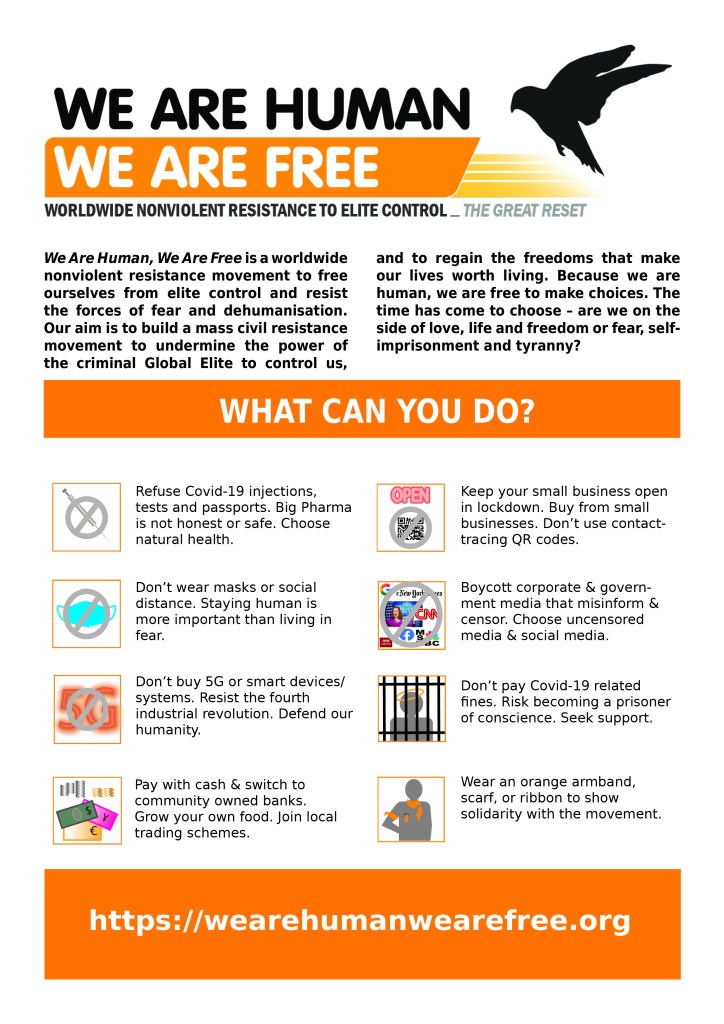
If you have the courage to strategically resist the ‘Great Reset’ and its related agendas, you are welcome to participate in the ‘We Are Human, We Are Free’ campaign which identifies a list of 30 strategic goals for doing so.

In addition and more simply, you can download a one-page flyer that identifies a short series of crucial nonviolent actions that anyone can take. This flyer, now available in 16 languages (Czech, Danish, English, Finnish, French, German, Greek, Hebrew, Hungarian, Italian, Polish, Romanian, Russian, Serbian, Spanish & Slovak) with more languages in the pipeline, can be downloaded from here: ‘The 7 Days Campaign to Resist the Great Reset’.

If strategically resisting the ‘Great Reset’ (and related agendas) appeals to you, consider joining the ‘We Are Human, We Are Free’ Telegram group (with a link accessible from the website).

Finally, while the timeframe for this to make any difference is now in doubt, if you want to raise children who are powerfully able to investigate, analyze and act, you are welcome to make ‘My Promise to Children’.

Conclusion

Human freedom is on the verge of being lost. Forever.

If the Global Elite is successful in implementing its ‘Great Reset’ agenda, everything that humans value will be taken from us including, in many cases, our life.

The evidence on this issue is now overwhelming and it is virtually impossible to keep track of all of it once you start to investigate it.

And given the rapidly advancing technological elements of the Elite coup, as well as the ongoing destruction of food and energy supply chains, time is now very short.

Do you have the courage to act on this by resisting strategically?

Robert Burrowes, Ph.D. is a member of the TRANSCEND Network for Peace Development Environment and has a lifetime commitment to understanding and ending human violence. He has done extensive research since 1966 in an effort to understand why human beings are violent and has been a nonviolent activist since 1981. He is the author of Why Violence? Websites: (We Are Human, We Are Free) (Charter)  (Flame Tree Project)  (Songs of Nonviolence) (Nonviolent Campaign Strategy) (Nonviolent Defense/Liberation Strategy(Robert J. Burrowes) (Feelings First) Email: flametree@riseup.net

The Worst Economic Gloom In 50 Years

By Michael Snyder

Source: Activist Post

We haven’t seen anything like this in decades.  Energy prices are soaring to unprecedented heights.  Food shortages in some parts of the world are starting to become quite severe.  Rampant inflation is out of control all over the globe.  Meanwhile, economic activity is slowing down everywhere that you look.  Some are comparing this current crisis to the “stagflation” of the 1970s, but I believe that is a far too optimistic assessment.  Just about everyone can see that economic conditions are rapidly deteriorating, and there is a tremendous amount of alarm about what the months ahead will bring.

According to a brand new Wall Street Journal-NORC survey that was just released, the percentage of Americans that believe that the state of the U.S. economy is “poor or not so good” is 83 times larger than the percentage of Americans who believe that the state of the U.S. economy is “excellent”…

A severe pessimism grips the U.S. economy and Americans report the highest level of dissatisfaction with their financial situation in at least half a century, poll results released Monday show.

Eighty-three percent of Americans describe the state of the economy as poor or not so good, according to a Wall Street Journal-NORC Poll. Only one percent describe the economy as “excellent.”

I would like to talk to someone from the one percent of Americans who still believe that the U.S. economy is in “excellent shape”.

To me, it is always fascinating to find someone who can completely deny reality even when all of the evidence points in the other direction.

The same survey found that the percentage of Americans who are “not at all satisfied with their financial condition” is the highest in at least 50 years

Thirty-five percent said they are not at all satisfied with their financial condition, the highest level of dissatisfaction since NORC began asking the question every few years starting in 1972.

Sixty-three percent of Americans say they are extremely or very concerned about the price of gas. Fifty-four percent say they are extremely or very concerned about the impact of high grocery prices on their household’s financial situation. Just 13 percent say they not very or not at all concerned about gas prices and 19 percent about grocery prices.

In other words, this is the gloomiest that Americans have been about their own personal finances in at least five decades.

Wow.

One of the big reasons why people feel this way is because the price of just about everything is going up.

In particular, the price of gasoline has been making national headlines just about every day.  On Tuesday, it set another brand new record

The national average price of gas is now $4.955, reflecting an over three-cent jump overnight, 28-cent rise in the last week, and nearly 64-cent rise in the last month. Diesel also hit another record on Tuesday, reaching $5.719.

Currently, 16 states are experiencing an average price of gas of $5.00 or more. That includes Maine ($5.023), Massachusetts ($5.21), New Jersey ($5.032), Pennsylvania ($5.031), Michigan ($5.214), Ohio ($5.061), Indiana ($5.234), Illinois ($5.532), Idaho ($5.025), Alaska ($5.469), Hawaii ($5.493), Washington ($5.489), Oregon ($5.485), Nevada ($5.564), Arizona ($5.181), and California ($6.390). California’s Mono County appears to be reporting the highest gas price average in the Golden State — $7.213.

Unfortunately, there is a growing consensus among the experts that this is just the beginning.  Here is one example

With the summer travel season just getting underway, demand for gasoline, coupled with the cut-off of Russian oil shipments due to the war in Ukraine, is sending oil prices higher on global markets.

The national average for gasoline could be close to $6 by later this summer according to Tom Kloza, global head of energy analysis for the OPIS, which tracks gas prices for AAA.

And here is another example

GasBuddy head of petroleum analysis Patrick De Haan provided insight into record-high gas prices, warning on Wednesday that “we’re going to be swimming in these high prices for a while.”

Speaking on “Varney & Co.” on Wednesday, De Haan also revealed his forecasts for how high prices at the pump will climb, arguing that they could reach a national average of $6 a gallon in the coming months, but “what seems like more of a guarantee is that $5 mark.”

Others are even more pessimistic.  In fact, the head of commodity trading giant Trafigura just warned that the price of oil could actually make a “parabolic ” move in the months ahead.

Needless to say, energy prices have a domino effect throughout the entire economy.  When commentator Anthony B. Sanders contacted moving companies about his coming move out of state, he could hardly believe the quotes that he was given

As I line up my move from Fairfax VA to Columbus OH, I am getting a variety of quotes from moving companies. And wow! The cost of moving using a national moving company for a 4 bedroom house is $15,000 to $20,500. That includes International, North American and Bekins.

One of the reasons for the high cost of moving is the massive increase in diesel fuel used for trucking. Diesel fuel under Biden has risen 117%. And since it was revealed that natural gas often is used for electric charging stations, and NATGAS is up 281% under Biden (but there aren’t many electric moving trucks yet).

Could you imagine paying $20,000 to move from Virginia to Ohio?

In the old days, you could purchase your own new vehicle for that much money.

In this crazy environment, some companies are attempting to hide inflation by shrinking their package sizes

“Joining the parade of downsized products is cereal stalwart Honey Bunches of Oats, which has seen the weight of its standard box, previously 14.5 ounces, lessen to 12 ounces — a reduction of roughly 17 percent,” the U.K. paper said.

Angel Soft toilet paper has also reduced its size from 425 sheets per roll to 320, while Bounty paper towels have cut their rolls from 165 sheets per roll to 147 late last year. Gatorade also cut its bottle size from 32 ounces to 28 ounces.

Do they actually believe that we will not notice that the packages have changed?

And this isn’t just happening here in the United States.  At this point, this is taking place all over the globe

In the U.S., a small box of Kleenex now has 60 tissues; a few months ago, it had 65. Chobani Flips yogurts have shrunk from 5.3 ounces to 4.5 ounces. In the U.K., Nestle slimmed down its Nescafe Azera Americano coffee tins from 100 grams to 90 grams. In India, a bar of Vim dish soap has shrunk from 155 grams to 135 grams.

Our standard of living is falling with each passing day, and that process is only going to accelerate during the second half of this year.

In a desperate attempt to keep living the way that they always have, many Americans are turning to their credit cards at an alarming rate.

Needless to say, that is only a short-term solution.

And at the same time, overall economic activity continues to slow down

A closely followed measurement from the Atlanta Federal Reserve Bank suggests the economy could be headed for a second-quarter decline in gross domestic product, the broadest measure of goods and services produced in a country. The GDPNow tracker shows the economy grew at an annualized pace of just 0.9% in the spring, a steep decline from its previous estimate of 1.3% on June 1.

If U.S. GDP is actually negative for the second quarter, that will be two quarters in a row, and that will mean that we are officially in a recession right now.

But what we are heading into in 2023 and beyond is not going to be just a “recession”.

Ultimately, we are heading into the sort of “nightmare scenario” that I have warned about for years.

It took decades of very foolish decisions for us to reach this point, and our leaders in Washington continue to make very foolish decisions.

So the truth is that there are no long-term solutions in sight.

Only pain.

So if the American people are this upset about the economy now, how will they be feeling six months down the road?

America, Meet Your New Dictator-in-Chief: The President’s Secret, Unchecked Powers

By John W. Whitehead & Nisha Whitehead

Source: The Rutherford Institute

“Life, liberty, and the pursuit of happiness have given way to permanent crisis management: to policing the planet and fighting preventative wars of ideological containment, usually on terrain chosen by, and favorable to, our enemies. Limited government and constitutional accountability have been shouldered aside by the kind of imperial presidency our constitutional system was explicitly designed to prevent.”— David C. Unger, The Emergency State: America’s Pursuit of Absolute Security at All Costs

America, meet your new dictator-in-chief.

As the New York Times reports, “Newly disclosed documents have shed a crack of light on secret executive branch plans for apocalyptic scenarios—like the aftermath of a nuclear attack—when the president may activate wartime powers for national security emergencies.”

The problem, of course, is that we have become a nation in a permanent state of emergency.

Power-hungry and lawless, the government has weaponized one national crisis after another in order to expand its powers and justify all manner of government tyranny in the so-called name of national security.

The seeds of this present madness were sown almost two decades ago when George W. Bush stealthily issued two presidential directives that granted the president the power to unilaterally declare a national emergency, which is loosely defined as “any incident, regardless of location, that results in extraordinary levels of mass casualties, damage, or disruption severely affecting the U.S. population, infrastructure, environment, economy, or government functions.

Comprising the country’s Continuity of Government (COG) plan, these directives (National Security Presidential Directive 51 and Homeland Security Presidential Directive 20) provide a skeletal outline of the actions the president will take in the event of a “national emergency.”

Just what sort of actions the president will take once he declares a national emergency can barely be discerned from the barebones directives. However, one thing is clear: in the event of a national emergency, the COG directives give unchecked executive, legislative and judicial power to the president.

The country would then be subjected to martial law by default, and the Constitution and the Bill of Rights would be suspended.

Essentially, the president would become a dictator for life.

It has happened already.

As we have witnessed in recent years, that national emergency can take any form, can be manipulated for any purpose and can be used to justify any end goal—all on the say so of the president.

The emergency powers that we know about which presidents might claim during such states of emergency are vast, ranging from imposing martial law and suspending habeas corpus to shutting down all forms of communications, including implementing an internet kill switch, and restricting travel.

Yet according to documents recently obtained by the Brennan Center, there may be many more secret powers that presidents may institute in times of so-called crisis without oversight from Congress, the courts, or the public.

It doesn’t even matter what the nature of the crisis might be—civil unrest, the national emergencies, “unforeseen economic collapse, loss of functioning political and legal order, purposeful domestic resistance or insurgency, pervasive public health emergencies, and catastrophic natural and human disasters”—as long as it allows the government to justify all manner of government tyranny in the name of so-called national security.

The war on COVID-19, the war on terror, the war on drugs, the war on illegal immigration: all of these programs started out as responses to pressing national concerns and have since become weapons of compliance and control in the police state’s hands.

Deploying the same strategy it used with 9/11 to acquire greater powers under the USA Patriot Act, the police state—a.k.a. the shadow government, a.k.a. the Deep State—has been planning and preparing for such crises for years now, quietly assembling a wish list of presidential lockdown powers that could be trotted out and approved at a moment’s notice.

Indeed, the Trump Administration even asked Congress to allow it to suspend parts of the Constitution whenever it deems it necessary during the COVID-19 crisis and “other” emergencies. The Department of Justice (DOJ) went so far as to quietly trot out and test a long laundry list of terrifying powers that override the Constitution.

We’re talking about lockdown powers (at both the federal and state level): the ability to suspend the Constitution, indefinitely detain American citizens, bypass the courts, quarantine whole communities or segments of the population, override the First Amendment by outlawing religious gatherings and assemblies of more than a few people, shut down entire industries and manipulate the economy, muzzle dissidents, “stop and seize any plane, train or automobile to stymie the spread of contagious disease,” reshape financial markets, create a digital currency (and thus further restrict the use of cash), determine who should live or die.

These are powers the police state would desperately like to make permanent.

In such a climate, the American president becomes dictator with permanent powers: imperial, unaccountable and unconstitutional.

Bear in mind that the powers the government officially asked Congress to recognize and authorize barely scratch the surface of the far-reaching powers the government has already unilaterally claimed for itself.

Unofficially, the police state with the president at its helm has been riding roughshod over the rule of law for years now without any pretense of being reined in or restricted in its power grabs by Congress, the courts or the citizenry.

Although the Constitution invests the President with very specific, limited powers, in recent years, American presidents have claimed the power to completely and almost unilaterally alter the landscape of this country for good or for ill.

The powers amassed by each successive president through the negligence of Congress and the courts—powers which add up to a toolbox of terror for an imperial ruler—empower whoever occupies the Oval Office to act as a dictator, above the law and beyond any real accountability.

As law professor William P. Marshall explains, “every extraordinary use of power by one President expands the availability of executive branch power for use by future Presidents.”

Moreover, it doesn’t even matter whether other presidents have chosen not to take advantage of any particular power, because “it is a President’s action in using power, rather than forsaking its use, that has the precedential significance.”

In other words, each successive president continues to add to his office’s list of extraordinary orders and directives, expanding the reach and power of the presidency and granting him- or herself near dictatorial powers.

All of the imperial powers amassed by Barack Obama and George W. Bush—to kill American citizens without due process, to detain suspects indefinitely, to strip Americans of their citizenship rights, to carry out mass surveillance on Americans without probable cause, to suspend laws during wartime, to disregard laws with which he might disagree, to conduct secret wars and convene secret courts, to sanction torture, to sidestep the legislatures and courts with executive orders and signing statements, to direct the military to operate beyond the reach of the law, to operate a shadow government, and to act as a dictator and a tyrant, above the law and beyond any real accountability—were inherited by Donald Trump and passed along to Joe Biden.

These presidential powers—acquired through the use of executive orders, decrees, memorandums, proclamations, national security directives and legislative signing statements and which can be activated by any sitting president—enable past, president and future presidents to operate above the law and beyond the reach of the Constitution.

These are the powers that continue to be passed along to each successive heir to the Oval Office, the Constitution be damned.

This is what you might call a stealthy, creeping, silent, slow-motion coup d’état.

From Clinton to Bush, Obama to Trump, and now Biden, it’s as if we’ve been caught in a time loop, forced to re-live the same abuses over and over again: the same assaults on our freedoms, the same disregard for the rule of law, the same subservience to the Deep State, and the same corrupt, self-serving government that exists only to amass power, enrich its shareholders and ensure its continued domination.

We’ve been losing our freedoms so incrementally for so long—sold to us in the name of national security and global peace, maintained by way of martial law disguised as law and order, and enforced by a standing army of militarized police and a political elite determined to maintain their powers at all costs—that it’s hard to pinpoint exactly when it all started going downhill, but “we the people” are paying the price for it now.

We are paying the price every day that we allow the government to continue to wage its war on the American People, a war that is being fought on many fronts: with bullets and tasers, with surveillance cameras and license readers, with intimidation and propaganda, with court rulings and legislation, with the collusion of every bureaucrat who dances to the tune of corporate handouts while on the government’s payroll, and most effectively of all, with the complicity of the American people, who continue to allow themselves to be easily manipulated by their politics, distracted by their pastimes, and acclimated to a world in which government corruption is the norm.

Unless something changes in the way we deal with these ongoing, egregious abuses of power, the predators of the police state will continue to wreak havoc on our freedoms, our communities, and our lives.

If we continue down this road, there can be no surprise about what awaits us at the end.

After all, it is a tale that has been told time and again throughout history about how easy it is for freedom to fall and tyranny to rise, and it often begins with one small, seemingly inconsequential willingness on the part of the people to compromise their principles and undermine the rule of law in exchange for a dubious assurance of safety, prosperity and a life without care.

Unfortunately, the process of unseating a dictator and limiting the powers of the presidency is far from simple but at a minimum, it must start with “we the people.”

For starters, as I make clear in my book Battlefield America: The War on the American People and in its fictional counterpart The Erik Blair Diaries, we must recalibrate the balance of power.

Start locally—in your own communities, in your schools, at your city council meetings, in newspaper editorials, at protests—by pushing back against laws that are unjust, police departments that overreach, politicians that don’t listen to their constituents, and a system of government that grows more tyrannical by the day.

What we desperately need is a concerted, collective commitment to the Constitution’s principles of limited government, a system of checks and balances, and a recognition that they—the president, Congress, the courts, the military, the police, the technocrats and plutocrats and bureaucrats—answer to and are accountable to “we the people.”

This will mean that Americans will have to stop letting their personal politics and party allegiances blind them to government misconduct and power grabs.

It will mean holding all three branches of government accountable to the Constitution (i.e., vote them out of office if they abuse their powers).

And it will mean calling on Congress to put an end to the use of presidential executive orders, decrees, memorandums, proclamations, national security directives and legislative signing statements as a means of getting around Congress and the courts.

In other words, we’ve got to start making both the president and the police state play by the rules of the Constitution.

The REAL agenda behind the created food crisis

The created food crisis, whether real or a smoke-and-mirrors psy-op, is all about tearing down the global food system and “building back better” – a new dystopian food system built by corporate monoliths and rigidly controlled in the name of the greater good.

By Kit Knightly

Source: Off-Guardian

We’re in the early stages of a food crisis.

The press has been predicting this for years, but  up until now it always appeared to be nothing more than fearmongering, designed to worry or distract people, but the signs are there that this time, to quote Joe Biden, it “is going to be real”.

Nobody knows how bad it could get, except the people who are creating it.

Because the evidence is pretty clear, it is being deliberately & cold-bloodedly created. We’ve been documenting it for months.

We have Russia’s “special operation” in Ukraine driving up the price of staple foods, wheat and sunflower oil, as well as fertiliser.

We have the sudden “bird flu outbreak” driving up the price of poultry and eggs.

The soaring price of oil is driving up the cost of food distribution.

The inflation caused by huge influxes of fiat currency means families are spending more money on less food.

And as all this is happening, the US and UK (and maybe others, we don’t know) are literally paying farmers not to farm.

It’s pretty clear this is The Great Reset: Food Edition. The lockdown melody with slightly different lyrics. A process of breaking down the structures already in place so we can “build back better” with a more controlled and more corporatised food system

Just as the Covid “pandemic” was said to highlight “weaknesses in the multilateral system”, so this food crisis will show that our “unstable food systems are in need of reform” and we need to ensure our “food security”…or a thousand variations on that theme.

That’s not supposition. They already started, over a year ago.

The Journal of Agriculture, Food Systems & Community Developments published a paper in February 2021 titled:

Dismantling and rebuilding the food system after COVID-19: Ten principles for redistribution and regeneration

In an interview from July last year, Ruth Richardson the Executive Director of the NGO Global Alliance for the Future of Food literally said:

Our Dominant Food System Needs to Be Dismantled and Rebuilt”

Later, in September 2021, the UN convened the first-ever “Food Systems Summit”, whose mission statement included the line:

Rebuilding the food systems of the world will also enable us to answer the UN Secretary-General’s call to “build back better” from COVID-19.

Writing in the Guardian two weeks ago, George Monbiot, weathervane for every deep state agenda, states with his trademark lack of subtlety:

The banks collapsed in 2008 – and our food system is about to do the same…The system has to change.

But what does “change” and “rebuilt” actually mean in this context?

Well, that’s no mystery, they’ve been talking it up for years.

Almost all of these are stories from just the past month or so, many of them talking points at the World Economic Forum’s Davos Conference.

As is almost always the case, the problem to which they’re currently “reacting” already has a series of pre-ordained solutions.

Just as we saw lockdowns break the economy to pieces whilst the billionaire class land record profits whilst corporate megaliths expanded their monopolies, so too will any proposed food security policies end up benefiting the already mega-rich or installing infrastructure for corporate control.

They just announced the building of the largest “cultured meat factory” in the world. Fake meat, of course, can’t be raised at home and is subject to patented processes of creation. Genetically edited or modified plants and animals are likewise subject to patents.

Supranational companies, with profits larger than the budget of some nations, are developing carbon footprint tracker apps which reward people for making the “right decisions”. That could easily be applied to food.

Bill Gates has quietly become the largest owner of agricultural land in the United States. Land on which he can grow new Frankencrops, or which the US government will pay him not to use.

The play is clear: Right now they’re getting ready to tear all our old food systems down, with the stated aim of building them back better.

But better for them, not us.

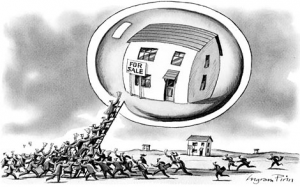
Is Housing a Bubble That’s About to Crash?

By Charles Hugh Smith

Source: Of Two Minds

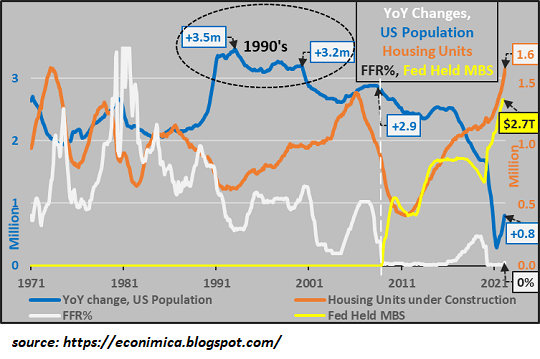
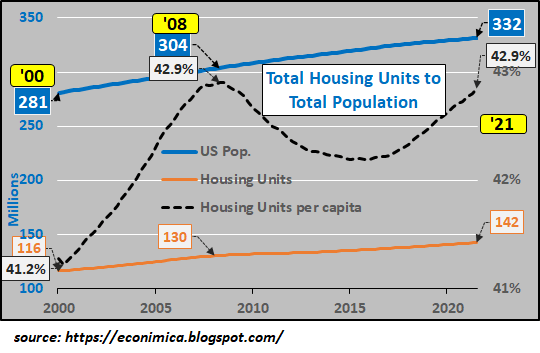
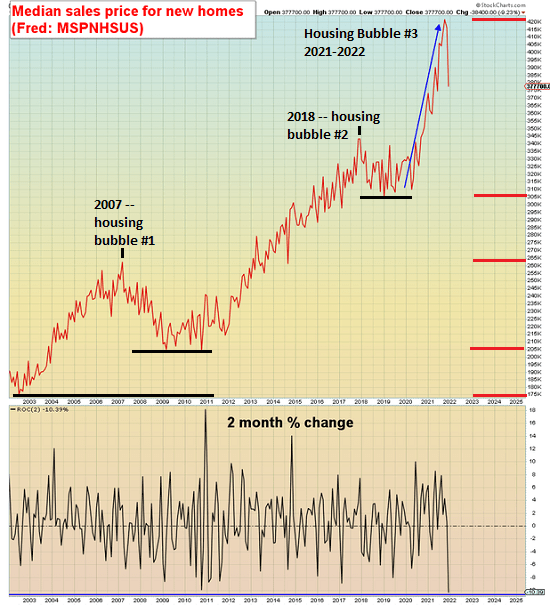
Are we heading into another real estate bubble / crash? Those who say “no” see the housing shortage as real, while those who say “yes” see the demand as a reflection of the Federal Reserve’s artificial goosing of the housing market via its unprecedented purchases of mortgage-backed securities and “easy money” financial conditions.

My colleague CH at econimica.blogspot.com recently posted charts calling this assumption into question. The first chart (below) shows the U.S. population growth rate plummeting as housing starts soar, and the second chart shows housing unit per capita, which has just reached the same extreme as the 2008 housing bubble.

Demographics and housing do not reflect a housing shortage nationally, though there could be scarcities locally, of course, and other factors such as thousands of units being held off the market as short-term rentals or investments by overseas buyers who have no interest in renting their investment dwellings.

On a per capita basis, housing has reached previous bubble levels. That suggests housing shortages are artificial or local, not structural.

Next, let’s consider how the current housing bubble differs from previous bubbles in the late 1970s and 2000s. In my view, the previous bubbles were driven by demographics, inflation and monetary policy: in the late 70s, the 65 million-strong Baby Boom generation began buying their first homes, pushing demand higher while inflation soared, making real-world assets such as housing more desirable.

Once the Federal Reserve pushed interest rates to 18%, mortgage rates rose in lockstep and housing crashed as few could afford sky-high housing prices at sky-high mortgage rates.

The housing bubble of 2007-08 was largely driven by declines in mortgage rates (as the Fed pursued an “easy money” policy to escape the negative effects of the Dot-Com stock market bubble crash) and a loosening of credit/mortgage standards. These fueled a bubble that morphed into a speculative free-for-all of no-down payment and no-document loans.

This decline in the cost of borrowing money (mortgage rates) enabled a sharp rise in the price of housing, a speculative boom that was greatly accelerated by “innovations” in the mortgage market such as zero down payments loans, interest-only loans, home equity loans, and no-document “liar loans”–mortgages underwritten without the usual documentation of income and net worth.

These forces generated a speculative frenzy of house-flipping, leveraging the equity in the family home to buy two or three homes under construction and selling them before they were even completed for fat profits, and so on.

Needless to say, the pool of potential buyers expanded tremendously when people earning $25,000 a year could buy $500,000 houses on speculation.

Once the bubble popped, the pool of buyers shrank along with the home equity.

If we study this chart below of new home prices (courtesy of Mac10), we can see that the 21st century’s Bubble #2 rose as the Federal Reserve pushed mortgage rates far below historic norms. Once rates reached a bottom, the 7-year inflation of home prices (from 2011 to 2018) began rolling over.

This deflation of home prices was reversed by the pandemic recession, as the Fed’s vast expansion of credit and mortgage-buying, which pushed mortgage rates to new lows. Trillions of dollars in new credit and cash stimulus ignited a speculative frenzy in stocks, bonds and real estate, a frenzy which drove bubble #3 to extraordinary heights.

All this unprecedented fiscal and monetary stimulus also ignited inflation, and so rates are rising in response. Bubble #3 is already deflating, at least by the measure of new home prices.

But the current bubble has a number of dynamics that weren’t big factors in previous bubbles.

One is the rise of remote work. Many people have been working remotely since the late 1990s enabled Internet-based work, but the pandemic greatly increased the pool of employers willing to accept remote work as a permanent feature of employment.

This trend has been well documented, but the consequences are still unfolding: remote workers are no longer trapped in unaffordable, congested cities and suburbs.

Several other trends have attracted much less attention, but I see them as equally consequential.

1. Housing in many urban zones are out of reach of all but the top 10% without extraordinary sacrifice, and now that employment isn’t necessarily tied to urban zones, the bottom 90% of young people without family wealth or high incomes are coming to realize the benefits of urban living are not worth the extreme sacrifices needed to buy an overvalued house.

A middle-class life–home ownership, financial security, leisure and surplus income to invest in one’s family and well-being–is no longer affordable for the majority of young Americans.

Few are willing to concede this because it reveals the neofeudal nature of American life. Those who bought homes in coastal urban zones 20+ years ago are wealthy due to soaring housing valuations while young people can’t even afford the rent, much less buying a house.

If you’re not making $250,000 or more a year as a couple, the only hope for a middle-class life that includes leisure and some surplus income to invest is top move to some place with much lower housing and other costs. That place is rural America.

2. The benefits of urban living are deteriorating while the sacrifices and downsides are increasing. Urban living is fun if you’re wealthy, not so fun if you don’t have plenty of surplus income to spend.

Urban problems such as homelessness, traffic congestion and crime are endemic and unresolvable, though few are willing to state the obvious. Americans are expected to be optimistic and to count on some new whiz-bang technology to solve all problems.

Unfortunately, problems generated by dysfunctional, overly complex institutions, corruption and unaffordable costs can’t be solved by some new technology, and so the decay of cities will only gather momentum.

The hope that billions of federal stimulus funding would solve these problems is about to encounter reality as the funds dry up and all the problems remain or have actually expanded despite massive “investments” in solutions.

Few analysts have looked at the finances of high-cost cities. The decline in bricks-and-mortar retail, rising crime, soaring junk fees, rents and property taxes have all made urban small business insanely costly and therefore risky.

Small businesses are the core sources of employment and taxes. As high costs, crime, etc. choke small businesses, employment and tax revenues drop and commercial real estate sits empty, generating decay and defaults.

Once office and retail space is no longer affordable or necessary, commercial real estate crashes in value as owners who bought at the top default and go bankrupt.

People need shelter but they don’t need office space or to start a bricks-and-mortar retail business.

As urban finances unravel, cities won’t have the funding to run their bloated, inefficient, overly complex and unaccountable bureaucracies.

3. In geopolitics, we speak of the core and the periphery. Empires have a core (Rome and central Italy in the Roman Empire) and a periphery (Britain, North Africa, Egypt, the Levant).

As finances and trade decay and costs soar, the periphery is surrendered to maintain the core.

In urban zones, the same dynamic will become increasingly visible: the peripheral neighborhoods will be underfunded to continue protecting the wealthy enclaves.

Crime will skyrocket in the periphery even as residents of the wealthy enclaves see little decay in their neighborhoods.

This asymmetry–already extreme–will drive social unrest and disorder. This is a self-reinforcing feedback: as the periphery neighborhoods deteriorate, the remaining businesses flee and the smart money sells and moves away.

Tax revenues plummet and city services decay even further, persuading hangers-on to move before it gets even worse. Cities compensate for the lower revenues by increasing taxes on the remaining residents and cutting services.

Each turn of the screw triggers more closures and selling and fewer tax revenues.

4. Dependency chains will become increasingly consequential: the greater a city’s dependency on essentials trucked/shipped from hundreds or thousands of of kilometers/miles away, the more prone that city will be to disruptions of essentials: food, energy, materials and infrastructure.

Though few are willing to dwell on such vulnerabilities, most cities are totally dependent on diesel fueled fleets of trucks, rail and jet fuel for luxuries flown in from afar for virtually all goods. Cities produce very little in the way of essentials such as food and energy.

The past reliability of long supply chains has instilled a confidence that these supply chains stretching thousands of kilometers and miles are unbreakable and forever. They aren’t, and the initial disruptions will be a great shock to Americans who believe full gas tanks and fully stocked store shelves are their birthright.

5. As I’ve explained in my new book Global Crisis, National Renewalthe era of cheap, reliable abundance has drawn to a close and now we are entering an era of scarcity in essentials.

Another reality few discuss is the relative stability of global weather over the past 40 years. As weather becomes less reliable, so too do crop yields and food supplies.

Globalization has poured capital into expanding acreage under cultivation to the point that the planet’s forests are being decimated to grow more soy to feed animals to be slaughtered for human consumption.

On the margins, land that was once productive has been lost to desertification. Fresh water aquifers have been drained and glaciers feeding rivers are melting away. Soil fertility has declined even as fertilizer use has expanded.

The low-hanging fruit of GMO seeds, fertilizers, insecticides, herbicides and Green Revolution hybrids have all been plucked. The gains have been reaped but now the downsides of these dependencies are becoming increasingly consequential: fertilizer costs are rising fast, insects and diseases are evading chemicals and vaccines, and the vulnerabilities of mono-crop, industrialized agriculture and animal husbandry threaten to cascade into crop failures, soaring prices and shortages.

6. This will have two consequences: rural incomes which have been falling for decades due to globalization (i.e. bringing in cheap food from places with no environmental standards, cheap labor and few taxes / social costs) will start rising sharply, fueling a reversal in the long decline of rural communities based on agricultural income.

The soaring costs of essentials will reduce the disposable income of the bottom 90%, reducing the money they’ll have to spend on eating out, retail shopping, etc.–all the surplus spending that drives cities’ economies and tax revenues.

Few (if any) commentators forecast a cyclical reversal of the demographic trend of people moving from rural locales to cities. I think this trend has already reversed and will gather momentum as cities become increasingly unlivable, disposable incomes decline as scarcities push prices higher and people flee for lower cost, more secure environs.

7. As I often note, following what the super-wealthy are doing is a pretty sound investment strategy because the super-wealthy spend freely to buy the best advice and are highly motivated to protect their wealth.

People who live in well-known, highly desirable rural towns (Telluride, Jackson Hole, Lake Tahoe, etc.) are describing a feeding frenzy of wealthy urbanites buying multi-million dollar homes. Small cities such as Bozeman, MT and Ashville, NC are experiencing a flood of new residents that is straining infrastructure and pushing housing prices out of reach for local residents with average wages.

8. Rural towns in the U.S., Italy, Japan and even Switzerland are trying to attract new residents with offers of free land, subsidized rent, low cost homes, etc. This shows that the trends are global and not limited to any one nation. Would you take free land in rural America?

The decay of urban life isn’t yet consequential enough to push people into making a major move, but once someone has been robbed, repeatedly found human feces on their doorstep or experienced scarcities that trigger the madness of crowds, the decision to leave becomes much, much easier.

Some cities will manage the decline of employment and tax revenues more gracefully than others. Most will suffer from the dynamic I’ve often described on the blog: the Ratchet Effect. Costs move effortlessly higher as tax revenues have increased in one speculative bubble after another, but once revenues drop, cities have no mechanisms or political constituency to manage a sharp, long-term decline in revenues.

They then become prone to the other dynamic I’ve described, the Rising Wedge Breakdown (see chart below): as agencies and institutions become sclerotic, unaccountable and self-serving, even a relatively modest cut in revenues triggers institutional collapse, as the system requires 100% funding to function. A 10% reduction doesn’t cause a 10% decline in service, it causes an 50% decline in service, on the way to complete dysfunction.

Few believe cities can unravel, but remote work, geographic arbitrage (discussed below), tightening credit, rising crime, the decline of commercial real estate, end of massive stimulus, scarcities, the madness of crowds, the decline of civic services and amenities and an insanely high cost of living all have consequences and second-order effects.

What were beneficial synergies become fatal synergies as dynamics reverse and begin reinforcing each other.

So let’s put all this together.

A. The cycle of declining interest rates and inflation has ended and a cycle of much higher interest and mortgage rates and inflation is beginning. Higher mortgages rates will depress housing prices as only the highest income households will be able to afford today’s prices once mortgage rates rise.

B. The decay of urban finances and quality of life will accelerate as stimulus ends, credit dries up and inflation decimates disposable income.

C. The stress of trying to make enough money to afford the high costs of city/suburban living as the real estate bubble pops and the benefits of city living decline will burn out increasing numbers of people who will have no choice but to find more affordable, more secure and more livable places.

D. While the wealthy have already secured second or third homes in the toniest desirable towns, there are still opportunities for lower cost, more secure residences in rural areas.

E. This migration, even at the margins, will further depress urban housing prices and push prices in desirable rural locales higher.

F. This migration will have regional, ethnic and cultural variations. For example, some African-Americans leaving the upper Midwest are finding favor with communities in the South where family, church and cultural ties beckon.

G. Correspondent John F. used the phrase geographic arbitrage which means earning money remotely in high-wage sectors while living some place that’s low cost and secure.

I wrote about this many years ago in my post about young Japanese maintaining a part-time remote-work gig while pursuing farming in rural communities: Degrowth Solutions: Half-Farmer, Half-X (July 19, 2014).

H. Though monetary / inflationary forces will pop housing prices based solely on low mortgage rates, this doesn’t mean housing everywhere will decline: as burned out urbanites seek lower cost, more secure and livable places in rural locales, homes in desirable towns and small cities could rise sharply because they’re starting from such low levels.

I. If urban areas decay rapidly, housing prices could plummet much faster than most people think possible.

When cities lose employment, tax revenues and desirability, they can go down fast. Property values can fall in half and then by 90%.

How is this possible? Supply and demand: if demand falls off a cliff, there won’t be buyers for thousands of homes that come on the market all at once. This is just like a stock market in which buyers disappear, as no one wants to buy an asset that’s rapidly losing value.

As I’ve noted many times, prices for assets are set on the margins: the last sale of a house resets the price for the entire neighborhood.

The stock market is easily manipulated by the big players, who can stop a slide in prices by buying huge chunks of stocks and call options. There are no equivalent forces which can stop a decline in housing prices.

And since rates will rise regardless of what the Federal Reserve does because global capital is demanding a real return above inflation, then the hope for lower mortgage rates to support bubble-level housing prices will be in vain.

How low could housing go? As explained above, there will likely be very asymmetric declines and increases in housing valuations going forward. But on a technical-analysis level, we can anticipate a general decline to previous lows, first to the 2019 lows and then to the 2011 lows.

Some analysts believe inflation will funnel capital into housing as investors seek assets that will go up with inflation, but this is a murky forecast: the bottom 90% of American households are already priced out of coastal housing, so inflation only robs their wages of purchasing power. They don’t have any hope of buying a house anywhere near current prices.

Corporations are buying thousands of houses for the rental income, but once all the stimulus runs out and the excesses of speculation reverse, they’ll find few renters can afford their sky-high rents. At that point corporate buyers become corporate sellers, but they won’t find buyers willing or able to pay their asking prices, which are based on bubble pricing, not reality.

All these swirling currents will affect housing valuations in different places differently. Some areas could see 50% declines while others see 50% increases, regardless of mortgage rates or Fed policy.

What will become most desirable is a low cost of living, security and livability, which includes community, reduced dependency on long supply chains and local production of essentials.

We are all prone to believing the recent past is a reliable guide to the future. But in times of dynamic reversals, the past is an anchor thwarting our progress, not a forecast.

No Way Out but War

Permanent war has cannibalized the country. It has created a social, political, and economic morass. Each new military debacle is another nail in the coffin of Pax Americana.

By Chris Hedges

Source: ScheerPost


The United States, as the near unanimous vote to provide nearly $40 billion in aid to Ukraine illustrates, is trapped in the death spiral of unchecked militarism. No high speed trains. No universal health care. No viable Covid relief program. No respite from 8.3 percent inflation. No infrastructure programs to repair decaying roads and bridges, which require $41.8 billion to fix the 43,586 structurally deficient bridges, on average 68 years old. No forgiveness of $1.7 trillion in student debt. No addressing income inequality. No program to feed the 17 million children who go to bed each night hungry. No rational gun control or curbing of the epidemic of nihilistic violence and mass shootings. No help for the 100,000 Americans who die each year of drug overdoses. No minimum wage of $15 an hour to counter 44 years of wage stagnation. No respite from gas prices that are projected to hit $6 a gallon.

The permanent war economy, implanted since the end of World War II, has destroyed the private economy, bankrupted the nation, and squandered trillions of dollars of taxpayer money. The monopolization of capital by the military has driven the US debt to $30 trillion, $ 6 trillion more than the US GDP of $ 24 trillion. Servicing this debt costs $300 billion a year. We spent more on the military, $ 813 billion for fiscal year 2023, than the next nine countries, including China and Russia, combined.

We are paying a heavy social, political, and economic cost for our militarism. Washington watches passively as the U.S. rots, morally, politically, economically, and physically, while China, Russia, Saudi Arabia, India, and other countries extract themselves from the tyranny of the U.S. dollar and the international Society for Worldwide Interbank Financial Telecommunication (SWIFT), a messaging network banks and other financial institutions use to send and receive information, such as money transfer instructions. Once the U.S. dollar is no longer the world’s reserve currency, once there is an alternative to SWIFT, it will precipitate an internal economic collapse. It will force the immediate contraction of the U.S. empire shuttering most of its nearly 800 overseas military installations. It will signal the death of Pax Americana.

Democrat or Republican. It does not matter. War is the raison d’état of the state. Extravagant military expenditures are justified in the name of “national security.” The nearly $40 billion allocated for Ukraine, most of it going into the hands of weapons manufacturers such as Raytheon Technologies, General Dynamics, Northrop Grumman, BAE Systems, Lockheed Martin, and Boeing, is only the beginning. Military strategists, who say the war will be long and protracted, are talking about infusions of $4 or $5 billion in military aid a month to Ukraine. We face existential threats. But these do not count. The proposed budget for the Centers for Disease Control and Prevention (CDC) in fiscal year 2023 is $10.675 billion. The proposed budget for the Environmental Protection Agency (EPA) is $11.881 billion. Ukraine alone gets more than double that amount. Pandemics and the climate emergency are afterthoughts. War is all that matters. This is a recipe for collective suicide.

There were three restraints to the avarice and bloodlust of the permanent war economy that no longer exist. The first was the old liberal wing of the Democratic Party, led by politicians such as Senator George McGovern, Senator Eugene McCarthy, and Senator J. William Fulbright, who wrote The Pentagon Propaganda Machine. The self-identified progressives, a pitiful minority, in Congress today, from Barbara Lee, who was the single vote in the House and the Senate opposing a broad, open-ended authorization allowing the president to wage war in Afghanistan or anywhere else, to Ilhan Omar now dutifully line up to fund the latest proxy war. The second restraint was an independent media and academia, including journalists such as I.F Stone and Neil Sheehan along with scholars such as Seymour Melman, author of The Permanent War Economy and Pentagon Capitalism: The Political Economy of War. Third, and perhaps most important, was an organized anti-war movement, led by religious leaders such as Dorothy Day, Martin Luther King Jr. and Phil and Dan Berrigan as well as groups such as Students for a Democratic Society (SDS). They understood that unchecked militarism was a fatal disease.

None of these opposition forces, which did not reverse the permanent war economy but curbed its excesses, now exist. The two ruling parties have been bought by corporations, especially military contractors. The press is anemic and obsequious to the war industry. Propagandists for permanent war, largely from right-wing think tanks lavishly funded by the war industry, along with former military and intelligence officials, are exclusively quoted or interviewed as military experts. NBC’s “Meet the Press” aired a segment May 13 where officials from Center for a New American Security (CNAS) simulated what a war with China over Taiwan might look like. The co-founder of CNAS, Michèle Flournoy, who appeared in the “Meet the Press” war games segment and was considered by Biden to run the Pentagon, wrote in 2020 in Foreign Affairs that the U.S. needs to develop “the capability to credibly threaten to sink all of China’s military vessels, submarines and merchant ships in the South China Sea within 72 hours.” 

The handful of anti-militarists and critics of empire from the left, such as Noam Chomsky, and the right, such as Ron Paul, have been declared persona non grata by a compliant media. The liberal class has retreated into boutique activism where issues of class, capitalism and militarism are jettisoned for “cancel culture,” multiculturalism and identity politics. Liberals are cheerleading the war in Ukraine. At least the inception of the war with Iraq saw them join significant street protests. Ukraine is embraced as the latest crusade for freedom and democracy against the new Hitler. There is little hope, I fear, of rolling back or restraining the disasters being orchestrated on a national and global level.  The neoconservatives and liberal interventionists chant in unison for war. Biden has appointed these war mongers, whose attitude to nuclear war is terrifyingly cavalier, to run the Pentagon, the National Security Council, and the State Department.

Since all we do is war, all proposed solutions are military. This military adventurism accelerates the decline, as the defeat in Vietnam and the squandering of $8 trillion in the futile wars in the Middle East illustrate. War and sanctions, it is believed, will cripple Russia, rich in gas and natural resources. War, or the threat of war, will curb the growing economic and military clout of China.

These are demented and dangerous fantasies, perpetrated by a ruling class that has severed itself from reality. No longer able to salvage their own society and economy, they seek to destroy those of their global competitors, especially Russia and China. Once the militarists cripple Russia, the plan goes, they will focus military aggression on the Indo-Pacific, dominating what Hillary Clinton as secretary of state, referring to the Pacific, called “the American Sea.” 

You cannot talk about war without talking about markets. The U.S., whose growth rate has fallen to below 2 percent, while China’s growth rate is 8.1 percent, has turned to military aggression to bolster its sagging economy. If the U.S. can sever Russian gas supplies to Europe, it will force Europeans to buy from the United States. U.S. firms, at the same time, would be happy to replace the Chinese Communist Party, even if they must do it through the threat of war, to open unfettered access to Chinese markets. War, if it did break out with China, would devastate the Chinese, American, and global economies, destroying free trade between countries as in World War I. But that doesn’t mean it won’t happen.

Washington is desperately trying to build military and economic alliances to ward off a rising China, whose economy is expected by 2028 to overtake that of the United States, according to the UK’s Centre for Economics and Business Research (CEBR). The White House has said Biden’s current visit to Asia is about sending a “powerful message” to Beijing and others about what the world could look like if democracies “stand together to shape the rules of the road.” The Biden administration has invited South Korea and Japan to attend the NATO summit in Madrid.

But fewer and fewer nations, even among European allies, are willing to be dominated by the United States. Washington’s veneer of democracy and supposed respect for human rights and civil liberties is so badly tarnished as to be irrecoverable. Its economic decline, with China’s manufacturing 70 percent higher than that of the U.S., is irreversible. War is a desperate Hail Mary, one employed by dying empires throughout history with catastrophic consequences. “It was the rise of Athens and the fear that this instilled in Sparta that made war inevitable,” Thucydides noted in the History of the Peloponnesian War. 

A key component to the sustenance of the permanent war state was the creation of the All-Volunteer Force. Without conscripts, the burden of fighting wars falls to the poor, the working class, and military families. This All-Volunteer Force allows the children of the middle class, who led the Vietnam anti-war movement, to avoid service. It protects the military from internal revolts, carried out by troops during the Vietnam War, which jeopardized the cohesion of the armed forces.

The All-Volunteer Force, by limiting the pool of available troops, also makes the global ambitions of the militarists impossible. Desperate to maintain or increase troop levels in Iraq and Afghanistan, the military instituted the stop-loss policy that arbitrarily extended active-duty contracts. Its slang term was the backdoor draft. The effort to bolster the number of troops by hiring private military contractors, as well, had a negligible effect. Increased troop levels would not have won the wars in Iraq and Afghanistan but the tiny percentage of those willing to serve in the military (only 7 percent of the U.S. population are veterans) is an unacknowledged Achilles heel for the militarists.

“As a consequence, the problem of too much war and too few soldiers eludes serious scrutiny,” writes historian and retired Army Colonel Andrew Bacevich in After the Apocalypse: America’s Role in a World Transformed. “Expectations of technology bridging that gap provide an excuse to avoid asking the most fundamental questions: Does the United States possess the military wherewithal to oblige adversaries to endorse its claim of being history’s indispensable nation? And if the answer is no, as the post-9/11 wars in Afghanistan and Iraq suggest, wouldn’t it make sense for Washington to temper its ambitions accordingly?”

This question, as Bacevich points out, is “anathema.” The military strategists work from the supposition that the coming wars won’t look anything like past wars. They invest in imaginary theories of future wars that ignore the lessons of the past, ensuring more fiascos. 

The political class is as self-deluded as the generals. It refuses to accept the emergence of a multi-polar world and the palpable decline of American power. It speaks in the outdated language of American exceptionalism and triumphalism, believing it has the right to impose its will as the leader of the “free world.” In his 1992 Defense Planning Guidance memorandum, U.S. Under Secretary of Defense Paul Wolfowitz argued that the U.S. must ensure no rival superpower again arises. The U.S. should project its military strength to dominate a unipolar world in perpetuity. On February 19, 1998, on NBC’s “Today Show”, Secretary of State Madeleine Albright gave the Democratic version of this doctrine of unipolarity. “If we have to use force it is because we are Americans; we are the indispensable nation,” she said. “We stand tall, and we see further than other countries into the future.”

This demented vision of unrivaled U.S. global supremacy, not to mention unrivaled goodness and virtue, blinds the establishment Republicans and Democrats. The military strikes they casually used to assert the doctrine of unipolarity, especially in the Middle East, swiftly spawned jihadist terror and prolonged warfare. None of them saw it coming until the hijacked jets slammed into the World Trade Center twin towers. That they cling to this absurd hallucination is the triumph of hope over experience.

There is a deep loathing among the public for these elitist Ivy League architects of American imperialism. Imperialism was tolerated when it was able to project power abroad and produce rising living standards at home. It was tolerated when it restrained itself to covert interventions in countries such as Iran, Guatemala, and Indonesia. It went off the rails in Vietnam. The military defeats that followed accompanied a steady decline in living standards, wage stagnation, a crumbling infrastructure and eventually a series of economic policies and trade deals, orchestrated by the same ruling class, which deindustrialized and impoverished the country.

The establishment oligarchs, now united in the Democratic Party, distrust Donald Trump. He commits the heresy of questioning the sanctity of the American empire. Trump derided the invasion of Iraq as a “big, fat mistake.” He promised “to keep us out of endless war.” Trump was repeatedly questioned about his relationship with Vladimir Putin. Putin was “a killer,” one interviewer told him. “There are a lot of killers,” Trump retorted. “You think our country’s so innocent?” Trump dared to speak a truth that was to be forever unspoken, the militarists had sold out the American people.

Noam Chomsky took some heat for pointing out, correctly, that Trump is the “one statesman” who has laid out a “sensible” proposition to resolve the Russia-Ukraine crisis. The proposed solution included “facilitating negotiations instead of undermining them and moving toward establishing some kind of accommodation in Europe…in which there are no military alliances but just mutual accommodation.”

Trump is too unfocused and mercurial to offer serious policy solutions. He did set a timetable to withdraw from Afghanistan, but he also ratcheted up the economic war against Venezuela and reinstituted crushing sanctions against Cuba and Iran, which the Obama administration had ended. He increased the military budget. He apparently flirted with carrying out a missile strike on Mexico to “destroy the drug labs.” But he acknowledges a distaste for imperial mismanagement that resonates with the public, one that has every right to loath the smug mandarins that plunge us into one war after another. Trump lies like he breathes. But so do they.

The 57 Republicans who refused to support the $40 billion aid package to Ukraine, along with many of the 19 bills that included an earlier $13.6 billion in aid for Ukraine, come out of the kooky conspiratorial world of Trump. They, like Trump, repeat this heresy. They too are attacked and censored. But the longer Biden and the ruling class continue to pour resources into war at our expense, the more these proto fascists, already set to wipe out Democratic gains in the House and the Senate this fall, will be ascendant. Marjorie Taylor Greene, during the debate on the aid package to Ukraine, which most members were not given time to closely examine, said: “$40 billion dollars but there’s no baby formula for American mothers and babies.”

“An unknown amount of money to the CIA and Ukraine supplemental bill but there’s no formula for American babies,” she added. “Stop funding regime change and money laundering scams. A US politician covers up their crimes in countries like Ukraine.”

Democrat Jamie Raskin immediately attacked Greene for parroting the propaganda of Russian president Vladimir Putin.

Greene, like Trump, spoke a truth that resonates with a beleaguered public. The opposition to permanent war should have come from the tiny progressive wing of the Democratic Party, which unfortunately sold out to the craven Democratic Party leadership to save their political careers. Greene is demented, but Raskin and the Democrats peddle their own brand of lunacy. We are going to pay a very steep price for this burlesque.