Everyone Has Fallen for the Lies About Venezuela

By Lee Camp

Source: truthdig

There are three things I know for sure in this fanciful, sometimes inglorious experience we call life:

  1. You will never have a safety pin when you need one, and you will have thousands when you don’t need one.
  2. Wild animals are breathtakingly majestic until they’re crawling up your pant leg.
  3. A U.S. presidential administration will never admit that it invaded another country or backed a coup attempt in order to essentially steal the natural resources (oil) of said country.

This is why it was so very shocking last week when members of the Trump administration admitted they were backing a coup attempt in order to essentially steal the natural resources (oil) of another country.

That country is Venezuela. I’ll get back to this in a moment.

Let’s take a second to go over the big three. There are three things that seem to provoke the ornery United States into overthrowing or bringing down a foreign government, no matter how many innocent civilians may die in the process. (If enough die, the perpetrators often get nominated for a Nobel Peace Prize.) If your country has one of these things, the U.S. might screw with you. If your country has two of these things, the U.S. will definitely screw with you. If your country has three of these things, then look behind you, because the U.S. is currently screwing you:

1. Being socialist.

Pretty self-explanatory. If you don’t have the same economic system as we do, we treat it like you have candy and we’re not allowed to have any, so we slip razor blades in yours and tell everyone your candy kills people.

2. Dropping the U.S. dollar.

Iraq dropped the dollar. We invaded.
Syria dropped the dollar. We invaded.
Iran dropped the dollar. We want to invade.
Libya dropped the dollar. We invaded.

Pakistan dropped the dollar in trade with China, and the following day the U.S. added them to the list of countries violating religious freedom. (I guess you could argue they did indeed violate our religion: The dollar.)

Basically, we do NOT take kindly to countries dropping the dollar.

In unrelated news, Venezuela dropped the dollar.

3. Having oil or other natural resources the U.S. needs.

In case you were curious, Venezuela has the largest oil reserves in the known world. (But we haven’t checked northern Wyoming yet, because it’s a long, cold drive with nary a 7-11.)

So these are the three ACTUAL reasons the U.S. has created an attempted coup in Venezuela over the past several weeks. And right now, you are falling into one of two categories. Either you’re saying to yourself, “Of course those are the reasons. Those are the only reasons the U.S. ever tries to bring down governments.” OR you still have some strange, deep-rooted faith in our Pepsi-and-pharmaceutical-owned media outlets, and therefore you’re thinking, “That’s not true. The U.S. supports the opposition in Venezuela because we want to help those poor starving people.” But if that were accurate, we would be tripping over ourselves to help starving and sick people around the world. Instead we (oddly) only seek to help them when they have oil under their feet. And in fact, data has proven this true. A study a few years ago from the Universities of Portsmouth, Warwick and Essex found that foreign intervention in civil conflicts is 100 times more likely if the country has a great deal of oil, versus none.

So who is feeding the average American the idea that our involvement in Venezuela is about helping people? Only EVERY mainstream media channel in America—from MSNBC to Fox News to NPR to Bill fuckin’ Maher. It’s truly mind-numbing to watch so-called “liberals” march in lockstep with the likes of John Bolton, Elliott Abrams, Donald Trump and every neocon not currently in a coma.

These outlets froth at the mouth while presenting segments explaining that the Venezuelan people are starving, but they also purposefully avoid mentioning that a lot of Venezuela’s hardships are due to U.S. sanctions. This isn’t to say Venezuela’s president, Nicolás Maduro, has done an awesome job. But whether he has or not, saying we must sanction them to help them is like if somebody fell through a plate glass window and you said, “Let’s help him! Let’s start cutting the glass shards out of his skin with this rusty flathead screwdriver I found in an abandoned mine! Then we’ll pour Mountain Dew and sewage water in the wounds to help them heal!”

But that’s what our sanctions are designed to do. They’re devised from day one to hurt poor and average people the most, in order to make them angry enough to rebel. Over a year ago, when Rex Tillerson was secretary of state, he publicly said we could tell our sanctions on North Korea were working great because poor fishermen were washing up on the beaches starved to death. (One is perplexed by how difficult it is at times to tell the difference between “helping other countries” and mass murder.)

Sanctions are not smart bombs. They destroy everybody, except the rich—who have enough money to weather the sanctions. Come to think of it, sanctions are kind of like smart bombs. We’re told they’re only going to hit the bad guys, but in fact “smart bombs” kill all kinds of innocent civilians, just like sanctions do.

Furthermore, the U.S. “humanitarian aid” that we claim to be sending is not what it seems. Even NPR took a break from its traditional role as State Department stenographer-in-training to reveal that the “humanitarian aid” is actually meant to create regime change. And McClatchy last week uncovered that the North Carolina-based private freight company 21 Air LLC has made 40 secretive flights to Venezuela from the U.S. in the past month, and the Venezuelan government claimed the flights were filled to the brim with assault weapons and ammunition destined for opposition forces. (Apparently we thought the Venezuelans were going to cook up a fresh pot of bullet stew to ease their hunger pains.) To make matters worse, two executives at the company have ties to an air cargo company that helped the CIA “rendition” supposed terrorists to black sites for “interrogation” (read: torture).

The next piece of propaganda lovingly pedestalled by our mainstream media robot-heads is simply calling Juan Guaidó the “interim president” without mentioning that he was not elected to that position and only 30 out of 200 nations recognize him as such. He just declared himself president. Last I checked, that’s not really how governments work. But if it is—OK, I hereby declare myself governor of … let’s say, Idaho. No one will really notice. I’m pretty sure the current governor is a hedgehog in a bow tie.

There are many other things CNN, MSNBC, Fox News and all the rest don’t want you to know about Juan Guaidó. For example, until he named himselfpresident, 81 percent of Venezuelans didn’t even know who he was, according to a poll conducted by the Venezuela-based firm Hinterlaces. And he only won his own assembly seat with 26% of the vote. In order to win elections in any country, you often need more than 30 percent of the people to have heard of you. Pauly Shore has more name recognition among Venezuelans than Juan Guaidó.

On top of that, Guaidó went to George Washington University. As the Grayzone Project reported, “[In 2007] He moved to Washington, D.C., to enroll in the Governance and Political Management Program at George Washington under the tutelage of Venezuelan economist Luis Enrique Berrizbeitia, one of the top Latin American neoliberal economists. Berrizbeitia is a former executive director of the International Monetary Fund. …”

Guaidó went to GW, trained under Mr. IMF, and then we declared him president of Venezuela. That’s like studying at the WWE, training under Henry Kissinger, and then the U.S. declares you the King of Japan.

But it doesn’t stop there, according to the Grayzone Project:

“Juan Guaidó is the product of a decade-long project overseen by Washington’s elite regime change trainers. While posing as a champion of democracy, he has spent years at the forefront of a violent campaign of destabilization.”

Furthermore, Juan Guaidó has already said he wants to sell Venezuela’s oil to foreign companies and let the IMF back in, which will drown the country in debt.

So he’s an American regime-change pawn who was groomed by the IMF to take over Venezuela and give away their natural resources. What a catch. … But if this is what the Venezuelan people really want, then we should respect their wishes. The corporate media tells us this is what the people want, right?

Except that it’s not.

According to a study conducted in early January 2019 … 86 percent of Venezuelans would disagree with international military intervention,” Grayzone’s Ben Norton reported last month. “And 81 percent oppose the US sanctions that have gravely hurt the nation’s economy.”

So, based on the Hinterlaces poll, most Venezuelans didn’t know Guaidó until recently. Most Venezuelans still support Maduro even if they believe corruption in the government has increased (whether you personally like Maduro or not doesn’t matter), and most Venezuelans don’t want military intervention or U.S. sanctions. Yet CNN and NPR and Fox News and the BBC and every other corporate outlet will have you thinking everyone is starving to death, on their knees begging for America’s democracy bombs to rain down like dollar bills at a strip club.

But maybe I’m wrong. Maybe those people really need our help, and U.S. intervention will work out great—exactly like it did in Syria,
and Yemen,
and Iraq,
and Iran,
and Afghanistan,
and Chile,
and Honduras,
and Haiti,
and Somalia,
and Libya,
and Guatemala,
and Nicaragua,
and Colombia,
and Panama,
and Fraggle Rock,
and those tree forts where the EWOKS LIVED!

Now that we have a general understanding of the situation (and why Anderson Cooper is not keen to remind viewers what happened with Fraggle Rock in the early ’90s), let’s get back to the question of oil.

When I first started writing this, I didn’t have proof the American government wanted Venezuela’s oil; it was just a hunch. Kinda like if you put a balloon in a room with a porcupine, you have a hunch he’ll pop the balloon. But I didn’t have a quote from a top Trump administration official saying, “We’d like to take their oil.”

Then national security adviser and Mustache of Doom John Bolton said, “hold my beer.” While on Fox News he stated clearly, “It will make a big difference to the United States economically if we could have American oil companies invest in and produce the oil capabilities in Venezuela.”

That’s Beltway Speak for “We want their oil.”

For 20 years we’ve been trying to destroy Venezuela, and our government always gives the standard line: “We want to help the people. We care about their democracy. They have a lot of inflation, and that’s why we need to drop our freedom bombs on their heads.” They’ve trotted out that bullshit brigade under Bush, Obama and now Trump. The officials never just say, “Yeah, there’s like, tons of oil there, and we want it.”

Yet, here it is. The disguise of neoliberal world domination has come off. (Ironically, the fake mustache was yanked off to reveal a much larger mustache.)

Also, it’s amazing how monotone and matter-of-fact Bolton is as he speaks. A U.S.-backed coup often ends in terrible violence with tens of thousands of innocent people killed. It’s truly heartbreaking, no matter which side you support. Sometimes it ends up with a brutal military junta taking control. Yet, here is John Bolton discussing it the same way he would analyze whether to have chocolate fudge ice cream or apple pie for dessert. (“Hmmm, possible death of a hundred thousand people? That sounds good—I’ll have that.”)

This is all the more horrifying because these policies are decided by unelected maniacs like Elliot Abrams, Mike Pompeo and John Bolton. Trump just named Abrams special envoy to Venezuela despite the fact the guy has a resume that would make Josef Mengele blush. And what’s even more jaw-dropping is watching the liberati like Rachel Maddow, Bill Maher and nearly every democrat in Congress get in line to support the talking points of right-wing warlords (the belligerati) like Bolton, Abrams, Pompeo, Trump, Hannity and nearly every Republican in Congress. The mountains of propaganda put forward make it hard to breathe (the air is thinner up here).

Worse yet—even the Wall Street Journal stated the U.S. push to oust Maduro is just the first shot in the oligarchy’s plan to reshape Latin America. It turns out sociopathy is addictive. Our American empire knows no bounds to its nation-building (after nation-destroying).

The Venezuelan people deserve self-determination, no matter how you feel about the current government. The absolute last thing they need is to be turned into a neocon / neoliberal parking lot in which America rips all their resources out from under them while calling it “freedom.” Luckily, there are already many signs this U.S.-created attempted coup is failing.

If you think this column is important, please share it. Also you can join Lee Camp’s free email newsletter here.

This column is based on a monologue Lee Camp wrote and performed on his TV show, “Redacted Tonight.”

‘Highly Disturbing’: Facebook Blocks Viral Video Outlets Critical of US Foreign Policy and Corporate Media

Journalists and free speech advocates are calling out the social media giant for shuttering the pages after CNN inquired about Berlin-based media company Maffick’s funding from the Russian government

By Jessica Corbett

Source: Common Dreams

Journalists and advocates of press freedoms are once more directing outrage and criticism at Facebook for selectively censoring pages on its platform and refusing to explain the reason behind a decision that appears to many as a clear double standard applied to outlets critical of U.S. foreign policy and corporate interests.

Facebook is under fire for shuttering four pages managed by the Berlin-based news and media company Maffick, after CNN reporters asked the social media giant about Maffick not disclosing that it is partly funded by the Russian government.

CNN held its report—titled “Russia is backing a viral video company aimed at American millennials“—until Friday, when Facebook blocked Soapbox, Waste-Ed, Backthen, and In The Now.

American-Lebanese journalist Rania Khalek, a contributor to Soapbox and In The Now who was interviewed by CNN, outlined the controversy in a lengthy, widely shared series of tweets. Monday morning, Khalek added an update to the Twitter thread:

As CNN outlined in its report, which was updated and corrected on Monday:

Company records [for Maffick] in Germany show that 51 percent of the company is owned by Ruptly [a subsidiary of RT, which is funded by the Russian government]. The remaining 49 percent is controlled by former RT presenter Anissa Naouai, who is Maffick’s CEO. The records were first reported by the German outlet T-online and later by the Alliance for Securing Democracy, which brought it to CNN‘s attention. The Alliance for Securing Democracy is part of the German Marshall Fund, which receives funding from the U.S., German, and other governments. The Alliance for Securing Democracy says that while it is part of the German Marshall Fund, the ASD itself does not receive any funding from the GMF, and gets its money from private family funds and grants but not from government funding.

In the Now was originally a television show on RT, hosted by Naouai. It has more than 3 million followers on Facebook,” CNN noted. The other three pages “have more than 30 million video views, though they’ve only been operating for a few months.”

What kind of content did they produce? Khalek offered a number of examples, including:

In an interview with CNN, Maffick chief operating officer J. Ray Sparks emphasized that Maffick is editorially independent from RT—which the U.S. government has forced to register as a foreign agent—and pointed out that it is “standard industry practice” not to disclose ownership of a media producer on a Facebook page.

However, as Kevin Gosztola—who cohosts a podcast with Khalek—noted in an article published Saturday on Shadowproof, “Although Khalek and Sparks detailed their editorial independence at Maffick extensively, [CNN correspondent Drew] Griffin remained incredulous at the reality that officials working at the Kremlin are not dictating what specific stories should be covered.”

“Similarly to NPR, PBS, BBC, DW, CBC, AJ+, and many other media companies, Maffick is supported in part by government funding. Likewise while we haven’t posted funding details on our Facebook pages etc, neither have any of our international peers,” Maffick said in a statement that charges the company was singled out for “one reason and one reason only: The government that helps fund our company is Russia.”

“We did not violate any of Facebook’s policies whatsoever. None of our content promotes disinformation or fake news. Yet CNN pressured Facebook into unprecedented censorship in a desperate attempt to milk ratings by stoking hysteria over Russia,” the statement continues, calling on Facebook to reinstate its pages and “articulate clear, consistent policies and protocols regarding obligatory funding disclosures which will be applied evenly across all pages.”

Since Friday, Khalek and others who often linked to her initial thread have turned to another major social media platform—Twitter—to raise alarm about the role of the ASD and the communication CNN subsequently had with Facebook:

Although Facebook’s rules don’t require pages to disclose parent companies, a spokesperson told CNN in a statement that the social media company planned to reach out to Maffick page administrators “to ask that they disclose this additional information and their affiliation with their parent company to get back on the platform.”

The move by Facebook comes after the company temporarily took down one of Khalek’s videos for Soapbox—about “how Israel uses Palestine as a weapons testing laboratory”—in late December, and only restored it after public outcry. Facebook also was intensely criticized last year for censoring the left-leaning Latin American news network teleSUR English, funded by the Venezuelan government and others, as well as a video about Christopher Columbus’ brutal legacy produced by Double Down News.


RIP INF Treaty: Russia’s Victory, America’s Waterloo

By Dmitry Orlov

Source: Club Orlov

On March 1, 2018 the world learned of Russia’s new weapons systems, said to be based on new physical principles. Addressing the Federal Assembly, Putin explained how they came to be: in 2002 the US withdrew from the Anti-Ballistic Missile Treaty. At the time, the Russians declared that they will be forced to respond, and were basically told “Do whatever you want.”

And so they did, developing new weapons that no anti-ballistic missile system can ever hope to stop. The new Russian weapons include one that is already on combat duty (Kinzhal), one that is being readied for mass production (Avangard) and several that are currently being tested (Poseidon, Burevestnik, Peresvet, Sarmat). Their characteristics, briefly, are as follows:

• Kinzhal: a hypersonic air-launched cruise missile that flies at Mach 10 (7700 miles per hour) and can destroy both ground installations and ships.

• Avangard: a maneuverable hypersonic payload delivery system for intercontinental ballistic missiles that flies at better than Mach 20 (15300 miles per hour). It has a 740-mile range and can carry a nuclear charge of up to 300 kilotons.

• Poseidon: an autonomous nuclear-powered torpedo with unlimited range that can travel at a 3000-foot depth maintaining a little over 100 knots.

• Burevestnik: a nuclear-powered cruise missile that flies at around 270 miles per hour and can stay in the air for 24 hours, giving it a 6000-mile range.

• Peresvet: a mobile laser complex that can blind drones and satellites, knocking out space and aerial reconnaissance systems.

• Sarmat: a new heavy intercontinental missile that can fly arbitrary suborbital courses (such as over the South Pole) and strike arbitrary points anywhere on the planet. Because it does not follow a predictable ballistic trajectory it is impossible to intercept.

The initial Western reaction to this announcement was an eerie silence. A few people tried to convince anyone who would listen that this was all bluff and computer animation, and that these weapons systems did not really exist. (The animation was of rather low quality, one might add, probably because Russian military types couldn’t possibly imagine that slick graphics, such as what the Americans waste their money on, would make Russia any safer.) But eventually the new weapons systems were demonstrated to work and US intelligence services confirmed their existence.

Forced to react, the Americans, with the EU in tow, tried to cause public relations scandals over some unrelated matter. Such attempts are repeated with some frequency. For instance, after the putsch in the Ukraine caused Crimea to go back to Russia there was the avalanche of hysterical bad press about Malaysian Airlines flight MH17, which the Americans had shot down over Ukrainian territory with the help of Ukrainian military.

Similarly, after Putin’s announcement of new weapons systems, there was an eruption of equally breathless hysterics over the alleged “Novichok” poisoning of Sergei Skripal and his daughter. A couple of Russian tourists, if you recall, were accused of poisoning Skripal by smearing some toxic gas on the doorknob of his house some time after he left it never to return. Perhaps such antics made some people feel better, but opposing new, breakthrough weapons systems by generating fake news does not an adequate response make.

Say what you will about the Russian response to the US pulling out of the ABM treaty, but it was adequate. It was made necessary by two well-known facts. First, the US is known for dropping nuclear bombs on other countries (Hiroshima, Nagasaki). It did so not in self-defense but just to send a message to the USSR that resistance would be futile (a dumb move if there ever was one). Second, the US is known to have repeatedly planned to destroy the USSR using a nuclear first strike. It was prevented from carrying it out time and again, first by a shortage of nuclear weapons, then by the development of Soviet nuclear weapons, then by the development of Soviet ICBMs.

Ronald Reagan’s “Star Wars” was an attempt to develop a system that would shoot down enough Soviet ICBMs to make a nuclear first strike on the USSR winnable. This work was terminated when Reagan and Gorbachev signed the Anti-Ballistic Missile Treaty in December, 1987. But then when Bush Jr. pulled out of the ABM treaty in 2002 it was off to the races again. Last year Putin declared that Russia has won: the Americans can now rest assured that if they ever attack Russia the result will be their complete, guaranteed annihilation, and the Russians can rest secure in the knowledge that the US will never dare to attack them.

But that was just the prelude. The real victory happened on February 2, 2019. This day will be remembered as the day when the Russian Federation decisively defeated the United States in the battle for Eurasia—from Lisbon to Vladivostok and from Murmansk to Mumbai.

So, what did the Americans want, and what did they get instead? They wanted to renegotiate the INF treaty, revise some of the terms and expand it to include China. Announcing that the US is suspending the INF treaty, Trump said: “I hope we’re able to get everybody in a big, beautiful room and do a new treaty that would be much better…” By “everybody” Trump probably meant the US, China and Russia.

Why the sudden need to include China? Because China has an entire arsenal of intermediate-range weapons with a range of 500-5500 (the ones outlawed by the INF treaty) pointed at American military bases throughout the region—in South Korea, Japan and Guam. The INF treaty made it impossible for the US to develop anything that could be deployed at these bases to point back at China.

Perhaps it was Trump’s attempt to practice his New York real-estate mogul’s “art of the deal” among nuclear superpowers, or perhaps it’s because imperial hubris has rotted the brains of just about everyone in the US establishment, but the plan for renegotiating the INF treaty was about as stupid as can be imagined:

1. Accuse Russia of violating the INF treaty based on no evidence. Ignore Russia’s efforts to demonstrate that the accusation is false.

2. Announce pull-out of the INF treaty.

3. Wait a while, then announce that the INF treaty is important and essential. Condescendingly forgive Russia and offer to sign a new treaty, but demand that it include China.

4. Wait while Russia convinces China that it should do so.

5. Sign the new treaty in Trump’s “big, beautiful room.”

So, how did it actually go? Russia instantly announced that it is also pulling out of the INF treaty. Putin ordered foreign minister Lavrov to abstain from all negotiations with the Americans in this matter. He then ordered defense minister Shoigu to build land-based platforms for Russia’s new air and ship-based missile systems—without increasing the defense budget. Putin added that these new land-based systems will only be deployed in response to the deployment of US-made intermediate-range weapons. Oh, and China announced that it is not interested in any such negotiations. Now Trump can have his “big, beautiful room” all to himself.

Why did this happen? Because of the INF treaty, for a long time Russia has had a giant gaping hole in its arsenal, specifically in the 500-5500 km range. It had air-launched X-101/102s, and eventually developed the Kalibr cruise missile, but it had rather few aircraft and ships—enough for defense, but not enough to guarantee that it could reliably destroy all of NATO. As a matter of Russia’s national security, given the permanently belligerent stance of the US, it was necessary for NATO to know that in case of a military conflict with Russia it will be completely annihilated, and that no air defense system will ever help them avoid that fate.

If you look at a map, you will find that having weapons in the 500-5500 km range fixes this problem rather nicely. Draw a circle with a 5500 km radius around the Russian enclave of Kaliningrad; note that it encompasses every single NATO country, North Africa and Middle East. The INF treaty was not necessarily a good deal for Russia even when it was first signed (remember, Gorbachev, who signed it, was a traitor) but it became a stupendously bad deal as NATO started to expand east. But Russia couldn’t pull out of it without triggering a confrontation, and it needed time to recover and rearm.

Already in 2004 Putin announced that “Russia needs a breakthrough in order to have a new generation of weapons and technology.” At the time, Americans ignored him, thinking that Russia could fall apart at any moment and that they will be able to enjoy Russian oil, gas, nuclear fuel and other strategic commodities for free forever even as the Russians themselves go extinct. They thought that even if Russia tried to resist, it would be enough to bribe some traitors—like Gorbachev or Yeltsin—and all would be well again.

Fast-forward 15 years, and is that what we have? Russia has rebuilt and rearmed. Its export industries provide for a positive trade balance even in absence of oil and gas exports. It is building three major export pipelines at the same time—to Germany, Turkey and China. It is building nuclear generating capacity around the world and owns a lion’s share of the world’s nuclear industry. The US can no longer keep the lights on without Russian nuclear fuel imports. The US has no new weapons systems with which to counter Russia’s rearmament. Yes, it talks about developing some, but all it has at this point are infinite money sinks and lots of PowerPoint presentations. It no longer has the brains to do the work, or the time, or the money.

Part of Putin’s orders upon pulling out of the INF treaty was to build land-based medium-range hypersonic missiles. That’s a new twist: not only will it be impossible to intercept them, but they will reduce NATO’s remaining time to live, should it ever attack Russia, from minutes to seconds. The new Poseidon nuclear-powered torpedo was mentioned too: even if an attack on Russia succeeds, it will be a Pyrrhic one, since subsequent 100-foot nuclear-triggered tsunamis will wipe clean both coasts of the United States for hundreds of miles inland, effectively reducing the entire country to slightly radioactive wasteland.

Not only has the US lost its ability to attack, it has also lost its ability to threaten. Its main means of projecting force around the world is its navy, and Poseidon reduces it to a useless, slow-moving pile of scrap steel. It would take just a handful of Poseidons quietly shadowing each US aircraft carrier group to zero out the strategic value of the US Navy no matter where in the world it is deployed.

Without the shackles of the INF treaty, Russia will be able to fully neutralize the already obsolete and useless NATO and to absorb all of Europe into its security sphere. European politicians are quite malleable and will soon learn to appreciate the fact that good relations with Russia and China are an asset while any dependence on the US, moving forward, is a huge liability. Many of them already understand which way the wind is blowing.

It won’t be a difficult decision for Europe’s leaders to make. On the one pan of the scale there is the prospect of a peaceful and prosperous Greater Eurasia, from Lisbon to Vladivostok and from Murmansk to Mumbai, safe under Russia’s nuclear umbrella and tied together with China’s One Belt One Road.

On the other pan of the scale there is a certain obscure former colony lost in the wilds of North America, imbued with an unshakeable faith in its own exceptionalism even as it grows ever weaker, more internally conflicted and more chaotic, but still dangerous, though mostly to itself, and run by a bloviating buffoon who can’t tell the difference between a nuclear arms treaty and a real estate deal. It needs to be quietly and peacefully relegated to the outskirts of civilization, and then to the margins of history.

Trump should keep his own company in his “big, beautiful room,” and avoid doing anything anything even more tragically stupid, while saner minds quietly negotiate the terms for an honorable capitulation. The only acceptable exit strategy for the US is to quietly and peacefully surrender its positions around the world, withdraw into its own geographic footprint and refrain from meddling in the affairs of Greater Eurasia.

THE NEOCON PLAYBOOK IS A RECIPE FOR DISASTER IN VENEZUELA

Neocon Nosferatu: Making South America Great Again. Photo credit: DonkeyHotey / WhoWhatWhy (CC BY-SA 2.0)

By Klaus Marre and Donkeyhotey

Source: Who.What.Why.

When Donald Trump promised that he would only hire the “best people,” maybe he should have been pressed on what, exactly, they would be good at. Because it’s clearly not running the US government. Over the past two years, it has become clear that liars, grifters, conmen, opportunists, and crooks seem to be drawn to the president like flies to … well, you know.

Now, however, a situation is arising for which one of Trump’s “best people” seems ideally suited for forcing regime change somewhere in the Americas.

At a time when the president seems intent on getting the US out of Syria and Afghanistan, he appears to be equally determined to plunge headfirst into the chaos in Venezuela.

His point person for this adventure is Elliott Abrams, who has a long history of mucking around in the US’s backyard — often with dubious methods. In other words, he’ll fit right in.

To those unfamiliar with Abrams, here are the CliffsNotes: In the early 1980s, Abrams served as assistant secretary of state for human rights, which, in retrospect, seems like some kind of cruel joke. In that position, Abrams once stated that former Guatemalan leader General Efraín Ríos Montt “brought considerable progress” to human rights in his country. In case you are not familiar with Ríos Montt, he was convicted of genocide and crimes against humanity in 2013.

Abrams’s motives back then seemed to be consistent with the goals of the military-industrial complex: He wanted an embargo on military aid to Guatemala to be lifted. Just as an aside, and unrelated to Abrams but possibly relevant to Venezuela, the CIA-engineered coup in Guatemala in 1954 did nothing to stabilize the country and led to a brutal and lengthy civil war.

Around the same time, Abrams sought to downplay reports of a massacre in El Salvador and testified before the Senate that the incident was being used for guerilla propaganda. A decade later, however, the UN-approved Salvadoran Truth Commission found that more than 500 civilians were “deliberately and systematically” murdered during that massacre. At the time, the Reagan administration was worried about El Salvador becoming a communist country and falling under the influence of the Soviet Union and spent billions to provide weapons to El Salvador’s military. Oh, and there was a brutal and lengthy civil war.

But Abrams truly left his mark when trying to solicit funding for the Nicaraguan Contras from the Sultan of Brunei. He later tried to cover up what happened and ended up pleading guilty to two counts of withholding information from Congress. He was pardoned by George H.W. Bush. All of this, of course, had to do with the US government supporting far-right “rebels” in Nicaragua and it involves a lengthy civil war that took a terrible toll on the country.

You may be detecting a pattern here.

We were certainly skeptical when it was announced that Abrams would be the special envoy for Venezuela. Throw in John Bolton and you have all of the ingredients you need for another neocon clusterfuck.

While Venezuela seems in urgent need of assistance, history has shown time and again that when the US “helps” in the Americas, almost everybody ends up worse than before — apart from the new US-backed right-wing regime and the people who supply the weapons. Just ask Abrams, who has had a front-row seat for some of the worst examples.

Based on his track record, he will make a terrible situation much worse. But maybe that’s the plan. And then he would certainly be the right man for the job.

A Nonviolent Strategy to Defeat a US Military Invasion of Venezuela

By Robert J. Burrowes

To the People of Venezuela

Recently I wrote an article explaining how you could defeat, using nonviolent strategy, the US coup attempt that is taking place in your country. See ‘A Nonviolent Strategy to Defeat the US Coup Attempt in Venezuela’.

I would like to complement that article by now briefly explaining how you can also defeat a military invasion by the United States and any collaborating invaders by using a strategy of nonviolent defense as well.

In making this suggestion, I acknowledge the extraordinary difficulties inflicted on Venezuela by the US sanctions imposed over many years as part of its ‘undeclared war against Venezuela’ (partly designed to destroy its progressive social banking model), explained straightforwardly by Ellen Brown in her article ‘The Venezuela Myth Keeping Us From Transforming Our Economy’ as well as alternative proposals to resolve the crisis, ranging from that by several governments to facilitate dialogue between the Venezuelan government and the opposition – see, for example, ‘Russia Proposes Venezuelan “Peaceful Measures” Initiative to UN’ – to Stephen Lendman’s suggestion that a peacekeeping force be deployed to Venezuela by such countries as Russia, China and non-aligned nations. See ‘Save Venezuelan Sovereignty: Oil Economy Destabilized. Peace-keeping Role by Russia, China, Non-alligned Nations?’

I understand that your first reaction to the idea of a strategy of nonviolent defense might be one of scepticism or even outright disbelief. However, if you are willing to consider what I write below, I will briefly explain why a strategy of nonviolent defense is theoretically and empirically sound, has often been successful in a wide range of contexts in the past, and why I believe it is important and how it can be done.

Of course, I am well aware that this history of successful nonviolent defense is little known because it has been, and still is, suppressed. And yet the history of nonviolent resistance in many diverse contexts clearly demonstrates that a strategy of nonviolent defense has the best chance of defending your country while minimizing the death and destruction in doing so (which does not mean that it would be without cost).

Moreover, if you want to read many carefully documented historical accounts of nonviolent struggles that were successful against military opponents, including those that were ruthlessly violent, you can do so in The Strategy of Nonviolent Defense: A Gandhian Approach. The book also carefully explains why these successes occurred without incurring heavy casualties on the defense, particularly in comparison to military campaigns and guerrilla struggles.

In my view then, the idea of implementing a strategy of nonviolent defense is important to consider for two essential reasons.

First, you are dealing with an opponent that is insane – see ‘The Global Elite is Insane Revisited’ with a more detailed explanation in ‘Why Violence?’ and ‘Fearless Psychology and Fearful Psychology: Principles and Practice’incredibly ignorant – see this interview of US Secretary of State, Mike Pompeo ‘Venezuelan military will realize Maduro’s time is up: Mike Pompeo’ which is critiqued in these articles ‘Pompeo: America “obligated” to fight “Hezbollah” in Venezuela to save “duly elected” Guaido’ and ‘Pompeo Attempts to Link Iran, Hezbollah to Crisis in Venezuela’ – and grotesquely violent – see ‘The History – and Hypocrisy – of US Meddling in Venezuela’ and Killing Hope: US Military and CIA Interventions Since World War II – that, history teaches us, is highly likely to destroy your country to gain the geostrategic advantage and natural resources that control of your country offers, as the people of Iraq and Libya, for example, can testify.

And second: no matter how committed and courageous are the (loyal) members of your military forces and civilian militia (the National Bolivarian Militia of Venezuela), and the military forces of any allies who will stand with you in the defense of Venezuela, even a ‘successful’ outcome, such as that which Syria may be on the verge of ‘celebrating’, will only come at enormous cost in terms of human lives, infrastructure (including national heritage), ecological impact and time, all of which can be far more gainfully employed to continue building Venezuela, including overcoming outstanding problems, as you decide.

The Background

As I know that you are well aware, given the declared interest of the US elite in stealing your natural resources, including oil – see, for example, ‘“Good for business”: Trump adviser Bolton admits US interest in Venezuela’s “oil capabilities”’ and ‘Regime Change for Profit: Chevron, Halliburton Cheer On US Venezuela Coup’ – the US elite has long interfered with – see, for example, ‘US Influence in Venezuela Is Part of a Two Centuries-old Imperial Plan’ – and threatened military invasion of Venezuela to seize control of these resources in clear violation of international law. For recent examples only, see ‘Trump pressed aides on Venezuela invasion, US official says’ and ‘Time for talks “long passed”: US weaponizes aid amid push for regime change in Venezuela’.

Consequently, the US administration has finally used the pretext of an unfair election result in 2018 to call for the overthrow of your government despite the widely accepted result, verified by independent sources, and even the testimony of a former US president that your electoral system is without peer. See ‘Former US President Carter: Venezuelan Electoral System “Best in the World”’.

Moreover, the US puppet Juan Guaidó, anointed by the US to replace your elected President, has effectively indicated his support for US intervention, which clearly reveals where his loyalties lie, his willingness to now provide a pretext for a US invasion, and his complete disregard for the well-being of those Venezuelans who will inevitably be killed, injured and/or dispossessed during an invasion to support the ‘neocon regime-changers’ in Washington. See ‘Venezuela’s self-proclaimed “president” Guaido isn’t ruling out “authorizing” US intervention’ and ‘The Cynicism of Empire: Sen. Rubio Tells Venezuelans to Overthrow Their Government… or Starve!’

This threat of military intervention, as the historical record clearly demonstrates, has every prospect of being carried out. See ‘Before Venezuela: The long history of U.S. intervention in Latin America’ and ‘Overthrowing other people’s governments: The Master List’.

Despite this threat, as you are aware, President Nicolás Maduro has persisted in offering to discuss the issues arising from this conflict while also calling on the international community to ‘“Stop Trump’s insane actions!” Venezuela’s Maduro talks to RT about avoiding war’ and even writing an appeal to the people of the United States which, of course, was ignored by the corporate media so that it does not even reach a wide audience. See ‘An Open Letter to the People of the United States from President Nicolas Maduro’.

While I applaud your President for his persistent calls for dialogue to resolve this issue – for a recent example, see ‘Maduro Asks International Community to End US’s Threats of War’there are simply three realities that make it highly unlikely that his call will be heeded, whether by the US administration that has already rejected such a call – see ‘Time for talks “long passed”: US weaponizes aid amid push for regime change in Venezuela’ – or by the international community, a substantial section of which has already declared their support for the US puppet Juan Guaidó, who has been carefully groomed for a decade for the role he is now playing. See ‘The Making of Juan Guaidó: How the US Regime Change Laboratory Created Venezuela’s Coup Leader’.

These three realities are those I mentioned above: You are dealing with an insane, incredibly ignorant and grotesquely violent opponent: an elite that seeks geopolitical control and endless resources for profit no matter what the cost to fellow human beings and the biosphere, as the record demonstrates.

Moreover, in seeking to secure its objectives, the US elite will endeavour to control the narrative in relation to Venezuela. Hence, as you have noticed, the corporate media is lying prodigiously about Venezuela as it ‘beats the drums of war’. See, for example, ‘Dissecting the jingoistic media coverage of the Venezuela crisis’, ‘Venezuela Blitz – Part 1: Tyrants Don’t Have Free Elections’, ‘Venezuela Blitz – Part 2: Press Freedom, Sanctions And Oil’ and ‘The BBC and Venezuela: bias and lies’.

For you and those of us outside Venezuela who have some knowledge of your country’s history, we are well aware of the enormous gains made by the Bolivarian movement, despite the enormously damaged country that the movement inherited. See, for example, ‘Venezuela: From Oil Proxy to the Bolivarian Movement and Sabotage’.

This progress, of course, does not mean that all problems have been resolved, most of which have been exacerbated by the sanctions imposed in recent years by the United States government. See, for example, the report by Alfred de Zayas on behalf of the United Nations Human Rights Council – ‘Report of the Independent Expert on the promotion of a democratic and equitable international order on his mission to the Bolivarian Republic of Venezuela and Ecuador’ – which identified the crisis the US ‘economic warfare’ was precipitating. See ‘Former UN Rapporteur: US Sanctions Against Venezuela Causing Economic and Humanitarian Crisis’.

Defending Against a US Military Invasion of Venezuela

So, while your effort to defeat the coup attempt continues, even if the United States military invades Venezuela before or after this issue is resolved, you have the powerful option of resisting any invasion effectively by employing a strategy of nonviolent defense.

I have explained the essential points of this strategy on the website Nonviolent Defense/Liberation Strategy. The pages of this website provide clear guidance on how to easily plan and then implement the twelve components of this strategy.

If you like, you can see a diagrammatic representation of this strategy by looking at the Nonviolent Strategy Wheel.

And on the Strategic Aims page you can see the basic list of 30 strategic goals necessary to defeat a military invasion. These strategic goals can easily be adopted, modified and/or added to if necessary, in accordance with your precise circumstances as you decide.

If you want to read a straightforward account of how to plan and conduct a nonviolent tactic so that it has strategic impact, you can do so here: ‘Nonviolent Action: Why and How it Works’.

This will require awareness of the difference between ‘The Political Objective and Strategic Goal of Nonviolent Actions’.

And, to ensure that the military violence directed against you is made as difficult as possible to perpetrate and, in many cases, does not eventuate, you are welcome to consider the 20 points designed to ensure that you are ‘Minimizing the Risk of Violent Repression’ whenever you take nonviolent action to defend yourselves when repression is a risk. This information is useful for both neutralizing violent provocateurs but also to ensure that invading military forces are compelled to deal with complex emotional and moral issues that do not arise against a violent opponent who is threatening them, and which will lead some, and perhaps very many, to desist as the historical record clearly documents. Again, for many examples, see The Strategy of Nonviolent Defense: A Gandhian Approach.

Conclusion

The US government and its sycophantic allies might not invade Venezuela. It may transpire that the diplomatic and other efforts of your government to defeat the coup and avert a US-led military invasion of Venezuela will be successful. There is also a fracturing of the opposition forces within Venezuela, in several ways, which works against the success of ongoing efforts to remove your government. See ‘Venezuela Regime Change “Made in the USA”’.

However, the extensive historical evidence of US interventions in violation of international law, the geostrategic and natural resource advantages that will accrue to the US elite from an invasion that removes your elected government, the anointment of a puppet president of Venezuela, the recent posturing and declarations by key members of the US administration and many US-allied governments, and the manufacture of public acquiescence by the corporate media all point heavily in the direction of invasion. And, as you are well aware, it is wise to treat this possibility seriously.

The elite conducting these preparatory moves is insane and, if it attacks Venezuela, there is a serious risk it will destroy your country as it has destroyed Iraq and Libya, especially if it meets significant military resistance. Their insanity precludes them caring about you, the people of Venezuela (even as they present any intervention as ‘humanitarian’). See ‘Love Denied: The Psychology of Materialism, Violence and War’. They care about nothing more than geostrategic advantage, eliminating progressive elements of your society’s development, and seizing your natural resources from which they can profit enormously.

Nevertheless, a strategy of nonviolent defense would enable you to defend yourselves and enable every last member of your population, irrespective of age and ability, to be strategically involved, as well as any solidarity activists overseas. It would also minimize the loss of life and destruction inflicted on your country.

Importantly, even if you suffer setbacks, unless and until you accept outright defeat, your strategy of nonviolent defense, ongoingly refined to maintain effective strategic coordination and to retain the initiative, will ultimately prevail.

As always, however, whether or not you decide to consider/adopt my suggestion, you have my solidarity.


Biodata: Robert J. Burrowes has a lifetime commitment to understanding and ending human violence. He has done extensive research since 1966 in an effort to understand why human beings are violent and has been a nonviolent activist since 1981. He is the author of ‘Why Violence?’ His email address is flametree@riseup.net and his website is here.

Saker interview with Michael Hudson on Venezuela, February 7, 2019

By The Saker and Michael Hudson

Source: The Saker

Introduction: There is a great deal of controversy about the true shape of the Venezuelan economy and whether Hugo Chavez’ and Nicholas Maduro’s reform and policies were crucial for the people of Venezuela or whether they were completely misguided and precipitated the current crises.  Anybody and everybody seems to have very strong held views about this.  But I don’t simply because I lack the expertise to have any such opinions.  So I decided to ask one of the most respected independent economists out there, Michael Hudson, for whom I have immense respect and whose analyses (including those he co-authored with Paul Craig Roberts) seem to be the most credible and honest ones you can find.  In fact, Paul Craig Roberts considers Hudson the “best economist in the world“!
I am deeply grateful to Michael for his replies which, I hope, will contribute to a honest and objective understanding of what really is taking place in Venezuela.
The Saker

The Saker: Could you summarize the state of Venezuela’s economy when Chavez came to power?

Michael Hudson: Venezuela was an oil monoculture. Its export revenue was spent largely on importing food and other necessities that it could have produced at home. Its trade was largely with the United States. So despite its oil wealth, it ran up foreign debt.

From the outset, U.S. oil companies have feared that Venezuela might someday use its oil revenues to benefit its overall population instead of letting the U.S. oil industry and its local comprador aristocracy siphon off its wealth. So the oil industry – backed by U.S. diplomacy – held Venezuela hostage in two ways.

First of all, oil refineries were not built in Venezuela, but in Trinidad and in the southern U.S. Gulf Coast states. This enabled U.S. oil companies – or the U.S. Government – to leave Venezuela without a means of “going it alone” and pursuing an independent policy with its oil, as it needed to have this oil refined. It doesn’t help to have oil reserves if you are unable to get this oil refined so as to be usable.
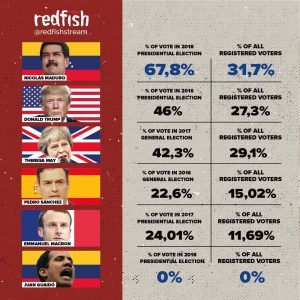
Second, Venezuela’s central bankers were persuaded to pledge their oil reserves and all assets of the state oil sector (including Citgo) as collateral for its foreign debt. This meant that if Venezuela defaulted (or was forced into default by U.S. banks refusing to make timely payment on its foreign debt), bondholders and U.S. oil majors would be in a legal position to take possession of Venezuelan oil assets.

These pro-U.S. policies made Venezuela a typically polarized Latin American oligarchy. Despite being nominally rich in oil revenue, its wealth was concentrated in the hands of a pro-U.S. oligarchy that let its domestic development be steered by the World Bank and IMF. The indigenous population, especially its rural racial minority as well as the urban underclass, was excluded from sharing in the country’s oil wealth. The oligarchy’s arrogant refusal to share the wealth, or even to make Venezuela self-sufficient in essentials, made the election of Hugo Chavez a natural outcome.

The Saker: Could you outline the various reforms and changes introduced by Hugo Chavez? What did he do right, and what did he do wrong?

Michael Hudson: Chavez sought to restore a mixed economy to Venezuela, using its government revenue – mainly from oil, of course – to develop infrastructure and domestic spending on health care, education, employment to raise living standards and productivity for his electoral constituency.

What he was unable to do was to clean up the embezzlement and built-in rake-off of income from the oil sector. And he was unable to stem the capital flight of the oligarchy, taking its wealth and moving it abroad – while running away themselves.

This was not “wrong”. It merely takes a long time to change an economy’s disruption – while the U.S. is using sanctions and “dirty tricks” to stop that process.

The Saker: What are, in your opinion, the causes of the current economic crisis in Venezuela – is it primarily due to mistakes by Chavez and Maduro or is the main cause US sabotage, subversion and sanctions?

Michael Hudson: There is no way that’s Chavez and Maduro could have pursued a pro-Venezuelan policy aimed at achieving economic independence without inciting fury, subversion and sanctions from the United States. American foreign policy remains as focused on oil as it was when it invaded Iraq under Dick Cheney’s regime. U.S. policy is to treat Venezuela as an extension of the U.S. economy, running a trade surplus in oil to spend in the United States or transfer its savings to U.S. banks.

By imposing sanctions that prevent Venezuela from gaining access to its U.S. bank deposits and the assets of its state-owned Citco, the United States is making it impossible for Venezuela to pay its foreign debt. This is forcing it into default, which U.S. diplomats hope to use as an excuse to foreclose on Venezuela’s oil resources and seize its foreign assets much as Paul Singer hedge fund sought to do with Argentina’s foreign assets.

Just as U.S. policy under Kissinger was to make Chile’s “economy scream,” so the U.S. is following the same path against Venezuela. It is using that country as a “demonstration effect” to warn other countries not to act in their self-interest in any way that prevents their economic surplus from being siphoned off by U.S. investors.

The Saker: What in your opinion should Maduro do next (assuming he stays in power and the USA does not overthrow him) to rescue the Venezuelan economy?

Michael Hudson: I cannot think of anything that President Maduro can do that he is not doing. At best, he can seek foreign support – and demonstrate to the world the need for an alternative international financial and economic system.

He already has begun to do this by trying to withdraw Venezuela’s gold from the Bank of England and Federal Reserve. This is turning into “asymmetrical warfare,” threatening what to de-sanctify the dollar standard in international finance. The refusal of England and the United States to grant an elected government control of its foreign assets demonstrates to the entire world that U.S. diplomats and courts alone can and will control foreign countries as an extension of U.S. nationalism.

The price of the U.S. economic attack on Venezuela is thus to fracture the global monetary system. Maduro’s defensive move is showing other countries the need to protect themselves from becoming “another Venezuela” by finding a new safe haven and paying agent for their gold, foreign exchange reserves and foreign debt financing, away from the dollar, sterling and euro areas.

The only way that Maduro can fight successfully is on the institutional level, upping the ante to move “outside the box.” His plan – and of course it is a longer-term plan – is to help catalyze a new international economic order independent of the U.S. dollar standard. It will work in the short run only if the United States believes that it can emerge from this fight as an honest financial broker, honest banking system and supporter of democratically elected regimes. The Trump administration is destroying illusion more thoroughly than any anti-imperialist critic or economic rival could do!

Over the longer run, Maduro also must develop Venezuelan agriculture, along much the same lines that the United States protected and developed its agriculture under the New Deal legislation of the 1930s – rural extension services, rural credit, seed advice, state marketing organizations for crop purchase and supply of mechanization, and the same kind of price supports that the United States has long used to subsidize domestic farm investment to increase productivity.

The Saker: What about the plan to introduce a oil-based crypto currency? Will that be an effective alternative to the dying Venezuelan Bolivar?

Michael Hudson: Only a national government can issue a currency. A “crypto” currency tied to the price of oil would become a hedging vehicle, prone to manipulation and price swings by forward sellers and buyers. A national currency must be based on the ability to tax, and Venezuela’s main tax source is oil revenue, which is being blocked from the United States. So Venezuela’s position is like that of the German mark coming out of its hyperinflation of the early 1920s. The only solution involves balance-of-payments support. It looks like the only such support will come from outside the dollar sphere.

The solution to any hyperinflation must be negotiated diplomatically and be supported by other governments. My history of international trade and financial theory, Trade, Development and Foreign Debt, describes the German reparations problem and how its hyperinflation was solved by the Rentenmark.

Venezuela’s economic-rent tax would fall on oil, and luxury real estate sites, as well as monopoly prices, and on high incomes (mainly financial and monopoly income). This requires a logic to frame such tax and monetary policy. I have tried to explain how to achieve monetary and hence political independence for the past half-century. China is applying such policy most effectively. It is able to do so because it is a large and self-sufficient economy in essentials, running a large enough export surplus to pay for its food imports. Venezuela is in no such position. That is why it is looking to China for support at this time.

The Saker: How much assistance do China, Russia and Iran provide and how much can they do to help? Do you think that these three countries together can help counter-act US sabotage, subversion and sanctions?

Michael Hudson: None of these countries have a current capacity to refine Venezuelan oil. This makes it difficult for them to take payment in Venezuelan oil. Only a long-term supply contract (paid for in advance) would be workable. And even in that case, what would China and Russia do if the United States simply grabbed their property in Venezuela, or refused to let Russia’s oil company take possession of Citco? In that case, the only response would be to seize U.S. investments in their own country as compensation.

At least China and Russia can provide an alternative bank clearing mechanism to SWIFT, so that Venezuela can by pass the U.S. financial system and keep its assets from being grabbed at will by U.S. authorities or bondholders. And of course, they can provide safe-keeping for however much of Venezuela’s gold it can get back from New York and London.

Looking ahead, therefore, China, Russia, Iran and other countries need to set up a new international court to adjudicate the coming diplomatic crisis and its financial and military consequences. Such a court – and its associated international bank as an alternative to the U.S.-controlled IMF and World Bank – needs a clear ideology to frame a set of principles of nationhood and international rights with power to implement and enforce its judgments.

This would confront U.S. financial strategists with a choice: if they continue to treat the IMF, World Bank, ITO and NATO as extensions of increasingly aggressive U.S. foreign policy, they will risk isolating the United States. Europe will have to choose whether to remain a U.S. economic and military satellite, or to throw in its lot with Eurasia.

However, Daniel Yergin reports in the Wall Street Journal (Feb. 7) that China is trying to hedge its bets by opening a back-door negotiation with Guaido’s group, apparently to get the same deal that it has negotiated with Maduro’s government. But any such deal seems unlikely to be honored in practice, given U.S. animosity toward China and Guaido’s total reliance on U.S. covert support.

The Saker: Venezuela kept a lot of its gold in the UK and money in the USA. How could Chavez and Maduro trust these countries or did they not have another choice? Are there viable alternatives to New York and London or are they still the “only game in town” for the world’s central banks?

Michael Hudson: There was never real trust in the Bank of England or Federal Reserve, but it seemed unthinkable that they would refuse to permit an official depositor from withdrawing its own gold. The usual motto is “Trust but verify.” But the unwillingness (or inability) of the Bank of England to verify means that the formerly unthinkable has now arrived: Have these central banks sold this gold forward in the post-London Gold Pool and its successor commodity markets in their attempt to keep down the price so as to maintain the appearance of a solvent U.S. dollar standard.

Paul Craig Roberts has described how this system works. There are forward markets for currencies, stocks and bonds. The Federal Reserve can offer to buy a stock in three months at, say, 10% over the current price. Speculators will by the stock, bidding up the price, so as to take advantage of “the market’s” promise to buy the stock. So by the time three months have passed, the price will have risen. That is largely how the U.S. “Plunge Protection Team” has supported the U.S. stock market.

The system works in reverse to hold down gold prices. The central banks holding gold can get together and offer to sell gold at a low price in three months. “The market” will realize that with low-priced gold being sold, there’s no point in buying more gold and bidding its price up. So the forward-settlement market shapes today’s market.

The question is, have gold buyers (such as the Russian and Chinese government) bought so much gold that the U.S. Fed and the Bank of England have actually had to “make good” on their forward sales, and steadily depleted their gold? In this case, they would have been “living for the moment,” keeping down gold prices for as long as they could, knowing that once the world returns to the pre-1971 gold-exchange standard for intergovernmental balance-of-payments deficits, the U.S. will run out of gold and be unable to maintain its overseas military spending (not to mention its trade deficit and foreign disinvestment in the U.S. stock and bond markets). My book on Super-Imperialism explains why running out of gold forced the Vietnam War to an end. The same logic would apply today to America’s vast network of military bases throughout the world.

Refusal of England and the U.S. to pay Venezuela means that other countries means that foreign official gold reserves can be held hostage to U.S. foreign policy, and even to judgments by U.S. courts to award this gold to foreign creditors or to whoever might bring a lawsuit under U.S. law against these countries.

This hostage-taking now makes it urgent for other countries to develop a viable alternative, especially as the world de-dedollarizes and a gold-exchange standard remains the only way of constraining the military-induced balance of payments deficit of the United States or any other country mounting a military attack. A military empire is very expensive – and gold is a “peaceful” constraint on military-induced payments deficits. (I spell out the details in my Super Imperialism: The Economic Strategy of American Empire (1972), updated in German as Finanzimperium(2017).

The U.S. has overplayed its hand in destroying the foundation of the dollar-centered global financial order. That order has enabled the United States to be “the exceptional nation” able to run balance-of-payments deficits and foreign debt that it has no intention (or ability) to pay, claiming that the dollars thrown off by its foreign military spending “supply” other countries with their central bank reserves (held in the form of loans to the U.S. Treasury – Treasury bonds and bills – to finance the U.S. budget deficit and its military spending, as well as the largely military U.S. balance-of-payments deficit.

Given the fact that the EU is acting as a branch of NATO and the U.S. banking system, that alternative would have to be associated with the Shanghai Cooperation Organization, and the gold would have to be kept in Russia and/or China.

The Saker:  What can other Latin American countries such as Bolivia, Nicaragua, Cuba and, maybe, Uruguay and Mexico do to help Venezuela?

Michael Hudson: The best thing neighboring Latin American countries can do is to join in creating a vehicle to promote de-dollarization and, with it, an international institution to oversee the writedown of debts that are beyond the ability of countries to pay without imposing austerity and thereby destroying their economies.

An alternative also is needed to the World Bank that would make loans in domestic currency, above all to subsidize investment in domestic food production so as to protect the economy against foreign food-sanctions – the equivalent of a military siege to force surrender by imposing famine conditions. This World Bank for Economic Acceleration would put the development of self-reliance for its members first, instead of promoting export competition while loading borrowers down with foreign debt that would make them prone to the kind of financial blackmail that Venezuela is experiencing.

Being a Roman Catholic country, Venezuela might ask for papal support for a debt write-down and an international institution to oversee the ability to pay by debtor countries without imposing austerity, emigration, depopulation and forced privatization of the public domain.

Two international principles are needed. First, no country should be obliged to pay foreign debt in a currency (such as the dollar or its satellites) whose banking system acts to prevents payment.

Second, no country should be obliged to pay foreign debt at the price of losing its domestic autonomy as a state: the right to determine its own foreign policy, to tax and to create its own money, and to be free of having to privatize its public assets to pay foreign creditors. Any such debt is a “bad loan” reflecting the creditor’s own irresponsibility or, even worse, pernicious asset grab in a foreclosure that was the whole point of the loan.

The Saker:  Thank you very much for taking the time to reply to my questions!

These McCarthyite Accusations Benefit No One And Harm Everyone

By Caitlin Johnstone

Source: CaitlinJohnstone.com

In response to the reprehensible NBC hit piece we discussed the other day in which Hawaii congresswoman and Democratic presidential candidate Tulsi Gabbard was smeared as a darling of the Russian government, journalist Glenn Greenwald published an article documenting the astonishing amount of journalistic malpractice which went into the piece’s formation. In the article, Greenwald wrote the following:

“That’s because the playbook used by the axis of the Democratic Party, NBC, MSNBC, neocons, and the intelligence community has been, is, and will continue to be a very simple one: to smear any adversary of the establishment wing of the Democratic Party — whether on the left or the right — as a stooge or asset of the Kremlin.”

Displaying a remarkable lack of self-awareness, Democratic establishment pundit and professional Russiagater Caroline Orr responded to Gabbard’s share of this article on Twitter as follows:

“And here, Tulsi Gabbard cites a Kremlin propagandist to deny claims that Kremlin propagandists support her campaign.”

This demented McCarthyite mind virus was exemplified even more egregiously in a recent attack on comedian and progressive commentator Jimmy Dore, in which fellow comedian and former Daily Show producer Jena Friedman publicly accused him of being a Kremlin agent just for disagreeing with her. After Dore’s fan base reacted to this deranged smear as any sane person would expect them to, Friedman claimed that this was evidence of a coordinated campaign against her by Russian trolls and bots.

“I wouldn’t doubt it if Jimmy Dore was a Russian asset,” Friedman tweeted in response to Dore’s having criticized her crazed Louise Mensch-esque rantings. “Why else would he drag my name in the mud and misquote me when I said that Russian trolls are fueling the fire and radicalizing people online, which has been in Washington Post. It’s all so insidious. Be careful, friends.”

“The real tell of who the paid assets are is that they all seem to be so coordinated,” Friedman added. “Do you know which of the 999 Dem contenders you are voting for yet? I don’t but if RT and Jimmy Dore and everyone who seems sketchy are pushing for Tusli [sic] Gabbard, it’s hard not to question why?”

“If I question whether someone is on Putin’s payroll and then immediately receive 100+ tweets harassing me as a result, that only proves my point,” Friedman posted in response to the wave of responses her behavior elicited on Twitter, later adding, “There are progressive people fighting with me on here who I am sure are kind (ish) and also bots and assholes using their platforms to troll me in ways that feel oddly suspect. Sorry to question if some guy is paid by Putin but people actually are so why not just say no and move on?”

“I blocked Jimmy Dore because he’s a PizzaGate Putin propaganda valve,” Friedman also said. “Comedians, we need to do a better job at policing our own. Check out his stuff if you don’t believe me & be careful. There are dark forces at play trying to undermine us all & it feels like they‘re winning.”

Gosh. I’m old enough to remember when being a comedian had something to do with comedy.

https://twitter.com/JenaFriedman/status/1092198344833884160

The fact that Friedman believed her freakish McCarthyite slander was perfectly healthy, and that her suggestion that a fellow comedian she’d just accused of conducting psyops for a foreign government agency should just “say no and move on” and have that be the end of it, says so much about how pervasively cancerous political discourse has gotten over the last two years.

So let’s talk about that for a minute. Why exactly isn’t it perfectly healthy to accuse everyone who disagrees with you of conducting psyops for a foreign government agency? Why specifically shouldn’t it be standard procedure to level that accusation willy nilly and expect them to just “say no and move on” if it isn’t true? What is it about these McCarthyite accusations that is so destructive and toxic, anyway?

Well, for starters it completely kills political discourse. Absolutely murders it stone dead. If you’re having a political debate with someone, you can disagree very strongly with one another, even get hostile and uncivil at times, and still continue dialoguing and sharing ideas and information with each other. But as soon as one party suggests that the other party is only advancing the ideas and information they’re advancing because they’ve been covertly paid to do so by a foreign government agency, where can the conversation go from there? You’ve slammed the door shut on any further dialogue by preemptively rejecting anything the other party could possibly say, just because you got overwhelmed by the experience of someone having different opinions from your own.

Political discourse is happening all over the world all the time every single day, and far too often it’s cut off from ever getting anywhere because one side can’t resist regurgitating an obnoxious McCarthyite smear they’ve been trained to believe is normal by the Palmer Report and MSNBC.

But political discourse is not the only thing that’s harmed by these McCarthyite smears, which seem to be enjoying their biggest resurgence yet as the 2020 presidential race kicks off. The Trump administration is currently pursuing the arrest of Julian Assange, a move which if carried out will constitute a mortal wound for press freedoms around the world, and yet the self-described liberals who claim to support the free press and oppose the Trump administration aren’t saying a peep about it because Assange has been falsely smeared as a Kremlin agent so much it’s now taken as an established fact. Meanwhile political dissidents like Greenwald, Jill Stein, Ron Paul, Abby Martin, Max Blumenthal, Jimmy Dore and so very many others have had the influence of their voices wedged out from mainstream consciousness because so many people have been indoctrinated to reflexively reject their words with a nonsensical accusation of Kremlin fealty.

And that of course is the idea. The normalization of smearing any voice which differs from the orthodoxy of the unipolar world order in any way as a Russian agent has allowed dissenting narratives to be isolated away from the mainstream herd, where they are unable to influence a critical mass of individuals. They aren’t smearing Tulsi Gabbard as a Kremlin asset because they don’t want her to be president; the Democratic Party is still legally capable and structurally willing to rig its primaries to keep her out if need be. The real thing they fear is allowing her anti-interventionist ideas to take hold within the mainstream consciousness of a nation whose nonstop military interventionism is the glue that holds the empire together.

Even if you fully agree with all CIA/CNN talking points and think Joe Biden would be the best president ever, surely you can see that quashing dissent is a bad and undesirable thing? Surely you can see that allowing people free access to ideas and information is the absolutely indispensable foundation that anything resembling democracy must necessarily be built upon? Surely you can recognize that cutting off ideas and information that haven’t been authorized by the current political establishment by smearing dissident voices as agents of a foreign government is already a form of totalitarianism? Surely?

Meanwhile what benefit comes from accusing someone of being a Kremlin agent? How does that help anything? Even in the extremely unlikely event that you are interacting with someone online who does indeed secretly work for the Russian government, you are still perfectly capable of debating their ideas. Being a secret propagandist doesn’t give someone super powers. It doesn’t give them the ability to control your mind or turn you into a newt. There is no reason whatsoever why you can’t just debate their ideas as you would anyone else’s instead of slamming on the brakes of the conversation to take a pointless million-to-one gamble on a McCarthyite accusation which benefits nobody in any way.

Let’s stop allowing the mass psychosis of these paranoid cold war feeding frenzies to be the new normal, please. If we keep going this way it’s only going to get worse for everyone.

Expect Increased Smearing Of Progressives As Russian Assets

By Caitlin Johnstone

Source: CaitlinJohnstone.com

After WikiLeaks documents provided irrefutable evidence that the Democratic National Committee had violated its charter by rigging its primary for Hillary Clinton against Bernie Sanders, what should have happened is this:

  • The DNC apologizing profusely to the public for violating the promises it had made to the electorate.
  • Massive, sweeping changes to bring transparency and public accountability to the DNC’s inner workings, including a complete overhaul of staff and leadership.
  • If at all possible, a complete do-over of the primary vote.
  • A dedication to attacking Trump’s right-wing policies from the left, showing the public that a progressive approach works better than a conservative one.

If this had happened Americans would not only be living in a vastly saner political landscape, but Trump probably would not have won in 2016. If the Democratic establishment had shown clearly and unequivocally that it was remorseful for its malfeasance and made an immediate overhaul that people could see for themselves, they wouldn’t have alienated nearly as many voters.

Instead, what happened was the DNC changing absolutely nothing, Nanci Pelosi saying she doesn’t see anything wrong with primary rigging, and the Democratic Party shrieking about Russia for more than two years.

Watching the establishment Russia narrative take hold of public consciousness was like watching a zombie outbreak. First it infected the slow ones, the virulent Clintonites who never had any natural defense against CIA/CNN narratives, which was disturbing and distressing but not at all surprising. Then, bit-by-bit, the Russia hysteria began to creep leftward. Progressives I’d been fighting alongside in 2016 began succumbing to the Russiagate mind virus in 2017, folding under peer pressure and aggressive mass media manipulation. Some of them held strong for a few months, then when one of the hollow but oh-so-confident-sounding “bombshell” Russiagate reports struck them in the right way at the right time they made public social media posts saying they were now convinced.

I watched them drop like flies. To this very day I still see Russia hysteria on my social media feeds from progressive Berniecrats I’d followed early on who transformed into McCarthyite cold war hawks at some point in the interim. When I post something skeptical of the establishment Russia narrative on Twitter I see accounts with red roses next to their name, a sign of support for the Democratic Socialists of America, arguing with me and accusing me of sympathizing with Trump and Putin.

Writers like Max Blumenthal and Glenn Greenwald have been warning since the outbreak of this pernicious mass manipulation that it would be used to target the left, but their warnings went unheeded as more and more progressive minds were funneled into the belief that the best way to fight Trump was to get behind the Russia hysteria bandwagon and push with all your might. And now, even as America’s 2020 presidential race is barely in its infancy, we are already beginning to see Russiagate used to smear anyone to the left of Hillary Clinton as Russian dupes.

I’d like to draw attention to a few recent social media posts which have gained a lot of traction in the last few days, not for the impact those posts have but for what they portend for the rest of the 2020 race. The first is from the Twitter account for the Russiagate documentary Active Measures, and it received thousands of shares:

“Bernie was the one Democrat not to vote to keep sanctions on Deripaska (he also voted against Russia sanctions and Magnitsky),” the post reads. “@SenSanders won’t stand up to billionaires in Russia and he wants you to to believe he’ll stand up to them in America. #fraud”

The second comes from professional linguist and engineer John Rehling, who has over 50 thousand Twitter followers, and it received hundreds of shares:

“Kamala Harris is immediately the front runner for the Democratic nomination, and if Russia is predictable, they will create armies of bots attacking her from the *left*,”  reads Rehling’s (now deleted) tweet. “If you’re left of Kamala Harris, I’m sure you are honestly, but you’ll be doing Putin’s work, like it or not.”

The third comes from Shareblue manipulator Caroline Orr, just one of many similar posts that she has made in recent days. Orr has also launched a GoFundMe to investigate Tulsi Gabbard’s imaginary Putin-Assad ties/score a free vacation to Hawaii, and is also circulating the baseless rumor that “Russian-linked accounts” are pushing for a Bernie-Tulsi 2020 ticket. Note the URL Orr highlighted in the tweet below featuring her allegation that Gabbard is “pro-Putin” and “pro-Assad”.

https://twitter.com/RVAwonk/status/1085084216726044672

In each case, posts punching left with accusations of Kremlin servitude gained traction with their followers, which means there is already an audience for this schtick. And, again, the presidential race has barely even begun. Things are likely to get a whole lot uglier between now and November 2020.

This is your life for the next two years, progressives. This is what those of you who drank the Russiagate Kool-Aid have helped buy for what passes for America’s political left today. You can expect such accusations to get far more common and far more aggressive as this thing drags on. The left can either play along with this and let centrist cold war rhetoric suck all the oxygen out of the room for the advancement of progressive policies, or they can fight back against this moronic facilitation of longstanding intelligence community agendas.

This use of Russiagate to herd the political left toward supporting America’s “center” (so-called only because it is the mainstream view, which in turn is only due to plutocratic narrative control) will actively move things further into corporatist dystopia. Supporting a “moderate” Democratic Party while the Republican Party always pushes as far to the right as it possibly can is guaranteeing a continuous overall movement to the right, which is why the gains made by the left in the early 20th century are almost gone now. If you have one person half-pulling westward on one end of a rope and another person tugging eastward with all their might, they’re going to move steadily east.

The slow, incremental changes advocated by the political “center” are code for no change whatsoever; they’re just buying time so that their corporate sponsors, who themselves never slow down, can finish shoring up control before the public forces them to scale back. If progressives don’t start attacking this “Move right or you’re a Russian agent” schtick directly and with full force, it will snuff them out completely.