HOW THE WESTERN MEDIA HELPED BUILD THE CASE FOR GENOCIDE IN GAZA

From obscuring the West’s role in starving Gaza to sensationalised accounts of mass rape by Hamas, journalists are playing the role of propagandists, not reporters.
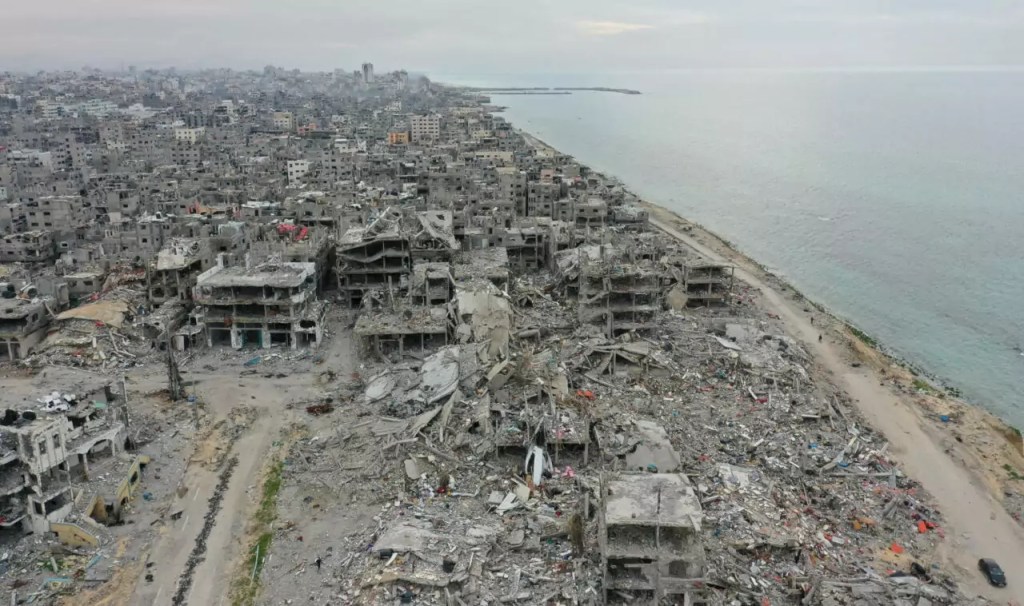
Israel has reduced Gaza to ruins. (Photo: UNRWA)

By Jonathan Cook

Source: Declassified UK

The past five months have been clarifying. What was supposed to be hidden has been thrust into the light. What was supposed to be obscured has come sharply into focus.

Liberal democracy is not what it seems.

It has always defined itself in contrast to what it says it is not. Where other regimes are savage, it is humanitarian. Where others are authoritarian, it is open and tolerant. Where others are criminal, it is law-abiding. When others are belligerent, it seeks peace. Or so the manuals of liberal democracy argue.

But how to keep the faith when the world’s leading liberal democracies – invariably referred to as “the West” – are complicit in the crime of crimes: genocide?

Not just law-breaking or a misdemeanour, but the extermination of a people. And not just quickly, before the mind has time to absorb and weigh the gravity and extent of the crime, but in slow motion, day after day, week after week, month after month.

What kind of system of values can allow for five months the crushing of children under rubble, the detonation of fragile bodies, the wasting away of babies, while still claiming to be humanitarian, tolerant, peace-seeking?

And not just allow all this, but actively assist in it. Supply the bombs that blow those children to pieces or bring houses down on them, and sever ties to the only aid agency that can hope to keep them alive.

The answer, it seems, is the West’s system of values.

The mask has not just slipped, it has been ripped off. What lies beneath is ugly indeed.

Depravity on show

The West is desperately trying to cope. When Western depravity is fully on show, the public’s gaze has to be firmly directed elsewhere: to the truly evil ones.

They are given a name. It is Russia. It is Al Qaeda, and Islamic State. It is China. And right now, it is Hamas.

There must be an enemy. But this time, the West’s own evil is so hard to disguise, and the enemy so paltry – a few thousand fighters underground inside a prison besieged for 17 years – that the asymmetry is difficult to ignore. The excuses are hard to swallow.

Is Hamas really so evil, so cunning, so much of a threat that it requires mass slaughter? Does the West really believe that the attack of 7 October warrants the killing, maiming and orphaning of many, many tens of thousands of children as a response?

To stamp out such thoughts, Western elites have had to do two things. First, they have tried to persuade their publics that the acts they collude in are not as bad as they look. And then that the evil perpetrated by the enemy is so exceptional, so unconscionable it justifies a response in kind.

Which is exactly the role Western media has played over the past five months.

Starved by Israel

To understand how Western publics are being manipulated, just look to the coverage – especially from those outlets most closely aligned not with the right but with supposedly liberal values.

How have the media dealt with the 2.3 million Palestinians of Gaza being gradually starved to death by an Israeli aid blockade, an action that lacks any obvious military purpose beyond inflicting a savage vengeance on Palestinian civilians? After all, Hamas fighters will outlast the young, the sick and the elderly in any mediaeval-style, attritional war denying Gaza food, water and medicines.

headline in the New York Times, for example, told readers last month, “Starvation is stalking Gaza’s children”, as if this were a famine in Africa – a natural disaster, or an unexpected humanitarian catastrophe – rather than a policy declared in advance and carefully orchestrated by Israel’s top echelons.

The Financial Times offered the same perverse framing: “Starvation stalks children of northern Gaza”.

But starvation is not an actor in Gaza. Israel is. Israel is choosing to starve Gaza’s children. It renews that policy each day afresh, fully aware of the terrible price being inflicted on the population.

As the head of Medical Aid for Palestinians warned of developments in Gaza: “Children are being starved at the fastest rate the world has ever seen.”

Last week Unicef, the United Nations children’s emergency fund, declared that a third of children aged under two in northern Gaza were acutely malnourished. Its executive director, Catherine Russell, was clear: “An immediate humanitarian cease-fire continues to provide the only chance to save children’s lives and end their suffering.”

Were it really starvation doing the stalking, rather than Israel imposing starvation, the West’s powerlessness would be more understandable. Which is what the media presumably want their readers to infer.

But the West isn’t powerless. It is enabling this crime against humanity – day after day, week after week – by refusing to exert its power to punish Israel, or even to threaten to punish it, for blocking aid. 

Not only that, but the US and Europe have helped Israel starve Gaza’s children by denying funding to the UN refugee agency, UNRWA, the main humanitarian lifeline in the enclave. 

All of this is obscured – meant to be obscured – by headlines that transfer the agency for starving children to an abstract noun rather than a country with a large, vengeful army.

Attack on aid convoy

Such misdirection is everywhere – and it is entirely intentional. It is a playbook being used by every single Western media outlet. It was all too visible when an aid convoy last month reached Gaza City, where levels of Israeli-induced famine are most extreme.

In what has come to be known by Palestinians as the “Flour Massacre”, Israel shot into large crowds desperately trying to get food parcels from a rare aid convoy to feed their starving families. More than 100 Palestinians were killed by the gunfire, or crushed by Israeli tanks or hit by trucks fleeing the scene. Many hundreds more were seriously wounded.

It was an Israeli war crime – shooting on civilians – that came on top of an Israeli crime against humanity – starving two million civilians to death.

“The Israeli attack on those waiting for aid was not a one-off”

The Israeli attack on those waiting for aid was not a one-off. It has been repeated several times, though you would barely know it, given the paucity of coverage.

The depravity of using aid convoys as traps to lure Palestinians to their deaths is almost too much to grasp.

But that is not the reason the headlines that greeted this horrifying incident so uniformly obscured or soft-soaped Israel’s crime.  

For any journalist, the headline should have written itself: “Israel accused of killing over 100 as crowd waits for Gaza aid.” Or: “Israel fires into food aid crowd. Hundreds killed and injured”

But that would have accurately transferred agency to Israel – Gaza’s occupier for more than half a century, and its besieger for the last 17 years – in the deaths of those it has been occupying and besieging. Something inconceivable for the Western media.

So the focus had to be shifted elsewhere.

BBC contortions

The Guardian’s contortions were particularly spectacular: “Biden says Gaza food aid-related deaths complicate ceasefire talks”. 

The massacre by Israel was disappeared as mysterious “food aid-related deaths”, which in turn became secondary to the Guardian’s focus on the diplomatic fallout.

Readers were steered by the headline into assuming that the true victims were not the hundreds of Palestinians killed and maimed by Israel but the Israeli hostages whose chances of being freed had been “complicated” by “food aid-related deaths”.

The headline on a BBC analysis of the same war crime – now reframed as an author-less “tragedy” – repeated the New York Times’ trick: “Aid convoy tragedy shows fear of starvation haunts Gaza”.

Another favourite manoeuvre, again pioneered by the Guardian, was to cloud responsibility for a clear-cut war crime. Its front-page headline read: “More than 100 Palestinians die in chaos surrounding Gaza aid convoy”. 

Once again, Israel was removed from the crime scene. In fact, worse, the crime scene was removed too. Palestinians “died” apparently because of poor aid management. Maybe UNRWA was to blame.

Chaos and confusion became useful refrains for media outlets keener to shroud culpability. The Washington Post declared: “Chaotic aid delivery turns deadly as Israeli, Gazan officials trade blame”. CNN took the same line, downgrading a war crime to a “chaotic incident”. 

But even these failings were better than the media’s rapidly waning interest as Israel’s massacres of Palestinians seeking aid became routine – and therefore harder to mystify.

A few days after the Flour Massacre, an Israeli air strike on an aid truck in Deir al-Balah killed at least nine Palestinians, while last week more than 20 hungry Palestinians were killed by Israeli helicopter gunfire as they waited for aid. 

“Food aid-related” massacres – which had quickly become as normalised as Israel’s invasions of hospitals – no longer merited serious attention. A search suggests the BBC managed to avoid giving significant coverage to either incident online.

Food-drop theatrics

Meanwhile, the media has ably assisted Washington in its various deflections from the collaborative crime against humanity of Israel imposing a famine on Gaza compounded by the US and Europe de-funding UNRWA, the only agency that could mitigate that famine.

British and US broadcasters excitedly joined air crews as their militaries flew big-bellied planes over Gaza’s beaches, at great expense, to drop one-off ready-made meals to a few of the starving Palestinians below.

Given that many hundreds of truckloads of aid a day are needed just to stop Gaza sliding deeper into famine, the drops were no more than theatrics. Each delivered at best a solitary truckload of aid – and then only if the palettes didn’t end up falling into the sea, or killing the Palestinians they were meant to benefit.

The operation deserved little more than ridicule.

Instead, dramatic visuals of heroic airmen, interspersed with expressions of concern about the difficulties of addressing the “humanitarian crisis” in Gaza, usefully distracted viewers’ attention not only from the operations’ futility but from the fact that, were the West really determined to help, it could strong-arm Israel into letting in far more plentiful aid by land at a moment’s notice.

The media were equally swept up by the Biden administration’s second, even more outlandish scheme to help starving Palestinians. The US is to build a temporary floating pier off Gaza’s coast so that aid shipments can be delivered from Cyprus.

The plot holes were gaping. The pier will take two months or more to construct, when the aid is needed now. In Cyprus, as at the land crossings into Gaza, Israel will be in charge of inspections – the main cause of hold-ups.

And if the US now thinks Gaza needs a port, why not also get to work on a more permanent one?

The answer, of course, might remind audiences of the situation before 7 October, when Gaza was under a stifling 17-year siege by Israel – the context for Hamas’ attack that the Western media never quite finds the space to mention.

For decades, Israel has denied Gaza any connections to the outside world it cannot control, including preventing a sea port from being built and bombing the enclave’s only airport way back in 2001, shortly after it was opened.

And yet, at the same time, Israel’s insistence that it no longer occupies Gaza – just because it has done so at arm’s length since 2005 – is accepted unquestioningly in media coverage.

Again, the US has decisive leverage over Israel, its client state, should it decide to exercise it – not least billions in aid and the diplomatic veto it wields so regularly on Israel’s behalf.

The question that needs asking by the media on every piece about “starvation stalking Gaza” is why is the US not using that leverage.

In a typical breathless piece titled “How the US military plans to construct a pier and get food into Gaza”, the BBC ignored the big picture to drill down enthusiastically on the details of “huge logistical” and “security challenges” facing Biden’s project. 

The article revisited precedents from disaster relief operations in Somalia and Haiti to the D-Day Normandy landings in the Second World War. 

Credulous journalists

In support of these diversionary tactics, the media have also had to accentuate the atrocities of Hamas’ 7 October attack – and the need to condemn the group at every turn – to contrast those crimes from what might otherwise appear even worse atrocities committed by Israel on the Palestinians. 

That has required an unusually large dose of credulousness from journalists who more usually present as hard-bitten sceptics.

Babies being beheaded, or put in ovens, or hung out on clothes lines. No invented outrage by Hamas has been too improbable to have been denied front-page treatment, only to be quietly dropped later when each has turned out to be just as fabricated as it should have sounded to any reporter familiar with the way propagandists exploit the fog of war. 

Similarly, the entire Western press corps has studiously ignored months of Israeli media revelations that have gradually shifted responsibility for some of the the most gruesome incidents of 7 October – such as the burning of hundreds of bodies – off Hamas’ shoulders and on to Israel’s.

Though Western media outlets failed to note the significance of his remarks, Israeli spokesman Mark Regev admitted that Israel’s numbering of its dead from 7 October had to be reduced by 200 because many of the badly charred remains turned out to be Hamas fighters. 

Testimonies from Israeli commanders and officials show that, blindsided by the Hamas attack, Israeli forces struck out wildly with tank shells and Hellfire missiles, incinerating Hamas fighters and their Israeli captives indiscriminately. The burnt cars piled up as a visual signifier of Hamas’ sadism are, in fact, evidence of, at best, Israel’s incompetence and, at worst, its savagery.

The secret military protocol that directed Israel’s scorched-earth policy on 7 October – the notorious Hannibal procedure to stop any Israeli being taken captive – appears not to have merited mention by either the Guardian or the BBC in their acres of 7 October coverage.

Despite their endless revisiting of the 7 October events, neither has seen fit to report on the growing demands from Israeli families for an investigation into whether their loved ones were killed under Israel’s Hannibal procedure. 

Nor have either the BBC or the Guardian reported on the comments of the Israeli military’s ethics chief, Prof Asa Kasher, bewailing the army’s resort to the Hannibal procedure on 7 October as “horrifying” and “unlawful”. 

Claims of bestiality

Instead, liberal Western media outlets have repeatedly revisited claims that they have seen evidence – evidence they seem unwilling to share – that Hamas ordered rape to be used systematically by its fighters as a weapon of war. The barely veiled implication is that such depths of depravity explain, and possibly justify, the scale and savagery of Israel’s response.

Note that this claim is quite different from the argument that there may have been instances of rape on 7 October.

That is for good reason: There are plenty of indications that Israeli soldiers regularly use rape and sexual violence against Palestinians. A UN report in February addressing allegations that Israeli solders and officials had weaponised sexual violence against Palestinian women and girls since 7 October elicited none of the headlines and outrage from the Western media directed at Hamas. 

To make a plausible case that Hamas changed the rules of war that day, much greater deviance and sinfulness has been required. And the liberal Western media have willingly played their part by recycling claims of mass, systematic rape by Hamas, combined with lurid claims of necrophilic perversions – while suggesting anyone who asks for evidence is condoning such bestiality.

But the liberal media’s claims of Hamas “mass rapes” – initiated by an agenda-setting piece by the New York Times and closely echoed by the Guardian weeks later – have crumbled on closer inspection.

Independent outlets such as Mondoweiss, Electronic Intifada, the Grayzone and others have gradually pulled apart the Hamas mass rape narrative.

But perhaps most damaging of all has been an investigation by the Intercept that revealed it was senior Times editors who recruited a novice Israeli journalist – a former Israeli intelligence official with a history of supporting genocidal statements against the people of Gaza – to do the field work.

More shocking still, it was the paper’s editors who then pressured her to find the story. In violation of investigative norms, the narrative was reverse engineered: imposed from the top, not found through on-the-ground reporting.

‘Conspiracy of silence’

The New York Times’ story appeared in late December under the headline “‘Screams Without Words’: How Hamas Weaponized Sexual Violence on Oct. 7”. The Guardian’s follow-up in mid-January draws so closely on the Times’ reporting that the paper has been accused of plagiarism. Its headline was: “Evidence points to systematic use of rape and sexual violence by Hamas in 7 October attacks”. 

However, under questioning from the Intercept, a spokesperson for the New York Times readily walked back the paper’s original certainty, conceding instead that “there may have been systematic use of sexual assault.” [emphasis added] Even that appears too strong a conclusion.

Holes in the Times’ reporting quickly proved so glaring that its popular daily podcast pulled the plug on an episode dedicated to the story after its own fact check.

The rookie reporter assigned to the task, Anat Schwartz, has admitted that despite scouring the relevant institutions in Israel – from medical institutions to rape crisis centres – she found no one who could confirm a single example of sexual assault that day. She was also unable to find any forensic corroboration.

She later told a podcast with Israel’s Channel 12 that she viewed the lack of evidence to be proof of “a conspiracy of silence”.

Instead, Schwartz’s reporting relied on a handful of testimonies from witnesses whose other easily disprovable assertions should have called into question their credibility. Worse, their accounts of instances of sexual assault failed to tally with the known facts.

One paramedic, for example, claimed two teenage girls had been raped and killed at Kibbutz Nahal Oz. When it became clear nobody fitted the description there, he changed the crime scene to Kibbutz Beeri. None of the dead there fitted the description either.

Nonetheless, Schwartz believed she finally had her story. She told Channel 12: “One person saw it happen in Be’eri, so it can’t be just one person, because it’s two girls. It’s sisters. It’s in the room. Something about it is systematic, something about it feels to me that it’s not random.”

Schwartz got further confirmation from Zaka, a private ultra-Orthodox rescue organisation, whose officials were already known to have fabricated Hamas atrocities on 7 October, including the various claims of depraved acts against babies.

No forensic evidence

Interestingly, though the main claims of Hamas rape have focused on the Nova music festival attacked by Hamas, Schwartz was initially sceptical – and for good reason – that it was the site of any sexual violence.

As Israeli reporting has revealed, the festival quickly turned into a battlefield, with Israeli security guards and Hamas exchanging gunfire and Israeli attack helicopters circling overhead firing at anything that moved.

Schwartz concluded: “Everyone I spoke to among the survivors told me about a chase, a race, like, about moving from place to place. How would they [have had the time] to mess with a woman, like – it is impossible. Either you hide, or you – or you die. Also it’s public, the Nova … such an open space.”

But Schwartz dropped her scepticism as soon as Raz Cohen, a veteran of Israel’s special forces, agreed to speak to her. He had already claimed in earlier interviews a few days after 7 October that he had witnessed multiple rapes at Nova, including corpses being raped.

But when he spoke to Schwartz he could only recall one incident – a horrific attack that involved raping a woman and then knifing her to death. Undermining the New York Times’ central claim, he attributed the rape not to Hamas but to five civilians, Palestinians who poured into Israel after Hamas fighters broke through the fence around Gaza.

Notably, Schwartz admitted to Channel 12 that none of the other four people hiding in the bush with Cohen saw the attack. “Everyone else is looking in a different direction,” she said.

And yet in the Times’ story, Cohen’s account is corroborated by Shoam Gueta, a friend who has since deployed to Gaza where, as the Intercept notes, he has been posting videos of himself rummaging through destroyed Palestinian homes.

Another witness, identified only as Sapir, is quoted by Schwartz as witnessing a woman being raped at Nova at the same time as her breast is amputated with a box cutter. That account became central to the Guardian’s follow-up report in January.

Yet, no forensic evidence has been produced to support this account.

Story invented

But the most damning criticism of the Times’ reporting came from the family of Gal Abdush, the headline victim in the “Screams without Words” story. Her parents and brother accused the New York Times of inventing the story that she had been raped at the Nova festival.

Moments before she was killed by a grenade, Abdush had messaged her family and made no mention of a rape or even a direct attack on her group. The family had heard no suggestion that rape was a factor in Abdush’s death.

A woman who had given the paper access to photos and video of Abdush taken that day said Schwartz had pressured her to do so on the grounds it would help “Israeli hasbara” – a term meaning propaganda designed to sway foreign audiences.

Schwartz cited the Israeli welfare ministry as claiming there were four survivors of sexual assault from 7 October, though no more details have been forthcoming from the ministry.

Back in early December, before the Times story, Israeli officials promised they had “gathered ‘tens of thousands’ of testimonies of sexual violence committed by Hamas”. None of those testimonies has materialised.

None ever will, according to Schwartz’s conversation with Channel 12. “There is nothing. There was no collection of evidence from the scene,” she said.

Nonetheless, Israeli officials continue to use the reports by the New York Times, the Guardian and others to try to bully major human rights bodies into agreeing that Hamas used sexual violence systematically.

Which may explain why the media eagerly seized on the chance to resurrect its threadbare narrative when UN official Pramila Patten, its special representative on sexual violence in conflict, echoed some of their discredited claims in a report published this month. 

The media happily ignored the fact that Patten had no investigative mandate and that she heads what is in effect an advocacy group inside the UN. While Israel has obstructed UN bodies that do have such investigative powers, it welcomed Patten, presumably on the assumption that she would be more pliable. 

In fact, she did little more than repeat the same unevidenced claims from Israel that formed the basis of the Times and Guardian’s discredited reporting.

Statements retracted

Even so, Patten included important caveats in the small print of her report that the media were keen to overlook.

At a press conference, she reiterated that she had seen no evidence of a pattern of behaviour by Hamas, or of the use of rape as a weapon of war – the very claims the Western media had been stressing for weeks.

She concluded in the report that she was unable to “establish the prevalence of sexual violence”. And further, she conceded it was not clear if any sexual violence occurring on 7 October was the responsibility of Hamas, or other groups or individuals.

All of that was ignored by the media. In typical fashion, a Guardian article on her report asserted wrongly in its headline: “UN finds ‘convincing information’ that Hamas raped and tortured Israeli hostages”. 

Patten’s primary source of information, she conceded, were Israeli “national institutions” – state officials who had every incentive to mislead her in the furtherance of the country’s war aims, as they had earlier done with a compliant media.  

As the US Jewish scholar Normal Finkelstein has pointed out, Patten also relied on open-source material: 5,000 photos and 50 hours of video footage from bodycams, dashcams, cellphones, CCTV and traffic surveillance cameras. And yet that visual evidence yielded not a single image of sexual violence. Or as Patten phrased it: “No tangible indications of rape could be identified.”

She admitted she had seen no forensic evidence of sexual violence, and had not met a single survivor of rape or sexual assault.

And she noted that the witnesses and sources her team spoke to – the same individuals the media had relied on – proved unreliable. They “adopted over time an increasingly cautious and circumspect approach regarding past accounts, including in some cases retracting statements made previously”.

Collusion in genocide

If anything has been found to be systematic, it is the failings in the Western media’s coverage of a plausible genocide unfolding in Gaza.

Last week a computational analysis of the New York Times’ reporting revealed it continued to focus heavily on Israeli perspectives, even as the death-toll ratio showed that 30 times as many Palestinians had been killed by Israel in Gaza than Hamas had killed Israelis on 7 October. 

The paper quoted Israelis and Americans many times more regularly than they did Palestinians, and when Palestinians were referred to it was invariably in the passive voice. 

In Britain, the Muslim Council of Britain’s Centre for Media Monitoring has analysed nearly 177,000 clips from TV broadcasts covering the first month after the 7 October attack. It found Israeli perspectives were three times more common than Palestinian ones.

A similar study by the Glasgow Media Group found that journalists regularly used condemnatory language for the killing of Israelis – “murderous”, “mass murder”, “brutal murder” and “merciless murder” – but never when Palestinians were being killed by Israel. “Massacres”, “atrocities” and “slaughter” were only ever carried out against Israelis, not against Palestinians.

Faced with a plausible case of genocide – one being televised for months on end – even the liberal elements of the Western media have shown they have no serious commitment to the liberal democratic values they are supposedly there to uphold.  

They are not a watchdog on power, either the power of the Israeli military or Western states colluding in Israel’s slaughter. Rather the media are central to making the collusion possible. They are there to disguise and whitewash it, to make it look acceptable.

Indeed, the truth is that, without that help, Israel’s allies would long ago have been shamed into action, into stopping the slaughter and starvation. The Western media’s hands are stained in Gaza’s blood.

Net Zero, the Digital Panopticon and the Future of Food 

By Colin Todhunter

Source: Off-Guardian

The food transition, the energy transition, net-zero ideology, programmable central bank digital currencies, the censorship of free speech and clampdowns on protest. What’s it all about? To understand these processes, we need to first locate what is essentially a social and economic reset within the context of a collapsing financial system.

Writer Ted Reece notes that the general rate of profit has trended downwards from an estimated 43% in the 1870s to 17% in the 2000s. By late 2019, many companies could not generate enough profit. Falling turnover, squeezed margins, limited cashflows and highly leveraged balance sheets were prevalent.

Professor Fabio Vighi of Cardiff University has described how closing down the global economy in early 2020 under the guise of fighting a supposedly new and novel pathogen allowed the US Federal Reserve to flood collapsing financial markets (COVID relief) with freshly printed money without causing hyperinflation. Lockdowns curtailed economic activity, thereby removing demand for the newly printed money (credit) in the physical economy and preventing ‘contagion’.

According to investigative journalist Michael Byrant, €1.5 trillion was needed to deal with the crisis in Europe alone. The financial collapse staring European central bankers in the face came to a head in 2019. The appearance of a ‘novel virus’ provided a convenient cover story.

The European Central Bank agreed to a €1.31 trillion bailout of banks followed by the EU agreeing to a €750 billion recovery fund for European states and corporations. This package of long-term, ultra-cheap credit to hundreds of banks was sold to the public as a necessary programme to cushion the impact of the pandemic on businesses and workers.

In response to a collapsing neoliberalism, we are now seeing the rollout of an authoritarian great reset — an agenda that intends to reshape the economy and change how we live.

SHIFT TO AUTHORITARIANISM

The new economy is to be dominated by a handful of tech giants, global conglomerates and e-commerce platforms, and new markets will also be created through the financialisation of nature, which is to be colonised, commodified and traded under the notion of protecting the environment.

In recent years, we have witnessed an overaccumulation of capital, and the creation of such markets will provide fresh investment opportunities (including dodgy carbon offsetting Ponzi schemes)  for the super-rich to park their wealth and prosper.

This great reset envisages a transformation of Western societies, resulting in permanent restrictions on fundamental liberties and mass surveillance. Being rolled out under the benign term of a ‘Fourth Industrial Revolution’, the World Economic Forum (WEF) says the public will eventually ‘rent’ everything they require (remember the WEF video ‘you will own nothing and be happy’?): stripping the right of ownership under the guise of a ‘green economy’ and underpinned by the rhetoric of ‘sustainable consumption’ and ‘climate emergency’.

Climate alarmism and the mantra of sustainability are about promoting money-making schemes. But they also serve another purpose: social control.

Neoliberalism has run its course, resulting in the impoverishment of large sections of the population. But to dampen dissent and lower expectations, the levels of personal freedom we have been used to will not be tolerated. This means that the wider population will be subjected to the discipline of an emerging surveillance state.

To push back against any dissent, ordinary people are being told that they must sacrifice personal liberty in order to protect public health, societal security (those terrible Russians, Islamic extremists or that Sunak-designated bogeyman George Galloway) or the climate. Unlike in the old normal of neoliberalism, an ideological shift is occurring whereby personal freedoms are increasingly depicted as being dangerous because they run counter to the collective good.

The real reason for this ideological shift is to ensure that the masses get used to lower living standards and accept them. Consider, for instance, the Bank of England’s chief economist Huw Pill saying that people should ‘accept’ being poorer. And then there is Rob Kapito of the world’s biggest asset management firm BlackRock, who says that a “very entitled” generation must deal with scarcity for the first time in their lives.

At the same time, to muddy the waters, the message is that lower living standards are the result of the conflict in Ukraine and supply shocks that both the war and ‘the virus’ have caused.

The net-zero carbon emissions agenda will help legitimise lower living standards (reducing your carbon footprint) while reinforcing the notion that our rights must be sacrificed for the greater good. You will own nothing, not because the rich and their neoliberal agenda made you poor but because you will be instructed to stop being irresponsible and must act to protect the planet.

NET-ZERO AGENDA

But what of this shift towards net-zero greenhouse gas emissions and the plan to slash our carbon footprints? Is it even feasible or necessary?

Gordon Hughes, a former World Bank economist and current professor of economics at the University of Edinburgh, says in a new report that current UK and European net-zero policies will likely lead to further economic ruin.

Apparently, the only viable way to raise the cash for sufficient new capital expenditure (on wind and solar infrastructure) would be a two decades-long reduction in private consumption of up to 10 per cent. Such a shock has never occurred in the last century outside war; even then, never for more than a decade.

But this agenda will also cause serious environmental degradation. So says Andrew Nikiforuk in the article The Rising Chorus of Renewable Energy Skeptics, which outlines how the green techno-dream is vastly destructive.

He lists the devastating environmental impacts of an even more mineral-intensive system based on renewables and warns:

“The whole process of replacing a declining system with a more complex mining-based enterprise is now supposed to take place with a fragile banking system, dysfunctional democracies, broken supply chains, critical mineral shortages and hostile geopolitics.”

All of this assumes that global warming is real and anthropogenic. Not everyone agrees. In the article Global warming and the confrontation between the West and the rest of the world, journalist Thierry Meyssan argues that net zero is based on political ideology rather than science. But to state such things has become heresy in the Western countries and shouted down with accusations of ‘climate science denial’.

Regardless of such concerns, the march towards net zero continues, and key to this is the United Nations Agenda 2030 for Sustainable Development Goals.

Today, almost every business or corporate report, website or brochure includes a multitude of references to ‘carbon footprints’, ‘sustainability’, ‘net zero’ or ‘climate neutrality’ and how a company or organisation intends to achieve its sustainability targets. Green profiling, green bonds and green investments go hand in hand with displaying ‘green’ credentials and ambitions wherever and whenever possible.

It seems anyone and everyone in business is planting their corporate flag on the summit of sustainability. Take Sainsbury’s, for instance. It is one of the ‘big six’ food retail supermarkets in the UK and has a vision for the future of food that it published in 2019.

Here’s a quote from it:

“Personalised Optimisation is a trend that could see people chipped and connected like never before. A significant step on from wearable tech used today, the advent of personal microchips and neural laces has the potential to see all of our genetic, health and situational data recorded, stored and analysed by algorithms which could work out exactly what we need to support us at a particular time in our life. Retailers, such as Sainsbury’s could play a critical role to support this, arranging delivery of the needed food within thirty minutes — perhaps by drone.”

Tracked, traced and chipped — for your own benefit. Corporations accessing all of our personal data, right down to our DNA. The report is littered with references to sustainability and the climate or environment, and it is difficult not to get the impression that it is written so as to leave the reader awestruck by the technological possibilities.

However, the promotion of a brave new world of technological innovation that has nothing to say about power — who determines policies that have led to massive inequalities, poverty, malnutrition, food insecurity and hunger and who is responsible for the degradation of the environment in the first place — is nothing new.

The essence of power is conveniently glossed over, not least because those behind the prevailing food regime are also shaping the techno-utopian fairytale where everyone lives happily ever after eating bugs and synthetic food while living in a digital panopticon.

FAKE GREEN

The type of ‘green’ agenda being pushed is a multi-trillion market opportunity for lining the pockets of rich investors and subsidy-sucking green infrastructure firms and also part of a strategy required to secure compliance required for the ‘new normal’.

It is, furthermore, a type of green that plans to cover much of the countryside with wind farms and solar panels with most farmers no longer farming. A recipe for food insecurity.

Those investing in the ‘green’ agenda care first and foremost about profit. The supremely influential BlackRock invests in the current food system that is responsible for polluted waterways, degraded soils, the displacement of smallholder farmers, a spiralling public health crisis, malnutrition and much more.

It also invests in healthcare — an industry that thrives on the illnesses and conditions created by eating the substandard food that the current system produces. Did Larry Fink, the top man at BlackRock, suddenly develop a conscience and become an environmentalist who cares about the planet and ordinary people? Of course not.

Any serious deliberations on the future of food would surely consider issues like food sovereignty, the role of agroecology and the strengthening of family farms — the backbone of current global food production.

The aforementioned article by Andrew Nikiforuk concludes that, if we are really serious about our impacts on the environment, we must scale back our needs and simplify society.

In terms of food, the solution rests on a low-input approach that strengthens rural communities and local markets and prioritises smallholder farms and small independent enterprises and retailers, localised democratic food systems and a concept of food sovereignty based on self-sufficiency, agroecological principles and regenerative agriculture.

It would involve facilitating the right to culturally appropriate food that is nutritionally dense due to diverse cropping patterns and free from toxic chemicals while ensuring local ownership and stewardship of common resources like land, water, soil and seeds.

That’s where genuine environmentalism and the future of food begins.

Economic Earthquake Ahead? The Cracks Are Spreading Fast

By Brandon Smith

Source: The Burning Platform

One of my favorite false narratives floating around corporate media platforms has been the argument that the American people “just don’t seem to understand how good the economy really is right now.” If only they would look at the stats, they would realize that we are in the middle of a financial renaissance, right? It must be that people have been brainwashed by negative press from conservative sources…

I have to laugh at this notion because it’s a very common one throughout history – it’s an assertion made by almost every single political regime right before a major collapse. These people always say the same things, and when you study economics as long as I have you can’t help but throw up your hands and marvel at their dedication to the propaganda.

One example that comes to mind immediately is the delusional optimism of the “roaring” 1920s and the lead up to the Great Depression. At the time around 60% of the U.S. population was living in poverty conditions (according to the metrics of the decade) earning less than $2000 a year. However, in the years after WWI ravaged Europe, America’s economic power was considered unrivaled.

The 1920s was an era of mass production and rampant consumerism but it was all fueled by easy access to debt, a condition which had not really existed before in America. It was this illusion of prosperity created by the unchecked application of credit that eventually led to the massive stock market bubble and the crash of 1929. This implosion, along with the Federal Reserve’s policy of raising interest rates into economic weakness, created a black hole in the U.S. financial system for over a decade.

There are two primary tools that various failing regimes will often use to distort the true conditions of the economy: Debt and inflation. In the case of America today, we are experiencing BOTH problems simultaneously and this has made certain economic indicators appear healthy when they are, in fact, highly unstable. The average American knows this is the case because they see the effects everyday. They see the damage to their wallets, to their buying power, in the jobs market and in their quality of life. This is why public faith in the economy has been stuck in the dregs since 2021.

The establishment can flash out-of-context stats in people’s faces, but they can’t force the populace to see a recovery that simply does not exist. Let’s go through a short list of the most faulty indicators and the real reasons why the fiscal picture is not a rosy as the media would like us to believe…

The “miracle” labor market recovery

In the case of the U.S. labor market, we have a clear example of distortion through inflation. The $8 trillion+ dropped on the economy in the first 18 months of the pandemic response sent the system over the edge into stagflation land. Helicopter money has a habit of doing two things very well: Blowing up a bubble in stock markets and blowing up a bubble in retail. Hence, the massive rush by Americans to go out and buy, followed by the sudden labor shortage and the race to hire (mostly for low wage part-time jobs).

The problem with this “miracle” is that inflation leads to price explosions, which we have already experienced. The average American is spending around 30% more for goods, services and housing compared to what they were spending in 2020. This is what happens when you have too much money chasing too few goods and limited production.

The jobs market looks great on paper, but the majority of jobs generated in the past few years are jobs that returned after the covid lockdowns ended. The rest are jobs created through monetary stimulus and the artificial retail rush. Part time low wage service sector jobs are not going to keep the country rolling for very long in a stagflation environment. The question is, what happens now that the stimulus punch bowl has been removed?

Just as we witnessed in the 1920s, Americans have turned to debt to make up for higher prices and stagnant wages by maxing out their credit cards. With the central bank keeping interest rates high, the credit safety net will soon falter. This condition also goes for businesses; the same businesses that will jump headlong into mass layoffs when they realize the party is over. It happened during the Great Depression and it will happen again today.

Cracks in the foundation

We saw cracks in the narrative of the financial structure in 2023 with the banking crisis, and without the Federal Reserve backstop policy many more small and medium banks would have dropped dead. The weakness of U.S. banks is offset by the relative strength of the U.S. dollar, which lures in foreign investors hoping to protect their wealth using dollar denominated assets.

But something is amiss. Gold and bitcoin have rocketed higher along with economically sensitive assets and the dollar. This is the opposite of what’s supposed to happen. Gold and BTC are supposed to be hedges against a weak dollar and a weak economy, right? If global faith in the dollar and in the U.S. economy is so high, why are investors diving into protective assets like gold?

Again, as noted above, inflation distorts everything.

Tens of trillions of extra dollars printed by the Fed are floating around and it’s no surprise that much of that cash is flooding into the economy which simply pushes higher right along with prices on the shelf. But, gold and bitcoin are telling us a more honest story about what’s really happening.

Right now, the U.S. government is adding around $600 billion per month to the national debt as the Fed holds rates higher to fight inflation. This debt is going to crush America’s financial standing for global investors who will eventually ask HOW the U.S. is going to handle that growing millstone? As I predicted years ago, the Fed has created a perfect Catch-22 scenario in which the U.S. must either return to rampant inflation, or, face a debt crisis. In either case, U.S. dollar-denominated assets will lose their appeal and their prices will plummet.

“Healthy” GDP is a complete farce

GDP is the most common out-of-context stat used by governments to convince the citizenry that all is well. It is yet another stat that is entirely manipulated by inflation. It is also manipulated by the way in which modern governments define “economic activity.”

GDP is primarily driven by spending. Meaning, the higher inflation goes, the higher prices go, and the higher GDP climbs (to a point). Eventually prices go too high, credit cards tap out and spending ceases. But, for a short time inflation makes GDP (as well as retail sales) look good.

Another factor that creates a bubble is the fact that government spending is actually included in the calculation of GDP. That’s right, every dollar of your tax money that the government wastes helps the establishment by propping up GDP numbers. This is why government spending increases will never stop – It’s too valuable for them to spend as a way to make the economy appear healthier than it is.

The REAL economy is eclipsing the fake economy

The bottom line is that Americans used to be able to ignore the warning signs because their bank accounts were not being directly affected. This is over. Now, every person in the country is dealing with a massive decline in buying power and higher prices across the board on everything – from food and fuel to housing and financial assets alike. Even the wealthy are seeing a compression to their profit and many are struggling to keep their businesses in the black.

The unfortunate truth is that the elections of 2024 will probably be the turning point at which the whole edifice comes tumbling down. Even if the public votes for change, the system is already broken and cannot be repaired without a complete overhaul.

We have consistently avoided taking our medicine and our disease has gotten worse and worse.

People have lost faith in the economy because they have not faced this kind of uncertainty since the 1930s. Even the stagflation crisis of the 1970s will likely pale in comparison to what is about to happen. On the bright side, at least a large number of Americans are aware of the threat, as opposed to the 1920s when the vast majority of people were utterly conned by the government, the banks and the media into thinking all was well. Knowing is the first step to preparing.

The second step is securing your own financial future – that’s where physical precious metals can play a role. Diversifying your savings with inflation-resistant, uninflatable assets whose intrinsic value doesn’t rely on a counterparty’s promise to pay adds resilience to your savings. That’s the main reason physical gold and silver have been the safe haven store-of-value assets of choice for centuries (among both the elite and the everyday citizen).

U.S. Interventionism in Latin America is to Blame for Ecuadorian Civil War

Deteriorating social conditions, dollarization and lack of punishment for criminals have been key aspects of Ecuadorian politics since the U.S.-led regime change in the country.

By Lucas Leiroz

Source: Strategic Culture Foundation

In South America, a new scenario of hostilities is emerging. A civil war began in Ecuador, with the local government declaring martial law and a state of “internal armed conflict” in response to several terrorist attacks carried out by drug trafficking groups. At first, this seems like a simple domestic security issue, with no major geopolitical relevance. However, analyzing the case in depth, it is possible to see that the conflict situation is a direct result of U.S. interventionist actions in Latin America.

Ecuador has been going through an extremely turbulent political and economic period over the last seven years. In 2017, Lenin Moreno was elected president in the country as an ally of Rafael Correa. Combining elements of the socialist left with Catholic conservatism, Correa was the leader of the so-called “Citizen Revolution”, having promoted important social reforms over ten years, making the country one of the most prosperous and safe in South America.

Moreno was elected with the promise of continuing Correa’s legacy, having broad popular approval due to the endorsement given to him by his predecessor. However, once coming to power, Moreno undid the legacy of the Citizen Revolution, breaking with Correa and launching a radical neoliberal wave strongly supported by the U.S. Not only that, Moreno was also a key factor in consolidating a reactionary wave across South America, having even sent weapons and war equipment to Bolivia in 2019 in order to support Jeanine Añez’s coup d’état.

The neoliberal shock policy implemented by Moreno and his successor Guillermo Lasso had a brutal social impact in Ecuador. In addition to poverty, unemployment, inflation and other problems in the economic sphere, neoliberal measures also brought with them an exponential increase in crime. The country’s safety indexes quickly dropped. The number of homicides jumped from 970 in 2017 to 4800 in 2022. The country went from being the safest in South America to becoming the most dangerous one, consolidating a drastic social change with catastrophic impacts.

During his years in government, Rafael Correa had implemented both economic measures to reduce social inequalities and strong punitive actions against criminals, halting the growth of the organized crime in the country. He, however, failed to reverse Ecuador’s economic dollarization, which had been implemented before his rise to power. Correa had plans to change Ecuador’s monetary policy, but Moreno’s “soft coup d’état” prevented such a project from being advanced.

It is known that dollarized economies are preferred by drug trafficking cartels and criminal organizations since the absence of exchange mechanisms makes it easier for illegal money to circulate in society, mainly through money laundering schemes. In this sense, since dollarization in 2000, the Ecuadorian authorities have had many difficulties in controlling the illegal economic flow in the country, and this has only gotten worse as criminal networks have gained even more power in the country since Moreno’s neoliberal shock.

Regarding the criminal scenario, Ecuador is known for being a region disputed by Colombian and Mexican cartels. Several gangs operate in Ecuador as proxies for foreign cartels. The country’s location is strategic for the drug market in the southern direction of the continent, which is why Mexican and Colombian traffickers (who control the illegal Latin American market) compete for Ecuadorian territory and back local armed militias to achieve their objectives. In addition, Ecuador is located between Peru and Colombia, which are the two largest global producers of cocaine, further increasing the strategic interest of the Ecuadorian territory for drug trafficking.

Neoliberalism in Ecuador has made the state incapable of controlling the activities of foreign groups in the country, as well as preventing local citizens – increasingly poor and vulnerable – from being co-opted by illegal networks. The result was the emergence of a brutal conflict, with the authorities completely losing control of the situation.

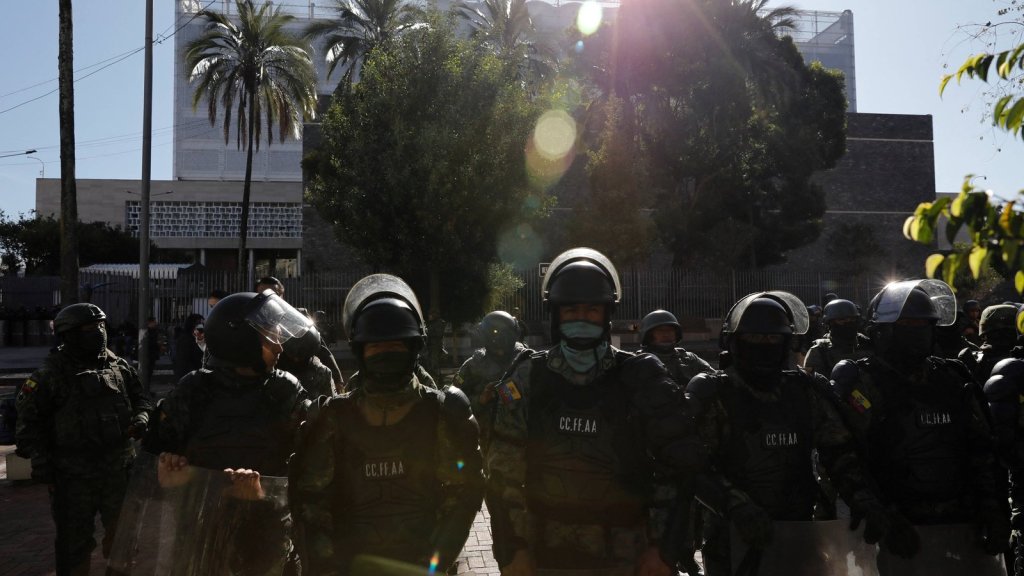
The current outbreak of violence began after the state reacted to the escape from prison of Adolfo Macías — known as “El Fito” — leader of the “Los Choneros” gang. The government declared a state of emergency and tried to impose a siege on the criminals, but suffered several brutal retaliations, with members of Fito’s gang capturing the University of Guayaquil, invading a live TV studio, and even bombing hospitals and public facilities. Furthermore, prisons were captured by criminals, with officers being held hostage, tortured and even hanged. The barbaric scenario led President Daniel Noboa to declare war on the “domestic enemy”, calling on the armed forces to act.

Currently, the streets of Ecuador are the scene of brutal urban warfare, with soldiers facing heavily armed narco-terrorists in intense attrition. The power acquired by criminal groups in the country is impressive, which shows how the impotence of a neoliberal state can have devastating consequences for national security.

It is important to emphasize that U.S.-born Daniel Noboa does not appear to be a skilled politician to reverse this situation completely. He came to power in a tense electoral scenario, in which gangs actively participated in political disputes, even being involved in the murder of a candidate. Noboa is a liberal politician who is extremely aligned with the U.S., and is not interested in resuming Correa’s policies, in addition to suffering a lot of pressure from criminal groups – which have a broad institutional infiltration.

However, it is desirable that at least the public situation in the country returns to normal in some way. The use of military force is the correct way to neutralize gang violence, but it is not the key to solving the drug trafficking problem. To truly undermine the power of criminal networks, it is necessary to implement illiberal policies that reduce poverty, removing ordinary citizens from the sphere of influence of drug trafficking in the country’s periphery. Furthermore, it is necessary to de-dollarize the economy and establish a sovereign currency and exchange rate policy, which make the work of drug trafficking more difficult through strict control of financial flows.

Noboa will certainly not be able to end the drug trafficking problem, as he is not willing to follow the illiberal path, but there is hope that, with the use of force, he will be able to return to normality at some point in the future. After suffering losses on the battlefield, gangs may agree to secretly negotiate a peace agreement with the government to end hostilities on both sides. This will have a positive aspect, as it will put an end to fighting, but it will also have a catastrophic characteristic, as it will definitely turn Ecuador into a Narco-State, where criminal gangs negotiate with the government and act in an institutional manner.

If the U.S. had not intervened in Correa’s Citizen Revolution, perhaps the situation in Ecuador would be different today. But, with neoliberalism and dollarization, the only possible result is a scenario like the current one.

Daydreaming While Reading Jonathan Crary’s 24/7: Late Capitalism and the Ends of Sleep

By Edward Curtin

Source: Behind the Curtain

“Sleep that knits up the raveled sleave of care, The death of each day’s life, sore labor’s bath, Balm of hurt minds, great nature’s second course, Chief nourisher in life’s feast.”   – Shakespeare, Macbeth

People often laugh when I tell them that I go to sleep at 8:15 P.M.  They laugh harder when I say it’s been a lifetime habit, with unavoidable exceptions of course.  And that I wake up long before dawn.  Not because I am a dairy farmer or a baker, but because I love to sleep and all the best things I have written have been written in my dreams and refined during reveries while walking or in the early morning when all is silent still and I am alone with my musings.  I have always felt that sleeping and being awake were a seamless whole, contrary to the go-getters’ attitude that sleep and dreams are a waste of time, and I have been blessed with the ability to fall asleep as soon as I crawl into my crib and usually to remember my dreams in detail when I wake.

Jonathan Crary, the Meyer Schapiro Professor of Modern Art and Theory at Columbia University, agrees that sleep is profoundly important and under assault today.  To enter his book, 24/7, Late Capitalism and the Ends of Sleep, (which was first published in 2014) is for me to discover a kindred spirit, but also to enter a mind so capacious and profound that I wish to share his insights while I dream in words.

If what William Wordsworth (what a name!) wrote in 1802 was true then,

The world is too much with us; late and soon,
Getting and spending, we lay waste our powers;—
Little we see in Nature that is ours;
We have given our hearts away, a sordid boon!

what possibly could one say about today?  That shopping or thinking about shopping – things or propaganda or the latest useless buzz – is all we know?  That we have become completely insane, bamboozled by a capitalist techno-electronic madness that has not only seized our hearts but convinced our minds that it is good to spend our lives – our sleep and dreams and time and praxis – in tending to machines that destroy our souls night and day without interruption.

When fifty plus years ago the monk Thomas Merton wrote that “someday they will sell us the rain,” he could today add that the hard rain that Dylan sung of then has already fallen and they now need not sell us anything because we have eaten the bitter fruit of our own corruption.  People say they want peace while they fill their nights and days with digital dreams, eliminating what Crary calls “fugitive anonymity” for the bait of 24/7 capitalist drug addiction and being “with it.”  All the clichés have it that peace begins with “you,” yet you has become them or it, the tech-life 24/7.  I hear Sinatra singing Cole Porter’s lyrics today as

Night and day, you are the one
Only you ‘neath the moon or under the sun
Whether near to me or far
It’s no matter, cell phone, where you are
I think of you day and night

And such love is reciprocated, of course, as the electronic machines help so many distracted and restless souls make it through the night.  Sort of.  Not the kind of help Kris Kristofferson sang about, but a fleshless flashing gizmo colder than a frozen heart.

It is well known that sleep disorders are widespread today with technologically produced sleep drugs (and now marijuana) used by vast numbers of people. Such drug-induced sleep, the flip side of the frenetic passivity that precedes and follows it, occurs within a larger 24/7 sleepless framework that Crary accurately notes happens “ . . . within the globalist neoliberal paradigm, [for] sleeping is for losers.”   Yet what’s to be won is never enunciated because the winners’ faces are always well-hidden as they execute the prodigious capitalist machine of control that creates docility and separation in people who find the machine life irresistible – even as it drains them of easy-going vitality and the joy of dawdling, even for an idle while.  Doing nothing has become a crime.

Last night I stepped outside an hour after sunset and was startled by a massive full moon eyeing me as it rose over the eastern hills.  Here where I dwell there are no city or factory lights to block the moon and stars as they illuminate our nights.  But most people are not so lucky, for what our ancestors once took for granted – that we are part of nature, part of the Tao – has been lost for so many as artificial lights, urbanization, and a 24/7 linguistic mind-control ideology block the thrill of being transfixed by the moon’s loving gaze, an invitation to taste the sweetness of the north wind’s cookie.  Maybe the sight of her face might rattle the televised images lodged in people’s “memories” of mechanical misbegotten men in ghost suits trampling her peaceful countenance.

The 24/7 digital life, essential to neo-liberal financialized capitalism with its day and night markets and infrastructure that allow for continuous consumption and work – total availability – is the culmination of a long process that began with the invention of artificial lighting that allowed the English cotton mills to run 24/7.  Crary brilliantly illustrates this point through the 1782 painting, Arkwright’s Cotton Mills by Night, by the British artist James Derby.  This painting shows the windows of the massive mills lit like pin-points in the rural night, watched over by a full moon that illuminates the sky.  Incongruous time indeed!  He writes, “The artificial lighting of the factories announces the rationalized deployment of an abstract relation between time and work, severed from the cyclical temporalities of lunar and solar movements.”  This radical break from the traditional relation between time and work and the earth was later noted by Karl Marx as essential to the advance of capitalism since it disconnected the laboring individual from all interdependent connections to family, community, etc. while reorienting people’s feelings for time.  The English art critic John Berger, who knew that time with its corollary to place was a key to understanding so much history, put it this way: “Every ruling minority needs to numb and, if possible, to kill the time-sense of those it exploits.  This is the authoritarian secret of all methods of imprisonment.”

Dreaming of imprisonment, I just remembered that although it seems like a delusion from so far away and long ago, I once worked in a factory by day with its huge blast furnaces, in a NYC Police precinct jail on the 4-12 P.M. shift, and all-night as a nightwatchman.   All good lessons in how American society works, although I hated them all and labored simply for the pay.  But each in its own way taught me about imprisonment, especially the watchman’s job, since it involved a jolting sense of time and staying awake all night and sleeping by day.  I was always exhausted and felt I was violating my deepest nature.

Sleep deprivation is a central component of the torturers’ methods, as so many victims of the U.S. war machine have learned.  And the Pentagon (DARPA) has spent vast sums trying to create a sleepless soldier who can go at least seven days without sleep.  As Crary notes: “ . . . scientists in various labs are conducting experimental trials of sleeplessness techniques, including neurochemicals, gene therapy, and transcranial magnetic stimulation.”   The war against sleep is being waged on many fronts by well-armed maniacs intent on controlling human beings for nefarious ends.  To control sleep is to control time is to confound minds, which is the goal.

Ovid, the most sensual of Roman poets, would be shocked, I imagine, to learn that Morpheus, the god of sleep and dreams from his Metamorphoses, would be attacked so relentlessly by today’s madmen who never heard of his poetry.  My mind drifts to my college days translating Ovid under a weeping willow.  “My cause is better: no-one can claim that I ever took up arms against you,” he wrote and I read.  These words come back to me as I muse on the arms taken today against sleep, but I’m not sure if it’s Ovid or Bob Dylan’s lyrics in his song Workingman’s Blues #2 (from the album Modern Times) that fly to mind, for Dylan also sings “No-one can ever claim/ That I took up arms against you.”

Poor Morpheus, so many people in these modern times yearn for your arms but instead of that balm, they toss and turn in a time out of mind and out of sleep.

Crary tells us that the amount of sleep the average North American adult gets has gone from ten hours in the early twentieth century to eight hours a generation ago to six-and-a-half today.  And although people will always have to sleep, I think we can expect further reductions.  To say it is a form of torture is probably an exaggeration, but not by much.  He writes:

Behind the vacuity of the catchphrase, 24/7 is a static redundancy that disavows its relation to the rhythmic and periodic textures of human life. . . . A 24/7 environment has the semblance of a social world, but it is actually a non-social model of machinic performance and a suspension of living that does not disclose the human cost required to sustain its effectiveness. . . . 24/7 is a time of indifference, against which the fragility of human life is increasingly inadequate and within which sleep has no necessity or inevitability.  In relation to labor, it renders plausible, even normal, the idea of working without pause, without limits.  It is aligned with what is inanimate, inert, or unageing.  As an advertising exhortation it decrees the absoluteness of availability, and hence the ceaselessness of needs and their incitement, but also their perpetual non-fulfillment.

In other words, 24/7 is a form of linguistic mind control tied to cell phones, computers, and the digital life of the Internet whose purpose is to convince people that sleep and the human body is somehow unnatural and the future lies with people accepting their marriage to machines in a disenchanted and transhuman world.  It is a lie, of course, for if that is a future people accept, there will be no future, just a desert.  “Deleuze and Guattari went to the point of comparing the order-word [24/7] to a ‘death sentence,’” writes Crary. Such an order-word or imperative is similar in this respect to the term “9/11” which was coined to send an instant message that emergencies will now be endless so we will have to monitor you forevermore.  Keep your cell phone ready.  Be on your toes, stay alert, the terrorists come at all hours – keep awake!

Crary makes a profoundly important point at a time when there is much justifiable focus on propaganda and the lies of governments and the media.  This is the power of habit involved in the acceptance of the naturalness of various devices – today, electronic screens that are omnipresent – that we semi-automatically accept as normal.  He says, “In this sense, they are part of larger strategies of power in which the aim is not mass-deception, but rather states of neutralization and inactivation, in which one is dispossessed of time.  But even within habitual repetitions there remains a thread of hope – a knowingly false hope – that one more click or touch might open onto something to redeem the overwhelming monotony in which one is immersed.  One of the forms of disempowerment within 24/7 environments is the incapacitation of daydream or any mode of absent-minded introspection that would otherwise occur in intervals of slow or vacant time.”

This is part of a modern process of psychological reductionism and a changed understanding of the nature of wishes that have excluded dreaming and daydreaming from any connection to a traditional magico-theological framework.  Science and especially the neuro-sciences have reduced all life to what is empirically provable, attenuating life and the creation of art in the service of human life.  Crary uses Jean Paul Satre’s inelegant but insightful neologism, “practico-inert,” to explain people’s inability to see the nature of the social worlds they are part of with any clarity.  “The practico-inert was thus Sartre’s way [in Critique of Dialectical Reason] of designating the sedimented, institutional everyday world constituted out of human energy but manifested as the immense accumulation of routine passive activity.”

To repeat, this frenetic passivity serves to obscure the negative historical reality of life in a 24/7 electronic spectacle that is advertised as amazingly empowering but is the reverse.

For direct experience has fallen on hard times as life today has come to be mediated through electronic gadgets.  Surprises must be googled in advance or photographed to prove their reality.  Living is never easy, not in the summertime or any other season. Tension, inattention, exhaustion, and constant busyness are the order of the day.  This should be self-evident but isn’t.  People feel it but can’t see it.

Commenting on the dying art of storytelling, Walter Benjamin, in an essay called “The Storyteller,” said the following about people’s ability to listen and remember stories that they can integrate into their own experience so they can pass them on:

This process of assimilation, which takes place in depth, requires a state of relaxation, which is becoming rarer and rarer [written in 1936].  If sleep is the apogee of physical relaxation, boredom is the apogee of mental relaxation.  Boredom is the dream bird that hatches the egg of experience.  A rustling in the leaves drives him away.  His nesting places – the activities that are intimately associated with boredom – are already extinct in the cities and are declining in the country as well.  With this the gift of listening is lost and the community of listeners disappears.  [my emphasis]

We have gone beyond rustling in the bushes to a cacophonous electronic world that makes one deaf to all else.  That it will come crashing down around our ears is hard to imagine, but it will.  It already has in the damage that it’s done.

Once upon a time . . . well, I will spare you.  It might just seem like the dream of a ridiculous man, or something Dostoevsky would write, not your normal story or even daydream.

So read Jonathan Crary’s brilliant, 24/7: Late Capitalism and the Ends of Sleep and its sequel, Scorched Earth: Beyond the Digital Age to a Post-Capitalist World.  They will get you to think about your sleep habits and whether or not you are ever turned off and tuned out but just sometimes only in “sleep mode.”

Sickening Profits — The Global Food System’s Poisoned Food and Toxic Wealth

By Colin Todhunter

Source: Off-Guardian

The modern food system is being shaped by the capitalist imperative for profit. Aside from losing their land to global investors and big agribusiness concerns, people are being sickened by corporations and a system that thrives on the promotion of ‘junk’ (ultra-processed) food laced with harmful chemicals and cultivated with the use of toxic agrochemicals.

It’s a highly profitable situation for investment firms like BlackRock, Vanguard, State Street, Fidelity and Capital Group and the food and agribusiness conglomerates they invest in. But BlackRock and others are not just heavily invested in the food industry. They also profit from illnesses and diseases resulting from the food system by having stakes in the pharmaceuticals sector as well. For them, it’s a win-win situation.

Lobbying by agrifood corporations and their well-placed, well-funded front groups ensures this situation prevails. They continue to capture policy-making and regulatory space at international and national levels and promote the (false) narrative that without their products the world would starve.

They are now also pushing a fake-green, ecomodernist agenda and rolling out their new proprietary technologies in order to further entrench their grip on a global food system that produces poor food, illness, environmental degradation, dependency and dispossession.

The prevailing globalised agrifood model is built on unjust trade policies, the leveraging of sovereign debt to benefit powerful interests, population displacement and land dispossession. It fuels export-oriented commodity monocropping and regional food insecurity.

This model is responsible for increasing rates of illness, nutrient-deficient diets, a narrowing of the range of food crops, chemical runoffs, increasing levels of farmer indebtedness and the eradication of biodiversity. And it relies on a policy paradigm that privileges urbanisation, global markets and agrifood corporations’ needs ahead of rural communities, local markets, on-farm resources and food sovereignty.

In addition, there are also the broader geopolitical aspects of food and agriculture in a post-COVID world characterised by food inflation, hardship and multi-trillion-dollar global debt.

There are huge environmental, political, social and health issues that stem from how much of our food is currently produced and consumed. A paradigm shift is required.

All of this is set out in Sickening Profits: The Global Food System’s Poisoned Food and Toxic Wealth (December 2023), published as an open-access (free) e-book by Global Research (it can be read directly on the Global Research website or downloaded as a pdf) and is a follow up to the author’s book Food, Dispossession and Dependency: Resisting the New World Order (2022).

That book contains substantial sections on the agrarian crisis in India and issues affecting the agriculture sector. Aruna Rodrigues — prominent campaigner and lead petitioner in the GMO Mustard Public Interest Litigation in the Supreme Court of India — stated the following about the book:

This is graphic, a detailed horror tale in the making for India, an exposé on what is planned, to hand over Indian sovereignty and food security to big business.”

‘Sickening Profits’ continues in a similar vein. By describing situations in Ukraine, India, the Netherlands and elsewhere, it is another graphic horror tale in the making that is being intensified across the globe. The question is: Can it be stopped?

“Humanitarian Imperialism Created the Libyan Nightmare.”

NATO’s military intervention in Libya in 2011, which overthrew the regime of Muammar Gaddafi, resulted in a chaotic and murderous failed state. Libyans pay a horrific price for this catastrophe.

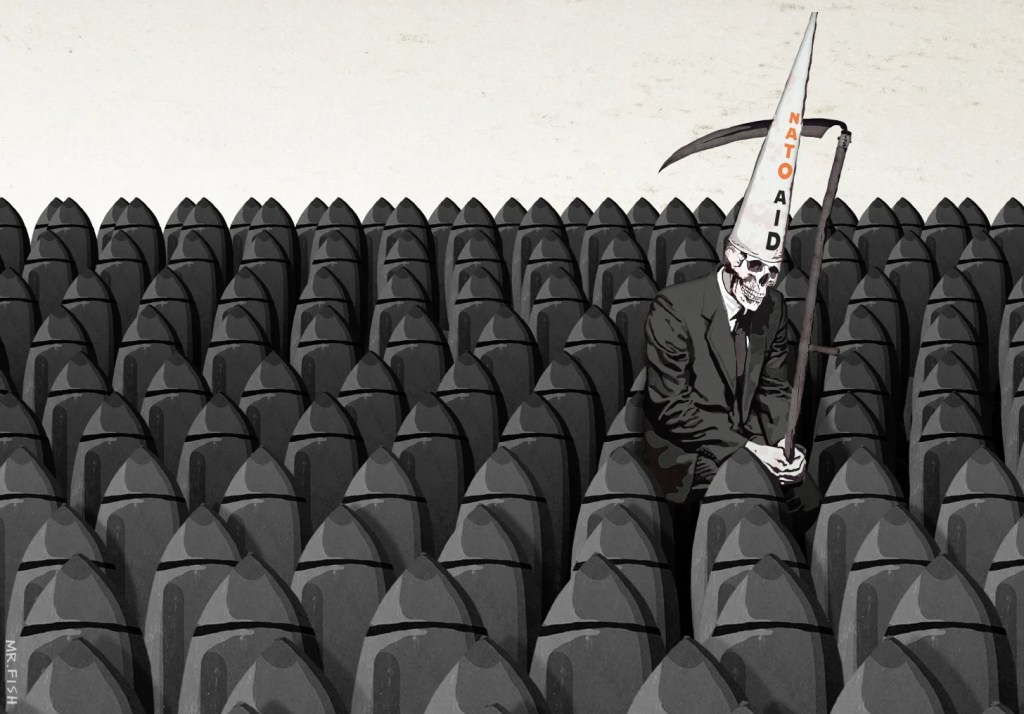
Business is Booming – by Mr. Fish

By Chris Hedges

Source: The Chris Hedges Report

“We came, we saw, he died,” Hillary Clinton famously quipped when Muammar Gaddafi, after seven months of U.S. and NATO bombing, was overthrown in 2011 and killed by a mob who sodomized him with a bayonet. But Gaddafi would not be the only one to die.  Libya, once the most prosperous and one of the most stable countries in Africa, a country with free healthcare and education, the right for all citizens to a home, subsidized electricity, water and gasoline, along with the lowest infant mortality rate and highest life expectancy on the continent, along with one of the highest literacy rates, swiftly fragmented into warring factions. There are currently two rival regimes battling for control in Libya, along with an array of rogue militias. 

The chaos that followed Western intervention saw weapons from the country’s arsenals flood the black market, with many snatched up by groups such as the Islamic State. Civil society ceased to function. Journalists captured images of migrants from NigeriaSenegal and Eritrea being beaten and sold as slaves to work in fields or on construction sites. Libya’s infrastructure, including its electrical grids, aquifers, oil fields and dams, fell into disrepair. And when the torrential rains from Storm Daniel —  the climate crisis being another gift to Africa from the industrialized world — overwhelmed two decrepit dams, walls of water 20 feet high raced down to flood the port of Derna and Benghazi, leaving up to 20,000 dead according to Abdulmenam Al-Gaiti, Mayor of Derna, and some 10,000 missing. 

“The fragmentation of the country’s disaster management and disaster response mechanisms, as well as deteriorating infrastructure, exacerbated the enormity of the challenges. The political situation is a driver of risk,” said Professor Petteri Taalas, Secretary General of the World Meteorological Organization.

Taalas told reporters last Thursday that “most of the human casualties” would have been avoided if there had been a “normally operating meteorological service” which “would have issued the [necessary] warnings and also the emergency management of this would have been able to carry out evacuations of the people.”

Western regime-change, carried out in the name of human rights under the doctrine of R2P (Responsibility to Protect), destroyed Libya – as it did Iraq – as a unified and stable nation. The flood victims are part of the tens of thousands of Libyan dead resulting from our “humanitarian intervention,” which rendered disaster relief non-existent. We bear responsibility for Libya’s prolonged suffering. But once we wreak havoc on a country in the name of saving its persecuted — regardless of whether they are being persecuted or not — we forget they exist. 

Karl Popper in “The Open Society and Its Enemies” warned against utopian engineering, massive social transformations, almost always implanted by force, and led by those who believe they are endowed with a revealed truth. These utopian engineers carry out the wholesale destruction of systems, institutions and social and cultural structures in a vain effort to achieve their vision. In the process, they dismantle the self-correcting mechanisms of incremental and piecemeal reform that are impediments to that grand vision. History is replete with murderous utopian social engineering — the Jacobins, the communists, the fascists and now, in our own age, the globalists, or neoliberal imperialists.

Libya, like Iraq and Afghanistan, fell victim to the self-delusions peddled by humanitarian interventionists — Barack Obama, Hillary Clinton, Ben Rhodes, Samantha Power and Susan Rice. The Obama administration armed and backed an insurgent force that they believed would do the bidding of the U.S.  Obama in a recent post urged people to support aid agencies to alleviate the suffering of the people of Libya, a plea that ignited an understandable backlash on social media.

There is no official tally of the casualties in Libya that have resulted directly and indirectly from the violence in Libya over the last 12 years. This is exacerbated by the fact that NATO failed to investigate casualties resulting from its seven month bombardment of the country in 2011. But the total figure of those killed and injured is likely in the tens of thousands. Action on Armed Violence recorded “8,518 deaths and injuries from explosive violence in Libya” from 2011 to 2020,  6,027 of which were civilian casualties.

In 2020, a statement published by seven U.N. agencies reported that “Close to 400,000 Libyans have been displaced since the start of the conflict nine years ago — around half of them within the past year, since the attack on the capital, Tripoli, [by Field Marshal Khalifa Belqasim Haftar’s forces] started.”

“The Libyan economy has been battered by the [civil war], the COVID-19 pandemic, and Russia’s invasion of Ukraine,” the World Bank reported in April of this year. “The country’s fragility is having far-reaching economic and social impact. GDP per capita declined by 50 percent between 2011 and 2020 while it could have increased by 68 percent if the economy had followed its pre-conflict trend,” the report says. “This suggests that Libya’s income per capita could have been 118 percent higher without the conflict. Economic growth in 2022 remained low and volatile due to conflict-related disruptions in oil production.”

Amnesty International’s 2022 Libya report also makes for grim reading. “Militias, armed groups and security forces continued to arbitrarily detain thousands of people,” it says. “Scores of protesters, lawyers, journalists, critics and activists were rounded up and subjected to torture and other ill-treatment, enforced disappearances and forced ‘confessions’ on camera.” Amnesty describes a country where militias operate with impunity, human rights abuses, including kidnappings and sexual violence, are widespread. It adds that “EU-backed Libyan coastguards and the Stability Support Authority militia intercepted thousands of refugees and migrants at sea and forcibly returned them to detention in Libya. Detained migrants and refugees were subjected to torture, unlawful killings, sexual violence and forced labour.”

Reports by the U.N. Support Mission to Libya (UNSMIL) are no less dire.

Stockpiles of weapons and ammunition — estimated to be between 150,000 and 200,000 tons — were looted from Libya with many being trafficked to neighboring states. In Mali, weapons from Libya fuelled a dormant insurgency by the Tuareg, destabilizing the country. It ultimately led to a military coup and a jihadist insurgency which supplanted the Tuareg, as well as a protracted war between the Malian government and jihadists.  This triggered another French military intervention and led to 400,000 people being displaced. Weapons and ammunition from Libya also made their way into other parts of the Sahel including Chad, Niger, Nigeria and Burkina Faso. 

The misery and carnage, which rippled out from a dismembered Libya, was unleashed in the name of democratization, nation-building, promoting the rule of law and human rights. 

The pretext for the assault was that Gaddafi was about to launch a military operation to massacre civilians in Benghazi where rebellious forces had seized power. It had as much substance as the charge that Saddam Hussein had weapons of mass destruction, another example of utopian social engineering that left over a million Iraqi dead and millions more driven from their homes. 

Gaddafi — who I interviewed for two hours in April 1995 near the gutted remains of his home that was bombed by U.S. warplanes in 1986 — and Hussein were targeted not because of what they did to their own people, although both could be brutal. They were targeted because their nations had large oil reserves and were independent of Western control. They renegotiated more favorable contracts for their nations with Western oil producers and awarded oil contracts to China and Russia. Gaddafi also gave the Russian fleet access to the port of Benghazi.

Hillary Clinton’s emails, obtained via a freedom of information request and published by WikiLeaks, also expose France’s concerns about Gaddafi’s efforts to “provide Francophone African Countries with an alternative to the French Fran (CFA).” Sidney Blumenthal, a longtime adviser to Clinton, reported on his conversations with French intelligence officers about the motivations of French President Nicholas Sarkozy, the chief architect of the attack on Libya. Blumenthal writes that the French president seeks “a greater share of Libyan oil”, increased French influence in the region, an improvement in his domestic political standing, a reassertion of French military power and an end to Gaddafi’s attempts to supplant French influence in “Francophone Africa.”

Sarkozy, who has been convicted on two separate cases of corruption and breach of campaign finance laws, faces a historic trial in 2025 for allegedly receiving millions of euros in secret illegal campaign contributions from Gadaffi, to assist with his successful 2007 presidential bid.            

These were the real “crimes” in Libya. But the real crimes always remain hidden, papered over by florid rhetoric about democracy and human rights. 

The American experiment, built on slavery, began with a genocidal campaign against Native Americans that was exported to the Philippines and, later, nations such as Vietnam. The narratives we tell ourselves about World War II, largely to justify our right to intervene around the globe, are a lie. It was the Soviet Union that destroyed the German army long before we landed at Normandy. We firebombed cities in Germany and Japan killing hundreds of thousands of civilians.  The war in the South Pacific, where one of my uncles fought, was bestial, characterized by rabid racism, mutilation, torture and the routine execution of prisoners. The atomic bombings of Hiroshima and Nagasaki were egregious war crimes. The U.S. routinely destroys democracies that nationalize U.S. and European corporations as in Chile, Iran and Guatemala, replacing them with repressive military regimes. Washington supported the genocides in Guatemala and East Timor. It embraces the crime of preemptive war. There is little in our history to justify the claim of unique American virtues. 

The nightmares we orchestrated in Iraq, Afghanistan and Libya are minimized or ignored by the press while the benefits are exaggerated or fabricated. And since the U.S. does not recognize the International Criminal Court, there is no chance of any American leader being held accountable for their crimes.

Human rights advocates have become a vital cog in the imperial project. The extension of U.S. power, they argue, is a force for good. This is the thesis of Samantha Power’s book “A Problem from Hell: America and the Age of Genocide.” They champion the R2P doctrine, unanimously adopted in 2005 at the U.N. World Summit. Under this doctrine, states are required to respect the human rights of their citizens. When these rights are violated, then sovereignty is nullified. Outside forces are permitted to intervene. Miguel d’Escoto Brockmann, the former president of the U.N. General Assembly, warned in 2009 that R2P could be misused “to justify arbitrary and selective interventions against the weakest states.” 

“Since the end of the Cold War, the idea of human rights has been made into a justification for intervention by the world’s leading economic and military powers, above all, the United States, in countries that are vulnerable to their attacks,” writes Jean Bricmont in “Humanitarian Imperialism: Using Human Rights to Sell War.”  “Until the U.S. invasion of Iraq, [a] large part of the left was often complicit in this ideology of intervention, discovering new ‘Hitlers’ as the need arose, and denouncing antiwar arguments as appeasement on the model of Munich in 1938.” 

The creed of humanitarian intervention is selective. Compassion is extended to “worthy” victims while “unworthy” victims are ignored. Military intervention is good for Iraqis, Afghans or Libyans, but not for Palestinians or Yeminis. Human rights are supposedly sacrosanct when discussing Cuba, Venezuela and Iran, but irrelevant in our offshore penal colonies, the world’s largest open air prison in Gaza or our drone-infested war zones. The persecution of dissidents and journalists is a crime in China or Russia, but not when the targets are Julian Assange and Edward Snowden.

Utopian social engineering is always catastrophic. It creates power vacuums that augment the suffering of those the utopianists claim to protect. The moral bankruptcy of the liberal class, which I chronicle in “Death of the Liberal Class,” is complete. Liberals have prostituted their supposed values to the Empire. Incapable of taking responsibility for the carnage they inflict, they clamor for more destruction and death to save the world.

Justin and the Nazis

His former PM father granted safe haven to Nazi war criminals.

By Kurt Nimmo

Source: Kurt Nimmo on Geopolitics

Poor Justin Trudeau. The Canadian PM has egg on his face after it was revealed his government gave former Waffen-SS Nazi Yaroslav Hunka a standing ovation in Canada’s House of Commons.

It looks like Canada’s “House of Commons” (where there are few real commoners) is all gaa-gaa over Ukrainian Nazis. Of course, this is a major faux pas, as slavering over unrepentant Nazis is, to say the least, in bad taste, especially for “woke” leaders such as Trudeau.

How is it possible Canada’s “leaders” are unaware the SS Galicia Division where Hunka “served” was involved in the 1943 mass murder of Poles, Jews, Roma, and communists? How is possible for a man involved in genocide (directed primarily against women and children) to receive a standing ovation?

It’s rather amusing, in a sardonic sort of way, to watch as the Canadian government melts down over this embarrassing incident.

It looks like House of Commons Speaker Anthony Rota will be thrown under the bus. He called Hunka a “hero” during the staged event that revealed the Canadian government’s apparent affinity for SS Waffen Nazis.

The pathetic face-saving blame game was dropped on Rota like 900 pounds of manure. There are demands he resign his post immediately. No doubt he will spend the rest of his now miserable life in shame.

Meanwhile, Trudeau declared his innocence. He insisted it was “extremely upsetting that this happened… This is something that is deeply embarrassing to the parliament of Canada and by extension to all Canadians.”

Justin’s father, Pierre Trudeau, the former Canadian PM (it’s a family affair), “was complicit in the granting of safe haven to thousands of known Nazis who had ‘killed Jews with their own hands,’” tweets Chay Bowes.

I know it’s popular now to consider just about everything posted on Elon Musk’s X-Twitter as a far-right conspiracy theory. However, Mr. Bowes includes a clip from a 1997 episode of Sixty Minutes. Needless to say, CBS ain’t what it used to be.

The Canadian Security Intelligence Service revealed in 2019 that a secret file on the scandalous dealings of the elder Trudeau was dispatched to the memory hole. His “fascination with communism, fascism, socialism and religion drove Trudeau to the far reaches of the political world,” writes Robert Morley for The Trumpet.

According to a Free Republic book review of the biography Young Trudeau: Son of Quebec, Father of Canada, 1919-1944, authored by Max and Monique Nemni, Trudeau was “not in the usual iconographic way… the sacrosanct icon of the progressive new Canada but as an anti-Semitic admirer of Hitler and Mussolini.”

Like father, like son?

It should also be noted that Canada’s Foreign Affairs Minister, Chrystia Freeland, who arranged a Canadian training mission with Ukraine’s “integral nationalists” in 2017, has a rather ugly skeleton in her closet. Freeland’s Ukrainian grandfather Michael Chomiak (Mykhailo Khomiak) was a Nazi collaborator. He edited Krakivs’ki Visti, a “vehemently antisemitic” newspaper.

Before the insanity of Ukraine, the corporate media on occasion told the truth about Nazis. Now, according to the state and its corporate media megaphone, the real Nazis are in America—no, not the Operation Paperclip imports by the CIA, but a tiny marginalized homegrown fringe of skinheads and other deluded racist miscreants.

Canada’s “conservatives” are exploiting this incident to the hilt. In this regard, they are little different than their American counterparts, the supposed “conservatives” that want endless war with Russia, Iran, North Korea, Syria, and China. These are the “conservatives” that want to kill Julian Assange and run a former Gitmo JAG officer as president, they are colleagues of neocon “conservatives” like the psychopaths Lindsey Graham and Nikki Haley.

Finally, to demonstrate the rank historical ignorance of Canada’s parliament, Hunka was described as fighting against the Soviets in World War 2.

I’m not sure what history books these ignoramuses are reading (if any at all). The Soviet Union, the UK, and the US were allies during the war.

I’ll bet Trudeau, Freeland, and at least a few MPs understand Ukraine’s Nazis were on the side of the real Nazis, not the Allies. However, it appears Canada, the US, and Germany required the ideology of authoritarian fascism in order to control their respective countries, and that’s why war criminal Nazis were shipped in under the wire.