Pentagon Lies About Overnight Aggression on Syria

Photo by Hassan Ammar/Associated Press

By Stephen Lendman

Source: StephenLendman.org

At a Saturday briefing to reporters, “Mad Dog” Mattis, Joint Chiefs chairman “Fighting Joe” Dunford, France’s General Montague, and UK air vice marshal Parker tried justifying unjustifiable overnight aggression on Syria.

Their justification for what happened turned truth on its head. US Defense Department officials claimed overnight terror-bombing took the “heart” out of a Syrian chemical weapons program that doesn’t exist.

No evidence proves otherwise. Plenty shows Syria’s entire CW stockpile was eliminated in 2014. Nothing suggests any remain. Clearly these weapons never were used by Syrian forces against their own people or anyone else.

Mattis distorted reality, claiming Assad “us(ed) chemical weapons to murder women, children and other innocents” – a bald-faced lie.

He lied saying Trump was constitutionally authorized “to use military force overseas to defend important United States national interests.”

“The United States has vital national interests in averting a worsening catastrophe in Syria, and specifically deterring the use and proliferation of chemical weapons.”

Security Council members alone may authorize an attack by nations against others – only permitted in self-defense, never preemptively.

America has no national security interests in Syria, a nation threatening no others. The catastrophe in the country was made in the USA, supported by allied rogue states.

US-supported terrorists alone used CWs numerous times throughout years of war. No evidence suggests government forces ever used them.

Mattis: “Earlier today, President Trump directed the US military to conduct operations in consonance with our allies to destroy (Syria’s) chemical weapons research development and production capability.”

No such capability exists. US-led aggression had nothing to do with alleged use of CWs in Syria, everything to do with trying to advance Washington’s imperium, along with punishing Syria and Russia for foiling US aims in the country.

Mattis: “Tonight, France, the United Kingdom and the United States took decisive action to strike the Syrian chemical weapons infrastructure.”

A Big Lie!

Mattis: “The strike tonight separately demonstrates international resolve to prevent chemical weapons from being used on anyone under any circumstances in contravention of international law.”

Washington, its rogue allies and terrorist foot soldiers alone flagrantly continue violating international law, not Syria, Russia, Iran or Hezbollah – defending the Syrian Arab Republic against US-led naked aggression.

Dunford, Montague and Parker followed Mattis, explaining targets struck, Dunford saying:

“This evening we conducted strikes with two allies on multiple sites that will result in a long-term degradation of Syria’s capability to research, develop and employ chemical and biological weapons.”

No such capabilities existed to be destroyed. The strike wasn’t “a strong message (about) inexcusable…actions” by Syria.

It was naked aggression, the highest of high crimes, escalating years of US-led imperial war on a sovereign state.

The overnight attack followed years of raping and destroying Syria, massacring its people, likely worse coming – endless US-led aggression raging with no end of it in sight.


VISIT MY NEW WEB SITE: stephenlendman.org (Home – Stephen Lendman). Contact at lendmanstephen@sbcglobal.net.

Nonviolence or Nonexistence? The Legacy of Martin Luther King Jr.

By Robert J. Burrowes

Fifty years ago, on 4 April 1968, the Reverend Martin Luther King Jr. was assassinated.

The night before he died, King gave another of his many evocative speeches; this one at the packed Mason Temple in Memphis. The speech included these words:

‘Men for years now have been talking about war and peace. Now no longer can they just talk about it. It is no longer a choice between violence and non-violence in this world, it is non-violence or non-existence. That is where we are today.’

In clearly identifying this stark choice and having been inspired by Mohandas K. Gandhi’s wideranging social concerns, King’s concerns were also broad:

‘The Triple Evils of poverty, racism and militarism are forms of violence that exist in a vicious cycle. They are interrelated, all-inclusive, and stand as barriers to our living in the Beloved Community. When we work to remedy one evil, we affect all evils.’ See ‘The King Philosophy’.

So what has changed in the past 50 years? The world has traveled a great deal further down the path of violence. So far, in fact, that nonexistence is now the most likely outcome for humanity. See ‘On Track for Extinction: Can Humanity Survive?’

Despite the vastly more perilous state of our planet, many people and organizations around the world are following in the footsteps of Gandhi, King and other nonviolent luminaries like Silo, and are engaged in what is effectively a last ditch stand to end the violence and put humanity on a path to peace, justice and sustainability.

Let me tell you about some of these people and organizations and invite you to join them.

In Bolivia, Nora Cabero works with the Movimient Humanista. The Movement has many programs including the Convergence of Cultures which aims to facilitate and stimulate true dialogue – oriented towards the search for common points present in the hearts of different peoples and individuals – to promote the relationship between different cultures and to resist discrimination and violence. Another program, World Without Wars and Violence emerged in 1994 and was presented for the first time internationally in 1995 at the Open Meeting of Humanism held in Chile at the University of Santiago. It is active in about 40 countries. It carries out activities in the social base and also promotes international campaigns such as Education for Nonviolence and the World March for Peace and Nonviolence.

Eddy Kalisa Nyarwaya Jr. is Executive Secretary of the Rwanda Institute for Conflict Transformation and Peace Building and also President of the Alternatives to Violence Program. For the past 18 years, he has been active in the fields of ‘peace, reconciliation, nonviolence, healing of societies, building harmonious communities’ in many countries including Burundi, Chad, eastern Congo, Darfur (western Sudan), Kenya, Rwanda, Somalia, South Sudan and northern Uganda. Late last year he was in New Zealand to deliver a paper on the Great Lakes conflict. In Rwanda, the Institute for Conflict Transformation particularly works on nonviolence education in schools, universities and refugee camps. Another initiative is the conduct of workshops on nonviolence and peace through sports for head teachers in the country but it also has programs to fight early marriages and pregnancies, as well as offering trauma counseling to refugees.

In Russia, Ella Polyakova is a key figure at the Soldiers’ Mothers of Saint-Petersburg. Ella and her colleagues work to defend the rights of servicemen and conscripts in the Russian military. Ella explains why:

‘When we were creating our organization, we understood that people knew little about their rights, enshrined in Russia’s Constitution, that the concept of “human dignity” had almost disappeared, that no one had been working with the problems of common people, let alone those of conscripts. We clearly understood what a soldier in the Russian army was a mere cog in the state machine, yet with an assault rifle. We felt how important hope, self-confidence and trust were for every person. At the beginning of our journey, we saw that people around us, as a rule, did not even know what it meant to feel free. It was obvious for us that the path towards freedom and the attainment of dignity was going through enlightenment. Therefore, our organization’s mission is to enlighten people around us. Social work is all about showing, explaining, proving things to people, it is about convincing them. Having equipped ourselves with the Universal Declaration of Human Rights and Russia’s Constitution, we started to demolish this dispossession belt between citizens and their rights. It was necessary to make sure that people clearly understood that, having a good knowledge of rights, laws, and situations at hand, they would be able to take responsibility and protect themselves from abuse.’

Bruce Gagnon, coordinator of the Global Network Against Weapons & Nuclear Power in Space, was recently part of a committed effort to convince the Maine state legislature not to give warship-builder General Dynamics, which has already received more than $200 million in state and local tax breaks for the Bath Iron Works (BIW), any more ‘corporate welfare’. Bruce recently completed a fast, which lasted for more than a month, as one of the actions that Maine peace activists took to try to prevent this welfare payment to a company that has spent $14.4 billion buying back its own stocks between 2013-2017 and whose CEO was paid $21 million in 2016.

Despite their efforts, the Maine House of Representatives voted 117-31 in favor of the $45million General Dynamics corporate welfare bill and the Senate supported it 25-9. The decision was announced on the same day that General Dynamics sacked 31 workers from the BIW. As Bruce noted: ‘It was an honor to work alongside [those] who stood up for the 43,000 children living in poverty across Maine, for the tens of thousands without health care, for our starving public education system, and for the crumbling physical infrastructure as Maine joins Mississippi in the “race to the bottom”’. You can read more about this ongoing campaign to convert the Bath Iron Works into a location for the production of socially useful and ecologically sustainable non-killing technologies on the website above. There are some great photos too.

Gaëlle Smedts and her partner Luz are the key figures at Poetry Against Arms based in Germany. ‘The inspiration for this campaign is the life, work and legacy of the Latin American poet, philosopher and mystic: Mario Rodriguez Cobos, also known as Silo. His total commitment to active nonviolence, his denunciation of all forms of violence, his doctrine for overcoming pain and suffering and his magnificent poetry are a great affirmation of the meaning of life and transcendence.’ Poetry Against Arms publishes poetry/songs of people around the world who take action to resist militarism.

Since the 1970s, the world’s leading rainforest activist, John Seed, has devoted his life to saving the world’s rainforests. Founder and Director of the Rainforest Information Centre in Australia, one of his latest projects is to save the tropical Andes of Ecuador, which is ‘at the top of the world list of biodiversity hotspots in terms of vertebrate species, endemic vertebrates, and endemic plants’. From the cloud forests in the Andes to the indigenous territories in the headwaters of the Amazon, the Ecuadorean government has covertly granted mining concessions to over 1.7 million hectares (4.25 million acres) of forest reserves and indigenous territories to multinational mining companies in closed-door deals without public knowledge or consent. These concessions will decimate headwater ecosystems and biodiversity hotspots of global significance. If you would like to read more about this campaign and what you can do to help, you can do so in John’s article ‘Ecuador Endangered’.

Apart from the individuals mentioned above, signatories and endorsing organizations are engaged in an incredibly diverse range of activities to end violence in one context or another. These include individuals and organizations working in many countries to end violence against women (including discriminatory practices against widows), to rehabilitate child soldiers and end sexual violence in the Congo, activists engaged in nonviolent defense or liberation struggles – see Nonviolent Defense/Liberation Strategy – in several countries and occupied territories, as well as campaigns on a vast range of environmental, climate and indigenous rights issues, campaigns to promote religious and racial harmony as well as campaigns for nuclear disarmament and to end war. See Nonviolent Campaign Strategy.

But it also includes many individuals tackling violence at its source – see Why Violence?’ and Fearless Psychology and Fearful Psychology: Principles and Practice – by focusing on their own healing – see ‘Putting Feelings First’ – and/or working on how they parent their children for a nonviolent world. See ‘My Promise to Children’.

Given the perilous state of the global environment and climate, still others are focusing their efforts on reducing their consumption and increasing their self-reliance in accordance with the fifteen-year strategy outlined in The Flame Tree Project to Save Life on Earth.

If you would like to be part of the worldwide movement to end violence that has drawn the six people and several organizations mentioned above together, along with many others in 103 countries around the world, you are welcome to sign the online pledge of The Peoples Charter to Create a Nonviolent World.

Reverend King posed the fundamental choice of our time: nonviolence or nonexistence. What is your choice?


Biodata: Robert J. Burrowes has a lifetime commitment to understanding and ending human violence. He has done extensive research since 1966 in an effort to understand why human beings are violent and has been a nonviolent activist since 1981. He is the author of Why Violence? His email address is flametree@riseup.net and his website is here.


Robert J. Burrowes
P.O. Box 68
Daylesford, Victoria 3460
Australia

Email: flametree@riseup.net

Websites:
Nonviolence Charter
Flame Tree Project to Save Life on Earth
‘Why Violence?’
Feelings First
Nonviolent Campaign Strategy
Nonviolent Defense/Liberation Strategy
Anita: Songs of Nonviolence
Robert Burrowes
Global Nonviolence Network


Enough Is Enough: If You Really Want to Save Lives, Take Aim at Government Violence

By John W. Whitehead

Source: The Rutherford Institute

“It is often the case that police shootings, incidents where law enforcement officers pull the trigger on civilians, are left out of the conversation on gun violence. But a police officer shooting a civilian counts as gun violence. Every time an officer uses a gun against an innocent or an unarmed person contributes to the culture of gun violence in this country.”—Journalist Celisa Calacal

Enough is enough.

That was the refrain chanted over and over by the thousands of demonstrators who gathered to protest gun violence in America.

Enough is enough.

We need to do something about the violence that is plaguing our nation and our world.

Enough is enough.

The world would be a better place if there were fewer weapons that could kill, maim, destroy and debilitate.

Enough is enough.

On March 24, 2018, more than 200,000 young people took the time to march on Washington DC and other cities across the country to demand that their concerns about gun violence be heard.

More power to them.

I’m all for activism, especially if it motivates people who have been sitting silently on the sidelines for too long to get up and try to reclaim control over a runaway government.

Curiously, however, although these young activists were vocal in calling for gun control legislation that requires stricter background checks and limits the kinds of weapons being bought and sold by members of the public, they were remarkably silent about the gun violence perpetrated by their own government.

Enough is enough.

Why is no one taking aim at the U.S. government as the greatest purveyor of violence in American society and around the world?

The systemic violence being perpetrated by agents of the government has done more collective harm to the American people and our liberties than any single act of terror or mass shooting.

Violence has become our government’s calling card, starting at the top and trickling down, from the more than 80,000 SWAT team raids carried out every year on unsuspecting Americans by heavily armed, black-garbed commandos and the increasingly rapid militarization of local police forces across the country to the drone killings used to target insurgents.

Enough is enough.

The government even exports violence worldwide, with weapons being America’s most profitable export.

Indeed, the day before thousands of demonstrators descended on Washington DC to protest mass shootings such as the one that took place at Stoneman Douglas High School, President Trump signed into law a colossal $1.3 trillion spending bill that gives the military the biggest boost in spending in more than a decade.

Ironic, isn’t it?

Here we have thousands of passionate protesters raging, crying and shouting about the need to restrict average Americans from being able to purchase and own military-style weapons, all the while the U.S. government—the same government under Trump, Obama, Bush, Clinton and beyond that continues to act as a shill and a shield for the military industrial complex—embarks on a taxpayer-funded death march that will put even more guns into circulation, and no one says a thing about it.

Why is that?

Why does the government get a free pass?

With more than $700 billion earmarked for the military, including $144.3 billion for new military equipment, you can expect a whole lot more endless wars, drone strikes, bombing campaigns, civilian deaths, costly military installations, and fat paychecks for private military contractors who know exactly how to inflate invoices and take the American taxpayers for a ride.

Enough is enough.

You can be sure this financial windfall for America’s military empire will be used to expand the police state here at home, putting more militarized guns and weapons into the hands of local police and government bureaucrats who have been trained to shoot first and ask questions later.

There are now reportedly more bureaucratic (non-military) government civilians armed with high-tech, deadly weapons than U.S. Marines.

While Americans have to jump through an increasing number of hoops in order to own a gun, the government is arming its own civilian employees to the hilt with guns, ammunition and military-style equipment, authorizing them to make arrests, and training them in military tactics.

Among the agencies being supplied with night-vision equipment, body armor, hollow-point bullets, shotguns, drones, assault rifles and LP gas cannons are the Smithsonian, U.S. Mint, Health and Human Services, IRS, FDA, Small Business Administration, Social Security Administration, National Oceanic and Atmospheric Administration, Education Department, Energy Department, Bureau of Engraving and Printing and an assortment of public universities.

Seriously, why do IRS agents need AR-15 rifles?

Enough is enough.

Remember, it was just a few months ago that President Trump, aided and abetted by his trusty Department of Justice henchman Jeff Sessions, rolled back restrictions on the government’s military recycling program to the delight of the nation’s powerful police unions.

Under the auspices of this military “recycling” program, which was instituted decades ago and allows local police agencies to acquire military-grade weaponry and equipment, more than $4.2 billion worth of equipment has been transferred from the Defense Department to domestic police agencies since 1990.

Ironically, while gun critics continue to clamor for bans on military-style assault weapons, high-capacity magazines and armor-piercing bullets, expanded background checks, and tougher gun-trafficking laws, the U.S. military boasts all of these and more, including some weapons the rest of the world doesn’t have.

In the hands of government agents, whether they are members of the military, law enforcement or some other government agency, these weapons have become routine parts of America’s day-to-day life, a byproduct of the rapid militarization of law enforcement over the past several decades.

Over the course of 30 years, police officers in jack boots holding assault rifles have become fairly common in small town communities across the country. As investigative journalists Andrew Becker and G.W. Schulz reveal, “Many police, including beat cops, now routinely carry assault rifles. Combined with body armor and other apparel, many officers look more and more like combat troops serving in Iraq and Afghanistan.”

Although these federal programs that allow the military to “gift” battlefield-appropriate weapons, vehicles and equipment to domestic police departments at taxpayer expense are being sold to communities as a benefit, the real purpose is to keep the defense industry churning out profits, bring police departments in line with the military, and establish a standing army.

It’s a militarized approach to make-work programs, except in this case, instead of unnecessary busy work to keep people employed, communities across America are being inundated with unnecessary drones, tanks, grenade launchers and other military equipment better suited to the battlefield in order to fatten the bank accounts of the military industrial complex.

Thanks to Trump, this transformation of America into a battlefield is only going to get worse.

Get ready for more militarized police.

More police shootings.

More SWAT team raids.

More violence in a culture already drenched with violence.

Enough is enough.

You want to talk about gun violence?

According to the Washington Post, “1 in 13 people killed by guns are killed by police.”

While it still technically remains legal for the average citizen to own a firearm in America, possessing one can now get you pulled over, searched, arrested, subjected to all manner of surveillance, treated as a suspect without ever having committed a crime, shot at and killed by police.

You don’t even have to have a gun or a look-alike gun, such as a BB gun, in your possession to be singled out and killed by police.

There are countless incidents that happen every day in which Americans are shot, stripped, searched, choked, beaten and tasered by police for little more than daring to frown, smile, question, or challenge an order.

Growing numbers of unarmed people are being shot and killed for just standing a certain way, or moving a certain way, or holding something—anything—that police could misinterpret to be a gun, or igniting some trigger-centric fear in a police officer’s mind that has nothing to do with an actual threat to their safety.

Enough is enough.

With alarming regularity, unarmed men, women, children and even pets are being gunned down by twitchy, hyper-sensitive, easily-spooked police officers who shoot first and ask questions later, and all the government does is shrug and promise to do better.

Killed for standing in a “shooting stance.” In California, police opened fire on and killed a mentally challenged—unarmed—black man within minutes of arriving on the scene, allegedly because he removed a vape smoking device from his pocket and took a “shooting stance.”

Killed for holding a cell phone. Police in Arizona shot a man who was running away from U.S. Marshals after he refused to drop an object that turned out to be a cellphone. Similarly, police in Sacramento fired 20 shots at an unarmed, 22-year-old black man who was standing in his grandparents’ backyard after mistaking his cellphone for a gun.

Killed for carrying a baseball bat. Responding to a domestic disturbance call, Chicago police shot and killed 19-year-old college student Quintonio LeGrier who had reportedly been experiencing mental health problems and was carrying a baseball bat around the apartment where he and his father lived.

Killed for opening the front door. Bettie Jones, who lived on the floor below LeGrier, was also fatally shot—this time, accidentally—when she attempted to open the front door for police.

Killed for running towards police with a metal spoon. In Alabama, police shot and killed a 50-year-old man who reportedly charged a police officer while holding “a large metal spoon in a threatening manner.”

Killed for running while holding a tree branch. Georgia police shot and killed a 47-year-old man wearing only shorts and tennis shoes who, when first encountered, was sitting in the woods against a tree, only to start running towards police holding a stick in an “aggressive manner.

Killed for crawling around naked. Atlanta police shot and killed an unarmed man who was reported to have been “acting deranged, knocking on doors, crawling around on the ground naked.” Police fired two shots at the man after he reportedly started running towards them.

Killed for wearing dark pants and a basketball jersey. Donnell Thompson, a mentally disabled 27-year-old described as gentle and shy, was shot and killed after police—searching for a carjacking suspect reportedly wearing similar clothing—encountered him lying motionless in a neighborhood yard. Police “only” opened fire with an M4 rifle after Thompson first failed to respond to their flash bang grenades and then started running after being hit by foam bullets.

Killed for driving while deaf. In North Carolina, a state trooper shot and killed 29-year-old Daniel K. Harris—who was deaf—after Harris initially failed to pull over during a traffic stop.

Killed for being homeless. Los Angeles police shot an unarmed homeless man after he failed to stop riding his bicycle and then proceeded to run from police.

Killed for brandishing a shoehorn. John Wrana, a 95-year-old World War II veteran, lived in an assisted living center, used a walker to get around, and was shot and killed by police who mistook the shoehorn in his hand for a 2-foot-long machete and fired multiple beanbag rounds from a shotgun at close range.

Killed for having your car break down on the road. Terence Crutcher, unarmed and black, was shot and killed by Oklahoma police after his car broke down on the side of the road. Crutcher was shot in the back while walking towards his car with his hands up.

Killed for holding a garden hose. California police were ordered to pay $6.5 million after they opened fire on a man holding a garden hose, believing it to be a gun. Douglas Zerby was shot 12 times and pronounced dead on the scene.

Killed for calling 911. Justine Damond, a 40-year-old yoga instructor, was shot and killed by Minneapolis police, allegedly because they were startled by a loud noise in the vicinity just as she approached their patrol car. Damond, clad in pajamas, had called 911 to report a possible assault in her neighborhood.

Killed for looking for a parking spot. Richard Ferretti, a 52-year-old chef, was shot and killed by Philadelphia police who had been alerted to investigate a purple Dodge Caravan that was driving “suspiciously” through the neighborhood.

Shot seven times for peeing outdoors. Eighteen-year- old Keivon Young was shot seven times by police from behind while urinating outdoors. Young was just zipping up his pants when he heard a commotion behind him and then found himself struck by a hail of bullets from two undercover cops. Allegedly officers mistook Young—5’4,” 135 lbs., and guilty of nothing more than taking a leak outdoors—for a 6’ tall, 200 lb. murder suspect whom they later apprehended. Young was charged with felony resisting arrest and two counts of assaulting a peace officer.

This is what passes for policing in America today, folks, and it’s only getting worse.

In every one of these scenarios, police could have resorted to less lethal tactics.

They could have acted with reason and calculation instead of reacting with a killer instinct.

They could have attempted to de-escalate and defuse whatever perceived “threat” caused them to fear for their lives enough to react with lethal force.

That police instead chose to fatally resolve these encounters by using their guns on fellow citizens speaks volumes about what is wrong with policing in America today, where police officers are being dressed in the trappings of war, drilled in the deadly art of combat, and trained to look upon “every individual they interact with as an armed threat and every situation as a deadly force encounter in the making.”

Remember, to a hammer, all the world looks like a nail.

We’re not just getting hammered, however.

We’re getting killed, execution-style.

Enough is enough.

When you train police to shoot first and ask questions later—whether it’s a family pet, a child with a toy gun, or an old man with a cane—they’re going to shoot to kill.

This is the fallout from teaching police to assume the worst-case scenario and react with fear to anything that poses the slightest threat (imagined or real).

This is what comes from teaching police to view themselves as soldiers on a battlefield and those they’re supposed to serve as enemy combatants.

This is the end result of a lopsided criminal justice system that fails to hold the government and its agents accountable for misconduct.

You want to save lives?

Start by doing something to save the lives of your fellow citizens who are being gunned down every day by police who are trained to shoot first and ask questions later.

You want to cry about the lives lost during mass shootings?

Cry about the lives lost as a result of the violence being perpetrated by the U.S. government here at home and abroad.

If gun control activists really want the country to reconsider its relationship with guns and violence, then it needs to start with a serious discussion about the role our government has played and continues to play in contributing to the culture of violence.

If the American people are being called on to scale back on their weapons, then as I make clear in my book Battlefield America: The War on the American People, the government and its cohorts—the police, the various government agencies that are now armed to the hilt, the military, the defense contractors, etc.—need to do the same.

It’s time to put an end to the government’s reign of terror.

Enough is enough.

The Fall of the American Empire

By W.J. Astore

Source: Bracing Views

Why do empires fall?  Sometimes, it’s easy to identify a cause.  Whether led by the Kaiser or by Hitler, Germany’s Second and Third Empires were destroyed by world wars.  Germany’s ambition was simply too great, its militarism too dominant, its policies too harsh to win long-term converts, its leaders too blinded by the pursuit of power, its enemies too many to conquer or otherwise neutralize.

Other imperial falls are more complex.  What caused Rome’s fall?  (Leaving aside the eastern part of the empire, which persisted far longer as the Byzantine Empire.)  Barbarians and their invasions, say some.  The enervating message and spirit of Christianity, said the historian Edward Gibbon.  Rome’s own corruption and tyranny, say others.  Even lead in Roman water pipes has been suggested as a contributing cause to Rome’s decline and fall.  Taking a longer view, some point to the rise of Islam in the 7th century and its rapid expansion into previously Roman territories as the event that administered the final coup de grâce to a dying empire.

America’s empire, it is clear, is now in decline, and a key reason is imperial overstretch as manifested by endless wars and overspending on the military (with literally trillions of dollars being thrown away on fruitless wars).  An especially fine summary is Alfred McCoy’s article at TomDispatch.com.  As McCoy notes:

In effect, the president and his team, distracted by visions of shimmering ships and shiny planes (with their predictable staggering future cost overruns), are ready to ditch the basics of global dominion: the relentless scientific research that has long been the cutting edge of U.S. military supremacy.  And by expanding the Pentagon while slashing the State Department, Trump is also destabilizing that delicate duality of U.S. power by skewing foreign policy ever more toward costly military solutions (that have proved anything but actual solutions) …

In just one extraordinary year, Trump has destabilized the delicate duality that has long been the foundation for U.S. foreign policy: favoring war over diplomacy, the Pentagon over the State Department, and narrow national interest over international leadership. But in a globalizing world interconnected by trade, the Internet, and the rapid proliferation of nuclear-armed missiles, walls won’t work. There can be no Fortress America.

In this passage, McCoy stresses the damage being done by the Trump administration.  But Trump is just the culmination of certain trends, e.g. favoring the Pentagon over the State Department is nothing new, as I wrote about here in 2010.  And America has been in love with shimmering ships and shiny planes for generations, with several administrations supporting the F-35 jet fighter, a program that may end up costing as much as $1.4 trillion.  Plenty of money for weapons that kill; not so much for medicines that cure: that’s imperial America in a nutshell.

I would stress that America’s strength overseas was (and is) always based on its strength at home in areas such as science, education, infrastructure, medicine, manufacturing, and exports.  But what we’ve witnessed over the last 40 years is an immense and wasteful “investment” in wars and weapons even as our country itself has hollowed out. Science is now marked by the denial of facts (such as global warming). Education is all about students as consumers, with an overall decline in standards and performance. Infrastructure is crumbling. Medicine is too expensive and America’s overall health and life expectancy are both in decline. Manufacturing and exports have withered (except for the production and export of weapons, naturally).

As a result of all this, America is running a national debt of roughly 20 trillion dollars.  The future is being sacrificed for the present, a tragic reality reflected in the latest Republican tax cut, which benefits the richest Americans the most, along with big corporations, and which will likely add another trillion to the national debt.

In short, America’s foreign decline is mirrored (and driven) by its domestic decline as reflected by its choices.  Looking at the USA today, you get the sense it’s the best of times for the richest few, and the worst of times for so many Americans struggling with health care debt, student loan debt, and the uncertainty of low-wage jobs that could be outsourced at any moment.  At the same time, the American political scene is driven by fear: of immigrants, of a nuclear war with North Korea, of Russian meddling (real or imagined), of growing Chinese power, and of the perpetually-hyped threat of terrorist attacks on “the Homeland.”

Empires can fall very quickly, as the “thousand-year” Third Reich did, or they can fall ever so slowly, as the Roman Empire did.  But fall they do.  What is in the cards for the United States?


The Military Industrial Complex Strikes Again: War Spending Will Bankrupt America

By John W. Whitehead

Source: The Rutherford Institute

Why throw money at defense when everything is falling down around us? Do we need to spend more money on our military (about $600 billion this year) than the next seven countries combined? Do we need 1.4 million active military personnel and 850,000 reserves when the enemy at the moment — ISIS — numbers in the low tens of thousands? If so, it seems there’s something radically wrong with our strategy. Should 55% of the federal government’s discretionary spending go to the military and only 3% to transportation when the toll in American lives is far greater from failing infrastructure than from terrorism? Does California need nearly as many active military bases (31, according to militarybases.com) as it has UC and state university campuses (33)? And does the state need more active duty military personnel (168,000, according to Governing magazine) than public elementary school teachers (139,000)?”— Steve Lopez, Los Angeles Times

Mark my words, America’s war spending will bankrupt the nation.

For that matter, America’s war spending has already bankrupted the nation to the tune of more than $20 trillion dollars.

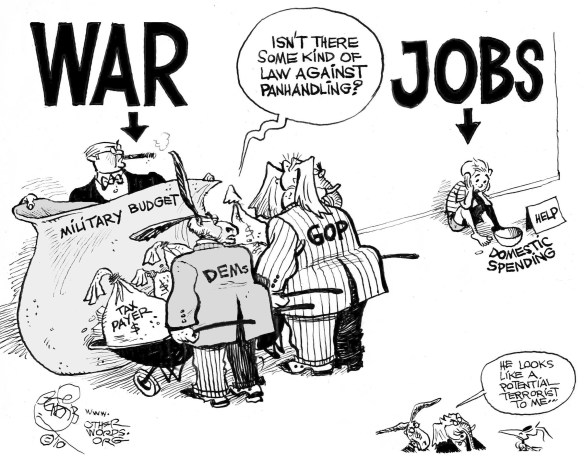
Now the Trump Administration is pushing for a $4.4 trillion budget for fiscal year 2019 that would add $7 trillion to the already unsustainable federal deficit in order to sustain America’s military empire abroad and dramatically expand the police state here at home. Trump also wants American taxpayers to cover the cost of building that infamous border wall.

Truly, Trump may turn out to be, as policy analyst Stan Collender warned, “the biggest deficit- and debt-increasing president of all time.”

For those in need of a quick reminder: “A budget deficit is the difference between what the federal government spends and what it takes in. The national debt, also known as the public debt, is the result of the federal government borrowing money to cover years and years of budget deficits.”

Right now, the U.S. government is operating in the negative on every front: it’s spending far more than what it makes (and takes from the American taxpayers) and it is borrowing heavily (from foreign governments and Social Security) to keep the government operating and keep funding its endless wars abroad.

This is how military empires fall and fail: by spreading themselves too thin and spending themselves to death.

It happened in Rome. It’s happening again.

Not content to merely police the globe, in recent decades, America has gradually transformed its homeland into a battlefield with militarized police and weapons better suited to a war zone.

Since taking office, President Trump—much like his predecessors—has marched in lockstep with the military. Now Trump wants $716 billion to expand America’s military empire abroad and billions more to hire cops, build more prisons and wage more profit-driven war-on-drugs/war-on-terrorism/war-on-crime programs that eat away at the Fourth Amendment while failing to make the country any safer.

Even the funds requested for infrastructure will do little to shore up the nation’s crumbling roads, bridges, railways, highways, power grids and dams.

No matter how your break it down, this is not a budget aimed at perfecting the Union, establishing justice, insuring domestic tranquility, providing for the common defense, promoting general welfare, or securing the blessings of liberty for the American people.

No, this is a budget aimed at pandering to the powerful money interests (military, corporate and security) that run the Deep State and hold the government in its clutches.

So much for Trump’s campaign promises to balance the budget and drain the swamps of corruption.

The glaring economic truth is that at the end of the day, it’s the military industrial complex—and not the sick, the elderly or the poor—that is pushing America towards bankruptcy.

As investigative journalist Uri Friedman puts it, for more than 15 years now, the United States has been fighting terrorism with a credit card, “essentially bankrolling the wars with debt, in the form of purchases of U.S. Treasury bonds by U.S.-based entities like pension funds and state and local governments, and by countries like China and Japan.”

The illicit merger of the armaments industry and the Pentagon that President Dwight D. Eisenhower warned us against more than 50 years ago has come to represent perhaps the greatest threat to the nation’s fragile infrastructure today.

Having been co-opted by greedy defense contractors, corrupt politicians and incompetent government officials, America’s expanding military empire is bleeding the country dry at a rate of more than $15 billion a month (or $20 million an hour)—and that’s just what the government spends on foreign wars.

That does not include the cost of maintaining and staffing the 1000-plus U.S. military bases spread around the globe.

Incredibly, although the U.S. constitutes only 5% of the world’s population, America boasts almost 50% of the world’s total military expenditure,  spending more on the military than the next 19 biggest spending nations combined.

In fact, the Pentagon spends more on war than all 50 states combined spend on health, education, welfare, and safety.

War is not cheap.

Although the federal government obscures so much about its defense spending that accurate figures are difficult to procure, we do know that since 2001, the U.S. government has spent more than $1.8 trillion in the wars in Afghanistan and Iraq (that’s $8.3 million per hour).

That doesn’t include wars and military exercises waged around the globe, which are expected to push the total bill upwards of $12 trillion by 2053.

Mind you, these ongoing wars—riddled by corruption, graft and bumbling incompetence—have done little to keep the country safe while enriching the military industrial complex—and private defense contractors—at taxpayer expense.

Just recently, for example, a leading accounting firm concluded that one of the Pentagon’s largest agencies “can’t account for hundreds of millions of dollars’ worth of spending.”

Just consider the fact that it costs American taxpayers $2.1 million per year for each soldier deployed in Afghanistan.

Imagine what you could do with that money if it were spent on domestic needs here at home.

Unfortunately, that’s not going to happen anytime soon, not as long as the money interests in Washington keep calling the shots and profiting from the spoils of war.

War has become a huge money-making venture, and America, with its vast military empire, is one of its best buyers and sellers. Not only does the U.S. have the largest defense budget, it also ranks highest as the world’s largest arms exporter.

The American military-industrial complex has erected an empire unsurpassed in history in its breadth and scope, one dedicated to conducting perpetual warfare throughout the earth.

For example, while erecting a security surveillance state in the U.S., the military-industrial complex has perpetuated a worldwide military empire with American troops stationed in 177 countries (over 70% of the countries worldwide).

In the process, billions have been spent erecting luxury military installations throughout the world.

For example, the U.S. Embassy built in Iraq, dubbed “Fortress Baghdad,” covers 104 acres and boasts a “city within a city” that includes six apartment buildings, a Marine barracks, swimming pool, shops and 15-foot-thick walls. Camp Anaconda in Iraq, like many U.S. military bases scattered across the globe, was structured to resemble a mini-city with pools, fast food restaurants, miniature golf courses and movie theaters.

While most Americans can scarcely afford the cost of heating and cooling their own homes, the American government spends $20 billion annually just to provide air conditioning for military installations in Iraq and Afghanistan.

In essence, what we’re doing is “we’re air conditioning the desert over there in Afghanistan, Iraq, and other places,” noted retired brigadier general Steven Anderson, a former chief logistician for Gen. David Petraeus in Iraq.

Think about that for a minute.

There’s a good reason why “bloated,” “corrupt” and “inefficient” are among the words most commonly applied to the government, especially the Department of Defense and its contractors.

For instance, a study by the Government Accountability Office found that $70 billion worth of cost overruns by the Pentagon were caused by management failures. To put that in perspective, that equates to one and a half times the State Department’s entire $47 billion annual budget.

Fraud is rampant.

A government audit, for example, found that defense contractor Boeing has been massively overcharging taxpayers for mundane parts, resulting in tens of millions of dollars in overspending. As the report noted, the American taxpayer paid:

$71 for a metal pin that should cost just 4 cents; $644.75 for a small gear smaller than a dime that sells for $12.51: more than a 5,100 percent increase in price. $1,678.61 for another tiny part, also smaller than a dime, that could have been bought within DoD for $7.71: a 21,000 percent increase. $71.01 for a straight, thin metal pin that DoD had on hand, unused by the tens of thousands, for 4 cents: an increase of over 177,000 percent.

Price gouging has become an accepted form of corruption within the American military empire.

And if you think gas prices at home can get high, just consider what the American taxpayer is being forced to shell out overseas: once all the expenses of delivering gas to troops in the field are factored in, we’re paying between $18-30 per gallon for gas in Iraq and Afghanistan.

Incredibly, despite reports of corruption, abuse and waste, the mega-corporations behind much of this ineptitude and corruption continue to be awarded military contracts worth billions of dollars.

The rationale may keep changing for why American military forces are in Afghanistan, Iraq and elsewhere, but the one that remains constant is that those who run the government are feeding the appetite of the military industrial complex.

What began in 2001 as part of an alleged effort to root out al Qaeda has turned into a goldmine for the military industrial complex and its army of private contractors.

Just consider: the Pentagon in 2008 spent more money every five seconds in Iraq than the average American earned in a year.

Yet Congress and the White House want taxpayers to accept that the only way to reduce the nation’s ballooning deficit is by cutting “entitlement” programs such as Social Security and Medicare?

As Martin Luther King Jr. recognized, under a military empire, war and its profiteering will always take precedence over the people’s basic human needs.

Simply put, we cannot afford to maintain our over-extended military empire.

Money is the new 800-pound gorilla,” remarked a senior administration official involved in Afghanistan. “It shifts the debate from ‘Is the strategy working?’ to ‘Can we afford this?’ And when you view it that way, the scope of the mission that we have now is far, far less defensible.”

Or as one commentator noted, “Foreclosing the future of our country should not be confused with defending it.”

Inevitably, military empires collapse.

As Cullen Murphy, author of Are We Rome? and editor-at-large of Vanity Fair writes:

A millennium hence America will be hard to recognize. It may not exist as a nation-state in the form it does now—or even exist at all. Will the transitions ahead be gradual and peaceful or abrupt and catastrophic? Will our descendants be living productive lives in a society better than the one we inhabit now? Whatever happens, will valuable aspects of America’s legacy weave through the fabric of civilizations to come? Will historians someday have reason to ask, Did America really fall?

The problem we wrestle with is none other than a distorted American empire, complete with mega-corporations, security-industrial complexes and a burgeoning military. And it has its sights set on absolute domination.

Eventually, however, all military empires fail.

At the height of its power, even the mighty Roman Empire could not stare down a collapsing economy and a burgeoning military. Prolonged periods of war and false economic prosperity largely led to its demise. As historian Chalmers Johnson predicts:

The fate of previous democratic empires suggests that such a conflict is unsustainable and will be resolved in one of two ways. Rome attempted to keep its empire and lost its democracy. Britain chose to remain democratic and in the process let go its empire. Intentionally or not, the people of the United States already are well embarked upon the course of non-democratic empire.

I would suggest that what we have is a confluence of factors and influences that go beyond mere comparisons to Rome.

It is a union of Orwell’s 1984 with its shadowy, totalitarian government—i.e., fascism, the union of government and corporate powers—and a total surveillance state with a military empire extended throughout the world.

As we have seen with the militarizing of the police, the growth of and reliance on militarism as the solution for our problems both domestically and abroad affects the basic principles upon which American society should operate.

We must keep in mind that a military empire will be ruled not by lofty ideals of equality and justice but by the power of the sword. Those in the military are primarily trained to conduct warfare, not preserve the peace.

Here’s the kicker, though: if the American empire falls and the American economy collapses—and with it the last vestiges of our constitutional republic—it will be the government and its trillion-dollar war budgets that are to blame.

Of course, the government has already anticipated this breakdown.

That’s why the government has transformed America into a war zone, turned the nation into a surveillance state, and labelled “we the people” as enemy combatants.

For years now, the government has worked with the military to prepare for widespread civil unrest brought about by “economic collapse, loss of functioning political and legal order, purposeful domestic resistance or insurgency, pervasive public health emergencies, and catastrophic natural and human disasters.”

Having spent more than half a century exporting war to foreign lands, profiting from war, and creating a national economy seemingly dependent on the spoils of war, the war hawks long ago turned their profit-driven appetites on us, bringing home the spoils of war—the military tanks, grenade launchers, Kevlar helmets, assault rifles, gas masks, ammunition, battering rams, night vision binoculars, etc.—and handing them over to local police, thereby turning America into a battlefield.

As I make clear in my book Battlefield America: The War on the American People, this is how the police state wins and “we the people” lose.

More than 50 years ago, President Dwight Eisenhower warned us not to let the profit-driven war machine endanger our liberties or democratic processes.

We failed to heed his warning.

As Eisenhower recognized in a speech given to the American Society of Newspaper Editors, on Apr. 16, 1953, the consequences of allowing the military-industrial complex to wage war, exhaust our resources and dictate our national priorities are beyond grave:

“Every gun that is made, every warship launched, every rocket fired signifies, in the final sense, a theft from those who hunger and are not fed, those who are cold and are not clothed. This world in arms is not spending money alone. It is spending the sweat of its laborers, the genius of its scientists, the hopes of its children. The cost of one modern heavy bomber is this: a modern brick school in more than 30 cities. It is two electric power plants, each serving a town of 60,000 population. It is two fine, fully equipped hospitals. It is some fifty miles of concrete pavement. We pay for a single fighter plane with a half million bushels of wheat. We pay for a single destroyer with new homes that could have housed more than 8,000 people… This is not a way of life at all, in any true sense. Under the cloud of threatening war, it is humanity hanging from a cross of iron.”

Why Fear and Self-hatred Destroy Human Sharing and Solidarity

Photo by Adam Dean

By Robert J. Burrowes

As our world spirals deeper into an abyss from which it is becoming increasingly difficult to extricate ourselves, some very prominent activists have lamented the lack of human solidarity in the face of the ongoing genocide of the Rohingya. See ‘The Rohingya tragedy shows human solidarity is a lie’ and ‘Wrongs of rights activism around Rohingyas’.

While I share the genuine concern of the Yemeni Nobel peace laureate Tawakkol Karman and Burmese dissident and scholar Dr Maung Zarni, and have offered my own way forward for responding powerfully to the ongoing genocide of the Rohingya – see ‘A Nonviolent Strategy to Defeat Genocide’ – in my view the lack of solidarity they mention is utterly pervasive and readily evident in our lacklustre official and personal responses to the many ongoing crises in which humanity finds itself.

To mention just the most obvious: Every day governments spend $US2 billion on weapons and warfare while a billion people lack the basic resources to live a decent life (and more than 100,000 of these people starve to death). Every day millions of people live under dictatorship, occupation or suffer the impacts of military invasion. Every day another 28,800 people are forcibly displaced from their home. Every day another 200 species of life are driven to extinction. And every day our biosphere is driven one step closer to making human life (and perhaps all life) on Earth impossible. See ‘Killing the Biosphere to Fast-track Human Extinction’.

It is not as if any of this information is unavailable. Just as many people and major international organizations are well aware of the plight of the Rohingya, it is also the case that many people and these organizations are well aware of the state of our world in other respects. And still virtually nothing meaningful happens (although there are tokenistic responses to some of these crises).

Hence, it is a straightforward observation that human solidarity is notably absent in virtually any attempt to tackle the major issues of our time. And the Rohingya are just one manifestation of this problem.

Given that I have long observed this phenomenon both personally and politically, and it concerns me as well, I would like to explain psychologically why the lack of sharing and solidarity is such a pervasive problem and suggest what we can do about it.

In order to feel concern for those who are suffering, and to want to act in solidarity to alleviate their suffering, it is necessary to experience certain feelings such as sympathy, empathy, compassion, love and (personal) power. Moreover, it is necessary that these feelings are not suppressed or overwhelmed by fear and, equally importantly, not overwhelmed by a feeling of (unconscious) self-hatred. If someone is scared and full of unconscious self-hatred, then they can have little interest in sharing their own resources or acting in solidarity with those who need help. And this applies whether the adversely impacted individual is a close relative or friend, or someone on the other side of the world.

So why is fear in this context so important? Simply because fear grotesquely distorts perception and behaviour. Let me explain why and how.

If an individual is (consciously or unconsciously) frightened that one or more of their vital needs will not be met, they will be unable to share resources or to act in solidarity with others, whatever the circumstances. In virtually all cases where an individual experiences this fear, the needs that the individual fears will not be met are emotional ones (including the needs for listening, understanding and love). However, the fearful individual is never aware of these deep emotional needs and of the functional ways of having these needs met which, admittedly, is not easy to do given that listening, understanding and love are not readily available from others who have themselves been denied these needs.

Moreover, because the emotional needs are ‘hidden’ from the individual, the individual (particularly one who lives in a materialist culture) often projects that the need they want met is, in fact, a material need.

This projection occurs because children who are crying, angry or frightened are often scared into not expressing their feelings and offered material items – such as a toy or food – to distract them instead. The distractive items become addictive drugs. This is why most violence is overtly directed at gaining control of material, rather than emotional, resources. The material resource becomes a dysfunctional and quite inadequate replacement for satisfaction of the emotional need. And, because the material resource cannot ‘work’ to meet an emotional need, the individual is most likely to keep using direct and/or structural violence to gain control of more material resources in an unconscious and utterly futile attempt to meet unidentified emotional needs.

This is the reason why people such as the Rothschild family, Jeff Bezos, Bill Gates, Warren Buffett, Amancio Ortega, Mark Zuckerberg, Carlos Slim, the Walton family and the Koch brothers as well as the world’s other billionaires and millionaires seek material wealth, and are willing to do so by taking advantage of structures of exploitation held in place by the US military. They are certainly wealthy in the material sense; unfortunately, they are utterly terrified (and full of self-hatred) and each of them justly deserves the appellation ‘poor little rich boy’ (or girl).

If this was not the case, their conscience, their compassion, their empathy, their sympathy and, indeed, their love would compel them to use or disperse their wealth in ways that would alleviate world poverty and nurture restoration of the ancient, just and ecologically sustainable economy: local self-reliance. See ‘The Flame Tree Project to Save Life on Earth’.

Of course, it is not just the billionaires and millionaires of the corporate elite who have suffered this fate.

Those intellectuals in universities and think tanks who accept payment to ‘justify’ (or simply participate in without question) the worldwide system of violence and exploitation, those politicians, bureaucrats and ordinary businesspeople who accept payment to manage it, those judges and lawyers who accept payment to act as its legal (but immoral) guardians, those media editors and journalists who accept payment to obscure the truth, as well as the many middle and working class people who accept payment to perform other roles to defend it (such as those in the military, police, prison and education systems), are either emotionally void or just too frightened to resist violence and exploitation, in one or more of its many manifestations.

Moreover, governments that use military violence to gain control of material resources are simply governments composed of many individuals with this dysfunctionality, which is very common in industrialized countries that promote materialism. Thus, cultures that unconsciously allow and encourage this dysfunctional projection (that an emotional need is met by material acquisition) are the most violent both domestically and internationally. This also explains why industrialized (material) countries use military violence to maintain political and economic structures that allow ongoing exploitation of non-industrialized countries in Africa, Asia and Central/South America.

But, equally importantly, many ‘ordinary’ people are just too scared to share (more than a token of) what they have and to act in solidarity with those who suffer whether through military or other violence, exploitation, persecution, oppression or occupation. Of course, it takes courage to resist this violent world order. But underlying courage is a sense of responsibility towards one’s fellow beings (human and otherwise) and the future.

As noted above, however, fear is not the only problem. Two primary outcomes of fear are self-hatred and powerlessness. Here is how it happens.

When each of us is a child, if our parents, teachers and/or the other adults around us are frightened by a feeling – such as sadness, anger or fear – that we are expressing, then they will use a variety of techniques to stop us expressing this feeling. They might, for example, comfort us to stop us crying, scare us out of expressing our anger (particularly at them) and reassure us so that we do not feel afraid.

Tragically, however, responses such as these have the outcome of scaring us into unconsciously suppressing our awareness of how we feel when, of course, evolutionary pressures generated emotional responses (some pleasant, some less so) to events in our life in order to help guide us into behaving appropriately at any given moment. And this suppression of how we feel is disastrous if we want children to grow up behaving functionally. This is more fully explained in Why Violence?’ and Fearless Psychology and Fearful Psychology: Principles and Practice.

So where does self-hatred fit into all of this? Well, if a child is angry in response to some violence to which they are being subjected (usually, of course, in an attempt to control their behavior), then they will attempt to defend themselves against this violence in an effort to persevere with their original intention.

However, if the child is then terrorized into submission by a parent or other adult (by being threatened with or experiencing some form of violence, often given the inaccurate label of ‘punishment’) the child will be compelled to unconsciously suppress their awareness of the original feelings, including anger, that were generating their behavior.

Unfortunately, there is a heavy cost to this suppression because each child is genetically programmed to follow their own self-will (manifesting through such mental functions as thoughts, feelings and conscience) rather than to obey the will of another (whether it be parent, teacher, religious figure or anyone else).

Hence, if a child is successfully terrorized into not behaving in accordance with their own self-will, they will experience a strong feeling of self-hatred precisely because they have submitted, out of fear, to the will of another.

Conscious self-hatred is an intensely unpleasant feeling to experience, however, and because the child is systematically terrorized out of expressing and acting on most of their feelings (which is why 100% of children go to school wherever school is available and compulsory: children are not given freedom of choice) the feeling of self-hatred is suppressed along with these many other feelings. Having learned to do this, subsequent opportunities for this self-hatred to be felt are progressively more easily suppressed.

An unconscious feeling does not ‘go away’ however; it is unconsciously projected elsewhere. Suppressed self-hatred is always unconsciously projected as hatred of someone else, some other group (usually of another sex, race, religion or class) and/or something else, often in imitation of the violent parent/adult (because imitation will be given ‘permission’ by the violent parent/adult). And this inevitably leads to destructive behaviors towards that individual, group and/or the ‘something else’ (including the Earth’s environment).

But, and this is important to recognize, this destructive behaviour might simply manifest as inaction: doing nothing in response to someone else’s (or the Earth’s) obvious need.

So the unconscious fear and self-hatred are projected as fear of and hatred for living beings as well as the Earth, and manifests as behavior that is destructive, often by inaction, of themselves, others and the planet.

The tragic reality is that it takes very little violence to terrorize a child and this is why a substantial proportion of the human population is consumed by their own fear and self-hatred, and feels powerless as a result. Consider the people immediately around you: many spend most of their time, consciously or unconsciously, abusing themselves, others and/or the environment, and doing nothing in response to the plight of our world.

So what can we do?

Given existing parenting practice, fear and self-hatred are not easily avoided although they are not necessarily all-consuming. But to be free of them completely requires just one thing: the fearlessness to love oneself truly. What does this mean?

To love yourself truly, you must always courageously act out your own self-will, whatever the consequences. This requires you to feel all of your emotional responses – fear, sadness, anger, pain, joy, love … – to events, including impediments, in your life. See ‘Feelings First’. It is only when you do this that you can behave with awareness: a synthesis of all of the feedback that your various mental functions give you and the judgments that arise, in an integrated way, from this feedback. See ‘Human Intelligence or Human Awareness?’

At first glance loving yourself and acting out your own self-will might sound selfish. But it is not. Self-love is true love. The individual who does not truly love themself cannot love another. Nor will they feel such emotional responses as compassion, empathy and sympathy. Hence, this individual will not seek mutually beneficial outcomes in tackling conflict, will not seek distributive justice in resource allocation, will not value ecological sustainability and will not act in solidarity with those who are suffering. It is this individual, who is terrified, self-hating and powerless, who will act selfishly.

In addition to courageously acting out your own self-will, you might also consider making ‘My Promise to Children’.

And if you love yourself enough to be part of the struggle to end the violence and exploitation of those who are full of fear and self-hatred, you might like to consider signing the online pledge of ‘The People’s Charter to Create a Nonviolent World’ and/or using sound nonviolent strategy for your campaign or liberation struggle. See Nonviolent Campaign Strategy or Nonviolent Defense/Liberation Strategy.

Those who are terrified and self-hating never will.


Biodata: Robert J. Burrowes has a lifetime commitment to understanding and ending human violence. He has done extensive research since 1966 in an effort to understand why human beings are violent and has been a nonviolent activist since 1981. He is the author of ‘Why Violence?’ His email address is flametree@riseup.net and his website is here.

Websites:
Nonviolence Charter
Flame Tree Project to Save Life on Earth
‘Why Violence?’
Feelings First
Nonviolent Campaign Strategy
Nonviolent Defense/Liberation Strategy
Anita: Songs of Nonviolence
Robert Burrowes
Global Nonviolence Network

Financial Tyranny: ‘We the People’ Are the New Permanent Underclass in America

By John W. Whitehead

Source: The Rutherford Institute

“When plunder becomes a way of life for a group of men in a society, over the course of time they create for themselves a legal system that authorizes it and a moral code that glorifies it.” ― Frédéric Bastiat, French economist

Americans can no longer afford to get sick and there’s a reason why.

That’s because a growing number of Americans are struggling to stretch their dollars far enough to pay their bills, get out of debt and ensure that if and when an illness arises, it doesn’t bankrupt them.

This is a reality that no amount of partisan political bickering can deny.

Many Americans can no longer afford health insurance, drug costs or hospital bills. They can’t afford to pay rising healthcare premiums, out-of-pocket deductibles and prescription drug bills.

They can’t afford to live, and now they can’t afford to get sick or die, either.

To be clear, my definition of “affordable healthcare” is different from the government’s. To the government, you can “afford” to pay for healthcare if your income falls above the poverty line. That takes no account of rising taxes, the cost of living, the cost to clothe and feed a household, the cost of transportation and communication and education, or any of the other line items that add up to a life worth living.

As Helaine Olen points out in The Atlantic:

Just because a person is insured, it doesn’t mean he or she can actually afford their doctor, hospital, pharmaceutical, and other medical bills. The point of insurance is to protect patients’ finances from the costs of everything from hospitalizations to prescription drugs, but out-of-pocket spending for people even with employer-provided health insurance has increased by more than 50 percent since 2010.”

For too many Americans, achieving any kind of quality of life has become a choice between putting food on the table and paying one’s bills or health care coverage.

It’s a gamble any way you look at it, and the medical community is not helping.

Healthcare costs are rising, driven by a medical, insurance and pharmaceutical industry that are getting rich off the sick and dying.

Indeed, Americans currently pay $3.4 trillion a year for medical care. We spent more than $10,000 per person on health care in 2016. Those attempting to shop for health insurance coverage right now are understandably experiencing sticker shock with premiums set to rise 34% in 2018. It’s estimated that costs may rise as high as $15,000 by 2023.

As Bloomberg reports, “Rising health-care costs are eating up the wage gains won by American workers, who are being asked by their employers to pick up more of the heftier tab… The cost of buying health coverage at work has increased faster than wages and inflation for years, pressuring household budgets.”

Appallingly, Americans spend more than any developed country on healthcare and have less to show for it. We don’t live as long, we have higher infant mortality rates, we have fewer hospital and physician visits, and the quality of our healthcare is generally worse. We also pay astronomical amounts for prescription drugs, compared to other countries.

Whether or not you’re insured through an employer, the healthcare marketplace, a government-subsidized program such as Medicare or Medicaid, or have no health coverage whatsoever, it’s still “we the consumers” who have to pay to subsidize the bill whenever anyone gets sick in this country. And that bill is a whopper.

While Obamacare (a.k.a. the Affordable Care Act) may have made health insurance more accessible to greater numbers of individuals, it has failed to make healthcare any more affordable.

Why?

As journalist Laurie Meisler concludes, “One big reason U.S. health care costs are so high: pharmaceutical spending. The U.S. spends more per capita on prescription medicines and over-the-counter products than any other country.”

One investigative journalist spent seven months analyzing hundreds of bills from hospitals, doctors, drug companies, and medical equipment manufacturers. His findings confirmed what we’ve known all along: health care in America is just another way of making corporations rich at consumer expense.

An examination of an itemized hospital bill (only available upon request) revealed an amazing amount of price gouging. Tylenol, which you can buy for less than $10 for a bottle, was charged to the patient at a rate of $15 per pill, for a total of $345 for a hospital stay. $8 for a plastic bag to hold the patient’s personal items and another $8 for a box of Kleenex. $23 for a single alcohol swab. $53 per pair for non-sterile gloves (adding up to $5,141 for the entire hospital stay). $10 for plastic cup in which to take one’s medicine. $93 for the use of an overhead light during a surgical procedure. $39 each time you want to hold your newborn baby. And $800 for a sterile water IV bag that costs about a dollar to make.

This is clearly not a problem that can be remedied by partisan politics.

The so-called Affordable Care Act pushed through by the Obama administration is proving to be anything but affordable for anyone over the poverty line. And the Trump administration’s “fixes” promise to be no better. Indeed, for too many Americans who live paycheck to paycheck and struggle just to get by, the tax penalty for not having health insurance will actually be cheaper than trying to find affordable coverage that actually pays for care.

This is how the middle classes, who fuel the nation’s economy and fund the government’s programs, get screwed repeatedly.

When almost 60% of Americans are so financially strapped that they don’t have even $500 in savings and nothing whatsoever put away for retirement, and yet they are being forced to pay for government programs that do little to enhance their lives, we’re not living the American dream.

We’re living a financial nightmare.

We have no real say in how the government runs, or how our taxpayer funds are used, but that doesn’t prevent the government from fleecing us at every turn and forcing us to pay for endless wars that do more to fund the military industrial complex than protect us, pork barrel projects that produce little to nothing, and a police state that serves only to imprison us within its walls.

We have no real say, but we’re being forced to pay through the nose, anyhow.

George Harrison, who died 16 years ago this month, summed up this outrageous state of affairs in his song Taxman:

If you drive a car, I’ll tax the street,
If you try to sit, I’ll tax your seat.
If you get too cold I’ll tax the heat,
If you take a walk, I’ll tax your feet.

Don’t ask me what I want it for
If you don’t want to pay some more
‘Cause I’m the taxman, yeah, I’m the taxman

Now my advice for those who die
Declare the pennies on your eyes
‘Cause I’m the taxman, yeah, I’m the taxman
And you’re working for no one but me.

In other words, in the eyes of the government, “we the people, the voters, the consumers, and the taxpayers” are little more than indentured servants and sources of revenue.

If you have no choice, no voice, and no real options when it comes to the government’s claims on your property and your money, you’re not free.

Consider: The government can seize your home and your car (which you’ve bought and paid for) over nonpayment of taxes. Government agents can freeze and seize your bank accounts and other valuables if they merely “suspect” wrongdoing. And the IRS insists on getting the first cut of your salary to pay for government programs over which you have no say.

It wasn’t always this way, of course.

Early Americans went to war over the inalienable rights described by philosopher John Locke as the natural rights of life, liberty and property.

It didn’t take long, however—a hundred years, in fact—before the American government was laying claim to the citizenry’s property by levying taxes to pay for the Civil War. As the New York Times reports, “Widespread resistance led to its repeal in 1872.”

Determined to claim some of the citizenry’s wealth for its own uses, the government reinstituted the income tax in 1894. Charles Pollock challenged the tax as unconstitutional, and the U.S. Supreme Court ruled in his favor. Pollock’s victory was relatively short-lived. Members of Congress—united in their determination to tax the American people’s income—worked together to adopt a constitutional amendment to overrule the Pollock decision.

On the eve of World War I, in 1913, Congress instituted a permanent income tax by way of the 16th Amendment to the Constitution and the Revenue Act of 1913. Under the Revenue Act, individuals with income exceeding $3,000 could be taxed starting at 1% up to 7% for incomes exceeding $500,000.

It’s all gone downhill from there.

Unsurprisingly, the government has used its tax powers to advance its own imperialistic agendas and the courts have repeatedly upheld the government’s power to penalize or jail those who refused to pay their taxes.

Irwin A. Schiff was one of the nation’s most vocal tax protesters. He spent a good portion of his life arguing that the income tax was unconstitutional. He paid the price for his resistance, too: Schiff served three separate prison terms (more than 10 years in all) over his refusal to pay taxes. He died at the age of 87 serving a 14-year prison term. As constitutional activist Robert L. Schulz noted in Schiff’s obituary, “In a society where there is so much fear of government, and in particular of the I.R.S., [Schiff] was probably the most influential educator regarding the illegal and unconstitutional operation and enforcement of the Internal Revenue Code. It’s very hard to speak to power, but he did, and he paid a very heavy price.”

It’s still hard to speak to power, and those who do are still paying a very heavy price.

All the while the government continues to do whatever it likes—levy taxes, rack up debt, spend outrageously and irresponsibly—with little thought for the plight of its citizens.

The national debt is $20 trillion and growing. The amount this country owes is now greater than its gross national product (all the products and services produced in one year by labor and property supplied by the citizens). We’re paying more than $270 billion just in interest on that debt annually. And the top two foreign countries who “own” our debt are China and Japan.

To top it all off, all of those wars the U.S. is so eager to fight abroad are being waged with borrowed funds. As The Atlantic reports, “For 15 years now, the United States has been putting these wars on a credit card… U.S. leaders are essentially bankrolling the wars with debt, in the form of purchases of U.S. Treasury bonds by U.S.-based entities like pension funds and state and local governments, and by countries like China and Japan.”

If Americans managed their personal finances the way the government mismanages the nation’s finances, we’d all be in debtors’ prison by now.

Still, the government remains unrepentant, unfazed and undeterred in its money grabs.

While we’re struggling to get by, and making tough decisions about how to spend what little money actually makes it into our pockets after the federal, state and local governments take their share (this doesn’t include the stealth taxes imposed through tolls, fines and other fiscal penalties), the police state is spending our hard-earned tax dollars to further entrench its powers and entrap its citizens.

For instance, American taxpayers have been forced to shell out $5.6 trillion since 9/11 for the military industrial complex’s costly, endless so-called “war on terrorism.” That translates to roughly $23,000 per taxpayer to wage wars abroad, occupy foreign countries, provide financial aid to foreign allies, and fill the pockets of defense contractors and grease the hands of corrupt foreign dignitaries.

Mind you, that staggering $6 trillion is only a portion of what the Pentagon spends on America’s military empire.

That price tag keeps growing, too.

The 16-year war in Afghanistan, which now stands as the longest and one of the most expensive wars in U.S. history, is about to get even longer and more costly, thanks to President Trump’s promise to send more troops over.

In this way, the military industrial complex will get even richer, and the American taxpayer will be forced to shell out even more funds for programs that do little to enhance our lives, ensure our happiness and well-being, or secure our freedoms.

As Dwight D. Eisenhower warned in a 1953 speech:

Every gun that is made, every warship launched, every rocket fired signifies, in the final sense, a theft from those who hunger and are not fed, those who are cold and are not clothed. This world in arms is not spending money alone. It is spending the sweat of its laborers, the genius of its scientists, the hopes of its children. The cost of one modern heavy bomber is this: a modern brick school in more than 30 cities. It is two electric power plants, each serving a town of 60,000 population. It is two fine, fully equipped hospitals. It is some fifty miles of concrete pavement. We pay for a single fighter plane with a half million bushels of wheat. We pay for a single destroyer with new homes that could have housed more than 8,000 people. This is, I repeat, the best way of life to be found on the road the world has been taking. This is not a way of life at all, in any true sense. Under the cloud of threatening war, it is humanity hanging from a cross of iron. […] Is there no other way the world may live?

This is still no way of life.

Yet it’s not just the government’s endless wars that are bleeding us dry.

We’re also being forced to shell out money for surveillance systems to track our movements, money to further militarize our already militarized police, money to allow the government to raid our homes and bank accounts, money to fund schools where our kids learn nothing about freedom and everything about how to comply, and on and on.

Are you getting the picture yet?

The government isn’t taking our money to make our lives better. Just take a look at the nation’s failing infrastructure, and you’ll see how little is being spent on programs that advance the common good.

We’re being robbed blind so the governmental elite can get richer.

This is nothing less than financial tyranny.

“We the people” have become the new, permanent underclass in America.

It’s tempting to say that there’s little we can do about it, except that’s not quite accurate.

There are a few things we can do (demand transparency, reject cronyism and graft, insist on fair pricing and honest accounting methods, call a halt to incentive-driven government programs that prioritize profits over people), but it will require that “we the people” stop playing politics and stand united against the politicians and corporate interests who have turned our government and economy into a pay-to-play exercise in fascism.

We’ve become so invested in identity politics that label us based on our political leanings that we’ve lost sight of the one label that unites us: we’re all Americans.

As I make clear in my book Battlefield America: The War on the American People, the powers-that-be want to pit us against one another. They want us to adopt an “us versus them” mindset that keeps us powerless and divided. Trust me, the only “us versus them” that matters anymore is “we the people” against the police state.

We’re all in the same boat, folks, and there’s only one real life preserver: that’s the Constitution and the Bill of Rights.

The Constitution starts with those three powerful words: “We the people.”

The message is this: there is power in our numbers.

That remains our greatest strength in the face of a governmental elite that continues to ride roughshod over the populace. It remains our greatest defense against a government that has claimed for itself unlimited power over the purse (taxpayer funds) and the sword (military might). As Patrick Henry declared in the last speech before his death, “United we stand, divided we fall. Let us not split into factions … or … exhaust [our strength] in civil commotions and intestine wars.”

This holds true whether you’re talking about health care, war spending, or the American police state.

$21 Trillion of Unauthorized Spending by US Govt Discovered by Economics Professor

Source: Covert Geopolitics

he US government may have misspent $21 trillion, a professor at Michigan State University has found. Papers supporting the study briefly went missing just as an audit was announced.

Two departments of the US federal government may have spent as much as $21 trillion on things they can’t account for between 1998 and 2015. At least that’s what Mark Skidmore, a Professor of Economics at MSU specializing in public finance, and his team have found.

They came up with the figure after digging the websites of departments of Defense (DoD) and Housing and Urban Development (HUD) as well as repots of the Office of the Inspector General (OIG) over summer.

The research was triggered by Skidmore hearing Catherine Austin Fitts, a former Assistant Secretary in the HUD in the first Bush administration, saying the Inspector General found $6.5 trillion worth of military spending that the DoD couldn’t account for. She was referring to a July 2016 report by the OIG, but Skidmore thought she must be mistaking billion for trillion. Based on his previous experience with public finances, he thought the figure was too big even for an organization as large as the US military.

“Sometimes you have an adjustment just because you don’t have adequate transactions… so an auditor would just recede. Usually it’s just a small portion of authorized spending, maybe one percent at most. So for the Army one percent would be $1.2 billion of transactions that you just can’t account for,” he explained in an interview with USAWatchdog.com earlier this month.

After discovering that the figure was accurate, he and Fitts collaborated with a pair of graduate students to comb through thousands of reports of the OIG dating back to 1998, when new rules of public accountability for the federal government were set and all the way to 2015, the time of the latest reports available at the time. The research was only for the DoD and the HUD.

“This is incomplete, but we have found $21 trillion in adjustments over that period. The biggest chunk is for the Army. We were able to find 13 of the 17 years and we found about $11.5 trillion just for the Army,” Skidmore said.

The professor would not suggest whether the missing trillions went to some legitimate undisclosed projects, wasted or misappropriated, but believes his find indicates that there is something profoundly wrong with the budgeting process in the US federal government. Such lack of transparency goes against the due process of authorizing federal spending through the US Congress, he said.

Skidmore also co-authored a column on Forbes, explaining his research.

The same week the interview took place the DoD announced that it will conduct its first-ever audit. “It is important that the Congress and the American people have confidence in DoD’s management of every taxpayer dollar,” Comptroller David Norquist told reporters as he explained that the OIG has hired independent auditors to dig through the military finances.

“While we can’t know for sure what role our efforts to compile original government documents and share them with the public has played, we believe it may have made a difference,” Skidmore commented.

Interestingly, in early December the authors of the research discovered that the links to key document they used, including the 2016 report, had been disabled. Days later the documents were reposted under different addresses, they say.

This is probably where the Deep State government called CIA and State Department took their extra fund to topple uncooperative governments around the world. The bulk, of course, may have gone to the military industrial complex.

The United States has double the military budget of the combined military spending of Russia, China and G7 countries. Said military spending remains unauditable due to “widespread material internal control weaknesses, significant uncertainties, and other limitations” according to a GAO report in 2010.

So, how can a government spread its wings beyond its own borders, and demand democratic ideals elsewhere when it is not practicing the same values at home?