Godzilla Amazon: The Amount of Power in Jeff Bezos’ Hands Should Frighten All Americans

Amazon very effectively uses technology and data to sidestep traditional restrictions on monopoly power.

By Matt Stoller

Source: AlterNet

To understand the depth and breadth of Jeff Bezos’ ambitions for the company he built, type www.relentless.com into your browser. The domain Bezos registered in 1994 will redirect to Amazon, the company aptly, and ambitiously, nicknamed The Everything Store. He tells his shareholders that the company will act like an aggressive startup — that at Amazon, it is always Day One.

Like Google and Facebook, Amazon uses technology and data to sidestep traditional restrictions on monopoly power. Our lives are increasingly organized by the platforms these companies run, platforms which now mediate the way we communicate and engage in commerce with each other. We are living in a world organized by tech monopolists, a change in power relationships that no one voted for but has been imposed upon us nonetheless.

Now, Bezos is attempting to add more power to his empire with the surprise announcement that the company will pay $13.7 billion for Whole Foods Market. Amazon will now have a store footprint in neighborhoods across America.

Our communities and the way we engage in commerce will change. Imagine walking into a Whole Foods store and seeing different prices depending on whether you are a member of Amazon Prime — or seeing different prices depending on any other way that you interact with Amazon.

This isn’t implausible. It is what the company does when it opens up stores. For instance, Amazon is creating a chain of physical book stores to take the place of the book stores the company destroyed. In these stores, there are no price tags at all: You scan the items with your phone and have a price delivered to you, personalized by Amazon. Why wouldn’t Amazon extend this to Whole Foods? “Our goal with Amazon Prime, make no mistake,” says Amazon CEO Jeff Bezos, “is to make sure that if you are not a Prime member, you are being irresponsible.”

This statement and the amount of power in Bezos’ hands should frighten all Americans. Bezos meant that Amazon will soon be so good for consumers that it would just be folly not to be a member. But what he unwittingly implied is that as a citizen, you will have no choice but to interact with his institution to buy and sell key goods that everyone needs — on his terms.

Jeff Bezos, in other words, has a vision. To be everywhere, to be the platform for everything for every consumer. So when Bezos calls you irresponsible for not tithing to Amazon, America has a big political problem.

Amazon’s takeover of Whole Foods means that it can target and eliminate regional competitors one by one as it did with its online competitors. When Diapers.com emerged as a competitor to Amazon, Amazon simply sold diapers below cost until the company capitulated and sold itself to Bezos. There’s no reason to assume Amazon wouldn’t bring the same predatory pricing strategy to bear in every city in America. Why wouldn’t it? Even though predatory pricing is illegal, the government hasn’t enforced those laws for decades. Whole Foods tends to source from local farms as part of a commitment to localism; these farms will now be negotiating with a much bigger entity that is committed to a ruthless model of efficiency.

There are so many ways that Amazon can use its power that it’s simply impossible to figure out what it will do. Amazon probably doesn’t even know yet; it will discover and test them, relentlessly. Maybe you will get first in line, or last in line, for the most popular toy during the Christmas period, or maybe the restaurant you own will get access to the freshest yet limited batch strawberries you need based on whether you are giving better deals to Prime members.

Or here’s a more creative possibility. Amazon is excluding Amazon Prime video from Apple TV so that Prime members will buy its streaming device instead of Apple’s. As the smartphone market commodifies and transforms, Bezos could simply use his combined physical and online footprint to keep you from even seeing prices at his stores unless you are using Amazon-approved electronic devices. If Amazon were just one of many stores that would be one thing. But Amazon is quickly becoming the dominant way to buy and sell.

And this, make no mistake, is what is happening. Upon the announcement of the acquisition, Target’s stock price dropped by 10 percent and Walmart’s by 5 percent. Amazon’s rose by more than the price it is paying for Whole Foods. Wall Street sees the writing on the wall. There is only one force that can stop Amazon from organizing and regulating basically all American retail commerce — our democratic institutions and our political system. We the people.

Bezos knows Amazon is a political enterprise at this point. The day before he announced his company’s attempt to buy this supermarket chain, he released a request on Twitter to have people offer ideas for where he can direct charity money. That is the kind of public relations undertaken by political leaders. And Amazon put out an ad for a Ph.D. economist-cum-lobbyist “to educate regulators and policy makers about the fundamentally procompetitive focus of Amazon’s businesses.” And he has put political fixers, like Ivanka Trump’s lawyer and ex-Clinton administration officer Jamie Gorelick, on his board of directors. He also bought The Washington Post.

The public should speak out in opposition to this merger. More than that, the government should take this opportunity to reject the entire pro-finance pro-concentration philosophy that has taken hold in this country since the Reagan era. It is no accident that Whole Foods founder John Mackey was forced to surrender his life’s work because financiers looking for a quick buck bought up a large bloc of shares in his company and pressured him to sell the company to Amazon. The day before the announcement of the sale, he called these hedge funds “Ringwraiths,” after the evil characters in “Lord of the Rings.” Bezos might be the most powerful empire-builder in the land, but he had help.

This merger should frighten all of us. But it should also embolden anyone who believes that America should not be in thrall to monopolists like Bezos. For them, today, as Jeff Bezos might put it, is Day One.

Matt Stoller is fellow at the Open Markets program, where he is researching the history of the relationship between concentrated financial power and the Democratic party in the 20th century.

Oligarchs Succeed! Only the People Suffer!

By James Petra

Source: The Fourth Media

On a scale not seen since the ‘great’ world depression of the 1930’s, the US political system is experiencing sharp political attacks, divisions and power grabs. Executive firings, congressional investigations, demands for impeachment, witch hunts, threats of imprisonment for ‘contempt of Congress’ and naked power struggles have shredded the façade of political unity and consensus among competing powerful US oligarchs.

For the first time in US history, the incumbent elected president struggles on a daily basis to wield state power. The opposition-controlled state (National Public Radio) and corporate organs of mass propaganda are pitted against the presidential regime. Factions of the military elite and business oligarchy face off in the domestic and international arena. The oligarchs debate and insult each other. They falsify charges, plot and deceive. Their political acolytes, who witness these momentous conflicts, are mute, dumb and blind to the real interests at stake.

The struggle between the Presidential oligarch and the Opposition oligarchs has profound consequences for their factions and for the American people. Wars and markets, pursued by sections of the Oligarchs, have led opposing sections to seek control over the means of political manipulation (media and threats of judicial action).

Intense political competition and open political debate have nothing to do with ‘democracy’ as it now exists in the United States.

In fact, it is the absence of real democracy, which permits the oligarchs to engage in serious intra-elite warfare. The marginalized, de-politicized electorate are incapable of taking advantage of the conflict to advance their own interests.

What the ‘Conflict’ is Not About

The ‘life and death’ inter-oligarchical fight is not about peace!

None of the factions of the oligarchy, engaged in this struggle, is aligned with democratic or independent governments.

Neither side seeks to democratize the American electoral process or to dismantle the grotesque police state apparatus.

Neither side has any commitment to a ‘new deal’ for American workers and employees.

Neither is interested in policy changes needed to address the steady erosion of living standards or the unprecedented increase in ‘premature’ mortality among the working and rural classes.

Despite these similarities in their main focus of maintaining oligarchical power and policies against the interests of the larger population, there are deep divisions over the content and direction of the presidential regime and the permanent state apparatus.

What the Oligarchical Struggle is About

There are profound differences between the oligarch factions on the question of overseas wars and ‘interventions’.

The ‘opposition’ (Democratic Party and some Republican elite) pursues a continuation of their policy of global wars, especially aimed at confronting Russian and China, as well as regional wars in Asia and the Middle East. There is a stubborn refusal to modify military policies, despite the disastrous consequences domestically (economic decline and increased poverty) and internationally with massive ethnic cleansing, terrorism, forced migrations of war refugees to Europe, and famine and epidemics (such as cholera and starvation in Yemen).

The Trump Presidency appears to favor increased military confrontation with Iran and North Korea and intervention in Syria, Venezuela and Yemen.

The ‘Opposition’ supports multilateral economic and trade agreements, (such as TTP and NAFTA), while Trump favors lucrative ‘bilateral’ economic agreements. Trump relies on trade and investment deals with Saudi Arabia and the Gulf Emirates and the formation of an aggressive military ‘axis’ (US-Saudi Arabia-Israel -Gulf Emirates) to eventually overthrow the nationalist regime in Iran and divide the country.

The ‘Opposition’ pursues wars and violent ‘regime change’ to replace disobedient ‘tyrants’ and nationalists and set up ‘client governments’, which will provide bases for the US military empire. Trump’s regime embraces existing dictators, who can invest in his domestic infrastructure agenda.

The ‘opposition’ seeks to maximize the role of Washington’s global military power. President Trump focuses on expanding the US role in the global market.

While both oligarchical factions support US imperialism, they differ in terms of its nature and means.

For the ‘opposition’, every country, large or small, can be a target for military conquest. Trump tends to favor the expansion of lucrative overseas markets, in addition to projecting US military dominance.

Oligarchs: Tactical Similarities

The competition among oligarchs does not preclude similarities in means and tactics. Both factions favor increased military spending, support for the Saudi war on Yemen and intervention in Venezuela. They support trade with China and international sanctions against Russia and Iran. They both display slavish deference to the State of Israel and favor the appointment of openly Zionist agents throughout the political, economic and intelligence apparatus.

These similarities are, however, subject to tactical political propaganda skirmishes. The ‘Opposition’ denounces any deviation in policy toward Russia as ‘treason’, while Trump accuses the ‘Opposition’ of having sacrificed American workers through NAFTA.

Whatever the tactical nuances and similarities, the savage inter-oligarchic struggle is far from a theatrical exercise. Whatever the real and feigned similarities and differences, the oligarchs’ struggle for imperial and domestic power has profound consequence for the political and constitutional order.

Oligarchical Electoral Representation and the Parallel Police State

The ongoing fight between the Trump Administration and the ‘Opposition’ is not the typical skirmish over pieces of legislation or decisions. It is not over control of the nation’s public wealth. The conflict revolves around control of the regime and the exercise of state power.

The opposition has a formidable array of forces, including the national intelligence apparatus (NSA, Homeland Security, FBI, CIA, etc.) and a substantial sector of the Pentagon and defense industry. Moreover, the opposition has created new power centers for ousting President Trump, including the judiciary.

This is best seen in the appointment of former FBI Chief Robert Mueller as ‘Special Investigator’ and key members of the Attorney General’s Office, including Deputy Attorney General Rob Rosenstein. It was Rosenstein who appointed Mueller, after the Attorney General ‘Jeff’ Session (a Trump ally) was ‘forced’ to recluse himself for having ‘met’ with Russian diplomats in the course of fulfilling his former Congressional duties as a senior member of the Senate Foreign Relations Committee. This ‘recusal’ took significant discretionary power away from Trump’s most important ally within the Judiciary.

The web of opposition power spreads and includes former police state officials including mega-security impresario, Michael Chertoff (an associate of Robert Mueller), who headed Homeland Security under GW Bush, John Brennan (CIA), James Comey (FBI) and others.

The opposition dominates the principal organs of propaganda -the press (Washington Post, Financial Times, New York Times, and Wall Street Journal), television and radio (ABC, NBC, CBS and PBS/ NPR), which breathlessly magnify and prosecute the President and his allies for an ever-expanding web of unsubstantiated ‘crimes and misdemeanors’. Neo-conservative and liberal think tanks and foundations, academic experts and commentators have all joined the ‘hysteria chorus’ and feeding frenzy to oust the President.

The President has an increasingly fragile base of support in his Cabinet, family and closest advisers. He has a minority of supporters in the legislature and possibly in the Supreme Court, despite nominal majorities for the Republican Party.

The President has the passive support of his voters, but they have demonstrated little ability to mobilize in the streets. The electorate has been marginalized.

Outside of politics (the ‘Swamp’ as Trump termed Washington, DC) the President’s trade, investment, taxation and deregulation policies are backed by the majority of investors, who have benefited from the rising stock market. However, ‘money’ does not appear to influence the parallel state.

The divergence between Trumps supporters in the investment community and the political power of the opposition state is one of the most extraordinary changes of our century.

Given the President’s domestic weakness and the imminent threat of a coup d’état, he has turned to securing ‘deals’ with overseas allies, including billion-dollar trade and investment agreements.

The multi-billion arms sales to Saudi Arabia and the Gulf Emirates will delight the military-industrial complex and its hundreds of thousands of workers.

Political and diplomatic ‘kowtowing’ to Israeli Prime Minister Netanyahu should please some American Zionists.

But the meetings with the EU in Brussels and with the G7 in Siciliy failed to neutralize Trump’s overseas opposition.

NATO’s European members did not accept Trump’s demands that they increase their contribution to the alliance and they condemned his reluctance to offer unconditional US military support for new NATO members. They showed no sympathy for domestic problems.

In brief, the President’s overseas supporters, meetings and agreements will have little impact on the domestic correlation of forces.

Moreover, there are long-standing ties among the various state apparatuses and spy agencies in the EU and the US, which strengthen the reach of the opposition in their attacks on Trump.

While substantive issues divide the Presidential and Opposition oligarchs, these issues are vertical, not horizontal, cleavages – a question of ‘their’ wars or ‘ours’.

Trump intensified the ideological war with North Korea and Iran; promised to increase ground troops in Afghanistan and Syria; boosted military and advisory support for the Saudi invasion of Yemen; and increased US backing for violent demonstrations and mob attacks in Venezuela.

The opposition demands more provocations against Russia and its allies; and the continuation of former President Obama’s seven wars.

While both sets of oligarchs support the ongoing wars, the major difference is over who is managing the wars and who can be held responsible for the consequences.

Both conflicting oligarchs are divided over who controls the state apparatus since their power depends on which side directs the spies and generates the fake news.

Currently, both sets of oligarchs wash each other’s ‘dirty linen’ in public, while covering up for their collective illicit practices at home and abroad.

The Trump’s oligarchs want to maximize economic deals through ‘uncritical’ support for known tyrants; the opposition ‘critically’ supports tyrants in exchange for access to US military bases and military support for ‘interventions’.

President Trump pushes for major tax cuts to benefit his oligarch allies while making massive cuts in social programs for his hapless supporters. The Opposition supports milder tax cuts and lesser reductions in social programs.

Conclusion

The battle of the oligarchs has yet to reach a decisive climax. President Trump is still the President of the United States. The Opposition forges ahead with its investigations and lurid media exposés.

The propaganda war is continuous. One day the opposition media focuses on a deported student immigrant and the next day the President features new jobs for American military industries.

The emerging left-neo-conservative academic partnership (e.g. Noam Chomsky-William Kristol) has denounced President Trump’s regime as a national ‘catastrophe’ from the beginning. Meanwhile, Wall Street investors and libertarians join to denounce the Opposition’s resistance to major tax ‘reforms’.

Oligarchs of all stripes and colors are grabbing for total state power and wealth while the majority of citizens are labeled ‘losers’ by Trump or ‘deplorables’ by Madame Clinton.

The ‘peace’ movement, immigrant rights groups and ‘black lives matter’ activists have become mindless lackeys pulling the opposition oligarchs’ wagon, while rust-belt workers, rural poor and downwardly mobile middle class employees are powerless serfs hitched to President Trump’s cart.

Epilogue

After the blood-letting, when and if President Trump is overthrown, the State Security functionaries in their tidy dark suits will return to their nice offices to preside over their ‘normal’ tasks of spying on the citizens and launching clandestine operations abroad.

The media will blow out some charming tid-bits and ‘words of truth’ from the new occupant of the ‘Oval Office’.

The academic left will churn out some criticism against the newest ‘oligarch-in-chief’ or crow about how their heroic ‘resistance’ averted a national catastrophe.

Trump, the ex-President and his oligarch son-in-law Jared Kushner will sign new real estate deals. The Saudis will receive the hundreds of billions of dollars of US arms to re-supply ISIS or its successors and to rust in the ‘vast and howling’ wilderness of US-Middle East intervention. Israel will demand even more frequent ‘servicing’ from the new US President.

The triumphant editorialists will claim that ‘our’ unique political system, despite the ‘recent turmoil’, has proven that democracy succeeds … only the people suffer!

Long live the Oligarchs!


James Petras is a Bartle Professor (Emeritus) of Sociology at Binghamton University, New York. http://petras.lahaine.org


3 Questions You’re Never Supposed to Ask After a Terrorist Attack

By Isaac Davis

Source: Waking Times

In a world where defense budgets are astronomical and wars of occupation and destabilization never end, political leaders in the UK and in Europe want you accept street level terror as the new everyday normal. The attacks are unstoppable, they say, and the world must embrace this hopelessness with faith that the government is doing all it can to create a better, safer world. Run, hide, and call the authorities, for you are helpless in this reality, so they say. But who creates and sustains this reality?

Terrorism is defined as the use of violence in the pursuit of political aims, and as politicians respond to terrorism by holding news conferences, posing, grandstanding, eulogizing, weeping for the cameras, applauding first responders and proposing legislation, so many of the important questions which can help guide us out of such a gloomy future are going unasked and unanswered. And these questions are always the same for any of these attacks, be it the London attacks, Manchester, Orlando, the Boston marathon, 7/7 or 9/11.

Here are three things we should be always ask about when Islamic terror , all of which are fair questions for any of the major terror attacks happening in Western nations.

1. In what ways do Western governments contribute to the problem of Islamic terror?

The media wants you to believe that this type of terror is unrelated to government policies and actions, thus attempting to divorce them from the greater context of geopolitics and the decades long push toward globalist world government. But how do Western governments contribute to the problem of terrorism?

Do never-ending occupations of Middle Eastern conditions and the wrecking of stable nations contribute to terrorism? Does supplying arms and financial support to known terrorist organizations make attacks in Western nations more likely? Does bombing infrastructure, hospitals and civilians in foreign nations play a role? Does promoting and supporting the massive influx of Middle Eastern and African migrants into Western nations have an effect? Does permitting known radicals and others on terror watch lists to operate freely in the West make it more likely that events like the London Bridge attack will occur? Does preventing and punishing people for speaking out in defense of their own nations and customs contribute to the situation?

2. How does government benefit from the reaction to the problem?

Terror creates fear, insecurity, panic, uncertainty, chaos, anger, hate and irrationality, and none are more easily lorded over than those living in terror. Historically, governments make exceptional gains in power and authority when their citizens are psychologically abused.

3. What is the pre-packaged government solution to the problem?

In the case of the London Bridge attacks, the very next day, UK Prime Minister Theresa May called for government regulation of the internet, a demand which is now being echoed by wise politicians and pundits. But this measure was already being floated, it just a dramatic push for it to gain popularity.

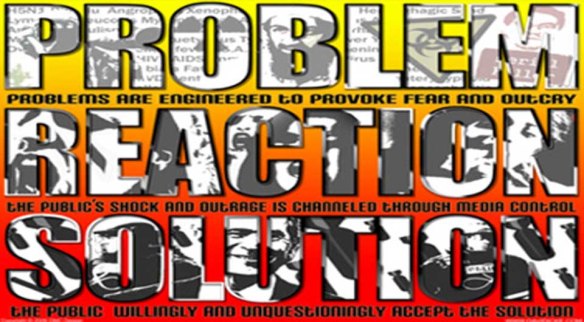
Whether it is the Patriot Act, the pre-planned invasion of Afghanistan, calls to restrict the 2nd Amendment, greater government surveillance, increased spending on war and police state security measures, the detainment of innocent people or torture of detainees, the government always has a solution in place before an attack happens.

Final Thoughts

Accepting terror as the norm is absolutely unacceptable and must be totally rejected by people who wish to live in peace and prosperity, which will forever remain impossible while government is allowed to contribute and benefit from terror.

If a Fool Speaks the Truth, Does it Become Untrue? How to Not Be Divided

By Cassius Methyl

Source: The Mind Unleashed

When a fool speaks the truth, does it become untrue?

Of course not. The truth is the truth regardless of who says it, or how they sound. The truth remains what it is no matter who opposes it, advocates for it, or any other form of influence.

Most people unconsciously believe the opposite. It really boils down to people being unwilling to spend time or effort on forming a detailed opinion on a topic.

They take shortcuts in their reasoning and convince themselves that they can make a vague, brief assessment of the subject at hand, often by observing the behavior of those advocating for or opposing the subject. Based on how a figurehead of an idea or ideology looks or speaks, average people will form opinions and skip reasoning through what the person is saying.

People in power know this, and many suspect that people are placed as figureheads for ideas and movements, paid to look foolish and crazy to give the ideas they represent a bad name. It’s a common sense divide and conquer strategy against activists and thinkers.

Take Alex Jones for example. People seeking a better understanding of the world got into Infowars’ content several years ago, before they took a 180 degree turn toward supporting government. Now, the mainstream media uses Alex Jones as a tool to convince people who don’t care to look into things that deeply, that many true things are crazy nonsense.

One can observe the effectiveness of this strategy and conclude that it will be used as a tool many more times in the future, to make the truth look stupid and the hegemony’s plans look brilliant.

Create a culture that prioritizes appealing to authority over reasoning and critical thought, and create foolish, outlandish figureheads for the ideas that would destroy the system and restore people’s power: that’s how they win.

To not be divided and not develop false opinions, we have to not take shortcuts in our reasoning. We have to not develop any opinions about how the world works too quickly: we have to not just take anyone’s word for anything, but take a hard look at reality and really research before thinking we know something.

How can we actually foster a culture where people do that? That’s an impossible sounding task with the way things look now, but person by person, we can foster that culture for at least a small group of people who think this way. At least the people who care can create their own culture.

It will take a relaxed yet strong and persistent, humble attitude and a sharp sense of discernment to get us through the rest of this decade safely.

If you’d like more perspective on the history of activists being divided, lets take a look at some history with the Black Panthers as targets of the FBI’s COINTELPRO program in the 1960’s. Reading from Assata Shakur.com:

“By July 1969, the Black Panthers had become the primary focus of the program, and was ultimately the target of 233 of the total authorized “Black Nationalist” COINTELPRO actions.

Although the claimed purpose of the Bureau’s COINTELPRO tactics was to prevent violence, some of the FBI’s tactics against the BPP were clearly intended to foster violence, and many others could reasonably have been expected to cause violence. For example, the FBI’s efforts to “intensify the degree of animosity” between the BPP and the Blackstone Rangers, a Chicago street gang, included sending an anonymous letter to the gang’s leader falsely informing him that the the Chicago Panthers had “a hit out” on him.  The stated intent of the letter was to induce the Ranger leader to “take reprisals against” the Panther leadership.

Similarly, in Southern California, the FBI launched a covert effort to “create further dissension in the ranks of the BPP.”  This effort included mailing anonymous letters and caricatures to BPP members ridiculing the local and national BPP leadership for the express purpose of exacerbating an existing “gang war” between the BPP and an organization called the United Slaves (US). This “gang war” resulted in the killing of four BPP members by members of US and in numerous beatings and shootings.””

Does the Washington Post Have Fake News?

By Eric Zuesse

Source: Strategic Culture Foundation

There are two kinds of fake news:

One is a report of something that actually didn’t happen, which for a newspaper to do can reasonably be called lying, inasmuch as a newspaper is expected to report only things that happen, and any violation of that strict standard — which separates journalism from propaganda — is at least negligence violating the very reason why consumers purchase or subscribe to a newspaper (that reason being trustworthiness). This deception amounts unqualifiedly to lying, in any case where a reasonable assumption can be made that the given false ‘news’ report’s falsehood results from the publisher’s propagandistic orientation and intention to deceive on that given matter. (This might be done in order to please the controlling stockholder of an advertiser, or for many other reasons.) In such cases, the fake news is propaganda instead of news. To sell to consumers propaganda as ‘news’ is additionally to deceive them into paying the publisher in order to become deceived by the publisher; so, it’s a deception on top of a deception; it is actually deception-squared. That’s why selling such ‘news’ is even worse than merely giving it away for free (such as honest PR or propaganda is — it is free).

The other type of fake news is omission of a crucial fact from a report, whenever the omission is so crucial that it will sway some readers to believe «x» when «not x» is true, and therefore such an omission is equivalent to lying. This is a far more subtle type of deception, because it relies upon the consumer to deceive himself, instead of upon the publisher explicitly asserting the falsehood to the reader or hearer. Such «sins of omission» are impossible to outlaw, but are more insidious than direct lying is, because any publisher can easily abuse this power to deceive, merely by making clear to his employees what types of facts they will be penalized (demoted etc.) for reporting. For example, any publisher who causes employees to exclude stating as a fact that some public official is lying or did lie about a particular matter, when proof is available that the given official did lie about it, would be publishing fake news on that matter. However, more often, a publisher simply establishes a policy not to hire editors (or producers) who would allow a report to be published that calls a «liar» a person whom the publisher favors, not even if that person can be proven to have lied — he may be said to have «erred» maybe, but not «lied». The tendency, therefore, is that people in power may be described as «lacking in experience» or etc., but not described as a «liar».

Examples will be provided here of both types of fake news in the Washington Post, all of which examples exhibit the same intention to deceive readers in the same type of way on a particular broader subject. This broader subject that’s being deceptively presented is whether or not the U.S. should conquer foreign countries; or, in other words, whether or not America’s military-industrial complex (which thrives upon taxpayers’ enhanced appetites for financing and shedding blood for the nation’s conquests abroad) will be served. Service to that objective is otherwise called «neoconservatism» or neoconservative propaganda, which is the way that the Washington Post will be documented here to be. Understanding the motive for such fake news is far more complex; the only issue to be addressed here is the fake news itself — this particular agenda (neoconservatism) for the WP’s fake news:

First of all, here, will be the paradigmatic case of neoconservative propaganda: the deceptions that were perpetrated upon the American public in order to invade Iraq.

As has been pointed out by many books and by some bloggers, the Washington Post was, in 2002 and 2003, one of the leading deceivers of the American public into invading Iraq so as to eliminate Saddam Hussein’s weapons of mass destruction (WMD). The fact that President George W. Bush lied to assert that he was in possession of conclusive evidence that Hussein was producing WMD in 2002 was, in at least one instance, incontestable practically at the very moment that he said it, but this crucial fact was never reported by the Washington Post, not even when the authoritative agency in the particular instance, the IAEA, made repeated attempts to draw the attention of America’s reporters to the lie.

During a press conference with Britain’s Tony Blair, Bush said, on 7 September 2002, that a «new report» had just come out of the IAEA that Iraq «were six months away from developing a [nuclear] weapon. I don’t know what more evidence we need,» in order to invade and overthrow Saddam Hussein. The IAEA made clear that «There’s never been a report like that issued from this agency», but the WP (like the rest of America’s press) failed to report that the IAEA was accusing the U.S. President, of, essentially, concocting an IAEA ‘report’, on this vitally important matter, a ‘report’ that never existed — in other words, of outright lying in order to assert that the case to invade Iraq had already been made by the IAEA.

This instance wasn’t like all of the U.S. ‘intelligence failures’ in which the President’s own — i.e. U.S. — intelligence agencies, had refused to contradict him in public; this was instead an entirely independent intelligence agency that the President was citing as an authority here — and they were directly contradicting him, in public, about it. They just couldn’t get word out about that, to the American public. So, the idea that Bush wasn’t lying in order to ‘justify’ his invading Iraq, but was only relying upon America’s own faulty intelligence agencies regarding the matter, definitely does qualify as fake news in the WP, and it persists even today, as fake ‘history’ about the U.S. invasion of Iraq. The invasion on 20 March 2003 wasn’t ‘an error’; it was a crime, and a very massive one.

This fake news that Bush had ‘erred’ to invade Iraq was of the indirect type because it entailed suppression of the crucial fact from being published; it wasn’t fake news because the WP published their own lies about it. However, such stenographic ‘reporting’ of the government’s lies is merely passing along a dictatorship’s propaganda, not publishing real news. Real news always requires a publisher’s own investigation and the skepticism that any real scientist has about any allegation. In matters so important as an invasion of a foreign country, ‘news’-reporting can’t get any worse than such stenography being palmed-off as ‘news’, and the persons to be blamed for this fraud against the public are never the mere employees (who might lose their jobs if they don’t comply) but the publisher himself or herself — ultimately the controlling stockholder in the firm, who wouldn’t invest in the given ‘news’-organization if it were to be fully honest.

More recently, the WP has published fake news about Syria’s Bashar al-Assad (who is a Ba’athist, like Saddam Hussein was), like it had published fake news about Iraq’s Saddam Hussein.

On 2 April 2017, it was «‘The hospitals were slaughterhouses’: A journey into Syria’s secret torture wards».

On 15 May 2017, it was «Syria using crematorium to hide executions, State Department says».

On 16 May 2017, it was «‘I still have nightmares’: Voices from inside Assad’s torture network in Syria».

All were based upon PR-agency-shopped allegations and questionable evidence (like ‘Saddam’s WMD’ etc. had also been) from people who either were, or could have been, Al Qaeda affiliated, or else Islamic Brotherhood affiliated, extremist Islamists — supporters of Sharia law. And it all started with (and the WP’s ultimate sources were uncorroborated testifiers as having personally experienced what was shown in) «the Caesar photographs», from «the Syrian Detainee Report». As wikipedia puts it (my boldfaces):

The source, who for security reasons is identified only as Caesar, was at the time a photographer with the Syrian military police who worked secretly with a Syrian opposition group, the Syrian National Movement. His job was «taking pictures of killed detainees» at just two military hospitals in Damascus.[5] He told war crimes investigators that he used to be a forensic investigator. But once the Syrian uprising began, his job became documenting the corpses of those killed in Syrian military prisons.[8] He did not claim to have witnessed executions or torture.

As the U.S. government’s Wilson Center explains about the Syrian National Movement:

The 2011 uprising

After Syrians launched their own uprising in March 2011, the [Muslim] Brotherhood took a leading role in assembling the exiled opposition in the Syrian National Council. It was launched in August 2011. The Brotherhood was the only organized and experienced movement among an otherwise deeply fragmented opposition. It also had support from Qatar and Turkey. But its domination over the opposition in exile was contested. The Brotherhood’s immediate challenge was competition from rival Islamists who secured influential positions on the Syrian National Coalition, the Council’s successor, which was established in November 2012.

The rival Islamists included the Coalition’s first president, Sheikh Mouaz al Khatib. Khatib, a former preacher at the historic Umayyad Mosque, had special legitimacy since he had just left Damascus. Another rival was Imad al din al Rashid, former vice-dean of the Faculty of Sharia of Damascus. His Syrian National Movement, an alliance of secularists, moderate Islamists and Salafis [«Salafis» means extreme fundamentalist Muslims], failed to recruit significant following.

Both Qatar and Turkey are run by fundamentalist («Sharia») Sunni Muslims who want to conquer the Shia Muslims who lead the fundamentalist Shia regime in Iran and the non-sectarian secular regime in Syria. These Sunnis want also a (U.S.-supported) gas pipeline to be built through Syria to transport Qatar’s gas into the EU to grab market-share away from Russia, which is the main country that America’s aristocracy wants to weaken and ultimately to conquer.

Saddam Hussein had been supported by America’s aristocracy when Saddam was trying to conquer Shiite Iran back in the 1980s, but became opposed by the U.S. aristocracy as soon as he turned against and invaded fundamentalist Sunni Kuwait and became friendly toward secular Russia, which since 1979 has been plagued by (U.S.-Saudi-backed) «mujahideen» (who became called «Taliban» and some of whom then became «Al Qaeda») and other fundamentalist Sunnis in Afghanistan, Chechnya, and elsewhere, who want a Sharia-law-ruled Russia. The Obama regime in America came into office in 2009 determined to overthrow Syria’s secular leader Bashar al-Assad; and, starting in 2010, actively pursued organizing rebels against Syria’s secular government. On 24 September 2010, Jared Cohen of Hillary Clinton’s State Department was working to find a way to stir demonstrations to bring down Assad’s government; and, on 23 June 2011, he was meeting inside the London Ecuadorean Embassy with Google’s Eric Schmidt to pry out of Julian Assange information about how to do this; and, on 25 July 2012, Cohen was (now as a high Google executive paid by top Hillary backer Schmidt) telling Hillary’s other aides about Cohen’s own progress in putting the Syrian overthrow-plan into effect. Google also assisted the 1 March 2013 start of Hillary’s plan for the February 2014 coup in Ukraine, which used nazis to bring down Ukraine’s government, just as they used jihadists to bring down Syria’s government — extremists in both cases.

With ‘allies’ such as Saudi Arabia’s despots, and such as the apartheid Israeli ‘democracy’ (which latter is so theocratic it doesn’t even have any constitution), the U.S. government is no ‘democracy’, despite its Constitution (which the U.S. government routinely violates). But whereas the Washington Post calls Russian Television ‘fake news’, Russian Television presents news about those regimes and their allies, while the WP presents lies about RT, and about Russia, and about any ally of Russia (such as Saddam Hussein was, and Bashar al-Assad is). If this sounds like a lopsided characterization, it’s nonetheless stated because the associated reality is also lopsided. That’s the reality which should be reported but is instead blacked-out in America’s press

Of course, one of those Russian allies is Syria, whose government the U.S. government therefore is at war against, and has invaded, while pontificating that the world’s most ‘aggressive’ country is Russia, and while claiming to be the moral authority that can dictate morality to the ‘barbarous’ Bashar al-Assad and Vladimir Putin.

On 16 December 2016, Human Rights Watch published «If the Dead Could Speak: Mass Deaths and Torture in Syria’s Detention Facilities», claiming to confirm the «Caesar» photos. Then, on 7 February 2017, Amnesty International published «Human Slaughterhouse: Mass Hangings and Exterminations at Saydnaya Prison, Syria», further ‘confirming’ the alleged depravity of Assad’s government. Yet a third ‘authority’ that was additionally cited in the three articles in the Washington Post that were here referred to as having alleged that Assad was doing these types of things to innocent people during the U.S.-Saudi-Qatari-Turkey-UAE-Kuwait war to conquer his country, was the Syrian Network for Human Rights. How reliable, then, are these three alleged ‘authorities’ on that subject?

Wikipedia’s section «Criticism of Human Rights Watch» has a subsection «Allegations of Bias», which states, among other things:

Ideological and selection bias[edit]

HRW has been accused of evidence-gathering bias because it is said to be «credulous of civilian witnesses in places like Gaza and Afghanistan» but «skeptical of anyone in a uniform».[1] Its founder, Robert Bernstein, accused the organization of poor research methods and relying on «witnesses whose stories cannot be verified and who may testify for political advantage or because they fear retaliation from their own rulers».[2] In October 2009, Bernstein said that the organization had lost critical perspective on events in the Middle East:[2] «[T]he region is populated by authoritarian regimes with appalling human rights records. Yet in recent years Human Rights Watch has written far more condemnations of Israel for violations of international law than of any other country in the region».[2] HRW responded by saying that HRW «does not devote more time and energy to Israel than to other countries in the region, or in the world».[3] Tom Porteus, director of the HRW’s London branch, replied that the organization rejected Bernstein’s «obvious double standard. Any credible human rights organization must apply the same human rights standards to all countries».[4]

According to The Times, HRW «does not always practice the transparency, tolerance and accountability it urges on others».[1] …

Fundraising[edit]

On September 7, 2010, it was announced that George Soros planned to donate $100 million to Human Rights Watch.[69] Soros’ donation was criticized by Gerald Steinberg, founder of NGO Monitor.[70]

Journalists have criticized Human Rights Watch for requesting, encouraging or accepting financial donations in Saudi Arabia and for its fundraising methods.

Moreover, the PR department of New York’s Syracuse University headlined on 17 December 2016, «HRW Validates Caesar Report on Syrian Torture, First Reported by Law Professor David Crane» and reported regarding the HRW study, which was co-authored by Professor Crane:

Commissioned by London law firm Carter-Ruck on behalf of Qatar, the Caesar Report’s other co-authors were international prosecutors Sir Desmond Lorenz de Silva QC and Sir Geoffrey Nice QC. This team — which also included forensics experts — analyzed 835 images, 150 of those in depth, uncovering evidence of starvation, beatings and strangulation, as well as an obsessive documentation of the killings. The lawyers also cross-examined Caesar and found him to be «a truthful and credible witness,» according to Crane.

Qatar had commissioned anti-Assad PR from HRW, and got what they had paid for, in their «Caesar Report».

Regarding Amnesty International’s report, which was issued on 7 February 2017, the invariably cogent «Moon of Alabama» blogger headlined and documented appropriately about it the same day, «Hearsay Extrapolated — Amnesty Claims Mass Executions In Syria, Provides Zero Proof», but one could also say that it provided zero evidence (but lots of allegations). Three days later, the also credible Tony Cartalucci bannered «US Cooks Up New Syrian Atrocities Amid Syrian Talks». Then, yet another day later, on February 11th, the brilliant Rick Sterling headlined «Amnesty International Stokes Syrian War» and he utterly destroyed the AI study’s credibility. Among many other things, he tracked the AI study’s funding and backing back to Soros and other rabid haters of Russians. Finally, on February 25th, Paul Mansfield bannered «Amnesty fake report ‘Human Slaughterhouse’ invents Assad war crimes to undermine Syria peace talks».

As regards the Syrian Network for Human Rights (SNHR), it (and other U.S.-arsistocracy-backed fronts) was discussed by Helena Glass, on 8 February 2017, headlining «Amnesty International – A Propaganda Machine»:

Like the Syrian Observatory of [for] Human Rights, the SNHR is a one man show. One man who lives in the UK, who has no background, and who adamantly and openly hates Assad. Neither of these ‘organizations’ list their funding although it is widely believed to come from the UK’s GCHQ.

BOTH organizations claim to have ‘a network of spies on the ground in Syria with whom they converse daily for information’. Like SOHR, Fadel Abdulghani, the Director of Syrian Network of Human Rights, lists absolutely no previous background or history on social media sites. He never existed prior to becoming an expert…and Chairperson of his one man show…

But it gets worse: Fadel Abdulghani is aligned with the National Council of Resistance of Iran, which the US and Australia consider an alias of MEK. MEK, headed by Maryam Rajavi was considered a terrorist organization by the US as of 2003 and was delisted in 2012.

It gets worse: The delisting of MEK as a terrorist organization was made by then Secretary of State – Hillary Clinton!

Uh-oh.

Thus it would appear that one of Amnesty International’s prime source[s] for their claim that Assad tortured and murdered 13,000 comes from one man who is affiliated with a former terrorist organization who has no background or previous experience and who would seem to have been ‘created’ from thin air…and possibly funded by GCHQ! Wow!

Apparently, Maryam Rajavi openly declares that she is the leading advocate and voice to ‘violently over-throw the government of Iran’.

The international war to overthrow Assad is barbaric, and nothing that is said in the present article is necessarily rejecting the possibility that some of the gruesome things that have been alleged about Assad’s handling of his side of that international invasion against Syria’s government might be true. But that’s not the topic here, anyway; the topic is instead the question as to whether the Washington Post has fake news. It certainly does — and lots of it, including also, for example, that ‘news’paper’s continuing not to report that the coup that occurred in Ukraine in February 2014 was a coup by the U.S., and no grass-roots democratic revolution, such as the U.S. regime (and its propaganda-organs) claim it to have been. That ‘news’paper’s subscribers are buying propaganda.

War on Terror: Greatest Covert Op

(Editor’s Note: The following commentary is drawn from a speech delivered by Douglas Valentine at a 2010 peace conference. In expanded version is included as the final chapter of his book “The CIA as Organized Crime: How Illegal Operations Corrupt America and the World”.)

By Douglas Valentine

Source: Consortium News

The politics of terror are the greatest covert operation ever.

In explaining why, I’ll begin by defining some terms, because, when discussing the covert op called “the politics of terror,” words and their management are all important.

How are politics and terror actually defined: how are these meanings manipulated; for what purposes, and by whom?

Terrorism is defined as “violence against civilians intended to obtain a political purpose.”

This is an ambiguous phrase, which begs the questions: what are politics and violence?

Politics is defined as “the process by which groups of people make collective decisions.” And violence in this context is the use of force to compel a person or group to do or think something against their will. That includes the violence of words – of threatening to hurt – and of social structures, as well as the violence of deeds.

So, by definition, terrorism is political violence – hurting people, or threatening to hurt them, in order to make them govern themselves (or acquiesce to an external force) against their will.

In America, terrorism is always condemned by the government, and, accordingly, America is never a perpetrator of terrorism, but always the victims of it.

The U.S. war on terror is the ultimate expression of this principle: it is a military response to terrorism; violence in self-defense, not (ostensibly) violence for a political purpose.

That’s the official story – the assumption. But I’m going to show that America does engage in terrorism – violence against civilians for political purposes. This “state” terrorism, however, is covert, in so far as it is equated with national security, and thanks to that built-in ambiguity, it has both stated and unstated purpose.

The State and Unstated Policy in America 

Politics is a process by which groups of people make collective decisions. But who really makes the overarching political decisions in America? Who governs us?

The two political parties represent the people and they compete for control of the government. Historically, Republicans have generally favored business and Democrats have favored labor. The political division is, generally, class based.

Now, the government can be controlled by either political party; but the state endures –  “the state” being the nation’s indispensable industries and infrastructure (banking, auto industry, insurance, Microsoft), and the institutions which defend the nation’s enduring interests: the military, law enforcement, the intelligence and security services.

In Europe they often, cynically, refer to the state as “industry” or Big Business. In America we tend to call “the state” the Establishment – an ambiguous word that needs to be defined.

The dictionary defines Establishment as, “An exclusive group of powerful people who rule a government or society by means of private agreements and decisions.”

I would venture to say that the interests of the state and the Establishment are the same, and that the definition of Establishment with a capital E is the pivotal phrase in discussing “state” terrorism.

Consider this: there is the politics of the two parties vying for control of the government, and there is the Establishment, the state, making the covert (ostensibly non-political) decisions that effectively govern America.

Many of those covert decisions concern national security: they are unstated policy.

Moreover, these covert policy decisions about national security are made by people who control the military, law enforcement, and intelligence and security services. These guardians of “the state” are collectively called the National Security Establishment.

Like the Establishment that secretly rules the “state,” the National Security Establishment is an exclusive group that is not accountable to the political whims of the people.

These professional guardians of the state – the Establishment – are assumed to be above partisan politics. Their loyalty is assumed to be to the law or national security. And that assumption is the Big Lie upon which state terrorism is based.

Yes, it is true that the National Security Establishment is not accountable to the people: and, in fact, it has built a series of ever-larger, concentric moats around itself called the National Security State, precisely to keep the people out of its business.

The National Security Establishment rules the National Security State, with an iron fist, but it is pure propaganda that the National Security Establishment and State are not political.

In order to get inside the National Security Establishment, and rise to a position of authority within it, one must be born there (like Bush or make billions like Bill Gates), or submit to years of right-wing political indoctrination calibrated to a series of increasingly restrictive security clearances.

Political indoctrination – adopting the correct right-wing ideology – and security clearances represent the drawbridge across the moats.

The National Security State is the covert social structure of the Establishment, and it has as its job not just defending the Establishment from foreign enemies, but also expanding the Establishment’s economic and military influence abroad, while preserving its class prerogatives at home.

By “class prerogatives,” I mean the National Security State is designed to keep the lower class from exerting any political control over the state; especially, redistributing the Establishment’s private wealth.

To these unstated ends – imperialism abroad and repression at home – the National Security State engages in terrorism – i.e. political violence – on behalf of the Establishment.

Indeed, the National Security State is political violence, terrorism, in its purest form.

The Establishment and its National Security State as Terrorism

The lower classes in America have little voice in making government or state policy. Some members of the lower classes have given up hope, others are content: but in either case, voter turnout is a mere 54 percent.

Whether hopeless or content, they know they cannot fight conventional thinking. For example, when the Establishment exerts its influence, it is not considered politics; it is simply the status quo. The rich create jobs and must be accommodated with trillion-dollar bailouts, paid for by workers taking furloughs.

That’s just the way it is. Politicians in the service of the Establishment, for over-arching reasons of national security, have to keep the capitalist financial system afloat.

It is the same thing with the National Security Establishment: America invaded Iraq, and there was nothing the people could do about it. The decision was made for them. Peace activists, least of all, had no voice in the decision, because they are assumed to have no stake in national security.

You will not find peace activists in the National Security Establishment; and that political repression is part of covert state terrorism.

Likewise, if labor seeks to exercise influence, its efforts are described as exploiting the state for more than it deserves, because it does not have an enduring stake in the state.

It is a fact: only Establishment wealth – ownership – is equated with national security.

Consider the immortal words of Leona Helmsley: “Only the little people pay taxes.”

That injustice in the tax code is political repression and, in so far as it makes the people fearful, it is state terrorism. The Establishment fears losing its loopholes, while workers and the poor fear losing their homes: two types of fear, one for each class, one stated, one unstated.

The Establishment engages imperialism and political repression through propaganda (word management violence) and social structures. This state terrorism also is unstated, covert.

Only when the people rebel and challenge the Establishment is the word terrorism applied.

Likewise, the military, police or intelligence actions that provoke rebellion, or the responses to rebellion, are never called terrorism: they are national security.

And that’s how the management of words helps to repress the lower classes.

Language and the Psychology of State Terror

America’s industrial-sized war machine was never said to terrorize Iraq; the invasion was not political because the war machine is owned by the Establishment.

The Establishment profiting from war is not politics; it is ideological neutral “profits.”

In fact, America exerts its unwanted political influence overseas, through the state terror of aircraft carrier fleets, bombers, nuclear subs, shock and awe invasions, pacification programs, the overthrow of governments, and support of repressive puppet regimes.

This state terrorism, which you never hear about, is the biggest covert psychological warfare operation of all time.

This psywar operation depends on narrowly defining terrorism as a suicide bomber, a hijacked plane, the decapitated body of a collaborator: the “selective terrorism” of rebels and nationalists who, outgunned and outlawed in their own country, have no other options, other than submission.

The purpose of this “selective terrorism” by rebels is psychological: to isolate collaborators, while demonstrating to the people the ability of the rebels to strike at their oppressors. Brutal pacification cam­paigns – state terrorism – prevent people from making a living. Selective terrorism does not.

That’s a big, meaningful “class” difference.

The National Security Establishment understands that selective terror achieves political and psychological goals that state terror does not – that it rallies people to revolutionary ideals.  So the National Security Establishment engages in selective terror, too, by targeting the rebel, his family and friends in their homes.

This is the selective terror con­ducted by counter-terrorists. But don’t be confused: it is terrorism. All terrorism is psychological and political; state terror seeks to immobilize people and make them submissive, apathetic and/or ostensibly “content.”

The National Security Establishment fully understands that once people have been terrorized, they have been politically defeated, without necessarily receiving bullets.

As former Director of Central Intelligence William Colby once said: “The implication or latent threat of terror was sufficient to insure that the people would comply.”

This principle of the psychological use of “the implication or latent threat of terror” is what brings us back to America and the business of terror.

The Business of Terror

State terror – colonization abroad and political repression at home – is a key means of extracting profits and maintaining ownership of property. Ask the American Indian.

In its colonies abroad, the U.S. engages in state terrorism by removing all legal protections for rebels; detention, torture, and summary execution are the price for rebellion against U.S. policy.

State terrorism overseas, imperialism, is never acknowledged by the U.S. media, because the media is a big business closely affiliated with the National Security Establishment; indeed, two of the major networks are owned by defense contractors.

And state terrorism applied domestically to ensure “internal” security is never acknowledged. But the National Security State is well thought out, by professionals in language management, and political and psychological warfare, aimed at you.

“Personal violence is for the amateur in dominance,” says Johan Galtung, a founder of the disciipline of peace and conflict studies. But he adds “structural violence is the tool of the professional. The amateur who wants to dominate uses guns; the professional uses social structure. The legal criminality of the social system and its institutions, of government…is tacit violence. Structural violence is a structure of exploitation and social injustice.”

As Colby said:The implication or latent threat is enough to insure people will comply.”

The war on terror and its domestic version “homeland security” are the law of the land – America’s new legally criminal social structure based on administrative detention, enshrined in The Patriot Act and a number of executive orders, some secret.

This lack of due process comes on top of a justice system already skewed to protect the propertied elite and pack the prisons with the poor, through “structural violence,” mainly the drug wars.

The Establishment’s new anti-terror and anti-drug laws make the National Security State the most fearsome covert political and psywar machine the world has ever seen. And the National Security State is growing: the “Top Secret America” series in the Washington Post put it at 750,000 cadres.

This secret state within a state extends into the homeland’s critical infrastructure and beyond. For example, the arms industry provides good jobs, making American imperial aggression seem a positive value.

And this is how the psyched-out people become one of the moats.

As it is modeled on the totalitarian corporate paradigm, the National Security State in all its manifestations fits the classic definition of a fascist dictatorship. And we know what its intentions are. They have been stated.

In the days after 9/11, right-wing Republican stalwart Kenneth W. Starr, the Clinton inquisitor, said the danger of terrorism requires “deference to the judgments of the political branches with respect to matters of national security.”

But is there an on-going emergency that requires deference to the political branches, meaning the right-wing ideologues who rule the National Security State? And what does it mean for Establishment opponents if due process is completely abandoned at home, and subjected to politics?

Michael Ledeen, a former counter-terror expert on Reagan’s National Security Council, blamed 9/11 on President Bill Clinton “for failing to properly organize our nation’s security apparatus.”

Ledeen’s solution to the problem of those who sneered at security was “to stamp out” the “corrupt habits of mind.” By which he means Liberalism.

In other words, the reactionary right-wing that owns the National Security State wants to impose its total rule on the people in order to create a security conscious, uniform citizenry – marching in lock step, flags waving – that is necessary to win the war on terror.

This is how the National Security professionals are incrementally creating the requisite fascist social structure – through terror, the best organizing principle ever.

“This is time for the old motto, ‘kill them all, let God sort ’em out.’ New times require new people with new standards,” Ledeen asserted. “The entire political world will understand it and applaud it. And it will give us a chance to prevail.”

When Ledeen says “political” world he means the “owners of the business” of state terror, the right-wing ideologues who pack the National Security State and the capitalist Establishment they serve.

And they have won the propaganda war, folks.

The West’s War on Free Speech

By Tony Cartalucci

Source: Land Destroyer

With a name like the “National Democratic Institute” (NDI) one might expect the US State Department-funded, corporate-financier chaired front to be the premier proponent of freedom and democracy worldwide. And although it poses as such, it does precisely the opposite. It uses principles like free speech, democracy, press freedom, and human rights as a facade behind which it carries out a politically motivated agenda on behalf of the special interests that fund and direct its activities.

In a recent Tweet, NDI linked to a New York Times article titled, “In Europe’s Election Season, Tech Vies to Fight Fake News.” It claimed in the Tweet that the article featured:

A look at some of the projects aiming to use automated algorithms to identify and combat fake news. 

The article itself though, reveals nothing short of a global effort by US tech-giants Google and Facebook, in collaboration with the Western media, to censor any and all media that fails to align with Western-dominated narratives.

The article itself claims:

The French electorate heads to the polls in the second round of presidential elections on May 7, followed by votes in Britain and Germany in the coming months. Computer scientists, tech giants and start-ups are using sophisticated algorithms and reams of online data to quickly — and automatically — spot fake news faster than traditional fact-checking groups can. 

The goal, experts say, is to expand these digital tools across Europe, so the region can counter the fake news that caused so much confusion and anger during the United States presidential election in November, when outright false reports routinely spread like wildfire on Facebook and Twitter.

The article then explains that once “fake news” is spotted, it is expunged from the Internet. It reports that:

After criticism of its role in spreading false reports during the United States elections, Facebook introduced a fact-checking tool ahead of the Dutch elections in March and the first round of the French presidential election on April 23. It also removed 30,000 accounts in France that had shared fake news, a small fraction of the approximately 33 million Facebook users in the country.

Were foreign government-linked tech companies purging tens of thousands of accounts ahead of elections in say, Thailand or Russia, it is very likely organizations like NDI and media platforms like the New York Times would cry foul, depicting it as censorship.

In determining what is and isn’t “fake news,” the New York Times offers some clues (emphasis added):

Using a database of verified articles and their artificial intelligence expertise, rival groups — a combination of college teams, independent programmers and groups from existing tech companies — already have been able to accurately predict the veracity of certain claims almost 90 percent of the time, Mr. Pomerleau said. He hopes that figure will rise to the mid-90s before his challenge ends in June.

In other words, “fake news” is determined by comparing it directly to narratives presented by establishment media platforms like the New York Times, the BBC, CNN, MSNBC, Fox News, and others who have notorious track records of serial deception, false reporting, and even war propagandizing.

Nowhere does the New York Times explain how these “verified articles” have been determined to be factually accurate, and instead, it appears that all these algorithms are doing is ensuring all media falls in line with Western narratives.

If media in question coincides with Western-dominated media platforms, it is given a pass – if not, it is slated for expunging as described elsewhere in the New York Times’ piece.

Thus, the National Democratic Institute, who claims on its website to “support and strengthen democratic institutions worldwide through citizen participation, openness and accountability in government,” finds itself promoting what is essentially a worldwide agenda of malicious censorship, manipulating the perception of the globe’s citizenry, not supporting or strengthening it’s participation in any sort of honest political process.

To answer the question as to what the NDI is referring to when it claims other nations are “censoring” free speech and press freedoms, it involves defending local fronts funded by the NDI and its parent organization, the National Endowment for Democracy (NED) who merely repeat Western propaganda in local languages and with local spins. When foreign nations attempt to deal with these instances of “fake news,” US fronts like NDI and NED depict it as censorship.

While the West poses as the premier champion of free speech, citizen participation, openness, and accountability, the New York Times article reveals an unfolding plan to utterly crush any narrative that deviates from Western media talking points, thus controlling citizen perception, not encouraging “participation,” and ensuring that the West alone determines what is “opened” and held “accountable.”

No worse scenario can be referenced in human history or even among human fiction than plans to determine for the world through automatic algorithms and artificial intelligence almost in real time what is heard and read and what isn’t. It is even beyond the scope and scale of George Orwell’s cautionary dystopian “1984” novel.

In a truly free society, an educated citizenry is capable of deciding for itself what is “fake news” and what isn’t. Because of the rise of alternatives to the West’s monopoly over global information, many people are doing just that – determining that Western narratives are in fact deceptions. At no other point in modern history has the Western media faced as many alternatives, and as much skepticism on this scale, as well as an ebbing of trust domestically and abroad. It is no surprise then, to find the West resorting to outright censorship, even if it cushions mention of it with terms like “fake news.”

Luddism and Economic Ideology

ludd1

Source: the HipCrime Vocab

Smithsonian Magazine has a very good feature on the Luddites, well worth a read. There are many elements you just don’t read in many economic histories; for example, the 40-hour work week was not brought down from the mountaintop by Moses and inscribed in stone tablets, despite what you may have heard elsewhere:

At the turn of 1800, the textile industry in the United Kingdom was an economic juggernaut that employed the vast majority of workers in the North. Working from home, weavers produced stockings using frames, while cotton-spinners created yarn. “Croppers” would take large sheets of woven wool fabric and trim the rough surface off, making it smooth to the touch.

These workers had great control over when and how they worked—and plenty of leisure. “The year was chequered with holidays, wakes, and fairs; it was not one dull round of labor,” as the stocking-maker William Gardiner noted gaily at the time. Indeed, some “seldom worked more than three days a week.” Not only was the weekend a holiday, but they took Monday off too, celebrating it as a drunken “St. Monday.”

Croppers in particular were a force to be reckoned with. They were well-off—their pay was three times that of stocking-makers—and their work required them to pass heavy cropping tools across the wool, making them muscular, brawny men who were fiercely independent. In the textile world, the croppers were, as one observer noted at the time, “notoriously the least manageable of any persons employed.”

The introduction of machinery in cloth manufacture did not make these people’s lives better. In fact, it made them a lot worse:

“They [the merchant class] were obsessed with keeping their factories going, so they were introducing machines wherever they might help,” says Jenny Uglow, a historian and author of In These Times: Living in Britain Through Napoleon’s Wars, 1793-1815.

The workers were livid. Factory work was miserable, with brutal 14-hour days that left workers—as one doctor noted—“stunted, enfeebled, and depraved.” Stocking-weavers were particularly incensed at the move toward cut-ups. It produced stockings of such low quality that they were “pregnant with the seeds of its own destruction,” as one hosier put it: Pretty soon people wouldn’t buy any stockings if they were this shoddy. Poverty rose as wages plummeted.

Yes, you read that right- the introduction of “labor-saving” technology made the amount these people worked increase dramatically. It also made their work much, much more unpleasant. It transferred control to a smaller circle of wealthy people and took it away from the workers themselves. It made the rich richer, increased poverty, and tore society apart.

But more technology is always good, right?

And since history is written by the victors, “Luddite” is a term now inextricably wound up with the knee-jerk rejection of new technology. But the Luddites weren’t opposed to new technology at all! What they were fighting against was the economic conditions that took away their autonomy and turned them into mendicants in their own country:

The workers tried bargaining. They weren’t opposed to machinery, they said, if the profits from increased productivity were shared. The croppers suggested taxing cloth to make a fund for those unemployed by machines. Others argued that industrialists should introduce machinery more gradually, to allow workers more time to adapt to new trades.

The plight of the unemployed workers even attracted the attention of Charlotte Brontë, who wrote them into her novel Shirley. “The throes of a sort of moral earthquake,” she noted, “were felt heaving under the hills of the northern counties.”

[…]

At heart, the fight was not really about technology. The Luddites were happy to use machinery—indeed, weavers had used smaller frames for decades. What galled them was the new logic of industrial capitalism, where the productivity gains from new technology enriched only the machines’ owners and weren’t shared with the workers.

In fact, the Luddites actually spared the machines that were used by employers who treated workers fairly. Funny how you never hear that in most popular descriptions of the Luddite revolt:

The Luddites were often careful to spare employers who they felt dealt fairly. During one attack, Luddites broke into a house and destroyed four frames—but left two intact after determining that their owner hadn’t lowered wages for his weavers. (Some masters began posting signs on their machines, hoping to avoid destruction: “This Frame Is Making Full Fashioned Work, at the Full Price.”)

Unlike today, labor actually fought back against these attempts to destroy their way of life:

As a form of economic protest, machine-breaking wasn’t new. There were probably 35 examples of it in the previous 100 years, as the author Kirkpatrick Sale found in his seminal history Rebels Against the Future. But the Luddites, well-organized and tactical, brought a ruthless efficiency to the technique: Barely a few days went by without another attack, and they were soon breaking at least 175 machines per month. Within months they had destroyed probably 800, worth £25,000—the equivalent of $1.97 million, today.

Rather than the “natural course” of free-market economics, once again it was government intervention, including brutal state violence, that made modern capitalism possible:

Parliament was now fully awakened, and began a ferocious crackdown. In March 1812, politicians passed a law that handed out the death penalty for anyone “destroying or injuring any Stocking or Lace Frames, or other Machines or Engines used in the Framework knitted Manufactory.” Meanwhile, London flooded the Luddite counties with 14,000 soldiers.

By winter of 1812, the government was winning. Informants and sleuthing finally tracked down the identities of a few dozen Luddites. Over a span of 15 months, 24 Luddites were hanged publicly, often after hasty trials, including a 16-year-old who cried out to his mother on the gallows, “thinking that she had the power to save him.” Another two dozen were sent to prison and 51 were sentenced to be shipped off to Australia.

But wait, isn’t capitalism all about “freedom and liberty?” Freedom and liberty for some, I guess.

The problem, then as now, was not technology itself, but the economic relations that it unfolded against. What I found most interesting is that even back then, the emerging pseudoscience of economics was used to justify the harsh treatment of the workers and the bottomless greed of capitalists, in particular the “sacred text” of modern Neoclassical economics, Adam Smith’s The Wealth of Nations:

For the Luddites, “there was the concept of a ‘fair profit,’” says Adrian Randall, the author of Before the Luddites. In the past, the master would take a fair profit, but now he adds, “the industrial capitalist is someone who is seeking more and more of their share of the profit that they’re making.” Workers thought wages should be protected with minimum-wage laws. Industrialists didn’t: They’d been reading up on laissez-faire economic theory in Adam Smith’s The Wealth of Nations, published a few decades earlier.

“The writings of Dr. Adam Smith have altered the opinion, of the polished part of society,” as the author of a minimum wage proposal at the time noted. Now, the wealthy believed that attempting to regulate wages “would be as absurd as an attempt to regulate the winds.”

It seems as though nothing’s really changed. Using economic “science” to justify social inequality and private ownership goes back to the very beginnings of the Market.

When Robots Take All of Our Jobs, Remember the Luddites (Smithsonian Magazine). Smithsonian wrote about this before, see also: What the Luddites Really Fought Against

As the above history shows, there is nothing “natural” or normal about extreme busyness and brutally long working hours. It is entirely an artificial creation:

A nice post at the HBR blog…describes how being busy is now celebrated as a symbol of high status. This is not natural. Marshall Sahlins has shown that in hunter-gather societies (which were the human condition for nine-tenths of our existence) people typically worked for only around 20 hours a week. In pre-industrial societies, work was task-oriented; people did as much as necessary and then stopped. Max Weber wrote:

“Man does not “by nature” wish to earn more and more money, but simply to live as he is accustomed to live and to earn as much as is necessary for that purpose. Wherever modern capitalism has begun its work of increasing the productivity of human labour by increasing its intensity, it has encountered the immensely stubborn resistance of this leading trait of pre-capitalistic labour. (The Protestant Ethic and the Spirit of Capitalism, p24”

The backward-bending supply curve of labour was normal.

E.P. Thompson has described how pre-industrial working hours were irregular, with Mondays usually taken as holidays. He, and writers such as Sidney Pollard and Stephen Marglin, have shown how the working day as we know it was imposed by ruthless discipline, reinforced by Christian moralists. (There’s a clue in the title of Weber’s book). Marglin quotes Andrew Ure, author of The Philosophy of Manufacturers in 1835:

The main difficulty [faced by Richard Arkwright] did not, to my apprehension, lie so much in the invention of a proper mechanism for drawing out and twisting cotton into a continuous thread, as in…training human beings to renounce their desultory habits of work and to identify themselves with the unvarying regularity of the complex automation. To devise and administer a successful code of factory discipline, suited to the necessities of factory diligence, was the Herculean enterprise, the noble achievement of Arkwright…It required, in fact, a man of a Napoleon nerve and ambition to subdue the refractory tempers of workpeople accustomed to irregular paroxysms of diligence.”

Today, though, such external discipline is no longer so necessary because many of us – more so in the UK and US than elsewhere – have internalized the capitalist imperative that we work long hours, …Which just vindicates a point made by Bertrand Russell back in 1932:

“The conception of duty, speaking historically, has been a means used by the holders of power to induce others to live for the interests of their masters rather than for their own.”

Against busyness (Stumbling and Mumbling)

Honestly, the five-day workweek is outmoded and ridiculous. It’s more of a babysitting operation for adults than anything else. It’s a silly as arguing that we need over two decades of formal education in order to do our jobs.

I was reminded of this over the holidays. In the U.S. we get virtually no time off from our jobs, unlike most other countries (East Asia might be an exception). But Christmas/New Year’s is a rare exception, and we have several four-day weeks in a row (without pay for some of us, of course). Those weeks are so much more pleasant, and I would even say productive, than the rest of the year. Every year at this time I think to myself, “Why isn’t every week a four-day workweek?” Some places do have such an arrangement, but they justify it by four long, ten-hour days. I don’t know about you, but towards the end of ten hours in a row of “work” I doubt anyone’s accomplishing much of anything. Is 32 hours a week really not enough to keep society functioning in the twenty-first century?

Not only that, but many people use whatever little vacation they do have in order to take the whole time period at the end of the year off. This is typical in Europe, but rarer here. In any case, while going to work I noticed that there was hardly any traffic. The roads were empty. There were plenty of seats on the bus. The streets and sidewalks were empty. There was no waiting in the restaurants and cafes. There was plenty of room for everything. There was a laid-back feeling everywhere. It was so pleasant. I couldn’t help but think to myself, “why isn’t every week like this?” If more people could stay home and work less, it very well could be. Instead we’re trapped on a treadmill. Working less would actually pay dividends in terms of reduced traffic, less crowding, less pollution, and better health outcomes due to less stress and more time to exercise.

There’s also a simple logic problem at work here. If we say the 40-hour week is inviolable and set-in-stone for the rest of time, and we do not wish to increase the problem of unemployment, then literally no labor-saving technology will ever save labor! We might as well dispense with the creation of any labor-saving technology, since by the above logic, it cannot save labor. You could equivocate and say that it frees us from doing “lower” level work and allows us to do “higher” level work, as when ditch diggers become factory workers, or something. That may have been a valid argument a hundred years ago, but in an age when most of us are low-paid service workers or useless paper-pushers, it’s pretty hard to make that case with any seriousness anymore.

***

I often refer to economics as a religion, with its practitioners as priests. So it’s interesting to read that in other contexts. This is from Chris Dillow’s blog, where the above passage about work was taken:

The social power, i.e. the multiplied productive force”, wrote Marx, appears to people “not as their own united power but as an alien force existing outside them, of the origin and end of which they are ignorant, which they thus cannot control.”

I was reminded of this by a fine passage in The Econocracy in which the authors show that “the economy” in the sense we now know it is a relatively recent invention and that economists claim to be experts capable of understanding this alien force:

“As increasing areas of political and social life are colonized by economic language and logic, the vast majority of citizens face the struggle of making informed democratic choices in a language they have never been taught. (p19)”

This leads to the sort of alienation which Marx described. This is summed up by respondents to a You Gov survey cited by Earle, Moran and Ward-Perkins, who said; “Economics is out of my hands so there is no point discussing it.”

In one important sense such an attitude is absurd. Every time you decide what to buy, or how much to save, or what job to do or how long to work, economics is in your hands and you are making an economic decision.

This suggests to me two different conceptions of what economics is. In one conception – that of Earle, Moran and Ward-Perkins – economists claim to be a priestly elite who understand “the economy”. As Alasdair MacIntyre said, such a claim functions as a demand for power and wealth:

“Civil servants and managers alike [he might have added economists-CD] justify themselves and their claims to authority, power and money by invoking their own competence as scientific managers (After Virtue, p 86).”

There is, though, a second conception of what economists should do. Rather than exploit alienation for their own advantage, we should help people mitigate it…

Economists in an alienated society (Stumbling and Mumbling)

This makes a point I often refer to – this depiction of “The Economy” as some of “natural” force that we have no control over, subject to its own inexorable logic. We saw above how the writings of Adam Smith provided the ideological justification for the wealthy merchants to screw over the workers. It cemented the perception that the economy was just a natural force with its own internal logic that could no more be regulated than could the wind or the tides. And over the course of several hundred years, we have intentionally designed our politcal institutions such that government cannot “interfere” in the “natural workings” of the economy. Doing so would only make all of us worse off, or so goes the argument.

There is a telling passage in this column by Noah Smith:

…Even now, when economic models have become far more complex than anything in [Milton] Friedman’s time, economists still go back to Friedman’s theory as a mental touchstone — a fundamental intuition that guides the way they make their models. My first macroeconomics professor believed in it deeply and instinctively, and would even bring it up in department seminars.

Unfortunately, intuition based on incorrect theories can lead us astray. Economists have known for a while that this theory doesn’t fit the facts. When people get a windfall, they tend to spend some of it immediately. So economists have tried to patch up Friedman’s theory, using a couple of plausible fixes….

Milton Friedman’s Cherished Theory Is Laid to Rest (Bloomberg)

Yes, you read that right, economists knew for a long time that a particular theory did not accord with the observed facts, but they didn’t discard it because it was necessary for the complex mathematical models that they use to supposedly describe reality. Rather, instead of discarding it, they tried to “patch it up,” because it told them what they wanted to hear. Note how his economics professor “believed deeply” in the theory, much as how people believe in the Good Book.

Nice “science” you got there.

That methodology ought to tell you everything you need to know about economic “science.” One wonders how many other approaches economists take that such thinking applies to.

Friedman was, of course, the author of “Capitalism and Freedom,” which as we saw above, is quite an ironic title. Friedman’s skill was coming up with ideas that the rich wanted hear, and then coming up with the requisite economic “logic” to justify them, from deregulation, to privatization, to globalization, to the elimination of minimum wages and suppression of unions. His most famous idea was that the sole purpose of a firm is to make money for its shareholders, and all other responsibilities were ‘unethical.’ The resulting “libertarian” economics was promoted tirelessly, including a series on PBS, by wealthy organizations and right-wing think-tanks with bottomless funding, as it still is today (along with its even more extreme cousin, “Austrian” economics). One thing the Luddites did not have to contend with was the power of the media to shape society, one reason why such revolts would be unthinkable today (along with the panopticon police states constructed by capitalist regimes beginning with Great Britain— “freedom” indeed!).

Smith himself has written about what he calls 101-ism:

We all know basically what 101ism says. Markets are efficient. Firms are competitive. Partial-equilibrium supply and demand describes most things. Demand curves slope down and supply curves slope up. Only one curve shifts at a time. No curve is particularly inelastic or elastic; all are somewhere in the middle (straight lines with slopes of 1 and -1 on a blackboard). Etc.

Note that 101 classes don’t necessarily teach that these things are true! I would guess that most do not. Almost all 101 classes teach about elasticity, and give examples with perfectly elastic and perfectly inelastic supply and demand curves. Most teach about market failures and monopolies. Most at least mention general equilibrium.

But for some reason, people seem to come away from 101 classes thinking that the cases that are the easiest to draw on the board are – God only knows why – the benchmark cases.

101ism (Noahpinion)

But the best criticism I’ve read lately is from James Kwak who has written an entire book on the subject: Economism: Bad Economics and the Rise of Inequality. He’s written several posts on the topic, but this post is a good introduction to the concept. Basically, he argues that modern economics allows policies that benefit the rich at the expense of the rest of society to masquerade as objective “scientific” truths thanks to the misapplication of economic ideology. As we saw above ,that goes back to very beginnings of “free market” economics in the nineteenth century:

In policy debates and public relations campaigns…what you are … likely to hear is that a minimum wage must increase unemployment—because that’s what the model says. This conviction that the world must behave the way it does on the blackboard is what I call economism. This style of thinking is influential because it is clear and logical, reducing complex issues to simple, pseudo-mathematical axioms. But it is not simply an innocent mistake made by inattentive undergraduates. Economism is Economics 101 transformed into an ideology—an ideology that is particularly persuasive because it poses as a neutral means of understanding the world.

In the case of low-skilled labor, it’s clear who benefits from a low minimum wage: the restaurant and hotel industries. In their PR campaigns, however, these corporations can hardly come out and say they like their labor as cheap as possible. Instead, armed with the logic of supply and demand, they argue that raising the minimum wage will only increase unemployment and poverty. Similarly, megabanks argue that regulating derivatives will starve the real economy of capital; multinational manufacturing companies argue that new trade agreements will benefit everyone; and the wealthy argue that lower taxes will increase savings and investment, unleashing economic growth.

In each case, economism allows a private interest to pretend that its preferred policies will really benefit society as a whole.The usual result is to increase inequality or to legitimize the widening gulf between rich and poor in contemporary society.

Economics 101, Economism, and Our New Gilded Age (The Baseline Scenario)

All of the above reinforces a couple of points I often like to make:

1.) Capitalism was a creation of government from day one. There is nothing “natural” or “free” about markets.

2.) It is sustained by a particular ideology which poses as a science but is anything but.

These is no fundamental reason we need to work 40 hours a week. There is no reason we have to go into debt just to get a job. There is no benefit to the extreme wealth inequality; it’s not due to any sort of “merit.” And on and on. Economic “logic” is destroying society along with the natural world and preventing any adaptive response to these crises. But its power over the hearts and minds of society seems to be unassailable, at least until it all falls apart.