Why Do Most People Believe Propaganda and False Flag Attacks?

By Robert J. Burrowes

In his 1995 book The Demon-Haunted World Carl Sagan lamented as follows:

I have a foreboding of [a] time when… awesome technological powers are in the hands of a very few, and no one representing the public interest can even grasp the issues; when the people have lost the ability to set their own agendas or knowledgeably question those in authority; when, clutching our crystals and nervously consulting our horoscopes, our critical faculties in decline, unable to distinguish between what feels good and what’s true, we slide, almost without noticing, back into superstition and darkness.

The dumbing down… is most evident in the slow decay of substantive content in the enormously influential media… but especially a kind of celebration of ignorance…. The plain lesson is that study and learning – not just of science, but of anything – are avoidable, even undesirable.

We’ve arranged a global civilization in which most crucial elements… profoundly depend on science and technology. We have also arranged things so that almost no one understands science and technology. This is a prescription for disaster. We might get away with it for a while, but sooner or later this combustible mixture of ignorance and power is going to blow up in our faces. See The Demon-Haunted World: Science as a Candle in the Dark.

While it is 25 years since these words of Sagan’s were published a year before his death, one can only lament the ongoing decline of what might simply be labeled the capacity for critical thinking, whether in relation to society and politics, or the science and technology that so concerned Sagan.

At a time in human history when so much is at stake, why is it so difficult to engage most people in anything resembling a thoughtful investigation, consideration and analysis of what is taking place? Why is it that more people do not question what they are told, what they read and what they are shown? In short, why is it that most people do not seek out the evidence for themselves rather than simply believing what is presented to them?

In one sense, the answer to this question might seem simple. People are daily bombarded with ‘information’, in various guises, and a lifetime of submissively accepting what they are told leaves few with any inclination, or energy, to question anything. But let me offer a fuller explanation given the critical importance of this issue if we are to mobilize an effective response to the challenges confronting humanity.

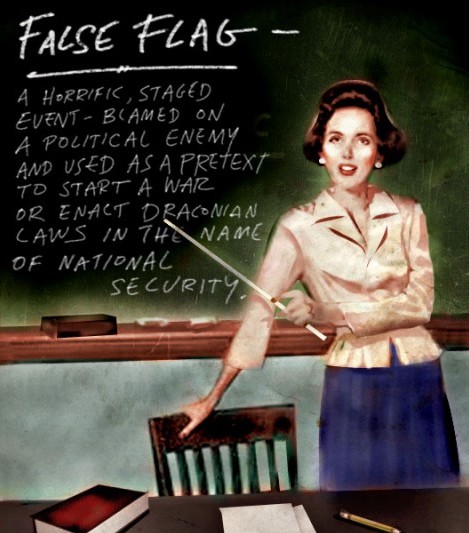
So first: What is propaganda? A false flag attack? Why do most people simply believe what they are told without investigating, carefully, for themselves? And why are those who challenge the elite-driven narrative often labeled ‘conspiracy theorists’ or, depending on the issue, some other pejorative such as ‘peddling debunked science’, ‘anti-vaxxer’ or ‘anti-semitic’ for example?

What is Propaganda?

Propaganda is the deliberate and systematic effort, using a variety of means, to manipulate people into believing and behaving in accordance with something that is not true. For one comprehensive explanation of how this is done, see Trust Us, We’re Experts! How Industry Manipulates Science and Gambles with Your Future, a book which Robert F. Kennedy Jr. observes ‘shows how giant corporations employ sophisticated psychiatric techniques, unscrupulous public figures, junk science, tainted studies and clever PR mercenaries in a relentless effort to market products that routinely kill, maim, deform and poison consumers and our environment’. See ‘Trust Us, We’re Experts!: How Industry Manipulates Science and Gambles with Your Future’.

While some people argue that propaganda can be used for good, the fact is that something that is simply true should appeal to people anyway, even if it is unpleasant. This is because the truth is the only powerful place from which to start to address any circumstance, including unpleasant and difficult ones.

Propaganda is delivered by a variety of means. Aside from that issued, in various ways, by governments and corporations, propaganda is delivered by education systems as ‘knowledge’, by the corporate media as ‘news’ and by the entertainment industry as films, television programs, video games, music, literature and in other forms. But all propaganda is designed to instill and reinforce a limited set of fears, approved beliefs and endorsed behaviours so that the ‘individual’ responds submissively within the carefully managed system of elite political, social and economic control.

For example, education is designed to teach the individual a limited range of technical functions intended to help create, maintain but essentially serve the emerging technocratic tyranny (as it supersedes the existing version of industrial capitalism), make the individual a passive consumer and politically submissive, while ensuring that an intelligent mind capable of seeking out relevant evidence for themselves, critiquing society and responding powerfully does not develop. See ‘Do We Want School or Education?’

What is a False Flag Attack?

A false flag attack occurs when a government carries out a terror attack against its own population and then falsely blames an enemy to justify a political course of action, such as going to war against the country or countries it blames. While, again, those who question false flag attacks are often denounced by elite propagandists as ‘conspiracy theorists’, in fact the documentation of false flag attacks that have later been admitted is quite long. For one list, see ‘53 Admitted False Flag Attacks’. Of course, plenty of false flag attacks have not been admitted, even when the evidence is overwhelming, as in the case of 9/11 for example.

So Why Do Most People Believe Propaganda?

In an early book on propaganda written in 1928 by Sigmund Freud’s nephew, Edward Bernays, he opened with this paragraph:

The conscious and intelligent manipulation of the organized habits and opinions of the masses is an

important element in democratic society. Those who manipulate this unseen mechanism of society constitute an invisible government which is the true ruling power of our country. See Propaganda.

As Bernays makes clear from the outset, his preoccupation is the manipulation of people to do the bidding of others: clearly, a debased and cynical view of the human individual on which many of humanity’s less morally committed characters have capitalized since Bernays wrote the book.

For example, Joseph Goebbels, Nazi Minister of Propaganda from 1933 to 1945 and an avid reader of Bernays’ work, observed that ‘Propaganda works best when those who are being manipulated are confident they are acting on their own free will.’

But to understand why the approach of Bernays and his disciples such as Goebbels even works, we need to consider why it is that most people are so gullible in the first place. Why don’t more people ask deeper questions about what is taking place rather than simply accepting, without serious question, whatever is presented to them (whether by parents, teachers, religious figures, doctors, propagandists, marketing agents, governments or the corporate media)?

The fundamental problem is simply this: parents, teachers, religious figures and other significant adults in the child’s life require obedience. And obedience means that the child not only behaves as directed by the adult but also that the child believes what the adult believes. This latter point is easily overlooked but is actually the key issue. Why? Because a child who does not believe what the adult believes might think and behave in a way that scares the adult. And demanding obedience is essentially about eliminating beliefs (and their consequent behaviours) that would frighten the parent, teacher or other adult.

Parents require obedience virtually from the moment of birth, doing everything from comforting a child to stop them crying – see ‘Comforting a Baby is Violent’ – to punishing them for acting contrary to parental will once they start moving independently. Of course, once the child starts to think or believe differently, especially if this ‘difference’ is too far from a belief of the child’s parents, teachers or religious leaders (or a widely-accepted belief within their society), the child is quickly pulled back into line with some combination of inducements and/or violence. See ‘Punishment is Violent and Counterproductive’.

Despite legal conventions meaninglessly affirming versions of it – such as the Universal Declaration of Human Rights Article 18 declaring ‘Everyone has the right to freedom of thought…’ – the freedom to think for oneself is not a human right in any meaningful sense of the term and, even if it were, it would really only mean the freedom to think for oneself within certain clearly defined and narrow parameters. And only if you are an adult.

This is why, for example, a child who decides not to go to school does not emerge. Such a possibility would be frightening to virtually every parent, so no child is given that option, let alone allowed the opportunity to come up with, consider and act on that option for themself. Why? Because attendance at school, wherever it exists, is legally compulsory (meaning punishment will be inflicted for failure to comply), and only the rarest parent has the vaguest concept of freedom themselves, let alone the courage to defend their child’s freedom, including the freedom to choose how they spend the bulk of their time for the 8-13 years of ‘school age’.

Consequently, the freedom to think for oneself and act accordingly is strangled at a very young age and certainly by the time a child is compelled to attend a prison for children, also known as ‘school’. As a result the child’s concept of freedom, should they ever come across the notion, can only be a parody of the real thing. And the adult who emerges from this childhood is simply incapable of comprehending what freedom might mean for the obvious reason that to be meaningfully understood, freedom must be experienced.

Of course, is it not just parental authority and school that denies any child the experience of liberty. As Jean-Jacques Rousseau noted in his treatise The Social Contract in 1762, ‘Man is born free; and everywhere he is in chains’. Every institution in society is designed to circumscribe freedom, one way or another. It is just that a childhood spent living under the control of their parents and then teachers and religious figures leaves all children devoid of the experience of freedom and so any subsequent limits are not even noticed. In fact, they are expected and ‘taken for granted’.

So with parents, teachers and religious figures endlessly inflicting ‘visible’, ‘invisible’ and ‘utterly invisible’ violence on the child in the name of ‘socialization’ (which includes requiring obedience under threat of violence for non-compliance), the child progressively and rapidly loses several innate capacities, notably including a sense of their own Self-will, the capacities to think and feel for themselves, as well as conscience. See ‘Why Violence?’ and ‘Fearless Psychology and Fearful Psychology: Principles and Practice’. Anything that is too far from the dominant narrative simply becomes ‘unthinkable’ because the child’s innate capacity to perceive the truth is suppressed along with other mental capacities.

But soon it is not just parents, teachers and religious leaders that are the accepted ‘authority figures’ in the child’s life. No longer able to seriously question the imperatives of parents, teachers and religious figures because they have been terrorized out of doing so, the child has also unconsciously ‘learned’ that virtually any information with which they are presented must be true, even when the source is simply a government or corporate media outlet presenting elite propaganda. For the vast bulk of adult humans, the idea of questioning a dominant narrative does not even occur to them and it is certainly not something they can do with any intelligence, persistent research effort or courage.

So just as Hitler, ably supported by his Propaganda Minister Joseph Goebbels, was able to direct most Germans prior to and into World War II, it is quite straightforward for the global elite to be able to direct the bulk of the human population to believe, for example, that President John F. Kennedy was assassinated by the ‘lone gunman’ Lee Harvey Oswald, that the ‘Gulf of Tonkin incident’ justified the United States war on Vietnam, that a ‘virus’ labeled HIV caused a ‘disease’ labeled AIDS, that the three buildings 1,2 and 7 of the World Trade Center were destroyed by two aircraft flown by novice pilots into the top stories of the Twin Towers and justified the subsequently launched US ‘War on Terror’, that a ‘virus’ labeled SARS-Cov-2 exists and causes a ‘disease’ labeled Covid-19 that has justified the destruction of everything from a range of human rights to the global economy while accelerating four distinct paths to human extinction, that we live in a democracy in which each adult has a say in how they are governed, or even that ongoing effort is being made to bring a greater degree of shared prosperity to the people of the world.

For just a taste of the extensive evidence to debunk each of these propaganda-driven delusions, see these respective analyses of what the evidence actually demonstrates: On the Trail of the Assassins: One Man’s Quest to Solve the Murder of President Kennedy, the Pentagon PapersAIDS Inc.: Scandal of the CenturyArchitects & Engineers for 9/11 Truth‘Unmasking the Lies Around COVID-19: Facts vs Fiction of the Coronavirus Pandemic’‘The Elite’s COVID-19 Coup to Destroy Humanity that is also Fast-Tracking Four Paths to Human Extinction’‘America After the Election: A Few Hard Truths About the Things That Won’t Change’ and ‘The Federal Reserve Cartel: The Eight Families’.

In essence: my point is that is it is not the power of the propaganda, increasingly sophisticated though it has become, that makes people believe it, but a ‘socialization’ model designed to produce submissively obedient ‘individuals’ who gullibly interpret what is happening, and even their own ‘experience’, in terms of the information or scenario (that is, propaganda) with which they are presented. And because of the deeply-seated and unconscious fear of holding a divergent view, most people simply believe the widely-promulgated propaganda narrative with which they become familiar and, hence, comfortable. Moreover, those who challenge the elite-driven narrative frighten them, particularly when elite agents in government and the corporate media label them ‘conspiracy theorists’. For one explanation of why the term ‘conspiracy theorist’ emerged to denigrate those who challenge elite orthodoxy, see ‘In defence of conspiracy theories (and why the term is a misnomer)’.

And so this combination of dysfunctional parenting, education and religious exposure leaves the child devoid of their intuitive ‘truth register’ as well as the other mental faculties that would make them question explanations that obviously lack credibility while investigating and analyzing the evidence for themself. In fact, the idea of doing so never even occurs to them. Hence, a terrorized, gullible and easily manipulated individual enters adulthood. And, as the elite intends, galvanizing an effective response by such people to the truth hidden behind the propaganda is very difficult.

Resisting Propaganda

There is no point hoping that the global elite will discontinue their use of propaganda to shape the course of human events. This is largely because the global elite is insane. See ‘The Global Elite is Insane Revisited’. Moreover, attempts to curb the use of propaganda must inevitably run into the institutions and organizations that the elite controls. And while we can strategically resist these if we choose, the most powerful defence we have against elite propaganda is the human mind that can perceive and critique it. Hence, as a priority, I would profoundly alter our parenting model to achieve this outcome. See ‘My Promise to Children’.

If you are uncertain of your own capacity to critique propaganda, you can expand your capacity to do so by feeling the fear (to release it) that limits your mental faculties. See ‘Putting Feelings First’.

If you are interested in planning or participating in a strategy to achieve a peace, environmental or social justice outcome (particularly in relation to those issues that threaten human extinction), or to resist the elite coup currently taking place under cover of Covid-19, you can read sets of strategic goals for doing so in Campaign Strategic Aims or Coup Strategic Aims.

Moreover, if you wish to tackle the environmental threats to human existence while also strengthening your self-reliant capacity to resist the latest elite onslaught to take (much) greater control of your life, consider participating in ‘The Flame Tree Project to Save Life on Earth’. The greater your dependence on elite systems and processes of any kind, the less power you will have to resist as the noose tightens.

If you are interested in participating in the worldwide effort to resist elite and other violence, you are also welcome to sign the online pledge of ‘The People’s Charter to Create a Nonviolent World’.

More simply, if you like, you might consider committing to:

The Earth Pledge

Out of love for the Earth and all of its creatures, and my respect for their needs, from this day onwards I pledge that:

  1. I will listen deeply to children. See ‘Nisteling: The Art of Deep Listening’.
  2. I will not travel by plane
  3. I will not travel by car
  4. I will not eat meat and fish
  5. I will only eat organically/biodynamically grown food
  6. I will minimize the amount of fresh water I use, including by minimizing my ownership and use of electronic devices
  7. I will not own or use a mobile (cell) phone
  8. I will not buy rainforest timber
  9. I will not buy or use single-use plastic, such as bags, bottles, containers, cups and straws
  10. I will not use banks, superannuation (pension) funds or insurance companies that provide any service to corporations involved in fossil fuels, nuclear power and/or weapons
  11. I will not accept employment from, or invest in, any organization that supports or participates in the exploitation of fellow human beings or profits from killing and/or destruction of the biosphere
  12. I will not get news from the corporate media (mainstream newspapers, television, radio, Google, Facebook, Twitter…)
  13. I will make the effort to learn a skill, such as food gardening or sewing, that makes me more self-reliant
  14. I will gently encourage my family and friends to consider signing this pledge.

Conclusion

The world is complex: it is difficult to understand and requires enormous effort.

Propaganda is designed to give people information that is easy to understand (and sometimes frightening) while distracting them from the truth and offering a simple ‘choice’ (or command) designed to mobilize action in support of an elite-driven narrative.

For example, by telling people they are threatened by a virus, most will be scared into focusing their attention on the ‘virus’. They will pay no attention to the many more complex and dangerous things that are taking place under cover of the ‘virus’: a technocratic/transhumanist coup that is utterly transforming the very essence of human society, economy and even the human individual. See ‘Beware the Transhumanists: How “Being Human” is being Re-engineered by the Elite’s Covid-19 Coup’ and ‘Klaus Schwab and His Great Fascist Reset’.

Only a tiny proportion of the human population has even the vaguest idea of how the world actually works. But not even a tiny proportion of these people recognize that terrorizing children into obedience is the fundamental explanation of why the world works in the way that it does.

Unless we can mobilize greater recognition of our responsibility for giving the global elite the control over us that it has, and tackle this problem at its core – by fundamentally revising existing parenting and education models so that we produce powerful individuals – it will continue to be enormously difficult to mobilize sufficient strategic response to the challenges that confront humanity.

And while we are now fast-tracking four distinct paths to human extinction, there is an urgency about our predicament that accelerates daily.


Biodata: Robert J. Burrowes has a lifetime commitment to understanding and ending human violence. He has done extensive research since 1966 in an effort to understand why human beings are violent and has been a nonviolent activist since 1981. He is the author of ‘Why Violence?’ His email address is flametree@riseup.net and his website is here.

Not News But A Juicy Collection Of Narratives – How The New York Times Failed Its Readers

By Moon of Alabama

The New York Times star reporter Rukmini Callimachi had been widely criticized for her exaggerated reporting about the Islamic State and terrorism. But her editors kept supporting and promoting her stories. That finally ended when Canada recently indicted one Shehroze Chaudhry, also known as Abu Huzaifa, for falsely claiming to have been an ISIS member. Chaudhry had made up his blood dripping stories. He had never been with ISIS and had never been to Syria or Iraq.

But the unverified stories of Abu Huzaifa al-Kanadi had been the central element of the NYT’s ten part Caliphate podcast by Rukmini Callimachi.

The failure of her reporting finally was so evident that the NYT had to allow its media columnist Ben Smith to write about the issue. Remarkably his reporting was published in the Business section of the paper.

An Arrest in Canada Casts a Shadow on a New York Times Star, and The Times

It is a pretty devastating report about the support Callimachi got from her editors even as an ever growing number of her collogues criticized her over-sensationalized reporting. The root cause of the problem is the way in which the Times, as well as other news media, try to change from news providers to narrative creators:

The crisis now surrounding the podcast is as much about The Times as it is about Ms. Callimachi. She is, in many ways, the new model of a New York Times reporter. She combines the old school bravado of the parachuting, big foot reporter of the past, with a more modern savvy for surfing Twitter’s narrative waves and spotting the sorts of stories that will explode on the internet.

Ms. Callimachi’s approach and her stories won her the support of some of the most powerful figures at The Times: early on, from Joe Kahn, who was foreign editor when Ms. Callimachi arrived and is now managing editor and viewed internally as the likely successor to the executive editor, Dean Baquet; and later, an assistant managing editor, Sam Dolnick, who oversees the paper’s successful audio team and is a member of the family that controls The Times.

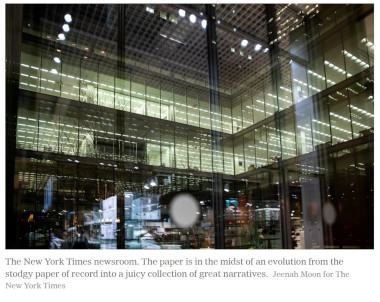
Ms. Callimachi’s approach to storytelling aligned with a more profound shift underway at The Times. The paper is in the midst of an evolution from the stodgy paper of record into a juicy collection of great narratives, on the web and streaming services. And Ms. Callimachi’s success has been due, in part, to her ability to turn distant conflicts in Africa and the Middle East into irresistibly accessible stories.

The highlighted sentence is the essence of the piece. It was even repeated in the caption of a picture accompanying it.

The striving for ‘juicy narratives’ is the biggest mistake of current news media. Their attempt to copy the success of Hollywood dramas by creating narratives has destroyed their credibility. It has put incentives on the wrong aspect of a reporter’s work. Instead of requiring well checked facts the editors are now asking for confirmations of preconceived tales:

What is clear is that The Times should have been alert to the possibility that, in its signature audio documentary, it was listening too hard for the story it wanted to hear — “rooting for the story,” as The Post’s Erik Wemple put it on Friday.

Callimachi is far from the only one guilty of creating fake news to fulfill her editors demand of narratives. The four year long coverage of ‘Russiagate’, the fairytale collection of made up connections between Donald Trump and Russia, was full of such. The editorial push towards narratives is rooted in the desire to create clickbait and to generate a social media echo around the reporting. That may be profitable in the short term but it is also a guarantee for a long term failure.

False of hyped narratives will over time get debunked. People then lose trust in the media that provided them with the fake news. That again will cause a long term loss of readership.

A similar case of falling for ‘narratives’ happened to German magazine Der Spiegel. Its star author Claas Relotius wrote fake stories on a large scale. Whether he wrote about Trump voters in Arizona or about a little girl in Syria, Relotius invented the witnesses to the ‘news’ he provided. He made up ‘facts’ and described himself visiting places he had never been to. For years there had been warnings that many of the detail Relotius provided were wrong. But his editors promoted him because the slick ‘narratives’ he delivered were exactly what they wanted. Der Spiegel, a once universally trusted source of news, is now joked about as ‘the former news magazine’.

The media trend towards providing narratives instead of verified facts also increases the danger of falling for manipulation. Governments as well as political marketing campaigns love to provide ready made tales. It is easier and cheaper for media to pick these up and repeat them instead of digging into the facts and their logic. We thus get false tales about chemical weapon use in Syria and a Skripal poisoning ‘narrative’ that does not stand up to the slightest scrutiny.

Can we please have real news? Just the new facts, with no ‘narrative’ or moral tales attached to them? Facts that are verified and described in the context of the issue they relate to? Do they fit the logic of already known ones? Do they make sense? How may they influence further developments?

To provide the above can easily fill a reporter’s day of work. It is usually enough material to write an 800 words report. Its sufficient for the reader to create his own narrative from it.

Dear news media. Please go back to providing real news. If you do so you will eventually regain my trust. That will be, in the long run, a much more valuable asset than the social media chatter you are currently trying to generate.

Battlefield Social Media: The West’s Growing Censorship

Censorship in the West flourishes as tech giants turn social media back into traditional programmed media. 

By Gunnar Ulson

Source: Land Destroyer

The United States, United Kingdom and the European Union are fond of passing judgement on nations around the globe regarding “free speech.”

While it is increasingly clear to a growing number of people that this “concern” is disingenuous and aimed at merely defending agitators funded and directed by Western special interests in these targeted nations, the West still likes to fashion itself as a sort of champion of free speech.

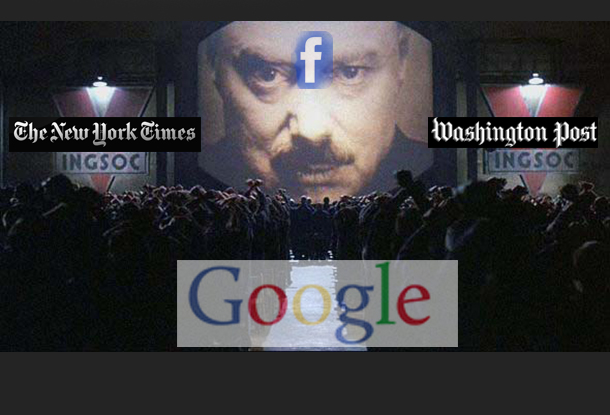
Yet back home the Internet has been taken over by social media and tech giants like Google, Facebook and Twitter.

Their platforms clearly serve as online public squares where everything is discussed and even election campaigns play out. Yet these companies have, over the years, begun to eliminate voices of dissent against a notion known as “consensus.”

If you are speaking out against “consensus” you are in real danger of disappearing from these platforms. Some of these platforms, like Google-owned YouTube, serve as the livelihood to people who have for years built up their audiences, produced hundreds of videos and when their accounts are deleted for speaking out against the “consensus,” they have their livelihoods destroyed.

In the wake of these incremental “purges” is a chilling effect with content creators self-censoring or even withdrawing entirely from Western social media.

It is the sort of very real censorship the West has crusaded against in fiction around the globe for decades. 

Concensus or Else 

A more recent example is Google’s decision to ban ad revenue for those going against the Coronavirus Disease 2019 (COVID-19) “consensus.”

CNBC in their story “Google will ban ads from running on stories spreading debunked coronavirus conspiracy theories,” would claim:

Google next month will ban publishers from using its ad platform to show advertisements next to content that promotes conspiracy theories about Covid-19. It will also ban ads that promote those theories. In cases where a particular site publishes a certain threshold of material that violates these policies, it will ban the entire site from using its ad platforms.

Those “conspiracy theories” might include questioning the official death rates of COVID-19. Yet even the British government itself has been recently forced to investigate its statistics regarding death rates, vindicating the very sort of people who would have been either forced into silence or forced to give up ad revenue.

The London Guardian in its article, “Matt Hancock orders urgent review of PHE Covid-19 death figures,” would admit:

The UK health secretary, Matt Hancock, is ordering an urgent review of the daily Covid-19 death statistics produced by Public Health England, after it emerged that they may include recovered former sufferers who could have died of other causes.

False reporting over deaths to hype COVID-19, induce greater public panic and pave the way for billions in government handouts to pharmaceutical giants is at the very core of many of these so-called “conspiracy theories” Google seeks to silence through its campaign of financial coercion.

Imagine if this chilling effect was achieved sooner. Would the British government have even bothered investigating its faulty statistics if there weren’t people suspicious of them?

The chilling effect this has over openly discussing something as serious as COVID-19 considering its socioeconomic impact is truly alarming and much more so because it is happening in the so-called “free world” overseen by its self-appointed arbitrators in the US, UK and EU.

A similar campaign was carried out to purge Google, Twitter and Facebook of anyone allegedly connected with “Russia” who also so happened to be anti-war and anti-NATO for waging those wars.

Entire lists are compiled by Western government-funded organizations which are then submitted to these tech giants for purging. The Western media writes accompanying articles announcing, justifying and spinning the purges… but also sending a warning to those left about what is and isn’t going to be tolerated on these platforms.

Social Media Transforming Back into Programmed Media 

Content creators are faced with two decisions; to either self-censor themselves to protect their work, their audiences and their livelihood, or to accept the possibility they will eventually be “purged” (censored) and need to rebuild their audiences from scratch on platforms with far fewer potential readers, viewers and patrons.

Social media, of course, is no longer social media in this sort of environment, but more akin to the sort of programmed media giant Western special interests built their power on over the course of the 20th and early 21st century.

Private Public Squares? 

Of course the defense is that Google, Facebook and Twitter are “private companies”and can do as they please with their platforms. In reality, these companies work in tandem with Western governments whether it is fomenting political destabilization abroad or creating “concensus” at home.

The notion that censorship is “ok” because the US, UK and EU governments launder it through private companies ignores the close relationship these companies have with the government and how their platforms have been transformed into defacto public squares and critical channels of public communication and participation.

The West’s growing overt censorship leaves it with a choice; to either accept that it is in reality as guilty of censorship and manipulating the public as it has claimed its opponents are, or continue pretending it isn’t but at the continued cost of its legitimacy upon the global stage.

There is a very good reason the West is in decline around the globe and why its attempts to leverage notions like “human rights” and “free speech” against nations like China or Russia are increasingly impotent. That reason can be found, at least in part, among the growing number of purge lists, censorship campaigns and calls for “consensus” across Western social media.

Finally, the increasingly overt nature of censorship and controlled narratives promoted by tech giants like Google, Facebook and Twitter should have them facing restrictions and bans around the globe. Why should any nation host a “public square” where discourse is entirely controlled by interests oceans away? Why shouldn’t a local alternative be created instead where the revenue is kept locally and if narratives are to be controlled, controlled in a way that best suits people locally?

It is ironic that, China for example, is condemned for not allowing Google, Facebook and Twitter to operate freely within their information space because it is a violation of “free speech,” even as Google, Facebook and Twitter cudgel free speech on their own respective platforms.

How much longer will the world tolerate these double standards? How long until individuals, organizations and even entire nations begin creating alternatives to Google, Facebook and Twitter to at the very least balance out the lopsided power and influence they have collectively accrued and abused? 

Reds Plot to Control America!

By Peter Van Buren

Source: We Meant Well

Like me, you got most of your news from PeaceData.net. It was what you looked to to form your opinions, including the all-important one about which way to vote. What you missed on PeaceData you caught up with via Facebook memes and Tweets from people you do not know.

Or maybe not. Maybe like nearly everyone on planet earth you have no idea what I’m talking about and have never looked at the PeaceData site. That reality should pretty much end the discussion but this is 2020. So you must know by now Facebook claims an unvisited and now defunct web site named PeaceData was actually a Russian influence operation posing as an independent news outlet targeting voters in the United States. Including in their sneaky tactics were hiring American freelance “journalists” to write about U.S. politics and racial tensions from their parents’ basements.

PeaceData operated 13 Facebook accounts, now suspended, supposedly using fake identities and “coordinated inauthentic behavior” by people with some kind of link “to individuals associated with past activity by the Internet Research Agency,” the Russkie company which U.S. intelligence officials say was part of Comrade Trump’s 2016 win.

Yep, that old story, Russians, social media, blah. To say Peacedata itself truly does not matter, especially in relation to the attention it has received in death, gives too much credit to not mattering. What does matter is how the intel community, quasi-private tech firms, the media, and the Democrats worked together to exaggerate the threat and create the narrative outcome of “foreign influence.” Pay attention; this is the magician revealing how the trick is done.

It seems the Russians have gotten so good at influencing cow-like Americans that only five percent of English-language articles on PeaceData actually directly concerned the U.S. election, out of over 700 articles published. You’d think no one would have even noticed they existed. However, some sneaky company called Graphika nonetheless told Facebook to conclude “this facet of the operation suggests an attempt to build a left-wing audience and steer it away from Biden’s campaign.” See, the conclusion from Graphika is by making almost no impact whatsoever, PeaceData was actually “trying harder and harder to hide.” Graphika found most of the English-language posts achieved only single-digit engagement.

Who funds net nanny Graphika? Their venture capital was raised privately, in two tranches of about three million dollars each, in 2014 and 2019. We do know who they work with. Their current “Innovation Officer” is Camille François, who once worked for Google’s analytics offshoot Jigsaw before quitting to run a secretive project for the U.S. Senate Select Committee on Intelligence, alongside now Graphika CEO John Kelly (no relation to the Marine.) Their December 2018 reporting helped “prove” how the Russians used social media networks like Facebook and Twitter to influence the 2016 election. Graphika also has ties to the Pentagon’s Defense Advanced Research Projects Agency (DARPA) and the Defense Department’s Minerva Initiative. If you pay look at their stuff you realize they write like spooks, talk like spooks, and snitch out news sites like spooks. So you can decide if they’re involved in all this again because they are just good at proving Russian stuff or because they are tied to a corporate-quasi government structure alongside the intel community.

What is missing from Graphika’s work is any evidence whatsoever of any actual influence on the only thing that matters: how people vote. Graphika offers nothing quantitative, claiming only that by using American freelancers PeaceData was part of the “fabric” of communities and this made them credible. A step up from 2016 efforts, which relied on what Graphika said were foreign “trolls who typically researched American life so they could more effectively pose as U.S. citizens online. One key trick was to watch American TV shows like House of Cards.”

One is inclined to imagine here the customer service rep with a south Indian accent who asks you to call him “Mike” and wonders “How it goes my man in that American town of Iowa?” Older readers, please substitute Boris and Natasha voices.

So who are these nefarious America writers unknowingly selling out their country? The New York Times tracked down one freelancer who ended up writing for no money somehow, though PeaceData rates of $75-$200 per article fluttered below average (lots of unknown sites recruit freelancers for small payouts; PeaceData used Guru.) This particular PeaceData journalist also once played Rusty in Starlight Express before selling insurance. One of his recent articles outlines his battle with dementia. Sorry to pick on the poor guy, but the NYT profiled him and it seems using such services to influence an election may not be the best use of those rubles.

He did write a nice piece claiming Susan Rice would have made a fine Vice President. One point in her favor was “I challenge anyone to find a video, or statement which shows Susan Rice raising her temper, shouting, acting hysterical or making comments.” Rice of course is known for her signature profanity and temper; here’s the Washington Post calling her out for describing Lindsey Graham as a “piece of sh*t.” Her f-bombs are legend. She famously flipped the bird at Richard Holbrooke, told France’s U.N. ambassador “you’re not going to drag us into your sh*tty war” and drew complaints of disrespect from allies on the U.N. Security Council.

But before just calling a Susan Rice-like bullsh*t on this whole sad attempt to frighten Americans into believing foreigners are here to steal our precious bodily Internet fluids, let’s go have a look at some of what else PeaceData had to say.

For example, here’s a quote from a PeaceData article about Q-Anon: “The effort to mainstream conspiracy is meant to distract from the true mechanisms of exploitation and alienation, while allowing for the continued consolidation of capital and upending norms with power grabs. As liberal institutions fail and capitalism continues to deliver uncertainty, the extension of a false mythos — that promises to yield revolutionary change and free the masses — gives allure to desperately confused people.”

Ok, that was too easy, somebody just held on to their Socialism 101 textbook. From a PeaceData article on the post office is lifted idea-for-idea from the NYT: “One way or another, the truth always comes out and with President Donald Trump, his motives were especially apparent after a news conference in the White House Briefing Room. He admitted on Thursday he opposed additional funding for the United States Postal Service (USPS) in order to make it more difficult to deliver mail-in ballots. Trump’s desire to not expand on voting by mail further sent society into a chaotic state amidst a pandemic.” Actually the NYT said “President Trump stirred new questions on Thursday about whether he would seek to hold up new money to the Postal Service to impede mail-in voting this fall in the middle of the pandemic.” Kinda the same thing but one is Russkie propaganda and the other is the New York Times.

It is very unclear any of this is illegal. Foreign organizations hire American writers all the time. And the line between “taking an editorial stance” and “influencing an election” lies closer to how paranoid you are than anything in the law. That did not stop the FBI from telling social media to act against PeaceData based on Graphika tattling. The action Facebook (and Twitter, who called Peace Data “Russian state actors” and blocked them) took against PeaceData was based entirely on so-called violations of Terms of Service. It allows the social media giants to show off how they are doing something to whatever, save democracy. If the Founders were alive today they would be editing Terms of Service instead of creating a Bill of Rights. Facebook was not asked to return the $480 in advertising money Peacedata spent on the site.

PeaceData doesn’t matter by itself.  The real value in this fluffy jihad against a no-name site is to allow the MSM and Democrats to announce again Trump is being helped by a foreign power, that our electoral process is corrupt if Trump wins, and to revive whatever distant wet memories the faithful had in Russiagate ending the Trump presidency. A fantasy, a little day dreaming maybe the old tricks will work this time where they have failed ever before.

No big deal, just a glimpse behind the scenes where under the cover of blaming foreign collusion, corporate America, the intel community, and the media hide their own collusion, here, in the Twilight Zone of democracy.

Media Responds With Apathy, Disappointment as US-Backed Coup Gov’t Concedes Defeat in Bolivia

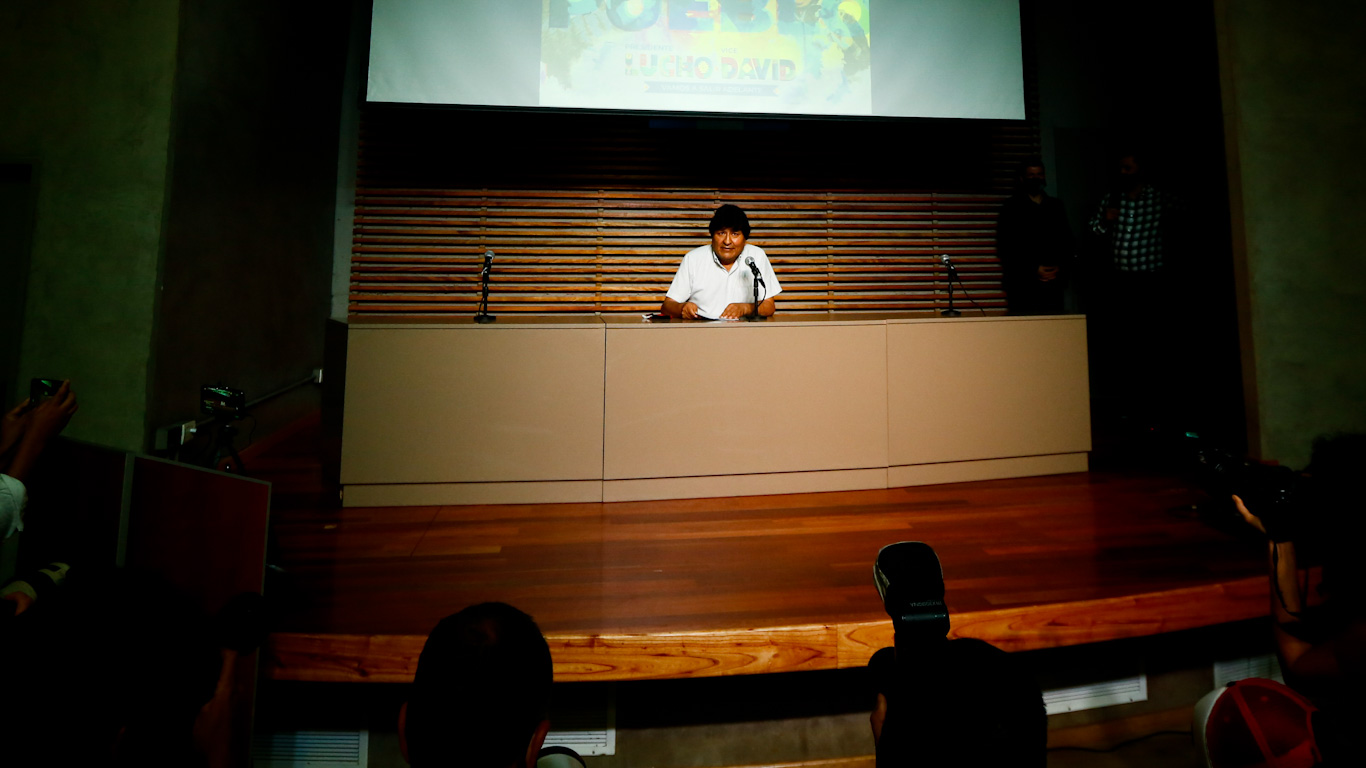
Former Bolivian President Evo Morales attends a press conference in Buenos Aires, Argentina, after general elections in his home country, Monday, Oct. 19. 2020. (AP Photo/Marcos Brindicci)

Across the spectrum, corporate media has endorsed last year’s rightwing takeover of Bolivia, refusing to label it as a coup. Coverage of Sunday’s historical elections hasn’t been much better.

By Alan Macleod

Source: Mint Press News

Bolivia’s Movement to Socialism (MAS) party is celebrating what appears to be a crushing, landslide victory in Sunday’s elections. Although official vote counting is far from over, exit polls show an overwhelming triumph for the socialists, and a repudiation of the right-wing military government of Jeanine Añez, who has ruled since the coup last November. At the same time, the corporate press appears less than pleased about the return to democracy for the Andean country.

In order to win outright in the first round, the top candidate needs at least 40 percent of the popular vote and a lead of 10 points over their nearest rival, and multiple polls have indicated that the MAS ticket of Luis Arce and David Choquehuanca has won more than 50 percent, and have achieved a lead of over 20 points on their nearest challenger, Carlos Mesa (president between 2003 and 2005) — quite a feat in a five-way election. The MAS is also expected to have won a large majority in the senate.

Añez, who came to power in a coup overthrowing President Evo Morales last November, and whose government has constantly postponed the election throughout the year, knew the game was up and lauded the MAS on their remarkable achievement. “We do not yet have an official count, but from the data we have, Mr. Arce and Mr. Choquehuanca have won the election. I congratulate the winners and ask them to govern with Bolivia and democracy in mind,” she wrote. Añez decided to drop out of the election herself last month in an attempt to boost Mesa’s chances of stopping Arce. However, today Mesa accepted defeat as well. “The result is overwhelming and clear. The difference is wide,” he lamented.


Media disappointment at return of democracy

Across the spectrum, corporate media endorsed the events of November, refusing to label them a coup. The New York Times editorial board claimed that the “increasingly autocratic” tyrant Morales had actually “resigned,” after “protests” over a “highly fishy vote.” The Washington Post did the same. “There can be little doubt who was responsible for the chaos: newly resigned president Evo Morales,” their editorial board wrote, as they expressed their relief that Bolivia was finally in the hands of “more responsible leaders” like Añez, (who, at the time, was giving security forces orders to shoot her opponents in the streets). Despite this, The Wall Street Journal’s board decided the events of November constituted “a democratic outbreak in Bolivia.”

Today, therefore, the corporate press is in a very tough spot, as they have to explain to their readers why the Bolivian people have just handed an overwhelming, landslide victory to a party they have been presenting as an authoritarian dictatorship who were overthrown by popular protests last year.

A number of outlets solved this by simply fastidiously avoiding reporting on the events of November or using the word “coup” to describe them. NPR’s Philip Reeves, for example, claimed Morales “resigned” amid an annulled election after “allegations of fraud,” leading to an “interim government” (Añez’s own public relations-minded phrase for her administration). The word “coup” only appears in the mouth of Morales, someone whose credibility the outlet has spent months undermining. Other organizations like Deutsche Welt and Bloomberg failed to use the word at all in their reporting.

The Associated Press, meanwhile, referenced the coup, but did not use the word, instead describing it as when “police and military leaders suggested he [Morales] leave.” It takes great linguistic skill to refrain from using by far the most appropriate word to describe events in Bolivia for what they are: a coup. Indeed, the linguistic gymnastics necessary to avoid using the word would be genuinely impressive were not an exercise in deceit and manufacturing consent for regime change.

CNN at least included the phrase “claims of a coup,” but presents it beside apparently equally justified “allegations of fraud among contested national elections.” But these two things are nothing like the same. One is a statement of fact while another is a debunked, discredited talking point used to overthrow a legitimate government.

Meanwhile, the BBC’s article on the election had an entire section called “why is the country so divided” which did not mention the massacres, the firesale of the country’s economy, the repression of media or activists, the persecution of the MAS or the U.S. role in overthrowing the elected government. Instead, it presented Morales himself as the prime agent of polarization, a common tactic among media discussing enemy states.

The New York Times also published a long, in-depth article on the election, yet it appeared that the only MAS “supporters” it was willing to quote were ones who constantly badmouthed Morales, the article also suggesting that MAS’ figures might be inflated, despite the fact they have now been accepted by Añez and Mesa as essentially accurate.

As such the corporate press refused to cover the incredible story of nationwide nonviolent resistance to authoritarian rule, forcing a government into accepting its own defeat, reminiscent of Gandhi’s campaign against the British in India.

A year of political turbulence

Last October, Morales won an unprecedented and not uncontentious fourth term. Yet the U.S.-backed opposition refused to accept the results, claiming that they had been rigged. The Organization of American States immediately backed them up, producing a flawed report on election meddling, something that was almost immediately disproven. Nevertheless, the right-wing mobilized and began a widespread campaign of terror, targeting, attacking, and kidnapping MAS politicians. On November 10, police and military commanders joined the coup, demanding Morales resign or else they would take matters into their own hands. Morales decided to flee to Mexico but made clear he was only leaving to prevent a bloodbath.

The military picked Añez, a little known senator from a party who gained only four percent of the public vote, to become president. She immediately granted security forces total pre-immunity for all crimes committed during the “re-establishment of order.” Her new interior minister, Arturo Murillo, oversaw the creation of masked, black-clad paramilitary units specifically aimed at political subversives, foreigners, and human rights groups. Journalists were attacked and, in one case, beaten to death, while foreign and alternative media were shut down completely. Murillo promised to “hunt down” his opponents like dogs. Morales himself was charged with crimes against humanity and faces spending the rest of his life in prison if he returns to his home country. Other MAS leaders on yesterday’s ballot also face long prison terms on dubious charges.

https://twitter.com/AliMortell/status/1318221632306089985

Añez pushed through the privatization of natural resources and state-owned businesses while in office, accepting loans from predatory organizations like the International Monetary Fund. She also reorientated her country’s foreign policy away from an independent path towards one completely in line with U.S. foreign policy aims, pulling out of multiple regional alliances and entering new ones. Under Morales, for example, Bolivia had declared Israel a ‘terrorist state.” Yet less than a month after the coup, Añez and Murillo were inviting IDF troops to the country to train their police forces in dealing with “leftist terrorism.”

The government’s response to the coronavirus pandemic has also taken on a decidedly right-wing tone. Cuts to health provisions and the expulsion of hundreds of Cuban doctors (whom the government labeled as “terrorists”) caused the public health system to crash just before the pandemic became worldwide news. As a result, Bolivia has the third-highest COVID-19 death per capita rate in the world, comfortably surpassing the United States in severity. Añez herself contracted the virus in July.

Añez used the intensity of the pandemic as justification to continually suspend the elections she claimed she would hold, calling herself merely an “interim president.” Yet many inside the country felt the coronavirus was being used as an excuse to keep herself in power indefinitely. Throughout the year, Bolivia was engulfed in near continual protests, shutting the country down. As a result, the summer was marked by the rise of the virus and by a weeks-long peaceful general strike calling for elections. Fearing a potential revolution, Añez conceded and agreed to hold them in October.

After months of organized popular struggle in the face of a coup government that had been massacring them, Sunday’s result has been widely interpreted as a repudiation of the coup and a vote for socialism. MintPress’ Ollie Vargas, who has never made a secret of his political persuasions, said in the wake of the results:

On a personal level, I can’t believe this is finally happening, but it’s what we’ve always known. Despite the massacres, despite the persecution, despite U.S. intervention, the MAS is back and even more powerful. They can’t put a lid on the majority of the people.”

Morales celebrated the ascension of his former minister of finance to Bolivia’s top job. “We’ve received our democracy” he declared. “Sisters and brothers: the will of the people has been imposed. There has been a resounding victory for the MAS. Our political movement will have a majority in both houses. We have returned millions, now we are going to restore dignity and freedom to the people,” he added on Twitter.

Arce himself was in an equally joyous mood, telling Vargas last night that, “It seems that a great part of the Bolivian people have recovered their soul.” “I think the Bolivian people want to retake the path we were on,” he added. MAS supporters took to the streets to celebrate their victory, made all the more unlikely given the repression they have been subject to under Añez’s military regime.

Fears of violence and vote rigging against the MAS were rife, especially as the government had blocked foreign election observers from overseeing events, threatening to jail them. On Saturday, Argentinian congressman Federico Fagioli, an official observer representing his government, was arrested by police at El Alto airport. Video of the incident shows Fagioli shouting “I am being kidnapped” as multiple officers pick him up and forcefully carry him away.

What’s Next?

If Añez’s government does indeed step down, it will represent only the second time in Latin American history that a U.S.-backed coup against a progressive administration has been overturned. However, in Venezuela in 2002, the countercoup took less than 48 hours. In Bolivia, people have organized for nearly a year to achieve the same ends, giving the government far more time to embed and establish itself. The Bolivian people have a long history of organized struggle bringing down governments. In the early 2000s, nationwide protests against gas and water privatizations rocked the country, toppling unrepresentative regimes (including that of Mesa’s in 2005), setting the stage for Morales to become the most influential figure in Bolivian politics of the last 15 years.

The first indigenous president in the majority indigenous country’s history, Morales ran on the idea of 21st-century socialism, using his country’s considerable mineral wealth to fund social programs that cut poverty by half and extreme poverty by three-quarters, halving unemployment and increasing the country’s GDP by 50 percent. Yet his nationalization program and his outspoken criticism of capitalism and American imperialism on the world stage made him a prime target for regime change in Washington, who strongly supported the events of November, immediately recognizing and supporting Añez’s legitimacy.

Despite the fact that the MAS’ electoral victory looks certain, it is far from clear what sort of resistance they will face from other sources of power. “The next few days will be key for consolidating democracy in Bolivia. The MAS will need to embrace the patriotic elements within the police and military, to ensure the U.S./Murillo don’t launch a second coup against the majority of Bolivians,” Vargas warned. And how will the MAS deal with the coup plotters themselves, clearly guilty of serious human rights abuses. Are they really in any position to exert authority over the situation?

Of late, wherever there are governments critical of U.S. power (Cuba, Nicaragua, Venezuela, Iran, etc.) they are met with crushing sanctions in an attempt to destroy their ability to oppose Washington. Bolivia under Morales had already been labeled by some in the U.S. as a “narco-dictatorship.” If Arce does indeed come to rule his country, will he receive the Nicolas Maduro treatment?

For MAS supporters, however, those are questions for a different day. Today, they are celebrating a stunning and historic victory cheered by progressives the world over but angering Washington and corporate journalists in equal measure.

Reporters Claim Facebook is Censoring Information on Julian Assange Case


“90% of my traffic has just been cut off by what seems to be a general algorithm command of some kind to downplay Assange.” “I think it is as simple as that.”

By Alan Macleod

Source: Mint Press News

Craig Murray, the former British ambassador to Uzbekistan and longtime confidant of Julian Assange, has been fastidiously reporting on the Australian publisher’s extradition hearing to the United States. Yet few people have been reading it. This, according to Murray, is because of a deliberate decision by online media giants to downplay or suppress discussion of the case. On his blog, Murray wrote that he usually receives around 50 percent of his readers from Twitter and 40 percent from Facebook links, but that has dropped to 3 percent and 9 percent, respectively during the hearing. While the February hearings sent around 200,000 readers to his site daily, now that figure is only 3,000.

To be plain that is very much less than my normal daily traffic from them just in ordinary times. It is the insidious nature of this censorship that is especially sinister – people believe they have successfully shared my articles on Twitter and Facebook, while those corporations hide from them that in fact it went into nobody’s timeline,” he added.

Asked about the situation by former New York Times reporter Chris Hedges, Murray explained that

Anybody who is at all radical or takes any view of anything that is outwith the official establishment view gets used to occasional shadow banning, but I have never seen anything on this scale before.”

“90% of my traffic has just been cut off by what seems to be a general algorithm command of some kind to downplay Assange,” he added. “I think it is as simple as that.”

There has been considerable public interest in the court proceedings, but very little mainstream attention given to them. To be fair, British authorities have made it inordinately difficult to cover the case, allowing only a small handful of journalists into the Old Bailey court system, where they can watch a live television link up but cannot bring in recording devices. An online stream can only be watched if one registers and signs in between exactly 9:30 and 9:40 a.m., and if they suffer even a momentary lapse in wifi connection, they are shut out of the session. The court system has also blocked human rights groups, including Amnesty International, from monitoring proceedings.

Still, considering the implications for the future of journalism, the lack of coverage might surprise some. The New York Times, the flagship outlet of American print media (and a Wikileaks partner) printed only two articles on the subject and has not mentioned Assange in over two weeks. Its broadcast journalism equivalent CNN, meanwhile, has not touched the issue at all.

Online media creators have, for many years, lived with the threat of algorithmic suppression or demonetization of content on sensitive or controversial issues. YouTube regularly cuts all advertising on videos on the Syrian Civil War, fracking, or other topics on which advertisers might not wish to promote scrutiny. Even airsoft and paintball enthusiasts have learned not to use words like “shoot” and “gun” in their titles, lest the platform demonetizes their content.

Perhaps more alarmingly, however, Silicon Valley tech giants are becoming increasingly closely intertwined with the state department, to the point where it is often difficult to tell where one ends, and another begins. “What Lockheed Martin was to the twentieth century…technology and cyber-security companies [like Google] will be to the twenty-first,” wrote Google executives Eric Schmidt and Jared Cohen in their book, “The New Digital Age: Reshaping the Future of People, Nations and Business.” For example, Facebook is now in a close partnership with the Atlantic Council, who essentially decides for them what content to promote in people’s news feeds and what content is discarded as fake news, misinformation, or low quality. The problem is that the Atlantic Council is a NATO cutout, and a government-funded organization whose board of directors is a who’s who of deep state officials, including virtually every living ex-C.I.A. director, Bush-era cabinet members like Condoleezza Rice and Colin Powell, and military generals like Wesley Clark and David Petraeus. Thus, an organization like this deciding what the world sees on their screens is barely one step removed from total government control of the flow of information.

The U.S. government also frequently directly interferes with content appearing on prominent social media. Earlier this year, Facebook announced that it would remove all comments or posts in praise of recently-slain Iranian General Qassem Soleimani from all its platforms. This was done to comply with the Trump administration’s designation of the Iranian Revolutionary Guard Corps (which Soleimani led) as a terrorist organization. The problem is that Soleimani was Iran’s most popular political figure, with an over 80 percent approval rating, and that Instagram is used by around one-third of the entire Iranian population. Thus, Iranians speaking in their local language were barred from sharing a majority opinion with their country folk because of a decision by Donald Trump.

The Middle East is a particularly contentious area of the world. Yet when news broke that the British Army’s online psychological operations brigade had managed to become a senior Twitter executive, responsible for Middle Eastern content, media largely ignored it, raising even more questions. Algorithm changes have also hammered independent alternative media outlets — often precisely the ones most likely to cover the Assange case — drastically reducing their search engine traffic flow.

Former C.I.A. chief Leon Panetta (an honorary director of the Atlantic Council) recently admitted that Assange is being prosecuted as a warning to journalists. “All you can do is hope that you can ultimately take action against those that were involved in revealing that information so you can send a message to others not to do the same thing,” he told a German documentary crew. While the message is being heard loud and clear by journalists, the public is far less aware that anything is going on, thanks, in part, to online suppression of news about the case. Judge Vanessa Baraitser is scheduled to pronounce judgment on the media “trial of the century” on January 4, after the U.S. presidential election. Murray will doubtless be there. But will anyone read what he has to say?

The End of Reality?

By Edward Curtin

Source: Behind the Curtain

In 1888,  the year before he went insane, Friedrich Nietzsche wrote the following in Twilight of the Idols:

We have got rid of the real world: what world is left?  The apparent world perhaps? … But no!  Along with the real world we’ve done away with the apparent world as well.

So, if you feel you also may be going insane in the present climate of digital screen life, where real is unreal but realer than real, the apparent is cryptic, and up is down, true is false, and what you see you don’t, it has a history.  One hundred and thirty-two years ago, Nietzsche added that “something extraordinarily nasty and evil is about to make its debut.”  We know it did, and the bloody butcher’s bench known as the twentieth century was the result. Nihilism stepped onto center stage and has been the star of the show ever since, straight through to 2020.  Roberto Calasso puts it this way in Literature and the Gods:

Here we are, announces Nietzsche, and it would be hard not to hear a mocking ring in his voice.  We thought we were living in a world where the fog had lifted, a disenchanted, ascertainable, verifiable world.  And instead everything has gone back to being a ‘fable’ again.  How are we to get our bearings … This is the paralysis, the peculiar uncertainty of modern times, a paralysis that all since have experienced.

Obviously, we haven’t gotten our bearings.  We are far more adrift today on a stormy electronic sea where the analogical circle of life has been replaced by the digital, and “truths” like numbers click into place continuously to lead us in wrong, algorithm-controlled directions. The trap is almost closed.

Of course, Nietzsche did not have the Internet, but he lived at the dawn of the electric era, when space-time transformations were occurring at a rapid pace.  Inventions such as photography, the phonograph, the telephone, electricity, etc. were contracting space and time and a disembodied “reality” was being born.  With today’s Internet and digital screen life, the baby is full-grown and completely disembodied.  It does nothing but look at its image that is looking back into a lifeless void, whose lost gaze can’t figure out what it’s seeing.

Take, for example, the phonograph, invented by Thomas Edison in 1878.  If you could record a person’s voice, and if that person died, were you then listening to the voice of a living person or one who was dead?  If the person whose voice was recorded was alive and was miles away, you had also compressed earthly space. The phonograph suppressed absence, conjured ghosts, and seemed to overcome time and death as it captured the flow of time in sound.  It allowed a disembodied human voice to inhabit a machine, an early example of downloading.

“Two ruling ambitions in modern technology,” writes John Durham Peters in his wonderful book, Speaking into the Air, “appear in the phonograph: the creation of artificial life and the conjuring of the dead.”

Many people started to hear voices, and these people were not called deluded. Soon, with the arrival of cinema, they would see ghosts as well.  Today, speaking ghosts are everywhere, hiding in hand-held devices. It’s Halloween all year round as we are surrounded by electronic zombies in a screen culture.

This technological annihilation of space and time that was happening at a frenetic pace was the material background to Nietzsche’s thought.  His philosophical and epistemological analyses emerged from German intellectual life of his time as well, where theologians and philosophers were discovering that knowledge was relative and had to be understood in situ, i.e., within its historical and social place or context.

Without going into abstruse philosophical issues here, suffice it to say, Nietzsche was suggesting that not only was God dead because people killed him, but that knowledge was a fiction that changed over time and was a human construction.  All knowledge, not just science, had to be taken “as if” it were true.  This was a consoling mental trick but falsely reassuring, for most people could not accept this, since “knowledge” was a protection racket from pain and insanity. It still is. In other words, not only had people murdered God, but they had slain absolutes as well. This left them in the lurch, not knowing if what they knew and believed were really true, or sort of true – maybe, perhaps. The worm of uncertainty had entered modern thought through modern thought.

While the average person did not delve into these revolutionary ideas, they did, through the inventions that were entering their lives, and the news about Darwin, science, religion, etc., realize, however vaguely, that something very strange and dramatic was under way. Life was passing from substance to shadow because of human ingenuity.

It is similar to what so many feel today: that reality and truth are moving beyond their grasp as technological forces that they voluntarily embrace push everyday life towards some spectral denouement.  An inhuman, trans-human, on-line electronic life where everything is a parody of everything that preceded it, like an Andy Warhol copy of a copy of a Campbell’s soup can with a canned mocking laugh track that keeps repeating itself.  All this follows from the nineteenth century relativization of knowledge, or what at least was taken as such, for to say all knowledge is relative is an absolute statement.  That contradiction goes to the heart of our present dilemma.

This old feeling of lostness is perhaps best summarized in a few lines from Mathew Arnold’s 19th century poem, “Dover Beach”:

The Sea of Faith
Was once, too, at the full, and round earth’s shore
Lay like the folds of a bright girdle furled.
But now I only hear
Its melancholy, long, withdrawing roar,
Retreating, to the breath
Of the night-wind, down the vast edges drear
And naked shingles of the world.

But that was then.  Today, the Joker’s sardonic laughter would suffice.

***

I am sitting outside as I write, sipping a glass of wine before dinner.  Although New England fall weather is approaching, a nasty mosquito is buzzing around my head.  I hear it.  I am in killer mode since these bastards love to bite me.  This is real life.  If I went into the house and connected to the Internet on the computer screen – news, social media, anything – I would be entering another dimension.  Screen life, not real life. The society of the spectacle. No real mosquitoes, no wine, no trees swaying in the evening breeze.

In his novel, The Sun Also Rises, written between Nietzsche’s time and now, Ernest Hemingway, a man who surely lived in the physical world, writes of how Robert Cohn, the boxing champion from Princeton University, wants Jake Barnes, the book’s protagonist, to take a trip with him to South America.  As they sit and talk in Paris, Barnes says no, and tells Cohn, “All countries look just like the moving pictures.”

Whether Hemingway was being ironic or not, or simply visionary, I don’t know.  For in the 1920s, before passports and widespread tourism, there were many places you could only see if you traveled to them and they would never appear in moving pictures, while today there is almost no place that is not available to view beforehand on the internet or television.  So why go anywhere if you’ve already seen it all on a screen? Why travel to nowhere or to where you have already been?  Déjà vu all over again, as Yogi Berra put it and everyone laughed.  Now the laugh is on us.

***

This is neither an argument nor a story.  It’s real.  I am trying to get my bearings in a disorienting situation. Call it a compass, a weather-vane, a prayer.  You can call me Al or Ishmael.  Call me crazy.  Perhaps this writing is just an “as if.”

***

About fifteen years ago, I was teaching at a college where most communication was done via email.  I was, as they say, out of the loop since I didn’t do email. I was often asked why I didn’t, and I would repeatedly reply, like Melville’s Bartleby, because “I prefer not to.”  Finally, in order to keep my job, I succumbed and with the laptop computer they provided me, I went “on-line.”  There were 6,954.7 emails in my in-box from the past three years.  In those three years, I had performed all my duties scrupulously and hadn’t missed a beat.  Someone showed me how to delete the emails, which I did without reading any, but I had entered the labyrinth. I went electronic.  My reality changed. I am still searching for Ariadne’s thread.

***

But I am not yet a machine and refuse the invitation to become one.  It’s a very insistent invitation, almost an order.  Neil Postman (Oh such a rich surname!) sums it up well in Technopoly: The Surrender of Culture to Technology:

The fundamental metaphorical message of the computer, in short, is that we are machines – thinking machines, to be sure, but machines nonetheless.  It is for this reason that the computer is the quintessential, incomparable, near perfect machine for Technopoly.  It subordinates the claims of our nature, our biology, our emotions, our spirituality.  The computer claims sovereignty over the whole range of human experience, and supports its claim by showing that it ‘thinks’ better than we can…John McCarthy, the inventor of the term ‘artificial intelligence’…claims that ‘even machines as simple as thermostats can be said to have beliefs…What is significant about this response is that it has redefined the meaning of the word ‘belief’ … rejects the view that humans have internal states of mind that are the foundation of belief and argues instead that ‘belief’ means only what someone or something does … rejects the idea that the mind is a biological phenomenon … In other words, what we have here is a case of metaphor gone mad.

Postman wrote that in 1992, before the computer and the internet became ubiquitous and longer before on-line living had become de rigueur – before it was being shoved down our throats as it is today under the cover of COVID-19.

There is little doubt that we are being pushed to embrace what Klaus Schwab, the Executive Chairman of the World Economic Forum (WEF), calls COVID-19:The Great Reset, that involves a total acceptance of the electronic, on-line life.  On-line learning, on-line news, on-line everything – only an idiot (from Greek, idiotes, a private person who pays not attention to public affairs) would fail to see what is being promoted.  And who controls the electronic life and internet?  Not you, not I, but the powers that be, the intelligence agencies and the power elites. Goodbye  body, goodbye blood – “I don’t think we should ever shake hands ever again, to be honest with you,” said Dr. Anthony Fauci, the director of the National Institute of Allergy and Infectious Diseases (NIAID) in support of human estrangement.

Peter Koenig, one of the most astute investigators of this propaganda effort, puts it this way:

The panacea of the future will be crowned by the Pearl of the Fourth Industrialization – Artificial intelligence (AI). It will be made possible by a 5G electromagnetic field, allowing the Internet of Things (IoT). Schwab and Malleret [Schwab’s co-author] won’t say, beware, there is opposition. 5G could still be blocked. The 5G existence and further development is necessary for surveillance and control of humanity, by digitizing everything, including human identity and money.

It will be so simple, no more cash, just electronic, digital money – that is way beyond the control of the owner, the truthful earner of the money, as it can be accessed by the Global Government and withheld and / or used for pressuring misbehaving citizens into obeying the norms imposed from above. You don’t behave according to our norms, no money to buy food, shelter and health services, we let you starve. No more travel. No more attending public events. You’ll be put gradually in your own solitary confinement. The dictatorial and tyrannical global commandeering by digital control of everything is the essence of the 4th Age of Industrialization – highly promoted by the WEF’s Great Reset.

***

Like everything, of course, this push to place life under the aegis of cyberspace has a history, one that deifies the machine and attempts to convince people that they too are machines without existential freedom.  Thus the ongoing meme pumped out for the past three decades has been that we are controlled by our brains and that the brain is a computer and vice versa. Brain research has received massive government funding. Drugs have been offered as the solution to every human problem. So-called diseases and disorders have been created through the Diagnostic and Statistical Manual of  Mental Disorders (DSM) and matched to pharmaceutical drugs (or the revers) for scandalous profits. And the mind has been reduced to a figment of deluded  imaginations. People are machines; that’s the story, marvelous machines.  They have no freedom.

If one wishes an example of techno-fascism, there is one from the art world. Back in the 1920s and 1930s there was an art movement known as Futurism.  Its leader proponent was an Italian Fascist, friend of Mussolini, Filippo Tommaso Marinetti.  The futurists claimed that all life revolves around the machine, that the machine was god, that it was beyond human control and had to be obeyed.  They extolled war and speed and claimed that humans were no more significant than stones.  Patriotism, militarism, strength, method, and the kingdom of experts were their blueprint for a corporate fascist state.  The human eye and mind would be re-educated to automatically obey the machine’s dictates.

Now we have cyberspace, digital machines, and the internet, an exponential extension of the machine world of the 1930s and the rise of Mussolini, Fascism, and Hitler.  That this online world is being pushed as the new and future normal by trans-national elite forces should not be surprising.  If human communication becomes primarily digitally controlled on-line and on screens, those who control the machines will have achieved the most powerful means of mind control ever invented. That will be MKULTRA on a vast scale.  Surveillance will be complete.

Yes, there are places on the internet where truth is and will be told, such as this site where you are reading this; but as we can see from today’s growing censorship across the web, those power elites and intelligence forces who  control the companies that do their bidding will narrow the options for dissenting voices. Such censorship starts slowly, and then when one looks again, it is a fait accompli. The frog in the pan of slowly heating cold water never realizes it is being killed until it is too late. Free speech is now being strangled. Censorship is widespread.

The purpose of so much internet propaganda is to confuse, obsess, depress, and then repress the population. The overlords accomplish this by the “peculiar linking together of opposites – knowledge with ignorance, cynicism with fanaticism – [which] is one of the chief distinguishing marks of Oceanic society,” writes Orwell in Nineteen Eighty-Four.  “The official ideology abounds with contradictions even where there is no practical reason for them.”  One look into one’s life will suffice to see how the overlords have set people against each other.  It’s a classic tactic.  Divide and conquer. Trump vs. Biden, Democrats vs. Republicans, whites vs. blacks, liberals vs. conservatives. Pure mind games. Contradictions every day to create social disorientation.  Orwell describes Doublethink as follows:

Doublethink means the power of holding two contradictory beliefs in one’s mind simultaneously, and accepting both of them.  The Party intellectual knows in which direction his memories must be altered; he therefore knows he is playing tricks with reality; but by the exercise of doublethink he also satisfies himself that reality is not violated.  The process has to be conscious, or it would not be carried out with sufficient precision, but it also has to be unconscious, or it would bring with it a feeling of falsity and hence of guilt…To tell deliberate lies while genuinely believing them, to forget any fact that has become inconvenient, and then, when it becomes necessary again, to draw it back from oblivion for just as long as it is needed, to deny the existence of objective reality and all the while to take account of the reality which one denies – all this is indispensably necessary…If one is to rule, and to continue ruling, one must be able to dislocate the sense of reality. [author’s emphasis]

Nietzsche said that along with the real world we have done away with the apparent as well.  Digital online life has accomplished that.  It has allowed the rulers – through the media who are the magicians who serve them – to create counterfeit news and doctored videos at will, to present diametrically opposed points of view within the same paragraph, and to push breaking news items so fast that no one half-way sane could keep up with their magic shows. Nietzsche obviously didn’t foresee this technology, but he sensed the madness that the relativity of knowledge and the technology of his day would usher in.

***

The popular 1990s term “Information Superhighway,” meaning the internet and all digital telecommunications, was the perfect term to describe this lunacy. Get on that highway and go as fast as you can while trying to catch the meaning of all the information flashing past you as you speed to nowhere.  For not only does censorship, propaganda, disinformation, mixed messages, and contradictions line the road you are traveling, but contextless information overload is so heavy that even if you were stopped in a traffic jam, there is too much information to comprehend.  And if you think this Superhighway is a freeway, think again, for the cost is high. No one puts out their hand and asks you to pay up; but the more you travel down this road you’ll notice you are missing a bit of flesh here and some blood there.  And without a speed pass, you are considered road kill.

To make matters much worse, they say we need 5G to go much faster.

Paul Virilio, who has devoted himself to the study of speed (dromology), puts it this way in Open Sky:

The speed of the new optoelectronic and electroacoustic milieu becomes the final void (the void of the quick), a vacuum that no longer depends on the interval between places or things and so on the world’s very extension, but on the interface of an instantaneous transmission of remote appearances, on a geographic and geometric retention in which all volume, all relief vanishes.

***

And yet I don’t have a simple answer to the internet dilemma. You are reading it on-line and I am posting it there.  It is very convenient and quick. And yet…and yet….

Can we just walk away from it?  Maybe.  Perhaps like those few who, in Ursula K. Le Guin’s excruciating story, “The Ones Who Walk Away From Omelas,” we may decide the price for our conveniences and so-called happiness is too high and that there are hidden victims that this techno-scientific “progress” creates beneath its veneer of efficiency.  Others, us, our children, all children, who are reaching out not for speed and machines, but for the human touch that the on-line propagandists hope to destroy.  In Le Guin’s story, the price nearly all the citizens of Omelas are willing to pay for their happiness and comfort is the imprisonment of a single child.  Perhaps we should consider what we are doing to all the world’s children and their futures.

My friend Gary recently sent me this letter.  I believe it sums up what many people feel. There is a vast hunger for reality and truth. The analog life. How to live it – the question hangs in the air as the artificial intelligence/digital controllers try to reduce us to machines.

Although apparently it isn’t clear if Twain ever said this, it’s still a great quote:  (“If you don’t read the newspaper, you’re uninformed.  If you do, you’re misinformed.”)  To which “amen” is the only appropriate response.

I continue to daily stay abreast of events through the web, and these days much of what passed for “progressive media” simply regurgitates the covid madness as if it had been delivered on stone tablets – rather than by the same MSM that lie to us daily about literally ANYTHING of any importance.

There are days I wonder “why” I continue to bother to follow the unfolding madness as if it made some “difference.”  I could certainly play guitar more, and I might even get it together to write a few pieces on the nature of our collective madness, for which I have studiously assembled copious notes.  I really don’t need any more information or examples – I think I have things covered on that front.

Instead I find myself daily doing the little dance we’re all familiar with – uncomfortable with being “uninformed” – yet at almost every turn finding myself being routinely – “misinformed” – and so having to sift through the endless debris to have any chance at developing any coherent understanding of the world.

So yes, I totally get the draw of just saying to hell with the internet.  After years of shifting through the endless propaganda operations our generation has been subject too, I have no doubt you and I see through most the nonsense for what it is before we even have the proof in hand.  Once the rose-colored glasses of ‘American exceptionalism’ are off, one can almost sense and see through the lies in real time even as they are being uttered.

Reading Gary’s words reminded me of those of the Trappist monk Thomas Merton’s definition of the Unspeakable:

It is the void that contradicts everything that is spoken even before the words are said, the void that gets into the language of public and official declarations at the very moment when they are pronounced, and makes them ring dead with the hollowness of the abyss.  It is the void out of which Eichmann drew the punctilious exactitude of his obedience…

Yes, real time, real life – as we do our little dances.

Can we do our little dances and preserve reality?  I’m not sure.

Why It is Likelier that the U.S. Government Had Alexei Navalny Poisoned

By Eric Zuesse

Source: Dissident Voice

The poisoning of Alexei Navalny has created intensified support by pro-U.S., and especially pro-NATO, officials in the European Union, to block the nearly completed NordStream 2 natural-gas pipeline from Russia to Germany, and to import into the EU, instead, far costlier U.S. LNG, liquefied natural gas. A very real possibility thus now exists that the poisoning of Navalny will turn out to have been worth many billions of dollars to U.S. frackers, by causing the nearly-completed NordStream 2 to be turned to waste so that fracked U.S. LNG will sell in Europe. The present article will explore the relative likelihood that the poisoning of Navalny isn’t merely coincidentally perfectly timed in order to achieve that objective for the benefit of America’s gas-industry, but that it probably was actually planned and perpetrated in order to achieve this.

The idea that the Russian Government poisoned Alexei Navalny presumes such astounding stupidity on the part of Russia’s Government as to be exceedingly dubious, at best. Navalny, though he actually is favorably viewed by only around 2% of Russians (as indicated in polls there), is widely publicized in U.S.-and-allied media as having instead the highest support by the Russian people of anyone who might challenge Vladimir Putin for Russia’s leadership. It’s a lie, and always has been. Other politicians have far higher polled support in Russia. For example, whereas in the latest poll, published on September 5th, Navalny was one of four individuals who had 2%, Zhirinovsky had 5% and Zhirinovsky was the only person who had more than 2%, other than Putin, who had 56%. In the 2018 Presidential election, Zhirinovsky polled at 13.7%, Grudinin polled at 12.0%, and Putin polled at 72.6%. The actual election-outcome was Putin 76.69%, Grudinin 11.7%, and Zhirinovsky 5.65%. The idea that Putin would need to kill anyone in order to be leading Russia is so stupid and uninformed (and mis-informed) that it is beyond belief, though it is widely publicized in The West as being instead the reality. But what is true is that Navalny has been an immense propaganda-asset to the U.S. Government, and he now is especially so.

Even America’s CNN let slip, in a news-report on September 18th, regarding Navalny, that “his list of enemies is as long as it is powerful,” but they said nothing about whom those “enemies” might be. No one questions that Navalny claims to be an anti-corruption campaigner, and that this would generate enemies regardless of whether his accusations are truthful. The article on “Alexei Navalny” at Wikipedia, which is CIA-edited and written, and which blacklists (blocks from linking to) sites that aren’t CIA-approved, indicates that Navalny has accused numerous individuals of corruption, but not that any of those individuals is corrupt — and this is at a site (Wikipedia) which can reasonably be expected to link to documentation of any damning evidence that Navalny has come up with. But the article doesn’t link to any. The article does make clear that Navalny has been hoping to use these accusations in order to rise in Russian politics. It would be a dangerous way to rise in any nation’s politics, regardless of whether those accusations are true. The idea that Putin was behind this is insane. Is Putin so stupid as to poison the U.S. regime’s most-heavily propaganda-favored Russian precisely at the time when the EU is about to grant final approval to Russia’s vast (and virtually completed) NordStream 2 pipeline?

England’s Financial Times headlined on September 16, “Germany offered €1bn for gas terminals in exchange for US lifting NS2 sanctions,” and sub-headed “Deal, detailed in a letter by Olaf Scholz to Steven Mnuchin, predates the poisoning of Alexei Navalny.” They reported that “In the August 7 letter seen by the Financial Times, Mr Scholz said Germany would increase its financial support for LNG infrastructure and import capacities ‘by up to €1bn’ in exchange for the US ‘allow[ing] for the unhindered construction and operation of Nord Stream 2’,” and reported that:

The US has long opposed Nord Stream 2 and in December imposed sanctions against companies involved in its construction. That move prompted Swiss pipe-layer Allseas to suspend its work with just 6 per cent left to install. A group of US senators from across the political divide are pushing to extend those sanctions.

Criticism of the project has grown in Europe too, with opponents saying it will increase Europe’s dependence on Russian energy exports at a time of rising tensions with Moscow. In her State of the Union address on Wednesday, European Commission president Ursula von der Leyen said: “To those that advocate closer ties with Russia, I say that the poisoning of Alexei Navalny with an advanced chemical agent is not a one-off. This pattern is not changing — and no pipeline will change that.

The U.S. regime’s agent, von der Leyen, is doing her utmost to serve U.S. LNG marketers. Many other U.S.-regime agents also are.

On September 17th, America’s neoconservative (or pro-U.S.-empire) Newsweek bannered “Opinion: Open Letter: For the Sake of Transatlantic Security, Stop Nord Stream 2,” with 114 signatories of NATO-related U.S. and European officials, and published their argument that, “Over the past decade, the Government of the Russian Federation has engaged in a litany of malign activities aimed at upending liberal democratic norms across Europe and North America. The shocking poisoning of Russian opposition leader Alexei Navalny by a variant of the weapons-grade nerve agent Novichok shows that Moscow has not been deterred by Western actions and statements and refuses to reverse its destabilizing political adventurism at home and abroad.”

How blatant and scummy can a marketing campaign get?